<?xml version="1.0" encoding="ISO-8859-1"?><article xmlns:mml="http://www.w3.org/1998/Math/MathML" xmlns:xlink="http://www.w3.org/1999/xlink" xmlns:xsi="http://www.w3.org/2001/XMLSchema-instance">
<front>
<journal-meta>
<journal-id>0120-6230</journal-id>
<journal-title><![CDATA[Revista Facultad de Ingeniería Universidad de Antioquia]]></journal-title>
<abbrev-journal-title><![CDATA[Rev.fac.ing.univ. Antioquia]]></abbrev-journal-title>
<issn>0120-6230</issn>
<publisher>
<publisher-name><![CDATA[Facultad de Ingeniería, Universidad de Antioquia]]></publisher-name>
</publisher>
</journal-meta>
<article-meta>
<article-id>S0120-62302011000400004</article-id>
<title-group>
<article-title xml:lang="en"><![CDATA[Comparative study for chaotic behaviour in fire fighting robot]]></article-title>
<article-title xml:lang="es"><![CDATA[Estudio comparativo de comportamiento caótico en un robot de combate a incendios]]></article-title>
</title-group>
<contrib-group>
<contrib contrib-type="author">
<name>
<surname><![CDATA[Morales Tavera]]></surname>
<given-names><![CDATA[Magda Judith]]></given-names>
</name>
<xref ref-type="aff" rid="A01"/>
</contrib>
<contrib contrib-type="author">
<name>
<surname><![CDATA[Lengerke]]></surname>
<given-names><![CDATA[Omar]]></given-names>
</name>
<xref ref-type="aff" rid="A02"/>
</contrib>
<contrib contrib-type="author">
<name>
<surname><![CDATA[Suell Dutra]]></surname>
<given-names><![CDATA[Max]]></given-names>
</name>
<xref ref-type="aff" rid="A01"/>
</contrib>
</contrib-group>
<aff id="A01">
<institution><![CDATA[,Federal University of Rio de Mechatronics Systems & Robotics Research Group ]]></institution>
<addr-line><![CDATA[Rio de Janeiro ]]></addr-line>
<country>Brasil</country>
</aff>
<aff id="A02">
<institution><![CDATA[,Autonomous University of Bucaramanga  ]]></institution>
<addr-line><![CDATA[Bucaramanga ]]></addr-line>
<country>Colombia</country>
</aff>
<pub-date pub-type="pub">
<day>00</day>
<month>09</month>
<year>2011</year>
</pub-date>
<pub-date pub-type="epub">
<day>00</day>
<month>09</month>
<year>2011</year>
</pub-date>
<numero>60</numero>
<fpage>31</fpage>
<lpage>41</lpage>
<copyright-statement/>
<copyright-year/>
<self-uri xlink:href="http://www.scielo.org.co/scielo.php?script=sci_arttext&amp;pid=S0120-62302011000400004&amp;lng=en&amp;nrm=iso"></self-uri><self-uri xlink:href="http://www.scielo.org.co/scielo.php?script=sci_abstract&amp;pid=S0120-62302011000400004&amp;lng=en&amp;nrm=iso"></self-uri><self-uri xlink:href="http://www.scielo.org.co/scielo.php?script=sci_pdf&amp;pid=S0120-62302011000400004&amp;lng=en&amp;nrm=iso"></self-uri><abstract abstract-type="short" xml:lang="en"><p><![CDATA[The fire fighting monitoring work is a case study where the chaotic control could minimize human, material and environmental injuries. In this paper, we proposed a chaotic control for a mobile robot, in order to do a further inspection in regular spaces, moving it through time with non determinate trajectories. A chaotic nature in the mobile vehicle is added, putting together kinematics with non linear equations such as Arnold and Lorenz, in the same system.]]></p></abstract>
<abstract abstract-type="short" xml:lang="es"><p><![CDATA[El trabajo de supervisión de incendios es un caso de estudio, donde el control caótico podría minimizar las lesiones en humanos, materiales y ambientales. En este artículo se propone un control caótico para un robot móvil, con el fin de hacer una nueva inspección en espacios regulares, desplazándolo a través de trayectorias no determinadas. Una naturaleza caótica en el robot, es adicionada, integrando la cinemática con las ecuaciones no lineales de Arnold y Lorenz, en el mismo sistema.]]></p></abstract>
<kwd-group>
<kwd lng="en"><![CDATA[Chaos]]></kwd>
<kwd lng="en"><![CDATA[fire fighting]]></kwd>
<kwd lng="en"><![CDATA[mobile robots]]></kwd>
<kwd lng="en"><![CDATA[non linear]]></kwd>
<kwd lng="es"><![CDATA[Caos]]></kwd>
<kwd lng="es"><![CDATA[combate de incéndios]]></kwd>
<kwd lng="es"><![CDATA[robótica móvil]]></kwd>
<kwd lng="es"><![CDATA[no lineal]]></kwd>
</kwd-group>
</article-meta>
</front><body><![CDATA[ <p align="center"><font face="Verdana" size="4"> <b>Comparative study for chaotic behaviour in fire fighting robot</b></font></p>      <p align="center"><font face="Verdana" size="4"> <b>Estudio comparativo de comportamiento ca&oacute;tico en un robot de combate a incendios</b></font></p>      <p> <font face="Verdana" size="2"> <i>Magda Judith Morales Tavera<sup>1</sup>*, Omar Lengerke<sup>2</sup>, Max Suell Dutra<sup>1</sup></i></font></p>       <p><font face="Verdana" size="2"><sup>1</sup>Mechatronics Systems &amp; Robotics  Research Group, Federal University of Rio de Janeiro, COPPE/UFRJ. Postal Box 68.503, CEP 21.945-970. Rio de Janeiro. Brasil.     <br>    <br>  <sup>2</sup>Autonomous University of Bucaramanga - UNAB. Calle 48 N.&deg; 39-234, Bucaramanga, Colombia. </font></p>      <br>  <hr noshade size="1">      <p><font face="Verdana" size="3"><b>Abstract</b></font></p>      <p><font face="Verdana" size="2">The fire  fighting monitoring work is a case study where the chaotic control could  minimize human, material and environmental injuries. In this paper, we proposed  a chaotic control for a mobile robot, in order to do a further inspection in  regular spaces, moving it through time with non determinate trajectories. A  chaotic nature in the mobile vehicle is added, putting together kinematics with  non linear equations such as Arnold and Lorenz, in the same system.</font></p>      <p><font face="Verdana" size="2"><i>Keywords:</i> Chaos, fire fighting, mobile robots, non linear.</font></p>   <hr noshade size="1">      ]]></body>
<body><![CDATA[<p><font face="Verdana" size="3"><b>Resumen</b></font></p>      <p><font face="Verdana" size="2">El trabajo  de supervisi&oacute;n de incendios es un caso de estudio, donde el control ca&oacute;tico  podr&iacute;a minimizar las lesiones en humanos, materiales y ambientales. En este  art&iacute;culo se propone un control ca&oacute;tico para un robot m&oacute;vil, con el fin de hacer  una nueva inspecci&oacute;n en espacios regulares, desplaz&aacute;ndolo a trav&eacute;s de  trayectorias no determinadas. Una naturaleza ca&oacute;tica en el robot, es  adicionada, integrando la cinem&aacute;tica con las ecuaciones no lineales de Arnold y  Lorenz, en el mismo sistema.</font></p>      <p><font face="Verdana" size="2"><i>Palabras clave: </i>Caos, combate de inc&ecirc;ndios, rob&oacute;tica m&oacute;vil, no  lineal.</font></p>  <hr noshade size="1">       <p><font face="Verdana" size="3"><b>Introduction</b></font></p>        <p><font face="Verdana" size="2">The  applications of the robotic systems are diverse; these include the substitution  of humans in repetitious and very sensitive to error works, also, assistance  for physically handicapped person, or vigilance and operation in dangerous  environments. The ambition of the society is the substitution of the human with  robotics system in activities that put in risk the human integrity, operations  which the human ability are not able to work in optimal conditions. A fire  fighting monitoring work is a case study where the chaotic control could  minimize human, material and ambient injuries in the moment of realize  inspection on determined environments. For example, the fire fighters are  continuously exposed to common dangers, in many cases, their lives are in risk  and eventually deceases are in registering. Events like building fallings or  concentration of smoke in small places are examples of dangerous situations  that involve human losses. Consequently, the solution is to keep a safe  distance using remote control (Teleoperation) or autonomous vehicles.    <br>    <br>  The  main cause of life and properties losses around the world is the fire &#91;1&#93;. The  fire could destroy completely installations, the work resources, indeed, could  be reduced, affecting the economy of countries and his population. The fire  fighting and rescue activities are recognized as risky missions, while they are  extinguished fire and rescuing people. In contrast, a robot could have an  autonomous operation being controlled from a remote distance in order to do  secure activities without put in risk the fire fighting life. In other works,  the robots could reduce the necessity of fire fighters exposition in some  situations, decreasing the dangerous that they are exposed. The first life that  the fire fighters have to rescue is their proper life &#91;2&#93;.     <br>    <br>  Many  ideas of autonomous guided robots have been developed, all following defined  trajectories, but are unnecessary when the global idea is to explore an  uncertain zone &#91;3, 4&#93;. One solution is showed by &#91;5&#93;; they added a chaotic  behavior in a mobile robot trajectory, making it moving randomly in the space,  helping in a better way in the explorations tasks.     <br>    ]]></body>
<body><![CDATA[<br>  The  chaos characterizes is one of the most mysterious and rich behaviors of  nonlinear dynamical systems &#91;6&#93;. Many research efforts have been realized to  establish the mathematical theory behind chaos. The applications of chaos are  also being studied and included, for example, in controlling chaos and chaotic  neural networks. This paper follows a method to impart chaotic behavior to a  mobile robot. This is achieved by designing a controller which ensures chaotic  motion &#91;5&#93;.     <br>    <br>  Chaos  phenomena have been useful integrated in diverse applications, since XIX  century, with Poincare and Lyapunov studies in the topological structure in the  phase space of dynamical trajectories. Some researches began the formation of  theories that allow the implementation of dynamics behaviors in diverse areas  such as, communications &#91;7-9&#93;, genetic Algorithms &#91;10&#93;, communications security  with chaotic pulse generation &#91;11&#93;, among others.     <br>    <br>  Numerous  dynamical systems achieve a chaotic behavior if their controller parameters are  modulated to certain values. In a physical outlook, when a natural phenomenal  are exposed to specifically conditions &#91;12&#93;. Researchers formulated an idea for  add chaotic behavior in a stable system, they connected two systems, one as a  non linear driven system, responsible by generation of the control signal, from  which the second one (the response system) is steered, achieving non linear  behavior also &#91;13&#93;.     <br>    <br>  The  purpose in this paper, is position a fire fighting robot as a response system,  and analyzes his behavior with different non linear systems as drivers. In the  next section is analyzed the fire fighting robot model, in the section 3 and 4  is added an brief review of the non linear systems used in the experiments, in  section 5 the integration of the different systems through simulations, and  finally in section 6, is registered the conclusions of this work and future  researches. </font></p>      <p><font face="Verdana" size="2"><b><i>Fire fighting robot</i></b></font></p>      <p><font face="Verdana" size="2">As  every process, the fire could exist in diverse forms; all involve a chemical  reaction between different kinds of combustible, oxygen and air. Correctly  used, the fire is a great benefice as an energy and heat source in industry and  home necessities, but, not controlled, it could generated strong material harm  and human suffering. Because of that, could be said that a fire's dynamic study  is essential for the Fire Protecting Engineers as a chemical study is for a  Chemical Engineer &#91;14&#93;.     <br>    ]]></body>
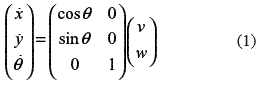
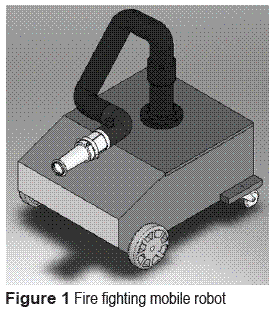
<body><![CDATA[<br>  Robotics  is a high success of industry and manufacturing in the world, for example the  robotic arms that could move with high speed and realize with precision  repetitive works, but they have a fundamental disadvantage: the reduced  movement. Nevertheless, a mobile robot could move in a determinate ambient  realizing the programmed work in the certain place. In a hazard and dangerous  environment, mobile robots supply the necessity of locomotion mechanism, making  that teleoperated or autonomous mechanism earn great popularity.     <br>    <br>  For  the proposal work, a wheel robot configuration is adopted; the wheels are the  locomotion mechanism more popular in mobile robotic, because they could reach  much efficiency with really simplex mechanicals implementations &#91;15&#93;. Normally,  the equilibrium is not a research problem in wheeled mobile robots projects,  because the wheels robots are planned to be on permanent contact with the soil,  all time. For this reason three wheels are enough for guarantee a stable  equilibrium. Instead of worrying about the equilibrium, the researches of  wheeled mobile robot are focused in tractions and stability problems, maneuver  and control. The principal purpose of this research is the control applied on  the proposed robot, in this section is studied the robots kinematics and  subsequently applied into the controller.     <br>    <br>  Kinematics  is the study of the mechanism behavior, in mobile robots is necessary  understand the mechanical behavior in order to analyze the implementation of  control software. The mobile robot model could be like a rigid body and wheels  &#91;16, 17&#93;. As the mathematical model of mobile robots, assume a two-wheeled  mobile robot as shown in <a href="#Figura1">figure 1</a>. </font></p>      <p align="center"><img src="/img/revistas/rfiua/n60/n60a04i01.gif" ><a name="Figura1"></a></p>      <p><font face="Verdana" size="2">Let  linear velocity of the robot <img src="/img/revistas/rfiua/n60/n60a04e00a.gif"> and angular velocity <img src="/img/revistas/rfiua/n60/n60a04e00b.gif"> are inputs of the system. The state equation of the  mobile robot is written in equation (1).</font></p>      <p> <img src="/img/revistas/rfiua/n60/n60a04e01.gif"></p>      <p><font face="Verdana" size="2">Where  (<i>x</i>&#91;<i>m</i>&#93;, y &#91;<i>m</i>&#93;) is the position robot and <i>&theta;</i>&#91;<i>rad</i>&#93; is the angle of the robot. </font></p>      <p><font face="Verdana" size="2"><b><i>The arnold equation</i></b></font></p>      ]]></body>
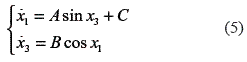
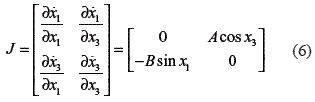
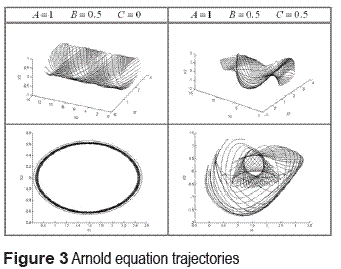
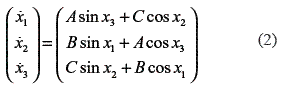
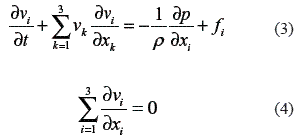
<body><![CDATA[<p><font face="Verdana" size="2">In  order to generate chaotic motions of the mobile robot, one of the chaotic  systems utilized the Arnold equation, which is written in equation (2). </font></p>      <p> <img src="/img/revistas/rfiua/n60/n60a04e02.gif"></p>      <p><font face="Verdana" size="2">Where  A, B, and C are constants. The Arnold equation describes a steady solution to  the three-dimensional (3-D) Euler equation (Equation (3) and Equation (4)). </font></p>      <p> <img src="/img/revistas/rfiua/n60/n60a04e03.gif"></p>      <p><font face="Verdana" size="2">The  Equation (3) and Equation (4) expresses the behaviors of no compressive perfect  fluids on a 3-D torus space. (<i>x</i><sub>1</sub>,  <i>x</i><sub>2</sub>, <i>x</i><sub>3</sub>) and (<i>v</i><sub>1</sub>, <i>v</i><sub>2</sub>,<i> v</i><sub>3</sub>)  denote the position and velocity of a particle and <i>p</i>, (<i>f</i><sub>1</sub>, <i>f</i><sub>2</sub>, <i>f</i><sub>3</sub>) and <i>&rho;</i> denote the pressure, external  force, and density, respectively. It is known that Arnold equation shows  periodic motion when one of the constants, for example <i>C</i>, is 0 or smaller, and shows  chaotic motion when <i>C</i> is superior. </font></p>      <p><font face="Verdana" size="2"><b><i>Behavior analysis</i></b></font></p>      <p><font face="Verdana" size="2">With <i>x</i><sub>2</sub> = 0 the system to analyze is in  equation (5).</font></p>      <p> <img src="/img/revistas/rfiua/n60/n60a04e05.gif"></p>      <p><font face="Verdana" size="2">Matching  with zero both equations find a set of infinite equilibrium points<em> </em><img src="/img/revistas/rfiua/n60/n60a04e00c.gif"> where <em>k<sub>i</sub></em> is an odd number, and <img src="/img/revistas/rfiua/n60/n60a04e00d.gif"> where <em>k</em> is an integer number. In order to analyze the behavior of  the equilibrium points, the Jacobian are implemented on equation (6).</font></p>      <p> <img src="/img/revistas/rfiua/n60/n60a04e06.gif"></p>      ]]></body>
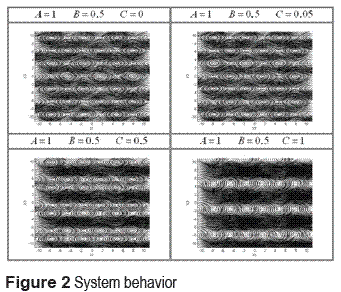
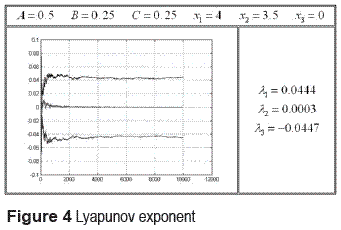
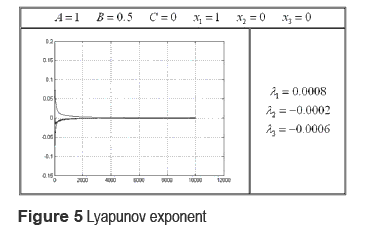
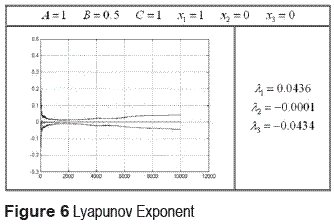
<body><![CDATA[<p><font face="Verdana" size="2">Where  the eigen values of the square and real matrix are the solutions of the  characteristic polynomial <img src="/img/revistas/rfiua/n60/n60a04e00e.gif"> that define the  behavior of the system for different values A and B, such behavior could be  seen in the <a href="#Figura2">figure 2</a>. When <i>C</i> = 0, is observed that topological transitivity does not  emerge, since the trajectories in the Poincar&eacute; section are closed. When |<em>C</em>| exceeds a certain small  number and gets larger, there are grown regions in which closed trajectories  disappear and scattered discrete points appear. The regions characterize chaos  and behavior. Since Arnold equation is a conservative system, is an important  feature that discrete trajectory of a point initially started in such a region  remains there and is never attracted by the closed trajectories outside region. </font></p>      <p align="center"><img src="/img/revistas/rfiua/n60/n60a04i02.gif" ><a name="Figura2"></a></p>      <p><font face="Verdana" size="2">In  the <a href="#Figura3">figure 3</a> are shown Arnolds equations trajectories for different values of  the C parameter. </font></p>      <p align="center"><img src="/img/revistas/rfiua/n60/n60a04i03.gif" ><a name="Figura3"></a></p>      <p><font face="Verdana" size="2"><i>The lyapunov exponent</i></font></p>      <p><font face="Verdana" size="2">The  Lyapunov exponent is used as a measure of the sensitive dependence on initial  conditions, that is, one of two characteristics of chaotic behavior. There are  n Lyapunov exponents in n-dimensional state space and the system is concluded  to have the sensitive dependence on initial conditions when the maximum  Lyapunov exponent is positive. Is calculated the Lyapunov exponent of Arnold  equation for different coefficients and initial states (<a href="#Figura4">figure 4</a>, <a href="#Figura5">figure 5</a> and  <a href="#Figura6">figure 6</a>). </font></p>      <p align="center"><img src="/img/revistas/rfiua/n60/n60a04i04.gif" ><a name="Figura4"></a></p>      <p align="center"><img src="/img/revistas/rfiua/n60/n60a04i05.gif" ><a name="Figura5"></a></p>      <p align="center"><img src="/img/revistas/rfiua/n60/n60a04i06.gif" ><a name="Figura6"></a></p>      <p><font face="Verdana" size="2">Since the maximum exponent is positive, Arnold equation has  sensitive dependence on initial conditions. In case of Arnold flow, the sum of&nbsp; Lyapunov exponents <i>&lambda;</i><sub>1</sub> + <i>&lambda;</i><sub>2</sub>  + <i>&lambda;</i><sub>3</sub> equals zero, it means that volume in the state space is  conserved. This results is the fact that a trajectory which started from a  chaotic region will not be attracted into attractors like limit cycles. The  total of the computed Lyapunov exponents became slightly larger than zero,  which is due to the numerical computation error.</font></p>      ]]></body>
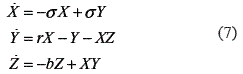
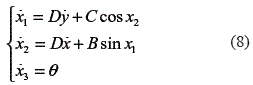
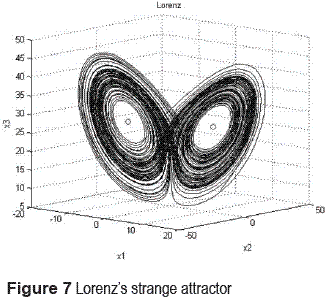
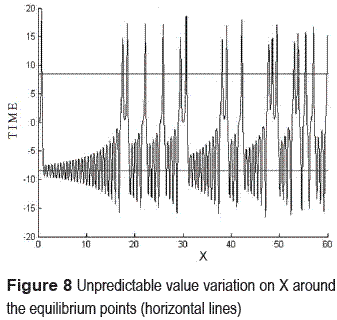
<body><![CDATA[<p><font face="Verdana" size="2"><i>The lorenz equation</i></font></p>      <p><font face="Verdana" size="2">The Lorenz equations are a well known non linear equations system, named  after and created by the meteorologist Lorenz, this model was made as a  modification of Navier-Strokes equation system (Equation (7)).</font></p>      <p> <img src="/img/revistas/rfiua/n60/n60a04e07.gif"></p>      <p><font face="Verdana" size="2">The control parameters are, the Prandalt number &sigma;, the  Raileigh number <i>r</i>, and the geometric measure <i>b</i>. The system is non  conservative, it means, that along the time energy loss, generating a variation  this form, therefore, the apparition of strange attractors (<a href="#Figura7">figure 7</a>), and the  system assume a chaotically behavior, making constants changes on its values,  almost unpredictable around the equilibrium points (<a href="#Figura8">figure 8</a>). These changes  are limited by the boundary of attractor, its means, which cannot reach another  value out of there. </font></p>      <p align="center"><img src="/img/revistas/rfiua/n60/n60a04i07.gif" ><a name="Figura7"></a></p>      <p align="center"><img src="/img/revistas/rfiua/n60/n60a04i08.gif" ><a name="Figura8"></a></p>      <p><font face="Verdana" size="2">The  parametric values required to input a chaotically behavior on the Lorenz System  are: &sigma; = 10, <em>r</em> = 28, <em>b</em> = 3/8. Lorenz is also sensitively depend on  initial conditions with these values, which mean, a variation of trajectories  for different values, however the existence of the strange attractor limits the  expansion of trajectories, being all globally apparent.</font> </p>      <p><font face="Verdana" size="2"><b><i>Integrated system</i></b></font></p>      <p><font face="Verdana" size="2"><i>Arnold equation integration</i></font></p>      <p><font face="Verdana" size="2">In  order to integrate the Arnold equation into the controller of the mobile robot,  is defined and used state variables (equation (8)). </font></p>      ]]></body>
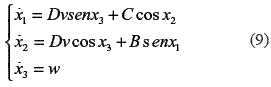
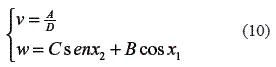
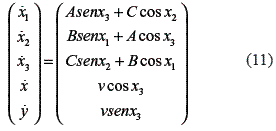
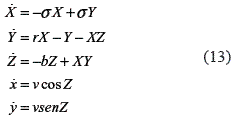
<body><![CDATA[<p> <img src="/img/revistas/rfiua/n60/n60a04e08.gif"></p>      <p><font face="Verdana" size="2">where <i>B</i>, <i>C</i> and <i>D</i> are constants. Substituting on the equation (8) the equation of the mobile robot is defined in equation (9).</font></p>      <p> <img src="/img/revistas/rfiua/n60/n60a04e09.gif"></p>      <p><font face="Verdana" size="2">The design the inputs is shows in equation (10).</font></p>      <p> <img src="/img/revistas/rfiua/n60/n60a04e10.gif"></p>      <p><font face="Verdana" size="2">Consequently, the state equation of the mobile robot becomes in equation (11).</font></p>      <p> <img src="/img/revistas/rfiua/n60/n60a04e11.gif"></p>      <p><font face="Verdana" size="2">The  equation (11) includes the Arnold equation. The Arnold equation behaves  chaotically or not, depending of the initial states, we choose the ones of the  Arnold equation such that the trajectory should became chaotically. It is  guaranteed that a chaotic orbit of the Arnold equation is not attracted to a  limit cycle or a quasi-periodic orbit. The whole states evolve in a 5-D space  according to equation (11), which includes a 3-D subspace of the Arnold flow.  The state evolution in the 2-D complementary space is highly coupled with the  one in the 3-D subspace as seen in equation (11). The coupling is physically  interpreted by the fact that the mobile robot moves with a constant velocity  and being steered by the third variable of the Arnold equation.     <br>    <br>  The  inputs to mobile robot become continuous since the Arnold equation is a  continuous system. Though the R&ouml;ssler equation, the Lorenz equation, and so on,  are well known as low-dimensional continuous chaotic systems. The Arnold  equation has some advantages as follows: (i) the structures of the Arnold  equation and mobile robot equation are similar, (ii) it is easy to deal with it  because the state variables <i>x</i><sub>1</sub>, <i>x</i><sub>2</sub>, and <i>x</i><sub>3</sub> are limited within a 3-D torus space, (iii) the range of  the input  w becomes -(|<em>B</em>|+ |<em>C</em>|) &le; <i>w</i> &le; (|<em>B</em>|+ |<em>C</em>|) and suitable for a robot  input, and (iv) the maximums of | <i><img src="/img/revistas/rfiua/n60/n60a04e00f.gif"></i><sub>1</sub>|, | <i><img src="/img/revistas/rfiua/n60/n60a04e00f.gif"></i><sub>2</sub>|,  | <i><img src="/img/revistas/rfiua/n60/n60a04e00f.gif"></i><sub>3</sub>| are determined by parameters  A, B,and  C.     ]]></body>
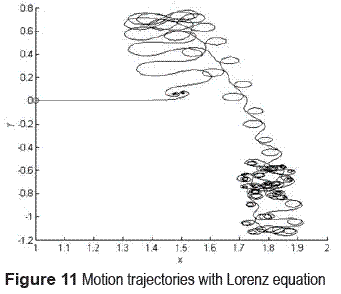
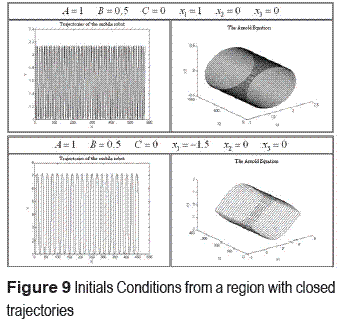
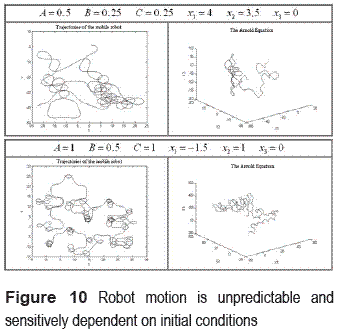
<body><![CDATA[<br>     <br>  The  <a href="#Figura9">figure 9</a> and <a href="#Figura10">figure 10</a> show examples of motions of the mobile robot with the  proposed controller, obtained by numerical simulation. Some initials conditions  were chosen from a region where the Poincar&eacute; section forms no closed trajectory (<a href="#Figura10">figure 10</a>). Is observed  that the robot motion is unpredictable and sensitively dependent on initial  conditions. </font></p>      <p align="center"><img src="/img/revistas/rfiua/n60/n60a04i09.gif" ><a name="Figura9"></a></p>      <p align="center"><img src="/img/revistas/rfiua/n60/n60a04i10.gif" ><a name="Figura10"></a></p>      <p> <font face="Verdana" size="2"><i>Lorenz equation integration</i></font></p>      <p><font face="Verdana" size="2">In  the same way that was done with the Arnold equation, is coupled the two Lorenz  equations with the robot mobile system, the parameter Z will be angular position (&theta;), and therefore the angular  velocity  <img src="/img/revistas/rfiua/n60/n60a04e00g.gif">  is consider in equation (12).</font></p>      <p> <img src="/img/revistas/rfiua/n60/n60a04e12.gif"></p>      <p><font face="Verdana" size="2">Creating in this form one 5-D dimension equation systems (equation (13)).</font></p>      <p> <img src="/img/revistas/rfiua/n60/n60a04e13.gif"></p>      <p><font face="Verdana" size="2">In  the same method that the first example, in equation (13) the first 3-D system  correspond the Lorenz equations, and it will drive the 2-D sub system  correspond to mobile robot. All the simulations was realized with the control  parameter configurations that leads to Lorenz to a chaotically behavior. The <a href="#Figura11">figure 11</a> shows a simulation of the mobile robot behavior with a constant  velocity <i>v</i> = 1 <i>m</i>/<i>s</i>, initial conditions for robot  mobile of (<i>x, y</i>) = (1.0) and duration 20 time units. </font></p>      ]]></body>
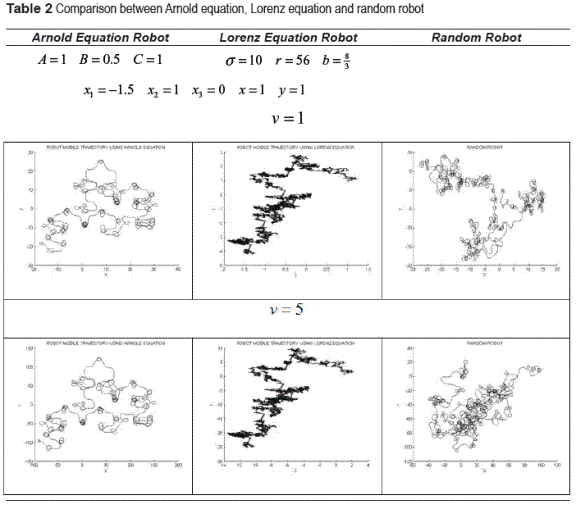
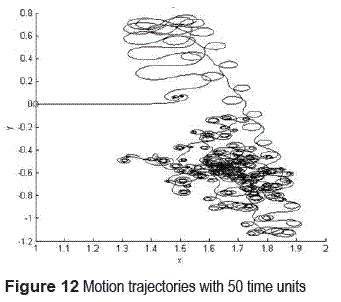
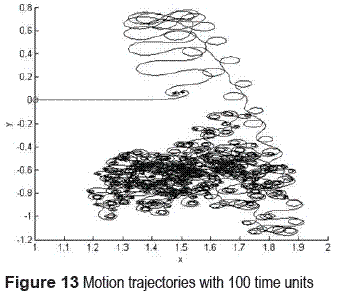
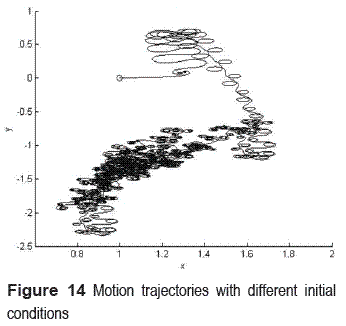
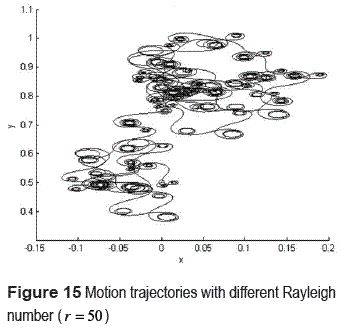
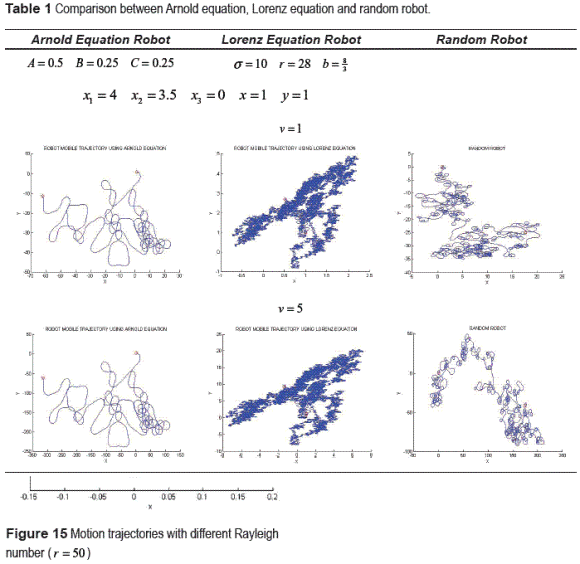
<body><![CDATA[<p align="center"><img src="/img/revistas/rfiua/n60/n60a04i11.gif" ><a name="Figura11"></a></p>      <p><font face="Verdana" size="2">Increasing  the time the robot mobile path creases in the space, covering more area. The  <a href="#Figura12">figures 12</a> and <a href="#Figura13">13</a>, shows that the distance an trajectory path of the robot  increasing directly with the time, however, the existence of the strange  attractor in the system, makes that path exist only into a specifically area,  all movements out of there are restricted.</font></p>      <p align="center"><img src="/img/revistas/rfiua/n60/n60a04i12.gif" ><a name="Figura12"></a></p>      <p align="center"><img src="/img/revistas/rfiua/n60/n60a04i13.gif" ><a name="Figura13"></a></p>      <p><font face="Verdana" size="2">The  only way for make a different path is changing the initial conditions in the  Lorenz system (<a href="#Figura14">figure 14</a>), or changing the value of the Rayleigh number <i>r</i> (<a href="#Figura15">figure 15</a>) but, in this case  is important to make sure that the Lorenz System still having a chaotically  behavior like seen in the <a href="#Figura7">figure 7</a>. </font></p>      <p align="center"><img src="/img/revistas/rfiua/n60/n60a04i14.gif" ><a name="Figura14"></a></p>      <p align="center"><img src="/img/revistas/rfiua/n60/n60a04i15.gif" ><a name="Figura15"></a></p>      <p> <font face="Verdana" size="2"><b><i>Comparison</i></b></font></p>      <p><font face="Verdana" size="2">In  this section is realized a comparison between the proposal systems and a robot  droved with a random behavior. The random steering generates random inputs to  the robot every two seconds, the system moves according with the generated input,  and changes when a new  input is generated.  In the <a href="#Tabla1">table 1</a> and <a href="#Tabla2">table 2</a><a href="#Tabla1"></a> compare the case study, using different parameters,  initial conditions and velocities in each case. </font></p>      <p align="center"><img src="/img/revistas/rfiua/n60/n60a04t01.gif" ><a name="Tabla1"></a></p>      ]]></body>
<body><![CDATA[<p align="center"><img src="/img/revistas/rfiua/n60/n60a04t02.gif" ><a name="Tabla2"></a></p>      <p><font face="Verdana" size="2">The  trajectory realized by the Lorenz robot is the most detailed making redundant  moves inside its work area, random robot an Arnold robot cover a large sector  of area as show the limits on the graphics, but is interesting to note that  Arnold made a superior exploration than the random one in the same space of  time.     <br>    <br>  In  <a href="#Tabla1">tables 1</a> and <a href="#Tabla2">2</a> is observed that the trajectories formed with Arnold and Lorenz  equations not change with the variation of their velocities, there only expands  its workspace, the sensibility to the initial conditions is the cause of this  change on their behavior. The random robot presents a different behavior for  each experiment due to its uncertain nature. The experiences demonstrate that  the random robot can't make and bigger exploration than the Arnold one, also  that the Lorenz robot path always shows to be restricted on a workspace and its  covertures area is lesser.</font></p>      <p><font face="Verdana" size="3"><b>Conclusiones</b> </font></p>       <p><font face="Verdana" size="2">In  this paper, we proposed the implementation of chaotic behavior on a fire  fighting robot, which implies a mobile robot with a controller that guarantees  a chaotic motion. The Arnold and the Lorenz equations, which are known to show  chaotic behavior, were adopted as the chaotic dynamics to be integrated into  the mobile robot; the behaviors of these equations on the system were analyzed.  We designed the controller explained that the total dynamics of the mobile  robot is characterized by the Arnold and the Lorenz equations.     <br>    <br>  This  kind of chaotic control could explore a dangerous space in order to find  ignitions sources or make a map of the location's current state, in this way we  can find "the obstacles" that could exists. All this implementation is  for futures works. Using this, the fire fighting corps could know what the best  path is for rescuing victims, do cleaning and disaster evaluation.     <br>    <br>  One  importance of this kind of inspections is rescue life of people involved in  this work, we must to make sure that the minimal risks are taken, the  implementation of chaotic control is an exceptional suggest for the fire  fighting robot area.     ]]></body>
<body><![CDATA[<br>    <br>  Comparing  between the studied systems is possible to conclude that the robot that  realizes the major special coverage is the Arnold one. One of the advantages of  Arnold robot with the random one, is that always execute its move in the same  way, realizing the same path. The random robot variation not allow to the  system to make the same performance between experiences, making different  results between experiences, but its coverage area is always lesser than the  Arnold one. The next step on this work is reduce the workspace into one  specific area with, the reduction of the area allows to put the robot in a  particular ambient, where could exists obstacles and sectors that have to be  avoided during the movement. </font></p>      <p><font face="Verdana" size="3"><b>Referencias</b> </font></p>      <!-- ref --><p><font face="Verdana" size="2">1. M. Y. H. Bangash, T. Bangash. "Explosion-Resistant  Buildings". Ed. Springer Verlag. Londres. 2006. pp. 46-52.     &nbsp;&nbsp;&nbsp;&nbsp;&nbsp;&nbsp;&nbsp;&nbsp;[&#160;<a href="javascript:void(0);" onclick="javascript: window.open('/scielo.php?script=sci_nlinks&ref=000116&pid=S0120-6230201100040000400001&lng=','','width=640,height=500,resizable=yes,scrollbars=1,menubar=yes,');">Links</a>&#160;]<!-- end-ref --><br>    <!-- ref --><br>  2. H. Amano. "Present Status and Problems of Fire Fighting  Robots". <i>Proceedings of the 41st SICE Annual Conference SICE 2002</i>. Vol. 2. 2002. pp. 880-885.     &nbsp;&nbsp;&nbsp;&nbsp;&nbsp;&nbsp;&nbsp;&nbsp;[&#160;<a href="javascript:void(0);" onclick="javascript: window.open('/scielo.php?script=sci_nlinks&ref=000118&pid=S0120-6230201100040000400002&lng=','','width=640,height=500,resizable=yes,scrollbars=1,menubar=yes,');">Links</a>&#160;]<!-- end-ref --><br>    <!-- ref --><br>  3. Y. Kanayama, Y. Kimura, F. Miyazaki, T. Noguchi. "A Stable Tracking  Control Method for an Autonomus Mobile Robot". <i>Proceedings of  the 1990 IEEE International Conference on Robotics and Automation</i>. Vol. 2. 1990. pp. 384-389.     &nbsp;&nbsp;&nbsp;&nbsp;&nbsp;&nbsp;&nbsp;&nbsp;[&#160;<a href="javascript:void(0);" onclick="javascript: window.open('/scielo.php?script=sci_nlinks&ref=000120&pid=S0120-6230201100040000400003&lng=','','width=640,height=500,resizable=yes,scrollbars=1,menubar=yes,');">Links</a>&#160;]<!-- end-ref --><br>    <!-- ref --><br>  4. V. Mu&ntilde;oz, A. Ollero, M. Prado, A. Sim&oacute;n. "Mobile Robot Trajectory  Planning with Dynamics and Kinematics Constraints". <i>Proceedings of  the IEEE International Conference on Robotics and Automation</i>. Vol. 4. 1994. pp. 2802-2807.     &nbsp;&nbsp;&nbsp;&nbsp;&nbsp;&nbsp;&nbsp;&nbsp;[&#160;<a href="javascript:void(0);" onclick="javascript: window.open('/scielo.php?script=sci_nlinks&ref=000122&pid=S0120-6230201100040000400004&lng=','','width=640,height=500,resizable=yes,scrollbars=1,menubar=yes,');">Links</a>&#160;]<!-- end-ref --><br>    <!-- ref --><br>  5. Y Nakamura, A. Sekiguchi. "The Chaotic M&oacute;bile  Robot". <i>IEEE Transactions on Robotics and Automation</i>. Vol.17. 2001. pp. 898-904.     &nbsp;&nbsp;&nbsp;&nbsp;&nbsp;&nbsp;&nbsp;&nbsp;[&#160;<a href="javascript:void(0);" onclick="javascript: window.open('/scielo.php?script=sci_nlinks&ref=000124&pid=S0120-6230201100040000400005&lng=','','width=640,height=500,resizable=yes,scrollbars=1,menubar=yes,');">Links</a>&#160;]<!-- end-ref --><br>    <!-- ref --><br>  6. M. Savi. "Din&aacute;mica Nao-Linear e  Caos". Ed. e-paper. Rio de Janeiro. Brasil. 2006. pp. 75-97.     &nbsp;&nbsp;&nbsp;&nbsp;&nbsp;&nbsp;&nbsp;&nbsp;[&#160;<a href="javascript:void(0);" onclick="javascript: window.open('/scielo.php?script=sci_nlinks&ref=000126&pid=S0120-6230201100040000400006&lng=','','width=640,height=500,resizable=yes,scrollbars=1,menubar=yes,');">Links</a>&#160;]<!-- end-ref --><br>    <!-- ref --><br>  7. J. M. T. Thompson, H. B. Stewart. <i>Nonlinear Dynamics  and Chaos</i>. Ed. John Whiley and Sons. Great Britain. 1996. pp. 291-347.     &nbsp;&nbsp;&nbsp;&nbsp;&nbsp;&nbsp;&nbsp;&nbsp;[&#160;<a href="javascript:void(0);" onclick="javascript: window.open('/scielo.php?script=sci_nlinks&ref=000128&pid=S0120-6230201100040000400007&lng=','','width=640,height=500,resizable=yes,scrollbars=1,menubar=yes,');">Links</a>&#160;]<!-- end-ref --><br>    <!-- ref --><br>  8. A. Astari, G. Thomas, W. Kinsner. "Sufficient Conditions  for Chaotic Maps to Yield Chaotic Behavior after FM". <i>IEEE  Transactions on Aerospace and  Electronic Systems</i>. Vol. 44. 2008. pp. 1240-1248.     &nbsp;&nbsp;&nbsp;&nbsp;&nbsp;&nbsp;&nbsp;&nbsp;[&#160;<a href="javascript:void(0);" onclick="javascript: window.open('/scielo.php?script=sci_nlinks&ref=000130&pid=S0120-6230201100040000400008&lng=','','width=640,height=500,resizable=yes,scrollbars=1,menubar=yes,');">Links</a>&#160;]<!-- end-ref --><br>    <!-- ref --><br>  9. K. M. Cuorno, A. V. Oppenheim, S. H.  Strogatz. "Synchronization  of Lorenz-Based Chaotic Circuits with Applications to Communications". <i>IEEE Transactions  on Circuits and Systems II. Analog and Digital Signal Processing</i>. Vol. 40. 1993. pp. 626-633.     &nbsp;&nbsp;&nbsp;&nbsp;&nbsp;&nbsp;&nbsp;&nbsp;[&#160;<a href="javascript:void(0);" onclick="javascript: window.open('/scielo.php?script=sci_nlinks&ref=000132&pid=S0120-6230201100040000400009&lng=','','width=640,height=500,resizable=yes,scrollbars=1,menubar=yes,');">Links</a>&#160;]<!-- end-ref --><br>    <!-- ref --><br>  10. J. Determan, J. A. Foster. "Using Chaos in Genetic  Algorithms". <i>Proceedings 1999 Congress on  Evolutionary Computation CEC 99</i>. Vol. 3. 1999. pp. 2094-2101.     &nbsp;&nbsp;&nbsp;&nbsp;&nbsp;&nbsp;&nbsp;&nbsp;[&#160;<a href="javascript:void(0);" onclick="javascript: window.open('/scielo.php?script=sci_nlinks&ref=000134&pid=S0120-6230201100040000400010&lng=','','width=640,height=500,resizable=yes,scrollbars=1,menubar=yes,');">Links</a>&#160;]<!-- end-ref --><br>    <!-- ref --><br>  11. Y. Wang, L. Wang, S. YU, L. Zhang, D. Yan, Y. Li. <i>Method of Chaotic  Pulse Sequence Produced by Continuous Chaotic System</i>. 9th International Conference  on Proceedings Signal Processing. ICSP 2008. IEEE Conferences. 2008. pp. 1892-1895.     &nbsp;&nbsp;&nbsp;&nbsp;&nbsp;&nbsp;&nbsp;&nbsp;[&#160;<a href="javascript:void(0);" onclick="javascript: window.open('/scielo.php?script=sci_nlinks&ref=000136&pid=S0120-6230201100040000400011&lng=','','width=640,height=500,resizable=yes,scrollbars=1,menubar=yes,');">Links</a>&#160;]<!-- end-ref --><br>    <!-- ref --><br>  12. J. A. Maldonado, J. A Hernandez. <i>Chaos Theory  Applied to Communications. Part I: Chaos Generators</i>. "Fourth Congress of  Electronics, Robotics, and Automotive Mechanics, IEEE Computer Society".  Morelos. M&eacute;xico. 2007. pp. 50-55.     &nbsp;&nbsp;&nbsp;&nbsp;&nbsp;&nbsp;&nbsp;&nbsp;[&#160;<a href="javascript:void(0);" onclick="javascript: window.open('/scielo.php?script=sci_nlinks&ref=000138&pid=S0120-6230201100040000400012&lng=','','width=640,height=500,resizable=yes,scrollbars=1,menubar=yes,');">Links</a>&#160;]<!-- end-ref --><br>    <!-- ref --><br>  13. L. M. Pecora, T. L. Carroll. "Driving systems with chaotic signals". <i>The American  Physical Society</i>.  Vol. 44. 1991. pp. 2374-2384.     &nbsp;&nbsp;&nbsp;&nbsp;&nbsp;&nbsp;&nbsp;&nbsp;[&#160;<a href="javascript:void(0);" onclick="javascript: window.open('/scielo.php?script=sci_nlinks&ref=000140&pid=S0120-6230201100040000400013&lng=','','width=640,height=500,resizable=yes,scrollbars=1,menubar=yes,');">Links</a>&#160;]<!-- end-ref --><br>    <!-- ref --><br>  14. D. Drysdale. <i>An Introduction  to Fire Dynamics</i>.  2<sup>a</sup>. ed. Ed. Jhon Wiley &amp; Sons. Edinburgh. UK. 1999. pp. 1-29.     &nbsp;&nbsp;&nbsp;&nbsp;&nbsp;&nbsp;&nbsp;&nbsp;[&#160;<a href="javascript:void(0);" onclick="javascript: window.open('/scielo.php?script=sci_nlinks&ref=000142&pid=S0120-6230201100040000400014&lng=','','width=640,height=500,resizable=yes,scrollbars=1,menubar=yes,');">Links</a>&#160;]<!-- end-ref --><br>    <!-- ref --><br>  15. J. Jones, A. Flynn, B. Seiger. <i>Mobile Robots,  Inspiration to implementation</i>. 2<sup>a</sup>. ed. Ed. AK Peters. USA. 1993. pp. 11-37.     &nbsp;&nbsp;&nbsp;&nbsp;&nbsp;&nbsp;&nbsp;&nbsp;[&#160;<a href="javascript:void(0);" onclick="javascript: window.open('/scielo.php?script=sci_nlinks&ref=000144&pid=S0120-6230201100040000400015&lng=','','width=640,height=500,resizable=yes,scrollbars=1,menubar=yes,');">Links</a>&#160;]<!-- end-ref --><br>    <!-- ref --><br>  16. J. C. Alexander, J. H. Maddocks. "On the  Kinenatics of Wheeled Mobile Robots". <i>International  Journal Robot Vehicles</i>. Vol. 8. 1989. pp. 15-27.     &nbsp;&nbsp;&nbsp;&nbsp;&nbsp;&nbsp;&nbsp;&nbsp;[&#160;<a href="javascript:void(0);" onclick="javascript: window.open('/scielo.php?script=sci_nlinks&ref=000146&pid=S0120-6230201100040000400016&lng=','','width=640,height=500,resizable=yes,scrollbars=1,menubar=yes,');">Links</a>&#160;]<!-- end-ref --><br>    <!-- ref --><br>  17. O. Lengerke, M. S. Dutra, F. M. G.  Fran&ccedil;a, M. J.  M. Tavera.  "Automated Guided Vehicles (AGV): Searching a Path in the Flexible  Manufacturing Systems". <i>Journal of Konbin</i>. Vol. 8. 2008. pp. 113--124. </font>&nbsp;&nbsp;&nbsp;&nbsp;&nbsp;&nbsp;&nbsp;&nbsp;[&#160;<a href="javascript:void(0);" onclick="javascript: window.open('/scielo.php?script=sci_nlinks&ref=000148&pid=S0120-6230201100040000400017&lng=','','width=640,height=500,resizable=yes,scrollbars=1,menubar=yes,');">Links</a>&#160;]<!-- end-ref --><br>    <br>    <br>    <br>       ]]></body>
<body><![CDATA[<p><font face="Verdana" size="2">(Recibido el 7 de abril de 2010. Aceptado el 20 de junio de 2011)</font></p>     <p><font face="Verdana" size="2"><sup>*</sup>Autor de correspondencia: tel&eacute;fono: + 55 + 21 + 256 277 64, fax: +  55 + 21 + 256 283 83, correo electr&oacute;nico: <a href="mailto:mjmtavera@ufrj.br">mjmtavera@ufrj.br</a>. (M. Morales)</font></p>      ]]></body><back>
<ref-list>
<ref id="B1">
<label>1</label><nlm-citation citation-type="book">
<person-group person-group-type="author">
<name>
<surname><![CDATA[Bangash]]></surname>
<given-names><![CDATA[M. Y. H]]></given-names>
</name>
<name>
<surname><![CDATA[Bangash]]></surname>
<given-names><![CDATA[T]]></given-names>
</name>
</person-group>
<source><![CDATA[Explosion-Resistant Buildings]]></source>
<year>2006</year>
<page-range>46-52</page-range><publisher-loc><![CDATA[Londres ]]></publisher-loc>
<publisher-name><![CDATA[Ed. Springer Verlag]]></publisher-name>
</nlm-citation>
</ref>
<ref id="B2">
<label>2</label><nlm-citation citation-type="">
<person-group person-group-type="author">
<name>
<surname><![CDATA[Amano]]></surname>
<given-names><![CDATA[H]]></given-names>
</name>
</person-group>
<article-title xml:lang="en"><![CDATA[Present Status and Problems of Fire Fighting Robots]]></article-title>
<source><![CDATA[Proceedings of the 41st SICE Annual Conference SICE 2002]]></source>
<year>2002</year>
<volume>2</volume>
<page-range>880-885</page-range></nlm-citation>
</ref>
<ref id="B3">
<label>3</label><nlm-citation citation-type="">
<person-group person-group-type="author">
<name>
<surname><![CDATA[Kanayama]]></surname>
<given-names><![CDATA[Y]]></given-names>
</name>
<name>
<surname><![CDATA[Kimura]]></surname>
<given-names><![CDATA[Y]]></given-names>
</name>
<name>
<surname><![CDATA[Miyazaki]]></surname>
<given-names><![CDATA[F]]></given-names>
</name>
<name>
<surname><![CDATA[Noguchi]]></surname>
<given-names><![CDATA[T]]></given-names>
</name>
</person-group>
<article-title xml:lang="en"><![CDATA[A Stable Tracking Control Method for an Autonomus Mobile Robot]]></article-title>
<source><![CDATA[Proceedings of the 1990 IEEE International Conference on Robotics and Automation]]></source>
<year>1990</year>
<volume>2</volume>
<page-range>384-389</page-range></nlm-citation>
</ref>
<ref id="B4">
<label>4</label><nlm-citation citation-type="">
<person-group person-group-type="author">
<name>
<surname><![CDATA[Muñoz]]></surname>
<given-names><![CDATA[V]]></given-names>
</name>
<name>
<surname><![CDATA[Ollero]]></surname>
<given-names><![CDATA[A]]></given-names>
</name>
<name>
<surname><![CDATA[Prado]]></surname>
<given-names><![CDATA[M]]></given-names>
</name>
<name>
<surname><![CDATA[Simón]]></surname>
<given-names><![CDATA[A]]></given-names>
</name>
</person-group>
<article-title xml:lang="en"><![CDATA[Mobile Robot Trajectory Planning with Dynamics and Kinematics Constraints]]></article-title>
<source><![CDATA[Proceedings of the IEEE International Conference on Robotics and Automation]]></source>
<year>1994</year>
<volume>4</volume>
<page-range>2802-2807</page-range></nlm-citation>
</ref>
<ref id="B5">
<label>5</label><nlm-citation citation-type="">
<person-group person-group-type="author">
<name>
<surname><![CDATA[Nakamura]]></surname>
<given-names><![CDATA[Y]]></given-names>
</name>
<name>
<surname><![CDATA[Sekiguchi]]></surname>
<given-names><![CDATA[A]]></given-names>
</name>
</person-group>
<article-title xml:lang="en"><![CDATA[The Chaotic Móbile Robot]]></article-title>
<source><![CDATA[IEEE Transactions on Robotics and Automation]]></source>
<year>2001</year>
<volume>17</volume>
<page-range>898-904</page-range></nlm-citation>
</ref>
<ref id="B6">
<label>6</label><nlm-citation citation-type="book">
<person-group person-group-type="author">
<name>
<surname><![CDATA[Savi]]></surname>
<given-names><![CDATA[M]]></given-names>
</name>
</person-group>
<source><![CDATA[Dinámica Nao-Linear e Caos]]></source>
<year>2006</year>
<page-range>75-97</page-range><publisher-loc><![CDATA[Rio de Janeiro ]]></publisher-loc>
<publisher-name><![CDATA[Ed. e-paper]]></publisher-name>
</nlm-citation>
</ref>
<ref id="B7">
<label>7</label><nlm-citation citation-type="book">
<person-group person-group-type="author">
<name>
<surname><![CDATA[Thompson]]></surname>
<given-names><![CDATA[J. M. T]]></given-names>
</name>
<name>
<surname><![CDATA[Stewart]]></surname>
<given-names><![CDATA[H. B]]></given-names>
</name>
</person-group>
<source><![CDATA[Nonlinear Dynamics and Chaos]]></source>
<year>1996</year>
<page-range>291-347</page-range><publisher-name><![CDATA[Ed. John Whiley and Sons]]></publisher-name>
</nlm-citation>
</ref>
<ref id="B8">
<label>8</label><nlm-citation citation-type="">
<person-group person-group-type="author">
<name>
<surname><![CDATA[Astari]]></surname>
<given-names><![CDATA[A]]></given-names>
</name>
<name>
<surname><![CDATA[Thomas]]></surname>
<given-names><![CDATA[G]]></given-names>
</name>
<name>
<surname><![CDATA[Kinsner]]></surname>
<given-names><![CDATA[W]]></given-names>
</name>
</person-group>
<article-title xml:lang="en"><![CDATA[Sufficient Conditions for Chaotic Maps to Yield Chaotic Behavior after FM]]></article-title>
<source><![CDATA[IEEE Transactions on Aerospace and Electronic Systems]]></source>
<year>2008</year>
<volume>44</volume>
<page-range>1240-1248</page-range></nlm-citation>
</ref>
<ref id="B9">
<label>9</label><nlm-citation citation-type="">
<person-group person-group-type="author">
<name>
<surname><![CDATA[Cuorno]]></surname>
<given-names><![CDATA[K. M]]></given-names>
</name>
<name>
<surname><![CDATA[Oppenheim]]></surname>
<given-names><![CDATA[A. V]]></given-names>
</name>
<name>
<surname><![CDATA[Strogatz]]></surname>
<given-names><![CDATA[S. H]]></given-names>
</name>
</person-group>
<article-title xml:lang="en"><![CDATA[Synchronization of Lorenz-Based Chaotic Circuits with Applications to Communications]]></article-title>
<source><![CDATA[IEEE Transactions on Circuits and Systems II: Analog and Digital Signal Processing]]></source>
<year>1993</year>
<volume>40</volume>
<page-range>626-633</page-range></nlm-citation>
</ref>
<ref id="B10">
<label>10</label><nlm-citation citation-type="">
<person-group person-group-type="author">
<name>
<surname><![CDATA[Determan]]></surname>
<given-names><![CDATA[J]]></given-names>
</name>
<name>
<surname><![CDATA[Foster]]></surname>
<given-names><![CDATA[J. A]]></given-names>
</name>
</person-group>
<article-title xml:lang="en"><![CDATA[Using Chaos in Genetic Algorithms]]></article-title>
<source><![CDATA[Proceedings 1999 Congress on Evolutionary Computation CEC 99]]></source>
<year>1999</year>
<volume>3</volume>
<page-range>2094-2101</page-range></nlm-citation>
</ref>
<ref id="B11">
<label>11</label><nlm-citation citation-type="confpro">
<person-group person-group-type="author">
<name>
<surname><![CDATA[Wang]]></surname>
<given-names><![CDATA[Y]]></given-names>
</name>
<name>
<surname><![CDATA[Wang]]></surname>
<given-names><![CDATA[L]]></given-names>
</name>
<name>
<surname><![CDATA[YU]]></surname>
<given-names><![CDATA[S]]></given-names>
</name>
<name>
<surname><![CDATA[Zhang]]></surname>
<given-names><![CDATA[L]]></given-names>
</name>
<name>
<surname><![CDATA[Yan]]></surname>
<given-names><![CDATA[D]]></given-names>
</name>
<name>
<surname><![CDATA[Li]]></surname>
<given-names><![CDATA[Y]]></given-names>
</name>
</person-group>
<source><![CDATA[Method of Chaotic Pulse Sequence Produced by Continuous Chaotic System]]></source>
<year></year>
<conf-name><![CDATA[9 International Conference on Proceedings Signal Processing]]></conf-name>
<conf-date>2008</conf-date>
<conf-loc> </conf-loc>
<page-range>1892-1895</page-range></nlm-citation>
</ref>
<ref id="B12">
<label>12</label><nlm-citation citation-type="confpro">
<person-group person-group-type="author">
<name>
<surname><![CDATA[Maldonado]]></surname>
<given-names><![CDATA[J. A]]></given-names>
</name>
<name>
<surname><![CDATA[Hernandez]]></surname>
<given-names><![CDATA[J. A]]></given-names>
</name>
</person-group>
<source><![CDATA[Chaos Theory Applied to Communications. Part I: Chaos Generators]]></source>
<year></year>
<conf-name><![CDATA[Fourth Congress of Electronics, Robotics, and Automotive Mechanics]]></conf-name>
<conf-date>2007</conf-date>
<conf-loc>Morelos </conf-loc>
<page-range>50-55</page-range></nlm-citation>
</ref>
<ref id="B13">
<label>13</label><nlm-citation citation-type="journal">
<person-group person-group-type="author">
<name>
<surname><![CDATA[Pecora]]></surname>
<given-names><![CDATA[L. M]]></given-names>
</name>
<name>
<surname><![CDATA[Carroll]]></surname>
<given-names><![CDATA[T. L]]></given-names>
</name>
</person-group>
<article-title xml:lang="en"><![CDATA[Driving systems with chaotic signals]]></article-title>
<source><![CDATA[The American Physical Society]]></source>
<year>1991</year>
<volume>44</volume>
<page-range>2374-2384</page-range></nlm-citation>
</ref>
<ref id="B14">
<label>14</label><nlm-citation citation-type="book">
<person-group person-group-type="author">
<name>
<surname><![CDATA[Drysdale]]></surname>
<given-names><![CDATA[D]]></given-names>
</name>
</person-group>
<source><![CDATA[An Introduction to Fire Dynamics]]></source>
<year>1999</year>
<edition>2</edition>
<page-range>1-29</page-range><publisher-loc><![CDATA[Edinburgh ]]></publisher-loc>
<publisher-name><![CDATA[Ed. Jhon Wiley & Sons]]></publisher-name>
</nlm-citation>
</ref>
<ref id="B15">
<label>15</label><nlm-citation citation-type="book">
<person-group person-group-type="author">
<name>
<surname><![CDATA[Jones]]></surname>
<given-names><![CDATA[J]]></given-names>
</name>
<name>
<surname><![CDATA[Flynn]]></surname>
<given-names><![CDATA[A]]></given-names>
</name>
<name>
<surname><![CDATA[Seiger]]></surname>
<given-names><![CDATA[B]]></given-names>
</name>
</person-group>
<source><![CDATA[Mobile Robots, Inspiration to implementation]]></source>
<year>1993</year>
<edition>2</edition>
<page-range>11-37</page-range><publisher-name><![CDATA[Ed. AK Peters]]></publisher-name>
</nlm-citation>
</ref>
<ref id="B16">
<label>16</label><nlm-citation citation-type="journal">
<person-group person-group-type="author">
<name>
<surname><![CDATA[Alexander]]></surname>
<given-names><![CDATA[J. C]]></given-names>
</name>
<name>
<surname><![CDATA[Maddocks]]></surname>
<given-names><![CDATA[J. H]]></given-names>
</name>
</person-group>
<article-title xml:lang="en"><![CDATA[On the Kinenatics of Wheeled Mobile Robots]]></article-title>
<source><![CDATA[International Journal Robot Vehicles]]></source>
<year>1989</year>
<volume>8</volume>
<page-range>15-27</page-range></nlm-citation>
</ref>
<ref id="B17">
<label>17</label><nlm-citation citation-type="journal">
<person-group person-group-type="author">
<name>
<surname><![CDATA[Lengerke]]></surname>
<given-names><![CDATA[O]]></given-names>
</name>
<name>
<surname><![CDATA[Dutra]]></surname>
<given-names><![CDATA[M. S]]></given-names>
</name>
<name>
<surname><![CDATA[França]]></surname>
<given-names><![CDATA[F. M. G]]></given-names>
</name>
<name>
<surname><![CDATA[Tavera]]></surname>
<given-names><![CDATA[M. J. M]]></given-names>
</name>
</person-group>
<article-title xml:lang="en"><![CDATA[Automated Guided Vehicles (AGV): Searching a Path in the Flexible Manufacturing Systems]]></article-title>
<source><![CDATA[Journal of Konbin]]></source>
<year>2008</year>
<volume>8</volume>
<page-range>113--124</page-range></nlm-citation>
</ref>
</ref-list>
</back>
</article>