<?xml version="1.0" encoding="ISO-8859-1"?><article xmlns:mml="http://www.w3.org/1998/Math/MathML" xmlns:xlink="http://www.w3.org/1999/xlink" xmlns:xsi="http://www.w3.org/2001/XMLSchema-instance">
<front>
<journal-meta>
<journal-id>0120-6230</journal-id>
<journal-title><![CDATA[Revista Facultad de Ingeniería Universidad de Antioquia]]></journal-title>
<abbrev-journal-title><![CDATA[Rev.fac.ing.univ. Antioquia]]></abbrev-journal-title>
<issn>0120-6230</issn>
<publisher>
<publisher-name><![CDATA[Facultad de Ingeniería, Universidad de Antioquia]]></publisher-name>
</publisher>
</journal-meta>
<article-meta>
<article-id>S0120-62302011000400011</article-id>
<title-group>
<article-title xml:lang="en"><![CDATA[Tactical planning of domestic supply chains]]></article-title>
<article-title xml:lang="es"><![CDATA[Planificación táctica de las cadenas de abastecimiento domésticas]]></article-title>
</title-group>
<contrib-group>
<contrib contrib-type="author">
<name>
<surname><![CDATA[García-Cáceres]]></surname>
<given-names><![CDATA[Rafael Guillermo]]></given-names>
</name>
<xref ref-type="aff" rid="A01"/>
</contrib>
<contrib contrib-type="author">
<name>
<surname><![CDATA[Palacios-Gómez]]></surname>
<given-names><![CDATA[Fernando]]></given-names>
</name>
</contrib>
<contrib contrib-type="author">
<name>
<surname><![CDATA[Martínez-Avella]]></surname>
<given-names><![CDATA[Mario Ernesto]]></given-names>
</name>
<xref ref-type="aff" rid="A02"/>
</contrib>
</contrib-group>
<aff id="A01">
<institution><![CDATA[,Escuela Colombiana de Ingeniería Department of Industrial Engineering ]]></institution>
<addr-line><![CDATA[ ]]></addr-line>
</aff>
<aff id="A02">
<institution><![CDATA[,Universidad de la Sabana Postgraduate Institute - FORUM ]]></institution>
<addr-line><![CDATA[ ]]></addr-line>
</aff>
<pub-date pub-type="pub">
<day>00</day>
<month>09</month>
<year>2011</year>
</pub-date>
<pub-date pub-type="epub">
<day>00</day>
<month>09</month>
<year>2011</year>
</pub-date>
<numero>60</numero>
<fpage>102</fpage>
<lpage>117</lpage>
<copyright-statement/>
<copyright-year/>
<self-uri xlink:href="http://www.scielo.org.co/scielo.php?script=sci_arttext&amp;pid=S0120-62302011000400011&amp;lng=en&amp;nrm=iso"></self-uri><self-uri xlink:href="http://www.scielo.org.co/scielo.php?script=sci_abstract&amp;pid=S0120-62302011000400011&amp;lng=en&amp;nrm=iso"></self-uri><self-uri xlink:href="http://www.scielo.org.co/scielo.php?script=sci_pdf&amp;pid=S0120-62302011000400011&amp;lng=en&amp;nrm=iso"></self-uri><abstract abstract-type="short" xml:lang="en"><p><![CDATA[This paper presents a single-period mathematical programming model NLMIP of a 5-stage supply chain with multiple possibilities of organizational ownership that allows several distribution channel links. The objective of the model is to optimize profit after tax, taking into account transfer prices, economies of scale, agreements between agents, demand and inventory issues, among other relevant aspects, specially in an idealised domestic environments. Finally, a solution procedure is presented for the problem associated with the NLMIP mathematical programming model proposed, that gives an optimal solution in satisfactory computational time. The model was validated using an experiment based on computational simulations.]]></p></abstract>
<abstract abstract-type="short" xml:lang="es"><p><![CDATA[Este artículo presenta un modelo de programación matemática NLMIP de un periodo simple para una cadena de abastecimiento de 5 etapas con múltiples posibilidades organizacionales de propiedad en los canales de distribución. El objetivo del modelo es optimizar la utilidad después de impuestos, contemplando entre otras consideraciones, precios de transferencia, economías de escala, acuerdos entre agentes, demanda, inventario, en un ambientedoméstico de decisión. Finalmente, presenta un procedimiento de solución del NLMIP que proporciona soluciones óptimas en tiempos razonables. El modelo fue validado por medio de un experimento computacional.]]></p></abstract>
<kwd-group>
<kwd lng="en"><![CDATA[Supply chain management]]></kwd>
<kwd lng="en"><![CDATA[integer]]></kwd>
<kwd lng="en"><![CDATA[programming]]></kwd>
<kwd lng="en"><![CDATA[non&shy]]></kwd>
<kwd lng="en"><![CDATA[linear programming]]></kwd>
<kwd lng="en"><![CDATA[logistics]]></kwd>
<kwd lng="es"><![CDATA[Administración de la cadena de abastecimiento]]></kwd>
<kwd lng="es"><![CDATA[programación NLMIP]]></kwd>
<kwd lng="es"><![CDATA[logística]]></kwd>
</kwd-group>
</article-meta>
</front><body><![CDATA[ <p align="center"><font face="Verdana" size="4"> <b>Tactical planning of domestic supply chains</b></font></p>      <p align="center"><font face="Verdana" size="4"> <b>Planificaci&oacute;n t&aacute;ctica de las cadenas de abastecimiento dom&eacute;sticas</b></font></p>      <p> <font face="Verdana" size="2"> <i>Rafael Guillermo Garc&iacute;a-C&aacute;ceres*<sup>1</sup>, Fernando Palacios-G&oacute;mez<sup>2</sup>, Mario Ernesto Mart&iacute;nez-Avella<sup>3</sup></i></font></p>       <p> <font face="Verdana" size="2"><sup>1</sup>Department of Industrial Engineering. Escuela  Colombiana de Ingenier&iacute;a. Autopista Norte Ak 45 N.&deg; 205-59. Bloque C  2do Piso. Bogot&aacute;, Colombia.     <br>    <br>  <sup>2</sup>Calle 119 N.&deg; 72B-60, Apto 104. Bogot&aacute;,  Colombia.     <br>    <br>  <sup>3</sup>Postgraduate Institute -  FORUM. Universidad de la Sabana. Cra. 69 N.&deg; 80-45, of. 301  Bogot&aacute;, Colombia. </font></p>      <br>  <hr noshade size="1">      <p><font face="Verdana" size="3"><b>Abstract</b></font></p>       ]]></body>
<body><![CDATA[<p><font face="Verdana" size="2">This paper presents a single-period mathematical  programming model NLMIP of a 5-stage supply chain with multiple possibilities  of organizational ownership that allows several distribution channel links. The  objective of the model is to optimize profit after tax, taking into account  transfer prices, economies of scale, agreements between agents, demand and  inventory issues, among other relevant aspects, specially in an idealised  domestic environments. Finally, a solution procedure is presented for the  problem associated with the NLMIP mathematical programming model proposed, that  gives an optimal solution in satisfactory computational time. The model was  validated using an experiment based on computational simulations.</font></p>       <p><font face="Verdana" size="2"><i>Keywords: </i>Supply chain management, integer programming, non-linear  programming, logistics.</font></p>   <hr noshade size="1">    <p><font face="Verdana" size="3"><b>Resumen</b></font></p>      <p><font face="Verdana" size="2">Este art&iacute;culo presenta un modelo de programaci&oacute;n  matem&aacute;tica NLMIP de un periodo simple para una cadena de abastecimiento de 5 etapas con m&uacute;ltiples  posibilidades organizacionales de propiedad en los canales de distribuci&oacute;n. El  objetivo del modelo es optimizar la utilidad despu&eacute;s de impuestos, contemplando  entre otras consideraciones, precios de transferencia, econom&iacute;as de escala,  acuerdos entre agentes, demanda, inventario, en un ambientedom&eacute;stico de  decisi&oacute;n. Finalmente, presenta un procedimiento de soluci&oacute;n del NLMIP que  proporciona soluciones &oacute;ptimas en tiempos razonables. El modelo fue validado  por medio de un experimento computacional. </font></p>      <p><font face="Verdana" size="2"><i>Palabras clave: </i>Administraci&oacute;n de la cadena de abastecimiento,  programaci&oacute;n NLMIP, log&iacute;stica.</font></p>  <hr noshade size="1">      <p><font face="Verdana" size="3"><b>Introduction</b></font></p>      <p><font face="Verdana" size="2">Recent progress made in supply chains has been focused on  global environments. It emerged as the logical consequence of initial developments  in domestic environments. However, in spite of the significant progress made in  global environments, a great part of this background has not been transferred  to domestic environments, and additionally many important aspects have been  ignored or have not been considered simultaneously for decision making.  Consequently, the aim of this paper is to incorporate several considerations  omitted or not incorporated in the tactical and domestic supply chain  bibliography into one single idealised model.    <br>    <br>  To achieve this goal, a review of work on tactical supply  chain decision-making is presented, which describes relevant aspects for both  modelling and solution procedures. The work presented here aims to establish a  model that takes into account some considerations identified in the literature  review that are relevant for domestic environments. A mathematical programming  model non linear mix integer (NLMIP) is presented, along with a solution  procedure that intends to satisfy such needs.</font></p>      <p><font face="Verdana" size="3"><b>Backgroud</b></font></p>      ]]></body>
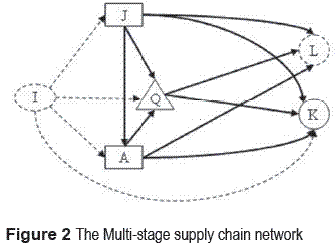
<body><![CDATA[<p><font face="Verdana" size="2">The following review is focused on the description of some  topics considered relevant on tactical decision making in domestic supply  chains and that have been treated by means of mathematical programming models.    <br>    <br>  One first review was developed by &#91;1&#93;. The author makes a description  of the relevant aspects on supply chain modeling of single echelon systems with  deterministic demand. The fundamental tactical aspects were associated with  distribution of raw materials and final products. The size of the problems was  limited by the absence of a computationally adequate MIP optimizer. The  evolution of the investigation in tactical supply chains has been developed in  several ways. On the one hand, as was indicated by the author, towards dynamic  modeling considerations and handling of inventories associated with an one  member of a specific echelon within the supply chain (agent) &#91;2&#93;. On the other  hand there was an increasing tendency towards a greater satisfaction of the  final consumer &#91;3&#93;, to consider developments of information and communication  systems since the end of the nineties and eighties &#91;4&#93;, the information  structure &#91;5&#93;, and later towards better coordination of the logistics  operations between the different stages of the supply chain, procurement,  production and distribution &#91;6&#93;.The aspects considered were: lead times,  capacities of the procurement and distribution channels, economies of scale,  bill of materials, among others. Towards the end of the twentieth century the  increased pressure by the economic internationalization, and new developments  in computational processing created global supply chain &#91;7&#93;, new aspects had to  be considered these included: demand uncertain considerations, transfer prices,  taxes and duties, exchange rates, among others, but not the modelling of alliances.  Solutions were developed incorporating solution procedures supported in  commercial software &#91;8&#93; that resulted in satisfactory practical results &#91;7&#93;.Others  topics related with our study, include procurement uncertainty in the demand  for products &#91;9, 10&#93;, and transfer prices &#91;11, 12&#93;.</font></p>         <p> <font face="Verdana" size="2"><b><i>Supply chain considerations</i></b></font></p>           <p> <font face="Verdana" size="2">The pertinent literature allows to development of  multi-stage supply chains has been limited to the context of a physical network  where the distribution is organized by distribution centers (DC) &#91;4&#93;. However,  although this is quite common in global environments, it can not be found in  most practical cases in domestic environments, where plants can for instance,  supply demand zones (DZ) directly. It is common in the literature, to find  considerations with respect to the capacity in strategic rather than tactical  contexts. Nevertheless, the problem of capacity in tactical decision-making is  important, and it is associated with the handling of throughput of product  families. Finally, the simultaneous explicit inclusion of transfer prices (TP)  and economies of scale (SE) in supply chain models is conspicuous through  absence in the literature. On the other hand, mathematical programming  modelling in the supply chain context has been limited to problems having few  logistics echelons &#91;13&#93;. Due to their combinatorial nature the treatment of  supply chains has been limited to relate to production inside plants, without  taking into account that transformation processes can be carried out in sales  points associated with DZs (afifth stage not considered in the current  literature). On the other hand, when a company has integratedDZs, the  possibility of surplus, or demand deficit should also be considered, due to the  demand variability.    <br>    <br>   In conclusion, except for some qualitative conditions that  may exist in specified supply chains situations, that require application of  Integral Analysis Method -IAM- &#91;14&#93;, we aim to include those aspects that are  considered most relevant to making tactical decisions, particularly in domestic  environments. Within this context, a proposed model and solution process can be  used as a reference for future studies.</font></p>       <p> <font face="Verdana" size="2"><i>Economies of scale and expandablecapacities</i></font></p>      <p><font face="Verdana" size="2">The typical behaviour of SE is represented by the function  shown in <a href="#Figura1">figure 1</a>, where the averagacost decreases up to a point where  production capacity is fully used, and increases again when that capacity is  exceeded and subcontracting or the use of stocks become necessary to satisfy  demand. SE can be achieved through technological, organizational and pecuniary factors  &#91;15, 16&#93;.</font></p>      <p align="center"><img src="/img/revistas/rfiua/n60/n60a11i01.gif" ><a name="Figura1"></a></p>      ]]></body>
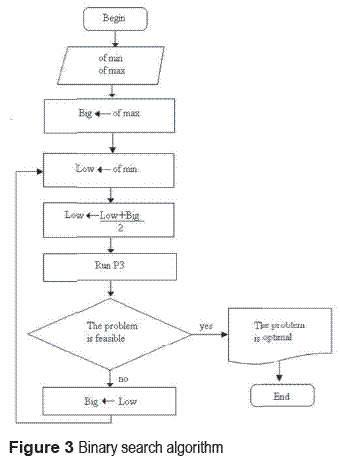
<body><![CDATA[<p><font face="Verdana" size="2"><i>Transfer pricing</i></font></p>      <p><font face="Verdana" size="2">A TP is the price that a selling department, division or  subsidiary of a company charges for a product or service supplied to a buying  department, division, or subsidiary of the same firm &#91;17&#93;. As proposed in this  paper the approach suggested by &#91;11&#93; is used as a basis for this model.</font></p>      <p><font face="Verdana" size="3"><b>Distribution</b> </font></p>      <p><font face="Verdana" size="2"><a href="#Figura2">Figure 2</a> shows a network with a wide range of possibilities  for distribution and various forms of ownership organization in the domestic  supply chain. Dotted lines represent subcontracted suppliers already  established in the market, while continuous lines represent agents who are  vertically integrated or are associated through alliances. In order to  facilitate the reading of the article, we will denominate with the word  "integrated" those business units that are owned by the organization  or associated with it through alliances. A global possibility that can be  modeled in a domestic context is offered by INCOTERM "Delivery Duty  Paid" (DDP).</font></p>      <p align="center"><img src="/img/revistas/rfiua/n60/n60a11i02.gif" ><a name="Figura2"></a></p>      <p><font face="Verdana" size="2">Where: <i>I</i> = External suppliers. <i>J</i> = Integrated plants that supply  goods to subsidiary plants. <i>A</i> = Integrated plants that do not supply goods to subsidiaiyplants.<em>Q</em> = Integrated distribution  centers (DC).  <i>K</i> =  Integrated demand zones (DZ). <i>L</i> = Non integrated demand zones (DZ).    <br>    <br>  Finally, one single distribution channel managed by the  salesperson was assumed, since this is the condition most frequently found in  domestic environments.</font></p>      <p><font face="Verdana" size="2"><i>Demand</i></font></p>      <p><font face="Verdana" size="2">The model is based on the assumption that it is possible to  satisfy the demand for goods in non-integrated DZs. In the case of integrated  DZs, surplus or deficit associated with the demand is allowed, with the purpose  of finding an optimum balance in production based on the estimation of average  demand.</font></p>      ]]></body>
<body><![CDATA[<p><font face="Verdana" size="2"><i>Storage</i></font></p>      <p><font face="Verdana" size="2">The proposal made by &#91;18&#93; is used to handle inventories  transferred between agents and inventories transferred from DCs to integrated  DZs. It includes considerations about safe stocks, security cycle factors, trip  frequency, and inventory cycles, and assumes that the demand and the lead time  of an item are independent of each other. This approach is particularly  effective for practical matters.</font></p>      <p><font face="Verdana" size="2"><i>Capacity</i></font></p>      <p><font face="Verdana" size="2">The model includes constraints on throughput capacity for  each associated stock family in each one of the stages of the supply chain,  since this is the condition usually found in real cases.</font></p>      <p><font face="Verdana" size="2"><i>Bill of materials</i></font></p>      <p><font face="Verdana" size="2">The model includes constraints on bills of materials (BOM)  for each facility where a transformation activity takes place, and for each raw  material or input used in that activity. This condition is more explicit than  the usual single constraint set. In the case of DCs, a unique mass balance set  constraint is caused by each case, because no transformation processes take  place in them.</font></p>      <p> <font face="Verdana" size="2"><b><i>Model</i></b></font></p>      <p><font face="Verdana" size="2">The associated model (P1) is show below:    <br>    <br>   Indices and Sets:    ]]></body>
<body><![CDATA[<br>    <br>  In addition to the sets presented to illustrate the supply  chain network in <a href="#Figura2">figure 2</a>, the following are included:    <br>    <br>  <em>D</em>: Nodes of supply  chain network    <br>    <br>  <em>E</em>:  Operation scales. <em>E(</em><sub>*</sub><em>,b)</em>: Operation scales of item <em>b</em> supplied by facility type *,where* <em>&#1028; D.</em>    <br>    <br>  <em>F</em>:  Item families. <em>F(</em><sub>*</sub><em>)</em>: Item families of facility type  *,where* <em>&#1028; D</em>. <em>F(&#9643;,</em>&#9642;<em>)</em>: Item families  transported between the facility <em>&#9643;</em> and the facility type &#9642;,where(<em>&#9643;</em>, &#9642;) <em>&#1028; N</em>.    <br>    <br>  <em>M</em>:&nbsp; Handled products and input material. <em>M(q)</em>: Items handled by DC <em>q</em>. <em>M(</em><sub>*</sub>,<em>q)</em>: Items handled by DC <em>q</em> and supplied by supplier *, where* <em>&#1028; D</em>.    ]]></body>
<body><![CDATA[<br>    <br>  <em>N</em> : Arcs of supply  chain network.    <br>    <br>  <em>P</em>:  Products. <em>P(</em><sub>*</sub><em>)</em>: Products supplied by supplier *,  where* <em>&#1028; D</em>. <em>P(&#9643;,</em>&#9642;<em>)</em>: Products of the  facility <em>&#9643;</em> supplied by the facility  type &#9642;,where(<em>&#9643;</em>, &#9642;) <em>&#1028; N</em>. <em>P(k,b1)</em>:  Goods produced in integrated DZ <em>k</em> that use item <em>b1 </em>as input    <br>    <br>  <em>R</em>:  Raw materials or input. <em>R(</em><sub>*</sub><em>)</em>: Raw materials used by facility type  *, where* <em>&#1028; D</em>. <em>R(&#9643;,</em>&#9642;<em>)</em>: Raw materials of  facility type &#9642; supplied by supplier <em>&#9643;</em>,(<em>&#9643;</em>, &#9642;) <em>&#1028; N</em>.    <br>    <br>  &#9642;<em>(&#9643;)</em>: Facility type &#9642; supplied by the facility type <em>&#9643;</em>,where (<em>&#9643;</em>, &#9642;) <em>&#1028; N</em>. <em>&#9643;(</em>&#9642;<em>)</em>:  Facility type <em>&#9643; </em>who supplies facility  type &#9642;,where(<em>&#9643;</em>, &#9642;) <em>&#1028; N</em>. <em>&#9643;(</em>&#9642;<em>,b1)</em>: Facilities type <em>&#9643;</em> which supplies facility type &#9642; with  item <em>b1</em>,where<em> &#9643; &#1028; D</em>. <em>&#9643;(</em>&#9642;<em>,b)</em> : Facility type <em>&#9643;</em> supplied by facility type &#9642; with item <em>b</em>, where (<em>&#9643;</em>, &#9642;) <em>&#1028; N. </em>    <br>     <br>  In order to facilitar the read of paper the parameters are denoted with  xx and the variables with xx, they are presented in each constraint group.    ]]></body>
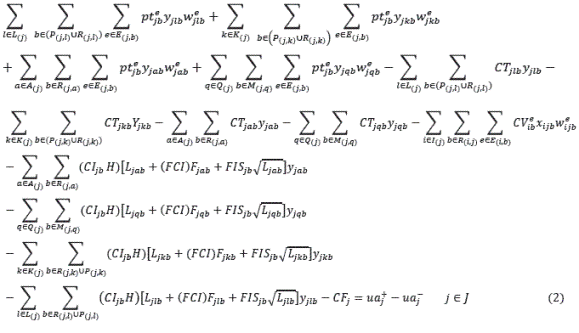
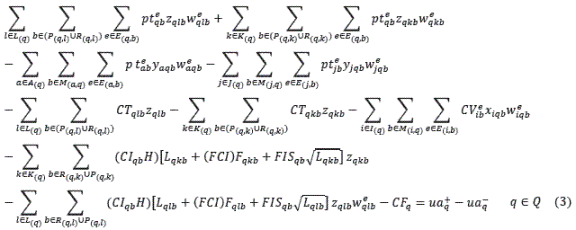
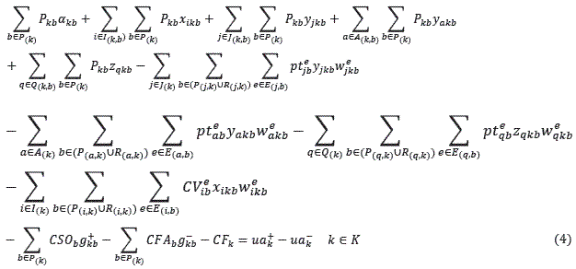
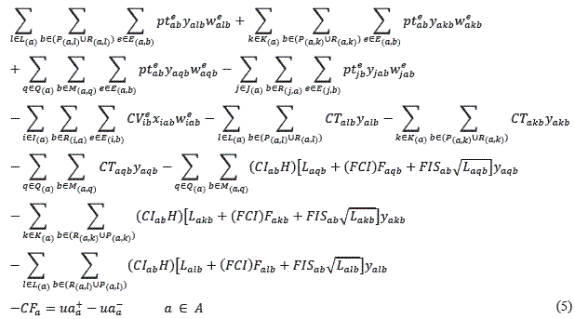
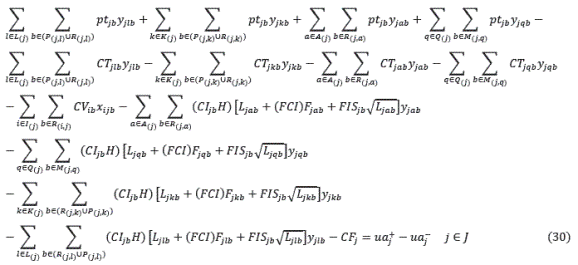
<body><![CDATA[<br>    <br>  Objective Function: Maximize: Profit after tax </font></p>      <p><img src="/img/revistas/rfiua/n60/n60a11e01.gif"></p>      <p><font face="Verdana" size="2">Where: <em>u&alpha;<sub>*</sub><sup>+</sup></em>=&nbsp; Net income before tax of facility type <em>* </em>in the time period, where<em> * &#1028; D</em>. <em>u&alpha;<sub>*</sub><sup>-</sup></em>=&nbsp;  Loss before tax of facility type <em>* </em>in the time period, where<em> * &#1028; D</em>.<em> IR<sub>*</sub></em>= Tax on facility  type <em>*</em> in the planning period ($ /  plant), where<em> * &#1028; D.</em>    <br>       <br>  Constraints:     <br>    <br>  Pre-tax net income in  each facility    <br>    <br>  Parameters: <em>FCI </em>= Inventory cycle  factor (percentage). <em>FIS<sub>*b</sub> </em>=Security  stock factor for item <em>b</em> in facility type <em>*</em> (Item units /  Planning period), where<em> &#9643; &#1028; D</em>. <em>F</em><sub><em>&#9643;</em>&#9642;<em>b</em></sub>=  Frequency of trips between facility type <em>&#9643;</em> and facility type &#9642; for item <em>b</em>&nbsp; (Time units / Planning period), where(<em>&#9643;</em>, &#9642;) <em>&#1028;N</em>. <em>H </em>=  Fraction of inventory keeping in one period. Holding cost given in $/($. units  of time) (units of time consistent with those of the average transportation  time parameters defined below) &#91;in general, given in $/$. year&#93;. <em>L</em><sub><em>&#9643;</em>&#9642;<em>b</em></sub>=  Lead time taken by facility type <em>&#9643;</em> to  deliver item <em>b</em> to  facility type &#9642; (Time units / item), where (<em>&#9643;</em>,  &#9642;) <em>&#1028; N</em>. <em>CF<sub>*</sub></em>= Fixed cost of facility type <em>*</em> in the planning period ($ / planning  period), where<em> * &#1028; D</em>. <em>CFA</em><sub><em>kb</em></sub>= Cost of deficit  for item <em>b</em> in integrated DZ <em>k</em> ($ / item). <em>CI</em><sub><em>*b</em></sub>= Inventory cost for item <em>b</em>&nbsp;  in facility type <em>*</em> in the  planning period ($ / item). <em>CSO</em><sub><em>kb</em></sub>= Cost  of surplus of item <em>b</em> in integrated DZ <em>k</em> ($ / item). <em>CT</em><sub><em>&#9643;</em>&#9642;<em>b</em></sub>=  Initial unit transportation cost of item <em>b</em> from facility type <em>&#9643;</em> to facility type &#9642; ($ / item), where (<em>&#9643;</em>,  &#9642;) <em>&#1028; N</em>. <em>CV</em><sub><em>ib</em></sub><em><sup>e</sup></em>= Cost of item <em>b</em> provided by supplier <em>i </em>at operation scale<em> e</em> ($ / item). <em>P</em><sub><em>kb</em></sub>= Sale price of item <em>b </em>inDZ <em>k</em> ($ / product unit).    ]]></body>

<body><![CDATA[<br>    <br>  Variables: <em>&alpha;</em><sub><em>kb</em></sub>= Item <em>b</em> used to satisfy the demand of DZ<em> k </em>in the time period. <em>x</em><sub><em>i*b</em></sub><em><sup>e</sup></em>= Item <em>b</em> supplied by supplier <em>i</em> to facility type * at scale <em>e</em> per planning period, where * <em>&#1028; D</em>. <em>y</em><sub><em>&#9643;</em>&#9642;<em>b</em></sub><em><sup>e</sup></em>= Item <em>b</em> supplied by facility type <em>&#9643; </em>to facility type &#9642; at scale <em>e</em> per planning period, where (<em>&#9643;</em>, &#9642;) <em>&#1028; N</em>. <em>z</em><sub><em>q</em>&#9642;<em>b</em></sub><em><sup>e</sup></em>= Item <em>b</em> supplied by the DC <em>q </em>to the DZ &#9642;<em> (K, L)</em> at scale <em>e</em> per  planning period, where (<em>&#9643;</em>, &#9642;) <em>&#1028; N</em>.<em>&nbsp; w</em><sub><em>&#9643;</em>&#9642;<em>b</em></sub><em><sup>e</sup></em>= binary variable that take  a value 1 if the item <em>b</em> from facility type <em>&#9643;</em> is supplied by  the facility type &#9642; in the scale e, where (<em>&#9643;</em>,  &#9642;) <em>&#1028; N</em>, and 0 in otherwise.    <br>    <br>  The next expression  takes into account the pre-tax net income for the complete set of plants that  supply integrated plants.</font></p>      <p><img src="/img/revistas/rfiua/n60/n60a11e02.gif"></p>      <p><font face="Verdana" size="2">Expression for  integrated DC&rsquo;s net income:</font></p>      <p><img src="/img/revistas/rfiua/n60/n60a11e03.gif"></p>      <p><font face="Verdana" size="2">Expression for DZ&rsquo;s  net income:</font></p>      <p><img src="/img/revistas/rfiua/n60/n60a11e04.gif"></p>      <p><font face="Verdana" size="2">Expression for the net income of plants receiving products from subsidiary plants:</font></p>      ]]></body>
<body><![CDATA[<p><img src="/img/revistas/rfiua/n60/n60a11e05.gif"></p>      <p><font face="Verdana" size="2">Expressions for modeling the scale operation of each facility type are modeled by the following type of constraints. In this case for the scale operation of external suppliers:</font></p>      <p><img src="/img/revistas/rfiua/n60/n60a11e06.gif"></p>      <p><font face="Verdana" size="2">Where<em> x<sub>i*b</sub></em> = Item <em>b</em> supplied by supplier <em>i</em> to facility type * per planning  period,where * <em>&#1028; D</em>.</font></p>      <p><img src="/img/revistas/rfiua/n60/n60a11e07.gif"></p>      <p><font face="Verdana" size="2">where: <em>GMAX<sub>ib</sub><sup>e</sup></em>=  Maximum supply of item <em>b</em> provided by supplier <em>i</em> at scale <em>e</em> per planning period (Item units  / Planning period). <em>GMIN<sub>ib</sub><sup>e</sup></em>=  Minimum supply of item <em>b</em> provided by supplier <em>i</em> at scale <em>e</em> per planning period (Item units  / Planning period).     <br>    <br>  An alternative  modelling for the scale operation of the external suppliers can be expressed  for this case as follows:</font></p>      <p><img src="/img/revistas/rfiua/n60/n60a11e09.gif"></p>      <p><font face="Verdana" size="2"><em>BIG</em> = Big positive number. <strong><em>G</em><em><sub>ib</sub><sup>e</sup></em></strong>: Oferta de  la art&iacute;culo <strong><em>b</em></strong> suministrado por el proveedor <strong><em>i</em></strong> en la  escala <strong><em>e</em></strong> por periodo de planeaci&oacute;n (Unidades del art&iacute;culo /  Periodo de planeaci&oacute;n).    ]]></body>
<body><![CDATA[<br>    <br>  Demand in integrated  DZ:</font></p>      <p><img src="/img/revistas/rfiua/n60/n60a11e10.gif"></p>      <p><font face="Verdana" size="2">Where: <em>g<sub>kb</sub><sup>+</sup></em>=&nbsp; Surplus of item <em>b</em> in DZ <em>k</em>. <em>g<sub>kb</sub><sup>-</sup></em>=&nbsp; Deficit of item <em>b </em>in DZ <em>k</em>. <em>pt<sub>*b</sub><sup>e</sup></em> = TP  of item <em>b</em> from facility type <em>* </em>in scale<em> e</em> per planning period, where<em> * &#1028;</em> (<em>D)</em>.<em> &Gamma;<sub>*b</sub></em>= Demand for item <em>b</em> in DZ type <em>*</em> per planning period (Item units / Planning period), where<em> * &#1028; D.</em>    <br>       <br>  Demand in  non-integrated DZ:</font></p>      <p><img src="/img/revistas/rfiua/n60/n60a11e11.gif"></p>      <p><font face="Verdana" size="2">Mass balance at distribution center:</font></p>      <p><img src="/img/revistas/rfiua/n60/n60a11e12.gif"></p>      <p><font face="Verdana" size="2">Production and handling capacity per item are modeled by the following type of constraints. In this case for plant supplying subsidiary plants:</font></p>      ]]></body>
<body><![CDATA[<p><img src="/img/revistas/rfiua/n60/n60a11e13.gif"></p>      <p><font face="Verdana" size="2"><em>T</em><em><sub>&#9643;b</sub></em>= Capacity units used  by facility type <em>&#9643;</em> to produce one  unit of item <em>b</em> (Resource units /  item). Where<em> &#9643; &#1028; D</em>. <em>T</em><sub><em>&#9643;</em>&#9642;<em>b</em></sub>=  Capacity units used in the transportation of item <em>b</em> between facility type <em>&#9643;</em> and facility type &#9642; (Resource units / item), where (<em>&#9643;</em>, &#9642;) <em>&#1028; N. CAPP<sub>*b</sub> </em>=Production  capacity of plant type <em>*</em> for item <em>b </em>per planning period (Resource  units / Planning period), where<em> * &#1028; D</em>.     <br>       <br>  Bill of materials is  modeled by the following type of constraints. In this case for plants supplying  subsidiary ones:</font></p>      <p><img src="/img/revistas/rfiua/n60/n60a11e14.gif"></p>      <p><font face="Verdana" size="2">where<em> Q<sub>b1b2</sub> </em>= Quantity of item <em>b1</em> used in the production of item <em>b2</em> (Volume or weight units of item <em>b1</em> / item <em>b2</em>)    <br>    <br>  Item-family inventory  capacity is modeled by the following type of constraints. In this case for  plants supplying subsidiary ones:</font></p>      <p><img src="/img/revistas/rfiua/n60/n60a11e15.gif"></p>      <p><font face="Verdana" size="2"><em>CAPI<sub>*f</sub> </em>= Finished-product inventory  capacity of family <em>f</em> in  facility type <em>*</em> in the planning  period (Volume or weight / Planning period), where<em> * &#1028; D</em>. <em>V<sub>fb</sub></em>= Volume  or weight of item <em>b</em> in the stock  place associated with family <em>f </em>in the  planning period (Volume or weight / item)    ]]></body>
<body><![CDATA[<br>       <br>  Transportation  capacity is modeled by the following type of constraints. In this case between  DC and both integrated and not-integrated DZs:</font></p>      <p><img src="/img/revistas/rfiua/n60/n60a11e16.gif"></p>      <p><font face="Verdana" size="2"><em>CAPT</em><sub><em>&#9643;</em>&#9642;<em>f </em></sub>= Carrying capacity of the means of  transportation associated with family <em>f</em>&nbsp; that is used between  facility type <em>&#9643;</em> and facility type &#9642; in  the planning period (Volume or weight / Planning period), where (<em>&#9643;</em>, &#9642;) <em>&#1028; N</em>.    <br>       <br>  Transfer-price bounds  are modeled by the following type of constraints. In this case in plants  supplying subsidiary ones:</font></p>      <p><img src="/img/revistas/rfiua/n60/n60a11e17.gif"></p>      <p><font face="Verdana" size="2"><em>PTMAX<sub>*b</sub><sup>e</sup></em> = Upper bound of TP  of item <em>b</em> in facility  type <em>* </em>in scale<em> e </em>in the time period, where <em>* &#1028;</em> (<em>D)</em>. <em>PTMIN<sub>*b</sub><sup>e</sup></em> = Lower bound of TP of item <em>b</em> in facility type <em>&#9643; </em>in scale<em> e </em>in the time period, where <em>* &#1028; D.</em>    <br>       <br>  Flow bounds are  modeled by the following type of constraints. In this case of supplier: </font></p>      ]]></body>

<body><![CDATA[<p><img src="/img/revistas/rfiua/n60/n60a11e18.gif"></p>      <p><font face="Verdana" size="2"><em>SMAX<font face="Verdana" size="2"><em><sub>*b</sub></em></font></em>= Maximum supply of item <em>b</em> agreed by supplier <em>&#9643;</em> (Item units / Planning period), where <em>* &#1028; D</em>. <em>SMIN<sub>*b</sub></em>=  Minimum supply of item <em>b</em> agreed by supplier <em>*</em> (Item units /  Planning period), where <em>* &#1028; D.</em>    <br>       <br>  The decision variables  are nonnegative</font></p>      <p><font face="Verdana" size="2"><b><i>Solution process</i></b></font></p>      <p><font face="Verdana" size="2">For  solving the problem, three steps are proposed:     <br>    <br>  Step 1. Redefinition of variables: The non-linear nature of  equations 2 to 5 is simplified; the nonlinearity treated arise from the product  of the two continuous, non-negative flow variables and the TP associated with  them is replaced by a non-negative continuous variable. The method employed is  illustrated by equations 23 through 26 (the latter being related to equation  9). The result is an equivalent problem (called P3), which is also a bilinear  and non-linear MIP problem but more treatable.     <br>     <br>  Step 2. Definition of bounds: The vectors of the lower  bound (UMIN) and the upper bound (UMAX) arises of pre-tax profit variables for  each of the integrated agents involved in the supply chain, and the objective  function bounds are calculated. In order to determine bound vectors, the number  of scale levels of P3 is reduced to one, TP are fixed to their maximum  (minimum) value, and input costs are fixed to their minimum (maximum) value for  each flow. Consequently, two versions of the relaxed problem (denominated P2)  are obtained. In summarizing, this linear problem allows the calculation of the  profit bounds of the original problem (P1). The mathematical programming  problem P2 is bilinear. According to &#91;19&#93; it is an NP-hard problem.     ]]></body>
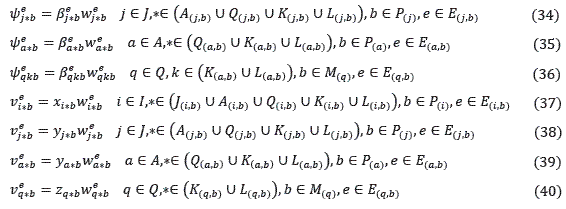
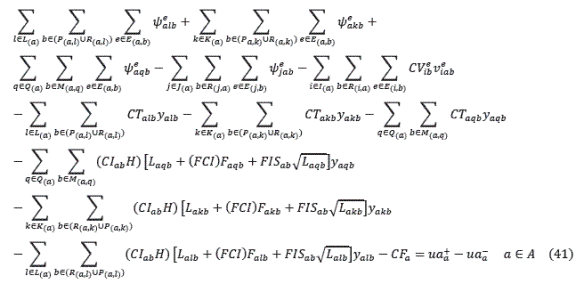
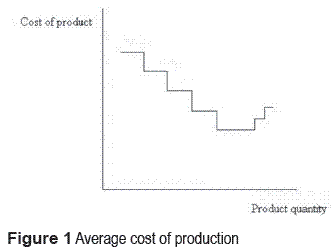
<body><![CDATA[<br>     <br>  Step3. P3 solution: In order to solve P1, a procedure based  on the inclusion of additional constraints on P3 is proposed. First, upper and  lower bounds of the pre-tax profit vector and of profit objective bounds  obtained from the previous step are included. Additionally, from the  transformation presented by &#91;20&#93; to approximate the nonlinearity of the  problem, new variables are redefined and new constraints are added to previous  constraints of P3. Finally, a binary search algorithm is proposed.    <br>    <br>  <em><b>Redefinition of variables </b></em><em>(in this point is necessary  to have as reference the model NLMIP presented above with equations A*)</em>    <br>    <br>  These are the new non  negatives variables:</font></p>      <p><img src="/img/revistas/rfiua/n60/n60a11e19.gif"></p>      <p><font face="Verdana" size="2">Alternatively for equation 9 </font></p>      <p><img src="/img/revistas/rfiua/n60/n60a11e22.gif"></p>      <p><font face="Verdana" size="2">And affect the equations (2 to 5), and the equation (9) as:</font></p>      ]]></body>
<body><![CDATA[<p><img src="/img/revistas/rfiua/n60/n60a11e23.gif"></p>      <p><font face="Verdana" size="2">Also it affects the constraints associated to the TP. In order to illustrate it, the constraints associated to the bounds of flows that leave the integrated plants that supply goods to subsidiary plants are used (equation 17):</font></p>      <p><img src="/img/revistas/rfiua/n60/n60a11e24.gif"></p>      <p><font face="Verdana" size="2">Constraints associated with the previous equations are included. And Alternatively: Equation (8):</font></p>      <p><img src="/img/revistas/rfiua/n60/n60a11e25.gif"></p>      <p><font face="Verdana" size="2"><i><b>Definition of bounds</b></i></font></p>      <p><font face="Verdana" size="2">The two bilinear  models, P2, are based on model P1 as follows:    <br>    <br>  First P2 Model: TP and  flow costs are fixed as follows:</font></p>      <p><img src="/img/revistas/rfiua/n60/n60a11e26.gif"></p>      ]]></body>
<body><![CDATA[<p><font face="Verdana" size="2">Second P2 Model: TP  and flow costs are fixed as follows:</font></p>      <p><img src="/img/revistas/rfiua/n60/n60a11e28.gif"></p>      <p><font face="Verdana" size="2">Scale summations and  their associated binary variables are eliminated in equations 2 to 5, and flows  bounds constraints are modified in order to establish flow bounds in the new  variables. In order to illustrate it, equation 2 (below) is used:</font></p>      <p><img src="/img/revistas/rfiua/n60/n60a11e30.gif"></p>      <p><font face="Verdana" size="2">Flow constraints are  replaced by the following expressions that establish flow bounds between each  echelon of the supply chain, as was mentioned earlier. As an example, the  constraints associated with the flows of integrated DCs to integrated DZs are  used: </font></p>      <p><img src="/img/revistas/rfiua/n60/n60a11e31.gif"></p>      <p><font face="Verdana" size="2">Where <em>G&#9643;&#9642;<sup>emin</sup></em> represents the  minimum bound of flow associated with the smaller scale between two echelons,  and <em>G&#9643;&#9642;<sup>emax</sup></em> represents the  maximum bound of flow associated with the larger scale associated in the  original problem (P1).&nbsp;     <br>    <br>  Finally, the  constraints of TP are eliminated.     <br>    ]]></body>

<body><![CDATA[<br>  The problem P2 is  efficiently solved by means of the successive LP solution procedure introduced  by Vidal and Goetschalckx &#91;11&#93;, and represents a relaxed version of this  problem. As was mentioned previously, the solutions for pre-tax profit and objective  profit bounds of each business unit and objective solution obtained in this  step are used as virtual upper and lower bounds of P3.    <br>    <br>  <em>P3 solution procedure</em>    <br>    <br>  In order to solve P3,  the bilinear nature of equations 2 to 5 associated with each unit businessare  treated by setting pre-tax profits. These values are calculated from the  maximum and minimum bounds obtained from P2 as:    <br>    <br>  Upper bound of pre-tax  profits vector, <em>UMAX</em>: Max (U<sub>FIRST P2</sub>, U<sub>SECOND P2</sub>).    <br>    <br>  Lower bound of pre-tax  profits vector, <em>UMIN</em>: Min (U<sub>FIRST P2</sub>, U<sub>SECOND P2</sub>).    <br>    ]]></body>
<body><![CDATA[<br>  And similarity:    <br>    <br>  Upper bound of total  profit, <em>OFMAX</em>: Max (<em>OF<sub>FIRST P2</sub>, OF<sub>SECOND P2</sub></em>)    <br>    <br>  Lower bound of total  profit,<em>OFMIN</em>: Min (<em>OF<sub>FIRST P2</sub>, OF<sub>SECOND P2</sub></em>)    <br>    <br>  Where: <em>U<sub>FIRST P2</sub></em>: Pre-tax profits vector  solution of first P2. <em>U<sub>SECOND P2</sub></em>:  Pre-tax profits vector solution of  second P2. <em>OF<sub>FIRST P2</sub></em>:  Objective function of first P2. <em>OF<sub>SECOND P2</sub></em>: Objective  function of second P2    <br>    <br>  This solution process implies the inclusion of a set  of additional constraints to P3. The set of equations is shown below:</font></p>      <p><img src="/img/revistas/rfiua/n60/n60a11e32.gif"></p>      ]]></body>
<body><![CDATA[<p><font face="Verdana" size="2">The total profit constraint is shown below:</font></p>      <p><img src="/img/revistas/rfiua/n60/n60a11e33.gif"></p>      <p><font face="Verdana" size="2">Finally in order to deal with the nonlinearity of P3,  &#91;20&#93; transformation was used, for setting product prices for bundling of  products. The authors present an approximation that includes substitution of  new variables and constraints that are added to problem. This is shown below:    <br>    <br>  Suppose the product <em>&Omega;</em> x <em>&Xi; </em>appears in a model,  where <em>&Xi;</em> is binary {0,1} variable while <em>&Omega;</em> is nonnegative continuous variable,  then:     <br>     <br>  &#8710; &le; &Omega;    <br>    <br>  &#8710; &le; &Xi; M<sub>&Xi;</sub>    <br>    ]]></body>
<body><![CDATA[<br>  &#8710; &ge; &Omega; &ndash; (1&minus; &Xi;) M<sub>&Omega;</sub>    <br>    <br>  Where:<em>M<sub>&Omega;</sub> </em>:Upper  bound on the value of <em>&Omega; and M<sub>&Xi;</sub> </em>:Upper  bound on the value of <em>&Omega;</em> x &Xi;    <br>    <br>  In order to use the &#91;20&#93;  approach, first the following non negative variables are redefined. These are  the new variables:</font></p>      <p><img src="/img/revistas/rfiua/n60/n60a11e34.gif"></p>      <p><font face="Verdana" size="2">This procedure affects  the equations (2 to 5) constraints. In turn to illustrate the previous process,  it is presented like example for equation 5:</font></p>      <p><img src="/img/revistas/rfiua/n60/n60a11e41.gif"></p>      <p><font face="Verdana" size="2">The process also  affects the constraints associated with the TP. In order to illustrate the  previous assertion, the constraints associated with bounds of the flows that  leave the integrated plants that do not supply goods to subsidiary plants, are  used:</font></p>      <p><img src="/img/revistas/rfiua/n60/n60a11e42.gif"></p>      ]]></body>
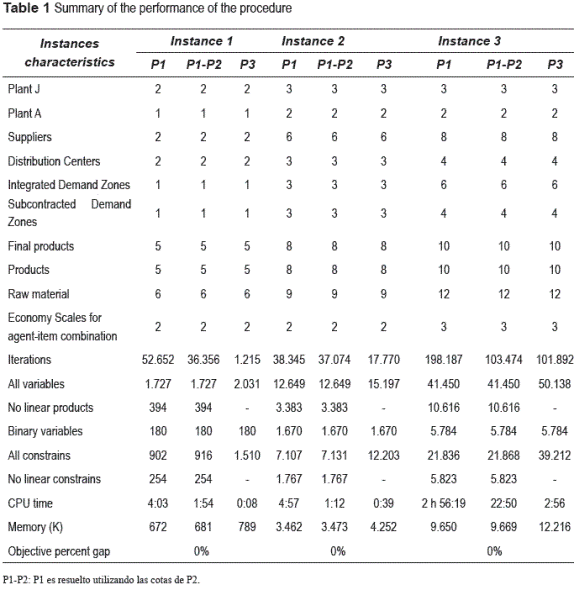
<body><![CDATA[<p><font face="Verdana" size="2">Constraints associated  with the equation &#8710; &le; &Omega; are included. As an example, the constraints associated  with the flow of integrated DCs to integrated DZs are used. Some examples are:</font></p>      <p><img src="/img/revistas/rfiua/n60/n60a11e43.gif"></p>      <p><font face="Verdana" size="2">Constraints associated  with the equation &#8710; &le; &Xi; M<sub>&Xi;</sub> are included. Some examples are:</font></p>      <p><img src="/img/revistas/rfiua/n60/n60a11e45.gif"></p>      <p><font face="Verdana" size="2">Constraints associated with the equation &#8710; &ge; &Omega; &ndash;(1&minus; &Xi;) M<sub>&Xi;</sub>  are included. In order to illustrate it, some examples are presented:</font></p>      <p><img src="/img/revistas/rfiua/n60/n60a11e47.gif"></p>      <p><font face="Verdana" size="2">Finally, in order to make the procedure of solution  more efficient, the binary search algorithm shown below is used. The above P3  solution process, as already mentioned, leads to the solution of the original  problem P1. (see <a href="#Figura3">figure 3 </a>) </font></p>      <p align="center"><img src="/img/revistas/rfiua/n60/n60a11i03.gif" ><a name="Figura3"></a></p>       <p><font face="Verdana" size="3"><b>Computational experience</b> </font></p>        <p><font face="Verdana" size="2">The  <a href="#Tabla1">table 1</a> below shows the instances of the problem. They are divided in twelve  simulated instances of P3 to determine its respective computational complexity.  For each instance, their physical and computational characteristics are  described in order to analyze its performance (see <a href="#Tabla1">table 1</a>).</font></p>      ]]></body>
<body><![CDATA[<p align="center"><img src="/img/revistas/rfiua/n60/n60a11t01.gif" ><a name="Tabla1"></a></p>      <p><font face="Verdana" size="2">The solution process was supported by MIP commercial  software LINGO<sup>TM</sup>. In the computations of the instances, Pentium-4 2.8 Ghz, 1 GB  RAM and Win XP-SP2 operative system was used. The solutions presented are  optimum. The total CPU time is in (min:sec) format. </font></p>      <p><font face="Verdana" size="3"><b>Conclusions</b> </font></p>      <p><font face="Verdana" size="2">The most significant contributions of this paper are the  design of a mathematical programming model that can be used as a paradigm in  the tactical planning of domestic supply chains, and the description of the  procedure followed to solve it. An advantage of the solution process proposed  is the low significant level of technical expertise required to achieve the  fast solution times for the instances studied.     <br>    <br>  Among the new research possibilities opened up by this  paper are the development of new solution procedures (e.g., decomposition  methods) that allow the application of the model in larger scales of  optimization, and the consideration of qualitative aspects that can be relevant  in these types of organizations, such as transaction costs, &#91;14&#93; and so, can be  included in the optimization of the supply chain. </font></p>      <p><font face="Verdana" size="3"><b>Acknowledges</b> </font></p>      <p><font face="Verdana" size="2">This article is the result of a research project  "Optimization of Agro-industrial Chains in Colombia" carried out by  La Universidad de la Sabana with financial support of COLCIENCIAS (Colombian  Institute for the Development of Science and Technology '<i>Francisco Jos&eacute; de  Caldas</i>')  and  <i>La Universidad de la Sabana</i>, and the scientific collaboration of <i>Escuela Colombiana  de Ingenier&iacute;a Julio Garavito</i>. </font></p>       <p><font face="Verdana" size="3"><b>References</b> </font></p>      <!-- ref --><p><font face="Verdana" size="2">1. C. H. Aikens. "Facility location models for  distribution planning". <i>European Journal of Operational Research</i>. Vol. 22. 1985. pp. 263 - 279.     &nbsp;&nbsp;&nbsp;&nbsp;&nbsp;&nbsp;&nbsp;&nbsp;[&#160;<a href="javascript:void(0);" onclick="javascript: window.open('/scielo.php?script=sci_nlinks&ref=000232&pid=S0120-6230201100040001100001&lng=','','width=640,height=500,resizable=yes,scrollbars=1,menubar=yes,');">Links</a>&#160;]<!-- end-ref --><br>       <!-- ref --><br>  2. M. A.  Cohen, H. L. Lee. "Strategic  analysis of integrated production-distribution systems: Models and  methods". <i>Operations Research</i>. Vol. 36. 1988. pp. 216-228.     &nbsp;&nbsp;&nbsp;&nbsp;&nbsp;&nbsp;&nbsp;&nbsp;[&#160;<a href="javascript:void(0);" onclick="javascript: window.open('/scielo.php?script=sci_nlinks&ref=000234&pid=S0120-6230201100040001100002&lng=','','width=640,height=500,resizable=yes,scrollbars=1,menubar=yes,');">Links</a>&#160;]<!-- end-ref --><br>     <!-- ref --><br>  3. B. C. Arntzen, G. G.  Brintegrated, T. P. Harrison, L. L. Trafton. "Global supply chain  management at digital equipment corporation". <i>Interfaces</i>. Vol. 25. 1995. pp. 69-93     &nbsp;&nbsp;&nbsp;&nbsp;&nbsp;&nbsp;&nbsp;&nbsp;[&#160;<a href="javascript:void(0);" onclick="javascript: window.open('/scielo.php?script=sci_nlinks&ref=000236&pid=S0120-6230201100040001100003&lng=','','width=640,height=500,resizable=yes,scrollbars=1,menubar=yes,');">Links</a>&#160;]<!-- end-ref --><br>     <!-- ref --><br>  4. A. M. Geoffrion, R. F.  Powers. "Twenty years of strategic distribution system design: An  evolutionary perspective". <i>Interfaces</i>. Vol. 25. 1995. pp. 105-127.     &nbsp;&nbsp;&nbsp;&nbsp;&nbsp;&nbsp;&nbsp;&nbsp;[&#160;<a href="javascript:void(0);" onclick="javascript: window.open('/scielo.php?script=sci_nlinks&ref=000238&pid=S0120-6230201100040001100004&lng=','','width=640,height=500,resizable=yes,scrollbars=1,menubar=yes,');">Links</a>&#160;]<!-- end-ref --><br>     <!-- ref --><br>  5. P. A. Slats, B. Bhola, J.  J. M. Evers, G Dijkhuizen. "Logistic chain modeling". <i>European Journal  of Operational Research</i>. Vol. 87. 1995. pp. 1-20.     &nbsp;&nbsp;&nbsp;&nbsp;&nbsp;&nbsp;&nbsp;&nbsp;[&#160;<a href="javascript:void(0);" onclick="javascript: window.open('/scielo.php?script=sci_nlinks&ref=000240&pid=S0120-6230201100040001100005&lng=','','width=640,height=500,resizable=yes,scrollbars=1,menubar=yes,');">Links</a>&#160;]<!-- end-ref --><br>     <!-- ref --><br>  6. D. Thomas, M. C. Griffin.  "Coordinate supply chain management". <i>European Journal  of Operational Research</i>. Vol. 94. 1996. pp. 1-15.     &nbsp;&nbsp;&nbsp;&nbsp;&nbsp;&nbsp;&nbsp;&nbsp;[&#160;<a href="javascript:void(0);" onclick="javascript: window.open('/scielo.php?script=sci_nlinks&ref=000242&pid=S0120-6230201100040001100006&lng=','','width=640,height=500,resizable=yes,scrollbars=1,menubar=yes,');">Links</a>&#160;]<!-- end-ref --><br>    <!-- ref --><br>  7. C. J. Vidal, M.  Goetschalckx. "Strategic production- distribution models: A critical  review with emphasis on global supply chain models". <i>European Journal  of Operational Research</i>. Vol. 98. 1997. pp. 1-18.     &nbsp;&nbsp;&nbsp;&nbsp;&nbsp;&nbsp;&nbsp;&nbsp;[&#160;<a href="javascript:void(0);" onclick="javascript: window.open('/scielo.php?script=sci_nlinks&ref=000244&pid=S0120-6230201100040001100007&lng=','','width=640,height=500,resizable=yes,scrollbars=1,menubar=yes,');">Links</a>&#160;]<!-- end-ref --><br>    <!-- ref --><br>  8. M. Goetschalckx, C. J.  Vidal, K. Dogan. "Modeling and design of global logistic system: A review  of integrated strategic and tactical models and design algorithms". <i>European Journal  of Operational Research</i>. Vol. 143. 2002. pp. 1-18.     &nbsp;&nbsp;&nbsp;&nbsp;&nbsp;&nbsp;&nbsp;&nbsp;[&#160;<a href="javascript:void(0);" onclick="javascript: window.open('/scielo.php?script=sci_nlinks&ref=000246&pid=S0120-6230201100040001100008&lng=','','width=640,height=500,resizable=yes,scrollbars=1,menubar=yes,');">Links</a>&#160;]<!-- end-ref --><br>    <!-- ref --><br>  9. A. Gupta,  C. D. Maranas. "Managing  demand uncertain in supply chain planning". <i>Computers &amp;  Chemical Engineering</i>. Vol. 27. 2003. pp. 1219 - 1227.     &nbsp;&nbsp;&nbsp;&nbsp;&nbsp;&nbsp;&nbsp;&nbsp;[&#160;<a href="javascript:void(0);" onclick="javascript: window.open('/scielo.php?script=sci_nlinks&ref=000248&pid=S0120-6230201100040001100009&lng=','','width=640,height=500,resizable=yes,scrollbars=1,menubar=yes,');">Links</a>&#160;]<!-- end-ref --><br>     <!-- ref --><br>  10. C. Chen, W. Lee.  "Multi-objective optimization of multi-echelon supply chain networks with  uncertain product demands and prices". <i>Computers &amp;  Chemical Engineering</i>. Vol. 28. 2004. pp. 1131 - 1144.     &nbsp;&nbsp;&nbsp;&nbsp;&nbsp;&nbsp;&nbsp;&nbsp;[&#160;<a href="javascript:void(0);" onclick="javascript: window.open('/scielo.php?script=sci_nlinks&ref=000250&pid=S0120-6230201100040001100010&lng=','','width=640,height=500,resizable=yes,scrollbars=1,menubar=yes,');">Links</a>&#160;]<!-- end-ref --><br>     <!-- ref --><br>  11. C. J. Vidal, M.  Goetschalckx. "A global supply chain model with transfer pricing and  transportation cost allocation". <i>European Journal  of Operational Research</i>. Vol. 129. 2001. pp. 134 - 158.    &nbsp;&nbsp;&nbsp;&nbsp;&nbsp;&nbsp;&nbsp;&nbsp;[&#160;<a href="javascript:void(0);" onclick="javascript: window.open('/scielo.php?script=sci_nlinks&ref=000252&pid=S0120-6230201100040001100011&lng=','','width=640,height=500,resizable=yes,scrollbars=1,menubar=yes,');">Links</a>&#160;]<!-- end-ref --><br>     <!-- ref --><br>  12. F. Villegas, J. Ouenniche.  "A general unconstrained model for transfer pricing in multinational  supply chains". <i>European Journal of Operational Research</i>. Vol. 187. 2008. pp. 829 - 856.     &nbsp;&nbsp;&nbsp;&nbsp;&nbsp;&nbsp;&nbsp;&nbsp;[&#160;<a href="javascript:void(0);" onclick="javascript: window.open('/scielo.php?script=sci_nlinks&ref=000254&pid=S0120-6230201100040001100012&lng=','','width=640,height=500,resizable=yes,scrollbars=1,menubar=yes,');">Links</a>&#160;]<!-- end-ref --><br>     <!-- ref --><br>  13. G. Mohan. <i>Mixer integer  programming models for supply chain integrated planning</i>. Masters Thesis. Concordia  University, Montreal. UMI Dissertation Information Service. 2003. pp. 133.     &nbsp;&nbsp;&nbsp;&nbsp;&nbsp;&nbsp;&nbsp;&nbsp;[&#160;<a href="javascript:void(0);" onclick="javascript: window.open('/scielo.php?script=sci_nlinks&ref=000256&pid=S0120-6230201100040001100013&lng=','','width=640,height=500,resizable=yes,scrollbars=1,menubar=yes,');">Links</a>&#160;]<!-- end-ref --><br>     <!-- ref --><br>  14. R. G. Garc&iacute;a,  J. A. Araoz. F.  Palacios. "Integral Analysis Method - IAM". <i>European Journal  of Operational Research</i>. Vol. 192. 2009. pp. 891- 903.     &nbsp;&nbsp;&nbsp;&nbsp;&nbsp;&nbsp;&nbsp;&nbsp;[&#160;<a href="javascript:void(0);" onclick="javascript: window.open('/scielo.php?script=sci_nlinks&ref=000258&pid=S0120-6230201100040001100014&lng=','','width=640,height=500,resizable=yes,scrollbars=1,menubar=yes,');">Links</a>&#160;]<!-- end-ref --><br>     <!-- ref --><br>  15. H.  Viscencio. <i>Econom&iacute;apara la Toma de Decisiones</i>. Ed. Paraninfo.  M&eacute;xico. 2002.  pp. 386.     &nbsp;&nbsp;&nbsp;&nbsp;&nbsp;&nbsp;&nbsp;&nbsp;[&#160;<a href="javascript:void(0);" onclick="javascript: window.open('/scielo.php?script=sci_nlinks&ref=000260&pid=S0120-6230201100040001100015&lng=','','width=640,height=500,resizable=yes,scrollbars=1,menubar=yes,');">Links</a>&#160;]<!-- end-ref --><br>     <!-- ref --><br>  16. K. C. Tan. "A  framework of supply chain management literature". <i>European Journal  of Purchasing and Supply Management</i>. Vol. 7. 2001. pp. 39 - 48.     &nbsp;&nbsp;&nbsp;&nbsp;&nbsp;&nbsp;&nbsp;&nbsp;[&#160;<a href="javascript:void(0);" onclick="javascript: window.open('/scielo.php?script=sci_nlinks&ref=000262&pid=S0120-6230201100040001100016&lng=','','width=640,height=500,resizable=yes,scrollbars=1,menubar=yes,');">Links</a>&#160;]<!-- end-ref --><br>     <!-- ref --><br>  17. W. M.  Abdallah. <i>International  Transfer Pricing Policies: Decision Making Guidelines for Multinational  Companies</i>. Ed. Quorum Books. New York. 1989. pp. 162.     &nbsp;&nbsp;&nbsp;&nbsp;&nbsp;&nbsp;&nbsp;&nbsp;[&#160;<a href="javascript:void(0);" onclick="javascript: window.open('/scielo.php?script=sci_nlinks&ref=000264&pid=S0120-6230201100040001100017&lng=','','width=640,height=500,resizable=yes,scrollbars=1,menubar=yes,');">Links</a>&#160;]<!-- end-ref --><br>     <!-- ref --><br>  18. E. R. Silver, R. Peterson. <i>Decision systems  for inventory management and production planning</i>. 2<sup>nd</sup>. ed. Ed. Wiley.  New York. 1985. pp. 722.     &nbsp;&nbsp;&nbsp;&nbsp;&nbsp;&nbsp;&nbsp;&nbsp;[&#160;<a href="javascript:void(0);" onclick="javascript: window.open('/scielo.php?script=sci_nlinks&ref=000266&pid=S0120-6230201100040001100018&lng=','','width=640,height=500,resizable=yes,scrollbars=1,menubar=yes,');">Links</a>&#160;]<!-- end-ref --><br>     <!-- ref --><br>  19. P. M.  Pardalos. S. A. Vavasis. "Quadratic programming with one negative eigenvalue is  NP-hard." <i>Journal of Global Optimization</i>. Vol. 21. 1991. pp. 843-855.     &nbsp;&nbsp;&nbsp;&nbsp;&nbsp;&nbsp;&nbsp;&nbsp;[&#160;<a href="javascript:void(0);" onclick="javascript: window.open('/scielo.php?script=sci_nlinks&ref=000268&pid=S0120-6230201100040001100019&lng=','','width=640,height=500,resizable=yes,scrollbars=1,menubar=yes,');">Links</a>&#160;]<!-- end-ref --><br>     <!-- ref --><br>  20. W. Hanson. R. K. Martin.  "Optimal bundle pricing". <i>Management  Science</i>. Vol.  36. 1990. pp. 155 - 174. </font>&nbsp;&nbsp;&nbsp;&nbsp;&nbsp;&nbsp;&nbsp;&nbsp;[&#160;<a href="javascript:void(0);" onclick="javascript: window.open('/scielo.php?script=sci_nlinks&ref=000270&pid=S0120-6230201100040001100020&lng=','','width=640,height=500,resizable=yes,scrollbars=1,menubar=yes,');">Links</a>&#160;]<!-- end-ref --><br>    <br>    ]]></body>
<body><![CDATA[<br>    <br>       <p><font face="Verdana" size="2">(Recibido  el 6 de junio de 2009. Aceptado el 10 de mayo de 2011)</font></p>     <p><font face="Verdana" size="2"><sup>*</sup>Autor de correspondencia: tel&eacute;fono: + 57 + 1 + 668 36 00 ext: 278-279, fax: + 57 + 1 +  676 23 40, correo electr&oacute;nico: <a href="mailto:rafael.garcia@escuelaing.edu.co">rafael.garcia@escuelaing.edu.co</a> (R. Garc&iacute;a)</font></p>      ]]></body><back>
<ref-list>
<ref id="B1">
<label>1</label><nlm-citation citation-type="journal">
<person-group person-group-type="author">
<name>
<surname><![CDATA[Aikens]]></surname>
<given-names><![CDATA[C. H]]></given-names>
</name>
</person-group>
<article-title xml:lang="en"><![CDATA[Facility location models for distribution planning]]></article-title>
<source><![CDATA[European Journal of Operational Research]]></source>
<year>1985</year>
<volume>22</volume>
<page-range>263 - 279</page-range></nlm-citation>
</ref>
<ref id="B2">
<label>2</label><nlm-citation citation-type="journal">
<person-group person-group-type="author">
<name>
<surname><![CDATA[Cohen]]></surname>
<given-names><![CDATA[M. A]]></given-names>
</name>
<name>
<surname><![CDATA[Lee]]></surname>
<given-names><![CDATA[H. L]]></given-names>
</name>
</person-group>
<article-title xml:lang="en"><![CDATA[Strategic analysis of integrated production-distribution systems: Models and methods]]></article-title>
<source><![CDATA[Operations Research]]></source>
<year></year>
<volume>36</volume>
</nlm-citation>
</ref>
<ref id="B3">
<label>3</label><nlm-citation citation-type="journal">
<person-group person-group-type="author">
<name>
<surname><![CDATA[Arntzen]]></surname>
<given-names><![CDATA[B. C]]></given-names>
</name>
<name>
<surname><![CDATA[Brintegrated]]></surname>
<given-names><![CDATA[G. G]]></given-names>
</name>
<name>
<surname><![CDATA[Harrison]]></surname>
<given-names><![CDATA[T. P]]></given-names>
</name>
<name>
<surname><![CDATA[Trafton]]></surname>
<given-names><![CDATA[L. L]]></given-names>
</name>
</person-group>
<article-title xml:lang="en"><![CDATA[Global supply chain management at digital equipment corporation]]></article-title>
<source><![CDATA[Interfaces]]></source>
<year>1995</year>
<volume>25</volume>
<page-range>69-93</page-range></nlm-citation>
</ref>
<ref id="B4">
<label>4</label><nlm-citation citation-type="journal">
<person-group person-group-type="author">
<name>
<surname><![CDATA[Geoffrion]]></surname>
<given-names><![CDATA[A. M]]></given-names>
</name>
<name>
<surname><![CDATA[Powers]]></surname>
<given-names><![CDATA[R. F]]></given-names>
</name>
</person-group>
<article-title xml:lang="en"><![CDATA[Twenty years of strategic distribution system design: An evolutionary perspective]]></article-title>
<source><![CDATA[Interfaces]]></source>
<year>1995</year>
<volume>25</volume>
<page-range>105-127</page-range></nlm-citation>
</ref>
<ref id="B5">
<label>5</label><nlm-citation citation-type="journal">
<person-group person-group-type="author">
<name>
<surname><![CDATA[Slats]]></surname>
<given-names><![CDATA[P. A]]></given-names>
</name>
<name>
<surname><![CDATA[Bhola]]></surname>
<given-names><![CDATA[B]]></given-names>
</name>
<name>
<surname><![CDATA[Evers]]></surname>
<given-names><![CDATA[J. J. M]]></given-names>
</name>
<name>
<surname><![CDATA[Dijkhuizen]]></surname>
<given-names><![CDATA[G]]></given-names>
</name>
</person-group>
<article-title xml:lang="en"><![CDATA[Logistic chain modeling]]></article-title>
<source><![CDATA[European Journal of Operational Research]]></source>
<year>1995</year>
<volume>87</volume>
<page-range>1-20</page-range></nlm-citation>
</ref>
<ref id="B6">
<label>6</label><nlm-citation citation-type="journal">
<person-group person-group-type="author">
<name>
<surname><![CDATA[Thomas]]></surname>
<given-names><![CDATA[D]]></given-names>
</name>
<name>
<surname><![CDATA[Griffin]]></surname>
<given-names><![CDATA[M. C]]></given-names>
</name>
</person-group>
<article-title xml:lang="en"><![CDATA[Coordinate supply chain management]]></article-title>
<source><![CDATA[European Journal of Operational Research]]></source>
<year>1996</year>
<volume>94</volume>
<page-range>1-15</page-range></nlm-citation>
</ref>
<ref id="B7">
<label>7</label><nlm-citation citation-type="journal">
<person-group person-group-type="author">
<name>
<surname><![CDATA[Vidal]]></surname>
<given-names><![CDATA[C. J]]></given-names>
</name>
<name>
<surname><![CDATA[Goetschalckx]]></surname>
<given-names><![CDATA[M]]></given-names>
</name>
</person-group>
<article-title xml:lang="en"><![CDATA[Strategic production- distribution models: A critical review with emphasis on global supply chain models]]></article-title>
<source><![CDATA[European Journal of Operational Research]]></source>
<year>1997</year>
<volume>98</volume>
<page-range>1-18</page-range></nlm-citation>
</ref>
<ref id="B8">
<label>8</label><nlm-citation citation-type="journal">
<person-group person-group-type="author">
<name>
<surname><![CDATA[Goetschalckx]]></surname>
<given-names><![CDATA[M]]></given-names>
</name>
<name>
<surname><![CDATA[Vidal]]></surname>
<given-names><![CDATA[C. J]]></given-names>
</name>
<name>
<surname><![CDATA[Dogan]]></surname>
<given-names><![CDATA[K]]></given-names>
</name>
</person-group>
<article-title xml:lang="en"><![CDATA[Modeling and design of global logistic system: A review of integrated strategic and tactical models and design algorithms]]></article-title>
<source><![CDATA[European Journal of Operational Research]]></source>
<year>2002</year>
<volume>143</volume>
<page-range>1-18</page-range></nlm-citation>
</ref>
<ref id="B9">
<label>9</label><nlm-citation citation-type="journal">
<person-group person-group-type="author">
<name>
<surname><![CDATA[Gupta]]></surname>
<given-names><![CDATA[A]]></given-names>
</name>
<name>
<surname><![CDATA[Maranas]]></surname>
<given-names><![CDATA[C. D]]></given-names>
</name>
</person-group>
<article-title xml:lang="en"><![CDATA[Managing demand uncertain in supply chain planning]]></article-title>
<source><![CDATA[Computers & Chemical Engineering]]></source>
<year>2003</year>
<volume>27</volume>
<page-range>1219 - 1227</page-range></nlm-citation>
</ref>
<ref id="B10">
<label>10</label><nlm-citation citation-type="journal">
<person-group person-group-type="author">
<name>
<surname><![CDATA[Chen]]></surname>
<given-names><![CDATA[C]]></given-names>
</name>
<name>
<surname><![CDATA[Lee]]></surname>
<given-names><![CDATA[W]]></given-names>
</name>
</person-group>
<article-title xml:lang="en"><![CDATA[Multi-objective optimization of multi-echelon supply chain networks with uncertain product demands and prices]]></article-title>
<source><![CDATA[Computers & Chemical Engineering]]></source>
<year>2004</year>
<volume>28</volume>
<page-range>1131 - 1144</page-range></nlm-citation>
</ref>
<ref id="B11">
<label>11</label><nlm-citation citation-type="journal">
<person-group person-group-type="author">
<name>
<surname><![CDATA[Vidal]]></surname>
<given-names><![CDATA[C. J]]></given-names>
</name>
<name>
<surname><![CDATA[Goetschalckx]]></surname>
<given-names><![CDATA[M]]></given-names>
</name>
</person-group>
<article-title xml:lang="en"><![CDATA[A global supply chain model with transfer pricing and transportation cost allocation]]></article-title>
<source><![CDATA[European Journal of Operational Research]]></source>
<year>2001</year>
<volume>129</volume>
<page-range>134 - 158</page-range></nlm-citation>
</ref>
<ref id="B12">
<label>12</label><nlm-citation citation-type="journal">
<person-group person-group-type="author">
<name>
<surname><![CDATA[Villegas]]></surname>
<given-names><![CDATA[F]]></given-names>
</name>
<name>
<surname><![CDATA[Ouenniche]]></surname>
<given-names><![CDATA[J]]></given-names>
</name>
</person-group>
<article-title xml:lang="en"><![CDATA[A general unconstrained model for transfer pricing in multinational supply chains]]></article-title>
<source><![CDATA[European Journal of Operational Research]]></source>
<year>2008</year>
<volume>187</volume>
<page-range>829 - 856</page-range></nlm-citation>
</ref>
<ref id="B13">
<label>13</label><nlm-citation citation-type="">
<person-group person-group-type="author">
<name>
<surname><![CDATA[Mohan]]></surname>
<given-names><![CDATA[G]]></given-names>
</name>
</person-group>
<source><![CDATA[Mixer integer programming models for supply chain integrated planning]]></source>
<year></year>
<page-range>133</page-range></nlm-citation>
</ref>
<ref id="B14">
<label>14</label><nlm-citation citation-type="journal">
<person-group person-group-type="author">
<name>
<surname><![CDATA[García]]></surname>
<given-names><![CDATA[R. G]]></given-names>
</name>
<name>
<surname><![CDATA[Araoz]]></surname>
<given-names><![CDATA[J. A]]></given-names>
</name>
<name>
<surname><![CDATA[Palacios]]></surname>
<given-names><![CDATA[F]]></given-names>
</name>
</person-group>
<source><![CDATA[European Journal of Operational Research]]></source>
<year>2009</year>
<volume>192</volume>
<page-range>891- 903</page-range></nlm-citation>
</ref>
<ref id="B15">
<label>15</label><nlm-citation citation-type="book">
<person-group person-group-type="author">
<name>
<surname><![CDATA[Viscencio]]></surname>
<given-names><![CDATA[H]]></given-names>
</name>
</person-group>
<source><![CDATA[Economíapara la Toma de Decisiones]]></source>
<year>2002</year>
<page-range>386</page-range><publisher-loc><![CDATA[México ]]></publisher-loc>
<publisher-name><![CDATA[Ed. Paraninfo]]></publisher-name>
</nlm-citation>
</ref>
<ref id="B16">
<label>16</label><nlm-citation citation-type="journal">
<person-group person-group-type="author">
<name>
<surname><![CDATA[Tan]]></surname>
<given-names><![CDATA[K. C]]></given-names>
</name>
</person-group>
<article-title xml:lang="en"><![CDATA[A framework of supply chain management literature]]></article-title>
<source><![CDATA[European Journal of Purchasing and Supply Management]]></source>
<year>2001</year>
<volume>7</volume>
<page-range>39 - 48</page-range></nlm-citation>
</ref>
<ref id="B17">
<label>17</label><nlm-citation citation-type="book">
<person-group person-group-type="author">
<name>
<surname><![CDATA[Abdallah]]></surname>
<given-names><![CDATA[W. M]]></given-names>
</name>
</person-group>
<source><![CDATA[International Transfer Pricing Policies: Decision Making Guidelines for Multinational Companies]]></source>
<year>1989</year>
<page-range>162</page-range><publisher-loc><![CDATA[New York ]]></publisher-loc>
<publisher-name><![CDATA[Ed. Quorum Books]]></publisher-name>
</nlm-citation>
</ref>
<ref id="B18">
<label>18</label><nlm-citation citation-type="book">
<person-group person-group-type="author">
<name>
<surname><![CDATA[Silver]]></surname>
<given-names><![CDATA[E. R]]></given-names>
</name>
<name>
<surname><![CDATA[Peterson]]></surname>
<given-names><![CDATA[R]]></given-names>
</name>
</person-group>
<source><![CDATA[Decision systems for inventory management and production planning]]></source>
<year>1985</year>
<edition>2</edition>
<page-range>722</page-range><publisher-loc><![CDATA[New York ]]></publisher-loc>
<publisher-name><![CDATA[Ed. Wiley]]></publisher-name>
</nlm-citation>
</ref>
<ref id="B19">
<label>19</label><nlm-citation citation-type="journal">
<person-group person-group-type="author">
<name>
<surname><![CDATA[Pardalos]]></surname>
<given-names><![CDATA[P. M]]></given-names>
</name>
<name>
<surname><![CDATA[Vavasis]]></surname>
<given-names><![CDATA[S. A]]></given-names>
</name>
</person-group>
<article-title xml:lang="en"><![CDATA[Quadratic programming with one negative eigenvalue is NP-hard]]></article-title>
<source><![CDATA[Journal of Global Optimization]]></source>
<year>1991</year>
<volume>21</volume>
<page-range>843-855</page-range></nlm-citation>
</ref>
<ref id="B20">
<label>20</label><nlm-citation citation-type="journal">
<person-group person-group-type="author">
<name>
<surname><![CDATA[Hanson]]></surname>
<given-names><![CDATA[W]]></given-names>
</name>
<name>
<surname><![CDATA[Martin]]></surname>
<given-names><![CDATA[R. K]]></given-names>
</name>
</person-group>
<article-title xml:lang="en"><![CDATA[Optimal bundle pricing]]></article-title>
<source><![CDATA[Management Science]]></source>
<year>1990</year>
<volume>36</volume>
<page-range>155 - 174</page-range></nlm-citation>
</ref>
</ref-list>
</back>
</article>