<?xml version="1.0" encoding="ISO-8859-1"?><article xmlns:mml="http://www.w3.org/1998/Math/MathML" xmlns:xlink="http://www.w3.org/1999/xlink" xmlns:xsi="http://www.w3.org/2001/XMLSchema-instance">
<front>
<journal-meta>
<journal-id>0120-6230</journal-id>
<journal-title><![CDATA[Revista Facultad de Ingeniería Universidad de Antioquia]]></journal-title>
<abbrev-journal-title><![CDATA[Rev.fac.ing.univ. Antioquia]]></abbrev-journal-title>
<issn>0120-6230</issn>
<publisher>
<publisher-name><![CDATA[Facultad de Ingeniería, Universidad de Antioquia]]></publisher-name>
</publisher>
</journal-meta>
<article-meta>
<article-id>S0120-62302011000400021</article-id>
<title-group>
<article-title xml:lang="en"><![CDATA[A ripple-mitigating pre-amplifier based on interleaved DC-DC boost converters for efficiency improvement]]></article-title>
<article-title xml:lang="es"><![CDATA[Pre-Amplificador de potencia basado en conexión paralela de convertidores DC-DC para reducción de rizados de corriente e incremento de eficiencia]]></article-title>
</title-group>
<contrib-group>
<contrib contrib-type="author">
<name>
<surname><![CDATA[Arango]]></surname>
<given-names><![CDATA[Eliana]]></given-names>
</name>
<xref ref-type="aff" rid="A01"/>
</contrib>
<contrib contrib-type="author">
<name>
<surname><![CDATA[Ramos-Paja]]></surname>
<given-names><![CDATA[Carlos]]></given-names>
</name>
<xref ref-type="aff" rid="A01"/>
</contrib>
<contrib contrib-type="author">
<name>
<surname><![CDATA[Carrejo]]></surname>
<given-names><![CDATA[Carlos]]></given-names>
</name>
<xref ref-type="aff" rid="A02"/>
</contrib>
<contrib contrib-type="author">
<name>
<surname><![CDATA[Giral]]></surname>
<given-names><![CDATA[Roberto]]></given-names>
</name>
<xref ref-type="aff" rid="A03"/>
</contrib>
<contrib contrib-type="author">
<name>
<surname><![CDATA[Saavedra-Montes]]></surname>
<given-names><![CDATA[Andres]]></given-names>
</name>
<xref ref-type="aff" rid="A01"/>
</contrib>
</contrib-group>
<aff id="A01">
<institution><![CDATA[,Universidad Nacional de Colombia  ]]></institution>
<addr-line><![CDATA[Medellín ]]></addr-line>
<country>Colombia</country>
</aff>
<aff id="A02">
<institution><![CDATA[,Laboratoire d'Analyse et d'Architecture des Systèmes LAAS-CNRS  ]]></institution>
<addr-line><![CDATA[Toulouse ]]></addr-line>
<country>France</country>
</aff>
<aff id="A03">
<institution><![CDATA[,Universitat Rovira i Virgili  ]]></institution>
<addr-line><![CDATA[Tarragona ]]></addr-line>
<country>España</country>
</aff>
<pub-date pub-type="pub">
<day>00</day>
<month>09</month>
<year>2011</year>
</pub-date>
<pub-date pub-type="epub">
<day>00</day>
<month>09</month>
<year>2011</year>
</pub-date>
<numero>60</numero>
<fpage>214</fpage>
<lpage>225</lpage>
<copyright-statement/>
<copyright-year/>
<self-uri xlink:href="http://www.scielo.org.co/scielo.php?script=sci_arttext&amp;pid=S0120-62302011000400021&amp;lng=en&amp;nrm=iso"></self-uri><self-uri xlink:href="http://www.scielo.org.co/scielo.php?script=sci_abstract&amp;pid=S0120-62302011000400021&amp;lng=en&amp;nrm=iso"></self-uri><self-uri xlink:href="http://www.scielo.org.co/scielo.php?script=sci_pdf&amp;pid=S0120-62302011000400021&amp;lng=en&amp;nrm=iso"></self-uri><abstract abstract-type="short" xml:lang="en"><p><![CDATA[An efficient pre-amplifier based on interleaved DC-DC boost switching converters to mitigate high-frequency harmonics injection to power sources is proposed. The main features of the pre-amplifier are mitigate the ripple of power converters input-current and improving the efficiency of the whole power conversion chain. The pre-amplifier optimal operating conditions are calculated, and the circuit is modeled and controlled to operate in such conditions. The pre-amplifier interacting with a classical single boost is analyzed, obtaining a strong reduction in the current ripple injected to the source, and also improving the efficiency of the initial conversion system. Finally, the theoretical analyses are confirmed by means of circuital PSIM simulations and experimental results.]]></p></abstract>
<abstract abstract-type="short" xml:lang="es"><p><![CDATA[Este artículo propone un pre-amplificador basado en convertidores DC-DC conectados en paralelo para la reducción de armónicos inyectados a fuentes de potencia. Las principales características del pre-amplificador son la reducción del rizado de corriente de entrada en convertidores de potencia, incrementado además la eficiencia del sistema de conversión. Se describe el cálculo de las condiciones óptimas de operación del pre-amplificador, así como su modelado matemático y control para operar en las condiciones seleccionadas. Así mismo, se analiza el pre-amplificador con un convertidor elevador clásico, obteniendo una reducción significativa en el rizado de corriente inyectado a la fuente, así como un incremento en la eficiencia del sistema. Finalmente, los análisis teóricos se confirman a través de simulaciones circuitales y resultados experimentales.]]></p></abstract>
<kwd-group>
<kwd lng="en"><![CDATA[Pre-Amplifier]]></kwd>
<kwd lng="en"><![CDATA[interleaved converters]]></kwd>
<kwd lng="en"><![CDATA[efficiency improvement]]></kwd>
<kwd lng="en"><![CDATA[ripple mitigation]]></kwd>
<kwd lng="es"><![CDATA[Pre-Amplificador]]></kwd>
<kwd lng="es"><![CDATA[conexión en paralelo]]></kwd>
<kwd lng="es"><![CDATA[eficiencia]]></kwd>
<kwd lng="es"><![CDATA[reducción de rizado]]></kwd>
</kwd-group>
</article-meta>
</front><body><![CDATA[ <p align="center"><font face="Verdana" size="4"> <b>A ripple-mitigating pre-amplifier based on interleaved DC-DC boost converters for efficiency improvement</b></font></p>      <p align="center"><font face="Verdana" size="4"> <b>Pre-Amplificador de potencia basado en conexi&oacute;n paralela de convertidores DC-DC para reducci&oacute;n de rizados de corriente e incremento de eficiencia</b></font></p>      <p> <font face="Verdana" size="2"> <i>Eliana Arango<sup>1</sup>, Carlos Ramos-Paja<sup>*1</sup>, Carlos Carrejo<sup>2</sup>, Roberto Giral<sup>3</sup>, Andres Saavedra-Montes<sup>1</sup></i></font></p>       <p><font face="Verdana" size="2"><sup>1</sup>Universidad Nacional de Colombia. Carrera 80 N.&deg; 65-223. Medell&iacute;n, Colombia.     <br>    <br> <sup>2</sup>Laboratoire d'Analyse  et d'Architecture des Syst&egrave;mes LAAS-CNRS. Toulouse, France.     <br>    <br> <sup>3</sup>Universitat Rovira i Virgili, Avda. Pa&iuml;sos Catalans 26, 43007. Tarragona,  Espa&ntilde;a. </font></p>      <br>  <hr noshade size="1">      <p><font face="Verdana" size="3"><b>Abstract</b></font></p>      ]]></body>
<body><![CDATA[<p><font face="Verdana" size="2">An  efficient pre-amplifier based on interleaved DC-DC boost switching converters  to mitigate high-frequency harmonics injection to power sources is proposed.  The main features of the pre-amplifier are mitigate the ripple of power  converters input-current and improving the efficiency of the whole power  conversion chain. The pre-amplifier optimal operating conditions are  calculated, and the circuit is modeled and controlled to operate in such  conditions. The pre-amplifier interacting with a classical single boost is  analyzed, obtaining a strong reduction in the current ripple injected to the  source, and also improving the efficiency of the initial conversion system.  Finally, the theoretical analyses are confirmed by means of circuital PSIM  simulations and experimental results.</font></p>      <p><font face="Verdana" size="2"><i>Keywords: </i>Pre-Amplifier,  interleaved converters, efficiency improvement, ripple mitigation.</font></p>  <hr noshade size="1">      <p><font face="Verdana" size="3"><b>Resumen</b></font></p>       <p><font face="Verdana" size="2">Este  art&iacute;culo propone un pre-amplificador basado en convertidores DC-DC conectados  en paralelo para la reducci&oacute;n de arm&oacute;nicos inyectados a fuentes de potencia.  Las principales caracter&iacute;sticas del pre-amplificador son la reducci&oacute;n del  rizado de corriente de entrada en convertidores de potencia, incrementado  adem&aacute;s la eficiencia del sistema de conversi&oacute;n. Se describe el c&aacute;lculo de las  condiciones &oacute;ptimas de operaci&oacute;n del pre-amplificador, as&iacute; como su modelado  matem&aacute;tico y control para operar en las condiciones seleccionadas. As&iacute; mismo,  se analiza el pre-amplificador con un convertidor elevador cl&aacute;sico, obteniendo  una reducci&oacute;n significativa en el rizado de corriente inyectado a la fuente,  as&iacute; como un incremento en la eficiencia del sistema. Finalmente, los an&aacute;lisis  te&oacute;ricos se confirman a trav&eacute;s de simulaciones circuitales y resultados  experimentales.</font></p>       <p><font face="Verdana" size="2"><i>Palabras clave:</i>Pre-Amplificador,  conexi&oacute;n en paralelo, eficiencia, reducci&oacute;n de rizado.</font> </p>   <br clear="all"> <hr noshade size="1">      <p><font face="Verdana" size="3"><b>Introduction</b></font></p>        <p><font face="Verdana" size="2">Considering the problematic that establishes the global  warming, fossil fuel exhaustion and the need to reduce carbon dioxide emissions  provided the stimulus to develop renewable energies sources as fuel cell and  photovoltaic panels &#91;1, 2&#93;. These options have been outlined for being two of  the most attractive since they are clean, pollution free, and inexhaustible. An  important aspect to consider is that these options have a series of  disadvantages as the high costs of installation and maintenance, low diffusion  among the users and difficulties in the process of energy storage, and such  characteristics maintain them non-competitive opposite to the option of  fossil-based energy resources. The appearance of new types of semiconductors,  control strategies and switched devices has raised the relation cost benefit  for this type of applications &#91;3-6&#93;. Nevertheless, the interconnection with the  utility grid continues to be a weak point to consider.     <br>    <br> It is widely known that the  current harmonics generated in source-power converter interaction can seriously  affect the system integrity and performance. In fuel cell applications, the  current harmonics are directly related to the Oxygen- starvation phenomena,  which considerably increase the natural aging of the cell membranes &#91;7&#93;. As for  the photovoltaic applications, the current harmonics affect the performance of  the control strategy, like the Maximum Power Point Tracking (MPPT) controller,  reducing its accuracy and decreasing the system efficiency &#91;8&#93;. In this paper,  the current harmonic injection to power sources by power converters is  addressed through an active cancelation. Nevertheless, low frequency  oscillations at double of the grid frequency are not considered since they can  be addressed by control approaches &#91;9&#93;.     <br>    ]]></body>
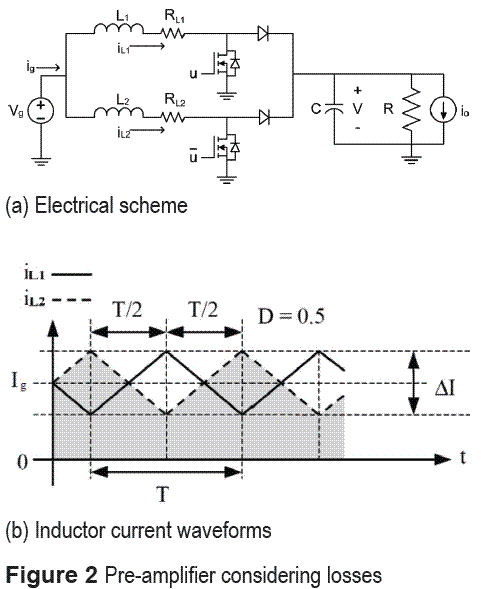
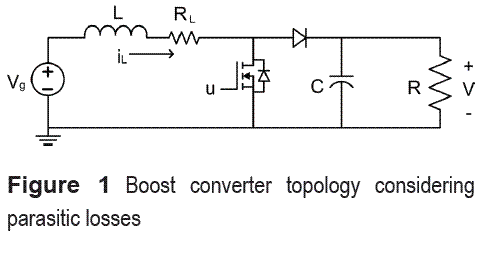
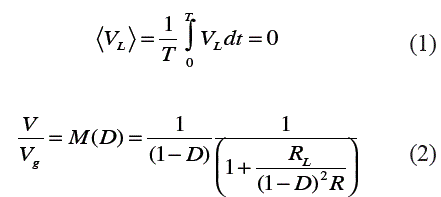
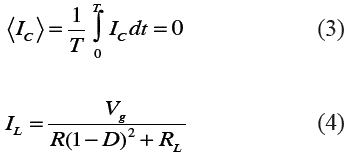
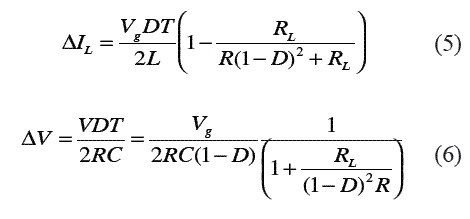
<body><![CDATA[<br> This paper is based on the work "A Ripple- Mitigating  Pre-filter Based on Interleaved DC- DC Boost Converters", developed by the  authors, which appeared in the 36th Annual Conference of the IEEE Industrial  Electronics Society (IECON-2010, &copy; 2010 IEEE), and it is focused on the  development of a power conversion system able to mitigate the high frequency  current harmonics generated during the converter switching, which is  traditionally addressed by the typical capacitor-filtering solution &#91;10&#93;. The  proposed solution also reduces the input capacitor requirements, decreasing its  cost and avoiding the use of non-reliable electrolytic capacitors.     <br>    <br> The  remain of the paper is organized as follows. The next section analyses a  classical single boost converter considering power losses. Then, the novel  pre-amplifier structure considering two boost converters in interleaved  topology is introduced. Furthermore, the paper presents the proposed  pre-amplifier operating with a boost converter, and compares it with the  classical boost approach by analytical and PSIM simulation results. Moreover,  the proposed solution is validated by means of experimental results. Finally,  some conclusions of the work are given.</font></p>      <p><font face="Verdana" size="3"><b>Single  boost converter analysis</b></font></p>      <p><font face="Verdana" size="2">The  design of a DC-DC converter, boost in this case, is performed to obtain the  desired current and voltage ripples. Given the switching frequency, the input  and output voltage, and ripples allowed, the capacitance and inductance are  designed, which are largely responsible for the converter's size. The first  step is to analyze the DC-DC boost converter efficiency considering the power  losses lumped in a single inductor series-resistance as depicted in <a href="#Figura1">figure 1</a>.  Using the volt-second balance &#91;11&#93; (1), the relation between the input and  output voltages (2) is obtained, where T is the switching period and D the  steady-state duty cycle.    <br>     <p align="center"><img src="/img/revistas/rfiua/n60/n60a21i01.gif" ><a name="Figura1"></a></p>      <p> <img src="/img/revistas/rfiua/n60/n60a21e01.gif"></p>    Considering the capacitor  charge balance &#91;11&#93; (3), the steady state inductance's current i<sub>L</sub>  is:    <br>      <p> <img src="/img/revistas/rfiua/n60/n60a21e03.gif"></p>    The  current ripple in the inductor is obtained calculating the current's slope in  the first switching semi-cycle (5). Similarly, the voltage ripple at the output  capacitor (6) is calculated.    ]]></body>
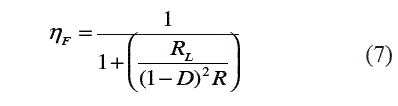
<body><![CDATA[<br>      <p> <img src="/img/revistas/rfiua/n60/n60a21e05.gif"></p>    Finally,  the efficiency of the boost converter considering the parasitic losses is given  by (7).</font></p>      <p> <img src="/img/revistas/rfiua/n60/n60a21e07.gif"></p>     <p> <font face="Verdana" size="3"><b>Pre-Amplifier topology and control</b></font></p>         <p><font face="Verdana" size="2">The pre-amplifier consists of two boost converters in  parallel, analyzed by considering the power losses lumped in inductor series-  resistances, which scheme is depicted in <a href="#Figura2">figure 2</a>(a). The active switches,  MOSFETs in this case, are controlled using complementary signals. This  structure is called complementary interleaving and allows reducing the ripple  of the input and output variables according to the specifications. The  complementary activation of the switches in the boost converters cancels  inductors current harmonics reducing the ripple in the input current &#91;1&#93;.    <br>        <p align="center"><img src="/img/revistas/rfiua/n60/n60a21i02.gif" ><a name="Figura2"></a></p>     Also, it mitigates the output  voltage ripple and reduces the electromagnetic interferences. In this way, the  reduction of the ripples allows to reduce the converter capacitances.     <br>    <br>    With  the complementary control signals, one of the inductors current is increasing  while the another one current is decreasing, therefore, the slopes of the  current waveforms have opposite signs as depicted in <a href="#Figura2">figure 2</a>(b), where T represents  the switching period, D the duty cycle and &Delta;I the peak-to-peak ripple current.  Since the input current is the sum of both inductor currents, the resulting  slope tends to cero producing a decrease in the input current ripple. As shows  <a href="#Figura2">figure 2</a>(b), the most favorable ripple decreasing case is produced when the  duty cycle is 0.5, or 50 %, because the slopes of both currents are equal but  with opposite sign. The final value of the input current I<sub>g</sub>  corresponds to the integral of the shaded area.</font></p>        <p> <font face="Verdana" size="2"><b><i>Dynamic model</i></b></font></p>       ]]></body>
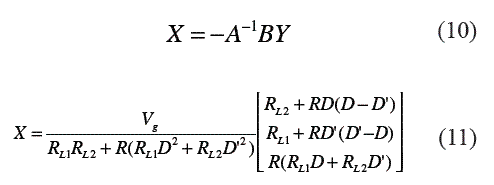
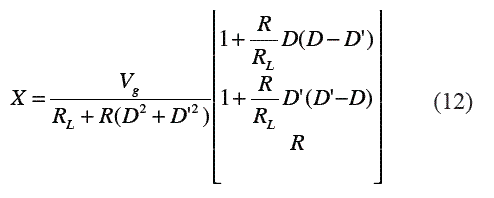
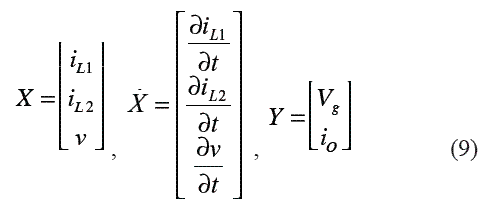
<body><![CDATA[<p><font face="Verdana" size="2">The state equations of the  pre-amplifier circuit given in <a href="#Figura2">figure 2</a>(a) can be expressed as:     <br>      <p> <img src="/img/revistas/rfiua/n60/n60a21e08.gif"></p>  where <i>X</i> and <img src="/img/revistas/rfiua/n60/n60a21i00.gif"> correspond to the state  variables vector and its derivatives. The <i>Y</i> vector contains the system inputs, and A and B matrices  depend on the converter parameters.     <br>      <p> <img src="/img/revistas/rfiua/n60/n60a21e09.gif"></p>  As  is described in (9), the system states are the inductor currents i<sub>L1</sub>  and i<sub>L2</sub>, and the output capacitor voltage <em>v</em>. The inputs of the system are  the input voltage V<sub>g</sub>, and the load perturbation current i<sub>O</sub>.  In steady state, the derivatives of states are cero, and the vector X is  obtained as:    <br>      <p> <img src="/img/revistas/rfiua/n60/n60a21e10.gif"></p>  In  sake of simplicity, the losses of both converters are considered similar, R<sub>L</sub>  &asymp; R<sub>L1</sub>&asymp; R<sub>L2</sub>, and expression (11) can be  simplified as:    <br>      <p> <img src="/img/revistas/rfiua/n60/n60a21e12.gif"></p>  The  relation between the input and output voltages, obtained from the volt-second  balance is:    <br>      ]]></body>
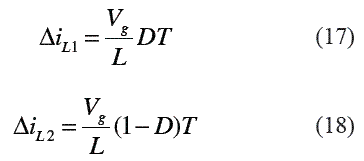
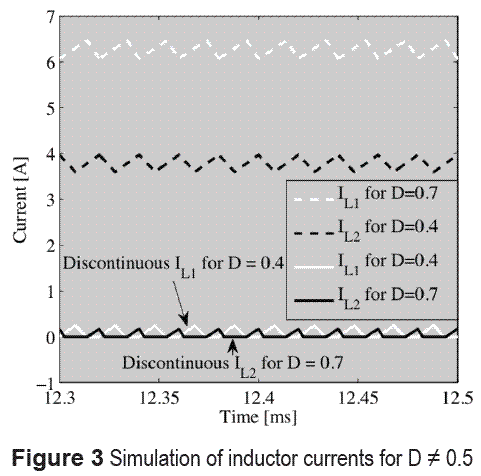
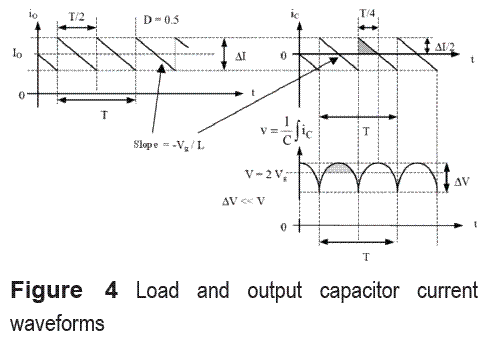
<body><![CDATA[<p> <img src="/img/revistas/rfiua/n60/n60a21e13.gif"></p>    Such  a condition is valid for a duty cycle equal to 50 %, or D = 0.5. Otherwise, the  pre-amplifier enters in Discontinuous Conduction Mode (DCM) preventing the  cancelation of the current ripples. This conclusion is obtained by applying the  volt-second balance in each inductor:     <br>      <p> <img src="/img/revistas/rfiua/n60/n60a21e14.gif"></p>       From  equations (14) and (15) is concluded that the only condition that ensures a  Continuous Conduction Mode (CCM) for the pre-amplifier is given by:    <br>      <p> <img src="/img/revistas/rfiua/n60/n60a21e16.gif"></p>       Simulations  depicted in <a href="#Figura3">figure 3</a> corroborate the previous conclusion, where the inductor  drove by the smallest duty cycle operates in DCM, and therefore the duty cycles  of both converters must be D = 0.5 to operate in CCM and to obtain the desired  current ripple reduction. Also, from equation (13), and considering a common  relation between parasitic loss-resistance and load equal to 1%, the voltage  conversion ratio of this pre-amplifier is approximately 2.    <br>     <p align="center"><img src="/img/revistas/rfiua/n60/n60a21i03.gif" ><a name="Figura3"></a></p>      The  current ripple magnitudes on the inductors are given by equations (17) and  (18), obtained solving the charge balance (3) for each inductor in steady-state  conditions:    <br>        <p> <img src="/img/revistas/rfiua/n60/n60a21e17.gif"></p>    Considering D = 0.5, the current ripple magnitudes (17) and  (18) are equal but with opposite sign. This implies that the input current will  have a small ripple, and in the ideal case, null ripple.    <br>     ]]></body>
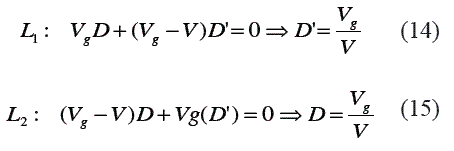
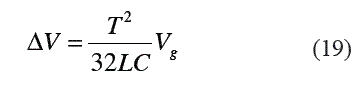
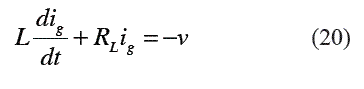
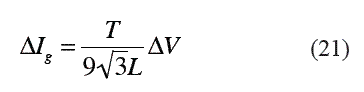
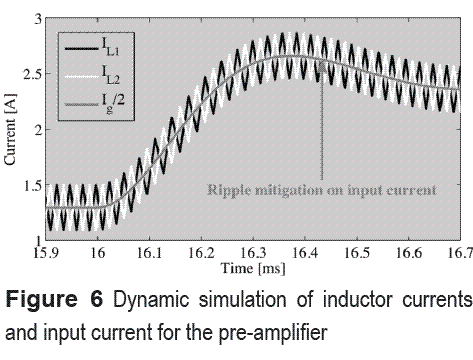
<body><![CDATA[<br>    For D &ne; 0.5 one inductor enters on DCM because the CCM conditions  given by (14) and (16) are not fulfilled. The inductor drove by the smaller  duty cycle, and therefore with lower steady- state current, enters on DCM. This  illustrated in <a href="#Figura3">figure 3</a>, where a duty cycle D = 0.7 causes a discontinuous L<sub>2</sub>  current since it is driver by D', while D = 0.4 causes a discontinuous L<sub>1</sub>  current.     <br>    <br>    The output voltage ripple, depicted in <a href="#Figura4">figure 4</a>, is  calculated by analyzing the current waveforms of the load i<sub>O</sub>(t) and  output capacitor i<sub>C</sub>(t). <a href="#Figura4">Figure 4</a> shows that the output voltage ripple  is small enough to consider the load current to be constant and equal to its  steady-state value. The current ripple is a sawtooth waveform with a frequency  equal to the double of the switching frequency.    <br>     <p align="center"><img src="/img/revistas/rfiua/n60/n60a21i04.gif" ><a name="Figura4"></a></p>    The  voltage ripple is obtained by integrating the current ripple on the capacitor  in each semi-period. It is observed in <a href="#Figura4">figure 4</a> that in each T/4 seconds the  capacitor current sign changes, hence the capacitor voltage waveform is a  symmetric convex parabola with a maximum value of (2Vg + &Delta;V/3). Calculating the  integral of i<sub>C</sub>(t) through the triangular shaded area, the amplitude  in absolute value of the output voltage ripple &Delta;V is calculated as:    <br>      <p> <img src="/img/revistas/rfiua/n60/n60a21e19.gif"></p>     From  the inductors current ripple cancelation is expected a null input current  ripple, but since in each switching interval the output port and the input  source are connected through one inductor, L<sub>2</sub> during DT seconds and  L<sub>1</sub> during D'T seconds, an input current ripple is generated by the  output voltage ripple following the small-signal relation &#91;12&#93;:    <br>      <p> <img src="/img/revistas/rfiua/n60/n60a21e20.gif"></p>    Since  the current ripple frequency in the output capacitor should be high, its losses  are small enough to be neglected. Therefore, integrating the shaded area in  capacitor voltage waveform of <a href="#Figura4">figure 4</a> and dividing it by L, the amplitude of  the input current ripple &Delta;Ig is obtained as follows:</font></p>                <p> <img src="/img/revistas/rfiua/n60/n60a21e21.gif"></p>       ]]></body>
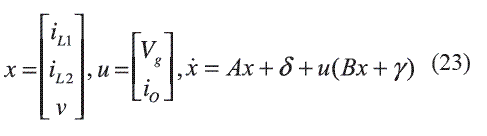
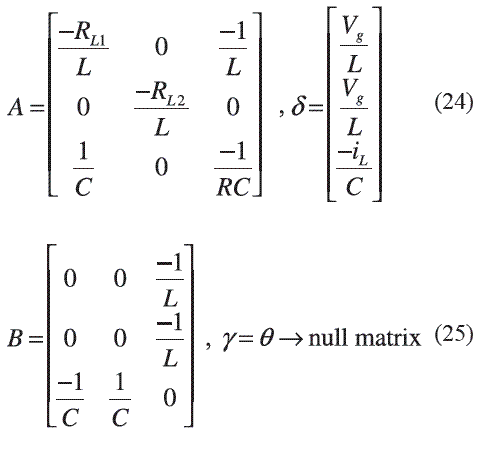
<body><![CDATA[<p> <font face="Verdana" size="2"><i>Sliding-mode control</i></font></p>       <p><font face="Verdana" size="2">In practical implementations,  there is slightly different impedances in both pre-amplifier branches, which  causes a difference between the DC current components of the inductors  depending on its inductance and parasitic losses tolerances. This must be  addressed to ensure the ripple reduction, and therefore a closed loop control  system is required. Since the PWM technique requires an external periodic  signal, the sliding-mode technique has been adopted due to its simpler  implementation.    <br>    <br>    The first step in sliding-mode  control consists in the design of the state space region to which the dynamic  of the system must be restricted, being generally called sliding surfaces. One  option is to choose hyperplanes &#91;2&#93;, meaning linear combinations of the system  state variables.    <br>    <br>    There  are three state variables in the pre-amplifier. Two are the inductor currents  and the last one is the voltage of the output capacitor. Although there are two  switches, they are considered as a single control variable because they are  activated by complementary signals, and therefore a single sliding surface S(x)  is required to fulfill the desired condition D = 0.5:    <br>       <p> <img src="/img/revistas/rfiua/n60/n60a21e22.gif"></p>    The small-signal dynamics are defined by:    <br>      <p> <img src="/img/revistas/rfiua/n60/n60a21e23.gif"></p>     From  the sliding-mode control theory &#91;4&#93; and the system description, matrices A, &delta;, B and &gamma; are:    ]]></body>

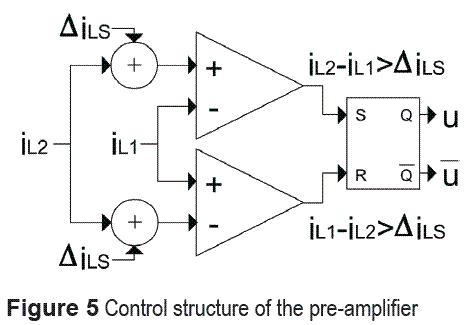
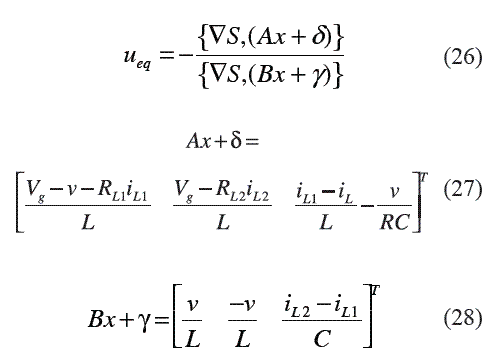
<body><![CDATA[<br>          <p> <img src="/img/revistas/rfiua/n60/n60a21e24.gif"></p>        where the input voltage V<sub>g</sub>  is considered constant and positive, and the inductances are equal.     <br>    <br>      The equivalent control technique  &#91;2, 5&#93; is used to calculate the continuous value u<sub>eq</sub> to be taken by the  control variable (22) if the conditions <i>S</i>(<i>x</i>) = 0 and <i>dS</i>(<i>x</i>) / <i>dt</i> = 0 are achieved. Such  conditions guarantee that the system trajectory is tangent to S(x) and remain  trapped into it. The expression for the equivalent control is described by  equation (26). In the numerator of the equivalent control there is the vector field  (Ax + &delta;) whose expression, in this case, is given by equation (27), and  likewise the denominator vector field is described by (28).    <br>         <p> <img src="/img/revistas/rfiua/n60/n60a21e26.gif"></p>            The  equivalent control expression depends on the parasitic losses and state  variables, and also on the system inputs V<sub>g</sub> and i<sub>O</sub>. In  sake of simplicity, the inductors parasitic losses are considered comparable,  therefore R<sub>L1</sub> &asymp; R<sub>L2</sub> &asymp; R<sub>L</sub>, and the equivalent  control is simplified to:    <br>          <p> <img src="/img/revistas/rfiua/n60/n60a21e29.gif"></p>      Taking  into account the transversality condition (v &ne; 0), if the system trajectory is  on the surface {S(x) = 0, i<sub>L1</sub> = i<sub>L2</sub>}, the equivalent  control is constant and equal to 0.5 (30), while the switching frequency  depends on the operating conditions.    <br>          <p> <img src="/img/revistas/rfiua/n60/n60a21e30.gif"></p>      The  controller has been implemented using the structure described in <a href="#Figura5">figure 5</a>,  where <i>u</i> and  <img src="/img/revistas/rfiua/n60/n60a21e0b.gif"> are the complementary signals  for activating&nbsp;&nbsp; the  MOSFETs, and &Delta;i<sub>Ls</sub> defines the maximum difference allowed between the  inductor currents, therefore the width of the sliding surface.         ]]></body>
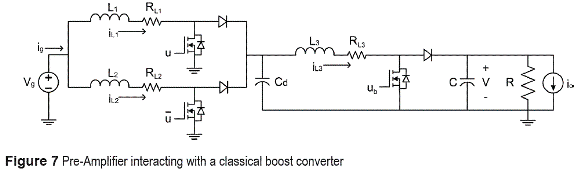
<body><![CDATA[<p align="center"><img src="/img/revistas/rfiua/n60/n60a21i05.gif" ><a name="Figura5"></a></p>  To illustrate the controller behavior, <a href="#Figura6">figure 6</a> shows a  transient simulation where also in such conditions the inductor currents are  complementary and the input current is minimum. In the simulation the input  current is shown divided by two to allow its visualization in the same scale.</font></p>       <p align="center"><img src="/img/revistas/rfiua/n60/n60a21i06.gif" ><a name="Figura6"></a></p>      <p> <font face="Verdana" size="2"><b><i>Pre-Amplifier based system: classicalboost interaction</i></b></font></p>      <p><font face="Verdana" size="2">This section analyses the  proposed Pre-Amplifier interacting with a classical boost converter as depicted  in <a href="#Figura7">figura 7</a>. The main objective of this structure is to reduce the current  ripple injected to the source V<sub>g</sub> without reducing the original power  conversion efficiency. In this section, the input current ripple and the  efficiency of both boost and boost with active pre-amplifier are contrasted. </font></p>     <p align="center"><img src="/img/revistas/rfiua/n60/n60a21i07.gif" ><a name="Figura7"></a></p>       <p><font face="Verdana" size="2"><i>Steady-state  analysis of the pre-amplifier based  system</i></font></p>      <p><font face="Verdana" size="2">By applying the volt-second  balance, and considering R<sub>L1</sub> &asymp; R<sub>L2</sub> &asymp; R<sub>L</sub>, the  input-to-output voltage conversion ratio is:     <br>     <p> <img src="/img/revistas/rfiua/n60/n60a21e31.gif"></p> Similarly, by applying the  charge balance on the circuit, the steady-state input current is:    <br>     ]]></body>
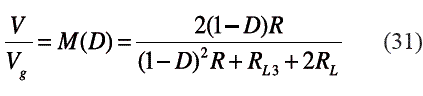
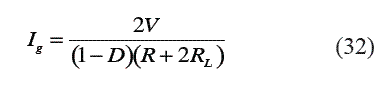
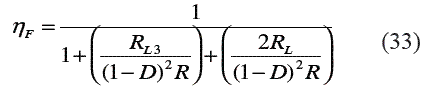
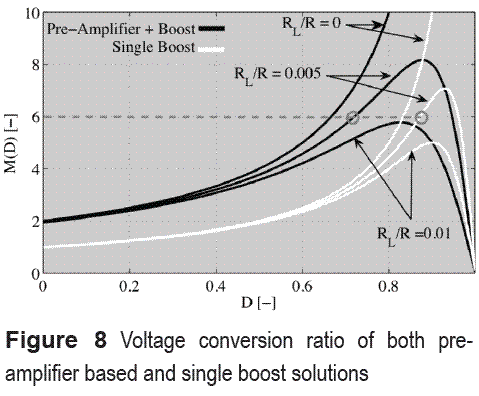
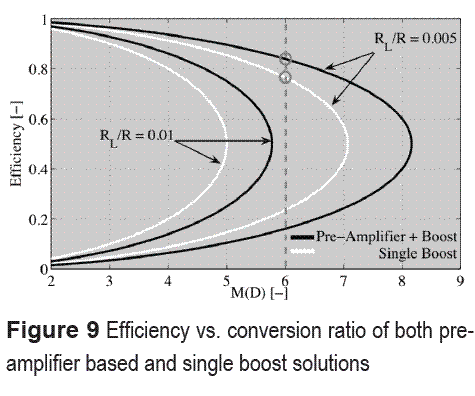
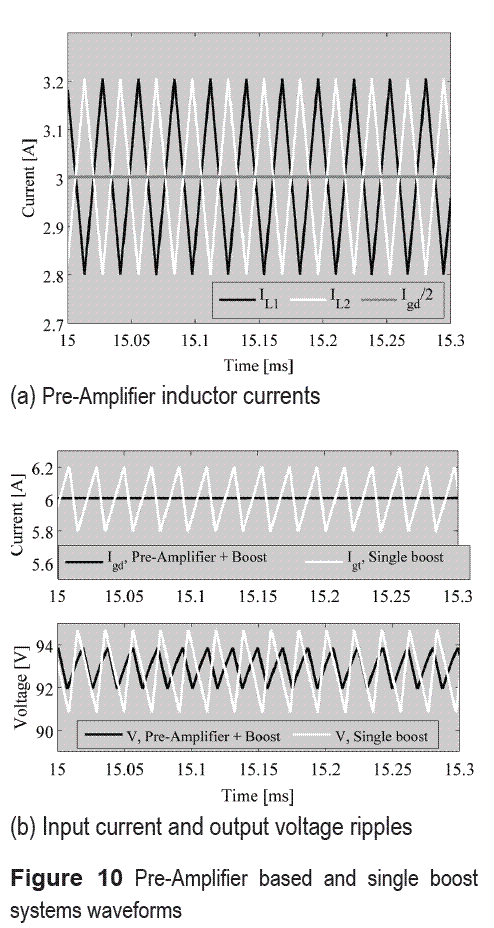
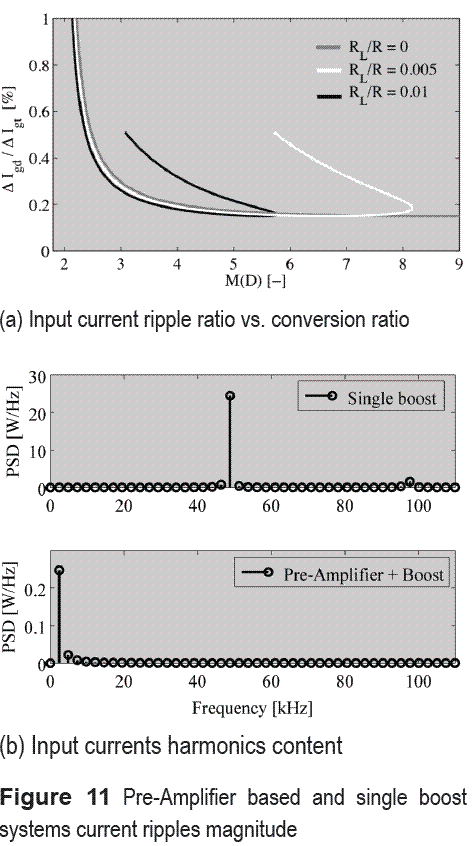
<body><![CDATA[<p> <img src="/img/revistas/rfiua/n60/n60a21e32.gif"></p> Finally, the efficiency of the  complete conversion system is:</font></p>     <p> <img src="/img/revistas/rfiua/n60/n60a21e33.gif"></p>      <p> <font face="Verdana" size="2"><i>Comparison between pre-amplifier based solution and  classical single boost</i></font></p>      <p> <font face="Verdana" size="2"> To perform a fair comparison,  the power converters must be analyzed in the same conversion ratio condition  and under the same load and source characteristics. The pre-amplifier based  system has a higher voltage conversion ratio M(D) than the typical boost under  the same source and load characteristics for a given duty cycle D. This is  observed in <a href="#Figura8">figura 8</a>, where considering a losses ratio R<sub>L</sub>/R = 0.005, or 0.5 %, a M(D) = 6  is obtained by operating the boost converter in the pre-amplifier based system  at D = 0.72, while in single boost solution D = 0.88 is required. This is  important since in boost converters the efficiency decrease with increments in  D &#91;11&#93;.    <br>     <p align="center"><img src="/img/revistas/rfiua/n60/n60a21i08.gif" ><a name="Figura8"></a></p>   The pre-amplifier based system  generates currents in each of the three inductors equal to the half of the  inductor current in the single boost solution. Since the power losses depend on  the square of the current, the losses in the pre-amplifier based solution are  lower. This is depicted in <a href="#Figura9">figura 9</a>, where considering M(D) = 6 and R<sub>L</sub>/R=0.005,  the pre-amplifier based solution provides an efficiency of 0.83, or 83 %, while  the single boost provides an efficiency of 0.76, or 76 %. Considering a  different R<sub>L</sub>/R condition, the pre-amplifier solution also provides  higher efficiency.     <br>     <p align="center"><img src="/img/revistas/rfiua/n60/n60a21i09.gif" ><a name="Figura9"></a></p>   <a href="#Figura10">Figura 10</a> shows the simulation  of the pre-amplifier based and single boost solutions. The waveforms of the  pre-amplifier inductor currents and its input current, divided by two to allow  its visualization in the same scale, are presented in <a href="#Figura10">figura 10</a>(a). Such a  simulation illustrates the complementary inductor current ripples, which  interaction reduces the pre-amplifier input current ripple. The input current  waveforms of the pre-amplifier based and single boost solutions are compared in  the top of <a href="#Figura10">figura 10</a>(b), which shows the significant reduction of the ripple  injected to the source as described by (21).    <br>      <p align="center"><img src="/img/revistas/rfiua/n60/n60a21i10.gif" ><a name="Figura10"></a></p>   Similarly, the reduction in  the output voltage ripple in the pre-amplifier based solution, in comparison  with the single boost solution, is depicted in the bottom of <a href="#Figura10">figura 10</a>(b). Such  an improvement is caused by the pre-amplifier voltage-boosting factor since in  a boost converter the output voltage ripple depends on the difference between  the input and output voltages.    ]]></body>
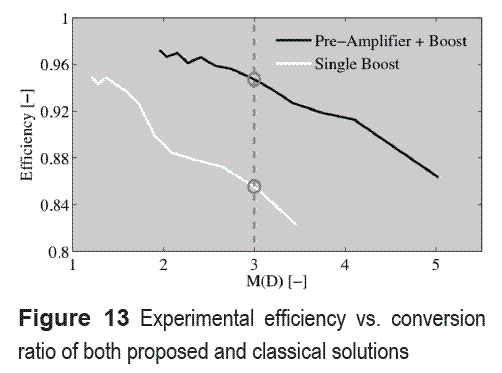
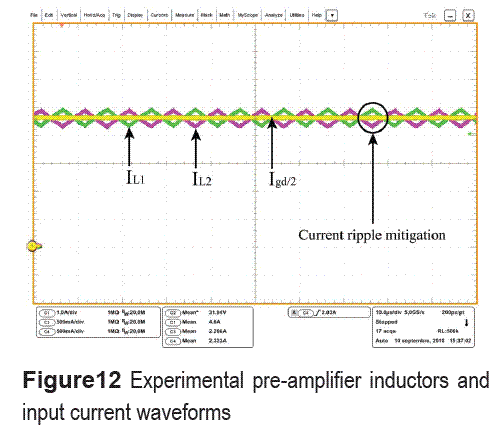
<body><![CDATA[<br>    <br>   The input current ripple ratio  {100 x &Delta;I<sub>gd</sub>/&Delta;I<sub>dt</sub>} &#91;%&#93; is defined to quantify the  reduction on the current ripple achieved by the pre-amplifier based solution  over the single boost converter.<a href="#Figura11">Figura 11</a>(a) shows the input current ripple  ratio depending on the voltage conversion ratio M(D) for different parasitic  loss-resistance relations. It is observed that for M(D) &gt; 3 the  pre-amplifier strongly reduces the ripple injected to the source. In  particular, considering M(D) = 6, the pre-amplifier based system generates only  the 0.2 % of the single boost input current ripple.    <br>     <p align="center"><img src="/img/revistas/rfiua/n60/n60a21i11.gif" ><a name="Figura11"></a></p>   <a href="#Figura11">Figura 11</a>(b) shows the Power  Spectral Density (PSD) of the input current harmonics for both pre-amplifier  based and single boost solutions. It is observed a large harmonic component at  the switching frequency in the single boost solution, while the PSD of the  pre-amplifier based solution does not exhibit such a component due to the  complementary inductor currents operation. In addition, the scale used to plot  the PSD of the proposed solution is 100 times smaller than the one adopted for  the single boost, which makes evident the strong harmonics reduction achieved. </font></p>      <p><font face="Verdana" size="3"><b> Experimental results</b> </font></p>       <p><font face="Verdana" size="2">Experimental  prototypes of the pre-amplifier based system, i.e. scheme of <a href="#Figura7">figura 7</a>, and  single boost solution, i.e. scheme of <a href="#Figura1">figura 1</a>, have been developed to validate  the analytical results. The inductors have been selected equal to 220 &mu;H, the  capacitors have been defined equal to 220 &mu;F, obtaining a lumped parasitic  resistances of 250 m&Omega; in each pre-amplifier branch and single boost converters.  The load has been defined equal to 29.4 &Omega;, obtaining a parasitic losses ratio R<sub>L</sub>/R = 0.0085, or 0.85 %, which is  comparable with the one defined in the circuital simulations. The inductor and  capacitor values have been designed to achieve switching  frequencies below 100 kHz and avoid electrolytic capacitors. The operating  conditions have been defined by the input and output voltages V<sub>g</sub> =  12 V and V = 40 V, respectively.    <br>    <br>     <a href="#Figura12">Figura 12</a> shows the experimental waveforms of the inductors  and input currents of the pre-amplifier converter. It is observed the opposite  inductor currents slope as well as the small ripple in the input current, which  corresponds to a 1.3 % of the DC component. In contrast, for the same operating  conditions, the single boost solution produces an input current ripple equal to  12 % of the requested DC component.    <br>     <p align="center"><img src="/img/revistas/rfiua/n60/n60a21i12.gif" ><a name="Figura12"></a></p>  <a href="#Figura13">Figura 13</a> presents the  experimental efficiencies of both pre-amplifier based and single boost  solutions. The pre-amplifier based solution exhibits an efficiency improvement  of 7.7 % over the single boost case at M(D) = 2, and the efficiency difference  grows until M(D) = 3.5 up to 10.1 % where the losses in the single boost limits  the voltage boosting ratio in such classical solution. Instead, the pre-amplifier  based system is able to supply higher voltage boosting ratios up to M(D) = 5.  Such experimental results, which have been carried out at an output power range  between 16 W and 125 W, demonstrate the ripple mitigation and efficiency  improvement provided by the proposed pre-amplifier based system.</font></p>      ]]></body>
<body><![CDATA[<p align="center"><img src="/img/revistas/rfiua/n60/n60a21i13.gif" ><a name="Figura13"></a></p>        <p><font face="Verdana" size="3"><b>Conclusions</b> </font></p>      <p><font face="Verdana" size="2">This paper proposes a pre-amplifier aimed to reduce the  current ripple injected to power sources by traditional DC/DC converters, being  particularly analyzed with a boost converter. Besides, this solution improves  the efficiency of the power conversion chain over the original system.    <br>    <br> The proposed solution is based on interleaved boost  converters, and it was analyzed in terms of efficiency and input current  ripple. Its optimal operating conditions were calculated, and a sliding-mode  controller was designed to ensure operation in such conditions.    <br>    <br> The  new power conversion chain, composed by the pre-amplifier and the original  boost converter, was analyzed and contrasted with the original single boost  solution. The theoretical analyses have been confirmed through PSIM circuital  simulations, and experimental measurements validated the pre-amplifier  benefits, obtaining a significant reduction up to 89 % of the original input  current ripple, and an improvement on the efficiency between 7.7 % and 10.1 %.</font></p>      <p><font face="Verdana" size="3"><b>Acknowledgments</b> </font></p>      <p><font face="Verdana" size="2">This work  was supported by GAUNAL and GITA research groups of the Universidad Nacional de  Colombia (projects DACOGEN-PV and MECOVA-WIND), the Spanish Ministerio de  Ciencia e Innovaci&oacute;n (project TEC2009- 13172), and the Colombian Departamento  Administrativo de Ciencia, Tecnolog&iacute;a e Innovaci&oacute;n COLCIENCIAS (scholarship 095-2005).</font></p>       <p><font face="Verdana" size="3"><b>References</b> </font></p>      ]]></body>
<body><![CDATA[<!-- ref --><p><font face="Verdana" size="2">1.  W. A. Surdoval, S. C. Singhal, G. L. McVay. <i>The Solid State Energy  Conversion Alliance SECA, U.S. Department of Energy Initiative to Promote the  Development of Mass Customized Solid Oxide Fuel Cells for Low-Cost Power</i>. The 7th  International Symposium on Solid Oxide Fuel Cells. Tsukuba. 2001. pp. 1-10.    &nbsp;&nbsp;&nbsp;&nbsp;&nbsp;&nbsp;&nbsp;&nbsp;[&#160;<a href="javascript:void(0);" onclick="javascript: window.open('/scielo.php?script=sci_nlinks&ref=000133&pid=S0120-6230201100040002100001&lng=','','width=640,height=500,resizable=yes,scrollbars=1,menubar=yes,');">Links</a>&#160;]<!-- end-ref --><br>    <!-- ref --><br>   2. V. Acquaviva, P. Poggi, M.  Muselli, Louche. "Grid- Connected Rooftop PV Systems for Reducing Voltage  Drops at End". <i>Energy</i>. Vol. 25. 2000. pp. 741-756.    &nbsp;&nbsp;&nbsp;&nbsp;&nbsp;&nbsp;&nbsp;&nbsp;[&#160;<a href="javascript:void(0);" onclick="javascript: window.open('/scielo.php?script=sci_nlinks&ref=000135&pid=S0120-6230201100040002100002&lng=','','width=640,height=500,resizable=yes,scrollbars=1,menubar=yes,');">Links</a>&#160;]<!-- end-ref --><br>    <!-- ref --><br>   3. P. T. Krein, R. S. Balog,  X. Geng. "High-frequency link inverter for fuel cells based on  multiple-carrier pwm". <i>IEEE Trans. Power Electron</i>. Vol. 19. 2004. pp. 1279-1288.    &nbsp;&nbsp;&nbsp;&nbsp;&nbsp;&nbsp;&nbsp;&nbsp;[&#160;<a href="javascript:void(0);" onclick="javascript: window.open('/scielo.php?script=sci_nlinks&ref=000137&pid=S0120-6230201100040002100003&lng=','','width=640,height=500,resizable=yes,scrollbars=1,menubar=yes,');">Links</a>&#160;]<!-- end-ref --><br>    <!-- ref --><br>   4.  C. Liu, A. Johnson, J. Lai. <i>Modeling and control of a novel six-leg three-phase high  power converter for low voltage fuel cell applications</i>. IEEE Power  Electron. Spec. Conf. Aachen. 2004. pp. 4715-4721.    &nbsp;&nbsp;&nbsp;&nbsp;&nbsp;&nbsp;&nbsp;&nbsp;[&#160;<a href="javascript:void(0);" onclick="javascript: window.open('/scielo.php?script=sci_nlinks&ref=000139&pid=S0120-6230201100040002100004&lng=','','width=640,height=500,resizable=yes,scrollbars=1,menubar=yes,');">Links</a>&#160;]<!-- end-ref --><br>    <!-- ref --><br>   5. C. Cabal,  C. Alonso, A. Cid-Pastor, B. Estibals, L. Seguier, R. Leyva, G. Schweitz, J.  Alzieu. <i>Adaptive digital MPPT control for photovoltaic  applications.</i> IEEE  International Symposium on Industrial Electronics. Vigo. 2007. pp. 2414-2419.    &nbsp;&nbsp;&nbsp;&nbsp;&nbsp;&nbsp;&nbsp;&nbsp;[&#160;<a href="javascript:void(0);" onclick="javascript: window.open('/scielo.php?script=sci_nlinks&ref=000141&pid=S0120-6230201100040002100005&lng=','','width=640,height=500,resizable=yes,scrollbars=1,menubar=yes,');">Links</a>&#160;]<!-- end-ref --><br>    ]]></body>
<body><![CDATA[<!-- ref --><br>   6. C. Cabal,  A. Cid-Pastor, L. Seguier, B. Estibals, C. Alonso. <i>Improved  photovoltaic conversion chain with interleaved method.</i> IEEE Power Electron. Spec.  Conf. Island of Rhodes. 2008. pp. 70-75.    &nbsp;&nbsp;&nbsp;&nbsp;&nbsp;&nbsp;&nbsp;&nbsp;[&#160;<a href="javascript:void(0);" onclick="javascript: window.open('/scielo.php?script=sci_nlinks&ref=000143&pid=S0120-6230201100040002100006&lng=','','width=640,height=500,resizable=yes,scrollbars=1,menubar=yes,');">Links</a>&#160;]<!-- end-ref --><br>    <!-- ref --><br>   7. C. Haynes, W. J. Wepfer.  "Characterizing heat transfer within a commercial-grade tubular solid  oxide fuel cell for enhanced thermal management".<i> Int. J. Hydrogen  Energy.</i>  Vol. 26. pp. 369-379.    &nbsp;&nbsp;&nbsp;&nbsp;&nbsp;&nbsp;&nbsp;&nbsp;[&#160;<a href="javascript:void(0);" onclick="javascript: window.open('/scielo.php?script=sci_nlinks&ref=000145&pid=S0120-6230201100040002100007&lng=','','width=640,height=500,resizable=yes,scrollbars=1,menubar=yes,');">Links</a>&#160;]<!-- end-ref --><br>    <!-- ref --><br>   8. G. Grandi, D. Casadei, C.  Rossi. "Direct coupling of power active filters with photovoltaic  generation systems with improved MPPT capability". <i>IEEE Power Tech  Conf. Proceedings.</i>  Vol. 2. 2003. pp. 23-26.    &nbsp;&nbsp;&nbsp;&nbsp;&nbsp;&nbsp;&nbsp;&nbsp;[&#160;<a href="javascript:void(0);" onclick="javascript: window.open('/scielo.php?script=sci_nlinks&ref=000147&pid=S0120-6230201100040002100008&lng=','','width=640,height=500,resizable=yes,scrollbars=1,menubar=yes,');">Links</a>&#160;]<!-- end-ref --><br>    <!-- ref --><br>   9. E.  Mamarelis, C. A. Ramos-Paja, G. Petrone, G. Spagnuolo, M. Vitelli. <i>FPGA-based  controller for mitigation of the 100 Hz oscillation in grid connected PV  systems.</i>  IEEE International Conference on Industrial Technology ICIT. Vi&ntilde;a  del Mar. 2010. pp. 925-930.    &nbsp;&nbsp;&nbsp;&nbsp;&nbsp;&nbsp;&nbsp;&nbsp;[&#160;<a href="javascript:void(0);" onclick="javascript: window.open('/scielo.php?script=sci_nlinks&ref=000149&pid=S0120-6230201100040002100009&lng=','','width=640,height=500,resizable=yes,scrollbars=1,menubar=yes,');">Links</a>&#160;]<!-- end-ref --><br>    <!-- ref --><br>   10. S. J. Jang, C. Y. Won, B.  K. Lee, J. Hur. "Fuel cell generation system with a new active clamping  current- fed half-bridge converter". <i>IEEE Trans.  Energy Conversion</i>.  Vol. 22. 2007. pp. 332-340.    &nbsp;&nbsp;&nbsp;&nbsp;&nbsp;&nbsp;&nbsp;&nbsp;[&#160;<a href="javascript:void(0);" onclick="javascript: window.open('/scielo.php?script=sci_nlinks&ref=000151&pid=S0120-6230201100040002100010&lng=','','width=640,height=500,resizable=yes,scrollbars=1,menubar=yes,');">Links</a>&#160;]<!-- end-ref --><br>    ]]></body>
<body><![CDATA[<!-- ref --><br>   11. W. Erickson, D.  Maksimovic.  <i>Fundamentals of Power Electronics</i>. 2<sup>nd</sup> ed. Ed. Kluwer Academic Publishers. New  York. 2001. pp. 39-77.    &nbsp;&nbsp;&nbsp;&nbsp;&nbsp;&nbsp;&nbsp;&nbsp;[&#160;<a href="javascript:void(0);" onclick="javascript: window.open('/scielo.php?script=sci_nlinks&ref=000153&pid=S0120-6230201100040002100011&lng=','','width=640,height=500,resizable=yes,scrollbars=1,menubar=yes,');">Links</a>&#160;]<!-- end-ref --><br>    <!-- ref --><br>   12. R. Girai, L.  Martinez-Salamero, R. Leyva, J. Maixe. "Sliding-mode control of  interleaved boost converters". <i>IEEE Trans. on  Circuits and Systems I</i>. Vol. 47. 2000. pp.1330-1339</font>&nbsp;&nbsp;&nbsp;&nbsp;&nbsp;&nbsp;&nbsp;&nbsp;[&#160;<a href="javascript:void(0);" onclick="javascript: window.open('/scielo.php?script=sci_nlinks&ref=000155&pid=S0120-6230201100040002100012&lng=','','width=640,height=500,resizable=yes,scrollbars=1,menubar=yes,');">Links</a>&#160;]<!-- end-ref --><br>    <br>    <br>    <br>       <p><font face="Verdana" size="2">(Recibido el 9 de diciembre de 2010. Aceptado el 20 de junio de 2011)</font></p>     <p><font face="Verdana" size="2"><sup>*</sup>Autor de correspondencia: tel&eacute;fono: + 57 + 4 + 425 53 45, fax: +57 + 4+ 234 10 02, correo electr&oacute;nico: <a href="mailto:caramosp@unal.edu.co">caramosp@unal.edu.co</a> (C. Ramos)</font></p>      ]]></body><back>
<ref-list>
<ref id="B1">
<label>1</label><nlm-citation citation-type="confpro">
<person-group person-group-type="author">
<name>
<surname><![CDATA[Surdoval]]></surname>
<given-names><![CDATA[W. A]]></given-names>
</name>
<name>
<surname><![CDATA[Singhal]]></surname>
<given-names><![CDATA[S. C]]></given-names>
</name>
<name>
<surname><![CDATA[McVay]]></surname>
<given-names><![CDATA[G. L]]></given-names>
</name>
</person-group>
<source><![CDATA[The Solid State Energy Conversion Alliance SECA, U.S. Department of Energy Initiative to Promote the Development of Mass Customized Solid Oxide Fuel Cells for Low-Cost Power]]></source>
<year></year>
<conf-name><![CDATA[7 International Symposium on Solid Oxide Fuel Cells]]></conf-name>
<conf-date>2001</conf-date>
<conf-loc>Tsukuba </conf-loc>
</nlm-citation>
</ref>
<ref id="B2">
<label>2</label><nlm-citation citation-type="journal">
<person-group person-group-type="author">
<name>
<surname><![CDATA[Acquaviva]]></surname>
<given-names><![CDATA[V]]></given-names>
</name>
<name>
<surname><![CDATA[Poggi]]></surname>
<given-names><![CDATA[P]]></given-names>
</name>
<name>
<surname><![CDATA[Muselli]]></surname>
<given-names><![CDATA[M]]></given-names>
</name>
</person-group>
<article-title xml:lang="en"><![CDATA[Grid- Connected Rooftop PV Systems for Reducing Voltage Drops at End]]></article-title>
<source><![CDATA[Energy]]></source>
<year>2000</year>
<volume>25</volume>
<page-range>741-756</page-range></nlm-citation>
</ref>
<ref id="B3">
<label>3</label><nlm-citation citation-type="journal">
<person-group person-group-type="author">
<name>
<surname><![CDATA[Krein]]></surname>
<given-names><![CDATA[P. T]]></given-names>
</name>
<name>
<surname><![CDATA[Balog]]></surname>
<given-names><![CDATA[R. S]]></given-names>
</name>
<name>
<surname><![CDATA[Geng]]></surname>
<given-names><![CDATA[X]]></given-names>
</name>
</person-group>
<article-title xml:lang="en"><![CDATA[High-frequency link inverter for fuel cells based on multiple-carrier pwm]]></article-title>
<source><![CDATA[IEEE Trans. Power Electron]]></source>
<year>2004</year>
<volume>19</volume>
<page-range>1279-1288</page-range></nlm-citation>
</ref>
<ref id="B4">
<label>4</label><nlm-citation citation-type="journal">
<person-group person-group-type="author">
<name>
<surname><![CDATA[Liu]]></surname>
<given-names><![CDATA[C]]></given-names>
</name>
<name>
<surname><![CDATA[Johnson]]></surname>
<given-names><![CDATA[A]]></given-names>
</name>
<name>
<surname><![CDATA[Lai]]></surname>
<given-names><![CDATA[J]]></given-names>
</name>
</person-group>
<article-title xml:lang="en"><![CDATA[Modeling and control of a novel six-leg three-phase high power converter for low voltage fuel cell applications]]></article-title>
<source><![CDATA[IEEE Power Electron. Spec. Conf. Aachen]]></source>
<year>2004</year>
<page-range>4715-4721</page-range></nlm-citation>
</ref>
<ref id="B5">
<label>5</label><nlm-citation citation-type="journal">
<person-group person-group-type="author">
<name>
<surname><![CDATA[Cabal]]></surname>
<given-names><![CDATA[C]]></given-names>
</name>
<name>
<surname><![CDATA[Alonso]]></surname>
<given-names><![CDATA[C]]></given-names>
</name>
<name>
<surname><![CDATA[Cid-Pastor]]></surname>
<given-names><![CDATA[A]]></given-names>
</name>
<name>
<surname><![CDATA[Estibals]]></surname>
<given-names><![CDATA[B]]></given-names>
</name>
<name>
<surname><![CDATA[Seguier]]></surname>
<given-names><![CDATA[L]]></given-names>
</name>
<name>
<surname><![CDATA[Leyva]]></surname>
<given-names><![CDATA[R]]></given-names>
</name>
<name>
<surname><![CDATA[Schweitz]]></surname>
<given-names><![CDATA[G]]></given-names>
</name>
<name>
<surname><![CDATA[Alzieu]]></surname>
<given-names><![CDATA[J]]></given-names>
</name>
</person-group>
<article-title xml:lang="en"><![CDATA[Adaptive digital MPPT control for photovoltaic applications]]></article-title>
<source><![CDATA[IEEE International Symposium on Industrial Electronics]]></source>
<year>2007</year>
<page-range>2414-2419</page-range><publisher-name><![CDATA[Vigo]]></publisher-name>
</nlm-citation>
</ref>
<ref id="B6">
<label>6</label><nlm-citation citation-type="journal">
<person-group person-group-type="author">
<name>
<surname><![CDATA[Cabal]]></surname>
<given-names><![CDATA[C]]></given-names>
</name>
<name>
<surname><![CDATA[Cid-Pastor]]></surname>
<given-names><![CDATA[A]]></given-names>
</name>
<name>
<surname><![CDATA[Seguier]]></surname>
<given-names><![CDATA[L]]></given-names>
</name>
<name>
<surname><![CDATA[Estibals]]></surname>
<given-names><![CDATA[B]]></given-names>
</name>
<name>
<surname><![CDATA[Alonso]]></surname>
<given-names><![CDATA[C]]></given-names>
</name>
</person-group>
<article-title xml:lang="en"><![CDATA[Improved photovoltaic conversion chain with interleaved method]]></article-title>
<source><![CDATA[IEEE Power Electron. Spec. Conf. Island of Rhodes]]></source>
<year>2008</year>
<page-range>70-75</page-range></nlm-citation>
</ref>
<ref id="B7">
<label>7</label><nlm-citation citation-type="journal">
<person-group person-group-type="author">
<name>
<surname><![CDATA[Haynes]]></surname>
<given-names><![CDATA[C]]></given-names>
</name>
<name>
<surname><![CDATA[Wepfer]]></surname>
<given-names><![CDATA[W. J]]></given-names>
</name>
</person-group>
<article-title xml:lang="en"><![CDATA[Characterizing heat transfer within a commercial-grade tubular solid oxide fuel cell for enhanced thermal management]]></article-title>
<source><![CDATA[Int. J. Hydrogen Energy]]></source>
<year></year>
<volume>26</volume>
<page-range>369-379</page-range></nlm-citation>
</ref>
<ref id="B8">
<label>8</label><nlm-citation citation-type="journal">
<person-group person-group-type="author">
<name>
<surname><![CDATA[Grandi]]></surname>
<given-names><![CDATA[G]]></given-names>
</name>
<name>
<surname><![CDATA[Casadei]]></surname>
<given-names><![CDATA[D]]></given-names>
</name>
<name>
<surname><![CDATA[Rossi]]></surname>
<given-names><![CDATA[C]]></given-names>
</name>
</person-group>
<article-title xml:lang="en"><![CDATA[Direct coupling of power active filters with photovoltaic generation systems with improved MPPT capability]]></article-title>
<source><![CDATA[IEEE Power Tech Conf. Proceedings]]></source>
<year>2003</year>
<volume>2</volume>
<page-range>23-26</page-range></nlm-citation>
</ref>
<ref id="B9">
<label>9</label><nlm-citation citation-type="confpro">
<person-group person-group-type="author">
<name>
<surname><![CDATA[Mamarelis]]></surname>
<given-names><![CDATA[E]]></given-names>
</name>
<name>
<surname><![CDATA[Ramos-Paja]]></surname>
<given-names><![CDATA[C. A]]></given-names>
</name>
<name>
<surname><![CDATA[Petrone]]></surname>
<given-names><![CDATA[G]]></given-names>
</name>
<name>
<surname><![CDATA[Spagnuolo]]></surname>
<given-names><![CDATA[G]]></given-names>
</name>
<name>
<surname><![CDATA[Vitelli]]></surname>
<given-names><![CDATA[M]]></given-names>
</name>
</person-group>
<source><![CDATA[FPGA-based controller for mitigation of the 100 Hz oscillation in grid connected PV systems]]></source>
<year></year>
<conf-name><![CDATA[ IEEE International Conference on Industrial Technology ICIT]]></conf-name>
<conf-date>2010</conf-date>
<conf-loc>Viña del Mar </conf-loc>
<page-range>925-930</page-range></nlm-citation>
</ref>
<ref id="B10">
<label>10</label><nlm-citation citation-type="journal">
<person-group person-group-type="author">
<name>
<surname><![CDATA[Jang]]></surname>
<given-names><![CDATA[S. J]]></given-names>
</name>
<name>
<surname><![CDATA[Won]]></surname>
<given-names><![CDATA[C. Y]]></given-names>
</name>
<name>
<surname><![CDATA[Lee]]></surname>
<given-names><![CDATA[B. K]]></given-names>
</name>
<name>
<surname><![CDATA[Hur]]></surname>
<given-names><![CDATA[J]]></given-names>
</name>
</person-group>
<article-title xml:lang="en"><![CDATA[Fuel cell generation system with a new active clamping current- fed half-bridge converter]]></article-title>
<source><![CDATA[IEEE Trans. Energy Conversion]]></source>
<year>2007</year>
<volume>22</volume>
<page-range>332-340</page-range></nlm-citation>
</ref>
<ref id="B11">
<label>11</label><nlm-citation citation-type="book">
<person-group person-group-type="author">
<name>
<surname><![CDATA[Erickson]]></surname>
<given-names><![CDATA[W]]></given-names>
</name>
<name>
<surname><![CDATA[Maksimovic]]></surname>
<given-names><![CDATA[D]]></given-names>
</name>
</person-group>
<source><![CDATA[Fundamentals of Power Electronics]]></source>
<year>2001</year>
<edition>2</edition>
<page-range>39-77</page-range><publisher-loc><![CDATA[New York ]]></publisher-loc>
<publisher-name><![CDATA[Ed. Kluwer Academic Publishers]]></publisher-name>
</nlm-citation>
</ref>
<ref id="B12">
<label>12</label><nlm-citation citation-type="journal">
<person-group person-group-type="author">
<name>
<surname><![CDATA[Girai]]></surname>
<given-names><![CDATA[R]]></given-names>
</name>
<name>
<surname><![CDATA[Martinez-Salamero]]></surname>
<given-names><![CDATA[L]]></given-names>
</name>
<name>
<surname><![CDATA[Leyva]]></surname>
<given-names><![CDATA[R]]></given-names>
</name>
<name>
<surname><![CDATA[Maixe]]></surname>
<given-names><![CDATA[J]]></given-names>
</name>
</person-group>
<article-title xml:lang="en"><![CDATA[Sliding-mode control of interleaved boost converters]]></article-title>
<source><![CDATA[IEEE Trans. on Circuits and Systems I]]></source>
<year>2000</year>
<volume>47</volume>
<page-range>1330-1339</page-range></nlm-citation>
</ref>
</ref-list>
</back>
</article>