<?xml version="1.0" encoding="ISO-8859-1"?><article xmlns:mml="http://www.w3.org/1998/Math/MathML" xmlns:xlink="http://www.w3.org/1999/xlink" xmlns:xsi="http://www.w3.org/2001/XMLSchema-instance">
<front>
<journal-meta>
<journal-id>0121-0793</journal-id>
<journal-title><![CDATA[Iatreia]]></journal-title>
<abbrev-journal-title><![CDATA[Iatreia]]></abbrev-journal-title>
<issn>0121-0793</issn>
<publisher>
<publisher-name><![CDATA[Universidad de Antioquia]]></publisher-name>
</publisher>
</journal-meta>
<article-meta>
<article-id>S0121-07932009000200005</article-id>
<title-group>
<article-title xml:lang="en"><![CDATA[Management of maturity-onset diabetes of the young (MODY)]]></article-title>
</title-group>
<contrib-group>
<contrib contrib-type="author">
<name>
<surname><![CDATA[Botero]]></surname>
<given-names><![CDATA[Diego]]></given-names>
</name>
<xref ref-type="aff" rid="A01"/>
</contrib>
</contrib-group>
<aff id="A01">
<institution><![CDATA[,Attending Physician Division of Pediatric Endocrinology ]]></institution>
<addr-line><![CDATA[Miami ]]></addr-line>
</aff>
<pub-date pub-type="pub">
<day>00</day>
<month>06</month>
<year>2009</year>
</pub-date>
<pub-date pub-type="epub">
<day>00</day>
<month>06</month>
<year>2009</year>
</pub-date>
<volume>22</volume>
<numero>2</numero>
<fpage>143</fpage>
<lpage>146</lpage>
<copyright-statement/>
<copyright-year/>
<self-uri xlink:href="http://www.scielo.org.co/scielo.php?script=sci_arttext&amp;pid=S0121-07932009000200005&amp;lng=en&amp;nrm=iso"></self-uri><self-uri xlink:href="http://www.scielo.org.co/scielo.php?script=sci_abstract&amp;pid=S0121-07932009000200005&amp;lng=en&amp;nrm=iso"></self-uri><self-uri xlink:href="http://www.scielo.org.co/scielo.php?script=sci_pdf&amp;pid=S0121-07932009000200005&amp;lng=en&amp;nrm=iso"></self-uri><abstract abstract-type="short" xml:lang="es"><p><![CDATA[La diabetes de tipo MODY (maturity-onset diabetes of the young) afecta entre 1 y 5% de los pacientes con diabetes en los Estados Unidos y otras naciones industrializadas. Las tres características más importantes de esta entidad son: desarrollo de diabetes antes de la edad de 25 a 30 años en ausencia de autoanticuerpos pancreáticos, transmisión genética autosómica dominante y evidencia de secreción residual de insulina. Existen seis subtipos de MODY de los cuales, el tipo 2 (mutación de la glucoquinasa-GKS) y el tipo 3 (mutación del factor nuclear hepático 1 alfa (HNF-1-a) son los más prevalentes (70% de todos los casos de diabetes de tipo MODY). Las sulfonilureas son la medicación de primera línea tanto en los niños como en los adultos, cuando la terapia dietética no es suficiente para normalizar la glicemia. Aunque los pacientes con subtipos 1, 3, y 4 usualmente responden bien a la terapia oral con sulfonilureas, un porcentaje significativo de pacientes con los subtipos 1 y 3 necesitan terapia con insulina debido a un deterioro progresivo de las células beta del páncreas. El mantenimiento de un estilo de vida activo y un peso normal, son recomendaciones esenciales en todos los pacientes con diabetes de tipo MODY.]]></p></abstract>
<abstract abstract-type="short" xml:lang="en"><p><![CDATA[Maturity-Onset Diabetes of the Young (MODY) affects 1-5% of people with diabetes in the USA and other industrialized countries. The three main features of MODY include: Development of diabetes before the age of 25 to 30 in absence of pancreatic antibodies, autosomal dominant inheritance, and evidence of residual insulin secretion. There are six subtypes of MODY of which, MODY2 (GCK mutation) and MODY3 (HNF1-a mutation) are the most prevalent, accounting for more than 70% of cases. Sulfonylureas (SUs) remain the medication of first choice in children and adults when dietary therapy is insufficient to maintain normoglycemia. Although patients with MODY1, 3, and 4 usually respond very well to oral SUs, due to progressive ß-cell failure, a significant proportion of MODY1 and MODY3 patients may eventually require insulin therapy. Leading an active lifestyle and maintaining a normal weight are essential recommendations for all MODY patients.]]></p></abstract>
<kwd-group>
<kwd lng="es"><![CDATA[Diabetes]]></kwd>
<kwd lng="es"><![CDATA[Insulina]]></kwd>
<kwd lng="es"><![CDATA[MODY]]></kwd>
<kwd lng="es"><![CDATA[Sulfonilureas]]></kwd>
<kwd lng="en"><![CDATA[Diabetes]]></kwd>
<kwd lng="en"><![CDATA[Insulin]]></kwd>
<kwd lng="en"><![CDATA[MODY]]></kwd>
<kwd lng="en"><![CDATA[Sulfonylureas]]></kwd>
</kwd-group>
</article-meta>
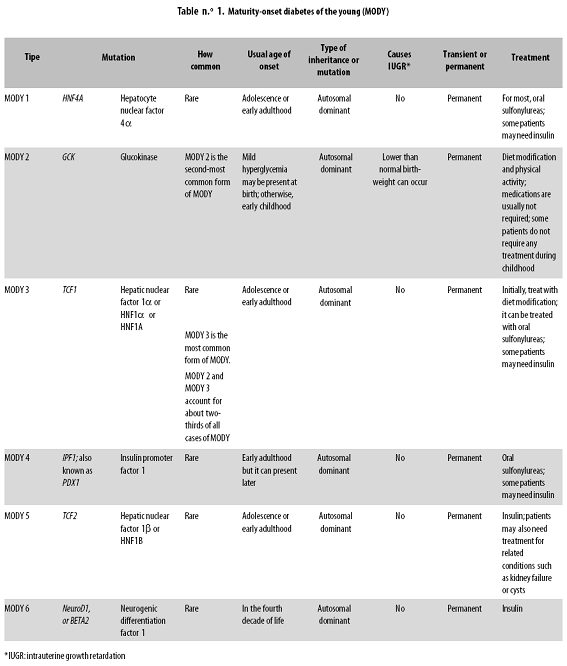
</front><body><![CDATA[ <p align="right"><strong><font size="2">ART&Iacute;CULO DE REVISI&Oacute;N</font></strong></p>     <p><strong><font size="4">Management of maturity&#8211;onset diabetes     of the young (MODY)     </font></strong> </p>     <p>&nbsp;</p>     <p><strong><font size="2">Diego Botero<SUP>1</SUP></font></strong></p>     <p><font size="2">1 Attending Physician, Division of Pediatric Endocrinology,     Miami Children's   Hospital.    <br> Contacto: <a href="mailto:Diego.Botero@mch.com">Diego.Botero@mch.com</a></font></p>     <p>&nbsp;</p> <hr size="1" noshade>     <p><font size="3"><strong>Resumen</strong></font></p>     <p><font size="2">  La diabetes de tipo MODY (maturity&#8211;onset diabetes of the     young) afecta entre 1 y 5% de los pacientes   con diabetes en los Estados Unidos y otras naciones industrializadas. Las tres     caracter&iacute;sticas m&aacute;s   importantes de esta entidad son: desarrollo de diabetes antes de la edad de     25 a 30 a&ntilde;os en ausencia   de autoanticuerpos pancre&aacute;ticos, transmisi&oacute;n gen&eacute;tica     autos&oacute;mica dominante y evidencia de secreci&oacute;n   residual de insulina. Existen seis subtipos de MODY de los cuales, el tipo     2 (mutaci&oacute;n de la   glucoquinasa&#8211;GKS) y el tipo 3 (mutaci&oacute;n del factor nuclear hep&aacute;tico     1 alfa (HNF&#8211;1&#8211;a) son los m&aacute;s   prevalentes (70% de todos los casos de diabetes de tipo MODY). Las sulfonilureas     son la medicaci&oacute;n   de primera l&iacute;nea tanto en los ni&ntilde;os como en los adultos, cuando     la terapia diet&eacute;tica no es suficiente   para normalizar la glicemia. Aunque los pacientes con subtipos 1, 3, y 4 usualmente     responden bien   a la terapia oral con sulfonilureas, un porcentaje significativo de pacientes     con los subtipos 1 y 3   necesitan terapia con insulina debido a un deterioro progresivo de las c&eacute;lulas     beta del p&aacute;ncreas. El   mantenimiento de un estilo de vida activo y un peso normal, son recomendaciones     esenciales en todos los pacientes con diabetes de tipo MODY.</font></p>     <p><font size="2"> <strong>Palabras clave:</strong><em>  Diabetes, Insulina, MODY, Sulfonilureas</em></font></p> <hr size="1" noshade>     ]]></body>
<body><![CDATA[<p><font size="3"><strong>SUMMARY</strong></font></p>     <p><font size="2">  Maturity&#8211;Onset Diabetes of the Young (MODY) affects 1&#8211;5%     of people with diabetes in the USA and   other industrialized countries. The three main features of MODY include: Development     of diabetes   before the age of 25 to 30 in absence of pancreatic antibodies, autosomal dominant     inheritance, and   evidence of residual insulin secretion. There are six subtypes of MODY of which,     MODY2 (GCK   mutation) and MODY3 (HNF1&#8211;a mutation) are the most prevalent, accounting for     more than 70% of cases. Sulfonylureas (SUs) remain the medication of first     choice in children and adults when dietary therapy is insufficient to maintain     normoglycemia.     Although patients with MODY1, 3, and 4 usually respond     very well to oral SUs, due to progressive &szlig;&#8211;cell failure, a     significant proportion of MODY1 and MODY3 patients     may eventually require insulin therapy. Leading an active     lifestyle and maintaining a normal weight are essential recommendations for all MODY patients.</font></p>     <p><font size="2"> <strong>Key words:</strong>  <em>Diabetes, Insulin, MODY, Sulfonylureas</em></font></p> <hr size="1" noshade>      <p>&nbsp;</p>     <p><font size="2">Maturity&#8211;Onset Diabetes of the Young (MODY) affects 1&#8211;   5% of people with diabetes in the USA and other   industrialized countries.<sup>1&#8211;3</sup> This type of diabetes very often  goes   unrecognized. The three main features of MODY include: Development of diabetes   before the age of 25 to 30 years in absence of pancreatic antibodies, autosomal   dominant inheritance (present in at least two family  generations), and evidence   of residual insulin secretion,   that allows for treatment of this condition most of the   time with diet or hypoglycemic agents and does not always   require insulin therapy. The <a href="#table">table</a> depicts the six types of MODY and their characteristics.</font></p>     <p align=center ><font size="2"><a name="table"></a><img src=/img/revistas/iat/v22n2/a5i1.gif></font></p>     <p><font size="2"> We will focus on the       management of MODY2 (GCK mutation) and 3 (HNF1&#8211;a mutation), which are the       most common subtypes,     accounting for more than 70% of cases.<sup>4&#8211;7</sup></font></p>     <p><font size="2">  Good evidence regarding effects and prognosis of various   treatments is still limited for this increasingly recognized   cause of diabetes. Although obesity and insulin resistance   are not typical features of MODY in comparison with   type 2 diabetes mellitus (T2DM); leading an active lifestyle   and maintaining a normal weight are essential   recommendations for all MODY patients. Weight loss will   improve insulin resistance as well as glucose tolerance in   obese patients with MODY.<sup>8</sup> Sulfonylureas (SUs) remain   the medication of first choice in children and adults when   dietary therapy is insufficient to maintain   normoglycemia.<sup>9&#8211;11</sup> The use of metiglinides has been   implemented in some patients to control post&#8211;prandial   hyperglycemia.<sup>12</sup> Although MODY1, 3, and 4 usually   respond very well to oral SUs, due to progressive &beta;&#8211;cell   failure, a significant proportion of MODY1 and MODY3   patients may eventually require insulin therapy.<sup>13</sup>   Mutations in the Hepatic nuclear factor 1 alpha gene   (HNF1&#8211;a) result in MODY3, the most common subtype,   which accounts for 8 to 63% of MODY cases.<sup>4,5,6</sup> Patients   with MODY 3 have a progressive deterioration in    <br>   glycemic control and are at risk for microvascular and   macrovascular complications.<sup>14 </sup> Pancreatic exocrine   dysfunction has been reported in 12% of adult patients.<sup>15</sup>  These   patients will need pancreatic supplements. Affected individuals usually present   with severe   hyperglycemia after puberty, which can be treated   initially with diet. However, post prandial hyperglycemia   will be present in the course of the time due to insufficient   insulin production.<sup>16</sup> At this point, most patients will need pharmacological treatment.</font></p>     <p><font size="2">  Compared to other types of diabetes, MODY3 patients   are extremely sensitive to the hypoglycemic effect of   SUs.<sup>17</sup> To avoid hypoglycemia, the initial dose in children   should be low (approximately &frac14; of the usual starting dose   in adults).<sup>9,18 </sup>Successful management of hyperglycemia   with administration of SUs for decades has been reported. <sup>9</sup>  HbA1c   levels should be repeated at 3 month intervals. If this regimen fails to control   blood glucose levels as  indicated by a rise in HbA1c, the use of a long acting   insulin alone or in combination with SUs should be   considered. Insulin is the treatment of choice in pregnant   women with MODY3 especially if there is excess in fetal   growth.<sup>19</sup></font></p>     ]]></body>
<body><![CDATA[<p><font size="2">  Patients with heterozygous Glucokinase (GCK) gene   mutations (MODY2) have sustained lifelong mild   asymptomatic hyperglycemia, very often present from   birth. HbA1c is typically on the upper normal limit.   Microvascular and macrovascular complications are   rarely developed even in untreated patients.<sup>20,21</sup> It is   very rare for patients with mutations in the GCK gene to   have symptomatic hyperglycemia or to need treatment   other than diet. There is very little evidence of clinical   benefit with pharmacological therapy.<sup>22</sup></font></p>     <p>&nbsp;  </p>     <p><strong><font size="3">BIBLIOGRAPHIC REFERENCES</font></strong></p>     <!-- ref --><p> <font size="2">1. Ledermann HM. Maturity&#8211;onset diabetes of the young   (MODY) at least 10 times more common in Europe than   previously assumed. Diabetologia 1995: 38: 1482.</font>&nbsp;&nbsp;&nbsp;&nbsp;&nbsp;&nbsp;&nbsp;&nbsp;[&#160;<a href="javascript:void(0);" onclick="javascript: window.open('/scielo.php?script=sci_nlinks&ref=000026&pid=S0121-0793200900020000500001&lng=','','width=640,height=500,resizable=yes,scrollbars=1,menubar=yes,');">Links</a>&#160;]<!-- end-ref --><!-- ref --><p><font size="2"> 2. Froguel P, Zouali H, Vionnnet N, Velho G, Vaxillaire M,   Sun F, et al. Familial hyperglycemia due to mutations in   glucokinase: definition of a subtype of diabetes mellitus.   N Eng J Med 1993; 328: 697&#8211;702</font>&nbsp;&nbsp;&nbsp;&nbsp;&nbsp;&nbsp;&nbsp;&nbsp;[&#160;<a href="javascript:void(0);" onclick="javascript: window.open('/scielo.php?script=sci_nlinks&ref=000027&pid=S0121-0793200900020000500002&lng=','','width=640,height=500,resizable=yes,scrollbars=1,menubar=yes,');">Links</a>&#160;]<!-- end-ref --><!-- ref --><p><font size="2"> 3. Gat&#8211;Yablonski G, Shalitin S, Phllip M. Maturity onset   diabetes of the young&#8211;review. Pediatr Endocrinol Rev   2006; 3: 514&#8211;20</font>&nbsp;&nbsp;&nbsp;&nbsp;&nbsp;&nbsp;&nbsp;&nbsp;[&#160;<a href="javascript:void(0);" onclick="javascript: window.open('/scielo.php?script=sci_nlinks&ref=000028&pid=S0121-0793200900020000500003&lng=','','width=640,height=500,resizable=yes,scrollbars=1,menubar=yes,');">Links</a>&#160;]<!-- end-ref --><!-- ref --><p><font size="2">4. Ch&egrave;vre JC, Hani EH, Boutin P, Vaxillaire M, Blanch&eacute; H,   Vionnet H et al. Mutation screening in 18 Caucasian   families suggests the existence of other MODY genes.   Diabetologia 1998; 41: 1017&#8211;1023.</font>&nbsp;&nbsp;&nbsp;&nbsp;&nbsp;&nbsp;&nbsp;&nbsp;[&#160;<a href="javascript:void(0);" onclick="javascript: window.open('/scielo.php?script=sci_nlinks&ref=000029&pid=S0121-0793200900020000500004&lng=','','width=640,height=500,resizable=yes,scrollbars=1,menubar=yes,');">Links</a>&#160;]<!-- end-ref --><!-- ref --><p><font size="2"> 5. Costa A, Bescos M, Velho G, Chevre J, Vidal J, Sesmilo   G, et al. Genetic and clinical characterization of maturityonset   diabetes of the young in Spanish families. Eur J   Endocrinol 2000; 142: 380 &#8211;386.</font>&nbsp;&nbsp;&nbsp;&nbsp;&nbsp;&nbsp;&nbsp;&nbsp;[&#160;<a href="javascript:void(0);" onclick="javascript: window.open('/scielo.php?script=sci_nlinks&ref=000030&pid=S0121-0793200900020000500005&lng=','','width=640,height=500,resizable=yes,scrollbars=1,menubar=yes,');">Links</a>&#160;]<!-- end-ref --><!-- ref --><p><font size="2"> 6. Frayling TM, Bulamn MP, Ellard S, Appleton M, Dronsfield   MJ, Mackie AD, et al. Mutations in the hepatocyte nuclear   factor&#8211;1alpha gene are a common cause of   maturity&#8211;onset diabetes of the young in the U.K. Diabetes   1997; 46: 720&#8211;725.</font>&nbsp;&nbsp;&nbsp;&nbsp;&nbsp;&nbsp;&nbsp;&nbsp;[&#160;<a href="javascript:void(0);" onclick="javascript: window.open('/scielo.php?script=sci_nlinks&ref=000031&pid=S0121-0793200900020000500006&lng=','','width=640,height=500,resizable=yes,scrollbars=1,menubar=yes,');">Links</a>&#160;]<!-- end-ref --><!-- ref --><p><font size="2"> 7. Estalella I, Rica I, Perez de Nanclares G, Bilbao JR,   Vazquez JA, San Pedro JI, et al. Mutation in GCK and   HNF&#8211;1 alpha explain the majority of cases with clinical   diagnosis of MODY in Spain. Clin Endocrinol 2007; 67:   538&#8211;546</font>&nbsp;&nbsp;&nbsp;&nbsp;&nbsp;&nbsp;&nbsp;&nbsp;[&#160;<a href="javascript:void(0);" onclick="javascript: window.open('/scielo.php?script=sci_nlinks&ref=000032&pid=S0121-0793200900020000500007&lng=','','width=640,height=500,resizable=yes,scrollbars=1,menubar=yes,');">Links</a>&#160;]<!-- end-ref --><!-- ref --><p><font size="2"> 8. Lawson VK, Young RT, Kitabchi AE. Maturity&#8211;onset diabetes   of the young: an illustrative case for control of   diabetes and hormonal normalization with dietary   management. Diabetes Care 1981; 4: 108&#8211;112</font>&nbsp;&nbsp;&nbsp;&nbsp;&nbsp;&nbsp;&nbsp;&nbsp;[&#160;<a href="javascript:void(0);" onclick="javascript: window.open('/scielo.php?script=sci_nlinks&ref=000033&pid=S0121-0793200900020000500008&lng=','','width=640,height=500,resizable=yes,scrollbars=1,menubar=yes,');">Links</a>&#160;]<!-- end-ref --><!-- ref --><p><font size="2"> 9. Fajans SS, Brown MB. Administration of sulfonyureas   can increase glucose&#8211;induced insulin secretion for   decades in patients with maturity&#8211;onset diabetes of the   young (MODY). Diabetes Care 1993; 16: 1254&#8211;1261.</font>&nbsp;&nbsp;&nbsp;&nbsp;&nbsp;&nbsp;&nbsp;&nbsp;[&#160;<a href="javascript:void(0);" onclick="javascript: window.open('/scielo.php?script=sci_nlinks&ref=000034&pid=S0121-0793200900020000500009&lng=','','width=640,height=500,resizable=yes,scrollbars=1,menubar=yes,');">Links</a>&#160;]<!-- end-ref --><!-- ref --><p><font size="2"> 10. Shepherd M, Pearson ER, Houghton J, Salt G, Ellard S,   Hattersley AT. No deterioration in glycemic control in   HNF&#8211;1alpha maturity&#8211;onset diabetes of the young   following transfer from long&#8211;term insulin to   sulphonylureas. Diabetes Care 2003; 26: 3191&#8211;3192.</font>&nbsp;&nbsp;&nbsp;&nbsp;&nbsp;&nbsp;&nbsp;&nbsp;[&#160;<a href="javascript:void(0);" onclick="javascript: window.open('/scielo.php?script=sci_nlinks&ref=000035&pid=S0121-0793200900020000500010&lng=','','width=640,height=500,resizable=yes,scrollbars=1,menubar=yes,');">Links</a>&#160;]<!-- end-ref --><!-- ref --><p><font size="2"> 11. Malecki, MT, Mlynarski W. Monogenic diabetes:   implications for therapy of rare types of disease. Diabetes   Obes Metab 2008; 10: 607&#8211;616.</font>&nbsp;&nbsp;&nbsp;&nbsp;&nbsp;&nbsp;&nbsp;&nbsp;[&#160;<a href="javascript:void(0);" onclick="javascript: window.open('/scielo.php?script=sci_nlinks&ref=000036&pid=S0121-0793200900020000500011&lng=','','width=640,height=500,resizable=yes,scrollbars=1,menubar=yes,');">Links</a>&#160;]<!-- end-ref --><!-- ref --><p><font size="2"> 12. Tuomi T, Honkanen EH, Isomaa B, Sarelin L, Groop LC.   Improved prandial glucose control with lower risk of   hypoglycemia with nateglinide than with glibenclamide   in patients with maturity&#8211;onset diabetes of the young   type 3. Diabetes Care 2006; 29: 189&#8211;194.</font>&nbsp;&nbsp;&nbsp;&nbsp;&nbsp;&nbsp;&nbsp;&nbsp;[&#160;<a href="javascript:void(0);" onclick="javascript: window.open('/scielo.php?script=sci_nlinks&ref=000037&pid=S0121-0793200900020000500012&lng=','','width=640,height=500,resizable=yes,scrollbars=1,menubar=yes,');">Links</a>&#160;]<!-- end-ref --><!-- ref --><p><font size="2"> 13. Herman WH, Fajans SS, Smith MJ, et al. Diminished   insulin and glucagon secretory responses to arginine in   nondiabetic subjects with a mutation in the hepatocyte   nuclear factor4&#8211;a/MODY1 gene. Diabetes 1997; 46:   1749&#8211;1754.</font>&nbsp;&nbsp;&nbsp;&nbsp;&nbsp;&nbsp;&nbsp;&nbsp;[&#160;<a href="javascript:void(0);" onclick="javascript: window.open('/scielo.php?script=sci_nlinks&ref=000038&pid=S0121-0793200900020000500013&lng=','','width=640,height=500,resizable=yes,scrollbars=1,menubar=yes,');">Links</a>&#160;]<!-- end-ref --><!-- ref --><p><font size="2"> 14. Isomaa B, Henricsson M, Lehto M, Forsblom C, Karanko   S, Sarelin L, et al. Chronic diabetic complications in   patients with MODY3 diabetes. Diabetologia 1998; 41:   467&#8211;473.</font>&nbsp;&nbsp;&nbsp;&nbsp;&nbsp;&nbsp;&nbsp;&nbsp;[&#160;<a href="javascript:void(0);" onclick="javascript: window.open('/scielo.php?script=sci_nlinks&ref=000039&pid=S0121-0793200900020000500014&lng=','','width=640,height=500,resizable=yes,scrollbars=1,menubar=yes,');">Links</a>&#160;]<!-- end-ref --><!-- ref --><p><font size="2"> 15. Vesterhus M, Raeder H, Johansson S, Molven A, Nj&oslash;lstad   PR. Pancreatic exocrine dysfunction in maturity&#8211;onset   diabetes of the young type 3. Diabetes Care, 2008; 31:   306&#8211;310</font>&nbsp;&nbsp;&nbsp;&nbsp;&nbsp;&nbsp;&nbsp;&nbsp;[&#160;<a href="javascript:void(0);" onclick="javascript: window.open('/scielo.php?script=sci_nlinks&ref=000040&pid=S0121-0793200900020000500015&lng=','','width=640,height=500,resizable=yes,scrollbars=1,menubar=yes,');">Links</a>&#160;]<!-- end-ref --><!-- ref --><p><font size="2"> 16. Byrne MM, Sturis J, Menzel S, Yamagata K, Fajans SS,   Dronsfield MJ, et al. Altered insulin secretory responses   to glucose in diabetic and nondiabetic subjects with   mutations in the diabetes susceptibility gene MODY3   on chromosome 12. Diabetes 1996; 45: 1503&#8211;1510</font>&nbsp;&nbsp;&nbsp;&nbsp;&nbsp;&nbsp;&nbsp;&nbsp;[&#160;<a href="javascript:void(0);" onclick="javascript: window.open('/scielo.php?script=sci_nlinks&ref=000041&pid=S0121-0793200900020000500016&lng=','','width=640,height=500,resizable=yes,scrollbars=1,menubar=yes,');">Links</a>&#160;]<!-- end-ref --><!-- ref --><p><font size="2"> 17. Pearson ER, Liddell WG, Shepherd M, Corrall RJ,   Hattersley AT. Sensitivity to sulphonylureas in patients   with hepatocyte nuclear factor 1 alpha gene mutations:   evidence for pharmacogenetics in diabetes. Diab Med   2000; 17: 543&#8211;545.</font>&nbsp;&nbsp;&nbsp;&nbsp;&nbsp;&nbsp;&nbsp;&nbsp;[&#160;<a href="javascript:void(0);" onclick="javascript: window.open('/scielo.php?script=sci_nlinks&ref=000042&pid=S0121-0793200900020000500017&lng=','','width=640,height=500,resizable=yes,scrollbars=1,menubar=yes,');">Links</a>&#160;]<!-- end-ref --><!-- ref --><p><font size="2"> 18. Pearson ER, Starkey BJ, Powell RJ, Gribble FM, Clark   PM, Hattersley AT. Genetic cause of hyperglycemia and   response to treatment in diabetes. Lancet 2003; 362: 1275&#8211;   1281.</font>&nbsp;&nbsp;&nbsp;&nbsp;&nbsp;&nbsp;&nbsp;&nbsp;[&#160;<a href="javascript:void(0);" onclick="javascript: window.open('/scielo.php?script=sci_nlinks&ref=000043&pid=S0121-0793200900020000500018&lng=','','width=640,height=500,resizable=yes,scrollbars=1,menubar=yes,');">Links</a>&#160;]<!-- end-ref --><!-- ref --><p><font size="2"> 19. Spyer G, Hattersley AT, Sykes JE, Sturley RH, MacLeod   KM. Influence of maternal and fetal glucokinase   mutations in gestational diabetes. Am J Obstet Gynecol   2001; 185: 240&#8211;241</font>&nbsp;&nbsp;&nbsp;&nbsp;&nbsp;&nbsp;&nbsp;&nbsp;[&#160;<a href="javascript:void(0);" onclick="javascript: window.open('/scielo.php?script=sci_nlinks&ref=000044&pid=S0121-0793200900020000500019&lng=','','width=640,height=500,resizable=yes,scrollbars=1,menubar=yes,');">Links</a>&#160;]<!-- end-ref --><!-- ref --><p><font size="2"> 20. Velho G, Blanche H, Vaxillaire M, Bellanne&#8211;Chantelot C,   Pardini VC, Timsit J, et al. Identification of 14 new   glucokinase mutations and description of the clinical   profile of 42 MODY&#8211;2 families. Diabetologia 1997; 40: 217&#8211;   224.</font>&nbsp;&nbsp;&nbsp;&nbsp;&nbsp;&nbsp;&nbsp;&nbsp;[&#160;<a href="javascript:void(0);" onclick="javascript: window.open('/scielo.php?script=sci_nlinks&ref=000045&pid=S0121-0793200900020000500020&lng=','','width=640,height=500,resizable=yes,scrollbars=1,menubar=yes,');">Links</a>&#160;]<!-- end-ref --><!-- ref --><p><font size="2"> 21. Segen JV, Bjorkhaug L, Molnes J, et al. Diagnostic   screening of MODY2/GCK mutation in the Norwegian MODY Registry. Pediatric Diabetes 2008; 9: 442&#8211;449.</font>&nbsp;&nbsp;&nbsp;&nbsp;&nbsp;&nbsp;&nbsp;&nbsp;[&#160;<a href="javascript:void(0);" onclick="javascript: window.open('/scielo.php?script=sci_nlinks&ref=000046&pid=S0121-0793200900020000500021&lng=','','width=640,height=500,resizable=yes,scrollbars=1,menubar=yes,');">Links</a>&#160;]<!-- end-ref --><!-- ref --><p><font size="2"> 22. Murphy R, Ellard S, Hatersley AT. Clinical implications of   a molecular genetic classification of monogenic B&#8211;cell   diabetes. Nat Clin Practice 2008: 4: 200&#8211;213.</font>&nbsp;&nbsp;&nbsp;&nbsp;&nbsp;&nbsp;&nbsp;&nbsp;[&#160;<a href="javascript:void(0);" onclick="javascript: window.open('/scielo.php?script=sci_nlinks&ref=000047&pid=S0121-0793200900020000500022&lng=','','width=640,height=500,resizable=yes,scrollbars=1,menubar=yes,');">Links</a>&#160;]<!-- end-ref --><p>&nbsp;</p>     <p><font size="2">Recibido: marzo 18 de 2009</font></p>     <p><font size="2"> Aceptado: marzo 24 de 2009</font></p>      ]]></body><back>
<ref-list>
<ref id="B1">
<label>1</label><nlm-citation citation-type="journal">
<person-group person-group-type="author">
<name>
<surname><![CDATA[Ledermann]]></surname>
<given-names><![CDATA[HM]]></given-names>
</name>
</person-group>
<article-title xml:lang="en"><![CDATA[Maturity-onset diabetes of the young (MODY) at least 10 times more common in Europe than previously assumed]]></article-title>
<source><![CDATA[Diabetologia]]></source>
<year>1995</year>
<volume>38</volume>
<page-range>1482</page-range></nlm-citation>
</ref>
<ref id="B2">
<label>2</label><nlm-citation citation-type="journal">
<person-group person-group-type="author">
<name>
<surname><![CDATA[Froguel]]></surname>
<given-names><![CDATA[P]]></given-names>
</name>
<name>
<surname><![CDATA[Zouali]]></surname>
<given-names><![CDATA[H]]></given-names>
</name>
<name>
<surname><![CDATA[Vionnnet]]></surname>
<given-names><![CDATA[N]]></given-names>
</name>
<name>
<surname><![CDATA[Velho]]></surname>
<given-names><![CDATA[G]]></given-names>
</name>
<name>
<surname><![CDATA[Vaxillaire]]></surname>
<given-names><![CDATA[M]]></given-names>
</name>
<name>
<surname><![CDATA[Sun]]></surname>
<given-names><![CDATA[F]]></given-names>
</name>
</person-group>
<article-title xml:lang="en"><![CDATA[Familial hyperglycemia due to mutations in glucokinase: definition of a subtype of diabetes mellitus]]></article-title>
<source><![CDATA[N Eng J Med]]></source>
<year>1993</year>
<volume>328</volume>
<page-range>697-702</page-range></nlm-citation>
</ref>
<ref id="B3">
<label>3</label><nlm-citation citation-type="journal">
<person-group person-group-type="author">
<name>
<surname><![CDATA[Gat-Yablonski]]></surname>
<given-names><![CDATA[G]]></given-names>
</name>
<name>
<surname><![CDATA[Shalitin]]></surname>
<given-names><![CDATA[S]]></given-names>
</name>
<name>
<surname><![CDATA[Phllip]]></surname>
<given-names><![CDATA[M]]></given-names>
</name>
</person-group>
<article-title xml:lang="en"><![CDATA[Maturity onset diabetes of the young-review]]></article-title>
<source><![CDATA[Pediatr Endocrinol Rev]]></source>
<year>2006</year>
<volume>3</volume>
<page-range>514-20</page-range></nlm-citation>
</ref>
<ref id="B4">
<label>4</label><nlm-citation citation-type="journal">
<person-group person-group-type="author">
<name>
<surname><![CDATA[Chèvre]]></surname>
<given-names><![CDATA[JC]]></given-names>
</name>
<name>
<surname><![CDATA[Hani]]></surname>
<given-names><![CDATA[EH]]></given-names>
</name>
<name>
<surname><![CDATA[Boutin]]></surname>
<given-names><![CDATA[P]]></given-names>
</name>
<name>
<surname><![CDATA[Vaxillaire]]></surname>
<given-names><![CDATA[M]]></given-names>
</name>
<name>
<surname><![CDATA[Blanché]]></surname>
<given-names><![CDATA[H]]></given-names>
</name>
<name>
<surname><![CDATA[Vionnet]]></surname>
<given-names><![CDATA[H]]></given-names>
</name>
</person-group>
<article-title xml:lang="en"><![CDATA[Mutation screening in 18 Caucasian families suggests the existence of other MODY genes]]></article-title>
<source><![CDATA[Diabetologia]]></source>
<year>1998</year>
<volume>41</volume>
<page-range>1017-1023</page-range></nlm-citation>
</ref>
<ref id="B5">
<label>5</label><nlm-citation citation-type="journal">
<person-group person-group-type="author">
<name>
<surname><![CDATA[Costa]]></surname>
<given-names><![CDATA[A]]></given-names>
</name>
<name>
<surname><![CDATA[Bescos]]></surname>
<given-names><![CDATA[M]]></given-names>
</name>
<name>
<surname><![CDATA[Velho]]></surname>
<given-names><![CDATA[G]]></given-names>
</name>
<name>
<surname><![CDATA[Chevre]]></surname>
<given-names><![CDATA[J]]></given-names>
</name>
<name>
<surname><![CDATA[Vidal]]></surname>
<given-names><![CDATA[J]]></given-names>
</name>
<name>
<surname><![CDATA[Sesmilo]]></surname>
<given-names><![CDATA[G]]></given-names>
</name>
</person-group>
<article-title xml:lang="en"><![CDATA[Genetic and clinical characterization of maturityonset diabetes of the young in Spanish families]]></article-title>
<source><![CDATA[Eur J Endocrinol]]></source>
<year>2000</year>
<volume>142</volume>
<page-range>380 -386</page-range></nlm-citation>
</ref>
<ref id="B6">
<label>6</label><nlm-citation citation-type="journal">
<person-group person-group-type="author">
<name>
<surname><![CDATA[Frayling]]></surname>
<given-names><![CDATA[TM]]></given-names>
</name>
<name>
<surname><![CDATA[Bulamn]]></surname>
<given-names><![CDATA[MP]]></given-names>
</name>
<name>
<surname><![CDATA[Ellard]]></surname>
<given-names><![CDATA[S]]></given-names>
</name>
<name>
<surname><![CDATA[Appleton]]></surname>
<given-names><![CDATA[M]]></given-names>
</name>
<name>
<surname><![CDATA[Dronsfield]]></surname>
<given-names><![CDATA[MJ]]></given-names>
</name>
<name>
<surname><![CDATA[Mackie]]></surname>
<given-names><![CDATA[AD]]></given-names>
</name>
</person-group>
<article-title xml:lang="en"><![CDATA[Mutations in the hepatocyte nuclear factor-1alpha gene are a common cause of maturity-onset diabetes of the young in the U.K]]></article-title>
<source><![CDATA[Diabetes]]></source>
<year>1997</year>
<volume>46</volume>
<page-range>720-725</page-range></nlm-citation>
</ref>
<ref id="B7">
<label>7</label><nlm-citation citation-type="journal">
<person-group person-group-type="author">
<name>
<surname><![CDATA[Estalella]]></surname>
<given-names><![CDATA[I]]></given-names>
</name>
<name>
<surname><![CDATA[Rica]]></surname>
<given-names><![CDATA[I]]></given-names>
</name>
<name>
<surname><![CDATA[Perez de Nanclares]]></surname>
<given-names><![CDATA[G]]></given-names>
</name>
<name>
<surname><![CDATA[Bilbao]]></surname>
<given-names><![CDATA[JR]]></given-names>
</name>
<name>
<surname><![CDATA[Vazquez]]></surname>
<given-names><![CDATA[JA]]></given-names>
</name>
<name>
<surname><![CDATA[San Pedro]]></surname>
<given-names><![CDATA[JI]]></given-names>
</name>
</person-group>
<article-title xml:lang="en"><![CDATA[Mutation in GCK and HNF-1 alpha explain the majority of cases with clinical diagnosis of MODY in Spain]]></article-title>
<source><![CDATA[Clin Endocrinol]]></source>
<year>2007</year>
<volume>67</volume>
<page-range>538-546</page-range></nlm-citation>
</ref>
<ref id="B8">
<label>8</label><nlm-citation citation-type="journal">
<person-group person-group-type="author">
<name>
<surname><![CDATA[Lawson]]></surname>
<given-names><![CDATA[VK]]></given-names>
</name>
<name>
<surname><![CDATA[Young]]></surname>
<given-names><![CDATA[RT]]></given-names>
</name>
<name>
<surname><![CDATA[Kitabchi]]></surname>
<given-names><![CDATA[AE]]></given-names>
</name>
</person-group>
<article-title xml:lang="en"><![CDATA[Maturity-onset diabetes of the young: an illustrative case for control of diabetes and hormonal normalization with dietary management]]></article-title>
<source><![CDATA[Diabetes Care]]></source>
<year>1981</year>
<volume>4</volume>
<page-range>108-112</page-range></nlm-citation>
</ref>
<ref id="B9">
<label>9</label><nlm-citation citation-type="journal">
<person-group person-group-type="author">
<name>
<surname><![CDATA[Fajans]]></surname>
<given-names><![CDATA[SS]]></given-names>
</name>
<name>
<surname><![CDATA[Brown]]></surname>
<given-names><![CDATA[MB]]></given-names>
</name>
</person-group>
<article-title xml:lang="en"><![CDATA[Administration of sulfonyureas can increase glucose-induced insulin secretion for decades in patients with maturity-onset diabetes of the young (MODY)]]></article-title>
<source><![CDATA[Diabetes Care]]></source>
<year>1993</year>
<volume>16</volume>
<page-range>1254-1261</page-range></nlm-citation>
</ref>
<ref id="B10">
<label>10</label><nlm-citation citation-type="journal">
<person-group person-group-type="author">
<name>
<surname><![CDATA[Shepherd]]></surname>
<given-names><![CDATA[M]]></given-names>
</name>
<name>
<surname><![CDATA[Pearson]]></surname>
<given-names><![CDATA[ER]]></given-names>
</name>
<name>
<surname><![CDATA[Houghton]]></surname>
<given-names><![CDATA[J]]></given-names>
</name>
<name>
<surname><![CDATA[Salt]]></surname>
<given-names><![CDATA[G]]></given-names>
</name>
<name>
<surname><![CDATA[Ellard]]></surname>
<given-names><![CDATA[S]]></given-names>
</name>
<name>
<surname><![CDATA[Hattersley]]></surname>
<given-names><![CDATA[AT]]></given-names>
</name>
</person-group>
<article-title xml:lang="en"><![CDATA[No deterioration in glycemic control in HNF-1alpha maturity-onset diabetes of the young following transfer from long-term insulin to sulphonylureas]]></article-title>
<source><![CDATA[Diabetes Care]]></source>
<year>2003</year>
<volume>26</volume>
<page-range>3191-3192</page-range></nlm-citation>
</ref>
<ref id="B11">
<label>11</label><nlm-citation citation-type="journal">
<person-group person-group-type="author">
<name>
<surname><![CDATA[Malecki]]></surname>
<given-names><![CDATA[MT]]></given-names>
</name>
<name>
<surname><![CDATA[Mlynarski]]></surname>
<given-names><![CDATA[W]]></given-names>
</name>
</person-group>
<article-title xml:lang="en"><![CDATA[Monogenic diabetes: implications for therapy of rare types of disease]]></article-title>
<source><![CDATA[Diabetes Obes Metab]]></source>
<year>2008</year>
<volume>10</volume>
<page-range>607-616</page-range></nlm-citation>
</ref>
<ref id="B12">
<label>12</label><nlm-citation citation-type="journal">
<person-group person-group-type="author">
<name>
<surname><![CDATA[Tuomi]]></surname>
<given-names><![CDATA[T]]></given-names>
</name>
<name>
<surname><![CDATA[Honkanen]]></surname>
<given-names><![CDATA[EH]]></given-names>
</name>
<name>
<surname><![CDATA[Isomaa]]></surname>
<given-names><![CDATA[B]]></given-names>
</name>
<name>
<surname><![CDATA[Sarelin]]></surname>
<given-names><![CDATA[L]]></given-names>
</name>
<name>
<surname><![CDATA[Groop]]></surname>
<given-names><![CDATA[LC]]></given-names>
</name>
</person-group>
<article-title xml:lang="en"><![CDATA[Improved prandial glucose control with lower risk of hypoglycemia with nateglinide than with glibenclamide in patients with maturity-onset diabetes of the young type 3]]></article-title>
<source><![CDATA[Diabetes Care]]></source>
<year>2006</year>
<volume>29</volume>
<page-range>189-194</page-range></nlm-citation>
</ref>
<ref id="B13">
<label>13</label><nlm-citation citation-type="journal">
<person-group person-group-type="author">
<name>
<surname><![CDATA[Herman]]></surname>
<given-names><![CDATA[WH]]></given-names>
</name>
<name>
<surname><![CDATA[Fajans]]></surname>
<given-names><![CDATA[SS]]></given-names>
</name>
<name>
<surname><![CDATA[Smith]]></surname>
<given-names><![CDATA[MJ]]></given-names>
</name>
</person-group>
<article-title xml:lang="en"><![CDATA[Diminished insulin and glucagon secretory responses to arginine in nondiabetic subjects with a mutation in the hepatocyte nuclear factor4-a/MODY1 gene]]></article-title>
<source><![CDATA[Diabetes]]></source>
<year>1997</year>
<volume>46</volume>
<page-range>1749-1754</page-range></nlm-citation>
</ref>
<ref id="B14">
<label>14</label><nlm-citation citation-type="journal">
<person-group person-group-type="author">
<name>
<surname><![CDATA[Isomaa]]></surname>
<given-names><![CDATA[B]]></given-names>
</name>
<name>
<surname><![CDATA[Henricsson]]></surname>
<given-names><![CDATA[M]]></given-names>
</name>
<name>
<surname><![CDATA[Lehto]]></surname>
<given-names><![CDATA[M]]></given-names>
</name>
<name>
<surname><![CDATA[Forsblom]]></surname>
<given-names><![CDATA[C]]></given-names>
</name>
<name>
<surname><![CDATA[Karanko]]></surname>
<given-names><![CDATA[S]]></given-names>
</name>
<name>
<surname><![CDATA[Sarelin]]></surname>
<given-names><![CDATA[L]]></given-names>
</name>
</person-group>
<article-title xml:lang="en"><![CDATA[Chronic diabetic complications in patients with MODY3 diabetes]]></article-title>
<source><![CDATA[Diabetologia]]></source>
<year>1998</year>
<volume>41</volume>
<page-range>467-473</page-range></nlm-citation>
</ref>
<ref id="B15">
<label>15</label><nlm-citation citation-type="journal">
<person-group person-group-type="author">
<name>
<surname><![CDATA[Vesterhus]]></surname>
<given-names><![CDATA[M]]></given-names>
</name>
<name>
<surname><![CDATA[Raeder]]></surname>
<given-names><![CDATA[H]]></given-names>
</name>
<name>
<surname><![CDATA[Johansson]]></surname>
<given-names><![CDATA[S]]></given-names>
</name>
<name>
<surname><![CDATA[Molven]]></surname>
<given-names><![CDATA[A]]></given-names>
</name>
<name>
<surname><![CDATA[Njølstad]]></surname>
<given-names><![CDATA[PR]]></given-names>
</name>
</person-group>
<article-title xml:lang="en"><![CDATA[Pancreatic exocrine dysfunction in maturity-onset diabetes of the young type 3]]></article-title>
<source><![CDATA[Diabetes Care]]></source>
<year>2008</year>
<volume>31</volume>
<page-range>306-310</page-range></nlm-citation>
</ref>
<ref id="B16">
<label>16</label><nlm-citation citation-type="journal">
<person-group person-group-type="author">
<name>
<surname><![CDATA[Byrne]]></surname>
<given-names><![CDATA[MM]]></given-names>
</name>
<name>
<surname><![CDATA[Sturis]]></surname>
<given-names><![CDATA[J]]></given-names>
</name>
<name>
<surname><![CDATA[Menzel]]></surname>
<given-names><![CDATA[S]]></given-names>
</name>
<name>
<surname><![CDATA[Yamagata]]></surname>
<given-names><![CDATA[K]]></given-names>
</name>
<name>
<surname><![CDATA[Fajans]]></surname>
<given-names><![CDATA[SS]]></given-names>
</name>
<name>
<surname><![CDATA[Dronsfield]]></surname>
<given-names><![CDATA[MJ]]></given-names>
</name>
</person-group>
<article-title xml:lang="en"><![CDATA[Altered insulin secretory responses to glucose in diabetic and nondiabetic subjects with mutations in the diabetes susceptibility gene MODY3 on chromosome 12]]></article-title>
<source><![CDATA[Diabetes]]></source>
<year>1996</year>
<volume>45</volume>
<page-range>1503-1510</page-range></nlm-citation>
</ref>
<ref id="B17">
<label>17</label><nlm-citation citation-type="journal">
<person-group person-group-type="author">
<name>
<surname><![CDATA[Pearson]]></surname>
<given-names><![CDATA[ER]]></given-names>
</name>
<name>
<surname><![CDATA[Liddell]]></surname>
<given-names><![CDATA[WG]]></given-names>
</name>
<name>
<surname><![CDATA[Shepherd]]></surname>
<given-names><![CDATA[M]]></given-names>
</name>
<name>
<surname><![CDATA[Corrall]]></surname>
<given-names><![CDATA[RJ]]></given-names>
</name>
<name>
<surname><![CDATA[Hattersley]]></surname>
<given-names><![CDATA[AT]]></given-names>
</name>
</person-group>
<article-title xml:lang="en"><![CDATA[Sensitivity to sulphonylureas in patients with hepatocyte nuclear factor 1 alpha gene mutations: evidence for pharmacogenetics in diabetes]]></article-title>
<source><![CDATA[Diab Med]]></source>
<year>2000</year>
<volume>17</volume>
<page-range>543-545</page-range></nlm-citation>
</ref>
<ref id="B18">
<label>18</label><nlm-citation citation-type="journal">
<person-group person-group-type="author">
<name>
<surname><![CDATA[Pearson]]></surname>
<given-names><![CDATA[ER]]></given-names>
</name>
<name>
<surname><![CDATA[Starkey]]></surname>
<given-names><![CDATA[BJ]]></given-names>
</name>
<name>
<surname><![CDATA[Powell]]></surname>
<given-names><![CDATA[RJ]]></given-names>
</name>
<name>
<surname><![CDATA[Gribble]]></surname>
<given-names><![CDATA[FM]]></given-names>
</name>
<name>
<surname><![CDATA[Clark]]></surname>
<given-names><![CDATA[PM]]></given-names>
</name>
<name>
<surname><![CDATA[Hattersley]]></surname>
<given-names><![CDATA[AT]]></given-names>
</name>
</person-group>
<article-title xml:lang="en"><![CDATA[Genetic cause of hyperglycemia and response to treatment in diabetes]]></article-title>
<source><![CDATA[Lancet]]></source>
<year>2003</year>
<volume>362</volume>
<page-range>1275- 1281</page-range></nlm-citation>
</ref>
<ref id="B19">
<label>19</label><nlm-citation citation-type="journal">
<person-group person-group-type="author">
<name>
<surname><![CDATA[Spyer]]></surname>
<given-names><![CDATA[G]]></given-names>
</name>
<name>
<surname><![CDATA[Hattersley]]></surname>
<given-names><![CDATA[AT]]></given-names>
</name>
<name>
<surname><![CDATA[Sykes]]></surname>
<given-names><![CDATA[JE]]></given-names>
</name>
<name>
<surname><![CDATA[Sturley]]></surname>
<given-names><![CDATA[RH]]></given-names>
</name>
<name>
<surname><![CDATA[MacLeod]]></surname>
<given-names><![CDATA[KM]]></given-names>
</name>
</person-group>
<article-title xml:lang="en"><![CDATA[Influence of maternal and fetal glucokinase mutations in gestational diabetes]]></article-title>
<source><![CDATA[Am J Obstet Gynecol]]></source>
<year>2001</year>
<volume>185</volume>
<page-range>240-241</page-range></nlm-citation>
</ref>
<ref id="B20">
<label>20</label><nlm-citation citation-type="journal">
<person-group person-group-type="author">
<name>
<surname><![CDATA[Velho]]></surname>
<given-names><![CDATA[G]]></given-names>
</name>
<name>
<surname><![CDATA[Blanche]]></surname>
<given-names><![CDATA[H]]></given-names>
</name>
<name>
<surname><![CDATA[Vaxillaire]]></surname>
<given-names><![CDATA[M]]></given-names>
</name>
<name>
<surname><![CDATA[Bellanne-Chantelot]]></surname>
<given-names><![CDATA[C]]></given-names>
</name>
<name>
<surname><![CDATA[Pardini]]></surname>
<given-names><![CDATA[VC]]></given-names>
</name>
<name>
<surname><![CDATA[Timsit]]></surname>
<given-names><![CDATA[J]]></given-names>
</name>
</person-group>
<article-title xml:lang="en"><![CDATA[Identification of 14 new glucokinase mutations and description of the clinical profile of 42 MODY-2 families]]></article-title>
<source><![CDATA[Diabetologia]]></source>
<year>1997</year>
<volume>40</volume>
<page-range>217- 224</page-range></nlm-citation>
</ref>
<ref id="B21">
<label>21</label><nlm-citation citation-type="journal">
<person-group person-group-type="author">
<name>
<surname><![CDATA[Segen]]></surname>
<given-names><![CDATA[JV]]></given-names>
</name>
<name>
<surname><![CDATA[Bjorkhaug]]></surname>
<given-names><![CDATA[L]]></given-names>
</name>
<name>
<surname><![CDATA[Molnes]]></surname>
<given-names><![CDATA[J]]></given-names>
</name>
</person-group>
<article-title xml:lang="en"><![CDATA[Diagnostic screening of MODY2/GCK mutation in the Norwegian MODY Registry]]></article-title>
<source><![CDATA[Pediatric Diabetes]]></source>
<year>2008</year>
<volume>9</volume>
<page-range>442-449</page-range></nlm-citation>
</ref>
<ref id="B22">
<label>22</label><nlm-citation citation-type="journal">
<person-group person-group-type="author">
<name>
<surname><![CDATA[Murphy]]></surname>
<given-names><![CDATA[R]]></given-names>
</name>
<name>
<surname><![CDATA[Ellard]]></surname>
<given-names><![CDATA[S]]></given-names>
</name>
<name>
<surname><![CDATA[Hatersley]]></surname>
<given-names><![CDATA[AT]]></given-names>
</name>
</person-group>
<article-title xml:lang="en"><![CDATA[Clinical implications of a molecular genetic classification of monogenic B-cell diabetes]]></article-title>
<source><![CDATA[Nat Clin Practice]]></source>
<year>2008</year>
<volume>4</volume>
<page-range>200-213</page-range></nlm-citation>
</ref>
</ref-list>
</back>
</article>
