<?xml version="1.0" encoding="ISO-8859-1"?><article xmlns:mml="http://www.w3.org/1998/Math/MathML" xmlns:xlink="http://www.w3.org/1999/xlink" xmlns:xsi="http://www.w3.org/2001/XMLSchema-instance">
<front>
<journal-meta>
<journal-id>0121-5051</journal-id>
<journal-title><![CDATA[Innovar]]></journal-title>
<abbrev-journal-title><![CDATA[Innovar]]></abbrev-journal-title>
<issn>0121-5051</issn>
<publisher>
<publisher-name><![CDATA[Facultad de Ciencias Económicas. Universidad Nacional de Colombia.]]></publisher-name>
</publisher>
</journal-meta>
<article-meta>
<article-id>S0121-50512011000200002</article-id>
<title-group>
<article-title xml:lang="en"><![CDATA[Relationship outcomes as measurement criteria to assist communication strategists to manage organisational relationships]]></article-title>
<article-title xml:lang="es"><![CDATA[Los resultados de las relaciones como criterio de medida para facilitar el manejo de las relaciones organizacionales]]></article-title>
<article-title xml:lang="fr"><![CDATA[Les résultats des relations considérés comme critère de mesure pour faciliter la gestion des relations organisationnelles]]></article-title>
<article-title xml:lang="pt"><![CDATA[Os resultados das relações como critério de medida para facilitar a gestão das relações organizacionais]]></article-title>
</title-group>
<contrib-group>
<contrib contrib-type="author">
<name>
<surname><![CDATA[Botha]]></surname>
<given-names><![CDATA[E]]></given-names>
</name>
<xref ref-type="aff" rid="A01"/>
</contrib>
<contrib contrib-type="author">
<name>
<surname><![CDATA[Van der Waldt]]></surname>
<given-names><![CDATA[D.L.R]]></given-names>
</name>
<xref ref-type="aff" rid="A02"/>
</contrib>
</contrib-group>
<aff id="A01">
<institution><![CDATA[,University of Cape Town  ]]></institution>
<addr-line><![CDATA[ ]]></addr-line>
</aff>
<aff id="A02">
<institution><![CDATA[,Tshwane University of Technology  ]]></institution>
<addr-line><![CDATA[ ]]></addr-line>
</aff>
<pub-date pub-type="pub">
<day>01</day>
<month>04</month>
<year>2011</year>
</pub-date>
<pub-date pub-type="epub">
<day>01</day>
<month>04</month>
<year>2011</year>
</pub-date>
<volume>21</volume>
<numero>40</numero>
<fpage>5</fpage>
<lpage>16</lpage>
<copyright-statement/>
<copyright-year/>
<self-uri xlink:href="http://www.scielo.org.co/scielo.php?script=sci_arttext&amp;pid=S0121-50512011000200002&amp;lng=en&amp;nrm=iso"></self-uri><self-uri xlink:href="http://www.scielo.org.co/scielo.php?script=sci_abstract&amp;pid=S0121-50512011000200002&amp;lng=en&amp;nrm=iso"></self-uri><self-uri xlink:href="http://www.scielo.org.co/scielo.php?script=sci_pdf&amp;pid=S0121-50512011000200002&amp;lng=en&amp;nrm=iso"></self-uri><abstract abstract-type="short" xml:lang="en"><p><![CDATA[Nonfinancial assets like relationships are increasingly important to managers. Communication managers in particular are focusing on measuring and managing organisational relationships as a means to quantify the return on investment (ROI) of public relations and communication strategies. Measuring relationships offers communication managers a way to evaluate its contribution to the organisation. A commonly agreed upon definition of these relationships, however, does not exist. If we consider communication management is a managerial function, it must first refine its instruments of measurement. This study looks at the three-stage model of organisational relationships (relationship antecedents, maintenance strategies and relationship outcomes) proposed by Grunig & Huang (2000) to firstly review the development of the model. Secondly, the study takes an in-depth look at each relationship outcomes of trust, commitment, satisfaction and control mutuality. Lastly, we assess the reliability and validity of the use of current relationship outcome measures through a survey of 154 organisational relationships. Previous studies that have utilized these outcomes in the measurement of organisational relationships do not discuss the possible interaction (or relationship) among these outcomes. This study contributes to current literature by both providing an improved framework for the measurement of relationship outcomes and hypothesizing about how these outcomes interact with one another. It also discusses the managerial implications of managing relationships through the constant measurement of trust, commitment, satisfaction and control mutuality.]]></p></abstract>
<abstract abstract-type="short" xml:lang="es"><p><![CDATA[Los recursos no financieros, como las relaciones, son de gran importancia para los directivos. En particular, los gerentes de comunicaciones se enfocan en medir y manejar las relaciones organizacionales como una forma de cuantificar el Retorno sobre la Inversión (ROI) que se deriva de las relaciones públicas y de las estrategias de comunicación. Esta medición ofrece a los gerentes una manera de evaluar el aporte de las relaciones en la organización. Sin embargo, no existe un acuerdo generalizado sobre cómo definir estas relaciones. Si la dirección de las comunicaciones se considera como una función de la gerencia, se debe, entonces, refinar sus instrumentos de medición. Así, este estudio considera un modelo de tres etapas sobre las relaciones organizacionales (antecedentes de la relación, estrategias de mantenimiento y resultado de la relación) propuesto por Grunig y Huang (2000). Primero, se revisará el desarrollo del modelo. En segundo lugar, se estudiará en detalle cada resultado de la relación en términos de su confianza, compromiso, satisfacción y control de la reciprocidad. Finalmente, la fiabilidad y la validez del uso de las medidas actuales de los resultados de la relación se evalúan a través de una muestra de 154 relaciones organizacionales. Estudios previos que han utilizado estos resultados en la medición de las relaciones organizacionales no discuten la posible interacción (o relación) entre los resultados. Este estudio realiza una contribución a la literatura al ofrecer una mejora del actual esquema para medir los resultados de las relaciones y al sugerir algunas hipótesis sobre cómo estos resultados interactúan entre sí. Asimismo discute qué repercusiones puede tener para las directivas un manejo de estas relaciones a través de una política de medición continua de la confianza, el compromiso, la satisfacción y del control de la reciprocidad.]]></p></abstract>
<abstract abstract-type="short" xml:lang="fr"><p><![CDATA[Les ressources non financières, telles que les ressources relationnelles, sont importantes pour les directeurs. Les gérants de communications s'efforcent plus particulièrement à mesurer et gérer les relations organisationnelles afin de pouvoir quantifier le Retour sur l'Inversion (ROI) qui dérive des relations publiques et des stratégies de communication. Cette mesure permet aux gérants d'évaluer l'apport des relations dans l'organisation. Cependant, il n'existe pas d'accord généralisé sur la définition de ces relations. La direction de communications étant ainsi considérée comme une fonction de la gérance, il est nécessaire de perfectionner ses instruments de mesure. Cette étude considère un modèle de trois étapes des relations organisationnelles (antécédents de la relation, stratégies de maintenance et résultat de la relation) proposé par Grunig et Huang (2000). Le développement du problème sera tout d'abord révisé. Ensuite, chaque résultat de la relation sera étudié avec précision en termes de sécurité, engagement, satisfaction et contrô le de réciprocité. Finalement, la fiabilité et la validité de l'utilisation des mesures actuelles de résultats de la relation sont évaluées sur un échantillon de 154 relations organisationnelles. Les études précédentes ayant utilisé ces résultats pour la mesure des relations organisationnelles ne mettent pas en discussion la possibilité d'interaction (ou de relation) entre les résultats. Ce travail contribue aux documents publiés par une amélioration du schéma actuel de mesure de résultats des relations et par la proposition de certaines hypothèses établissant l'interaction de ces résultats entre eux. Il considère également les répercussions possibles pour la direction d'une gestion des ces relations par une politique de mesure continuelle de la sécurité, de l'engagement, de la satisfaction et du contrôle de la réciprocité.]]></p></abstract>
<abstract abstract-type="short" xml:lang="pt"><p><![CDATA[Os recursos não financeiros, como as relações, são de grande importância para os diretores. Em particular, os gerentes de comunicações estão enfocados em medir e gerenciar as relações organizacionais como uma forma de quantificar o Retorno sobre o Investimento (ROI) que se deriva das relações públicas e das estratégias de comunicação. Esta medição oferece aos gerentes uma maneira de avaliar a contribuição das relações na organização. Sem embargo, não existe um acordo generalizado sobre como definir essas relações. Se a direção das comunicações é considerada como uma função da gerência, deve-se, então, refinar seus instrumentos de medição. Assim, este estudo considera um modelo de três etapas sobre as relações organizacionais (antecedentes da relação, estratégias de manutenção e resultado da relação) proposto por Grunig e Huang (2000). Primeiro, será reexaminado o desenvolvimento do modelo. Em segundo lugar, será estudado em detalhe cada resultado da relação em termos de sua confiança, compromisso, satisfação e controle da reciprocidade. Finalmente, a confiabilidade e a validade do uso das medidas atuais dos resultados da relação, avaliados através de uma mostra de 154 relações organizacionais. Estudos anteriores que utilizaram estes resultados na medição das relações organizacionais não discutem a possível interação (ou relação) entre os resultados. Este estudo contribui à literatura ao oferecer uma melhora do atual esquema para medir os resultados das relações e ao sugerir algumas hipóteses sobre como esses resultados interagem entre si. Da mesma forma, discute que tipos de repercussões podem surgir para as direções uma gestão destas relações através de uma política de medição contínua da confiança, do compromisso, da satisfação e do controle da reciprocidade.]]></p></abstract>
<kwd-group>
<kwd lng="en"><![CDATA[Relationship measurement]]></kwd>
<kwd lng="en"><![CDATA[trust]]></kwd>
<kwd lng="en"><![CDATA[commitment]]></kwd>
<kwd lng="en"><![CDATA[control mutuality]]></kwd>
<kwd lng="en"><![CDATA[relational satisfaction]]></kwd>
<kwd lng="en"><![CDATA[relationship management]]></kwd>
<kwd lng="es"><![CDATA[medida de la relación]]></kwd>
<kwd lng="es"><![CDATA[confianza]]></kwd>
<kwd lng="es"><![CDATA[compromiso]]></kwd>
<kwd lng="es"><![CDATA[control de la reciprocidad]]></kwd>
<kwd lng="es"><![CDATA[satisfacción relacional]]></kwd>
<kwd lng="es"><![CDATA[gerencia de relaciones]]></kwd>
<kwd lng="fr"><![CDATA[mesure de relation]]></kwd>
<kwd lng="fr"><![CDATA[sécurité]]></kwd>
<kwd lng="fr"><![CDATA[engagement]]></kwd>
<kwd lng="fr"><![CDATA[contrôle de réciprocité]]></kwd>
<kwd lng="fr"><![CDATA[satisfaction relationnelle]]></kwd>
<kwd lng="fr"><![CDATA[gestion de relations]]></kwd>
<kwd lng="pt"><![CDATA[medida da relação]]></kwd>
<kwd lng="pt"><![CDATA[confiança]]></kwd>
<kwd lng="pt"><![CDATA[compromisso]]></kwd>
<kwd lng="pt"><![CDATA[controle da reciprocidade]]></kwd>
<kwd lng="pt"><![CDATA[satisfação relacional]]></kwd>
<kwd lng="pt"><![CDATA[gerência de relações]]></kwd>
</kwd-group>
</article-meta>
</front><body><![CDATA[  <font size="2" face="verdana">     <p>&nbsp;</p>     <p>&nbsp;</p>     <p>       <center>     <font size="4"><b>    Relationship outcomes as  measurement criteria to assist  communication strategists  to manage organisational relationships     </b></font>   </center> </p>     <p>       <center>     <font size="3">    <b>Los resultados de las relaciones como criterio de     medida para facilitar el manejo de las relaciones     organizacionales     </b></font>   </center> </p>     <p>       <center>     <font size="3"><b>Les r&eacute;sultats des relations consid&eacute;r&eacute;s comme crit&egrave;re     de mesure pour faciliter la gestion des relations     organisationnelles</b></font>   </center> </p>     <p>       ]]></body>
<body><![CDATA[<center>     <font size="3"><b>Os resultados das rela&ccedil;&otilde;es como crit&eacute;rio de medida para     facilitar a gest&atilde;o das rela&ccedil;&otilde;es organizacionais     </b></font>   </center> </p>     <p>&nbsp;</p>     <p>  E. Botha* &amp; D.L.R. Van der Waldt**</p>     <p>* University of Cape Town.  E-mail: <a href="mailto:elsamari.botha@uct.ac.za">elsamari.botha@uct.ac.za</a></p>     <p>  ** Tshwane University of Technology.  E-mail: <a href="mailto:vanderwaldtd@tut.ac.za">vanderwaldtd@tut.ac.za</a></p>     <p>&nbsp;</p>     <p>Recibido: abril de 2009 Aprobado: diciembre de 2010</p> <hr noshade size="1" />     <p>&nbsp;</p>     <p> <font size="3"><b>Abstract : </b></font></p>     <p>Nonfinancial assets like relationships are increasingly important to managers. Communication   managers in particular are focusing on measuring and managing organisational relationships   as a means to quantify the return on investment (ROI) of public relations and communication   strategies. Measuring relationships offers communication managers a way to evaluate its contribution   to the organisation. A commonly agreed upon definition of these relationships, however, does   not exist. If we consider communication management is a managerial function, it must first refine   its instruments of measurement. This study looks at the three-stage model of organisational relationships   (relationship antecedents, maintenance strategies and relationship outcomes) proposed   by Grunig &amp; Huang (2000) to firstly review the development of the model. Secondly, the study   takes an in-depth look at each relationship outcomes of trust, commitment, satisfaction and control   mutuality. Lastly, we assess the reliability and validity of the use of current relationship outcome   measures through a survey of 154 organisational relationships. Previous studies that have utilized   these outcomes in the measurement of organisational relationships do not discuss the possible   interaction (or relationship) among these outcomes. This study contributes to current literature   by both providing an improved framework for the measurement of relationship outcomes and hypothesizing   about how these outcomes interact with one another. It also discusses the managerial   implications of managing relationships through the constant measurement of trust, commitment, satisfaction and control mutuality.</p>     ]]></body>
<body><![CDATA[<p> <font size="3"><b>Keywords: </b></font></p>     <p>Relationship measurement, trust, commitment, control mutuality, relational satisfaction, relationship management.</p>     <p>&nbsp;</p>     <p> <font size="3"><b>Resumen: </b></font></p>     <p>Los recursos no financieros, como las relaciones, son de gran   importancia para los directivos. En particular, los gerentes de comunicaciones   se enfocan en medir y manejar las relaciones organizacionales como   una forma de cuantificar el Retorno sobre la Inversi&oacute;n (ROI) que se deriva   de las relaciones p&uacute;blicas y de las estrategias de comunicaci&oacute;n. Esta medici&oacute;n   ofrece a los gerentes una manera de evaluar el aporte de las relaciones   en la organizaci&oacute;n. Sin embargo, no existe un acuerdo generalizado   sobre c&oacute;mo definir estas relaciones. Si la direcci&oacute;n de las comunicaciones   se considera como una funci&oacute;n de la gerencia, se debe, entonces, refinar   sus instrumentos de medici&oacute;n. As&iacute;, este estudio considera un modelo de   tres etapas sobre las relaciones organizacionales (antecedentes de la relaci&oacute;n,   estrategias de mantenimiento y resultado de la relaci&oacute;n) propuesto   por Grunig y Huang (2000). Primero, se revisar&aacute; el desarrollo del modelo.   En segundo lugar, se estudiar&aacute; en detalle cada resultado de la relaci&oacute;n en   t&eacute;rminos de su confianza, compromiso, satisfacci&oacute;n y control de la reciprocidad.   Finalmente, la fiabilidad y la validez del uso de las medidas actuales   de los resultados de la relaci&oacute;n se eval&uacute;an a trav&eacute;s de una muestra de   154 relaciones organizacionales. Estudios previos que han utilizado estos   resultados en la medici&oacute;n de las relaciones organizacionales no discuten   la posible interacci&oacute;n (o relaci&oacute;n) entre los resultados. Este estudio realiza   una contribuci&oacute;n a la literatura al ofrecer una mejora del actual esquema   para medir los resultados de las relaciones y al sugerir algunas hip&oacute;tesis   sobre c&oacute;mo estos resultados interact&uacute;an entre s&iacute;. Asimismo discute qu&eacute; repercusiones   puede tener para las directivas un manejo de estas relaciones   a trav&eacute;s de una pol&iacute;tica de medici&oacute;n continua de la confianza, el compromiso,   la satisfacci&oacute;n y del control de la reciprocidad.</p>     <p> <font size="3"><b>Palabras clave: </b></font></p>     <p>medida de la relaci&oacute;n, confianza, compromiso, control   de la reciprocidad, satisfacci&oacute;n relacional, gerencia de relaciones.</p>     <p>&nbsp;</p>     <p><font size="3"><b>R&eacute;sum&eacute; : </b></font></p>     <p>Les ressources non financi&egrave;res, telles que les ressources relationnelles,   sont importantes pour les directeurs. Les g&eacute;rants de communications   s'efforcent plus particuli&egrave;rement &agrave; mesurer et g&eacute;rer les relations   organisationnelles afin de pouvoir quantifier le Retour sur l'Inversion (ROI )   qui d&eacute;rive des relations publiques et des strat&eacute;gies de communication.   Cette mesure permet aux g&eacute;rants d'&eacute;valuer l'apport des relations dans   l'organisation. Cependant, il n'existe pas d'accord g&eacute;n&eacute;ralis&eacute; sur la d&eacute;finition   de ces relations. La direction de communications &eacute;tant ainsi consid&eacute;r&eacute;e   comme une fonction de la g&eacute;rance, il est n&eacute;cessaire de perfectionner   ses instruments de mesure. Cette &eacute;tude consid&egrave;re un mod&egrave;le de trois &eacute;tapes   des relations organisationnelles (ant&eacute;c&eacute;dents de la relation, strat&eacute;gies   de maintenance et r&eacute;sultat de la relation) propos&eacute; par Grunig et Huang   (2000). Le d&eacute;veloppement du probl&egrave;me sera tout d'abord r&eacute;vis&eacute;. Ensuite,   chaque r&eacute;sultat de la relation sera &eacute;tudi&eacute; avec pr&eacute;cision en termes de s&eacute;curit&eacute;,   engagement, satisfaction et contr&ocirc;le de r&eacute;ciprocit&eacute;. Finalement, la   fiabilit&eacute; et la validit&eacute; de l'utilisation des mesures actuelles de r&eacute;sultats de   la relation sont &eacute;valu&eacute;es sur un &eacute;chantillon de 154 relations organisationnelles.   Les &eacute;tudes pr&eacute;c&eacute;dentes ayant utilis&eacute; ces r&eacute;sultats pour la mesure   des relations organisationnelles ne mettent pas en discussion la possibilit&eacute;   d'interaction (ou de relation) entre les r&eacute;sultats. Ce travail contribue aux   documents publi&eacute;s par une am&eacute;lioration du sch&eacute;ma actuel de mesure de   r&eacute;sultats des relations et par la proposition de certaines hypoth&egrave;ses &eacute;tablissant   l'interaction de ces r&eacute;sultats entre eux. Il consid&egrave;re &eacute;galement les   r&eacute;percussions possibles pour la direction d'une gestion des ces relations   par une politique de mesure continuelle de la s&eacute;curit&eacute;, de l'engagement,   de la satisfaction et du contr&ocirc;le de la r&eacute;ciprocit&eacute;.</p>     ]]></body>
<body><![CDATA[<p> <font size="3"><b>Mots-clefs: </b></font></p>     <p>mesure de relation, s&eacute;curit&eacute;, engagement, contr&ocirc;le de r&eacute;ciprocit&eacute;,   satisfaction relationnelle, gestion de relations.</p>     <p>&nbsp;</p>     <p><font size="3"><b>Resumo: </b></font></p>     <p>Os recursos n&atilde;o financeiros, como as rela&ccedil;&otilde;es, s&atilde;o de grande   import&acirc;ncia para os diretores. Em particular, os gerentes de comunica&ccedil;&otilde;es   est&atilde;o enfocados em medir e gerenciar as rela&ccedil;&otilde;es organizacionais como   uma forma de quantificar o Retorno sobre o Investimento (ROI) que se deriva   das rela&ccedil;&otilde;es p&uacute;blicas e das estrat&eacute;gias de comunica&ccedil;&atilde;o. Esta medi&ccedil;&atilde;o   oferece aos gerentes uma maneira de avaliar a contribui&ccedil;&atilde;o das rela&ccedil;&otilde;es   na organiza&ccedil;&atilde;o. Sem embargo, n&atilde;o existe um acordo generalizado sobre   como definir essas rela&ccedil;&otilde;es. Se a dire&ccedil;&atilde;o das comunica&ccedil;&otilde;es &eacute; considerada   como uma fun&ccedil;&atilde;o da ger&ecirc;ncia, deve-se, ent&atilde;o, refinar seus instrumentos   de medi&ccedil;&atilde;o. Assim, este estudo considera um modelo de tr&ecirc;s etapas sobre   as rela&ccedil;&otilde;es organizacionais (antecedentes da rela&ccedil;&atilde;o, estrat&eacute;gias de manuten&ccedil;&atilde;o   e resultado da rela&ccedil;&atilde;o) proposto por Grunig e Huang (2000).   Primeiro, ser&aacute; reexaminado o desenvolvimento do modelo. Em segundo   lugar, ser&aacute; estudado em detalhe cada resultado da rela&ccedil;&atilde;o em termos de   sua confian&ccedil;a, compromisso, satisfa&ccedil;&atilde;o e controle da reciprocidade. Finalmente,   a confiabilidade e a validade do uso das medidas atuais dos   resultados da rela&ccedil;&atilde;o, avaliados atrav&eacute;s de uma mostra de 154 rela&ccedil;&otilde;es   organizacionais. Estudos anteriores que utilizaram estes resultados na medi&ccedil;&atilde;o   das rela&ccedil;&otilde;es organizacionais n&atilde;o discutem a poss&iacute;vel intera&ccedil;&atilde;o (ou   rela&ccedil;&atilde;o) entre os resultados. Este estudo contribui &agrave; literatura ao oferecer   uma melhora do atual esquema para medir os resultados das rela&ccedil;&otilde;es e ao   sugerir algumas hip&oacute;teses sobre como esses resultados interagem entre si.   Da mesma forma, discute que tipos de repercuss&otilde;es podem surgir para as   dire&ccedil;&otilde;es uma gest&atilde;o destas rela&ccedil;&otilde;es atrav&eacute;s de uma pol&iacute;tica de medi&ccedil;&atilde;o   cont&iacute;nua da confian&ccedil;a, do compromisso, da satisfa&ccedil;&atilde;o e do controle da   reciprocidade.</p>     <p> <font size="3"><b>Palavras chave: </b></font></p>     <p>medida da rela&ccedil;&atilde;o, confian&ccedil;a, compromisso, controle   da reciprocidade, satisfa&ccedil;&atilde;o relacional, ger&ecirc;ncia de rela&ccedil;&otilde;es.</p>     <p>&nbsp;</p>     <p>    <center><font size="3"><b>Introduction</b></font></center></p>     ]]></body>
<body><![CDATA[<p>  Grunig (2006, p. 166) states that since the Excellence study public relations   researchers have studied relationships more than any other topic in the   discipline. Relationships "offer a means for evaluating both the long-term   and short-term contributions of public relations programs and of the overall   function to organisational effectiveness" (Grunig, 2006, p. 166). He belives   that these relationships will eventually enable public relations practitioners   and academics to demonstrate that the return on investment (ROI) of public   relations develops through the intangible assets which relationships provide to an organisation.</p>     <p>The nature of relationships between organisations and   key stakeholders emerges as a central concept in the   theory of public relations and organisational effectiveness   (Grunig, Grunig &amp; Ehling, 1992, p. 81). Public relations   and communication management add value to the   organisation when it identifies strategic publics that develop   because of the "consequences that organisations   and publics have on each other". Grunig (2006, p. 160)   states that public relations must be organised in such a   way that it builds sustainable relationships as a strategic   management function through symmetrical communication.   Symmetrical communication programmes develops   and maintains quality relationships with these "strategic publics" (Yang &amp; Grunig, 2005, p. 3).</p>     <p>  The term organisational relationship is a general and   broad term that incorporates a wide range of organisational   relationships with employee, customer, stakeholder   and investor relationships, to name but a few. Even   though many researchers have focused on measuring organisational   relationships, they have not found a commonly   agreed upon definition and commonly agreed   upon measurement instrument of organisational relationships.   The "pioneering model" of Broom, Casey &amp; Ritchey   (1997) included antecedents, subsequent states and   consequences of organisational relationships and formed   the basis for the model developed by Grunig &amp; Huang   (2000, p. 34) applied in this study. Later public relations   scholars, Grunig &amp; Huang (2000, p. 35) conceptualised   a three-stage model of relationships as antecedents,   maintenance strategies and relationship outcomes. An   increasing amount of researchers has applied the threestage   model of organisational relationships (specifically   the relationship outcomes) to measure organisational relationships   in various contexts. This study, too, utilised   the relationship outcomes measurement instrument proposed   by Grunig &amp; Huang (2000) to answer the research question.</p>     <p>  Based on the above theory, we formulated the following research objectives for the study:</p> <ol>     <p>    <li>to describe the development of the three stage model of organisational relationships,</li></p>     <p>    <li>to describe the relationship outcomes: trust, commitment, relational satisfaction and control mutuality, and</li></p>     <p>    <li>to assess the validity and reliability of the relationship   outcomes measures and to conduct an exploratory   analysis on the possible relationship among the outcomes.</li></p>     ]]></body>
<body><![CDATA[</ol>     <p>&nbsp;</p>     <p>    <center><font size="3"><b>  Objective 1: to describe the   development of the three-stage model of organisational relationships</b></font></center></p>     <p>  Due to the lack of a concrete definition of organisational   relationships, the measurement of these relationships and   their outcomes within management has been diverse, as   it has not been based on a solid theory of relationships   (Broom, Casey &amp; Ritchey, 1997, p. 81; Grunig &amp; Huang,   2000; Ledingham &amp; Bruning, 2000a; Str&ouml;h, 2005). Broom   et al. (1997) called for a definition of organisation-public   relationships and proposed a model of organisational   relationships. Recently, the progress in developing measures   for the concept of organisation-public relationships is   significant, where either the type of relationship or relationship   outcomes have been used as a measure of these relationships (Yang &amp; Grunig, 2005, p. 4).</p>     <p>  Based on the work by Broom et al. (1997), Grunig &amp; Huang (2000, p. 34) formulated the three-stage model of organisational relationships as antecedents, maintenance strategies and relationship outcomes and provided general guidelines for the measurement of organisational relationships.   This conceptualisation was useful in explaining why   organisations engage in relationships with specific publics   (Yang &amp; Grunig, 2005, p. 6). <a href="/img/revistas/inno/v21n40/40a02t1.jpg" target="_blank">Table 1</a> below gives an adopted summary of the three-stage model of organisational relationships.</p>     <p>  The model explains that with all organisational relationships,   certain factors (like the context of the relationship,   the type of relationship, or the amount of parties involved)   influence the outcome of these relationships, called situational   antecedents. Authors are still in disagreement   about which factors should be considered (and measured   as) situational antecedents. Grunig &amp; Huang's (2000) provide   suggestion of possible situational antecedents that   affect the outcome of organisational relationships (see <a href="#f1">figure   1</a>). After relationship partners enter into   the relationship or alliance, both partners follow certain   communication strategies to ensure the success of the relationship.   These strategies can be either symmetrical or   asymmetrical and we call them maintenance strategies.   Thereafter, we should assess the outcome of the relationship   by measuring the outcomes of the organisational relationship:   trust, commitment, control mutuality, satisfaction and goal attainment.</p>     <p><a name="f1">&nbsp;</a></p>     <p>    <center><img src="/img/revistas/inno/v21n40/40a02f1.jpg"></center></p>     ]]></body>
<body><![CDATA[<p>  The consequence of these processes is assumed goal attainment.   Goal attainment is defined here as "complementary   behaviour", and it does not necessarily relate to the   actual attainment of organisational or relational goals.   Consequently, when relationship partners are committed   to the relationship, are satisfied with the relationship, feel   that a relatively fair distribution of power exists within the   relationship and that the organisation they are partnering   with is trustworthy, the organisational relationship is considered   successful (Grunig &amp; Huang, 2000, p. 34; Str&ouml;h,   2005, p. 125). However, because this vague definition of   goal attainment, the measurement of relationship outcomes   has often omitted this outcome and has only measured   trust, commitment, satisfaction and control mutuality   (see Hon &amp; Brunner, 2002; Jo, Hon &amp; Brunner, 2004; Ledingham &amp; Bruning, 2000b; Yang &amp; Grunig, 2005).</p>     <p>  Recent studies in the maintenance strategies that managers   can employ to deliver the desired relationship outcomes   (Hung, 2002, as cited in Grunig, 2006, p. 167) have re-labelled these <i>maintenance strategies</i> as cultivation   strategies. Organisational relationships need to be cultivated   according to the conditions that affect them; they are   not simply maintained. These cultivation strategies "identify   specific ways in which symmetrical communication can   be used to cultivate relationships" and act as "heir to the   models of public relations" (Grunig, 2006, p. 168).</p>     <p>  Grunig and Huang (2000, p. 41), however, state: "a true   evaluation of the effectiveness of public relations must   come from measuring the relational outcomes", and process   indicators (maintenance strategies) are only valuable   when linked to outcome indicators. Outcomes measure   whether communication between stakeholders resulted in   a change in behaviour, opinion or attitudes (Lindenmann, 1997, as cited in Grunig &amp; Huang, 2000, p. 27).</p>     <p>&nbsp;</p>     <p>    <center><font size="3"><b>  Objective 2: to describe  the relationship outcomes</b></font></center></p>     <p>  The relationship outcomes proposed by Grunig &amp; Huang   (2000) have been applied to various contexts (Hon &amp;   Brunner, 2002; Jo, Hon &amp; Brunner, 2004; Ledingham &amp;   Bruning, 2000b; Yang &amp; Grunig, 2005) and high correlations   between these constructs were found (Grunig &amp;   Huang, 2000, p. 47; Ledingham, 2000, p. 8; Jo, 2003;   Str&ouml;h, 2005). <a href="/img/revistas/inno/v21n40/40a02t2.jpg" target="_blank">Table 2</a> summarises some previous studies   that specifically used Grunig &amp; Huang's (2000) relationship   outcomes.</p>     <p>  All of the below studies applied the relationship outcomes   to measure the success of organisational relationships in   various contexts. The following sections address each of   these relationship outcomes individually.</p>     <p>&nbsp;</p>     <p><font size="3"><b>  Trust as a relationship outcome</b></font></p>     ]]></body>
<body><![CDATA[<p>  Heath (2001, as cited in Spicer, 2007, p. 27), in his <i>Handbook   of public relations</i>, identified 20 words and phrases   that constitute the emerging vocabulary that represent the   "heart and soul" of current intellectual debate in the discipline.   Two of the key words that he identified were relationships   and trust. Murphy (2003, p. 2) states "the need to   restore trust in the minds and hearts of the public, employees   and other stakeholders is one of the great challenges"   faced by American organisations. Trust is an overriding   concern for business leadership around the globe and this   construct has been identified as a key factor in successful   leadership and management. Trust is also one of the basic   elements of a cooperative relationship and a salient factor   in determining the effectiveness of many relationships, as   it facilitates interpersonal acceptance and openness of expression   (CII , 2006; Wong &amp; Cheung, 2005, p. 1).</p>     <p>  No generally accepted definition of trust exists in current   literature; rather, scholars and researchers use the term   to refer to different things. This has resulted in an assortment   of definitions the literature has accumulated (Greguras,   2003, p. 3; Saxton, 1997, p. 455). Trust is seen as "...   a psychological state comprising the intention to accept   vulnerability based on positive expectations of the intentions   or behaviour of another" (Rousseau, Sitkin, Burt &amp;   Camerer, 1998, as cited in Spicer, 2007, p. 35). In trusting   relationships, the intentions of relationship partners were adequately communicated. In general, an assumption of   duty to protect the rights and interests of others accompanies   trust (Hosmer, 1995, as cited in Spicer, 2007, p. 32).   In some misinterpretations, however, business studies have   applied trust. While researchers intuitively know that trust   can have an impact on the "financial health" of an organisation,   a consistent methodology for measuring stakeholders'   trust in the organisation has not yet been developed   (Murphy, 2003, p. 9).</p>     <p>  In organisations, trust can imply that the business keeps   its commitments, does not disadvantage its stake holders,   and communicates in an "open, timely and honest manner"   (MacMillan, Money &amp; Downing, 2000). A trusting relationship   is based on a "mutual understanding of each   other's capabilities and limitations" as well as the "corporate   integrity" of both parties (CII , 2006). Previous studies   by Saxton (1997) and Gulati (1995) indicate that various   factors influence the formation of trust in an organisational   relationship. Some factors include similarities between   partners, shared decision-making within the alliance and   partner reputation.</p>     <p>  Trust is a basic element of relationships and can help renew   relationships with key stakeholders. Strong relationships   with key stakeholders reduces the cost of litigation, regulation   and legislation, where a high level of trust can further   cultivate relationships with consumers, shareholders   and others needed to support organisational goals (Murphy,   2003, p. 9). According to Dyer &amp; Singh (1998, p. 670),   trust can decrease the governance cost of alliances and   other organisational relationships by avoiding contracting   costs, lowering monitoring costs through relying on selfenforcing   agreements, lowering the costs associated with   complex adaptations and not subjecting alliance and relationship   agreements to the time limitations of a formal   contract. Morgan &amp; Hunt (1994, p. 23) state that trust occurs   when one party has confidence in a relationship partner's   reliability and integrity.</p>     <p>  The abundance of definitions and applications of trust has   impaired the measurement of this construct, which in turn   limits the integration and comparison of research on this   construct (Greguras, 2003, p. 1). Sherman (1992, as cited   in Morgan &amp; Hunt, 1994, p. 24) states that the biggest   obstacle to the success of strategic alliances, as a form of   organisational relationship, is a lack of trust. Trust has consequently   been a key factor in relationship literature. In   addition, trust has formed an increasingly important role   in public relations literature. The elements of trust evaluated   by Grunig &amp; Huang's (2000) three-stage model of   relationships relate to fairness and caring within the relationship   (Hon &amp; Brunner, 2002, p. 9). Other studies (Hon   &amp; Brunner, 2002, p. 3; Jo, Hon &amp; Brunner, 2004, p. 4) that    applied similar guidelines to measure trust (based on Grunig    &amp; Huang, 2000, p. 36) differentiated between several     underlying dimensions of trust including <i>integrity, fairness   and dependability</i>.</p>     <p>    Integrity refers to "fairness and justness"; dependability     deals with consistency between verbal statements and behavioural     actions", and the way in which relationship partners     "have the ability to do what they say they will do" (Jo     et al., 2004, p. 4). These constructs form the basis of the     measurement instrument used in this study, even though     trust has also been associated with such qualities as consistent,     competent, honest, fair, responsible, helpful and   benevolent (Morgan &amp; Hunt, 1994, p. 23).</p>     <p>&nbsp;</p>     <p><font size="3"><b>    Commitment as a relationship outcome</b></font></p>     <p>    Social exchange, marriage and organisational literature     (Morgan &amp; Hunt, 1994, p. 23) can provide conceptualisations     of commitment. Commitment refers to the extent     that both parties in a relationship feel or believe that the     relationship is "worth spending energy on to maintain and     promote" (Grunig, 2002, p. 2). It is when a relationship     partner believes that an ongoing relationship with another     is "so important as to warrant maximum efforts at maintaining     it" (Morgan &amp; Hunt, 1994, p. 23). Jo et al. (2004,     p. 4) defined commitment as the "situation in which one or     both parties in a relationship direct their emotional attachment     and behaviour towards ensuring a continuance of the     relationship". It is a "desire to continue with the relationship     in supporting the goals and values of the organisation,     and putting in the effort to maintain the relationship"     (Str&ouml;h, 2005, p. 127). Commitment therefore refers to the     emotional attachment and plans for continuing the relationship     that both parties have within the relationship. In     organisations, this would imply that relationship partners     plan to continue, for instance, the supply agreement with     a specific contractor and act accordingly to lengthen the   duration of the relationship.</p>     <p>    Another aspect of commitment could pertain to calculations     on the part of the possible costs what a partnering organisation     could incur upon exiting the relationship (Str&ouml;h,     2005, p. 128). In Hon &amp; Brunner's (2002, p. 8) study, the     partnering organisation realised that their relationship     with the organisation had components of costs and benefits     for both sides that affected the commitment within the     relationship. Morgan &amp; Hunt (1994, p. 23) conclude that     commitment among exchange or relationship partners is a     "key to achieving valuable outcomes for themselves" and     these parties endeavour to develop and maintain this precious   attribute in relationships.</p>     ]]></body>
<body><![CDATA[<p>Morgan &amp; Hunt (1994, p. 23) state that commitment is   only present in relationships that are considered important   and where the relationship partner wants the relationship   to endure indefinitely and is therefore willing to   work on the relationship. The scale items that we used in   the measurement instrument of the present study relates   to whether relationship partners wish to continue with   the relationship and therefore feel it is worth their while.   The partnering organisation should also want to create   a long-term relationship with the organisation (Grunig &amp; Huang, 2000).</p>     <p>&nbsp;  </p>     <p><font size="3"><b>Relational satisfaction as a relationship outcome</b></font></p>     <p>  Relational satisfaction refers to feelings of favourability   with in the relationship, because the relationship met   positive expectations (Grunig, 2002, p. 2). It is the result   of positive maintenance behaviour within the relationship   (Jo et al., 2004, p. 4). In relationships where satisfaction   is present, the rewards connected to the relationship   outweighs the costs of that relationship (Grunig, Grunig   &amp; Dozier, 2002, p. 553), which include both material (for    instance value for money, pay, holidays, training) and nonmaterial    benefits (for instance emotional benefits, recognition,    identification with the organisation) (MacMillan et    al., 2000, p. 72). Partners can also understand relational    satisfaction as "a measure of the extent to which the benefits    of the relationship exceed the expectations that both parties have" (Jo et al., 2004, p. 4).</p>     <p>   The social exchange theory states that relationship satisfaction    is one of the focal consequences of exchange partners'    relationship management behaviours (Smith, 1998,    as cited in Robson &amp; Katsikeas, 2005, p. 5). According to    Robson &amp; Katsikeas (2005, p. 5), relationship satisfaction    results from the appraisal of all aspects of an organisation's working relationship with another organisation.</p>     <p>   The measuring instrument measured whether stakeholder    needs are being met, whether the organisation is "good",    whether they are experiencing problems and whether they    are generally satisfied with the relationship to establish    an overall measure for relational satisfaction within the relationship.    These are all constructs related to whether a    stakeholder within an organisational relationship is satisfied    with the relationship (Grunig &amp; Huang, 2000; Hon &amp; Brunner, 2002, p. 8).</p>     <p>&nbsp;</p>     <p><font size="3"><b>   Control mutuality as a relationship outcome</b></font></p>     <p>   Heath (2006, p. 100) states that control and power are    at the centre of stakeholder exchange and, therefore, organisational    relationships. Control mutuality refers to the    degree to which parties in a relationship are satisfied with    the amount of control they have in a relationship (Grunig,    2002, p. 2), and implies equality in power (Grunig &amp;    Huang, 2000, p. 45). Hon &amp; Brunner (2002, p. 3) affirm    that control mutuality is the "power balance" in their use    of the construct within a university setting. Still, managements    from all kinds of organisations may engage in decision-    making through communication to "foster the illusion    of efficacy whereby they proclaim competence to account    for positive outcomes and place blame for negative outcomes"    (Conrad, as cited in Heath, 2006, p. 100). These    illusions of control mutuality, referred to as efficacy by    Heath (2006, p. 100), may be more symbolic than instrumental.    Power is a key concept in public relations theory    and practice, as it is an essential dimension of symmetry    and "rests on shared meaning as well as the ability to influence outcomes" (Heath, 2006, p. 104).</p>     <p>   Control mutuality relates to the power balance within the    relationship that in turn also influences who decides the    goals within the relationship. According to Grunig (1992,    as cited in Gregory, 1999, p. 270), the dominant coalition    determines the goals as well as how they are attained.    Grunig &amp; Grunig (1992, p. 311) are of the opinion that in    allowing participation in decision-making, organisations    designate stakeholders to accept control. Excellent organisations    realise that "they can get more of what they want    by giving publics &#91;stakeholders&#93; what they want". Where    power is not equally distributed, the norm of reciprocity    could lead to good relationships (Grunig &amp; Huang, 2000,    p. 43). Gregory (1999, p. 274) states that effective communication    allows the organisation to attempt to control    and influence the environment while at the same time being    sensitive to it. Hon &amp; Brunner (2002, p. 8) also suggest    that strategic public relations can be used here to empower    stakeholders and thereby create a sense of shared control in the relationship.</p>     ]]></body>
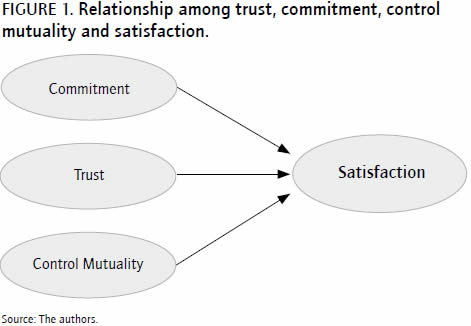
<body><![CDATA[<p>  The measurement instrument measured whether the relationship   partner was satisfied with the decision-making   process and if they perceive themselves and the organisation   to have equal influence within the decision-making   process. Shared decision-making is a key influencer in successful   relationships, as commitment and trust increase in   relationships where shared decision-making takes place.   Information asymmetry get also reduces when both relationship   partners have a high participation in and knowledge   of strategic decisions and actions (Saxton, 1997, p.   446). Steyn (2007, p. 159) states that a competitive advantage   can be gained by the organisation through involving   stakeholders in decision-making and thereby stabilising   organisational relationships. From an organisational learning   perspective, the ability of relationship partners to facilitate learning and innovation and share knowledge   requires close involvement in the relationship and its decision-   making processes (Nooteboom, 1992, as cited in   Saxton, 1997, p. 447). Therefore, a high degree of shared   decision-making in relationships positively affect the outcomes   of the relationship, as such involvement builds trust   and enhances the sharing of knowledge within the relationship   (Saxton, 1997, p. 447). Relationship partners,   where control mutuality exists, also know what to expect   from one another (Grunig &amp; Huang, 2000). The scale items   measuring this construct therefore focused on the power   relations within the relationship in terms of shared decision-making and transparent expectations. The following   section looks at the measurement of these outcomes.</p>     <p>  Objective 3 was measured using variance-based structural   equation modelling, specifically Partial Least Squares (PLS )   analysis using SmartPLS software. This allowed us to do simultaneous   modelling of relationships among multiple independent   and dependent constructs. It also allowed us   to assess the reliability and validity of the proposed measures   with more than first-generation statistical techniques   (Haenlein, M. &amp; Kaplan, A.M., 2004).</p>     <p>&nbsp;</p>     <p>    <center><font size="3"><b>  Objective 3: validity, reliability   and exploratory analysis of the   relationship between the outcomes</b></font></center></p>     <p>  Grunig &amp; Huang's (2000) guidelines to measuring relationship   outcomes were used to measure relationship outcomes   in the South African context. Similar to previous   studies that have measured these outcomes (see Hon &amp;   Brunner, 2002; Jo, Hon &amp; Brunner, 2004), an email survey   was administered on a population of 2500 population elements   involved in organisational relationships: A census   was conducted on the population framework of IPSA (the   Institute for Procurement and Supply South Africa). The   research method and sample size was constrained by the   available resources. A response rate of 6% was realised   (n = 154).</p>     <p>  Previous studies have simply measured each relationship   outcome, but have failed to propose the possible relationship   between these outcomes. In this study, we analysed   the possible relationship between these outcomes as well   as the reliability and validity of the proposed measurement   of these outcomes using structural equation modelling.</p>     <p>  Saxton (1997, p. 447) studied the effect of relational and   organisational characteristics on organisational outcomes   and states that with the presence of trust between partnering   organisations, the likelihood of positive or successful   relationship outcomes increases. We can therefore posit   that trust contributes to satisfaction in and with the relationship.   Therefore, to will commitment and control mutuality   contribute to satisfaction in the relationship. Based   on the interpretation of the literature as well as exploratory   analysis, we propose the following simplified model   (<a href="#f1">Figure 1</a>) of relationship outcomes: We hypothesise trust,   commitment and control mutuality positively contribute to   relational satisfaction.</p>     <p>When this model was fitted, an R square value of 0.706   was generated. By implication, the relationship outcomes   of trust, commitment and control mutuality explained approximately 71% of the variance in relational satisfaction.</p>     <p><a href="/img/revistas/inno/v21n40/40a02t3.jpg" target="_blank">  Table 3</a> provides an overview of the measurement model   analysis obtained from the PLS analysis. We discuss these   figures in greater depth in the following sections.</p>     ]]></body>
<body><![CDATA[<p></p>     <p><font size="3"><b>  Reliability assessment and   confirmatory factor analysis</b></font></p>     <p>  To measure the key constructs of this study, we calculated   a summated scale for each individual outcome. The negatively worded items in the scales were reverse scored   and we attained the following reliability scores: Trust   (0.68), commitment (0.79), satisfaction (0.84) and control   mutuality (0.78) where all the relationship outcomes, except   trust, obtained reliability scores above the required   0.7. The composite reliability scores too were all higher   than 0.7 as illustrated in <a href="/img/revistas/inno/v21n40/40a02t3.jpg" target="_blank">Table 3</a>.</p>     <p>  The composite reliability is a measure of the overall reliability   of heterogeneous but similar scale items. It differs from   individual item reliability (Cronbach Alpha) in that it tests   for the reliability of the latent construct (Anon, 2007). Existent   items in each scale do not influence this measure,   but uses item loadings extracted from the causal model   analysed (Vinzi, Chin, Henseler &amp; Wang, 2010). <a href="/img/revistas/inno/v21n40/40a02t4.jpg" target="_blank">Table 4</a>   provides the factor loadings and Beta values for each of   the outcomes (as well as their individual scale items).</p>     <p>  An exploratory factor analysis confirmed one factor loaded   for each relationship. The confirmatory factor analysis confirmed   it and the following. The bootstrapping technique   in PLS also confirmed the relationships proposed in the   model as all the relationships were found to be significant   and positive (t-value larger than 1.96) for both the scale   items and the relationships between the outcomes.</p>     <p></p>     <p><font size="3"><b>  Convergent and discriminant validity</b></font></p>     <p>  To assess the convergent validity of the measures, we   need to analyse the Average Variance Extracted (AVE) of   each construct needs. The AVEs, or variance extracted estimates,   analyses the amount of variance captured by a   construct in relation to the variance due to random measurement   error. An AVE higher than 0.5 indicates the validity   of both the construct and the individual items is high   (Anon, 2007). In other words, the variance explained by   the indicators exceeds the variance explained by error (Vinzi,   Chin, Henseler &amp; Wang, 2010). <a href="/img/revistas/inno/v21n40/40a02t3.jpg" target="_blank">Table 3</a> shows that each   AVE is greater than 0.5.</p>     <p>  We also used the AVEs to assess the discriminant validity   of the relationship outcomes or constructs. The condition   for discriminant validity is that the AVE is greater than   the square correlation between the construct and each of   the other constructs in the model (Vinzi, Chin, Henseler &amp;   Wang, 2010). We can apply a reverse process to analyse   this condition where we place the square of the AVEs in the   diagonal of the correlation matrix. The result of this analysis   is contained in <a href="/img/revistas/inno/v21n40/40a02t5.jpg" target="_blank">Table 5</a>.</p>     <p>  The squared AVEs are consistently greater than the correlations   obtained between the constructs. Therefore, the   relationship outcomes measured satisfy the conditions for   convergent validity (see AVEs in <a href="/img/revistas/inno/v21n40/40a02t3.jpg" target="_blank">Table 3</a>) and discriminant   validity (see <a href="/img/revistas/inno/v21n40/40a02t5.jpg" target="_blank">Table 5</a>), and therefore the constructs achieve   both convergent and discriminant validity.</p>     ]]></body>
<body><![CDATA[<p></p>     <p>    <center><font size="3"><b>  Discussion</b></font></center></p>     <p>  The lack of a generally accepted definition of organisational   relationships has severely inhibited the management   function of communication (Broom et al., 1997, p.   81; Grunig &amp; Huang, 2000; Ledingham &amp; Bruning, 2000a; Str&ouml;h, 2005). Measuring relationship outcomes provide   managers with a reliable means to estimate the success   of organisational relationships. Yang &amp; Grunig (2005, p. 5)   have even suggested defining those relationships in terms   of these outcomes: "The degree that the organisation and   its publics trust one another, agree on who has rightful   power to influence, experience satisfaction with each other,   and commit oneself to one another".</p>     <p>  If we consider communication management a managerial   function, it must first refine its instruments of measurement.   In order for the communication function to "exist   and survive", it is important to prove that it is useful and   beneficial (Tixier, 1995, as cited in Noble, 1999, p. 14).   Public relations and communication should become a more   research-based discipline, and creating a reliable and consistently   used measure of organisational relationships has   been a top priority for communication managers globally   (Noble, 1999, pp. 14, 20).</p>     <p>  Grunig (2006, pp. 167) states that non-financial indicators   of value or intangible assets "are a hot topic in management   and accounting sciences" and he believes that   relationships are the most important of those intangible   assets. When communication managers can reliably quantify   organisational relationships, their contribution to the   field of relationship management can be further grounded   and their place in the boardroom could be better justified   (Grunig, 2006). A valid measurement scale for organisational   relationships also offers both practitioners and   scholars a way to measure and manage relationships as   they develop (Jo, 2003, p. xi).</p>     <p><a href="/img/revistas/inno/v21n40/40a02t6.jpg" target="_blank">  Table 6</a> illustrates an adapted guideline to measuring relationship   outcomes based on Gruing and Huang's (2000)   original framework. This proposed measurement instrument   provides a shorter, comprehensive and more reliable   measure of organisational relationships.</p>     <p>  This measurement instrument provides communication   managers with a tool to evaluate the relationships that   the organisation has with various stakeholders. Jo (2003,   p. 2) also applied the relationship outcomes as a measure   of organisational relationships and state that "the value   of organisation-public relationships can be represented by   relational outcomes", where these outcomes offer a global   measure of organisational relationships. However, there is   no simple, single solution to the problem of public relations   evaluation (Noble, 1999, p. 15).</p>     <p>&nbsp;</p>     <p>    ]]></body>
<body><![CDATA[<center><font size="3"><b>  Managerial implications</b></font></center></p>     <p>  Measuring relationship outcomes relates to the evaluation   of the long-term value of public relations and communication   management (Noble, 1999, pp. 16; Str&ouml;h, 2005, p. 176). The practice of evaluation involves the systematic   collection of information regarding the activities, characteristics   and outcomes of communication in organisations   with the aim of improving the communication within that   organisation (Noble, 1999, p. 17). According to Hehir   (1997, as cited in Noble, 1999, p. 17), confidence in public   relations and communication will only be engendered   if measurable objectives are put into place. He argues   that measurable objectives is the "golden bridge" over   which public relations can march into the promised land   of corporate respectability and enhanced resources. Adequate   methods of measurement in public relations and   communication therefore engender greater appreciation   for this organisational function.</p>     <p>  Managers currently invest extensive budgets in simple   evaluation programs, but they do not make any effort to   measure the impact of communication in the organ isation   (Tixier, 1995, as cited in Noble, 1999, p. 19). We can   measure this impact through a reliable assessment of the   relationship that organisations have with key stakeholders.   When organisations know exactly what the "health"   of their relationships with specific stakeholders is, managers   can develop proactive action plans where they can ask   the following questions regarding their relationship with   stakeholders:</p> <ul>     <p>       <li>  How can the organisation communicate to stakeholders     to increase the trust that stakeholders have in the     organisation?</li> </p>     <p>       <li>  How can the organisation increase the commitment     that stakeholders have to the organisation, and how     can the organisation better communicate their commitment     to particular stakeholders?</li> </p>     <p>       <li>   Which factors influence the satisfaction that different     stakeholders have in the organisational relationship?</li> </p>     <p>       ]]></body>
<body><![CDATA[<li>  How can the organisation include stakeholders in the     decision-making process of the organisation?</li> </p>     <p>       <li>  Do stakeholders know what the organisation expects     from them? In addition, does the organisation know     what stakeholders expect from the organisation?</li> </p>     </ul>     <p>  Once organisations have answers to these questions, they   can develop appropriate communication strategies for   individual stakeholder groups allowing communication   managers to proactively manage these organisational relationships.   Scott (2007, p. 264) applied the relationship   outcomes to various stakeholders in their respective contexts   and states that measuring relationship outcomes is   important because:</p> <ul>       <p>       <li>  In a world of intangibles and educated guesses, it is     a means of concretely mapping stakeholders in order     to prioritize which groups are most in need of engagement.</li> </p>     <p>       <li>It provides an understanding of the most appropriate     terms of that engagement as well as provides a benchmark     against which to track the impact of a communication     programme over time.</li> </p>     <p>       ]]></body>
<body><![CDATA[<li> The numeric impact of using the relationship outcomes     to measure organisational relationships allows public     relations executives to speak in quantitative terms     about what they have always seen as a notoriously soft     variable.</li> </p>     <p>       <li> Applying the relationship outcomes to various stakeholders     is an important validation of the overall strategy,     because of its ability to prioritize stakeholder     groups according to the quality of their existing relationships     with an organisation.</li> </p>     <p>       <li> It helps professionals to determine where to invest campaign     resources.</li> </p>     <p>       <li> It is a valuable source of tactical insight, because of its     ability to score across numerous dimensions of a relationship.</li> </p>     </ul>     <p>  Scott (2007, p. 264) emphasises that the measurement of   relationship outcomes in organisational relationships contributes   to organisational effectiveness on both a tactical   and strategic level, while giving a numeric value to a traditionally vague, qualitative construct.</p>     <p>&nbsp;</p>     ]]></body>
<body><![CDATA[<p>    <center><font size="3"><b>  Possible limitations</b></font></center></p>     <p>  Possible sources of limitations could have resulted from   the use of an electronic survey. The main sources of error   detected in studies utilising survey data is sampling   error, questionnaire error, high refusal rates or high non-response,   respondent effects, data capturing errors and the   inappropriate selection of statistical techniques (Mouton,   2005, p. 153). Low response rate is a common limitation of electronic surveys (Alreck &amp; Settle, 1995, p. 184).</p>     <p>  It appears that the concept of having "relationships" with   organisations rather than individuals is not always a comfortable   concept for respondents to entertain. Scott (2007,   p. 269) found a small minority of respondents that were   resistant to the measurement instrument and these respondents   usually ask questions like "Am I supposed to   answer this from a personal or professional perspective?" or "Do you want me to speak for my organisation of for myself?" Scott (2007, p. 270) reiterates that the respondents should try to speak for themselves. This possible obstacle was encountered in the present study and the solution provided by Scott (2007, p. 270) was followed.</p>     <p>&nbsp;</p>     <p>    <center><font size="3"><b>  Future research</b></font></center></p>     <p>  Jo (2003, p. xi) applied Grunig and Huang's (2000, p.   36) guidelines on measuring relationship outcomes to the   South Korean context and attempted to determine if specific   relationship features characterise organisational relationships   in this context. He concluded that we should   add "face and favour" to the relationship measurement   instrument in this context. Similarly, we can apply and   adapt the proposed measurement instrument to various   contexts and expand it to include context specific relationship   factors. We have developed the present measurement   of organisational relationships based on a Western   culture (Jo, 2003, p. 5) and consequently the application   thereof to other cultures would greatly benefit this framework.   Most western studies stated that trust was the key   contributing factor to the success of organisational relationships.   However, through regression analysis on the   relative contribution of each relationship outcome to perceptions   of goal attainment or relationship success, this   study found that control mutuality was the largest contributing   factor and trust had a relatively small contribution   to perceptions of relationship success. Jo's (2003)   study in South Korea also found that control mutuality   was the largest contributor to relationship success. Future   research can investigate which outcome of relationship   communication managers should focus on, or alternatively,   whether we need emphasized different outcomes for   different types of relationships or different contexts.</p>     <p>&nbsp;</p>     <p>    ]]></body>
<body><![CDATA[<center><font size="3"><b>  References</b></font></center></p>     <!-- ref --><p>  Alreck, P.L. &amp; Settle, R.B. (1995). <i>The survey research handbook</i> (2nd ed.).   Homewood, USA: Irwin.    &nbsp;&nbsp;&nbsp;&nbsp;&nbsp;&nbsp;&nbsp;&nbsp;[&#160;<a href="javascript:void(0);" onclick="javascript: window.open('/scielo.php?script=sci_nlinks&ref=000164&pid=S0121-5051201100020000200001&lng=','','width=640,height=500,resizable=yes,scrollbars=1,menubar=yes,');">Links</a>&#160;]<!-- end-ref --></p>     <!-- ref --><p>  Anon. (2007). <i>Blogspot: Composite reliability-the reliability of   each composite</i>. Retrieved from <a href="http://zencaroline.blogspot.com/2007/06/composite-reliability.html" target="_blank">http://zencaroline.blogspot.com/2007/06/composite-reliability.html</a>&nbsp;&nbsp;&nbsp;&nbsp;&nbsp;&nbsp;&nbsp;&nbsp;[&#160;<a href="javascript:void(0);" onclick="javascript: window.open('/scielo.php?script=sci_nlinks&ref=000166&pid=S0121-5051201100020000200002&lng=','','width=640,height=500,resizable=yes,scrollbars=1,menubar=yes,');">Links</a>&#160;]<!-- end-ref --><!-- ref --><p>  Botha, E. &amp; Van der Waldt, D.L.R. (2009a). <i>Towards a linear regression   model of relationship outcomes and perceptions of goal attainment in organisational alliances</i>. Article under preparation.    &nbsp;&nbsp;&nbsp;&nbsp;&nbsp;&nbsp;&nbsp;&nbsp;[&#160;<a href="javascript:void(0);" onclick="javascript: window.open('/scielo.php?script=sci_nlinks&ref=000167&pid=S0121-5051201100020000200003&lng=','','width=640,height=500,resizable=yes,scrollbars=1,menubar=yes,');">Links</a>&#160;]<!-- end-ref --></p>     <!-- ref --><p>  Botha, E. &amp; Van der Waldt, D.L.R. (2009b). <i>Investigating the influence   of organisational relationship outcomes on the success of alliances by means of a linear model</i>. Article under preparation.    &nbsp;&nbsp;&nbsp;&nbsp;&nbsp;&nbsp;&nbsp;&nbsp;[&#160;<a href="javascript:void(0);" onclick="javascript: window.open('/scielo.php?script=sci_nlinks&ref=000169&pid=S0121-5051201100020000200004&lng=','','width=640,height=500,resizable=yes,scrollbars=1,menubar=yes,');">Links</a>&#160;]<!-- end-ref --></p>     <!-- ref --><p>  Broom, G.M., Casey, S. &amp; Ritchey, J. (1997). Toward a concept and theory   of organisation-public relationships. <i>Journal of Public Relations Research</i>, <i>9</i>(2), 83-98.    &nbsp;&nbsp;&nbsp;&nbsp;&nbsp;&nbsp;&nbsp;&nbsp;[&#160;<a href="javascript:void(0);" onclick="javascript: window.open('/scielo.php?script=sci_nlinks&ref=000171&pid=S0121-5051201100020000200005&lng=','','width=640,height=500,resizable=yes,scrollbars=1,menubar=yes,');">Links</a>&#160;]<!-- end-ref --></p>     ]]></body>
<body><![CDATA[<!-- ref --><p>  Canary, D.J. &amp; Cupach, W.R. (1988). Relational and episodic characteristics   associated with conflict tactics. <i>Journal of Social and Personal Relationships</i>, <i>5</i>, 305-325.    &nbsp;&nbsp;&nbsp;&nbsp;&nbsp;&nbsp;&nbsp;&nbsp;[&#160;<a href="javascript:void(0);" onclick="javascript: window.open('/scielo.php?script=sci_nlinks&ref=000173&pid=S0121-5051201100020000200006&lng=','','width=640,height=500,resizable=yes,scrollbars=1,menubar=yes,');">Links</a>&#160;]<!-- end-ref --></p>     <!-- ref --><p>  CII. (2006). Cost-trust relationship. <i>CII Products Online</i>, <i>24</i>(1). Retrieved   from <a href="http://construction-institute.org/scriptcontent/more/24_1_more.cfm" target="_blank">http://construction-institute.org/scriptcontent/more/24_1_more.cfm</a>&nbsp;&nbsp;&nbsp;&nbsp;&nbsp;&nbsp;&nbsp;&nbsp;[&#160;<a href="javascript:void(0);" onclick="javascript: window.open('/scielo.php?script=sci_nlinks&ref=000175&pid=S0121-5051201100020000200007&lng=','','width=640,height=500,resizable=yes,scrollbars=1,menubar=yes,');">Links</a>&#160;]<!-- end-ref --><!-- ref --><p>  Cooper, D.R. &amp; Schindler, P.S. (2003). <i>Business Research Methods</i> (8th ed.). New York, USA: McGraw-Hill.    &nbsp;&nbsp;&nbsp;&nbsp;&nbsp;&nbsp;&nbsp;&nbsp;[&#160;<a href="javascript:void(0);" onclick="javascript: window.open('/scielo.php?script=sci_nlinks&ref=000176&pid=S0121-5051201100020000200008&lng=','','width=640,height=500,resizable=yes,scrollbars=1,menubar=yes,');">Links</a>&#160;]<!-- end-ref --></p>     <!-- ref --><p>  Dyer, J.H. &amp; Singh, H. (1998). The relational view: Cooperative strategy   and sources of interorganisational competitive advantage. <i>Academy of Management Review</i>, <i>3</i>(4), 660-679.    &nbsp;&nbsp;&nbsp;&nbsp;&nbsp;&nbsp;&nbsp;&nbsp;[&#160;<a href="javascript:void(0);" onclick="javascript: window.open('/scielo.php?script=sci_nlinks&ref=000178&pid=S0121-5051201100020000200009&lng=','','width=640,height=500,resizable=yes,scrollbars=1,menubar=yes,');">Links</a>&#160;]<!-- end-ref --></p>     <!-- ref --><p>  EbscoHost. (2008). Retrieved from <a href="http://0ejournals.ebsco.com.innopac.up.ac.za/Home.asp" target="_blank">http://0ejournals.ebsco.com.innopac.up.ac.za/Home.asp</a>.    &nbsp;&nbsp;&nbsp;&nbsp;&nbsp;&nbsp;&nbsp;&nbsp;[&#160;<a href="javascript:void(0);" onclick="javascript: window.open('/scielo.php?script=sci_nlinks&ref=000180&pid=S0121-5051201100020000200010&lng=','','width=640,height=500,resizable=yes,scrollbars=1,menubar=yes,');">Links</a>&#160;]<!-- end-ref --></p>     <!-- ref --><p>  Emerald. (2008). Retrieved from <a href="http://0www.emeraldinsight.com.innopac.up.ac.za/" target="_blank">http://0www.emeraldinsight.com.innopac.up.ac.za/</a>.    &nbsp;&nbsp;&nbsp;&nbsp;&nbsp;&nbsp;&nbsp;&nbsp;[&#160;<a href="javascript:void(0);" onclick="javascript: window.open('/scielo.php?script=sci_nlinks&ref=000182&pid=S0121-5051201100020000200011&lng=','','width=640,height=500,resizable=yes,scrollbars=1,menubar=yes,');">Links</a>&#160;]<!-- end-ref --></p>     <!-- ref --><p>  Gregory, A. (1999). Systems theory and public relations practice. <i>Journal of Communication Management</i>, <i>4</i>(3), 266-277.    &nbsp;&nbsp;&nbsp;&nbsp;&nbsp;&nbsp;&nbsp;&nbsp;[&#160;<a href="javascript:void(0);" onclick="javascript: window.open('/scielo.php?script=sci_nlinks&ref=000184&pid=S0121-5051201100020000200012&lng=','','width=640,height=500,resizable=yes,scrollbars=1,menubar=yes,');">Links</a>&#160;]<!-- end-ref --></p>     <!-- ref --><p>  Greguras, G.J. (2003). <i>The nature of trust: Conceptual and operational   clarification</i>. Unpublished dissertation. Louisiana State University and Agricultural and Mechanical College.    &nbsp;&nbsp;&nbsp;&nbsp;&nbsp;&nbsp;&nbsp;&nbsp;[&#160;<a href="javascript:void(0);" onclick="javascript: window.open('/scielo.php?script=sci_nlinks&ref=000186&pid=S0121-5051201100020000200013&lng=','','width=640,height=500,resizable=yes,scrollbars=1,menubar=yes,');">Links</a>&#160;]<!-- end-ref --></p>     <!-- ref --><p>  Grunig, J.E. (2002). <i>Qualitative methods for assessing relationships between   organisations and publics</i>. The Institute for Public Relations. Retrieved from <a href="http://instituteforpr.com" target="_blank">http://instituteforpr.com</a>&nbsp;&nbsp;&nbsp;&nbsp;&nbsp;&nbsp;&nbsp;&nbsp;[&#160;<a href="javascript:void(0);" onclick="javascript: window.open('/scielo.php?script=sci_nlinks&ref=000188&pid=S0121-5051201100020000200014&lng=','','width=640,height=500,resizable=yes,scrollbars=1,menubar=yes,');">Links</a>&#160;]<!-- end-ref --><!-- ref --><p>  Grunig, J.E. (2006). Furnishing the edifice: Ongoing research on public   relations as a strategic management function. <i>Journal of Public Relations Research</i>, <i>18</i>(2), 151-176.    &nbsp;&nbsp;&nbsp;&nbsp;&nbsp;&nbsp;&nbsp;&nbsp;[&#160;<a href="javascript:void(0);" onclick="javascript: window.open('/scielo.php?script=sci_nlinks&ref=000189&pid=S0121-5051201100020000200015&lng=','','width=640,height=500,resizable=yes,scrollbars=1,menubar=yes,');">Links</a>&#160;]<!-- end-ref --></p>     <!-- ref --><p>  Grunig, J.E. &amp; Grunig, L.A. (1992). Models of public relations and communication.   In Grunig, J.E. (Ed.), <i>Excellence in public relations and   communication management</i> (pp. 285-325). New Jersey, USA: Lawrence Erlbaum Associates.    &nbsp;&nbsp;&nbsp;&nbsp;&nbsp;&nbsp;&nbsp;&nbsp;[&#160;<a href="javascript:void(0);" onclick="javascript: window.open('/scielo.php?script=sci_nlinks&ref=000191&pid=S0121-5051201100020000200016&lng=','','width=640,height=500,resizable=yes,scrollbars=1,menubar=yes,');">Links</a>&#160;]<!-- end-ref --></p>     ]]></body>
<body><![CDATA[<!-- ref --><p>  Grunig, L.A., Grunig, J.E. &amp; Dozier, D.M. (2002). <i>Excellent public relations   and effective organisations: The study of communication   management in three countries</i>. New Jersey, USA: Lawrence Erlbaum Associates.    &nbsp;&nbsp;&nbsp;&nbsp;&nbsp;&nbsp;&nbsp;&nbsp;[&#160;<a href="javascript:void(0);" onclick="javascript: window.open('/scielo.php?script=sci_nlinks&ref=000193&pid=S0121-5051201100020000200017&lng=','','width=640,height=500,resizable=yes,scrollbars=1,menubar=yes,');">Links</a>&#160;]<!-- end-ref --></p>     <!-- ref --><p>  Grunig, L.A., Grunig, J.E. &amp; Ehling, W.P. (1992). What is an effective organisation.   In Grunig, J.E. (Ed.), <i>Excellence in public relations and   communication management</i> (pp. 65-90). New Jersey, USA: Lawrence Erlbaum Associates.    &nbsp;&nbsp;&nbsp;&nbsp;&nbsp;&nbsp;&nbsp;&nbsp;[&#160;<a href="javascript:void(0);" onclick="javascript: window.open('/scielo.php?script=sci_nlinks&ref=000195&pid=S0121-5051201100020000200018&lng=','','width=640,height=500,resizable=yes,scrollbars=1,menubar=yes,');">Links</a>&#160;]<!-- end-ref --></p>     <!-- ref --><p>  Grunig, J.E. &amp; Huang, Y. (2000). From organisation effectiveness to relationship   indicators: Antecedents of relationships, public relations   strategies, and relationship outcomes. In Ledingham, J.A. &amp; Bruning,   S.D. <i>Public Relations as Relationship Management: A Relational   Approach to the Study and Practice of Public Relations</i> (pp. 23-54). New Jersey, USA: Lawrence Erlbaum Associates.    &nbsp;&nbsp;&nbsp;&nbsp;&nbsp;&nbsp;&nbsp;&nbsp;[&#160;<a href="javascript:void(0);" onclick="javascript: window.open('/scielo.php?script=sci_nlinks&ref=000197&pid=S0121-5051201100020000200019&lng=','','width=640,height=500,resizable=yes,scrollbars=1,menubar=yes,');">Links</a>&#160;]<!-- end-ref --></p>     <!-- ref --><p>  Grunig, J.E. &amp; White, J. (1992). The effect of worldviews on public relations   theory and practice. In Grunig, J.E. (Ed.), <i>Excellence in public   relations and communication management</i> (pp. 31-64). New Jersey, USA: Lawrence Erlbaum Associates.    &nbsp;&nbsp;&nbsp;&nbsp;&nbsp;&nbsp;&nbsp;&nbsp;[&#160;<a href="javascript:void(0);" onclick="javascript: window.open('/scielo.php?script=sci_nlinks&ref=000199&pid=S0121-5051201100020000200020&lng=','','width=640,height=500,resizable=yes,scrollbars=1,menubar=yes,');">Links</a>&#160;]<!-- end-ref --></p>     <!-- ref --><p>  Gulati, R. (1995). Social structure and alliance formation patterns: A   longitudinal analysis. <i>Administrative Science Quarterly</i>, <i>40</i>(4), 619-653.    &nbsp;&nbsp;&nbsp;&nbsp;&nbsp;&nbsp;&nbsp;&nbsp;[&#160;<a href="javascript:void(0);" onclick="javascript: window.open('/scielo.php?script=sci_nlinks&ref=000201&pid=S0121-5051201100020000200021&lng=','','width=640,height=500,resizable=yes,scrollbars=1,menubar=yes,');">Links</a>&#160;]<!-- end-ref --></p>     ]]></body>
<body><![CDATA[<!-- ref --><p>  Haenlein, M. &amp; Kaplan, A.M. (2004). A beginner's guide to partial least squares analysis. <i>Understanding Statistics</i>, <i>3</i>(4), 283-297.    &nbsp;&nbsp;&nbsp;&nbsp;&nbsp;&nbsp;&nbsp;&nbsp;[&#160;<a href="javascript:void(0);" onclick="javascript: window.open('/scielo.php?script=sci_nlinks&ref=000203&pid=S0121-5051201100020000200022&lng=','','width=640,height=500,resizable=yes,scrollbars=1,menubar=yes,');">Links</a>&#160;]<!-- end-ref --></p>     <!-- ref --><p>  Heath, R.L. (2006). Onward into more fog: thoughts on public relations'   research directions. <i>Journal of Public Relations Research</i>, <i>18</i>(2), 93-114.    &nbsp;&nbsp;&nbsp;&nbsp;&nbsp;&nbsp;&nbsp;&nbsp;[&#160;<a href="javascript:void(0);" onclick="javascript: window.open('/scielo.php?script=sci_nlinks&ref=000205&pid=S0121-5051201100020000200023&lng=','','width=640,height=500,resizable=yes,scrollbars=1,menubar=yes,');">Links</a>&#160;]<!-- end-ref --></p>     <!-- ref --><p>  Hendrick, S.S. (1988). A generic measure of relational satisfaction. <i>Journal of Marriage and the Family</i>, <i>50</i>, 93-98.    &nbsp;&nbsp;&nbsp;&nbsp;&nbsp;&nbsp;&nbsp;&nbsp;[&#160;<a href="javascript:void(0);" onclick="javascript: window.open('/scielo.php?script=sci_nlinks&ref=000207&pid=S0121-5051201100020000200024&lng=','','width=640,height=500,resizable=yes,scrollbars=1,menubar=yes,');">Links</a>&#160;]<!-- end-ref --></p>     <!-- ref --><p>  Hon, L. &amp; Brunner, B. (2002). Measuring public relationships among students   and administrators at the University of Florida. <i>Journal of Communication Management</i>, <i>6</i>(3), 227-238.    &nbsp;&nbsp;&nbsp;&nbsp;&nbsp;&nbsp;&nbsp;&nbsp;[&#160;<a href="javascript:void(0);" onclick="javascript: window.open('/scielo.php?script=sci_nlinks&ref=000209&pid=S0121-5051201100020000200025&lng=','','width=640,height=500,resizable=yes,scrollbars=1,menubar=yes,');">Links</a>&#160;]<!-- end-ref --></p>     <!-- ref --><p>  Huang, Y.H. (1997). <i>Public relations strategies, relational outcomes and   conflict management strategies</i>. Unpublished doctoral dissertation,   University of Maryland, College Park: Maryland.    &nbsp;&nbsp;&nbsp;&nbsp;&nbsp;&nbsp;&nbsp;&nbsp;[&#160;<a href="javascript:void(0);" onclick="javascript: window.open('/scielo.php?script=sci_nlinks&ref=000211&pid=S0121-5051201100020000200026&lng=','','width=640,height=500,resizable=yes,scrollbars=1,menubar=yes,');">Links</a>&#160;]<!-- end-ref --></p>     ]]></body>
<body><![CDATA[<!-- ref --><p>Jo, S. (2003). <i>Measurement of organisation-public relationships: Validation   of measurement using a manufacturer-retailers relationship</i>. Abstract of PhD dissertation, Florida, USA: University of Florida.    &nbsp;&nbsp;&nbsp;&nbsp;&nbsp;&nbsp;&nbsp;&nbsp;[&#160;<a href="javascript:void(0);" onclick="javascript: window.open('/scielo.php?script=sci_nlinks&ref=000213&pid=S0121-5051201100020000200027&lng=','','width=640,height=500,resizable=yes,scrollbars=1,menubar=yes,');">Links</a>&#160;]<!-- end-ref --></p>     <!-- ref --><p>  Jo, S., Hon, L.C. &amp; Brunner, B.R. (2004). Organisation-public relationships:   Measurement validation in a university setting. <i>Journal of Communication Management</i>, <i>9</i>(1), 14-27.    &nbsp;&nbsp;&nbsp;&nbsp;&nbsp;&nbsp;&nbsp;&nbsp;[&#160;<a href="javascript:void(0);" onclick="javascript: window.open('/scielo.php?script=sci_nlinks&ref=000215&pid=S0121-5051201100020000200028&lng=','','width=640,height=500,resizable=yes,scrollbars=1,menubar=yes,');">Links</a>&#160;]<!-- end-ref --></p>     <!-- ref --><p>  Ledingham, J.A. (2000). Government-community relationships: Extending   the relational theory of public relations. <i>PR Review</i>, <i>27</i>, 285-295.    &nbsp;&nbsp;&nbsp;&nbsp;&nbsp;&nbsp;&nbsp;&nbsp;[&#160;<a href="javascript:void(0);" onclick="javascript: window.open('/scielo.php?script=sci_nlinks&ref=000217&pid=S0121-5051201100020000200029&lng=','','width=640,height=500,resizable=yes,scrollbars=1,menubar=yes,');">Links</a>&#160;]<!-- end-ref --></p>     <!-- ref --><p>  Ledingham, J.A. (2003). Explicating relationship management as a   general theory of public relations. <i>Journal of Public Relations Research</i>, <i>15</i>(2), 181-198.    &nbsp;&nbsp;&nbsp;&nbsp;&nbsp;&nbsp;&nbsp;&nbsp;[&#160;<a href="javascript:void(0);" onclick="javascript: window.open('/scielo.php?script=sci_nlinks&ref=000219&pid=S0121-5051201100020000200030&lng=','','width=640,height=500,resizable=yes,scrollbars=1,menubar=yes,');">Links</a>&#160;]<!-- end-ref --></p>     <!-- ref --><p>  Leadingham, J.A. &amp; Bruning, S.D. (2000a). <i>Public relations as relationship   management: A relational aproach to the study and practice of public relations</i>. Mahwah, N.J: Lawrence Erlbaum Associates.    &nbsp;&nbsp;&nbsp;&nbsp;&nbsp;&nbsp;&nbsp;&nbsp;[&#160;<a href="javascript:void(0);" onclick="javascript: window.open('/scielo.php?script=sci_nlinks&ref=000221&pid=S0121-5051201100020000200031&lng=','','width=640,height=500,resizable=yes,scrollbars=1,menubar=yes,');">Links</a>&#160;]<!-- end-ref --></p>     ]]></body>
<body><![CDATA[<!-- ref --><p>  Ledingham, J.A. &amp; Bruning, S.D. (2000b). A longitudinal study of organisation-   public relationship dimensions: Defining the role of   communication in the practice of relationship management. In   Ledingham, J.A. &amp; Bruning, S.D. <i>Public relations as relationship   management: A relational approach to the study and practice of   public relations</i> (pp. 55-70). New Jersey, USA: Lawrence Erlbaum Associates.    &nbsp;&nbsp;&nbsp;&nbsp;&nbsp;&nbsp;&nbsp;&nbsp;[&#160;<a href="javascript:void(0);" onclick="javascript: window.open('/scielo.php?script=sci_nlinks&ref=000223&pid=S0121-5051201100020000200032&lng=','','width=640,height=500,resizable=yes,scrollbars=1,menubar=yes,');">Links</a>&#160;]<!-- end-ref --></p>     <!-- ref --><p>  Ledingham, J.A. &amp; Bruning, S.D. (2000c). Introduction: Background   and current trends in the study of relationship management. In   Ledingham, J.A. &amp; Bruning, S.D. <i>Public relations as relationship   management: A relational approach to the study and practice of   public relations</i> (pp. xi-xvii). New Jersey, USA: Lawrence Erlbaum Associates.    &nbsp;&nbsp;&nbsp;&nbsp;&nbsp;&nbsp;&nbsp;&nbsp;[&#160;<a href="javascript:void(0);" onclick="javascript: window.open('/scielo.php?script=sci_nlinks&ref=000225&pid=S0121-5051201100020000200033&lng=','','width=640,height=500,resizable=yes,scrollbars=1,menubar=yes,');">Links</a>&#160;]<!-- end-ref --></p>     <!-- ref --><p>  MacMillan, K., Money, K. &amp; Downing, S. (2000). Successful business relationships. <i>Journal of General Management</i>, <i>26</i>(1), 69-83.    &nbsp;&nbsp;&nbsp;&nbsp;&nbsp;&nbsp;&nbsp;&nbsp;[&#160;<a href="javascript:void(0);" onclick="javascript: window.open('/scielo.php?script=sci_nlinks&ref=000227&pid=S0121-5051201100020000200034&lng=','','width=640,height=500,resizable=yes,scrollbars=1,menubar=yes,');">Links</a>&#160;]<!-- end-ref --></p>     <!-- ref --><p>  Morgan, R.M. &amp; Hunt, S.D. (1994). The commitment-trust theory of relationship marketing. <i>Journal of Marketing</i>, <i>58</i>(3), 20-38.    &nbsp;&nbsp;&nbsp;&nbsp;&nbsp;&nbsp;&nbsp;&nbsp;[&#160;<a href="javascript:void(0);" onclick="javascript: window.open('/scielo.php?script=sci_nlinks&ref=000229&pid=S0121-5051201100020000200035&lng=','','width=640,height=500,resizable=yes,scrollbars=1,menubar=yes,');">Links</a>&#160;]<!-- end-ref --></p>     <!-- ref --><p>  Mouton, J. (2005). <i>How to succeed in your master's and doctoral studies:   A South African Guide and Resource Book</i>. Johannesburg, South Africa: Van Schaik.    &nbsp;&nbsp;&nbsp;&nbsp;&nbsp;&nbsp;&nbsp;&nbsp;[&#160;<a href="javascript:void(0);" onclick="javascript: window.open('/scielo.php?script=sci_nlinks&ref=000231&pid=S0121-5051201100020000200036&lng=','','width=640,height=500,resizable=yes,scrollbars=1,menubar=yes,');">Links</a>&#160;]<!-- end-ref --></p>     ]]></body>
<body><![CDATA[<!-- ref --><p>  Murphy, J.E. (2003). <i>Restoring trust in business: Models for action</i>. Retrieved from <a href="http://72.32.147.97/pr_coalition/index.html" target="_blank">http://72.32.147.97/pr_coalition/index.html</a>&nbsp;&nbsp;&nbsp;&nbsp;&nbsp;&nbsp;&nbsp;&nbsp;[&#160;<a href="javascript:void(0);" onclick="javascript: window.open('/scielo.php?script=sci_nlinks&ref=000233&pid=S0121-5051201100020000200037&lng=','','width=640,height=500,resizable=yes,scrollbars=1,menubar=yes,');">Links</a>&#160;]<!-- end-ref --><!-- ref --><p>  Noble, P. (1999). Towards an inclusive evaluation methodology. <i>Journal of Communication Management</i>, <i>4</i>(1), 14-23.    &nbsp;&nbsp;&nbsp;&nbsp;&nbsp;&nbsp;&nbsp;&nbsp;[&#160;<a href="javascript:void(0);" onclick="javascript: window.open('/scielo.php?script=sci_nlinks&ref=000234&pid=S0121-5051201100020000200038&lng=','','width=640,height=500,resizable=yes,scrollbars=1,menubar=yes,');">Links</a>&#160;]<!-- end-ref --></p>     <!-- ref --><p>  Robson, M.J. &amp; Katsikeas, C.S. (2005). International strategic alliance   relationships within the foreign investment decision process. <i>International Marketing Review</i>, <i>22</i>(4), 399-419.    &nbsp;&nbsp;&nbsp;&nbsp;&nbsp;&nbsp;&nbsp;&nbsp;[&#160;<a href="javascript:void(0);" onclick="javascript: window.open('/scielo.php?script=sci_nlinks&ref=000236&pid=S0121-5051201100020000200039&lng=','','width=640,height=500,resizable=yes,scrollbars=1,menubar=yes,');">Links</a>&#160;]<!-- end-ref --></p>     <!-- ref --><p>  Saxton, T. (1997). The effects of partner and relationship characteristics   on alliance outcomes. <i>Academy of Management Journal</i>, <i>40</i>(2), 443-461.    &nbsp;&nbsp;&nbsp;&nbsp;&nbsp;&nbsp;&nbsp;&nbsp;[&#160;<a href="javascript:void(0);" onclick="javascript: window.open('/scielo.php?script=sci_nlinks&ref=000238&pid=S0121-5051201100020000200040&lng=','','width=640,height=500,resizable=yes,scrollbars=1,menubar=yes,');">Links</a>&#160;]<!-- end-ref --></p>     <!-- ref --><p>  Science Direct. (2008). Retrieved from <a href="http://0-www.sciencedirect.com.innopac.up.ac.za/science?_ob=BrowseListURL&_type=subject&subjColl=14&zone=brws&_acct=C000005298&_version= 1&_urlVersion=0&_userid=59388&md5=6dcfe4cc6b2182dfdade5ff066154ef0" target="_blank">http://0-www.sciencedirect.com.innopac.up.ac.za/science?_ob=BrowseListURL&amp;_type=subject&amp;subjColl=14&amp;zone=brws&amp;_acct=C000005298&amp;_version=   1&amp;_urlVersion=0&amp;_userid=59388&amp;md5=6dcfe4cc6b2182dfdade5ff066154ef0</a>&nbsp;&nbsp;&nbsp;&nbsp;&nbsp;&nbsp;&nbsp;&nbsp;[&#160;<a href="javascript:void(0);" onclick="javascript: window.open('/scielo.php?script=sci_nlinks&ref=000240&pid=S0121-5051201100020000200041&lng=','','width=640,height=500,resizable=yes,scrollbars=1,menubar=yes,');">Links</a>&#160;]<!-- end-ref --><!-- ref --><p>  Scott, J. (2007). Relationship measures applied to practice. In Toth, E.L.   (Ed.), <i>The future of excellence in public relations and communication management: Challenges for the next generation</i> (pp. 263-274). New Jersey, USA: Lawrence Erlbaum Associates.    &nbsp;&nbsp;&nbsp;&nbsp;&nbsp;&nbsp;&nbsp;&nbsp;[&#160;<a href="javascript:void(0);" onclick="javascript: window.open('/scielo.php?script=sci_nlinks&ref=000241&pid=S0121-5051201100020000200042&lng=','','width=640,height=500,resizable=yes,scrollbars=1,menubar=yes,');">Links</a>&#160;]<!-- end-ref --></p>     ]]></body>
<body><![CDATA[<!-- ref --><p>  Spicer, C.H. (2007). Collaborative advocacy and the creation of trust:   Toward an understanding of stakeholder claims and risks. In Toth,   E.L. (Ed.), <i>The future of excellence in public relations and communication management: Challenges for the next generation</i> (pp. 27-40). New Jersey, USA: Lawrence Erlbaum Associates.    &nbsp;&nbsp;&nbsp;&nbsp;&nbsp;&nbsp;&nbsp;&nbsp;[&#160;<a href="javascript:void(0);" onclick="javascript: window.open('/scielo.php?script=sci_nlinks&ref=000243&pid=S0121-5051201100020000200043&lng=','','width=640,height=500,resizable=yes,scrollbars=1,menubar=yes,');">Links</a>&#160;]<!-- end-ref --></p>     <!-- ref --><p>  Stafford, L. &amp; Canary, D.J. (1991). Maintenance strategies and romantic   relationship type, gender, and relational characteristics. <i>Journal of Social and Personal Relationships</i>, <i>8</i>, 217-242.    &nbsp;&nbsp;&nbsp;&nbsp;&nbsp;&nbsp;&nbsp;&nbsp;[&#160;<a href="javascript:void(0);" onclick="javascript: window.open('/scielo.php?script=sci_nlinks&ref=000245&pid=S0121-5051201100020000200044&lng=','','width=640,height=500,resizable=yes,scrollbars=1,menubar=yes,');">Links</a>&#160;]<!-- end-ref --></p>     <!-- ref --><p>  Steyn, B. (2007). Contribution of public relations to organisational   strategy formulation. In Toth, E.L. (Ed.), <i>The future of excellence   in public relations and communication management: Challenges   for the next generation</i> (pp. 137-172). New Jersey, USA: Lawrence Erlbaum Associates.    &nbsp;&nbsp;&nbsp;&nbsp;&nbsp;&nbsp;&nbsp;&nbsp;[&#160;<a href="javascript:void(0);" onclick="javascript: window.open('/scielo.php?script=sci_nlinks&ref=000247&pid=S0121-5051201100020000200045&lng=','','width=640,height=500,resizable=yes,scrollbars=1,menubar=yes,');">Links</a>&#160;]<!-- end-ref --></p>     <!-- ref --><p>  Str&ouml;h, U.M. (2005). <i>An experimental study of organisational change   and communication management</i>. Unpublished PhD thesis. Pretoria, South Africa: University of Pretoria.    &nbsp;&nbsp;&nbsp;&nbsp;&nbsp;&nbsp;&nbsp;&nbsp;[&#160;<a href="javascript:void(0);" onclick="javascript: window.open('/scielo.php?script=sci_nlinks&ref=000249&pid=S0121-5051201100020000200046&lng=','','width=640,height=500,resizable=yes,scrollbars=1,menubar=yes,');">Links</a>&#160;]<!-- end-ref --></p>     <!-- ref --><p>  Tustin, D., Lighthelm, A., Martins, J. &amp; Van Wyk, A. (2005). <i>Marketing research in practise</i>. Pretoria, South Africa: UNISA Press.    &nbsp;&nbsp;&nbsp;&nbsp;&nbsp;&nbsp;&nbsp;&nbsp;[&#160;<a href="javascript:void(0);" onclick="javascript: window.open('/scielo.php?script=sci_nlinks&ref=000251&pid=S0121-5051201100020000200047&lng=','','width=640,height=500,resizable=yes,scrollbars=1,menubar=yes,');">Links</a>&#160;]<!-- end-ref --></p>     ]]></body>
<body><![CDATA[<!-- ref --><p>  Vinzi, V.E., Chin, W.W., Henseler, J. &amp; Wang, H. (2010). <i>Partial least   squares: concepts, methods and applications</i>. Berlin, Germany: Springer.    &nbsp;&nbsp;&nbsp;&nbsp;&nbsp;&nbsp;&nbsp;&nbsp;[&#160;<a href="javascript:void(0);" onclick="javascript: window.open('/scielo.php?script=sci_nlinks&ref=000253&pid=S0121-5051201100020000200048&lng=','','width=640,height=500,resizable=yes,scrollbars=1,menubar=yes,');">Links</a>&#160;]<!-- end-ref --></p>     <!-- ref --><p>  Wong, P.S.P. &amp; Cheung, S.O. (2005). Structural equation model of trust   and partnering success. <i>Journal of Management in Engineering</i>, <i>21</i>(2), 70-80.    &nbsp;&nbsp;&nbsp;&nbsp;&nbsp;&nbsp;&nbsp;&nbsp;[&#160;<a href="javascript:void(0);" onclick="javascript: window.open('/scielo.php?script=sci_nlinks&ref=000255&pid=S0121-5051201100020000200049&lng=','','width=640,height=500,resizable=yes,scrollbars=1,menubar=yes,');">Links</a>&#160;]<!-- end-ref --></p>     <!-- ref --><p>  Yang, S.U. &amp; Grunig, J.E. (2005). Decomposing organisational reputation:   The effects of organisation-public relationship outcomes on   cognitive representations of organisations and evaluations of organisational   performance. <i>Journal of Communication Management</i>, <i>9</i>(4), 305-325.    &nbsp;&nbsp;&nbsp;&nbsp;&nbsp;&nbsp;&nbsp;&nbsp;[&#160;<a href="javascript:void(0);" onclick="javascript: window.open('/scielo.php?script=sci_nlinks&ref=000257&pid=S0121-5051201100020000200050&lng=','','width=640,height=500,resizable=yes,scrollbars=1,menubar=yes,');">Links</a>&#160;]<!-- end-ref --></p> </font>      ]]></body><back>
<ref-list>
<ref id="B1">
<nlm-citation citation-type="book">
<person-group person-group-type="author">
<name>
<surname><![CDATA[Alreck]]></surname>
<given-names><![CDATA[P.L]]></given-names>
</name>
<name>
<surname><![CDATA[Settle]]></surname>
<given-names><![CDATA[R.B]]></given-names>
</name>
</person-group>
<source><![CDATA[The survey research handbook]]></source>
<year>1995</year>
<edition>2</edition>
<publisher-loc><![CDATA[Homewood^eUSA USA]]></publisher-loc>
<publisher-name><![CDATA[Irwin]]></publisher-name>
</nlm-citation>
</ref>
<ref id="B2">
<nlm-citation citation-type="">
<collab>Anon</collab>
<source><![CDATA[Blogspot: Composite reliability-the reliability of each composite]]></source>
<year>2007</year>
</nlm-citation>
</ref>
<ref id="B3">
<nlm-citation citation-type="">
<person-group person-group-type="author">
<name>
<surname><![CDATA[Botha]]></surname>
<given-names><![CDATA[E]]></given-names>
</name>
<name>
<surname><![CDATA[Van der Waldt]]></surname>
<given-names><![CDATA[D.L.R]]></given-names>
</name>
</person-group>
<source><![CDATA[Towards a linear regression model of relationship outcomes and perceptions of goal attainment in organisational alliances]]></source>
<year>2009</year>
<month>a</month>
</nlm-citation>
</ref>
<ref id="B4">
<nlm-citation citation-type="">
<person-group person-group-type="author">
<name>
<surname><![CDATA[Botha]]></surname>
<given-names><![CDATA[E]]></given-names>
</name>
<name>
<surname><![CDATA[Van der Waldt]]></surname>
<given-names><![CDATA[D.L.R]]></given-names>
</name>
</person-group>
<source><![CDATA[Investigating the influence of organisational relationship outcomes on the success of alliances by means of a linear model]]></source>
<year>2009</year>
<month>b</month>
</nlm-citation>
</ref>
<ref id="B5">
<nlm-citation citation-type="journal">
<person-group person-group-type="author">
<name>
<surname><![CDATA[Broom]]></surname>
<given-names><![CDATA[G.M]]></given-names>
</name>
<name>
<surname><![CDATA[Casey]]></surname>
<given-names><![CDATA[S]]></given-names>
</name>
<name>
<surname><![CDATA[Ritchey]]></surname>
<given-names><![CDATA[J]]></given-names>
</name>
</person-group>
<article-title xml:lang="en"><![CDATA[Toward a concept and theory of organisation-public relationships]]></article-title>
<source><![CDATA[Journal of Public Relations Research]]></source>
<year>1997</year>
<volume>9</volume>
<numero>2</numero>
<issue>2</issue>
<page-range>83-98</page-range></nlm-citation>
</ref>
<ref id="B6">
<nlm-citation citation-type="journal">
<person-group person-group-type="author">
<name>
<surname><![CDATA[Canary]]></surname>
<given-names><![CDATA[D.J]]></given-names>
</name>
<name>
<surname><![CDATA[Cupach]]></surname>
<given-names><![CDATA[W.R]]></given-names>
</name>
</person-group>
<article-title xml:lang="en"><![CDATA[Relational and episodic characteristics associated with conflict tactics]]></article-title>
<source><![CDATA[Journal of Social and Personal Relationships]]></source>
<year>1988</year>
<volume>5</volume>
<page-range>305-325</page-range></nlm-citation>
</ref>
<ref id="B7">
<nlm-citation citation-type="journal">
<collab>CII</collab>
<article-title xml:lang="en"><![CDATA[Cost-trust relationship]]></article-title>
<source><![CDATA[CII Products Online]]></source>
<year>2006</year>
<volume>24</volume>
<numero>1</numero>
<issue>1</issue>
</nlm-citation>
</ref>
<ref id="B8">
<nlm-citation citation-type="book">
<person-group person-group-type="author">
<name>
<surname><![CDATA[Cooper]]></surname>
<given-names><![CDATA[D.R]]></given-names>
</name>
<name>
<surname><![CDATA[Schindler]]></surname>
<given-names><![CDATA[P.S]]></given-names>
</name>
</person-group>
<source><![CDATA[Business Research Methods]]></source>
<year>2003</year>
<edition>8</edition>
<publisher-loc><![CDATA[New York ]]></publisher-loc>
<publisher-name><![CDATA[McGraw-Hill]]></publisher-name>
</nlm-citation>
</ref>
<ref id="B9">
<nlm-citation citation-type="journal">
<person-group person-group-type="author">
<name>
<surname><![CDATA[Dyer]]></surname>
<given-names><![CDATA[J.H]]></given-names>
</name>
<name>
<surname><![CDATA[Singh]]></surname>
<given-names><![CDATA[H]]></given-names>
</name>
</person-group>
<article-title xml:lang="en"><![CDATA[The relational view: Cooperative strategy and sources of interorganisational competitive advantage]]></article-title>
<source><![CDATA[Academy of Management Review]]></source>
<year>1998</year>
<volume>3</volume>
<numero>4</numero>
<issue>4</issue>
<page-range>660-679</page-range></nlm-citation>
</ref>
<ref id="B10">
<nlm-citation citation-type="">
<source><![CDATA[EbscoHost]]></source>
<year>2008</year>
</nlm-citation>
</ref>
<ref id="B11">
<nlm-citation citation-type="">
<source><![CDATA[Emerald]]></source>
<year>2008</year>
</nlm-citation>
</ref>
<ref id="B12">
<nlm-citation citation-type="journal">
<person-group person-group-type="author">
<name>
<surname><![CDATA[Gregory]]></surname>
<given-names><![CDATA[A]]></given-names>
</name>
</person-group>
<article-title xml:lang="en"><![CDATA[Systems theory and public relations practice]]></article-title>
<source><![CDATA[Journal of Communication Management]]></source>
<year>1999</year>
<volume>4</volume>
<numero>3</numero>
<issue>3</issue>
<page-range>266-277</page-range></nlm-citation>
</ref>
<ref id="B13">
<nlm-citation citation-type="book">
<person-group person-group-type="author">
<name>
<surname><![CDATA[Greguras]]></surname>
<given-names><![CDATA[G.J]]></given-names>
</name>
</person-group>
<source><![CDATA[The nature of trust: Conceptual and operational clarification]]></source>
<year>2003</year>
<publisher-name><![CDATA[Louisiana State University and Agricultural and Mechanical College]]></publisher-name>
</nlm-citation>
</ref>
<ref id="B14">
<nlm-citation citation-type="book">
<person-group person-group-type="author">
<name>
<surname><![CDATA[Grunig]]></surname>
<given-names><![CDATA[J.E]]></given-names>
</name>
</person-group>
<source><![CDATA[Qualitative methods for assessing relationships between organisations and publics]]></source>
<year>2002</year>
<publisher-name><![CDATA[The Institute for Public Relations]]></publisher-name>
</nlm-citation>
</ref>
<ref id="B15">
<nlm-citation citation-type="journal">
<person-group person-group-type="author">
<name>
<surname><![CDATA[Grunig]]></surname>
<given-names><![CDATA[J.E]]></given-names>
</name>
</person-group>
<article-title xml:lang="en"><![CDATA[Furnishing the edifice: Ongoing research on public relations as a strategic management function]]></article-title>
<source><![CDATA[Journal of Public Relations Research]]></source>
<year>2006</year>
<volume>18</volume>
<numero>2</numero>
<issue>2</issue>
<page-range>151-176</page-range></nlm-citation>
</ref>
<ref id="B16">
<nlm-citation citation-type="book">
<person-group person-group-type="author">
<name>
<surname><![CDATA[Grunig]]></surname>
<given-names><![CDATA[J.E]]></given-names>
</name>
<name>
<surname><![CDATA[Grunig]]></surname>
<given-names><![CDATA[L.A]]></given-names>
</name>
</person-group>
<article-title xml:lang="en"><![CDATA[Models of public relations and communication]]></article-title>
<person-group person-group-type="editor">
<name>
<surname><![CDATA[J.E]]></surname>
<given-names><![CDATA[Grunig]]></given-names>
</name>
</person-group>
<source><![CDATA[Excellence in public relations and communication management]]></source>
<year>1992</year>
<page-range>285-325</page-range><publisher-loc><![CDATA[New Jersey ]]></publisher-loc>
<publisher-name><![CDATA[Lawrence Erlbaum Associates]]></publisher-name>
</nlm-citation>
</ref>
<ref id="B17">
<nlm-citation citation-type="book">
<person-group person-group-type="author">
<name>
<surname><![CDATA[Grunig]]></surname>
<given-names><![CDATA[L.A]]></given-names>
</name>
<name>
<surname><![CDATA[Grunig]]></surname>
<given-names><![CDATA[J.E]]></given-names>
</name>
<name>
<surname><![CDATA[Dozier]]></surname>
<given-names><![CDATA[D.M]]></given-names>
</name>
</person-group>
<source><![CDATA[Excellent public relations and effective organisations: The study of communication management in three countries]]></source>
<year>2002</year>
<publisher-loc><![CDATA[New Jersey ]]></publisher-loc>
<publisher-name><![CDATA[Lawrence Erlbaum Associates]]></publisher-name>
</nlm-citation>
</ref>
<ref id="B18">
<nlm-citation citation-type="book">
<person-group person-group-type="author">
<name>
<surname><![CDATA[Grunig]]></surname>
<given-names><![CDATA[L.A]]></given-names>
</name>
<name>
<surname><![CDATA[Grunig]]></surname>
<given-names><![CDATA[J.E]]></given-names>
</name>
<name>
<surname><![CDATA[Ehling]]></surname>
<given-names><![CDATA[W.P]]></given-names>
</name>
</person-group>
<article-title xml:lang="en"><![CDATA[What is an effective organisation]]></article-title>
<person-group person-group-type="editor">
<name>
<surname><![CDATA[Grunig]]></surname>
<given-names><![CDATA[J.E]]></given-names>
</name>
</person-group>
<source><![CDATA[Excellence in public relations and communication management]]></source>
<year>1992</year>
<page-range>65-90</page-range><publisher-loc><![CDATA[New Jersey ]]></publisher-loc>
<publisher-name><![CDATA[Lawrence Erlbaum Associates]]></publisher-name>
</nlm-citation>
</ref>
<ref id="B19">
<nlm-citation citation-type="book">
<person-group person-group-type="author">
<name>
<surname><![CDATA[Grunig]]></surname>
<given-names><![CDATA[J.E]]></given-names>
</name>
<name>
<surname><![CDATA[Huang]]></surname>
<given-names><![CDATA[Y]]></given-names>
</name>
</person-group>
<article-title xml:lang="en"><![CDATA[From organisation effectiveness to relationship indicators: Antecedents of relationships, public relations strategies, and relationship outcomes]]></article-title>
<person-group person-group-type="editor">
<name>
<surname><![CDATA[Ledingham]]></surname>
<given-names><![CDATA[J.A]]></given-names>
</name>
<name>
<surname><![CDATA[Bruning]]></surname>
<given-names><![CDATA[S.D]]></given-names>
</name>
</person-group>
<source><![CDATA[Public Relations as Relationship Management: A Relational Approach to the Study and Practice of Public Relations]]></source>
<year>2000</year>
<page-range>23-54</page-range><publisher-loc><![CDATA[New Jersey ]]></publisher-loc>
<publisher-name><![CDATA[Lawrence Erlbaum Associates]]></publisher-name>
</nlm-citation>
</ref>
<ref id="B20">
<nlm-citation citation-type="book">
<person-group person-group-type="author">
<name>
<surname><![CDATA[Grunig]]></surname>
<given-names><![CDATA[J.E]]></given-names>
</name>
<name>
<surname><![CDATA[White]]></surname>
<given-names><![CDATA[J]]></given-names>
</name>
</person-group>
<article-title xml:lang="en"><![CDATA[The effect of worldviews on public relations theory and practice]]></article-title>
<person-group person-group-type="editor">
<name>
<surname><![CDATA[Grunig]]></surname>
<given-names><![CDATA[J.E]]></given-names>
</name>
</person-group>
<source><![CDATA[Excellence in public relations and communication management]]></source>
<year>1992</year>
<page-range>31-64</page-range><publisher-loc><![CDATA[New Jersey ]]></publisher-loc>
<publisher-name><![CDATA[Lawrence Erlbaum Associates]]></publisher-name>
</nlm-citation>
</ref>
<ref id="B21">
<nlm-citation citation-type="journal">
<person-group person-group-type="author">
<name>
<surname><![CDATA[Gulati]]></surname>
<given-names><![CDATA[R]]></given-names>
</name>
</person-group>
<article-title xml:lang="en"><![CDATA[Social structure and alliance formation patterns: A longitudinal analysis]]></article-title>
<source><![CDATA[Administrative Science Quarterly]]></source>
<year>1995</year>
<volume>40</volume>
<numero>4</numero>
<issue>4</issue>
<page-range>619-653</page-range></nlm-citation>
</ref>
<ref id="B22">
<nlm-citation citation-type="journal">
<person-group person-group-type="author">
<name>
<surname><![CDATA[Haenlein]]></surname>
<given-names><![CDATA[M]]></given-names>
</name>
<name>
<surname><![CDATA[Kaplan]]></surname>
<given-names><![CDATA[A.M]]></given-names>
</name>
</person-group>
<article-title xml:lang="en"><![CDATA[A beginner's guide to partial least squares analysis]]></article-title>
<source><![CDATA[Understanding Statistics]]></source>
<year>2004</year>
<volume>3</volume>
<numero>4</numero>
<issue>4</issue>
<page-range>283-297</page-range></nlm-citation>
</ref>
<ref id="B23">
<nlm-citation citation-type="journal">
<person-group person-group-type="author">
<name>
<surname><![CDATA[Heath]]></surname>
<given-names><![CDATA[R.L]]></given-names>
</name>
</person-group>
<article-title xml:lang="en"><![CDATA[Onward into more fog: thoughts on public relations' research directions]]></article-title>
<source><![CDATA[Journal of Public Relations Research]]></source>
<year>2006</year>
<volume>18</volume>
<numero>2</numero>
<issue>2</issue>
<page-range>93-114</page-range></nlm-citation>
</ref>
<ref id="B24">
<nlm-citation citation-type="journal">
<person-group person-group-type="author">
<name>
<surname><![CDATA[Hendrick]]></surname>
<given-names><![CDATA[S.S]]></given-names>
</name>
</person-group>
<article-title xml:lang="en"><![CDATA[A generic measure of relational satisfaction]]></article-title>
<source><![CDATA[Journal of Marriage and the Family]]></source>
<year>1988</year>
<volume>50</volume>
<page-range>93-98</page-range></nlm-citation>
</ref>
<ref id="B25">
<nlm-citation citation-type="journal">
<person-group person-group-type="author">
<name>
<surname><![CDATA[Hon]]></surname>
<given-names><![CDATA[L]]></given-names>
</name>
<name>
<surname><![CDATA[Brunner]]></surname>
<given-names><![CDATA[B]]></given-names>
</name>
</person-group>
<article-title xml:lang="en"><![CDATA[Measuring public relationships among students and administrators at the University of Florida]]></article-title>
<source><![CDATA[Journal of Communication Management]]></source>
<year>2002</year>
<volume>6</volume>
<numero>3</numero>
<issue>3</issue>
<page-range>227-238</page-range></nlm-citation>
</ref>
<ref id="B26">
<nlm-citation citation-type="book">
<person-group person-group-type="author">
<name>
<surname><![CDATA[Huang]]></surname>
<given-names><![CDATA[Y.H]]></given-names>
</name>
</person-group>
<source><![CDATA[Public relations strategies, relational outcomes and conflict management strategies]]></source>
<year>1997</year>
<publisher-loc><![CDATA[^eMaryland Maryland]]></publisher-loc>
<publisher-name><![CDATA[University of Maryland, College Park]]></publisher-name>
</nlm-citation>
</ref>
<ref id="B27">
<nlm-citation citation-type="book">
<person-group person-group-type="author">
<name>
<surname><![CDATA[Jo]]></surname>
<given-names><![CDATA[S]]></given-names>
</name>
</person-group>
<source><![CDATA[Measurement of organisation-public relationships: Validation of measurement using a manufacturer-retailers relationship]]></source>
<year>2003</year>
<publisher-loc><![CDATA[^eFlorida Florida]]></publisher-loc>
<publisher-name><![CDATA[University of Florida]]></publisher-name>
</nlm-citation>
</ref>
<ref id="B28">
<nlm-citation citation-type="journal">
<person-group person-group-type="author">
<name>
<surname><![CDATA[Jo]]></surname>
<given-names><![CDATA[S]]></given-names>
</name>
<name>
<surname><![CDATA[Hon]]></surname>
<given-names><![CDATA[L.C]]></given-names>
</name>
<name>
<surname><![CDATA[Brunner]]></surname>
<given-names><![CDATA[B.R]]></given-names>
</name>
</person-group>
<article-title xml:lang="en"><![CDATA[Organisation-public relationships: Measurement validation in a university setting]]></article-title>
<source><![CDATA[Journal of Communication Management]]></source>
<year>2004</year>
<volume>9</volume>
<numero>1</numero>
<issue>1</issue>
<page-range>14-27</page-range></nlm-citation>
</ref>
<ref id="B29">
<nlm-citation citation-type="journal">
<person-group person-group-type="author">
<name>
<surname><![CDATA[Ledingham]]></surname>
<given-names><![CDATA[J.A]]></given-names>
</name>
</person-group>
<article-title xml:lang="en"><![CDATA[Government-community relationships: Extending the relational theory of public relations]]></article-title>
<source><![CDATA[PR Review]]></source>
<year>2000</year>
<volume>27</volume>
<page-range>285-295</page-range></nlm-citation>
</ref>
<ref id="B30">
<nlm-citation citation-type="journal">
<person-group person-group-type="author">
<name>
<surname><![CDATA[Ledingham]]></surname>
<given-names><![CDATA[J.A]]></given-names>
</name>
</person-group>
<article-title xml:lang="en"><![CDATA[Explicating relationship management as a general theory of public relations]]></article-title>
<source><![CDATA[Journal of Public Relations Research]]></source>
<year>2003</year>
<volume>15</volume>
<numero>2</numero>
<issue>2</issue>
<page-range>181-198</page-range></nlm-citation>
</ref>
<ref id="B31">
<nlm-citation citation-type="book">
<person-group person-group-type="author">
<name>
<surname><![CDATA[Leadingham]]></surname>
<given-names><![CDATA[J.A]]></given-names>
</name>
<name>
<surname><![CDATA[Bruning]]></surname>
<given-names><![CDATA[S.D]]></given-names>
</name>
</person-group>
<source><![CDATA[Public relations as relationship management: A relational aproach to the study and practice of public relations]]></source>
<year>2000</year>
<month>a</month>
<publisher-loc><![CDATA[Mahwah^eN.J N.J]]></publisher-loc>
<publisher-name><![CDATA[Lawrence Erlbaum Associates]]></publisher-name>
</nlm-citation>
</ref>
<ref id="B32">
<nlm-citation citation-type="book">
<person-group person-group-type="author">
<name>
<surname><![CDATA[Ledingham]]></surname>
<given-names><![CDATA[J.A]]></given-names>
</name>
<name>
<surname><![CDATA[Bruning]]></surname>
<given-names><![CDATA[S.D]]></given-names>
</name>
</person-group>
<article-title xml:lang="en"><![CDATA[A longitudinal study of organisation- public relationship dimensions: Defining the role of communication in the practice of relationship management]]></article-title>
<source><![CDATA[Public relations as relationship management: A relational approach to the study and practice of public relations]]></source>
<year>2000</year>
<month>b</month>
<page-range>55-70</page-range><publisher-loc><![CDATA[New Jersey^eUSA USA]]></publisher-loc>
<publisher-name><![CDATA[Lawrence Erlbaum Associates]]></publisher-name>
</nlm-citation>
</ref>
<ref id="B33">
<nlm-citation citation-type="book">
<person-group person-group-type="author">
<name>
<surname><![CDATA[Ledingham]]></surname>
<given-names><![CDATA[J.A]]></given-names>
</name>
<name>
<surname><![CDATA[Bruning]]></surname>
<given-names><![CDATA[S.D]]></given-names>
</name>
</person-group>
<article-title xml:lang="en"><![CDATA[Introduction: Background and current trends in the study of relationship management]]></article-title>
<person-group person-group-type="editor">
<name>
<surname><![CDATA[Ledingham]]></surname>
<given-names><![CDATA[J.A]]></given-names>
</name>
<name>
<surname><![CDATA[Bruning]]></surname>
<given-names><![CDATA[S.D]]></given-names>
</name>
</person-group>
<source><![CDATA[Public relations as relationship management: A relational approach to the study and practice of public relations]]></source>
<year>2000</year>
<month>c</month>
<page-range>xi-xvii</page-range><publisher-loc><![CDATA[New Jersey ]]></publisher-loc>
<publisher-name><![CDATA[Lawrence Erlbaum Associates]]></publisher-name>
</nlm-citation>
</ref>
<ref id="B34">
<nlm-citation citation-type="journal">
<person-group person-group-type="author">
<name>
<surname><![CDATA[MacMillan]]></surname>
<given-names><![CDATA[K]]></given-names>
</name>
<name>
<surname><![CDATA[Money]]></surname>
<given-names><![CDATA[K]]></given-names>
</name>
<name>
<surname><![CDATA[Downing]]></surname>
<given-names><![CDATA[S]]></given-names>
</name>
</person-group>
<article-title xml:lang="en"><![CDATA[Successful business relationships]]></article-title>
<source><![CDATA[Journal of General Management]]></source>
<year>2000</year>
<volume>26</volume>
<numero>1</numero>
<issue>1</issue>
<page-range>69-83</page-range></nlm-citation>
</ref>
<ref id="B35">
<nlm-citation citation-type="journal">
<person-group person-group-type="author">
<name>
<surname><![CDATA[Morgan]]></surname>
<given-names><![CDATA[R.M]]></given-names>
</name>
<name>
<surname><![CDATA[Hunt]]></surname>
<given-names><![CDATA[S.D]]></given-names>
</name>
</person-group>
<article-title xml:lang="en"><![CDATA[The commitment-trust theory of relationship marketing]]></article-title>
<source><![CDATA[Journal of Marketing]]></source>
<year>1994</year>
<volume>58</volume>
<numero>3</numero>
<issue>3</issue>
<page-range>20-38</page-range></nlm-citation>
</ref>
<ref id="B36">
<nlm-citation citation-type="book">
<person-group person-group-type="author">
<name>
<surname><![CDATA[Mouton]]></surname>
<given-names><![CDATA[J]]></given-names>
</name>
</person-group>
<source><![CDATA[How to succeed in your master's and doctoral studies: A South African Guide and Resource Book]]></source>
<year>2005</year>
<publisher-loc><![CDATA[Johannesburg ]]></publisher-loc>
<publisher-name><![CDATA[Van Schaik]]></publisher-name>
</nlm-citation>
</ref>
<ref id="B37">
<nlm-citation citation-type="">
<person-group person-group-type="author">
<name>
<surname><![CDATA[Murphy]]></surname>
<given-names><![CDATA[J.E]]></given-names>
</name>
</person-group>
<source><![CDATA[Restoring trust in business: Models for action]]></source>
<year>2003</year>
</nlm-citation>
</ref>
<ref id="B38">
<nlm-citation citation-type="journal">
<person-group person-group-type="author">
<name>
<surname><![CDATA[Noble]]></surname>
<given-names><![CDATA[P]]></given-names>
</name>
</person-group>
<article-title xml:lang="en"><![CDATA[Towards an inclusive evaluation methodology]]></article-title>
<source><![CDATA[Journal of Communication Management]]></source>
<year>1999</year>
<volume>4</volume>
<numero>1</numero>
<issue>1</issue>
<page-range>14-23</page-range></nlm-citation>
</ref>
<ref id="B39">
<nlm-citation citation-type="journal">
<person-group person-group-type="author">
<name>
<surname><![CDATA[Robson]]></surname>
<given-names><![CDATA[M.J]]></given-names>
</name>
<name>
<surname><![CDATA[Katsikeas]]></surname>
<given-names><![CDATA[C.S]]></given-names>
</name>
</person-group>
<article-title xml:lang="en"><![CDATA[International strategic alliance relationships within the foreign investment decision process]]></article-title>
<source><![CDATA[International Marketing Review]]></source>
<year>2005</year>
<volume>22</volume>
<numero>4</numero>
<issue>4</issue>
<page-range>399-419</page-range></nlm-citation>
</ref>
<ref id="B40">
<nlm-citation citation-type="journal">
<person-group person-group-type="author">
<name>
<surname><![CDATA[Saxton]]></surname>
<given-names><![CDATA[T]]></given-names>
</name>
</person-group>
<article-title xml:lang="en"><![CDATA[The effects of partner and relationship characteristics on alliance outcomes]]></article-title>
<source><![CDATA[Academy of Management Journal]]></source>
<year>1997</year>
<volume>40</volume>
<numero>2</numero>
<issue>2</issue>
<page-range>443-461</page-range></nlm-citation>
</ref>
<ref id="B41">
<nlm-citation citation-type="">
<source><![CDATA[Science Direct]]></source>
<year>2008</year>
</nlm-citation>
</ref>
<ref id="B42">
<nlm-citation citation-type="book">
<person-group person-group-type="author">
<name>
<surname><![CDATA[Scott]]></surname>
<given-names><![CDATA[J]]></given-names>
</name>
</person-group>
<article-title xml:lang="en"><![CDATA[Relationship measures applied to practice]]></article-title>
<person-group person-group-type="editor">
<name>
<surname><![CDATA[Toth]]></surname>
<given-names><![CDATA[E.L]]></given-names>
</name>
</person-group>
<source><![CDATA[The future of excellence in public relations and communication management: Challenges for the next generation]]></source>
<year>2007</year>
<page-range>263-274</page-range><publisher-loc><![CDATA[New Jersey^eUSA USA]]></publisher-loc>
<publisher-name><![CDATA[Lawrence Erlbaum Associates]]></publisher-name>
</nlm-citation>
</ref>
<ref id="B43">
<nlm-citation citation-type="book">
<person-group person-group-type="author">
<name>
<surname><![CDATA[Spicer]]></surname>
<given-names><![CDATA[C.H]]></given-names>
</name>
</person-group>
<article-title xml:lang="en"><![CDATA[Collaborative advocacy and the creation of trust: Toward an understanding of stakeholder claims and risks]]></article-title>
<person-group person-group-type="editor">
<name>
<surname><![CDATA[Toth]]></surname>
<given-names><![CDATA[E.L]]></given-names>
</name>
</person-group>
<source><![CDATA[The future of excellence in public relations and communication management: Challenges for the next generation]]></source>
<year>2007</year>
<page-range>27-40</page-range><publisher-loc><![CDATA[New Jersey ]]></publisher-loc>
<publisher-name><![CDATA[Lawrence Erlbaum Associates]]></publisher-name>
</nlm-citation>
</ref>
<ref id="B44">
<nlm-citation citation-type="journal">
<person-group person-group-type="author">
<name>
<surname><![CDATA[Stafford]]></surname>
<given-names><![CDATA[L]]></given-names>
</name>
<name>
<surname><![CDATA[Canary]]></surname>
<given-names><![CDATA[D.J]]></given-names>
</name>
</person-group>
<article-title xml:lang="en"><![CDATA[Maintenance strategies and romantic relationship type, gender, and relational characteristics]]></article-title>
<source><![CDATA[Journal of Social and Personal Relationships]]></source>
<year>1991</year>
<volume>8</volume>
<page-range>217-242</page-range></nlm-citation>
</ref>
<ref id="B45">
<nlm-citation citation-type="book">
<person-group person-group-type="author">
<name>
<surname><![CDATA[Steyn]]></surname>
<given-names><![CDATA[B]]></given-names>
</name>
</person-group>
<article-title xml:lang="en"><![CDATA[Contribution of public relations to organisational strategy formulation]]></article-title>
<person-group person-group-type="editor">
<name>
<surname><![CDATA[Toth]]></surname>
<given-names><![CDATA[E.L]]></given-names>
</name>
</person-group>
<source><![CDATA[The future of excellence in public relations and communication management: Challenges for the next generation]]></source>
<year>2007</year>
<page-range>137-172</page-range><publisher-loc><![CDATA[New Jersey ]]></publisher-loc>
<publisher-name><![CDATA[Lawrence Erlbaum Associates]]></publisher-name>
</nlm-citation>
</ref>
<ref id="B46">
<nlm-citation citation-type="book">
<person-group person-group-type="author">
<name>
<surname><![CDATA[Ströh]]></surname>
<given-names><![CDATA[U.M]]></given-names>
</name>
</person-group>
<source><![CDATA[An experimental study of organisational change and communication management]]></source>
<year>2005</year>
<publisher-loc><![CDATA[Pretoria ]]></publisher-loc>
<publisher-name><![CDATA[University of Pretoria]]></publisher-name>
</nlm-citation>
</ref>
<ref id="B47">
<nlm-citation citation-type="book">
<person-group person-group-type="author">
<name>
<surname><![CDATA[Tustin]]></surname>
<given-names><![CDATA[D]]></given-names>
</name>
<name>
<surname><![CDATA[Lighthelm]]></surname>
<given-names><![CDATA[A]]></given-names>
</name>
<name>
<surname><![CDATA[Martins]]></surname>
<given-names><![CDATA[J]]></given-names>
</name>
<name>
<surname><![CDATA[Van Wyk]]></surname>
<given-names><![CDATA[A]]></given-names>
</name>
</person-group>
<source><![CDATA[Marketing research in practise]]></source>
<year>2005</year>
<publisher-loc><![CDATA[Pretoria ]]></publisher-loc>
<publisher-name><![CDATA[UNISA Press]]></publisher-name>
</nlm-citation>
</ref>
<ref id="B48">
<nlm-citation citation-type="book">
<person-group person-group-type="author">
<name>
<surname><![CDATA[Vinzi]]></surname>
<given-names><![CDATA[V.E]]></given-names>
</name>
<name>
<surname><![CDATA[Chin]]></surname>
<given-names><![CDATA[W.W]]></given-names>
</name>
<name>
<surname><![CDATA[Henseler]]></surname>
<given-names><![CDATA[J]]></given-names>
</name>
<name>
<surname><![CDATA[Wang]]></surname>
<given-names><![CDATA[H]]></given-names>
</name>
</person-group>
<source><![CDATA[Partial least squares: concepts, methods and applications]]></source>
<year>2010</year>
<publisher-loc><![CDATA[Berlin ]]></publisher-loc>
<publisher-name><![CDATA[Springer]]></publisher-name>
</nlm-citation>
</ref>
<ref id="B49">
<nlm-citation citation-type="journal">
<person-group person-group-type="author">
<name>
<surname><![CDATA[Wong]]></surname>
<given-names><![CDATA[P.S.P]]></given-names>
</name>
<name>
<surname><![CDATA[Cheung]]></surname>
<given-names><![CDATA[S.O]]></given-names>
</name>
</person-group>
<article-title xml:lang="en"><![CDATA[Structural equation model of trust and partnering success]]></article-title>
<source><![CDATA[Journal of Management in Engineering]]></source>
<year>2005</year>
<volume>21</volume>
<numero>2</numero>
<issue>2</issue>
<page-range>70-80</page-range></nlm-citation>
</ref>
<ref id="B50">
<nlm-citation citation-type="journal">
<person-group person-group-type="author">
<name>
<surname><![CDATA[Yang]]></surname>
<given-names><![CDATA[S.U]]></given-names>
</name>
<name>
<surname><![CDATA[Grunig]]></surname>
<given-names><![CDATA[J.E]]></given-names>
</name>
</person-group>
<article-title xml:lang="en"><![CDATA[Decomposing organisational reputation: The effects of organisation-public relationship outcomes on cognitive representations of organisations and evaluations of organisational performance]]></article-title>
<source><![CDATA[Journal of Communication Management]]></source>
<year>2005</year>
<volume>9</volume>
<numero>4</numero>
<issue>4</issue>
<page-range>305-325</page-range></nlm-citation>
</ref>
</ref-list>
</back>
</article>