<?xml version="1.0" encoding="ISO-8859-1"?><article xmlns:mml="http://www.w3.org/1998/Math/MathML" xmlns:xlink="http://www.w3.org/1999/xlink" xmlns:xsi="http://www.w3.org/2001/XMLSchema-instance">
<front>
<journal-meta>
<journal-id>0123-3432</journal-id>
<journal-title><![CDATA[Íkala, Revista de Lenguaje y Cultura]]></journal-title>
<abbrev-journal-title><![CDATA[Íkala]]></abbrev-journal-title>
<issn>0123-3432</issn>
<publisher>
<publisher-name><![CDATA[Escuela de Idiomas, Universidad de Antioquia]]></publisher-name>
</publisher>
</journal-meta>
<article-meta>
<article-id>S0123-34322013000100007</article-id>
<title-group>
<article-title xml:lang="en"><![CDATA[KNOWLEDGE BASE AND EFL TEACHER EDUCATION PROGRAMS: A COLOMBIAN PERSPECTIVE]]></article-title>
<article-title xml:lang="es"><![CDATA[BASE DE CONOCIMIENTOS Y PROGRAMAS DE FORMACIÓN PARA DOCENTES DE INGLÉS COMO LENGUA EXTRANJERA: UNA PERSPECTIVA COLOMBIANA]]></article-title>
</title-group>
<contrib-group>
<contrib contrib-type="author">
<name>
<surname><![CDATA[Fandiño]]></surname>
<given-names><![CDATA[Yamith]]></given-names>
</name>
<xref ref-type="aff" rid="A01"/>
</contrib>
</contrib-group>
<aff id="A01">
<institution><![CDATA[,Universidad La Salle School of Education Sciences ]]></institution>
<addr-line><![CDATA[Bogotá ]]></addr-line>
<country>Colombia</country>
</aff>
<pub-date pub-type="pub">
<day>00</day>
<month>04</month>
<year>2013</year>
</pub-date>
<pub-date pub-type="epub">
<day>00</day>
<month>04</month>
<year>2013</year>
</pub-date>
<volume>18</volume>
<numero>1</numero>
<fpage>83</fpage>
<lpage>95</lpage>
<copyright-statement/>
<copyright-year/>
<self-uri xlink:href="http://www.scielo.org.co/scielo.php?script=sci_arttext&amp;pid=S0123-34322013000100007&amp;lng=en&amp;nrm=iso"></self-uri><self-uri xlink:href="http://www.scielo.org.co/scielo.php?script=sci_abstract&amp;pid=S0123-34322013000100007&amp;lng=en&amp;nrm=iso"></self-uri><self-uri xlink:href="http://www.scielo.org.co/scielo.php?script=sci_pdf&amp;pid=S0123-34322013000100007&amp;lng=en&amp;nrm=iso"></self-uri><abstract abstract-type="short" xml:lang="en"><p><![CDATA[In the 21st century, Colombian pre-service EFL Teacher Education Programs (TEPs) should study what constitutes the core knowledge base for language teachers to be effective in their profession. These programs must refrain from simply conceptualizing knowledge base as the acquisition of the basic skills required for teaching, the competency of educators in their subject matter area, and the use of pedagogical skills. Instead, they should strive to reflect on what Colombian language teachers need to know about teaching and learning, and study how their knowledge, beliefs, and attitudes inform their practices. A starting point to do so is to interpret the variety of proposals that have been generated through the years in the field. This paperoffers a review of what teacher knowledge base is, presents an overview of how Colombian EFL TEPs are working on teacher knowledge,and suggests some strategies to envision a more complete framework of reference for teacher formation in Colombia.]]></p></abstract>
<abstract abstract-type="short" xml:lang="es"><p><![CDATA[En el siglo XXI, los programas de formación docente de profesores de inglés deberían estudiar lo que constituye la base de conocimientosesenciales para profesores de idiomas para ser eficaces en su profesión. Estos programas deben abstenerse de conceptualizar simplemente la base de conocimiento como la adquisición de las habilidades básicas necesarias para la enseñanza, la competencia de los educadores en su área temática y el uso de sus habilidades pedagógicas. Por el contrario, estos programas deben esforzarse por reflexionar sobre lo que los docentes colombianos de idiomas necesitan saber acerca de la enseñanza y el aprendizaje y estudiar cómo su conocimiento, creencias y actitudes informan sus prácticas. Un punto de partida para ello es la interpretación de la variedad de propuestas que se han generado a través de los años en el campo. Este artículo ofrece una revisión de lo que es la base de conocimientos docentes, presenta una visión general de cómo los programas de formación docente colombianos en inglés como lengua extranjera están trabajandoel conocimiento docente y sugiere algunas estrategias para visualizar un marco más completo de referencia para la formación docente en Colombia.]]></p></abstract>
<kwd-group>
<kwd lng="en"><![CDATA[teacher education]]></kwd>
<kwd lng="en"><![CDATA[second language instruction]]></kwd>
<kwd lng="en"><![CDATA[teacher qualifications]]></kwd>
<kwd lng="en"><![CDATA[educational personnel training]]></kwd>
<kwd lng="en"><![CDATA[knowledge base]]></kwd>
<kwd lng="es"><![CDATA[formación de docentes]]></kwd>
<kwd lng="es"><![CDATA[enseñanza de una segunda lengua]]></kwd>
<kwd lng="es"><![CDATA[competencias del docente]]></kwd>
<kwd lng="es"><![CDATA[formación de personal docente]]></kwd>
<kwd lng="es"><![CDATA[bases de conocimiento]]></kwd>
</kwd-group>
</article-meta>
</front><body><![CDATA[ <p align="right"><font size="2" face="Verdana, Arial, Helvetica, sans-serif"><b>LITERATURE REVIEWS</b></font> </p>     <p align="center">&nbsp;</p>     <p align="center"><b><font size="4" face="Verdana, Arial, Helvetica, sans-serif">KNOWLEDGE BASE AND EFL TEACHER EDUCATION  PROGRAMS: A COLOMBIAN PERSPECTIVE</font></b></p>     <p align="center">&nbsp;</p>     <p align="center"><b><font size="3" face="Verdana, Arial, Helvetica, sans-serif">BASE DE CONOCIMIENTOS Y PROGRAMAS DE FORMACI&Oacute;N PARA DOCENTES DE INGL&Eacute;S COMO LENGUA EXTRANJERA: UNA PERSPECTIVA COLOMBIANA</font></b><font size="3" face="Verdana, Arial, Helvetica, sans-serif"></font></p>     <p>&nbsp;</p>     <p>&nbsp;</p>     <p><font size="2" face="Verdana, Arial, Helvetica, sans-serif"><b>Yamith Fandi&ntilde;o</b></font><b>*</b></p>     <p><font size="2" face="Verdana, Arial, Helvetica, sans-serif">* School of Education Sciences,  Universidad La Salle, Colombia.  Correspondence concerning this  articles hould be addressed to Yamith  Fandi&ntilde;o, Universidad La Salle, Cra.  5 #59 A-44, Edificio Fundadores,  Bogot&aacute;, Colombia.  E-mail: <a href="mailto:yfandino@unisalle.edu.co">yfandino@unisalle.edu.co</a> </font></p>     <p>&nbsp;</p>     ]]></body>
<body><![CDATA[<p><font size="2" face="Verdana, Arial, Helvetica, sans-serif">Received: 2012-08-13/ Reviewed: 2012-10-31/Accepted: 2012-11-06/Published: 2013/01-01</font></p>     <p>&nbsp;</p>     <p><font size="2" face="Verdana, Arial, Helvetica, sans-serif"><b>How to reference this article:</b> Fandi&ntilde;o, Y. (2013). Knowledge base and EFL teacher education  programs: a Colombian perspective. <i>&Iacute;kala, revista de lenguaje y cultura</i>, 18(1), 83-95.</font></p>     <p>&nbsp;</p> <hr size=1 noshade>     <p><font size="2" face="Verdana, Arial, Helvetica, sans-serif"><b>ABSTRACT</b></font></p>     <p><font size="2" face="Verdana, Arial, Helvetica, sans-serif"> In the 21st  century, Colombian pre-service EFL Teacher Education Programs  (TEPs) should study what constitutes the core knowledge base for language  teachers to be effective in their profession. These programs must refrain from simply  conceptualizing knowledge base as the acquisition of the basic skills required for  teaching, the competency of educators in their subject matter area, and the use  of pedagogical skills. Instead, they should strive to reflect on what Colombian  language teachers need to know about teaching and learning, and study how their  knowledge, beliefs, and attitudes inform their practices. A starting point to do so  is to interpret the variety of proposals that have been generated through the years  in the field. This paperoffers a review of what teacher knowledge base is, presents  an overview of how Colombian EFL TEPs are working on teacher knowledge,and  suggests some strategies to envision a more complete framework of reference for  teacher formation in Colombia.</font></p>     <p><font size="2" face="Verdana, Arial, Helvetica, sans-serif"><b>Keywords: </b>teacher education, second language instruction, teacher qualifications,  educational personnel training, knowledge base</font></p> <hr size=1 noshade>     <p><font size="2" face="Verdana, Arial, Helvetica, sans-serif"><b>RESUMEN</b></font></p>     <p><font size="2" face="Verdana, Arial, Helvetica, sans-serif"> En el siglo XXI, los programas de formaci&oacute;n docente de profesores de ingl&eacute;s deber&iacute;an  estudiar lo que constituye la base de conocimientosesenciales para profesores de  idiomas para ser eficaces en su profesi&oacute;n. Estos programas deben abstenerse de  conceptualizar simplemente la base de conocimiento como la adquisici&oacute;n de las  habilidades b&aacute;sicas necesarias para la ense&ntilde;anza, la competencia de los educadores  en su &aacute;rea tem&aacute;tica y el uso de sus habilidades pedag&oacute;gicas. Por el contrario, estos  programas deben esforzarse por reflexionar sobre lo que los docentes colombianos  de idiomas necesitan saber acerca de la ense&ntilde;anza y el aprendizaje y estudiar c&oacute;mo  su conocimiento, creencias y actitudes informan sus pr&aacute;cticas. Un punto de partida  para ello es la interpretaci&oacute;n de la variedad de propuestas que se han generado a  trav&eacute;s de los a&ntilde;os en el campo. Este art&iacute;culo ofrece una revisi&oacute;n de lo que es la base  de conocimientos docentes, presenta una visi&oacute;n general de c&oacute;mo los programas  de formaci&oacute;n docente  colombianos en ingl&eacute;s como lengua extranjera est&aacute;n  trabajandoel conocimiento docente y sugiere algunas estrategias para visualizar un  marco m&aacute;s completo de referencia para la formaci&oacute;n docente en Colombia. </font></p>     <p><font size="2" face="Verdana, Arial, Helvetica, sans-serif"><b>Palabras clave:</b> formaci&oacute;n de docentes, ense&ntilde;anza de una segunda lengua,  competencias del docente, formaci&oacute;n de personal docente, bases de conocimiento</font></p> <hr size=1 noshade>     ]]></body>
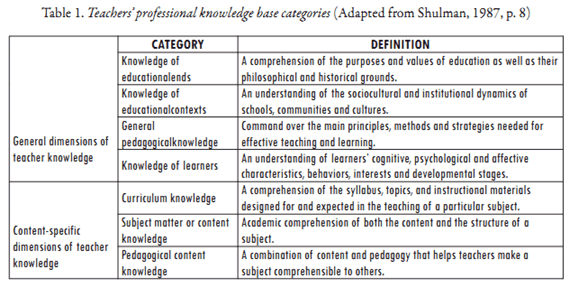
<body><![CDATA[<p>&nbsp;</p>     <p>&nbsp;</p>     <p><font size="3" face="Verdana, Arial, Helvetica, sans-serif"><b>INTRODUCTION </b></font></p>     <p><font size="2" face="Verdana, Arial, Helvetica, sans-serif">EFL teachers must know how to face several  challenges such as improving their language  pro&#64257;ciency, teaching in diverse contexts,  implementing classroom-based research, having  access to professional development and networking  (Gonz&aacute;lez, 2000). Such challenges ask them to  be able to integrate knowledge about language,  pedagogical practices, learning theories, and  educational contexts. Besides, as a consequence of  accreditation, globalization, and standardization,  most Colombian EFL TEPs have undergone major  curricular and pedagogical changes in the last  years. These changes have mostly been the result of  imported discourses and models, which have not  only caused curricular and pedagogical changes in  teacher education programs, but have also affected  the language, the actions, the attitudes, and the  conceptions of teachers themselves (Mu&ntilde;oz,  Quintero &amp; Munevar, 2002). As a consequence,  there is evidence of the existence of practices in  which colonial and instrumental perspectives  displace our internal realities and knowledge.  Some of these perspectives are linked to the  figure of the native speaker as role model and the  accreditation of knowledge production (Gonz&aacute;lez  &amp; Sierra, 2005). </font></p>     <p><font size="2" face="Verdana, Arial, Helvetica, sans-serif">In the 21<sup>st</sup>  century, Colombian pre-service EFL  TEPs should study what constitutes the core  knowledge base of the language teaching profession  so that language teachers can be effective and  critical practitioners. As Shulman (1986) states,  EFL TEPs should avoid considering teacher  education from the perspective of content or  pedagogy as mutually exclusive domains. Instead,  efforts should be made to conceptualize what  Colombian language teachers need to know about  teaching and learning, and how their knowledge,  beliefs, and attitudes inform their practices.  Within the framework of knowledge base, this  article discusses some of the issues that Colombian  EFL TEPs need to incorporate in order to prepare  pre-service teachers to acknowledge and examine  the underlying premises that form and guide their  professional performance. Some of these issues are:  knowledge base, content knowledge, pedagogical  knowledge, pedagogical content knowledge, and  pedagogical reasoning and action(see section  below). </font></p>     <p><font size="2" face="Verdana, Arial, Helvetica, sans-serif"><b>2.1 Knowledge base</b></font></p>     <p><font size="2" face="Verdana, Arial, Helvetica, sans-serif"> Pineda (2002) says that for a long time, the  conceptualization of knowledge base was restricted  to the attainment of the basic skills required for  teaching, the competency of educators in their  subject matter area, and the use of pedagogical  strategies. However, there are other variables that  are critical in teaching: the classroom context, the  physical and psychological characteristics of the  learners, the personal and practical experiences  of teachers, their reflective practices and research  skills. Such a wider consideration of what  constitutes the teaching profession can enable EFL  TEPs to envision a more complete framework of  reference for future professional application. </font></p>     <p><font size="2" face="Verdana, Arial, Helvetica, sans-serif">A starting point for conceptualizing how  knowledge base evolves in the minds of language  teachers consists of understanding the variety of  proposals that have been generated through the  years in the field. An overview of the literature,  maintainKaur G., Yuen andKaurS. (2011), reveals  that an effective teacher needs to master at least  two types of basic knowledge:  <i>content knowledge </i>and  <i>pedagogical knowledge</i>. The former refers to  the knowledge a teacher should possess in the  subject itself while the latter refers to the teaching  and learning of subjects and their curricula.  </font></p>     <p><font size="2" face="Verdana, Arial, Helvetica, sans-serif">More concretely, Shulman (1987) states that  teachers' knowledge base must not simply be  regarded as a set of professional and experiential  skills to be built up. Instead, he argues for a  framework that includes and combines content,  pedagogy, curriculum and context. To him,  teachers' knowledge base consists of different  categories of knowledge which are needed for  effective teaching.In his framework, Shulman  differentiates three types of content knowledge:</font></p>     <p><font size="2" face="Verdana, Arial, Helvetica, sans-serif">(a)  <i>subject matter knowledg</i>e, (b)  <i>pedagogical  content knowledge</i>, and (c) <i>curricular knowledge</i>. In  addition, this framework includes categories such  as  <i>knowledge of learners</i>,<i>knowledge of pedagogy</i>,  <i>knowledge of educational contexts</i>, and <i>knowledge of  educational ends</i>(see <a href="#t01">Table 1</a> below).</font></p>     ]]></body>
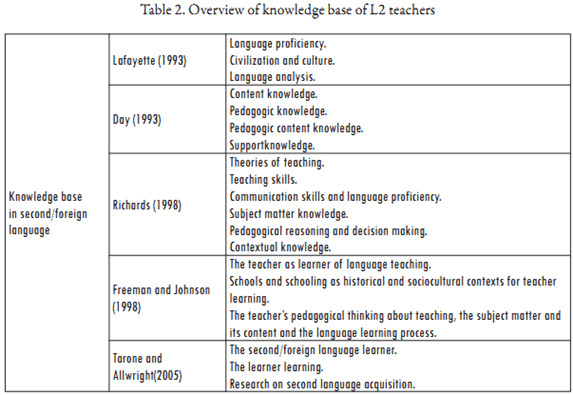
<body><![CDATA[<p>&nbsp;</p>     <p align="center"><font size="2" face="Verdana, Arial, Helvetica, sans-serif"><a name="t01"></a><img src="/img/revistas/ikala/v18n1/v18n1a7t01.gif"></font></p>     <p>&nbsp;</p>     <p><font size="2" face="Verdana, Arial, Helvetica, sans-serif">When talking about teachers' knowledge,  Fenstermacher (1994) makes a distinction  between <i>formal knowledge</i> and <i>practical knowledge</i>.  For him, formal knowledge is based on literature  derived from research about effective teaching.  On the other hand, practical knowledge is  generated by teachers as a result of their every  day experimentation and reflection within the  classroom context and as such it is personal,  situational and tacit. When discussing Shulman  and Fenstermacher's proposal, Polyzou and  Postlethwaite (2000) suggest that teachers  subject knowledge and curriculum knowledge  are essentially formal forms of knowledge; their  pedagogical subject knowledge is essentially  practical knowledge and their knowledge of  student learning and educational contexts may be  an amalgam of both.</font></p>     <p><font size="2" face="Verdana, Arial, Helvetica, sans-serif">The above theoretical perspectives imply that it is  important to identify and understand any general,  specific, formal, or practical type of knowledge  teachers need to acquire and develop. It isessential,  then, to establish the basic elements or dimensions  that EFL TEPsshould provide EFL pre-service teachers for their working life.In addition, it is  importantto approach the situation of Colombian  EFL TEPs in regards to teacher knowledge in order  to suggest a set of alternatives and strategies that  allow the formation of more effective and critical  EFL professionals. Accordingly, the main features  of L2 teachers' knowledge base are presented next.</font></p>     <p><font size="2" face="Verdana, Arial, Helvetica, sans-serif"><b>2.2 Knowledge base of L2 teachers</b></font></p>     <p><font size="2" face="Verdana, Arial, Helvetica, sans-serif">In the field of second language teaching, a wide  variety of proposals about what constitutes  knowledge base have been proposed. Different  scholars have strived to offer a systematic and  comprehensive view of how teachers construct and  develop knowledge from the interplay of content,  pedagogy, context and curriculum. Due to space  constraints, the following literature review focuses  mainly on a brief historical overview of the past  two decades of theory aboutknowledge base in L2. </font></p>     <p><font size="2" face="Verdana, Arial, Helvetica, sans-serif">Lafayette (1993) maintains that there is a specialist  component of foreign language teacher education,  which consists of proficiency in and knowledge  about the language, literature and culture to be taught. He suggests that there are three domains  which encompass L2 teachers' knowledge: <i>language proficiency,  civilization</i> and <i>culture</i>, and  <i>language analysis</i>. To him, L2 teachers should  have an advanced command of the language in  order to be effective users and models. In terms  of civilization and culture, Lafayette argues that  L2 teachers should be cognizant of issues such as  literature and customs so as to help their students  develop cultural sensitivities and awareness  towards people and things unfamiliar to them. In  regards to language analysis, Lafayette states that  L2 teachers should not only be informed about  language structures, but also be knowledgeable  about applied linguistics and second language  acquisition.</font></p>     <p><font size="2" face="Verdana, Arial, Helvetica, sans-serif">In the same year, Day (1993) proposes a framework  that includes four domains of knowledge:  <i>content knowledge,  pedagogic knowledge,  pedagogic  content knowledge,</i> and  <i>support knowledge</i>. In this  framework, content knowledge refers to knowledge  of subject matter connected to issues such as syntax,  phonology, semantics, pragmatics, and literary and  cultural aspects. Pedagogic knowledge consists of  knowledge of teaching practices; e.g., classroom  management, lesson planning, etc. Pedagogic  content knowledge deals with specialized  knowledge of the teaching of an L2 (grammar,  speaking, etc.),whereas support knowledge includes  knowledge of different disciplines that inform  language teachers' approaches to the teaching and  learning of an L2; e.g., linguistics, sociolinguistics,  psycholinguistics, etc.</font></p>     <p><font size="2" face="Verdana, Arial, Helvetica, sans-serif">Following Shulman's conceptualization of  knowledge base, Richards (1998) proposes six  dimensions: <i>theories of teaching </i>(theoretical bases  for approaching teaching as well as instructional  practices),  <i>teaching skills </i>(essential dimensions  of the repertoire of any teacher),  <i>communication  skills</i> and <i>language proficiency </i>(competence in  language use and information exchange),  <i>subject  matter knowledge </i>(specialized disciplinary  knowledge of language teaching),  <i>pedagogical  reasoning</i> and <i>decision making </i>(complex cognitive  and problem-solving skills underlying teaching practices) and  <i>contextual knowledge </i>(information  about educational and linguistic policies as well  as familiarity with students, institutions, and  programs). The development of these dimensions  in EFL TEPs, contends Richards, can help L2  teachers understand the bases of their classroom  realities and improve their educational experiences.  This development can, ultimately,bring about  critical reflection and change.</font></p>     ]]></body>
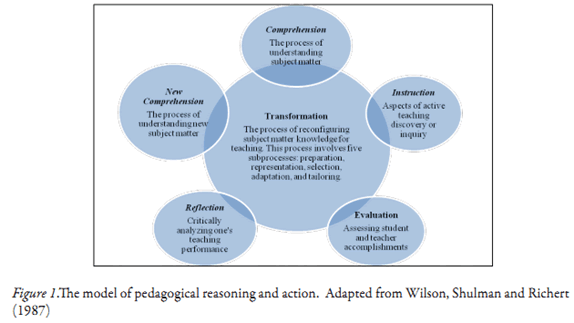
<body><![CDATA[<p><font size="2" face="Verdana, Arial, Helvetica, sans-serif">For their part, Freeman and Johnson (1998)  argue for a re-conceptualization of the knowledge  base of language teacher educationbased on the  premise that language teaching can beenriched  when examining systematically how language  teachers come to know what they know and do  what they do in their work. To them, such re- conceptualizationimplies that teacher learners  and their learning processes cannot be adequately  described or understood without taking into full  account the socio-cultural contexts in which  their learning takes place. Consequently, the core  of knowledge base mustfocus on the activity  of teaching itself, the teacher who does it, the  contexts in which it is done and the pedagogy  by which it is done. As a result, they posit that a  re-conceptualized knowledge base for second  language teaching (SLT) should concern three  interrelated domains linked by processes of  socialization, community creation and activity  participation: (a) <i>the teacher as learner of language  teaching</i>, (b) <i>schools and schooling as historical and  socio-cultural contexts for teacher learning</i> and (c)  <i>the teacher's pedagogical thinking about teaching,  the subject matter and its contents and the language  learning process</i>. The integrated discussion of  language teaching, the contexts of schools and the  teacher's pedagogical reasoning, explain Freeman  and Johnson,can lead to an informed exploration  of language teachers' actions and practices, which  can ultimately help understand and develop their  knowledge base.</font></p>     <p><font size="2" face="Verdana, Arial, Helvetica, sans-serif">In 2005, Tarone and Allwrightpoint out that  Freeman and Johnson's framework lacks a key  element: the second/foreign language learner. They  propose that the teachers' knowledge base should include a clear understanding of learners, who  they are, why they learn, what they need to learn,  and what motivates them, among other aspects.  Furthermore, they argue that second/foreign  language teaching must be regarded as different  from teacher education for otherdisciplines since  it has its own specificities and particularities.  Therefore, EFL TEPs should draw on researchthat  is unique to second/foreign language contexts: <i>second/foreign language acquisition</i> (SLA). To them,  most of the research findings of SLA are relevant  to teachers when they make decisions in classroom  processes and curriculum planning. Consequently,  they encourage teachers to collaborate on SLA  research in order to better understand how L2  learners learn. </font></p>     <p><font size="2" face="Verdana, Arial, Helvetica, sans-serif">Up to this point, diverse proposals about what  constitutes knowledge base have been presented  (See <a href="#t02">table 2</a> to have a summary of this theoretical  overview). Such diversity exemplifies the efforts  of the L2 community to offer a systematic and  comprehensive view of how teachers construct and develop knowledge from the interplay of content,  pedagogy, context and curriculum. However, it  seems possible to state that, in second language  teaching, knowledge base refers to the expertise,  understanding, awareness, knowledge, and skills  that L2 teachers need to posses in order to be  effective teachers (Faez, 2011).</font></p>     <p>&nbsp;</p>     <p align="center"><font size="2" face="Verdana, Arial, Helvetica, sans-serif"><a name="t02"></a><img src="/img/revistas/ikala/v18n1/v18n1a7t02.gif"></font></p>     <p>&nbsp;</p>     <p><font size="2" face="Verdana, Arial, Helvetica, sans-serif">In addition, it is worth noting that proposals  about the knowledge base of L2 teachers have  moved away from simply listing 'discrete' skills  and competencies to focusing on sociocultural  perspectives or models. As Freeman and Johnson  (1998) point out, these models suggest that  teacher knowledge is a contextualized process that  takes place in specific circumstances. In this regard,  Richards (2008) maintains that L2 teachers'  knowledge base should not be viewed simply as  translating knowledge and theories into practice  but as constructing new knowledge and theory  through engaging in particular types of activities  and processes in specific social contexts (p. 164).   In other words, discussingknowledge base of L2 teachers does not only consist of being familiar  with the elements, dimensions or domains that  constitute it, but it demands understanding the  models that shape it. In the section below, some of  the most relevant models to work with L2 teachers'  knowledge base aredescribed. Once again, this  presentation follows a historical chronology  beginning with Shulman's pedagogical reasoning  and action model and ending with Ohata's(2007)  teaching alternatives through self-awareness and  reflection.</font></p>     <p><font size="2" face="Verdana, Arial, Helvetica, sans-serif"><b>2.3 Models of knowledge base for L2 teachers</b></font></p>     <p><font size="2" face="Verdana, Arial, Helvetica, sans-serif">In order to show how teachers can use their  knowledge base to support their choices and  actions, Shulman (1986, 1987) presents the model  for pedagogical reasoning and action. This model  presents a cycle that links the knowledge that  teachers have with their thinking and their classroom  practices. This cycle includes six components:<i>comprehension, instruction, evaluation, reflection,  new comprehension,</i> and <i>transformation</i>. According  to Lee (2002), pedagogical reasoning begins  with the comprehension of subject matter  and continues with new comprehension after  reflection on instruction. At the center of this  self-perpetuating process isthe transformation  of knowledge, whichcontains, in turn, five sub- processes:<i> preparation, representation, selection,  adaptation</i>,  and <i>tailoring</i>. Preparation involves  the examination and critical interpretation of  knowledge of subject matter. Representation  entails the repackaging of subject matter in  a manner suitable for instruction. Selection  comprises the choosing of appropriate educational  strategies. Adaptation includes the alteration of  subject matter to fit the characteristics of specific  students. Tailoring is the special configuration of  subject matter for students with individual needs.  To have a better idea of this pedagogical reasoning  and action, see <a href="#f01">figure</a> below.</font></p>     <p>&nbsp;</p>     ]]></body>
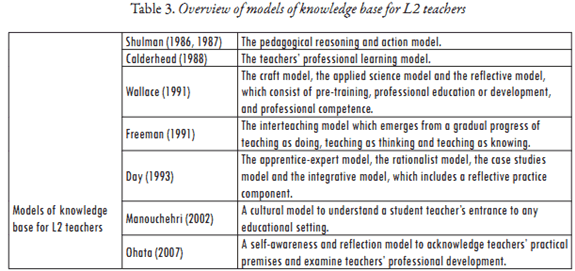
<body><![CDATA[<p align="center"><font size="2" face="Verdana, Arial, Helvetica, sans-serif"><a name="f01"></a><img src="/img/revistas/ikala/v18n1/v18n1a7f01.gif"></font></p>     <p>&nbsp;</p>     <p><font size="2" face="Verdana, Arial, Helvetica, sans-serif">When discussing teacher knowledge, Calderhead  (1988) proposes a teachers' professional learning  model that acknowledges the interrelation  among four aspects: <i>practical knowledge, academic  knowledge, meta-cognitive processes</i> and <i>conceptions  of learning to teach</i>. To Calderhead, practical  knowledge is action-related and emerges from  teachers' classroom experiences whereas academic knowledge is theory-based and results from teacher  education programs. For its part, meta-cognitive  processes allow teachers to compare, analyze and  evaluate different types of information in order  to produce functional knowledge for classroom  practice. The conceptions that teachers have of the  process of learning to teach, contends Calderhead,  influence how their knowledge base is structured,  represented and employed. Not only does this  model allow us to study the interrelations among  action, theory, meta-cognition and conceptions,  but also it helps us understand how individual  teachers build and develop their knowledge of  teaching.</font></p>     <p><font size="2" face="Verdana, Arial, Helvetica, sans-serif">For their part, Wallace (1991) and Freeman  (1991) identify models that characterize how the  preparation of future teachers can be delivered.  On the one hand, Wallace identifies three models:  <i>the craft model</i> based on the imitation of what  experts do;the <i>applied science model </i>based on  practical application of the theories of scholars;  and  the <i>reflective model </i>based on an ongoing  construction and interpretation of knowledge  and practice. When applied to teacher education,  Wallace's reflective model consists of three  stages: (a) <i>pre-training</i>, a point in which teachers  acquire preliminary conceptual schema or mental  constructs when they are students; (b) <i>professional  education or development</i>, a period when  teachers learn the actual framework of teaching  and become aware of the different classroom  situations through received knowledge (theories  and research about second/foreign language  teaching) and experiential knowledge (practical  experience derived from knowing and reflection  about actions); and (c)  <i>professional competence</i>, a  competence which,thanks to recurrent cycles of  professional development, allows teachers to make  connections, create meaning, and make informed  decisions. </font></p>     <p><font size="2" face="Verdana, Arial, Helvetica, sans-serif">On the other hand, Freeman (1991) avows that  teacher education can opt for three views of  teaching:  <i>teaching as doing, teaching as thinking </i>and  <i>teaching as knowing what to do</i>. First, the  teaching as doing view is based on a behavioral paradigm which emphasizes the development of  skills through a craft model of teacher education.  Second, the teaching as thinking and doing view  follows a cognitive paradigm and calls attention  to what teachers know and how they do things  through an applied science model. Finally, the  teaching as knowing what to do envisions an  interpretative paradigm that encourages the  development of frameworks of interpretation to  theory and focuses on teachers' decision- making  and reflection. To Freeman, the gradual progress  through these views can help teachers undergo  interteaching, which consists of a movement  towards effective, creative and self-sufficient  practice from stages of dependence, information  reception, and guidance.</font></p>     <p><font size="2" face="Verdana, Arial, Helvetica, sans-serif">When examining TEPs and the ways they can  work with knowledge base effectively, Day (1993)  discusses four models: <i>the apprentice-expert model;  the rationalist model, the case studies model </i>and  <i>the integrative model</i>. These models or approaches  characterize the overall way a program presents or  delivers knowledge to its learners. The apprentice- expert model is the oldest form of professional  education and consists of the trainee or beginner  working closely with an expert teacher in order  to acquire knowledge through observation,  instruction, and practice. The rationalist model  is also known as the rationalist learn-the-theory- and-then-apply-it model. This model involves the  teaching of scientific knowledge to student teachers  who, in turn, are expected to apply this knowledge  in their teaching. The case studies model involves  the discussion and analysis of actual case histories  in the classroom. The basic objective of this model  is the generalization of particular behaviors into  broader understandings of the discipline. The  integrative model is a systematic approach to  second language teacher education that ensures  that the learner gains pedagogic, content,  pedagogic content, and support knowledge  through a variety of experiences and activities. It  includes a reflective practice component, which  implies a critical examination of all the experiences  and activities student teachers are engaged in.</font></p>     <p><font size="2" face="Verdana, Arial, Helvetica, sans-serif">Such reflective thinking seeks to help new teachers  act in deliberate and intentional ways in order to  devise new ways of teaching and interpret practice  from a fresh perspective. </font></p>     <p><font size="2" face="Verdana, Arial, Helvetica, sans-serif">Based on Shulman, Calderhead, Wallace, Freeman  and Day's proposals, it seems teacher education  needs and has, in fact, moved from having a  mere instructional emphasis to seeking a more  reflective approach. In this regard, Ohata (2007)  states that teacher education has undergone a shift  from searching for better ways to train teachers to  understand the process of learning to providing  effective <i>alternatives to teach through self-awareness  and reflection</i>. To him, teachers need to critically  acknowledge the underlying premises that guide  their professional practices before systematically  examining specific activities or procedures for their  professional development. The goals of this critical  acknowledgement should not only be, explains  Ohata, to describe and articulate what decisions  are made while teaching but,more importantly,  to challenge and explore how or why classroom  actions or behaviors are influenced by previous  experiences and personal assumptions or beliefs.  Thus, TEPs must not see teaching as a static and  prescriptive activity. Instead, they should regard  it as a dynamic process characterized by reflection  and change.</font></p>     <p><font size="2" face="Verdana, Arial, Helvetica, sans-serif">However, Manoucheri (2002) explains that a  simple emphasis on reflection can fail to address the  importance of socialization and social interaction  in the development of professional knowledge.  Following Bruner's (1990) view of education,  she suggests that entering any educational setting  is entering a culture that holds and maintains  its own normative structures, all of which form  and enforce common sense. As a result, student  teachers do not simply learn the social norms and  constructs of an educational institution. They also  learn certain attitudes, practices, and performances  which, in turn, interactively influence the making  of meaning and set the standard for cultural  and professional competence. Consequently,  posits Manouchehri, <i>guided and systematic  communication and collaboration</i> are needed in TEPs so that student teachers can exchange ideas,  articulate their thinking, and understand others'  viewpoints. By communicating and collaborating,  student teachers can develop their capacity to take  on new perspectives and build new understanding  about their profession.</font></p>     <p><font size="2" face="Verdana, Arial, Helvetica, sans-serif">Summarizing this part of the paper, it is possible  to identify how over time different models have  expanded and broadened their approaches to  teachers' knowledge base. Such approaches have  mainly focused their attention on relating or  integrating different perspectives in order to help  teachers produce knowledge and guide their  actions in practice (see <a href="#t03">table 3</a> to have a basic view  of the models presented in this article). In sum, all  of these models seem to suggest that L2 teachers  need to develop an interconnected and well-  organized construct of subject matter, pedagogy,  learning,  learners, and context, which requires  judgment, action, and the capacity to reflect and  revise practices and decisions. The following  section discusses whether Colombian EFL TEPs  programs are giving pre-service teachers the  necessary basesthey need in order for them to be  able to create and develop reflective and critical  views of their educational realities.</font></p>     ]]></body>
<body><![CDATA[<p>&nbsp;</p>     <p align="center"><font size="2" face="Verdana, Arial, Helvetica, sans-serif"><a name="t03"></a><img src="/img/revistas/ikala/v18n1/v18n1a7t03.gif"></font></p>     <p>&nbsp;</p>     <p><font size="2" face="Verdana, Arial, Helvetica, sans-serif"><b>3.1 EFL TEPs in Colombia and knowledge base</b></font></p>     <p><font size="2" face="Verdana, Arial, Helvetica, sans-serif">Despite thereform movements, Vieira and  Moreira (2008) explain that teacher education  programs still tend totell teachers what and how  to do things (technicalinstruction) rather than  facilitating a thoroughunderstanding of and a  purposeful intervention ineducational contexts  (reflective inquiry). To them,this state of affairs  raises constraints on reflectivity,authenticity,  dialogical interaction, openness toinnovation  and autonomy. If student teachers and teacher  educators are tobecome critical agents, claim Vieira  and Moreira,they should become not only critical  consumersand creative producers of knowledge,  but alsoinformed participants in the improvement  of theeducational situations they experience.</font></p>     <p><font size="2" face="Verdana, Arial, Helvetica, sans-serif">In Colombia, Cort&eacute;s, Hern&aacute;ndez and Arteaga  (2008) state that our society expects EFL teachers  to be not justexcellent users of the foreign  language, but more importantly analysts and  researchers equipped with a generalknowledge  of educational philosophy,curriculum theory,  teaching methods,learning approaches and ICTs. However, Calvo, Rend&oacute;n and Rojas (2004) claim  that, although there have been several efforts to  strengthen reflection and research in TEPs, the  articulation between the innovating teaching- learning model of the institutions and their real  possibilities for better formative processes is still  uncertain. Calvo et al. argue that such efforts  may have been obstructed by the permanence  of traditional pedagogical models that privilege  technical training, which goes against theoretical,  pedagogical, and curricular innovation and  restructuring promoted by research and reflection.  In a similar vein, Caicedo (2008) says TEPs need  to be reconsidered, so they can implement new  curriculum approaches to form educators who are  able, among other things, (a) to develop critical  and creative thinking, (b) to do and communicate  research properly, and (c) to face today's challenges  holistically.</font></p>     <p><font size="2" face="Verdana, Arial, Helvetica, sans-serif">Within the field of English language teaching,  Gonz&aacute;lez (2009) states that the spread of the  In-service Certificate in English Language Teaching (ICELT) and the Teaching Knowledge  Test (TKT) in Colombia plays a clear role in  the homogenization, 'businessification' and  inequality of EFL professional development.  In 2007, she maintained that the professional  development model proposed in 'Colombia  Biling&uuml;e' was a representation of colonial,  traditional, and central discourses in ELT that  needed to be reshaped by the new, local, and  peripheral knowledge constructed by Colombian  ELT scholars and teachers. Similarly, Quintero  and Ram&iacute;rez (2009) state that the history of most  TEPs has been related to teaching as a passive  activity in which state and private universities  tend to train students to become teachers through  highly theory-based courses or seminars that  provide them with insufficient research practice in  the classroom. As a result, Quintero and Ram&iacute;rez  argue that the following problems usually emerge:  adoption of experts' suggestions for teaching  practices that do not always meet classroom needs;  use of isolated teaching and research techniques;  lack of reflection skills; and few opportunities to  improve professional skills to face the problems of  real classroom situations.</font></p>     <p><font size="2" face="Verdana, Arial, Helvetica, sans-serif">When discussing the teaching models used in EFL  TEPs in Colombia, C&aacute;rdenas (2009) explains that  knowledge transmission and skills development- based models are still present, but she states that more personal and social-oriented paradigms are  observable in teaching proposals. The existence  of behaviorist, humanist, constructivist, social  constructivist and reflective perspectives in teacher  education programs suggests a certain degree of  eclecticism. This eclecticism, contends C&aacute;rdenas,  can have two interpretations: a lack of conceptual  clarity or an awareness of the need for multifaceted  approaches to teacher education. From a  methodological perspective, C&aacute;rdenas explains  that teacher education programs seem to focus  on the experiences and beliefs of future teachers,  reflection-based processes, real context practices,  ethnography and action research and performance  and process-based evaluation. However, C&aacute;rdenas  states that the influence of official regulations  is shifting the emphasis of courses towards the  preparation for exams, which seems to be in line  with the spread of discourses about accountability  and evaluation.</font></p>     <p><font size="2" face="Verdana, Arial, Helvetica, sans-serif">Within the framework of recent linguistic and  educational policies, Usma (2009)suggests that  thequest for standardization, internationalization  and accreditationhave undermined EFL  TEPs' possibilities to acknowledge and  promote awareness, autonomy, diversity and  contextualization. To him, not only have certain  decisionsand sets of lawsimposed foreign discourses  and practices at the expense of local knowledge,  but they have stratified and excluded teachers  and universities based on scores and rankings.  In view of this situation, most EFL TEPs have  had to comply with top-down requirements and  demands, which are mainly based on traditional  and central discourses; discourses that disregard  teachers' expertise and knowledge and devalue  reflection and interaction.</font></p>     <p><font size="2" face="Verdana, Arial, Helvetica, sans-serif">In regards to Colombian teachers' knowledge  base, Pi&ntilde;eros and Quintero (2007) argue that this  base shows an interaction between abstraction and  generation of meaning through reflective practices.  In other words, teachers are required to allow  different types of knowledge to interact in order to  establish relationships, which in turn construct a  solid conceptualization of teaching:their teaching knowledge base. In their view, this knowledge  base leads teachers to take more critical positions  towards educational theories and to make informed  decisions on what is favorable for learners.</font></p>     ]]></body>
<body><![CDATA[<p><font size="2" face="Verdana, Arial, Helvetica, sans-serif">In a similar vein, &Aacute;lvarez (2009) states that  understanding the complexities inherent to teacher  knowledge and its sources and characteristics can  provide information about teachers' practices,  give insights to examine language teaching  policies and professional development programs.  According to him, the construction of teachers'  knowledge base is a continuous process that  involves (a) teachers' experiences in and out of  the classroom, (b) teachers' beliefs and values at  different moments of their educational life, and (c)  an interaction between pre-training knowledge,  teacher education knowledge, and teaching  activity. Although teachers value the technical  aspects of language teaching such as content and  methodological aspects, argues &Aacute;lvarez, EFL  teachers pay special attention to of issues that have  to do with the humanistic sphere of education.  This humanistic view entails knowledge and  awareness of their roles, their students and their  professional setting. In particular, Concretely,  &Aacute;lvarez states that EFL teachers' self-perception  as pedagogues seems to play a significant role in  constructing their knowledge base. As a result, he  calls for more research to be done from an insider's  perspective capable of studying the intricacies of  teachers' inner selves.</font></p>     <p><font size="2" face="Verdana, Arial, Helvetica, sans-serif">The complex situation of EFL TEPs and the  diversity of factors influencing teacher knowledge  make it difficult to propose a 'one size fits  all' approach that helps prepare Colombian  EFL teachers for the variety of sociocultural  backgrounds that exist in our classrooms. However,  we can start conceptualizinghow this might be  done by implementinginquiryand strengthening  professional-based focuses in EFL TEPs in a  methodical and deliberate way. This implementation  and strengthening can help EFL student teachers  and teacher educators construct local knowledge,  examine their actions, and question the theories of  others (see final section below).</font></p>     <p><font size="2" face="Verdana, Arial, Helvetica, sans-serif"><b>3.2 Strategies for improving knowledge base in  Colombian EFL TEPs</b></font></p>     <p><font size="2" face="Verdana, Arial, Helvetica, sans-serif">One possible alternative to help EFL TEPS generate  a voice of their own in pre-service teachers could  be the systematic and careful implementation  of inquiry in TEPs. Such implementation,  however, calls for more than simply having more  reflective-based activities or including research- oriented guidelines. In this regard, Sharkey (2009)  maintains that TEPs need to infuse inquiry into  all aspects of the curriculum so that teachers can  theorize their practices and interpret the theory of  others. In her view, by systematically inculcating  inquiry, TEPs can become professional and  learning communities of praxis, operating on  principles of collaboration and critical reflection.  Through a commitment to praxis (theorized  practice), contends Sharkey, these communities  can transform educational practices and policies.</font></p>     <p><font size="2" face="Verdana, Arial, Helvetica, sans-serif">Another possibility is the search for new agendas  for professional formation and development.  In this regard, Gonz&aacute;lez and Quinch&iacute;a (2003)  state that EFL TEPs need to articulate at least  three main focuses in order to expand teacher  knowledge: (1) knowledge of local realities; (2)  broad understandingof teaching EFL; and (3)  direct experience with research. Among other  things, these focuses can help EFL teachers become  sensitive to the particular conditions of the socio- cultural milieu in whichteaching and learning  take place, explore their school environments  and, ultimately, create disciplinary knowledge.  Gonz&aacute;lez (2003) also states that TEPs should  help student teachers and teacher educators  develop their potential in three major domains:  EFL teachers as workers able to participate in  the decisions made at schools; EFL teachers as  instructors equipped with new and effective  teaching techniques to empower students; and  EFL teachers as learners capable of constructing  and participating in collaborative networks.</font></p>     <p><font size="2" face="Verdana, Arial, Helvetica, sans-serif">Finally, in 2007, Gonz&aacute;lez also proposes that EFL  TEPs should be constructed with the following  characteristics: (1) application of a post-method  framework based on parameters of particularity,  practicality, and possibility, and macro strategies  for language teaching; (2) practice of peripheral  knowledge construction; (3) establishment of  adequate communication with local scholars and  policy makers; and (4) acceptance of counter- discourses and a critical theory of teacher  education.</font></p>     <p>&nbsp;</p>     <p><font size="3" face="Verdana, Arial, Helvetica, sans-serif"><b>4. DISCUSION</b></font></p>     <p><font size="2" face="Verdana, Arial, Helvetica, sans-serif">To conclude, EFL TEPs should place reflective  teaching atthe heart of their curricular reforms.  Observing, questioning, describing, taking notes,  interpreting, reflecting, planning, acting, and  writing are competences, states Fandi&ntilde;o (2011),  that need to be included gradually, as a natural  routine in the daily life of student teachers and  teacher educators. Not only can this gradual  inclusion create advanced knowledge on the basis  of practical experience, but it can also improve the  context or conditions in which language teaching  and learning take place. Ultimately, reflective  teaching can strengthen pedagogical practice and  favor strategies for critical reflection and change.</font></p>     <p><font size="2" face="Verdana, Arial, Helvetica, sans-serif">EFL TEPs can search for a more complete  framework of reference for teacher formation in  Colombia by studying different proposals about  teacher knowledge, infusing inquiry into their  practices and incorporatingeffective focusesand  characteristics in their proposals. By doing so,  they can be committed to the development and  improvement of the knowledge base of Colombian  student teachers and teacher educators. Not only  would these teachersbe better prepared torespond  to the educational needs and interests of the  national ELT community, but they would also be  capable of constructing their own theories from  their daily practice.</font></p>     ]]></body>
<body><![CDATA[<p>&nbsp;</p>     <p><font size="3" face="Verdana, Arial, Helvetica, sans-serif"><b>REFERENCES</b></font></p>     <!-- ref --><p><font size="2" face="Verdana, Arial, Helvetica, sans-serif">1. &Aacute;lvarez, J. (2009). An exploration of Colombian EFL  teachers' knowledge base through teachers'  reflection. <i>RevistaLinguagem &amp; Ensino</i>,  12(1),  73-108.    &nbsp;&nbsp;&nbsp;&nbsp;&nbsp;&nbsp;&nbsp;&nbsp;[&#160;<a href="javascript:void(0);" onclick="javascript: window.open('/scielo.php?script=sci_nlinks&ref=000085&pid=S0123-3432201300010000700001&lng=','','width=640,height=500,resizable=yes,scrollbars=1,menubar=yes,');">Links</a>&#160;]<!-- end-ref --> </font></p>     <!-- ref --><p><font size="2" face="Verdana, Arial, Helvetica, sans-serif">2. Bruner, J. (1990). <i>Acts of meaning</i>. Cambridge, England:  Harvard University Press.    &nbsp;&nbsp;&nbsp;&nbsp;&nbsp;&nbsp;&nbsp;&nbsp;[&#160;<a href="javascript:void(0);" onclick="javascript: window.open('/scielo.php?script=sci_nlinks&ref=000087&pid=S0123-3432201300010000700002&lng=','','width=640,height=500,resizable=yes,scrollbars=1,menubar=yes,');">Links</a>&#160;]<!-- end-ref --> </font></p>     <!-- ref --><p><font size="2" face="Verdana, Arial, Helvetica, sans-serif">3. Caicedo, Y. (2008). Tendencias curriculares y formaci&oacute;n  de docentes: Hacia una reflexi&oacute;n sobre nuestro  quehacer como docentes en las facultades de  educaci&oacute;n. <i>Cuadernos de Psicopedagog&iacute;a</i>,  5,  35-44. Retrieved from <a href="http://aplica.uptc.edu.co/Publicaciones/CuadernosPsicopedagogia/Documents/N5_Articulo3.pdf" target="_blank">http://aplica.uptc.edu.co/Publicaciones/CuadernosPsicopedagogia/Documents/N5_Articulo3.pdf</a> </font>&nbsp;&nbsp;&nbsp;&nbsp;&nbsp;&nbsp;&nbsp;&nbsp;[&#160;<a href="javascript:void(0);" onclick="javascript: window.open('/scielo.php?script=sci_nlinks&ref=000089&pid=S0123-3432201300010000700003&lng=','','width=640,height=500,resizable=yes,scrollbars=1,menubar=yes,');">Links</a>&#160;]<!-- end-ref --><!-- ref --><p><font size="2" face="Verdana, Arial, Helvetica, sans-serif">4. Calderhead, J. (1988). The development of knowledge  structure in learning to teach. In J. Claderhead  (Ed.),  <i>Teachers' professional learning</i> (pp. 51- 64). London, England: The Falmer Press.    &nbsp;&nbsp;&nbsp;&nbsp;&nbsp;&nbsp;&nbsp;&nbsp;[&#160;<a href="javascript:void(0);" onclick="javascript: window.open('/scielo.php?script=sci_nlinks&ref=000090&pid=S0123-3432201300010000700004&lng=','','width=640,height=500,resizable=yes,scrollbars=1,menubar=yes,');">Links</a>&#160;]<!-- end-ref -->  </font></p>     <!-- ref --><p><font size="2" face="Verdana, Arial, Helvetica, sans-serif">5. Calvo, G., Rend&oacute;n, D.,&amp; Rojas, L. (2004).  Un  diagn&oacute;stico de la formaci&oacute;n docente en Colombia.  Bogot&aacute;, Colombia: IESALC, UNESCO.  Retrievedfrom <a href="http://www.lpp-buenosaires.net/documentacionpedagogica/ArtPon/PDF_ArtPon/Formacion%20docente%20en%20Colombia.pdf" target="_blank">http://www.lpp-buenosaires.net/documentacionpedagogica/ArtPon/PDF_ArtPon/Formacion%20docente%20en%20Colombia.pdf</a> </font>&nbsp;&nbsp;&nbsp;&nbsp;&nbsp;&nbsp;&nbsp;&nbsp;[&#160;<a href="javascript:void(0);" onclick="javascript: window.open('/scielo.php?script=sci_nlinks&ref=000092&pid=S0123-3432201300010000700005&lng=','','width=640,height=500,resizable=yes,scrollbars=1,menubar=yes,');">Links</a>&#160;]<!-- end-ref --><!-- ref --><p><font size="2" face="Verdana, Arial, Helvetica, sans-serif">6. C&aacute;rdenas, R. (2009). Tendencia globales y locales en la  formaci&oacute;n de docentes de lenguas extranjeras. <i>&Iacute;kala, revista de lenguaje y cultura</i>,  14(22),  71-106.    &nbsp;&nbsp;&nbsp;&nbsp;&nbsp;&nbsp;&nbsp;&nbsp;[&#160;<a href="javascript:void(0);" onclick="javascript: window.open('/scielo.php?script=sci_nlinks&ref=000093&pid=S0123-3432201300010000700006&lng=','','width=640,height=500,resizable=yes,scrollbars=1,menubar=yes,');">Links</a>&#160;]<!-- end-ref -->  </font></p>     <!-- ref --><p><font size="2" face="Verdana, Arial, Helvetica, sans-serif">7. Cort&eacute;s, L., Hern&aacute;ndez, J., &amp; Arteaga, R. (2008). '&iquest;Qu&eacute;  espera la sociedad colombiana de los profesores  de lenguas extranjeras?'. <i>Revista Electr&oacute;nica  Matices en Lenguas Extranjeras</i>,  2, 19-32. Retrieved from <a href="http://www.revistamatices.unal.edu.co/pdfs/02Cortes.pdf" target="_blank">http://www.revistamatices.unal.edu.co/pdfs/02Cortes.pdf</a> </font>&nbsp;&nbsp;&nbsp;&nbsp;&nbsp;&nbsp;&nbsp;&nbsp;[&#160;<a href="javascript:void(0);" onclick="javascript: window.open('/scielo.php?script=sci_nlinks&ref=000095&pid=S0123-3432201300010000700007&lng=','','width=640,height=500,resizable=yes,scrollbars=1,menubar=yes,');">Links</a>&#160;]<!-- end-ref --><!-- ref --><p><font size="2" face="Verdana, Arial, Helvetica, sans-serif">8. Day, R. (1993). Models and the knowledge base of second  language teacher education.<i>Working papers in  second language studies</i>,  11(2), 1-13. Retrieved  from <a href="http://hawaii.edu/sls/uhwpesl/11(2)/Day.pdf" target="_blank">http://hawaii.edu/sls/uhwpesl/11(2)/Day.pdf</a> </font>&nbsp;&nbsp;&nbsp;&nbsp;&nbsp;&nbsp;&nbsp;&nbsp;[&#160;<a href="javascript:void(0);" onclick="javascript: window.open('/scielo.php?script=sci_nlinks&ref=000096&pid=S0123-3432201300010000700008&lng=','','width=640,height=500,resizable=yes,scrollbars=1,menubar=yes,');">Links</a>&#160;]<!-- end-ref --><!-- ref --><p><font size="2" face="Verdana, Arial, Helvetica, sans-serif">9. Faez, F. (2011). Points of departure: Developing the  knowledge base of ESL and FSL teachers for  K-12 programs in Canada. <i>The Canadian Journal  of Applied Linguistics</i>, 14(1), 29-49.    &nbsp;&nbsp;&nbsp;&nbsp;&nbsp;&nbsp;&nbsp;&nbsp;[&#160;<a href="javascript:void(0);" onclick="javascript: window.open('/scielo.php?script=sci_nlinks&ref=000097&pid=S0123-3432201300010000700009&lng=','','width=640,height=500,resizable=yes,scrollbars=1,menubar=yes,');">Links</a>&#160;]<!-- end-ref --> </font></p>     <!-- ref --><p><font size="2" face="Verdana, Arial, Helvetica, sans-serif">10. Fandi&ntilde;o, Y. (2011). English teacher training programs  focused on reflection. <i>Educaci&oacute;n y educadores</i>,  14(2), 269-285.    &nbsp;&nbsp;&nbsp;&nbsp;&nbsp;&nbsp;&nbsp;&nbsp;[&#160;<a href="javascript:void(0);" onclick="javascript: window.open('/scielo.php?script=sci_nlinks&ref=000099&pid=S0123-3432201300010000700010&lng=','','width=640,height=500,resizable=yes,scrollbars=1,menubar=yes,');">Links</a>&#160;]<!-- end-ref --></font></p>     <!-- ref --><p><font size="2" face="Verdana, Arial, Helvetica, sans-serif">11.  Fenstermacher, G. D. (1994). The knower and the known:  The nature of knowledge in research on teaching. <i>Review of Educational Research</i>, 20, 3-56.    &nbsp;&nbsp;&nbsp;&nbsp;&nbsp;&nbsp;&nbsp;&nbsp;[&#160;<a href="javascript:void(0);" onclick="javascript: window.open('/scielo.php?script=sci_nlinks&ref=000101&pid=S0123-3432201300010000700011&lng=','','width=640,height=500,resizable=yes,scrollbars=1,menubar=yes,');">Links</a>&#160;]<!-- end-ref --></font></p>     ]]></body>
<body><![CDATA[<!-- ref --><p><font size="2" face="Verdana, Arial, Helvetica, sans-serif">12. Fenstermacher, G. D. (1994). The knower and the known:  The nature of knowledge in research on teaching.  <i>Review of Educational Research</i>, 20, 3-56.    &nbsp;&nbsp;&nbsp;&nbsp;&nbsp;&nbsp;&nbsp;&nbsp;[&#160;<a href="javascript:void(0);" onclick="javascript: window.open('/scielo.php?script=sci_nlinks&ref=000103&pid=S0123-3432201300010000700012&lng=','','width=640,height=500,resizable=yes,scrollbars=1,menubar=yes,');">Links</a>&#160;]<!-- end-ref --></font></p>     <!-- ref --><p><font size="2" face="Verdana, Arial, Helvetica, sans-serif">13. Freeman, D. (1991, December). Three views to teachers'  knowledge. <i>IATEFL Teacher Development  Newsletter</i>, 1-4.    &nbsp;&nbsp;&nbsp;&nbsp;&nbsp;&nbsp;&nbsp;&nbsp;[&#160;<a href="javascript:void(0);" onclick="javascript: window.open('/scielo.php?script=sci_nlinks&ref=000105&pid=S0123-3432201300010000700013&lng=','','width=640,height=500,resizable=yes,scrollbars=1,menubar=yes,');">Links</a>&#160;]<!-- end-ref --> </font></p>     <!-- ref --><p><font size="2" face="Verdana, Arial, Helvetica, sans-serif">14. Freeman, D., &amp; Johnson, K. E. (1998).Reconceptualizing  the knowledge-base of language teacher  education.<i>TESOL Quarterly</i>, 32(3), 397-418.    &nbsp;&nbsp;&nbsp;&nbsp;&nbsp;&nbsp;&nbsp;&nbsp;[&#160;<a href="javascript:void(0);" onclick="javascript: window.open('/scielo.php?script=sci_nlinks&ref=000107&pid=S0123-3432201300010000700014&lng=','','width=640,height=500,resizable=yes,scrollbars=1,menubar=yes,');">Links</a>&#160;]<!-- end-ref --> </font></p>     <!-- ref --><p><font size="2" face="Verdana, Arial, Helvetica, sans-serif">15. Gonz&aacute;lez, A. (2000). The new millennium: More  challenges for EFL teachers and teacher educators. <i>Colombian Applied Linguistics Journal</i>, 2, 5-14.    &nbsp;&nbsp;&nbsp;&nbsp;&nbsp;&nbsp;&nbsp;&nbsp;[&#160;<a href="javascript:void(0);" onclick="javascript: window.open('/scielo.php?script=sci_nlinks&ref=000109&pid=S0123-3432201300010000700015&lng=','','width=640,height=500,resizable=yes,scrollbars=1,menubar=yes,');">Links</a>&#160;]<!-- end-ref -->    </font></p>     <!-- ref --><p><font size="2" face="Verdana, Arial, Helvetica, sans-serif">16. Gonz&aacute;lez, A. (2003). Who is educating EFL teachers:  Aqualitative study of in-service in Colombia. <i>&Iacute;kala, revista de lenguaje y cultura</i>, 8(14),  153-172. Retrieved from <a href="http://aprendeenlinea.udea.edu.co/revistas/index.php/ikala/article/view/3183/2947" target="_blank">http://aprendeenlinea.udea.edu.co/revistas/index.php/ikala/article/view/3183/2947</a> </font>&nbsp;&nbsp;&nbsp;&nbsp;&nbsp;&nbsp;&nbsp;&nbsp;[&#160;<a href="javascript:void(0);" onclick="javascript: window.open('/scielo.php?script=sci_nlinks&ref=000111&pid=S0123-3432201300010000700016&lng=','','width=640,height=500,resizable=yes,scrollbars=1,menubar=yes,');">Links</a>&#160;]<!-- end-ref --><!-- ref --><p><font size="2" face="Verdana, Arial, Helvetica, sans-serif">17. Gonz&aacute;lez, A. (2007). Professional development of EFL  teachers in Colombia: Between colonial and local  practices. <i>&Iacute;kala, revista de lenguaje y cultura</i>,  12(18), 309-332.    &nbsp;&nbsp;&nbsp;&nbsp;&nbsp;&nbsp;&nbsp;&nbsp;[&#160;<a href="javascript:void(0);" onclick="javascript: window.open('/scielo.php?script=sci_nlinks&ref=000112&pid=S0123-3432201300010000700017&lng=','','width=640,height=500,resizable=yes,scrollbars=1,menubar=yes,');">Links</a>&#160;]<!-- end-ref --> </font></p>     <!-- ref --><p><font size="2" face="Verdana, Arial, Helvetica, sans-serif">18. Gonz&aacute;lez, A. (2009). On alternative and additional  certifications in English language teaching: The  case of Colombian EFL teachers' professional  development. <i>&Iacute;kala, revista de lenguaje y  cultura</i>, 14(22), 183-209. Retrievedfrom <a href="http://aprendeenlinea.udea.edu.co/revistas/index.php/ikala/article/view/2635/2122" target="_blank">http://aprendeenlinea.udea.edu.co/revistas/index.php/ikala/article/view/2635/2122</a> </font>&nbsp;&nbsp;&nbsp;&nbsp;&nbsp;&nbsp;&nbsp;&nbsp;[&#160;<a href="javascript:void(0);" onclick="javascript: window.open('/scielo.php?script=sci_nlinks&ref=000114&pid=S0123-3432201300010000700018&lng=','','width=640,height=500,resizable=yes,scrollbars=1,menubar=yes,');">Links</a>&#160;]<!-- end-ref --><!-- ref --><p><font size="2" face="Verdana, Arial, Helvetica, sans-serif">19. Gonz&aacute;lez, A.,&amp;Quinch&iacute;a, D. (2003).Tomorrow's EFL  teacher educators.Colombian <i>Applied Linguistics  Journal</i>, 5, 86-104.    &nbsp;&nbsp;&nbsp;&nbsp;&nbsp;&nbsp;&nbsp;&nbsp;[&#160;<a href="javascript:void(0);" onclick="javascript: window.open('/scielo.php?script=sci_nlinks&ref=000115&pid=S0123-3432201300010000700019&lng=','','width=640,height=500,resizable=yes,scrollbars=1,menubar=yes,');">Links</a>&#160;]<!-- end-ref --> </font></p>     <!-- ref --><p><font size="2" face="Verdana, Arial, Helvetica, sans-serif">20. Gonz&aacute;lez, A., &amp; Sierra, N. (2005). The professional  development of foreign language teacher  educators: Another challenge for professional  communities. <i>&Iacute;kala, revista de Lenguaje y  Cultura</i>, 10(16), 11-29.    &nbsp;&nbsp;&nbsp;&nbsp;&nbsp;&nbsp;&nbsp;&nbsp;[&#160;<a href="javascript:void(0);" onclick="javascript: window.open('/scielo.php?script=sci_nlinks&ref=000117&pid=S0123-3432201300010000700020&lng=','','width=640,height=500,resizable=yes,scrollbars=1,menubar=yes,');">Links</a>&#160;]<!-- end-ref --> </font></p>     <!-- ref --><p><font size="2" face="Verdana, Arial, Helvetica, sans-serif">21. Kaur, G., Yuen, C., &amp; Kaur, S. (2011). Assessing ESL  teacher trainees' content, pedagogical, and  professional knowledge base. <i>The assessment  handbook</i>, 4(2), 4-15.    &nbsp;&nbsp;&nbsp;&nbsp;&nbsp;&nbsp;&nbsp;&nbsp;[&#160;<a href="javascript:void(0);" onclick="javascript: window.open('/scielo.php?script=sci_nlinks&ref=000119&pid=S0123-3432201300010000700021&lng=','','width=640,height=500,resizable=yes,scrollbars=1,menubar=yes,');">Links</a>&#160;]<!-- end-ref --> </font></p>     <!-- ref --><p><font size="2" face="Verdana, Arial, Helvetica, sans-serif">22. Lafayette, R. C. (1993). Subject-matter content: What  every foreign language teacher needs to know.  In G. Guntermann (Ed.),  <i>Developing language  teachers for a changing world</i> (pp. 125-157).  Lincolnwood, IL: National Textbook.    &nbsp;&nbsp;&nbsp;&nbsp;&nbsp;&nbsp;&nbsp;&nbsp;[&#160;<a href="javascript:void(0);" onclick="javascript: window.open('/scielo.php?script=sci_nlinks&ref=000121&pid=S0123-3432201300010000700022&lng=','','width=640,height=500,resizable=yes,scrollbars=1,menubar=yes,');">Links</a>&#160;]<!-- end-ref --> </font></p>     ]]></body>
<body><![CDATA[<!-- ref --><p><font size="2" face="Verdana, Arial, Helvetica, sans-serif">23. Lee, J. (2002).  <i>Teacher Knowledge: Transforming  content knowledge into pedagogical knowledge</i>.  Retrieved from <a href="http://msit.gsu.edu/socialstudies/courses/7540_02/pck.doc" target="_blank">http://msit.gsu.edu/socialstudies/courses/7540_02/pck.doc</a></font>&nbsp;&nbsp;&nbsp;&nbsp;&nbsp;&nbsp;&nbsp;&nbsp;[&#160;<a href="javascript:void(0);" onclick="javascript: window.open('/scielo.php?script=sci_nlinks&ref=000123&pid=S0123-3432201300010000700023&lng=','','width=640,height=500,resizable=yes,scrollbars=1,menubar=yes,');">Links</a>&#160;]<!-- end-ref --><!-- ref --><p><font size="2" face="Verdana, Arial, Helvetica, sans-serif">24. Manouchehri, A. (2002). Developing teaching  knowledge through peer discourse.<i> Teaching and  Teacher Education</i>, 18, 715-737. Retrieved from <a href="http://www.se.rit.edu/~swami/LearningPapers/Manoucheri2002PeerDiscourse.pdf" target="_blank">http://www.se.rit.edu/~swami/LearningPapers/Manoucheri2002PeerDiscourse.pdf</a> </font>&nbsp;&nbsp;&nbsp;&nbsp;&nbsp;&nbsp;&nbsp;&nbsp;[&#160;<a href="javascript:void(0);" onclick="javascript: window.open('/scielo.php?script=sci_nlinks&ref=000124&pid=S0123-3432201300010000700024&lng=','','width=640,height=500,resizable=yes,scrollbars=1,menubar=yes,');">Links</a>&#160;]<!-- end-ref --><!-- ref --><p><font size="2" face="Verdana, Arial, Helvetica, sans-serif">25. Mu&ntilde;oz, J., Quintero, J., &amp;Mun&eacute;var, R. (2002).  Experiencias en investigaci&oacute;n-acci&oacute;n-reflexi&oacute;n  con educadores en proceso de formaci&oacute;n en  Colombia. <i>Revista electr&oacute;nica de investigaci&oacute;n  educativa</i>, 4(1), 66-80. Retrieved from <a href="http://redalyc.uaemex.mx/pdf/155/15504104.pdf" target="_blank">http://redalyc.uaemex.mx/pdf/155/15504104.pdf</a> </font>&nbsp;&nbsp;&nbsp;&nbsp;&nbsp;&nbsp;&nbsp;&nbsp;[&#160;<a href="javascript:void(0);" onclick="javascript: window.open('/scielo.php?script=sci_nlinks&ref=000125&pid=S0123-3432201300010000700025&lng=','','width=640,height=500,resizable=yes,scrollbars=1,menubar=yes,');">Links</a>&#160;]<!-- end-ref --><!-- ref --><p><font size="2" face="Verdana, Arial, Helvetica, sans-serif">26. Ohata, K. (2007). Teacher development or training? Recent  developments in second/foreign language teacher  education.<i>The language research bulletin</i>, 22(1),  1-16.Retrieved from <a href="http://web.icu.ac.jp/lrb/vol_22/Kota%20LRB%20V22.pdf" target="_blank">http://web.icu.ac.jp/lrb/vol_22/Kota%20LRB%20V22.pdf</a> </font>&nbsp;&nbsp;&nbsp;&nbsp;&nbsp;&nbsp;&nbsp;&nbsp;[&#160;<a href="javascript:void(0);" onclick="javascript: window.open('/scielo.php?script=sci_nlinks&ref=000126&pid=S0123-3432201300010000700026&lng=','','width=640,height=500,resizable=yes,scrollbars=1,menubar=yes,');">Links</a>&#160;]<!-- end-ref --><!-- ref --><p><font size="2" face="Verdana, Arial, Helvetica, sans-serif">27. Pineda, C. (2002). Knowledge base for ESL/EFL  educators: What does it mean? <i>Profile issues in  teachers' professional development</i>, 3, 9-14.    &nbsp;&nbsp;&nbsp;&nbsp;&nbsp;&nbsp;&nbsp;&nbsp;[&#160;<a href="javascript:void(0);" onclick="javascript: window.open('/scielo.php?script=sci_nlinks&ref=000127&pid=S0123-3432201300010000700027&lng=','','width=640,height=500,resizable=yes,scrollbars=1,menubar=yes,');">Links</a>&#160;]<!-- end-ref --> </font></p>     <!-- ref --><p><font size="2" face="Verdana, Arial, Helvetica, sans-serif">28. Pi&ntilde;eros, C., &amp; Quintero, A. (2006). Conceptualizing  as regards educational change and pedagogical  knowledge: how novice teacher-researchers'  proposals illustrate this relationship. <i>Profile issues  in teachers' professional development</i>, 7, 173-196.  Retrieved from <a href="http://www.revistas.unal.edu.co/index.php/profile/article/viewFile/11007/11680" target="_blank">http://www.revistas.unal.edu.co/index.php/profile/article/viewFile/11007/11680</a> </font>&nbsp;&nbsp;&nbsp;&nbsp;&nbsp;&nbsp;&nbsp;&nbsp;[&#160;<a href="javascript:void(0);" onclick="javascript: window.open('/scielo.php?script=sci_nlinks&ref=000129&pid=S0123-3432201300010000700028&lng=','','width=640,height=500,resizable=yes,scrollbars=1,menubar=yes,');">Links</a>&#160;]<!-- end-ref --><!-- ref --><p><font size="2" face="Verdana, Arial, Helvetica, sans-serif">29. Polyzou, A., &amp; Postlethwaite, K. (2000). Investigating  second language teachers' knowledge:  implications for ICT training. <i>ICT in education:  proceedings of the 2nd conference</i>, Petras, Greece,  (pp. 608-616).Retrieved from <a href="http://www.etpe.gr/files/proceedings/uploads1/paper22.pdf" target="_blank">http://www.etpe.gr/files/proceedings/uploads1/paper22.pdf</a> </font>&nbsp;&nbsp;&nbsp;&nbsp;&nbsp;&nbsp;&nbsp;&nbsp;[&#160;<a href="javascript:void(0);" onclick="javascript: window.open('/scielo.php?script=sci_nlinks&ref=000130&pid=S0123-3432201300010000700029&lng=','','width=640,height=500,resizable=yes,scrollbars=1,menubar=yes,');">Links</a>&#160;]<!-- end-ref --><!-- ref --><p><font size="2" face="Verdana, Arial, Helvetica, sans-serif">30. Quintero, J., &amp; Ram&iacute;rez, O. (2009). Conducting action  research projects in a teacher preparation  program. <i>Revista Lenguaje</i>, 37(2), 415-436.  Retrieved from <a href="http://bibliotecadigital.univalle.edu.co/bitstream/10893/2826/1/Lenguaje" target="_blank">http://bibliotecadigital.univalle.edu.co/bitstream/10893/2826/1/Lenguaje%20Vol.37%282%29.%20p.415-436.pdf</a> </font>&nbsp;&nbsp;&nbsp;&nbsp;&nbsp;&nbsp;&nbsp;&nbsp;[&#160;<a href="javascript:void(0);" onclick="javascript: window.open('/scielo.php?script=sci_nlinks&ref=000131&pid=S0123-3432201300010000700030&lng=','','width=640,height=500,resizable=yes,scrollbars=1,menubar=yes,');">Links</a>&#160;]<!-- end-ref --><!-- ref --><p><font size="2" face="Verdana, Arial, Helvetica, sans-serif">31. Richards, J. (1998).  <i>Beyond training</i>. Cambridge,  England: Cambridge University Press.    &nbsp;&nbsp;&nbsp;&nbsp;&nbsp;&nbsp;&nbsp;&nbsp;[&#160;<a href="javascript:void(0);" onclick="javascript: window.open('/scielo.php?script=sci_nlinks&ref=000132&pid=S0123-3432201300010000700031&lng=','','width=640,height=500,resizable=yes,scrollbars=1,menubar=yes,');">Links</a>&#160;]<!-- end-ref --></font></p>     <!-- ref --><p><font size="2" face="Verdana, Arial, Helvetica, sans-serif">32. Richards, J. (2008). Second language teacher education  today. RELC <i>Journal: a journal of language and  teaching research</i>, 39(2), 158-177.    &nbsp;&nbsp;&nbsp;&nbsp;&nbsp;&nbsp;&nbsp;&nbsp;[&#160;<a href="javascript:void(0);" onclick="javascript: window.open('/scielo.php?script=sci_nlinks&ref=000134&pid=S0123-3432201300010000700032&lng=','','width=640,height=500,resizable=yes,scrollbars=1,menubar=yes,');">Links</a>&#160;]<!-- end-ref --> </font></p>     <!-- ref --><p><font size="2" face="Verdana, Arial, Helvetica, sans-serif">33. Sharkey, J. (2009). Can we praxize second language  teacher education? An invitation tojoin a  collective, collaborative challenge. <i>&Iacute;kala, revista  de lenguajey cultura</i>,14(22), 125-150.    &nbsp;&nbsp;&nbsp;&nbsp;&nbsp;&nbsp;&nbsp;&nbsp;[&#160;<a href="javascript:void(0);" onclick="javascript: window.open('/scielo.php?script=sci_nlinks&ref=000136&pid=S0123-3432201300010000700033&lng=','','width=640,height=500,resizable=yes,scrollbars=1,menubar=yes,');">Links</a>&#160;]<!-- end-ref --> </font></p>     <!-- ref --><p><font size="2" face="Verdana, Arial, Helvetica, sans-serif">34. Shulman, L. (1986). Those who understand: Knowledge  growth in teaching.  <i>Educational Researcher</i>,  15(2), 4-14.    &nbsp;&nbsp;&nbsp;&nbsp;&nbsp;&nbsp;&nbsp;&nbsp;[&#160;<a href="javascript:void(0);" onclick="javascript: window.open('/scielo.php?script=sci_nlinks&ref=000138&pid=S0123-3432201300010000700034&lng=','','width=640,height=500,resizable=yes,scrollbars=1,menubar=yes,');">Links</a>&#160;]<!-- end-ref --> </font></p>     <!-- ref --><p><font size="2" face="Verdana, Arial, Helvetica, sans-serif">35. Shulman, L. (1987). Knowledge and teaching:  Foundations of the new reform.  <i>Harvard  Educational Review</i>, 57(1), 1-22.    &nbsp;&nbsp;&nbsp;&nbsp;&nbsp;&nbsp;&nbsp;&nbsp;[&#160;<a href="javascript:void(0);" onclick="javascript: window.open('/scielo.php?script=sci_nlinks&ref=000140&pid=S0123-3432201300010000700035&lng=','','width=640,height=500,resizable=yes,scrollbars=1,menubar=yes,');">Links</a>&#160;]<!-- end-ref --> </font></p>     <!-- ref --><p><font size="2" face="Verdana, Arial, Helvetica, sans-serif">36. Tarone, E.,&amp;Allwright, D. (2005). Language teacher- learning and student languagelearning: Shaping  the knowledge base. In D.J. Tedick (Ed.), <i>Second  language teacher education: International  perspectives</i> (pp. 5-23). USA: Lawrence Erlbaum  Publishers.    &nbsp;&nbsp;&nbsp;&nbsp;&nbsp;&nbsp;&nbsp;&nbsp;[&#160;<a href="javascript:void(0);" onclick="javascript: window.open('/scielo.php?script=sci_nlinks&ref=000142&pid=S0123-3432201300010000700036&lng=','','width=640,height=500,resizable=yes,scrollbars=1,menubar=yes,');">Links</a>&#160;]<!-- end-ref --> </font></p>     <!-- ref --><p><font size="2" face="Verdana, Arial, Helvetica, sans-serif">37. Usma, J. (2009). Education and language policy in  Colombia: Exploring processes of inclusion,  exclusion, and stratification in times of global  reform.  <i>Profile Issues in teachers' professional  development</i>, 11, 123-141.    &nbsp;&nbsp;&nbsp;&nbsp;&nbsp;&nbsp;&nbsp;&nbsp;[&#160;<a href="javascript:void(0);" onclick="javascript: window.open('/scielo.php?script=sci_nlinks&ref=000144&pid=S0123-3432201300010000700037&lng=','','width=640,height=500,resizable=yes,scrollbars=1,menubar=yes,');">Links</a>&#160;]<!-- end-ref --></font></p>     <!-- ref --><p><font size="2" face="Verdana, Arial, Helvetica, sans-serif">38.  Vieira, I.,&amp; Moreira, M. A. (2008). Reflective teacher  education towards learner autonomy: building a  culture of possibility. In M. Raya &amp; T. Lamb (Eds.), <i>Pedagogy for autonomy in language education:  Theory, practice and teacher education</i> (pp. 266- 282). Dublin, Ireland: Authentik.    &nbsp;&nbsp;&nbsp;&nbsp;&nbsp;&nbsp;&nbsp;&nbsp;[&#160;<a href="javascript:void(0);" onclick="javascript: window.open('/scielo.php?script=sci_nlinks&ref=000146&pid=S0123-3432201300010000700038&lng=','','width=640,height=500,resizable=yes,scrollbars=1,menubar=yes,');">Links</a>&#160;]<!-- end-ref --> </font></p>     <!-- ref --><p><font size="2" face="Verdana, Arial, Helvetica, sans-serif">39. Wallace, M. (1991). <i>Training foreign language teachers:  A reflective approach</i>. Cambridge, England: CUP.    &nbsp;&nbsp;&nbsp;&nbsp;&nbsp;&nbsp;&nbsp;&nbsp;[&#160;<a href="javascript:void(0);" onclick="javascript: window.open('/scielo.php?script=sci_nlinks&ref=000148&pid=S0123-3432201300010000700039&lng=','','width=640,height=500,resizable=yes,scrollbars=1,menubar=yes,');">Links</a>&#160;]<!-- end-ref --> </font></p>     <!-- ref --><p><font size="2" face="Verdana, Arial, Helvetica, sans-serif">40. Wilson, S. M., Shulman, L.S., &amp; Richert A. E. (1987).  150 different ways of knowing: Representations  of knowledge in teaching. In J. Calderhead  (Ed.), <i>Exploring teachers' thinking</i> (pp.104-124).  London, England: Cassell.    &nbsp;&nbsp;&nbsp;&nbsp;&nbsp;&nbsp;&nbsp;&nbsp;[&#160;<a href="javascript:void(0);" onclick="javascript: window.open('/scielo.php?script=sci_nlinks&ref=000150&pid=S0123-3432201300010000700040&lng=','','width=640,height=500,resizable=yes,scrollbars=1,menubar=yes,');">Links</a>&#160;]<!-- end-ref --></font></p>      ]]></body><back>
<ref-list>
<ref id="B1">
<label>1</label><nlm-citation citation-type="journal">
<person-group person-group-type="author">
<name>
<surname><![CDATA[Álvarez]]></surname>
<given-names><![CDATA[J]]></given-names>
</name>
</person-group>
<article-title xml:lang="en"><![CDATA[An exploration of Colombian EFL teachers' knowledge base through teachers' reflection]]></article-title>
<source><![CDATA[RevistaLinguagem & Ensino]]></source>
<year>2009</year>
<volume>12</volume>
<numero>1</numero>
<issue>1</issue>
<page-range>73-108</page-range></nlm-citation>
</ref>
<ref id="B2">
<label>2</label><nlm-citation citation-type="book">
<person-group person-group-type="author">
<name>
<surname><![CDATA[Bruner]]></surname>
<given-names><![CDATA[J.]]></given-names>
</name>
</person-group>
<source><![CDATA[Acts of meaning]]></source>
<year>1990</year>
<publisher-loc><![CDATA[Cambridge ]]></publisher-loc>
<publisher-name><![CDATA[Harvard University Press]]></publisher-name>
</nlm-citation>
</ref>
<ref id="B3">
<label>3</label><nlm-citation citation-type="journal">
<person-group person-group-type="author">
<name>
<surname><![CDATA[Caicedo]]></surname>
<given-names><![CDATA[Y]]></given-names>
</name>
</person-group>
<article-title xml:lang="es"><![CDATA[Tendencias curriculares y formación de docentes: Hacia una reflexión sobre nuestro quehacer como docentes en las facultades de educación]]></article-title>
<source><![CDATA[Cuadernos de Psicopedagogía]]></source>
<year>2008</year>
<volume>5</volume>
<page-range>35-44</page-range></nlm-citation>
</ref>
<ref id="B4">
<label>4</label><nlm-citation citation-type="book">
<person-group person-group-type="author">
<name>
<surname><![CDATA[Calderhead]]></surname>
<given-names><![CDATA[J.]]></given-names>
</name>
</person-group>
<article-title xml:lang="en"><![CDATA[The development of knowledge structure in learning to teach]]></article-title>
<person-group person-group-type="editor">
<name>
<surname><![CDATA[Claderhead]]></surname>
<given-names><![CDATA[J.]]></given-names>
</name>
</person-group>
<source><![CDATA[Teachers' professional learning]]></source>
<year>1988</year>
<page-range>51- 64</page-range><publisher-loc><![CDATA[London ]]></publisher-loc>
<publisher-name><![CDATA[The Falmer Press]]></publisher-name>
</nlm-citation>
</ref>
<ref id="B5">
<label>5</label><nlm-citation citation-type="book">
<person-group person-group-type="author">
<name>
<surname><![CDATA[Calvo]]></surname>
<given-names><![CDATA[G.]]></given-names>
</name>
<name>
<surname><![CDATA[Rendón]]></surname>
<given-names><![CDATA[D.]]></given-names>
</name>
<name>
<surname><![CDATA[Rojas]]></surname>
<given-names><![CDATA[L.]]></given-names>
</name>
</person-group>
<source><![CDATA[Un diagnóstico de la formación docente en Colombia]]></source>
<year>2004</year>
<publisher-loc><![CDATA[Bogotá ]]></publisher-loc>
<publisher-name><![CDATA[IESALC, UNESCO]]></publisher-name>
</nlm-citation>
</ref>
<ref id="B6">
<label>6</label><nlm-citation citation-type="journal">
<person-group person-group-type="author">
<name>
<surname><![CDATA[Cárdenas]]></surname>
<given-names><![CDATA[R]]></given-names>
</name>
</person-group>
<article-title xml:lang="es"><![CDATA[Tendencia globales y locales en la formación de docentes de lenguas extranjeras]]></article-title>
<source><![CDATA[Íkala, revista de lenguaje y cultura]]></source>
<year>2009</year>
<volume>14</volume>
<numero>22</numero>
<issue>22</issue>
<page-range>71-106</page-range></nlm-citation>
</ref>
<ref id="B7">
<label>7</label><nlm-citation citation-type="journal">
<person-group person-group-type="author">
<name>
<surname><![CDATA[Cortés]]></surname>
<given-names><![CDATA[L.]]></given-names>
</name>
<name>
<surname><![CDATA[Hernández]]></surname>
<given-names><![CDATA[J.]]></given-names>
</name>
<name>
<surname><![CDATA[Arteaga]]></surname>
<given-names><![CDATA[R.]]></given-names>
</name>
</person-group>
<article-title xml:lang="es"><![CDATA['¿Qué espera la sociedad colombiana de los profesores de lenguas extranjeras?']]></article-title>
<source><![CDATA[Revista Electrónica Matices en Lenguas Extranjeras]]></source>
<year>2008</year>
<volume>2</volume>
<page-range>19-32</page-range></nlm-citation>
</ref>
<ref id="B8">
<label>8</label><nlm-citation citation-type="journal">
<person-group person-group-type="author">
<name>
<surname><![CDATA[Day]]></surname>
<given-names><![CDATA[R]]></given-names>
</name>
</person-group>
<article-title xml:lang="en"><![CDATA[Models and the knowledge base of second language teacher education]]></article-title>
<source><![CDATA[Working papers in second language studies]]></source>
<year>1993</year>
<volume>11</volume>
<numero>2</numero>
<issue>2</issue>
<page-range>1-13</page-range></nlm-citation>
</ref>
<ref id="B9">
<label>9</label><nlm-citation citation-type="journal">
<person-group person-group-type="author">
<name>
<surname><![CDATA[Faez]]></surname>
<given-names><![CDATA[F]]></given-names>
</name>
</person-group>
<article-title xml:lang="en"><![CDATA[Points of departure: Developing the knowledge base of ESL and FSL teachers for K-12 programs in Canada]]></article-title>
<source><![CDATA[The Canadian Journal of Applied Linguistics]]></source>
<year>2011</year>
<volume>14</volume>
<numero>1</numero>
<issue>1</issue>
<page-range>29-49</page-range></nlm-citation>
</ref>
<ref id="B10">
<label>10</label><nlm-citation citation-type="journal">
<person-group person-group-type="author">
<name>
<surname><![CDATA[Fandiño]]></surname>
<given-names><![CDATA[Y]]></given-names>
</name>
</person-group>
<article-title xml:lang="en"><![CDATA[English teacher training programs focused on reflection]]></article-title>
<source><![CDATA[Educación y educadores]]></source>
<year>2011</year>
<volume>14</volume>
<numero>2</numero>
<issue>2</issue>
<page-range>269-285</page-range></nlm-citation>
</ref>
<ref id="B11">
<label>11</label><nlm-citation citation-type="journal">
<person-group person-group-type="author">
<name>
<surname><![CDATA[Fenstermacher]]></surname>
<given-names><![CDATA[G. D]]></given-names>
</name>
</person-group>
<article-title xml:lang="en"><![CDATA[The knower and the known: The nature of knowledge in research on teaching]]></article-title>
<source><![CDATA[Review of Educational Research]]></source>
<year>1994</year>
<volume>20</volume>
<page-range>3-56</page-range></nlm-citation>
</ref>
<ref id="B12">
<label>12</label><nlm-citation citation-type="journal">
<person-group person-group-type="author">
<name>
<surname><![CDATA[Fenstermacher]]></surname>
<given-names><![CDATA[G. D]]></given-names>
</name>
</person-group>
<article-title xml:lang="en"><![CDATA[The knower and the known: The nature of knowledge in research on teaching]]></article-title>
<source><![CDATA[Review of Educational Research]]></source>
<year>1994</year>
<volume>20</volume>
<page-range>3-56</page-range></nlm-citation>
</ref>
<ref id="B13">
<label>13</label><nlm-citation citation-type="journal">
<person-group person-group-type="author">
<name>
<surname><![CDATA[Freeman]]></surname>
<given-names><![CDATA[D.]]></given-names>
</name>
</person-group>
<source><![CDATA[IATEFL Teacher Development Newsletter]]></source>
<year>1991</year>
<month>, </month>
<day>De</day>
<page-range>1-4</page-range></nlm-citation>
</ref>
<ref id="B14">
<label>14</label><nlm-citation citation-type="journal">
<person-group person-group-type="author">
<name>
<surname><![CDATA[Freeman]]></surname>
<given-names><![CDATA[D.]]></given-names>
</name>
<name>
<surname><![CDATA[Johnson]]></surname>
<given-names><![CDATA[K. E.]]></given-names>
</name>
</person-group>
<article-title xml:lang="en"><![CDATA[Reconceptualizing the knowledge-base of language teacher education]]></article-title>
<source><![CDATA[TESOL Quarterly]]></source>
<year>1998</year>
<volume>32</volume>
<numero>3</numero>
<issue>3</issue>
<page-range>397-418</page-range></nlm-citation>
</ref>
<ref id="B15">
<label>15</label><nlm-citation citation-type="journal">
<person-group person-group-type="author">
<name>
<surname><![CDATA[González]]></surname>
<given-names><![CDATA[A]]></given-names>
</name>
</person-group>
<article-title xml:lang="en"><![CDATA[The new millennium: More challenges for EFL teachers and teacher educators]]></article-title>
<source><![CDATA[Colombian Applied Linguistics Journal]]></source>
<year>2000</year>
<volume>2</volume>
<page-range>5-14</page-range></nlm-citation>
</ref>
<ref id="B16">
<label>16</label><nlm-citation citation-type="journal">
<person-group person-group-type="author">
<name>
<surname><![CDATA[González]]></surname>
<given-names><![CDATA[A]]></given-names>
</name>
</person-group>
<article-title xml:lang="en"><![CDATA[Who is educating EFL teachers: Aqualitative study of in-service in Colombia]]></article-title>
<source><![CDATA[Íkala, revista de lenguaje y cultura]]></source>
<year>2003</year>
<volume>8</volume>
<numero>14</numero>
<issue>14</issue>
<page-range>153-172</page-range></nlm-citation>
</ref>
<ref id="B17">
<label>17</label><nlm-citation citation-type="journal">
<person-group person-group-type="author">
<name>
<surname><![CDATA[González]]></surname>
<given-names><![CDATA[A]]></given-names>
</name>
</person-group>
<article-title xml:lang="en"><![CDATA[Professional development of EFL teachers in Colombia: Between colonial and local practices]]></article-title>
<source><![CDATA[Íkala]]></source>
<year>2007</year>
<volume>12</volume>
<numero>18</numero>
<issue>18</issue>
<page-range>309-332</page-range></nlm-citation>
</ref>
<ref id="B18">
<label>18</label><nlm-citation citation-type="journal">
<person-group person-group-type="author">
<name>
<surname><![CDATA[González]]></surname>
<given-names><![CDATA[A]]></given-names>
</name>
</person-group>
<article-title xml:lang="en"><![CDATA[On alternative and additional certifications in English language teaching: The case of Colombian EFL teachers' professional development]]></article-title>
<source><![CDATA[Íkala, revista de lenguaje y cultura]]></source>
<year>2009</year>
<volume>14</volume>
<numero>22</numero>
<issue>22</issue>
<page-range>183-209</page-range></nlm-citation>
</ref>
<ref id="B19">
<label>19</label><nlm-citation citation-type="journal">
<person-group person-group-type="author">
<name>
<surname><![CDATA[González]]></surname>
<given-names><![CDATA[A.]]></given-names>
</name>
<name>
<surname><![CDATA[Quinchía]]></surname>
<given-names><![CDATA[D.]]></given-names>
</name>
</person-group>
<article-title xml:lang="en"><![CDATA[Tomorrow's EFL teacher educators]]></article-title>
<source><![CDATA[Colombian Applied Linguistics Journal]]></source>
<year>2003</year>
<volume>5</volume>
<page-range>86-104</page-range></nlm-citation>
</ref>
<ref id="B20">
<label>20</label><nlm-citation citation-type="journal">
<person-group person-group-type="author">
<name>
<surname><![CDATA[González]]></surname>
<given-names><![CDATA[A.]]></given-names>
</name>
<name>
<surname><![CDATA[Sierra]]></surname>
<given-names><![CDATA[N.]]></given-names>
</name>
</person-group>
<article-title xml:lang="en"><![CDATA[The professional development of foreign language teacher educators: Another challenge for professional communities]]></article-title>
<source><![CDATA[Íkala, revista de Lenguaje y Cultura]]></source>
<year>2005</year>
<volume>10</volume>
<numero>16</numero>
<issue>16</issue>
<page-range>11-29</page-range></nlm-citation>
</ref>
<ref id="B21">
<label>21</label><nlm-citation citation-type="journal">
<person-group person-group-type="author">
<name>
<surname><![CDATA[Kaur]]></surname>
<given-names><![CDATA[G.]]></given-names>
</name>
<name>
<surname><![CDATA[Yuen]]></surname>
<given-names><![CDATA[C.]]></given-names>
</name>
<name>
<surname><![CDATA[Kaur]]></surname>
<given-names><![CDATA[S.]]></given-names>
</name>
</person-group>
<article-title xml:lang="en"><![CDATA[Assessing ESL teacher trainees' content, pedagogical, and professional knowledge base]]></article-title>
<source><![CDATA[The assessment handbook]]></source>
<year>2011</year>
<volume>4</volume>
<numero>2</numero>
<issue>2</issue>
<page-range>4-15</page-range></nlm-citation>
</ref>
<ref id="B22">
<label>22</label><nlm-citation citation-type="book">
<person-group person-group-type="author">
<name>
<surname><![CDATA[Lafayette]]></surname>
<given-names><![CDATA[R. C.]]></given-names>
</name>
</person-group>
<article-title xml:lang="en"><![CDATA[Subject-matter content: What every foreign language teacher needs to know]]></article-title>
<person-group person-group-type="editor">
<name>
<surname><![CDATA[Guntermann]]></surname>
<given-names><![CDATA[G.]]></given-names>
</name>
</person-group>
<source><![CDATA[Developing language teachers for a changing world]]></source>
<year>1993</year>
<page-range>125-157</page-range><publisher-loc><![CDATA[Lincolnwood^eIL IL]]></publisher-loc>
<publisher-name><![CDATA[National Textbook]]></publisher-name>
</nlm-citation>
</ref>
<ref id="B23">
<label>23</label><nlm-citation citation-type="">
<person-group person-group-type="author">
<name>
<surname><![CDATA[Lee]]></surname>
<given-names><![CDATA[J.]]></given-names>
</name>
</person-group>
<source><![CDATA[Teacher Knowledge: Transforming content knowledge into pedagogical knowledge]]></source>
<year>2002</year>
</nlm-citation>
</ref>
<ref id="B24">
<label>24</label><nlm-citation citation-type="journal">
<person-group person-group-type="author">
<name>
<surname><![CDATA[Manouchehri]]></surname>
<given-names><![CDATA[A.]]></given-names>
</name>
</person-group>
<article-title xml:lang="en"><![CDATA[Developing teaching knowledge through peer discourse]]></article-title>
<source><![CDATA[Teaching and Teacher Education]]></source>
<year>2002</year>
<volume>18</volume>
<page-range>715-737</page-range></nlm-citation>
</ref>
<ref id="B25">
<label>25</label><nlm-citation citation-type="journal">
<person-group person-group-type="author">
<name>
<surname><![CDATA[Muñoz]]></surname>
</name>
<name>
<surname><![CDATA[Quintero]]></surname>
<given-names><![CDATA[J.]]></given-names>
</name>
<name>
<surname><![CDATA[Munévar]]></surname>
<given-names><![CDATA[R.]]></given-names>
</name>
</person-group>
<article-title xml:lang="es"><![CDATA[Experiencias en investigación-acción-reflexión con educadores en proceso de formación en Colombia]]></article-title>
<source><![CDATA[Revista electrónica de investigación educativa]]></source>
<year>2002</year>
<volume>4</volume>
<numero>1</numero>
<issue>1</issue>
<page-range>66-80</page-range></nlm-citation>
</ref>
<ref id="B26">
<label>26</label><nlm-citation citation-type="journal">
<person-group person-group-type="author">
<name>
<surname><![CDATA[Ohata]]></surname>
<given-names><![CDATA[K]]></given-names>
</name>
</person-group>
<article-title xml:lang="en"><![CDATA[Teacher development or training? Recent developments in second/foreign language teacher education]]></article-title>
<source><![CDATA[The language research bulletin]]></source>
<year>2007</year>
<volume>22</volume>
<numero>1</numero>
<issue>1</issue>
<page-range>1-16</page-range></nlm-citation>
</ref>
<ref id="B27">
<label>27</label><nlm-citation citation-type="journal">
<person-group person-group-type="author">
<name>
<surname><![CDATA[Pineda]]></surname>
<given-names><![CDATA[C]]></given-names>
</name>
</person-group>
<article-title xml:lang="en"><![CDATA[Knowledge base for ESL/EFL educators: What does it mean?]]></article-title>
<source><![CDATA[Profile issues in teachers' professional development]]></source>
<year>2002</year>
<volume>3</volume>
<page-range>9-14</page-range></nlm-citation>
</ref>
<ref id="B28">
<label>28</label><nlm-citation citation-type="journal">
<person-group person-group-type="author">
<name>
<surname><![CDATA[Piñeros]]></surname>
<given-names><![CDATA[C.]]></given-names>
</name>
<name>
<surname><![CDATA[Quintero]]></surname>
<given-names><![CDATA[A.]]></given-names>
</name>
</person-group>
<article-title xml:lang="en"><![CDATA[Conceptualizing as regards educational change and pedagogical knowledge: how novice teacher-researchers' proposals illustrate this relationship]]></article-title>
<source><![CDATA[Profile issues in teachers' professional development]]></source>
<year>2006</year>
<volume>7</volume>
<page-range>173-196</page-range></nlm-citation>
</ref>
<ref id="B29">
<label>29</label><nlm-citation citation-type="confpro">
<person-group person-group-type="author">
<name>
<surname><![CDATA[Polyzou]]></surname>
<given-names><![CDATA[A.]]></given-names>
</name>
<name>
<surname><![CDATA[Postlethwaite]]></surname>
<given-names><![CDATA[K.]]></given-names>
</name>
</person-group>
<source><![CDATA[Investigating second language teachers' knowledge: implications for ICT training]]></source>
<year>2000</year>
<conf-name><![CDATA[ ICT in education: proceedings of the 2nd conference]]></conf-name>
<conf-loc>Petras </conf-loc>
<page-range>608-616</page-range></nlm-citation>
</ref>
<ref id="B30">
<label>30</label><nlm-citation citation-type="journal">
<person-group person-group-type="author">
<name>
<surname><![CDATA[Quintero]]></surname>
<given-names><![CDATA[J.]]></given-names>
</name>
<name>
<surname><![CDATA[Ramírez]]></surname>
<given-names><![CDATA[O.]]></given-names>
</name>
</person-group>
<article-title xml:lang="en"><![CDATA[Conducting action research projects in a teacher preparation program]]></article-title>
<source><![CDATA[Revista Lenguaje]]></source>
<year>2009</year>
<volume>37</volume>
<numero>2</numero>
<issue>2</issue>
<page-range>415-436</page-range></nlm-citation>
</ref>
<ref id="B31">
<label>31</label><nlm-citation citation-type="book">
<person-group person-group-type="author">
<name>
<surname><![CDATA[Richards]]></surname>
<given-names><![CDATA[J.]]></given-names>
</name>
</person-group>
<source><![CDATA[Beyond training]]></source>
<year>1998</year>
<publisher-loc><![CDATA[Cambridge ]]></publisher-loc>
<publisher-name><![CDATA[Cambridge University Press]]></publisher-name>
</nlm-citation>
</ref>
<ref id="B32">
<label>32</label><nlm-citation citation-type="journal">
<person-group person-group-type="author">
<name>
<surname><![CDATA[Richards]]></surname>
<given-names><![CDATA[J]]></given-names>
</name>
</person-group>
<article-title xml:lang="en"><![CDATA[Second language teacher education today]]></article-title>
<source><![CDATA[RELC Journal: a journal of language and teaching research]]></source>
<year>2008</year>
<volume>39</volume>
<numero>2</numero>
<issue>2</issue>
<page-range>158-177</page-range></nlm-citation>
</ref>
<ref id="B33">
<label>33</label><nlm-citation citation-type="journal">
<person-group person-group-type="author">
<name>
<surname><![CDATA[Sharkey]]></surname>
<given-names><![CDATA[J]]></given-names>
</name>
</person-group>
<article-title xml:lang="en"><![CDATA[Can we praxize second language teacher education? An invitation tojoin a collective, collaborative challenge]]></article-title>
<source><![CDATA[Íkala, revista de lenguajey cultura]]></source>
<year>2009</year>
<volume>14</volume>
<numero>22</numero>
<issue>22</issue>
<page-range>125-150</page-range></nlm-citation>
</ref>
<ref id="B34">
<label>34</label><nlm-citation citation-type="journal">
<person-group person-group-type="author">
<name>
<surname><![CDATA[Shulman]]></surname>
<given-names><![CDATA[L]]></given-names>
</name>
</person-group>
<article-title xml:lang="en"><![CDATA[Those who understand: Knowledge growth in teaching]]></article-title>
<source><![CDATA[Educational Researcher]]></source>
<year>1986</year>
<volume>15</volume>
<numero>2</numero>
<issue>2</issue>
<page-range>4-14</page-range></nlm-citation>
</ref>
<ref id="B35">
<label>35</label><nlm-citation citation-type="journal">
<person-group person-group-type="author">
<name>
<surname><![CDATA[Shulman]]></surname>
<given-names><![CDATA[L]]></given-names>
</name>
</person-group>
<article-title xml:lang="en"><![CDATA[Knowledge and teaching: Foundations of the new reform]]></article-title>
<source><![CDATA[Harvard Educational Review]]></source>
<year>1987</year>
<volume>57</volume>
<numero>1</numero>
<issue>1</issue>
<page-range>1-22</page-range></nlm-citation>
</ref>
<ref id="B36">
<label>36</label><nlm-citation citation-type="book">
<person-group person-group-type="author">
<name>
<surname><![CDATA[Tarone]]></surname>
<given-names><![CDATA[E.]]></given-names>
</name>
<name>
<surname><![CDATA[Allwright]]></surname>
<given-names><![CDATA[D.]]></given-names>
</name>
</person-group>
<article-title xml:lang="en"><![CDATA[Language teacher- learning and student languagelearning: Shaping the knowledge base]]></article-title>
<person-group person-group-type="editor">
<name>
<surname><![CDATA[Tedick]]></surname>
<given-names><![CDATA[D.J.]]></given-names>
</name>
</person-group>
<source><![CDATA[Second language teacher education: International perspectives]]></source>
<year>2005</year>
<page-range>5-23</page-range><publisher-name><![CDATA[Lawrence Erlbaum Publishers]]></publisher-name>
</nlm-citation>
</ref>
<ref id="B37">
<label>37</label><nlm-citation citation-type="journal">
<person-group person-group-type="author">
<name>
<surname><![CDATA[Usma]]></surname>
<given-names><![CDATA[J]]></given-names>
</name>
</person-group>
<article-title xml:lang="en"><![CDATA[Education and language policy in Colombia: Exploring processes of inclusion, exclusion, and stratification in times of global reform]]></article-title>
<source><![CDATA[Profile Issues in teachers' professional development]]></source>
<year>2009</year>
<volume>11</volume>
<page-range>123-141</page-range></nlm-citation>
</ref>
<ref id="B38">
<label>38</label><nlm-citation citation-type="book">
<person-group person-group-type="author">
<name>
<surname><![CDATA[Vieira]]></surname>
<given-names><![CDATA[I.]]></given-names>
</name>
<name>
<surname><![CDATA[Moreira]]></surname>
<given-names><![CDATA[M. A.]]></given-names>
</name>
</person-group>
<article-title xml:lang="en"><![CDATA[Reflective teacher education towards learner autonomy: building a culture of possibility]]></article-title>
<person-group person-group-type="editor">
<name>
<surname><![CDATA[Raya]]></surname>
<given-names><![CDATA[M.]]></given-names>
</name>
<name>
<surname><![CDATA[Lamb]]></surname>
<given-names><![CDATA[T.]]></given-names>
</name>
</person-group>
<source><![CDATA[Pedagogy for autonomy in language education: Theory, practice and teacher education]]></source>
<year>2008</year>
<page-range>266- 282</page-range><publisher-loc><![CDATA[Dublin ]]></publisher-loc>
<publisher-name><![CDATA[Authentik]]></publisher-name>
</nlm-citation>
</ref>
<ref id="B39">
<label>39</label><nlm-citation citation-type="book">
<person-group person-group-type="author">
<name>
<surname><![CDATA[Wallace]]></surname>
<given-names><![CDATA[M.]]></given-names>
</name>
</person-group>
<source><![CDATA[Training foreign language teachers: A reflective approach]]></source>
<year>1991</year>
<publisher-loc><![CDATA[Cambridge ]]></publisher-loc>
<publisher-name><![CDATA[CUP]]></publisher-name>
</nlm-citation>
</ref>
<ref id="B40">
<label>40</label><nlm-citation citation-type="book">
<person-group person-group-type="author">
<name>
<surname><![CDATA[Wilson]]></surname>
<given-names><![CDATA[S. M.]]></given-names>
</name>
<name>
<surname><![CDATA[Shulman]]></surname>
<given-names><![CDATA[L.S.]]></given-names>
</name>
<name>
<surname><![CDATA[Richert]]></surname>
<given-names><![CDATA[A. E.]]></given-names>
</name>
</person-group>
<article-title xml:lang="en"><![CDATA[150 different ways of knowing: Representations of knowledge in teaching]]></article-title>
<person-group person-group-type="editor">
<name>
<surname><![CDATA[Calderhead]]></surname>
<given-names><![CDATA[J.]]></given-names>
</name>
</person-group>
<source><![CDATA[Exploring teachers' thinking]]></source>
<year>1987</year>
<page-range>104-124</page-range><publisher-loc><![CDATA[London ]]></publisher-loc>
<publisher-name><![CDATA[Cassell]]></publisher-name>
</nlm-citation>
</ref>
</ref-list>
</back>
</article>