<?xml version="1.0" encoding="ISO-8859-1"?><article xmlns:mml="http://www.w3.org/1998/Math/MathML" xmlns:xlink="http://www.w3.org/1999/xlink" xmlns:xsi="http://www.w3.org/2001/XMLSchema-instance">
<front>
<journal-meta>
<journal-id>0124-0064</journal-id>
<journal-title><![CDATA[Revista de Salud Pública]]></journal-title>
<abbrev-journal-title><![CDATA[Rev. salud pública]]></abbrev-journal-title>
<issn>0124-0064</issn>
<publisher>
<publisher-name><![CDATA[Instituto de Salud Publica, Facultad de Medicina - Universidad Nacional de Colombia]]></publisher-name>
</publisher>
</journal-meta>
<article-meta>
<article-id>S0124-00642005000300001</article-id>
<title-group>
<article-title xml:lang="en"><![CDATA[Characteristics of People committing suicide in Medellín, Colombia]]></article-title>
<article-title xml:lang="es"><![CDATA[Características del suicido en Medellín, Colombia]]></article-title>
</title-group>
<contrib-group>
<contrib contrib-type="author">
<name>
<surname><![CDATA[Palacio-Acosta]]></surname>
<given-names><![CDATA[Carlos]]></given-names>
</name>
<xref ref-type="aff" rid="A01"/>
</contrib>
<contrib contrib-type="author">
<name>
<surname><![CDATA[García-Valencia]]></surname>
<given-names><![CDATA[Jenny]]></given-names>
</name>
<xref ref-type="aff" rid="A02"/>
</contrib>
<contrib contrib-type="author">
<name>
<surname><![CDATA[Diago-García]]></surname>
<given-names><![CDATA[Johanna]]></given-names>
</name>
<xref ref-type="aff" rid="A03"/>
</contrib>
<contrib contrib-type="author">
<name>
<surname><![CDATA[Zapata]]></surname>
<given-names><![CDATA[Claudia]]></given-names>
</name>
<xref ref-type="aff" rid="A04"/>
</contrib>
<contrib contrib-type="author">
<name>
<surname><![CDATA[Ortiz- Tobón]]></surname>
<given-names><![CDATA[Juan]]></given-names>
</name>
<xref ref-type="aff" rid="A05"/>
</contrib>
<contrib contrib-type="author">
<name>
<surname><![CDATA[López-Calle]]></surname>
<given-names><![CDATA[Gabriel]]></given-names>
</name>
<xref ref-type="aff" rid="A06"/>
</contrib>
<contrib contrib-type="author">
<name>
<surname><![CDATA[López-Tobón]]></surname>
<given-names><![CDATA[María]]></given-names>
</name>
<xref ref-type="aff" rid="A07"/>
</contrib>
</contrib-group>
<aff id="A01">
<institution><![CDATA[,Universidad de Antioquia  ]]></institution>
<addr-line><![CDATA[ ]]></addr-line>
</aff>
<aff id="A02">
<institution><![CDATA[,Universidad de Antioquia  ]]></institution>
<addr-line><![CDATA[ ]]></addr-line>
</aff>
<aff id="A03">
<institution><![CDATA[,Universidad de Antioquia  ]]></institution>
<addr-line><![CDATA[ ]]></addr-line>
</aff>
<aff id="A04">
<institution><![CDATA[,Universidad de Antioquia  ]]></institution>
<addr-line><![CDATA[ ]]></addr-line>
</aff>
<aff id="A05">
<institution><![CDATA[,Universidad de Antioquia  ]]></institution>
<addr-line><![CDATA[ ]]></addr-line>
</aff>
<aff id="A06">
<institution><![CDATA[,Universidad de Antioquia  ]]></institution>
<addr-line><![CDATA[ ]]></addr-line>
</aff>
<aff id="A07">
<institution><![CDATA[,Universidad de Antioquia  ]]></institution>
<addr-line><![CDATA[ ]]></addr-line>
</aff>
<pub-date pub-type="pub">
<day>17</day>
<month>11</month>
<year>2005</year>
</pub-date>
<pub-date pub-type="epub">
<day>17</day>
<month>11</month>
<year>2005</year>
</pub-date>
<volume>7</volume>
<numero>3</numero>
<fpage>243</fpage>
<lpage>253</lpage>
<copyright-statement/>
<copyright-year/>
<self-uri xlink:href="http://www.scielo.org.co/scielo.php?script=sci_arttext&amp;pid=S0124-00642005000300001&amp;lng=en&amp;nrm=iso"></self-uri><self-uri xlink:href="http://www.scielo.org.co/scielo.php?script=sci_abstract&amp;pid=S0124-00642005000300001&amp;lng=en&amp;nrm=iso"></self-uri><self-uri xlink:href="http://www.scielo.org.co/scielo.php?script=sci_pdf&amp;pid=S0124-00642005000300001&amp;lng=en&amp;nrm=iso"></self-uri><abstract abstract-type="short" xml:lang="en"><p><![CDATA[Objectives Describing the socio-demographic and clinical characteristics of a group of individuals who committed suicide in the city of Medellín between 2000 and 2003; identifying possible groups within the suicides&#8217; socio-demographic and clinical characteristics. Methods The sample consisted of 108 individuals who had committed suicide in Medellín; psychological autopsy was carried out and their characteristics were described. Multiple correspondence analysis was used for identifying the different groups. Results 50 % of the individuals were aged less than 29 and 79,4 % were male. The most frequently employed method for committing suicide was hanging (47,2 %); 68,5 % had expressed a wish to die and 35,2 % had previously attempted suicide. Three axes were identified for expressing the socio-demographic and clinical characteristics. Conclusions The characteristics found in this study were similar to those reported in studies carried out in Colombia and other countries. Suicide was more frequent amongst younger people in the group being studied, this being consistent with the national tendency. The groups observed in multiple correspondence analysis were in line with clinical observations and can be used for designing prevention strategies. However, further analytical studies are required for determining the actual risk factors and using them as the starting point for a prevention programme.]]></p></abstract>
<abstract abstract-type="short" xml:lang="es"><p><![CDATA[Objetivos Describir las características sociodemográficas y clínicas de un grupo de individuos que fallecieron por suicidio en la ciudad de Medellín entre 2000 y 2003, e identificar posibles agrupaciones dentro de las características sociodemográficas y clínicas de los individuos suicidios. Métodos Se tomó una muestra de 108 individuos que murieron por suicidio en Medellín, se realizó autopsia psicológica y se describieron sus características. Para identificar las posibles agrupaciones se realizó análisis de correspondencias múltiples. Resultados El 50 % de los individuos estudiados tenían una edad menor de 29 años y el 79,4 % pertenecían al sexo masculino. El método de suicidio más frecuente fue el ahorcamiento (47,2 %), el 68,5 % habían manifestado deseos de morir y el 35,2 % intentaron suicidarse previamente. Se identificaron tres ajes, cada uno con dos agrupaciones de características sociodemográficas y clínicas. Conclusiones Se encontraron características similares a estudios descriptivos previos realizados en nuestro país y en otros lugares del mundo. En este grupo el suicidio ocurrió con más frecuencia en jóvenes, similar a la tendencia nacional. En el análisis de correspondencias múltiples se observaron agrupaciones coherentes con lo observado en la clínica, que pueden utilizarse para el diseño de estrategias de prevención. Sin embargo, se requieren estudios analíticos que permitan precisar los factores de riesgo y establecer efectivos programas de prevención.]]></p></abstract>
<kwd-group>
<kwd lng="en"><![CDATA[Suicide]]></kwd>
<kwd lng="en"><![CDATA[prevention]]></kwd>
<kwd lng="en"><![CDATA[control]]></kwd>
<kwd lng="en"><![CDATA[Psychology]]></kwd>
<kwd lng="en"><![CDATA[Medellín]]></kwd>
<kwd lng="es"><![CDATA[Suicidio]]></kwd>
<kwd lng="es"><![CDATA[prevención]]></kwd>
<kwd lng="es"><![CDATA[control]]></kwd>
<kwd lng="es"><![CDATA[Psicología]]></kwd>
<kwd lng="es"><![CDATA[Medellín]]></kwd>
</kwd-group>
</article-meta>
</front><body><![CDATA[ <p align="right"><font face="Verdana" size="2"><b>ART&Iacute;CULOS/INVESTIGACI&Oacute;N</b></font></p>          <p>&nbsp;</p>          <center>        <p><font size="4" face="verdana"><b>Characteristics of People committing suicide in Medell&iacute;n, Colombia </b></font></p>        <p>&nbsp;</p>        <p><font size="3" face="verdana"><b>Caracter&iacute;sticas      del suicido en Medell&iacute;n, Colombia </b></font></p> </center>      <p>&nbsp;</p>          <p>&nbsp;</p>     <p><font size="2" face="verdana"><b>Carlos Palacio-Acosta<sup>I</sup>, Jenny Garc&iacute;a-Valencia<sup>II</sup>, Johanna Diago-Garc&iacute;a<sup>III</sup>, Claudia Zapata<sup>IV</sup>, Juan Ortiz- Tob&oacute;n<sup>V</sup>, Gabriel L&oacute;pez-Calle<sup>VI</sup> y Mar&iacute;a    L&oacute;pez-Tob&oacute;n<sup>VII</sup> </font></b></p>      <p><font size="2" face="verdana"> <b><sup>I</sup></b>    M&eacute;dico, Especialista en Psiquiatr&iacute;a. M. Sc. Epidemiolog&iacute;a.    Instituto Nacional de Medicina Legal. Facultad de Medicina, Universidad de Antioquia.    Tel&eacute;fono: (574) 2106090. E-mail: <a href="mailto:cpalacio@epm.net.co">cpalacio@epm.net.co</a>     ]]></body>
<body><![CDATA[<br>   <b><sup>II</sup></b> M&eacute;dica, Especialista en Psiquiatr&iacute;a. M. Sc.    Epidemiolog&iacute;a. Departamento de Psiquiatr&iacute;a, Facultad de Medicina,    Universidad de Antioquia. Tel&eacute;fono: (574) 2131813. E-mail: <a href="mailto:jegava@epm.net.co">jegava@epm.net.co</a>    <br>   <b><sup>III</sup></b> M&eacute;dico. Departamento de Psiquiatr&iacute;a, Facultad    de Medicina, Universidad de Antioquia. E-mail:<a href="mailto:jpdiago@hotmail.com">jpdiago@hotmail.com</a>    <br>   <b><sup>IV</sup></b> M&eacute;dico. Departamento de Psiquiatr&iacute;a, Facultad    de Medicina, Universidad de Antioquia.E-mail: <a href="mailto:claudiazapata101@yahoo.com.ar">claudiazapata101@yahoo.com.ar</a>    <br>   <b><sup>V</sup></b> M&eacute;dico, Especialista en Psiquiatr&iacute;a. Departamento    de Psiquiatr&iacute;a, Facultad de Medicina, Universidad de Antioquia. E-mail:<a href="mailto:juanfot@hotmail.com">juanfot@hotmail.com</a>    <br>   <b><sup>VI</sup></b> M&eacute;dico, Especialista en Psiquiatr&iacute;a. Instituto    Nacional de Medicina Legal. E-mail:<a href="mailto:gabrieljlopez@epm.net.co">gabrieljlopez@epm.net.co</a>    <br>   <b><sup>VII</sup></b> Trabajadora Social. Departamento de Psiquiatr&iacute;a, Facultad    de Medicina, Universidad de Antioquia. E-mail: <a href="mailto:patomon7@hotmail.com">patomon7@hotmail.com</a></font>       <p>&nbsp;</p>          <p>&nbsp;</p> <hr size="1">     <br>    <font size="2" face="Verdana">      <p><b>ABSTRACT</b>      ]]></body>
<body><![CDATA[<p><b>Objectives</b> Describing the socio-demographic and clinical characteristics    of a group of individuals who committed suicide in the city of Medell&iacute;n    between 2000 and 2003; identifying possible groups within the suicides&#8217;    socio-demographic and clinical characteristics.    <br>   <b>Methods</b> The sample consisted of 108 individuals who had committed    suicide in Medell&iacute;n; psychological autopsy was carried out and their    characteristics were described. Multiple correspondence analysis was used for    identifying the different groups.    <br>   <b>Results</b> 50 % of the individuals were aged less than 29 and    79,4 % were male. The most frequently employed method for committing suicide    was hanging (47,2 %); 68,5 % had expressed a wish to die and 35,2 % had previously    attempted suicide. Three axes were identified for expressing the socio-demographic    and clinical characteristics.    <br>   <b>Conclusions</b> The characteristics found in this study were similar    to those reported in studies carried out in Colombia and other countries. Suicide    was more frequent amongst younger people in the group being studied, this being    consistent with the national tendency. The groups observed in multiple correspondence    analysis were in line with clinical observations and can be used for designing    prevention strategies. However, further analytical studies are required for    determining the actual risk factors and using them as the starting point for    a prevention programme.</p>     <p> <b>Key Words</b>: Suicide, prevention, control, Psychology, Medell&iacute;n    <i>(source:MeSH, NLM)</i>.</p>     <br> <hr size="1">      <p><b>RESUMEN</b></p>      <p><b>Objetivos</b> Describir las caracter&iacute;sticas sociodemogr&aacute;ficas    y cl&iacute;nicas de un grupo de individuos que fallecieron por suicidio en    la ciudad de Medell&iacute;n entre 2000 y 2003, e identificar posibles agrupaciones    dentro de las caracter&iacute;sticas sociodemogr&aacute;ficas y cl&iacute;nicas    de los individuos suicidios.     <br>   <b>M&eacute;todos</b> Se tom&oacute; una muestra de 108 individuos    que murieron por suicidio en Medell&iacute;n, se realiz&oacute; autopsia psicol&oacute;gica    y se describieron sus caracter&iacute;sticas. Para identificar las posibles    agrupaciones se realiz&oacute; an&aacute;lisis de correspondencias m&uacute;ltiples.        <br>   <b>Resultados</b> El 50 % de los individuos estudiados ten&iacute;an    una edad menor de 29 a&ntilde;os y el 79,4 % pertenec&iacute;an al sexo masculino.    El m&eacute;todo de suicidio m&aacute;s frecuente fue el ahorcamiento (47,2    %), el 68,5 % hab&iacute;an manifestado deseos de morir y el 35,2 % intentaron    suicidarse previamente. Se identificaron tres ajes, cada uno con dos agrupaciones    de caracter&iacute;sticas sociodemogr&aacute;ficas y cl&iacute;nicas.     ]]></body>
<body><![CDATA[<br>   <b>Conclusiones</b> Se encontraron caracter&iacute;sticas similares    a estudios descriptivos previos realizados en nuestro pa&iacute;s y en otros    lugares del mundo. En este grupo el suicidio ocurri&oacute; con m&aacute;s frecuencia    en j&oacute;venes, similar a la tendencia nacional. En el an&aacute;lisis de    correspondencias m&uacute;ltiples se observaron agrupaciones coherentes con    lo observado en la cl&iacute;nica, que pueden utilizarse para el dise&ntilde;o    de estrategias de prevenci&oacute;n. Sin embargo, se requieren estudios anal&iacute;ticos    que permitan precisar los factores de riesgo y establecer efectivos programas    de prevenci&oacute;n</p>     <p><b>Palabras Clave</b>: Suicidio, prevenci&oacute;n, control, Psicolog&iacute;a,    Medell&iacute;n <i>(fuente:DeCS, BIREME)</i></p></font>  <hr size="1">     <br>     <p>&nbsp;</p>          <p>&nbsp;</p>  <font size="2" face="verdana">      <p>Suicide is defined as being the act or instance of taking    one&#8217;s own life intentionally and voluntarily, with the full knowledge    of the lethality of such an attempt (1). Suicide is becoming more important    due to the increased mortality caused by it. However, the reported incidence    is not very reliable, since it continues being a stigmatised act (2). It has    been estimated that around 800 000 people die by suicide around the world each    year (3). The rates of incidence in Colombia in 1981, 1985, 1995 and 1999 were    3, 3, 5, 4 and 5 suicides per 100 000 inhabitants per year, respectively. Since    1999 the figures have remained stable. The mortality rate for suicide in Colombia    in 2003 was 4,4 per 100 000 inhabitants per year. Bucaramanga had the greatest    incidence of suicide amongst Colombia&#8217;s largest department capital cities    (i.e. having more than 1 000 000 inhabitants), with 9 per 100 000 inhabitants    per year and Barranquilla had the lowest rate with 4 per 100 000 inhabitants    per year. Medell&iacute;n has constantly returned figures of 6 per 100 000 inhabitants    per year during the last five years (4).</p>     <p>The incidence of suicide varies amongst different countries and regions; the    same occurs with the victims&#8217; characteristics. The best way of establishing    such characteristics is by psychological autopsy, with which an individual&#8217;s    biographical and psychopathological aspects can be reconstructed through interviewing    family members and friends and reviewing personal and medical documents (5,6).    This method has been employed when carrying out studies in Colombia in Bogot&aacute;    and on the Atlantic Coast; depression and li ited and narcissistic personality    disorders were predominantly found to have been diagnosed in the former and    depression was also most frequently found in the latter (7,8). </p>     <p>These types of study have not been carried out so far in Medell&iacute;n but    they should be carried out for the regional variations which could present the    phenomenon. Knowledge of the victims&#8217; characteristics is useful when proposing    a hypothesis about the possible risk factors and designing prevention strategies    which might be more suitable for the population. The present study was thus    aimed at describing the socio-demographic and clinical characteristics of a    group of individuals who committed suicide in Medell&iacute;n between 2000 and    2003. It also identified possible groupings within the socio-demographic and    clinical characteristics of suicide victims. Such groupings could be useful    for designing and setting up specific programmes for the prevention of suicide.  </font></p>     <p><b><font face="verdana" size="3">METHODS</font></b> </p>  <font size="2" face="verdana">    <p>A convenience sample was taken from the 484 suicides occurring between 2000 and 2003 in the city of Medell&iacute;n    and its metropolitan area. 320 families were contacted by phone; 111 of them (34,7 %) decided to participate, 67 (20,9 %) could not be located because their    phone numbers were defunct, 142 (44,4 %) families refused to participate and 3 (0,01 %) were excluded after being interviewed because it was not clear how    the person had died (i.e. the cause of death). A medical-legal examination carried out at the Instituto de Medicina Legal established whether suicide was being    dealt with.</p>      ]]></body>
<body><![CDATA[<p>The Universidad de Antioquia&#8217;s Medicine Faculty Ethics Committee and the Research Committee from the Instituto    Nacional de Medicina Legal reviewed and approved the protocol before any procedure was undertaken. Information was collected from people after giving a complete    and detailed explanation about the origin and purpose of the project; the informed consent form was read to family members who then gave their written authorisation.    Interviews were conducted using an instrument designed for such end by psychiatrists (CP, JG, GL, JD and CZ) who has been trained in applying it once the criteria    to be evaluated had been standardised. At least two significant family members were interviewed (having first degree of consanguinity and who had lived with    the individual) according to international recommendations. Another family member was called upon in the case of incongruity appearing in the information (6).</p>      <p>The variables studied were divided into four groups: socio-demographic, personal and family, psychopathological    and vital adverse events. </p>      <p>The socio-demographic variables included: civil state (married, separated or divorced, widow/widower, single    or living with a particular person), years of schooling, being unemployed, income    (number of minimum wages), living alone, having children and participating in    religious activities.</p>      <p>Personal and family parameters included: previous attempts at committing suicide, manifesting the desire to    die, incapacitating physical disease, having consulted a non-psychiatric doctor    during the month prior to death and a history of suicide and/or attempts at    committing suicide in first degree of consanguinity family members. </p>      <p>Psychopathological variables included: mental disturbance diagnosed by psychological autopsy according to    the Diagnostic and Statistical Manual for Mental Disorders (DSM-IV-TR) revised    text criteria (9), antecedents of having undergone treatment and psychiatric    hospitalisation.</p>      <p>Vital adverse events occurring    during the six months prior to death were classified as being: the presence    of any adverse event, the death of a loved one, separation, the deceased having    problems with her/his own children, job-loss, economic difficulties and being    informed of a serious disease.</p>      <p Statistical analysis</p>      <p>SPSS-10.0 software was used    for creating a database; statistical analysis employed frequencies and percentages    for qualitative data and means of central tendency and dispersion for quantitative    data.</p>      <p>SPAD-N-3.5 software was used for identifying categories amongst the suicides&#8217; sociodemographic    and clinical characteristics. Multivariate analysis was done by using the multiple correspondence method, allowing individuals&#8217;, variables&#8217; or a variable&#8217;s    values to be grouped when data was categorical. A graphical representation of the association between categorical variables two to two meant that proximity    between individuals could be analyzed in terms of similarity and proximity between modes of different variables in terms of association (10,11). Categorical variables    were used in this analysis; neither illustrative nor continuous variables were incorporated in this analysis.</p>      <p><font size= 3 face="Verdana"><b>RESULTS</b></font></p>      ]]></body>
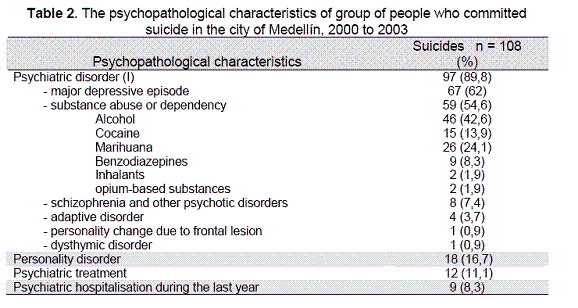
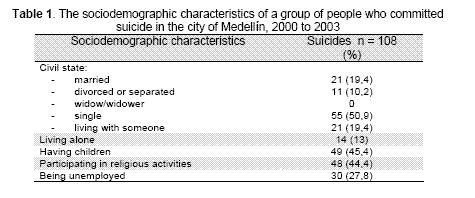
<body><![CDATA[<p>79,4 % of the 108 people included in this study were male and 20,6 % female.    50 % of the population were aged over 29 when they committed suicide (19 to    42 interquartile age range). Half the population had had 8 years of schooling    (5 to 11 interquartile age range). More than 50 % of the cases were earning    less than half a minimum monthly wage (0 minimum and 11 maximum). The other    sociodemographic characteristics considered can be seen in <a href="#tab1">Table 1.</a></p>  <a name="tab1"></a>     <p>    <center><img src="/img/revistas/rsap/v7n3/v7n3a01tab1.gif"></center></p>      <p>    <br>    The methods employed for    committing suicide were: 51 hanged themselves (47,2 %), 24 used a firearm (22,2    %), 17 poisoned themselves (15,7 %), 7 threw themselves from a high place (6,5    %), 3 used a sharp instrument (2,8 %) and 6 used other means (5,6 %), including    setting fire to themselves, injecting air, throwing themselves from an automobile    and drowning.</p>      <p>More than half (68,5 %)    had expressed a desire to die: 63 (58,3 %) had stated this verbally and 17 (15,7    %) in writing; 38 (35,2 %) had previously attempted suicide, the mean being    0 (0 minimum and 6 maximum). 23,1 % of the population had family antecedents    of suicide and 26,9 % had attempted suicide.</p>      <p>Regarding medical antecedents,    35 (32,4 %) had consulted a non-psychiatric doctor during the month prior to    committing suicide and 18 (16,7 %) had had incapacitating physical disease.    </p>      <p><a href="#tab2">Table 2</a> shows the frequency    of different psychiatric diagnoses made via psychological autopsy. There was    a marked presence of psychiatric disorder in 97 people (89,8 %), but only 11,1    % had received psychiatric treatment, 25 (23,1 %) had been treated by a GP and    2 (1,9 %) by a psychologist. Nine people (8,3 %) had undergone some psychiatric    hospitalizations during the year prior to committing suicide. Personality disorders    were found in 18 (16,7 %), including limited disorder in 7 (6,5 %), schizoid    in 4 (3,7 %), antisocial in 3 (2,8 %), dependent in 2 (1,9 %) and schizo-typical    disorder in 1 (0,9 %).</p>      <p>    <center><a name="tab2"></a><img src="/img/revistas/rsap/v7n3/v7n3a01tab2.GIF"></center></p>     ]]></body>
<body><![CDATA[<p>The results of Medicina Legal&#8217;s examination for psychoactive substances    in urine and blood during necropsy were negative in 61 individuals (56,1 %),    positive in 32 (29,9 %) and no examination was carried out for the other 15    (14 %). </p>     <p>Vital adverse events had been presented during the six months prior to the deaths  of 83 individuals (76,9 %); the types of vital event can be seen in <a href="#tab3">Table 3.</a></p>       <p>Multiple correspondence analysis (based on the histogram of own values) was    subjected to an interpretation having three axes. The following groupings were    defined after analyzing the contributions and coordinates of the different values    for each variable on each axis:    <br></p>      <p>    <center><a name="tab3"></a><img src="/img/revistas/rsap/v7n3/v7n3a01tab3.GIF"></center>    <br>   &#8226; Axis 1 expl ined 7,8 % of variance. It was observed when analyzing the    values for the coordinates on this axis and the graph that individuals diagnosed    as having a psychotic disorder by psychological autopsy, a history of psychiatric    treatment or who had not suffered from a major depressive episode, previously    attempted suicide or expressed a desire for death, were separated towards the    positive pole. Individuals diagnosed by psychological autopsy as suffering from    major depressive disorder, were being treated by a GP, had previously attempted    suicide, had expressed their desire for death, had suffered adverse vital events    during the six months prior to their death or had consulted a non- psychiatric    doctor during the month before committing suicide were found to be towards the    negative pole.</p>      <p>&#8226; Axis 2 explained 6,8 % of variance. This axis had a positive pole of    individuals who were: separated or divorced, older adults, adults with their    own children, people who did not participate in religious activities, had been    informed of serious disease and who had died from poisoning or had thrown themselves    from a height. Single individuals, young people, people without children or    having limited personality disorder were at the negative extreme.</p>      <p>&#8226; Axis 3 explained 6,6 % of variance. Males living with a partner, unemployed    people, those who had had economic difficulties or affective separation during    the previous six months, disorders due to substance abuse, used a firearm to    commit suicide or presented positive results in the psychoactive substances    examination were separated towards the positive pole. Females, people having    problems with their children or hanged themselves when committing suicide were    found towards the negative pole.</p>      <p><b><font size="3">DISCUSSION</font></b></p>      ]]></body>
<body><![CDATA[<p>This was a descriptive study of clinical and sociodemographic characteristics    pertaining to a sample of 108 people committing suicide between 2000 and 2003    in the city of Medell&iacute;n. It has the limitations inherent in the psychological    autopsy method which have been recognized by other authors, such as the biased    memory of those being interviewed who possibly overvalue psychopathological    details and vital events when someone dies by committing suicide (6,12). Convenience    sampling was used in this investigation; a large percentage of individuals who    were eligible to participate in the study could not be found or family members    declined to participate, meaning that the sample is not representative and the    results cannot be generalized. </p>      <p>This sample of individuals reflected the national trend for suicide to occur    more frequently in the younger population (4). It was thus necessary to investigate    which elements play a predominant role in leading this group to commit suicide.    This is especially important when it is taken into account that suicide produced    64 343 lost years of useful life in Colombia during 2003, signifying great economic    and social detriment. Its predominance in young people could be a reflection    of Colombia&#8217;s underdevelopment and the despair caused by the lack of opportunities,    as some authors have mentioned that the peaks of age in suicide are related    to economic development (13,14).</p>      <p>A large percentage of the population being studied had poor working conditions    and low wages as more than half of them were unemployed or underemployed receiving    scant remuneration. Such socio-economic conditions have been observed in other    studies on the topic and it is probable that they constitute a risk factor (15,16).  </p>      <p>62 % of the studied individuals were single, divorced or separated; more than    half of them did not have children, which could mean that there is a frequent    lack of affective ties within this population.</p>      <p>Participation in religious activities has been considered as protecting people    against committing suicide because it takes advantage of social support, morally    prohibiting it, giving a sense of vital purpose and providing specific cognition    (e.g. the belief that adverse events result from God&#8217;s will and must be    accepted as such) (17). 65,6 % of the suicides being studied in the sample had    not been actively practicing their religion; this merits analytical study showing    religion&#8217;s protective role in the population of Medell&iacute;n. </p>      <p>The methods chosen for committing suicide did not coincide with those reported    in other studies; this may have been due to problems related to selecting the    sample (4).</p>      <p>32,4 % of the individuals had consulted a GP, highlighting the importance of    evaluating and managing the risk of a person committing suicide when a patient    attends primary consultation, even though this may not be the given motive for    consulting. Personnel working in primary attention and mental health services    must take into consideration that a large percentage of suicides have expressed    their desire to die and almost 90 % have some sort of psychiatric disorder (the    most frequent being depression and consumption of psychoactive substances).</p>      <p>A large group of victims presented family antecedents of attempting to commit    suicide or actually committing suicide, coinciding with results from other studies    and thereby leading to the possibility of a family component being considered    in this event (18-20).</p>      <p>Three axes were considered in multivariate analysis, proving to be important    when considering designing and establishing programmes aimed at preventing and    treating attempted suicide. Individuals suffering from mental disorder were    observed on the first axis; at one extreme were those suffering from a psychotic    disorder who were being given psychiatric treatment and had no antecedents of    attempted suicide and at the other extreme were patients suffering from depression,    being treated by a GP and who expressed a desire to die. This axis highlights    the importance of mental pathology and its suitable treatment in preventing    suicide, from both the specialised and primary attention points of view. Mental    health specialists must always consider patients suffering from psychotic disorders    as being potential suicides. Primary attention services must be capable of suitably    managing patients and have sufficient infrastructure for dealing with psychiatric    pathology, particularly depression. </p>        <p>Adults older than 40 were observed on the second axis at one extreme who (in  spite of having children) seemed to have few affective or religious ties and did  have health problems. At the other extreme were younger people, having few affective  bonds and unstable personalities. Characteristics which could have been associated  with individuals&#8217; age were noticeable on this axis, above all when it is  taken account that, according to studies concerning risk factors from different  parts of the world, there is a peak during youth and another during old age (3,13,14).  Prevention strategies should be based on social wellbeing sectors for older adults,  offering better living conditions, as well as preventative approaches aimed at  the younger population and attempt psychological management of individuals suffering  from dysfunctional personality features.</p>       ]]></body>
<body><![CDATA[<p>Males were observed at one pole on the third axis suffering from disorders    arising from substance abuse, having economic difficulties and instable working    conditions; prevention strategy here must take social sectors and working conditions    into account, as well as preventing addiction and managing it. The other pole    of the third axis was constituted by women having problems with their children,    making family and individual intervention important so that this group of women    acquires suitable tools for resolving such conflicts. </p>      <p>Similar characterist cs were found to those of previous descriptive studies    carried out in Colombia (21,22) and other parts of the world. Multiple correspondence    analysis revealed coherent groupings with that observed in clinical practice    and could be used for designing prevention strategies. However, analytical studies    are required so that true risk factors can be specified and, in turn, leading    to establishing effective programmes for preventing and controlling attempted    suicide.</p>      <p><font face="verdana" size="2"><b>Acknowledgements</b> This work was financed by the Instituto    Colombiano para el Desarrollo de la Ciencia y la Tecnolog&iacute;a (COLCIENCIAS)    (contract 0183-04-12896) and the Instituto Nacional de Medicina Legal. We would    like to thank Jason Garry for translating the text.</font></p>      <p><font size=3><b>REFERENCES</b></font></p>      <!-- ref --><p>1. Organizaci&oacute;n Mundial de la Salud. Clasificaci&oacute;n Internacional    de Enfermedades CIE-10. Madrid: Organizaci&oacute;n Mundial de la Salud; 1992.    &nbsp;&nbsp;&nbsp;&nbsp;&nbsp;&nbsp;&nbsp;&nbsp;[&#160;<a href="javascript:void(0);" onclick="javascript: window.open('/scielo.php?script=sci_nlinks&ref=000087&pid=S0124-0064200500030000100001&lng=','','width=640,height=500,resizable=yes,scrollbars=1,menubar=yes,');">Links</a>&#160;]<!-- end-ref --><!-- ref --><br>   2. World Health Organization. The World health report: 2001. Mental health:    new understanding, new hope. Geneva, Switzerland: World Health Association;    2001.    &nbsp;&nbsp;&nbsp;&nbsp;&nbsp;&nbsp;&nbsp;&nbsp;[&#160;<a href="javascript:void(0);" onclick="javascript: window.open('/scielo.php?script=sci_nlinks&ref=000088&pid=S0124-0064200500030000100002&lng=','','width=640,height=500,resizable=yes,scrollbars=1,menubar=yes,');">Links</a>&#160;]<!-- end-ref --><!-- ref --><br>   3. Organizaci&oacute;n Mundial de la Salud. Informe mundial sobre la violencia    y la salud: resumen. Washington, DC: Organizaci&oacute;n Mundial de la Salud;    2002.    &nbsp;&nbsp;&nbsp;&nbsp;&nbsp;&nbsp;&nbsp;&nbsp;[&#160;<a href="javascript:void(0);" onclick="javascript: window.open('/scielo.php?script=sci_nlinks&ref=000089&pid=S0124-0064200500030000100003&lng=','','width=640,height=500,resizable=yes,scrollbars=1,menubar=yes,');">Links</a>&#160;]<!-- end-ref --><!-- ref --><br>   4. Instituto Nacional de Medicina Legal y Ciencias Forenses, Centro de Referencia    Nacional sobre Violencia. Forensis 2003. Datos para la vida. Herramienta para    la interpretaci&oacute;n, intervenci&oacute;n y prevenci&oacute;n del hecho    violento en Colombia. Bogot&aacute;, DC: Panamericana Formas e Impresos SA;    2004.    &nbsp;&nbsp;&nbsp;&nbsp;&nbsp;&nbsp;&nbsp;&nbsp;[&#160;<a href="javascript:void(0);" onclick="javascript: window.open('/scielo.php?script=sci_nlinks&ref=000090&pid=S0124-0064200500030000100004&lng=','','width=640,height=500,resizable=yes,scrollbars=1,menubar=yes,');">Links</a>&#160;]<!-- end-ref --><!-- ref --><br>   5. Cavanagh JT, Carson AJ, Sharpe M, Lawrie SM. Psychological autopsy studies    of suicide: a systematic review. Psychol Med 2003; 33:395-405.    &nbsp;&nbsp;&nbsp;&nbsp;&nbsp;&nbsp;&nbsp;&nbsp;[&#160;<a href="javascript:void(0);" onclick="javascript: window.open('/scielo.php?script=sci_nlinks&ref=000091&pid=S0124-0064200500030000100005&lng=','','width=640,height=500,resizable=yes,scrollbars=1,menubar=yes,');">Links</a>&#160;]<!-- end-ref --><!-- ref --><br>   6. Cooper J. Ethical issues and their practical application in a psychological    autopsy study of suicide. J Clin Nursing 1999; 8:467-475.    &nbsp;&nbsp;&nbsp;&nbsp;&nbsp;&nbsp;&nbsp;&nbsp;[&#160;<a href="javascript:void(0);" onclick="javascript: window.open('/scielo.php?script=sci_nlinks&ref=000092&pid=S0124-0064200500030000100006&lng=','','width=640,height=500,resizable=yes,scrollbars=1,menubar=yes,');">Links</a>&#160;]<!-- end-ref --><!-- ref --><br>   7. Ceballos-Ospino GA. Caracter&iacute;sticas de las personas que consumaron    suicidio en la ciudad de Santa Marta (Colombia) durante el a&ntilde;o 2002:    un informe de casos. Bolet&iacute;n electr&oacute;nico Psicolog&iacute;a Cl&iacute;nica    y de la Salud. 2004 (Internet) Disponible: <a href="http://www.monografias.com/trabajos14/suicide/suicide.shtml">www.monografias.com/trabajos14/suicide/suicide.shtml</a>.    Consulted December 2004.    &nbsp;&nbsp;&nbsp;&nbsp;&nbsp;&nbsp;&nbsp;&nbsp;[&#160;<a href="javascript:void(0);" onclick="javascript: window.open('/scielo.php?script=sci_nlinks&ref=000093&pid=S0124-0064200500030000100007&lng=','','width=640,height=500,resizable=yes,scrollbars=1,menubar=yes,');">Links</a>&#160;]<!-- end-ref --><br>   8. Jim&eacute;nez I, Morales M, Gelves C, Villamil D, Jim&eacute;nez D, C&aacute;rdenas    M et al., Analisis del suicidio a trav&eacute;s de autopsia psicol&oacute;gica    (Bogot&aacute;).    <br>   Rev Col Psiquiatria 1998; 27:197-211.    <br>   9. American Psychiatric Association. DSM-IV-TR: diagnostic and statistical manual    for mental disorders. Revised text. Washington DC: Masson; 2000.    <!-- ref --><br>   10. Escofier B, Pages J. An&aacute;lisis factoriales simples y m&uacute;ltiples.    Objetivos, m&eacute;todos e interpretaci&oacute;n. Bilbao: Dunod ; 1990.    &nbsp;&nbsp;&nbsp;&nbsp;&nbsp;&nbsp;&nbsp;&nbsp;[&#160;<a href="javascript:void(0);" onclick="javascript: window.open('/scielo.php?script=sci_nlinks&ref=000097&pid=S0124-0064200500030000100010&lng=','','width=640,height=500,resizable=yes,scrollbars=1,menubar=yes,');">Links</a>&#160;]<!-- end-ref --><!-- ref --><br>   11. Lebart L, Morineau A, Piron C. Statistique exploratoire multidimensionelle.    Paris: Dunod ; 1995.    &nbsp;&nbsp;&nbsp;&nbsp;&nbsp;&nbsp;&nbsp;&nbsp;[&#160;<a href="javascript:void(0);" onclick="javascript: window.open('/scielo.php?script=sci_nlinks&ref=000098&pid=S0124-0064200500030000100011&lng=','','width=640,height=500,resizable=yes,scrollbars=1,menubar=yes,');">Links</a>&#160;]<!-- end-ref --><br>   12. Isometsa ET. Psychological autopsy studies: a review. Eur Psychiatry 2001;    16:379-385    <!-- ref --><br>   13. Lester D. The distribution of sex and age among completed suicides: a cross-national    study. Int J Soc Psychiatry 1982; 28:256-260.    &nbsp;&nbsp;&nbsp;&nbsp;&nbsp;&nbsp;&nbsp;&nbsp;[&#160;<a href="javascript:void(0);" onclick="javascript: window.open('/scielo.php?script=sci_nlinks&ref=000100&pid=S0124-0064200500030000100013&lng=','','width=640,height=500,resizable=yes,scrollbars=1,menubar=yes,');">Links</a>&#160;]<!-- end-ref --><!-- ref --><br>   14. Schmidkte A. Perspective: suicide in Europe. Suicide Life Threat Behav 1997;    27:127-136.    &nbsp;&nbsp;&nbsp;&nbsp;&nbsp;&nbsp;&nbsp;&nbsp;[&#160;<a href="javascript:void(0);" onclick="javascript: window.open('/scielo.php?script=sci_nlinks&ref=000101&pid=S0124-0064200500030000100014&lng=','','width=640,height=500,resizable=yes,scrollbars=1,menubar=yes,');">Links</a>&#160;]<!-- end-ref --><!-- ref --><br>   15. Agerbo E, Nordentoft M, Mortensen PB. Familial, psychiatric, and socioeconomic    risk factors for suicide in young people: nested case-control study. BMJ 2002;    325:74.    &nbsp;&nbsp;&nbsp;&nbsp;&nbsp;&nbsp;&nbsp;&nbsp;[&#160;<a href="javascript:void(0);" onclick="javascript: window.open('/scielo.php?script=sci_nlinks&ref=000102&pid=S0124-0064200500030000100015&lng=','','width=640,height=500,resizable=yes,scrollbars=1,menubar=yes,');">Links</a>&#160;]<!-- end-ref --><!-- ref --><br>   16. Artazcoz L, Benach J, Borrell C, Cort&eacute;s I. Unemployment and mental    health: understanding the interactions among gender, family roles, and social    class. Am J Public Health 2004; 94:82-88.    &nbsp;&nbsp;&nbsp;&nbsp;&nbsp;&nbsp;&nbsp;&nbsp;[&#160;<a href="javascript:void(0);" onclick="javascript: window.open('/scielo.php?script=sci_nlinks&ref=000103&pid=S0124-0064200500030000100016&lng=','','width=640,height=500,resizable=yes,scrollbars=1,menubar=yes,');">Links</a>&#160;]<!-- end-ref --><!-- ref --><br>   17. Range LM, Leach MM, McIntyre D, Posey-Deters PB, Marion MS, Kovac SH et    al., Multicultural perspectives on suicide. Aggression and violent behavior    1999; 4:413-430.    &nbsp;&nbsp;&nbsp;&nbsp;&nbsp;&nbsp;&nbsp;&nbsp;[&#160;<a href="javascript:void(0);" onclick="javascript: window.open('/scielo.php?script=sci_nlinks&ref=000104&pid=S0124-0064200500030000100017&lng=','','width=640,height=500,resizable=yes,scrollbars=1,menubar=yes,');">Links</a>&#160;]<!-- end-ref --><br>   18. Chiu HF, Yip PS, Chi I, Chan S, Tsoh J, Kwan CW et al. Elderl  suicide in    Hong Kong: a case-controlled psychological autopsy study. Acta Psychiatr Scand    2004; 109:299-305.    <!-- ref --><br>   19. Marusic A, Roskar S, Hughes RH. Familial study of suicidal behaviour amongst    adolescents in Slovenia. Crisis 2004; 25:74-77.    &nbsp;&nbsp;&nbsp;&nbsp;&nbsp;&nbsp;&nbsp;&nbsp;[&#160;<a href="javascript:void(0);" onclick="javascript: window.open('/scielo.php?script=sci_nlinks&ref=000106&pid=S0124-0064200500030000100019&lng=','','width=640,height=500,resizable=yes,scrollbars=1,menubar=yes,');">Links</a>&#160;]<!-- end-ref --><!-- ref --><br>   20. Qin P, Agerbo E, Mortensen PB. Suicide risk in relation to socioeconomic,    demographic, psychiatric and familial factors: a national register-based study    of all suicides in Denmark, 1981-1997. Am J Psychiatry 2003; 160:765-772.    &nbsp;&nbsp;&nbsp;&nbsp;&nbsp;&nbsp;&nbsp;&nbsp;[&#160;<a href="javascript:void(0);" onclick="javascript: window.open('/scielo.php?script=sci_nlinks&ref=000107&pid=S0124-0064200500030000100020&lng=','','width=640,height=500,resizable=yes,scrollbars=1,menubar=yes,');">Links</a>&#160;]<!-- end-ref --><!-- ref --><br>   21. Calvo JM, S&aacute;nchez R, Tejada P. Prevalencia y factores asociados a    ideaci&oacute;n suicida en estudiantes universitarios. Rev Salud P&uacute;blica    2003; 5(2): 123-143.    &nbsp;&nbsp;&nbsp;&nbsp;&nbsp;&nbsp;&nbsp;&nbsp;[&#160;<a href="javascript:void(0);" onclick="javascript: window.open('/scielo.php?script=sci_nlinks&ref=000108&pid=S0124-0064200500030000100021&lng=','','width=640,height=500,resizable=yes,scrollbars=1,menubar=yes,');">Links</a>&#160;]<!-- end-ref --><!-- ref --><br>   22. S&aacute;nchez R, Orejarena S, Guzm&aacute;n Y. Caracter&iacute;sticas de    los suicidios en Bogot&aacute;: 1985-2000. Rev Salud P&uacute;blica 2004; 6(3):    217-234.    &nbsp;&nbsp;&nbsp;&nbsp;&nbsp;&nbsp;&nbsp;&nbsp;[&#160;<a href="javascript:void(0);" onclick="javascript: window.open('/scielo.php?script=sci_nlinks&ref=000109&pid=S0124-0064200500030000100022&lng=','','width=640,height=500,resizable=yes,scrollbars=1,menubar=yes,');">Links</a>&#160;]<!-- end-ref --><br></p>  </font>      ]]></body><back>
<ref-list>
<ref id="B1">
<label>1</label><nlm-citation citation-type="book">
<collab>Organización Mundial de la Salud</collab>
<source><![CDATA[Clasificación Internacional de Enfermedades CIE-10]]></source>
<year>1992</year>
<publisher-loc><![CDATA[Madrid ]]></publisher-loc>
<publisher-name><![CDATA[Organización Mundial de la Salud]]></publisher-name>
</nlm-citation>
</ref>
<ref id="B2">
<label>2</label><nlm-citation citation-type="book">
<collab>World Health Organization</collab>
<source><![CDATA[new understanding, new hope]]></source>
<year>2001</year>
<publisher-loc><![CDATA[Geneva ]]></publisher-loc>
<publisher-name><![CDATA[World Health Association]]></publisher-name>
</nlm-citation>
</ref>
<ref id="B3">
<label>3</label><nlm-citation citation-type="book">
<collab>Organización Mundial de la Salud</collab>
<source><![CDATA[Informe mundial sobre la violencia y la salud: resumen]]></source>
<year>2002</year>
<publisher-loc><![CDATA[Washington ]]></publisher-loc>
<publisher-name><![CDATA[Organización Mundial de la Salud]]></publisher-name>
</nlm-citation>
</ref>
<ref id="B4">
<label>4</label><nlm-citation citation-type="">
<collab>Instituto Nacional de Medicina Legal y Ciencias Forenses^dCentro de Referencia Nacional sobre Violencia</collab>
<source><![CDATA[Datos para la vida. Herramienta para la interpretación, intervención y prevención del hecho violento en Colombia. Bogotá, DC]]></source>
<year>2004</year>
</nlm-citation>
</ref>
<ref id="B5">
<label>5</label><nlm-citation citation-type="journal">
<person-group person-group-type="author">
<name>
<surname><![CDATA[Cavanagh]]></surname>
<given-names><![CDATA[JT]]></given-names>
</name>
<name>
<surname><![CDATA[Carson]]></surname>
<given-names><![CDATA[AJ]]></given-names>
</name>
<name>
<surname><![CDATA[Sharpe]]></surname>
<given-names><![CDATA[M]]></given-names>
</name>
<name>
<surname><![CDATA[Lawrie]]></surname>
<given-names><![CDATA[SM]]></given-names>
</name>
</person-group>
<article-title xml:lang="en"><![CDATA[Psychological autopsy studies of suicide: a systematic review]]></article-title>
<source><![CDATA[Psychol Med]]></source>
<year>2003</year>
<volume>33</volume>
<page-range>395-405</page-range></nlm-citation>
</ref>
<ref id="B6">
<label>6</label><nlm-citation citation-type="journal">
<person-group person-group-type="author">
<name>
<surname><![CDATA[Cooper]]></surname>
<given-names><![CDATA[J]]></given-names>
</name>
</person-group>
<article-title xml:lang="en"><![CDATA[Ethical issues and their practical application in a psychological autopsy study of suicide]]></article-title>
<source><![CDATA[J Clin Nursing]]></source>
<year>1999</year>
<volume>8</volume>
<page-range>467-475</page-range></nlm-citation>
</ref>
<ref id="B7">
<label>7</label><nlm-citation citation-type="book">
<person-group person-group-type="author">
<name>
<surname><![CDATA[Ceballos-Ospino]]></surname>
<given-names><![CDATA[GA]]></given-names>
</name>
</person-group>
<source><![CDATA[Características de las personas que consumaron suicidio en la ciudad de Santa Marta (Colombia) durante el año 2002: un informe de casos]]></source>
<year>2004</year>
<publisher-name><![CDATA[Boletín electrónico Psicología Clínica y de la Salud]]></publisher-name>
</nlm-citation>
</ref>
<ref id="B8">
<label>8</label><nlm-citation citation-type="journal">
<person-group person-group-type="author">
<name>
<surname><![CDATA[Jiménez]]></surname>
<given-names><![CDATA[I]]></given-names>
</name>
<name>
<surname><![CDATA[Morales]]></surname>
<given-names><![CDATA[M]]></given-names>
</name>
<name>
<surname><![CDATA[Gelves]]></surname>
<given-names><![CDATA[C]]></given-names>
</name>
<name>
<surname><![CDATA[Villamil]]></surname>
<given-names><![CDATA[D]]></given-names>
</name>
<name>
<surname><![CDATA[Jiménez]]></surname>
<given-names><![CDATA[D]]></given-names>
</name>
<name>
<surname><![CDATA[Cárdenas]]></surname>
<given-names><![CDATA[M]]></given-names>
</name>
</person-group>
<article-title xml:lang="es"><![CDATA[Analisis del suicidio a través de autopsia psicológica (Bogotá)]]></article-title>
<source><![CDATA[Rev Col Psiquiatria]]></source>
<year>1998</year>
<volume>27</volume>
<page-range>197-211</page-range></nlm-citation>
</ref>
<ref id="B9">
<label>9</label><nlm-citation citation-type="">
<article-title xml:lang="en"><![CDATA[DSM-IV-TR: diagnostic and statistical manual for mental disorders]]></article-title>
<source><![CDATA[]]></source>
<year>2000</year>
</nlm-citation>
</ref>
<ref id="B10">
<label>10</label><nlm-citation citation-type="">
<person-group person-group-type="author">
<name>
<surname><![CDATA[Escofier]]></surname>
<given-names><![CDATA[B]]></given-names>
</name>
<name>
<surname><![CDATA[Pages]]></surname>
<given-names><![CDATA[J]]></given-names>
</name>
</person-group>
<article-title xml:lang="es"><![CDATA[Análisis factoriales simples y múltiples. Objetivos, métodos e interpretación]]></article-title>
<source><![CDATA[]]></source>
<year>1990</year>
</nlm-citation>
</ref>
<ref id="B11">
<label>11</label><nlm-citation citation-type="">
<person-group person-group-type="author">
<name>
<surname><![CDATA[Lebart]]></surname>
<given-names><![CDATA[L]]></given-names>
</name>
<name>
<surname><![CDATA[Morineau]]></surname>
<given-names><![CDATA[A]]></given-names>
</name>
<name>
<surname><![CDATA[Piron]]></surname>
<given-names><![CDATA[C]]></given-names>
</name>
</person-group>
<article-title xml:lang="en"><![CDATA[Statistique exploratoire multidimensionelle]]></article-title>
<source><![CDATA[]]></source>
<year>1995</year>
</nlm-citation>
</ref>
<ref id="B12">
<label>12</label><nlm-citation citation-type="journal">
<article-title xml:lang="en"><![CDATA[Psychological autopsy studies: a review]]></article-title>
<source><![CDATA[Eur Psychiatry]]></source>
<year>2001</year>
<volume>16</volume>
<page-range>379-385</page-range></nlm-citation>
</ref>
<ref id="B13">
<label>13</label><nlm-citation citation-type="journal">
<person-group person-group-type="author">
<name>
<surname><![CDATA[Lester]]></surname>
<given-names><![CDATA[D]]></given-names>
</name>
</person-group>
<article-title xml:lang="en"><![CDATA[The distribution of sex and age among completed suicides: a cross-national study]]></article-title>
<source><![CDATA[Int J Soc Psychiatry]]></source>
<year>1982</year>
<volume>28</volume>
<page-range>256-260</page-range></nlm-citation>
</ref>
<ref id="B14">
<label>14</label><nlm-citation citation-type="">
<person-group person-group-type="author">
<name>
<surname><![CDATA[Schmidkte]]></surname>
<given-names><![CDATA[A]]></given-names>
</name>
</person-group>
<article-title xml:lang="en"><![CDATA[Perspective: suicide in Europe. Suicide Life Threat Behav]]></article-title>
<source><![CDATA[]]></source>
<year>1997</year>
<volume>27</volume>
<page-range>127-136</page-range></nlm-citation>
</ref>
<ref id="B15">
<label>15.</label><nlm-citation citation-type="journal">
<person-group person-group-type="author">
<name>
<surname><![CDATA[Agerbo]]></surname>
<given-names><![CDATA[E]]></given-names>
</name>
<name>
<surname><![CDATA[Nordentoft]]></surname>
<given-names><![CDATA[M]]></given-names>
</name>
<name>
<surname><![CDATA[Mortensen]]></surname>
<given-names><![CDATA[PB]]></given-names>
</name>
</person-group>
<article-title xml:lang="en"><![CDATA[Familial, psychiatric, and socioeconomic risk factors for suicide in young people: nested case-control study.]]></article-title>
<source><![CDATA[BMJ]]></source>
<year>2002</year>
<volume>325</volume>
<page-range>74</page-range></nlm-citation>
</ref>
<ref id="B16">
<label>16</label><nlm-citation citation-type="journal">
<person-group person-group-type="author">
<name>
<surname><![CDATA[Artazcoz]]></surname>
<given-names><![CDATA[L]]></given-names>
</name>
<name>
<surname><![CDATA[Benach]]></surname>
<given-names><![CDATA[J]]></given-names>
</name>
<name>
<surname><![CDATA[Borrell]]></surname>
<given-names><![CDATA[C]]></given-names>
</name>
<name>
<surname><![CDATA[Cortés]]></surname>
<given-names><![CDATA[I]]></given-names>
</name>
</person-group>
<article-title xml:lang="en"><![CDATA[Unemployment and mental health: understanding the interactions among gender, family roles, and social class]]></article-title>
<source><![CDATA[Am J Public Health]]></source>
<year>2004</year>
<volume>94</volume>
<page-range>82-88</page-range></nlm-citation>
</ref>
<ref id="B17">
<label>17</label><nlm-citation citation-type="">
<person-group person-group-type="author">
<name>
<surname><![CDATA[Range]]></surname>
<given-names><![CDATA[LM]]></given-names>
</name>
<name>
<surname><![CDATA[Leach]]></surname>
<given-names><![CDATA[MM]]></given-names>
</name>
<name>
<surname><![CDATA[McIntyre]]></surname>
<given-names><![CDATA[D]]></given-names>
</name>
<name>
<surname><![CDATA[Posey-Deters]]></surname>
<given-names><![CDATA[PB]]></given-names>
</name>
<name>
<surname><![CDATA[Marion]]></surname>
<given-names><![CDATA[MS]]></given-names>
</name>
<name>
<surname><![CDATA[Kovac]]></surname>
<given-names><![CDATA[SH]]></given-names>
</name>
</person-group>
<article-title xml:lang="en"><![CDATA[Multicultural perspectives on suicide. Aggression and violent behavior]]></article-title>
<source><![CDATA[]]></source>
<year>1999</year>
<volume>4</volume>
<page-range>413-430</page-range></nlm-citation>
</ref>
<ref id="B18">
<label>18</label><nlm-citation citation-type="journal">
<person-group person-group-type="author">
<name>
<surname><![CDATA[Chiu]]></surname>
<given-names><![CDATA[HF]]></given-names>
</name>
<name>
<surname><![CDATA[Yip]]></surname>
<given-names><![CDATA[PS]]></given-names>
</name>
<name>
<surname><![CDATA[Chi]]></surname>
<given-names><![CDATA[I]]></given-names>
</name>
<name>
<surname><![CDATA[Chan]]></surname>
<given-names><![CDATA[S]]></given-names>
</name>
<name>
<surname><![CDATA[Tsoh]]></surname>
<given-names><![CDATA[J]]></given-names>
</name>
<name>
<surname><![CDATA[Kwan]]></surname>
<given-names><![CDATA[CW]]></given-names>
</name>
</person-group>
<article-title xml:lang="en"><![CDATA[Elderly suicide in Hong Kong: a case-controlled psychological autopsy study]]></article-title>
<source><![CDATA[Acta Psychiatr Scand]]></source>
<year>2004</year>
<volume>109</volume>
<page-range>299-305</page-range></nlm-citation>
</ref>
<ref id="B19">
<label>19</label><nlm-citation citation-type="">
<person-group person-group-type="author">
<name>
<surname><![CDATA[Marusic]]></surname>
<given-names><![CDATA[A]]></given-names>
</name>
<name>
<surname><![CDATA[Roskar]]></surname>
<given-names><![CDATA[S]]></given-names>
</name>
<name>
<surname><![CDATA[Hughes]]></surname>
<given-names><![CDATA[RH]]></given-names>
</name>
</person-group>
<article-title xml:lang="en"><![CDATA[Familial study of suicidal behaviour amongst adolescents in Slovenia Crisis]]></article-title>
<source><![CDATA[]]></source>
<year>2004</year>
<volume>25</volume>
<page-range>74-77</page-range></nlm-citation>
</ref>
<ref id="B20">
<label>20</label><nlm-citation citation-type="journal">
<person-group person-group-type="author">
<name>
<surname><![CDATA[Qin]]></surname>
<given-names><![CDATA[P]]></given-names>
</name>
<name>
<surname><![CDATA[Agerbo]]></surname>
<given-names><![CDATA[E]]></given-names>
</name>
<name>
<surname><![CDATA[Mortensen]]></surname>
<given-names><![CDATA[PB]]></given-names>
</name>
</person-group>
<article-title xml:lang="en"><![CDATA[Suicide risk in relation to socioeconomic, demographic, psychiatric and familial factors: a national register-based study of all suicides in Denmark, 1981-1997]]></article-title>
<source><![CDATA[Am J Psychiatry]]></source>
<year>2003</year>
<volume>160</volume>
<page-range>765-772</page-range></nlm-citation>
</ref>
<ref id="B21">
<label>21</label><nlm-citation citation-type="journal">
<person-group person-group-type="author">
<name>
<surname><![CDATA[Calvo]]></surname>
<given-names><![CDATA[JM]]></given-names>
</name>
<name>
<surname><![CDATA[Sánchez]]></surname>
<given-names><![CDATA[R]]></given-names>
</name>
<name>
<surname><![CDATA[Tejada]]></surname>
<given-names><![CDATA[P]]></given-names>
</name>
</person-group>
<article-title xml:lang="es"><![CDATA[Prevalencia y factores asociados a ideación suicida en estudiantes universitarios]]></article-title>
<source><![CDATA[Rev Salud Pública]]></source>
<year>2003</year>
<volume>5</volume>
<numero>2</numero>
<issue>2</issue>
<page-range>123-143</page-range></nlm-citation>
</ref>
<ref id="B22">
<label>22</label><nlm-citation citation-type="journal">
<person-group person-group-type="author">
<name>
<surname><![CDATA[Sánchez]]></surname>
<given-names><![CDATA[R]]></given-names>
</name>
<name>
<surname><![CDATA[Orejarena]]></surname>
<given-names><![CDATA[S]]></given-names>
</name>
<name>
<surname><![CDATA[Guzmán]]></surname>
<given-names><![CDATA[Y]]></given-names>
</name>
</person-group>
<article-title xml:lang="es"><![CDATA[Características de los suicidios en Bogotá: 1985-2000]]></article-title>
<source><![CDATA[Rev Salud Pública]]></source>
<year>2004</year>
<volume>6</volume>
<numero>3</numero>
<issue>3</issue>
<page-range>217-234</page-range></nlm-citation>
</ref>
</ref-list>
</back>
</article>