<?xml version="1.0" encoding="ISO-8859-1"?><article xmlns:mml="http://www.w3.org/1998/Math/MathML" xmlns:xlink="http://www.w3.org/1999/xlink" xmlns:xsi="http://www.w3.org/2001/XMLSchema-instance">
<front>
<journal-meta>
<journal-id>0304-2847</journal-id>
<journal-title><![CDATA[Revista Facultad Nacional de Agronomía Medellín]]></journal-title>
<abbrev-journal-title><![CDATA[Rev. Fac. Nac. Agron. Medellín]]></abbrev-journal-title>
<issn>0304-2847</issn>
<publisher>
<publisher-name><![CDATA[Facultad de Ciencias Agrarias - Universidad Nacional de Colombia]]></publisher-name>
</publisher>
</journal-meta>
<article-meta>
<article-id>S0304-28472014000100004</article-id>
<article-id pub-id-type="doi">10.15446/rfnam.v67n1.42634</article-id>
<title-group>
<article-title xml:lang="en"><![CDATA[Inbreeding and Gene Action in Butternut Squash (Cucurbita moschata) Seed Starch Content]]></article-title>
<article-title xml:lang="es"><![CDATA[Endocría y Acción Génica para el Contenido de Almidón en Semilla de Zapallo (Cucurbita moschata)]]></article-title>
</title-group>
<contrib-group>
<contrib contrib-type="author">
<name>
<surname><![CDATA[Ortiz Grisales]]></surname>
<given-names><![CDATA[Sanín]]></given-names>
</name>
<xref ref-type="aff" rid="A01"/>
</contrib>
<contrib contrib-type="author">
<name>
<surname><![CDATA[Bastidas Burbano]]></surname>
<given-names><![CDATA[Lucy Viviana]]></given-names>
</name>
<xref ref-type="aff" rid="A02"/>
</contrib>
<contrib contrib-type="author">
<name>
<surname><![CDATA[Ordoñez Narváez]]></surname>
<given-names><![CDATA[Ginna Alejandra]]></given-names>
</name>
<xref ref-type="aff" rid="A03"/>
</contrib>
<contrib contrib-type="author">
<name>
<surname><![CDATA[Valdés Restrepo]]></surname>
<given-names><![CDATA[Magda Piedad]]></given-names>
</name>
<xref ref-type="aff" rid="A04"/>
</contrib>
<contrib contrib-type="author">
<name>
<surname><![CDATA[Baena García]]></surname>
<given-names><![CDATA[Diosdado]]></given-names>
</name>
<xref ref-type="aff" rid="A05"/>
</contrib>
<contrib contrib-type="author">
<name>
<surname><![CDATA[Vallejo Cabrera]]></surname>
<given-names><![CDATA[Franco Alirio]]></given-names>
</name>
<xref ref-type="aff" rid="A06"/>
</contrib>
</contrib-group>
<aff id="A01">
<institution><![CDATA[,Universidad Nacional de Colombia -Sede Palmira Facultad de Ciencias Agropecuarias ]]></institution>
<addr-line><![CDATA[Palmira ]]></addr-line>
<country>Colombia</country>
</aff>
<aff id="A02">
<institution><![CDATA[,Universidad Nacional de Colombia -Sede Palmira Facultad de Ciencias Agropecuarias ]]></institution>
<addr-line><![CDATA[Palmira ]]></addr-line>
<country>Colombia</country>
</aff>
<aff id="A03">
<institution><![CDATA[,Universidad Nacional de Colombia -Sede Palmira Facultad de Ciencias Agropecuarias ]]></institution>
<addr-line><![CDATA[Palmira ]]></addr-line>
<country>Colombia</country>
</aff>
<aff id="A04">
<institution><![CDATA[,Universidad Nacional de Colombia -Sede Palmira Facultad de Ciencias Agropecuarias ]]></institution>
<addr-line><![CDATA[Palmira ]]></addr-line>
<country>Colombia</country>
</aff>
<aff id="A05">
<institution><![CDATA[,Universidad Nacional de Colombia -Sede Palmira Facultad de Ciencias Agropecuarias ]]></institution>
<addr-line><![CDATA[Palmira Valle]]></addr-line>
<country>Colombia</country>
</aff>
<aff id="A06">
<institution><![CDATA[,Universidad Nacional de Colombia -Sede Palmira Facultad de Ciencias Agropecuarias ]]></institution>
<addr-line><![CDATA[Palmira Valle]]></addr-line>
<country>Colombia</country>
</aff>
<pub-date pub-type="pub">
<day>00</day>
<month>01</month>
<year>2014</year>
</pub-date>
<pub-date pub-type="epub">
<day>00</day>
<month>01</month>
<year>2014</year>
</pub-date>
<volume>67</volume>
<numero>1</numero>
<fpage>7169</fpage>
<lpage>7175</lpage>
<copyright-statement/>
<copyright-year/>
<self-uri xlink:href="http://www.scielo.org.co/scielo.php?script=sci_arttext&amp;pid=S0304-28472014000100004&amp;lng=en&amp;nrm=iso"></self-uri><self-uri xlink:href="http://www.scielo.org.co/scielo.php?script=sci_abstract&amp;pid=S0304-28472014000100004&amp;lng=en&amp;nrm=iso"></self-uri><self-uri xlink:href="http://www.scielo.org.co/scielo.php?script=sci_pdf&amp;pid=S0304-28472014000100004&amp;lng=en&amp;nrm=iso"></self-uri><abstract abstract-type="short" xml:lang="en"><p><![CDATA[The effect of inbreeding and gene action on butternut squash (Cucurbita moschata Duch.) seed production and seed starch content was evaluated at two locations in the department of Valle del Cauca, Colombia, using six accessions (S0) and their inbred lines S1 and S2. Significant differences were found between the accessions and inbred lines, but not between localities. The seed production and seed starch content showed no significant effects of inbreeding depression. An additive-type gene action predominated, suggesting that recurrent selection could be the best strategy to increase the frequencies of genes promoting seed production and seed starch content.]]></p></abstract>
<abstract abstract-type="short" xml:lang="es"><p><![CDATA[Se evaluó el efecto de la endocría y la acción génica en la producción de semilla y en el contenido de almidón en la semilla de zapallo (Cucurbita moschata Duch.) en dos localidades del departamento del Valle del Cauca, Colombia, utilizando seis accesiones (S0) y sus respectivas líneas endocriadas S1 y S2 . Se detectaron diferencias significativas entre accesiones y líneas endocriadas pero no entre localidades. La producción de semilla y el contenido de almidón no presentaron efectos significativos de depresión endogámica. Predominó la acción génica de tipo aditivo, sugiriendo que la selección recurrente podría ser la mejor estrategia para incrementar las frecuencias de los genes que favorecen la producción de semilla y contenido de almidón en la semilla.]]></p></abstract>
<kwd-group>
<kwd lng="en"><![CDATA[Butternut squash]]></kwd>
<kwd lng="en"><![CDATA[genetic improvement]]></kwd>
<kwd lng="en"><![CDATA[nutrition]]></kwd>
<kwd lng="en"><![CDATA[genes]]></kwd>
<kwd lng="es"><![CDATA[Ahuyama]]></kwd>
<kwd lng="es"><![CDATA[mejoramiento genético]]></kwd>
<kwd lng="es"><![CDATA[nutrición]]></kwd>
<kwd lng="es"><![CDATA[genes]]></kwd>
</kwd-group>
</article-meta>
</front><body><![CDATA[ <p><a href="http://dx.doi.org/10.15446/rfnam.v67n1.42634" target="_blank">http://dx.doi.org/10.15446/rfnam.v67n1.42634</a></p>     <p><font size="4" face="Verdana, Arial, Helvetica, sans-serif"><b>Inbreeding and Gene Action in Butternut Squash (<i><i>Cucurbita moschata</i></i>) Seed Starch Content</b></font></p>     <p><i><font size="3"><b><font face="Verdana, Arial, Helvetica, sans-serif">Endocr&iacute;a y Acci&oacute;n G&eacute;nica para el Contenido de Almid&oacute;n en Semilla de Zapallo (<i>Cucurbita moschata</i>)</font></b></font></i></p>     <p>&nbsp;</p>     <p><font size="2" face="Verdana, Arial, Helvetica, sans-serif"><b>San&iacute;n Ortiz Grisales<sup>1</sup>; Lucy Viviana Bastidas Burbano<sup>2</sup>; Ginna Alejandra Ordo&ntilde;ez Narv&aacute;ez<sup>3</sup>; Magda Piedad Vald&eacute;s Restrepo<sup>4</sup>; Diosdado Baena Garc&iacute;a<sup>5</sup> and Franco Alirio Vallejo Cabrera<sup>6</sup></b></font></p>     <p>&nbsp;</p>     <p><font size="2" face="Verdana, Arial, Helvetica, sans-serif"><b><sup>1</sup></b><i> Associate Professor. Universidad Nacional de Colombia -Sede Palmira - Facultad de Ciencias Agropecuarias. Apartado A&eacute;reo 237, Palmira, Colombia. &lt;<a href="mailto:sortizg@unal.edu.co">sortizg@unal.edu.co</a>&gt;    <br>   </i><b><sup>2</sup></b><i> Agroindustrial Enginner. Universidad Nacional de Colombia -Sede Palmira - Facultad de Ciencias Agropecuarias.  Apartado A&eacute;reo 237, Palmira, Colombia. &lt;<a href="mailto:lvbastidasb@unal.edu.co">lvbastidasb@unal.edu.co</a>&gt;    <br>   </i><b><sup>3</sup></b><i> Master Student. Universidad Nacional de Colombia -Sede Palmira - Facultad de Ciencias Agropecuarias. Apartado A&eacute;reo 237, Palmira, Colombia. &lt;<a href="mailto:gaordonezn@unal.edu.co">gaordonezn@unal.edu.co</a>&gt;    <br>   </i><b><sup>4</sup></b><i> D.Sc. Student. Universidad Nacional de Colombia -Sede Palmira - Facultad de Ciencias Agropecuarias. Apartado A&eacute;reo 237, Palmira, Colombia. &lt;<a href="mailto:mpvaldesr@unal.edu.co">mpvaldesr@unal.edu.co</a>&gt;    ]]></body>
<body><![CDATA[<br>   </i><b><sup>5</sup></b><i> Full Professor. Universidad Nacional de Colombia -Sede Palmira - Facultad de Ciencias Agropecuarias.Carrera 32 No. 12-00, Palmira, Valle, Colombia. &lt;<a href="mailto:dbaenag@unal.edu.co">dbaenag@unal.edu.co</a>&gt;    <br>   </i><b><sup>6</sup></b><i> Full Professor. Universidad Nacional de Colombia -Sede Palmira - Facultad de Ciencias Agropecuarias.  Carrera 32 No. 12-00, Palmira, Valle, Colombia. &lt;<a href="mailto:favallejoc@unal.edu.co">favallejoc@unal.edu.co</a>&gt;</i></font></p>     <p>&nbsp;</p>     <p><font size="2" face="Verdana, Arial, Helvetica, sans-serif"><b>Received:  February 21, 2013; accepted: September 13, 2013. </b></font></p>     <p>&nbsp;</p> <hr>     <p><font size="2" face="Verdana, Arial, Helvetica, sans-serif"><b><i>Abstract. </i></b><i>The effect of inbreeding and gene action on butternut squash (<b><i>Cucurbita moschata</i></b> Duch.) seed production and seed starch content was evaluated at two locations in the department of Valle del Cauca, Colombia, using six accessions (S<sub>0</sub>) and their inbred lines S<sub>1</sub> and S<sub>2</sub>. Significant differences were found between the accessions and inbred lines, but not between localities. The seed production and seed starch content showed no significant effects of inbreeding depression. An additive-type gene action predominated, suggesting that recurrent selection could be the best strategy to increase the frequencies of genes promoting seed production and seed starch content.</i></font></p>     <p><font size="2" face="Verdana, Arial, Helvetica, sans-serif"><b>Key words: </b>Butternut squash, genetic improvement, nutrition, genes.</font></p>     <p><font size="2" face="Verdana, Arial, Helvetica, sans-serif"><b><i>Resumen. </i></b><i>Se evalu&oacute; el efecto de la endocr&iacute;a y la acci&oacute;n g&eacute;nica en la producci&oacute;n de semilla y en el contenido de almid&oacute;n en la semilla de zapallo (<b><i>Cucurbita moschata</i></b> Duch.) en dos localidades del departamento del Valle del Cauca, Colombia, utilizando seis accesiones (S<sub>0</sub>) y sus respectivas l&iacute;neas endocriadas S<sub>1</sub> y S<sub>2</sub> . Se detectaron diferencias significativas entre accesiones y l&iacute;neas endocriadas pero no entre localidades. La producci&oacute;n de semilla y el contenido de almid&oacute;n no presentaron efectos significativos de depresi&oacute;n endog&aacute;mica. Predomin&oacute; la acci&oacute;n g&eacute;nica de tipo aditivo, sugiriendo que la selecci&oacute;n recurrente podr&iacute;a ser la mejor estrategia para incrementar las frecuencias de los genes que favorecen la producci&oacute;n de semilla y contenido de almid&oacute;n en la semilla. </i></font></p>     <p><font size="2" face="Verdana, Arial, Helvetica, sans-serif"><b>Palabras clave: </b>Ahuyama, mejoramiento gen&eacute;tico, nutrici&oacute;n, genes.</font></p> <hr>     <p>&nbsp;</p>     ]]></body>
<body><![CDATA[<p><font size="2" face="Verdana, Arial, Helvetica, sans-serif">Only the pulp of butternut squash (<i>Cucurbita moschata</i> Duch.) is used in human and animal nutrition. The seeds are discarded, which could represent a potential loss of valuable nutrients because little information is available on the potential value of these seeds as a source of nutrients (Karaye <i>et al</i>., 2012).</font></p>     <p><font size="2" face="Verdana, Arial, Helvetica, sans-serif">Each squash fruit can contain between 30-150 g of seed, adding up to 500-1000 kg/ha (Ortiz, 2009). These chewable seeds have a sweet, nutty flavor, attributable to their ethereal extract content, which also confers a seed oil content higher than 45% (Applequista <i>et al</i>., 2006; Ortiz <i>et al</i>., 2009). The only commercial value generally given to squash seeds is, however, its use as grain (Criollo <i>et al</i>., 1999). Squash seed cakes have 50% crude protein (CP) and a gross energy (GE) above 4.5 megacalories per kg (Ortiz <i>et al</i>., 2009). </font></p>     <p><font size="2" face="Verdana, Arial, Helvetica, sans-serif">Seed starch yield should be measured quantitatively to identify the S<sub>0</sub> populations and their inbred S<sub>1</sub> and S<sub>2</sub> lines, presenting greater consistency in overall seed starch production and their response to inbreeding (Ortiz, 2009).</font></p>     <p><font size="2" face="Verdana, Arial, Helvetica, sans-serif">Inbreeding has been used in breeding programs to fix phenotypes of agronomic interest, identify favorable genotypes and reduce the percentage of heterozygotes in populations (Ortiz <i>et al</i>., 2008). Inbreeding, however, not only reduces the population mean, causing a loss of vigor (fitness), particularly in allogamous plants, but also increases genetic variance between families and reduces it within families (Falconer and Mackay, 1996), with a gradual increase of additive variance (<font face="Symbol">s</font>A) at the expense of dominance (<font face="Symbol">s</font>D) in completely homozygous lines (Ceballos, 1998).</font></p>     <p><font size="2" face="Verdana, Arial, Helvetica, sans-serif">In the case of butternut squash, inbreeding should be considered as mandatory when selecting good parental material. Although inbreeding depression may occur, as in most allogamous species, it is almost imperceptible in cucurbits (Ortiz <i>et al</i>., 2008) but has been recorded in advanced lines of the cucumber, squash, melon and watermelon (Robinson, 2000; Cardoso, 2004).</font></p>     <p><font size="2" face="Verdana, Arial, Helvetica, sans-serif">In cucurbits, particularly in butternut squash, inbreeding depression depends on the genetic structure of each population, so it is possible to select inbred lines So, S<sub>1</sub> and S<sub>2</sub> that outperform S<sub>0</sub>, attributable to the accumulation of favorable, homozygous genes (Ortiz <i>et al</i>., 2009), or lines that can be used as parental material in hybridization breeding programs.</font></p>     <p><font size="2" face="Verdana, Arial, Helvetica, sans-serif">Although some information is available on the effect of inbreeding on traits related to fruit yield and quality (dry matter, starch, carotene and protein in pulp), little is known about the impact it has on seeds and seed components.</font></p>     <p><font size="2" face="Verdana, Arial, Helvetica, sans-serif">This research aimed to study the performance of six accessions of butternut squash in three generations of inbreeding (So, S<sub>1</sub> and S<sub>2</sub>) and the resulting impact on seed production and seed starch content.</font></p>     <p>&nbsp;</p>     <p><font size="3" face="Verdana, Arial, Helvetica, sans-serif"><b>MATERIALS AND METHODS</b></font></p>     ]]></body>
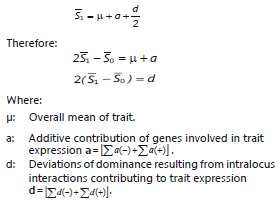
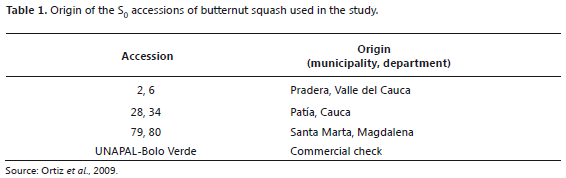
<body><![CDATA[<p><font size="2" face="Verdana, Arial, Helvetica, sans-serif"><b><i>Location.</i></b> The study was conducted at two locations in the department of Valle del Cauca, Colombia. The first, the Experiment Center of the Universidad Nacional de Colombia-Palmira Campus (CEUNP, its Spanish acronym), is located in the municipality of Candelaria (03&deg;25'N latitude, 76&deg;25'W longitude) at an altitude of 973 m above sea level, with a mean annual temperature of 26 &deg;C, an annual precipitation of 1,100 mm, and 76% relative humidity (Ortiz, 2009). The second, a facility of the Servicio Nacional de Aprendizaje (SENA), is located in the municipality of Buga (3&deg;53'N latitude, 76&deg;18'W longitude) at an altitude of 969 m above sea level, with a mean annual temperature of 23 &deg;C, an annual precipitation of 980 mm, and 74% relative humidity (Ortiz, 2009).</font></p>     <p><font size="2" face="Verdana, Arial, Helvetica, sans-serif">The macromolecular analysis of the squash fruits was performed at the Animal Nutrition and Agricultural Prospective Laboratory of the Universidad Nacional de Colombia-Palmira campus.</font></p>     <p><font size="2" face="Verdana, Arial, Helvetica, sans-serif"><b><i>Genetic material.</i></b> Six open-pollinated So accessions were used as well as their S<sub>1</sub> and S<sub>2</sub> inbred lines (Ortiz <i>et al</i>., 2009) and the commercial check variety UNAPAL-Bolo Verde (<a href="#tab01">Table 1</a>). </font></p>     <p align="center"><font size="2" face="Verdana, Arial, Helvetica, sans-serif"><a name="tab01"></a></font><img src="/img/revistas/rfnam/v67n1/v67n1a04tab01.gif"></p>     <p><font size="2" face="Verdana, Arial, Helvetica, sans-serif"><b><i>Experimental methodology.</i></b> The accessions and their inbred lines were planted in a field using a randomized complete block experimental design with four replicates and five plants per replicate. At harvest, three plants were gathered from the center of each plot and one fruit was selected from each of these plants to submit to laboratory analysis.</font></p>     <p><font size="2" face="Verdana, Arial, Helvetica, sans-serif"><b><i>Test variables.</i></b> Seed production per plant (in grams) and seed starch content (%) were measured using the method proposed by the American Association of Cereal Chemists (BeMiller and Low, 1998; Peris-Tortajada, 2000).</font></p>     <p><font size="2" face="Verdana, Arial, Helvetica, sans-serif">Statistical analysis. The <b>1-w<sub>s</sub>/w<sub>0</sub></b> model was used to estimate inbreeding depression, where w<sub>s</sub> is the mean of the trait in inbred plants and w<sub>0</sub> the mean trait in non-inbred plants (Hayes <i>et al</i>., 2005). The positive or negative relationship determines the type of gene action that controls the expression of the quantitative trait (Fox, 2005). The statistical significance of inbreeding depression in S<sub>1</sub> and S<sub>2</sub> was estimated using Student's t-test at the 0.05 and 0.01 levels of probability. </font></p>     <p><font size="2" face="Verdana, Arial, Helvetica, sans-serif"> The model proposed by Mather and Jinks (1982) was used to estimate the genetic effects associated with additivity and dominance, as described below: </font></p>     <p><font size="2" face="Verdana, Arial, Helvetica, sans-serif">Mean of the zero generation of inbreeding (<img class="_idGenPageitem-1" src="/img/revistas/rfnam/v67n1/v67n1a04eq003.gif" />):</font></p>     <p><img src="/img/revistas/rfnam/v67n1/v67n1a04eq000.gif"></p>     ]]></body>
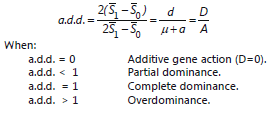
<body><![CDATA[<p><font size="2" face="Verdana, Arial, Helvetica, sans-serif">Mean first generation of inbreeding (<img class="_idGenPageitem-3" src="/img/revistas/rfnam/v67n1/v67n1a04eq004.gif" />):</font></p>     <p><img src="/img/revistas/rfnam/v67n1/v67n1a04eq001.gif"></p>     <p><font size="2" face="Verdana, Arial, Helvetica, sans-serif">Based on the above expressions, it can be deduced that:</font></p> <ul>       <li><font size="2" face="Verdana, Arial, Helvetica, sans-serif">If <font face="Symbol"><b>m</b></font><b> + a</b> is <b>positive</b>, then the additive effects of the genes favor trait expression. If <font face="Symbol"><b>m</b></font><b> + a</b> is <b>negative</b>, then the contrary occurs.</font></li>       <li><font size="2" face="Verdana, Arial, Helvetica, sans-serif">If <b>d</b> is <b>positive</b>, dominance is in the sense of the genes favoring trait expression; if <b>d</b> is <b>negative</b>, then the contrary occurs.</font></li>     </ul>     <p><font size="2" face="Verdana, Arial, Helvetica, sans-serif">The model proposed by Gardner and Lonnquist (1959) was used to estimate the average degree of dominance (a.d.d.):</font></p>     <p><img src="/img/revistas/rfnam/v67n1/v67n1a04eq002.gif"></p>     <p>&nbsp;</p>     <p><font size="3" face="Verdana, Arial, Helvetica, sans-serif"><b>RESULTS AND DISCUSSION</b></font></p>     ]]></body>
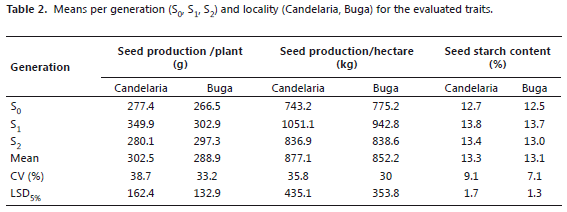
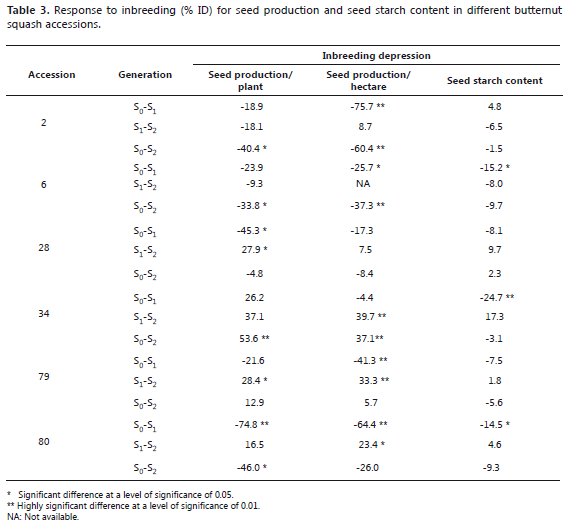
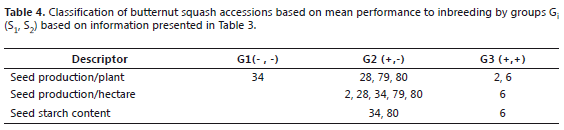
<body><![CDATA[<p><font size="2" face="Verdana, Arial, Helvetica, sans-serif"><a href="#tab02">Table 2</a> shows the mean for each trait in the three generations of inbreeding (S<sub>0</sub>, S<sub>1</sub> and S<sub>2</sub>) and at both localities. </font></p>     <p align="center"><font size="2" face="Verdana, Arial, Helvetica, sans-serif"><a name="tab02"></a></font><img src="/img/revistas/rfnam/v67n1/v67n1a04tab02.gif"></p>     <p><font size="2" face="Verdana, Arial, Helvetica, sans-serif">No significant differences were found between the generations of inbreeding or between the locations. Inbreeding had no significant effect on the average performance of the accessions. Its effect depended on the genetic complexity of the trait being studied, the geographical origin of the accession and the level of heterozygosity, combined with the ability of each accession to respond differently to the inbreeding process, which could be attributed to the fact that the starch synthesis pathway is not only controlled genetically but is also influenced by the metabolic phase during which sugar conversion occurs (Tofi&ntilde;o <i>et al</i>., 2006). This corresponds to a physiological response of the genotype to the environment as indicated by Falconer and Mackay (1996), where inbred individuals are highly sensitive to the effects of environmental variation. </font></p>     <p><font size="2" face="Verdana, Arial, Helvetica, sans-serif"><b><i>Response to inbreeding.</i></b> The significant negative values obtained by the model ID= &#91;1-(W<sub>s</sub>/W<sub>0</sub>)&#93;100, where ID is inbreeding depression, are associated with favorable responses to the inbreeding process. Significant positive values correspond to evident depressive effects while non-significant values, both positive and negative, indicate insensitivity to inbreeding (<a href="#tab03">Table 3</a>). </font></p>     <p align="center"><font size="2" face="Verdana, Arial, Helvetica, sans-serif"><a name="tab03"></a></font><img src="/img/revistas/rfnam/v67n1/v67n1a04tab03.gif"></p>     <p><font size="2" face="Verdana, Arial, Helvetica, sans-serif">ID values, such as -75.7** (S<sub>0</sub>-S<sub>1</sub>) and -60.4** (S<sub>0</sub>-S<sub>2</sub>) for the trait seed production/hectare in the case of accession 2, indicate a favorable response to inbreeding as a result of a higher concentration of favorable homozygous genes, which increases seed production/hectare, as compared with values of 39.7** (S<sub>1</sub>-S<sub>2</sub>) and 37.1** (S<sub>0</sub>-S<sub>2</sub>) in the case of accession 34, which are associated with depressive effects and could be attributed to the manifestation of homozygous genes that reduce seed production/hectare. This indicates that there is no pattern of response to inbreeding in the case of these accessions and traits (Ortiz <i>et al</i>., 2009).</font></p>     <p><font size="2" face="Verdana, Arial, Helvetica, sans-serif">According to the differential response of S<sub>0</sub> accessions and their inbred lines, three groups were defined:</font></p>     <p><font size="2" face="Verdana, Arial, Helvetica, sans-serif"><b>G1 (-, -)</b> Negative response to inbreeding in S<sub>1</sub> and S<sub>2</sub>. Inbreeding depression is moderate in S<sub>1</sub> and S<sub>2</sub>, for example in the case of the trait seed production/plant in accession 34 (<a href="#tab04">Table 4</a>).</font></p>     <p align="center"><font size="2" face="Verdana, Arial, Helvetica, sans-serif"><a name="tab04"></a></font><img src="/img/revistas/rfnam/v67n1/v67n1a04tab04.gif"></p>     <p><font size="2" face="Verdana, Arial, Helvetica, sans-serif"><b>G2 (+, -)</b> Positive response to inbreeding in S<sub>1</sub> but presenting inbreeding depression when passing from S<sub>1</sub> to S<sub>2</sub>, as occurs in accessions 6, 34 and 80 for seed starch content and in accessions 2, 28, 34, 79 and 80 for seed production/hectare. The positive response to inbreeding assumes highly significant negative values; in other words, inbreeding does not suppress a trait per se, which characterizes the performance of butternut squash (Ortiz, 2009). </font></p>     ]]></body>
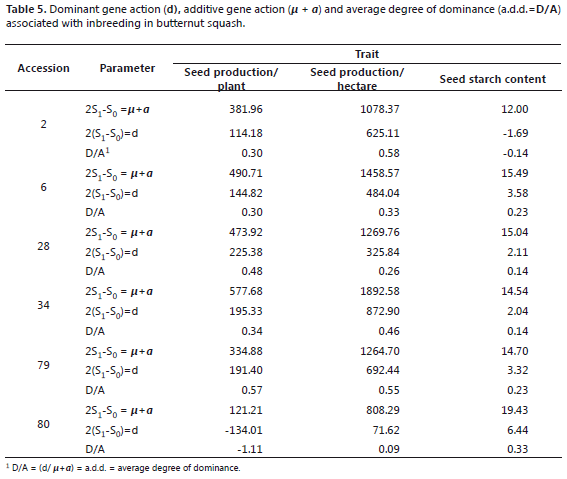
<body><![CDATA[<p><font size="2" face="Verdana, Arial, Helvetica, sans-serif"><b>G3 (+, +)</b> Positive response to inbreeding in S<sub>1</sub> and S<sub>2</sub>. Inbreeding helped improved the mean performance of accessions in S<sub>1</sub> and S<sub>2</sub>, for example seed production/plant in accessions 2 and 6 and seed production/hectare in accession 6 (<a href="#tab04">Table 4</a>).</font></p>     <p><font size="2" face="Verdana, Arial, Helvetica, sans-serif">The information given in <a href="#tab03">Tables 3</a> and <a href="#tab04">4</a> indicates that, unlike other self-pollinated species such as maize, inbreeding depression in cucurbits is uncertain, at least for the traits being evaluated in this study, and depends not only on the accession's degree of heterozygosity in S<sub>0</sub>, but also on the &quot;remnant&quot; genetic load manifested in S<sub>1</sub> and S<sub>2</sub>. As a hypothesis, it can be assumed that, in the case of accessions that have been geographically isolated for a long time, undesirable genes responsible for inbreeding depression may have been removed through a natural process of inbreeding in related crosses so that these accessions, contrary to what is assumed, have a high degree of homozygosity when collected and entered into the program's work collection. As a result, when these accessions are submitted to inbreeding they are either insensitive or respond favorably or unfavorably to the process, as found by Espitia <i>et al</i>. (2006) regarding fruit traits.</font></p>     <p><font size="2" face="Verdana, Arial, Helvetica, sans-serif"><b><i>Type of gene action.</i></b> If S<sub>0</sub> accessions are heterozygous, inbreeding is expected to depress their performance because a certain number of heterozygous loci acquire the recessive homozygous condition. If these recessive homozygous genes are part of the genetic load of the inbred accession, then the depressive effect on the population mean will be evidenced (Sahag&uacute;n and Garc&iacute;a, 2009).</font></p>     <p><font size="2" face="Verdana, Arial, Helvetica, sans-serif">When S<sub>1</sub>&lt; S<sub>0</sub>, parameters <b>d</b> and <b>D/A</b>, which are associated with deviations in dominance and a.d.d., are less than zero as a result of loss of heterozygosity, which, in addition to the residual heterozygosity in S<sub>1</sub>, reduces the mean value of the inbred accession (effect of reverse dominance) as in group G (-, -) (<a href="#tab04">Table 4</a>).</font></p>     <p><font size="2" face="Verdana, Arial, Helvetica, sans-serif">When S<sub>1</sub>&asymp;S<sub>0</sub>, parameters <b>d</b> and <b>D/A</b> are approximately zero and the gene action that controls trait expression is additive in nature or, if not, then there is a balance between positive and negative deviations of dominance (d+&asymp;d-), for example in the case of the trait seed production/hectare in accession 80.</font></p>     <p><font size="2" face="Verdana, Arial, Helvetica, sans-serif">When both <b>d</b> and <b>D/A</b> present positive values, the partial dominance significantly increases the means of the evaluated traits in inbred accessions as occurred for most of the traits under study, with a.d.d up to 0.55, as occurred for the variable seed production/hectare in accession 79 (<a href="#tab05">Table 5</a>).</font></p>     <p align="center"><font size="2" face="Verdana, Arial, Helvetica, sans-serif"><a name="tab05"></a></font><img src="/img/revistas/rfnam/v67n1/v67n1a04tab05.gif"></p>     <p><font size="2" face="Verdana, Arial, Helvetica, sans-serif">The parameter <font face="Symbol">m</font> + a was positive in all accessions (<a href="#tab05">Table 5</a>), attributable to a higher proportion of alleles with favorable additive effects for trait expression in loci acquiring the homozygous condition after selfing.</font></p>     <p><font size="2" face="Verdana, Arial, Helvetica, sans-serif">The performance of the trait seed production/plant in accession 80, with a.d.d. of -1.11, should be highlighted because inbreeding in this particular case creates an imbalance in the dominance relationships in heterozygous loci so that intralocus interactions favor the alleles depressing the expression of said trait.</font></p>     <p><font size="2" face="Verdana, Arial, Helvetica, sans-serif">Different breeding strategies for seed production and starch content can be derived from the above results such as the following: advancing to S2 those accessions suffering inbreeding depression for subsequent crossbreeding between inbred lines to obtain commercially valuable hybrids; selection of S<sub>1</sub> or S<sub>2</sub> inbred populations presenting a mean performance superior to that of the S<sub>0</sub> accession; or simply selection of S<sub>0</sub> accessions for traits insensitive to inbreeding.</font></p>     ]]></body>
<body><![CDATA[<p>&nbsp;</p>     <p><font size="3" face="Verdana, Arial, Helvetica, sans-serif"><b>CONCLUSIONS</b></font></p>     <p><font size="2" face="Verdana, Arial, Helvetica, sans-serif">The parameter D/A indicates that, with the exceptions already mentioned, inbreeding in butternut squash helps increase additive gene action as a result of the increase in the number of homozygous loci after selfing, which in turn significantly favors the mean response of inbred accessions. Similarly, the loci remaining heterozygous in S<sub>1</sub> (residual heterozygosity) express levels of dominance in favor of traits associated with seed production and seed starch content.</font></p>     <p><font size="2" face="Verdana, Arial, Helvetica, sans-serif">The response to inbreeding in butternut squash varies among accessions, generations of inbreeding (S<sub>1</sub>, S<sub>2</sub>) and traits, with no clearly defined pattern.</font></p>     <p><font size="2" face="Verdana, Arial, Helvetica, sans-serif">The predominance of additive gene action over the dominance type for the traits under study suggests that a recurrent selection program could serve as a strategy to increase the frequencies of genes that promote the expression of traits associated with seed production and starch content in butternut squash.</font></p>     <p>&nbsp;</p>     <p><font size="3" face="Verdana, Arial, Helvetica, sans-serif"><b>BIBLIOGRAPHY</b></font></p>     <!-- ref --><p><font size="2" face="Verdana, Arial, Helvetica, sans-serif">Applequist, W., B. Avula, B.T. Schaneberg, Y.H. Wang and A.I. Khan. 2006. Comparative fatty acid content of seeds of four Cucurbita species grown in a common (shared) garden. Journal of Food Composition and Analysis 19(6-7): 606-611.    &nbsp;&nbsp;&nbsp;&nbsp;&nbsp;&nbsp;&nbsp;&nbsp;[&#160;<a href="javascript:void(0);" onclick="javascript: window.open('/scielo.php?script=sci_nlinks&ref=000080&pid=S0304-2847201400010000400001&lng=','','width=640,height=500,resizable=yes,scrollbars=1,menubar=yes,');">Links</a>&#160;]<!-- end-ref --></font></p>     <!-- ref --><p><font size="2" face="Verdana, Arial, Helvetica, sans-serif">BeMiller, J.N. and N.H. Low. 1998. Carbohydrates analysis. pp. 167-188 In: Nielsen, S.S. (ed.). Food Analysis. Second edition. Aspen Publications, Gaithersburg. 557 p.    &nbsp;&nbsp;&nbsp;&nbsp;&nbsp;&nbsp;&nbsp;&nbsp;[&#160;<a href="javascript:void(0);" onclick="javascript: window.open('/scielo.php?script=sci_nlinks&ref=000082&pid=S0304-2847201400010000400002&lng=','','width=640,height=500,resizable=yes,scrollbars=1,menubar=yes,');">Links</a>&#160;]<!-- end-ref --></font></p>     <!-- ref --><p><font size="2" face="Verdana, Arial, Helvetica, sans-serif">Cardoso, A.I.I. 2004. Depress&atilde;o por endogamia ap&oacute;s   quatro gera&ccedil;&otilde;es sucessivas de autopoliniza&ccedil;&atilde;o em    ab&oacute;bora. Scientia Agricola (Piracicaba, Brazil) 61(2):    224-227.    &nbsp;&nbsp;&nbsp;&nbsp;&nbsp;&nbsp;&nbsp;&nbsp;[&#160;<a href="javascript:void(0);" onclick="javascript: window.open('/scielo.php?script=sci_nlinks&ref=000084&pid=S0304-2847201400010000400003&lng=','','width=640,height=500,resizable=yes,scrollbars=1,menubar=yes,');">Links</a>&#160;]<!-- end-ref --></font></p>     <!-- ref --><p><font size="2" face="Verdana, Arial, Helvetica, sans-serif">Ceballos, L.H. 1998. Gen&eacute;tica Cuantitativa y Fitomejoramiento. Universidad Nacional de Colombia, Palmira. 524 p.    &nbsp;&nbsp;&nbsp;&nbsp;&nbsp;&nbsp;&nbsp;&nbsp;[&#160;<a href="javascript:void(0);" onclick="javascript: window.open('/scielo.php?script=sci_nlinks&ref=000086&pid=S0304-2847201400010000400004&lng=','','width=640,height=500,resizable=yes,scrollbars=1,menubar=yes,');">Links</a>&#160;]<!-- end-ref --></font></p>     <!-- ref --><p><font size="2" face="Verdana, Arial, Helvetica, sans-serif">Criollo, E.H., C.C.I. Cardozo, y C. Guevara. 1999. Madurez fisiol&oacute;gica y potencial de almacenamiento de semillas de zapallo. Acta Agron&oacute;mica 49(3-4): 24-30.    &nbsp;&nbsp;&nbsp;&nbsp;&nbsp;&nbsp;&nbsp;&nbsp;[&#160;<a href="javascript:void(0);" onclick="javascript: window.open('/scielo.php?script=sci_nlinks&ref=000088&pid=S0304-2847201400010000400005&lng=','','width=640,height=500,resizable=yes,scrollbars=1,menubar=yes,');">Links</a>&#160;]<!-- end-ref --></font></p>     <!-- ref --><p><font size="2" face="Verdana, Arial, Helvetica, sans-serif">Espitia, M., F. Vallejo, y D. Baena. 2006. Depresi&oacute;n en vigor por endogamia y heterosis para el rendimiento y sus componentes en zapallo <i>Cucurbita moschata</i> Duch. Ex Poir. Revista Facultad Nacional de Agronom&iacute;a Medell&iacute;n, 59(1): 3089-3103.    &nbsp;&nbsp;&nbsp;&nbsp;&nbsp;&nbsp;&nbsp;&nbsp;[&#160;<a href="javascript:void(0);" onclick="javascript: window.open('/scielo.php?script=sci_nlinks&ref=000090&pid=S0304-2847201400010000400006&lng=','','width=640,height=500,resizable=yes,scrollbars=1,menubar=yes,');">Links</a>&#160;]<!-- end-ref --></font></p>     <!-- ref --><p><font size="2" face="Verdana, Arial, Helvetica, sans-serif">Falconer, D.S. and T.F.C. Mackay. 1996. Introduction to Quantitative Genetics. Prentice Hall, London. 464 p.    &nbsp;&nbsp;&nbsp;&nbsp;&nbsp;&nbsp;&nbsp;&nbsp;[&#160;<a href="javascript:void(0);" onclick="javascript: window.open('/scielo.php?script=sci_nlinks&ref=000092&pid=S0304-2847201400010000400007&lng=','','width=640,height=500,resizable=yes,scrollbars=1,menubar=yes,');">Links</a>&#160;]<!-- end-ref --> </font></p>     <!-- ref --><p><font size="2" face="Verdana, Arial, Helvetica, sans-serif">Fox, C.W. 2005. Problems in measuring among-family variation in inbreeding depression. American Journal of Botany 92(11): 1929-1932.    &nbsp;&nbsp;&nbsp;&nbsp;&nbsp;&nbsp;&nbsp;&nbsp;[&#160;<a href="javascript:void(0);" onclick="javascript: window.open('/scielo.php?script=sci_nlinks&ref=000094&pid=S0304-2847201400010000400008&lng=','','width=640,height=500,resizable=yes,scrollbars=1,menubar=yes,');">Links</a>&#160;]<!-- end-ref --> </font></p>     <!-- ref --><p><font size="2" face="Verdana, Arial, Helvetica, sans-serif">Gardner, C.O. and J.H. Lonnquist. 1959. Linkage and the degree of dominance of genes controlling quantitative characters in maize. Agronomy Journal 51(9): 524-528.    &nbsp;&nbsp;&nbsp;&nbsp;&nbsp;&nbsp;&nbsp;&nbsp;[&#160;<a href="javascript:void(0);" onclick="javascript: window.open('/scielo.php?script=sci_nlinks&ref=000096&pid=S0304-2847201400010000400009&lng=','','width=640,height=500,resizable=yes,scrollbars=1,menubar=yes,');">Links</a>&#160;]<!-- end-ref --></font></p>     <!-- ref --><p><font size="2" face="Verdana, Arial, Helvetica, sans-serif">Hayes, C.N., J.M. Winsor and A.G. Stephenson. 2005. Environmental variation influences the magnitude of inbreeding depression in Cucurbita pepo ssp. texana (Cucurbitaceae). Evolution 59(2): 276-286.    &nbsp;&nbsp;&nbsp;&nbsp;&nbsp;&nbsp;&nbsp;&nbsp;[&#160;<a href="javascript:void(0);" onclick="javascript: window.open('/scielo.php?script=sci_nlinks&ref=000098&pid=S0304-2847201400010000400010&lng=','','width=640,height=500,resizable=yes,scrollbars=1,menubar=yes,');">Links</a>&#160;]<!-- end-ref --></font></p>     <!-- ref --><p><font size="2" face="Verdana, Arial, Helvetica, sans-serif">Karaye, I.U., A.A. Aliero, S. Muhamma and S. Bilbis. 2012. Comparative evaluation of amino acid composition and volatile organic compounds of selected Nigerian cucurbit seeds. Pakistan Journal of Nutrition 11(12): 1161-1165.    &nbsp;&nbsp;&nbsp;&nbsp;&nbsp;&nbsp;&nbsp;&nbsp;[&#160;<a href="javascript:void(0);" onclick="javascript: window.open('/scielo.php?script=sci_nlinks&ref=000100&pid=S0304-2847201400010000400011&lng=','','width=640,height=500,resizable=yes,scrollbars=1,menubar=yes,');">Links</a>&#160;]<!-- end-ref --></font></p>     <!-- ref --><p><font size="2" face="Verdana, Arial, Helvetica, sans-serif">Mather, K and J. Jinks. 1982. Biometrical Genetics. Third edition. Chapman and Hall, London. 430 p.    &nbsp;&nbsp;&nbsp;&nbsp;&nbsp;&nbsp;&nbsp;&nbsp;[&#160;<a href="javascript:void(0);" onclick="javascript: window.open('/scielo.php?script=sci_nlinks&ref=000102&pid=S0304-2847201400010000400012&lng=','','width=640,height=500,resizable=yes,scrollbars=1,menubar=yes,');">Links</a>&#160;]<!-- end-ref --></font></p>     <!-- ref --><p><font size="2" face="Verdana, Arial, Helvetica, sans-serif">Ortiz, G.S. 2009. Estudios gen&eacute;ticos en caracteres relacionados con el rendimiento y calidad del fruto de zapallo <i>Cucurbita moschata</i> Duch. para fines agroindustriales. Tesis Doctoral en Mejoramiento de Plantas. Escuela de Posgrados. Universidad Nacional de Colombia. Palmira. 232 p.    &nbsp;&nbsp;&nbsp;&nbsp;&nbsp;&nbsp;&nbsp;&nbsp;[&#160;<a href="javascript:void(0);" onclick="javascript: window.open('/scielo.php?script=sci_nlinks&ref=000104&pid=S0304-2847201400010000400013&lng=','','width=640,height=500,resizable=yes,scrollbars=1,menubar=yes,');">Links</a>&#160;]<!-- end-ref --></font></p>     <!-- ref --><p><font size="2" face="Verdana, Arial, Helvetica, sans-serif">Ortiz, G.S., G.D. Baena y F.A. Vallejo. 2009. Efecto de la endocr&iacute;a en caracteres relacionados con la calidad del fruto del zapallo. Acta Agron&oacute;mica 58(3): 140-144.    &nbsp;&nbsp;&nbsp;&nbsp;&nbsp;&nbsp;&nbsp;&nbsp;[&#160;<a href="javascript:void(0);" onclick="javascript: window.open('/scielo.php?script=sci_nlinks&ref=000106&pid=S0304-2847201400010000400014&lng=','','width=640,height=500,resizable=yes,scrollbars=1,menubar=yes,');">Links</a>&#160;]<!-- end-ref --></font></p>     <!-- ref --><p><font size="2" face="Verdana, Arial, Helvetica, sans-serif">Ortiz, G.S., A.X.C. Rivas, L.S.C. Pasos, R.M.P. Vald&eacute;s y F.A. Vallejo. 2009. Extracci&oacute;n y caracterizaci&oacute;n de aceite de semilla de zapallo. Acta Agron&oacute;mica 58(3): 145-151.    &nbsp;&nbsp;&nbsp;&nbsp;&nbsp;&nbsp;&nbsp;&nbsp;[&#160;<a href="javascript:void(0);" onclick="javascript: window.open('/scielo.php?script=sci_nlinks&ref=000108&pid=S0304-2847201400010000400015&lng=','','width=640,height=500,resizable=yes,scrollbars=1,menubar=yes,');">Links</a>&#160;]<!-- end-ref --></font></p>     <!-- ref --><p><font size="2" face="Verdana, Arial, Helvetica, sans-serif">Peris-Tortajada, M. 2000. Measuring starch in food. In: Eliasson, A.C. (ed.). Starch in Food. Structure, Function and Applications. CRC Press, Cambridge. 605 p.    &nbsp;&nbsp;&nbsp;&nbsp;&nbsp;&nbsp;&nbsp;&nbsp;[&#160;<a href="javascript:void(0);" onclick="javascript: window.open('/scielo.php?script=sci_nlinks&ref=000110&pid=S0304-2847201400010000400016&lng=','','width=640,height=500,resizable=yes,scrollbars=1,menubar=yes,');">Links</a>&#160;]<!-- end-ref --></font></p>     <!-- ref --><p><font size="2" face="Verdana, Arial, Helvetica, sans-serif">Robinson, R.W. 2000. Rationale and methods for producing hybrid cucurbit seed. Journal of New Seeds 1(3-4): 1-47.    &nbsp;&nbsp;&nbsp;&nbsp;&nbsp;&nbsp;&nbsp;&nbsp;[&#160;<a href="javascript:void(0);" onclick="javascript: window.open('/scielo.php?script=sci_nlinks&ref=000112&pid=S0304-2847201400010000400017&lng=','','width=640,height=500,resizable=yes,scrollbars=1,menubar=yes,');">Links</a>&#160;]<!-- end-ref --></font></p>     <!-- ref --><p><font size="2" face="Verdana, Arial, Helvetica, sans-serif">Sahag&uacute;n, J. y F. Garc&iacute;a. 2009. El coeficiente de endogamia de una poblaci&oacute;n bajo selecci&oacute;n masal. Agrociencia 43(2): 119-132.    &nbsp;&nbsp;&nbsp;&nbsp;&nbsp;&nbsp;&nbsp;&nbsp;[&#160;<a href="javascript:void(0);" onclick="javascript: window.open('/scielo.php?script=sci_nlinks&ref=000114&pid=S0304-2847201400010000400018&lng=','','width=640,height=500,resizable=yes,scrollbars=1,menubar=yes,');">Links</a>&#160;]<!-- end-ref --> </font></p>     <!-- ref --><p><font size="2" face="Verdana, Arial, Helvetica, sans-serif">Tofi&ntilde;o, A., M. Fregene, H. Ceballos y D. Cabal. 2006. Regulaci&oacute;n de la bios&iacute;ntesis del almid&oacute;n en plantas terrestres: Perspectivas de modificaci&oacute;n. Acta Agron&oacute;mica 55(1): 1-13.    &nbsp;&nbsp;&nbsp;&nbsp;&nbsp;&nbsp;&nbsp;&nbsp;[&#160;<a href="javascript:void(0);" onclick="javascript: window.open('/scielo.php?script=sci_nlinks&ref=000116&pid=S0304-2847201400010000400019&lng=','','width=640,height=500,resizable=yes,scrollbars=1,menubar=yes,');">Links</a>&#160;]<!-- end-ref --></font></p>      ]]></body><back>
<ref-list>
<ref id="B1">
<nlm-citation citation-type="journal">
<person-group person-group-type="author">
<name>
<surname><![CDATA[Applequist]]></surname>
<given-names><![CDATA[W.]]></given-names>
</name>
<name>
<surname><![CDATA[Avula]]></surname>
<given-names><![CDATA[B.]]></given-names>
</name>
<name>
<surname><![CDATA[Schaneberg]]></surname>
<given-names><![CDATA[B.T.]]></given-names>
</name>
<name>
<surname><![CDATA[Wang]]></surname>
<given-names><![CDATA[Y.H.]]></given-names>
</name>
<name>
<surname><![CDATA[Khan]]></surname>
<given-names><![CDATA[A.I.]]></given-names>
</name>
</person-group>
<article-title xml:lang="en"><![CDATA[Comparative fatty acid content of seeds of four Cucurbita species grown in a common (shared) garden]]></article-title>
<source><![CDATA[Journal of Food Composition and Analysis]]></source>
<year>2006</year>
<volume>19</volume>
<numero>6-7</numero>
<issue>6-7</issue>
<page-range>606-611</page-range></nlm-citation>
</ref>
<ref id="B2">
<nlm-citation citation-type="book">
<person-group person-group-type="author">
<name>
<surname><![CDATA[BeMiller]]></surname>
<given-names><![CDATA[J.N.]]></given-names>
</name>
<name>
<surname><![CDATA[Low]]></surname>
<given-names><![CDATA[N.H.]]></given-names>
</name>
</person-group>
<article-title xml:lang="en"><![CDATA[Carbohydrates analysis]]></article-title>
<person-group person-group-type="editor">
<name>
<surname><![CDATA[Nielsen]]></surname>
<given-names><![CDATA[S.S.]]></given-names>
</name>
</person-group>
<source><![CDATA[Food Analysis]]></source>
<year>1998</year>
<edition>Second</edition>
<page-range>167-188</page-range><publisher-loc><![CDATA[Gaithersburg ]]></publisher-loc>
<publisher-name><![CDATA[Aspen Publications]]></publisher-name>
</nlm-citation>
</ref>
<ref id="B3">
<nlm-citation citation-type="journal">
<person-group person-group-type="author">
<name>
<surname><![CDATA[Cardoso]]></surname>
<given-names><![CDATA[A.I.I.]]></given-names>
</name>
</person-group>
<article-title xml:lang="pt"><![CDATA[Depressão por endogamia após quatro gerações sucessivas de autopolinização em abóbora]]></article-title>
<source><![CDATA[Scientia Agricola]]></source>
<year>2004</year>
<volume>61</volume>
<numero>2</numero>
<issue>2</issue>
<page-range>224-227</page-range><publisher-loc><![CDATA[Piracicaba ]]></publisher-loc>
</nlm-citation>
</ref>
<ref id="B4">
<nlm-citation citation-type="book">
<person-group person-group-type="author">
<name>
<surname><![CDATA[Ceballos]]></surname>
<given-names><![CDATA[L.H.]]></given-names>
</name>
</person-group>
<source><![CDATA[Genética Cuantitativa y Fitomejoramiento]]></source>
<year>1998</year>
<publisher-loc><![CDATA[Palmira ]]></publisher-loc>
<publisher-name><![CDATA[Universidad Nacional de Colombia]]></publisher-name>
</nlm-citation>
</ref>
<ref id="B5">
<nlm-citation citation-type="journal">
<person-group person-group-type="author">
<name>
<surname><![CDATA[Criollo]]></surname>
<given-names><![CDATA[E.H.]]></given-names>
</name>
<name>
<surname><![CDATA[Cardozo]]></surname>
<given-names><![CDATA[C.C.I.]]></given-names>
</name>
<name>
<surname><![CDATA[Guevara]]></surname>
<given-names><![CDATA[C.]]></given-names>
</name>
</person-group>
<article-title xml:lang="es"><![CDATA[Madurez fisiológica y potencial de almacenamiento de semillas de zapallo]]></article-title>
<source><![CDATA[Acta Agronómica]]></source>
<year>1999</year>
<volume>49</volume>
<numero>3-4</numero>
<issue>3-4</issue>
<page-range>24-30</page-range></nlm-citation>
</ref>
<ref id="B6">
<nlm-citation citation-type="journal">
<person-group person-group-type="author">
<name>
<surname><![CDATA[Espitia]]></surname>
<given-names><![CDATA[M.]]></given-names>
</name>
<name>
<surname><![CDATA[Vallejo]]></surname>
<given-names><![CDATA[F.]]></given-names>
</name>
<name>
<surname><![CDATA[Baena]]></surname>
<given-names><![CDATA[D.]]></given-names>
</name>
</person-group>
<article-title xml:lang="es"><![CDATA[Depresión en vigor por endogamia y heterosis para el rendimiento y sus componentes en zapallo Cucurbita moschata Duch. Ex Poir.]]></article-title>
<source><![CDATA[Revista Facultad Nacional de Agronomía Medellín]]></source>
<year>2006</year>
<volume>59</volume>
<numero>1</numero>
<issue>1</issue>
<page-range>3089-3103</page-range></nlm-citation>
</ref>
<ref id="B7">
<nlm-citation citation-type="book">
<person-group person-group-type="author">
<name>
<surname><![CDATA[Falconer]]></surname>
<given-names><![CDATA[D.S.]]></given-names>
</name>
<name>
<surname><![CDATA[Mackay]]></surname>
<given-names><![CDATA[T.F.C.]]></given-names>
</name>
</person-group>
<source><![CDATA[Introduction to Quantitative Genetics]]></source>
<year>1996</year>
<publisher-loc><![CDATA[London ]]></publisher-loc>
<publisher-name><![CDATA[Prentice Hall]]></publisher-name>
</nlm-citation>
</ref>
<ref id="B8">
<nlm-citation citation-type="journal">
<person-group person-group-type="author">
<name>
<surname><![CDATA[Fox]]></surname>
<given-names><![CDATA[C.W.]]></given-names>
</name>
</person-group>
<article-title xml:lang="en"><![CDATA[Problems in measuring among-family variation in inbreeding depression]]></article-title>
<source><![CDATA[American Journal of Botany]]></source>
<year>2005</year>
<volume>92</volume>
<numero>11</numero>
<issue>11</issue>
<page-range>1929-1932</page-range></nlm-citation>
</ref>
<ref id="B9">
<nlm-citation citation-type="journal">
<person-group person-group-type="author">
<name>
<surname><![CDATA[Gardner]]></surname>
<given-names><![CDATA[C.O.]]></given-names>
</name>
<name>
<surname><![CDATA[Lonnquist]]></surname>
<given-names><![CDATA[J.H.]]></given-names>
</name>
</person-group>
<article-title xml:lang="en"><![CDATA[Linkage and the degree of dominance of genes controlling quantitative characters in maize]]></article-title>
<source><![CDATA[Agronomy Journal]]></source>
<year>1959</year>
<volume>51</volume>
<numero>9</numero>
<issue>9</issue>
<page-range>524-528</page-range></nlm-citation>
</ref>
<ref id="B10">
<nlm-citation citation-type="journal">
<person-group person-group-type="author">
<name>
<surname><![CDATA[Hayes]]></surname>
<given-names><![CDATA[C.N.]]></given-names>
</name>
<name>
<surname><![CDATA[Winsor]]></surname>
<given-names><![CDATA[J.M.]]></given-names>
</name>
<name>
<surname><![CDATA[Stephenson]]></surname>
<given-names><![CDATA[A.G.]]></given-names>
</name>
</person-group>
<article-title xml:lang="en"><![CDATA[Environmental variation influences the magnitude of inbreeding depression in Cucurbita pepo ssp. texana (Cucurbitaceae)]]></article-title>
<source><![CDATA[Evolution]]></source>
<year>2005</year>
<volume>59</volume>
<numero>2</numero>
<issue>2</issue>
<page-range>276-286</page-range></nlm-citation>
</ref>
<ref id="B11">
<nlm-citation citation-type="journal">
<person-group person-group-type="author">
<name>
<surname><![CDATA[Karaye]]></surname>
<given-names><![CDATA[I.U.]]></given-names>
</name>
<name>
<surname><![CDATA[Aliero]]></surname>
<given-names><![CDATA[A.A.]]></given-names>
</name>
<name>
<surname><![CDATA[Muhamma]]></surname>
<given-names><![CDATA[S.]]></given-names>
</name>
<name>
<surname><![CDATA[Bilbis]]></surname>
<given-names><![CDATA[S.]]></given-names>
</name>
</person-group>
<article-title xml:lang="en"><![CDATA[Comparative evaluation of amino acid composition and volatile organic compounds of selected Nigerian cucurbit seeds]]></article-title>
<source><![CDATA[Pakistan Journal of Nutrition]]></source>
<year>2012</year>
<volume>11</volume>
<numero>12</numero>
<issue>12</issue>
<page-range>1161-1165</page-range></nlm-citation>
</ref>
<ref id="B12">
<nlm-citation citation-type="book">
<person-group person-group-type="author">
<name>
<surname><![CDATA[Mather]]></surname>
<given-names><![CDATA[K]]></given-names>
</name>
<name>
<surname><![CDATA[Jinks]]></surname>
<given-names><![CDATA[J.]]></given-names>
</name>
</person-group>
<source><![CDATA[Biometrical Genetics]]></source>
<year>1982</year>
<edition>Third</edition>
<publisher-loc><![CDATA[London ]]></publisher-loc>
<publisher-name><![CDATA[Chapman and Hall]]></publisher-name>
</nlm-citation>
</ref>
<ref id="B13">
<nlm-citation citation-type="">
<person-group person-group-type="author">
<name>
<surname><![CDATA[Ortiz]]></surname>
<given-names><![CDATA[G.S.]]></given-names>
</name>
</person-group>
<source><![CDATA[Estudios genéticos en caracteres relacionados con el rendimiento y calidad del fruto de zapallo Cucurbita moschata Duch. para fines agroindustriales]]></source>
<year>2009</year>
</nlm-citation>
</ref>
<ref id="B14">
<nlm-citation citation-type="journal">
<person-group person-group-type="author">
<name>
<surname><![CDATA[Ortiz]]></surname>
<given-names><![CDATA[G.S.]]></given-names>
</name>
<name>
<surname><![CDATA[Baena]]></surname>
<given-names><![CDATA[G.D.]]></given-names>
</name>
<name>
<surname><![CDATA[Vallejo]]></surname>
<given-names><![CDATA[F.A.]]></given-names>
</name>
</person-group>
<article-title xml:lang="es"><![CDATA[Efecto de la endocría en caracteres relacionados con la calidad del fruto del zapallo]]></article-title>
<source><![CDATA[Acta Agronómica]]></source>
<year>2009</year>
<volume>58</volume>
<numero>3</numero>
<issue>3</issue>
<page-range>140-144</page-range></nlm-citation>
</ref>
<ref id="B15">
<nlm-citation citation-type="journal">
<person-group person-group-type="author">
<name>
<surname><![CDATA[Ortiz]]></surname>
<given-names><![CDATA[G.S.]]></given-names>
</name>
<name>
<surname><![CDATA[Rivas]]></surname>
<given-names><![CDATA[A.X.C.]]></given-names>
</name>
<name>
<surname><![CDATA[Pasos]]></surname>
<given-names><![CDATA[L.S.C.]]></given-names>
</name>
<name>
<surname><![CDATA[Valdés]]></surname>
<given-names><![CDATA[R.M.P.]]></given-names>
</name>
<name>
<surname><![CDATA[Vallejo]]></surname>
<given-names><![CDATA[F.A.]]></given-names>
</name>
</person-group>
<article-title xml:lang="es"><![CDATA[Extracción y caracterización de aceite de semilla de zapallo]]></article-title>
<source><![CDATA[Acta Agronómica]]></source>
<year>2009</year>
<volume>58</volume>
<numero>3</numero>
<issue>3</issue>
<page-range>145-151</page-range></nlm-citation>
</ref>
<ref id="B16">
<nlm-citation citation-type="book">
<person-group person-group-type="author">
<name>
<surname><![CDATA[Peris-Tortajada]]></surname>
<given-names><![CDATA[M.]]></given-names>
</name>
</person-group>
<article-title xml:lang="en"><![CDATA[Measuring starch in food]]></article-title>
<person-group person-group-type="editor">
<name>
<surname><![CDATA[Eliasson]]></surname>
<given-names><![CDATA[A.C.]]></given-names>
</name>
</person-group>
<source><![CDATA[Starch in Food: Structure, Function and Applications]]></source>
<year>2000</year>
<publisher-loc><![CDATA[Cambridge ]]></publisher-loc>
<publisher-name><![CDATA[CRC Press]]></publisher-name>
</nlm-citation>
</ref>
<ref id="B17">
<nlm-citation citation-type="journal">
<person-group person-group-type="author">
<name>
<surname><![CDATA[Robinson]]></surname>
<given-names><![CDATA[R.W.]]></given-names>
</name>
</person-group>
<article-title xml:lang="en"><![CDATA[Rationale and methods for producing hybrid cucurbit seed]]></article-title>
<source><![CDATA[Journal of New Seeds]]></source>
<year>2000</year>
<volume>1</volume>
<numero>3-4</numero>
<issue>3-4</issue>
<page-range>1-47</page-range></nlm-citation>
</ref>
<ref id="B18">
<nlm-citation citation-type="journal">
<person-group person-group-type="author">
<name>
<surname><![CDATA[Sahagún]]></surname>
<given-names><![CDATA[J.]]></given-names>
</name>
<name>
<surname><![CDATA[García]]></surname>
<given-names><![CDATA[F.]]></given-names>
</name>
</person-group>
<article-title xml:lang="es"><![CDATA[El coeficiente de endogamia de una población bajo selección masal]]></article-title>
<source><![CDATA[Agrociencia]]></source>
<year>2009</year>
<volume>43</volume>
<numero>2</numero>
<issue>2</issue>
<page-range>119-132</page-range></nlm-citation>
</ref>
<ref id="B19">
<nlm-citation citation-type="journal">
<person-group person-group-type="author">
<name>
<surname><![CDATA[Tofiño]]></surname>
<given-names><![CDATA[A.]]></given-names>
</name>
<name>
<surname><![CDATA[Fregene]]></surname>
<given-names><![CDATA[M.]]></given-names>
</name>
<name>
<surname><![CDATA[Ceballos]]></surname>
<given-names><![CDATA[H.]]></given-names>
</name>
<name>
<surname><![CDATA[Cabal]]></surname>
<given-names><![CDATA[D.]]></given-names>
</name>
</person-group>
<article-title xml:lang="es"><![CDATA[Regulación de la biosíntesis del almidón en plantas terrestres: Perspectivas de modificación]]></article-title>
<source><![CDATA[Acta Agronómica]]></source>
<year>2006</year>
<volume>55</volume>
<numero>1</numero>
<issue>1</issue>
<page-range>1-13</page-range></nlm-citation>
</ref>
</ref-list>
</back>
</article>