<?xml version="1.0" encoding="ISO-8859-1"?><article xmlns:mml="http://www.w3.org/1998/Math/MathML" xmlns:xlink="http://www.w3.org/1999/xlink" xmlns:xsi="http://www.w3.org/2001/XMLSchema-instance">
<front>
<journal-meta>
<journal-id>0304-2847</journal-id>
<journal-title><![CDATA[Revista Facultad Nacional de Agronomía Medellín]]></journal-title>
<abbrev-journal-title><![CDATA[Rev. Fac. Nac. Agron. Medellín]]></abbrev-journal-title>
<issn>0304-2847</issn>
<publisher>
<publisher-name><![CDATA[Facultad de Ciencias Agrarias - Universidad Nacional de Colombia]]></publisher-name>
</publisher>
</journal-meta>
<article-meta>
<article-id>S0304-28472017000100004</article-id>
<article-id pub-id-type="doi">10.15446/rfna.v70n1.61764</article-id>
<title-group>
<article-title xml:lang="en"><![CDATA[Morpho-agronomic assessment of introductions of butternut squash (Cucurbita moschata Duch.) from Central America]]></article-title>
<article-title xml:lang="es"><![CDATA[Evaluación morfoagronómica de introducciones centroamericanas de zapallo (Cucurbita moschata Duch.)]]></article-title>
</title-group>
<contrib-group>
<contrib contrib-type="author">
<name>
<surname><![CDATA[Vásquez Gamboa]]></surname>
<given-names><![CDATA[Giomara]]></given-names>
</name>
<xref ref-type="aff" rid="A01"/>
</contrib>
<contrib contrib-type="author">
<name>
<surname><![CDATA[Ortiz Grisales]]></surname>
<given-names><![CDATA[Sanín]]></given-names>
</name>
<xref ref-type="aff" rid="A02"/>
</contrib>
<contrib contrib-type="author">
<name>
<surname><![CDATA[Vallejo Cabrera]]></surname>
<given-names><![CDATA[Franco Alirio]]></given-names>
</name>
<xref ref-type="aff" rid="A01"/>
</contrib>
<contrib contrib-type="author">
<name>
<surname><![CDATA[Salazar Villareal]]></surname>
<given-names><![CDATA[Fredy Antonio]]></given-names>
</name>
<xref ref-type="aff" rid="A03"/>
</contrib>
</contrib-group>
<aff id="A01">
<institution><![CDATA[,Universidad Nacional de Colombia Facultad de Ingeniería y Administración ]]></institution>
<addr-line><![CDATA[Palmira ]]></addr-line>
<country>Colombia</country>
</aff>
<aff id="A02">
<institution><![CDATA[,Universidad Nacional de Colombia Facultad de Ciencias Agropecuarias ]]></institution>
<addr-line><![CDATA[Palmira ]]></addr-line>
<country>Colombia</country>
</aff>
<aff id="A03">
<institution><![CDATA[,Centro de Investigación de la Caña de Azúcar de Colombia Área de Mejoramiento Genético ]]></institution>
<addr-line><![CDATA[Cali ]]></addr-line>
<country>Colombia</country>
</aff>
<pub-date pub-type="pub">
<day>00</day>
<month>01</month>
<year>2017</year>
</pub-date>
<pub-date pub-type="epub">
<day>00</day>
<month>01</month>
<year>2017</year>
</pub-date>
<volume>70</volume>
<numero>1</numero>
<fpage>8057</fpage>
<lpage>8068</lpage>
<copyright-statement/>
<copyright-year/>
<self-uri xlink:href="http://www.scielo.org.co/scielo.php?script=sci_arttext&amp;pid=S0304-28472017000100004&amp;lng=en&amp;nrm=iso"></self-uri><self-uri xlink:href="http://www.scielo.org.co/scielo.php?script=sci_abstract&amp;pid=S0304-28472017000100004&amp;lng=en&amp;nrm=iso"></self-uri><self-uri xlink:href="http://www.scielo.org.co/scielo.php?script=sci_pdf&amp;pid=S0304-28472017000100004&amp;lng=en&amp;nrm=iso"></self-uri><abstract abstract-type="short" xml:lang="en"><p><![CDATA[A Central American collection of butternut squash (Cucurbita moschata Duch.) was characterized based on a series of morpho-agronomic descriptors and its variability assessed. Floral asynchrony ranging from 10 to 15 days was observed between staminate and pistillate flowers. Differences were also observed among introductions for all quantitative characteristics evaluated (P<0.01). An interaction between introduction and planting cycle (P<0.05) was observed for 50% of the evaluated variables: fruit weight, polar diameter of fruit, wall thickness of fruit, fruit color, days to harvest, and total fruit seed weight. Cluster analysis revealed that groups 3 and 5 gathered introductions presenting high yields and larger, heavier fruits. Group 4 gathered introductions with intermediate yields, high seed production, and thick fruit walls. In all cases, genetic improvement aiming to increase the production of fruit for fresh consumption or agro-industrial purposes as well as the production of oilseed should use introductions from groups 3 and 5 in well-planned crossings with introductions from group 4.]]></p></abstract>
<abstract abstract-type="short" xml:lang="es"><p><![CDATA[Se caracterizó una colección centroamericana de zapallo (Cucurbita moschata Duch.) con base en una serie de descriptores morfo-agronómicos y luego se evaluó su variabilidad. Se evidenció una asincronía floral entre flores estaminadas y pistililadas de 10 a 15 días. Se encontraron diferencias entre las introducciones (P<0,01) respecto a todos los caracteres cuantitativos evaluados. Se presentó una interacción introducción x ciclo de siembra (P<0,05) en 50% de las variables evaluadas: peso del fruto, diámetro polar del fruto, espesor de la pared del fruto, color de la matriz del fruto, días a cosecha y peso total de la semilla del fruto. El análisis de conglomerados detectó que en los grupos 3 y 5 se ubicaron las introducciones con altos rendimientos y frutos más grandes y pesados. El grupo 4 estuvo conformado por las introducciones con rendimientos intermedios, alta producción de semillas y amplio espesor de pared del fruto. En todos los casos, el mejoramiento genético dirigido a aumentar la producción de fruto para consumo en fresco o para fines agroindustriales o la producción de semillas de tipo oleaginoso deberá utilizar las introducciones de los grupos 3 y 5 en cruzamientos bien planeados con las del grupo 4.]]></p></abstract>
<kwd-group>
<kwd lng="en"><![CDATA[Plant morphology]]></kwd>
<kwd lng="en"><![CDATA[Agronomic characters]]></kwd>
<kwd lng="en"><![CDATA[Germplasm]]></kwd>
<kwd lng="en"><![CDATA[Squashes]]></kwd>
<kwd lng="en"><![CDATA[Multivariate analysis]]></kwd>
<kwd lng="es"><![CDATA[Morfología vegetal]]></kwd>
<kwd lng="es"><![CDATA[Características agronómicas]]></kwd>
<kwd lng="es"><![CDATA[Germoplasma]]></kwd>
<kwd lng="es"><![CDATA[Ahuyama]]></kwd>
<kwd lng="es"><![CDATA[Análisis multivariado]]></kwd>
</kwd-group>
</article-meta>
</front><body><![CDATA[ <p><font size="1" face="Verdana, Arial, Helvetica, sans-serif"><b>DOI:</b> <a href="http://dx.doi.org/10.15446/rfna.v70n1.61764" target="_blank">http://dx.doi.org/10.15446/rfna.v70n1.61764</a></font></p>     <p><font size="4" face="Verdana, Arial, Helvetica, sans-serif"><b>Morpho-agronomic assessment of introductions of butternut squash (<i>Cucurbita moschata</i> Duch.) from Central America</b></font></p>     <p><i><b><font size="3" face="Verdana, Arial, Helvetica, sans-serif">Evaluaci&oacute;n morfoagron&oacute;mica de introducciones centroamericanas de zapallo  (Cucurbita moschata Duch.)</font></b><font size="3" face="Verdana, Arial, Helvetica, sans-serif"></font></i></p>     <p>&nbsp;</p>     <p ><font size="2" face="Verdana, Arial, Helvetica, sans-serif"><b>Giomara V&aacute;squez Gamboa<sup >1</sup>, San&iacute;n Ortiz Grisales<sup >2</sup>, Franco Alirio Vallejo Cabrera<sup>1</sup> and Fredy Antonio Salazar Villareal<sup>3</sup></b></font></p>     <p>&nbsp;</p>     <p><font size="2" face="Verdana, Arial, Helvetica, sans-serif"><b><sup ><i>1 </i></sup></b><i>Facultad de Ingenier&iacute;a y Administraci&oacute;n. Universidad Nacional de Colombia. A.A. 237, Palmira, Colombia.    <br>   <b><sup >2</sup></b> Facultad de Ciencias Agropecuarias. Universidad Nacional de Colombia. A.A. 237, Palmira, Colombia. &lt;<a href="mailto:sortizg@unal.edu.co" target="_blank">sortizg@unal.edu.co</a>&gt;    <br>   <b><sup >3</sup></b> &Aacute;rea de Mejoramiento Gen&eacute;tico. Centro de Investigaci&oacute;n de la Ca&ntilde;a de Az&uacute;car de Colombia - CENICA&Ntilde;A. A.A. 9138, Cali, Colombia.</i></font></p>     <p>&nbsp;</p>     ]]></body>
<body><![CDATA[<p><font size="2" face="Verdana, Arial, Helvetica, sans-serif"><b>Received: August 15, 2016; Accepted: October 10, 2016</b></font></p>     <p><font size="1" face="Verdana, Arial, Helvetica, sans-seriff"><b>This work is licensed under a</b> <a rel="license" href="http://creativecommons.org/licenses/by-nc-nd/4.0/">Creative Commons Attribution-NonCommercial-NoDerivatives 4.0 International License</a>.</font><br />   <a rel="license" href="http://creativecommons.org/licenses/by-nc-nd/4.0/"><img style="border-width:0" src="https://i.creativecommons.org/l/by-nc-nd/4.0/88x31.png" /></a></p> <hr>     <p><font size="2" face="Verdana, Arial, Helvetica, sans-serif"><b>ABSTRACT </b>    <br>   A Central American collection of butternut squash (<i>Cucurbita moschata</i> Duch.) was characterized based on a series of morpho-agronomic descriptors and its variability assessed. Floral asynchrony ranging from 10 to 15 days was observed between staminate and pistillate flowers. Differences were also observed among introductions for all quantitative characteristics evaluated (<i>P</i>&lt;0.01). An interaction between introduction and planting cycle (<i>P</i>&lt;0.05) was observed for 50% of the evaluated variables: fruit weight, polar diameter of fruit, wall thickness of fruit, fruit color, days to harvest, and total fruit seed weight. Cluster analysis revealed that groups 3 and 5 gathered introductions presenting high yields and larger, heavier fruits. Group 4 gathered introductions with intermediate yields, high seed production, and thick fruit walls. In all cases, genetic improvement aiming to increase the production of fruit for fresh consumption or agro-industrial purposes as well as the production of oilseed should use introductions from groups 3 and 5 in well-planned crossings with introductions from group 4. </font></p>     <p><font size="2" face="Verdana, Arial, Helvetica, sans-serif"><b>Key words: </b>Plant morphology, Agronomic characters, Germplasm, Squashes, Multivariate analysis</font></p>     <p><font size="2" face="Verdana, Arial, Helvetica, sans-serif"><b>RESUMEN</b>    <br>   </font><font size="2" face="Verdana, Arial, Helvetica, sans-serif">Se caracteriz&oacute; una colecci&oacute;n centroamericana de zapallo (<i>Cucurbita moschata</i> Duch.) con base en una serie de descriptores morfo-agron&oacute;micos y luego se evalu&oacute; su variabilidad. Se evidenci&oacute; una asincron&iacute;a floral entre flores estaminadas y pistililadas de 10 a 15 d&iacute;as. Se encontraron diferencias entre las introducciones (<i>P</i>&lt;0,01) respecto a todos los caracteres cuantitativos evaluados. Se present&oacute; una interacci&oacute;n introducci&oacute;n x ciclo de siembra (<i>P</i>&lt;0,05) en 50% de las variables evaluadas: peso del fruto, di&aacute;metro polar del fruto, espesor de la pared del fruto, color de la matriz del fruto, d&iacute;as a cosecha y peso total de la semilla del fruto. El an&aacute;lisis de conglomerados detect&oacute; que en los grupos 3 y 5 se ubicaron las introducciones con altos rendimientos y frutos m&aacute;s grandes y pesados. El grupo 4 estuvo conformado por las introducciones con rendimientos intermedios, alta producci&oacute;n de semillas y amplio espesor de pared del fruto. En todos los casos, el mejoramiento gen&eacute;tico dirigido a aumentar la producci&oacute;n de fruto para consumo en fresco o para fines agroindustriales o la producci&oacute;n de semillas de tipo oleaginoso deber&aacute; utilizar las introducciones de los grupos 3 y 5 en cruzamientos bien planeados con las del grupo 4.</font></p>     <p><font size="2" face="Verdana, Arial, Helvetica, sans-serif"><b>Palabras claves: </b>Morfolog&iacute;a vegetal, Caracter&iacute;sticas agron&oacute;micas, Germoplasma, Ahuyama, An&aacute;lisis multivariado</font></p> <hr>     <p>&nbsp;</p>     <p><font size="2" face="Verdana, Arial, Helvetica, sans-serif">The ancestral and current uses of the fruit of butternut squash (<i>Cucurbita moschata</i> Duch.) as both horticultural and edible crop not only in Colombia but throughout the Americas have been well documented by Pati&ntilde;o (1967), Piperno <i>et al</i>. (2000), Piperno and Stothert (2003), Piperno (2011), and Ortiz <i>et al.</i> (2013).</font></p>     ]]></body>
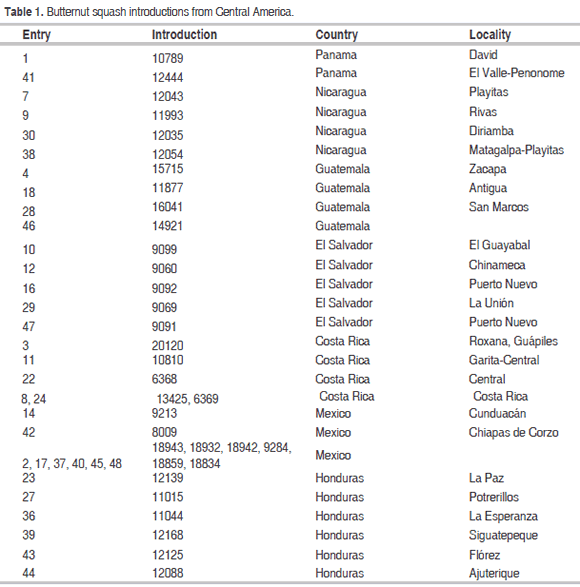
<body><![CDATA[<p><font size="2" face="Verdana, Arial, Helvetica, sans-serif">In the case of Colombia, butternut squash ranks first as domesticated horticultural crop, with a total planted area of 3800 hectares and an annual production of 65,000 t (FAOSTAT, 2013). Butternut squash is frequently intercropped or rotated with fruit, ornamental, and forest species as a staple crop in agro-ecosystems of rural economy. It also plays an important role as horticultural crop in the country's food security, being planted as main or transitory crop on small or intermediate farms (Jaramillo, 1980; Estrada <i>et al.</i>, 2010). Its popularity can be attributed to its versatility for fresh consumption and its industrial uses (Espitia <i>et al.</i>, 2005; Ortiz <i>et al.</i>, 2008; Ortiz <i>et al.</i>, 2013; Ordo&ntilde;ez <i>et al.</i>, 2014).</font></p>     <p><font size="2" face="Verdana, Arial, Helvetica, sans-serif">Because of its nutritional value, butternut squash was included in the list of priority foods that guarantee a balanced human diet and, according to FAO, form part of Colombia's basic food basket (PNSAN, 2012).</font></p>     <p><font size="2" face="Verdana, Arial, Helvetica, sans-serif">This study aimed to evaluate and characterize the initial morpho-agronomic traits of a collection of butternut squash from Central America, which would serve as basis to identify superior genotypes for release to farmers.</font></p>     <p>&nbsp;</p>     <p><font size="3" face="Verdana, Arial, Helvetica, sans-serif"><b>MATERIALS AND METHODS</b></font></p>     <p><font size="2" face="Verdana, Arial, Helvetica, sans-serif"><b>Location    <br>   </b></font><font size="2" face="Verdana, Arial, Helvetica, sans-serif">Field trials were conducted at CEUNP, the Experimental Center of the Universidad Nacional de Colombia, Sede Palmira, which is located in Candelaria (rural community of El Carmelo), department of Valle del Cauca, Colombia (03&deg;25'25.3''N, 76&deg;25'47.8''S), at an altitude of 972 m above sea level, with an average annual temperature of 26 &deg;C, 76% RH, and average annual rainfall of 1100 mm (Ortiz et al., 2013).</font></p>     <p><font size="2" face="Verdana, Arial, Helvetica, sans-serif"><b>Germplasm used    <br>   </b>Thirty-four butternut squash introductions original of Central America (<a href="#tab01">Table 1</a>) were used; of these, six disappeared during the first planting cycle due to prevalent conditions (excess rainfall or excess drought).</font></p>     <p align="center"><a name="tab01"></a><img src="/img/revistas/rfnam/v70n1/v70n1a04tab01.gif"></p>     ]]></body>
<body><![CDATA[<p><font size="2" face="Verdana, Arial, Helvetica, sans-serif"><b>Nursery and planting in the field    <br>   </b></font><font size="2" face="Verdana, Arial, Helvetica, sans-serif">Nurseries were established and subsequently planted in the field during two consecutive planting seasons of 2014, according to the protocol of the UNAPAL's Horticultural Program (Ortiz et al., 2013), using commercial peat as substrate.</font></p>     <p><font size="2" face="Verdana, Arial, Helvetica, sans-serif">Two seeds were sown per 12-oz cup. After 20 days in the nursery, the trials were planted in the field using a randomized complete block design with three replications and five plants per replication. The experimental unit was represented by five plants, planted in 3 x 3 m arrangement in the field. Agronomic practices were coordinated by the Horticultural Program (Ortiz et al., 2013).</font></p>     <p><font size="2" face="Verdana, Arial, Helvetica, sans-serif"><b>Evaluated traits    <br>   </b></font><font size="2" face="Verdana, Arial, Helvetica, sans-serif">Plant- and fruit-related traits were assessed based on the descriptors proposed for butternut squash by Esquinas and Gulick (1983), Montes et al. (2004), and ECPGR (2008). Three plants were sampled per furrow and two fruits per plant were evaluated in the three replications. The following variables were measured: days to staminate flowering (DSF); days to pistillate flowering (DPF); days to harvest (DH); fruit weight (FW) in kg; number of fruits per plant (NFP); fruit yield (FY) in t ha-1; total seed weight per fruit (TSWF) in g; 100-seed weight (100-SW) in g; polar diameter of fruit (PDF) in cm; equatorial diameter of fruit (EDF) in cm; thickness of fruit wall (TFW) in cm; diameter of placental cavity (DPC) in cm; fruit form (FF) (scale 1-14); pericarp color (PC) (scale 1-10); fruit pulp color (FPC) (scale 1-15); fruit matrix color (FMC) (scale 1-3); and pulp quality (PQ) (scale 1-2); placenta location (PL): on the wall (1), in the middle (2).</font></p>     <p><font size="2" face="Verdana, Arial, Helvetica, sans-serif"><b>Statistical analyses    <br>   </b></font><font size="2" face="Verdana, Arial, Helvetica, sans-serif">Variance analysis was conducted to detect differences between introductions and estimate the effect of the environment on the expression of variability. The SAS 3.0 statistical package was used (SAS, 2009). Means separation was based on Fisher's Least Significant Difference (LSD) test at a 5% significance level (Steel and Torrie, 1985).</font></p>     <p><font size="2" face="Verdana, Arial, Helvetica, sans-serif">Cluster analysis was used to determine the importance of variables and genetic relationships between introductions. The Ward-Modified Location Model (Ward-MLM) was used, using the algorithm proposed by Franco et al. (1998), where clustering occurs under the assumption of minimum variance within the group but maximum heterogeneity between groups. Heterogeneity between groups was estimated based on Mahalanobis distances and the pseudo-F statistic determined the number of selected groups (maximum value). The number of groups was decided based on the lowest value of the function. Gower's index was used to estimate genetic distances. The data matrix was standardized and the distance matrix was estimated by the Ward-Gower method (Gower, 1971), which allows the use of continuous, nominal, and binary variables. The Proc IML, Proc Cluster, and Proc Tree procedures of the SAS 9.3 statistical package (SAS, 2009) were used in all cases.</font></p>     <p>&nbsp;</p>     <p><font size="3" face="Verdana, Arial, Helvetica, sans-serif"><b>RESULTS AND DISCUSSION</b></font></p>     ]]></body>
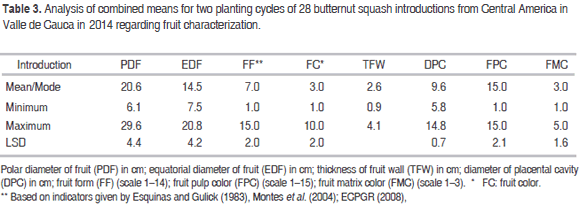
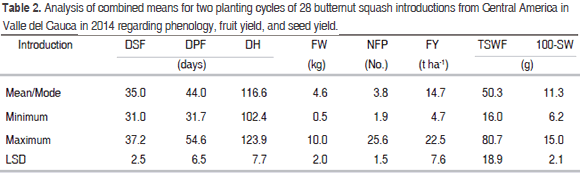
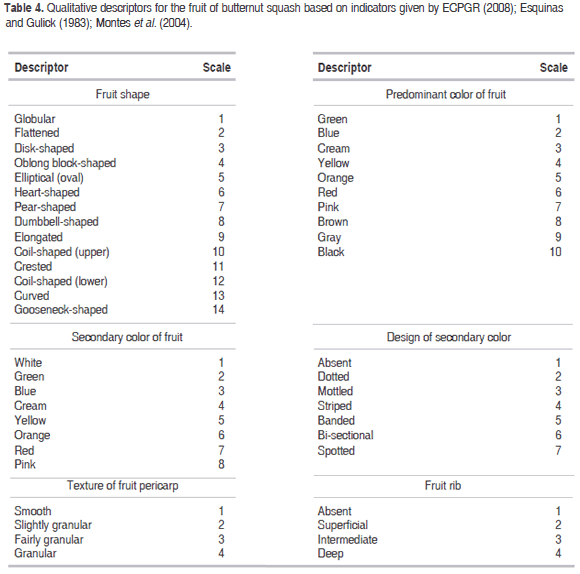
<body><![CDATA[<p><font size="2" face="Verdana, Arial, Helvetica, sans-serif"><b>Phenology and fruit and seed yield    <br>   </b>Asynchrony between DPF and DSF was detected in most butternut squash introductions (<a href="#tab02">Table 2</a>). The results agree with those of Ortiz (2009), who evaluated the Colombian collection of butternut squash and observed physical deterioration in 10-day-old plants. These plants only produced pollen-producing flowers with no receptive pistillate flowers for fertilization and fruit formation. Therefore, if pollination is not performed and seed formation is not effective, then the fruit is not developed and aborts.</font></p>     <p align="center"><a name="tab02"></a><img src="/img/revistas/rfnam/v70n1/v70n1a04tab02.gif"></p>     <p><font size="2" face="Verdana, Arial, Helvetica, sans-serif">Regarding DH, plants from the Central American collection matured at least 30 days earlier as compared to those of the Colombian collection (<a href="#tab02">Table 2</a>), presenting relative precocity (Ortiz, 2009; Vald&eacute;s <i>et al.</i>, 2010).</font></p>     <p><font size="2" face="Verdana, Arial, Helvetica, sans-serif">Although FW varied broadly, results indicated that 35% of the genotypes of the Central American collection presented heavy fruits, weighing more than 5 kg. These results agree with those of different studies conducted by UNAPAL's Horticultural Program (Montes et al<i>.</i>, 2004; Ortiz, 2009; Valdes et al., 2014).</font></p>     <p><font size="2" face="Verdana, Arial, Helvetica, sans-serif">The NFP presented relative uniformity across introductions (<a href="#tab02">Table 2</a>), averaging 3.8. In introduction 42, however, there was a marked asymmetry, with 25 fruits per plant. The NFP of the remaining introductions of the collection did not exceed four fruits per plant. This characteristic is important from the genetic viewpoint because prolificacy is a selection factor that can be significantly affected by the environment. For example, the absence or low presence of pollinating bees can cause the early abortion of fruit due to the absence of effective pollen (Lau and Stephenson, 1993; Ortiz et al., 2013). Water availability at critical times of fruit fill and limited amounts of trace minerals in the soil solution can also cause early abortion of the fruit (Lopes de Sousa, 2011).</font></p>     <p><font size="2" face="Verdana, Arial, Helvetica, sans-serif">Average fruit yield (FY) of the Central American collection was similar to that of commercial butternut squash in Valle del Cauca, Colombia, which is 14 t ha-1. However, 21% of the genotypes presented yields above 20 t ha-1, which opens the opportunity to select prolific genotypes with heavy fruit and superior performance (Ortiz et al., 2013).</font></p>     <p><font size="2" face="Verdana, Arial, Helvetica, sans-serif">Regarding TSWF and 100-SW, 39% of the Central American introductions presented above-average values, which reflects in the presence of large, heavy seeds with added value for agro-industrial purposes (Ordo&ntilde;ez et al., 2014). The remaining introductions presented typical values, being similar to those reported by Valdes et al. (2014). </font></p>     <p><font size="2" face="Verdana, Arial, Helvetica, sans-serif"><b>Fruit characterization    <br>   </b></font><font size="2" face="Verdana, Arial, Helvetica, sans-serif">The results of means analysis of fruit-related traits of Central American butternut squash introductions are presented in <a href="#tab03">Table 3</a>. Characterization was based on the fruit descriptors for butternut squash developed by ECPGR, 2008; Esquinas and Gulick, 1983; and Montes <i>et al.</i>, 2004 (<a href="#tab04">Table 4</a>).</font></p>     ]]></body>
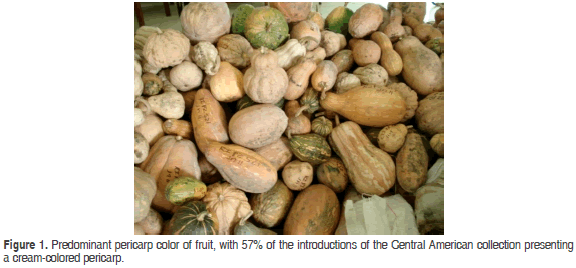
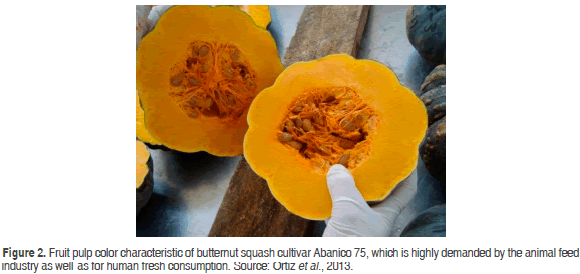
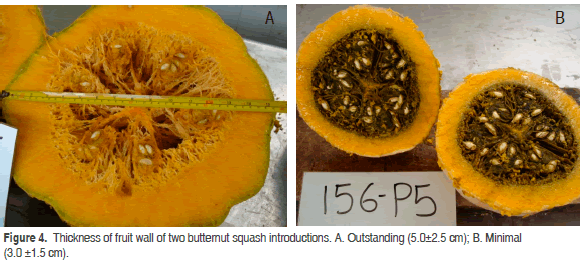
<body><![CDATA[<p align="center"><a name="tab03"></a><img src="/img/revistas/rfnam/v70n1/v70n1a04tab03.gif"></p>     <p align="center"><a name="tab04"></a><img src="/img/revistas/rfnam/v70n1/v70n1a04tab04.gif"></p>     <p><font size="2" face="Verdana, Arial, Helvetica, sans-serif">Analysis results indicated that 75% of the evaluated introductions presented cylindrical, pear-, diamond-, spindle- or gourd-shaped fruits based on PDF and EDF (<a href="#tab03">Table 3</a>) and the rest, a flat, vessel-shaped fruit based on EDF (<a href="#fig01">Figure 1</a>), indicating that there are materials available that have fleshy fruits with small placental cavity, two traits that industries find attractive. </font></p>     <p align="center"><a name="fig01"></a><img src="/img/revistas/rfnam/v70n1/v70n1a04fig01.gif"></p>     <p><font size="2" face="Verdana, Arial, Helvetica, sans-serif">Regarding the predominant PC of the fruit, 57% of the introductions presented a cream-colored pericarp (<a href="#fig01">Figure 1</a>), which is attractive from the commercial viewpoint. However, the demand of the fresh consumption market in Colombia is for bright green fruits (Ortiz et al., 2013).</font></p>     <p><font size="2" face="Verdana, Arial, Helvetica, sans-serif">The TFW, a desirable character to ensure marketable butternut squash for commercial fresh consumption, presented a relatively low average for 62% of the introductions (<a href="#tab03">Table 3</a>); however, 38% presented above-average values, with introduction 30 presenting the highest TFW value (4.1 cm) (<a href="#fig02">Figures 2</a>, <a href="#fig03">3A</a>, and <a href="#fig04">4A</a>). Market demand determines desirable characteristics of fruit pulp quality (<a href="#fig02">Figure 2</a>) and serves to select the most appropriate model for genetic improvement (Ortiz et al., 2013). </font></p>     <p align="center"><a name="fig02"></a><img src="/img/revistas/rfnam/v70n1/v70n1a04fig02.gif"></p>     <p align="center"><a name="fig03"></a><img src="/img/revistas/rfnam/v70n1/v70n1a04fig03.gif"></p>     <p align="center"><a name="fig04"></a><img src="/img/revistas/rfnam/v70n1/v70n1a04fig04.gif"></p>     <p><font size="2" face="Verdana, Arial, Helvetica, sans-serif">Contradictory results were obtained regarding the DPC of the fruit. If the diameter is wide, then the amount of seed it can hold is significant; however, a wide DPC could affect the TFW, making it necessary to find an introduction that meets both characteristics (good seed production and high TFW). In any case, 57% of the introductions presented above-average values (<a href="#tab03">Table 3</a> and <a href="#fig04">Figures 4A</a> and <a href="#fig04">4B</a>).</font></p>     ]]></body>
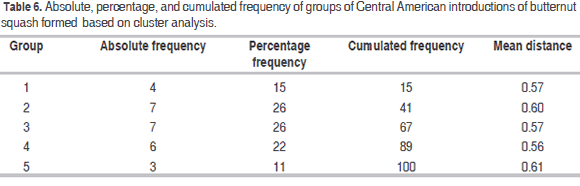
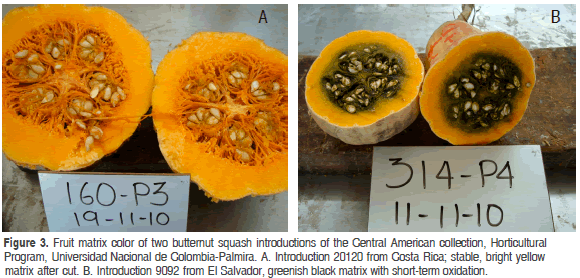
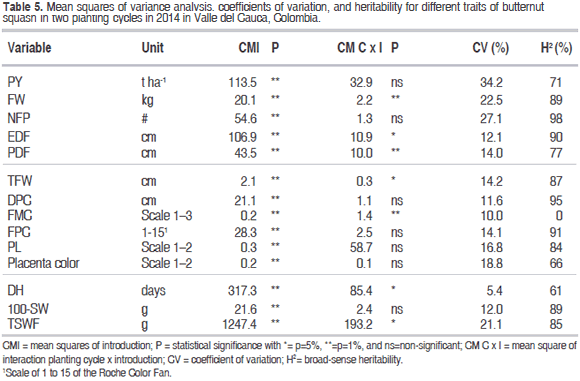
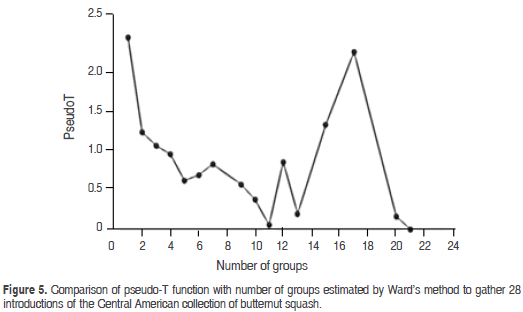
<body><![CDATA[<p><font size="2" face="Verdana, Arial, Helvetica, sans-serif">Regarding FPC, 75% of the Central American introductions presented high values of bright yellow on the Roche scale. The remaining materials were pale yellow or yellow with green or bright green stripes, which reduces their commercial value for fresh consumption (<a href="#fig03">Figures 3</a>, <a href="#fig04">4A</a>, and <a href="#fig04">4B</a>). A green-colored pulp is an indication that the material has a marked wild or naturalized origin (Sanjur et al., 2002) and, given the cross-pollination that occurs in butternut squash, advanced genotypes could be derived that would seriously impair the breeding process for FPC.</font></p>     <p><font size="2" face="Verdana, Arial, Helvetica, sans-serif">Both FMC and FPC, typically yellow in butternut squash, ranged from bright yellow in several of the Central American introductions to greenish-black for 71% of the introductions assessed (<a href="#fig03">Figures 3</a> and <a href="#fig04">4B</a>). This finding disagrees with the bright yellow FMC that consumers found attractive in previously evaluated collections (Ortiz, 2009; Valdes et al., 2010; Valdes et al., 2014). However, the greenish-black color of the pulp when the fruit is opened or several hours after processed is not an indication of fruit deterioration. The fresh consumption market in Colombia does not find introductions with a green- or black-colored matrix attractive, but their nutritional or productive qualities for the animal feed industry should be further studied.</font></p>     <p><font size="2" face="Verdana, Arial, Helvetica, sans-serif"><b>Analysis of variance    <br>   </b></font><font size="2" face="Verdana, Arial, Helvetica, sans-serif">The analysis of variance showed highly significant differences among introductions (P &lt;0.01) for all study variables (<a href="#tab05">Table 5</a>). Overall, the coefficients of variation for the descriptors evaluated were low to intermediate, ranging between 5.4 and 34.2% (<a href="#tab05">Table 5</a>). This variation is considered appropriate because the assessment of traits was based on individual plants and this assumes that the variation of micro-environments has been controlled to some extent (Ceballos, 1998).</font></p>     <p align="center"><a name="tab05"></a><img src="/img/revistas/rfnam/v70n1/v70n1a04tab05.gif"></p>     <p><font size="2" face="Verdana, Arial, Helvetica, sans-serif">The analysis of the interaction cycle x introduction indicated no significant differences (P &lt;0.05) for Y, NFP, DPC, FPC, PDF, PC, and 100-SW (<a href="#tab05">Table 5</a>); however, highly significant differences (P &lt;0.01) were observed regarding FW, PDF, and FMC.</font></p>     <p><font size="2" face="Verdana, Arial, Helvetica, sans-serif">Overall, broad-sense heritability was high, ranging between 66 and 98% (<a href="#tab05">Table 5</a>). Although this indicator is usually important in plant breeding processes, in the case of this study care should be taken when quantifying broad-sense heritability as, according to Ceballos (1998), heritability is not only a property of the plant trait but also of the plant population and is affected by the environmental conditions under which the individuals develop and how the phenotype is evaluated. The changing value of this trait is associated with all components of variance and will accordingly be affected by changes in cropping conditions (Espitia, 2004; Ortiz, 2009). Heritability is expected to increase in variable environments and decrease under more favorable conditions (Falconer and Mackay, 1996). Based on the above, in the cases where the biological or statistical differences observed can be attributable to the interaction planting cycle x introduction (<a href="#tab05">Table 5</a>), it is highly probable that adequate breeding methods or appropriate agronomic practices can trigger positive practices associated with high heritability.</font></p>     <p><font size="2" face="Verdana, Arial, Helvetica, sans-serif"><b>Cluster analysis    <br>   </b>Five groups were formed based on the Ward method (<a href="#fig05">Figure 5</a> and <a href="#tab06">Table 6</a>). The graphic of the pseudo-maximum likelihood shows a sharp decline in group 4 with a subsequent rise in group 6 and is assumed to represent the breakeven point for determining work groups. Introduction 42 was excluded from the cluster analysis because it presented an outlier value for NFP.</font></p>     <p align="center"><a name="fig05"></a><img src="/img/revistas/rfnam/v70n1/v70n1a04fig05.gif"></p>     ]]></body>
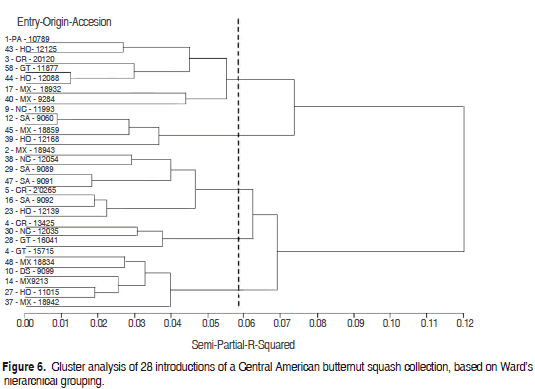
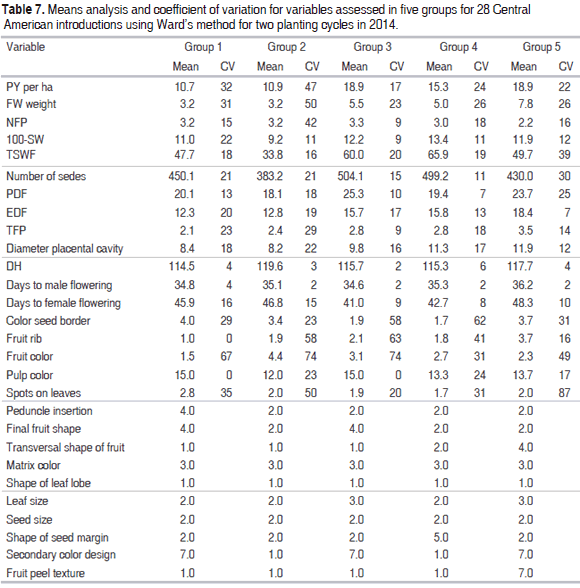
<body><![CDATA[<p align="center"><a name="tab06"></a><img src="/img/revistas/rfnam/v70n1/v70n1a04tab06.gif"></p>     <p><font size="2" face="Verdana, Arial, Helvetica, sans-serif"><a href="#fig06">Figure 6</a> shows how the 27 introductions were grouped. Five groups were formed based on Ward's hierarchical clustering (<a href="#tab06">Table 6</a>). Group 1 was composed of four introductions, one each from Nicaragua, El Salvador, Mexico, and Honduras (accounting for 15% of the total), with an average distance of 0.57 between introductions. Group 2 was composed of seven introductions, one each from Panama, Costa Rica, and Guatemala, two from Honduras, and two from Mexico (accounting for 26%), with a distance of 0.60 between introductions and located far from groups 3 and 5. Group 3 includes seven introductions, with one introduction each from Honduras, Nicaragua, Mexico, and Costa Rica and three from El Salvador (accounting for 26%), with a distance of 0.57 between introductions and located far from groups 1 and 5. Group 4 consists of six introductions, one each from Guatemala, Salvador, and Honduras, and three from Mexico (accounting for 22%), with a distance of 0.56 between introductions. Finally, group 5 includes three introductions, one each from Costa Rica, Nicaragua, and Honduras (accounting for 11%), with a distance of 0.61 between introductions. </font></p>     <p align="center"><a name="fig06"></a><img src="/img/revistas/rfnam/v70n1/v70n1a04fig06.gif"></p>     <p><font size="2" face="Verdana, Arial, Helvetica, sans-serif">Although phenotypic variability is evident in the Central American collection of butternut squash introductions studied, the cluster analysis failed to group introductions according to origin (country), probably because of the very active exchange of germplasm in Central America. Butternut squash, maize, and beans are the basis of Milpa agriculture and food security crops in traditional family-based farming systems in Central America (Pati&ntilde;o, 1967; Piperno et al., 2000; Piperno and Stothert, 2003; Piperno, 2011). </font></p>     <p><font size="2" face="Verdana, Arial, Helvetica, sans-serif"><a href="#tab07">Table 7</a> presents the results of means analysis and the coefficient of variation for study variables for the five groups, based on Ward's method. Groups 1 and 2 gathered the introductions with the lowest means for traits related to fresh fruit yield per hectare, smaller and lighter fruit, lower PDF and EDF, less TFW and DPC, fewer seeds, lower 100-SW, and lower TSWF. Fruit with green-colored pulp predominated, and introductions of group 1 matured the earliest. Therefore, the introductions of these groups rank low when selecting for fresh fruit yield, seed yield, and fruit pulp quality.</font></p>     <p align="center"><a name="tab07"></a><img src="/img/revistas/rfnam/v70n1/v70n1a04tab07.gif"></p>     <p><font size="2" face="Verdana, Arial, Helvetica, sans-serif">In the case of group 2, the only relevant trait regarding the rest of the introductions evaluated was the yellow color of the pulp (<a href="#tab07">Table 7</a>). The remaining variables presented average or below-average values.</font></p>     <p><font size="2" face="Verdana, Arial, Helvetica, sans-serif">Groups 3 and 5 gathered introductions with higher average values for traits related to PY, FW, PDF and EDF, number of seeds per fruit and 100-SW (<a href="#tab07">Table 7</a>). However, at the same time introductions maturing the latest in terms of days to harvest also took the longest in terms of DSF and DPF. Unfortunately, green-colored pulp and fruit matrix predominated in group 3, presenting rapid oxidation and blackening (<a href="#fig01">Figure 3B</a>), which disqualifies these introductions for fresh consumption.</font></p>     <p><font size="2" face="Verdana, Arial, Helvetica, sans-serif">Group 4 gathered introductions presenting higher averages regarding TSWF, 100-SW, seed size, EDF, and DPC; intermediate values for PY per hectare, FW, NFP, and DH (late). The bright yellow color of the pulp of these introductions stands out, which adds value for fresh consumption.</font></p>     <p><font size="2" face="Verdana, Arial, Helvetica, sans-serif">Group 5 gathered introductions presenting higher averages in terms of PY per hectare, FW, PDF and EDF, TFW, DPC, and FPC. The positive traits of the introductions of this group were yellow-colored pulp, TFW, TFP, and wide DPC (<a href="#fig03">Figure 3A</a>) and DH. Negative traits included a longer time to DPF and DSF, marked ribbed fruit, fruit pericarp with a rough to frogskin-like or bumpy texture, and green color matrix with rapid oxidation and blackening (<a href="#fig03">Figure 3B</a>).</font></p>     ]]></body>
<body><![CDATA[<p><font size="2" face="Verdana, Arial, Helvetica, sans-serif">If the products of cluster analysis (<a href="#fig06">Figure 6</a>) and means analysis (<a href="#tab07">Table 7</a>) are integrated, it can be inferred that the introductions that would prove useful for a breeding program that aims to develop materials that produce fruit for fresh consumption or for agro-industrial purposes are those that correspond to group 3 (introductions 2, 5, 16, 23, 29, 38, 47) and group 5 (introductions 4, 10, 14, 27, 37, 48) (<a href="#tab07">Table 7</a>). The same methodology was used by Ortiz (2009), Valdes et al. (2010), and Ortiz et al. (2013) to develop cultivars for fresh consumption and agro-industrial purposes.</font></p>     <p><font size="2" face="Verdana, Arial, Helvetica, sans-serif">Furthermore, to produce grain derived from seed for oilseed purposes (Ordo&ntilde;ez et al., 2014), the recommendation is to use genotypes derived from group 3 (introductions 2, 5, 16, 23, 29, 38).</font></p>     <p>&nbsp;</p>     <p><font size="3" face="Verdana, Arial, Helvetica, sans-serif"><b>CONCLUSIONS</b></font></p>     <p><font size="2" face="Verdana, Arial, Helvetica, sans-serif">The Central American collection of butternut squash introductions evaluated in this study presents variability regarding traits of interest, indicating the availability of source material to develop a breeding program to produce squash fruit for fresh consumption or agro-industrial purposes as well as to produce oilseed.</font></p>     <p><font size="2" face="Verdana, Arial, Helvetica, sans-serif">There was no interaction between introductions regarding planting time, indicating that introductions of the Central American collection tend to be stable over time.</font></p>     <p><font size="2" face="Verdana, Arial, Helvetica, sans-serif">Breeding processes aiming to increase either the production of fruit for fresh consumption or for agro-industrial purposes or to increase oilseed production should use the introductions identified in groups 3 and 5 in well-designed crosses with introductions of group 4.</font></p>     <p>&nbsp;</p>     <p><font size="3" face="Verdana, Arial, Helvetica, sans-serif"><b>ACKNOWLEDGEMENTS</b></font></p>     <p><font size="2" face="Verdana, Arial, Helvetica, sans-serif">Our sincere thanks to the Research Program of Genetic Breeding, Agronomy and Horticultural Crop Seed Production, Universidad Nacional de Colombia, Sede Palmira.</font></p>     ]]></body>
<body><![CDATA[<p>&nbsp;</p>     <p><font size="3" face="Verdana, Arial, Helvetica, sans-serif"><b>REFERENCES</b></font></p>     <!-- ref --><p><font size="2" face="Verdana, Arial, Helvetica, sans-serif">Ceballos LH. 1998. Gen&eacute;tica cuantitativa y fitomejoramiento. Universidad Nacional de Colombia, Palmira, Colombia. 524 p.    &nbsp;&nbsp;&nbsp;&nbsp;&nbsp;&nbsp;&nbsp;&nbsp;[&#160;<a href="javascript:void(0);" onclick="javascript: window.open('/scielo.php?script=sci_nlinks&ref=3248081&pid=S0304-2847201700010000400001&lng=','','width=640,height=500,resizable=yes,scrollbars=1,menubar=yes,');">Links</a>&#160;]<!-- end-ref --></font></p>     <!-- ref --><p><font size="2" face="Verdana, Arial, Helvetica, sans-serif">ECPGR (European Cooperative Programme for Plant Genetic Resources). 2008. Minimum descriptors for Cucurbita spp., cucumber, melon and watermelon. ECPGR Secretariat, Rome, Italy.    &nbsp;&nbsp;&nbsp;&nbsp;&nbsp;&nbsp;&nbsp;&nbsp;[&#160;<a href="javascript:void(0);" onclick="javascript: window.open('/scielo.php?script=sci_nlinks&ref=3248083&pid=S0304-2847201700010000400002&lng=','','width=640,height=500,resizable=yes,scrollbars=1,menubar=yes,');">Links</a>&#160;]<!-- end-ref --></font></p>     <!-- ref --><p><font size="2" face="Verdana, Arial, Helvetica, sans-serif">Espitia CMM. 2004. Estimaci&oacute;n y an&aacute;lisis de par&aacute;metros gen&eacute;ticos en cruzamiento dial&eacute;licos de zapallo Cuc&uacute;rbita moschata Dusch. Ex Poir., en el Valle del Cauca. Ph.D. Thesis. Escuela de Posgrados Universidad Nacional de Colombia, Palmira. 206 p.    &nbsp;&nbsp;&nbsp;&nbsp;&nbsp;&nbsp;&nbsp;&nbsp;[&#160;<a href="javascript:void(0);" onclick="javascript: window.open('/scielo.php?script=sci_nlinks&ref=3248085&pid=S0304-2847201700010000400003&lng=','','width=640,height=500,resizable=yes,scrollbars=1,menubar=yes,');">Links</a>&#160;]<!-- end-ref --></font></p>     <!-- ref --><p><font size="2" face="Verdana, Arial, Helvetica, sans-serif">Espitia M, Vallejo FA and Baena GD. 2005. Correlaciones fenot&iacute;picas, gen&eacute;ticas y ambientales en Cucurbita moschata Duch. Ex Poir. Acta Agron&oacute;mica 54(1): 1-9.    &nbsp;&nbsp;&nbsp;&nbsp;&nbsp;&nbsp;&nbsp;&nbsp;[&#160;<a href="javascript:void(0);" onclick="javascript: window.open('/scielo.php?script=sci_nlinks&ref=3248087&pid=S0304-2847201700010000400004&lng=','','width=640,height=500,resizable=yes,scrollbars=1,menubar=yes,');">Links</a>&#160;]<!-- end-ref --></font></p>     ]]></body>
<body><![CDATA[<!-- ref --><p><font size="2" face="Verdana, Arial, Helvetica, sans-serif">Esquinas AJT and Gulick PJ. 1983. Genetic resources of Cucurbitaceae: A global report. International Board for Plant Genetic Resources IBPGR Secretariat, Rome, Italy. 105 p.    &nbsp;&nbsp;&nbsp;&nbsp;&nbsp;&nbsp;&nbsp;&nbsp;[&#160;<a href="javascript:void(0);" onclick="javascript: window.open('/scielo.php?script=sci_nlinks&ref=3248089&pid=S0304-2847201700010000400005&lng=','','width=640,height=500,resizable=yes,scrollbars=1,menubar=yes,');">Links</a>&#160;]<!-- end-ref --></font></p>     <!-- ref --><p><font size="2" face="Verdana, Arial, Helvetica, sans-serif">Estrada EI, Vallejo FA, Baena GD, Ortiz S y Zambrano E.  2010. Unapal-Llanogrande, nuevo cultivar de zapallo adaptado a las condiciones del valle geogr&aacute;fico del r&iacute;o Cauca, Colombia. Acta Agron&oacute;mica 59(2): 135-143.    &nbsp;&nbsp;&nbsp;&nbsp;&nbsp;&nbsp;&nbsp;&nbsp;[&#160;<a href="javascript:void(0);" onclick="javascript: window.open('/scielo.php?script=sci_nlinks&ref=3248091&pid=S0304-2847201700010000400006&lng=','','width=640,height=500,resizable=yes,scrollbars=1,menubar=yes,');">Links</a>&#160;]<!-- end-ref --> </font></p>     <!-- ref --><p><font size="2" face="Verdana, Arial, Helvetica, sans-serif">Falconer DS and Mackay TFC. 1996. Introduction to quantitative genetics. Prentice Hall, London. 464 p.    &nbsp;&nbsp;&nbsp;&nbsp;&nbsp;&nbsp;&nbsp;&nbsp;[&#160;<a href="javascript:void(0);" onclick="javascript: window.open('/scielo.php?script=sci_nlinks&ref=3248093&pid=S0304-2847201700010000400007&lng=','','width=640,height=500,resizable=yes,scrollbars=1,menubar=yes,');">Links</a>&#160;]<!-- end-ref --></font></p>     <!-- ref --><p><font size="2" face="Verdana, Arial, Helvetica, sans-serif">Food and Agriculture Organization of the United Nations - FAOSTAT. 2013. Producci&oacute;n de cultivos de zapallo [Material num&eacute;rico en Excel]. Available in: <a href="http://faostat3.fao.org/home/index.html#SEARCH_DATA" target="_blank">http://faostat3.fao.org/home/index.html#SEARCH_DATA</a>; accessed: July 2013.    &nbsp;&nbsp;&nbsp;&nbsp;&nbsp;&nbsp;&nbsp;&nbsp;[&#160;<a href="javascript:void(0);" onclick="javascript: window.open('/scielo.php?script=sci_nlinks&ref=3248095&pid=S0304-2847201700010000400008&lng=','','width=640,height=500,resizable=yes,scrollbars=1,menubar=yes,');">Links</a>&#160;]<!-- end-ref --> </font></p>     <!-- ref --><p><font size="2" face="Verdana, Arial, Helvetica, sans-serif">Franco J, Crossa J, Villase&ntilde;or J, Taba S and Eberhart SA. 1998. Classifying genetic resources by categorical and continuous variables. Crop Science 38(6): 1688-1696.    &nbsp;&nbsp;&nbsp;&nbsp;&nbsp;&nbsp;&nbsp;&nbsp;[&#160;<a href="javascript:void(0);" onclick="javascript: window.open('/scielo.php?script=sci_nlinks&ref=3248097&pid=S0304-2847201700010000400009&lng=','','width=640,height=500,resizable=yes,scrollbars=1,menubar=yes,');">Links</a>&#160;]<!-- end-ref --></font></p>     ]]></body>
<body><![CDATA[<!-- ref --><p><font size="2" face="Verdana, Arial, Helvetica, sans-serif">Gower JC. 1971. A general coefficient of similarity and some of its properties. Biometrics 27: 857-874.    &nbsp;&nbsp;&nbsp;&nbsp;&nbsp;&nbsp;&nbsp;&nbsp;[&#160;<a href="javascript:void(0);" onclick="javascript: window.open('/scielo.php?script=sci_nlinks&ref=3248099&pid=S0304-2847201700010000400010&lng=','','width=640,height=500,resizable=yes,scrollbars=1,menubar=yes,');">Links</a>&#160;]<!-- end-ref --></font></p>     <!-- ref --><p><font size="2" face="Verdana, Arial, Helvetica, sans-serif">Jaramillo J. 1980. El cultivo de ahuyama o zapallo. Hortalizas. Manual de Asistencia T&eacute;cnica. Instituto Colombiano Agropecuario (ICA) 28: 15-19.    &nbsp;&nbsp;&nbsp;&nbsp;&nbsp;&nbsp;&nbsp;&nbsp;[&#160;<a href="javascript:void(0);" onclick="javascript: window.open('/scielo.php?script=sci_nlinks&ref=3248101&pid=S0304-2847201700010000400011&lng=','','width=640,height=500,resizable=yes,scrollbars=1,menubar=yes,');">Links</a>&#160;]<!-- end-ref --></font></p>     <!-- ref --><p><font size="2" face="Verdana, Arial, Helvetica, sans-serif">Lau TC and Stephenson AG. 1993. Effects of soil nitrogen on pollen production, pollen grain size and pollen performance in Cucurbita pepo (Cucurbitaceae). American Journal of Botany 80(7): 763-768.    &nbsp;&nbsp;&nbsp;&nbsp;&nbsp;&nbsp;&nbsp;&nbsp;[&#160;<a href="javascript:void(0);" onclick="javascript: window.open('/scielo.php?script=sci_nlinks&ref=3248103&pid=S0304-2847201700010000400012&lng=','','width=640,height=500,resizable=yes,scrollbars=1,menubar=yes,');">Links</a>&#160;]<!-- end-ref --></font></p>     <!-- ref --><p><font size="2" face="Verdana, Arial, Helvetica, sans-serif">Lopes de Souza C. 2011. Cultivar development of allogamous crops. Crop Breeding and Applied Biotechnology  11: 8-15.    &nbsp;&nbsp;&nbsp;&nbsp;&nbsp;&nbsp;&nbsp;&nbsp;[&#160;<a href="javascript:void(0);" onclick="javascript: window.open('/scielo.php?script=sci_nlinks&ref=3248105&pid=S0304-2847201700010000400013&lng=','','width=640,height=500,resizable=yes,scrollbars=1,menubar=yes,');">Links</a>&#160;]<!-- end-ref --> </font></p>     <!-- ref --><p><font size="2" face="Verdana, Arial, Helvetica, sans-serif">Montes RC, Vallejo FA, y Baena GD. 2004. Diversidad gen&eacute;tica de germoplasma colombiano de zapallo Cucurbita moschata Duch. Acta Agron&oacute;mica 53: 43-50.    &nbsp;&nbsp;&nbsp;&nbsp;&nbsp;&nbsp;&nbsp;&nbsp;[&#160;<a href="javascript:void(0);" onclick="javascript: window.open('/scielo.php?script=sci_nlinks&ref=3248107&pid=S0304-2847201700010000400014&lng=','','width=640,height=500,resizable=yes,scrollbars=1,menubar=yes,');">Links</a>&#160;]<!-- end-ref --></font></p>     ]]></body>
<body><![CDATA[<!-- ref --><p><font size="2" face="Verdana, Arial, Helvetica, sans-serif">Ordo&ntilde;ez NGA, Ortiz S, Vald&eacute;s MP y Vallejo FA. 2014. Selecci&oacute;n de introducciones de Cucurbita por contenido de aceite en semillas. Acta Agron&oacute;mica 63(2): 175-180.    &nbsp;&nbsp;&nbsp;&nbsp;&nbsp;&nbsp;&nbsp;&nbsp;[&#160;<a href="javascript:void(0);" onclick="javascript: window.open('/scielo.php?script=sci_nlinks&ref=3248109&pid=S0304-2847201700010000400015&lng=','','width=640,height=500,resizable=yes,scrollbars=1,menubar=yes,');">Links</a>&#160;]<!-- end-ref --> </font></p>     <!-- ref --><p><font size="2" face="Verdana, Arial, Helvetica, sans-serif">Ortiz GS. 2009. Estudios gen&eacute;ticos en caracteres relacionados con el rendimiento y calidad del fruto de zapallo Cucurbita moschata Duch. para fines agroindustriales. Ph.D. thesis in Agricultural Sciences with emphasis in Plant Breeding. Universidad Nacional de Colombia, Palmira, Colombia. 206 p.    &nbsp;&nbsp;&nbsp;&nbsp;&nbsp;&nbsp;&nbsp;&nbsp;[&#160;<a href="javascript:void(0);" onclick="javascript: window.open('/scielo.php?script=sci_nlinks&ref=3248111&pid=S0304-2847201700010000400016&lng=','','width=640,height=500,resizable=yes,scrollbars=1,menubar=yes,');">Links</a>&#160;]<!-- end-ref --></font></p>     <!-- ref --><p><font size="2" face="Verdana, Arial, Helvetica, sans-serif">Ortiz GS, S&aacute;nchez LJ, Vald&eacute;s MP, Baena GD and Vallejo FA. 2008. Retenci&oacute;n de caroteno total en fruto de zapallo Cucurbita moschata Duch. acondicionado por osmodeshidrataci&oacute;n y secado. Acta Agron&oacute;mica 57(4): 269-274.    &nbsp;&nbsp;&nbsp;&nbsp;&nbsp;&nbsp;&nbsp;&nbsp;[&#160;<a href="javascript:void(0);" onclick="javascript: window.open('/scielo.php?script=sci_nlinks&ref=3248113&pid=S0304-2847201700010000400017&lng=','','width=640,height=500,resizable=yes,scrollbars=1,menubar=yes,');">Links</a>&#160;]<!-- end-ref --></font></p>     <!-- ref --><p><font size="2" face="Verdana, Arial, Helvetica, sans-serif">Ortiz GS, Vallejo FA, Baena GD, E.I. Estrada EI y Vald&eacute;s MP. 2013. Zapallo para consumo en fresco y fines agroindustriales: Investigaci&oacute;n y desarrollo. Feriva, Santiago de Cali, Colombia.    &nbsp;&nbsp;&nbsp;&nbsp;&nbsp;&nbsp;&nbsp;&nbsp;[&#160;<a href="javascript:void(0);" onclick="javascript: window.open('/scielo.php?script=sci_nlinks&ref=3248115&pid=S0304-2847201700010000400018&lng=','','width=640,height=500,resizable=yes,scrollbars=1,menubar=yes,');">Links</a>&#160;]<!-- end-ref --></font></p>     <!-- ref --><p><font size="2" face="Verdana, Arial, Helvetica, sans-serif">Pati&ntilde;o VM. 1967. Plantas cultivadas y animales dom&eacute;sticos en Am&eacute;rica equinoccial: Fibras, medicinas, miscel&aacute;neas. Vol. 3. Imprenta Departamental, Cali, Colombia.    &nbsp;&nbsp;&nbsp;&nbsp;&nbsp;&nbsp;&nbsp;&nbsp;[&#160;<a href="javascript:void(0);" onclick="javascript: window.open('/scielo.php?script=sci_nlinks&ref=3248117&pid=S0304-2847201700010000400019&lng=','','width=640,height=500,resizable=yes,scrollbars=1,menubar=yes,');">Links</a>&#160;]<!-- end-ref --></font></p>     ]]></body>
<body><![CDATA[<!-- ref --><p><font size="2" face="Verdana, Arial, Helvetica, sans-serif">Piperno DR. 2011. The origins of plant cultivation and domestication in the New World tropics: Patterns, process, and new developments. Current Anthropology 52(S4): S453-S470.    &nbsp;&nbsp;&nbsp;&nbsp;&nbsp;&nbsp;&nbsp;&nbsp;[&#160;<a href="javascript:void(0);" onclick="javascript: window.open('/scielo.php?script=sci_nlinks&ref=3248119&pid=S0304-2847201700010000400020&lng=','','width=640,height=500,resizable=yes,scrollbars=1,menubar=yes,');">Links</a>&#160;]<!-- end-ref --></font></p>     <!-- ref --><p><font size="2" face="Verdana, Arial, Helvetica, sans-serif">Piperno DR and Stothert KE. 2003. Phytolith evidence for early holocene Cucurbita domestication in southwest Ecuador. Science 299(5609): 1054-1057.    &nbsp;&nbsp;&nbsp;&nbsp;&nbsp;&nbsp;&nbsp;&nbsp;[&#160;<a href="javascript:void(0);" onclick="javascript: window.open('/scielo.php?script=sci_nlinks&ref=3248121&pid=S0304-2847201700010000400021&lng=','','width=640,height=500,resizable=yes,scrollbars=1,menubar=yes,');">Links</a>&#160;]<!-- end-ref --></font></p>     <!-- ref --><p><font size="2" face="Verdana, Arial, Helvetica, sans-serif">Piperno DR, Andres TC, and Stothert KE. 2000. Phytoliths in Cucurbita and other neotropical Cucurbitaceae and their occurrence in early archaeological sites from the lowland American topics. Journal of Archaeological Science 27(3): 193-208.    &nbsp;&nbsp;&nbsp;&nbsp;&nbsp;&nbsp;&nbsp;&nbsp;[&#160;<a href="javascript:void(0);" onclick="javascript: window.open('/scielo.php?script=sci_nlinks&ref=3248123&pid=S0304-2847201700010000400022&lng=','','width=640,height=500,resizable=yes,scrollbars=1,menubar=yes,');">Links</a>&#160;]<!-- end-ref --></font></p>     <!-- ref --><p><font size="2" face="Verdana, Arial, Helvetica, sans-serif">Plan Nacional de Seguridad Alimentaria Nacional - PNSAN. 2012. 2012-2019. Available in: <a href="http://infoagro.net/programas/seguridad/politicas/RegionAndina/Colombia_plan.pdf">http://infoagro.net/programas/seguridad/politicas/RegionAndina/Colombia_plan.pdf</a> ; accessed: May 2015.    &nbsp;&nbsp;&nbsp;&nbsp;&nbsp;&nbsp;&nbsp;&nbsp;[&#160;<a href="javascript:void(0);" onclick="javascript: window.open('/scielo.php?script=sci_nlinks&ref=3248125&pid=S0304-2847201700010000400023&lng=','','width=640,height=500,resizable=yes,scrollbars=1,menubar=yes,');">Links</a>&#160;]<!-- end-ref --></font></p>     <!-- ref --><p><font size="2" face="Verdana, Arial, Helvetica, sans-serif">Sanjur O, Riperno D, Andres T and Wessel-Beaver L. 2002. Phylogenetic relationships among domesticated and wild species of Cucurbita (Cucurbitaceae) inferred from a mitochondrial gene: Implications for crop plant evolution and areas of origin. Anthropology 99(1): 535-540.    &nbsp;&nbsp;&nbsp;&nbsp;&nbsp;&nbsp;&nbsp;&nbsp;[&#160;<a href="javascript:void(0);" onclick="javascript: window.open('/scielo.php?script=sci_nlinks&ref=3248127&pid=S0304-2847201700010000400024&lng=','','width=640,height=500,resizable=yes,scrollbars=1,menubar=yes,');">Links</a>&#160;]<!-- end-ref --></font></p>     ]]></body>
<body><![CDATA[<!-- ref --><p><font size="2" face="Verdana, Arial, Helvetica, sans-serif">SAS. 2009. User's guide: Statistics, version 9.3. SAS Institute Inc. Cary, North Carolina, USA.    &nbsp;&nbsp;&nbsp;&nbsp;&nbsp;&nbsp;&nbsp;&nbsp;[&#160;<a href="javascript:void(0);" onclick="javascript: window.open('/scielo.php?script=sci_nlinks&ref=3248129&pid=S0304-2847201700010000400025&lng=','','width=640,height=500,resizable=yes,scrollbars=1,menubar=yes,');">Links</a>&#160;]<!-- end-ref --> </font></p>     <!-- ref --><p><font size="2" face="Verdana, Arial, Helvetica, sans-serif">Steel RG y Torrie JH. 1985. Bioestad&iacute;stica: Principios y procedimientos. Second edition. Iowa State University Press, Ames, IA, USA</font>&nbsp;&nbsp;&nbsp;&nbsp;&nbsp;&nbsp;&nbsp;&nbsp;[&#160;<a href="javascript:void(0);" onclick="javascript: window.open('/scielo.php?script=sci_nlinks&ref=3248131&pid=S0304-2847201700010000400026&lng=','','width=640,height=500,resizable=yes,scrollbars=1,menubar=yes,');">Links</a>&#160;]<!-- end-ref --><!-- ref --><p><font size="2" face="Verdana, Arial, Helvetica, sans-serif">Vald&eacute;s MP, Ortiz GS, Baena GD y Vallejo FA. 2014. Variabilidad en el fruto y semillas de zapallo Cucurbita moschata Duch. y Cucurbita argyrosperma subsp. sororia L.H. Bailey Merrick &amp; D.M. Bates. Acta Agron&oacute;mica 63(3): 282-293.    &nbsp;&nbsp;&nbsp;&nbsp;&nbsp;&nbsp;&nbsp;&nbsp;[&#160;<a href="javascript:void(0);" onclick="javascript: window.open('/scielo.php?script=sci_nlinks&ref=3248132&pid=S0304-2847201700010000400027&lng=','','width=640,height=500,resizable=yes,scrollbars=1,menubar=yes,');">Links</a>&#160;]<!-- end-ref --></font></p>     <!-- ref --><p><font size="2" face="Verdana, Arial, Helvetica, sans-serif">Vald&eacute;s MP, Ortiz GS, Vallejo FA y Baena GD. 2010. Evaluaci&oacute;n de poblaciones de zapallo Cucurbita moschata Duch. para caracteres de importancia agroindustrial. Acta Agron&oacute;mica 59(1): 91-96.    &nbsp;&nbsp;&nbsp;&nbsp;&nbsp;&nbsp;&nbsp;&nbsp;[&#160;<a href="javascript:void(0);" onclick="javascript: window.open('/scielo.php?script=sci_nlinks&ref=3248134&pid=S0304-2847201700010000400028&lng=','','width=640,height=500,resizable=yes,scrollbars=1,menubar=yes,');">Links</a>&#160;]<!-- end-ref --></font></p>      ]]></body><back>
<ref-list>
<ref id="B1">
<nlm-citation citation-type="book">
<person-group person-group-type="author">
<name>
<surname><![CDATA[Ceballos]]></surname>
<given-names><![CDATA[LH.]]></given-names>
</name>
</person-group>
<source><![CDATA[Genética cuantitativa y fitomejoramiento.]]></source>
<year>1998</year>
<publisher-loc><![CDATA[Palmira ]]></publisher-loc>
<publisher-name><![CDATA[Universidad Nacional de Colombia]]></publisher-name>
</nlm-citation>
</ref>
<ref id="B2">
<nlm-citation citation-type="book">
<collab>European Cooperative Programme for Plant Genetic Resources</collab>
<source><![CDATA[Minimum descriptors for Cucurbita spp., cucumber, melon and watermelon.]]></source>
<year>2008</year>
<publisher-loc><![CDATA[Rome ]]></publisher-loc>
<publisher-name><![CDATA[ECPGR Secretariat]]></publisher-name>
</nlm-citation>
</ref>
<ref id="B3">
<nlm-citation citation-type="">
<person-group person-group-type="author">
<name>
<surname><![CDATA[Espitia]]></surname>
<given-names><![CDATA[CMM.]]></given-names>
</name>
</person-group>
<source><![CDATA[Estimación y análisis de parámetros genéticos en cruzamiento dialélicos de zapallo Cucúrbita moschata Dusch. Ex Poir., en el Valle del Cauca.]]></source>
<year>2004</year>
</nlm-citation>
</ref>
<ref id="B4">
<nlm-citation citation-type="journal">
<person-group person-group-type="author">
<name>
<surname><![CDATA[Espitia]]></surname>
<given-names><![CDATA[M]]></given-names>
</name>
<name>
<surname><![CDATA[Vallejo]]></surname>
<given-names><![CDATA[FA]]></given-names>
</name>
<name>
<surname><![CDATA[Baena]]></surname>
<given-names><![CDATA[GD.]]></given-names>
</name>
</person-group>
<article-title xml:lang="es"><![CDATA[Correlaciones fenotípicas, genéticas y ambientales en Cucurbita moschata Duch. Ex Poir.]]></article-title>
<source><![CDATA[Acta Agronómica]]></source>
<year>2005</year>
<volume>54</volume>
<numero>1</numero>
<issue>1</issue>
<page-range>1-9</page-range></nlm-citation>
</ref>
<ref id="B5">
<nlm-citation citation-type="">
<person-group person-group-type="author">
<name>
<surname><![CDATA[Esquinas]]></surname>
<given-names><![CDATA[AJT]]></given-names>
</name>
<name>
<surname><![CDATA[Gulick]]></surname>
<given-names><![CDATA[PJ.]]></given-names>
</name>
</person-group>
<article-title xml:lang="en"><![CDATA[Genetic resources of Cucurbitaceae: A global report]]></article-title>
<source><![CDATA[International Board for Plant Genetic Resources IBPGR Secretariat]]></source>
<year>1983</year>
<publisher-loc><![CDATA[Rome ]]></publisher-loc>
</nlm-citation>
</ref>
<ref id="B6">
<nlm-citation citation-type="journal">
<person-group person-group-type="author">
<name>
<surname><![CDATA[Estrada]]></surname>
<given-names><![CDATA[EI]]></given-names>
</name>
<name>
<surname><![CDATA[Vallejo]]></surname>
<given-names><![CDATA[FA]]></given-names>
</name>
<name>
<surname><![CDATA[Baena]]></surname>
<given-names><![CDATA[GD]]></given-names>
</name>
<name>
<surname><![CDATA[Ortiz]]></surname>
<given-names><![CDATA[S]]></given-names>
</name>
<name>
<surname><![CDATA[Zambrano]]></surname>
<given-names><![CDATA[E.]]></given-names>
</name>
</person-group>
<article-title xml:lang="es"><![CDATA[Unapal-Llanogrande, nuevo cultivar de zapallo adaptado a las condiciones del valle geográfico del río Cauca, Colombia.]]></article-title>
<source><![CDATA[Acta Agronómica]]></source>
<year>2010</year>
<volume>59</volume>
<numero>2</numero>
<issue>2</issue>
<page-range>135-143</page-range></nlm-citation>
</ref>
<ref id="B7">
<nlm-citation citation-type="book">
<person-group person-group-type="author">
<name>
<surname><![CDATA[Falconer]]></surname>
<given-names><![CDATA[DS]]></given-names>
</name>
<name>
<surname><![CDATA[Mackay]]></surname>
<given-names><![CDATA[TFC.]]></given-names>
</name>
</person-group>
<source><![CDATA[Introduction to quantitative genetics.]]></source>
<year>1996</year>
<publisher-loc><![CDATA[London ]]></publisher-loc>
<publisher-name><![CDATA[Prentice Hall]]></publisher-name>
</nlm-citation>
</ref>
<ref id="B8">
<nlm-citation citation-type="">
<collab>Food and Agriculture Organization of the United Nations</collab>
<source><![CDATA[Producción de cultivos de zapallo]]></source>
<year>2013</year>
</nlm-citation>
</ref>
<ref id="B9">
<nlm-citation citation-type="journal">
<person-group person-group-type="author">
<name>
<surname><![CDATA[Franco]]></surname>
<given-names><![CDATA[J]]></given-names>
</name>
<name>
<surname><![CDATA[Crossa]]></surname>
<given-names><![CDATA[J]]></given-names>
</name>
<name>
<surname><![CDATA[Villaseñor]]></surname>
<given-names><![CDATA[J]]></given-names>
</name>
<name>
<surname><![CDATA[Taba]]></surname>
<given-names><![CDATA[S]]></given-names>
</name>
<name>
<surname><![CDATA[Eberhart]]></surname>
<given-names><![CDATA[SA.]]></given-names>
</name>
</person-group>
<article-title xml:lang="en"><![CDATA[Classifying genetic resources by categorical and continuous variables.]]></article-title>
<source><![CDATA[Crop Science]]></source>
<year>1998</year>
<volume>38</volume>
<numero>6</numero>
<issue>6</issue>
<page-range>1688-1696</page-range></nlm-citation>
</ref>
<ref id="B10">
<nlm-citation citation-type="journal">
<person-group person-group-type="author">
<name>
<surname><![CDATA[Gower]]></surname>
<given-names><![CDATA[JC.]]></given-names>
</name>
</person-group>
<article-title xml:lang="en"><![CDATA[A general coefficient of similarity and some of its properties.]]></article-title>
<source><![CDATA[Biometrics]]></source>
<year>1971</year>
<numero>27</numero>
<issue>27</issue>
<page-range>857-874</page-range></nlm-citation>
</ref>
<ref id="B11">
<nlm-citation citation-type="book">
<person-group person-group-type="author">
<name>
<surname><![CDATA[Jaramillo]]></surname>
<given-names><![CDATA[J.]]></given-names>
</name>
</person-group>
<article-title xml:lang="es"><![CDATA[El cultivo de ahuyama o zapallo.]]></article-title>
<source><![CDATA[Hortalizas: Manual de Asistencia Técnica]]></source>
<year>1980</year>
<page-range>15-19</page-range><publisher-name><![CDATA[Instituto Colombiano Agropecuario]]></publisher-name>
</nlm-citation>
</ref>
<ref id="B12">
<nlm-citation citation-type="journal">
<person-group person-group-type="author">
<name>
<surname><![CDATA[Lau]]></surname>
<given-names><![CDATA[TC]]></given-names>
</name>
<name>
<surname><![CDATA[Stephenson]]></surname>
<given-names><![CDATA[AG.]]></given-names>
</name>
</person-group>
<article-title xml:lang="en"><![CDATA[Effects of soil nitrogen on pollen production, pollen grain size and pollen performance in Cucurbita pepo (Cucurbitaceae).]]></article-title>
<source><![CDATA[American Journal of Botany]]></source>
<year>1993</year>
<volume>80</volume>
<numero>7</numero>
<issue>7</issue>
<page-range>763-768</page-range></nlm-citation>
</ref>
<ref id="B13">
<nlm-citation citation-type="journal">
<person-group person-group-type="author">
<name>
<surname><![CDATA[Lopes de Souza]]></surname>
<given-names><![CDATA[C.]]></given-names>
</name>
</person-group>
<article-title xml:lang="en"><![CDATA[Cultivar development of allogamous crops.]]></article-title>
<source><![CDATA[Crop Breeding and Applied Biotechnology]]></source>
<year>2011</year>
<numero>11</numero>
<issue>11</issue>
<page-range>8-15</page-range></nlm-citation>
</ref>
<ref id="B14">
<nlm-citation citation-type="journal">
<person-group person-group-type="author">
<name>
<surname><![CDATA[Montes]]></surname>
<given-names><![CDATA[RC]]></given-names>
</name>
<name>
<surname><![CDATA[Vallejo]]></surname>
<given-names><![CDATA[FA]]></given-names>
</name>
<name>
<surname><![CDATA[Baena]]></surname>
<given-names><![CDATA[GD.]]></given-names>
</name>
</person-group>
<article-title xml:lang="es"><![CDATA[Diversidad genética de germoplasma colombiano de zapallo Cucurbita moschata Duch]]></article-title>
<source><![CDATA[Acta Agronómica]]></source>
<year>2004</year>
<numero>53</numero>
<issue>53</issue>
<page-range>43-50</page-range></nlm-citation>
</ref>
<ref id="B15">
<nlm-citation citation-type="journal">
<person-group person-group-type="author">
<name>
<surname><![CDATA[Ordoñez]]></surname>
<given-names><![CDATA[NGA]]></given-names>
</name>
<name>
<surname><![CDATA[Ortiz]]></surname>
<given-names><![CDATA[S]]></given-names>
</name>
<name>
<surname><![CDATA[Valdés]]></surname>
<given-names><![CDATA[MP]]></given-names>
</name>
<name>
<surname><![CDATA[Vallejo]]></surname>
<given-names><![CDATA[FA]]></given-names>
</name>
</person-group>
<article-title xml:lang="es"><![CDATA[Selección de introducciones de Cucurbita por contenido de aceite en semillas.]]></article-title>
<source><![CDATA[Acta Agronómica]]></source>
<year>2014</year>
<volume>63</volume>
<numero>2</numero>
<issue>2</issue>
<page-range>175-180</page-range></nlm-citation>
</ref>
<ref id="B16">
<nlm-citation citation-type="">
<person-group person-group-type="author">
<name>
<surname><![CDATA[Ortiz]]></surname>
<given-names><![CDATA[GS.]]></given-names>
</name>
</person-group>
<source><![CDATA[Estudios genéticos en caracteres relacionados con el rendimiento y calidad del fruto de zapallo Cucurbita moschata Duch. para fines agroindustriales.]]></source>
<year>2009</year>
</nlm-citation>
</ref>
<ref id="B17">
<nlm-citation citation-type="journal">
<person-group person-group-type="author">
<name>
<surname><![CDATA[Ortiz]]></surname>
<given-names><![CDATA[GS]]></given-names>
</name>
<name>
<surname><![CDATA[Sánchez]]></surname>
<given-names><![CDATA[LJ]]></given-names>
</name>
<name>
<surname><![CDATA[Valdés]]></surname>
<given-names><![CDATA[MP]]></given-names>
</name>
<name>
<surname><![CDATA[Baena]]></surname>
<given-names><![CDATA[GD]]></given-names>
</name>
<name>
<surname><![CDATA[Vallejo]]></surname>
<given-names><![CDATA[FA]]></given-names>
</name>
</person-group>
<article-title xml:lang="es"><![CDATA[Retención de caroteno total en fruto de zapallo Cucurbita moschata Duch. acondicionado por osmodeshidratación y secado.]]></article-title>
<source><![CDATA[Acta Agronómica]]></source>
<year>2008</year>
<volume>57</volume>
<numero>^s4</numero>
<issue>^s4</issue>
<supplement>4</supplement>
<page-range>269-274</page-range></nlm-citation>
</ref>
<ref id="B18">
<nlm-citation citation-type="book">
<person-group person-group-type="author">
<name>
<surname><![CDATA[Ortiz]]></surname>
<given-names><![CDATA[GS]]></given-names>
</name>
<name>
<surname><![CDATA[Vallejo]]></surname>
<given-names><![CDATA[FA]]></given-names>
</name>
<name>
<surname><![CDATA[Baena]]></surname>
<given-names><![CDATA[GD]]></given-names>
</name>
<name>
<surname><![CDATA[Estrada]]></surname>
<given-names><![CDATA[EI]]></given-names>
</name>
<name>
<surname><![CDATA[Valdés]]></surname>
<given-names><![CDATA[MP]]></given-names>
</name>
</person-group>
<source><![CDATA[Zapallo para consumo en fresco y fines agroindustriales: Investigación y desarrollo]]></source>
<year>2013</year>
<publisher-loc><![CDATA[Santiago de Cali ]]></publisher-loc>
<publisher-name><![CDATA[Feriva]]></publisher-name>
</nlm-citation>
</ref>
<ref id="B19">
<nlm-citation citation-type="book">
<person-group person-group-type="author">
<name>
<surname><![CDATA[Patiño]]></surname>
<given-names><![CDATA[VM.]]></given-names>
</name>
</person-group>
<source><![CDATA[Plantas cultivadas y animales domésticos en América equinoccial: Fibras, medicinas, misceláneas.]]></source>
<year>1967</year>
<volume>3</volume>
<publisher-loc><![CDATA[Cali ]]></publisher-loc>
<publisher-name><![CDATA[Imprenta Departamental]]></publisher-name>
</nlm-citation>
</ref>
<ref id="B20">
<nlm-citation citation-type="journal">
<person-group person-group-type="author">
<name>
<surname><![CDATA[Piperno]]></surname>
<given-names><![CDATA[DR.]]></given-names>
</name>
</person-group>
<article-title xml:lang="en"><![CDATA[The origins of plant cultivation and domestication in the New World tropics: Patterns, process, and new developments.]]></article-title>
<source><![CDATA[Current Anthropology]]></source>
<year>2011</year>
<volume>52</volume>
<numero>S4</numero>
<issue>S4</issue>
<page-range>S453-S470</page-range></nlm-citation>
</ref>
<ref id="B21">
<nlm-citation citation-type="journal">
<person-group person-group-type="author">
<name>
<surname><![CDATA[Piperno]]></surname>
<given-names><![CDATA[DR]]></given-names>
</name>
<name>
<surname><![CDATA[Stothert]]></surname>
<given-names><![CDATA[KE.]]></given-names>
</name>
</person-group>
<article-title xml:lang="en"><![CDATA[Phytolith evidence for early holocene Cucurbita domestication in southwest Ecuador]]></article-title>
<source><![CDATA[Science]]></source>
<year>2003</year>
<volume>299</volume>
<numero>5609</numero>
<issue>5609</issue>
<page-range>1054-1057</page-range></nlm-citation>
</ref>
<ref id="B22">
<nlm-citation citation-type="journal">
<person-group person-group-type="author">
<name>
<surname><![CDATA[Piperno]]></surname>
<given-names><![CDATA[DR]]></given-names>
</name>
<name>
<surname><![CDATA[Andres]]></surname>
<given-names><![CDATA[TC]]></given-names>
</name>
<name>
<surname><![CDATA[Stothert]]></surname>
<given-names><![CDATA[KE.]]></given-names>
</name>
</person-group>
<article-title xml:lang="en"><![CDATA[Phytoliths in Cucurbita and other neotropical Cucurbitaceae and their occurrence in early archaeological sites from the lowland American topics]]></article-title>
<source><![CDATA[Journal of Archaeological Science]]></source>
<year>2000</year>
<volume>27</volume>
<numero>3</numero>
<issue>3</issue>
<page-range>193-208</page-range></nlm-citation>
</ref>
<ref id="B23">
<nlm-citation citation-type="">
<collab>Plan Nacional de Seguridad Alimentaria Nacional</collab>
<source><![CDATA[]]></source>
<year>2012</year>
</nlm-citation>
</ref>
<ref id="B24">
<nlm-citation citation-type="journal">
<person-group person-group-type="author">
<name>
<surname><![CDATA[Sanjur]]></surname>
<given-names><![CDATA[O]]></given-names>
</name>
<name>
<surname><![CDATA[Riperno]]></surname>
<given-names><![CDATA[D]]></given-names>
</name>
<name>
<surname><![CDATA[Andres]]></surname>
<given-names><![CDATA[T]]></given-names>
</name>
<name>
<surname><![CDATA[Wessel-Beaver]]></surname>
<given-names><![CDATA[L.]]></given-names>
</name>
</person-group>
<article-title xml:lang="en"><![CDATA[Phylogenetic relationships among domesticated and wild species of Cucurbita (Cucurbitaceae) inferred from a mitochondrial gene: Implications for crop plant evolution and areas of origin]]></article-title>
<source><![CDATA[Anthropology]]></source>
<year>2002</year>
<volume>99</volume>
<numero>^s1</numero>
<issue>^s1</issue>
<supplement>1</supplement>
<page-range>535-540</page-range></nlm-citation>
</ref>
<ref id="B25">
<nlm-citation citation-type="book">
<collab>SAS</collab>
<source><![CDATA[User's guide: Statistics]]></source>
<year>2009</year>
<publisher-loc><![CDATA[Cary^eNorth Carolina North Carolina]]></publisher-loc>
<publisher-name><![CDATA[SAS Institute Inc.]]></publisher-name>
</nlm-citation>
</ref>
<ref id="B26">
<nlm-citation citation-type="book">
<person-group person-group-type="author">
<name>
<surname><![CDATA[Steel]]></surname>
<given-names><![CDATA[RG]]></given-names>
</name>
<name>
<surname><![CDATA[Torrie]]></surname>
<given-names><![CDATA[JH.]]></given-names>
</name>
</person-group>
<source><![CDATA[Bioestadística: Principios y procedimientos]]></source>
<year>1985</year>
<edition>Second</edition>
<publisher-loc><![CDATA[Ames^eIA IA]]></publisher-loc>
<publisher-name><![CDATA[Iowa State University Press]]></publisher-name>
</nlm-citation>
</ref>
<ref id="B27">
<nlm-citation citation-type="journal">
<person-group person-group-type="author">
<name>
<surname><![CDATA[Valdés]]></surname>
<given-names><![CDATA[MP]]></given-names>
</name>
<name>
<surname><![CDATA[Ortiz]]></surname>
<given-names><![CDATA[GS]]></given-names>
</name>
<name>
<surname><![CDATA[Baena]]></surname>
<given-names><![CDATA[GD]]></given-names>
</name>
<name>
<surname><![CDATA[Vallejo]]></surname>
<given-names><![CDATA[FA]]></given-names>
</name>
</person-group>
<article-title xml:lang="es"><![CDATA[Variabilidad en el fruto y semillas de zapallo Cucurbita moschata Duch. y Cucurbita argyrosperma subsp. sororia L.H. Bailey Merrick & D.M. Bates.]]></article-title>
<source><![CDATA[Acta Agronómica]]></source>
<year>2014</year>
<volume>63</volume>
<numero>3</numero>
<issue>3</issue>
<page-range>282-293</page-range></nlm-citation>
</ref>
<ref id="B28">
<nlm-citation citation-type="journal">
<person-group person-group-type="author">
<name>
<surname><![CDATA[Valdés]]></surname>
<given-names><![CDATA[MP]]></given-names>
</name>
<name>
<surname><![CDATA[Ortiz]]></surname>
<given-names><![CDATA[GS]]></given-names>
</name>
<name>
<surname><![CDATA[Vallejo]]></surname>
<given-names><![CDATA[FA]]></given-names>
</name>
<name>
<surname><![CDATA[Baena]]></surname>
<given-names><![CDATA[GD.]]></given-names>
</name>
</person-group>
<article-title xml:lang="en"><![CDATA[Evaluación de poblaciones de zapallo Cucurbita moschata Duch. para caracteres de importancia agroindustrial.]]></article-title>
<source><![CDATA[Acta Agronómica]]></source>
<year>2010</year>
<volume>59</volume>
<numero>1</numero>
<issue>1</issue>
<page-range>91-96</page-range></nlm-citation>
</ref>
</ref-list>
</back>
</article>