<?xml version="1.0" encoding="ISO-8859-1"?><article xmlns:mml="http://www.w3.org/1998/Math/MathML" xmlns:xlink="http://www.w3.org/1999/xlink" xmlns:xsi="http://www.w3.org/2001/XMLSchema-instance">
<front>
<journal-meta>
<journal-id>0366-5232</journal-id>
<journal-title><![CDATA[Caldasia]]></journal-title>
<abbrev-journal-title><![CDATA[Caldasia]]></abbrev-journal-title>
<issn>0366-5232</issn>
<publisher>
<publisher-name><![CDATA[Instituto de Ciencias Naturales, Facultad de Ciencias-Universidad Nacional de Colombia]]></publisher-name>
</publisher>
</journal-meta>
<article-meta>
<article-id>S0366-52322011000200018</article-id>
<title-group>
<article-title xml:lang="en"><![CDATA[DATA SET INCONGRUENCE, MISLEADING CHARACTERS, AND INSIGHTS FROM THE FOSSIL RECORD: THE CANID PHYLOGENY]]></article-title>
<article-title xml:lang="es"><![CDATA[Incongruencia, datos conflictivos e indicios del registro fósil: la filogenia de los cánidos]]></article-title>
</title-group>
<contrib-group>
<contrib contrib-type="author">
<name>
<surname><![CDATA[MUÑOZ-DURÁN]]></surname>
<given-names><![CDATA[JOAO]]></given-names>
</name>
<xref ref-type="aff" rid="A01"/>
</contrib>
</contrib-group>
<aff id="A01">
<institution><![CDATA[,Universidad Nacional de Colombia Departamento de Biología ]]></institution>
<addr-line><![CDATA[Bogotá D.C.]]></addr-line>
<country>Colombia</country>
</aff>
<pub-date pub-type="pub">
<day>30</day>
<month>12</month>
<year>2011</year>
</pub-date>
<pub-date pub-type="epub">
<day>30</day>
<month>12</month>
<year>2011</year>
</pub-date>
<volume>33</volume>
<numero>2</numero>
<fpage>637</fpage>
<lpage>658</lpage>
<copyright-statement/>
<copyright-year/>
<self-uri xlink:href="http://www.scielo.org.co/scielo.php?script=sci_arttext&amp;pid=S0366-52322011000200018&amp;lng=en&amp;nrm=iso"></self-uri><self-uri xlink:href="http://www.scielo.org.co/scielo.php?script=sci_abstract&amp;pid=S0366-52322011000200018&amp;lng=en&amp;nrm=iso"></self-uri><self-uri xlink:href="http://www.scielo.org.co/scielo.php?script=sci_pdf&amp;pid=S0366-52322011000200018&amp;lng=en&amp;nrm=iso"></self-uri><abstract abstract-type="short" xml:lang="en"><p><![CDATA[Identifying and accounting for sources of significant, explicit phylogenetic conflicts among data sets is an issue that requires further study. In this paper I explore the usefulness of the known fossil record for assessing the accuracy of conflicting sister taxa hypotheses, and in identifying and accounting for misleading characters (MCs). The alternative I present begins with a parsimony analysis of each available data set. Bootstrap proportions >95% supporting conflicting clades among most parsimonious trees (MPTs) identify instances of &#8220;strong&#8221; data set incongruence. The accuracy of conflicting sister taxa hypotheses is assessed through a comparison of their temporal gaps (T). Conflicting clades, with a significantly longer than average T, are called into question. As exceptionally long Ts can result from incompleteness and/or biases in the fossil record, it is necessary to differentiate the effect of MCs from the effect of a fragmentary fossil record. For this, the effect that characters supporting questioned conflicting clades have on data set homoplasy is assessed. If resetting these characters to missing values reduces data set homoplasy in a manner that is significantly different from random, then conflicting clades with exceptionally long T must arise from the effect of MCs. If so, new MPTs are calculated for modified data sets and the testing process is repeated until no more well-supported, conflicting clades are found. Finally, data sets are combined and the MPT is calculated. I applied this approach to the phylogeny of the Caninae using morphological and mtDNA data sets. Among the MCs characters identified were some that cannot be accounted for by commonly used a priori weighting schemes. The phylogeny of canids is also briefly discussed. The resulting MPT suggests the colonization of South America by three canid lineages and that the trenchant heel, a trait associated with hypercarnivory and sociality, evolved only once within the Caninae]]></p></abstract>
<abstract abstract-type="short" xml:lang="es"><p><![CDATA[Identificar y controlar las fuentes de conflictos filogenéticos explícitos entre particiones de datos es un tema que requiere mayor esfuerzo de investigación. En este trabajo exploro la utilidad del registro fósil en la evaluación de hipótesis conflictivas de clados hermanos y en la identificación y control de caracteres artificiosos (MCs). La alternativa que presento inicia con un análisis de máxima parsimonia independiente para cada partición de datos disponible. Clados conflictivos y soportados por porcentajes de Bootstrap >95% entre árboles mas parsimoniosos (AMPs) identifican instancias de incongruencia &#8220;fuerte&#8221; entre particiones de datos. La precisión de las hipótesis conflictivas de clados hermanos se prueba mediante la comparación de saltos temporales (T). Clados conflictivos con Ts significativamente más largos que el promedio son cuestionados y objeto de análisis adicionales. Puesto que los Ts excepcionalmente largos pueden ser el resultado de un registro fósil incompleto o sesgado, se hace necesario diferenciar el efecto de un registro fósil inadecuado del efecto que sobre el nivel de homplasia tienen los caracteres que soportan los clados cuestionados. Si la recodificación de estos caracteres como datos faltantes reduce el nivel de homoplasia de una manera que es significativamente diferente a la de un efecto aleatorio, entonces los clados conflictivos con Ts excepcionalmente largos deben ser el resultado de MCs. De ser así, el siguiente paso es calcular AMPs para las particiones modificadas y el proceso se repite hasta que no se obtienen clados conflictivos fuertemente soportados. Finalmente, las particiones se combinan y se calcula el AMP. Esta aproximación fue aplicada en la estimación de la filogenia de los cánidos utilizando dos particiones: ADN mitocondrial y morfología. Entre los MCs identificados hay algunos que no pueden ser controlados mediante métodos de pesaje a priori. También se discute brevemente la filogenia de los cánidos. El AMP resultante sugiere la colonización de Sur América por tres linajes de cánidos. La topología de este cladograma también indica que el talón cortante de los géneros hipercarnívoros y sociales evolucionó una única vez entre los Caninae]]></p></abstract>
<kwd-group>
<kwd lng="en"><![CDATA[Stratigraphic data]]></kwd>
<kwd lng="en"><![CDATA[
<kwd lng="en"><![CDATA[temporal gap]]></kwd>
<kwd lng="en"><![CDATA[misleading characters]]></kwd>
<kwd lng="en"><![CDATA[Caninae]]></kwd>
<kwd lng="es"><![CDATA[Datos estratigráficos]]></kwd>
<kwd lng="es"><![CDATA[inferencia filogenética]]></kwd>
<kwd lng="es"><![CDATA[saltos temporales]]></kwd>
<kwd lng="es"><![CDATA[caracteres artificiosos]]></kwd>
<kwd lng="es"><![CDATA[Caninae]]></kwd>
</kwd-group>
</article-meta>
</front><body><![CDATA[  <font size="2" face="verdana">      <p><font size="4">        <center>     <b>DATA SET INCONGRUENCE, MISLEADING CHARACTERS, AND INSIGHTS FROM THE FOSSIL      RECORD: THE CANID PHYLOGENY</b>    </center>   </font></p> <font size="3">      <center>       <p><b>Incongruencia, datos conflictivos e indicios del registro f&oacute;sil:      la filogenia de los c&aacute;nidos</b></p> </center> </font>      <p><b>JOAO MU&Ntilde;OZ-DUR&Aacute;N</b>      <p><i>Departamento de Biolog&iacute;a, Universidad Nacional de Colombia, Bogot&aacute;    D.C., Colombia. <a href="mailto:jvmunozd@unal.edu.co">jvmunozd@unal.edu.co</a></i></p>     <p><b>ABSTRACT</b>      <p>Identifying and accounting for sources of significant, explicit phylogenetic    conflicts among data sets is an issue that requires further study. In this paper    I explore the usefulness of the known fossil record for assessing the accuracy    of conflicting sister taxa hypotheses, and in identifying and accounting for    misleading characters (MCs). The alternative I present begins with a parsimony    analysis of each available data set. Bootstrap proportions &gt;95% supporting    conflicting clades among most parsimonious trees (MPTs) identify instances of    &#8220;strong&#8221; data set incongruence. The accuracy of conflicting sister    taxa hypotheses is assessed through a comparison of their temporal gaps (T).    Conflicting clades, with a significantly longer than average T, are called into    question. As exceptionally long Ts can result from incompleteness and/or biases    in the fossil record, it is necessary to differentiate the effect of MCs from    the effect of a fragmentary fossil record. For this, the effect that characters    supporting questioned conflicting clades have on data set homoplasy is assessed.    If resetting these characters to missing values reduces data set homoplasy in    a manner that is significantly different from random, then conflicting clades    with exceptionally long T must arise from the effect of MCs. If so, new MPTs    are calculated for modified data sets and the testing process is repeated until    no more well-supported, conflicting clades are found. Finally, data sets are    combined and the MPT is calculated. I applied this approach to the phylogeny    of the Caninae using morphological and mtDNA data sets. Among the MCs characters    identified were some that cannot be accounted for by commonly used a priori    weighting schemes. The phylogeny of canids is also briefly discussed. The resulting    MPT suggests the colonization of South America by three canid lineages and that    the trenchant heel, a trait associated with hypercarnivory and sociality, evolved    only once within the Caninae.     <p><b>Key words.</b> Stratigraphic data, Phylogenetic inference, temporal gap,    misleading characters, Caninae.</p>     ]]></body>
<body><![CDATA[<p><b>RESUMEN</b></p>     <p>Identificar y controlar las fuentes de conflictos filogen&eacute;ticos expl&iacute;citos    entre particiones de datos es un tema que requiere mayor esfuerzo de investigaci&oacute;n.    En este trabajo exploro la utilidad del registro f&oacute;sil en la evaluaci&oacute;n    de hip&oacute;tesis conflictivas de clados hermanos y en la identificaci&oacute;n    y control de caracteres artificiosos (MCs). La alternativa que presento inicia    con un an&aacute;lisis de m&aacute;xima parsimonia independiente para cada partici&oacute;n    de datos disponible. Clados conflictivos y soportados por porcentajes de Bootstrap    &gt;95% entre &aacute;rboles mas parsimoniosos (AMPs) identifican instancias    de incongruencia &#8220;fuerte&#8221; entre particiones de datos. La precisi&oacute;n    de las hip&oacute;tesis conflictivas de clados hermanos se prueba mediante la    comparaci&oacute;n de saltos temporales (T). Clados conflictivos con Ts significativamente    m&aacute;s largos que el promedio son cuestionados y objeto de an&aacute;lisis    adicionales. Puesto que los Ts excepcionalmente largos pueden ser el resultado    de un registro f&oacute;sil incompleto o sesgado, se hace necesario diferenciar    el efecto de un registro f&oacute;sil inadecuado del efecto que sobre el nivel    de homplasia tienen los caracteres que soportan los clados cuestionados. Si    la recodificaci&oacute;n de estos caracteres como datos faltantes reduce el    nivel de homoplasia de una manera que es significativamente diferente a la de    un efecto aleatorio, entonces los clados conflictivos con Ts excepcionalmente    largos deben ser el resultado de MCs. De ser as&iacute;, el siguiente paso es    calcular AMPs para las particiones modificadas y el proceso se repite hasta    que no se obtienen clados conflictivos fuertemente soportados. Finalmente, las    particiones se combinan y se calcula el AMP. Esta aproximaci&oacute;n fue aplicada    en la estimaci&oacute;n de la filogenia de los c&aacute;nidos utilizando dos    particiones: ADN mitocondrial y morfolog&iacute;a. Entre los MCs identificados    hay algunos que no pueden ser controlados mediante m&eacute;todos de pesaje    a priori. Tambi&eacute;n se discute brevemente la filogenia de los c&aacute;nidos.    El AMP resultante sugiere la colonizaci&oacute;n de Sur Am&eacute;rica por tres    linajes de c&aacute;nidos. La topolog&iacute;a de este cladograma tambi&eacute;n    indica que el tal&oacute;n cortante de los g&eacute;neros hipercarn&iacute;voros    y sociales evolucion&oacute; una &uacute;nica vez entre los Caninae. </p>     <p><b>Palabras clave.</b> Datos estratigr&aacute;ficos; inferencia filogen&eacute;tica;    saltos temporales, caracteres artificiosos, Caninae.</p>     <p>Recibido: 01/02/2011    <br>   Aceptado: 15/09/2011</p>     <p><b>INTRODUCTION</b></p>     <p>The growing amount and diversity of phylogenetic data has motivated many efforts    to generate more accurate phylogenetic inferences and several approaches for    managing diverse sources of phylogenetic information have been proposed (Mickevich    1978, Fisher 1988, Kluge 1989, Fisher 1992, Bull et al. 1993, de Queiroz 1993,    Rodrigo et al. 1993, Farris et al. 1995, Miyamoto &amp; Fitch 1995, Huelsenbeck    &amp; Bull 1996, Clyde &amp; Fisher 1997, Ballard et al. 1998, Lapointe 1998,    Wiens 1998, O'Keefe &amp; Sander 1999, Maddison &amp; Knowles 2006, An&eacute;    et al. 2007, Edwards et al. 2007, Liang &amp; Pearl 2007). Similarly, a number    of tests have been implemented to determine whether there is significant incongruence    among different data sets (Templeton 1983, Felsenstein 1985, Kishino &amp; Hasegawa    1989, de Queiroz 1993, Rodrigo et al. 1993, Farris et al. 1995, Huelsenbeck    &amp; Bull 1996). Weighting schemes have been suggested to reduce the effect    of misleading characters and improve the detection of the phylogenetic signal    from molecular data (Martin 1995, Hillis et al. 1996, Naylor &amp; Brown 1997,    Hassanin et al. 1998). In addition, many attempts have been made to assess the    quality of the results of phylogenetic inference by testing for congruence between    cladistic patterns and stratigraphic data (Fisher 1992, Norell &amp; Novacek    1992, Benton &amp; Storrs 1994, Huelsenbeck 1994, Wagner 1995, Huelsenbeck &amp;    Rannala 1997, Siddall 1998, Wills 1999, Angielczyk 2002, Pol &amp; Norell 2006,    Wills et al. 2008, Pyron 2010). Nevertheless, identifying and accounting for    sources of significant, explicit phylogenetic conflicts among data sets is an    issue that requires further study. The objective of this paper is to explore    the use of the known fossil record as an independent source of information in    assessing the accuracy of conflicting, well-supported sister taxa hypotheses    derived from different data sets, and in identifying and accounting for misleading    characters. For this, I propose an approach based on the comparison of temporal    gaps among conflicting sister taxa hypotheses. The phylogeny of the sub-family    Caninae will be used as an example.    <br>       <br>   For the purposes of this paper, misleading characters (MCs) are defined as the    fraction of all homoplastic characters and character states whose inclusion    in a phylogenetic analysis may obscure the pattern of shared ancestry present    in a data set and may lead to &quot;strong&quot; incongruence among data sets.    MCs are not necessarily evenly distributed across all taxa in an analysis, and    thus they only confuse the phylogenetic signal in few regions of a phylogeny.    MCs differ from noisy characters (random data sensu Wenzel &amp; Siddall 1999)    in that they include not only homoplasies that result from random processes,    but also those caused by processes of evolutionary convergence (adaptive and    nonadaptive), by among lineages differences in life history traits, or by structural,    functional and developmental constraints. MCs are not uninformative; on the    contrary, they provide valuable information about evolutionary patterns and    mechanisms, especially those related to structural and functional constraints.    However, controlling for MCs is desirable in trying to improve the accuracy    of phylogenetic relationships derived from a data set.</p>     <p><b>Assessing Conflicting Phylogenetic Hypotheses with Paleontological Data</b></p>     ]]></body>
<body><![CDATA[<p>Paleontological data and phylogenies are independent sources of information    on the evolutionary history of taxa. Thus, the fossil record might be used in    testing the accuracy of conflicting phylogenetic hypotheses and in detecting    misleading characters. It has been shown that paleontological data may provide    valuable information about characters or combinations of characters that elucidate    aspects of character polarity and distribution of synapomorphies, thus improving    the accuracy of phylogenetic estimation (Patterson 1981, Donoghue et al. 1989,    Novacek 1992, Eernisse &amp; Kluge 1993, Wheeler et al. 1993, Benton 1995, Miyamoto    &amp; Fitch 1995, Novacek 1996, Brochu 1997, Smith 1998, Naylor &amp; Adams    2001, Asher et al. 2003, Santini &amp; Tyler 2003, Hermsen et al. 2006, Cobbett    et al. 2007, Magall&oacute;n 2010). Fossil data may also subdivide long branches    leading to erroneous sister taxa hypotheses resulting from parallel character    changes; therefore this type of data may help in correcting for long branch    attraction effects (Wiens 2005). Furthermore, the inclusion of fossil data in    phylogenetic analyses has the potential of overturning proposed evolutionary    relationships based on data from extant taxa alone (Gauthier et al. 1988, Donoghue    et al. 1989, Novacek 1992, Smith 1998, Rothwell &amp; Nixon 2006, Cobbett et    al. 2007).</p>     <p>Paleontology also provides information on the approximate age of origination    of clades which may be useful in testing the reliability of conflicting hypotheses    of sister taxa relationships derived from the separate analyses of data sets.    A variety of metrics have been proposed for assessing the congruence between    stratigraphic and cladistic data (Fisher 1992, Norell &amp; Novacek 1992, Benton    &amp; Storrs 1994, Huelsenbeck 1994, Smith &amp; Littlewood 1994, Wagner 1995,    Siddall 1998, Wills 1999, Angielczyk 2002, Pol &amp; Norell 2006, Wills et al.    2008, Pyron 2010). These approaches are used to find a cladogram, from a number    of competing cladograms, that best matches the known stratigraphic data for    a group of taxa. Competing cladograms may represent alternative topologies from    a single data set or from multiple data sets. Assuming parsimony, the cladogram    that shows the best fit to the stratigraphic data is considered to reflect most    accurately the evolutionary history of the group. The drawback that still remains    in the above approaches is that they estimate the degree to which an entire    tree fits the available stratigraphic data. Since phylogenetic trees most likely    present a combination of clades with different degrees of fit to stratigraphic    data, the identification of specific clades in the tree that show a poor fit    is obscured when a good, global fit to stratigraphic sequences is found. Distinguishing    between clades with relatively low and high levels of fit to stratigraphic sequences    may help in testing the accuracy of conflicting sister taxa hypotheses from    different MPTs. The analysis of characters supporting poor-fitting clades can    help also to identify and account for characters misleading the phylogenetic    signal within data sets. </p>     <p><b>An Alternative: Comparing Temporal Gaps of Conflicting Sister Taxa Hypotheses</b></p>     <p>With multiple data sets and a good fossil record for a given group, it seems    appropriate to begin a phylogenetic analysis by finding the most parsimonious    tree (MPT) or trees(s) for each data set. Then, data set incongruence can be    evaluated using bootstrap proportions (Wiens 1998). Specific instances of &quot;strong&quot;    incongruence among data sets are identified when conflicting clades are supported    by &gt;95% bootstrap proportions (Efron et al. 1996). Contrary to conflicting    clades supported by &lt;95% bootstrap proportions, &quot;strong&quot; instances    of data set incongruence are not the result of undersampling. Instead, different    character sets may record discordant evolutionary histories. </p>     <p>&quot;Strong&quot; incongruence can arise from different sources (for a review    see Wendel &amp; Doyle, 1998), including violation of the assumptions of maximum    parsimony or the use of inaccurate models of character evolution. For instance,    it is common to assume that all characters included in an analysis are independent    estimators of phylogeny and that there are homogeneous processes through time    in all lineages included in a tree (Felsenstein 1985, Hillis &amp; Bull 1993,    de Queiroz et al. 1995, Efron et al. 1996, Lopez et al. 2002, Ruano-Rubio &amp;    Fares 2007, Kolaczkowski &amp; Thornton 2008, Shavit Grievink et al. 2010).    Simple factors, such as among lineage differences on life history traits, including    generation times (For an example see Jackson et al. 2009), age of sexual maturity,    average litter size, reproductive strategies, matting systems, among others    may affect substitution rates. These differences, as far as I am aware of, are    not included in any model of sequence evolution. Assuming that the taxa included    in the analysis are comparable on the above factors, subsets of characters may    show higher than expected levels of covariation which may deviate from the historical    signal in the data set and produce a pattern of &quot;coarse-grained&quot; homoplasy    (Naylor &amp; Brown 1998, Shavit Grievink et al. 2010). It is also possible    that this misleading signal is supported by high bootstrap values (See also    Hillis &amp; Bull 1993, Naylor &amp; Brown 1998, Takezaki &amp; Takashi 1999,    Ruano-Rubio &amp; Fares 2007). Thus, when separate analyses of data sets show    conflicting, well-supported clades, such clades may correspond to either instances    in which different character sets record discordant evolutionary histories or    instances in which historical signal within character sets is perturbed by a    sub-set of linked, or unlinked, misleading characters. </p>     <p><b>Assessing the accuracy of conflicting sister taxa hypotheses.</b> After    specific instances of &quot;strong&quot; incongruence among data sets are identified,    the next step is to assess the phylogenetic accuracy of the conflicting hypotheses.    For this, temporal gaps are calculated for all well-supported clades in all    cladograms under analysis. If fossil information is adequate, confidence intervals    on stratigraphic ranges must be calculated using some of the available quantitative    methods to correct for the incompleteness of the fossil record (Strauss &amp;    Sadler 1989, Springer 1990, Marshall 1991, Solow 1996, Marshall 1997).</p>     <p>After temporal gaps are calculated, the null hypothesis is tested that the    temporal gap of each conflicting clade is not significantly longer than the    mean temporal gap of all other well-supported clades. Conflicting clades for    which the null hypothesis is rejected are called into question and further explored.    Rejection of the null hypothesis may result from incompleteness and/or undersampling    of the fossil record, or it may suggest that hypothesized sister taxa did not    diverge from a common ancestor and that the clade results from the effect of    MCs. To determine which of the above alternatives is more likely, the next step    is to assess the effect that the characters supporting questioned conflicting    clades have on data set homoplasy.</p>     <p><b>Assessing the effect on homoplasy and accounting for MCs.</b> Before assessing    the effect that characters supporting conflicting clades with exceptionally    long temporal gaps have on data set homoplasy, these characters must be examined.    If an analysis of these characters reveals possible coding errors, then character    states must be redefined and data set incongruence must be evaluated again.    On the other hand, if evidence of structural, functional or any other kind of    constraint acting on those characters is gathered, chances are that conflicting    clades result from the effect of MCs. </p>     <p>The next step is resetting to missing values the characters supporting conflicting    clades with significantly longer temporal gaps. This is done for the taxa on    those clades only. Then, modified data sets are separately analyzed again and    new MPTs are calculated. At this point, the hypothesis is tested that resetting    suspected MCs to missing values has a significantly stronger effect in reducing    homoplasy than randomly resetting to missing values an equal number of character    states. If the null hypothesis cannot be rejected for a given data set, we cannot    have confidence that conflicting clades in such data set result from the effect    of MCs. If the null hypothesis cannot be rejected for any data set, the testing    process is stopped and data sets should not be combined. In this case, strong    instances of incongruence among data sets are more likely the result of these    data recording discordant evolutionary histories. Accepting the null hypothesis    also indicates that exceptionally long temporal gaps must result from an incomplete    and/or biased fossil record. On the other hand, if the null hypothesis is rejected    for at least one data set, it suggests that instances of data set incongruence    result from the effect of MCs. </p>     <p>The testing process is iterated until no more conflicting, well-supported clades    among MPTs are found. Finally, modified data sets are combined and the MPT is    calculated. An application of this approach to the canid phylogeny is presented.    Canids were selected because they have a relatively good fossil record and because    previous studies (Wayne et al. 1997) indicated significant incongruence between    two available data sets, one morphological (Tedford et al. 1995) and one molecular    (Wayne et al. 1997).</p>     ]]></body>
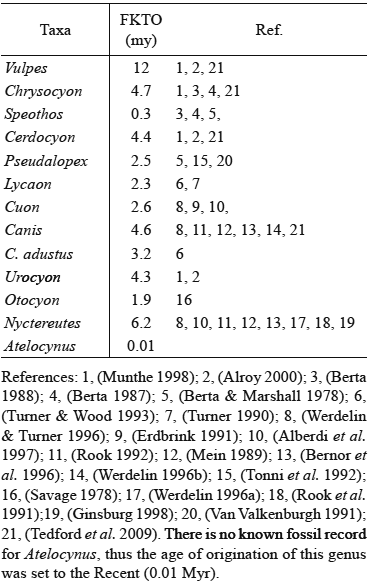
<body><![CDATA[<p><b>METHODS</b></p>     <p>There are several sources of phylogenetic information for the Caninae (Geffen    et al. 1992, Tedford et al. 1995, Wayne et al. 1997, Zrzav&yacute; &amp; &#344;i&#269;&aacute;nkov&aacute;    2004, Bardeleben et al. 2005; Lindblad-Toh et al. 2005, Prevosti 2010), however    there is only strong incongruence between two of these sources (Mu&ntilde;oz-Dur&aacute;n    &amp; Fuentes, in prep.). The first one includes 2001 base pairs of mitochondrial    DNA (mtDNA) used by Wayne et al. (1997) in a phylogenetic analysis of 23 canid    species. This sequence includes 729 bp of cytochrome b (Cytb), 588 bp of cytochrome    c oxidase I (COI), and 684 bp of cytochrome c oxidase II (COII). Since analyses    by Wayne et al. (1997) and Bardeleben et al. (2005) argued for congruent evolutionary    histories among these three mitochondrial sequences, they were included in a    single data partition (mtDNA). The second is a data set of 57 morphological    characters for 14 extant canid genera studied by Tedford et al. (1995). </p>     <p>The analysis was performed at the genus level; however, <i>Canis adustus</i>    Sundevall 1847 was included separately from the genus <i>Canis</i> Linnaeus    1758. The reasons for the above include: 1) most of the living canid genera    are monotypic, 2) the monophyletic status of the polytypic genera <i>Pseudalopex</i>    Burmeister 1856 and <i>Vulpes</i> Frisch 1775 have been confirmed by mtDNA and    nuclear genes analyses (Geffen et al. 1992, Wayne et al. 1997, Zrzav&yacute;    &amp; &#344;i&#269;&aacute;nkov&aacute; 2004, Bardeleben et al. 2005; Lindblad-Toh    et al. 2005), 3) <i>Canis</i> can be considered a coherent unit for analyses    on morphological grounds because of the level of similarity among its species    (Tedford et al. 1995); however, <i>Canis adustus</i> renders <i>Canis</i> polyphyletic    on mtDNA analyses (Wayne et al. 1997, Zrzav&yacute; &amp; &#344;i&#269;&aacute;nkov&aacute;    2004). </p>     <p>The selection of different species representing polytypic canid genera could    affect the results of this analysis. Therefore, sets of conflicting clades obtained    when different species were selected to represent polytypic genera were compared.    Complete mtDNA sequences used in this analysis are available for both <i>Vulpes    vulpes</i> Linnaeus 1758 and <i>V. macrotis</i> Merriam 1888, thus the analysis    was done once with each one of these species. Separate analyses were done for    the genus <i>Canis</i> using <i>C. mesomelas</i> Schreber 1775 and <i>C. latrans</i>    Say 1823, which are the most basal and one of the most derived species within    this genus, respectively, as suggested by mtDNA studies (Wayne et al. 1997).    Analyses were also performed using the most basal species within the genus <i>Pseudalopex</i>    Burmeister 1856, <i>P. sechurae</i> Thomas 1900, and one of the most derived    species, <i>P. culpaeus</i> Molina 1782 (Wayne et al. 1997). <i>Urocyon cinereoargenteus</i>    Schreber 1775 was selected to represent the genus Urocyon Baird 1858 because    it is the only species in this genus for which the sequence of mtDNA used here    is available.</p>     <p>Because the morphological data set of Tedford et al. (1995) and the molecular    data set of Wayne et al. (1997) use different outgroup taxa, the combined tree    in this analysis was rooted by combining the outgroup information. The phylogenetic    tree of Tedford et al. (1995) was rooted using as outgroup taxa Hesperocyoninae,    Borophaginae, and <i>Leptocyon</i> Matthew 1918. Since Hesperocyoninae is viewed    by Tedford et al. (1995) as a completely plesiomorphic stem-group for all later    canids, character states of this taxon were selected as the outgroup information    for morphological traits. Character states of the harbor seal (<i>Phoca vitulina</i>    Linnaeus 1758) were used as the outgroup information for the mtDNA data.</p>     <p>Separate and combined parsimony analyses of data sets were performed under    PAUP 4.0b10 (Swofford 2003) in PowerBook G3. Heuristic search using the options    of stepwise-addition, with swap on all if more than one starting tree existed,    closest addition sequence, holding of 100 trees at each step, and the tree bisection-reconnection    (TBR) swapping algorithm. The transition/transversion ratio was set to 1. Successive    weighting (Farris 1969) was used as a tool to identify the most likely MPT when    analyses yielded more than one MPT. In other words, when more than one MPT was    obtained, characters were reweighted based on their rescaled consistency index    (rc) and a new heuristic search was executed, keeping same parameters and options.    This was done until the topology was stabilized. This procedure never took more    than one reweighting cycle. </p>     <p>Phylogenetic signal value (g1; 1,000,000 random trees) was used as an estimation    of the strength of the phylogenetic signal in data set versus random noise (Hillis    &amp; Huelsenbeck 1992) for each data partition and for the combined data set.    Data set incongruence was assessed using bootstrap values (Felsenstein 1985).    Most parsimonious trees for each data set were obtained and bootstrap proportions    were calculated using 1000 bootstrap replicates, using the same search conditions    as described above. Most parsimonious trees from separate analyses of data sets    were examined for conflicts involving sister taxa hypotheses supported by bootstrap    proportions higher than 95%. For the sake of data set exploration, maximum likelihood    analyses were also performed on the mtDNA. MODELTEST 3.7 (Posada &amp; Buckley    2004) was used to estimate the best-fit model for DNA evolution. The ML tree    was calculated using the same search parameters as in the parsimony analyses.    I did not insist in systematically explore model based approaches for estimating    the phylogeny the Caninae since MCs may be the result of differences in life    history traits or of structural, functional and developmental constraints, among    other factors that are not accommodated by any model of sequence evolution I    am aware of. </p>     <p><b>Assessing the Accuracy of Conflicting Clades: Comparing Temporal Gaps</b></p>     <p>Temporal gaps (T), the difference between first known times of sister taxa    origination, were calculated using information on <a href="#tabla1">Table 1</a>.    Unfortunately, it was not possible to estimate confidence intervals for the    stratigraphic ranges of canids. Available methods not only require information    on first and last recorded appearances, but also on all occurrences of the taxa    between the first and last known records. This data is difficult to collect    for canid taxa with a broad geographical distribution. The limitations are related    to the lack of relevant rock outcrops in some areas, to low sampling effort    for some taxa and geographical regions, and to the access to existing data that    have not been published in international journals, among others.</p>     <center>       ]]></body>
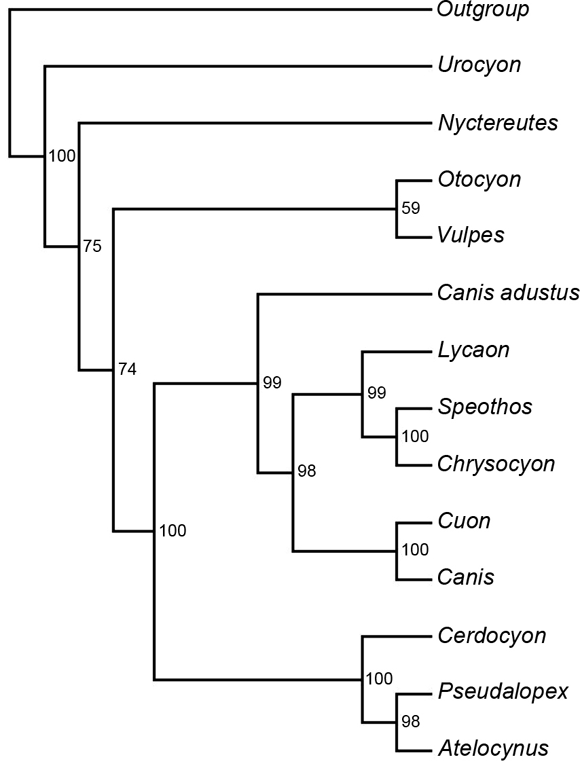
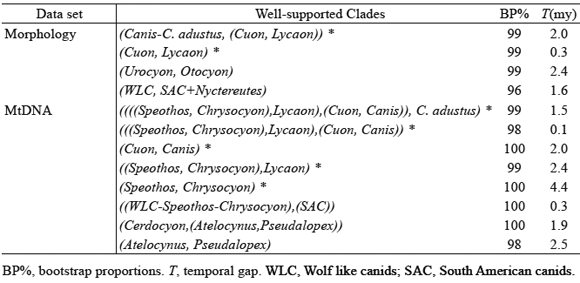
<body><![CDATA[<p><b>Table 1.</b> First known times of origination for canid genera. FKTO,      first known time of origination.</p> </center>     <center>       <p><img src="/img/revistas/cal/v33n2/v33n2a18tab1.gif"><a name="tabla1"></a>    </p> </center>     <p><b>Statistical test</b></p>     <p>One-tailed t-test was used to examine the following null hypotheses: first,    that the temporal gap calculated for each conflicting clade is not significantly    longer than the mean temporal gap of all other well-supported clades; second,    that the retention index (RI) of the MPT derived from the data sets in which    suspected MCs were reset to missing values was not significantly higher than    the mean value of this index from the MPTs derived from randomly modified data    sets. To test the latter hypothesis 100 replicates of the data sets were produced    in which an equal number of characters states (with the same distribution by    codon position in the case of the mtDNA data set) as the suspected MCs were    randomly reset to missing values. Lastly, a G-test was used to examine the hypothesis    that different codon positions and substitution types of the mtDNA genes did    not differ in the proportion of suspected misleading characters found on them.</p>     <p><b>RESULTS</b></p>     <p><b>Data Set Incongruence</b></p>     <p>Phylogenetic analyses of separate morphological and mtDNA data sets led to    the most parsimonious trees shown in <a href="#figura1a">Figure 1A</a>, <a href="#figura1b">figure    1B</a>. The topology of these trees is the most stable, not only because they    are among the initial set of MPTs derived from the data sets but also because    these are the resulting topologies after one cycle of reweighting. Data set    incongruence as indicated by bootstrap support of clades led to the identification    of the conflicting phylogenetic hypotheses presented in <a href="#tabla2">Table    2</a>. This table also presents temporal gaps (T) for all clades (conflicting    and non-conflicting) supported by BP&gt;95%. Little or no bootstrap support    for conflicting nodes in rival trees was found when tables of bootstrap partitions    for each data set were examined. Conflicting clades referred to the hypothesized    phylogenetic relationships among the wolf like canids genera and two South American    genera <i>Speothos</i> Lund 1839 and Chrysocyon Hamilton-Smith 1839. The sister    taxa hypothesis between these last genera (100% BP) was included in the set    of conflicting clades since its grouping with <i>Lycaon</i> Brookes 1827 is    conflictive. The mtDNA suggest that the <i>Lycaon</i> lineage and the hypothesized    ancestor of <i>Speothos</i> and <i>Chrysocyon</i> split from a common ancestor    about 4.7 Myr. To test this hypothesis it is necessary to test also the hypothesis    that <i>Speothos</i> and <i>Chrysocyon</i> evolved from a common ancestor. In    this manner, the internal consistency of the node is tested. </p>     <p>        <center>     <img src="/img/revistas/cal/v33n2/v33n2a18fig1a.gif"><a name="figura1a"></a>    </center>     ]]></body>
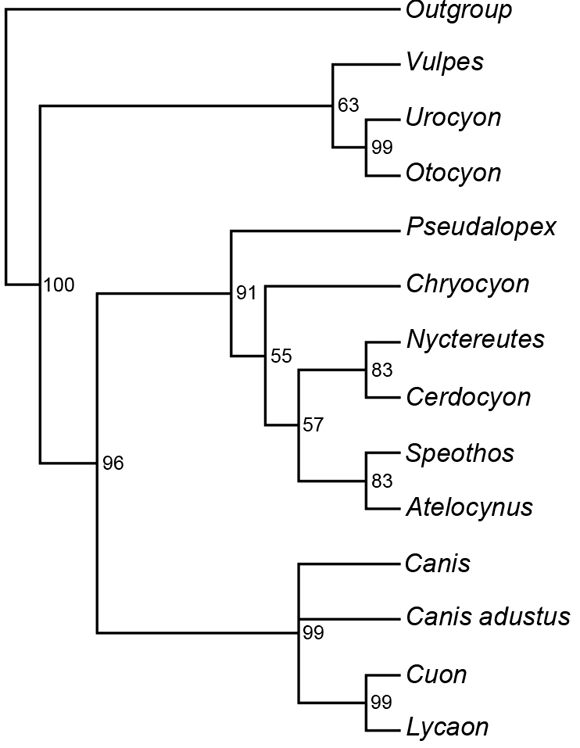
<body><![CDATA[<center>       <p><b>Figure 1A.</b> Most parsimonious tree from morphological data set with      bootstrap proportions.&nbsp; </p>       <p>          <center>       <img src="/img/revistas/cal/v33n2/v33n2a18fig1b.gif"><a name="figura1b"></a>      </center>       <center>         <p><b>Figure 1B.</b> Most parsimonious tree from mtDNA data set with bootstrap        proportions. </p>         <p></p>   </center> </center>     <center>       <p><b>Table 2.</b> Temporal gaps for all well-supported clades (conflicting      and non-conflicting) on trees derived from the independent analyses of data      sets. Conflicting clades are identified with an asterisk (*).</p> </center>     <center>       ]]></body>
<body><![CDATA[<p><img src="/img/revistas/cal/v33n2/v33n2a18tab2.gif"><a name="tabla2"></a>    </p> </center>     <p>The selection of different species representing polytypic genera in the mtDNA    data set did not affect the set of conflicting clades between the MPTs from    morphology and mtDNA. The main effect of including different species from polytypic    genera was the rearrangement of the phylogenetic relationships among the genera    <i>Vulpes, Nyctereutes</i> Temminck 1839, <i>Urocyon</i> and <i>Otocyon</i>    M&uuml;ller 1836. However, none of these different phylogenetic arrangements    was supported by &gt;95% bootstrap proportions and did not lead to the identification    of new conflicting clades. The mtDNA trees shown in this paper were derived    from analyses in which Canis mesomelas, Pseudalopex culpaeus, and Vulpes vulpes    represent their corresponding genera.</p>     <p><b>Accuracy of Conflicting Clades</b></p>     <p><b>Comparing Temporal Gaps.</b> The sister taxa hypothesis between <i>Speothos</i>    and <i>Chrysocyon</i> was the only conflicting clade whose temporal gap was    significantly longer than the mean temporal gap of all other well-supported    clades (t = -2.575, p = 0.012). Thus, the characters supporting this clade were    further analyzed.</p>     <p><b>Suspected Misleading Characters (MCs).</b> Contrary to expectations that    most suspected MCs must be associated with third codon positions, the results    of a G-test indicated that there are no significant differences in the proportion    of suspected MCs among the three classes of codon positions (df = 2, G = 1.5806,    p &gt; 0.05). Although the great majority of suspected MCs corresponds to third    positions, normalizing by the number of parsimony informative characters in    each of the three codon positions shows that third codon positions have a relative    low proportion (10 %) of parsimony informative characters in which suspected    MCs were found, only 47 out of 472 (<a href="#tabla3">Table 3</a>). First codon    positions have the largest proportion (15.1%) of suspected MCs relative to the    total number of parsimony informative characters on that codon position.</p>     <center>       <p><b>Table 3.</b> Temporal gaps for all well-supported clades (conflicting      and non-conflicting) on trees derived from the independent analyses of data      sets. Conflicting clades are identified with an asterisk (*).</p> </center>     <center>       <p><img src="/img/revistas/cal/v33n2/v33n2a18tab3.gif"><a name="tabla3"></a>    </p> </center>     <p>Suspected MCs in all three codon positions correspond mostly to transitions    rather than transversions (df = 1, G = 23.76, p &lt; 0.001). All suspected MCs    in first and second codon positions result from transitions, as well as 42 out    of 47 suspected MCs in third positions (<a href="#tabla3">Table 3</a>). This    pattern is in agreement with expectations on the relative frequency of substitution    types.     ]]></body>
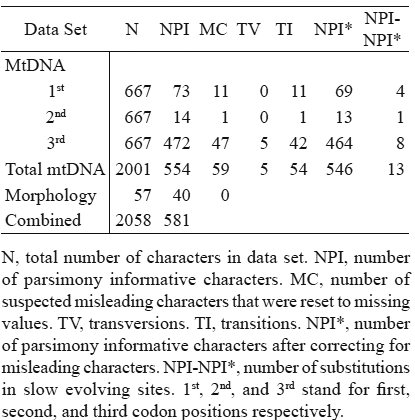
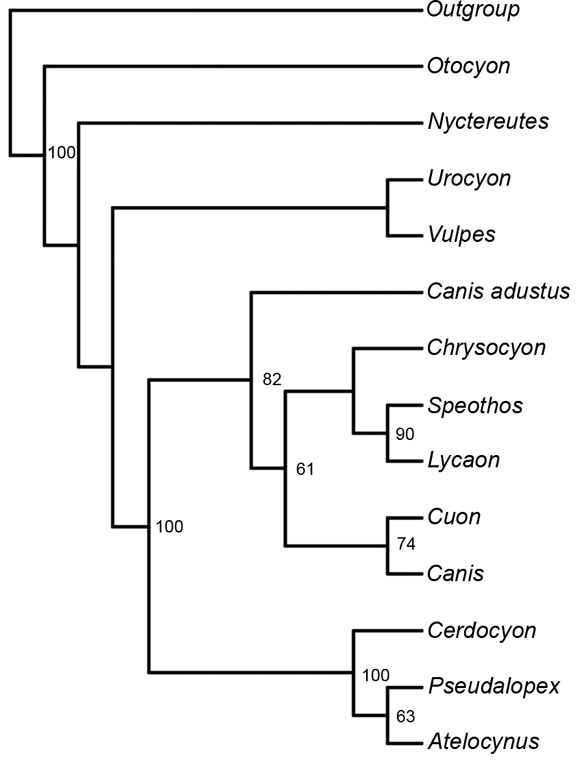
<body><![CDATA[<br>   About half of the suspected MCs may result from homoplasies in non-synonymous    positions and in other slow evolving third codon positions. An inspection of    the distribution of character states in other genera besides <i>Speothos</i>    and <i>Chrysocyon</i> showed that in 29 out of 59 instances of suspected MCs,    the character for most of the remaining genera was fixed in the ancestral state.    In other words, about half of the suspected MCs may have resulted from homoplasies    in characters with a slow rate of nucleotide substitution. This is associated    with the observed reduction in the number of parsimony informative characters    in the mtDNA data set after controlling for misleading characters (<a href="#tabla3">Table    3</a>). The reduction in 13 parsimony informative characters corresponds to    13 MCs that were reset to missing values in sites where no more than one other    genus, in addition to <i>Speothos</i> and <i>Chrysocyon</i>, expressed the derived    character state. These 13 MCs correspond to four TIs in first position, one    TI in second position, and eight TIs in third position.</p>     <p>Suspected MCs in first and second positions were associated with functional    and structural constraints of mitochondrial proteins. All suspected MCs on first    and second codon positions are related to amino acid replacements involving    the hydrophobic residues leucine, isoleucine, valine, and threonine. Furthermore,    based on a model of cytochrome b (Degli Esposti 1993), it was observed that    all but two suspected MCs in first and second positions found in that protein    are associated with transmembrane amino-acid residues. The remaining two suspected    MCs correspond to first positions and are associated with amino acids on the    intermembrane domain. </p>     <p><b>Assessing the effect on homoplasy and Controlling for Misleading Characters    (MCs)</b></p>     <p>The previous analyses suggested that the <i>Speothos - Chrysocyon</i> clade    was more likely an artifact of MCs in the mtDNA data set. Thus, the characters    supporting this clade were reset to missing values in both genera and a new    MPT was calculated (<a href="#figura2">Figure 2</a>). Controlling for MCs led    to a reduction of only 0.4% in the size of the molecular data set, and an increase    of 7% in the strength of its phylogenetic signal (g1 changed from -0.56 to -0.60).  </p>     <p>        <center>     <img src="/img/revistas/cal/v33n2/v33n2a18fig2.gif"><a name="figura2"></a>    </center>     <center>       <p><b>Figure 2.</b> Most parsimonious tree from the modified mtDNA data set      (after misleading characters were reset to missing values).</p> </center>     <p>One hundred copies of the mtDNA data set were prepared in which 118 character    states (since 59 characters states were reset to missing values for both <i>Speothos</i>    and <i>Chrysocyon</i>) with the same distribution by codon position as the suspected    MCs were randomly reset to missing values. These data sets included only parsimony    informative characters from the original mtDNA data set. </p>     <p>Resetting to missing values suspected MCs reduced homoplasy in the mtDNA data    set in a manner that was significantly different from random. Results of t-tests    (df = 99) for some tree statistics were as follow: tree length, t = 17.365,    p &lt; 0.001; consistency index, t = -6.681, p &lt;0.001; retention index, t    = -5.779, p &lt;0.001; rescaled consistency index, t = -6.631, p &lt;0.001.    After controlling for misleading characters, a comparison of new MPT from the    modified mtDNA data set with the MPT from the morphological data did not indicate    the presence of new conflicting clades. Thus, both data sets were combined and    a MPT was calculated.</p>     ]]></body>
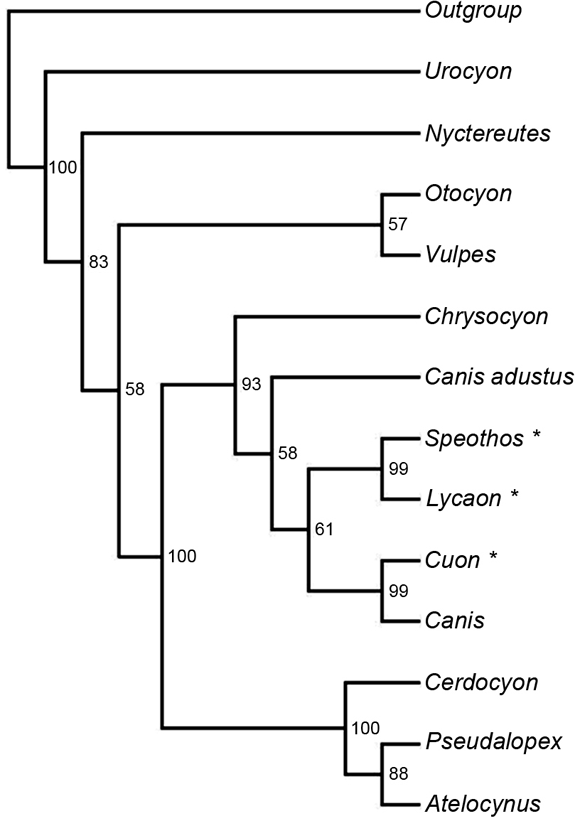
<body><![CDATA[<p><b>Combined Analysis</b></p>     <p>The MPT from the combined morphological and mtDNA (<a href="#figura3">Figure    3</a>) shows the foxes at the base of the Caninae. Urocyon is the most basal    species followed by Nyctereutes. A clade shared by Otocyon and Vulpes is placed    as the sister taxon of a large clade including the wolflike canids and the South    American canids. The latter form a polyphyletic group, with <i>Chrysocyon</i>    at the base of the wolf-like canid clade and <i>Speothos</i> in a well supported    clade (99% BP) with Lycaon. This tree also shows that the trenchant heel evolved    once in the Caninae but later was lost in the Canis lineage. The same set of    relationships is supported by the maximum likelihood tree after controlling    for MCs (tree not shown, the best-fit model is GTR+I+G).</p>     <p>        <center>     <img src="/img/revistas/cal/v33n2/v33n2a18fig3.gif"><a name="figura3"></a>    </center>     <center>       <p><b>Figure 3.</b> Most parsimonious tree from the combined morphological and      mtDNA data set. Asterisks indicate the trenchant heeled species.&nbsp; </p> </center>     <p><b>DISCUSSION</b></p>     <p>Incompleteness of the fossil record has been mistakenly equated to inadequacy    (Paul 1992, Clyde &amp; Fisher 1997, Paul 1998) of the fossil record in phylogenetic    inference and in testing evolutionary hypotheses. However, it has been demonstrated    (Norell &amp; Novacek 1992, Benton 1995, Benton &amp; Hitchin 1997, Clyde &amp;    Fisher 1997, Hitchin &amp; Benton 1997, Hermsen et al. 2006, Rothwell &amp;    Nixon 2006, Cobbett et al. 2007, Wills et al. 2008, Magall&oacute;n 2010) that    fossil data and the stratigraphic sequence of fossil taxa carry a conspicuous    phylogenetic signal. It is precisely this expected correspondence between the    sequence of taxa origination in the rocks and estimates of phylogeny that has    promoted the exploration of more comprehensive approaches to phylogenetic inference.</p>     <p>I use temporal data to identify well-supported, conflicting clades among MPTs    that may result from the effect of misleading characters. Because conflicting    clades with exceptional long temporal gaps may result either from incompleteness    of the fossil record or from the effect of MCs, these clades are rejected only    after evidence suggesting the homoplastic nature of the characters that support    them is gathered. The main goal of this approach is to use stratigraphic data    to identify and control for sources of incongruence among data sets previous    to a &quot;total evidence&quot; analysis. This is different from previous methods    in which known times of taxa origination are used either to test the reliability    of entire phylogenetic trees or as an optimality criterion to estimate phylogenetic    trees (Gauthier et al. 1988, Fisher 1992, Norell &amp; Novacek 1992, Benton    &amp; Storrs 1994, Huelsenbeck 1994, Smith &amp; Littlewood 1994, Wagner 1995,    Clyde &amp; Fisher 1997, Huelsenbeck &amp; Rannala 1997, Siddall 1998, Wills    1999, Angielczyk 2002, Pol &amp; Norell 2006, Wills et al. 2008). Furthermore,    the approach proposed here and the results of this study support the claim (Wiens    2005, Cobbett et al. 2007, Magall&oacute;n 2010) that fossil data, stratigraphic    data in this particular case, can break up long branches. The sister taxa relationship    between <i>Speothos</i> and <i>Chrysocyon</i>, implied by the mtDNA data set,    arose from the structural and functional constrains. These constraints lead    to among-site rate variation, a known cause of long-branch attraction (Poe 2003,    Wiens 2005).</p>     <p><b>Misleading characters</b></p>     ]]></body>
<body><![CDATA[<p>Incongruence between the morphological and mtDNA data sets found in this study    may be in part explained by differences in evolutionary rates among these two    data sources. That MCs were detected only in the mtDNA data set could be explained    by higher evolutionary rates in this data set, which make it more prone to saturation,    and therefore homoplasy, in lineages that have long diverged from a common ancestor.    This in turn could result in instances of long-branch attraction as the sister    taxa relationship between <i>Speothos</i> and <i>Chrysocyon</i> suggested by    the mtDNA data set. </p>     <p>The results of this study suggest that, similarly to systematic biases (Brinkmann    et al. 2005, Jeffroy et al. 2006, Rodr&iacute;guez-Ezpeleta et al. 2007), the    presence of MCs in a dataset may result in well supported but inaccurate sister    clade hypotheses. Furthermore, it is suggested that controlling for misleading    characters must be accomplished after evidence indicating their misleading status    has been gathered. A priori weighting schemes, such as giving higher weights    to substitutions in slow evolving positions and down-weighting third position    substitutions, could have had, if used in the present study, a doubly misleading    effect. On the one hand, similarly to recent studies (Hansen et al. 2005, Simmons    et al. 2006, Seo &amp; Kishino 2008), results suggest that third positions are    phylogenetically informative and that only a small fraction of all substitutions    in this position may distort the phylogenetic signal in the mtDNA data set.    This is in agreement with the low rate of saturation found in this mtDNA data    set by Wayne et al. (1997). In addition to MCs, third codon substitutions may    include other homoplasies that do not greatly affect the phylogenetic signal,    and substitutions that do have phylogenetic content. More importantly, characters    are neither informative nor misleading across all clades in a cladogram. On    the contrary, a character can be both informative in some clades and misleading    in others. Therefore, down-weighting or eliminating all third codon substitutions    in this analysis would had overestimated the amount of MCs and produce a loss    of information. </p>     <p>On the other hand, contrary to a priori expectations, results also showed that    there are not significant differences in the proportion of MCs among different    classes of codon positions. Therefore, not all substitutions in first and second    positions will accurately reflect the pattern of descent in the molecular data    set. A priori weighting schemes that assign higher weights to substitutions    in slow evolving positions could actually enhance the misleading effect of misleading    characters in those positions. </p>     <p>The approach proposed in this paper may prove a suitable alternative in identifying    and controlling for characters that confuse the historical pattern in a data    set, and that may lead to long-branch attraction. The homoplastic condition    of the MCs identified through this approach is supported by evidence on the    functional and structural constraints of mitochondrial proteins. The results    of this analysis showed not only that non-synonymous sites have an important    proportion of MCs, but also that those MCs are associated with substitutions    between hydrophobic amino acid residues that, in the case of the Cytochrome    b protein, tend to be located on transmembrane domains. This pattern is in agreement    with functional and structural expectations, indicating that although the rate    of nucleotide substitution in first and second positions is lower in comparison    with the rate at third positions, the probability that nucleotide substitutions    in these positions result in homoplastic characters is high. This is due to    functional requirements of hydrophobicity that constrain the number of possible    character states at first and second positions (Howell 1989, Degli Esposti et    al. 1993, Naylor et al. 1995, Griffiths 1997, Naylor &amp; Brown 1997, Hassanin    et al. 1998, Naylor &amp; Brown 1998). For instance, it has been found (Naylor    et al. 1995, Hassanin et al. 1998) that the need of conserving hydrophobic properties    constrains the type of nucleotide substitution in first positions mainly to    A-G transitions and in second positions to C-T transitions.</p>     <p>The results of the present analysis may also be an example of heterotachy (Philippe    &amp; Lopez 2001, Lopez et al. 2002). This is because MCs affect only the <i>Chrysocyon</i>    and <i>Speothos</i> lineages, and arose from biased codon substitutions that    did not affect hydrophobic and functional properties of trasmembrane regions    of the cytochrome b protein, as it could be expected for proteins that participate    on fundamental metabolic processes and are under strong stabilizing selective    pressures. Identified MCs indicate among lineage variation on the proportion    and position of variable sites of the cytochrome b sequence.</p>     <p>The above suggests that paleontological data and the approach outlined in this    paper not only allows for testing the phylogenetic accuracy of conflicting phylogenetic    hypotheses, but it also may be a more suitable option than a priori weighting    schemes in identifying and accounting for characters that confuse the phylogenetic    signal in a data set. This approach may prove useful in reducing incongruence    among data sets prior to a total evidence analysis.</p>     <p><b>Phylogeny of Caninae</b></p>     <p>Although the main objective of this analysis is not to estimate the phylogeny    of the Caninae, I would like to comment on the implications of the topology    of the resulting cladogram. The combined tree not only optimizes all available    morphological and mtDNA characters, but it also conforms to paleontological    data. In the combined tree neither the temporal gap for the <i>Speothos - Lycaon</i>    clade (2 my) nor for the <i>Chrysocyon</i> - wolflike canid clade (0,1 my) are    significantly longer compared to other well-supported clades. The presence of    clades with BP &lt;95% indicates that more data is still needed to resolve the    exact phylogenetic relationships of some canid taxa, particularly the radiation    pattern of basal genera <i>Urocyon, Otocyon, Nyctereutes</i>, and the South    American genus <i>Chrysocyon</i>.</p>     <p>The combined tree shows Urocyon at the base of the radiation of the extant    Caninae, followed by Nyctereutes, a clade shared by <i>Otocyon</i> and <i>Vulpes</i>    and finally a large clade including all genera of dog-like canids (<i>Cerdocyon</i>    + <i>Pseudalopex</i> + <i>Atelocynus</i> + <i>Chrysocyon</i> + <i>Cuon</i> +    <i>Canis</i> + <i>Speothos</i> + <i>Lycaon</i>). </p>     <p>The MPT from the combined data set supports the hypothesis of a polyphyletic    origin of the diverse group of South American canids (Geffen et al. 1996, Wayne    et al. 1997, Lindblad-Toh et al. 2005, Prevosti 2010). Coincident with the results    of recent analyses (Zrzav&yacute; &amp; &#344;i&#269;&aacute;nkov&aacute; 2004,    Bardeleben et al. 2005), there is still uncertainty on the phylogenetic position    of <i>Speothos</i> and <i>Chrysocyon</i>. Analyses including larger morphological,    behavioral, and molecular data combined with paleontological information are    needed to resolve long standing questions related to the evolutionary affinities    of these South American canids. Particularly, the possibility that <i>Speothos</i>    may belong to a clade of hypercarnivorous canids, together with <i>Lycaon</i>    and <i>Cuon</i>, has received support from recent analyses of dental and osteological    characters (Prevosti 2010). This is a hypothesis that deserves further consideration.  </p>     ]]></body>
<body><![CDATA[<p>The tree indicates the successful colonization of South America by four canid    lineages: <i>Chrysocyon, Speothos, Urocyon</i> and the common ancestor of remaining    South American genera. Although the genus <i>Canis</i> does not inhabit in South    America at the present time, there is a fossil record for this genus in Plio-Pleistocene    formations in this continent (Prevosti, 2010), which indicates at least five    independent colonization events of canid lineages into South America. </p>     <p>The resulting tree also shows that the wolf-like canids form a clade together    with Speothos and Chrysocyon. The position of C. adustus still renders the genus    Canis as polyphyletic, a feature that is common to most phylogenetic analyses    of the Caninae (Wayne et al. 1997, Zrzav&yacute; &amp; &#344;i&#269;&aacute;nkov&aacute;    2004, Lindblad-Toh et al. 2005). The results of the present analysis support    previous suggestions of including C. adustus in a separate genus Lupulella Hilzheimer    1906 (Zrzav&yacute; &amp; &#344;i&#269;&aacute;nkov&aacute; 2004).</p>     <p>The trenchant heel, a specialized cutting blade on the lower carnassial molar,    represents an adaptation to increasing carnivory (Van Valkenburgh 1990) and    is present in all social canines except Canis lupus Linnaeus 1758. The results    of the present analysis suggest that this structure evolved only once in the    common ancestor of the wolf-like canids and Speothos, but that it was later    lost in the lineage leading to Canis. This is a simpler hypothesis compared    to previous hypotheses suggesting that the trenchant heel has a single origin    followed by multiple losses (Wayne et al. 1997), or that it evolved independently    in two lineages and was later lost in one lineage (Tedford et al. 1995, Geffen    et al. 1996, Wayne et al. 1997, Bardeleben et al. 2005, Lindblad-Toh et al.    2005) or that it has three independent origins and several loses (Clutton-Brock    et al. 1976, Wayne et al. 1997).</p>     <p><b>CONCLUDING REMARKS</b></p>     <p>Paleontology provides information on approximate times of taxa origination    which constitutes independent evidence on the evolutionary history of a group.    These hints from the fossil record can be used to test the accuracy of conflicting    cladistic hypotheses, and to identify and account for characters which confuse    the pattern of shared ancestry in a data set. The approach proposed in this    paper leads to a more comprehensive approach to phylogenetic inference through    the incorporation of fossil data in the search for more accurate phylogenies.    The application of this procedure to the phylogeny of the Caninae allowed a    reduction in the level of incongruence among the morphological and mtDNA data    sets, and led to a better tuning of their common phylogenetic signal. However,    additional molecular and/or morphological data is still necessary to have a    better estimate of the phylogenetic relationships of various canid taxa. Further    phylogenetic analysis of other groups with a well preserved fossil record may    reveal the extent to which this approach could be applied, as well as other    limitations for its application.</p>     <p><b>ACKNOWLEDGMENTS</b></p>     <p>I am grateful to Jesualdo Arturo Fuentes and the three referees of this manuscript    for their suggestions and thoughtful criticism of the manuscript. I thank Dorina    Apahidean for her editorial assistance. I also thank the Colombian Agency for    the Advance of Science and Technology-COLCIENCIAS (contract 192-2007) and the    Divisi&oacute;n de Investigaciones at the Universidad Nacional de Colombia -    Sede Bogot&aacute; (DIB, Project 8373), for their financial support.</p>     <p><b>LITERATURE CITED</b></p>     <!-- ref --><p> 1. ALBERDI, M. T., B. AZANZA, E. CERDE&Ntilde;O &amp; J. L. PRADO. 1997. Similarity    relationship between Mammal faunas and bichronology from Latest Miocene to Pleistocene    in the Western Mediterranean area. Eclogae Geologicae Helvetiae 90: 115-132.    &nbsp;&nbsp;&nbsp;&nbsp;&nbsp;&nbsp;&nbsp;&nbsp;[&#160;<a href="javascript:void(0);" onclick="javascript: window.open('/scielo.php?script=sci_nlinks&ref=000111&pid=S0366-5232201100020001800001&lng=','','width=640,height=500,resizable=yes,scrollbars=1,menubar=yes,');">Links</a>&#160;]<!-- end-ref --><!-- ref --><br>   2. ALROY, J. 2000. Understanding the dynamics of trends within evolving lineages.    Paleobiology 26: 319-329.    &nbsp;&nbsp;&nbsp;&nbsp;&nbsp;&nbsp;&nbsp;&nbsp;[&#160;<a href="javascript:void(0);" onclick="javascript: window.open('/scielo.php?script=sci_nlinks&ref=000112&pid=S0366-5232201100020001800002&lng=','','width=640,height=500,resizable=yes,scrollbars=1,menubar=yes,');">Links</a>&#160;]<!-- end-ref --><!-- ref --><br>   3. AN&Eacute;, C., B. LARGET, D. A. BAUM, S. D. SMITH &amp; A. ROKAS. 2007.    Bayesian Estimation of Concordance among Gene Trees. Molecular Biology and Evolution    24: 412-426.    &nbsp;&nbsp;&nbsp;&nbsp;&nbsp;&nbsp;&nbsp;&nbsp;[&#160;<a href="javascript:void(0);" onclick="javascript: window.open('/scielo.php?script=sci_nlinks&ref=000113&pid=S0366-5232201100020001800003&lng=','','width=640,height=500,resizable=yes,scrollbars=1,menubar=yes,');">Links</a>&#160;]<!-- end-ref --><!-- ref --><br>   4. ANGIELCZYK, K. D. 2002. A character-based method for measuring the fit of    a cladogram to the fossil record. Systematic Biology 51: 176-191.    &nbsp;&nbsp;&nbsp;&nbsp;&nbsp;&nbsp;&nbsp;&nbsp;[&#160;<a href="javascript:void(0);" onclick="javascript: window.open('/scielo.php?script=sci_nlinks&ref=000114&pid=S0366-5232201100020001800004&lng=','','width=640,height=500,resizable=yes,scrollbars=1,menubar=yes,');">Links</a>&#160;]<!-- end-ref --><!-- ref --><br>   5. ASHER, R. J., M. J. NOVACEK &amp; J. H. GEISLER. 2003. Relationships of Endemic    African Mammals and Their Fossil Relatives Based on Morphological and Molecular    Evidence. Journal of Mammalian Evolution 10: 131-194.    &nbsp;&nbsp;&nbsp;&nbsp;&nbsp;&nbsp;&nbsp;&nbsp;[&#160;<a href="javascript:void(0);" onclick="javascript: window.open('/scielo.php?script=sci_nlinks&ref=000115&pid=S0366-5232201100020001800005&lng=','','width=640,height=500,resizable=yes,scrollbars=1,menubar=yes,');">Links</a>&#160;]<!-- end-ref --><!-- ref --><br>   6. AZZAROLI, A. 1995. The &#8220;Elephant-Equus&#8221; and the &#8220;End-Villafranchian&#8221;    events in Eurasia. En: E.S. Vrba, G.H. Denton, T.C. Patridge &amp; L.H. Burckle    eds.). Paleoclimate and evolution, with emphasis on human evolution: 311-318.    Yale University Press. New Haven and London.    &nbsp;&nbsp;&nbsp;&nbsp;&nbsp;&nbsp;&nbsp;&nbsp;[&#160;<a href="javascript:void(0);" onclick="javascript: window.open('/scielo.php?script=sci_nlinks&ref=000116&pid=S0366-5232201100020001800006&lng=','','width=640,height=500,resizable=yes,scrollbars=1,menubar=yes,');">Links</a>&#160;]<!-- end-ref --><!-- ref --><br>   7. BALLARD, J. W. O., M. K. THAYER, A. F. NEWTON &amp; E. R. GRISMER. 1998.    Data sets, partitions, and characters: philosophies and procedures for analyzing    multiple data sets. Systematic Biology 47: 367-396.    &nbsp;&nbsp;&nbsp;&nbsp;&nbsp;&nbsp;&nbsp;&nbsp;[&#160;<a href="javascript:void(0);" onclick="javascript: window.open('/scielo.php?script=sci_nlinks&ref=000117&pid=S0366-5232201100020001800007&lng=','','width=640,height=500,resizable=yes,scrollbars=1,menubar=yes,');">Links</a>&#160;]<!-- end-ref --><!-- ref --><br>   8. BARDELEBEN, C., R. L. MOORE &amp; R. K. WAYNE. 2005. A molecular phylogeny    of the Canidae based on six nuclear loci. Molecular Phylogenetics and Evolution    37: 815-831.    &nbsp;&nbsp;&nbsp;&nbsp;&nbsp;&nbsp;&nbsp;&nbsp;[&#160;<a href="javascript:void(0);" onclick="javascript: window.open('/scielo.php?script=sci_nlinks&ref=000118&pid=S0366-5232201100020001800008&lng=','','width=640,height=500,resizable=yes,scrollbars=1,menubar=yes,');">Links</a>&#160;]<!-- end-ref --><!-- ref --><br>   9. BENTON, M. J. 1995. Testing the time axis of phylogenies. Philosophical Transactions    of the Royal Society of London B Biological Sciences 349: 5-10.    &nbsp;&nbsp;&nbsp;&nbsp;&nbsp;&nbsp;&nbsp;&nbsp;[&#160;<a href="javascript:void(0);" onclick="javascript: window.open('/scielo.php?script=sci_nlinks&ref=000119&pid=S0366-5232201100020001800009&lng=','','width=640,height=500,resizable=yes,scrollbars=1,menubar=yes,');">Links</a>&#160;]<!-- end-ref --><!-- ref --><br>   10. BENTON, M. J. &amp; R. HITCHIN. 1997. Congruence between phylogenetic and    stratigraphic data on the history of life. Proceedings of the Royal Society    Biological Sciences Series B 264: 885-890.    &nbsp;&nbsp;&nbsp;&nbsp;&nbsp;&nbsp;&nbsp;&nbsp;[&#160;<a href="javascript:void(0);" onclick="javascript: window.open('/scielo.php?script=sci_nlinks&ref=000120&pid=S0366-5232201100020001800010&lng=','','width=640,height=500,resizable=yes,scrollbars=1,menubar=yes,');">Links</a>&#160;]<!-- end-ref --><!-- ref --><br>   11. BENTON, M. J. &amp; G. W. STORRS. 1994. Testing the quality of the fossil    record: paleontological knowledge is improving. Geology 22: 111-114.    &nbsp;&nbsp;&nbsp;&nbsp;&nbsp;&nbsp;&nbsp;&nbsp;[&#160;<a href="javascript:void(0);" onclick="javascript: window.open('/scielo.php?script=sci_nlinks&ref=000121&pid=S0366-5232201100020001800011&lng=','','width=640,height=500,resizable=yes,scrollbars=1,menubar=yes,');">Links</a>&#160;]<!-- end-ref --><!-- ref --><br>   12. BERNOR, R. L., V. FAHLBUSCH, P. ANDREWS, H. DE BRUIJN, M. FORTELIUS, F.    ROGL, F. F. STEININGER &amp; L. WERDELIN. 1996. The evolution of Western Eurasian    Neogene Mammal faunas: a chronologic, systematic, biogeographic, and paleoenvironmental    synthesis. En: L. Bernor, V. Fahlbusch &amp; H.-W. Mittmann eds.). The evolution    of Western Eurasian Neogene Mammal Faunas.: 449-469. Columbia University Press.    New York.    &nbsp;&nbsp;&nbsp;&nbsp;&nbsp;&nbsp;&nbsp;&nbsp;[&#160;<a href="javascript:void(0);" onclick="javascript: window.open('/scielo.php?script=sci_nlinks&ref=000122&pid=S0366-5232201100020001800012&lng=','','width=640,height=500,resizable=yes,scrollbars=1,menubar=yes,');">Links</a>&#160;]<!-- end-ref --><!-- ref --><br>   13. BERTA, A. 1987. Origin, diversification, and zoogeography of the South American    Canidae. Fieldiana Zoology. 39: 455-472.    &nbsp;&nbsp;&nbsp;&nbsp;&nbsp;&nbsp;&nbsp;&nbsp;[&#160;<a href="javascript:void(0);" onclick="javascript: window.open('/scielo.php?script=sci_nlinks&ref=000123&pid=S0366-5232201100020001800013&lng=','','width=640,height=500,resizable=yes,scrollbars=1,menubar=yes,');">Links</a>&#160;]<!-- end-ref --><!-- ref --><br>   14. BERTA, A. 1988. Quaternary evolution and biogeography of the large South    American Canidae (Mammalia: Carnivora). University of California Publications    on Geological Sciences 132: 1-160.    &nbsp;&nbsp;&nbsp;&nbsp;&nbsp;&nbsp;&nbsp;&nbsp;[&#160;<a href="javascript:void(0);" onclick="javascript: window.open('/scielo.php?script=sci_nlinks&ref=000124&pid=S0366-5232201100020001800014&lng=','','width=640,height=500,resizable=yes,scrollbars=1,menubar=yes,');">Links</a>&#160;]<!-- end-ref --><!-- ref --><br>   15. BERTA, A. &amp; L. MARSHALL. 1978. South American Carnivora. En: F. Westphal    (ed. Fossilium Catalogus l : Animalia: 1-48. Dr. W. Junk b.v. Publishers. The    Hague/ Boston/London.    &nbsp;&nbsp;&nbsp;&nbsp;&nbsp;&nbsp;&nbsp;&nbsp;[&#160;<a href="javascript:void(0);" onclick="javascript: window.open('/scielo.php?script=sci_nlinks&ref=000125&pid=S0366-5232201100020001800015&lng=','','width=640,height=500,resizable=yes,scrollbars=1,menubar=yes,');">Links</a>&#160;]<!-- end-ref --><!-- ref --><br>   16. BRINKMANN, H., M. VAN DER GIEZEN, Y. ZHOU, G. T. PONCELIN DE RAUCOURT &amp;    H. PHILIPPE. 2005. An empirical assessment of long-branch attraction artefacts    in deep eukaryotic phylogenomics. Systematic Biology 54: 743-757.    &nbsp;&nbsp;&nbsp;&nbsp;&nbsp;&nbsp;&nbsp;&nbsp;[&#160;<a href="javascript:void(0);" onclick="javascript: window.open('/scielo.php?script=sci_nlinks&ref=000126&pid=S0366-5232201100020001800016&lng=','','width=640,height=500,resizable=yes,scrollbars=1,menubar=yes,');">Links</a>&#160;]<!-- end-ref --><!-- ref --><br>   17. BROCHU, C. A. 1997. Morphology, fossils, divergence timing, and the phylogenetic    relationships of Gavialis. Systematic Biology 46: 479-522.    &nbsp;&nbsp;&nbsp;&nbsp;&nbsp;&nbsp;&nbsp;&nbsp;[&#160;<a href="javascript:void(0);" onclick="javascript: window.open('/scielo.php?script=sci_nlinks&ref=000127&pid=S0366-5232201100020001800017&lng=','','width=640,height=500,resizable=yes,scrollbars=1,menubar=yes,');">Links</a>&#160;]<!-- end-ref --><!-- ref --><br>   18. BULL, J. J., J. P. HUELSENBECK, C. W. CUNNINGHAM, D. L. SWOFFORD &amp; P.    J. WADDELL. 1993. Partitioning and combining data in phylogenetic analysis.    Systematic Biology 42: 384-397.    &nbsp;&nbsp;&nbsp;&nbsp;&nbsp;&nbsp;&nbsp;&nbsp;[&#160;<a href="javascript:void(0);" onclick="javascript: window.open('/scielo.php?script=sci_nlinks&ref=000128&pid=S0366-5232201100020001800018&lng=','','width=640,height=500,resizable=yes,scrollbars=1,menubar=yes,');">Links</a>&#160;]<!-- end-ref --><!-- ref --><br>   19. CLUTTON-BROCK, J., G. B. CORBETT &amp; M. HILLS. 1976. A review of the family    Canidae with a classification by numerical methods. Bulletin of the British    Museum (Natural History), Zoology 119-199.    &nbsp;&nbsp;&nbsp;&nbsp;&nbsp;&nbsp;&nbsp;&nbsp;[&#160;<a href="javascript:void(0);" onclick="javascript: window.open('/scielo.php?script=sci_nlinks&ref=000129&pid=S0366-5232201100020001800019&lng=','','width=640,height=500,resizable=yes,scrollbars=1,menubar=yes,');">Links</a>&#160;]<!-- end-ref --><!-- ref --><br>   20. CLYDE, W. C. &amp; D. C. FISHER. 1997. Comparing the fit of stratigraphic    and morphologic data in phylogenetic analysis. Paleobiology 23: 1-19.    &nbsp;&nbsp;&nbsp;&nbsp;&nbsp;&nbsp;&nbsp;&nbsp;[&#160;<a href="javascript:void(0);" onclick="javascript: window.open('/scielo.php?script=sci_nlinks&ref=000130&pid=S0366-5232201100020001800020&lng=','','width=640,height=500,resizable=yes,scrollbars=1,menubar=yes,');">Links</a>&#160;]<!-- end-ref --><!-- ref --><br>   21. COBBETT, A., M. WILKINSON &amp; M. A. WILLS. 2007. Fossils Impact as Hard    as Living Taxa in Parsimony Analyses of Morphology. Systematic Biology 56: 753-766.    &nbsp;&nbsp;&nbsp;&nbsp;&nbsp;&nbsp;&nbsp;&nbsp;[&#160;<a href="javascript:void(0);" onclick="javascript: window.open('/scielo.php?script=sci_nlinks&ref=000131&pid=S0366-5232201100020001800021&lng=','','width=640,height=500,resizable=yes,scrollbars=1,menubar=yes,');">Links</a>&#160;]<!-- end-ref --><!-- ref --><br>   22. DE QUEIROZ, A. 1993. For consensus (sometimes). Systematic Biology 42:368-372.    &nbsp;&nbsp;&nbsp;&nbsp;&nbsp;&nbsp;&nbsp;&nbsp;[&#160;<a href="javascript:void(0);" onclick="javascript: window.open('/scielo.php?script=sci_nlinks&ref=000132&pid=S0366-5232201100020001800022&lng=','','width=640,height=500,resizable=yes,scrollbars=1,menubar=yes,');">Links</a>&#160;]<!-- end-ref --><!-- ref --><br>   23. DE QUEIROZ, A., M. J. DONOGHUE &amp; K. JUNHYONG. 1995. Separate versus    combined analysis of phylogenetic evidence. Annual Review of Ecology and Systematics    26: 657-681.    &nbsp;&nbsp;&nbsp;&nbsp;&nbsp;&nbsp;&nbsp;&nbsp;[&#160;<a href="javascript:void(0);" onclick="javascript: window.open('/scielo.php?script=sci_nlinks&ref=000133&pid=S0366-5232201100020001800023&lng=','','width=640,height=500,resizable=yes,scrollbars=1,menubar=yes,');">Links</a>&#160;]<!-- end-ref --><!-- ref --><br>   24. DEGLI ESPOSTI, M., S. DE VRIES, M. CRIMI, A. GHELLI, T. PATARNELLO &amp;    A. MEYER. 1993. Mitochondrial cytochrome b: evolution and structure of the protein.    Biochimica et Biophysica Acta 1143: 243-271.    &nbsp;&nbsp;&nbsp;&nbsp;&nbsp;&nbsp;&nbsp;&nbsp;[&#160;<a href="javascript:void(0);" onclick="javascript: window.open('/scielo.php?script=sci_nlinks&ref=000134&pid=S0366-5232201100020001800024&lng=','','width=640,height=500,resizable=yes,scrollbars=1,menubar=yes,');">Links</a>&#160;]<!-- end-ref --><!-- ref --><br>   25. DONOGHUE, M. J., J. A. DOYLE, J. GAUTHIER, A. G. KLUGE &amp; T. ROWE. 1989.    The importance of fossils in phylogenetic reconstruction. Annual Review of Ecology    and Systematics 20: 431-460.    &nbsp;&nbsp;&nbsp;&nbsp;&nbsp;&nbsp;&nbsp;&nbsp;[&#160;<a href="javascript:void(0);" onclick="javascript: window.open('/scielo.php?script=sci_nlinks&ref=000135&pid=S0366-5232201100020001800025&lng=','','width=640,height=500,resizable=yes,scrollbars=1,menubar=yes,');">Links</a>&#160;]<!-- end-ref --><!-- ref --><br>   26. EDWARDS, S. V., L. LIU &amp; D. K. PEARL. 2007. High-Resolution Species    Trees without Concatenation. Proceedings of the National Academy of Sciences    of the United States of America 104: 5936-5941.    &nbsp;&nbsp;&nbsp;&nbsp;&nbsp;&nbsp;&nbsp;&nbsp;[&#160;<a href="javascript:void(0);" onclick="javascript: window.open('/scielo.php?script=sci_nlinks&ref=000136&pid=S0366-5232201100020001800026&lng=','','width=640,height=500,resizable=yes,scrollbars=1,menubar=yes,');">Links</a>&#160;]<!-- end-ref --><!-- ref --><br>   27. EERNISSE, D. J. &amp; A. G. KLUGE. 1993. Taxonomic congruence versus total    evidence, and amniote phylogeny inferred from fossils, molecules, and morphology.    Molecular Biology and Evolution 10: 1170-1195.    &nbsp;&nbsp;&nbsp;&nbsp;&nbsp;&nbsp;&nbsp;&nbsp;[&#160;<a href="javascript:void(0);" onclick="javascript: window.open('/scielo.php?script=sci_nlinks&ref=000137&pid=S0366-5232201100020001800027&lng=','','width=640,height=500,resizable=yes,scrollbars=1,menubar=yes,');">Links</a>&#160;]<!-- end-ref --><!-- ref --><br>   28. EFRON, B., E. HALLORAN &amp; S. HOLMES. 1996. Bootstrap confidence levels    for phylogenetic trees. Proceedings of the National Academy of Sciences of the    United States of America 93: 7085-7090.    &nbsp;&nbsp;&nbsp;&nbsp;&nbsp;&nbsp;&nbsp;&nbsp;[&#160;<a href="javascript:void(0);" onclick="javascript: window.open('/scielo.php?script=sci_nlinks&ref=000138&pid=S0366-5232201100020001800028&lng=','','width=640,height=500,resizable=yes,scrollbars=1,menubar=yes,');">Links</a>&#160;]<!-- end-ref --><!-- ref --><br>   29. ERDBRINK, D. P. B. 1991. Dogs long gone: some fossil postcranial skeletal    remains. Proceedings of the Koninklijke Nederlandse Akademie van Wetenschappen    Biological Chemical Physical and Medical Sciences 94: 281-298.    &nbsp;&nbsp;&nbsp;&nbsp;&nbsp;&nbsp;&nbsp;&nbsp;[&#160;<a href="javascript:void(0);" onclick="javascript: window.open('/scielo.php?script=sci_nlinks&ref=000139&pid=S0366-5232201100020001800029&lng=','','width=640,height=500,resizable=yes,scrollbars=1,menubar=yes,');">Links</a>&#160;]<!-- end-ref --><!-- ref --><br>   30. FARRIS, J. S. 1969. A successive approximation approach to character weighting.    Systematic Zoology 18: 374-385.    &nbsp;&nbsp;&nbsp;&nbsp;&nbsp;&nbsp;&nbsp;&nbsp;[&#160;<a href="javascript:void(0);" onclick="javascript: window.open('/scielo.php?script=sci_nlinks&ref=000140&pid=S0366-5232201100020001800030&lng=','','width=640,height=500,resizable=yes,scrollbars=1,menubar=yes,');">Links</a>&#160;]<!-- end-ref --><!-- ref --><br>   31. FARRIS, J. S., M. K&Auml;LLERSJ&Ouml;, A. G. KLUGE &amp; C. BULT. 1995.    Constructing a significance test for incongruence. Systematic Biology 44: 570-572.    &nbsp;&nbsp;&nbsp;&nbsp;&nbsp;&nbsp;&nbsp;&nbsp;[&#160;<a href="javascript:void(0);" onclick="javascript: window.open('/scielo.php?script=sci_nlinks&ref=000141&pid=S0366-5232201100020001800031&lng=','','width=640,height=500,resizable=yes,scrollbars=1,menubar=yes,');">Links</a>&#160;]<!-- end-ref --><!-- ref --><br>   32. FELSENSTEIN, J. 1985. Confidence limits on phylogenies: an approach using    the bootstrap. Evolution 39: 783-791.    &nbsp;&nbsp;&nbsp;&nbsp;&nbsp;&nbsp;&nbsp;&nbsp;[&#160;<a href="javascript:void(0);" onclick="javascript: window.open('/scielo.php?script=sci_nlinks&ref=000142&pid=S0366-5232201100020001800032&lng=','','width=640,height=500,resizable=yes,scrollbars=1,menubar=yes,');">Links</a>&#160;]<!-- end-ref --><!-- ref --><br>   33. FISHER, D. C. 1988. Stratocladistics: integrating stratigraphic and morphologic    data in phylogenetic inference. Geological Society of America 20:A186.    &nbsp;&nbsp;&nbsp;&nbsp;&nbsp;&nbsp;&nbsp;&nbsp;[&#160;<a href="javascript:void(0);" onclick="javascript: window.open('/scielo.php?script=sci_nlinks&ref=000143&pid=S0366-5232201100020001800033&lng=','','width=640,height=500,resizable=yes,scrollbars=1,menubar=yes,');">Links</a>&#160;]<!-- end-ref --><!-- ref --><br>   34. FISHER, D. C. 1992. Stratigraphic Parsimony. En: W.P. Maddison &amp; D.R.    Maddison eds.). MacClade: analysis of phylogeny and character evolution, Version    3: 124-129. Sinauer Associates, Inc. Sunderland, Massachusetts.    &nbsp;&nbsp;&nbsp;&nbsp;&nbsp;&nbsp;&nbsp;&nbsp;[&#160;<a href="javascript:void(0);" onclick="javascript: window.open('/scielo.php?script=sci_nlinks&ref=000144&pid=S0366-5232201100020001800034&lng=','','width=640,height=500,resizable=yes,scrollbars=1,menubar=yes,');">Links</a>&#160;]<!-- end-ref --><!-- ref --><br>   35. GAUTHIER, J. A., A. G. KLUGE &amp; T. ROWE. 1988. Amniote phylogeny and    the importance of fossils. Cladistics 4: 105-209.    &nbsp;&nbsp;&nbsp;&nbsp;&nbsp;&nbsp;&nbsp;&nbsp;[&#160;<a href="javascript:void(0);" onclick="javascript: window.open('/scielo.php?script=sci_nlinks&ref=000145&pid=S0366-5232201100020001800035&lng=','','width=640,height=500,resizable=yes,scrollbars=1,menubar=yes,');">Links</a>&#160;]<!-- end-ref --><!-- ref --><br>   36. GEFFEN, E., M. E. GOMPPER, J. L. GITTLEMANN, H.-K. LUH, D. W. MACDONAL &amp;    R. K. WAYNE. 1996. Size, life-history traits, and social organization in the    Canidae: a reevaluation. American Naturalist 147: 140-160.    &nbsp;&nbsp;&nbsp;&nbsp;&nbsp;&nbsp;&nbsp;&nbsp;[&#160;<a href="javascript:void(0);" onclick="javascript: window.open('/scielo.php?script=sci_nlinks&ref=000146&pid=S0366-5232201100020001800036&lng=','','width=640,height=500,resizable=yes,scrollbars=1,menubar=yes,');">Links</a>&#160;]<!-- end-ref --><!-- ref --><br>   37. GEFFEN, E., A. MERCURE, D. J. GIRMAN, D. W. MACDONAL &amp; R. K. WAYNE.    1992. Phylogenetic relationships of the fox-like canids: mitochondrial DNA restriction    fragment, site and cytochrome b sequence analyses. Journal of Zoology (London)    27-39.    &nbsp;&nbsp;&nbsp;&nbsp;&nbsp;&nbsp;&nbsp;&nbsp;[&#160;<a href="javascript:void(0);" onclick="javascript: window.open('/scielo.php?script=sci_nlinks&ref=000147&pid=S0366-5232201100020001800037&lng=','','width=640,height=500,resizable=yes,scrollbars=1,menubar=yes,');">Links</a>&#160;]<!-- end-ref --><!-- ref --><br>   38. GINSBURG, L. 1998. Le gisement de vert&eacute;be's pliocenes de Calta,    Ankara, Turquie.5.Carnivores. Geodiversitas 20: 379-396.    &nbsp;&nbsp;&nbsp;&nbsp;&nbsp;&nbsp;&nbsp;&nbsp;[&#160;<a href="javascript:void(0);" onclick="javascript: window.open('/scielo.php?script=sci_nlinks&ref=000148&pid=S0366-5232201100020001800038&lng=','','width=640,height=500,resizable=yes,scrollbars=1,menubar=yes,');">Links</a>&#160;]<!-- end-ref --><!-- ref --><br>   39. GRIFFITHS, C. S. 1997. Correlation of functional domains and rates of nucleotide    substitution in Cytochrome b. Molecular Phylogenetics and Evolution 7: 352-365.    &nbsp;&nbsp;&nbsp;&nbsp;&nbsp;&nbsp;&nbsp;&nbsp;[&#160;<a href="javascript:void(0);" onclick="javascript: window.open('/scielo.php?script=sci_nlinks&ref=000149&pid=S0366-5232201100020001800039&lng=','','width=640,height=500,resizable=yes,scrollbars=1,menubar=yes,');">Links</a>&#160;]<!-- end-ref --><!-- ref --><br>   40. HANSEN, K., K. F. LOBUGLIO &amp; D. H. PFISTER. 2005. Evolutionary relationships    of the cup-fungus genus Peziza and Pezizaceae inferred from multiple nuclear    genes: RPB2, [beta]-tubulin, and LSU rDNA. Molecular Phylogenetics and Evolution    36: 1-23.    &nbsp;&nbsp;&nbsp;&nbsp;&nbsp;&nbsp;&nbsp;&nbsp;[&#160;<a href="javascript:void(0);" onclick="javascript: window.open('/scielo.php?script=sci_nlinks&ref=000150&pid=S0366-5232201100020001800040&lng=','','width=640,height=500,resizable=yes,scrollbars=1,menubar=yes,');">Links</a>&#160;]<!-- end-ref --><!-- ref --><br>   41. HASSANIN, A., G. LECOINTRE &amp; S. TILLIER. 1998. The &#8216;evolutionary    signal' of homoplasy in protein coding gene sequences and its consequences    for a priori weighting in phylogeny. Comptes Rendus de l'Academie des    Sciences Serie III Sciences de la Vie 321: 611-620.    &nbsp;&nbsp;&nbsp;&nbsp;&nbsp;&nbsp;&nbsp;&nbsp;[&#160;<a href="javascript:void(0);" onclick="javascript: window.open('/scielo.php?script=sci_nlinks&ref=000151&pid=S0366-5232201100020001800041&lng=','','width=640,height=500,resizable=yes,scrollbars=1,menubar=yes,');">Links</a>&#160;]<!-- end-ref --><!-- ref --><br>   42. HERMSEN, E., K. NIXON &amp; W. CREPET. 2006. The impact of extinct taxa    on understanding the early evolution of Angiosperm clades: an example incorporating    fossil reproductive structures of Saxifragales. Plant Systematics &amp; Evolution    260: 141-169.    &nbsp;&nbsp;&nbsp;&nbsp;&nbsp;&nbsp;&nbsp;&nbsp;[&#160;<a href="javascript:void(0);" onclick="javascript: window.open('/scielo.php?script=sci_nlinks&ref=000152&pid=S0366-5232201100020001800042&lng=','','width=640,height=500,resizable=yes,scrollbars=1,menubar=yes,');">Links</a>&#160;]<!-- end-ref --><!-- ref --><br>   43. HILLIS, D. M. &amp; J. J. BULL. 1993. An empirical test of bootstrapping    as a method for assessing confidence in phylogenetic analysis. Systematic Biology    42: 182-192.    &nbsp;&nbsp;&nbsp;&nbsp;&nbsp;&nbsp;&nbsp;&nbsp;[&#160;<a href="javascript:void(0);" onclick="javascript: window.open('/scielo.php?script=sci_nlinks&ref=000153&pid=S0366-5232201100020001800043&lng=','','width=640,height=500,resizable=yes,scrollbars=1,menubar=yes,');">Links</a>&#160;]<!-- end-ref --><!-- ref --><br>   44. HILLIS, D. M. &amp; J. P. HUELSENBECK. 1992. Signal, noise, and reliability    in molecular phylogenetic analyses. Journal of Heredity 83: 189-195.    &nbsp;&nbsp;&nbsp;&nbsp;&nbsp;&nbsp;&nbsp;&nbsp;[&#160;<a href="javascript:void(0);" onclick="javascript: window.open('/scielo.php?script=sci_nlinks&ref=000154&pid=S0366-5232201100020001800044&lng=','','width=640,height=500,resizable=yes,scrollbars=1,menubar=yes,');">Links</a>&#160;]<!-- end-ref --><!-- ref --><br>   45. HILLIS, D. M., B. K. MABLE &amp; C. MORITZ. 1996. Applications of molecular    systematics: the state of the field and a look of the future. En: D.M. Hillis,    C. Moritz &amp; B.K. Mable eds.). Molecular Systematics: 515-547. Sinauer Associates.    Inc. Sunderland, Massachusetts.    &nbsp;&nbsp;&nbsp;&nbsp;&nbsp;&nbsp;&nbsp;&nbsp;[&#160;<a href="javascript:void(0);" onclick="javascript: window.open('/scielo.php?script=sci_nlinks&ref=000155&pid=S0366-5232201100020001800045&lng=','','width=640,height=500,resizable=yes,scrollbars=1,menubar=yes,');">Links</a>&#160;]<!-- end-ref --><!-- ref --><br>   46. HITCHIN, R. &amp; M. J. BENTON. 1997. Congruence between parsimony and stratigraphy:    Comparisons of three indices. Paleobiology 23: 20-32.    &nbsp;&nbsp;&nbsp;&nbsp;&nbsp;&nbsp;&nbsp;&nbsp;[&#160;<a href="javascript:void(0);" onclick="javascript: window.open('/scielo.php?script=sci_nlinks&ref=000156&pid=S0366-5232201100020001800046&lng=','','width=640,height=500,resizable=yes,scrollbars=1,menubar=yes,');">Links</a>&#160;]<!-- end-ref --><!-- ref --><br>   47. HOWELL, N. 1989. Evolutionary conservation of protein regions in the protonmotive    cytochrome b and their possible roles in redox catalysis. Journal of Molecular    Evolution 29: 157-169.    &nbsp;&nbsp;&nbsp;&nbsp;&nbsp;&nbsp;&nbsp;&nbsp;[&#160;<a href="javascript:void(0);" onclick="javascript: window.open('/scielo.php?script=sci_nlinks&ref=000157&pid=S0366-5232201100020001800047&lng=','','width=640,height=500,resizable=yes,scrollbars=1,menubar=yes,');">Links</a>&#160;]<!-- end-ref --><!-- ref --><br>   48. HUELSENBECK, J. P. 1994. Comparing the stratigraphic record to estimates    of phylogeny. Paleobiology 20: 470-483.    &nbsp;&nbsp;&nbsp;&nbsp;&nbsp;&nbsp;&nbsp;&nbsp;[&#160;<a href="javascript:void(0);" onclick="javascript: window.open('/scielo.php?script=sci_nlinks&ref=000158&pid=S0366-5232201100020001800048&lng=','','width=640,height=500,resizable=yes,scrollbars=1,menubar=yes,');">Links</a>&#160;]<!-- end-ref --><!-- ref --><br>   49. HUELSENBECK, J. P. &amp; J. J. BULL. 1996. A likelihood ratio test for detection    of conflicting phylogenetic signal. Systematic Biology 45: 92-98.    &nbsp;&nbsp;&nbsp;&nbsp;&nbsp;&nbsp;&nbsp;&nbsp;[&#160;<a href="javascript:void(0);" onclick="javascript: window.open('/scielo.php?script=sci_nlinks&ref=000159&pid=S0366-5232201100020001800049&lng=','','width=640,height=500,resizable=yes,scrollbars=1,menubar=yes,');">Links</a>&#160;]<!-- end-ref --><!-- ref --><br>   50. HUELSENBECK, J. P. &amp; B. RANNALA. 1997. Maximum likelihood estimation    of phylogeny using stratigraphic data. Paleobiology 23: 174-180.    &nbsp;&nbsp;&nbsp;&nbsp;&nbsp;&nbsp;&nbsp;&nbsp;[&#160;<a href="javascript:void(0);" onclick="javascript: window.open('/scielo.php?script=sci_nlinks&ref=000160&pid=S0366-5232201100020001800050&lng=','','width=640,height=500,resizable=yes,scrollbars=1,menubar=yes,');">Links</a>&#160;]<!-- end-ref --><!-- ref --><br>   51. JACKSON, J. A., C. S. BAKER, M. VANT, D. J. STEEL, L. MEDRANO-GONZ&Atilde;&iexcl;LEZ    &amp; S. R. PALUMBI. 2009. Big and Slow: Phylogenetic Estimates of Molecular    Evolution in Baleen Whales (Suborder Mysticeti). Molecular Biology and Evolution    26: 2427-2440.    &nbsp;&nbsp;&nbsp;&nbsp;&nbsp;&nbsp;&nbsp;&nbsp;[&#160;<a href="javascript:void(0);" onclick="javascript: window.open('/scielo.php?script=sci_nlinks&ref=000161&pid=S0366-5232201100020001800051&lng=','','width=640,height=500,resizable=yes,scrollbars=1,menubar=yes,');">Links</a>&#160;]<!-- end-ref --><!-- ref --><br>   52. JEFFROY, O., H. BRINKMANN, F. DELSUC &amp; H. PHILIPPE. 2006. Phylogenomics:    the beginning of incongruence? Trends in Genetics 22: 225-231.    &nbsp;&nbsp;&nbsp;&nbsp;&nbsp;&nbsp;&nbsp;&nbsp;[&#160;<a href="javascript:void(0);" onclick="javascript: window.open('/scielo.php?script=sci_nlinks&ref=000162&pid=S0366-5232201100020001800052&lng=','','width=640,height=500,resizable=yes,scrollbars=1,menubar=yes,');">Links</a>&#160;]<!-- end-ref --><!-- ref --><br>   53. KISHINO, H. &amp; M. HASEGAWA. 1989. Evaluation of the maximum likelihood    estimate of the evolutionary tree topologies from DNA sequence data, and the    branching order in Hominoidea. Journal of Molecular Evolution 29: 170-179.    &nbsp;&nbsp;&nbsp;&nbsp;&nbsp;&nbsp;&nbsp;&nbsp;[&#160;<a href="javascript:void(0);" onclick="javascript: window.open('/scielo.php?script=sci_nlinks&ref=000163&pid=S0366-5232201100020001800053&lng=','','width=640,height=500,resizable=yes,scrollbars=1,menubar=yes,');">Links</a>&#160;]<!-- end-ref --><!-- ref --><br>   54. KLUGE, A. G. 1989. A concern for evidence and a phylogenetic hypothesis    of relationships among Epicrates (Boidae, Serpentes). Systematic Zoology 7-25.    &nbsp;&nbsp;&nbsp;&nbsp;&nbsp;&nbsp;&nbsp;&nbsp;[&#160;<a href="javascript:void(0);" onclick="javascript: window.open('/scielo.php?script=sci_nlinks&ref=000164&pid=S0366-5232201100020001800054&lng=','','width=640,height=500,resizable=yes,scrollbars=1,menubar=yes,');">Links</a>&#160;]<!-- end-ref --><!-- ref --><br>   55. KOLACZKOWSKI, B. &amp; J. W. THORNTON. 2008. A Mixed Branch Length Model    of Heterotachy Improves Phylogenetic Accuracy. Molecular Biology and Evolution    25: 1054-1066.    &nbsp;&nbsp;&nbsp;&nbsp;&nbsp;&nbsp;&nbsp;&nbsp;[&#160;<a href="javascript:void(0);" onclick="javascript: window.open('/scielo.php?script=sci_nlinks&ref=000165&pid=S0366-5232201100020001800055&lng=','','width=640,height=500,resizable=yes,scrollbars=1,menubar=yes,');">Links</a>&#160;]<!-- end-ref --><!-- ref --><br>   56. LAPOINTE, F.-J. 1998. How to validate phylogenetic trees? A stepwise procedure.    En: C. Hayashi, H.H. Bock, K. Yajima, Y. Tanaka, N. Oshumi &amp; Y. Baba eds.).    Data science, classifcation, and related methods: Studies in classifcation,    data analysis, and knowledge optimization: 71-88. Springer-Verlag. Tokyo.    &nbsp;&nbsp;&nbsp;&nbsp;&nbsp;&nbsp;&nbsp;&nbsp;[&#160;<a href="javascript:void(0);" onclick="javascript: window.open('/scielo.php?script=sci_nlinks&ref=000166&pid=S0366-5232201100020001800056&lng=','','width=640,height=500,resizable=yes,scrollbars=1,menubar=yes,');">Links</a>&#160;]<!-- end-ref --><!-- ref --><br>   57. LIANG, L. &amp; D. K. PEARL. 2007. Species Trees from Gene Trees: Reconstructing    Bayesian Posterior Distributions of a Species Phylogeny Using Estimated Gene    Tree Distributions. Systematic Biology 56:504-514.    &nbsp;&nbsp;&nbsp;&nbsp;&nbsp;&nbsp;&nbsp;&nbsp;[&#160;<a href="javascript:void(0);" onclick="javascript: window.open('/scielo.php?script=sci_nlinks&ref=000167&pid=S0366-5232201100020001800057&lng=','','width=640,height=500,resizable=yes,scrollbars=1,menubar=yes,');">Links</a>&#160;]<!-- end-ref --><!-- ref --><br>   58. LINDBLAD-TOH K., C.M. WADE, T.S. MIKKELSEN, E.K. KARLSSON, D.B. JAFFE, M.    KAMAL, M. CLAMP, J.L.CHANG, E.J. KULBOKAS, M.C. ZODY, E. MAUCELI, X. XIE, M.    BREEN, R.K.WAYNE, E.A. OSTRANDER, C.P. PONTING, F. GALIBERT, D.R. SMITH, P.J.    DEJONG, E. KIRKNESS, P. ALVAREZ, T. BIAGI, W. BROCKMAN, J. BUTLER, C-W. CHIN,    A. COOK, J. CUFF, M.J. DALY, D. DECAPRIO, S. GNERRE, M. GRABHERR, M. KELLIS,    M. KLEBER, C. BARDELEBEN, L. GOODSTADT, A. HEGER, C. HITTE, L. KIM, K-P. KOEPFLI,    H.G. PARKER, J.P. POLLINGER, S.M.J. SEARLE, N.B. SUTTER, R. THOMAS, C. WEBBER,    J. BALDWIN, A. ABEBE, A. ABOUELLEIL, L. AFTUCK, M. AIT-ZAHRA, T. ALDREDGE, N.    ALLEN, P. AN, S. ANDERSON, C. ANTOINE, H. ARACHCHI, A. ASLAM, L. AYOTTE, P.    BACHANTSANG, A. BARRY, T. BAYUL, M. BENAMARA, A. BERLIN, D. BESSETTE, B. BLITSHTEYN,    T. BLOOM, J. BLYE, L. BOGUSLAVSKIY, C. BONNET, B. BOUKHGALTER, A. BROWN, P.    CAHILL, N. CALIXTE, J. CAMARATA, Y. CHESHATSANG, J. CHU, M. CITROEN, A. COLLYMORE,    P. COOKE , T. DAWOE, R. DAZA, K. DECKTOR, S. DEGRAY, N. DHARGAY, K. DOOLEY,    K. DORJEE K, L. DORRIS, N. DUFFEY, A. DUPES, O. EGBIREMOLEN, R. ELONG, J. FALK,    A. FARINA, S. FARO, D. FERGUSON, P. FERREIRA, S. FISHER, M. FITZGERALD, K. FOLEY,    C. FOLEY, A. FRANKE, D. FRIEDRICH, D. GAGE, M. GARBER, G. GEARIN, G. GIANNOUKOS,    T. GOODE, A. GOYETTE, J. GRAHAM, E. GRANDBOIS, K. GYALTSEN, N. HAFEZ, D. HAGOPIAN,    B. HAGOS, J. HALL, C. HEALY, R. HEGARTY, T. HONAN, A. HORN, N. HOUDE, L. HUGHES,    L. HUNNICUTT, M. HUSBY, B. JESTER, C. JONES, A. KAMAT, B. KANGA, C. KELLS, D.    KHAZANOVICH, A.C. KIEU, P. KISNER, M. KUMAR, K. LANCE, T. LANDERS, M. LARA,    W. LEE, J-P. LEGER, N. LENNON, L. LEUPER, S. LEVINE, J. LIU, X. LIU, Y. LOKYITSANG,    T. LOKYITSANG, A. LUI, J. MACDONALD, J. MAJOR, R. MARABELLA, K. MARU, C. MATTHEWS,    S. MCDONOUGH, T. MEHTA, J. MELDRIM, A. MELNIKOV, L. MENEUS, A. MIHALEV, T. MIHOVA,    K. MILLER, R. MITTELMAN, V. MLENGA, L. MULRAIN, G. MUNSON, A. NAVIDI, J. NAYLOR,    T. NGUYEN, N. NGUYEN, C. NGUYEN, T. NGUYEN, R. NICOL, N. NORBU, C. NORBU, N.    NOVOD, T. NYIMA, P. OLANDT, B. O'NEILL, K. O'NEILL, S. OSMAN, L.    OYONO, C. PATTI, D. PERRIN, P. PHUNKHANG, F. PIERRE, M. PRIEST, A. RACHUPKA,    S. RAGHURAMAN, R. RAMEAU, V. RAY V, C. RAYMOND, F. REGE, C. RISE , J. ROGERS,    P. ROGOV, J. SAHALIE, S. SETTIPALLI, T. SHARPE, T. SHEA, M. SHEEHAN, N. SHERPA,    J. SHI, D. SHIH, J. SLOAN, C. SMITH, T. SPARROW, J. STALKER, N. STANGE-T., S.    STAVROPOULOS, C. STONE, S. STONE, S. SYKES, P. TCHUINGA, P. TENZING, S. TESFAYE,    D. THOULUTSANG, Y. THOULUTSANG, K. TOPHAM, I. TOPPING, T. TSAMLA, H. VASSILIEV,    V. VENKATARAMAN, A. VO, T. WANGCHUK, T. WANGDI, M. WEIAND, J. WILKINSON, A.    WILSON, S. YADAV, S. YANG, X. YANG, G. YOUNG, Q. YU, J. ZAINOUN, L. ZEMBEK,    A. ZIMMER &amp; E.S. LANDER 2005. Genome sequence, comparative analysis and    haplotype structure of the domestic dog. Nature 438(7069): 803-819.    &nbsp;&nbsp;&nbsp;&nbsp;&nbsp;&nbsp;&nbsp;&nbsp;[&#160;<a href="javascript:void(0);" onclick="javascript: window.open('/scielo.php?script=sci_nlinks&ref=000168&pid=S0366-5232201100020001800058&lng=','','width=640,height=500,resizable=yes,scrollbars=1,menubar=yes,');">Links</a>&#160;]<!-- end-ref --><!-- ref --><br>   59. LOPEZ, P., D. CASANE &amp; H. PHILIPPE. 2002. Heterotachy, an Important    Process of Protein Evolution. Molecular Biology and Evolution 19: 1-7.    &nbsp;&nbsp;&nbsp;&nbsp;&nbsp;&nbsp;&nbsp;&nbsp;[&#160;<a href="javascript:void(0);" onclick="javascript: window.open('/scielo.php?script=sci_nlinks&ref=000169&pid=S0366-5232201100020001800059&lng=','','width=640,height=500,resizable=yes,scrollbars=1,menubar=yes,');">Links</a>&#160;]<!-- end-ref --><!-- ref --><br>   60. MADDISON, W. P. &amp; L. L. KNOWLES. 2006. Inferring Phylogeny Despite Incomplete    Lineage Sorting. Systematic Biology 55: 21-30.    &nbsp;&nbsp;&nbsp;&nbsp;&nbsp;&nbsp;&nbsp;&nbsp;[&#160;<a href="javascript:void(0);" onclick="javascript: window.open('/scielo.php?script=sci_nlinks&ref=000170&pid=S0366-5232201100020001800060&lng=','','width=640,height=500,resizable=yes,scrollbars=1,menubar=yes,');">Links</a>&#160;]<!-- end-ref --><!-- ref --><br>   61. MAGALL&Oacute;N, S. 2010. Using Fossils to Break Long Branches in Molecular    Dating: A Comparison of Relaxed Clocks Applied to the Origin of Angiosperms.    Systematic Biology 59: 384-399.    &nbsp;&nbsp;&nbsp;&nbsp;&nbsp;&nbsp;&nbsp;&nbsp;[&#160;<a href="javascript:void(0);" onclick="javascript: window.open('/scielo.php?script=sci_nlinks&ref=000171&pid=S0366-5232201100020001800061&lng=','','width=640,height=500,resizable=yes,scrollbars=1,menubar=yes,');">Links</a>&#160;]<!-- end-ref --><!-- ref --><br>   62. MARSHALL, C. R. 1991. Estimation of taxonomic ranges from the fossil record.    En: N. Gilinsky &amp; P.W. Signor eds.). Analytical Paleobiology: 19-38. University    of Tennessee. Knoxville.    &nbsp;&nbsp;&nbsp;&nbsp;&nbsp;&nbsp;&nbsp;&nbsp;[&#160;<a href="javascript:void(0);" onclick="javascript: window.open('/scielo.php?script=sci_nlinks&ref=000172&pid=S0366-5232201100020001800062&lng=','','width=640,height=500,resizable=yes,scrollbars=1,menubar=yes,');">Links</a>&#160;]<!-- end-ref --><!-- ref --><br>   63. MARSHALL, C. R. 1997. Confidence intervals on stratigraphic ranges with    nonrandom distributions of fossil horizons. Paleobiology 23: 165-173.    &nbsp;&nbsp;&nbsp;&nbsp;&nbsp;&nbsp;&nbsp;&nbsp;[&#160;<a href="javascript:void(0);" onclick="javascript: window.open('/scielo.php?script=sci_nlinks&ref=000173&pid=S0366-5232201100020001800063&lng=','','width=640,height=500,resizable=yes,scrollbars=1,menubar=yes,');">Links</a>&#160;]<!-- end-ref --><!-- ref --><br>   64. MARSHALL, L. G. 1985. Geochronology and Land-Mammal biochronology of the    transamerican faunal interchange. En: F.G. Stehli &amp; D.S. Webb eds.). The    great American biotic interchange: 49-85. Plenum Press. New York.    &nbsp;&nbsp;&nbsp;&nbsp;&nbsp;&nbsp;&nbsp;&nbsp;[&#160;<a href="javascript:void(0);" onclick="javascript: window.open('/scielo.php?script=sci_nlinks&ref=000174&pid=S0366-5232201100020001800064&lng=','','width=640,height=500,resizable=yes,scrollbars=1,menubar=yes,');">Links</a>&#160;]<!-- end-ref --><!-- ref --><br>   65. MARTIN, A. P. 1995. Mitochondrial DNA sequence evolution in sharks: rates,    patterns, and phylogenetic inferences. Molecular Biology and Evolution 12: 1114-1123.    &nbsp;&nbsp;&nbsp;&nbsp;&nbsp;&nbsp;&nbsp;&nbsp;[&#160;<a href="javascript:void(0);" onclick="javascript: window.open('/scielo.php?script=sci_nlinks&ref=000175&pid=S0366-5232201100020001800065&lng=','','width=640,height=500,resizable=yes,scrollbars=1,menubar=yes,');">Links</a>&#160;]<!-- end-ref --><!-- ref --><br>   66. MCKEE, J. K. 1991. Palaeo-ecology of the Sterkfontein hominids: a review    and synthesis. Palaeontologia Africana 28: 41-51.    &nbsp;&nbsp;&nbsp;&nbsp;&nbsp;&nbsp;&nbsp;&nbsp;[&#160;<a href="javascript:void(0);" onclick="javascript: window.open('/scielo.php?script=sci_nlinks&ref=000176&pid=S0366-5232201100020001800066&lng=','','width=640,height=500,resizable=yes,scrollbars=1,menubar=yes,');">Links</a>&#160;]<!-- end-ref --><!-- ref --><br>   67. MEIN, P. 1989. Updating of MN Zones. En: E.H. Lindsay, V. Fahlbusch &amp;    P. Mein eds.). European Neogene Mammal Chronology: 73-90. Plenum Press and NATO    Scientific Affairs Division. New York and London.    &nbsp;&nbsp;&nbsp;&nbsp;&nbsp;&nbsp;&nbsp;&nbsp;[&#160;<a href="javascript:void(0);" onclick="javascript: window.open('/scielo.php?script=sci_nlinks&ref=000177&pid=S0366-5232201100020001800067&lng=','','width=640,height=500,resizable=yes,scrollbars=1,menubar=yes,');">Links</a>&#160;]<!-- end-ref --><!-- ref --><br>   68. MICKEVICH, M. F. 1978. Taxonomic congruence. Systematic Zoology 27: 143-158.    &nbsp;&nbsp;&nbsp;&nbsp;&nbsp;&nbsp;&nbsp;&nbsp;[&#160;<a href="javascript:void(0);" onclick="javascript: window.open('/scielo.php?script=sci_nlinks&ref=000178&pid=S0366-5232201100020001800068&lng=','','width=640,height=500,resizable=yes,scrollbars=1,menubar=yes,');">Links</a>&#160;]<!-- end-ref --><!-- ref --><br>   69. MIYAMOTO, M. M. &amp; W. M. FITCH. 1995. Testing species phylogenies and    phylogenetic methods with congruence. Systematic Biology 44: 64-76.    &nbsp;&nbsp;&nbsp;&nbsp;&nbsp;&nbsp;&nbsp;&nbsp;[&#160;<a href="javascript:void(0);" onclick="javascript: window.open('/scielo.php?script=sci_nlinks&ref=000179&pid=S0366-5232201100020001800069&lng=','','width=640,height=500,resizable=yes,scrollbars=1,menubar=yes,');">Links</a>&#160;]<!-- end-ref --><!-- ref --><br>   70. MUNTHE, K. 1998. Canidae. En: C.M. Janis, K.M. Scott &amp; L.L. Jacobs eds.).    Evolution of Tertiary mammals of North America.: 124-143. Cambridge University    Press. Cambridge.    &nbsp;&nbsp;&nbsp;&nbsp;&nbsp;&nbsp;&nbsp;&nbsp;[&#160;<a href="javascript:void(0);" onclick="javascript: window.open('/scielo.php?script=sci_nlinks&ref=000180&pid=S0366-5232201100020001800070&lng=','','width=640,height=500,resizable=yes,scrollbars=1,menubar=yes,');">Links</a>&#160;]<!-- end-ref --><!-- ref --><br>   71. NAYLOR, G. J. P. &amp; D. C. ADAMS. 2001. Are the fossil data really at    odds with the molecular data? Morphological evidence for cetartiodactyla phylogeny    reexamined. Systematic Biology 50: 444-453.    &nbsp;&nbsp;&nbsp;&nbsp;&nbsp;&nbsp;&nbsp;&nbsp;[&#160;<a href="javascript:void(0);" onclick="javascript: window.open('/scielo.php?script=sci_nlinks&ref=000181&pid=S0366-5232201100020001800071&lng=','','width=640,height=500,resizable=yes,scrollbars=1,menubar=yes,');">Links</a>&#160;]<!-- end-ref --><!-- ref --><br>   72. NAYLOR, G. J. P. &amp; E. M. BROWN. 1997. Structural biology and phylogenetic    estimation. Nature 388: 527-528.    &nbsp;&nbsp;&nbsp;&nbsp;&nbsp;&nbsp;&nbsp;&nbsp;[&#160;<a href="javascript:void(0);" onclick="javascript: window.open('/scielo.php?script=sci_nlinks&ref=000182&pid=S0366-5232201100020001800072&lng=','','width=640,height=500,resizable=yes,scrollbars=1,menubar=yes,');">Links</a>&#160;]<!-- end-ref --><!-- ref --><br>   73. NAYLOR, G. J. P. &amp; E. M. BROWN. 1998. Amphioxus mitochondrial DNA, chordate    phylogeny, and the limits of Inference based on comparisons of sequences. Systematic    Biology 47: 61-76.    &nbsp;&nbsp;&nbsp;&nbsp;&nbsp;&nbsp;&nbsp;&nbsp;[&#160;<a href="javascript:void(0);" onclick="javascript: window.open('/scielo.php?script=sci_nlinks&ref=000183&pid=S0366-5232201100020001800073&lng=','','width=640,height=500,resizable=yes,scrollbars=1,menubar=yes,');">Links</a>&#160;]<!-- end-ref --><!-- ref --><br>   74. NAYLOR, G. J. P., T. M. COLLINS &amp; W. M. BROWN. 1995. Hydrophobicity    and phylogeny. Nature 373: 565-566.    &nbsp;&nbsp;&nbsp;&nbsp;&nbsp;&nbsp;&nbsp;&nbsp;[&#160;<a href="javascript:void(0);" onclick="javascript: window.open('/scielo.php?script=sci_nlinks&ref=000184&pid=S0366-5232201100020001800074&lng=','','width=640,height=500,resizable=yes,scrollbars=1,menubar=yes,');">Links</a>&#160;]<!-- end-ref --><!-- ref --><br>   75. NORELL, M. A. &amp; M. J. NOVACEK. 1992. Congruence between superpositional    and phylogenetic patterns: comparing cladistic patterns with fossil records.    Cladistics 8: 319-337.    &nbsp;&nbsp;&nbsp;&nbsp;&nbsp;&nbsp;&nbsp;&nbsp;[&#160;<a href="javascript:void(0);" onclick="javascript: window.open('/scielo.php?script=sci_nlinks&ref=000185&pid=S0366-5232201100020001800075&lng=','','width=640,height=500,resizable=yes,scrollbars=1,menubar=yes,');">Links</a>&#160;]<!-- end-ref --><!-- ref --><br>   76. NOVACEK, M. J. 1992. Fossils as critical data for phylogeny. En: M.J. Novacek    &amp; Q.D. Wheeler eds.). Extinction and phylogeny: 46-88. Columbia University    Press. New York.    &nbsp;&nbsp;&nbsp;&nbsp;&nbsp;&nbsp;&nbsp;&nbsp;[&#160;<a href="javascript:void(0);" onclick="javascript: window.open('/scielo.php?script=sci_nlinks&ref=000186&pid=S0366-5232201100020001800076&lng=','','width=640,height=500,resizable=yes,scrollbars=1,menubar=yes,');">Links</a>&#160;]<!-- end-ref --><!-- ref --><br>   77. NOVACEK, M. J. 1996. Paleontological data and the study of adaptation. En:    M.R. Rose &amp; G.V. Lauder eds.). Adaptation: 311-359. Academic Press. San    Diego, California.    &nbsp;&nbsp;&nbsp;&nbsp;&nbsp;&nbsp;&nbsp;&nbsp;[&#160;<a href="javascript:void(0);" onclick="javascript: window.open('/scielo.php?script=sci_nlinks&ref=000187&pid=S0366-5232201100020001800077&lng=','','width=640,height=500,resizable=yes,scrollbars=1,menubar=yes,');">Links</a>&#160;]<!-- end-ref --><!-- ref --><br>   78. O'KEEFE, R. F. &amp; M. P. SANDER. 1999. Paleontological paradigms    and inferences of phylogenetic pattern: a case study. Paleobiology 25: 518-533.    &nbsp;&nbsp;&nbsp;&nbsp;&nbsp;&nbsp;&nbsp;&nbsp;[&#160;<a href="javascript:void(0);" onclick="javascript: window.open('/scielo.php?script=sci_nlinks&ref=000188&pid=S0366-5232201100020001800078&lng=','','width=640,height=500,resizable=yes,scrollbars=1,menubar=yes,');">Links</a>&#160;]<!-- end-ref --><!-- ref --><br>   79. OPDYKE, N. D. 1995. Mammalian migration and climate over the last seven    million years. En: E.S. Vrba, G.H. Denton, T.C. Patridge &amp; B.L. H. eds.).    Paleoclimate and evolution, with emphasis on human evolution: 109-114. Yale    University Press. New Haven and London.    &nbsp;&nbsp;&nbsp;&nbsp;&nbsp;&nbsp;&nbsp;&nbsp;[&#160;<a href="javascript:void(0);" onclick="javascript: window.open('/scielo.php?script=sci_nlinks&ref=000189&pid=S0366-5232201100020001800079&lng=','','width=640,height=500,resizable=yes,scrollbars=1,menubar=yes,');">Links</a>&#160;]<!-- end-ref --><!-- ref --><br>   80. PATTERSON, C. 1981. Significance of fossils in determining evolutionary    relationships. Annual Review of Ecology and Systematics 12: 195-223.    &nbsp;&nbsp;&nbsp;&nbsp;&nbsp;&nbsp;&nbsp;&nbsp;[&#160;<a href="javascript:void(0);" onclick="javascript: window.open('/scielo.php?script=sci_nlinks&ref=000190&pid=S0366-5232201100020001800080&lng=','','width=640,height=500,resizable=yes,scrollbars=1,menubar=yes,');">Links</a>&#160;]<!-- end-ref --><!-- ref --><br>   81. PAUL, C. R. C. 1992. How complete does the fossil record have to be? Revista    Espa&ntilde;ola de Paleontolog&iacute;a 7: 127-133.    &nbsp;&nbsp;&nbsp;&nbsp;&nbsp;&nbsp;&nbsp;&nbsp;[&#160;<a href="javascript:void(0);" onclick="javascript: window.open('/scielo.php?script=sci_nlinks&ref=000191&pid=S0366-5232201100020001800081&lng=','','width=640,height=500,resizable=yes,scrollbars=1,menubar=yes,');">Links</a>&#160;]<!-- end-ref --><!-- ref --><br>   82. PAUL, C. R. C. 1998. Adequacy, completeness and the fossil record. En: S.K.    Donovan &amp; C.R.C. Paul eds.). The adequacy of the fossil record: 1-22. John    Wiley &amp; Sons Ltd. Sussex.    &nbsp;&nbsp;&nbsp;&nbsp;&nbsp;&nbsp;&nbsp;&nbsp;[&#160;<a href="javascript:void(0);" onclick="javascript: window.open('/scielo.php?script=sci_nlinks&ref=000192&pid=S0366-5232201100020001800082&lng=','','width=640,height=500,resizable=yes,scrollbars=1,menubar=yes,');">Links</a>&#160;]<!-- end-ref --><!-- ref --><br>   83. PHILIPPE, H. &amp; P. LOPEZ. 2001. On the conservation of protein sequences    in evolution. Trends in Biochemical Sciences 26: 414-416.    &nbsp;&nbsp;&nbsp;&nbsp;&nbsp;&nbsp;&nbsp;&nbsp;[&#160;<a href="javascript:void(0);" onclick="javascript: window.open('/scielo.php?script=sci_nlinks&ref=000193&pid=S0366-5232201100020001800083&lng=','','width=640,height=500,resizable=yes,scrollbars=1,menubar=yes,');">Links</a>&#160;]<!-- end-ref --><!-- ref --><br>   84. POE, S. 2003. Evaluation of the Strategy of Long-Branch Subdivision to Improve    the Accuracy of Phylogenetic Methods. Systematic Biology 52: 423.    &nbsp;&nbsp;&nbsp;&nbsp;&nbsp;&nbsp;&nbsp;&nbsp;[&#160;<a href="javascript:void(0);" onclick="javascript: window.open('/scielo.php?script=sci_nlinks&ref=000194&pid=S0366-5232201100020001800084&lng=','','width=640,height=500,resizable=yes,scrollbars=1,menubar=yes,');">Links</a>&#160;]<!-- end-ref --><!-- ref --><br>   85. POL, D. &amp; M. A. NORELL. 2006. Uncertainty in the Age of Fossils and    the Stratigraphic Fit to Phylogenies. Systematic Biology 55: 512-521.    &nbsp;&nbsp;&nbsp;&nbsp;&nbsp;&nbsp;&nbsp;&nbsp;[&#160;<a href="javascript:void(0);" onclick="javascript: window.open('/scielo.php?script=sci_nlinks&ref=000195&pid=S0366-5232201100020001800085&lng=','','width=640,height=500,resizable=yes,scrollbars=1,menubar=yes,');">Links</a>&#160;]<!-- end-ref --><!-- ref --><br>   86. POSADA, D. &amp; T. R. BUCKLEY. 2004. Model selection and model averaging    in phylogenetics: advantages of the AIC and Bayesian approaches over likelihood    ratio tests. Systematic Biology 53: 793-808.    &nbsp;&nbsp;&nbsp;&nbsp;&nbsp;&nbsp;&nbsp;&nbsp;[&#160;<a href="javascript:void(0);" onclick="javascript: window.open('/scielo.php?script=sci_nlinks&ref=000196&pid=S0366-5232201100020001800086&lng=','','width=640,height=500,resizable=yes,scrollbars=1,menubar=yes,');">Links</a>&#160;]<!-- end-ref --><!-- ref --><br>   87. PREVOSTI, F.J. 2010. Phylogeny of the large extinct South American Canids    (Mammalia, Carnivora, Canidae) using a &#8216;&#8216;total evidence&quot;    approach. Cladistics 26: 456-481.    &nbsp;&nbsp;&nbsp;&nbsp;&nbsp;&nbsp;&nbsp;&nbsp;[&#160;<a href="javascript:void(0);" onclick="javascript: window.open('/scielo.php?script=sci_nlinks&ref=000197&pid=S0366-5232201100020001800087&lng=','','width=640,height=500,resizable=yes,scrollbars=1,menubar=yes,');">Links</a>&#160;]<!-- end-ref --><!-- ref --><br>   88. PYRON, A.R. 2010. A Likelihood Method for Assessing Molecular Divergence    Time Estimates and the Placement of Fossil Calibrations. Systematic Biology    59: 185-194.    &nbsp;&nbsp;&nbsp;&nbsp;&nbsp;&nbsp;&nbsp;&nbsp;[&#160;<a href="javascript:void(0);" onclick="javascript: window.open('/scielo.php?script=sci_nlinks&ref=000198&pid=S0366-5232201100020001800088&lng=','','width=640,height=500,resizable=yes,scrollbars=1,menubar=yes,');">Links</a>&#160;]<!-- end-ref --><!-- ref --><br>   89. RODRIGO, A. G., M. KELLY-BORGES, P. R. BERGQUIST &amp; P. L. BERGQUIST.    1993. A randomisation test of the null hypothesis that two cladograms are sample    estimates of a parametric phylogenetic tree. New Zealand Journal of Botany 31:    257-268.    &nbsp;&nbsp;&nbsp;&nbsp;&nbsp;&nbsp;&nbsp;&nbsp;[&#160;<a href="javascript:void(0);" onclick="javascript: window.open('/scielo.php?script=sci_nlinks&ref=000199&pid=S0366-5232201100020001800089&lng=','','width=640,height=500,resizable=yes,scrollbars=1,menubar=yes,');">Links</a>&#160;]<!-- end-ref --><!-- ref --><br>   90. RODR&Iacute;GUEZ-EZPELETA, N., H. BRINKMANN, B. ROURE, N. LARTILLOT, B.    F. LANG &amp; H. PHILIPPE. 2007. Detecting and Overcoming Systematic Errors    in Genome-Scale Phylogenies. Systematic Biology 56: 389-399.    &nbsp;&nbsp;&nbsp;&nbsp;&nbsp;&nbsp;&nbsp;&nbsp;[&#160;<a href="javascript:void(0);" onclick="javascript: window.open('/scielo.php?script=sci_nlinks&ref=000200&pid=S0366-5232201100020001800090&lng=','','width=640,height=500,resizable=yes,scrollbars=1,menubar=yes,');">Links</a>&#160;]<!-- end-ref --><!-- ref --><br>   91. ROOK, L. 1992. Canis monticinensis, new species, a new Canidae (Carnivora,    Mammalia) from the late Messinian of Italy. Bollettino della Societa Paleontologica    Italiana 31: 151-156.    &nbsp;&nbsp;&nbsp;&nbsp;&nbsp;&nbsp;&nbsp;&nbsp;[&#160;<a href="javascript:void(0);" onclick="javascript: window.open('/scielo.php?script=sci_nlinks&ref=000201&pid=S0366-5232201100020001800091&lng=','','width=640,height=500,resizable=yes,scrollbars=1,menubar=yes,');">Links</a>&#160;]<!-- end-ref --><!-- ref --><br>   92. ROOK, L., G. FICCARELLI &amp; D. TORRE. 1991. Messinian carnivores from    Italy. Bollettino della Societa Paleontologica Italiana 30: 7-22.    &nbsp;&nbsp;&nbsp;&nbsp;&nbsp;&nbsp;&nbsp;&nbsp;[&#160;<a href="javascript:void(0);" onclick="javascript: window.open('/scielo.php?script=sci_nlinks&ref=000202&pid=S0366-5232201100020001800092&lng=','','width=640,height=500,resizable=yes,scrollbars=1,menubar=yes,');">Links</a>&#160;]<!-- end-ref --><!-- ref --><br>   93. ROTHWELL, G. W. &amp; K. C. NIXON. 2006. How does the inclusion of fossil    data change our conclusions about the phylogenetic history of Euphyllophytes?    International Journal of Plant Sciences 167: 737-749.    &nbsp;&nbsp;&nbsp;&nbsp;&nbsp;&nbsp;&nbsp;&nbsp;[&#160;<a href="javascript:void(0);" onclick="javascript: window.open('/scielo.php?script=sci_nlinks&ref=000203&pid=S0366-5232201100020001800093&lng=','','width=640,height=500,resizable=yes,scrollbars=1,menubar=yes,');">Links</a>&#160;]<!-- end-ref --><!-- ref --><br>   94. RUANO-RUBIO, V. &amp; M. A. FARES. 2007. Artifactual Phylogenies Caused    by Correlated Distribution of Substitution Rates among Sites and Lineages: The    Good, the Bad, and the Ugly. Systematic Biology 56: 68-82.    &nbsp;&nbsp;&nbsp;&nbsp;&nbsp;&nbsp;&nbsp;&nbsp;[&#160;<a href="javascript:void(0);" onclick="javascript: window.open('/scielo.php?script=sci_nlinks&ref=000204&pid=S0366-5232201100020001800094&lng=','','width=640,height=500,resizable=yes,scrollbars=1,menubar=yes,');">Links</a>&#160;]<!-- end-ref --><!-- ref --><br>   95. SANTINI, F. &amp; J. C. TYLER. 2003. A phylogeny of the families of fossil    and extant tetraodontiform fishes (Acanthomorpha,Tetraodontiformes), Upper Cretaceous    to Recent. Zoological Journal of the Linnean Society 565-617.    &nbsp;&nbsp;&nbsp;&nbsp;&nbsp;&nbsp;&nbsp;&nbsp;[&#160;<a href="javascript:void(0);" onclick="javascript: window.open('/scielo.php?script=sci_nlinks&ref=000205&pid=S0366-5232201100020001800095&lng=','','width=640,height=500,resizable=yes,scrollbars=1,menubar=yes,');">Links</a>&#160;]<!-- end-ref --><!-- ref --><br>   96. SAVAGE, R. J. G. 1978. Carnivora. En: V.J. Maglio &amp; H.B.S. Cook eds.).    Evolution of African Mammals: 249-267. Harvard University Press. Cambridge Massachusetts.    &nbsp;&nbsp;&nbsp;&nbsp;&nbsp;&nbsp;&nbsp;&nbsp;[&#160;<a href="javascript:void(0);" onclick="javascript: window.open('/scielo.php?script=sci_nlinks&ref=000206&pid=S0366-5232201100020001800096&lng=','','width=640,height=500,resizable=yes,scrollbars=1,menubar=yes,');">Links</a>&#160;]<!-- end-ref --><!-- ref --><br>   97. SEO, T.-K. &amp; H. KISHINO. 2008. Synonymous substitutions substantially    improve evolutionary inference from highly diverged proteins. Systematic Biology    57: 367-377.    &nbsp;&nbsp;&nbsp;&nbsp;&nbsp;&nbsp;&nbsp;&nbsp;[&#160;<a href="javascript:void(0);" onclick="javascript: window.open('/scielo.php?script=sci_nlinks&ref=000207&pid=S0366-5232201100020001800097&lng=','','width=640,height=500,resizable=yes,scrollbars=1,menubar=yes,');">Links</a>&#160;]<!-- end-ref --><!-- ref --><br>   98. SHAVIT GRIEVINK, L., D. PENNY, M. D. HENDY &amp; B. R. HOLLAND. 2010. Phylogenetic    Tree Reconstruction Accuracy and Model Fit when Proportions of Variable Sites    Change across the Tree. Systematic Biology 59: 288-297.    &nbsp;&nbsp;&nbsp;&nbsp;&nbsp;&nbsp;&nbsp;&nbsp;[&#160;<a href="javascript:void(0);" onclick="javascript: window.open('/scielo.php?script=sci_nlinks&ref=000208&pid=S0366-5232201100020001800098&lng=','','width=640,height=500,resizable=yes,scrollbars=1,menubar=yes,');">Links</a>&#160;]<!-- end-ref --><!-- ref --><br>   99. SIDDALL, M. E. 1998. Stratigraphic fit to phylogenies: A proposed solution.    Cladistics 14: 201-208.    &nbsp;&nbsp;&nbsp;&nbsp;&nbsp;&nbsp;&nbsp;&nbsp;[&#160;<a href="javascript:void(0);" onclick="javascript: window.open('/scielo.php?script=sci_nlinks&ref=000209&pid=S0366-5232201100020001800099&lng=','','width=640,height=500,resizable=yes,scrollbars=1,menubar=yes,');">Links</a>&#160;]<!-- end-ref --><!-- ref --><br>   100. SIMMONS, M. P., Z. LI-BING, C. T. WEBB &amp; A. REEVES. 2006. How Can Third    Codon Positions Outperform First and Second Codon Positions in Phylogenetic    Inference? An Empirical Example from the Seed Plants. Systematic Biology 55:    245-258.    &nbsp;&nbsp;&nbsp;&nbsp;&nbsp;&nbsp;&nbsp;&nbsp;[&#160;<a href="javascript:void(0);" onclick="javascript: window.open('/scielo.php?script=sci_nlinks&ref=000210&pid=S0366-5232201100020001800100&lng=','','width=640,height=500,resizable=yes,scrollbars=1,menubar=yes,');">Links</a>&#160;]<!-- end-ref --><!-- ref --><br>   101. SMITH, A. B. 1998. What does palaeontology contributes to systematics in    a molecular world? Molecular Phylogenetics and Evolution 9: 437-447.    &nbsp;&nbsp;&nbsp;&nbsp;&nbsp;&nbsp;&nbsp;&nbsp;[&#160;<a href="javascript:void(0);" onclick="javascript: window.open('/scielo.php?script=sci_nlinks&ref=000211&pid=S0366-5232201100020001800101&lng=','','width=640,height=500,resizable=yes,scrollbars=1,menubar=yes,');">Links</a>&#160;]<!-- end-ref --><!-- ref --><br>   102. SMITH, A. B. &amp; D. T. J. LITTLEWOOD. 1994. Paleontological data and    molecular phylogenetic analysis. Paleobiology 20: 259-273.    &nbsp;&nbsp;&nbsp;&nbsp;&nbsp;&nbsp;&nbsp;&nbsp;[&#160;<a href="javascript:void(0);" onclick="javascript: window.open('/scielo.php?script=sci_nlinks&ref=000212&pid=S0366-5232201100020001800102&lng=','','width=640,height=500,resizable=yes,scrollbars=1,menubar=yes,');">Links</a>&#160;]<!-- end-ref --><!-- ref --><br>   103. SOLOW, A. R. 1996. Tests and confidence intervals for a common upper endpoint    in fossil taxa. Paleobiology 22: 406-410.    &nbsp;&nbsp;&nbsp;&nbsp;&nbsp;&nbsp;&nbsp;&nbsp;[&#160;<a href="javascript:void(0);" onclick="javascript: window.open('/scielo.php?script=sci_nlinks&ref=000213&pid=S0366-5232201100020001800103&lng=','','width=640,height=500,resizable=yes,scrollbars=1,menubar=yes,');">Links</a>&#160;]<!-- end-ref --><!-- ref --><br>   104. SPRINGER, M. S. 1990. The effect of random range truncations on patterns    of evolution in the fossil record. Paleobiology 16: 512-520.    &nbsp;&nbsp;&nbsp;&nbsp;&nbsp;&nbsp;&nbsp;&nbsp;[&#160;<a href="javascript:void(0);" onclick="javascript: window.open('/scielo.php?script=sci_nlinks&ref=000214&pid=S0366-5232201100020001800104&lng=','','width=640,height=500,resizable=yes,scrollbars=1,menubar=yes,');">Links</a>&#160;]<!-- end-ref --><!-- ref --><br>   105. STRAUSS, D. &amp; P. M. SADLER. 1989. Classical confidence intervals and    Bayesian probability estimates for ends of local taxon ranges. Mathematical    Geology 211: 411-427.    &nbsp;&nbsp;&nbsp;&nbsp;&nbsp;&nbsp;&nbsp;&nbsp;[&#160;<a href="javascript:void(0);" onclick="javascript: window.open('/scielo.php?script=sci_nlinks&ref=000215&pid=S0366-5232201100020001800105&lng=','','width=640,height=500,resizable=yes,scrollbars=1,menubar=yes,');">Links</a>&#160;]<!-- end-ref --><!-- ref --><br>   106. SWOFFORD, D. L. 2003. PAUP*. Phylogenetic Analysis Using Parsimony (*and    Other Methods). Sinauer Associates, Sunderland, Massachusetts.    &nbsp;&nbsp;&nbsp;&nbsp;&nbsp;&nbsp;&nbsp;&nbsp;[&#160;<a href="javascript:void(0);" onclick="javascript: window.open('/scielo.php?script=sci_nlinks&ref=000216&pid=S0366-5232201100020001800106&lng=','','width=640,height=500,resizable=yes,scrollbars=1,menubar=yes,');">Links</a>&#160;]<!-- end-ref --><!-- ref --><br>   107. TAKEZAKI, N. &amp; G. TAKASHI. 1999. Correct and incorrect vertebrate phylogenies    obtained by the entire mitochondrial DNA sequences. Molecular Biology and Evolution    16: 590-601.    &nbsp;&nbsp;&nbsp;&nbsp;&nbsp;&nbsp;&nbsp;&nbsp;[&#160;<a href="javascript:void(0);" onclick="javascript: window.open('/scielo.php?script=sci_nlinks&ref=000217&pid=S0366-5232201100020001800107&lng=','','width=640,height=500,resizable=yes,scrollbars=1,menubar=yes,');">Links</a>&#160;]<!-- end-ref --><!-- ref --><br>   108. TEDFORD, R. H., B. E. TAYLOR &amp; X. WANG. 1995. Phylogeny of the Caninae    (Carnivora: Canidae): the living taxa. Am Mus Novit. 1-37.    &nbsp;&nbsp;&nbsp;&nbsp;&nbsp;&nbsp;&nbsp;&nbsp;[&#160;<a href="javascript:void(0);" onclick="javascript: window.open('/scielo.php?script=sci_nlinks&ref=000218&pid=S0366-5232201100020001800108&lng=','','width=640,height=500,resizable=yes,scrollbars=1,menubar=yes,');">Links</a>&#160;]<!-- end-ref --><!-- ref --><br>   109. TEDFORD, R. H., X. M. WANG &amp; B. E. TAYLOR. 2009. Phylogenetic systematics    of the north american fossil caninae (Carnivora: Canidae). Bulletin of the American    Museum of Natural History. CP1-218.    &nbsp;&nbsp;&nbsp;&nbsp;&nbsp;&nbsp;&nbsp;&nbsp;[&#160;<a href="javascript:void(0);" onclick="javascript: window.open('/scielo.php?script=sci_nlinks&ref=000219&pid=S0366-5232201100020001800109&lng=','','width=640,height=500,resizable=yes,scrollbars=1,menubar=yes,');">Links</a>&#160;]<!-- end-ref --><!-- ref --><br>   110. TEMPLETON, A. R. 1983. Phylogenetic inference from restriction endonuclease    cleavage site maps with particular reference to the evolution of humans and    the apes. Evolution 37: 221-244.    &nbsp;&nbsp;&nbsp;&nbsp;&nbsp;&nbsp;&nbsp;&nbsp;[&#160;<a href="javascript:void(0);" onclick="javascript: window.open('/scielo.php?script=sci_nlinks&ref=000220&pid=S0366-5232201100020001800110&lng=','','width=640,height=500,resizable=yes,scrollbars=1,menubar=yes,');">Links</a>&#160;]<!-- end-ref --><!-- ref --><br>   111. TONNI, E. P., M. T. ALBERDI, J. L. PRADO, M. S. BARGO &amp; A. L. CIONE.    1992. Changes in mammal assemblages in the Pampean region (Argentina) and their    relation with the Plio-Pleistocene boundary. Palaeogeography Palaeoclimatology    Palaeoecology 95: 179-194.    &nbsp;&nbsp;&nbsp;&nbsp;&nbsp;&nbsp;&nbsp;&nbsp;[&#160;<a href="javascript:void(0);" onclick="javascript: window.open('/scielo.php?script=sci_nlinks&ref=000221&pid=S0366-5232201100020001800111&lng=','','width=640,height=500,resizable=yes,scrollbars=1,menubar=yes,');">Links</a>&#160;]<!-- end-ref --><!-- ref --><br>   112. TURNER, A. 1990. The evolution of the guild of larger terrestrial carnivores    during the Plio-Pleistocene in Africa. Geobios 349-368.    &nbsp;&nbsp;&nbsp;&nbsp;&nbsp;&nbsp;&nbsp;&nbsp;[&#160;<a href="javascript:void(0);" onclick="javascript: window.open('/scielo.php?script=sci_nlinks&ref=000222&pid=S0366-5232201100020001800112&lng=','','width=640,height=500,resizable=yes,scrollbars=1,menubar=yes,');">Links</a>&#160;]<!-- end-ref --><!-- ref --><br>   113. TURNER, A. 1997. Further remains of Carnivora (Mammalia) from the Sterkfontein    Hominid site. Palaeontologia Africana. 34:115-126.    &nbsp;&nbsp;&nbsp;&nbsp;&nbsp;&nbsp;&nbsp;&nbsp;[&#160;<a href="javascript:void(0);" onclick="javascript: window.open('/scielo.php?script=sci_nlinks&ref=000223&pid=S0366-5232201100020001800113&lng=','','width=640,height=500,resizable=yes,scrollbars=1,menubar=yes,');">Links</a>&#160;]<!-- end-ref --><!-- ref --><br>   114. TURNER, A. &amp; B. WOOD. 1993. Taxonomic and geographic diversity in robust    australopithecines and other African Plio-Pleistocene larger mammals. Journal    of Human Evolution 24: 147-168.    &nbsp;&nbsp;&nbsp;&nbsp;&nbsp;&nbsp;&nbsp;&nbsp;[&#160;<a href="javascript:void(0);" onclick="javascript: window.open('/scielo.php?script=sci_nlinks&ref=000224&pid=S0366-5232201100020001800114&lng=','','width=640,height=500,resizable=yes,scrollbars=1,menubar=yes,');">Links</a>&#160;]<!-- end-ref --><!-- ref --><br>   115. VAN VALKENBURGH, B. 1990. Carnivore dental adaptations and diet: A study    of trophic diversity in guilds. En: J.L. Gittleman (ed. Carnivore behavior,    ecology and evolution: 410-436. Cornell University Press. Ithaca, New York.    &nbsp;&nbsp;&nbsp;&nbsp;&nbsp;&nbsp;&nbsp;&nbsp;[&#160;<a href="javascript:void(0);" onclick="javascript: window.open('/scielo.php?script=sci_nlinks&ref=000225&pid=S0366-5232201100020001800115&lng=','','width=640,height=500,resizable=yes,scrollbars=1,menubar=yes,');">Links</a>&#160;]<!-- end-ref --><!-- ref --><br>   116. VAN VALKENBURGH, B. 1991. Iterative evolution of hypercarnivory in canids    (Mammalia: Carnivora): evolutionary interactions among sympatric predators.    Paleobiology 17: 340-362.    &nbsp;&nbsp;&nbsp;&nbsp;&nbsp;&nbsp;&nbsp;&nbsp;[&#160;<a href="javascript:void(0);" onclick="javascript: window.open('/scielo.php?script=sci_nlinks&ref=000226&pid=S0366-5232201100020001800116&lng=','','width=640,height=500,resizable=yes,scrollbars=1,menubar=yes,');">Links</a>&#160;]<!-- end-ref --><!-- ref --><br>   117. VRBA, E. S. 1995. The fossil record of African antelopes (Mammalia, Bovidae)    in relation to human evolution and paleoclimate. En: E.S. Vrba, G.H. Denton,    T.C. Patridge &amp; B.L. H. eds.). Paleoclimate and evolution, with emphasis    on human evolution: 385-424. Yale University Press. New Haven and London.    &nbsp;&nbsp;&nbsp;&nbsp;&nbsp;&nbsp;&nbsp;&nbsp;[&#160;<a href="javascript:void(0);" onclick="javascript: window.open('/scielo.php?script=sci_nlinks&ref=000227&pid=S0366-5232201100020001800117&lng=','','width=640,height=500,resizable=yes,scrollbars=1,menubar=yes,');">Links</a>&#160;]<!-- end-ref --><!-- ref --><br>   118. WAGNER, P. J. 1995. Stratigraphic test of cladistic hypotheses. Paleobiology    21: 153-178.    &nbsp;&nbsp;&nbsp;&nbsp;&nbsp;&nbsp;&nbsp;&nbsp;[&#160;<a href="javascript:void(0);" onclick="javascript: window.open('/scielo.php?script=sci_nlinks&ref=000228&pid=S0366-5232201100020001800118&lng=','','width=640,height=500,resizable=yes,scrollbars=1,menubar=yes,');">Links</a>&#160;]<!-- end-ref --><!-- ref --><br>   119. WAYNE, R. K., E. GEFFEN, D. J. GIRMAN, K. P. KOEPFLI, L. M. LAU &amp; C.    R. MARSHALL. 1997. Molecular systematics of the Canidae. Systematic Biology    46: 622-653.    &nbsp;&nbsp;&nbsp;&nbsp;&nbsp;&nbsp;&nbsp;&nbsp;[&#160;<a href="javascript:void(0);" onclick="javascript: window.open('/scielo.php?script=sci_nlinks&ref=000229&pid=S0366-5232201100020001800119&lng=','','width=640,height=500,resizable=yes,scrollbars=1,menubar=yes,');">Links</a>&#160;]<!-- end-ref --><!-- ref --><br>   120. WENDEL, J.F. &amp; J.J. DOYLE. 1998. Phylogenetic incongruence: window    into genome history and molecular evolution. En: D.E. Soltis, P.S. Soltis &amp;    J.J. Doyle (eds.). Molecular systematics of plants II - DNA sequencing: 265-296.    Norwell, Massachusetts, Kluwer Academic Publishers.    &nbsp;&nbsp;&nbsp;&nbsp;&nbsp;&nbsp;&nbsp;&nbsp;[&#160;<a href="javascript:void(0);" onclick="javascript: window.open('/scielo.php?script=sci_nlinks&ref=000230&pid=S0366-5232201100020001800120&lng=','','width=640,height=500,resizable=yes,scrollbars=1,menubar=yes,');">Links</a>&#160;]<!-- end-ref --><!-- ref --><br>   121. WENZEL, J. W. &amp; M. E. SIDDALL. 1999. Noise. Cladistics 15: 51-64.    &nbsp;&nbsp;&nbsp;&nbsp;&nbsp;&nbsp;&nbsp;&nbsp;[&#160;<a href="javascript:void(0);" onclick="javascript: window.open('/scielo.php?script=sci_nlinks&ref=000231&pid=S0366-5232201100020001800121&lng=','','width=640,height=500,resizable=yes,scrollbars=1,menubar=yes,');">Links</a>&#160;]<!-- end-ref --><!-- ref --><br>   122. WERDELIN, L. 1996a. Carnivores, exclusive of Hyaenidae, from the Later    Miocene of Europe and Western Asia. En: L. Bernor, V. Fahlbusch &amp; H.-W.    Mittmann eds.). The evolution of Western Eurasian Neogene Mammal Faunas: 271-289.    Columbia University Press. New York.    &nbsp;&nbsp;&nbsp;&nbsp;&nbsp;&nbsp;&nbsp;&nbsp;[&#160;<a href="javascript:void(0);" onclick="javascript: window.open('/scielo.php?script=sci_nlinks&ref=000232&pid=S0366-5232201100020001800122&lng=','','width=640,height=500,resizable=yes,scrollbars=1,menubar=yes,');">Links</a>&#160;]<!-- end-ref --><!-- ref --><br>   123. WERDELIN, L. 1996b. The history of the felid classification. En: K. Nowell    &amp; P. Jackson eds.). Wild Cats: xviii-xxiii. IUCN. Gland, Switzerland.    &nbsp;&nbsp;&nbsp;&nbsp;&nbsp;&nbsp;&nbsp;&nbsp;[&#160;<a href="javascript:void(0);" onclick="javascript: window.open('/scielo.php?script=sci_nlinks&ref=000233&pid=S0366-5232201100020001800123&lng=','','width=640,height=500,resizable=yes,scrollbars=1,menubar=yes,');">Links</a>&#160;]<!-- end-ref --><!-- ref --><br>   124. WERDELIN, L. &amp; A. TURNER. 1996. Turnover in the guild of larger carnivores    in Eurasia across the Miocene-Pliocene boundary. Acta Zoologica Cracoviensia    39: 585-592.    &nbsp;&nbsp;&nbsp;&nbsp;&nbsp;&nbsp;&nbsp;&nbsp;[&#160;<a href="javascript:void(0);" onclick="javascript: window.open('/scielo.php?script=sci_nlinks&ref=000234&pid=S0366-5232201100020001800124&lng=','','width=640,height=500,resizable=yes,scrollbars=1,menubar=yes,');">Links</a>&#160;]<!-- end-ref --><!-- ref --><br>   125. WHEELER, W. C., P. CARTWRIGHT &amp; C. Y. HAYASHI. 1993. Arthropod phylogeny:    a combined approach. Cladistics. 1-39.    &nbsp;&nbsp;&nbsp;&nbsp;&nbsp;&nbsp;&nbsp;&nbsp;[&#160;<a href="javascript:void(0);" onclick="javascript: window.open('/scielo.php?script=sci_nlinks&ref=000235&pid=S0366-5232201100020001800125&lng=','','width=640,height=500,resizable=yes,scrollbars=1,menubar=yes,');">Links</a>&#160;]<!-- end-ref --><!-- ref --><br>   126. WIENS, J. J. 1998. Combining data sets with different phylogenetic histories.    Systematic Biology 47: 568-581.    &nbsp;&nbsp;&nbsp;&nbsp;&nbsp;&nbsp;&nbsp;&nbsp;[&#160;<a href="javascript:void(0);" onclick="javascript: window.open('/scielo.php?script=sci_nlinks&ref=000236&pid=S0366-5232201100020001800126&lng=','','width=640,height=500,resizable=yes,scrollbars=1,menubar=yes,');">Links</a>&#160;]<!-- end-ref --><!-- ref --><br>   127. WIENS, J. J. 2005. Can Incomplete Taxa Rescue Phylogenetic Analyses from    Long-Branch Attraction? Systematic Biology 54: 731-742.    &nbsp;&nbsp;&nbsp;&nbsp;&nbsp;&nbsp;&nbsp;&nbsp;[&#160;<a href="javascript:void(0);" onclick="javascript: window.open('/scielo.php?script=sci_nlinks&ref=000237&pid=S0366-5232201100020001800127&lng=','','width=640,height=500,resizable=yes,scrollbars=1,menubar=yes,');">Links</a>&#160;]<!-- end-ref --><!-- ref --><br>   128. WILLS, M. A. 1999. Congruence between phylogeny and stratigraphy: randomization    tests and the gap excess ratio. Systematic Biology 48: 559-580.    &nbsp;&nbsp;&nbsp;&nbsp;&nbsp;&nbsp;&nbsp;&nbsp;[&#160;<a href="javascript:void(0);" onclick="javascript: window.open('/scielo.php?script=sci_nlinks&ref=000238&pid=S0366-5232201100020001800128&lng=','','width=640,height=500,resizable=yes,scrollbars=1,menubar=yes,');">Links</a>&#160;]<!-- end-ref --><!-- ref --><br>   129. WILLS, M. A., P. M. BARRETT &amp; J. F. HEATHCOTE. 2008. The Modified Gap    Excess Ratio (GER*) and the Stratigraphic Congruence of Dinosaur Phylogenies.    Systematic Biology 57: 891-904.    &nbsp;&nbsp;&nbsp;&nbsp;&nbsp;&nbsp;&nbsp;&nbsp;[&#160;<a href="javascript:void(0);" onclick="javascript: window.open('/scielo.php?script=sci_nlinks&ref=000239&pid=S0366-5232201100020001800129&lng=','','width=640,height=500,resizable=yes,scrollbars=1,menubar=yes,');">Links</a>&#160;]<!-- end-ref --><!-- ref --><br>   130. ZRZAV&Yacute;, J. &amp; V. RIC&Aacute;NKOV&Aacute;. 2004. Phylogeny of    Recent Canidae (Mammalia, Carnivora): relative reliability and utility of morphological    and molecular datasets. Zoologica Scripta 33: 311-333.    &nbsp;&nbsp;&nbsp;&nbsp;&nbsp;&nbsp;&nbsp;&nbsp;[&#160;<a href="javascript:void(0);" onclick="javascript: window.open('/scielo.php?script=sci_nlinks&ref=000240&pid=S0366-5232201100020001800130&lng=','','width=640,height=500,resizable=yes,scrollbars=1,menubar=yes,');">Links</a>&#160;]<!-- end-ref --><br> </font>       ]]></body><back>
<ref-list>
<ref id="B1">
<label>1.</label><nlm-citation citation-type="journal">
<person-group person-group-type="author">
<name>
<surname><![CDATA[ALBERDI]]></surname>
<given-names><![CDATA[M. T.]]></given-names>
</name>
<name>
<surname><![CDATA[AZANZA]]></surname>
<given-names><![CDATA[B.]]></given-names>
</name>
<name>
<surname><![CDATA[CERDEÑO]]></surname>
<given-names><![CDATA[E.]]></given-names>
</name>
<name>
<surname><![CDATA[PRADO]]></surname>
<given-names><![CDATA[J. L.]]></given-names>
</name>
</person-group>
<article-title xml:lang="en"><![CDATA[Similarity relationship between Mammal faunas and bichronology from Latest Miocene to Pleistocene in the Western Mediterranean area]]></article-title>
<source><![CDATA[Eclogae Geologicae Helvetiae]]></source>
<year>1997</year>
<volume>90</volume>
<page-range>115-132</page-range></nlm-citation>
</ref>
<ref id="B2">
<label>2.</label><nlm-citation citation-type="journal">
<person-group person-group-type="author">
<name>
<surname><![CDATA[ALROY]]></surname>
<given-names><![CDATA[J.]]></given-names>
</name>
</person-group>
<article-title xml:lang="en"><![CDATA[Understanding the dynamics of trends within evolving lineages]]></article-title>
<source><![CDATA[Paleobiology]]></source>
<year>2000</year>
<volume>26</volume>
<page-range>319-329</page-range></nlm-citation>
</ref>
<ref id="B3">
<label>3.</label><nlm-citation citation-type="journal">
<person-group person-group-type="author">
<name>
<surname><![CDATA[ANÉ]]></surname>
<given-names><![CDATA[C.]]></given-names>
</name>
<name>
<surname><![CDATA[LARGET]]></surname>
<given-names><![CDATA[B.]]></given-names>
</name>
<name>
<surname><![CDATA[BAUM]]></surname>
<given-names><![CDATA[D. A.]]></given-names>
</name>
<name>
<surname><![CDATA[SMITH]]></surname>
<given-names><![CDATA[S. D.]]></given-names>
</name>
<name>
<surname><![CDATA[ROKAS]]></surname>
<given-names><![CDATA[A.]]></given-names>
</name>
</person-group>
<article-title xml:lang="en"><![CDATA[Bayesian Estimation of Concordance among Gene Trees]]></article-title>
<source><![CDATA[Molecular Biology and Evolution]]></source>
<year>2007</year>
<volume>24</volume>
<page-range>412-426</page-range></nlm-citation>
</ref>
<ref id="B4">
<label>4.</label><nlm-citation citation-type="journal">
<person-group person-group-type="author">
<name>
<surname><![CDATA[ANGIELCZYK]]></surname>
<given-names><![CDATA[K. D.]]></given-names>
</name>
</person-group>
<article-title xml:lang="en"><![CDATA[A character-based method for measuring the fit of a cladogram to the fossil record]]></article-title>
<source><![CDATA[Systematic Biology]]></source>
<year>2002</year>
<volume>51</volume>
<page-range>176-191</page-range></nlm-citation>
</ref>
<ref id="B5">
<label>5.</label><nlm-citation citation-type="journal">
<person-group person-group-type="author">
<name>
<surname><![CDATA[ASHER]]></surname>
<given-names><![CDATA[R. J.]]></given-names>
</name>
<name>
<surname><![CDATA[NOVACEK]]></surname>
<given-names><![CDATA[M. J.]]></given-names>
</name>
<name>
<surname><![CDATA[GEISLER]]></surname>
<given-names><![CDATA[J. H.]]></given-names>
</name>
</person-group>
<article-title xml:lang="en"><![CDATA[Relationships of Endemic African Mammals and Their Fossil Relatives Based on Morphological and Molecular Evidence]]></article-title>
<source><![CDATA[Journal of Mammalian Evolution]]></source>
<year>2003</year>
<volume>10</volume>
<page-range>131-194</page-range></nlm-citation>
</ref>
<ref id="B6">
<label>6.</label><nlm-citation citation-type="book">
<person-group person-group-type="author">
<name>
<surname><![CDATA[AZZAROLI]]></surname>
<given-names><![CDATA[A.]]></given-names>
</name>
</person-group>
<article-title xml:lang="en"><![CDATA[The &#8220;Elephant-Equus&#8221; and the &#8220;End-Villafranchian&#8221; events in Eurasia]]></article-title>
<person-group person-group-type="editor">
<name>
<surname><![CDATA[Vrba]]></surname>
<given-names><![CDATA[E.S.]]></given-names>
</name>
<name>
<surname><![CDATA[Denton]]></surname>
<given-names><![CDATA[G.H.]]></given-names>
</name>
<name>
<surname><![CDATA[Patridge]]></surname>
<given-names><![CDATA[T.C.]]></given-names>
</name>
<name>
<surname><![CDATA[Burckle]]></surname>
<given-names><![CDATA[L.H.]]></given-names>
</name>
</person-group>
<source><![CDATA[Paleoclimate and evolution, with emphasis on human evolution]]></source>
<year>1995</year>
<page-range>311-318</page-range><publisher-loc><![CDATA[New Haven and London ]]></publisher-loc>
<publisher-name><![CDATA[Yale University Press]]></publisher-name>
</nlm-citation>
</ref>
<ref id="B7">
<label>7.</label><nlm-citation citation-type="journal">
<person-group person-group-type="author">
<name>
<surname><![CDATA[BALLARD]]></surname>
<given-names><![CDATA[J. W. O.]]></given-names>
</name>
<name>
<surname><![CDATA[THAYER]]></surname>
<given-names><![CDATA[M. K.]]></given-names>
</name>
<name>
<surname><![CDATA[NEWTON]]></surname>
<given-names><![CDATA[A. F.]]></given-names>
</name>
<name>
<surname><![CDATA[GRISMER]]></surname>
<given-names><![CDATA[E. R.]]></given-names>
</name>
</person-group>
<article-title xml:lang="en"><![CDATA[Data sets, partitions, and characters: philosophies and procedures for analyzing multiple data sets]]></article-title>
<source><![CDATA[Systematic Biology]]></source>
<year>1998</year>
<volume>47</volume>
<page-range>367-396</page-range></nlm-citation>
</ref>
<ref id="B8">
<label>8.</label><nlm-citation citation-type="journal">
<person-group person-group-type="author">
<name>
<surname><![CDATA[BARDELEBEN]]></surname>
<given-names><![CDATA[C.]]></given-names>
</name>
<name>
<surname><![CDATA[MOORE]]></surname>
<given-names><![CDATA[R. L.]]></given-names>
</name>
<name>
<surname><![CDATA[WAYNE]]></surname>
<given-names><![CDATA[R. K.]]></given-names>
</name>
</person-group>
<article-title xml:lang="en"><![CDATA[A molecular phylogeny of the Canidae based on six nuclear loci]]></article-title>
<source><![CDATA[Molecular Phylogenetics and Evolution]]></source>
<year>2005</year>
<volume>37</volume>
<page-range>815-831</page-range></nlm-citation>
</ref>
<ref id="B9">
<label>9.</label><nlm-citation citation-type="journal">
<person-group person-group-type="author">
<name>
<surname><![CDATA[BENTON]]></surname>
<given-names><![CDATA[M. J.]]></given-names>
</name>
</person-group>
<article-title xml:lang="en"><![CDATA[Testing the time axis of phylogenies]]></article-title>
<source><![CDATA[Philosophical Transactions of the Royal Society of London B Biological Sciences]]></source>
<year>1995</year>
<volume>349</volume>
<page-range>5-10</page-range></nlm-citation>
</ref>
<ref id="B10">
<label>10.</label><nlm-citation citation-type="journal">
<person-group person-group-type="author">
<name>
<surname><![CDATA[BENTON]]></surname>
<given-names><![CDATA[M. J.]]></given-names>
</name>
<name>
<surname><![CDATA[HITCHIN]]></surname>
<given-names><![CDATA[R.]]></given-names>
</name>
</person-group>
<article-title xml:lang="en"><![CDATA[Congruence between phylogenetic and stratigraphic data on the history of life]]></article-title>
<source><![CDATA[Proceedings of the Royal Society Biological Sciences Series B]]></source>
<year>1997</year>
<volume>264</volume>
<page-range>885-890</page-range></nlm-citation>
</ref>
<ref id="B11">
<label>11.</label><nlm-citation citation-type="journal">
<person-group person-group-type="author">
<name>
<surname><![CDATA[BENTON]]></surname>
<given-names><![CDATA[M. J.]]></given-names>
</name>
<name>
<surname><![CDATA[STORRS]]></surname>
<given-names><![CDATA[G. W.]]></given-names>
</name>
</person-group>
<article-title xml:lang="en"><![CDATA[Testing the quality of the fossil record: paleontological knowledge is improving]]></article-title>
<source><![CDATA[Geology]]></source>
<year>1994</year>
<volume>22</volume>
<page-range>111-114</page-range></nlm-citation>
</ref>
<ref id="B12">
<label>12.</label><nlm-citation citation-type="book">
<person-group person-group-type="author">
<name>
<surname><![CDATA[BERNOR]]></surname>
<given-names><![CDATA[R. L.]]></given-names>
</name>
<name>
<surname><![CDATA[FAHLBUSCH]]></surname>
<given-names><![CDATA[V.]]></given-names>
</name>
<name>
<surname><![CDATA[ANDREWS]]></surname>
<given-names><![CDATA[P.]]></given-names>
</name>
<name>
<surname><![CDATA[DE BRUIJN]]></surname>
<given-names><![CDATA[H.]]></given-names>
</name>
<name>
<surname><![CDATA[FORTELIUS]]></surname>
<given-names><![CDATA[M.]]></given-names>
</name>
<name>
<surname><![CDATA[ROGL]]></surname>
<given-names><![CDATA[F.]]></given-names>
</name>
<name>
<surname><![CDATA[STEININGER]]></surname>
<given-names><![CDATA[F. F.]]></given-names>
</name>
<name>
<surname><![CDATA[WERDELIN]]></surname>
<given-names><![CDATA[L.]]></given-names>
</name>
</person-group>
<article-title xml:lang="en"><![CDATA[The evolution of Western Eurasian Neogene Mammal faunas: a chronologic, systematic, biogeographic, and paleoenvironmental synthesis]]></article-title>
<person-group person-group-type="editor">
<name>
<surname><![CDATA[Bernor]]></surname>
<given-names><![CDATA[L.]]></given-names>
</name>
<name>
<surname><![CDATA[Fahlbusch]]></surname>
<given-names><![CDATA[V.]]></given-names>
</name>
<name>
<surname><![CDATA[Mittmann]]></surname>
<given-names><![CDATA[H.-W.]]></given-names>
</name>
</person-group>
<source><![CDATA[The evolution of Western Eurasian Neogene Mammal Faunas]]></source>
<year>1996</year>
<page-range>449-469</page-range><publisher-loc><![CDATA[New York ]]></publisher-loc>
<publisher-name><![CDATA[Columbia University Press]]></publisher-name>
</nlm-citation>
</ref>
<ref id="B13">
<label>13.</label><nlm-citation citation-type="journal">
<person-group person-group-type="author">
<name>
<surname><![CDATA[BERTA]]></surname>
<given-names><![CDATA[A.]]></given-names>
</name>
</person-group>
<article-title xml:lang="en"><![CDATA[Origin, diversification, and zoogeography of the South American Canidae]]></article-title>
<source><![CDATA[Fieldiana Zoology]]></source>
<year>1987</year>
<volume>39</volume>
<page-range>455-472</page-range></nlm-citation>
</ref>
<ref id="B14">
<label>14.</label><nlm-citation citation-type="journal">
<person-group person-group-type="author">
<name>
<surname><![CDATA[BERTA]]></surname>
<given-names><![CDATA[A.]]></given-names>
</name>
</person-group>
<article-title xml:lang="en"><![CDATA[Quaternary evolution and biogeography of the large South American Canidae (Mammalia: Carnivora)]]></article-title>
<source><![CDATA[University of California Publications on Geological Sciences]]></source>
<year>1988</year>
<volume>132</volume>
<page-range>1-160</page-range></nlm-citation>
</ref>
<ref id="B15">
<label>15.</label><nlm-citation citation-type="book">
<person-group person-group-type="author">
<name>
<surname><![CDATA[BERTA]]></surname>
<given-names><![CDATA[A.]]></given-names>
</name>
<name>
<surname><![CDATA[MARSHALL]]></surname>
<given-names><![CDATA[L.]]></given-names>
</name>
</person-group>
<article-title xml:lang="en"><![CDATA[South American Carnivora]]></article-title>
<person-group person-group-type="editor">
<name>
<surname><![CDATA[Westphal]]></surname>
<given-names><![CDATA[F.]]></given-names>
</name>
</person-group>
<source><![CDATA[Fossilium Catalogus l : Animalia]]></source>
<year>1978</year>
<page-range>1-48</page-range><publisher-loc><![CDATA[The Hague/ Boston/London ]]></publisher-loc>
<publisher-name><![CDATA[Dr. W. Junk b.v. Publishers]]></publisher-name>
</nlm-citation>
</ref>
<ref id="B16">
<label>16.</label><nlm-citation citation-type="journal">
<person-group person-group-type="author">
<name>
<surname><![CDATA[BRINKMANN]]></surname>
<given-names><![CDATA[H.]]></given-names>
</name>
<name>
<surname><![CDATA[VAN DER GIEZEN]]></surname>
<given-names><![CDATA[M.]]></given-names>
</name>
<name>
<surname><![CDATA[ZHOU]]></surname>
<given-names><![CDATA[Y.]]></given-names>
</name>
<name>
<surname><![CDATA[PONCELIN DE RAUCOURT]]></surname>
<given-names><![CDATA[G. T.]]></given-names>
</name>
<name>
<surname><![CDATA[PHILIPPE]]></surname>
<given-names><![CDATA[H.]]></given-names>
</name>
</person-group>
<article-title xml:lang="en"><![CDATA[An empirical assessment of long-branch attraction artefacts in deep eukaryotic phylogenomics]]></article-title>
<source><![CDATA[Systematic Biology]]></source>
<year>2005</year>
<volume>54</volume>
<page-range>743-757</page-range></nlm-citation>
</ref>
<ref id="B17">
<label>17.</label><nlm-citation citation-type="journal">
<person-group person-group-type="author">
<name>
<surname><![CDATA[BROCHU]]></surname>
<given-names><![CDATA[C. A.]]></given-names>
</name>
</person-group>
<article-title xml:lang="en"><![CDATA[Morphology, fossils, divergence timing, and the phylogenetic relationships of Gavialis]]></article-title>
<source><![CDATA[Systematic Biology]]></source>
<year>1997</year>
<volume>46</volume>
<page-range>479-522</page-range></nlm-citation>
</ref>
<ref id="B18">
<label>18.</label><nlm-citation citation-type="journal">
<person-group person-group-type="author">
<name>
<surname><![CDATA[BULL]]></surname>
<given-names><![CDATA[J. J.]]></given-names>
</name>
<name>
<surname><![CDATA[HUELSENBECK]]></surname>
<given-names><![CDATA[J. P.]]></given-names>
</name>
<name>
<surname><![CDATA[CUNNINGHAM]]></surname>
<given-names><![CDATA[C. W.]]></given-names>
</name>
<name>
<surname><![CDATA[SWOFFORD]]></surname>
<given-names><![CDATA[D. L.]]></given-names>
</name>
<name>
<surname><![CDATA[WADDELL]]></surname>
<given-names><![CDATA[P. J.]]></given-names>
</name>
</person-group>
<article-title xml:lang="en"><![CDATA[Partitioning and combining data in phylogenetic analysis]]></article-title>
<source><![CDATA[Systematic Biology]]></source>
<year>1993</year>
<volume>42</volume>
<page-range>384-397</page-range></nlm-citation>
</ref>
<ref id="B19">
<label>19.</label><nlm-citation citation-type="journal">
<person-group person-group-type="author">
<name>
<surname><![CDATA[CLUTTON-BROCK]]></surname>
<given-names><![CDATA[J.]]></given-names>
</name>
<name>
<surname><![CDATA[CORBETT]]></surname>
<given-names><![CDATA[G. B.]]></given-names>
</name>
<name>
<surname><![CDATA[HILLS]]></surname>
<given-names><![CDATA[M.]]></given-names>
</name>
</person-group>
<article-title xml:lang="en"><![CDATA[A review of the family Canidae with a classification by numerical methods]]></article-title>
<source><![CDATA[Bulletin of the British Museum (Natural History), Zoology]]></source>
<year>1976</year>
<page-range>119-199</page-range></nlm-citation>
</ref>
<ref id="B20">
<label>20.</label><nlm-citation citation-type="journal">
<person-group person-group-type="author">
<name>
<surname><![CDATA[CLYDE]]></surname>
<given-names><![CDATA[W. C.]]></given-names>
</name>
<name>
<surname><![CDATA[FISHER]]></surname>
<given-names><![CDATA[D. C.]]></given-names>
</name>
</person-group>
<article-title xml:lang="en"><![CDATA[Comparing the fit of stratigraphic and morphologic data in phylogenetic analysis]]></article-title>
<source><![CDATA[Paleobiology]]></source>
<year>1997</year>
<volume>23</volume>
<page-range>1-19</page-range></nlm-citation>
</ref>
<ref id="B21">
<label>21.</label><nlm-citation citation-type="journal">
<person-group person-group-type="author">
<name>
<surname><![CDATA[COBBETT]]></surname>
<given-names><![CDATA[A.]]></given-names>
</name>
<name>
<surname><![CDATA[WILKINSON]]></surname>
<given-names><![CDATA[M.]]></given-names>
</name>
<name>
<surname><![CDATA[WILLS]]></surname>
<given-names><![CDATA[M. A.]]></given-names>
</name>
</person-group>
<article-title xml:lang="en"><![CDATA[Fossils Impact as Hard as Living Taxa in Parsimony Analyses of Morphology]]></article-title>
<source><![CDATA[Systematic Biology]]></source>
<year>2007</year>
<volume>56</volume>
<page-range>753-766</page-range></nlm-citation>
</ref>
<ref id="B22">
<label>22.</label><nlm-citation citation-type="journal">
<person-group person-group-type="author">
<name>
<surname><![CDATA[DE QUEIROZ]]></surname>
<given-names><![CDATA[A.]]></given-names>
</name>
</person-group>
<article-title xml:lang="en"><![CDATA[For consensus (sometimes)]]></article-title>
<source><![CDATA[Systematic Biology]]></source>
<year>1993</year>
<volume>42</volume>
<page-range>368-372</page-range></nlm-citation>
</ref>
<ref id="B23">
<label>23.</label><nlm-citation citation-type="journal">
<person-group person-group-type="author">
<name>
<surname><![CDATA[DE QUEIROZ]]></surname>
<given-names><![CDATA[A.]]></given-names>
</name>
<name>
<surname><![CDATA[DONOGHUE]]></surname>
<given-names><![CDATA[M. J.]]></given-names>
</name>
<name>
<surname><![CDATA[JUNHYONG]]></surname>
<given-names><![CDATA[K.]]></given-names>
</name>
</person-group>
<article-title xml:lang="en"><![CDATA[Separate versus combined analysis of phylogenetic evidence]]></article-title>
<source><![CDATA[Annual Review of Ecology and Systematics]]></source>
<year>1995</year>
<volume>26</volume>
<page-range>657-681</page-range></nlm-citation>
</ref>
<ref id="B24">
<label>24.</label><nlm-citation citation-type="journal">
<person-group person-group-type="author">
<name>
<surname><![CDATA[DEGLI ESPOSTI]]></surname>
<given-names><![CDATA[M.]]></given-names>
</name>
<name>
<surname><![CDATA[DE VRIES]]></surname>
<given-names><![CDATA[S.]]></given-names>
</name>
<name>
<surname><![CDATA[CRIMI]]></surname>
<given-names><![CDATA[M.]]></given-names>
</name>
<name>
<surname><![CDATA[GHELLI]]></surname>
<given-names><![CDATA[A.]]></given-names>
</name>
<name>
<surname><![CDATA[PATARNELLO]]></surname>
<given-names><![CDATA[T.]]></given-names>
</name>
<name>
<surname><![CDATA[MEYER]]></surname>
<given-names><![CDATA[A.]]></given-names>
</name>
</person-group>
<article-title xml:lang="en"><![CDATA[Mitochondrial cytochrome b: evolution and structure of the protein]]></article-title>
<source><![CDATA[Biochimica et Biophysica Acta]]></source>
<year>1993</year>
<volume>1143</volume>
<page-range>243-271</page-range></nlm-citation>
</ref>
<ref id="B25">
<label>25.</label><nlm-citation citation-type="journal">
<person-group person-group-type="author">
<name>
<surname><![CDATA[DONOGHUE]]></surname>
<given-names><![CDATA[M. J.]]></given-names>
</name>
<name>
<surname><![CDATA[DOYLE]]></surname>
<given-names><![CDATA[J. A.]]></given-names>
</name>
<name>
<surname><![CDATA[GAUTHIER]]></surname>
<given-names><![CDATA[J.]]></given-names>
</name>
<name>
<surname><![CDATA[KLUGE]]></surname>
<given-names><![CDATA[A. G.]]></given-names>
</name>
<name>
<surname><![CDATA[ROWE]]></surname>
<given-names><![CDATA[T.]]></given-names>
</name>
</person-group>
<article-title xml:lang="en"><![CDATA[The importance of fossils in phylogenetic reconstruction]]></article-title>
<source><![CDATA[Annual Review of Ecology and Systematics]]></source>
<year>1989</year>
<volume>20</volume>
<page-range>431-460</page-range></nlm-citation>
</ref>
<ref id="B26">
<label>26.</label><nlm-citation citation-type="journal">
<person-group person-group-type="author">
<name>
<surname><![CDATA[EDWARDS]]></surname>
<given-names><![CDATA[S. V.]]></given-names>
</name>
<name>
<surname><![CDATA[LIU]]></surname>
<given-names><![CDATA[L.]]></given-names>
</name>
<name>
<surname><![CDATA[PEARL]]></surname>
<given-names><![CDATA[D. K.]]></given-names>
</name>
</person-group>
<article-title xml:lang="en"><![CDATA[High-Resolution Species Trees without Concatenation]]></article-title>
<source><![CDATA[Proceedings of the National Academy of Sciences of the United States of America]]></source>
<year>2007</year>
<volume>104</volume>
<page-range>5936-5941</page-range></nlm-citation>
</ref>
<ref id="B27">
<label>27.</label><nlm-citation citation-type="journal">
<person-group person-group-type="author">
<name>
<surname><![CDATA[EERNISSE]]></surname>
<given-names><![CDATA[D. J.]]></given-names>
</name>
<name>
<surname><![CDATA[KLUGE]]></surname>
<given-names><![CDATA[A. G.]]></given-names>
</name>
</person-group>
<article-title xml:lang="en"><![CDATA[Taxonomic congruence versus total evidence, and amniote phylogeny inferred from fossils, molecules, and morphology]]></article-title>
<source><![CDATA[Molecular Biology and Evolution]]></source>
<year>1993</year>
<volume>10</volume>
<page-range>1170-1195</page-range></nlm-citation>
</ref>
<ref id="B28">
<label>28.</label><nlm-citation citation-type="journal">
<person-group person-group-type="author">
<name>
<surname><![CDATA[EFRON]]></surname>
<given-names><![CDATA[B.]]></given-names>
</name>
<name>
<surname><![CDATA[HALLORAN]]></surname>
<given-names><![CDATA[E.]]></given-names>
</name>
<name>
<surname><![CDATA[HOLMES]]></surname>
<given-names><![CDATA[S.]]></given-names>
</name>
</person-group>
<article-title xml:lang="en"><![CDATA[Bootstrap confidence levels for phylogenetic trees]]></article-title>
<source><![CDATA[Proceedings of the National Academy of Sciences of the United States of America]]></source>
<year>1996</year>
<volume>93</volume>
<page-range>7085-7090</page-range></nlm-citation>
</ref>
<ref id="B29">
<label>29.</label><nlm-citation citation-type="journal">
<person-group person-group-type="author">
<name>
<surname><![CDATA[ERDBRINK]]></surname>
<given-names><![CDATA[D. P. B.]]></given-names>
</name>
</person-group>
<article-title xml:lang="en"><![CDATA[Dogs long gone: some fossil postcranial skeletal remains]]></article-title>
<source><![CDATA[Proceedings of the Koninklijke Nederlandse Akademie van Wetenschappen Biological Chemical Physical and Medical Sciences]]></source>
<year>1991</year>
<volume>94</volume>
<page-range>281-298</page-range></nlm-citation>
</ref>
<ref id="B30">
<label>30.</label><nlm-citation citation-type="journal">
<person-group person-group-type="author">
<name>
<surname><![CDATA[FARRIS]]></surname>
<given-names><![CDATA[J. S.]]></given-names>
</name>
</person-group>
<article-title xml:lang="en"><![CDATA[A successive approximation approach to character weighting]]></article-title>
<source><![CDATA[Systematic Zoology]]></source>
<year>1969</year>
<volume>18</volume>
<page-range>374-385</page-range></nlm-citation>
</ref>
<ref id="B31">
<label>31.</label><nlm-citation citation-type="journal">
<person-group person-group-type="author">
<name>
<surname><![CDATA[FARRIS]]></surname>
<given-names><![CDATA[J. S.]]></given-names>
</name>
<name>
<surname><![CDATA[KÄLLERSJÖ]]></surname>
<given-names><![CDATA[M.]]></given-names>
</name>
<name>
<surname><![CDATA[KLUGE]]></surname>
<given-names><![CDATA[A. G.]]></given-names>
</name>
<name>
<surname><![CDATA[BULT]]></surname>
<given-names><![CDATA[C.]]></given-names>
</name>
</person-group>
<article-title xml:lang="en"><![CDATA[Constructing a significance test for incongruence]]></article-title>
<source><![CDATA[Systematic Biology]]></source>
<year>1995</year>
<volume>44</volume>
<page-range>570-572</page-range></nlm-citation>
</ref>
<ref id="B32">
<label>32.</label><nlm-citation citation-type="journal">
<person-group person-group-type="author">
<name>
<surname><![CDATA[FELSENSTEIN]]></surname>
<given-names><![CDATA[J.]]></given-names>
</name>
</person-group>
<article-title xml:lang="en"><![CDATA[Confidence limits on phylogenies: an approach using the bootstrap]]></article-title>
<source><![CDATA[Evolution]]></source>
<year>1985</year>
<volume>39</volume>
<page-range>783-791</page-range></nlm-citation>
</ref>
<ref id="B33">
<label>33.</label><nlm-citation citation-type="journal">
<person-group person-group-type="author">
<name>
<surname><![CDATA[FISHER]]></surname>
<given-names><![CDATA[D. C.]]></given-names>
</name>
</person-group>
<article-title xml:lang="en"><![CDATA[Stratocladistics: integrating stratigraphic and morphologic data in phylogenetic inference]]></article-title>
<source><![CDATA[Geological Society of America]]></source>
<year>1988</year>
<volume>20</volume>
<page-range>A186</page-range></nlm-citation>
</ref>
<ref id="B34">
<label>34.</label><nlm-citation citation-type="book">
<person-group person-group-type="author">
<name>
<surname><![CDATA[FISHER]]></surname>
<given-names><![CDATA[D. C.]]></given-names>
</name>
</person-group>
<article-title xml:lang="es"><![CDATA[Stratigraphic Parsimony]]></article-title>
<person-group person-group-type="editor">
<name>
<surname><![CDATA[Maddison]]></surname>
<given-names><![CDATA[W.P.]]></given-names>
</name>
<name>
<surname><![CDATA[Maddison]]></surname>
<given-names><![CDATA[D.R.]]></given-names>
</name>
</person-group>
<source><![CDATA[MacClade: analysis of phylogeny and character evolution, Version 3]]></source>
<year>1992</year>
<page-range>124-129</page-range><publisher-loc><![CDATA[Massachusetts ]]></publisher-loc>
<publisher-name><![CDATA[Sinauer Associates, Inc. Sunderland]]></publisher-name>
</nlm-citation>
</ref>
<ref id="B35">
<label>35.</label><nlm-citation citation-type="journal">
<person-group person-group-type="author">
<name>
<surname><![CDATA[GAUTHIER]]></surname>
<given-names><![CDATA[J. A.]]></given-names>
</name>
<name>
<surname><![CDATA[KLUGE]]></surname>
<given-names><![CDATA[A. G.]]></given-names>
</name>
<name>
<surname><![CDATA[ROWE]]></surname>
<given-names><![CDATA[T.]]></given-names>
</name>
</person-group>
<article-title xml:lang="en"><![CDATA[Amniote phylogeny and the importance of fossils]]></article-title>
<source><![CDATA[Cladistics]]></source>
<year>1988</year>
<volume>4</volume>
<page-range>105-209</page-range></nlm-citation>
</ref>
<ref id="B36">
<label>36.</label><nlm-citation citation-type="journal">
<person-group person-group-type="author">
<name>
<surname><![CDATA[GEFFEN]]></surname>
<given-names><![CDATA[E.]]></given-names>
</name>
<name>
<surname><![CDATA[GOMPPER]]></surname>
<given-names><![CDATA[M. E.]]></given-names>
</name>
<name>
<surname><![CDATA[GITTLEMANN]]></surname>
<given-names><![CDATA[J. L.]]></given-names>
</name>
<name>
<surname><![CDATA[LUH]]></surname>
<given-names><![CDATA[H.-K.]]></given-names>
</name>
<name>
<surname><![CDATA[MACDONAL]]></surname>
<given-names><![CDATA[D. W.]]></given-names>
</name>
<name>
<surname><![CDATA[WAYNE]]></surname>
<given-names><![CDATA[R. K.]]></given-names>
</name>
</person-group>
<article-title xml:lang="en"><![CDATA[Size, life-history traits, and social organization in the Canidae: a reevaluation]]></article-title>
<source><![CDATA[American Naturalist]]></source>
<year>1996</year>
<volume>147</volume>
<page-range>140-160</page-range></nlm-citation>
</ref>
<ref id="B37">
<label>37.</label><nlm-citation citation-type="journal">
<person-group person-group-type="author">
<name>
<surname><![CDATA[GEFFEN]]></surname>
<given-names><![CDATA[E.]]></given-names>
</name>
<name>
<surname><![CDATA[MERCURE]]></surname>
<given-names><![CDATA[A.]]></given-names>
</name>
<name>
<surname><![CDATA[GIRMAN]]></surname>
<given-names><![CDATA[D. J.]]></given-names>
</name>
<name>
<surname><![CDATA[MACDONAL]]></surname>
<given-names><![CDATA[D. W.]]></given-names>
</name>
<name>
<surname><![CDATA[WAYNE]]></surname>
<given-names><![CDATA[R. K.]]></given-names>
</name>
</person-group>
<article-title xml:lang="en"><![CDATA[Phylogenetic relationships of the fox-like canids: mitochondrial DNA restriction fragment, site and cytochrome b sequence analyses]]></article-title>
<source><![CDATA[Journal of Zoology (London)]]></source>
<year>1992</year>
<page-range>27-39</page-range></nlm-citation>
</ref>
<ref id="B38">
<label>38.</label><nlm-citation citation-type="journal">
<person-group person-group-type="author">
<name>
<surname><![CDATA[GINSBURG]]></surname>
<given-names><![CDATA[L.]]></given-names>
</name>
</person-group>
<article-title xml:lang="en"><![CDATA[Le gisement de vertébe's pliocenes de Calta, Ankara, Turquie.5.Carnivores]]></article-title>
<source><![CDATA[Geodiversitas]]></source>
<year>1998</year>
<volume>20</volume>
<page-range>379-396</page-range></nlm-citation>
</ref>
<ref id="B39">
<label>39.</label><nlm-citation citation-type="journal">
<person-group person-group-type="author">
<name>
<surname><![CDATA[GRIFFITHS]]></surname>
<given-names><![CDATA[C. S.]]></given-names>
</name>
</person-group>
<article-title xml:lang="en"><![CDATA[Correlation of functional domains and rates of nucleotide substitution in Cytochrome b]]></article-title>
<source><![CDATA[Molecular Phylogenetics and Evolution]]></source>
<year>1997</year>
<volume>7</volume>
<page-range>352-365</page-range></nlm-citation>
</ref>
<ref id="B40">
<label>40.</label><nlm-citation citation-type="journal">
<person-group person-group-type="author">
<name>
<surname><![CDATA[HANSEN]]></surname>
<given-names><![CDATA[K.]]></given-names>
</name>
<name>
<surname><![CDATA[LOBUGLIO]]></surname>
<given-names><![CDATA[K. F.]]></given-names>
</name>
<name>
<surname><![CDATA[PFISTER]]></surname>
<given-names><![CDATA[D. H.]]></given-names>
</name>
</person-group>
<article-title xml:lang="en"><![CDATA[Evolutionary relationships of the cup-fungus genus Peziza and Pezizaceae inferred from multiple nuclear genes: RPB2, [beta]-tubulin, and LSU rDNA]]></article-title>
<source><![CDATA[Molecular Phylogenetics and Evolution]]></source>
<year>2005</year>
<volume>36</volume>
<page-range>1-23</page-range></nlm-citation>
</ref>
<ref id="B41">
<label>41.</label><nlm-citation citation-type="">
<person-group person-group-type="author">
<name>
<surname><![CDATA[HASSANIN]]></surname>
<given-names><![CDATA[A.]]></given-names>
</name>
<name>
<surname><![CDATA[LECOINTRE]]></surname>
<given-names><![CDATA[G.]]></given-names>
</name>
<name>
<surname><![CDATA[TILLIER]]></surname>
<given-names><![CDATA[S.]]></given-names>
</name>
</person-group>
<source><![CDATA[The &#8216;evolutionary signal' of homoplasy in protein coding gene sequences and its consequences for a priori weighting in phylogeny]]></source>
<year>1998</year>
<page-range>611-620</page-range></nlm-citation>
</ref>
<ref id="B42">
<label>42.</label><nlm-citation citation-type="journal">
<person-group person-group-type="author">
<name>
<surname><![CDATA[HERMSEN]]></surname>
<given-names><![CDATA[E.]]></given-names>
</name>
<name>
<surname><![CDATA[NIXON]]></surname>
<given-names><![CDATA[K.]]></given-names>
</name>
<name>
<surname><![CDATA[CREPET]]></surname>
<given-names><![CDATA[W.]]></given-names>
</name>
</person-group>
<article-title xml:lang="en"><![CDATA[The impact of extinct taxa on understanding the early evolution of Angiosperm clades: an example incorporating fossil reproductive structures of Saxifragales]]></article-title>
<source><![CDATA[Plant Systematics & Evolution]]></source>
<year>2006</year>
<volume>260</volume>
<page-range>141-169</page-range></nlm-citation>
</ref>
<ref id="B43">
<label>43.</label><nlm-citation citation-type="journal">
<person-group person-group-type="author">
<name>
<surname><![CDATA[HILLIS]]></surname>
<given-names><![CDATA[D. M.]]></given-names>
</name>
<name>
<surname><![CDATA[BULL]]></surname>
<given-names><![CDATA[J. J.]]></given-names>
</name>
</person-group>
<article-title xml:lang="en"><![CDATA[An empirical test of bootstrapping as a method for assessing confidence in phylogenetic analysis]]></article-title>
<source><![CDATA[Systematic Biology]]></source>
<year>1993</year>
<volume>42</volume>
<page-range>182-192</page-range></nlm-citation>
</ref>
<ref id="B44">
<label>44.</label><nlm-citation citation-type="journal">
<person-group person-group-type="author">
<name>
<surname><![CDATA[HILLIS]]></surname>
<given-names><![CDATA[D. M.]]></given-names>
</name>
<name>
<surname><![CDATA[HUELSENBECK]]></surname>
<given-names><![CDATA[J. P.]]></given-names>
</name>
</person-group>
<article-title xml:lang="en"><![CDATA[Signal, noise, and reliability in molecular phylogenetic analyses]]></article-title>
<source><![CDATA[Journal of Heredity]]></source>
<year>1992</year>
<volume>83</volume>
<page-range>189-195</page-range></nlm-citation>
</ref>
<ref id="B45">
<label>45.</label><nlm-citation citation-type="book">
<person-group person-group-type="author">
<name>
<surname><![CDATA[HILLIS]]></surname>
<given-names><![CDATA[D. M.]]></given-names>
</name>
<name>
<surname><![CDATA[MABLE]]></surname>
<given-names><![CDATA[B. K.]]></given-names>
</name>
<name>
<surname><![CDATA[MORITZ]]></surname>
<given-names><![CDATA[C.]]></given-names>
</name>
</person-group>
<article-title xml:lang="en"><![CDATA[Applications of molecular systematics: the state of the field and a look of the future]]></article-title>
<person-group person-group-type="editor">
<name>
<surname><![CDATA[Hillis]]></surname>
<given-names><![CDATA[D.M.]]></given-names>
</name>
<name>
<surname><![CDATA[Moritz]]></surname>
<given-names><![CDATA[C.]]></given-names>
</name>
<name>
<surname><![CDATA[Mable]]></surname>
<given-names><![CDATA[B.K.]]></given-names>
</name>
</person-group>
<source><![CDATA[Molecular Systematics]]></source>
<year>1996</year>
<page-range>515-547</page-range><publisher-loc><![CDATA[Sunderland^eMassachusetts Massachusetts]]></publisher-loc>
<publisher-name><![CDATA[Sinauer Associates. Inc.]]></publisher-name>
</nlm-citation>
</ref>
<ref id="B46">
<label>46.</label><nlm-citation citation-type="journal">
<person-group person-group-type="author">
<name>
<surname><![CDATA[HITCHIN]]></surname>
<given-names><![CDATA[R.]]></given-names>
</name>
<name>
<surname><![CDATA[BENTON]]></surname>
<given-names><![CDATA[M. J.]]></given-names>
</name>
</person-group>
<article-title xml:lang="en"><![CDATA[Congruence between parsimony and stratigraphy: Comparisons of three indices]]></article-title>
<source><![CDATA[Paleobiology]]></source>
<year>1997</year>
<volume>23</volume>
<page-range>20-32</page-range></nlm-citation>
</ref>
<ref id="B47">
<label>47.</label><nlm-citation citation-type="journal">
<person-group person-group-type="author">
<name>
<surname><![CDATA[HOWELL]]></surname>
<given-names><![CDATA[N.]]></given-names>
</name>
</person-group>
<article-title xml:lang="en"><![CDATA[Evolutionary conservation of protein regions in the protonmotive cytochrome b and their possible roles in redox catalysis]]></article-title>
<source><![CDATA[Journal of Molecular Evolution]]></source>
<year>1989</year>
<volume>29</volume>
<page-range>157-169</page-range></nlm-citation>
</ref>
<ref id="B48">
<label>48.</label><nlm-citation citation-type="journal">
<person-group person-group-type="author">
<name>
<surname><![CDATA[HUELSENBECK]]></surname>
<given-names><![CDATA[J. P.]]></given-names>
</name>
</person-group>
<article-title xml:lang="en"><![CDATA[Comparing the stratigraphic record to estimates of phylogeny]]></article-title>
<source><![CDATA[Paleobiology]]></source>
<year>1994</year>
<volume>20</volume>
<page-range>470-483</page-range></nlm-citation>
</ref>
<ref id="B49">
<label>49.</label><nlm-citation citation-type="journal">
<person-group person-group-type="author">
<name>
<surname><![CDATA[HUELSENBECK]]></surname>
<given-names><![CDATA[J. P.]]></given-names>
</name>
<name>
<surname><![CDATA[BULL]]></surname>
<given-names><![CDATA[J. J.]]></given-names>
</name>
</person-group>
<article-title xml:lang="en"><![CDATA[A likelihood ratio test for detection of conflicting phylogenetic signal]]></article-title>
<source><![CDATA[Systematic Biology]]></source>
<year>1996</year>
<volume>45</volume>
<page-range>92-98</page-range></nlm-citation>
</ref>
<ref id="B50">
<label>50.</label><nlm-citation citation-type="journal">
<person-group person-group-type="author">
<name>
<surname><![CDATA[HUELSENBECK]]></surname>
<given-names><![CDATA[J. P.]]></given-names>
</name>
<name>
<surname><![CDATA[RANNALA]]></surname>
<given-names><![CDATA[B.]]></given-names>
</name>
</person-group>
<article-title xml:lang="en"><![CDATA[Maximum likelihood estimation of phylogeny using stratigraphic data]]></article-title>
<source><![CDATA[Paleobiology]]></source>
<year>1997</year>
<volume>23</volume>
<page-range>174-180</page-range></nlm-citation>
</ref>
<ref id="B51">
<label>51.</label><nlm-citation citation-type="journal">
<person-group person-group-type="author">
<name>
<surname><![CDATA[JACKSON]]></surname>
<given-names><![CDATA[J. A.]]></given-names>
</name>
<name>
<surname><![CDATA[BAKER]]></surname>
<given-names><![CDATA[C. S.]]></given-names>
</name>
<name>
<surname><![CDATA[VANT]]></surname>
<given-names><![CDATA[M.]]></given-names>
</name>
<name>
<surname><![CDATA[STEEL]]></surname>
<given-names><![CDATA[D. J.]]></given-names>
</name>
<name>
<surname><![CDATA[MEDRANO-GONZÃ¡LEZ]]></surname>
<given-names><![CDATA[L.]]></given-names>
</name>
<name>
<surname><![CDATA[PALUMBI]]></surname>
<given-names><![CDATA[S. R.]]></given-names>
</name>
</person-group>
<article-title xml:lang="en"><![CDATA[Big and Slow: Phylogenetic Estimates of Molecular Evolution in Baleen Whales (Suborder Mysticeti).]]></article-title>
<source><![CDATA[Molecular Biology and Evolution]]></source>
<year>2009</year>
<volume>26</volume>
<page-range>2427-2440</page-range></nlm-citation>
</ref>
<ref id="B52">
<label>52.</label><nlm-citation citation-type="journal">
<person-group person-group-type="author">
<name>
<surname><![CDATA[JEFFROY]]></surname>
<given-names><![CDATA[O.]]></given-names>
</name>
<name>
<surname><![CDATA[BRINKMANN]]></surname>
<given-names><![CDATA[H.]]></given-names>
</name>
<name>
<surname><![CDATA[DELSUC]]></surname>
<given-names><![CDATA[F.]]></given-names>
</name>
<name>
<surname><![CDATA[PHILIPPE]]></surname>
<given-names><![CDATA[H.]]></given-names>
</name>
</person-group>
<article-title xml:lang="en"><![CDATA[Phylogenomics: the beginning of incongruence?]]></article-title>
<source><![CDATA[Trends in Genetics]]></source>
<year>2006</year>
<volume>22</volume>
<page-range>225-231</page-range></nlm-citation>
</ref>
<ref id="B53">
<label>53.</label><nlm-citation citation-type="journal">
<person-group person-group-type="author">
<name>
<surname><![CDATA[KISHINO]]></surname>
<given-names><![CDATA[H.]]></given-names>
</name>
<name>
<surname><![CDATA[HASEGAWA]]></surname>
<given-names><![CDATA[M.]]></given-names>
</name>
</person-group>
<article-title xml:lang="en"><![CDATA[Evaluation of the maximum likelihood estimate of the evolutionary tree topologies from DNA sequence data, and the branching order in Hominoidea]]></article-title>
<source><![CDATA[Journal of Molecular Evolution]]></source>
<year>1989</year>
<volume>29</volume>
<page-range>170-179</page-range></nlm-citation>
</ref>
<ref id="B54">
<label>54.</label><nlm-citation citation-type="journal">
<person-group person-group-type="author">
<name>
<surname><![CDATA[KLUGE]]></surname>
<given-names><![CDATA[A. G.]]></given-names>
</name>
</person-group>
<article-title xml:lang="en"><![CDATA[A concern for evidence and a phylogenetic hypothesis of relationships among Epicrates (Boidae, Serpentes)]]></article-title>
<source><![CDATA[Systematic Zoology]]></source>
<year>1989</year>
<page-range>7-25</page-range></nlm-citation>
</ref>
<ref id="B55">
<label>55.</label><nlm-citation citation-type="journal">
<person-group person-group-type="author">
<name>
<surname><![CDATA[KOLACZKOWSKI]]></surname>
<given-names><![CDATA[B.]]></given-names>
</name>
<name>
<surname><![CDATA[THORNTON]]></surname>
<given-names><![CDATA[J. W.]]></given-names>
</name>
</person-group>
<article-title xml:lang="en"><![CDATA[A Mixed Branch Length Model of Heterotachy Improves Phylogenetic Accuracy]]></article-title>
<source><![CDATA[Molecular Biology and Evolution]]></source>
<year>2008</year>
<volume>25</volume>
<page-range>1054-1066</page-range></nlm-citation>
</ref>
<ref id="B56">
<label>56.</label><nlm-citation citation-type="book">
<person-group person-group-type="author">
<name>
<surname><![CDATA[LAPOINTE]]></surname>
<given-names><![CDATA[F.-J.]]></given-names>
</name>
</person-group>
<article-title xml:lang="en"><![CDATA[How to validate phylogenetic trees? A stepwise procedure]]></article-title>
<person-group person-group-type="editor">
<name>
<surname><![CDATA[Hayashi]]></surname>
<given-names><![CDATA[C.]]></given-names>
</name>
<name>
<surname><![CDATA[Bock]]></surname>
<given-names><![CDATA[H.H.]]></given-names>
</name>
<name>
<surname><![CDATA[Yajima]]></surname>
<given-names><![CDATA[K.]]></given-names>
</name>
<name>
<surname><![CDATA[Tanaka]]></surname>
<given-names><![CDATA[Y.]]></given-names>
</name>
<name>
<surname><![CDATA[Oshumi]]></surname>
<given-names><![CDATA[N.]]></given-names>
</name>
<name>
<surname><![CDATA[Baba]]></surname>
<given-names><![CDATA[Y.]]></given-names>
</name>
</person-group>
<source><![CDATA[Data science, classifcation, and related methods: Studies in classifcation, data analysis, and knowledge optimization]]></source>
<year>1998</year>
<page-range>71-88</page-range><publisher-loc><![CDATA[Tokyo ]]></publisher-loc>
<publisher-name><![CDATA[Springer-Verlag]]></publisher-name>
</nlm-citation>
</ref>
<ref id="B57">
<label>57.</label><nlm-citation citation-type="journal">
<person-group person-group-type="author">
<name>
<surname><![CDATA[LIANG]]></surname>
<given-names><![CDATA[L.]]></given-names>
</name>
<name>
<surname><![CDATA[PEARL]]></surname>
<given-names><![CDATA[D. K.]]></given-names>
</name>
</person-group>
<article-title xml:lang="en"><![CDATA[Species Trees from Gene Trees: Reconstructing Bayesian Posterior Distributions of a Species Phylogeny Using Estimated Gene Tree Distributions]]></article-title>
<source><![CDATA[Systematic Biology]]></source>
<year>2007</year>
<volume>56</volume>
<page-range>504-514</page-range></nlm-citation>
</ref>
<ref id="B58">
<label>58.</label><nlm-citation citation-type="journal">
<person-group person-group-type="author">
<name>
<surname><![CDATA[LINDBLAD-TOH]]></surname>
<given-names><![CDATA[K.]]></given-names>
</name>
<name>
<surname><![CDATA[WADE]]></surname>
<given-names><![CDATA[C.M.]]></given-names>
</name>
<name>
<surname><![CDATA[MIKKELSEN]]></surname>
<given-names><![CDATA[T.S.]]></given-names>
</name>
<name>
<surname><![CDATA[KARLSSON]]></surname>
<given-names><![CDATA[E.K.]]></given-names>
</name>
<name>
<surname><![CDATA[JAFFE]]></surname>
<given-names><![CDATA[D.B.]]></given-names>
</name>
<name>
<surname><![CDATA[KAMAL]]></surname>
<given-names><![CDATA[M.]]></given-names>
</name>
<name>
<surname><![CDATA[CLAMP]]></surname>
<given-names><![CDATA[M.]]></given-names>
</name>
<name>
<surname><![CDATA[CHANG]]></surname>
<given-names><![CDATA[J.L.]]></given-names>
</name>
<name>
<surname><![CDATA[KULBOKAS]]></surname>
<given-names><![CDATA[E.J.]]></given-names>
</name>
<name>
<surname><![CDATA[ZODY]]></surname>
<given-names><![CDATA[M.C.]]></given-names>
</name>
<name>
<surname><![CDATA[MAUCELI]]></surname>
<given-names><![CDATA[E.]]></given-names>
</name>
<name>
<surname><![CDATA[XIE]]></surname>
<given-names><![CDATA[X.]]></given-names>
</name>
<name>
<surname><![CDATA[BREEN]]></surname>
<given-names><![CDATA[M.]]></given-names>
</name>
<name>
<surname><![CDATA[WAYNE]]></surname>
<given-names><![CDATA[R.K.]]></given-names>
</name>
<name>
<surname><![CDATA[OSTRANDER]]></surname>
<given-names><![CDATA[E.A.]]></given-names>
</name>
<name>
<surname><![CDATA[PONTING]]></surname>
<given-names><![CDATA[C.P.]]></given-names>
</name>
<name>
<surname><![CDATA[GALIBERT]]></surname>
<given-names><![CDATA[F.]]></given-names>
</name>
<name>
<surname><![CDATA[SMITH]]></surname>
<given-names><![CDATA[D.R.]]></given-names>
</name>
<name>
<surname><![CDATA[DEJONG]]></surname>
<given-names><![CDATA[P.J.]]></given-names>
</name>
<name>
<surname><![CDATA[KIRKNESS]]></surname>
<given-names><![CDATA[E.]]></given-names>
</name>
<name>
<surname><![CDATA[ALVAREZ]]></surname>
<given-names><![CDATA[P.]]></given-names>
</name>
<name>
<surname><![CDATA[BIAGI]]></surname>
<given-names><![CDATA[T.]]></given-names>
</name>
<name>
<surname><![CDATA[BROCKMAN]]></surname>
<given-names><![CDATA[W.]]></given-names>
</name>
<name>
<surname><![CDATA[BUTLER]]></surname>
<given-names><![CDATA[J.]]></given-names>
</name>
<name>
<surname><![CDATA[CHIN]]></surname>
<given-names><![CDATA[C-W.]]></given-names>
</name>
<name>
<surname><![CDATA[COOK]]></surname>
<given-names><![CDATA[A.]]></given-names>
</name>
<name>
<surname><![CDATA[CUFF]]></surname>
<given-names><![CDATA[J.]]></given-names>
</name>
<name>
<surname><![CDATA[DALY]]></surname>
<given-names><![CDATA[M.J.]]></given-names>
</name>
<name>
<surname><![CDATA[DECAPRIO]]></surname>
<given-names><![CDATA[D.]]></given-names>
</name>
<name>
<surname><![CDATA[GNERRE]]></surname>
<given-names><![CDATA[S.]]></given-names>
</name>
<name>
<surname><![CDATA[GRABHERR]]></surname>
<given-names><![CDATA[M.]]></given-names>
</name>
<name>
<surname><![CDATA[KELLIS]]></surname>
<given-names><![CDATA[M.]]></given-names>
</name>
<name>
<surname><![CDATA[KLEBER]]></surname>
<given-names><![CDATA[M.]]></given-names>
</name>
<name>
<surname><![CDATA[BARDELEBEN]]></surname>
<given-names><![CDATA[C.]]></given-names>
</name>
<name>
<surname><![CDATA[GOODSTADT]]></surname>
<given-names><![CDATA[L.]]></given-names>
</name>
<name>
<surname><![CDATA[HEGER]]></surname>
<given-names><![CDATA[A.]]></given-names>
</name>
<name>
<surname><![CDATA[HITTE]]></surname>
<given-names><![CDATA[C.]]></given-names>
</name>
<name>
<surname><![CDATA[KIM]]></surname>
<given-names><![CDATA[L.]]></given-names>
</name>
<name>
<surname><![CDATA[KOEPFLI]]></surname>
<given-names><![CDATA[K-P.]]></given-names>
</name>
<name>
<surname><![CDATA[PARKER]]></surname>
<given-names><![CDATA[H.G.]]></given-names>
</name>
<name>
<surname><![CDATA[POLLINGER]]></surname>
<given-names><![CDATA[J.P.]]></given-names>
</name>
<name>
<surname><![CDATA[SEARLE]]></surname>
<given-names><![CDATA[S.M.J.]]></given-names>
</name>
<name>
<surname><![CDATA[SUTTER]]></surname>
<given-names><![CDATA[N.B.]]></given-names>
</name>
<name>
<surname><![CDATA[THOMAS]]></surname>
<given-names><![CDATA[R.]]></given-names>
</name>
<name>
<surname><![CDATA[WEBBER]]></surname>
<given-names><![CDATA[C.]]></given-names>
</name>
<name>
<surname><![CDATA[BALDWIN]]></surname>
<given-names><![CDATA[J.]]></given-names>
</name>
<name>
<surname><![CDATA[ABEBE]]></surname>
<given-names><![CDATA[A.]]></given-names>
</name>
<name>
<surname><![CDATA[ABOUELLEIL]]></surname>
<given-names><![CDATA[A.]]></given-names>
</name>
<name>
<surname><![CDATA[AFTUCK]]></surname>
<given-names><![CDATA[L.]]></given-names>
</name>
<name>
<surname><![CDATA[AIT-ZAHRA]]></surname>
<given-names><![CDATA[M.]]></given-names>
</name>
<name>
<surname><![CDATA[ALDREDGE]]></surname>
<given-names><![CDATA[T.]]></given-names>
</name>
<name>
<surname><![CDATA[ALLEN]]></surname>
<given-names><![CDATA[N.]]></given-names>
</name>
<name>
<surname><![CDATA[AN]]></surname>
<given-names><![CDATA[P.]]></given-names>
</name>
<name>
<surname><![CDATA[ANDERSON]]></surname>
<given-names><![CDATA[S.]]></given-names>
</name>
<name>
<surname><![CDATA[ANTOINE]]></surname>
<given-names><![CDATA[C.]]></given-names>
</name>
<name>
<surname><![CDATA[ARACHCHI]]></surname>
<given-names><![CDATA[H.]]></given-names>
</name>
<name>
<surname><![CDATA[ASLAM]]></surname>
<given-names><![CDATA[A.]]></given-names>
</name>
<name>
<surname><![CDATA[AYOTTE]]></surname>
<given-names><![CDATA[L.]]></given-names>
</name>
<name>
<surname><![CDATA[BACHANTSANG]]></surname>
<given-names><![CDATA[P.]]></given-names>
</name>
<name>
<surname><![CDATA[BARRY]]></surname>
<given-names><![CDATA[A.]]></given-names>
</name>
<name>
<surname><![CDATA[BAYUL]]></surname>
<given-names><![CDATA[T.]]></given-names>
</name>
<name>
<surname><![CDATA[BENAMARA]]></surname>
<given-names><![CDATA[M.]]></given-names>
</name>
<name>
<surname><![CDATA[BERLIN]]></surname>
<given-names><![CDATA[A.]]></given-names>
</name>
<name>
<surname><![CDATA[BESSETTE]]></surname>
<given-names><![CDATA[D.]]></given-names>
</name>
<name>
<surname><![CDATA[BLITSHTEYN]]></surname>
<given-names><![CDATA[B.]]></given-names>
</name>
<name>
<surname><![CDATA[BLOOM]]></surname>
<given-names><![CDATA[T.]]></given-names>
</name>
<name>
<surname><![CDATA[BLYE]]></surname>
<given-names><![CDATA[J.]]></given-names>
</name>
<name>
<surname><![CDATA[BOGUSLAVSKIY]]></surname>
<given-names><![CDATA[L.]]></given-names>
</name>
<name>
<surname><![CDATA[BONNET]]></surname>
<given-names><![CDATA[C.]]></given-names>
</name>
<name>
<surname><![CDATA[BOUKHGALTER]]></surname>
<given-names><![CDATA[B.]]></given-names>
</name>
<name>
<surname><![CDATA[BROWN]]></surname>
<given-names><![CDATA[A.]]></given-names>
</name>
<name>
<surname><![CDATA[CAHILL]]></surname>
<given-names><![CDATA[P.]]></given-names>
</name>
<name>
<surname><![CDATA[CALIXTE]]></surname>
<given-names><![CDATA[N.]]></given-names>
</name>
<name>
<surname><![CDATA[CAMARATA]]></surname>
<given-names><![CDATA[J.]]></given-names>
</name>
<name>
<surname><![CDATA[CHESHATSANG]]></surname>
<given-names><![CDATA[Y.]]></given-names>
</name>
<name>
<surname><![CDATA[CHU]]></surname>
<given-names><![CDATA[J.]]></given-names>
</name>
<name>
<surname><![CDATA[CITROEN]]></surname>
<given-names><![CDATA[M.]]></given-names>
</name>
<name>
<surname><![CDATA[COLLYMORE]]></surname>
<given-names><![CDATA[A.]]></given-names>
</name>
<name>
<surname><![CDATA[COOKE]]></surname>
<given-names><![CDATA[P.]]></given-names>
</name>
<name>
<surname><![CDATA[DAWOE]]></surname>
<given-names><![CDATA[T.]]></given-names>
</name>
<name>
<surname><![CDATA[DAZA]]></surname>
<given-names><![CDATA[R.]]></given-names>
</name>
<name>
<surname><![CDATA[DECKTOR]]></surname>
<given-names><![CDATA[K.]]></given-names>
</name>
<name>
<surname><![CDATA[DEGRAY]]></surname>
<given-names><![CDATA[S.]]></given-names>
</name>
<name>
<surname><![CDATA[DHARGAY]]></surname>
<given-names><![CDATA[N.]]></given-names>
</name>
<name>
<surname><![CDATA[DOOLEY]]></surname>
<given-names><![CDATA[K.]]></given-names>
</name>
<name>
<surname><![CDATA[DORJEE K]]></surname>
<given-names><![CDATA[K.]]></given-names>
</name>
<name>
<surname><![CDATA[DORRIS]]></surname>
<given-names><![CDATA[L.]]></given-names>
</name>
<name>
<surname><![CDATA[DUFFEY]]></surname>
<given-names><![CDATA[N.]]></given-names>
</name>
<name>
<surname><![CDATA[DUPES]]></surname>
<given-names><![CDATA[A.]]></given-names>
</name>
<name>
<surname><![CDATA[EGBIREMOLEN]]></surname>
<given-names><![CDATA[O.]]></given-names>
</name>
<name>
<surname><![CDATA[ELONG]]></surname>
<given-names><![CDATA[R.]]></given-names>
</name>
<name>
<surname><![CDATA[FALK]]></surname>
<given-names><![CDATA[J.]]></given-names>
</name>
<name>
<surname><![CDATA[FARINA]]></surname>
<given-names><![CDATA[A.]]></given-names>
</name>
<name>
<surname><![CDATA[FARO]]></surname>
<given-names><![CDATA[S.]]></given-names>
</name>
<name>
<surname><![CDATA[FERGUSON]]></surname>
<given-names><![CDATA[D.]]></given-names>
</name>
<name>
<surname><![CDATA[FERREIRA]]></surname>
<given-names><![CDATA[P.]]></given-names>
</name>
<name>
<surname><![CDATA[FISHER]]></surname>
<given-names><![CDATA[S.]]></given-names>
</name>
<name>
<surname><![CDATA[FITZGERALD]]></surname>
<given-names><![CDATA[M.]]></given-names>
</name>
<name>
<surname><![CDATA[FOLEY]]></surname>
<given-names><![CDATA[K.]]></given-names>
</name>
<name>
<surname><![CDATA[FOLEY]]></surname>
<given-names><![CDATA[C.]]></given-names>
</name>
<name>
<surname><![CDATA[FRANKE]]></surname>
<given-names><![CDATA[A.]]></given-names>
</name>
<name>
<surname><![CDATA[FRIEDRICH]]></surname>
<given-names><![CDATA[D.]]></given-names>
</name>
<name>
<surname><![CDATA[GAGE]]></surname>
<given-names><![CDATA[D.]]></given-names>
</name>
<name>
<surname><![CDATA[GARBER]]></surname>
<given-names><![CDATA[M.]]></given-names>
</name>
<name>
<surname><![CDATA[GEARIN]]></surname>
<given-names><![CDATA[G.]]></given-names>
</name>
<name>
<surname><![CDATA[GIANNOUKOS]]></surname>
<given-names><![CDATA[G.]]></given-names>
</name>
<name>
<surname><![CDATA[GOODE]]></surname>
<given-names><![CDATA[T.]]></given-names>
</name>
<name>
<surname><![CDATA[GOYETTE]]></surname>
<given-names><![CDATA[A.]]></given-names>
</name>
<name>
<surname><![CDATA[GRAHAM]]></surname>
<given-names><![CDATA[J.]]></given-names>
</name>
<name>
<surname><![CDATA[GRANDBOIS]]></surname>
<given-names><![CDATA[E.]]></given-names>
</name>
<name>
<surname><![CDATA[GYALTSEN]]></surname>
<given-names><![CDATA[K.]]></given-names>
</name>
<name>
<surname><![CDATA[HAFEZ]]></surname>
<given-names><![CDATA[N.]]></given-names>
</name>
<name>
<surname><![CDATA[HAGOPIAN]]></surname>
<given-names><![CDATA[D.]]></given-names>
</name>
<name>
<surname><![CDATA[HAGOS]]></surname>
<given-names><![CDATA[B.]]></given-names>
</name>
<name>
<surname><![CDATA[HALL]]></surname>
<given-names><![CDATA[J.]]></given-names>
</name>
<name>
<surname><![CDATA[HEALY]]></surname>
<given-names><![CDATA[C.]]></given-names>
</name>
<name>
<surname><![CDATA[HEGARTY]]></surname>
<given-names><![CDATA[R.]]></given-names>
</name>
<name>
<surname><![CDATA[HONAN]]></surname>
<given-names><![CDATA[T.]]></given-names>
</name>
<name>
<surname><![CDATA[HORN]]></surname>
<given-names><![CDATA[A.]]></given-names>
</name>
<name>
<surname><![CDATA[HOUDE]]></surname>
<given-names><![CDATA[N.]]></given-names>
</name>
<name>
<surname><![CDATA[HUGHES]]></surname>
<given-names><![CDATA[L.]]></given-names>
</name>
<name>
<surname><![CDATA[HUNNICUTT]]></surname>
<given-names><![CDATA[L.]]></given-names>
</name>
<name>
<surname><![CDATA[HUSBY]]></surname>
<given-names><![CDATA[M.]]></given-names>
</name>
<name>
<surname><![CDATA[JESTER]]></surname>
<given-names><![CDATA[B.]]></given-names>
</name>
<name>
<surname><![CDATA[JONES]]></surname>
<given-names><![CDATA[C.]]></given-names>
</name>
<name>
<surname><![CDATA[KAMAT]]></surname>
<given-names><![CDATA[A.]]></given-names>
</name>
<name>
<surname><![CDATA[KANGA]]></surname>
<given-names><![CDATA[B.]]></given-names>
</name>
<name>
<surname><![CDATA[KELLS]]></surname>
<given-names><![CDATA[C.]]></given-names>
</name>
<name>
<surname><![CDATA[KHAZANOVICH]]></surname>
<given-names><![CDATA[D.]]></given-names>
</name>
<name>
<surname><![CDATA[KIEU]]></surname>
<given-names><![CDATA[A.C.]]></given-names>
</name>
<name>
<surname><![CDATA[KISNER]]></surname>
<given-names><![CDATA[P.]]></given-names>
</name>
<name>
<surname><![CDATA[KUMAR]]></surname>
<given-names><![CDATA[M.]]></given-names>
</name>
<name>
<surname><![CDATA[LANCE]]></surname>
<given-names><![CDATA[K.]]></given-names>
</name>
<name>
<surname><![CDATA[LANDERS]]></surname>
<given-names><![CDATA[T.]]></given-names>
</name>
<name>
<surname><![CDATA[LARA]]></surname>
<given-names><![CDATA[M.]]></given-names>
</name>
<name>
<surname><![CDATA[LEE]]></surname>
<given-names><![CDATA[W.]]></given-names>
</name>
<name>
<surname><![CDATA[LEGER]]></surname>
<given-names><![CDATA[J-P.]]></given-names>
</name>
<name>
<surname><![CDATA[LENNON]]></surname>
<given-names><![CDATA[N.]]></given-names>
</name>
<name>
<surname><![CDATA[LEUPER]]></surname>
<given-names><![CDATA[L.]]></given-names>
</name>
<name>
<surname><![CDATA[LEVINE]]></surname>
<given-names><![CDATA[S.]]></given-names>
</name>
<name>
<surname><![CDATA[LIU]]></surname>
<given-names><![CDATA[J.]]></given-names>
</name>
<name>
<surname><![CDATA[LIU]]></surname>
<given-names><![CDATA[X.]]></given-names>
</name>
<name>
<surname><![CDATA[LOKYITSANG]]></surname>
<given-names><![CDATA[Y.]]></given-names>
</name>
<name>
<surname><![CDATA[LOKYITSANG]]></surname>
<given-names><![CDATA[T.]]></given-names>
</name>
<name>
<surname><![CDATA[LUI]]></surname>
<given-names><![CDATA[A.]]></given-names>
</name>
<name>
<surname><![CDATA[MACDONALD]]></surname>
<given-names><![CDATA[J.]]></given-names>
</name>
<name>
<surname><![CDATA[MAJOR]]></surname>
<given-names><![CDATA[J.]]></given-names>
</name>
<name>
<surname><![CDATA[MARABELLA]]></surname>
<given-names><![CDATA[R.]]></given-names>
</name>
<name>
<surname><![CDATA[MARU]]></surname>
<given-names><![CDATA[K.]]></given-names>
</name>
<name>
<surname><![CDATA[MATTHEWS]]></surname>
<given-names><![CDATA[C.]]></given-names>
</name>
<name>
<surname><![CDATA[MCDONOUGH]]></surname>
<given-names><![CDATA[S.]]></given-names>
</name>
<name>
<surname><![CDATA[MEHTA]]></surname>
<given-names><![CDATA[T.]]></given-names>
</name>
<name>
<surname><![CDATA[MELDRIM]]></surname>
<given-names><![CDATA[J.]]></given-names>
</name>
<name>
<surname><![CDATA[MELNIKOV]]></surname>
<given-names><![CDATA[A.]]></given-names>
</name>
<name>
<surname><![CDATA[MENEUS]]></surname>
<given-names><![CDATA[L.]]></given-names>
</name>
<name>
<surname><![CDATA[MIHALEV]]></surname>
<given-names><![CDATA[A.]]></given-names>
</name>
<name>
<surname><![CDATA[MIHOVA]]></surname>
<given-names><![CDATA[T.]]></given-names>
</name>
<name>
<surname><![CDATA[MILLER]]></surname>
<given-names><![CDATA[K.]]></given-names>
</name>
<name>
<surname><![CDATA[MITTELMAN]]></surname>
<given-names><![CDATA[R.]]></given-names>
</name>
<name>
<surname><![CDATA[MLENGA]]></surname>
<given-names><![CDATA[V.]]></given-names>
</name>
<name>
<surname><![CDATA[MULRAIN]]></surname>
<given-names><![CDATA[L.]]></given-names>
</name>
<name>
<surname><![CDATA[MUNSON]]></surname>
<given-names><![CDATA[G.]]></given-names>
</name>
<name>
<surname><![CDATA[NAVIDI]]></surname>
<given-names><![CDATA[A.]]></given-names>
</name>
<name>
<surname><![CDATA[NAYLOR]]></surname>
<given-names><![CDATA[J.]]></given-names>
</name>
<name>
<surname><![CDATA[NGUYEN]]></surname>
<given-names><![CDATA[T.]]></given-names>
</name>
<name>
<surname><![CDATA[NGUYEN]]></surname>
<given-names><![CDATA[N.]]></given-names>
</name>
<name>
<surname><![CDATA[NGUYEN]]></surname>
<given-names><![CDATA[C.]]></given-names>
</name>
<name>
<surname><![CDATA[NGUYEN]]></surname>
<given-names><![CDATA[T.]]></given-names>
</name>
<name>
<surname><![CDATA[NICOL]]></surname>
<given-names><![CDATA[R.]]></given-names>
</name>
<name>
<surname><![CDATA[NORBU]]></surname>
<given-names><![CDATA[N.]]></given-names>
</name>
<name>
<surname><![CDATA[NORBU]]></surname>
<given-names><![CDATA[C.]]></given-names>
</name>
<name>
<surname><![CDATA[NOVOD]]></surname>
<given-names><![CDATA[N.]]></given-names>
</name>
<name>
<surname><![CDATA[NYIMA]]></surname>
<given-names><![CDATA[T.]]></given-names>
</name>
<name>
<surname><![CDATA[OLANDT]]></surname>
<given-names><![CDATA[P.]]></given-names>
</name>
<name>
<surname><![CDATA[O'NEILL]]></surname>
<given-names><![CDATA[B.]]></given-names>
</name>
<name>
<surname><![CDATA[O'NEILL]]></surname>
<given-names><![CDATA[K.]]></given-names>
</name>
<name>
<surname><![CDATA[OSMAN]]></surname>
<given-names><![CDATA[S.]]></given-names>
</name>
<name>
<surname><![CDATA[OYONO]]></surname>
<given-names><![CDATA[L.]]></given-names>
</name>
<name>
<surname><![CDATA[PATTI]]></surname>
<given-names><![CDATA[C.]]></given-names>
</name>
<name>
<surname><![CDATA[PERRIN]]></surname>
<given-names><![CDATA[D.]]></given-names>
</name>
<name>
<surname><![CDATA[PHUNKHANG]]></surname>
<given-names><![CDATA[P.]]></given-names>
</name>
<name>
<surname><![CDATA[PIERRE]]></surname>
<given-names><![CDATA[F.]]></given-names>
</name>
<name>
<surname><![CDATA[PRIEST]]></surname>
<given-names><![CDATA[M.]]></given-names>
</name>
<name>
<surname><![CDATA[RACHUPKA]]></surname>
<given-names><![CDATA[A.]]></given-names>
</name>
<name>
<surname><![CDATA[RAGHURAMAN]]></surname>
<given-names><![CDATA[S.]]></given-names>
</name>
<name>
<surname><![CDATA[RAMEAU]]></surname>
<given-names><![CDATA[R.]]></given-names>
</name>
<name>
<surname><![CDATA[RAY V]]></surname>
<given-names><![CDATA[V.]]></given-names>
</name>
<name>
<surname><![CDATA[RAYMOND]]></surname>
<given-names><![CDATA[C.]]></given-names>
</name>
<name>
<surname><![CDATA[REGE]]></surname>
<given-names><![CDATA[F.]]></given-names>
</name>
<name>
<surname><![CDATA[RISE]]></surname>
<given-names><![CDATA[C.]]></given-names>
</name>
<name>
<surname><![CDATA[ROGERS]]></surname>
<given-names><![CDATA[J.]]></given-names>
</name>
<name>
<surname><![CDATA[ROGOV]]></surname>
<given-names><![CDATA[P.]]></given-names>
</name>
<name>
<surname><![CDATA[SAHALIE]]></surname>
<given-names><![CDATA[J.]]></given-names>
</name>
<name>
<surname><![CDATA[SETTIPALLI]]></surname>
<given-names><![CDATA[S.]]></given-names>
</name>
<name>
<surname><![CDATA[SHARPE]]></surname>
<given-names><![CDATA[T.]]></given-names>
</name>
<name>
<surname><![CDATA[SHEA]]></surname>
<given-names><![CDATA[T.]]></given-names>
</name>
<name>
<surname><![CDATA[SHEEHAN]]></surname>
<given-names><![CDATA[M.]]></given-names>
</name>
<name>
<surname><![CDATA[SHERPA]]></surname>
<given-names><![CDATA[N.]]></given-names>
</name>
<name>
<surname><![CDATA[SHI]]></surname>
<given-names><![CDATA[J.]]></given-names>
</name>
<name>
<surname><![CDATA[SHIH]]></surname>
<given-names><![CDATA[D.]]></given-names>
</name>
<name>
<surname><![CDATA[SLOAN]]></surname>
<given-names><![CDATA[J.]]></given-names>
</name>
<name>
<surname><![CDATA[SMITH]]></surname>
<given-names><![CDATA[C.]]></given-names>
</name>
<name>
<surname><![CDATA[SPARROW]]></surname>
<given-names><![CDATA[T.]]></given-names>
</name>
<name>
<surname><![CDATA[STALKER]]></surname>
<given-names><![CDATA[J.]]></given-names>
</name>
<name>
<surname><![CDATA[STANGE-T.]]></surname>
<given-names><![CDATA[N.]]></given-names>
</name>
<name>
<surname><![CDATA[STAVROPOULOS]]></surname>
<given-names><![CDATA[S.]]></given-names>
</name>
<name>
<surname><![CDATA[STONE]]></surname>
<given-names><![CDATA[C.]]></given-names>
</name>
<name>
<surname><![CDATA[STONE]]></surname>
<given-names><![CDATA[S.]]></given-names>
</name>
<name>
<surname><![CDATA[SYKES]]></surname>
<given-names><![CDATA[S.]]></given-names>
</name>
<name>
<surname><![CDATA[TCHUINGA]]></surname>
<given-names><![CDATA[P.]]></given-names>
</name>
<name>
<surname><![CDATA[TENZING]]></surname>
<given-names><![CDATA[P.]]></given-names>
</name>
<name>
<surname><![CDATA[TESFAYE]]></surname>
<given-names><![CDATA[S.]]></given-names>
</name>
<name>
<surname><![CDATA[THOULUTSANG]]></surname>
<given-names><![CDATA[D.]]></given-names>
</name>
<name>
<surname><![CDATA[THOULUTSANG]]></surname>
<given-names><![CDATA[Y.]]></given-names>
</name>
<name>
<surname><![CDATA[TOPHAM]]></surname>
<given-names><![CDATA[K.]]></given-names>
</name>
<name>
<surname><![CDATA[TOPPING]]></surname>
<given-names><![CDATA[I.]]></given-names>
</name>
<name>
<surname><![CDATA[TSAMLA]]></surname>
<given-names><![CDATA[T.]]></given-names>
</name>
<name>
<surname><![CDATA[VASSILIEV]]></surname>
<given-names><![CDATA[H.]]></given-names>
</name>
<name>
<surname><![CDATA[VENKATARAMAN]]></surname>
<given-names><![CDATA[V.]]></given-names>
</name>
<name>
<surname><![CDATA[VO]]></surname>
<given-names><![CDATA[A.]]></given-names>
</name>
<name>
<surname><![CDATA[WANGCHUK]]></surname>
<given-names><![CDATA[T.]]></given-names>
</name>
<name>
<surname><![CDATA[WANGDI]]></surname>
<given-names><![CDATA[T.]]></given-names>
</name>
<name>
<surname><![CDATA[WEIAND]]></surname>
<given-names><![CDATA[M.]]></given-names>
</name>
<name>
<surname><![CDATA[WILKINSON]]></surname>
<given-names><![CDATA[J.]]></given-names>
</name>
<name>
<surname><![CDATA[WILSON]]></surname>
<given-names><![CDATA[A.]]></given-names>
</name>
<name>
<surname><![CDATA[YADAV]]></surname>
<given-names><![CDATA[S.]]></given-names>
</name>
<name>
<surname><![CDATA[YANG]]></surname>
<given-names><![CDATA[S.]]></given-names>
</name>
<name>
<surname><![CDATA[YANG]]></surname>
<given-names><![CDATA[X.]]></given-names>
</name>
<name>
<surname><![CDATA[YOUNG]]></surname>
<given-names><![CDATA[G.]]></given-names>
</name>
<name>
<surname><![CDATA[YU]]></surname>
<given-names><![CDATA[Q.]]></given-names>
</name>
<name>
<surname><![CDATA[ZAINOUN]]></surname>
<given-names><![CDATA[J.]]></given-names>
</name>
<name>
<surname><![CDATA[ZEMBEK]]></surname>
<given-names><![CDATA[L.]]></given-names>
</name>
<name>
<surname><![CDATA[ZIMMER]]></surname>
<given-names><![CDATA[A.]]></given-names>
</name>
<name>
<surname><![CDATA[LANDER]]></surname>
<given-names><![CDATA[E.S.]]></given-names>
</name>
</person-group>
<article-title xml:lang="en"><![CDATA[Genome sequence, comparative analysis and haplotype structure of the domestic dog]]></article-title>
<source><![CDATA[Nature]]></source>
<year>2005</year>
<volume>438</volume>
<numero>7069</numero>
<issue>7069</issue>
<page-range>803-819</page-range></nlm-citation>
</ref>
<ref id="B59">
<label>59.</label><nlm-citation citation-type="journal">
<person-group person-group-type="author">
<name>
<surname><![CDATA[LOPEZ]]></surname>
<given-names><![CDATA[P.]]></given-names>
</name>
<name>
<surname><![CDATA[CASANE]]></surname>
<given-names><![CDATA[D.]]></given-names>
</name>
<name>
<surname><![CDATA[PHILIPPE]]></surname>
<given-names><![CDATA[H.]]></given-names>
</name>
</person-group>
<article-title xml:lang="en"><![CDATA[Heterotachy, an Important Process of Protein Evolution]]></article-title>
<source><![CDATA[Molecular Biology and Evolution]]></source>
<year>2002</year>
<volume>19</volume>
<page-range>1-7</page-range></nlm-citation>
</ref>
<ref id="B60">
<label>60.</label><nlm-citation citation-type="journal">
<person-group person-group-type="author">
<name>
<surname><![CDATA[MADDISON]]></surname>
<given-names><![CDATA[W. P.]]></given-names>
</name>
<name>
<surname><![CDATA[KNOWLES]]></surname>
<given-names><![CDATA[L. L.]]></given-names>
</name>
</person-group>
<article-title xml:lang="en"><![CDATA[Inferring Phylogeny Despite Incomplete Lineage Sorting]]></article-title>
<source><![CDATA[Systematic Biology]]></source>
<year>2006</year>
<volume>55</volume>
<page-range>21-30</page-range></nlm-citation>
</ref>
<ref id="B61">
<label>61.</label><nlm-citation citation-type="journal">
<person-group person-group-type="author">
<name>
<surname><![CDATA[MAGALLÓN]]></surname>
<given-names><![CDATA[S.]]></given-names>
</name>
</person-group>
<article-title xml:lang="en"><![CDATA[Using Fossils to Break Long Branches in Molecular Dating: A Comparison of Relaxed Clocks Applied to the Origin of Angiosperms]]></article-title>
<source><![CDATA[Systematic Biology]]></source>
<year>2010</year>
<volume>59</volume>
<page-range>384-399</page-range></nlm-citation>
</ref>
<ref id="B62">
<label>62.</label><nlm-citation citation-type="book">
<person-group person-group-type="author">
<name>
<surname><![CDATA[MARSHALL]]></surname>
<given-names><![CDATA[C. R.]]></given-names>
</name>
</person-group>
<article-title xml:lang="en"><![CDATA[Estimation of taxonomic ranges from the fossil record]]></article-title>
<person-group person-group-type="editor">
<name>
<surname><![CDATA[Gilinsky]]></surname>
<given-names><![CDATA[N.]]></given-names>
</name>
<name>
<surname><![CDATA[Signor]]></surname>
<given-names><![CDATA[P.W.]]></given-names>
</name>
</person-group>
<source><![CDATA[Analytical Paleobiology]]></source>
<year>1991</year>
<page-range>19-38</page-range><publisher-loc><![CDATA[Knoxville ]]></publisher-loc>
<publisher-name><![CDATA[University of Tennessee]]></publisher-name>
</nlm-citation>
</ref>
<ref id="B63">
<label>63.</label><nlm-citation citation-type="journal">
<person-group person-group-type="author">
<name>
<surname><![CDATA[MARSHALL]]></surname>
<given-names><![CDATA[C. R.]]></given-names>
</name>
</person-group>
<article-title xml:lang="en"><![CDATA[Confidence intervals on stratigraphic ranges with nonrandom distributions of fossil horizons]]></article-title>
<source><![CDATA[Paleobiology]]></source>
<year>1997</year>
<volume>23</volume>
<page-range>165-173</page-range></nlm-citation>
</ref>
<ref id="B64">
<label>64.</label><nlm-citation citation-type="book">
<person-group person-group-type="author">
<name>
<surname><![CDATA[MARSHALL]]></surname>
<given-names><![CDATA[L. G.]]></given-names>
</name>
</person-group>
<article-title xml:lang="en"><![CDATA[Geochronology and Land-Mammal biochronology of the transamerican faunal interchange]]></article-title>
<person-group person-group-type="editor">
<name>
<surname><![CDATA[Stehli]]></surname>
<given-names><![CDATA[F.G.]]></given-names>
</name>
<name>
<surname><![CDATA[Webb]]></surname>
<given-names><![CDATA[D.S.]]></given-names>
</name>
</person-group>
<source><![CDATA[The great American biotic interchange]]></source>
<year>1985</year>
<page-range>49-85</page-range><publisher-loc><![CDATA[New York ]]></publisher-loc>
<publisher-name><![CDATA[Plenum Press]]></publisher-name>
</nlm-citation>
</ref>
<ref id="B65">
<label>65.</label><nlm-citation citation-type="journal">
<person-group person-group-type="author">
<name>
<surname><![CDATA[MARTIN]]></surname>
<given-names><![CDATA[A. P.]]></given-names>
</name>
</person-group>
<article-title xml:lang="en"><![CDATA[Mitochondrial DNA sequence evolution in sharks: rates, patterns, and phylogenetic inferences]]></article-title>
<source><![CDATA[Molecular Biology and Evolution]]></source>
<year>1995</year>
<volume>12</volume>
<page-range>1114-1123</page-range></nlm-citation>
</ref>
<ref id="B66">
<label>66.</label><nlm-citation citation-type="journal">
<person-group person-group-type="author">
<name>
<surname><![CDATA[MCKEE]]></surname>
<given-names><![CDATA[J. K.]]></given-names>
</name>
</person-group>
<article-title xml:lang="en"><![CDATA[Palaeo-ecology of the Sterkfontein hominids: a review and synthesis]]></article-title>
<source><![CDATA[Palaeontologia Africana]]></source>
<year>1991</year>
<volume>28</volume>
<page-range>41-51</page-range></nlm-citation>
</ref>
<ref id="B67">
<label>67.</label><nlm-citation citation-type="book">
<person-group person-group-type="author">
<name>
<surname><![CDATA[MEIN]]></surname>
<given-names><![CDATA[P.]]></given-names>
</name>
</person-group>
<article-title xml:lang="en"><![CDATA[Updating of MN Zones]]></article-title>
<person-group person-group-type="editor">
<name>
<surname><![CDATA[Lindsay]]></surname>
<given-names><![CDATA[E.H.]]></given-names>
</name>
<name>
<surname><![CDATA[Fahlbusch]]></surname>
<given-names><![CDATA[V.]]></given-names>
</name>
<name>
<surname><![CDATA[Mein]]></surname>
<given-names><![CDATA[P.]]></given-names>
</name>
</person-group>
<source><![CDATA[European Neogene Mammal Chronology]]></source>
<year>1989</year>
<page-range>73-90</page-range><publisher-loc><![CDATA[New York and London ]]></publisher-loc>
<publisher-name><![CDATA[Plenum Press and NATO Scientific Affairs Division]]></publisher-name>
</nlm-citation>
</ref>
<ref id="B68">
<label>68.</label><nlm-citation citation-type="journal">
<person-group person-group-type="author">
<name>
<surname><![CDATA[MICKEVICH]]></surname>
<given-names><![CDATA[M. F.]]></given-names>
</name>
</person-group>
<article-title xml:lang="en"><![CDATA[Taxonomic congruence]]></article-title>
<source><![CDATA[Systematic Zoology]]></source>
<year>1978</year>
<volume>27</volume>
<page-range>143-158</page-range></nlm-citation>
</ref>
<ref id="B69">
<label>69.</label><nlm-citation citation-type="journal">
<person-group person-group-type="author">
<name>
<surname><![CDATA[MIYAMOTO]]></surname>
<given-names><![CDATA[M. M.]]></given-names>
</name>
<name>
<surname><![CDATA[FITCH]]></surname>
<given-names><![CDATA[W. M.]]></given-names>
</name>
</person-group>
<article-title xml:lang="en"><![CDATA[Testing species phylogenies and phylogenetic methods with congruence]]></article-title>
<source><![CDATA[Systematic Biology]]></source>
<year>1995</year>
<volume>44</volume>
<page-range>64-76</page-range></nlm-citation>
</ref>
<ref id="B70">
<label>70.</label><nlm-citation citation-type="book">
<person-group person-group-type="author">
<name>
<surname><![CDATA[MUNTHE]]></surname>
<given-names><![CDATA[K.]]></given-names>
</name>
</person-group>
<article-title xml:lang="en"><![CDATA[Canidae]]></article-title>
<person-group person-group-type="editor">
<name>
<surname><![CDATA[Janis]]></surname>
<given-names><![CDATA[C.M.]]></given-names>
</name>
<name>
<surname><![CDATA[Scott]]></surname>
<given-names><![CDATA[K.M.]]></given-names>
</name>
<name>
<surname><![CDATA[Jacobs]]></surname>
<given-names><![CDATA[L.L.]]></given-names>
</name>
</person-group>
<source><![CDATA[Evolution of Tertiary mammals of North America]]></source>
<year>1998</year>
<page-range>124-143</page-range><publisher-loc><![CDATA[Cambridge ]]></publisher-loc>
<publisher-name><![CDATA[Cambridge University Press]]></publisher-name>
</nlm-citation>
</ref>
<ref id="B71">
<label>71.</label><nlm-citation citation-type="journal">
<person-group person-group-type="author">
<name>
<surname><![CDATA[NAYLOR]]></surname>
<given-names><![CDATA[G. J. P.]]></given-names>
</name>
<name>
<surname><![CDATA[ADAMS]]></surname>
<given-names><![CDATA[D. C.]]></given-names>
</name>
</person-group>
<article-title xml:lang="en"><![CDATA[Are the fossil data really at odds with the molecular data? Morphological evidence for cetartiodactyla phylogeny reexamined]]></article-title>
<source><![CDATA[Systematic Biology]]></source>
<year>2001</year>
<volume>50</volume>
<page-range>444-453</page-range></nlm-citation>
</ref>
<ref id="B72">
<label>72.</label><nlm-citation citation-type="journal">
<person-group person-group-type="author">
<name>
<surname><![CDATA[NAYLOR]]></surname>
<given-names><![CDATA[G. J. P.]]></given-names>
</name>
<name>
<surname><![CDATA[BROWN]]></surname>
<given-names><![CDATA[E. M.]]></given-names>
</name>
</person-group>
<article-title xml:lang="en"><![CDATA[Structural biology and phylogenetic estimation]]></article-title>
<source><![CDATA[Nature]]></source>
<year>1997</year>
<volume>388</volume>
<page-range>527-528</page-range></nlm-citation>
</ref>
<ref id="B73">
<label>73.</label><nlm-citation citation-type="journal">
<person-group person-group-type="author">
<name>
<surname><![CDATA[NAYLOR]]></surname>
<given-names><![CDATA[G. J. P.]]></given-names>
</name>
<name>
<surname><![CDATA[BROWN]]></surname>
<given-names><![CDATA[E. M.]]></given-names>
</name>
</person-group>
<article-title xml:lang="en"><![CDATA[Amphioxus mitochondrial DNA, chordate phylogeny, and the limits of Inference based on comparisons of sequences]]></article-title>
<source><![CDATA[Systematic Biology]]></source>
<year>1998</year>
<volume>47</volume>
<page-range>61-76</page-range></nlm-citation>
</ref>
<ref id="B74">
<label>74.</label><nlm-citation citation-type="journal">
<person-group person-group-type="author">
<name>
<surname><![CDATA[NAYLOR]]></surname>
<given-names><![CDATA[G. J. P.]]></given-names>
</name>
<name>
<surname><![CDATA[COLLINS]]></surname>
<given-names><![CDATA[T. M.]]></given-names>
</name>
<name>
<surname><![CDATA[BROWN]]></surname>
<given-names><![CDATA[W. M.]]></given-names>
</name>
</person-group>
<article-title xml:lang="en"><![CDATA[Hydrophobicity and phylogeny]]></article-title>
<source><![CDATA[Nature]]></source>
<year>1995</year>
<volume>373</volume>
<page-range>565-566</page-range></nlm-citation>
</ref>
<ref id="B75">
<label>75.</label><nlm-citation citation-type="journal">
<person-group person-group-type="author">
<name>
<surname><![CDATA[NORELL]]></surname>
<given-names><![CDATA[M. A.]]></given-names>
</name>
<name>
<surname><![CDATA[NOVACEK]]></surname>
<given-names><![CDATA[M. J.]]></given-names>
</name>
</person-group>
<article-title xml:lang="en"><![CDATA[Congruence between superpositional and phylogenetic patterns: comparing cladistic patterns with fossil records]]></article-title>
<source><![CDATA[Cladistics]]></source>
<year>1992</year>
<volume>8</volume>
<page-range>319-337</page-range></nlm-citation>
</ref>
<ref id="B76">
<label>76.</label><nlm-citation citation-type="book">
<person-group person-group-type="author">
<name>
<surname><![CDATA[NOVACEK]]></surname>
<given-names><![CDATA[M. J.]]></given-names>
</name>
</person-group>
<article-title xml:lang="en"><![CDATA[Fossils as critical data for phylogeny]]></article-title>
<person-group person-group-type="editor">
<name>
<surname><![CDATA[Novacek]]></surname>
<given-names><![CDATA[M.J.]]></given-names>
</name>
<name>
<surname><![CDATA[Wheeler]]></surname>
<given-names><![CDATA[Q.D.]]></given-names>
</name>
</person-group>
<source><![CDATA[Extinction and phylogeny]]></source>
<year>1992</year>
<page-range>46-88</page-range><publisher-loc><![CDATA[New York ]]></publisher-loc>
<publisher-name><![CDATA[Columbia University Press]]></publisher-name>
</nlm-citation>
</ref>
<ref id="B77">
<label>77.</label><nlm-citation citation-type="book">
<person-group person-group-type="author">
<name>
<surname><![CDATA[NOVACEK]]></surname>
<given-names><![CDATA[M. J.]]></given-names>
</name>
</person-group>
<article-title xml:lang="en"><![CDATA[Paleontological data and the study of adaptation]]></article-title>
<person-group person-group-type="editor">
<name>
<surname><![CDATA[Rose]]></surname>
<given-names><![CDATA[M.R.]]></given-names>
</name>
<name>
<surname><![CDATA[Lauder]]></surname>
<given-names><![CDATA[G.V.]]></given-names>
</name>
</person-group>
<source><![CDATA[Adaptation]]></source>
<year>1996</year>
<page-range>311-359</page-range><publisher-loc><![CDATA[San Diego^eCalifornia California]]></publisher-loc>
<publisher-name><![CDATA[Academic Press]]></publisher-name>
</nlm-citation>
</ref>
<ref id="B78">
<label>78.</label><nlm-citation citation-type="journal">
<person-group person-group-type="author">
<name>
<surname><![CDATA[O'KEEFE]]></surname>
<given-names><![CDATA[R. F.]]></given-names>
</name>
<name>
<surname><![CDATA[SANDER]]></surname>
<given-names><![CDATA[M. P.]]></given-names>
</name>
</person-group>
<article-title xml:lang="en"><![CDATA[Paleontological paradigms and inferences of phylogenetic pattern: a case study]]></article-title>
<source><![CDATA[Paleobiology]]></source>
<year>1999</year>
<volume>25</volume>
<page-range>518-533</page-range></nlm-citation>
</ref>
<ref id="B79">
<label>79.</label><nlm-citation citation-type="book">
<person-group person-group-type="author">
<name>
<surname><![CDATA[OPDYKE]]></surname>
<given-names><![CDATA[N. D.]]></given-names>
</name>
</person-group>
<article-title xml:lang="en"><![CDATA[Mammalian migration and climate over the last seven million years]]></article-title>
<person-group person-group-type="editor">
<name>
<surname><![CDATA[Vrba]]></surname>
<given-names><![CDATA[E.S.]]></given-names>
</name>
<name>
<surname><![CDATA[Denton]]></surname>
<given-names><![CDATA[G.H.]]></given-names>
</name>
<name>
<surname><![CDATA[Patridge]]></surname>
<given-names><![CDATA[T.C.]]></given-names>
</name>
<name>
<surname><![CDATA[B.L. H.]]></surname>
</name>
</person-group>
<source><![CDATA[Paleoclimate and evolution, with emphasis on human evolution]]></source>
<year>1995</year>
<page-range>109-114</page-range><publisher-loc><![CDATA[New Haven and London ]]></publisher-loc>
<publisher-name><![CDATA[Yale University Press]]></publisher-name>
</nlm-citation>
</ref>
<ref id="B80">
<label>80.</label><nlm-citation citation-type="journal">
<person-group person-group-type="author">
<name>
<surname><![CDATA[PATTERSON]]></surname>
<given-names><![CDATA[C.]]></given-names>
</name>
</person-group>
<article-title xml:lang="en"><![CDATA[Significance of fossils in determining evolutionary relationships]]></article-title>
<source><![CDATA[Annual Review of Ecology and Systematics]]></source>
<year>1981</year>
<volume>12</volume>
<page-range>195-223</page-range></nlm-citation>
</ref>
<ref id="B81">
<label>81.</label><nlm-citation citation-type="journal">
<person-group person-group-type="author">
<name>
<surname><![CDATA[PAUL]]></surname>
<given-names><![CDATA[C. R. C.]]></given-names>
</name>
</person-group>
<article-title xml:lang="en"><![CDATA[How complete does the fossil record have to be?]]></article-title>
<source><![CDATA[Revista Española de Paleontología]]></source>
<year>1992</year>
<volume>7</volume>
<page-range>127-133</page-range></nlm-citation>
</ref>
<ref id="B82">
<label>82.</label><nlm-citation citation-type="book">
<person-group person-group-type="author">
<name>
<surname><![CDATA[PAUL]]></surname>
<given-names><![CDATA[C. R. C.]]></given-names>
</name>
</person-group>
<article-title xml:lang="en"><![CDATA[Adequacy, completeness and the fossil record]]></article-title>
<person-group person-group-type="editor">
<name>
<surname><![CDATA[Donovan]]></surname>
<given-names><![CDATA[S.K.]]></given-names>
</name>
<name>
<surname><![CDATA[Paul]]></surname>
<given-names><![CDATA[C.R.C.]]></given-names>
</name>
</person-group>
<source><![CDATA[The adequacy of the fossil record]]></source>
<year>1998</year>
<page-range>1-22</page-range><publisher-loc><![CDATA[Sussex ]]></publisher-loc>
<publisher-name><![CDATA[John Wiley & Sons Ltd]]></publisher-name>
</nlm-citation>
</ref>
<ref id="B83">
<label>83.</label><nlm-citation citation-type="journal">
<person-group person-group-type="author">
<name>
<surname><![CDATA[PHILIPPE]]></surname>
<given-names><![CDATA[H.]]></given-names>
</name>
<name>
<surname><![CDATA[LOPEZ]]></surname>
<given-names><![CDATA[P.]]></given-names>
</name>
</person-group>
<article-title xml:lang="en"><![CDATA[On the conservation of protein sequences in evolution]]></article-title>
<source><![CDATA[Trends in Biochemical Sciences]]></source>
<year>2001</year>
<volume>26</volume>
<page-range>414-416</page-range></nlm-citation>
</ref>
<ref id="B84">
<label>84.</label><nlm-citation citation-type="journal">
<person-group person-group-type="author">
<name>
<surname><![CDATA[POE]]></surname>
<given-names><![CDATA[S.]]></given-names>
</name>
</person-group>
<article-title xml:lang="en"><![CDATA[Evaluation of the Strategy of Long-Branch Subdivision to Improve the Accuracy of Phylogenetic Methods]]></article-title>
<source><![CDATA[Systematic Biology]]></source>
<year>2003</year>
<volume>52</volume>
<page-range>423</page-range></nlm-citation>
</ref>
<ref id="B85">
<label>85.</label><nlm-citation citation-type="journal">
<person-group person-group-type="author">
<name>
<surname><![CDATA[POL]]></surname>
<given-names><![CDATA[D.]]></given-names>
</name>
<name>
<surname><![CDATA[NORELL]]></surname>
<given-names><![CDATA[M. A.]]></given-names>
</name>
</person-group>
<article-title xml:lang="en"><![CDATA[Uncertainty in the Age of Fossils and the Stratigraphic Fit to Phylogenies]]></article-title>
<source><![CDATA[Systematic Biology]]></source>
<year>2006</year>
<volume>55</volume>
<page-range>512-521</page-range></nlm-citation>
</ref>
<ref id="B86">
<label>86.</label><nlm-citation citation-type="journal">
<person-group person-group-type="author">
<name>
<surname><![CDATA[POSADA]]></surname>
<given-names><![CDATA[D.]]></given-names>
</name>
<name>
<surname><![CDATA[BUCKLEY]]></surname>
<given-names><![CDATA[T. R.]]></given-names>
</name>
</person-group>
<article-title xml:lang="en"><![CDATA[Model selection and model averaging in phylogenetics: advantages of the AIC and Bayesian approaches over likelihood ratio tests]]></article-title>
<source><![CDATA[Systematic Biology]]></source>
<year>2004</year>
<volume>53</volume>
<page-range>793-808</page-range></nlm-citation>
</ref>
<ref id="B87">
<label>87.</label><nlm-citation citation-type="journal">
<person-group person-group-type="author">
<name>
<surname><![CDATA[PREVOSTI]]></surname>
<given-names><![CDATA[F.J.]]></given-names>
</name>
</person-group>
<article-title xml:lang="en"><![CDATA[Phylogeny of the large extinct South American Canids (Mammalia, Carnivora, Canidae) using a &#8216;&#8216;total evidence" approach]]></article-title>
<source><![CDATA[Cladistics]]></source>
<year>2010</year>
<volume>26</volume>
<page-range>456-481</page-range></nlm-citation>
</ref>
<ref id="B88">
<label>88.</label><nlm-citation citation-type="journal">
<person-group person-group-type="author">
<name>
<surname><![CDATA[PYRON]]></surname>
<given-names><![CDATA[A.R.]]></given-names>
</name>
</person-group>
<article-title xml:lang="en"><![CDATA[A Likelihood Method for Assessing Molecular Divergence Time Estimates and the Placement of Fossil Calibrations]]></article-title>
<source><![CDATA[Systematic Biology]]></source>
<year>2010</year>
<volume>59</volume>
<page-range>185-194</page-range></nlm-citation>
</ref>
<ref id="B89">
<label>89.</label><nlm-citation citation-type="journal">
<person-group person-group-type="author">
<name>
<surname><![CDATA[RODRIGO]]></surname>
<given-names><![CDATA[A. G.]]></given-names>
</name>
<name>
<surname><![CDATA[KELLY-BORGES]]></surname>
<given-names><![CDATA[M.]]></given-names>
</name>
<name>
<surname><![CDATA[BERGQUIST]]></surname>
<given-names><![CDATA[P. R.]]></given-names>
</name>
<name>
<surname><![CDATA[BERGQUIST]]></surname>
<given-names><![CDATA[P. L.]]></given-names>
</name>
</person-group>
<article-title xml:lang="en"><![CDATA[A randomisation test of the null hypothesis that two cladograms are sample estimates of a parametric phylogenetic tree]]></article-title>
<source><![CDATA[New Zealand Journal of Botany]]></source>
<year>1993</year>
<volume>31</volume>
<page-range>257-268</page-range></nlm-citation>
</ref>
<ref id="B90">
<label>90.</label><nlm-citation citation-type="journal">
<person-group person-group-type="author">
<name>
<surname><![CDATA[RODRÍGUEZ-EZPELETA]]></surname>
<given-names><![CDATA[N.]]></given-names>
</name>
<name>
<surname><![CDATA[BRINKMANN]]></surname>
<given-names><![CDATA[H.]]></given-names>
</name>
<name>
<surname><![CDATA[ROURE]]></surname>
<given-names><![CDATA[B.]]></given-names>
</name>
<name>
<surname><![CDATA[LARTILLOT]]></surname>
<given-names><![CDATA[N.]]></given-names>
</name>
<name>
<surname><![CDATA[LANG]]></surname>
<given-names><![CDATA[B. F.]]></given-names>
</name>
<name>
<surname><![CDATA[PHILIPPE]]></surname>
<given-names><![CDATA[H.]]></given-names>
</name>
</person-group>
<article-title xml:lang="en"><![CDATA[Detecting and Overcoming Systematic Errors in Genome-Scale Phylogenies]]></article-title>
<source><![CDATA[Systematic Biology]]></source>
<year>2007</year>
<volume>56</volume>
<page-range>389-399</page-range></nlm-citation>
</ref>
<ref id="B91">
<label>91.</label><nlm-citation citation-type="journal">
<person-group person-group-type="author">
<name>
<surname><![CDATA[ROOK]]></surname>
<given-names><![CDATA[L.]]></given-names>
</name>
</person-group>
<article-title xml:lang="en"><![CDATA[Canis monticinensis, new species, a new Canidae (Carnivora, Mammalia) from the late Messinian of Italy]]></article-title>
<source><![CDATA[Bollettino della Societa Paleontologica Italiana]]></source>
<year>1992</year>
<volume>31</volume>
<page-range>151-156</page-range></nlm-citation>
</ref>
<ref id="B92">
<label>92.</label><nlm-citation citation-type="journal">
<person-group person-group-type="author">
<name>
<surname><![CDATA[ROOK]]></surname>
<given-names><![CDATA[L.]]></given-names>
</name>
<name>
<surname><![CDATA[FICCARELLI]]></surname>
<given-names><![CDATA[G.]]></given-names>
</name>
<name>
<surname><![CDATA[TORRE]]></surname>
<given-names><![CDATA[D.]]></given-names>
</name>
</person-group>
<article-title xml:lang="en"><![CDATA[Messinian carnivores from Italy]]></article-title>
<source><![CDATA[Bollettino della Societa Paleontologica Italiana]]></source>
<year>1991</year>
<volume>30</volume>
<page-range>7-22</page-range></nlm-citation>
</ref>
<ref id="B93">
<label>93.</label><nlm-citation citation-type="journal">
<person-group person-group-type="author">
<name>
<surname><![CDATA[ROTHWELL]]></surname>
<given-names><![CDATA[G. W.]]></given-names>
</name>
<name>
<surname><![CDATA[NIXON]]></surname>
<given-names><![CDATA[K. C.]]></given-names>
</name>
</person-group>
<article-title xml:lang="en"><![CDATA[How does the inclusion of fossil data change our conclusions about the phylogenetic history of Euphyllophytes?]]></article-title>
<source><![CDATA[International Journal of Plant Sciences]]></source>
<year>2006</year>
<volume>167</volume>
<page-range>737-749</page-range></nlm-citation>
</ref>
<ref id="B94">
<label>94.</label><nlm-citation citation-type="journal">
<person-group person-group-type="author">
<name>
<surname><![CDATA[RUANO-RUBIO]]></surname>
<given-names><![CDATA[V.]]></given-names>
</name>
<name>
<surname><![CDATA[FARES]]></surname>
<given-names><![CDATA[M. A.]]></given-names>
</name>
</person-group>
<article-title xml:lang="en"><![CDATA[Artifactual Phylogenies Caused by Correlated Distribution of Substitution Rates among Sites and Lineages: The Good, the Bad, and the Ugly]]></article-title>
<source><![CDATA[Systematic Biology]]></source>
<year>2007</year>
<volume>56</volume>
<page-range>68-82</page-range></nlm-citation>
</ref>
<ref id="B95">
<label>95.</label><nlm-citation citation-type="journal">
<person-group person-group-type="author">
<name>
<surname><![CDATA[SANTINI]]></surname>
<given-names><![CDATA[F.]]></given-names>
</name>
<name>
<surname><![CDATA[TYLER]]></surname>
<given-names><![CDATA[J. C.]]></given-names>
</name>
</person-group>
<article-title xml:lang="en"><![CDATA[A phylogeny of the families of fossil and extant tetraodontiform fishes (Acanthomorpha,Tetraodontiformes), Upper Cretaceous to Recent]]></article-title>
<source><![CDATA[Zoological Journal of the Linnean Society]]></source>
<year>2003</year>
<page-range>565-617</page-range></nlm-citation>
</ref>
<ref id="B96">
<label>96.</label><nlm-citation citation-type="book">
<person-group person-group-type="author">
<name>
<surname><![CDATA[SAVAGE]]></surname>
<given-names><![CDATA[R. J. G.]]></given-names>
</name>
</person-group>
<article-title xml:lang="en"><![CDATA[Carnivora]]></article-title>
<person-group person-group-type="editor">
<name>
<surname><![CDATA[Maglio]]></surname>
<given-names><![CDATA[V.J.]]></given-names>
</name>
<name>
<surname><![CDATA[Cook]]></surname>
<given-names><![CDATA[H.B.S.]]></given-names>
</name>
</person-group>
<source><![CDATA[Evolution of African Mammals]]></source>
<year>1978</year>
<page-range>249-267</page-range><publisher-loc><![CDATA[Cambridge^eMassachusetts Massachusetts]]></publisher-loc>
<publisher-name><![CDATA[Harvard University Press]]></publisher-name>
</nlm-citation>
</ref>
<ref id="B97">
<label>97.</label><nlm-citation citation-type="journal">
<person-group person-group-type="author">
<name>
<surname><![CDATA[SEO]]></surname>
<given-names><![CDATA[T.-K.]]></given-names>
</name>
<name>
<surname><![CDATA[KISHINO]]></surname>
<given-names><![CDATA[H.]]></given-names>
</name>
</person-group>
<article-title xml:lang="en"><![CDATA[Synonymous substitutions substantially improve evolutionary inference from highly diverged proteins]]></article-title>
<source><![CDATA[Systematic Biology]]></source>
<year>2008</year>
<volume>57</volume>
<page-range>367-377</page-range></nlm-citation>
</ref>
<ref id="B98">
<label>98.</label><nlm-citation citation-type="journal">
<person-group person-group-type="author">
<name>
<surname><![CDATA[SHAVIT GRIEVINK]]></surname>
<given-names><![CDATA[L.]]></given-names>
</name>
<name>
<surname><![CDATA[PENNY]]></surname>
<given-names><![CDATA[D.]]></given-names>
</name>
<name>
<surname><![CDATA[HENDY]]></surname>
<given-names><![CDATA[M. D.]]></given-names>
</name>
<name>
<surname><![CDATA[HOLLAND]]></surname>
<given-names><![CDATA[B. R.]]></given-names>
</name>
</person-group>
<article-title xml:lang="en"><![CDATA[Phylogenetic Tree Reconstruction Accuracy and Model Fit when Proportions of Variable Sites Change across the Tree]]></article-title>
<source><![CDATA[Systematic Biology]]></source>
<year>2010</year>
<volume>59</volume>
<page-range>288-297</page-range></nlm-citation>
</ref>
<ref id="B99">
<label>99.</label><nlm-citation citation-type="journal">
<person-group person-group-type="author">
<name>
<surname><![CDATA[SIDDALL]]></surname>
<given-names><![CDATA[M. E.]]></given-names>
</name>
</person-group>
<article-title xml:lang="en"><![CDATA[Stratigraphic fit to phylogenies: A proposed solution]]></article-title>
<source><![CDATA[Cladistics]]></source>
<year>1998</year>
<volume>14</volume>
<page-range>201-208</page-range></nlm-citation>
</ref>
<ref id="B100">
<label>100.</label><nlm-citation citation-type="journal">
<person-group person-group-type="author">
<name>
<surname><![CDATA[SIMMONS]]></surname>
<given-names><![CDATA[M. P.]]></given-names>
</name>
<name>
<surname><![CDATA[LI-BING]]></surname>
<given-names><![CDATA[Z.]]></given-names>
</name>
<name>
<surname><![CDATA[WEBB]]></surname>
<given-names><![CDATA[C. T.]]></given-names>
</name>
<name>
<surname><![CDATA[REEVES]]></surname>
<given-names><![CDATA[A.]]></given-names>
</name>
</person-group>
<article-title xml:lang="en"><![CDATA[How Can Third Codon Positions Outperform First and Second Codon Positions in Phylogenetic Inference? An Empirical Example from the Seed Plants]]></article-title>
<source><![CDATA[Systematic Biology]]></source>
<year>2006</year>
<volume>55</volume>
<page-range>245-258</page-range></nlm-citation>
</ref>
<ref id="B101">
<label>101.</label><nlm-citation citation-type="journal">
<person-group person-group-type="author">
<name>
<surname><![CDATA[SMITH]]></surname>
<given-names><![CDATA[A. B.]]></given-names>
</name>
</person-group>
<article-title xml:lang="en"><![CDATA[What does palaeontology contributes to systematics in a molecular world?]]></article-title>
<source><![CDATA[Molecular Phylogenetics and Evolution]]></source>
<year>1998</year>
<volume>9</volume>
<page-range>437-447</page-range></nlm-citation>
</ref>
<ref id="B102">
<label>102.</label><nlm-citation citation-type="journal">
<person-group person-group-type="author">
<name>
<surname><![CDATA[SMITH]]></surname>
<given-names><![CDATA[A. B.]]></given-names>
</name>
<name>
<surname><![CDATA[LITTLEWOOD]]></surname>
<given-names><![CDATA[D. T. J.]]></given-names>
</name>
</person-group>
<article-title xml:lang="en"><![CDATA[Paleontological data and molecular phylogenetic analysis]]></article-title>
<source><![CDATA[Paleobiology]]></source>
<year>1994</year>
<volume>20</volume>
<page-range>259-273</page-range></nlm-citation>
</ref>
<ref id="B103">
<label>103.</label><nlm-citation citation-type="journal">
<person-group person-group-type="author">
<name>
<surname><![CDATA[SOLOW]]></surname>
<given-names><![CDATA[A. R.]]></given-names>
</name>
</person-group>
<article-title xml:lang="en"><![CDATA[Tests and confidence intervals for a common upper endpoint in fossil taxa]]></article-title>
<source><![CDATA[Paleobiology]]></source>
<year>1996</year>
<volume>22</volume>
<page-range>406-410</page-range></nlm-citation>
</ref>
<ref id="B104">
<label>104.</label><nlm-citation citation-type="journal">
<person-group person-group-type="author">
<name>
<surname><![CDATA[SPRINGER]]></surname>
<given-names><![CDATA[M. S.]]></given-names>
</name>
</person-group>
<article-title xml:lang="en"><![CDATA[The effect of random range truncations on patterns of evolution in the fossil record]]></article-title>
<source><![CDATA[Paleobiology]]></source>
<year>1990</year>
<volume>16</volume>
<page-range>512-520</page-range></nlm-citation>
</ref>
<ref id="B105">
<label>105.</label><nlm-citation citation-type="journal">
<person-group person-group-type="author">
<name>
<surname><![CDATA[STRAUSS]]></surname>
<given-names><![CDATA[D.]]></given-names>
</name>
<name>
<surname><![CDATA[SADLER]]></surname>
<given-names><![CDATA[P. M.]]></given-names>
</name>
</person-group>
<article-title xml:lang="en"><![CDATA[Classical confidence intervals and Bayesian probability estimates for ends of local taxon ranges]]></article-title>
<source><![CDATA[Mathematical Geology]]></source>
<year>1989</year>
<volume>211</volume>
<page-range>411-427</page-range></nlm-citation>
</ref>
<ref id="B106">
<label>106.</label><nlm-citation citation-type="book">
<person-group person-group-type="author">
<name>
<surname><![CDATA[SWOFFORD]]></surname>
<given-names><![CDATA[D. L.]]></given-names>
</name>
</person-group>
<source><![CDATA[PAUP*. Phylogenetic Analysis Using Parsimony (*and Other Methods)]]></source>
<year>2003</year>
<publisher-loc><![CDATA[Sunderland^eMassachusetts Massachusetts]]></publisher-loc>
<publisher-name><![CDATA[Sinauer Associates]]></publisher-name>
</nlm-citation>
</ref>
<ref id="B107">
<label>107.</label><nlm-citation citation-type="journal">
<person-group person-group-type="author">
<name>
<surname><![CDATA[TAKEZAKI]]></surname>
<given-names><![CDATA[N.]]></given-names>
</name>
<name>
<surname><![CDATA[TAKASHI]]></surname>
<given-names><![CDATA[G.]]></given-names>
</name>
</person-group>
<article-title xml:lang="en"><![CDATA[Correct and incorrect vertebrate phylogenies obtained by the entire mitochondrial DNA sequences]]></article-title>
<source><![CDATA[Molecular Biology and Evolution]]></source>
<year>1999</year>
<volume>16</volume>
<page-range>590-601</page-range></nlm-citation>
</ref>
<ref id="B108">
<label>108.</label><nlm-citation citation-type="journal">
<person-group person-group-type="author">
<name>
<surname><![CDATA[TEDFORD]]></surname>
<given-names><![CDATA[R. H.]]></given-names>
</name>
<name>
<surname><![CDATA[TAYLOR]]></surname>
<given-names><![CDATA[B. E.]]></given-names>
</name>
<name>
<surname><![CDATA[WANG]]></surname>
<given-names><![CDATA[X.]]></given-names>
</name>
</person-group>
<article-title xml:lang="en"><![CDATA[Phylogeny of the Caninae (Carnivora: Canidae): the living taxa]]></article-title>
<source><![CDATA[Am Mus Novit.]]></source>
<year>1995</year>
<page-range>1-37</page-range></nlm-citation>
</ref>
<ref id="B109">
<label>109.</label><nlm-citation citation-type="journal">
<person-group person-group-type="author">
<name>
<surname><![CDATA[TEDFORD]]></surname>
<given-names><![CDATA[R. H.]]></given-names>
</name>
<name>
<surname><![CDATA[WANG]]></surname>
<given-names><![CDATA[X. M.]]></given-names>
</name>
<name>
<surname><![CDATA[TAYLOR]]></surname>
<given-names><![CDATA[B. E.]]></given-names>
</name>
</person-group>
<article-title xml:lang="en"><![CDATA[Phylogenetic systematics of the north american fossil caninae (Carnivora: Canidae)]]></article-title>
<source><![CDATA[Bulletin of the American Museum of Natural History]]></source>
<year>2009</year>
<volume>CP1-218</volume>
</nlm-citation>
</ref>
<ref id="B110">
<label>110.</label><nlm-citation citation-type="journal">
<person-group person-group-type="author">
<name>
<surname><![CDATA[TEMPLETON]]></surname>
<given-names><![CDATA[A. R.]]></given-names>
</name>
</person-group>
<article-title xml:lang="en"><![CDATA[Phylogenetic inference from restriction endonuclease cleavage site maps with particular reference to the evolution of humans and the apes]]></article-title>
<source><![CDATA[Evolution]]></source>
<year>1983</year>
<volume>37</volume>
<page-range>221-244</page-range></nlm-citation>
</ref>
<ref id="B111">
<label>111.</label><nlm-citation citation-type="journal">
<person-group person-group-type="author">
<name>
<surname><![CDATA[TONNI]]></surname>
<given-names><![CDATA[E. P.]]></given-names>
</name>
<name>
<surname><![CDATA[ALBERDI]]></surname>
<given-names><![CDATA[M. T.]]></given-names>
</name>
<name>
<surname><![CDATA[PRADO]]></surname>
<given-names><![CDATA[J. L.]]></given-names>
</name>
<name>
<surname><![CDATA[BARGO]]></surname>
<given-names><![CDATA[M. S.]]></given-names>
</name>
<name>
<surname><![CDATA[CIONE]]></surname>
<given-names><![CDATA[A. L.]]></given-names>
</name>
</person-group>
<article-title xml:lang="en"><![CDATA[Changes in mammal assemblages in the Pampean region (Argentina) and their relation with the Plio-Pleistocene boundary]]></article-title>
<source><![CDATA[Palaeogeography Palaeoclimatology Palaeoecology]]></source>
<year>1992</year>
<volume>95</volume>
<page-range>179-194</page-range></nlm-citation>
</ref>
<ref id="B112">
<label>112.</label><nlm-citation citation-type="journal">
<person-group person-group-type="author">
<name>
<surname><![CDATA[TURNER]]></surname>
<given-names><![CDATA[A.]]></given-names>
</name>
</person-group>
<article-title xml:lang="en"><![CDATA[The evolution of the guild of larger terrestrial carnivores during the Plio-Pleistocene in Africa]]></article-title>
<source><![CDATA[Geobios]]></source>
<year>1990</year>
<page-range>349-368</page-range></nlm-citation>
</ref>
<ref id="B113">
<label>113.</label><nlm-citation citation-type="journal">
<person-group person-group-type="author">
<name>
<surname><![CDATA[TURNER]]></surname>
<given-names><![CDATA[A.]]></given-names>
</name>
</person-group>
<article-title xml:lang="en"><![CDATA[Further remains of Carnivora (Mammalia) from the Sterkfontein Hominid site]]></article-title>
<source><![CDATA[Palaeontologia Africana]]></source>
<year>1997</year>
<volume>34</volume>
<page-range>115-126</page-range></nlm-citation>
</ref>
<ref id="B114">
<label>114.</label><nlm-citation citation-type="journal">
<person-group person-group-type="author">
<name>
<surname><![CDATA[TURNER]]></surname>
<given-names><![CDATA[A.]]></given-names>
</name>
<name>
<surname><![CDATA[WOOD]]></surname>
<given-names><![CDATA[B.]]></given-names>
</name>
</person-group>
<article-title xml:lang="en"><![CDATA[Taxonomic and geographic diversity in robust australopithecines and other African Plio-Pleistocene larger mammals]]></article-title>
<source><![CDATA[Journal of Human Evolution]]></source>
<year>1993</year>
<volume>24</volume>
<page-range>147-168</page-range></nlm-citation>
</ref>
<ref id="B115">
<label>115.</label><nlm-citation citation-type="book">
<person-group person-group-type="author">
<name>
<surname><![CDATA[VAN VALKENBURGH]]></surname>
<given-names><![CDATA[B.]]></given-names>
</name>
</person-group>
<article-title xml:lang="en"><![CDATA[Carnivore dental adaptations and diet: A study of trophic diversity in guilds]]></article-title>
<person-group person-group-type="editor">
<name>
<surname><![CDATA[Gittleman]]></surname>
<given-names><![CDATA[J.L.]]></given-names>
</name>
</person-group>
<source><![CDATA[Carnivore behavior, ecology and evolution]]></source>
<year>1990</year>
<page-range>410-436</page-range><publisher-loc><![CDATA[Ithaca, New York ]]></publisher-loc>
<publisher-name><![CDATA[Cornell University Press]]></publisher-name>
</nlm-citation>
</ref>
<ref id="B116">
<label>116.</label><nlm-citation citation-type="journal">
<person-group person-group-type="author">
<name>
<surname><![CDATA[VAN VALKENBURGH]]></surname>
<given-names><![CDATA[B.]]></given-names>
</name>
</person-group>
<article-title xml:lang="en"><![CDATA[Iterative evolution of hypercarnivory in canids (Mammalia: Carnivora): evolutionary interactions among sympatric predators]]></article-title>
<source><![CDATA[Paleobiology]]></source>
<year>1991</year>
<volume>17</volume>
<page-range>340-362</page-range></nlm-citation>
</ref>
<ref id="B117">
<label>117.</label><nlm-citation citation-type="book">
<person-group person-group-type="author">
<name>
<surname><![CDATA[VRBA]]></surname>
<given-names><![CDATA[E. S.]]></given-names>
</name>
</person-group>
<article-title xml:lang="en"><![CDATA[The fossil record of African antelopes (Mammalia, Bovidae) in relation to human evolution and paleoclimate]]></article-title>
<person-group person-group-type="editor">
<name>
<surname><![CDATA[Vrba]]></surname>
<given-names><![CDATA[E.S.]]></given-names>
</name>
<name>
<surname><![CDATA[Denton]]></surname>
<given-names><![CDATA[G.H.]]></given-names>
</name>
<name>
<surname><![CDATA[Patridge]]></surname>
<given-names><![CDATA[T.C.]]></given-names>
</name>
<name>
<surname><![CDATA[B.L. H.]]></surname>
</name>
</person-group>
<source><![CDATA[Paleoclimate and evolution, with emphasis on human evolution]]></source>
<year>1995</year>
<page-range>385-424</page-range><publisher-loc><![CDATA[New Haven and London ]]></publisher-loc>
<publisher-name><![CDATA[Yale University Press]]></publisher-name>
</nlm-citation>
</ref>
<ref id="B118">
<label>118.</label><nlm-citation citation-type="journal">
<person-group person-group-type="author">
<name>
<surname><![CDATA[WAGNER]]></surname>
<given-names><![CDATA[P. J.]]></given-names>
</name>
</person-group>
<article-title xml:lang="en"><![CDATA[Stratigraphic test of cladistic hypotheses]]></article-title>
<source><![CDATA[Paleobiology]]></source>
<year>1995</year>
<volume>21</volume>
<page-range>153-178</page-range></nlm-citation>
</ref>
<ref id="B119">
<label>119.</label><nlm-citation citation-type="journal">
<person-group person-group-type="author">
<name>
<surname><![CDATA[WAYNE]]></surname>
<given-names><![CDATA[R. K.]]></given-names>
</name>
<name>
<surname><![CDATA[GEFFEN]]></surname>
<given-names><![CDATA[E.]]></given-names>
</name>
<name>
<surname><![CDATA[GIRMAN]]></surname>
<given-names><![CDATA[D. J.]]></given-names>
</name>
<name>
<surname><![CDATA[KOEPFLI]]></surname>
<given-names><![CDATA[K. P.]]></given-names>
</name>
<name>
<surname><![CDATA[LAU]]></surname>
<given-names><![CDATA[L. M.]]></given-names>
</name>
<name>
<surname><![CDATA[MARSHALL]]></surname>
<given-names><![CDATA[C. R.]]></given-names>
</name>
</person-group>
<article-title xml:lang="en"><![CDATA[Molecular systematics of the Canidae]]></article-title>
<source><![CDATA[Systematic Biology]]></source>
<year>1997</year>
<volume>46</volume>
<page-range>622-653</page-range></nlm-citation>
</ref>
<ref id="B120">
<label>120.</label><nlm-citation citation-type="book">
<person-group person-group-type="author">
<name>
<surname><![CDATA[WENDEL]]></surname>
<given-names><![CDATA[J.F.]]></given-names>
</name>
<name>
<surname><![CDATA[DOYLE]]></surname>
<given-names><![CDATA[J.J.]]></given-names>
</name>
</person-group>
<article-title xml:lang="en"><![CDATA[Phylogenetic incongruence: window into genome history and molecular evolution]]></article-title>
<person-group person-group-type="editor">
<name>
<surname><![CDATA[Soltis]]></surname>
<given-names><![CDATA[D.E.]]></given-names>
</name>
<name>
<surname><![CDATA[Soltis]]></surname>
<given-names><![CDATA[P.S.]]></given-names>
</name>
<name>
<surname><![CDATA[Doyle]]></surname>
<given-names><![CDATA[J.J.]]></given-names>
</name>
</person-group>
<source><![CDATA[Molecular systematics of plants II - DNA sequencing]]></source>
<year>1998</year>
<page-range>265-296</page-range><publisher-loc><![CDATA[Norwell^eMassachusetts Massachusetts]]></publisher-loc>
<publisher-name><![CDATA[Kluwer Academic Publishers]]></publisher-name>
</nlm-citation>
</ref>
<ref id="B121">
<label>121.</label><nlm-citation citation-type="journal">
<person-group person-group-type="author">
<name>
<surname><![CDATA[WENZEL]]></surname>
<given-names><![CDATA[J. W.]]></given-names>
</name>
<name>
<surname><![CDATA[SIDDALL]]></surname>
<given-names><![CDATA[M. E.]]></given-names>
</name>
</person-group>
<article-title xml:lang="en"><![CDATA[Noise]]></article-title>
<source><![CDATA[Cladistics]]></source>
<year>1999</year>
<volume>15</volume>
<page-range>51-64</page-range></nlm-citation>
</ref>
<ref id="B122">
<label>122.</label><nlm-citation citation-type="book">
<person-group person-group-type="author">
<name>
<surname><![CDATA[WERDELIN]]></surname>
<given-names><![CDATA[L.]]></given-names>
</name>
</person-group>
<article-title xml:lang="en"><![CDATA[Carnivores, exclusive of Hyaenidae, from the Later Miocene of Europe and Western Asia]]></article-title>
<person-group person-group-type="editor">
<name>
<surname><![CDATA[Bernor]]></surname>
<given-names><![CDATA[L.]]></given-names>
</name>
<name>
<surname><![CDATA[Fahlbusch]]></surname>
<given-names><![CDATA[V.]]></given-names>
</name>
<name>
<surname><![CDATA[Mittmann]]></surname>
<given-names><![CDATA[H.-W.]]></given-names>
</name>
</person-group>
<source><![CDATA[The evolution of Western Eurasian Neogene Mammal Faunas]]></source>
<year>1996</year>
<month>a</month>
<page-range>271-289</page-range><publisher-loc><![CDATA[New York ]]></publisher-loc>
<publisher-name><![CDATA[Columbia University Press]]></publisher-name>
</nlm-citation>
</ref>
<ref id="B123">
<label>123.</label><nlm-citation citation-type="book">
<person-group person-group-type="author">
<name>
<surname><![CDATA[WERDELIN]]></surname>
<given-names><![CDATA[L.]]></given-names>
</name>
</person-group>
<article-title xml:lang="en"><![CDATA[The history of the felid classification]]></article-title>
<person-group person-group-type="editor">
<name>
<surname><![CDATA[Nowell]]></surname>
<given-names><![CDATA[K.]]></given-names>
</name>
<name>
<surname><![CDATA[Jackson]]></surname>
<given-names><![CDATA[P.]]></given-names>
</name>
</person-group>
<source><![CDATA[Wild Cats]]></source>
<year>1996</year>
<month>b</month>
<page-range>xviii-xxiii</page-range><publisher-loc><![CDATA[Gland ]]></publisher-loc>
<publisher-name><![CDATA[IUCN]]></publisher-name>
</nlm-citation>
</ref>
<ref id="B124">
<label>124.</label><nlm-citation citation-type="journal">
<person-group person-group-type="author">
<name>
<surname><![CDATA[WERDELIN]]></surname>
<given-names><![CDATA[L.]]></given-names>
</name>
<name>
<surname><![CDATA[TURNER]]></surname>
<given-names><![CDATA[A.]]></given-names>
</name>
</person-group>
<article-title xml:lang="en"><![CDATA[Turnover in the guild of larger carnivores in Eurasia across the Miocene-Pliocene boundary]]></article-title>
<source><![CDATA[Acta Zoologica Cracoviensia]]></source>
<year>1996</year>
<volume>39</volume>
<page-range>585-592</page-range></nlm-citation>
</ref>
<ref id="B125">
<label>125.</label><nlm-citation citation-type="journal">
<person-group person-group-type="author">
<name>
<surname><![CDATA[WHEELER]]></surname>
<given-names><![CDATA[W. C.]]></given-names>
</name>
<name>
<surname><![CDATA[CARTWRIGHT]]></surname>
<given-names><![CDATA[P.]]></given-names>
</name>
<name>
<surname><![CDATA[HAYASHI]]></surname>
<given-names><![CDATA[C. Y.]]></given-names>
</name>
</person-group>
<article-title xml:lang="en"><![CDATA[Arthropod phylogeny: a combined approach]]></article-title>
<source><![CDATA[Cladistics]]></source>
<year>1993</year>
<page-range>1-39</page-range></nlm-citation>
</ref>
<ref id="B126">
<label>126.</label><nlm-citation citation-type="journal">
<person-group person-group-type="author">
<name>
<surname><![CDATA[WIENS]]></surname>
<given-names><![CDATA[J. J.]]></given-names>
</name>
</person-group>
<article-title xml:lang="en"><![CDATA[Combining data sets with different phylogenetic histories]]></article-title>
<source><![CDATA[Systematic Biology]]></source>
<year>1998</year>
<volume>47</volume>
<page-range>568-581</page-range></nlm-citation>
</ref>
<ref id="B127">
<label>127.</label><nlm-citation citation-type="journal">
<person-group person-group-type="author">
<name>
<surname><![CDATA[WIENS]]></surname>
<given-names><![CDATA[J. J.]]></given-names>
</name>
</person-group>
<article-title xml:lang="en"><![CDATA[Can Incomplete Taxa Rescue Phylogenetic Analyses from Long-Branch Attraction?]]></article-title>
<source><![CDATA[Systematic Biology]]></source>
<year>2005</year>
<volume>54</volume>
<page-range>731-742</page-range></nlm-citation>
</ref>
<ref id="B128">
<label>128.</label><nlm-citation citation-type="journal">
<person-group person-group-type="author">
<name>
<surname><![CDATA[WILLS]]></surname>
<given-names><![CDATA[M. A.]]></given-names>
</name>
</person-group>
<article-title xml:lang="en"><![CDATA[Congruence between phylogeny and stratigraphy: randomization tests and the gap excess ratio]]></article-title>
<source><![CDATA[Systematic Biology]]></source>
<year>1999</year>
<volume>48</volume>
<page-range>559-580</page-range></nlm-citation>
</ref>
<ref id="B129">
<label>129.</label><nlm-citation citation-type="journal">
<person-group person-group-type="author">
<name>
<surname><![CDATA[WILLS]]></surname>
<given-names><![CDATA[M. A.]]></given-names>
</name>
<name>
<surname><![CDATA[BARRETT]]></surname>
<given-names><![CDATA[P. M.]]></given-names>
</name>
<name>
<surname><![CDATA[HEATHCOTE]]></surname>
<given-names><![CDATA[J. F.]]></given-names>
</name>
</person-group>
<article-title xml:lang="en"><![CDATA[The Modified Gap Excess Ratio (GER*) and the Stratigraphic Congruence of Dinosaur Phylogenies]]></article-title>
<source><![CDATA[Systematic Biology]]></source>
<year>2008</year>
<volume>57</volume>
<page-range>891-904</page-range></nlm-citation>
</ref>
<ref id="B130">
<label>130.</label><nlm-citation citation-type="journal">
<person-group person-group-type="author">
<name>
<surname><![CDATA[ZRZAVÝ]]></surname>
<given-names><![CDATA[J.]]></given-names>
</name>
<name>
<surname><![CDATA[RICÁNKOVÁ]]></surname>
<given-names><![CDATA[V.]]></given-names>
</name>
</person-group>
<article-title xml:lang="en"><![CDATA[Phylogeny of Recent Canidae (Mammalia, Carnivora): relative reliability and utility of morphological and molecular datasets]]></article-title>
<source><![CDATA[Zoologica Scripta]]></source>
<year>2004</year>
<volume>33</volume>
<page-range>311-333</page-range></nlm-citation>
</ref>
</ref-list>
</back>
</article>