<?xml version="1.0" encoding="ISO-8859-1"?><article xmlns:mml="http://www.w3.org/1998/Math/MathML" xmlns:xlink="http://www.w3.org/1999/xlink" xmlns:xsi="http://www.w3.org/2001/XMLSchema-instance">
<front>
<journal-meta>
<journal-id>0012-7353</journal-id>
<journal-title><![CDATA[DYNA]]></journal-title>
<abbrev-journal-title><![CDATA[Dyna rev.fac.nac.minas]]></abbrev-journal-title>
<issn>0012-7353</issn>
<publisher>
<publisher-name><![CDATA[Universidad Nacional de Colombia]]></publisher-name>
</publisher>
</journal-meta>
<article-meta>
<article-id>S0012-73532007000200011</article-id>
<title-group>
<article-title xml:lang="es"><![CDATA[ESTUDIO DEL MECANISMO DE FALLA DE TERRAPLENES DEBIDO A LA INFILTRACIÓN DE AGUAS LLUVIAS MEDIANTE EL MONITOREO DE PRESIONES DE POROS Y CONTENIDOS DE AGUA]]></article-title>
<article-title xml:lang="en"><![CDATA[STUDY OF FAILURE MECHANISM IN EMBANKMENTS INDUCED BY RAINFALL INFILTRATION BY MONITORING PORE WATER PRESSURES AND WATER CONTENTS]]></article-title>
</title-group>
<contrib-group>
<contrib contrib-type="author">
<name>
<surname><![CDATA[GARCÍA]]></surname>
<given-names><![CDATA[EDWIN]]></given-names>
</name>
<xref ref-type="aff" rid="A01"/>
</contrib>
<contrib contrib-type="author">
<name>
<surname><![CDATA[UCHIMURA]]></surname>
<given-names><![CDATA[TARO]]></given-names>
</name>
<xref ref-type="aff" rid="A02"/>
</contrib>
</contrib-group>
<aff id="A01">
<institution><![CDATA[,University of Antioquia Department of Civil Engineering ]]></institution>
<addr-line><![CDATA[ ]]></addr-line>
</aff>
<aff id="A02">
<institution><![CDATA[,University of Tokyo Department of Civil Engineering ]]></institution>
<addr-line><![CDATA[ ]]></addr-line>
</aff>
<pub-date pub-type="pub">
<day>00</day>
<month>07</month>
<year>2007</year>
</pub-date>
<pub-date pub-type="epub">
<day>00</day>
<month>07</month>
<year>2007</year>
</pub-date>
<volume>74</volume>
<numero>152</numero>
<fpage>125</fpage>
<lpage>135</lpage>
<copyright-statement/>
<copyright-year/>
<self-uri xlink:href="http://www.scielo.org.co/scielo.php?script=sci_arttext&amp;pid=S0012-73532007000200011&amp;lng=en&amp;nrm=iso"></self-uri><self-uri xlink:href="http://www.scielo.org.co/scielo.php?script=sci_abstract&amp;pid=S0012-73532007000200011&amp;lng=en&amp;nrm=iso"></self-uri><self-uri xlink:href="http://www.scielo.org.co/scielo.php?script=sci_pdf&amp;pid=S0012-73532007000200011&amp;lng=en&amp;nrm=iso"></self-uri><abstract abstract-type="short" xml:lang="es"><p><![CDATA[El presente artículo muestra experimentos realizados utilizando modelos a escala para estudiar el proceso de infiltración en terraplenes sometidos a aguas lluvias. Varios modelos a escala fueron construidos usando un suelo arenoso con alto contenido de finos; para aplicar la lluvia artificial y observar el proceso de infiltración del agua se utilizó un tubo de irrigación. Para monitorear los cambios en succión ocasionados por los ciclos de humedecimiento y secado se instalaron dentro del suelo varios sensores de presión de poros, contenido de agua y de desplazamiento en diferentes puntos. El cambio de la presión de poros en el tiempo, el contenido de agua y las relaciones entre las mediciones de presión de poros y desplazamientos del suelo son presentados. Este estudio muestra que el movimiento del suelo en un talud está directamente relacionado con el contenido de agua del suelo y las presiones de poros existentes en él, sugiriendo que por medio del monitoreo de estos dos parámetros es posible predecir fallas locales inducidas por infiltración de aguas lluvias en los taludes.]]></p></abstract>
<abstract abstract-type="short" xml:lang="en"><p><![CDATA[This paper presents experiments using scale models to study the infiltration process on embankments subjected to rainfall infiltration. Various model embankments were built using a silty sand soil; an irrigation pipe was used to applied artificial rainfall in order to observe the effect of the water infiltration. Pore water pressure, water content and displacements transducers were installed within the scale models at various locations to monitor the changes in suction caused during cycles of wetting and drying processes. Pore water pressure histories, water content histories and relations between measurements of pore water pressures and displacements are presented. This study showed that slope movements are directly related to the soil water content and pore water pressures within the slope, suggesting that slope failure caused by rainfall infiltration could be predicted by monitoring these parameters.]]></p></abstract>
<kwd-group>
<kwd lng="en"><![CDATA[Embankment]]></kwd>
<kwd lng="en"><![CDATA[unsaturated soils]]></kwd>
<kwd lng="en"><![CDATA[rainfall effect]]></kwd>
<kwd lng="en"><![CDATA[rainfall infiltration]]></kwd>
<kwd lng="en"><![CDATA[Terraplén]]></kwd>
<kwd lng="en"><![CDATA[suelos no saturados]]></kwd>
<kwd lng="en"><![CDATA[efecto lluvia]]></kwd>
<kwd lng="en"><![CDATA[infiltración de aguas lluvias]]></kwd>
</kwd-group>
</article-meta>
</front><body><![CDATA[ <p align="center"><font size="4" face="Verdana, Arial, Helvetica, sans-serif"><b>ESTUDIO       DEL MECANISMO DE FALLA DE TERRAPLENES DEBIDO A LA INFILTRACIÓN DE AGUAS  LLUVIAS MEDIANTE EL MONITOREO DE PRESIONES DE POROS Y CONTENIDOS DE AGUA</b></font></p>     <p align="center"><font size="2" face="Verdana, Arial, Helvetica, sans-serif"><b>STUDY OF FAILURE MECHANISM IN EMBANKMENTS  INDUCED BY RAINFALL INFILTRATION BY MONITORING PORE WATER PRESSURES AND WATER  CONTENTS</b></font></p>     <p align="center"><font size="2" face="Verdana, Arial, Helvetica, sans-serif"><b>EDWIN       GARCÍA</b>    <br>     <i>Lecturer, Department of Civil Engineering, University of Antioquia, <a href="mailto:egarcia@udea.edu.co">egarcia@udea.edu.co</a></i></font></p>     <p align="center"><font size="2" face="Verdana, Arial, Helvetica, sans-serif"><b>TARO UCHIMURA</b>    <br>     <i>Associate Professor, Department of Civil Engineering, University of Tokyo, <a href="mailto:uchimura@civil.t.u-tokyo.ac.jp">uchimura@civil.t.u-tokyo.ac.jp</a></i></font></p>     <p align="center"><font size="2" face="Verdana, Arial, Helvetica, sans-serif"><b>Recibido para revisar 27 de Julio de  2006, Aceptado 14 de Noviembre de 2006, Version final 24 de Enero de 2007</b></font></p>     <p><font size="2" face="Verdana, Arial, Helvetica, sans-serif"><b>RESUMEN:</b> El     presente artículo muestra experimentos realizados utilizando  modelos a escala para estudiar el proceso de infiltración en terraplenes sometidos  a aguas lluvias.  Varios modelos a escala fueron construidos usando un suelo  arenoso con alto contenido de finos; para aplicar la lluvia artificial y observar  el proceso de infiltración del agua se utilizó un tubo de irrigación.  Para  monitorear los cambios en succión ocasionados por los ciclos de humedecimiento  y secado se instalaron dentro del suelo varios sensores de presión de poros,  contenido de agua y de desplazamiento en diferentes puntos.  El cambio de la  presión de poros en el tiempo, el contenido de agua y las relaciones entre  las mediciones de presión de poros y desplazamientos del suelo son presentados.  Este  estudio muestra que el movimiento del suelo en un talud está directamente relacionado  con el contenido de agua del suelo y las presiones de poros existentes en él,  sugiriendo que por medio del monitoreo de estos dos parámetros es posible predecir  fallas locales inducidas por infiltración de aguas lluvias en los taludes.</font></p>     <p><font size="2" face="Verdana, Arial, Helvetica, sans-serif"><b>ABSTRACT:</b>  This paper presents experiments using scale models to study  the infiltration process on embankments subjected to rainfall infiltration.  Various  model embankments were built using a silty sand soil; an irrigation pipe was  used to applied artificial rainfall in order to observe the effect of the water  infiltration.  Pore water pressure, water content and displacements transducers  were installed within the scale models at various locations to monitor the  changes in suction caused during cycles of wetting and drying processes.  Pore  water pressure histories, water content histories and relations between measurements  of pore water pressures and displacements are presented.  This study showed  that slope movements are directly related to the soil water content and pore  water pressures within the slope, suggesting that slope failure caused by rainfall  infiltration could be predicted by monitoring these parameters.</font></p>     <p><font size="2" face="Verdana, Arial, Helvetica, sans-serif"><b>KEY WORDS:</b> Embankment,  unsaturated soils, rainfall effect, rainfall infiltration.</font></p>     ]]></body>
<body><![CDATA[<p><font size="2" face="Verdana, Arial, Helvetica, sans-serif"><b>PALABRAS CLAVE:</b> Terraplén,  suelos no saturados, efecto lluvia, infiltración de aguas lluvias.</font></p>       <p>&nbsp;</p>     <p><font size="3" face="Verdana, Arial, Helvetica, sans-serif"><b>1. INTRODUCTION</b></font></p>     <p><font size="2" face="Verdana, Arial, Helvetica, sans-serif">Slope failure     may be triggered by many natural conditions: earthquakes, rainfalls, volcanic     eruptions, snow melting, human activities, etc.  Among  natural hazards, landslides occur in virtually every country in the world.  Globally,  they cause approximately 1000 deaths a year with property damage of about US  4 billion (Orense 2003).    Colombia as a tropical country has two rainy seasons during the year (March  to May and September to November); during this time heavy rainfall causes considerable  damage to highways, serious threats to settlements, transport infrastructure  and tourism.  Although, newly constructed embankments are adopted with various  soil improvement techniques such as geo-reinforcement and internal drainage  facilities, old existing embankments are having poor drainage conditions that  lead to instability of the structure with water infiltration.  Considering  the cost of improvement of all existing embankments, it is worth to understand  the stability and the behavior of the embankments during and after rainfall  infiltration in order to minimize the damage to the infrastructure and the  human casualties caused by the failure of embankments.</font></p>     <p><font size="2" face="Verdana, Arial, Helvetica, sans-serif">To understand     how slope failures result from rainfall infiltrations is necessary to study     the unsaturated soils.  Many times, slope failures occur  when the soil is not completely saturated, in such a case, suction (negative  pore water pressure) within the soil becomes an important parameter for analyzing  the behavior of the soils.  Nevertheless, this behavior cannot be explained  by the classical soil mechanism, which primary emphasis has been the behavior  of dried or saturated soils.</font></p>     <p><font size="2" face="Verdana, Arial, Helvetica, sans-serif">Variation in suction     and an increase in pore water pressures reduce the shear strength of soils     causing failures; Yoshida et al (1991a, 1991b) and Gallage et al (2005) studied     these effects of saturation on the shear strength of soils taken at the landslides     sites due to heavy rainfall in recent years.  Modeling of scale embankments     and monitoring of water contents and negative and positive pore water pressure     within the soil, allow us to understand and to correlate the response of     the soils due to the rainfall infiltration in the field with the variation  of the strength parameter obtained by laboratory tests.</font></p>     <p><font size="2" face="Verdana, Arial, Helvetica, sans-serif">This paper presents     the results of monitored pore-water pressure, monitored water content and     lateral displacements at several locations in model slopes during and after     an artificial rainfall. Then, the pore-water pressure and water content are     plotted against the time to study the drying and wetting processes within     the model tests.  Infiltration process was explained by the  recorded pore water pressures and their distribution.  The pore water pressures  recorded by two sensors were plotted against lateral displacement in order  to show the movement of the soil caused by the water infiltration and the reduction  in soil suction.  Finally, the contour failures obtained at the final of the  test were shown, as well as the pictures of the failure process during the  rainfall application.</font></p>     <p>&nbsp;</p>     <p><font size="3" face="Verdana, Arial, Helvetica, sans-serif"><b>2. TEST   MATERIALS, APPARATUS AND PROCEDURES</b></font></p>     <p><font size="2" face="Verdana, Arial, Helvetica, sans-serif"><b>2.1 Test  materials    ]]></body>
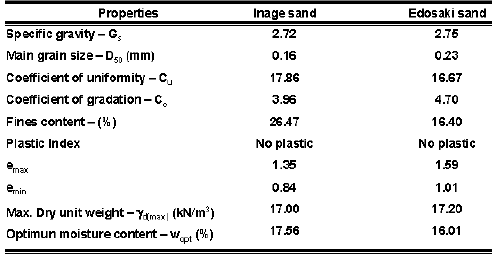
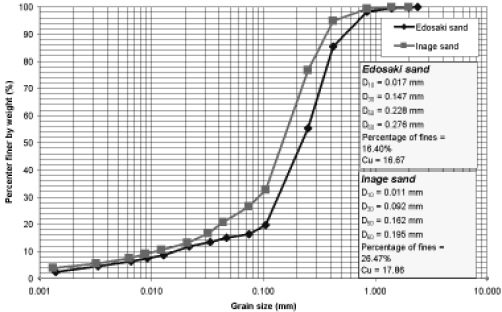
<body><![CDATA[<br> </b>In the model tests, two soils were used to construct the embankments.  Physical  properties of the tested materials are shown in <a href="#tab01">table 1</a>.  <a href="#fig01">Figure  1</a> shows the  grain size distribution of the mentioned soils.</font></p>     <p align="center"><font size="2" face="Verdana, Arial, Helvetica, sans-serif"><b><a name="tab01"></a>Table       1. </b> Physical  properties of the tested materials    <br>  <b>Tabla 1.</b>  Propiedades  físicas de los materials utilizados</font>    <br>  <img src="/img/revistas/dyna/v74n152/a11tab01.gif">    <br> </p>     <p align="center"><font size="2" face="Verdana, Arial, Helvetica, sans-serif"><b><a name="fig01"></a><img src="/img/revistas/dyna/v74n152/a11fig01.gif">    <br>   Figure 1.</b>  Grain     size distribution    <br>   <b>Figura 1.</b>  Distribución  granulométrica</font></p>     <p><font size="2" face="Verdana, Arial, Helvetica, sans-serif"><b>2.2 Embankment  Model and measurement systems</b></font></p>     <p><font size="2" face="Verdana, Arial, Helvetica, sans-serif"><b>2.2.1 Description    ]]></body>
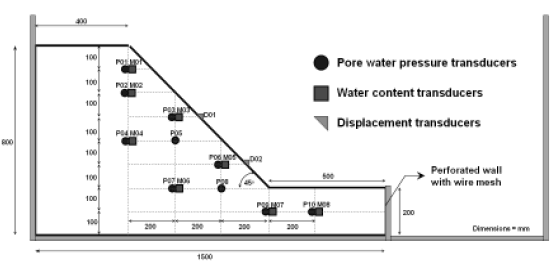
<body><![CDATA[<br> </b><a href="#fig02">Figure 2</a> shows the schematic diagram of the   soil box and the location of the transducers used for the model embankment   No. 1.  The major  components of the system are:  soil box, pore pressure sensors, ceramic cups, water content sensors and rainfall system.</font></p>     <p><font size="2" face="Verdana, Arial, Helvetica, sans-serif">The soil box used     in the model test is 220 cm long, 80 cm wide and 100 cm high.  The walls of the soil box are made of steel plates, except  for the front side which is made of transparent acrylic in order to facilitate  the observation of the process.  Pore pressure meters and soil moisture content  meters were installed within the model embankment.  A perforated wall with  wired mesh was used at the toe of the embankment in order to allow the free  water drainage of the infiltrated water.</font></p>       <p align="center"><font size="2" face="Verdana, Arial, Helvetica, sans-serif"><b><a name="fig02"></a><img src="/img/revistas/dyna/v74n152/a11fig02.gif">    <br>   Figure 2.</b>  Schematic     diagram of model tests and transducer locations    <br>   <b>Figura 2.</b>  Diagrama esquemático  de los modelos y la localización de los sensores</font></p>     <p><font size="2" face="Verdana, Arial, Helvetica, sans-serif">Pore pressure     transducers were used to monitor the positive and negative pore water pressure     caused by the infiltration of the water within the slope model.  Porous ceramic round bottom straight cups were attached to  the pore water transducers in order to measure negative pore water pressures.  The  porous ceramic used is 1.27 cm diameter, 6.35 cm in length and 0.32 cm thick.  It  has an air entry value of 100 kPa.  Soil moisture transducers were used to  monitor the volumetric water content.  Sensors are shown schematically in <a href="#fig03">figure  3</a>.  The output signals from the electronic transducers were sent to the A/D  converter and finally to the computer, where data sampling was recorded every  two seconds for the wetting process and every 5 minutes for the drying process.</font></p>       <p align="center"><font size="2" face="Verdana, Arial, Helvetica, sans-serif"><b><a name="fig03"></a><img src="/img/revistas/dyna/v74n152/a11fig03.gif">    <br>   Figure 3.</b>  Schematic     diagram of the sensors used within the model tests.    <br>   <b>Figura 3.</b>  Diagrama esquemático  de los sensors usados en los modelos</font></p>     <p><font size="2" face="Verdana, Arial, Helvetica, sans-serif"><b>2.2.2 Model       test preparation    ]]></body>
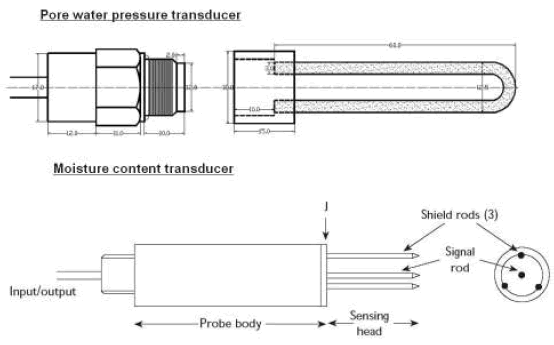
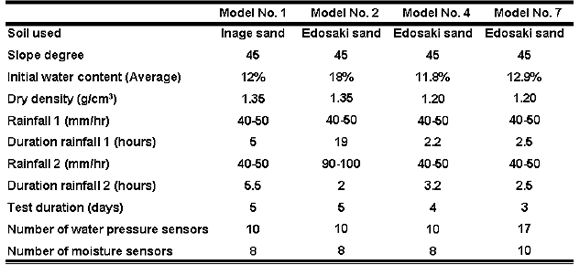
<body><![CDATA[<br> </b><i>Soil preparation</i>:  The soil used to make the slope, was  dried in an oven for 24 hours.  After drying the soil, it was necessary to  crush it using a tamping rod in order to achieve a natural grain size distribution.  The  grain size distribution of the soil used did not change with this procedure.  Once  the soil was crushed, water was added to it to reach required initial water content in between 12% and 18% to do the compaction process easier.</font></p>     <p><font size="2" face="Verdana, Arial, Helvetica, sans-serif"><i>Saturation of ceramic cups:</i>  The ceramic cups attached  to the pore pressure transducers were used to measure suction within the soil.  In  order to saturate the ceramic cups, they were immersed in a cylinder filled  with water and a vacuum was applied to the cylinder.  After this process, the  ceramic cups were attached to the pore pressure transducers within the water-filled  cylinder.</font></p>     <p><font size="2" face="Verdana, Arial, Helvetica, sans-serif"><i>Placement and compaction of the soil:</i>  The model slope  was constructed in the central portion of the soil box, and was prepared by  the moist placement method or tamping.  Next, the moist soil was placed in  a series of horizontal layers.  Each layer was tamped equally using a tamping  rod to a thickness of 5 cm.  This procedure was repeated until the full height  of the model slope was achieved.</font></p>     <p><font size="2" face="Verdana, Arial, Helvetica, sans-serif"><i>Placement of the sensors:</i>  During the soil placement,  pore pressure transducers and water content transducers were placed at specific  locations within the slope.  Before placement of the pore water pressure sensors,  soil was disturbed and the sensor was place on it in order to achieve good  contact between the soil and the ceramic cup, next, a new layer of soil was  placed above the sensor.  The procedure for placing the moisture content sensor  was different; after the pore water pressure sensor was fixed and a new soil  layer was placed and compacted, a portion of the soil was removed and the sensor  was inserted laterally into the compacted soil.</font></p>     <p><font size="2" face="Verdana, Arial, Helvetica, sans-serif"><i>Rainfall simulation:</i>  After preparation of the slope,  a spray irrigation pipe was used to simulate artificial rainfall.  This pipe  produces a fine side spray that simulates constant rainfall.  Rainfall intensities  of between 40 and 50 mm/hr were simulated using this system.  Intensities of  between 80 and 100 mm/hr were achieved using two pipes.  The first rainfall  was applied during the second day of the tests.  After the first rainfall the  model embankment was subjected to drying process without rainfall, because  the model test was conducted outside the laboratory it was covered with a plastic  sheet to avoid the effect of natural rainfall.  The models were subjected to  a second rainfall in the fourth day.  Intensities, durations of the rainfalls  and duration of the tests are shown in <a href="#tab02">Table 2</a>.  Four burettes were used to  measure rainfall intensity, two located at the bottom of the embankment and  two at the top.</font></p>       <p align="center"><font size="2" face="Verdana, Arial, Helvetica, sans-serif"><b><a name="tab02"></a>Table       2. </b> General  information and test conditions    <br>  <b>Tabla 2. </b> Información  general acerca de los modelos</font>    <br>  <img src="/img/revistas/dyna/v74n152/a11tab02.gif"></p>     <p>&nbsp;</p>     <p><font size="3" face="Verdana, Arial, Helvetica, sans-serif"><b>3. EXPERIMENTAL   RESULTS AND DISCUSSION</b></font></p>     ]]></body>
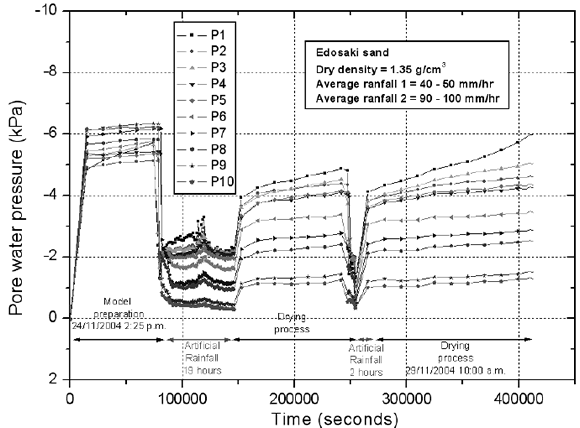
<body><![CDATA[<p><font size="2" face="Verdana, Arial, Helvetica, sans-serif">In order to observe     the general pattern of the rainfall infiltration, a series of slope model     tests were performed.  Artificial rainfall was applied  to the model embankments using an irrigation pipe.  Pore water pressure transducers  to monitor the negative and the positive pore water pressures and water content  transducers to measure volumetric water contents, were installed within the  model slope at various locations.  To measure the displacement of the soil  due to the rainfall infiltration, displacement transducers were used in some  model tests.  All models responded similarly to the infiltration process.</font></p>     <p><font size="2" face="Verdana, Arial, Helvetica, sans-serif"><b>3.1 Pore  water pressure history    <br> </b><a href="#fig04">Figure 4</a> shows the time histories of monitored pore  water pressure for model test No. 02 (see <a href="#fig02">figure 2</a> for the location of the transducers).  This  graph shows that when the first rainfall was applied to the model the negative  pore water pressures (suction) started to decrease rapidly.  Next, when this  rainfall was stopped (drying process), the recorded negative pore water pressures  increased, especially in the sensors at the top (sensors P1 to P5).  This increment  in negative pore water pressure within the soil is strongly related with the  depth of the slope; sensors within the top of the model presented higher suctions  than those sensors located at the bottom.  This graph also shows that recovering  in suctions is very slow, suggesting that water was retained during a period  of time within the soil.</font></p>     <p align="center"><font size="2" face="Verdana, Arial, Helvetica, sans-serif"><b><a name="fig04"></a><img src="/img/revistas/dyna/v74n152/a11fig04.gif">    <br>   Figure 4.</b>  Time     histories of pore water pressure model No. 02    <br>   <b>Figura 4.</b>  Registro  histórico de la presión de poros en el modelo No. 02</font></p>     <p><font size="2" face="Verdana, Arial, Helvetica, sans-serif"><b>3.2 Pore  water pressure distribution    <br> </b>Monitored pore water pressure distributions for  model test No. 2 are shown in <a href="#fig05">figure 5</a>.  Four different sketches are shown.  At the beginning  of the test the model showed uniform pore water pressure in between -5 and  -6 kPa (see <a href="#fig05">figure 5.a</a>).  <a href="#fig05">Figure 5.b</a> shows the pore water pressure distribution  after 18 hours of applying the first rainfall (after 40 hours); suction in  the soil reduced to levels in between -1 and -2 kPa and close to zero at the  toe of the model.  <a href="#fig05">Figure 5.c</a> shows the state of the model when the rainfall  was stopped, (drying process, after 68 hours), suction recovered specially  at the top of the model, where the soil reached values similar to those at  the beginning of the test, but, at the bottom of the model, lower values of  suction were recorded, it can be explained by the accumulation of the water  on the bottom of the soil box.  Finally, pore water pressure distribution during  the second rainfall is shown in <a href="#fig05">figure 5.d</a> (after 71 hours); infiltrated water  began to accumulate at the bottom of the model, showing the pore water pressures  close to zero after 2 hours of the second rainfall.  In all the model tests,  water table started to build up from the bottom to the top triggering local  retrogressive failure from the bottom of the model.</font></p>     <p align="center"><font size="2" face="Verdana, Arial, Helvetica, sans-serif"><b><a name="fig05"></a><img src="/img/revistas/dyna/v74n152/a11fig05.gif">    <br>   Figure       5.</b>&nbsp; Pore water pressure distribution, model No. 02    ]]></body>
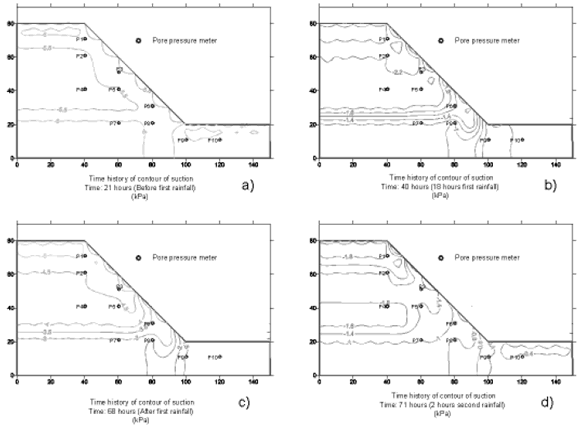
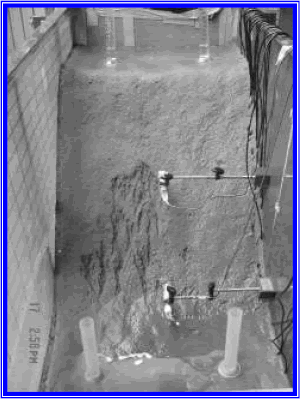
<body><![CDATA[<br>     <b>Figura 5.</b>&nbsp; Distribuci&oacute;n de la presi&oacute;n de poros en el modelo No. 02</font></p>     <p><font size="2" face="Verdana, Arial, Helvetica, sans-serif">Generally, the     patterns of the pore water pressure distribution are a good indicator of     the propagation of the wetting front, the infiltrated water reached initially     the sensors close to the surface and finally the sensors located at the bottom.  Similar  behavior was observed within the model using Inage sand.</font></p>       <p><font size="2" face="Verdana, Arial, Helvetica, sans-serif"><b>3.3 Moisture  content history    <br> </b><a href="#fig06">Figure 6</a> shows the histories of monitored water content within  the slope.  This graph shows that when rainfall 1 was applied (19 hours), the  soil was saturated very fast and it remained with constant water content during  the application of this rainfall.  When rainfall 1 was stopped, water moved  from the top to the bottom and lower water content at the top of the model  was recorded (sensors M1 to M4).  In contrast, sensors located at the bottom  (M5 to M8) remained at the same water contents, then, water accumulated at  the bottom of the slope.  When rainfall 2 was applied to the model, sensors  responded quickly showing saturation within all the locations, but after stopping  this rainfall, a similar response of the sensors to that showed after rainfall  1 was observed; water was moving from the top and it accumulated at the bottom.</font></p>     <p align="center"><font size="2" face="Verdana, Arial, Helvetica, sans-serif"><b><a name="fig06"></a><img src="/img/revistas/dyna/v74n152/a11fig06.gif">    <br>   Figure       6.</b>&nbsp; Time history of water content model No. 02    <br>     <b>Figura 6.</b>&nbsp; Registro hist&oacute;rico contenido de agua Modelo No. 02</font></p>     <p><font size="2" face="Verdana, Arial, Helvetica, sans-serif">As it was found by the pore water pressure measurements, drying  or drainage process is faster at the top than at the bottom locations, it could  be because of the movement of water from the top to the bottom of the model  and due to the evaporation which is higher in the soil close to the surface.</font></p>       <p><font size="2" face="Verdana, Arial, Helvetica, sans-serif"><b>3.4 Horizontal  displacement history    <br> </b><a href="#fig07">Figure 7</a> shows a picture of the location of the displacement  transducers used in the model embankment No. 7.  These devices measured the  lateral displacement in the model due to the saturation of the soil.</font></p>     ]]></body>
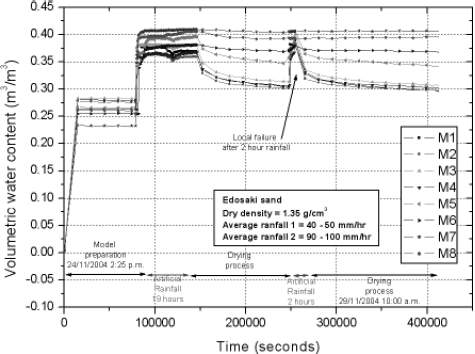
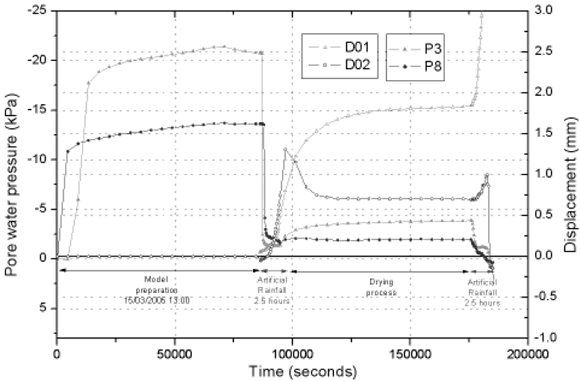
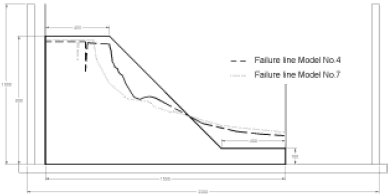
<body><![CDATA[<p align="center"><font size="2" face="Verdana, Arial, Helvetica, sans-serif"><b><a name="fig07"></a><img src="/img/revistas/dyna/v74n152/a11fig07.gif">    <br>   Figure       7. </b> Transducer  configuration to measure displacement.  Model Test No. 07    <br>  <b>Figura 7.</b>  Configuración  de los sensors para medir desplazamiento.  Modelo No. 07</font></p>     <p><font size="2" face="Verdana, Arial, Helvetica, sans-serif"><a href="#fig08">Figure       8</a> shows     the monitored pore water pressure histories of the sensors P3 and P8 and     the monitored displacement histories of the transducers D01 and D02 in model     test No. 7.  Sensors P3 and P8 are the closest sensors  to D01 and D02, respectively; the position of the sensor are shown in <a href="#fig02">figure  2</a>.  <a href="#fig08">Figure 8</a> shows that when rainfall 1 was applied, the negative pore water  pressures decreased and the lateral displacements increased within the model  test; these deformations of the model continue increasing even when the rainfall  1 was stopped; but, they tended to stabilize after some hours.  When rainfall  2 was applied, displacement of the soil increased again and once the pore water  pressure were positive the model started to fail.  It suggests that displacements  are strongly related to the growth of water content within the soil.  This  observation is consistent with the results of triaxial tests on unsaturated  specimens, where the most critical parameter in failure initiation was the  degree of saturation (Farooq 2002).  Monitoring of the water contents within  the soils can predict failure induced by rainfall infiltration.  <a href="#fig09">Figure  9</a> shows  the final failure contours of model tests No.4 and No.7.  This figure shows  that the final contours have similar shape assuring good repeatability of the  tests.  The tests suggested that failure initiated when water content within  the soil increased, especially at the toe of the slope where the soil reaches  positive pore water pressures, in contrast, a major portion of the sliding  mass may still be in an unsaturated condition. Positive pore water pressure  at the toe contributes to the development of highly unstable area at the slope  toe which influences on overall instability.  This suggests that the effective  drainage at the slope toe can prevent progressive sliding due to build up of  water table.  Tohari et al (2000), observed similar failure mechanism in artificial  model slopes, explaining that the saturation process significantly reduced  moisture shear strength of the soil, and the increase if water table within  the slope decreased the effective stress of the soil, especially at the slope  toe.</font></p>     <p align="center"><font size="2" face="Verdana, Arial, Helvetica, sans-serif"><b><a name="fig08"></a><img src="/img/revistas/dyna/v74n152/a11fig08.gif">    <br>   Figure       8.</b>&nbsp; Pore water pressure &ndash;  Displacement relation.&nbsp; Model No.7    <br>  <b>Figura 8.</b>&nbsp; Relaci&oacute;n de Presi&oacute;n de poros &ndash; Desplazamiento.&nbsp; Modelo No.7</font></p>     <p align="center"><font size="2" face="Verdana, Arial, Helvetica, sans-serif"><b><a name="fig09"></a><img src="/img/revistas/dyna/v74n152/a11fig09.gif">    <br>   Figure 9.</b>  Final     contour failure models No. 4 and No. 7    <br>   <b>Figura 9.</b>  Contorno  final de falla Modelos No. 4 y No. 7</font></p>     ]]></body>
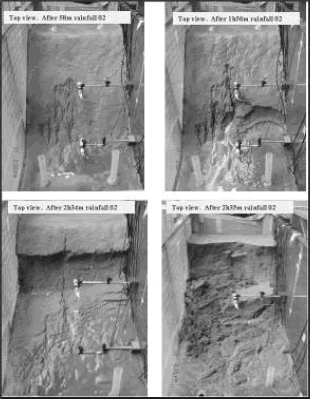
<body><![CDATA[<p><font size="2" face="Verdana, Arial, Helvetica, sans-serif"><b>3.5 Failure  mechanism    <br> </b>Model No. 7 was prepared to be tested at the same conditions  of model No. 4.  <a href="#fig10">Figure 10</a> shows some photographs at various stages during  the second rainfall.  Water infiltrated within the model started to accumulate  from the bottom of the slope.  Water content and pore water pressure increase  at this portion of the model; the effective stress decreased due to the increment  in pore water pressure, until the soil located at the toe reached the failure  line.  Then, failure progressed due to the continuous saturation.  Finally,  after progressive failure at the toe, a sliding plane was formed, and the soil  mass slipped.  As it is showed by the pictures, due to the resulting instability,  beginning from the toe of the slope, retrogressive failure occurred.</font></p>     <p align="center"><font size="2" face="Verdana, Arial, Helvetica, sans-serif"><b><a name="fig10"></a><img src="/img/revistas/dyna/v74n152/a11fig10.gif">    <br>   Figure       10. </b> Photographs  at various stages.  Model No. 07    <br>  <b>Figura 10.</b>  Fotografías  en varias etapas.  Modelo No. 07</font></p>     <p>&nbsp;</p>     <p><font size="3" face="Verdana, Arial, Helvetica, sans-serif"><b>4. CONCLUSIONS</b></font></p>     <p><font size="2" face="Verdana, Arial, Helvetica, sans-serif">The tests suggested that failure initiated when water content  within the soil increased, especially at the toe of the slope where the soil  reaches positive pore water pressures, in contrast, a major portion of the  sliding mass may still be in an unsaturated condition.</font></p>     <p><font size="2" face="Verdana, Arial, Helvetica, sans-serif">Soil displacements     with the tested embankments are directly related to the soil water contents     and pore water pressures within the slopes.  The  higher the water pressures, the higher the displacements within the soil.  Local  failure appears at the bottom of the embankments and progressed to the top  triggering global failure in the model embankments.  Prediction of local and  global failure in slopes could be inferred by monitoring water contents and  pore water pressures within the soil</font></p>     <p>&nbsp;</p>     ]]></body>
<body><![CDATA[<!-- ref --><p><font size="3" face="Verdana, Arial, Helvetica, sans-serif"><b>5. REFERENCES</b></font>&nbsp;&nbsp;&nbsp;&nbsp;&nbsp;&nbsp;&nbsp;&nbsp;[&#160;<a href="javascript:void(0);" onclick="javascript: window.open('/scielo.php?script=sci_nlinks&ref=000093&pid=S0012-7353200700020001100001&lng=','','width=640,height=500,resizable=yes,scrollbars=1,menubar=yes,');">Links</a>&#160;]<!-- end-ref --><!-- ref --> [2]</b></font></td><td><font size="2" face="Verdana, Arial, Helvetica, sans-serif">GALLAGE, C.P.K., E.F. Garcia, A. Peiris, T. Uchimura, Use of soil-water characteristic curve in determination of stability of embankments during drying and wetting processes, Advance Experimental Unsaturated Soil Mechanics, Experus 2005, Trento, Italy, 351-357, 2005.</font></td></tr> <tr><td valign="top" align="right"><font size="2" face="Verdana, Arial, Helvetica, sans-serif"><b>    &nbsp;&nbsp;&nbsp;&nbsp;&nbsp;&nbsp;&nbsp;&nbsp;[&#160;<a href="javascript:void(0);" onclick="javascript: window.open('/scielo.php?script=sci_nlinks&ref=000094&pid=S0012-7353200700020001100002&lng=','','width=640,height=500,resizable=yes,scrollbars=1,menubar=yes,');">Links</a>&#160;]<!-- end-ref --><!-- ref --> [3]</b></font></td><td><font size="2" face="Verdana, Arial, Helvetica, sans-serif">ORENSE, R. P, Geotechnical hazards, nature, assessment and mitigation, The University of The Philippines Press, Philippines , 2003.</font></td></tr> <tr><td valign="top" align="right"><font size="2" face="Verdana, Arial, Helvetica, sans-serif"><b>    &nbsp;&nbsp;&nbsp;&nbsp;&nbsp;&nbsp;&nbsp;&nbsp;[&#160;<a href="javascript:void(0);" onclick="javascript: window.open('/scielo.php?script=sci_nlinks&ref=000095&pid=S0012-7353200700020001100003&lng=','','width=640,height=500,resizable=yes,scrollbars=1,menubar=yes,');">Links</a>&#160;]<!-- end-ref --><!-- ref --> [4]</b></font></td><td><font size="2" face="Verdana, Arial, Helvetica, sans-serif">TOHARI,       A, Laboratory experiments on initiation of rainfall induced slope failure       with moisture content measurements, GeoEng2000: An International Conference   on Geotechnical & Geological Engineering, Melbourne, Australia , 2000.</font></td></tr> <tr><td valign="top" align="right"><font size="2" face="Verdana, Arial, Helvetica, sans-serif"><b>    &nbsp;&nbsp;&nbsp;&nbsp;&nbsp;&nbsp;&nbsp;&nbsp;[&#160;<a href="javascript:void(0);" onclick="javascript: window.open('/scielo.php?script=sci_nlinks&ref=000096&pid=S0012-7353200700020001100004&lng=','','width=640,height=500,resizable=yes,scrollbars=1,menubar=yes,');">Links</a>&#160;]<!-- end-ref --><!-- ref --> [5]</b></font></td><td><font size="2" face="Verdana, Arial, Helvetica, sans-serif">YOSHIDA, Y., J. Kuwano, R. Kuwano, Effects of saturation on shear strength of soils. Soils and Foundations 31, No. 1: 181-186, 1991a.</font></td></tr> <tr><td valign="top" align="right"><font size="2" face="Verdana, Arial, Helvetica, sans-serif"><b>    &nbsp;&nbsp;&nbsp;&nbsp;&nbsp;&nbsp;&nbsp;&nbsp;[&#160;<a href="javascript:void(0);" onclick="javascript: window.open('/scielo.php?script=sci_nlinks&ref=000097&pid=S0012-7353200700020001100005&lng=','','width=640,height=500,resizable=yes,scrollbars=1,menubar=yes,');">Links</a>&#160;]<!-- end-ref --><!-- ref --> [6]</b></font></td><td><font size="2" face="Verdana, Arial, Helvetica, sans-serif">YOSHIDA, Y., J. Kuwano, R. Kuwano, Rain-induced slope failures caused by reduction in soil strength, Soil and Foundations 31, No. 4: 187-93, 1991b.</font></td></tr> </table>    &nbsp;&nbsp;&nbsp;&nbsp;&nbsp;&nbsp;&nbsp;&nbsp;[&#160;<a href="javascript:void(0);" onclick="javascript: window.open('/scielo.php?script=sci_nlinks&ref=000098&pid=S0012-7353200700020001100006&lng=','','width=640,height=500,resizable=yes,scrollbars=1,menubar=yes,');">Links</a>&#160;]<!-- end-ref --> ]]></body><back>
<ref-list>
<ref id="B1">
<label>1</label><nlm-citation citation-type="">
<person-group person-group-type="author">
<name>
<surname><![CDATA[FAROOQ]]></surname>
<given-names><![CDATA[K.]]></given-names>
</name>
</person-group>
<source><![CDATA[Experimental study on failure initiation in sandy slopes due to rainfall infiltration]]></source>
<year></year>
</nlm-citation>
</ref>
<ref id="B2">
<label>2</label><nlm-citation citation-type="journal">
<person-group person-group-type="author">
<name>
<surname><![CDATA[GALLAGE]]></surname>
<given-names><![CDATA[C.P.K.]]></given-names>
</name>
<name>
<surname><![CDATA[Garcia]]></surname>
<given-names><![CDATA[E.F.]]></given-names>
</name>
<name>
<surname><![CDATA[Peiris]]></surname>
<given-names><![CDATA[A.]]></given-names>
</name>
<name>
<surname><![CDATA[Uchimura]]></surname>
<given-names><![CDATA[T.]]></given-names>
</name>
</person-group>
<article-title xml:lang="en"><![CDATA[Use of soil-water characteristic curve in determination of stability of embankments during drying and wetting processes]]></article-title>
<source><![CDATA[Advance Experimental Unsaturated Soil Mechanics]]></source>
<year>2005</year>
<month>20</month>
<day>05</day>
<page-range>351-357</page-range><publisher-loc><![CDATA[Trento ]]></publisher-loc>
<publisher-name><![CDATA[Experus]]></publisher-name>
</nlm-citation>
</ref>
<ref id="B3">
<label>3</label><nlm-citation citation-type="book">
<person-group person-group-type="author">
<name>
<surname><![CDATA[ORENSE]]></surname>
<given-names><![CDATA[R. P]]></given-names>
</name>
</person-group>
<source><![CDATA[Geotechnical hazards, nature, assessment and mitigation]]></source>
<year>2003</year>
<publisher-name><![CDATA[The University of The Philippines Press]]></publisher-name>
</nlm-citation>
</ref>
<ref id="B4">
<label>4</label><nlm-citation citation-type="confpro">
<person-group person-group-type="author">
<name>
<surname><![CDATA[TOHARI]]></surname>
<given-names><![CDATA[A]]></given-names>
</name>
</person-group>
<article-title xml:lang="en"><![CDATA[Laboratory experiments on initiation of rainfall induced slope failure with moisture content measurements]]></article-title>
<source><![CDATA[]]></source>
<year></year>
<conf-name><![CDATA[ GeoEng2000: An International Conference on Geotechnical & Geological Engineering]]></conf-name>
<conf-date>2000</conf-date>
<conf-loc>Melbourne </conf-loc>
</nlm-citation>
</ref>
<ref id="B5">
<label>5</label><nlm-citation citation-type="journal">
<person-group person-group-type="author">
<name>
<surname><![CDATA[YOSHIDA]]></surname>
<given-names><![CDATA[Y.,]]></given-names>
</name>
<name>
<surname><![CDATA[Kuwano]]></surname>
<given-names><![CDATA[J.]]></given-names>
</name>
<name>
<surname><![CDATA[Kuwano]]></surname>
<given-names><![CDATA[R]]></given-names>
</name>
</person-group>
<article-title xml:lang="en"><![CDATA[Effects of saturation on shear strength of soils]]></article-title>
<source><![CDATA[Soils and Foundations]]></source>
<year>1991</year>
<month>a</month>
<volume>31</volume>
<numero>1</numero>
<issue>1</issue>
<page-range>181-186</page-range></nlm-citation>
</ref>
<ref id="B6">
<label>6</label><nlm-citation citation-type="journal">
<person-group person-group-type="author">
<name>
<surname><![CDATA[YOSHIDA]]></surname>
<given-names><![CDATA[Y]]></given-names>
</name>
<name>
<surname><![CDATA[Kuwano]]></surname>
<given-names><![CDATA[J.]]></given-names>
</name>
<name>
<surname><![CDATA[Kuwano]]></surname>
<given-names><![CDATA[R.]]></given-names>
</name>
</person-group>
<article-title xml:lang="en"><![CDATA[Rain-induced slope failures caused by reduction in soil strength]]></article-title>
<source><![CDATA[Soil and Foundations]]></source>
<year>1991</year>
<month>b</month>
<volume>31</volume>
<numero>4</numero>
<issue>4</issue>
<page-range>187-93</page-range></nlm-citation>
</ref>
</ref-list>
</back>
</article>