<?xml version="1.0" encoding="ISO-8859-1"?><article xmlns:mml="http://www.w3.org/1998/Math/MathML" xmlns:xlink="http://www.w3.org/1999/xlink" xmlns:xsi="http://www.w3.org/2001/XMLSchema-instance">
<front>
<journal-meta>
<journal-id>0012-7353</journal-id>
<journal-title><![CDATA[DYNA]]></journal-title>
<abbrev-journal-title><![CDATA[Dyna rev.fac.nac.minas]]></abbrev-journal-title>
<issn>0012-7353</issn>
<publisher>
<publisher-name><![CDATA[Universidad Nacional de Colombia]]></publisher-name>
</publisher>
</journal-meta>
<article-meta>
<article-id>S0012-73532008000300012</article-id>
<title-group>
<article-title xml:lang="en"><![CDATA[DETERMINATION OF THE ISOSTERIC HEAT TO PLANTAIN PULP (musa paradisiaca) BY SORPTION ISOTHERMS]]></article-title>
<article-title xml:lang="es"><![CDATA[DETERMINACIÓN DEL CALOR ISOSTÉRICO PARA PULPA DE PLÁTANO (musa paradisiaca) POR ISOTERMAS DE SORCIÓN]]></article-title>
</title-group>
<contrib-group>
<contrib contrib-type="author">
<name>
<surname><![CDATA[CIRO]]></surname>
<given-names><![CDATA[HÉCTOR]]></given-names>
</name>
<xref ref-type="aff" rid="A01"/>
</contrib>
<contrib contrib-type="author">
<name>
<surname><![CDATA[OSORIO]]></surname>
<given-names><![CDATA[JAIRO ALEXANDER]]></given-names>
</name>
<xref ref-type="aff" rid="A02"/>
</contrib>
<contrib contrib-type="author">
<name>
<surname><![CDATA[CORTÉS]]></surname>
<given-names><![CDATA[ELKIN ALONSO]]></given-names>
</name>
<xref ref-type="aff" rid="A03"/>
</contrib>
</contrib-group>
<aff id="A01">
<institution><![CDATA[,Universidad Nacional de Colombia Departamento de Ingeniería Agrícola y de Alimentos ]]></institution>
<addr-line><![CDATA[ ]]></addr-line>
</aff>
<aff id="A02">
<institution><![CDATA[,Universidad Nacional de Colombia Departamento de Ingeniería Agrícola y de Alimentos ]]></institution>
<addr-line><![CDATA[ ]]></addr-line>
</aff>
<aff id="A03">
<institution><![CDATA[,Universidad Nacional de Colombia Departamento de Ingeniería Agrícola y de Alimentos ]]></institution>
<addr-line><![CDATA[ ]]></addr-line>
</aff>
<pub-date pub-type="pub">
<day>00</day>
<month>11</month>
<year>2008</year>
</pub-date>
<pub-date pub-type="epub">
<day>00</day>
<month>11</month>
<year>2008</year>
</pub-date>
<volume>75</volume>
<numero>156</numero>
<fpage>127</fpage>
<lpage>134</lpage>
<copyright-statement/>
<copyright-year/>
<self-uri xlink:href="http://www.scielo.org.co/scielo.php?script=sci_arttext&amp;pid=S0012-73532008000300012&amp;lng=en&amp;nrm=iso"></self-uri><self-uri xlink:href="http://www.scielo.org.co/scielo.php?script=sci_abstract&amp;pid=S0012-73532008000300012&amp;lng=en&amp;nrm=iso"></self-uri><self-uri xlink:href="http://www.scielo.org.co/scielo.php?script=sci_pdf&amp;pid=S0012-73532008000300012&amp;lng=en&amp;nrm=iso"></self-uri><abstract abstract-type="short" xml:lang="en"><p><![CDATA[For sorptional data to be useful in simulation and design of storage and drying systems, they must be represented by equations valid in the conditions usually found in industrial practice. Using the modified Chung-Pfost model and fitted by desorption the net and total isosteric heat of plantain pulp was evaluated. The net isosteric heat decreased with increasing moisture content ranging from 1670 kJ/kg (5%.d.b) to 215 kJ/kg (26%.d.b) where the better goodness of fit was presented by polynomial and power-law models.]]></p></abstract>
<abstract abstract-type="short" xml:lang="es"><p><![CDATA[Las isotermas de sorción para ser usadas en la simulación y diseño de procesos de secado y almacenamiento de alimentos deben ser representadas por modelos válidos dentro de las condiciones encontradas en la práctica industrial. Usando el modelo de Chung-Pfost y ajustado por desorción el calor isostérico neto y total para pulpa de plátano fueron determinados. El calor neto isotérico neto decreció con el contenido de humedad del producto variando desde 1670 kJ/kg (5%.d.b) a 215 kJ/kg (26%.d.b) donde esta variación fue representada por el modelo potencial y polinomial.]]></p></abstract>
<kwd-group>
<kwd lng="en"><![CDATA[Physical properties]]></kwd>
<kwd lng="en"><![CDATA[moisture content]]></kwd>
<kwd lng="en"><![CDATA[isosteric heat]]></kwd>
<kwd lng="es"><![CDATA[Propiedades físicas]]></kwd>
<kwd lng="es"><![CDATA[contenido de humedad]]></kwd>
<kwd lng="es"><![CDATA[calor isostérico]]></kwd>
</kwd-group>
</article-meta>
</front><body><![CDATA[ <p align="center"><font size="4" face="Verdana, Arial, Helvetica, sans-serif"><b>DETERMINATION OF THE ISOSTERIC HEAT TO PLANTAIN PULP (<i>musa paradisiaca</i>) BY SORPTION ISOTHERMS</b></font></p>     <p align="center"><font size="3" face="Verdana, Arial, Helvetica, sans-serif"><b>DETERMINACIÓN DEL CALOR   ISOSTÉRICO PARA PULPA DE PLÁTANO (<i>musa   paradisiaca</i>) POR ISOTERMAS DE SORCIÓN</b></font></p>     <p align="center">&nbsp;</p>     <p align="center"><font size="2" face="Verdana, Arial, Helvetica, sans-serif"><b>HÉCTOR   CIRO</b>    <br>   <i>Profesor, Departamento de Ingeniería Agrícola y de   Alimentos, Universidad Nacional de Colombia</i></font></p>     <p align="center"><font size="2" face="Verdana, Arial, Helvetica, sans-serif"><b>JAIRO   ALEXANDER OSORIO</b>    <br>   <i>Profesor, Departamento de Ingeniería Agrícola y de   Alimentos, Universidad Nacional de Colombia</i></font></p>     <p align="center"><font size="2" face="Verdana, Arial, Helvetica, sans-serif"><b>ELKIN   ALONSO CORTÉS</b>    <br>   <i>Profesor, Departamento de Ingeniería Agrícola y de Alimentos, Universidad Nacional   de Colombia, <a href="mailto:ecortes@unalmed.edu.co">ecortes@unalmed.edu.co</a></i></font></p>     <p align="center">&nbsp;</p>     ]]></body>
<body><![CDATA[<p align="center"><font size="2" face="Verdana, Arial, Helvetica, sans-serif"><b>Recibido para revisar Marzo   15 de 2008, aceptado Junio 18 de 2008, versión final Junio 26 de 2008</b></font></p>     <p align="center">&nbsp;</p> <hr>     <p><font size="2" face="Verdana, Arial, Helvetica, sans-serif"><b>ABSTRACT: </b>For sorptional data   to be useful in simulation and design of storage and drying systems, they must be represented by equations valid   in the conditions usually found in industrial practice. Using the modified Chung–Pfost model and fitted by desorption the net and total isosteric heat of plantain pulp was evaluated. The net isosteric   heat decreased with increasing moisture content ranging from 1670 kJ/kg   (5%.d.b) to 215 kJ/kg (26%.d.b) where the better goodness of fit was presented   by polynomial and power-law models. </font></p>     <p><font size="2" face="Verdana, Arial, Helvetica, sans-serif"><b>KEYWORDS:</b> Physical   properties, moisture content, isosteric heat.</font></p>     <p><font size="2" face="Verdana, Arial, Helvetica, sans-serif"><b>RESUMEN: </b>Las isotermas de sorción para ser usadas en la simulación y diseño de procesos de   secado y almacenamiento de alimentos deben ser representadas por modelos   válidos dentro de las condiciones encontradas en la práctica industrial. Usando el modelo de Chung–Pfost y   ajustado por desorción el calor isostérico neto y total para pulpa de plátano fueron determinados. El   calor neto isotérico neto decreció con el contenido de humedad del producto   variando desde 1670   kJ/kg (5%.d.b) a 215 kJ/kg (26%.d.b)   donde esta variación fue representada   por el modelo potencial y polinomial. </font></p>     <p><font size="2" face="Verdana, Arial, Helvetica, sans-serif"><b>PALABRAS CLAVE</b> Propiedades físicas, contenido de humedad, calor isostérico.</font></p> <hr>     <p>&nbsp;</p>     <p><font size="3" face="Verdana, Arial, Helvetica, sans-serif"><b>1. INTRODUCTION</b></font></p>     <p><font size="2" face="Verdana, Arial, Helvetica, sans-serif">The plantain   is a species of the genus <i>Musa</i> and is generally used for cooking, in contrast to the soft, sweet banana (which is sometimes called the dessert banana). Plantains tend to be firmer and lower in sugar content than dessert bananas and are used   either when green or under-ripe (and therefore starchy) or overripe (and therefore   sweet). Plantains are a staple food in the tropical regions of the   world, treated in much the same way as potatoes and with   a similar neutral flavour and texture when unripe. In    Colombia the plantain under-ripe is called as “ plátano verde” and its pulp is used extensively by its high   culinary quality and industrial   processing as flour. The “plátano” is one of the products more important at domestic marketing, since it participates with the 6,8% of   the agricultural production occupying the fifth place after the coffee, flowers, banana and sugarcane. This product is fundamental   in the Colombians diet with a consumption   by person of 61,9 kg/year. </font></p>     <p><font size="2" face="Verdana, Arial, Helvetica, sans-serif">The sorption isosteric heat (also called latent   heat of vaporization, desorption–vaporization) in foodstuffs is of practical interest in   drying operations, handling, storage and processing (Mulet <i>et   al.,</i> 2002; Ashraful <i>et al.,</i> 2007; Yan <i>et al.,</i> 2008). The value of latent heat   of vaporization is neither constant nor equal to the heat of pure water   evaporation (Tolaba <i>et al.,</i> 2004). It   is a function of temperature and moisture content, that is, the value is varied   throughout the drying process (Rucklod <i>et al</i>., 2003). A simple model including   moisture content and temperature term is very useful to compute the latent heat   of vaporization (Kaya and Kahyaoglu, 2005).</font></p>     ]]></body>
<body><![CDATA[<p><font size="2" face="Verdana, Arial, Helvetica, sans-serif">The net isosteric heat is defined as the total heat   of sorption in the food minus the heat of vaporization of water, at the system temperature   (Tsami, 1990). The total isoteric heat of sorption is the total heat supply for drying of a   material. As a differential molar quantity, isosteric heat of sorption   determines the temperature dependence of water activity of a biological   material. The heat of vaporization of sorbed water may increase to values well   above the vaporization of pure water as food is dehydrated to low moisture   levels (Rizvi, 2005). The extent of material moisture content at which the   isosteric heat of sorption approaches the latent heat of vaporization of water   is often considered as an indication of the amount of “bound water” existing in   the food (Kiranoudis <i>et al</i>., 1993). Conventionally,   is a positive quantity when heat is evolved during adsorption, and negative   when heat is absorbed during desorption. The heat of adsorption is a measure of   the energy released on sorption, and the heat of desorption the energy   requirement to break the intermolecular forces between the molecules of water   vapour and the surface of adsorbent.   Thus, the heat of sorption is considered as indicative of the intermolecular   attractive forces between the sorption sites and water vapour (Rizvi, 2005).</font></p>     <p><font size="2" face="Verdana, Arial, Helvetica, sans-serif">The application of thermodynamic principles   to sorption isotherm data has been used to obtain more information about the   properties of water, food microstructure, and physical phenomena on the food surfaces,   and sorption kinetic parameters (McMinn   and Magee, 2003). The net isosteric heat of   sorption is used as thermodynamic function for analysis of sorption isotherms. The   net isosteric heat of sorption or   differential enthalpy shows the energy requirement for removing moisture from   food material (water–solid binding strength) has a practical use in complete   drying calculations and modeling of energy (Rizvi, 2005). The net integral   enthalpy or net equilibrium heat of sorption indicates the binding strength of   water molecules to food particles and could be a measure of the food–water   affinity (Aviara et al., 2004). </font></p>     <p><font size="2" face="Verdana, Arial, Helvetica, sans-serif">Two methods are available for measurement of the   differential heat of sorption. The first is direct calorimetric measurement of   the heat evolved, and the second is application of the Clausius-Clayperon   equation on the isosteric equilibrium pressures at different temperatures (the   ‘isosteric’ heat of sorption). Sorption calorimetry is difficult because of the   technique needed for precise measurement of the small quantities of heat   evolved. For this reason, calorimetrical measured heats of sorption are much   less common than those calculated from the sorption isotherm, however, they   offer a higher degree of accuracy when determined with care (Al-Muhtaseb et al., 2002<b>).</b></font></p>     <p><font size="2" face="Verdana, Arial, Helvetica, sans-serif">Moisture sorption isotherms   describe the relationship between the equilibrium moisture content and the   water activity at constant temperatures and pressures (Kaleemullah and   Kailappan, 2004). For food materials these isotherms give information about the   sorption mechanism and the interaction of food biopolymers with water. The   moisture sorption isotherms are extremely important in modelling the drying process, in design and optimisation   of drying equipment, in predicting shelf-life stability, in calculating   moisture changes which may occur during storage and in selecting appropriate   packaging material (Gabas et al., 2000; Kaymak-Ertekin and Gedik, 2004)</font></p>     <p><font size="2" face="Verdana, Arial, Helvetica, sans-serif">The objective of this study was to determine the   thermodynamic function of isosteric heat   in relation to moisture sorption in plantain pulp using a sorption model.</font></p>     <p>&nbsp;</p>     <p><font size="3" face="Verdana, Arial, Helvetica, sans-serif"><b>2. MATERIALS   AND METHODS</b></font></p>     <p><font size="2" face="Verdana, Arial, Helvetica, sans-serif"><i>Isotherm models    <br>   </i>In this study the isosteric heat of plantain pulp was determined through the   sorption isotherm method. Two <i>Aw</i> models incorporating temperature terms have been evaluated for sorption data (Ciro <i>et   al</i>., in press). The modified Chung–Pfost model fitted by desorption was adopted in this study to compute the <i>q<sub>st</sub></i> (the net isosteric heat) and <i>Q<sub>st</sub></i> (total heat of   sorption) values. The fitted model is:</font></p>     <p><font size="2" face="Verdana, Arial, Helvetica, sans-serif"><img src="/img/revistas/dyna/v75n156/a12eq01.gif"></font></p>     ]]></body>
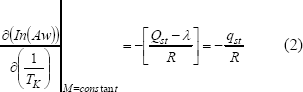
<body><![CDATA[<p><font size="2" face="Verdana, Arial, Helvetica, sans-serif">The   model cited above presented the best   goodness of fit (Ciro <i>et al</i>., in   press) and was fitted to 25ºC&#8804;<i>T</i>&#8804;50ºC, activity water of 0,4&#8804;<i>Aw</i>&#8804;0,8 and equilibrium moisture content of 5% d.b&#8804; <i>M<sub>E</sub></i> &#8804; 26%d.b.</font></p>     <p><font size="2" face="Verdana, Arial, Helvetica, sans-serif"><i>Net isosteric   heat of sorption</i> <i>The Clausius–Clapeyron   equation    <br>   </i>The net isosteric heat of sorption (<i>q<sub>st</sub></i>) is obtained by subtraction   of heat of water vaporization from total heat of sorption (<i>Q<sub>st</sub></i>). The <i>q<sub>st</sub> </i>could be determined from experimental data using Clausius- Clayperon   equation in the form(Aguerre et al., 1988; Rizvi, 2005; Chen, 2006;   Perez-Alonso et al., 2006; Vullioud et al., 2006; Samapundo et al., 2007):</font></p>     <p><font size="2" face="Verdana, Arial, Helvetica, sans-serif"><img src="/img/revistas/dyna/v75n156/a12eq02.gif"></font></p>     <p><font size="2" face="Verdana, Arial, Helvetica, sans-serif">Integrating Eq. (2), assuming that   the net isosteric heat of sorption (<i>q<sub>st</sub></i>)   is temperature independent gives the following equation:</font></p>     <p><font size="2" face="Verdana, Arial, Helvetica, sans-serif"><img src="/img/revistas/dyna/v75n156/a12eq03.gif"></font></p>     <p><font size="2" face="Verdana, Arial, Helvetica, sans-serif">Where:</font></p>     <blockquote>       <p><font size="2" face="Verdana, Arial, Helvetica, sans-serif"><i>q<sub>st</sub></i>= <i>Q<sub>st</sub></i>-<i>l</i> (kJ/kg)    <br>     K= Integration constant    ]]></body>
<body><![CDATA[<br>     <i>Aw</i>= Water activity (decimal)    <br>     <i>l</i>= Latent heat of vaporization of pure water (kJ/kg)    <br>     <i>R</i>= Gas constant (0,4618 kJ/kg K)    <br>     <i>T<sub>k</sub></i>= Temperature (K)    <br>     <i>M</i>= Moisture content (% dry basis)</font></p> </blockquote>     <p><font size="2" face="Verdana, Arial, Helvetica, sans-serif">The heat to vaporization of pure water (l) can be calculated by:</font></p>     <p><font size="2" face="Verdana, Arial, Helvetica, sans-serif"><img src="/img/revistas/dyna/v75n156/a12eq04.gif"></font></p>     <p><font size="2" face="Verdana, Arial, Helvetica, sans-serif">In this study, the isosteric heat of sorption was   determined from the slope after plotting ln(<i>Aw</i>)   versus 1/<i>T<sub>K</sub></i> at constant   moisture content. This approach assumes that isosteric heat of sorption does   not change with temperature.</font></p>     <p><font size="2" face="Verdana, Arial, Helvetica, sans-serif"><i>The Othmer   equation    <br>   </i>The relationship between <i>Pvs</i> (saturated water vapor pressure) and the <i>Pv</i> (vapor pressure of water in food products) was given by Othmer (1940) as:</font></p>     ]]></body>
<body><![CDATA[<p><font size="2" face="Verdana, Arial, Helvetica, sans-serif"><img src="/img/revistas/dyna/v75n156/a12eq05.gif"></font></p>     <p><font size="2" face="Verdana, Arial, Helvetica, sans-serif">where l is   the heat of evaporization for pure water in kJ/kg, <i>Q<sub>st</sub></i> total heat of   sorption isosteric or latent heat of vaporization of food products in kJ/kg (Brooker et al., 1992); <i>P v</i> is the vapor </font></p>     <p><font size="2" face="Verdana, Arial, Helvetica, sans-serif">pressure in food stuffs in kPa; and <i>Pvs</i> is the saturate vapor pressure in   kPa. This model considers that the <i>Q<sub>st</sub></i>/l value is independent of temperature. From   the linear regression analysis technique, the slope, <i>Q<sub>st</sub></i>, can be found from ln(<i>Pv</i>) and ln(<i>Pvs</i>) data. </font></p>     <p><font size="2" face="Verdana, Arial, Helvetica, sans-serif">In the equation (5), the saturation vapor pressure   was determined using the Tetens equation (Weisss,   1977):</font></p>     <p><font size="2" face="Verdana, Arial, Helvetica, sans-serif"><img src="/img/revistas/dyna/v75n156/a12eq06.gif"></font></p>     <p><font size="2" face="Verdana, Arial, Helvetica, sans-serif">The vapor pressure in the food was calculated   as:</font></p>     <p><font size="2" face="Verdana, Arial, Helvetica, sans-serif"><img src="/img/revistas/dyna/v75n156/a12eq07.gif"></font></p>     <p><font size="2" face="Verdana, Arial, Helvetica, sans-serif">To   equilibrium conditions the equilibrium relative humidity (<i>ERH</i>) is equal to water activity (<i>Aw</i>) (Jayendra et al., 2005; Ashraful et al., 2007)</font></p>     <p><font size="2" face="Verdana, Arial, Helvetica, sans-serif"><i>Fitting Models </i></font></p>     <p><font size="2" face="Verdana, Arial, Helvetica, sans-serif">Several researchers reported the isosteric heat of   sorption as an empirical function of</font></p>     ]]></body>
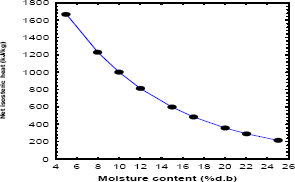
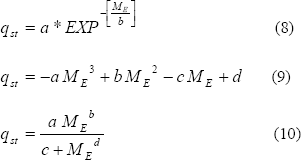
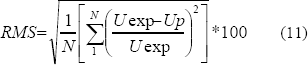
<body><![CDATA[<p><font size="2" face="Verdana, Arial, Helvetica, sans-serif">moisture content (Tsami <i>et al</i>., 1990; Wang and Brennan, 1991; Sopade and Ajisegiri, 1994;Oztekin   and Soysal, 2000; Hossain <i>et al</i>.,2001; Kaya and Kahyaoglu, 2005 Chen, 2006; Ashraful <i>et al</i>., 2007; Iguaz and Vírseda,   2007). The isosteric heat of sorption of plantain pulp as a function of equilibrium moisture content (<i>M<sub>E</sub></i>) in the following forms were considered:</font></p>     <p><font size="2" face="Verdana, Arial, Helvetica, sans-serif"><img src="/img/revistas/dyna/v75n156/a12eq080910.gif"></font></p>     <p><font size="2" face="Verdana, Arial, Helvetica, sans-serif">In the   equation (8), “<i>b” </i>indicates the changes in binding energy with   changes in water content, and <i> “a” </i>is the isosteric heat of sorption for the   strongest bound water molecule (Rahman et al<i>.,</i> 2002).</font></p>     <p><font size="2" face="Verdana, Arial, Helvetica, sans-serif">The accuracy of fit was   evaluated by calculating the root mean square percent error (RMS) (Lievonen and Roos, 2002): </font></p>     <p><font size="2" face="Verdana, Arial, Helvetica, sans-serif"><img src="/img/revistas/dyna/v75n156/a12eq11.gif"></font></p>     <p><font size="2" face="Verdana, Arial, Helvetica, sans-serif"><i>Uexp</i> and <i>Up</i> are the values of isosteric   heat observed and predicted, respectively.</font></p>     <p>&nbsp;</p>     <p><font size="3" face="Verdana, Arial, Helvetica, sans-serif"><b>3. RESULTS AND DISCUSSION </b></font></p>     <p><font size="2" face="Verdana, Arial, Helvetica, sans-serif"><i>Isosteric   heat of sorption    <br>   </i>Values of the heat of sorption at a specific   moisture content provides an indication of the state of the sorbed water and   hence, a measure of the physical, chemical and microbiological stability of the   food material under given storage conditions. In addition, the variation in   heat of sorption with moisture content provides valuable data for energy   consumption calculations and subsequent design of drying equipment, and   knowledge of the extent of the water–solid versus water–water interactions   (McMinn and Magee, 2003). The net isosteric heats of sorption values with respect to moisture   content are represented in <a href="#fig01">Fig. 1</a>. The curve shows that the heat of desorption   decreased with increase in moisture content, initially rapidly up to 15 g moisture/100 g drysolids   and later slowly, as observed in many other food systems (Sawhney et al., 1991; Tsami, 1991; Rahman et al., 2002; Delgado and Sun, 2002b; Tolaba et al., 2004; Yazdani et al., 2006; Sapamundo   et al., 2007; Ashraful   et al., 2007; García-Pérez et al., 2008). The decrease in the isosteric heat with the   increase in sorbed water content may be attributed to the fact that sorption   initially occurs on the most active sites such as hydrophilic polar groups   giving rise to the greatest interaction energy. With increase in the moisture   content, as these sites become occupied, sorption occurs on the less active   sites viz., peptide bonds or hydrophobic hydration sites resulting in lower heats   of sorption (Delgado and Sun, 2002b; Jayendra et al., 2005).</font></p>     ]]></body>
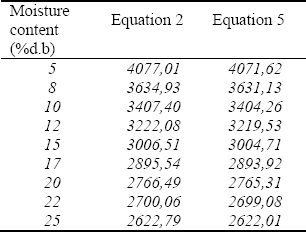
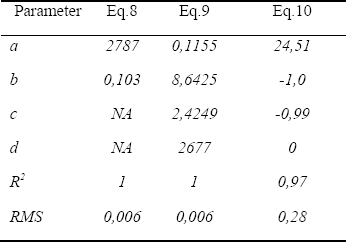
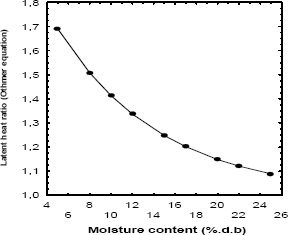
<body><![CDATA[<p align="center"><font size="2" face="Verdana, Arial, Helvetica, sans-serif"><b><a name="fig01"></a><img src="/img/revistas/dyna/v75n156/a12fig01.gif">    <br>   Figure 1.</b> Net isosteric heat as a   function of equilibrium moisture content (equation 3)</font></p>     <p><font size="2" face="Verdana, Arial, Helvetica, sans-serif">The ratio of   latent heat of vaporization as a function of moisture content calculated by <i>Othmer equation</i> can be   observed in <a href="#fig02">Fig. 2</a>. The ratio of (<i>Qst</i>/l) at low moisture   contents is high, indicating that the heat of sorption is nearly twice the heat   of vaporization of pure water (l). This initial   heat may result probably from the chemisorption on polar groups (Simal et al.,   2007). The   value of (<i>Qst</i>/l) was higher than one at   every moisture contents but tending to one as the moisture content increased. The   results of the <a href="#fig01">Fig. 1</a> shown that during a drying process of plantain pulp the energy requirements are very   high. </font></p>     <p align="center"><font size="2" face="Verdana, Arial, Helvetica, sans-serif"><b><a name="fig02"></a><img src="/img/revistas/dyna/v75n156/a12fig02.gif">    <br>   Figure 2.</b> Latent heat of vaporization using   Othmer´s equation</font></p>     <p><font size="2" face="Verdana, Arial, Helvetica, sans-serif">The   analysis statistical (ANOVA with P=0,05) did not found differences to the total   isosteric heat calculated by <i>Clausius–Clapeyron </i>and <i>Othmer </i>equation<i>.</i> The total isosteric heats of desorption of plantain pulp are presented in <a href="#tab01">Table 1</a>. It is evident a marked increases in   isosteric heat at the lower moisture contents. The evaporation of water from   pulp requires energy to overcome the heat of evaporation of pure water (2408,4   kJ/kg). The values were calculated to    25ºC using the Eq. 2   and 5.</font></p>     <p align="center"><font size="2" face="Verdana, Arial, Helvetica, sans-serif"><b><a name="tab01"></a>Table 1.</b> Total isosteric heat as a function of moisture content to plantain pulp</font>    <br>   <img src="/img/revistas/dyna/v75n156/a12tab01.gif"></p>     <p><font size="2" face="Verdana, Arial, Helvetica, sans-serif"><i>Fitting Models    <br>   </i>The calculation of isosteric heat variation with   moisture content was done using the power model (Eq.8), polynomial model (Eq.9)   and non-linear model (Eq.10) and plotted in <a href="#fig03">Fig. 3</a>. The agreement was excellent   for the desorption curve (R<sup>2</sup>@1). The parameters and the standard error of estimate of the parameters   for fitting the Eq. (8), (9) and (10) are   shown in <a href="#tab02">Table 2</a>. The results of <a href="#tab02">Table 2</a> suggesting that polynomial and power model   considered in this study can be used to predict the net isosteric heat of plantain pulp with excellent approximation. </font></p>     ]]></body>
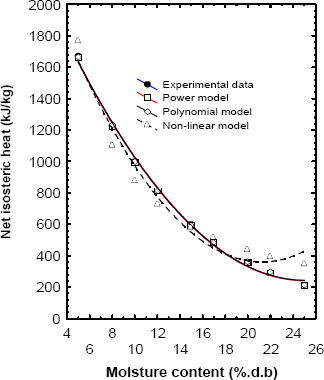
<body><![CDATA[<p align="center"><font size="2" face="Verdana, Arial, Helvetica, sans-serif"><b><a name="fig03"></a><img src="/img/revistas/dyna/v75n156/a12fig03.gif">    <br>   Figure 3</b>. Fitted models to net isosteric   heat according to moisture content</font></p>     <p align="center"><font size="2" face="Verdana, Arial, Helvetica, sans-serif"><b><a name="tab02"></a>Table 2.</b> Estimated parameters for the different models</font>    <br>   <img src="/img/revistas/dyna/v75n156/a12tab02.gif"></p>     <p>&nbsp;</p>     <p><font size="3" face="Verdana, Arial, Helvetica, sans-serif"><b>4. CONCLUSION</b></font></p>     <p><font size="2" face="Verdana, Arial, Helvetica, sans-serif">The net and total isosteric heat of sorption by   desorption of plantain pulp increased   with decreasing moisture content. The net isosteric heat was found to be a   polynomial and power function of equilibrium moisture content. This set of   equations will be useful in the simulation of drying and storage of plantain   pulp.</font></p>     <p>&nbsp; </p>     <p><font size="3" face="Verdana, Arial, Helvetica, sans-serif"><b>REFERENCES</b></font></p>     <!-- ref --><p> <font size="2" face="Verdana, Arial, Helvetica, sans-serif"><b> [1]</b> AGUERRE, R. J; SUAREZ C. AND VIOLLAZ, P. E. The temperature dependence of isosteric heat of sorption of some cereal grains, International Journal of Food Science and Technology, 23, 141-145, 1988.    &nbsp;&nbsp;&nbsp;&nbsp;&nbsp;&nbsp;&nbsp;&nbsp;[&#160;<a href="javascript:void(0);" onclick="javascript: window.open('/scielo.php?script=sci_nlinks&ref=000092&pid=S0012-7353200800030001200001&lng=','','width=640,height=500,resizable=yes,scrollbars=1,menubar=yes,');">Links</a>&#160;]<!-- end-ref --><!-- ref --><br>   <b>[2]</b> AL-MUHTASEB, A. H., MCMINN, W. A. M. AND MAGEE, T. R. A., Moisture sorption isotherm characteristics of food products: a review, Trans IChemE, 80, 118-128, 2002.    &nbsp;&nbsp;&nbsp;&nbsp;&nbsp;&nbsp;&nbsp;&nbsp;[&#160;<a href="javascript:void(0);" onclick="javascript: window.open('/scielo.php?script=sci_nlinks&ref=000093&pid=S0012-7353200800030001200002&lng=','','width=640,height=500,resizable=yes,scrollbars=1,menubar=yes,');">Links</a>&#160;]<!-- end-ref --><!-- ref --><br>   <b>[3]</b> ASHRAFUL HAQUE, MD., SHIMIZU, NAOTO AND KIMURA, TOSHINORi, Net isosteric heats of adsorption and desorption for different forms of hybrid rice, International Journal of Food Properties, 10, 25–37, 2007.    &nbsp;&nbsp;&nbsp;&nbsp;&nbsp;&nbsp;&nbsp;&nbsp;[&#160;<a href="javascript:void(0);" onclick="javascript: window.open('/scielo.php?script=sci_nlinks&ref=000094&pid=S0012-7353200800030001200003&lng=','','width=640,height=500,resizable=yes,scrollbars=1,menubar=yes,');">Links</a>&#160;]<!-- end-ref --><!-- ref --><br>   <b>[4]</b> AVIARA, N. A AND AJIBOLA, O. O., Thermodynamics of moisture sorption in melon seed and cassava. 2002. Journal of Food Engineering, 55, 107–113, 2002.    &nbsp;&nbsp;&nbsp;&nbsp;&nbsp;&nbsp;&nbsp;&nbsp;[&#160;<a href="javascript:void(0);" onclick="javascript: window.open('/scielo.php?script=sci_nlinks&ref=000095&pid=S0012-7353200800030001200004&lng=','','width=640,height=500,resizable=yes,scrollbars=1,menubar=yes,');">Links</a>&#160;]<!-- end-ref --><!-- ref --><br>   <b>[5]</b> BROOKER, D.B., BAKER-ARKEMA, F.W AND HALL, C.W. Drying and Storage of Grains and Oilseeds, The AVI Publishing COMPANY, NEW YORK, 1992.    &nbsp;&nbsp;&nbsp;&nbsp;&nbsp;&nbsp;&nbsp;&nbsp;[&#160;<a href="javascript:void(0);" onclick="javascript: window.open('/scielo.php?script=sci_nlinks&ref=000096&pid=S0012-7353200800030001200005&lng=','','width=640,height=500,resizable=yes,scrollbars=1,menubar=yes,');">Links</a>&#160;]<!-- end-ref --><!-- ref --><br>   <b>[6]</b> CHEN C., Obtaining the isosteric sorption heat directly by sorption isotherm equations, Journal of Food Engineering, 74, 178–185, 2006.    &nbsp;&nbsp;&nbsp;&nbsp;&nbsp;&nbsp;&nbsp;&nbsp;[&#160;<a href="javascript:void(0);" onclick="javascript: window.open('/scielo.php?script=sci_nlinks&ref=000097&pid=S0012-7353200800030001200006&lng=','','width=640,height=500,resizable=yes,scrollbars=1,menubar=yes,');">Links</a>&#160;]<!-- end-ref --><!-- ref --><br>   <b>[7]</b> DELGADO, A. E., AND SUN, D.-W., Desorption isotherms for cooked and cured beef and pork, Journal of Food Engineering, 51, 163–170, 2002b.    &nbsp;&nbsp;&nbsp;&nbsp;&nbsp;&nbsp;&nbsp;&nbsp;[&#160;<a href="javascript:void(0);" onclick="javascript: window.open('/scielo.php?script=sci_nlinks&ref=000098&pid=S0012-7353200800030001200007&lng=','','width=640,height=500,resizable=yes,scrollbars=1,menubar=yes,');">Links</a>&#160;]<!-- end-ref --><!-- ref --><br>   <b>[8]</b> GABAS A.L., MENEGALLI, F.C., AND TELIS-ROMERO J., Water sorption enthalpy-entropy compensation based on isotherms of plum skin and pulp, Journal of Food Science, 65 (4), 680-684, 2000.    &nbsp;&nbsp;&nbsp;&nbsp;&nbsp;&nbsp;&nbsp;&nbsp;[&#160;<a href="javascript:void(0);" onclick="javascript: window.open('/scielo.php?script=sci_nlinks&ref=000099&pid=S0012-7353200800030001200008&lng=','','width=640,height=500,resizable=yes,scrollbars=1,menubar=yes,');">Links</a>&#160;]<!-- end-ref --><!-- ref --><br>   <b>[9]</b> GARCÍA-PÉREZ, J.V., CÁRCEL, J.A., CLEMENTE, G. AND MULET, A. Water sorption isotherms for lemon peel at different temperatures and isosteric heats, LWT , 41, 18–25, 2008.    &nbsp;&nbsp;&nbsp;&nbsp;&nbsp;&nbsp;&nbsp;&nbsp;[&#160;<a href="javascript:void(0);" onclick="javascript: window.open('/scielo.php?script=sci_nlinks&ref=000100&pid=S0012-7353200800030001200009&lng=','','width=640,height=500,resizable=yes,scrollbars=1,menubar=yes,');">Links</a>&#160;]<!-- end-ref --><!-- ref --><br>   <b>[10]</b> HOSSAIN, M.D., BALA, B.K., HOSSAIN, M.A., MONDOL, M.R.A., Sorption isotherms and heat of sorption of pineapple, J. Food Eng., 48 (2), 103–107, 2001.    &nbsp;&nbsp;&nbsp;&nbsp;&nbsp;&nbsp;&nbsp;&nbsp;[&#160;<a href="javascript:void(0);" onclick="javascript: window.open('/scielo.php?script=sci_nlinks&ref=000101&pid=S0012-7353200800030001200010&lng=','','width=640,height=500,resizable=yes,scrollbars=1,menubar=yes,');">Links</a>&#160;]<!-- end-ref --><!-- ref --><br>   <b>[11]</b> IGUAZ, A. AND VÍRSEDA, P., Moisture desorption isotherms of rough rice at high temperatures, Journal of Food Engineering 79, 794–802, 2007.    &nbsp;&nbsp;&nbsp;&nbsp;&nbsp;&nbsp;&nbsp;&nbsp;[&#160;<a href="javascript:void(0);" onclick="javascript: window.open('/scielo.php?script=sci_nlinks&ref=000102&pid=S0012-7353200800030001200011&lng=','','width=640,height=500,resizable=yes,scrollbars=1,menubar=yes,');">Links</a>&#160;]<!-- end-ref --><!-- ref --><br>   <b>[12]</b> JAYENDRA KUMAR, A., SINGH, R.R.B., PATIL, G.R AND PATEL, A.A., Effect of temperature on moisture desorption isotherms of kheer, LWT, 38, 303–310, 2005.    &nbsp;&nbsp;&nbsp;&nbsp;&nbsp;&nbsp;&nbsp;&nbsp;[&#160;<a href="javascript:void(0);" onclick="javascript: window.open('/scielo.php?script=sci_nlinks&ref=000103&pid=S0012-7353200800030001200012&lng=','','width=640,height=500,resizable=yes,scrollbars=1,menubar=yes,');">Links</a>&#160;]<!-- end-ref --><!-- ref --><br>   <b>[13]</b> KALEEMULLAH, S. AND KAILAPPAN, R. Moisture sorption isotherms of red chillies, Biosystems Engineering, 88 (1), 95–104, 2004.    &nbsp;&nbsp;&nbsp;&nbsp;&nbsp;&nbsp;&nbsp;&nbsp;[&#160;<a href="javascript:void(0);" onclick="javascript: window.open('/scielo.php?script=sci_nlinks&ref=000104&pid=S0012-7353200800030001200013&lng=','','width=640,height=500,resizable=yes,scrollbars=1,menubar=yes,');">Links</a>&#160;]<!-- end-ref --><!-- ref --><br>   <b>[14]</b> KAYA, S AND KAHYAOGLU, T, Thermodynamic properties and sorption equilibrium of pestil (grape leather), Journal of Food Engineering , 7, 200–207, 2005.    &nbsp;&nbsp;&nbsp;&nbsp;&nbsp;&nbsp;&nbsp;&nbsp;[&#160;<a href="javascript:void(0);" onclick="javascript: window.open('/scielo.php?script=sci_nlinks&ref=000105&pid=S0012-7353200800030001200014&lng=','','width=640,height=500,resizable=yes,scrollbars=1,menubar=yes,');">Links</a>&#160;]<!-- end-ref --><!-- ref --><br>   <b>[15]</b> KAYMAK-ERTEKIN, FIGEN AND GEDIK, ATIL, Sorption isotherms andisosteric heat of sorption for grapes, apricots, apples and potatoes, Lebensm.-Wiss. u.-Technol., 37,429–438, 2004.    &nbsp;&nbsp;&nbsp;&nbsp;&nbsp;&nbsp;&nbsp;&nbsp;[&#160;<a href="javascript:void(0);" onclick="javascript: window.open('/scielo.php?script=sci_nlinks&ref=000106&pid=S0012-7353200800030001200015&lng=','','width=640,height=500,resizable=yes,scrollbars=1,menubar=yes,');">Links</a>&#160;]<!-- end-ref --><!-- ref --><br>   <b>[16]</b> KIRANOUDIS, C.T., MAROULIS, Z.B., TSAMI, E., MARINOS-KOURIS, D., Equilibrium moisture content and heat of desorption of some vegetables, J. Food Eng., 20 (1), 55–74, 1993.    &nbsp;&nbsp;&nbsp;&nbsp;&nbsp;&nbsp;&nbsp;&nbsp;[&#160;<a href="javascript:void(0);" onclick="javascript: window.open('/scielo.php?script=sci_nlinks&ref=000107&pid=S0012-7353200800030001200016&lng=','','width=640,height=500,resizable=yes,scrollbars=1,menubar=yes,');">Links</a>&#160;]<!-- end-ref --><!-- ref --><br>   <b>[17]</b> LIEVONEN, S.M. AND ROOS, Y.H. Water sorption of food models for studies of glass transition and reaction kinetics, Journal of Food Science, 67(5),1758-1766, 2002.    &nbsp;&nbsp;&nbsp;&nbsp;&nbsp;&nbsp;&nbsp;&nbsp;[&#160;<a href="javascript:void(0);" onclick="javascript: window.open('/scielo.php?script=sci_nlinks&ref=000108&pid=S0012-7353200800030001200017&lng=','','width=640,height=500,resizable=yes,scrollbars=1,menubar=yes,');">Links</a>&#160;]<!-- end-ref --><!-- ref --><br>   <b>[18]</b> MCMINN, W. A. M AND MAGEE, T. R. A., Thermodynamic properties of moisture sorption of potato, Journal of Food Engineering, 60, 155–157, 2003.    &nbsp;&nbsp;&nbsp;&nbsp;&nbsp;&nbsp;&nbsp;&nbsp;[&#160;<a href="javascript:void(0);" onclick="javascript: window.open('/scielo.php?script=sci_nlinks&ref=000109&pid=S0012-7353200800030001200018&lng=','','width=640,height=500,resizable=yes,scrollbars=1,menubar=yes,');">Links</a>&#160;]<!-- end-ref --><!-- ref --><br>   <b>[19]</b> MULET, A., GARCIA-PASCUAL, P., SANJUÁN, N AND GARCÍA-REVERTER, J., Equilibrium isotherms and isosteric heats of morel (Morchella esculenta), Journal of Food Engineering, 53,75–81,2002.    &nbsp;&nbsp;&nbsp;&nbsp;&nbsp;&nbsp;&nbsp;&nbsp;[&#160;<a href="javascript:void(0);" onclick="javascript: window.open('/scielo.php?script=sci_nlinks&ref=000110&pid=S0012-7353200800030001200019&lng=','','width=640,height=500,resizable=yes,scrollbars=1,menubar=yes,');">Links</a>&#160;]<!-- end-ref --><!-- ref --><br>   <b>[20]</b> OTHMER DF., Correlating vapor pressure and latent heat data. A new plot, Ind Eng Chem, 32:841-856, 1940.    &nbsp;&nbsp;&nbsp;&nbsp;&nbsp;&nbsp;&nbsp;&nbsp;[&#160;<a href="javascript:void(0);" onclick="javascript: window.open('/scielo.php?script=sci_nlinks&ref=000111&pid=S0012-7353200800030001200020&lng=','','width=640,height=500,resizable=yes,scrollbars=1,menubar=yes,');">Links</a>&#160;]<!-- end-ref --><!-- ref --><br>   <b>[21]</b> OZTEKIN, S. AND SOYSAL, Y., Comparison of Adsorption and Desorption Isosteric Heats for Some grains. Agricultural Engineering International: the CIGR Journal of Scientific Research and development 2000, II, 1–17.    &nbsp;&nbsp;&nbsp;&nbsp;&nbsp;&nbsp;&nbsp;&nbsp;[&#160;<a href="javascript:void(0);" onclick="javascript: window.open('/scielo.php?script=sci_nlinks&ref=000112&pid=S0012-7353200800030001200021&lng=','','width=640,height=500,resizable=yes,scrollbars=1,menubar=yes,');">Links</a>&#160;]<!-- end-ref --><!-- ref --><br>   <b>[22]</b> PÉREZ-ALONSO, C.; BERISTAIN, C.I.; LOBATO-CALLEROS, C.; RODRÍGUEZ-HUEZO, M.E. AND VERNON-CARTER, E.J., Thermodynamic analysis of the sorption isotherms of pure and blended carbohydrate polymers, Journal of Food Engineering, 77, 753–760, 2006.    &nbsp;&nbsp;&nbsp;&nbsp;&nbsp;&nbsp;&nbsp;&nbsp;[&#160;<a href="javascript:void(0);" onclick="javascript: window.open('/scielo.php?script=sci_nlinks&ref=000113&pid=S0012-7353200800030001200022&lng=','','width=640,height=500,resizable=yes,scrollbars=1,menubar=yes,');">Links</a>&#160;]<!-- end-ref --><!-- ref --><br>   <b>[23]</b> RAHMAN, M. S., SABLANI, S. S., AL–RUZEIQI, GUIZANI, M. H., N., Water adsorption isotherms of freeze–dried tuna meat, Transactions of the ASAE, 45(3), 767–772, 2002.    &nbsp;&nbsp;&nbsp;&nbsp;&nbsp;&nbsp;&nbsp;&nbsp;[&#160;<a href="javascript:void(0);" onclick="javascript: window.open('/scielo.php?script=sci_nlinks&ref=000114&pid=S0012-7353200800030001200023&lng=','','width=640,height=500,resizable=yes,scrollbars=1,menubar=yes,');">Links</a>&#160;]<!-- end-ref --><!-- ref --><br>   <b>[24]</b> RIZVI,S,S,H., Thermodynamics properties of foods in dehydration, In: Engineering properties of food (Third Edition), Editor: M. A. Rao; Syed S.H. Rizvi and Ashim K. Datta, New York: CRC Press, 239-326, 2005.    &nbsp;&nbsp;&nbsp;&nbsp;&nbsp;&nbsp;&nbsp;&nbsp;[&#160;<a href="javascript:void(0);" onclick="javascript: window.open('/scielo.php?script=sci_nlinks&ref=000115&pid=S0012-7353200800030001200024&lng=','','width=640,height=500,resizable=yes,scrollbars=1,menubar=yes,');">Links</a>&#160;]<!-- end-ref --><!-- ref --><br>   <b>[25]</b> RUCKLOD, S., ISENGARD, H.-D., HANSS, J., AND GROBECKER, K. H., The energy of interaction between water and surfaces of biological reference materials, Food Chemistry, 82, 51–59, 2003.    &nbsp;&nbsp;&nbsp;&nbsp;&nbsp;&nbsp;&nbsp;&nbsp;[&#160;<a href="javascript:void(0);" onclick="javascript: window.open('/scielo.php?script=sci_nlinks&ref=000116&pid=S0012-7353200800030001200025&lng=','','width=640,height=500,resizable=yes,scrollbars=1,menubar=yes,');">Links</a>&#160;]<!-- end-ref --><!-- ref --><br>   <b>[26]</b> SAMAPUNDO, SIMBARASHE, DEVLIEGHERE, FRANK, DE MEULENAER, BRUNO, ATUKWASE, ABEL, LAMBONI, YENDOUBAN AND DEBEVERE, JOHAN M., Sorption isotherms and isosteric heats of sorption of whole yellow dent corn, Journal of Food Engineering, 79, 168–175, 2007.    &nbsp;&nbsp;&nbsp;&nbsp;&nbsp;&nbsp;&nbsp;&nbsp;[&#160;<a href="javascript:void(0);" onclick="javascript: window.open('/scielo.php?script=sci_nlinks&ref=000117&pid=S0012-7353200800030001200026&lng=','','width=640,height=500,resizable=yes,scrollbars=1,menubar=yes,');">Links</a>&#160;]<!-- end-ref --><!-- ref --><br>   <b>[27]</b> SAWHNEY, I.K., PATIL, G.R. AND BIKRAM KUMAR. Effect of temperature on moisture sorption isotherms of heat treated whole milk product khoa, Journal of Dairy Research, 58, 329-335, 1991.    &nbsp;&nbsp;&nbsp;&nbsp;&nbsp;&nbsp;&nbsp;&nbsp;[&#160;<a href="javascript:void(0);" onclick="javascript: window.open('/scielo.php?script=sci_nlinks&ref=000118&pid=S0012-7353200800030001200027&lng=','','width=640,height=500,resizable=yes,scrollbars=1,menubar=yes,');">Links</a>&#160;]<!-- end-ref --><!-- ref --><br>   <b>[28]</b> SIMAL, SUSANA, FEMENIA ANTONI, CASTELL-PALOU, AFRICA, ROSSELLO, CARMEN , Water desorption thermodynamic properties of pineapple, Journal of Food Engineering, 80, 1293–1301, 2007.    &nbsp;&nbsp;&nbsp;&nbsp;&nbsp;&nbsp;&nbsp;&nbsp;[&#160;<a href="javascript:void(0);" onclick="javascript: window.open('/scielo.php?script=sci_nlinks&ref=000119&pid=S0012-7353200800030001200028&lng=','','width=640,height=500,resizable=yes,scrollbars=1,menubar=yes,');">Links</a>&#160;]<!-- end-ref --><!-- ref --><br>   <b>[29]</b> SOPADE, P.A. AND AJISEGIRI, E.S. Moisture sorption study on Nigerian foods: maize and sorghum, Journal of Food Engineering, 17(1), 33-56, 1994.    &nbsp;&nbsp;&nbsp;&nbsp;&nbsp;&nbsp;&nbsp;&nbsp;[&#160;<a href="javascript:void(0);" onclick="javascript: window.open('/scielo.php?script=sci_nlinks&ref=000120&pid=S0012-7353200800030001200029&lng=','','width=640,height=500,resizable=yes,scrollbars=1,menubar=yes,');">Links</a>&#160;]<!-- end-ref --><!-- ref --><br>   <b>[30]</b> TOLABA, MARCELA P., PELTZER, MERCEDES, ENRIQUEZ, NATALIA AND POLLIO MARÍA LUCÍA, Grain sorption equilibria of quinoa grains, Journal of Food Engineering, 61,365–371, 2004.    &nbsp;&nbsp;&nbsp;&nbsp;&nbsp;&nbsp;&nbsp;&nbsp;[&#160;<a href="javascript:void(0);" onclick="javascript: window.open('/scielo.php?script=sci_nlinks&ref=000121&pid=S0012-7353200800030001200030&lng=','','width=640,height=500,resizable=yes,scrollbars=1,menubar=yes,');">Links</a>&#160;]<!-- end-ref --><!-- ref --><br>   <b>[31]</b> TSAMI E., Net isosteric heat of sorption in dried fruits, J. Food Eng. , 14, 327–335, 1991.    &nbsp;&nbsp;&nbsp;&nbsp;&nbsp;&nbsp;&nbsp;&nbsp;[&#160;<a href="javascript:void(0);" onclick="javascript: window.open('/scielo.php?script=sci_nlinks&ref=000122&pid=S0012-7353200800030001200031&lng=','','width=640,height=500,resizable=yes,scrollbars=1,menubar=yes,');">Links</a>&#160;]<!-- end-ref --><!-- ref --><br>   <b>[32]</b> TSAMI, E., MAROULIS, Z. B., MORUNOS-KOURIS,D. AND SARAVACOS, G. D., Heat of sorption of water in dried fruits, Int J Food Sci Technol, 25: 350–359, 1990.    &nbsp;&nbsp;&nbsp;&nbsp;&nbsp;&nbsp;&nbsp;&nbsp;[&#160;<a href="javascript:void(0);" onclick="javascript: window.open('/scielo.php?script=sci_nlinks&ref=000123&pid=S0012-7353200800030001200032&lng=','','width=640,height=500,resizable=yes,scrollbars=1,menubar=yes,');">Links</a>&#160;]<!-- end-ref --><!-- ref --><br>   <b>[33]</b> VULLIOUD, M.; MÁRQUEZ, C.A AND DE MICHELIS, A., Equilibrium sorption isotherms and isosteric heat of rose hip fruits (rosa eglanteria), International Journal of Food Properties, 9, 823–833, 2006.    &nbsp;&nbsp;&nbsp;&nbsp;&nbsp;&nbsp;&nbsp;&nbsp;[&#160;<a href="javascript:void(0);" onclick="javascript: window.open('/scielo.php?script=sci_nlinks&ref=000124&pid=S0012-7353200800030001200033&lng=','','width=640,height=500,resizable=yes,scrollbars=1,menubar=yes,');">Links</a>&#160;]<!-- end-ref --><!-- ref --><br>   <b>[34]</b> WANG, N. AND BRENNAN, J.G., Moisture Sorption Isotherm Characteristics of Potatoes at four temperatures, J. Food Eng. , 14 (4), 269–287, 1991.    &nbsp;&nbsp;&nbsp;&nbsp;&nbsp;&nbsp;&nbsp;&nbsp;[&#160;<a href="javascript:void(0);" onclick="javascript: window.open('/scielo.php?script=sci_nlinks&ref=000125&pid=S0012-7353200800030001200034&lng=','','width=640,height=500,resizable=yes,scrollbars=1,menubar=yes,');">Links</a>&#160;]<!-- end-ref --><!-- ref --><br>   <b>[35]</b> WEISSS, A., Algorithms for the calculation of moist air properties on a hand calculator, Trans ASAE, 20, 1133-1136, 1977.    &nbsp;&nbsp;&nbsp;&nbsp;&nbsp;&nbsp;&nbsp;&nbsp;[&#160;<a href="javascript:void(0);" onclick="javascript: window.open('/scielo.php?script=sci_nlinks&ref=000126&pid=S0012-7353200800030001200035&lng=','','width=640,height=500,resizable=yes,scrollbars=1,menubar=yes,');">Links</a>&#160;]<!-- end-ref --><!-- ref --><br>   <b>[36]</b> YAN, ZHENGYONG., SOUSA-GALLAGHER, MARIA J AND OLIVEIRA, FERNANDA A.R., Sorption isotherms and moisture sorption hysteresis of intermediate moisture content banana, Journal of Food Engineering, 86, 342–348, 2008.    &nbsp;&nbsp;&nbsp;&nbsp;&nbsp;&nbsp;&nbsp;&nbsp;[&#160;<a href="javascript:void(0);" onclick="javascript: window.open('/scielo.php?script=sci_nlinks&ref=000127&pid=S0012-7353200800030001200036&lng=','','width=640,height=500,resizable=yes,scrollbars=1,menubar=yes,');">Links</a>&#160;]<!-- end-ref --><!-- ref --><br>   <b>[37]</b> YAZDANI, M., SAZANDEHCHI P., AZIZI, M AND GHOBADI, P., Moisture sorption isotherms and isosteric heat for pistachio, European Food Research and Technology, 223(5), 577-584, 2006.</font>&nbsp;&nbsp;&nbsp;&nbsp;&nbsp;&nbsp;&nbsp;&nbsp;[&#160;<a href="javascript:void(0);" onclick="javascript: window.open('/scielo.php?script=sci_nlinks&ref=000128&pid=S0012-7353200800030001200037&lng=','','width=640,height=500,resizable=yes,scrollbars=1,menubar=yes,');">Links</a>&#160;]<!-- end-ref --> ]]></body><back>
<ref-list>
<ref id="B1">
<label>1</label><nlm-citation citation-type="journal">
<person-group person-group-type="author">
<name>
<surname><![CDATA[AGUERRE]]></surname>
<given-names><![CDATA[R. J]]></given-names>
</name>
<name>
<surname><![CDATA[SUAREZ]]></surname>
<given-names><![CDATA[C.]]></given-names>
</name>
<name>
<surname><![CDATA[VIOLLAZ]]></surname>
<given-names><![CDATA[P. E.]]></given-names>
</name>
</person-group>
<article-title xml:lang="en"><![CDATA[The temperature dependence of isosteric heat of sorption of some cereal grains]]></article-title>
<source><![CDATA[International Journal of Food Science and Technology]]></source>
<year>1988</year>
<volume>23</volume>
<page-range>141-145</page-range></nlm-citation>
</ref>
<ref id="B2">
<label>2</label><nlm-citation citation-type="journal">
<person-group person-group-type="author">
<name>
<surname><![CDATA[AL-MUHTASEB]]></surname>
<given-names><![CDATA[A. H.]]></given-names>
</name>
<name>
<surname><![CDATA[MCMINN]]></surname>
<given-names><![CDATA[W. A. M.]]></given-names>
</name>
<name>
<surname><![CDATA[MAGEE]]></surname>
<given-names><![CDATA[T. R. A.]]></given-names>
</name>
</person-group>
<article-title xml:lang="en"><![CDATA[Moisture sorption isotherm characteristics of food products: a review]]></article-title>
<source><![CDATA[Trans IChemE]]></source>
<year>2002</year>
<volume>80</volume>
<page-range>118-128</page-range></nlm-citation>
</ref>
<ref id="B3">
<label>3</label><nlm-citation citation-type="journal">
<person-group person-group-type="author">
<name>
<surname><![CDATA[ASHRAFUL HAQUE]]></surname>
<given-names><![CDATA[MD]]></given-names>
</name>
<name>
<surname><![CDATA[SHIMIZU]]></surname>
<given-names><![CDATA[NAOTO]]></given-names>
</name>
<name>
<surname><![CDATA[KIMURA]]></surname>
<given-names><![CDATA[TOSHINORi]]></given-names>
</name>
</person-group>
<article-title xml:lang="en"><![CDATA[Net isosteric heats of adsorption and desorption for different forms of hybrid rice]]></article-title>
<source><![CDATA[International Journal of Food Properties]]></source>
<year>2007</year>
<volume>10</volume>
<page-range>25-37</page-range></nlm-citation>
</ref>
<ref id="B4">
<label>4</label><nlm-citation citation-type="journal">
<person-group person-group-type="author">
<name>
<surname><![CDATA[AVIARA]]></surname>
<given-names><![CDATA[N. A]]></given-names>
</name>
<name>
<surname><![CDATA[AJIBOLA]]></surname>
<given-names><![CDATA[O. O.]]></given-names>
</name>
</person-group>
<article-title xml:lang="en"><![CDATA[Thermodynamics of moisture sorption in melon seed and cassava]]></article-title>
<source><![CDATA[Journal of Food Engineering]]></source>
<year>2002</year>
<month>20</month>
<day>02</day>
<volume>55</volume>
<page-range>107-113</page-range></nlm-citation>
</ref>
<ref id="B5">
<label>5</label><nlm-citation citation-type="book">
<person-group person-group-type="author">
<name>
<surname><![CDATA[BROOKER]]></surname>
<given-names><![CDATA[D.B.]]></given-names>
</name>
<name>
<surname><![CDATA[BAKER-ARKEMA]]></surname>
<given-names><![CDATA[F.W]]></given-names>
</name>
<name>
<surname><![CDATA[HALL]]></surname>
<given-names><![CDATA[C.W.]]></given-names>
</name>
</person-group>
<source><![CDATA[Drying and Storage of Grains and Oilseeds]]></source>
<year>1992</year>
<publisher-loc><![CDATA[NEW YORK ]]></publisher-loc>
<publisher-name><![CDATA[The AVI Publishing COMPANY]]></publisher-name>
</nlm-citation>
</ref>
<ref id="B6">
<label>6</label><nlm-citation citation-type="journal">
<person-group person-group-type="author">
<name>
<surname><![CDATA[CHEN]]></surname>
<given-names><![CDATA[C.]]></given-names>
</name>
</person-group>
<article-title xml:lang="en"><![CDATA[Obtaining the isosteric sorption heat directly by sorption isotherm equations]]></article-title>
<source><![CDATA[Journal of Food Engineering]]></source>
<year>2006</year>
<volume>74</volume>
<page-range>178-185</page-range></nlm-citation>
</ref>
<ref id="B7">
<label>7</label><nlm-citation citation-type="journal">
<person-group person-group-type="author">
<name>
<surname><![CDATA[DELGADO]]></surname>
<given-names><![CDATA[A. E.]]></given-names>
</name>
<name>
<surname><![CDATA[SUN]]></surname>
<given-names><![CDATA[D.-W.]]></given-names>
</name>
</person-group>
<article-title xml:lang="en"><![CDATA[Desorption isotherms for cooked and cured beef and pork]]></article-title>
<source><![CDATA[Journal of Food Engineering]]></source>
<year>2002</year>
<month>b</month>
<volume>51</volume>
<page-range>163-170</page-range></nlm-citation>
</ref>
<ref id="B8">
<label>8</label><nlm-citation citation-type="journal">
<person-group person-group-type="author">
<name>
<surname><![CDATA[GABAS]]></surname>
<given-names><![CDATA[A.L.]]></given-names>
</name>
<name>
<surname><![CDATA[MENEGALLI]]></surname>
<given-names><![CDATA[F.C.]]></given-names>
</name>
<name>
<surname><![CDATA[TELIS-ROMERO]]></surname>
<given-names><![CDATA[J.]]></given-names>
</name>
</person-group>
<article-title xml:lang="en"><![CDATA[Water sorption enthalpy-entropy compensation based on isotherms of plum skin and pulp]]></article-title>
<source><![CDATA[Journal of Food Science]]></source>
<year>2000</year>
<volume>65</volume>
<numero>4</numero>
<issue>4</issue>
<page-range>680-684</page-range></nlm-citation>
</ref>
<ref id="B9">
<label>9</label><nlm-citation citation-type="journal">
<person-group person-group-type="author">
<name>
<surname><![CDATA[GARCÍA-PÉREZ]]></surname>
<given-names><![CDATA[J.V.]]></given-names>
</name>
<name>
<surname><![CDATA[CÁRCEL]]></surname>
<given-names><![CDATA[J.A.]]></given-names>
</name>
<name>
<surname><![CDATA[CLEMENTE]]></surname>
<given-names><![CDATA[G.]]></given-names>
</name>
<name>
<surname><![CDATA[MULET]]></surname>
<given-names><![CDATA[A.]]></given-names>
</name>
</person-group>
<article-title xml:lang="en"><![CDATA[Water sorption isotherms for lemon peel at different temperatures and isosteric heats]]></article-title>
<source><![CDATA[LWT]]></source>
<year>2008</year>
<volume>41</volume>
<page-range>18-25</page-range></nlm-citation>
</ref>
<ref id="B10">
<label>10</label><nlm-citation citation-type="journal">
<person-group person-group-type="author">
<name>
<surname><![CDATA[HOSSAIN]]></surname>
<given-names><![CDATA[M.D.]]></given-names>
</name>
<name>
<surname><![CDATA[BALA]]></surname>
<given-names><![CDATA[B.K.]]></given-names>
</name>
<name>
<surname><![CDATA[HOSSAIN]]></surname>
<given-names><![CDATA[M.A.]]></given-names>
</name>
<name>
<surname><![CDATA[MONDOL]]></surname>
<given-names><![CDATA[M.R.A.]]></given-names>
</name>
</person-group>
<article-title xml:lang="en"><![CDATA[Sorption isotherms and heat of sorption of pineapple]]></article-title>
<source><![CDATA[J. Food Eng.]]></source>
<year>2001</year>
<volume>48</volume>
<numero>2</numero>
<issue>2</issue>
<page-range>103-107</page-range></nlm-citation>
</ref>
<ref id="B11">
<label>11</label><nlm-citation citation-type="journal">
<person-group person-group-type="author">
<name>
<surname><![CDATA[IGUAZ]]></surname>
<given-names><![CDATA[A.]]></given-names>
</name>
<name>
<surname><![CDATA[VÍRSEDA]]></surname>
<given-names><![CDATA[P.]]></given-names>
</name>
</person-group>
<article-title xml:lang="en"><![CDATA[Moisture desorption isotherms of rough rice at high temperatures]]></article-title>
<source><![CDATA[Journal of Food Engineering]]></source>
<year>2007</year>
<volume>79</volume>
<page-range>794-802</page-range></nlm-citation>
</ref>
<ref id="B12">
<label>12</label><nlm-citation citation-type="journal">
<person-group person-group-type="author">
<name>
<surname><![CDATA[JAYENDRA KUMAR]]></surname>
<given-names><![CDATA[A.]]></given-names>
</name>
<name>
<surname><![CDATA[SINGH]]></surname>
<given-names><![CDATA[R.R.B.]]></given-names>
</name>
<name>
<surname><![CDATA[PATIL]]></surname>
<given-names><![CDATA[G.R]]></given-names>
</name>
<name>
<surname><![CDATA[PATEL]]></surname>
<given-names><![CDATA[A.A.]]></given-names>
</name>
</person-group>
<article-title xml:lang="en"><![CDATA[Effect of temperature on moisture desorption isotherms of kheer]]></article-title>
<source><![CDATA[LWT]]></source>
<year>2005</year>
<volume>38</volume>
<page-range>303-310</page-range></nlm-citation>
</ref>
<ref id="B13">
<label>13</label><nlm-citation citation-type="journal">
<person-group person-group-type="author">
<name>
<surname><![CDATA[KALEEMULLAH]]></surname>
<given-names><![CDATA[S.]]></given-names>
</name>
<name>
<surname><![CDATA[KAILAPPAN]]></surname>
<given-names><![CDATA[R.]]></given-names>
</name>
</person-group>
<article-title xml:lang="en"><![CDATA[Moisture sorption isotherms of red chillies]]></article-title>
<source><![CDATA[Biosystems Engineering]]></source>
<year>2004</year>
<volume>88</volume>
<numero>1</numero>
<issue>1</issue>
<page-range>95-104</page-range></nlm-citation>
</ref>
<ref id="B14">
<label>14</label><nlm-citation citation-type="journal">
<person-group person-group-type="author">
<name>
<surname><![CDATA[KAYA]]></surname>
<given-names><![CDATA[S]]></given-names>
</name>
<name>
<surname><![CDATA[KAHYAOGLU]]></surname>
<given-names><![CDATA[T]]></given-names>
</name>
</person-group>
<article-title xml:lang="en"><![CDATA[Thermodynamic properties and sorption equilibrium of pestil (grape leather)]]></article-title>
<source><![CDATA[Journal of Food Engineering]]></source>
<year>2005</year>
<volume>7</volume>
<page-range>200-207</page-range></nlm-citation>
</ref>
<ref id="B15">
<label>15</label><nlm-citation citation-type="journal">
<person-group person-group-type="author">
<name>
<surname><![CDATA[KAYMAK-ERTEKIN]]></surname>
<given-names><![CDATA[FIGEN]]></given-names>
</name>
<name>
<surname><![CDATA[GEDIK]]></surname>
<given-names><![CDATA[ATIL]]></given-names>
</name>
</person-group>
<article-title xml:lang="en"><![CDATA[Sorption isotherms andisosteric heat of sorption for grapes, apricots, apples and potatoes]]></article-title>
<source><![CDATA[Lebensm.-Wiss. u.-Technol]]></source>
<year>2004</year>
<volume>37</volume>
<page-range>429-438</page-range></nlm-citation>
</ref>
<ref id="B16">
<label>16</label><nlm-citation citation-type="journal">
<person-group person-group-type="author">
<name>
<surname><![CDATA[KIRANOUDIS]]></surname>
<given-names><![CDATA[C.T.]]></given-names>
</name>
<name>
<surname><![CDATA[MAROULIS]]></surname>
<given-names><![CDATA[Z.B.]]></given-names>
</name>
<name>
<surname><![CDATA[TSAMI]]></surname>
<given-names><![CDATA[E.]]></given-names>
</name>
<name>
<surname><![CDATA[MARINOS-KOURIS]]></surname>
<given-names><![CDATA[D.]]></given-names>
</name>
</person-group>
<article-title xml:lang="en"><![CDATA[Equilibrium moisture content and heat of desorption of some vegetables]]></article-title>
<source><![CDATA[J. Food Eng.]]></source>
<year>1993</year>
<volume>20</volume>
<numero>1</numero>
<issue>1</issue>
<page-range>55-74</page-range></nlm-citation>
</ref>
<ref id="B17">
<label>17</label><nlm-citation citation-type="journal">
<person-group person-group-type="author">
<name>
<surname><![CDATA[LIEVONEN]]></surname>
<given-names><![CDATA[S.M.]]></given-names>
</name>
<name>
<surname><![CDATA[ROOS]]></surname>
<given-names><![CDATA[Y.H.]]></given-names>
</name>
</person-group>
<article-title xml:lang="en"><![CDATA[Water sorption of food models for studies of glass transition and reaction kinetics]]></article-title>
<source><![CDATA[Journal of Food Science]]></source>
<year>2002</year>
<volume>67</volume>
<numero>5</numero>
<issue>5</issue>
<page-range>1758-1766</page-range></nlm-citation>
</ref>
<ref id="B18">
<label>18</label><nlm-citation citation-type="journal">
<person-group person-group-type="author">
<name>
<surname><![CDATA[MCMINN]]></surname>
<given-names><![CDATA[W. A. M]]></given-names>
</name>
<name>
<surname><![CDATA[MAGEE]]></surname>
<given-names><![CDATA[T. R. A.]]></given-names>
</name>
</person-group>
<article-title xml:lang="en"><![CDATA[Thermodynamic properties of moisture sorption of potato]]></article-title>
<source><![CDATA[Journal of Food Engineering]]></source>
<year>2003</year>
<volume>60</volume>
<page-range>155-157</page-range></nlm-citation>
</ref>
<ref id="B19">
<label>19</label><nlm-citation citation-type="journal">
<person-group person-group-type="author">
<name>
<surname><![CDATA[MULET]]></surname>
<given-names><![CDATA[A.]]></given-names>
</name>
<name>
<surname><![CDATA[GARCIA-PASCUAL]]></surname>
<given-names><![CDATA[P.]]></given-names>
</name>
<name>
<surname><![CDATA[SANJUÁN]]></surname>
<given-names><![CDATA[N]]></given-names>
</name>
<name>
<surname><![CDATA[GARCÍA-REVERTER]]></surname>
<given-names><![CDATA[J.]]></given-names>
</name>
</person-group>
<article-title xml:lang="en"><![CDATA[Equilibrium isotherms and isosteric heats of morel (Morchella esculenta)]]></article-title>
<source><![CDATA[Journal of Food Engineering]]></source>
<year>2002</year>
<volume>53</volume>
<page-range>75-81</page-range></nlm-citation>
</ref>
<ref id="B20">
<label>20</label><nlm-citation citation-type="journal">
<person-group person-group-type="author">
<name>
<surname><![CDATA[OTHMER]]></surname>
<given-names><![CDATA[DF]]></given-names>
</name>
</person-group>
<article-title xml:lang="en"><![CDATA[Correlating vapor pressure and latent heat data: A new plot]]></article-title>
<source><![CDATA[Ind Eng Chem]]></source>
<year>1940</year>
<volume>32</volume>
<page-range>841-856</page-range></nlm-citation>
</ref>
<ref id="B21">
<label>21</label><nlm-citation citation-type="journal">
<person-group person-group-type="author">
<name>
<surname><![CDATA[OZTEKIN]]></surname>
<given-names><![CDATA[S.]]></given-names>
</name>
<name>
<surname><![CDATA[SOYSAL]]></surname>
<given-names><![CDATA[Y.]]></given-names>
</name>
</person-group>
<article-title xml:lang="en"><![CDATA[Comparison of Adsorption and Desorption Isosteric Heats for Some grains]]></article-title>
<source><![CDATA[Journal of Scientific Research and development]]></source>
<year></year>
<volume>2000</volume>
<numero>II</numero>
<issue>II</issue>
<page-range>1-17</page-range></nlm-citation>
</ref>
<ref id="B22">
<label>22</label><nlm-citation citation-type="journal">
<person-group person-group-type="author">
<name>
<surname><![CDATA[PÉREZ-ALONSO]]></surname>
<given-names><![CDATA[C.]]></given-names>
</name>
<name>
<surname><![CDATA[BERISTAIN]]></surname>
<given-names><![CDATA[C.I.]]></given-names>
</name>
<name>
<surname><![CDATA[LOBATO-CALLEROS]]></surname>
<given-names><![CDATA[C.]]></given-names>
</name>
<name>
<surname><![CDATA[RODRÍGUEZ-HUEZO]]></surname>
<given-names><![CDATA[M.E.]]></given-names>
</name>
<name>
<surname><![CDATA[VERNON-CARTER]]></surname>
<given-names><![CDATA[E.J.]]></given-names>
</name>
</person-group>
<article-title xml:lang="en"><![CDATA[Thermodynamic analysis of the sorption isotherms of pure and blended carbohydrate polymers]]></article-title>
<source><![CDATA[Journal of Food Engineering]]></source>
<year>2006</year>
<volume>77</volume>
<page-range>753-760</page-range></nlm-citation>
</ref>
<ref id="B23">
<label>23</label><nlm-citation citation-type="journal">
<person-group person-group-type="author">
<name>
<surname><![CDATA[RAHMAN]]></surname>
<given-names><![CDATA[M. S.]]></given-names>
</name>
<name>
<surname><![CDATA[SABLANI]]></surname>
<given-names><![CDATA[S. S.]]></given-names>
</name>
<name>
<surname><![CDATA[AL-RUZEIQI, GUIZANI]]></surname>
<given-names><![CDATA[M. H., N.]]></given-names>
</name>
</person-group>
<article-title xml:lang="en"><![CDATA[Water adsorption isotherms of freeze-dried tuna meat]]></article-title>
<source><![CDATA[Transactions of the ASAE]]></source>
<year>2002</year>
<volume>45</volume>
<numero>3</numero>
<issue>3</issue>
<page-range>767-772</page-range></nlm-citation>
</ref>
<ref id="B24">
<label>24</label><nlm-citation citation-type="book">
<person-group person-group-type="author">
<name>
<surname><![CDATA[RIZVI]]></surname>
<given-names><![CDATA[S,S,H.]]></given-names>
</name>
</person-group>
<article-title xml:lang="en"><![CDATA[Thermodynamics properties of foods in dehydration]]></article-title>
<person-group person-group-type="editor">
<name>
<surname><![CDATA[M. A.]]></surname>
<given-names><![CDATA[Rao]]></given-names>
</name>
<name>
<surname><![CDATA[Rizvi]]></surname>
<given-names><![CDATA[Syed S.H.]]></given-names>
</name>
<name>
<surname><![CDATA[Datta]]></surname>
<given-names><![CDATA[Ashim K.]]></given-names>
</name>
</person-group>
<source><![CDATA[Engineering properties of food]]></source>
<year>2005</year>
<edition>Third Edition</edition>
<page-range>239-326</page-range><publisher-loc><![CDATA[New York ]]></publisher-loc>
<publisher-name><![CDATA[CRC Press]]></publisher-name>
</nlm-citation>
</ref>
<ref id="B25">
<label>25</label><nlm-citation citation-type="journal">
<person-group person-group-type="author">
<name>
<surname><![CDATA[RUCKLOD]]></surname>
<given-names><![CDATA[S.]]></given-names>
</name>
<name>
<surname><![CDATA[ISENGARD]]></surname>
<given-names><![CDATA[H.-D.]]></given-names>
</name>
<name>
<surname><![CDATA[HANSS]]></surname>
<given-names><![CDATA[J.]]></given-names>
</name>
<name>
<surname><![CDATA[GROBECKER]]></surname>
<given-names><![CDATA[K. H.]]></given-names>
</name>
</person-group>
<article-title xml:lang="en"><![CDATA[The energy of interaction between water and surfaces of biological reference materials]]></article-title>
<source><![CDATA[Food Chemistry]]></source>
<year>2003</year>
<volume>82</volume>
<page-range>51-59</page-range></nlm-citation>
</ref>
<ref id="B26">
<label>26</label><nlm-citation citation-type="journal">
<person-group person-group-type="author">
<name>
<surname><![CDATA[SAMAPUNDO]]></surname>
<given-names><![CDATA[SIMBARASHE]]></given-names>
</name>
<name>
<surname><![CDATA[DEVLIEGHERE]]></surname>
<given-names><![CDATA[FRANK]]></given-names>
</name>
<name>
<surname><![CDATA[DE MEULENAER]]></surname>
<given-names><![CDATA[BRUNO]]></given-names>
</name>
<name>
<surname><![CDATA[ATUKWASE]]></surname>
<given-names><![CDATA[ABEL]]></given-names>
</name>
<name>
<surname><![CDATA[LAMBONI]]></surname>
<given-names><![CDATA[YENDOUBAN]]></given-names>
</name>
<name>
<surname><![CDATA[DEBEVERE]]></surname>
<given-names><![CDATA[JOHAN M.]]></given-names>
</name>
</person-group>
<article-title xml:lang="en"><![CDATA[Sorption isotherms and isosteric heats of sorption of whole yellow dent corn]]></article-title>
<source><![CDATA[Journal of Food Engineering]]></source>
<year>2007</year>
<volume>79</volume>
<page-range>168-175</page-range></nlm-citation>
</ref>
<ref id="B27">
<label>27</label><nlm-citation citation-type="journal">
<person-group person-group-type="author">
<name>
<surname><![CDATA[SAWHNEY]]></surname>
<given-names><![CDATA[I.K.]]></given-names>
</name>
<name>
<surname><![CDATA[PATIL]]></surname>
<given-names><![CDATA[G.R.]]></given-names>
</name>
<name>
<surname><![CDATA[BIKRAM]]></surname>
<given-names><![CDATA[KUMAR]]></given-names>
</name>
</person-group>
<article-title xml:lang="en"><![CDATA[Effect of temperature on moisture sorption isotherms of heat treated whole milk product khoa]]></article-title>
<source><![CDATA[Journal of Dairy Research]]></source>
<year>1991</year>
<volume>58</volume>
<page-range>329-335</page-range></nlm-citation>
</ref>
<ref id="B28">
<label>28</label><nlm-citation citation-type="journal">
<person-group person-group-type="author">
<name>
<surname><![CDATA[SIMAL]]></surname>
<given-names><![CDATA[SUSANA]]></given-names>
</name>
<name>
<surname><![CDATA[FEMENIA]]></surname>
<given-names><![CDATA[ANTONI]]></given-names>
</name>
<name>
<surname><![CDATA[CASTELL-PALOU]]></surname>
<given-names><![CDATA[AFRICA]]></given-names>
</name>
<name>
<surname><![CDATA[ROSSELLO]]></surname>
<given-names><![CDATA[CARMEN]]></given-names>
</name>
</person-group>
<article-title xml:lang="en"><![CDATA[Water desorption thermodynamic properties of pineapple]]></article-title>
<source><![CDATA[Journal of Food Engineering]]></source>
<year>2007</year>
<volume>80</volume>
<page-range>1293-1301</page-range></nlm-citation>
</ref>
<ref id="B29">
<label>29</label><nlm-citation citation-type="journal">
<person-group person-group-type="author">
<name>
<surname><![CDATA[SOPADE]]></surname>
<given-names><![CDATA[P.A.]]></given-names>
</name>
<name>
<surname><![CDATA[AJISEGIRI]]></surname>
<given-names><![CDATA[E.S.]]></given-names>
</name>
</person-group>
<article-title xml:lang="en"><![CDATA[Moisture sorption study on Nigerian foods: maize and sorghum]]></article-title>
<source><![CDATA[Journal of Food Engineering]]></source>
<year>1994</year>
<volume>17</volume>
<numero>1</numero>
<issue>1</issue>
<page-range>33-56</page-range></nlm-citation>
</ref>
<ref id="B30">
<label>30</label><nlm-citation citation-type="journal">
<person-group person-group-type="author">
<name>
<surname><![CDATA[TOLABA]]></surname>
<given-names><![CDATA[MARCELA P.]]></given-names>
</name>
<name>
<surname><![CDATA[PELTZER]]></surname>
<given-names><![CDATA[MERCEDES]]></given-names>
</name>
<name>
<surname><![CDATA[ENRIQUEZ]]></surname>
<given-names><![CDATA[NATALIA]]></given-names>
</name>
<name>
<surname><![CDATA[POLLIO]]></surname>
<given-names><![CDATA[MARÍA LUCÍA]]></given-names>
</name>
</person-group>
<article-title xml:lang="en"><![CDATA[Grain sorption equilibria of quinoa grains]]></article-title>
<source><![CDATA[Journal of Food Engineering]]></source>
<year>2004</year>
<volume>61</volume>
<page-range>365-371</page-range></nlm-citation>
</ref>
<ref id="B31">
<label>31</label><nlm-citation citation-type="journal">
<person-group person-group-type="author">
<name>
<surname><![CDATA[TSAMI]]></surname>
<given-names><![CDATA[E.]]></given-names>
</name>
</person-group>
<article-title xml:lang="en"><![CDATA[Net isosteric heat of sorption in dried fruits]]></article-title>
<source><![CDATA[J. Food Eng.]]></source>
<year>1991</year>
<volume>14</volume>
<page-range>327-335</page-range></nlm-citation>
</ref>
<ref id="B32">
<label>32</label><nlm-citation citation-type="journal">
<person-group person-group-type="author">
<name>
<surname><![CDATA[TSAMI]]></surname>
<given-names><![CDATA[E.]]></given-names>
</name>
<name>
<surname><![CDATA[MAROULIS]]></surname>
<given-names><![CDATA[Z. B.]]></given-names>
</name>
<name>
<surname><![CDATA[MORUNOS-KOURIS]]></surname>
<given-names><![CDATA[D.]]></given-names>
</name>
<name>
<surname><![CDATA[SARAVACOS]]></surname>
<given-names><![CDATA[G. D.]]></given-names>
</name>
</person-group>
<article-title xml:lang="en"><![CDATA[Heat of sorption of water in dried fruits]]></article-title>
<source><![CDATA[Int J Food Sci Technol]]></source>
<year>1990</year>
<volume>25</volume>
<page-range>350-359</page-range></nlm-citation>
</ref>
<ref id="B33">
<label>33</label><nlm-citation citation-type="journal">
<person-group person-group-type="author">
<name>
<surname><![CDATA[VULLIOUD]]></surname>
<given-names><![CDATA[M.]]></given-names>
</name>
<name>
<surname><![CDATA[MÁRQUEZ]]></surname>
<given-names><![CDATA[C.A]]></given-names>
</name>
<name>
<surname><![CDATA[DE MICHELIS]]></surname>
<given-names><![CDATA[A.]]></given-names>
</name>
</person-group>
<article-title xml:lang="en"><![CDATA[Equilibrium sorption isotherms and isosteric heat of rose hip fruits (rosa eglanteria)]]></article-title>
<source><![CDATA[International Journal of Food Properties]]></source>
<year>2006</year>
<volume>9</volume>
<page-range>823-833</page-range></nlm-citation>
</ref>
<ref id="B34">
<label>34</label><nlm-citation citation-type="journal">
<person-group person-group-type="author">
<name>
<surname><![CDATA[WANG]]></surname>
<given-names><![CDATA[N.]]></given-names>
</name>
<name>
<surname><![CDATA[BRENNAN]]></surname>
<given-names><![CDATA[J.G.]]></given-names>
</name>
</person-group>
<article-title xml:lang="en"><![CDATA[Moisture Sorption Isotherm Characteristics of Potatoes at four temperatures]]></article-title>
<source><![CDATA[J. Food Eng.]]></source>
<year>1991</year>
<volume>14</volume>
<numero>4</numero>
<issue>4</issue>
<page-range>269-287</page-range></nlm-citation>
</ref>
<ref id="B35">
<label>35</label><nlm-citation citation-type="journal">
<person-group person-group-type="author">
<name>
<surname><![CDATA[WEISSS]]></surname>
<given-names><![CDATA[A.]]></given-names>
</name>
</person-group>
<article-title xml:lang="en"><![CDATA[Algorithms for the calculation of moist air properties on a hand calculator]]></article-title>
<source><![CDATA[Trans ASAE]]></source>
<year>1977</year>
<volume>20</volume>
<page-range>1133-1136</page-range></nlm-citation>
</ref>
<ref id="B36">
<label>36</label><nlm-citation citation-type="journal">
<person-group person-group-type="author">
<name>
<surname><![CDATA[YAN]]></surname>
<given-names><![CDATA[ZHENGYONG]]></given-names>
</name>
<name>
<surname><![CDATA[SOUSA-GALLAGHER]]></surname>
<given-names><![CDATA[MARIA J]]></given-names>
</name>
<name>
<surname><![CDATA[OLIVEIRA]]></surname>
<given-names><![CDATA[FERNANDA A.R.]]></given-names>
</name>
</person-group>
<article-title xml:lang="en"><![CDATA[Sorption isotherms and moisture sorption hysteresis of intermediate moisture content banana]]></article-title>
<source><![CDATA[Journal of Food Engineering]]></source>
<year>2008</year>
<volume>86</volume>
<page-range>342-348</page-range></nlm-citation>
</ref>
<ref id="B37">
<label>37</label><nlm-citation citation-type="journal">
<person-group person-group-type="author">
<name>
<surname><![CDATA[YAZDANI]]></surname>
<given-names><![CDATA[M.]]></given-names>
</name>
<name>
<surname><![CDATA[SAZANDEHCHI]]></surname>
<given-names><![CDATA[P.]]></given-names>
</name>
<name>
<surname><![CDATA[AZIZI]]></surname>
<given-names><![CDATA[M]]></given-names>
</name>
<name>
<surname><![CDATA[GHOBADI]]></surname>
<given-names><![CDATA[P.]]></given-names>
</name>
</person-group>
<article-title xml:lang="en"><![CDATA[Moisture sorption isotherms and isosteric heat for pistachio]]></article-title>
<source><![CDATA[European Food Research and Technology]]></source>
<year>2006</year>
<volume>223</volume>
<numero>5</numero>
<issue>5</issue>
<page-range>577-584</page-range></nlm-citation>
</ref>
</ref-list>
</back>
</article>