<?xml version="1.0" encoding="ISO-8859-1"?><article xmlns:mml="http://www.w3.org/1998/Math/MathML" xmlns:xlink="http://www.w3.org/1999/xlink" xmlns:xsi="http://www.w3.org/2001/XMLSchema-instance">
<front>
<journal-meta>
<journal-id>0012-7353</journal-id>
<journal-title><![CDATA[DYNA]]></journal-title>
<abbrev-journal-title><![CDATA[Dyna rev.fac.nac.minas]]></abbrev-journal-title>
<issn>0012-7353</issn>
<publisher>
<publisher-name><![CDATA[Universidad Nacional de Colombia]]></publisher-name>
</publisher>
</journal-meta>
<article-meta>
<article-id>S0012-73532010000100002</article-id>
<title-group>
<article-title xml:lang="en"><![CDATA[THE SCARCITY-ABUNDANCE RELATIONSHIP OF MINERAL RESOURCES INTRODUCING SOME SUSTAINTABLE ASPECTS]]></article-title>
<article-title xml:lang="es"><![CDATA[LA RELACIÓN ESCASEZ -ABUNDANCIA EN LOS RECURSOS MINERALES AL INTRODUCIR EL ASPECTO DE LA SOSTENIBILIDAD]]></article-title>
</title-group>
<contrib-group>
<contrib contrib-type="author">
<name>
<surname><![CDATA[ESPI]]></surname>
<given-names><![CDATA[JOSÉ ANTONIO]]></given-names>
</name>
<xref ref-type="aff" rid="A01"/>
</contrib>
<contrib contrib-type="author">
<name>
<surname><![CDATA[MORENO]]></surname>
<given-names><![CDATA[SERGIO ALAN]]></given-names>
</name>
<xref ref-type="aff" rid="A02"/>
</contrib>
</contrib-group>
<aff id="A01">
<institution><![CDATA[,Universidad Politécnica de Madrid  ]]></institution>
<addr-line><![CDATA[ ]]></addr-line>
</aff>
<aff id="A02">
<institution><![CDATA[,Universidad de Sonora  ]]></institution>
<addr-line><![CDATA[ ]]></addr-line>
</aff>
<pub-date pub-type="pub">
<day>00</day>
<month>03</month>
<year>2010</year>
</pub-date>
<pub-date pub-type="epub">
<day>00</day>
<month>03</month>
<year>2010</year>
</pub-date>
<volume>77</volume>
<numero>161</numero>
<fpage>21</fpage>
<lpage>29</lpage>
<copyright-statement/>
<copyright-year/>
<self-uri xlink:href="http://www.scielo.org.co/scielo.php?script=sci_arttext&amp;pid=S0012-73532010000100002&amp;lng=en&amp;nrm=iso"></self-uri><self-uri xlink:href="http://www.scielo.org.co/scielo.php?script=sci_abstract&amp;pid=S0012-73532010000100002&amp;lng=en&amp;nrm=iso"></self-uri><self-uri xlink:href="http://www.scielo.org.co/scielo.php?script=sci_pdf&amp;pid=S0012-73532010000100002&amp;lng=en&amp;nrm=iso"></self-uri><abstract abstract-type="short" xml:lang="en"><p><![CDATA[The Planet has a large number of concentrations of minerals. However, the low price assigned to these resources and the principles of sustainable mining in the short term may cause limitations in the exploration and extraction of these resources in the immediate future and they affect the supply of minerals. The true accounts of non-renewable natural resources must be completed entering with the non market values associated to its exploitation. The environmental management tools (Exergetic Analisis and Life Cycle Assessment) are instruments to achieve this goal as outlined below.]]></p></abstract>
<abstract abstract-type="short" xml:lang="es"><p><![CDATA[El Planeta posee un gran número de concentraciones de minerales. Sin embargo, el bajo precio asignado a estos recursos y los principios de la minería sostenible, a corto plazo, pueden producir limitaciones en la exploración y en la extracción de estos recursos, que en un futuro inmediato, sin duda, afectarán al suministro de los minerales. La verdadera contabilidad de los recursos naturales no renovables ha de hacerse introduciendo los valores sin mercado provocados por su explotación que hasta ahora no habían sido contabilizados. Las herramientas de gestión ambiental (fundamentalmente el Análisis Exergético y el Análisis de Ciclo de Vida, aplicados a la producción mineral) son instrumentos para alcanzar este fin, tal como se expresa a continuación.]]></p></abstract>
<kwd-group>
<kwd lng="en"><![CDATA[Natural Resources Sustainability]]></kwd>
<kwd lng="en"><![CDATA[Environmental management tools]]></kwd>
<kwd lng="en"><![CDATA[Exergetic Analisis]]></kwd>
<kwd lng="en"><![CDATA[Life Cycle Assessment]]></kwd>
<kwd lng="es"><![CDATA[Sostenibilidad de los recursos naturales]]></kwd>
<kwd lng="es"><![CDATA[Herramientas de la gestión ambiental]]></kwd>
<kwd lng="es"><![CDATA[Análisis Exergético]]></kwd>
<kwd lng="es"><![CDATA[Análisis de Ciclo de Vida]]></kwd>
</kwd-group>
</article-meta>
</front><body><![CDATA[ <p align="center"><b><font size="4" face="Verdana, Arial, Helvetica, sans-serif">THE SCARCITY-ABUNDANCE RELATIONSHIP OF MINERAL RESOURCES INTRODUCING SOME SUSTAINTABLE ASPECTS</font></b></p>     <p align="center"><b><font size="3" face="Verdana, Arial, Helvetica, sans-serif">LA RELACI&Oacute;N ESCASEZ &ndash;ABUNDANCIA EN LOS RECURSOS MINERALES AL INTRODUCIR EL ASPECTO DE LA SOSTENIBILIDAD</font></b></p>     <p align="center">&nbsp;</p>     <p align="center"><font size="2" face="Verdana, Arial, Helvetica, sans-serif"><b>JOS&Eacute; ANTONIO ESPI</b>    <br>   <i>Universidad   Polit&eacute;cnica de Madrid, <a href="mailto:joseantonio.espi@upm.es">joseantonio.espi@upm.es</a></i></font></p>     <p align="center"><font size="2" face="Verdana, Arial, Helvetica, sans-serif"><b>SERGIO ALAN MORENO</b>    <br>   <i>Universidad de Sonora,   <a href="mailto:alan@dycim.uson.mx">alan@dycim.uson.mx</a></i></font></p>     <p align="center">&nbsp;</p>     <p align="center"><font size="2" face="Verdana, Arial, Helvetica, sans-serif"><b>Received for review June 16 <sup>th</sup>, 2009, accepted December 6 <sup>th</sup>, 2009, final version December 21<sup>th</sup>, 2009</b></font></p>     <p align="center">&nbsp; </p> <hr>     ]]></body>
<body><![CDATA[<p><font size="2" face="Verdana, Arial, Helvetica, sans-serif"><b>ABSTRACT:</b> The Planet has a large number of  concentrations of minerals. However, the low price assigned to these resources  and the principles of sustainable mining in the short term may cause  limitations in the exploration and extraction of these resources in the  immediate future and they affect the supply of minerals. The true accounts of  non-renewable natural resources must be completed entering with the non market  values associated to its exploitation. The environmental management tools (Exergetic  Analisis and Life Cycle Assessment) are instruments to achieve this goal as  outlined below.</font></p>     <p><font size="2" face="Verdana, Arial, Helvetica, sans-serif"><b>KEYWORDS</b>: Natural Resources Sustainability,  Environmental management tools, Exergetic Analisis, Life Cycle Assessment.</font></p>     <p><font size="2" face="Verdana, Arial, Helvetica, sans-serif"><b>RESUMEN: </b>El Planeta  posee un gran n&uacute;mero de concentraciones de minerales. Sin embargo, el bajo  precio asignado a estos recursos y los principios de la miner&iacute;a sostenible, a  corto plazo, pueden producir limitaciones en la exploraci&oacute;n y en la extracci&oacute;n  de estos recursos, que en un futuro inmediato, sin duda, afectar&aacute;n al suministro  de los minerales. La verdadera contabilidad de los recursos naturales no  renovables ha de hacerse introduciendo los valores sin mercado provocados por  su explotaci&oacute;n que hasta ahora no hab&iacute;an sido contabilizados. Las herramientas  de gesti&oacute;n ambiental (fundamentalmente el An&aacute;lisis Exerg&eacute;tico y el An&aacute;lisis de Ciclo de Vida, aplicados a la  producci&oacute;n mineral) son instrumentos para alcanzar este fin, tal como se  expresa a continuaci&oacute;n. </font></p>     <p><font size="2" face="Verdana, Arial, Helvetica, sans-serif"><b>PALABRAS CLAVE:</b> Sostenibilidad de los recursos naturales, Herramientas de la gesti&oacute;n ambiental, An&aacute;lisis Exerg&eacute;tico, An&aacute;lisis de Ciclo de  Vida.</font></p>   <hr>     <p>&nbsp;</p>     <p><font size="3" face="Verdana, Arial, Helvetica, sans-serif"><b>1. INTRODUCTION</b></font></p>     <p><font size="2" face="Verdana, Arial, Helvetica, sans-serif">Generally  speaking, mineral resources belong to the natural non-renewable resources.  However, it still discusses its scarcity; they have a significant economic interest,  but differ somewhat from the cycles of the global economy. Moreover, the  components of its economy have changed substantially in recent years and have been incorporated  the relations with the environment and the social aspects. </font></p>     <p><font size="2" face="Verdana, Arial, Helvetica, sans-serif">The  formation of prices, the contribution of technological innovation, strategies  for their production and the difficulty of defining its future,  are also part of its peculiarities and uncertainties.</font></p>     <p>&nbsp;</p>     <p><font size="3" face="Verdana, Arial, Helvetica, sans-serif"><b>2. SUSTAINABILITY USING MINERAL RESOURCES</b></font></p>     ]]></body>
<body><![CDATA[<p><font size="2" face="Verdana, Arial, Helvetica, sans-serif"><b>2.1 The possible reduction of mineral resources    <br> </b></font><font size="2" face="Verdana, Arial, Helvetica, sans-serif">As  announced almost all the analysts, the most important factor in future demand  for metals and minerals are derived from population growth and the access to  new goods that are product of global economic development. However, the  majority of world population growth will increase in developing countries,  where living standards are low or moderate and the impact of increased  population in the total consumption of minerals will not be as high as would occur in situations with an explosive increase of wealth.</font></p>     <p><font size="2" face="Verdana, Arial, Helvetica, sans-serif">Economic  cycles, recycling of metals, and other factors, may be second-order controls on  the demand for new minerals to more local level. Although the per capita consumption  of minerals, as a whole, does not vary substantially with the economic cycle,  the progressive trend towards increased global demand has been evident for many  decades and is more likely to remain so long more. </font></p>     <p><font size="2" face="Verdana, Arial, Helvetica, sans-serif"><b>2.2 Future supplies of minerals and metals    <br> </b></font><font size="2" face="Verdana, Arial, Helvetica, sans-serif">Mineral  commodities produced in large quantities, such as potassium salts or coal, often  have a &quot;life of the reserves&#8221; of more than 150 years, because it is  much easier to calculate and extrapolate the reserves for these products than  for producing very local sources, such as the higher unit value. Thus, concentrations  of lead and zinc have lives of only 20 to 25 years. In this case, this amount  has remained the same since 1950, despite an increase in production from 1.7 million tonnes of lead and 2.2 Mt zinc in 1950 to 3.0 Mt Pb, and 8,0 Mt Zn at the beginning of the new century.</font></p>     <p><font size="2" face="Verdana, Arial, Helvetica, sans-serif">This  stability is a dynamic balance between consumption and discovery of new  reserves of both metals over the past 50 years. It is obviously much more  important and constant effort to maintain a dynamic balance for mineral  commodities in shortest life for a very long life. &#91;1&#93; Wellmer and Becker-Platen. </font></p>     <p><font size="2" face="Verdana, Arial, Helvetica, sans-serif">According  to Stephen E. Kesler &#91;2&#93;, the world population is growing faster than at any  other time in history, and consumption of minerals makes it faster than  population, as long as new consumers enter the market as a result of its  mineral increased quality of life.</font></p>     <p><font size="2" face="Verdana, Arial, Helvetica, sans-serif">Does  this mean that we will face a crisis of supply of minerals in the XXI century?  If so, we can solve this crisis by providing increased  mineral exploration for new mineral resources, and therefore will require a  more reliable geological information and easier access to the territory. The  answers to these questions should be based on predictions of global demand for  minerals in the twenty-first century, along with a better understanding of the  relationship between the world reserves of minerals and the formation of deposits.</font></p>     <p><font size="2" face="Verdana, Arial, Helvetica, sans-serif"><b>2.3 Patterns of use of Natural Resources    <br> </b></font><font size="2" face="Verdana, Arial, Helvetica, sans-serif">Natural  resources provide numerous goods and services demanded by our society. However,  the frameworks within which it operates the valuation of these resources often  fail to consider values that had not previously passed by the thought of anyone: aesthetic, recreational, environmental or, simply the existence value. </font></p>     ]]></body>
<body><![CDATA[<p><font size="2" face="Verdana, Arial, Helvetica, sans-serif">However  there are obvious failures flaws in the markets of natural resources, as noted by  Richard F. Kazmierczak &#91;3&#93;: </font></p> <ol>       <li><font size="2" face="Verdana, Arial, Helvetica, sans-serif">Failures due to common ownership of resources</font></li>       <li><font size="2" face="Verdana, Arial, Helvetica, sans-serif">Failures related with externalities</font></li>       <li><font size="2" face="Verdana, Arial, Helvetica, sans-serif">Failures in relation to public goods</font></li>       <li><font size="2" face="Verdana, Arial, Helvetica, sans-serif">Failures due to failure of the risks and imbalances in the accounts of the     property. Knowing how markets operate and how they fail, we can discuss the     strategy of incorporating economic systems. This will use different systems for     more complete assessment:</font></li>     </ol>     <p><font size="2" face="Verdana, Arial, Helvetica, sans-serif">First,  one can resort to methods that incorporate the valuation of assets or resources  &quot;no market value&quot;: Contingent Valuation, Method of Travel Costs and Hedonic  Values. It can also use the Cost- Benefit Analysis. The mechanisms to correct  market failures mainly consist of the following: controls, regulations, fees, permits,  etc.</font></p>     <p><font size="2" face="Verdana, Arial, Helvetica, sans-serif"><b>2.4</b> <b>Optimal  extraction of non-renewable natural</b> <b>resources    <br>  </b></font><font size="2" face="Verdana, Arial, Helvetica, sans-serif">The  actual experience in production costs indicates that the effects of cost  reduction due to new technologies are more important than decline in the  quality of the deposits.</font></p>     <p><font size="2" face="Verdana, Arial, Helvetica, sans-serif">Some  studies look at long term prices of mineral raw materials stationary and conclude  that the shortage will not be any problem at the moment; others conclude that  the price over time has a U-shaped and therefore would increase the shortage  long term&quot; Jhon E. Tilton &#91;4&#93;.</font></p>     ]]></body>
<body><![CDATA[<p><font size="2" face="Verdana, Arial, Helvetica, sans-serif">But,  1) In the past century and at times of explosive consumption, has never existed  a scarcity problem. 2) The past has shown that trends in the price of minerals  is not fixed ... ...&quot;If the society is sensitive about the topics related  with the scarce mineral resources to increase investments in geological  information to better determine the shape of the curve of accumulated supplies,  it could provide many details about the circumstances of a possible reduction  in long-term resources &quot; Jhon E. Tilton &#91;4&#93;.</font></p>     <p><font size="2" face="Verdana, Arial, Helvetica, sans-serif">Humphreys  &#91;5&#93; do not agree with the idea that the social and environmental costs of mining  are not included in the price of mineral products. Humphreys's critique is summarized  in four points:</font></p> <ol>       <li><font size="2" face="Verdana, Arial, Helvetica, sans-serif">There is a large or difficult to value the externalities in relation to the     creation of a single level of fees, since there are many peculiarities in the     mining situations. </font></li>       <li><font size="2" face="Verdana, Arial, Helvetica, sans-serif">Valuations are made by experts who have not experienced the consequences of     their judgments</font></li>       <li><font size="2" face="Verdana, Arial, Helvetica, sans-serif">The internalization of externalities should be a combination of regulations and     good governance</font></li>       <li><font size="2" face="Verdana, Arial, Helvetica, sans-serif">The trend of increasing membership in the &quot;codes of conduct&quot; or     &quot;good practices&quot; is a factor mitigating the effects of regulations     and fees.</font></li>     </ol>     <p><font size="2" face="Verdana, Arial, Helvetica, sans-serif">The  world has a wide variety of mineral deposits. However, the low price of these resources  and mining conditions of sustainable exploitations in the exploration and  extraction of mineral resources, could affect the future supply of mineral raw materials.</font></p>     <p><font size="2" face="Verdana, Arial, Helvetica, sans-serif"><b>2.5 The price mechanism    <br> </b></font><font size="2" face="Verdana, Arial, Helvetica, sans-serif">Prices  in general are determined by supply or demand and not by a single variable. However,  the production tends to be more stable and predictable than demand. The buying demand in the markets so volatile and almost always tied up in economic activity. </font></p>     ]]></body>
<body><![CDATA[<p><font size="2" face="Verdana, Arial, Helvetica, sans-serif">The  precious metals and have many features of a competitive market: products are  homogeneous, fungible, replaceable, and well distributed throughout the world. Also  considered recycled metals and transport prices. Barriers to entry are low: there  are good statistics, the markets are reasonably transparent, and information about  prospective market is rapidly distributed.</font></p>     <p><font size="2" face="Verdana, Arial, Helvetica, sans-serif">In  principle, prices are formed on intersection point of supply and demand curves:  if demand goes up or down the supply, then prices go up it will be balanced  again. In practice, prices tend to fluctuate around its equilibrium point. P. Crowson  &#91;6&#93;. </font></p>     <p><font size="2" face="Verdana, Arial, Helvetica, sans-serif">In  mineral raw materials, supply, demand, or both are usually in constant change. When  resources are exhausted, or when rising production costs, there is an attempt to  take control of their prices. In contrast, the opening of new exploitations,  the industry demand decline tends to lower the prices of the mineral resources. </font></p>     <p><font size="2" face="Verdana, Arial, Helvetica, sans-serif"><b>2.6 Other dimensions of sustainability    <br> </b></font><font size="2" face="Verdana, Arial, Helvetica, sans-serif">In  addition to the economic vision, the social and environmental design the geometry  of sustainability. The problem is that valuations of natural capital lost or modified  by human actions is difficult to determine because of the unavailability of an economy that fits to &#8220;no market values&#8221;. </font></p>     <p><font size="2" face="Verdana, Arial, Helvetica, sans-serif">The  lack a measurement system to harmonize market values with they have not yet  possess, affects the formation of the real prices of raw materials and  therefore its scarcity or abundance. One of the latest approaches to the  understanding of this problem is the use of &quot;environmental management  tools.&quot; </font></p>     <p>&nbsp;</p>     <p><font size="3" face="Verdana, Arial, Helvetica, sans-serif"><b>3. USING TOOLS OF ENVIRONMENTAL MANAGEMENT MEASURING THE SUSTAINABILITY</b></font></p>     <p><font size="2" face="Verdana, Arial, Helvetica, sans-serif"><b>3.1 Management tools of environmental quality  in mining    <br> </b></font><font size="2" face="Verdana, Arial, Helvetica, sans-serif">It  is proposed the use of Environmental Management Tools for an approach to the set  of actions that should further implement the valuation of minerals, whereas in  its social and environmental aspects linked to their economic viability. Some  of them are named below: </font></p> <ul>       ]]></body>
<body><![CDATA[<li><font size="2" face="Verdana, Arial, Helvetica, sans-serif">Environmental Accounts</font></li>       <li><font size="2" face="Verdana, Arial, Helvetica, sans-serif">Best Available Technology </font></li>       <li><font size="2" face="Verdana, Arial, Helvetica, sans-serif">Study and Improvement of the &#8220;Mineral Efficiency&#8221;</font></li>       <li><font size="2" face="Verdana, Arial, Helvetica, sans-serif">Development of protocols on the &quot;Safe Use of Mineral Raw Materials&#8221;, </font></li>       <li><font size="2" face="Verdana, Arial, Helvetica, sans-serif">Study of the Improved Production of Minerals and Reduction of Residues </font></li>       <li><font size="2" face="Verdana, Arial, Helvetica, sans-serif">The Study &quot;Cost / Benefit&quot; </font></li>       <li><font size="2" face="Verdana, Arial, Helvetica, sans-serif">Development of Sustainable Mining Indicators &quot;</font></li>       <li><font size="2" face="Verdana, Arial, Helvetica, sans-serif">The &quot;Risk Analysis&#8221; applied to environmental decisions.</font></li>       <li><font size="2" face="Verdana, Arial, Helvetica, sans-serif">&quot;Life Cycle Assessment&#8221; of mineral raw materials.</font></li>     </ul>     ]]></body>
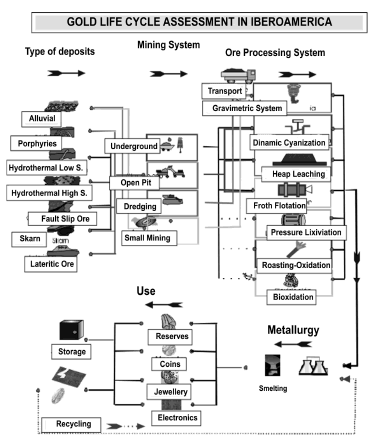
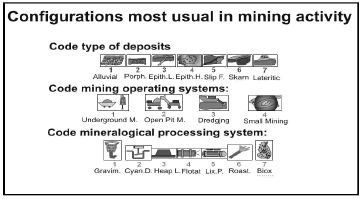
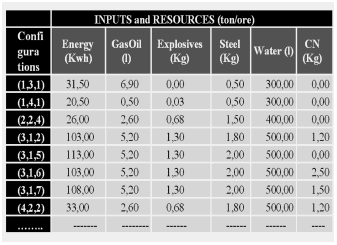
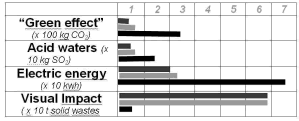
<body><![CDATA[<p><font size="2" face="Verdana, Arial, Helvetica, sans-serif"><b>3.2 Use of environmental management tools in the  assessment of mining activities    <br> </b></font><font size="2" face="Verdana, Arial, Helvetica, sans-serif">The  LCA (Life Cycle Analysis) is one of the most complete and recognized environmental  tools. Basically is a procedure of environmental accounting in quantifying  properly the adverse environmental effects caused by the products and their  manipulation referring to an industrial process generated throughout the life  cycle of the product or process. </font></p>     <p><font size="2" face="Verdana, Arial, Helvetica, sans-serif">The  international standard, ISO 14040, defines the stages to be met by the LCA execution: </font></p> <ul>       <li><font size="2" face="Verdana, Arial, Helvetica, sans-serif">The definition the objectives and scope of the analysis in order to properly     plan the study. </font></li>       <li><font size="2" face="Verdana, Arial, Helvetica, sans-serif">The analysis of the inventory, in which the system or each of its parts are     summarized in graphical form, as a flow of materials and energy and resolving     their balance sheets. </font></li>       <li><font size="2" face="Verdana, Arial, Helvetica, sans-serif">The life-cycle impact assessment, weighting capabilities and summarizing environment     impacts, according to a given set of impact categories. </font></li>     </ul>     <p align="center"><font size="2" face="Verdana, Arial, Helvetica, sans-serif"><b><a name="fig01"></a><img src="/img/revistas/dyna/v77n161/a02fig01.gif">    <br>   Figure 1.</b> An example in valuation effects on   Madrid  granite exploitations applying the LCA, Life Cycle Assessment. J.A. Espi.1999</font></p>     <p><font size="2" face="Verdana, Arial, Helvetica, sans-serif">J.A.  Espi and Berrezueta &#91;6&#93; have used LCA to assess environmentally several gold mineral  deposits typologies according to the <a href="#fig02">Figures 2</a>, <a href="#fig03">3</a> and <a href="#tab01">Table 1</a> schedules.</font></p>     ]]></body>
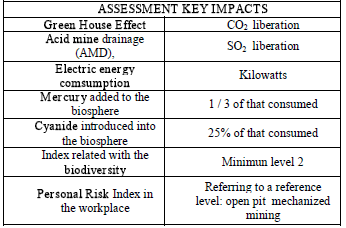
<body><![CDATA[<p align="center"><font size="2" face="Verdana, Arial, Helvetica, sans-serif"><b> <a name="fig02"></a><img src="/img/revistas/dyna/v77n161/a02fig02.gif">    <br> Figure 2</b>. LCA in several gold mineral deposits typologies. Esp&iacute; y Berrezueta &#91;6&#93;</font></p>     <p align="center"><font size="2" face="Verdana, Arial, Helvetica, sans-serif"><b><a name="fig03"></a><img src="/img/revistas/dyna/v77n161/a02fig03.gif">    <br>   Figure 3.</b> Configurations most usual in mineral gold operations as component  of LCA, according types of gold ores. Esp&iacute; y Berrezueta &#91;6&#93;</font></p>     <p align="center"><font size="2" face="Verdana, Arial, Helvetica, sans-serif"><b><a name="tab01"></a>Table 1.</b> Inputs related with ore model  configurations (an example)</font>    <br>  <img src="/img/revistas/dyna/v77n161/a02tab01.gif"></p>     <p><font size="2" face="Verdana, Arial, Helvetica, sans-serif">And,  finally, a summary of the overall effects similar to conditions on production of  Acid Waters, Greenhouse Effect, Visual Impact, Energy Consumption and others  (<a href="#tab02">Table 2</a>). </font></p>     <p align="center"><font size="2" face="Verdana, Arial, Helvetica, sans-serif"><b><a name="tab02"></a>Table 2.</b> Summary about the main effects  calculated in the exploitation stages and processing of gold ores. Esp&iacute; y  Berrezueta &#91;6&#93;</font>    <br>  <img src="/img/revistas/dyna/v77n161/a02tab02.gif"></p>     <p><font size="2" face="Verdana, Arial, Helvetica, sans-serif"><b>3.3 The Exergetic Analysis applied to the production  systems of minerals    ]]></body>
<body><![CDATA[<br> </b></font><font size="2" face="Verdana, Arial, Helvetica, sans-serif">Sergio  Alan Moreno in his doctoral thesis presented in 2006 at the UPM addresses about  use of two environmental tools applied to the most common types of deposits.  Its title is &quot;Evaluation of the productive chains of the global metal mining,  using innovative tools for environmental management&quot; &#91;7&#93;. The author  calculates his environmental qualification using the Exergetic Analysis and the  Life Cycle Assessment.</font></p>     <p><font size="2" face="Verdana, Arial, Helvetica, sans-serif">As  previous case concerning the different models of gold deposits and their exploitation,  Moreno shows  that there are procedures that help to determine the true extent of the  environmental problems caused by the economic exploitation of natural  resources. </font></p>     <p><font size="2" face="Verdana, Arial, Helvetica, sans-serif">The  first approach refers to the Exergetic Analysis. Exergy is the maximum amount of  work that can be obtained from an imbalance between a system and its environment.  The imbalance is that the value of dynamic variable is different for the system  and its environment, so is means both are in disequilibrium. </font></p>     <p><font size="2" face="Verdana, Arial, Helvetica, sans-serif">A  way of measuring the appropriate use of resources by exergy is the exergy efficiency,  which is the ratio of the minimum exergy and exergy consumed in the task.  Nature provides us minerals, rocks, water, fuels, in industrial use, which remember  us about the need to separate them of its natural components and further purified  them. These early stages are profoundly physical energy consumers and energy  needed to separate one component of a solution (solid, liquid or gas) tends to be  proportional to the inverse of its concentration. </font></p>     <p><font size="2" face="Verdana, Arial, Helvetica, sans-serif">A.  Moreno in its application to the mining process begins with separating the  genetic models of mineral deposits and relating them with the most common  technologies. He called the Chain of Metal Mining. The term &#8220;chain&#8221;  in this case refers to various unit operations related to obtain a product.</font></p>     <p><font size="2" face="Verdana, Arial, Helvetica, sans-serif"><b>3.4   Ore  model, methods of operation and</b></font> <font size="2" face="Verdana, Arial, Helvetica, sans-serif"><b>metallurgical process</b></font></p>     <p><font size="2" face="Verdana, Arial, Helvetica, sans-serif">Application  examples:    <br> </font><font size="2" face="Verdana, Arial, Helvetica, sans-serif">A  case could be the different metallogenic types of iron ore deposits:</font></p> <ul>       <li><font size="2" face="Verdana, Arial, Helvetica, sans-serif">Banded iron (BIF)</font></li>       <li><font size="2" face="Verdana, Arial, Helvetica, sans-serif">Pirometasomatics</font></li>       ]]></body>
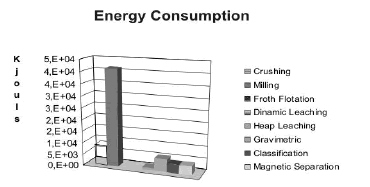
<body><![CDATA[<li><font size="2" face="Verdana, Arial, Helvetica, sans-serif">Hydrothermal veins</font></li>       <li><font size="2" face="Verdana, Arial, Helvetica, sans-serif">For Segregation</font></li>       <li><font size="2" face="Verdana, Arial, Helvetica, sans-serif">For Replacement</font></li>       <li><font size="2" face="Verdana, Arial, Helvetica, sans-serif">Exhalative sedimentary</font></li>       <li><font size="2" face="Verdana, Arial, Helvetica, sans-serif">Ool&iacute;tics</font></li>       <li><font size="2" face="Verdana, Arial, Helvetica, sans-serif">Lateritic alteration</font></li>     </ul>     <p><font size="2" face="Verdana, Arial, Helvetica, sans-serif">The  following examples, <a href="#fig04">Figure 4</a> and <a href="#fig05">5</a> show the components of its environmental and  energy expenditure:</font></p>     <p align="center"><font size="2" face="Verdana, Arial, Helvetica, sans-serif"><b><a name="fig04"></a><img src="/img/revistas/dyna/v77n161/a02fig04.gif">    <br>   Figure 4.</b> Consumption in kilojoules per  tonne processed according to the concentration process</font></p>     ]]></body>
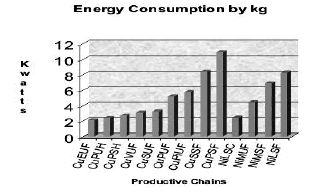
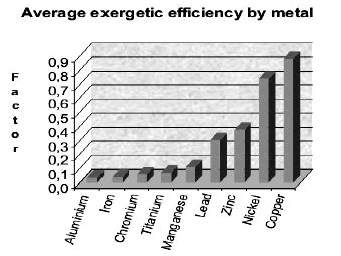
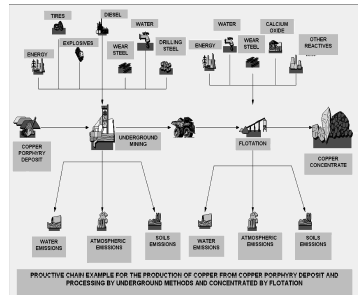
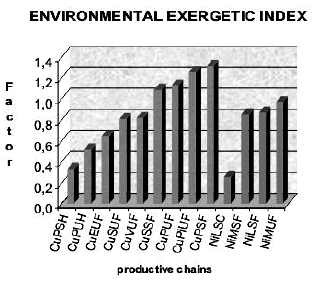
<body><![CDATA[<p align="center"><font size="2" face="Verdana, Arial, Helvetica, sans-serif"><b><a name="fig05"></a><img src="/img/revistas/dyna/v77n161/a02fig05.gif">    <br>   Figure 5.</b> Kilowatts to obtain 1 kg of metal in concentrate  for each chains. (Note: the abbreviations  of the productive chains means: he first  two letters is the metal, the next one, the type of deposit, the next one, the method of mining and the last, the concentration method.  For example, CuPUF means copper from porphyric deposit, exploited  by Underground Methods, and concentrated by Froth Flotation)</font></p>     <p><font size="2" face="Verdana, Arial, Helvetica, sans-serif">It  is very useful a comparison between the calculated energy (exergy) and the  actual energy consumed per each process. This indicator of efficiency allows  classifying the different productive chains is involved in the process of  extraction &#8211; concentration of minerals, as then exemplifies for various metals  (<a href="#fig06">Figure 6</a>). S. A. Moreno &#91;7&#93;. </font></p>     <p align="center"><font size="2" face="Verdana, Arial, Helvetica, sans-serif"><b><a name="fig06"></a><img src="/img/revistas/dyna/v77n161/a02fig06.gif">    <br>   Figure 6.</b> Environmental exergetic  average rate</font> <font size="2" face="Verdana, Arial, Helvetica, sans-serif">for  each metal, considering the energy</font> <font size="2" face="Verdana, Arial, Helvetica, sans-serif">consumption  of each chain and the amount of</font> <font size="2" face="Verdana, Arial, Helvetica, sans-serif">metal  produced per tonne.. </font></p>     <p><font size="2" face="Verdana, Arial, Helvetica, sans-serif"><b>3.4 Other application: The Life Cycle Assessment  (LCA) used in minerals Production    <br> </b></font><font size="2" face="Verdana, Arial, Helvetica, sans-serif">Comparing  the method of Exergetic Analysis applied  to the processes of mineral exploitation, SA Moreno develops a Life Cycle  Assessment with quantitative evaluation using the Umberto software and its  ecopoints (<a href="#fig07">Figures 7</a> and <a href="#fig08">8</a>)<b>. </b>To this account: </font></p>     <p align="center"><font size="2" face="Verdana, Arial, Helvetica, sans-serif"><b><a name="fig07"></a><img src="/img/revistas/dyna/v77n161/a02fig07.gif">    <br> Figure 7</b>. Example extraction-concentration process stages in a porphyry copper ore &#91;7&#93;</font></p>     <p align="center"><font size="2" face="Verdana, Arial, Helvetica, sans-serif"><b><a name="fig08"></a><img src="/img/revistas/dyna/v77n161/a02fig08.gif">    ]]></body>
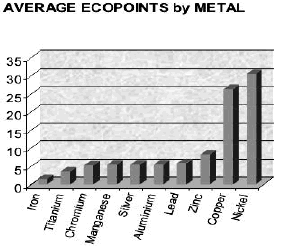
<body><![CDATA[<br>   Figure 8.</b> Ecopoints referred to chain metal   products, summarized by metal</font></p>     <p><font size="2" face="Verdana, Arial, Helvetica, sans-serif"><i>Entries (inputs):</i> the consumption of materials,  energy and matter flow were obtained directly from the data-mining operation.</font></p>     <p><font size="2" face="Verdana, Arial, Helvetica, sans-serif"><i>Matter flow</i>: calculated based on the quantity of rock  needed to move and process each pound of metal to be considered, including  stripping if necessary. </font></p>     <p><font size="2" face="Verdana, Arial, Helvetica, sans-serif"><i>Outputs (outputs):</i> the product of the process  emissions were calculated using databases from the USGS, NPI (National Pollutant  Inventory) and the Umberto software. We have considered both the issues of product  consumption of materials, such as those generated in their manufacture. </font></p>     <p><font size="2" face="Verdana, Arial, Helvetica, sans-serif">Finally,  to complete the assessment process of each mineral substance extracted and concentrated  will include: </font></p> <ul type=disc>  <li style='color:black;text-align:justify; text-autospace:none'><font size="2" face="Verdana, Arial, Helvetica, sans-serif">The impact categories</font></li>  <li style='color:black;text-align:justify; text-autospace:none'><font size="2" face="Verdana, Arial, Helvetica, sans-serif">The amount of each reference substance  emitted</font></li>  <li style='color:black;text-align:justify; text-autospace:none'><font size="2" face="Verdana, Arial, Helvetica, sans-serif">A weighting factor</font></li>  <li style='color:black;text-align:justify; text-autospace:none'><font size="2" face="Verdana, Arial, Helvetica, sans-serif">An assessment and normalization factor</font></li>     </ul>     <p><font size="2" face="Verdana, Arial, Helvetica, sans-serif">The  author concludes with a comparison of two valuation methods (Exergetic Analysis  and LCA) applied to the extraction and processing in the mineral industry (<a href="#fig09">Figures  9</a> and <a href="#fig10">10</a>). </font></p>     <p align="center"><font size="2" face="Verdana, Arial, Helvetica, sans-serif"><b><a name="fig09"></a><img src="/img/revistas/dyna/v77n161/a02fig09.gif">    <br>   Figure 9.</b> Results of application of  Exergetic Analysis and Life Cycle Assessment using several copper and nickel ore types. </font></p>     <p align="center"><font size="2" face="Verdana, Arial, Helvetica, sans-serif"><b><a name="fig10"></a><img src="/img/revistas/dyna/v77n161/a02fig10.gif">    ]]></body>
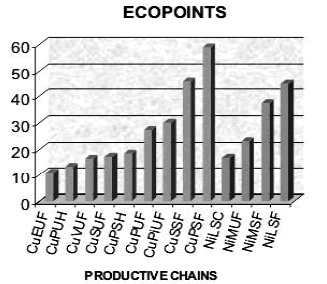
<body><![CDATA[<br>   Figure 10.</b> Results of application of  Exergy Analysis and Life Cycle Assessment using various types of copper and  nickel ores. Exergetic Analisis</font> <font size="2" face="Verdana, Arial, Helvetica, sans-serif">As  result, S.A. Moreno proposes a cluster analysis as follows: </font></p>     <p><font size="2" face="Verdana, Arial, Helvetica, sans-serif"><i>Group 1</i>: The environmental impacts referring to  of mass flow are those that dominate in the: iron, aluminium, chromium,  manganese, and titanium. </font></p>     <p><font size="2" face="Verdana, Arial, Helvetica, sans-serif"><i>Group 2:</i> A medium effect between the flow mass and  energy: copper, nickel, lead, zinc. </font></p>     <p><font size="2" face="Verdana, Arial, Helvetica, sans-serif"><i>Group 3:</i> Most of the emissions are due to a large  power consumption product: silver, gold and PGM </font></p>     <p><font size="2" face="Verdana, Arial, Helvetica, sans-serif">Coinciding  with the first approach of the LCA for different types of gold mineralization  (Espi and Berrezueta &#91;6&#93; and &#91;8&#93;, from the standpoint of sustainable development,  the Exergy Analysis shows that the deposits should be exploited to the highest  metal content possible, underground mines and in many cases using the low energy  consumption, such as hydrometallurgical processes. </font></p>     <p>&nbsp;</p>     <p><font size="3" face="Verdana, Arial, Helvetica, sans-serif"><b>4. CONCLUSIONS</b></font></p>     <p><font size="2" face="Verdana, Arial, Helvetica, sans-serif"><b>4.1 The true scarcity-abundance ratio of a  mineral resource    <br> </b></font><font size="2" face="Verdana, Arial, Helvetica, sans-serif">A  more realistic relationship between scarcity and abundance of a mineral substance  must also be considered within its social and environmental. Therefore, procedures  or tools that determine the dimensions that include the three characteristics  of sustainable operations (value of &quot;use&quot; and &quot;no market  value&quot;) must limit the acceptance of resource inventories with a single  dimension (economic). </font></p>     <p><font size="2" face="Verdana, Arial, Helvetica, sans-serif">Current  technological advances are the result of recent economic crisis, but at the time  of prosperity, as the past, the mineral industry has not invest on discovering  new types of mineral deposits &#8220;green fields&#8221;, nor the increase in  selectivity in terms of the targets exploration, the incorporation of new areas  of the planet and others. Then, the huge size of the processes using poor quality  resources and increasing the investment in search of &quot;brownfields&quot; rather  than the attractiveness of the project called &quot;greenfields&#8221; are the  main strategy of many companies. </font></p>     ]]></body>
<body><![CDATA[<p><font size="2" face="Verdana, Arial, Helvetica, sans-serif">The  series of mergers among large companies is concentrating mineral production in  a few hands. </font></p>     <p><font size="2" face="Verdana, Arial, Helvetica, sans-serif">This  situation is the opposite of a search for a better use of resources. Today, big  mining companies are betting on the benefits of easily available resources by  opting for tight margins unit generating extraordinary production values multiplied  by the great quantities of poor mineral moved. </font></p>     <p><font size="2" face="Verdana, Arial, Helvetica, sans-serif"><b>4.2 Sustainability and Society    <br> </b></font><font size="2" face="Verdana, Arial, Helvetica, sans-serif">To  get the sustainability, economic and social benefits that a company generates  for the local residents have to be higher than their social and environmental  costs. These clear and dimensional benefits must start at the beginning of the  project and continue until after closure. To reach this, it must have good  projects, managed by experienced companies, where governments also align local and national interests. Bob Elton. Eldorado Controller General &#91;9&#93;. </font></p>     <p><font size="2" face="Verdana, Arial, Helvetica, sans-serif">The  sustainable yield is associated with good governance. This requires a elldefined regulatory framework, including ights over resources, the delineation of areas of &quot;no exploitation&quot;, the  rules for apportioning the income of communities and platforms for dialogue.</font></p>     <p><font size="2" face="Verdana, Arial, Helvetica, sans-serif"><b>4.3 The last considerations    <br> </b></font><font size="2" face="Verdana, Arial, Helvetica, sans-serif">The  actual perception about the good value used by mankind, especially those who  are critical to the Natural Capital has changed as the developing world has  risen and the perception related with the effects of population explosion was made visible. </font></p>     <p><font size="2" face="Verdana, Arial, Helvetica, sans-serif">However,  the economic value assigned to such property does not always reflect the capital  used and hence, often, the price of these goods rather than being a limiting factor  or management of its consumption, is an inducement to wasteful use of them. Management  environmental tools, now quite varied and specific to many cases, constitute  one of the procedures, quantitative analysis and prioritization of action to  change the current assessment of natural resources and their true economic assessment. </font></p>     <p>&nbsp;</p>     <p><font size="3" face="Verdana, Arial, Helvetica, sans-serif"><b>REFERENCES</b></font></p>     ]]></body>
<body><![CDATA[<!-- ref --><p><font face="Verdana, Arial, Helvetica, sans-serif"><b><font size="2">&#91;1&#93;</font></b><font size="2">  WELLMER, F.W. AND DIETER J.B. Global Nonfuel Mineral Resources and Sustainability en Proceedings for a Workshop on Deposit Modelling, Mineral Resources Assessment and Their Role in Sustainable Development, USGS Circular 1294,1-16, 2007.       &nbsp;&nbsp;&nbsp;&nbsp;&nbsp;&nbsp;&nbsp;&nbsp;[&#160;<a href="javascript:void(0);" onclick="javascript: window.open('/scielo.php?script=sci_nlinks&ref=000153&pid=S0012-7353201000010000200001&lng=','','width=640,height=500,resizable=yes,scrollbars=1,menubar=yes,');">Links</a>&#160;]<!-- end-ref --><!-- ref --><br>       <b>&#91;2&#93;</b>  KESLER S.E. Mineral Supply and Demand into the 21st Century en Deposit Modelling, Mineral Resources Assessment and Their Role in Sustainable Development, USGS Circular 1294, 55-62, 2007.        &nbsp;&nbsp;&nbsp;&nbsp;&nbsp;&nbsp;&nbsp;&nbsp;[&#160;<a href="javascript:void(0);" onclick="javascript: window.open('/scielo.php?script=sci_nlinks&ref=000154&pid=S0012-7353201000010000200002&lng=','','width=640,height=500,resizable=yes,scrollbars=1,menubar=yes,');">Links</a>&#160;]<!-- end-ref --><!-- ref --><br>       <b>&#91;3&#93;</b>  KAZMIERCZAK R.F. Centre of Natural Resources Economics and Policy. Louisiana State University, 2007.        &nbsp;&nbsp;&nbsp;&nbsp;&nbsp;&nbsp;&nbsp;&nbsp;[&#160;<a href="javascript:void(0);" onclick="javascript: window.open('/scielo.php?script=sci_nlinks&ref=000155&pid=S0012-7353201000010000200003&lng=','','width=640,height=500,resizable=yes,scrollbars=1,menubar=yes,');">Links</a>&#160;]<!-- end-ref --><!-- ref --><br>       <b>&#91;4&#93;</b>  TILTON J.E. Mining, Minerals and Sustainable Development. Mining, Minerals and Sustainable Development (MMSD), 2001.        &nbsp;&nbsp;&nbsp;&nbsp;&nbsp;&nbsp;&nbsp;&nbsp;[&#160;<a href="javascript:void(0);" onclick="javascript: window.open('/scielo.php?script=sci_nlinks&ref=000156&pid=S0012-7353201000010000200004&lng=','','width=640,height=500,resizable=yes,scrollbars=1,menubar=yes,');">Links</a>&#160;]<!-- end-ref --><!-- ref --><br>       <b>&#91;5&#93;</b> HUMPHREYS D. Mining in Knowledge-based Economy, Minerals and Energy, 16 nº3. 2001.     &nbsp;&nbsp;&nbsp;&nbsp;&nbsp;&nbsp;&nbsp;&nbsp;[&#160;<a href="javascript:void(0);" onclick="javascript: window.open('/scielo.php?script=sci_nlinks&ref=000157&pid=S0012-7353201000010000200005&lng=','','width=640,height=500,resizable=yes,scrollbars=1,menubar=yes,');">Links</a>&#160;]<!-- end-ref --><!-- ref --><br>       <b>&#91;6&#93;</b> ESPI J.A. Y BERREZUETA E. El entorno natural y social afectado por la miner&iacute;a del oro, El Libro del Oro de la Miner&iacute;a Iberoamericana. CYTED XIIIb, 2001.     &nbsp;&nbsp;&nbsp;&nbsp;&nbsp;&nbsp;&nbsp;&nbsp;[&#160;<a href="javascript:void(0);" onclick="javascript: window.open('/scielo.php?script=sci_nlinks&ref=000158&pid=S0012-7353201000010000200006&lng=','','width=640,height=500,resizable=yes,scrollbars=1,menubar=yes,');">Links</a>&#160;]<!-- end-ref --><!-- ref --><br>       <b>&#91;7&#93;</b> MORENO S.A. Valoraci&oacute;n de las cadenas productivas de la miner&iacute;a met&aacute;lica global, usando herramientas innovadoras de gesti&oacute;n ambiental, Tesis Doctoral, Universidad Polit&eacute;cnica de Madrid, 2006.     &nbsp;&nbsp;&nbsp;&nbsp;&nbsp;&nbsp;&nbsp;&nbsp;[&#160;<a href="javascript:void(0);" onclick="javascript: window.open('/scielo.php?script=sci_nlinks&ref=000159&pid=S0012-7353201000010000200007&lng=','','width=640,height=500,resizable=yes,scrollbars=1,menubar=yes,');">Links</a>&#160;]<!-- end-ref --><!-- ref --><br>       <b>&#91;8&#93;</b> MORENO S.A. Y ESPI J. A. Introducci&oacute;n al uso de las Herramientas de Gesti&oacute;n Ambiental aplicadas a los Recursos Naturales no renovables, Master Int. Aprovechamiento Sostenible de los Recursos Minerales. Red Desir. Programa Alfa.OEI, 2007.     &nbsp;&nbsp;&nbsp;&nbsp;&nbsp;&nbsp;&nbsp;&nbsp;[&#160;<a href="javascript:void(0);" onclick="javascript: window.open('/scielo.php?script=sci_nlinks&ref=000160&pid=S0012-7353201000010000200008&lng=','','width=640,height=500,resizable=yes,scrollbars=1,menubar=yes,');">Links</a>&#160;]<!-- end-ref --><!-- ref --><br>       <b>&#91;9&#93;</b>  ELTON B. Workshop about mining sustainable, MMSD Several Documents, 2005. </font></font>&nbsp;&nbsp;&nbsp;&nbsp;&nbsp;&nbsp;&nbsp;&nbsp;[&#160;<a href="javascript:void(0);" onclick="javascript: window.open('/scielo.php?script=sci_nlinks&ref=000161&pid=S0012-7353201000010000200009&lng=','','width=640,height=500,resizable=yes,scrollbars=1,menubar=yes,');">Links</a>&#160;]<!-- end-ref --> ]]></body><back>
<ref-list>
<ref id="B1">
<label>1</label><nlm-citation citation-type="confpro">
<person-group person-group-type="author">
<name>
<surname><![CDATA[WELLMER]]></surname>
<given-names><![CDATA[F.W.]]></given-names>
</name>
<name>
<surname><![CDATA[DIETER]]></surname>
<given-names><![CDATA[J.B.]]></given-names>
</name>
</person-group>
<article-title xml:lang="en"><![CDATA[Global Nonfuel Mineral Resources and Sustainability]]></article-title>
<source><![CDATA[]]></source>
<year>2007</year>
<conf-name><![CDATA[ Proceedings for a Workshop on Deposit Modelling, Mineral Resources Assessment and Their Role in Sustainable Development]]></conf-name>
<conf-loc> </conf-loc>
<page-range>1-16</page-range></nlm-citation>
</ref>
<ref id="B2">
<label>2</label><nlm-citation citation-type="">
<person-group person-group-type="author">
<name>
<surname><![CDATA[KESLER]]></surname>
<given-names><![CDATA[S.E.]]></given-names>
</name>
</person-group>
<source><![CDATA[Mineral Supply and Demand into the 21st Century en Deposit Modelling: Mineral Resources Assessment and Their Role in Sustainable Development]]></source>
<year>2007</year>
<page-range>55-62</page-range></nlm-citation>
</ref>
<ref id="B3">
<label>3</label><nlm-citation citation-type="book">
<person-group person-group-type="author">
<name>
<surname><![CDATA[KAZMIERCZAK]]></surname>
<given-names><![CDATA[R.F.]]></given-names>
</name>
</person-group>
<source><![CDATA[Centre of Natural Resources Economics and Policy]]></source>
<year>2007</year>
<publisher-name><![CDATA[Louisiana State University]]></publisher-name>
</nlm-citation>
</ref>
<ref id="B4">
<label>4</label><nlm-citation citation-type="">
<person-group person-group-type="author">
<name>
<surname><![CDATA[TILTON]]></surname>
<given-names><![CDATA[J.E.]]></given-names>
</name>
</person-group>
<source><![CDATA[Mining, Minerals and Sustainable Development: Mining, Minerals and Sustainable Development]]></source>
<year>2001</year>
</nlm-citation>
</ref>
<ref id="B5">
<label>5</label><nlm-citation citation-type="journal">
<person-group person-group-type="author">
<name>
<surname><![CDATA[HUMPHREYS]]></surname>
<given-names><![CDATA[D.]]></given-names>
</name>
</person-group>
<article-title xml:lang="en"><![CDATA[Mining in Knowledge-based Economy]]></article-title>
<source><![CDATA[Minerals and Energy]]></source>
<year>2001</year>
<volume>16</volume>
<numero>3</numero>
<issue>3</issue>
</nlm-citation>
</ref>
<ref id="B6">
<label>6</label><nlm-citation citation-type="book">
<person-group person-group-type="author">
<name>
<surname><![CDATA[ESPI]]></surname>
<given-names><![CDATA[J.A.]]></given-names>
</name>
<name>
<surname><![CDATA[BERREZUETA]]></surname>
<given-names><![CDATA[E.]]></given-names>
</name>
</person-group>
<source><![CDATA[El entorno natural y social afectado por la minería del oro: El Libro del Oro de la Minería Iberoamericana]]></source>
<year>2001</year>
<publisher-name><![CDATA[CYTED XIIIb]]></publisher-name>
</nlm-citation>
</ref>
<ref id="B7">
<label>7</label><nlm-citation citation-type="">
<person-group person-group-type="author">
<name>
<surname><![CDATA[MORENO]]></surname>
<given-names><![CDATA[S.A.]]></given-names>
</name>
</person-group>
<source><![CDATA[Valoración de las cadenas productivas de la minería metálica global, usando herramientas innovadoras de gestión ambiental]]></source>
<year></year>
</nlm-citation>
</ref>
<ref id="B8">
<label>8</label><nlm-citation citation-type="">
<person-group person-group-type="author">
<name>
<surname><![CDATA[MORENO]]></surname>
<given-names><![CDATA[S.A.]]></given-names>
</name>
<name>
<surname><![CDATA[ESPI]]></surname>
<given-names><![CDATA[J. A.]]></given-names>
</name>
</person-group>
<source><![CDATA[Introducción al uso de las Herramientas de Gestión Ambiental aplicadas a los Recursos Naturales no renovables]]></source>
<year>2007</year>
</nlm-citation>
</ref>
<ref id="B9">
<label>9</label><nlm-citation citation-type="">
<person-group person-group-type="author">
<name>
<surname><![CDATA[ELTON]]></surname>
<given-names><![CDATA[B.]]></given-names>
</name>
</person-group>
<source><![CDATA[Workshop about mining sustainable: MMSD Several Documents]]></source>
<year>2005</year>
</nlm-citation>
</ref>
</ref-list>
</back>
</article>