<?xml version="1.0" encoding="ISO-8859-1"?><article xmlns:mml="http://www.w3.org/1998/Math/MathML" xmlns:xlink="http://www.w3.org/1999/xlink" xmlns:xsi="http://www.w3.org/2001/XMLSchema-instance">
<front>
<journal-meta>
<journal-id>0012-7353</journal-id>
<journal-title><![CDATA[DYNA]]></journal-title>
<abbrev-journal-title><![CDATA[Dyna rev.fac.nac.minas]]></abbrev-journal-title>
<issn>0012-7353</issn>
<publisher>
<publisher-name><![CDATA[Universidad Nacional de Colombia]]></publisher-name>
</publisher>
</journal-meta>
<article-meta>
<article-id>S0012-73532010000100008</article-id>
<title-group>
<article-title xml:lang="en"><![CDATA[THE ROCK PROCESSING SECTOR: PART I: CUTTING TECHNOLOGY TOOLS, A NEW DIAMOND SEGMENT BAND SAW PART II: STUDY OF CUTTING FORCES]]></article-title>
<article-title xml:lang="es"><![CDATA[EL SECTOR TRANSFORMADOR DE ROCA: PARTE I: TECNOLOGÍAS DE CORTE, UNA NUEVA SIERRA DE CINTA CON SEGMENTOS DE DIAMANTE PARTE II: ESTUDIO SOBRE FUERZAS DE CORTE]]></article-title>
</title-group>
<contrib-group>
<contrib contrib-type="author">
<name>
<surname><![CDATA[SEGADE ROBLEDA]]></surname>
<given-names><![CDATA[ABRAHAM]]></given-names>
</name>
<xref ref-type="aff" rid="A01"/>
</contrib>
<contrib contrib-type="author">
<name>
<surname><![CDATA[VILÁN VILÁN]]></surname>
<given-names><![CDATA[JOSÉ ANTONIO]]></given-names>
</name>
<xref ref-type="aff" rid="A02"/>
</contrib>
<contrib contrib-type="author">
<name>
<surname><![CDATA[LÓPEZ LAGO]]></surname>
<given-names><![CDATA[MARCOS]]></given-names>
</name>
<xref ref-type="aff" rid="A03"/>
</contrib>
<contrib contrib-type="author">
<name>
<surname><![CDATA[TABOADA CASTRO]]></surname>
<given-names><![CDATA[JAVIER]]></given-names>
</name>
<xref ref-type="aff" rid="A04"/>
</contrib>
</contrib-group>
<aff id="A01">
<institution><![CDATA[,Universidad de Vigo E.T.S.I.Industriales Lagoas - Marcosende]]></institution>
<addr-line><![CDATA[ ]]></addr-line>
</aff>
<aff id="A02">
<institution><![CDATA[,Universidad de Vigo E.T.S.I.Industriales Lagoas - Marcosende]]></institution>
<addr-line><![CDATA[ ]]></addr-line>
</aff>
<aff id="A03">
<institution><![CDATA[,Universidad de Vigo E.T.S.I.Industriales Lagoas - Marcosende]]></institution>
<addr-line><![CDATA[ ]]></addr-line>
</aff>
<aff id="A04">
<institution><![CDATA[,Universidad de Vigo E.T.S.I.Industriales Lagoas - Marcosende]]></institution>
<addr-line><![CDATA[ ]]></addr-line>
</aff>
<pub-date pub-type="pub">
<day>00</day>
<month>03</month>
<year>2010</year>
</pub-date>
<pub-date pub-type="epub">
<day>00</day>
<month>03</month>
<year>2010</year>
</pub-date>
<volume>77</volume>
<numero>161</numero>
<fpage>77</fpage>
<lpage>87</lpage>
<copyright-statement/>
<copyright-year/>
<self-uri xlink:href="http://www.scielo.org.co/scielo.php?script=sci_arttext&amp;pid=S0012-73532010000100008&amp;lng=en&amp;nrm=iso"></self-uri><self-uri xlink:href="http://www.scielo.org.co/scielo.php?script=sci_abstract&amp;pid=S0012-73532010000100008&amp;lng=en&amp;nrm=iso"></self-uri><self-uri xlink:href="http://www.scielo.org.co/scielo.php?script=sci_pdf&amp;pid=S0012-73532010000100008&amp;lng=en&amp;nrm=iso"></self-uri><abstract abstract-type="short" xml:lang="en"><p><![CDATA[This article presents the state of the art in cutting procedures used for ornamental stone processing: primarily diamond segment discs, diamond wires and frame saws. In all these, a reduction in cutting thickness has a direct repercussion on profitability. A new tool is presented with a cutting thickness half that of the best achieved in conventional tools: a band saw with welded diamond segments. The first prototypes are built, cutting tests are carried out and the features of the cut are studied. In the second part, existing studies on measurement of cutting force in conventional tools are reviewed and the prototype band saw machine is monitored. Cutting forces in this new process are studied, with measurement of tangential force and feed force under various working conditions.]]></p></abstract>
<abstract abstract-type="short" xml:lang="es"><p><![CDATA[El artículo presenta el estado del arte de los procedimientos de corte empleados en la transformación de roca ornamental, principalmente, disco con segmentos de diamante, hilo diamantado y los telares. En todos ellos, una reducción en el espesor de corte, repercute de forma directa en la rentabilidad. Se presenta una herramienta novedosa, con un espesor de corte la mitad del mejor conseguido en herramientas convencionales: una sierra de cinta sobre la que se sueldan segmentos de diamante. Se construyen los primeros prototipos, se realizan pruebas de corte y se estudian las características del corte realizado. En una segunda parte se revisan los estudios que existen en la actualidad sobre la medición de fuerzas de corte en granito con herramientas convencionales, y se monitoriza una máquina prototipo de sierra de cinta. Se estudian las fuerzas de corte para este nuevo proceso de corte, se mide la fuerza tangencial, y la fuerza de avance, bajo diferentes condiciones de trabajo.]]></p></abstract>
<kwd-group>
<kwd lng="en"><![CDATA[Stone sawing]]></kwd>
<kwd lng="en"><![CDATA[diamond tools]]></kwd>
<kwd lng="en"><![CDATA[cutting thickness]]></kwd>
<kwd lng="en"><![CDATA[band saw]]></kwd>
<kwd lng="en"><![CDATA[cutting force]]></kwd>
<kwd lng="es"><![CDATA[Corte]]></kwd>
<kwd lng="es"><![CDATA[roca ornamental]]></kwd>
<kwd lng="es"><![CDATA[sierra de cinta]]></kwd>
</kwd-group>
</article-meta>
</front><body><![CDATA[ <p align="center"><font size="4" face="Verdana, Arial, Helvetica, sans-serif"><b>THE ROCK  PROCESSING SECTOR: PART I: CUTTING TECHNOLOGY TOOLS, A NEW DIAMOND SEGMENT BAND  SAW PART II: STUDY OF CUTTING FORCES </b></font></p>     <p align="center"><i><font size="3"><b><font face="Verdana, Arial, Helvetica, sans-serif">EL SECTOR TRANSFORMADOR DE ROCA: PARTE I: TECNOLOG&Iacute;AS DE  CORTE, UNA NUEVA SIERRA DE CINTA CON SEGMENTOS DE DIAMANTE PARTE II: ESTUDIO  SOBRE FUERZAS DE CORTE </font></b></font></i></p>     <p align="center">&nbsp;</p>     <p align="center"><font size="2" face="Verdana, Arial, Helvetica, sans-serif"><b>ABRAHAM SEGADE ROBLEDA</b>    <br>   <i>Universidad de Vigo, E.T.S.I.Industriales, Lagoas &#8211; Marcosende  36310 Vigo, Spain, <a href="mailto:asegade@uvigo.es">asegade@uvigo.es</a></i></font></p>      <p align="center"><font size="2" face="Verdana, Arial, Helvetica, sans-serif"> <b>JOS&Eacute; ANTONIO  VIL&Aacute;N VIL&Aacute;N</b>    <br>  <i>Universidad de Vigo, E.T.S.I.Industriales, Lagoas &#8211; Marcosende  36310 Vigo, Spain, <a href="mailto:jvilan@uvigo.es">jvilan@uvigo.es</a></i> </font></p>      <p align="center"><font size="2" face="Verdana, Arial, Helvetica, sans-serif"><b>MARCOS L&Oacute;PEZ LAGO</b>    <br>    <i>Universidad de Vigo, E.T.S.I.Industriales, Lagoas &#8211; Marcosende  36310 Vigo, Spain, <a href="mailto:mllago@uvigo.es">mllago@uvigo.es</a></i> </font></p>      <p align="center"><font size="2" face="Verdana, Arial, Helvetica, sans-serif"> <b>JAVIER TABOADA  CASTRO</b>    ]]></body>
<body><![CDATA[<br>  <i>Universidad de Vigo, E.T.S.I.Minas, Lagoas &#8211; Marcosende 36310  Vigo, Spain, <a href="mailto:jtaboada@uvigo.es">jtaboada@uvigo.es</a></i> </font></p>      <p align="center">&nbsp;</p>      <p align="center"><font size="2" face="Verdana, Arial, Helvetica, sans-serif"><b>Received for review June 16 <sup>th,</sup> 2009, accepted December    20 <sup>th</sup>, 2009, final version December 21 <sup>th</sup>, 2009</b></font></p>      <p>&nbsp;</p>  <hr>      <p><font size="2" face="Verdana, Arial, Helvetica, sans-serif"><b>ABSTRACT: </b>This article presents the state of the art in cutting    procedures used for ornamental stone processing: primarily diamond segment    discs, diamond wires and frame saws. In all these, a reduction in cutting    thickness has a direct repercussion on profitability. A new tool is presented    with a cutting thickness half that of the best achieved in conventional tools:    a band saw with welded diamond segments. The first prototypes are built,    cutting tests are carried out and the features of the cut are studied. </font></p>      <p><font size="2" face="Verdana, Arial, Helvetica, sans-serif">In the second part, existing studies on measurement of cutting force in  conventional tools are reviewed and the prototype band saw machine is monitored.  Cutting forces in this new process are studied, with measurement of tangential  force and feed force under various working conditions. </font></p>      <p><font size="2" face="Verdana, Arial, Helvetica, sans-serif"><b>KEYWORDS</b>: Stone sawing, diamond tools, cutting thickness, band saw, cutting  force.</font></p>      <p><font size="2" face="Verdana, Arial, Helvetica, sans-serif"><b>RESUMEN: </b>El art&iacute;culo presenta el estado del arte de los  procedimientos de corte empleados en la transformaci&oacute;n de roca ornamental,  principalmente, disco con segmentos de diamante, hilo diamantado y los telares.  En todos ellos, una reducci&oacute;n en el espesor de corte, repercute de forma  directa en la rentabilidad. Se presenta una herramienta novedosa, con un  espesor de corte la mitad del mejor conseguido en herramientas convencionales:  una sierra de cinta sobre la que se sueldan segmentos de diamante. Se  construyen los primeros prototipos, se realizan pruebas de corte y se estudian  las caracter&iacute;sticas del corte realizado.</font></p>      <p><font size="2" face="Verdana, Arial, Helvetica, sans-serif">En una segunda parte  se revisan los estudios que existen en la actualidad sobre la medici&oacute;n de  fuerzas de corte en granito con herramientas convencionales, y se monitoriza  una m&aacute;quina prototipo de sierra de cinta. Se estudian las fuerzas de corte para  este nuevo proceso de corte, se mide la fuerza tangencial, y la fuerza de  avance, bajo diferentes condiciones de trabajo.</font></p>      <p><font size="2" face="Verdana, Arial, Helvetica, sans-serif"><b>PALABRAS CLAVE</b>: Corte,  roca ornamental, sierra de cinta.</font></p>    <hr>      ]]></body>
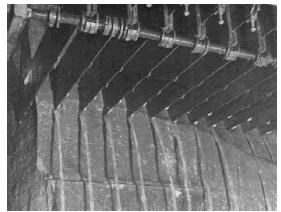
<body><![CDATA[<p>&nbsp;</p>      <p><b><font size="3" face="Verdana, Arial, Helvetica, sans-serif">PART I: CUTTING TECHNOLOGY TOOLS, A NEW DIAMOND SEGMENT BAND SAW</font></b></p>      <p><font size="3" face="Verdana, Arial, Helvetica, sans-serif"><b>1. INTRODUCTION</b></font></p>      <p><font size="2" face="Verdana, Arial, Helvetica, sans-serif">The  ornamental stone processing industry includes all the operations needed to  create the finished product. Our description focuses on cutting machines  &#8211; prior primarily frame saws, discs and diamond wires &#8211; for the new  process presented here sits alongside these.</font></p>      <p><font size="2" face="Verdana, Arial, Helvetica, sans-serif">Theoretical  study of ornamental rock cutting began at the end of the 20<sup>th</sup> century and it was Ertingshausen, &#91;1&#93;, who proposed the first cutting model.  This basic model has been widely accepted, &#91;2&#93;, and afterwards other complex  theories have been coming out, &#91;3, 4, 5&#93;. This recent development provides some  generic publications, &#91;6&#93;, but almost all the studies are centered on circular  diamond saws. </font></p>      <p><font size="2" face="Verdana, Arial, Helvetica, sans-serif">In the next  paragraphs a brief description of current technology for cutting machines is  provided.</font></p>  <font size="2" face="Verdana, Arial, Helvetica, sans-serif"><b>1.1 Frames    <br>  </b>A frame is    a large, 16-metre structure weighing roughly 50 tons which uses numerous strips    as a cutting tool, <a href="#fig01">Figure 1</a>. The cutting strips are taut and use a connecting    rod - crank to move backwards and forwards. The strips are usually between 4  &#8211; 5 mm thick and a mixture of water and metal shot is added on the    downward stroke to aid cutting and cool the strip. The thickness of the final cut   is normally between 8 &#8211; 10 mm.     <p align="center"><b><a name="fig01"></a><img src="/img/revistas/dyna/v77n161/a08fig01.gif">    <br>  Figure 1.</b> Frame cutting strips</p>      <p>Frame saws   have been used for years, but there are few technical publications about cutting performance.    Some of them deal with slabs quality &#91;7&#93; or fastening system for saw blades   &#91;8&#93;.</p>  <b>1.2 Disc cutting    ]]></body>
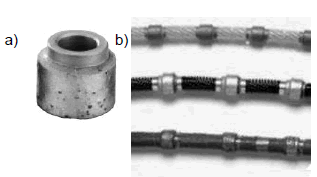
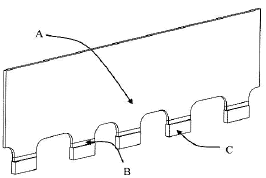
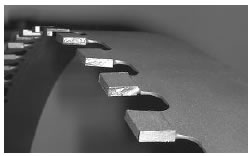
<body><![CDATA[<br>  </b>The cutting     tool is a steel alloy disc with diamond segments welded to the periphery,     <a href="#fig02">Figure 2</a>. Depending on the thickness to be cut the size of the disc can vary,  ranging between 300 mm and 4 metres in diameter.</font><font face="Verdana, Arial, Helvetica, sans-serif">      <p align="center"><font size="2"><b><a name="fig02"></a><img src="/img/revistas/dyna/v77n161/a08fig02.gif">    <br>   Figure 2.</b> Disc  with diamond segments</font></p>      <p><font size="2">Large disc     machines are fitted with discs of 4 metres in diameter with segments that are     14 mm thick. Such machines, when fitted with powerful motors of up to 110 kW,  can open large blocks measuring 1.7 metres.</font></p>      <p><font size="2">This is the     most studied technology and almost all the publications are focused on it. Some     of the studies deal with segment wear &#91;9, 10, 11&#93;, and sawability influence  from rock properties or composition &#91;12 -18&#93;. </font></p>  <font size="2"><b>1.3 Wire cutting    <br>  </b>A    conventional stationary wire cutting machine for the processing industry    weights around six tons and has a cutting motor frequently fitted of between 10   &#8211; 20 kW. The cutting tool is a steel wire, usually from four to five    millimetres thick, on to which diamond beads, as they are called, are attached,    <a href="#fig03">Figure 3</a> a). These beads have the same structure as the diamond segments:    sintered polycrystalline diamonds in a metal matrix. There must be separation    between the diamond beads to allow for the removal of cut away material, and 30   &#8211; 40 beads are usually fitted per metre. The element separating the beads    may differ depending on the type of wire, which may be springs or injected   polymer, but normally vulcanised rubber or plastic, <a href="#fig03">Figure 3</a> b).       <p align="center"><b><a name="fig03"></a><img src="/img/revistas/dyna/v77n161/a08fig03.gif">    <br>   Figure 3.</b> a) Diamond bead b) Diamond wire</p>  Technical  publications about wire cutting are really limited, some of them deal with  marble quarrying &#91;19 - 21&#93;, and as far as bench cutting of large stone blocks  is concerned they are almost nonexistent &#91;22, 23&#93;, and deal with basic factors  as wear and cutting forces. 1.4 Band saw cutting      <p>The    proposed system consists of diamond segments welded to a continuous band, &#91;24&#93;,  <a href="#fig04">Figure 4</a>.</p>      <p align="center"><b><a name="fig04"></a><img src="/img/revistas/dyna/v77n161/a08fig04.gif">    ]]></body>
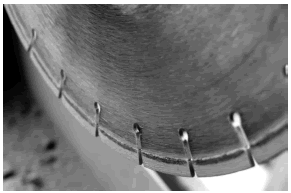
<body><![CDATA[<br>  Figure 4.</b> Band saw with diamond segments &#91;24&#93;</p>      <p>The saw    consists of a flexible strip (A) cut with merlons (B) that allow the diamond    segments to be welded on the ends. As the strip is very narrow, 1.3 mm in this    case, small 3 mm thick segments can be welded, by which a major reduction can  be achieved in cutting thickness.</p>      <p>&nbsp;</p>  </font></font>      <p><font size="3" face="Verdana, Arial, Helvetica, sans-serif"><b>2. THE IMPORTANCE OF THICKNESS REDUCTION</b></font></p>  <font face="Verdana, Arial, Helvetica, sans-serif"><font size="2">      <p>In   conventional processes, the most common thicknesses are the following:</p>  </font></font>  <ul>        <li><font face="Verdana, Arial, Helvetica, sans-serif"><font size="2"><i>Frames</i> open      a cut of between 8 &#8211; 10 mm to make slabs. </font></font></li>        <li><font face="Verdana, Arial, Helvetica, sans-serif"><font size="2"><i>Disc machines </i>must      be fitted with segments of 14 mm to open blocks. </font></font></li>        <li><font face="Verdana, Arial, Helvetica, sans-serif"><font size="2"><i>Wire machines.</i> In a standard processing sector machine, the diamond bead coating has an      exterior diameter of 8.5 mm, and when it is fully worn reaches up to 6.5 mm. </font></font></li>      </ul>  <font face="Verdana, Arial, Helvetica, sans-serif"><font size="2">      <p>The    proposed band saw reduces the tool thickness to a minimum of 3 mm. Thus,    although most of the advantages of this cutting process stem from reducing cut   thickness, they can be detailed as follows:</p>  </font></font>      ]]></body>
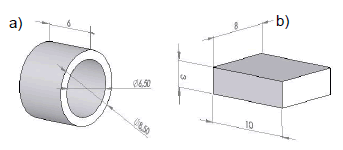
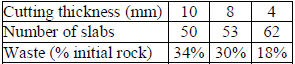
<body><![CDATA[<p><font face="Verdana, Arial, Helvetica, sans-serif"><font size="2"><b>2.1 Reduction in cutting thickness    <br>    </b>Frames and    diamond wire cutters currently have the smallest thicknesses for block cutting,    which can reach 7 mm, with difficulty, when the wire is worn, and only the    latest machines fit 6mm diameter wire. With the proposed cutting machine it    would be relatively simple to work with a 3mm thick tool, and even manufacture  special tools to reach 2.5 mm.</font></font></p>      <p><font face="Verdana, Arial, Helvetica, sans-serif"><font size="2"><b>2.2 Less    wasted rock    <br>    </b>Wasted rock    is a major concern, particularly in the production of slabs. To evaluate the    amount of rock wasted in slab production, the productivity of a block of 1,500    mm. will be studied. It will be used for producing 20 mm slabs, and it will be    taken into consideration that cutting thickness will be wasted, <a href="#tab01">Table 1</a>. </font></font></p>  <font face="Verdana, Arial, Helvetica, sans-serif"><font size="2">      <p align="center"><b><a name="tab01"></a>Table 1.</b> Using a 1,500 mm block to make 20 mm slabs    <br>  <img src="/img/revistas/dyna/v77n161/a08tab01.gif"></p>      <p>In relative    terms, compared to standard frame production, productivity for the same block    would be increased by 24%, and waste would be reduced by 48% at the same time,    i.e. practically halved. This turns into a major saving, particularly when   dealing with rock with high value features. </p>  <b>2.3 Sawdust reduction &#8211; waste management  cost    <br>  </b>Sawdust     waste from cutting processes causes major separation and purifying problems.     Processing companies must fit purifying equipment for sawdust separation as it     is mixed with large amounts of water, and then they must pay for transport and     storage. The wasted rock calculation in <a href="#tab01">Table 1</a> considers that with a decrease     in cutting thickness more cuts can be made in the block; but for the same     number of cuts the waste reduction is at a ratio of 10 &#8211; 4, which means     60% less. Even for a minimum cut of 7 mm, done using a wire at the end of its    life, waste reduction would be 43%, which means 43% less sawdust to treat. <b>2.4 Cutting tool performance    <br>    </b>Cutting    tools base their cutting ability on a process of abrasion. Their performance    can be evaluated according to the amount of diamond used up during cutting,   divided by the frontal area that faces the cut.        <p>Calculating    for a standard diamond wire, the diamond bead has an initial diameter of 8.5 mm    and is worn down to 6.5 mm. The amount of diamond worn away is the volume    between the initial and final diameters, multiplied by the length of the bead,      <a href="#fig05">Figure 5</a> a). The frontal attack area varies for the beads on the wire, starting    at 8.5x 6 mm<sup>2</sup>, and ending at 6.5x 6 mm. For the calculation an approximate average value of 7.5x 6mm   is taken in this case.</p>        ]]></body>
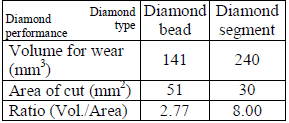
<body><![CDATA[<p align="center"><b><a name="fig05"></a><img src="/img/revistas/dyna/v77n161/a08fig05.gif">    <br>    Figure 5.</b> Volume of diamond: a) Diamond bead wire, b)   Proposed saw segment</p>        <p>For a 3x    10x 10 mm diamond segment, a volume of diamond for wear of 3x 10x 8 mm can be   estimated, maintaining a constant frontal area of 3x 10 mm.</p>        <p>The worn    volume to area ratio is indicative of the millimetres of material the cutting    element has in reserve for each millimetre squared of surface it cuts. The    calculations in <a href="#tab02">Table 2</a> show that for the diamond beaded wire there are 2.77 mm   of reserve material, whereas for the diamond segment there are 8 mm. </p>        <p align="center"><b><a name="tab02"></a>Table 2.</b> Volume for wear and cutting   area, for diamond bead and diamond segment    <br>   <img src="/img/revistas/dyna/v77n161/a08tab02.gif"></p>        <p>The    performance that can be attained with a diamond segment is almost three times    greater than that for a diamond beaded wire, which means a much longer tool   lifetime can be expected. </p>  </font></font>      <p><font face="Verdana, Arial, Helvetica, sans-serif"><font size="2"><b>2.5 Less power needed for cutting    <br>    </b>Given that    the power consumed during cutting, and the forces that arise, are proportional    to the amount of material removed per unit of time, &#91;25&#93;, a substantial 60%    decrease in cutting thickness will lead to a substantial decrease in power  consumed.</font></font></p>      <p><font size="2" face="Verdana, Arial, Helvetica, sans-serif"><b>2.6 Increased speed  </b>       ]]></body>
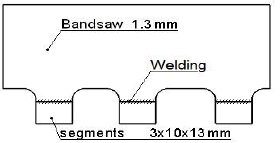
<body><![CDATA[<br>   The speed limitation for wire cutting is a consequence of the straightness of the cut, for if the feed movement is very fast the cut will begin to warp. In wire cutting the normal load in the wire is 3,000 N, and it is a flexible element. However, the band is more rigid (against flexion in the cutting direction) and greater forces are used, 8,000 N for a conventional saw. At the same time, the amount of material removed to make the cut is reduced and therefore the feed force is reduced, which leads us to believe that feed speed will increase.</font></p>  <font face="Verdana, Arial, Helvetica, sans-serif"><font size="2">      <p>Because of    these improvements, an increase in feed speed is expected if working conditions    are favourable, which means the same facility will achieve greater productivity   as the number of metres cut per machine for each unit of time will increase. </p>       <p>&nbsp;</p>  </font></font>      <p><font size="3" face="Verdana, Arial, Helvetica, sans-serif"><b>3. SAW CONSTRUCTION</b></font></p>  <font face="Verdana, Arial, Helvetica, sans-serif"><font size="2">      <p>It would    certainly be better to use a large scale saw for improved cutting conditions.    The first prototype has been built using a 1.3 mm thick strip fitted with   segments of approximately 3x 10x 13 mm<sup>3</sup>, <a href="#fig06">Figure 6</a>.</p>       <p align="center"><b><a name="fig06"></a><img src="/img/revistas/dyna/v77n161/a08fig06.gif">    <br>   Figure 6.</b> Diamond segment band saw</p>       <p>In order to cut the saw with merlon shaped geometry it was decided to    cut in stretches, using a waterjet to avoid problems of thermal alteration in   the steel.</p>       <p>A study was made into the possibilities of welding the diamond segments    by laser or silver welding. The latter was chosen as it is a more widespread    method with mechanical properties at the join believed to be sufficient.    Extreme care was taken when welding the whole periphery of the segment in order    to ensure correct alignment. The appearance of the saw after construction is   showed, <a href="#fig07">Figure 7</a>.</p>       <p align="center"><b><a name="fig07"></a><img src="/img/revistas/dyna/v77n161/a08fig07.jpg">    ]]></body>
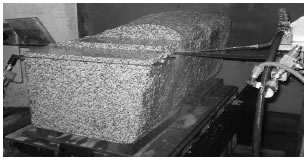
<body><![CDATA[<br>   Figure 7.</b> Final geometry of   the segmented saw</p>       <p>&nbsp;</p>  </font></font>      <p><font size="3" face="Verdana, Arial, Helvetica, sans-serif"><b>4. CUTTING TESTS</b></font></p>  <font face="Verdana, Arial, Helvetica, sans-serif"><font size="2">      <p>Once the    saw with segments was built, it was fitted to a specially adapted prototype    machine and checked for trouble-free operation. <a href="#fig08">Figure 8</a> shows the band saw   going through one of the support guides.</p>       <p align="center"><b><a name="fig08"></a><img src="/img/revistas/dyna/v77n161/a08fig08.gif">    <br>   Figure 8.</b> Diamond segment saw   passing through support guides </p>       <p>Two ornamental rock types were cut in the tests: brown <i>silvestre</i> granite and Spanish <i>Porri&ntilde;o</i> pink granite. The brown granite has a    compressive strength of 81 MPa, &#91;26&#93;, and a coarse grain size and is considered    to be easy to machine as there is little cohesion between grains. The Porri&ntilde;o    pink granite has a compressive strength of 114 MPa, &#91;26&#93;, and a fine grain    size. It has a very high cutting resistance due to the great cohesion between   its grains.</p>       <p>Proper operation was checked for speeds of between 25 and 30 m/s and,    furthermore, the detritus cleaning systems were fitted and checked. A nominal    speed of 28 m/s was used to start cutting, and a low speed (120 mm/h) was   initially used for feeding, <a href="#fig09">Figure 9</a>, and then gradually increased.</p>       <p align="center"><b><a name="fig09"></a><img src="/img/revistas/dyna/v77n161/a08fig09.jpg">    <br>   Figure 9.</b> Brown granite   cutting in progress</p>       ]]></body>
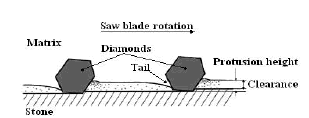
<body><![CDATA[<p>The saw was observed to behave well during cutting. Final cut surfaces    showed good flatness and speeds similar to those for diamond wire were   achieved.</p>       <p>The prototype machine was fitted with a saw with a 1.3x 38 mm<sup>2</sup> useful section, and a 500 mm wide block of ornamental rock was cut. As the    machine had small pulleys, it was not possible to tauten the saw with too much    force as this would have over-punished it. With larger pulleys (recommendable    1,200 mm vs. 650 mm at the prototype machine), an increase would have been    possible to a more desirable 120 MPa and a greater feed speed. At this stress    it is thought that highly competitive speeds could be reached. The following   results were obtained:</p>       <p>For brown granite, at a pressure of 25 MPa on the saw, feed speeds of    1,200 mm/h were reached. With higher stresses, of 80 MPa, feed speeds of 3,000    mm/h were reached. For 500 mm wide blocks of pink granite, with a stress of 60   MPa, approximately 600 mm/h was reached. </p>  </font></font>      <p>&nbsp;</p>      <p><font size="3" face="Verdana, Arial, Helvetica, sans-serif"><b>PART II: STUDY OF CUTTING FORCES</b></font></p> <font face="Verdana, Arial, Helvetica, sans-serif"><font size="2">     <p>&nbsp;</p>  </font></font>      <p><font size="3" face="Verdana, Arial, Helvetica, sans-serif"><b>5. INTRODUCTION</b></font></p>  <font face="Verdana, Arial, Helvetica, sans-serif"><font size="2">      <p>The study    of cutting forces in granite processing is a field that has developed only   recently.</p>       <p>Segment     cutting can be considered as abrasion at multiple contact points (diamond     grains) at different passing depths, &#91;27&#93;. Only a few grains of diamond form     part of the abrasion process on each pass. A variety of factors influence this     process, such as diamond grain concentration in the matrix, grain geometry,    each diamond grain&#8217;s protrusion out of the matrix, and so on. </p>       <p>The diamond    segment is made up of sintered diamond grains in a matrix. As the diamond is    stronger, it remains in view and the supporting matrix is eroded away. Wear on    the matrix varies according to the attack face or the tail face of the diamond   grain, <a href="#fig10">Figure 10</a>.</p>       ]]></body>
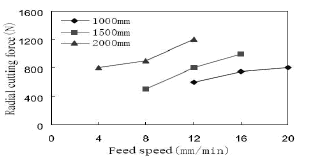
<body><![CDATA[<p align="center"><b><a name="fig10"></a><img src="/img/revistas/dyna/v77n161/a08fig10.gif">    <br>   Figure 10.</b> Gradual segment wear, &#91;4&#93;</p>       <p>The segment     is at the top of the figure, and the rock at the bottom. The segment moves     towards the right, which means the segment&#8217;s attack face is also to the     right. Greater wear on the matrix is observed at this attack face, which leads     to some protrusion of the diamond out of the matrix, and less wear takes place     on the tail side as the matrix material is protected by the diamond grain. When     good protrusion of the diamond out of the matrix is produced, the segment is    said to be sharp as it is this protrusion that does the actual cutting.</p>       <p>Estimating    and discovering the exact cutting forces in ornamental rock sawing is a    difficult task as it depends on many factors such as the specific strength of    the rock being cut, the cooling water flow rate, the type of segment fitted,   how worn this is, and so on. </p>       <p>&nbsp;</p>  </font></font>      <p><font size="3" face="Verdana, Arial, Helvetica, sans-serif"><b>6. FORCES IN CUTTING PROCESS</b></font></p>  <font face="Verdana, Arial, Helvetica, sans-serif"><font size="2"><b>6.1 Diamond  wire cutting    <br>   </b>Zhang, used    a conventional 8 mm diameter diamond wire for cutting at an axial speed of 23    m/s. The cutting of Red Shidao granite was studied with 110 MPa of compressive    strength. Feed force was measured, &#91;23&#93;, but not the force in a tangential    direction from the cut. Graphs were produced with the above force values for   different stone widths and feed speeds, <a href="#fig11">Figure 11</a>:       <p align="center"><b><a name="fig11"></a><img src="/img/revistas/dyna/v77n161/a08fig11.gif">    <br>   Figure 11.</b> Forces in diamond wire cutting, &#91;23&#93;</p>       <p>With the    amount of material removed unchanged, it is not the same to cut a wide material    with a slow feed as it is to cut a narrow material with a fast feed. The narrow    material needs a faster feed, which means the effective area of each working    diamond grain is greater, that is, there is a greater feed per grain of    diamond. For the wider material the feed per grain of diamond is less for the   same amount of material removed.</p>       ]]></body>
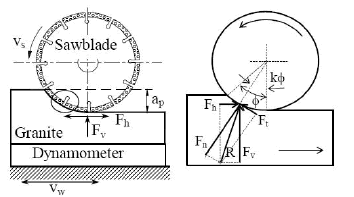
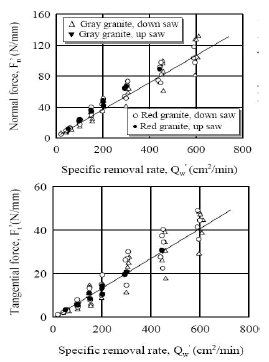
<body><![CDATA[<p>There has    also been study into the influence of cutting speed, although the cutting tool,    a 0.8 mm diameter wire, was totally different. In the work by Ge, &#91;28&#93;, it was    discovered that given a significant increase in cutting speed a slight   reduction in tangential force was produced.</p>   <b>6.2 Diamond disc cutting    <br>   </b>The main    parameters for diamond disc cutting are, <a href="#fig12">Figure 12</a>: cutting speed, v<sub>s</sub>,    is the tangential velocity of the disc at the moment of cutting; feed speed, v<sub>w</sub>,    is the velocity at which the disc&#8217;s axle is moved relative to the rock;    and pass depth, a<sub>p</sub>, is the depth at which the disc penetrates into   the rock at each pass.        <p align="center"><b><a name="fig12"></a><img src="/img/revistas/dyna/v77n161/a08fig12.gif">    <br>    Figure 12.</b> Force diagram for disc cutting, &#91;29&#93;</p>        <p>Several    studies provide normal, tangential, or compound cutting force &#91;25, 29 - 32&#93;. In    the case of diamond disc cutting the amount of removed material per time unit    is obtained as the product of the pass depth times the feed speed. Some    articles, &#91;25, 29&#93;, provide the normal and tangential force value, versus   specific removal rate. See some results on the <a href="#fig13">figure 13</a>.</p>    </font></font>      <p align="center"><font size="2" face="Verdana, Arial, Helvetica, sans-serif"><b><a name="fig13"></a><img src="/img/revistas/dyna/v77n161/a08fig13.gif">    <br>   Figure 13.</b> Cutting forces according to    material removal rate, &#91;29&#93;</font></p>  <font face="Verdana, Arial, Helvetica, sans-serif"><font size="2">        <p>This tests     were carried out on two granite types, grey and red, but their compressive     strength was not given. According to documental research this could be between     110 &#8211; 180 MPa. The machine was fitted with a 350 mm diameter disc, with    3.6 mm wide segments, and cut at a speed of 30 m/s.</p>        <p>The    efficiency of a given cutting process is measured by specific energy, which is    defined as the energy consumed per unit volume of material removal.    So, some tests deal with specific energy measurement, &#91;25, 33 - 35&#93;, and how it   is influenced by feed rate, wear or cutting depth.</p>  </font></font>      <p><font face="Verdana, Arial, Helvetica, sans-serif"><font size="2"><b>6.3 Frame cutting    ]]></body>
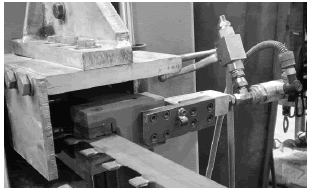
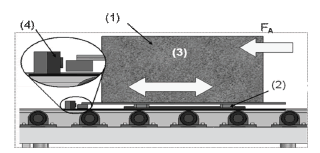
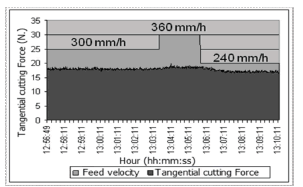
<body><![CDATA[<br>    </b>Frame    cutting is different from other cutting processes, there is an alternating    strip movement and feeding is not done in a constant way. That is why cutting    force calculations are more complicated and studies made &#91;27&#93;, are limited to    giving average force values according to average feed values. What can be said    from their data is that the force in the normal direction is between three and  3.5 times the value of the tangential force.</font></font></p>      <p><font face="Verdana, Arial, Helvetica, sans-serif"><font size="2"><b>6.4 Band saw cutting    <br>    </b>To measure    ornamental rock cutting forces with band saws, a data acquisition system must    be prepared for the prototype machine as nonesuch is available off the shelf.    As in the first part, two rock types were cut during the tests: brown granite    as a soft one, and pink granite as a hard one. </font></font></p>  <font face="Verdana, Arial, Helvetica, sans-serif"><font size="2">      <p>&nbsp;</p>  </font></font>      <p><b><font size="3" face="Verdana, Arial, Helvetica, sans-serif">7. MONITORING THE PROTOTYPE MACHINE</font></b></p>  <font face="Verdana, Arial, Helvetica, sans-serif"><font size="2">      <p>The    tangential cutting force (F<sub>T</sub>) and the normal feed force (F<sub>A</sub>)    will be measured. Several instruments are used to measure force: monitoring of    the electric motor operating parameters and a hydraulic system, but the base    instrument for these measurements will be a linear guide system coupled to a   force transducer, as can be seen in the following <a href="#fig14">figure</a>:</p>       <p align="center"><b><a name="fig14"></a><img src="/img/revistas/dyna/v77n161/a08fig14.gif">    <br>   Figure 14.</b> Block setup using linear guides for force   measurement</p>       <p>The granite    block (1) is placed between two plates with a linear guide system (2). Thus the    rock (1) is easily moved in direction (3), and when cutting it, the force in    the feed direction, F<sub>A</sub>, aligned with the guide system (2), is    entirely transmitted to the force transducer (4). Furthermore, the linear guide    system setup will also be valid for measuring the tangential force (F<sub>T</sub>)    rotating 90º the guide lines, and aligning them with the tangential direction.    To minimize errors due to friction, small rocks are used for measurement   taking.</p>   <b>7.1 Tangential cutting force    <br>   </b>Both from    the data recorded from the motors and from the force transducer, it can be seen    that the tangential cutting force remains highly uniform during cutting. The    tangential cutting force hardly undergoes any change as the feed moves    forwards, <a href="#fig15">Figure 15</a>, the oscillation that appears is no greater than 0.5 N and    at times an oscillation of this value can be seen when cutting a length of rock   with constant parameters.       ]]></body>
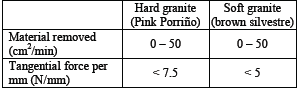
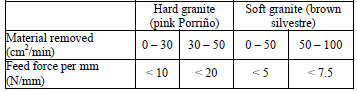
<body><![CDATA[<p align="center"><b><a name="fig15"></a><img src="/img/revistas/dyna/v77n161/a08fig15.gif">    <br>   Figure 15. </b>F<sub>T</sub> measured by force transducer</p>       <p>Forces were    measured, and the results will be showed per millimetre of thickness cut, in    this case, 4 mm. Tangential force will be represented for a range of removed   material amounts, <a href="#tab03">Table 3</a>, always with 25 m/s of cutting speed.</p>       <p align="center"><b><a name="tab03"></a>Table 3.</b> F<sub>T</sub> for 500 mm wide rock    <br>   <img src="/img/revistas/dyna/v77n161/a08tab03.gif"></p>       <p>The    tangential force value needed to make a cut is very similar, despite the    different properties of the materials being cut. This could be due to the fact    that the force in a tangential direction is caused to a greater extent by the    drag of the detritus produced in the cut as well as the drag of the cooling   water.</p>       <p>The    tangential force needed to keep the machine moving has been estimated at 56 N,    which means the tangential force to maintain the cut, under the measured    conditions, has a really low value, below 50% of the force needed to keep the    machine in operation. Such a small force has few mechanical design implications    for the machine, but it can relevant with regards motor size as 65% of power   deployed by the motor is used to keep the machine running rather than cutting. </p>   <b>7.2 Feed force    <br>   </b>According    to the tests carried out, the feed force is greater than the tangential cutting    force, above all for hard granite. Just as before, forces were measured, and    the results will be showed per millimetre of thickness cut, in this case 4 mm.    Normal feed force will be represented for a range of removed material amounts,   <a href="#tab04">Table 4</a>, always with 25 m/s of cutting speed.        <p align="center"><b><a name="tab04"></a>Table 4.</b> F<sub>A</sub> for 500 mm wide rock    <br>   <img src="/img/revistas/dyna/v77n161/a08tab04.gif"></p>       ]]></body>
<body><![CDATA[<p>For the    feed force, normal to the cut, the difference between the two materials is much    more representative. For similar amounts of removed material (up to 50 cm<sup>2</sup>/min),    the force for the pink granite, 20 N/mm, is found to be four times greater than    that for the brown granite, 5 N/mm. According to the literature this difference    is due to the hardness of the material, as a cutting force in the normal    direction is what the diamond grain applies to the rock to be cut in order to   compress it and gradually achieve the destruction of material.</p>       <p>This can    also be clearly seen in the results, where the greater the amount of material    removed, the greater the necessary feed force, which is even more obvious with   the hard granite. </p>       <p>The tests    were always done working with saws with a useful section of 1.3x 38 mm<sup>2</sup>,    and several tensions on the saw, but always with low values in order to obtain   longer duration.</p>       <p>Keeping up    a stress of 25 MPa on the saw, which meant 1,250 MPa of force per saw section,    it has been shown empirically that with feed forces below 30 N (7.5 N/mm) the    cut is kept straight. For a stress of 60 MPa, 2,960 N of force per stretch, it    can be seen that with forces below 70 N (18 N/mm) the cut is kept quite    straight. It should also be said that some cuts made at speeds ranging from 40    &#8211; 50 cm<sup>2</sup>/min in pink granite showed irreversible warping in   the cut after time.</p>       <p>If the saw    were oversized and similar stresses used for cutting steel could be applied,    120 MPa or higher, higher feed speeds for pink granite cutting could certainly   have been achieved.</p>       <p>&nbsp;</p>  </font></font>      <p><font size="3" face="Verdana, Arial, Helvetica, sans-serif"><b>8. CONCLUSIONS</b></font></p>  <font face="Verdana, Arial, Helvetica, sans-serif"><font size="2">      <p>Firstly, it has been shown to be possible to cut ornamental rock with a     band saw with diamond segments. When constructing the saw it is important to     have good alignment in the die cutting and welding, and not to thermally affect     the saw. The systems for detritus cleaning, saw positioning and cutting feed     worked adequately. Points for improvement are the use of greater stresses on     the saw, and a larger sized one. The aim of both these is to obtain greater    feed speeds and improve this cutting system&#8217;s competitiveness.</p>        <p>Despite the limitations in the cutting force measuring systems, a series   of conclusions can be obtained from the measurements made. </p>        <p>The feed force, normal to the cutting direction, varies noticeably with     the amount of material removed per time unit. This variation is more marked in     a hard rock such as the Porri&ntilde;o pink than in a relatively soft rock like the     brown silvestre. Compared to other cutting systems, the feed force in the band     saw cutting has an intermediate value between that for discs and wires, greater    than disc cutting, and smaller than diamond wire cutting.</p>        ]]></body>
<body><![CDATA[<p>The tangential cutting force has a relatively small value and     represents, in general terms, only 35% of the power consumed by the cutting     motor, the rest of the power is needed to keep the pulleys and the saw moving.     For very hard rocks such as pink Porri&ntilde;o, the tangential cutting force comes to     a third of the feed force. This detail also coincides with results from other     researchers in similar materials, but using conventional cutting procedures.     For softer rocks, such as the brown granite, the feed force and the tangential    cutting force have a similar module. </p>        <p>&nbsp;</p>  </font></font>      <p><font size="3" face="Verdana, Arial, Helvetica, sans-serif"><b>9. ACKNOWLEDGEMENTS</b></font></p>  <font face="Verdana, Arial, Helvetica, sans-serif"><font size="2">      <p>The authors would like to thank the collaboration of the Xunta de    Galicia through the &#8220;Direcci&oacute;n General de Investigaci&oacute;n y    Desarrollo&#8221;, as this work is funded by the &#8220;Plan Gallego de    Investigaci&oacute;n, Desarrollo e Innovaci&oacute;n Tecnol&oacute;gica&#8221;, reference:   PGIDT06REM032E.</p>       <p>&nbsp;</p>  </font></font>      <p><b><font size="3" face="Verdana, Arial, Helvetica, sans-serif">REFERENCES </font></b></p>  <font face="Verdana, Arial, Helvetica, sans-serif"><font size="2">      <!-- ref --><p><b>&#91;1&#93;</b>  ERTINGSHAUSEN, W. Zerspanung von Granit mit Diamant-Trennschleifscheiben &#91;PhD Thesis&#93;</b> Universität Hannover, 1984.     &nbsp;&nbsp;&nbsp;&nbsp;&nbsp;&nbsp;&nbsp;&nbsp;[&#160;<a href="javascript:void(0);" onclick="javascript: window.open('/scielo.php?script=sci_nlinks&ref=000159&pid=S0012-7353201000010000800001&lng=','','width=640,height=500,resizable=yes,scrollbars=1,menubar=yes,');">Links</a>&#160;]<!-- end-ref --><!-- ref --><br>    <b>&#91;2&#93;</b> Tönshoff, H.K.; Hillmann-Apmann, H.; Asche, J. Diamond tools in stone and civil engineering industry: cutting principles, wear and applications. Diamond and Related Materials, 11, 736 - 741, 2002.     &nbsp;&nbsp;&nbsp;&nbsp;&nbsp;&nbsp;&nbsp;&nbsp;[&#160;<a href="javascript:void(0);" onclick="javascript: window.open('/scielo.php?script=sci_nlinks&ref=000160&pid=S0012-7353201000010000800002&lng=','','width=640,height=500,resizable=yes,scrollbars=1,menubar=yes,');">Links</a>&#160;]<!-- end-ref --><!-- ref --><br>    <b>&#91;3&#93;</b> KONSTANTY, J. Theoretical analysis of stone sawing with diamonds. Journal of Materials Processing Technology, 123, 146 - 154, 2002.     &nbsp;&nbsp;&nbsp;&nbsp;&nbsp;&nbsp;&nbsp;&nbsp;[&#160;<a href="javascript:void(0);" onclick="javascript: window.open('/scielo.php?script=sci_nlinks&ref=000161&pid=S0012-7353201000010000800003&lng=','','width=640,height=500,resizable=yes,scrollbars=1,menubar=yes,');">Links</a>&#160;]<!-- end-ref --><!-- ref --><br>    <b>&#91;4&#93;</b> DI ILIO, A. AND TOGNA A. A theoretical wear model for diamond tools in stone cutting International Journal of Machine Tools & Manufacture 43, 1171 - 1177, 2003     &nbsp;&nbsp;&nbsp;&nbsp;&nbsp;&nbsp;&nbsp;&nbsp;[&#160;<a href="javascript:void(0);" onclick="javascript: window.open('/scielo.php?script=sci_nlinks&ref=000162&pid=S0012-7353201000010000800004&lng=','','width=640,height=500,resizable=yes,scrollbars=1,menubar=yes,');">Links</a>&#160;]<!-- end-ref --><!-- ref --><br>    <b>&#91;5&#93;</b> BOLATASHVILI, N.D.; MGALOBLISHVILI, K.D. AND DADUNASHVILI G.G. Theoretical and experimental study of the wear factor for a diamond stone-cutting tool. Measurement Techniques, 52 (3), 292 - 295, 2009.     &nbsp;&nbsp;&nbsp;&nbsp;&nbsp;&nbsp;&nbsp;&nbsp;[&#160;<a href="javascript:void(0);" onclick="javascript: window.open('/scielo.php?script=sci_nlinks&ref=000163&pid=S0012-7353201000010000800005&lng=','','width=640,height=500,resizable=yes,scrollbars=1,menubar=yes,');">Links</a>&#160;]<!-- end-ref --><!-- ref --><br>    <b>&#91;6&#93;</b> BROOK, B. Principles of diamond tool technology for sawing rock. International Journal of Rock Mechanics and Mining Sciences, 39, 41 - 58, 2002.     &nbsp;&nbsp;&nbsp;&nbsp;&nbsp;&nbsp;&nbsp;&nbsp;[&#160;<a href="javascript:void(0);" onclick="javascript: window.open('/scielo.php?script=sci_nlinks&ref=000164&pid=S0012-7353201000010000800006&lng=','','width=640,height=500,resizable=yes,scrollbars=1,menubar=yes,');">Links</a>&#160;]<!-- end-ref --><!-- ref --><br>    <b>&#91;7&#93;</b> KAHRAMAN, S.; ULKER, U. AND DELIBALTA, M.S. A quality classification of building stones from P-wave velocity and its application to stone cutting with gang saws. The Journal of The Southern African Institute of Mining and Metallurgy, 107, 427 - 430, 2007.     &nbsp;&nbsp;&nbsp;&nbsp;&nbsp;&nbsp;&nbsp;&nbsp;[&#160;<a href="javascript:void(0);" onclick="javascript: window.open('/scielo.php?script=sci_nlinks&ref=000165&pid=S0012-7353201000010000800007&lng=','','width=640,height=500,resizable=yes,scrollbars=1,menubar=yes,');">Links</a>&#160;]<!-- end-ref --><!-- ref --><br>    <b>&#91;8&#93;</b> ORLOWSKI, K.; WASIELEWSKI, R. AND BLACHARSKI, W. Frictinonal group fastening effectiveness of mini gang saw blades in the frame sawing machine. Holz als Roh- un Werkstoff, 59, 9 - 12, 2001.     &nbsp;&nbsp;&nbsp;&nbsp;&nbsp;&nbsp;&nbsp;&nbsp;[&#160;<a href="javascript:void(0);" onclick="javascript: window.open('/scielo.php?script=sci_nlinks&ref=000166&pid=S0012-7353201000010000800008&lng=','','width=640,height=500,resizable=yes,scrollbars=1,menubar=yes,');">Links</a>&#160;]<!-- end-ref --><!-- ref --><br>    <b>&#91;9&#93;</b> LUO, S.Y. Characteristics of diamond sawblade wear in sawing. International Journal of Machine Tools and Manufacture, 36 (6), 661 - 672, 1996.     &nbsp;&nbsp;&nbsp;&nbsp;&nbsp;&nbsp;&nbsp;&nbsp;[&#160;<a href="javascript:void(0);" onclick="javascript: window.open('/scielo.php?script=sci_nlinks&ref=000167&pid=S0012-7353201000010000800009&lng=','','width=640,height=500,resizable=yes,scrollbars=1,menubar=yes,');">Links</a>&#160;]<!-- end-ref --><!-- ref --><br>    <b>&#91;10&#93;</b> ERSOY, A.; BUYUKSAGIC, S. AND ATICI, U. Wear characteristics of circular diamond saws in the cutting of different hard abrasive rocks. Wear, 258, 1422 - 1436, 2005     &nbsp;&nbsp;&nbsp;&nbsp;&nbsp;&nbsp;&nbsp;&nbsp;[&#160;<a href="javascript:void(0);" onclick="javascript: window.open('/scielo.php?script=sci_nlinks&ref=000168&pid=S0012-7353201000010000800010&lng=','','width=640,height=500,resizable=yes,scrollbars=1,menubar=yes,');">Links</a>&#160;]<!-- end-ref --><!-- ref --><br>    <b>&#91;11&#93;</b> EYUBOGLU, A.S.; OZCELIK, Y.; KULAKSIZ, S. AND ENGIN, I.C. Statistical and microscopic investigation of disc segment wear related to sawing Ankara andesites. International Journal of Rock Mechanics and Mining Sciences, 40, 405 - 414, 2003.     &nbsp;&nbsp;&nbsp;&nbsp;&nbsp;&nbsp;&nbsp;&nbsp;[&#160;<a href="javascript:void(0);" onclick="javascript: window.open('/scielo.php?script=sci_nlinks&ref=000169&pid=S0012-7353201000010000800011&lng=','','width=640,height=500,resizable=yes,scrollbars=1,menubar=yes,');">Links</a>&#160;]<!-- end-ref --><!-- ref --><br>    <b>&#91;12&#93;</b> S&Aacute;NCHEZ DELGADO, N.; RODR&Iacute;GUEZ REY, A.; SU&Aacute;REZ DEL R&Iacute;O, L.M.; D&Iacute;EZ SARRI&Aacute;, I.; CALLEJA, L AND RUIZ DE ARGANDO&Ntilde;A, V.G. The influence of rock microhardness on the sawability of Pink Porrino granite (Spain). International Journal of Rock Mechanics and Mining Sciences, 42, 161 - 166, 2005.     &nbsp;&nbsp;&nbsp;&nbsp;&nbsp;&nbsp;&nbsp;&nbsp;[&#160;<a href="javascript:void(0);" onclick="javascript: window.open('/scielo.php?script=sci_nlinks&ref=000170&pid=S0012-7353201000010000800012&lng=','','width=640,height=500,resizable=yes,scrollbars=1,menubar=yes,');">Links</a>&#160;]<!-- end-ref --><!-- ref --><br>    <b>&#91;13&#93;</b> FENER, M.; KAHRAMAN, S. AND OZDER M.O. Performance prediction of circular diamond saws from mechanical rock properties in cutting carbonate rocks. Rock Mechanics and Rock Engineering, 40 (5), 505 - 517, 2007.     &nbsp;&nbsp;&nbsp;&nbsp;&nbsp;&nbsp;&nbsp;&nbsp;[&#160;<a href="javascript:void(0);" onclick="javascript: window.open('/scielo.php?script=sci_nlinks&ref=000171&pid=S0012-7353201000010000800013&lng=','','width=640,height=500,resizable=yes,scrollbars=1,menubar=yes,');">Links</a>&#160;]<!-- end-ref --><!-- ref --><br>    <b>&#91;14&#93;</b> KAHRAMAN, S.; FENER, M. AND GUNAYDIN, O. Predicting the sawability of carbonate rocks using multiple curvilinear regression analysis. International Journal of Rock Mechanics and Mining Sciences, 41, 1123 - 1131, 2004.     &nbsp;&nbsp;&nbsp;&nbsp;&nbsp;&nbsp;&nbsp;&nbsp;[&#160;<a href="javascript:void(0);" onclick="javascript: window.open('/scielo.php?script=sci_nlinks&ref=000172&pid=S0012-7353201000010000800014&lng=','','width=640,height=500,resizable=yes,scrollbars=1,menubar=yes,');">Links</a>&#160;]<!-- end-ref --><!-- ref --><br>    <b>&#91;15&#93;</b> KAHRAMAN, S.; ALTUN, H.; TEZEKICI, B.S. AND FENER, M. Sawability prediction of carbonate rocks from shear strength parameters using artificial neural networks. International Journal of Rock Mechanics and Mining Sciences, 43, 157 - 164.     &nbsp;&nbsp;&nbsp;&nbsp;&nbsp;&nbsp;&nbsp;&nbsp;[&#160;<a href="javascript:void(0);" onclick="javascript: window.open('/scielo.php?script=sci_nlinks&ref=000173&pid=S0012-7353201000010000800015&lng=','','width=640,height=500,resizable=yes,scrollbars=1,menubar=yes,');">Links</a>&#160;]<!-- end-ref --><!-- ref --><br>    <b>&#91;16&#93;</b> SUN, L.; PAN J. AND LIN C. A new approach to improve the performance of diamond sawblades. Materials Letters, 57, 1010 - 1014, 2002.     &nbsp;&nbsp;&nbsp;&nbsp;&nbsp;&nbsp;&nbsp;&nbsp;[&#160;<a href="javascript:void(0);" onclick="javascript: window.open('/scielo.php?script=sci_nlinks&ref=000174&pid=S0012-7353201000010000800016&lng=','','width=640,height=500,resizable=yes,scrollbars=1,menubar=yes,');">Links</a>&#160;]<!-- end-ref --><!-- ref --><br>    <b>&#91;17&#93;</b> TUTMEZ, B.; KAHRAMAN, S. AND GUNAYDIN, O. Multifactorial fuzzy approach to the sawability classification of building stones. Construction and Building Materials, 21, 1672 - 1679, 2007.     &nbsp;&nbsp;&nbsp;&nbsp;&nbsp;&nbsp;&nbsp;&nbsp;[&#160;<a href="javascript:void(0);" onclick="javascript: window.open('/scielo.php?script=sci_nlinks&ref=000175&pid=S0012-7353201000010000800017&lng=','','width=640,height=500,resizable=yes,scrollbars=1,menubar=yes,');">Links</a>&#160;]<!-- end-ref --><!-- ref --><br>    <b>&#91;18&#93;</b> WEI, X; WANG, C.Y. AND ZHOU, Z.H. Study on the fuzzy ranking of granite sawability. Journal of Materials Porcessing Technology, 139, 277 - 280, 2003.     &nbsp;&nbsp;&nbsp;&nbsp;&nbsp;&nbsp;&nbsp;&nbsp;[&#160;<a href="javascript:void(0);" onclick="javascript: window.open('/scielo.php?script=sci_nlinks&ref=000176&pid=S0012-7353201000010000800018&lng=','','width=640,height=500,resizable=yes,scrollbars=1,menubar=yes,');">Links</a>&#160;]<!-- end-ref --><!-- ref --><br>    <b>&#91;19&#93;</b> ÖZÇELIK, Y.; KULAKSIZ, S. AND ÇETIN, M.C. Assesment of the wear of diamond beads in the cutting of different rock types by the ridge regression. Journal of Materials Processing Technology, 127, 392 - 400, 2002.     &nbsp;&nbsp;&nbsp;&nbsp;&nbsp;&nbsp;&nbsp;&nbsp;[&#160;<a href="javascript:void(0);" onclick="javascript: window.open('/scielo.php?script=sci_nlinks&ref=000177&pid=S0012-7353201000010000800019&lng=','','width=640,height=500,resizable=yes,scrollbars=1,menubar=yes,');">Links</a>&#160;]<!-- end-ref --><!-- ref --><br>    <b>&#91;20&#93;</b> MIKAEIL, R.; ATAEI, M. AND HOSEINIE, S.H. Predicting the production rate of diamond wire saws in carbonate rock cutting. Industrial Diamond Review, 68 (3), 28 - 34, 2008.     &nbsp;&nbsp;&nbsp;&nbsp;&nbsp;&nbsp;&nbsp;&nbsp;[&#160;<a href="javascript:void(0);" onclick="javascript: window.open('/scielo.php?script=sci_nlinks&ref=000178&pid=S0012-7353201000010000800020&lng=','','width=640,height=500,resizable=yes,scrollbars=1,menubar=yes,');">Links</a>&#160;]<!-- end-ref --><!-- ref --><br>    <b>&#91;21&#93;</b> JAIN, S.C. AND RATHORE, S.S. Role of cut size area on the performance of diamond wire saw machine in quarrying of marble. International Journal of Mining, Reclamation and Environment, 23 (2), 79 - 91, 2009.     &nbsp;&nbsp;&nbsp;&nbsp;&nbsp;&nbsp;&nbsp;&nbsp;[&#160;<a href="javascript:void(0);" onclick="javascript: window.open('/scielo.php?script=sci_nlinks&ref=000179&pid=S0012-7353201000010000800021&lng=','','width=640,height=500,resizable=yes,scrollbars=1,menubar=yes,');">Links</a>&#160;]<!-- end-ref --><!-- ref --><br>    <b>&#91;22&#93;</b> HUANG, H.; HUANG, G.; GUO, H. AND XU X. Wear characteristics of diamond beads in wire sawing granite. Chinese Journal of Mechanical Engineering, 44 (8), 112 - 117, 2008.     &nbsp;&nbsp;&nbsp;&nbsp;&nbsp;&nbsp;&nbsp;&nbsp;[&#160;<a href="javascript:void(0);" onclick="javascript: window.open('/scielo.php?script=sci_nlinks&ref=000180&pid=S0012-7353201000010000800022&lng=','','width=640,height=500,resizable=yes,scrollbars=1,menubar=yes,');">Links</a>&#160;]<!-- end-ref --><!-- ref --><br>    <b>&#91;23&#93;</b> Zhang, J.S. AND Wang, Z. Technical parameters and wear resistibility of diamond wire-saw in granite cutting. Key Engineering Materials, 259 - 260, 122 - 126, 2004.     &nbsp;&nbsp;&nbsp;&nbsp;&nbsp;&nbsp;&nbsp;&nbsp;[&#160;<a href="javascript:void(0);" onclick="javascript: window.open('/scielo.php?script=sci_nlinks&ref=000181&pid=S0012-7353201000010000800023&lng=','','width=640,height=500,resizable=yes,scrollbars=1,menubar=yes,');">Links</a>&#160;]<!-- end-ref --><!-- ref --><br>    <b>&#91;24&#93;</b> VIL&Aacute;N, J.A., SEGADE, A., L&Oacute;PEZ, M. AND TABOADA, J. - Universidad de Vigo. "Sierra de cinta sin fin con segmentos de diamante" Oficina Espa&ntilde;ola de Patentes y Marcas, ES 2 262 453. 2006.     &nbsp;&nbsp;&nbsp;&nbsp;&nbsp;&nbsp;&nbsp;&nbsp;[&#160;<a href="javascript:void(0);" onclick="javascript: window.open('/scielo.php?script=sci_nlinks&ref=000182&pid=S0012-7353201000010000800024&lng=','','width=640,height=500,resizable=yes,scrollbars=1,menubar=yes,');">Links</a>&#160;]<!-- end-ref --><!-- ref --><br>    <b>&#91;25&#93;</b> XU, X., LI, Y. AND MALKIN, S. Forces and energy in circular sawing and grinding of granite, Journal of Manufacturing Science and Engineering, 123, 13 - 22, 2001.     &nbsp;&nbsp;&nbsp;&nbsp;&nbsp;&nbsp;&nbsp;&nbsp;[&#160;<a href="javascript:void(0);" onclick="javascript: window.open('/scielo.php?script=sci_nlinks&ref=000183&pid=S0012-7353201000010000800025&lng=','','width=640,height=500,resizable=yes,scrollbars=1,menubar=yes,');">Links</a>&#160;]<!-- end-ref --><!-- ref --><br>    <b>&#91;26&#93;</b> QUIROGA, J.R., CASARES, A. AND SU&Aacute;REZ, V.L. A pedra de Galicia, Conseller&iacute;a de Industria e Comercio. Xunta de Galicia, 1997.     &nbsp;&nbsp;&nbsp;&nbsp;&nbsp;&nbsp;&nbsp;&nbsp;[&#160;<a href="javascript:void(0);" onclick="javascript: window.open('/scielo.php?script=sci_nlinks&ref=000184&pid=S0012-7353201000010000800026&lng=','','width=640,height=500,resizable=yes,scrollbars=1,menubar=yes,');">Links</a>&#160;]<!-- end-ref --><!-- ref --><br>    <b>&#91;27&#93;</b> WANG, C.Y. AND ROLF, C. Frame sawing of stone - Theory and technology. Key Engineering Materials, 250, 171 - 180, 2003.     &nbsp;&nbsp;&nbsp;&nbsp;&nbsp;&nbsp;&nbsp;&nbsp;[&#160;<a href="javascript:void(0);" onclick="javascript: window.open('/scielo.php?script=sci_nlinks&ref=000185&pid=S0012-7353201000010000800027&lng=','','width=640,height=500,resizable=yes,scrollbars=1,menubar=yes,');">Links</a>&#160;]<!-- end-ref --><!-- ref --><br>    <b>&#91;28&#93;</b> GE, P.Q., ZHANG, L., GAO, W. AND LIU, Z.C. Development of endless diamond wire saw and sawing experiments. Materials Science Forums 471 - 472: 481 - 484, 2004.     &nbsp;&nbsp;&nbsp;&nbsp;&nbsp;&nbsp;&nbsp;&nbsp;[&#160;<a href="javascript:void(0);" onclick="javascript: window.open('/scielo.php?script=sci_nlinks&ref=000186&pid=S0012-7353201000010000800028&lng=','','width=640,height=500,resizable=yes,scrollbars=1,menubar=yes,');">Links</a>&#160;]<!-- end-ref --><!-- ref --><br>    <b>&#91;29&#93;</b> XU, X.P. AND LI Y. The effects of swarf in the diamond sawing of granite. Key Engineering Materials, 250, 187 - 193, 2003.     &nbsp;&nbsp;&nbsp;&nbsp;&nbsp;&nbsp;&nbsp;&nbsp;[&#160;<a href="javascript:void(0);" onclick="javascript: window.open('/scielo.php?script=sci_nlinks&ref=000187&pid=S0012-7353201000010000800029&lng=','','width=640,height=500,resizable=yes,scrollbars=1,menubar=yes,');">Links</a>&#160;]<!-- end-ref --><!-- ref --><br>    <b>&#91;30&#93;</b> ERSOY, A. AND ATICI, U. Performance characteristics of circular diamond saws in cutting different types of rocks. Diamond and Related Materials, 13, 22 - 37, 2004.     &nbsp;&nbsp;&nbsp;&nbsp;&nbsp;&nbsp;&nbsp;&nbsp;[&#160;<a href="javascript:void(0);" onclick="javascript: window.open('/scielo.php?script=sci_nlinks&ref=000188&pid=S0012-7353201000010000800030&lng=','','width=640,height=500,resizable=yes,scrollbars=1,menubar=yes,');">Links</a>&#160;]<!-- end-ref --><!-- ref --><br>    <b>&#91;31&#93;</b> XU, X.; LI, Y. AND YU Y. Force ratio in the circular sawing of granites with a diamond segmented blade. Journal of Materials Processing Technology, 139, 281 - 285, 2003.     &nbsp;&nbsp;&nbsp;&nbsp;&nbsp;&nbsp;&nbsp;&nbsp;[&#160;<a href="javascript:void(0);" onclick="javascript: window.open('/scielo.php?script=sci_nlinks&ref=000189&pid=S0012-7353201000010000800031&lng=','','width=640,height=500,resizable=yes,scrollbars=1,menubar=yes,');">Links</a>&#160;]<!-- end-ref --><!-- ref --><br>    <b>&#91;32&#93;</b> XU, X. Friction studies on the process in circular sawing of granites. Tribology Letters, 7, 221 - 227, 1999.     &nbsp;&nbsp;&nbsp;&nbsp;&nbsp;&nbsp;&nbsp;&nbsp;[&#160;<a href="javascript:void(0);" onclick="javascript: window.open('/scielo.php?script=sci_nlinks&ref=000190&pid=S0012-7353201000010000800032&lng=','','width=640,height=500,resizable=yes,scrollbars=1,menubar=yes,');">Links</a>&#160;]<!-- end-ref --><!-- ref --><br>    <b>&#91;33&#93;</b> ATICI, U. AND ERSOY, A. Correlation of specific energy of cutting saws and drilling bits with rock brittleness and destruction energy. Journal of Materials Processing Technology, 209, 2602 - 2612, 2009.     &nbsp;&nbsp;&nbsp;&nbsp;&nbsp;&nbsp;&nbsp;&nbsp;[&#160;<a href="javascript:void(0);" onclick="javascript: window.open('/scielo.php?script=sci_nlinks&ref=000191&pid=S0012-7353201000010000800033&lng=','','width=640,height=500,resizable=yes,scrollbars=1,menubar=yes,');">Links</a>&#160;]<!-- end-ref --><!-- ref --><br>    <b>&#91;34&#93;</b> BUYUKSAGIS, I.S. Effect of cutting mode on the sawability of granites using segmented circular diamond sawblade. Journal of Materials Processing Technology, 183, 399 - 406, 2007.     &nbsp;&nbsp;&nbsp;&nbsp;&nbsp;&nbsp;&nbsp;&nbsp;[&#160;<a href="javascript:void(0);" onclick="javascript: window.open('/scielo.php?script=sci_nlinks&ref=000192&pid=S0012-7353201000010000800034&lng=','','width=640,height=500,resizable=yes,scrollbars=1,menubar=yes,');">Links</a>&#160;]<!-- end-ref --><!-- ref --><br>    <b>&#91;35&#93;</b> BUYUKSAGIS, I.S. AND GOKTAN, R.M. Investigation of marble machining performance using an instrumented block-cutter. Journal of Materials Processing Technology, 169, 258 - 262, 2005. &nbsp;&nbsp;&nbsp;&nbsp;&nbsp;&nbsp;&nbsp;&nbsp;[&#160;<a href="javascript:void(0);" onclick="javascript: window.open('/scielo.php?script=sci_nlinks&ref=000193&pid=S0012-7353201000010000800035&lng=','','width=640,height=500,resizable=yes,scrollbars=1,menubar=yes,');">Links</a>&#160;]<!-- end-ref --> ]]></body><back>
<ref-list>
<ref id="B1">
<label>1</label><nlm-citation citation-type="">
<person-group person-group-type="author">
<name>
<surname><![CDATA[ERTINGSHAUSEN]]></surname>
<given-names><![CDATA[W.]]></given-names>
</name>
</person-group>
<source><![CDATA[Zerspanung von Granit mit Diamant-Trennschleifscheiben]]></source>
<year></year>
</nlm-citation>
</ref>
<ref id="B2">
<label>2</label><nlm-citation citation-type="journal">
<person-group person-group-type="author">
<name>
<surname><![CDATA[Tönshoff]]></surname>
<given-names><![CDATA[H.K]]></given-names>
</name>
<name>
<surname><![CDATA[Hillmann-Apmann]]></surname>
<given-names><![CDATA[H.]]></given-names>
</name>
<name>
<surname><![CDATA[Asche]]></surname>
<given-names><![CDATA[J.]]></given-names>
</name>
</person-group>
<article-title xml:lang="en"><![CDATA[Diamond tools in stone and civil engineering industry:: cutting principles, wear and applications.]]></article-title>
<source><![CDATA[Diamond and Related Materials,]]></source>
<year>2002</year>
<volume>11</volume>
<page-range>736 - 741</page-range></nlm-citation>
</ref>
<ref id="B3">
<label>3</label><nlm-citation citation-type="journal">
<person-group person-group-type="author">
<name>
<surname><![CDATA[KONSTANTY]]></surname>
<given-names><![CDATA[J.]]></given-names>
</name>
</person-group>
<article-title xml:lang="en"><![CDATA[Theoretical analysis of stone sawing with diamonds.]]></article-title>
<source><![CDATA[Journal of Materials Processing Technology]]></source>
<year>2002</year>
<volume>123</volume>
<page-range>146 - 154</page-range></nlm-citation>
</ref>
<ref id="B4">
<label>4</label><nlm-citation citation-type="journal">
<person-group person-group-type="author">
<name>
<surname><![CDATA[DI ILIO]]></surname>
<given-names><![CDATA[A.]]></given-names>
</name>
<name>
<surname><![CDATA[TOGNA]]></surname>
<given-names><![CDATA[A.]]></given-names>
</name>
</person-group>
<article-title xml:lang="en"><![CDATA[A theoretical wear model for diamond tools in stone cutting International]]></article-title>
<source><![CDATA[Journal of Machine Tools & Manufacture]]></source>
<year>2003</year>
<volume>43</volume>
<page-range>1171 - 1177</page-range></nlm-citation>
</ref>
<ref id="B5">
<label>5</label><nlm-citation citation-type="journal">
<person-group person-group-type="author">
<name>
<surname><![CDATA[BOLATASHVILI]]></surname>
<given-names><![CDATA[N.D.]]></given-names>
</name>
<name>
<surname><![CDATA[MGALOBLISHVILI]]></surname>
<given-names><![CDATA[K.D.]]></given-names>
</name>
<name>
<surname><![CDATA[DADUNASHVILI]]></surname>
<given-names><![CDATA[G.G.]]></given-names>
</name>
</person-group>
<article-title xml:lang="en"><![CDATA[Theoretical and experimental study of the wear factor for a diamond stone-cutting tool.]]></article-title>
<source><![CDATA[Measurement Techniques]]></source>
<year>2009</year>
<volume>52</volume>
<numero>3</numero>
<issue>3</issue>
<page-range>292 - 295</page-range></nlm-citation>
</ref>
<ref id="B6">
<label>6</label><nlm-citation citation-type="journal">
<person-group person-group-type="author">
<name>
<surname><![CDATA[BROOK]]></surname>
<given-names><![CDATA[B.]]></given-names>
</name>
</person-group>
<article-title xml:lang="en"><![CDATA[Principles of diamond tool technology for sawing rock.]]></article-title>
<source><![CDATA[International Journal of Rock Mechanics and Mining Sciences]]></source>
<year>2002</year>
<volume>39</volume>
<page-range>41 - 58</page-range></nlm-citation>
</ref>
<ref id="B7">
<label>7</label><nlm-citation citation-type="journal">
<person-group person-group-type="author">
<name>
<surname><![CDATA[KAHRAMAN]]></surname>
<given-names><![CDATA[S.]]></given-names>
</name>
<name>
<surname><![CDATA[ULKER]]></surname>
<given-names><![CDATA[U.]]></given-names>
</name>
<name>
<surname><![CDATA[DELIBALTA]]></surname>
<given-names><![CDATA[M.S.]]></given-names>
</name>
</person-group>
<article-title xml:lang="en"><![CDATA[A quality classification of building stones from P-wave velocity and its application to stone cutting with gang saws.]]></article-title>
<source><![CDATA[The Journal of The Southern African Institute of Mining and Metallurgy,]]></source>
<year>2007</year>
<volume>107</volume>
<page-range>427 - 430</page-range></nlm-citation>
</ref>
<ref id="B8">
<label>8</label><nlm-citation citation-type="journal">
<person-group person-group-type="author">
<name>
<surname><![CDATA[ORLOWSKI]]></surname>
<given-names><![CDATA[K.]]></given-names>
</name>
<name>
<surname><![CDATA[WASIELEWSKI]]></surname>
<given-names><![CDATA[R.]]></given-names>
</name>
<name>
<surname><![CDATA[BLACHARSKI]]></surname>
<given-names><![CDATA[W.]]></given-names>
</name>
</person-group>
<article-title xml:lang="en"><![CDATA[Frictinonal group fastening effectiveness of mini gang saw blades in the frame sawing machine.]]></article-title>
<source><![CDATA[Holz als Roh- un Werkstoff,]]></source>
<year>2001</year>
<volume>59</volume>
<page-range>9 - 12</page-range></nlm-citation>
</ref>
<ref id="B9">
<label>9</label><nlm-citation citation-type="journal">
<person-group person-group-type="author">
<name>
<surname><![CDATA[LUO]]></surname>
<given-names><![CDATA[S.Y.]]></given-names>
</name>
</person-group>
<article-title xml:lang="en"><![CDATA[Characteristics of diamond sawblade wear in sawing.]]></article-title>
<source><![CDATA[International Journal of Machine Tools and Manufacture]]></source>
<year>1996</year>
<volume>36</volume>
<numero>6</numero>
<issue>6</issue>
<page-range>661 - 672</page-range></nlm-citation>
</ref>
<ref id="B10">
<label>10</label><nlm-citation citation-type="journal">
<person-group person-group-type="author">
<name>
<surname><![CDATA[ERSOY]]></surname>
<given-names><![CDATA[A.]]></given-names>
</name>
<name>
<surname><![CDATA[BUYUKSAGIC]]></surname>
<given-names><![CDATA[S.]]></given-names>
</name>
<name>
<surname><![CDATA[ATICI]]></surname>
<given-names><![CDATA[U.]]></given-names>
</name>
</person-group>
<article-title xml:lang="en"><![CDATA[Wear characteristics of circular diamond saws in the cutting of different hard abrasive rocks.]]></article-title>
<source><![CDATA[Wear]]></source>
<year>2005</year>
<volume>258</volume>
<page-range>1422 - 1436</page-range></nlm-citation>
</ref>
<ref id="B11">
<label>11</label><nlm-citation citation-type="journal">
<person-group person-group-type="author">
<name>
<surname><![CDATA[EYUBOGLU]]></surname>
<given-names><![CDATA[A.S.]]></given-names>
</name>
<name>
<surname><![CDATA[OZCELIK]]></surname>
<given-names><![CDATA[Y.]]></given-names>
</name>
<name>
<surname><![CDATA[KULAKSIZ]]></surname>
<given-names><![CDATA[S.]]></given-names>
</name>
<name>
<surname><![CDATA[ENGIN]]></surname>
<given-names><![CDATA[I.C.]]></given-names>
</name>
</person-group>
<article-title xml:lang="en"><![CDATA[Statistical and microscopic investigation of disc segment wear related to sawing Ankara andesites.]]></article-title>
<source><![CDATA[International Journal of Rock Mechanics and Mining Sciences,]]></source>
<year>2003</year>
<volume>40</volume>
<page-range>405 - 414</page-range></nlm-citation>
</ref>
<ref id="B12">
<label>12</label><nlm-citation citation-type="journal">
<person-group person-group-type="author">
<name>
<surname><![CDATA[SÁNCHEZ DELGADO]]></surname>
<given-names><![CDATA[N.]]></given-names>
</name>
<name>
<surname><![CDATA[RODRÍGUEZ REY]]></surname>
<given-names><![CDATA[A.]]></given-names>
</name>
<name>
<surname><![CDATA[SUÁREZ DEL RÍO]]></surname>
<given-names><![CDATA[L.M.]]></given-names>
</name>
<name>
<surname><![CDATA[DÍEZ SARRIÁ]]></surname>
<given-names><![CDATA[I.]]></given-names>
</name>
</person-group>
<article-title xml:lang="en"><![CDATA[The influence of rock microhardness on the sawability of Pink Porrino granite (Spain).]]></article-title>
<source><![CDATA[International Journal of Rock Mechanics and Mining Sciences,]]></source>
<year>2005</year>
<volume>42</volume>
<page-range>161 - 166</page-range></nlm-citation>
</ref>
<ref id="B13">
<label>13</label><nlm-citation citation-type="journal">
<person-group person-group-type="author">
<name>
<surname><![CDATA[FENER]]></surname>
<given-names><![CDATA[M.]]></given-names>
</name>
<name>
<surname><![CDATA[KAHRAMAN]]></surname>
<given-names><![CDATA[S.]]></given-names>
</name>
<name>
<surname><![CDATA[OZDER]]></surname>
<given-names><![CDATA[M.O.]]></given-names>
</name>
</person-group>
<article-title xml:lang="en"><![CDATA[Performance prediction of circular diamond saws from mechanical rock properties in cutting carbonate rocks.]]></article-title>
<source><![CDATA[Rock Mechanics and Rock Engineering]]></source>
<year>2007</year>
<volume>40</volume>
<numero>5</numero>
<issue>5</issue>
<page-range>505 - 517</page-range></nlm-citation>
</ref>
<ref id="B14">
<label>14</label><nlm-citation citation-type="journal">
<person-group person-group-type="author">
<name>
<surname><![CDATA[KAHRAMAN]]></surname>
<given-names><![CDATA[S.]]></given-names>
</name>
<name>
<surname><![CDATA[FENER]]></surname>
<given-names><![CDATA[M.]]></given-names>
</name>
<name>
<surname><![CDATA[GUNAYDIN]]></surname>
<given-names><![CDATA[O.]]></given-names>
</name>
</person-group>
<article-title xml:lang="en"><![CDATA[Predicting the sawability of carbonate rocks using multiple curvilinear regression analysis.]]></article-title>
<source><![CDATA[International Journal of Rock Mechanics and Mining Sciences]]></source>
<year>2004</year>
<volume>41</volume>
<page-range>1123 - 1131</page-range></nlm-citation>
</ref>
<ref id="B15">
<label>15</label><nlm-citation citation-type="journal">
<person-group person-group-type="author">
<name>
<surname><![CDATA[KAHRAMAN]]></surname>
<given-names><![CDATA[S.]]></given-names>
</name>
<name>
<surname><![CDATA[ALTUN]]></surname>
<given-names><![CDATA[H.]]></given-names>
</name>
<name>
<surname><![CDATA[TEZEKICI]]></surname>
<given-names><![CDATA[B.S.]]></given-names>
</name>
<name>
<surname><![CDATA[FENER]]></surname>
<given-names><![CDATA[M.]]></given-names>
</name>
</person-group>
<article-title xml:lang="en"><![CDATA[Sawability prediction of carbonate rocks from shear strength parameters using artificial neural networks.]]></article-title>
<source><![CDATA[International Journal of Rock Mechanics and Mining Sciences]]></source>
<year></year>
<volume>43</volume>
<page-range>157 - 164</page-range></nlm-citation>
</ref>
<ref id="B16">
<label>16</label><nlm-citation citation-type="journal">
<person-group person-group-type="author">
<name>
<surname><![CDATA[SUN]]></surname>
<given-names><![CDATA[L.]]></given-names>
</name>
<name>
<surname><![CDATA[PAN]]></surname>
<given-names><![CDATA[J.]]></given-names>
</name>
<name>
<surname><![CDATA[LIN]]></surname>
<given-names><![CDATA[C.]]></given-names>
</name>
</person-group>
<article-title xml:lang="en"><![CDATA[A new approach to improve the performance of diamond sawblades.]]></article-title>
<source><![CDATA[Materials Letters]]></source>
<year>2002</year>
<volume>57</volume>
<page-range>1010 - 1014</page-range></nlm-citation>
</ref>
<ref id="B17">
<label>17</label><nlm-citation citation-type="journal">
<person-group person-group-type="author">
<name>
<surname><![CDATA[TUTMEZ]]></surname>
<given-names><![CDATA[B.]]></given-names>
</name>
<name>
<surname><![CDATA[KAHRAMAN]]></surname>
<given-names><![CDATA[S.]]></given-names>
</name>
<name>
<surname><![CDATA[GUNAYDIN]]></surname>
<given-names><![CDATA[O.]]></given-names>
</name>
</person-group>
<article-title xml:lang="en"><![CDATA[Multifactorial fuzzy approach to the sawability classification of building stones.]]></article-title>
<source><![CDATA[Construction and Building Materials]]></source>
<year>2007</year>
<volume>21</volume>
<page-range>1672 - 1679</page-range></nlm-citation>
</ref>
<ref id="B18">
<label>18</label><nlm-citation citation-type="journal">
<person-group person-group-type="author">
<name>
<surname><![CDATA[WEI]]></surname>
<given-names><![CDATA[X]]></given-names>
</name>
<name>
<surname><![CDATA[WANG]]></surname>
<given-names><![CDATA[C.Y.]]></given-names>
</name>
<name>
<surname><![CDATA[ZHOU]]></surname>
<given-names><![CDATA[Z.H.]]></given-names>
</name>
</person-group>
<article-title xml:lang="en"><![CDATA[Study on the fuzzy ranking of granite sawability.]]></article-title>
<source><![CDATA[Journal of Materials Porcessing Technology]]></source>
<year>2003</year>
<volume>139</volume>
<page-range>277 - 280</page-range></nlm-citation>
</ref>
<ref id="B19">
<label>19</label><nlm-citation citation-type="journal">
<person-group person-group-type="author">
<name>
<surname><![CDATA[ÖZÇELIK]]></surname>
<given-names><![CDATA[Y.]]></given-names>
</name>
<name>
<surname><![CDATA[KULAKSIZ]]></surname>
<given-names><![CDATA[S.]]></given-names>
</name>
<name>
<surname><![CDATA[ÇETIN]]></surname>
<given-names><![CDATA[M.C.]]></given-names>
</name>
</person-group>
<article-title xml:lang="en"><![CDATA[Assesment of the wear of diamond beads in the cutting of different rock types by the ridge regression.]]></article-title>
<source><![CDATA[Journal of Materials Processing Technology]]></source>
<year>2002</year>
<volume>127</volume>
<page-range>392 - 400</page-range></nlm-citation>
</ref>
<ref id="B20">
<label>20</label><nlm-citation citation-type="journal">
<person-group person-group-type="author">
<name>
<surname><![CDATA[MIKAEIL]]></surname>
<given-names><![CDATA[R.]]></given-names>
</name>
<name>
<surname><![CDATA[ATAEI]]></surname>
<given-names><![CDATA[M.]]></given-names>
</name>
<name>
<surname><![CDATA[HOSEINIE]]></surname>
<given-names><![CDATA[S.H.]]></given-names>
</name>
</person-group>
<article-title xml:lang="en"><![CDATA[Predicting the production rate of diamond wire saws in carbonate rock cutting.]]></article-title>
<source><![CDATA[Industrial Diamond Review]]></source>
<year>2008</year>
<volume>68</volume>
<numero>3</numero>
<issue>3</issue>
<page-range>28 - 34</page-range></nlm-citation>
</ref>
<ref id="B21">
<label>21</label><nlm-citation citation-type="journal">
<person-group person-group-type="author">
<name>
<surname><![CDATA[JAIN]]></surname>
<given-names><![CDATA[S.C.]]></given-names>
</name>
<name>
<surname><![CDATA[RATHORE]]></surname>
<given-names><![CDATA[S.S.]]></given-names>
</name>
</person-group>
<article-title xml:lang="en"><![CDATA[Role of cut size area on the performance of diamond wire saw machine in quarrying of marble.]]></article-title>
<source><![CDATA[International Journal of Mining, Reclamation and Environment]]></source>
<year>2009</year>
<volume>23</volume>
<numero>2</numero>
<issue>2</issue>
<page-range>79 - 91</page-range></nlm-citation>
</ref>
<ref id="B22">
<label>22</label><nlm-citation citation-type="journal">
<person-group person-group-type="author">
<name>
<surname><![CDATA[HUANG]]></surname>
<given-names><![CDATA[H.]]></given-names>
</name>
<name>
<surname><![CDATA[HUANG]]></surname>
<given-names><![CDATA[G.]]></given-names>
</name>
<name>
<surname><![CDATA[GUO]]></surname>
<given-names><![CDATA[H.]]></given-names>
</name>
<name>
<surname><![CDATA[XU]]></surname>
<given-names><![CDATA[X.]]></given-names>
</name>
</person-group>
<article-title xml:lang="en"><![CDATA[Wear characteristics of diamond beads in wire sawing granite.]]></article-title>
<source><![CDATA[Chinese Journal of Mechanical Engineering,]]></source>
<year>2008</year>
<volume>44</volume>
<numero>8</numero>
<issue>8</issue>
<page-range>112 - 117</page-range></nlm-citation>
</ref>
<ref id="B23">
<label>23</label><nlm-citation citation-type="journal">
<person-group person-group-type="author">
<name>
<surname><![CDATA[Zhang]]></surname>
<given-names><![CDATA[J.S.]]></given-names>
</name>
<name>
<surname><![CDATA[Wang]]></surname>
<given-names><![CDATA[Z.]]></given-names>
</name>
</person-group>
<article-title xml:lang="en"><![CDATA[Technical parameters and wear resistibility of diamond wire-saw in granite cutting.]]></article-title>
<source><![CDATA[Key Engineering Materials]]></source>
<year>2004</year>
<page-range>259 - 260</page-range><page-range>122 - 126</page-range></nlm-citation>
</ref>
<ref id="B24">
<label>24</label><nlm-citation citation-type="book">
<person-group person-group-type="author">
<name>
<surname><![CDATA[VILÁN]]></surname>
<given-names><![CDATA[J.A.]]></given-names>
</name>
<name>
<surname><![CDATA[SEGADE]]></surname>
<given-names><![CDATA[A.]]></given-names>
</name>
<name>
<surname><![CDATA[LÓPEZ]]></surname>
<given-names><![CDATA[M.]]></given-names>
</name>
<name>
<surname><![CDATA[TABOADA]]></surname>
<given-names><![CDATA[J.]]></given-names>
</name>
</person-group>
<source><![CDATA[Universidad de Vigo. -Sierra de cinta sin fin con segmentos de diamante]]></source>
<year>2006</year>
<volume>2</volume>
<page-range>262 - 453</page-range><publisher-name><![CDATA[Oficina Española de Patentes y Marcas]]></publisher-name>
</nlm-citation>
</ref>
<ref id="B25">
<label>25</label><nlm-citation citation-type="journal">
<person-group person-group-type="author">
<name>
<surname><![CDATA[XU]]></surname>
<given-names><![CDATA[X.]]></given-names>
</name>
<name>
<surname><![CDATA[LI]]></surname>
<given-names><![CDATA[Y.]]></given-names>
</name>
<name>
<surname><![CDATA[MALKIN]]></surname>
<given-names><![CDATA[S.]]></given-names>
</name>
</person-group>
<article-title xml:lang="en"><![CDATA[Forces and energy in circular sawing and grinding of granite]]></article-title>
<source><![CDATA[Journal of Manufacturing Science and Engineering]]></source>
<year>2001</year>
<volume>123</volume>
<page-range>13 - 22</page-range></nlm-citation>
</ref>
<ref id="B26">
<label>26</label><nlm-citation citation-type="">
<person-group person-group-type="author">
<name>
<surname><![CDATA[QUIROGA]]></surname>
<given-names><![CDATA[J.R.]]></given-names>
</name>
<name>
<surname><![CDATA[CASARES]]></surname>
<given-names><![CDATA[A.]]></given-names>
</name>
<name>
<surname><![CDATA[SUÁREZ]]></surname>
<given-names><![CDATA[V.L.]]></given-names>
</name>
</person-group>
<source><![CDATA[A pedra de Galicia, Consellería de Industria e Comercio.]]></source>
<year>1997</year>
</nlm-citation>
</ref>
<ref id="B27">
<label>27</label><nlm-citation citation-type="journal">
<person-group person-group-type="author">
<name>
<surname><![CDATA[WANG]]></surname>
<given-names><![CDATA[C.Y.]]></given-names>
</name>
<name>
<surname><![CDATA[ROLF]]></surname>
<given-names><![CDATA[C.]]></given-names>
</name>
</person-group>
<article-title xml:lang="en"><![CDATA[Frame sawing of stone - Theory and technology.]]></article-title>
<source><![CDATA[Key Engineering Materials]]></source>
<year>2003</year>
<volume>250</volume>
<page-range>171 - 180</page-range></nlm-citation>
</ref>
<ref id="B28">
<label>28</label><nlm-citation citation-type="journal">
<person-group person-group-type="author">
<name>
<surname><![CDATA[GE]]></surname>
<given-names><![CDATA[P.Q.]]></given-names>
</name>
<name>
<surname><![CDATA[ZHANG]]></surname>
<given-names><![CDATA[L.]]></given-names>
</name>
<name>
<surname><![CDATA[GAO]]></surname>
<given-names><![CDATA[W.]]></given-names>
</name>
<name>
<surname><![CDATA[LIU]]></surname>
<given-names><![CDATA[Z.C.]]></given-names>
</name>
</person-group>
<article-title xml:lang="en"><![CDATA[Development of endless diamond wire saw and sawing experiments.]]></article-title>
<source><![CDATA[Materials Science Forums]]></source>
<year>2004</year>
<page-range>471 - 472</page-range><page-range>481 - 484</page-range></nlm-citation>
</ref>
<ref id="B29">
<label>29</label><nlm-citation citation-type="journal">
<person-group person-group-type="author">
<name>
<surname><![CDATA[XU]]></surname>
<given-names><![CDATA[X.P.]]></given-names>
</name>
<name>
<surname><![CDATA[LI]]></surname>
<given-names><![CDATA[Y.]]></given-names>
</name>
</person-group>
<article-title xml:lang="en"><![CDATA[The effects of swarf in the diamond sawing of granite.]]></article-title>
<source><![CDATA[Key Engineering Materials]]></source>
<year>2003</year>
<volume>250</volume>
<page-range>187 - 193</page-range></nlm-citation>
</ref>
<ref id="B30">
<label>30</label><nlm-citation citation-type="journal">
<person-group person-group-type="author">
<name>
<surname><![CDATA[ERSOY]]></surname>
<given-names><![CDATA[A.]]></given-names>
</name>
<name>
<surname><![CDATA[ATICI]]></surname>
<given-names><![CDATA[U.]]></given-names>
</name>
</person-group>
<article-title xml:lang="en"><![CDATA[Performance characteristics of circular diamond saws in cutting different types of rocks.]]></article-title>
<source><![CDATA[Diamond and Related Materials]]></source>
<year>2004</year>
<volume>13</volume>
<page-range>22 - 37</page-range></nlm-citation>
</ref>
<ref id="B31">
<label>31</label><nlm-citation citation-type="journal">
<person-group person-group-type="author">
<name>
<surname><![CDATA[XU]]></surname>
<given-names><![CDATA[X.]]></given-names>
</name>
<name>
<surname><![CDATA[LI,]]></surname>
<given-names><![CDATA[Y.]]></given-names>
</name>
<name>
<surname><![CDATA[YU]]></surname>
<given-names><![CDATA[Y.]]></given-names>
</name>
</person-group>
<article-title xml:lang="en"><![CDATA[Force ratio in the circular sawing of granites with a diamond segmented blade.]]></article-title>
<source><![CDATA[Journal of Materials Processing Technology]]></source>
<year>2003</year>
<volume>139</volume>
<page-range>281 - 285</page-range></nlm-citation>
</ref>
<ref id="B32">
<label>32</label><nlm-citation citation-type="journal">
<person-group person-group-type="author">
<name>
<surname><![CDATA[XU]]></surname>
<given-names><![CDATA[X.]]></given-names>
</name>
</person-group>
<article-title xml:lang="en"><![CDATA[Friction studies on the process in circular sawing of granites.]]></article-title>
<source><![CDATA[Tribology Letters]]></source>
<year>1999</year>
<volume>7</volume>
<page-range>221 - 227</page-range></nlm-citation>
</ref>
<ref id="B33">
<label>33</label><nlm-citation citation-type="journal">
<person-group person-group-type="author">
<name>
<surname><![CDATA[ATICI]]></surname>
<given-names><![CDATA[U.]]></given-names>
</name>
<name>
<surname><![CDATA[ERSOY]]></surname>
<given-names><![CDATA[A.]]></given-names>
</name>
</person-group>
<article-title xml:lang="en"><![CDATA[Correlation of specific energy of cutting saws and drilling bits with rock brittleness and destruction energy.]]></article-title>
<source><![CDATA[Journal of Materials Processing Technology]]></source>
<year>2009</year>
<volume>209</volume>
<page-range>2602 - 2612</page-range></nlm-citation>
</ref>
<ref id="B34">
<label>34</label><nlm-citation citation-type="journal">
<person-group person-group-type="author">
<name>
<surname><![CDATA[BUYUKSAGIS]]></surname>
<given-names><![CDATA[I.S.]]></given-names>
</name>
</person-group>
<article-title xml:lang="en"><![CDATA[Effect of cutting mode on the sawability of granites using segmented circular diamond sawblade.]]></article-title>
<source><![CDATA[Journal of Materials Processing Technology]]></source>
<year>2007</year>
<volume>183</volume>
<page-range>399 - 406</page-range></nlm-citation>
</ref>
<ref id="B35">
<label>35</label><nlm-citation citation-type="journal">
<person-group person-group-type="author">
<name>
<surname><![CDATA[BUYUKSAGIS]]></surname>
<given-names><![CDATA[I.S.]]></given-names>
</name>
<name>
<surname><![CDATA[GOKTAN]]></surname>
<given-names><![CDATA[R.M.]]></given-names>
</name>
</person-group>
<article-title xml:lang="en"><![CDATA[Investigation of marble machining performance using an instrumented block-cutter.]]></article-title>
<source><![CDATA[Journal of Materials Processing Technology,]]></source>
<year>2005</year>
<volume>169</volume>
<page-range>258 - 262</page-range></nlm-citation>
</ref>
</ref-list>
</back>
</article>