<?xml version="1.0" encoding="ISO-8859-1"?><article xmlns:mml="http://www.w3.org/1998/Math/MathML" xmlns:xlink="http://www.w3.org/1999/xlink" xmlns:xsi="http://www.w3.org/2001/XMLSchema-instance">
<front>
<journal-meta>
<journal-id>0012-7353</journal-id>
<journal-title><![CDATA[DYNA]]></journal-title>
<abbrev-journal-title><![CDATA[Dyna rev.fac.nac.minas]]></abbrev-journal-title>
<issn>0012-7353</issn>
<publisher>
<publisher-name><![CDATA[Universidad Nacional de Colombia]]></publisher-name>
</publisher>
</journal-meta>
<article-meta>
<article-id>S0012-73532010000100009</article-id>
<title-group>
<article-title xml:lang="en"><![CDATA[GENERATION OF RECYCLED AGGREGATES AND TECHNICAL REQUIREMENTS FOR SOME APPLICATIONS]]></article-title>
<article-title xml:lang="es"><![CDATA[GENERACIÓN DE LOS ÁRIDOS RECICLADOS Y REQUISITOS TÉCNICOS PARA ALGUNAS APLICACIONES]]></article-title>
</title-group>
<contrib-group>
<contrib contrib-type="author">
<name>
<surname><![CDATA[MARTÍNEZ LAGE]]></surname>
<given-names><![CDATA[ISABEL]]></given-names>
</name>
<xref ref-type="aff" rid="A01"/>
</contrib>
<contrib contrib-type="author">
<name>
<surname><![CDATA[VÁZQUEZ HERRERO]]></surname>
<given-names><![CDATA[CRISTINA]]></given-names>
</name>
<xref ref-type="aff" rid="A02"/>
</contrib>
<contrib contrib-type="author">
<name>
<surname><![CDATA[GONZÁLEZ FONTEBOA]]></surname>
<given-names><![CDATA[BELÉN]]></given-names>
</name>
<xref ref-type="aff" rid="A03"/>
</contrib>
<contrib contrib-type="author">
<name>
<surname><![CDATA[MARTÍNEZ ABELLA]]></surname>
<given-names><![CDATA[FERNANDO]]></given-names>
</name>
<xref ref-type="aff" rid="A04"/>
</contrib>
</contrib-group>
<aff id="A01">
<institution><![CDATA[,Universidade da Coruña  ]]></institution>
<addr-line><![CDATA[ ]]></addr-line>
<country>España</country>
</aff>
<aff id="A02">
<institution><![CDATA[,Universidade da Coruña  ]]></institution>
<addr-line><![CDATA[ ]]></addr-line>
<country>España</country>
</aff>
<aff id="A03">
<institution><![CDATA[,Universidade da Coruña  ]]></institution>
<addr-line><![CDATA[ ]]></addr-line>
<country>España</country>
</aff>
<aff id="A04">
<institution><![CDATA[,Universidade da Coruña  ]]></institution>
<addr-line><![CDATA[ ]]></addr-line>
<country>España</country>
</aff>
<pub-date pub-type="pub">
<day>00</day>
<month>03</month>
<year>2010</year>
</pub-date>
<pub-date pub-type="epub">
<day>00</day>
<month>03</month>
<year>2010</year>
</pub-date>
<volume>77</volume>
<numero>161</numero>
<fpage>89</fpage>
<lpage>97</lpage>
<copyright-statement/>
<copyright-year/>
<self-uri xlink:href="http://www.scielo.org.co/scielo.php?script=sci_arttext&amp;pid=S0012-73532010000100009&amp;lng=en&amp;nrm=iso"></self-uri><self-uri xlink:href="http://www.scielo.org.co/scielo.php?script=sci_abstract&amp;pid=S0012-73532010000100009&amp;lng=en&amp;nrm=iso"></self-uri><self-uri xlink:href="http://www.scielo.org.co/scielo.php?script=sci_pdf&amp;pid=S0012-73532010000100009&amp;lng=en&amp;nrm=iso"></self-uri><abstract abstract-type="short" xml:lang="en"><p><![CDATA[In the present framework of sustainable construction, management of construction and demolition (CyD) waste or debris is stressed and its correct implementation requires a previous estimation of the precise quantities and detailed composition of CyD waste.This allows us to make an estimate of the production of recycled aggregate and to analyze the impact of its use in relation to the use of natural aggregate. Research of existing bibliography, the results obtained from both experimental testing and previous experience at construction works where CyD debris is used, enabled us to develop technical specifications for each application of the recycled aggregates. This includes recommendations for use, quality control specifications, and the maximum percentage of recycled aggregate that ought to substitute natural aggregate in concrete mixes in order to get admissible performances.]]></p></abstract>
<abstract abstract-type="short" xml:lang="es"><p><![CDATA[En el marco actual de la Construcción Sostenible destaca la gestión de los Residuos de Construcción y Demolición, cuyo correcto desarrollo exige, primeramente, una cuantificación y una composición suficientemente precisas de los residuos, para así poder realizar una estimación sobre la producción de áridos reciclados y analizar la repercusión que tendría su utilización, con respecto al uso de los áridos naturales. Además, a partir de la bibliografía existente, de los resultados obtenidos en los ensayos y de las experiencias conocidas en obras realizadas con árido reciclado, se confeccionan fichas de utilización para cada aplicación de los áridos reciclados, en las que se incluyen las especificaciones y el control de calidad recomendados, así como el porcentaje de sustitución de árido reciclado por árido natural admisible.]]></p></abstract>
<kwd-group>
<kwd lng="en"><![CDATA[Construction and Demolition (CyD)]]></kwd>
<kwd lng="en"><![CDATA[CyD Waste (CDW)]]></kwd>
<kwd lng="en"><![CDATA[CyD Debris]]></kwd>
<kwd lng="en"><![CDATA[Management of CyD Waste]]></kwd>
<kwd lng="en"><![CDATA[Quantification of CyD Waste]]></kwd>
<kwd lng="en"><![CDATA[Composition of CyD Waste]]></kwd>
<kwd lng="en"><![CDATA[Recycled Aggregate]]></kwd>
<kwd lng="es"><![CDATA[residuos de construcción y demolición (CyD debris)]]></kwd>
<kwd lng="es"><![CDATA[gestión de CyD debris]]></kwd>
<kwd lng="es"><![CDATA[cuantificación de CyD debris]]></kwd>
<kwd lng="es"><![CDATA[composición de CyD debris]]></kwd>
<kwd lng="es"><![CDATA[áridos reciclados]]></kwd>
</kwd-group>
</article-meta>
</front><body><![CDATA[ <p align="center"><font size="4" face="Verdana, Arial, Helvetica, sans-serif"><b>GENERATION  OF RECYCLED AGGREGATES AND TECHNICAL REQUIREMENTS FOR SOME APPLICATIONS</b></font></p>     <p align="center"><i><font size="3" face="Verdana, Arial, Helvetica, sans-serif"><b>GENERACI&Oacute;N DE LOS &Aacute;RIDOS  RECICLADOS Y REQUISITOS T&Eacute;CNICOS PARA ALGUNAS APLICACIONES</b></font></i></p>     <p align="center">&nbsp;</p>     <p align="center"><font size="2" face="Verdana, Arial, Helvetica, sans-serif"><b>ISABEL   MART&Iacute;NEZ LAGE</b>    <br>   <i>Universidade da Coru&ntilde;a, Espa&ntilde;a, E.T.S,    <a href="mailto:imartinez@udc.es">imartinez@udc.es</a></i></font></p>     <p align="center"><font size="2" face="Verdana, Arial, Helvetica, sans-serif"><b>CRISTINA  V&Aacute;ZQUEZ HERRERO</b>    <br>  <i>Universidade da Coru&ntilde;a, Espa&ntilde;a, E.T.S, <a href="mailto:cvazquezh@udc.es">cvazquezh@udc.es</a></i></font></p>     <p align="center"><font size="2" face="Verdana, Arial, Helvetica, sans-serif"><b>BEL&Eacute;N  GONZ&Aacute;LEZ FONTEBOA</b>    <br>  <i>Universidade da Coru&ntilde;a, Espa&ntilde;a, E.T.S,   <a href="mailto:bfonteboa@udc.es">bfonteboa@udc.es</a></i></font></p>     <p align="center"><font size="2" face="Verdana, Arial, Helvetica, sans-serif"> <b>FERNANDO MART&Iacute;NEZ ABELLA</b>    ]]></body>
<body><![CDATA[<br> <i>Universidade da Coru&ntilde;a, Espa&ntilde;a, E.T.S, <a href="mailto:fmartinez@udc.es">fmartinez@udc.es</a> </i></font></p>     <p align="center">&nbsp;</p>     <p align="center"><font size="2" face="Verdana, Arial, Helvetica, sans-serif"><b>Received for review June 12<sup>th</sup>, 2009, accepted December  20<sup>th</sup>, 2009, final  version December 22<sup>th</sup>, 2009</b></font></p>     <p align="center">&nbsp;</p> <hr>     <p><font size="2" face="Verdana, Arial, Helvetica, sans-serif"><b>ABSTRACT: </b>In  the present framework of sustainable construction, management of construction  and demolition (C&amp;D) waste or debris is stressed and its correct implementation  requires a previous estimation of the precise quantities and detailed  composition of C&amp;D waste.This allows us to make an estimate of the  production of recycled aggregate and to analyze the impact of its use in  relation to the use of natural aggregate. Research of existing bibliography, the  results obtained from both experimental testing and previous experience at  construction works where C&amp;D debris is used, enabled us to develop  technical specifications for each application of the recycled aggregates. This  includes recommendations for use, quality control specifications, and the  maximum percentage of recycled aggregate that ought to substitute natural  aggregate in concrete mixes in order to get admissible performances.</font></p>     <p><font size="2" face="Verdana, Arial, Helvetica, sans-serif"><b>KEY  WORDS</b>: Construction and Demolition (C&amp;D), C&amp;D Waste (CDW), C&amp;D Debris,  Management of C&amp;D Waste, Quantification of C&amp;D Waste, Composition of  C&amp;D Waste, Recycled Aggregate.</font></p>     <p><font size="2" face="Verdana, Arial, Helvetica, sans-serif"><b>RESUMEN: </b>En el marco actual de la Construcci&oacute;n  Sostenible destaca la gesti&oacute;n de los Residuos de Construcci&oacute;n  y Demolici&oacute;n, cuyo correcto desarrollo exige, primeramente, una cuantificaci&oacute;n  y una composici&oacute;n suficientemente precisas de los residuos, para as&iacute; poder  realizar una estimaci&oacute;n sobre la producci&oacute;n de &aacute;ridos reciclados y analizar la  repercusi&oacute;n que tendr&iacute;a su utilizaci&oacute;n, con respecto al uso de los &aacute;ridos  naturales. Adem&aacute;s, a partir de la  bibliograf&iacute;a existente, de los resultados obtenidos en los ensayos y de las  experiencias conocidas en obras realizadas con &aacute;rido reciclado, se confeccionan  fichas de utilizaci&oacute;n para cada aplicaci&oacute;n de los &aacute;ridos reciclados, en las que  se incluyen las especificaciones y el control de calidad recomendados, as&iacute; como  el porcentaje de sustituci&oacute;n de &aacute;rido reciclado por &aacute;rido natural admisible.</font></p>     <p><font size="2" face="Verdana, Arial, Helvetica, sans-serif"><b>PALABRAS CLAVE: </b>residuos de construcci&oacute;n y demolici&oacute;n (C&amp;D  debris), gesti&oacute;n de C&amp;D debris, cuantificaci&oacute;n de C&amp;D debris,  composici&oacute;n de C&amp;D debris, &aacute;ridos reciclados.</font></p>   <hr>     <p>&nbsp;</p>     <p><font size="3" face="Verdana, Arial, Helvetica, sans-serif"><b>1. INTRODUCCI&Oacute;N </b></font></p>     ]]></body>
<body><![CDATA[<p><font size="2" face="Verdana, Arial, Helvetica, sans-serif">The construction and  demolition debris (C&amp;D debris) is the waste that results from construction,  rehabilitation and demolition of buildings, public works and works of  urbanization. According to the European Waste Catalogue &#91;1&#93;, C&amp;D debris  includes the excavation of land from previous activities; this material is  excluded in most (of the present) management plans and applications at present.</font></p>     <p><font size="2" face="Verdana, Arial, Helvetica, sans-serif">C&amp;D debris is composed of  inert waste materials and therefore is not generally dangerous but its volume  is so large, that in order to protect the environment, management planning is  required. Among its components there are metals, plastics, wood, glass, paper  and cardboard which are easily detachable and reusable materials. However, other  components such as stone, ceramic, concrete and mortar are very difficult to  separate, even if selection is carried out on the site, as they adhere to each  other. These materials are used to produce recycled aggregate, and to calculate  the amount that can be generated, it is necessary to know the particular quantities  of stone, ceramic, concrete and mortar included in C&amp;D debris.</font></p>     <p><font size="2" face="Verdana, Arial, Helvetica, sans-serif">The objectives of this work  are: </font></p> <ul>       <li><font size="2" face="Verdana, Arial, Helvetica, sans-serif">To quantify the amount of recycled     aggregate from C&amp;D debris that can be generated and to compare it with     natural aggregate produced in Galicia in 2007. </font></li>       <li><font size="2" face="Verdana, Arial, Helvetica, sans-serif">To present technical     specifications, according to available literatures, that present the minimum requirements     that must be complied with for each specific use of recycled aggregate. </font></li>     </ul>     <p>&nbsp;</p>     <p><font size="3" face="Verdana, Arial, Helvetica, sans-serif"><b>2. QUANTIFICATION OF THE VOLUME OF RECYCLED   AGGREGATES FROM C&amp;D DEBRIS IN GALICIA </b></font></p>     <p><font size="2" face="Verdana, Arial, Helvetica, sans-serif">The C&amp;D debris is  calculated as the amount of waste generated in building works, public works and  urbanization works. Statistical data from construction companies indicate that C&amp;D  debris generated in public works and urbanization is low compared to that  generated in building works. Besides, most C&amp;D waste is composed of metal,  wood, plastics and paper, which is not suitable for the production of recycled  aggregate.</font></p>     <p><font size="2" face="Verdana, Arial, Helvetica, sans-serif">C&amp;D waste generated in  building works has been calculated as the sum of that generated during  construction (<i>R<sub>C</sub></i>), rehabilitation  (<i>R<sub>R</sub></i>), and demolition (<i>R<sub>D</sub></i>) works &#91;2&#93;, &#91;3&#93;, &#91;4&#93;.</font></p>     ]]></body>
<body><![CDATA[<p><font size="2" face="Verdana, Arial, Helvetica, sans-serif"><b>2.1 Estimation  of C&amp;D waste generated during construction works    <br> </b></font><font size="2" face="Verdana, Arial, Helvetica, sans-serif">The C&amp;D debris generated  during construction is calculated as the product of the built surface of  buildings times the amount of waste generated per unit surface during  construction &#91;3&#93;, &#91;4&#93;. The number of buildings built in   2007 in Galicia, obtained from IGE &#91;5&#93;, amounts  to 8485 with a total area of   8,750,565 m<sup>2</sup>. </font></p>     <p><font size="2" face="Verdana, Arial, Helvetica, sans-serif">The ratio of C&amp;D waste  generated per unit surface area has been obtained from statistics of recent  building works. The number and volume of waste containers that were used in each  work is known, so the volume of waste per surface built can be quantified. The  density of construction waste has been calculated from the C&amp;D debris weight  records at entry to the RECINOR recycling  plant (  Ferrol, Spain ), and it equals approximately  700 kg/m<sup>3</sup>. If this latter value is multiplied by the former ratio of  waste generated per unit surface, a result of 80 kg/m<sup>2</sup> is obtained.  This value has been contrasted with that calculated by the ITeC &#91;6&#93;, 85 kg/m<sup>2</sup>,  confirming the precision of the estimation and the validity of the developed procedure  to estimate C&amp;D waste generated during construction.</font></p>     <p><font size="2" face="Verdana, Arial, Helvetica, sans-serif">Applying this procedure, it  has been determined that C&amp;D debris generated in Galicia in the year 2007 amounts to  700 thousand metric tons. </font></p>     <p><font size="2" face="Verdana, Arial, Helvetica, sans-serif"><b>2.2 Estimation  of C&amp;D waste generated during demolition works    <br> </b></font><font size="2" face="Verdana, Arial, Helvetica, sans-serif">C&amp;D debris generated in  demolition works has also been calculated as the product of the surface area of  demolished buildings times the amount of waste generated per unit area in  demolition works. </font></p>     <p><font size="2" face="Verdana, Arial, Helvetica, sans-serif">From its data, IGE &#91;5&#93;  establishes that the number of buildings demolished in   2007 in Galicia is 908, but  the average surface of demolished buildings is unknown. However this parameter  has been found for the years 2000, 2001 and 2002, which has allowed an estimation  of the average area of each demolished building during this particular triennium  ( 327.74 m<sup>2</sup>).  This value, of course, is not constant over time. As no data are available for  its growth, it will be assumed that the increase of the average area equals the  increase of the average surface of buildings built in those years.</font></p>     <p><font size="2" face="Verdana, Arial, Helvetica, sans-serif">To determine C&amp;D debris  from demolition works, historical projects of buildings built fifty years ago  have been studied, which are stored in the Historical Archives of Galicia.  These buildings have reached the end of their service life and therefore are  likely to be demolished in the coming years. A total of 178 buildings have been  studied with the analysis of diverse parameters such as the number of floors  and the construction system used, among others. It has been verified that almost  all the buildings comprise a structure of reinforced concrete and facade made  of brick walls. A representative sample was selected and a quantification of  the weight of all the building elements in such buildings has been obtained: the  total area of waste in demolition work, classified by material, is 1350 kp/m<sup>2</sup>.  This value has been contrasted with the data from the demolition of similar buildings  located at the North Access to Ferrol in Fene, Neda and Nar&oacute;n, to check the  accuracy of this estimation. </font></p>     <p><font size="2" face="Verdana, Arial, Helvetica, sans-serif">Consequently the C&amp;D  debris produced by demolition works in Galicia in the year 2007 amounts to  553 thousand metric tons.</font></p>     <p><font size="2" face="Verdana, Arial, Helvetica, sans-serif"><b>2.3 Estimation  of C&amp;D waste generated in rehabilitation works    ]]></body>
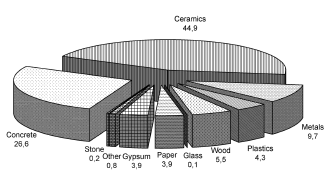
<body><![CDATA[<br> </b></font><font size="2" face="Verdana, Arial, Helvetica, sans-serif">Rehabilitation works are diverse  and consequently the volume of C&amp;D debris generated is variable. Data obtained  from IGE &#91;5&#93; shows that the number of buildings renovated in 2007 is 1628, but  there is no data available regarding either the type or the total surface of  each building. Therefore, an extrapolation of existing data from previous years  has been done. Applying the procedure explained in 2.2 to estimate the average surface  of demolished buildings, the following parameters have been determined: 713  construction works were building enlargements (with an average area of 273.4 m<sup>2</sup>), 294 were  building improvements (with an average area of 398 m<sup>2</sup>), 621 were  building alterations without emptying, 587 reformed buildings were subject to  partial demolition (with an average surface of 202.5 m<sup>2</sup>), and  293 business premises were renovated. The average area of building premises was  calculated from real data from 278 premises, resulting in a value of   170 m<sup>2</sup> per premise.</font></p>     <p><font size="2" face="Verdana, Arial, Helvetica, sans-serif">For partial demolition the amount  of waste generated is supposed to be similar to that of total demolition, 1350  kg/m<sup>2</sup>. For enlargement or alteration works that imply emptying,  demolition is already considered in the partial demolition, and new waste generated  is supposed to equal new building construction, i.e. 80 kg/m<sup>2</sup>. Reformed  buildings can be emptied without alterations of foundations, structure, facade,  roof, etc. But in general they generate little waste compared to other cases.  In the case of alterations to business premises, the ratio of waste volume per  unit surface is known, i.e. 0.136 m<sup>3</sup>/m<sup>2</sup>. If a waste  density of 650 kg/m<sup>2</sup> is considered (statistical data from the  recycling plant RECINOR offers a range between 300 and 1000 kg/m<sup>2</sup>),  the waste ratio for these reform works is 90 kg/m<sup>2</sup>. </font></p>     <p><font size="2" face="Verdana, Arial, Helvetica, sans-serif">Multiplying the values of each  of the categories, and adding them, it has been concluded that C&amp;D debris  produced by rehabilitation works in Galicia in 2007 amounts to 262  thousand metric tons.</font></p>     <p><font size="2" face="Verdana, Arial, Helvetica, sans-serif"><b>2.4 Estimation of total C&amp;D debris produced in  Galicia in 2007    <br> </b></font><font size="2" face="Verdana, Arial, Helvetica, sans-serif">The C&amp;D debris generated  in Galicia in 2007 is the sum of that generated during construction, rehabilitation and  demolition, which amounts to 1.51 million metric tons. Approximately, 46% is  construction waste, 17% is renovation debris and 37% is demolition waste. </font></p>     <p><font size="2" face="Verdana, Arial, Helvetica, sans-serif"><b>2.5 Analysis  of the composition of C&amp;D debris    <br> </b></font><font size="2" face="Verdana, Arial, Helvetica, sans-serif">In order to determine the  composition of C&amp;D debris, it is necessary to know the composition of construction  waste, used for construction works and renovation projects with the exception  of partial demolitions and the composition of demolition waste, which is valid  for both partial and total demolitions. The mass composition adopted for  construction waste has been determined from data provided by the ITeC &#91;6&#93;. The mass  composition of demolition debris has been calculated from the average of the  values obtained from the study projects of buildings constructed fifty years  ago. <a href="#fig01">Figure 1</a> shows the percentage obtained for each of the materials that make  up C&amp;D debris.</font></p>     <p align="center"><font size="2" face="Verdana, Arial, Helvetica, sans-serif"><b><a name="fig01"></a><img src="/img/revistas/dyna/v77n161/a09fig01.gif">    <br>   Figure  1. </b> Mass composition of C&amp;D debris</font></p>     <p><font size="2" face="Verdana, Arial, Helvetica, sans-serif"><b>2.6 Calculation  of recycled aggregate generated and comparison with current aggregate    ]]></body>
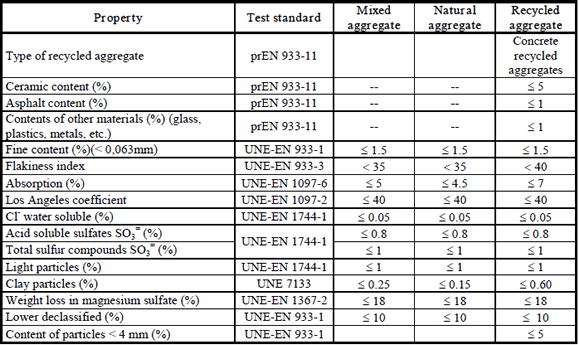
<body><![CDATA[<br> </b></font><font size="2" face="Verdana, Arial, Helvetica, sans-serif">The previous section shows  that the percentage of stone materials, ceramic, concrete and mortar in the C&amp;D  waste is 71.7%. Therefore, from the 1.51 million tons of C&amp;D debris  generated in Galicia in 2007, 1.09 million metric tons of recycled aggregate could have been  obtained. </font></p>     <p><font size="2" face="Verdana, Arial, Helvetica, sans-serif">The report prepared by ANEFA (the  Spanish national association of aggregate producers) &#91;7&#93; stated that the amount  of aggregate used for construction in   2006 in Galicia was 24.8 million metric tons. Therefore,  the amount of recycled aggregate generated in Galicia in 2007 compared to the total  amount of aggregate used in 2006 amounts to 4.4% of the total, which means that  recycled aggregate does not represent any threat to the sector of natural  aggregate. In addition, this analysis evidences that, in this particular market,  recycled aggregate need not be used in complex applications.</font></p>     <p>&nbsp;</p>     <p><font size="3" face="Verdana, Arial, Helvetica, sans-serif"><b>3. TECHNICAL SPECIFICATIONS FOR C&amp;D WASTE</b></font></p>     <p><font size="2" face="Verdana, Arial, Helvetica, sans-serif">Among the possible uses of aggregate in construction,  railroad ballast and road pavements have their own cycles: the damaged  materials that are removed are reused or recycled, therefore closing their own  cycle. For other uses, technical specifications have been developed which depict the requirements and  characteristics that must be fulfilled by these aggregates &#91;8&#93;, &#91;9&#93;, &#91;10&#93;, &#91;11&#93;. </font></p>     <p><font size="2" face="Verdana, Arial, Helvetica, sans-serif"><b>3.1 C&amp;D  waste for structural Concrete    <br> </b></font><font size="2" face="Verdana, Arial, Helvetica, sans-serif">The current standard EHE-08&#91;12&#93; in its Annex 15 sets  out recommendations for the use of concrete made with coarse recycled aggregate  obtained from waste concrete crushing. This aggregate can be used in mass concrete  or structural concrete up to strengths of 40 N/mm<sup>2</sup>. It is recommended  that the dry content of recycled coarse aggregate does not exceed 20% of the  total dry aggregate so as not to affect the final properties of concrete with  respect to conventional concrete of similar strength. In <a href="#tab01">Table 1</a> the  requirements proposed by Article 28 and Annex 15 of the EHE-08 are included.</font></p>     <p align="center"><font size="2" face="Verdana, Arial, Helvetica, sans-serif"><b><a name="tab01"></a>Table 1.</b> Requirements for   coarse aggregate for structural concrete (EHE-08)</font>    <br>   <img src="/img/revistas/dyna/v77n161/a09tab01.gif"></p>     <p><font size="2" face="Verdana, Arial, Helvetica, sans-serif"><b>3.2 C&amp;D waste for non-structural concrete    ]]></body>
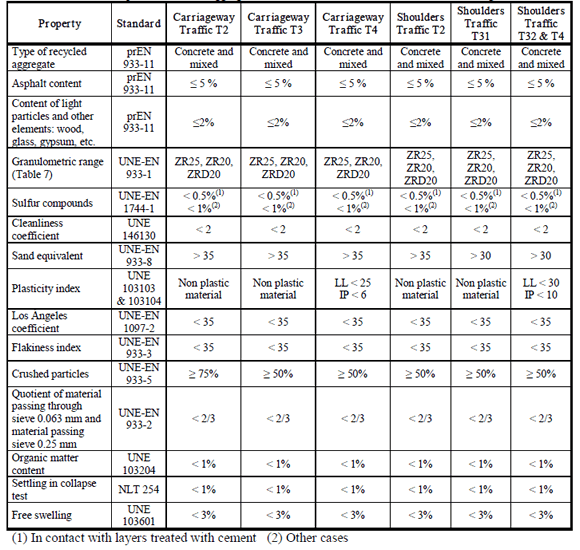
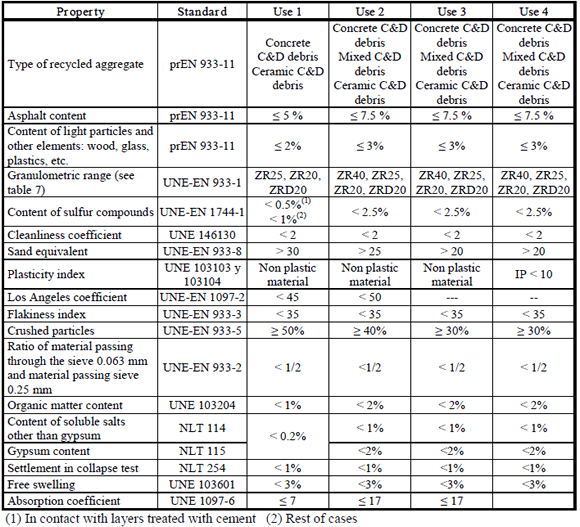
<body><![CDATA[<br> </b>Annex 18 of EHE-08 &#91;12&#93; contains the specifications  for the use of non-structural concrete and allows that 100% of recycled coarse  aggregate may be used in the manufacture of non-structural concrete provided that it meets the specifications of <a href="#tab01">Table 1</a>. </font></p>     <p><font size="2" face="Verdana, Arial, Helvetica, sans-serif"><b>3.3 Unbound  granular material from C&amp;D waste    <br> </b>The specifications listed in <a href="#tab02">Table 2</a> are those given  in the PG-3 &#91;13&#93; for traffic types T2, T3 and T4, which also include the  requirements for recycled aggregate. </font></p>     <p align="center"><font size="2" face="Verdana, Arial, Helvetica, sans-serif"><b><a name="tab02"></a>Table   2.</b> Specifications for aggregate used for base course, sub-base course and sub-grade</font>    <br>   <img src="/img/revistas/dyna/v77n161/a09tab02.gif"></p>     <p><font size="2" face="Verdana, Arial, Helvetica, sans-serif">Generally, only recycled aggregate obtained from  crushed concrete (containing over 90% of concrete and stone material) could  meet all the specifications, so it is very unlikely to do so with mixed recycled  aggregates (obtained from stone, concrete and ceramic). If recycled aggregate  does not meet the specifications described in </font></p>     <p><font size="2" face="Verdana, Arial, Helvetica, sans-serif"><a href="#tab02">Table 2</a>, it can be mixed with natural aggregate in  order to address these limitations. Typically, critical constraints are the Los Angeles coefficient  (UNE-EN 1097-2) and the cleanliness coefficient (UNE146130). In order to  calculate the percentage of substitution a linear correlation can be used.</font></p>       <p><font size="2" face="Verdana, Arial, Helvetica, sans-serif"><b>3.4  Embankment construction with C&amp;D waste    <br> </b>The Spanish standard PG-3 &#91;13&#93;  states that appropriate or selected soil can be used for the coronation of  embankments, and that selected, appropriate or tolerable soil may be used for  both embankment foundation and core. <a href="#tab03">Table 3</a> includes the above restrictions  and the allowable use of recycled aggregate. </font></p>     <p align="center"><font size="2" face="Verdana, Arial, Helvetica, sans-serif"><b><a name="tab03"></a>Table 3</b>. Specifications   for aggregates to embankments</font>    ]]></body>
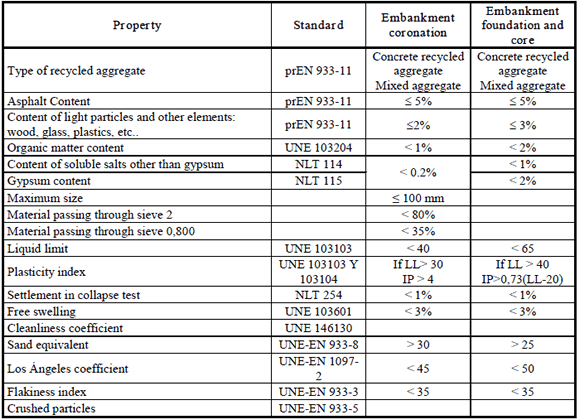
<body><![CDATA[<br>   <img src="/img/revistas/dyna/v77n161/a09tab03.gif"></p>     <p><font size="2" face="Verdana, Arial, Helvetica, sans-serif"><b>3.5 Soil-cement production with C&amp;D waste    <br> </b>The specifications met by the  aggregate to be used in the manufacture of soil-cement after standard PG-3 &#91;13&#93;  are included in <a href="#tab04">Table 4</a>, and those specific to soil-cement are included in  <a href="#tab05">Table 5</a>. </font></p>     <p align="center"><font size="2" face="Verdana, Arial, Helvetica, sans-serif"><b><a name="tab04"></a>Table 4</b>. Specifications   for aggregates to manufacture soil-cement</font>    <br>   <img src="/img/revistas/dyna/v77n161/a09tab04.gif"></p>     <p align="center"><font size="2" face="Verdana, Arial, Helvetica, sans-serif"><b><a name="tab05"></a>Table 5.</b> Specifications of   soil-cement</font>    <br>   <img src="/img/revistas/dyna/v77n161/a09tab05.gif"></p>     <p><font size="2" face="Verdana, Arial, Helvetica, sans-serif">A retardant must be used to delay cement setting in order to increase  the workability period of soil-cement.</font></p>     <p><font size="2" face="Verdana, Arial, Helvetica, sans-serif"><b>3.6 Others  uses</b></font></p>     <p><font size="2" face="Verdana, Arial, Helvetica, sans-serif">Use 1: Filling and leveling of   industrial areas with C&amp;D debris. Filling and leveling of industrial   buildings. Filling and leveling of building works.    ]]></body>
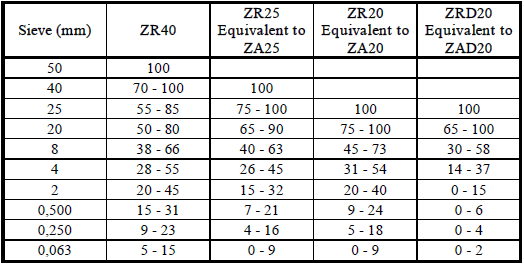
<body><![CDATA[<br> </font><font size="2" face="Verdana, Arial, Helvetica, sans-serif">Use 2: Filling of trench works  with C&amp;D waste. Land filling and farm filling.   Forest  tracks and rural roads. (Use 2)    <br> </font><font size="2" face="Verdana, Arial, Helvetica, sans-serif">Use 3: Sports and leisure  applications of C&amp;D debris. Contribution of material to landfills.  Environmental recovery of quarries (Use 3)    <br> </font><font size="2" face="Verdana, Arial, Helvetica, sans-serif">Use 4: Gardening with C&amp;D  debris. </font></p>     <p><font size="2" face="Verdana, Arial, Helvetica, sans-serif">For such uses, there is no  regulation regarding the specifications that must be met by the aggregate. To  fill this gap, the recommendations of <a href="#tab06">Table 6</a> have been designed. </font></p>     <p align="center"><font size="2" face="Verdana, Arial, Helvetica, sans-serif"><b><a name="tab06"></a>Table 6</b>. Specifications for aggregate for others uses</font>    <br> <img src="/img/revistas/dyna/v77n161/a09tab06.gif"></p>     <p><font size="2" face="Verdana, Arial, Helvetica, sans-serif">In general, concrete recycled  aggregate (containing more than 90% stone and concrete materials) meets all the  specifications, which is </font></p>     <p><font size="2" face="Verdana, Arial, Helvetica, sans-serif">not the case of both ceramic  recycled aggregate (over 90% of ceramic material) and mixed recycled aggregate  (a mixture of stony material, ceramic and concrete). If the recycled aggregate  does not meet the specifications described in the table above it can be mixed  with natural aggregate, so that the dry mixture meets the above limitations.  Typically, critical constraints for mixed recycled aggregate are the   Los Angeles coefficient  (UNE-EN 1097-2) and the cleanliness coefficient (UNE 146130). A linear  correlation can be assumed in both cases.</font></p>       <p align="center"><font size="2" face="Verdana, Arial, Helvetica, sans-serif"><b><a name="tab07"></a>Table  7</b>.  Granulometric curves for recycled aggregate</font>    <br>  <img src="/img/revistas/dyna/v77n161/a09tab07.gif"></p>       ]]></body>
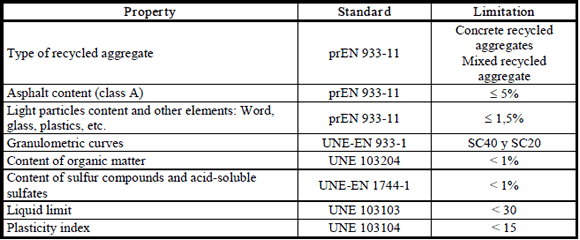
<body><![CDATA[<p>&nbsp;</p>     <p><font size="3" face="Verdana, Arial, Helvetica, sans-serif"><b>4. CONCLUSIONS</b></font></p>     <p><font size="2" face="Verdana, Arial, Helvetica, sans-serif">The conclusions resulting from  this paper are:</font></p> <ul>       <li><font size="2" face="Verdana, Arial, Helvetica, sans-serif">In the year 2007, 1,5 million tons of C&amp;D waste     has been generated in      Galicia ,     which amount to 550 kilos per capita.</font></li>       <li><font size="2" face="Verdana, Arial, Helvetica, sans-serif">The amount of C&amp;D waste is very small compared to     the annual consumption of aggregates.</font></li>       <li><font size="2" face="Verdana, Arial, Helvetica, sans-serif">The previous conclusion leads to the fact that C&amp;D     waste in Spain does not have to be used in complex applications.</font></li>       <li><font size="2" face="Verdana, Arial, Helvetica, sans-serif">Further studies should be conducted on the     characteristics of recycled aggregates and their possible applications.</font></li>     </ul>     <p>&nbsp;</p>     <p><font size="3" face="Verdana, Arial, Helvetica, sans-serif"><b>REFERENCES</b></font></p>     ]]></body>
<body><![CDATA[<!-- ref --><p><font size="2"><b><font face="Verdana, Arial, Helvetica, sans-serif">&#91;1&#93;</font></b><font face="Verdana, Arial, Helvetica, sans-serif"> EUROPEAN WASTE CATALOGUE,. Commissi&oacute;n of European Communities. Directive 91/689/CEE.     &nbsp;&nbsp;&nbsp;&nbsp;&nbsp;&nbsp;&nbsp;&nbsp;[&#160;<a href="javascript:void(0);" onclick="javascript: window.open('/scielo.php?script=sci_nlinks&ref=000103&pid=S0012-7353201000010000900001&lng=','','width=640,height=500,resizable=yes,scrollbars=1,menubar=yes,');">Links</a>&#160;]<!-- end-ref --><!-- ref --><br>     <b>&#91;2&#93;</b>  BRODERSEN, J., JUUL, J., JACOBSEN, H. Review of selected waste streams: Sewage sludge, construction and demolition waste, waste oils, waste from coal-fired power plants and biodegradable municipal waste. European Topic Centre on Waste, Project manager: Dimitros Tsotsos. European Environment Agency. 2002.       &nbsp;&nbsp;&nbsp;&nbsp;&nbsp;&nbsp;&nbsp;&nbsp;[&#160;<a href="javascript:void(0);" onclick="javascript: window.open('/scielo.php?script=sci_nlinks&ref=000104&pid=S0012-7353201000010000900002&lng=','','width=640,height=500,resizable=yes,scrollbars=1,menubar=yes,');">Links</a>&#160;]<!-- end-ref --><!-- ref --><br>       <b>&#91;3&#93;</b> COCHRAN, K., TOWNSEND, T., REINHART, D., HECK, H. Estimation of regional building-related C&D Debris generation and composition: Case study for Florida, U.S. Waste management 27 (2007): 921-931, 2007.     &nbsp;&nbsp;&nbsp;&nbsp;&nbsp;&nbsp;&nbsp;&nbsp;[&#160;<a href="javascript:void(0);" onclick="javascript: window.open('/scielo.php?script=sci_nlinks&ref=000105&pid=S0012-7353201000010000900003&lng=','','width=640,height=500,resizable=yes,scrollbars=1,menubar=yes,');">Links</a>&#160;]<!-- end-ref --><!-- ref --><br>       <b>&#91;4&#93;</b>  FRANKLIN ASSOCIATES. Characterization of Building-Related Construction and Demolition Debris in the United States . U.S. Environmental Protection Agency. Report No. EPA530-R-98-010, 1998.       &nbsp;&nbsp;&nbsp;&nbsp;&nbsp;&nbsp;&nbsp;&nbsp;[&#160;<a href="javascript:void(0);" onclick="javascript: window.open('/scielo.php?script=sci_nlinks&ref=000106&pid=S0012-7353201000010000900004&lng=','','width=640,height=500,resizable=yes,scrollbars=1,menubar=yes,');">Links</a>&#160;]<!-- end-ref --><!-- ref --><br>       <b>&#91;5&#93;</b> INSTITUTO GALEGO DE ESTAD&Iacute;SITICA. Datos estad&iacute;sticos de poblaci&oacute;n, edificaci&oacute;n y vivienda en Galicia. Available: <a href="http://www.ige.eu">http://www.ige.eu</a>. &#91;Visited september, 2008&#93;</b>        &nbsp;&nbsp;&nbsp;&nbsp;&nbsp;&nbsp;&nbsp;&nbsp;[&#160;<a href="javascript:void(0);" onclick="javascript: window.open('/scielo.php?script=sci_nlinks&ref=000107&pid=S0012-7353201000010000900005&lng=','','width=640,height=500,resizable=yes,scrollbars=1,menubar=yes,');">Links</a>&#160;]<!-- end-ref --><!-- ref --><br>       <b>&#91;6&#93;</b> MA&Ntilde;À I REIXACH, F, GONZÀLEZ I BARROSO, J., SAGRERA I CUSC&Oacute;, A. Plan de Gesti&oacute;n de Residuos en las Obras de Construcci&oacute;n y Demolici&oacute;n; Programa Life. Direcci&oacute;n General de Medio Ambiente; Institut de Tecnolog&iacute;a de la Construcci&oacute; de Catalunya, Barcelona, 2000.     &nbsp;&nbsp;&nbsp;&nbsp;&nbsp;&nbsp;&nbsp;&nbsp;[&#160;<a href="javascript:void(0);" onclick="javascript: window.open('/scielo.php?script=sci_nlinks&ref=000108&pid=S0012-7353201000010000900006&lng=','','width=640,height=500,resizable=yes,scrollbars=1,menubar=yes,');">Links</a>&#160;]<!-- end-ref --><!-- ref --><br>       <b>&#91;7&#93;</b> ASOCIACI&Oacute;N DE EMPRESARIOS FABRICANTES DE &Aacute;RIDOS (ANEFA). 2007. Estad&iacute;sticas de &aacute;ridos 2006. Available: <a href="http://www.geoscopio.com/escaparate/ docs2.pl?url=/empresas/anefa3//anefa/estadisticas/Estadisticas%202006-2007%20final.pdf& accion=abajo">http://www.geoscopio.com/escaparate/ docs2.pl?url=/empresas/anefa3//anefa/estadisticas/Estadisticas%202006-2007%20final.pdf&  accion=abajo</a> &#91;visited march, 2009&#93;</b> .     &nbsp;&nbsp;&nbsp;&nbsp;&nbsp;&nbsp;&nbsp;&nbsp;[&#160;<a href="javascript:void(0);" onclick="javascript: window.open('/scielo.php?script=sci_nlinks&ref=000109&pid=S0012-7353201000010000900007&lng=','','width=640,height=500,resizable=yes,scrollbars=1,menubar=yes,');">Links</a>&#160;]<!-- end-ref --><!-- ref --><br> <b>&#91;8&#93;</b>  CRAWFORD, H.S. Market Development Study for Recycled Aggregate Products. Waste reduction Advisory Committee; Calgary, 2001.     &nbsp;&nbsp;&nbsp;&nbsp;&nbsp;&nbsp;&nbsp;&nbsp;[&#160;<a href="javascript:void(0);" onclick="javascript: window.open('/scielo.php?script=sci_nlinks&ref=000110&pid=S0012-7353201000010000900008&lng=','','width=640,height=500,resizable=yes,scrollbars=1,menubar=yes,');">Links</a>&#160;]<!-- end-ref --><!-- ref --><br> <b>&#91;9&#93;</b> FUEYO, L. Manual de demoliciones, reciclaje y manipulaci&oacute;n de materiales. Ed. Fueyo editores; Madrid, 2003.     &nbsp;&nbsp;&nbsp;&nbsp;&nbsp;&nbsp;&nbsp;&nbsp;[&#160;<a href="javascript:void(0);" onclick="javascript: window.open('/scielo.php?script=sci_nlinks&ref=000111&pid=S0012-7353201000010000900009&lng=','','width=640,height=500,resizable=yes,scrollbars=1,menubar=yes,');">Links</a>&#160;]<!-- end-ref --><!-- ref --><br> <b>&#91;10&#93;</b> GRUPO DE TRABAJO &Aacute;RIDOS RECICLADOS; AEN/CTN 146. Propuesta de Proyecto de Norma UNE &Aacute;ridos Reciclados para su uso como Material de Construcci&oacute;n de Bases, Subbases y Explanadas, 1999.     &nbsp;&nbsp;&nbsp;&nbsp;&nbsp;&nbsp;&nbsp;&nbsp;[&#160;<a href="javascript:void(0);" onclick="javascript: window.open('/scielo.php?script=sci_nlinks&ref=000112&pid=S0012-7353201000010000900010&lng=','','width=640,height=500,resizable=yes,scrollbars=1,menubar=yes,');">Links</a>&#160;]<!-- end-ref --><!-- ref --><br> <b>&#91;11&#93;</b> GRUPO DE TRABAJO HORMIG&Oacute;N RECICLADO. Comisi&oacute;n Permanente del Hormig&oacute;n. Utilizaci&oacute;n del &aacute;rido reciclado para la fabricaci&oacute;n de hormig&oacute;n estructural. Monograf&iacute;a de la Asociaci&oacute;n Cient&iacute;fico-T&eacute;cnica del Hormig&oacute;n Estructural (ACHE); Madrid, 2006.     &nbsp;&nbsp;&nbsp;&nbsp;&nbsp;&nbsp;&nbsp;&nbsp;[&#160;<a href="javascript:void(0);" onclick="javascript: window.open('/scielo.php?script=sci_nlinks&ref=000113&pid=S0012-7353201000010000900011&lng=','','width=640,height=500,resizable=yes,scrollbars=1,menubar=yes,');">Links</a>&#160;]<!-- end-ref --><!-- ref --><br> <b>&#91;12&#93;</b> EHE-08. Instrucci&oacute;n de Hormig&oacute;n Estructural. Publicaciones del Ministerio de Fomento; Secretar&iacute;a General T&eacute;cnica, Madrid, 2008.     &nbsp;&nbsp;&nbsp;&nbsp;&nbsp;&nbsp;&nbsp;&nbsp;[&#160;<a href="javascript:void(0);" onclick="javascript: window.open('/scielo.php?script=sci_nlinks&ref=000114&pid=S0012-7353201000010000900012&lng=','','width=640,height=500,resizable=yes,scrollbars=1,menubar=yes,');">Links</a>&#160;]<!-- end-ref --><!-- ref --><br> <b>&#91;13&#93;</b> PG-3. Pliego de Prescripciones T&eacute;cnicas Generales para Obras de Carreteras y Puentes. Obra preparada por Gerardo Bustos Pretes, T&eacute;cnico Superior de la Administraci&oacute;n General del Estado; Ediciones LITEAM; 4ª Edici&oacute;n actualizada a 6 de abril de 2004. </font></font>&nbsp;&nbsp;&nbsp;&nbsp;&nbsp;&nbsp;&nbsp;&nbsp;[&#160;<a href="javascript:void(0);" onclick="javascript: window.open('/scielo.php?script=sci_nlinks&ref=000115&pid=S0012-7353201000010000900013&lng=','','width=640,height=500,resizable=yes,scrollbars=1,menubar=yes,');">Links</a>&#160;]<!-- end-ref --> ]]></body><back>
<ref-list>
<ref id="B1">
<label>1</label><nlm-citation citation-type="">
<source><![CDATA[EUROPEAN WASTE CATALOGUE: Commissión of European Communities]]></source>
<year></year>
</nlm-citation>
</ref>
<ref id="B2">
<label>2</label><nlm-citation citation-type="book">
<person-group person-group-type="author">
<name>
<surname><![CDATA[BRODERSEN]]></surname>
<given-names><![CDATA[J.]]></given-names>
</name>
<name>
<surname><![CDATA[JUUL]]></surname>
<given-names><![CDATA[J.]]></given-names>
</name>
<name>
<surname><![CDATA[JACOBSEN]]></surname>
<given-names><![CDATA[H.]]></given-names>
</name>
</person-group>
<source><![CDATA[Review of selected waste streams: Sewage sludge, construction and demolition waste, waste oils, waste from coal-fired power plants and biodegradable municipal waste]]></source>
<year>2002</year>
<publisher-name><![CDATA[European Environment Agency]]></publisher-name>
</nlm-citation>
</ref>
<ref id="B3">
<label>3</label><nlm-citation citation-type="journal">
<person-group person-group-type="author">
<name>
<surname><![CDATA[COCHRAN]]></surname>
<given-names><![CDATA[K.]]></given-names>
</name>
<name>
<surname><![CDATA[TOWNSEND]]></surname>
<given-names><![CDATA[T.]]></given-names>
</name>
<name>
<surname><![CDATA[REINHART]]></surname>
<given-names><![CDATA[D.]]></given-names>
</name>
<name>
<surname><![CDATA[HECK]]></surname>
<given-names><![CDATA[H.]]></given-names>
</name>
</person-group>
<article-title xml:lang="en"><![CDATA[Estimation of regional building-related C&D Debris generation and composition: Case study for Florida, U.S]]></article-title>
<source><![CDATA[Waste management]]></source>
<year>2007</year>
<volume>27</volume>
<numero>2007</numero>
<issue>2007</issue>
<page-range>921-931</page-range></nlm-citation>
</ref>
<ref id="B4">
<label>4</label><nlm-citation citation-type="book">
<collab>FRANKLIN ASSOCIATES</collab>
<source><![CDATA[Characterization of Building-Related Construction and Demolition Debris in the United States . U.S.]]></source>
<year>1998</year>
<publisher-name><![CDATA[Environmental Protection Agency]]></publisher-name>
</nlm-citation>
</ref>
<ref id="B5">
<label>5</label><nlm-citation citation-type="">
<collab>INSTITUTO GALEGO DE ESTADÍSITICA</collab>
<source><![CDATA[Datos estadísticos de población, edificación y vivienda en Galicia]]></source>
<year>sept</year>
<month>em</month>
<day>be</day>
</nlm-citation>
</ref>
<ref id="B6">
<label>6</label><nlm-citation citation-type="book">
<person-group person-group-type="author">
<name>
<surname><![CDATA[MAÑÀ I REIXACH]]></surname>
<given-names><![CDATA[F]]></given-names>
</name>
<name>
<surname><![CDATA[GONZÀLEZ I BARROSO]]></surname>
<given-names><![CDATA[J.]]></given-names>
</name>
<name>
<surname><![CDATA[SAGRERA I CUSCÓ]]></surname>
<given-names><![CDATA[A.]]></given-names>
</name>
</person-group>
<source><![CDATA[Plan de Gestión de Residuos en las Obras de Construcción y Demolición: Programa Life]]></source>
<year>2000</year>
<publisher-loc><![CDATA[^eBarcelona Barcelona]]></publisher-loc>
<publisher-name><![CDATA[Dirección General de Medio Ambiente]]></publisher-name>
</nlm-citation>
</ref>
<ref id="B7">
<label>7</label><nlm-citation citation-type="">
<collab>ASOCIACIÓN DE EMPRESARIOS FABRICANTES DE ÁRIDOS</collab>
<source><![CDATA[Estadísticas de áridos 2006]]></source>
<year>2007</year>
</nlm-citation>
</ref>
<ref id="B8">
<label>8</label><nlm-citation citation-type="book">
<person-group person-group-type="author">
<name>
<surname><![CDATA[CRAWFORD]]></surname>
<given-names><![CDATA[H.S.]]></given-names>
</name>
</person-group>
<source><![CDATA[Market Development Study for Recycled Aggregate Products]]></source>
<year>2001</year>
<publisher-loc><![CDATA[Calgary ]]></publisher-loc>
<publisher-name><![CDATA[Waste reduction Advisory Committee]]></publisher-name>
</nlm-citation>
</ref>
<ref id="B9">
<label>9</label><nlm-citation citation-type="book">
<person-group person-group-type="author">
<name>
<surname><![CDATA[FUEYO]]></surname>
<given-names><![CDATA[L.]]></given-names>
</name>
</person-group>
<source><![CDATA[Manual de demoliciones, reciclaje y manipulación de materiales]]></source>
<year>2003</year>
<publisher-loc><![CDATA[Madrid ]]></publisher-loc>
<publisher-name><![CDATA[Ed. Fueyo editores]]></publisher-name>
</nlm-citation>
</ref>
<ref id="B10">
<label>10</label><nlm-citation citation-type="book">
<collab>GRUPO DE TRABAJO ÁRIDOS RECICLADOS</collab>
<source><![CDATA[AEN/CTN 146: Propuesta de Proyecto de Norma UNE Áridos Reciclados para su uso como Material de Construcción de Bases]]></source>
<year>1999</year>
<publisher-name><![CDATA[Subbases y Explanadas]]></publisher-name>
</nlm-citation>
</ref>
<ref id="B11">
<label>11</label><nlm-citation citation-type="">
<collab>GRUPO DE TRABAJO HORMIGÓN RECICLADO</collab>
<source><![CDATA[Utilización del árido reciclado para la fabricación de hormigón estructural: Monografía de la Asociación Científico-Técnica del Hormigón Estructural (ACHE)]]></source>
<year>2006</year>
<publisher-loc><![CDATA[Madrid ]]></publisher-loc>
</nlm-citation>
</ref>
<ref id="B12">
<label>12</label><nlm-citation citation-type="book">
<source><![CDATA[EHE-08: Instrucción de Hormigón Estructural]]></source>
<year>2008</year>
<publisher-loc><![CDATA[Madrid ]]></publisher-loc>
<publisher-name><![CDATA[Publicaciones del Ministerio de Fomento]]></publisher-name>
</nlm-citation>
</ref>
<ref id="B13">
<label>13</label><nlm-citation citation-type="book">
<collab>Técnico Superior de la Administración General del Estado</collab>
<source><![CDATA[Pliego de Prescripciones Técnicas Generales para Obras de Carreteras y Puentes: Obra preparada por Gerardo Bustos Pretes]]></source>
<year></year>
<edition>4ª Edición</edition>
<publisher-name><![CDATA[Ediciones LITEAM]]></publisher-name>
</nlm-citation>
</ref>
</ref-list>
</back>
</article>