<?xml version="1.0" encoding="ISO-8859-1"?><article xmlns:mml="http://www.w3.org/1998/Math/MathML" xmlns:xlink="http://www.w3.org/1999/xlink" xmlns:xsi="http://www.w3.org/2001/XMLSchema-instance">
<front>
<journal-meta>
<journal-id>0012-7353</journal-id>
<journal-title><![CDATA[DYNA]]></journal-title>
<abbrev-journal-title><![CDATA[Dyna rev.fac.nac.minas]]></abbrev-journal-title>
<issn>0012-7353</issn>
<publisher>
<publisher-name><![CDATA[Universidad Nacional de Colombia]]></publisher-name>
</publisher>
</journal-meta>
<article-meta>
<article-id>S0012-73532010000100010</article-id>
<title-group>
<article-title xml:lang="en"><![CDATA[TECHNOLOGICAL INNOVATIONS ON UNDERGROUND COAL GASIFICATION AND CO2 SEQUESTRATION]]></article-title>
<article-title xml:lang="es"><![CDATA[LAS INNOVACIONES TECNOLÓGICAS EN GASIFICACIÓN SUBTERRÁNEA DE CARBÓN Y LA SECUESTRACIÓN DEL CO2]]></article-title>
</title-group>
<contrib-group>
<contrib contrib-type="author">
<name>
<surname><![CDATA[DA GAMA]]></surname>
<given-names><![CDATA[CARLOS DINIS]]></given-names>
</name>
<xref ref-type="aff" rid="A01"/>
</contrib>
<contrib contrib-type="author">
<name>
<surname><![CDATA[NAVARRO TORRES]]></surname>
<given-names><![CDATA[VIDAL]]></given-names>
</name>
<xref ref-type="aff" rid="A02"/>
</contrib>
<contrib contrib-type="author">
<name>
<surname><![CDATA[FALCÃO NEVES]]></surname>
<given-names><![CDATA[ANA PAULA]]></given-names>
</name>
<xref ref-type="aff" rid="A03"/>
</contrib>
</contrib-group>
<aff id="A01">
<institution><![CDATA[,Technical University of Lisbon  ]]></institution>
<addr-line><![CDATA[ ]]></addr-line>
<country>Portugal</country>
</aff>
<aff id="A02">
<institution><![CDATA[,Technical University of Lisbon  ]]></institution>
<addr-line><![CDATA[ ]]></addr-line>
<country>Portugal</country>
</aff>
<aff id="A03">
<institution><![CDATA[,Technical University of Lisbon  ]]></institution>
<addr-line><![CDATA[ ]]></addr-line>
<country>Portugal</country>
</aff>
<pub-date pub-type="pub">
<day>00</day>
<month>03</month>
<year>2010</year>
</pub-date>
<pub-date pub-type="epub">
<day>00</day>
<month>03</month>
<year>2010</year>
</pub-date>
<volume>77</volume>
<numero>161</numero>
<fpage>101</fpage>
<lpage>108</lpage>
<copyright-statement/>
<copyright-year/>
<self-uri xlink:href="http://www.scielo.org.co/scielo.php?script=sci_arttext&amp;pid=S0012-73532010000100010&amp;lng=en&amp;nrm=iso"></self-uri><self-uri xlink:href="http://www.scielo.org.co/scielo.php?script=sci_abstract&amp;pid=S0012-73532010000100010&amp;lng=en&amp;nrm=iso"></self-uri><self-uri xlink:href="http://www.scielo.org.co/scielo.php?script=sci_pdf&amp;pid=S0012-73532010000100010&amp;lng=en&amp;nrm=iso"></self-uri><abstract abstract-type="short" xml:lang="en"><p><![CDATA[A brief description of the underground coal gasification (UCG) process, combined with the possibility of CO2 sequestration, is presented. Although nowadays there are very few active industrial UCG plants, a number of new projects are under way in different parts of the world aimed to produce regular gas fuel derived from “in situ” coal combustion, despite the environmental advantages resulting from this process. A brief review of those projects is included. The possibility of underground CO2 storage, either with or without simultaneous UCG, is analyzed by taking into consideration the main challenges of its application and the risks associated with integrated solutions, thus requiring innovative solutions.]]></p></abstract>
<abstract abstract-type="short" xml:lang="es"><p><![CDATA[Se describen las principales contribuciones al desarrollo tecnológico del proceso de gasificación subterránea del carbón (G.S.C.) y complementariamente la posibilidad de secuestración del CO2 en el medio ambiente subterráneo. Se busca explicar por que razones existen actualmente en el mundo muy pocas plantas industriales de G.S.C. que produzcan regularmente combustibles gaseosos oriundos de la combustión del carbón “in situ”, a pesar de las ventajas de protección ambiental que resultan de este proceso. Un breve listado de los proyectos en curso es incluido. La posibilidad del almacenamiento subterráneo del CO2 con o sin simultaneidad respecto a la G.S.C. es analizada, destacando las principales dificultades de aplicación de esta técnica y los riesgos asociados a las soluciones integradas, que necesitan soluciones de innovación.]]></p></abstract>
<kwd-group>
<kwd lng="en"><![CDATA[Underground]]></kwd>
<kwd lng="en"><![CDATA[coal gasification]]></kwd>
<kwd lng="en"><![CDATA[CO2 capture]]></kwd>
<kwd lng="en"><![CDATA[CO2 sequestration]]></kwd>
<kwd lng="en"><![CDATA[sustainability]]></kwd>
<kwd lng="en"><![CDATA[sustainability index]]></kwd>
<kwd lng="es"><![CDATA[Subterránea]]></kwd>
<kwd lng="es"><![CDATA[gasificación del carbón]]></kwd>
<kwd lng="es"><![CDATA[captura de CO2]]></kwd>
<kwd lng="es"><![CDATA[secuestración del CO2]]></kwd>
<kwd lng="es"><![CDATA[índice de sostenibilidad]]></kwd>
</kwd-group>
</article-meta>
</front><body><![CDATA[ <p align="center"><font size="4" face="Verdana, Arial, Helvetica, sans-serif"><b>TECHNOLOGICAL  INNOVATIONS ON UNDERGROUND COAL GASIFICATION AND CO2 SEQUESTRATION </b></font></p>     <p align="center"><i><font size="3" face="Verdana, Arial, Helvetica, sans-serif"><b>LAS INNOVACIONES TECNOL&Oacute;GICAS EN  GASIFICACI&Oacute;N SUBTERR&Aacute;NEA DE CARB&Oacute;N Y  LA SECUESTRACI&Oacute;N DEL  CO2</b></font></i></p>     <p align="center">&nbsp; </p>     <p align="center"><font size="2" face="Verdana, Arial, Helvetica, sans-serif"><b>CARLOS DINIS DA GAMA</b>    <br>  <i>IST, Technical University of Lisbon, Portugal, <a href="mailto:dgama@ist.utl.pt">dgama@ist.utl.pt</a></i></font></p>     <p align="center"><font size="2" face="Verdana, Arial, Helvetica, sans-serif"><b>VIDAL NAVARRO TORRES</b>    <br>  <i>IST, Technical University of Lisbon, Portugal, <a href="mailto:vntorres@ist.utl.pt">vntorres@ist.utl.pt</a></i></font></p>     <p align="center"><font size="2" face="Verdana, Arial, Helvetica, sans-serif"><b>ANA  PAULA FALCÃO NEVES</b>    <br>  <i>IST,  Technical University of Lisbon, Portugal, <a href="mailto:pfalcaoneves@mail.ist.utl.pt">pfalcaoneves@mail.ist.utl.pt</a></i></font></p>     <p align="center">&nbsp; </p>     ]]></body>
<body><![CDATA[<p align="center"><font size="2" face="Verdana, Arial, Helvetica, sans-serif"><b>Received for review June 30 <sup>th</sup>, 2009, accepted  December 12 <sup>th</sup>, 2009, final version December 21 <sup>th</sup>, 2009</b></font></p>     <p align="center">&nbsp; </p> <hr>     <p><font size="2" face="Verdana, Arial, Helvetica, sans-serif"><b>ABSTRACT</b>: A brief description of the  underground coal gasification (UCG) process, combined with the possibility of  CO<sub>2</sub> sequestration, is presented. Although nowadays there are very  few active industrial UCG plants, a number of new projects are under way in  different parts of the world aimed to produce regular gas fuel derived from “in  situ” coal combustion, despite the environmental advantages resulting from this  process. A brief review of those projects is included. The possibility of  underground CO<sub>2</sub> storage, either with or without simultaneous UCG, is  analyzed by taking into consideration the main challenges of its application  and the risks associated with integrated solutions, thus requiring innovative  solutions.</font></p>     <p><font size="2" face="Verdana, Arial, Helvetica, sans-serif"><b>KEYWORDS</b>: Underground, coal  gasification, CO<sub>2</sub> capture, CO<sub>2</sub> sequestration,  sustainability, sustainability index.</font></p>     <p><font size="2" face="Verdana, Arial, Helvetica, sans-serif"><b>RESUMEN: </b>Se describen las principales contribuciones al desarrollo tecnol&oacute;gico  del proceso de gasificaci&oacute;n subterr&aacute;nea del carb&oacute;n (G.S.C.) y  complementariamente la posibilidad de secuestraci&oacute;n del CO<sub>2</sub> en el  medio ambiente subterr&aacute;neo. Se busca explicar por que razones existen  actualmente en el mundo muy pocas plantas industriales de G.S.C. que produzcan  regularmente combustibles gaseosos oriundos de la combusti&oacute;n del carb&oacute;n “in  situ”, a pesar de las ventajas de protecci&oacute;n ambiental que resultan de este proceso.  Un breve listado de los proyectos en curso es incluido. La posibilidad del  almacenamiento subterr&aacute;neo del CO<sub>2</sub> con o sin simultaneidad respecto  a  la G.S.C. es  analizada, destacando las principales dificultades de aplicaci&oacute;n de esta  t&eacute;cnica y los riesgos asociados a las soluciones integradas, que necesitan  soluciones de innovaci&oacute;n.</font></p>     <p><font size="2" face="Verdana, Arial, Helvetica, sans-serif"><b>PALABRAS CLAVE</b>: Subterr&aacute;nea, gasificaci&oacute;n del carb&oacute;n, captura  de CO<sub>2</sub>, secuestraci&oacute;n del CO<sub>2, </sub>&iacute;ndice de sostenibilidad.</font></p>  <hr>     <p>&nbsp;</p>     <p><font size="3" face="Verdana, Arial, Helvetica, sans-serif"><b>1. INTRODUCTION</b></font></p>     <p><font size="2" face="Verdana, Arial, Helvetica, sans-serif">Technological  innovations are creative business practices for the development of new  processes, products or methodologies, which are essential for success in today’s  world, in all industrial areas, including the mining sector.</font></p>     <p><font size="2" face="Verdana, Arial, Helvetica, sans-serif">The main  reasons for this trend are due to the increasingly intense trend of  globalization, leading to exacerbate competition procedures, under the growing  power of public opinion and environmental constraints.</font></p>      ]]></body>
<body><![CDATA[<p><font size="2" face="Verdana, Arial, Helvetica, sans-serif">Thus, new  skills in training young engineers are required to ensure new technological  achievements in that sector.</font></p>     <p><font size="2" face="Verdana, Arial, Helvetica, sans-serif">   The origin and perpetual need for innovation is linked to the deepest human  aspirations, as it was proclaimed by many writers, among others Von Goethe  (1749-1832): &quot;Over time, the reason becomes senseless and privileges, disturbances&quot;,  George Duhammel (1884-1966): &quot;The world was created to be recreated&quot;  and recently, Peter F. Drucker: &quot;Our only habit is the constant changing&quot;.</font></p>     <p><font size="2" face="Verdana, Arial, Helvetica, sans-serif">In the  field of mining, the majority of known innovations are related to:</font></p> <ul>       <li><font size="2" face="Verdana, Arial, Helvetica, sans-serif">      Use of clean, non-intrusive, technologies;</font></li>       <li><font size="2" face="Verdana, Arial, Helvetica, sans-serif">Using     BATNEEC (&quot;Best Available Technology Not Enticing Excessive Costs&quot;);</font></li>       <li><font size="2" face="Verdana, Arial, Helvetica, sans-serif">Environmental     rehabilitation simultaneous with exploitation;</font></li>       <li><font size="2" face="Verdana, Arial, Helvetica, sans-serif">Close     involvement with local communities;</font></li>       <li><font size="2" face="Verdana, Arial, Helvetica, sans-serif">New     contributions to social cohesion and regional development.</font></li>     </ul>     <p><font size="2" face="Verdana, Arial, Helvetica, sans-serif">It is also important  to mention the Milos Declaration &#91;1&#93;,  which contains the fundamental survival principles of the mining sector in the 21<sup>st</sup> Century and beyond. </font></p>     ]]></body>
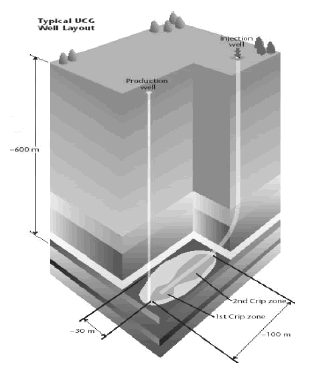
<body><![CDATA[<p>&nbsp;</p>     <p><font size="3" face="Verdana, Arial, Helvetica, sans-serif"><b>2. PRINCIPLES OF UNDERGROUND COAL GASIFICATION</b></font></p>     <p><font size="2" face="Verdana, Arial, Helvetica, sans-serif"><b>2.1 History    <br> </b></font><font size="2" face="Verdana, Arial, Helvetica, sans-serif">This  technique had started in Russia during the 30s, consisting of the opening of  vertical drill-holes to intersect a coal seam at a certain depth, then injecting  air or oxygen and / or steam at high temperature to cause an underground combustion.  The resulting gases were extracted from the combustion chamber through other  boreholes, thus creating an “in situ” coal gasification to produce CO and  hydrogen at high pressure for use in electrical generating plants or in the production of chemicals &#91;2&#93; (<a href="#fig01">Figure 1</a>). </font></p> <font size="2" face="Verdana, Arial, Helvetica, sans-serif">      <p align="center"><b><a name="fig01"></a><img src="/img/revistas/dyna/v77n161/a10fig01.gif">    <br>   Figure  1. </b> Phases and process of Underground Coal  Gasification: drilling, injection and production &#91;1,2&#93; </p>     <p>The  advantages of this technique are related to its high efficiency, because it  makes possible to triple or quadrupling the exploitable coal reserves and so offsetting  the decline in reserves of other mineral fuels such as oil and gas. This is  particularly suitable for low quality coals, such as lignite and bituminous  coal, which produce less heat in combustion due to its high ash content and are  they more polluting in conventional plants.</p>     <p>Another  important advantage is that the ashes of combustion remain underground, which reduces  emissions of NOx and SOx pollutants, as well as mercury levels and particulate  pollution, compared to conventional coal thermal units, with additional  economic benefits.</p>     <p>In this  way, chemical reactions can produce a gas rich in carbon monoxide, hydrogen and  other elements such as methane. This gas can be used to generate electricity or  as fuel and the coal used need not be a high calorific value, although their  optimal use is also dependent on geological features (faults, folds,  weathering, etc.) of the adjacent ground, particularly the formations located  above the combustion chamber.</p>     <p><b>2.2 The  CRIP innovation    ]]></body>
<body><![CDATA[<br> </b>Several  processes exist to initiate and control UCG reactions, including the Controlled  Retraction Injection Point (CRIP) process, developed by the Lawrence Livermore  National Laboratory (LLNL) for shallow coal and the European trial extended its  use to deeper coal. </p>     <p>These  ignition processes create a syngas stream which is compositionally similar to  surface-produced syngas. It can have higher CO<sub>2</sub> content and hydrogen  products due to a number of factors, including a higher than optimal rate of  water flux into the UCG reactor and ash catalysis of water-gas shift. Because  of the nature of in-situ conversion, UCG syngas is lower in sulfur, tar,  particulates and mercury than conventional syngas and has very low ash content.  Other components are similar and can be managed through conventional gas  processing and clean up (<a href="#fig02">Figure 2</a>).</p> </font>     <p align="center"><font size="2" face="Verdana, Arial, Helvetica, sans-serif"><b><a name="fig02"></a><img src="/img/revistas/dyna/v77n161/a10fig02.gif">    <br>   Figure   2.</b> Schematic representation of the CRIP   technique &#91;3&#93; </font></p> <font size="2" face="Verdana, Arial, Helvetica, sans-serif">     <p><b>2.3 Economics    <br> </b>The   economics of UCG appear extremely promising. The capital expenses of UCG plants   appear to be substantially less than the equivalent plant fed by surface   gasifiers because plant purchase is not required. Similarly, operating expenses   are likely to be much lower because of the lack of coal mining, cleaning and   transportation, thus significantly reducing ash management facilities. Even for   configurations requiring a substantial environmental monitoring program and additional swing facilities, UCG plants retain other economic advantages:</p> </font> <ul>       <li><font size="2" face="Verdana, Arial, Helvetica, sans-serif">It can     serve to spread the use of hydrogen as a clean fuel, thus exploiting further     layers than in conventional hard coal underground mining;</font></li>       <li><font size="2" face="Verdana, Arial, Helvetica, sans-serif">It takes     the energy contained in coal without the need to remove it and avoid technical     problems and safety of conventional mining;</font></li>       <li><font size="2" face="Verdana, Arial, Helvetica, sans-serif">As the     ashes and other undesirable components remain in the reservoir, this means     great savings in terms of surface waste disposal;</font></li>       <li><font size="2" face="Verdana, Arial, Helvetica, sans-serif">Coal     gasification plants are more energy efficient that conventional combustion (50%     greater), and experts believe that in forthcoming years they can reach 70 or     80% higher performances; </font></li>     ]]></body>
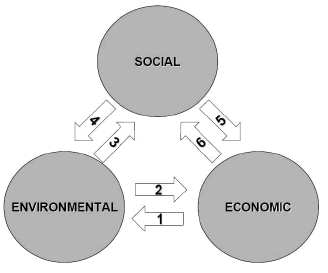
<body><![CDATA[<li><font size="2" face="Verdana, Arial, Helvetica, sans-serif">Carbon    dioxide, a leading greenhouse gas, can be captured by chemical processes in  ways that do not let it escape to the atmosphere. </font></li>     </ul>      <p><font size="2" face="Verdana, Arial, Helvetica, sans-serif"><b>2.4 Environmental effects and sustainability    <br>   </b>There are   two primary, short-term environmental hazards associated with UCG: ground-water   contamination and surface subsidence. Both of these, according to LLNL, appear to   be avoidable through careful site selection and management. Those negative   environmental effects may influence the quality of groundwater resources   whereas surface subsidence may be induced by the cavities produced by coal   combustion, although these problems are known to decrease with the depth of the reservoir.</font></p>     <p><font size="2" face="Verdana, Arial, Helvetica, sans-serif">In   similarity to the mining industry and as any other human activities the UCG   process must be carried out in concordance to the sustainable development (SD)   principles. The key for SD of the UCG is comprised of the three &quot;basic pillars&quot;  – economic, social and environmental (<a href="#fig03">Figure 3</a>). </font></p>     <p align="center"><font size="2" face="Verdana, Arial, Helvetica, sans-serif"><b><a name="fig03"></a><img src="/img/revistas/dyna/v77n161/a10fig03.gif">    <br>   Figure  3.</b> Interactions of mining sustainable development components &#91;4&#93; </font></p>     <p><font size="2" face="Verdana, Arial, Helvetica, sans-serif">The overall   quantification of the Sustainable Development (SD) in UCG is a very complex   task, so the management based on a Sustainability Index is an important way to   implement it in practical terms, in order to involve a large amount of intervening   parameters along the life cycle of the UCG process, by considering the  permissible levels of sustainability &#91;4&#93;. </font></p>     <p><font size="2" face="Verdana, Arial, Helvetica, sans-serif">In the   future, Underground Coal Gasification will be an important activity for human   society development, so the projects in this area must be carried out with  acceptable environmental sustainability principles.</font></p>     <p><font size="2" face="Verdana, Arial, Helvetica, sans-serif"><b>2.5 Directional   drilling innovations    ]]></body>
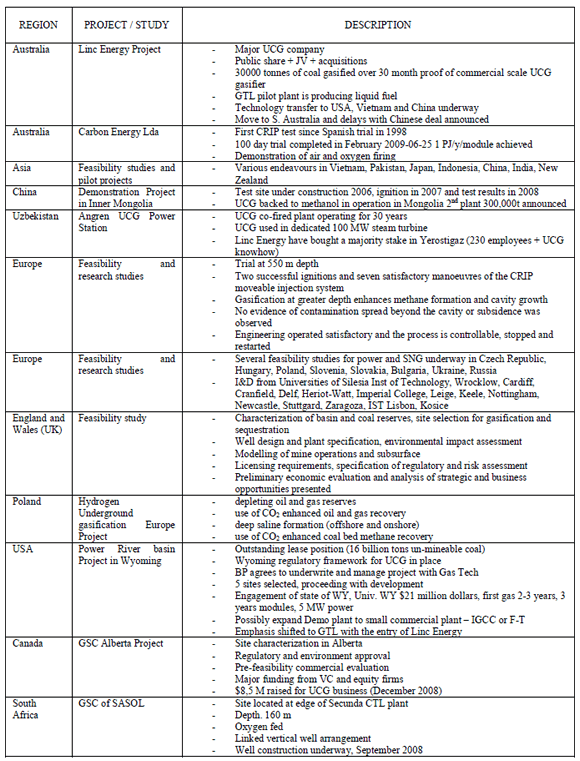
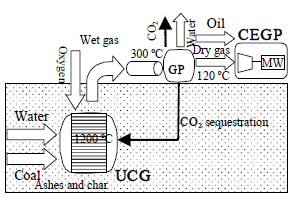
<body><![CDATA[<br>   </b>Initially,   gasification was normally conducted by two vertical wells, one for injecting   the combustion agents and the other one to recover the resulting gases.   However, in some cases it was very difficult to connect between the two wells.   At present, oil drilling technology has enabled a much greater advantage by   means of drilling deviated, inclined or horizontal boreholes, which can connect  the injection well directly to the recovery of the gases.</font></p>     <p><font size="2" face="Verdana, Arial, Helvetica, sans-serif"> This system, called gasification channel, was   experienced between 1992 and   1999   in Spain ,   specifically in the mine Alcorisa (Teruel).   For this purpose, a company was established by organizations from   Spain , UK and Belgium ,  under the support of the European Commission. </font></p>     <p><font size="2" face="Verdana, Arial, Helvetica, sans-serif"><b>2.6 The EU Research Program    <br>   </b>Results of   this field testing program, according to its promoters, showed that the system   was operational and that several identified problems were simple to solve. The   sub-bituminous coal was suitable for the combustion experiment at a depth of   600 meters, with a 30 degree inclination.</font></p>     <p><font size="2" face="Verdana, Arial, Helvetica, sans-serif">Preliminary   outcomes indicated that the resulting gas had high methane content, as well as hydrogen   and carbon monoxide, with an average calorific value 10.1 MJ / kg. The  production rate was 2.5 megawatts, with a maximum of 7.5 megawatts. </font></p>     <p><font size="2" face="Verdana, Arial, Helvetica, sans-serif"><b>2.7 Projects in other countries    <br>   </b>In the UK, the   Department of Trade and Industry aimed at developing a British gasification process   as a technology for future energy use of coal, both at land and located under the   North Sea. Currently, China seems to be the first to invest in this technology, with at least 30 projects   in various stages of implementation. India also have plans to use this   technique to produce energy and chemicals from the massive reserves, estimated at 350,000 million tons, discovered in the states of Gujarat and West Bengal.</font></p>     <p><font size="2" face="Verdana, Arial, Helvetica, sans-serif">Part of the   generated CO2 is injected into oil fields to increase production of   heavy oil discovered in   Gujarat. This <u>was</u> already being done at Dakota Gasification plant between Canada and the USA.   According to information from an Indian report, 2015 will come into operation   on 3 floors of commercial coal gasification site. Other countries like United Kingdom , USA , Australia and South Africa have also shown interest in this process. According to Green &#91;3&#93;, some of the most important current projects are mentioned  in <a href="#tab01">Table 1</a>. </font></p>     <p align="center"><font size="2" face="Verdana, Arial, Helvetica, sans-serif"><b><a name="tab01"></a>Table   1. </b> Main UCG current projects in the</font> <font size="2" face="Verdana, Arial, Helvetica, sans-serif">world &#91;3,7,8,9&#93; </font>    <br>   <img src="/img/revistas/dyna/v77n161/a10tab01.gif"></p>     ]]></body>
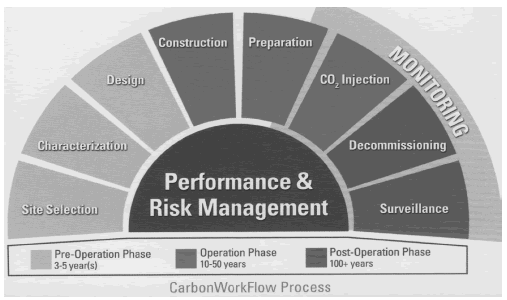
<body><![CDATA[<p>&nbsp;</p>     <p><font size="3" face="Verdana, Arial, Helvetica, sans-serif"><b>3. UNDERGROUND CO<sub>2</sub> SEQUESTRATION</b></font></p>     <p><font size="2" face="Verdana, Arial, Helvetica, sans-serif">In recent   years a warning has sounded on the excessive emission of greenhouse gases   (GHGs), especially carbon dioxide, due to heavy industrial production. Many   scientists link directly this excess of CO<sub>2</sub> in the atmosphere with   climate changes due to greenhouse gases that are causing temperature increases.   Possible solutions would be in the promotion of the natural carbon sinks when  they have ceased to perform its function due to human action.</font></p>     <p><font size="2" face="Verdana, Arial, Helvetica, sans-serif">According   to experts, carbon dioxide remains are stored in the oceans, vegetation and   soil. It is known that soil stores between 2 and 20 times more of these  greenhouse gases that earth vegetation. </font></p>     <p><font size="2" face="Verdana, Arial, Helvetica, sans-serif">In fact,   the emissions market share can generate CO<sub>2</sub> by planting trees but   not sink it into the ground. However, the soil sink is a much more stable and has   more storage capacity. Thus, there are soils that are acting as net sinks,   meaning that they only absorb CO<sub>2</sub> and emit no pollutants and others   that are more dynamic and perform both functions at once. Given this, it   naturally enhances its absorption into the soil through revegetation and enhancement  of agricultural activities.</font></p>     <p><font size="2" face="Verdana, Arial, Helvetica, sans-serif"> This is a partial solution to the problem because the most important way is to   reduce emissions which will require a considerable change in human society’s way  of life.</font></p>     <p><font size="2" face="Verdana, Arial, Helvetica, sans-serif">During the   past ten years there has been some research efforts devoted to the direct   effects of ocean storage of CO<sub>2</sub> in the seabed &#91;5&#93;, where the typical deep ocean account for a storage depth of  3000m water. </font></p>     <p><font size="2" face="Verdana, Arial, Helvetica, sans-serif">In case of carbon   dioxide leakage under the sea, and in contrast to the case of invasion from the  atmosphere, available monitoring techniques may be applied efficiently. </font></p>     <p><font size="2" face="Verdana, Arial, Helvetica, sans-serif">The   involuntary leakage of CO<sub>2</sub> can change the sea chemistry with local   consequences larger than those derived from the invasion of the atmosphere. Therefore,   effects on the marine environment from the escape of CO<sub>2</sub> from the   seabed storage are considered difficult to control. Thus, it is the abduction  of an underpass as the most viable options for resolving this problem. <a href="#fig04">Figure 4</a> presents the recent contributions to develop the technique of underground storage &#91;6&#93;. </font></p>     <p align="center"><font size="2" face="Verdana, Arial, Helvetica, sans-serif"><b><a name="fig04"></a><img src="/img/revistas/dyna/v77n161/a10fig04.gif">    ]]></body>
<body><![CDATA[<br>   Figure  4.</b> The main stages of SSC and their expected duration &#91;6, 10&#93; </font></p>     <p>&nbsp;</p>     <p><font size="3" face="Verdana, Arial, Helvetica, sans-serif"><b>4. UCG ASSOCIATED WITH CO<sub>2</sub> SEQUESTRATION</b></font></p>     <p><font size="2" face="Verdana, Arial, Helvetica, sans-serif"> Other underway projects are seeking to include CO<sub>2</sub> sequestration on   the cavity from which the coal was extracted &#91;10&#93;. The CO<sub>2</sub> capture takes place at high pressure   before combustion plant for its separation and storage, using the same   technology of drilling and completion than UCG. At depths of over 1000m also operates under   the same pressures that are necessary for the phase of high density storage of CO<sub>2</sub>.   The synergy is even greater if the same process for gasification wells can be  reused, after modification, for its storage. </font></p>     <p><font size="2" face="Verdana, Arial, Helvetica, sans-serif">Thus, if a   series of wells are open in a UCG chamber for the production of synthesis gas   which will separate CO<sub>2</sub> contents and re-injected them through   abandoned wells to appropriate underground structures suitable for permanent   storage. The fuel would be produced efficiently for use in gas turbines of combined   cycle or fuel cells and therefore emissions would be zero in the case of  hydrogen or near zero for the hydrogen-methane mixtures.</font></p>     <p><font size="2" face="Verdana, Arial, Helvetica, sans-serif">Underground   storage of CO<sub>2</sub> is able to meet all minimum standards for leakage  prevention. </font></p>     <p><font size="2" face="Verdana, Arial, Helvetica, sans-serif">It is   possible to demonstrate that a deep well UCG can be reused with or without   modification, for injection and permanent storage of CO<sub>2</sub>. The target   for storage may also be located in the coal seams, the upper layers or an abandoned   UCG cavity. Preliminary estimates indicate that at depths greater than 1500m,  all the CO<sub>2</sub> produced from coal can be restored.</font></p>     <p>&nbsp;</p>     <p><font size="3" face="Verdana, Arial, Helvetica, sans-serif"><b>5. CONCLUSIONS</b></font></p>     <p><font size="2" face="Verdana, Arial, Helvetica, sans-serif">The GSC and   SSC processes are of great importance for humanity, particularly if they are   well-adjusted technologies for developing a permanent and unquestionable   economic feasibility, with the advantage of creating reduced environmental   impacts. Future developments are full of challenges and achievements, as it is  typical of the greatest human endeavors.</font></p>     ]]></body>
<body><![CDATA[<p><font size="2" face="Verdana, Arial, Helvetica, sans-serif">The U.E.   has re-implemented in 2008, the &quot;Research Fund for Coal and Steel&quot;   with a priority to the use of clean energy sources and apply new techniques for   gasification and liquefaction, as an incentive for scientists and engineers who  intend to devote their abilities to these issues.</font></p>     <p>&nbsp;</p>     <p><font size="3" face="Verdana, Arial, Helvetica, sans-serif"><b>REFERENCES</b></font></p>     <!-- ref --><p><font size="2"><b><font face="Verdana, Arial, Helvetica, sans-serif">&#91;1&#93;</font></b><font face="Verdana, Arial, Helvetica, sans-serif"> NAVARRO TORRES; V.F. AND DINIS DA GAMA; C. The Milos Declaration and Sustainable Development (in Portuguese). Journal INGENIUM II Series, Number 84 November/December 2004, pp. 56 – 59.     &nbsp;&nbsp;&nbsp;&nbsp;&nbsp;&nbsp;&nbsp;&nbsp;[&#160;<a href="javascript:void(0);" onclick="javascript: window.open('/scielo.php?script=sci_nlinks&ref=000096&pid=S0012-7353201000010001000001&lng=','','width=640,height=500,resizable=yes,scrollbars=1,menubar=yes,');">Links</a>&#160;]<!-- end-ref --><!-- ref --><br>     <b>&#91;2&#93;</b> NAVARRO TORRES V.F,Modelling and Optimisation of Underground Coal Gasification and CO2 Capture and Sequestration for Clean Energy in Europe. Proposal of European Young Investigator Awards – EURYI Awards 2005     &nbsp;&nbsp;&nbsp;&nbsp;&nbsp;&nbsp;&nbsp;&nbsp;[&#160;<a href="javascript:void(0);" onclick="javascript: window.open('/scielo.php?script=sci_nlinks&ref=000097&pid=S0012-7353201000010001000002&lng=','','width=640,height=500,resizable=yes,scrollbars=1,menubar=yes,');">Links</a>&#160;]<!-- end-ref --><!-- ref --><br>       <b>&#91;3&#93;</b>  GREEN, M., Overview of worldwide field activity and the Future of UCG. 4th International Conference on Underground Coal Gasification. UCG Partnership, London, February 10-11, 2009.       &nbsp;&nbsp;&nbsp;&nbsp;&nbsp;&nbsp;&nbsp;&nbsp;[&#160;<a href="javascript:void(0);" onclick="javascript: window.open('/scielo.php?script=sci_nlinks&ref=000098&pid=S0012-7353201000010001000003&lng=','','width=640,height=500,resizable=yes,scrollbars=1,menubar=yes,');">Links</a>&#160;]<!-- end-ref --><!-- ref --><br>       <b>&#91;4&#93;</b>  DINIS DA GAMA, C. AND NAVARRO TORRES V.F, A mathematical model to assess an environmental sustainability index for the underground coal gasification process. 4th International Conference on Underground Coal Gasification. UCG Partnership, London, February 10-11, 2009.        &nbsp;&nbsp;&nbsp;&nbsp;&nbsp;&nbsp;&nbsp;&nbsp;[&#160;<a href="javascript:void(0);" onclick="javascript: window.open('/scielo.php?script=sci_nlinks&ref=000099&pid=S0012-7353201000010001000004&lng=','','width=640,height=500,resizable=yes,scrollbars=1,menubar=yes,');">Links</a>&#160;]<!-- end-ref --><!-- ref --><br>       <b>&#91;5&#93;</b>  CALDEIRA, K. AND WICKETT, M.E, Ocean model predictions of chemistry changes from CO2 emissions and ocean to the atmosphere. J. Geophysical Research, 110, C09S04, DOI 10.1029/2004JC002671. 2005.       &nbsp;&nbsp;&nbsp;&nbsp;&nbsp;&nbsp;&nbsp;&nbsp;[&#160;<a href="javascript:void(0);" onclick="javascript: window.open('/scielo.php?script=sci_nlinks&ref=000100&pid=S0012-7353201000010001000005&lng=','','width=640,height=500,resizable=yes,scrollbars=1,menubar=yes,');">Links</a>&#160;]<!-- end-ref --><!-- ref --><br>       <b>&#91;6&#93;</b>  SCHLUMBERGER CARBON SERVICES, Integrated solutions for long-term CO2 storage. London. 2007.       &nbsp;&nbsp;&nbsp;&nbsp;&nbsp;&nbsp;&nbsp;&nbsp;[&#160;<a href="javascript:void(0);" onclick="javascript: window.open('/scielo.php?script=sci_nlinks&ref=000101&pid=S0012-7353201000010001000006&lng=','','width=640,height=500,resizable=yes,scrollbars=1,menubar=yes,');">Links</a>&#160;]<!-- end-ref --><!-- ref --><br>       <b>&#91;7&#93;</b>  WALKER, L., Underground Coal Gasification: A clean coal technology ready for development. The Australian Coal Review, October 1999.       &nbsp;&nbsp;&nbsp;&nbsp;&nbsp;&nbsp;&nbsp;&nbsp;[&#160;<a href="javascript:void(0);" onclick="javascript: window.open('/scielo.php?script=sci_nlinks&ref=000102&pid=S0012-7353201000010001000007&lng=','','width=640,height=500,resizable=yes,scrollbars=1,menubar=yes,');">Links</a>&#160;]<!-- end-ref --><!-- ref --><br>       <b>&#91;8&#93;</b>  ROGUT, J., EU Project HUGE - the role and value of virtual and experimental approaches. 4th International Conference on Underground Coal Gasification. UCG Partnership, London, February 10-11, 2009.       &nbsp;&nbsp;&nbsp;&nbsp;&nbsp;&nbsp;&nbsp;&nbsp;[&#160;<a href="javascript:void(0);" onclick="javascript: window.open('/scielo.php?script=sci_nlinks&ref=000103&pid=S0012-7353201000010001000008&lng=','','width=640,height=500,resizable=yes,scrollbars=1,menubar=yes,');">Links</a>&#160;]<!-- end-ref --><!-- ref --><br>       <b>&#91;9&#93;</b> KEMPKA, T.; SCHLUTER, R.; AECKERSBERG, R.; TIAN, H.AND KROOSS, B., Carbon dioxide storage in “in situ” concerted coal seams – Experimental Studies. 4th International Conference on Underground Coal Gasification. UCG Partnership, London, February 10-11, 2009.     &nbsp;&nbsp;&nbsp;&nbsp;&nbsp;&nbsp;&nbsp;&nbsp;[&#160;<a href="javascript:void(0);" onclick="javascript: window.open('/scielo.php?script=sci_nlinks&ref=000104&pid=S0012-7353201000010001000009&lng=','','width=640,height=500,resizable=yes,scrollbars=1,menubar=yes,');">Links</a>&#160;]<!-- end-ref --><!-- ref --><br>       <b>&#91;10&#93;</b>  European Technology Platform for Zero Emission Fossil Fuel Power Plants (ZEP), CO2 Capture and Storage (CCS), a key solution for combating climate change. 2005.  </font></font>&nbsp;&nbsp;&nbsp;&nbsp;&nbsp;&nbsp;&nbsp;&nbsp;[&#160;<a href="javascript:void(0);" onclick="javascript: window.open('/scielo.php?script=sci_nlinks&ref=000105&pid=S0012-7353201000010001000010&lng=','','width=640,height=500,resizable=yes,scrollbars=1,menubar=yes,');">Links</a>&#160;]<!-- end-ref --> ]]></body><back>
<ref-list>
<ref id="B1">
<label>1</label><nlm-citation citation-type="journal">
<person-group person-group-type="author">
<name>
<surname><![CDATA[NAVARRO TORRES]]></surname>
<given-names><![CDATA[V.F.]]></given-names>
</name>
<name>
<surname><![CDATA[DINIS DA GAMA]]></surname>
<given-names><![CDATA[C.]]></given-names>
</name>
</person-group>
<article-title xml:lang="en"><![CDATA[The Milos Declaration and Sustainable Development]]></article-title>
<source><![CDATA[Journal INGENIUM II Series]]></source>
<year>Nove</year>
<month>mb</month>
<day>er</day>
<numero>84</numero>
<issue>84</issue>
<page-range>56 - 59</page-range></nlm-citation>
</ref>
<ref id="B2">
<label>2</label><nlm-citation citation-type="">
<person-group person-group-type="author">
<name>
<surname><![CDATA[NAVARRO TORRES]]></surname>
<given-names><![CDATA[V.F]]></given-names>
</name>
</person-group>
<source><![CDATA[Modelling and Optimisation of Underground Coal Gasification and CO2 Capture and Sequestration for Clean Energy in Europe]]></source>
<year></year>
</nlm-citation>
</ref>
<ref id="B3">
<label>3</label><nlm-citation citation-type="confpro">
<person-group person-group-type="author">
<name>
<surname><![CDATA[GREEN]]></surname>
<given-names><![CDATA[M.]]></given-names>
</name>
</person-group>
<article-title xml:lang="en"><![CDATA[Overview of worldwide field activity and the Future of UCG]]></article-title>
<source><![CDATA[]]></source>
<year></year>
<conf-name><![CDATA[4th International Conference on Underground Coal Gasification]]></conf-name>
<conf-date>February 10-11, 2009</conf-date>
<conf-loc>London </conf-loc>
</nlm-citation>
</ref>
<ref id="B4">
<label>4</label><nlm-citation citation-type="confpro">
<person-group person-group-type="author">
<name>
<surname><![CDATA[DINIS DA GAMA]]></surname>
<given-names><![CDATA[C.]]></given-names>
</name>
<name>
<surname><![CDATA[NAVARRO TORRES]]></surname>
<given-names><![CDATA[V.F]]></given-names>
</name>
</person-group>
<article-title xml:lang="en"><![CDATA[A mathematical model to assess an environmental sustainability index for the underground coal gasification process]]></article-title>
<source><![CDATA[]]></source>
<year></year>
<conf-name><![CDATA[4th International Conference on Underground Coal Gasification]]></conf-name>
<conf-date>February 10-11, 2009</conf-date>
<conf-loc>London </conf-loc>
</nlm-citation>
</ref>
<ref id="B5">
<label>5</label><nlm-citation citation-type="journal">
<person-group person-group-type="author">
<name>
<surname><![CDATA[CALDEIRA]]></surname>
<given-names><![CDATA[K.]]></given-names>
</name>
<name>
<surname><![CDATA[WICKETT]]></surname>
<given-names><![CDATA[M.E]]></given-names>
</name>
</person-group>
<article-title xml:lang="en"><![CDATA[Ocean model predictions of chemistry changes from CO2 emissions and ocean to the atmosphere]]></article-title>
<source><![CDATA[J. Geophysical Research]]></source>
<year>2005</year>
<numero>110</numero>
<issue>110</issue>
</nlm-citation>
</ref>
<ref id="B6">
<label>6</label><nlm-citation citation-type="">
<collab>SCHLUMBERGER CARBON SERVICES</collab>
<article-title xml:lang="en"><![CDATA[Integrated solutions for long-term CO2 storage]]></article-title>
<source><![CDATA[]]></source>
<year>2007</year>
</nlm-citation>
</ref>
<ref id="B7">
<label>7</label><nlm-citation citation-type="journal">
<person-group person-group-type="author">
<name>
<surname><![CDATA[WALKER]]></surname>
<given-names><![CDATA[L.]]></given-names>
</name>
</person-group>
<article-title xml:lang="en"><![CDATA[Underground Coal Gasification: A clean coal technology ready for development]]></article-title>
<source><![CDATA[The Australian Coal Review]]></source>
<year>Octo</year>
<month>be</month>
<day>r </day>
</nlm-citation>
</ref>
<ref id="B8">
<label>8</label><nlm-citation citation-type="confpro">
<person-group person-group-type="author">
<name>
<surname><![CDATA[ROGUT]]></surname>
<given-names><![CDATA[J.]]></given-names>
</name>
</person-group>
<article-title xml:lang="en"><![CDATA[EU Project HUGE: the role and value of virtual and experimental approaches]]></article-title>
<source><![CDATA[]]></source>
<year></year>
<conf-name><![CDATA[4th International Conference on Underground Coal Gasification]]></conf-name>
<conf-date>February 10-11, 2009</conf-date>
<conf-loc>London </conf-loc>
</nlm-citation>
</ref>
<ref id="B9">
<label>9</label><nlm-citation citation-type="confpro">
<person-group person-group-type="author">
<name>
<surname><![CDATA[KEMPKA]]></surname>
<given-names><![CDATA[T.]]></given-names>
</name>
<name>
<surname><![CDATA[SCHLUTER]]></surname>
<given-names><![CDATA[R.]]></given-names>
</name>
<name>
<surname><![CDATA[AECKERSBERG]]></surname>
<given-names><![CDATA[R.]]></given-names>
</name>
<name>
<surname><![CDATA[TIAN]]></surname>
<given-names><![CDATA[H.]]></given-names>
</name>
<name>
<surname><![CDATA[KROOSS]]></surname>
<given-names><![CDATA[B.]]></given-names>
</name>
</person-group>
<article-title xml:lang="en"><![CDATA[Carbon dioxide storage in “in situ” concerted coal seams: Experimental Studies]]></article-title>
<source><![CDATA[]]></source>
<year></year>
<conf-name><![CDATA[4th International Conference on Underground Coal Gasification]]></conf-name>
<conf-date>February 10-11, 2009</conf-date>
<conf-loc>London </conf-loc>
</nlm-citation>
</ref>
<ref id="B10">
<label>10</label><nlm-citation citation-type="">
<article-title xml:lang="en"><![CDATA[European Technology Platform for Zero Emission Fossil Fuel Power Plants (ZEP), CO2 Capture and Storage (CCS), a key solution for combating climate change]]></article-title>
<source><![CDATA[]]></source>
<year>2005</year>
</nlm-citation>
</ref>
</ref-list>
</back>
</article>