<?xml version="1.0" encoding="ISO-8859-1"?><article xmlns:mml="http://www.w3.org/1998/Math/MathML" xmlns:xlink="http://www.w3.org/1999/xlink" xmlns:xsi="http://www.w3.org/2001/XMLSchema-instance">
<front>
<journal-meta>
<journal-id>0012-7353</journal-id>
<journal-title><![CDATA[DYNA]]></journal-title>
<abbrev-journal-title><![CDATA[Dyna rev.fac.nac.minas]]></abbrev-journal-title>
<issn>0012-7353</issn>
<publisher>
<publisher-name><![CDATA[Universidad Nacional de Colombia]]></publisher-name>
</publisher>
</journal-meta>
<article-meta>
<article-id>S0012-73532010000100011</article-id>
<title-group>
<article-title xml:lang="en"><![CDATA[PROCESS OPTIMIZATION OF SAMPLING AND DETERMINING THE UNCERTAINTY ASSOCIATED WITH THE PROPERTIES OF SOLID FUELS FOR COCOMBUSTION]]></article-title>
<article-title xml:lang="es"><![CDATA[OPTIMIZACIÓN DEL PROCESO DE MUESTREO Y DETERMINACIÓN DE LA INCERTIDUMBRE ASOCIADA A LAS PROPIEDADES DE COMBUSTIBLES SÓLIDOS PARA COCOMBUSTION]]></article-title>
</title-group>
<contrib-group>
<contrib contrib-type="author">
<name>
<surname><![CDATA[PAZÓ]]></surname>
<given-names><![CDATA[JOSE ANTONIO]]></given-names>
</name>
<xref ref-type="aff" rid="A01"/>
</contrib>
<contrib contrib-type="author">
<name>
<surname><![CDATA[GRANADA]]></surname>
<given-names><![CDATA[ENRIQUE]]></given-names>
</name>
<xref ref-type="aff" rid="A02"/>
</contrib>
<contrib contrib-type="author">
<name>
<surname><![CDATA[SAAVEDRA]]></surname>
<given-names><![CDATA[ANGELES]]></given-names>
</name>
<xref ref-type="aff" rid="A03"/>
</contrib>
<contrib contrib-type="author">
<name>
<surname><![CDATA[ESTEVEZ]]></surname>
<given-names><![CDATA[XIAN]]></given-names>
</name>
<xref ref-type="aff" rid="A04"/>
</contrib>
<contrib contrib-type="author">
<name>
<surname><![CDATA[COMESAÑA]]></surname>
<given-names><![CDATA[ROBERTO]]></given-names>
</name>
<xref ref-type="aff" rid="A05"/>
</contrib>
</contrib-group>
<aff id="A01">
<institution><![CDATA[,University of Vigo Dep. Mechanical Engineering ]]></institution>
<addr-line><![CDATA[ ]]></addr-line>
<country>Spain</country>
</aff>
<aff id="A02">
<institution><![CDATA[,University of Vigo Dep. Mechanical Engineering ]]></institution>
<addr-line><![CDATA[ ]]></addr-line>
<country>Spain</country>
</aff>
<aff id="A03">
<institution><![CDATA[,University of Vigo Dep. Statistics ]]></institution>
<addr-line><![CDATA[ ]]></addr-line>
<country>Spain</country>
</aff>
<aff id="A04">
<institution><![CDATA[,University of Vigo Dep. Mechanical Engineering ]]></institution>
<addr-line><![CDATA[ ]]></addr-line>
<country>Spain</country>
</aff>
<aff id="A05">
<institution><![CDATA[,University of Vigo Dep. Mechanical Engineering ]]></institution>
<addr-line><![CDATA[ ]]></addr-line>
<country>Spain</country>
</aff>
<pub-date pub-type="pub">
<day>00</day>
<month>03</month>
<year>2010</year>
</pub-date>
<pub-date pub-type="epub">
<day>00</day>
<month>03</month>
<year>2010</year>
</pub-date>
<volume>77</volume>
<numero>161</numero>
<fpage>109</fpage>
<lpage>119</lpage>
<copyright-statement/>
<copyright-year/>
<self-uri xlink:href="http://www.scielo.org.co/scielo.php?script=sci_arttext&amp;pid=S0012-73532010000100011&amp;lng=en&amp;nrm=iso"></self-uri><self-uri xlink:href="http://www.scielo.org.co/scielo.php?script=sci_abstract&amp;pid=S0012-73532010000100011&amp;lng=en&amp;nrm=iso"></self-uri><self-uri xlink:href="http://www.scielo.org.co/scielo.php?script=sci_pdf&amp;pid=S0012-73532010000100011&amp;lng=en&amp;nrm=iso"></self-uri><abstract abstract-type="short" xml:lang="en"><p><![CDATA[This paper presents the process used to determine the statistical uncertainty associated with eight different properties of solid fuels for co-combustion tests of moisture and ash. Provides a map of sampling to determine the sample sizes in the light of the uncertainties that are considered acceptable. The values obtained show that despite the heterogeneity of the fuel itself, a well-planned campaign of samples can extrapolate the properties of the samples from the entire lot with an uncertainty controlled and quantified.]]></p></abstract>
<abstract abstract-type="short" xml:lang="es"><p><![CDATA[En este trabajo se presenta el proceso empleado para la determinación estadística de la incertidumbre asociada a diversas propiedades de ocho combustibles sólidos para co-combustión a partir de los ensayos de humedad y cenizas. Se establece un mapa de muestreo que permite determinar los tamaños muestrales en función de las incertidumbres que se consideren aceptables. Los valores obtenidos permiten afirmar que a pesar de la heterogeneidad propia de dichos combustibles, una campaña de muestreos bien planificada permite extrapolar las propiedades obtenidas de las muestras a la totalidad del lote analizado con una incertidumbre controlada y cuantificada.]]></p></abstract>
<kwd-group>
<kwd lng="en"><![CDATA[co-combustion]]></kwd>
<kwd lng="en"><![CDATA[sampling]]></kwd>
<kwd lng="en"><![CDATA[uncertainty]]></kwd>
<kwd lng="es"><![CDATA[co-combustión]]></kwd>
<kwd lng="es"><![CDATA[muestreo]]></kwd>
<kwd lng="es"><![CDATA[incertidumbre]]></kwd>
</kwd-group>
</article-meta>
</front><body><![CDATA[ <p align="center"><font size="4" face="Verdana, Arial, Helvetica, sans-serif"><b>PROCESS  OPTIMIZATION OF SAMPLING AND DETERMINING THE UNCERTAINTY ASSOCIATED WITH THE  PROPERTIES OF SOLID FUELS FOR COCOMBUSTION</b></font></p>     <p align="center"><i><font size="3" face="Verdana, Arial, Helvetica, sans-serif"><b>OPTIMIZACI&Oacute;N DEL PROCESO DE  MUESTREO Y DETERMINACI&Oacute;N DE LA INCERTIDUMBRE ASOCIADA  A LAS PROPIEDADES DE COMBUSTIBLES S&Oacute;LIDOS PARA COCOMBUSTION</b></font></i></p>     <p align="center">&nbsp;</p>     <p align="center"><font size="2" face="Verdana, Arial, Helvetica, sans-serif"><b>JOSE ANTONIO PAZ&Oacute;</b>    <br> <i>Dep. Mechanical Engineering, University of Vigo, Spain , <a href="mailto:jpazo@uvigo.es">jpazo@uvigo.es</a></i></font></p>     <p align="center"><font size="2" face="Verdana, Arial, Helvetica, sans-serif"><b>ENRIQUE GRANADA</b>    <br> <i>Dep. Mechanical Engineering, University of Vigo, Spain , <a href="mailto:egranada@uvigo.es">egranada@uvigo.es</a></i></font></p>     <p align="center"><font size="2" face="Verdana, Arial, Helvetica, sans-serif"><b>ANGELES SAAVEDRA</b>    <br> <i>Dep. Statistics, University of Vigo, Spain , <a href="mailto:saavedra@uvigo.es">saavedra@uvigo.es</a></i></font></p>     <p align="center"><font size="2" face="Verdana, Arial, Helvetica, sans-serif"><b>XIAN ESTEVEZ</b>    ]]></body>
<body><![CDATA[<br> <i>Dep. Mechanical Engineering. University of Vigo, Spain , <a href="mailto:xian@uvigo.es">xian@uvigo.es</a></i></font></p>     <p align="center"><font size="2" face="Verdana, Arial, Helvetica, sans-serif"><b>ROBERTO COMESA&Ntilde;A</b>    <br> <i>Dep. Mechanical Engineeringl, University of Vigo, Spain , <a href="mailto:robcomesana@uvigo.es">robcomesana@uvigo.es</a></i></font></p>     <p align="center">&nbsp;</p>     <p align="center"><font size="2" face="Verdana, Arial, Helvetica, sans-serif"><b>Received for review June 16<sup> th</sup>, 2009, accepted  December 6<sup> th</sup>, 2009, final version December 21<sup> th</sup>, 2009</b></font></p>     <p>&nbsp;</p> <hr>     <p><font size="2" face="Verdana, Arial, Helvetica, sans-serif"><b>ABSTRACT</b>: This paper presents the process used to  determine the statistical uncertainty associated with eight different  properties of solid fuels for co-combustion tests of moisture and ash. Provides  a map of sampling to determine the sample sizes in the light of the  uncertainties that are considered acceptable. The values obtained show that  despite the heterogeneity of the fuel itself, a well-planned campaign of samples  can extrapolate the properties of the samples from the entire lot with an  uncertainty controlled and quantified.</font></p>     <p><font size="2" face="Verdana, Arial, Helvetica, sans-serif"><b>KEYWORDS:</b> co-combustion, sampling, uncertainty.</font></p>     <p><font size="2" face="Verdana, Arial, Helvetica, sans-serif"><b>RESUMEN: </b>En este trabajo se presenta  el proceso empleado para la determinaci&oacute;n estad&iacute;stica de la incertidumbre  asociada a diversas propiedades de ocho combustibles s&oacute;lidos para co-combusti&oacute;n  a partir de los ensayos de humedad y cenizas. Se establece un mapa de muestreo  que permite determinar los tama&ntilde;os muestrales en funci&oacute;n de las incertidumbres  que se consideren aceptables. Los valores obtenidos permiten afirmar que a  pesar de la heterogeneidad propia de dichos combustibles, una campa&ntilde;a de  muestreos bien planificada permite extrapolar las propiedades obtenidas de las  muestras a la totalidad del lote analizado con una incertidumbre controlada y  cuantificada.</font></p>     <p><font size="2" face="Verdana, Arial, Helvetica, sans-serif"><b>PALABRAS  CLAVE:</b> co-combusti&oacute;n,  muestreo, incertidumbre.</font></p> <hr>     ]]></body>
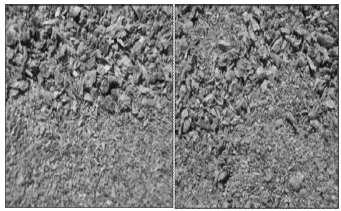
<body><![CDATA[<p>&nbsp;</p> <font size="3" face="Verdana, Arial, Helvetica, sans-serif"><b>1. INTRODUCTION</b></font>     <p><font size="2" face="Verdana, Arial, Helvetica, sans-serif">In today's society, air  pollution has become an issue of particular interest, the Kyoto Protocol </font><font size="2" face="Verdana, Arial, Helvetica, sans-serif">sets limits on   emissions of greenhouse gases &#91;1&#93;. Measures to assess and reduce emissions   appear as a priority. Co-combustion is an alternative technique in which the  fossil fuel used in a boiler </font><font size="2" face="Verdana, Arial, Helvetica, sans-serif">is replaced by biomass.   This option achieves the benefit of the environmental advantages of biomass   burning instead of the use of fossil fuels like coal. The technologies employed   in co-combustion are direct co-combustion, indirect co-combustion and   co-combustion in parallel &#91;2&#93;. In the direct co-combustion type, the biomass is   introduced into the boiler. The two fuels are burned together. Indirect   co-combustion requires the biomass to be processed prior to an independent   device of external combustion or gasification. Then, products generated by each   process and fuel are introduced into the boiler. These systems reduce the   problems that may arise in the boiler by using a fuel other than that for which   it was designed. In parallel co-combustion the biomass is burned in a separate   boiler. The main advantages of co-combustion highlighted by different authors   &#91;2-7&#93; are: Reduction of the percentage of CO<sub>2</sub> emitted into the   atmosphere per Joule produced, because the CO<sub>2</sub> emissions related to   biomass burning are considered to be neutral. Reduced emissions of SO<sub>2</sub>,   as a result of the low sulfur content of biomass and a positive effect on NO<sub>x</sub> emissions. Reduction of the dependence on fossil fuels by using local   agricultural and forest waste. An increase in operation flexibility with respect   to plants that burn only biomass. The major drawbacks are the cost of   additional facilities and potential negative effects of biomass burning, such   as decreased performance, increased corrosion and increased fouling &#91;2&#93;. The   intrinsic heterogeneity of the biomass increases the complexity to define   systems that allow an objective knowledge of their technical characteristics.   The types of biomass are analyzed in the study of diverse backgrounds, variable   presentation and packaging of different forms. There are extensive published   data &#91;8-11&#93; on different sampling methods to provide answers to the problems   associated with the materials on which this work is based. A sampling theory   should be suitable to answer the questions of how to select a sample and how   much material must be taken &#91;8&#93;. It is often necessary to obtain small samples   from large lots. These great reductions require a careful sampling and sample   reduction. Some of the most important factors to consider working with solid   materials are the phenomena of segregation and stratification (<a href="#fig01">fig 1</a>) &#91;10&#93;. A   good sampling method should be able to get a representative sample without the   influence of these phenomena. In order to know their technical characteristics,   a study method was designed. In this method each material with different  origins, appearance or packaging, is considered as a lot.</font></p>     <p align="center"><font size="2" face="Verdana, Arial, Helvetica, sans-serif"><b><a name="fig01"></a><img src="/img/revistas/dyna/v77n161/a11fig01.gif">    <br>   Figure   1.</b> Different segregation states for the same sample. The left picture shows a high   degree of segregation. The image on the right shows the opposite case</font></p>     <p><font size="2" face="Verdana, Arial, Helvetica, sans-serif">The moisture content   and ash of solid biomass are chosen for the study; moisture as a feature   related to the material and processes for storage, as well as environmental  conditions and ashes as a feature associated with the material.</font></p>     <p><font size="2" face="Verdana, Arial, Helvetica, sans-serif">The objectives of this   work are find out the values of moisture and ash contents of each lot tested,   as well as the uncertainty associated with the number of samples. Once the   above parameters are known, the minimum number of samples required for an error   and a given level of reliability will be determined. Moisture content   influences the low heating value, which affects the performance of the device,   and the ashes are critical to the effects of fouling and corrosion of heat  exchangers &#91;2, 12-14&#93;.</font></p>     <p>&nbsp;</p>     <p><font size="3" face="Verdana, Arial, Helvetica, sans-serif"><b>2. METHODOLOGY </b></font></p>     <p><font size="2" face="Verdana, Arial, Helvetica, sans-serif"><b>2.1 Materials    <br> </b></font><font size="2" face="Verdana, Arial, Helvetica, sans-serif">Materials from   agriculture and forestry were selected for the study, covering a broad spectrum   of solid biomass which could be used as fuel in processes of co-combustion. The   materials of agricultural origin were stored in big-bags. The materials of forest origin pellets were stored in sacks.</font></p>     ]]></body>
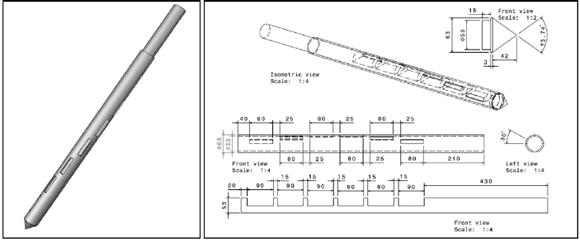
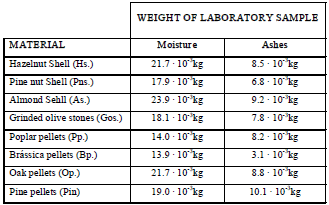
<body><![CDATA[<p><font size="2" face="Verdana, Arial, Helvetica, sans-serif">The materials of   agricultural origin selected were: pine kernel shell, almond shells, hazelnut   shell and crush olive stones. The materials of forest origin were selected as follows:  Pellets of pine, oak pellets, brasica pellets and poplar pellet.</font></p> <font size="2" face="Verdana, Arial, Helvetica, sans-serif"><b>2.2 Sampling    <br> </b>Samples of various   materials were obtained through a tube sampler design. The tube sampler used   was built with the intention of being able to use the types and presentations of biomass and bulk pellets which are studied in this work. This </font>     <p><font size="2" face="Verdana, Arial, Helvetica, sans-serif">design also takes into  account that these materials were supplied in sacks or pallets of big-bag. It is considered that the nominal </font></p>     <p><font size="2" face="Verdana, Arial, Helvetica, sans-serif">maximum size   &quot;d&quot; of the material sampled is 0.02 m &#91;15&#93;, so the tube sampler should have an increased ability to collect no less than &#91;16&#93;:</font></p>     <p><font size="2" face="Verdana, Arial, Helvetica, sans-serif"> V<sub>min</sub> = 0.05 &#8729; d = 0 05 &#8729;  20 = 1 dm<sup>3</sup> = 10<sup>-3</sup> &#8729; m<sup>3</sup> </font></p>     <p><font size="2" face="Verdana, Arial, Helvetica, sans-serif">The tube sampler is composed of three parts   (see <a href="#fig02">fig 2</a>). The first part is the outer tube which presents a series of six   holes; each rotated 30 degrees to the previous hole. The holes are 80x30mm and   the greatest dimension is in the direction of the axis. The second piece is the   inner tube which can be rotated within the outer tube which enables the holes   to be closed while the tube is inserted in the sample, and then opened when the   device is in the correct position for collecting the sample. The third piece is   joined onto the tip of the outer tube to facilitate the penetration of the   device in the sack of material under study. This cone is removable for easy   cleaning of the instrument. The design of this instrument is based on the standard &#91;17&#93; and the work of Pierre Gy &#91;16&#93;.</font></p>     <p align="center"><font size="2" face="Verdana, Arial, Helvetica, sans-serif"><b><a name="fig02"></a><img src="/img/revistas/dyna/v77n161/a11fig02.gif">    <br>   Figure 2.</b> 3D picture and  drawing of the tube sampler</font></p>     <p><font size="2" face="Verdana, Arial, Helvetica, sans-serif"><i><b>2.2.1 Procedure for lots in  big-bag    <br> </b></i></font><font size="2" face="Verdana, Arial, Helvetica, sans-serif">9 samples of   approximately 10<sup>-3</sup> m<sup>3</sup> volume were extracted &#91;17&#93;. The   upper surface of the big-bag, which is circular, is divided into 8 equal circles. Samples were removed from each circular sector by introducing a tube sampler at 2/3 from the </font><font size="2" face="Verdana, Arial, Helvetica, sans-serif">centre. The sample nº 9 was removed from the centre of the big-bag.</font></p>     ]]></body>
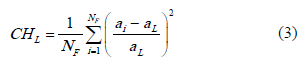
<body><![CDATA[<p><font size="2" face="Verdana, Arial, Helvetica, sans-serif"><i><b>2.2.2 Procedure for lots in bags  of pellets    <br> </b></i></font><font size="2" face="Verdana, Arial, Helvetica, sans-serif">Samples of about 10<sup>-3</sup> m<sup>3</sup> volume of each of the 5 bags were selected using a table of random </font></p>     <p><font size="2" face="Verdana, Arial, Helvetica, sans-serif">numbers &#91;17&#93;. Samples   were obtained by firstly introducing the tube sampler from a corner of the bag   to the opposite corner below and secondly from opposite corners in the other   direction. The two samples from each bag were mixed and stored in the same bottle, thereby obtaining five bottles of each sample material.</font></p>     <p><font size="2" face="Verdana, Arial, Helvetica, sans-serif">In the case of pellets   of pine and oak the process was analogous but samples from the same bag were not   mixed, therefore ten sample bottles were obtained. The bottles used to store   the samples are made of polypropylene, wide-necked with a lid and screw top and therefore air tight.</font></p>     <p><font size="2" face="Verdana, Arial, Helvetica, sans-serif"><b>2.3 Reduction of the samples    <br> </b></font><font size="2" face="Verdana, Arial, Helvetica, sans-serif">For samples that were   subjected to laboratory tests, it was necessary to reduce their size; the process was the same for all samples.</font></p>     <p><font size="2" face="Verdana, Arial, Helvetica, sans-serif">1.   The selected samples were completely ground in a RETSCH SM-100 grinder, using a   6 mm nominal square step sieve. This filter was chosen because there are studies   that indicate that for cocombusti&oacute;n this particle size is sufficient even with   pulverized coal &#91;18, 19&#93;. The olive stone samples do not receive this treatment   because they are already crushed when delivered. The ground samples were stored  back in the original bottles.</font></p>     <p><font size="2" face="Verdana, Arial, Helvetica, sans-serif">2. The sample is   divided in similar parts using a slotted box, called a Boerner divider, which   separates them into smaller samples. In <a href="#tab01">Table 1</a> rounded average weights of the   samples selected for analysis of each material are shown. Once a sample is   selected, it is separated by half. One part is subjected to testing in order to determine the moisture content and the other is stored.</font></p>     <p align="center"><font size="2" face="Verdana, Arial, Helvetica, sans-serif"><b><a name="tab01"></a>Table 1.</b> Rounded average  weight of the samples</font>    <br>  <img src="/img/revistas/dyna/v77n161/a11tab01.gif"></p>     ]]></body>
<body><![CDATA[<p><font size="2" face="Verdana, Arial, Helvetica, sans-serif">3. The determination of   moisture content was carried out. Dry samples were returned to the bag from   which the sample for the ash test was obtained. Before testing, the sample was   ground in a mill with IKA MF 10.2, with an impact grinding head, producing a particle size less than </font><font size="2" face="Verdana, Arial, Helvetica, sans-serif">3&#8729;10<sup>-3</sup>m, to determine the ash content.</font></p>     <p><font size="2" face="Verdana, Arial, Helvetica, sans-serif">4. The sample obtained   in the previous step is divided into two parts, one of which is sealed in a bag, and the other used to determine the ash content.</font></p>     <p>&nbsp;</p>     <p><font size="3" face="Verdana, Arial, Helvetica, sans-serif"><b>3. TESTS </b></font></p>     <p><b><font size="2" face="Verdana, Arial, Helvetica, sans-serif">3.1 Moisture</font></b><font size="2" face="Verdana, Arial, Helvetica, sans-serif">    <br> </font><font size="2" face="Verdana, Arial, Helvetica, sans-serif">The method used is oven   drying (Nabertherm) of the wet sample obtained by the reduction procedure   described above. Aluminium trays with an interior diameter of 0.093 m which have no corrosion phenomena and no moisture adsorption, are used.</font></p>     <p><font size="2" face="Verdana, Arial, Helvetica, sans-serif">The samples are weighed using the “Great Series   VXI-110” scales with 0.100 kg maximum and precision of 10<sup>-8</sup>kg. The   empty tray is weighed. Then the sample is uniformly distributed over the   surface of the tray with about 10<sup>-3</sup>kg/10<sup>-4</sup>m<sup>2</sup>.   The weighed samples of each material are simultaneously introduced in the oven   at a temperature of 105ºC. The time spent on stabilising these conditions is   180 minutes to ensure constant mass. Moisture content on wet basis (M<sub>ar</sub>) is obtained by the following expression &#91;20&#93;.</font></p>     <p><img src="/img/revistas/dyna/v77n161/a11eq01.gif"></p>     <p><font size="2" face="Verdana, Arial, Helvetica, sans-serif">Where the different m<sub>i</sub> (10<sup>-3</sup> kg) indicate:</font></p>     <blockquote>       ]]></body>
<body><![CDATA[<p><font size="2" face="Verdana, Arial, Helvetica, sans-serif">m<sub>1</sub>: Empty     tray.    <br> </font><font size="2" face="Verdana, Arial, Helvetica, sans-serif">m<sub>2</sub>: Tray and   sample before drying.    <br>   </font><font size="2" face="Verdana, Arial, Helvetica, sans-serif">m<sub>3</sub>: Tray and     sample after drying.    <br>     </font><font size="2" face="Verdana, Arial, Helvetica, sans-serif">m<sub>4</sub>:       Reference tray at room temperature before drying.    <br>     </font><font size="2" face="Verdana, Arial, Helvetica, sans-serif">m<sub>5</sub>: Tray         after drying when reference is still hot.    <br>     </font><font size="2" face="Verdana, Arial, Helvetica, sans-serif">m<sub>6</sub>: Moisture           packing where applicable.</font></p> </blockquote> <font size="2" face="Verdana, Arial, Helvetica, sans-serif"><b>3.2 Ashes    <br> </b></font><font size="2" face="Verdana, Arial, Helvetica, sans-serif">The ash are known as   the inorganic mass residue which remains after combustion of a biofuel sample   at a controlled temperature of 550 ± 10ºC in air   oven until the constant mass is established &#91;21&#93;. To set up the tests,   crucibles with composition SiO<sub>2</sub> and Al<sub>2</sub>O<sub>3</sub> were   used as recipients. Their properties are chemical stability, low mechanical   strength expansion at high temperature and thermal shock resistance &#91;22&#93;. The   sample covers the surface of the container in a proportion equal to, or less   than, 10<sup>-4 </sup>kg/10<sup>-4</sup>m<sup>2</sup>, the smallest amount   tested is 10<sup>-3</sup>kg. To weigh the samples, scales with   precision of 10<sup>-8</sup> kg were used. The sample was grinded and passed through the 3 MF 3 mm sieve.   Before starting the tests, the crucibles were placed in the oven at 550 ± 10<sup>º</sup>C   for 60 min. The sample was introduced into the crucible and uniformly   distributed over the bottom surface. The dry sample and crucible were weighed   and then put into the oven when cold in order to start the test. A heating rate   of 5ºC/min to 250ºC was programmed. Once finished, the temperature was kept at   250ºC for 60 min to evaporate the volatiles. With the same heating rate, the   temperature increases to 550 ± 10ºC and is maintained for 360 min. The ash content in dry basis, A<sub>d</sub>, is calculated by &#91;21&#93;.</font>     <p><img src="/img/revistas/dyna/v77n161/a11eq02.gif"></p>     <p><font size="2" face="Verdana, Arial, Helvetica, sans-serif">Where the different m<sub>i</sub> (10<sup>-3</sup> kg) indicate: </font></p>     <blockquote>       ]]></body>
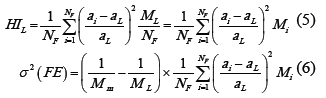
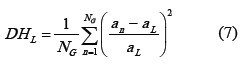
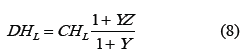
<body><![CDATA[<p><font size="2" face="Verdana, Arial, Helvetica, sans-serif">m<sub>1</sub>: empty     crucible.    <br> </font><font size="2" face="Verdana, Arial, Helvetica, sans-serif">m<sub>2</sub>: crucible   and sample.    <br>   </font><font size="2" face="Verdana, Arial, Helvetica, sans-serif">m<sub>3</sub>: crucible     and ash.</font></p> </blockquote> <font size="2" face="Verdana, Arial, Helvetica, sans-serif"><b>4. STATISTICAL TREATMENT    <br> </b></font><font size="2" face="Verdana, Arial, Helvetica, sans-serif">Lots of a large number   of unspecified random units, with unit masses more or less uniform (with a   tolerance of approximately 20%) and assumed to be independent of each other can   be considered as zero-dimensional objects. Using the sampling procedure   described, a sample of the total lot or package of material, L, is chosen. <b><i>M<sub>L</sub></i></b> is the mass of the lot and <b><i>M<sub>m </sub></i></b>is the mass of the   sample (<b><i>M<sub>m</sub> &#8804; M<sub>L</sub></i></b>). <b><i>F<sub>i</sub> </i></b>denotes the   minimum fragment or sampling unit, and <b><i>N<sub>F</sub></i> </b>the number of   fragments that form the lot. Each <b><i>F<sub>i</sub></i></b> has a probability <b><i>P<sub>i</sub></i></b> of being included in the sample. If the sampling procedure is suitable, the value   of concentration of component <b><i>A</i></b> in the sample, <b><i>a<sub>m</sub></i></b>,   is a good estimate of <b><i>a<sub>L</sub></i></b> (good estimate refers   to minimizing some error criteria). Ultimately, the goal is to estimate the   value of unknown concentration <b><i>a<sub>L</sub></i></b> of component <b><i>A</i></b>. <b><i>A</i></b> is the critical   component that is often described by their concentration or percentage <b>a</b>. In a zero-dimensional lot, a sample   may consist of fragments <b><i>F<sub>i</sub></i></b> independently selected   previously. This type of sampling, known as simple random sampling, verifies   that the probability <b><i>P<sub>i</sub> = P = 1/N<sub>F</sub></i></b> is constant. Another type of sampling, which is also very common, is one in   which groups of neighbouring fragments are removed from the lot, <b><i>G<sub>n</sub></i> .</b> In this second case the probability that a group be included in the   sample, <b><i>P<sub>n</sub></i></b>, is the one which remains constant<b>: <i>P =     P<sub>n</sub> = 1 / N<sub>G</sub></i></b>, where <b><i>N<sub>G</sub></i> </b>is the   number of groups that comprise the lot <b><i>L</i></b>. Under the assumption that the   sampling procedure is correct, the sampling error, <b><i>SE</i></b>, can be expressed as   the sum of two components: the fundamental error, <b><i>FE</i></b>, and the segregation   and grouping error, <b><i>SGE</i></b>. Moreover, as these two errors are independent, the   following relationship between their variances <b><i>&#963;<sup>2</sup>(SE) = &#963;<sup>2</sup>(FE) + &#963;<sup>2</sup>(SGE)</i></b> is verified.</font><font size="2" face="Verdana, Arial, Helvetica, sans-serif"><b>4.1 Definition of fundamental  error FE    <br> </b></font><font size="2" face="Verdana, Arial, Helvetica, sans-serif">The fundamental error is related to   the constitution heterogeneity, <b><i>CH<sub>L</sub></i></b>, and occurs when the   sampling units of the lot that are withdrawn, <b><i>L</i></b>, are fragments <b>F<sub>i</sub></b>, These units have also   been collected after a properly-designed and undertaken sampling process. The <b><i>FE</i></b> is never be zero, but it is the minimum sampling error that can be made. The   constitutional heterogeneity is an intrinsic property of the lot, a material property, and is calculated as an average of squared errors: </font>     <p><img src="/img/revistas/dyna/v77n161/a11eq03.gif"></p>     <p><font size="2" face="Verdana, Arial, Helvetica, sans-serif">Where <b><i>a<sub>i</sub></i></b> is the concentration   of component <b><i>A</i></b> in an <b><i>F<sub>i</sub></i></b> fragment and <i>(<b>a<sub>i</sub></b>-<b> a<sub>L</sub>)/ a<sub>L</sub></b></i> is a random variable, called sampling error,   which represents the deviation of the concentration of components in the   fraction <b><i>F<sub>i</sub></i></b>, as a proportion of the total concentration of   lot <b><i>L</i></b>. The variance of the fundamental error can be expressed as: </font></p>     <p><img src="/img/revistas/dyna/v77n161/a11eq04.gif"></p>     <p><font size="2" face="Verdana, Arial, Helvetica, sans-serif">where <b><i>HI<sub>L</sub>= CH<sub>L</sub>•M<sub>L</sub>/N<sub>F</sub></i></b> is the heterogeneity invariant. Taking into account the expression of <b><i>HI<sub>L</sub></i></b> and knowing that <b><i>M<sub>L</sub> = M<sub>i</sub>•N<sub>F</sub></i></b>, then:</font></p>     <p><img src="/img/revistas/dyna/v77n161/a11eq0506.gif"></p>     ]]></body>

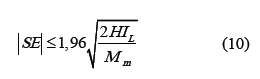
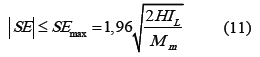
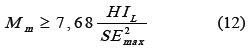
<body><![CDATA[<p><font size="2" face="Verdana, Arial, Helvetica, sans-serif">In view of the above   expressions, it is easy to deduce that <b><i>&#963;<sup>2</sup> (FE)</i></b> is zero if,   and only if, some of the following two conditions holds: the sample is the   whole lot, <b><i>M<sub>m</sub> = M<sub>L</sub></i></b>, or the material is completely homogeneous, which means that: <b><i>a<sub>i</sub>=a<sub>L</sub> , </i></b><img src="/img/revistas/dyna/v77n161/a11eq004.gif"><b><i>i=1,2,…,N<sub>F</sub></i></b> .</font></p> <font size="2" face="Verdana, Arial, Helvetica, sans-serif"><b>4.2 Definition of the segregation and grouping error <i>SGE    <br> </i></b></font><font size="2" face="Verdana, Arial, Helvetica, sans-serif">The grouping and segregation error is related to   the distribution heterogeneity, which, like the above mentioned, occurs when   the elements <b><i>F<sub>i</sub> </i></b>of the sample are not chosen independently with   equal probability, but the <b><i>F<sub>i</sub> </i></b>elements are selected   from the <b><i>G<sub>n</sub></i></b> groups. These groups have the same probability of being selected, <b><i>Pn = P = 1/N<sub>G</sub></i></b>. </font>     <p><img src="/img/revistas/dyna/v77n161/a11eq07.gif"></p>     <p><font size="2" face="Verdana, Arial, Helvetica, sans-serif">with <b><i>a<sub>n</sub></i></b> the concentration of   component <b><i>A</i></b> in a <b><i>G<sub>n</sub></i></b> group. There is a relationship between the constitution and the distribution heterogeneity:</font></p>     <p><img src="/img/revistas/dyna/v77n161/a11eq08.gif"></p>     <p><font size="2" face="Verdana, Arial, Helvetica, sans-serif">Y and Z are   nondimensional parameters which characterize the size of groups and   distribution of components in the lot, respectively. Since <b><i>Y&#8805;0</i></b> and <b><i>0&#8804;Z&#8804;1 </i></b>then, <b><i>0&#8804; DH<sub>L</sub>&#8804;CH<sub>L </sub></i></b>is assured.</font></p> <font size="2" face="Verdana, Arial, Helvetica, sans-serif"><b>4.3 Bounding the variance of sampling error:    <br> </b></font><font size="2" face="Verdana, Arial, Helvetica, sans-serif">Even when the sample is   well-chosen, there are still two types of error: the fundamental error, caused   by the constitutional heterogeneity, and the segregation and grouping error, caused by the distribution heterogeneity. The sampling error is then: <b><i>SE= FE+SGE</i></b>.</font>     <p><font size="2" face="Verdana, Arial, Helvetica, sans-serif">Since both errors are independent, the variance   of the sampling error can be expressed as the sum of the variances: <b><i>&#963;<sup>2</sup>(SE)= &#963;<sup>2</sup>(FE)+&#963;<sup>2 </sup>(SGE</i></b>). The variance of the grouping and segregation error cannot be calculated, but as the relationship: <b><i>0 &#8804; &#963;<sup>2 </sup>(SGE) &#8804; &#963;<sup>2 </sup>(FE)</i></b> is verified, we can deduce that: <b><i>&#963;<sup>2 </sup>(FE)&#8804; &#963;<sup>2</sup>(SE) &#8804; 2&#963;<sup>2 </sup>(FE).</i></b></font></p>     <p><font size="2" face="Verdana, Arial, Helvetica, sans-serif">Assuming that the sampling error follows a  normal distribution, i.e.: <b><i> SE~N(0,&#963;(SE))</i></b>, we can ensure with a confidence level of 95%:</font></p>     <p><img src="/img/revistas/dyna/v77n161/a11eq09.gif"></p>     ]]></body>
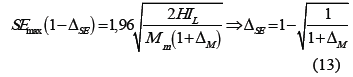
<body><![CDATA[<p><font size="2" face="Verdana, Arial, Helvetica, sans-serif"> Finally, assuming that <b><i>M<sub>m</sub> &lt;&lt;&lt;M<sub>L</sub></i></b> , it is easy to show: </font></p>     <p><img src="/img/revistas/dyna/v77n161/a11eq10.gif"></p>     <p><font size="2" face="Verdana, Arial, Helvetica, sans-serif">The   following conclusions can be inferred from the above equation, with a confidence level of 95%:</font></p>     <p><font size="2" face="Verdana, Arial, Helvetica, sans-serif">1. If the mass of the sample is   constant, the sampling error has an upper bound of a maximum sampling error given by:</font></p>     <p><img src="/img/revistas/dyna/v77n161/a11eq11.gif"></p>     <p><font size="2" face="Verdana, Arial, Helvetica, sans-serif">2. If we set a maximum sampling  error, the mass of the sample should be:</font></p>     <p><img src="/img/revistas/dyna/v77n161/a11eq12.gif"></p>     <p><font size="2" face="Verdana, Arial, Helvetica, sans-serif">3. Regardless of the material, a   direct relationship between increases in the maximum error of sampling and the mass of the sample is observed:</font></p>     <p><img src="/img/revistas/dyna/v77n161/a11eq13.gif"></p>     <p><font size="2" face="Verdana, Arial, Helvetica, sans-serif">For example, an increase of 50% mass  reduction of the sample represents a maximum sampling error of 18.35%. </font></p>     ]]></body>
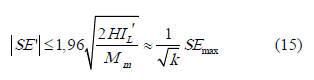
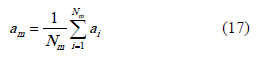
<body><![CDATA[<p><font size="2" face="Verdana, Arial, Helvetica, sans-serif">4. By setting a maximum error and   considering a constant sample mass, we can ask wonder about what is the effect   of the fragment size <b><i>F<sub>i</sub></i></b> on the sampling error.   Logic suggests that using a single piece of mass <b><i>M<sub>i</sub>=M<sub>m</sub></i></b> is not the same as doing it with a   number <b><i>k, k &#1108; N, k&gt;1</i></b> of fragments of mass <b><i>M<sub>i</sub>= M<sub>m</sub>/k</i></b>. In fact, it can be shown that by increasing   the number of elements included in the sample, even when <b><i>M<sub>m</sub></i></b> remains constant, the maximum value   of the sampling error is reduced. This result is a consequence of the   heterogeneity invariant, <b><i>HI<sub>L</sub></i></b>, which is a function   of the number of fragments that constitute the sample and varies according to   the type of material, but it is not the function of the mass sample <b><i>M<sub>m</sub></i></b>. Thus, if we divide each fragment   into <b><i>k</i></b>,   smaller fragments then <b><i>M’<sub>i</sub> =M<sub>i</sub>/k, N’<sub>F</sub>=k × N<sub>F</sub></i></b>. Using the <b><i>HI<sub>L</sub></i></b> expression   and assuming that the concentration of the new fragments, <b><i>a'<sub>i</sub></i></b>, is   similar to that of the original fragment <b><i>a’<sub>i &#8776; </sub>a</i></b>, then the heterogeneity invariant in the new fragment is calculated as: </font></p>     <p><img src="/img/revistas/dyna/v77n161/a11eq14.gif"></p>     <p><font size="2" face="Verdana, Arial, Helvetica, sans-serif">So, the sampling error has an upper limit  calculated as:</font></p>     <p><img src="/img/revistas/dyna/v77n161/a11eq15.gif"></p>     <p><font size="2" face="Verdana, Arial, Helvetica, sans-serif">and it can be seen that when <b><i>k</i></b> tends to infinity, the sampling  error tends to zero.</font></p> <font size="2" face="Verdana, Arial, Helvetica, sans-serif"><b>4.4 Application to biomass data    <br> </b></font><font face="Verdana, Arial, Helvetica, sans-serif">Following &#91;23&#93;, <b><i>HI<sub>L</sub></i></b> can be estimated from   a sample obtained by simple random sampling, provided that the number of fragments in the sample, <b><i>N<sub>m</sub></i></b>, is big enough:</font><font size="2"></font>     <p><img src="/img/revistas/dyna/v77n161/a11eq16.gif"></p>     <p><font size="2" face="Verdana, Arial, Helvetica, sans-serif">where <b><i>a<sub>m</sub></i></b>, the concentration of component in the sample, is   obtained by averaging the concentrations of the extracts:</font></p>     <p><img src="/img/revistas/dyna/v77n161/a11eq17.gif"></p>     <p><font size="2" face="Verdana, Arial, Helvetica, sans-serif">For the calculations shown below,   the mass of the fragment is assumed as a dimensionless unit of mass <b><i>M<sub>i</sub>=1</i></b>, so that the mass sample is represented as sampling units <b><i>N<sub>m</sub></i></b>. </font></p>     ]]></body>

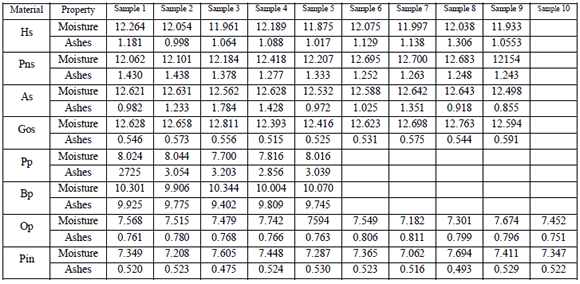
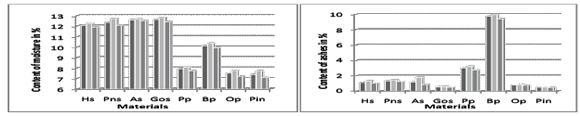
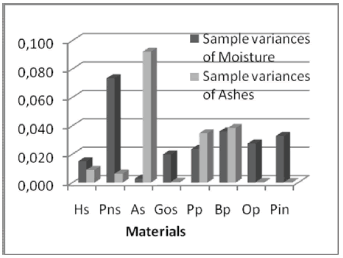
<body><![CDATA[<p>&nbsp;</p>     <p><b><font size="3" face="Verdana, Arial, Helvetica, sans-serif">5. RESULTS</font></b></p>     <p><font size="2" face="Verdana, Arial, Helvetica, sans-serif"><a href="#tab02">Table 2</a>, shows the values of moisture in % and ash for each material  tested. </font></p>     <p align="center"><font size="2" face="Verdana, Arial, Helvetica, sans-serif"><b><a name="tab02"></a>Table  2.</b> Values of moisture and ash in % for each material tested</font>    <br>  <img src="/img/revistas/dyna/v77n161/a11tab02.gif"></p>     <p><font size="2" face="Verdana, Arial, Helvetica, sans-serif">The medium, maximum, and minimum value of moisture and ash content in %,   are shown respectively in <a href="#fig03">figure 3</a>. </font></p>     <p align="center"><font size="2" face="Verdana, Arial, Helvetica, sans-serif"><b><a name="fig03"></a><img src="/img/revistas/dyna/v77n161/a11fig03.gif">    <br>   Figure 3.</b> Medium, minimum   and maximum values (%) of moisture content and ash</font></p>     <p><font size="2" face="Verdana, Arial, Helvetica, sans-serif">The moisture value observed in hazelnut shell, pine nut, almond and   olive stones, is similar. These materials were presented in big-bag. The pellets presented in sacks, also   have humidity values, with the exception of brassica pellets, which contain a   higher percentage of humidity. The high ash content in the brassica pellets is   significant. The results also show a significant uniformity in the average   values of the ashes of hazelnut shells (1.10%), pinion (1.32%) and almond   (1.17%). The lowest ash percentage is found in oak, olive stones and pine   pellets. These values make these pellets best suited for burning in boilers. In   poplar pellets, a high ash value, was found. <a href="#fig04">Figure 4</a> illustrates the values of the variances of moisture and ash for the materials studied.</font></p>     <p align="center"><font size="2" face="Verdana, Arial, Helvetica, sans-serif"><b><a name="fig04"></a><img src="/img/revistas/dyna/v77n161/a11fig04.gif">    ]]></body>
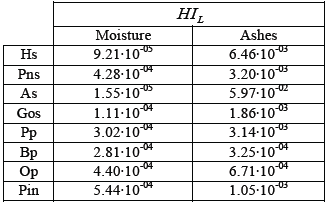
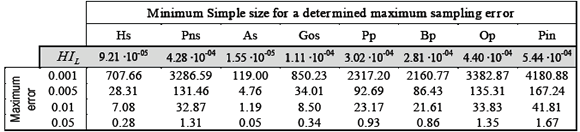
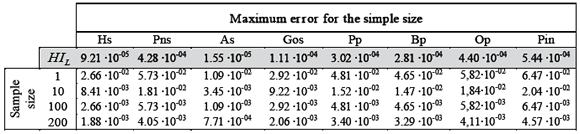
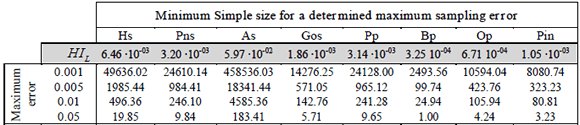
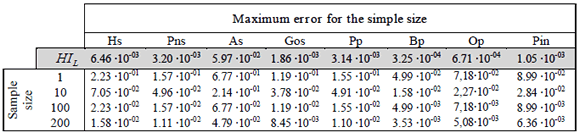
<body><![CDATA[<br>   Figure 4.</b> Variances of   moisture and ash</font></p>     <p><font size="2" face="Verdana, Arial, Helvetica, sans-serif">By analyzing the value of the variances of   moisture and ash obtained for the different materials, we can conclude that the   sampling plans should take into account what the properties to be studied are,   as well as their accuracy and reliability. For example, materials like olive stone,   pellets of pine and oak have a very low variance for the ashes, but, on the   other hand, have significant values for the moisture content. It can also be   seen that the values obtained for the variances of moisture and ash, indicate   that there are independent variables. A surprising case is that of almond shell   and pine, which show very contrasting values of variance for the two   properties. This fact requires different sampling plans, if we want to obtain   the same accuracy and reliability in the results. As the moisture of the material depends on its own   characteristics and external actions to which it was subjected, a greater value   for their variances was expected, than the variances associated with the ashes. This hypothesis was confirmed in only five of the materials.</font></p>     <p><font size="2" face="Verdana, Arial, Helvetica, sans-serif">By applying the  statistical treatment described above to the sample data, the values of <b><i>HI<sub>L</sub></i></b> shown in <a href="#tab03">Table 3</a> are obtained.</font></p>     <p align="center"><font size="2" face="Verdana, Arial, Helvetica, sans-serif"><b><a name="tab03"></a>Table   3.</b> Values for the intrinsic heterogeneity of moisture and ash concentrations   observed in different biomass materials</font>    <br>   <img src="/img/revistas/dyna/v77n161/a11tab03.gif"></p>     <p><font size="2" face="Verdana, Arial, Helvetica, sans-serif">With these values, it can be deduced that the   maximum sampling error for a fixed sample mass and the mass of a minimum sample   size has a fixed sampling error. These results are given in <a href="#tab04">Tables 4</a> and <a href="#tab05">5</a>, for   data of humidity, and <a href="#tab06">Tables 6</a> and <a href="#tab07">7</a> for details of ashes. With these Tables,   it is possible to determine the maximum permissible error for a sample size,   which is necessary for the determination of moisture and ash respectively   (<a href="#tab04">Tables 4</a> and <a href="#tab06">6</a>), or alternatively, for a predetermined sample size, the maximum error made can be determined.</font></p>     <p align="center"><font size="2" face="Verdana, Arial, Helvetica, sans-serif"><b><a name="tab04"></a>Table 4.</b> Moisture. Minimum   sample mass, expressed as N<sub>m</sub> sampling units, sampling error for a   determined maximum sampling error</font>    <br>   <img src="/img/revistas/dyna/v77n161/a11tab04.gif"></p>     <p align="center"><font size="2" face="Verdana, Arial, Helvetica, sans-serif"><b><a name="tab05"></a>Table 5.</b> Moisture maximum   sampling error for a simple mass, expressed as N<sub>m</sub> sampling   determined units</font>    <br>   <img src="/img/revistas/dyna/v77n161/a11tab05.gif"></p>     ]]></body>
<body><![CDATA[<p align="center"><font size="2" face="Verdana, Arial, Helvetica, sans-serif"><b><a name="tab06"></a>Table 6.</b> Ashes. Minimum   sample mass, expressed as N<sub>m</sub> sampling units, sampling error for a   determined maximum sampling error</font>    <br>   <img src="/img/revistas/dyna/v77n161/a11tab06.gif"></p>     <p align="center"><font size="2" face="Verdana, Arial, Helvetica, sans-serif"><b><a name="tab07"></a>Table 7.</b> Ashes maximum   sampling error for a simple mass, expressed as N<sub>m</sub> sampling   determined units</font>    <br>   <img src="/img/revistas/dyna/v77n161/a11tab07.gif"></p>     <p><font size="2" face="Verdana, Arial, Helvetica, sans-serif">The sampling errors have a certain correlation   with the results of variance in <a href="#fig04">Figure 4</a>. Those materials with large sample   variance will, in general, have a higher sampling error. In the case of the   correlation between the moisture sampling error (<a href="#tab04">Tables 4</a>-<a href="#tab07">7</a>) and sample   variance (<a href="#fig04">Fig. 4</a>) it is 0.69. In the case of ash, the correlation increases to   0.85. Then, it can be deduced that the sample variance is a more qualitative   than quantitative indication of the sampling errors, but in no case, can be   estimated. The perfect correlation (1.00) exists between the coefficient of   variation (sample standard deviation between sample mean) and the sampling error. </font></p>     <p>&nbsp;</p> <font size="3" face="Verdana, Arial, Helvetica, sans-serif"><b>6. CONCLUSIONS</b></font>     <p><font size="2" face="Verdana, Arial, Helvetica, sans-serif">In   determining properties of a lot, a sampling plan for each property to be   studied should be designed and the sampling error that is made with the chosen   sampling process should be determined. This is crucial in order to discover the   subsequent propagation of error in future calculations with the set property   value. In particular, biomass fuels, despite being heterogeneous materials,   with an appropriate sampling procedure, the experimental error associated with   different properties, can be reasonably limited. In other words, we can say   that, despite the heterogeneity of the fuel itself, a well-planned campaign of   samples can extrapolate the properties of the samples from the entire lot with   a controlled, analyzed and quantified uncertainty.</font></p>     <p><font size="2" face="Verdana, Arial, Helvetica, sans-serif">In this work, it can be seen that, despite the fact that the sample variance of a property of   a material is an indication of the level of heterogeneity, this does not accurately   quantify the error committed. To do this, a determination of the statistical   uncertainty associated with this property, which allows us to quantify this error precisely, is necessary.</font></p>     <p><font size="2" face="Verdana, Arial, Helvetica, sans-serif">Eight biomass fuels and a map of   sampling to determine the sample sizes in the light of the uncertainties which   are considered acceptable and vice versa have been established. These   techniques, the sampling procedure and statistical determination, can be   extrapolated to any solid material in granular form with approximately homogeneous sizes.</font></p>     <p>&nbsp;</p>     ]]></body>
<body><![CDATA[<p><font size="3" face="Verdana, Arial, Helvetica, sans-serif"><b>7. ACKNOWLEDGMENTS</b></font></p>     <p><font size="2" face="Verdana, Arial, Helvetica, sans-serif">This work was partially funded by projects   08DPI003303PR for the first and second author and PGIDIT07PXIB300191PR of the   Xunta de Galicia and by the project MTM2008-03129, Ministry of Science and Innovation for the third author.</font></p>     <p>&nbsp;</p>  <font size="3" face="Verdana, Arial, Helvetica, sans-serif"><b>REFERENCES </b></font>     <!-- ref --><p>   <font size="2" face="Verdana, Arial, Helvetica, sans-serif"><b>&#91;1&#93;</b> G&Oacute;MEZ, M., SALDARRIAGA, J., CORREA, M., POSADA, E. AND CASTRILL&Oacute;N, F. J., Modelaci&oacute;n estad&iacute;stica de los aportes de las v&iacute;as como fuentes de emisi&oacute;n a las part&iacute;culas totales en suspensi&oacute;n seg&uacute;n modelo MCF zona centro de Medell&iacute;n-Antioquia-Colombia 2004, Dyna, 153, 35-40, 2007.     &nbsp;&nbsp;&nbsp;&nbsp;&nbsp;&nbsp;&nbsp;&nbsp;[&#160;<a href="javascript:void(0);" onclick="javascript: window.open('/scielo.php?script=sci_nlinks&ref=000146&pid=S0012-7353201000010001100001&lng=','','width=640,height=500,resizable=yes,scrollbars=1,menubar=yes,');">Links</a>&#160;]<!-- end-ref --><!-- ref --><br>   <b>&#91;2&#93;</b>  VAN LOO, S. AND KOPPEJAN, J. (eds.), Handbook of biomass. Combustion and co-firing, Twente University Press, 2002.       &nbsp;&nbsp;&nbsp;&nbsp;&nbsp;&nbsp;&nbsp;&nbsp;[&#160;<a href="javascript:void(0);" onclick="javascript: window.open('/scielo.php?script=sci_nlinks&ref=000147&pid=S0012-7353201000010001100002&lng=','','width=640,height=500,resizable=yes,scrollbars=1,menubar=yes,');">Links</a>&#160;]<!-- end-ref --><!-- ref --><br>   <b>&#91;3&#93;</b> HEIN, K.R.G. AND BEMTGEN, J.M., EU clean coal technology co-combustion of coal and biomass, Fuel Processing Technology, 54, 159–169, 1998.     &nbsp;&nbsp;&nbsp;&nbsp;&nbsp;&nbsp;&nbsp;&nbsp;[&#160;<a href="javascript:void(0);" onclick="javascript: window.open('/scielo.php?script=sci_nlinks&ref=000148&pid=S0012-7353201000010001100003&lng=','','width=640,height=500,resizable=yes,scrollbars=1,menubar=yes,');">Links</a>&#160;]<!-- end-ref --><!-- ref --><br>   <b>&#91;4&#93;</b>  TILLAMAN, D.A., Biomass cofiring: The technology, the experience, the combustion consequences, Biomass and Bioenergy 19, 365-384, 2000.       &nbsp;&nbsp;&nbsp;&nbsp;&nbsp;&nbsp;&nbsp;&nbsp;[&#160;<a href="javascript:void(0);" onclick="javascript: window.open('/scielo.php?script=sci_nlinks&ref=000149&pid=S0012-7353201000010001100004&lng=','','width=640,height=500,resizable=yes,scrollbars=1,menubar=yes,');">Links</a>&#160;]<!-- end-ref --><!-- ref --><br>   <b>&#91;5&#93;</b>  SAMI M., ANNAMALAI K. AND WOODRIDGE M., Co-firing of coal and biomass fuel blends, Progress in Energy and Combustion Science, 27, 2001.       &nbsp;&nbsp;&nbsp;&nbsp;&nbsp;&nbsp;&nbsp;&nbsp;[&#160;<a href="javascript:void(0);" onclick="javascript: window.open('/scielo.php?script=sci_nlinks&ref=000150&pid=S0012-7353201000010001100005&lng=','','width=640,height=500,resizable=yes,scrollbars=1,menubar=yes,');">Links</a>&#160;]<!-- end-ref --><!-- ref --><br>   <b>&#91;6&#93;</b> LECKNER B., Co-Combustion – A Summary of Technology, Thermal Science11, 4, 5-40, 2007.     &nbsp;&nbsp;&nbsp;&nbsp;&nbsp;&nbsp;&nbsp;&nbsp;[&#160;<a href="javascript:void(0);" onclick="javascript: window.open('/scielo.php?script=sci_nlinks&ref=000151&pid=S0012-7353201000010001100006&lng=','','width=640,height=500,resizable=yes,scrollbars=1,menubar=yes,');">Links</a>&#160;]<!-- end-ref --><!-- ref --><br>   <b>&#91;7&#93;</b> MELGAR A., BORGE D. AND P&Eacute;REZ J., Estudio cin&eacute;tico del proceso de devolatilizaci&oacute;n de biomasa lignocelul&oacute;sica mediante an&aacute;lisis termogravim&eacute;trico para tama&ntilde;os de part&iacute;culas de 2 a 19 mm, Dyna, 155, 123-131, 2008.     &nbsp;&nbsp;&nbsp;&nbsp;&nbsp;&nbsp;&nbsp;&nbsp;[&#160;<a href="javascript:void(0);" onclick="javascript: window.open('/scielo.php?script=sci_nlinks&ref=000152&pid=S0012-7353201000010001100007&lng=','','width=640,height=500,resizable=yes,scrollbars=1,menubar=yes,');">Links</a>&#160;]<!-- end-ref --><!-- ref --><br>   <b>&#91;8&#93;</b>  PITARD, F.F. AND GY, P., Sampling Theory and Sampling Practice, 2 ed. CRC Press Ltd., 1993.       &nbsp;&nbsp;&nbsp;&nbsp;&nbsp;&nbsp;&nbsp;&nbsp;[&#160;<a href="javascript:void(0);" onclick="javascript: window.open('/scielo.php?script=sci_nlinks&ref=000153&pid=S0012-7353201000010001100008&lng=','','width=640,height=500,resizable=yes,scrollbars=1,menubar=yes,');">Links</a>&#160;]<!-- end-ref --><!-- ref --><br>   <b>&#91;9&#93;</b>  SMITH, P.L., A Primer for Sampling Solids, Liquids and Gases, Siam , 2001.       &nbsp;&nbsp;&nbsp;&nbsp;&nbsp;&nbsp;&nbsp;&nbsp;[&#160;<a href="javascript:void(0);" onclick="javascript: window.open('/scielo.php?script=sci_nlinks&ref=000154&pid=S0012-7353201000010001100009&lng=','','width=640,height=500,resizable=yes,scrollbars=1,menubar=yes,');">Links</a>&#160;]<!-- end-ref --><!-- ref --><br>   <b>&#91;10&#93;</b> PETERSEN, L., MINKKINEN, P. AND ESBENSEN, K.H., Representative sampling for reliable data analysis: theory of sampling, Chemometrics and Intelligent Laboratory Systems, 77, 261–277, 2005.     &nbsp;&nbsp;&nbsp;&nbsp;&nbsp;&nbsp;&nbsp;&nbsp;[&#160;<a href="javascript:void(0);" onclick="javascript: window.open('/scielo.php?script=sci_nlinks&ref=000155&pid=S0012-7353201000010001100010&lng=','','width=640,height=500,resizable=yes,scrollbars=1,menubar=yes,');">Links</a>&#160;]<!-- end-ref --><!-- ref --><br>   <b>&#91;11&#93;</b> PETERSEN L., DAHL C.K. AND ESBENSEN K.H., Representative mass reduction in sampling—a critical survey of techniques and hardware, Chemometrics and Intelligent Laboratory Systems, 74, 95–114, 2004.     &nbsp;&nbsp;&nbsp;&nbsp;&nbsp;&nbsp;&nbsp;&nbsp;[&#160;<a href="javascript:void(0);" onclick="javascript: window.open('/scielo.php?script=sci_nlinks&ref=000156&pid=S0012-7353201000010001100011&lng=','','width=640,height=500,resizable=yes,scrollbars=1,menubar=yes,');">Links</a>&#160;]<!-- end-ref --><!-- ref --><br>   <b>&#91;12&#93;</b> TRISTANCHO, J., VASQUEZ, C. AND PE&Ntilde;A D., Hot corrosion study of AISI-SAE 304H alloyd, by using the electrochemical impedance spectroscopy technique, Dyna, 153, 119-124, 2007.     &nbsp;&nbsp;&nbsp;&nbsp;&nbsp;&nbsp;&nbsp;&nbsp;[&#160;<a href="javascript:void(0);" onclick="javascript: window.open('/scielo.php?script=sci_nlinks&ref=000157&pid=S0012-7353201000010001100012&lng=','','width=640,height=500,resizable=yes,scrollbars=1,menubar=yes,');">Links</a>&#160;]<!-- end-ref --><!-- ref --><br>   <b>&#91;13&#93;</b> BERLANGA-LABARI, C. AND FERN&Aacute;NDEZ-CARRASQUILLA, J., Revisi&oacute;n sobre la corrosi&oacute;n de tubos sobrecalentadores en plantas de biomasa, Revista de Metalurg&iacute;a, 42, 299-317, 2006.     &nbsp;&nbsp;&nbsp;&nbsp;&nbsp;&nbsp;&nbsp;&nbsp;[&#160;<a href="javascript:void(0);" onclick="javascript: window.open('/scielo.php?script=sci_nlinks&ref=000158&pid=S0012-7353201000010001100013&lng=','','width=640,height=500,resizable=yes,scrollbars=1,menubar=yes,');">Links</a>&#160;]<!-- end-ref --><!-- ref --><br>   <b>&#91;14&#93;</b> MARULANDA, J., GARC&Iacute;A, A. AND VITOLA, J., Protecci&oacute;n contra la corrosi&oacute;n por sales fundidas de un acero al carbono por rociado t&eacute;rmico, Dyna, 157, 251-256, 2009.     &nbsp;&nbsp;&nbsp;&nbsp;&nbsp;&nbsp;&nbsp;&nbsp;[&#160;<a href="javascript:void(0);" onclick="javascript: window.open('/scielo.php?script=sci_nlinks&ref=000159&pid=S0012-7353201000010001100014&lng=','','width=640,height=500,resizable=yes,scrollbars=1,menubar=yes,');">Links</a>&#160;]<!-- end-ref --><!-- ref --><br>   <b>&#91;15&#93;</b>  CEN/TS 14961 EX, Especificaciones y clases de combustibles.       &nbsp;&nbsp;&nbsp;&nbsp;&nbsp;&nbsp;&nbsp;&nbsp;[&#160;<a href="javascript:void(0);" onclick="javascript: window.open('/scielo.php?script=sci_nlinks&ref=000160&pid=S0012-7353201000010001100015&lng=','','width=640,height=500,resizable=yes,scrollbars=1,menubar=yes,');">Links</a>&#160;]<!-- end-ref --><!-- ref --><br>   <b>&#91;16&#93;</b> CEN/TS 14778-1:2005 Muestreo. Parte 1: M&eacute;todos de muestreo.     &nbsp;&nbsp;&nbsp;&nbsp;&nbsp;&nbsp;&nbsp;&nbsp;[&#160;<a href="javascript:void(0);" onclick="javascript: window.open('/scielo.php?script=sci_nlinks&ref=000161&pid=S0012-7353201000010001100016&lng=','','width=640,height=500,resizable=yes,scrollbars=1,menubar=yes,');">Links</a>&#160;]<!-- end-ref --><!-- ref --><br>   <b>&#91;17&#93;</b> GY, P., Sampling of discrete materials. I-V, Chemometrics and Intelligent Lab. Syst. 74, 261–277, 2005.     &nbsp;&nbsp;&nbsp;&nbsp;&nbsp;&nbsp;&nbsp;&nbsp;[&#160;<a href="javascript:void(0);" onclick="javascript: window.open('/scielo.php?script=sci_nlinks&ref=000162&pid=S0012-7353201000010001100017&lng=','','width=640,height=500,resizable=yes,scrollbars=1,menubar=yes,');">Links</a>&#160;]<!-- end-ref --><!-- ref --><br>   <b>&#91;18&#93;</b> SPLIETHOFF, H. AND HEIN, K.R.G., Effect of co-combustion of biomass on emissions in pulverized fuel furnaces. Fuel Processing Technology, 54, 189–205, 1998.     &nbsp;&nbsp;&nbsp;&nbsp;&nbsp;&nbsp;&nbsp;&nbsp;[&#160;<a href="javascript:void(0);" onclick="javascript: window.open('/scielo.php?script=sci_nlinks&ref=000163&pid=S0012-7353201000010001100018&lng=','','width=640,height=500,resizable=yes,scrollbars=1,menubar=yes,');">Links</a>&#160;]<!-- end-ref --><!-- ref --><br>   <b>&#91;19&#93;</b> ROJAS A. AND BARRAZA J., Predicci&oacute;n de la devolatilizaci&oacute;n de carbones pulverizados, Dyna, 154, 113-122, 2008.     &nbsp;&nbsp;&nbsp;&nbsp;&nbsp;&nbsp;&nbsp;&nbsp;[&#160;<a href="javascript:void(0);" onclick="javascript: window.open('/scielo.php?script=sci_nlinks&ref=000164&pid=S0012-7353201000010001100019&lng=','','width=640,height=500,resizable=yes,scrollbars=1,menubar=yes,');">Links</a>&#160;]<!-- end-ref --><!-- ref --><br>   <b>&#91;20&#93;</b> CEN/TS 14774-EX., Biocombustibles s&oacute;lidos, M&eacute;todo para la determinaci&oacute;n del contenido de humedad, M&eacute;todo de secado en estufa, Sep., 2007.     &nbsp;&nbsp;&nbsp;&nbsp;&nbsp;&nbsp;&nbsp;&nbsp;[&#160;<a href="javascript:void(0);" onclick="javascript: window.open('/scielo.php?script=sci_nlinks&ref=000165&pid=S0012-7353201000010001100020&lng=','','width=640,height=500,resizable=yes,scrollbars=1,menubar=yes,');">Links</a>&#160;]<!-- end-ref --><!-- ref --><br>   <b>&#91;21&#93;</b> CEN/TS 14775-EX., Biocombustibles s&oacute;lidos, M&eacute;todo para la determinaci&oacute;n del contenido en cenizas, Dec., 2007.     &nbsp;&nbsp;&nbsp;&nbsp;&nbsp;&nbsp;&nbsp;&nbsp;[&#160;<a href="javascript:void(0);" onclick="javascript: window.open('/scielo.php?script=sci_nlinks&ref=000166&pid=S0012-7353201000010001100021&lng=','','width=640,height=500,resizable=yes,scrollbars=1,menubar=yes,');">Links</a>&#160;]<!-- end-ref --><!-- ref --><br>   <b>&#91;22&#93;</b>  RIBERO, D., RESTREPO, R., PAUCAR, C. AND GARCIA, C., Decrease of the temperature in the synthesis of a highly refractory ceramic material (Mullite) from hidroxihidrogeles, Dyna, 153, 95-100, 2007.       &nbsp;&nbsp;&nbsp;&nbsp;&nbsp;&nbsp;&nbsp;&nbsp;[&#160;<a href="javascript:void(0);" onclick="javascript: window.open('/scielo.php?script=sci_nlinks&ref=000167&pid=S0012-7353201000010001100022&lng=','','width=640,height=500,resizable=yes,scrollbars=1,menubar=yes,');">Links</a>&#160;]<!-- end-ref --><!-- ref --><br>  <b>&#91;23&#93;</b>  GY, P., Sampling of Discrete Materials II. Quantitative Approach. Sampling of Zero-dimensional objects, Chemometrics and Intelligent Laboratory Systems, 74, 25-38, 2004. </font>&nbsp;&nbsp;&nbsp;&nbsp;&nbsp;&nbsp;&nbsp;&nbsp;[&#160;<a href="javascript:void(0);" onclick="javascript: window.open('/scielo.php?script=sci_nlinks&ref=000168&pid=S0012-7353201000010001100023&lng=','','width=640,height=500,resizable=yes,scrollbars=1,menubar=yes,');">Links</a>&#160;]<!-- end-ref --> ]]></body><back>
<ref-list>
<ref id="B1">
<label>1</label><nlm-citation citation-type="journal">
<person-group person-group-type="author">
<name>
<surname><![CDATA[GÓMEZ]]></surname>
<given-names><![CDATA[M.]]></given-names>
</name>
<name>
<surname><![CDATA[SALDARRIAGA]]></surname>
<given-names><![CDATA[J.]]></given-names>
</name>
<name>
<surname><![CDATA[CORREA]]></surname>
<given-names><![CDATA[M.]]></given-names>
</name>
<name>
<surname><![CDATA[POSADA]]></surname>
<given-names><![CDATA[E.]]></given-names>
</name>
<name>
<surname><![CDATA[CASTRILLÓN]]></surname>
<given-names><![CDATA[F. J.]]></given-names>
</name>
</person-group>
<article-title xml:lang="es"><![CDATA[Modelación estadística de los aportes de las vías como fuentes de emisión a las partículas totales en suspensión según modelo MCF zona centro de Medellín-Antioquia-Colombia]]></article-title>
<source><![CDATA[Dyna]]></source>
<year>2004</year>
<month>20</month>
<day>07</day>
<numero>153</numero>
<issue>153</issue>
<page-range>35-40</page-range></nlm-citation>
</ref>
<ref id="B2">
<label>2</label><nlm-citation citation-type="book">
<person-group person-group-type="author">
<name>
<surname><![CDATA[VAN LOO]]></surname>
<given-names><![CDATA[S.]]></given-names>
</name>
<name>
<surname><![CDATA[KOPPEJAN]]></surname>
<given-names><![CDATA[J.]]></given-names>
</name>
</person-group>
<source><![CDATA[Handbook of biomass: Combustion and co-firing]]></source>
<year>2002</year>
<publisher-name><![CDATA[Twente University Press]]></publisher-name>
</nlm-citation>
</ref>
<ref id="B3">
<label>3</label><nlm-citation citation-type="journal">
<person-group person-group-type="author">
<name>
<surname><![CDATA[HEIN]]></surname>
<given-names><![CDATA[K.R.G.]]></given-names>
</name>
<name>
<surname><![CDATA[BEMTGEN]]></surname>
<given-names><![CDATA[J.M.]]></given-names>
</name>
</person-group>
<article-title xml:lang="en"><![CDATA[EU clean coal technology co-combustion of coal and biomass]]></article-title>
<source><![CDATA[Fuel Processing Technology]]></source>
<year>1998</year>
<volume>54</volume>
<page-range>159-169</page-range></nlm-citation>
</ref>
<ref id="B4">
<label>4</label><nlm-citation citation-type="journal">
<person-group person-group-type="author">
<name>
<surname><![CDATA[TILLAMAN]]></surname>
<given-names><![CDATA[D.A.]]></given-names>
</name>
</person-group>
<article-title xml:lang="en"><![CDATA[Biomass cofiring: The technology, the experience, the combustion consequences]]></article-title>
<source><![CDATA[Biomass and Bioenergy]]></source>
<year>2000</year>
<numero>19</numero>
<issue>19</issue>
<page-range>365-384</page-range></nlm-citation>
</ref>
<ref id="B5">
<label>5</label><nlm-citation citation-type="journal">
<person-group person-group-type="author">
<name>
<surname><![CDATA[SAMI]]></surname>
<given-names><![CDATA[M.]]></given-names>
</name>
<name>
<surname><![CDATA[ANNAMALAI]]></surname>
<given-names><![CDATA[K.]]></given-names>
</name>
<name>
<surname><![CDATA[WOODRIDGE]]></surname>
<given-names><![CDATA[M.]]></given-names>
</name>
</person-group>
<article-title xml:lang="en"><![CDATA[Co-firing of coal and biomass fuel blends]]></article-title>
<source><![CDATA[Progress in Energy and Combustion Science]]></source>
<year>2001</year>
<numero>27</numero>
<issue>27</issue>
</nlm-citation>
</ref>
<ref id="B6">
<label>6</label><nlm-citation citation-type="journal">
<person-group person-group-type="author">
<name>
<surname><![CDATA[LECKNER]]></surname>
<given-names><![CDATA[B.]]></given-names>
</name>
</person-group>
<article-title xml:lang="en"><![CDATA[Co-Combustion: A Summary of Technology]]></article-title>
<source><![CDATA[Thermal Science]]></source>
<year>2007</year>
<volume>11</volume>
<numero>4</numero>
<issue>4</issue>
<page-range>5-40</page-range></nlm-citation>
</ref>
<ref id="B7">
<label>7</label><nlm-citation citation-type="journal">
<person-group person-group-type="author">
<name>
<surname><![CDATA[MELGAR]]></surname>
<given-names><![CDATA[A.]]></given-names>
</name>
<name>
<surname><![CDATA[BORGE]]></surname>
<given-names><![CDATA[D.]]></given-names>
</name>
<name>
<surname><![CDATA[PÉREZ]]></surname>
<given-names><![CDATA[J.]]></given-names>
</name>
</person-group>
<article-title xml:lang="es"><![CDATA[Estudio cinético del proceso de devolatilización de biomasa lignocelulósica mediante análisis termogravimétrico para tamaños de partículas de 2 a 19 mm]]></article-title>
<source><![CDATA[Dyna]]></source>
<year>2008</year>
<numero>155</numero>
<issue>155</issue>
<page-range>123-131</page-range></nlm-citation>
</ref>
<ref id="B8">
<label>8</label><nlm-citation citation-type="book">
<person-group person-group-type="author">
<name>
<surname><![CDATA[PITARD]]></surname>
<given-names><![CDATA[F.F.]]></given-names>
</name>
<name>
<surname><![CDATA[GY]]></surname>
<given-names><![CDATA[P.]]></given-names>
</name>
</person-group>
<source><![CDATA[Sampling Theory and Sampling Practice]]></source>
<year>1993</year>
<edition>2</edition>
<publisher-name><![CDATA[CRC Press Ltd.]]></publisher-name>
</nlm-citation>
</ref>
<ref id="B9">
<label>9</label><nlm-citation citation-type="journal">
<person-group person-group-type="author">
<name>
<surname><![CDATA[SMITH]]></surname>
<given-names><![CDATA[P.L.]]></given-names>
</name>
</person-group>
<article-title xml:lang="en"><![CDATA[A Primer for Sampling Solids]]></article-title>
<source><![CDATA[Liquids and Gases]]></source>
<year>2001</year>
</nlm-citation>
</ref>
<ref id="B10">
<label>10</label><nlm-citation citation-type="journal">
<person-group person-group-type="author">
<name>
<surname><![CDATA[PETERSEN]]></surname>
<given-names><![CDATA[L.]]></given-names>
</name>
<name>
<surname><![CDATA[MINKKINEN]]></surname>
<given-names><![CDATA[P.]]></given-names>
</name>
<name>
<surname><![CDATA[ESBENSEN]]></surname>
<given-names><![CDATA[K.H.]]></given-names>
</name>
</person-group>
<article-title xml:lang="en"><![CDATA[Representative sampling for reliable data analysis: theory of sampling]]></article-title>
<source><![CDATA[Chemometrics and Intelligent Laboratory Systems]]></source>
<year>2005</year>
<volume>77</volume>
<page-range>261-277</page-range></nlm-citation>
</ref>
<ref id="B11">
<label>11</label><nlm-citation citation-type="journal">
<person-group person-group-type="author">
<name>
<surname><![CDATA[PETERSEN]]></surname>
<given-names><![CDATA[L.]]></given-names>
</name>
<name>
<surname><![CDATA[DAHL]]></surname>
<given-names><![CDATA[C.K.]]></given-names>
</name>
<name>
<surname><![CDATA[ESBENSEN]]></surname>
<given-names><![CDATA[K.H.]]></given-names>
</name>
</person-group>
<article-title xml:lang="en"><![CDATA[Representative mass reduction in sampling-a critical survey of techniques and hardware]]></article-title>
<source><![CDATA[Chemometrics and Intelligent Laboratory Systems]]></source>
<year>2004</year>
<numero>74</numero>
<issue>74</issue>
<page-range>95-114</page-range></nlm-citation>
</ref>
<ref id="B12">
<label>12</label><nlm-citation citation-type="journal">
<person-group person-group-type="author">
<name>
<surname><![CDATA[TRISTANCHO]]></surname>
<given-names><![CDATA[J.]]></given-names>
</name>
<name>
<surname><![CDATA[VASQUEZ]]></surname>
<given-names><![CDATA[C.]]></given-names>
</name>
<name>
<surname><![CDATA[PEÑA]]></surname>
<given-names><![CDATA[D.]]></given-names>
</name>
</person-group>
<article-title xml:lang="en"><![CDATA[Hot corrosion study of AISI-SAE 304H alloyd, by using the electrochemical impedance spectroscopy technique]]></article-title>
<source><![CDATA[Dyna]]></source>
<year>2007</year>
<numero>153</numero>
<issue>153</issue>
<page-range>119-124</page-range></nlm-citation>
</ref>
<ref id="B13">
<label>13</label><nlm-citation citation-type="journal">
<person-group person-group-type="author">
<name>
<surname><![CDATA[BERLANGA-LABARI]]></surname>
<given-names><![CDATA[C.]]></given-names>
</name>
<name>
<surname><![CDATA[FERNÁNDEZ-CARRASQUILLA]]></surname>
<given-names><![CDATA[J.]]></given-names>
</name>
</person-group>
<article-title xml:lang="es"><![CDATA[Revisión sobre la corrosión de tubos sobrecalentadores en plantas de biomasa]]></article-title>
<source><![CDATA[Revista de Metalurgía]]></source>
<year>2006</year>
<volume>42</volume>
<page-range>299-317</page-range></nlm-citation>
</ref>
<ref id="B14">
<label>14</label><nlm-citation citation-type="journal">
<person-group person-group-type="author">
<name>
<surname><![CDATA[MARULANDA]]></surname>
<given-names><![CDATA[J.]]></given-names>
</name>
<name>
<surname><![CDATA[GARCÍA]]></surname>
<given-names><![CDATA[A.]]></given-names>
</name>
<name>
<surname><![CDATA[VITOLA]]></surname>
<given-names><![CDATA[J.]]></given-names>
</name>
</person-group>
<article-title xml:lang="es"><![CDATA[Protección contra la corrosión por sales fundidas de un acero al carbono por rociado térmico]]></article-title>
<source><![CDATA[Dyna]]></source>
<year>2009</year>
<numero>157</numero>
<issue>157</issue>
<page-range>251-256</page-range></nlm-citation>
</ref>
<ref id="B15">
<label>15</label><nlm-citation citation-type="">
<article-title xml:lang="es"><![CDATA[CEN/TS 14961 EX: Especificaciones y clases de combustibles]]></article-title>
<source><![CDATA[]]></source>
<year></year>
</nlm-citation>
</ref>
<ref id="B16">
<label>16</label><nlm-citation citation-type="">
<article-title xml:lang="es"><![CDATA[CEN/TS 14778-1:2005 Muestreo: Parte 1: Métodos de muestreo]]></article-title>
<source><![CDATA[]]></source>
<year></year>
</nlm-citation>
</ref>
<ref id="B17">
<label>17</label><nlm-citation citation-type="journal">
<person-group person-group-type="author">
<name>
<surname><![CDATA[GY]]></surname>
<given-names><![CDATA[P.]]></given-names>
</name>
</person-group>
<article-title xml:lang="en"><![CDATA[Sampling of discrete materials]]></article-title>
<source><![CDATA[Chemometrics and Intelligent Lab. Syst.]]></source>
<year>2005</year>
<volume>74</volume>
<page-range>261-277</page-range></nlm-citation>
</ref>
<ref id="B18">
<label>18</label><nlm-citation citation-type="journal">
<person-group person-group-type="author">
<name>
<surname><![CDATA[SPLIETHOFF]]></surname>
<given-names><![CDATA[H.]]></given-names>
</name>
<name>
<surname><![CDATA[HEIN]]></surname>
<given-names><![CDATA[K.R.G.]]></given-names>
</name>
</person-group>
<article-title xml:lang="en"><![CDATA[Effect of co-combustion of biomass on emissions in pulverized fuel furnaces]]></article-title>
<source><![CDATA[Fuel Processing Technology]]></source>
<year>1998</year>
<volume>54</volume>
<page-range>189-205</page-range></nlm-citation>
</ref>
<ref id="B19">
<label>19</label><nlm-citation citation-type="journal">
<person-group person-group-type="author">
<name>
<surname><![CDATA[ROJAS]]></surname>
<given-names><![CDATA[A.]]></given-names>
</name>
<name>
<surname><![CDATA[BARRAZA]]></surname>
<given-names><![CDATA[J.]]></given-names>
</name>
</person-group>
<article-title xml:lang="es"><![CDATA[Predicción de la devolatilización de carbones pulverizados]]></article-title>
<source><![CDATA[Dyna]]></source>
<year>2008</year>
<numero>154</numero>
<issue>154</issue>
<page-range>113-122</page-range></nlm-citation>
</ref>
<ref id="B20">
<label>20</label><nlm-citation citation-type="">
<article-title xml:lang="es"><![CDATA[CEN/TS 14774-EX., Biocombustibles sólidos: Método para la determinación del contenido de humedad]]></article-title>
<source><![CDATA[]]></source>
<year>Sep.</year>
<month>, </month>
<day>20</day>
</nlm-citation>
</ref>
<ref id="B21">
<label>21</label><nlm-citation citation-type="">
<article-title xml:lang="es"><![CDATA[Biocombustibles sólidos: Método para la determinación del contenido en cenizas]]></article-title>
<source><![CDATA[]]></source>
<year>Dec.</year>
<month>, </month>
<day>20</day>
</nlm-citation>
</ref>
<ref id="B22">
<label>22</label><nlm-citation citation-type="journal">
<person-group person-group-type="author">
<name>
<surname><![CDATA[RIBERO]]></surname>
<given-names><![CDATA[D.]]></given-names>
</name>
<name>
<surname><![CDATA[RESTREPO]]></surname>
<given-names><![CDATA[R.]]></given-names>
</name>
<name>
<surname><![CDATA[PAUCAR]]></surname>
<given-names><![CDATA[C.]]></given-names>
</name>
<name>
<surname><![CDATA[GARCIA]]></surname>
<given-names><![CDATA[C.]]></given-names>
</name>
</person-group>
<article-title xml:lang="en"><![CDATA[Decrease of the temperature in the synthesis of a highly refractory ceramic material (Mullite) from hidroxihidrogeles]]></article-title>
<source><![CDATA[Dyna]]></source>
<year>2007</year>
<numero>153</numero>
<issue>153</issue>
<page-range>95-100</page-range></nlm-citation>
</ref>
<ref id="B23">
<label>23</label><nlm-citation citation-type="journal">
<person-group person-group-type="author">
<name>
<surname><![CDATA[GY]]></surname>
<given-names><![CDATA[P.]]></given-names>
</name>
</person-group>
<article-title xml:lang="en"><![CDATA[Sampling of Discrete Materials II: Quantitative Approach. Sampling of Zero-dimensional objects]]></article-title>
<source><![CDATA[Chemometrics and Intelligent Laboratory Systems]]></source>
<year>2004</year>
<volume>74</volume>
<page-range>25-38</page-range></nlm-citation>
</ref>
</ref-list>
</back>
</article>