<?xml version="1.0" encoding="ISO-8859-1"?><article xmlns:mml="http://www.w3.org/1998/Math/MathML" xmlns:xlink="http://www.w3.org/1999/xlink" xmlns:xsi="http://www.w3.org/2001/XMLSchema-instance">
<front>
<journal-meta>
<journal-id>0012-7353</journal-id>
<journal-title><![CDATA[DYNA]]></journal-title>
<abbrev-journal-title><![CDATA[Dyna rev.fac.nac.minas]]></abbrev-journal-title>
<issn>0012-7353</issn>
<publisher>
<publisher-name><![CDATA[Universidad Nacional de Colombia]]></publisher-name>
</publisher>
</journal-meta>
<article-meta>
<article-id>S0012-73532010000300002</article-id>
<title-group>
<article-title xml:lang="en"><![CDATA[A DISPLACEMENT-BASED DESIGN METHOD FOR MEDIUM-RISE REINFORCED CONCRETE WALLS]]></article-title>
<article-title xml:lang="es"><![CDATA[UN MÉTODO DE DISEÑO BASADO EN DESPLAZAMIENTOS PARA MUROS DE HORMIGON REFORZADO DE MEDIANA ALTURA]]></article-title>
</title-group>
<contrib-group>
<contrib contrib-type="author">
<name>
<surname><![CDATA[URREGO]]></surname>
<given-names><![CDATA[HECTOR]]></given-names>
</name>
<xref ref-type="aff" rid="A01"/>
</contrib>
<contrib contrib-type="author">
<name>
<surname><![CDATA[BONETT]]></surname>
<given-names><![CDATA[RICARDO L.]]></given-names>
</name>
<xref ref-type="aff" rid="A02"/>
</contrib>
</contrib-group>
<aff id="A01">
<institution><![CDATA[,AREA I.C. (Ingenieros Consultores)  ]]></institution>
<addr-line><![CDATA[Medellin ]]></addr-line>
</aff>
<aff id="A02">
<institution><![CDATA[,Universidad de Medellín  ]]></institution>
<addr-line><![CDATA[Medellin ]]></addr-line>
</aff>
<pub-date pub-type="pub">
<day>00</day>
<month>09</month>
<year>2010</year>
</pub-date>
<pub-date pub-type="epub">
<day>00</day>
<month>09</month>
<year>2010</year>
</pub-date>
<volume>77</volume>
<numero>163</numero>
<fpage>13</fpage>
<lpage>25</lpage>
<copyright-statement/>
<copyright-year/>
<self-uri xlink:href="http://www.scielo.org.co/scielo.php?script=sci_arttext&amp;pid=S0012-73532010000300002&amp;lng=en&amp;nrm=iso"></self-uri><self-uri xlink:href="http://www.scielo.org.co/scielo.php?script=sci_abstract&amp;pid=S0012-73532010000300002&amp;lng=en&amp;nrm=iso"></self-uri><self-uri xlink:href="http://www.scielo.org.co/scielo.php?script=sci_pdf&amp;pid=S0012-73532010000300002&amp;lng=en&amp;nrm=iso"></self-uri><abstract abstract-type="short" xml:lang="en"><p><![CDATA[In displacement-based design methods some demand considerations, starting from the first mode of vibration, are usually made. However, some authors have called the attention on the importance of taking the higher modes into account, due to their influence in the distribution and demand of both, moments and shears along the vertical elements, with significant effects. In this work, the method presented allows to consider, in a practical way, the effect of the higher modes on the seismic response of a structure. The proposal to achieve it, is a simplified model of Three Degree of-Fredom developed from a mass concentration of four points equally distant along the building height. This method corresponds to an iterative process, in which the analysis and design procedures are carried out simultaneously, thus, avoiding considerations or suppositions on resistance and ductility values. This method has been applied to the structural walls of a 15-storey building. The results obtained show the efficiency of the method in terms of the proposed objectives achievement and the fast converging of the iterative process involved. The effect of the higher modes is extremely noticeable in the distribution of shear stresses and the use of an initial pre-dimensioning involving the reinforcement, allows consistency between the analysis and the structural design.]]></p></abstract>
<abstract abstract-type="short" xml:lang="es"><p><![CDATA[En los métodos de diseño basado en desplazamientos normalmente se hacen consideraciones de demanda a partir del primer modo de vibrar, sin embargo algunos autores han llamado la atención sobre la importancia de considerar los modos superiores ya que estos influyen en la distribución y en la demanda tanto de momentos como de cortantes a lo largo de los elementos verticales con efectos importantes. En este trabajo, se presenta un método práctico que permite considerar el efecto de los modos superiores sobre la respuesta sísmica de una estructura. Para ello, se propone un modelo simplificado de tres grados de libertad, desarrollado a partir de la concentración de las masas en cuatro puntos igualmente espaciados en la altura del edificio. El método desarrollado corresponde a un proceso iterativo, en el cual los procedimientos de análisis y diseño se realizan de manera simultánea, evitando hacer consideraciones o supuestos sobre valores de resistencia y ductilidad. El método ha sido aplicado a un edificio de muros estructurales de 15 niveles. Los resultados obtenidos muestran la eficiencia del método en términos del cumplimiento de los objetivos propuestos y la rapidez con que converge el proceso iterativo involucrado. El efecto de los modos superiores es altamente notorio en la distribución de esfuerzos cortantes y el uso de un predimensionamiento inicial que involucra el refuerzo, permite una consistencia entre el análisis y el diseño estructural]]></p></abstract>
<kwd-group>
<kwd lng="en"><![CDATA[Displacement-Based Design Method]]></kwd>
<kwd lng="en"><![CDATA[displacement ductility demand and capacity]]></kwd>
<kwd lng="en"><![CDATA[structural walls]]></kwd>
<kwd lng="en"><![CDATA[reinforced concrete buildings]]></kwd>
<kwd lng="es"><![CDATA[Diseño basado en desempeño]]></kwd>
<kwd lng="es"><![CDATA[método de diseño basado en desplazamientos]]></kwd>
<kwd lng="es"><![CDATA[demanda de ductilidad de desplazamiento]]></kwd>
<kwd lng="es"><![CDATA[muros estructurales]]></kwd>
<kwd lng="es"><![CDATA[edificios de hormigón reforzado]]></kwd>
</kwd-group>
</article-meta>
</front><body><![CDATA[ <p align="center"><font size="4" face="Verdana, Arial, Helvetica, sans-serif"><b>A DISPLACEMENT-BASED DESIGN METHOD FOR MEDIUM-RISE   REINFORCED CONCRETE WALLS</b></font></p>     <p align="center"><i><font size="3" face="Verdana, Arial, Helvetica, sans-serif"><b>UN M&Eacute;TODO DE DISEÑO BASADO EN   DESPLAZAMIENTOS PARA MUROS DE HORMIGON REFORZADO DE MEDIANA ALTURA</b></font></i></p>     <p align="center">&nbsp;</p>     <p align="center"><font size="2" face="Verdana, Arial, Helvetica, sans-serif"><b>HECTOR   URREGO <i>AREA</i></b><i>    <br>   I.C. (Ingenieros Consultores), manager, Medellin, <a href="mailto:hurrego@une.net.co">hurrego@une.net.co</a></i> </font></p>     <p align="center"><font size="2" face="Verdana, Arial, Helvetica, sans-serif"><b>RICARDO   L. BONETT </b>    <br>   <i>Universidad   de Medell&iacute;n, professor, Medellin, <a href="mailto:rbonett@udem.edu.co">rbonett@udem.edu.co</a></i> </font></p>     <p align="center">&nbsp;</p>     <p align="center"><font size="2" face="Verdana, Arial, Helvetica, sans-serif"><b>Received for review October 27<sup>th</sup>, 2009, accepted June 15<sup>th</sup>, 2010, final version July , 15<sup>th</sup>, 2010</b></font></p>     <p>&nbsp;</p> <hr>     ]]></body>
<body><![CDATA[<p><font size="2" face="Verdana, Arial, Helvetica, sans-serif"><b>ABSTRACT: </b>In displacement-based design   methods some demand considerations, starting from the first mode of   vibration, are usually made. However,   some authors have called the attention on the importance of taking the higher   modes into account, due to their influence in the distribution and demand of   both, moments and shears along the vertical elements, with significant   effects. In this work, the method   presented allows to consider, in a practical way, the effect of the higher   modes on the seismic response of a structure. The proposal to achieve it, is a simplified model of Three Degree   of-Fredom developed from a mass concentration of four points equally distant   along the building height. This method   corresponds to an iterative process, in which the analysis and design   procedures are carried out simultaneously, thus, avoiding considerations or   suppositions on resistance and ductility values. This method has been applied   to the structural walls of a 15-storey building. The results obtained show the efficiency of   the method in terms of the proposed objectives achievement and the fast   converging of the iterative process involved. The effect of the higher modes is extremely noticeable in the   distribution of shear stresses and the use of an initial pre-dimensioning   involving the reinforcement, allows consistency between the analysis and the   structural design.</font></p>     <p><font size="2" face="Verdana, Arial, Helvetica, sans-serif"><b>KEYWORDS:</b> Displacement-Based   Design Method, displacement ductility demand and capacity, structural walls, reinforced   concrete buildings.</font></p>     <p><font size="2" face="Verdana, Arial, Helvetica, sans-serif"><b>RESUMEN: </b>En los m&eacute;todos de   diseño basado en desplazamientos normalmente se hacen consideraciones de demanda a partir   del primer modo de vibrar, sin embargo algunos autores han llamado la   atenci&oacute;n sobre la importancia de considerar los modos superiores ya que estos   influyen en la distribuci&oacute;n y en la demanda tanto de momentos como de   cortantes a lo largo de los elementos verticales con efectos importantes. En   este trabajo, se presenta un m&eacute;todo   pr&aacute;ctico que permite considerar el efecto de los modos superiores sobre la   respuesta s&iacute;smica de una estructura. Para ello, se propone un modelo   simplificado de tres grados de libertad, desarrollado a partir de la   concentraci&oacute;n de las masas en cuatro puntos igualmente espaciados en la   altura del edificio. El m&eacute;todo desarrollado corresponde a un proceso   iterativo, en el cual los procedimientos de an&aacute;lisis y diseño se realizan de   manera simult&aacute;nea, evitando hacer consideraciones o supuestos sobre valores   de resistencia y ductilidad. El m&eacute;todo ha sido aplicado a un edificio de   muros estructurales de 15 niveles. Los resultados obtenidos muestran la   eficiencia del m&eacute;todo en t&eacute;rminos del cumplimiento de los objetivos   propuestos y la rapidez con que converge el proceso iterativo involucrado. El   efecto de los modos superiores es altamente notorio en la distribuci&oacute;n de   esfuerzos cortantes y el uso de un predimensionamiento inicial que involucra   el refuerzo, permite una consistencia entre el an&aacute;lisis y el diseño   estructural</font></p>     <p><font size="2" face="Verdana, Arial, Helvetica, sans-serif"><b>PALABRAS CLAVE:</b> Diseño basado en   desempeño; m&eacute;todo de diseño basado en desplazamientos; demanda de ductilidad   de desplazamiento; muros estructurales; edificios de hormig&oacute;n reforzado.</font></p> <hr>     <p>&nbsp;</p>     <p><font size="3" face="Verdana, Arial, Helvetica, sans-serif"><b>1. INTRODUCTION</b></font></p>     <p><font size="2" face="Verdana, Arial, Helvetica, sans-serif">In the last 20   years there has been a significant increase in the losses produced by seismic   movements. The seismic catastrophies have caused thousands of mortal victims,   millions of material losses and have produced a considerable delay in the urban   and rural environments development. The   increase of the registered losses is mainly due to the following factors: 1) The rise in the population density in   seismic hazardous zones, 2) The accelerated vertical building proliferation in   urban zones, 3) The cost increment and the impact of work interruption of some   companies and or business centers, 4) The use of costly and highly fragile   finish materials and contents.</font></p>     <p><font size="2" face="Verdana, Arial, Helvetica, sans-serif">Most of the existing codes and earthquake resistant design   regulations define three basic performance objectives, which are to resist   minor earthquakes without causing damage; in moderate earthquakes a certain non   structural damage level is admitted and in major earthquakes, collapse must be   prevented. In general, those buildings   designed starting from codes have attained to guarantee the fulfillment of   these requirements. However, it has not   caused a great satisfaction to owners, builders, designers or insurance   companies due to the earthquake impact on the performance, operation and use of   the structures, which has not been considered in a direct and explicit manner   in most of the codes.</font></p>     <p><font size="2" face="Verdana, Arial, Helvetica, sans-serif">In addition to the structural damage repair costs, there are   those costs resulting from operation loss or service suspension, which, could   sometimes be higher than the repair itself.In this sense, the performance-based   design has created a whole consistent philosophic frame that connects, in an   explicit way, the design sismic movements, the expected structural response and   the control parameters that allow the fulfillment of the proposed objectives. The above-mentioned supposes a considerable   advance towards the reduction in the uncertainty levels and in the reliability   in predicting the seismic behavior of the structures.</font></p>     <p><font size="2" face="Verdana, Arial, Helvetica, sans-serif">Displacement-based design methods are generally recognized as   an excellent alternative </font><font size="2" face="Verdana, Arial, Helvetica, sans-serif">for their use within a performance-based design frame, due to   their capacity to predict structural damage status. A variety of displacement-based design   methods have been developed during the last years as an attempt to meet the   important aims of the performance-based design &#91;1&#93;. Some significant variations have been   observed between these procedures and the main similarity is the structural   displacements restriction.</font></p>     ]]></body>
<body><![CDATA[<p><font size="2" face="Verdana, Arial, Helvetica, sans-serif">This work proposes a practical and simple design procedure   for reinforced concrete structural walls, which   allows incorporating the capacity of the section within the variables and   considers, in an explicit way, the effect of higher modes on the flexural and   shear design. To get this done, the Multi Degree of-Freedom system is converted   into a Three Degree of-Freedom equivalent system. Only the flexure effect is considered in   order to determine the displacements according to the seismic loads. It does not consider the effect of the   rotational inertia. The proposed method has been applied to a 15-storey   building located in Los Angeles (California). The obtained results show that the proposed   procedure allows the fulfillment of the proposed performance objectives.</font></p>     <p>&nbsp;</p>     <p><font size="3" face="Verdana, Arial, Helvetica, sans-serif"><b>2. OBJECTIVE AND SCOPE</b></font></p>     <p><font size="2" face="Verdana, Arial, Helvetica, sans-serif">The first objective of this teorical study was to   develop a simple analytical model (Three Degree of Freedom System) in order to   consider the efect the higger modes in the seismic behavior of reinforced concrete walls. The second   objetive was to develop a simple displacement based design method for   medium-rise buildings governed by the flexural stress.The proposed method   considers only the flexural effect as it seeks to apply to walls with ductile   behavior, which have a height/length relation (H/L<sub>w</sub>) greater than   3.0. In these cases, the shear deformation are negligible. The effects due to the rotatory inertia of the mass supported by the structural system are not considered. </font></p>     <p>&nbsp;</p>     <p><font size="3" face="Verdana, Arial, Helvetica, sans-serif"><b>3. STATE OF THE ART</b></font></p>     <p><font size="2" face="Verdana, Arial, Helvetica, sans-serif">Displacement-Based   Design methods, DBD, began emerging in the early 1990s as procedures to design   structures in a more rational way. Besides, these methods were considered to be more accurate in predicting   structural damages. Among the most   outsanding works are those carried out by &#91;2&#93;;&#91;3&#93;;&#91;4&#93;;&#91;5&#93;;&#91;6&#93;;&#91;7&#93;;&#91;8&#93;;&#91;9&#93;;&#91;10&#93;;   &#91;11&#93;. A detailed description of the works carried out up to 2003 is registered   in the Beton Internacional Federation report &#91;12&#93;. After that date, there have   been new proposals allowing some progress in reducing uncertainties with   regards to modeling and considering new elements that improve prediction in   connection with the structure performance. Sullivan et al. &#91;9&#93; carried out an outsanting work proposing a method   for structures that use walls and frames to resist the seismic action (dual   system). The method brings two key elements: 1) An expression to obtain the deformed shape of frame-wall structure   before carrying out any type of analysis and 2) the development of an expression to calculate the ductility of a One   Degree of-Freedon equivalent system that takes into account the frame-wall   interaction. Panagiotou &#91;11&#93; proposed a   method that allows to consider the overstrength of the system and the effect of   the higher modes over the structural response, based on the plastic analysis   and structural dynamics principles. A   capacity-based design is used to verify the inelastic deformation   mechanism. This work includes, for the   first time, the dual plastic hinge design concept as an alternative to improve   the performance and to optimize the construction of high-rise buildings.</font></p>     <p>&nbsp;</p>     <p><font size="3" face="Verdana, Arial, Helvetica, sans-serif"><b>4. LIMITATIONS OF THE DISPLACEMENT METHODS</b></font></p>     <p><font size="2" face="Verdana, Arial, Helvetica, sans-serif">The   majority of the proposed methods include the following limitations: 1) They use   the concept of equivalent lateral stiffness, ignoring the different stages of   the materials behavior which does not permit to verify the fulfillment of the   performance objectives, 2) they do not take into account the dynamic effects of   higher modes, 3) they do not consider the overstrength effect of the structural   system, 4) most of them have been partially developed and so far, it is not   possible to make a direct application to the elements and structural systems   design and 5) there has been no evidence of a method that includes a practical   manner of distributing the seismic load between the structure walls.</font></p>     ]]></body>
<body><![CDATA[<p>&nbsp;</p>     <p><font size="3" face="Verdana, Arial, Helvetica, sans-serif"><b>5. THE METHOD</b></font></p>     <p><font size="2" face="Verdana, Arial, Helvetica, sans-serif">Unlike the existing methods, the one proposed in this work,   makes the analysis and design to be consistent by involving, in the iterative   procedure, the main parameters that define the capacity of the structural wall. The method starts from the materials   strain-stress diagram and from a pre-dimensioning that includes geometry,   longitudinal and transveral reinforcement, and an axial load level that acts   over the elements.</font></p>     <p><font size="2" face="Verdana, Arial, Helvetica, sans-serif">The   procedure presented has been developed for Multi Degree of-Freedom (MDOF)   systems, adopting the idea of an equivalent Three Degree-of-Freedom system,   which allows including the effect of higher modes. The proposed DBD procedure   can be described in a global way by the following steps &#91;13&#93;:</font></p> <ol>       <li><font size="2" face="Verdana, Arial, Helvetica, sans-serif">Definition     of the performance objectives in terms of the seismic demand and the control     parameters of the structural performance.</font></li>       <li><font size="2" face="Verdana, Arial, Helvetica, sans-serif">Geometric     pre-dimensioning of the structural walls: longitudinal and transversal initial     reinforcement ratios as well as the confinement reinforcement in the zones     anticipated as regions of higher compression stress.</font></li>       <li><font size="2" face="Verdana, Arial, Helvetica, sans-serif">Calculation of the wall flexural capacity     (bilinear representation of the Moment-Curvature diagram) considering the axial     force. Definition of the plastic hinge length in such a way that a certain     displacement ductility should be ensured.</font></li>       <li><font size="2" face="Verdana, Arial, Helvetica, sans-serif">Generation of a three Degree of-Freedom (DOF)     system to consider the effect of higher modes.</font></li>       <li><font size="2" face="Verdana, Arial, Helvetica, sans-serif">Calculation of the displacement ductility     capacity of the wall.</font></li>       <li><font size="2" face="Verdana, Arial, Helvetica, sans-serif">Determination of the displacement ductility     demand for the required seismic hazard level.</font></li>       ]]></body>
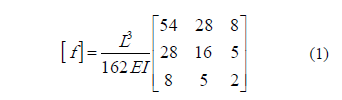
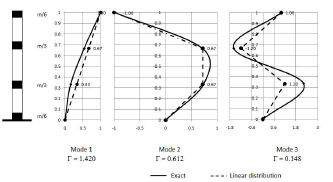
<body><![CDATA[<li><font size="2" face="Verdana, Arial, Helvetica, sans-serif">Definition     of the final reinforcement and geometry to satisfy the required demand for the     three performance levels, considering the effect of higher modes.</font></li>     </ol>     <p><font size="2" face="Verdana, Arial, Helvetica, sans-serif"><b>5.1   Three Degree of-Freedom equivalent system    <br>   </b></font><font size="2" face="Verdana, Arial, Helvetica, sans-serif">The proposed method has been developed to regular structures   where the mass can be considered as uniformly distributed for example buildings   with the same plant in each level. This procedure proposes to concentrate the masses in four   points, distributed at equal distance along the element height, thus; <i>M/6</i> on the ground level and the top and <i>M/3</i> in the two intermediate points (see <a href="#fig01">Figure 1</a>). Therefore, a MDOF system with   fixed-base can be transformed into an equivalent three DOF system. Additionally, the higher modes effect can be   considered in a simple way. The periods calculated from this   simplification are quite close to the exact values calculated from the solution   of the differential equation. Therefore, the proposed   simplification is considered as proper to be adopted in the DBD procedure. In   order to simplify the modal analysis, a linear distribution is proposed for the   first mode and a tri-linear distribution for the second and third modes is   suggested (see <a href="#fig01">Figure 1</a>). This simplification has been proposed as a simple way   to represent and remember the higger modes distribution. The obtained results are considered as   acceptable enough for proposed design. From these distributions, the lateral   forces are determined for each mode, as a proportion to the masses and the   components of the modal shape in the four points defined along the height. The maximum values of acceleration and   displacement for each mode are obtained by equilibrium.</font></p>     <p align="center"><font size="2" face="Verdana, Arial, Helvetica, sans-serif"><b><a name="fig01"></a><img src="/img/revistas/dyna/v77n163/a02fig01.gif">    <br>   Figure 1.</b> Scheme of the Three   Degree of-Freedom equivalent system</font></p>     <p><font size="2" face="Verdana, Arial, Helvetica, sans-serif"><i>5.1.1 Dynamic properties    <br>   </i></font><font size="2" face="Verdana, Arial, Helvetica, sans-serif">To determine the dynamic elastic properties of the structure,   the flexibility matrix is used and it is defined for three displacements in the   following equation:</font></p>     <p><img src="/img/revistas/dyna/v77n163/a02eq01.gif"></p>     <p><font size="2" face="Verdana, Arial, Helvetica, sans-serif">Where <i>L</i> is the   total wall height, <i>E</i> is the   concrete elasticity module, and <i>I</i> is the inertia moment.</font></p>     ]]></body>
<body><![CDATA[<p><font size="2" face="Verdana, Arial, Helvetica, sans-serif">The mass matrix &#91;<i>m</i>&#93;   is equal to:</font></p>     <p><img src="/img/revistas/dyna/v77n163/a02eq02.gif"></p>     <p><font size="2" face="Verdana, Arial, Helvetica, sans-serif">Where <i>m</i> corresponds to the   total structure mass. The equation of the motion governing free vibration has   been used in order to obtain the natural frequencies of vibrations:</font></p>     <p><img src="/img/revistas/dyna/v77n163/a02eq03.gif"></p>     <p><font size="2" face="Verdana, Arial, Helvetica, sans-serif">To obtain a solution, different from the trivial one, the following   condition must be fulfilled:</font></p>     <p><img src="/img/revistas/dyna/v77n163/a02eq04.gif"></p>     <p><font size="2" face="Verdana, Arial, Helvetica, sans-serif">For each one of the three modes of vibrations, the correct frequencies <i>w</i><sub>i</sub>, are obtained as follows: </font></p>     <p><img src="/img/revistas/dyna/v77n163/a02eq05.gif"></p>     <p><font size="2" face="Verdana, Arial, Helvetica, sans-serif">Taking into account   that the fundamental mode of vibration was obtained based on capacity   criteria, the periods of the higher modes are obtained of from equation (5).</font></p>     <p><font size="2" face="Verdana, Arial, Helvetica, sans-serif">For the first mode:</font></p>     ]]></body>
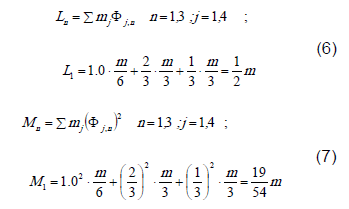
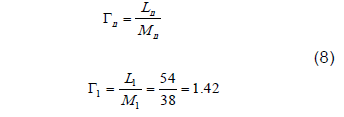
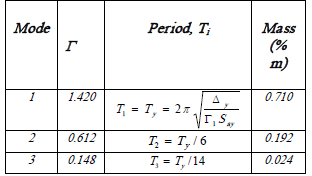
<body><![CDATA[<p><img src="/img/revistas/dyna/v77n163/a02eq0607.gif"></p>     <p><font size="2" face="Verdana, Arial, Helvetica, sans-serif">The modal participation factor: </font></p>     <p><img src="/img/revistas/dyna/v77n163/a02eq08.gif"></p>     <p><font size="2" face="Verdana, Arial, Helvetica, sans-serif">The effective mass for the first mode is equal to 0.71m. In the same way, it can be demonstrated that   the effective mass for the second and third modes are 0.192m and 0.024m, and   that the participation factors are equal to 0.612 and 0.148, respectively. Under this reasoning, the total equivalent   effective mass is 0.927m. Taking into   account the first two modes only, the total equivalent effective mass is equal   to 0.902m, which is enough for practical effects. Through a similar procedure, it can be demonstrated   that to divide the element into three parts is more representative and gives   better results than to divide it into two sections, even if only those values   of the first two modes were taken into account. </font></p>     <p><font size="2" face="Verdana, Arial, Helvetica, sans-serif"><i>5.1.2. Demand calculation and   distribution    <br>   </i></font><font size="2" face="Verdana, Arial, Helvetica, sans-serif">The   demands for each mode depend on the modal form, mass and period according to   the acceleration spectrum. The   coefficients for the corresponding shears and moments are shown in <a href="#fig02">Figure 2</a>. To obtain the values it is necessary to   multiply these coefficients by the building total weight, <i>W=m*g</i> and by the pseudo-acceleration <i>S<sub>a</sub></i>. </font></p>     <p align="center"><font size="2" face="Verdana, Arial, Helvetica, sans-serif"><b><a name="fig02"></a><img src="/img/revistas/dyna/v77n163/a02fig02.gif">    <br>   Figure 2</b>. Moment and shear   distribution of the first three modes of vibration</font></p>     <p><font size="2" face="Verdana, Arial, Helvetica, sans-serif">The shear force, <i>V<sub>b1</sub></i>, and the   moment, <i>M<sub>b1</sub></i>, at the base   are obtained by equilibrium and they correspond to the first yield of the   tension reinforcement. </font></p>     <p><img src="/img/revistas/dyna/v77n163/a02eq0910.gif"></p>     ]]></body>
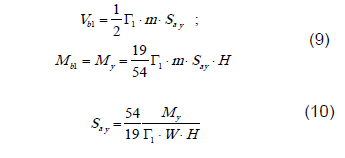
<body><![CDATA[<p><font size="2" face="Verdana, Arial, Helvetica, sans-serif"><i>S<sub>ay</sub></i> is   the pseudo-acceleration, associated with the first yield of the reinforcing   steel, which represents the demand of acceleration, and <i>M<sub>y</sub></i> is the yield moment. The yield displacement for the   wall can be obtained as: </font></p>     <p><img src="/img/revistas/dyna/v77n163/a02eq11.gif"></p>     <p><font size="2" face="Verdana, Arial, Helvetica, sans-serif">Where <i>j<sub>y</sub></i> is the yield curvature.</font></p>     <p><font size="2" face="Verdana, Arial, Helvetica, sans-serif">Modal participation factors and the obtained   periods for the equivalent 3 DOF system are shown in <a href="#tab01">Table 1</a>.</font></p>     <p align="center"><font size="2" face="Verdana, Arial, Helvetica, sans-serif"><b><a name="tab01"></a>Table   1.</b> Modal participation factors and periods of the equivalent three DOF   system</font>    <br>   <img src="/img/revistas/dyna/v77n163/a02tab01.gif"></p>     <p><font size="2" face="Verdana, Arial, Helvetica, sans-serif"><b>5.2 Displacement ductility capacity for the wall    <br>   </b></font><font size="2" face="Verdana, Arial, Helvetica, sans-serif">The   displacement ductility capacity<i> µ<sub>D</sub></i>, is   obtained as the maximum relation between the ultimate displacement <i>D<sub>u</sub></i> and   the yield displacement <i>D<sub>y</sub></i>. Both   displacements are obtained from the curvatures distribution along the height,   by means of the following simplified expressions: </font></p>     <p><img src="/img/revistas/dyna/v77n163/a02eq13.gif"></p>     <p><font size="2" face="Verdana, Arial, Helvetica, sans-serif">where <i>L<sub>p</sub></i> is plastic hinge   length.</font></p>     ]]></body>
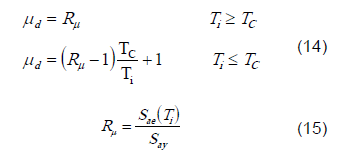
<body><![CDATA[<p><font size="2" face="Verdana, Arial, Helvetica, sans-serif"><b>5.3</b> <b>Displacement ductility demand    <br>   </b></font><font size="2" face="Verdana, Arial, Helvetica, sans-serif">The displacement   ductility demand <i>µ<sub>d</sub></i> is   obtained in terms of the reduction factor, <i>R<sub>u</sub></i>,   the characteristic period of acceleration spectrum <i>T<sub>C</sub></i>, and the period of each mode <i>T<sub>i</sub></i>, when the moment at the base overcomes the yield   moment. Equations (14) and (15) are used to calculate the displacement   ductility demand, <i>µ<sub>d</sub></i> &#91;14&#93;: </font></p>     <p><img src="/img/revistas/dyna/v77n163/a02eq1415.gif"></p>     <p><font size="2" face="Verdana, Arial, Helvetica, sans-serif">Where <i>S<sub>ae</sub></i> is the elastic spectral acceleration for each mode of vibration.</font></p>     <p><font size="2" face="Verdana, Arial, Helvetica, sans-serif"><b>5.4 </b> <b>Comparison between   the capacity and the demand    <br>   </b></font><font size="2" face="Verdana, Arial, Helvetica, sans-serif">It is   necessary to compare the capacity and the demand in terms of the displacement   ductility, maximum drift, the confined concrete strain and longitudinal   reinforcing steel strain in   order to guarantee the fulfillment of the design objectives. </font></p>     <p><font size="2" face="Verdana, Arial, Helvetica, sans-serif">When <i>µ<sub>d</sub></i> is less than the displacement ductility   capacity <i>µ<sub>c</sub></i>, the maximum   drift and the strength must be verified in order to fulfill the requeriments of   the design. In addition, the plastic   hinge length could also be changed.</font></p>     <p><font size="2" face="Verdana, Arial, Helvetica, sans-serif">If the maximum drift value for the three   performance levels is not fulfilled, it is possible to choose one of the   following alternatives or a combination of them: 1) modify the geometry, 2)   modify the conventional reinforcement and/or 3) increase the compression   capacity of the element using post -tensioned reinforcement.</font></p>     <p><font size="2" face="Verdana, Arial, Helvetica, sans-serif"><b>5.5 Final   design details    <br>   </b>The   forces associated with each mode are defined by considering the ductility   demand for each one of them. In general, the effects of the second and third   modes, are not produce yield in steel, therefore, their behaviour is lineal   elastic (demand ductility is equal to 1.0). Otherwise, it is necessary apply   the same procedure employed to the first mode. The final forces that the   structure must resist are obtained as a combination of the three modes of   vibration, through the method of the square root of the squares sum (SRSS). Thus, for these forces, the wall   capacity must be verified in order to fulfill the performance objectives. <a href="#fig03">Figure 3</a> shows a flow chart   squeme of the proposed method. </font></p>     ]]></body>
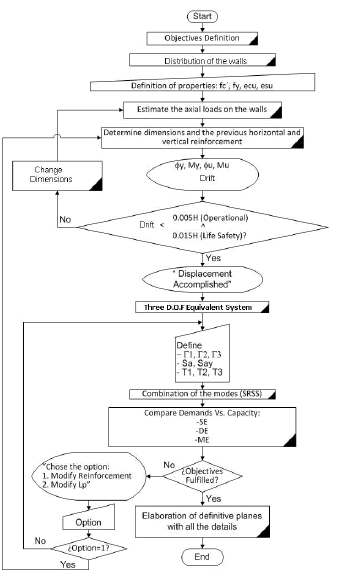
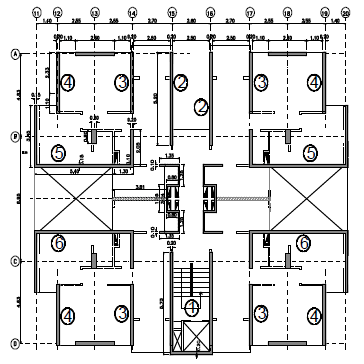
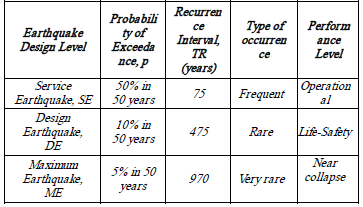
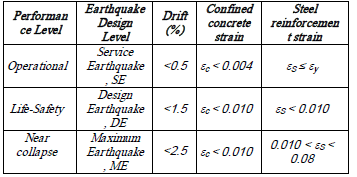
<body><![CDATA[<p align="center"><font size="2" face="Verdana, Arial, Helvetica, sans-serif"><b><a name="fig03"></a><img src="/img/revistas/dyna/v77n163/a02fig03.gif">    <br>   Figure   3</b>. Flow chart squeme of the proposed method</font></p>     <p>&nbsp;</p>     <p><font size="3" face="Verdana, Arial, Helvetica, sans-serif"><b>6. THE APPLICATION CASE</b></font></p>     <p><font size="2" face="Verdana, Arial, Helvetica, sans-serif">The DBD method explained in the previous section   was applied to a structural wall belonging to a 15-storey building, which is   37.50m high and has a floor area of 340m<sup>2</sup> (see <a href="#fig04">Figure 4</a>). All the walls are initially 0.20m thick. A   detailed description can be seen in Urrego and Bonett &#91;13&#93;. </font></p>     <p align="center"><font size="2" face="Verdana, Arial, Helvetica, sans-serif"><b><a name="fig04"></a><img src="/img/revistas/dyna/v77n163/a02fig04.gif">    <br>   Figure 4.</b> Plant view of a 15-storey building</font></p>     <p><font size="2" face="Verdana, Arial, Helvetica, sans-serif"><b>6.1 Performance objectives    <br>   </b>The objectives   are defined in terms of seismic demand and performance. It represents a limit   condition established as a funtion of three essential aspects: 1) The possible   physical damages to the structural and non structural components, 2) The   threatening safety risk of building occupants, induced by these damages and, 3)   The building functionality after the earthquake &#91;15&#93;, &#91;16&#93;. This work, considers three performance levels:   operational, life-safety and collapse prevention. Each level is associated with: a seismic   hazard risk represented by a ground motion which has a certain probability of exceedence, a recurrence period and a   magnitude (see <a href="#tab02">Table 2</a>).</font></p>     <p align="center"><font size="2" face="Verdana, Arial, Helvetica, sans-serif"><b><a name="tab02"></a>Table 2. </b>Description of   the earthquake design levels</font>    ]]></body>
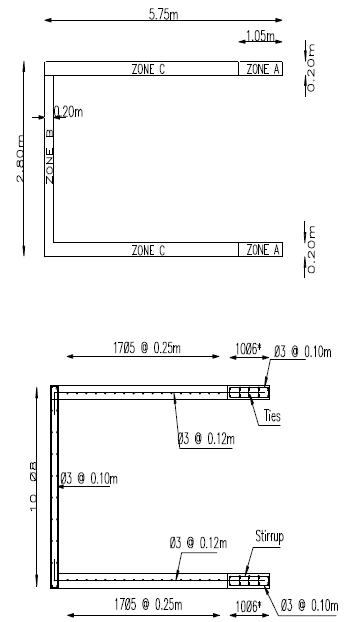
<body><![CDATA[<br>   <img src="/img/revistas/dyna/v77n163/a02tab02.gif"></p>     <p><font size="2" face="Verdana, Arial, Helvetica, sans-serif">The   maximum drift and maximum confined concrete and reinforcing steel strain have   been chosen to control the performance in terms of the structural damage (see <a href="#tab03">Table 3</a>). </font></p>     <p align="center"><font size="2" face="Verdana, Arial, Helvetica, sans-serif"><b><a name="tab03"></a>Table   3.</b> Relation of Performance Objectives, Earthquake Design Levels, and   structural control parameters</font>    <br>   <img src="/img/revistas/dyna/v77n163/a02tab03.gif"></p>     <p><font size="2" face="Verdana, Arial, Helvetica, sans-serif">The adopted values have been chosen based on the   information given by the Committee Vision 2000, experimental tests and the   experience of the authors in the design and post-earthquake evaluation of   structures that have been affected by earthquakes.</font></p>     <p><font size="2" face="Verdana, Arial, Helvetica, sans-serif"><b>6.2 Pre-dimensioning and design parameters    <br>   </b></font><font size="2" face="Verdana, Arial, Helvetica, sans-serif">The proposed method supposes an initial geometry   of the transverse section of the wall, using the following criteria: a) the   height-to-length ratio (<i>H/L<sub>w</sub></i>)   in each direction must be lesss than or equal to 4.0, b) the storey   height-to-wall width (<i>h<sub>n</sub>/b<sub>w</sub></i>)   must be less than or equal to 25 and, c) and the relative compression stress <sub><img src="/img/revistas/dyna/v77n163/a02eq008.gif"></sub> must be less tan   0.2, in order to guarantee that is possible to obtain a displacement ductility   greater than 3. Thus, the fulfillment of the performance objectives can be   attained.</font></p>     <p><font size="2" face="Verdana, Arial, Helvetica, sans-serif">The method begins from supposing 1% and 0.3% of   longitudinal and transversal reinforcement ratios, respectively. The confining effect on the stress-strain   relationships of the concrete is considered, but it is only taken into account   to increase the ultimate compression strain. The increase in the compression   strength is not considered because it can cause spalling of the unconfined concrete   reducing the original section. <a href="#fig05">Figure 5</a> shows the geometry and final   reinforcement array of the wall 1.</font></p>     <p align="center"><font size="2" face="Verdana, Arial, Helvetica, sans-serif"><b><a name="fig05"></a><img src="/img/revistas/dyna/v77n163/a02fig05.gif">    <br>   Figure 5</b>. Plant view of Wall 1. Geometric and   Initial distribution of the reinforcement</font></p>     ]]></body>
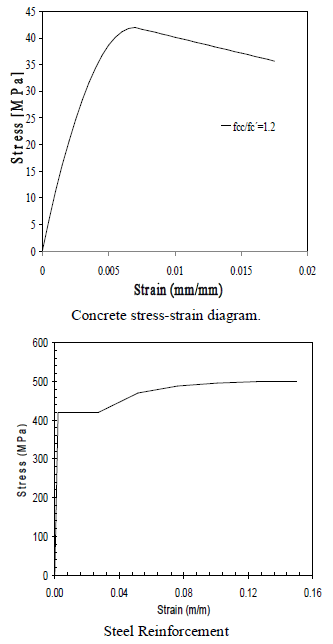
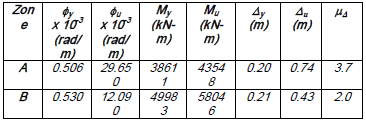
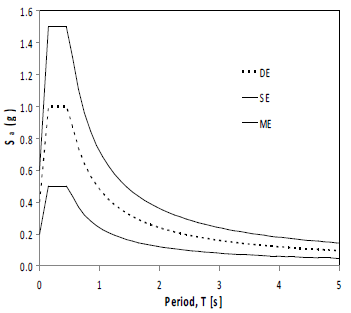
<body><![CDATA[<p><font size="2" face="Verdana, Arial, Helvetica, sans-serif">The concrete nominal   compressive strength is 35 MPa and the nominal yield strength of the steel is   420 MPa. The concrete and steel   stress-strain relationships are shown in <a href="#fig06">Figure 6</a>.</font></p>     <p align="center"><font size="2" face="Verdana, Arial, Helvetica, sans-serif"><b><a name="fig06"></a><img src="/img/revistas/dyna/v77n163/a02fig06.gif">    <br>   Figure 6.</b> Stress-strain diagram</font></p>     <p><font size="2" face="Verdana, Arial, Helvetica, sans-serif"><b>6.3 Wall bending capacity    <br>   </b></font><font size="2" face="Verdana, Arial, Helvetica, sans-serif">Starting   from geometry, the bending capacity of the section is evaluated through the   Moment-Curvature diagram. The bilinear representation is adopted and it is   defined by two states: 1) the first yielding of the tension reinforment steel   and, 2) the maximum compression strain of the confined concrete (see <a href="#tab04">Table 4</a>).   Initially, the plastic hinge length is defined as 10% of the wall height (<i>L<sub>p</sub></i> = 2.5m). Nevertheless, this condition must be verified   and fixed in order to fulfill the three performance objectives guaranteeing   that, for none of the elements, the reinforcement reaches the yield point.</font></p>     <p align="center"><font size="2" face="Verdana, Arial, Helvetica, sans-serif"><b><a name="tab04"></a>Table 4.</b> Moment-curvature bilinear representation for zones A and B</font>    <br>   <img src="/img/revistas/dyna/v77n163/a02tab04.gif"></p>     <p><font size="2" face="Verdana, Arial, Helvetica, sans-serif"><b>6.4 Three Degree of-Freedom equivalent system    <br>   </b></font><font size="2" face="Verdana, Arial, Helvetica, sans-serif"><a href="#tab05">Table 5</a> shows the elastic   spectral acceleration for zone A and the mass for each mode. The spectral   acceleration associated to the yield limit, <i>S<sub>ay</sub></i><sub>,</sub> is equal to 0.217g. The   displacement ductility demand, <i>µ<sub>d</sub></i> is equal to 2.2 and 3.8 to   the first mode of vibration, associated to DE and ME respectively.</font></p>     <p align="center"><font size="2" face="Verdana, Arial, Helvetica, sans-serif"><b><a name="tab05"></a>Table 5.</b> Parameters of the Three Degree of-Freedom Equivalent   System (Zone A)</font>    ]]></body>
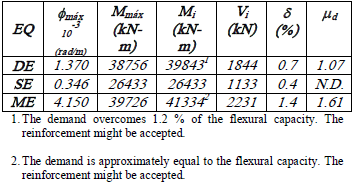
<body><![CDATA[<br>   <img src="/img/revistas/dyna/v77n163/a02tab05.gif"></p>     <p><font size="2" face="Verdana, Arial, Helvetica, sans-serif"><b>6.5 Capacity vs. demand    <br>   </b></font><font size="2" face="Verdana, Arial, Helvetica, sans-serif">The Design Earthquake, DE,   corresponds to the one defined by the UBC-97 for a soil type SB, a seismic   source type B, a nearby field, with a seismic acceleration   and velocity coefficient Ca and <i>C<sub>v</sub></i> equal to 0.4. For the SE   and ME earthquake levels, the design spectrum was factored by 0.5 and 1.5   respectively (See <a href="#fig07">Figure 7</a>).</font></p>     <p align="center"><font size="2" face="Verdana, Arial, Helvetica, sans-serif"><b><a name="fig07"></a><img src="/img/revistas/dyna/v77n163/a02fig07.gif">    <br>   Figure 7.</b> Acceleration Spectra</font></p>     <p><font size="2" face="Verdana, Arial, Helvetica, sans-serif">The final solicitations that   the structure has to resist are obtained as a combination of the three modes of   vibration using the method of the square root of the squares sum (see <a href="#tab06">Table 6</a>).</font></p>     <p align="center"><font size="2" face="Verdana, Arial, Helvetica, sans-serif"><b><a name="tab06"></a>Table 6.</b> Values of the capacity, demand and damage control parameters</font>    <br>   <img src="/img/revistas/dyna/v77n163/a02tab06.gif"></p>     <p><font size="2" face="Verdana, Arial, Helvetica, sans-serif"><b>6.6 Definitive design details    <br>   </b></font><font size="2" face="Verdana, Arial, Helvetica, sans-serif">Since the requirements are   not fulfilled in terms of strength and drifts, it is necessary to increase the   longitudinal reinforcement. In this case, the option is to increase the tension   reinforcement in zone <b>A</b>. The detailed procedure in the previous section   has been redone to fulfill all the requirements. Two iterations were used in   order to accomplish all the performance objectives. </font></p>     ]]></body>
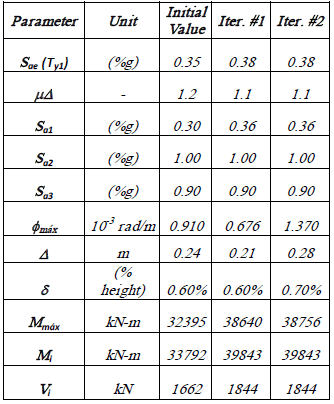
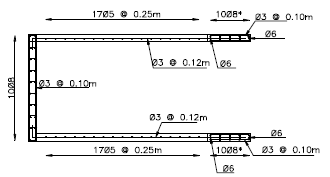
<body><![CDATA[<p><font size="2" face="Verdana, Arial, Helvetica, sans-serif"><a href="#tab07">Table 7</a> shows the obtained   results in terms of the reinforcement ratio for each zone, seismic capacity   represented by Moment-Curvature diagram, displacement ductility and some   dynamic properties, such as the period for the three modes of vibration and   their mass. The demand and control parameters for design, service and   maximum probable Earthquake, are presented in <a href="#tab08">Table 8</a>, <a href="#tab09">9</a> and <a href="#tab10">10</a>, respectively.</font></p>     <p align="center"><font size="2" face="Verdana, Arial, Helvetica, sans-serif"><b><a name="tab07"></a>Table 7.</b> Reinforcement ratio and capacity parameters of the wall. Iterative procedure</font>    <br>   <img src="/img/revistas/dyna/v77n163/a02tab07.gif"></p>     <p align="center"><font size="2" face="Verdana, Arial, Helvetica, sans-serif"><b><a name="tab08"></a>Table 8.</b> Displacement and demand parameters for Design Earthquake</font>    <br>   <img src="/img/revistas/dyna/v77n163/a02tab08.gif"></p>     <p align="center"><font size="2" face="Verdana, Arial, Helvetica, sans-serif"><b><a name="tab09"></a>Table 9.</b> Displacement and demand parameters for Service Earthquake</font>    <br>   <img src="/img/revistas/dyna/v77n163/a02tab09.gif"></p>     <p align="center"><font size="2" face="Verdana, Arial, Helvetica, sans-serif"><b><a name="tab10"></a>Table 10.</b> Displacement and demand parameters for Maximum Earthquake</font>    <br>   <img src="/img/revistas/dyna/v77n163/a02tab10.gif"></p>     <p><font size="2" face="Verdana, Arial, Helvetica, sans-serif">In <a href="#fig08">Figure 8</a>, a detail of the wall appears with the   final array of the reinforcement.</font></p>     ]]></body>
<body><![CDATA[<p align="center"><font size="2" face="Verdana, Arial, Helvetica, sans-serif"><b><a name="fig08"></a><img src="/img/revistas/dyna/v77n163/a02fig08.gif">    <br>   Figure 8.</b> Definitive reinforcement detail</font></p>     <p>&nbsp;</p>     <p><font size="3" face="Verdana, Arial, Helvetica, sans-serif"><b>7. DISCUSSION AND CONCLUSIONS</b></font></p>     <p><font size="2" face="Verdana, Arial, Helvetica, sans-serif">The mathematical model, based   on four masses, allows representing the nonlinear behavior of a medium-rise   reinforced concrete building configured by resistant cantilever walls. In this   case, the participation of the third mode can be omitted. Aditional studies   should be done for low-rise and high-rise buildings. The plastic length is a   variable to be considered and it has to be defined in the design to determine,   in a correct way, the ductility capacity. The designer engineer can fix the   value of this parameter and can also verify the accomplishment of the   performance objectives. The detailed study of the plastic zone is not being   considered in this article.</font></p>     <p><font size="2" face="Verdana, Arial, Helvetica, sans-serif">An optimal reinforcement   design needs to bear in mind the section behavior. When the curvature and the   displacement ductility are supposed, they should be verified. As it is shown in   this work, it is an advantage to begin the design with a reinforcement ratio.   In this article, a step by step procedure is shown, to get the most   satisfactory design. When the design conditions are required, a tri-linear   Moment-Curvature diagram has to be used and should include the concrete tensile   capacity. When deformations over 0.004   are considered, it is necessary to make a confinement of the steel bars due to the buckling rebar.</font></p>     <p><font size="2" face="Verdana, Arial, Helvetica, sans-serif">It is important to know the   overstrength values for the steel to be included in the capacity of the   element. The proposed method has been   verified to the same plant buildings with up to 40 levels.</font></p>     <p>&nbsp;</p>     <p><font size="3" face="Verdana, Arial, Helvetica, sans-serif"><b>ACKNOWLEGMENTS</b></font></p>     <p><font size="2" face="Verdana, Arial, Helvetica, sans-serif">The authors wish to   acknowledge the financial support granted by the "Universidad de Medell&iacute;n"   and "AREA Ingenieros Consultores".</font></p>     ]]></body>
<body><![CDATA[<p>&nbsp;</p>     <p><font size="3" face="Verdana, Arial, Helvetica, sans-serif"><b>REFERENCES</b></font></p>     <!-- ref --><p><font size="2" face="Verdana, Arial, Helvetica, sans-serif"><b>&#91;1&#93;</b> SULLIVAN, T.J., CALVI, G.M., PRIESTLEY, M.J.N., AND KOWALSKY, M.J. (2003). The limitations and performances of different displacement based design methods, Journal of Earthquake Engineering, 7:201-241.     &nbsp;&nbsp;&nbsp;&nbsp;&nbsp;&nbsp;&nbsp;&nbsp;[&#160;<a href="javascript:void(0);" onclick="javascript: window.open('/scielo.php?script=sci_nlinks&ref=000155&pid=S0012-7353201000030000200001&lng=','','width=640,height=500,resizable=yes,scrollbars=1,menubar=yes,');">Links</a>&#160;]<!-- end-ref --><!-- ref --><br>   <b>&#91;2&#93;</b> MOEHLE, J.P. (1992). Displacement-based design of RC structures subjected to earthquakes, Earthquake Spectra, 8(3):403-428.     &nbsp;&nbsp;&nbsp;&nbsp;&nbsp;&nbsp;&nbsp;&nbsp;[&#160;<a href="javascript:void(0);" onclick="javascript: window.open('/scielo.php?script=sci_nlinks&ref=000156&pid=S0012-7353201000030000200002&lng=','','width=640,height=500,resizable=yes,scrollbars=1,menubar=yes,');">Links</a>&#160;]<!-- end-ref --><!-- ref --><br>   <b>&#91;3&#93;</b> KOWALSKY, M.J, PRIESTLEY, M.J.N AND MACRAE, G.A (1994). Displacement-based design, a methodology for seismic design applied to single degree of-freedom reinforced concrete structures. Report No. SSRP- 94/16. Structural Systems Research, University of California, San Diego, La Jolla, California.     &nbsp;&nbsp;&nbsp;&nbsp;&nbsp;&nbsp;&nbsp;&nbsp;[&#160;<a href="javascript:void(0);" onclick="javascript: window.open('/scielo.php?script=sci_nlinks&ref=000157&pid=S0012-7353201000030000200003&lng=','','width=640,height=500,resizable=yes,scrollbars=1,menubar=yes,');">Links</a>&#160;]<!-- end-ref --><!-- ref --><br>   <b>&#91;4&#93;</b> MEDHEKAR, M.S. AND KENNEDY, D.J.L. (2000). Displacement-based seismic design of buildings-theory. Engineering Structures 22, 201-209.     &nbsp;&nbsp;&nbsp;&nbsp;&nbsp;&nbsp;&nbsp;&nbsp;[&#160;<a href="javascript:void(0);" onclick="javascript: window.open('/scielo.php?script=sci_nlinks&ref=000158&pid=S0012-7353201000030000200004&lng=','','width=640,height=500,resizable=yes,scrollbars=1,menubar=yes,');">Links</a>&#160;]<!-- end-ref --><!-- ref --><br>   <b>&#91;5&#93;</b> PRIESTLEY, M.J.N AND KOWALSKY, M.J. (2000). Direct displacement-based seismic design of concrete buildings. Bulletin of the New Zealand National Society for Earthquake Engineering, 33(4):421- 444.     &nbsp;&nbsp;&nbsp;&nbsp;&nbsp;&nbsp;&nbsp;&nbsp;[&#160;<a href="javascript:void(0);" onclick="javascript: window.open('/scielo.php?script=sci_nlinks&ref=000159&pid=S0012-7353201000030000200005&lng=','','width=640,height=500,resizable=yes,scrollbars=1,menubar=yes,');">Links</a>&#160;]<!-- end-ref --><!-- ref --><br>   <b>&#91;6&#93;</b> XUE, QIANG (2001). A direct displacement-based seismic design procedure of inelastic structures. Engineering Structures, (23). 1453-1460.     &nbsp;&nbsp;&nbsp;&nbsp;&nbsp;&nbsp;&nbsp;&nbsp;[&#160;<a href="javascript:void(0);" onclick="javascript: window.open('/scielo.php?script=sci_nlinks&ref=000160&pid=S0012-7353201000030000200006&lng=','','width=640,height=500,resizable=yes,scrollbars=1,menubar=yes,');">Links</a>&#160;]<!-- end-ref --><!-- ref --><br>   <b>&#91;7&#93;</b> PANAGIOTAKOS, T.B. AND FARDIS, M.N. (2001). A displacement-based seismic design procedure for RC buildings and comparison with EC8. Earthquake Engineering and Structural Dynamics. 30:1439-1462.     &nbsp;&nbsp;&nbsp;&nbsp;&nbsp;&nbsp;&nbsp;&nbsp;[&#160;<a href="javascript:void(0);" onclick="javascript: window.open('/scielo.php?script=sci_nlinks&ref=000161&pid=S0012-7353201000030000200007&lng=','','width=640,height=500,resizable=yes,scrollbars=1,menubar=yes,');">Links</a>&#160;]<!-- end-ref --><!-- ref --><br>   <b>&#91;8&#93;</b> KOWALSKY, MERVYN J. (2002). A displacement-based approach for the seismic design of continuous concrete bridges. Earthquake Engineering and Structural Dynamics. 31:719-747.     &nbsp;&nbsp;&nbsp;&nbsp;&nbsp;&nbsp;&nbsp;&nbsp;[&#160;<a href="javascript:void(0);" onclick="javascript: window.open('/scielo.php?script=sci_nlinks&ref=000162&pid=S0012-7353201000030000200008&lng=','','width=640,height=500,resizable=yes,scrollbars=1,menubar=yes,');">Links</a>&#160;]<!-- end-ref --><!-- ref --><br>   <b>&#91;9&#93;</b> SULLIVAN, T. J., PRIESTLEY, M. J. N. AND CALVI, G. M. (2006). Direct Displacement-Based Design Of Frame-Wall Structures. Journal of Earthquake Engineering. Vol. 10, Special Issue 1, 91-124.     &nbsp;&nbsp;&nbsp;&nbsp;&nbsp;&nbsp;&nbsp;&nbsp;[&#160;<a href="javascript:void(0);" onclick="javascript: window.open('/scielo.php?script=sci_nlinks&ref=000163&pid=S0012-7353201000030000200009&lng=','','width=640,height=500,resizable=yes,scrollbars=1,menubar=yes,');">Links</a>&#160;]<!-- end-ref --><!-- ref --><br>   <b>&#91;10&#93;</b> RESTREPO, J.I. AND PRETI, M.A. (2006). Two-level Displacement-based Design Methodology for Structural Wall Buildings. 2nd Fib Congress, Naples, Italy.     &nbsp;&nbsp;&nbsp;&nbsp;&nbsp;&nbsp;&nbsp;&nbsp;[&#160;<a href="javascript:void(0);" onclick="javascript: window.open('/scielo.php?script=sci_nlinks&ref=000164&pid=S0012-7353201000030000200010&lng=','','width=640,height=500,resizable=yes,scrollbars=1,menubar=yes,');">Links</a>&#160;]<!-- end-ref --><!-- ref --><br>   <b>&#91;11&#93;</b> PANAGIOTOU, M. (2008). Seismic design, testing and analysis of reinforced concrete wall buildings. A dissertation submitted in partial satisfaction of the requirements for the degree Doctor of Philosophy in Structural Engineering. University of California, San Diego.     &nbsp;&nbsp;&nbsp;&nbsp;&nbsp;&nbsp;&nbsp;&nbsp;[&#160;<a href="javascript:void(0);" onclick="javascript: window.open('/scielo.php?script=sci_nlinks&ref=000165&pid=S0012-7353201000030000200011&lng=','','width=640,height=500,resizable=yes,scrollbars=1,menubar=yes,');">Links</a>&#160;]<!-- end-ref --><!-- ref --><br>   <b>&#91;12&#93;</b> FIB. (2003). Displacement-based Seismic Design of Reinforced Concrete Buildings. State-of-art Report. Federation International de Beton, Lausanne Switzerland, 196 p.     &nbsp;&nbsp;&nbsp;&nbsp;&nbsp;&nbsp;&nbsp;&nbsp;[&#160;<a href="javascript:void(0);" onclick="javascript: window.open('/scielo.php?script=sci_nlinks&ref=000166&pid=S0012-7353201000030000200012&lng=','','width=640,height=500,resizable=yes,scrollbars=1,menubar=yes,');">Links</a>&#160;]<!-- end-ref --><!-- ref --><br>   <b>&#91;13&#93;</b> URREGO, H. and BONETT, R.L. (2008). A displacement-based analysis and design procedure for structural walls. Proceeding of the 14th World Conference on Earthquake Engineering. October 12-17. Beijing-China.     &nbsp;&nbsp;&nbsp;&nbsp;&nbsp;&nbsp;&nbsp;&nbsp;[&#160;<a href="javascript:void(0);" onclick="javascript: window.open('/scielo.php?script=sci_nlinks&ref=000167&pid=S0012-7353201000030000200013&lng=','','width=640,height=500,resizable=yes,scrollbars=1,menubar=yes,');">Links</a>&#160;]<!-- end-ref --><!-- ref --><br>   <b>&#91;14&#93;</b> FAJFAR, P. (1999). Capacity spectrum method based on inelastic demand spectra. Earthquake Engineering and Structural Dynamics. 28. 979-993.     &nbsp;&nbsp;&nbsp;&nbsp;&nbsp;&nbsp;&nbsp;&nbsp;[&#160;<a href="javascript:void(0);" onclick="javascript: window.open('/scielo.php?script=sci_nlinks&ref=000168&pid=S0012-7353201000030000200014&lng=','','width=640,height=500,resizable=yes,scrollbars=1,menubar=yes,');">Links</a>&#160;]<!-- end-ref --><!-- ref --><br>   <b>&#91;15&#93;</b> SEAOC. Vision 2000 (1995). Performance Based Seismic Engineering of Buildings. Structural Engineers Association of California, Sacramento.     &nbsp;&nbsp;&nbsp;&nbsp;&nbsp;&nbsp;&nbsp;&nbsp;[&#160;<a href="javascript:void(0);" onclick="javascript: window.open('/scielo.php?script=sci_nlinks&ref=000169&pid=S0012-7353201000030000200015&lng=','','width=640,height=500,resizable=yes,scrollbars=1,menubar=yes,');">Links</a>&#160;]<!-- end-ref --><!-- ref --><br>   <b>&#91;16&#93;</b> ATC-40. (1996). Seismic evaluation and retrofit of concrete buildings, Vol. 1. Applied Technology Council, Redwood City (California) </font>&nbsp;&nbsp;&nbsp;&nbsp;&nbsp;&nbsp;&nbsp;&nbsp;[&#160;<a href="javascript:void(0);" onclick="javascript: window.open('/scielo.php?script=sci_nlinks&ref=000170&pid=S0012-7353201000030000200016&lng=','','width=640,height=500,resizable=yes,scrollbars=1,menubar=yes,');">Links</a>&#160;]<!-- end-ref --> ]]></body><back>
<ref-list>
<ref id="B1">
<label>1</label><nlm-citation citation-type="journal">
<person-group person-group-type="author">
<name>
<surname><![CDATA[SULLIVAN]]></surname>
<given-names><![CDATA[T.J]]></given-names>
</name>
<name>
<surname><![CDATA[CALVI]]></surname>
<given-names><![CDATA[G.M]]></given-names>
</name>
<name>
<surname><![CDATA[PRIESTLEYM]]></surname>
<given-names><![CDATA[J.N]]></given-names>
</name>
<name>
<surname><![CDATA[KOWALSKY]]></surname>
<given-names><![CDATA[M.J]]></given-names>
</name>
</person-group>
<article-title xml:lang="en"><![CDATA[The limitations and performances of different displacement based design methods]]></article-title>
<source><![CDATA[Journal of Earthquake Engineering]]></source>
<year>2003</year>
<numero>7</numero>
<issue>7</issue>
<page-range>201-241</page-range></nlm-citation>
</ref>
<ref id="B2">
<label>2</label><nlm-citation citation-type="journal">
<person-group person-group-type="author">
<name>
<surname><![CDATA[MOEHLE]]></surname>
<given-names><![CDATA[J.P]]></given-names>
</name>
</person-group>
<article-title xml:lang="en"><![CDATA[Displacement-based design of RC structures subjected to earthquakes]]></article-title>
<source><![CDATA[Earthquake Spectra]]></source>
<year>1992</year>
<volume>8</volume>
<numero>3</numero>
<issue>3</issue>
<page-range>403-428</page-range></nlm-citation>
</ref>
<ref id="B3">
<label>3</label><nlm-citation citation-type="book">
<person-group person-group-type="author">
<name>
<surname><![CDATA[KOWALSKY]]></surname>
<given-names><![CDATA[M.J]]></given-names>
</name>
<name>
<surname><![CDATA[PRIESTLEY]]></surname>
<given-names><![CDATA[M.J.N]]></given-names>
</name>
<name>
<surname><![CDATA[MACRAE]]></surname>
<given-names><![CDATA[G.A]]></given-names>
</name>
</person-group>
<article-title xml:lang="en"><![CDATA[Displacement-based design, a methodology for seismic design applied to single degree of-freedom reinforced concrete structures]]></article-title>
<source><![CDATA[Report No. SSRP- 94/16: Structural Systems Research]]></source>
<year>1994</year>
<publisher-loc><![CDATA[San Diego^eCaliforniaLa Jolla California]]></publisher-loc>
<publisher-name><![CDATA[University of California]]></publisher-name>
</nlm-citation>
</ref>
<ref id="B4">
<label>4</label><nlm-citation citation-type="journal">
<person-group person-group-type="author">
<name>
<surname><![CDATA[MEDHEKAR]]></surname>
<given-names><![CDATA[M.S.]]></given-names>
</name>
<name>
<surname><![CDATA[KENNEDY]]></surname>
<given-names><![CDATA[D.J.L]]></given-names>
</name>
</person-group>
<article-title xml:lang="en"><![CDATA[Displacement-based seismic design of buildings-theory]]></article-title>
<source><![CDATA[Engineering Structures]]></source>
<year>2000</year>
<numero>22</numero>
<issue>22</issue>
<page-range>201-209</page-range></nlm-citation>
</ref>
<ref id="B5">
<label>5</label><nlm-citation citation-type="journal">
<person-group person-group-type="author">
<name>
<surname><![CDATA[PRIESTLEY]]></surname>
<given-names><![CDATA[M.J.N]]></given-names>
</name>
<name>
<surname><![CDATA[KOWALSKY]]></surname>
<given-names><![CDATA[M.J]]></given-names>
</name>
</person-group>
<article-title xml:lang="en"><![CDATA[Direct displacement-based seismic design of concrete buildings]]></article-title>
<source><![CDATA[Bulletin of the New Zealand National Society for Earthquake Engineering]]></source>
<year>2000</year>
<volume>33</volume>
<numero>4</numero>
<issue>4</issue>
<page-range>421- 444</page-range></nlm-citation>
</ref>
<ref id="B6">
<label>6</label><nlm-citation citation-type="journal">
<person-group person-group-type="author">
<name>
<surname><![CDATA[XUE]]></surname>
<given-names><![CDATA[QIANG]]></given-names>
</name>
</person-group>
<article-title xml:lang="en"><![CDATA[A direct displacement-based seismic design procedure of inelastic structures.]]></article-title>
<source><![CDATA[Engineering Structures]]></source>
<year>2001</year>
<volume>23</volume>
<page-range>1453-1460</page-range></nlm-citation>
</ref>
<ref id="B7">
<label>7</label><nlm-citation citation-type="">
<person-group person-group-type="author">
<name>
<surname><![CDATA[PANAGIOTAKOS]]></surname>
<given-names><![CDATA[T.B]]></given-names>
</name>
<name>
<surname><![CDATA[FARDIS]]></surname>
<given-names><![CDATA[M.N.]]></given-names>
</name>
</person-group>
<article-title xml:lang="en"><![CDATA[A displacement-based seismic design procedure for RC buildings and comparison with EC8]]></article-title>
<source><![CDATA[]]></source>
<year>2001</year>
<numero>30</numero>
<issue>30</issue>
<page-range>1439-1462.</page-range></nlm-citation>
</ref>
<ref id="B8">
<label>8</label><nlm-citation citation-type="journal">
<person-group person-group-type="author">
<name>
<surname><![CDATA[KOWALSKY]]></surname>
<given-names><![CDATA[MERVYN J.]]></given-names>
</name>
</person-group>
<article-title xml:lang="en"><![CDATA[A displacement-based approach for the seismic design of continuous concrete bridges.]]></article-title>
<source><![CDATA[Earthquake Engineering and Structural Dynamics]]></source>
<year>2002</year>
<numero>31</numero>
<issue>31</issue>
<page-range>719-747.</page-range></nlm-citation>
</ref>
<ref id="B9">
<label>9</label><nlm-citation citation-type="journal">
<person-group person-group-type="author">
<name>
<surname><![CDATA[SULLIVAN]]></surname>
<given-names><![CDATA[T. J.]]></given-names>
</name>
<name>
<surname><![CDATA[PRIESTLEY]]></surname>
<given-names><![CDATA[M. J. N.]]></given-names>
</name>
<name>
<surname><![CDATA[CALVI]]></surname>
<given-names><![CDATA[G. M.]]></given-names>
</name>
</person-group>
<article-title xml:lang="en"><![CDATA[Direct Displacement-Based Design Of Frame-Wall Structures]]></article-title>
<source><![CDATA[Journal of Earthquake Engineering]]></source>
<year>2006</year>
<volume>10</volume>
<numero>1</numero>
<issue>1</issue>
<page-range>91-124</page-range></nlm-citation>
</ref>
<ref id="B10">
<label>10</label><nlm-citation citation-type="confpro">
<person-group person-group-type="author">
<name>
<surname><![CDATA[RESTREPO]]></surname>
<given-names><![CDATA[J.I]]></given-names>
</name>
<name>
<surname><![CDATA[PRETI]]></surname>
<given-names><![CDATA[M.A]]></given-names>
</name>
</person-group>
<article-title xml:lang="en"><![CDATA[Two-level Displacement-based Design Methodology for Structural Wall Buildings]]></article-title>
<source><![CDATA[]]></source>
<year>2006</year>
<conf-name><![CDATA[2 Fib Congress]]></conf-name>
<conf-loc>Naples </conf-loc>
</nlm-citation>
</ref>
<ref id="B11">
<label>11</label><nlm-citation citation-type="">
<person-group person-group-type="author">
<name>
<surname><![CDATA[PANAGIOTOU]]></surname>
<given-names><![CDATA[M.]]></given-names>
</name>
</person-group>
<source><![CDATA[Seismic design, testing and analysis of reinforced concrete wall buildings.]]></source>
<year>2008</year>
</nlm-citation>
</ref>
<ref id="B12">
<label>12</label><nlm-citation citation-type="book">
<collab>FIB</collab>
<source><![CDATA[Displacement-based Seismic Design of Reinforced Concrete Buildings: State-of-art Report]]></source>
<year>2003</year>
<publisher-loc><![CDATA[Lausanne ]]></publisher-loc>
<publisher-name><![CDATA[Federation International de Beton]]></publisher-name>
</nlm-citation>
</ref>
<ref id="B13">
<label>13</label><nlm-citation citation-type="confpro">
<person-group person-group-type="author">
<name>
<surname><![CDATA[URREGO]]></surname>
<given-names><![CDATA[H]]></given-names>
</name>
<name>
<surname><![CDATA[BONETT]]></surname>
<given-names><![CDATA[R.L.]]></given-names>
</name>
</person-group>
<article-title xml:lang="en"><![CDATA[A displacement-based analysis and design procedure for structural walls]]></article-title>
<source><![CDATA[]]></source>
<year>2008</year>
<conf-name><![CDATA[14 World Conference on Earthquake Engineering]]></conf-name>
<conf-date>October 12-17</conf-date>
<conf-loc>Beijing </conf-loc>
</nlm-citation>
</ref>
<ref id="B14">
<label>14</label><nlm-citation citation-type="journal">
<person-group person-group-type="author">
<name>
<surname><![CDATA[FAJFAR]]></surname>
<given-names><![CDATA[P]]></given-names>
</name>
</person-group>
<article-title xml:lang="en"><![CDATA[Capacity spectrum method based on inelastic demand spectra]]></article-title>
<source><![CDATA[Earthquake Engineering and Structural Dynamics]]></source>
<year>1999</year>
<numero>28</numero>
<issue>28</issue>
<page-range>979-993</page-range></nlm-citation>
</ref>
<ref id="B15">
<label>15</label><nlm-citation citation-type="book">
<collab>SEAOC</collab>
<article-title xml:lang="en"><![CDATA[Vision 2000]]></article-title>
<source><![CDATA[Performance Based Seismic Engineering of Buildings]]></source>
<year>1995</year>
<publisher-loc><![CDATA[Sacramento ]]></publisher-loc>
<publisher-name><![CDATA[Structural Engineers Association of California]]></publisher-name>
</nlm-citation>
</ref>
<ref id="B16">
<label>16</label><nlm-citation citation-type="">
<source><![CDATA[Seismic evaluation and retrofit of concrete buildings]]></source>
<year>1996</year>
<volume>1</volume>
<publisher-loc><![CDATA[Redwood City^eCalifornia California]]></publisher-loc>
</nlm-citation>
</ref>
</ref-list>
</back>
</article>