<?xml version="1.0" encoding="ISO-8859-1"?><article xmlns:mml="http://www.w3.org/1998/Math/MathML" xmlns:xlink="http://www.w3.org/1999/xlink" xmlns:xsi="http://www.w3.org/2001/XMLSchema-instance">
<front>
<journal-meta>
<journal-id>0012-7353</journal-id>
<journal-title><![CDATA[DYNA]]></journal-title>
<abbrev-journal-title><![CDATA[Dyna rev.fac.nac.minas]]></abbrev-journal-title>
<issn>0012-7353</issn>
<publisher>
<publisher-name><![CDATA[Universidad Nacional de Colombia]]></publisher-name>
</publisher>
</journal-meta>
<article-meta>
<article-id>S0012-73532010000300014</article-id>
<title-group>
<article-title xml:lang="en"><![CDATA[MODELING OF DIRECT SOLAR RADIATION IN A COMPOUND PARABOLIC COLLECTOR (CPC) WITH THE RAY TRACING TECHNIQUE]]></article-title>
<article-title xml:lang="es"><![CDATA[MODELAMIENTO DE LA REFLEXIÓN SOLAR DIRECTA EN UN COLECTOR PARABÓLICO COMPUESTO (CPC) USANDO LA TÉCNICA DE "RAY-TRACING"]]></article-title>
</title-group>
<contrib-group>
<contrib contrib-type="author">
<name>
<surname><![CDATA[COLINA-MÁRQUEZ]]></surname>
<given-names><![CDATA[JOSÉ A.]]></given-names>
</name>
<xref ref-type="aff" rid="A01"/>
</contrib>
<contrib contrib-type="author">
<name>
<surname><![CDATA[LÓPEZ-VÁSQUEZ]]></surname>
<given-names><![CDATA[ANDRÉS F.]]></given-names>
</name>
<xref ref-type="aff" rid="A02"/>
</contrib>
<contrib contrib-type="author">
<name>
<surname><![CDATA[MACHUCA-MARTÍNEZ]]></surname>
<given-names><![CDATA[FIDERMAN]]></given-names>
</name>
<xref ref-type="aff" rid="A03"/>
</contrib>
</contrib-group>
<aff id="A01">
<institution><![CDATA[,Universidad de Cartagena Departamento de Ingeniería Química ]]></institution>
<addr-line><![CDATA[ ]]></addr-line>
</aff>
<aff id="A02">
<institution><![CDATA[,Universidad Libre Bogotá Deparatmento de Ingenieria Ambiental ]]></institution>
<addr-line><![CDATA[ ]]></addr-line>
</aff>
<aff id="A03">
<institution><![CDATA[,Universidad del Valle Escuela de Ingeniería Química ]]></institution>
<addr-line><![CDATA[Cali ]]></addr-line>
<country>Colombia</country>
</aff>
<pub-date pub-type="pub">
<day>00</day>
<month>09</month>
<year>2010</year>
</pub-date>
<pub-date pub-type="epub">
<day>00</day>
<month>09</month>
<year>2010</year>
</pub-date>
<volume>77</volume>
<numero>163</numero>
<fpage>132</fpage>
<lpage>140</lpage>
<copyright-statement/>
<copyright-year/>
<self-uri xlink:href="http://www.scielo.org.co/scielo.php?script=sci_arttext&amp;pid=S0012-73532010000300014&amp;lng=en&amp;nrm=iso"></self-uri><self-uri xlink:href="http://www.scielo.org.co/scielo.php?script=sci_abstract&amp;pid=S0012-73532010000300014&amp;lng=en&amp;nrm=iso"></self-uri><self-uri xlink:href="http://www.scielo.org.co/scielo.php?script=sci_pdf&amp;pid=S0012-73532010000300014&amp;lng=en&amp;nrm=iso"></self-uri><abstract abstract-type="short" xml:lang="en"><p><![CDATA[The compound parabolic collector (CPC) is a widely used technology in photochemical applications, like photocatalytic reactions. For kinetic purposes in this kind of reaction, the radiation distribution has to be well known, since the reaction rate is strongly dependent on the photon absorption rate. The present work develops a mathematical model which allows simulating the reflection of direct solar radiation on a CPC. Using analytical geometry and vector calculation, equations were evaluated, first for calculating the Cartesian coordinates of the reflecting surface. Later these points are used to calculate incident and reflected rays layouts on the collector. Visual Basic (Excel environment) program was developed for data generation and plotting the reflected rays at any instant. The incident radiation on the receptor was plotted separately displaying the daily direct energy distribution in the absorber. Also the involute length (collector) was calculated with these data, which can be very useful information for collector construction. Results obtained after simulations show that the distribution of incident energy on the absorber surface depends on the surface reflectivity. The incident energy is larger at the top of the absorber than the bottom zone and it is more convenient higher surface reflectivities for more uniform energy distributions. This mathematical model can be a first approach for absorption models which include direct solar radiation in photochemical or photothermal applications.]]></p></abstract>
<abstract abstract-type="short" xml:lang="es"><p><![CDATA[El colector parabólico compuesto (CPC) es una tecnología ampliamente usada en aplicaciones fotoquímicas, como las reacciones fotocatalíticas. Para propósitos cinéticos en esta clase de reacciones, se debe conocer la distribución de la radiación ya que la velocidad de reacción depende la absorción de fotones. En el presente trabajo desarrolló un modelo matemático que permitió simular el fenómeno de reflexión de la radiación solar directa en un CPC. Las ecuaciones se evaluaron usando geometría analítica y cálculo vectorial, primero para calcular las coordenadas cartesianas de la superficie reflectiva. Luego estos puntos se usaron para calcular las trayectorias de los rayos incidentes y reflejados en cualquier instante. La radiación incidente en el receptor se graficó independientemente, mostrando la distribución de la energía directa que llega directamente al absorbedor. La longitud de la involuta también se calculó a partir de estos datos, los cuales pueden resultar muy útiles para su construcción. Los resultados obtenidos a partir de las simulaciones muestran que la distribución de la energía incidente en la superficie del absorbedor depende de la reflectividad de la superficie del CPC. La energía incidente es mayor en la parte superior que en la inferior del absorbedor, y son más convenientes valores altos de reflectividad para distribuciones de energía más uniformes. Este modelo matemático puede ser una primera aproximación para modelos más complejos de absorción de fotones que incluyan radiación solar directa en aplicaciones fotoquímicas o fototérmicas.]]></p></abstract>
<kwd-group>
<kwd lng="en"><![CDATA[CPC]]></kwd>
<kwd lng="en"><![CDATA[direct radiation]]></kwd>
<kwd lng="en"><![CDATA[modeling]]></kwd>
<kwd lng="en"><![CDATA[reflection]]></kwd>
<kwd lng="es"><![CDATA[CPC]]></kwd>
<kwd lng="es"><![CDATA[radiacióndirecta]]></kwd>
<kwd lng="es"><![CDATA[reflexión]]></kwd>
</kwd-group>
</article-meta>
</front><body><![CDATA[ <p align="center"><font size="4" face="Verdana, Arial, Helvetica, sans-serif"><b>MODELING OF DIRECT SOLAR RADIATION IN A COMPOUND PARABOLIC COLLECTOR (CPC) WITH THE RAY TRACING TECHNIQUE</b></font></p>     <p align="center"><i><b><font size="3" face="Verdana, Arial, Helvetica, sans-serif">MODELAMIENTO DE LA REFLEXI&Oacute;N SOLAR DIRECTA EN UN COLECTOR PARAB&Oacute;LICO COMPUESTO (CPC) USANDO LA T&Eacute;CNICA DE &ldquo;RAY-TRACING&rdquo;</font></b></i></p>     <p align="center">&nbsp; </p>     <p align="center"><font size="2" face="Verdana, Arial, Helvetica, sans-serif"><b>JOS&Eacute; A. COLINA-M&Aacute;RQUEZ</b>    <br>   </font><font size="2" face="Verdana, Arial, Helvetica, sans-serif"><i>Departamento de Ingenier&iacute;a Qu&iacute;mica. Universidad de   Cartagena, <a href="mailto:jcolinam@unicartagena.edu.co">jcolinam@unicartagena.edu.co</a></i></font></p>     <p align="center"><font size="2" face="Verdana, Arial, Helvetica, sans-serif"><b>ANDR&Eacute;S F. L&Oacute;PEZ-V&Aacute;SQUEZ</b>    <br>   <i>Chemical Engineer,   M. Sc. Deparatmento de Ingenieria Ambiental. Universidad Libre Bogot&aacute;, <a href="mailto:andresf.lopez@unilibrebog.edu.co">andresf.lopez@unilibrebog.edu.co</a></i></font></p>     <p align="center"><font size="2" face="Verdana, Arial, Helvetica, sans-serif"><b>FIDERMAN MACHUCA-MART&Iacute;NEZ</b>    <br>   </font><font size="2" face="Verdana, Arial, Helvetica, sans-serif"><i>Escuela de Ingenier&iacute;a   Qu&iacute;mica. Universidad del   Valle, Cali (Colombia), <a href="mailto:fiderman.machuca@correounivalle.edu.co">fiderman.machuca@correounivalle.edu.co</a></i></font></p>     <p align="center">&nbsp; </p>     ]]></body>
<body><![CDATA[<p align="center"><font size="2" face="Verdana, Arial, Helvetica, sans-serif"><b>Received for review August   26<sup>th</sup>, 2009, accepted   March 4<sup>th</sup>, 2010, final version April,   18<sup>th</sup>, 2010</b></font></p>     <p align="center">&nbsp; </p> <hr>     <p><font size="2" face="Verdana, Arial, Helvetica, sans-serif"><b>ABSTRACT:</b> The compound parabolic   collector (CPC) is a widely used technology in photochemical applications, like   photocatalytic reactions. For kinetic purposes in   this kind of reaction, the radiation distribution has to be well known, since   the reaction rate is strongly dependent on the photon   absorption rate. The present work develops a mathematical model which allows   simulating the reflection of direct solar radiation on a   CPC. Using analytical geometry and vector calculation, equations were   evaluated, first for calculating the Cartesian coordinates of the reflecting   surface. Later these points are used to calculate incident and reflected rays   layouts on the collector. Visual Basic (Excel environment) program was   developed for data generation and plotting the reflected rays at any instant.   The incident radiation on the receptor was plotted separately displaying the daily direct   energy distribution in the absorber. Also the involute   length (collector) was calculated with these data, which can be very useful   information for collector construction. Results obtained after simulations show   that the distribution of incident energy on the absorber surface depends on the   surface reflectivity. The incident energy is larger at the top of the absorber than   the bottom zone and it is more convenient higher surface reflectivities   for more uniform energy distributions. This mathematical model can be a first   approach for absorption models which include direct solar radiation in   photochemical or photothermal applications.</font></p>     <p><font size="2" face="Verdana, Arial, Helvetica, sans-serif"><b>KEYWORDS:</b> CPC,   direct radiation, modeling, reflection. </font></p>     <p><font size="2" face="Verdana, Arial, Helvetica, sans-serif"><b>RESUMEN:</b> El colector   parab&oacute;lico compuesto (CPC) es una tecnolog&iacute;a ampliamente usada en aplicaciones   fotoqu&iacute;micas, como las reacciones fotocatal&iacute;ticas.   Para prop&oacute;sitos cin&eacute;ticos en esta clase de reacciones, se debe conocer la   distribuci&oacute;n de la radiaci&oacute;n ya que la velocidad de reacci&oacute;n depende la   absorci&oacute;n de fotones. En el presente trabajo desarroll&oacute; un modelo matem&aacute;tico   que permiti&oacute; simular el fen&oacute;meno de reflexi&oacute;n de la radiaci&oacute;n solar directa en   un CPC. Las ecuaciones se evaluaron usando geometr&iacute;a anal&iacute;tica y c&aacute;lculo   vectorial, primero para calcular las coordenadas cartesianas de la superficie reflectiva. Luego estos puntos se usaron para calcular las   trayectorias de los rayos incidentes y reflejados en cualquier instante. La   radiaci&oacute;n incidente en el receptor se grafic&oacute; independientemente, mostrando la   distribuci&oacute;n de la energ&iacute;a directa que llega directamente al absorbedor. La   longitud de la involuta tambi&eacute;n se calcul&oacute; a partir de estos datos, los cuales   pueden resultar muy &uacute;tiles para su construcci&oacute;n. Los resultados obtenidos a   partir de las simulaciones muestran que la distribuci&oacute;n de la energ&iacute;a incidente   en la superficie del absorbedor depende de la reflectividad   de la superficie del CPC. La energ&iacute;a incidente es mayor en la parte superior   que en la inferior del absorbedor, y son m&aacute;s convenientes valores altos de reflectividad para distribuciones de energ&iacute;a m&aacute;s uniformes.   Este modelo matem&aacute;tico puede ser una primera aproximaci&oacute;n para modelos m&aacute;s   complejos de absorci&oacute;n de fotones que incluyan radiaci&oacute;n solar directa en   aplicaciones fotoqu&iacute;micas o fotot&eacute;rmicas.</font></p>     <p><font size="2" face="Verdana, Arial, Helvetica, sans-serif"><b>PALABRASCLAVE:</b> CPC,   radiaci&oacute;ndirecta, reflexi&oacute;n</font></p> <hr>     <p>&nbsp;</p>     <p><font size="3" face="Verdana, Arial, Helvetica, sans-serif"><b>1. INTRODUCTION</b></font></p>     <p><font size="2" face="Verdana, Arial, Helvetica, sans-serif">The solar energy is   an important part of the renewable energies. Their abundance and low cost are   two great strategic advantages, that they turn it an excellent energy alternative   for developed and developing countries. Since 1970, the research has been   oriented to find ways to take advantage of the energy in a more efficient   manner &#91;1&#93;.</font></p>     <p><font size="2" face="Verdana, Arial, Helvetica, sans-serif">A low yield in the   use of this kind of energy is one the major disadvantages respect to other   conventional energy sources. In this aspect, the development of the solar   concentrators becomes important, since they are devices that improve   considerably the performance of systems which use solar energy for its   operation. The most outstanding physical obstacle in these systems is the area   that must be exposed for obtaining the maximum use of the solar energy, so the   objective of a concentrator is to redirect the largest quantity of radiation to   a certain available area. Most studies about collectors design &#91;2-4&#93; have been focused to improve   the radiation-to-available area ratio. Different types of collectors have been   proposed for obtaining the maximal amount of radiation redirected to a specific   absorber.</font></p>     ]]></body>
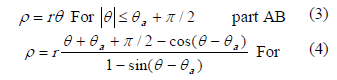
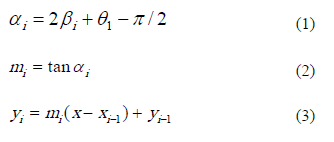
<body><![CDATA[<p><font size="2" face="Verdana, Arial, Helvetica, sans-serif">The compound   parabolic concentrators (CPC) are curved screens designed to redistribute the   solar radiation such as diffuse and direct one, in cylindrical absorbers. The   geometry of these collectors is determined by the form of the absorber, and it   is very important to increase the use of the solar radiation &#91;5&#93;. Initially, this device was   proposed to photothermal applications &#91;2,6&#93;. Nonetheless, the CPC has been mainly applied to the   photochemical </font><font size="2" face="Verdana, Arial, Helvetica, sans-serif">treatment of   polluted water &#91;7-12&#93;. The solar detoxification of   polluted wastewaters with CPC photocatalytic reactors   has widely studied &#91;5,7,8,12-15&#93;, with the modeling and   scaling-up of these reactors as the most challenging aspects of the photochemical   applications. The modeling of the radiation field is one of the most difficult   tasks that has to be faced, and there are several works reported regarding to   the solution of this problem. Arancibia-Bulnes et al. &#91;16,17&#93; developed an approach for   modeling radiation fields in parabolic through collectors and CPC based in the   so-called P1 model. Alfano et al. &#91;18,19&#93; have proposed a more rigorous   approach that implies the numerical solution of the radiative   transfer equation (RTE). Mueses et al. &#91;20&#93; made an approach based in an   effective area of the absorber by fitting parameters to experimental data. </font></p>     <p><font size="2" face="Verdana, Arial, Helvetica, sans-serif">The modeling of direct solar radiation in a   CPC can be made by using the "ray-tracing" technique. Although the first   applications of this procedure was aimed to model shadows and 3-D solids &#91;21-24&#93;, the reflection of radiation in a CPC has   been also modeled by ray-tracing-based computer programs &#91;11,25&#93;. However, the obtained plots for reflected   radiation in a CPC have been used only for descriptive purposes and they do not   provide useful information for modeling or scaling-up this kind of photoreactors. In this work, the modeling work was aimed to   generate the data that could describe the collector involute   curve, which can be used in their later production by tools that use numeric   control; and to obtain data and equations which can model how the incident rays in the   adjacent regions to the absorber are reflected toward its body.</font></p>     <p>&nbsp;</p>     <p><b><font size="3" face="Verdana, Arial, Helvetica, sans-serif">2. MATERIAL   AND METHODS</font></b></p>     <p><font size="2" face="Verdana, Arial, Helvetica, sans-serif">A program was   elaborated based on Visual Basic of Microsoft Excel XP, which generated a   series of coordinates in the <i>XY</i> plane   that describes the curve of the CPC, the circumference of the absorber, and the   incident and reflected rays by the collector, starting from analytical geometry   and vectors' calculus.</font></p>     <p>&nbsp;</p>     <p><font size="2" face="Verdana, Arial, Helvetica, sans-serif"><b>3. MATHEMATICAL EXPRESSIONS</b></font></p>     <p><font size="2" face="Verdana, Arial, Helvetica, sans-serif">The Cartesian plane origin corresponds to the   circular absorber centre and (<i>x,y</i>) coordinates of the absorber circumference   were calculated with the following equations: </font></p>     <p><img src="/img/revistas/dyna/v77n163/a14eq0102.gif"></p>     <p><font size="2" face="Verdana, Arial, Helvetica, sans-serif"><b>3.1. Compound Parabolic Concentrator    ]]></body>
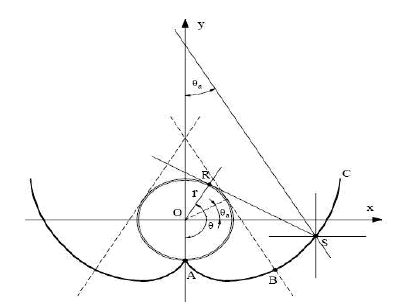
<body><![CDATA[<br>   </b></font><font size="2" face="Verdana, Arial, Helvetica, sans-serif">For the collector, the corresponding expression   is an ordinary involute of the circumference before   described, since the acceptance angle is equal to 90º (See <a href="#fig01">figure 1</a>). The   general equations for acceptance angles &#91;11&#93; are given by:</font></p>     <p><img src="/img/revistas/dyna/v77n163/a14eq0304.gif"></p>     <p align="center"><font size="2" face="Verdana, Arial, Helvetica, sans-serif"><b><a name="fig01"></a><img src="/img/revistas/dyna/v77n163/a14fig01.gif">    <br>   Figure 1.</b> CPC acceptance   angle</font></p>     <p><font size="2" face="Verdana, Arial, Helvetica, sans-serif">According to prior works &#91;11&#93;, an optimum value for   acceptance angle is between 60º and 90º. This value is used later for calculate   the concentration ratio of the CPC according to the following equation: </font></p>     <p><img src="/img/revistas/dyna/v77n163/a14eq05.gif"></p>     <p><font size="2" face="Verdana, Arial, Helvetica, sans-serif">For constructing the CPC curve with Cartesian   coordinates, expressions can be deduced starting from analytic geometry, where involute is built like a normal curve to the tangents that   define the curve of the absorber &#91;26&#93;, see <a href="#fig02">figure 2</a>.</font></p>     <p align="center"><font size="2" face="Verdana, Arial, Helvetica, sans-serif"><b><a name="fig02"></a><img src="/img/revistas/dyna/v77n163/a14fig02.gif">    <br>   Figure 2.</b> Involute construction</font></p>     <p><font size="2" face="Verdana, Arial, Helvetica, sans-serif">The BC segment corresponds to the    OB radius perpendicular and its longitude corresponds to   the AB circumference arch length and point C corresponds to an involute point. As point O is Cartesian plane origin, the   coordinates of the point C are given by the following parametric equations:</font></p>     ]]></body>

<body><![CDATA[<p><img src="/img/revistas/dyna/v77n163/a14eq0607.gif"></p>     <p><font size="2" face="Verdana, Arial, Helvetica, sans-serif">The t parameter corresponds to the angle AOB   measured in radians from the OA axis and negative in counter clockwise. </font></p>     <p><font size="2" face="Verdana, Arial, Helvetica, sans-serif"><b>3.2. Vectors expressions for reflection   geometry    <br>   </b></font><font size="2" face="Verdana, Arial, Helvetica, sans-serif">Considering a specular surface, then incidence and reflection angles respect   to the perpendicular of reflecting surface are equal. Using parameterized   equations (6) and (7), a vectorial equation for   position <b>r</b> can be evaluated as   follows: </font></p>     <p><img src="/img/revistas/dyna/v77n163/a14eq08.gif"></p>     <p><font size="2" face="Verdana, Arial, Helvetica, sans-serif">Where the unitary tangent vector <b>T</b> is given by the expression: </font></p>     <p><img src="/img/revistas/dyna/v77n163/a14eq09.gif"></p>     <p><font size="2" face="Verdana, Arial, Helvetica, sans-serif">And the unitary normal vector <b>N</b> is given by this expression: </font></p>     <p><img src="/img/revistas/dyna/v77n163/a14eq10.gif"></p>     <p><font size="2" face="Verdana, Arial, Helvetica, sans-serif">Where normal vector <b>N</b> is given by Eq. (10) after evaluating the corresponding   derivatives, the following expressions were obtained: </font></p>     ]]></body>
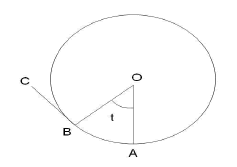
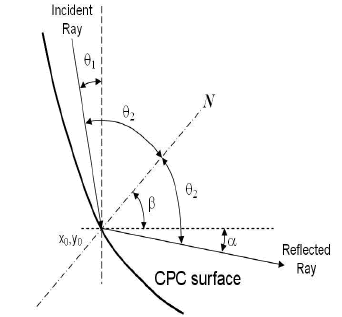
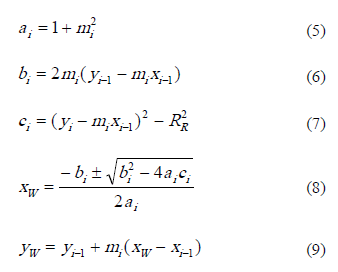
<body><![CDATA[<p><img src="/img/revistas/dyna/v77n163/a14eq1112.gif"></p>     <p align="center"><font size="2" face="Verdana, Arial, Helvetica, sans-serif"><b><a name="fig03"></a><img src="/img/revistas/dyna/v77n163/a14fig03.gif">    <br>   Figure 3.</b> Incident ray trajectory on   CPC surface</font></p>     <p><font size="2" face="Verdana, Arial, Helvetica, sans-serif">The <b><i>N</i></b> vector forms a <i><font face="Symbol">b</font> </i>angle respect to the horizontal   axis determined in the equations (9) and (10), and it can be calculated as follows: </font></p>     <p><img src="/img/revistas/dyna/v77n163/a14eq13.gif"></p>     <p><font size="2" face="Verdana, Arial, Helvetica, sans-serif">The incidence and reflection angles were   estimated from the angle of the axis normal to the CPC surface (<a href="#fig01">Figure 1</a>) by considering the collector   surfaces as specular. Eqs. (14-16) describe the   reflection phenomenon as follows, (1)</font></p>     <p><img src="/img/revistas/dyna/v77n163/a14eq1416.gif"></p>     <p><font size="2" face="Verdana, Arial, Helvetica, sans-serif">where <i>i</i> corresponds to   a consecutive reflection on the CPC surface, <i>q<sub>1</sub></i> is the angle of the incident ray measured from   the <i>y</i>-axis and <i>a</i> is the reflected   ray measured from the positive <i>x</i>-axis.   The reflected ray modeled by Eq. (16) can intercept a point on the reflective   surface or the reactor wall. This was determined in an iterative process which   estimated if the reflected ray hits the reactor wall before than the CPC   surface. The reactor wall circumference is described by Eq. (17).</font></p>     <p><img src="/img/revistas/dyna/v77n163/a14eq17.gif"></p>     <p><font size="2" face="Verdana, Arial, Helvetica, sans-serif">Eq. (16) was substituted in Eq. (17) resulting   in a second grade equation that was solved with Eqs.   (18-22):</font></p>     ]]></body>

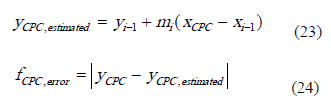
<body><![CDATA[<p><img src="/img/revistas/dyna/v77n163/a14eq1822.gif"></p>     <p><font size="2" face="Verdana, Arial, Helvetica, sans-serif">Eqs. (21-22) correspond   to the coordinates of the points where the reflected ray could intercept the   reactor wall. If these equations did not have real solutions, it means that the   reflected ray intercepted a point on the CPC surface instead the reactor wall.   In that case, the coordinates of this CPC point were estimated numerically due   to the complexity of the analytical solution of the involved equations. The   error-function developed in Eq. (25) allowed estimating the coordinates of such   point.</font></p>     <p><img src="/img/revistas/dyna/v77n163/a14eq2324.gif"></p>     <p><font size="2" face="Verdana, Arial, Helvetica, sans-serif">where <i>x<sub>CPC</sub></i> and <i>y<sub>CPC</sub></i> were calculated with Eqs. (6-7), and <i>y<sub>CPC</sub>,estimated</i> was calculated with the reflected ray equation (Eq. (23)). The   error-function was evaluated for the points of the entire CPC involute, and the selected point was the one with the   minimal error (<i>f<sub>CPC,error</sub></i>). </font></p>     <p><font size="2" face="Verdana, Arial, Helvetica, sans-serif">After the necessary iterations, the coordinates   where the ray was reflected by the CPC surface, as well where it hit the   reactor wall, were calculated.</font></p>     <p><font size="2" face="Verdana, Arial, Helvetica, sans-serif"><b>3.3. Reflectivity and incident energy on the   absorber CPC</b>    <br>   </font><font size="2" face="Verdana, Arial, Helvetica, sans-serif">Incident energy (<i>E<sub>inc</sub></i>) on the absorber surface   given in (25) depends on the incoming energy (<i>E<sub>0</sub></i>), surface reflectivity (<font face="Symbol">r</font><i></i>) and the number of successive reflections (<i>n</i>) on the specular   surface of collector. This energy can be calculated from the Snell's law of   reflectance as follows:</font></p>     <p><img src="/img/revistas/dyna/v77n163/a14eq25.gif"></p>     <p><font size="2" face="Verdana, Arial, Helvetica, sans-serif"><b>3.4. Sun path modeling    <br>   </b></font><font size="2" face="Verdana, Arial, Helvetica, sans-serif">The sun movement in the sky was modeled from the   elevation angle and the azimuth calculated values, from sunrise to sunset, for   the corresponding latitude and longitude of the place where the collector will   be located &#91;27&#93;. This model helped to obtain   a complementary expression for calculating total incident energy of Eq. (25), where   the solar time (<i>t</i>) can be calculated from   incoming ray angle (<i><font face="Symbol">q</font><sub>1</sub></i>)   and declination (<i><font face="Symbol">d</font></i>):</font></p>     ]]></body>
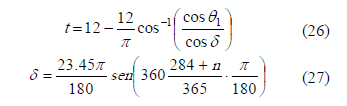
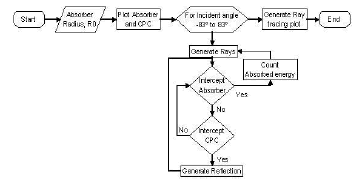
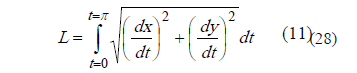
<body><![CDATA[<p><img src="/img/revistas/dyna/v77n163/a14eq2627.gif"></p>     <p><font size="2" face="Verdana, Arial, Helvetica, sans-serif"><b>3.5. Calculation of CPC length    <br>   </b></font><font size="2" face="Verdana, Arial, Helvetica, sans-serif">The integral of line was evaluated to determine   the involute length in (28): </font></p>     <p><img src="/img/revistas/dyna/v77n163/a14eq28.gif"></p>     <p><font size="2" face="Verdana, Arial, Helvetica, sans-serif"><b>3.6. Algorithm flow sheet    <br>   </b></font><font size="2" face="Verdana, Arial, Helvetica, sans-serif">The figure shows the   algorithm flow sheet uses in the calculus</font></p>     <p align="center"><font size="2" face="Verdana, Arial, Helvetica, sans-serif"><b><a name="fig04"></a><img src="/img/revistas/dyna/v77n163/a14fig04.gif">    <br>   Figure 4.</b> Algorithm Flow sheet</font></p>     <p>&nbsp;</p>     <p><font size="3" face="Verdana, Arial, Helvetica, sans-serif"><b>4. RESULTS AND DISCUSSION</b></font></p>     ]]></body>
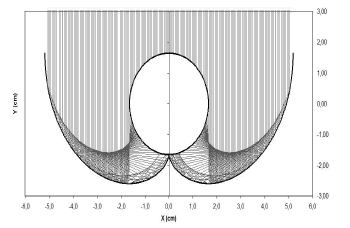
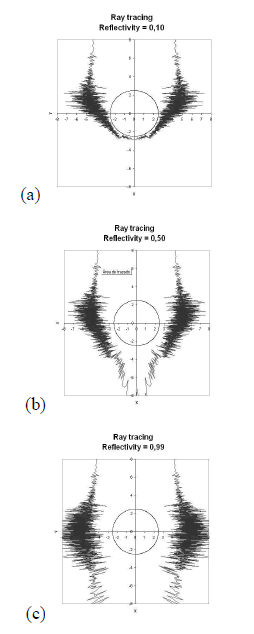
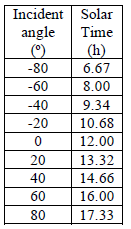
<body><![CDATA[<p><font size="2" face="Verdana, Arial, Helvetica, sans-serif">Simulations were run   varying incoming angle with 1º increments, generating 200 rays in each run (see <a href="#fig05">figure 5</a>). Each simulation provided an incident energy amount on the absorber   surface. Although the incoming radiant energy value was taken arbitrarily, the   distribution depended on the surface reflectivity. For photothermal   or photochemical applications, reflectivity value can be adjusted to actual   values of materials like ECP-244® and SA-85P® (both manufactured by 3M), present   in commercial CPC used for water treatment &#91;11&#93;. </font></p>     <p align="center"><font size="2" face="Verdana, Arial, Helvetica, sans-serif"><b><a name="fig05"></a><img src="/img/revistas/dyna/v77n163/a14fig05.gif">    <br>   Figure 5.</b> Ray-tracing with   an incident angle of 0&deg;</font></p>     <p><font size="2" face="Verdana, Arial, Helvetica, sans-serif">An acceptance angle of 90º was used for data   generation of CPC involute plot. Involute   covers until 7.9 cm   approximately in horizontal axis, giving an additional area of irradiation to   the absorber, as seen in <a href="#fig05">figure 5</a>. Even the absorber zones which were not   exposed to direct radiation received some energy after successive reflections. </font></p>     <p><font size="2" face="Verdana, Arial, Helvetica, sans-serif">The picture of <a href="#fig05">Figure 5</a> was comparable to the   reported in literature &#91;11,25&#93; obtained from commercial   computer programs. That points that the proposed equations were reliable and   could model faithfully the reflection phenomenon of the solar direct radiation   in a CPC. All the direct radiation that hit the collector surfaces could be   reflected to the circular absorber as it was expected.</font></p>     <p><font size="2" face="Verdana, Arial, Helvetica, sans-serif">The total incident energy resulted from the   summation of the incident energies of each run of simulation that corresponds   to a specific incoming angle which varies depending on the sun position (azimuth and elevation angle). </font></p>     <p><font size="2" face="Verdana, Arial, Helvetica, sans-serif"><a href="#tab01">Table 1</a> shows data for a specific day (April 20<sup>th</sup>)   considering that there is no surface azimuth angle, and the angle respect the   horizontal surface is equal to the location latitude. For evaluating the direct   incident radiation along this day, the solar time expression (26) based in   declination value (which depends on the selected day of the year for the simulation) of equation (27).</font></p>     <p align="center"><font size="2" face="Verdana, Arial, Helvetica, sans-serif"><b><a name="tab01"></a>Table 1.</b> Data for April 20<sup>th</sup></font>    <br>   <img src="/img/revistas/dyna/v77n163/a14tab01.gif"></p>     <p><font size="2" face="Verdana, Arial, Helvetica, sans-serif"><a href="#fig06">Figures 6a</a>, <a href="#fig06">6b</a> and <a href="#fig06">6c</a> show the energy distribution results of three different simulations varying   the collector surface reflectivity. The circumference corresponds to absorber   and the plot around it represents the energy distribution. When the energy   distribution plot is located near the absorber surface means that this zone of   the absorber received low amounts of incident energy, meanwhile if the plot is   far from surface, the incident energy amounts are larger.</font></p>     ]]></body>
<body><![CDATA[<p align="center"><font size="2" face="Verdana, Arial, Helvetica, sans-serif"><b><a name="fig06"></a><img src="/img/revistas/dyna/v77n163/a14fig06.gif">    <br>   Figure 6.</b> Incident energy on absorber surface   for different reflectivities. a) 0.10, b)   0.50, c) 0.99</font></p>     <p><font size="2" face="Verdana, Arial, Helvetica, sans-serif">The incident energy plots provided a good idea   of the behavior for the incident photon flux in photochemical applications.   This information can be useful for studying the photon absorption effect in CPC   solar reactors. This procedure can be coupled to mathematical models proposed   in literature &#91;11,16-18,28&#93; for modeling the photon   absorption phenomenon in photocatalytic reactions,   and by this way, to estimate truly intrinsic rate laws for this kind of processes. The incident energy profiles were comparable   to the obtained in a previous work carried out by Malato   et al. &#91;11&#93;. This further observation   confirmed that the model proposed in this study is valid for photochemical   applications.</font></p>     <p><font size="2" face="Verdana, Arial, Helvetica, sans-serif">It was possible to calculate the involute length by using the Eq. (28). Numerical   integration was used for this integral evaluation. For this case, with an   absorber of 2.5 cm   of radius, the length of the involute was equal to 12.34 cm. This data are   very useful in collector construction since the sheet   dimensions can be determined from them.</font></p>     <p>&nbsp;</p>     <p><font size="3" face="Verdana, Arial, Helvetica, sans-serif"><b>5. CONCLUSIONS</b></font></p>     <p><font size="2" face="Verdana, Arial, Helvetica, sans-serif">This model gives a   good first approach for more complex mathematical models which involve total   radiation including scattered and direct components. Also, it can be a useful   tool for developing absorption models in photochemical applications, and   obtaining more rigorous kinetic models in photocatalytic   reactions which employ CPC as photoreactors. </font></p>     <p><font size="2" face="Verdana, Arial, Helvetica, sans-serif">The simulations with three reflectivity values   showed that higher reflective materials give more uniform energy distribution, being   more convenient for photochemical or photothermal applications which use solar   radiation as energy source. Lower reflectivity values give poor incident energy   distribution at rear zones of the absorber (as seen in <a href="#fig06">Figure 6a</a>). </font></p>     <p><font size="2" face="Verdana, Arial, Helvetica, sans-serif">By using simple expressions from analytical geometry and vectorial calculus, mathematical model can be obtained with   reasonable rigor degree. This tool could model diffuse radiation with the help   of a reliable random numbers generator.</font></p>     <p> </p>     ]]></body>
<body><![CDATA[<p><font size="3" face="Verdana, Arial, Helvetica, sans-serif"><b>ACKNOWLEDGEMENTS </b></font></p>     <p><font size="2" face="Verdana, Arial, Helvetica, sans-serif">Authors thank to the Vice-Head   Office of Research of the Universidad del Valle (Grant   2520) and COLCIENCIAS by the financial support (Grant 110647922029). </font></p>     <p> </p>     <p><font size="3" face="Verdana, Arial, Helvetica, sans-serif"><b>REFERENCES</b></font></p>     <!-- ref --><p><font size="2" face="Verdana, Arial, Helvetica, sans-serif"><b>&#91;1&#93;</b> ZEKAI S. "Solar energy in progress and future research trends". Prog. Energy Combust. Sci.,(30), 367-416, 2004.     &nbsp;&nbsp;&nbsp;&nbsp;&nbsp;&nbsp;&nbsp;&nbsp;[&#160;<a href="javascript:void(0);" onclick="javascript: window.open('/scielo.php?script=sci_nlinks&ref=000107&pid=S0012-7353201000030001400001&lng=','','width=640,height=500,resizable=yes,scrollbars=1,menubar=yes,');">Links</a>&#160;]<!-- end-ref --><!-- ref --><br>   <b>&#91;2&#93;</b> HATWAAMBO S., HAKANSSON H., NILSSON J., KARLSSON B. "Angular characterization of low concentrating PV-CPC using low-cost reflectors". Solar Energy Material and Solar Cells,92, (11), 1347-1351, 2008.     &nbsp;&nbsp;&nbsp;&nbsp;&nbsp;&nbsp;&nbsp;&nbsp;[&#160;<a href="javascript:void(0);" onclick="javascript: window.open('/scielo.php?script=sci_nlinks&ref=000108&pid=S0012-7353201000030001400002&lng=','','width=640,height=500,resizable=yes,scrollbars=1,menubar=yes,');">Links</a>&#160;]<!-- end-ref --><!-- ref --><br>   <b>&#91;3&#93;</b> Meinel A., Meinel M. Applied Solar Energy - An introduction. Reading - USA: Addison-Wesley Publishig Company; 1977.     &nbsp;&nbsp;&nbsp;&nbsp;&nbsp;&nbsp;&nbsp;&nbsp;[&#160;<a href="javascript:void(0);" onclick="javascript: window.open('/scielo.php?script=sci_nlinks&ref=000109&pid=S0012-7353201000030001400003&lng=','','width=640,height=500,resizable=yes,scrollbars=1,menubar=yes,');">Links</a>&#160;]<!-- end-ref --><!-- ref --><br>   <b>&#91;4&#93;</b> MOUSAZADEH H., KEYHANI A., JAVADI A., MOBLI H., ABRINIA K., SHARIFI A. "A review of principle and sun-tracking methods for maximizing solar systems output". Renewable and Sustainable Energy Reviews,13, (8), 1800-1818, 2009.     &nbsp;&nbsp;&nbsp;&nbsp;&nbsp;&nbsp;&nbsp;&nbsp;[&#160;<a href="javascript:void(0);" onclick="javascript: window.open('/scielo.php?script=sci_nlinks&ref=000110&pid=S0012-7353201000030001400004&lng=','','width=640,height=500,resizable=yes,scrollbars=1,menubar=yes,');">Links</a>&#160;]<!-- end-ref --><!-- ref --><br>   <b>&#91;5&#93;</b> S. Malato. "Photocatalytic reactors for the treatment of liquid wastewater in the presence of solar irradiation". Thessalonica. Vol. February, pp. 1-16. 2004. <a href="http://www.psa.es/webeng/projects/cadox/documents/Solarphotoreactors.pdf" target="referencias">http://www.psa.es/webeng/projects/cadox/documents/Solarphotoreactors.pdf</a>     &nbsp;&nbsp;&nbsp;&nbsp;&nbsp;&nbsp;&nbsp;&nbsp;[&#160;<a href="javascript:void(0);" onclick="javascript: window.open('/scielo.php?script=sci_nlinks&ref=000111&pid=S0012-7353201000030001400005&lng=','','width=640,height=500,resizable=yes,scrollbars=1,menubar=yes,');">Links</a>&#160;]<!-- end-ref --><!-- ref --><br>   <b>&#91;6&#93;</b> FASULO A., ODICINO L., PERELLO D. "Development of a CPC with low thermal losses". Solar & Wind Technology,4, (2), 157-162, 1987.     &nbsp;&nbsp;&nbsp;&nbsp;&nbsp;&nbsp;&nbsp;&nbsp;[&#160;<a href="javascript:void(0);" onclick="javascript: window.open('/scielo.php?script=sci_nlinks&ref=000112&pid=S0012-7353201000030001400006&lng=','','width=640,height=500,resizable=yes,scrollbars=1,menubar=yes,');">Links</a>&#160;]<!-- end-ref --><!-- ref --><br>   <b>&#91;7&#93;</b> AJONA J., VIDAL A. "The use of CPC collectors for detoxification of contaminated water: Design, construction and preliminary results". Sol. Energy,68, (1), 109-120, 2000.     &nbsp;&nbsp;&nbsp;&nbsp;&nbsp;&nbsp;&nbsp;&nbsp;[&#160;<a href="javascript:void(0);" onclick="javascript: window.open('/scielo.php?script=sci_nlinks&ref=000113&pid=S0012-7353201000030001400007&lng=','','width=640,height=500,resizable=yes,scrollbars=1,menubar=yes,');">Links</a>&#160;]<!-- end-ref --><!-- ref --><br>   <b>&#91;8&#93;</b> COLINA-M&Aacute;RQUEZ J., D&Iacute;AZ D., REND&Oacute;N A., L&Oacute;PEZ-V&Aacute;SQUEZ A., MACHUCA-MART&Iacute;NEZ F. "Photocatalytic Treatment of A Dye Polluted Industrial Effluent With A Solar Pilot-Scale CPC Reactor". J. Adv. Oxid. Technol.,12, (1), 93-99, 2009.     &nbsp;&nbsp;&nbsp;&nbsp;&nbsp;&nbsp;&nbsp;&nbsp;[&#160;<a href="javascript:void(0);" onclick="javascript: window.open('/scielo.php?script=sci_nlinks&ref=000114&pid=S0012-7353201000030001400008&lng=','','width=640,height=500,resizable=yes,scrollbars=1,menubar=yes,');">Links</a>&#160;]<!-- end-ref --><!-- ref --><br>   <b>&#91;9&#93;</b> MALATO S., BLANCO J., RICHTER C., CURC&Oacute; D., GIM&Eacute;NEZ J. "Low-concentrating CPC collectors for photocatalytic water detoxification: Comparison with a medium concentrating solar collector". Water Sci. Technol.,35, (4), 157-164, 1997.     &nbsp;&nbsp;&nbsp;&nbsp;&nbsp;&nbsp;&nbsp;&nbsp;[&#160;<a href="javascript:void(0);" onclick="javascript: window.open('/scielo.php?script=sci_nlinks&ref=000115&pid=S0012-7353201000030001400009&lng=','','width=640,height=500,resizable=yes,scrollbars=1,menubar=yes,');">Links</a>&#160;]<!-- end-ref --><!-- ref --><br>   <b>&#91;10&#93;</b> MALATO S., BLANCO J., C&Aacute;CERES J., FERN&Aacute;NDEZ-ALBA A.R., AGÜERA A., RODR&Iacute;GUEZ A. "Photocatalytic treatment of water-soluble pesticides by photo-Fenton and TiO2 using solar energy". Catal. Today,76), 209-220, 2002.     &nbsp;&nbsp;&nbsp;&nbsp;&nbsp;&nbsp;&nbsp;&nbsp;[&#160;<a href="javascript:void(0);" onclick="javascript: window.open('/scielo.php?script=sci_nlinks&ref=000116&pid=S0012-7353201000030001400010&lng=','','width=640,height=500,resizable=yes,scrollbars=1,menubar=yes,');">Links</a>&#160;]<!-- end-ref --><!-- ref --><br>   <b>&#91;11&#93;</b> MALATO S., BLANCO J., MALDONADO R., FERN&Aacute;NDEZ P., ALARC&Oacute;N D., COLLARES-PEREIRA M., FARINHA J., CORREIA DE OLIVEIRA J. "Engineering of solar photocatalytic collectors". Sol. Energy,77, (5), 513-524, 2004.     &nbsp;&nbsp;&nbsp;&nbsp;&nbsp;&nbsp;&nbsp;&nbsp;[&#160;<a href="javascript:void(0);" onclick="javascript: window.open('/scielo.php?script=sci_nlinks&ref=000117&pid=S0012-7353201000030001400011&lng=','','width=640,height=500,resizable=yes,scrollbars=1,menubar=yes,');">Links</a>&#160;]<!-- end-ref --><!-- ref --><br>   <b>&#91;12&#93;</b> MALATO S., BLANCO J., VIDAL A., RICHTER C. "Photocatalytic decontamination and disinfection of water with solar collectors". Catal. Today,122, (1-2), 137-149, 2007.     &nbsp;&nbsp;&nbsp;&nbsp;&nbsp;&nbsp;&nbsp;&nbsp;[&#160;<a href="javascript:void(0);" onclick="javascript: window.open('/scielo.php?script=sci_nlinks&ref=000118&pid=S0012-7353201000030001400012&lng=','','width=640,height=500,resizable=yes,scrollbars=1,menubar=yes,');">Links</a>&#160;]<!-- end-ref --><!-- ref --><br>   <b>&#91;13&#93;</b> BAHNEMANN D. "Photocatalytic water treatment: solar energy applications". Sol. Energy,(77), 445-459, 2004.     &nbsp;&nbsp;&nbsp;&nbsp;&nbsp;&nbsp;&nbsp;&nbsp;[&#160;<a href="javascript:void(0);" onclick="javascript: window.open('/scielo.php?script=sci_nlinks&ref=000119&pid=S0012-7353201000030001400013&lng=','','width=640,height=500,resizable=yes,scrollbars=1,menubar=yes,');">Links</a>&#160;]<!-- end-ref --><!-- ref --><br>   <b>&#91;14&#93;</b> BANDALA E., ARANCIBIA-BULNES C., OROZCO S., ESTRADA C. "Solar photoreactors comparison based in oxalic acid photocatalytic degradation". Sol. Energy,(77), 503-512, 2004.     &nbsp;&nbsp;&nbsp;&nbsp;&nbsp;&nbsp;&nbsp;&nbsp;[&#160;<a href="javascript:void(0);" onclick="javascript: window.open('/scielo.php?script=sci_nlinks&ref=000120&pid=S0012-7353201000030001400014&lng=','','width=640,height=500,resizable=yes,scrollbars=1,menubar=yes,');">Links</a>&#160;]<!-- end-ref --><!-- ref --><br>   <b>&#91;15&#93;</b> MALATO S., BLANCO J., VIDAL A., RICHTER C. "Photocatalysis with solar energy at a pilot-plant scale: An overview". Appl. Catal. B-Environ.,(37), 1-15, 2002.     &nbsp;&nbsp;&nbsp;&nbsp;&nbsp;&nbsp;&nbsp;&nbsp;[&#160;<a href="javascript:void(0);" onclick="javascript: window.open('/scielo.php?script=sci_nlinks&ref=000121&pid=S0012-7353201000030001400015&lng=','','width=640,height=500,resizable=yes,scrollbars=1,menubar=yes,');">Links</a>&#160;]<!-- end-ref --><!-- ref --><br>   <b>&#91;16&#93;</b> ARANCIBIA-BULNES C., CUEVAS S.A. "Modeling of the radiation field in a parabolic trough solar photocatalytic reactor". Sol. Energy,(76), 615-622, 2003.     &nbsp;&nbsp;&nbsp;&nbsp;&nbsp;&nbsp;&nbsp;&nbsp;[&#160;<a href="javascript:void(0);" onclick="javascript: window.open('/scielo.php?script=sci_nlinks&ref=000122&pid=S0012-7353201000030001400016&lng=','','width=640,height=500,resizable=yes,scrollbars=1,menubar=yes,');">Links</a>&#160;]<!-- end-ref --><!-- ref --><br>   <b>&#91;17&#93;</b> ARANCIBIA-BULNES C., JIM&Eacute;NEZ A., ESTRADA C. "Development and Modeling of Solar Photocatalytic Reactors". Adv. Chem. Eng.,36), 185-227, 2009.     &nbsp;&nbsp;&nbsp;&nbsp;&nbsp;&nbsp;&nbsp;&nbsp;[&#160;<a href="javascript:void(0);" onclick="javascript: window.open('/scielo.php?script=sci_nlinks&ref=000123&pid=S0012-7353201000030001400017&lng=','','width=640,height=500,resizable=yes,scrollbars=1,menubar=yes,');">Links</a>&#160;]<!-- end-ref --><!-- ref --><br>   <b>&#91;18&#93;</b> ALFANO O., CASSANO A. "Photoreactor Modeling: Applications to Advanced Oxidation Processes". Int. J. Chem. Reactor Eng.,6, (P2), 1-20, 2008.     &nbsp;&nbsp;&nbsp;&nbsp;&nbsp;&nbsp;&nbsp;&nbsp;[&#160;<a href="javascript:void(0);" onclick="javascript: window.open('/scielo.php?script=sci_nlinks&ref=000124&pid=S0012-7353201000030001400018&lng=','','width=640,height=500,resizable=yes,scrollbars=1,menubar=yes,');">Links</a>&#160;]<!-- end-ref --><!-- ref --><br>   <b>&#91;19&#93;</b> ALFANO O., CASSANO A. "Scaling-Up of Photoreactors: Applications to Advanced Oxidation Processes". Adv. Chem. Eng.,36), 226-287, 2009.     &nbsp;&nbsp;&nbsp;&nbsp;&nbsp;&nbsp;&nbsp;&nbsp;[&#160;<a href="javascript:void(0);" onclick="javascript: window.open('/scielo.php?script=sci_nlinks&ref=000125&pid=S0012-7353201000030001400019&lng=','','width=640,height=500,resizable=yes,scrollbars=1,menubar=yes,');">Links</a>&#160;]<!-- end-ref --><!-- ref --><br>   <b>&#91;20&#93;</b> MUESES M., MACHUCA-MART&Iacute;NEZ F., COLINA-M&Aacute;RQUEZ J. "Determination of Quantum Yield in a Heterogeneous Photocatalytic System Using a Fitting-Parameters Model". J. Adv. Oxid. Technol.,11, (1), 42-48, 2008.     &nbsp;&nbsp;&nbsp;&nbsp;&nbsp;&nbsp;&nbsp;&nbsp;[&#160;<a href="javascript:void(0);" onclick="javascript: window.open('/scielo.php?script=sci_nlinks&ref=000126&pid=S0012-7353201000030001400020&lng=','','width=640,height=500,resizable=yes,scrollbars=1,menubar=yes,');">Links</a>&#160;]<!-- end-ref --><!-- ref --><br>   <b>&#91;21&#93;</b> CHEN C., HOPKINS G. "Ray tracing through funnel concentrator optics". Appl. Opt.,17, (9), 1248-1259, 1978.     &nbsp;&nbsp;&nbsp;&nbsp;&nbsp;&nbsp;&nbsp;&nbsp;[&#160;<a href="javascript:void(0);" onclick="javascript: window.open('/scielo.php?script=sci_nlinks&ref=000127&pid=S0012-7353201000030001400021&lng=','','width=640,height=500,resizable=yes,scrollbars=1,menubar=yes,');">Links</a>&#160;]<!-- end-ref --><!-- ref --><br>   <b>&#91;22&#93;</b> KAJIYA J., VON HERZEN B. "Ray tracing volume densities". Comp. Graphics,18, (3), 165-174, 1984.     &nbsp;&nbsp;&nbsp;&nbsp;&nbsp;&nbsp;&nbsp;&nbsp;[&#160;<a href="javascript:void(0);" onclick="javascript: window.open('/scielo.php?script=sci_nlinks&ref=000128&pid=S0012-7353201000030001400022&lng=','','width=640,height=500,resizable=yes,scrollbars=1,menubar=yes,');">Links</a>&#160;]<!-- end-ref --><!-- ref --><br>   <b>&#91;23&#93;</b> RABL A. "Edge-ray method for analysis of radiation transfer among specular reflectors". Appl. Opt.,33, (7), 1248-1259, 1994.     &nbsp;&nbsp;&nbsp;&nbsp;&nbsp;&nbsp;&nbsp;&nbsp;[&#160;<a href="javascript:void(0);" onclick="javascript: window.open('/scielo.php?script=sci_nlinks&ref=000129&pid=S0012-7353201000030001400023&lng=','','width=640,height=500,resizable=yes,scrollbars=1,menubar=yes,');">Links</a>&#160;]<!-- end-ref --><!-- ref --><br>   <b>&#91;24&#93;</b> WARD G., RUBINSTEIN F., CLEAR R. "A ray tracing solution for diffuse interreflection". Comp. Graphics,22, (4), 85-92, 1988.     &nbsp;&nbsp;&nbsp;&nbsp;&nbsp;&nbsp;&nbsp;&nbsp;[&#160;<a href="javascript:void(0);" onclick="javascript: window.open('/scielo.php?script=sci_nlinks&ref=000130&pid=S0012-7353201000030001400024&lng=','','width=640,height=500,resizable=yes,scrollbars=1,menubar=yes,');">Links</a>&#160;]<!-- end-ref --><!-- ref --><br>   <b>&#91;25&#93;</b> GIM&Eacute;NEZ, J., CURC&Oacute;, D. "Modelos Cin&eacute;ticos y de radiaci&oacute;n en sistemas fotocatal&iacute;ticos" in: Eliminaci&oacute;n de Contaminantes por Fotocat&aacute;lisis Heterog&eacute;nea. M. B., editor. CYTED, 2001. 189. <a href="http://www.cnea.gov.ar/xxi/ambiental/cyted/15cap09.pdf" target="referencias">www.cnea.gov.ar/xxi/ambiental/cyted/15cap09.pdf</a>     &nbsp;&nbsp;&nbsp;&nbsp;&nbsp;&nbsp;&nbsp;&nbsp;[&#160;<a href="javascript:void(0);" onclick="javascript: window.open('/scielo.php?script=sci_nlinks&ref=000131&pid=S0012-7353201000030001400025&lng=','','width=640,height=500,resizable=yes,scrollbars=1,menubar=yes,');">Links</a>&#160;]<!-- end-ref --><!-- ref --><br>   <b>&#91;26&#93;</b> SARAVIA L. "Diseño gr&aacute;fico de concentradores tipo CPC". Avances en energ&iacute;as renovables y medio ambiente,8, (1), 25-30, 2004.     &nbsp;&nbsp;&nbsp;&nbsp;&nbsp;&nbsp;&nbsp;&nbsp;[&#160;<a href="javascript:void(0);" onclick="javascript: window.open('/scielo.php?script=sci_nlinks&ref=000132&pid=S0012-7353201000030001400026&lng=','','width=640,height=500,resizable=yes,scrollbars=1,menubar=yes,');">Links</a>&#160;]<!-- end-ref --><!-- ref --><br>   <b>&#91;27&#93;</b> IDEAM. "Atlas Radiaci&oacute;n Solar" in: Atlas de Radiaci&oacute;n Solar de Colombia. Primera ed., Ministerio del Medio Ambiente, 2005. 133.     &nbsp;&nbsp;&nbsp;&nbsp;&nbsp;&nbsp;&nbsp;&nbsp;[&#160;<a href="javascript:void(0);" onclick="javascript: window.open('/scielo.php?script=sci_nlinks&ref=000133&pid=S0012-7353201000030001400027&lng=','','width=640,height=500,resizable=yes,scrollbars=1,menubar=yes,');">Links</a>&#160;]<!-- end-ref --><!-- ref --><br>   <b>&#91;28&#93;</b> LI PUMA G., TOEPFER B., PUDDU V. "Photocatalytic oxidation of herbicides in single-component and multicomponent systems: Reaction kinetics analysis". Appl. Catal. B-Environ.,(65), 1-10, 2006. </font>&nbsp;&nbsp;&nbsp;&nbsp;&nbsp;&nbsp;&nbsp;&nbsp;[&#160;<a href="javascript:void(0);" onclick="javascript: window.open('/scielo.php?script=sci_nlinks&ref=000134&pid=S0012-7353201000030001400028&lng=','','width=640,height=500,resizable=yes,scrollbars=1,menubar=yes,');">Links</a>&#160;]<!-- end-ref --> ]]></body><back>
<ref-list>
<ref id="B1">
<label>1</label><nlm-citation citation-type="journal">
<person-group person-group-type="author">
<name>
<surname><![CDATA[ZEKAI]]></surname>
<given-names><![CDATA[S.]]></given-names>
</name>
</person-group>
<article-title xml:lang="en"><![CDATA[Solar energy in progress and future research trends]]></article-title>
<source><![CDATA[Prog. Energy Combust. Sci.]]></source>
<year>2004</year>
<numero>30</numero>
<issue>30</issue>
<page-range>367-416</page-range></nlm-citation>
</ref>
<ref id="B2">
<label>2</label><nlm-citation citation-type="journal">
<person-group person-group-type="author">
<name>
<surname><![CDATA[HATWAAMBO]]></surname>
<given-names><![CDATA[S.]]></given-names>
</name>
<name>
<surname><![CDATA[HAKANSSON]]></surname>
<given-names><![CDATA[H.]]></given-names>
</name>
<name>
<surname><![CDATA[NILSSON]]></surname>
<given-names><![CDATA[J.]]></given-names>
</name>
<name>
<surname><![CDATA[KARLSSON]]></surname>
<given-names><![CDATA[B.]]></given-names>
</name>
</person-group>
<article-title xml:lang="en"><![CDATA[Angular characterization of low concentrating PV-CPC using low-cost reflectors]]></article-title>
<source><![CDATA[Solar Energy Material and Solar Cells]]></source>
<year>2008</year>
<volume>92</volume>
<numero>11</numero>
<issue>11</issue>
<page-range>1347-1351</page-range></nlm-citation>
</ref>
<ref id="B3">
<label>3</label><nlm-citation citation-type="book">
<person-group person-group-type="author">
<name>
<surname><![CDATA[Meinel]]></surname>
<given-names><![CDATA[A.]]></given-names>
</name>
<name>
<surname><![CDATA[Meinel]]></surname>
<given-names><![CDATA[M.]]></given-names>
</name>
</person-group>
<article-title xml:lang="en"><![CDATA[Applied Solar Energy - An introduction.]]></article-title>
<source><![CDATA[]]></source>
<year>1977</year>
<publisher-name><![CDATA[Addison-Wesley Publishig Company]]></publisher-name>
</nlm-citation>
</ref>
<ref id="B4">
<label>4</label><nlm-citation citation-type="journal">
<person-group person-group-type="author">
<name>
<surname><![CDATA[MOUSAZADEH]]></surname>
<given-names><![CDATA[H.]]></given-names>
</name>
<name>
<surname><![CDATA[KEYHANI]]></surname>
<given-names><![CDATA[A.]]></given-names>
</name>
<name>
<surname><![CDATA[JAVADI]]></surname>
<given-names><![CDATA[A.]]></given-names>
</name>
<name>
<surname><![CDATA[MOBLI]]></surname>
<given-names><![CDATA[H.]]></given-names>
</name>
<name>
<surname><![CDATA[ABRINIA]]></surname>
<given-names><![CDATA[K.]]></given-names>
</name>
<name>
<surname><![CDATA[SHARIFI]]></surname>
<given-names><![CDATA[A.]]></given-names>
</name>
</person-group>
<article-title xml:lang="en"><![CDATA[A review of principle and sun-tracking methods for maximizing solar systems output]]></article-title>
<source><![CDATA[Renewable and Sustainable Energy Reviews]]></source>
<year>2009</year>
<volume>13</volume>
<numero>8</numero>
<issue>8</issue>
<page-range>1800-1818</page-range></nlm-citation>
</ref>
<ref id="B5">
<label>5</label><nlm-citation citation-type="journal">
<person-group person-group-type="author">
<name>
<surname><![CDATA[Malato]]></surname>
<given-names><![CDATA[S.]]></given-names>
</name>
</person-group>
<article-title xml:lang="en"><![CDATA[Photocatalytic reactors for the treatment of liquid wastewater in the presence of solar irradiation]]></article-title>
<source><![CDATA[Thessalonica]]></source>
<year>2004</year>
<page-range>1-16</page-range></nlm-citation>
</ref>
<ref id="B6">
<label>6</label><nlm-citation citation-type="journal">
<person-group person-group-type="author">
<name>
<surname><![CDATA[FASULO]]></surname>
<given-names><![CDATA[A.]]></given-names>
</name>
<name>
<surname><![CDATA[ODICINO]]></surname>
<given-names><![CDATA[L.]]></given-names>
</name>
<name>
<surname><![CDATA[PERELLO]]></surname>
<given-names><![CDATA[D.]]></given-names>
</name>
</person-group>
<article-title xml:lang="en"><![CDATA[Development of a CPC with low thermal losses]]></article-title>
<source><![CDATA[Solar & Wind Technology]]></source>
<year>1987</year>
<volume>4</volume>
<numero>2</numero>
<issue>2</issue>
<page-range>157-162</page-range></nlm-citation>
</ref>
<ref id="B7">
<label>7</label><nlm-citation citation-type="journal">
<person-group person-group-type="author">
<name>
<surname><![CDATA[AJONA]]></surname>
<given-names><![CDATA[J.]]></given-names>
</name>
<name>
<surname><![CDATA[VIDAL]]></surname>
<given-names><![CDATA[A.]]></given-names>
</name>
</person-group>
<article-title xml:lang="en"><![CDATA[The use of CPC collectors for detoxification of contaminated water: Design, construction and preliminary results]]></article-title>
<source><![CDATA[Sol. Energy]]></source>
<year>2000</year>
<volume>68</volume>
<numero>1</numero>
<issue>1</issue>
<page-range>109-120</page-range></nlm-citation>
</ref>
<ref id="B8">
<label>8</label><nlm-citation citation-type="journal">
<person-group person-group-type="author">
<name>
<surname><![CDATA[COLINA-MÁRQUEZ]]></surname>
<given-names><![CDATA[J.]]></given-names>
</name>
<name>
<surname><![CDATA[DÍAZ]]></surname>
<given-names><![CDATA[D.]]></given-names>
</name>
<name>
<surname><![CDATA[RENDÓN]]></surname>
<given-names><![CDATA[A.]]></given-names>
</name>
<name>
<surname><![CDATA[LÓPEZ-VÁSQUEZ]]></surname>
<given-names><![CDATA[A.]]></given-names>
</name>
<name>
<surname><![CDATA[MACHUCA-MARTÍNEZ]]></surname>
<given-names><![CDATA[F.]]></given-names>
</name>
</person-group>
<article-title xml:lang="en"><![CDATA[Photocatalytic Treatment of A Dye Polluted Industrial Effluent With A Solar Pilot-Scale CPC Reactor]]></article-title>
<source><![CDATA[J. Adv. Oxid. Technol.]]></source>
<year>2009</year>
<volume>12</volume>
<numero>1</numero>
<issue>1</issue>
<page-range>93-99</page-range></nlm-citation>
</ref>
<ref id="B9">
<label>9</label><nlm-citation citation-type="journal">
<person-group person-group-type="author">
<name>
<surname><![CDATA[MALATO]]></surname>
<given-names><![CDATA[S.]]></given-names>
</name>
<name>
<surname><![CDATA[BLANCO]]></surname>
<given-names><![CDATA[J.]]></given-names>
</name>
<name>
<surname><![CDATA[RICHTER]]></surname>
<given-names><![CDATA[C.]]></given-names>
</name>
<name>
<surname><![CDATA[CURCÓ]]></surname>
<given-names><![CDATA[D.]]></given-names>
</name>
<name>
<surname><![CDATA[GIMÉNEZ]]></surname>
<given-names><![CDATA[J.]]></given-names>
</name>
</person-group>
<article-title xml:lang="en"><![CDATA[Low-concentrating CPC collectors for photocatalytic water detoxification:: Comparison with a medium concentrating solar collector]]></article-title>
<source><![CDATA[Water Sci. Technol.]]></source>
<year>1997</year>
<volume>35</volume>
<numero>4</numero>
<issue>4</issue>
<page-range>157-164</page-range></nlm-citation>
</ref>
<ref id="B10">
<label>10</label><nlm-citation citation-type="journal">
<person-group person-group-type="author">
<name>
<surname><![CDATA[MALATO]]></surname>
<given-names><![CDATA[S.]]></given-names>
</name>
<name>
<surname><![CDATA[BLANCO]]></surname>
<given-names><![CDATA[J.]]></given-names>
</name>
<name>
<surname><![CDATA[CÁCERES]]></surname>
<given-names><![CDATA[J.]]></given-names>
</name>
<name>
<surname><![CDATA[FERNÁNDEZ-ALBA]]></surname>
<given-names><![CDATA[A.R.]]></given-names>
</name>
<name>
<surname><![CDATA[AGÜERA]]></surname>
<given-names><![CDATA[A.]]></given-names>
</name>
<name>
<surname><![CDATA[RODRÍGUEZ]]></surname>
<given-names><![CDATA[A.]]></given-names>
</name>
</person-group>
<article-title xml:lang="en"><![CDATA[Photocatalytic treatment of water-soluble pesticides by photo-Fenton and TiO2 using solar energy]]></article-title>
<source><![CDATA[Catal. Today]]></source>
<year>2002</year>
<numero>76</numero>
<issue>76</issue>
<page-range>209-220</page-range></nlm-citation>
</ref>
<ref id="B11">
<label>11</label><nlm-citation citation-type="journal">
<person-group person-group-type="author">
<name>
<surname><![CDATA[MALATO]]></surname>
<given-names><![CDATA[S.]]></given-names>
</name>
<name>
<surname><![CDATA[BLANCO]]></surname>
<given-names><![CDATA[J.]]></given-names>
</name>
<name>
<surname><![CDATA[MALDONADO]]></surname>
<given-names><![CDATA[R.]]></given-names>
</name>
<name>
<surname><![CDATA[FERNÁNDEZ]]></surname>
<given-names><![CDATA[P.]]></given-names>
</name>
<name>
<surname><![CDATA[ALARCÓN]]></surname>
<given-names><![CDATA[D.]]></given-names>
</name>
<name>
<surname><![CDATA[COLLARES-PEREIRA]]></surname>
<given-names><![CDATA[M.]]></given-names>
</name>
<name>
<surname><![CDATA[FARINHA]]></surname>
<given-names><![CDATA[J.]]></given-names>
</name>
<name>
<surname><![CDATA[CORREIA DE OLIVEIRA]]></surname>
<given-names><![CDATA[J.]]></given-names>
</name>
</person-group>
<article-title xml:lang="en"><![CDATA[Engineering of solar photocatalytic collectors]]></article-title>
<source><![CDATA[Sol. Energy]]></source>
<year>2004</year>
<volume>77</volume>
<numero>5</numero>
<issue>5</issue>
<page-range>513-524</page-range></nlm-citation>
</ref>
<ref id="B12">
<label>12</label><nlm-citation citation-type="journal">
<person-group person-group-type="author">
<name>
<surname><![CDATA[MALATO]]></surname>
<given-names><![CDATA[S.]]></given-names>
</name>
<name>
<surname><![CDATA[BLANCO]]></surname>
<given-names><![CDATA[J.]]></given-names>
</name>
<name>
<surname><![CDATA[VIDAL]]></surname>
<given-names><![CDATA[A.]]></given-names>
</name>
<name>
<surname><![CDATA[RICHTER]]></surname>
<given-names><![CDATA[C.]]></given-names>
</name>
</person-group>
<article-title xml:lang="en"><![CDATA[Photocatalytic decontamination and disinfection of water with solar collectors]]></article-title>
<source><![CDATA[Catal. Today]]></source>
<year>2007</year>
<volume>122</volume>
<numero>1-2</numero>
<issue>1-2</issue>
<page-range>137-149</page-range></nlm-citation>
</ref>
<ref id="B13">
<label>13</label><nlm-citation citation-type="journal">
<person-group person-group-type="author">
<name>
<surname><![CDATA[BAHNEMANN]]></surname>
<given-names><![CDATA[D.]]></given-names>
</name>
</person-group>
<article-title xml:lang="en"><![CDATA[Photocatalytic water treatment: solar energy applications]]></article-title>
<source><![CDATA[Sol. Energy]]></source>
<year>2004</year>
<numero>77</numero>
<issue>77</issue>
<page-range>445-459</page-range></nlm-citation>
</ref>
<ref id="B14">
<label>14</label><nlm-citation citation-type="journal">
<person-group person-group-type="author">
<name>
<surname><![CDATA[BANDALA]]></surname>
<given-names><![CDATA[E.]]></given-names>
</name>
<name>
<surname><![CDATA[ARANCIBIA-BULNES]]></surname>
<given-names><![CDATA[C.]]></given-names>
</name>
<name>
<surname><![CDATA[OROZCO]]></surname>
<given-names><![CDATA[S.]]></given-names>
</name>
<name>
<surname><![CDATA[ESTRADA]]></surname>
<given-names><![CDATA[C.]]></given-names>
</name>
</person-group>
<article-title xml:lang="en"><![CDATA[Solar photoreactors comparison based in oxalic acid photocatalytic degradation]]></article-title>
<source><![CDATA[Sol. Energy]]></source>
<year>2004</year>
<numero>77</numero>
<issue>77</issue>
<page-range>503-512</page-range></nlm-citation>
</ref>
<ref id="B15">
<label>15</label><nlm-citation citation-type="journal">
<person-group person-group-type="author">
<name>
<surname><![CDATA[MALATO]]></surname>
<given-names><![CDATA[S.]]></given-names>
</name>
<name>
<surname><![CDATA[BLANCO]]></surname>
<given-names><![CDATA[J.]]></given-names>
</name>
<name>
<surname><![CDATA[VIDAL]]></surname>
<given-names><![CDATA[A.]]></given-names>
</name>
<name>
<surname><![CDATA[RICHTER]]></surname>
<given-names><![CDATA[C.]]></given-names>
</name>
</person-group>
<article-title xml:lang="en"><![CDATA[Photocatalysis with solar energy at a pilot-plant scale:: An overview]]></article-title>
<source><![CDATA[Appl. Catal. B-Environ.,]]></source>
<year>2002</year>
<numero>37</numero>
<issue>37</issue>
<page-range>1-15</page-range></nlm-citation>
</ref>
<ref id="B16">
<label>16</label><nlm-citation citation-type="journal">
<person-group person-group-type="author">
<name>
<surname><![CDATA[ARANCIBIA-BULNES]]></surname>
<given-names><![CDATA[C.]]></given-names>
</name>
<name>
<surname><![CDATA[CUEVAS]]></surname>
<given-names><![CDATA[S.A.]]></given-names>
</name>
</person-group>
<article-title xml:lang="en"><![CDATA[Modeling of the radiation field in a parabolic trough solar photocatalytic reactor]]></article-title>
<source><![CDATA[Sol. Energy]]></source>
<year>2003</year>
<numero>76</numero>
<issue>76</issue>
<page-range>615-622</page-range></nlm-citation>
</ref>
<ref id="B17">
<label>17</label><nlm-citation citation-type="journal">
<person-group person-group-type="author">
<name>
<surname><![CDATA[ARANCIBIA-BULNES]]></surname>
<given-names><![CDATA[C.]]></given-names>
</name>
<name>
<surname><![CDATA[JIMÉNEZ]]></surname>
<given-names><![CDATA[A.]]></given-names>
</name>
<name>
<surname><![CDATA[ESTRADA]]></surname>
<given-names><![CDATA[C.]]></given-names>
</name>
</person-group>
<article-title xml:lang="en"><![CDATA[Development and Modeling of Solar Photocatalytic Reactors]]></article-title>
<source><![CDATA[Adv. Chem. Eng.]]></source>
<year>2009</year>
<numero>36</numero>
<issue>36</issue>
<page-range>185-227</page-range></nlm-citation>
</ref>
<ref id="B18">
<label>18</label><nlm-citation citation-type="journal">
<person-group person-group-type="author">
<name>
<surname><![CDATA[ALFANO]]></surname>
<given-names><![CDATA[O.]]></given-names>
</name>
<name>
<surname><![CDATA[CASSANO]]></surname>
<given-names><![CDATA[A.]]></given-names>
</name>
</person-group>
<article-title xml:lang="en"><![CDATA[Photoreactor Modeling: Applications to Advanced Oxidation Processes]]></article-title>
<source><![CDATA[Int. J. Chem. Reactor Eng.]]></source>
<year>2008</year>
<numero>6</numero>
<issue>6</issue>
<page-range>1-20</page-range></nlm-citation>
</ref>
<ref id="B19">
<label>19</label><nlm-citation citation-type="journal">
<person-group person-group-type="author">
<name>
<surname><![CDATA[ALFANO]]></surname>
<given-names><![CDATA[O.]]></given-names>
</name>
<name>
<surname><![CDATA[CASSANO]]></surname>
<given-names><![CDATA[A.]]></given-names>
</name>
</person-group>
<article-title xml:lang="en"><![CDATA[Scaling-Up of Photoreactors:: Applications to Advanced Oxidation Processes]]></article-title>
<source><![CDATA[Adv. Chem. Eng.]]></source>
<year>2009</year>
<numero>36</numero>
<issue>36</issue>
<page-range>226-287</page-range></nlm-citation>
</ref>
<ref id="B20">
<label>20</label><nlm-citation citation-type="journal">
<person-group person-group-type="author">
<name>
<surname><![CDATA[MUESES]]></surname>
<given-names><![CDATA[M.]]></given-names>
</name>
<name>
<surname><![CDATA[MACHUCA-MARTÍNEZ]]></surname>
<given-names><![CDATA[F.]]></given-names>
</name>
<name>
<surname><![CDATA[COLINA-MÁRQUEZ]]></surname>
<given-names><![CDATA[J.]]></given-names>
</name>
</person-group>
<article-title xml:lang="en"><![CDATA[Determination of Quantum Yield in a Heterogeneous Photocatalytic System Using a Fitting-Parameters Model]]></article-title>
<source><![CDATA[J. Adv. Oxid. Technol.]]></source>
<year>2008</year>
<volume>11</volume>
<numero>1</numero>
<issue>1</issue>
<page-range>42-48</page-range></nlm-citation>
</ref>
<ref id="B21">
<label>21</label><nlm-citation citation-type="journal">
<person-group person-group-type="author">
<name>
<surname><![CDATA[CHEN]]></surname>
<given-names><![CDATA[C.]]></given-names>
</name>
<name>
<surname><![CDATA[HOPKINS]]></surname>
<given-names><![CDATA[G.]]></given-names>
</name>
</person-group>
<article-title xml:lang="en"><![CDATA[Ray tracing through funnel concentrator optics]]></article-title>
<source><![CDATA[Appl. Opt.]]></source>
<year>1978</year>
<volume>17</volume>
<numero>9</numero>
<issue>9</issue>
<page-range>1248-1259</page-range></nlm-citation>
</ref>
<ref id="B22">
<label>22</label><nlm-citation citation-type="journal">
<person-group person-group-type="author">
<name>
<surname><![CDATA[KAJIYA]]></surname>
<given-names><![CDATA[J.]]></given-names>
</name>
<name>
<surname><![CDATA[VON HERZEN]]></surname>
<given-names><![CDATA[B.]]></given-names>
</name>
</person-group>
<article-title xml:lang="en"><![CDATA[Ray tracing volume densities]]></article-title>
<source><![CDATA[Comp. Graphics]]></source>
<year>1984</year>
<volume>18</volume>
<numero>3</numero>
<issue>3</issue>
<page-range>165-174</page-range></nlm-citation>
</ref>
<ref id="B23">
<label>23</label><nlm-citation citation-type="journal">
<person-group person-group-type="author">
<name>
<surname><![CDATA[RABL]]></surname>
<given-names><![CDATA[A.]]></given-names>
</name>
</person-group>
<article-title xml:lang="en"><![CDATA[Edge-ray method for analysis of radiation transfer among specular reflectors]]></article-title>
<source><![CDATA[Appl. Opt.]]></source>
<year>1994</year>
<volume>33</volume>
<numero>7</numero>
<issue>7</issue>
<page-range>1248-1259</page-range></nlm-citation>
</ref>
<ref id="B24">
<label>24</label><nlm-citation citation-type="journal">
<person-group person-group-type="author">
<name>
<surname><![CDATA[WARD]]></surname>
<given-names><![CDATA[G.]]></given-names>
</name>
<name>
<surname><![CDATA[RUBINSTEIN]]></surname>
<given-names><![CDATA[F.]]></given-names>
</name>
<name>
<surname><![CDATA[CLEAR]]></surname>
<given-names><![CDATA[R.]]></given-names>
</name>
</person-group>
<article-title xml:lang="en"><![CDATA[A ray tracing solution for diffuse interreflection]]></article-title>
<source><![CDATA[Comp. Graphics]]></source>
<year>1988</year>
<volume>22</volume>
<numero>4</numero>
<issue>4</issue>
<page-range>85-92</page-range></nlm-citation>
</ref>
<ref id="B25">
<label>25</label><nlm-citation citation-type="book">
<person-group person-group-type="author">
<name>
<surname><![CDATA[GIMÉNEZ]]></surname>
<given-names><![CDATA[J.]]></given-names>
</name>
<name>
<surname><![CDATA[CURCÓ]]></surname>
<given-names><![CDATA[D.]]></given-names>
</name>
</person-group>
<article-title xml:lang="en"><![CDATA[Modelos Cinéticos y de radiación en sistemas fotocatalíticos]]></article-title>
<source><![CDATA[Eliminación de Contaminantes por Fotocatálisis Heterogénea]]></source>
<year>2001</year>
<publisher-name><![CDATA[CYTED]]></publisher-name>
</nlm-citation>
</ref>
<ref id="B26">
<label>26</label><nlm-citation citation-type="journal">
<person-group person-group-type="author">
<name>
<surname><![CDATA[SARAVIA]]></surname>
<given-names><![CDATA[L.]]></given-names>
</name>
</person-group>
<article-title xml:lang="en"><![CDATA[Diseño gráfico de concentradores tipo CPC]]></article-title>
<source><![CDATA[Avances en energías renovables y medio ambiente]]></source>
<year>2004</year>
<volume>8</volume>
<numero>1</numero>
<issue>1</issue>
<page-range>25-30</page-range></nlm-citation>
</ref>
<ref id="B27">
<label>27</label><nlm-citation citation-type="book">
<collab>IDEAM</collab>
<article-title xml:lang="es"><![CDATA[Atlas Radiación Solar]]></article-title>
<source><![CDATA[Atlas de Radiación Solar de Colombia]]></source>
<year>2005</year>
<edition>Primera</edition>
<publisher-name><![CDATA[Ministerio del Medio Ambiente]]></publisher-name>
</nlm-citation>
</ref>
<ref id="B28">
<label>28</label><nlm-citation citation-type="journal">
<person-group person-group-type="author">
<name>
<surname><![CDATA[LI PUMA]]></surname>
<given-names><![CDATA[G.]]></given-names>
</name>
<name>
<surname><![CDATA[TOEPFER]]></surname>
<given-names><![CDATA[B.]]></given-names>
</name>
<name>
<surname><![CDATA[PUDDU]]></surname>
<given-names><![CDATA[V.]]></given-names>
</name>
</person-group>
<article-title xml:lang="en"><![CDATA[Photocatalytic oxidation of herbicides in single-component and multicomponent systems:: Reaction kinetics analysis]]></article-title>
<source><![CDATA[Appl. Catal. B-Environ.,]]></source>
<year>2006</year>
<numero>65</numero>
<issue>65</issue>
<page-range>1-10</page-range></nlm-citation>
</ref>
</ref-list>
</back>
</article>