<?xml version="1.0" encoding="ISO-8859-1"?><article xmlns:mml="http://www.w3.org/1998/Math/MathML" xmlns:xlink="http://www.w3.org/1999/xlink" xmlns:xsi="http://www.w3.org/2001/XMLSchema-instance">
<front>
<journal-meta>
<journal-id>0012-7353</journal-id>
<journal-title><![CDATA[DYNA]]></journal-title>
<abbrev-journal-title><![CDATA[Dyna rev.fac.nac.minas]]></abbrev-journal-title>
<issn>0012-7353</issn>
<publisher>
<publisher-name><![CDATA[Universidad Nacional de Colombia]]></publisher-name>
</publisher>
</journal-meta>
<article-meta>
<article-id>S0012-73532010000300015</article-id>
<title-group>
<article-title xml:lang="en"><![CDATA[METHANE PARTIAL OXIDATION BY THE LATTICE OXYGEN OF THE LANIO3-D PEROVSKITE. A PULSE STUDY]]></article-title>
<article-title xml:lang="es"><![CDATA[OXIDACIÓN PARCIAL DEL METANO USANDO EL OXÍGENO DE LA RED DE LA PEROVSKITA LANIO3-D. ESTUDIO POR PULSOS]]></article-title>
</title-group>
<contrib-group>
<contrib contrib-type="author">
<name>
<surname><![CDATA[Sierra Gallego]]></surname>
<given-names><![CDATA[Germán]]></given-names>
</name>
<xref ref-type="aff" rid="A01"/>
</contrib>
<contrib contrib-type="author">
<name>
<surname><![CDATA[Batiot-Dupeyrat]]></surname>
<given-names><![CDATA[Catherine]]></given-names>
</name>
<xref ref-type="aff" rid="A02"/>
</contrib>
<contrib contrib-type="author">
<name>
<surname><![CDATA[Mondragón]]></surname>
<given-names><![CDATA[Fanor]]></given-names>
</name>
<xref ref-type="aff" rid="A03"/>
</contrib>
</contrib-group>
<aff id="A01">
<institution><![CDATA[,Escuela de Ingeniería de MaterialesUniversidad Nacional de Colombia  ]]></institution>
<addr-line><![CDATA[ ]]></addr-line>
<country>Colombia</country>
</aff>
<aff id="A02">
<institution><![CDATA[,Université de Poitiers Laboratoire de Catalyse en Chimie Organique ]]></institution>
<addr-line><![CDATA[ ]]></addr-line>
</aff>
<aff id="A03">
<institution><![CDATA[,Universidad de Antioquia Instituto de Química ]]></institution>
<addr-line><![CDATA[ ]]></addr-line>
<country>Colombia</country>
</aff>
<pub-date pub-type="pub">
<day>00</day>
<month>09</month>
<year>2010</year>
</pub-date>
<pub-date pub-type="epub">
<day>00</day>
<month>09</month>
<year>2010</year>
</pub-date>
<volume>77</volume>
<numero>163</numero>
<fpage>141</fpage>
<lpage>150</lpage>
<copyright-statement/>
<copyright-year/>
<self-uri xlink:href="http://www.scielo.org.co/scielo.php?script=sci_arttext&amp;pid=S0012-73532010000300015&amp;lng=en&amp;nrm=iso"></self-uri><self-uri xlink:href="http://www.scielo.org.co/scielo.php?script=sci_abstract&amp;pid=S0012-73532010000300015&amp;lng=en&amp;nrm=iso"></self-uri><self-uri xlink:href="http://www.scielo.org.co/scielo.php?script=sci_pdf&amp;pid=S0012-73532010000300015&amp;lng=en&amp;nrm=iso"></self-uri><abstract abstract-type="short" xml:lang="en"><p><![CDATA[LaNiO3 perovskite was prepared by the self-combustion method and tested as catalyst for CH4 activation using the oxygen lattice at 700°C and 800°C. Based on the non-stoichiometry experiments, the perovskite formula is written as La3+Ni3+0.37Ni2+0.63O2.68. When unreduced LaNiO3-d perovskite is used, only b-type oxygen species were responsible for the partial CH4 oxidation. Over non reduced perovskite high CH4 conversions to H2 and CO were obtained. CH4 conversion and H2, CO and CO2, selectivities under quasi-stationary conditions were 100%, 80%, 98% and 2 % respectively at 800°C. At the beginning of the reaction, a complete oxidation of methane to CO2 and H2O took place, whereas a partial oxidation to CO and H2 was observed after that period. In such conditions the H2/CO molar ratio obtained was 1.7, indicating a contribution of the parallel reverse water gas shift reaction]]></p></abstract>
<abstract abstract-type="short" xml:lang="es"><p><![CDATA[La Perovskita LaNiO3 fue preparada por el método de auto-combustión y probada como catalizador en la activación del CH4 utilizando el oxígeno de la red a 700°C y 800°C. Basados en experimentos de no estequiometria se encontró que la fórmula de la perovskita es La3+Ni3+0.37Ni2+0.63O2.68. Cuando se usó la perovskita no reducida, solo las especies oxigeno b fueron las responsables de la oxidación parcial del CH4. En este caso la conversión de CH4 y las selectividades hacia H2, CO y CO2 en estado cuasi-estacionario fueron 100%, 80%, 98% y 2% respectivamente a 800°C. Al principio de la reacción, la completa oxidación del metano hacia CO2 y H2O fue observada, mientras que la oxidación parcial hacia CO y H2 fue la reacción predominante el resto de la reacción. La relación molar H2/CO obtenida fue de 1.7, indicando la contribución de la reacción inversa de gas a agua en forma paralela.]]></p></abstract>
<kwd-group>
<kwd lng="en"><![CDATA[Methane partial oxidation]]></kwd>
<kwd lng="en"><![CDATA[lattice oxygen]]></kwd>
<kwd lng="en"><![CDATA[LaNiO3- perovskite]]></kwd>
<kwd lng="en"><![CDATA[auto combustion method]]></kwd>
<kwd lng="es"><![CDATA[Oxidación parcial del metano]]></kwd>
<kwd lng="es"><![CDATA[oxígeno de la red]]></kwd>
<kwd lng="es"><![CDATA[Perovskita LaNiO3]]></kwd>
<kwd lng="es"><![CDATA[Método de auto combustión]]></kwd>
</kwd-group>
</article-meta>
</front><body><![CDATA[ <p align="center"><font size="4" face="Verdana, Arial, Helvetica, sans-serif"><b>METHANE PARTIAL OXIDATION BY THE LATTICE OXYGEN OF THE LANIO<sub>3-<font face="Symbol">D</font></sub> PEROVSKITE. A PULSE STUDY </b></font></p>     <p align="center"><font size="3" face="Verdana, Arial, Helvetica, sans-serif"><i><b>OXIDACI&Oacute;N PARCIAL DEL METANO USANDO EL OX&Iacute;GENO DE LA RED DE LA PEROVSKITA LANIO<sub>3-<font face="Symbol">D</font></sub>. ESTUDIO POR PULSOS</b></i></font></p>     <p align="center">&nbsp;</p>     <p align="center"><font size="2" face="Verdana, Arial, Helvetica, sans-serif"><b>Germ&aacute;n Sierra Gallego</b>    <br>   <i>Escuela de Ingenier&iacute;a de   Materiales, Universidad Nacional de   Colombia, Colombia, <a href="mailto:geasierraga@unal.edu.co">geasierraga@unal.edu.co</a></i></font></p>     <p align="center"><font size="2" face="Verdana, Arial, Helvetica, sans-serif"><b>Catherine Batiot-Dupeyrat</b>    <br>   <i>Laboratoire de Catalyse en Chimie Organique, UMR   CNRS 6503, Universit&eacute; de Poitiers, Ecole Sup&eacute;rieure d'Ing&eacute;nieurs de Poitiers, <a href="mailto:catherine.batiot.dupeyrat@univ-poitiers.fr">catherine.batiot.dupeyrat@univ-poitiers.fr</a></i></font></p>     <p align="center"><font size="2" face="Verdana, Arial, Helvetica, sans-serif"> <b>Fanor Mondrag&oacute;n</b>    <br>   <i>Instituto de Qu&iacute;mica, Universidad de Antioquia,Colombia, <a href="mailto:fmondra@catios.udea.edu.co">fmondra@catios.udea.edu.co</a></i></font></p>     <p align="center">&nbsp;</p>     ]]></body>
<body><![CDATA[<p align="center"><font size="2" face="Verdana, Arial, Helvetica, sans-serif"><b>Received for review July 23<sup>th</sup>, 2009, accepted December 12<sup>th</sup>, 2009, final version January,   3<sup>th</sup>, 2010</b></font></p>     <p>&nbsp;</p> <hr>     <p><font size="2" face="Verdana, Arial, Helvetica, sans-serif"><b>ABSTRACT</b>: LaNiO<sub>3</sub> perovskite was   prepared by the self-combustion method and tested as catalyst for CH<sub>4</sub> activation using the oxygen lattice at   700°C and 800°C<b>. </b>Based   on the non-stoichiometry experiments, the perovskite formula is written as La<sup>3+</sup>Ni<sup>3+</sup><sub>0.37</sub>Ni<sup>2+</sup><sub>0.63</sub>O<sub>2.68</sub>. When unreduced LaNiO<sub>3-d</sub> perovskite is   used, only &#61538;-type oxygen species were responsible for the partial CH<sub>4</sub> oxidation. Over non reduced perovskite high CH<sub>4</sub> conversions to H<sub>2</sub> and CO were obtained. CH<sub>4</sub> conversion and H<sub>2</sub>, CO and CO<sub>2</sub>, selectivities under quasi-stationary conditions were   100%, 80%, 98% and 2 % respectively at   800°C. </font></p>     <p><font size="2" face="Verdana, Arial, Helvetica, sans-serif">At the beginning of the reaction, a complete oxidation of methane to CO<sub>2</sub> and H<sub>2</sub>O took place, whereas a partial oxidation to CO and H<sub>2</sub> was observed after that period. In such conditions the H<sub>2</sub>/CO molar   ratio obtained was 1.7, indicating a contribution of the parallel reverse water   gas shift reaction</font></p>     <p><font size="2" face="Verdana, Arial, Helvetica, sans-serif"><b>KEYWORDS</b>: Methane partial oxidation; lattice oxygen; LaNiO<sub>3-<font face="Symbol">d</font></sub> perovskite; auto combustion method</font></p>     <p><font size="2" face="Verdana, Arial, Helvetica, sans-serif"><b>RESUMEN: </b> La Perovskita LaNiO<sub>3</sub> fue preparada por el m&eacute;todo   de auto-combusti&oacute;n y probada como catalizador en la activaci&oacute;n del CH<sub>4</sub> utilizando el ox&iacute;geno de la red a   700°C y 800°C. Basados en experimentos de no estequiometria   se encontr&oacute; que la f&oacute;rmula de la perovskita es La<sup>3+</sup>Ni<sup>3+</sup><sub>0.37</sub>Ni<sup>2+</sup><sub>0.63</sub>O<sub>2.68</sub>.   Cuando se us&oacute; la perovskita no reducida, solo las   especies oxigeno b fueron las responsables de la oxidaci&oacute;n parcial del CH<sub>4</sub>. En este   caso la conversi&oacute;n de CH<sub>4</sub> y las selectividades hacia H<sub>2</sub>,   CO y CO<sub>2</sub> en estado cuasi-estacionario fueron 100%, 80%, 98% y 2% respectivamente   a   800°C.</font></p>     <p><font size="2" face="Verdana, Arial, Helvetica, sans-serif">Al principio de la   reacci&oacute;n, la completa oxidaci&oacute;n del metano hacia CO<sub>2</sub> y H<sub>2</sub>O   fue observada, mientras que la oxidaci&oacute;n parcial hacia CO y H<sub>2</sub> fue la reacci&oacute;n   predominante el resto de la reacci&oacute;n. La relaci&oacute;n molar H<sub>2</sub>/CO obtenida fue de 1.7,   indicando la contribuci&oacute;n de la reacci&oacute;n inversa de gas a agua en forma   paralela.</font></p>     <p><font size="2" face="Verdana, Arial, Helvetica, sans-serif"><b>PALABRAS CLAVE</b>: Oxidaci&oacute;n parcial del metano; ox&iacute;geno de la   red; Perovskita LaNiO<sub>3</sub>; M&eacute;todo de auto combusti&oacute;n</font></p> <hr>     <p>&nbsp;</p>     <p><font size="3" face="Verdana, Arial, Helvetica, sans-serif"><b>1. INTRODUCCI&Oacute;N </b></font></p>     ]]></body>
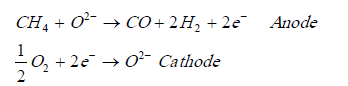
<body><![CDATA[<p><font size="2" face="Verdana, Arial, Helvetica, sans-serif">Syngas is an important   feedstock for Fischer-Tropsch and methanol synthesis &#91;1&#93;, as well as a precursor of hydrogen   production. Most of the syngas is currently obtained   from natural gas in which the main component is methane.</font></p>     <p><font size="2" face="Verdana, Arial, Helvetica, sans-serif">To date, a large-scale   industrial route for syngas production comprises   methane steam reforming (MSR), but an alternative technology is based on the   catalytic partial oxidation of methane (POM):</font></p>     <p><font face="Verdana, Arial, Helvetica, sans-serif"><img src="/img/revistas/dyna/v77n163/a15eq00.gif"></font></p>     <p><font size="2" face="Verdana, Arial, Helvetica, sans-serif">This process has some   comparatively important differences with the well established steam reforming   of methane. POM is mildly exothermic and does not require a high operating   pressure and hence is more energy efficient &#91;2-4&#93;. The major drawback is related   to the high costs of oxygen plants, and the use of   dense ceramic membranes with mixed oxygen-ionic and electronic conductivity &#91;5&#93;.</font></p>     <p><font size="2" face="Verdana, Arial, Helvetica, sans-serif">Many catalysts have been   studied for the POM reaction. Most of them include non-noble (Ni, Co, Fe) and   noble (Ru, Pt, Ir, Os, Rh, Pd) transition metals, usually deposited as fine   particles over porous supports   &#91;6&#93;. The   production of synthesis gas by partial oxidation of CH<sub>4</sub> is also   possible in using the SOFCs (solid oxide fuel cells).</font></p>     <p><font face="Verdana, Arial, Helvetica, sans-serif"><img src="/img/revistas/dyna/v77n163/a15eq001.gif"></font></p>     <p><font size="2" face="Verdana, Arial, Helvetica, sans-serif">The oxidation   technologies using SOFC-type reactors integrate oxygen separation and partial   oxidation into a single step for methane conversion. Materials such as RuOx-ZrO<sub>2</sub> (8% mol Y<sub>2</sub>O<sub>3</sub>)   composites &#91;7&#93;, pyrochlore materials &#91;8&#93;, ceria based   materials &#91;9&#93; and perovskites &#91;10&#93; have been used as anodes or cathodes in   solid oxide fuel cells (SOFCs).</font></p>     <p><font size="2" face="Verdana, Arial, Helvetica, sans-serif">A particularly attractive   option for POM &#91;11&#93; and SOFCs &#91;12-13&#93; consists in the use of mixed metal   oxide precursors with a perovskite structure, since these materials have also   an exceptional high thermal stability. The general formula of these oxides is ABO<sub>3</sub>, in   which the cation A of a larger size is responsible   for the thermal resistance of the catalyst whereas the cation B of smaller size accounts for the catalytic performance. Moreover, these   oxides, due to their redox properties, are   particularly attractive for the partial oxidation of methane &#91;14&#93;. </font></p>     <p><font size="2" face="Verdana, Arial, Helvetica, sans-serif">Previous studies have   shown that the particular behavior of the ABO<sub>3</sub> perovskites as oxidation   catalysts is mainly due to the specific mobility of the lattice oxygen &#91;15-16&#93;. In this work, in the presence of LaNiO<sub>3</sub> perovskite the partial   oxidation of methane was studied using only lattice oxygen species instead of   gaseous oxygen. It was evidenced that oxygen from the lattice selectively   oxidized methane with production of syngas</font></p>     <p>&nbsp;</p>     ]]></body>
<body><![CDATA[<p><font size="3" face="Verdana, Arial, Helvetica, sans-serif"><b>2. EXPERIMENTAL</b></font></p> <font size="2" face="Verdana, Arial, Helvetica, sans-serif"><b>2.1 Catalyst  preparation    <br> </b>The LaNiO<sub>3</sub> perovskite was prepared by the self combustion method    &#91;17&#93;. In the synthesis, La(NO<sub>3</sub>)<sub>3</sub>×6H<sub>2</sub>O (Rhodia),    Ni(NO<sub>3</sub>)<sub>2</sub>×6H<sub>2</sub>O (Aldrich) and glycine (Merck) were used. All reagents were of analytical    grade. Glycine (H<sub>2</sub>NCH<sub>2</sub>CO<sub>2</sub>H) used as ignition promoter was   added to an aqueous solution of metal nitrates with the appropriate stoichiometry, in order to get a NO<sub>3</sub><sup>-</sup>/NH<sub>2</sub> = 1 ratio.     <p>The   resulting solution was slowly evaporated until a green gel was obtained. The   gel was heated up to 250   °C at which the ignition reaction occured yielding a powdered precursor which still contained carbon residues. After calcination at   700°C for 8 hours all of the remaining carbon   species were eliminated leading to the formation of the perovskite structure.</p> <b>2.2 Characterization</b>    <br> The     catalysts were characterized before and after the catalytic test by powder     X-ray diffraction (XRD) using a Siemens D-5000 diffractometer with CuK<sub>a1</sub> = 1.5406 and CuK<sub><font face="Symbol">a</font>2 </sub>=1.5439  &#506;, operated at 40 kV and 40 mA. The diffraction   patterns were recorded in the 2q range 10-90° with a step of 0.016° and 4s per step.</font>     <p><font size="2" face="Verdana, Arial, Helvetica, sans-serif">Transmission   and scanning electron microscopy were carried out on a Philips CM120   instrument, with a LaB<sub>6</sub> filament and equipped with an energy   dispersive X-ray analyzer (EDX). The catalyst powder was first dispersed in <i>iso</i>-propanol after grinding in an agate mortar and   thereafter put on Cu grids for TEM observation.</font></p>     <p><font size="2" face="Verdana, Arial, Helvetica, sans-serif">The   specific surface area was obtained from the adsorption - desorption isotherm of   N<sub>2</sub> using 30 % N<sub>2</sub>/Ar as the adsorbate in a Micromeritics Flowsorb II 2300 apparatus at -196 °C. All samples were degassed for 30 minutes at   300°C before measurement.</font></p>     <p><font size="2" face="Verdana, Arial, Helvetica, sans-serif">Nonstoichiometric oxygen was experimentally determined by a thermogravimetric method &#91;18-19&#93;, using a 2950 TA instrument microbalance.</font></p>     <p><font size="2" face="Verdana, Arial, Helvetica, sans-serif">In the   transient TGA experiments, 15 mg of the perovskite was put on the sample pan.   Then the sample was heated up from room temperature to the desired temperature   at a rate of 20 °C/min under a flow of pure O<sub>2</sub> at 1 atm. After the   sample weighted reaches a steady-state value, the gas in the furnace was switched to helium. </font></p>     <p><font size="2" face="Verdana, Arial, Helvetica, sans-serif">Pulse   experiments using a CH<sub>4 </sub>flow were carried out in a quartz reactor (i.d. =   6 mm)   at 700 °C   and 800 °C   under atmospheric pressure. Prior to each reaction, 50 mg of the powder   catalyst was loaded into the reactor and preheated at 500 °C under 30   ml/min flow of He/O<sub>2</sub> (0.1% of oxygen) for 30 min in order   to remove residual gases. Then, the reactor was cooled down to room temperature   and the catalyst exposed to CH<sub>4</sub> pulses while the temperature of the   reactor was increased from room temperature to   700 °C or 800 °C. The amount of   gas in each pulse was 7.7 mmol, and the time interval between   pulses varied from 1 min to 15 min. Between every CH<sub>4</sub> pulse, a flow of He/O<sub>2</sub> (0.1% of oxygen) used as   carrier gas passed through the catalyst bed. The products of CH<sub>4</sub> conversion were analyzed on-line with a mass spectrometer. The same type   experiment was performed using a reduced perovskite catalyst.</font></p>     <p>&nbsp;</p>     ]]></body>
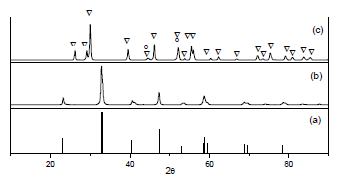
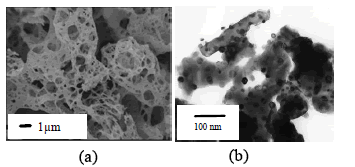
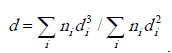
<body><![CDATA[<p><font size="3" face="Verdana, Arial, Helvetica, sans-serif"><b>3. RESULTS AND DISCUSSION</b></font></p> <font size="2" face="Verdana, Arial, Helvetica, sans-serif"><b>3.1 Sample characterization</b></font>     <p><font size="2" face="Verdana, Arial, Helvetica, sans-serif">XRD   patterns of the perovskite LaNiO<sub>3</sub> after calcination and after reduction are shown in <a href="#fig01">Figure 1</a>. </font></p>     <p align="center"><font size="2" face="Verdana, Arial, Helvetica, sans-serif"><b><a name="fig01" id="fig01"></a><img src="/img/revistas/dyna/v77n163/a15fig01.gif">    <br>   Figure 1.</b> XRD patterns of the LaNiO<sub>3</sub> (a) JCPDF Card No. 330711, (b) after calcination at 700°C (c) and after   reduction treatment. (°) Ni°, (Ñ) La<sub>2</sub>O<sub>3</sub></font></p>     <p><font size="2" face="Verdana, Arial, Helvetica, sans-serif">After calcination at   700 °C only LaNiO<sub>3</sub> perovskite   structure (<a href="#fig01">Figure 1b</a>) was observed. The diffraction lines are representative of   the LaNiO<sub>3</sub> rhombohedral phase (JCPDF Card   No. 33-0711- <a href="#fig01">Figure 1a</a>). After reduction treatment under hydrogen at   700°C, the   LaNiO<sub>3 </sub>perovskite structure was completely transformed into Ni° and   La<sub>2</sub>O<sub>3</sub> (<a href="#fig01">Figure1c</a>), which are the only phases observed.</font></p> <font size="2" face="Verdana, Arial, Helvetica, sans-serif"><b>3.2 Characterization  by electron microscopy    <br> </b>SEM    analysis was carried out after the perovskite calcination at    700°C    and TEM characterization was done after the reduction treatment with H<sub>2</sub>.    The micrograph presented in the <a href="#fig02">Figure 2a</a> shows that the auto combustion method    leads to the formation of a porous LaNiO<sub>3</sub> with a sponge appearance.    TEM micrograph obtained after reduction of LaNiO<sub>3</sub> under hydrogen at 700 °C clearly shows    the presence of spherical particles of nickel (<a href="#fig02">Figure 2b</a>). Based on the TEM micrograph, the average size   of metallic particles was calculated using the following equation:     <p><img src="/img/revistas/dyna/v77n163/a15eq002.gif"></p>     <p>Where <i>n<sub>i</sub></i> is the   particle number and <i>d<sub>i</sub></i> is   the characteristic diameter of particles &#91;20&#93;. </p> </font>     <p align="center"><font size="2" face="Verdana, Arial, Helvetica, sans-serif"><b><a name="fig02"></a><img src="/img/revistas/dyna/v77n163/a15fig02.gif">    <br>   Figure 2.</b> (a) SEM micrograph of LaNiO<sub>3-d</sub> after calcination and (b) TEM micrograph obtained after reduction   of LaNiO<sub>3-d</sub> under hydrogen at   700&deg;C</font></p> <font size="2" face="Verdana, Arial, Helvetica, sans-serif">     ]]></body>
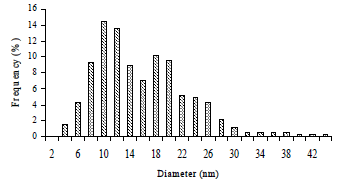
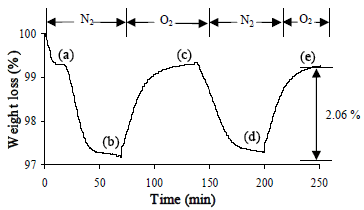
<body><![CDATA[<p>The   particle size distribution is reported in <a href="#fig03">Figure 3</a>, the particle size ranged   between 2 and 50 nm and the average size of metallic particles was around 15 nm.</p>     <p align="center"><b><a name="fig03"></a><img src="/img/revistas/dyna/v77n163/a15fig03.gif">    <br>   Figure 3.</b> Ni Particle size distribution   determined from TEM micrographs of LaNiO<sub>3</sub> reduced under hydrogen at   700°C</p> <b>3.3 Characterization  of oxygen non stoichiometric by thermo-gravimetric  analysis    <br> </b></font><font size="2" face="Verdana, Arial, Helvetica, sans-serif"><a href="#fig04">Figure 4</a> shows the weight changes after modification of the carrier gas (cycles N<sub>2</sub>® O<sub>2</sub>) at    800°C as follows:    under nitrogen flow (curves a-b and c-d) and under oxygen flow (curves b-c and    d-e). The initial mass loss under the nitrogen flow corresponds to desorption    of water and carbon dioxide. When the carrier gas is switched    from oxygen to nitrogen at 800 °C the weight of the LaNiO<sub>3-d</sub> sample    decreases with time on stream as shown in <a href="#fig04">Figure 4</a>. Weight of the sample    is restored if nitrogen is replaced by oxygen. The rate of the weight change is    slower in the oxygen desorption period (curve c-d), than in the absorption   period (curve d-e).</font>     <p align="center"><font size="2" face="Verdana, Arial, Helvetica, sans-serif"><b><a name="fig04"></a><img src="/img/revistas/dyna/v77n163/a15fig04.gif">    <br>   Figure 4.</b> Weight change of LaNiO<sub>3-d</sub> during nitrogen&#8594;oxygen&#8594;nitrogen&#8594;oxygen cycles at   800&deg;C</font></p>     <p><font size="2" face="Verdana, Arial, Helvetica, sans-serif">These   results mean that a part of lattice oxygen can be removed from the sample at   800°C.</font></p>     <p><font size="2" face="Verdana, Arial, Helvetica, sans-serif">The overall   oxygen content and the average Ni oxidation state were determined using the   thermo-gravimetric analysis data. Thus, in the formula LaNiO<sub>3-d</sub> d value is   estimated to be 0.32 (in our experimental conditions), so that the perovskite   formula can be rewritten as LaNiO<sub>2.68</sub>.</font></p>     <p><font size="2" face="Verdana, Arial, Helvetica, sans-serif">This result   is quite important because it shows that in LaNiO<sub>2.68</sub> perovskite about 63 % of the nickel in the   structure correspond to Ni<sup>2+</sup> species with the formation of oxygen   vacancies, while about 37 % of the Ni remains as Ni<sup>3+</sup>. Thus the perovskite formula is La<sup>3+</sup>Ni<sup>3+</sup><sub>0.37</sub>Ni<sup>2+</sup><sub>0.63</sub>O<sub>2.68</sub>.</font></p>     <p><font size="2" face="Verdana, Arial, Helvetica, sans-serif">In several   previous publications, it was also reported that the decomposition of LaNiO<sub>3</sub> to produce the structures La<sub>2</sub>NiO<sub>4</sub> or La<sub>4</sub>Ni<sub>3</sub>O<sub>10</sub> and NiO occurred at elevated temperatures between 800   and 1100 °C   in both air and inert gases &#91;21-22&#93;. To verify   if the perovskite structure was maintained during the nitrogen&#8594;oxygen&#8594;nitrogen&#8594;oxygen cycles at 900°C,   an <i>in-situ</i> XRD analysis was performed   (See <a href="#fig05">Figure 5</a>). </font></p>     ]]></body>
<body><![CDATA[<p align="center"><font size="2" face="Verdana, Arial, Helvetica, sans-serif"><b><a name="fig05"></a><img src="/img/revistas/dyna/v77n163/a15fig05.gif">    <br>   Figure 5.</b> DRX of LaNiO<sub>3</sub> during nitrogen&#8594;oxygen&#8594;nitrogen&#8594;oxygen cycles. (a) at room temperature, (b) at   900 °C over oxygen, (c) at 900 °C over nitrogen   and (d) at 900 °C   over oxygen. (&#9632;) sample holder</font></p>     <p><font size="2" face="Verdana, Arial, Helvetica, sans-serif">It can be   observed (<a href="#fig05">Figure 5</a>) that during the oxygen adsorption and desorption steps the   perovskite structure remains unchanged showing a high stability in these   conditions or perhaps a rather low phase transformation (with a slow kinetics   to be observed), which could explain the reversibility of the process as shown   in <a href="#fig04">Figure 4</a>.</font></p> <font size="2" face="Verdana, Arial, Helvetica, sans-serif"><b>3.4 Reactivity  of lattice oxygen in the oxidation of methane    <br> </b></font><font size="2" face="Verdana, Arial, Helvetica, sans-serif">The partial    oxidation of methane by pulsed reaction over the LaNiO<sub>3-d</sub> catalysts was studied at    700 °C and 800 °C. First, a    blank experiment was carried out without catalyst under usual experimental    conditions in order to evidence the thermal decomposition of methane. In all    cases the CH<sub>4</sub> conversion was lower than 1%. Then, methane pulses    were introduced each 15    minutes over the non reduced LaNiO<sub>3-d</sub> perovskite, in order to examine the reactivity of lattice oxygen (between pulses, carrier gas He/O<sub>2</sub> (0.1% O<sub>2</sub>) was continuously flowed through the catalyst bed). </font>     <p><font size="2" face="Verdana, Arial, Helvetica, sans-serif">At 700°C there was no   catalytic activity and CH<sub>4</sub> conversion remained equal to 1%. At 800 °C the results are displayed in the <a href="#fig06">Figure   6</a>. The only products detected were H<sub>2</sub>, CO, and CO<sub>2</sub>, which   indicates that methane is effectively oxidized by the lattice oxygen of the   perovskite oxide (the amount of water produced in the reaction was not   quantified). <a href="#fig06">Figure 6</a> also shows that CO   and H<sub>2</sub> productions begin almost at the same time when the CO<sub>2</sub> production goes through a maximum before declining (pulse 18). The decline in   the CO<sub>2</sub> production suggests a decrease of the concentration of   surface active oxygen species. </font></p>     <p align="center"><font size="2" face="Verdana, Arial, Helvetica, sans-serif"><b><a name="fig06"></a><img src="/img/revistas/dyna/v77n163/a15fig06.gif">    <br>   Figure 6.</b> Methane pulsed   oxidation reaction (7.7 mmol/pulse) over non   reduced LaNiO<sub>3-d</sub> perovskite at 800 &deg;C. A pulse was injected every 15 min. (&#9650;)   CH<sub>4</sub>, (&uml;) CO<sub>2</sub>, (&acute;) CO and (&#9632;)   H<sub>2</sub></font></p>     <p><font size="2" face="Verdana, Arial, Helvetica, sans-serif">After 25   pulses the amount of H<sub>2</sub> and CO indicates that the partial oxidation   (POM) of methane is taking place at a significant extent with a very high   selectivity. At this point it is possible that the hydrogen reduces the   catalyst so that Ni° particles are available as active sites for the methane   activation. Then it is suggested that carbon species can be formed over the   metal active sites from the dissociation of methane and further completely   oxidized to synthesis gas by the oxygen lattice. Under steady conditions the CH<sub>4</sub> conversion is 100% and the CO<sub>2</sub>, CO and H<sub>2</sub> selectivities are 2, 98 and 80 % respectively without   formation of carbon deposits at the catalyst surface. </font></p>     <p><font size="2" face="Verdana, Arial, Helvetica, sans-serif">The   perpendicular dotted line represents the pulse number when the temperature of   the reactor reached   800   °C.</font></p>     <p><font size="2" face="Verdana, Arial, Helvetica, sans-serif">It is   expected that if the reaction followed the stoichiometry of the POM, the CO and H<sub>2</sub> selectivities should be similar, with a H<sub>2</sub>/CO molar ratio equal to   2. In our case, the   selectivity to H<sub>2</sub> is lower giving a H<sub>2</sub>/CO molar ratio of   1.7. This result suggest that there is a contribution   of the reverse water gas shift reaction.</font></p>     ]]></body>
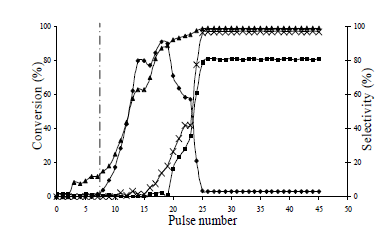
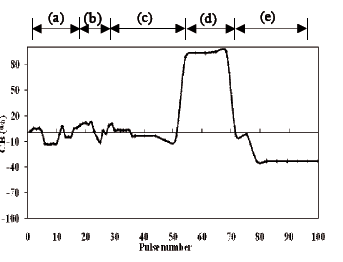
<body><![CDATA[<p><font size="2" face="Verdana, Arial, Helvetica, sans-serif">From the   comparison of the results of pulsed experiments at   700 ºC and 800 °C, it is evident   that b-type oxygen species (atomic oxygen   originating from the bulk which desorbs at high temperatures) are the only   oxygen species responsible for the partial oxidation reaction. Thus, it is   clear that the bulk lattice oxygen of LaNiO<sub>3-d</sub> perovskite should participate in the partial   oxidation of CH<sub>4</sub> to H<sub>2</sub> and CO. The TGA experiments   (<a href="#fig04">Figure 4</a>) show that there are non stoichiometric oxygen and oxygen vacancies involved in the oxygen transport through the   lattice &#91;23&#93;. In a recent publication it was   found that the selectivity towards the total and partial oxidation of methane   using La<sub>0.3</sub>Sr<sub>0.7</sub>Fe<sub>0.8</sub><i>M</i><sub>0.2</sub>O<sub>3-</sub><i><sub><font face="Symbol">d</font></sub></i> (<i>M</i>= Ga, Al) perovskites, was related to   the amount of nonstoichiometric oxygen &#91;24&#93;. The relationship between the rate   of oxygen migration and the concentration of oxygen vacancies was also   confirmed by Rossetti <i>et al </i>&#91;25&#93;. </font></p>     <p><font size="2" face="Verdana, Arial, Helvetica, sans-serif">A   complementary experiment using the pulse technique was conducted at 800°C in order to   study the behavior of the lattice oxygen during a quasi-continuous operating   reaction. The results are displayed in   the <a href="#fig07">Figure 7</a>. The experiments can be described as follows: </font></p>     <p align="center"><font size="2" face="Verdana, Arial, Helvetica, sans-serif"><b><a name="fig07"></a><img src="/img/revistas/dyna/v77n163/a15fig07.gif">    <br>   Figure 7.</b> Methane pulsed oxidation   reaction (7.7 mmol/pulse) over non reduced LaNiO<sub>3-d</sub> perovskite at 800 °C. Pulse composition:   (a) CH<sub>4</sub> (every 15 min), (b) O<sub>2</sub>/He - 5% of oxygen (every   15min), (c) CH<sub>4</sub> (every 15 min), (d) CH<sub>4</sub> (every 1min) and   (e) CH<sub>4</sub> (every 15 min). (&#9650;) CH<sub>4</sub>, (¨) CO<sub>2</sub>, (´) CO, (&#9632;) H<sub>2</sub></font></p>     <p><font size="2" face="Verdana, Arial, Helvetica, sans-serif">In the   first part (segment (<i>a)</i> of <a href="#fig07">Figure 7</a>), the pulse   sequence is the same as the one described above. Pulses of methane were   injected each 15 min, while the temperature was increased from room temperature   to 800 °C.   After that, a higher oxygen concentration was used (He/O<sub>2</sub> - 5% of   oxygen) during 30 min, with the aim of re-oxidizing the sample and refill the   maximum number of the oxygen vacancies, (segment (<i>b)</i> in the <a href="#fig07">Figure 7</a>). Then 30 pulses of methane were injected again   at intervals of 15 min using He/O<sub>2</sub> (0.1% of oxygen) as carrier gas   (segment (<i>c)</i> of the <a href="#fig07">Figure 7</a>. In order to approach a   continuous operation and to determine how fast the catalyst can recover the   oxidation capability, pulses of CH<sub>4</sub> were injected at intervals of 1   min, (segment (<i>d)</i> <a href="#fig07">Figure 7</a>). Finally,   the pulses frequency was reduced to every 15 min (segment (<i>e) </i><a href="#fig07">Figure 7</a><i>)</i>. The carbon balance of all these   experiments is reported in the <a href="#fig08">Figure 8</a>. The selectivities and conversion profiles shown in <a href="#fig07">Figure 7</a> are similar to those presented in the <a href="#fig06">Figure 6</a>. Comparison of segments (<i>a</i>)   and (<i>c</i>) shows that re-oxidation   process of the catalyst is reversible, and that the oxygen vacancies can be   easily regenerated. Under steady conditions CH<sub>4</sub> conversion and CO<sub>2</sub>,   CO and H<sub>2</sub> selectivities are the same as those   obtained at   700°C   (<a href="#fig06">Figure 6</a>).</font></p>     <p align="center"><font size="2" face="Verdana, Arial, Helvetica, sans-serif"><b><a name="fig08"></a><img src="/img/revistas/dyna/v77n163/a15fig08.gif">    <br>   Figure 8.</b> Carbon balance for the   methane pulses series of the <a href="#fig07">Figure 7</a></font></p>     <p><font size="2" face="Verdana, Arial, Helvetica, sans-serif">Methane   conversions as well as CO and H<sub>2</sub> selectivities were constant during 25 pulses, segment (<i>c</i>).   At the same time, carbon balance (not shown) revealed that there was not carbon   deposition on the catalyst surface during the pulsed experiments. This result   suggests that partial oxidation is the main reaction taking place and that the   catalytic methane pyrolysis, if any, is a minor   reaction.</font></p>     <p><font size="2" face="Verdana, Arial, Helvetica, sans-serif">The   perpendicular dotted line represents the pulse number when the temperature of   the reactor reached   800   °C.</font></p>     <p><font size="2" face="Verdana, Arial, Helvetica, sans-serif">The results   show that the oxygen required in the partial oxidation is i)   extracted from the LaNiO<sub>3-d</sub> lattice during the CH<sub>4 </sub>pulses   and ii) regenerated by direct activation of molecular oxygen contained in the   carrier gas.</font></p>     ]]></body>
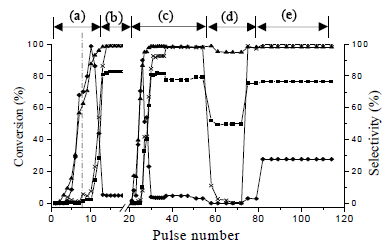
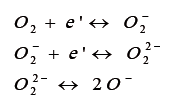
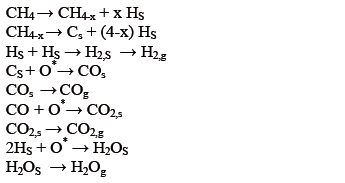
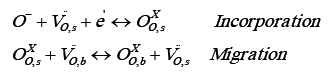
<body><![CDATA[<p><font size="2" face="Verdana, Arial, Helvetica, sans-serif">Indeed if   the time between pulses was reduced from 15 min to 1min, segment (<i>d</i>), CH<sub>4</sub> dissociation was   observed and carbon deposition took place on the LaNiO<sub>3-d</sub> perovskite surface due to a lower surface concentration   of oxygen species close to the carbon species deposited on the active sites   which could also indicate a limited oxygen mobility.   During these 20 consecutives CH<sub>4</sub> pulses in segment (<i>d</i>), only H<sub>2</sub> was formed and CO   selectivity decreased towards zero. Here, carbon deposits were detected,   indicating that pyrolysis of CH<sub>4</sub> takes   place (<a href="#fig08">Figure 8</a>).</font></p>     <p><font size="2" face="Verdana, Arial, Helvetica, sans-serif">After   re-increasing the pulse intervals to 15 min (segment (<i>e</i>)), CO was produced again and a large amount of CO<sub>2</sub> was   also detected. The carbon balance is considerably lowered due to the oxidation   of the carbonaceous deposits over the catalyst surface, which originated from   the previous methane dissociation (segment (<i>e</i>)   in the <a href="#fig08">Figure 8</a>).</font></p> <font size="2" face="Verdana, Arial, Helvetica, sans-serif"><b>3.5 Methane partial oxidation mechanism over the LaNiO<sub>3-d</sub> perovskite    <br> </b>Taking into    account the above observations and the results published in the literature, the   following mechanism is suggested.     <p>First, it   is necessary to consider the oxygen incorporation into the lattice. This   process has been studied using isotopic oxygen exchange with different oxides.   It is generally accepted that O<sub>2</sub> incorporation into the lattice   occurred as follows, &#91;26&#93;.</p>     <p><img src="/img/revistas/dyna/v77n163/a15eq003.gif"></p>     <p>Several   species can appear as intermediates in the reduction of molecular oxygen, such   as O<sub>2</sub><sup>-</sup>, O<sub>2</sub><sup>2-</sup>, and O<sup>-</sup>.   In this work we did not attempt to distinguish between these three surface   oxygen species, and therefore they are denoted as O*. The Kröger-Vink notation is used for lattice defects &#91;27&#93;: V<sup>..</sup><sub>o</sub> denotes   an oxygen vacancy, O<sup>×</sup><sub>O</sub> a regular lattice oxygen ion, and e' an electron. The subscripts s and b refer to   "surface" and "bulk," respectively. This distinction is necessary because only   the surface lattice oxygen will be accessible for the catalytic reaction. The   same argument also holds for oxygen vacancies.</p>     <p>In the   first part of the reaction, when there is a high concentration of reactive   lattice oxygen, CH<sub>4</sub> is completely oxidized to form CO<sub>2</sub> and H<sub>2</sub>O.</p>     <p><img src="/img/revistas/dyna/v77n163/a15eq004.gif"></p>     <p>A low   concentration of extractible lattice oxygen favors selective oxidation of   methane to CO and H<sub>2</sub>, and the reaction mechanism can be expressed   as:</p>     <p><img src="/img/revistas/dyna/v77n163/a15eq005.gif"></p>     ]]></body>
<body><![CDATA[<p>The methane   molecule can be also dissociated by the oxygen species according to the   following equation &#91;28&#93;: </p>     <p><img src="/img/revistas/dyna/v77n163/a15eq006.gif"></p>     <p>In this   step, the adsorbed H atom may combine to form hydrogen which easily desorbs.   The chemisorbed carbon species are either oxidized to CO by lattice oxygen or   oxidized to CO<sub>2</sub>.</p>     <p>According   to the above scheme, the product distribution of the POM reaction over LaNiO<sub>3-d</sub> catalyst was determined by the concentration   of surface oxygen species, which is affected by the migration rate of oxygen   from the bulk toward the surface. </p>     <p>Finally,   the re-oxidation process can be written as function of an incorporation and   migration process:</p>     <p><img src="/img/revistas/dyna/v77n163/a15eq007.gif"></p>     <p>According to our results, these vacancies can be re-filled with oxygen   either by direct activation of oxygen from the gas phase or by lattice oxygen   diffusion. Lattice oxygen diffusion may provide an alternative pathway for   replenishment of the surface lattice oxygen consumed by methane. This may explain the high methane conversion over the LaNiO<sub>3</sub> catalyst.</p> </font>     <p>&nbsp;</p>     <p><font size="3" face="Verdana, Arial, Helvetica, sans-serif"><b>4. CONCLUSIONS</b></font> </p>     <p><font size="2" face="Verdana, Arial, Helvetica, sans-serif">The perovskite LaNiO<sub>3</sub> prepared by   the auto combustion method has a nonstoichiometric oxygen and that its formula can be   rewritten as La<sup>3+</sup>Ni<sup>3+</sup><sub>0.368</sub>Ni<sup>2+</sup><sub>0.632</sub>O<sub>2.684</sub>.</font></p>     ]]></body>
<body><![CDATA[<p><font size="2" face="Verdana, Arial, Helvetica, sans-serif">Perovskite oxygen lattice has   catalytic activity towards CH<sub>4</sub> partial oxidation at   800 °C while at a   lower temperature the conversion is negligible. Complete oxidation of methane   to CO<sub>2</sub> and H<sub>2</sub>O occurs during the first step of the   reaction (initial pulses), whereas partial oxidation to CO and H<sub>2</sub> is   found to be the main reaction during the subsequent pulses. A high   concentration of available lattice oxygen promotes total oxidation of CH<sub>4</sub> to CO<sub>2</sub> and H<sub>2</sub>O, while a low concentration of lattice   oxygen favors selective oxidation of methane to CO and H<sub>2</sub>. High   methane conversions and large amounts of H<sub>2</sub> and CO were produced   using non reduced perovskite, with a CH<sub>4</sub> conversion and H<sub>2</sub>,   CO and CO<sub>2</sub>, selectivities under steady   conditions of 100%, 80%, 98% and 2 % respectively at 800°C. The H<sub>2</sub>/CO ratio obtained was 1.7,   indicating a contribution of the reverse water gas shift reaction</font></p>     <p>&nbsp;</p>     <p><font size="3" face="Verdana, Arial, Helvetica, sans-serif"><b>5. ACKNOWLEDGEMENTS</b></font> </p>     <p><font size="2" face="Verdana, Arial, Helvetica, sans-serif">The authors are grateful to the PICS program: &quot;Valorization of   natural gas and Fischer-Tropsch synthesis&quot; for   the financial support given. F.   Mondragon and G. Sierra acknowledge to the   University of Antioquia   for the financial support of the Sostenibilidad Program and to Colciencias for the support of the   project 1115-06-   17639. G.   Sierra thanks COLCIENCIAS and the University   of Antioquia for the PhD scholarship.</font></p>     <p>&nbsp;</p>     <p><b><font size="3" face="Verdana, Arial, Helvetica, sans-serif">REFERENCES</font></b></p>     <!-- ref --><p><font face="Verdana, Arial, Helvetica, sans-serif"><b><font size="2">&#91;1&#93;</font></b><font size="2"> York, A.P.E., Xiao, T. Green, M.L.H. Brief Overview of the Partial Oxidation of Methane to. Synthesis Gas, Top. Catal., 22, 345-358, 2003.     &nbsp;&nbsp;&nbsp;&nbsp;&nbsp;&nbsp;&nbsp;&nbsp;[&#160;<a href="javascript:void(0);" onclick="javascript: window.open('/scielo.php?script=sci_nlinks&ref=000109&pid=S0012-7353201000030001500001&lng=','','width=640,height=500,resizable=yes,scrollbars=1,menubar=yes,');">Links</a>&#160;]<!-- end-ref --><!-- ref --><br>   <b>&#91;2&#93;</b> Diskin, A.M., Ormerod, R.M. Partial Oxidation of Methane over. Supported Nickel Catalysts, Stud. Surf. Sci. Catal., 130, 3519 -3524, 2000.     &nbsp;&nbsp;&nbsp;&nbsp;&nbsp;&nbsp;&nbsp;&nbsp;[&#160;<a href="javascript:void(0);" onclick="javascript: window.open('/scielo.php?script=sci_nlinks&ref=000110&pid=S0012-7353201000030001500002&lng=','','width=640,height=500,resizable=yes,scrollbars=1,menubar=yes,');">Links</a>&#160;]<!-- end-ref --><!-- ref --><br>   <b>&#91;3&#93;</b> Liu, Z.W. Jun, K.W. Roh, H.S. Park, S.E. Oh, Y.S. Partial Oxidation of Methane over Nickel Catalysts Supported on Various Aluminas, Korean J. Chem. Eng., 19, 735-735, 2002.     &nbsp;&nbsp;&nbsp;&nbsp;&nbsp;&nbsp;&nbsp;&nbsp;[&#160;<a href="javascript:void(0);" onclick="javascript: window.open('/scielo.php?script=sci_nlinks&ref=000111&pid=S0012-7353201000030001500003&lng=','','width=640,height=500,resizable=yes,scrollbars=1,menubar=yes,');">Links</a>&#160;]<!-- end-ref --><!-- ref --><br>   <b>&#91;4&#93;</b> Chen, Y. Hu, C. Gong, M. Chen, Y. Tian, A. Partial oxidation and chemisorption of methane over Ni/Al2O3 catalysts, Stud. Surf. Sci. Catal. 130, 3543-3548, 2000.     &nbsp;&nbsp;&nbsp;&nbsp;&nbsp;&nbsp;&nbsp;&nbsp;[&#160;<a href="javascript:void(0);" onclick="javascript: window.open('/scielo.php?script=sci_nlinks&ref=000112&pid=S0012-7353201000030001500004&lng=','','width=640,height=500,resizable=yes,scrollbars=1,menubar=yes,');">Links</a>&#160;]<!-- end-ref --><!-- ref --><br>   <b>&#91;5&#93;</b> Mazanec, T.J. Prasad, R. Odegard, Steyn, R. C. Robinson, E.T. Oxygen transport membranes for syngas production, Stud. Surf. Sci. Catal. 136. 147-152, 2001.     &nbsp;&nbsp;&nbsp;&nbsp;&nbsp;&nbsp;&nbsp;&nbsp;[&#160;<a href="javascript:void(0);" onclick="javascript: window.open('/scielo.php?script=sci_nlinks&ref=000113&pid=S0012-7353201000030001500005&lng=','','width=640,height=500,resizable=yes,scrollbars=1,menubar=yes,');">Links</a>&#160;]<!-- end-ref --><!-- ref --><br>   <b>&#91;6&#93;</b> Lago, R. Bini, G. Peña, M.A Fierro, J.L.G. Partial Oxidation of Methane to Synthesis Gas Using LnCoO3 Perovskites as Catalyst Precursors, J. Catal. 167, 198-209, 1997.     &nbsp;&nbsp;&nbsp;&nbsp;&nbsp;&nbsp;&nbsp;&nbsp;[&#160;<a href="javascript:void(0);" onclick="javascript: window.open('/scielo.php?script=sci_nlinks&ref=000114&pid=S0012-7353201000030001500006&lng=','','width=640,height=500,resizable=yes,scrollbars=1,menubar=yes,');">Links</a>&#160;]<!-- end-ref --><!-- ref --><br>   <b>&#91;7&#93;</b> Bebelis, S. Neophytides, S. Kotsionopoulos, N. riantafyllopoulos, N. Colomer, M.T. Jurado, J. Methane oxidation on composite ruthenium electrodes in YSZ cells, Solid State Ionics. 177, 2087-2091, 2006.     &nbsp;&nbsp;&nbsp;&nbsp;&nbsp;&nbsp;&nbsp;&nbsp;[&#160;<a href="javascript:void(0);" onclick="javascript: window.open('/scielo.php?script=sci_nlinks&ref=000115&pid=S0012-7353201000030001500007&lng=','','width=640,height=500,resizable=yes,scrollbars=1,menubar=yes,');">Links</a>&#160;]<!-- end-ref --><!-- ref --><br>   <b>&#91;8&#93;</b> Kumar, M. Anbu Kulandainathan, M. Arul Raj, I. Chandrasekaran, R. Pattabiraman, R. Electrical and sintering behaviour of Y2Zr2O7 (YZ) pyrochlore based materials: the influence of bismuth, Mater. Chem. Phys. 92 303-309, 2005.     &nbsp;&nbsp;&nbsp;&nbsp;&nbsp;&nbsp;&nbsp;&nbsp;[&#160;<a href="javascript:void(0);" onclick="javascript: window.open('/scielo.php?script=sci_nlinks&ref=000116&pid=S0012-7353201000030001500008&lng=','','width=640,height=500,resizable=yes,scrollbars=1,menubar=yes,');">Links</a>&#160;]<!-- end-ref --><!-- ref --><br>   <b>&#91;9&#93;</b> Kharton, V.V. Yaremchenko, A.A. Valente, A.A. Frolova, E.V Ivanovskaya, M.I. Frade, J.R. Marques, F.M.B. Rocha, J. Methane oxidation over SOFC anodes with nanocrystalline ceria-based phases, Solid State Ionics, 177, 2179-2183, 2006.     &nbsp;&nbsp;&nbsp;&nbsp;&nbsp;&nbsp;&nbsp;&nbsp;[&#160;<a href="javascript:void(0);" onclick="javascript: window.open('/scielo.php?script=sci_nlinks&ref=000117&pid=S0012-7353201000030001500009&lng=','','width=640,height=500,resizable=yes,scrollbars=1,menubar=yes,');">Links</a>&#160;]<!-- end-ref --><!-- ref --><br>   <b>&#91;10&#93;</b> Sun, X.F. Guo, R.S. Li, J. Preparation and properties of yttrium-doped SrTiO3 anode materials, Ceramics International. 34, 219-223, 2008.     &nbsp;&nbsp;&nbsp;&nbsp;&nbsp;&nbsp;&nbsp;&nbsp;[&#160;<a href="javascript:void(0);" onclick="javascript: window.open('/scielo.php?script=sci_nlinks&ref=000118&pid=S0012-7353201000030001500010&lng=','','width=640,height=500,resizable=yes,scrollbars=1,menubar=yes,');">Links</a>&#160;]<!-- end-ref --><!-- ref --><br>   <b>&#91;11&#93;</b> Labhsetwar, N.K. Watanabe, A. Mitsuhashi, T. New improved syntheses of LaRuO3 perovskites and their applications in environmental catalysis. Catal. B: Environ., 40 21-30, 2003.     &nbsp;&nbsp;&nbsp;&nbsp;&nbsp;&nbsp;&nbsp;&nbsp;[&#160;<a href="javascript:void(0);" onclick="javascript: window.open('/scielo.php?script=sci_nlinks&ref=000119&pid=S0012-7353201000030001500011&lng=','','width=640,height=500,resizable=yes,scrollbars=1,menubar=yes,');">Links</a>&#160;]<!-- end-ref --><!-- ref --><br>   <b>&#91;12&#93;</b> Sauvet, A.L. Fouletier, J. Gaillard, F. Primet, M. Surface Properties and Physicochemical Characterizations of a New Type of Anode Material, La1-xSrxCr1-yRuyO3-d, for a Solid Oxide Fuel Cell under Methane at Intermediate Temperature, J. Catal., 209, 25-34, 2002.     &nbsp;&nbsp;&nbsp;&nbsp;&nbsp;&nbsp;&nbsp;&nbsp;[&#160;<a href="javascript:void(0);" onclick="javascript: window.open('/scielo.php?script=sci_nlinks&ref=000120&pid=S0012-7353201000030001500012&lng=','','width=640,height=500,resizable=yes,scrollbars=1,menubar=yes,');">Links</a>&#160;]<!-- end-ref --><!-- ref --><br>   <b>&#91;13&#93;</b> Hwang, H.J. Moon, J.W. Lee, S. Lee, E.A. Electrochemical performance of LSCF-based composite cathodes for intermediate temperature SOFCs, Journal of Power Sources, 145, 243-248, 2005.     &nbsp;&nbsp;&nbsp;&nbsp;&nbsp;&nbsp;&nbsp;&nbsp;[&#160;<a href="javascript:void(0);" onclick="javascript: window.open('/scielo.php?script=sci_nlinks&ref=000121&pid=S0012-7353201000030001500013&lng=','','width=640,height=500,resizable=yes,scrollbars=1,menubar=yes,');">Links</a>&#160;]<!-- end-ref --><!-- ref --><br>   <b>&#91;14&#93;</b> Barbero, J. Peña, M.A. Campos-Martin, J.M. Fierro, J.L.G. Arias, P.L. Support effect in Ni-supported catalysts on their performance for methane partial oxidation, Catal. Lett., 87, 211-218, 2003.     &nbsp;&nbsp;&nbsp;&nbsp;&nbsp;&nbsp;&nbsp;&nbsp;[&#160;<a href="javascript:void(0);" onclick="javascript: window.open('/scielo.php?script=sci_nlinks&ref=000122&pid=S0012-7353201000030001500014&lng=','','width=640,height=500,resizable=yes,scrollbars=1,menubar=yes,');">Links</a>&#160;]<!-- end-ref --><!-- ref --><br>   <b>&#91;15&#93;</b> Peña, M.A., Fierro, J.L.G. Chemical structures and performance of perovskites oxides, Chem. Rev. 101, 1981-2017, 2001.     &nbsp;&nbsp;&nbsp;&nbsp;&nbsp;&nbsp;&nbsp;&nbsp;[&#160;<a href="javascript:void(0);" onclick="javascript: window.open('/scielo.php?script=sci_nlinks&ref=000123&pid=S0012-7353201000030001500015&lng=','','width=640,height=500,resizable=yes,scrollbars=1,menubar=yes,');">Links</a>&#160;]<!-- end-ref --><!-- ref --><br>   <b>&#91;16&#93;</b> Falc&oacute;n, H. Barbero, J.A. Araujo, G. Casais, M.T. Martinez-Lopez, M.J. Alonso, J.A. Fierro, J.L.G. Double perovskite oxides A2FeMoO6-d (A=Ca, Sr and Ba) as catalysts for methane combustion, Appl. Catal. B: Environ., 53, 37-45, 2004.     &nbsp;&nbsp;&nbsp;&nbsp;&nbsp;&nbsp;&nbsp;&nbsp;[&#160;<a href="javascript:void(0);" onclick="javascript: window.open('/scielo.php?script=sci_nlinks&ref=000124&pid=S0012-7353201000030001500016&lng=','','width=640,height=500,resizable=yes,scrollbars=1,menubar=yes,');">Links</a>&#160;]<!-- end-ref --><!-- ref --><br>   <b>&#91;17&#93;</b> Pechini, R. Method of preparing lead ans alkaline earth titanates and niobates and coating method using the same to form a capacitor,US Patent No 3,330,697 (1967).     &nbsp;&nbsp;&nbsp;&nbsp;&nbsp;&nbsp;&nbsp;&nbsp;[&#160;<a href="javascript:void(0);" onclick="javascript: window.open('/scielo.php?script=sci_nlinks&ref=000125&pid=S0012-7353201000030001500017&lng=','','width=640,height=500,resizable=yes,scrollbars=1,menubar=yes,');">Links</a>&#160;]<!-- end-ref --><!-- ref --><br>   <b>&#91;18&#93;</b> Zeng, Y., Lin, Y.S. A transient TGA study on oxygen permeation properties of perovskite-type ceramic membrane, Solid State Ionics, 110, 209-221, 1998.     &nbsp;&nbsp;&nbsp;&nbsp;&nbsp;&nbsp;&nbsp;&nbsp;[&#160;<a href="javascript:void(0);" onclick="javascript: window.open('/scielo.php?script=sci_nlinks&ref=000126&pid=S0012-7353201000030001500018&lng=','','width=640,height=500,resizable=yes,scrollbars=1,menubar=yes,');">Links</a>&#160;]<!-- end-ref --><!-- ref --><br>   <b>&#91;19&#93;</b> Yang, Z., Lin, Y.S. A semi-empirical equation for oxygen nonstoichiometry of perovskite-type ceramics, Solid State Ionics. 150, 245-254, 2002.     &nbsp;&nbsp;&nbsp;&nbsp;&nbsp;&nbsp;&nbsp;&nbsp;[&#160;<a href="javascript:void(0);" onclick="javascript: window.open('/scielo.php?script=sci_nlinks&ref=000127&pid=S0012-7353201000030001500019&lng=','','width=640,height=500,resizable=yes,scrollbars=1,menubar=yes,');">Links</a>&#160;]<!-- end-ref --><!-- ref --><br>   <b>&#91;20&#93;</b> Mustard, D.G. Bartholomew, C.H. Determination of metal crystallite size and morphology in supported nickel catalysts, J. Catal., 67, 186-206, 1981.     &nbsp;&nbsp;&nbsp;&nbsp;&nbsp;&nbsp;&nbsp;&nbsp;[&#160;<a href="javascript:void(0);" onclick="javascript: window.open('/scielo.php?script=sci_nlinks&ref=000128&pid=S0012-7353201000030001500020&lng=','','width=640,height=500,resizable=yes,scrollbars=1,menubar=yes,');">Links</a>&#160;]<!-- end-ref --><!-- ref --><br>   <b>&#91;21&#93;</b> Zinkevich, M., Aldinger, F. Thermodynamic analysis of the ternary La-Ni-O system, J. Alloys and Compounds. 375, 147-161, 2004.     &nbsp;&nbsp;&nbsp;&nbsp;&nbsp;&nbsp;&nbsp;&nbsp;[&#160;<a href="javascript:void(0);" onclick="javascript: window.open('/scielo.php?script=sci_nlinks&ref=000129&pid=S0012-7353201000030001500021&lng=','','width=640,height=500,resizable=yes,scrollbars=1,menubar=yes,');">Links</a>&#160;]<!-- end-ref --><!-- ref --><br>   <b>&#91;22&#93;</b> Mart&iacute;nez-Lope, M.J. Casais, M.T. Alonso., J. A., Stabilization of Ni+ in defect perovskites La(Ni1-xAlx)O2+x with infinite-layer structure, Journal of Alloys and Compounds, 275, 109-112, 1998.     &nbsp;&nbsp;&nbsp;&nbsp;&nbsp;&nbsp;&nbsp;&nbsp;[&#160;<a href="javascript:void(0);" onclick="javascript: window.open('/scielo.php?script=sci_nlinks&ref=000130&pid=S0012-7353201000030001500022&lng=','','width=640,height=500,resizable=yes,scrollbars=1,menubar=yes,');">Links</a>&#160;]<!-- end-ref --><!-- ref --><br>   <b>&#91;23&#93;</b> Ramos, T. Atkinson, A. Oxygen diffusion and surface exchange in La1-xSrxFe0.8Cr0.2O3-d (x=0.2, 0.4 and 0.6), Solid State Ionics. 170, 275-286, 2004.     &nbsp;&nbsp;&nbsp;&nbsp;&nbsp;&nbsp;&nbsp;&nbsp;[&#160;<a href="javascript:void(0);" onclick="javascript: window.open('/scielo.php?script=sci_nlinks&ref=000131&pid=S0012-7353201000030001500023&lng=','','width=640,height=500,resizable=yes,scrollbars=1,menubar=yes,');">Links</a>&#160;]<!-- end-ref --><!-- ref --><br>   <b>&#91;24&#93;</b> Kharton, V.V., Patrakeev, M.V., Waerenborgh, J.C., Sobyanin, V.A., Veniaminov, S.A., Yaremchenko, A.A., Gaczynski, P., Belyaev, V.D., Semin, G.L., and Frade, J.R., Methane oxidation over perovskite-related ferrites: Effects of oxygen nonstoichiometry, Solid State Sciences. 7, 1344-1352, 2005.     &nbsp;&nbsp;&nbsp;&nbsp;&nbsp;&nbsp;&nbsp;&nbsp;[&#160;<a href="javascript:void(0);" onclick="javascript: window.open('/scielo.php?script=sci_nlinks&ref=000132&pid=S0012-7353201000030001500024&lng=','','width=640,height=500,resizable=yes,scrollbars=1,menubar=yes,');">Links</a>&#160;]<!-- end-ref --><!-- ref --><br>   <b>&#91;25&#93;</b> Rossetti, I. Forni, L. Catalytic flameless combustion of methane over perovskites prepared by flame-hydrolysis, Appl. Catal. B. 33, 345-352, 2001.     &nbsp;&nbsp;&nbsp;&nbsp;&nbsp;&nbsp;&nbsp;&nbsp;[&#160;<a href="javascript:void(0);" onclick="javascript: window.open('/scielo.php?script=sci_nlinks&ref=000133&pid=S0012-7353201000030001500025&lng=','','width=640,height=500,resizable=yes,scrollbars=1,menubar=yes,');">Links</a>&#160;]<!-- end-ref --><!-- ref --><br>   <b>&#91;26&#93;</b> Zhu, J. van Ommen, J.G. Bouwmeester, H.J.M. Lefferts, L. Activation of O2 and CH4 on yttrium-stabilized zirconia for the partial oxidation of methane to synthesis gas, J. Catal. 233, 434-441, 2005.     &nbsp;&nbsp;&nbsp;&nbsp;&nbsp;&nbsp;&nbsp;&nbsp;[&#160;<a href="javascript:void(0);" onclick="javascript: window.open('/scielo.php?script=sci_nlinks&ref=000134&pid=S0012-7353201000030001500026&lng=','','width=640,height=500,resizable=yes,scrollbars=1,menubar=yes,');">Links</a>&#160;]<!-- end-ref --><!-- ref --><br>   <b>&#91;27&#93;</b> Kroger, F.A. The Chemistry of Imperfect Crystals. Vol. 2. Imperfection Chemistry of Crystalline Solids. Elsevier, New York, 1974.     &nbsp;&nbsp;&nbsp;&nbsp;&nbsp;&nbsp;&nbsp;&nbsp;[&#160;<a href="javascript:void(0);" onclick="javascript: window.open('/scielo.php?script=sci_nlinks&ref=000135&pid=S0012-7353201000030001500027&lng=','','width=640,height=500,resizable=yes,scrollbars=1,menubar=yes,');">Links</a>&#160;]<!-- end-ref --><!-- ref --><br>   <b>&#91;28&#93;</b> Au, C.T. and Wang, H.Y. Mechanistic Studies of Methane Partial Oxidation to Syngas over SiO2-Supported Rhodium Catalysts, J. Catal. 167, 337-345, 1997. </font></font>&nbsp;&nbsp;&nbsp;&nbsp;&nbsp;&nbsp;&nbsp;&nbsp;[&#160;<a href="javascript:void(0);" onclick="javascript: window.open('/scielo.php?script=sci_nlinks&ref=000136&pid=S0012-7353201000030001500028&lng=','','width=640,height=500,resizable=yes,scrollbars=1,menubar=yes,');">Links</a>&#160;]<!-- end-ref --> ]]></body><back>
<ref-list>
<ref id="B1">
<label>1</label><nlm-citation citation-type="journal">
<person-group person-group-type="author">
<name>
<surname><![CDATA[York]]></surname>
<given-names><![CDATA[A.P.E.]]></given-names>
</name>
<name>
<surname><![CDATA[Xiao]]></surname>
<given-names><![CDATA[T]]></given-names>
</name>
<name>
<surname><![CDATA[Green]]></surname>
<given-names><![CDATA[M.L.H.]]></given-names>
</name>
</person-group>
<article-title xml:lang="en"><![CDATA[Brief Overview of the Partial Oxidation of Methane to. Synthesis Gas]]></article-title>
<source><![CDATA[Top. Catal.]]></source>
<year>2003</year>
<numero>22</numero>
<issue>22</issue>
<page-range>345-358</page-range></nlm-citation>
</ref>
<ref id="B2">
<label>2</label><nlm-citation citation-type="journal">
<person-group person-group-type="author">
<name>
<surname><![CDATA[Diskin]]></surname>
<given-names><![CDATA[A.M]]></given-names>
</name>
<name>
<surname><![CDATA[Ormerod]]></surname>
<given-names><![CDATA[R.M]]></given-names>
</name>
</person-group>
<article-title xml:lang="en"><![CDATA[Partial Oxidation of Methane over: Supported Nickel Catalysts]]></article-title>
<source><![CDATA[Stud. Surf. Sci. Catal]]></source>
<year>2000</year>
<volume>130</volume>
<page-range>3519 -3524</page-range></nlm-citation>
</ref>
<ref id="B3">
<label>3</label><nlm-citation citation-type="journal">
<person-group person-group-type="author">
<name>
<surname><![CDATA[Liu]]></surname>
<given-names><![CDATA[Z.W]]></given-names>
</name>
<name>
<surname><![CDATA[Jun]]></surname>
<given-names><![CDATA[K.W]]></given-names>
</name>
<name>
<surname><![CDATA[Roh]]></surname>
<given-names><![CDATA[H.S]]></given-names>
</name>
<name>
<surname><![CDATA[Park]]></surname>
<given-names><![CDATA[S.E]]></given-names>
</name>
<name>
<surname><![CDATA[Oh]]></surname>
<given-names><![CDATA[Y.S.]]></given-names>
</name>
</person-group>
<article-title xml:lang="en"><![CDATA[Partial Oxidation of Methane over Nickel Catalysts Supported on Various Aluminas]]></article-title>
<source><![CDATA[Korean J. Chem. Eng.]]></source>
<year>2002</year>
<month>.</month>
<numero>19</numero>
<issue>19</issue>
<page-range>735-735</page-range></nlm-citation>
</ref>
<ref id="B4">
<label>4</label><nlm-citation citation-type="journal">
<person-group person-group-type="author">
<name>
<surname><![CDATA[Chen]]></surname>
<given-names><![CDATA[Y.]]></given-names>
</name>
<name>
<surname><![CDATA[HuC. Gong]]></surname>
<given-names><![CDATA[M.]]></given-names>
</name>
<name>
<surname><![CDATA[Chen]]></surname>
<given-names><![CDATA[Y.]]></given-names>
</name>
<name>
<surname><![CDATA[Tian]]></surname>
<given-names><![CDATA[A.]]></given-names>
</name>
</person-group>
<article-title xml:lang="en"><![CDATA[Partial oxidation and chemisorption of methane over Ni/Al2O3 catalysts]]></article-title>
<source><![CDATA[Stud. Surf. Sci. Catal]]></source>
<year>2000</year>
<numero>130</numero>
<issue>130</issue>
<page-range>3543-3548</page-range></nlm-citation>
</ref>
<ref id="B5">
<label>5</label><nlm-citation citation-type="journal">
<person-group person-group-type="author">
<name>
<surname><![CDATA[Mazanec]]></surname>
<given-names><![CDATA[T.J]]></given-names>
</name>
<name>
<surname><![CDATA[Prasad]]></surname>
<given-names><![CDATA[R]]></given-names>
</name>
<name>
<surname><![CDATA[Odegard]]></surname>
<given-names><![CDATA[Steyn, R. C]]></given-names>
</name>
<name>
<surname><![CDATA[Robinson]]></surname>
<given-names><![CDATA[E.T]]></given-names>
</name>
</person-group>
<article-title xml:lang="en"><![CDATA[Oxygen transport membranes for syngas production]]></article-title>
<source><![CDATA[Stud. Surf. Sci. Catal]]></source>
<year>2001</year>
<numero>136</numero>
<issue>136</issue>
<page-range>147-152</page-range></nlm-citation>
</ref>
<ref id="B6">
<label>6</label><nlm-citation citation-type="journal">
<person-group person-group-type="author">
<name>
<surname><![CDATA[Lago]]></surname>
<given-names><![CDATA[R.]]></given-names>
</name>
<name>
<surname><![CDATA[Bini]]></surname>
<given-names><![CDATA[G.]]></given-names>
</name>
<name>
<surname><![CDATA[Peña]]></surname>
<given-names><![CDATA[M.A]]></given-names>
</name>
<name>
<surname><![CDATA[Fierro]]></surname>
<given-names><![CDATA[J. L.G.]]></given-names>
</name>
</person-group>
<article-title xml:lang="en"><![CDATA[Partial Oxidation of Methane to Synthesis Gas Using LnCoO3 Perovskites as Catalyst Precursors]]></article-title>
<source><![CDATA[J. Catal]]></source>
<year>1997</year>
<numero>167</numero>
<issue>167</issue>
<page-range>198-209</page-range></nlm-citation>
</ref>
<ref id="B7">
<label>7</label><nlm-citation citation-type="journal">
<person-group person-group-type="author">
<name>
<surname><![CDATA[Bebelis]]></surname>
<given-names><![CDATA[S]]></given-names>
</name>
<name>
<surname><![CDATA[Neophytides]]></surname>
<given-names><![CDATA[S]]></given-names>
</name>
<name>
<surname><![CDATA[Kotsionopoulos]]></surname>
<given-names><![CDATA[N]]></given-names>
</name>
<name>
<surname><![CDATA[riantafyllopoulos]]></surname>
<given-names><![CDATA[N]]></given-names>
</name>
<name>
<surname><![CDATA[Colomer]]></surname>
<given-names><![CDATA[M.T]]></given-names>
</name>
<name>
<surname><![CDATA[Jurado]]></surname>
<given-names><![CDATA[J]]></given-names>
</name>
</person-group>
<article-title xml:lang="en"><![CDATA[Methane oxidation on composite ruthenium electrodes in YSZ cells]]></article-title>
<source><![CDATA[Solid State Ionics]]></source>
<year>2006</year>
<numero>177</numero>
<issue>177</issue>
<page-range>2087-2091</page-range></nlm-citation>
</ref>
<ref id="B8">
<label>8</label><nlm-citation citation-type="journal">
<person-group person-group-type="author">
<name>
<surname><![CDATA[Kumar]]></surname>
<given-names><![CDATA[M]]></given-names>
</name>
<name>
<surname><![CDATA[Anbu Kulandainathan]]></surname>
<given-names><![CDATA[M]]></given-names>
</name>
<name>
<surname><![CDATA[Arul Raj]]></surname>
<given-names><![CDATA[I]]></given-names>
</name>
<name>
<surname><![CDATA[Chandrasekaran]]></surname>
<given-names><![CDATA[R.]]></given-names>
</name>
<name>
<surname><![CDATA[Pattabiraman]]></surname>
<given-names><![CDATA[R.]]></given-names>
</name>
</person-group>
<article-title xml:lang="en"><![CDATA[Electrical and sintering behaviour of Y2Zr2O7 (YZ) pyrochlore based materials: the influence of bismuth]]></article-title>
<source><![CDATA[Mater. Chem. Phys]]></source>
<year>2005</year>
<numero>92</numero>
<issue>92</issue>
<page-range>303-309</page-range></nlm-citation>
</ref>
<ref id="B9">
<label>9</label><nlm-citation citation-type="journal">
<person-group person-group-type="author">
<name>
<surname><![CDATA[Kharton]]></surname>
<given-names><![CDATA[V.V.]]></given-names>
</name>
<name>
<surname><![CDATA[Yaremchenko]]></surname>
<given-names><![CDATA[A.A.]]></given-names>
</name>
<name>
<surname><![CDATA[Valente]]></surname>
<given-names><![CDATA[A.A.]]></given-names>
</name>
<name>
<surname><![CDATA[Frolova]]></surname>
<given-names><![CDATA[E.V]]></given-names>
</name>
<name>
<surname><![CDATA[Ivanovskaya]]></surname>
<given-names><![CDATA[M.I.]]></given-names>
</name>
<name>
<surname><![CDATA[Frade]]></surname>
<given-names><![CDATA[J.R.]]></given-names>
</name>
<name>
<surname><![CDATA[Marques]]></surname>
<given-names><![CDATA[F.M.B.]]></given-names>
</name>
<name>
<surname><![CDATA[Rocha]]></surname>
<given-names><![CDATA[J.]]></given-names>
</name>
</person-group>
<article-title xml:lang="en"><![CDATA[Methane oxidation over SOFC anodes with nanocrystalline ceria-based phases]]></article-title>
<source><![CDATA[Solid State Ionics]]></source>
<year>2006</year>
<numero>177</numero>
<issue>177</issue>
<page-range>2179-2183</page-range></nlm-citation>
</ref>
<ref id="B10">
<label>10</label><nlm-citation citation-type="journal">
<person-group person-group-type="author">
<name>
<surname><![CDATA[Sun]]></surname>
<given-names><![CDATA[X.F]]></given-names>
</name>
<name>
<surname><![CDATA[Guo]]></surname>
<given-names><![CDATA[R.S]]></given-names>
</name>
<name>
<surname><![CDATA[Li]]></surname>
<given-names><![CDATA[J]]></given-names>
</name>
</person-group>
<article-title xml:lang="en"><![CDATA[Preparation and properties of yttrium-doped SrTiO3 anode materials]]></article-title>
<source><![CDATA[Ceramics International]]></source>
<year>2008</year>
<numero>34</numero>
<issue>34</issue>
<page-range>219-223</page-range></nlm-citation>
</ref>
<ref id="B11">
<label>11</label><nlm-citation citation-type="journal">
<person-group person-group-type="author">
<name>
<surname><![CDATA[Labhsetwar]]></surname>
<given-names><![CDATA[N.K]]></given-names>
</name>
<name>
<surname><![CDATA[Watanabe]]></surname>
<given-names><![CDATA[A]]></given-names>
</name>
<name>
<surname><![CDATA[Mitsuhashi]]></surname>
<given-names><![CDATA[T]]></given-names>
</name>
</person-group>
<article-title xml:lang="en"><![CDATA[New improved syntheses of LaRuO3 perovskites and their applications in environmental catalysis]]></article-title>
<source><![CDATA[Catal. B: Environ.]]></source>
<year>2003</year>
<numero>40</numero>
<issue>40</issue>
<page-range>21-30</page-range></nlm-citation>
</ref>
<ref id="B12">
<label>12</label><nlm-citation citation-type="journal">
<person-group person-group-type="author">
<name>
<surname><![CDATA[Sauvet]]></surname>
<given-names><![CDATA[A.L]]></given-names>
</name>
<name>
<surname><![CDATA[Fouletier]]></surname>
<given-names><![CDATA[J]]></given-names>
</name>
<name>
<surname><![CDATA[Gaillard]]></surname>
<given-names><![CDATA[F]]></given-names>
</name>
<name>
<surname><![CDATA[Primet]]></surname>
<given-names><![CDATA[M]]></given-names>
</name>
</person-group>
<article-title xml:lang="en"><![CDATA[Surface Properties and Physicochemical Characterizations of a New Type of Anode Material, La1-xSrxCr1-yRuyO3-d, for a Solid Oxide Fuel Cell under Methane at Intermediate Temperature]]></article-title>
<source><![CDATA[J. Catal.]]></source>
<year>2002</year>
<month>.</month>
<numero>209</numero>
<issue>209</issue>
<page-range>25-34</page-range></nlm-citation>
</ref>
<ref id="B13">
<label>13</label><nlm-citation citation-type="journal">
<person-group person-group-type="author">
<name>
<surname><![CDATA[Hwang]]></surname>
<given-names><![CDATA[H.J]]></given-names>
</name>
<name>
<surname><![CDATA[Moon]]></surname>
<given-names><![CDATA[J.W]]></given-names>
</name>
<name>
<surname><![CDATA[Lee]]></surname>
<given-names><![CDATA[S]]></given-names>
</name>
<name>
<surname><![CDATA[Lee]]></surname>
<given-names><![CDATA[E.A]]></given-names>
</name>
</person-group>
<article-title xml:lang="en"><![CDATA[Electrochemical performance of LSCF-based composite cathodes for intermediate temperature SOFCs]]></article-title>
<source><![CDATA[Journal of Power Sources]]></source>
<year>2005</year>
<numero>145</numero>
<issue>145</issue>
<page-range>243-248</page-range></nlm-citation>
</ref>
<ref id="B14">
<label>14</label><nlm-citation citation-type="journal">
<person-group person-group-type="author">
<name>
<surname><![CDATA[Barbero]]></surname>
<given-names><![CDATA[J]]></given-names>
</name>
<name>
<surname><![CDATA[Peña]]></surname>
<given-names><![CDATA[M.A]]></given-names>
</name>
<name>
<surname><![CDATA[Campos-Martin]]></surname>
<given-names><![CDATA[J.M]]></given-names>
</name>
<name>
<surname><![CDATA[Fierro]]></surname>
<given-names><![CDATA[J.L.G]]></given-names>
</name>
<name>
<surname><![CDATA[Arias]]></surname>
<given-names><![CDATA[P.L.]]></given-names>
</name>
</person-group>
<article-title xml:lang="en"><![CDATA[Support effect in Ni-supported catalysts on their performance for methane partial oxidation]]></article-title>
<source><![CDATA[Catal. Lett]]></source>
<year>2003</year>
<numero>87</numero>
<issue>87</issue>
<page-range>211-218</page-range></nlm-citation>
</ref>
<ref id="B15">
<label>15</label><nlm-citation citation-type="journal">
<person-group person-group-type="author">
<name>
<surname><![CDATA[Peña]]></surname>
<given-names><![CDATA[M.A]]></given-names>
</name>
<name>
<surname><![CDATA[Fierro]]></surname>
<given-names><![CDATA[J.L.G]]></given-names>
</name>
</person-group>
<article-title xml:lang="en"><![CDATA[Chemical structures and performance of perovskites oxides]]></article-title>
<source><![CDATA[Chem. Rev]]></source>
<year>2001</year>
<numero>101</numero>
<issue>101</issue>
<page-range>1981-2017</page-range></nlm-citation>
</ref>
<ref id="B16">
<label>16</label><nlm-citation citation-type="journal">
<person-group person-group-type="author">
<name>
<surname><![CDATA[Falcón]]></surname>
<given-names><![CDATA[H]]></given-names>
</name>
<name>
<surname><![CDATA[Barbero]]></surname>
<given-names><![CDATA[J.A]]></given-names>
</name>
<name>
<surname><![CDATA[Araujo]]></surname>
<given-names><![CDATA[G]]></given-names>
</name>
<name>
<surname><![CDATA[Casais]]></surname>
<given-names><![CDATA[M.T]]></given-names>
</name>
<name>
<surname><![CDATA[Martinez-Lopez]]></surname>
<given-names><![CDATA[M.J]]></given-names>
</name>
<name>
<surname><![CDATA[Alonso]]></surname>
<given-names><![CDATA[J.A]]></given-names>
</name>
<name>
<surname><![CDATA[Fierro]]></surname>
<given-names><![CDATA[J.L.G]]></given-names>
</name>
</person-group>
<article-title xml:lang="en"><![CDATA[Double perovskite oxides A2FeMoO6-d (A=Ca, Sr and Ba) as catalysts for methane combustion, Appl]]></article-title>
<source><![CDATA[Catal. B: Environ]]></source>
<year>2004</year>
<month>.</month>
<numero>53</numero>
<issue>53</issue>
<page-range>37-45</page-range></nlm-citation>
</ref>
<ref id="B17">
<label>17</label><nlm-citation citation-type="">
<person-group person-group-type="author">
<name>
<surname><![CDATA[Pechini]]></surname>
<given-names><![CDATA[R]]></given-names>
</name>
</person-group>
<article-title xml:lang="en"><![CDATA[Method of preparing lead ans alkaline earth titanates and niobates and coating method using the same to form a capacitor]]></article-title>
<source><![CDATA[]]></source>
<year></year>
</nlm-citation>
</ref>
<ref id="B18">
<label>18</label><nlm-citation citation-type="journal">
<person-group person-group-type="author">
<name>
<surname><![CDATA[Zeng]]></surname>
<given-names><![CDATA[Y]]></given-names>
</name>
<name>
<surname><![CDATA[Lin]]></surname>
<given-names><![CDATA[Y.S]]></given-names>
</name>
</person-group>
<article-title xml:lang="en"><![CDATA[A transient TGA study on oxygen permeation properties of perovskite-type ceramic membrane]]></article-title>
<source><![CDATA[Solid State Ionics]]></source>
<year>1998</year>
<numero>110</numero>
<issue>110</issue>
<page-range>209-221</page-range></nlm-citation>
</ref>
<ref id="B19">
<label>19</label><nlm-citation citation-type="journal">
<person-group person-group-type="author">
<name>
<surname><![CDATA[Yang]]></surname>
<given-names><![CDATA[Z]]></given-names>
</name>
<name>
<surname><![CDATA[Lin]]></surname>
<given-names><![CDATA[Y.S]]></given-names>
</name>
</person-group>
<article-title xml:lang="en"><![CDATA[A semi-empirical equation for oxygen nonstoichiometry of perovskite-type ceramics]]></article-title>
<source><![CDATA[Solid State Ionics]]></source>
<year>2002</year>
<numero>150</numero>
<issue>150</issue>
<page-range>245-254</page-range></nlm-citation>
</ref>
<ref id="B20">
<label>20</label><nlm-citation citation-type="journal">
<person-group person-group-type="author">
<name>
<surname><![CDATA[Mustard]]></surname>
<given-names><![CDATA[D.G]]></given-names>
</name>
<name>
<surname><![CDATA[Bartholomew]]></surname>
<given-names><![CDATA[C.H]]></given-names>
</name>
</person-group>
<article-title xml:lang="en"><![CDATA[Determination of metal crystallite size and morphology in supported nickel catalysts]]></article-title>
<source><![CDATA[J. Catal]]></source>
<year>1981</year>
<numero>67</numero>
<issue>67</issue>
<page-range>186-206</page-range></nlm-citation>
</ref>
<ref id="B21">
<label>21</label><nlm-citation citation-type="journal">
<person-group person-group-type="author">
<name>
<surname><![CDATA[Zinkevich]]></surname>
<given-names><![CDATA[M]]></given-names>
</name>
<name>
<surname><![CDATA[Aldinger]]></surname>
<given-names><![CDATA[F]]></given-names>
</name>
</person-group>
<article-title xml:lang="en"><![CDATA[Thermodynamic analysis of the ternary La-Ni-O system]]></article-title>
<source><![CDATA[J. Alloys and Compounds]]></source>
<year>2004</year>
<numero>375</numero>
<issue>375</issue>
<page-range>147-161</page-range></nlm-citation>
</ref>
<ref id="B22">
<label>22</label><nlm-citation citation-type="journal">
<person-group person-group-type="author">
<name>
<surname><![CDATA[Martínez-Lope]]></surname>
<given-names><![CDATA[M.J]]></given-names>
</name>
<name>
<surname><![CDATA[Casais]]></surname>
<given-names><![CDATA[M.T]]></given-names>
</name>
<name>
<surname><![CDATA[Alonso]]></surname>
<given-names><![CDATA[J. A]]></given-names>
</name>
</person-group>
<article-title xml:lang="en"><![CDATA[Stabilization of Ni+ in defect perovskites La(Ni1-xAlx)O2+x with infinite-layer structure]]></article-title>
<source><![CDATA[Journal of Alloys and Compounds]]></source>
<year>1998</year>
<numero>275</numero>
<issue>275</issue>
<page-range>109-112</page-range></nlm-citation>
</ref>
<ref id="B23">
<label>23</label><nlm-citation citation-type="journal">
<person-group person-group-type="author">
<name>
<surname><![CDATA[Ramos]]></surname>
<given-names><![CDATA[T]]></given-names>
</name>
<name>
<surname><![CDATA[Atkinson]]></surname>
<given-names><![CDATA[A]]></given-names>
</name>
</person-group>
<article-title xml:lang="en"><![CDATA[Oxygen diffusion and surface exchange in La1-xSrxFe0.8Cr0.2O3-d (x=0.2, 0.4 and 0.6)]]></article-title>
<source><![CDATA[Solid State Ionics]]></source>
<year>2004</year>
<numero>170</numero>
<issue>170</issue>
<page-range>275-286</page-range></nlm-citation>
</ref>
<ref id="B24">
<label>24</label><nlm-citation citation-type="">
<person-group person-group-type="author">
<name>
<surname><![CDATA[Kharton]]></surname>
<given-names><![CDATA[V.V]]></given-names>
</name>
<name>
<surname><![CDATA[Patrakeev]]></surname>
<given-names><![CDATA[M.V]]></given-names>
</name>
<name>
<surname><![CDATA[Waerenborgh]]></surname>
<given-names><![CDATA[J.C]]></given-names>
</name>
<name>
<surname><![CDATA[Sobyanin]]></surname>
<given-names><![CDATA[V.A]]></given-names>
</name>
<name>
<surname><![CDATA[Veniaminov]]></surname>
<given-names><![CDATA[S.A]]></given-names>
</name>
<name>
<surname><![CDATA[Yaremchenko]]></surname>
<given-names><![CDATA[A.A]]></given-names>
</name>
<name>
<surname><![CDATA[Gaczynski]]></surname>
<given-names><![CDATA[P]]></given-names>
</name>
<name>
<surname><![CDATA[Belyaev]]></surname>
<given-names><![CDATA[V.D]]></given-names>
</name>
<name>
<surname><![CDATA[Semin]]></surname>
<given-names><![CDATA[G.L]]></given-names>
</name>
<name>
<surname><![CDATA[Frade]]></surname>
<given-names><![CDATA[J.R]]></given-names>
</name>
</person-group>
<article-title xml:lang="en"><![CDATA[Methane oxidation over perovskite-related ferrites: Effects of oxygen nonstoichiometry]]></article-title>
<source><![CDATA[]]></source>
<year>2005</year>
<numero>7</numero>
<issue>7</issue>
<page-range>1344-1352</page-range></nlm-citation>
</ref>
<ref id="B25">
<label>25</label><nlm-citation citation-type="journal">
<person-group person-group-type="author">
<name>
<surname><![CDATA[Rossetti]]></surname>
<given-names><![CDATA[I]]></given-names>
</name>
<name>
<surname><![CDATA[Forni]]></surname>
<given-names><![CDATA[L]]></given-names>
</name>
</person-group>
<article-title xml:lang="en"><![CDATA[Catalytic flameless combustion of methane over perovskites prepared by flame-hydrolysis]]></article-title>
<source><![CDATA[Appl. Catal. B]]></source>
<year>2001</year>
<numero>33</numero>
<issue>33</issue>
<page-range>345-352</page-range></nlm-citation>
</ref>
<ref id="B26">
<label>26</label><nlm-citation citation-type="journal">
<person-group person-group-type="author">
<name>
<surname><![CDATA[Zhu]]></surname>
<given-names><![CDATA[J]]></given-names>
</name>
<name>
<surname><![CDATA[van Ommen]]></surname>
<given-names><![CDATA[J.G]]></given-names>
</name>
<name>
<surname><![CDATA[Bouwmeester]]></surname>
<given-names><![CDATA[H.J.M]]></given-names>
</name>
<name>
<surname><![CDATA[Lefferts]]></surname>
<given-names><![CDATA[L]]></given-names>
</name>
</person-group>
<article-title xml:lang="en"><![CDATA[Activation of O2 and CH4 on yttrium-stabilized zirconia for the partial oxidation of methane to synthesis gas]]></article-title>
<source><![CDATA[J. Catal.]]></source>
<year>2005</year>
<numero>233</numero>
<issue>233</issue>
<page-range>434-441</page-range></nlm-citation>
</ref>
<ref id="B27">
<label>27</label><nlm-citation citation-type="book">
<person-group person-group-type="author">
<name>
<surname><![CDATA[Kroger]]></surname>
<given-names><![CDATA[F.A.]]></given-names>
</name>
</person-group>
<source><![CDATA[The Chemistry of Imperfect Crystals]]></source>
<year>1974</year>
<volume>2</volume>
<publisher-loc><![CDATA[^eNew York New York]]></publisher-loc>
<publisher-name><![CDATA[Elsevier]]></publisher-name>
</nlm-citation>
</ref>
<ref id="B28">
<label>28</label><nlm-citation citation-type="journal">
<person-group person-group-type="author">
<name>
<surname><![CDATA[Au]]></surname>
<given-names><![CDATA[C.T]]></given-names>
</name>
<name>
<surname><![CDATA[Wang]]></surname>
<given-names><![CDATA[H.Y]]></given-names>
</name>
</person-group>
<article-title xml:lang="en"><![CDATA[Mechanistic Studies of Methane Partial Oxidation to Syngas over SiO2-Supported Rhodium Catalysts]]></article-title>
<source><![CDATA[J. Catal]]></source>
<year>1997</year>
<numero>167</numero>
<issue>167</issue>
<page-range>337-345</page-range></nlm-citation>
</ref>
</ref-list>
</back>
</article>