<?xml version="1.0" encoding="ISO-8859-1"?><article xmlns:mml="http://www.w3.org/1998/Math/MathML" xmlns:xlink="http://www.w3.org/1999/xlink" xmlns:xsi="http://www.w3.org/2001/XMLSchema-instance">
<front>
<journal-meta>
<journal-id>0012-7353</journal-id>
<journal-title><![CDATA[DYNA]]></journal-title>
<abbrev-journal-title><![CDATA[Dyna rev.fac.nac.minas]]></abbrev-journal-title>
<issn>0012-7353</issn>
<publisher>
<publisher-name><![CDATA[Universidad Nacional de Colombia]]></publisher-name>
</publisher>
</journal-meta>
<article-meta>
<article-id>S0012-73532011000400001</article-id>
<title-group>
<article-title xml:lang="en"><![CDATA[MINIMUM BRACING STIFFNESS FOR MULTI-COLUMN SYSTEMS: THEORY]]></article-title>
<article-title xml:lang="en"><![CDATA[RIGIDEZ MINIMA DE ARRIOSTRAMIENTO EN SISTEMAS DE MULTI-COLUMNAS: TEORIA]]></article-title>
</title-group>
<contrib-group>
<contrib contrib-type="author">
<name>
<surname><![CDATA[ARISTIZÁBAL-OCHOA]]></surname>
<given-names><![CDATA[J. DARÍO]]></given-names>
</name>
<xref ref-type="aff" rid="A01"/>
</contrib>
</contrib-group>
<aff id="A01">
<institution><![CDATA[,National University School of Mines ]]></institution>
<addr-line><![CDATA[Medellín ]]></addr-line>
<country>Colombia</country>
</aff>
<pub-date pub-type="pub">
<day>00</day>
<month>08</month>
<year>2011</year>
</pub-date>
<pub-date pub-type="epub">
<day>00</day>
<month>08</month>
<year>2011</year>
</pub-date>
<volume>78</volume>
<numero>168</numero>
<fpage>7</fpage>
<lpage>18</lpage>
<copyright-statement/>
<copyright-year/>
<self-uri xlink:href="http://www.scielo.org.co/scielo.php?script=sci_arttext&amp;pid=S0012-73532011000400001&amp;lng=en&amp;nrm=iso"></self-uri><self-uri xlink:href="http://www.scielo.org.co/scielo.php?script=sci_abstract&amp;pid=S0012-73532011000400001&amp;lng=en&amp;nrm=iso"></self-uri><self-uri xlink:href="http://www.scielo.org.co/scielo.php?script=sci_pdf&amp;pid=S0012-73532011000400001&amp;lng=en&amp;nrm=iso"></self-uri><abstract abstract-type="short" xml:lang="en"><p><![CDATA[A method that determines the minimum bracing stiffness required by a multi-column elastic system to achieve non-sway buckling conditions is proposed. Equations that evaluate the required minimum stiffness of the lateral and torsional bracings and the corresponding “braced" critical buckling load for each column of the story level are derived using the modified stability functions. The following effects are included: 1) the types of end connections (rigid, semirigid, and simple); 2) the blueprint layout of the columns (i.e., the cross section orientation and location of the centroid of each column); 3) shear deformations along each column using the modified method initially proposed by Haringx in 1948; and 4) axial load distribution among the columns (i.e., load pattern). The effects of axial deformations and warping torsion are not included. The proposed method is applicable to 2D and 3D framed structures with rigid, semi-rigid, and simple connections. The formulation presented in this paper is based on a previous work presented by Aristizabal-Ochoa in 2007. It is shown that the minimum stiffness of lateral and torsional bracings required by a multi-column system depend on: 1) the blueprint layout of the columns; 2) the variation in heights and cross sectional properties among the columns; 3) the flexural and shear stiffness of each column; 4) the load pattern on the multi-column system; 5) the lack of symmetry (in the loading pattern, column layout, column sizes, and heights) that cause the combined torsion-sway buckling all of which reduce the buckling capacity of the frame as a whole; and 6) the support conditions and restraints at the top end of the columns. The proposed method is limited to multi-column systems with elastic and orthotropic columns with doubly symmetrical cross sections (i.e., with a shear center coinciding with the centroid) oriented in any direction with respect to the global axes. Four comprehensive examples are presented in detail in a companion paper that shows the effectiveness and simplicity of the proposed method.]]></p></abstract>
<abstract abstract-type="short" xml:lang="es"><p><![CDATA[Se propone un método que determina la rigidez mínima de arrostramiento requeridos por un sistema elástico de varias columnas para lograr condiciones de pandeo sin deriva entre pisos. Las ecuaciones que evalúan la rigidez mínima requerida de los arrostramientos laterales y de torsión y la carga crítica de pandeo “arriostrada" correspondiente para cada columna del nivel de piso se obtienen utilizando las funciones de estabilidad modificadas. Se incluyen los siguientes efectos: 1) tipos de conexiones (rígidas, semirrígidas y simples), 2) la distribución en planta de las columnas (es decir, la orientación de la sección transversal y la ubicación del centro de gravedad de cada columna), 3) deformaciones por cortante a lo largo de cada columna mediante el método modificado propuesto por Haringx en 1948, y 4) distribución de la carga axial entre las columnas (es decir, el patrón de carga). Los efectos de las deformaciones axial y de torsión no están incluidos. El método propuesto es aplicable a estructuras 2D y 3D con conexiones rígidas, semirígidas y simple. La formulación se presenta en este documento se basa en un trabajo previo presentado por Aristizábal-Ochoa en 2007. Se demuestra que la rigidez mínima de los arrostramientos laterales y de torsión requeridos por un sistema de varias columnas depende de: 1) la distribución en planta las columnas; 2) la variación en altura y propiedades de la sección transversal de las columnas; 3)las rigideces a flexión y a cortante de cada columna; 4) el patrón de cargas en el sistema de columnas; 5) la falta de simetría (en el patrón de carga, en la disposición de las columnas, tamaños de las columnas, y sus alturas) que hacen que el pandeo combinado de torsión y flexión lateral pueden reducir la capacidad de pandeo critico de la estructura en su conjunto; y 6) las condiciones de apoyo y restricciones en el extremo superior de las columnas. El método propuesto se limita a sistemas multi-columna con columnas elásticas y ortotrópicas con secciones transversales doblemente simétricas (es decir, con centro de corte coincidiendo con el centroide) orientadas en cualquier dirección con respecto a los ejes globales. Se presentan cuatro ejemplos en detalle en una publicación adjunta que muestran la eficacia y la simplicidad del método propuesto.]]></p></abstract>
<kwd-group>
<kwd lng="en"><![CDATA[Beam-columns]]></kwd>
<kwd lng="en"><![CDATA[buckling]]></kwd>
<kwd lng="en"><![CDATA[bracing]]></kwd>
<kwd lng="en"><![CDATA[building codes]]></kwd>
<kwd lng="en"><![CDATA[columns]]></kwd>
<kwd lng="en"><![CDATA[construction types]]></kwd>
<kwd lng="en"><![CDATA[frames]]></kwd>
<kwd lng="en"><![CDATA[loads]]></kwd>
<kwd lng="en"><![CDATA[P-&bull; effects]]></kwd>
<kwd lng="en"><![CDATA[reinforced concrete]]></kwd>
<kwd lng="en"><![CDATA[shear deformations]]></kwd>
<kwd lng="en"><![CDATA[seismic loads]]></kwd>
<kwd lng="en"><![CDATA[stability]]></kwd>
<kwd lng="es"><![CDATA[vigas-columnas]]></kwd>
<kwd lng="es"><![CDATA[pandeo]]></kwd>
<kwd lng="es"><![CDATA[refuerzos]]></kwd>
<kwd lng="es"><![CDATA[códigos de construcción]]></kwd>
<kwd lng="es"><![CDATA[columnas]]></kwd>
<kwd lng="es"><![CDATA[tipos de construcción]]></kwd>
<kwd lng="es"><![CDATA[marcos]]></kwd>
<kwd lng="es"><![CDATA[cargas]]></kwd>
<kwd lng="es"><![CDATA[efectos P-&bull;]]></kwd>
<kwd lng="es"><![CDATA[deformaciones por cortante]]></kwd>
<kwd lng="es"><![CDATA[hormigón reforzado]]></kwd>
<kwd lng="es"><![CDATA[cargas sísmicas]]></kwd>
<kwd lng="es"><![CDATA[estabilidad]]></kwd>
</kwd-group>
</article-meta>
</front><body><![CDATA[ <p align="center"><font size="4" face="Verdana, Arial, Helvetica, sans-serif"><b>MINIMUM BRACING STIFFNESS FOR MULTI-COLUMN  SYSTEMS: THEORY </b></font></p>     <p align="center"><i><b><font size="3" face="Verdana, Arial, Helvetica, sans-serif">RIGIDEZ  MINIMA DE ARRIOSTRAMIENTO EN SISTEMAS DE MULTI-COLUMNAS: TEORIA </font></b></i></p>     <p align="center">&nbsp;</p>     <p align="center"><b><font size="2" face="Verdana, Arial, Helvetica, sans-serif">J. DAR&Iacute;O ARISTIZ&Aacute;BAL-OCHOA</font></b><font size="2" face="Verdana, Arial, Helvetica, sans-serif">    <br>     <i>National University, School of Mines, Medell&iacute;n-Colombia; <a href="mailto:jdaristi@unal.edu.co">jdaristi@unal.edu.co</a></i></font></p>     <p align="center">&nbsp;</p>     <p align="center"><font size="2" face="Verdana, Arial, Helvetica, sans-serif"><b>Received for review November 24<sup>th</sup>, 2009; accepted December 2<sup>th</sup>, 2010; final version December, 3<sup>th</sup>, 2010</b></font></p>     <p align="center">&nbsp;</p> <hr>     <p><font size="2" face="Verdana, Arial, Helvetica, sans-serif"><b>ABSTRACT:</b> A method that determines the minimum bracing  stiffness required by a multi-column elastic system to achieve non-sway  buckling conditions is proposed. Equations that evaluate the required minimum  stiffness of the lateral and torsional bracings and the corresponding "braced&quot; critical  buckling load for each column of the story level are derived using the <i>modified</i> stability functions. The following  effects are included: 1) the types of end connections (rigid, semirigid, and  simple); 2) the blueprint layout of the columns (i.e., the cross section  orientation and location of the centroid of each column); 3) shear deformations  along each column using the modified method initially proposed by Haringx in  1948; and 4) axial load distribution among the columns (i.e., load pattern). The  effects of axial deformations and warping torsion are not included. The  proposed method is applicable to 2D and 3D framed structures with rigid, semi-rigid,  and simple connections. The formulation presented in this paper is based on a previous  work presented by Aristizabal-Ochoa in 2007. It is shown that the minimum  stiffness of lateral and torsional bracings required by a multi-column system  depend on: 1) the blueprint layout of the columns; 2) the variation in heights  and cross sectional properties among the columns; 3) the flexural and shear  stiffness of each column; 4) the load pattern on the multi-column system; 5)  the lack of symmetry (in the loading pattern, column layout, column sizes, and  heights) that cause the combined torsion-sway buckling all of which reduce the buckling  capacity of the frame as a whole; and 6) the support conditions and restraints at  the top end of the columns. The proposed method is limited to multi-column  systems with elastic and orthotropic columns with doubly symmetrical cross  sections (i.e., with a shear center coinciding with the centroid) oriented in  any direction with respect to the global axes. Four comprehensive examples are  presented in detail in a companion paper that shows the effectiveness and  simplicity of the proposed method. </font></p>     <p><font size="2" face="Verdana, Arial, Helvetica, sans-serif"><b>KEY WORDS</b>: Beam-columns, buckling, bracing, building  codes, columns, construction types, frames, loads, P-D effects, reinforced concrete, shear deformations, seismic  loads, stability </font></p> <hr>     ]]></body>
<body><![CDATA[<p>&nbsp;</p>     <p><font size="3" face="Verdana, Arial, Helvetica, sans-serif"><b>1. INTRODUCTION </b></font></p>     <p><font size="2" face="Verdana, Arial, Helvetica, sans-serif">Bracing and how to  design the proper bracing (including its strength and stiffness) in real structures  are topics of major concern to structural engineers and designers since both bracing  and its design are vital to their own stability performance under working  loading conditions, as well as the overall integrity of the structure under  extreme loadings such as those caused by severe earthquakes and strong winds or  lateral loads. It is a common practice to design framed structures with lateral  bracings to protect them against excessive lateral sways and deflections, to  avoid buckling and premature collapses, and to utilize maximum allowable  stresses in their structural members and connections. This is done to obtain safe  and economical designs. Bracings are structural components or assemblies that  are intended to prevent buckling or reduce the effective unsupported length of  columns, towers, truss chords, and other members or structures loaded in  compression. In some cases, the same bracing is also used to resist externally  applied loads. </font></p>     <p><font size="2" face="Verdana, Arial, Helvetica, sans-serif">Bracing can be divided  into three major categories: 1) component bracing to avoid local or individual  member buckling; 2) sub-system bracing to avoid excessive distortion in  vertical or horizontal assemblages such as roofs and floor diaphragms; and 3)  system bracing to prevent sidesway buckling of the structure as a whole and to maintain  its lateral stability, including overturning the effects of extreme drifts  caused by severe lateral loads. </font></p>     <p><font size="2" face="Verdana, Arial, Helvetica, sans-serif">Component and sub-system  bracings may consist of cross-tension members where the axial stiffness of the  bracings is utilized; they may be provided at concentrated locations by other  members-framing transversely to the member being braced, wherein both the axial  and flexural stiffnesses of the bracing members are utilized. Steel  construction codes offer some guidance on these two types of bracings [1, 2, 3,  4, and 5]. However, many bracing details employed in steel construction do not  prevent the twisting of column members [6] or the local buckling of the beam flanges  in concentric braced frame structures, due to lack of adequate lateral support [7].  These aspects are in need of further research. </font></p>     <p><font size="2" face="Verdana, Arial, Helvetica, sans-serif">On the other hand,  system bracing is intimately related to the control of interstory drifts,  generally referred to as &quot;lateral&quot; stability. Guidance on the  required stiffness and strength for story bracing for frames is not precise,  but rather indefinite. The task of designing system bracing is generally left  to the structural designer. For instance, a steel-braced frame, according to  AISC Chapter C of LRFD versions 1994, 2002, and 2005 [3, 4, and 5], is one in  which "lateral stability is provided by diagonal bracing, shear walls or  equivalent means.&quot; The vertical bracing system must be "adequate, as determined  by structural analysis, to prevent buckling of the structure and maintain the  lateral stability of the structure, including overturning effects of drift...&quot; Details  on diagonal bracing under tension and compression are given by the AISC-LRFD  Manuals [3, 4 and, 5]. A design guide related to bracing cold-formed steel  structure elements and systems is presented by Sputo and Turner [8]. This book contains  design examples illustrating the bracing design for various types of  cold-formed steel structures, as well as an extensive list of primary reference  sources. </font></p>     <p><font size="2" face="Verdana, Arial, Helvetica, sans-serif">It is generally  recognized that bracings need stiffness (to limit the deformation of the braced  components or structures and to cause them to behave in an intentional manner)  and strength (to provide the necessary stabilizing forces). In many situations,  the stiffness and strength requirements are related to each other: reduced  stiffness allows for greater deformations, which in turn results in increased  force on the bracing. </font></p>     <p><font size="2" face="Verdana, Arial, Helvetica, sans-serif">Rigorous analysis for  determining the required stiffness and strength of bracing systems can be very  complicated. Establishing the strength requirements for stability bracing  generally requires large displacement analyses on imperfect systems [9]. However,  simple and approximate criteria are available for designers. For instance, in  reinforced concrete buildings, "a story within a structure is nonsway if the  stability index is less than or equal to 0.05...&quot; (ACI code version 318-05,  10.11.4.2) [10] or "... if the increase in the lateral load moments from P-D effects does not exceed 5 percent of the first-order  moments...&quot; (ACI code version 318-05, R10.11.4) [10]. The alternative specified  in the ACI 1995 Code that says: "...if bracing elements (shearwalls, shear  trusses, or other types of lateral bracing) have a total stiffness at least six  times the sum of the stiffnesses of all the columns within the story&quot; has been  deleted from the last three versions of the ACI Code (1998, 2005, and 2008) [10,  12, 13]. </font></p>     <p><font size="2" face="Verdana, Arial, Helvetica, sans-serif">In addition,  construction codes [14] still base the lateral stability design on simplified 2D  analyses (i.e., models obtained by breaking the structure into vertical plane  frames) ignoring the real 3D stability behavior. The two major effects on the  stability behavior of framed structures, namely, the overall torsional-flexural  coupling and coupling among the columns at a story level are ignored by most  codes. Except for totally symmetrical frames (i.e., symmetrical frames subjected  to symmetrical axial load patterns), torsional-flexural buckling must be  considered in the design of 3D framed structures since the buckling loads can  be significantly below the 2D buckling flexural loads. Whereas column coupling  becomes important in frames with columns of different heights or/and under  different axial loads and boundary conditions as described by Aristizabal-Ochoa  [15, 16, 17, 18, 19, 20 and 21]. </font></p>     <p><font size="2" face="Verdana, Arial, Helvetica, sans-serif">The main objective of  this article is to present a straightforward formulation for minimum stiffness of  the bracings required by an elastic multi-column structure to achieve fully "braced&quot;  conditions (i.e., the required minimum stiffness of the lateral and torsional  bracings). Design recommendations for strength, ductility, fatigue, structural  details of connections, etc. of any particular bracing configuration, and  material are beyond the scope of this paper. The proposed formulation can be  applied to plane and space multi-column frames with rigid, semirigid, and  simple connections, but it is limited to framed structures with doubly  symmetrical columns with their principal axes oriented in any direction with  respect to the global axes. The effects of shear deformations in all members are  included but axial and warping torsion deformations are not. The formulation  presented in this paper is based on the work presented formerly by  Aristizabal-Ochoa [21]. </font></p>     ]]></body>
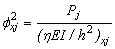
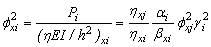
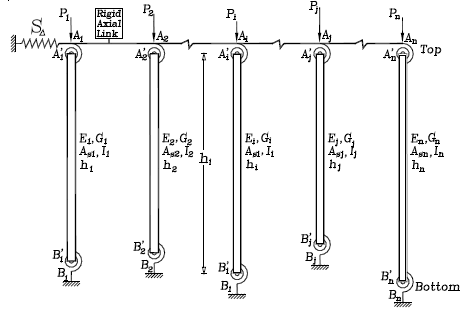
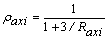
<body><![CDATA[<p>&nbsp;</p>     <p><font size="3" face="Verdana, Arial, Helvetica, sans-serif"><b>2. STRUCTURAL  MODELS </b></font></p>     <p><font size="2" face="Verdana, Arial, Helvetica, sans-serif">The models of an entire  story of 2D and 3D framed structures are shown in <a href="#fig01">Figs. 1(a)</a> and <a href="#fig01">1(b)</a>,  respectively. In both models it is assumed that the floor diaphragms are  axially rigid in their own plane. This allows for the condensation of the  lateral degrees of freedom (DOFs) into one DOF per floor level in 2D frames,  and three DOFs per floor level (two horizontal translations and a rotation  about the vertical axis at the stiffness or shear center) in 3D frames. </font></p>     <p align="center"><font size="2" face="Verdana, Arial, Helvetica, sans-serif"><b><a name="fig01"></a><img src="/img/revistas/dyna/v78n168/a01fig01.gif">    <br> Fig. 1. </b>2D-model multi-column system with sidesway partially inhibited </font></p>     <p><font size="2" face="Verdana, Arial, Helvetica, sans-serif"><b><u>2D  Multi-column Model</u>. </b>The 2D model  shown in <a href="#fig01">Fig. 1(a)</a> is a linear elastic model consisting of <b>n</b> prismatic columns each one with different cross sectional  properties (gross sectional area <i>A<sub>i</sub></i>, effective shear area <i>A<sub>si</sub></i>, and moment  of inertia <i>I<sub>i</sub></i>), height (<i>h<sub>i</sub></i>), end bending  restraints <i>(k<sub>ai</sub>, k<sub>bi</sub></i>), under different axial  loads (<i>P<sub>i</sub></i>), all <b>n </b>columns sharing the same lateral spring  restraint <i>S </i>and the same sidesway <i>D</i>. A typical   column element A<sub>i</sub>B<sub>i</sub> of the multi-column  system (<a href="#fig02">Fig. 2a</a>) is made up of the column itself <sub> <img src="/img/revistas/dyna/v78n168/a01eq002.gif"> </sub> and the lumped bending springs A<sub>i <img src="/img/revistas/dyna/v78n168/a01eq004.gif"> </sub> and B<sub>i <img src="/img/revistas/dyna/v78n168/a01eq006.gif"> </sub> at the top and bottom ends, respectively. These bending restraints  have stiffness <i>k<sub>ai</sub></i> and <i>k<sub>bi</sub></i> (units are in  Moment/Radian). It is assumed that a typical column A<sub>i</sub>B<sub>i</sub> is made of a  homogeneous linear elastic material with: 1) a moduli of elasticity <i>E<sub>i</sub></i> and <i>G<sub>i</sub></i>; 2) a straight  line centroidal axis; and 3) buckling taking place around one of the principal  axis of the cross section. The ratios <i>R<sub>ai</sub>=k<sub>ai</sub>/</i>(<i>E<sub>i</sub>I<sub>i</sub>/h<sub>i</sub></i>) and <i>R<sub>bi</sub>=k<sub>bi</sub>/</i>(<i>E<sub>i</sub>I<sub>i</sub>/h<sub>i</sub></i>) will be  denoted as the stiffness indices of the flexural connections of column <i>i </i>at ends A and B, respectively. For  convenience, the following two parameters are introduced: </font></p>     <p><font size="2" face="Verdana, Arial, Helvetica, sans-serif"><i>r<sub>a </sub>= </i>1/(1<i>+</i>3/<i>R<sub>a</sub></i>) (1a)    <br> </font><font size="2" face="Verdana, Arial, Helvetica, sans-serif"><i>r<sub>b </sub>= </i>1/(1<i>+</i>3/<i>R<sub>b</sub></i>) (1b) </font></p>     <p><font size="2" face="Verdana, Arial, Helvetica, sans-serif"><i>r<sub>a</sub></i> and <i>r<sub>a</sub></i> are denoted as the  fixity factors. For hinged connections, both the fixity factor <i>r</i> and the  rigidity index <i>R</i> are zero; but for  rigid connections, the fixity factor is equal to 1 while the rigidity index tends  to infinity. Since the fixity factor can only vary from 0 to 1 (while the rigidity  index <i>R </i>may vary form 0 to ¥), it is more  convenient to use in the analysis of structures with semirigid connections [15,  16, 22, 23]. Gerstle [24] has indicated lower and upper bounds for <i>k<sub>a</sub></i> and <i>k<sub>b</sub></i> for plane frames. Xu  and Grierson [25] used these bounds in the design of plane frames with semirigid  connections. </font></p>     <p align="center"><font size="2" face="Verdana, Arial, Helvetica, sans-serif"><b><a name="fig02"></a><img src="/img/revistas/dyna/v78n168/a01fig02.gif">    ]]></body>
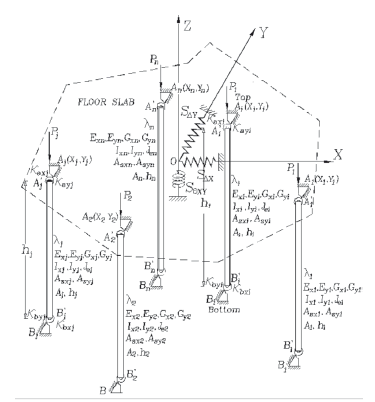
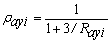
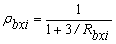
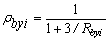
<body><![CDATA[<br>   Fig. 2. </b>3D-model   multi-column system with rotational restraints and with sidesway and torsion   partially inhibited </font></p>     <p><font size="2" face="Verdana, Arial, Helvetica, sans-serif"><b><u>3D   Multi-column Model</u>-. </b>In the case   of a 3-D multi-column system shown in <a href="#fig01">Fig. 1(b)</a>, the particular floor under   consideration is on the <i>XY</i> plane with   the origin O located at a convenient point (generally, at the shear center of   the floor). Again, This is a linear elastic model consisting of <b>n</b> prismatic columns, with the centroid   of column <b>i</b> located at point (<i>X<sub>i</sub>,Y<sub>i</sub></i>) on the global <i>XY</i>-plane, under axial load (<i>P<sub>i</sub></i>) with individual properties including: a cross area (<i>A<sub>i</sub></i>), effective shear areas (<i>A<sub>sxi</sub></i>, <i>A<sub>syi</sub></i> for transverse shear corresponding to bending around the   local x<sub>i</sub>- and y<sub>i</sub>-axes, respectively);   principal moments of inertia (<i>I<sub>xi</sub></i> and <i>I<sub>yi</sub></i> for bending around the local <i>x<sub>i</sub></i>- and <i>y<sub>i</sub></i>-axes, respectively) with its major local <i>x<sub>i</sub></i>-axis making an angle <i>l<sub>i</sub></i> with the global   X-axis; effective polar moment of inertia (<i>J<sub>ei</sub></i>); height (<i>h<sub>i</sub></i>); and end flexural restraints <i>k<sub>axi</sub>, k<sub>bxi</sub></i>, and <i>k<sub>ayi</sub>, k<sub>byi</sub></i> around the local   principal <i>x<sub>i</sub></i>- and <i>y<sub>i</sub></i>-axes, respectively. All <b>n</b> columns share the same lateral spring restraints <i>S<sub>DX</sub>, S<sub>DY</sub>, S<sub>qXY</sub>,</i> and interstory   sidesways <i>D<sub>X</sub>, D<sub>Y</sub>,</i> and <i>q<sub>XY</sub></i> (i.e., at each story, the top and bottom floors serve   as rigid diaphragms allowing only three degrees-of-freedom per floor). All   columns are assumed to have doubly symmetrical cross sections and whose shear   center and centroid coincide. Only three types of overall-story buckling   modes are considered: 1) pure-translational sway flexural buckling; 2)   pure-torsional sway buckling; and 3) combined flexural-torsional sway buckling.   Individual column flexural buckling without overall story sway is also   considered; but individual column torsional buckling is not. </font></p>     <p><font size="2" face="Verdana, Arial, Helvetica, sans-serif">A typical column element A<sub>i</sub>B<sub>i</sub> of the 3-D multi-story system is made up of the column itself <sub> <img src="/img/revistas/dyna/v78n168/a01eq008.gif"> </sub> and the two pairs of bending restraints<sub> <img src="/img/revistas/dyna/v78n168/a01eq010.gif"> </sub> ,<sub> <img src="/img/revistas/dyna/v78n168/a01eq012.gif"> </sub> and <sub> <img src="/img/revistas/dyna/v78n168/a01eq014.gif"> </sub> , <sub> <img src="/img/revistas/dyna/v78n168/a01eq016.gif"> </sub> located at the top and  bottom ends and around the local <i>x<sub>i</sub></i>- and <i>y<sub>i</sub></i>-axes, respectively (<a href="#fig02">Fig. 2</a>). It is assumed that a  typical column <sub> <img src="/img/revistas/dyna/v78n168/a01eq008.gif"> </sub> is made of a homogeneous linear elastic  material with: 1) moduli of elasticity <i>E<sub>xi</sub></i>, <i>E<sub>yi</sub></i>, <i>E<sub>zi</sub></i>, <i>G<sub>xi</sub></i>, <i>G<sub>yi</sub></i> and <i>G<sub>ei</sub></i>; and 2) straight-line centroidal axis <i>z<sub>i</sub></i> with the external axial load <i>P<sub>i</sub></i> applied along its centroidal axis. </font></p>     <p><font size="2" face="Verdana, Arial, Helvetica, sans-serif">The bending restraints <sub> <img src="/img/revistas/dyna/v78n168/a01eq018.gif"> </sub> and <sub> <img src="/img/revistas/dyna/v78n168/a01eq014.gif"> </sub> at the top end A have  stiffnesses <i>k<sub>axi</sub></i> and <i>k<sub>ayi</sub></i> (whose dimensions are in force-distance/radian) around  the principal local <i>x<sub>i</sub></i>- and <i>y<sub>i</sub></i>-axes, respectively. The ratios <i>R<sub>axi</sub>= k<sub>axi</sub></i>/(<i>E<sub>xi</sub>I<sub>xi</sub>/h<sub>i</sub></i>) and <i>R<sub>ayi</sub>= k<sub>ayi</sub></i>/(<i>E<sub>yi</sub>I<sub>yi</sub>/h<sub>i</sub></i>) will be denoted as the <i>stiffness indices</i> of the bending restraints of column <b><i>i</i></b> at the top end A. Similarly, the bending restraints <sub> <img src="/img/revistas/dyna/v78n168/a01eq021.gif"> </sub> and <sub> <img src="/img/revistas/dyna/v78n168/a01eq016.gif"> </sub> at the bottom end have  stiffnesses <i>k<sub>bxi</sub></i> and <i>k<sub>byi</sub></i> and stiffness indices ratios <i>R<sub>bxi</sub>= k<sub>bxi</sub></i>/(<i>E<sub>xi</sub>I<sub>xi</sub>/h<sub>i</sub></i>) and <i>R<sub>byi</sub>= k<sub>byi</sub></i>/(<i>E<sub>yi</sub>I<sub>yi</sub>/h<sub>i</sub></i>). The stiffness indices vary from zero for hinged  connections to infinity for fully restrained connections (i.e., perfectly clamped  ends). To facilitate analysis, the following four parameters are introduced: </font></p>     <p><font size="2" face="Verdana, Arial, Helvetica, sans-serif"><i><sub> <img src="/img/revistas/dyna/v78n168/a01eq024.gif"> </sub> ; <sub> <img src="/img/revistas/dyna/v78n168/a01eq026.gif"> </sub> ; </i></font></p>     <p><font size="2" face="Verdana, Arial, Helvetica, sans-serif"><i><sub> <img src="/img/revistas/dyna/v78n168/a01eq028.gif"> </sub> ; <sub> <img src="/img/revistas/dyna/v78n168/a01eq030.gif"> </sub></i> (2a-d) </font></p>     <p><font size="2" face="Verdana, Arial, Helvetica, sans-serif">Where <i>r<sub>axi</sub>, r<sub>ayi</sub>, r<sub>bxi</sub></i>, and <i>r<sub>byi</sub></i> are called the <i>fixity  factors</i> at the top and bottom ends of column A<sub>i</sub>B<sub>i</sub> around  the principal local <i>x<sub>i</sub></i>- and <i>y<sub>i</sub></i>-axes, respectively. </font></p>     <p>&nbsp;</p>     <p><font size="2" face="Verdana, Arial, Helvetica, sans-serif"><b>3.1 PROPOSED CRITERIA   FOR MINIMUM STIFFNESS OF BRACING </b></font></p>     <p><font size="2" face="Verdana, Arial, Helvetica, sans-serif"><b>3.1 For 2D  Multi-column Systems    ]]></body>
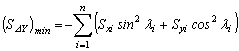
<body><![CDATA[<br></b></font><font size="2" face="Verdana, Arial, Helvetica, sans-serif">The minimum lateral  bracing stiffness (S<sub>D</sub>)<sub>min.</sub> required to convert any  story of a 2D multi-column system [<a href="#fig01">Fig. 1</a>] with sidesway uninhibited or  partially inhibited into a fully braced story can be determined from Eq. (3). </font></p>     <p><font size="2" face="Verdana, Arial, Helvetica, sans-serif"><sub> <img src="/img/revistas/dyna/v78n168/a01eq032.gif"> </sub> (3) </font></p>     <p><font size="2" face="Verdana, Arial, Helvetica, sans-serif">Where: <sub> <img src="/img/revistas/dyna/v78n168/a01eq034.gif"> </sub> (4a) </font></p>     <p><font size="2" face="Verdana, Arial, Helvetica, sans-serif"><sub> <img src="/img/revistas/dyna/v78n168/a01eq036.gif"> </sub> (4b) </font></p>     <p><font size="2" face="Verdana, Arial, Helvetica, sans-serif"><i>a<sub>i </sub>= P<sub>i</sub>/P<sub>j</sub>=</i> ratio of axial load of column<i> i</i> to that of representative column<i> j</i>; </font></p>     <p><font size="2" face="Verdana, Arial, Helvetica, sans-serif"><i>b<sub>i </sub>= </i>(<i>EI</i>)<i><sub>i</sub>/</i>(<i>EI</i>)<sub>j</sub><i>=</i> ratio of flexural stiffness of column <i>i</i> to that of representative column <i>j</i>; </font></p>     <p><font size="2" face="Verdana, Arial, Helvetica, sans-serif"><i>g<sub>i </sub>= h<sub>i</sub>/h<sub>j</sub> =</i> ratio of height of column <i>i</i> to that of representative column <i>j</i>; </font></p>     <p><font size="2" face="Verdana, Arial, Helvetica, sans-serif"><i>f<sub>j </sub>= f-</i>value of the  representative column <i>j</i> calculated using  Eq. (5) under braced conditions; </font></p>     <p><font size="2" face="Verdana, Arial, Helvetica, sans-serif"><i>h<sub>i </sub>= </i>1/[1<i>+P<sub>i</sub></i>/(<i>G<sub>i</sub>A<sub>si</sub></i>)] and <i>h<sub>j</sub>= </i>1/[1<i>+P<sub>j</sub></i>/(<i>G<sub>j</sub>A<sub>sj</sub></i>)]<i>. </i></font></p>     <p><font size="2" face="Verdana, Arial, Helvetica, sans-serif">The stability equation  for the representative <i>j</i>-column under  &quot;braced&quot; conditions is given by Eq. (5): </font></p>     ]]></body>

<body><![CDATA[<p><font size="2" face="Verdana, Arial, Helvetica, sans-serif"><sub> <img src="/img/revistas/dyna/v78n168/a01eq038.gif"> </sub> (5) </font></p>     <p><font size="2" face="Verdana, Arial, Helvetica, sans-serif">The value of <i>(S<sub>D</sub>)<sub>min.</sub></i> according to  Eq. (3) can be obtained following the four steps described below: </font></p>     <p><font size="2" face="Verdana, Arial, Helvetica, sans-serif"> 1) The representative <i>j</i>-column is selected from the <b>n</b>-column  system. The column with the lowest critical axial load under braced conditions  from Eq. (5) is generally recommended. </font></p>     <p><font size="2" face="Verdana, Arial, Helvetica, sans-serif"> 2) The fixity factors <i>r<sub>ai</sub></i> and <i>r<sub>bi</sub></i> for each column must be  determined for both conditions "braced&quot; (i.e. with side sway totally inhibited)  and "unbraced&quot; (i.e. with side sway totally uninhibited). </font></p>     <p><font size="2" face="Verdana, Arial, Helvetica, sans-serif"> 3) The <i>f<sub>j</sub></i> value of the  representative <i>j</i>-column is calculated  from Eq. (5) utilizing the fixity factors <i>r<sub>aj</sub></i> and <i>r<sub>bj</sub></i> for "braced&quot;  conditions. For the rest of the columns, the "braced&quot; <i>f<sub>i</sub></i> values  are determined from Eq. (4b). In this step, it is important to make sure that  the <i>P<sub>cr</sub></i> of each  column for &quot;braced&quot; conditions is larger than that corresponding to  &quot;unbraced&quot; conditions; otherwise, the representative <i>j</i>-column initially selected must changed  to the one with the lowest <i>P<sub>cr</sub></i> among the <b>n</b> columns considering that the top end  of the multi-column system is &quot;braced&quot; against lateral sway. </font></p>     <p><font size="2" face="Verdana, Arial, Helvetica, sans-serif"> 4) The <i>f</i> values of all columns (from step 3) and <i>r<sub>ai</sub></i> and <i>r<sub>bi</sub></i> for  "unbraced&quot; conditions (from step 2) are then substituted into Eq. (3) from  which the required minimum bracing stiffness (<i>S<sub>D</sub></i>)<i><sub>min</sub></i> can be calculated  directly. The next two examples that follow show in detail the proposed  procedure for single columns and plane frames. </font></p>     <p><font size="2" face="Verdana, Arial, Helvetica, sans-serif"><b>3.2 For 3D Multi-column  Systems    <br> </b></font><font size="2" face="Verdana, Arial, Helvetica, sans-serif">The minimum stiffness of  the lateral bracings <i>S<sub>DX</sub>,  S<sub>DY</sub></i> and torsional bracing <i>S<sub>qXY</sub></i> required to  convert any given story of a 3-D multi-column system with sidesway uninhibited  or partially inhibited [<a href="#fig02">Fig. 2</a>] into a fully &quot;braced&quot; story can be  determined from Eqs. (10), (11), and (12), respectively, as follows: </font></p>     <p><font size="2" face="Verdana, Arial, Helvetica, sans-serif"><sub> <img src="/img/revistas/dyna/v78n168/a01eq040.gif"> </sub> (10) </font></p>     <p><font size="2" face="Verdana, Arial, Helvetica, sans-serif"><sub> <img src="/img/revistas/dyna/v78n168/a01eq042.gif"> </sub> (11) </font></p>     ]]></body>
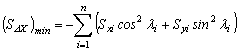
<body><![CDATA[<p><font size="2" face="Verdana, Arial, Helvetica, sans-serif"><sub> <img src="/img/revistas/dyna/v78n168/a01eq044.gif"> </sub> (12) </font></p>     <p><font size="2" face="Verdana, Arial, Helvetica, sans-serif">Where the lateral  stiffness coefficients <i>S<sub>xi</sub></i> and <i>S<sub>yi</sub></i> are given by Eqs. (13a) and (13b). </font></p>     <p><font size="2" face="Verdana, Arial, Helvetica, sans-serif"><sub> <img src="/img/revistas/dyna/v78n168/a01eq046.gif"> </sub> (13a) </font></p>     <p><font size="2" face="Verdana, Arial, Helvetica, sans-serif"><sub> <img src="/img/revistas/dyna/v78n168/a01eq048.gif"> </sub> (13b) </font></p>     <p><font size="2" face="Verdana, Arial, Helvetica, sans-serif">Where: </font></p>     <p><font size="2" face="Verdana, Arial, Helvetica, sans-serif"><sub> <img src="/img/revistas/dyna/v78n168/a01eq050.gif"> </sub> (14a) </font></p>     <p><font size="2" face="Verdana, Arial, Helvetica, sans-serif"><sub> <img src="/img/revistas/dyna/v78n168/a01eq052.gif"> </sub> (14b) </font></p>     <p><font size="2" face="Verdana, Arial, Helvetica, sans-serif"><sub> <img src="/img/revistas/dyna/v78n168/a01eq054.gif"> </sub> (14c) </font></p>     <p><font size="2" face="Verdana, Arial, Helvetica, sans-serif"><sub> <img src="/img/revistas/dyna/v78n168/a01eq056.gif"> </sub> (14d) </font></p>     <p><font size="2" face="Verdana, Arial, Helvetica, sans-serif"><i>a<sub>i</sub>= P<sub>i</sub>/P<sub>j</sub>=</i> ratio of axial load of column <i>i</i> to that of representative <i>j</i>-column; </font></p>     ]]></body>
<body><![CDATA[<p><font size="2" face="Verdana, Arial, Helvetica, sans-serif"><i>b<sub>xi</sub>=  (EI)<sub>xi</sub>/(EI)<sub>xj</sub>=</i> ratio of flexural stiffness around the local <i>x</i>-axis of column <i>i</i> to that of representative <i>j</i>-column; </font></p>     <p><font size="2" face="Verdana, Arial, Helvetica, sans-serif"><i>b<sub>yi </sub>=  (EI)<sub>yi</sub>/(EI)<sub>yj</sub>=</i> ratio of flexural stiffness around the local <i>y</i>-axis of column i to that of  representative <i>j</i>-column; </font></p>     <p><font size="2" face="Verdana, Arial, Helvetica, sans-serif"><i>g<sub>i </sub>=  h<sub>i</sub>/h<sub>j</sub></i> = ratio of  height of column <i>i</i> to that of  representative column <i>j</i>; </font></p>     <p><font size="2" face="Verdana, Arial, Helvetica, sans-serif"><i>f<sub>xj</sub></i> and<i>f<sub>xj</sub>= </i>stability factors of the representative <i>j</i>-column  corresponding to buckling along the local <i>x<sub>j</sub></i>- and <i>y<sub>j</sub></i>-axes calculated  from Eq. (5) under "braced&quot; conditions, respectively; </font></p>     <p><font size="2" face="Verdana, Arial, Helvetica, sans-serif"><i>h<sub>xi </sub>= </i>1/[1<i>+P<sub>i</sub></i>/(<i>G<sub>xi</sub>A<sub>sxi</sub></i>)]<i>; </i>and </font></p>     <p><font size="2" face="Verdana, Arial, Helvetica, sans-serif"><i>h<sub>yi </sub>= </i>1/[1<i>+P<sub>i</sub></i>/(<i>G<sub>yi</sub>A<sub>syj</sub></i>)]<i>.</i> </font></p>     <p><font size="2" face="Verdana, Arial, Helvetica, sans-serif">The stability equations  for &quot;braced&quot; conditions along the <i>X</i>-  and <i>Y</i>- directions are given by Eqs.  (15a-b). </font></p>     <p><font size="2" face="Verdana, Arial, Helvetica, sans-serif"><sub> <img src="/img/revistas/dyna/v78n168/a01eq058.gif"> </sub> (15a) </font></p>     <p><font size="2" face="Verdana, Arial, Helvetica, sans-serif"><sub> <img src="/img/revistas/dyna/v78n168/a01eq060.gif"> </sub> (15b) </font></p>     <p><font size="2" face="Verdana, Arial, Helvetica, sans-serif">The stiffnesses <i>(S<sub>DX</sub>)<sub>min.</sub>,</i> <i>(S<sub>DY</sub>)<sub>min.</sub></i> and <i>(S<sub>qXY</sub>)<sub>min.</sub></i> can be obtained  following the 4 steps described below: </font></p>     ]]></body>

<body><![CDATA[<p><font size="2" face="Verdana, Arial, Helvetica, sans-serif">1)  Similar to 2-D frames, a representative <i>j</i>-column  is selected from the <b>n</b> columns  within the story level under consideration [<a href="#fig02">Fig. 2</a>]. The column with the lowest  critical axial load under braced conditions is generally recommended. </font></p>     <p><font size="2" face="Verdana, Arial, Helvetica, sans-serif">2)  The fixity factors <i>r<sub>ai</sub></i> and <i>r<sub>bi</sub></i> of each column must be  determined in the local <i>x<sub>i</sub></i>- and <i>y<sub>i</sub></i>-directions  for both conditions, "braced&quot; and "unbraced&quot;; </font></p>     <p><font size="2" face="Verdana, Arial, Helvetica, sans-serif">3)  The "braced&quot; <i>f<sub>xj</sub></i> and <i>f<sub>yj</sub></i> factors of the  representative column <i>j</i> are  calculated from Eqs. (15a) and (15b) utilizing the fixity factors <i>r<sub>axj</sub>,</i> <i>r<sub>ayj, </sub>r<sub>bxj</sub></i>, and <i>r<sub>by</sub></i> for the "braced&quot; case. For  the rest of the columns the "braced&quot; factors <i>f<sub>xj</sub></i> and <i>f<sub>yj</sub></i> can be determined from  Eqs. (14b) and (14d). At this step, it is important to check that <i>P<sub>cr</sub></i> of each  column for &quot;braced&quot; conditions is larger than that corresponding to &quot;unbraced&quot;  conditions; otherwise, the <i>j</i>-column  initially selected must be changed to the column with the smallest <i>P<sub>cr</sub></i> among the <b>n</b> columns considering that story level &quot;braced&quot;. </font></p>     <p><font size="2" face="Verdana, Arial, Helvetica, sans-serif">4)  The "braced&quot; <i>f</i>-factors  (from step 2), the fixity factors <i>r<sub>ai</sub></i> and <i>r<sub>bi</sub></i> in <i>x</i>- and <i>y</i>-directions for "unbraced&quot;  conditions (from step 1), the <i>XY</i> coordinates of each column, and the individual column torsional stiffness (<i>G<sub>ei</sub>J<sub>ei</sub>/h<sub>i</sub></i>) are then  substituted into Eqs. (10), (11) and (12) from which the required minimum stiffness  of the bracings (<i>S<sub>DX</sub></i>)<i><sub>min</sub></i><sub>.</sub>, (<i>S<sub>DY</sub></i>)<i><sub>min</sub></i><sub>.</sub> and (<i>S<sub>qXY</sub></i>)<i><sub>min</sub></i><sub>.</sub> be  calculated directly. The two examples that follow show the proposed procedure  for 3-D framed structures. </font></p>     <p><font size="2" face="Verdana, Arial, Helvetica, sans-serif">Note that similar to  what happens in 2D multi-column system when the values of both fixity factors <i>r<sub>a</sub></i> and <i>r<sub>b</sub></i> for "braced&quot; and  "unbraced&quot; conditions in any column of a 3D multi-column system remain  unchanged in any of its local x- and y-directions. Thus (<i>S<sub>DX</sub></i>)<i><sub>min</sub></i> or/and (<i>S<sub>DY</sub></i>)<i><sub>min</sub></i> and (<i>S<sub>qXY</sub></i>)<i><sub>min</sub></i><sub>.</sub> become  infinity except for leaning columns. This comes from the fact that denominator  of Eqs. (13a-b) which is identical to expressions (15a-b) become equal to zero,  making (<i>S<sub>DX</sub></i>)<i><sub>min</sub></i> or/and (<i>S<sub>DY</sub></i>)<i><sub>min</sub></i> and (<i>S<sub>qXY</sub></i>)<i><sub>min</sub></i><sub>.</sub> equal to infinity,  with the shear factors <i>h</i> having no  effect. </font></p>     <p> </p>     <p>&nbsp;</p>     <p><font size="3" face="Verdana, Arial, Helvetica, sans-serif"><b>4. SUMMARY AND   CONCLUSIONS </b></font></p>     <p><font size="2" face="Verdana, Arial, Helvetica, sans-serif">A method that determines  the minimum stiffness of the lateral and torsional bracings required by a  multi-column elastic system, with the goal of achieving non-sway buckling  conditions is proposed. Equations that evaluate the required minimum stiffness of  the lateral and torsional bracings and the corresponding "braced&quot; critical  buckling load for each column of the story level are derived using the modified  stability functions. The following effects are included: 1) the plan layout of  the columns (i.e., the orientation and location of the centroid of the cross  section of all columns); and 2) shear deformations along each column using the  modified method proposed by Timoshenko and Gere [26]. The proposed method is  applicable to 2D and 3D multi-column systems with rigid, semi-rigid, and simple  connections. It is shown that the minimum stiffness of the bracings required by  a multi-column system depends on: 1) the blueprint layout and the layout of the  columns; 2) the variation in height and cross sectional properties among the  columns; 3) the flexural and shear stiffness of each column; 4) the applied  axial load pattern on the columns; 5) the lack of symmetry in the loading  pattern, column layout, column sizes, and heights that cause the combined torsion-sway  buckling which reduces the buckling capacity of the frame as a whole; and 6)  the support conditions and end restraints of the columns. The proposed method  is limited to elastic framed structures with columns with a doubly-symmetrical  cross section oriented in any direction with respect to the global axes. Three  examples are presented in detail to show the effectiveness and simplicity of  the proposed method and the effects of the orientation of the cross section and  shear deformations along the height of the columns. </font></p>     <p><font size="2" face="Verdana, Arial, Helvetica, sans-serif">Definite criterion for  minimum stiffness of bracing for 2-D and 3-D elastic framed structures is  presented, and the corresponding equations are derived using the modified  method proposed by Timoshenko and Gere [26]. A condensed approach that determines  the minimum stiffness of story bracing required by plane and space framed  structures to achieve non-sway buckling conditions is proposed. The proposed  approach and corresponding equations are applicable to multi-column frames with  rigid, semirigid, and simple connections. The proposed method is only  applicable to elastic framed structures with the following limitations: 1) the  floor diaphragms including the ground floor of the framed structure are assumed  to be axially rigid; and 2) all columns are assumed to be doubly-symmetrical  with their principal cross-sectional axes parallel to the XY global axes (i.e.,  columns whose shear center and centroid coincide). The effects of axial  deformations are also neglected. As a consequence, overall story flexural  buckling occurring along the X- or/and Y-axes and overall flexural-torsional  buckling occurring in the XY plane and about the Z axis are considered in 3-D  frames. Overall story flexural buckling occurring in the plane of the frame is  only considered in the bracing analysis of 2-D frames. Pure torsional buckling  in a single column is not considered herein. </font></p>     ]]></body>
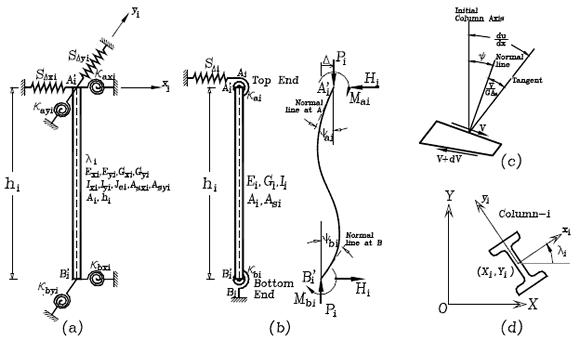
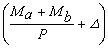
<body><![CDATA[<p><font size="2" face="Verdana, Arial, Helvetica, sans-serif">The proposed method finds  great applications in systems made of materials with relatively low shear  stiffness such as orthotropic composite materials (FRP) and multilayer  elastomeric bearings used for seismic isolation of buildings. It allows the analyst to investigate directly not only  the combined effects of shear and bending deformations along each column, but  also the topology of the columns (i.e., their layout and orientation on the  XY-plane), load patterns, semirigid connections, flexural hinges, interstory  bracing, and the properties of the members (span, cross sectional geometry, and  elastic moduli) on the minimum bracing stiffness  requirements for plane and space framed structures. The proposed approach is  more accurate and general than any other method available in the technical  literature.</font></p>     <p>&nbsp; </p>     <p><font size="3" face="Verdana, Arial, Helvetica, sans-serif"><b>5. APPENDIX </b> <b>I.</b> <b> DERIVATION  OF BRACING STIFFNESS EQUATIONS </b></font></p>     <p><font size="2" face="Verdana, Arial, Helvetica, sans-serif"><b>5.1 Determination  of Lateral Stiffness Coefficients S<sub>xi</sub></b> <b>and S<sub>yi</sub></b>-.    <br> The stability analysis of a prismatic column including bending and  shear deformations (<a href="#fig03">Figs. 3b-c</a>) is formulated using the modified approach proposed  by Timoshenko and Gere [26, page 134]. This approach has been utilized by  Aristizabal-Ochoa [21] in the stability analysis of columns and elastomeric isolation  bearings. The governing equations are as follow:</font></p>     <p><font size="2" face="Verdana, Arial, Helvetica, sans-serif"><i>hEI u''</i>(<i>x</i>) +<i>P  u</i>(<i>x</i>)<i>=-M<sub>a</sub></i> <i>-</i> (<i>M<sub>a </sub></i>+ <i>M<sub>b</sub></i>+ <i>PD</i>)<i><sub> <img src="/img/revistas/dyna/v78n168/a01eq062.gif"> </sub> </i> (16a) </font></p>     <p><font size="2" face="Verdana, Arial, Helvetica, sans-serif"><i>hEI y''</i>(<i>x</i>) + <i>P y</i>(<i>x</i>)<i>= <sub> <img src="/img/revistas/dyna/v78n168/a01eq064.gif"> </sub> </i> (16b)</font></p>     <p><font size="2" face="Verdana, Arial, Helvetica, sans-serif">Where <i>u</i>(<i>x</i>) = lateral deflection of the column center line; and <i>y</i>(<i>x</i>) = rotation of the cross section, as shown by     <a href="#fig02">Fig. 2c</a>. The solutions for the second-order linear differential Eqs. (16a)-(16b)  are as follows: </font></p>     <p><font size="2" face="Verdana, Arial, Helvetica, sans-serif"><i>u</i>(<i>x</i>)= <i>Acos</i>(<i><sub> <img src="/img/revistas/dyna/v78n168/a01eq062.gif"> </sub></i> <i>f</i>)+<i>Bsin</i>(<i><sub> <img src="/img/revistas/dyna/v78n168/a01eq062.gif"> </sub></i> <i>f</i>)+<i><sub> <img src="/img/revistas/dyna/v78n168/a01eq062.gif"> </sub></i> <i><sub> <img src="/img/revistas/dyna/v78n168/a01eq069.gif"> </sub></i> <i>-<sub> <img src="/img/revistas/dyna/v78n168/a01eq071.gif"> </sub></i> (17a) </font></p>     <p><font size="2" face="Verdana, Arial, Helvetica, sans-serif"><i>y&bull;</i>(<i>x</i>)= <i>Ccos</i>(<i><sub> <img src="/img/revistas/dyna/v78n168/a01eq062.gif"> </sub></i> <i>f</i>)+<i>Dsin</i>(<i><sub> <img src="/img/revistas/dyna/v78n168/a01eq062.gif"> </sub></i> <i>f</i>) +<i><sub> <img src="/img/revistas/dyna/v78n168/a01eq075.gif"> </sub></i> <i><sub> <img src="/img/revistas/dyna/v78n168/a01eq077.gif"> </sub></i> (17b) </font></p>     ]]></body>
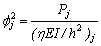
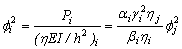
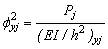
<body><![CDATA[<p><font size="2" face="Verdana, Arial, Helvetica, sans-serif">Where: <i>f</i><sup>2</sup><i>= P</i>/(<i>hEI/h</i><sup>2</sup>)<i>.</i> </font></p>     <p align="center"><font size="2" face="Verdana, Arial, Helvetica, sans-serif"><b><a name="fig03"></a><img src="/img/revistas/dyna/v78n168/a01fig03.gif">    <br>   Fig. 3. Model of column with sidesway partially inhibited  and with rotational and lateral end restraints: </b>(a) Structural model; b) end moments, forces, rotations  and deflections; c) differential element including bending and shear deformations;  and d) column orientation of cross-section local axis </font></p>     <p><font size="2" face="Verdana, Arial, Helvetica, sans-serif">The unknown  coefficients A, B, C, and D can be obtained from the following boundary  conditions: </font></p>     <p><font size="2" face="Verdana, Arial, Helvetica, sans-serif">At x = 0: <i>u= 0</i>, and <i>y = y<sub>a</sub></i> </font></p>     <p><font size="2" face="Verdana, Arial, Helvetica, sans-serif">At x = h: <i>u= D</i> and <i>y = y<sub>b </sub></i></font></p>     <p><font size="2" face="Verdana, Arial, Helvetica, sans-serif">Where: </font></p>     <p><font size="2" face="Verdana, Arial, Helvetica, sans-serif"><i>y<sub>a</sub></i> and <i>y<sub>b</sub></i>= rotations of cross sections at A and B  due to bending, respectively; </font></p>     <p><font size="2" face="Verdana, Arial, Helvetica, sans-serif"><i>D<sub>a</sub></i> and <i>D<sub>b</sub></i>= lateral sway at A and B, respectively. </font></p>     <p><font size="2" face="Verdana, Arial, Helvetica, sans-serif"><i>D</i>= <i>D<sub>a</sub>-D<sub>b</sub></i>=  relative sidesway of column end A with respect to its bottom end B. </font></p>     ]]></body>
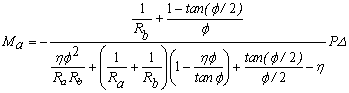
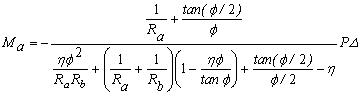
<body><![CDATA[<p><font size="2" face="Verdana, Arial, Helvetica, sans-serif">Therefore: <i>A=<sub> <img src="/img/revistas/dyna/v78n168/a01eq079.gif"> </sub> </i>; <i>B=<sub> <img src="/img/revistas/dyna/v78n168/a01eq081.gif"> </sub> tan(f</i>/2<i>) -<sub> <img src="/img/revistas/dyna/v78n168/a01eq083.gif"> </sub> </i>; <i>C= y<sub>a</sub>-<sub> <img src="/img/revistas/dyna/v78n168/a01eq085.gif"> </sub> <sub> <img src="/img/revistas/dyna/v78n168/a01eq087.gif"> </sub> </i>; and </font></p>     <p><font size="2" face="Verdana, Arial, Helvetica, sans-serif"><i>D</i>= <sub> <img src="/img/revistas/dyna/v78n168/a01eq089.gif"> </sub> -<sub> <img src="/img/revistas/dyna/v78n168/a01eq091.gif"> </sub> <i>tan</i>(<i>f</i>/2) </font></p>     <p><font size="2" face="Verdana, Arial, Helvetica, sans-serif">Since <i>u'</i>=<i>y +V</i>/(<i>A<sub>s</sub>G</i>) and <i>V=Py -<sub> <img src="/img/revistas/dyna/v78n168/a01eq093.gif"> </sub> </i> the following expressions for <i>y<sub>a</sub></i> and <i>y<sub>b</sub></i> can be obtained:</font></p>      <p><font size="2" face="Verdana, Arial, Helvetica, sans-serif"><i>y<sub>a</sub></i>= <sub> <img src="/img/revistas/dyna/v78n168/a01eq095.gif"> </sub> (18a) </font></p>     <p><font size="2" face="Verdana, Arial, Helvetica, sans-serif"><i>y<sub>b</sub></i>= <sub> <img src="/img/revistas/dyna/v78n168/a01eq097.gif"> </sub> (18b) </font></p>     <p><font size="2" face="Verdana, Arial, Helvetica, sans-serif">Where: <i>h=</i>1/[<i>1+P</i>/(<i>A<sub>s</sub>G</i>)]; and <i>A<sub>s</sub></i>= effective shear area of the column. Notice that, in  this approach <i>V</i> includes the component <i>Py, </i>as  suggested by Haringx [27]. This component was not included in the paper by Aristizabal-Ochoa  [20] on the effects of shear deformations on the stability of single  beam-columns. </font></p>     <p><font size="2" face="Verdana, Arial, Helvetica, sans-serif">Eqs. (18) can be represented in matrix form as  follows: </font></p>     <p><font size="2" face="Verdana, Arial, Helvetica, sans-serif"><sub> <img src="/img/revistas/dyna/v78n168/a01eq099.gif"> </sub> (19) </font></p>     <p><font size="2" face="Verdana, Arial, Helvetica, sans-serif">Inverting the 2´2 matrix in Eq. (19), <i>M<sub>a</sub></i> and <i>M<sub>b</sub></i> can be expressed in  term of the interstory drift <i>D/h</i> as  follows: </font></p>     <p><font size="2" face="Verdana, Arial, Helvetica, sans-serif"><sub> <img src="/img/revistas/dyna/v78n168/a01eq101.gif"> </sub> (20a) </font></p>     ]]></body>
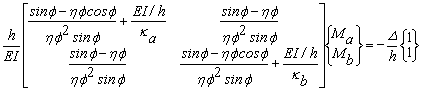
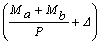
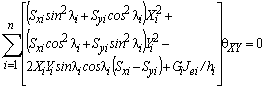
<body><![CDATA[<p><font size="2" face="Verdana, Arial, Helvetica, sans-serif"><sub> <img src="/img/revistas/dyna/v78n168/a01eq103.gif"> </sub> (20b) </font></p>     <p><font size="2" face="Verdana, Arial, Helvetica, sans-serif">Since three unknowns (<i>M<sub>ai</sub></i>, <i>M<sub>bi</sub></i>, and <i>D</i>) are involved, one more equation is required at the  element level. This equation is obtained applying rotational equilibrium of  column AB in <a href="#fig02">Fig. 2b</a>: </font></p>     <p><font size="2" face="Verdana, Arial, Helvetica, sans-serif"> <i>M<sub>a </sub></i>+ <i>M<sub>b </sub></i>+ <i>PD</i> +<i>F</i> <i>h = 0 </i> (21) </font></p>     <p><font size="2" face="Verdana, Arial, Helvetica, sans-serif">Substituting Eqs. (20a-b) into Eq. (21) </font></p>     <p><font size="2" face="Verdana, Arial, Helvetica, sans-serif"><sub> <img src="/img/revistas/dyna/v78n168/a01eq105.gif"> </sub> (22) </font></p>     <p><font size="2" face="Verdana, Arial, Helvetica, sans-serif">The left term of Eq. (22) represents the lateral  stiffness (including the effects of shear deformations) provided by column AB  to the floor system in the direction of buckling. Eq. (22) can be expressed in  terms of the fixity factors [<i>r<sub>ai</sub></i> and <i>r<sub>bi</sub></i> from Eqs. (1a-b)] and ratios <i>a<sub>i</sub></i> and <i>g<sub>i</sub></i>, as follows: </font></p>     <p><font size="2" face="Verdana, Arial, Helvetica, sans-serif"><sub> <img src="/img/revistas/dyna/v78n168/a01eq107.gif"> </sub> (23) </font></p>     <p><font size="2" face="Verdana, Arial, Helvetica, sans-serif">The left term in Eq. (23), when applied in the local <i>x<sub>i</sub></i>- and <i>y<sub>i</sub></i>-principal directions, becomes the stiffness  coefficients <i>S<sub>xi</sub></i> and <i>S<sub>yi</sub></i> given  by Eqs. (13a) and (13b) previously utilized in Eqs. (10)-(13). </font></p>     <p><font size="2" face="Verdana, Arial, Helvetica, sans-serif">The stiffness matrix <sub> <img src="/img/revistas/dyna/v78n168/a01eq109.gif"> </sub> of column <i>i</i> in the principal <i>x<sub>i</sub>y<sub>i</sub></i> local system (<a href="#fig02">Fig. 2c</a>) is then transformed into the global system <i>XY</i> as follows: </font></p>     <p><font size="2" face="Verdana, Arial, Helvetica, sans-serif">[<i>K</i>]<i><sub>i</sub></i>= <sub> <img src="/img/revistas/dyna/v78n168/a01eq111.gif"> </sub> <sub> <img src="/img/revistas/dyna/v78n168/a01eq113.gif"> </sub> <sub> <img src="/img/revistas/dyna/v78n168/a01eq115.gif"> </sub> </font></p>     ]]></body>
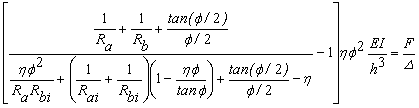
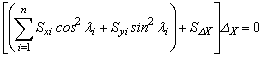
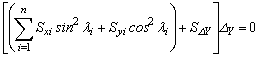
<body><![CDATA[<p><font size="2" face="Verdana, Arial, Helvetica, sans-serif">= <sub> <img src="/img/revistas/dyna/v78n168/a01eq117.gif"> </sub> (24) </font></p>     <p><font size="2" face="Verdana, Arial, Helvetica, sans-serif">Using Eq. (24) for each column <i>i</i> (with its centroid located at <i>X<sub>i</sub></i> and <i>Y<sub>i</sub></i> with respect to the global <i>XY</i>-system), and applying static  equilibrium of the top floor of the model shown in <a href="#fig02">Fig. 2</a> along the <i>X</i>-axes, and assuming that the floor is  braced along the <i>Y</i>-axes and restrained  to rotate about the <i>Z</i>-axis for 3D  frames, then: </font></p>     <p><font size="2" face="Verdana, Arial, Helvetica, sans-serif"><sub> <img src="/img/revistas/dyna/v78n168/a01eq119.gif"> </sub> (25) </font></p>     <p><font size="2" face="Verdana, Arial, Helvetica, sans-serif">Now, considering static equilibrium along the <i>Y</i>-axis and around the <i>Z</i>-axis independently (<a href="#fig01">Fig. 1b</a>) in a  similar fashion as it was done along the <i>X</i>-axis,  the following two equations can be obtained: </font></p>     <p><font size="2" face="Verdana, Arial, Helvetica, sans-serif"><sub> <img src="/img/revistas/dyna/v78n168/a01eq121.gif"> </sub> (26) </font></p>     <p><font size="2" face="Verdana, Arial, Helvetica, sans-serif"><sub> <img src="/img/revistas/dyna/v78n168/a01eq123.gif"> </sub> (27) </font></p>     <p><font size="2" face="Verdana, Arial, Helvetica, sans-serif">Where the coefficients within the square matrix are  given by Eqs. (10)-(12). The stability analysis, on the other hand, can be  carried out by making the determinant of Eq. (28) equal to zero. The three  modes of buckling of a story in 3D multi-column systems are related to the  types of symmetry about the <i>X</i>- and <i>Y</i>-axes and they are fully described by  Aristizabal-Ochoa [21].</font></p>     <p>&nbsp; </p>     <p><font size="3" face="Verdana, Arial, Helvetica, sans-serif"><b>ACKNOWLEDGEMENTS </b></font></p>     <p><font size="2" face="Verdana, Arial, Helvetica, sans-serif">This research was carried out  at the National University of Colombia at Medell&iacute;n by the GES group. The  authors want to express their gratitude to the School of Civil Engineering and DIME for their  financial support.</font></p>     ]]></body>
<body><![CDATA[<p>&nbsp; </p>     <p><font size="3" face="Verdana, Arial, Helvetica, sans-serif"><b>NOTATION </b></font></p>     <p><font size="2" face="Verdana, Arial, Helvetica, sans-serif">The following symbols  are used in this paper: </font></p>     <p><font size="2" face="Verdana, Arial, Helvetica, sans-serif"><i>A<sub>s </sub></i>= effective shear area  of the column.    <br>  <i>E </i>=  Elastic modulus of the material;    <br>  <i>G </i>=  Shear modulus of the material;    <br>  <i>h<sub>i </sub></i>= height of column <i>i</i>;    <br>  <i>i </i>= subscript  indicating column-i of the 3-D multi-column system;    <br>  <i>j </i>= subscript  indicating the representative column-<i>j</i> of the multi-column system;    <br>  <i>I<sub>g </sub></i>= girder moment of  inertia;    ]]></body>
<body><![CDATA[<br>  <i>I<sub>i</sub></i> or <i>I<sub>c </sub></i>=  moment of the inertia of column i;    <br>  <i>k<sub>ai</sub></i> and <i>k<sub>bi </sub></i>= the flexural stiffness  of the end connections at Ai and Bi, respectively;    <br>  <i>L</i><sub>g </sub>= girder  span;    <br>  (<i>P<sub>cr</sub></i>)<sub>j </sub>= buckling  load of representative column <i>j</i>;    <br>  (<i>P<sub>cr</sub></i>)<sub>i</sub> = buckling  load of column <i>i</i> [=<i>a<sub>i</sub></i> (<i>P<sub>cr</sub></i>)<sub>j</sub>];    <br>  <b>n </b>=  total number of columns in the story system;    <br>  <i>S<sub>Dx </sub></i>= interstory lateral  stiffness or bracing stiffness provided to the system along the X-axis;    <br>  <i>S<sub>Dy </sub></i>= interstory lateral  stiffness or bracing stiffness provided to the system along the Y-axis;    <br>  <i>S<sub>qxy </sub></i>= stiffness of the interstory  torsional bracing provided to the system about the Z-axis;    <br>  <i>R<sub>ai </sub></i>= stiffness index of the  flexural connection at A<sub>i</sub> [= <i>k<sub>ai</sub></i>/(<i>EI<sub>i</sub>/h<sub>i</sub></i>)];    ]]></body>
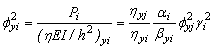
<body><![CDATA[<br>  <i>R<sub>bi </sub></i>= stiffness index of the  flexural connection at B<sub>i</sub> [=<i>k<sub>bi</sub></i>/(<i>EI<sub>i</sub>/h<sub>i</sub></i>)];    <br>  <i>X<sub>i</sub></i> and <i>Y<sub>i </sub></i>= <i>X</i>-and <i>Y</i>-coordinates of column i with respect to origin O;    <br>  <i>x </i>and <i>y </i>= subscripts that indicate that the  calculation is in the global <i>X</i>- and <i>Y</i>-directions, respectively;    <br>  <i>a<sub>i </sub></i>= ratio of axial load of  column i to that of representative column j [= <i>P<sub>i</sub></i>/<i>P<sub>j</sub></i>];    <br>  <i>b<sub>i</sub></i> = ratio of flexural  stiffness of column <i>i</i> to that of  representative column <i>j</i> [= (<i>E<sub>i</sub>I<sub>i</sub></i>)/(<i>EjIj</i>)];    <br>  <i>h</i> <i>= </i>[1+<i>P</i>/(<i>A<sub>s</sub>G</i>)];    <br>  <i>g<sub>I</sub></i> = ratio of height of  column <i>i </i>to that of representative  column <i>j</i> [= <i>h<sub>i</sub>/h<sub>j</sub></i>];    <br>  <i>D </i>= interstory drift;    <br>  <i>r<sub>ai</sub></i> and <i>r<sub>bi </sub></i>= fixity factors at A<sub>i</sub> and B<sub>i</sub> of column <i>i</i>, respectively;    <br>  <i>f<sub>i</sub></i> =<sub> <img src="/img/revistas/dyna/v78n168/a01eq125.gif"> </sub> = Stability factor of column <i>i</i>;    ]]></body>
<body><![CDATA[<br>  <i>G<sub>ai</sub></i> and <i>T<sub>bi</sub></i> = ratios <i>&aring;(EI/h)<sub>c</sub>/(EI/L)<sub>g</sub></i> at ends A<sub>i</sub> and B<sub>i</sub> of column <i>I</i>, respectively;    <br>  <i>q</i> = interstory  angle of twist of the story floor;    <br>  <sub> <img src="/img/revistas/dyna/v78n168/a01eq127.gif"> </sub> and <sub> <img src="/img/revistas/dyna/v78n168/a01eq129.gif"> </sub> = rotations of column <i>i</i> at <sub> <img src="/img/revistas/dyna/v78n168/a01eq004.gif"> </sub> and <sub> <img src="/img/revistas/dyna/v78n168/a01eq006.gif"> </sub> with respect to  column's cord, respectively.</font></p>     <p>&nbsp; </p>     <p><font size="3" face="Verdana, Arial, Helvetica, sans-serif"><b>REFERENCES</b> </font></p>     <!-- ref --><p><font size="2" face="Verdana, Arial, Helvetica, sans-serif"><b>[1]</b> Manual of Steel Construction, "Allowable Stress Design," Ninth Edition, AISC, part 3, 1990.     &nbsp;&nbsp;&nbsp;&nbsp;&nbsp;&nbsp;&nbsp;&nbsp;[&#160;<a href="javascript:void(0);" onclick="javascript: window.open('/scielo.php?script=sci_nlinks&ref=000178&pid=S0012-7353201100040000100001&lng=','','width=640,height=500,resizable=yes,scrollbars=1,menubar=yes,');">Links</a>&#160;]<!-- end-ref --><!-- ref --><br>  <b>[2]</b> Manual of Steel Construction, "Load & Resistance Factor Design," 1st Edition, AISC, part 2, 1986.     &nbsp;&nbsp;&nbsp;&nbsp;&nbsp;&nbsp;&nbsp;&nbsp;[&#160;<a href="javascript:void(0);" onclick="javascript: window.open('/scielo.php?script=sci_nlinks&ref=000179&pid=S0012-7353201100040000100002&lng=','','width=640,height=500,resizable=yes,scrollbars=1,menubar=yes,');">Links</a>&#160;]<!-- end-ref --><!-- ref --><br>  <b>[3]</b> Manual of Steel Construction, "Load & Resistance Factor Design," 2nd Edition, AISC, 1994.     &nbsp;&nbsp;&nbsp;&nbsp;&nbsp;&nbsp;&nbsp;&nbsp;[&#160;<a href="javascript:void(0);" onclick="javascript: window.open('/scielo.php?script=sci_nlinks&ref=000180&pid=S0012-7353201100040000100003&lng=','','width=640,height=500,resizable=yes,scrollbars=1,menubar=yes,');">Links</a>&#160;]<!-- end-ref --><!-- ref --><br>  <b>[4]</b> Manual of Steel Construction, "Load & Resistance Factor Design," 3rd Edition, AISC, 2002.     &nbsp;&nbsp;&nbsp;&nbsp;&nbsp;&nbsp;&nbsp;&nbsp;[&#160;<a href="javascript:void(0);" onclick="javascript: window.open('/scielo.php?script=sci_nlinks&ref=000181&pid=S0012-7353201100040000100004&lng=','','width=640,height=500,resizable=yes,scrollbars=1,menubar=yes,');">Links</a>&#160;]<!-- end-ref --><!-- ref --><br>  <b>[5]</b> Manual of Steel Construction, "Load & Resistance Factor Design," 4th Edition, AISC, 2005.     &nbsp;&nbsp;&nbsp;&nbsp;&nbsp;&nbsp;&nbsp;&nbsp;[&#160;<a href="javascript:void(0);" onclick="javascript: window.open('/scielo.php?script=sci_nlinks&ref=000182&pid=S0012-7353201100040000100005&lng=','','width=640,height=500,resizable=yes,scrollbars=1,menubar=yes,');">Links</a>&#160;]<!-- end-ref --><!-- ref --><br>  <b>[6]</b> Helwig, T. A. and Yura, J. A., "Torsional Bracing of Columns,&quot; Journal of Structural Engineering, Vol. 125, No. 5, 1999, pp. 547-555.     &nbsp;&nbsp;&nbsp;&nbsp;&nbsp;&nbsp;&nbsp;&nbsp;[&#160;<a href="javascript:void(0);" onclick="javascript: window.open('/scielo.php?script=sci_nlinks&ref=000183&pid=S0012-7353201100040000100006&lng=','','width=640,height=500,resizable=yes,scrollbars=1,menubar=yes,');">Links</a>&#160;]<!-- end-ref --><!-- ref --><br>  <b>[7]</b> Kim, H. I. and Goel, S. C., "Upgrading of Braced Frames for Potential Local Failures,&quot; Journal of Structural Engineering, Vol. 122, No. 5, 1996, pp. 470-475     &nbsp;&nbsp;&nbsp;&nbsp;&nbsp;&nbsp;&nbsp;&nbsp;[&#160;<a href="javascript:void(0);" onclick="javascript: window.open('/scielo.php?script=sci_nlinks&ref=000184&pid=S0012-7353201100040000100007&lng=','','width=640,height=500,resizable=yes,scrollbars=1,menubar=yes,');">Links</a>&#160;]<!-- end-ref --><!-- ref --><br>  <b>[8]</b> Sputo, T. and Turner, J. L. (Editors), "Bracing Cold-Formed Steel Structures: A Design Guide,&quot; ASCE Book, ISBN 0784408173, 2006, 144 p.     &nbsp;&nbsp;&nbsp;&nbsp;&nbsp;&nbsp;&nbsp;&nbsp;[&#160;<a href="javascript:void(0);" onclick="javascript: window.open('/scielo.php?script=sci_nlinks&ref=000185&pid=S0012-7353201100040000100008&lng=','','width=640,height=500,resizable=yes,scrollbars=1,menubar=yes,');">Links</a>&#160;]<!-- end-ref --><!-- ref --><br>  <b>[9]</b> Wang, L. and Helwig, T. A., "Critical Imperfections for Beam Bracing Systems,&quot; Journal of Structural Engineering, Vol. 131, No. 6, June 2005, pp. 933-940.     &nbsp;&nbsp;&nbsp;&nbsp;&nbsp;&nbsp;&nbsp;&nbsp;[&#160;<a href="javascript:void(0);" onclick="javascript: window.open('/scielo.php?script=sci_nlinks&ref=000186&pid=S0012-7353201100040000100009&lng=','','width=640,height=500,resizable=yes,scrollbars=1,menubar=yes,');">Links</a>&#160;]<!-- end-ref --><!-- ref --><br>  <b>[10]</b> ACI Committee 318, "Building Code Requirements for Reinforced Concrete and Commentary (ACI 318-89/318R-89, Revised 2005)", American Concrete Institute, Detroit , 430 pp.     &nbsp;&nbsp;&nbsp;&nbsp;&nbsp;&nbsp;&nbsp;&nbsp;[&#160;<a href="javascript:void(0);" onclick="javascript: window.open('/scielo.php?script=sci_nlinks&ref=000187&pid=S0012-7353201100040000100010&lng=','','width=640,height=500,resizable=yes,scrollbars=1,menubar=yes,');">Links</a>&#160;]<!-- end-ref --><!-- ref --><br>  <b>[11]</b> ACI Committee 318, "Building Code Requirements for Reinforced Concrete and Commentary (ACI 318-89/318R-89, Revised 1995)", American Concrete Institute, Detroit , 390 pp.     &nbsp;&nbsp;&nbsp;&nbsp;&nbsp;&nbsp;&nbsp;&nbsp;[&#160;<a href="javascript:void(0);" onclick="javascript: window.open('/scielo.php?script=sci_nlinks&ref=000188&pid=S0012-7353201100040000100011&lng=','','width=640,height=500,resizable=yes,scrollbars=1,menubar=yes,');">Links</a>&#160;]<!-- end-ref --><!-- ref --><br>  <b>[12]</b> ACI Committee 318, "Building Code Requirements for Reinforced Concrete and Commentary (ACI 318-89/318R-89, Revised 1998)", American Concrete Institute, Detroit , 395 pp.     &nbsp;&nbsp;&nbsp;&nbsp;&nbsp;&nbsp;&nbsp;&nbsp;[&#160;<a href="javascript:void(0);" onclick="javascript: window.open('/scielo.php?script=sci_nlinks&ref=000189&pid=S0012-7353201100040000100012&lng=','','width=640,height=500,resizable=yes,scrollbars=1,menubar=yes,');">Links</a>&#160;]<!-- end-ref --><!-- ref --><br>  <b>[13]</b> ACI Committee 318, "Building Code Requirements for Structural Concrete (ACI 318-08) and Commentary", American Concrete Institute, Detroit , 456 pp.     &nbsp;&nbsp;&nbsp;&nbsp;&nbsp;&nbsp;&nbsp;&nbsp;[&#160;<a href="javascript:void(0);" onclick="javascript: window.open('/scielo.php?script=sci_nlinks&ref=000190&pid=S0012-7353201100040000100013&lng=','','width=640,height=500,resizable=yes,scrollbars=1,menubar=yes,');">Links</a>&#160;]<!-- end-ref --><!-- ref --><br>  <b>[14]</b> Hellesland, J., "Extended second order approximate analysis of frames with sway-braced column interaction,&quot; Journal of Constructional Steel Research,V. 65, Issue 5, May 2009, pp.1075-1086.     &nbsp;&nbsp;&nbsp;&nbsp;&nbsp;&nbsp;&nbsp;&nbsp;[&#160;<a href="javascript:void(0);" onclick="javascript: window.open('/scielo.php?script=sci_nlinks&ref=000191&pid=S0012-7353201100040000100014&lng=','','width=640,height=500,resizable=yes,scrollbars=1,menubar=yes,');">Links</a>&#160;]<!-- end-ref --><!-- ref --><br>  <b>[15]</b> Aristizabal-Ochoa, J. Dario, "K-factor for Columns in any Type of Construction: Nonparadoxical approach," J. Struct. Engrg., ASCE, 120(4), (1994,1272-1290.     &nbsp;&nbsp;&nbsp;&nbsp;&nbsp;&nbsp;&nbsp;&nbsp;[&#160;<a href="javascript:void(0);" onclick="javascript: window.open('/scielo.php?script=sci_nlinks&ref=000192&pid=S0012-7353201100040000100015&lng=','','width=640,height=500,resizable=yes,scrollbars=1,menubar=yes,');">Links</a>&#160;]<!-- end-ref --><!-- ref --><br>  <b>[16]</b> Aristizabal-Ochoa, J. Dario, "Slenderness K-Factor for Leaning Columns," J. Struct. Engrg., ASCE, 120(10), 1994, 2977-2991.     &nbsp;&nbsp;&nbsp;&nbsp;&nbsp;&nbsp;&nbsp;&nbsp;[&#160;<a href="javascript:void(0);" onclick="javascript: window.open('/scielo.php?script=sci_nlinks&ref=000193&pid=S0012-7353201100040000100016&lng=','','width=640,height=500,resizable=yes,scrollbars=1,menubar=yes,');">Links</a>&#160;]<!-- end-ref --><!-- ref --><br>  <b>[17]</b> Aristizabal-Ochoa, J. Dario, "Stability of Columns under Uniform Load with Semirigid Connections," J. Struct. Engrg., ASCE, 120(11), 1994, 3212-3222.     &nbsp;&nbsp;&nbsp;&nbsp;&nbsp;&nbsp;&nbsp;&nbsp;[&#160;<a href="javascript:void(0);" onclick="javascript: window.open('/scielo.php?script=sci_nlinks&ref=000194&pid=S0012-7353201100040000100017&lng=','','width=640,height=500,resizable=yes,scrollbars=1,menubar=yes,');">Links</a>&#160;]<!-- end-ref --><!-- ref --><br>  <b>[18]</b> Aristizabal-Ochoa, J. Dario, "Story Stability and Minimum Bracing in RC Framed Structures: A General Approach," ACI Structural Journal, 92 (6), Nov.-Dec. 1995, 735-744.     &nbsp;&nbsp;&nbsp;&nbsp;&nbsp;&nbsp;&nbsp;&nbsp;[&#160;<a href="javascript:void(0);" onclick="javascript: window.open('/scielo.php?script=sci_nlinks&ref=000195&pid=S0012-7353201100040000100018&lng=','','width=640,height=500,resizable=yes,scrollbars=1,menubar=yes,');">Links</a>&#160;]<!-- end-ref --><!-- ref --><br>  <b>[19]</b> Aristizabal-Ochoa, J. Dario, "Braced, Partially Braced, and Unbraced Columns: Complete Set Classical Stability Equations," Structural Engineering and Mechanics, Int. Journal, 4(4), 1996,365-381.     &nbsp;&nbsp;&nbsp;&nbsp;&nbsp;&nbsp;&nbsp;&nbsp;[&#160;<a href="javascript:void(0);" onclick="javascript: window.open('/scielo.php?script=sci_nlinks&ref=000196&pid=S0012-7353201100040000100019&lng=','','width=640,height=500,resizable=yes,scrollbars=1,menubar=yes,');">Links</a>&#160;]<!-- end-ref --><!-- ref --><br>  <b>[20]</b> Aristizabal-Ochoa, J. Dar&iacute;o, "Column Stability and Minimum Lateral Bracing: Effects of Shear Deformations," J. of Engineering Mechanics, Vol. 130 (10), Nov. 2004, pp. 1223-1232.     &nbsp;&nbsp;&nbsp;&nbsp;&nbsp;&nbsp;&nbsp;&nbsp;[&#160;<a href="javascript:void(0);" onclick="javascript: window.open('/scielo.php?script=sci_nlinks&ref=000197&pid=S0012-7353201100040000100020&lng=','','width=640,height=500,resizable=yes,scrollbars=1,menubar=yes,');">Links</a>&#160;]<!-- end-ref --><!-- ref --><br>  <b>[21]</b> Aristizabal-Ochoa, J. Dario, "Tension and Compression Stability and Second-Order Analyses of Three-Dimensional Multicolumn Systems: Effects of Shear Deformations," ASCE Journal of Engineering Mechanics, Vol. 133 (1), 2007, pp. 106-116.     &nbsp;&nbsp;&nbsp;&nbsp;&nbsp;&nbsp;&nbsp;&nbsp;[&#160;<a href="javascript:void(0);" onclick="javascript: window.open('/scielo.php?script=sci_nlinks&ref=000198&pid=S0012-7353201100040000100021&lng=','','width=640,height=500,resizable=yes,scrollbars=1,menubar=yes,');">Links</a>&#160;]<!-- end-ref --><!-- ref --><br>  <b>[22]</b> Cunningham, R., "Some Aspects of Semi-rigid Connections in Structural Steel-work." Structural Engineering, 68(5), 1990, 85-92.     &nbsp;&nbsp;&nbsp;&nbsp;&nbsp;&nbsp;&nbsp;&nbsp;[&#160;<a href="javascript:void(0);" onclick="javascript: window.open('/scielo.php?script=sci_nlinks&ref=000199&pid=S0012-7353201100040000100022&lng=','','width=640,height=500,resizable=yes,scrollbars=1,menubar=yes,');">Links</a>&#160;]<!-- end-ref --><!-- ref --><br>  <b>[23]</b> Wang, C. K., "Intermediate Structural Analysis," McGraw-Hill Inc., New York , 1983,Chapter 20.     &nbsp;&nbsp;&nbsp;&nbsp;&nbsp;&nbsp;&nbsp;&nbsp;[&#160;<a href="javascript:void(0);" onclick="javascript: window.open('/scielo.php?script=sci_nlinks&ref=000200&pid=S0012-7353201100040000100023&lng=','','width=640,height=500,resizable=yes,scrollbars=1,menubar=yes,');">Links</a>&#160;]<!-- end-ref --><!-- ref --><br>  <b>[24]</b> Gerstle, K. H., "Effects of Connections on Frames." Steel Beam-to Column Building Connections, W. F. Chen, ed., Elsevier Science Publishers Ltd., New York , N.Y. , 1988, pp. 241- 267.     &nbsp;&nbsp;&nbsp;&nbsp;&nbsp;&nbsp;&nbsp;&nbsp;[&#160;<a href="javascript:void(0);" onclick="javascript: window.open('/scielo.php?script=sci_nlinks&ref=000201&pid=S0012-7353201100040000100024&lng=','','width=640,height=500,resizable=yes,scrollbars=1,menubar=yes,');">Links</a>&#160;]<!-- end-ref --><!-- ref --><br>  <b>[25]</b> Xu, L., and Grierson, D. E., "Computer-Automated Design of Semirigid Steel Frameworks." Journal of Structural Engineering, Vol. 119, No.6, 1993, pp. 1740-1760.     &nbsp;&nbsp;&nbsp;&nbsp;&nbsp;&nbsp;&nbsp;&nbsp;[&#160;<a href="javascript:void(0);" onclick="javascript: window.open('/scielo.php?script=sci_nlinks&ref=000202&pid=S0012-7353201100040000100025&lng=','','width=640,height=500,resizable=yes,scrollbars=1,menubar=yes,');">Links</a>&#160;]<!-- end-ref --><!-- ref --><br>  <b>[26]</b> Timoshenko, S. and Gere, J., "Theory of Elastic Stability," 2nd Ed., McGraw-Hill, Chapter II.     &nbsp;&nbsp;&nbsp;&nbsp;&nbsp;&nbsp;&nbsp;&nbsp;[&#160;<a href="javascript:void(0);" onclick="javascript: window.open('/scielo.php?script=sci_nlinks&ref=000203&pid=S0012-7353201100040000100026&lng=','','width=640,height=500,resizable=yes,scrollbars=1,menubar=yes,');">Links</a>&#160;]<!-- end-ref --><!-- ref --><br> <b>[27]</b> Haringx, (1949), "Elastic Stability of Helical Springs at a Compression larger than original length,&quot; Applied Scientific Research, Springer Netherlands, Vo. 1 (1), 1961, pp. 417-434. </font>&nbsp;&nbsp;&nbsp;&nbsp;&nbsp;&nbsp;&nbsp;&nbsp;[&#160;<a href="javascript:void(0);" onclick="javascript: window.open('/scielo.php?script=sci_nlinks&ref=000204&pid=S0012-7353201100040000100027&lng=','','width=640,height=500,resizable=yes,scrollbars=1,menubar=yes,');">Links</a>&#160;]<!-- end-ref --> ]]></body><back>
<ref-list>
<ref id="B1">
<label>1</label><nlm-citation citation-type="book">
<source><![CDATA[Manual of Steel Construction: "Allowable Stress Design,"]]></source>
<year>1990</year>
<edition>Ninth Edition</edition>
<publisher-name><![CDATA[AISC]]></publisher-name>
</nlm-citation>
</ref>
<ref id="B2">
<label>2</label><nlm-citation citation-type="book">
<source><![CDATA[Manual of Steel Construction: "Load & Resistance Factor Design,"]]></source>
<year>1986</year>
<edition>1st Edition</edition>
<publisher-name><![CDATA[AISC]]></publisher-name>
</nlm-citation>
</ref>
<ref id="B3">
<label>3</label><nlm-citation citation-type="book">
<source><![CDATA[Manual of Steel Construction: "Load & Resistance Factor Design,"]]></source>
<year>1994</year>
<edition>2nd Edition</edition>
<publisher-name><![CDATA[AISC]]></publisher-name>
</nlm-citation>
</ref>
<ref id="B4">
<label>4</label><nlm-citation citation-type="book">
<source><![CDATA[Manual of Steel Construction: Load & Resistance Factor Design,"]]></source>
<year>2002</year>
<edition>3rd Edition</edition>
<publisher-name><![CDATA[AISC]]></publisher-name>
</nlm-citation>
</ref>
<ref id="B5">
<label>5</label><nlm-citation citation-type="book">
<source><![CDATA[Manual of Steel Construction: "Load & Resistance Factor Design,"]]></source>
<year>2005</year>
<edition>4th Edition</edition>
<publisher-name><![CDATA[AISC]]></publisher-name>
</nlm-citation>
</ref>
<ref id="B6">
<label>6</label><nlm-citation citation-type="journal">
<person-group person-group-type="author">
<name>
<surname><![CDATA[Helwig]]></surname>
<given-names><![CDATA[T. A.]]></given-names>
</name>
<name>
<surname><![CDATA[Yura]]></surname>
<given-names><![CDATA[J. A.]]></given-names>
</name>
</person-group>
<article-title xml:lang="en"><![CDATA[Torsional Bracing of Columns]]></article-title>
<source><![CDATA[Journal of Structural Engineering]]></source>
<year>1999</year>
<volume>125</volume>
<numero>5</numero>
<issue>5</issue>
<page-range>547-555</page-range></nlm-citation>
</ref>
<ref id="B7">
<label>7</label><nlm-citation citation-type="journal">
<person-group person-group-type="author">
<name>
<surname><![CDATA[Kim]]></surname>
<given-names><![CDATA[H. I.]]></given-names>
</name>
<name>
<surname><![CDATA[Goel]]></surname>
<given-names><![CDATA[S. C.]]></given-names>
</name>
</person-group>
<article-title xml:lang="en"><![CDATA[Upgrading of Braced Frames for Potential Local Failures]]></article-title>
<source><![CDATA[Journal of Structural Engineering]]></source>
<year>1996</year>
<volume>122</volume>
<numero>5</numero>
<issue>5</issue>
<page-range>470-475</page-range></nlm-citation>
</ref>
<ref id="B8">
<label>8</label><nlm-citation citation-type="">
<person-group person-group-type="author">
<name>
<surname><![CDATA[Sputo]]></surname>
<given-names><![CDATA[T]]></given-names>
</name>
<name>
<surname><![CDATA[Turner]]></surname>
<given-names><![CDATA[J. L.]]></given-names>
</name>
</person-group>
<article-title xml:lang="en"><![CDATA[Bracing Cold-Formed Steel Structures: A Design Guide]]></article-title>
<source><![CDATA[ASCE Book]]></source>
<year>2006</year>
</nlm-citation>
</ref>
<ref id="B9">
<label>9</label><nlm-citation citation-type="journal">
<person-group person-group-type="author">
<name>
<surname><![CDATA[Wang]]></surname>
<given-names><![CDATA[L]]></given-names>
</name>
<name>
<surname><![CDATA[Helwig]]></surname>
<given-names><![CDATA[T. A.]]></given-names>
</name>
</person-group>
<article-title xml:lang="en"><![CDATA[Critical Imperfections for Beam Bracing Systems]]></article-title>
<source><![CDATA[Journal of Structural Engineering]]></source>
<year>June</year>
<month> 2</month>
<day>00</day>
<volume>131</volume>
<numero>6</numero>
<issue>6</issue>
<page-range>933-940</page-range></nlm-citation>
</ref>
<ref id="B10">
<label>10</label><nlm-citation citation-type="book">
<source><![CDATA[ACI Committee 318: Building Code Requirements for Reinforced Concrete and Commentary (ACI 318-89/318R-89, Revised 2005)]]></source>
<year></year>
<publisher-loc><![CDATA[Detroit ]]></publisher-loc>
<publisher-name><![CDATA[American Concrete Institute]]></publisher-name>
</nlm-citation>
</ref>
<ref id="B11">
<label>11</label><nlm-citation citation-type="book">
<source><![CDATA[ACI Committee 318: "Building Code Requirements for Reinforced Concrete and Commentary (ACI 318-89/318R-89, Revised 1995)"]]></source>
<year></year>
<publisher-loc><![CDATA[Detroit ]]></publisher-loc>
<publisher-name><![CDATA[American Concrete Institute]]></publisher-name>
</nlm-citation>
</ref>
<ref id="B12">
<label>12</label><nlm-citation citation-type="book">
<source><![CDATA[ACI Committee 318: "Building Code Requirements for Reinforced Concrete and Commentary (ACI 318-89/318R-89, Revised 1998)"]]></source>
<year></year>
<publisher-loc><![CDATA[Detroit ]]></publisher-loc>
<publisher-name><![CDATA[American Concrete Institute]]></publisher-name>
</nlm-citation>
</ref>
<ref id="B13">
<label>13</label><nlm-citation citation-type="book">
<source><![CDATA[ACI Committee 318: "Building Code Requirements for Structural Concrete (ACI 318-08) and Commentary"]]></source>
<year></year>
<publisher-name><![CDATA[American Concrete InstituteDetroit]]></publisher-name>
</nlm-citation>
</ref>
<ref id="B14">
<label>14</label><nlm-citation citation-type="journal">
<person-group person-group-type="author">
<name>
<surname><![CDATA[Hellesland]]></surname>
<given-names><![CDATA[J]]></given-names>
</name>
</person-group>
<article-title xml:lang="en"><![CDATA[Extended second order approximate analysis of frames with sway-braced column interaction]]></article-title>
<source><![CDATA[Journal of Constructional Steel Research]]></source>
<year>May </year>
<month>20</month>
<day>09</day>
<volume>65</volume>
<numero>5</numero>
<issue>5</issue>
<page-range>1075-1086</page-range></nlm-citation>
</ref>
<ref id="B15">
<label>15</label><nlm-citation citation-type="journal">
<person-group person-group-type="author">
<name>
<surname><![CDATA[Aristizabal-Ochoa]]></surname>
<given-names><![CDATA[J. Dario]]></given-names>
</name>
</person-group>
<article-title xml:lang="en"><![CDATA[K-factor for Columns in any Type of Construction: Nonparadoxical approach]]></article-title>
<source><![CDATA[J. Struct. Engrg., ASCE]]></source>
<year>1994</year>
<volume>4</volume>
<numero>120</numero>
<issue>120</issue>
<page-range>1272-1290</page-range></nlm-citation>
</ref>
<ref id="B16">
<label>16</label><nlm-citation citation-type="journal">
<person-group person-group-type="author">
<name>
<surname><![CDATA[Aristizabal-Ochoa]]></surname>
<given-names><![CDATA[J. Dario]]></given-names>
</name>
</person-group>
<article-title xml:lang="en"><![CDATA[Slenderness K-Factor for Leaning Columns]]></article-title>
<source><![CDATA[J. Struct. Engrg., ASCE]]></source>
<year>1994</year>
<volume>10</volume>
<numero>120</numero>
<issue>120</issue>
<page-range>2977-2991</page-range></nlm-citation>
</ref>
<ref id="B17">
<label>17</label><nlm-citation citation-type="journal">
<person-group person-group-type="author">
<name>
<surname><![CDATA[Aristizabal-Ochoa]]></surname>
<given-names><![CDATA[J. Dario]]></given-names>
</name>
</person-group>
<article-title xml:lang="en"><![CDATA[Stability of Columns under Uniform Load with Semirigid Connections]]></article-title>
<source><![CDATA[J. Struct. Engrg., ASCE]]></source>
<year>1994</year>
<volume>11</volume>
<numero>120</numero>
<issue>120</issue>
<page-range>3212-3222</page-range></nlm-citation>
</ref>
<ref id="B18">
<label>18</label><nlm-citation citation-type="journal">
<person-group person-group-type="author">
<name>
<surname><![CDATA[Aristizabal-Ochoa]]></surname>
<given-names><![CDATA[J. Dario]]></given-names>
</name>
</person-group>
<article-title xml:lang="en"><![CDATA[Story Stability and Minimum Bracing in RC Framed Structures: A General Approach]]></article-title>
<source><![CDATA[ACI Structural Journal]]></source>
<year>Nov.</year>
<month>-D</month>
<day>ec</day>
<volume>6</volume>
<numero>92</numero>
<issue>92</issue>
<page-range>735-744</page-range></nlm-citation>
</ref>
<ref id="B19">
<label>19</label><nlm-citation citation-type="journal">
<person-group person-group-type="author">
<name>
<surname><![CDATA[Aristizabal-Ochoa]]></surname>
<given-names><![CDATA[J. Dario]]></given-names>
</name>
</person-group>
<article-title xml:lang="en"><![CDATA[Braced, Partially Braced, and Unbraced Columns: Complete Set Classical Stability Equations]]></article-title>
<source><![CDATA[Structural Engineering and Mechanics, Int. Journal]]></source>
<year>1996</year>
<volume>4</volume>
<numero>4</numero>
<issue>4</issue>
<page-range>365-381</page-range></nlm-citation>
</ref>
<ref id="B20">
<label>20</label><nlm-citation citation-type="journal">
<person-group person-group-type="author">
<name>
<surname><![CDATA[Aristizabal-Ochoa]]></surname>
<given-names><![CDATA[J. Darío]]></given-names>
</name>
</person-group>
<article-title xml:lang="en"><![CDATA[Column Stability and Minimum Lateral Bracing: Effects of Shear Deformations]]></article-title>
<source><![CDATA[J. of Engineering Mechanics]]></source>
<year>Nov.</year>
<month> 2</month>
<day>00</day>
<volume>130</volume>
<numero>10</numero>
<issue>10</issue>
<page-range>1223-1232</page-range></nlm-citation>
</ref>
<ref id="B21">
<label>21</label><nlm-citation citation-type="journal">
<person-group person-group-type="author">
<name>
<surname><![CDATA[Aristizabal-Ochoa]]></surname>
<given-names><![CDATA[J. Dario]]></given-names>
</name>
</person-group>
<article-title xml:lang="en"><![CDATA[Tension and Compression Stability and Second-Order Analyses of Three-Dimensional Multicolumn Systems: Effects of Shear Deformations]]></article-title>
<source><![CDATA[ASCE Journal of Engineering Mechanics]]></source>
<year>2007</year>
<volume>133</volume>
<numero>1</numero>
<issue>1</issue>
<page-range>106-116</page-range></nlm-citation>
</ref>
<ref id="B22">
<label>22</label><nlm-citation citation-type="journal">
<person-group person-group-type="author">
<name>
<surname><![CDATA[Cunningham]]></surname>
<given-names><![CDATA[R.]]></given-names>
</name>
</person-group>
<article-title xml:lang="en"><![CDATA[Some Aspects of Semi-rigid Connections in Structural Steel-work]]></article-title>
<source><![CDATA[Structural Engineering]]></source>
<year>1990</year>
<volume>5</volume>
<numero>68</numero>
<issue>68</issue>
<page-range>85-92</page-range></nlm-citation>
</ref>
<ref id="B23">
<label>23</label><nlm-citation citation-type="book">
<person-group person-group-type="author">
<name>
<surname><![CDATA[Wang]]></surname>
<given-names><![CDATA[C. K.]]></given-names>
</name>
</person-group>
<source><![CDATA[Intermediate Structural Analysis]]></source>
<year>1983</year>
<publisher-loc><![CDATA[New York ]]></publisher-loc>
<publisher-name><![CDATA[McGraw-Hill Inc.]]></publisher-name>
</nlm-citation>
</ref>
<ref id="B24">
<label>24</label><nlm-citation citation-type="book">
<person-group person-group-type="author">
<name>
<surname><![CDATA[Gerstle]]></surname>
<given-names><![CDATA[K. H.]]></given-names>
</name>
</person-group>
<article-title xml:lang="en"><![CDATA[Effects of Connections on Frames: Steel Beam-to Column Building Connections]]></article-title>
<person-group person-group-type="editor">
<name>
<surname><![CDATA[Chen]]></surname>
<given-names><![CDATA[W. F.]]></given-names>
</name>
</person-group>
<source><![CDATA[]]></source>
<year>1988</year>
<page-range>241- 267</page-range><publisher-loc><![CDATA[New York , N.Y. ]]></publisher-loc>
<publisher-name><![CDATA[Elsevier Science Publishers Ltd.]]></publisher-name>
</nlm-citation>
</ref>
<ref id="B25">
<label>25</label><nlm-citation citation-type="journal">
<person-group person-group-type="author">
<name>
<surname><![CDATA[Xu]]></surname>
<given-names><![CDATA[L.]]></given-names>
</name>
<name>
<surname><![CDATA[Grierson]]></surname>
<given-names><![CDATA[D. E.]]></given-names>
</name>
</person-group>
<article-title xml:lang="en"><![CDATA[Computer-Automated Design of Semirigid Steel Frameworks]]></article-title>
<source><![CDATA[Journal of Structural Engineering]]></source>
<year>1993</year>
<volume>119</volume>
<numero>6</numero>
<issue>6</issue>
<page-range>1740-1760</page-range></nlm-citation>
</ref>
<ref id="B26">
<label>26</label><nlm-citation citation-type="book">
<person-group person-group-type="author">
<name>
<surname><![CDATA[Timoshenko]]></surname>
<given-names><![CDATA[S]]></given-names>
</name>
<name>
<surname><![CDATA[Gere]]></surname>
<given-names><![CDATA[J]]></given-names>
</name>
</person-group>
<source><![CDATA[Theory of Elastic Stability]]></source>
<year></year>
<edition>2nd Ed</edition>
<publisher-name><![CDATA[McGraw-Hill]]></publisher-name>
</nlm-citation>
</ref>
<ref id="B27">
<label>27</label><nlm-citation citation-type="journal">
<person-group person-group-type="author">
<name>
<surname><![CDATA[Haringx]]></surname>
</name>
</person-group>
<article-title xml:lang="en"><![CDATA[Elastic Stability of Helical Springs at a Compression larger than original length]]></article-title>
<source><![CDATA[Applied Scientific Research, Springer Netherlands]]></source>
<year>1949</year>
<month>19</month>
<day>61</day>
<volume>1</volume>
<numero>1</numero>
<issue>1</issue>
<page-range>417-434</page-range></nlm-citation>
</ref>
</ref-list>
</back>
</article>