<?xml version="1.0" encoding="ISO-8859-1"?><article xmlns:mml="http://www.w3.org/1998/Math/MathML" xmlns:xlink="http://www.w3.org/1999/xlink" xmlns:xsi="http://www.w3.org/2001/XMLSchema-instance">
<front>
<journal-meta>
<journal-id>0012-7353</journal-id>
<journal-title><![CDATA[DYNA]]></journal-title>
<abbrev-journal-title><![CDATA[Dyna rev.fac.nac.minas]]></abbrev-journal-title>
<issn>0012-7353</issn>
<publisher>
<publisher-name><![CDATA[Universidad Nacional de Colombia]]></publisher-name>
</publisher>
</journal-meta>
<article-meta>
<article-id>S0012-73532011000400006</article-id>
<title-group>
<article-title xml:lang="en"><![CDATA[ELECTRICAL PROPERTIES OF Cr/CrN NANO-MULTILAYERS PRODUCED BY THE UNBALANCED MAGNETRON SPUTTERING TECHNIQUE]]></article-title>
<article-title xml:lang="es"><![CDATA[PROPIEDADES ELÉCTRICAS DE NANO-MULTICAPAS DE Cr/CrN PRODUCIDAS POR LA TÉCNICA DE SPUTTERING CON MAGNÉTRÓN DESBALANCEADO]]></article-title>
</title-group>
<contrib-group>
<contrib contrib-type="author">
<name>
<surname><![CDATA[MARULANDA CARDONA]]></surname>
<given-names><![CDATA[DIANA MARITZA]]></given-names>
</name>
<xref ref-type="aff" rid="A01"/>
</contrib>
<contrib contrib-type="author">
<name>
<surname><![CDATA[OLAYA FLOREZ]]></surname>
<given-names><![CDATA[JHON JAIRO]]></given-names>
</name>
<xref ref-type="aff" rid="A02"/>
</contrib>
</contrib-group>
<aff id="A01">
<institution><![CDATA[,Universidad Nacional de Colombia Departamento de Ingeniería Mecánica y Mecatrónica ]]></institution>
<addr-line><![CDATA[ ]]></addr-line>
</aff>
<aff id="A02">
<institution><![CDATA[,Universidad Nacional de Colombia Departamento de Ingeniería Mecánica y Mecatrónica ]]></institution>
<addr-line><![CDATA[ ]]></addr-line>
</aff>
<pub-date pub-type="pub">
<day>00</day>
<month>08</month>
<year>2011</year>
</pub-date>
<pub-date pub-type="epub">
<day>00</day>
<month>08</month>
<year>2011</year>
</pub-date>
<volume>78</volume>
<numero>168</numero>
<fpage>53</fpage>
<lpage>57</lpage>
<copyright-statement/>
<copyright-year/>
<self-uri xlink:href="http://www.scielo.org.co/scielo.php?script=sci_arttext&amp;pid=S0012-73532011000400006&amp;lng=en&amp;nrm=iso"></self-uri><self-uri xlink:href="http://www.scielo.org.co/scielo.php?script=sci_abstract&amp;pid=S0012-73532011000400006&amp;lng=en&amp;nrm=iso"></self-uri><self-uri xlink:href="http://www.scielo.org.co/scielo.php?script=sci_pdf&amp;pid=S0012-73532011000400006&amp;lng=en&amp;nrm=iso"></self-uri><abstract abstract-type="short" xml:lang="en"><p><![CDATA[Chromium nitride (CrN) films have been applied to several steels as protective coatings against wear and corrosion due to their excellent mechanical properties and corrosion resistance, and in the electronic field these films are commonly used due to their low electrical resistivity. However, it has been found that multilayers combining metal/ceramic films could enhance mechanical and electrical properties compared with their monolayer counterparts, due to the higher amount and interaction between interfaces. In this work, Cr/CrN nano-multilayers have been produced through the unbalanced magnetron sputtering technique with three different degrees of unbalance, in order to study the influence of this parameter on electrical properties. Cr/CrN multilayers with approximately 1 µm of total thickness and a bilayer period (&#923;) of 200 nm, 100 nm, and 20 nm were produced at room temperature on H13 steel and silicon (100); and their microstructure and electrical properties as a function of the magnetic field were evaluated. The phase formation was characterized through x-ray diffraction, and results presented (111) and (200) preferred orientations for all the multilayers. Cross section images were obtained through scanning electron microscopy and a multilayer structure can be clearly seen.]]></p></abstract>
<abstract abstract-type="short" xml:lang="es"><p><![CDATA[Películas de nitruro de cromo (CrN) se han aplicado como recubrimientos protectores contra el desgaste y la corrosión debido a sus excelentes propiedades mecánicas y alta resistencia a la corrosión, y en el campo electrónico debido a su baja resistividad. Sin embargo, se ha encontrado que las multicapas que combinan películas metal/cerámico podrían mejorar las propiedades en comparación a sus contrapartes en monocapa debido al aumento e interacción entre interfaces. En este trabajo se produjeron nano-multicapas de Cr/CrN a través de la técnica de sputtering con magnetrón desbalanceado con tres grados de desbalanceo diferentes para estudiar la influencia de este parámetro en las propiedades eléctricas. Se crecieron multicapas con un espesor total de aproximadamente 1 µm y un período de bicapa (&#923;) de 200 nm, 100 nm y 20 nm. Las multicapas se produjeron a temperatura ambiente sobre acero H13 y silicio (100) y se estudió su microestructura y las propiedades eléctricas en función del campo magnético. La formación de fases se caracterizó a través de Difracción de Rayos X y los resultados muestran las orientaciones (111) y (200) para todas las multicapas. Se obtuvieron imágenes de la sección transversal a través de Microscopía Electrónica de Barrido y los resultados muestran la formación de una estructura en multicapas.]]></p></abstract>
<kwd-group>
<kwd lng="en"><![CDATA[Multilayers unbalanced magnetron sputtering]]></kwd>
<kwd lng="en"><![CDATA[UBM]]></kwd>
<kwd lng="en"><![CDATA[Cr/CrN]]></kwd>
<kwd lng="en"><![CDATA[resistivity]]></kwd>
<kwd lng="es"><![CDATA[Multicapas]]></kwd>
<kwd lng="es"><![CDATA[sputtering con magnetrón desbalanceado]]></kwd>
</kwd-group>
</article-meta>
</front><body><![CDATA[  		    <p align="center"><font size="4" face="Verdana, Arial, Helvetica, sans-serif"><b>ELECTRICAL PROPERTIES OF Cr/CrN NANO-MULTILAYERS PRODUCED BY THE UNBALANCED MAGNETRON SPUTTERING TECHNIQUE </b></font></p> 		    <p align="center"><i><font size="3"><b><font face="Verdana, Arial, Helvetica, sans-serif">PROPIEDADES EL&Eacute;CTRICAS DE NANO-MULTICAPAS DE Cr/CrN PRODUCIDAS POR LA T&Eacute;CNICA DE SPUTTERING CON MAGN&Eacute;TR&Oacute;N DESBALANCEADO</font></b></font></i></p> 		    <p align="center">&nbsp;</p> 		    <p align="center"><font size="2" face="Verdana, Arial, Helvetica, sans-serif"><b>DIANA MARITZA MARULANDA CARDONA</b>    <br> 	    <i>Departamento de Ingenier&iacute;a Mec&aacute;nica y Mecatr&oacute;nica, Universidad Nacional de Colombia. <a href="mailto:dmaritzamc@gmail.com">dmaritzamc@gmail.com</a></i></font></p> 		    <p align="center"><font size="2" face="Verdana, Arial, Helvetica, sans-serif"><b>JHON JAIRO OLAYA FLOREZ</b>    <br> 		  <i>Departamento de Ingenier&iacute;a Mec&aacute;nica y Mecatr&oacute;nica, Universidad Nacional de Colombia. <a href="mailto:jjolaya@unal.edu.co">jjolaya@unal.edu.co</a></i></font></p> 		    <p align="center">&nbsp;</p> 		    <p align="center"><font size="2" face="Verdana, Arial, Helvetica, sans-serif"><b>Received for review November 24<sup>th</sup>, 2009; accepted December 2<sup>nd</sup>, 2010; final version December 23<sup>rd</sup>, 2010</b></font></p> 		    ]]></body>
<body><![CDATA[<p align="center">&nbsp;</p> 		<hr> 		    <p><font size="2" face="Verdana, Arial, Helvetica, sans-serif"><b>ABSTRACT:</b> Chromium nitride (CrN) films have been applied to several steels as protective coatings against wear and corrosion due to their excellent mechanical properties and corrosion resistance, and in the electronic field these films are commonly used due to their low electrical resistivity. However, it has been found that multilayers combining metal/ceramic films could enhance mechanical and electrical properties compared with their monolayer counterparts, due to the higher amount and interaction between interfaces. In this work, Cr/CrN nano-multilayers have been produced through the unbalanced magnetron sputtering technique with three different degrees of unbalance, in order to study the influence of this parameter on electrical properties. Cr/CrN multilayers with approximately 1 <font face="Symbol">m</font>m of total thickness and a bilayer period (<font face="Symbol">L</font>) of 200 nm, 100 nm, and 20 nm were produced at room temperature on H13 steel and silicon (100); and their microstructure and electrical properties as a function of the magnetic field were evaluated. The phase formation was characterized through x-ray diffraction, and results presented (111) and (200) preferred orientations for all the multilayers. Cross section images were obtained through scanning electron microscopy and a multilayer structure can be clearly seen.</font></p> 		    <p><font size="2" face="Verdana, Arial, Helvetica, sans-serif"><b>KEY WORDS:</b> Multilayers, unbalanced magnetron sputtering, UBM, Cr/CrN, resistivity </font></p> 		    <p><font size="2" face="Verdana, Arial, Helvetica, sans-serif"><b>RESUMEN:</b> Pel&iacute;culas de nitruro de cromo (CrN) se han aplicado como recubrimientos protectores contra el desgaste y la corrosi&oacute;n debido a sus excelentes propiedades mec&aacute;nicas y alta resistencia a la corrosi&oacute;n, y en el campo electr&oacute;nico debido a su baja resistividad. Sin embargo, se ha encontrado que las multicapas que combinan pel&iacute;culas metal/cer&aacute;mico podr&iacute;an mejorar las propiedades en comparaci&oacute;n a sus contrapartes en monocapa debido al aumento e interacci&oacute;n entre interfaces. En este trabajo se produjeron nano-multicapas de Cr/CrN a trav&eacute;s de la t&eacute;cnica de sputtering con magnetr&oacute;n desbalanceado con tres grados de desbalanceo diferentes para estudiar la influencia de este par&aacute;metro en las propiedades el&eacute;ctricas. Se crecieron multicapas con un espesor total de aproximadamente 1 <font face="Symbol">m</font>m y un per&iacute;odo de bicapa (<font face="Symbol">L</font>) de 200 nm, 100 nm y 20 nm. Las multicapas se produjeron a temperatura ambiente sobre acero H13 y silicio (100) y se estudi&oacute; su microestructura y las propiedades el&eacute;ctricas en funci&oacute;n del campo magn&eacute;tico. La formaci&oacute;n de fases se caracteriz&oacute; a trav&eacute;s de Difracci&oacute;n de Rayos X y los resultados muestran las orientaciones (111) y (200) para todas las multicapas. Se obtuvieron im&aacute;genes de la secci&oacute;n transversal a trav&eacute;s de Microscop&iacute;a Electr&oacute;nica de Barrido y los resultados muestran la formaci&oacute;n de una estructura en multicapas.</font></p> 		    <p><font size="2" face="Verdana, Arial, Helvetica, sans-serif"><b>PALABRAS CLAVE:</b>Multicapas, sputtering con magnetr&oacute;n desbalanceado, UBM, Cr/CrN, resistividad.</font></p> 		<hr> 		    <p>&nbsp;</p> 		    <p><font size="3" face="Verdana, Arial, Helvetica, sans-serif"><b>1. INTRODUCTION</b></font></p> 	    <p><font size="2" face="Verdana, Arial, Helvetica, sans-serif">Chromium/chromium nitride multilayer coatings have received attention in recent years due to their high level of hardness and corrosion resistance [1-5] which are higher than those of their monolayer counterparts, especially because the interfaces present in multilayers act as barriers to crack propagation and dislocation movement, and the re-nucleation presented in these structures reduces pores resulting in better corrosion resistance [6-8]. Cr and CrN multilayer coatings could also find an application as materials for low-resistivity diffusion barriers because the presence of interfaces would block diffusion through grain boundaries [7] and the grain size reduction which is common for this kind of structures [9,10] would form long diffusion paths through grain boundaries.</font></p> 		    <p><font size="2" face="Verdana, Arial, Helvetica, sans-serif">Physical vapor deposition (PVD) techniques are commonly used to produce high quality coatings at the nanometer scale [11-14], especially the techniques based on sputter deposition. The unbalanced magnetron (UBM) sputtering technique has gained attention due to its superior performance compared to conventional balanced magnetron [15]. With UBM, the level of unbalance of the magnetron varies the magnetic field in such way that the field lines are not confined to the target region but are also directed towards the substrate resulting in a high ionic current on the substrate and a high flux of coating atoms [16]. The ionic bombarding produced on the substrate modifies adatoms mobility [17] during film growth and hence the film properties are also modified [18].</font></p> 		    <p><font size="2" face="Verdana, Arial, Helvetica, sans-serif">The level of unbalance of a magnetron can be estimated using a coefficient of geometrical unbalance KG, according to [19]:</font></p> 		    ]]></body>
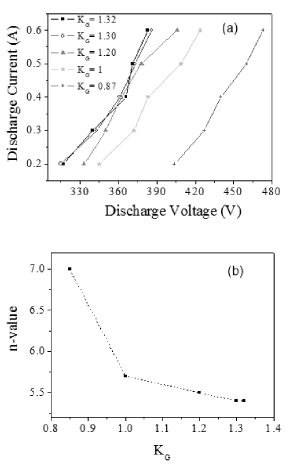
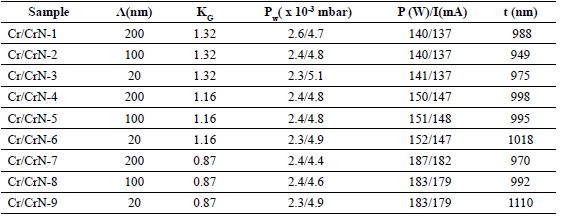
<body><![CDATA[<p><font size="2" face="Verdana, Arial, Helvetica, sans-serif"><img src="/img/revistas/dyna/v78n168/a06eq100869.jpeg" /> (1)</font></p> 		    <p><font size="2" face="Verdana, Arial, Helvetica, sans-serif">Where R is the average radius of the erosion zone and Z (Bz=0) is the distance from the target surface to the point on the axis of the magnetron where the magnetic field changes its direction [19], that is, where Bz component takes a value of zero. </font></p> 		    <p><font size="2" face="Verdana, Arial, Helvetica, sans-serif">In this study, Cr/CrN nano-multilayers were produced using the UBM technique by varying the level of unbalance of the magnetron, and its influence on the in-plane resistivity was studied in order to evaluate this kind of structure for low-resistivity barrier diffusion applications. </font></p> 		    <p>&nbsp;</p> 		    <p><font size="3" face="Verdana, Arial, Helvetica, sans-serif"><b>2. EXPERIMENTAL SETUP</b></font></p> 		    <p><font size="2" face="Verdana, Arial, Helvetica, sans-serif"><b>2.1. Multilayer deposition    <br> 		</b></font><font size="2" face="Verdana, Arial, Helvetica, sans-serif">The nano-multilayers of Cr/CrN were deposited by means of the UBM technique in a vacuum chamber that has an unbalanced magnetron GENCOA sputter VT 100 which allows for one to vary the magnetic field through the variation in the number of turns (NV) of a millimeter screw which changes the distance between the magnets assembly and the target. An increment in NV corresponds to enlarging the distance between the central magnet and the target and, consequently, modifying the magnetic field configuration. The average radius of the erosion zone (R) and Z(Bz=0) shown in equation (1) were measured by using a portable teslameter Phywe with a Hall effect probe, and KG was calculated according to these data as a function of Nv. The coefficient of geometrical unbalance varied inversely with the level of unbalance of the magnetron: a high KG value implied a low level of unbalance of the magnetron and vice versa. The multilayers were produced with three different KG values (KG&nbsp;=&nbsp;1.32, 1.16, and 0.87) as shown in <a href="#tab01">Table 1</a>.</font></p> 	        <p align="center"><font size="2" face="Verdana, Arial, Helvetica, sans-serif"><b><a name="tab01"></a>Table 1. </b>Deposition conditions: period (<font face="Symbol">L</font>), unbalance coefficient (KG), working pressure (Pw), discharge power (P), discharge current (I), thickness (t)</font>    <br>         <img src="/img/revistas/dyna/v78n168/a06tab01.gif"></p>         <p><font size="2" face="Verdana, Arial, Helvetica, sans-serif">The magnetron current-voltage characteristic was estimated to determine variations in efficiency with the unbalance coefficient. A sputtering system has a current-voltage (I-V) characteristic that behaves as  (at constant pressure) [20]. Exponent n reflects how well the electrons are confined by the magnetic trap in the race track. An optimum magnetron should give an nvalue which is typically around 5-9 [20]. <a href="#fig01">Figure&nbsp;1(a)</a> shows the current-voltage characteristic for argon-nitrogen discharge using a Cr target and the n-values (<a href="#fig01">Fig. 1[b]</a>) as a function of KG were determined according to the current-voltage values. <a href="#fig01">Figure&nbsp;1(b)</a> illustrates that the efficiency of the magnetron increases for low KG values, this means, a higher electron density is reached for KG = 0.87 (and therefore a higher level of unbalance of the magnetron), while lower electron density is obtained for KG = 1.32. </font></p> 		    ]]></body>
<body><![CDATA[<p align="center"> <font size="2" face="Verdana, Arial, Helvetica, sans-serif"><b><a name="fig01"></a><img src="/img/revistas/dyna/v78n168/a06fig01.gif">    <br> 	    Figure 1. </b>Characterization of plasma efficiency (a)&nbsp;Current-voltage characteristic, (b) Electron confinement as a function of KG</font></p> 		    <p><font size="2" face="Verdana, Arial, Helvetica, sans-serif">Commercial AISI H13 tool steel of 0.32-0.45 C, 0.8-1.20 Si, 0.20-0.50 Mn, 4.75-5.5 Cr, 0.8-1.20 V, 1.10-1.75 Mo, Fe balance (wt%) composition, and silicon (100) were used as substrates. Steel samples were polished using sandpaper from 100 to 1200, pretreated by quenching (1000-1025 &deg;C) and tempering (175-315 &deg;C) and finally, they were mirror polished. Before introducing the substrates in the deposition chamber, they were ultrasonically cleaned in acetone and alcohol in sequence and dried in flowing compressed air.</font></p> 		    <p><font size="2" face="Verdana, Arial, Helvetica, sans-serif">Multilayers were produced with a bilayer period of 200 nm, 100 nm, and 20 nm, and approximately 1 <font face="Symbol">m</font>m of total thickness. The base pressure was less than 9x10⁻⁴&nbsp;Pa. All the multilayers were grown at room temperature and the sample target distance was set to 5 cm while Ar and N2 flow rates were set to 9 standard cubic centimeters per minute (sccm) and 3 sccm, respectively. The substrate was floating without any external bias. Deposition conditions are summarized in <a href="#tab01">Table 1</a>. </font></p> 		    <p><font size="2" face="Verdana, Arial, Helvetica, sans-serif"><b>2.2. Multilayers Characterization    <br> 		</b></font><font size="2" face="Verdana, Arial, Helvetica, sans-serif">Identification of crystallographic phases and preferential orientations of the multilayers was done by x-ray diffraction (XRD) using an XPertPro Panalytical system under conditions of 6&deg; grazing incident, 90&deg;/s spinning velocity and monochromatized CuKa radiation. The cross-sectional morphology of the multilayers grown on Si (100) was studied using a FEIKUANTA 200 scanning electron microscope (SEM). </font></p> 	    <p><font size="2" face="Verdana, Arial, Helvetica, sans-serif">The four point probe (FPP) method was used to obtain in-plane resistivity of the multilayers. Sheet resistance values were taken and resistivity was calculated according to the expression [21,22]:</font></p> 		    <p><font size="2" face="Verdana, Arial, Helvetica, sans-serif"> <img src="/img/revistas/dyna/v78n168/a06eq209506.jpeg" /> (2)</font></p> 		    <p><font size="2" face="Verdana, Arial, Helvetica, sans-serif">Where r is the resistivity (<font face="Symbol">m</font>W-cm), Rs is the sheet resistance (ohms per square), and t is the multilayer thickness. The FPP was placed in contact with the film surface and the current was applied across the outer two probes while voltage drop was measured across the two inner probes. Four assumptions that are important for consistent good measurements were taken into account [23]: 1) the spacing between probe tips was the same between each probe tip, 2) the contact pressure on all four probe tips was uniform, 3) the edge of the sample was at least 10 times the spacing from the nearest probe tip, and 4) the thickness of the sample was less than 4 times the spacing between probe tips.</font></p> 		    <p><font size="2" face="Verdana, Arial, Helvetica, sans-serif">A Lucas Signatone four-point probe head with tungsten carbide tips and 0.0012 inch tip radius was used. Spacing between tips was 0.040 inches and the pressure applied was 45 grams.</font></p> 		    ]]></body>
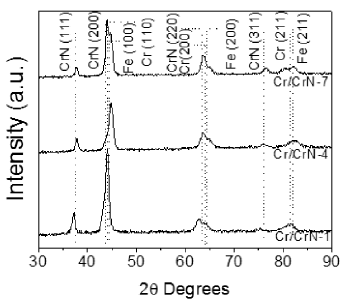
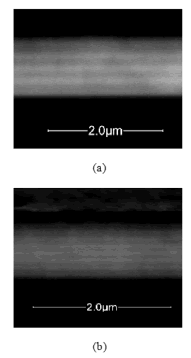
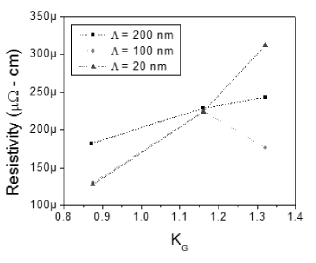
<body><![CDATA[<p><font size="2" face="Verdana, Arial, Helvetica, sans-serif"> Six sets of measurements were made for each multilayer applying a current of 1, 2, 4, 6, 8, and 10 mA, and the average for sheet resistance was calculated. Cr/CrN multilayers total thickness (t) was measured with a Veeco Dektak 150 profilometer, and the results are summarized in <a href="#tab01">Table 1</a>.</font></p> 		    <p>&nbsp;</p> 		    <p><font size="3" face="Verdana, Arial, Helvetica, sans-serif"><b>3. RESULTS AND DISCUSSION</b></font></p> 	    <p><font size="2" face="Verdana, Arial, Helvetica, sans-serif"><b>Structural characterization</b></font></p> 	    <p><font size="2" face="Verdana, Arial, Helvetica, sans-serif">Results for high angle XRD are shown in <a href="#fig02">Fig. 2</a> for multilayers grown with <font face="Symbol">L</font> = 200 nm. The SEM results show a clearly defined layered structure for multilayers with <font face="Symbol">L</font> = 200 nm (<a href="#fig03">Fig. 3[a]</a>) and <font face="Symbol">L</font> = 100 nm (Fig. 3[b]). For multilayers with <font face="Symbol">L</font>&nbsp;=&nbsp;20 nm (not shown), it was not possible to obtain a clear image due to the resolution of the microscope used. The in-plane resistivity results are shown in <a href="#fig04">Fig. 4</a>. As can be seen, lower resistivity values were found for multilayers grown with KG = 0.87. This could be due to the higher plasma efficiency reached in this configuration, where electrons are confined to the target region and they are lost in fewer amounts to the chamber walls producing dense plasma on the substrate region.</font></p> 		    <p align="center"><font size="2" face="Verdana, Arial, Helvetica, sans-serif"><b><a name="fig02"></a><img src="/img/revistas/dyna/v78n168/a06fig02.gif">    <br> 	    Figure 2.</b> XRD pattern for multilayers grown with <font face="Symbol">L</font>&nbsp;=&nbsp;200 nm</font></p> 	        <p align="center"><font size="2" face="Verdana, Arial, Helvetica, sans-serif"><b><a name="fig03"></a><img src="/img/revistas/dyna/v78n168/a06fig03.gif">    <br>         Figure 3.</b> Cross section SEM micrographs of the multilayers grown with (a) <font face="Symbol">L</font> = 200 nm, (b) <font face="Symbol">L</font>&nbsp;=&nbsp;100&nbsp;nm and KG = 1.32</font></p>             <p align="center"><font size="2" face="Verdana, Arial, Helvetica, sans-serif"><a name="fig04"></a><b><img src="/img/revistas/dyna/v78n168/a06fig04.gif">    ]]></body>
<body><![CDATA[<br>         Figure 4.</b> In- plane resistivity as a function of KG. The dotted lines serve as a guide to the eye.</font></p>         <p><font size="2" face="Verdana, Arial, Helvetica, sans-serif">In turn, the ionization efficiency in plasma results in considerably higher ion currents at the substrate, and therefore, the ion flux increases as the degree of unbalance increases [24]. The ion bombardment induces adatom mobility producing microstructural changes and therefore denser coatings with fewer defects. These microstructural changes have been studied for different coatings such as Al, Zr, W [25], and TiN [26], among others. </font></p> 		    <p><font size="2" face="Verdana, Arial, Helvetica, sans-serif">Resistivity in a thin film arises due to electron scattering by phonons, point defects, impurities, grain boundaries, and film surfaces and interfaces [27]. As denser films (fewer defects inside grains) are produced for KG = 0.87, lower resistivity values are obtained. As in the in-plane measurement the applied current passes through the lower resistivity layers (i.e. Cr layers), there is no noteworthy influence of the interfaces on the resistivity (Cr has a bulk resistivity of 13&nbsp;<font face="Symbol">m</font><font face="Symbol">W</font>cm while CrN has a bulk resistivity of 640&nbsp;<font face="Symbol">m</font><font face="Symbol">W</font>-cm [28]). </font></p> 	    <p><font size="2" face="Verdana, Arial, Helvetica, sans-serif">The resistivity reached a value of approximately 225 <font face="Symbol">m</font>W-cm for all the multilayers grown with KG&nbsp;=&nbsp;1.16, and higher resistivity values were found for the multilayer grown with KG = 1.32 and <font face="Symbol">L</font> = 20 nm, where lower plasma efficiency is presented.</font></p> 	    <p>&nbsp;</p> 	    <p><font size="3" face="Verdana, Arial, Helvetica, sans-serif"><b>4. CONCLUSIONS</b></font></p> 	    <p><font size="2" face="Verdana, Arial, Helvetica, sans-serif">In this work, Cr/CrN nano-multilayers were produced through the unbalanced magnetron sputtering technique with three different levels of unbalance, and the influence of this parameter on electrical properties was evaluated. Results show that a higher degree of unbalance of the magnetron produces lower resistivity for all the multilayer periods, which could indicate that denser films are produced due to the increase in mobility as a result of the higher plasma efficiency reached in this configuration.</font></p> 	    <p>&nbsp;</p> 	    <p><font size="3" face="Verdana, Arial, Helvetica, sans-serif"><b>ACKNOWLEDGMENTS</b></font></p> 	    <p><font size="2" face="Verdana, Arial, Helvetica, sans-serif">This research has been financially supported by the Instituto Colombiano para el desarrollo de la Ciencia y la Tecnolog&iacute;a Francisco Jos&eacute; de Caldas-COLCIENCIAS, through project 1101-479-22003 CT 531-2008, the Fundaci&oacute;n Para la Promoci&oacute;n de la Ciencia y la Tecnolog&iacute;a, through a project under contract 200814 and the Direcci&oacute;n de Investigaci&oacute;n de la Universidad Nacional de Colombia sede Bogot&aacute;, through project 11109.</font></p> 		    ]]></body>
<body><![CDATA[<p>&nbsp;</p> 		    <p><font size="3" face="Verdana, Arial, Helvetica, sans-serif"><b>REFERENCES</b></font></p> 		    <!-- ref --><p><font size="2" face="Verdana, Arial, Helvetica, sans-serif"><b>[1]</b> R. Bay&oacute;n, A. Igartua, X.Fern&aacute;ndez, R. Mart&iacute;nez, R.J. Rodr&iacute;guez, J.A. Garc&iacute;a, A. de Frutos, M.A. Arenas, J.de Damborenea, Tribology International, 42 (2009) 591-599.     &nbsp;&nbsp;&nbsp;&nbsp;&nbsp;&nbsp;&nbsp;&nbsp;[&#160;<a href="javascript:void(0);" onclick="javascript: window.open('/scielo.php?script=sci_nlinks&ref=000065&pid=S0012-7353201100040000600001&lng=','','width=640,height=500,resizable=yes,scrollbars=1,menubar=yes,');">Links</a>&#160;]<!-- end-ref --><!-- ref --><br>         <b>[2]</b> J. Stockemer a, R. Winand, P. Vanden Brande, Surf. Coat. Technol., 115 (1999) 230-233.             &nbsp;&nbsp;&nbsp;&nbsp;&nbsp;&nbsp;&nbsp;&nbsp;[&#160;<a href="javascript:void(0);" onclick="javascript: window.open('/scielo.php?script=sci_nlinks&ref=000066&pid=S0012-7353201100040000600002&lng=','','width=640,height=500,resizable=yes,scrollbars=1,menubar=yes,');">Links</a>&#160;]<!-- end-ref --><!-- ref --><br>         <b>[3]</b> E. Mart&iacute;nez, J. Romero, A. Lousa and J. Esteve, J. Phys. D: Appl. Phys, 35 (2002) 1880-1883.     &nbsp;&nbsp;&nbsp;&nbsp;&nbsp;&nbsp;&nbsp;&nbsp;[&#160;<a href="javascript:void(0);" onclick="javascript: window.open('/scielo.php?script=sci_nlinks&ref=000067&pid=S0012-7353201100040000600003&lng=','','width=640,height=500,resizable=yes,scrollbars=1,menubar=yes,');">Links</a>&#160;]<!-- end-ref --><!-- ref --><br>         <b>[4]</b> S. Kaciulis, A. Mezzi, G. Montesperelli, F. Lamastra, M. Rapone, F. Casadei, T. Valente, G. Gusmano, Surf. Coat. Technol., 201 (2006) 313-319.     &nbsp;&nbsp;&nbsp;&nbsp;&nbsp;&nbsp;&nbsp;&nbsp;[&#160;<a href="javascript:void(0);" onclick="javascript: window.open('/scielo.php?script=sci_nlinks&ref=000068&pid=S0012-7353201100040000600004&lng=','','width=640,height=500,resizable=yes,scrollbars=1,menubar=yes,');">Links</a>&#160;]<!-- end-ref --><!-- ref --><br>         <b>[5]</b> M. Kot, W.A. Rakowski, L. Major, R. Major, J. Morgiel, Surf. Coat. Technol., 202 (2008) 3501-3506.     &nbsp;&nbsp;&nbsp;&nbsp;&nbsp;&nbsp;&nbsp;&nbsp;[&#160;<a href="javascript:void(0);" onclick="javascript: window.open('/scielo.php?script=sci_nlinks&ref=000069&pid=S0012-7353201100040000600005&lng=','','width=640,height=500,resizable=yes,scrollbars=1,menubar=yes,');">Links</a>&#160;]<!-- end-ref --><!-- ref --><br>         <b>[6]</b> J.J. Olaya, Recubrimientos de nitruros met&aacute;licos depositados con la t&eacute;cnica de espurreo asistido con campos magn&eacute;ticos variables, PhD. Thesis, Instituto de Investigaciones en Materiales, UNAM, M&eacute;xico, 2005.     &nbsp;&nbsp;&nbsp;&nbsp;&nbsp;&nbsp;&nbsp;&nbsp;[&#160;<a href="javascript:void(0);" onclick="javascript: window.open('/scielo.php?script=sci_nlinks&ref=000070&pid=S0012-7353201100040000600006&lng=','','width=640,height=500,resizable=yes,scrollbars=1,menubar=yes,');">Links</a>&#160;]<!-- end-ref --><!-- ref --><br>         <b>[7]</b> R. Hubler, Surf. Coat. Technol., 116-119, pp. 1116-1122, (1999).             &nbsp;&nbsp;&nbsp;&nbsp;&nbsp;&nbsp;&nbsp;&nbsp;[&#160;<a href="javascript:void(0);" onclick="javascript: window.open('/scielo.php?script=sci_nlinks&ref=000071&pid=S0012-7353201100040000600007&lng=','','width=640,height=500,resizable=yes,scrollbars=1,menubar=yes,');">Links</a>&#160;]<!-- end-ref --><!-- ref --><br>         <b>[8]</b> A. Leyland, A. Mathews, Surf. Coat. Technol. 70, pp.19-25, (1994).             &nbsp;&nbsp;&nbsp;&nbsp;&nbsp;&nbsp;&nbsp;&nbsp;[&#160;<a href="javascript:void(0);" onclick="javascript: window.open('/scielo.php?script=sci_nlinks&ref=000072&pid=S0012-7353201100040000600008&lng=','','width=640,height=500,resizable=yes,scrollbars=1,menubar=yes,');">Links</a>&#160;]<!-- end-ref --><!-- ref --><br>         <b>[9]</b> E. Zart, Acta Mater. 46, 5611 (1998).             &nbsp;&nbsp;&nbsp;&nbsp;&nbsp;&nbsp;&nbsp;&nbsp;[&#160;<a href="javascript:void(0);" onclick="javascript: window.open('/scielo.php?script=sci_nlinks&ref=000073&pid=S0012-7353201100040000600009&lng=','','width=640,height=500,resizable=yes,scrollbars=1,menubar=yes,');">Links</a>&#160;]<!-- end-ref --><!-- ref --><br>         <b>[10]</b> M. Flores, S. Muhl, L. Huerta, E. Andrade, Surf. Coat. Technol, 200, 1315 (2005).             &nbsp;&nbsp;&nbsp;&nbsp;&nbsp;&nbsp;&nbsp;&nbsp;[&#160;<a href="javascript:void(0);" onclick="javascript: window.open('/scielo.php?script=sci_nlinks&ref=000074&pid=S0012-7353201100040000600010&lng=','','width=640,height=500,resizable=yes,scrollbars=1,menubar=yes,');">Links</a>&#160;]<!-- end-ref --><!-- ref --><br>         <b>[11]</b> A. Conde, C. Navas, A.B. Crist&oacute;bal, J. Housden, J. de Damborenea, Surf. Coat. Technol., 201 (2006) 2690-2695.     &nbsp;&nbsp;&nbsp;&nbsp;&nbsp;&nbsp;&nbsp;&nbsp;[&#160;<a href="javascript:void(0);" onclick="javascript: window.open('/scielo.php?script=sci_nlinks&ref=000075&pid=S0012-7353201100040000600011&lng=','','width=640,height=500,resizable=yes,scrollbars=1,menubar=yes,');">Links</a>&#160;]<!-- end-ref --><!-- ref --><br>         <b>[12]</b> A. Barata, L. Cunha, C. Moura, Thin Solid Films 398 -399 (2001) 501-506.     &nbsp;&nbsp;&nbsp;&nbsp;&nbsp;&nbsp;&nbsp;&nbsp;[&#160;<a href="javascript:void(0);" onclick="javascript: window.open('/scielo.php?script=sci_nlinks&ref=000076&pid=S0012-7353201100040000600012&lng=','','width=640,height=500,resizable=yes,scrollbars=1,menubar=yes,');">Links</a>&#160;]<!-- end-ref --><!-- ref --><br>         <b>[13]</b> C. Gautier, H. Moussaoui, F. Elstner, J. Machet, Surf. and Coat. Technol., 86-87 (1996) 254-262.             &nbsp;&nbsp;&nbsp;&nbsp;&nbsp;&nbsp;&nbsp;&nbsp;[&#160;<a href="javascript:void(0);" onclick="javascript: window.open('/scielo.php?script=sci_nlinks&ref=000077&pid=S0012-7353201100040000600013&lng=','','width=640,height=500,resizable=yes,scrollbars=1,menubar=yes,');">Links</a>&#160;]<!-- end-ref --><!-- ref --><br>         <b>[14]</b> Wei-Yu Ho, Cheng-Hsun Hsu, Dung-Hau Huang, Yen-Chun Lin, Chi-Lung Chang, Da-Yung Wang, Surf. & Coat. Technol. 200 (2005) 1303 - 1309.     &nbsp;&nbsp;&nbsp;&nbsp;&nbsp;&nbsp;&nbsp;&nbsp;[&#160;<a href="javascript:void(0);" onclick="javascript: window.open('/scielo.php?script=sci_nlinks&ref=000078&pid=S0012-7353201100040000600014&lng=','','width=640,height=500,resizable=yes,scrollbars=1,menubar=yes,');">Links</a>&#160;]<!-- end-ref --><!-- ref --><br>         <b>[15]</b> J.J. Olaya, S.E. Rodil, S. Muhl, E. S&aacute;nchez, Thin Solid Films 474 (2005) 119- 126.     &nbsp;&nbsp;&nbsp;&nbsp;&nbsp;&nbsp;&nbsp;&nbsp;[&#160;<a href="javascript:void(0);" onclick="javascript: window.open('/scielo.php?script=sci_nlinks&ref=000079&pid=S0012-7353201100040000600015&lng=','','width=640,height=500,resizable=yes,scrollbars=1,menubar=yes,');">Links</a>&#160;]<!-- end-ref --><!-- ref --><br>         <b>[16]</b> P.J. Kelly, R.D. Arnell, Vacuum, 56 (2000) 159-172.             &nbsp;&nbsp;&nbsp;&nbsp;&nbsp;&nbsp;&nbsp;&nbsp;[&#160;<a href="javascript:void(0);" onclick="javascript: window.open('/scielo.php?script=sci_nlinks&ref=000080&pid=S0012-7353201100040000600016&lng=','','width=640,height=500,resizable=yes,scrollbars=1,menubar=yes,');">Links</a>&#160;]<!-- end-ref --><!-- ref --><br>         <b>[17]</b> J.J. Olaya, S.E. Rodil, S. Muhl, L. Huerta, Surf. Coat. Technol., 200 (2006) 5743-5750.     &nbsp;&nbsp;&nbsp;&nbsp;&nbsp;&nbsp;&nbsp;&nbsp;[&#160;<a href="javascript:void(0);" onclick="javascript: window.open('/scielo.php?script=sci_nlinks&ref=000081&pid=S0012-7353201100040000600017&lng=','','width=640,height=500,resizable=yes,scrollbars=1,menubar=yes,');">Links</a>&#160;]<!-- end-ref --><!-- ref --><br>         <b>[18]</b> P.J. Kelly, R.D. Arnell, Surf. Coat. Technol., 108-109 (1998) 317-322.     &nbsp;&nbsp;&nbsp;&nbsp;&nbsp;&nbsp;&nbsp;&nbsp;[&#160;<a href="javascript:void(0);" onclick="javascript: window.open('/scielo.php?script=sci_nlinks&ref=000082&pid=S0012-7353201100040000600018&lng=','','width=640,height=500,resizable=yes,scrollbars=1,menubar=yes,');">Links</a>&#160;]<!-- end-ref --><!-- ref --><br>         <b>[19]</b> I.V. Svadkovski, D.A. Golosov, S.M. Zavatskiy, Vacuum 68 (2003) 283-290.     &nbsp;&nbsp;&nbsp;&nbsp;&nbsp;&nbsp;&nbsp;&nbsp;[&#160;<a href="javascript:void(0);" onclick="javascript: window.open('/scielo.php?script=sci_nlinks&ref=000083&pid=S0012-7353201100040000600019&lng=','','width=640,height=500,resizable=yes,scrollbars=1,menubar=yes,');">Links</a>&#160;]<!-- end-ref --><!-- ref --><br>         <b>[20]</b> Rossnagel S M and Kaufman H R, J. Vac. Sci. Technol. A 6 (1988) 223             &nbsp;&nbsp;&nbsp;&nbsp;&nbsp;&nbsp;&nbsp;&nbsp;[&#160;<a href="javascript:void(0);" onclick="javascript: window.open('/scielo.php?script=sci_nlinks&ref=000084&pid=S0012-7353201100040000600020&lng=','','width=640,height=500,resizable=yes,scrollbars=1,menubar=yes,');">Links</a>&#160;]<!-- end-ref --><!-- ref --><br>         <b>[21]</b> Dieter, K. Schroder, Semiconductor Material and Device Characterization, John Wiley and Sons, Inc, New York, 1998.             &nbsp;&nbsp;&nbsp;&nbsp;&nbsp;&nbsp;&nbsp;&nbsp;[&#160;<a href="javascript:void(0);" onclick="javascript: window.open('/scielo.php?script=sci_nlinks&ref=000085&pid=S0012-7353201100040000600021&lng=','','width=640,height=500,resizable=yes,scrollbars=1,menubar=yes,');">Links</a>&#160;]<!-- end-ref --><!-- ref --><br>         <b>[22]</b> H. J. Wondergem, A. Heger, J. J. van Den Broek, Thin Solid Films 249, 6 (1994).             &nbsp;&nbsp;&nbsp;&nbsp;&nbsp;&nbsp;&nbsp;&nbsp;[&#160;<a href="javascript:void(0);" onclick="javascript: window.open('/scielo.php?script=sci_nlinks&ref=000086&pid=S0012-7353201100040000600022&lng=','','width=640,height=500,resizable=yes,scrollbars=1,menubar=yes,');">Links</a>&#160;]<!-- end-ref --><!-- ref --><br>         <b>[23]</b> L. B. Valdes in Proceedings of the IRE 42 (1954) 420.             &nbsp;&nbsp;&nbsp;&nbsp;&nbsp;&nbsp;&nbsp;&nbsp;[&#160;<a href="javascript:void(0);" onclick="javascript: window.open('/scielo.php?script=sci_nlinks&ref=000087&pid=S0012-7353201100040000600023&lng=','','width=640,height=500,resizable=yes,scrollbars=1,menubar=yes,');">Links</a>&#160;]<!-- end-ref --><!-- ref --><br>         <b>[24]</b> Jun Zhou, Zhe Wu, and Zhanhe Liu, Journal of University of Science and Technology Beijing Volume 15, Number 6, December 2008, Page 775.             &nbsp;&nbsp;&nbsp;&nbsp;&nbsp;&nbsp;&nbsp;&nbsp;[&#160;<a href="javascript:void(0);" onclick="javascript: window.open('/scielo.php?script=sci_nlinks&ref=000088&pid=S0012-7353201100040000600024&lng=','','width=640,height=500,resizable=yes,scrollbars=1,menubar=yes,');">Links</a>&#160;]<!-- end-ref --><!-- ref --><br>         <b>[25]</b> P.J. Kelly, R.D. Arnell, Surf. Coat. Technol., 97 (1997) 595-602.             &nbsp;&nbsp;&nbsp;&nbsp;&nbsp;&nbsp;&nbsp;&nbsp;[&#160;<a href="javascript:void(0);" onclick="javascript: window.open('/scielo.php?script=sci_nlinks&ref=000089&pid=S0012-7353201100040000600025&lng=','','width=640,height=500,resizable=yes,scrollbars=1,menubar=yes,');">Links</a>&#160;]<!-- end-ref --><!-- ref --><br>         <b>[26]</b> M. Zlatanovic, R. Belosevac, N. Popovic, A. Kunosic, Surf. Coat. Technol., 106 (1998) 150-155.     &nbsp;&nbsp;&nbsp;&nbsp;&nbsp;&nbsp;&nbsp;&nbsp;[&#160;<a href="javascript:void(0);" onclick="javascript: window.open('/scielo.php?script=sci_nlinks&ref=000090&pid=S0012-7353201100040000600026&lng=','','width=640,height=500,resizable=yes,scrollbars=1,menubar=yes,');">Links</a>&#160;]<!-- end-ref --><!-- ref --><br>         <b>[27]</b> D. Schumacher, Surface Scattering Experiments with Conduction Electrons, Springer-Verlag, Berlin, 1993.             &nbsp;&nbsp;&nbsp;&nbsp;&nbsp;&nbsp;&nbsp;&nbsp;[&#160;<a href="javascript:void(0);" onclick="javascript: window.open('/scielo.php?script=sci_nlinks&ref=000091&pid=S0012-7353201100040000600027&lng=','','width=640,height=500,resizable=yes,scrollbars=1,menubar=yes,');">Links</a>&#160;]<!-- end-ref --><!-- ref --><br>         <b>[28]</b> Bhushan B, Gupta BK, in Handbook of tribology, McGraw-Hill, New York (1991) p. 4.54.     </font>&nbsp;&nbsp;&nbsp;&nbsp;&nbsp;&nbsp;&nbsp;&nbsp;[&#160;<a href="javascript:void(0);" onclick="javascript: window.open('/scielo.php?script=sci_nlinks&ref=000092&pid=S0012-7353201100040000600028&lng=','','width=640,height=500,resizable=yes,scrollbars=1,menubar=yes,');">Links</a>&#160;]<!-- end-ref --> ]]></body><back>
<ref-list>
<ref id="B1">
<label>1</label><nlm-citation citation-type="journal">
<person-group person-group-type="author">
<name>
<surname><![CDATA[Bayón]]></surname>
<given-names><![CDATA[R]]></given-names>
</name>
<name>
<surname><![CDATA[Igartua]]></surname>
<given-names><![CDATA[A]]></given-names>
</name>
<name>
<surname><![CDATA[Fernández]]></surname>
<given-names><![CDATA[X]]></given-names>
</name>
<name>
<surname><![CDATA[Martínez]]></surname>
<given-names><![CDATA[R]]></given-names>
</name>
<name>
<surname><![CDATA[Rodríguez]]></surname>
<given-names><![CDATA[R.J]]></given-names>
</name>
<name>
<surname><![CDATA[García]]></surname>
<given-names><![CDATA[J.A]]></given-names>
</name>
<name>
<surname><![CDATA[de Frutos]]></surname>
<given-names><![CDATA[A]]></given-names>
</name>
<name>
<surname><![CDATA[Arenas]]></surname>
<given-names><![CDATA[M.A]]></given-names>
</name>
<name>
<surname><![CDATA[de Damborenea]]></surname>
<given-names><![CDATA[J]]></given-names>
</name>
</person-group>
<source><![CDATA[Tribology International]]></source>
<year>2009</year>
<volume>42</volume>
<page-range>591-599</page-range></nlm-citation>
</ref>
<ref id="B2">
<label>2</label><nlm-citation citation-type="journal">
<person-group person-group-type="author">
<name>
<surname><![CDATA[Stockemer]]></surname>
<given-names><![CDATA[J]]></given-names>
</name>
<name>
<surname><![CDATA[Winand]]></surname>
<given-names><![CDATA[a, R]]></given-names>
</name>
<name>
<surname><![CDATA[Vanden Brande]]></surname>
<given-names><![CDATA[P]]></given-names>
</name>
</person-group>
<source><![CDATA[Surf. Coat. Technol.]]></source>
<year>1999</year>
<volume>115</volume>
<page-range>230-233</page-range></nlm-citation>
</ref>
<ref id="B3">
<label>3</label><nlm-citation citation-type="journal">
<person-group person-group-type="author">
<name>
<surname><![CDATA[Martínez]]></surname>
<given-names><![CDATA[E]]></given-names>
</name>
<name>
<surname><![CDATA[Romero]]></surname>
<given-names><![CDATA[J]]></given-names>
</name>
<name>
<surname><![CDATA[Lousa]]></surname>
<given-names><![CDATA[A]]></given-names>
</name>
<name>
<surname><![CDATA[Esteve]]></surname>
<given-names><![CDATA[J]]></given-names>
</name>
</person-group>
<source><![CDATA[J. Phys. D: Appl. Phys]]></source>
<year>2002</year>
<volume>35</volume>
<page-range>1880-1883</page-range></nlm-citation>
</ref>
<ref id="B4">
<label>4</label><nlm-citation citation-type="journal">
<person-group person-group-type="author">
<name>
<surname><![CDATA[Kaciulis]]></surname>
<given-names><![CDATA[S]]></given-names>
</name>
<name>
<surname><![CDATA[Mezzi]]></surname>
<given-names><![CDATA[A]]></given-names>
</name>
<name>
<surname><![CDATA[Montesperelli]]></surname>
<given-names><![CDATA[G]]></given-names>
</name>
<name>
<surname><![CDATA[Lamastra]]></surname>
<given-names><![CDATA[F]]></given-names>
</name>
<name>
<surname><![CDATA[Rapone]]></surname>
<given-names><![CDATA[M]]></given-names>
</name>
<name>
<surname><![CDATA[Casadei]]></surname>
<given-names><![CDATA[F]]></given-names>
</name>
<name>
<surname><![CDATA[Valente]]></surname>
<given-names><![CDATA[T]]></given-names>
</name>
<name>
<surname><![CDATA[Gusmano]]></surname>
<given-names><![CDATA[G]]></given-names>
</name>
</person-group>
<source><![CDATA[Surf. Coat. Technol.]]></source>
<year>(200</year>
<month>6)</month>
<volume>201</volume>
<page-range>313-319</page-range></nlm-citation>
</ref>
<ref id="B5">
<label>5</label><nlm-citation citation-type="journal">
<person-group person-group-type="author">
<name>
<surname><![CDATA[Kot]]></surname>
<given-names><![CDATA[M]]></given-names>
</name>
<name>
<surname><![CDATA[Rakowski]]></surname>
<given-names><![CDATA[W.A]]></given-names>
</name>
<name>
<surname><![CDATA[Major]]></surname>
<given-names><![CDATA[L]]></given-names>
</name>
<name>
<surname><![CDATA[Major]]></surname>
<given-names><![CDATA[R]]></given-names>
</name>
<name>
<surname><![CDATA[Morgiel]]></surname>
<given-names><![CDATA[J]]></given-names>
</name>
</person-group>
<source><![CDATA[Surf. Coat. Technol]]></source>
<year>2008</year>
<volume>202</volume>
<page-range>3501-3506</page-range></nlm-citation>
</ref>
<ref id="B6">
<label>6</label><nlm-citation citation-type="">
<person-group person-group-type="author">
<name>
<surname><![CDATA[Olaya]]></surname>
<given-names><![CDATA[J.J]]></given-names>
</name>
</person-group>
<source><![CDATA[Recubrimientos de nitruros metálicos depositados con la técnica de espurreo asistido con campos magnéticos variables]]></source>
<year></year>
</nlm-citation>
</ref>
<ref id="B7">
<label>7</label><nlm-citation citation-type="journal">
<person-group person-group-type="author">
<name>
<surname><![CDATA[Hubler]]></surname>
<given-names><![CDATA[R]]></given-names>
</name>
</person-group>
<source><![CDATA[Surf. Coat. Technol]]></source>
<year>1999</year>
<page-range>116-119</page-range><page-range>1116-1122</page-range></nlm-citation>
</ref>
<ref id="B8">
<label>8</label><nlm-citation citation-type="journal">
<person-group person-group-type="author">
<name>
<surname><![CDATA[Leyland]]></surname>
<given-names><![CDATA[A]]></given-names>
</name>
<name>
<surname><![CDATA[Mathews]]></surname>
<given-names><![CDATA[A]]></given-names>
</name>
</person-group>
<source><![CDATA[Surf. Coat. Technol]]></source>
<year>1994</year>
<volume>70</volume>
<page-range>19-25</page-range></nlm-citation>
</ref>
<ref id="B9">
<label>9</label><nlm-citation citation-type="journal">
<person-group person-group-type="author">
<name>
<surname><![CDATA[Zart]]></surname>
<given-names><![CDATA[E]]></given-names>
</name>
</person-group>
<source><![CDATA[Acta Mater]]></source>
<year>1998</year>
<volume>46</volume>
<page-range>5611</page-range></nlm-citation>
</ref>
<ref id="B10">
<label>10</label><nlm-citation citation-type="journal">
<person-group person-group-type="author">
<name>
<surname><![CDATA[Flores]]></surname>
<given-names><![CDATA[M]]></given-names>
</name>
<name>
<surname><![CDATA[Muhl]]></surname>
<given-names><![CDATA[S]]></given-names>
</name>
<name>
<surname><![CDATA[Huerta]]></surname>
<given-names><![CDATA[L]]></given-names>
</name>
<name>
<surname><![CDATA[Andrade]]></surname>
<given-names><![CDATA[E]]></given-names>
</name>
</person-group>
<source><![CDATA[Surf. Coat. Technol]]></source>
<year>2005</year>
<volume>200</volume>
<page-range>1315</page-range></nlm-citation>
</ref>
<ref id="B11">
<label>11</label><nlm-citation citation-type="journal">
<person-group person-group-type="author">
<name>
<surname><![CDATA[Conde]]></surname>
<given-names><![CDATA[A]]></given-names>
</name>
<name>
<surname><![CDATA[Navas]]></surname>
<given-names><![CDATA[C]]></given-names>
</name>
<name>
<surname><![CDATA[Cristóbal]]></surname>
<given-names><![CDATA[A.B]]></given-names>
</name>
<name>
<surname><![CDATA[Housden]]></surname>
<given-names><![CDATA[J]]></given-names>
</name>
<name>
<surname><![CDATA[de Damborenea]]></surname>
<given-names><![CDATA[J]]></given-names>
</name>
</person-group>
<source><![CDATA[Surf. Coat. Technol]]></source>
<year>2006</year>
<volume>201</volume>
<page-range>2690-2695.</page-range></nlm-citation>
</ref>
<ref id="B12">
<label>12</label><nlm-citation citation-type="journal">
<person-group person-group-type="author">
<name>
<surname><![CDATA[Barata]]></surname>
<given-names><![CDATA[A.]]></given-names>
</name>
<name>
<surname><![CDATA[Cunha]]></surname>
<given-names><![CDATA[L.]]></given-names>
</name>
<name>
<surname><![CDATA[Moura]]></surname>
<given-names><![CDATA[C.]]></given-names>
</name>
</person-group>
<source><![CDATA[Thin Solid Films]]></source>
<year>2001</year>
<page-range>398 -399</page-range><page-range>501-506</page-range></nlm-citation>
</ref>
<ref id="B13">
<label>13</label><nlm-citation citation-type="journal">
<person-group person-group-type="author">
<name>
<surname><![CDATA[Gautier]]></surname>
<given-names><![CDATA[C]]></given-names>
</name>
<name>
<surname><![CDATA[Moussaoui]]></surname>
<given-names><![CDATA[H]]></given-names>
</name>
<name>
<surname><![CDATA[Elstner]]></surname>
<given-names><![CDATA[F]]></given-names>
</name>
<name>
<surname><![CDATA[Machet]]></surname>
<given-names><![CDATA[J]]></given-names>
</name>
</person-group>
<source><![CDATA[Surf. and Coat. Technol.]]></source>
<year>1996</year>
<volume>86-87</volume>
<page-range>254-262</page-range></nlm-citation>
</ref>
<ref id="B14">
<label>14</label><nlm-citation citation-type="journal">
<person-group person-group-type="author">
<name>
<surname><![CDATA[Yu Ho]]></surname>
<given-names><![CDATA[Wei]]></given-names>
</name>
<name>
<surname><![CDATA[Hsun Hsu]]></surname>
<given-names><![CDATA[Cheng]]></given-names>
</name>
<name>
<surname><![CDATA[Huang]]></surname>
<given-names><![CDATA[Dung-Hau]]></given-names>
</name>
<name>
<surname><![CDATA[Chun Lin]]></surname>
<given-names><![CDATA[Yen]]></given-names>
</name>
<name>
<surname><![CDATA[Chang]]></surname>
<given-names><![CDATA[Chi-Lung]]></given-names>
</name>
<name>
<surname><![CDATA[Yung Wang]]></surname>
<given-names><![CDATA[Da]]></given-names>
</name>
</person-group>
<source><![CDATA[Surf. & Coat. Technol]]></source>
<year>2005</year>
<volume>200</volume>
<page-range>1303 - 1309</page-range></nlm-citation>
</ref>
<ref id="B15">
<label>15</label><nlm-citation citation-type="journal">
<person-group person-group-type="author">
<name>
<surname><![CDATA[Olaya]]></surname>
<given-names><![CDATA[J.J]]></given-names>
</name>
<name>
<surname><![CDATA[Rodil]]></surname>
<given-names><![CDATA[S.E]]></given-names>
</name>
<name>
<surname><![CDATA[Muhl]]></surname>
<given-names><![CDATA[S]]></given-names>
</name>
<name>
<surname><![CDATA[Sánchez]]></surname>
<given-names><![CDATA[E]]></given-names>
</name>
</person-group>
<source><![CDATA[Thin Solid Films]]></source>
<year>2005</year>
<volume>474</volume>
<page-range>119- 126</page-range></nlm-citation>
</ref>
<ref id="B16">
<label>16</label><nlm-citation citation-type="journal">
<person-group person-group-type="author">
<name>
<surname><![CDATA[Kelly]]></surname>
<given-names><![CDATA[P.J]]></given-names>
</name>
<name>
<surname><![CDATA[Arnell]]></surname>
<given-names><![CDATA[R.D.]]></given-names>
</name>
</person-group>
<source><![CDATA[Vacuum]]></source>
<year>2000</year>
<volume>56</volume>
<page-range>159-172</page-range></nlm-citation>
</ref>
<ref id="B17">
<label>17</label><nlm-citation citation-type="journal">
<person-group person-group-type="author">
<name>
<surname><![CDATA[Olaya]]></surname>
<given-names><![CDATA[J.J.]]></given-names>
</name>
<name>
<surname><![CDATA[Rodil]]></surname>
<given-names><![CDATA[S.E.]]></given-names>
</name>
<name>
<surname><![CDATA[Muhl]]></surname>
<given-names><![CDATA[S]]></given-names>
</name>
<name>
<surname><![CDATA[Huerta]]></surname>
<given-names><![CDATA[L]]></given-names>
</name>
</person-group>
<source><![CDATA[Surf. Coat. Technol]]></source>
<year>2006</year>
<volume>200</volume>
<page-range>5743-5750</page-range></nlm-citation>
</ref>
<ref id="B18">
<label>18</label><nlm-citation citation-type="journal">
<person-group person-group-type="author">
<name>
<surname><![CDATA[Kelly]]></surname>
<given-names><![CDATA[P.J]]></given-names>
</name>
<name>
<surname><![CDATA[Arnell]]></surname>
<given-names><![CDATA[R.D]]></given-names>
</name>
</person-group>
<source><![CDATA[Surf. Coat. Technol.]]></source>
<year>1998</year>
<volume>108-109</volume>
<page-range>317-322</page-range></nlm-citation>
</ref>
<ref id="B19">
<label>19</label><nlm-citation citation-type="journal">
<person-group person-group-type="author">
<name>
<surname><![CDATA[Svadkovski]]></surname>
<given-names><![CDATA[I.V.]]></given-names>
</name>
<name>
<surname><![CDATA[Golosov]]></surname>
<given-names><![CDATA[D.A]]></given-names>
</name>
<name>
<surname><![CDATA[Zavatskiy]]></surname>
<given-names><![CDATA[S.M]]></given-names>
</name>
</person-group>
<source><![CDATA[Vacuum]]></source>
<year>2003</year>
<volume>68</volume>
<page-range>283-290</page-range></nlm-citation>
</ref>
<ref id="B20">
<label>20</label><nlm-citation citation-type="journal">
<person-group person-group-type="author">
<name>
<surname><![CDATA[Rossnagel]]></surname>
<given-names><![CDATA[S M]]></given-names>
</name>
<name>
<surname><![CDATA[Kaufman]]></surname>
<given-names><![CDATA[H R]]></given-names>
</name>
</person-group>
<source><![CDATA[J. Vac. Sci. Technol]]></source>
<year>1988</year>
<volume>A 6</volume>
<page-range>223</page-range></nlm-citation>
</ref>
<ref id="B21">
<label>21</label><nlm-citation citation-type="book">
<person-group person-group-type="author">
<name>
<surname><![CDATA[K. Schroder]]></surname>
<given-names><![CDATA[Dieter]]></given-names>
</name>
</person-group>
<source><![CDATA[Semiconductor Material and Device Characterization]]></source>
<year>1998</year>
<publisher-loc><![CDATA[New York ]]></publisher-loc>
<publisher-name><![CDATA[John Wiley and Sons, Inc]]></publisher-name>
</nlm-citation>
</ref>
<ref id="B22">
<label>22</label><nlm-citation citation-type="journal">
<person-group person-group-type="author">
<name>
<surname><![CDATA[Wondergem]]></surname>
<given-names><![CDATA[H. J]]></given-names>
</name>
<name>
<surname><![CDATA[Heger]]></surname>
<given-names><![CDATA[A]]></given-names>
</name>
<name>
<surname><![CDATA[van Den Broek]]></surname>
<given-names><![CDATA[J. J.]]></given-names>
</name>
</person-group>
<source><![CDATA[Thin Solid Films]]></source>
<year>1994</year>
<month>)</month>
<volume>249</volume>
<numero>6</numero>
<issue>6</issue>
</nlm-citation>
</ref>
<ref id="B23">
<label>23</label><nlm-citation citation-type="journal">
<person-group person-group-type="author">
<name>
<surname><![CDATA[. Valdes]]></surname>
<given-names><![CDATA[L. B]]></given-names>
</name>
</person-group>
<source><![CDATA[Proceedings of the IRE]]></source>
<year>1954</year>
<volume>42</volume>
</nlm-citation>
</ref>
<ref id="B24">
<label>24</label><nlm-citation citation-type="journal">
<person-group person-group-type="author">
<name>
<surname><![CDATA[Zhou]]></surname>
<given-names><![CDATA[Jun]]></given-names>
</name>
<name>
<surname><![CDATA[Wu]]></surname>
<given-names><![CDATA[Zhe]]></given-names>
</name>
<name>
<surname><![CDATA[Zhanhe]]></surname>
<given-names><![CDATA[Liu]]></given-names>
</name>
</person-group>
<source><![CDATA[Journal of University of Science and Technology Beijing]]></source>
<year>Dece</year>
<month>mb</month>
<day>er</day>
<volume>15</volume>
<numero>6</numero>
<issue>6</issue>
<page-range>775</page-range></nlm-citation>
</ref>
<ref id="B25">
<label>25</label><nlm-citation citation-type="journal">
<person-group person-group-type="author">
<name>
<surname><![CDATA[Kelly]]></surname>
<given-names><![CDATA[P.J.]]></given-names>
</name>
<name>
<surname><![CDATA[Arnell]]></surname>
<given-names><![CDATA[R.D.]]></given-names>
</name>
</person-group>
<source><![CDATA[Surf. Coat. Technol.]]></source>
<year>1997</year>
<volume>97</volume>
<page-range>595-602.</page-range></nlm-citation>
</ref>
<ref id="B26">
<label>26</label><nlm-citation citation-type="journal">
<person-group person-group-type="author">
<name>
<surname><![CDATA[Zlatanovic]]></surname>
<given-names><![CDATA[M]]></given-names>
</name>
<name>
<surname><![CDATA[Belosevac]]></surname>
<given-names><![CDATA[R]]></given-names>
</name>
<name>
<surname><![CDATA[Popovic]]></surname>
<given-names><![CDATA[N]]></given-names>
</name>
<name>
<surname><![CDATA[Kunosic]]></surname>
<given-names><![CDATA[A]]></given-names>
</name>
</person-group>
<source><![CDATA[Surf. Coat. Technol.]]></source>
<year>1998</year>
<volume>106</volume>
<page-range>150-155</page-range></nlm-citation>
</ref>
<ref id="B27">
<label>27</label><nlm-citation citation-type="book">
<person-group person-group-type="author">
<name>
<surname><![CDATA[Schumacher]]></surname>
<given-names><![CDATA[D]]></given-names>
</name>
</person-group>
<source><![CDATA[Surface Scattering Experiments with Conduction Electrons]]></source>
<year>1993</year>
<publisher-loc><![CDATA[Berlin ]]></publisher-loc>
<publisher-name><![CDATA[Springer-Verlag]]></publisher-name>
</nlm-citation>
</ref>
<ref id="B28">
<label>28</label><nlm-citation citation-type="book">
<person-group person-group-type="author">
<name>
<surname><![CDATA[Bhushan]]></surname>
<given-names><![CDATA[B]]></given-names>
</name>
<name>
<surname><![CDATA[BK]]></surname>
<given-names><![CDATA[Gupta]]></given-names>
</name>
</person-group>
<source><![CDATA[Handbook of tribology]]></source>
<year>1991</year>
<page-range>4.54</page-range><publisher-loc><![CDATA[New York ]]></publisher-loc>
<publisher-name><![CDATA[McGraw-Hill]]></publisher-name>
</nlm-citation>
</ref>
</ref-list>
</back>
</article>