<?xml version="1.0" encoding="ISO-8859-1"?><article xmlns:mml="http://www.w3.org/1998/Math/MathML" xmlns:xlink="http://www.w3.org/1999/xlink" xmlns:xsi="http://www.w3.org/2001/XMLSchema-instance">
<front>
<journal-meta>
<journal-id>0012-7353</journal-id>
<journal-title><![CDATA[DYNA]]></journal-title>
<abbrev-journal-title><![CDATA[Dyna rev.fac.nac.minas]]></abbrev-journal-title>
<issn>0012-7353</issn>
<publisher>
<publisher-name><![CDATA[Universidad Nacional de Colombia]]></publisher-name>
</publisher>
</journal-meta>
<article-meta>
<article-id>S0012-73532011000400013</article-id>
<title-group>
<article-title xml:lang="en"><![CDATA[DESIGN AND IMPLEMENTATION OF A PEM FUEL CELL EMULATOR FOR STATIC AND DYNAMIC BEHAVIOR]]></article-title>
<article-title xml:lang="es"><![CDATA[DISEÑO E IMPLEMENTACIÓN DE UN EMULADOR DE PILA DE COMBUSTIBLE PEM PARA COMPORTAMIENTO ESTÁTICO Y DINÁMICO]]></article-title>
</title-group>
<contrib-group>
<contrib contrib-type="author">
<name>
<surname><![CDATA[RAMOS-PAJA]]></surname>
<given-names><![CDATA[CARLOS ANDRÉS]]></given-names>
</name>
<xref ref-type="aff" rid="A01"/>
</contrib>
<contrib contrib-type="author">
<name>
<surname><![CDATA[JARAMILLO-MATTA]]></surname>
<given-names><![CDATA[ADOLFO ANDRÉS]]></given-names>
</name>
<xref ref-type="aff" rid="A02"/>
</contrib>
<contrib contrib-type="author">
<name>
<surname><![CDATA[PÉREZ-ROJAS]]></surname>
<given-names><![CDATA[EFRAÍN ANTONIO]]></given-names>
</name>
<xref ref-type="aff" rid="A03"/>
</contrib>
</contrib-group>
<aff id="A01">
<institution><![CDATA[,, Universidad Nacional de Colombia Facultad de Minas ]]></institution>
<addr-line><![CDATA[ ]]></addr-line>
</aff>
<aff id="A02">
<institution><![CDATA[,Universidad Rovira i Virgili GAEI ]]></institution>
<addr-line><![CDATA[ ]]></addr-line>
</aff>
<aff id="A03">
<institution><![CDATA[,Universidad Nacional de Colombia Facultad de Minas ]]></institution>
<addr-line><![CDATA[ ]]></addr-line>
</aff>
<pub-date pub-type="pub">
<day>00</day>
<month>08</month>
<year>2011</year>
</pub-date>
<pub-date pub-type="epub">
<day>00</day>
<month>08</month>
<year>2011</year>
</pub-date>
<volume>78</volume>
<numero>168</numero>
<fpage>107</fpage>
<lpage>118</lpage>
<copyright-statement/>
<copyright-year/>
<self-uri xlink:href="http://www.scielo.org.co/scielo.php?script=sci_arttext&amp;pid=S0012-73532011000400013&amp;lng=en&amp;nrm=iso"></self-uri><self-uri xlink:href="http://www.scielo.org.co/scielo.php?script=sci_abstract&amp;pid=S0012-73532011000400013&amp;lng=en&amp;nrm=iso"></self-uri><self-uri xlink:href="http://www.scielo.org.co/scielo.php?script=sci_pdf&amp;pid=S0012-73532011000400013&amp;lng=en&amp;nrm=iso"></self-uri><abstract abstract-type="short" xml:lang="en"><p><![CDATA[This paper presents the design, implementation, and experimental validation of a digitally-controlled emulator of proton exchange membrane (PEM) fuel cells for static and dynamic behavior. The emulator is a low cost, easy to use, and portable device designed to evaluate power systems and control strategies for fuel cell-based generation systems. For the implementation of this emulator, an appropriate mathematical model is chosen, parameterized, and experimentally validated. The resulting model is processed digitally by the emulator, which generates the appropriate electrical behavior to a load. The emulator power stage is implemented by using a two-inductor step-down DC/DC switching converter, which is controlled directly by the digital processing system. Later, the electrical scheme of the power stage and the block diagram of the system are presented, and the behavior of the emulator is illustrated with a simulation. Finally, the emulator is validated using experimental data.]]></p></abstract>
<abstract abstract-type="short" xml:lang="es"><p><![CDATA[Este artículo presenta el diseño, implementación y validación experimental de un emulador controlado digitalmente de pilas de combustible con membrana de intercambio protónico (PEM), tanto para comportamiento estático como dinámico, el cual es fácil de usar y proporciona autonomía y portabilidad a bajo costo. El emulador permite la evaluación de sistemas de potencia y estrategias de control en sistemas basados en pilas de combustible. Para la implementación del emulador se seleccionó, ajustó y validó un modelo matemático apropiado. El modelo es procesado digitalmente en el emulador, el cual genera el comportamiento eléctrico apropiado a la carga. La etapa de potencia fue implementada usando un convertidor DC/DC conmutado de dos inductores, controlado directamente con el sistema de procesamiento digital. El artículo presenta el esquema eléctrico y diagrama de bloques de la etapa de potencia, y el comportamiento del emulador es ilustrado con resultados de simulación. Finalmente, el emulador es validado experimentalmente.]]></p></abstract>
<kwd-group>
<kwd lng="en"><![CDATA[Fuel cell emulator]]></kwd>
<kwd lng="en"><![CDATA[proton-exchange membrane fuel cell]]></kwd>
<kwd lng="en"><![CDATA[real-time processing]]></kwd>
<kwd lng="en"><![CDATA[DC/DC switching converter]]></kwd>
<kwd lng="en"><![CDATA[digital control]]></kwd>
<kwd lng="es"><![CDATA[Emulador de pilas de combustible]]></kwd>
<kwd lng="es"><![CDATA[pila de combustible PEM]]></kwd>
<kwd lng="es"><![CDATA[procesamiento en tiempo real]]></kwd>
<kwd lng="es"><![CDATA[conversores DC/DC conmutados]]></kwd>
<kwd lng="es"><![CDATA[control digital]]></kwd>
</kwd-group>
</article-meta>
</front><body><![CDATA[ <p align="center"><font size="4" face="Verdana, Arial, Helvetica, sans-serif"><b>DESIGN AND  IMPLEMENTATION OF A PEM FUEL CELL EMULATOR FOR STATIC AND DYNAMIC BEHAVIOR</b></font></p>     <p align="center"><i><font size="3"><b><font face="Verdana, Arial, Helvetica, sans-serif">DISE&Ntilde;O E IMPLEMENTACI&Oacute;N DE UN EMULADOR DE PILA DE  COMBUSTIBLE PEM PARA COMPORTAMIENTO EST&Aacute;TICO Y DIN&Aacute;MICO</font></b></font></i></p>     <p align="center">&nbsp;</p>     <p align="center"><font size="2" face="Verdana, Arial, Helvetica, sans-serif"><b>CARLOS ANDR&Eacute;S RAMOS-PAJA</b>    <br>   <i>Profesor Facultad de Minas,  Universidad Nacional de Colombia, Sede Medell&iacute;n, <a href="mailto:caramosp@unal.edu.co">caramosp@unal.edu.co</a></i></font></p>     <p align="center"><font size="2" face="Verdana, Arial, Helvetica, sans-serif"><b>ADOLFO ANDR&Eacute;S  JARAMILLO-MATTA</b>    <br>  <i>GAEI, Universidad Rovira i  Virgili, Tarragona-Espa&ntilde;a, <a href="mailto:adolfoandres.jaramillo@urv.cat">adolfoandres.jaramillo@urv.cat</a></i></font></p>     <p align="center"><font size="2" face="Verdana, Arial, Helvetica, sans-serif"><b>EFRA&Iacute;N ANTONIO P&Eacute;REZ-ROJAS</b>    <br>   <i>Profesor Facultad de Minas,  Universidad Nacional de Colombia, Sede Medell&iacute;n, <a href="mailto:eaperez@unal.edu.co">eaperez@unal.edu.co</a></i></font></p>     <p align="center">&nbsp;</p>     ]]></body>
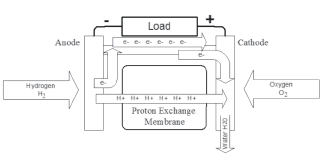
<body><![CDATA[<p align="center"><font size="2" face="Verdana, Arial, Helvetica, sans-serif"><b>Received for review November 30<sup>th</sup>, 2009; accepted December 6<sup>th</sup>, 2010; final version January 26<sup>th</sup>, 2011</b></font></p>     <p>&nbsp;</p> <hr>     <p><font size="2" face="Verdana, Arial, Helvetica, sans-serif"><b>ABSTRACT</b>: This paper presents the design, implementation, and experimental  validation of a digitally-controlled emulator of proton exchange membrane (PEM)  fuel cells for static and dynamic behavior. The emulator is a low cost, easy to  use, and portable device designed to evaluate power systems and control  strategies for fuel cell-based generation systems. For the implementation of  this emulator, an appropriate mathematical model is chosen, parameterized, and  experimentally validated. The resulting model is processed digitally by the  emulator, which generates the appropriate electrical behavior to a load. The  emulator power stage is implemented by using a two-inductor step-down DC/DC  switching converter, which is controlled directly by the digital processing  system. Later, the electrical scheme of the power stage and the block diagram  of the system are presented, and the behavior of the emulator is illustrated  with a simulation. Finally, the emulator is validated using experimental data.</font></p>     <p><font size="2" face="Verdana, Arial, Helvetica, sans-serif"><b>KEYWORDS</b>: Fuel cell emulator, proton-exchange membrane fuel cell, real-time  processing, DC/DC switching converter, digital control</font></p>     <p><font size="2" face="Verdana, Arial, Helvetica, sans-serif"><b>RESUMEN: </b>Este art&iacute;culo  presenta el dise&ntilde;o, implementaci&oacute;n y validaci&oacute;n experimental de un emulador  controlado digitalmente de pilas de combustible con membrana de intercambio  prot&oacute;nico (PEM), tanto para comportamiento est&aacute;tico como din&aacute;mico, el cual es  f&aacute;cil de usar y proporciona autonom&iacute;a y portabilidad a bajo costo. El emulador  permite la evaluaci&oacute;n de sistemas de potencia y estrategias de control en  sistemas basados en pilas de combustible. Para la implementaci&oacute;n del emulador  se seleccion&oacute;, ajust&oacute; y valid&oacute; un modelo matem&aacute;tico apropiado. El modelo es  procesado digitalmente en el emulador, el cual genera el comportamiento  el&eacute;ctrico apropiado a la carga. La etapa de potencia fue implementada usando un  convertidor DC/DC conmutado de dos inductores, controlado directamente con el  sistema de procesamiento digital. El art&iacute;culo presenta el esquema el&eacute;ctrico y  diagrama de bloques de la etapa de potencia, y el comportamiento del emulador  es ilustrado con resultados de simulaci&oacute;n. Finalmente, el emulador es validado  experimentalmente.</font></p>     <p><font size="2" face="Verdana, Arial, Helvetica, sans-serif"><b>PALABRAS CLAVE</b>: Emulador de pilas de combustible, pila de  combustible PEM, procesamiento en tiempo real, conversores DC/DC conmutados, control  digital</font></p>  <hr>     <p>&nbsp;</p>     <p><font size="3" face="Verdana, Arial, Helvetica, sans-serif"><b>1. INTRODUCTION </b></font></p>     <p><font size="2" face="Verdana, Arial, Helvetica, sans-serif">Among the different types of fuel cells, the proton exchange membrane (PEM)  fuel cells are especially interesting because they have a high power density,  solid electrolytes, and relatively low corrosion. Also, their low operation  temperature (65 <sup>o</sup>C to 100 <sup>o</sup>C) enables a fast start-up of  PEM-based systems [1].</font></p>     <p><font size="2" face="Verdana, Arial, Helvetica, sans-serif">In <a href="#fig01">Fig. 1</a>, the PEM basic principle is presented [2]: fuel (hydrogen) is provided to the catalytic layer of the anode, where  the hydrogen dissociates and produces protons and electrons. The chemical  reaction in the anode is:</font></p>     ]]></body>
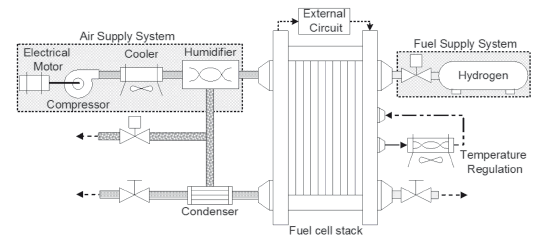
<body><![CDATA[<p><font size="2" face="Verdana, Arial, Helvetica, sans-serif"><sub><img src="/img/revistas/dyna/v78n168/a13eq002.gif"></sub> (1)</font></p>     <p align="center"><font size="2" face="Verdana, Arial, Helvetica, sans-serif"><b><a name="fig01"></a><img src="/img/revistas/dyna/v78n168/a13fig01.gif">    <br> Figure 1.</b> PEM fuel cell basic principle.</font></p>     <p><font size="2" face="Verdana, Arial, Helvetica, sans-serif">The protons flow through an electrolytic membrane that blocks the  electrons from the catalytic layer of the cathode. Thus, the electrons are  forced to travel through an external circuit, generating an electric current.  At the other end of the fuel cell, the oxygen flows through the cathode to the  catalytic layer. At this point, oxygen, protons, and electrons are consumed,  producing liquid water and heat in the surface of catalytic particles. The  chemical reaction in the cathode is:</font></p>     <p><font size="2" face="Verdana, Arial, Helvetica, sans-serif"><sub><img src="/img/revistas/dyna/v78n168/a13eq005.gif"></sub> (2)</font></p>     <p><font size="2" face="Verdana, Arial, Helvetica, sans-serif">Finally, the global process in the fuel cell can be summarized as:</font></p>     <p><font size="2" face="Verdana, Arial, Helvetica, sans-serif"><sub><img src="/img/revistas/dyna/v78n168/a13eq007.gif"></sub> (3)</font></p>     <p><font size="2" face="Verdana, Arial, Helvetica, sans-serif">The PEM-based systems require auxiliary elements, such as the systems  that provide the oxidant (air oxygen) and fuel (hydrogen), the humidification  system, the temperature control, and the pressure regulation system. The  structure of the fuel cell power system with the support subsystems can be  observed in <a href="#fig02">Fig. 2.</a> This system can be very complex, and in most applications  an additional interface power system is required between the PEM fuel cell and  an electrical load [3].</font></p>     <p align="center"><font size="2" face="Verdana, Arial, Helvetica, sans-serif"><b><a name="fig02"></a><img src="/img/revistas/dyna/v78n168/a13fig02.gif">    <br>   Figure 2</b>.   PEM fuel cell power system.</font></p>     ]]></body>
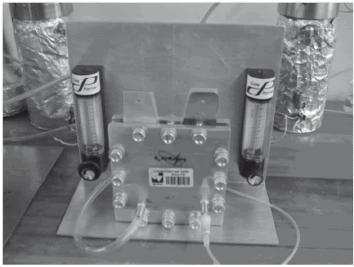
<body><![CDATA[<p><font size="2" face="Verdana, Arial, Helvetica, sans-serif">In order to develop the control systems required by either the  application or fault detection strategies in mechanical systems, electrical  power interfaces and high level energy management are required. Some of these  systems are expensive, and the required equipment and safety procedures are not  easily provided by most control and power electronics laboratories. These  difficulties have been addressed using emulators. Emulators are a valuable  resource in the test of control strategies in industrial environments because  the evaluation of controllers in a real system implies that production is  stopped.</font></p>     <p><font size="2" face="Verdana, Arial, Helvetica, sans-serif">In this way, in [4] the responses of a stabilization strategy for induction motor drives  with poorly damped input filters using a hardware-in-the-loop (HIL) simulator is  evaluated because it allows for faster and more flexible experiments in  comparison to using a real  motor-inverter system. In electric systems, a reduced-scale distribution  network simulator [5] is proposed. Other applications include emulators of mechanical loads [6] for testing electrical drives and motion-control techniques. Similarly,  a real-time simulator was presented in [7], where the emulation of a voltage-source converter-based <b>D</b>istribution <b>STAT</b>ic <b>COM</b>pensator  (D-STATCOM - 5 kVA) power system is presented. This emulation technique has  also been used intensively by the automobile industry as reported in [8].</font></p>     <p><font size="2" face="Verdana, Arial, Helvetica, sans-serif">In [9] a fuel cell real-time simulator oriented to evaluate the performance of  DC/DC and DC/AC converters powered by fuel cells is presented, but it only  reproduces the fuel cell static behavior. Similarly, in [10] a fuel cell emulator based on real-time hardware is presented. That  work was improved in [11] by a fuel cell dynamic simulator based on a programmable DC power  supply and a LabVIEW graphical user interface. These emulators allow for one to  carry out experiments in a safe and easy way without the consumption of reagents,  but all of them are based on closed-loop fuel cell systems, and therefore it is  not possible to test control systems behavior. Also, those emulators are based  on non-specialized hardware, making them expensive, non-portable and difficult to  adapt to new fuel cell systems. Finally, the models used in those emulators do  not represent the main overall system dynamics, making them not suitable for the  evaluation of power electronics and control systems in practical fuel cell  applications.</font></p>     <p><font size="2" face="Verdana, Arial, Helvetica, sans-serif">In this paper, a digitally-controlled emulator of PEM fuel cells which  is based on a dynamical model adjusted to real fuel cell measurements is  presented. The emulator is intended to test power systems designed to interact  with PEM fuel cells and to evaluate the performance of strategies for fuel  regulation in different electrical power profiles. The emulator is implemented  by using a low-cost microcontroller and a DC/DC switching converter resulting  in a low-cost, portable, and easy-to-configure embedded system. The only  additional hardware required is a voltage power supply.</font></p>     <p><font size="2" face="Verdana, Arial, Helvetica, sans-serif">The paper is organized as follows: in Section 2, the mathematical model  used in the emulator is shown and the experimental parameterization of the  model is described. In Section 3, the power stage of the emulator is presented.  In Section 4, the general structure of the emulator and its implementation is  described. In Section 5, the validation of the emulator using  experimental data is performed. Finally, the conclusions of the work are presented  in Section 6.</font></p>     <p>&nbsp;</p>     <p><font size="3" face="Verdana, Arial, Helvetica, sans-serif"><b>2. MATHEMATICAL MODEL </b></font></p>     <p><font size="2" face="Verdana, Arial, Helvetica, sans-serif">After evaluating different mathematical models proposed in the  literature, the PEM fuel cell power system model proposed in [1, 12] was  selected for the emulator implementation because it takes the fuel cell stack,  the systems that provide the oxygen and hydrogen, the humidification system,  the temperature control, and the pressure regulation system into consideration.  This model is based on the physical and chemical relations present in the  electrical energy generation system, obtaining satisfactory performance in the  prediction of both static and dynamic behaviors. In the same way, another  interesting model evaluated was the one proposed in [13].</font></p>     <p><font size="2" face="Verdana, Arial, Helvetica, sans-serif">Both Pukrushpan et al. and Real et al. models have well defined functional  blocks, so that Matlab models for computational simulation are available. Using  such functional blocks, a computer-based simulation system was designed and  parameterized to predict the behavior of an experimental fuel cell stack. </font></p> <font size="2" face="Verdana, Arial, Helvetica, sans-serif"><b>2.1 Mathematical Model Parameterization    <br> </b></font><font size="2" face="Verdana, Arial, Helvetica, sans-serif">In order to reproduce the behavior of a real fuel cell, a   parameterization of the mathematical model was performed by using experimental   data and the physical characteristics of the fuel cell. In this work, an H<sub>2</sub>Economy-EcoFC   fuel cell was used. According to its manufacture specifications, this fuel cell   generates a nominal electric power of 3.5 W with a stack voltage of 600 mV and   pressures of 1 bar for H<sub>2</sub> and 1.2 bar for O<sub>2</sub> at 80 <sup>o</sup>C.   <a href="#fig03">Figure 3</a> shows a picture of the fuel cell that can produce a maximum power of 5  W.</font>     ]]></body>
<body><![CDATA[<p align="center"><font size="2" face="Verdana, Arial, Helvetica, sans-serif"><b><a name="fig03"></a><img src="/img/revistas/dyna/v78n168/a13fig03.gif">    <br> Figure </b> <b>3.</b> A 5W <i>H<sub>2</sub>Economy-EcoFC</i> fuel cell.</font></p>     <p><font size="2" face="Verdana, Arial, Helvetica, sans-serif">Several experiments considering changes in the cell current, at constant   temperature, were performed to evaluate the fuel cell static and dynamic   responses. The experimental system uses a fuel cell test station MTS-150 to   regulate the reagent flows, an electronic load ECL-150 to define the cell   current, and a computer to store the experimental data transmitted through a  GPIB channel supported by the measurement devices.</font></p>     <p><font size="2" face="Verdana, Arial, Helvetica, sans-serif">In the experiments, the anode-cathode pressure-ratio was adjusted in  open loop according to the instructions provided by the fuel cell manufacturer.</font></p>     <p><font size="2" face="Verdana, Arial, Helvetica, sans-serif">In the model, the corresponding adjustment follows the open loop static   feed-forward configuration proposed in [14]. The fuel and oxidant flows are expressed as a percentage of the   maximum flow that can be applied to the fuel cell, which is standardized as a control  signal denominated <i>fuel flow ratio</i>.</font></p>     <p><font size="2" face="Verdana, Arial, Helvetica, sans-serif">The stack voltage is described in (4):</font></p>     <p><font size="2" face="Verdana, Arial, Helvetica, sans-serif"><sub><img src="/img/revistas/dyna/v78n168/a13eq009.gif"></sub> (4)</font></p>     <p><font size="2" face="Verdana, Arial, Helvetica, sans-serif">whose parameters {<i>x</i><sub>k</sub> , <i>k</i> = 1..8} are given by</font></p>     <p><font size="2" face="Verdana, Arial, Helvetica, sans-serif"><sub><img src="/img/revistas/dyna/v78n168/a13eq011.gif"></sub> (5)</font></p>     <p><font size="2" face="Verdana, Arial, Helvetica, sans-serif"><sub><img src="/img/revistas/dyna/v78n168/a13eq013.gif"></sub> (6)</font></p>     ]]></body>
<body><![CDATA[<p><font size="2" face="Verdana, Arial, Helvetica, sans-serif"><sub><img src="/img/revistas/dyna/v78n168/a13eq015.gif"></sub> </font></p>     <p><font size="2" face="Verdana, Arial, Helvetica, sans-serif"><sub><img src="/img/revistas/dyna/v78n168/a13eq017.gif"></sub> </font></p>     <p><font size="2" face="Verdana, Arial, Helvetica, sans-serif"><sub><img src="/img/revistas/dyna/v78n168/a13eq019.gif"></sub> (7)</font></p>     <p><font size="2" face="Verdana, Arial, Helvetica, sans-serif"><sub><img src="/img/revistas/dyna/v78n168/a13eq021.gif"></sub> (8)</font></p>     <p><font size="2" face="Verdana, Arial, Helvetica, sans-serif"><sub><img src="/img/revistas/dyna/v78n168/a13eq023.gif"></sub> (9)</font></p>     <p><font size="2" face="Verdana, Arial, Helvetica, sans-serif"><sub><img src="/img/revistas/dyna/v78n168/a13eq025.gif"></sub> (10)</font></p>     <p><font size="2" face="Verdana, Arial, Helvetica, sans-serif"><sub><img src="/img/revistas/dyna/v78n168/a13eq027.gif"></sub> (11)</font></p>     <p><font size="2" face="Verdana, Arial, Helvetica, sans-serif"><sub><img src="/img/revistas/dyna/v78n168/a13eq029.gif"></sub> (12)</font></p>     <p><font size="2" face="Verdana, Arial, Helvetica, sans-serif">while the current density j is defined by:</font></p>     <p><font size="2" face="Verdana, Arial, Helvetica, sans-serif"><sub><img src="/img/revistas/dyna/v78n168/a13eq031.gif"></sub> (13)</font></p>     ]]></body>
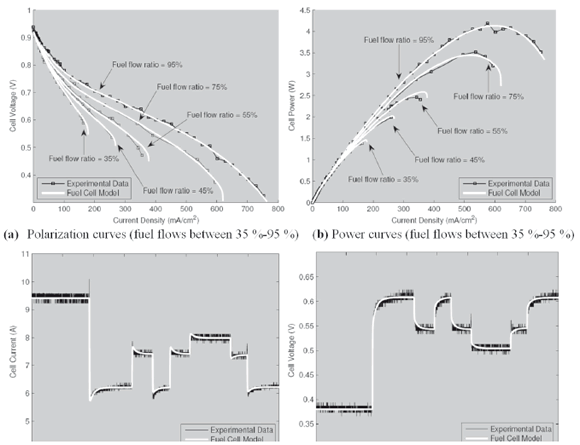
<body><![CDATA[<p><font size="2" face="Verdana, Arial, Helvetica, sans-serif">and the stack power is  given by:</font></p>     <p><font size="2" face="Verdana, Arial, Helvetica, sans-serif"><sub><img src="/img/revistas/dyna/v78n168/a13eq033.gif"></sub> (14)</font></p>     <p><font size="2" face="Verdana, Arial, Helvetica, sans-serif">The fuel cell voltage, current, power and temperature, are given by <i>V<sub>fc</sub></i>, <i>I<sub>st</sub></i>, <i>P<sub>st</sub>, </i>and<i> T<sub>st</sub></i>, respectively;   and the oxygen cathode and hydrogen anode pressures are given by <sub><img src="/img/revistas/dyna/v78n168/a13eq035.gif"></sub> and <sub><img src="/img/revistas/dyna/v78n168/a13eq037.gif"></sub>. The effective fuel cell area, <i>A<sub>fc</sub></i>, is included to model the effect of the anode water   accumulation on the voltage, and it depends on the nominal fuel cell area <i>A<sup>0</sup><sub>fc</sub></i> and on a mass   fraction of the liquid water present in the anode <sub><img src="/img/revistas/dyna/v78n168/a13eq039.gif"></sub>. The currents and voltages   of the experimental operating points, {(<i>p<sub>ki</sub></i>, <i>p<sub>kv</sub></i>) , <i>k</i> = 1..4}, are used to model the fuel   cell, and <sub><img src="/img/revistas/dyna/v78n168/a13eq041.gif"></sub>, <sub><img src="/img/revistas/dyna/v78n168/a13eq043.gif"></sub>, <i>T</i><sup>0</sup><i><sub>st</sub></i> define a nominal operating  point where <sub><img src="/img/revistas/dyna/v78n168/a13eq045.gif"></sub>, <sub><img src="/img/revistas/dyna/v78n168/a13eq047.gif"></sub>, and <i><font face="Symbol">a</font></i><sub>1</sub> are measured. </font></p>     <p><font size="2" face="Verdana, Arial, Helvetica, sans-serif">A detailed description and validation of this physical model can be  found in [13], where thermal and fluid dynamics are also taken into account.</font></p>     <p><font size="2" face="Verdana, Arial, Helvetica, sans-serif">The polarization and power curves of the fuel cell and the model are   presented in <a href="#fig04">Figs. 4(a)</a> and <a href="#fig04">4(b)</a>, for 95 %, 75 %, 55 %, 45 %, and 35 % fuel   flow ratios. For the dynamic behavior evaluation, changes in an electrical   resistive load connected to the fuel cell were made, and the comparison with   the simulations of the model can be observed in <a href="#fig04">Figs. 4(c)</a> and <a href="#fig04">4(d)</a>. In   conclusion, the parameterized mathematical model exhibits a satisfactory   performance in the reproduction of the static and dynamic behaviors of the  selected fuel cell. </font></p>     <p align="center"><font size="2" face="Verdana, Arial, Helvetica, sans-serif"><b><a name="fig04"></a><img src="/img/revistas/dyna/v78n168/a13fig04.gif">    <br>   Figure 4</b>.   Fuel cell model behavior evaluation.</font></p>     <p><font size="2" face="Verdana, Arial, Helvetica, sans-serif">In summary, this model considers the auxiliary systems dynamics, the   stack humidity and temperature effects, the fluid dynamics, gas diffusion, and   electrochemical reactions inside the stack [13]. Besides these, it describes the static and dynamic behavior of the   stack and auxiliary systems of a fuel cell power system. The model is validated   by comparing the simulated results with experimental measurements. The thermal   and fluid dynamics effects under consideration allow for the analysis of the   conditions of flooding and oxygen starvation, and therefore, the design and  evaluation of control strategies that consider these undesired conditions.</font></p>     <p>&nbsp;</p>     <p><font size="3" face="Verdana, Arial, Helvetica, sans-serif"><b>3. EMULATOR POWER STAGE</b></font> </p>     ]]></body>
<body><![CDATA[<p><font size="2" face="Verdana, Arial, Helvetica, sans-serif">The interaction of the emulator with real systems is provided by a power   stage that generates the voltage and power determined by the mathematical model   according to the current fixed by the load and the control signal of the fuel   flow ratio. In this implementation, the power stage consists of a two-inductor   step-down DC/DC switching converter, whose circuit scheme is depicted in <a href="#fig05">Fig. 5</a>.   This converter was introduced in [15], and it has been selected here because it is able to provide high   currents at voltages near to zero volts, and low currents close to the supply   voltage. The fundamental reasons for choosing a switching converter are its   high efficiency and compact size, according with the objective of developing a  portable fuel cell emulator. </font></p>     <p align="center"><font size="2" face="Verdana, Arial, Helvetica, sans-serif"><b><a name="fig05"></a><img src="/img/revistas/dyna/v78n168/a13fig05.gif">    <br>   Figure 5</b>.   Power stage DC/DC converter.</font></p>     <p><font size="2" face="Verdana, Arial, Helvetica, sans-serif">The converter parameters used in this implementation are: L1 = 140  <font face="Symbol">m</font>H, L2 = 140 <font face="Symbol">m</font>H, C1 = 200 <font face="Symbol">m</font>F, and Co = 15 <font face="Symbol">m</font>F. </font></p>     <p><font size="2" face="Verdana, Arial, Helvetica, sans-serif">Disregarding the losses, the set of differential equations that  describes the DC/DC converter behavior can be expressed as:</font></p>     <p><font size="2" face="Verdana, Arial, Helvetica, sans-serif"><sub><img src="/img/revistas/dyna/v78n168/a13eq049.gif"></sub> (15)</font></p>     <p><font size="2" face="Verdana, Arial, Helvetica, sans-serif"><sub><img src="/img/revistas/dyna/v78n168/a13eq051.gif"></sub> (16)</font></p>     <p><font size="2" face="Verdana, Arial, Helvetica, sans-serif"><sub><img src="/img/revistas/dyna/v78n168/a13eq053.gif"></sub> (17)</font></p>     <p><font size="2" face="Verdana, Arial, Helvetica, sans-serif"><sub><img src="/img/revistas/dyna/v78n168/a13eq055.gif"></sub> (18)</font></p>     <p><font size="2" face="Verdana, Arial, Helvetica, sans-serif"><sub><img src="/img/revistas/dyna/v78n168/a13eq057.gif"></sub> (19)</font></p>     ]]></body>
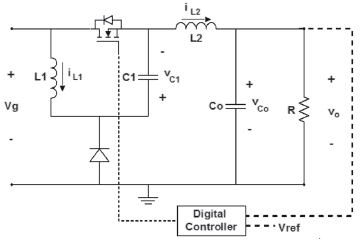
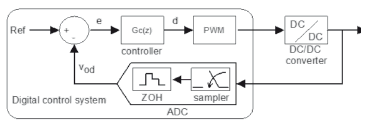
<body><![CDATA[<p><font size="2" face="Verdana, Arial, Helvetica, sans-serif">where d represents the duty cycle of the MOSFET activation, R the  load, and R<sub>s</sub> the current sensor.</font></p>     <p><font size="2" face="Verdana, Arial, Helvetica, sans-serif">Due to the unidirectional implementation of the converter, the  steady-state voltage gain in continuous conduction mode is:</font></p>     <p><font size="2" face="Verdana, Arial, Helvetica, sans-serif"><sub><img src="/img/revistas/dyna/v78n168/a13eq059.gif"></sub> (20)</font></p>     <p><font size="2" face="Verdana, Arial, Helvetica, sans-serif">The control loop scheme of the implementation is presented in <a href="#fig06">Fig. 6</a>,   where the voltage reference <i>Ref </i>is a   discrete signal, <i>v<sub>o</sub> </i>is the   output voltage, <i>v<sub>od</sub></i> is the   output voltage sampled using an analog-to-digital converter (ADC), <i>e </i>is the sampled output voltage error,  and <i>d</i> is the duty control signal.</font></p>     <p align="center"><font size="2" face="Verdana, Arial, Helvetica, sans-serif"><b><a name="fig06"></a><img src="/img/revistas/dyna/v78n168/a13fig06.gif">    <br>   Figure 6</b>.   Digital control loop.</font></p>     <p><font size="2" face="Verdana, Arial, Helvetica, sans-serif">From equations (15) to (19), the discrete control-to-output transfer   function for the DC/DC converter [16] defined by the previous set of parameters, in the operating point   described by {Vg = 12 V, Vo = 5 V, output power = 100 W, switching frequency =  100 kHz, D = 63 %, sampling time = 10 <font face="Symbol">m</font>s}, can be expressed as:</font></p>     <p><font size="2" face="Verdana, Arial, Helvetica, sans-serif"><sub><img src="/img/revistas/dyna/v78n168/a13eq061.gif"></sub> (21)</font></p>     <p><font size="2" face="Verdana, Arial, Helvetica, sans-serif"><sub><img src="/img/revistas/dyna/v78n168/a13eq064.gif"></sub> </font></p>     <p><font size="2" face="Verdana, Arial, Helvetica, sans-serif"><sub><img src="/img/revistas/dyna/v78n168/a13eq067.gif"></sub> </font></p>     ]]></body>
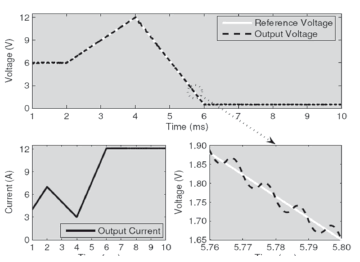
<body><![CDATA[<p><font size="2" face="Verdana, Arial, Helvetica, sans-serif">From this model, a digital voltage controller that provides a phase   margin of 61.8<sup>o</sup> and a gain margin of 10.9 dB was designed, and its  discrete transfer function is:</font></p>     <p><font size="2" face="Verdana, Arial, Helvetica, sans-serif"><sub><img src="/img/revistas/dyna/v78n168/a13eq070.gif"></sub> (22)</font></p>     <p><font size="2" face="Verdana, Arial, Helvetica, sans-serif"><a href="#fig07">Figure 7</a> shows a simulation of the closed-loop converter response to   simultaneous variations in the voltage reference (top) and in the output   current (bottom-left). Since the output voltage of the converter is difficult   to distinguish from the reference, a zoom showing the waveform of both voltages   is provided at the bottom-right graph. The variations of the voltage reference   and output current test the closed loop converter in the worst possible case,   i.e., high current at low voltage. In the simulation, the power stage exhibits  a satisfactory performance at the required conditions.</font></p>     <p align="center"><font size="2" face="Verdana, Arial, Helvetica, sans-serif"><b><a name="fig07"></a><img src="/img/revistas/dyna/v78n168/a13fig07.gif">    <br> Figure 7.</b> Controlled converter tracking response.</font></p>     <p>&nbsp;</p>     <p><b><font size="3" face="Verdana, Arial, Helvetica, sans-serif">4. PEM   FUEL CELL EMULATOR STRUCTURE </font></b></p> <font face="Verdana, Arial, Helvetica, sans-serif"><font size="2">     <p>The emulator was designed to allow for fast and easy modification of the   operating conditions and mathematical model. Thus, the mathematical model   parameterization was made for a single cell, with the aim of allowing the  emulation of stacks with different numbers of cells in series connection.</p>      <p>The general structure of the emulator is presented in <a href="#fig08">Fig. 8</a>, where the   mathematical model calculation, voltage control blocks, microcontroller and,   DC/DC converter are observed. A low-cost Silicon Laboratories microcontroller  C8051F120 was used for the implementation. </p> </font></font>     <p align="center"><font size="2" face="Verdana, Arial, Helvetica, sans-serif"><b><a name="fig08"></a><img src="/img/revistas/dyna/v78n168/a13fig08.gif">    ]]></body>
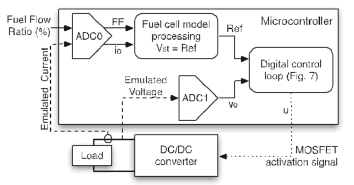
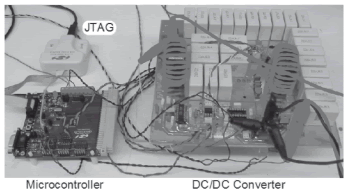
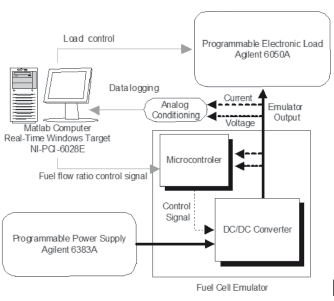
<body><![CDATA[<br>   Figure 8</b>.   Emulator block diagram.</font></p> <font face="Verdana, Arial, Helvetica, sans-serif"><font size="2">     <p>Two control loops that regulate the DC/DC converter output voltage were   implemented in the microcontroller. An internal loop regulates the duty cycle   to follow the reference voltage generated by the mathematical model, by means   of a digital controller, a PWM modulation system, and an ADC, denominated "ADC1"   in <a href="#fig08">Fig. 8</a>. In order to measure   the output current, a resistive shunt and an INA196 differential amplifier were   used. The INA196 integrated circuit has been chosen because it admits   common-mode voltages between -16 V to 80 V. The other analog signals are  acquired through another ADC, denominated "ADC0" in <a href="#fig08">Fig. 8</a>.</p>      <p>This structure allows the parallel execution of both regulation loops    interacting in real-time and, by using the ADC's of the microcontroller, it is    possible to sample simultaneously both DC/DC converter output voltage and    current. Additionally, the control signal for the fuel flow ratio can be    modified in run-time by means of an analog input signal, which is acquired    through the ADC0. This characteristic allows for the evaluation of control    strategies applied to the fuel cell emulator and its performance verification   by using realistic operation conditions and loads.</p>      <p>&nbsp;</p> </font></font>     <p><font size="3" face="Verdana, Arial, Helvetica, sans-serif"><b>5.   EXPERIMENTAL RESULTS</b></font></p> <font face="Verdana, Arial, Helvetica, sans-serif"><font size="2">     <p><a href="#fig09">Figure 9</a> illustrates the fuel cell emulator with its different hardware   components, i.e., the microcontroller and the two-inductor DC/DC switching   converter. The JTAG-USB debug adapter used for the embedded system programming,  not required for normal emulator operation can also be observed.</p>      <p align="center"><b><a name="fig09"></a><img src="/img/revistas/dyna/v78n168/a13fig09.gif">    <br>   Figure 9</b>.   PEM Fuel cell emulator.</p>  </font></font>    <p><font size="2" face="Verdana, Arial, Helvetica, sans-serif">In the experimental validation of the fuel cell emulator, a Matlab-based   system was implemented by using the Real-Time Windows Target   ToolBox. The structure of the test and the data-logging system are given in <a href="#fig10">Fig.   10</a>. Through a data acquisition system (DAQ, NI PCI-6024E), a Simulink model   defines the output current of the emulator and the control signal for the fuel   flow ratio (FF) of the mathematical model. Thus, it is possible to evaluate  multiple operating points and different transient conditions. Additionally, the system stores the voltage, current, and fuel   flow ratio values from the emulator all the time, and this allows for one to   perform further analysis and evaluation of the emulator behavior. <a href="#fig11">Figure 11</a>  depicts a picture of the test system. The test equipment being used, which is   the one currently available in our power electronics laboratory, is over-sized and   could be replaced by any other that might commonly be available in any  electronics laboratory. </font></p>      <p align="center"><font size="2" face="Verdana, Arial, Helvetica, sans-serif"><b><a name="fig10"></a><img src="/img/revistas/dyna/v78n168/a13fig10.gif">    ]]></body>
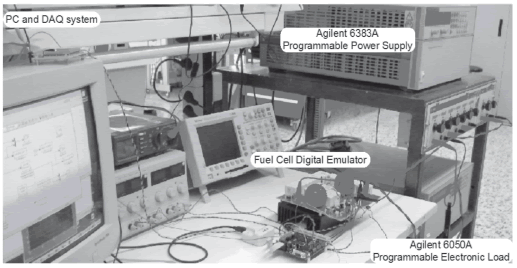
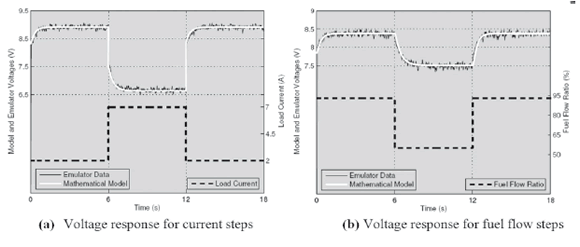
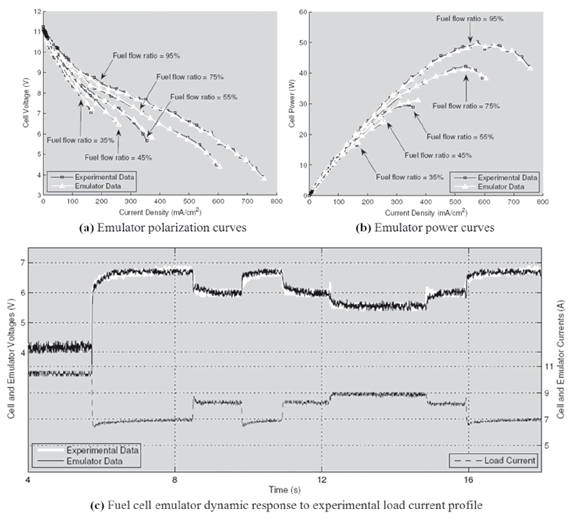
<body><![CDATA[<br>   Figure 10</b>.    Test and data logging system structure.</font></p>     <p align="center"><font size="2" face="Verdana, Arial, Helvetica, sans-serif"><b><a name="fig11"></a><img src="/img/revistas/dyna/v78n168/a13fig11.gif">    <br>   Figure 11.</b> Fuel-cell digital emulator   test system.</font><font face="Verdana, Arial, Helvetica, sans-serif"><font size="2"></font></font></p> <font face="Verdana, Arial, Helvetica, sans-serif"><font size="2">     <p>In order to evaluate the emulator performance, different comparative   experiments simulating and emulating a stack of 12 basic cells in series were   made. This configuration corresponds to the maximum stack size that the   emulator can represent, and therefore its behavior is evaluated under the most  critical conditions.</p>     <p>The dynamic behavior of the emulator and the simulated mathematical   model were compared to verify the accuracy of both model processing and   converter control in a real-time environment. In <a href="#fig12">Fig. 12(a)</a>, the responses of   the mathematical model and the emulator, for a variation of 5A in the stack   current, are presented. The model and emulator responses to a variation of 38 %   in the fuel flow ratio signal are depicted in <a href="#fig12">Fig. 12(b)</a>. The performance of   the emulator in both experiments in comparison to the model simulations is   satisfactory. The main difference is the 100 mV voltage ripple in the emulator   experimental data around the mean value. This ripple is due to the switching  action in the DC/DC converter.</p> </font></font>     <p align="center"><font size="2" face="Verdana, Arial, Helvetica, sans-serif"><b><a name="fig12"></a><img src="/img/revistas/dyna/v78n168/a13fig12.gif">    <br> Figure 12</b>. Fuel cell emulator dynamic response.</font></p> <font face="Verdana, Arial, Helvetica, sans-serif"><font size="2">     <p>Later,   the emulator performance has been contrasted in front of static and dynamic   experimental data of a real fuel cell. <a href="#fig13">Figures 13(a)</a> and <a href="#fig13">13(b)</a> show the   polarization and power curves of the emulator and the corresponding   experimental curves of a stack of 12 cells in series, respectively. It is   observed that the emulator response is very close to the static behavior of the   stack. The small discrepancies observed in the static curves are caused by poor   temperature regulation in the fuel cell experimental data acquisition process. For the experimental validation of the emulator dynamic behavior, the   response data of the same 12-cell stack has been used. The emulator output   current has been defined by means of an electronic load in agreement with the   one registered in the dynamic experiment made in the real stack. The results obtained   are presented in <a href="#fig13">Fig. 13(c)</a>, where it can be observed that the emulator   reproduces the dynamic behavior of the stack almost perfectly. The experiments   have been made with a fuel flow ratio of 95 %, and with the current profile   depicted in the bottom trace of the figure. The maximum error in the   polarization curves prediction is 0.5 %, and in the system dynamics  reproduction it is 9.1 %.</p> </font></font>     <p align="center"><font size="2" face="Verdana, Arial, Helvetica, sans-serif"><b><a name="fig13"></a><img src="/img/revistas/dyna/v78n168/a13fig13.gif">    <br>   Figure 13.</b> Fuel cell emulator static   and dynamic response.</font></p> <font face="Verdana, Arial, Helvetica, sans-serif"><font size="2">     ]]></body>
<body><![CDATA[<p>The main specifications of the developed fuel cell emulator are: 1-12   cells, a maximum power of 60 W, a maximum current of 14 A, 12 V - 18 V voltage source, an efficiency of 60 % - 85 %, and a bandwidth   of 4 kHz. The voltage power source required for the emulator operation depends   on the developed power stage. The switching DC/DC converter-based power stage   implemented presents a significant reduction in the current required from the  voltage source, in comparison with a linear power circuit implementation. </p>     <p>In the most critical condition of emulating a 12-cell stack in the   operating point of maximum output power (60 W), the switching power stage has a   minimum efficiency of 60 %. At the same 60 W operating point, the required 15 V  power source must have an output power of 100 W and an output current of 6.67 A.</p>     <p>Under the same conditions, a linear power stage will require a 15 V   power source of 142.5 W and an output current of 9.5 A, resulting in a power stage efficiency of 42.1 % and a 42.5 % higher  power source specification. </p>     <p>The best refreshing ratio of the voltage reference for the DC/DC   converter controller achieved in the microcontroller is 8 kHz. This parameter defines   a 4 kHz limit for the emulator bandwidth, which is enough for the intended   applications. Finally, as an estimation of the prototype cost, the   microcontroller represents about 15 % of the whole cost, the converter MMK   capacitors-about 45 %, and the remaining electronic components-about 40 %. The  costs of prototype manufacturing and testing were not considered.</p>     <p>&nbsp;</p> </font></font>     <p><b><font size="3" face="Verdana, Arial, Helvetica, sans-serif">6. CONCLUSIONS</font></b></p> <font face="Verdana, Arial, Helvetica, sans-serif"><font size="2">     <p>A low-cost, autonomous, portable, and simple-to-operate PEM fuel cell   emulator has been developed and validated. The emulator operation simply requires   a voltage power source of those usually available in any power electronics   laboratory. Due to the digital nature of the emulation, it is possible to make   quick changes to the mathematical model, thus avoiding changes in the system  hardware in most cases.</p>      <p>The hardware changes affect only the power stage, when larger stack   current and/or voltage have to be emulated. This power stage is implemented by   using a non-conventional DC/DC switching converter to obtain the desired   electrical behavior with high-energy efficiency. Also, the digital controller   implemented allows for an easy integration in the microcontroller emulation  structure.</p>      <p>The experiments performed have validated the static and dynamic behavior   of the PEM fuel cell emulator. The flexibility of the implementation could   allow for one to use the system to emulate other types of fuel cells, or even   other energy supply systems (i.e., photovoltaic panels, batteries, etc.) whose   non-linear time-variant nature make experimentation difficult. This will be the  subject of future works.</p>      <p>This PEM fuel cell emulator allows for the testing of power systems   designed to interact with PEM fuel cells, in order to prevent stack degradation   caused by the electric behavior of the system. Foreseen benefits of this   emulator are the ability to work without reagents in a non-specialized   environment, in a reproducible way and with a faster start-up/turn-off   operation. Finally, the proposed emulator is a useful device for designing,   developing, and testing power systems intended to interface between PEM fuel  cells electrical output and loads.</p>      ]]></body>
<body><![CDATA[<p>&nbsp;</p> </font></font>     <p><b><font size="3" face="Verdana, Arial, Helvetica, sans-serif">REFERENCES</font></b></p> <font face="Verdana, Arial, Helvetica, sans-serif"><font size="2">     <!-- ref --><p><b>[1]</b> J. T. PUKRUSHPAN, A. G. STEFANOPOULOU, and P. HUEI, Control of fuel cell breathing, IEEE Control Systems Magazine, vol. 24, pp. 30-46, 2004.        &nbsp;&nbsp;&nbsp;&nbsp;&nbsp;&nbsp;&nbsp;&nbsp;[&#160;<a href="javascript:void(0);" onclick="javascript: window.open('/scielo.php?script=sci_nlinks&ref=000135&pid=S0012-7353201100040001300001&lng=','','width=640,height=500,resizable=yes,scrollbars=1,menubar=yes,');">Links</a>&#160;]<!-- end-ref --><!-- ref --><br>    <b>[2]</b> J. M. CORREA, F. A. FARRET, L. N. CANHA, and M. G. SIMOES, An electrochemical-based fuel-cell model suitable for electrical engineering automation approach, IEEE Transactions on Industrial Electronics, vol. 51, pp. 1103-1112, 2004.        &nbsp;&nbsp;&nbsp;&nbsp;&nbsp;&nbsp;&nbsp;&nbsp;[&#160;<a href="javascript:void(0);" onclick="javascript: window.open('/scielo.php?script=sci_nlinks&ref=000136&pid=S0012-7353201100040001300002&lng=','','width=640,height=500,resizable=yes,scrollbars=1,menubar=yes,');">Links</a>&#160;]<!-- end-ref --><!-- ref --><br>    <b>[3]</b> M. C. PERA, D. CANDUSSO, D. HISSEL, and J. M. KAUFFMANN, Power generation by fuel cells, IEEE Industrial Electronics Magazine, vol. 1, pp. 28-37, 2007.        &nbsp;&nbsp;&nbsp;&nbsp;&nbsp;&nbsp;&nbsp;&nbsp;[&#160;<a href="javascript:void(0);" onclick="javascript: window.open('/scielo.php?script=sci_nlinks&ref=000137&pid=S0012-7353201100040001300003&lng=','','width=640,height=500,resizable=yes,scrollbars=1,menubar=yes,');">Links</a>&#160;]<!-- end-ref --><!-- ref --><br>    <b>[4]</b> H. MOSSKULL, J. GALIC, and B. WAHLBERG, Stabilization of Induction Motor Drives With Poorly Damped Input Filters, IEEE Transactions on Industrial Electronics, vol. 54, pp. 2724-2734, 2007.        &nbsp;&nbsp;&nbsp;&nbsp;&nbsp;&nbsp;&nbsp;&nbsp;[&#160;<a href="javascript:void(0);" onclick="javascript: window.open('/scielo.php?script=sci_nlinks&ref=000138&pid=S0012-7353201100040001300004&lng=','','width=640,height=500,resizable=yes,scrollbars=1,menubar=yes,');">Links</a>&#160;]<!-- end-ref --><!-- ref --><br>    <b>[5]</b> H. KOIZUMI, T. MIZUNO, T. KAITO, Y. NODA, N. GOSHIMA, M. KAWASAKI, K. NAGASAKA, and K. KUROKAWA, A Novel Microcontroller for Grid-Connected Photovoltaic Systems, IEEE Transactions on Industrial Electronics, vol. 53, pp. 1889-1897, 2006.        &nbsp;&nbsp;&nbsp;&nbsp;&nbsp;&nbsp;&nbsp;&nbsp;[&#160;<a href="javascript:void(0);" onclick="javascript: window.open('/scielo.php?script=sci_nlinks&ref=000139&pid=S0012-7353201100040001300005&lng=','','width=640,height=500,resizable=yes,scrollbars=1,menubar=yes,');">Links</a>&#160;]<!-- end-ref --><!-- ref --><br>    <b>[6]</b> J. ARELLANO-PADILLA, G. M. ASHER, and M. SUMNER, Control of an AC Dynamometer for Dynamic Emulation of Mechanical Loads With Stiff and Flexible Shafts, IEEE Transactions on Industrial Electronics, vol. 53, pp. 1250-1260, 2006.        &nbsp;&nbsp;&nbsp;&nbsp;&nbsp;&nbsp;&nbsp;&nbsp;[&#160;<a href="javascript:void(0);" onclick="javascript: window.open('/scielo.php?script=sci_nlinks&ref=000140&pid=S0012-7353201100040001300006&lng=','','width=640,height=500,resizable=yes,scrollbars=1,menubar=yes,');">Links</a>&#160;]<!-- end-ref --><!-- ref --><br>    <b>[7]</b> V. DINAVAHI, R. IRAVANI, and R. BONERT, Design of a real-time digital Simulator for a D-STATCOM system, IEEE Transactions on Industrial Electronics, vol. 51, pp. 1001-1008, 2004.        &nbsp;&nbsp;&nbsp;&nbsp;&nbsp;&nbsp;&nbsp;&nbsp;[&#160;<a href="javascript:void(0);" onclick="javascript: window.open('/scielo.php?script=sci_nlinks&ref=000141&pid=S0012-7353201100040001300007&lng=','','width=640,height=500,resizable=yes,scrollbars=1,menubar=yes,');">Links</a>&#160;]<!-- end-ref --><!-- ref --><br>    <b>[8]</b> A. VATH, Z. LEMS, H. MNCHER, M. SHN, N. NICOLOSO, and T. HARTKOPF, Dynamic modelling and hardware-in-the-loop testing of pemfc, Journal of Power Sources, vol. 157, pp. 816-827, 2006.        &nbsp;&nbsp;&nbsp;&nbsp;&nbsp;&nbsp;&nbsp;&nbsp;[&#160;<a href="javascript:void(0);" onclick="javascript: window.open('/scielo.php?script=sci_nlinks&ref=000142&pid=S0012-7353201100040001300008&lng=','','width=640,height=500,resizable=yes,scrollbars=1,menubar=yes,');">Links</a>&#160;]<!-- end-ref --><!-- ref --><br>    <b>[9]</b> A. PRABHA, E. PRASAD, and I. J. PITEL, An advanced fuel cell simulator, in Applied Power Electronics Conference and Exposition, 2004. APEC '04. Nineteenth Annual IEEE, 2004, pp. 1554-1558 Vol.3.        &nbsp;&nbsp;&nbsp;&nbsp;&nbsp;&nbsp;&nbsp;&nbsp;[&#160;<a href="javascript:void(0);" onclick="javascript: window.open('/scielo.php?script=sci_nlinks&ref=000143&pid=S0012-7353201100040001300009&lng=','','width=640,height=500,resizable=yes,scrollbars=1,menubar=yes,');">Links</a>&#160;]<!-- end-ref --><!-- ref --><br>    <b>[10]</b> C. DUFOUR, T. DAS, and S. AKELLA, Real time simulation of proton exchange membrane fuel cell hybrid vehicle, in Congress on Global Powetrain, 2005, pp. 1554-1558.        &nbsp;&nbsp;&nbsp;&nbsp;&nbsp;&nbsp;&nbsp;&nbsp;[&#160;<a href="javascript:void(0);" onclick="javascript: window.open('/scielo.php?script=sci_nlinks&ref=000144&pid=S0012-7353201100040001300010&lng=','','width=640,height=500,resizable=yes,scrollbars=1,menubar=yes,');">Links</a>&#160;]<!-- end-ref --><!-- ref --><br>    <b>[11]</b> L. JEONG-GYU, K. SEOK-HWAN, S. EUN-KYUNG, S. HWI-BEOM, C. SE-KYO, and L. HYUN-WOO, Implementation of Fuel Cell Dynamic Simulator, in Power Electronics Specialists Conference, 2006. PESC '06. 37th IEEE, 2006, pp. 1-5.        &nbsp;&nbsp;&nbsp;&nbsp;&nbsp;&nbsp;&nbsp;&nbsp;[&#160;<a href="javascript:void(0);" onclick="javascript: window.open('/scielo.php?script=sci_nlinks&ref=000145&pid=S0012-7353201100040001300011&lng=','','width=640,height=500,resizable=yes,scrollbars=1,menubar=yes,');">Links</a>&#160;]<!-- end-ref --><!-- ref --><br>    <b>[12]</b> C. A. RAMOS-PAJA, C. BORDONS, A. ROMERO, R. GIRAL, and L. MARTINEZ-SALAMERO, Minimum Fuel Consumption Strategy for PEM Fuel Cells, IEEE Transaction on Industrial Electronics, vol. 56, pp. 685-695, 2009.        &nbsp;&nbsp;&nbsp;&nbsp;&nbsp;&nbsp;&nbsp;&nbsp;[&#160;<a href="javascript:void(0);" onclick="javascript: window.open('/scielo.php?script=sci_nlinks&ref=000146&pid=S0012-7353201100040001300012&lng=','','width=640,height=500,resizable=yes,scrollbars=1,menubar=yes,');">Links</a>&#160;]<!-- end-ref --><!-- ref --><br>    <b>[13]</b> A. J. D. REAL, A. ARCE, and C. BORDONS, Development and experimental validation of a pem fuel cell dynamic model, Journal of Power Sources, vol. 173, pp. 310-324, 2007.        &nbsp;&nbsp;&nbsp;&nbsp;&nbsp;&nbsp;&nbsp;&nbsp;[&#160;<a href="javascript:void(0);" onclick="javascript: window.open('/scielo.php?script=sci_nlinks&ref=000147&pid=S0012-7353201100040001300013&lng=','','width=640,height=500,resizable=yes,scrollbars=1,menubar=yes,');">Links</a>&#160;]<!-- end-ref --><!-- ref --><br>    <b>[14]</b> J. T. PUKRUSHPAN, A. G. STEFANOPOULOU, and H. PENG, Control of Fuel Cell Power Systems, Springer-Verlag, 2005.        &nbsp;&nbsp;&nbsp;&nbsp;&nbsp;&nbsp;&nbsp;&nbsp;[&#160;<a href="javascript:void(0);" onclick="javascript: window.open('/scielo.php?script=sci_nlinks&ref=000148&pid=S0012-7353201100040001300014&lng=','','width=640,height=500,resizable=yes,scrollbars=1,menubar=yes,');">Links</a>&#160;]<!-- end-ref --><!-- ref --><br>    <b>[15]</b> R. TYMERSKI and V. VORPERIAN, Generation and classification of PWM DC-to-DC converters, Aerospace and Electronic Systems, IEEE Transactions on, vol. 24, pp. 743-754, 1988.        &nbsp;&nbsp;&nbsp;&nbsp;&nbsp;&nbsp;&nbsp;&nbsp;[&#160;<a href="javascript:void(0);" onclick="javascript: window.open('/scielo.php?script=sci_nlinks&ref=000149&pid=S0012-7353201100040001300015&lng=','','width=640,height=500,resizable=yes,scrollbars=1,menubar=yes,');">Links</a>&#160;]<!-- end-ref --><!-- ref --><br>   <b>[16]</b> B. J. PATELLA, A. PRODIC, A. ZIRGER, and D. MAKSIMOVIC, High-frequency digital PWM controller IC for DC-DC converters, IEEE Transactions on Power Electronics, vol. 18, pp. 438-446, 2003.&nbsp;&nbsp;&nbsp;&nbsp;&nbsp;&nbsp;&nbsp;&nbsp;[&#160;<a href="javascript:void(0);" onclick="javascript: window.open('/scielo.php?script=sci_nlinks&ref=000150&pid=S0012-7353201100040001300016&lng=','','width=640,height=500,resizable=yes,scrollbars=1,menubar=yes,');">Links</a>&#160;]<!-- end-ref --> ]]></body><back>
<ref-list>
<ref id="B1">
<label>1</label><nlm-citation citation-type="journal">
<person-group person-group-type="author">
<name>
<surname><![CDATA[PUKRUSHPAN]]></surname>
<given-names><![CDATA[J. T.]]></given-names>
</name>
<name>
<surname><![CDATA[STEFANOPOULOU]]></surname>
<given-names><![CDATA[A. G]]></given-names>
</name>
<name>
<surname><![CDATA[HUEI]]></surname>
<given-names><![CDATA[P]]></given-names>
</name>
</person-group>
<article-title xml:lang="es"><![CDATA[Control of fuel cell breathing]]></article-title>
<source><![CDATA[IEEE Control Systems Magazine]]></source>
<year>2004</year>
<volume>24</volume>
<page-range>30-46</page-range></nlm-citation>
</ref>
<ref id="B2">
<label>2</label><nlm-citation citation-type="journal">
<person-group person-group-type="author">
<name>
<surname><![CDATA[CORREA]]></surname>
<given-names><![CDATA[J. M.]]></given-names>
</name>
<name>
<surname><![CDATA[FARRET]]></surname>
<given-names><![CDATA[F. A.]]></given-names>
</name>
<name>
<surname><![CDATA[CANHA]]></surname>
<given-names><![CDATA[L. N]]></given-names>
</name>
<name>
<surname><![CDATA[SIMOES]]></surname>
<given-names><![CDATA[M. G]]></given-names>
</name>
</person-group>
<article-title xml:lang="en"><![CDATA[An electrochemical-based fuel-cell model suitable for electrical engineering automation approach]]></article-title>
<source><![CDATA[IEEE Transactions on Industrial Electronics]]></source>
<year>2004</year>
<volume>51</volume>
<page-range>1103-1112</page-range></nlm-citation>
</ref>
<ref id="B3">
<label>3</label><nlm-citation citation-type="journal">
<person-group person-group-type="author">
<name>
<surname><![CDATA[PERA]]></surname>
<given-names><![CDATA[M. C]]></given-names>
</name>
<name>
<surname><![CDATA[CANDUSSO]]></surname>
<given-names><![CDATA[D]]></given-names>
</name>
<name>
<surname><![CDATA[HISSEL]]></surname>
<given-names><![CDATA[D]]></given-names>
</name>
<name>
<surname><![CDATA[KAUFFMANN]]></surname>
<given-names><![CDATA[J. M]]></given-names>
</name>
</person-group>
<article-title xml:lang="en"><![CDATA[Power generation by fuel cells]]></article-title>
<source><![CDATA[IEEE Industrial Electronics Magazine]]></source>
<year>2007</year>
<volume>1</volume>
<page-range>28-37</page-range></nlm-citation>
</ref>
<ref id="B4">
<label>4</label><nlm-citation citation-type="journal">
<person-group person-group-type="author">
<name>
<surname><![CDATA[MOSSKULL]]></surname>
<given-names><![CDATA[H]]></given-names>
</name>
<name>
<surname><![CDATA[GALIC]]></surname>
<given-names><![CDATA[J]]></given-names>
</name>
<name>
<surname><![CDATA[WAHLBERG]]></surname>
<given-names><![CDATA[B]]></given-names>
</name>
</person-group>
<article-title xml:lang="en"><![CDATA[Stabilization of Induction Motor Drives With Poorly Damped Input Filters]]></article-title>
<source><![CDATA[IEEE Transactions on Industrial Electronics]]></source>
<year>2007</year>
<volume>54</volume>
<page-range>2724-2734</page-range></nlm-citation>
</ref>
<ref id="B5">
<label>5</label><nlm-citation citation-type="journal">
<person-group person-group-type="author">
<name>
<surname><![CDATA[KOIZUMI]]></surname>
<given-names><![CDATA[H]]></given-names>
</name>
<name>
<surname><![CDATA[MIZUNO]]></surname>
<given-names><![CDATA[T]]></given-names>
</name>
<name>
<surname><![CDATA[KAITO]]></surname>
<given-names><![CDATA[T]]></given-names>
</name>
<name>
<surname><![CDATA[NODA]]></surname>
<given-names><![CDATA[Y]]></given-names>
</name>
<name>
<surname><![CDATA[GOSHIMA]]></surname>
<given-names><![CDATA[N]]></given-names>
</name>
<name>
<surname><![CDATA[KAWASAKI]]></surname>
<given-names><![CDATA[M]]></given-names>
</name>
<name>
<surname><![CDATA[NAGASAKA]]></surname>
<given-names><![CDATA[K]]></given-names>
</name>
<name>
<surname><![CDATA[KUROKAWA]]></surname>
<given-names><![CDATA[K]]></given-names>
</name>
</person-group>
<article-title xml:lang="en"><![CDATA[A Novel Microcontroller for Grid-Connected Photovoltaic Systems]]></article-title>
<source><![CDATA[IEEE Transactions on Industrial Electronics]]></source>
<year>2006</year>
<volume>53</volume>
<page-range>1889-1897</page-range></nlm-citation>
</ref>
<ref id="B6">
<label>6</label><nlm-citation citation-type="journal">
<person-group person-group-type="author">
<name>
<surname><![CDATA[ARELLANO-PADILLA]]></surname>
<given-names><![CDATA[J]]></given-names>
</name>
<name>
<surname><![CDATA[ASHER]]></surname>
<given-names><![CDATA[G. M]]></given-names>
</name>
<name>
<surname><![CDATA[SUMNER]]></surname>
<given-names><![CDATA[M]]></given-names>
</name>
</person-group>
<article-title xml:lang="en"><![CDATA[Control of an AC Dynamometer for Dynamic Emulation of Mechanical Loads With Stiff and Flexible Shafts]]></article-title>
<source><![CDATA[IEEE Transactions on Industrial Electronics]]></source>
<year>2006</year>
<volume>53</volume>
<page-range>1250-1260</page-range></nlm-citation>
</ref>
<ref id="B7">
<label>7</label><nlm-citation citation-type="journal">
<person-group person-group-type="author">
<name>
<surname><![CDATA[DINAVAHI]]></surname>
<given-names><![CDATA[V]]></given-names>
</name>
<name>
<surname><![CDATA[IRAVANI]]></surname>
<given-names><![CDATA[R]]></given-names>
</name>
<name>
<surname><![CDATA[BONERT]]></surname>
<given-names><![CDATA[R]]></given-names>
</name>
</person-group>
<article-title xml:lang="en"><![CDATA[Design of a real-time digital Simulator for a D-STATCOM system]]></article-title>
<source><![CDATA[IEEE Transactions on Industrial Electronics,]]></source>
<year>2004</year>
<volume>51</volume>
<page-range>1001-1008</page-range></nlm-citation>
</ref>
<ref id="B8">
<label>8</label><nlm-citation citation-type="journal">
<person-group person-group-type="author">
<name>
<surname><![CDATA[VATH]]></surname>
<given-names><![CDATA[A]]></given-names>
</name>
<name>
<surname><![CDATA[LEMS]]></surname>
<given-names><![CDATA[Z]]></given-names>
</name>
<name>
<surname><![CDATA[MNCHER]]></surname>
<given-names><![CDATA[H]]></given-names>
</name>
<name>
<surname><![CDATA[SHN]]></surname>
<given-names><![CDATA[M]]></given-names>
</name>
<name>
<surname><![CDATA[NICOLOSO]]></surname>
<given-names><![CDATA[N]]></given-names>
</name>
<name>
<surname><![CDATA[HARTKOPF]]></surname>
<given-names><![CDATA[T]]></given-names>
</name>
</person-group>
<article-title xml:lang="en"><![CDATA[Dynamic modelling and hardware-in-the-loop testing of pemfc]]></article-title>
<source><![CDATA[Journal of Power Sources]]></source>
<year>2006</year>
<volume>157</volume>
<page-range>816-827</page-range></nlm-citation>
</ref>
<ref id="B9">
<label>9</label><nlm-citation citation-type="journal">
<person-group person-group-type="author">
<name>
<surname><![CDATA[PRABHA]]></surname>
<given-names><![CDATA[A]]></given-names>
</name>
<name>
<surname><![CDATA[PRASAD]]></surname>
<given-names><![CDATA[E]]></given-names>
</name>
<name>
<surname><![CDATA[PITEL]]></surname>
<given-names><![CDATA[I. J.]]></given-names>
</name>
</person-group>
<source><![CDATA[Nineteenth Annual IEEEAn advanced fuel cell simulator]]></source>
<year>2004</year>
<volume>3</volume>
<conf-name><![CDATA[ Applied Power Electronics Conference and Exposition2004]]></conf-name>
<conf-date>1</conf-date>
<conf-loc> </conf-loc>
<page-range>1554-1558</page-range></nlm-citation>
</ref>
<ref id="B10">
<label>10</label><nlm-citation citation-type="confpro">
<person-group person-group-type="author">
<name>
<surname><![CDATA[DUFOUR]]></surname>
<given-names><![CDATA[C]]></given-names>
</name>
<name>
<surname><![CDATA[DAS]]></surname>
<given-names><![CDATA[T]]></given-names>
</name>
<name>
<surname><![CDATA[AKELLA]]></surname>
<given-names><![CDATA[S]]></given-names>
</name>
</person-group>
<article-title xml:lang="en"><![CDATA[Real time simulation of proton exchange membrane fuel cell hybrid vehicle]]></article-title>
<source><![CDATA[]]></source>
<year>2005</year>
<conf-name><![CDATA[ Congress on Global Powetrain]]></conf-name>
<conf-loc> </conf-loc>
<page-range>1554-1558</page-range></nlm-citation>
</ref>
<ref id="B11">
<label>11</label><nlm-citation citation-type="confpro">
<person-group person-group-type="author">
<name>
<surname><![CDATA[JEONG-GYU]]></surname>
<given-names><![CDATA[L]]></given-names>
</name>
<name>
<surname><![CDATA[SEOK-HWAN]]></surname>
<given-names><![CDATA[K]]></given-names>
</name>
<name>
<surname><![CDATA[EUN-KYUNG]]></surname>
<given-names><![CDATA[S]]></given-names>
</name>
<name>
<surname><![CDATA[HWI-BEOM]]></surname>
<given-names><![CDATA[S]]></given-names>
</name>
<name>
<surname><![CDATA[SE-KYO]]></surname>
<given-names><![CDATA[C]]></given-names>
</name>
<name>
<surname><![CDATA[HYUN-WOO]]></surname>
<given-names><![CDATA[L]]></given-names>
</name>
</person-group>
<article-title xml:lang="en"><![CDATA[Implementation of Fuel Cell Dynamic Simulator]]></article-title>
<source><![CDATA[]]></source>
<year>2006</year>
<conf-name><![CDATA[37th Power Electronics Specialists Conference,]]></conf-name>
<conf-date>2006</conf-date>
<conf-loc> </conf-loc>
<page-range>1-5</page-range></nlm-citation>
</ref>
<ref id="B12">
<label>12</label><nlm-citation citation-type="journal">
<person-group person-group-type="author">
<name>
<surname><![CDATA[RAMOS-PAJA]]></surname>
<given-names><![CDATA[C. A]]></given-names>
</name>
<name>
<surname><![CDATA[BORDONS]]></surname>
<given-names><![CDATA[C]]></given-names>
</name>
<name>
<surname><![CDATA[ROMERO]]></surname>
<given-names><![CDATA[A]]></given-names>
</name>
<name>
<surname><![CDATA[GIRAL]]></surname>
<given-names><![CDATA[R]]></given-names>
</name>
<name>
<surname><![CDATA[MARTINEZ-SALAMERO]]></surname>
<given-names><![CDATA[L]]></given-names>
</name>
</person-group>
<article-title xml:lang="en"><![CDATA[Minimum Fuel Consumption Strategy for PEM Fuel Cells]]></article-title>
<source><![CDATA[IEEE Transaction on Industrial Electronics]]></source>
<year>2009</year>
<volume>56</volume>
<page-range>685-695</page-range></nlm-citation>
</ref>
<ref id="B13">
<label>13</label><nlm-citation citation-type="journal">
<person-group person-group-type="author">
<name>
<surname><![CDATA[REAL]]></surname>
<given-names><![CDATA[A. J. D]]></given-names>
</name>
<name>
<surname><![CDATA[ARCE]]></surname>
<given-names><![CDATA[A]]></given-names>
</name>
<name>
<surname><![CDATA[BORDONS]]></surname>
<given-names><![CDATA[C]]></given-names>
</name>
</person-group>
<article-title xml:lang="en"><![CDATA[Development and experimental validation of a pem fuel cell dynamic model]]></article-title>
<source><![CDATA[Journal of Power Sources]]></source>
<year>2007</year>
<volume>173</volume>
<page-range>310-324</page-range></nlm-citation>
</ref>
<ref id="B14">
<label>14</label><nlm-citation citation-type="book">
<person-group person-group-type="author">
<name>
<surname><![CDATA[PUKRUSHPAN]]></surname>
<given-names><![CDATA[J. T]]></given-names>
</name>
<name>
<surname><![CDATA[STEFANOPOULOU]]></surname>
<given-names><![CDATA[A. G]]></given-names>
</name>
<name>
<surname><![CDATA[PENG]]></surname>
<given-names><![CDATA[H]]></given-names>
</name>
</person-group>
<source><![CDATA[Control of Fuel Cell Power Systems]]></source>
<year>2005</year>
<publisher-name><![CDATA[Springer-Verlag]]></publisher-name>
</nlm-citation>
</ref>
<ref id="B15">
<label>15</label><nlm-citation citation-type="journal">
<person-group person-group-type="author">
<name>
<surname><![CDATA[TYMERSKI]]></surname>
<given-names><![CDATA[R]]></given-names>
</name>
<name>
<surname><![CDATA[VORPERIAN]]></surname>
<given-names><![CDATA[V]]></given-names>
</name>
</person-group>
<article-title xml:lang="en"><![CDATA[Generation and classification of PWM DC-to-DC converters, Aerospace and Electronic Systems,]]></article-title>
<source><![CDATA[IEEE Transactions]]></source>
<year>1988</year>
<volume>24</volume>
<page-range>743-754</page-range></nlm-citation>
</ref>
<ref id="B16">
<label>16</label><nlm-citation citation-type="journal">
<person-group person-group-type="author">
<name>
<surname><![CDATA[PATELLA]]></surname>
<given-names><![CDATA[B. J.]]></given-names>
</name>
<name>
<surname><![CDATA[PRODIC]]></surname>
<given-names><![CDATA[A]]></given-names>
</name>
<name>
<surname><![CDATA[ZIRGER]]></surname>
<given-names><![CDATA[A]]></given-names>
</name>
<name>
<surname><![CDATA[MAKSIMOVIC]]></surname>
<given-names><![CDATA[D]]></given-names>
</name>
</person-group>
<article-title xml:lang="en"><![CDATA[High-frequency digital PWM controller IC for DC-DC converters]]></article-title>
<source><![CDATA[IEEE Transactions on Power Electronics]]></source>
<year>2003</year>
<volume>18</volume>
<page-range>438-446</page-range></nlm-citation>
</ref>
</ref-list>
</back>
</article>