<?xml version="1.0" encoding="ISO-8859-1"?><article xmlns:mml="http://www.w3.org/1998/Math/MathML" xmlns:xlink="http://www.w3.org/1999/xlink" xmlns:xsi="http://www.w3.org/2001/XMLSchema-instance">
<front>
<journal-meta>
<journal-id>0012-7353</journal-id>
<journal-title><![CDATA[DYNA]]></journal-title>
<abbrev-journal-title><![CDATA[Dyna rev.fac.nac.minas]]></abbrev-journal-title>
<issn>0012-7353</issn>
<publisher>
<publisher-name><![CDATA[Universidad Nacional de Colombia]]></publisher-name>
</publisher>
</journal-meta>
<article-meta>
<article-id>S0012-73532011000600006</article-id>
<title-group>
<article-title xml:lang="en"><![CDATA[DESIGN CYCLE OF A ROBOT FOR LEARNING AND THE DEVELOPMENT OF CREATIVITY IN ENGENEERING]]></article-title>
<article-title xml:lang="es"><![CDATA[CICLO DE DISEÑO DE UN ROBOT PARA EL APRENDIZAJE Y DESARROLLO DE LA CREATIVIDAD EN INGENIERÍA]]></article-title>
</title-group>
<contrib-group>
<contrib contrib-type="author">
<name>
<surname><![CDATA[ÁLVAREZ CHAVARRÍA]]></surname>
<given-names><![CDATA[JUAN SEBASTIÁN]]></given-names>
</name>
<xref ref-type="aff" rid="A01"/>
</contrib>
<contrib contrib-type="author">
<name>
<surname><![CDATA[JIMÉNEZ BUILES]]></surname>
<given-names><![CDATA[JOVANI ALBERTO]]></given-names>
</name>
<xref ref-type="aff" rid="A02"/>
</contrib>
<contrib contrib-type="author">
<name>
<surname><![CDATA[RAMÍREZ PATIÑO]]></surname>
<given-names><![CDATA[JUAN FERNANDO]]></given-names>
</name>
<xref ref-type="aff" rid="A03"/>
</contrib>
</contrib-group>
<aff id="A01">
<institution><![CDATA[,Universidad Nacional de Colombia Diseño Mecánico Computacional ]]></institution>
<addr-line><![CDATA[ ]]></addr-line>
</aff>
<aff id="A02">
<institution><![CDATA[,Universidad Nacional de Colombia Inteligencia Artificial en Educación ]]></institution>
<addr-line><![CDATA[ ]]></addr-line>
</aff>
<aff id="A03">
<institution><![CDATA[,Universidad Nacional de Colombia Diseño Mecánico Computacional ]]></institution>
<addr-line><![CDATA[ ]]></addr-line>
</aff>
<pub-date pub-type="pub">
<day>00</day>
<month>12</month>
<year>2011</year>
</pub-date>
<pub-date pub-type="epub">
<day>00</day>
<month>12</month>
<year>2011</year>
</pub-date>
<volume>78</volume>
<numero>170</numero>
<fpage>51</fpage>
<lpage>58</lpage>
<copyright-statement/>
<copyright-year/>
<self-uri xlink:href="http://www.scielo.org.co/scielo.php?script=sci_arttext&amp;pid=S0012-73532011000600006&amp;lng=en&amp;nrm=iso"></self-uri><self-uri xlink:href="http://www.scielo.org.co/scielo.php?script=sci_abstract&amp;pid=S0012-73532011000600006&amp;lng=en&amp;nrm=iso"></self-uri><self-uri xlink:href="http://www.scielo.org.co/scielo.php?script=sci_pdf&amp;pid=S0012-73532011000600006&amp;lng=en&amp;nrm=iso"></self-uri><abstract abstract-type="short" xml:lang="en"><p><![CDATA[This paper attempts to show the main aspects which have given evolution to the development of a device belonging to a new pedagogic strategy called educational robotics. We present how starting from the basic design requirements expressed, and after applying a rigorous and methodological design process, the design specifications are obtained according to the different pedagogical, functional, esthetic, constructive, and economic aspects which this strategy proposes to implement.]]></p></abstract>
<abstract abstract-type="short" xml:lang="es"><p><![CDATA[Este artículo pretende mostrar los aspectos más relevantes en el desarrollo evolutivo del diseño de un dispositivo perteneciente a una nueva estrategia pedagógica denominada Robótica Educativa. Aquí se presenta cómo a partir de los requerimientos básicos de diseño expresados, y luego de aplicar un proceso riguroso y metodológico de diseño, se logra obtener las especificaciones de diseño acordes con los diferentes aspectos pedagógicos, funcionales, estéticos, constructivos y económicos que esta nueva estrategia de enseñanza propone implementar.]]></p></abstract>
<kwd-group>
<kwd lng="en"><![CDATA[Robotics]]></kwd>
<kwd lng="en"><![CDATA[active learning]]></kwd>
<kwd lng="en"><![CDATA[design methodology]]></kwd>
<kwd lng="en"><![CDATA[innovation in education]]></kwd>
<kwd lng="en"><![CDATA[engineering]]></kwd>
<kwd lng="en"><![CDATA[artificial intelligence]]></kwd>
<kwd lng="es"><![CDATA[Robótica]]></kwd>
<kwd lng="es"><![CDATA[aprendizaje activo]]></kwd>
<kwd lng="es"><![CDATA[metodología de diseño]]></kwd>
<kwd lng="es"><![CDATA[innovación en educación]]></kwd>
<kwd lng="es"><![CDATA[ingeniería]]></kwd>
</kwd-group>
</article-meta>
</front><body><![CDATA[ <p align="center"><b><font size="4" face="Verdana, Arial, Helvetica, sans-serif">DESIGN CYCLE OF A ROBOT FOR LEARNING AND THE DEVELOPMENT OF CREATIVITY IN ENGENEERING</font></b></p>     <p align="center"><i><b><font size="3" face="Verdana, Arial, Helvetica, sans-serif">CICLO DE DISE&Ntilde;O DE UN ROBOT PARA EL APRENDIZAJE Y DESARROLLO DE LA CREATIVIDAD EN INGENIER&Iacute;A</font></b></i></p>     <p align="center">&nbsp;</p>     <p align="center"><font size="2" face="Verdana, Arial, Helvetica, sans-serif"><b>JUAN SEBASTI&Aacute;N &Aacute;LVAREZ CHAVARR&Iacute;A</b>    <br>   <i>Engineer, research group: Dise&ntilde;o Mec&aacute;nico Computacional Universidad Nacional de Colombia, <a href="mailto:jsalvare@unal.edu.co">jsalvare@unal.edu.co</a></i></font></p>     <p align="center"><font size="2" face="Verdana, Arial, Helvetica, sans-serif"><b>JOVANI ALBERTO JIM&Eacute;NEZ BUILES</b>    <br>   <i>Ph. D., research group: Inteligencia Artificial en Educaci&oacute;n Universidad Nacional de Colombia, <a href="mailto:jajimen1@unal.edu.co">jajimen1@unal.edu.co</a> </i></font></p>     <p align="center"><font size="2" face="Verdana, Arial, Helvetica, sans-serif"><b>JUAN FERNANDO RAM&Iacute;REZ PATI&Ntilde;O</b>    <br>   <i>Ph. D .(c), research group: Dise&ntilde;o Mec&aacute;nico Computacional Universidad Nacional de Colombia, <a href="mailto:jframirp@unal.edu.co">jframirp@unal.edu.co</a></i></font></p>     <p align="center">&nbsp;</p>     ]]></body>
<body><![CDATA[<p align="center"><font size="2" face="Verdana, Arial, Helvetica, sans-serif"><b>Received for review: October 15<sup>th</sup>, 2010, accepted: March 29<sup>st</sup>, 2011, final version: March 31<sup>th</sup>, 2011</b></font></p>     <p>&nbsp;</p> <hr>     <p><font size="2" face="Verdana, Arial, Helvetica, sans-serif"><b>ABSTRACT:</b> This paper attempts to show the main aspects which have given evolution to the development of a device belonging to a new pedagogic strategy called educational robotics. We present how starting from the basic design requirements expressed, and after applying a rigorous and methodological design process, the design specifications are obtained according to the different pedagogical, functional, esthetic, constructive, and economic aspects which this strategy proposes to implement.</font></p>     <p><font size="2" face="Verdana, Arial, Helvetica, sans-serif"><b>KEYWORDS:</b> Robotics, active learning, design methodology, innovation in education, engineering, artificial intelligence.</font></p>     <p><font size="2" face="Verdana, Arial, Helvetica, sans-serif"><b>RESUMEN:</b> Este art&iacute;culo pretende mostrar los aspectos m&aacute;s relevantes en el desarrollo evolutivo del dise&ntilde;o de un dispositivo perteneciente a una nueva estrategia pedag&oacute;gica denominada Rob&oacute;tica Educativa. Aqu&iacute; se presenta c&oacute;mo a partir de los requerimientos b&aacute;sicos de dise&ntilde;o expresados, y luego de aplicar un proceso riguroso y metodol&oacute;gico de dise&ntilde;o, se logra obtener las especificaciones de dise&ntilde;o acordes con los diferentes aspectos pedag&oacute;gicos, funcionales, est&eacute;ticos, constructivos y econ&oacute;micos que esta nueva estrategia de ense&ntilde;anza propone implementar.</font></p>     <p><font size="2" face="Verdana, Arial, Helvetica, sans-serif"><b>PALABRAS CLAVE:</b> Rob&oacute;tica, aprendizaje activo, metodolog&iacute;a de dise&ntilde;o, innovaci&oacute;n en educaci&oacute;n, ingenier&iacute;a,</font></p> <hr>     <p>&nbsp;</p>     <p><font size="3" face="Verdana, Arial, Helvetica, sans-serif"><b>1. INTRODUCTION</b></font></p>     <p><font size="2" face="Verdana, Arial, Helvetica, sans-serif">One of the cornerstones, and perhaps the most important, in the development of a country is its educational system, which is precisely one of the fundamental scenarios in the solution of the conflict caused by the necessity to operate technology and know how it works to improve the quality of life of a society [1].</font></p>     <p><font size="2" face="Verdana, Arial, Helvetica, sans-serif">From this cornerstone, which joins the substantive functions of teaching, research, university extension departments, university welfare and social outreach, arises the mission of higher education institutions (instituciones de educaci&oacute;n superior, IES in Spanish) in Colombia [2].</font></p>     ]]></body>
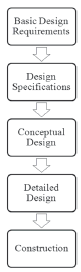
<body><![CDATA[<p><font size="2" face="Verdana, Arial, Helvetica, sans-serif">To achieve their mission, the IESs must have suitable human talent trained in proficiencies needed by modern society, which are required to educate human beings with great ability to understand and comminicate abstract concepts, suitable for experimentation, team work, and with a great ability to adapt to changes [3].</font></p>     <p><font size="2" face="Verdana, Arial, Helvetica, sans-serif">In this work, a teaching and learning methodological approach for engineering different from traditional learning is presented. The approach, which has two scenarios, is based on active learning. In the first stage-the building of the robots-some work was done by undergraduate mechanical engineering students. For that stage, the basic design methodology was modified by adding a continuous refinement cycle. It is necessary to clarify that the participating students had a plus represented in the theoretical and practical knowledge, compared to other students. This is evidenced by the continued participation of the students in different projects. Some of these projects are based on real problems shown by some companies like SENA (Servicio Nacional de Aprendizaje in Spanish), Argos, Sofasa, Isa, Ecopetrol, GEA, among others. Additionally, students participating in this first stage are more proactive, argumentative, and they propose solutions to the problems formulated by their professors in class.</font></p>     <p><font size="2" face="Verdana, Arial, Helvetica, sans-serif">The second stage is oriented towards younger students from different high schools like Cooperativo Juan del Corral, Diego Echavarr&iacute;a Misas, among others, located in Medellin, Colombia. This population was chosen because they are currently considering different professional options for their future, and one of those options is engineering. Based on the robots pre-manufactured by mechanical engineering students from Universidad Nacional de Colombia, Medellin Branch; different principles of mechanical and undulatory physics, electronics, and algorithmics can be addressed. The aim is for the students to build the robots and, at the same time, experiment with the principles that rule them thanks to the mechanisms integrated in the premanufactured robot to sense the work environment. Besides accomplishing the proposed instructional component goal, it was perceived that these youngsters acquired other proficiencies that were not included in the building project from the beginning. Some of these additional proficiencies are: communicative skills, respect for each other and for nature, leadership, collaborative and cooperative work, problem solving, keeping the work area in order while using tools, books, PCs, and so on; along with other civic and democratic attitudes.</font></p>     <p><font size="2" face="Verdana, Arial, Helvetica, sans-serif">In both scenarios, the purpose was to form young people with solid technological knowledge, based on human values and personal modern codes. Thanks to this project, the participating students have become analytical, argumentative, propositional, and so on; that is to say, they changed from a passive attitude to a proactive one.</font></p>     <p><font size="2" face="Verdana, Arial, Helvetica, sans-serif">It is worth mentioning the resistance that some professors presented to the challenge of introducing and experimenting with new education methods based on active learning [4], and to implement the research and the development of pedagogy and engineering areas in the classrooms. It is urgently needed to innovate with new teaching and learning methods different from the traditional ones but before doing that, a work on pedagogical formation needs to be carried out among teachers.</font></p>     <p><font size="2" face="Verdana, Arial, Helvetica, sans-serif">This paper is structured as follows: in the next chapter, the design process is presented. In chapter three, the application of the new design's cycle in the robot's construction is presented. Chapter four deals with the concepts to experiment with the construction of pre-manufactured robots. Finally in chapters five and six, the results and conclusions are respectively presented.</font></p>     <p>&nbsp;</p>     <p><font size="3" face="Verdana, Arial, Helvetica, sans-serif"><b>2. METHODOLOGY ONE: DESIGNING PROcESS</b></font></p>     <p><font size="2" face="Verdana, Arial, Helvetica, sans-serif">For the initial design of the robot, the methodology developed by authors Phal and Beitz (2007), which can be seen in <a href="#fig01">Fig. 1</a>, was followed. In the first phase of the methodology, the user's requirements were identified. These include, from a wider point of view, the requirements made by the manufacturer, the seller, the final user, and so on, becoming the starting point of the conceptual design.</font></p>     <p align="center"><font size="2" face="Verdana, Arial, Helvetica, sans-serif"><b><a name="fig01"></a><img src="/img/revistas/dyna/v78n170/a06fig01.gif">    ]]></body>
<body><![CDATA[<br>   Figure 1.</b> Basic design methodology [5]</font></p>     <p><font size="2" face="Verdana, Arial, Helvetica, sans-serif">For this robot's specific case, it was found that the user's requirements were not clearly defined. Due to the fact that the robot is not a machine whose work is restricted to the execution of a task, it was required to teach young people (on the second stage previously mentioned) different science concepts, based on the execution of the tasks performed by the robot. The idea is that the participating youngsters can modify the robot to see how these modifications affect its performance of the same tasks. The following figure describes the basic design methodology [5].</font></p>     <p><font size="2" face="Verdana, Arial, Helvetica, sans-serif"><b>2.1. Basic design methodology    <br>   </b>The basic design methodology (<a href="#fig01">Fig. 1</a>) is composed of the following five steps [5]:</font></p> <ul>       <li><font size="2" face="Verdana, Arial, Helvetica, sans-serif">Basic design requirements: This step is described by the final users. It is focused on clarifying the users' desired requierements and the way the solution will be presented. </font></li>       <li><font size="2" face="Verdana, Arial, Helvetica, sans-serif">Design specifications: These are the users' requirements translated into the engineering language. After the basic design requirements step, the designer can write a design specification, which is a list of factors that the design should satisfy. This information can be used in the elaboration of ideas in order to guarantee that all customers' necessities are being taken into account. In this step, graphics, diagrams, and algorithms, among others, can be used. </font></li>       <li><font size="2" face="Verdana, Arial, Helvetica, sans-serif">Conceptual design: This section deals with the design phase in which a functional prototype is developed.</font></li>       <li><font size="2" face="Verdana, Arial, Helvetica, sans-serif">Detailed design: In this phase, the existing functional design is improved and complemented in order to achieve all design requirements and specifications while making the robot manufacturable.</font></li>       <li><font size="2" face="Verdana, Arial, Helvetica, sans-serif">Construction: This step includes not only manufacturing the parts but also tuning the machine.</font></li>     </ul>     ]]></body>
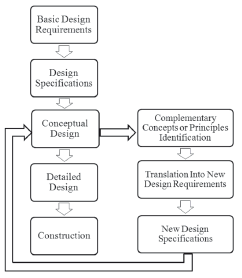
<body><![CDATA[<p><font size="2" face="Verdana, Arial, Helvetica, sans-serif">During the initial manufacturing process of the robot, the previously shown methodology was used. Nevertheless, because the robot's main objective is to be used as a teaching tool, and at the time, there were no elements allowing the development of any kind of knowledge when manipulating it, it was necessary to stop the process at the conceptual design step, in order to be able to integrate different elements that help to improve that knowledge generation while using the robot. Some additional elements such as component distribution, different kinds of sensors, and processing cards which were inserted into the premanufactured robot for this purpose, are presented below (<a href="#fig02">Fig. 2</a>).</font></p>     <p><font size="2" face="Verdana, Arial, Helvetica, sans-serif"><b>2.2. Modified Design Methodology    <br>   </b></font><font size="2" face="Verdana, Arial, Helvetica, sans-serif">Knowing that the machine's purpose is to teach, it is necessary to identify which formative aspects can be approached by the device. With these aspects, the design requirements were complemented. This was translated into a change on the basic design methodology (<a href="#fig02">Fig. 2</a>). The new methodology is hereafter named Modified Design Cycle.</font></p>     <p align="center"><font size="2" face="Verdana, Arial, Helvetica, sans-serif"><b><a name="fig02"></a><img src="/img/revistas/dyna/v78n170/a06fig02.gif">    <br>   Figure 2.</b> Modified design cycle</font></p>     <p><font size="2" face="Verdana, Arial, Helvetica, sans-serif">As shown in <a href="#fig02">Fig. 2</a>, this cycle is composed of eight steps. The first three steps are similar to the basic methodology showed in <a href="#fig01">Fig. 1</a>. In the next five steps, modifications are presented as well as the new part of the cycle. It should be known that this modification is proposed by the authors of this paper.</font></p> <ul>       <li><font size="2" face="Verdana, Arial, Helvetica, sans-serif">Identification of complementary principles or concepts: Throughout this stage, the concepts and physical principles associated to the robot are analyzed, complementing the basic requirements originally proposed, and thus raising the knowledge young people should get by using the robot.</font></li>       <li><font size="2" face="Verdana, Arial, Helvetica, sans-serif">Translating new design requirements: For a better development and appreciation of the concepts and physical principles inherent to the robot, it is necessary to define new design requirements which allow for a more explicit appreciation of the concepts and principles of the robot.</font></li>       <li><font size="2" face="Verdana, Arial, Helvetica, sans-serif">New design specifications: All the new requirements must also be translated into an engineering language, which will allow students to take them into consideration during the conceptual design phase.</font></li>     </ul>     ]]></body>
<body><![CDATA[<p><font size="2" face="Verdana, Arial, Helvetica, sans-serif">Then, the following steps are repeated: conceptual design, detail design, and construction in order to refine the robot under construction. At this step, there is feedback on the conceptual design with the requirements that were not taken into account at the initial phase. </font></p>     <p><font size="2" face="Verdana, Arial, Helvetica, sans-serif">This modification, and the inclusion of the new stages in the design process, allows for one to approach, in an easier and more organized way, the addition of new design requirements, and as a result, the new design specifications. This is why it is possible to implement concepts and/or principles that allow for the generation of knowledge by using the robot; all of them being always arranged in a way that they never interfere with each other, thus taking out the biggest potential the robot can give.</font></p>     <p>&nbsp;</p>     <p><font size="3" face="Verdana, Arial, Helvetica, sans-serif"><b>3. METHODOLOGY TWO: APPLICATION OF THE NEW DESIGNING CYCLE</b></font></p>     <p><font size="2" face="Verdana, Arial, Helvetica, sans-serif"><b>3.1. Basic Design Requirements</b></font></p>     <p><font size="2" face="Verdana, Arial, Helvetica, sans-serif">The initial requirements with which the development and purpose of the robot were proposed were:</font></p> <ul>       <li><font size="2" face="Verdana, Arial, Helvetica, sans-serif">The robot must be able to move in a structured work environment, which can be an office floor, a laboratory table, etc. </font></li>       <li><font size="2" face="Verdana, Arial, Helvetica, sans-serif">The robot should be able to detect different obstacles as chairs, desks, limited luminosity, doors, stairs, etc.</font></li>       <li><font size="2" face="Verdana, Arial, Helvetica, sans-serif">The robot must be able to change its trajectory if it is blocked.</font></li>     </ul>     ]]></body>
<body><![CDATA[<p><font size="2" face="Verdana, Arial, Helvetica, sans-serif"><b>3.2 Design Specifications</b></font></p>     <p><font size="2" face="Verdana, Arial, Helvetica, sans-serif">Due to the fact that the design requirements proposed above are focused on the robot's ability to perform some functions, these requirements can be taken as the design specifications. The previous stage must satisfy the conceptual design. However, there are some specifications that must be added:</font></p> <ul>       <li><font size="2" face="Verdana, Arial, Helvetica, sans-serif">The cost of the robot has to be as low as possible.</font></li>       <li><font size="2" face="Verdana, Arial, Helvetica, sans-serif">The robot assembly has to be as easy as possible.</font></li>     </ul>     <p><font size="2" face="Verdana, Arial, Helvetica, sans-serif"><b>3.3 Conceptual Design</b></font></p>     <p><font size="2" face="Verdana, Arial, Helvetica, sans-serif">The initial conceptual design features of the robot are:</font></p> <ul>       <li><font size="2" face="Verdana, Arial, Helvetica, sans-serif">Movement: two driving wheels, each with a motor, and a third freewheel which allows the robot to turn. The three wheels have a fixed position inside the robot.</font></li>       <li><font size="2" face="Verdana, Arial, Helvetica, sans-serif">Structure: a solid three-level structure. In the first level the driving part of the robot is located, in the intermediate level is the control part, and the sensors are located in the top level.</font></li>       <li><font size="2" face="Verdana, Arial, Helvetica, sans-serif">Sensor: infrared sensors as well as an ultrasonic sensor are located in the top level of the structure. These sensors have a fixed position.</font></li>     ]]></body>
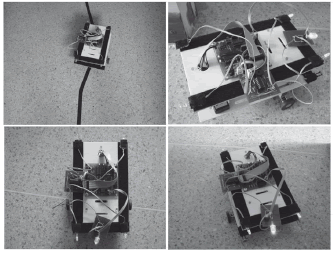
<body><![CDATA[</ul>     <p><font size="2" face="Verdana, Arial, Helvetica, sans-serif">The position of the printed circuits, the batteries, and other elements are not considered important because the participating students will consider it according with the guides, thus experimenting different theories such as Newton's laws (<a href="#fig03">Fig. 3</a>).</font></p>     <p align="center"><font size="2" face="Verdana, Arial, Helvetica, sans-serif"><b><a name="fig03"></a><img src="/img/revistas/dyna/v78n170/a06fig03.gif">    <br>   Figure 3.</b> Initial prototype</font></p>     <p><font size="2" face="Verdana, Arial, Helvetica, sans-serif"><b>3.4 Identification of complementary concepts or principles</b></font></p> <ul>       <li><font size="2" face="Verdana, Arial, Helvetica, sans-serif">Rigid body equilibrium: it allows the robot to remain in a balanced position (&aring;F=0, &aring;M=0).</font></li>       <li><font size="2" face="Verdana, Arial, Helvetica, sans-serif">Friction: it allows the robot's movement through the contact between the floor and the wheels.</font></li>       <li><font size="2" face="Verdana, Arial, Helvetica, sans-serif">Center of gravity: it makes possible for the robot to maintain a balanced position and to lose it when moving on an uneven ground.</font></li>       <li><font size="2" face="Verdana, Arial, Helvetica, sans-serif">Uses of complementary sensors: sensors are devices able to detect physical and chemical magnitudes called instrumental variables (temperature, light intensity, distance, acceleration, etc.) and transform them into electric variables. </font></li>       <li><font size="2" face="Verdana, Arial, Helvetica, sans-serif">Passive sensors: light dependent resistor (LDR), electric switch, microphone</font></li>       ]]></body>
<body><![CDATA[<li><font size="2" face="Verdana, Arial, Helvetica, sans-serif">Active sensors: phototransistor reflective object sensor</font></li>       <li><font size="2" face="Verdana, Arial, Helvetica, sans-serif">It is also taken into account that a better strategy to bring the participating students closer to the robot is to allow them to perform not the full assembly process but just a part of it, starting from pre-assembled subsets. Another important aspect of the learning and appropriation process with the robot is letting the youngsters identify themselves with the robot, and modify its esthetic features.</font></li>     </ul>     <p><font size="2" face="Verdana, Arial, Helvetica, sans-serif"><b>3.5 New design requirements</b></font></p> <ul>       <li><font size="2" face="Verdana, Arial, Helvetica, sans-serif">The robot's support position must be modifiable.</font></li>       <li><font size="2" face="Verdana, Arial, Helvetica, sans-serif">The position of the robot's elements having a relevant weight must be changeable without affecting its functions. Their weight is relevant because the robot's equilibrium depends on them. </font></li>       <li><font size="2" face="Verdana, Arial, Helvetica, sans-serif">The friction coefficient between the wheels and the ground must be modifiable.</font></li>       <li><font size="2" face="Verdana, Arial, Helvetica, sans-serif">The assembly must be done by the participating students.</font></li>       <li><font size="2" face="Verdana, Arial, Helvetica, sans-serif">The robot's esthetic feature must be modifiable by the participating students.</font></li>     </ul>     ]]></body>
<body><![CDATA[<p><font size="2" face="Verdana, Arial, Helvetica, sans-serif"><b>3.6 New design specifications</b></font></p> <ul>       <li><font size="2" face="Verdana, Arial, Helvetica, sans-serif">The wheel position must be modifiable to a position in which the robot loses the equilibrium condition.</font></li>       <li><font size="2" face="Verdana, Arial, Helvetica, sans-serif">It must be possible to change the batteries' position inside the robot. </font></li>       <li><font size="2" face="Verdana, Arial, Helvetica, sans-serif">The main assembly of the robot must be simple and feasible using basic tools and hands, and by people who are neither mechanical nor robotics experts.</font></li>       <li><font size="2" face="Verdana, Arial, Helvetica, sans-serif">The robot must have at least one element that can be customized by the final users.</font></li>       <li><font size="2" face="Verdana, Arial, Helvetica, sans-serif">The robot must have and use different sensors like: LDR, electric switch, microphone, light emitting diode (LED), phototransistor reflective object sensor, infrared LED.</font></li>     </ul>     <p><font size="2" face="Verdana, Arial, Helvetica, sans-serif"><b>3.7 Conceptual design (second phase)    <br>   </b></font><font size="2" face="Verdana, Arial, Helvetica, sans-serif">The new characteristics that allow the robot to fulfill the specifications mentioned in numeral 3.6 are:</font></p> <ul>       <li><font size="2" face="Verdana, Arial, Helvetica, sans-serif">The contact material between the wheels and the ground can be changed using different material bands placed around the wheels.</font></li>       ]]></body>
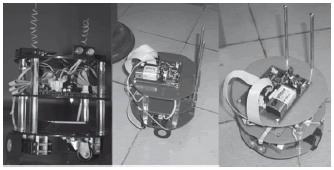
<body><![CDATA[<li><font size="2" face="Verdana, Arial, Helvetica, sans-serif">The batteries can be positioned in three different ways inside the robot. This makes it possible to change the location of the mass center.</font></li>       <li><font size="2" face="Verdana, Arial, Helvetica, sans-serif">The driving wheels can be moved in the robot structure using guides. This enables one to have different configurations in the supports, which, as a result, modify the equilibrium condition.</font></li>       <li><font size="2" face="Verdana, Arial, Helvetica, sans-serif">The robot shape allows the sensors previously mentioned to be attached to it. Besides, it has guides located in its top part that allow the movement of some sensors to the point where their signals interfere to have a wider spectrum to sense.</font></li>       <li><font size="2" face="Verdana, Arial, Helvetica, sans-serif">The robot has a housing that final users can modify in the exterior part, customizing the visual aspect of the robot.</font></li>       <li><font size="2" face="Verdana, Arial, Helvetica, sans-serif">The assembly is modular. The parts that need glue, drying time, and so on, are manufactured before as sub-assemblies. The other parts will be joined by commercial screws and Velcro&reg;; this allows an easy assembly and disassembly of the whole set by the students (<a href="#fig04">Fig. 4</a>).</font></li>     </ul>     <p align="center"><font size="2" face="Verdana, Arial, Helvetica, sans-serif"><b><a name="fig04"></a><img src="/img/revistas/dyna/v78n170/a06fig04.gif">    <br>   Figure 4.</b> Final prototypes</font></p>     <p><font size="2" face="Verdana, Arial, Helvetica, sans-serif"><b>3.8 Detailed Design    <br>   </b></font><font size="2" face="Verdana, Arial, Helvetica, sans-serif">After having met all the design's requirements by the basic and functional principles in the steps of the conceptual design, it becomes necessary to specify the physical and geometric features of the elements that will form the robot to guarantee that no attachment will interfere with each other, allowing the development of all the set functions. The main parts of the detailed design are:</font></p> <ul>       ]]></body>
<body><![CDATA[<li><font size="2" face="Verdana, Arial, Helvetica, sans-serif">sizing of the driving wheels and the freewheel</font></li>       <li><font size="2" face="Verdana, Arial, Helvetica, sans-serif">material selection for the driving wheels</font></li>       <li><font size="2" face="Verdana, Arial, Helvetica, sans-serif">sizing of the structural plates, positioning of the guides and fixation places for every element</font></li>       <li><font size="2" face="Verdana, Arial, Helvetica, sans-serif">selection of the type and motor features</font></li>       <li><font size="2" face="Verdana, Arial, Helvetica, sans-serif">distribution of all the functional parts inside the robot's structure</font></li>       <li><font size="2" face="Verdana, Arial, Helvetica, sans-serif">organization of the robot parts into sub-assemblies</font></li>     </ul>     <p><font size="2" face="Verdana, Arial, Helvetica, sans-serif"><b>3.9 Construction    <br>   </b></font><font size="2" face="Verdana, Arial, Helvetica, sans-serif">Due to the fact that the robot's design must be modular, its construction process was divided into initial subsets to make the subsequent assembly of elements easier. This initial process began by choosing the parts to be joined with glue and/or by welding. These sub-sets are: the structure plates, the driving device and each of the robot's printed circuits, whether general or of each particular sensor.</font></p> <ul>       <li><font size="2" face="Verdana, Arial, Helvetica, sans-serif">Glue is used in the plates to fix the Velcro&reg;, allowing one to add or to remove the sensors easily.</font></li>       ]]></body>
<body><![CDATA[<li><font size="2" face="Verdana, Arial, Helvetica, sans-serif">The wheels are joined to the motor shaft by glazier's putty. This set is then fixed to the supports, which allow the positioning of this driving set in the robot's structure.</font></li>       <li><font size="2" face="Verdana, Arial, Helvetica, sans-serif">The printed circuits and all their electronic elements are previously assembled, leaving aside only the needed cables for the connection to the batteries and sensors.</font></li>     </ul>     <p><font size="2" face="Verdana, Arial, Helvetica, sans-serif">From this point on, all the other operations to build the robot are assembly operations using simple tools like screwdrivers and pliers, and the student's own hands.</font></p>     <p>&nbsp;</p>     <p><font size="3" face="Verdana, Arial, Helvetica, sans-serif"><b>4. PRINCIPLES ADDRESSED IN ROBOTICS TEACHING </b></font></p>     <p><font size="2" face="Verdana, Arial, Helvetica, sans-serif">Traditional teaching has been characterized by using a &quot;passive&quot; learning scheme in which the professor imparts the content of his/her lectures face to face through presentations on the board or slides, with little or no intervention by or interaction with the students. This teaching-learning methodology makes the student a passive being, with little or no proactivity nor propositivity. This makes them dependent on the professor's knowledge, showing little dynamics in the construction of their own knowledge, their proficiencies and &quot;know-how,&quot; which they require.</font></p>     <p><font size="2" face="Verdana, Arial, Helvetica, sans-serif">Nowadays, teaching-learning models are aimed to propose active learning, where the students have a proactive role in the construction of their own knowledge [6, 7]. Thus, in an active learning, it is the students themselves who build concepts, meanings and strategies from the experiences they face during the teaching process in real time. Learning then becomes more effective and productive for them [4,8].</font></p>     <p><font size="2" face="Verdana, Arial, Helvetica, sans-serif">The nature of the robot's construction, which is the purpose of this paper, can be classified as a construction of &quot;know-how,&quot; and not as a &quot;theoretical knowledge,&quot; which justifies the choice of this learning model in the educational robotics field [6,3]. Some works, as the ones made for innovating engineering learning using active didactics elements [9], show a significant change in the students' learning through innovative projects, which involve technology, and where students play the leading role.</font></p>     <p>&nbsp;</p>     ]]></body>
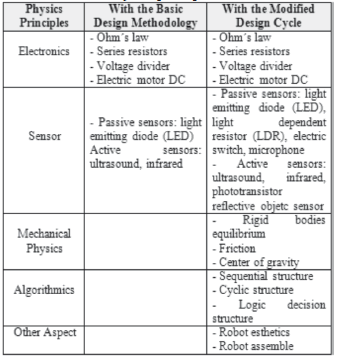
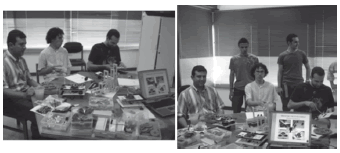
<body><![CDATA[<p><font size="3" face="Verdana, Arial, Helvetica, sans-serif"><b>5. RESULTS</b></font></p>     <p><font size="2" face="Verdana, Arial, Helvetica, sans-serif">In <a href="#tab01">Table 1</a>, a comparison is shown between the physics principles that can be learned through the robot, both for the design with the basic methodology and for the design with the modified cycle. This clarifies how the modification in the design methodology used in this case helps to complement what can be learned and taught with this robot.</font></p>     <p align="center"><font size="2" face="Verdana, Arial, Helvetica, sans-serif"><a name="tab01"></a><b>Table 1.</b> Physics principles to address</font>    <br>   <img src="/img/revistas/dyna/v78n170/a06tab01.gif"></p>     <p><font size="2" face="Verdana, Arial, Helvetica, sans-serif">In order to build the pre-manufactured robots, undergraduate students in mechanical engineering were involved in the stages of the modified design cycle. Their previous learning environment is known as stage one.</font></p>     <p><font size="2" face="Verdana, Arial, Helvetica, sans-serif">For the second stage, 40 robots were pre-manufactured. This process started by selecting 10 educational institutions in the city of Medellin to develop the workshops. At each institution, five workshops lasting 5 hours each were given. For every single institution, one kit composed of four robots, four guide books and tools were delivered. The target audience was primarily adolescents between the ages of 14 and 17 (<a href="#fig05">Fig. 5</a>). The assembly and experimentation of each robot was carried out by groups of five students. This means that for every educational institution, 20 students participated in the project.</font></p>     <p align="center"><font size="2" face="Verdana, Arial, Helvetica, sans-serif"><b><a name="fig05"></a><img src="/img/revistas/dyna/v78n170/a06fig05.gif">    <br>   Figure 5. </b>Typical sessions of teaching and learning in robotics, in the second stage</font></p>     <p><font size="2" face="Verdana, Arial, Helvetica, sans-serif">Some of the implicit achievements of the youngsters during the assembly of the pre-manufactured robots are those related with civic, democratic, artistic, cooperative, and collaborative proficiencies. These achievements were not planned from the beginning, but became an added value of the project.</font></p>     <p><font size="2" face="Verdana, Arial, Helvetica, sans-serif">The evaluation results of the participating students in the second stage in relation to the explored principles show that the students accomplished the proposed goals. At the end of the workshops, the results were socialized. In this stage the youngsters' teachers were present. During the workshops, they participated as observers.</font></p>     ]]></body>
<body><![CDATA[<p><font size="2" face="Verdana, Arial, Helvetica, sans-serif">Most of the teachers indicated that this kind of learning is less stressful for the students because they have been taking magisterial classes for over 10 years, and the only course that is a little out of context is physical education, recreation, and sports. They also said that the students were enthusiastic while experimenting during the workshops. During the workshops, the students were also interested in the way different courses merged through the innovative project of the robot's construction.</font></p>     <p>&nbsp;</p>     <p><b><font size="3" face="Verdana, Arial, Helvetica, sans-serif">6. CONCLUSIONS</font></b></p>     <p><font size="2" face="Verdana, Arial, Helvetica, sans-serif">With the work described in this paper, it was shown that different learning methodologies exist for teaching engineering concepts. Our proposal showed good results; the students left a passive attitude to become analytical, argumentative, and propositional; ergo, proactive people.</font></p>     <p><font size="2" face="Verdana, Arial, Helvetica, sans-serif">Robotics was used because it has recently become a great tool to strengthen creativity, learning, and designing skills. In the first stage, the design methodology had to be modified into a refined cycle. This was because the requirements presented by the users were not clear.</font></p>     <p><font size="2" face="Verdana, Arial, Helvetica, sans-serif">Deep down, the aim was also to reduce the student dropout rate in high school, and to prepare the young people to face an undergraduate academic program in engineering (higher education).</font></p>     <p><font size="2" face="Verdana, Arial, Helvetica, sans-serif">To finish this chapter, we agree with Resnick when he says that there is currently a transition toward a creativity society. This is because information and knowledge are not enough to address the current problems that the world is facing, and it is necessary to use creativity to generate solutions [10].</font></p>     <p><font size="2" face="Verdana, Arial, Helvetica, sans-serif">For years, institutions such as universities have made the mistake of restricting creativity to certain careers like engineering, and applying it only to some courses like design [11, 12]. But creativity is actually an area common to every human activity, and some examples are: agricultural production, medicine, painting, and of course, engineering; therefore, the development of this skill should be encouraged from childhood. Also, creativity is not limited to an age range but it should be encouraged during all the stages of a person's growth, mainly in the stages between 0 and 17 years, because it is when the person finds his/her interests and creates his/her learning models [13].</font></p>     <p>&nbsp;</p>     <p><b><font size="3" face="Verdana, Arial, Helvetica, sans-serif">7. ACKNOWLEDGMENT</font></b></p>     ]]></body>
<body><![CDATA[<p><font size="2" face="Verdana, Arial, Helvetica, sans-serif">The work described in this paper is part of the research project: Plan de acci&oacute;n para el fortalecimiento de los grupos de investigaci&oacute;n Inteligencia Artificial en Educaci&oacute;n y Dise&ntilde;o Mec&aacute;nico Computacional, sponsored by the Vicerrector&iacute;a de Investigaci&oacute;n de la Universidad Nacional de Colombia.</font></p>     <p>&nbsp;</p>     <p><b><font size="3" face="Verdana, Arial, Helvetica, sans-serif">REFERENCES</font></b></p>     <!-- ref --><p><font size="2" face="Verdana, Arial, Helvetica, sans-serif"><b>[1]</b> Ausubel, D., Psicolog&iacute;a educativa. En: cap. 13: Factores de grupo y sociales en el aprendizaje. M&eacute;xico: Trillas, 1990.     &nbsp;&nbsp;&nbsp;&nbsp;&nbsp;&nbsp;&nbsp;&nbsp;[&#160;<a href="javascript:void(0);" onclick="javascript: window.open('/scielo.php?script=sci_nlinks&ref=000156&pid=S0012-7353201100060000600001&lng=','','width=640,height=500,resizable=yes,scrollbars=1,menubar=yes,');">Links</a>&#160;]<!-- end-ref --><!-- ref --><br>   <b>[2]</b> CONSEJO NACIONAL DE ACREDITACI&Oacute;N, Lineamientos para la acreditaci&oacute;n de programas. Serie documentos Nro. 1. En: cap. 6: Aspectos institucionales en la acreditaci&oacute;n de programas. Sistema Nacional de Acreditaci&oacute;n, Consejo Nacional de Acreditaci&oacute;n. Colombia: Corcas Editores Ltda, 2006.     &nbsp;&nbsp;&nbsp;&nbsp;&nbsp;&nbsp;&nbsp;&nbsp;[&#160;<a href="javascript:void(0);" onclick="javascript: window.open('/scielo.php?script=sci_nlinks&ref=000157&pid=S0012-7353201100060000600002&lng=','','width=640,height=500,resizable=yes,scrollbars=1,menubar=yes,');">Links</a>&#160;]<!-- end-ref --><!-- ref --><br>   <b>[3]</b> Jim&eacute;nez, J., Ovalle, D. y Ram&iacute;rez, J., Rob&oacute;tica educativa: estrategias activas en ingenier&iacute;a. En: cap. 1: La universidad. Facultad de Minas, Universidad Nacional de Colombia. Colombia: Unibiblos, 2010.     &nbsp;&nbsp;&nbsp;&nbsp;&nbsp;&nbsp;&nbsp;&nbsp;[&#160;<a href="javascript:void(0);" onclick="javascript: window.open('/scielo.php?script=sci_nlinks&ref=000158&pid=S0012-7353201100060000600003&lng=','','width=640,height=500,resizable=yes,scrollbars=1,menubar=yes,');">Links</a>&#160;]<!-- end-ref --><!-- ref --><br>   <b>[4]</b> SAMFORD, Traditional versus PBL classroom. SamfordUniversity. Disponible en: <a href="http://www.samford.edu/pbl/what3.html" target="referencia">http://www.samford.edu/pbl/what3.html</a># Fecha de acceso: agosto de 2010.     &nbsp;&nbsp;&nbsp;&nbsp;&nbsp;&nbsp;&nbsp;&nbsp;[&#160;<a href="javascript:void(0);" onclick="javascript: window.open('/scielo.php?script=sci_nlinks&ref=000159&pid=S0012-7353201100060000600004&lng=','','width=640,height=500,resizable=yes,scrollbars=1,menubar=yes,');">Links</a>&#160;]<!-- end-ref --><!-- ref --><br>   <b>[5]</b> Pahl, G., Beitz, W., Feldhusen, J. and Grote, K., Engineering design. A systematic approach. 3rd edition, Springer, 2007.     &nbsp;&nbsp;&nbsp;&nbsp;&nbsp;&nbsp;&nbsp;&nbsp;[&#160;<a href="javascript:void(0);" onclick="javascript: window.open('/scielo.php?script=sci_nlinks&ref=000160&pid=S0012-7353201100060000600005&lng=','','width=640,height=500,resizable=yes,scrollbars=1,menubar=yes,');">Links</a>&#160;]<!-- end-ref --><!-- ref --><br>   <b>[6]</b> Waldegg, G., Using new technologies for teaching and learning science. En: Revista Electr&oacute;nica de Investigaci&oacute;n Educativa, Vol. 4, No. 1. M&eacute;xico: Instituto de Investigaci&oacute;n y Desarrollo Educativo, 2002.     &nbsp;&nbsp;&nbsp;&nbsp;&nbsp;&nbsp;&nbsp;&nbsp;[&#160;<a href="javascript:void(0);" onclick="javascript: window.open('/scielo.php?script=sci_nlinks&ref=000161&pid=S0012-7353201100060000600006&lng=','','width=640,height=500,resizable=yes,scrollbars=1,menubar=yes,');">Links</a>&#160;]<!-- end-ref --><!-- ref --><br>   <b>[7]</b> Christensen, H., Interdisciplinary just - in - time teaching. Active learning in a multicultural setting. En: ALE: Active Learning in Engineering. Designing and implementing an active and equitable engineering education. Colombia: Ediciones Uniandes, 2008.     &nbsp;&nbsp;&nbsp;&nbsp;&nbsp;&nbsp;&nbsp;&nbsp;[&#160;<a href="javascript:void(0);" onclick="javascript: window.open('/scielo.php?script=sci_nlinks&ref=000162&pid=S0012-7353201100060000600007&lng=','','width=640,height=500,resizable=yes,scrollbars=1,menubar=yes,');">Links</a>&#160;]<!-- end-ref --><!-- ref --><br>   <b>[8]</b> Rhem, J., Problem-based learning: an introduction. En: The National Teaching & Learning Forum, Vol. 8, (1) USA, 1998.     &nbsp;&nbsp;&nbsp;&nbsp;&nbsp;&nbsp;&nbsp;&nbsp;[&#160;<a href="javascript:void(0);" onclick="javascript: window.open('/scielo.php?script=sci_nlinks&ref=000163&pid=S0012-7353201100060000600008&lng=','','width=640,height=500,resizable=yes,scrollbars=1,menubar=yes,');">Links</a>&#160;]<!-- end-ref --><!-- ref --><br>   <b>[9]</b> Hern&aacute;ndez, J. and Ram&iacute;rez, C., Innovate and teamwork training in undergraduate engineering education. The fair and the contest: milestones of innovation. En: ALE: Active Learning in Engineering. Designing and implementing an active and equitable engineering education. Colombia: Ediciones Uniandes, 2008.     &nbsp;&nbsp;&nbsp;&nbsp;&nbsp;&nbsp;&nbsp;&nbsp;[&#160;<a href="javascript:void(0);" onclick="javascript: window.open('/scielo.php?script=sci_nlinks&ref=000164&pid=S0012-7353201100060000600009&lng=','','width=640,height=500,resizable=yes,scrollbars=1,menubar=yes,');">Links</a>&#160;]<!-- end-ref --><!-- ref --><br>   <b>[10]</b> Resnickm, M., Sowing the seeds for a more a creative society. En: ISTE International Society for Technology in Education. USA: International Society for Technology in Education, 2007.     &nbsp;&nbsp;&nbsp;&nbsp;&nbsp;&nbsp;&nbsp;&nbsp;[&#160;<a href="javascript:void(0);" onclick="javascript: window.open('/scielo.php?script=sci_nlinks&ref=000165&pid=S0012-7353201100060000600010&lng=','','width=640,height=500,resizable=yes,scrollbars=1,menubar=yes,');">Links</a>&#160;]<!-- end-ref --><!-- ref --><br>   <b>[11]</b> Gonz&aacute;lez, J., Jim&eacute;nez, J. y Ram&iacute;rez, P., Nuevos modelos de apredizaje y desarrollo de la creatividad usando agentes rob&oacute;ticos. En: revista DYNA, v.78 fasc.162 p.61 - 71, 2010.     &nbsp;&nbsp;&nbsp;&nbsp;&nbsp;&nbsp;&nbsp;&nbsp;[&#160;<a href="javascript:void(0);" onclick="javascript: window.open('/scielo.php?script=sci_nlinks&ref=000166&pid=S0012-7353201100060000600011&lng=','','width=640,height=500,resizable=yes,scrollbars=1,menubar=yes,');">Links</a>&#160;]<!-- end-ref --><!-- ref --><br>   <b>[12]</b> G&oacute;mez, M., Uribe, G. y Jim&eacute;nez, J., Nueva perspectiva de los entornos virtuales de ense&ntilde;anza y aprendizaje en ingenier&iacute;a. Caso pr&aacute;ctico: operiaciones con s&oacute;lidos. En: revista DYNA, v.159 fasc.160 p.76 - 84, 2009.     &nbsp;&nbsp;&nbsp;&nbsp;&nbsp;&nbsp;&nbsp;&nbsp;[&#160;<a href="javascript:void(0);" onclick="javascript: window.open('/scielo.php?script=sci_nlinks&ref=000167&pid=S0012-7353201100060000600012&lng=','','width=640,height=500,resizable=yes,scrollbars=1,menubar=yes,');">Links</a>&#160;]<!-- end-ref --><!-- ref --><br>   <b>[13]</b> Zuckerman, O. and Resnick, M., System blocks: a physical interface for system dynamics learning. En: Computer/Human Interaction. MIT Media Laboratory. USA: ACM, 2003. </font>&nbsp;&nbsp;&nbsp;&nbsp;&nbsp;&nbsp;&nbsp;&nbsp;[&#160;<a href="javascript:void(0);" onclick="javascript: window.open('/scielo.php?script=sci_nlinks&ref=000168&pid=S0012-7353201100060000600013&lng=','','width=640,height=500,resizable=yes,scrollbars=1,menubar=yes,');">Links</a>&#160;]<!-- end-ref --> ]]></body><back>
<ref-list>
<ref id="B1">
<label>1</label><nlm-citation citation-type="book">
<person-group person-group-type="author">
<name>
<surname><![CDATA[Ausubel]]></surname>
<given-names><![CDATA[D.]]></given-names>
</name>
</person-group>
<source><![CDATA[Psicología educativa]]></source>
<year>1990</year>
<publisher-name><![CDATA[Trillas]]></publisher-name>
</nlm-citation>
</ref>
<ref id="B2">
<label>2</label><nlm-citation citation-type="book">
<collab>CONSEJO NACIONAL DE ACREDITACIÓN</collab>
<source><![CDATA[Lineamientos para la acreditación de programas: cap. 6: Aspectos institucionales en la acreditación de programas]]></source>
<year>2006</year>
<publisher-name><![CDATA[Corcas Editores Ltda]]></publisher-name>
</nlm-citation>
</ref>
<ref id="B3">
<label>3</label><nlm-citation citation-type="book">
<person-group person-group-type="author">
<name>
<surname><![CDATA[Jiménez]]></surname>
<given-names><![CDATA[J.]]></given-names>
</name>
<name>
<surname><![CDATA[Ovalle]]></surname>
<given-names><![CDATA[D.]]></given-names>
</name>
<name>
<surname><![CDATA[Ramírez]]></surname>
<given-names><![CDATA[J.]]></given-names>
</name>
</person-group>
<source><![CDATA[Robótica educativa: estrategias activas en ingeniería]]></source>
<year>2010</year>
<publisher-name><![CDATA[Unibiblos]]></publisher-name>
</nlm-citation>
</ref>
<ref id="B4">
<label>4</label><nlm-citation citation-type="">
<collab>Samford University</collab>
<source><![CDATA[Traditional versus PBL classroom]]></source>
<year></year>
</nlm-citation>
</ref>
<ref id="B5">
<label>5</label><nlm-citation citation-type="book">
<person-group person-group-type="author">
<name>
<surname><![CDATA[Pahl]]></surname>
<given-names><![CDATA[G.]]></given-names>
</name>
<name>
<surname><![CDATA[Beitz]]></surname>
<given-names><![CDATA[W.]]></given-names>
</name>
<name>
<surname><![CDATA[Feldhusen]]></surname>
<given-names><![CDATA[J.]]></given-names>
</name>
<name>
<surname><![CDATA[Grote]]></surname>
<given-names><![CDATA[K.]]></given-names>
</name>
</person-group>
<source><![CDATA[Engineering design: A systematic approach]]></source>
<year>2007</year>
<edition>3rd</edition>
<publisher-name><![CDATA[Springer]]></publisher-name>
</nlm-citation>
</ref>
<ref id="B6">
<label>6</label><nlm-citation citation-type="journal">
<person-group person-group-type="author">
<name>
<surname><![CDATA[Waldegg]]></surname>
<given-names><![CDATA[G.]]></given-names>
</name>
</person-group>
<article-title xml:lang="en"><![CDATA[Using new technologies for teaching and learning science]]></article-title>
<source><![CDATA[Revista Electrónica de Investigación Educativa]]></source>
<year>2002</year>
<volume>4</volume>
<numero>1</numero>
<issue>1</issue>
<publisher-name><![CDATA[Instituto de Investigación y Desarrollo Educativo]]></publisher-name>
</nlm-citation>
</ref>
<ref id="B7">
<label>7</label><nlm-citation citation-type="book">
<person-group person-group-type="author">
<name>
<surname><![CDATA[Christensen]]></surname>
<given-names><![CDATA[H.]]></given-names>
</name>
</person-group>
<article-title xml:lang="en"><![CDATA[Interdisciplinary just - in - time teaching: Active learning in a multicultural setting]]></article-title>
<source><![CDATA[ALE: Active Learning in Engineering: Designing and implementing an active and equitable engineering education]]></source>
<year>2008</year>
<publisher-name><![CDATA[Ediciones Uniandes]]></publisher-name>
</nlm-citation>
</ref>
<ref id="B8">
<label>8</label><nlm-citation citation-type="journal">
<person-group person-group-type="author">
<name>
<surname><![CDATA[Rhem]]></surname>
<given-names><![CDATA[J.]]></given-names>
</name>
</person-group>
<article-title xml:lang="en"><![CDATA[Problem-based learning: an introduction]]></article-title>
<source><![CDATA[The National Teaching & Learning Forum]]></source>
<year>1998</year>
<volume>8</volume>
<numero>1</numero>
<issue>1</issue>
</nlm-citation>
</ref>
<ref id="B9">
<label>9</label><nlm-citation citation-type="book">
<person-group person-group-type="author">
<name>
<surname><![CDATA[Hernández]]></surname>
<given-names><![CDATA[J.]]></given-names>
</name>
<name>
<surname><![CDATA[Ramírez]]></surname>
<given-names><![CDATA[C.]]></given-names>
</name>
</person-group>
<article-title xml:lang="en"><![CDATA[Innovate and teamwork training in undergraduate engineering education: The fair and the contest: milestones of innovation]]></article-title>
<source><![CDATA[ALE: Active Learning in Engineering: Designing and implementing an active and equitable engineering education]]></source>
<year>2008</year>
<publisher-name><![CDATA[Ediciones Uniandes]]></publisher-name>
</nlm-citation>
</ref>
<ref id="B10">
<label>10</label><nlm-citation citation-type="book">
<person-group person-group-type="author">
<name>
<surname><![CDATA[Resnickm]]></surname>
<given-names><![CDATA[M.]]></given-names>
</name>
</person-group>
<source><![CDATA[Sowing the seeds for a more a creative society]]></source>
<year>2007</year>
<publisher-name><![CDATA[International Society for Technology in Education]]></publisher-name>
</nlm-citation>
</ref>
<ref id="B11">
<label>11</label><nlm-citation citation-type="journal">
<person-group person-group-type="author">
<name>
<surname><![CDATA[González]]></surname>
<given-names><![CDATA[J.]]></given-names>
</name>
<name>
<surname><![CDATA[Jiménez]]></surname>
<given-names><![CDATA[J.]]></given-names>
</name>
<name>
<surname><![CDATA[Ramírez]]></surname>
<given-names><![CDATA[P.]]></given-names>
</name>
</person-group>
<article-title xml:lang="es"><![CDATA[Nuevos modelos de apredizaje y desarrollo de la creatividad usando agentes robóticos]]></article-title>
<source><![CDATA[revista DYNA]]></source>
<year>2010</year>
<volume>78</volume>
<numero>162</numero>
<issue>162</issue>
<page-range>61 - 71</page-range></nlm-citation>
</ref>
<ref id="B12">
<label>12</label><nlm-citation citation-type="journal">
<person-group person-group-type="author">
<name>
<surname><![CDATA[Gómez]]></surname>
<given-names><![CDATA[M.]]></given-names>
</name>
<name>
<surname><![CDATA[Uribe]]></surname>
<given-names><![CDATA[G.]]></given-names>
</name>
<name>
<surname><![CDATA[Jiménez]]></surname>
<given-names><![CDATA[J.]]></given-names>
</name>
</person-group>
<article-title xml:lang="es"><![CDATA[Nueva perspectiva de los entornos virtuales de enseñanza y aprendizaje en ingeniería: Caso práctico: operiaciones con sólidos]]></article-title>
<source><![CDATA[revista DYNA]]></source>
<year>2009</year>
<volume>159</volume>
<numero>160</numero>
<issue>160</issue>
<page-range>76 - 84</page-range></nlm-citation>
</ref>
<ref id="B13">
<label>13</label><nlm-citation citation-type="book">
<person-group person-group-type="author">
<name>
<surname><![CDATA[Zuckerman]]></surname>
<given-names><![CDATA[O.]]></given-names>
</name>
<name>
<surname><![CDATA[Resnick]]></surname>
<given-names><![CDATA[M.]]></given-names>
</name>
</person-group>
<article-title xml:lang="en"><![CDATA[System blocks: a physical interface for system dynamics learning]]></article-title>
<source><![CDATA[Computer/Human Interaction]]></source>
<year>2003</year>
<publisher-name><![CDATA[MIT Media Laboratory]]></publisher-name>
</nlm-citation>
</ref>
</ref-list>
</back>
</article>