<?xml version="1.0" encoding="ISO-8859-1"?><article xmlns:mml="http://www.w3.org/1998/Math/MathML" xmlns:xlink="http://www.w3.org/1999/xlink" xmlns:xsi="http://www.w3.org/2001/XMLSchema-instance">
<front>
<journal-meta>
<journal-id>0012-7353</journal-id>
<journal-title><![CDATA[DYNA]]></journal-title>
<abbrev-journal-title><![CDATA[Dyna rev.fac.nac.minas]]></abbrev-journal-title>
<issn>0012-7353</issn>
<publisher>
<publisher-name><![CDATA[Universidad Nacional de Colombia]]></publisher-name>
</publisher>
</journal-meta>
<article-meta>
<article-id>S0012-73532011000600007</article-id>
<title-group>
<article-title xml:lang="en"><![CDATA[COSMODEL: AN INTERACTION MODEL FOR SOCIAL NETWORK GAMES]]></article-title>
<article-title xml:lang="es"><![CDATA[COSMODEL: MODELO DE INTERACCIÓN PARA JUEGOS EN REDES SOCIALES EN LÍNEA]]></article-title>
</title-group>
<contrib-group>
<contrib contrib-type="author">
<name>
<surname><![CDATA[NIÑO]]></surname>
<given-names><![CDATA[MIGUEL]]></given-names>
</name>
<xref ref-type="aff" rid="A01"/>
</contrib>
<contrib contrib-type="author">
<name>
<surname><![CDATA[TOBAR]]></surname>
<given-names><![CDATA[HENDRYS]]></given-names>
</name>
<xref ref-type="aff" rid="A02"/>
</contrib>
<contrib contrib-type="author">
<name>
<surname><![CDATA[LEMOS]]></surname>
<given-names><![CDATA[JONATAN]]></given-names>
</name>
<xref ref-type="aff" rid="A03"/>
</contrib>
</contrib-group>
<aff id="A01">
<institution><![CDATA[,University of Cauca  ]]></institution>
<addr-line><![CDATA[Popayán ]]></addr-line>
<country>Colombia</country>
</aff>
<aff id="A02">
<institution><![CDATA[,University of Cauca  ]]></institution>
<addr-line><![CDATA[Popayán ]]></addr-line>
<country>Colombia</country>
</aff>
<aff id="A03">
<institution><![CDATA[,University of Cauca  ]]></institution>
<addr-line><![CDATA[Popayán ]]></addr-line>
<country>Colombia</country>
</aff>
<pub-date pub-type="pub">
<day>00</day>
<month>12</month>
<year>2011</year>
</pub-date>
<pub-date pub-type="epub">
<day>00</day>
<month>12</month>
<year>2011</year>
</pub-date>
<volume>78</volume>
<numero>170</numero>
<fpage>59</fpage>
<lpage>69</lpage>
<copyright-statement/>
<copyright-year/>
<self-uri xlink:href="http://www.scielo.org.co/scielo.php?script=sci_arttext&amp;pid=S0012-73532011000600007&amp;lng=en&amp;nrm=iso"></self-uri><self-uri xlink:href="http://www.scielo.org.co/scielo.php?script=sci_abstract&amp;pid=S0012-73532011000600007&amp;lng=en&amp;nrm=iso"></self-uri><self-uri xlink:href="http://www.scielo.org.co/scielo.php?script=sci_pdf&amp;pid=S0012-73532011000600007&amp;lng=en&amp;nrm=iso"></self-uri><abstract abstract-type="short" xml:lang="en"><p><![CDATA[Social network games (videogames for online social networks), have become very popular among videogame developers. Nevertheless, the conceptual aids for designers and developers of this type of games are scarce, particularly the aids that focus on interaction between players. Due to this, CosModel is proposed as a model for the design of social network games. CosModel is made up of three interaction design views that aid in the construction of these games and focus on enhancing player interactions. One of these views features the use of a metaphor as a conceptual aid for the design of social network games. This paper presents the theoretical background that supports the model, the model's development procedure and structure, and a proposed process for its implementation.]]></p></abstract>
<abstract abstract-type="short" xml:lang="es"><p><![CDATA[Los juegos para redes sociales (videojuegos para redes sociales en línea), se han vuelto muy populares entre los desarrolladores de videojuegos. Sin embargo, los soportes conceptuales para los diseñadores de este tipo de juegos son escasos, en particular aquellos que se enfocan en la interacción entre jugadores. Debido a lo anterior, se propone CosModel como un modelo para el diseño de juegos para redes sociales. CosModel se compone de tres vistas de diseño de interacción que respaldan la construcción de estos juegos y se enfocan en potenciar las interacciones entre los jugadores. Una de estas vistas presenta el uso de una metáfora como ayuda conceptual para el diseño de juegos para redes sociales. Este artículo presenta el contexto teórico que apoya al modelo, el proceso de desarrollo del modelo y su estructura, y un proceso propuesto para su implementación.]]></p></abstract>
<kwd-group>
<kwd lng="en"><![CDATA[Social network game design]]></kwd>
<kwd lng="en"><![CDATA[interaction design]]></kwd>
<kwd lng="en"><![CDATA[online social networks]]></kwd>
<kwd lng="en"><![CDATA[CosModel]]></kwd>
<kwd lng="es"><![CDATA[Diseño de juegos para redes sociales]]></kwd>
<kwd lng="es"><![CDATA[diseño de interacción]]></kwd>
<kwd lng="es"><![CDATA[redes sociales en línea]]></kwd>
<kwd lng="es"><![CDATA[CosModel]]></kwd>
</kwd-group>
</article-meta>
</front><body><![CDATA[ <p align="center"><b><font size="4" face="Verdana, Arial, Helvetica, sans-serif">COSMODEL:  AN INTERACTION MODEL FOR SOCIAL NETWORK GAMES</font></b></p>     <p align="center"><i><b><font size="3" face="Verdana, Arial, Helvetica, sans-serif">COSMODEL: MODELO DE INTERACCI&Oacute;N PARA JUEGOS EN REDES  SOCIALES EN L&Iacute;NEA</font></b></i></p>     <p>&nbsp;</p>     <p align="center"><font size="2" face="Verdana, Arial, Helvetica, sans-serif"><b>MIGUEL NI&Ntilde;O</b>    <br>   <i>M. Sc., Ph.D. student., Professor at University of Cauca, Sector Tulc&aacute;n, Popay&aacute;n, Colombia, <a href="mailto:manzamb@unicauca.edu.co">manzamb@unicauca.edu.co</a></i></font></p>     <p align="center"><font size="2" face="Verdana, Arial, Helvetica, sans-serif"><b>HENDRYS TOBAR</b>    <br>   <i>Systems Engineer from University of Cauca, Sector Tulc&aacute;n, Popay&aacute;n, Colombia, <a href="mailto:fabian@unicauca.edu.co">fabian@unicauca.edu.co</a></i></font></p>     <p align="center"><font size="2" face="Verdana, Arial, Helvetica, sans-serif"><b>JONATAN LEMOS</b>    <br>   <i>Systems Engineer from University of Cauca, Sector Tulc&aacute;n, Popay&aacute;n, Colombia, <a href="mailto:jlemos@unicauca.edu.co">jlemos@unicauca.edu.co</a></i></font></p>     <p align="center">&nbsp;</p>     ]]></body>
<body><![CDATA[<p align="center"><font size="2" face="Verdana, Arial, Helvetica, sans-serif"><b>Received for review: April 29<sup>th</sup>, 2010; accepted: December 3<sup>th</sup>, 2010; final version: December 27<sup>th</sup>, 2010</b></font></p>     <p>&nbsp;</p> <hr>     <p><font size="2" face="Verdana, Arial, Helvetica, sans-serif"><b>ABSTRACT:</b> Social network games (videogames for online social networks), have become very popular among videogame developers. Nevertheless, the conceptual aids for designers and developers of this type of games are scarce, particularly the aids that focus on interaction between players. Due to this, CosModel is proposed as a model for the design of social network games. CosModel is made up of three interaction design views that aid in the construction of these games and focus on enhancing player interactions. One of these views features the use of a metaphor as a conceptual aid for the design of social network games. This paper presents the theoretical background that supports the model, the model's development procedure and structure, and a proposed process for its implementation. </font></p>     <p><font size="2" face="Verdana, Arial, Helvetica, sans-serif"><b>KEYWORDS: </b>Social network game design, interaction design, online social networks, CosModel</font></p>     <p><font size="2" face="Verdana, Arial, Helvetica, sans-serif"><b>RESUMEN:</b> Los juegos para redes sociales (videojuegos para redes sociales en l&iacute;nea), se han vuelto muy populares entre los desarrolladores de videojuegos. Sin embargo, los soportes conceptuales para los dise&ntilde;adores de este tipo de juegos son escasos, en particular aquellos que se enfocan en la interacci&oacute;n entre jugadores. Debido a lo anterior, se propone CosModel como un modelo para el dise&ntilde;o de juegos para redes sociales. CosModel se compone de tres vistas de dise&ntilde;o de interacci&oacute;n que respaldan la construcci&oacute;n de estos juegos y se enfocan en potenciar las interacciones entre los jugadores. Una de estas vistas presenta el uso de una met&aacute;fora como ayuda conceptual para el dise&ntilde;o de juegos para redes sociales. Este art&iacute;culo presenta el contexto te&oacute;rico que apoya al modelo, el proceso de desarrollo del modelo y su estructura, y un proceso propuesto para su implementaci&oacute;n. </font></p>     <p><font size="2" face="Verdana, Arial, Helvetica, sans-serif"><b>PALABRAS CLAVE: </b>Dise&ntilde;o de juegos para redes sociales, dise&ntilde;o de interacci&oacute;n, redes sociales en l&iacute;nea, CosModel.</font></p> <hr>     <p>&nbsp;</p>     <p><font size="3" face="Verdana, Arial, Helvetica, sans-serif"><b>1. INTRODUCTION</b></font></p>     <p><font size="2" face="Verdana, Arial, Helvetica, sans-serif">The theoretical supports for the design and development of social network games (in this article, the term social network games will be used to refer to video games for online social networks) that appear in video game literature are limited. However, there are frameworks [1] and models such as the theory of game elements (TGE) [2] that allow for us to move towards a formal approach of interaction design for social network games.</font></p>     <p><font size="2" face="Verdana, Arial, Helvetica, sans-serif">This article presents CosModel, which is an interaction model for the design of social network games that focuses on player-player interaction. Also, this paper presents the interaction design views of the model and suggestions for its application in the design and development of social network games. We decided to define a model in order to guide videogame constructors to use Model Driven Engineering that has proved valuable in projects such as [3]</font></p>     ]]></body>
<body><![CDATA[<p><font size="2" face="Verdana, Arial, Helvetica, sans-serif">This approach is targeted at social network game constructors (game designers and developers), so that they might better understand the main elements of social network games and the relationships of interaction within these games. The purpose of this model is that the social network game design might influence the software architecture and design to enhance interaction between players.</font></p>     <p>&nbsp;</p>     <p><font size="3" face="Verdana, Arial, Helvetica, sans-serif"><b>2. THEORETICAL BACKGROUND</b></font></p>     <p><font size="2" face="Verdana, Arial, Helvetica, sans-serif">This section presents the theoretical foundations that are going to be used in the development of the model.</font></p>     <p><font size="2" face="Verdana, Arial, Helvetica, sans-serif"><b>2.1 MDA Framework    <br>   </b></font><font size="2" face="Verdana, Arial, Helvetica, sans-serif">The MDA framework [3] defines the main principles for analyzing and developing games. Based on this premise, the MDA framework asserts that these principles should be taken into account from the standpoint of designers and developers, as well as from the perspective of the players, the users, and the consumers.</font></p>     <p><font size="2" face="Verdana, Arial, Helvetica, sans-serif">The MDA framework is named after the three key aspects involved in it: mechanics, dynamics, and aesthetics, which are defined as follows:</font></p> <ul>       <li><font size="2" face="Verdana, Arial, Helvetica, sans-serif">Mechanics describes the specific components of the game (data structures and algorithms). The mechanics determine the elements of the game and the rules that govern it.</font></li>       <li><font size="2" face="Verdana, Arial, Helvetica, sans-serif">Dynamics describes the behavior of the mechanics at runtime in response to player input. The dynamics emerge from the game system that is influenced by the actions taken by the player and the limits imposed by the game rules. The game system is the set of elements that a game is made up of [2]. For example, in chess, the game system is made up of a board and chess pieces.</font></li>       <li><font size="2" face="Verdana, Arial, Helvetica, sans-serif">Aesthetics represents the emotional responses that the designer wishes to evoke in the player when interacting with the game system. Aesthetics also consider the desired player reactions to be achieved by playing the game and how these reactions will be obtained.</font></li>     ]]></body>
<body><![CDATA[</ul>     <p><font size="2" face="Verdana, Arial, Helvetica, sans-serif">The MDA framework exposes the designer/player relationship with the game system. In this relationship, if the designer changes an aspect of the game mechanics, it will proportionally affect the gameplay dynamics with the consequent change in the aesthetics of the game. Furthermore, changing the emotional objectives of the game (the aesthetics) may involve changing the game mechanics and dynamics.</font></p>     <p><font size="2" face="Verdana, Arial, Helvetica, sans-serif">Since the designer/player relationship makes the system sensitive to changes, and it depends on the game design itself, the MDA framework proposes refinement as an iterative technique for the analysis, construction, and improvement of the game. Refinement consists of making tuning passes through the game, adjusting its mechanics and seeing how the player reacts to the aesthetics. The designer can make these passes in order to modify the aesthetics and monitor potential changes for the mechanics.</font></p>     <p><font size="2" face="Verdana, Arial, Helvetica, sans-serif"><b>2.2 Theory of Game Elements</b>    <br>   </font><font size="2" face="Verdana, Arial, Helvetica, sans-serif">Aki J&auml;rvinen in his doctoral dissertation Games Without Frontiers [2] presents a theoretical perspective for studying and designing games. Given that social network games are a subset of games; this perspective serves to establish a conceptual basis to describe the elements of social network games.</font></p>     <p><font size="2" face="Verdana, Arial, Helvetica, sans-serif">J&auml;rvinen introduces three theories that correspond to three psycho-social aspects that are present in games: the player as an individual, communication, and interaction. The latter aspect will be used as an input for this study.</font></p>     <p><font size="2" face="Verdana, Arial, Helvetica, sans-serif">According to J&auml;rvinen, games are systems, so games can be represented as a set of elements that interact with their environment for a common goal: fun [1]. These systems can be seen as finite state machines that change their state as a function of these elements. This change of state occurs thanks to in-game behavior, a natural consequence of the interaction of the player with the game. The theory of game elements (TGE) tries to identify what makes elements behave in a certain way within the game system. J&auml;rvinen classified these elements into three categories: systemic, compound, and behavioral. These design elements will be taken into account in the development of the model in order to represent the elements of social network games.</font></p>     <p><font size="2" face="Verdana, Arial, Helvetica, sans-serif"><b>2.3 Online Community Framework    <br>   </b></font><font size="2" face="Verdana, Arial, Helvetica, sans-serif">De Souza and Preece [5], claim that the impacts of software design should be considered in the design and evaluation of virtual communities when building technologies to support online social interaction. These authors propose the online community framework (OCF), which aims to help designers understand virtual communities, taking into account the structure of these communities and the communicative aspects of computer-mediated interaction involved in such communities.</font></p>     <p><font size="2" face="Verdana, Arial, Helvetica, sans-serif">For this study, the online community component of the OCF [5] was used to describe the community generated through the game. This component is an abstraction of virtual communities structured in terms of the three main components of sociability: people, purposes, and policies.</font></p>     ]]></body>
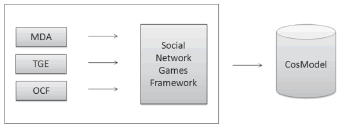
<body><![CDATA[<p><font size="2" face="Verdana, Arial, Helvetica, sans-serif">This representation contains a set of entities, the relationships between them, and the attributes of both entities and relations. This component can be taken as a whole or a part of it and is used to describe and analyze a particular community.</font></p>     <p><font size="2" face="Verdana, Arial, Helvetica, sans-serif">The purpose of utilizing the OCF is to put together additional guidelines about how a social network game can or should be used to improve sociability and to avoid obstacles in computer-mediated communication and social interaction in the design of a social network game.</font></p>     <p><font size="2" face="Verdana, Arial, Helvetica, sans-serif"><b>2.4 Game Design for Social Networks    <br>   </b></font><font size="2" face="Verdana, Arial, Helvetica, sans-serif">J&auml;rvinen also proposes a framework with the design principles that must be present in the design of a social network game [1]. Each of these principles is composed of design patterns for social network games.</font></p>     <p><font size="2" face="Verdana, Arial, Helvetica, sans-serif">The four main design principles are: narrativity, spontaneity, symbolic physicality, and sociability. These elements are arranged in an asynchronous cycle that establishes asynchronicity as the fifth design principle for social network games. Hence, the design should lead to a cycle which is the natural course of a game on an online social network. This course will always be affected by the inherent asynchronicity of the interactions in the social network.</font></p>     <p><font size="2" face="Verdana, Arial, Helvetica, sans-serif">This framework provides the conceptual guidelines for the design of social network games, and this will serve as a filter in the construction of the interaction model.</font></p>     <p>&nbsp;</p>     <p><font size="3" face="Verdana, Arial, Helvetica, sans-serif"><b>3. DEVELOPMENT OF THE MODEL</b></font></p>     <p><font size="2" face="Verdana, Arial, Helvetica, sans-serif">The development of the model began with the analysis of the ten most played social network games on Facebook (http://www.facebook.com) and Myspace (http://www.myspace.com) according to AppData (http://www.appdata.com), at the time this research was conducted. The games that were analyzed using the framework for social network games proposed by J&auml;rvinen [1] were: Bloodlines, Dragon Wars, Mafia Wars, Mobsters 2: Vendetta, Mobsters: Overdrive, Ninja Saga, Pet Society, Street Racing, Vampire Wars, and Word Challenge. Also, the interactions between the social actors in these games were analyzed using the MDA framework [3]. The latter analysis allowed the description of these games as services.</font></p>     <p><font size="2" face="Verdana, Arial, Helvetica, sans-serif">The TGE model of J&auml;rvinen [2] helped to take the first steps towards the formalization of the consulted patterns and to obtain a preliminary representation of the model.</font></p>     ]]></body>
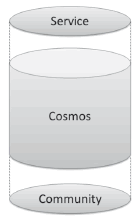
<body><![CDATA[<p><font size="2" face="Verdana, Arial, Helvetica, sans-serif">Finally, the online community component of the OCF framework of De Souza and Preece [5] allowed for us to define the required structures for the creation of a community through a social network game.</font></p>     <p><font size="2" face="Verdana, Arial, Helvetica, sans-serif">To unify these theoretical perspectives, a base object that contains the three design views of the model was used. <a href="#fig01">Figure 1</a> illustrates the construction process.</font></p>     <p align="center"><font size="2" face="Verdana, Arial, Helvetica, sans-serif"><b><a name="fig01"></a><img src="/img/revistas/dyna/v78n170/a07fig01.gif">    <br>   Figure 1.</b> CosModel construction process</font></p>     <p>&nbsp;</p>     <p><b><font size="3" face="Verdana, Arial, Helvetica, sans-serif">4. COSMODEL</font></b></p>     <p><font size="2" face="Verdana, Arial, Helvetica, sans-serif">CosModel defines a base object that contains three interaction design views for social network games. These views represent the areas to be considered in the design of a social network game. To give a clearer representation, a base object was set up, as shown in <a href="#fig02">Fig. 2</a>.</font></p>     <p align="center"><font size="2" face="Verdana, Arial, Helvetica, sans-serif"><b><a name="fig02"></a><img src="/img/revistas/dyna/v78n170/a07fig02.gif">    <br>   Figure 2.</b> CosModel base object</font></p>     <p><font size="2" face="Verdana, Arial, Helvetica, sans-serif">The different views of the cylinder are described below:</font></p> <ul>       ]]></body>
<body><![CDATA[<li><font size="2" face="Verdana, Arial, Helvetica, sans-serif">Service view: This view allows for us to define a social network game as a service considering the actors involved in this process.</font></li>       <li><font size="2" face="Verdana, Arial, Helvetica, sans-serif">Cosmos view: This view proposes a series of concepts to represent a social network game through the use of a metaphor.</font></li>       <li><font size="2" face="Verdana, Arial, Helvetica, sans-serif">Community view: This view utilizes a structure that supports the design of a social network game and the creation of its community.</font></li>     </ul>     <p><font size="2" face="Verdana, Arial, Helvetica, sans-serif">According to Bates [12], game design should be conceived as a multidisciplinary activity. Hence, a model to support the creation of a social network game and describe its elements and relationships should be in a common language, understandable by all the participants of this process. That is the reason why a metaphor is proposed in the middle part of the base object (the &quot;cosmos&quot;) as a design aid-given that metaphors serve to facilitate the understanding of a conceptual domain [13].</font></p>     <p><font size="2" face="Verdana, Arial, Helvetica, sans-serif">This representation is intended to unify the underlying concepts of social network games so that people from different disciplines (game designers, software architects, and developers) may better understand the elements and relationships of a social network game. In this way, the game can be formalized and implemented from the knowledge area of each participant, in a unified way.</font></p>     <p><font size="2" face="Verdana, Arial, Helvetica, sans-serif">The top and the bottom of the base object are meant to strengthen the model's middle part, supporting the understanding of social network games as services and describing the community structure that is meant to be generated through these games.</font></p>     <p><font size="2" face="Verdana, Arial, Helvetica, sans-serif"><b>4.1 Social Network Games Service View</b>    <br>   </font><font size="2" face="Verdana, Arial, Helvetica, sans-serif">CosModel presents a design view of social network games as services as the top of the base object, whose content is a designed behavior based on the MDA framework [3]. CosModel abstracts the structure of the game systems of social network games, the relationship of these games with social network sites (SNS), and the interacting actors (designer and players), in order to produce the resulting structure with the MDA layers applied to social network game design.</font></p>     <p><font size="2" face="Verdana, Arial, Helvetica, sans-serif">The service view gives designers an overview of the service to be designed and the main relationships between the entities involved in the interaction. These interaction relationships will be reflected in the asynchronous interaction cycle (AIC) with the purpose of the game design enhancing the interaction between players. The AIC will be explained in more detail in the following sections.</font></p>     ]]></body>
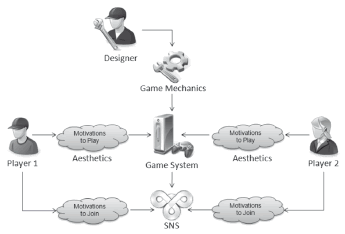
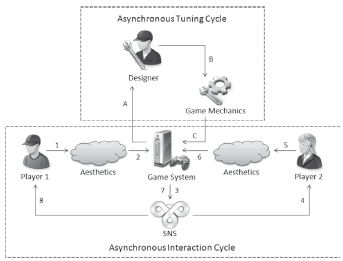
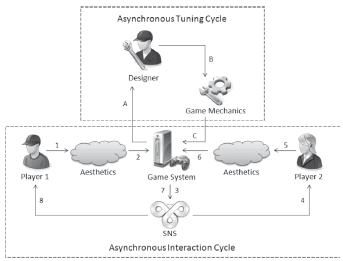
<body><![CDATA[<p><font size="2" face="Verdana, Arial, Helvetica, sans-serif"><b>4.1.1 Social Network Games Service Structure    <br>   </b></font><font size="2" face="Verdana, Arial, Helvetica, sans-serif">In essence, the service structure is the adaptation of the abstraction layers of the MDA framework to social network games. These games can be seen as services because they are connected to an online platform so they can be reached by many players in a social network. Thus, in this study, we consider J&auml;rvinen's viewpoint of social network game design as service design for social media [1]. The layers of MDA are abstracted and other elements regarding social network games are adapted to define this service structure (<a href="#fig03">Fig. 3</a>).</font></p>     <p align="center"><font size="2" face="Verdana, Arial, Helvetica, sans-serif"><b><a name="fig03"></a><img src="/img/revistas/dyna/v78n170/a07fig03.gif">    <br>   Figure 3.</b> Social games service structure</font></p>     <p><font size="2" face="Verdana, Arial, Helvetica, sans-serif">Actors interacting in <a href="#fig03">Fig. 3</a> are described as follows:</font></p> <ul>       <li><font size="2" face="Verdana, Arial, Helvetica, sans-serif">Player: This is the person who plays the game and belongs to the online social network (OSN) hosted by the SNS. In <a href="#fig03">Fig. 3</a>, the interaction occurring between a pair of players is highlighted. However, interactions can occur between any number of players.</font></li>       <li><font size="2" face="Verdana, Arial, Helvetica, sans-serif">Designer: This is the person or team who designs the social network game. In this case, it does not refer to a particular role of the game construction team; instead it refers to those who are responsible for the design of the game as a service and as an interaction medium.</font></li>     </ul>     <p><font size="2" face="Verdana, Arial, Helvetica, sans-serif">For a player to play on a game system, he or she must have a motivation to do so. This motivation that includes the goals or desires that the player intends to achieve or satisfy by playing the game references the aesthetics element defined in MDA [3]. In social network games, both mechanics and aesthetics motivate the players to play through the special social features of the game.</font></p>     <p><font size="2" face="Verdana, Arial, Helvetica, sans-serif">The next element is mechanics, which allow the player to access to the contents of the game when he or she is playing it. Mechanics constitute the game system which is the game while it is running, the game seen as an interaction medium.</font></p>     ]]></body>
<body><![CDATA[<p><font size="2" face="Verdana, Arial, Helvetica, sans-serif">On the other hand, the player has intentions to join an OSN which prompt him or her to be a participant of it. Among those intentions are: the possibility of interacting with other people and Web 2.0 artifacts [4], achieving his or her goals and aspirations as an SNS community member [5], keeping contact with his or her friends, and exchanging information [6]. The designer must consider that these desires or intentions are usually satisfied through the player's interaction with his or her peers. </font></p>     <p><font size="2" face="Verdana, Arial, Helvetica, sans-serif">The described structure in <a href="#fig03">Fig. 3</a> is static because it only considers the abstraction layers and their relationships. However, interaction occurs when these elements come together. In the following section, the structure with its elements interacting and how this structure leads to interaction between players is shown.</font></p>     <p><font size="2" face="Verdana, Arial, Helvetica, sans-serif"><b>4.1.2 Social Network Games Service Dynamics    <br>   </b>When the elements described in the service structure interact, there are certain features that must be present in order to foster social interaction. <a href="#fig04">Figure 4</a> shows the dynamics of these elements as a numbered interaction diagram. Also, this figure identifies two important cycles that emerge as important phenomena for consideration when designing the interaction occurring in the game.</font></p>     <p align="center"><font size="2" face="Verdana, Arial, Helvetica, sans-serif"><b><a name="fig04"></a><img src="/img/revistas/dyna/v78n170/a07fig04.gif">    <br>   Figure 4.</b> Social network games service dynamics</font></p>     <p><font size="2" face="Verdana, Arial, Helvetica, sans-serif">In <a href="#fig04">Fig. 4</a>, two cycles that the designer must consider in order to foster player interaction are exposed.</font></p>     <p><font size="2" face="Verdana, Arial, Helvetica, sans-serif">Firstly, at the bottom of <a href="#fig04">Fig. 4</a> there is the asynchronous interaction cycle (AIC). This feature which occurs in social network games has been characterized in J&auml;rvinen's framework [1].</font></p>     <p><font size="2" face="Verdana, Arial, Helvetica, sans-serif">This cycle consists of the following steps:</font></p> <ul>       <li><font size="2" face="Verdana, Arial, Helvetica, sans-serif">Player 1, who initiates the interaction, aims to satisfy one of his or her desires by playing the game. To achieve this, the player must execute a game mechanic (preferably one that supports the spontaneity of the game referencing the spontaneity principle in the framework for social network games [1]).</font></li>       ]]></body>
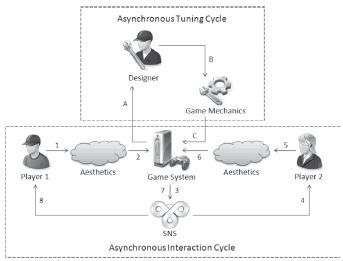
<body><![CDATA[<li><font size="2" face="Verdana, Arial, Helvetica, sans-serif">Player 1 executes an action in the game system to run the above-mentioned mechanic.</font></li>       <li><font size="2" face="Verdana, Arial, Helvetica, sans-serif">The game system notifies the SNS about this action.</font></li>       <li><font size="2" face="Verdana, Arial, Helvetica, sans-serif">The SNS notifies Player 1's action to Player 2. That notification constitutes a symbol of an action for Player 2 that she will seek to respond to.</font></li>       <li><font size="2" face="Verdana, Arial, Helvetica, sans-serif">When notified, Player 2 will seek to execute the same actions Player 1 did. In <a href="#fig04">Fig. 4</a> these are steps 5, 6, 7, and 8, thus closing the sequence and completing the interaction cycle.</font></li>     </ul>     <p><font size="2" face="Verdana, Arial, Helvetica, sans-serif">Secondly, the cycle identified at the top of <a href="#fig04">Fig. 4</a>, called the asynchronous tuning cycle (ATC), is a feature that the designer must consider to ensure longevity, growth, and community success for his or her service.</font></p>     <p><font size="2" face="Verdana, Arial, Helvetica, sans-serif">The ATC focuses on the maintenance of the service by the designer. It follows these steps:</font></p> <ol>       <li><font size="2" face="Verdana, Arial, Helvetica, sans-serif">The designer observes the dynamics of the game system when players run the AIC.</font></li>       <li><font size="2" face="Verdana, Arial, Helvetica, sans-serif">The designer refines the mechanics from the observation made in step A.</font></li>       <li><font size="2" face="Verdana, Arial, Helvetica, sans-serif">The mechanics update the game system creating new dynamics thus closing the cycle.</font></li>     ]]></body>
<body><![CDATA[</ol>     <p><font size="2" face="Verdana, Arial, Helvetica, sans-serif"><b>4.2 Social Network Games Cosmos View</b>    <br>   </font><font size="2" face="Verdana, Arial, Helvetica, sans-serif">Based on the TGE [2] and the analysis of the social network games, the elements of these games were abstracted and a metaphor to describe them was used. The chosen metaphor was that of a cosmic system, a cosmos. According to the Merriam-Webster dictionary, a cosmos is &quot;an orderly harmonious systematic universe&quot; [7], so this concept serves to represent social network games as harmonious systems which create play and enhance player interaction.</font></p>     <p><font size="2" face="Verdana, Arial, Helvetica, sans-serif"><b>4.2.1 Web 2.0 Technologies as Interaction Universes    <br>   </b></font><font size="2" face="Verdana, Arial, Helvetica, sans-serif">According to Fumero [8], Web 2.0 is a space in which social actors take an active role in a communication-oriented platform. Given that social network games have a high interaction potential [1], CosModel's cosmos view has been established to try to display social network games in a broader context relating them to the other Web 2.0 tools.</font></p>     <p><font size="2" face="Verdana, Arial, Helvetica, sans-serif">Based on the service view explained previously, social network games and Web 2.0 technologies were analyzed to introduce the concept of interaction universe, understood to be the conceptual representation of an interaction medium. An interaction medium is a computer medium by which two or more people interact on Web 2.0 [4]. Examples of interaction media can be social network sites (SNS), wikis, blogs, RSS services, etc. For the cosmos view, the term interaction universe was adopted because, in these media, the player/member &quot;exists&quot;, and is allowed to interact with his or her peers. For example, in SNS, users exist through their user accounts, in wikis or blogs they exist as editors or readers, etc.</font></p>     <p><font size="2" face="Verdana, Arial, Helvetica, sans-serif">The focus of this study is on social network games, as shown in <a href="#fig05">Fig. 5</a>.</font></p>     <p align="center"><font size="2" face="Verdana, Arial, Helvetica, sans-serif"><b><a name="fig05"></a><img src="/img/revistas/dyna/v78n170/a07fig05.gif">    <br>   Figure 5.</b> Interaction universes</font></p>     <p><font size="2" face="Verdana, Arial, Helvetica, sans-serif"><a href="#fig05">Figure 5</a> highlights the relationship of social network games players and SNS, and shows that they may interact by sending or receiving information through other Web 2.0 tools. Players are surrounded by a social context defined by: their interactive relationships, the content of the interaction media, and the social aspects of the interaction media's community members. The connection arrows between the universes represent flows of information, key elements in enhancing interaction-as will be discussed in the following sections.</font></p>     ]]></body>
<body><![CDATA[<p><font size="2" face="Verdana, Arial, Helvetica, sans-serif">CosModel's cosmos view aims to describe the abstraction of the features of social network games, exploring the interaction universes labeled social network games shown in <a href="#fig05">Fig. 5</a>. This description will be made based on the observations about social network games, and by applying the TGE [2].</font></p>     <p><font size="2" face="Verdana, Arial, Helvetica, sans-serif"><b>4.2.2 Social Network Games as Planetary Systems    <br>   </b></font><font size="2" face="Verdana, Arial, Helvetica, sans-serif">Continuing the metaphor of the cosmos proposed in this study, a social network game was modeled as a planetary system so that designers can relate the elements of such a system with those of a social network game. In this system, each player owns a planet and the group of planets is set so that players can interact with each other. A planet is an element that the game designer sets for a player to interact with. This concept will be explained in more detail in the following sections.</font></p>     <p><font size="2" face="Verdana, Arial, Helvetica, sans-serif">Another element in this system is the sun. It represents a centralized information repository to which planets send information that is stored so this same information can be subsequently accessed by other planets at any time in the future as required, including information entering or leaving other interaction universes (social network games, SNS, or other Web 2.0 tools). These repositories correspond to databases, data files, or any data structure used by social network games or social network services to support these games. These repositories store events, notifications, news, and the actions of community users so that these notifications may be sent later to the interface of each game.</font></p>     <p><font size="2" face="Verdana, Arial, Helvetica, sans-serif">The final element is space, which is the component that surrounds the planets and the sun; it corresponds to the social context of the game. This context defines the forms of communication in the social network game, for example the language to be used in the game.</font></p>     <p><font size="2" face="Verdana, Arial, Helvetica, sans-serif"><a href="#fig06">Figure 6</a> shows the previous elements and the importance of the information flow (reference to the item information in TGE [2]) for interaction between players. This concept will be represented as rays. <a href="#fig06">Figure 6</a> also shows that each player exclusively interacts with his or her planet, which is part of a group of planets that constitute the planetary system. These planets can share interplanetary rays among themselves (synchronous information) and solar rays with the sun (asynchronous information). Cosmic rays enable interactions with other universes, such as other SNS or other Web 2.0 tools.</font></p>     <p align="center"><font size="2" face="Verdana, Arial, Helvetica, sans-serif"><b><a name="fig06"></a><img src="/img/revistas/dyna/v78n170/a07fig06.gif">    <br>   Figure 6.</b> Planetary system</font></p>     <p><font size="2" face="Verdana, Arial, Helvetica, sans-serif">According to the elements of <a href="#fig06">Fig. 6</a>, the designer of a social network game can associate each element of the cosmos with each of the essential elements in the design of the game, enabling him or her to identify and model each element through the proposed metaphor.</font></p>     <p><font size="2" face="Verdana, Arial, Helvetica, sans-serif">The following sections will go into a deeper level of abstraction of the elements explained so far, in order to better understand the model and define other important elements of interaction design in social network games.</font></p>     ]]></body>
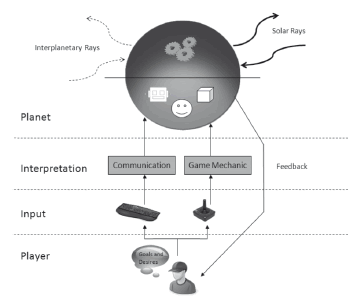
<body><![CDATA[<p><font size="2" face="Verdana, Arial, Helvetica, sans-serif"><b>4.2.3 Interacting with the planet    <br>   </b></font><font size="2" face="Verdana, Arial, Helvetica, sans-serif">Manninen [10] defines the components of human-computer interaction that are present in video games: human action, input devices, interaction techniques, and interaction forms. Based on these components, the player's interaction with his or her planet was abstracted. The player's interaction happens through the following layers of interaction:</font></p> <ul>       <li><font size="2" face="Verdana, Arial, Helvetica, sans-serif">The player layer corresponds to human action. The player, with the objective of accomplishing goals and satisfying desires, initiates an action pertinent to the game.</font></li>       <li><font size="2" face="Verdana, Arial, Helvetica, sans-serif">The input layer corresponds to the input devices that send signals to the game. It is an instance of Manninen's input devices element [10]. </font></li>       <li><font size="2" face="Verdana, Arial, Helvetica, sans-serif">The interpretation layer corresponds to the interaction technique. The game system must have a mechanism that is responsible for interpreting the signals that are sent through the input layer. This mechanism must know the rules of the game and must send the interpreted information to the planet. In this way the planet can undertake the necessary actions in the game.</font></li>       <li><font size="2" face="Verdana, Arial, Helvetica, sans-serif">The planet layer is a medium through which the player interacts with the game and executes actions on it. This layer defines the mechanisms by which the player interacts. It corresponds to Manninen's interface and interaction forms [10]. At this stage, the planet executes the necessary actions in the game. Subsequently, the planet should send feedback to the player. While this is an optional element, it enables compliance with the game design principle called constant feedback [12]. On the other hand, the planet may decide to send interplanetary or solar rays, depending on the case.</font></li>     </ul>     <p><font size="2" face="Verdana, Arial, Helvetica, sans-serif">The previous cycle is repeated until the player no longer starts it.</font></p>     <p><font size="2" face="Verdana, Arial, Helvetica, sans-serif">In CosModel, each player owns only one planet per game, and it is manipulated by just one player. A player plays in his or her planet as shown in <a href="#fig07">Fig. 7</a>.</font></p>     <p align="center"><font size="2" face="Verdana, Arial, Helvetica, sans-serif"><b><a name="fig07"></a><img src="/img/revistas/dyna/v78n170/a07fig07.gif">    ]]></body>
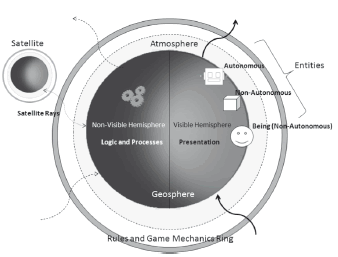
<body><![CDATA[<br>   Figure 7.</b> Player-planet interaction layers</font></p>     <p><font size="2" face="Verdana, Arial, Helvetica, sans-serif">The preceding sections establish the structure of the elements that are set for the player to interact with and through the social network game. This is to show player-game interaction as the first step in player-player interaction. The next section will go down one more level of abstraction to clearly specify the interaction between the planet and the players, explaining each of the elements that must be taken into account to design this interaction.</font></p>     <p><font size="2" face="Verdana, Arial, Helvetica, sans-serif"><b>4.2.4 The planet    <br>   </b>The planet is the part of the metaphor that represents the systemic and compound elements that will be taken from the TGE and that are exposed to the player by the social network game. These elements comprise the game mechanics (as compound elements [2]) and other elements such as information and rules. These elements have a set of particular features that will be described using the cosmos metaphor. The planet sends and receives rays between the player, other planets, and the sun. <a href="#fig08">Figure 8</a> shows the coexisting elements in the planet.</font></p>     <p align="center"><font size="2" face="Verdana, Arial, Helvetica, sans-serif"><b><a name="fig08"></a><img src="/img/revistas/dyna/v78n170/a07fig08.gif">    <br>   Figure 8.</b> The planet</font></p>     <p><font size="2" face="Verdana, Arial, Helvetica, sans-serif"><b>4.2.5 Satellites    <br>   </b></font><font size="2" face="Verdana, Arial, Helvetica, sans-serif">Each planet can have a set of satellites revolving around it. Satellites represent other stages that the main game can access. These are essentially games; therefore they possess the same element structure described in the planet concept.</font></p>     <p><font size="2" face="Verdana, Arial, Helvetica, sans-serif">The game can display at any point one of these stages as part of its overall game logic. The satellites can also project and receive rays as planets do. Interaction with a satellite occurs in the same way as with a planet, as described previously.</font></p>     <p><font size="2" face="Verdana, Arial, Helvetica, sans-serif">At this point, the end of the internal abstractions in the cosmos view of CosModel's base object is reached. The next section describes the community design view of social network games, which will provide an abstraction of social network game design from the perspective of virtual communities.</font></p>     ]]></body>
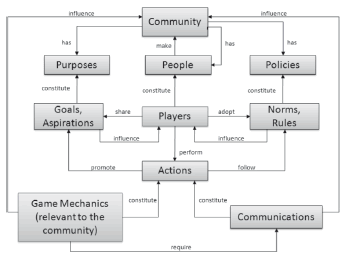
<body><![CDATA[<p><font size="2" face="Verdana, Arial, Helvetica, sans-serif"><b>4.3 Social Network games community view    <br>   </b></font><font size="2" face="Verdana, Arial, Helvetica, sans-serif">The community view of the model is an adaptation of the community component of the OCF proposed by De Souza and Preece [5]. This adaptation allows the representation of the virtual community that is generated from the social network game in terms of people, purposes, and policies. These three components are necessary for a good sociability which leads to better interaction between players. According to Preece, sociability consists of developing software, policies, and practices to support social interaction within an online community [14].</font></p>     <p><font size="2" face="Verdana, Arial, Helvetica, sans-serif">By instantiating this component to represent the community of the social network game, the designer will take into account the most relevant qualitative aspects that impact the community, and ensure its success.</font></p>     <p><font size="2" face="Verdana, Arial, Helvetica, sans-serif">In the adaptation the following changes were made:</font></p> <ul>       <li><font size="2" face="Verdana, Arial, Helvetica, sans-serif">The individuals entity became players.</font></li>       <li><font size="2" face="Verdana, Arial, Helvetica, sans-serif">The operations entity became game mechanics (relevant to the community).</font></li>     </ul>     <p><font size="2" face="Verdana, Arial, Helvetica, sans-serif"><a href="#fig09">Figure 9</a> shows the adapted community component of the OCF.</font></p>     <p align="center"><font size="2" face="Verdana, Arial, Helvetica, sans-serif"><a name="fig09"></a><b><img src="/img/revistas/dyna/v78n170/a07fig09.gif">    <br>   Figure 9.</b> Community view of CosModel</font></p>     ]]></body>
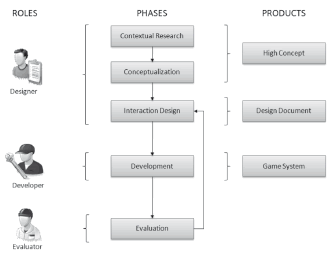
<body><![CDATA[<p><font size="2" face="Verdana, Arial, Helvetica, sans-serif">The adjustment made to the framework presented by De Souza and Preece [5] shown in <a href="#fig09">Fig. 9</a> serves as a basis for describing the community that will be generated through the social network game. In this view, the game mechanics and communications that are present in the cosmos view appear. Game mechanics (relevant to the community) and communications have a definite purpose which is to maintain the community which could have a larger purpose than the one of the social network game itself.</font></p>     <p>&nbsp;</p>     <p><font size="3" face="Verdana, Arial, Helvetica, sans-serif"><b>5. IMPLEMENTATION OF COSMODEL</b></font></p>     <p><font size="2" face="Verdana, Arial, Helvetica, sans-serif">The following section presents the design suggestions that can be followed for a proper implementation of CosModel. These suggestions will be carried out to build the prototype that is part of the development stage of this research. The main contribution of this section is the design and development approach that supports interaction design in social network games. Its main emphasis will be to provide an approach that focuses on the creative process and conceptual understanding of social network games.</font></p>     <p><font size="2" face="Verdana, Arial, Helvetica, sans-serif"><b>5.1 Proposed process for implementing CosModel    <br>   </b></font><font size="2" face="Verdana, Arial, Helvetica, sans-serif">CosModel represents a set of features that need to be implemented to improve interaction in social network games. The main principle of this approach is to follow a game design process that has been inspired by the life cycle of video game design and development of Bates [12].</font></p>     <p><font size="2" face="Verdana, Arial, Helvetica, sans-serif"><a href="#fig10">Figure 10</a> shows the proposed roles, phases, and products required in the implementation of CosModel. The process described is iterative in its last three phases (<a href="#fig10">Fig. 10</a>)</font></p>     <p align="center"><font size="2" face="Verdana, Arial, Helvetica, sans-serif"><a name="fig10"></a><b><img src="/img/revistas/dyna/v78n170/a07fig10.gif">    <br>   Figure 10. </b>Process to implement CosModel</font></p>     <p><font size="2" face="Verdana, Arial, Helvetica, sans-serif">The suggested phases are described below:</font></p> <ul>       ]]></body>
<body><![CDATA[<li><font size="2" face="Verdana, Arial, Helvetica, sans-serif">Contextual research: During this stage the designer should review CosModel to have a clear idea about how social network games work and understand the concept of interaction n them. This phase is focused on the service view of CosModel. </font></li>       <li><font size="2" face="Verdana, Arial, Helvetica, sans-serif">Conceptualization: This is the main creative effort stage where idea creation techniques are used, such as brainstorming [15], to get to the high-concept [12] of the social network game. The designer focuses his or her efforts on defining the game theme, the game goal, and on defining and analyzing the potential players of the game. This stage should also focus on the gathering or the interaction cues that should appear in the game, although these ideas change when they are implemented. This phase is also based on the service view of the model.</font></li>       <li><font size="2" face="Verdana, Arial, Helvetica, sans-serif">Interaction design: This phase is based on the ideas gathered from the previous stage. In this phase the cosmos view of CosModel is used to specify the interaction possibilities of the game. In this phase, the game design is performed and will be written down in a game design document. The designer is free to use any template he or she wishes for this document. Also during this stage, an instance of the CosModel community view is made to consider the design aspects of the community that the game will foster.</font></li>       <li><font size="2" face="Verdana, Arial, Helvetica, sans-serif">Development: In this stage, the game is constructed using an appropriate software-development methodology. The selection of this methodology is up to the game development team. In this part, all the interaction and community-building features are implemented. A product of this phase is the game system which will be ready to be tested.</font></li>       <li><font size="2" face="Verdana, Arial, Helvetica, sans-serif">Evaluation: Once created, the game is released for a target OSN to begin attracting players and generate the community. In this stage, a set of metrics can be established to assess the level of interaction between players and evaluate the interaction design features of the game.</font></li>     </ul>     <p><font size="2" face="Verdana, Arial, Helvetica, sans-serif">As shown in <a href="#fig10">Fig. 10</a>, there is a cycle between the evaluation and interaction design phases in which both interaction and community design features can be modified to enhance player interaction. This cyclical feature of the process is a consequence of the asynchronous tuning cycle described in the service view of CosModel.</font></p>     <p>&nbsp;</p>     <p><b><font size="3" face="Verdana, Arial, Helvetica, sans-serif">6. CONCLUSIONS</font></b></p>     <p><font size="2" face="Verdana, Arial, Helvetica, sans-serif">CosModel can be refined through its continuous use in the design of social network games so its interaction guidelines can be improved based upon the feedback of these experiences. Also, the right metrics have to be chosen in order to evaluate interaction in the designed games so these can also provide feedback to the model and help in its refinement. </font></p>     ]]></body>
<body><![CDATA[<p><font size="2" face="Verdana, Arial, Helvetica, sans-serif">The purpose of CosModel is to guide the design of a social network game towards interaction. It helps designers and developers to have a conceptual aid where the main ideas of interaction design can be registered, having a solid view of this process. Thus, when there are aspects that are not clear in the design process, the designers can refer to the model and gather guiding principles to encourage interaction through the game.</font></p>     <p><font size="2" face="Verdana, Arial, Helvetica, sans-serif">Social network game construction teams need more conceptual tools to support the creation of highly interactive games; that is the reason why this model is an attempt to support designers and developers in having a unified conceptual framework to foster player interaction.</font></p>     <p>&nbsp;</p>     <p><b><font size="3" face="Verdana, Arial, Helvetica, sans-serif">ACKNOWLEDGEMENTS</font></b></p>     <p><font size="2" face="Verdana, Arial, Helvetica, sans-serif">We would like to acknowledge the support given to us by the following people: Aki J&auml;rvinen for his suggestions and discussions about social network games; and Mar&iacute;a Rubio, Paul Ashford and Thomas Finken, who contributed to the editing of this article. Also we thank the University of Cauca for co-financing this research.</font></p>     <p>&nbsp;</p>     <p><b><font size="3" face="Verdana, Arial, Helvetica, sans-serif">REFERENCES</font></b></p>     <!-- ref --><p><font size="2" face="Verdana, Arial, Helvetica, sans-serif"><b>[1]</b> Järvinen, A., Game design for social networks: interaction design for playful dispositions. Proceedings of the 2009 ACM SIGGRAPH Symposium on Video Games. New Orleans, Louisiana. S. N. Spencer, Ed. Sandbox '09. ACM, New York, NY, pp. 95-102. 2009.     &nbsp;&nbsp;&nbsp;&nbsp;&nbsp;&nbsp;&nbsp;&nbsp;[&#160;<a href="javascript:void(0);" onclick="javascript: window.open('/scielo.php?script=sci_nlinks&ref=000180&pid=S0012-7353201100060000700001&lng=','','width=640,height=500,resizable=yes,scrollbars=1,menubar=yes,');">Links</a>&#160;]<!-- end-ref --><!-- ref --><br>   <b>[2]</b> Järvinen, A., Games without frontiers. Theories and methods for games studies and design. PhD. thesis. University of Tampere. Finland. 2007.     &nbsp;&nbsp;&nbsp;&nbsp;&nbsp;&nbsp;&nbsp;&nbsp;[&#160;<a href="javascript:void(0);" onclick="javascript: window.open('/scielo.php?script=sci_nlinks&ref=000181&pid=S0012-7353201100060000700002&lng=','','width=640,height=500,resizable=yes,scrollbars=1,menubar=yes,');">Links</a>&#160;]<!-- end-ref --><!-- ref --><br>   <b>[3]</b> Montenegro, C., Gaona, P., Cueva, J., and Sanjuan, O., Application of Model Driven Engineering (MDE) for the construction of a tool for domain specific modeling (DSM) and the creation of modules in Learning Management Systems (LMS) Platform Independent. DYNA, No 169, pp 43-52, 2011     &nbsp;&nbsp;&nbsp;&nbsp;&nbsp;&nbsp;&nbsp;&nbsp;[&#160;<a href="javascript:void(0);" onclick="javascript: window.open('/scielo.php?script=sci_nlinks&ref=000182&pid=S0012-7353201100060000700003&lng=','','width=640,height=500,resizable=yes,scrollbars=1,menubar=yes,');">Links</a>&#160;]<!-- end-ref --><!-- ref --><br>   <b>[4]</b> Hunicke, R., LeBlanc, M. and Zubek, R. MDA: A formal approach to game design and game research. Challenges in Game AI Workshop at AAAI 2004.     &nbsp;&nbsp;&nbsp;&nbsp;&nbsp;&nbsp;&nbsp;&nbsp;[&#160;<a href="javascript:void(0);" onclick="javascript: window.open('/scielo.php?script=sci_nlinks&ref=000183&pid=S0012-7353201100060000700004&lng=','','width=640,height=500,resizable=yes,scrollbars=1,menubar=yes,');">Links</a>&#160;]<!-- end-ref --><!-- ref --><br>   <b>[5]</b> Mechant, P. and Evens, T., Interaction possibilities on web 2.0 websites as a framework for cluster analysis. COST Action 298. 2009.     &nbsp;&nbsp;&nbsp;&nbsp;&nbsp;&nbsp;&nbsp;&nbsp;[&#160;<a href="javascript:void(0);" onclick="javascript: window.open('/scielo.php?script=sci_nlinks&ref=000184&pid=S0012-7353201100060000700005&lng=','','width=640,height=500,resizable=yes,scrollbars=1,menubar=yes,');">Links</a>&#160;]<!-- end-ref --><!-- ref --><br>   <b>[6]</b> De Souza, C.S. and Preece, J., A framework for analyzing and understanding online communities. Interacting with Computers, the Interdisciplinary Journal of Human-Computer Interaction. 2004.     &nbsp;&nbsp;&nbsp;&nbsp;&nbsp;&nbsp;&nbsp;&nbsp;[&#160;<a href="javascript:void(0);" onclick="javascript: window.open('/scielo.php?script=sci_nlinks&ref=000185&pid=S0012-7353201100060000700006&lng=','','width=640,height=500,resizable=yes,scrollbars=1,menubar=yes,');">Links</a>&#160;]<!-- end-ref --><!-- ref --><br>   <b>[7]</b> Richter, A. and Koch, M., Functions of Social Networking Services. Proc. Intl. Conf. on the Design of Cooperative Systems, Carry-le-Rouet, France. Springer. 2008.     &nbsp;&nbsp;&nbsp;&nbsp;&nbsp;&nbsp;&nbsp;&nbsp;[&#160;<a href="javascript:void(0);" onclick="javascript: window.open('/scielo.php?script=sci_nlinks&ref=000186&pid=S0012-7353201100060000700007&lng=','','width=640,height=500,resizable=yes,scrollbars=1,menubar=yes,');">Links</a>&#160;]<!-- end-ref --><!-- ref --><br>   <b>[8]</b> MERRIAM-WEBSTER ON LINE DICTIONARY, Cosmos. Available: <a href="http://www.merriam-webster.com/dictionary/cosmos" target="referencia">http://www.merriam-webster.com/dictionary/cosmos</a>. Cited February 5, 2010.     &nbsp;&nbsp;&nbsp;&nbsp;&nbsp;&nbsp;&nbsp;&nbsp;[&#160;<a href="javascript:void(0);" onclick="javascript: window.open('/scielo.php?script=sci_nlinks&ref=000187&pid=S0012-7353201100060000700008&lng=','','width=640,height=500,resizable=yes,scrollbars=1,menubar=yes,');">Links</a>&#160;]<!-- end-ref --><!-- ref --><br>   <b>[9]</b> Fumero, A. and Roca, G., Web 2.0. Fundaci&oacute;n Orange Editores. 2007.     &nbsp;&nbsp;&nbsp;&nbsp;&nbsp;&nbsp;&nbsp;&nbsp;[&#160;<a href="javascript:void(0);" onclick="javascript: window.open('/scielo.php?script=sci_nlinks&ref=000188&pid=S0012-7353201100060000700009&lng=','','width=640,height=500,resizable=yes,scrollbars=1,menubar=yes,');">Links</a>&#160;]<!-- end-ref --><!-- ref --><br>   <b>[10]</b> Tadhg, K., 8 Types of Social Games. Available: <a href="http://www.simplelifeforms.com/2009/03/20/8-types-of-social-game/" target="referencia">http://www.simplelifeforms.com/2009/03/20/8-types-of-social-game/</a>. Cited August 4, 2009.     &nbsp;&nbsp;&nbsp;&nbsp;&nbsp;&nbsp;&nbsp;&nbsp;[&#160;<a href="javascript:void(0);" onclick="javascript: window.open('/scielo.php?script=sci_nlinks&ref=000189&pid=S0012-7353201100060000700010&lng=','','width=640,height=500,resizable=yes,scrollbars=1,menubar=yes,');">Links</a>&#160;]<!-- end-ref --><!-- ref --><br>   <b>[11]</b> Manninen, T., Rich Interaction Model for Game and Virtual Environment Design. PhD.8 Thesis. Department of Information Processing Science, University of Oulu. Finland. 2004.     &nbsp;&nbsp;&nbsp;&nbsp;&nbsp;&nbsp;&nbsp;&nbsp;[&#160;<a href="javascript:void(0);" onclick="javascript: window.open('/scielo.php?script=sci_nlinks&ref=000190&pid=S0012-7353201100060000700011&lng=','','width=640,height=500,resizable=yes,scrollbars=1,menubar=yes,');">Links</a>&#160;]<!-- end-ref --><!-- ref --><br>   <b>[12]</b> Järvinen, A., Heliö, S. and Mäyrä, F., Communication and Community in Digital Entertainment Services. Available: <a href="http://tampub.uta.fi/tup/951-44-5432-4.pdf" target="referencia">http://tampub.uta.fi/tup/951-44-5432-4.pdf</a>. Cited September 3, 2009.     &nbsp;&nbsp;&nbsp;&nbsp;&nbsp;&nbsp;&nbsp;&nbsp;[&#160;<a href="javascript:void(0);" onclick="javascript: window.open('/scielo.php?script=sci_nlinks&ref=000191&pid=S0012-7353201100060000700012&lng=','','width=640,height=500,resizable=yes,scrollbars=1,menubar=yes,');">Links</a>&#160;]<!-- end-ref --><!-- ref --><br>   <b>[13]</b> Bates, B., Game Design. Second edition. Course Technology PTR. 2004.     &nbsp;&nbsp;&nbsp;&nbsp;&nbsp;&nbsp;&nbsp;&nbsp;[&#160;<a href="javascript:void(0);" onclick="javascript: window.open('/scielo.php?script=sci_nlinks&ref=000192&pid=S0012-7353201100060000700013&lng=','','width=640,height=500,resizable=yes,scrollbars=1,menubar=yes,');">Links</a>&#160;]<!-- end-ref --><!-- ref --><br>   <b>[14]</b> Kövecses, Z., Metaphor: a practical introduction. Oxford University Press. US. 2002.     &nbsp;&nbsp;&nbsp;&nbsp;&nbsp;&nbsp;&nbsp;&nbsp;[&#160;<a href="javascript:void(0);" onclick="javascript: window.open('/scielo.php?script=sci_nlinks&ref=000193&pid=S0012-7353201100060000700014&lng=','','width=640,height=500,resizable=yes,scrollbars=1,menubar=yes,');">Links</a>&#160;]<!-- end-ref --><!-- ref --><br>   <b>[15]</b> Preece, J., Sociability and usability in online communities: determining and measuring success. Behaviour and Information Technology, Vol. 20, No. 5, pp. 347-356. 2001.     &nbsp;&nbsp;&nbsp;&nbsp;&nbsp;&nbsp;&nbsp;&nbsp;[&#160;<a href="javascript:void(0);" onclick="javascript: window.open('/scielo.php?script=sci_nlinks&ref=000194&pid=S0012-7353201100060000700015&lng=','','width=640,height=500,resizable=yes,scrollbars=1,menubar=yes,');">Links</a>&#160;]<!-- end-ref --><!-- ref --><br>   <b>[16]</b> Fullerton, T., Swain, C. and Hoffman, S., Game Design Workshop: A Playcentric Approach to Creating Innovative Games. Elsevier/Morgan Kaufmann, Amsterdam. Second edition. 2008. </font>&nbsp;&nbsp;&nbsp;&nbsp;&nbsp;&nbsp;&nbsp;&nbsp;[&#160;<a href="javascript:void(0);" onclick="javascript: window.open('/scielo.php?script=sci_nlinks&ref=000195&pid=S0012-7353201100060000700016&lng=','','width=640,height=500,resizable=yes,scrollbars=1,menubar=yes,');">Links</a>&#160;]<!-- end-ref --> ]]></body><back>
<ref-list>
<ref id="B1">
<label>1</label><nlm-citation citation-type="confpro">
<person-group person-group-type="author">
<name>
<surname><![CDATA[Järvinen]]></surname>
<given-names><![CDATA[A.]]></given-names>
</name>
</person-group>
<article-title xml:lang="en"><![CDATA[Game design for social networks: interaction design for playful dispositions]]></article-title>
<person-group person-group-type="editor">
<name>
<surname><![CDATA[Spencer]]></surname>
<given-names><![CDATA[S. N.]]></given-names>
</name>
</person-group>
<source><![CDATA[Proceedings]]></source>
<year>2009</year>
<conf-name><![CDATA[ ACM SIGGRAPH Symposium on Video Games]]></conf-name>
<conf-date>2009</conf-date>
<conf-loc>New Orleans Louisiana</conf-loc>
<page-range>95-102</page-range><publisher-loc><![CDATA[New York^eNY NY]]></publisher-loc>
</nlm-citation>
</ref>
<ref id="B2">
<label>2</label><nlm-citation citation-type="">
<person-group person-group-type="author">
<name>
<surname><![CDATA[Järvinen]]></surname>
<given-names><![CDATA[A.]]></given-names>
</name>
</person-group>
<source><![CDATA[Games without frontiers: Theories and methods for games studies and design]]></source>
<year></year>
</nlm-citation>
</ref>
<ref id="B3">
<label>3</label><nlm-citation citation-type="journal">
<person-group person-group-type="author">
<name>
<surname><![CDATA[Montenegro]]></surname>
<given-names><![CDATA[C.]]></given-names>
</name>
<name>
<surname><![CDATA[Gaona]]></surname>
<given-names><![CDATA[P.]]></given-names>
</name>
<name>
<surname><![CDATA[Cueva]]></surname>
<given-names><![CDATA[J.]]></given-names>
</name>
<name>
<surname><![CDATA[Sanjuan]]></surname>
<given-names><![CDATA[O.]]></given-names>
</name>
</person-group>
<article-title xml:lang="en"><![CDATA[Application of Model Driven Engineering (MDE) for the construction of a tool for domain specific modeling (DSM) and the creation of modules in Learning Management Systems (LMS) Platform Independent]]></article-title>
<source><![CDATA[DYNA]]></source>
<year>2011</year>
<numero>169</numero>
<issue>169</issue>
<page-range>43-52</page-range></nlm-citation>
</ref>
<ref id="B4">
<label>4</label><nlm-citation citation-type="confpro">
<person-group person-group-type="author">
<name>
<surname><![CDATA[Hunicke]]></surname>
<given-names><![CDATA[R.]]></given-names>
</name>
<name>
<surname><![CDATA[LeBlanc]]></surname>
<given-names><![CDATA[M.]]></given-names>
</name>
<name>
<surname><![CDATA[Zubek]]></surname>
<given-names><![CDATA[R.]]></given-names>
</name>
</person-group>
<article-title xml:lang="en"><![CDATA[MDA: A formal approach to game design and game research]]></article-title>
<source><![CDATA[]]></source>
<year></year>
<conf-name><![CDATA[ Challenges in Game AI Workshop at AAAI]]></conf-name>
<conf-date>2004</conf-date>
<conf-loc> </conf-loc>
</nlm-citation>
</ref>
<ref id="B5">
<label>5</label><nlm-citation citation-type="journal">
<person-group person-group-type="author">
<name>
<surname><![CDATA[Mechant]]></surname>
<given-names><![CDATA[P.]]></given-names>
</name>
<name>
<surname><![CDATA[Evens]]></surname>
<given-names><![CDATA[T.]]></given-names>
</name>
</person-group>
<article-title xml:lang="en"><![CDATA[Interaction possibilities on web 2.0 websites as a framework for cluster analysis]]></article-title>
<source><![CDATA[COST Action]]></source>
<year>2009</year>
<numero>298</numero>
<issue>298</issue>
</nlm-citation>
</ref>
<ref id="B6">
<label>6</label><nlm-citation citation-type="journal">
<person-group person-group-type="author">
<name>
<surname><![CDATA[De Souza]]></surname>
<given-names><![CDATA[C.S.]]></given-names>
</name>
<name>
<surname><![CDATA[Preece]]></surname>
<given-names><![CDATA[J.]]></given-names>
</name>
</person-group>
<article-title xml:lang="en"><![CDATA[A framework for analyzing and understanding online communities: Interacting with Computers]]></article-title>
<source><![CDATA[the Interdisciplinary Journal of Human-Computer Interaction]]></source>
<year>2004</year>
</nlm-citation>
</ref>
<ref id="B7">
<label>7</label><nlm-citation citation-type="confpro">
<person-group person-group-type="author">
<name>
<surname><![CDATA[Richter]]></surname>
<given-names><![CDATA[A.]]></given-names>
</name>
<name>
<surname><![CDATA[Koch]]></surname>
<given-names><![CDATA[M.]]></given-names>
</name>
</person-group>
<article-title xml:lang="en"><![CDATA[Functions of Social Networking Services]]></article-title>
<source><![CDATA[]]></source>
<year>2008</year>
<conf-name><![CDATA[ Proc. Intl. Conf. on the Design of Cooperative Systems]]></conf-name>
<conf-loc>Carry-le-Rouet </conf-loc>
<publisher-name><![CDATA[Springer]]></publisher-name>
</nlm-citation>
</ref>
<ref id="B8">
<label>8</label><nlm-citation citation-type="">
<source><![CDATA[MERRIAM-WEBSTER ON LINE DICTIONARY: Cosmos]]></source>
<year></year>
</nlm-citation>
</ref>
<ref id="B9">
<label>9</label><nlm-citation citation-type="book">
<person-group person-group-type="author">
<name>
<surname><![CDATA[Fumero]]></surname>
<given-names><![CDATA[A.]]></given-names>
</name>
<name>
<surname><![CDATA[Roca]]></surname>
<given-names><![CDATA[G.]]></given-names>
</name>
</person-group>
<source><![CDATA[Web 2.0]]></source>
<year>2007</year>
<publisher-name><![CDATA[Fundación Orange Editores]]></publisher-name>
</nlm-citation>
</ref>
<ref id="B10">
<label>10</label><nlm-citation citation-type="">
<person-group person-group-type="author">
<name>
<surname><![CDATA[Tadhg]]></surname>
<given-names><![CDATA[K.]]></given-names>
</name>
</person-group>
<source><![CDATA[8 Types of Social Games]]></source>
<year></year>
</nlm-citation>
</ref>
<ref id="B11">
<label>11</label><nlm-citation citation-type="">
<person-group person-group-type="author">
<name>
<surname><![CDATA[Manninen]]></surname>
<given-names><![CDATA[T.]]></given-names>
</name>
</person-group>
<source><![CDATA[Rich Interaction Model for Game and Virtual Environment Design]]></source>
<year></year>
</nlm-citation>
</ref>
<ref id="B12">
<label>12</label><nlm-citation citation-type="">
<person-group person-group-type="author">
<name>
<surname><![CDATA[Järvinen]]></surname>
<given-names><![CDATA[A.]]></given-names>
</name>
<name>
<surname><![CDATA[Heliö]]></surname>
<given-names><![CDATA[S.]]></given-names>
</name>
<name>
<surname><![CDATA[Mäyrä]]></surname>
<given-names><![CDATA[F.]]></given-names>
</name>
</person-group>
<source><![CDATA[Communication and Community in Digital Entertainment Services]]></source>
<year></year>
</nlm-citation>
</ref>
<ref id="B13">
<label>13</label><nlm-citation citation-type="">
<person-group person-group-type="author">
<name>
<surname><![CDATA[Bates]]></surname>
<given-names><![CDATA[B.]]></given-names>
</name>
</person-group>
<source><![CDATA[Game Design]]></source>
<year>2004</year>
<edition>Second</edition>
</nlm-citation>
</ref>
<ref id="B14">
<label>14</label><nlm-citation citation-type="book">
<person-group person-group-type="author">
<name>
<surname><![CDATA[Kövecses]]></surname>
<given-names><![CDATA[Z.]]></given-names>
</name>
</person-group>
<source><![CDATA[Metaphor: a practical introduction]]></source>
<year>2002</year>
<publisher-name><![CDATA[Oxford University Press]]></publisher-name>
</nlm-citation>
</ref>
<ref id="B15">
<label>15</label><nlm-citation citation-type="journal">
<person-group person-group-type="author">
<name>
<surname><![CDATA[Preece]]></surname>
<given-names><![CDATA[J.]]></given-names>
</name>
</person-group>
<article-title xml:lang="en"><![CDATA[Sociability and usability in online communities: determining and measuring success]]></article-title>
<source><![CDATA[Behaviour and Information Technology]]></source>
<year>2001</year>
<volume>20</volume>
<numero>5</numero>
<issue>5</issue>
<page-range>347-356</page-range></nlm-citation>
</ref>
<ref id="B16">
<label>16</label><nlm-citation citation-type="book">
<person-group person-group-type="author">
<name>
<surname><![CDATA[Fullerton]]></surname>
<given-names><![CDATA[T.]]></given-names>
</name>
<name>
<surname><![CDATA[Swain]]></surname>
<given-names><![CDATA[C.]]></given-names>
</name>
<name>
<surname><![CDATA[Hoffman]]></surname>
<given-names><![CDATA[S.]]></given-names>
</name>
</person-group>
<source><![CDATA[Game Design Workshop: A Playcentric Approach to Creating Innovative Games]]></source>
<year>2008</year>
<edition>Second</edition>
<publisher-loc><![CDATA[Amsterdam ]]></publisher-loc>
<publisher-name><![CDATA[Elsevier/Morgan Kaufmann]]></publisher-name>
</nlm-citation>
</ref>
</ref-list>
</back>
</article>