<?xml version="1.0" encoding="ISO-8859-1"?><article xmlns:mml="http://www.w3.org/1998/Math/MathML" xmlns:xlink="http://www.w3.org/1999/xlink" xmlns:xsi="http://www.w3.org/2001/XMLSchema-instance">
<front>
<journal-meta>
<journal-id>0012-7353</journal-id>
<journal-title><![CDATA[DYNA]]></journal-title>
<abbrev-journal-title><![CDATA[Dyna rev.fac.nac.minas]]></abbrev-journal-title>
<issn>0012-7353</issn>
<publisher>
<publisher-name><![CDATA[Universidad Nacional de Colombia]]></publisher-name>
</publisher>
</journal-meta>
<article-meta>
<article-id>S0012-73532011000600016</article-id>
<title-group>
<article-title xml:lang="en"><![CDATA[PRELIMINARY ANALYSIS OF BIOMASS POTENTIALLY USEFUL FOR PRODUCING BIODIESEL]]></article-title>
<article-title xml:lang="es"><![CDATA[ANALISIS PRELIMINAR DE BIOMASA POTENCIALMENTE ÚTIL PARA PRODUCIR BIODIESEL]]></article-title>
</title-group>
<contrib-group>
<contrib contrib-type="author">
<name>
<surname><![CDATA[CABRERA CIFUENTES]]></surname>
<given-names><![CDATA[GERARDO]]></given-names>
</name>
<xref ref-type="aff" rid="A01"/>
</contrib>
<contrib contrib-type="author">
<name>
<surname><![CDATA[BURBANO JARAMILLO]]></surname>
<given-names><![CDATA[JUAN CARLOS]]></given-names>
</name>
<xref ref-type="aff" rid="A02"/>
</contrib>
<contrib contrib-type="author">
<name>
<surname><![CDATA[GARCIA MELO]]></surname>
<given-names><![CDATA[JOSÉ ISIDRO]]></given-names>
</name>
<xref ref-type="aff" rid="A03"/>
</contrib>
</contrib-group>
<aff id="A01">
<institution><![CDATA[,University of Valle Mechanical Engineering School ]]></institution>
<addr-line><![CDATA[Cali ]]></addr-line>
<country>Colombia</country>
</aff>
<aff id="A02">
<institution><![CDATA[,Technological University of Pereira Mechanical Engineering Faculty ]]></institution>
<addr-line><![CDATA[Pereira ]]></addr-line>
<country>Colombia</country>
</aff>
<aff id="A03">
<institution><![CDATA[,University of Valle Mechanical Engineering School ]]></institution>
<addr-line><![CDATA[Cali ]]></addr-line>
<country>Colombia</country>
</aff>
<pub-date pub-type="pub">
<day>00</day>
<month>12</month>
<year>2011</year>
</pub-date>
<pub-date pub-type="epub">
<day>00</day>
<month>12</month>
<year>2011</year>
</pub-date>
<volume>78</volume>
<numero>170</numero>
<fpage>144</fpage>
<lpage>151</lpage>
<copyright-statement/>
<copyright-year/>
<self-uri xlink:href="http://www.scielo.org.co/scielo.php?script=sci_arttext&amp;pid=S0012-73532011000600016&amp;lng=en&amp;nrm=iso"></self-uri><self-uri xlink:href="http://www.scielo.org.co/scielo.php?script=sci_abstract&amp;pid=S0012-73532011000600016&amp;lng=en&amp;nrm=iso"></self-uri><self-uri xlink:href="http://www.scielo.org.co/scielo.php?script=sci_pdf&amp;pid=S0012-73532011000600016&amp;lng=en&amp;nrm=iso"></self-uri><abstract abstract-type="short" xml:lang="en"><p><![CDATA[Given that biodiesel is emerging as a viable solution for some energy and environmental problems, research on raw materials appropriate for its production is a matter of growing interest. In this study we present the results of research devoted to preliminary analysis on several vegetable (biomass) species potentially useful for producing biodiesel. The bioprospection zone is a region on the Colombian Pacific coast. The candidate species collected underwent different standardized ASTM tests in order for us to define properties that facilitate their evaluation. Some of the species underwent a transesterification process. Comparisons between the thermo-physical properties of the biofuels obtained and the properties of commercial diesel were carried out. Also, performance tests for these biofuels were conducted in compression ignition engines, particularly evaluating efficiency, fuel consumption, and potency at different RPMs.]]></p></abstract>
<abstract abstract-type="short" xml:lang="es"><p><![CDATA[Considerando que el biodiesel se está convirtiendo en una solución viable para algunos problemas energéticos y medioambientales, la investigación de materias primas para su producción es un tema de creciente interés. Este estudio presenta los resultados de una investigación dedicada al análisis preliminar de varias especies vegetales (biomasa), potencialmente útiles para producir biodiesel. La zona de bioprospección es una región de la costa pacifica colombiana. Las especies promisorias recolectadas fueron sometidas a diferentes pruebas normalizadas ASTM para definir propiedades que faciliten su evaluación. Algunas de las especies fueron sometidas a un proceso de transesterificación. Adicionalmente, se realiza una comparación entre las propiedades termo-físicas de los biodiesel y las propiedades del diesel comercial. Las pruebas de rendimiento de estos biocombustibles en los motores de encendido por compresión, particularmente la eficiencia, el consumo y la potencia a diferentes RPM del motor, se presentan en este trabajo.]]></p></abstract>
<kwd-group>
<kwd lng="en"><![CDATA[Biodiesel]]></kwd>
<kwd lng="en"><![CDATA[biofuel]]></kwd>
<kwd lng="en"><![CDATA[transesterification]]></kwd>
<kwd lng="en"><![CDATA[internal combustion engines]]></kwd>
<kwd lng="es"><![CDATA[Biodiesel]]></kwd>
<kwd lng="es"><![CDATA[biocombustibles]]></kwd>
<kwd lng="es"><![CDATA[motores de combustión interna]]></kwd>
</kwd-group>
</article-meta>
</front><body><![CDATA[ <p align="center"><font size="4" face="Verdana, Arial, Helvetica, sans-serif"><b>PRELIMINARY ANALYSIS OF BIOMASS POTENTIALLY USEFUL FOR PRODUCING BIODIESEL</b></font></p>     <p align="center"><i><font size="3"><b><font face="Verdana, Arial, Helvetica, sans-serif">ANALISIS PRELIMINAR DE BIOMASA POTENCIALMENTE &Uacute;TIL PARA PRODUCIR BIODIESEL</font></b></font></i></p>     <p align="center">&nbsp;</p>     <p align="center"><font size="2" face="Verdana, Arial, Helvetica, sans-serif"><b>GERARDO CABRERA CIFUENTES</b><br />   <i>M.Sc.Mechanical Engineering School, University of Valle, Cali, Colombia, <a href="mailto:gcabrera@univalle.edu.co">gcabrera@univalle.edu.co</a></i></font></p>     <p align="center"><font size="2" face="Verdana, Arial, Helvetica, sans-serif"><b>JUAN CARLOS BURBANO JARAMILLO </b><br />   <i>Ph.D.Mechanical Engineering Faculty, Technological University of Pereira, Pereira, Colombia, <a href="mailto:jburbano@utp.edu.co">jburbano@utp.edu.co</a></i></font></p>     <p align="center"><font size="2" face="Verdana, Arial, Helvetica, sans-serif"><b>JOS&Eacute; ISIDRO GARCIA MELO </b><br />   <i>Ph.D Mechanical Engineering School, University of Valle, Cali, Colombia, <a href="mailto:jose.i.garcia@correounivalle.edu.co">jose.i.garcia@correounivalle.edu.co</a></i></font></p>     <p align="center">&nbsp;</p>     <p align="center"><font size="2" face="Verdana, Arial, Helvetica, sans-serif"><b>Received for review March 31<sup>th</sup>, 2010, accepted August 5<sup>th</sup>, 2010, final version August, 10<sup>th</sup>, 2010</b></font></p>     <p>&nbsp;</p> <hr />     <p><font size="2" face="Verdana, Arial, Helvetica, sans-serif"><b>ABSTRACT:</b> Given that biodiesel is emerging as a viable solution for some energy and environmental problems, research on raw materials appropriate for its production is a matter of growing interest. In this study we present the results of research devoted to preliminary analysis on several vegetable (biomass) species potentially useful for producing biodiesel. The bioprospection zone is a region on the Colombian Pacific coast. The candidate species collected underwent different standardized ASTM tests in order for us to define properties that facilitate their evaluation. Some of the species underwent a transesterification process. Comparisons between the thermo-physical properties of the biofuels obtained and the properties of commercial diesel were carried out. Also, performance tests for these biofuels were conducted in compression ignition engines, particularly evaluating efficiency, fuel consumption, and potency at different RPMs.</font></p>     ]]></body>
<body><![CDATA[<p><font size="2" face="Verdana, Arial, Helvetica, sans-serif"><b>KEY WORDS:</b> Biodiesel, biofuel, transesterification, internal combustion engines</font></p>     <p><font size="2" face="Verdana, Arial, Helvetica, sans-serif"><b>RESUMEN: </b>Considerando que el biodiesel se est&aacute; convirtiendo en una soluci&oacute;n viable para algunos problemas energ&eacute;ticos y medioambientales, la investigaci&oacute;n de materias primas para su producci&oacute;n es un tema de creciente inter&eacute;s. Este estudio presenta los resultados de una investigaci&oacute;n dedicada al an&aacute;lisis preliminar de varias especies vegetales (biomasa), potencialmente &uacute;tiles para producir biodiesel. La zona de bioprospecci&oacute;n es una regi&oacute;n de la costa pacifica colombiana. Las especies promisorias recolectadas fueron sometidas a diferentes pruebas normalizadas ASTM para definir propiedades que faciliten su evaluaci&oacute;n. Algunas de las especies fueron sometidas a un proceso de transesterificaci&oacute;n. Adicionalmente, se realiza una comparaci&oacute;n entre las propiedades termo-f&iacute;sicas de los biodiesel y las propiedades del diesel comercial. Las pruebas de rendimiento de estos biocombustibles en los motores de encendido por compresi&oacute;n, particularmente la eficiencia, el consumo y la potencia a diferentes RPM del motor, se presentan en este trabajo.</font></p>     <p><font size="2" face="Verdana, Arial, Helvetica, sans-serif"><b>PALABRAS CLAVE:</b> Biodiesel, biocombustibles, motores de combusti&oacute;n interna</font></p> <hr />     <p>&nbsp;</p>     <p><b><font size="3" face="Verdana, Arial, Helvetica, sans-serif">1. INTRODUCTION</font></b></p>     <p><font size="2" face="Verdana, Arial, Helvetica, sans-serif">Currently, scientists and economists have focused their efforts on finding new energy resources. Biomass ranks fourth as an energy resource worldwide, accounting for approximately 14 % of the world's energy needs; moreover, biomass is the most important energy resource in developing nations, providing 35 % of their energy [1]. Demirbas reviewed different biomass technologies such as biomass conversion into biodiesel, among others [2]. Additionally, there is an urgent need of substitutes for petroleum-based fuels, if one takes into account the environmental/economic costs and the fact that it is a non-renewable resource, among other characteristics [3]. Moreover, this has already encouraged the use of biomass as a complementary energy source in developed countries [4,5,6]. In this context, a promising alternative to petroleum-based fuels is known as biodiesel, which, in general terms, are molecules of triglycerides (three long-chain fatty acids linked with glycerol molecules by an ester). In addition, a technical definition for biodiesel is a fuel comprising mono-alkyl esters of long-chain fatty acids derived from vegetable oils or animal fats, designated B100, and meeting the ASTM D 6751 requirements. </font></p>     <p><font size="2" face="Verdana, Arial, Helvetica, sans-serif">Usually, the catalyzing of vegetable oil to get biodiesel can be done with an alkali, with an acid, or an enzyme [7]. The alkali method was used in this study. Various authors have presented works about plants as raw materials for biodiesel. In [1] the combustion characteristics of different biomass fuels are presented. In [8] the biodiesel production using soybean and sunflower is shown. A reference of potential for producing bio-fuel in the Amazon deforested areas is realized in [9]. In [10] the potential bioethanol and biogas production using lignocellulosic biomass from winter rye, oilseed rape (also known as rapeseed or Brassica napus), and faba bean is studied. An analysis of the properties of biodiesel from palmoil is realized in [11]. In [12], a tobacco seed oil and tobacco seed oil methyl ester has been tested in diesel engines. In [13], a technique for producing biodiesel from mahua oil (Madhuca indica) having high free fatty acids (19 % FFA) has been developed. In [14] a process for converting the Jojoba oil-wax to biodiesel by transesterification with methanol, catalysed with sodium methoxide is discussed. </font></p>     <p><font size="2" face="Verdana, Arial, Helvetica, sans-serif">In general, biodiesel has the advantage of being derived from potentially renewable sources, it is also biodegradable, non-toxic, and its use reduces the emission of greenhouse gases, sulphur oxides, and the total unburned hydrocarbons. In addition, their production could be sustainable [7]. However, the current high production cost is considered to be one of its main competitive constrains being estimated between 70-95 % depending on the raw material [15]. Moreover, another obstacle is the high viscosity (10-20 times greater) compared to diesel, resulting in fuel injector troubles in injection engines. However, by expanding the array of cost assessment to include environmental costs, the economic balance leans toward bio-fuels [16,17]. In [18], a techno-economic analysis of a process that produces biodiesel from vegetable oils is presented with the aim of researching the dependence of the critical profitability indicators on the production capacity.</font></p>     <p><font size="2" face="Verdana, Arial, Helvetica, sans-serif">For all above mentioned arguments, finding and identifying vegetable oils (bioprospection) available within an area of the Colombian Pacific coast which would be promising for biodiesel production is one of the tasks necessary for achieving advantages in fuel switching and legitimizing its use, justifying the aim of this work.</font></p>     <p><font size="2" face="Verdana, Arial, Helvetica, sans-serif">This paper is structured as follows: We initially describe the bioprospection area where the set of plants was selected; then we present results on standardized tests (ASTM) for the various species studied; thereafter, mechanical performance experiments are carried out; and finally, the conclusions and comments are presented.</font></p>     ]]></body>
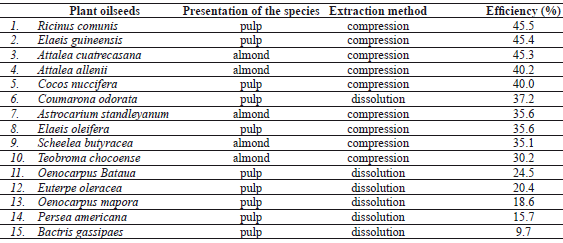
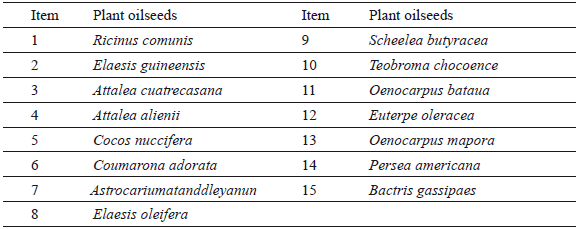
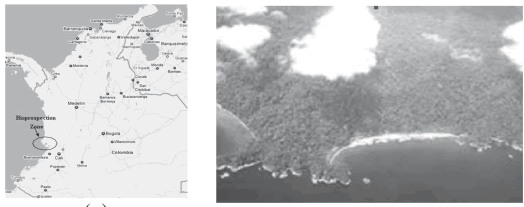
<body><![CDATA[<p>&nbsp;</p>     <p><b><font size="3" face="Verdana, Arial, Helvetica, sans-serif">2. BIOPROSPECTION ZONE </font></b></p>     <p><font size="2" face="Verdana, Arial, Helvetica, sans-serif">The bioprospection area for this study is located in Colombia (<a href="#fig01">Fig. 1</a>). This country is characterized by different geographic areas and thermal floors, which may present abundant sunshine and water, as well as a correspondingly high biodiversity. One of these areas is called the Pacific Plain (<a href="#fig01">Fig. 1[b]</a>), which is a large tropical jungle plain between the Pacific Ocean and the western Colombian mountains. This zone has different characteristics including lush vegetation, abundant water resources, a high pluviometric index, beaches, and forests adjacent to the Pacific Ocean with little interference from civilized man, among others, which contribute positively in a high rate of biodiversity [19]. In the Colombian Pacific coast area are the states of Choco, Valle del Cauca, Cauca, and Nari&ntilde;o.</font></p>     <p align="center"><font size="2" face="Verdana, Arial, Helvetica, sans-serif"><b><a name="fig01" id="fig01"></a><img src="/img/revistas/dyna/v78n170/a16fig01.gif" /><br />   Figure. 1.</b> Bioprospection zone: (a) location in Colombia, (b) appearance of Pacific coast</font></p>     <p><font size="2" face="Verdana, Arial, Helvetica, sans-serif">The Colombian Pacific Region is a strip of 75,000 kilometers between the countries of Panama and Ecuador. This region has a high concentration of biodiversity in terms of the number of species per hectare thanks to the combination of soil, water, and climate, coupled with a near zero interference in evolutionary natural processes. With regard to this, approximately 9,000 species of the 45,000 registered species in Colombia are present in the Pacific Coast, particularly in the state of Choco. Due to all aspects discussed above, this region was selected as the bioprospection area for this study.</font></p>     <p><font size="2" face="Verdana, Arial, Helvetica, sans-serif">In the bioprospection area, 15 oilseeds were collected (<a href="#tab01">Table 1</a>), and different ASTM tests were carried out in order to determine their fuel characteristics.</font></p>     <p align="center"><font size="2" face="Verdana, Arial, Helvetica, sans-serif"><b><a name="tab01" id="tab01"></a>Table 1.</b> Plant oilseeds</font><br />   <img src="/img/revistas/dyna/v78n170/a16tab01.gif" /></p>     <p>&nbsp;</p>     <p><b><font size="3" face="Verdana, Arial, Helvetica, sans-serif">3. OIL EXTRACTION AND CHARACTERIZATION OF BIO-OILS</font></b></p>     <p><font size="2" face="Verdana, Arial, Helvetica, sans-serif"><b>3.1 Oil extraction</b><br />   </font><font size="2" face="Verdana, Arial, Helvetica, sans-serif">Vegetable oil was initially extracted from the selected plant species by compression or dissolution using a solvent, then their extraction efficiencies (R), were determined according to Eq. (1) where it corresponds to the relation between the quantity of vegetable oil recovery (moil) and the quantity of the original raw material (mraw material).</font></p>     ]]></body>
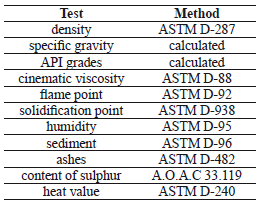
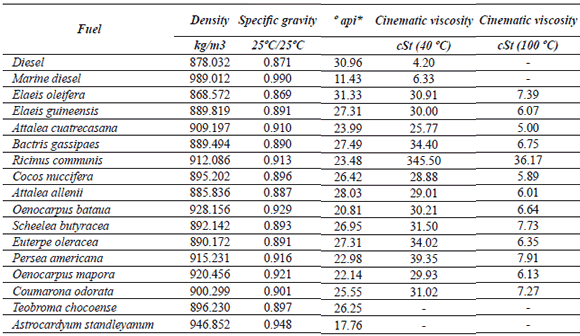
<body><![CDATA[<p><img src="/img/revistas/dyna/v78n170/a16eq01.gif" /></p>     <p><font size="2" face="Verdana, Arial, Helvetica, sans-serif">The extraction of these substances is generally easy. The methods used are: cold compression, warm compression, water-steam flow, and dissolution with an appropriate solvent. For this research, the extraction with pressure (compression) and a dissolvent was used.</font></p>     <p><font size="2" face="Verdana, Arial, Helvetica, sans-serif"><a href="#tab02">Table 2</a> shows the extraction efficiency, the extraction method, and the vegetable species selected. The first four species present an extraction efficiency of around 45 %, and the worst extraction efficiency was Bactris gassipaes with 9.7 %.</font></p>     <p align="center"><font size="2" face="Verdana, Arial, Helvetica, sans-serif"><b><a name="tab02" id="tab02"></a> Table 2.</b> Efficiency, extraction method, and presentation of vegetable species</font><br />   <img src="/img/revistas/dyna/v78n170/a16tab02.gif" /></p>     <p><font size="2" face="Verdana, Arial, Helvetica, sans-serif"><b>3.2 Characterization of bio-oils</b><br />   We must consider that oil application depends on its thermo-physics properties such as: density, cinematic viscosity, flame point, solidification point, humidity, sediment, ashes, and heat value, among others. The bio-oils obtained after the extraction stage underwent eight different tests based on standardized ASTM methods. Specific gravity and API grades are calculated. The sulphur content was determined according to AOAC methods (<a href="#tab03">Table 3</a>).</font></p>     <p align="center"><font size="2" face="Verdana, Arial, Helvetica, sans-serif"><b><a name="tab03" id="tab03"></a>Table 3.</b> Different tests and normalized methods for bio-oils</font><br />   <img src="/img/revistas/dyna/v78n170/a16tab03.gif" /></p>     <p><font size="2" face="Verdana, Arial, Helvetica, sans-serif">The values of density, API grades and cinematic viscosity at temperatures of 40 oC and 100 &deg;C, are presented in <a href="#tab04">Table 4</a>. Additionally, in the same table, the values of these properties for diesel and marine diesel also appear.</font></p>     <p align="center"><font size="2" face="Verdana, Arial, Helvetica, sans-serif"><b><a name="tab04" id="tab04"></a>Table 4.</b> Different property values for the species studied</font><br />   <img src="/img/revistas/dyna/v78n170/a16tab04.gif" /></p>     <p><font size="2" face="Verdana, Arial, Helvetica, sans-serif">As can be seen in the table above (<a href="#tab04">Table 4</a>), we should note that the viscosity of the vegetable oils with values between 25 and 40 cSt, and the diesel and marine diesel, with viscosities of 4.2 and 6.33 (at 40 oC), differ from the Riccinus communis with 345 cSt.</font></p>     <p><font size="2" face="Verdana, Arial, Helvetica, sans-serif">The values of humidity, sediment, ashes, heat value, and flame temperature properties are shown in <a href="#tab05">Table 5</a>.</font></p>     ]]></body>
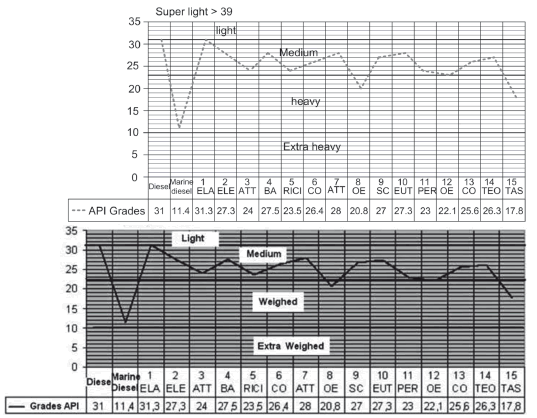
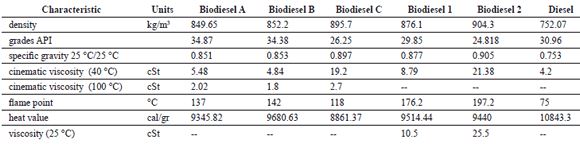
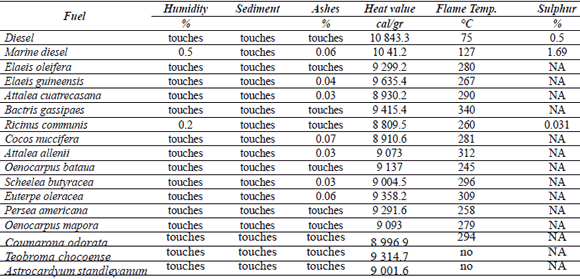
<body><![CDATA[<p align="center"><font size="2" face="Verdana, Arial, Helvetica, sans-serif"><b><a name="tab05" id="tab05"></a>Table 5. </b>Humidity, sediment, ashes, heat value, and flame temperature for the species studied </font><br />   <img src="/img/revistas/dyna/v78n170/a16tab05.gif" /></p>     <p><font size="2" face="Verdana, Arial, Helvetica, sans-serif">As shown in <a href="#tab05">Table 5</a>, the heat value of all biodiesel is similar (around 9200 cal/gr), and is low with regards to diesel and marine diesel. A low value in the power heat (heat value) means that each kilogram of burned fuel delivers less heat to be transformed into work transferred to the engine axis and therefore major quantities of fuel are required to obtain the same quantity of work.</font></p>     <p><font size="2" face="Verdana, Arial, Helvetica, sans-serif">The relative density of the oil is measured in American Petroleum Institute (API) grades. The oils of more of 30 API grades are considered to be light. Those which have less than 30 API grades, but more than 22, qualify as medium. Those which have less than 22 API grades but more than 10 API grades are considered to be heavy. The oils of less than 10 API grades are extra-weighed, of which those of minor density are qualified, like bitumen.</font></p>     <p><font size="2" face="Verdana, Arial, Helvetica, sans-serif">In accordance with the values of API grades obtained, it is possible to consider that the majority of the bio-oils studied fall into the category of medium, coming closer to commercial diesel, with the exception of number 8, oenocarpus bataua and number 15, tastrocardyum standleyanum, which fall into the category of heavy oil.</font></p>     <p><font size="2" face="Verdana, Arial, Helvetica, sans-serif"><a href="#fig02">Figure 2</a> shows the values of API grades for the different species studied.</font></p>     <p align="center"><font size="2" face="Verdana, Arial, Helvetica, sans-serif"><b><a name="fig02" id="fig02"></a><img src="/img/revistas/dyna/v78n170/a16fig02.gif" /><br />   Figure 2.</b> API grade values for the different species studied</font></p>     <p>&nbsp;</p>     <p><b><font size="3" face="Verdana, Arial, Helvetica, sans-serif">4. MECHANICAL PERFORMANCE</font></b></p>     <p><font size="2" face="Verdana, Arial, Helvetica, sans-serif">The direct use of vegetable oils has problems with the engine due principally to: its high viscosity which makes its flow difficult-increasing the pressure of injection and the deposits in the injectors-, its low volatile nature that make engine ignition difficult. It is necessary to transform the vegetable oil into something similar to diesel. Some methods to obtain biodiesel similar to commercial diesel are: pyrolysis, micro-emulsification, dilution, and transesterification (Maa &amp; Hannab, 1999). For this present research, the transesterification method was used.</font></p>     <p><font size="2" face="Verdana, Arial, Helvetica, sans-serif">The oils selected to be transesterificated were: Elaeis ole&iacute;fera (biodiesel A), Elaeis guineensis (biodiesel B), and Ricinus comunis (biodiesel C). It was observed that the biodiesel that adjusted itself better to the international regulations are Elaeis guineensis and Elaeis oleifera. As an additional characteristic, the cetane index was evaluated for this combustible, finding a value of 50. In all the cases, a considerable reduction of the flame point and a light increase of the heat value appear in the biodiesel-with respect to its original state.</font></p>     ]]></body>
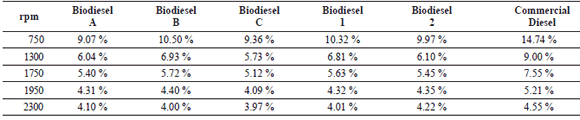
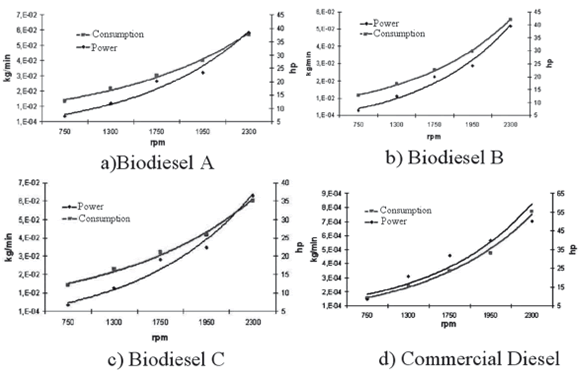
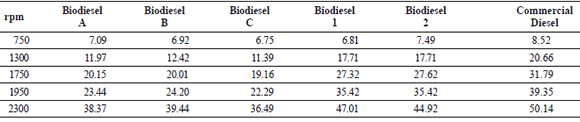
<body><![CDATA[<p><font size="2" face="Verdana, Arial, Helvetica, sans-serif">A comparison of characteristics of the fuels studied with two kind of biodiesel from palm oil (biodiesel 1, treated with methanol; and biodiesel 2, treated with ethanol) and the commercial diesel, is presented in <a href="#tab06">Table 6</a>.</font></p>     <p align="center"><font size="2" face="Verdana, Arial, Helvetica, sans-serif"><a name="tab06" id="tab06"></a><b>Table 6.</b> Comparison of the characteristics of different kind of biodiesel</font><br />   <img src="/img/revistas/dyna/v78n170/a16tab06.gif" /></p>     <p><font size="2" face="Verdana, Arial, Helvetica, sans-serif">At 40 &deg;C, the biodiesels that can be used in an internal combustion engine are: elaeis guineensis and  elaeis oleifera because the others exceed the limit of 6 cSt; however, all biodiesels can be used up to 100 &deg;C. In order to do that, a warming up of the engine before input must be carried out by modifying the combustion system.</font></p>     <p><font size="2" face="Verdana, Arial, Helvetica, sans-serif">The biodiesel efficiency curves were drawn based on tests the essays of applicability of palm oil biodiesel in power generation. The estimated efficiencies for different rpms, of different biodiesel are shown in <a href="#tab07">Table 7</a>; and the estimated potencies (in HP) are shown in <a href="#tab08">Table 8</a>.</font></p>     <p align="center"><font size="2" face="Verdana, Arial, Helvetica, sans-serif"><a name="tab07" id="tab07"></a><b>Table 7. </b>Estimated efficiencies</font><br />   <img src="/img/revistas/dyna/v78n170/a16tab07.gif" /></p>     <p align="center"><font size="2" face="Verdana, Arial, Helvetica, sans-serif"><b><a name="tab08" id="tab08"></a>Table 8.</b> Estimated power</font><br />   <img src="/img/revistas/dyna/v78n170/a16tab08.gif" /></p>     <p><font size="2" face="Verdana, Arial, Helvetica, sans-serif">Tests were carried out on a dynamometer for diesel and palm biodiesel. By comparatively evaluating the incidence of the different properties in the biodiesel obtained, the behavior was discovered in power generation.</font></p>     <p><font size="2" face="Verdana, Arial, Helvetica, sans-serif">Biodiesel A, B, C, and biodiesel 1 and 2, were compared with commercial diesel, finding that all the first ones present major similarities with biodiesel 2 (the biodiesel of palm olein). </font></p>     <p><font size="2" face="Verdana, Arial, Helvetica, sans-serif"><a href="#fig03">Figure 3</a> synthesizes the behavior of each biodiesel and commercial diesel with respect to consumption and power. <a href="#fig03">Figures 3a</a>, <a href="#fig03">3b</a>, and <a href="#fig03">3c</a> correspond to biodiesel A, biodiesel B, and biodiesel C, respectively, displaying the consumption and axis power tendency, relative to the revolutions in the engine axis.</font></p>     <p align="center"><font size="2" face="Verdana, Arial, Helvetica, sans-serif"><b><a name="fig03" id="fig03"></a><img src="/img/revistas/dyna/v78n170/a16fig03.gif" /><br />   Figure 3.</b> Behavior of each biodiesel and commercial diesel with respect to consumption and power</font></p>     ]]></body>
<body><![CDATA[<p><font size="2" face="Verdana, Arial, Helvetica, sans-serif">The curves in <a href="#fig03">Figure 3</a> show how the engine has a good fuel consumption/power relationship when revolutions increase approaching approximately 2300 rpm. For commercial diesel, the behavior in the fuel consumption/power relationship is practically constant throughout different RPMs, as can be seen in <a href="#fig03">Figure 3d</a>. The corresponding power at 2300 RPM were different for each type of fuel, about 40 hp in biodiesel A and B, and near 34 hp in biodiesel C. On the commercial biodiesel curve, it is possible to note that output power is greater.</font></p>     <p>&nbsp;</p>     <p><b><font size="3" face="Verdana, Arial, Helvetica, sans-serif">5. CONCLUSIONS</font></b></p>     <p><font size="2" face="Verdana, Arial, Helvetica, sans-serif">Due to their potential use as raw materials in the production of biodiesel, a bio-prospect and characterization of 15 oily vegetable species was presented in this work. The bio-oils studied can be used directly in diesel engines, but due to the fact that they present a high viscosity in relation to diesel and marine diesel, transesterification is recommended.</font></p>     <p><font size="2" face="Verdana, Arial, Helvetica, sans-serif">When using oils for internal combustion engines, high viscosity can cause wear in the conduits and obstruction-particularly in narrow orifices like those of injectors.</font></p>     <p><font size="2" face="Verdana, Arial, Helvetica, sans-serif">In comparison to standard diesel, biodiesel has less power delivered at an equal level of consumption, which is explained by the lower heat value, and also sometimes by the difference in viscosity. High viscosity may hamper the intimate contact between drops of fuel and oxygen within the combustion chamber of the engine being tested. This opens a field of research and development in the fuel-combustion system according to the type of biodiesel used.</font></p>     <p><font size="2" face="Verdana, Arial, Helvetica, sans-serif">The Pacific Colombian Region is a tropical, humid, and insufficiently explored region where there are a number of not yet evaluated species.</font></p>     <p><font size="2" face="Verdana, Arial, Helvetica, sans-serif">The research will have to continue to evaluate its best direct application in engines, the biodiesel manufactured methods from the extracted oils, the technical-economic and environmental plan design for its manufacturing, and to recommend terms of development for the people of the region.</font></p>     <p>&nbsp;</p>     <p><b><font size="3" face="Verdana, Arial, Helvetica, sans-serif">ACKNOWLEDGEMENTS</font></b></p>     ]]></body>
<body><![CDATA[<p><font size="2" face="Verdana, Arial, Helvetica, sans-serif">The authors would like to thank Angela Mar&iacute;a Cer&oacute;n and Germ&aacute;n Adolfo Charry for their invaluable collaboration.</font></p>     <p>&nbsp;</p>     <p><b><font size="3" face="Verdana, Arial, Helvetica, sans-serif">REFERENCES</font></b></p>     <!-- ref --><p><font size="2" face="Verdana, Arial, Helvetica, sans-serif"><b>[1]</b> Demirbas, A., Combustion characteristics of different biomass fuels, Progress in Energy and Combustion Science, vol. 30, (2), pp. 219-230, 2004.     &nbsp;&nbsp;&nbsp;&nbsp;&nbsp;&nbsp;&nbsp;&nbsp;[&#160;<a href="javascript:void(0);" onclick="javascript: window.open('/scielo.php?script=sci_nlinks&ref=000076&pid=S0012-7353201100060001600001&lng=','','width=640,height=500,resizable=yes,scrollbars=1,menubar=yes,');">Links</a>&#160;]<!-- end-ref --><!-- ref --><br>   <b>[2]</b> Demirbas, A., Recent advances in biomass conversion technologies, Energy Edu Sci Technol; Vol 6, pp. 19-41, 2000.     &nbsp;&nbsp;&nbsp;&nbsp;&nbsp;&nbsp;&nbsp;&nbsp;[&#160;<a href="javascript:void(0);" onclick="javascript: window.open('/scielo.php?script=sci_nlinks&ref=000077&pid=S0012-7353201100060001600002&lng=','','width=640,height=500,resizable=yes,scrollbars=1,menubar=yes,');">Links</a>&#160;]<!-- end-ref --><!-- ref --><br>   <b>[3]</b> Srivastava, A, and Prasad, R., Triglycerides based diesel fuels., Renewable and Sustainable Energy Reviews, Vol. 4, (2), pp. 111-133, 2000.     &nbsp;&nbsp;&nbsp;&nbsp;&nbsp;&nbsp;&nbsp;&nbsp;[&#160;<a href="javascript:void(0);" onclick="javascript: window.open('/scielo.php?script=sci_nlinks&ref=000078&pid=S0012-7353201100060001600003&lng=','','width=640,height=500,resizable=yes,scrollbars=1,menubar=yes,');">Links</a>&#160;]<!-- end-ref --><!-- ref --><br>   <b>[4]</b> Thornley, P., Increasing biomass based power generation in the UK, Energy Policy, Vol 34, (15), pp. 2087-2099, 2006.     &nbsp;&nbsp;&nbsp;&nbsp;&nbsp;&nbsp;&nbsp;&nbsp;[&#160;<a href="javascript:void(0);" onclick="javascript: window.open('/scielo.php?script=sci_nlinks&ref=000079&pid=S0012-7353201100060001600004&lng=','','width=640,height=500,resizable=yes,scrollbars=1,menubar=yes,');">Links</a>&#160;]<!-- end-ref --><!-- ref --><br>   <b>[5]</b> Tuck, G., Glendining, M. J., Smith, P., House, J. I, and Wattenbach, M., The potential distribution of bioenergy crops in Europe under present and future climate, Biomass and Bioenergy ,Vol 30, (3), pp. 183-197, 2006.     &nbsp;&nbsp;&nbsp;&nbsp;&nbsp;&nbsp;&nbsp;&nbsp;[&#160;<a href="javascript:void(0);" onclick="javascript: window.open('/scielo.php?script=sci_nlinks&ref=000080&pid=S0012-7353201100060001600005&lng=','','width=640,height=500,resizable=yes,scrollbars=1,menubar=yes,');">Links</a>&#160;]<!-- end-ref --><!-- ref --><br>   <b>[6]</b> Cort&eacute;s, E., Suarez, H., Pardo, S. Biocombustibles y autosuficiencia energ&eacute;tica. Revista Dyna, Vol. 158, pp. 101-110, 2009.     &nbsp;&nbsp;&nbsp;&nbsp;&nbsp;&nbsp;&nbsp;&nbsp;[&#160;<a href="javascript:void(0);" onclick="javascript: window.open('/scielo.php?script=sci_nlinks&ref=000081&pid=S0012-7353201100060001600006&lng=','','width=640,height=500,resizable=yes,scrollbars=1,menubar=yes,');">Links</a>&#160;]<!-- end-ref --><!-- ref --><br>   <b>[7]</b> Maa, F., Hannab M. A. Biodiesel production: a review, Bioresource Technology, Vol. 70, (1), pp. 1-15, 1999.     &nbsp;&nbsp;&nbsp;&nbsp;&nbsp;&nbsp;&nbsp;&nbsp;[&#160;<a href="javascript:void(0);" onclick="javascript: window.open('/scielo.php?script=sci_nlinks&ref=000082&pid=S0012-7353201100060001600007&lng=','','width=640,height=500,resizable=yes,scrollbars=1,menubar=yes,');">Links</a>&#160;]<!-- end-ref --><!-- ref --><br>   <b>[8]</b> Pimentel, D. and Patzek, T. W., Ethanol Production Using Corn, Switchgrass, and Wood Biodiesel Production Using Soybean and Sunflower, Natural Resources Research, Vol. 14, (1), pp. 65-76, 2005.     &nbsp;&nbsp;&nbsp;&nbsp;&nbsp;&nbsp;&nbsp;&nbsp;[&#160;<a href="javascript:void(0);" onclick="javascript: window.open('/scielo.php?script=sci_nlinks&ref=000083&pid=S0012-7353201100060001600008&lng=','','width=640,height=500,resizable=yes,scrollbars=1,menubar=yes,');">Links</a>&#160;]<!-- end-ref --><!-- ref --><br>   <b>[9]</b> Cunha Da Costa, R., Potential for producing bio-fuel in the Amazon deforested areas, Biomass and Bioenergy Vol. 26, (5), pp. 405-415, 2004.     &nbsp;&nbsp;&nbsp;&nbsp;&nbsp;&nbsp;&nbsp;&nbsp;[&#160;<a href="javascript:void(0);" onclick="javascript: window.open('/scielo.php?script=sci_nlinks&ref=000084&pid=S0012-7353201100060001600009&lng=','','width=640,height=500,resizable=yes,scrollbars=1,menubar=yes,');">Links</a>&#160;]<!-- end-ref --><!-- ref --><br>   <b>[10]</b> Petersson, A., Thomsen, M. H., Hauggaard-Nielsen, H., and Thomsen A., Potential bioethanol and biogas production using lignocellulosic biomass from winter rye, oilseed rape and faba bean, Biomass and Bioenergy,Vol. 31, No. 11-12, pp. 812-819, 2007.     &nbsp;&nbsp;&nbsp;&nbsp;&nbsp;&nbsp;&nbsp;&nbsp;[&#160;<a href="javascript:void(0);" onclick="javascript: window.open('/scielo.php?script=sci_nlinks&ref=000085&pid=S0012-7353201100060001600010&lng=','','width=640,height=500,resizable=yes,scrollbars=1,menubar=yes,');">Links</a>&#160;]<!-- end-ref --><!-- ref --><br>   <b>[11]</b> Kalam, M. A, and Masjuki, H. H., Biodiesel from palmoil-an analysis of its properties and potential, Biomass and Bioenergy, Vol. 23, (6), pp. 471-479, 2002.     &nbsp;&nbsp;&nbsp;&nbsp;&nbsp;&nbsp;&nbsp;&nbsp;[&#160;<a href="javascript:void(0);" onclick="javascript: window.open('/scielo.php?script=sci_nlinks&ref=000086&pid=S0012-7353201100060001600011&lng=','','width=640,height=500,resizable=yes,scrollbars=1,menubar=yes,');">Links</a>&#160;]<!-- end-ref --><!-- ref --><br>   <b>[12]</b> Usta, N., Use of tobacco seed oil methyl ester in a turbocharged indirect injection diesel engine, Biomass and Bioenergy, Vol. 28, (1), pp. 77-86, 2005.     &nbsp;&nbsp;&nbsp;&nbsp;&nbsp;&nbsp;&nbsp;&nbsp;[&#160;<a href="javascript:void(0);" onclick="javascript: window.open('/scielo.php?script=sci_nlinks&ref=000087&pid=S0012-7353201100060001600012&lng=','','width=640,height=500,resizable=yes,scrollbars=1,menubar=yes,');">Links</a>&#160;]<!-- end-ref --><!-- ref --><br>   <b>[13]</b> Shashikant, V, and Hifjur, R., Biodiesel production from mahua (Madhuca indica) oil having high free fatty acids, Biomass and Bioenergy, Vol. 28, (6), pp. 601-605, 2005.     &nbsp;&nbsp;&nbsp;&nbsp;&nbsp;&nbsp;&nbsp;&nbsp;[&#160;<a href="javascript:void(0);" onclick="javascript: window.open('/scielo.php?script=sci_nlinks&ref=000088&pid=S0012-7353201100060001600013&lng=','','width=640,height=500,resizable=yes,scrollbars=1,menubar=yes,');">Links</a>&#160;]<!-- end-ref --><!-- ref --><br>   <b>[14]</b> Canoira, L., Alc&aacute;ntara, R., Garc&iacute;a, M. J, and Carrasco, J., Biodiesel from Jojoba oil-wax: Transesterification with methanol and properties as a fuel, Biomass and Bioenergy ,Vol 30, (1), pp. 76-81, 2006.     &nbsp;&nbsp;&nbsp;&nbsp;&nbsp;&nbsp;&nbsp;&nbsp;[&#160;<a href="javascript:void(0);" onclick="javascript: window.open('/scielo.php?script=sci_nlinks&ref=000089&pid=S0012-7353201100060001600014&lng=','','width=640,height=500,resizable=yes,scrollbars=1,menubar=yes,');">Links</a>&#160;]<!-- end-ref --><!-- ref --><br>   <b>[15]</b> Lang, X., Dalai, A. K., Bakhshi, N. N., Reaney, M. J, and Hertz, P.B., Preparation and characterization of bio-diesels from various bio-oils, Bioresour Technol. Vol. 80, (1), pp. 53-62, 2001.     &nbsp;&nbsp;&nbsp;&nbsp;&nbsp;&nbsp;&nbsp;&nbsp;[&#160;<a href="javascript:void(0);" onclick="javascript: window.open('/scielo.php?script=sci_nlinks&ref=000090&pid=S0012-7353201100060001600015&lng=','','width=640,height=500,resizable=yes,scrollbars=1,menubar=yes,');">Links</a>&#160;]<!-- end-ref --><!-- ref --><br>   <b>[16]</b> Duncan, J., Costs of Biodiesel Production, Energy Efficiency and Conservation Authority, 2003.     &nbsp;&nbsp;&nbsp;&nbsp;&nbsp;&nbsp;&nbsp;&nbsp;[&#160;<a href="javascript:void(0);" onclick="javascript: window.open('/scielo.php?script=sci_nlinks&ref=000091&pid=S0012-7353201100060001600016&lng=','','width=640,height=500,resizable=yes,scrollbars=1,menubar=yes,');">Links</a>&#160;]<!-- end-ref --><!-- ref --><br>   <b>[17]</b> Haas, M. J., Mcaloon, A. J. and Yee, W. C., Foglia t. A process model to estimate biodiesel production costs, Bioresource Technology, Vol. 97, (4), pp. 671-678, 2006.     &nbsp;&nbsp;&nbsp;&nbsp;&nbsp;&nbsp;&nbsp;&nbsp;[&#160;<a href="javascript:void(0);" onclick="javascript: window.open('/scielo.php?script=sci_nlinks&ref=000092&pid=S0012-7353201100060001600017&lng=','','width=640,height=500,resizable=yes,scrollbars=1,menubar=yes,');">Links</a>&#160;]<!-- end-ref --><!-- ref --><br>   <b>[18]</b> Apostolakou, A., Kookos, I., Marazioti, C. and Angelopoulos, K., Techno-economic analysis of a biodiesel production process from vegetable oils, Fuel Processing Technology Vol 90, No. 7-8, pp 1023-1031, 2009.     &nbsp;&nbsp;&nbsp;&nbsp;&nbsp;&nbsp;&nbsp;&nbsp;[&#160;<a href="javascript:void(0);" onclick="javascript: window.open('/scielo.php?script=sci_nlinks&ref=000093&pid=S0012-7353201100060001600018&lng=','','width=640,height=500,resizable=yes,scrollbars=1,menubar=yes,');">Links</a>&#160;]<!-- end-ref --><!-- ref --><br>   <b>[19]</b> URUGUAY, El Choc&oacute; colombiano: una regi&oacute;n megadiversa en un pa&iacute;s megadiverso &iquest;por cu&aacute;nto tiempo m&aacute;s?, available at <a href="http://www.wrm.org.uy/boletin/44/Colombia.html" target="referencia">http://www.wrm.org.uy/boletin/44/Colombia.html</a>, [January 8th, 2007]. </font>&nbsp;&nbsp;&nbsp;&nbsp;&nbsp;&nbsp;&nbsp;&nbsp;[&#160;<a href="javascript:void(0);" onclick="javascript: window.open('/scielo.php?script=sci_nlinks&ref=000094&pid=S0012-7353201100060001600019&lng=','','width=640,height=500,resizable=yes,scrollbars=1,menubar=yes,');">Links</a>&#160;]<!-- end-ref --> ]]></body><back>
<ref-list>
<ref id="B1">
<label>1</label><nlm-citation citation-type="journal">
<person-group person-group-type="author">
<name>
<surname><![CDATA[Demirbas]]></surname>
<given-names><![CDATA[A.]]></given-names>
</name>
</person-group>
<article-title xml:lang="en"><![CDATA[Combustion characteristics of different biomass fuels]]></article-title>
<source><![CDATA[Progress in Energy and Combustion Science]]></source>
<year>2004</year>
<volume>30</volume>
<numero>2</numero>
<issue>2</issue>
<page-range>219-230</page-range></nlm-citation>
</ref>
<ref id="B2">
<label>2</label><nlm-citation citation-type="journal">
<person-group person-group-type="author">
<name>
<surname><![CDATA[Demirbas]]></surname>
<given-names><![CDATA[A.]]></given-names>
</name>
</person-group>
<article-title xml:lang="en"><![CDATA[Recent advances in biomass conversion technologies]]></article-title>
<source><![CDATA[Energy Edu Sci Technol]]></source>
<year>2000</year>
<volume>6</volume>
<page-range>19-41</page-range></nlm-citation>
</ref>
<ref id="B3">
<label>3</label><nlm-citation citation-type="journal">
<person-group person-group-type="author">
<name>
<surname><![CDATA[Srivastava]]></surname>
<given-names><![CDATA[A]]></given-names>
</name>
<name>
<surname><![CDATA[Prasad]]></surname>
<given-names><![CDATA[R.]]></given-names>
</name>
</person-group>
<article-title xml:lang="en"><![CDATA[Triglycerides based diesel fuels.]]></article-title>
<source><![CDATA[Renewable and Sustainable Energy Reviews]]></source>
<year>2000</year>
<volume>4</volume>
<numero>2</numero>
<issue>2</issue>
<page-range>111-133</page-range></nlm-citation>
</ref>
<ref id="B4">
<label>4</label><nlm-citation citation-type="journal">
<person-group person-group-type="author">
<name>
<surname><![CDATA[Thornley]]></surname>
<given-names><![CDATA[P.]]></given-names>
</name>
</person-group>
<article-title xml:lang="en"><![CDATA[Increasing biomass based power generation in the UK]]></article-title>
<source><![CDATA[Energy Policy]]></source>
<year>2006</year>
<volume>34</volume><volume>15</volume>
<page-range>2087-2099</page-range></nlm-citation>
</ref>
<ref id="B5">
<label>5</label><nlm-citation citation-type="journal">
<person-group person-group-type="author">
<name>
<surname><![CDATA[Tuck]]></surname>
<given-names><![CDATA[G]]></given-names>
</name>
<name>
<surname><![CDATA[Glendining]]></surname>
<given-names><![CDATA[M. J]]></given-names>
</name>
<name>
<surname><![CDATA[Smith]]></surname>
<given-names><![CDATA[P]]></given-names>
</name>
<name>
<surname><![CDATA[House]]></surname>
<given-names><![CDATA[J. I]]></given-names>
</name>
<name>
<surname><![CDATA[Wattenbach]]></surname>
<given-names><![CDATA[M]]></given-names>
</name>
</person-group>
<article-title xml:lang="en"><![CDATA[The potential distribution of bioenergy crops in Europe under present and future climate]]></article-title>
<source><![CDATA[Biomass and Bioenergy]]></source>
<year>2006</year>
<volume>30</volume>
<numero>3</numero>
<issue>3</issue>
<page-range>183-197</page-range></nlm-citation>
</ref>
<ref id="B6">
<label>6</label><nlm-citation citation-type="journal">
<person-group person-group-type="author">
<name>
<surname><![CDATA[Cortés]]></surname>
<given-names><![CDATA[E.]]></given-names>
</name>
<name>
<surname><![CDATA[Suarez]]></surname>
<given-names><![CDATA[H.]]></given-names>
</name>
<name>
<surname><![CDATA[Pardo]]></surname>
<given-names><![CDATA[S.]]></given-names>
</name>
</person-group>
<article-title xml:lang="es"><![CDATA[Biocombustibles y autosuficiencia energética.]]></article-title>
<source><![CDATA[Revista Dyna]]></source>
<year>2009</year>
<volume>158</volume>
<page-range>101-110</page-range></nlm-citation>
</ref>
<ref id="B7">
<label>7</label><nlm-citation citation-type="journal">
<person-group person-group-type="author">
<name>
<surname><![CDATA[Maa]]></surname>
<given-names><![CDATA[F.]]></given-names>
</name>
<name>
<surname><![CDATA[Hannab]]></surname>
<given-names><![CDATA[M. A]]></given-names>
</name>
</person-group>
<article-title xml:lang="en"><![CDATA[Biodiesel production: a review]]></article-title>
<source><![CDATA[Bioresource Technology]]></source>
<year>1999</year>
<volume>70</volume>
<numero>1</numero>
<issue>1</issue>
<page-range>1-15</page-range></nlm-citation>
</ref>
<ref id="B8">
<label>8</label><nlm-citation citation-type="journal">
<person-group person-group-type="author">
<name>
<surname><![CDATA[Pimentel]]></surname>
<given-names><![CDATA[D.]]></given-names>
</name>
<name>
<surname><![CDATA[Patzek]]></surname>
<given-names><![CDATA[T. W.]]></given-names>
</name>
</person-group>
<article-title xml:lang="en"><![CDATA[Ethanol Production Using Corn, Switchgrass, and Wood Biodiesel Production Using Soybean and Sunflower]]></article-title>
<source><![CDATA[Natural Resources Research]]></source>
<year>2005</year>
<volume>14</volume>
<numero>1</numero>
<issue>1</issue>
<page-range>65-76</page-range></nlm-citation>
</ref>
<ref id="B9">
<label>9</label><nlm-citation citation-type="journal">
<person-group person-group-type="author">
<name>
<surname><![CDATA[Cunha Da Costa]]></surname>
<given-names><![CDATA[R]]></given-names>
</name>
</person-group>
<article-title xml:lang="en"><![CDATA[Potential for producing bio-fuel in the Amazon deforested areas]]></article-title>
<source><![CDATA[Biomass and Bioenergy]]></source>
<year>2004</year>
<volume>26</volume>
<numero>5</numero>
<issue>5</issue>
<page-range>405-415</page-range></nlm-citation>
</ref>
<ref id="B10">
<label>10</label><nlm-citation citation-type="journal">
<person-group person-group-type="author">
<name>
<surname><![CDATA[Petersson]]></surname>
<given-names><![CDATA[A]]></given-names>
</name>
<name>
<surname><![CDATA[Thomsen]]></surname>
<given-names><![CDATA[M. H.]]></given-names>
</name>
<name>
<surname><![CDATA[Hauggaard-Nielsen]]></surname>
<given-names><![CDATA[H]]></given-names>
</name>
<name>
<surname><![CDATA[Thomsen]]></surname>
<given-names><![CDATA[A.]]></given-names>
</name>
</person-group>
<article-title xml:lang="en"><![CDATA[Potential bioethanol and biogas production using lignocellulosic biomass from winter rye, oilseed rape and faba bean]]></article-title>
<source><![CDATA[Biomass and Bioenergy]]></source>
<year>2007</year>
<volume>31</volume>
<numero>11-12</numero>
<issue>11-12</issue>
<page-range>812-819</page-range></nlm-citation>
</ref>
<ref id="B11">
<label>11</label><nlm-citation citation-type="journal">
<person-group person-group-type="author">
<name>
<surname><![CDATA[Kalam]]></surname>
<given-names><![CDATA[M. A]]></given-names>
</name>
<name>
<surname><![CDATA[Masjuki]]></surname>
<given-names><![CDATA[H. H.]]></given-names>
</name>
</person-group>
<article-title xml:lang="en"><![CDATA[Biodiesel from palmoil-an analysis of its properties and potential]]></article-title>
<source><![CDATA[Biomass and Bioenergy]]></source>
<year>2002</year>
<volume>23</volume>
<numero>6</numero>
<issue>6</issue>
<page-range>471-479</page-range></nlm-citation>
</ref>
<ref id="B12">
<label>12</label><nlm-citation citation-type="journal">
<person-group person-group-type="author">
<name>
<surname><![CDATA[Usta]]></surname>
<given-names><![CDATA[N.]]></given-names>
</name>
</person-group>
<article-title xml:lang="en"><![CDATA[Use of tobacco seed oil methyl ester in a turbocharged indirect injection diesel engine]]></article-title>
<source><![CDATA[Biomass and Bioenergy]]></source>
<year>2005</year>
<volume>28</volume>
<numero>1</numero>
<issue>1</issue>
<page-range>77-86</page-range></nlm-citation>
</ref>
<ref id="B13">
<label>13</label><nlm-citation citation-type="journal">
<person-group person-group-type="author">
<name>
<surname><![CDATA[Shashikant]]></surname>
<given-names><![CDATA[V]]></given-names>
</name>
<name>
<surname><![CDATA[Hifjur]]></surname>
<given-names><![CDATA[R.]]></given-names>
</name>
</person-group>
<article-title xml:lang="en"><![CDATA[Biodiesel production from mahua (Madhuca indica) oil having high free fatty acids]]></article-title>
<source><![CDATA[Biomass and Bioenergy]]></source>
<year>2005</year>
<month>.</month>
<volume>28</volume>
<numero>6</numero>
<issue>6</issue>
<page-range>601-605</page-range></nlm-citation>
</ref>
<ref id="B14">
<label>14</label><nlm-citation citation-type="journal">
<person-group person-group-type="author">
<name>
<surname><![CDATA[Canoira]]></surname>
<given-names><![CDATA[L.]]></given-names>
</name>
<name>
<surname><![CDATA[Alcántara]]></surname>
<given-names><![CDATA[R.]]></given-names>
</name>
<name>
<surname><![CDATA[García]]></surname>
<given-names><![CDATA[M. J]]></given-names>
</name>
<name>
<surname><![CDATA[Carrasco]]></surname>
<given-names><![CDATA[J.]]></given-names>
</name>
</person-group>
<article-title xml:lang="en"><![CDATA[Biodiesel from Jojoba oil-wax: Transesterification with methanol and properties as a fuel]]></article-title>
<source><![CDATA[Biomass and Bioenergy]]></source>
<year>2006</year>
<volume>30</volume>
<numero>1</numero>
<issue>1</issue>
<page-range>76-81</page-range></nlm-citation>
</ref>
<ref id="B15">
<label>15</label><nlm-citation citation-type="journal">
<person-group person-group-type="author">
<name>
<surname><![CDATA[Lang]]></surname>
<given-names><![CDATA[X.]]></given-names>
</name>
<name>
<surname><![CDATA[Dalai]]></surname>
<given-names><![CDATA[A. K.]]></given-names>
</name>
<name>
<surname><![CDATA[Bakhshi]]></surname>
<given-names><![CDATA[N. N.]]></given-names>
</name>
<name>
<surname><![CDATA[Reaney]]></surname>
<given-names><![CDATA[M. J]]></given-names>
</name>
<name>
<surname><![CDATA[Hertz]]></surname>
<given-names><![CDATA[P.B.]]></given-names>
</name>
</person-group>
<article-title xml:lang="en"><![CDATA[Preparation and characterization of bio-diesels from various bio-oils]]></article-title>
<source><![CDATA[Bioresour Technol.]]></source>
<year>2001</year>
<volume>80</volume>
<numero>1</numero>
<issue>1</issue>
<page-range>53-62</page-range></nlm-citation>
</ref>
<ref id="B16">
<label>16</label><nlm-citation citation-type="journal">
<person-group person-group-type="author">
<name>
<surname><![CDATA[Duncan]]></surname>
<given-names><![CDATA[J.]]></given-names>
</name>
</person-group>
<article-title xml:lang="en"><![CDATA[Costs of Biodiesel Production]]></article-title>
<source><![CDATA[Energy Efficiency and Conservation Authority]]></source>
<year>2003</year>
</nlm-citation>
</ref>
<ref id="B17">
<label>17</label><nlm-citation citation-type="journal">
<person-group person-group-type="author">
<name>
<surname><![CDATA[Haas]]></surname>
<given-names><![CDATA[M. J.]]></given-names>
</name>
<name>
<surname><![CDATA[Mcaloon]]></surname>
<given-names><![CDATA[A. J]]></given-names>
</name>
<name>
<surname><![CDATA[Yee]]></surname>
<given-names><![CDATA[W. C.]]></given-names>
</name>
<name>
<surname><![CDATA[Foglia]]></surname>
<given-names><![CDATA[t.]]></given-names>
</name>
</person-group>
<article-title xml:lang="en"><![CDATA[A process model to estimate biodiesel production costs]]></article-title>
<source><![CDATA[Bioresource Technology]]></source>
<year>2006</year>
<month>.</month>
<volume>97</volume>
<numero>4</numero>
<issue>4</issue>
<page-range>671-678</page-range></nlm-citation>
</ref>
<ref id="B18">
<label>18</label><nlm-citation citation-type="journal">
<person-group person-group-type="author">
<name>
<surname><![CDATA[Apostolakou]]></surname>
<given-names><![CDATA[A.]]></given-names>
</name>
<name>
<surname><![CDATA[Kookos]]></surname>
<given-names><![CDATA[I.]]></given-names>
</name>
<name>
<surname><![CDATA[Marazioti]]></surname>
<given-names><![CDATA[C.]]></given-names>
</name>
<name>
<surname><![CDATA[Angelopoulos]]></surname>
<given-names><![CDATA[K.]]></given-names>
</name>
</person-group>
<article-title xml:lang="en"><![CDATA[Techno-economic analysis of a biodiesel production process from vegetable oils]]></article-title>
<source><![CDATA[Fuel Processing Technology]]></source>
<year>2009</year>
<volume>90</volume>
<numero>. 7-8</numero>
<issue>. 7-8</issue>
<page-range>1023-1031</page-range></nlm-citation>
</ref>
<ref id="B19">
<label>19</label><nlm-citation citation-type="">
<source><![CDATA[El Chocó colombiano: una región megadiversa en un país megadiverso ¿por cuánto tiempo más?]]></source>
<year></year>
</nlm-citation>
</ref>
</ref-list>
</back>
</article>