<?xml version="1.0" encoding="ISO-8859-1"?><article xmlns:mml="http://www.w3.org/1998/Math/MathML" xmlns:xlink="http://www.w3.org/1999/xlink" xmlns:xsi="http://www.w3.org/2001/XMLSchema-instance">
<front>
<journal-meta>
<journal-id>0012-7353</journal-id>
<journal-title><![CDATA[DYNA]]></journal-title>
<abbrev-journal-title><![CDATA[Dyna rev.fac.nac.minas]]></abbrev-journal-title>
<issn>0012-7353</issn>
<publisher>
<publisher-name><![CDATA[Universidad Nacional de Colombia]]></publisher-name>
</publisher>
</journal-meta>
<article-meta>
<article-id>S0012-73532011000600025</article-id>
<title-group>
<article-title xml:lang="en"><![CDATA[MOTOR CURRENT SIGNATURE ANALYSIS AND NEGATIVE SEQUENCE CURRENT BASED STATOR WINDING SHORT FAULT DETECTION IN AN INDUCTION MOTOR]]></article-title>
<article-title xml:lang="es"><![CDATA[DETECCIÓN DE CORTO CIRCUITO EN EL ESTATOR DE UN MOTOR DE INDUCCIÓN BASADA EN MCSA Y LA CORRIENTE DE SECUENCIA NEGATIVA]]></article-title>
</title-group>
<contrib-group>
<contrib contrib-type="author">
<name>
<surname><![CDATA[OVIEDO]]></surname>
<given-names><![CDATA[SILVIA]]></given-names>
</name>
<xref ref-type="aff" rid="A01"/>
</contrib>
<contrib contrib-type="author">
<name>
<surname><![CDATA[QUIROGA]]></surname>
<given-names><![CDATA[JABID]]></given-names>
</name>
<xref ref-type="aff" rid="A02"/>
</contrib>
<contrib contrib-type="author">
<name>
<surname><![CDATA[BORRÁS]]></surname>
<given-names><![CDATA[CARLOS]]></given-names>
</name>
<xref ref-type="aff" rid="A03"/>
</contrib>
</contrib-group>
<aff id="A01">
<institution><![CDATA[,Universidad Industrial de Santander Escuela de Ingeniería Mecánica ]]></institution>
<addr-line><![CDATA[Bucaramanga ]]></addr-line>
<country>Colombia</country>
</aff>
<aff id="A02">
<institution><![CDATA[,Universidad Industrial de Santander Escuela de Ingeniería Mecánica ]]></institution>
<addr-line><![CDATA[Bucaramanga ]]></addr-line>
<country>Colombia</country>
</aff>
<aff id="A03">
<institution><![CDATA[,Universidad Industrial de Santander Escuela de Ingeniería Mecánica ]]></institution>
<addr-line><![CDATA[Bucaramanga ]]></addr-line>
<country>Colombia</country>
</aff>
<pub-date pub-type="pub">
<day>00</day>
<month>12</month>
<year>2011</year>
</pub-date>
<pub-date pub-type="epub">
<day>00</day>
<month>12</month>
<year>2011</year>
</pub-date>
<volume>78</volume>
<numero>170</numero>
<fpage>214</fpage>
<lpage>220</lpage>
<copyright-statement/>
<copyright-year/>
<self-uri xlink:href="http://www.scielo.org.co/scielo.php?script=sci_arttext&amp;pid=S0012-73532011000600025&amp;lng=en&amp;nrm=iso"></self-uri><self-uri xlink:href="http://www.scielo.org.co/scielo.php?script=sci_abstract&amp;pid=S0012-73532011000600025&amp;lng=en&amp;nrm=iso"></self-uri><self-uri xlink:href="http://www.scielo.org.co/scielo.php?script=sci_pdf&amp;pid=S0012-73532011000600025&amp;lng=en&amp;nrm=iso"></self-uri><abstract abstract-type="short" xml:lang="en"><p><![CDATA[In this paper, negative sequence analysis and motor current signature analysis (MCSA) based approaches are applied to perform short fault detection of a single phase winding in an induction motor. The fault detection is carried out using the negative sequence analysis and spectral analysis of current signals. An experimental analysis is presented, showing the advantages and drawbacks for each method implemented. Tests are performed in a 2 Hp induction motor dedicated to this type of study. Experimental results show variations in the fault indicator in both methods when the motor is running under different load conditions. Although the negative sequence current method demands simultaneous three phase current sensing, it presents better performance for short fault detection and provides a fault severity level estimation.]]></p></abstract>
<abstract abstract-type="short" xml:lang="es"><p><![CDATA[En este artículo se utilizan las técnicas MCSA y componentes secuenciales para la detección de cortocircuito de una fase del bobinado del estator de un motor de inducción. La detección de esta falla se realiza usando el análisis de corriente de secuencia negativa y del espectro de la señal de corriente. Se presenta un análisis experimental mostrando las ventajas y desventajas de cada método implementado. Se realizan pruebas en un banco de motores de inducción de 2 hp dedicado para este tipo de estudios. Los resultados experimentales muestran variaciones en el indicador de falla en ambos métodos cuando el motor está operando en diferentes condiciones de carga. Aunque la corriente secuencial negativa requiere el uso de sensores de corriente en las tres fases del motor, esta técnica presenta un mejor desempeño en la detección del cortocircuito del bobinado y proporciona un valor estimado de la severidad de la falla.]]></p></abstract>
<kwd-group>
<kwd lng="en"><![CDATA[Fault detection]]></kwd>
<kwd lng="en"><![CDATA[stator winding short circuit]]></kwd>
<kwd lng="en"><![CDATA[sequence components]]></kwd>
<kwd lng="en"><![CDATA[MCSA]]></kwd>
<kwd lng="es"><![CDATA[Detección de fallas]]></kwd>
<kwd lng="es"><![CDATA[cortocircuito en el bobinado del estator]]></kwd>
<kwd lng="es"><![CDATA[componentes secuenciales]]></kwd>
<kwd lng="es"><![CDATA[MCSA]]></kwd>
</kwd-group>
</article-meta>
</front><body><![CDATA[ <p align="center"><font size="4" face="Verdana, Arial, Helvetica, sans-serif"><b>MOTOR  CURRENT SIGNATURE ANALYSIS AND NEGATIVE SEQUENCE CURRENT BASED STATOR WINDING  SHORT FAULT DETECTION IN AN INDUCTION MOTOR </b></font></p>     <p align="center"><i><font size="3"><b><font face="Verdana, Arial, Helvetica, sans-serif">DETECCI&Oacute;N DE CORTO CIRCUITO EN EL ESTATOR DE UN MOTOR DE  INDUCCI&Oacute;N BASADA EN MCSA Y LA CORRIENTE DE SECUENCIA NEGATIVA</font></b></font></i></p>     <p align="center">&nbsp;</p>     <p align="center"><font size="2" face="Verdana, Arial, Helvetica, sans-serif"><b>SILVIA OVIEDO</b>    <br>   <i>MSc. Escuela de Ingenier&iacute;a Mec&aacute;nica, Universidad Industrial de Santander, Bucaramanga-Colombia, <a href="mailto:siljuovi@uis.edu.co">siljuovi@uis.edu.co</a></i></font></p>     <p align="center"><font size="2" face="Verdana, Arial, Helvetica, sans-serif"><b>JABID QUIROGA</b>    <br>   <i>MSc . Profesor Asociado, Ingenier&iacute;a Mec&aacute;nica, Universidad Industrial de Santander, Bucaramanga-Colombia, <a href="mailto:jabib@uis.edu.co">jabib@uis.edu.co</a></i></font></p>     <p align="center"><font size="2" face="Verdana, Arial, Helvetica, sans-serif"><b>CARLOS BORR&Aacute;S</b>    <br>   <i>PhD. Profesor Asociado, Ingenier&iacute;a Mec&aacute;nica, Universidad Industrial de Santander, Bucaramanga-Colombia, <a href="mailto:cborras@uis.edu.co">cborras@uis.edu.co</a></i></font></p>     <p align="center">&nbsp;</p>     ]]></body>
<body><![CDATA[<p align="center"><font size="2" face="Verdana, Arial, Helvetica, sans-serif"><b>Received for review September 6<sup>th</sup>, 2010, accepted March 14<sup>th</sup>, 2011, final version March 25<sup>th</sup>, 2011</b></font></p>     <p>&nbsp;</p> <hr>     <p><font size="2" face="Verdana, Arial, Helvetica, sans-serif"><b>ABSTRACT:</b> In this paper, negative sequence analysis and motor current signature analysis (MCSA) based approaches are applied to perform short fault detection of a single phase winding in an induction motor. The fault detection is carried out using the negative sequence analysis and spectral analysis of current signals. An experimental analysis is presented, showing the advantages and drawbacks for each method implemented. Tests are performed in a 2 Hp induction motor dedicated to this type of study. Experimental results show variations in the fault indicator in both methods when the motor is running under different load conditions. Although the negative sequence current method demands simultaneous three phase current sensing, it presents better performance for short fault detection and provides a fault severity level estimation.</font></p>     <p><font size="2" face="Verdana, Arial, Helvetica, sans-serif"><b>KEYWORDS:</b> Fault detection, stator winding short circuit, sequence components, MCSA</font></p>     <p><font size="2" face="Verdana, Arial, Helvetica, sans-serif"><b>RESUMEN:</b> En este art&iacute;culo se utilizan las t&eacute;cnicas MCSA y componentes secuenciales para la detecci&oacute;n de cortocircuito de una fase del bobinado del estator de un motor de inducci&oacute;n. La detecci&oacute;n de esta falla se realiza usando el an&aacute;lisis de corriente de secuencia negativa y del espectro de la se&ntilde;al de corriente. Se presenta un an&aacute;lisis experimental mostrando las ventajas y desventajas de cada m&eacute;todo implementado. Se realizan pruebas en un banco de motores de inducci&oacute;n de 2 hp dedicado para este tipo de estudios. Los resultados experimentales muestran variaciones en el indicador de falla en ambos m&eacute;todos cuando el motor est&aacute; operando en diferentes condiciones de carga. Aunque la corriente secuencial negativa requiere el uso de sensores de corriente en las tres fases del motor, esta t&eacute;cnica presenta un mejor desempe&ntilde;o en la detecci&oacute;n del cortocircuito del bobinado y proporciona un valor estimado de la severidad de la falla.</font></p>     <p><font size="2" face="Verdana, Arial, Helvetica, sans-serif"><b>PALABRAS CLAVE:</b> Detecci&oacute;n de fallas, cortocircuito en el bobinado del estator, componentes secuenciales, MCSA</font></p> <hr>     <p>&nbsp;</p>     <p><font size="3" face="Verdana, Arial, Helvetica, sans-serif"><b>1. INTRODUCTION</b></font></p>     <p><font size="2" face="Verdana, Arial, Helvetica, sans-serif">Early detection of a stator short circuit fault in motors is critical in preventing damage to the machine. Fast and accurate diagnosis of these types of faults allows actions to be taken to protect the power system and the machine. Recently, there has been considerable interest in fault detection and diagnosis techniques. The subject of a fault detection and diagnosis system (FDD) has been the focus of many investigations. Different invasive and noninvasive methods have been reported for incipient and permanent fault detection. Noninvasive methods are based on establishing the system condition by analyzing the information obtained outside the equipment, such as terminal and environmental measurements; furthermore, noninvasive techniques are more economical and therefore preferred. Usually, the detection schemes and the parameter settings developed are very specific to the system under investigation. Fault detection methods can be further grouped into: (a) model based, (b) knowledge based, and (c) signal based methods.</font></p>     <p><font size="2" face="Verdana, Arial, Helvetica, sans-serif">Signal based methods such as spectral analysis, instantaneous power FFT, bispectrum, wavelet analysis, sequence analysis, etc., do not incorporate any model and rely on features associated with the fault present in the measured variables. Although simple, signal-based methods require high-quality sensors (an acquisition system) in order to be used for detection. Fault detection associated with signal based methods consists basically in a pattern recognition method.</font></p>     ]]></body>
<body><![CDATA[<p><font size="2" face="Verdana, Arial, Helvetica, sans-serif">Generally, FDD schemes for motors have concentrated on sensing specific failures in one of the three components: the rotor, the stator, and the bearings. In addition, the most common fault modes are categorized into two types: mechanical and electrical faults. Mechanical faults include bearing faults, air gap, eccentricity, and faults caused by overheating. Electrical faults consist of faults caused by winding insulation problems and some rotor faults. </font></p>     <p><font size="2" face="Verdana, Arial, Helvetica, sans-serif">Different FDD methods have been proposed for each type of motor fault. Even though thermal and vibration monitoring have been utilized widely, most of the recent research has been focused on electrical characteristic of the motor with emphasis on inspecting the stator current of the motor [1-2]. </font></p>     <p><font size="2" face="Verdana, Arial, Helvetica, sans-serif">In the literature, work on the fault detection of stator winding shorts of electric machines is primarily focused on induction motors using either motor current signature analysis (MCSA) or negative sequence component (NSC). The absence of publications in detection of stator winding faults using MCSA and NSC simultaneously prevents a systematic comparison of the proposed methods. </font></p>     <p><font size="2" face="Verdana, Arial, Helvetica, sans-serif">In [3], a comparative analysis is provided for the online diagnosis of a stator winding short circuit in induction motors. The authors compared several diagnostic methods in terms of diagnostic efficiency and requirements for practical implementation. Among all the techniques analyzed, those based on the sequence components are considered to be the most promising. The use of MCSA in stator winding short circuit under different load conditions is proposed [4-7]. Results showed the activation of different harmonics depending on the test carried out for each specific study. Variations in the fault indicator jeopardize any attempt to use the activation of specific current harmonics as a fault indicator. In tests performed [4] in an uncoupled induction motor under 2 %, 4 %, and 32 % of shorted winding in one phase showed a maximum increase of 15 dB (32 % fault) in a 75 Hz component of normal condition. The presence of fault coincident harmonics linked to eccentricity when the load is connected is claimed, which does not make it possible to distinguish one effect from the other. Similar results are obtained for an uncoupled machine [5], claiming a 15 dB increase in 54.5 Hz, and 154.5 Hz from a healthy condition to the non- specified most severe fault condition. A decrease in the amplitude of the fault harmonics when the machine load is increased is also noticed [5-6]. Furthermore, the fault indicator presents a minor increase in the first stages of faulty condition which means the indicator has low damage sensitivity. .</font></p>     <p><font size="2" face="Verdana, Arial, Helvetica, sans-serif">On the other hand, the experiments carried out in this study using an induction motor under fault condition show a significant increase in the negative sequence components of the current under both incipient and severe faults. Although the effect of other sources of asymmetries such as inherent motor imbalance and instrumentation is not considered in this paper, the experimental implementation of the negative sequence current does permit a real assessment of the machine's condition. </font></p>     <p>&nbsp;</p>     <p><font size="3" face="Verdana, Arial, Helvetica, sans-serif"><b>2. METHODOLOGY</b></font></p>     <p><font size="2" face="Verdana, Arial, Helvetica, sans-serif"><b>2.1 Stator Winding Short Circuits in Electric Machines </b></font></p>     <p><font size="2" face="Verdana, Arial, Helvetica, sans-serif">Statistics show that stator winding faults constitute the largest portion of electrical faults [8]. The stator winding short circuit fault in electric motors usually starts as an undetected insulation failure between two adjacent turns, and then develops into a short circuit isolating a number of turns [9]. Though starting with incipient turn-to-turn short circuits, undetected small insulation failures can deteriorate and accumulate rapidly. The resulting high current may eventually lead to loss of a phase winding, phase-to-phase or phase-to-ground faults. The incipient winding faults in a single stator coil may have relatively little effect on motor performance but may affect overall motor reliability, availability, and longevity [10].</font></p>     <p><font size="2" face="Verdana, Arial, Helvetica, sans-serif">The causes of the stator winding faults can be summarized as follows [11-12].</font></p> <ul>       ]]></body>
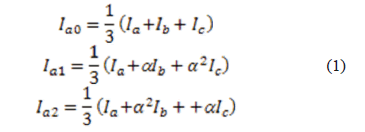
<body><![CDATA[<li><font size="2" face="Verdana, Arial, Helvetica, sans-serif">During the motor startup, the inter turn insulation suffers from a transient overvoltage.</font></li>       <li><font size="2" face="Verdana, Arial, Helvetica, sans-serif">Unbalance and overvoltage cause increases in the winding temperature and deterioration of the insulation.</font></li>       <li><font size="2" face="Verdana, Arial, Helvetica, sans-serif">Loose bracing for end winding.</font></li>       <li><font size="2" face="Verdana, Arial, Helvetica, sans-serif">Short circuit and electrical discharges.</font></li>       <li><font size="2" face="Verdana, Arial, Helvetica, sans-serif">Aggressive environments such as those with contamination, moisture, chemicals, and high temperatures weaken the insulation.</font></li>     </ul>     <p><font size="2" face="Verdana, Arial, Helvetica, sans-serif"><b>2.1.1 Negative Sequence Component    <br>   </b></font><font size="2" face="Verdana, Arial, Helvetica, sans-serif">The method of symmetrical components is a mathematical technique to describe unbalanced power systems. For a three phase system, the sequence components of the current are described by (1)</font></p>     <p><img src="/img/revistas/dyna/v78n170/a25eq01.gif"></p>     <p><font size="2" face="Verdana, Arial, Helvetica, sans-serif">where <i>I<sub><font face="Symbol">a0</font></sub></i>, <i>I<sub><font face="Symbol">a</font>1</sub></i>, and <i>I<sub><font face="Symbol">a</font>2</sub></i> are the zero, positive, and negative sequence currents, respectively; and a is a phase rotation operator equivalent to e<sup>j2p/3</sup> or 120&deg;. A balanced set of three phase currents only contains the positive sequence current component, the negative sequence current is an indication of the amount of unbalance (asymmetry) in the system, and the zero-sequence current is a measure of the amount of current not returning through the phase conductors [13]. </font></p>     ]]></body>
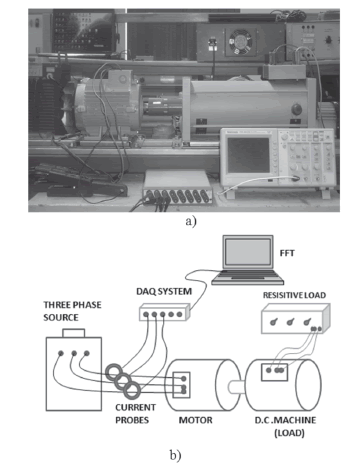
<body><![CDATA[<p><font size="2" face="Verdana, Arial, Helvetica, sans-serif">Asymmetries in the 3<font face="Symbol">j</font> quantities of the electric machines may arise due to a variety of reasons: (a) stator winding short circuits, (b) inherent machine and instrumentation asymmetries, (c) load fluctuations, and (d) unbalanced supply voltages. Such asymmetries are reflected in the negative sequence component. In this study, the negative sequence of the current signal is employed as a fault indicator, which is obtained for the induction motor using (1). Both analytical and experimental results have demonstrated an increase in negative sequence current under stator winding short circuits [14].</font></p>     <p><font size="2" face="Verdana, Arial, Helvetica, sans-serif"><b>2.1.2. Motor Current Signature Analysis    <br>   </b></font><font size="2" face="Verdana, Arial, Helvetica, sans-serif">Motor current signature analysis (MCSA) is a noninvasive fault detection technique. It is frequency information based and capable of detecting stator winding shorts. The MCSA is performed by monitoring the activation of some specific fault condition related to harmonics. Theoretical studies have proven that the following equation provides the components in the air gap flux waveform, and therefore in the current waveform that is a function of shorted turns [7]:</font></p>     <p><img src="/img/revistas/dyna/v78n170/a25eq02.gif"></p>     <p><font size="2" face="Verdana, Arial, Helvetica, sans-serif">where <i>f<sub>st</sub></i> are the frequency components associated with shorted turns, <i>f<sub>1</sub></i> is the supply frequency, <i>p</i> is the number of pole pairs, <i>n = 1, 2, 3 ...</i>, <i>k = 1, 2, 3 ...</i>, and s is the motor slip.</font></p>     <p>&nbsp;</p>     <p><font size="3" face="Verdana, Arial, Helvetica, sans-serif"><b>3. EXPERIMENTAL RESULTSB</b></font></p>     <p><font size="2" face="Verdana, Arial, Helvetica, sans-serif">This section presents the experimental results obtained using both the MCSA and NSC approaches to perform the fault detection of a stator winding short circuit in an induction motor. A series of tests are designed to evaluate the detectability and the severity level of the emulated stator winding short faults using the proposed methodologies, both with and without load fluctuation. Three cases are presented here for each approach. </font></p>     <p><font size="2" face="Verdana, Arial, Helvetica, sans-serif">A 2 Hp, 440/220V, 1800 rpm, 4 pole, 60 Hz motor is used for the tests. In the proposed experimental setup, the induction motor is specifically designed for fault detection and diagnosis purposes, especially the stator winding faults. To emulate the fault conditions, the stator windings of the induction motor have been reconstructed. The windings in one phase of the motor are equipped with several accessible taps so that a stator winding short type fault of varying severity can be introduced, corresponding to 2 %, 5 % and 10 % shorted turns. <a href="#fig01">Figure 1</a> shows the implemented test bench. In order to emulate real operating conditions, the load is applied to the induction motor obtaining 75 % and 85 % of the rated current as expected in real applications. A 220 VDC shunt generator is used as a load; the different load conditions are created by connecting variable resistive loads to it.</font></p>     <p align="center"><font size="2" face="Verdana, Arial, Helvetica, sans-serif"><b><a name="fig01"></a><img src="/img/revistas/dyna/v78n170/a25fig01.gif">    ]]></body>
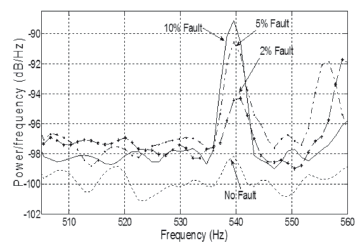
<body><![CDATA[<br>   Figure 1.</b> a) Experimental test bench b) test bench scheme</font></p>     <p><font size="2" face="Verdana, Arial, Helvetica, sans-serif">The data acquisition system is developed using Matlab/Simulink&Ograve; with WinDaq software as an interface to the hardware. Algorithms utilized in the implementation of MCSA and NSC are developed in Matlab/Simulink&Ograve;. A DI-730 data acquisition system from DataQ&Ograve; is used to display and record the three line currents from a three hall effect based on AC/DC current probes.</font></p>     <p><font size="2" face="Verdana, Arial, Helvetica, sans-serif">A series of tests are designed to demonstrate the detectability and diagnosis capability of the emulated stator interturn short circuit fault using MCSA and NSC with and without load fluctuation. </font></p>     <p><font size="2" face="Verdana, Arial, Helvetica, sans-serif">In the proposed MCSA and NSC based fault detection system, the data acquisition allows for the sampling of three phase line currents INS (t), where NS represent a nonstationary signal. The signals are sampled with a 5 kHz sampling frequency and the data are used in both approaches simultaneously. The IfNS(t) are then used to generate the spectrum and the negative sequence current fault indicator <i>I<sub><font face="Symbol">a</font>2</sub></i> according to (1) in the Matlab and Simulink environments.</font></p>     <p><font size="2" face="Verdana, Arial, Helvetica, sans-serif"><b>3.1 Motor Current Signature Analysis approach    <br>   </b></font><font size="2" face="Verdana, Arial, Helvetica, sans-serif">The MCSA is a frequency information based technique in which one or various specific frequencies are used as fault indicators. Because this fault detection scheme relies on the frequency information of the current, an appropriate spectral algorithm must be used to identify the feature associated to the fault. The Welch spectrum implemented in Matlab&Ograve; is used in this study. This technique provides a substantial noise reduction, facilitating the fault-associated feature recognition.</font></p>     <p><font size="2" face="Verdana, Arial, Helvetica, sans-serif"><b>Case 1. MCSA for stator winding short with no load coupled </b></font></p>     <p><font size="2" face="Verdana, Arial, Helvetica, sans-serif">This experiment is performed to demonstrate the detectability of a winding short fault using the MCSA under no load condition. <a href="#fig02">Figure 2</a> shows the spectral components of the current for the induction motor running for no load condition for a 500-600 Hz bandwidth. The Welch spectrum between 0-2500 Hz shows a single fault frequency activated around 540 Hz, among all the <i>f<sub>st</sub></i> possibilities. Taking into account the previous result, the activation of frequencies around 540 Hz under higher load conditions is expected.</font></p>     <p align="center"><font size="2" face="Verdana, Arial, Helvetica, sans-serif"><b><a name="fig02"></a><img src="/img/revistas/dyna/v78n170/a25fig02.gif">    <br>   Figure 2. </b>Welch periodogram for no load coupled</font></p>     ]]></body>
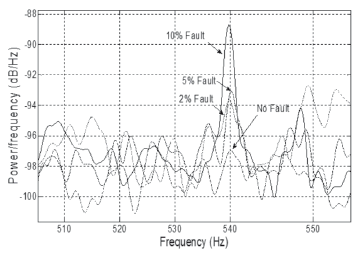
<body><![CDATA[<p><font size="2" face="Verdana, Arial, Helvetica, sans-serif"><b>Case 2. MCSA for stator winding short with 75 % load coupled</b></font></p>     <p><font size="2" face="Verdana, Arial, Helvetica, sans-serif">Another experiment is carried out in conditions similar to Case 1, with a coupled load of 75 % of the motor rated current, and for fault conditions of 2 %, 5 %, and 10 % shorted windings. This test is used to prove the fault detectability using the purposed methodology under a higher load condition. As expected, based on Case 1, the 540 Hz frequency spectral amplitude shows a consistent behavior under this load condition. <a href="#fig03">Figure 3</a> shows the range between 500 and 600 Hz with the corresponding excited frequency under fault condition. In the same figure, a maximum variation around 8 dB between normal condition and 10% fault condition can be appreciated. Nevertheless, this variation can be also observed in other fault nonrelated frequency components, and for that reason, the sensitivity of this fault indicator is not satisfying for the authors when monitoring the condition of an induction motor.</font></p>     <p align="center"><font size="2" face="Verdana, Arial, Helvetica, sans-serif"><b><a name="fig03"></a><img src="/img/revistas/dyna/v78n170/a25fig03.gif">    <br>   Figure 3.</b> Welch periodogram for 75 % load coupled</font></p>     <p><font size="2" face="Verdana, Arial, Helvetica, sans-serif"><b>Case 3. MCSA for stator winding short with 85 % load coupled</b></font></p>     <p><font size="2" face="Verdana, Arial, Helvetica, sans-serif">A third experiment is carried out using a load corresponding to 85 % of the motor rated current, and the same shorted winding percentages used in Case 1 and Case 2 (2 %, 5 %, and 10 % shorted turns). In this case, tests show that the 500-600 Hz bandwidth range is no longer an appropriate choice for the fault detection in the particular conditions of the testbed, because the expected</font></p>     <p><font size="2" face="Verdana, Arial, Helvetica, sans-serif">excited frequencies in that frequency range, predicted by (2), are missing for this load condition. </font></p>     <p><font size="2" face="Verdana, Arial, Helvetica, sans-serif">Based on the previous results, it can be concluded that picking one frequency out of dozens as a fault indicator is not a guarantee of the reliable monitoring of the stator winding condition using MCSA. Additionally, according to what was found in the experimentation, increasing the induction motor load conditions attenuates the spectral amplitude of fst , making it more complex to achieve an accurate fault detection under the MCSA approach.</font></p>     <p><font size="2" face="Verdana, Arial, Helvetica, sans-serif"><b>3.2 Negative Sequence Component Aproach    <br>   </b></font><font size="2" face="Verdana, Arial, Helvetica, sans-serif">The NSC is implemented recreating Eq. (1) in the Simulink&Ograve; environment. Experiments results are depicted in <a href="#fig04">Figs. 4</a>-<a href="#fig06">6</a>. The line with the lowest current magnitude in <a href="#fig04">Figs. 4</a>-<a href="#fig06">6</a> is the <i>I<sub><font face="Symbol">a</font>2</sub></i> component corresponding to the healthy condition in the motor. </font></p>     ]]></body>
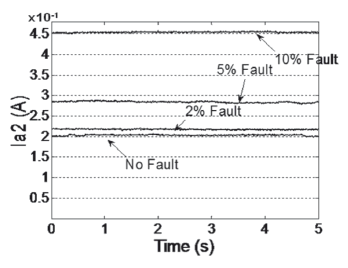
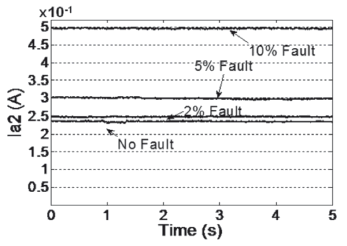
<body><![CDATA[<p><font size="2" face="Verdana, Arial, Helvetica, sans-serif"><b>Case 1. NSC for stator winding short with no load coupled</b></font></p>     <p><font size="2" face="Verdana, Arial, Helvetica, sans-serif">As in Case 1 in the MCSA approach, this test is carried out to demonstrate the stator winding short fault detectability under no load condition. In this case study, three fault severities are applied (2 %, 5 %, and 10% of shorted winding) and data from the three phases is used to obtain<i> I<sub><font face="Symbol">a</font>2</sub></i>. <a href="#fig04">Figure 4</a> shows the value of the negative sequence current obtained from this experiment. As shown in <a href="#fig04">Fig. 4</a>, the implemented approach is quite effective for distinguishing healthy from faulty conditions when no load is applied to the motor. In addition, a clear relationship between the fault severity and the magnitude of the negative sequence current indicator can be observed.</font></p>     <p align="center"><font size="2" face="Verdana, Arial, Helvetica, sans-serif"><a name="fig04"></a><b><img src="/img/revistas/dyna/v78n170/a25fig04.gif">    <br>   Figure 4.</b> Negative sequence current for no load coupled</font></p>     <p><font size="2" face="Verdana, Arial, Helvetica, sans-serif"><b>Case 2. NSC for stator winding short with 75 % load coupled</b></font></p>     <p><font size="2" face="Verdana, Arial, Helvetica, sans-serif">In this case, a constant 75 % of the rated current load is applied to the induction motor, and also, stator windings short faults of 2 %, 5 %, and 10 % are induced once again. Experimental results of negative sequence current are shown in <a href="#fig05">Fig. 5</a>, where a baseline for the no fault condition is also depicted. </font></p>     <p align="center"><font size="2" face="Verdana, Arial, Helvetica, sans-serif"><a name="fig05"></a><b><img src="/img/revistas/dyna/v78n170/a25fig05.gif">    <br>   Figure 5.</b> Negative sequence current for 75 % load coupled</font></p>     <p><font size="2" face="Verdana, Arial, Helvetica, sans-serif">Comparing <a href="#fig04">Fig. 4</a> and <a href="#fig05">Fig. 5</a>, an increase of <i>I<sub><font face="Symbol">a</font>2</sub></i> for all fault conditions, including no fault condition can be appreciated. Nevertheless, all <i>I<sub><font face="Symbol">a</font>2</sub></i> magnitudes in <a href="#fig05">Fig. 5</a> present an approximately even increase compared to the values shown in <a href="#fig04">Fig. 4</a>. This means that a roughly relationship between the load level and the NSC fault indicator <i>I<sub><font face="Symbol">a</font>2</sub></i> might be established.</font></p>     <p><font size="2" face="Verdana, Arial, Helvetica, sans-serif"><b>Case 3. NSC for stator winding short with 85% load coupled</b></font></p>     ]]></body>
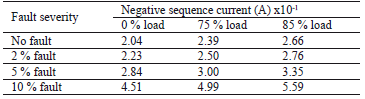
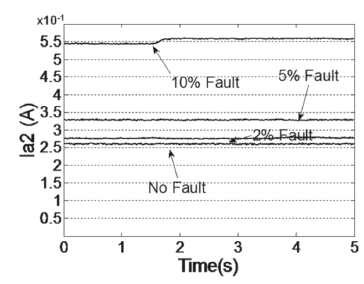
<body><![CDATA[<p><font size="2" face="Verdana, Arial, Helvetica, sans-serif"><a href="#fig06">Figure 6</a> shows the experimental results of the negative sequence current under a higher load condition for the same fault conditions. As in previous experimental results, the amplitude of the negative sequence current increases as the fault condition becomes severer. The reliable performance of the sequence components in this application is also demonstrated for this test condition.</font></p>     <p align="center"><font size="2" face="Verdana, Arial, Helvetica, sans-serif"><a name="fig06"></a><b><img src="/img/revistas/dyna/v78n170/a25fig06.gif">    <br>   Figure 6.</b> Negative sequence current for 85 % load coupled</font></p>     <p><font size="2" face="Verdana, Arial, Helvetica, sans-serif">The previous experiments allow for us to conclude that there is a slight augmentation in the <i>I<sub><font face="Symbol">a</font>2</sub></i> indicator when the load is coupled to the induction motor. This means that there is not a single <i>I<sub><font face="Symbol">a</font>2</sub></i> value for the healthy condition, but it depends on the load, and so the <i>I<sub><font face="Symbol">a</font>2</sub></i> magnitude for all faulty conditions. <a href="#tab01">Table I</a> presents the <i>I<sub><font face="Symbol">a</font>2</sub></i> mean values for all the cases and load conditions. </font></p>     <p align="center"><font size="2" face="Verdana, Arial, Helvetica, sans-serif"><a name="tab01"></a><b>Table 1.</b><i> I<sub><font face="Symbol">a</font>2 </sub></i>Magnitudes for different levels of load and</font> <font size="2" face="Verdana, Arial, Helvetica, sans-serif">fault severity</font>    <br>   <img src="/img/revistas/dyna/v78n170/a25tab01.gif"></p>     <p>&nbsp;</p>     <p><font size="3" face="Verdana, Arial, Helvetica, sans-serif"><b>4. CONCLUSIONS</b></font></p>     <p><font size="2" face="Verdana, Arial, Helvetica, sans-serif">In this paper, two noninvasive techniques, MCSA and NSC for induction motor fault detection were implemented and evaluated for several load conditions and fault severities. </font></p>     <p><font size="2" face="Verdana, Arial, Helvetica, sans-serif">For the laboratory test conditions, the MCSA allows for using only one fault frequency magnitude as a fault indicator. The behavior of that frequency was consistent with the expected results in most of the fault case studies. However, the performance of the MCSA technique is degraded by the increment of the load directly modifying the amplitude of the fault indicator. Additionally, and as reported by many studies, the frequencies associated with this type of fault depend on the particular conditions of the motor.</font></p>     ]]></body>
<body><![CDATA[<p><font size="2" face="Verdana, Arial, Helvetica, sans-serif">Furthermore, experimental study shows that the NSC diagnosis approach is not immune to load fluctuation either. Conversely, NSC shows a better performance in fault detection and it might be capable of diagnosing the severity level of the stator winding short fault if a load condition-negative sequence current relationship is previously established. For all the tests carried out, the fault is identified promptly and properly using NSC. This method showed its efficacy in performing fault detection when the induction motor is running under different conditions of load and with different levels of severity of the stator winding short fault. However, in order to guarantee a reliable and robust fault detection, power quality must be guaranteed in the motor supply network since the negative sequence current indicator is a reflection of unbalances, not all caused by stator shorted windings. </font></p>     <p>&nbsp;</p>     <p><font size="3" face="Verdana, Arial, Helvetica, sans-serif"><b>REFERENCES</b></font></p>     <!-- ref --><p><font size="2" face="Verdana, Arial, Helvetica, sans-serif"><b>[1]</b> Benbouzid, M.E.H., A review of induction motors signatures analysis as a medium for fault detection, IEEE Transactions on Industrial Electronics, Vol. 47, (5), pp. 984-993, 2000.     &nbsp;&nbsp;&nbsp;&nbsp;&nbsp;&nbsp;&nbsp;&nbsp;[&#160;<a href="javascript:void(0);" onclick="javascript: window.open('/scielo.php?script=sci_nlinks&ref=000096&pid=S0012-7353201100060002500001&lng=','','width=640,height=500,resizable=yes,scrollbars=1,menubar=yes,');">Links</a>&#160;]<!-- end-ref --><!-- ref --><br>   <b>[2]</b> Quiroga , J., Cartes, D. and Edrington, C., Neural Network Based System Identification of a PMSM Under Load Fluctuation. Revista Dyna, Vol. 76, no. 160, pp. 273-282, 2009.     &nbsp;&nbsp;&nbsp;&nbsp;&nbsp;&nbsp;&nbsp;&nbsp;[&#160;<a href="javascript:void(0);" onclick="javascript: window.open('/scielo.php?script=sci_nlinks&ref=000097&pid=S0012-7353201100060002500002&lng=','','width=640,height=500,resizable=yes,scrollbars=1,menubar=yes,');">Links</a>&#160;]<!-- end-ref --><!-- ref --><br>   <b>[3]</b> Albizu, I., Zamora, I., Mazon, A.J. and Tapia, A., Techniques for Online Diagnosis of Stator Shorted Turns in Induction Motors, Electric Power Components and Systems, Vol. 34, (1), pp. 97-114. 2006.     &nbsp;&nbsp;&nbsp;&nbsp;&nbsp;&nbsp;&nbsp;&nbsp;[&#160;<a href="javascript:void(0);" onclick="javascript: window.open('/scielo.php?script=sci_nlinks&ref=000098&pid=S0012-7353201100060002500003&lng=','','width=640,height=500,resizable=yes,scrollbars=1,menubar=yes,');">Links</a>&#160;]<!-- end-ref --><!-- ref --><br>   <b>[4]</b> Pereira, L.A., Gazzana, da Silva D. and Pereira, L.F.A., Motor current signature analysis and fuzzy logic applied to the diagnosis of short-circuit faults in induction motors, Industrial Electronics Society, 2005. IECON 2005. 31st Annual Conference of IEEE ,Vol 6, pp. 6-10 Noviembre 2005.     &nbsp;&nbsp;&nbsp;&nbsp;&nbsp;&nbsp;&nbsp;&nbsp;[&#160;<a href="javascript:void(0);" onclick="javascript: window.open('/scielo.php?script=sci_nlinks&ref=000099&pid=S0012-7353201100060002500004&lng=','','width=640,height=500,resizable=yes,scrollbars=1,menubar=yes,');">Links</a>&#160;]<!-- end-ref --><!-- ref --><br>   <b>[5]</b> Royo, J. and Arcega, F.J., Machine Current Signature Analysis as a Way for Fault Detection in Squirrel Cage Wind Generators, IEEE International Symposium on Diagnostics for Electric Machines, Power Electronics and Drives, SDEMPED 2007, pp. 383- 387, Septiembre 2007.     &nbsp;&nbsp;&nbsp;&nbsp;&nbsp;&nbsp;&nbsp;&nbsp;[&#160;<a href="javascript:void(0);" onclick="javascript: window.open('/scielo.php?script=sci_nlinks&ref=000100&pid=S0012-7353201100060002500005&lng=','','width=640,height=500,resizable=yes,scrollbars=1,menubar=yes,');">Links</a>&#160;]<!-- end-ref --><!-- ref --><br>   <b>[6]</b> Gazzana, D., da Silva. and Pereira, L.A., Fernandes, D., A system for incipient fault detection and fault diagnosis based on MCSA, Transmission and Distribution Conference and Exposition, 2010 IEEE PES , pp.1-6, Abril 2010.     &nbsp;&nbsp;&nbsp;&nbsp;&nbsp;&nbsp;&nbsp;&nbsp;[&#160;<a href="javascript:void(0);" onclick="javascript: window.open('/scielo.php?script=sci_nlinks&ref=000101&pid=S0012-7353201100060002500006&lng=','','width=640,height=500,resizable=yes,scrollbars=1,menubar=yes,');">Links</a>&#160;]<!-- end-ref --><!-- ref --><br>   <b>[7]</b> Thomson, W.T., On-line MCSA to diagnose shorted turns in low voltage stator windings of 3-phase induction motors prior to failure, Electric Machines and Drives Conference, IEMDC 2001. IEEE International, pp. 891-898, Junio 2001.     &nbsp;&nbsp;&nbsp;&nbsp;&nbsp;&nbsp;&nbsp;&nbsp;[&#160;<a href="javascript:void(0);" onclick="javascript: window.open('/scielo.php?script=sci_nlinks&ref=000102&pid=S0012-7353201100060002500007&lng=','','width=640,height=500,resizable=yes,scrollbars=1,menubar=yes,');">Links</a>&#160;]<!-- end-ref --><!-- ref --><br>   <b>[8]</b> Ojo O., Osaloni, O. and Kshirsagar, P., Models for the control and simulation of synchronous type machine drives under various fault conditions, in 2002 Conference Record Ind. Applicat. Conference, 37th IAS Annual Meeting, Vol. 3, pp. 1533-1540, Diciembre 2002.     &nbsp;&nbsp;&nbsp;&nbsp;&nbsp;&nbsp;&nbsp;&nbsp;[&#160;<a href="javascript:void(0);" onclick="javascript: window.open('/scielo.php?script=sci_nlinks&ref=000103&pid=S0012-7353201100060002500008&lng=','','width=640,height=500,resizable=yes,scrollbars=1,menubar=yes,');">Links</a>&#160;]<!-- end-ref --><!-- ref --><br>   <b>[9]</b> Awadallah, M.A. and Morcos, M. M., ANFIS-based diagnosis and location of stator interturn faults in PM brushless DC motors, IEEE Trans. Energy Conversion, Vol. 19, no. 4, pp. 795-796, 2004.     &nbsp;&nbsp;&nbsp;&nbsp;&nbsp;&nbsp;&nbsp;&nbsp;[&#160;<a href="javascript:void(0);" onclick="javascript: window.open('/scielo.php?script=sci_nlinks&ref=000104&pid=S0012-7353201100060002500009&lng=','','width=640,height=500,resizable=yes,scrollbars=1,menubar=yes,');">Links</a>&#160;]<!-- end-ref --><!-- ref --><br>   <b>[10]</b> Nelson, A.l. and Chow, M.Y., Characterization of coil faults in an axial flux variable reluctance PM motor, IEEE Trans. Energy Conversion, Vol. 17, no. 3, pp. 340-348, 2002.     &nbsp;&nbsp;&nbsp;&nbsp;&nbsp;&nbsp;&nbsp;&nbsp;[&#160;<a href="javascript:void(0);" onclick="javascript: window.open('/scielo.php?script=sci_nlinks&ref=000105&pid=S0012-7353201100060002500010&lng=','','width=640,height=500,resizable=yes,scrollbars=1,menubar=yes,');">Links</a>&#160;]<!-- end-ref --><!-- ref --><br>   <b>[11]</b> Bonnett, A.H. and Soukup, G.C., Cause and analysis of stator and rotor failures in three -phase squirrel cage induction motors, IEEE Transaction on Industry Applications, pp. 921-937, 1992.     &nbsp;&nbsp;&nbsp;&nbsp;&nbsp;&nbsp;&nbsp;&nbsp;[&#160;<a href="javascript:void(0);" onclick="javascript: window.open('/scielo.php?script=sci_nlinks&ref=000106&pid=S0012-7353201100060002500011&lng=','','width=640,height=500,resizable=yes,scrollbars=1,menubar=yes,');">Links</a>&#160;]<!-- end-ref --><!-- ref --><br>   <b>[12]</b> Nandi, S., Toliyat, H.A. and Xiaodong, L., Condition monitoring and fault diagnosis of electrical motors-a review, IEEE Transaction on Energy Conversion, Vol.20, no.4, pp. 719-729, 2005.     &nbsp;&nbsp;&nbsp;&nbsp;&nbsp;&nbsp;&nbsp;&nbsp;[&#160;<a href="javascript:void(0);" onclick="javascript: window.open('/scielo.php?script=sci_nlinks&ref=000107&pid=S0012-7353201100060002500012&lng=','','width=640,height=500,resizable=yes,scrollbars=1,menubar=yes,');">Links</a>&#160;]<!-- end-ref --><!-- ref --><br>   <b>[13]</b> H.Bollen, M. and Gu, I., Interpretation of Symmetrical Components, En: Signal Processing of Power Quality Disturbances, IEEE Press Series on Power Engineering, pp.69-71, 2006.     &nbsp;&nbsp;&nbsp;&nbsp;&nbsp;&nbsp;&nbsp;&nbsp;[&#160;<a href="javascript:void(0);" onclick="javascript: window.open('/scielo.php?script=sci_nlinks&ref=000108&pid=S0012-7353201100060002500013&lng=','','width=640,height=500,resizable=yes,scrollbars=1,menubar=yes,');">Links</a>&#160;]<!-- end-ref --><!-- ref --><br>   <b>[14]</b> Williamson, S. and Mirzoian, K., Analysis of cage induction motors with stator windings faults, IEEE Trans. Power App. Syst., Vol. PAS-104, no. 7, pp. 1832-1842, 1985. </font>&nbsp;&nbsp;&nbsp;&nbsp;&nbsp;&nbsp;&nbsp;&nbsp;[&#160;<a href="javascript:void(0);" onclick="javascript: window.open('/scielo.php?script=sci_nlinks&ref=000109&pid=S0012-7353201100060002500014&lng=','','width=640,height=500,resizable=yes,scrollbars=1,menubar=yes,');">Links</a>&#160;]<!-- end-ref --> ]]></body><back>
<ref-list>
<ref id="B1">
<label>1</label><nlm-citation citation-type="journal">
<person-group person-group-type="author">
<name>
<surname><![CDATA[Benbouzid]]></surname>
<given-names><![CDATA[M.E.H.]]></given-names>
</name>
</person-group>
<article-title xml:lang="en"><![CDATA[A review of induction motors signatures analysis as a medium for fault detection]]></article-title>
<source><![CDATA[IEEE Transactions on Industrial Electronics]]></source>
<year>2000</year>
<volume>47</volume>
<numero>5</numero>
<issue>5</issue>
<page-range>984-993</page-range></nlm-citation>
</ref>
<ref id="B2">
<label>2</label><nlm-citation citation-type="journal">
<person-group person-group-type="author">
<name>
<surname><![CDATA[Quiroga]]></surname>
<given-names><![CDATA[J.]]></given-names>
</name>
<name>
<surname><![CDATA[Cartes]]></surname>
<given-names><![CDATA[D.]]></given-names>
</name>
<name>
<surname><![CDATA[Edrington]]></surname>
<given-names><![CDATA[C.]]></given-names>
</name>
</person-group>
<article-title xml:lang="en"><![CDATA[Neural Network Based System Identification of a PMSM Under Load Fluctuation]]></article-title>
<source><![CDATA[Revista Dyna]]></source>
<year>2009</year>
<volume>76</volume>
<numero>160</numero>
<issue>160</issue>
<page-range>273-282</page-range></nlm-citation>
</ref>
<ref id="B3">
<label>3</label><nlm-citation citation-type="journal">
<person-group person-group-type="author">
<name>
<surname><![CDATA[Albizu]]></surname>
<given-names><![CDATA[I.]]></given-names>
</name>
<name>
<surname><![CDATA[Zamora]]></surname>
<given-names><![CDATA[I.]]></given-names>
</name>
<name>
<surname><![CDATA[Mazon]]></surname>
<given-names><![CDATA[A.J.]]></given-names>
</name>
<name>
<surname><![CDATA[Tapia]]></surname>
<given-names><![CDATA[A.]]></given-names>
</name>
</person-group>
<article-title xml:lang="en"><![CDATA[Techniques for Online Diagnosis of Stator Shorted Turns in Induction Motors]]></article-title>
<source><![CDATA[Electric Power Components and Systems]]></source>
<year>2006</year>
<volume>34</volume>
<numero>1</numero>
<issue>1</issue>
<page-range>97-114</page-range></nlm-citation>
</ref>
<ref id="B4">
<label>4</label><nlm-citation citation-type="confpro">
<person-group person-group-type="author">
<name>
<surname><![CDATA[Pereira]]></surname>
<given-names><![CDATA[L.A.]]></given-names>
</name>
<name>
<surname><![CDATA[Gazzana]]></surname>
<given-names><![CDATA[da Silva D.]]></given-names>
</name>
<name>
<surname><![CDATA[Pereira]]></surname>
<given-names><![CDATA[L.F.A.]]></given-names>
</name>
</person-group>
<article-title xml:lang="en"><![CDATA[Motor current signature analysis and fuzzy logic applied to the diagnosis of short-circuit faults in induction motors]]></article-title>
<source><![CDATA[Industrial Electronics Society: IECON 2005]]></source>
<year>Novi</year>
<month>em</month>
<day>br</day>
<volume>6</volume>
<conf-name><![CDATA[31st Annual Conference of IEEE]]></conf-name>
<conf-loc> </conf-loc>
<page-range>6-10</page-range></nlm-citation>
</ref>
<ref id="B5">
<label>5</label><nlm-citation citation-type="confpro">
<person-group person-group-type="author">
<name>
<surname><![CDATA[Royo]]></surname>
<given-names><![CDATA[J.]]></given-names>
</name>
<name>
<surname><![CDATA[Arcega]]></surname>
<given-names><![CDATA[F.J.]]></given-names>
</name>
</person-group>
<article-title xml:lang="en"><![CDATA[Machine Current Signature Analysis as a Way for Fault Detection in Squirrel Cage Wind Generators]]></article-title>
<source><![CDATA[]]></source>
<year>Sept</year>
<month>ie</month>
<day>mb</day>
<conf-name><![CDATA[ IEEE International Symposium on Diagnostics for Electric Machines, Power Electronics and Drives]]></conf-name>
<conf-date>2007</conf-date>
<conf-loc> </conf-loc>
<page-range>383- 387</page-range></nlm-citation>
</ref>
<ref id="B6">
<label>6</label><nlm-citation citation-type="confpro">
<person-group person-group-type="author">
<name>
<surname><![CDATA[Gazzana]]></surname>
<given-names><![CDATA[D. , da Silva.]]></given-names>
</name>
<name>
<surname><![CDATA[Pereira]]></surname>
<given-names><![CDATA[L.A.]]></given-names>
</name>
<name>
<surname><![CDATA[Fernandes]]></surname>
<given-names><![CDATA[D.]]></given-names>
</name>
</person-group>
<article-title xml:lang="en"><![CDATA[A system for incipient fault detection and fault diagnosis based on MCSA]]></article-title>
<source><![CDATA[]]></source>
<year>2010</year>
<conf-name><![CDATA[ Transmission and Distribution Conference and Exposition]]></conf-name>
<conf-date>2010</conf-date>
<conf-loc> </conf-loc>
<page-range>1-6</page-range></nlm-citation>
</ref>
<ref id="B7">
<label>7</label><nlm-citation citation-type="confpro">
<person-group person-group-type="author">
<name>
<surname><![CDATA[Thomson]]></surname>
<given-names><![CDATA[W.T.]]></given-names>
</name>
</person-group>
<article-title xml:lang="en"><![CDATA[On-line MCSA to diagnose shorted turns in low voltage stator windings of 3-phase induction motors prior to failure]]></article-title>
<source><![CDATA[]]></source>
<year>Juni</year>
<month>o </month>
<day>20</day>
<conf-name><![CDATA[ Electric Machines and Drives Conference]]></conf-name>
<conf-date>2001</conf-date>
<conf-loc> </conf-loc>
<page-range>891-898</page-range><publisher-name><![CDATA[IEEE International]]></publisher-name>
</nlm-citation>
</ref>
<ref id="B8">
<label>8</label><nlm-citation citation-type="confpro">
<person-group person-group-type="author">
<name>
<surname><![CDATA[Ojo]]></surname>
<given-names><![CDATA[O.]]></given-names>
</name>
<name>
<surname><![CDATA[Osaloni]]></surname>
<given-names><![CDATA[O.]]></given-names>
</name>
<name>
<surname><![CDATA[Kshirsagar]]></surname>
<given-names><![CDATA[P.]]></given-names>
</name>
</person-group>
<article-title xml:lang="en"><![CDATA[Models for the control and simulation of synchronous type machine drives under various fault conditions]]></article-title>
<source><![CDATA[]]></source>
<year>Dici</year>
<month>em</month>
<day>br</day>
<volume>3</volume>
<conf-name><![CDATA[37th Conference Record Ind. Applicat. Conference]]></conf-name>
<conf-loc> </conf-loc>
<page-range>1533-1540</page-range></nlm-citation>
</ref>
<ref id="B9">
<label>9</label><nlm-citation citation-type="journal">
<person-group person-group-type="author">
<name>
<surname><![CDATA[Awadallah]]></surname>
<given-names><![CDATA[M.A.]]></given-names>
</name>
<name>
<surname><![CDATA[Morcos]]></surname>
<given-names><![CDATA[M. M.]]></given-names>
</name>
</person-group>
<article-title xml:lang="en"><![CDATA[ANFIS-based diagnosis and location of stator interturn faults in PM brushless DC motors]]></article-title>
<source><![CDATA[IEEE Trans. Energy Conversion]]></source>
<year>2004</year>
<volume>19</volume>
<numero>4</numero>
<issue>4</issue>
<page-range>795-796</page-range></nlm-citation>
</ref>
<ref id="B10">
<label>10</label><nlm-citation citation-type="journal">
<person-group person-group-type="author">
<name>
<surname><![CDATA[Nelson]]></surname>
<given-names><![CDATA[A.l.]]></given-names>
</name>
<name>
<surname><![CDATA[Chow]]></surname>
<given-names><![CDATA[M.Y.]]></given-names>
</name>
</person-group>
<article-title xml:lang="en"><![CDATA[Characterization of coil faults in an axial flux variable reluctance PM motor]]></article-title>
<source><![CDATA[IEEE Trans. Energy Conversion]]></source>
<year>2002</year>
<volume>17</volume>
<numero>3</numero>
<issue>3</issue>
<page-range>340-348</page-range></nlm-citation>
</ref>
<ref id="B11">
<label>11</label><nlm-citation citation-type="journal">
<person-group person-group-type="author">
<name>
<surname><![CDATA[Bonnett]]></surname>
<given-names><![CDATA[A.H.]]></given-names>
</name>
<name>
<surname><![CDATA[Soukup]]></surname>
<given-names><![CDATA[G.C.]]></given-names>
</name>
</person-group>
<article-title xml:lang="en"><![CDATA[Cause and analysis of stator and rotor failures in three -phase squirrel cage induction motors]]></article-title>
<source><![CDATA[IEEE Transaction on Industry Applications]]></source>
<year>1992</year>
<page-range>921-937</page-range></nlm-citation>
</ref>
<ref id="B12">
<label>12</label><nlm-citation citation-type="journal">
<person-group person-group-type="author">
<name>
<surname><![CDATA[Nandi]]></surname>
<given-names><![CDATA[S.]]></given-names>
</name>
<name>
<surname><![CDATA[Toliyat]]></surname>
<given-names><![CDATA[H.A.]]></given-names>
</name>
<name>
<surname><![CDATA[Xiaodong]]></surname>
<given-names><![CDATA[L.]]></given-names>
</name>
</person-group>
<article-title xml:lang="en"><![CDATA[Condition monitoring and fault diagnosis of electrical motors-a review]]></article-title>
<source><![CDATA[IEEE Transaction on Energy Conversion]]></source>
<year>2005</year>
<volume>20</volume>
<numero>4</numero>
<issue>4</issue>
<page-range>719-729</page-range></nlm-citation>
</ref>
<ref id="B13">
<label>13</label><nlm-citation citation-type="book">
<person-group person-group-type="author">
<name>
<surname><![CDATA[H.Bollen]]></surname>
<given-names><![CDATA[M.]]></given-names>
</name>
<name>
<surname><![CDATA[Gu]]></surname>
<given-names><![CDATA[I.]]></given-names>
</name>
</person-group>
<article-title xml:lang="en"><![CDATA[Interpretation of Symmetrical Components]]></article-title>
<source><![CDATA[Signal Processing of Power Quality Disturbances]]></source>
<year>2006</year>
<page-range>69-71</page-range><publisher-name><![CDATA[IEEE Press]]></publisher-name>
</nlm-citation>
</ref>
<ref id="B14">
<label>14</label><nlm-citation citation-type="journal">
<person-group person-group-type="author">
<name>
<surname><![CDATA[Williamson]]></surname>
<given-names><![CDATA[S.]]></given-names>
</name>
<name>
<surname><![CDATA[Mirzoian]]></surname>
<given-names><![CDATA[K.]]></given-names>
</name>
</person-group>
<article-title xml:lang="en"><![CDATA[Analysis of cage induction motors with stator windings faults]]></article-title>
<source><![CDATA[IEEE Trans. Power App. Syst.]]></source>
<year>1985</year>
<volume>PAS-104</volume>
<numero>7</numero>
<issue>7</issue>
<page-range>1832-1842</page-range></nlm-citation>
</ref>
</ref-list>
</back>
</article>