<?xml version="1.0" encoding="ISO-8859-1"?><article xmlns:mml="http://www.w3.org/1998/Math/MathML" xmlns:xlink="http://www.w3.org/1999/xlink" xmlns:xsi="http://www.w3.org/2001/XMLSchema-instance">
<front>
<journal-meta>
<journal-id>0012-7353</journal-id>
<journal-title><![CDATA[DYNA]]></journal-title>
<abbrev-journal-title><![CDATA[Dyna rev.fac.nac.minas]]></abbrev-journal-title>
<issn>0012-7353</issn>
<publisher>
<publisher-name><![CDATA[Universidad Nacional de Colombia]]></publisher-name>
</publisher>
</journal-meta>
<article-meta>
<article-id>S0012-73532011000600029</article-id>
<title-group>
<article-title xml:lang="en"><![CDATA[A NEW CLASSIFICATION OF GEOLOGICAL RESOURCES]]></article-title>
<article-title xml:lang="es"><![CDATA[UNA NUEVA CLASIFICACION DE LOS RECURSOS GEOLÓGICOS]]></article-title>
</title-group>
<contrib-group>
<contrib contrib-type="author">
<name>
<surname><![CDATA[MATA-PERELLÓ]]></surname>
<given-names><![CDATA[JOSEP M.]]></given-names>
</name>
<xref ref-type="aff" rid="A01"/>
</contrib>
<contrib contrib-type="author">
<name>
<surname><![CDATA[MATA-LLEONART]]></surname>
<given-names><![CDATA[ROGER]]></given-names>
</name>
<xref ref-type="aff" rid="A02"/>
</contrib>
<contrib contrib-type="author">
<name>
<surname><![CDATA[VINTRÓ-SÁNCHEZ]]></surname>
<given-names><![CDATA[CARLA]]></given-names>
</name>
<xref ref-type="aff" rid="A03"/>
</contrib>
</contrib-group>
<aff id="A01">
<institution><![CDATA[,Polytechnic University of Catalonia Dep. of Mining and Natural Resources ]]></institution>
<addr-line><![CDATA[ ]]></addr-line>
</aff>
<aff id="A02">
<institution><![CDATA[,Axial Geology and Environment  ]]></institution>
<addr-line><![CDATA[ ]]></addr-line>
</aff>
<aff id="A03">
<institution><![CDATA[,Polytechnic University of Catalonia Dept. of Business Management ]]></institution>
<addr-line><![CDATA[ ]]></addr-line>
</aff>
<pub-date pub-type="pub">
<day>00</day>
<month>12</month>
<year>2011</year>
</pub-date>
<pub-date pub-type="epub">
<day>00</day>
<month>12</month>
<year>2011</year>
</pub-date>
<volume>78</volume>
<numero>170</numero>
<fpage>243</fpage>
<lpage>249</lpage>
<copyright-statement/>
<copyright-year/>
<self-uri xlink:href="http://www.scielo.org.co/scielo.php?script=sci_arttext&amp;pid=S0012-73532011000600029&amp;lng=en&amp;nrm=iso"></self-uri><self-uri xlink:href="http://www.scielo.org.co/scielo.php?script=sci_abstract&amp;pid=S0012-73532011000600029&amp;lng=en&amp;nrm=iso"></self-uri><self-uri xlink:href="http://www.scielo.org.co/scielo.php?script=sci_pdf&amp;pid=S0012-73532011000600029&amp;lng=en&amp;nrm=iso"></self-uri><abstract abstract-type="short" xml:lang="en"><p><![CDATA[The traditional definition of the geological resource term excludes all those elements or processes of the physical environment that show a scientific, didactic, or cultural interest, but do not offer, in principle, an economic potential. The so called cultural geo-resources have traditionally not been included within a classification that puts them in the same hierarchical and semantic ranking than the rest of the resources, and there has been no attempt to define a classification of these resources under a more didactic and modern perspective. Hence, in order to catalogue all those geological elements that show a cultural, patrimonial, scientific, or didactic interest as a resource, this paper proposes a new classification in which geo-resources stand in the same hierarchical and semantic ranking than the rest of the resources traditionally catalogued as such.]]></p></abstract>
<abstract abstract-type="short" xml:lang="es"><p><![CDATA[La definición clásica del término recurso excluye a todos aquellos elementos o procesos del medio físico que presentan un interés científico, didáctico o cultural y que como contrapartida no ofrecen en principio un potencial económico. Los llamados geo-recursos culturales no se han incluido hasta la fecha en una clasificación que los situé en el mismo rango jerárquico y semántico que el resto de los recursos, ni se ha intentado realizar una clasificación de los recursos bajo una perspectiva más didáctica y acorde con nuestros días. A partir de la idea de dar un reconocimiento de recurso a todos aquellos elementos geológicos que presentan un interés cultural, patrimonial, científico o didáctico se propone una nueva clasificación, en la que los llamados geo-recursos se sitúen en el mismo rango jerárquico y semántico que el resto de los recursos clásicamente definidos.]]></p></abstract>
<kwd-group>
<kwd lng="en"><![CDATA[geological resource]]></kwd>
<kwd lng="en"><![CDATA[classification]]></kwd>
<kwd lng="es"><![CDATA[Recurso geológico]]></kwd>
<kwd lng="es"><![CDATA[Clasificación]]></kwd>
</kwd-group>
</article-meta>
</front><body><![CDATA[ <p align="center"><font size="4" face="Verdana, Arial, Helvetica, sans-serif"><b>A NEW CLASSIFICATION OF GEOLOGICAL RESOURCES </b></font></p>     <p align="center"><i><font size="3"><b><font face="Verdana, Arial, Helvetica, sans-serif">UNA NUEVA CLASIFICACION DE LOS RECURSOS GEOL&Oacute;GICOS</font></b></font></i></p>     <p align="center">&nbsp;</p>     <p align="center"><font size="2" face="Verdana, Arial, Helvetica, sans-serif"><b>JOSEP M. MATA-PERELL&Oacute;</b>    <br>   <i>Ph.D. Dep. of Mining and Natural Resources, Polytechnic University of Catalonia, <a href="mailto:mata@emrn.upc.edu">mata@emrn.upc.edu</a></i></font></p>     <p align="center"><font size="2" face="Verdana, Arial, Helvetica, sans-serif"><b>ROGER MATA-LLEONART</b>    <br>   <i>Msc. Axial Geology and Environment, <a href="mailto:rmata@colgeocat.org">rmata@colgeocat.org</a></i></font></p>     <p align="center"><font size="2" face="Verdana, Arial, Helvetica, sans-serif"><b>CARLA VINTR&Oacute;-S&Aacute;NCHEZ</b>    <br>   <i>Ph.D. Dept. of Business Management, Polytechnic University of Catalonia, <a href="mailto:carla.vintro@upc.edu">carla.vintro@upc.edu</a></i></font></p>     <p align="center">&nbsp;</p>     ]]></body>
<body><![CDATA[<p align="center"><font size="2" face="Verdana, Arial, Helvetica, sans-serif"><b>Received for review June 5<sup>th</sup>, 2010, accepted March 14<sup>th</sup>, 2011, final version April, 11<sup>th</sup>, 2011</b></font></p>     <p>&nbsp;</p> <hr>     <p><font size="2" face="Verdana, Arial, Helvetica, sans-serif"><b>ABSTRACT:</b> The traditional definition of the geological resource term excludes all those elements or processes of the physical environment that show a scientific, didactic, or cultural interest, but do not offer, in principle, an economic potential. The so called cultural geo-resources have traditionally not been included within a classification that puts them in the same hierarchical and semantic ranking than the rest of the resources, and there has been no attempt to define a classification of these resources under a more didactic and modern perspective. Hence, in order to catalogue all those geological elements that show a cultural, patrimonial, scientific, or didactic interest as a resource, this paper proposes a new classification in which geo-resources stand in the same hierarchical and semantic ranking than the rest of the resources traditionally catalogued as such.</font></p>     <p><font size="2" face="Verdana, Arial, Helvetica, sans-serif"><b>KEYWORDS: </b>geological resource, classification</font></p>     <p><font size="2" face="Verdana, Arial, Helvetica, sans-serif"><b>RESUMEN: </b>La definici&oacute;n cl&aacute;sica del t&eacute;rmino recurso excluye a todos aquellos elementos o procesos del medio f&iacute;sico que presentan un inter&eacute;s cient&iacute;fico, did&aacute;ctico o cultural y que como contrapartida no ofrecen en principio un potencial econ&oacute;mico. Los llamados geo-recursos culturales no se han incluido hasta la fecha en una clasificaci&oacute;n que los situ&eacute; en el mismo rango jer&aacute;rquico y sem&aacute;ntico que el resto de los recursos, ni se ha intentado realizar una clasificaci&oacute;n de los recursos bajo una perspectiva m&aacute;s did&aacute;ctica y acorde con nuestros d&iacute;as. A partir de la idea de dar un reconocimiento de recurso a todos aquellos elementos geol&oacute;gicos que presentan un inter&eacute;s cultural, patrimonial, cient&iacute;fico o did&aacute;ctico se propone una nueva clasificaci&oacute;n, en la que los llamados geo-recursos se sit&uacute;en en el mismo rango jer&aacute;rquico y sem&aacute;ntico que el resto de los recursos cl&aacute;sicamente definidos.</font></p>     <p><font size="2" face="Verdana, Arial, Helvetica, sans-serif"><b>PALABRAS CLAVE:</b> Recurso geol&oacute;gico, Clasificaci&oacute;n </font></p> <hr>     <p>&nbsp;</p>     <p><b><font size="3" face="Verdana, Arial, Helvetica, sans-serif">1. INTRODUCTION</font></b></p>     <p><font size="2" face="Verdana, Arial, Helvetica, sans-serif">Since the remotest of times, the resources that the lithosphere offers have played an essential role in the economic and social development of humanity. Any element present in the environment has its origins in a geological resource, and as a matter of fact, the current exploitation of geological resources is vital for human beings. This leads us to an unavoidable need for an exhaustive knowledge and for a characterization and classification of these resources.</font></p>     <p><font size="2" face="Verdana, Arial, Helvetica, sans-serif">Different proposals of resource classification can be found in the literature. These classifications have been periodically updated by several authors, and the most general ones are universally accepted. Nevertheless, they are all quite far from the current conception of the term resource.</font></p>     ]]></body>
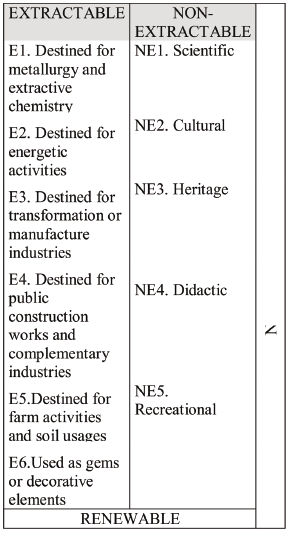
<body><![CDATA[<p><font size="2" face="Verdana, Arial, Helvetica, sans-serif">We assume that a geological resource is any solid, gas, or liquid element that is in or on the earth's crust and in optimum concentration for its exploitation. However, in our opinion this definition still remains incomplete and we consider as resources all those geological elements that have a scientific, landscaping, or patrimonial value, and especially those with a didactic value. For example, Riba [1] gives an extensive definition and describes natural resources as goods obtained from nature, along the ground, subsoil, water, etc. that are necessary to satisfy human needs. A similar conception of natural resources is found in the definition of Foley, McKenzie, and Utgard [2] in which knowledge plays a central role in the accomplishment of human needs. Both definitions stress the importance of the didactic value.</font></p>     <p><font size="2" face="Verdana, Arial, Helvetica, sans-serif">This article presents a new classification of geological resources that puts both the typical resources and the didactic-type resources in the same hierarchical ranking.</font></p>     <p>&nbsp;</p>     <p><b><font size="3" face="Verdana, Arial, Helvetica, sans-serif">2. ANALYSIS OF THE GEOLOGICAL RESOURCES CLASSIFICATION </font></b></p>     <p><font size="2" face="Verdana, Arial, Helvetica, sans-serif">Not too long ago, the knowledge of geology was mainly based on the geological history of Earth and its natural resources, which are essential components of our daily lives. It is important to notice that any element present in the environment has its origins in a geological material (for example the fuel for vehicles and means of transport, the chairs we sit on, the frames of our glasses, etc.). Thus, our society depends on geological resources to such an extent that these resources have conditioned the subsistence of the human being and the evolution of the planet itself.</font></p>     <p><font size="2" face="Verdana, Arial, Helvetica, sans-serif">This reality has led to a traditional characterization and classification of resources based on purely economic criteria, which is not an inheritance of the US Geological Survey classifications. For example, the Dictionary of Geology [1] defines the term geological resource as any solid, gas or liquid element that is in or on the earth's crust and that is presented in optimum concentrations for its exploitation.</font></p>     <p><font size="2" face="Verdana, Arial, Helvetica, sans-serif">In accordance with this definition, Brobst and Pratt [3] have classified natural resources into reserves and resources, among which they distinguish between renewable and non-renewable.</font></p>     <p><font size="2" face="Verdana, Arial, Helvetica, sans-serif">On the other hand, geological resources have been divided into different types according to their characteristics, properties, and origins, but without regard for their possible multiple uses or profitability.</font></p>     <p><font size="2" face="Verdana, Arial, Helvetica, sans-serif">Several classifications have been suggested by different authors. In accordance with these classifications, it can be determined that mineral resources have traditionally been classified as: industrial or non-metallic, metallic, mineral, energetic materials, rocks and gems. This classification has been in force during the 70s, 80s, and 90s, and it has been updated with modifications introduced by governments or by the technical and scientific entities of each country. </font></p>     <p><font size="2" face="Verdana, Arial, Helvetica, sans-serif">Some national governments hold specific classifications, for example the Spanish Government establishes the same groups as the ones depicted in the nation's Law of Mines [4] which include: resources of section A: stone; resources of section B: ground water, mining-medicinal water, thermal water; resources of section C: minerals; and resources of section D: energetic materials.</font></p>     ]]></body>
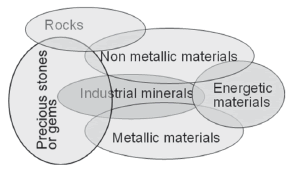
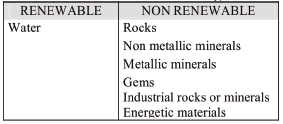
<body><![CDATA[<p><font size="2" face="Verdana, Arial, Helvetica, sans-serif">Precisely, the individual classifications adopted by each national government show the low level of practical utility that traditional classifications have. This fact points to the need for us to regulate geological resources considering the particular socioeconomic situation of a given region, even though the individual classifications are seemingly biased by the traditional classifications and therefore follow the same pattern as the traditional classifications.</font></p>     <p><font size="2" face="Verdana, Arial, Helvetica, sans-serif">A breakthrough classification is the proposal of Ord&oacute;&ntilde;ez et al. [5] that divides the resources into: energetic, raw materials for industry, hydraulic, edaphic, and cultural-landscaping. The approach held by the authors tries to extend the term geological resource. </font></p>     <p><font size="2" face="Verdana, Arial, Helvetica, sans-serif">Currently, different authors have adopted the term cultural geo-resources when referring to geological elements that have contributed to a high scientific and didactic value [5].</font></p>     <p>&nbsp;</p>     <p><font size="3" face="Verdana, Arial, Helvetica, sans-serif"><b>3. THE DRAWBACKS OF THE TRADITIONAL CLASSIFICATION</b></font></p>     <p><font size="2" face="Verdana, Arial, Helvetica, sans-serif">The traditional classification of resources (<a href="#tab01">Table 1</a>) holds some practical drawbacks if we analyze its application within social and economic activity. Specifically, three inherent problems can be highlighted: </font></p>     <p align="center"><font size="2" face="Verdana, Arial, Helvetica, sans-serif"><b><a name="tab01"></a>Table 1. </b>Traditional classification of geo-resources</font>    <br>   <img src="/img/revistas/dyna/v78n170/a29tab01.gif"></p>     <p><font size="2" face="Verdana, Arial, Helvetica, sans-serif">The first problem is that the classification referred to does not contemplate the possibility of a resource being included simultaneously in two different groups. For example, is it not possible that an energetic material may also be an industrial mineral? Cannot a metallic mineral be an industrial mineral too? Do rocks not have an industrial use?</font></p>     <p><font size="2" face="Verdana, Arial, Helvetica, sans-serif">In fact, many metallic minerals are industrial minerals too, so there is an overlap among the different groups (<a href="#fig01">Fig. 1</a>).</font></p>     ]]></body>
<body><![CDATA[<p align="center"><font size="2" face="Verdana, Arial, Helvetica, sans-serif"><a name="fig01"></a><b><img src="/img/revistas/dyna/v78n170/a29fig01.gif">    <br>   Figure 1.</b> Graphic outline of the overlap among different groups of geological resources [7]</font></p>     <p><font size="2" face="Verdana, Arial, Helvetica, sans-serif">The second problem is that there is only a hierarchical and semantic order: renewable and non-renewable. But when we consider the subgroups renewable and non-renewable, we observe that there is no hierarchical level and that the substantives assigned to describe the subgroups do not share the same root words, and therefore the semantic criteria is not sustained. Consequently, we are not able to know which group is more important and it is difficult to enlarge the classification in an orderly way. </font></p>     <p><font size="2" face="Verdana, Arial, Helvetica, sans-serif">The third problem is that the traditional classification is not adapted to the current trends of sustainable development, as is described in the 1992 Rio Conference. Only the elements that have some economic value are considered to be being resources in the traditional classification, and the other elements that present social or educational profits are discarded. In this regard, it is fundamental to have the resources that will be used in education included therein.</font></p>     <p><font size="2" face="Verdana, Arial, Helvetica, sans-serif">Some authors have gauged this last problem, and have introduced some definitions of the geological resource terms that take human and not just economic needs into consideration. For example, the Dictionary of Geology [1] offers the following definition of natural resource: &quot;any natural asset obtained from nature, along the ground, subsoil, water, etc. to satisfy human needs.&quot; Similarly, Foley et al. [2], UNESCO and PROGEO [6] have introduced these considerations in their programs to catalogue the geological patrimony.</font></p>     <p>&nbsp;</p>     <p><font size="3" face="Verdana, Arial, Helvetica, sans-serif"><b>4. A NEW CLASSIFICATION FOR GEOLOGICAL RESOURCES </b></font></p>     <p><font size="2" face="Verdana, Arial, Helvetica, sans-serif">As stated above, the traditional classification does not entirely fit in with the current trends in geology which are aimed at protecting, preserving, and spreading the knowledge of geological elements of scientific and didactic interest. Such a classification does not consider those outcrops, materials, structures or geological processes that present a didactic value (and do not have an economic interest) to be resources; and neither does it contemplate the guidelines stated in the 1992 Rio Conference. Thus, all those geological elements that have value should be catalogued as an economic, social, scientific, landscaping, patrimonial, or didactic resource.</font></p>     <p><font size="2" face="Verdana, Arial, Helvetica, sans-serif">The drawback that impedes progress is that although the patrimony or the geological resources of cultural, scientific, and didactic types have been included within the classifications of geological resources, how to fit these resources correctly into the subgroups or categories defined by the classifications has not been dealt with, since they have not been placed on a hierarchical and semantic scale. Thus, these resources have only been referred to as cultural resources, cultural geo-resources, or patrimonial resources.</font></p>     <p><font size="2" face="Verdana, Arial, Helvetica, sans-serif">One of the first approaches to the inclusion of the geological resources of a cultural type into the same level than the rest of the resources is that of Elizaga [8] in which the so-called cultural geo-resources are introduced. This approach has been widely accepted up to the present time and it constitutes an important milestone. Nevertheless, it does not achieve placing patrimonial type resources at the same level than the rest of the resources, but rather, establishes them as a mere addition.</font></p>     ]]></body>
<body><![CDATA[<p><font size="2" face="Verdana, Arial, Helvetica, sans-serif">On the other hand, the so-called cultural or patrimonial geo-resources have been mainly classified according to their physical or genetic characteristics into different groups: tectonic, volcanic, stratigraphical, geomorphological, and mineralogical [9]. This classification is very suitable for cataloguing patrimony, and it has been employed in the majority of inventories and catalogues carried out. But, as it focuses on purely geological aspects, it is not quite effective for use in entities not devoted to geology.</font></p>     <p><font size="2" face="Verdana, Arial, Helvetica, sans-serif">The classification suggested in this paper attempts to classify the geological resources, including the so-called cultural geo-resources, considering their potential and usage. It is structured into two main groups: extractable and non-extractable geological resources.</font></p>     <p><font size="2" face="Verdana, Arial, Helvetica, sans-serif">The non-extractable group includes those outcrops, elements, or geological processes that present a cultural, scientific, didactic, patrimonial, or recreational value. According to this order of ideas, the so-called geo-resources are integrated into the same level as the rest of the economic resources.</font></p>     <p><font size="2" face="Verdana, Arial, Helvetica, sans-serif">The extractable resources group includes any solid, gas, or liquid element that is in or on the earth's crust in optimum concentration for its exploitation. Also, the extraction of these resources must be a basic element for the subsistence of society and therefore does not generate irreversible natural, social, or educational impacts.</font></p>     <p><font size="2" face="Verdana, Arial, Helvetica, sans-serif">The proposed classification considers non-extractable resources to be any solid, gas, or liquid element, or any geological process that is found in or on the earth's crust and that has some optimum characteristics that make it suitable to be used in educational and/or cultural activities, or that favors the sustainable development of society and therefore increases human quality of life. This is why conservation and advising protection are needed to assure sustainable extraction. In accordance with this new classification, it is also necessary to redefine the concept of reserve.</font></p>     <p><font size="2" face="Verdana, Arial, Helvetica, sans-serif">All known and identified resources that can be exploited with an economic, social, cultural, touristic, scientific, and/or educational profit, and that benefit social needs, will be considered as reserves. The classification proposed for the first group includes different subgroups, each of which sustains the hierarchical level with respect to the other ones and the semantic level, since it is recommended to denominate each subgroup with the beginning words &quot;destined for...&quot; or &quot;used as...&quot;.</font></p>     <p><font size="2" face="Verdana, Arial, Helvetica, sans-serif">The classification introduced in this paper achieves the three main goals of any systematic classification:</font></p> <ol>       <li><font size="2" face="Verdana, Arial, Helvetica, sans-serif">Resources that have a non-limited scientific, cultural, patrimonial, or didactic value are included within the classification of resources of economic value.</font></li>       <li><font size="2" face="Verdana, Arial, Helvetica, sans-serif">The new types of resources, which are in the same hierarchical and semantic rank sustaining the levels of classification together with the typical resources, are integrated in the classification and therefore they are not included as an addition or appendix.</font></li>       <li><font size="2" face="Verdana, Arial, Helvetica, sans-serif">The resources are classified according to their characteristics, properties, and utilities, and not only considering the characteristics themselves as it was done up to a few years ago.</font></li>       ]]></body>
<body><![CDATA[<li><font size="2" face="Verdana, Arial, Helvetica, sans-serif">A single resource is not limited to one field alone, since that resource can present multiple benefits.</font></li>     </ol>     <p><font size="2" face="Verdana, Arial, Helvetica, sans-serif">The proposed classification is detailed on <a href="#tab02">Table 2</a>, and it should be complemented with the classification of Mata-Perell&oacute; [10] for the group of extractable resources.</font></p>     <p align="center"><font size="2" face="Verdana, Arial, Helvetica, sans-serif"><b><a name="tab02"></a>Table 2.</b> Reclassification of geological resources</font>    <br>   <img src="/img/revistas/dyna/v78n170/a29tab02.gif"></p>     <p><font size="2" face="Verdana, Arial, Helvetica, sans-serif">In view of the simplicity of this new classification and of its ease of use, we consider it to be unnecessary to make an explanatory description beyond what is seen on the table.</font></p>     <p><font size="2" face="Verdana, Arial, Helvetica, sans-serif">A second level of division for each group of extractable resource is detailed below:</font></p>     <p><font size="2" face="Verdana, Arial, Helvetica, sans-serif"><b>E1. GEOLOGICAL MATERIALS DESTINED FOR METALLURGY AND CHEMISTRY</b></font></p>     <blockquote>       <p><font size="2" face="Verdana, Arial, Helvetica, sans-serif">1.1 Minerals and applications of metallic chemical elements    ]]></body>
<body><![CDATA[<br>     </font><font size="2" face="Verdana, Arial, Helvetica, sans-serif">1.2 Sources of non-metallic chemical elements    <br>     </font><font size="2" face="Verdana, Arial, Helvetica, sans-serif">1.3 Melt materials and refractory materials [11]</font></p> </blockquote>     <p><font size="2" face="Verdana, Arial, Helvetica, sans-serif"><b>E2. GEOLOGICAL MATERIALS DESTINED FOR ENERGETIC ACTIVITIES</b></font></p>     <blockquote>       <p><font size="2" face="Verdana, Arial, Helvetica, sans-serif">2.1 Minerals of radioactive elements used in nuclear fission    <br>     </font><font size="2" face="Verdana, Arial, Helvetica, sans-serif">2.2 Geological materials used in nuclear fusion    <br>     </font><font size="2" face="Verdana, Arial, Helvetica, sans-serif">2.3 Geological materials used in thermoelectric plants    <br>     </font><font size="2" face="Verdana, Arial, Helvetica, sans-serif">2.4 Geological materials used in hydroelectric energy    <br>     </font><font size="2" face="Verdana, Arial, Helvetica, sans-serif">2.5 Geological materials used for tidal energy    <br>     </font><font size="2" face="Verdana, Arial, Helvetica, sans-serif">2.6 Geological materials used for geothermal energy    ]]></body>
<body><![CDATA[<br>     </font><font size="2" face="Verdana, Arial, Helvetica, sans-serif">2.7 Materials used in obtaining solar energy    <br>     </font><font size="2" face="Verdana, Arial, Helvetica, sans-serif">2.8 Materials used in obtaining wind power</font></p> </blockquote>     <p><font size="2" face="Verdana, Arial, Helvetica, sans-serif"><b>E3. GEOLOGICAL MATERIALS DESTINED FOR HEAVY TRANSFORMATION OR MANUFACTURE INDUSTRIES</b></font></p>     <blockquote>       <p><font size="2" face="Verdana, Arial, Helvetica, sans-serif">3.1 Materials destined for heavy industry and agronomic activities (fertilizers, pesticides, and micronutrients are also included)    <br>     </font><font size="2" face="Verdana, Arial, Helvetica, sans-serif">3.2 Materials destined for the asphalt industry    <br>     </font><font size="2" face="Verdana, Arial, Helvetica, sans-serif">3.3 Materials destined for the rubber industry    <br>     </font><font size="2" face="Verdana, Arial, Helvetica, sans-serif">3.4 Materials destined for the pottery industry    <br>     </font><font size="2" face="Verdana, Arial, Helvetica, sans-serif">3.5 Materials destined for the cosmetic and perfume industry    <br>     </font><font size="2" face="Verdana, Arial, Helvetica, sans-serif">3.6 Materials destined for the detergent and soap industry    ]]></body>
<body><![CDATA[<br>     </font><font size="2" face="Verdana, Arial, Helvetica, sans-serif">3.7 Materials destined for the electrical power industry    <br>     </font><font size="2" face="Verdana, Arial, Helvetica, sans-serif">3.8 Materials destined for the electronic industry (including laser)    <br>     </font><font size="2" face="Verdana, Arial, Helvetica, sans-serif">3.9 Materials destined for the explosives and fuel industries    <br>     </font><font size="2" face="Verdana, Arial, Helvetica, sans-serif">3.10 Materials destined for the medical industry (including antiseptic materials and purifiers of waters)    <br>     </font><font size="2" face="Verdana, Arial, Helvetica, sans-serif">3.11 Materials destined for the cold and heat industry (including preservatives)    <br>     </font><font size="2" face="Verdana, Arial, Helvetica, sans-serif">3.12 Materials destined for the mechanical industry (including abrasive materials)    <br>     </font><font size="2" face="Verdana, Arial, Helvetica, sans-serif">3.13 Materials destined for the mining and geological industries (the ones related with the surveys are included, too)    <br>     </font><font size="2" face="Verdana, Arial, Helvetica, sans-serif">3.14 Materials destined for the optic industries    <br>     </font><font size="2" face="Verdana, Arial, Helvetica, sans-serif">3.15 Materials destined for the wastepaper basket industry    <br>     </font><font size="2" face="Verdana, Arial, Helvetica, sans-serif">3.16 Materials destined for the adhesives industry    ]]></body>
<body><![CDATA[<br>     </font><font size="2" face="Verdana, Arial, Helvetica, sans-serif">3.17 Materials destined for the pyrotechnic industry    <br>     </font><font size="2" face="Verdana, Arial, Helvetica, sans-serif">3.18 Materials destined for the plastic industry    <br>     </font><font size="2" face="Verdana, Arial, Helvetica, sans-serif">3.19 Materials destined for the chemical industry    <br>     </font><font size="2" face="Verdana, Arial, Helvetica, sans-serif">3.20 Materials destined for the watch industry    <br>     </font><font size="2" face="Verdana, Arial, Helvetica, sans-serif">3.21 Materials destined for the coir industry    <br>     </font><font size="2" face="Verdana, Arial, Helvetica, sans-serif">3.22 Materials destined for the textile industry    <br>     </font><font size="2" face="Verdana, Arial, Helvetica, sans-serif">3.23 Materials destined for the transport industry    <br>     </font><font size="2" face="Verdana, Arial, Helvetica, sans-serif">3.24 Materials destined for the glass industry    <br>     </font><font size="2" face="Verdana, Arial, Helvetica, sans-serif">3.25 Materials used as absorbents in different industries    <br>     </font><font size="2" face="Verdana, Arial, Helvetica, sans-serif">3.26 Materials used as binders in different industries    ]]></body>
<body><![CDATA[<br>     </font><font size="2" face="Verdana, Arial, Helvetica, sans-serif">3.27 Materials used as insulators in different industries    <br>     </font><font size="2" face="Verdana, Arial, Helvetica, sans-serif">3.28 Materials used as antifreeze    <br>     </font><font size="2" face="Verdana, Arial, Helvetica, sans-serif">3.29 Materials used as industrial materials in different activities    <br>     </font><font size="2" face="Verdana, Arial, Helvetica, sans-serif">3.30 Materials used as lubricants in different industrial activities    <br>     </font><font size="2" face="Verdana, Arial, Helvetica, sans-serif">3.31 Materials used as industrial pigments, dyes, tinges and colors (leads -of pencil- are also included)</font></p> </blockquote>     <p><font size="2" face="Verdana, Arial, Helvetica, sans-serif"><b>E4. DESTINED FOR THE CONSTRUCTION, IN PUBLIC WORKS AND IN RELATED INDUSTRIES OF COMPLEMENTS.</b></font></p>     <blockquote>       <p><font size="2" face="Verdana, Arial, Helvetica, sans-serif">4.1 Geological materials used in the construction of walls, coatings and roofs    <br>     </font><font size="2" face="Verdana, Arial, Helvetica, sans-serif">4.2 Metallic materials used in the manufacture of structures in construction and in public works    <br>     </font><font size="2" face="Verdana, Arial, Helvetica, sans-serif">4.3 Geological materials used in binders    ]]></body>
<body><![CDATA[<br>     </font><font size="2" face="Verdana, Arial, Helvetica, sans-serif">4.4 Geological materials used in the manufacture of ceramic materials [12]    <br>     </font><font size="2" face="Verdana, Arial, Helvetica, sans-serif">4.5 Geological materials used in the manufacture of glasses    <br>     </font><font size="2" face="Verdana, Arial, Helvetica, sans-serif">4.6 Geological materials used in obtaining pigments and mineral colors    <br>     </font><font size="2" face="Verdana, Arial, Helvetica, sans-serif">4.7 Geological materials used as insulators</font></p> </blockquote>     <p><font size="2" face="Verdana, Arial, Helvetica, sans-serif"><b>E5. DESTINED FOR FARM ACTIVITIES AND SOIL USAGES.</b></font></p>     <blockquote>       <p><font size="2" face="Verdana, Arial, Helvetica, sans-serif">5.1 Geological materials or processes to help in developing agronomic zones    <br>     </font><font size="2" face="Verdana, Arial, Helvetica, sans-serif">5.2 Geological materials used to improve farm or agronomic activities    <br>     </font><font size="2" face="Verdana, Arial, Helvetica, sans-serif">5.3 Geological materials, outcrops o reprocesses to maintain the adequate soil conditions or to reduce its vulnerability</font></p> </blockquote>     <p><font size="2" face="Verdana, Arial, Helvetica, sans-serif"><b>E6. GEOLOGICAL MATERIALS (OR WORKED) USED AS GEMS, OR ORNAMENTAL MATERIALS.</b></font></p>     ]]></body>
<body><![CDATA[<blockquote>       <p><font size="2" face="Verdana, Arial, Helvetica, sans-serif">A subdivision for non-extractable is not included, as it depends on the specific needs and characteristics of every zone.</font></p> </blockquote>     <p>&nbsp;</p>     <p><font size="3" face="Verdana, Arial, Helvetica, sans-serif"><b>5. CONCLUSIONS</b></font></p>     <p><font size="2" face="Verdana, Arial, Helvetica, sans-serif">The classification presented in this paper holds important advantages, especially in the field of education and more specifically in the first levels of education to help students understand that one resource belongs to one group or another depending on its use, the type of resource an outcrop is, or that a bed of chalks has portrayed a formation to itself (as for example a bed of iron). This would enhance a global perception of the environment. </font></p>     <p><font size="2" face="Verdana, Arial, Helvetica, sans-serif">On the other hand, the application of this classification simplifies the development of studies like evaluations of environmental impacts or the development of special plans for natural spaces management, and it also facilitates the management of protected zones.</font></p>     <p><font size="2" face="Verdana, Arial, Helvetica, sans-serif">Mackeley [13] evaluates the importance of geological resources in society considering the level or quality of life. He formulates (1) that the standard of living (L) depends on natural resources (R), energy (E), capacity of inventiveness (I) and population (P).</font></p>     <p><font size="2" face="Verdana, Arial, Helvetica, sans-serif"> L = (R&middot;E&middot;I) / P (1)</font></p>     <p><font size="2" face="Verdana, Arial, Helvetica, sans-serif">Until not too long ago, the USGS only considered and introduced in the calculation the resources of an economic type, in part due to the difficulty of including geo-cultural resources at the same level.</font></p>     <p><font size="2" face="Verdana, Arial, Helvetica, sans-serif">The new classification proposed in this paper, enables us to perform the evaluation considering both the extractable and the non-extractable resources at the same rank. Thus, now the quality of life also depends on geological resources that do not offer a direct economic benefit but offer a patrimonial interest.</font></p>     ]]></body>
<body><![CDATA[<p>&nbsp;</p>     <p><font size="3" face="Verdana, Arial, Helvetica, sans-serif"><b>REFERENCES</b></font></p>     <!-- ref --><p><font size="2" face="Verdana, Arial, Helvetica, sans-serif"><b>[1]</b> Riba, O., ET AL., Diccionari de Geologia. Pub. Institut d´Estudis Catalans. Enciclopèdia de Catalunya, Barcelona, 1407 P. 1998.     &nbsp;&nbsp;&nbsp;&nbsp;&nbsp;&nbsp;&nbsp;&nbsp;[&#160;<a href="javascript:void(0);" onclick="javascript: window.open('/scielo.php?script=sci_nlinks&ref=000145&pid=S0012-7353201100060002900001&lng=','','width=640,height=500,resizable=yes,scrollbars=1,menubar=yes,');">Links</a>&#160;]<!-- end-ref --><!-- ref --><br>   <b>[2]</b> Foley, D., Mckenzie, G., and Utgard, R., Investigations in Environmental Geology, Prentice-Hall, New Jersey, 1999.     &nbsp;&nbsp;&nbsp;&nbsp;&nbsp;&nbsp;&nbsp;&nbsp;[&#160;<a href="javascript:void(0);" onclick="javascript: window.open('/scielo.php?script=sci_nlinks&ref=000146&pid=S0012-7353201100060002900002&lng=','','width=640,height=500,resizable=yes,scrollbars=1,menubar=yes,');">Links</a>&#160;]<!-- end-ref --><!-- ref --><br>   <b>[3]</b> Brobst, D. and Pratt, W., United States Mineral Resources, U.S. Geological Survey Professional Paper 820 P., 1973.     &nbsp;&nbsp;&nbsp;&nbsp;&nbsp;&nbsp;&nbsp;&nbsp;[&#160;<a href="javascript:void(0);" onclick="javascript: window.open('/scielo.php?script=sci_nlinks&ref=000147&pid=S0012-7353201100060002900003&lng=','','width=640,height=500,resizable=yes,scrollbars=1,menubar=yes,');">Links</a>&#160;]<!-- end-ref --><!-- ref --><br>   <b>[4]</b> LEY DE MINAS, Ley 22/1973 de 21 de julio de Minas. Espa&ntilde;a, 1973.     &nbsp;&nbsp;&nbsp;&nbsp;&nbsp;&nbsp;&nbsp;&nbsp;[&#160;<a href="javascript:void(0);" onclick="javascript: window.open('/scielo.php?script=sci_nlinks&ref=000148&pid=S0012-7353201100060002900004&lng=','','width=640,height=500,resizable=yes,scrollbars=1,menubar=yes,');">Links</a>&#160;]<!-- end-ref --><!-- ref --><br>   <b>[5]</b> Ord&oacute;&ntilde;ez, S., Calvo, J.P., Lunar, R. and Lopez Vera, F., Concepto y tipos de recursos naturales, Geolog&iacute;a y Medio Ambiente. CEOTMA, Madrid, 1981.     &nbsp;&nbsp;&nbsp;&nbsp;&nbsp;&nbsp;&nbsp;&nbsp;[&#160;<a href="javascript:void(0);" onclick="javascript: window.open('/scielo.php?script=sci_nlinks&ref=000149&pid=S0012-7353201100060002900005&lng=','','width=640,height=500,resizable=yes,scrollbars=1,menubar=yes,');">Links</a>&#160;]<!-- end-ref --><!-- ref --><br>   <b>[6]</b> Parkes M. (ED.), Natural and Cultural Landscapes, The Geological Foundation. Proceedings of a conference and the ProGEO Third General Assembly. Dublin Castle, Ireland. Royal Irish Academy, 9-11 September 2002.     &nbsp;&nbsp;&nbsp;&nbsp;&nbsp;&nbsp;&nbsp;&nbsp;[&#160;<a href="javascript:void(0);" onclick="javascript: window.open('/scielo.php?script=sci_nlinks&ref=000150&pid=S0012-7353201100060002900006&lng=','','width=640,height=500,resizable=yes,scrollbars=1,menubar=yes,');">Links</a>&#160;]<!-- end-ref --><!-- ref --><br>   <b>[7]</b> Bennet, M and Doyle, P., Environmental Geology, John Wiley & sons Ltd. Chichester, England, 1997.     &nbsp;&nbsp;&nbsp;&nbsp;&nbsp;&nbsp;&nbsp;&nbsp;[&#160;<a href="javascript:void(0);" onclick="javascript: window.open('/scielo.php?script=sci_nlinks&ref=000151&pid=S0012-7353201100060002900007&lng=','','width=640,height=500,resizable=yes,scrollbars=1,menubar=yes,');">Links</a>&#160;]<!-- end-ref --><!-- ref --><br>   <b>[8]</b> Elizaga, E., Georrecursos culturales, In: Geolog&iacute;a Ambiental (Eds. Ayala-Carcedo and Jord&aacute; Pardo), IGME, pp. 85-100, 1988.     &nbsp;&nbsp;&nbsp;&nbsp;&nbsp;&nbsp;&nbsp;&nbsp;[&#160;<a href="javascript:void(0);" onclick="javascript: window.open('/scielo.php?script=sci_nlinks&ref=000152&pid=S0012-7353201100060002900008&lng=','','width=640,height=500,resizable=yes,scrollbars=1,menubar=yes,');">Links</a>&#160;]<!-- end-ref --><!-- ref --><br>   <b>[9]</b> Ayala-Carcedo, F.J., et al., Geolog&iacute;a y Medio Ambiente. Gu&iacute;a did&aacute;ctica y colecci&oacute;n de diapositivas, Instituto Geol&oacute;gico y Minero de Espa&ntilde;a (IGME), Madrid, 1998.     &nbsp;&nbsp;&nbsp;&nbsp;&nbsp;&nbsp;&nbsp;&nbsp;[&#160;<a href="javascript:void(0);" onclick="javascript: window.open('/scielo.php?script=sci_nlinks&ref=000153&pid=S0012-7353201100060002900009&lng=','','width=640,height=500,resizable=yes,scrollbars=1,menubar=yes,');">Links</a>&#160;]<!-- end-ref --><!-- ref --><br>   <b>[10]</b> Mata-Perell&oacute;, J.M., Unpublished: Los materiales geol&oacute;gicos y su aprovechamiento por la sociedad, UPC, 1996.     &nbsp;&nbsp;&nbsp;&nbsp;&nbsp;&nbsp;&nbsp;&nbsp;[&#160;<a href="javascript:void(0);" onclick="javascript: window.open('/scielo.php?script=sci_nlinks&ref=000154&pid=S0012-7353201100060002900010&lng=','','width=640,height=500,resizable=yes,scrollbars=1,menubar=yes,');">Links</a>&#160;]<!-- end-ref --><!-- ref --><br>   <b>[11]</b> P&eacute;rez, G.Z; Vargas, Y.C. y C&oacute;rdoba, E.M., Beneficio de arcilla caolin&iacute;tica de la regi&oacute;n de Barichara (Santander) para la fabricaci&oacute;n de refractarios. Revista Dyna, Nº 164 (diciembre de 2010), vol 77, Revista Dyna, pp.28-38. 2010     &nbsp;&nbsp;&nbsp;&nbsp;&nbsp;&nbsp;&nbsp;&nbsp;[&#160;<a href="javascript:void(0);" onclick="javascript: window.open('/scielo.php?script=sci_nlinks&ref=000155&pid=S0012-7353201100060002900011&lng=','','width=640,height=500,resizable=yes,scrollbars=1,menubar=yes,');">Links</a>&#160;]<!-- end-ref --><!-- ref --><br>   <b>[12]</b> Santos, J.D; Malag&oacute;n, P.Y. y C&oacute;rdoba, E.M., Caracterizaci&oacute;n de arcillas y preparaci&oacute;n de pastas cer&aacute;micas para la fabricaci&oacute;n de tejas y ladrillos en la regi&oacute;n de Barichara, Santander. Nº 167 (junio de 2011), vol 78, Revista Dyna, pp.49-58. 2011     &nbsp;&nbsp;&nbsp;&nbsp;&nbsp;&nbsp;&nbsp;&nbsp;[&#160;<a href="javascript:void(0);" onclick="javascript: window.open('/scielo.php?script=sci_nlinks&ref=000156&pid=S0012-7353201100060002900012&lng=','','width=640,height=500,resizable=yes,scrollbars=1,menubar=yes,');">Links</a>&#160;]<!-- end-ref --><!-- ref --><br>   <b>[13]</b> Mckelvey, V., Mineral resource estimates and public policy, In: Mineral Resources (Eds. Brobst and Pratt), U.S. Geological Survey Professional Paper 820, pp. 9-19, 1973. </font>&nbsp;&nbsp;&nbsp;&nbsp;&nbsp;&nbsp;&nbsp;&nbsp;[&#160;<a href="javascript:void(0);" onclick="javascript: window.open('/scielo.php?script=sci_nlinks&ref=000157&pid=S0012-7353201100060002900013&lng=','','width=640,height=500,resizable=yes,scrollbars=1,menubar=yes,');">Links</a>&#160;]<!-- end-ref --> ]]></body><back>
<ref-list>
<ref id="B1">
<label>1</label><nlm-citation citation-type="book">
<person-group person-group-type="author">
<name>
<surname><![CDATA[Riba]]></surname>
<given-names><![CDATA[O.]]></given-names>
</name>
</person-group>
<source><![CDATA[Diccionari de Geologia]]></source>
<year>1998</year>
<publisher-loc><![CDATA[Barcelona ]]></publisher-loc>
<publisher-name><![CDATA[Institut d´Estudis Catalans]]></publisher-name>
</nlm-citation>
</ref>
<ref id="B2">
<label>2</label><nlm-citation citation-type="book">
<person-group person-group-type="author">
<name>
<surname><![CDATA[Foley]]></surname>
<given-names><![CDATA[D.]]></given-names>
</name>
<name>
<surname><![CDATA[Mckenzie]]></surname>
<given-names><![CDATA[G.]]></given-names>
</name>
<name>
<surname><![CDATA[Utgard]]></surname>
<given-names><![CDATA[R.]]></given-names>
</name>
</person-group>
<source><![CDATA[Investigations in Environmental Geology]]></source>
<year>1999</year>
<publisher-loc><![CDATA[New Jersey ]]></publisher-loc>
<publisher-name><![CDATA[Prentice-Hall]]></publisher-name>
</nlm-citation>
</ref>
<ref id="B3">
<label>3</label><nlm-citation citation-type="">
<person-group person-group-type="author">
<name>
<surname><![CDATA[Brobst]]></surname>
<given-names><![CDATA[D.]]></given-names>
</name>
<name>
<surname><![CDATA[Pratt]]></surname>
<given-names><![CDATA[W.]]></given-names>
</name>
</person-group>
<source><![CDATA[United States Mineral Resources: U.S. Geological Survey Professional Paper]]></source>
<year>1973</year>
</nlm-citation>
</ref>
<ref id="B4">
<label>4</label><nlm-citation citation-type="">
<source><![CDATA[LEY DE MINAS: Ley 22/1973 de 21 de julio de Minas]]></source>
<year>1973</year>
</nlm-citation>
</ref>
<ref id="B5">
<label>5</label><nlm-citation citation-type="journal">
<person-group person-group-type="author">
<name>
<surname><![CDATA[Ordóñez]]></surname>
<given-names><![CDATA[S.]]></given-names>
</name>
<name>
<surname><![CDATA[Calvo]]></surname>
<given-names><![CDATA[J.P.]]></given-names>
</name>
<name>
<surname><![CDATA[Lunar]]></surname>
<given-names><![CDATA[R.]]></given-names>
</name>
<name>
<surname><![CDATA[Lopez Vera]]></surname>
<given-names><![CDATA[F.]]></given-names>
</name>
</person-group>
<article-title xml:lang="es"><![CDATA[Concepto y tipos de recursos naturales]]></article-title>
<source><![CDATA[Geología y Medio Ambiente]]></source>
<year>1981</year>
<publisher-loc><![CDATA[Madrid ]]></publisher-loc>
</nlm-citation>
</ref>
<ref id="B6">
<label>6</label><nlm-citation citation-type="confpro">
<person-group person-group-type="author">
<name>
<surname><![CDATA[Parkes]]></surname>
<given-names><![CDATA[M.]]></given-names>
</name>
</person-group>
<article-title xml:lang="en"><![CDATA[Natural and Cultural Landscapes, The Geological Foundation]]></article-title>
<source><![CDATA[]]></source>
<year></year>
<conf-name><![CDATA[ Proceedings of a conference and the ProGEO Third General Assembly]]></conf-name>
<conf-date>9-11 September 2002</conf-date>
<conf-loc>Dublin Castle </conf-loc>
</nlm-citation>
</ref>
<ref id="B7">
<label>7</label><nlm-citation citation-type="book">
<person-group person-group-type="author">
<name>
<surname><![CDATA[Bennet]]></surname>
<given-names><![CDATA[M]]></given-names>
</name>
<name>
<surname><![CDATA[Doyle]]></surname>
<given-names><![CDATA[P.]]></given-names>
</name>
</person-group>
<source><![CDATA[Environmental Geology]]></source>
<year>1997</year>
<publisher-loc><![CDATA[Chichester ]]></publisher-loc>
<publisher-name><![CDATA[John Wiley & sons Ltd.]]></publisher-name>
</nlm-citation>
</ref>
<ref id="B8">
<label>8</label><nlm-citation citation-type="book">
<person-group person-group-type="author">
<name>
<surname><![CDATA[Elizaga]]></surname>
<given-names><![CDATA[E.]]></given-names>
</name>
</person-group>
<article-title xml:lang="es"><![CDATA[Georrecursos culturales]]></article-title>
<person-group person-group-type="editor">
<name>
<surname><![CDATA[Ayala-Carcedo]]></surname>
</name>
<name>
<surname><![CDATA[Pardo]]></surname>
<given-names><![CDATA[Jordá]]></given-names>
</name>
</person-group>
<source><![CDATA[Geología Ambiental]]></source>
<year>1988</year>
<page-range>85-100</page-range><publisher-name><![CDATA[IGME]]></publisher-name>
</nlm-citation>
</ref>
<ref id="B9">
<label>9</label><nlm-citation citation-type="book">
<person-group person-group-type="author">
<name>
<surname><![CDATA[Ayala-Carcedo]]></surname>
<given-names><![CDATA[F.J.]]></given-names>
</name>
</person-group>
<source><![CDATA[Geología y Medio Ambiente: Guía didáctica y colección de diapositivas]]></source>
<year>1998</year>
<publisher-loc><![CDATA[Madrid ]]></publisher-loc>
<publisher-name><![CDATA[Instituto Geológico y Minero de España]]></publisher-name>
</nlm-citation>
</ref>
<ref id="B10">
<label>10</label><nlm-citation citation-type="book">
<person-group person-group-type="author">
<name>
<surname><![CDATA[Mata-Perelló]]></surname>
<given-names><![CDATA[J.M.]]></given-names>
</name>
</person-group>
<source><![CDATA[Unpublished: Los materiales geológicos y su aprovechamiento por la sociedad]]></source>
<year>1996</year>
<publisher-name><![CDATA[UPC]]></publisher-name>
</nlm-citation>
</ref>
<ref id="B11">
<label>11</label><nlm-citation citation-type="journal">
<person-group person-group-type="author">
<name>
<surname><![CDATA[Pérez]]></surname>
<given-names><![CDATA[G.Z]]></given-names>
</name>
<name>
<surname><![CDATA[Vargas]]></surname>
<given-names><![CDATA[Y.C.]]></given-names>
</name>
<name>
<surname><![CDATA[Córdoba]]></surname>
<given-names><![CDATA[E.M.]]></given-names>
</name>
</person-group>
<article-title xml:lang="es"><![CDATA[Beneficio de arcilla caolinítica de la región de Barichara (Santander) para la fabricación de refractarios]]></article-title>
<source><![CDATA[Revista Dyna]]></source>
<year>dici</year>
<month>em</month>
<day>br</day>
<volume>77</volume>
<numero>164</numero>
<issue>164</issue>
<page-range>28-38</page-range></nlm-citation>
</ref>
<ref id="B12">
<label>12</label><nlm-citation citation-type="journal">
<person-group person-group-type="author">
<name>
<surname><![CDATA[Santos]]></surname>
<given-names><![CDATA[J.D]]></given-names>
</name>
<name>
<surname><![CDATA[Malagón]]></surname>
<given-names><![CDATA[P.Y.]]></given-names>
</name>
<name>
<surname><![CDATA[Córdoba]]></surname>
<given-names><![CDATA[E.M.]]></given-names>
</name>
</person-group>
<article-title xml:lang="es"><![CDATA[Caracterización de arcillas y preparación de pastas cerámicas para la fabricación de tejas y ladrillos en la región de Barichara, Santander]]></article-title>
<source><![CDATA[Revista Dyna]]></source>
<year>juni</year>
<month>o </month>
<day>de</day>
<volume>78</volume>
<numero>167</numero>
<issue>167</issue>
</nlm-citation>
</ref>
<ref id="B13">
<label>13</label><nlm-citation citation-type="">
<person-group person-group-type="author">
<name>
<surname><![CDATA[Mckelvey]]></surname>
<given-names><![CDATA[V.]]></given-names>
</name>
</person-group>
<article-title xml:lang="en"><![CDATA[Mineral resource estimates and public policy]]></article-title>
<person-group person-group-type="editor">
<name>
<surname><![CDATA[Brobst]]></surname>
</name>
<name>
<surname><![CDATA[Pratt]]></surname>
</name>
</person-group>
<source><![CDATA[Mineral Resources]]></source>
<year>1973</year>
<page-range>9-19</page-range></nlm-citation>
</ref>
</ref-list>
</back>
</article>