 ]]>
Figure 1. Marginal-cost pricing for congestion
]]>
Figure 1. Marginal-cost pricing for congestionLA NECESIDAD DE PEAJE POR CONGESTIÓN EN MEDELLÍN: UNA PERSPECTIVA ECONÓMICA
CARLOS A. GONZÁLEZ-CALDERÓN
M.S. Professor, Departament of Civil and Environmental Engineering, Universidad de Antioquia, gonzalez@udea.edu.co
JOHN JAIRO POSADA HENAO
Esp. Professor, Departament of Civil Engineering, Universidad Nacional de Colombia, Sede Medellín, jjposada@unal.edu.co
IVÁN DARÍO SÁNCHEZ-DÍAZ
I.C. Research Assistant, Departament of Civil and Environmental Engineering, Rensselaer Polytechnic Institute, sanchi2@rpi.edu
]]> Received for review July 3th, 2011, accepted November 30th, 2011, final version December, 9th, 2011
ABSTRACT: This paper presents a brief description of vehicular congestion in Medellin, Colombia, and discusses the need to implement congestion pricing (CP) from an economic point of view. It describes the license plate-based traffic restriction (Pico y Placa) in the city, showing that the measure is palliative, and that the implementation of CP is necessary. A cost-benefit analysis is presented to assess the effects of implementing a hypothetical CP strategy based on data from previous studies. The first-best solution for CP is presented, and considered as the optimal policy for deciding on the congestion rate that would maximize social welfare. The main finding is that the net benefit of implementation costs is positive. Therefore, the implementation of a CP strategy is recommended to improve the efficiency of road infrastructure use in the city based on economic principles. Finally, a set of recommendations for improving the city's mobility in the future are presented.
KEYWORDS: congestion pricing, cost-benefit analysis, Medellin, vehicular restriction
RESUMEN: Se presenta una breve descripción de la congestión vehicular en Medellín, y la necesidad de implementar el sistema de peaje por congestión (PC) desde una óptica económica. Se describe la restricción a la circulación vehicular del "Pico y Placa," mostrando que la medida es paliativa y que es necesaria la implementación del PC. Se realiza un análisis costo-beneficio para valorar los efectos de implementar una estrategia en forma hipotética de PC basado en datos de investigaciones. La mejor solución debida al PC es presentada y considerada como lo óptimo para lograr encontrar la tasa de congestión que maximiza el bienestar social. El principal hallazgo es que el beneficio neto de la implementación es positivo. Por lo tanto, se recomienda la implementación del PC para mejorar la eficiencia en el uso de la infraestructura vial en la ciudad basado en principios económicos. Finalmente, se presentan algunas recomendaciones para mejorar la movilidad en la ciudad.
PALABRAS CLAVE: peaje por congestión, análisis costo-beneficio, Medellín, restricción vehicular
1. INTRODUCTION
Growth of traffic volumes has increased in recent decades in almost all cities in the world, augmenting congestion, and this is why transportation engineers must try to solve the situation suggesting the investment on road infrastructure and/or creating policies to avoid the increase of this transportation externality. Traffic congestion is a natural consequence of supply and demand: road capacity is time-consuming and costly to build, and is fixed for long time periods. The demand fluctuates over time, and transportation services are continuous, they cannot easily be stopped to smooth imbalances between capacity and demand; thus, congestion has to be studied to try to enhance mobility and accessibility.
The phenomena of congestion and pollution are currently the most important problems in urban transportation. Congestion is produced when the interference between users of a system leads to losses for all of them. Travel speed decreases according to the density on the road and increases with its capacity or width. In fact, the higher the concentration of vehicles, the more interference is produced, causing slowdowns for all users. On the other hand, increasing capacity mitigates interferences and increases travel speed [1]. In this sense, the evidence has shown that the construction of new infrastructure is not the only alternative for coping with congestion [2]. New infrastructure will induce increased vehicle volumes compared to traffic forecasts made by planners. In general, solutions implemented in Latin American cities are aimed at solving the previously mentioned problems in a pragmatic fashion sometimes due to a lack of resources. So it is necessary to analyze, for each strategy, the size of the effect, operating costs, factors of increased travel time, and pollution, in order to solve or diminish the phenomenon of congestion.
]]> Medellin, with 2,200,000 inhabitants, is part of a metropolitan area that has 3,300,000 inhabitants [3]. Buses, taxis, and the Metro de Medellín serve as public transportation in the city. According to the Valle de Aburra's 2005 Origin-Destination Survey, 4.8 million journeys take place every day (34% buses, 10% Metro, 13% automobile, and 43% others) [4]. In order to improve mobility in the city, by integrating the Metro stations with different sectors of the city, a new Bus Rapid Transit (BRT)-Metroplús- system is being implemented. In this city, traffic congestion has made the roads chaotic at peak hours. The automobile fleet is constantly increasing in an uncontrolled fashion: new private cars and taxis join the existing vehicles and public service vehicles (buses, vans, and minibuses). The result, in addition to congestion, is increased noise and pollution in the city.It is noted that Medellin has serious transport problems, especially in the absence of adequate infrastructure and strategies for enhancing mobility in the city. In 2004, some traffic studies were performed on strategic corridors. The average speed calculated was 22.1 km/h in the morning peak period and 17 km/h in the evening peak period. The average travel time in public transport was 35 minutes over an average distance of 8.75 km. Speeds on the public transport network ranged between 5 and 26 km/h [5]. The lower speeds were presented in the downtown area, with values between 5 and 13 km/h; these low speeds are due to traffic congestion and transit routing convergence in the area [6]. These results reflect the critical situation of congestion levels in the city.
From another perspective, congestion pricing (CP)-sometimes called value pricing-is a way of harnessing the power of the market to reduce the loss associated with traffic congestion [7]. Congestion pricing works by shifting purely discretionary rush hour highway travel to other transportation modes or to off-peak periods, taking advantage of the fact that the majority of rush hour drivers on a typical urban highway are not commuters. Congestion pricing benefits drivers and businesses by reducing delays and stress, increasing the predictability of trip times, and allowing for more deliveries per hour. It benefits mass transit by improving transit speeds and the reliability of transit services, increasing transit ridership, and lowering costs for transit providers.
Taking into account the above information, the main purpose of this paper is to demonstrate the necessity of implementing CP in Medellin, to overcome its mobility problems and the current inefficiency of the Pico y Placa restriction. The Cost-Benefit Analysis (CBA) proposed exposes the benefits of implementing CP in Medellin, for a specific sector of the city with a high volume of vehicles. This paper is organized as follows: The analytical framework on congestion pricing is presented in Section 2. Section 3 explains the Pico y Placa restriction in Medellin and its evolution over time. Section 4 describes a congestion pricing study in Medellin. Section 5 develops a cost-benefit analysis of the congestion pricing in the city. Finally, the main findings of this research are summarized and discussed in Section 6.
2. CONGESTION PRICING
Interest in CP has been revived extensively by economists and transportation researchers in recent years because of the growing prominence and changing nature of the urban transportation problem facing a modern city [8]. A basic economic principle is that consumers should pay directly for the costs they impose as an incentive to use resources efficiently. Congestion imposes various costs on travelers: reduced speeds and increased travel times, a decrease in travel time reliability, greater fuel consumption and vehicle wear, inconvenience from rescheduling trips or using alternative travel modes, and the costs of relocating residences and jobs. The strategy to reach this objective is to impose on users a charge equivalent to the marginal cost of congestion they cause. This strategy induces changes in mode choice and route choice that lead to an optimum use of the network [1]. The former strategy is especially valid for urban areas where charging for the use of road infrastructure on a time interval enables traffic demand to be controlled.
Various policies to curb traffic congestion have been adopted or proposed over the years. The traditional response is to expand capacity by building new roads or upgrading existing ones. A second method is to reduce demand by discouraging peak-period travel, limiting access to congested areas by using permit systems and parking restrictions, imposing bans on commercial vehicles during certain hours, and so on. A third approach is to improve the efficiency of the road system, so that the same demand can be accommodated at a lower cost. Re-timing of traffic lights, metering access to highway entrance ramps, high-occupancy vehicle lanes and advanced traveler information systems are examples of such measures [9]. Also, it has been argued that one of the key benefits of pricing for road space is to increase the reliability of journey times and therefore produce significant resource savings [10].
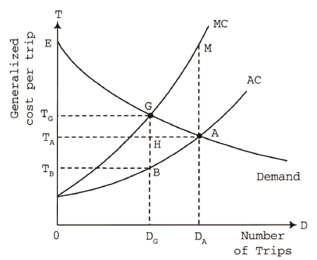
Congestion pricing has welfare distributional effects on travelers that tend to help those people with high time values. Because time value is positively correlated with income, CP is consistent with the conventional view that tolling is regressive. The theoretical background of CP has relied on the fundamental economic principle of marginal-cost pricing, which states that road users using congested roads should pay a toll equal to the difference between the marginal-social cost and the marginal-private cost in order to maximize social net benefit. Figure 1
]]>
Figure 1. Marginal-cost pricing for congestion
[8] shows that the average cost (AC) curve represents the average (private) cost of congestion at each level of demand (number of trips accomplished), and the marginal cost (MC) curve represents the marginal cost which is the additional cost of adding one extra vehicle or trip to the traffic stream. Marginal costs may be seen as "social costs" in the limited sense that they are the costs to the society of road users [8].
Yang and Huang [8] explain that any individual user entering the road will only consider the costs (AC) he or she personally bears. A driver will either be unaware of, or unwilling to consider, the external congestion costs that he or she imposes on the other road users. Therefore, the MC curve relates to the marginal social cost for the new trip-maker and the existing road users of an addition to the traffic flow, while the AC curve is equivalent to the marginal private cost or the additional cost borne and perceived by the new trip-maker alone. Button [11] shows that the difference between the AC and MC curves at any level of travel demand reflects the economic costs of congestion at that demand. Yang and Huang state that the optimal flow is, as we can see, equal to DG where marginal cost and demand are equated, while the actual demand when there is no toll tends to be DA because road users ignore the congestion that they impose on others.
From a social point of view, the actual demand, DA, is excessive because the DA-th user is only enjoying a benefit of DAA, but imposing the costs of DAM. The additional traffic beyond the optimal level DG can be seen to be generating costs equal to the area DAMGDG, but only enjoying a benefit equal to the area DAAGDG, so a deadweight welfare loss of the AMG area is apparent. A demand level lower than DG is also sub-optimal because the potential consumer surplus gained from trip-making is not being fully exploited. Therefore, the optimal toll to be charged is equal to BG. Under this toll charge, the economic benefit, as given by the area BGETB (total user benefit minus total social cost), will be maximized.
The purpose of a congestion price from the economic point of view is to maximize the economic benefit at an aggregate level. The economic benefit or welfare, Eq. (1), is composed of the consumer surplus, Eq. (2), and the producer surplus, Eq. (3). The production cost function is represented by the integral of the marginal cost with respect to flow, as shown in Eq. (4). Setting the derivative of welfare, Eq. (5), to zero in Eq. (6), it can be observed in Eq. (7) that the price maximizing the welfare is the marginal cost for a competitive market.
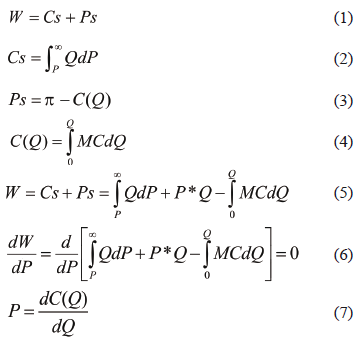
As the user only perceives the average cost, the way to maximize the welfare is to charge a congestion price that makes the average cost for the user equal to the marginal cost of production. This price is called the "Pigouvian tax" [12],which was the first term used for road pricing. Therefore the congestion price represents the difference between the average cost (cost perceived by the user or private cost) and the marginal cost (that which is perceived by the system, the social cost).
3. LICENSE PLATE-BASED TRAFFIC RESTRICTION ("PEAK AND PLATE") IN MEDELLIN
The license plate-based traffic restriction "peak and plate" is an operational measure by a transportation authority for restricting the circulation of vehicles during peak hours, according to the final digit of a vehicle's plate. These restrictions have been implemented in Latin America in the last 25 years with different objectives, most of them related to environmental reasons. In Bogota (Colombia) the Pico y Placa was implemented in 1998, but at that time the main purpose was to reduce congestion in the rush hours [13].
]]> The problem of congestion in Medellin is not a recent problem, it has been latent in the everyday life of the city for several years, and therefore the local government has implemented some measures to try to mitigate its impact on mobility and transport by seeking to increase the road capacity to achieve better mobility in the city (with the enlargement of lanes, new roads, new junctions, etc.). The most important of those measures is a license plate-based traffic restriction named Pico y Placa which has been applied in Medellin since 2005.The purpose of Pico y Placa is to restrict the movement of private cars according to the final digit of the license plate (except in some cases for services such as ambulances, state workers, school transport, and others. Additionally, some corridors are also exempted from Pico y Placa in order to guarantee regional connectivity during rush hours in the morning (6:30 to 8:30 am), and afternoon (5:30 to 7:30 pm).
The restriction seeks to achieve the following benefits: a) To discourage the use of private transport and decrease overall travel times for the vehicles circulating in these hours, b) To increase the use of public transport. c) To reduce the risk of accidents. And, d) to reduce pollution. However, Gonzalez-Calderon[14] and Posada et al. [15] showed that this restriction is palliative, and by 2012 its effectiveness will be null.
Posada et al. [15] proposes an ex-post facto impact assessment of the Pico y Placa policy in the city of Medellin. The authors found that the effect of the measure reduces congestion at rush hours, but moves it to the off-rush hours, creating a constant rush (though not as heavy as rush hours). Also, they asserted that the same effects could be achieved with congestion pricing, whereby people would have the opportunity to choose what to do, instead of a prohibition on using the car (Pico y Placa restriction).
3.1 Analysis of the evolution over time of the Pico y Placa system
Gonzalez-Calderon [14] and Posada et al. [15] pointed out that the measure only works for a few years. The authors showed that in 2008 the measure had to be reassessed because the number of vehicles circulating reached the initial level of congestion. In 2008 the restriction was extended to four plates per day; i.e., 40% restriction. Again, in 2012 the number of vehicles circulating will reach the baseline [14,15]. For that reason, CP must be considered.
3.2 Microeconomic analysis of the Pico y Placa policy
A microeconomic analysis of the policy shows that the restriction produces a loss in the consumer surplus that in the long term is compensated by the dynamics of the market, with the downside that old vehicles remain in use. Cantillo [13] presents an economic assessment of the restriction policy. In fact, the restriction produces a displacement of the demand curve to the left that leads to a reduction in the quantity consumed (traffic flow). Assuming that this new equilibrium is equivalent to a second-optimum, this means that the displacement of the demand curve causes a reduction in the quantity consumed. This quatity is equivalent to the reduction, that would cause an increase in the cost curve from private costs to social costs (corresponding to the externalities). This reduction in the quantity consumed produces a loss in consumer surplus. Cantillo [13] assumes that in the best case this loss could be compensated by the recovery of the deadweight loss produced by externalities. The problem highlighted by the author is that the reduction in the quantity consumed obeys a restriction so that the willingness of consumers to pay is higher than the payment reflected by the actual demand curve, which produces a new switch in the demand curve (reflected by an increase in the purchases of vehicles with license plates that enable users to use them on the days they have the restriction). In the long term, the policy does not have a positive effect because the demand will tend to be the same, but the new vehicles will have lower technical specifications.
4. CONGESTION PRICING IN MEDELLIN
]]> Gonzalez-Calderon and Ospina [6] conducted a survey to analyze the Pico y Placa measure in the city of Medellin, using stated preference methods. Laureles neighborhood was the area chosen for conducting the study. It is one of the areas with the greatest number of vehicles in the city, so it makes a big contribution to general traffic congestion [14]. It was found that private drivers are not in agreement with the Pico y Placa measure, but that the traffic level of service in the city was improved with its implementation. The results show the market share of mode transport due to congestion: 48% of the users would prefer to share a vehicle with other people for comfort; 37% would choose the bus, since it provides a good service, although it is affected by lack of safety; 9% would travel to their place of destination by taxi, since it is comfortable and safe; and the remaining 6% would use the Metro combined with a taxi, involving a mandatory transfer when the destination is a long distance away.For many people, the use of a car is absolutely necessary. Many respondents asserted they did not stop driving and did not care about the fines, as they made many trips in their private car during the day. In the same study, Gonzalez-Calderon [14] explains that a survey was conducted asking the drivers about their willingness to pay a fee to lift the Pico y Placa restriction on the day that the driver is affected by the restriction (as congestion pricing). Thus the driver would decide whether it was more favorable to pay or to leave the car at home. The option would be for the driver to pay a fee to travel in the city during rush hours. And, if so, they would pay a fee of COP$15,000/day (USD$7.50/day), COP$10,000/day (USD$5.00/day), or COP$5,000/day (USD$2.50/day) to lift the restriction. This is a kind of measure of willingness to pay a congestion charge at peak times for travel during those hours. The results of the survey show a large negative response to paying the congestion fee for the day that corresponds to the vehicle restrictions (63%); the remaining (37%) stated that they would pay a fee (USD$2.50/day). For more information, refer to [14].
If this fee (toll) is applied for a year; i.e., in a period of 50 weeks with 250,000 vehicles in Medellin, the government will have a yearly income approximately USD$11,562,500 (for the restriction of 2 plates per day and one day per week) and USD$46,250,000 (for the restriction of 4 plates per day and two days per week), taking into account that administration cost, fees, etc. have to be deducted. It is known that 1 km of Metroplús (BRT for Medellin) cost approximately USD$3.5 million [14]. Also, it is known that the city contributes 30% of expenditures for public works, and so approximately 19 km of Metroplús roads could be constructed in about a year with the current restriction. On the other hand, gasoline becomes more expensive every day, so many users could travel by public transport, as it is done in big metropolises. From this, it can be stated that the Pico y Placa can be combined with (or replaced by) the option of paying a congestion charge for driving at peak hours for those who want to avoid the driving ban. This would generate significant revenue for the local authority, which would finance new roads for the Metroplús BRT.
It is unclear as yet from the limited formal research whether drivers would be better off in terms of expected travel costs under nonresponsive or responsive pricing. Some surveys have found that drivers dislike uncertainty about how much they will have to pay in tolls. Aversion to uncertainty about payment was one of the reasons for opposition to the congestion metering project planned for Cambridge, England, in which vehicles would have been charged on the basis of actual congestion experienced.
5. COST-BENEFIT ANALYSIS OF CONGESTION PRICING IN MEDELLIN
The methodology adopted to produce the CBA of the CP in Medellin is based on Prud'homme and Bocarejo [16]. In that study, the authors used pre-charge and post-charge data on speed and road usage in the London congestion charge zone to estimate demand and cost curves for road usage. In the current study, the objective is to estimate the benefits and the cost that the implementation of CP policy in Medellin would bring. The first step is to derive demand and supply curves, in order to estimate social surplus, consumer surplus, and welfare obtained from the hypothetic policy. Further assumptions made will be explained later.
The main limitation to producing a CBA of the policy in Medellin is the lack of data. Prud'homme and Bocarejo implemented this model using data before and after implementing congestion pricing. In our case, a survey was conducted in a zone of Medellin where the most vehicle trips are produced (Laureles). In Medellin, two zones have the highest levels of congestion: the Central Business District (CBD, where congestion is caused by buses) and El Poblado (where it is caused by private vehicles) which is a mixed land use zone (residential and commercial. This motivated the authors to center the CBA focusing on El Poblado zone. So the analysis will focus on the trips made from Laureles to El Poblado.
1. Demand in study zone: The demand curve for non-commercial vehicles in Laureles is estimated using the willingness of people from this zone to pay. An assumption is made here, because the results are not segregated by destination. In fact, people having as destination El Poblado could have a higher willingness to pay than people having another zone as their destination. The hypothetical scenario used in this paper considers a congestion charging (CH) equal to USD$2.00 per day. For more information about this scenario, refer to Gonzalez-Calderon [14]. As can be seen in the analysis of the CP below, this fee is too low; further research will focus on different scenarios with different rates.
The first point of the demand curve is estimated using the origin-destination matrix of Medellin [4]. The first point (B) is obtained for the base case in 2005. In this case, it was found that B = 104,000 veh. km/day. In order to obtain the demand in the hypothetical scenario where CP is implemented, the demand B is multiplied by the percentage of people who responded in the survey that they were willing to pay the charge CH to use the road. The percentage of people with destination El Poblado not willing to pay USD$2.00 to use their car was 13% [14]. The demand for the hypothetical scenario would then be C = 0.87 * 104,000 = 90,480 veh. km.
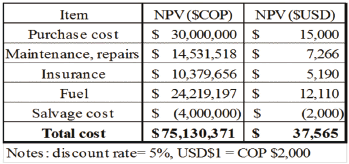
]]> 2. Cost curves for the charged zone: It is now necessary to calculate the cost curve, expressed in dollars per veh. km. The cost function can be calculated in terms of operational costs (such as fuel and amortization), and the value of time spent driving 1 km. The fixed cost is composed of average costs of purchase, maintenance, repairs, insurance, and salvage cost, as presented in Table 1. Assuming a period of 15 years and 10,000 km of car use pr year, the fixed cost per kilometer obtained is: USD$37,565.00/150,000 km = USD$0.25/km.Table 1. Fixed cost of having a car for 15 years
For the variable part, a function relating flow and travel time is used to compute travel cost for a specific volume. A complete analysis could determine the change of speed per link using the Bureau of Public Roads (BPR) formula [17]. For simplicity, a linear function is considered for the overall network affected. As explained by Prud'homme and Bocarejo [16], it is possible to relate speed and flow, because the average speed on a network follows a linear relation with flow. The function specification is:. In order to calculate the parameters of the function, two points need to be found: the free flow speed and another speed for a known flow. The speed for the base case scenario and the free flow speed were calculated using a proportional traffic assignment of Medellin O-D matrix in TransCAD® for the zones studied. Free flow speed: s (0) = 33.6 km/hour. For a flow B = 104,000 veh. km/day, the speed is s (104,000) = 15 km/hour. So the equation becomes: in km/hour. The time value is then multiplied by the inverse of the speed. The time value for Medellin drivers was assumed to be USD$10.00/hour, as shown in Moreno et al.[18].
The total private cost can be expressed by Eq. (8):

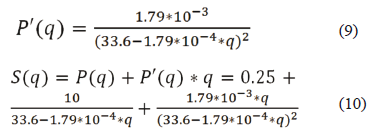
The social cost curve S(q) is then estimated using P(q), by summing the private cost P(q), and the product of the flow and the marginal cost imposed by a new user entering the network (i.e., P›(q) multiplied by the demand flow (q) as described in Eqs. (9) and (10):
3. Demand curve: From Section 1 we have the demand flows for two different scenarios with different associated costs. The next step is therefore to determine the equation relating the demand flows to the prices. As we know, the base case scenario is associated with a demand flow of B = 104,000 veh. km/day and a price of .


For the hypothetical scenario with congestion pricing, the cost is calculated as a summation of the fixed cost, the variable cost of using the network and the average congestion charge. The average congestion charge can be obtained by dividing the total fee (USD$2.00) into the average distance driven by the user "av". For the zones studied, the average distance driven per vehicle each day between Laureles and El Poblado is av = 6.5 km/day. Now, we have a demand curve D(q) with two points, B (104,000; 0.92) and C (90,480; 1.13), and we assume the curve is linear. Now it is easy to calculate the demand curve equation: . Using cost-benefit theory and the equations of private cost, social cost, and demand for the different scenarios, we can determine the coordinates of all the points represented in Fig. 2, and produce Table 2.
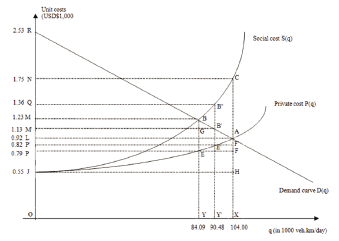
Figure 2. Road congestion with a congestion charge
Table 2. Congestion pricing cost and benefits for different scenarios (cars only)
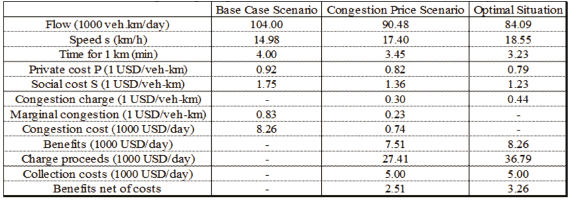
The optimal situation is obtained when the demand curve and the social cost curve intersect, that is when S (q) = D (q). Congestion costs are defined as BCA in the case of the pre-charge situation, and as BB''B' in the case of the congestion price situation. By definition, congestion costs are zero in the case of the optimal situation. In principle, these costs are defined as the difference between the integrals of the social cost curve and the demand curve over the YX (or Y'X) values of q. The collection cost was assumed as USD$2.00/day because only on three arteries in the city that have access to El Poblado zone are needed, and not as a ring scheme like in London (that is much more expensive). The benefits of the charge policy are the reduction in congestion costs, relative to the base case scenario. The results are summarized in Table 2, showing how important congestion costs in the charged zone are before the introduction of the charge (present situation).
Congestion costs in the base scenario (2005) amounted to about USD$8,200 per chargeable day. This is about USD$2 million per year (excluding congestion on weekends and other days excluded from the congestion charge). This is what a congestion charge is expected to eliminate, and this elimination is the main benefit of such a system. Congestion costs can also be related to the utility derived from motor vehicle usage. This utility is equal to what users pay, plus the consumer surplus they obtain, represented by area RAXO in Fig. 2. In 2005, this can be estimated as USD$179,400per day, to be compared with the USD$8,260 dollars per day of congestion costs. Thus, in 2005, traffic congestion costs represented about 4.5% of the utility generated by traffic in the same year. In the case of environmental benefits, with the implementation of the CP in Medellin, less veh. km at a lower speed will be circulation, meaning less pollutants produced, and lower pollution costs. However, this study is for only one congested area, trips from Laureles. The environmental benefits have to be assessed with all the vehicles in the city, because air quality depends upon total emissions.
It can be seen from Table 2 that the number of veh. km decreased by USD$13,520 thousand (104-90.48) per day. Following the steps of Prud'homme and Bocarejo [16], we can take the official French value of pollution costs in dense urban areas of USD$40 per 1,000 veh. km, and USD$10 per 1,000 veh. km in reduction of CO2 emissions; this translates into USD$540.80/day or USD$137,904/year, and USD$135.20/day or USD$34,476/year, respectively.
]]> The total environmental benefits generated by the congestion charge (ignoring additional emissions) can be estimated at USD$172,380/year. The standard economic theory of congestion ignores management and collection costs, and assumes them to be zero. In Table 2, it looks only at the line ‘benefits', sees a positive number, and concludes that the scheme is justified (benefits net of costs > 0).Therefore, the implementation of a CP strategy is recommended to improve the efficiency of road infrastructure use in the city, based on economic principles.Finally, Prud'homme and Bocarejo [16] explained that CP policy was introduced jointly with another measure: a significant increase in bus supply. The authors concluded that the two policy measures were obviously complementary because without new buses, bus crowding would have increased, comfort on bus journeys would have declined, and therefore a modification in modal split would have been more difficult to produce. The city of Medellin could experience a similar situation when applying CP scheme while incorporating new buses of the new BRT system, Metroplús (this is going to happen in 2012). This reinforces the need to implement CP in Medellin, because the transit system is going to be improved, and drivers will have more alternatives for commuting besides the automobile.
6. CONCLUSIONS
The Pico y Placa is a temporary measure and alone it will not solve the underlying problem of mobility in Medellin. However, for future years, it is necessary to provide different options, such as accessible public transport, and to provide a safe and efficient infrastructure for non-motorized modes of transport, such as walking or cycling. For this reason, congestion pricing is proposed as a solution that has been successfully applied in other congested cities like London.
When there is a restriction on circulation (Pico y Placa), people prefer to continue using their own cars and choose to travel during off-peak hours. The same effects could be achieved with congestion pricing. In this case, all drivers have the opportunity to choose what to do, and there is no prohibition on using the car.
A CBS has been carried out to assess the implementation of congestion pricing in Medellin, based on data from previous surveys and the origin-destination matrix of the city, including the zones with higher car density. The CBA considers the traffic situation in 2005 and the effects of implementing a hypothetical congestion pricing strategy. The first-best solution for congestion pricing is presented, and found to be the optimal policy for determining the congestion rate that would maximize social welfare. The main finding is that net benefits of implementation| costs are positive (about USD$2,510/day and USD$3,260/day for the congestion price and optimal situation, respectively). Therefore, the implementation of a CP strategy is recommended to improve the efficiency of road infrastructure use in the city, based on economic principles.
This is the first known study conducted in Medellin for the implementation of a congestion pricing scheme, and it is a preliminary assessment of the measure. We recommend conducting the CBA for more zones within the city in order to obtain more accurate data before implementing the CP scheme in Medellin.
REFERENCES
]]>[1] Galarraga, X., Llorens, L., and Chamorro, J., "Precios de congestión y movilidad urbana: estimación empírica para el caso del Bilbao Metropolitano," in I Congreso de Ciencia Regional de Andalucía: Andalucía en el umbral del siglo XXI, Andalucía, 1997, p. 17. [ Links ]
[2] Sheffi, Y., Urban transportation networks: Equilibrium analysis with mathematical programming methods: Prentice-Hall Englewood Cliffs, NJ, 1984. [ Links ]
[3] Departamento Administrativo Nacional de Estadística, "Censo General de Colombia ", ed. Bogotá, 2005, p. 50. [ Links ]
[4] Área Metropolitana del Valle de Aburrá, "Encuesta Origen Destino Hogares y Estudios Complementarios 2005," Área Metropolitana del Valle de Aburrá, Medellín2006. [ Links ]
[5] Vélez, A., "Análisis comparativo antes y después de la implementación de la medida de pico y placa," Secretaría de Transportes y Tránsito. Medellin2005. [ Links ]
[6] Gonzalez-Calderon, C. and Ospina, F., "Estrategias tarifarias y/o uso del vehículo particular por medio del sistema de restricción del pico y placa con aplicación a algunas zonas de Medellín," Trabajo de Grado. Universidad Nacional de Colombia Sede Medellín, 2004. [ Links ]
[7] US Department of Transportation, "Congestion Pricing," Federal Highway Administration, Ed., ed. Washington, 2006, p. 12. [ Links ]
[8] Yang, H. and Huang, H., "Principle of marginal-cost pricing: how does it work in a general road network?," Transportation Research Part A: Policy and Practice, vol. 32, pp. 45-54, 1998. [ Links ]
[9] Lindsey, C. and Verhoef, E., "Traffic congestion and congestion pricing," 2000. [ Links ]
[10] Ortuzar, J. and Willumsen, L., Modelling transport, Third Edition ed. Chichester: John Wiley and Sons, 2001. [ Links ]
[11] Button, K., Transport economics: Edward Elgar Publishing, 1993. [ Links ]
[12] Pigou, A. C., The economics of welfare: Transaction Publishers, 1952. [ Links ]
[13] Cantillo, V., "Analisis Economico de Politicas de Transporte Erroneas. Caso de Restriccion a Vehiclos Segun Numeros de Patente y de Subsidios a Motocicletas," in XVI PANAM, Lisbon, Portugal, 2010. [ Links ]
[14] Gonzalez-Calderon, C., "Estrategias tarifarias y desestimulación del uso del vehículo particular por medio del pico y placa en Medellín," Rev. ing. univ. Medellin, pp. 95-110, 2009. [ Links ]
[15] Posada, J., Farbiarz, V., and Gonzalez-Calderon, C., "Analisys of "Pico y Placa" as vehicular circulation restriction in Medellín - based on traffic volumes," Dyna, vol. 78, pp. 112-121, 2011. [ Links ]
[16] Prud'homme, R. and Bocarejo, J. P., "The London congestion charge: a tentative economic appraisal+," Transport Policy, vol. 12, pp. 279-287, 2005. [ Links ]
[17] Bureau of Public Roads, "Traffic Assignment Mannual.," U. P. D. U.S. Dept. of Commerce, Ed., ed. Washington D.C., 1964. [ Links ]
[18] Moreno, D., Sarmiento, I., and Gonzalez-Calderon, C., "Políticas para influir en la elección modal de usuarios de vehículo privado en universidades: caso Universidad de Antioquia," DYNA, vol. 165, pp. 101-111, 2011. [ Links ] ]]>