<?xml version="1.0" encoding="ISO-8859-1"?><article xmlns:mml="http://www.w3.org/1998/Math/MathML" xmlns:xlink="http://www.w3.org/1999/xlink" xmlns:xsi="http://www.w3.org/2001/XMLSchema-instance">
<front>
<journal-meta>
<journal-id>0012-7353</journal-id>
<journal-title><![CDATA[DYNA]]></journal-title>
<abbrev-journal-title><![CDATA[Dyna rev.fac.nac.minas]]></abbrev-journal-title>
<issn>0012-7353</issn>
<publisher>
<publisher-name><![CDATA[Universidad Nacional de Colombia]]></publisher-name>
</publisher>
</journal-meta>
<article-meta>
<article-id>S0012-73532012000100017</article-id>
<title-group>
<article-title xml:lang="en"><![CDATA[RECIPANEL: RECYCLED PAPER PANELS]]></article-title>
<article-title xml:lang="es"><![CDATA[RECIPANEL: PANELES DE PAPEL RECICLADO]]></article-title>
</title-group>
<contrib-group>
<contrib contrib-type="author">
<name>
<surname><![CDATA[CAÑOLA]]></surname>
<given-names><![CDATA[HERNÁN]]></given-names>
</name>
<xref ref-type="aff" rid="A01"/>
</contrib>
<contrib contrib-type="author">
<name>
<surname><![CDATA[ECHAVARRÍA]]></surname>
<given-names><![CDATA[CÉSAR]]></given-names>
</name>
<xref ref-type="aff" rid="A02"/>
</contrib>
<contrib contrib-type="author">
<name>
<surname><![CDATA[SÁNCHEZ]]></surname>
<given-names><![CDATA[JULIO CÉSAR]]></given-names>
</name>
<xref ref-type="aff" rid="A03"/>
</contrib>
</contrib-group>
<aff id="A01">
<institution><![CDATA[,Universidad Nacional de Colombia School of Construction ]]></institution>
<addr-line><![CDATA[ ]]></addr-line>
</aff>
<aff id="A02">
<institution><![CDATA[,Universidad Nacional de Colombia School of Construction ]]></institution>
<addr-line><![CDATA[ ]]></addr-line>
</aff>
<aff id="A03">
<institution><![CDATA[,Universidad Nacional de Colombia School of Construction ]]></institution>
<addr-line><![CDATA[ ]]></addr-line>
</aff>
<pub-date pub-type="pub">
<day>00</day>
<month>02</month>
<year>2012</year>
</pub-date>
<pub-date pub-type="epub">
<day>00</day>
<month>02</month>
<year>2012</year>
</pub-date>
<volume>79</volume>
<numero>171</numero>
<fpage>132</fpage>
<lpage>137</lpage>
<copyright-statement/>
<copyright-year/>
<self-uri xlink:href="http://www.scielo.org.co/scielo.php?script=sci_arttext&amp;pid=S0012-73532012000100017&amp;lng=en&amp;nrm=iso"></self-uri><self-uri xlink:href="http://www.scielo.org.co/scielo.php?script=sci_abstract&amp;pid=S0012-73532012000100017&amp;lng=en&amp;nrm=iso"></self-uri><self-uri xlink:href="http://www.scielo.org.co/scielo.php?script=sci_pdf&amp;pid=S0012-73532012000100017&amp;lng=en&amp;nrm=iso"></self-uri><abstract abstract-type="short" xml:lang="en"><p><![CDATA[In this paper, the manufacturing and the mechanical behaviour of recycled paper panels are studied. The main goal of this study is to make a prototype panel using recycled paper (newspaper) and white Portland cement. This panel, called Recipanel, must be inexpensive and possess good mechanical properties and commercial dimensions for use in building walls and ceilings. Recipanel is a non-structural panel based on recycled paper and fulfils Colombian regulations for non-structural panels. Recipanel has high mechanical properties.]]></p></abstract>
<abstract abstract-type="short" xml:lang="es"><p><![CDATA[En este artículo se estudia la fabricación y el comportamiento mecánico de paneles a base de papel reciclado. El objetivo principal del proyecto es producir un prototipo de panel que emplee elementos provenientes de residuos sólidos (papel periódico) y de un material conglomerante (cemento Portland blanco). El panel debe ser económico, debe tener buenas propiedades mecánicas y debe tener dimensiones comerciales para su uso en muros tabiques y en cielos falsos en la industria de la construcción. El Recipanel es un panel no estructural a base de papel reciclado. El Recipanel cumple las normas colombianas en lo relativo a los paneles de uso no estructural y presenta además unas excelentes características mecánicas.]]></p></abstract>
<kwd-group>
<kwd lng="en"><![CDATA[Recipanel]]></kwd>
<kwd lng="en"><![CDATA[recycled paper]]></kwd>
<kwd lng="en"><![CDATA[ceiling]]></kwd>
<kwd lng="en"><![CDATA[wall]]></kwd>
<kwd lng="en"><![CDATA[sustainable construction]]></kwd>
<kwd lng="es"><![CDATA[Recipanel]]></kwd>
<kwd lng="es"><![CDATA[papel reciclado]]></kwd>
<kwd lng="es"><![CDATA[cielo falso]]></kwd>
<kwd lng="es"><![CDATA[muro tabique]]></kwd>
<kwd lng="es"><![CDATA[construcción sostenible]]></kwd>
</kwd-group>
</article-meta>
</front><body><![CDATA[  		    <p align="center"><font size="4" face="Verdana, Arial, Helvetica, sans-serif"><b>RECIPANEL: RECYCLED PAPER PANELS</b></font></p> 		    <p align="center"><font size="3"><b><font face="Verdana, Arial, Helvetica, sans-serif"><i>RECIPANEL: PANELES DE PAPEL RECICLADO</i></font></b></font></p> 		    <p align="center">&nbsp;</p> 		    <p align="center"><font size="2" face="Verdana, Arial, Helvetica, sans-serif"><b>HERN&Aacute;N CA&Ntilde;OLA</b>    <br>             <i>Especialista en Patolog&iacute;a, School of Construction, Universidad Nacional de Colombia, <a href="mailto:hdcanola@unal.edu.co">hdcanola@unal.edu.co</a></i></font></p> 		    <p align="center"><font size="2" face="Verdana, Arial, Helvetica, sans-serif"><b>C&Eacute;SAR ECHAVARR&Iacute;A</b>    <br> 		  <i>Ph.D., Profesor Asociado, School of Construction, Universidad Nacional de Colombia, <a href="mailto:caechavarrial@unal.edu.co">caechavarrial@unal.edu.co</a></i></font></p> 		    <p align="center"><font size="2" face="Verdana, Arial, Helvetica, sans-serif"><b>JULIO C&Eacute;SAR S&Aacute;NCHEZ</b>    <br> 		  <i>Ph.D., Profesor Asociado, School of Construction, Universidad Nacional de Colombia, <a href="mailto:jcsanche@unal.edu.co">jcsanche@unal.edu.co</a></i></font></p> 		    ]]></body>
<body><![CDATA[<p align="center">&nbsp;</p> 		    <p align="center"><font size="2" face="Verdana, Arial, Helvetica, sans-serif"><b>Received for review November 4<sup>th</sup>, 2010, accepted November 23<sup>th</sup>, 2011, final version December, 20<sup>th</sup>, 2011</b></font></p> 	    <p>&nbsp;</p> 		<hr> 		    <p><font size="2" face="Verdana, Arial, Helvetica, sans-serif"><b>ABSTRACT:</b> In this paper, the manufacturing and the mechanical behaviour of recycled paper panels are studied. The main goal of this study is to make a prototype panel using recycled paper (newspaper) and white Portland cement. This panel, called Recipanel, must be inexpensive and possess good mechanical properties and commercial dimensions for use in building walls and ceilings. Recipanel is a non-structural panel based on recycled paper and fulfils Colombian regulations for non-structural panels. Recipanel has high mechanical properties.</font></p> 		    <p><font size="2" face="Verdana, Arial, Helvetica, sans-serif"><b>KEYWORDS:</b> Recipanel, recycled paper, ceiling, wall, sustainable construction</font></p> 		    <p><font size="2" face="Verdana, Arial, Helvetica, sans-serif"><b>RESUMEN:</b> En este art&iacute;culo se estudia la fabricaci&oacute;n y el comportamiento mec&aacute;nico de paneles a base de papel reciclado. El objetivo principal del proyecto es producir un prototipo de panel que emplee elementos provenientes de residuos s&oacute;lidos (papel peri&oacute;dico) y de un material conglomerante (cemento Portland blanco). El panel debe ser econ&oacute;mico, debe tener buenas propiedades mec&aacute;nicas y debe tener dimensiones comerciales para su uso en muros tabiques y en cielos falsos en la industria de la construcci&oacute;n. El Recipanel es un panel no estructural a base de papel reciclado. El Recipanel cumple las normas colombianas en lo relativo a los paneles de uso no estructural y presenta adem&aacute;s unas excelentes caracter&iacute;sticas mec&aacute;nicas. </font></p> 		    <p><font size="2" face="Verdana, Arial, Helvetica, sans-serif"><b>PALABRAS CLAVE:</b> Recipanel, papel reciclado, cielo falso, muro tabique, construcci&oacute;n sostenible</font></p> 		<hr> 		    <p>&nbsp;</p> 		    <p><font size="3" face="Verdana, Arial, Helvetica, sans-serif"><b>1. INTRODUCTION</b></font></p> 		    <p><font size="2" face="Verdana, Arial, Helvetica, sans-serif">In the middle of the twentieth century, the world showed a rising interest in the industrialized reuse of elements based on vegetable fibers (paper and cardboard). This was a reaction to the accelerated reduction of the world's forest reserves. Massive devastation and environmental degradation have inspired the birth of a global environmental conscience [1-5].</font></p> 		    ]]></body>
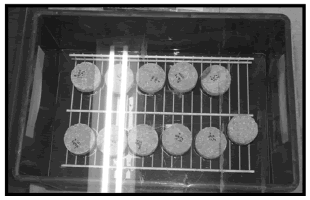
<body><![CDATA[<p><font size="2" face="Verdana, Arial, Helvetica, sans-serif">Paper and recycled cardboard have been used for nearly half a decade in order to avoid excessive use of traditional wood materials and deforestation. However, this tendency has not been adopted by the construction industry. One can say that the construction sector is responsible for 50% of the total use of natural resources, for 40% of the energy consumed and for 50% of total waste generated in the world [6]. And thus, there is a growing interest in taking advantage of recyclable materials for use in construction. </font></p> 		    <p><font size="2" face="Verdana, Arial, Helvetica, sans-serif">Reused paper is an alternative solution that can be very useful in the production of panels for interior walls and ceilings. A clear example of the use of paper in residential construction is the Swiss Cell and Papercrete system [7]. The plates of this system are obtained by replacing part of the conventional aggregates with shredded paper waste.</font></p> 		    <p><font size="2" face="Verdana, Arial, Helvetica, sans-serif">The present study will prioritize the use of recycled paper in the manufacturing of panels reinforced with polypropylene fibers. These panels reach adequate rigidity and dimensional stability through the compaction and homogenization processes during manufacturing. The material thus obtained is suitable for use in any type of traditional housing. In this analysis, the Colombian technical standards (Normas T&eacute;cnicas Colombianas, NTC) and the Spanish regulations (Una Norma Espa&ntilde;ola, UNE) are used.</font></p> 		    <p>&nbsp;</p> 		    <p><font size="3" face="Verdana, Arial, Helvetica, sans-serif"><b>2. EXPERIMENTAL STUDY</b></font></p> 		    <p><font size="2" face="Verdana, Arial, Helvetica, sans-serif">Recipanel are panels made of recycled paper, polypropylene fibers, and white Portland cement. The panels are used to make interior walls and ceilings. In this project, we have produced panels with variable surfaces between 0.10 m&sup2; and 1.00 m&sup2;. Different recycled materials have been evaluated: paper, newspaper, cardboard, Bond paper and a variety of conglomerate materials including: lime, gypsum, plastic stucco, and white Portland cement. A selection was initially made from a combination of materials based on the obtained mechanical strength and cohesion. This selection was used for evaluating the ability of Recipanel to resist crushing during handling or use of the material.</font></p> 		    <p><font size="2" face="Verdana, Arial, Helvetica, sans-serif">The use of lime as a binder did not provide adequate cohesion to the mix. The stucco and gypsum generated detachment and disintegration of particles at the edges of the cured specimens (<a href="#fig01">Fig. 1</a>). By contrast, white Portland cement has shown to provide the panels' high cohesive strength. The combination of white Portland cement and recycled newspaper has also been rated the best in terms of dimensional stability and mechanical properties.</font></p> 		    <p align="center"><font size="2" face="Verdana, Arial, Helvetica, sans-serif"><b><a name="fig01"></a><img src="/img/revistas/dyna/v79n171/a17fig01.gif">    <br> 	    Figure 1.</b> Gypsum plaster panel</font></p> 		    <p><font size="2" face="Verdana, Arial, Helvetica, sans-serif">In the manufacturing of Recipanel, recycled paper and water are subjected to a process of mixing and homogenization in an industrial blender for 8 min. This produces paper pulp.</font></p> 		    ]]></body>
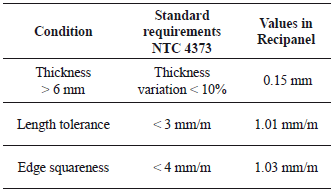
<body><![CDATA[<p><font size="2" face="Verdana, Arial, Helvetica, sans-serif">Subsequently, the wet paper pulp is compacted under a hand press to remove excess water until it reaches a 60% water content. Then, the white Portland cement is mixed with the recycled paper pulp in a ratio of 1:3 parts by weight.</font></p> 		    <p><font size="2" face="Verdana, Arial, Helvetica, sans-serif">Recipanel is fabricated in two stages. Each stage consists of a discharge of the mixture (paper pulp, cement, and water) under pressure to form a compact layer. The pressure applied is approximately 1.20 kPa.</font></p> 		    <p><font size="2" face="Verdana, Arial, Helvetica, sans-serif">Initially, a layer of uniform compacted mixture of 5 mm in height is poured on a flat and smooth surface. Then, a reusable reinforcement of polypropylene fibers is extended over the initial mixture layer from sacks to generate greater stability in the material. Finally, a second 5 mm thick compacted mixture is added on top. Recipanel acquires a final thickness of approximately 15 mm and reaches its maximum mechanical strength after the curing process of the cement has ended. The nominal thickness of Recipanel is evaluated by measuring the thickness of the specimen with a micrometer.</font></p> 		    <p><font size="2" face="Verdana, Arial, Helvetica, sans-serif">Once the specimens have been produced, a tactile and visual analysis is performed to verify the characteristics of Recipanel regarding their dimensional variation, consistency and texture. </font></p> 		    <p align="center"><font size="2" face="Verdana, Arial, Helvetica, sans-serif"><b><a name="fig02"></a><img src="/img/revistas/dyna/v79n171/a17fig02.gif">    <br> 	    Figure 2.</b> shows an optimized prototype with plates of 0.60 m x 0.60 m for use in ceilings.</font></p> 		    <p><font size="2" face="Verdana, Arial, Helvetica, sans-serif">The mechanical properties of Recipanel are evaluated according to the Colombian standards NTC and Spanish regulations UNE.</font></p> 		    <p><font size="2" face="Verdana, Arial, Helvetica, sans-serif"><b>2.1 Dimensional stability    <br> 		</b></font><font size="2" face="Verdana, Arial, Helvetica, sans-serif">Before testing the mechanical properties of Recipanel, a dimensional control should be performed based on tolerances that allow standardization of material for proper performance of tests. Acceptance tolerances for a prototype of 1.00 m<sup>2</sup> according to NTC 4373 [8] and results obtained for the Recipanel samples are presented in <a href="#tab01">Table 1</a>. </font></p> 		    <p align="center"><font size="2" face="Verdana, Arial, Helvetica, sans-serif"><b><a name="tab01"></a>Table 1.</b> Dimensional stability for a 1.00 m<sup>2</sup> prototype</font>    ]]></body>
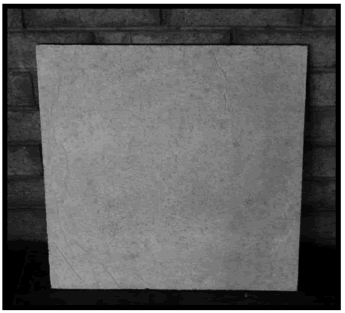
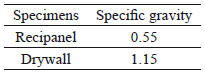
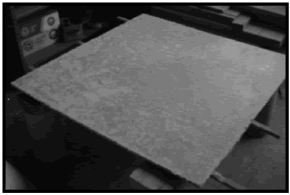
<body><![CDATA[<br> 	    <img src="/img/revistas/dyna/v79n171/a17tab01.gif"></p> 		    <p><font size="2" face="Verdana, Arial, Helvetica, sans-serif">The width of Recipanel was evaluated by measuring the edge-to-edge dimension of a full-size specimen. The length of Recipanel was evaluated by measuring the end-to-end dimension of a full-size specimen. The edge squareness of Recipanel was evaluated by drawing a line perpendicular to the end of a full-length specimen to its opposite end and measuring the length of the side of the triangle formed. </font></p> 		    <p><font size="2" face="Verdana, Arial, Helvetica, sans-serif">According to the results obtained in the dimensional stability analysis, Recipanel fulfilled the standards conditions of the NTC 4373 of thickness and edge- and end-squareness variation.</font></p> 		    <p><font size="2" face="Verdana, Arial, Helvetica, sans-serif"><b>2.2 Specific gravity    <br> 		</b></font><font size="2" face="Verdana, Arial, Helvetica, sans-serif">According to NTC 4373 [8], four Recipanel specimens of 0.08 m x 0.025 m x 0.015 m were cut from the plates of 1.00 m&sup2; in order to determine their specific gravity. The samples were dried in an oven for 24 h at a temperature of 100 &deg;C. The volume displaced by immersion in water and the mass of each specimen were determined with a laboratory balance of 0.001 g of precision. Finally, we determined the specific gravity of the samples, see <a href="#tab02">Table 2</a>.</font></p> 		    <p align="center"><font size="2" face="Verdana, Arial, Helvetica, sans-serif"><b><a name="tab02"></a>Table 2.</b> Prototype 0.08 m x 0.025 m x 0.015 m</font>    <br> 	    <img src="/img/revistas/dyna/v79n171/a17tab02.gif"></p> 	        <p><font size="2" face="Verdana, Arial, Helvetica, sans-serif"><b>2.3 Flexural strength</b>    <br> 		Flexural properties of Recipanel are evaluated by supporting the specimens near the ends and applying a transverse load midway between the supports. To obtain the flexural strength of Recipanel plates, five prototypes of 1.00 m x 1.00 m were made, see <a href="#fig03">Fig. 3</a>.</font></p> 		    <p align="center"><font size="2" face="Verdana, Arial, Helvetica, sans-serif"><b><a name="fig03"></a><img src="/img/revistas/dyna/v79n171/a17fig03.gif">    ]]></body>
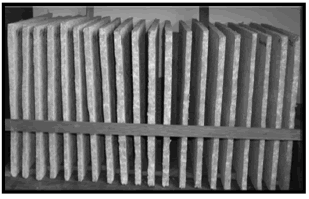
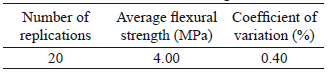
<body><![CDATA[<br> 	    Figure 3.</b> Recipanel prototype (1.00 m x 1.00 m)</font></p> 		    <p><font size="2" face="Verdana, Arial, Helvetica, sans-serif">The thickness of the prototypes varied between 0.14 cm and 0.15 cm. Twenty specimens of 0.25 m x 0.25 m were extracted from the prototypes. Prior to testing, the specimens were conditioned to attain the equilibrium moisture content, see <a href="#fig04">Fig. 4</a>. </font></p> 		    <p align="center"><font size="2" face="Verdana, Arial, Helvetica, sans-serif"><b><a name="fig04"></a><img src="/img/revistas/dyna/v79n171/a17fig04.gif">    <br> 	    Figure 4.</b> Specimen conditioning</font></p> 		    <p><font size="2" face="Verdana, Arial, Helvetica, sans-serif">The NTC 4373 classifies the panels according to their flexural strength: the type A plates have a flexural strength greater than 7 MPa, the type B plates have a flexural strength greater than 4 MPa. This test method covers a procedure for evaluating the ability of Recipanel to withstand flexural stresses during the handling or use of the material.</font></p> 		    <p><font size="2" face="Verdana, Arial, Helvetica, sans-serif">After 28 days, the flexural strength of the Recipanel plates was estimated by applying a concentrated load. The average breaking strength is calculated and reported, see results in <a href="#tab03">Table 3</a>.</font></p> 		    <p align="center"><font size="2" face="Verdana, Arial, Helvetica, sans-serif"><b><a name="tab03"></a>Table 3.</b> Flexural strength</font>    <br> 	    <img src="/img/revistas/dyna/v79n171/a17tab03.gif"></p> 	        <p><font size="2" face="Verdana, Arial, Helvetica, sans-serif">These results indicate that Recipanel can be classified as a type B panel. For comparison, drywall is a type B panel which has a flexural strength of 5.4 MPa.</font></p> 		    <p><font size="2" face="Verdana, Arial, Helvetica, sans-serif"><b>2.4 Capillary suction    ]]></body>
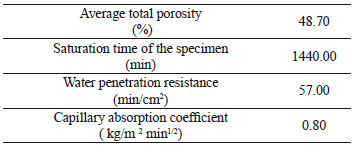
<body><![CDATA[<br> 		</b>The fluidity and capillary suction of the prototypes were estimated using the NTC 111 [9] and UNE 83966:2008 [10] standards. The water resistance of Recipanel is evaluated by immersing the specimens in water for a specified period of time. This method provides a procedure for evaluating the ability of Recipanel to resist water penetration. Ten cylindrical specimens of 5 cm in height and 10 cm in diameter were fabricated. Adhesive tape was added to the specimens in their lower half to ensure that the water contacted just one of the flat basal sides (<a href="#fig05">Fig. 5</a>).</font></p> 		    <p align="center"><font size="2" face="Verdana, Arial, Helvetica, sans-serif"><b><a name="fig05"></a><img src="/img/revistas/dyna/v79n171/a17fig05.gif">    <br> 	    Figure 5.</b> Capillary suction </font></p> 		    <p><font size="2" face="Verdana, Arial, Helvetica, sans-serif">Subsequently, the cylindrical specimens were conditioned at a temperature of 60 &deg;C for 24 h to remove the non structural water.</font></p> 		    <p><font size="2" face="Verdana, Arial, Helvetica, sans-serif">The specimens were tested individually after constant weight was reached and within 10 min upon removal from the conditioning chamber.</font></p> 		    <p><font size="2" face="Verdana, Arial, Helvetica, sans-serif">Further on, the specimens were placed in a flat container with a water layer of 5 mm &plusmn; 1 mm over the top of the specimens and then they were weighed at 5 min, 10 min, 15 min, 30 min, 1 h, 2 h, 3 h, 4 h, 6 h, 24 h, 48 h, 72 h, and 96 h from the start of the test. After 96 h, the specimens were weighed every 24 h until they reached constant mass, see <a href="#tab04">Table 4</a>.</font></p> 		    <p align="center"><font size="2" face="Verdana, Arial, Helvetica, sans-serif"><b><a name="tab04"></a>Table 4.</b> Prototype capillary suction </font>    <br> 	    <img src="/img/revistas/dyna/v79n171/a17tab04.gif"></p> 		    <p><font size="2" face="Verdana, Arial, Helvetica, sans-serif"><b>2.5 Pull-out test    <br> 		</b></font><font size="2" face="Verdana, Arial, Helvetica, sans-serif">This test was run according to NTC 951 [11]. To perform this test, 10 specimens of 0.05 m x 0.05 m x 0.15 m were prepared with the same dosage used in the manufacture of prototype boards. These specimens, after 28 days of hardening, were subjected to the pull-out test.</font></p> 		    ]]></body>
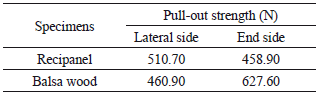
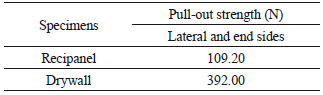
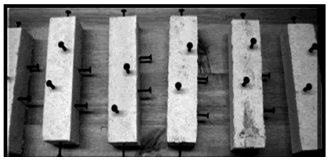
<body><![CDATA[<p><font size="2" face="Verdana, Arial, Helvetica, sans-serif">Screws of 2.50 mm in diameter and 32 mm in length were introduced into the specimens, see <a href="#fig06">Fig. 6</a>. Two screws were inserted in the lateral face, two on the longitudinal side, and one at each end side of the piece. The pull-out test was performed with a continuous load at a speed of 3.5 mm/min.</font></p> 		    <p align="center"><font size="2" face="Verdana, Arial, Helvetica, sans-serif"><b><a name="fig06"></a><img src="/img/revistas/dyna/v79n171/a17fig06.gif">    <br> 	    Figure 6.</b> Pull-out test</font></p> 		    <p><font size="2" face="Verdana, Arial, Helvetica, sans-serif">The results obtained for a total of 10 prototypes of Recipanel and a comparative analysis of resistance with drywall and balsa wood are shown in <a href="#tab05">Tables 5</a> and <a href="#tab06">6</a>.</font></p> 		    <p align="center"><font size="2" face="Verdana, Arial, Helvetica, sans-serif"><b><a name="tab05"></a>Table 5. </b>Pull-out test (0.05 m x 0.05 m x 0.16 m)</font>    <br> 	    <img src="/img/revistas/dyna/v79n171/a17tab05.gif"></p> 	        <p align="center"><font size="2" face="Verdana, Arial, Helvetica, sans-serif"><b><a name="tab06"></a>Table 6. </b>Pull-out test (0.10 m x 0.10 m x 0.015m)</font>    <br>         <img src="/img/revistas/dyna/v79n171/a17tab06.gif"></p> 	        <p><font size="2" face="Verdana, Arial, Helvetica, sans-serif">Finally, a 1.44 m&sup2; prototype ceiling was created out of 0.36 m&sup2; plates. The ease of handling of the plates was noted, given their low weight and flexibility of assembly with screws, without generating fractures at the edges.</font></p> 		    <p><font size="2" face="Verdana, Arial, Helvetica, sans-serif"><b>2.6 Combustion and thermal conductivity    ]]></body>
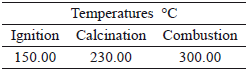
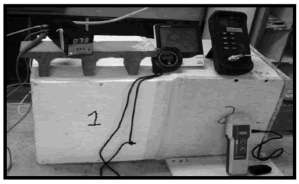
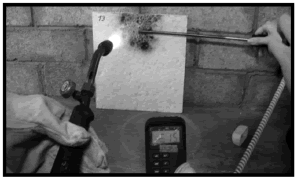
<body><![CDATA[<br> 		</b></font><font size="2" face="Verdana, Arial, Helvetica, sans-serif">This test is performed on prototypes of 0.25 m x 0.25 m to determine the capacity of thermal conductivity of the material, the point of ignition, combustion and calcination. A type K thermocouple was used to calculate the combustion temperature of Recipanel. Points of ignition, combustion and calcination were identified [12-14], see <a href="#fig07">Fig. 7</a> and <a href="#tab07">Table 7</a>.</font></p> 		    <p align="center"><font size="2" face="Verdana, Arial, Helvetica, sans-serif"><b><a name="fig07"></a><img src="/img/revistas/dyna/v79n171/a17fig07.gif">    <br> 	    Figure 7.</b> Recipanel fire test</font></p> 		    <p align="center"><font size="2" face="Verdana, Arial, Helvetica, sans-serif"><b><a name="tab07"></a>Table 7.</b> Prototype temperatures</font>    <br> 	    <img src="/img/revistas/dyna/v79n171/a17tab07.gif"></p> 	        <p><font size="2" face="Verdana, Arial, Helvetica, sans-serif">The thermal conductivity measurement was made using a closed and isolated system with a Recipanel wall thickness of 0.13 m, see <a href="#fig08">Fig. 8</a>. The thermal conductivity is the property of a material that indicates its ability to conduct heat.</font></p> 		    <p align="center"><font size="2" face="Verdana, Arial, Helvetica, sans-serif"><b><a name="fig08"></a><img src="/img/revistas/dyna/v79n171/a17fig08.gif">    <br> 	    Figure 8. </b>Thermal conductivity measurement system</font></p> 		    <p><font size="2" face="Verdana, Arial, Helvetica, sans-serif">A sheet of aluminum with dimensions of 0.20 m x 0.15 m and thickness 1/8&rdquo; was stuck to one wall of Recipanel. </font></p> 		    <p><font size="2" face="Verdana, Arial, Helvetica, sans-serif">A temperature of 130 &deg;C using an electrical resistance with a power of 500 W was provided. The temperature supplied to the system is 20 &deg;C lower than the ignition temperature of the material. The transient measurements were performed during the process of heating up. The advantage of this technique is that measurements can be made relatively quickly. Measurements of the thermocouples on both sides of the wall for about an hour were taken. In this way, it is possible to analyze the behaviour of Recipanel related to the transmission of heat. We obtained an average thermal conductivity of 1.08 W / (K.m). It is clearly observed that the temperature became constant 6 min after starting the test, see <a href="#fig09">Fig. 9</a>.</font></p> 		    ]]></body>
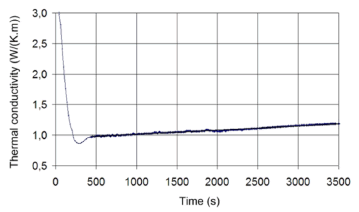
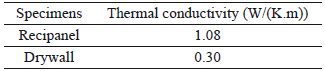
<body><![CDATA[<p align="center"><font size="2" face="Verdana, Arial, Helvetica, sans-serif"><b><a name="fig09"></a><img src="/img/revistas/dyna/v79n171/a17fig09.gif">    <br> 	    Figure 9.</b> Thermal conductivity Recipanel</font></p> 		    <p><font size="2" face="Verdana, Arial, Helvetica, sans-serif">The thermal conductivity of Recipanel was compared with the thermal conductivity of drywall, see <a href="#tab08">Table 8</a>.</font></p> 		    <p align="center"><font size="2" face="Verdana, Arial, Helvetica, sans-serif"><b><a name="tab08"></a>Table 8.</b> Prototype thermal conductivity</font>    <br> 	    <img src="/img/revistas/dyna/v79n171/a17tab08.gif"></p> 	        <p>&nbsp;</p> 		    <p><font size="3" face="Verdana, Arial, Helvetica, sans-serif"><b>3. CONCLUSIONS </b></font></p> 		    <p><font size="2" face="Verdana, Arial, Helvetica, sans-serif">Recipanel are lightweight panels which offer many benefits over other non-structural panels and are created by using recycled materials. The test of capillary suction shows the hygroscopic nature of the recycled paper pulp used here. </font></p> 		    <p><font size="2" face="Verdana, Arial, Helvetica, sans-serif">Recipanel can be classified as interior panels Type B according to the NTC 4373 standards. The dimensional stability of Recipanel is good. The tolerances in the manufacturing of these panels are appropriate. </font></p> 		    <p><font size="2" face="Verdana, Arial, Helvetica, sans-serif">The pull-out test in the panels resulted in high strength. It is therefore concluded that Recipanel could easily be used without cracking in the connections with metal connectors such as screws and nails.</font></p> 		    ]]></body>
<body><![CDATA[<p><font size="2" face="Verdana, Arial, Helvetica, sans-serif">Taking into account the results of thermal conductivity, we find that Recipanel is a panel of low thermal conductivity. Recipanel would be appropriate for use in buildings in areas with drastic temperature changes.</font></p> 		    <p><font size="2" face="Verdana, Arial, Helvetica, sans-serif">Recipanel is made of recyclable materials and has demonstrated high flexural strength. Recipanel is an ideal choice for the production of building elements that lead to the reduction of environmental impact. It is also an appropriate option for the manufacture of lightweight enclosure elements in buildings. </font></p> 		    <p><font size="2" face="Verdana, Arial, Helvetica, sans-serif">The advantages and creative applications for these panels are unlimited for architects, general contractors, renovators, and civil engineers. </font></p> 		    <p>&nbsp;</p> 		    <p><font size="3" face="Verdana, Arial, Helvetica, sans-serif"><b>ACKNOWLEDGEMENTS</b></font></p> 		    <p><font size="2" face="Verdana, Arial, Helvetica, sans-serif">This project was made possible with funding obtained from the DIME and UGI of the Faculty of Architecture at the Universidad Nacional de Colombia. We also appreciate the support given from professors Carlos V&eacute;lez and Yhan Paul Arias of the School of Construction.</font></p> 	    <p>&nbsp;</p> 	    <p><font size="3" face="Verdana, Arial, Helvetica, sans-serif"><b>REFERENCES</b></font></p> 	    <!-- ref --><p><font size="2" face="Verdana, Arial, Helvetica, sans-serif"><b>[1]</b> Quebedo, V. Foro ciudadano: relatos de la actualidad que perduran. LOM ediciones, Santiago de Chile, 2002.             &nbsp;&nbsp;&nbsp;&nbsp;&nbsp;&nbsp;&nbsp;&nbsp;[&#160;<a href="javascript:void(0);" onclick="javascript: window.open('/scielo.php?script=sci_nlinks&ref=000111&pid=S0012-7353201200010001700001&lng=','','width=640,height=500,resizable=yes,scrollbars=1,menubar=yes,');">Links</a>&#160;]<!-- end-ref --><!-- ref --><br>         <b>[2]</b> Valenzuela, S. et al. Libro verde del medio ambiente urbano, tomo 1. BETA Editorial: Ministerio de medio ambiente, Barcelona, 2007.             &nbsp;&nbsp;&nbsp;&nbsp;&nbsp;&nbsp;&nbsp;&nbsp;[&#160;<a href="javascript:void(0);" onclick="javascript: window.open('/scielo.php?script=sci_nlinks&ref=000112&pid=S0012-7353201200010001700002&lng=','','width=640,height=500,resizable=yes,scrollbars=1,menubar=yes,');">Links</a>&#160;]<!-- end-ref --><!-- ref --><br>         <b>[3]</b> Capistr&aacute;n, F., Aranda, E. y Romero J.C. Manual de reciclaje, compostaje y lombricompostaje. Editorial Limusa, Ciudad de M&eacute;xico, 1994.     &nbsp;&nbsp;&nbsp;&nbsp;&nbsp;&nbsp;&nbsp;&nbsp;[&#160;<a href="javascript:void(0);" onclick="javascript: window.open('/scielo.php?script=sci_nlinks&ref=000113&pid=S0012-7353201200010001700003&lng=','','width=640,height=500,resizable=yes,scrollbars=1,menubar=yes,');">Links</a>&#160;]<!-- end-ref --><!-- ref --><br>         <b>[4]</b> Colomer, F.J. Tratamiento y gesti&oacute;n de residuos s&oacute;lidos. Editorial Limusa, Valencia, 2007.     &nbsp;&nbsp;&nbsp;&nbsp;&nbsp;&nbsp;&nbsp;&nbsp;[&#160;<a href="javascript:void(0);" onclick="javascript: window.open('/scielo.php?script=sci_nlinks&ref=000114&pid=S0012-7353201200010001700004&lng=','','width=640,height=500,resizable=yes,scrollbars=1,menubar=yes,');">Links</a>&#160;]<!-- end-ref --><!-- ref --><br>         <b>[5]</b> Linbachiya, M. and Roberts J. Construction and demolition waste. Thomas Telford, London, 2004.             &nbsp;&nbsp;&nbsp;&nbsp;&nbsp;&nbsp;&nbsp;&nbsp;[&#160;<a href="javascript:void(0);" onclick="javascript: window.open('/scielo.php?script=sci_nlinks&ref=000115&pid=S0012-7353201200010001700005&lng=','','width=640,height=500,resizable=yes,scrollbars=1,menubar=yes,');">Links</a>&#160;]<!-- end-ref --><!-- ref --><br>         <b>[6]</b> Anink, D., Boonstra, C. and Mak, J. Handbook of Sustainable Building. and Environmental Preference Method for Selection of Materials for Use in Construction and Refurbishment. Editorial James and James Ltda, London, 1996.             &nbsp;&nbsp;&nbsp;&nbsp;&nbsp;&nbsp;&nbsp;&nbsp;[&#160;<a href="javascript:void(0);" onclick="javascript: window.open('/scielo.php?script=sci_nlinks&ref=000116&pid=S0012-7353201200010001700006&lng=','','width=640,height=500,resizable=yes,scrollbars=1,menubar=yes,');">Links</a>&#160;]<!-- end-ref --><!-- ref --><br>         <b>[7]</b> Lyon, A. Materials for architects and builder. Elsevier, London, 2007.             &nbsp;&nbsp;&nbsp;&nbsp;&nbsp;&nbsp;&nbsp;&nbsp;[&#160;<a href="javascript:void(0);" onclick="javascript: window.open('/scielo.php?script=sci_nlinks&ref=000117&pid=S0012-7353201200010001700007&lng=','','width=640,height=500,resizable=yes,scrollbars=1,menubar=yes,');">Links</a>&#160;]<!-- end-ref --><!-- ref --><br>         <b>[8]</b> Norma t&eacute;cnica colombiana NTC 4373. Placas de fibro-cemento, Colombia, 1997.     &nbsp;&nbsp;&nbsp;&nbsp;&nbsp;&nbsp;&nbsp;&nbsp;[&#160;<a href="javascript:void(0);" onclick="javascript: window.open('/scielo.php?script=sci_nlinks&ref=000118&pid=S0012-7353201200010001700008&lng=','','width=640,height=500,resizable=yes,scrollbars=1,menubar=yes,');">Links</a>&#160;]<!-- end-ref --><!-- ref --><br>         <b>[9]</b> Norma t&eacute;cnica colombiana NTC 111. Especificaciones para la mesa de flujo usada en ensayos de cemento hidr&aacute;ulico. Colombia, 2008.     &nbsp;&nbsp;&nbsp;&nbsp;&nbsp;&nbsp;&nbsp;&nbsp;[&#160;<a href="javascript:void(0);" onclick="javascript: window.open('/scielo.php?script=sci_nlinks&ref=000119&pid=S0012-7353201200010001700009&lng=','','width=640,height=500,resizable=yes,scrollbars=1,menubar=yes,');">Links</a>&#160;]<!-- end-ref --><!-- ref --><br>         <b>[10]</b> Norma Espa&ntilde;ola UNE 83966:2008. Durabilidad del hormig&oacute;n. Acondicionamiento de probetas de hormig&oacute;n para los ensayos de permeabilidad a gases y capilaridad. (M&eacute;todo natural). Espa&ntilde;a, 2006.     &nbsp;&nbsp;&nbsp;&nbsp;&nbsp;&nbsp;&nbsp;&nbsp;[&#160;<a href="javascript:void(0);" onclick="javascript: window.open('/scielo.php?script=sci_nlinks&ref=000120&pid=S0012-7353201200010001700010&lng=','','width=640,height=500,resizable=yes,scrollbars=1,menubar=yes,');">Links</a>&#160;]<!-- end-ref --><!-- ref --><br>         <b>[11]</b> Norma t&eacute;cnica colombiana NTC 951. Maderas, m&eacute;todos de extracci&oacute;n del clavo. Colombia, 1975.     &nbsp;&nbsp;&nbsp;&nbsp;&nbsp;&nbsp;&nbsp;&nbsp;[&#160;<a href="javascript:void(0);" onclick="javascript: window.open('/scielo.php?script=sci_nlinks&ref=000121&pid=S0012-7353201200010001700011&lng=','','width=640,height=500,resizable=yes,scrollbars=1,menubar=yes,');">Links</a>&#160;]<!-- end-ref --><!-- ref --><br>         <b>[12]</b> Incropera, F. y De Witt, D. Fundamentos de Transferencia de Calor. Prentice Hall, M&eacute;xico, D.F., 1999.     &nbsp;&nbsp;&nbsp;&nbsp;&nbsp;&nbsp;&nbsp;&nbsp;[&#160;<a href="javascript:void(0);" onclick="javascript: window.open('/scielo.php?script=sci_nlinks&ref=000122&pid=S0012-7353201200010001700012&lng=','','width=640,height=500,resizable=yes,scrollbars=1,menubar=yes,');">Links</a>&#160;]<!-- end-ref --><!-- ref --><br>         <b>[13]</b> Skoog, D. y Holler, J.F. Principios de an&aacute;lisis instrumental. McGraw-Hill M&eacute;xico, D.F., 2008.     &nbsp;&nbsp;&nbsp;&nbsp;&nbsp;&nbsp;&nbsp;&nbsp;[&#160;<a href="javascript:void(0);" onclick="javascript: window.open('/scielo.php?script=sci_nlinks&ref=000123&pid=S0012-7353201200010001700013&lng=','','width=640,height=500,resizable=yes,scrollbars=1,menubar=yes,');">Links</a>&#160;]<!-- end-ref --><!-- ref --><br>     <b>[14]</b> Mu&ntilde;oz, A., Chejne, F., Espinel, J. and Londo&ntilde;o, C. Evaluation of the cellulose of paper and coal ashes, like alternative insulating materials. Dyna, A&ntilde;o 73, 148, pp. 1-8, 2006. </font>&nbsp;&nbsp;&nbsp;&nbsp;&nbsp;&nbsp;&nbsp;&nbsp;[&#160;<a href="javascript:void(0);" onclick="javascript: window.open('/scielo.php?script=sci_nlinks&ref=000124&pid=S0012-7353201200010001700014&lng=','','width=640,height=500,resizable=yes,scrollbars=1,menubar=yes,');">Links</a>&#160;]<!-- end-ref --> ]]></body><back>
<ref-list>
<ref id="B1">
<label>1</label><nlm-citation citation-type="book">
<person-group person-group-type="author">
<name>
<surname><![CDATA[Quebedo]]></surname>
<given-names><![CDATA[V.]]></given-names>
</name>
</person-group>
<source><![CDATA[Foro ciudadano: relatos de la actualidad que perduran.]]></source>
<year>2002</year>
<publisher-loc><![CDATA[Santiago de Chile ]]></publisher-loc>
<publisher-name><![CDATA[LOM ediciones]]></publisher-name>
</nlm-citation>
</ref>
<ref id="B2">
<label>2</label><nlm-citation citation-type="book">
<person-group person-group-type="author">
<name>
<surname><![CDATA[Valenzuela]]></surname>
<given-names><![CDATA[S.]]></given-names>
</name>
</person-group>
<source><![CDATA[Libro verde del medio ambiente urbano,]]></source>
<year>2007</year>
<publisher-loc><![CDATA[Barcelona ]]></publisher-loc>
<publisher-name><![CDATA[BETA Editorial: Ministerio de medio ambiente]]></publisher-name>
</nlm-citation>
</ref>
<ref id="B3">
<label>3</label><nlm-citation citation-type="book">
<person-group person-group-type="author">
<name>
<surname><![CDATA[Capistrán]]></surname>
<given-names><![CDATA[F.]]></given-names>
</name>
<name>
<surname><![CDATA[Aranda]]></surname>
<given-names><![CDATA[E.]]></given-names>
</name>
<name>
<surname><![CDATA[Romero]]></surname>
<given-names><![CDATA[J.C.]]></given-names>
</name>
</person-group>
<source><![CDATA[Manual de reciclaje, compostaje y lombricompostaje.]]></source>
<year>1994</year>
<publisher-loc><![CDATA[Ciudad de México ]]></publisher-loc>
<publisher-name><![CDATA[Editorial Limusa]]></publisher-name>
</nlm-citation>
</ref>
<ref id="B4">
<label>4</label><nlm-citation citation-type="book">
<person-group person-group-type="author">
<name>
<surname><![CDATA[Colomer]]></surname>
<given-names><![CDATA[F.J.]]></given-names>
</name>
</person-group>
<source><![CDATA[Tratamiento y gestión de residuos sólidos.]]></source>
<year>2007</year>
<publisher-loc><![CDATA[Valencia ]]></publisher-loc>
<publisher-name><![CDATA[Editorial Limusa]]></publisher-name>
</nlm-citation>
</ref>
<ref id="B5">
<label>5</label><nlm-citation citation-type="book">
<person-group person-group-type="author">
<name>
<surname><![CDATA[Linbachiya]]></surname>
<given-names><![CDATA[M.]]></given-names>
</name>
<name>
<surname><![CDATA[Roberts]]></surname>
<given-names><![CDATA[J.]]></given-names>
</name>
</person-group>
<source><![CDATA[Construction and demolition waste.]]></source>
<year>2004</year>
<publisher-loc><![CDATA[London ]]></publisher-loc>
<publisher-name><![CDATA[Thomas Telford]]></publisher-name>
</nlm-citation>
</ref>
<ref id="B6">
<label>6</label><nlm-citation citation-type="book">
<person-group person-group-type="author">
<name>
<surname><![CDATA[Anink]]></surname>
<given-names><![CDATA[D.]]></given-names>
</name>
<name>
<surname><![CDATA[Boonstra]]></surname>
<given-names><![CDATA[C.]]></given-names>
</name>
<name>
<surname><![CDATA[Mak]]></surname>
<given-names><![CDATA[J.]]></given-names>
</name>
</person-group>
<source><![CDATA[Handbook of Sustainable Building. and Environmental Preference Method for Selection of Materials for Use in Construction and Refurbishment.]]></source>
<year>1996</year>
<publisher-loc><![CDATA[London ]]></publisher-loc>
<publisher-name><![CDATA[Editorial James and James Ltda]]></publisher-name>
</nlm-citation>
</ref>
<ref id="B7">
<label>7</label><nlm-citation citation-type="book">
<person-group person-group-type="author">
<name>
<surname><![CDATA[Lyon]]></surname>
<given-names><![CDATA[A.]]></given-names>
</name>
</person-group>
<source><![CDATA[Materials for architects and builder.]]></source>
<year>2007</year>
<publisher-loc><![CDATA[London ]]></publisher-loc>
<publisher-name><![CDATA[Elsevier]]></publisher-name>
</nlm-citation>
</ref>
<ref id="B8">
<label>8</label><nlm-citation citation-type="">
<source><![CDATA[Norma técnica colombiana NTC 4373: Placas de fibro-cemento]]></source>
<year>1997</year>
</nlm-citation>
</ref>
<ref id="B9">
<label>9</label><nlm-citation citation-type="">
<source><![CDATA[Norma técnica colombiana NTC 111.: Especificaciones para la mesa de flujo usada en ensayos de cemento hidráulico.]]></source>
<year>2008</year>
</nlm-citation>
</ref>
<ref id="B10">
<label>10</label><nlm-citation citation-type="">
<source><![CDATA[Norma Española UNE 83966:2008: Durabilidad del hormigón. Acondicionamiento de probetas de hormigón para los ensayos de permeabilidad a gases y capilaridad. (Método natural).]]></source>
<year>2006</year>
</nlm-citation>
</ref>
<ref id="B11">
<label>11</label><nlm-citation citation-type="">
<source><![CDATA[Norma técnica colombiana NTC 951.: Maderas, métodos de extracción del clavo.]]></source>
<year>1975</year>
</nlm-citation>
</ref>
<ref id="B12">
<label>12</label><nlm-citation citation-type="book">
<person-group person-group-type="author">
<name>
<surname><![CDATA[Incropera]]></surname>
<given-names><![CDATA[F.]]></given-names>
</name>
<name>
<surname><![CDATA[De Witt]]></surname>
<given-names><![CDATA[D.]]></given-names>
</name>
</person-group>
<source><![CDATA[Fundamentos de Transferencia de Calor]]></source>
<year>1999</year>
<publisher-name><![CDATA[Prentice Hall]]></publisher-name>
</nlm-citation>
</ref>
<ref id="B13">
<label>13</label><nlm-citation citation-type="book">
<person-group person-group-type="author">
<name>
<surname><![CDATA[Skoog]]></surname>
<given-names><![CDATA[D.]]></given-names>
</name>
<name>
<surname><![CDATA[Holler]]></surname>
<given-names><![CDATA[J.F.]]></given-names>
</name>
</person-group>
<source><![CDATA[Principios de análisis instrumental.]]></source>
<year>2008</year>
<publisher-name><![CDATA[McGraw-Hill]]></publisher-name>
</nlm-citation>
</ref>
<ref id="B14">
<label>14</label><nlm-citation citation-type="journal">
<person-group person-group-type="author">
<name>
<surname><![CDATA[Muñoz]]></surname>
<given-names><![CDATA[A.]]></given-names>
</name>
<name>
<surname><![CDATA[Chejne]]></surname>
<given-names><![CDATA[F.]]></given-names>
</name>
<name>
<surname><![CDATA[Espinel]]></surname>
<given-names><![CDATA[J.]]></given-names>
</name>
<name>
<surname><![CDATA[Londoño]]></surname>
<given-names><![CDATA[C.]]></given-names>
</name>
</person-group>
<article-title xml:lang="en"><![CDATA[Evaluation of the cellulose of paper and coal ashes, like alternative insulating materials]]></article-title>
<source><![CDATA[Dyna]]></source>
<year>2006</year>
<volume>73</volume>
<numero>148</numero>
<issue>148</issue>
<page-range>1-8</page-range></nlm-citation>
</ref>
</ref-list>
</back>
</article>