<?xml version="1.0" encoding="ISO-8859-1"?><article xmlns:mml="http://www.w3.org/1998/Math/MathML" xmlns:xlink="http://www.w3.org/1999/xlink" xmlns:xsi="http://www.w3.org/2001/XMLSchema-instance">
<front>
<journal-meta>
<journal-id>0012-7353</journal-id>
<journal-title><![CDATA[DYNA]]></journal-title>
<abbrev-journal-title><![CDATA[Dyna rev.fac.nac.minas]]></abbrev-journal-title>
<issn>0012-7353</issn>
<publisher>
<publisher-name><![CDATA[Universidad Nacional de Colombia]]></publisher-name>
</publisher>
</journal-meta>
<article-meta>
<article-id>S0012-73532012000600003</article-id>
<title-group>
<article-title xml:lang="en"><![CDATA[STABILITY AND MINIMUM LATERAL BRACING FOR STEPPED COLUMNS WITH SEMI-RIGID CONNECTIONS INCLUDING SHEAR EFFECTS: II) VERIFICATION AND EXAMPLES]]></article-title>
<article-title xml:lang="es"><![CDATA[ESTABILIDAD Y ARRIOSTRAMIENTO MÍNIMO LATERAL PARA COLUMNAS ESCALONADAS CON CONEXIONES SEMI-RÍGIDAS INCLUYENDO LOS EFECTOS DE CORTANTE: II) VERIFICACIÓN Y EJEMPLOS]]></article-title>
</title-group>
<contrib-group>
<contrib contrib-type="author">
<name>
<surname><![CDATA[ARISTIZABAL-OCHOA]]></surname>
<given-names><![CDATA[J. DARIO]]></given-names>
</name>
<xref ref-type="aff" rid="A01"/>
</contrib>
</contrib-group>
<aff id="A01">
<institution><![CDATA[,National University School of Mines ]]></institution>
<addr-line><![CDATA[Medellín ]]></addr-line>
<country>Colombia</country>
</aff>
<pub-date pub-type="pub">
<day>00</day>
<month>12</month>
<year>2012</year>
</pub-date>
<pub-date pub-type="epub">
<day>00</day>
<month>12</month>
<year>2012</year>
</pub-date>
<volume>79</volume>
<numero>176</numero>
<fpage>19</fpage>
<lpage>26</lpage>
<copyright-statement/>
<copyright-year/>
<self-uri xlink:href="http://www.scielo.org.co/scielo.php?script=sci_arttext&amp;pid=S0012-73532012000600003&amp;lng=en&amp;nrm=iso"></self-uri><self-uri xlink:href="http://www.scielo.org.co/scielo.php?script=sci_abstract&amp;pid=S0012-73532012000600003&amp;lng=en&amp;nrm=iso"></self-uri><self-uri xlink:href="http://www.scielo.org.co/scielo.php?script=sci_pdf&amp;pid=S0012-73532012000600003&amp;lng=en&amp;nrm=iso"></self-uri><abstract abstract-type="short" xml:lang="en"><p><![CDATA[The elastic stability analysis of single-stepped columns with sidesway totally inhibited, partially inhibited, and uninhibited subjected to concentrated axial loads located at the ends and at the intermediate joint including semi-rigid connections and shear force effects are presented using three different approaches in a companion paper. The first two approaches are those by Engesser and Haringx that include the shear component of the applied axial force proportional to the total slope (dy/dx) and to the angle of rotation of the cross section () along the member, respectively. The third approach is a simplified formulation based on the classical Euler theory that includes the effects of shear deformations but neglects the shear component of the applied axial force along the member. Definite criterion on minimum stiffness of lateral bracings for single-stepped columns is also presented. Five comprehensive examples are included that demonstrate the effectiveness of the proposed stability equations and minimum bracing stiffness criteria.]]></p></abstract>
<abstract abstract-type="short" xml:lang="es"><p><![CDATA[El análisis de estabilidad elástica de columnas con un cambio de sección con derivas laterales totalmente inhibidas, parcialmente inhibidas, y desinhibidas sometidas a cargas axiales concentradas en los extremos y en el nudo intermedio incluyendo los efectos de las conexiones y de las fuerzas a cortante utilizando tres modelos diferentes es presentado y discutido en una publicación adjunta. Los dos primeros modelos son de Engesser y de Haringx que incluyen la componente de la fuerza axial aplicada a cortante proporcional a la pendiente total (dy/dx) y al ángulo de giro de la sección transversal () a lo largo del miembro, respectivamente. El tercer modelo es una formulación simplificada basada en la teoría clásica de Euler, que incluye los efectos de las deformaciones por cortante, pero desprecia la componente a cortante de la fuerza axial aplicada a lo largo de la columna. Se presenta también criterios definidos para determinar la rigidez mínima de los arriostramientos laterales para columnas con un cambio de sección. Se incluye cinco ejemplos completos en esta publicación que muestran la efectividad de las ecuaciones de métodos propuesto en el análisis de estabilidad y en el cálculo de los arriostramientos mínimos para columnas con un cambio de sección.]]></p></abstract>
<kwd-group>
<kwd lng="en"><![CDATA[bracing]]></kwd>
<kwd lng="en"><![CDATA[buckling]]></kwd>
<kwd lng="en"><![CDATA[building codes]]></kwd>
<kwd lng="en"><![CDATA[columns]]></kwd>
<kwd lng="en"><![CDATA[construction]]></kwd>
<kwd lng="en"><![CDATA[computer applications]]></kwd>
<kwd lng="en"><![CDATA[frames]]></kwd>
<kwd lng="en"><![CDATA[loads]]></kwd>
<kwd lng="en"><![CDATA[semi-rigid connections]]></kwd>
<kwd lng="en"><![CDATA[shear deformations]]></kwd>
<kwd lng="en"><![CDATA[shoring]]></kwd>
<kwd lng="en"><![CDATA[stability]]></kwd>
<kwd lng="en"><![CDATA[stepped columns]]></kwd>
<kwd lng="es"><![CDATA[arriostramiento]]></kwd>
<kwd lng="es"><![CDATA[pandeo]]></kwd>
<kwd lng="es"><![CDATA[códigos de construcción]]></kwd>
<kwd lng="es"><![CDATA[columnas]]></kwd>
<kwd lng="es"><![CDATA[construcción]]></kwd>
<kwd lng="es"><![CDATA[aplicaciones informáticas]]></kwd>
<kwd lng="es"><![CDATA[marcos]]></kwd>
<kwd lng="es"><![CDATA[cargas]]></kwd>
<kwd lng="es"><![CDATA[conexiones semi-rígidas]]></kwd>
<kwd lng="es"><![CDATA[deformaciones por cortante]]></kwd>
<kwd lng="es"><![CDATA[apuntalamiento]]></kwd>
<kwd lng="es"><![CDATA[estabilidad]]></kwd>
<kwd lng="es"><![CDATA[columnas con cambio de sección]]></kwd>
</kwd-group>
</article-meta>
</front><body><![CDATA[ <p align="center"><font size="4" face="Verdana, Arial, Helvetica, sans-serif"><b>STABILITY AND MINIMUM LATERAL BRACING FOR STEPPED COLUMNS WITH SEMI-RIGID CONNECTIONS INCLUDING SHEAR EFFECTS: II) VERIFICATION AND EXAMPLES</b></font></p>     <p align="center"><i><font size="3"><b><font face="Verdana, Arial, Helvetica, sans-serif">ESTABILIDAD Y ARRIOSTRAMIENTO M&Iacute;NIMO LATERAL PARA COLUMNAS ESCALONADAS CON CONEXIONES SEMI-R&Iacute;GIDAS INCLUYENDO LOS EFECTOS DE CORTANTE: II) VERIFICACI&Oacute;N Y EJEMPLOS</font></b></font></i></p>     <p align="center">&nbsp;</p>     <p align="center"><font size="2" face="Verdana, Arial, Helvetica, sans-serif"><b>J. DARIO ARISTIZABAL-OCHOA</b>    <br>   <i>School of Mines, National University, Medell&iacute;n, Colombia, <a href="mailto:jdaristi@unal.edu.co">jdaristi@unal.edu.co</a></i></font></p>     <p align="center">&nbsp;</p>     <p align="center"><font size="2" face="Verdana, Arial, Helvetica, sans-serif"><b>Received for review January 26<sup>th</sup>, 2012, accepted August 14<sup>th</sup>, 2012, final version August, 15<sup>th</sup>, 2012</b></font></p>     <p>&nbsp;</p> <hr>     <p><font size="2" face="Verdana, Arial, Helvetica, sans-serif"><b>ABSTRACT:</b> The elastic stability analysis of single-stepped columns with sidesway totally inhibited, partially inhibited, and uninhibited subjected to concentrated axial loads located at the ends and at the intermediate joint including semi-rigid connections and shear force effects are presented using three different approaches in a companion paper. The first two approaches are those by Engesser and Haringx that include the shear component of the applied axial force proportional to the total slope (dy/dx) and to the angle of rotation of the cross section () along the member, respectively. The third approach is a simplified formulation based on the classical Euler theory that includes the effects of shear deformations but neglects the shear component of the applied axial force along the member. Definite criterion on minimum stiffness of lateral bracings for single-stepped columns is also presented. Five comprehensive examples are included that demonstrate the effectiveness of the proposed stability equations and minimum bracing stiffness criteria.</font></p>     <p><font size="2" face="Verdana, Arial, Helvetica, sans-serif"><b>KEY WORDS:</b> bracing, buckling, building codes, columns, construction, computer applications, frames, loads, semi-rigid connections, shear deformations, shoring, stability, stepped columns</font></p>     ]]></body>
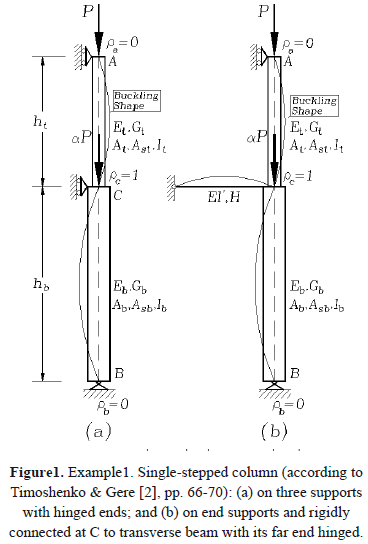
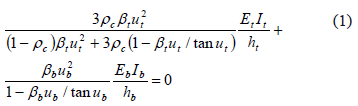
<body><![CDATA[<p><font size="2" face="Verdana, Arial, Helvetica, sans-serif"><b>RESUMEN:</b> El an&aacute;lisis de estabilidad el&aacute;stica de columnas con un cambio de secci&oacute;n con derivas laterales totalmente inhibidas, parcialmente inhibidas, y desinhibidas sometidas a cargas axiales concentradas en los extremos y en el nudo intermedio incluyendo los efectos de las conexiones y de las fuerzas a cortante utilizando tres modelos diferentes es presentado y discutido en una publicaci&oacute;n adjunta. Los dos primeros modelos son de Engesser y de Haringx que incluyen la componente de la fuerza axial aplicada a cortante proporcional a la pendiente total (dy/dx) y al &aacute;ngulo de giro de la secci&oacute;n transversal () a lo largo del miembro, respectivamente. El tercer modelo es una formulaci&oacute;n simplificada basada en la teor&iacute;a cl&aacute;sica de Euler, que incluye los efectos de las deformaciones por cortante, pero desprecia la componente a cortante de la fuerza axial aplicada a lo largo de la columna. Se presenta tambi&eacute;n criterios definidos para determinar la rigidez m&iacute;nima de los arriostramientos laterales para columnas con un cambio de secci&oacute;n. Se incluye cinco ejemplos completos en esta publicaci&oacute;n que muestran la efectividad de las ecuaciones de m&eacute;todos propuesto en el an&aacute;lisis de estabilidad y en el c&aacute;lculo de los arriostramientos m&iacute;nimos para columnas con un cambio de secci&oacute;n.</font></p>     <p><font size="2" face="Verdana, Arial, Helvetica, sans-serif"><b>PALABRAS CLAVE: </b>arriostramiento, pandeo, c&oacute;digos de construcci&oacute;n, columnas, construcci&oacute;n, aplicaciones inform&aacute;ticas, marcos, cargas, conexiones semi-r&iacute;gidas, deformaciones por cortante, apuntalamiento, estabilidad, columnas con cambio de secci&oacute;n</font></p> <hr>     <p>&nbsp;</p>     <p><font size="3" face="Verdana, Arial, Helvetica, sans-serif"><b>1. INTRODUCTION</b></font></p>     <p><font size="2" face="Verdana, Arial, Helvetica, sans-serif">The elastic stability analysis and the corresponding equations for stepped columns subject to end and intermediate-axial loads including the effects of: 1) lateral and rotational restraints at the intermediate connection and column ends; and 2) shear deformations and shear force along the member caused by the applied axial loads are presented in a companion paper &#91;1&#93;. The main objective of this article is to present the use of the proposed stability equations and to demonstrate their effectiveness.</font></p>     <p>&nbsp;</p>     <p><font size="3" face="Verdana, Arial, Helvetica, sans-serif"><b>2. VERIFICATION STUDY AND EXAMPLES</b></font></p>     <p><font size="2" face="Verdana, Arial, Helvetica, sans-serif">2.1 Example 1. Consider the single-stepped column with hinged ends subjected to concentric axial loads <i>P</i> and <i><font face="Symbol">a</font>P</i> at <i>A</i> and <i>C</i> shown in Fig. 1a (hinged at A and B: <i><font face="Symbol">r</font><sub>a</sub></i> = <i><font face="Symbol">r</font><sub>b</sub></i> = 0; and with rigid connection at C and no exterior rotational restraint: <i><font face="Symbol">r</font><sub>c</sub></i> = 1, K<sub>c</sub> = 0).</font></p>     <p><font size="2" face="Verdana, Arial, Helvetica, sans-serif"><i>Solution:</i> Using Eq. (10) listed in the companion paper and assuming that <i><font face="Symbol">r</font><sub>a</sub></i> = <i><font face="Symbol">r</font><sub>b</sub></i> = 0, and k<sub>c</sub> = 0, the eigenvalue equation becomes</font></p>     <p><img src="/img/revistas/dyna/v79n176/v79n176a03eq01.gif"></p>     ]]></body>
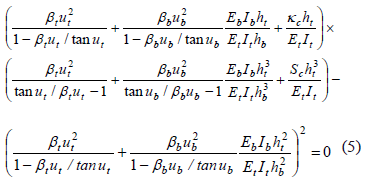
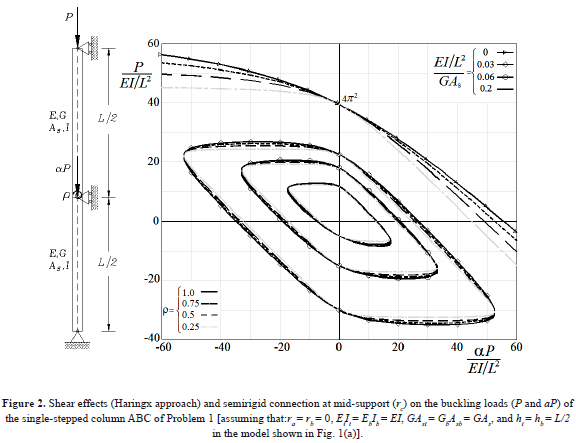
<body><![CDATA[<p><font size="2" face="Verdana, Arial, Helvetica, sans-serif">When <i><font face="Symbol">r</font><sub>c</sub></i> = 1 and <i>E<sub>t</sub></i> = <i>E<sub>b</sub></i>, Eq. (1) can be reduced to Eq. (2) as follows:</font></p>     <p><img src="/img/revistas/dyna/v79n176/v79n176a03eq02.gif"></p>     <p align="center"><font size="2" face="Verdana, Arial, Helvetica, sans-serif"><a name="fig01"></a></font><img src="/img/revistas/dyna/v79n176/v79n176a03fig01.gif"></p>     <p><font size="2" face="Verdana, Arial, Helvetica, sans-serif">For the particular case of <img src="/img/revistas/dyna/v79n176/v79n176a03eq70069.jpeg" />=<img src="/img/revistas/dyna/v79n176/v79n176a03eq70076.jpeg" />=1 (i.e., neglecting shear effects), Eq. (2) is identical to the solution reported by Timoshenko and Gere &#91;1&#93;, Eq. (b), p.67.</font></p>     <p><font size="2" face="Verdana, Arial, Helvetica, sans-serif">An additional example was considered assuming that k<sub>c</sub> = 3<i><i>EI</i>'/H</i> (bending restraint provided by a transverse beam located at midspan with a hinged far end), <i>h<sub>t</sub></i> = <i>h<sub>b</sub></i>, <i>I<sub>t</sub></i> = <i>I<sub>b</sub></i>, <i><font face="Symbol">b</font><sub>t</sub></i> = <i><font face="Symbol">b</font><sub>b</sub></i> = 1, <i>E<sub>t</sub></i> = <i>E<sub>b</sub></i> = <i>E</i>, and <font face="Symbol">a</font> = 0, as shown in Fig. 1b. Then Eq. (2) becomes</font></p>     <p><img src="/img/revistas/dyna/v79n176/v79n176a03eq03.gif"></p>     <p><font size="2" face="Verdana, Arial, Helvetica, sans-serif">Since <i>u<sub>t</sub></i> = <i>u<sub>b</sub></i>, Eq. (3) is reduced to Eq. (4) </font></p>     <p><img src="/img/revistas/dyna/v79n176/v79n176a03eq04.gif"></p>     <p><font size="2" face="Verdana, Arial, Helvetica, sans-serif">Expression (4) is identical to the solution reported by Timoshenko and Gere (&#91;2&#93;, bottom of p. 69). Note that in Timoshenko's notation, <i>u<sub>t</sub></i> = 2u<sub>1</sub>, and <i>u<sub>b</sub></i> = 2u<sub>2</sub>,.</font></p>     <p><font size="2" face="Verdana, Arial, Helvetica, sans-serif">Figure 2 shows the effects of shear deformations (using the Haringx approach) and semi-rigid connection at C (<i><font face="Symbol">r</font><sub>c</sub></i>) on the buckling loads of the column of Fig. 1(a) assuming that column segments are made of identical material, cross section, and equal length (<i>h<sub>t</sub></i> = <i>h<sub>b</sub></i>= L/2). Notice that: 1) shear deformations reduce the critical loads P and aP, while the effects of the semi-rigid connection at C are only significant when <i>GA<sub>s</sub></i>/(<i>EI</i>/<i>L</i><sup>2</sup>) is very large and aP &bull; 0; and 2) the proposed equation is capable of capturing the phenomena of buckling under tension when P or/and aP are negative</font></p>     ]]></body>
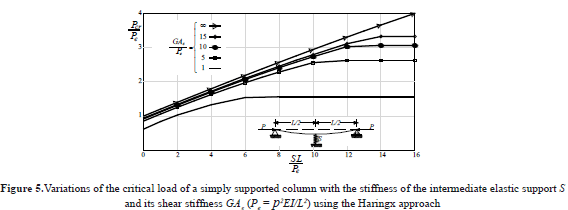
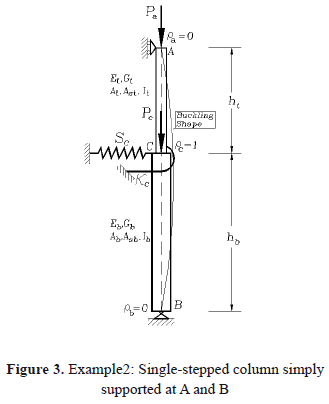
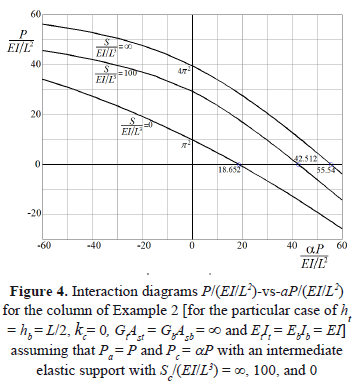
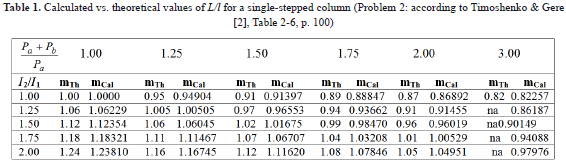
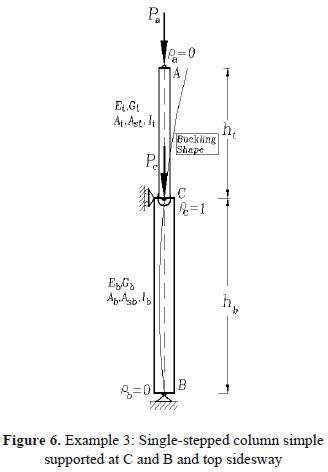
<body><![CDATA[<p><font size="2" face="Verdana, Arial, Helvetica, sans-serif"><b>2.2. Example 2.</b> The case under consideration is a single-stepped column with hinged supports at A and B subjected to concentric axial loads <i>P<sub>a</sub></i> and <i>P<sub>c</sub></i> at A and C as shown in Fig. 3 (hinged at A and B and rigidly connected at C: <i><font face="Symbol">r</font><sub>a</sub></i> = <i><font face="Symbol">r</font><sub>b</sub></i> = 0, and <i><font face="Symbol">r</font><sub>c</sub></i> = 1).</font></p>     <p><font size="2" face="Verdana, Arial, Helvetica, sans-serif">Using Eq. (10) listed in the companion paper and assuming that <i><font face="Symbol">r</font><sub>a</sub></i> = <i><font face="Symbol">r</font><sub>b</sub></i> = 0 and <i><font face="Symbol">r</font><sub>c</sub></i> = 1, the eigenvalue equation becomes </font></p>     <p><img src="/img/revistas/dyna/v79n176/v79n176a03eq05.gif"></p>     <p><font size="2" face="Verdana, Arial, Helvetica, sans-serif">Results from Eq. (5) were tested against tabulated values presented by Timoshenko and Gere (&#91;2&#93;, Table 2-6, p. 100) for the particular case of <i>S<sub>c</sub></i> = k<sub>c</sub> = 0, <i><font face="Symbol">b</font><sub>t</sub></i> = <i><font face="Symbol">b</font><sub>b</sub></i> = 1 and <i>E<sub>t</sub></i> = <i>E<sub>b</sub></i> = E. The values of the reduced length L of the column calculated from Eq. (5) which are listed in Table 1 (denoted as mCal) are practically identical to those derived by Timoshenko and Gere &#91;2&#93; denoted as mTh) where (P<sub>a</sub>+P<sub>c</sub>)<sub>cr</sub> = <font face="Symbol">p</font><sup>2</sup><i>EI</i>/<i>L</i><sup>2</sup>.</font></p>     <p><font size="2" face="Verdana, Arial, Helvetica, sans-serif">Figure 4 show a series of interaction diagrams of P/(<i>EI</i>/<i>L</i><sup>2</sup>)-vs-<font face="Symbol">a</font>P/(<i>EI</i>/<i>L</i><sup>2</sup>) for different values of S/(<i>EI</i>/<i>L</i><sup>3</sup>) all obtained using Eq. (5) for the particular case of <i>h<sub>t</sub></i> = <i>h<sub>b</sub></i> = L/2, <i>G<sub>t</sub></i><i>A<sub>st</sub></i> = <i>G<sub>b</sub></i><i>A<sub>sb</sub></i> = &infin; and <i>E<sub>t</sub></i><i><i>I<sub>t</sub></i></i> = <i>E<sub>b</sub></i><i>I<sub>b</sub></i> = <i><i>EI</i></i>. Figure5 shows the variations of the compressive buckling load <i>P<sub>cr</sub></i> of a simply supported beam with the stiffness of the intermediate elastic support <i>S</i> located at midspan for different values of <i>GA<sub>s</sub></i>/<i>P<sub>e</sub></i> (notice that <i>P<sub>cr</sub></i> and <i>S</i> are normalized with respect to <i>P<sub>e</sub></i> = <font face="Symbol">p</font><sup>2</sup><i>EI</i>/<i>L</i><sup>2</sup>).</font></p>     <p align="center"><font size="2" face="Verdana, Arial, Helvetica, sans-serif"><a name="fig02"></a></font><img src="/img/revistas/dyna/v79n176/v79n176a03fig02.gif"></p>     <p><font size="2" face="Verdana, Arial, Helvetica, sans-serif">Notice also that: 1) the values indicated in Fig. 5 corresponding to the curve with <i>S</i> = 0 are identical to those presented by Timoshenko and Gere (&#91;2&#93;, p. 100 Table 2-6 for n = 1); 2) the buckling load capacity of the beam-column is affected significantly not only by the location and stiffness of the mid-support but also by the magnitude of the shear stiffness of the members as shown by the curves in Fig. 5 and 3) the curve corresponding to <i>GA<sub>s</sub></i>/<i>P<sub>e</sub></i> = &infin; in Fig. 5 shows that the compressive critical load increases in approximately the same proportion as S. This curve is identical to that presented by Timoshenko and Gere (&#91;2&#93;, p. 73).</font></p>     <p><font size="2" face="Verdana, Arial, Helvetica, sans-serif"><b>2.3 Example 3.</b> The validity of Eq. (12) was tested against the solutions obtained utilizing the classical method of slope-deflection (Salmon and Johnson &#91;3&#93;, p. 840) for a stepped column with hinged ends subjected to concentric axial loads <i>P<sub>a</sub></i> and <i>P<sub>c</sub></i> at A and C as shown in Fig. 6 (free at A: <i><font face="Symbol">r</font><sub>a</sub></i> = 0, <i>S<sub>a</sub></i> = 0; braced at C with no exterior rotational restraint: <i><font face="Symbol">r</font><sub>c</sub></i> = 1, K<sub>c</sub> = 0; and hinged at B: <i><font face="Symbol">r</font><sub>b</sub></i> = 0).</font></p>     <p align="center"><font size="2" face="Verdana, Arial, Helvetica, sans-serif"><a name="fig03"></a></font><img src="/img/revistas/dyna/v79n176/v79n176a03fig03.gif"></p>     <p align="center"><font size="2" face="Verdana, Arial, Helvetica, sans-serif"><a name="fig04"></a></font><img src="/img/revistas/dyna/v79n176/v79n176a03fig04.gif"></p>     ]]></body>
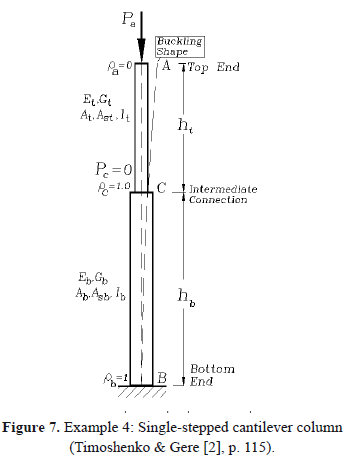
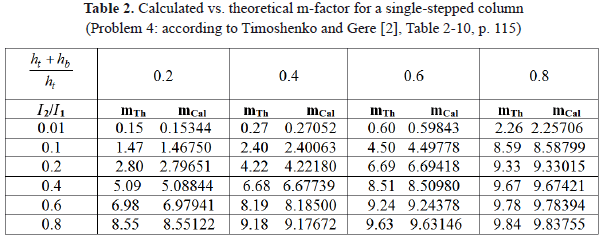
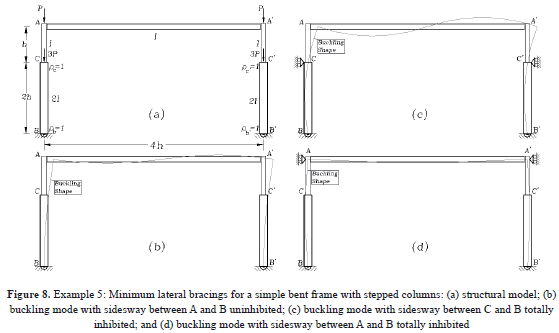
<body><![CDATA[<p align="center"><font size="2" face="Verdana, Arial, Helvetica, sans-serif"><a name="fig05"></a></font><img src="/img/revistas/dyna/v79n176/v79n176a03fig05.gif"></p>     <p align="center"><font size="2" face="Verdana, Arial, Helvetica, sans-serif"><a name="tab01"></a></font><img src="/img/revistas/dyna/v79n176/v79n176a03tab01.gif"></p>     <p><font size="2" face="Verdana, Arial, Helvetica, sans-serif">Substituting into Eq. (12) <i><font face="Symbol">r</font><sub>a</sub></i> = <i><font face="Symbol">r</font><sub>b</sub></i> = 0, <i><font face="Symbol">r</font><sub>c</sub></i> = 1, and K<sub>c</sub> = 0, the eigenvalue equation becomes</font></p>     <p><img src="/img/revistas/dyna/v79n176/v79n176a03eq06.gif"></p>     <p align="center"><font size="2" face="Verdana, Arial, Helvetica, sans-serif"><a name="fig06"></a></font><img src="/img/revistas/dyna/v79n176/v79n176a03fig06.gif"></p>     <p><font size="2" face="Verdana, Arial, Helvetica, sans-serif">For the particular case: <i>P<sub>c</sub></i> = 0, <i>h<sub>t</sub></i> = <i>h<sub>b</sub></i> = h, <i>E<sub>t</sub></i><i>I<sub>t</sub></i> = <i>E<sub>b</sub></i><i>I<sub>b</sub></i> = <i>EI</i>, and<i><font face="Symbol">b</font><sub>t</sub></i> = <i><font face="Symbol">b</font><sub>b</sub></i> = 1, the stability equation is reduced to 2<i>u<sub>t</sub></i> = tan<i>u<sub>t</sub></i>, whose solution is <i>u<sub>t</sub></i> = 1.16556 or (<i>P<sub>a</sub></i>)<i><sub>cr</sub></i> = <font face="Symbol">p</font><sup>2</sup><i>EI</i>/(2.6953h2). Using the slope-deflection method (Salmon and Johnson &#91;3&#93;, pp. 840-842) a stability equation identical to (6b) can be obtained.</font></p>     <p><font size="2" face="Verdana, Arial, Helvetica, sans-serif"><b>2.4 Example 4. </b>Results from Eq. (13) were tested against tabulated solutions presented by Timoshenko and Gere (&#91;2&#93;, Table 2-10, p. 115) for a stepped cantilever Euler-Bernoulli column (<i><font face="Symbol">b</font><sub>t</sub></i> = <i><font face="Symbol">b</font><sub>b</sub></i> = 1) shown in Fig. 7 free at A (<i><font face="Symbol">r</font><sub>a</sub></i> = <i>S<sub>a</sub></i> = 0), rigidly connected and unrestrained at C (<i><font face="Symbol">r</font><sub>c</sub></i> = 1, <i>S<sub>c</sub></i> = K<sub>c</sub> = 0), and perfectly fixed at B (<i><font face="Symbol">r</font><sub>b</sub></i> = 1).</font></p>     <p><font size="2" face="Verdana, Arial, Helvetica, sans-serif">Table 2 shows that the values of m calculated using Eq. (13), which are listed with five significant figures, are practically identical to those by Timoshenko. Note that m is for the hinged-hinged column, and m/4 for the cantilever column, where m is used by Timoshenko in <i>P<sub>cr</sub></i> = m<i>EI</i><sub>2</sub>/(h<sub>1</sub>+h<sub>2</sub>)<sup>2</sup>.</font></p>     <p><font size="2" face="Verdana, Arial, Helvetica, sans-serif"><b>2.5 Example 5: </b><i>Minimum lateral bracing for a bent-up frame</i></font></p>     <p><font size="2" face="Verdana, Arial, Helvetica, sans-serif">Utilizing the minimum bracing criteria and the steps described in the companion paper, determine the lateral bracings required to convert the bent frame shown in Fig. 8a into a braced frame. The bracings that need to be analyzed are: 1) <i>S<sub>a</sub></i> along the top level (i.e., frame braced at A and A' only); 2) <i>S<sub>c</sub></i> at the intermediate joint (i.e., frame braced at C and C' only); and 3) <i>S<sub>a</sub></i> and <i>S<sub>c</sub></i> along the top and intermediate joints (i.e., frame braced at A and C). Assume that <i><font face="Symbol">r</font><sub>b</sub></i> = <i><font face="Symbol">r</font><sub>c</sub></i> = 1 in both columns and neglect the effects of shear deformations (i.e., <i>b</i> = 1 in all members).</font></p>     ]]></body>
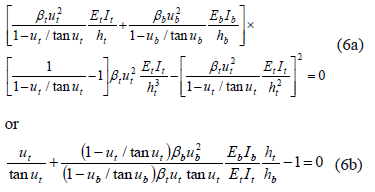
<body><![CDATA[<p><font size="2" face="Verdana, Arial, Helvetica, sans-serif"><i>Solution:</i> Since the frame is symmetrical, columns AB and A'B' are both identical with the same loads and boundary conditions. Therefore, the stability analysis can be reduced to that of a single column.</font></p>     <p><font size="2" face="Verdana, Arial, Helvetica, sans-serif">The first step is to find the fixity factors at the column ends for unbraced and braced conditions. Relationships between the rotational restraints and the fixity factors in framed structures are presented in the Appendix of the companion paper. For this particular frame, the fixity factors are as follows:</font></p>     <p><font size="2" face="Verdana, Arial, Helvetica, sans-serif">i) For <i>unbraced conditions</i> along AA', the frame would buckle in a anti-symmetric shape (Figs. 8b-c) with the beam providing rotational restraints at both ends A and A' of magnitude 6<i>EI</i>/<i>L</i> = 1.5<i>EI</i>/h (since L = <i>4h</i>). Therefore, <i><font face="Symbol">r</font><sub>a</sub></i> = 1/(1+3/1.5) = 1/3, and <i><font face="Symbol">r</font><sub>b</sub></i> = <i><font face="Symbol">r</font><sub>c</sub></i> = 1.</font></p>     <p><font size="2" face="Verdana, Arial, Helvetica, sans-serif">ii) For <i>braced conditions</i> along AA', the frame would buckle in a symmetric shape (Fig. 8d) with the beam providing rotational restraints at both ends A and A' of magnitude 2<i>EI</i>/<i>L</i> = 0.5<i>EI</i>/<i>h</i>. Therefore, <i><font face="Symbol">r</font><sub>a</sub></i> = 1/(1+3/0.5) = 1/7, and <i><font face="Symbol">r</font><sub>b</sub></i> = <i><font face="Symbol">r</font><sub>c</sub></i> = 1.</font></p>     <p><font size="2" face="Verdana, Arial, Helvetica, sans-serif">The required bracings for column AB for each one of the requested cases are calculated as follows:</font></p>     <p align="center"><font size="2" face="Verdana, Arial, Helvetica, sans-serif"><a name="fig07"></a></font><img src="/img/revistas/dyna/v79n176/v79n176a03fig07.gif"></p> <ol>       <li><font size="2" face="Verdana, Arial, Helvetica, sans-serif"><i>Braced at top end A only.</i> Taking into consideration that: <i>I<sub>t</sub></i> = I, <i>h<sub>t</sub></i> = h, <i>I<sub>b</sub></i> = 2I, <i>h<sub>t</sub></i> = 2h, <i>P<sub>a</sub></i> = P, <i>P<sub>c</sub></i> = 3P, <i><font face="Symbol">r</font><sub>a</sub></i> = 1/3, and <i><font face="Symbol">r</font><sub>b</sub></i> = <i><font face="Symbol">r</font><sub>c</sub></i> = 1, the solution for braced conditions obtained from Eq. (11) are: (<i>P<sub>a</sub></i>)<i><sub>cr</sub></i> = 0.19072(<font face="Symbol">p</font><sup>2</sup><i>EI</i>/<i>h<sup>2</sup></i>) and (<i>P<sub>a</sub></i>+<i>P<sub>c</sub></i>)<i><sub>cr</sub></i> = 0.76288(<font face="Symbol">p</font><sup>2</sup><i>EI</i>/<i>h<sup>2</sup></i>) (or <i>u<sub>t</sub></i> = <font face="Symbol">p</font><img src="/img/revistas/dyna/v79n176/v79n176a03eq70250.jpeg" /> = 1.37198 and <i>u<sub>b</sub></i> = <font face="Symbol">p</font><img src="/img/revistas/dyna/v79n176/v79n176a03eq70257.jpeg" /> = 3.88055). Now, the magnitude of <i>S<sub>a</sub></i> can obtained directly from Eq. (11) by substituting the values of <i>u<sub>t</sub></i> = 1.37198 and <i>u<sub>b</sub></i> = 3.88055, <i><font face="Symbol">r</font><sub>a</sub></i> = 1/3, and <i><font face="Symbol">r</font><sub>b</sub></i> = <i><font face="Symbol">r</font><sub>c</sub></i> = 1. The result is <i>S<sub>a</sub></i> = 3.3818<i>EI</i>/<i>h<sup>3</sup></i> per column.</font></li>       <li><font size="2" face="Verdana, Arial, Helvetica, sans-serif"><i>Braced at the intermediate joint C only.</i> Taking into consideration that: <i>I<sub>t</sub></i> = I, <i>h<sub>t</sub></i> = h, <i>I<sub>b</sub></i> = 2I, <i>h<sub>t</sub></i> = 2h, <i>P<sub>a</sub></i> = P, <i>P<sub>c</sub></i> = 3P, <i><font face="Symbol">r</font><sub>a</sub></i> = 1/3, and <i><font face="Symbol">r</font><sub>b</sub></i> = <i><font face="Symbol">r</font><sub>c</sub></i> = 1, the solution for braced conditions obtained from Eq. (12) are: (<i>P<sub>a</sub></i>)<i><sub>cr</sub></i> = 0.20909(<font face="Symbol">p</font><sup>2</sup><i>EI</i>/<i>h<sup>2</sup></i>) and (<i>P<sub>a</sub></i>+<i>P<sub>c</sub></i>)<i><sub>cr</sub></i> = 0.83637(<font face="Symbol">p</font><sup>2</sup><i>EI</i>/<i>h<sup>2</sup></i>) (or <i>u<sub>t</sub></i> = <font face="Symbol">p</font><img src="/img/revistas/dyna/v79n176/v79n176a03eq70266.jpeg" /> = 1.43654 and <i>u<sub>b</sub></i> = <font face="Symbol">p</font><img src="/img/revistas/dyna/v79n176/v79n176a03eq70276.jpeg" /> = 4.06315). Now, the magnitude of <i>S<sub>c</sub></i> can obtained directly from Eq. (12) by substituting the values of <i>u<sub>t</sub></i> = 1.43654, <i>u<sub>b</sub></i> = 4.06315, <i><font face="Symbol">r</font><sub>a</sub></i> = 1/3, and <i><font face="Symbol">r</font><sub>b</sub></i> = <i><font face="Symbol">r</font><sub>c</sub></i> = 1. The result is <i>S<sub>c</sub></i> = 2.77322<i>EI</i>/<i>h<sup>3</sup></i> per column.</font></li>       <li><font size="2" face="Verdana, Arial, Helvetica, sans-serif"><i>Braced at end A and at the intermediate joint C simultaneously.</i> Taking into consideration that: <i>I<sub>t</sub></i> = <i>I</i>, <i>h<sub>t</sub></i> = <i>h</i>, <i>I<sub>b</sub></i> = 2<i>I</i>, <i>h<sub>t</sub></i> = 2<i>h</i>, <i>P<sub>a</sub></i> = <i>P</i>, <i>P<sub>c</sub></i> = 3<i>P</i>, <i><font face="Symbol">r</font><sub>a</sub></i> = 1/7, and <i><font face="Symbol">r</font><sub>b</sub></i> =<i><font face="Symbol">r</font><sub>c</sub></i> = 1, the solution for braced conditions obtained from Eq. (10) are: (<i>P<sub>a</sub></i>)<i><sub>cr</sub></i> = 0.329338(<font face="Symbol">p</font><sup>2</sup><i>EI</i>/<i>h<sup>2</sup></i>) and (<i>P<sub>a</sub></i>+<i>P<sub>c</sub></i>)<i><sub>cr</sub></i> = 1.31735(<font face="Symbol">p</font><sup>2</sup><i>EI</i>/<i>h<sup>2</sup></i>) (or <i>u<sub>t</sub></i> = <font face="Symbol">p</font><img src="/img/revistas/dyna/v79n176/v79n176a03eq70288.jpeg" /> = 1.802898 and <i>u<sub>b</sub></i> = <font face="Symbol">p</font><img src="/img/revistas/dyna/v79n176/v79n176a03eq70297.jpeg" /> = 5.09936).</font></li>     </ol>     ]]></body>
<body><![CDATA[<p><font size="2" face="Verdana, Arial, Helvetica, sans-serif">Now, the magnitude of <i>S<sub>a</sub></i> can obtained directly from the characteristic equation <img src="/img/revistas/dyna/v79n176/v79n176a03eq70304.jpeg" />= 0 by deleting the second row and column (or <img src="/img/revistas/dyna/v79n176/v79n176a03eq70312.jpeg" />) and substituting the values of <i>u<sub>t</sub></i> = 1.802898, <i>u<sub>b</sub></i> = 5.09936, <i><font face="Symbol">r</font><sub>a</sub></i>= 1/7, and <i><font face="Symbol">r</font><sub>b</sub></i> =<i><font face="Symbol">r</font><sub>c</sub></i> = 1. The result is <i>S<sub>a</sub></i> = 47.3354<i>EI</i>/<i>h<sup>3</sup></i> per column. </font></p>     <p><font size="2" face="Verdana, Arial, Helvetica, sans-serif">Similarly, <i>S<sub>c</sub></i> can obtained directly from the characteristic equation <img src="/img/revistas/dyna/v79n176/v79n176a03eq70319.jpeg" />= 0 by deleting the third row and column (or  ) and substituting the values of <i>u<sub>t</sub></i> = 1.802898, <i>u<sub>b</sub></i> = 5.09936, <i><font face="Symbol">r</font><sub>a</sub></i> = 1/7, and <i><font face="Symbol">r</font><sub>b</sub></i> = <i><font face="Symbol">r</font><sub>c</sub></i> = 1. The result is <i>S<sub>c</sub></i> = 1.096677<i>EI</i>/<i>h<sup>3</sup></i> per column.</font></p>     <p><font size="2" face="Verdana, Arial, Helvetica, sans-serif">It is interesting to note that: 1) the trend for this particular frame is indicated by Eq. (18) as follows: (<i>P<sub>a</sub></i>+<i>P<sub>c</sub></i>)<i><sub>cr</sub></i> = 1.31735(<font face="Symbol">p</font><sup>2</sup><i>EI</i>/<i>h<sup>2</sup></i>) &gt; 0.83637(<font face="Symbol">p</font><sup>2</sup><i>EI</i>/<i>h<sup>2</sup></i>) &gt; 0.76288(<font face="Symbol">p</font><sup>2</sup><i>EI</i>/<i>h<sup>2</sup></i>) &gt; 0.16074(<font face="Symbol">p</font><sup>2</sup><i>EI</i>/<i>h<sup>2</sup></i>) (this last value corresponds to the unbraced frame); and 2) the required lateral bracing at A is relatively small compared to that required at the intermediate joint C.</font></p>     <p align="center"><font size="2" face="Verdana, Arial, Helvetica, sans-serif"><a name="tab02"></a></font><img src="/img/revistas/dyna/v79n176/v79n176a03tab02.gif"></p>     <p align="center"><font size="2" face="Verdana, Arial, Helvetica, sans-serif"><a name="fig08"></a></font><img src="/img/revistas/dyna/v79n176/v79n176a03fig08.gif"></p>     <p>&nbsp;</p>     <p><font size="3" face="Verdana, Arial, Helvetica, sans-serif"><b>3. SUMMARY AND CONCLUSIONS</b></font></p>     <p><font size="2" face="Verdana, Arial, Helvetica, sans-serif">A complete column classification and the corresponding stability equations for single-stepped columns with sidesway totally inhibited, partially inhibited, and uninhibited subjected to concentrated axial loads located at the ends and at the intermediate joint including the shear force effects are presented using three different approaches in a companion paper.</font></p>     <p><font size="2" face="Verdana, Arial, Helvetica, sans-serif">To understand the four-way classification of single-stepped columns and post shores, the corresponding stability equations, five examples are used in this paper and the results are compared to those using other methods. A verification study indicates that the calculated elastic buckling loads are theoretically exact.</font></p>     <p><font size="2" face="Verdana, Arial, Helvetica, sans-serif">Analytical studies indicate that: 1) the stability of a single-stepped column increases substantially with the magnitude of the lateral restraints and the fixity at the base and at the intermediate connection; 2) shear deformations and the shear forces induced by the applied axial loads reduce the buckling loads; 3) the degree of fixity at the top end has less influence on the overall stability of stepped columns and post shores in frames with sidesway inhibited than in frames with sidesway uninhibited; 4) the critical axial loads using the Engesser approach is lower than that using the Haringx and simplified Euler approaches; 5) the critical loads in tension and in compression predicted by the Haringx approach are very sensitive to the shear stiffness <i>GA<sub>s</sub></i>; 6) the Haringx approach is the only one among the three approaches capable of capturing the phenomena of tension buckling; and 7)as expected, the critical axial loads in compression are highly affected by the degree of flexural fixity at the supports, but the critical axial loads in tension are not affected as much. It is important to emphasize that shear effects are not of significance and can be neglected for slender columns of solid cross sections like rectangular and I-cross sections.</font></p>     ]]></body>
<body><![CDATA[<p>&nbsp;</p>     <p><font size="3" face="Verdana, Arial, Helvetica, sans-serif"><b>ACKNOWLEDGMENTS</b></font></p>     <p><font size="2" face="Verdana, Arial, Helvetica, sans-serif">The research presented in this paper was carried out at the National University of Colombia at Medellin. The author wants to express his appreciation to Jaime Hernandez-Urrea, currently a Ph.D. student at the University of Illinois at Champaign-Urbana and former member of the Structural Stability Group GES of the National University of Colombia at Medellin for helping and preparing the figures of all the examples.</font></p>     <p>&nbsp;</p>     <p><font size="3" face="Verdana, Arial, Helvetica, sans-serif"><b>NOTATION</b></font></p>     <p><img src="/img/revistas/dyna/v79n176/v79n176a03not00.gif"></p>     <p>&nbsp;</p>     <p><font size="3" face="Verdana, Arial, Helvetica, sans-serif"><b>REFERENCES</b></font></p>     <!-- ref --><p><font size="2" face="Verdana, Arial, Helvetica, sans-serif"><b>&#91;1&#93;</b> Aristizabal, J. D., Stability and minimum lateral bracing for stepped columns with semi-rigid connections including shear effects: I) Theory, Revista DYNA, 174, 2012, pp. 96-106.    &nbsp;&nbsp;&nbsp;&nbsp;&nbsp;&nbsp;&nbsp;&nbsp;[&#160;<a href="javascript:void(0);" onclick="javascript: window.open('/scielo.php?script=sci_nlinks&ref=000081&pid=S0012-7353201200060000300001&lng=','','width=640,height=500,resizable=yes,scrollbars=1,menubar=yes,');">Links</a>&#160;]<!-- end-ref --><!-- ref --><br>   <b>&#91;2&#93;</b> Timoshenko, S. P., and Gere, J. M., Theory of Elastic Stability, 2nd Ed., McGraw-Hill Book Inc., New York, N.Y. 1961.    &nbsp;&nbsp;&nbsp;&nbsp;&nbsp;&nbsp;&nbsp;&nbsp;[&#160;<a href="javascript:void(0);" onclick="javascript: window.open('/scielo.php?script=sci_nlinks&ref=000082&pid=S0012-7353201200060000300002&lng=','','width=640,height=500,resizable=yes,scrollbars=1,menubar=yes,');">Links</a>&#160;]<!-- end-ref --><!-- ref --><br>   <b>&#91;3&#93;</b> Salmon, C. G. and Johnson, J.E., Steel Structures: Design and Behavior, 4th Ed., HarperCollins College Publishers (Chapter 14), 1996.    &nbsp;&nbsp;&nbsp;&nbsp;&nbsp;&nbsp;&nbsp;&nbsp;[&#160;<a href="javascript:void(0);" onclick="javascript: window.open('/scielo.php?script=sci_nlinks&ref=000083&pid=S0012-7353201200060000300003&lng=','','width=640,height=500,resizable=yes,scrollbars=1,menubar=yes,');">Links</a>&#160;]<!-- end-ref --> </font></p>      ]]></body><back>
<ref-list>
<ref id="B1">
<label>1</label><nlm-citation citation-type="journal">
<person-group person-group-type="author">
<name>
<surname><![CDATA[Aristizabal]]></surname>
<given-names><![CDATA[J. D.]]></given-names>
</name>
</person-group>
<article-title xml:lang="en"><![CDATA[Stability and minimum lateral bracing for stepped columns with semi-rigid connections including shear effects: I) Theory]]></article-title>
<source><![CDATA[Revista DYNA]]></source>
<year>2012</year>
<numero>174</numero>
<issue>174</issue>
<page-range>96-106</page-range></nlm-citation>
</ref>
<ref id="B2">
<label>2</label><nlm-citation citation-type="book">
<person-group person-group-type="author">
<name>
<surname><![CDATA[Timoshenko]]></surname>
<given-names><![CDATA[S. P.]]></given-names>
</name>
<name>
<surname><![CDATA[Gere]]></surname>
<given-names><![CDATA[J. M.]]></given-names>
</name>
</person-group>
<source><![CDATA[Theory of Elastic Stability]]></source>
<year>1961</year>
<edition>2nd</edition>
<publisher-loc><![CDATA[New York^eN.Y. N.Y.]]></publisher-loc>
<publisher-name><![CDATA[McGraw-Hill Book Inc.]]></publisher-name>
</nlm-citation>
</ref>
<ref id="B3">
<label>3</label><nlm-citation citation-type="book">
<person-group person-group-type="author">
<name>
<surname><![CDATA[Salmon]]></surname>
<given-names><![CDATA[C. G.]]></given-names>
</name>
<name>
<surname><![CDATA[Johnson]]></surname>
<given-names><![CDATA[J.E.]]></given-names>
</name>
</person-group>
<source><![CDATA[Steel Structures: Design and Behavior]]></source>
<year>1996</year>
<edition>4th</edition>
<publisher-name><![CDATA[HarperCollins College Publishers]]></publisher-name>
</nlm-citation>
</ref>
</ref-list>
</back>
</article>