<?xml version="1.0" encoding="ISO-8859-1"?><article xmlns:mml="http://www.w3.org/1998/Math/MathML" xmlns:xlink="http://www.w3.org/1999/xlink" xmlns:xsi="http://www.w3.org/2001/XMLSchema-instance">
<front>
<journal-meta>
<journal-id>0012-7353</journal-id>
<journal-title><![CDATA[DYNA]]></journal-title>
<abbrev-journal-title><![CDATA[Dyna rev.fac.nac.minas]]></abbrev-journal-title>
<issn>0012-7353</issn>
<publisher>
<publisher-name><![CDATA[Universidad Nacional de Colombia]]></publisher-name>
</publisher>
</journal-meta>
<article-meta>
<article-id>S0012-73532013000200004</article-id>
<title-group>
<article-title xml:lang="en"><![CDATA[PERFORMANCE COMPARISON BETWEEN A CLASSIC PARTICLE SWARM OPTIMIZATION AND A GENETIC ALGORITHM IN MANUFACTURING CELL DESIGN]]></article-title>
<article-title xml:lang="es"><![CDATA[COMPARACIÓN DEL DESEMPEÑO ENTRE UN ALGORITMO CLÁSICO DE OPTIMIZACIÓN POR ENJAMBRE DE PARTÍCULAS Y UN ALGORITMO GENÉTICO EN EL DISEÑO DE CELDAS DE MANUFACTURA]]></article-title>
</title-group>
<contrib-group>
<contrib contrib-type="author">
<name>
<surname><![CDATA[RODRÍGUEZ LEÓN]]></surname>
<given-names><![CDATA[JOHANNA]]></given-names>
</name>
<xref ref-type="aff" rid="A01"/>
</contrib>
<contrib contrib-type="author">
<name>
<surname><![CDATA[QUIROGA MÉNDEZ]]></surname>
<given-names><![CDATA[JABID EDUARDO]]></given-names>
</name>
<xref ref-type="aff" rid="A02"/>
</contrib>
<contrib contrib-type="author">
<name>
<surname><![CDATA[ORTIZ PIMIENTO]]></surname>
<given-names><![CDATA[NESTOR RAUL]]></given-names>
</name>
<xref ref-type="aff" rid="A03"/>
</contrib>
</contrib-group>
<aff id="A01">
<institution><![CDATA[,Universidad Industrial de Santander Escuela de Estudios Industriales y Empresariales ]]></institution>
<addr-line><![CDATA[ ]]></addr-line>
<country>Colombia</country>
</aff>
<aff id="A02">
<institution><![CDATA[,Universidad Industrial de Santander Escuela de Ingeniería Mecánica ]]></institution>
<addr-line><![CDATA[ ]]></addr-line>
<country>Colombia</country>
</aff>
<aff id="A03">
<institution><![CDATA[,Universidad Industrial de Santander Escuela de Estudios Industriales y Empresariales ]]></institution>
<addr-line><![CDATA[ ]]></addr-line>
<country>Colombia</country>
</aff>
<pub-date pub-type="pub">
<day>00</day>
<month>04</month>
<year>2013</year>
</pub-date>
<pub-date pub-type="epub">
<day>00</day>
<month>04</month>
<year>2013</year>
</pub-date>
<volume>80</volume>
<numero>178</numero>
<fpage>29</fpage>
<lpage>36</lpage>
<copyright-statement/>
<copyright-year/>
<self-uri xlink:href="http://www.scielo.org.co/scielo.php?script=sci_arttext&amp;pid=S0012-73532013000200004&amp;lng=en&amp;nrm=iso"></self-uri><self-uri xlink:href="http://www.scielo.org.co/scielo.php?script=sci_abstract&amp;pid=S0012-73532013000200004&amp;lng=en&amp;nrm=iso"></self-uri><self-uri xlink:href="http://www.scielo.org.co/scielo.php?script=sci_pdf&amp;pid=S0012-73532013000200004&amp;lng=en&amp;nrm=iso"></self-uri><abstract abstract-type="short" xml:lang="en"><p><![CDATA[This article studies the performance of two metaheuristics, the Particle Swarm Optimization (PSO) and the Genetic Algorithm (GA), in the manufacturing cell formation problem of a factory that needs to organize three production cases in an efficient way for four, five and six manufacturing cells to produce 30, 40 and 50 different products to be processed in 10, 10 and 20 type machines, respectively. The procedure for adjusting the particular parameters of each algorithm is implemented through a Design of Experiments which includes their own analysis of variance. Both algorithms are implemented in Matlab®. The results obtained by each meta heuristic are compared in terms of the cost of the best solution found and the execution time used to find that solution, so that it is possible to establish which methodology is the most appropriate when solving this optimization problem.]]></p></abstract>
<abstract abstract-type="short" xml:lang="es"><p><![CDATA[Este artículo estudia el desempeño de los meta-heurísticos Optimización de Enjambre de Partículas y Algoritmos Genéticos en el problema de formación de celdas de manufactura de una empresa que desea organizar de manera eficiente tres escenarios de producción: cuatro, cinco y seis celdas de manufactura para la fabricación de 30, 40 y 50 productos diferentes a ser procesados en 10, 10 y 20 tipos de máquinas, respectivamente. El proceso de ajuste de los parámetros particulares de cada algoritmo se realiza a través de un diseño de experimentos con su respectivo análisis de varianza. Los algoritmos son implementados en Matlab®. Los resultados obtenidos por cada metaheurística son comparados en términos del costo de la mejor solución encontrada y del tiempo de ejecución empleado para llegar a dicha solución, de manera que sea posible establecer cual metodología es la más adecuada a la hora de solucionar este problema de optimización.]]></p></abstract>
<kwd-group>
<kwd lng="en"><![CDATA[Manufacturing cells]]></kwd>
<kwd lng="en"><![CDATA[Group Technology]]></kwd>
<kwd lng="en"><![CDATA[Cellular Manufacturing]]></kwd>
<kwd lng="en"><![CDATA[Meta-heuristic Models]]></kwd>
<kwd lng="en"><![CDATA[Particle Swarm Optimization]]></kwd>
<kwd lng="en"><![CDATA[Genetic Algorithm]]></kwd>
<kwd lng="en"><![CDATA[Intercellular Transfers]]></kwd>
<kwd lng="es"><![CDATA[Celdas de Fabricación]]></kwd>
<kwd lng="es"><![CDATA[Tecnología de Grupos]]></kwd>
<kwd lng="es"><![CDATA[Manufactura Celular]]></kwd>
<kwd lng="es"><![CDATA[Metodologías Meta-heurísticos]]></kwd>
<kwd lng="es"><![CDATA[Optmización Enjambre de particulas]]></kwd>
<kwd lng="es"><![CDATA[Algoritmos Genéticos]]></kwd>
<kwd lng="es"><![CDATA[Transferencias Intercelulares]]></kwd>
</kwd-group>
</article-meta>
</front><body><![CDATA[ <p align="center"><font size="4" face="Verdana, Arial, Helvetica, sans-serif"><b>PERFORMANCE COMPARISON BETWEEN A CLASSIC PARTICLE SWARM OPTIMIZATION AND A GENETIC ALGORITHM IN MANUFACTURING CELL DESIGN </b></font></p>     <p align="center"><i><font size="3" face="Verdana, Arial, Helvetica, sans-serif"><b>COMPARACI&Oacute;N DEL DESEMPE&Ntilde;O ENTRE UN ALGORITMO CL&Aacute;SICO DE OPTIMIZACI&Oacute;N POR ENJAMBRE DE PART&Iacute;CULAS Y UN ALGORITMO GEN&Eacute;TICO EN EL DISE&Ntilde;O DE CELDAS DE MANUFACTURA</b></font></i></p>     <p align="center">&nbsp;</p>     <p align="center"><font size="2" face="Verdana, Arial, Helvetica, sans-serif"><b>JOHANNA RODR&Iacute;GUEZ LE&Oacute;N</b>    <br>   <i>Ingeniera Industrial Escuela de Estudios Industriales y Empresariales Universidad Industrial de Santander, Colombia. <a href="mailto:johannita7@hotmail.com">johannita7@hotmail.com</a></i></font></p>     <p align="center"><font size="2" face="Verdana, Arial, Helvetica, sans-serif"><b>JABID EDUARDO QUIROGA M&Eacute;NDEZ</b>    <br>   <i>Magister en Ingenier&iacute;a Mec&aacute;nica, Profesor Escuela de Ingenier&iacute;a Mec&aacute;nica Universidad Industrial de Santander, Colombia, <a href="mailto:jabib@uis.edu.co">jabib@uis.edu.co</a></i></font></p>     <p align="center"><font size="2" face="Verdana, Arial, Helvetica, sans-serif"><b>NESTOR RAUL ORTIZ PIMIENTO</b>    <br>   <i>Magister en Ingenier&iacute;a, Profesor Escuela de Estudios Industriales y Empresariales Universidad Industrial de Santander, Colombia, <a href="mailto:nortiz@uis.edu.co">nortiz@uis.edu.co</a></i></font></p>     <p align="center">&nbsp; </p>     ]]></body>
<body><![CDATA[<p align="center"><font size="2" face="Verdana, Arial, Helvetica, sans-serif"><b>Received for review March 13<sup>th</sup>, 2012, accepted December 14<sup>th</sup>, 2012, final version January, 18<sup>th</sup>, 2013</b></font></p>     <p align="center">&nbsp;</p> <hr>     <p><font size="2" face="Verdana, Arial, Helvetica, sans-serif"><b>ABSTRACT:</b> This article studies the performance of two metaheuristics, the Particle Swarm Optimization (PSO) and the Genetic Algorithm (GA), in the manufacturing cell formation problem of a factory that needs to organize three production cases in an efficient way for four, five and six manufacturing cells to produce 30, 40 and 50 different products to be processed in 10, 10 and 20 type machines, respectively. The procedure for adjusting the particular parameters of each algorithm is implemented through a Design of Experiments which includes their own analysis of variance. Both algorithms are implemented in Matlab&reg;. The results obtained by each meta heuristic are compared in terms of the cost of the best solution found and the execution time used to find that solution, so that it is possible to establish which methodology is the most appropriate when solving this optimization problem.</font> </p>     <p><font size="2" face="Verdana, Arial, Helvetica, sans-serif"><b>KEYWORDS:</b> Manufacturing cells, Group Technology, Cellular Manufacturing, Meta-heuristic Models, Particle Swarm Optimization, Genetic Algorithm, Intercellular Transfers.</font> </p>     <p><font size="2" face="Verdana, Arial, Helvetica, sans-serif"><b>RESUMEN:</b> Este art&iacute;culo estudia el desempe&ntilde;o de los meta-heur&iacute;sticos Optimizaci&oacute;n de Enjambre de Part&iacute;culas y Algoritmos Gen&eacute;ticos en el problema de formaci&oacute;n de celdas de manufactura de una empresa que desea organizar de manera eficiente tres escenarios de producci&oacute;n: cuatro, cinco y seis celdas de manufactura para la fabricaci&oacute;n de 30, 40 y 50 productos diferentes a ser procesados en 10, 10 y 20 tipos de m&aacute;quinas, respectivamente.  El proceso de ajuste de los par&aacute;metros particulares de cada algoritmo se realiza a trav&eacute;s de un dise&ntilde;o de experimentos con su respectivo an&aacute;lisis de varianza. Los algoritmos son implementados  en Matlab&reg;. Los resultados obtenidos por cada metaheur&iacute;stica son comparados en t&eacute;rminos del costo de la mejor soluci&oacute;n encontrada y del tiempo de ejecuci&oacute;n empleado para llegar a dicha soluci&oacute;n, de manera que sea posible establecer cual metodolog&iacute;a es la m&aacute;s adecuada a la hora de solucionar este problema de optimizaci&oacute;n.</font> </p>     <p><font size="2" face="Verdana, Arial, Helvetica, sans-serif"><b>PALABRAS CLAVE:</b> Celdas de Fabricaci&oacute;n, Tecnolog&iacute;a de Grupos,  Manufactura Celular, Metodolog&iacute;as Meta-heur&iacute;sticos, Optmizaci&oacute;n Enjambre de particulas, Algoritmos Gen&eacute;ticos, Transferencias Intercelulares.</font></p> <hr>     <p>&nbsp; </p>     <p><font size="3" face="Verdana, Arial, Helvetica, sans-serif"><b>1. INTRODUCTION</b></font></p>     <p><font size="2" face="Verdana, Arial, Helvetica, sans-serif">Nowadays, production systems must be flexible to respond to market needs in the elaboration of new products or to satisfy the customer requirements. The rapid obsolescence of the products and the sudden and unexpected fluctuations of the demand, has led to new concepts of production systems such as Cellular Manufacturing (CM). CM is based upon the principles of Group Technology, which seeks to group products to be manufactured in similar characteristics (size, shape, or common processing). In CM systems, machines are grouped together according to families of parts produced. Each production cell must be able to produce any member of the family. The organization of a plant using this structure becomes a challenge because of the numerous variations in the machines grouping and in the creation of products families.</font></p>     <p><font size="2" face="Verdana, Arial, Helvetica, sans-serif">In this study, a cell formation problem is addressed using PSO and GA comparing each methodology in terms of algorithm efficiency and feasible solution. The objective function involves the product demand, the operating time, the capacity by type of machine and constraints on the cell sizes to be arranged.</font></p>     ]]></body>
<body><![CDATA[<p><font size="2" face="Verdana, Arial, Helvetica, sans-serif">The paper is organized as follows: in section 2 a relevant literature review is presented, section 3 introduces briefly the theoretical framework describing each methodology and the mathematical model is formulated. In section 4 a statistical analysis is presented, which was performed to establish the PSO and GA parameters. Then, the specific characteristic of the three problems used in this study are introduced in section 5. Section 6 summarizes the results obtained in each of the proposed approaches. Finally, conclusions drawn from this study are given in section 7.</font></p>     <p>&nbsp;</p>     <p><font size="3" face="Verdana, Arial, Helvetica, sans-serif"><b>2.  RELEVANT LITERATURE REVIEW</b></font></p>     <p><font size="2" face="Verdana, Arial, Helvetica, sans-serif">The cell formation problem is an NP-hard combinatorial optimization problem for which several exact and approximate solution methods have been proposed &#91;1&#93;.</font></p>     <p><font size="2" face="Verdana, Arial, Helvetica, sans-serif">Different methodologies for solving the cell forming problem based on mathematical models have been proposed since the 1980s, Kusiak &#91;2&#93; and  Shtub &#91;3&#93;. The complexity associated with the model based approach has motivated the use of metaheuristics as an alternative solution methodology. </font></p>     <p><font size="2" face="Verdana, Arial, Helvetica, sans-serif">In the literature, the PSO implementation for solving the cell formation problem is limited. Andr&eacute;s and Lozano &#91;4&#93; PSO is only used to find the optimum number of transfers of lots of product between cells. Neither the product manufacturing time, nor cell size related constraints are considered. Ming and Ponnambalama &#91;5&#93; proposed a hybrid concept between PSO and GA for minimizing the total cell load variations and the total component traffic. A discrete PSO algorithm is proposed for minimizing the intercell transfers in &#91;6&#93;, however, neither production cost nor production time are considered. Mehdizadeh and Tavakkoli &#91;7&#93; proposed an algorithm based on Fuzzy clustering and Particle Swarm Optimization (FPSO) to solve the cell formation problem. Anvari, Mehrabad and Banzinpour &#91;8&#93; considered the cell formation problem using a hybrid PSO-GA. A new mutation operator is introduced to update the velocity equation to minimize the possibility that the search gets trapped in local minimums.</font></p>     <p><font size="2" face="Verdana, Arial, Helvetica, sans-serif">The GA implementation for solving the cell formation problem began with Venugopal and Narendran &#91;9&#93;. Gupta, Kumar and Sundram &#91;10&#93; proposing a GA to minimize the intracell and intercell movements. In &#91;11&#93; an algorithm with new genetic operators and a new chromosome representation is proposed. In &#91;12&#93; an integer programming model employing GA is proposed. Morad and Zalzala &#91;13&#93; used GA to handle two problems in manufacturing systems: the formation of manufacturing cells in cellular manufacturing and batch scheduling. Dimopoulos and Zalzala &#91;14&#93; examined a CM optimization problem to configure the cells in a facility maximizing the total number of batches processed per year. </font></p>     <p><font size="2" face="Verdana, Arial, Helvetica, sans-serif">Wu, Chu, Wang and Yang &#91;15&#93; presented a hierarchical genetic algorithm (GA) to solve the cell formation and layout decisions of cellular manufacturing considering two highly correlated <i>fitness</i> functions, and proposing a group mutation operator to increase the probability of mutation. In &#91;16&#93; a mathematical model of a nonlinear mixed-integer programming type is presented for designing cellular manufacturing systems. This paper develops and uses genetic algorithms (GAs), simulated annealing (SA) and tabu search (TS) for a Cellular Manufacturing CM model in a dynamic environment setting. In &#91;17&#93; the operational time and the sequence of operations are considered to minimize the total cell load variation. </font></p>     <p><font size="2" face="Verdana, Arial, Helvetica, sans-serif">Tunnukij and Hicks &#91;18&#93; presented a GA variation for which the number of manufacturing cells and the number of parts or machines per cell are not preset. In &#91;19&#93; GA are used to perform a multiobjective optimization. Cells are formed so as to simultaneously minimize three conflicting objectives, namely, the level of the work-in-process, the intercell moves and the total machinery investment. In &#91;20&#93; the product mix, product demand in each period, machine relocation and new equipment is considered in the Cell Formation (CF) problem. </font></p>     <p><font size="2" face="Verdana, Arial, Helvetica, sans-serif">Caprihan, Slomp, Gusaran and Agarwal &#91;21&#93; developed a Quantum PSO (QPSO) procedure to design virtual manufacturing cells for which machines and jobs are assigned to the cells seeking the maximization of productive output, while simultaneously minimizing the inter-cell movements. This problem is also solved using GA, the results showed that the QPSO implementation outperformed the GA algorithm in running time and results. </font></p>     ]]></body>
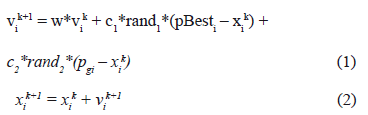
<body><![CDATA[<p><font size="2" face="Verdana, Arial, Helvetica, sans-serif">Sarayloo and Tavakkoli &#91;22&#93; developed an Imperialistic Competitive Algorithm (ICA), which optimizes inspired by imperialistic competition. ICA is compared with other well-known evolutionary algorithms, i.e. genetic algorithm (GA) and particle swarm optimization (PSO), to show its efficiency. However, in this paper the performance of PSO to GA is not compared. </font></p>     <p><font size="2" face="Verdana, Arial, Helvetica, sans-serif">In &#91;23-24&#93; a comparison between PSO and GA is studied in aerospace and control applications. Similarly, for the CF problem the comparison among different strategies should be compared to the solution obtained by an exact optimization method.</font></p>     <p>&nbsp;</p>     <p><font size="3" face="Verdana, Arial, Helvetica, sans-serif"><b>3.  THEORETICAL FRAMEWORK</b></font></p>     <p><b><font size="2" face="Verdana, Arial, Helvetica, sans-serif">3.1.  The PSO Algorithm    <br>   </font></b><font size="2" face="Verdana, Arial, Helvetica, sans-serif">PSO is a metaheuristic that optimizes a function by having a population of candidate solutions, and iteratively trying to improve a candidate solution with regard to a <i>fitness</i> function. PSO explores the search-space using the position and velocity of each particle &#91;25&#93;. Each particle's movement is influenced by its local best known position and is also guided toward the best known positions in the search-space, which are updated as better positions are found by other particles. This is expected to move the swarm toward the best solutions &#91;26&#93;.</font></p>     <p><font size="2" face="Verdana, Arial, Helvetica, sans-serif">In general, each particle <i>p<sub>i</sub></i> is composed of five main elements: a) the current particle position <i>x<sub>i</sub> = (x<sub>i1</sub>,x<sub>i2</sub>,&hellip;, x<sub>in</sub>)</i>, b) the current best position <i>pBest<sub>i</sub> = (p<sub>i1</sub>, p<sub>i2</sub>,&hellip;, p<sub>in</sub>)</i>, c) the velocity vector <i>v<sub>i</sub> = (v<sub>i1</sub>, v<sub>i2</sub>,&hellip;,v<sub>in</sub>)</i>; d) the best solution <i>fitness_x<sub>i</sub></i> for the current <i>x<sub>i</sub></i>; <i>e</i>) the current best solution <i>fitness_pBest<sub>i</sub></i> . The algorithm begins by randomly choosing initial positions and velocities for each particle. Then the <i>fitness_x<sub>i</sub></i> and <i>fitness_pBest<sub>i</sub></i> are determined. The iterative process to determine the solution is performed in (1) and (2).</font></p>     <p><img src="/img/revistas/dyna/v80n178/v80n178a04eq0102.gif"></p>     <p><font size="2" face="Verdana, Arial, Helvetica, sans-serif">where <i>v<sub>i</sub><sup>k</sup></i> is the velocity for the <i>i<sup>th</sup></i> particle in the <i>k<sup>th</sup></i> iteration; <i>w</i> is the inertia factor; c<sub>1</sub> and c<sub>2</sub> are acceleration constants (cognitive and social); rand<sub>1</sub> and rand<sub>2</sub> are random real numbers sampled from a uniform distribution between 0 and 1; <i>x<sub>i</sub><sup>k</sup></i> is the current position of the <i>i<sup>th</sup></i> particle in the <i>k<sup>th</sup></i> iteration; <i>pBest<sub>i</sub></i> is the best position (solution) for the <i>i<sup>th</sup></i> particle  and <i>p<sub>gi</sub></i> represents the particle position for the best <i>_fitness</i> pBest of the outline of <i>p<sub>i</sub></i> (lBest meaning localbest) or the entire swarm (<i>gBest</i> meaning <i>globalbest</i>).</font></p>     <p><font size="2" face="Verdana, Arial, Helvetica, sans-serif">The equation (1) represents the updated velocity vector for the <i>i<sup>th</sup></i> particle in the <i>k<sup>th</sup></i> iteration. The cognitive component is modeled by the factor <i>'c1*rand1*(pBest<sub>i</sub> - x<sub>i</sub><sup>k</sup>)'</i> and represents the distance between the current position and the best known position of this particle, that is, the decision assumed by the own experience in its life. The social component is considered by <i>'c2*rand2*(pg<sub>i</sub> - x<sub>i</sub><sup>k</sup>)'</i> and represents the distance between the current position and the best position in the swarm. Equation (2) represents the movement for the <i>i<sup>th</sup></i> particle in the <i>k<sup>th</sup></i> <i>iteration</i>.</font></p>     ]]></body>
<body><![CDATA[<p><font size="2" face="Verdana, Arial, Helvetica, sans-serif"><b>3.2.  The Genetic Algorithm</b>    <br>   </font><font size="2" face="Verdana, Arial, Helvetica, sans-serif">A GA is a search heuristic that mimics the process of natural evolution. In a GA, a population of strings (called chromosomes), which encode candidate solutions (called individuals) to an optimization problem, which evolves toward better solutions using genetic operators. </font></p>     <p><font size="2" face="Verdana, Arial, Helvetica, sans-serif">A GA consists of the following operations: a) Selection. During each successive generation, a proportion of the existing population is selected to breed a new generation keeping the best sequences of genetic material. b) Reproduction. The next step is to generate a second generation of the population of solutions from those selected in the first operation by using genetic operators: crossover, and/or mutation. For each new solution to be produced, a pair of &quot;parent&quot; solutions is selected for breeding from the pool selected previously. By producing a &quot;child&quot; solution using the above methods of crossover and mutation, a new solution is created which typically shares many of the characteristics of its &quot;parents&quot;. New parents are selected to create each new child, and the process continues until a new population of solutions of appropriate size is generated &#91;27&#93;. The mutation provides a variation of the information contained in the chromosomes, which can lead the search space exploration to new environments avoiding stagnation or the appearance of degenerate populations. The <i>fitness</i> function measures the quality of the solution and determines if the genetic material will be transmitted to the subsequent generations.</font></p>     <p><font size="2" face="Verdana, Arial, Helvetica, sans-serif"><b>3.3.  The Cell Formation (CF) Problem    <br>   </b></font><font size="2" face="Verdana, Arial, Helvetica, sans-serif">The CF problem is expressed as the minimization of the production costs. The mathematical model utilized in this work is based on &#91;28&#93;. In this process the following costs are considered:</font></p>     <p><font size="2" face="Verdana, Arial, Helvetica, sans-serif"><i>Operating cost:</i> The cost of operating machines for the production of parts. This cost depends on the cost of operating each machine type per hour and the number of hours required for each machine type.</font></p>     <p><font size="2" face="Verdana, Arial, Helvetica, sans-serif"><i>Intercell material handling cost:</i> The cost of transferring parts between cells when the parts cannot be produced completely in a single cell. This cost is determined by multiplying the number of batches of each product to be transferred by the cost of transporting a batch of product between any pair of cells</font></p>     <p><font size="2" face="Verdana, Arial, Helvetica, sans-serif">The following decisions must be made during the design process: The assignment of operations of each product to the cells and the determination the number of machines to perform the assigned task. The following considerations must be imposed in the model:</font></p> <ol>       <li><font size="2" face="Verdana, Arial, Helvetica, sans-serif">There must be sufficient machine capacity to produce each product, to satisfy the specified level of demand in each period.</font></li>       <li><font size="2" face="Verdana, Arial, Helvetica, sans-serif">The cell size must be specified. However upper and lower bounds can be used instead of a specific number.</font></li>       ]]></body>
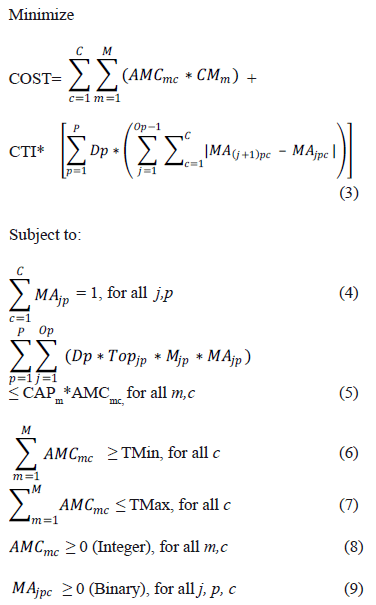
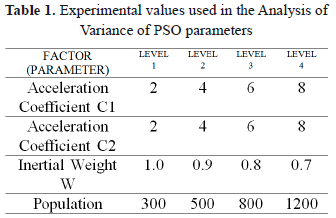
<body><![CDATA[<li><font size="2" face="Verdana, Arial, Helvetica, sans-serif">The number of cells in the system must be specified.</font></li>     </ol>     <p><font size="2" face="Verdana, Arial, Helvetica, sans-serif">The objective function based on the previous considerations is established in the following equation:</font></p>     <p><img src="/img/revistas/dyna/v80n178/v80n178a04eq0309.gif"></p>     <p><font size="2" face="Verdana, Arial, Helvetica, sans-serif">Where <i>c</i> is the cell index (<i>c</i>=1,2,&hellip;,<i>C</i>); m is the index for the different types of machines (<i>m</i>=1,2,&hellip;,<i>M</i>); <i>p</i> is the index for the different types of product (<i>p</i>=1,2,&hellip;,<i>P</i>); <i>j</i> is the index for the different types of operations required by part (<i>j</i>=1,&hellip;, <i>Op</i>); <i>D<sub>p</sub></i> is the demand for product p in the period; <i>O<sub>p</sub></i> is the number of operations required to manufacture a part or product <i>p</i>; <i>M<sub>jp</sub></i> is the incidence matrix part-machine. In this matrix <i>M</i> represents the type of machine required for each product; <i>Top<sub>jp</sub></i> is the time required to perform operation <i>j</i> for part type <i>p</i>; <i>CAP<sub>m</sub></i> is the capacity of each machine of type m in each period; <i>CM<sub>m</sub></i> is the operating cost per period of machine type <i>m</i>; <i>CT<sub>i</sub></i> is the intercell material handling cost per batch; <i>TMin</i> is the lower bound cell size; <i>TMax</i> upper bound cell size; <i>AMC<sub>mc</sub></i> is an <i>M x C</i> matrix that contains the number of machines of type <i>m</i> to be assigned to the cell <i>c</i> in each period and <i>MA<sub>jpc</sub></i> is the matrix of size Op x P with: 1 if the operation <i>j</i> of part type <i>p</i> is assigned to the cell <i>c</i>; 0 otherwise.</font></p>     <p><font size="2" face="Verdana, Arial, Helvetica, sans-serif">In equation (3) the first term is the operating machine total costs, the second term is the total intercell material handling cost, the equation (4) limits the assignation of each product operation to the respective cell; the equation (5) limits machine and cells capacity for satisfying the demand and the equations (6-7) limits the number of machines for the different cells.</font></p>     <p>&nbsp;</p>     <p><font size="3" face="Verdana, Arial, Helvetica, sans-serif"><b>4.  STATISTICAL ANALYSIS</b></font></p>     <p><font size="2" face="Verdana, Arial, Helvetica, sans-serif">A statistical analysis was performed to establish the PSO and GA parameters. Then, the set of instances to be included in the computational experiments was determined. Specific configuration of each problem included four, five and six cells for producing 30, 40 and 50 types of products using 10, 10, and 20 types of machines respectively. </font></p>     <p><font size="2" face="Verdana, Arial, Helvetica, sans-serif">In the case of PSO, an experimental design was used to determine the values of c1, c2, w, and the size of the population. The setting of these parameters will be performed through a completely randomized design. <a href="#tab01">Table 1</a> provides the experimental design, indicating the established values for each parameter to be adjusted.</font></p>     ]]></body>
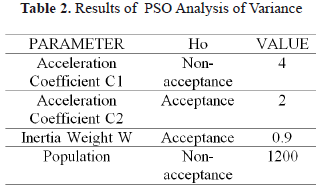
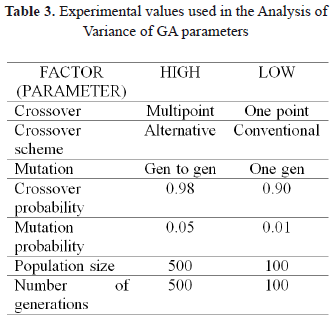
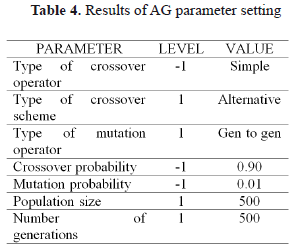
<body><![CDATA[<p align="center"><font size="2" face="Verdana, Arial, Helvetica, sans-serif"><a name="tab01"></a></font><img src="/img/revistas/dyna/v80n178/v80n178a04tab01.gif"></p>     <p><font size="2" face="Verdana, Arial, Helvetica, sans-serif">Initially, the algorithm was run for four values of each factor, moving one at a time. The experiment was repeated five times and the average values were taken. An Analysis of Variance was performed to these data in order to study the influence of the chosen parameters in the performance of the algorithm. In <a href="#tab02">table 2</a> are shown the results of the ANOVA.</font></p>     <p align="center"><font size="2" face="Verdana, Arial, Helvetica, sans-serif"><a name="tab02"></a></font><img src="/img/revistas/dyna/v80n178/v80n178a04tab02.gif"></p>     <p><font size="2" face="Verdana, Arial, Helvetica, sans-serif">In the case of the GA, a factorial experiment for adjusting the GA parameters was run &#91;28&#93;. <a href="#tab03">Table 3</a> provides the selected factors with their respective levels. </font></p>     <p align="center"><font size="2" face="Verdana, Arial, Helvetica, sans-serif"><a name="tab03"></a></font><img src="/img/revistas/dyna/v80n178/v80n178a04tab03.gif"></p>     <p><font size="2" face="Verdana, Arial, Helvetica, sans-serif"><a href="#tab04">Table 4</a> presented the results of the ANOVA analysis for the GA parameters &#91;28&#93;.</font></p>     <p align="center"><font size="2" face="Verdana, Arial, Helvetica, sans-serif"><a name="tab04"></a></font><img src="/img/revistas/dyna/v80n178/v80n178a04tab04.gif"></p>     <p>&nbsp;</p>     <p><font size="3" face="Verdana, Arial, Helvetica, sans-serif"><b>5.  PROBLEM CONFIGURATION</b></font></p>     <p><font size="2" face="Verdana, Arial, Helvetica, sans-serif">The performance of the PSO and the GA implemented was evaluated using three configuration problems. The input data for each problem were generated randomly, under the following conditions:</font></p>     ]]></body>
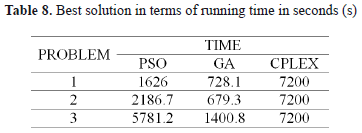
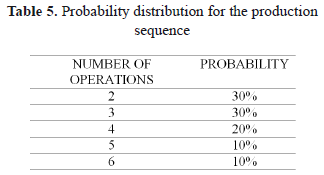
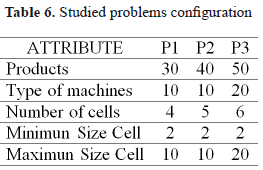
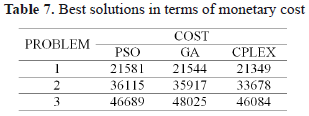
<body><![CDATA[<p><font size="2" face="Verdana, Arial, Helvetica, sans-serif">The demand of each product was generated using a discrete uniform distribution between 10 and 25 lots; the production sequence of each product was generated randomly using the probability distribution shown in <a href="#tab05">table 5</a>; the specific machine employed in each operation was selected using a discrete uniform distribution between 1 and M; the production time for a lot of any product per operation was sampled from a discrete uniform distribution between 1 and 10 minutes. The machine available time was 8 hours, 5 days per week during a three months programming period. </font></p>     <p align="center"><font size="2" face="Verdana, Arial, Helvetica, sans-serif"><a name="tab05"></a></font><img src="/img/revistas/dyna/v80n178/v80n178a04tab05.gif"></p>     <p><font size="2" face="Verdana, Arial, Helvetica, sans-serif">The Intercell material handling cost for each lot was assumed to be one monetary unit; the Operating cost was generated randomly using a discrete uniform distribution between 100 and 2000 monetary units.</font></p>     <p><font size="2" face="Verdana, Arial, Helvetica, sans-serif">The particular configuration for the three problems studied using the two metaheuristics is summarized in <a href="#tab06">table 6</a>.</font></p>     <p align="center"><font size="2" face="Verdana, Arial, Helvetica, sans-serif"><a name="tab06"></a></font><img src="/img/revistas/dyna/v80n178/v80n178a04tab06.gif"></p>     <p>&nbsp;</p>     <p><font size="3" face="Verdana, Arial, Helvetica, sans-serif"><b>6.  RESULTS</b></font></p>     <p><font size="2" face="Verdana, Arial, Helvetica, sans-serif"><a href="#tab07">Table 7</a> show the best solutions found using PSO after 2000 iterations, GA after 500 iterations, and the solutions found by CPLEX software after 2 hours.</font></p>     <p align="center"><font size="2" face="Verdana, Arial, Helvetica, sans-serif"><a name="tab07"></a></font><img src="/img/revistas/dyna/v80n178/v80n178a04tab07.gif"></p>     <p><font size="2" face="Verdana, Arial, Helvetica, sans-serif"><a href="#tab08">Table 8</a> present the running time analysis for the metaheuristics studied, in this table can be observed a noticeable difference in running time for the three problems studied.</font></p>     ]]></body>
<body><![CDATA[<p align="center"><font size="2" face="Verdana, Arial, Helvetica, sans-serif"><a name="tab08"></a></font><img src="/img/revistas/dyna/v80n178/v80n178a04tab08.gif"></p>     <p><font size="2" face="Verdana, Arial, Helvetica, sans-serif">In the three configuration problems the AG is far superior in efficiency to PSO. </font></p>     <p>&nbsp;</p>     <p><font size="3" face="Verdana, Arial, Helvetica, sans-serif"><b>7.  CONCLUSIONS</b></font></p>     <p><font size="2" face="Verdana, Arial, Helvetica, sans-serif">In this paper a Particle Swarm Optimization (PSO) and a Genetic Algorithm (GA) were evaluated using a Cell Formation problem. The experimental results showed that there is a slight difference in the performance to find the minimum cost. In two of the three scenarios GA reported a better performance, although the algorithms present variations in response, in all cases studied the differences are below 3%. In general, the solution provided by each algorithm is close to the solution obtained by the CPLEX software (analytical solution).</font></p>     <p><font size="2" face="Verdana, Arial, Helvetica, sans-serif">The sensitivity analysis performed on the PSO parameters show a great influence of the size of the population. Additionally, an increase in the number of cells produces a better performance of the PSO algorithm. </font></p>     <p><font size="2" face="Verdana, Arial, Helvetica, sans-serif">As far as computational time is concerned, the PSO approach took longer to converge in all the cases studied. The difference was greater than 200%.</font></p>     <p>&nbsp;</p>     <p><font size="3" face="Verdana, Arial, Helvetica, sans-serif"><b>REFERENCES</b></font></p>     <!-- ref --><p><font size="2" face="Verdana, Arial, Helvetica, sans-serif"><b>&#91;1&#93;</b> Papaioannou, G. and Wilson, J. M., The evolution of cell formation problem methodologies based on recent studies (1997-2008): Review and directions for future research, European Journal of Operational Research, 206, pp. 509-521, 2010.    &nbsp;&nbsp;&nbsp;&nbsp;&nbsp;&nbsp;&nbsp;&nbsp;[&#160;<a href="javascript:void(0);" onclick="javascript: window.open('/scielo.php?script=sci_nlinks&ref=000092&pid=S0012-7353201300020000400001&lng=','','width=640,height=500,resizable=yes,scrollbars=1,menubar=yes,');">Links</a>&#160;]<!-- end-ref --><!-- ref --><br>   <b>&#91;2&#93;</b> Kusiak, A., The generalized group technology concept, International Journal of Production Research, 25, pp. 561-569, 1987.    &nbsp;&nbsp;&nbsp;&nbsp;&nbsp;&nbsp;&nbsp;&nbsp;[&#160;<a href="javascript:void(0);" onclick="javascript: window.open('/scielo.php?script=sci_nlinks&ref=000093&pid=S0012-7353201300020000400002&lng=','','width=640,height=500,resizable=yes,scrollbars=1,menubar=yes,');">Links</a>&#160;]<!-- end-ref --><!-- ref --><br>   <b>&#91;3&#93;</b> Shtub, A., Modelling group technology cell formation as a generalized assignment problem, International Journal of Production Research, 27, pp. 775-782, 1987.    &nbsp;&nbsp;&nbsp;&nbsp;&nbsp;&nbsp;&nbsp;&nbsp;[&#160;<a href="javascript:void(0);" onclick="javascript: window.open('/scielo.php?script=sci_nlinks&ref=000094&pid=S0012-7353201300020000400003&lng=','','width=640,height=500,resizable=yes,scrollbars=1,menubar=yes,');">Links</a>&#160;]<!-- end-ref --><!-- ref --><br>   <b>&#91;4&#93;</b> Andres, C. and Lozano, S., A particle swarm optimization algorithm for part machine grouping, Robotics and Computer-Integrated Manufacturing, 22, pp. 468-474, 2006.    &nbsp;&nbsp;&nbsp;&nbsp;&nbsp;&nbsp;&nbsp;&nbsp;[&#160;<a href="javascript:void(0);" onclick="javascript: window.open('/scielo.php?script=sci_nlinks&ref=000095&pid=S0012-7353201300020000400004&lng=','','width=640,height=500,resizable=yes,scrollbars=1,menubar=yes,');">Links</a>&#160;]<!-- end-ref --><!-- ref --><br>   <b>&#91;5&#93;</b> Ming, L. C. and Ponnambalama, S. G., A hybrid GA/PSO for the concurrent design of cellular manufacturing system. IEEE International Conference on Systems, Man and Cybernetics, Singapore, 1855-1860, pp. 12-15 October 2008.    &nbsp;&nbsp;&nbsp;&nbsp;&nbsp;&nbsp;&nbsp;&nbsp;[&#160;<a href="javascript:void(0);" onclick="javascript: window.open('/scielo.php?script=sci_nlinks&ref=000096&pid=S0012-7353201300020000400005&lng=','','width=640,height=500,resizable=yes,scrollbars=1,menubar=yes,');">Links</a>&#160;]<!-- end-ref --><!-- ref --><br>   <b>&#91;6&#93;</b> Duran, O., Rodriguez, N. and Consalter, L. A., A PSO-Based Clustering Algorithm for Manufacturing Cell Design, First International Workshop on Knowledge Discovery and Data Mining, Adelaide, 72 - 75, pp. 23-24 January 2008.    &nbsp;&nbsp;&nbsp;&nbsp;&nbsp;&nbsp;&nbsp;&nbsp;[&#160;<a href="javascript:void(0);" onclick="javascript: window.open('/scielo.php?script=sci_nlinks&ref=000097&pid=S0012-7353201300020000400006&lng=','','width=640,height=500,resizable=yes,scrollbars=1,menubar=yes,');">Links</a>&#160;]<!-- end-ref --><!-- ref --><br>   <b>&#91;7&#93;</b> Mehdizadeh, E. and Tavakkoli-Moghaddam, R., A fuzzy particle swarm optimization algorithm for a cell formation problem. Proceedings of IFSA-EUSFLAT, Available: <a href="http://www.eusflat.org/proceedings/IFSA-EUSFLAT_2009/pdf/tema_1768.pdf" target="referencia">http://www.eusflat.org/proceedings/IFSA-EUSFLAT_2009/pdf/tema_1768.pdf</a> &#91;cited 02-12-2011&#93;    &nbsp;&nbsp;&nbsp;&nbsp;&nbsp;&nbsp;&nbsp;&nbsp;[&#160;<a href="javascript:void(0);" onclick="javascript: window.open('/scielo.php?script=sci_nlinks&ref=000098&pid=S0012-7353201300020000400007&lng=','','width=640,height=500,resizable=yes,scrollbars=1,menubar=yes,');">Links</a>&#160;]<!-- end-ref -->.    <!-- ref --><br>   <b>&#91;8&#93;</b> Anvari, M., Mehrabad, M. S. and Banzinpour, F., Machine-part cell formation using a hybrid particle swarm optimization, International Journal of Advanced Manufacturing Technology, 47, 745-754, 2008.    &nbsp;&nbsp;&nbsp;&nbsp;&nbsp;&nbsp;&nbsp;&nbsp;[&#160;<a href="javascript:void(0);" onclick="javascript: window.open('/scielo.php?script=sci_nlinks&ref=000100&pid=S0012-7353201300020000400008&lng=','','width=640,height=500,resizable=yes,scrollbars=1,menubar=yes,');">Links</a>&#160;]<!-- end-ref --><!-- ref --><br>   <b>&#91;9&#93;</b> Venugopal, V., Narendran, T.T., A genetic algorithm approach to the machinecomponent grouping problem with multiple objectives, Computers and Industrial Engineering, 22 (4), pp. 469-480, 1992.    &nbsp;&nbsp;&nbsp;&nbsp;&nbsp;&nbsp;&nbsp;&nbsp;[&#160;<a href="javascript:void(0);" onclick="javascript: window.open('/scielo.php?script=sci_nlinks&ref=000101&pid=S0012-7353201300020000400009&lng=','','width=640,height=500,resizable=yes,scrollbars=1,menubar=yes,');">Links</a>&#160;]<!-- end-ref --><!-- ref --><br>   <b>&#91;10&#93;</b> Gupta, Y., Gupta, M., Kumar, A. and Sundram, CH., Minimizing total intercell and intracell moves in cellular manufacturing: a genetic algorithm approach. International Journal of Computer Integrated Manufacturing, 8 (2), pp. 92-101, 1995.    &nbsp;&nbsp;&nbsp;&nbsp;&nbsp;&nbsp;&nbsp;&nbsp;[&#160;<a href="javascript:void(0);" onclick="javascript: window.open('/scielo.php?script=sci_nlinks&ref=000102&pid=S0012-7353201300020000400010&lng=','','width=640,height=500,resizable=yes,scrollbars=1,menubar=yes,');">Links</a>&#160;]<!-- end-ref --><!-- ref --><br>   <b>&#91;11&#93;</b> Falkenauer, E., A New Representation and Operators for Genetic Algorithms Applied to Grouping Problems. Evolutionary computation, 2 (2), pp. 123-144, 1994.    &nbsp;&nbsp;&nbsp;&nbsp;&nbsp;&nbsp;&nbsp;&nbsp;[&#160;<a href="javascript:void(0);" onclick="javascript: window.open('/scielo.php?script=sci_nlinks&ref=000103&pid=S0012-7353201300020000400011&lng=','','width=640,height=500,resizable=yes,scrollbars=1,menubar=yes,');">Links</a>&#160;]<!-- end-ref --><!-- ref --><br>   <b>&#91;12&#93;</b> Joines, J., Culbreth, T. and King, R., Manufacturing Cell Design: An Integer Programming Model Employing Genetic Algorithms, IIE Transactions, 28 (1), pp. 69-85, 1996.    &nbsp;&nbsp;&nbsp;&nbsp;&nbsp;&nbsp;&nbsp;&nbsp;[&#160;<a href="javascript:void(0);" onclick="javascript: window.open('/scielo.php?script=sci_nlinks&ref=000104&pid=S0012-7353201300020000400012&lng=','','width=640,height=500,resizable=yes,scrollbars=1,menubar=yes,');">Links</a>&#160;]<!-- end-ref --><!-- ref --><br>   <b>&#91;13&#93;</b> Morad, N. and Zalzala, A., Formulations for cellular manufacturing and batch scheduling using genetic algorithms, UKACC International Conference on Control, pp. 473-478, 2-5 September 1996.    &nbsp;&nbsp;&nbsp;&nbsp;&nbsp;&nbsp;&nbsp;&nbsp;[&#160;<a href="javascript:void(0);" onclick="javascript: window.open('/scielo.php?script=sci_nlinks&ref=000105&pid=S0012-7353201300020000400013&lng=','','width=640,height=500,resizable=yes,scrollbars=1,menubar=yes,');">Links</a>&#160;]<!-- end-ref --><!-- ref --><br>   <b>&#91;14&#93;</b> Dimopoulos, C. and Zalzala, A., Optimization of Cell Configuration and Comparisons using Evolutionary Computation Approaches, IEEE World Congress on Computational Intelligence, Anchorage, 148-153, pp. 4-9 May 1998.    &nbsp;&nbsp;&nbsp;&nbsp;&nbsp;&nbsp;&nbsp;&nbsp;[&#160;<a href="javascript:void(0);" onclick="javascript: window.open('/scielo.php?script=sci_nlinks&ref=000106&pid=S0012-7353201300020000400014&lng=','','width=640,height=500,resizable=yes,scrollbars=1,menubar=yes,');">Links</a>&#160;]<!-- end-ref --><!-- ref --><br>   <b>&#91;15&#93;</b> Wu, X., Chu, C., Wang, Y. and Yang, W., A Genetic Algorithm for Integrated Cell Formation and Layout Decisions, Congress on Evolutionary Computation, Honolulu, pp. 1866-1872, 12-17 May 2002.    &nbsp;&nbsp;&nbsp;&nbsp;&nbsp;&nbsp;&nbsp;&nbsp;[&#160;<a href="javascript:void(0);" onclick="javascript: window.open('/scielo.php?script=sci_nlinks&ref=000107&pid=S0012-7353201300020000400015&lng=','','width=640,height=500,resizable=yes,scrollbars=1,menubar=yes,');">Links</a>&#160;]<!-- end-ref --><!-- ref --><br>   <b>&#91;16&#93;</b> Pervaiz, A., Tavakkoli-Moghaddam, R. and Safaei, N., A Comparison of Heuristic Methods for Solving a Cellular Manufacturing Model in a Dynamic Environment, Available: <a href="http://www.wlv.ac.uk/pdf/uwbs_04%20wp007-04%20ahmed%20et%20al.pdf" target="referencia">http://www.wlv.ac.uk/pdf/uwbs_04%20wp007-04%20ahmed%20et%20al.pdf</a> , &#91;cited 02-12-2011&#93;    &nbsp;&nbsp;&nbsp;&nbsp;&nbsp;&nbsp;&nbsp;&nbsp;[&#160;<a href="javascript:void(0);" onclick="javascript: window.open('/scielo.php?script=sci_nlinks&ref=000108&pid=S0012-7353201300020000400016&lng=','','width=640,height=500,resizable=yes,scrollbars=1,menubar=yes,');">Links</a>&#160;]<!-- end-ref -->.     <!-- ref --><br>   <b>&#91;17&#93;</b> Mahapatra, S. and Sudhakara, P., Genetic cell formation using ratio level data in cellular manufacturing systems, International Journal of Advanced Manufacturing Technology, 38, pp. 630-640, 2008.    &nbsp;&nbsp;&nbsp;&nbsp;&nbsp;&nbsp;&nbsp;&nbsp;[&#160;<a href="javascript:void(0);" onclick="javascript: window.open('/scielo.php?script=sci_nlinks&ref=000110&pid=S0012-7353201300020000400017&lng=','','width=640,height=500,resizable=yes,scrollbars=1,menubar=yes,');">Links</a>&#160;]<!-- end-ref --><!-- ref --><br>   <b>&#91;18&#93;</b> Tunnukij, T., and Hicks, C., Cell formation in group technology: a combinatorial search approach, International Journal of Production Research, 35, 2025-2043, 2009.    &nbsp;&nbsp;&nbsp;&nbsp;&nbsp;&nbsp;&nbsp;&nbsp;[&#160;<a href="javascript:void(0);" onclick="javascript: window.open('/scielo.php?script=sci_nlinks&ref=000111&pid=S0012-7353201300020000400018&lng=','','width=640,height=500,resizable=yes,scrollbars=1,menubar=yes,');">Links</a>&#160;]<!-- end-ref --><!-- ref --><br>   <b>&#91;19&#93;</b> Neto, A. and Filho, E., A simulation-based evolutionary multiobjective approach to manufacturing cell formation. Computers & Industrial Engineering, 59, pp. 64-74, 2010.    &nbsp;&nbsp;&nbsp;&nbsp;&nbsp;&nbsp;&nbsp;&nbsp;[&#160;<a href="javascript:void(0);" onclick="javascript: window.open('/scielo.php?script=sci_nlinks&ref=000112&pid=S0012-7353201300020000400019&lng=','','width=640,height=500,resizable=yes,scrollbars=1,menubar=yes,');">Links</a>&#160;]<!-- end-ref --><!-- ref --><br>   <b>&#91;20&#93;</b> Deljoo, V., AL-E-Hashem, S. J., Deljoo, F. and Aryanezhad, M. B., Using genetic algorithm to solve dynamic cell formation problem, Applied Mathematical Modelling, 34, pp. 1078-1092, 2010.    &nbsp;&nbsp;&nbsp;&nbsp;&nbsp;&nbsp;&nbsp;&nbsp;[&#160;<a href="javascript:void(0);" onclick="javascript: window.open('/scielo.php?script=sci_nlinks&ref=000113&pid=S0012-7353201300020000400020&lng=','','width=640,height=500,resizable=yes,scrollbars=1,menubar=yes,');">Links</a>&#160;]<!-- end-ref --><!-- ref --><br>   <b>&#91;21&#93;</b> Caprihan, R., Slomp, J., Gusaran. and Agarwal, K., A quantum particle swarm optimization approach for the design of virtual manufacturing cells, IEEE International Conference on Industrial Engineering and Engineering Management, Hong Kong, 125 - 129, pp. 8-11 December 2009.    &nbsp;&nbsp;&nbsp;&nbsp;&nbsp;&nbsp;&nbsp;&nbsp;[&#160;<a href="javascript:void(0);" onclick="javascript: window.open('/scielo.php?script=sci_nlinks&ref=000114&pid=S0012-7353201300020000400021&lng=','','width=640,height=500,resizable=yes,scrollbars=1,menubar=yes,');">Links</a>&#160;]<!-- end-ref --><!-- ref --><br>   <b>&#91;22&#93;</b> Fatemeh, S. and Tavakkoli-Moghaddam, R., Imperialistic Competitive Algorithm for Solving a Dynamic Cell Formation Problem with Production Planning. Advanced Intelligent Computing Theories and Applications. Lecture Notes in Computer Science. 6215, pp. 266-276, 2010.    &nbsp;&nbsp;&nbsp;&nbsp;&nbsp;&nbsp;&nbsp;&nbsp;[&#160;<a href="javascript:void(0);" onclick="javascript: window.open('/scielo.php?script=sci_nlinks&ref=000115&pid=S0012-7353201300020000400022&lng=','','width=640,height=500,resizable=yes,scrollbars=1,menubar=yes,');">Links</a>&#160;]<!-- end-ref --><!-- ref --><br>   <b>&#91;23&#93;</b> Hassan, R., Cohanin, B. and De Weck, O., A Comparison of Particle Swarm Optimization and The Genetic Algorithm, Available: <a href="http://web.mit.edu/deweck/www/PDF_archive/3%20Refereed%20Conference/3_50_AIAA-2005-1897.pdf" target="referencia">http://web.mit.edu/deweck/www/PDF_archive/3%20Refereed%20Conference/3_50_AIAA-2005-1897.pdf</a> &#91;cited 02-12-2011&#93;    &nbsp;&nbsp;&nbsp;&nbsp;&nbsp;&nbsp;&nbsp;&nbsp;[&#160;<a href="javascript:void(0);" onclick="javascript: window.open('/scielo.php?script=sci_nlinks&ref=000116&pid=S0012-7353201300020000400023&lng=','','width=640,height=500,resizable=yes,scrollbars=1,menubar=yes,');">Links</a>&#160;]<!-- end-ref -->.    <!-- ref --><br>   <b>&#91;24&#93;</b> Panda, S. and Padhy, N., Comparison of Particle Swarm Optimization and Genetic Algorithm for TCSC-based Controller Design, International Journal of Electrical and Electronics Engineering, 1 (1), pp. 41-49, 2007.    &nbsp;&nbsp;&nbsp;&nbsp;&nbsp;&nbsp;&nbsp;&nbsp;[&#160;<a href="javascript:void(0);" onclick="javascript: window.open('/scielo.php?script=sci_nlinks&ref=000118&pid=S0012-7353201300020000400024&lng=','','width=640,height=500,resizable=yes,scrollbars=1,menubar=yes,');">Links</a>&#160;]<!-- end-ref --><!-- ref --><br>   <b>&#91;25&#93;</b> Correa, R., Begambre, O. y Carrillo, J., Validaci&oacute;n de un Algoritmo H&iacute;brido del PSO con el M&eacute;todo Simplex y de Topolog&iacute;a de Evoluci&oacute;n Param&eacute;trica, Dyna, 165, pp. 255-265, 2011.    &nbsp;&nbsp;&nbsp;&nbsp;&nbsp;&nbsp;&nbsp;&nbsp;[&#160;<a href="javascript:void(0);" onclick="javascript: window.open('/scielo.php?script=sci_nlinks&ref=000119&pid=S0012-7353201300020000400025&lng=','','width=640,height=500,resizable=yes,scrollbars=1,menubar=yes,');">Links</a>&#160;]<!-- end-ref --><!-- ref --><br>   <b>&#91;26&#93;</b> Garc&iacute;a, J., NEO: Networking and Emerging Optimization. Available: <a href="http://neo.lcc.uma.es/staff/jmgn/doc/Memoria_PFC_JMGN.pdf" target="referencia">http://neo.lcc.uma.es/staff/jmgn/doc/Memoria_PFC_JMGN.pdf</a> 09 14, 2006. &#91;cited 02-12-2011&#93;    &nbsp;&nbsp;&nbsp;&nbsp;&nbsp;&nbsp;&nbsp;&nbsp;[&#160;<a href="javascript:void(0);" onclick="javascript: window.open('/scielo.php?script=sci_nlinks&ref=000120&pid=S0012-7353201300020000400026&lng=','','width=640,height=500,resizable=yes,scrollbars=1,menubar=yes,');">Links</a>&#160;]<!-- end-ref --><!-- ref --><br>   <b>&#91;27&#93;</b> Cadavid, J., Rivera, J. y Ceballos, Y., Agrupamiento Homog&eacute;neo de Elementos don M&uacute;ltiples Atributos mediante Algoritmos Gen&eacute;ticos, Dyna, 165, pp. 246-254, 2011.    &nbsp;&nbsp;&nbsp;&nbsp;&nbsp;&nbsp;&nbsp;&nbsp;[&#160;<a href="javascript:void(0);" onclick="javascript: window.open('/scielo.php?script=sci_nlinks&ref=000121&pid=S0012-7353201300020000400027&lng=','','width=640,height=500,resizable=yes,scrollbars=1,menubar=yes,');">Links</a>&#160;]<!-- end-ref --><!-- ref --><br>   <b>&#91;28&#93;</b> Ortiz, N. R. y G&oacute;mez, S., Desarrollo de un Algoritmo Gen&eacute;tico para el Dise&ntilde;o de Sistemas de Manufactura Celular a partir de una nueva Funci&oacute;n de Aptitud, UIS Ingenier&iacute;as, 6 (2), pp. 71 - 82, 2007.    &nbsp;&nbsp;&nbsp;&nbsp;&nbsp;&nbsp;&nbsp;&nbsp;[&#160;<a href="javascript:void(0);" onclick="javascript: window.open('/scielo.php?script=sci_nlinks&ref=000122&pid=S0012-7353201300020000400028&lng=','','width=640,height=500,resizable=yes,scrollbars=1,menubar=yes,');">Links</a>&#160;]<!-- end-ref --></font>    <br> </p>      ]]></body><back>
<ref-list>
<ref id="B1">
<label>1</label><nlm-citation citation-type="journal">
<person-group person-group-type="author">
<name>
<surname><![CDATA[Papaioannou]]></surname>
<given-names><![CDATA[G.]]></given-names>
</name>
<name>
<surname><![CDATA[Wilson]]></surname>
<given-names><![CDATA[J. M.]]></given-names>
</name>
</person-group>
<article-title xml:lang="en"><![CDATA[The evolution of cell formation problem methodologies based on recent studies (1997-2008): Review and directions for future research]]></article-title>
<source><![CDATA[European Journal of Operational Research]]></source>
<year>2010</year>
<numero>206</numero>
<issue>206</issue>
<page-range>509-521</page-range></nlm-citation>
</ref>
<ref id="B2">
<label>2</label><nlm-citation citation-type="journal">
<person-group person-group-type="author">
<name>
<surname><![CDATA[Kusiak]]></surname>
<given-names><![CDATA[A.]]></given-names>
</name>
</person-group>
<article-title xml:lang="en"><![CDATA[The generalized group technology concept]]></article-title>
<source><![CDATA[International Journal of Production Research]]></source>
<year>1987</year>
<numero>25</numero>
<issue>25</issue>
<page-range>561-569</page-range></nlm-citation>
</ref>
<ref id="B3">
<label>3</label><nlm-citation citation-type="journal">
<person-group person-group-type="author">
<name>
<surname><![CDATA[Shtub]]></surname>
<given-names><![CDATA[A.]]></given-names>
</name>
</person-group>
<article-title xml:lang="en"><![CDATA[Modelling group technology cell formation as a generalized assignment problem]]></article-title>
<source><![CDATA[International Journal of Production Research]]></source>
<year>1987</year>
<numero>27</numero>
<issue>27</issue>
<page-range>775-782</page-range></nlm-citation>
</ref>
<ref id="B4">
<label>4</label><nlm-citation citation-type="journal">
<person-group person-group-type="author">
<name>
<surname><![CDATA[Andres]]></surname>
<given-names><![CDATA[C.]]></given-names>
</name>
<name>
<surname><![CDATA[Lozano]]></surname>
<given-names><![CDATA[S.]]></given-names>
</name>
</person-group>
<article-title xml:lang="en"><![CDATA[A particle swarm optimization algorithm for part machine grouping]]></article-title>
<source><![CDATA[Robotics and Computer-Integrated Manufacturing]]></source>
<year>2006</year>
<numero>22</numero>
<issue>22</issue>
<page-range>468-474</page-range></nlm-citation>
</ref>
<ref id="B5">
<label>5</label><nlm-citation citation-type="confpro">
<person-group person-group-type="author">
<name>
<surname><![CDATA[Ming]]></surname>
<given-names><![CDATA[L. C.]]></given-names>
</name>
<name>
<surname><![CDATA[Ponnambalama]]></surname>
<given-names><![CDATA[S. G.]]></given-names>
</name>
</person-group>
<article-title xml:lang="en"><![CDATA[A hybrid GA/PSO for the concurrent design of cellular manufacturing system]]></article-title>
<source><![CDATA[]]></source>
<year>12-1</year>
<month>5 </month>
<day>Oc</day>
<conf-name><![CDATA[ IEEE International Conference on Systems, Man and Cybernetics]]></conf-name>
<conf-loc> </conf-loc>
<page-range>1855-1860</page-range></nlm-citation>
</ref>
<ref id="B6">
<label>6</label><nlm-citation citation-type="confpro">
<person-group person-group-type="author">
<name>
<surname><![CDATA[Duran]]></surname>
<given-names><![CDATA[O.]]></given-names>
</name>
<name>
<surname><![CDATA[Rodriguez]]></surname>
<given-names><![CDATA[N.]]></given-names>
</name>
<name>
<surname><![CDATA[Consalter]]></surname>
<given-names><![CDATA[L. A.]]></given-names>
</name>
</person-group>
<article-title xml:lang="en"><![CDATA[A PSO-Based Clustering Algorithm for Manufacturing Cell Design]]></article-title>
<source><![CDATA[]]></source>
<year>23-2</year>
<month>4 </month>
<day>Ja</day>
<conf-name><![CDATA[First International Workshop on Knowledge Discovery and Data Mining]]></conf-name>
<conf-loc>Adelaide </conf-loc>
<page-range>72 - 75</page-range></nlm-citation>
</ref>
<ref id="B7">
<label>7</label><nlm-citation citation-type="">
<person-group person-group-type="author">
<name>
<surname><![CDATA[Mehdizadeh]]></surname>
<given-names><![CDATA[E.]]></given-names>
</name>
<name>
<surname><![CDATA[Tavakkoli-Moghaddam]]></surname>
<given-names><![CDATA[R.]]></given-names>
</name>
</person-group>
<article-title xml:lang="en"><![CDATA[A fuzzy particle swarm optimization algorithm for a cell formation problem]]></article-title>
<source><![CDATA[Proceedings of IFSA-EUSFLAT]]></source>
<year></year>
</nlm-citation>
</ref>
<ref id="B8">
<label>8</label><nlm-citation citation-type="journal">
<person-group person-group-type="author">
<name>
<surname><![CDATA[Anvari]]></surname>
<given-names><![CDATA[M.]]></given-names>
</name>
<name>
<surname><![CDATA[Mehrabad]]></surname>
<given-names><![CDATA[M. S.]]></given-names>
</name>
<name>
<surname><![CDATA[Banzinpour]]></surname>
<given-names><![CDATA[F.]]></given-names>
</name>
</person-group>
<article-title xml:lang="en"><![CDATA[Machine-part cell formation using a hybrid particle swarm optimization]]></article-title>
<source><![CDATA[International Journal of Advanced Manufacturing Technology]]></source>
<year>2008</year>
<numero>47</numero>
<issue>47</issue>
<page-range>745-754</page-range></nlm-citation>
</ref>
<ref id="B9">
<label>9</label><nlm-citation citation-type="journal">
<person-group person-group-type="author">
<name>
<surname><![CDATA[Venugopal]]></surname>
<given-names><![CDATA[V.]]></given-names>
</name>
<name>
<surname><![CDATA[Narendran]]></surname>
<given-names><![CDATA[T.T.]]></given-names>
</name>
</person-group>
<article-title xml:lang="en"><![CDATA[A genetic algorithm approach to the machinecomponent grouping problem with multiple objectives]]></article-title>
<source><![CDATA[Computers and Industrial Engineering]]></source>
<year>1992</year>
<volume>22</volume>
<numero>4</numero>
<issue>4</issue>
<page-range>469-480</page-range></nlm-citation>
</ref>
<ref id="B10">
<label>10</label><nlm-citation citation-type="journal">
<person-group person-group-type="author">
<name>
<surname><![CDATA[Gupta]]></surname>
<given-names><![CDATA[Y.]]></given-names>
</name>
<name>
<surname><![CDATA[Gupta]]></surname>
<given-names><![CDATA[M.]]></given-names>
</name>
<name>
<surname><![CDATA[Kumar]]></surname>
<given-names><![CDATA[A.]]></given-names>
</name>
<name>
<surname><![CDATA[Sundram]]></surname>
<given-names><![CDATA[CH.]]></given-names>
</name>
</person-group>
<article-title xml:lang="en"><![CDATA[Minimizing total intercell and intracell moves in cellular manufacturing: a genetic algorithm approach]]></article-title>
<source><![CDATA[International Journal of Computer Integrated Manufacturing]]></source>
<year>1995</year>
<volume>8</volume>
<numero>2</numero>
<issue>2</issue>
<page-range>92-101</page-range></nlm-citation>
</ref>
<ref id="B11">
<label>11</label><nlm-citation citation-type="journal">
<person-group person-group-type="author">
<name>
<surname><![CDATA[Falkenauer]]></surname>
<given-names><![CDATA[E.]]></given-names>
</name>
</person-group>
<article-title xml:lang="en"><![CDATA[A New Representation and Operators for Genetic Algorithms Applied to Grouping Problems]]></article-title>
<source><![CDATA[Evolutionary computation]]></source>
<year>1994</year>
<volume>2</volume>
<numero>2</numero>
<issue>2</issue>
<page-range>123-144</page-range></nlm-citation>
</ref>
<ref id="B12">
<label>12</label><nlm-citation citation-type="journal">
<person-group person-group-type="author">
<name>
<surname><![CDATA[Joines]]></surname>
<given-names><![CDATA[J.]]></given-names>
</name>
<name>
<surname><![CDATA[Culbreth]]></surname>
<given-names><![CDATA[T.]]></given-names>
</name>
<name>
<surname><![CDATA[King]]></surname>
<given-names><![CDATA[R.]]></given-names>
</name>
</person-group>
<article-title xml:lang="en"><![CDATA[Manufacturing Cell Design: An Integer Programming Model Employing Genetic Algorithms]]></article-title>
<source><![CDATA[IIE Transactions]]></source>
<year>1996</year>
<volume>28</volume>
<numero>1</numero>
<issue>1</issue>
<page-range>69-85</page-range></nlm-citation>
</ref>
<ref id="B13">
<label>13</label><nlm-citation citation-type="confpro">
<person-group person-group-type="author">
<name>
<surname><![CDATA[Morad]]></surname>
<given-names><![CDATA[N.]]></given-names>
</name>
<name>
<surname><![CDATA[Zalzala]]></surname>
<given-names><![CDATA[A.]]></given-names>
</name>
</person-group>
<article-title xml:lang="en"><![CDATA[Formulations for cellular manufacturing and batch scheduling using genetic algorithms]]></article-title>
<source><![CDATA[]]></source>
<year></year>
<conf-name><![CDATA[ UKACC International Conference on Control]]></conf-name>
<conf-date>2-5 September 1996</conf-date>
<conf-loc> </conf-loc>
</nlm-citation>
</ref>
<ref id="B14">
<label>14</label><nlm-citation citation-type="confpro">
<person-group person-group-type="author">
<name>
<surname><![CDATA[Dimopoulos]]></surname>
<given-names><![CDATA[C.]]></given-names>
</name>
<name>
<surname><![CDATA[Zalzala]]></surname>
<given-names><![CDATA[A.]]></given-names>
</name>
</person-group>
<article-title xml:lang="en"><![CDATA[Optimization of Cell Configuration and Comparisons using Evolutionary Computation Approaches]]></article-title>
<source><![CDATA[]]></source>
<year></year>
<conf-name><![CDATA[ IEEE World Congress on Computational Intelligence]]></conf-name>
<conf-date>4-9 May 1998</conf-date>
<conf-loc>Anchorage </conf-loc>
</nlm-citation>
</ref>
<ref id="B15">
<label>15</label><nlm-citation citation-type="confpro">
<person-group person-group-type="author">
<name>
<surname><![CDATA[Wu]]></surname>
<given-names><![CDATA[X.]]></given-names>
</name>
<name>
<surname><![CDATA[Chu]]></surname>
<given-names><![CDATA[C.]]></given-names>
</name>
<name>
<surname><![CDATA[Wang]]></surname>
<given-names><![CDATA[Y.]]></given-names>
</name>
<name>
<surname><![CDATA[Yang]]></surname>
<given-names><![CDATA[W.]]></given-names>
</name>
</person-group>
<article-title xml:lang="en"><![CDATA[A Genetic Algorithm for Integrated Cell Formation and Layout Decisions]]></article-title>
<source><![CDATA[]]></source>
<year></year>
<conf-name><![CDATA[ Congress on Evolutionary Computation]]></conf-name>
<conf-date>12-17 May 2002</conf-date>
<conf-loc>Honolulu </conf-loc>
</nlm-citation>
</ref>
<ref id="B16">
<label>16</label><nlm-citation citation-type="">
<person-group person-group-type="author">
<name>
<surname><![CDATA[Pervaiz]]></surname>
<given-names><![CDATA[A.]]></given-names>
</name>
<name>
<surname><![CDATA[Tavakkoli-Moghaddam]]></surname>
<given-names><![CDATA[R.]]></given-names>
</name>
<name>
<surname><![CDATA[Safaei]]></surname>
<given-names><![CDATA[N.]]></given-names>
</name>
</person-group>
<source><![CDATA[A Comparison of Heuristic Methods for Solving a Cellular Manufacturing Model in a Dynamic Environment]]></source>
<year></year>
</nlm-citation>
</ref>
<ref id="B17">
<label>17</label><nlm-citation citation-type="journal">
<person-group person-group-type="author">
<name>
<surname><![CDATA[Mahapatra]]></surname>
<given-names><![CDATA[S.]]></given-names>
</name>
<name>
<surname><![CDATA[Sudhakara]]></surname>
<given-names><![CDATA[P.]]></given-names>
</name>
</person-group>
<article-title xml:lang="en"><![CDATA[Genetic cell formation using ratio level data in cellular manufacturing systems]]></article-title>
<source><![CDATA[International Journal of Advanced Manufacturing Technology]]></source>
<year>2008</year>
<numero>38</numero>
<issue>38</issue>
<page-range>630-640</page-range></nlm-citation>
</ref>
<ref id="B18">
<label>18</label><nlm-citation citation-type="journal">
<person-group person-group-type="author">
<name>
<surname><![CDATA[Tunnukij]]></surname>
<given-names><![CDATA[T.]]></given-names>
</name>
<name>
<surname><![CDATA[Hicks]]></surname>
<given-names><![CDATA[C.]]></given-names>
</name>
</person-group>
<article-title xml:lang="en"><![CDATA[Cell formation in group technology: a combinatorial search approach]]></article-title>
<source><![CDATA[International Journal of Production Research]]></source>
<year>2009</year>
<numero>35</numero>
<issue>35</issue>
<page-range>2025-2043</page-range></nlm-citation>
</ref>
<ref id="B19">
<label>19</label><nlm-citation citation-type="journal">
<person-group person-group-type="author">
<name>
<surname><![CDATA[Neto]]></surname>
<given-names><![CDATA[A.]]></given-names>
</name>
<name>
<surname><![CDATA[Filho]]></surname>
<given-names><![CDATA[E.]]></given-names>
</name>
</person-group>
<article-title xml:lang="en"><![CDATA[A simulation-based evolutionary multiobjective approach to manufacturing cell formation]]></article-title>
<source><![CDATA[Computers & Industrial Engineering]]></source>
<year>2010</year>
<numero>59</numero>
<issue>59</issue>
<page-range>64-74</page-range></nlm-citation>
</ref>
<ref id="B20">
<label>20</label><nlm-citation citation-type="journal">
<person-group person-group-type="author">
<name>
<surname><![CDATA[Deljoo]]></surname>
<given-names><![CDATA[V.]]></given-names>
</name>
<name>
<surname><![CDATA[AL-E-Hashem]]></surname>
<given-names><![CDATA[S. J.]]></given-names>
</name>
<name>
<surname><![CDATA[Deljoo]]></surname>
<given-names><![CDATA[F.]]></given-names>
</name>
<name>
<surname><![CDATA[Aryanezhad]]></surname>
<given-names><![CDATA[M. B.]]></given-names>
</name>
</person-group>
<article-title xml:lang="en"><![CDATA[Using genetic algorithm to solve dynamic cell formation problem]]></article-title>
<source><![CDATA[Applied Mathematical Modelling]]></source>
<year>2010</year>
<numero>34</numero>
<issue>34</issue>
<page-range>1078-1092</page-range></nlm-citation>
</ref>
<ref id="B21">
<label>21</label><nlm-citation citation-type="confpro">
<person-group person-group-type="author">
<name>
<surname><![CDATA[Caprihan]]></surname>
<given-names><![CDATA[R.]]></given-names>
</name>
<name>
<surname><![CDATA[Slomp]]></surname>
<given-names><![CDATA[J.]]></given-names>
</name>
<name>
<surname><![CDATA[Gusaran]]></surname>
</name>
<name>
<surname><![CDATA[Agarwal]]></surname>
<given-names><![CDATA[K.]]></given-names>
</name>
</person-group>
<article-title xml:lang="en"><![CDATA[A quantum particle swarm optimization approach for the design of virtual manufacturing cells]]></article-title>
<source><![CDATA[]]></source>
<year></year>
<conf-name><![CDATA[ IEEE International Conference on Industrial Engineering and Engineering Management]]></conf-name>
<conf-date>8-11 December 2009</conf-date>
<conf-loc>Hong Kong </conf-loc>
</nlm-citation>
</ref>
<ref id="B22">
<label>22</label><nlm-citation citation-type="journal">
<person-group person-group-type="author">
<name>
<surname><![CDATA[Fatemeh]]></surname>
<given-names><![CDATA[S.]]></given-names>
</name>
<name>
<surname><![CDATA[Tavakkoli-Moghaddam]]></surname>
<given-names><![CDATA[R.]]></given-names>
</name>
</person-group>
<article-title xml:lang="en"><![CDATA[Imperialistic Competitive Algorithm for Solving a Dynamic Cell Formation Problem with Production Planning]]></article-title>
<source><![CDATA[Advanced Intelligent Computing Theories and Applications]]></source>
<year>2010</year>
<numero>6215</numero>
<issue>6215</issue>
<page-range>266-276</page-range></nlm-citation>
</ref>
<ref id="B23">
<label>23</label><nlm-citation citation-type="">
<person-group person-group-type="author">
<name>
<surname><![CDATA[Hassan]]></surname>
<given-names><![CDATA[R.]]></given-names>
</name>
<name>
<surname><![CDATA[Cohanin]]></surname>
<given-names><![CDATA[B.]]></given-names>
</name>
<name>
<surname><![CDATA[De Weck]]></surname>
<given-names><![CDATA[O.]]></given-names>
</name>
</person-group>
<source><![CDATA[A Comparison of Particle Swarm Optimization and The Genetic Algorithm]]></source>
<year></year>
</nlm-citation>
</ref>
<ref id="B24">
<label>24</label><nlm-citation citation-type="journal">
<person-group person-group-type="author">
<name>
<surname><![CDATA[Panda]]></surname>
<given-names><![CDATA[S.]]></given-names>
</name>
<name>
<surname><![CDATA[Padhy]]></surname>
<given-names><![CDATA[N.]]></given-names>
</name>
</person-group>
<article-title xml:lang="en"><![CDATA[Comparison of Particle Swarm Optimization and Genetic Algorithm for TCSC-based Controller Design]]></article-title>
<source><![CDATA[International Journal of Electrical and Electronics Engineering]]></source>
<year>2007</year>
<volume>1</volume>
<numero>1</numero>
<issue>1</issue>
<page-range>41-49</page-range></nlm-citation>
</ref>
<ref id="B25">
<label>25</label><nlm-citation citation-type="journal">
<person-group person-group-type="author">
<name>
<surname><![CDATA[Correa]]></surname>
<given-names><![CDATA[R.]]></given-names>
</name>
<name>
<surname><![CDATA[Begambre]]></surname>
<given-names><![CDATA[O.]]></given-names>
</name>
<name>
<surname><![CDATA[Carrillo]]></surname>
<given-names><![CDATA[J.]]></given-names>
</name>
</person-group>
<article-title xml:lang="es"><![CDATA[Validación de un Algoritmo Híbrido del PSO con el Método Simplex y de Topología de Evolución Paramétrica]]></article-title>
<source><![CDATA[Dyna]]></source>
<year>2011</year>
<numero>165</numero>
<issue>165</issue>
<page-range>255-265</page-range></nlm-citation>
</ref>
<ref id="B26">
<label>26</label><nlm-citation citation-type="">
<person-group person-group-type="author">
<name>
<surname><![CDATA[García]]></surname>
<given-names><![CDATA[J.]]></given-names>
</name>
</person-group>
<source><![CDATA[NEO: Networking and Emerging Optimization]]></source>
<year></year>
</nlm-citation>
</ref>
<ref id="B27">
<label>27</label><nlm-citation citation-type="journal">
<person-group person-group-type="author">
<name>
<surname><![CDATA[Cadavid]]></surname>
<given-names><![CDATA[J.]]></given-names>
</name>
<name>
<surname><![CDATA[Rivera]]></surname>
<given-names><![CDATA[J.]]></given-names>
</name>
<name>
<surname><![CDATA[Ceballos]]></surname>
<given-names><![CDATA[Y.]]></given-names>
</name>
</person-group>
<article-title xml:lang="es"><![CDATA[Agrupamiento Homogéneo de Elementos don Múltiples Atributos mediante Algoritmos Genéticos]]></article-title>
<source><![CDATA[Dyna]]></source>
<year>2011</year>
<numero>165</numero>
<issue>165</issue>
<page-range>246-254</page-range></nlm-citation>
</ref>
<ref id="B28">
<label>28</label><nlm-citation citation-type="journal">
<person-group person-group-type="author">
<name>
<surname><![CDATA[Ortiz]]></surname>
<given-names><![CDATA[N. R.]]></given-names>
</name>
<name>
<surname><![CDATA[Gómez]]></surname>
<given-names><![CDATA[S.]]></given-names>
</name>
</person-group>
<article-title xml:lang="es"><![CDATA[Desarrollo de un Algoritmo Genético para el Diseño de Sistemas de Manufactura Celular a partir de una nueva Función de Aptitud]]></article-title>
<source><![CDATA[UIS Ingenierías]]></source>
<year>2007</year>
<volume>6</volume>
<numero>2</numero>
<issue>2</issue>
<page-range>71 - 82</page-range></nlm-citation>
</ref>
</ref-list>
</back>
</article>