<?xml version="1.0" encoding="ISO-8859-1"?><article xmlns:mml="http://www.w3.org/1998/Math/MathML" xmlns:xlink="http://www.w3.org/1999/xlink" xmlns:xsi="http://www.w3.org/2001/XMLSchema-instance">
<front>
<journal-meta>
<journal-id>0012-7353</journal-id>
<journal-title><![CDATA[DYNA]]></journal-title>
<abbrev-journal-title><![CDATA[Dyna rev.fac.nac.minas]]></abbrev-journal-title>
<issn>0012-7353</issn>
<publisher>
<publisher-name><![CDATA[Universidad Nacional de Colombia]]></publisher-name>
</publisher>
</journal-meta>
<article-meta>
<article-id>S0012-73532014000400015</article-id>
<article-id pub-id-type="doi">10.15446/dyna.v81n186.39489</article-id>
<title-group>
<article-title xml:lang="en"><![CDATA[Applying TOC Heuristics to Job Scheduling in a Hybrid Flexible Flow Shop]]></article-title>
<article-title xml:lang="es"><![CDATA[Aplicando la Heurística TOC a la Secuenciación de Trabajos en un Flow Shop Híbrido Flexible]]></article-title>
</title-group>
<contrib-group>
<contrib contrib-type="author">
<name>
<surname><![CDATA[Arango-Marín]]></surname>
<given-names><![CDATA[Jaime Antero]]></given-names>
</name>
<xref ref-type="aff" rid="A01"/>
</contrib>
<contrib contrib-type="author">
<name>
<surname><![CDATA[Giraldo-García]]></surname>
<given-names><![CDATA[Jaime Alberto]]></given-names>
</name>
<xref ref-type="aff" rid="A02"/>
</contrib>
<contrib contrib-type="author">
<name>
<surname><![CDATA[Castrillón-Gómez]]></surname>
<given-names><![CDATA[Omar Danilo]]></given-names>
</name>
<xref ref-type="aff" rid="A03"/>
</contrib>
</contrib-group>
<aff id="A01">
<institution><![CDATA[,Universidad Nacional de Colombia Facultad de Ingeniería y Arquitectura ]]></institution>
<addr-line><![CDATA[ ]]></addr-line>
<country>Colombia</country>
</aff>
<aff id="A02">
<institution><![CDATA[,Universidad Nacional de Colombia Facultad de Ingeniería y Arquitectura ]]></institution>
<addr-line><![CDATA[ ]]></addr-line>
<country>Colombia</country>
</aff>
<aff id="A03">
<institution><![CDATA[,Universidad Nacional de Colombia Facultad de Ingeniería y Arquitectura ]]></institution>
<addr-line><![CDATA[ ]]></addr-line>
<country>Colombia</country>
</aff>
<pub-date pub-type="pub">
<day>00</day>
<month>08</month>
<year>2014</year>
</pub-date>
<pub-date pub-type="epub">
<day>00</day>
<month>08</month>
<year>2014</year>
</pub-date>
<volume>81</volume>
<numero>186</numero>
<fpage>113</fpage>
<lpage>119</lpage>
<copyright-statement/>
<copyright-year/>
<self-uri xlink:href="http://www.scielo.org.co/scielo.php?script=sci_arttext&amp;pid=S0012-73532014000400015&amp;lng=en&amp;nrm=iso"></self-uri><self-uri xlink:href="http://www.scielo.org.co/scielo.php?script=sci_abstract&amp;pid=S0012-73532014000400015&amp;lng=en&amp;nrm=iso"></self-uri><self-uri xlink:href="http://www.scielo.org.co/scielo.php?script=sci_pdf&amp;pid=S0012-73532014000400015&amp;lng=en&amp;nrm=iso"></self-uri><abstract abstract-type="short" xml:lang="en"><p><![CDATA[This paper introduces an application of the Theory of Constraints product mix heuristic to job scheduling in a Hybrid Flexible Flow Shop. The general heuristic is adapted for unrelated parallel machines and the algorithm is implemented as a job detailed scheduling tool based on the principle of the Theory of Constraints to schedule the production based in the bottleneck resource. The adaptation of the methodology to a flexible hybrid context, where there is parallelism in the bottleneck stage, and its application in a textile plant, helps to assign capacity based on the contribution margin. The result is a viable job scheduling focused on the profitability unit. Although the results do not reach the global optimum of this type of problems, they represent a fast and effective job scheduling alternative in the contexts under study.]]></p></abstract>
<abstract abstract-type="short" xml:lang="es"><p><![CDATA[Este artículo presenta una aplicación de la heurística para la mezcla de productos de la Teoría de Restricciones, a la planificación de tareas en un Flow Shop híbrido flexible. La heurística general se adapta para el caso de máquinas paralelas no relacionadas y el algoritmo se implementa como una herramienta de programación detallada de trabajos, basada en el principio de la Teoría de Restricciones de subordinar toda la programación al recurso cuello de botella. La adaptación de la metodología a un contexto híbrido flexible, donde hay paralelismo en la etapa cuello de botella y su aplicación en una planta textil contribuye a asignar la capacidad con base en el margen de contribución. El resultado es una programación de trabajos viable enfocada en la utilidad unitaria. Aunque los resultados no alcanzan el óptimo global para este tipo de problemas, sí representan una alternativa de programación de trabajos rápida y eficaz en los contextos estudiados.]]></p></abstract>
<kwd-group>
<kwd lng="en"><![CDATA[Theory of Constraints]]></kwd>
<kwd lng="en"><![CDATA[Flow Shop]]></kwd>
<kwd lng="en"><![CDATA[job scheduling]]></kwd>
<kwd lng="en"><![CDATA[heuristics]]></kwd>
<kwd lng="es"><![CDATA[Teoría de Restricciones]]></kwd>
<kwd lng="es"><![CDATA[flow shop]]></kwd>
<kwd lng="es"><![CDATA[secuenciación de trabajos]]></kwd>
<kwd lng="es"><![CDATA[heurística]]></kwd>
</kwd-group>
</article-meta>
</front><body><![CDATA[ <p><font size="2" face="Verdana, Arial, Helvetica, sans-serif"><a href="http://dx.doi.org/10.15446/dyna.v81n186.39489" target="_blank">http://dx.doi.org/10.15446/dyna.v81n186.39489</a></font></p>     <p align="center"><font size="4" face="Verdana, Arial, Helvetica, sans-serif"><b>Applying TOC Heuristics to Job Scheduling in a   Hybrid Flexible Flow Shop</b></font></p>     <p align="center"><i><b><font size="3" face="Verdana, Arial, Helvetica, sans-serif">Aplicando   la Heur&iacute;stica TOC a la Secuenciaci&oacute;n de Trabajos en un Flow Shop H&iacute;brido   Flexible</font></b></i></p>     <p align="center">&nbsp;</p>     <p align="center"><b><font size="2" face="Verdana, Arial, Helvetica, sans-serif">Jaime Antero Arango-Mar&iacute;n <sup>a</sup>, Jaime   Alberto Giraldo-Garc&iacute;a <sup>b</sup> &amp; Omar Danilo Castrill&oacute;n-G&oacute;mez <sup>c</sup></font></b></p>     <p align="center">&nbsp;</p>     <p align="center"><font size="2" face="Verdana, Arial, Helvetica, sans-serif"><sup><i>a </i></sup><i>Facultad de Ingenier&iacute;a y Arquitectura, Universidad   Nacional de Colombia; Universidad Cat&oacute;lica de Manizales, Colombia. <a href="mailto:jaarangom@unal.edu.co">jaarangom@unal.edu.co</a>    <br>   <sup>b </sup>Facultad de Ingenier&iacute;a y Arquitectura, Universidad   Nacional de Colombia, Colombia. <a href="mailto:jaiagiraldog@unal.edu.co">jaiagiraldog@unal.edu.co</a>    <br>   <sup>c </sup>Facultad de Ingenier&iacute;a y Arquitectura, Universidad   Nacional de Colombia, Colombia. <a href="mailto:odcastrillong@unal.edu.co">odcastrillong@unal.edu.co</a></i></font></p>     <p align="center">&nbsp;</p>     ]]></body>
<body><![CDATA[<p align="center"><font size="2" face="Verdana, Arial, Helvetica, sans-serif"><b>Received: August 11<sup>th</sup>, de 2013. Received in   revised form: March 10<sup>th</sup>, 2014. Accepted: April 24<sup>th</sup>, 2014</b></font></p>     <p align="center">&nbsp;</p> <hr>     <p><font size="2" face="Verdana, Arial, Helvetica, sans-serif"><b>Abstract    <br>   </b></font><font size="2" face="Verdana, Arial, Helvetica, sans-serif">This paper introduces   an application of the Theory of Constraints product mix heuristic to job   scheduling in a Hybrid Flexible Flow Shop. The general heuristic is adapted for   unrelated parallel machines and the algorithm is implemented as a job detailed   scheduling tool based on the principle of the Theory of Constraints to schedule   the production based in the bottleneck resource. The adaptation of the   methodology to a flexible hybrid context, where there is parallelism in the   bottleneck stage, and its application in a textile plant, helps to assign   capacity based on the contribution margin.  The result is a viable job scheduling focused on the profitability unit.   Although the results do not reach the global optimum of this type of problems,   they represent a fast and effective job scheduling alternative in the contexts   under study.</font></p>     <p><font size="2" face="Verdana, Arial, Helvetica, sans-serif"><i>Keywords</i>: Theory   of Constraints; Flow Shop; job scheduling; heuristics</font></p>     <p><font size="2" face="Verdana, Arial, Helvetica, sans-serif"><b>Resumen    <br>   </b></font><font size="2" face="Verdana, Arial, Helvetica, sans-serif">Este art&iacute;culo presenta una aplicaci&oacute;n de la   heur&iacute;stica para la mezcla de productos de la Teor&iacute;a de Restricciones, a la   planificaci&oacute;n de tareas en un Flow Shop h&iacute;brido flexible. La heur&iacute;stica general   se adapta para el caso de m&aacute;quinas paralelas no relacionadas y el algoritmo se   implementa como una herramienta de programaci&oacute;n detallada de trabajos, basada   en el principio de la Teor&iacute;a de Restricciones de subordinar toda la   programaci&oacute;n al recurso cuello de botella. La adaptaci&oacute;n de la metodolog&iacute;a a un   contexto h&iacute;brido flexible, donde hay paralelismo en la etapa cuello de botella   y su aplicaci&oacute;n en una planta textil contribuye a asignar la capacidad con base   en el margen de contribuci&oacute;n. El resultado es una programaci&oacute;n de trabajos   viable enfocada en la utilidad unitaria. Aunque los resultados no alcanzan el   &oacute;ptimo global para este tipo de problemas, s&iacute; representan una alternativa de   programaci&oacute;n de trabajos r&aacute;pida y eficaz en los contextos estudiados.</font></p>     <p><font size="2" face="Verdana, Arial, Helvetica, sans-serif"><i>Palabras clave</i>: Teor&iacute;a de Restricciones; flow shop;   secuenciaci&oacute;n de trabajos; heur&iacute;stica.</font></p> <hr>     <p>&nbsp;</p>     <p><b><font size="3" face="Verdana, Arial, Helvetica, sans-serif">1.  Introduction </font></b></p>     ]]></body>
<body><![CDATA[<p><font size="2" face="Verdana, Arial, Helvetica, sans-serif">Production scheduling   is the stage that defines the assigning of specific jobs on a machine or set of   machines and the sequence or order in which the pending jobs will be processed.   Efficient production programs can lead to substantial improvements in   productivity and cost reduction. &#91;1&#93;</font></p>     <p><font size="2" face="Verdana, Arial, Helvetica, sans-serif">Each production environment has its own restrictions and   particularities that require the application of appropriate techniques to   ensure efficient scheduling.</font></p>     <p><font size="2" face="Verdana, Arial, Helvetica, sans-serif">The hybrid Flow Shop is a production line process in which   at least one of the stages includes parallel machines. In a flexible Hybrid   Flow Shop, some products might be processed without going through one or more   of the stages. &#91;2&#93;   A classic example of such a process is in the textile industry.</font></p>     <p><font size="2" face="Verdana, Arial, Helvetica, sans-serif">The Scheduling in the Hybrid Flow Shop has been approached   by dozens of researchers using different techniques. Some of the more recent   contributions are those of Qiao and Sun, &#91;3&#93;(2011),   Yue-Wen et al. &#91;4&#93;(2011)   and Yalaoui et al. &#91;5&#93;(2011)   who applied intelligent particles, and Hidri and Haouari &#91;6&#93;   (2011) who applied limitation strategies.</font></p>     <p><font size="2" face="Verdana, Arial, Helvetica, sans-serif">One of the main features in the flexible hybrid Flow Shop   is parallelism in at least one stage of the production process. The most   general and most common case in the real world &#91;7&#93;&#91;8&#93;   is that of unrelated parallel machines These are, machines with different   production rates and different job scheduling possibilities. Some recent work   on parallel machines scheduling includes: Zhank and Van de Velde &#91;9&#93;(2012)   who proposed an approximation algorithm, Driessel and Monch &#91;10&#93;(2011)   and James and Almada-Lobo &#91;11&#93;(2011)   with Variable neighborhood search, Lin et al. &#91;12&#93;(2011)   who applied a greedy algorithm, while Chang and Chen &#91;13&#93;(2011)   and Arango et al. &#91;14&#93;(2013)   adapted genetic algorithms. </font></p>     <p><font size="2" face="Verdana, Arial, Helvetica, sans-serif">It is common to find the use of heuristics.  In the most general sense heuristics refer to   those smart technical methods or procedures required to perform a task.  Heuristics is the result of the knowledge of   an expert and does not come from a rigorous formal analysis.</font></p>     <p><font size="2" face="Verdana, Arial, Helvetica, sans-serif">The  optimal   &quot;product-mix&quot; of the  Theory of   Constraints is obtained using a heuristic known as TOC, which was developed   based on the five steps proposed by Goldratt &#91;16&#93;   (1984). (Find the constraint, exploit the constraint, subordinate the system to   the constraint, elevate the constraint and when the constraint is overcome,   find a new one and repeat the process).&#91;16&#93;</font></p>     <p><font size="2" face="Verdana, Arial, Helvetica, sans-serif">Several researchers have taken into consideration this   algorithm: (Fredendall and Lea &#91;17&#93;   1997; Lee and Plenert  &#91;18&#93;,   1993), who discussed the capacity of TOC compared to LP or ILP models (Lea and   Fredendall &#91;19&#93;   2002; Mabin and Davies &#91;20&#93;,   2003; Aryanezhad and Komijan &#91;21&#93;,   2004; Souren, Ahn and Schmitz &#91;22&#93;(2005). </font></p>     <p><font size="2" face="Verdana, Arial, Helvetica, sans-serif">Metaheuristics have also been applied to the problem of   the optimal mix under study using the Theory of Constraints: Onwubolu &#91;23&#93;(2001)   proposed an algorithm based on tabu search; Mishra, Prakash, Tiwari, Shankar, and   Chan &#91;24&#93;   (2005) presented a hybrid algorithm of tabu search and simulated annealing; and   Onwubolu and Mutingi &#91;25&#93;   (2001) developed a genetic algorithm.</font></p>     <p><font size="2" face="Verdana, Arial, Helvetica, sans-serif">The aim of this paper is to present an adaptation of the   optimal product mix of the Theory of Constraints in the case where parallelism   takes place in the bottleneck of the process and use it as a scheduling tool in   production in this kind of environments.</font></p>     ]]></body>
<body><![CDATA[<p><font size="2" face="Verdana, Arial, Helvetica, sans-serif">Different from most papers that address problems using   this approach, this paper will take into account the capacity constraints and   also the constraints in market size and the availability of the supplies. The   test data are based on a producer of textiles for industrial use. The model is   solved using a heuristic adapted from the original TOC proposal which provides   load assignation and a sequencing of jobs on the machines. The results obtained   will be compared to those obtained using the optimal mix according to the   classical view of integer linear programming.</font></p>     <p><font size="2" face="Verdana, Arial, Helvetica, sans-serif">The heuristic is proposed as a viable solution, due to the   combinatorial nature of the problem, and the long computational time of exact   methods, not appropriated for the habitual use in real production environments.</font></p>     <p>&nbsp;</p>     <p><b><font size="3" face="Verdana, Arial, Helvetica, sans-serif">2.  Methodology</font></b></p>     <p><font size="2" face="Verdana, Arial, Helvetica, sans-serif">Linares (2009) &#91;26&#93;   summarizes the first two steps of the TOC heuristic corresponding to the quantitative   part:</font></p>     <p><font size="2" face="Verdana, Arial, Helvetica, sans-serif"><b>Step 1: Identify   the system constraints:    <br>   </b></font><font size="2" face="Verdana, Arial, Helvetica, sans-serif">Calculate the required load on each resource to   manufacture all the products. The constraint or bottleneck (BN) is the resource   in which demand exceeds capacity.</font></p>     <p><font size="2" face="Verdana, Arial, Helvetica, sans-serif"><b>Step 2: Decide how   to exploit the system constraints:</b></font></p> <ol type="a">       <li><font size="2" face="Verdana, Arial, Helvetica, sans-serif">Calculate the contribution margin (CM) of each product such as the selling     price minus costs of raw materials (RM).</font></li>       <li><font size="2" face="Verdana, Arial, Helvetica, sans-serif">Calculate the relation between the contribution margin of the products and the     processing time at the bottleneck resource (CM/BN).</font></li>       ]]></body>
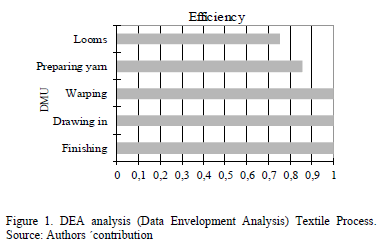
<body><![CDATA[<li><font size="2" face="Verdana, Arial, Helvetica, sans-serif">Reserve     the capacity of the bottleneck resource, by sorting the products in descending     order according to the relation CM/BN.</font></li>     </ol>     <p><font size="2" face="Verdana, Arial, Helvetica, sans-serif">The classical approach of the Theory of Constraints   assumes a sequential production line in which there is only one item of each   resource type, and the products can have alternative process routes by varying   the order on the same resources.</font></p>     <p><font size="2" face="Verdana, Arial, Helvetica, sans-serif">Industrial processes classified as &quot;Hybrid Flexible   Flow Shop&quot;, such as in the case of textile production, count on several similar   resources in parallel with similar process routes for all the products   regarding the order in which these go through the transformation processes. The   issue is to find out how to distribute each job in the different resources with   the aim to favor contribution to the business profits.</font></p>     <p><font size="2" face="Verdana, Arial, Helvetica, sans-serif">The following steps are proposed to determine the optimal   product mix in a Flexible Hybrid Flow Shop according to the Theory of   Constraints:</font></p>     <p><font size="2" face="Verdana, Arial, Helvetica, sans-serif"><b>Step 1: Identify   the system constraints:    <br>   </b></font><font size="2" face="Verdana, Arial, Helvetica, sans-serif">Data Envelopment Analysis (DEA) is applied to determine   the main constraint of the system. DEA is a mathematic technique that allow the   construction of an efficient border, or empirical production function from data   of a set of studied units, where the units which are into the border are called   &quot;efficient units&quot; and the other are called &quot;inefficient units&quot;. DEA allows one   to evaluate the relative efficiency of each unit in the study. &#91;27&#93; <a href="#fig01">Figure 1</a> shows the efficiency of the processes of the textile production plant   evaluated by using DEA. The units in the figure are the ratio of efficiency of   each process with respect to those belonging to the efficiency frontier (most   efficient).</font></p>     <p align="center"><font size="2" face="Verdana, Arial, Helvetica, sans-serif"><a name="fig01"></a></font><img src="/img/revistas/dyna/v81n186/v81n186a15fig01.gif"></p>     <p><font size="2" face="Verdana, Arial, Helvetica, sans-serif">The figure shows that the process of looms, with an   indicator of 0.754, is the least efficient of all and the furthest away from   the efficiency frontier. Therefore, it is determined that the process of looms   is the bottleneck of the system.</font></p>     <p><font size="2" face="Verdana, Arial, Helvetica, sans-serif"><b>Step 2: Decide how   to exploit the system constraints:    ]]></body>
<body><![CDATA[<br>   </b></font><font size="2" face="Verdana, Arial, Helvetica, sans-serif">Calculate the contribution margin (CM) of each product, the   selling price minus costs of raw materials (RM).</font></p>     <p><font size="2" face="Verdana, Arial, Helvetica, sans-serif">The throughput   (contribution margin), as stated by the procedure, ignores the processing costs   which can have, in many cases, a high impact on total cost. The difference in   profitability of different products, depending on technical characteristics and   the required processes, can also be established.</font></p>     <p><font size="2" face="Verdana, Arial, Helvetica, sans-serif">Therefore, it is   proposed to calculate the contribution margin as the difference between the   sales price and manufacturing costs with the objective to arrive at a   model.  This model might be considered   when making scheduling and production decisions at the operational and   strategic levels, and might also be used to obtain results comparable with the   determination of the optimal product mix using the traditional methodology of   operations research focused on the strategic level.</font></p>     <p><font size="2" face="Verdana, Arial, Helvetica, sans-serif">In this way:</font></p>     <p><img src="/img/revistas/dyna/v81n186/v81n186a15eq01.gif"></p>     <p><font size="2" face="Verdana, Arial, Helvetica, sans-serif">Where:</font></p>     <blockquote>       <p><font size="2" face="Verdana, Arial, Helvetica, sans-serif"><i>CM<sub>i</sub></i> = Contribution margin per kilogram of product <i>i</i>.</font><font size="2" face="Verdana, Arial, Helvetica, sans-serif"><i>    <br>     SPi </i>=     Selling price per kilogram of product <i>i</i>.    <br>     </font><font size="2" face="Verdana, Arial, Helvetica, sans-serif"><i>UC<sub>i</sub></i> = Manufacturing Unit Cost per kilogram of product <i>i</i>.</font></p> </blockquote>     ]]></body>
<body><![CDATA[<p><font size="2" face="Verdana, Arial, Helvetica, sans-serif">Calculate the relation between the contribution margins of   the products per processing time at the bottleneck resource (CM/BN).</font></p>     <p><font size="2" face="Verdana, Arial, Helvetica, sans-serif">The formula below might be used to get the contribution   margin per unit of time in the bottleneck resource, taking into account the   description of the problem and using some of the considerations presented in &#91;28&#93;   regarding the numerical relations to calculate the capacity of a weaving (the   Looms process):</font></p>     <p><img src="/img/revistas/dyna/v81n186/v81n186a15eq02.gif"></p>     <p><font size="2" face="Verdana, Arial, Helvetica, sans-serif">Where:</font></p>     <blockquote>       <p><font size="2" face="Verdana, Arial, Helvetica, sans-serif"><i>(CM/BN)<sub>i</sub></i> = Contribution     margin of product<i> i</i> per unit of time     in the bottleneck resource.    <br>     </font><font size="2" face="Verdana, Arial, Helvetica, sans-serif"><i>gm<sub>i</sub></i> = Weight in     grams per meter of product<i> i    <br>     </i></font><font size="2" face="Verdana, Arial, Helvetica, sans-serif"><i>rpm<sub>i</sub></i> = Average speed in     revolutions per minute of the looms on which product<i> i</i> is processed.    <br>     </font><font size="2" face="Verdana, Arial, Helvetica, sans-serif"><i>el<sub>i</sub></i> = Efficiency in the loom     of product <i>i    <br>     </i></font><font size="2" face="Verdana, Arial, Helvetica, sans-serif"><i>lo<sub>i</sub></i>= Loom simultaneous     outputs when product <i>i   </i>is processed.    ]]></body>
<body><![CDATA[<br>     </font><font size="2" face="Verdana, Arial, Helvetica, sans-serif"><i>dw<sub>i</sub></i> = Density in wefts/centimeters in product <i>i</i>.</font></p> </blockquote>     <p><font size="2" face="Verdana, Arial, Helvetica, sans-serif">The constant 100000 corresponds to the conversion of   units: 100 match centimeters of <i>dw<sub>i</sub></i> to the meters of <i>gm<sub>i</sub></i> and 1000 for the consistency between grams of <i>gm<sub>i</sub></i> and kilograms of (<i>SP<sub>i</sub> - UC<sub>i</sub></i>).</font></p>     <p><font size="2" face="Verdana, Arial, Helvetica, sans-serif">The the capacity of the bottleneck resource must be reserved   sorting the products in descending order according to the relation <i>CM/BN</i>, until capacity is depleted.</font></p>     <p><font size="2" face="Verdana, Arial, Helvetica, sans-serif">In this step, a   ranking of profitability per unit of time of the different products must be   established until the capacity of the bottleneck resource is depleted, in   descending order, starting with the product with the highest contribution   margin.</font></p>     <p><font size="2" face="Verdana, Arial, Helvetica, sans-serif">The problem is compounded when, as happens in textile   weaving, there are multiple parallel machines with different capacities, and   product differentiation depends on the technical specifications of the loom on   which textiles are weaved. It must then be considered that the parallel   machines as unrelated.</font></p>     <p><font size="2" face="Verdana, Arial, Helvetica, sans-serif">The decision,   therefore, is not only related to the distribution of productive capacity among   a set of jobs waiting to be processed on a resource. An optimal distribution of   work is required, that meets the criterion of maximizing total contribution   margin, and the scheduling of resources according to technical features taking   into account the limitations of the market and the availability of raw   materials.</font></p>     <p><font size="2" face="Verdana, Arial, Helvetica, sans-serif">The optimization model is thus formulated:</font></p>     <p><img src="/img/revistas/dyna/v81n186/v81n186a15eq03.gif"></p>     <p><font size="2" face="Verdana, Arial, Helvetica, sans-serif">Subject to:</font></p>     <p><font size="2" face="Verdana, Arial, Helvetica, sans-serif">Capacity constraints:</font></p>     ]]></body>
<body><![CDATA[<p><font size="2" face="Verdana, Arial, Helvetica, sans-serif">Assuming a month of thirty working days,  24 hours a day, 60 minutes per hour:</font></p>     <p><img src="/img/revistas/dyna/v81n186/v81n186a15eq04.gif"></p>     <p><font size="2" face="Verdana, Arial, Helvetica, sans-serif">Market constraints:</font></p>     <p><img src="/img/revistas/dyna/v81n186/v81n186a15eq05.gif"></p>     <p><font size="2" face="Verdana, Arial, Helvetica, sans-serif">Raw material constraints:</font></p>     <p><img src="/img/revistas/dyna/v81n186/v81n186a15eq06.gif"></p>     <p><font size="2" face="Verdana, Arial, Helvetica, sans-serif">Non-negativity condition:</font></p>     <p><img src="/img/revistas/dyna/v81n186/v81n186a15eq07.gif"></p>     <p><font size="2" face="Verdana, Arial, Helvetica, sans-serif">Where:</font></p>     <blockquote>       ]]></body>

<body><![CDATA[<p><font size="2" face="Verdana, Arial, Helvetica, sans-serif"><i>z</i> = Total contribution margin    <br>     </font><font size="2" face="Verdana, Arial, Helvetica, sans-serif"><i>(CM/BN)<sub>i</sub></i> = Contribution     margin of product <i>i</i> per every minute     of work in the loom.    <br>     </font><font size="2" face="Verdana, Arial, Helvetica, sans-serif"><i>y<sub>il</sub></i>= Minutes for product <i>i </i>on loom<i> l</i>.    <br>     </font><font size="2" face="Verdana, Arial, Helvetica, sans-serif"><i>i</i> = Product.    <br>     </font><font size="2" face="Verdana, Arial, Helvetica, sans-serif"><i>n</i> = Total amount of products.    <br>     </font><font size="2" face="Verdana, Arial, Helvetica, sans-serif"><i>dw<sub>i</sub></i> = Density in wefts/centimeters     of product <i>i</i>.    <br>     </font><font size="2" face="Verdana, Arial, Helvetica, sans-serif"><i>sr<sub>i</sub></i> = Size of roll of product<i> i</i> (kilograms).    <br>     </font><font size="2" face="Verdana, Arial, Helvetica, sans-serif"><i>gm<sub>i</sub></i> = Linear     weight of product<i> i</i> (grams/meters).    <br>     </font><font size="2" face="Verdana, Arial, Helvetica, sans-serif"><i>el<sub>i</sub></i> = Efficiency in looms of     product <i>i</i> (ratio of 0 (not efficient)     and 1 (fully efficient)).    <br>     </font><font size="2" face="Verdana, Arial, Helvetica, sans-serif"><i>lo<sub>i</sub></i> = Number of loom outputs     used simultaneously on a loom to make product<i> i</i>.    ]]></body>
<body><![CDATA[<br>     </font><font size="2" face="Verdana, Arial, Helvetica, sans-serif"><i>rpm<sub>l</sub></i> = Loom speed <i>l</i> (revolutions per minute).    <br>     </font><font size="2" face="Verdana, Arial, Helvetica, sans-serif"><i>l </i>= Loom.    <br>     </font><font size="2" face="Verdana, Arial, Helvetica, sans-serif"><i>s </i>= Total number of looms.    <br>     </font><font size="2" face="Verdana, Arial, Helvetica, sans-serif"><i>U<sub>i</sub></i>= Maximum demand of     product <i>i</i>. (rolls).    <br>     </font><font size="2" face="Verdana, Arial, Helvetica, sans-serif"><i>r<sub>ik</sub></i> = Demand of raw material <i>k</i> in  kilograms per roll of product<i> i</i>.    <br>     </font><font size="2" face="Verdana, Arial, Helvetica, sans-serif"><i>R<sub>k </sub></i>= Available kilograms of     raw material <i>k</i>.    <br>     </font><font size="2" face="Verdana, Arial, Helvetica, sans-serif"><i>k</i> = Raw material.    <br>     </font><font size="2" face="Verdana, Arial, Helvetica, sans-serif"><i>q</i> = Total amount of raw material.</font></p> </blockquote>     <p><font size="2" face="Verdana, Arial, Helvetica, sans-serif">This model, according   to the initial philosophy of TOC heuristics, must be resolved by sorting   products from the highest to the lowest contribution margin. The proposed   algorithm includes a flexibility indicator of the loom as a criterion for job   assignation.  The total of minutes   required by each process is distributed among the looms to complete the maximum   rolls of each product, taking into account technical constraints:</font></p>     <p><font size="2" face="Verdana, Arial, Helvetica, sans-serif"><b>Step 1: </b>Sort products   from the highest to the lowest value of CM / BN.</font></p>     ]]></body>
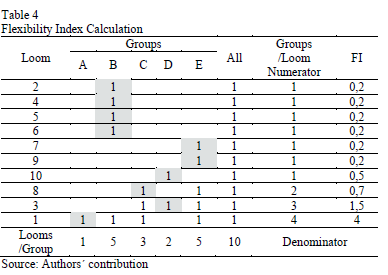
<body><![CDATA[<p><font size="2" face="Verdana, Arial, Helvetica, sans-serif"><b>Step 2: </b>Calculate   the flexibility indicator in each loom.  This is calculated as the result of dividing the number of groups in which   the loom is scheduled by the lower number of looms among all the groups where   the loom belongs. For example the flexibility indicator of a loom that belongs   to a group of 6 looms and a group of 3, will be 2/3. And the flexibility   indicator of another loom that belongs to two groups of 4 and a 5 looms, will   be 3/4.</font></p>     <p><font size="2" face="Verdana, Arial, Helvetica, sans-serif"><b>Step 3:</b> Sort in   ascending order the looms according to the flexibility indicator calculated in   step 2. In the above example the first loom is better sorted (indicator = 2/3)   than the second loom (indicator = 3/4). This rule favors products that can be   manufactured in very few looms and these looms should be scheduled only as   needed.  Similarly, the looms with the   highest flexibility are assigned at the end thereby facilitating the scheduling   of more products.</font></p>     <p><font size="2" face="Verdana, Arial, Helvetica, sans-serif"><b>Step 4:</b> Assign the first product of the current list to the first of the   available looms with capacity to manufacture. The assignment corresponds to the   lower value in rolls equal to the available capacity on the loom, the maximum   demand of the unscheduled product, and the availability of raw material for this   product. Then subtract the assigned value from the available capacity of the   loom, from the maximum product demand and from the availability of raw   materials.</font></p>     <p><img src="/img/revistas/dyna/v81n186/v81n186a15eq08.gif"></p>     <p><font size="2" face="Verdana, Arial, Helvetica, sans-serif">Where:</font></p>     <blockquote>       <p><font size="2" face="Verdana, Arial, Helvetica, sans-serif"><i>y<sub>il</sub></i> = Job assignment <i>i</i> to loom <i>l    <br>     </i></font><font size="2" face="Verdana, Arial, Helvetica, sans-serif"><i>cap<sub>l</sub></i> = Available capacity     in loom <i>l    <br>     </i></font><font size="2" face="Verdana, Arial, Helvetica, sans-serif"><i>dem<sub>i</sub></i> = Maximum demand of     product <i>i    <br>     </i></font><font size="2" face="Verdana, Arial, Helvetica, sans-serif"><i>rm<sub>k</sub></i> = Raw materials <i>k</i></font></p> </blockquote>     ]]></body>
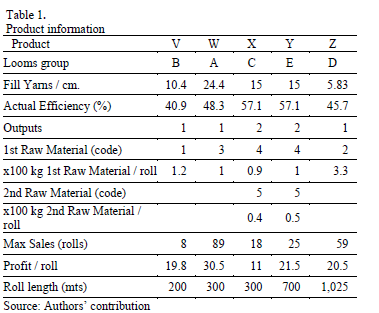
<body><![CDATA[<p><font size="2" face="Verdana, Arial, Helvetica, sans-serif"><b>Step 5: </b>When maximum demand is not covered with one loom, continue to the next   loom. When maximum demand is covered, the product should be removed from the   list and return to step 4. Continue until the list of products is exhausted.</font></p>     <p><font size="2" face="Verdana, Arial, Helvetica, sans-serif">At the end, a detailed   product assignation of each of the productive resources must be obtained   considering market constraints, raw materials and machine capacities. The   algorithm is based on the original TOC heuristics and tries to respect its main   premises. A general integer optimization algorithm might be applied based on   the model presented in expressions (3) a (7) (such as the hybrid genetic   simplex introduced in &#91;28&#93;).  </font></p>     <p><font size="2" face="Verdana, Arial, Helvetica, sans-serif">Thus, it is necessary to depart from the   standard procedure of the Theory of Constraints to achieve the optimal product   mix, following strategies such as those by different authors who have proposed   modifications to the model and to the algorithm; among which are worth   mentioning:  Lee and Plenert  (1993) &#91;18&#93;, Hsu and Chung  (1998) &#91;29&#93;, Onwubolu  (2001) &#91;23&#93;, Onwubolu and   Mutingi  (2001) &#91;25&#93;, Vasant  (2004) &#91;29&#93;, Mishra, Prakash,   Tiwari, Shankar, and Chan  (2005) &#91;24&#93;, Bhattacharya and   Vasant  (2007) &#91;30&#93; and Linhares  (2009) &#91;26&#93;.</font></p>     <p><font size="2" face="Verdana, Arial, Helvetica, sans-serif">As noted at the beginning, works about the optimal product   mix under the Theory of Constraints require different working conditions in the   textile industry.  So, an application of   some of the findings made by the authors to the problem under study must be   reviewed and adapted to the particularities of the production of textiles.</font></p>     <p><font size="2" face="Verdana, Arial, Helvetica, sans-serif">It is also worth noting that the theory of constraints in   general and its method of determining the optimal product mix in particular are   aimed at the operation of production rather than the strategic direction of the   company.  Thus, its philosophy, although   it has been extended to the entire business context, does not correspond at all   with the objective of directing the marketing policy, but to improve   productivity in the operation plant.</font></p>     <p>&nbsp;</p>     <p><font size="3" face="Verdana, Arial, Helvetica, sans-serif"><b>3.  Numerical   Example</b></font></p>     <p><font size="2" face="Verdana, Arial, Helvetica, sans-serif">The following tables summarize an example of the   application of the algorithm to a case in the textile industry.</font></p>     <p><font size="2" face="Verdana, Arial, Helvetica, sans-serif"><a href="#tab01">Table 1</a> summarizes the technical information of the   products, including the group of looms (to compare to Table 2), the density of   the fabric in wefts per centimeter (important for speed), the actual efficiency   of the product in the machines, the simultaneous product outputs on the looms,   raw materials (to compare with Table 3), amount of raw material in a roll of   fabric, market restrictions in rolls, the profit per unit and the length of the   fabric roll in meters.</font></p>     <p align="center"><font size="2" face="Verdana, Arial, Helvetica, sans-serif"><a name="tab01" id="tab01"></a></font><img src="/img/revistas/dyna/v81n186/v81n186a15tab01.gif"></p>     ]]></body>
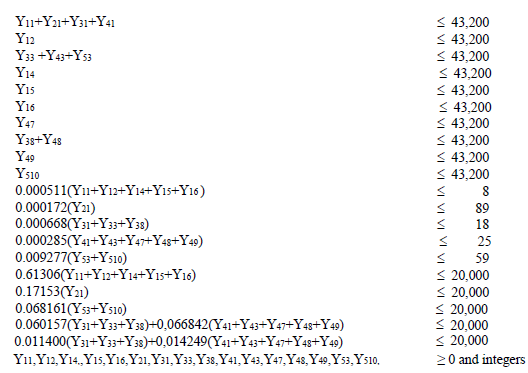
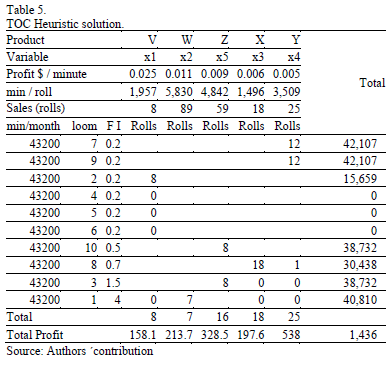
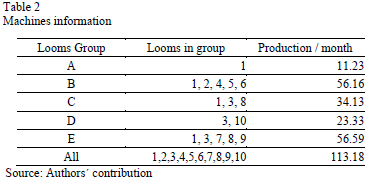
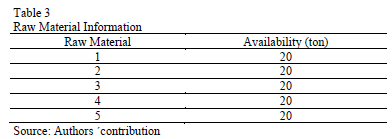
<body><![CDATA[<p><font size="2" face="Verdana, Arial, Helvetica, sans-serif"><a href="#tab02">Table 2</a> describes the group of looms, identifying both the   looms included in each group and its total production capacity in millions of   wefts</font></p>     <p align="center"><font size="2" face="Verdana, Arial, Helvetica, sans-serif"><a name="tab02"></a></font><img src="/img/revistas/dyna/v81n186/v81n186a15tab02.gif"></p>     <p><font size="2" face="Verdana, Arial, Helvetica, sans-serif"><a href="#tab03">Table 3</a> summarizes the   availability of Raw Material. It is an important constraint in industries such   as technical textiles where suppliers are in distant countries and immediate   availability is required to improve response times.</font></p>     <p align="center"><font size="2" face="Verdana, Arial, Helvetica, sans-serif"><a name="tab03"></a></font><img src="/img/revistas/dyna/v81n186/v81n186a15tab03.gif"></p>     <p><font size="2" face="Verdana, Arial, Helvetica, sans-serif">The exact mathematical model would be as follows:</font></p>     <p><img src="/img/revistas/dyna/v81n186/v81n186a15eq081.gif"></p>     <p><font size="2" face="Verdana, Arial, Helvetica, sans-serif">Subject to:</font></p>     <p><img src="/img/revistas/dyna/v81n186/v81n186a15eq082.gif"></p>     <p><font size="2" face="Verdana, Arial, Helvetica, sans-serif">Following the procedure introduced in this paper, where   products are sorted by their contribution margin per unit of time in the   bottleneck resource and machines are assigned in order of flexibility index (<i>FI</i>) calculated as explained in the   Methodology section, as is shown in <a href="#tab04">Table 4</a>. Shadowed cells are the minor group   of looms for each loom. The final solution of the example is presented in <a href="#tab05">Table   5</a>.</font></p>     <p align="center"><font size="2" face="Verdana, Arial, Helvetica, sans-serif"><a name="tab04"></a></font><img src="/img/revistas/dyna/v81n186/v81n186a15tab04.gif"></p>     ]]></body>
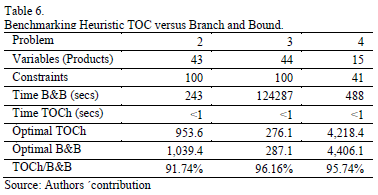
<body><![CDATA[<p align="center"><font size="2" face="Verdana, Arial, Helvetica, sans-serif"><a name="tab05"></a></font><img src="/img/revistas/dyna/v81n186/v81n186a15tab05.gif"></p>     <p>&nbsp;</p>     <p><b><font size="3" face="Verdana, Arial, Helvetica, sans-serif">4.  Results</font></b></p>     <p><font size="2" face="Verdana, Arial, Helvetica, sans-serif">Besides the example presented, different tests were made   with heuristics based on the Theory of Constraints for an optimal product mix.   The heuristic is used actually by a real textile company to make its aggregated   planning. To test the utility of the heuristic in real environments, it three   examples with real data were taken. The results are compared against the same   cases using integer linear scheduling and solved by the Branch and Bound   algorithm. The examples, from a real textile factory, can be downloaded in text   format from https://db.tt/4EMzWnmk.   The TOC Heuristic was implemented in Visual Fox Pro&#91;32&#93;.   For the benchmark with Branch and Bound the LP-ILP 2.0 module from WinQSB &#91;32&#93;was   used. Both programs were executed on the same computer. A detailed description   of the tested cases can be downloaded from https://db.tt/8xcpBTRd. <a href="#tab06">Table 6</a> summarizes the results.</font></p>     <p align="center"><font size="2" face="Verdana, Arial, Helvetica, sans-serif"><a name="tab06"></a></font><img src="/img/revistas/dyna/v81n186/v81n186a15tab06.gif"></p>     <p><font size="2" face="Verdana, Arial, Helvetica, sans-serif">It can be seen that the TOC heuristics gets results slightly   below than the ones obtained with the Branch and Bound method.  However, when compared to the detailed   results of the Branch and Bound method, it is observed that the same values are   achieved in many variables, especially in the first of the sorted list of   references in descending order of contribution margin per minute.   However, it is disconcerting to see that   high values are   assigned to some references that are at the   bottom of that list.</font></p>     <p><font size="2" face="Verdana, Arial, Helvetica, sans-serif">This behavior has been studied in the scientific   literature which states that TOC heuristics reaches the absolute optimum only   when there is a constraint that falls far apart from other productive resources   in performance &#91;24&#93;.</font></p>     <p><font size="2" face="Verdana, Arial, Helvetica, sans-serif">Heuristic generates an   array of products depending on their profitability per unit of time, which may   be useful as prioritization criteria in trade policy and in infrastructure   investment.</font></p>     <p><font size="2" face="Verdana, Arial, Helvetica, sans-serif">This procedure is implemented in planning, scheduling and   production control software in a textile company and it is used as complementary   criteria to prioritize deliveries and sales effort.</font></p>     <p>&nbsp;</p>     ]]></body>
<body><![CDATA[<p><b><font size="3" face="Verdana, Arial, Helvetica, sans-serif">5.  Conclusions </font></b></p>     <p><font size="2" face="Verdana, Arial, Helvetica, sans-serif">TOC heuristics is a planning tool of low computational   cost with a good performance level that can be used for detailed production   scheduling in different contexts.</font></p>     <p><font size="2" face="Verdana, Arial, Helvetica, sans-serif">TOC heuristic requires adaptations for a Flexible Hybrid   Flow Shop, and in particular for the textile industry, especially for the   parallelism conditions of the machines in the bottleneck stage.</font></p>     <p><font size="2" face="Verdana, Arial, Helvetica, sans-serif">The flexibility index introduced in this paper is a   measure of the machine capacity to process different products that must be used   to reserve the most flexible resources for specialized products without   sacrificing productivity.</font></p>     <p><font size="2" face="Verdana, Arial, Helvetica, sans-serif">It is suggested to calculate the throughput as the   difference between the selling price and the cost of processing instead of   using Goldratt's formula which takes into account only the cost of raw   materials.</font></p>     <p><font size="2" face="Verdana, Arial, Helvetica, sans-serif">Although the heuristic of the Theory of Constraints does   not get close enough to the global optimum of the optimal product mix problem,   it provides an overview of the classification of the products in ascendant   order of profits.   This overview might   be useful in strategic market direction and capacity expansion projects.</font></p>     <p><font size="2" face="Verdana, Arial, Helvetica, sans-serif">When considering the details of scheduling in the plant,   TOC heuristics are more specific and operational than models of linear   programming. In addition, TOC heuristics are easy to implement since they do   not involve complex calculations.</font></p>     <p>&nbsp;</p>     <p><b><font size="3" face="Verdana, Arial, Helvetica, sans-serif">6.  Acknowledgments</font></b></p>     <p><font size="2" face="Verdana, Arial, Helvetica, sans-serif">The authors wish to acknowledge the Universidad Nacional   de Colombia for supporting the development of this research (Call to support   graduate thesis-DIMA 2012. Project:   &quot;Mejora de tiempos de entrega en un Flow Shop H&iacute;brido Flexible usando t&eacute;cnicas   inteligentes. Aplicaci&oacute;n en la industria de tejidos t&eacute;cnicos&quot;, c&oacute;digo Hermes   15917). </font></p>     ]]></body>
<body><![CDATA[<p><font size="2" face="Verdana, Arial, Helvetica, sans-serif">This work is part of the doctoral thesis of Jaime Antero   Arango Mar&iacute;n.</font></p>     <p>&nbsp;</p>     <p><font size="3" face="Verdana, Arial, Helvetica, sans-serif"><b>References</b></font></p>     <!-- ref --><p><font size="2" face="Verdana, Arial, Helvetica, sans-serif"><b>&#91;1&#93;</b> Montoya-Torres, J. R.; Soto-Ferrari, M.; Gonzalez-Solano, F. Production Scheduling with Sequence­Dependent Setups and Job Release Times. Dyna, 77 (163), pp. 260­269, 2010.    &nbsp;&nbsp;&nbsp;&nbsp;&nbsp;&nbsp;&nbsp;&nbsp;[&#160;<a href="javascript:void(0);" onclick="javascript: window.open('/scielo.php?script=sci_nlinks&ref=000166&pid=S0012-7353201400040001500001&lng=','','width=640,height=500,resizable=yes,scrollbars=1,menubar=yes,');">Links</a>&#160;]<!-- end-ref --></font></p>     <!-- ref --><p> <font size="2" face="Verdana, Arial, Helvetica, sans-serif"><b>&#91;2&#93;</b> Zandieh, M.; Karimi, N. An Adaptive Multi-Population Genetic Algorithm to Solve the Multi-Objective Group Scheduling Problem in Hybrid Flexible Flowshop with Sequence-Dependent Setup Times. J Intell Manuf. 22(6), Pp 979-989, 2010.    &nbsp;&nbsp;&nbsp;&nbsp;&nbsp;&nbsp;&nbsp;&nbsp;[&#160;<a href="javascript:void(0);" onclick="javascript: window.open('/scielo.php?script=sci_nlinks&ref=000168&pid=S0012-7353201400040001500002&lng=','','width=640,height=500,resizable=yes,scrollbars=1,menubar=yes,');">Links</a>&#160;]<!-- end-ref --></font></p>     <!-- ref --><p> <font size="2" face="Verdana, Arial, Helvetica, sans-serif"><b>&#91;3&#93;</b> Qiao, P.; Sun, C. Research On Hybrid Flow Shop Scheduling Problem Based On Improved Immune Particle Swarm Optimization. In: 2nd International Conference on Artificial Intelligence, Management Science and Electronic Commerce (Aimsec), Pp 4240-4243, 2011.    &nbsp;&nbsp;&nbsp;&nbsp;&nbsp;&nbsp;&nbsp;&nbsp;[&#160;<a href="javascript:void(0);" onclick="javascript: window.open('/scielo.php?script=sci_nlinks&ref=000170&pid=S0012-7353201400040001500003&lng=','','width=640,height=500,resizable=yes,scrollbars=1,menubar=yes,');">Links</a>&#160;]<!-- end-ref --></font></p>     <!-- ref --><p> <font size="2" face="Verdana, Arial, Helvetica, sans-serif"><b>&#91;4&#93;</b> Yue-Wen, F.; Feng-Xing, Z.; Xiao-Hong, X.; Qing-Zhu, C.; Jia-Hua, W. Hybrid Flow Shop Scheduling Method Based on Multiagent Particle Swarm Optimization. In: International Conference on Information and Automation, Pp 755-759, 2011.    &nbsp;&nbsp;&nbsp;&nbsp;&nbsp;&nbsp;&nbsp;&nbsp;[&#160;<a href="javascript:void(0);" onclick="javascript: window.open('/scielo.php?script=sci_nlinks&ref=000172&pid=S0012-7353201400040001500004&lng=','','width=640,height=500,resizable=yes,scrollbars=1,menubar=yes,');">Links</a>&#160;]<!-- end-ref --></font></p>     <!-- ref --><p> <font size="2" face="Verdana, Arial, Helvetica, sans-serif"><b>&#91;5&#93;</b> Yalaoui, N.; Mahdi, H.; Amodeo, L.; Yalaoui, F. A Particle Swarm Optimization under Fuzzy Logic Controller to Solve a Scheduling Problem. In: International Conference on Communications, Computing and Control Applications (Ccca), 2011, Pp 1-6, 2011.    &nbsp;&nbsp;&nbsp;&nbsp;&nbsp;&nbsp;&nbsp;&nbsp;[&#160;<a href="javascript:void(0);" onclick="javascript: window.open('/scielo.php?script=sci_nlinks&ref=000174&pid=S0012-7353201400040001500005&lng=','','width=640,height=500,resizable=yes,scrollbars=1,menubar=yes,');">Links</a>&#160;]<!-- end-ref --></font></p>     <!-- ref --><p> <font size="2" face="Verdana, Arial, Helvetica, sans-serif"><b>&#91;6&#93;</b> Hidri, L.; Haouari, M. Bounding Strategies for the Hybrid Flow Shop Scheduling Problem. Applied Mathematics and Computation, 217, Pp 8248-8263, 2011.    &nbsp;&nbsp;&nbsp;&nbsp;&nbsp;&nbsp;&nbsp;&nbsp;[&#160;<a href="javascript:void(0);" onclick="javascript: window.open('/scielo.php?script=sci_nlinks&ref=000176&pid=S0012-7353201400040001500006&lng=','','width=640,height=500,resizable=yes,scrollbars=1,menubar=yes,');">Links</a>&#160;]<!-- end-ref --></font></p>     <!-- ref --><p> <font size="2" face="Verdana, Arial, Helvetica, sans-serif"><b>&#91;7&#93;</b> G&oacute;mez Gasquet, P. (2010). Programaci&oacute;n de la Producci&oacute;n en un Taller de Flujo H&iacute;brido Sujeto a Incertidumbre: Arquitectura y Algoritmos. Aplicaci&oacute;n a La Industria Cer&aacute;mica. Tesis Doctoral. Universidad Polit&eacute;cnica de Valencia. Departamento de Organizaci&oacute;n de Empresas. 988 p., 2010.    &nbsp;&nbsp;&nbsp;&nbsp;&nbsp;&nbsp;&nbsp;&nbsp;[&#160;<a href="javascript:void(0);" onclick="javascript: window.open('/scielo.php?script=sci_nlinks&ref=000178&pid=S0012-7353201400040001500007&lng=','','width=640,height=500,resizable=yes,scrollbars=1,menubar=yes,');">Links</a>&#160;]<!-- end-ref --></font></p>     <!-- ref --><p> <font size="2" face="Verdana, Arial, Helvetica, sans-serif"><b>&#91;8&#93;</b> Guinet, A. Textile Production Systems: A Succession of Non-Identical Parallel Processor Shops. The Journal of the Operational Research Society, 42 (8), Pp. 655-671, 1991.    &nbsp;&nbsp;&nbsp;&nbsp;&nbsp;&nbsp;&nbsp;&nbsp;[&#160;<a href="javascript:void(0);" onclick="javascript: window.open('/scielo.php?script=sci_nlinks&ref=000180&pid=S0012-7353201400040001500008&lng=','','width=640,height=500,resizable=yes,scrollbars=1,menubar=yes,');">Links</a>&#160;]<!-- end-ref --></font></p>     <!-- ref --><p> <font size="2" face="Verdana, Arial, Helvetica, sans-serif"><b>&#91;9&#93;</b> Zhang, X.; Van De Velde, S. Approximation Algorithms for the Parallel Flow Shop Problem. European Journal of Operational Research, 216, Pp 544-552, 2012.    &nbsp;&nbsp;&nbsp;&nbsp;&nbsp;&nbsp;&nbsp;&nbsp;[&#160;<a href="javascript:void(0);" onclick="javascript: window.open('/scielo.php?script=sci_nlinks&ref=000182&pid=S0012-7353201400040001500009&lng=','','width=640,height=500,resizable=yes,scrollbars=1,menubar=yes,');">Links</a>&#160;]<!-- end-ref --></font></p>     <!-- ref --><p> <font size="2" face="Verdana, Arial, Helvetica, sans-serif"><b>&#91;10&#93;</b> Driessel, R.; Mönch, L. Variable Neighborhood Search Approaches for Scheduling Jobs on Parallel Machines with Sequence-Dependent Setup Times, Precedence Constraints, and Ready Times. Computers and Industrial Engineering, 61, Pp 336-345, 2011.    &nbsp;&nbsp;&nbsp;&nbsp;&nbsp;&nbsp;&nbsp;&nbsp;[&#160;<a href="javascript:void(0);" onclick="javascript: window.open('/scielo.php?script=sci_nlinks&ref=000184&pid=S0012-7353201400040001500010&lng=','','width=640,height=500,resizable=yes,scrollbars=1,menubar=yes,');">Links</a>&#160;]<!-- end-ref --></font></p>     <!-- ref --><p> <font size="2" face="Verdana, Arial, Helvetica, sans-serif"><b>&#91;11&#93;</b> James, R. J. W.; Almada-Lobo, B. Single and Parallel Machine Capacitated Lotsizing and Scheduling: New Iterative Mip-Based Neighborhood Search Heuristics. Computers and Operations Research, 28, Pp 1816-1825, 2011.    &nbsp;&nbsp;&nbsp;&nbsp;&nbsp;&nbsp;&nbsp;&nbsp;[&#160;<a href="javascript:void(0);" onclick="javascript: window.open('/scielo.php?script=sci_nlinks&ref=000186&pid=S0012-7353201400040001500011&lng=','','width=640,height=500,resizable=yes,scrollbars=1,menubar=yes,');">Links</a>&#160;]<!-- end-ref --></font></p>     <!-- ref --><p> <font size="2" face="Verdana, Arial, Helvetica, sans-serif"><b>&#91;12&#93;</b> Lin, S-W; Lee, Z-J; Ying, K-C; Lu, C-C. Minimization of Maximum Lateness on Parallel Machines with Sequence-Dependent Setup Times and Job Release Dates. Computers and Operations Research, 38, Pp 809-815, 2011.    &nbsp;&nbsp;&nbsp;&nbsp;&nbsp;&nbsp;&nbsp;&nbsp;[&#160;<a href="javascript:void(0);" onclick="javascript: window.open('/scielo.php?script=sci_nlinks&ref=000188&pid=S0012-7353201400040001500012&lng=','','width=640,height=500,resizable=yes,scrollbars=1,menubar=yes,');">Links</a>&#160;]<!-- end-ref --></font></p>     <!-- ref --><p> <font size="2" face="Verdana, Arial, Helvetica, sans-serif"><b>&#91;13&#93;</b> Chang, P-C; Chen, S-H. Integrating Dominance Properties with Genetic Algorithms for Parallel Machine Scheduling Problems with Setup Times. Applied Soft Computing, 11, Pp 1263-1274, 2011.    &nbsp;&nbsp;&nbsp;&nbsp;&nbsp;&nbsp;&nbsp;&nbsp;[&#160;<a href="javascript:void(0);" onclick="javascript: window.open('/scielo.php?script=sci_nlinks&ref=000190&pid=S0012-7353201400040001500013&lng=','','width=640,height=500,resizable=yes,scrollbars=1,menubar=yes,');">Links</a>&#160;]<!-- end-ref --></font></p>     <!-- ref --><p> <font size="2" face="Verdana, Arial, Helvetica, sans-serif"><b>&#91;14&#93;</b> Arango, J. A; Giraldo, J. A.; Castrill&oacute;n, O. D. Programaci&oacute;n de M&aacute;quinas Paralelas no Relacionadas con Tiempos de Montaje Dependientes de la Secuencia y Entrada Din&aacute;mica usando Algoritmos Gen&eacute;ticos. Revista Informaci&oacute;n Tecnol&oacute;gica 24(3), pp. 73-84, 2013.    &nbsp;&nbsp;&nbsp;&nbsp;&nbsp;&nbsp;&nbsp;&nbsp;[&#160;<a href="javascript:void(0);" onclick="javascript: window.open('/scielo.php?script=sci_nlinks&ref=000192&pid=S0012-7353201400040001500014&lng=','','width=640,height=500,resizable=yes,scrollbars=1,menubar=yes,');">Links</a>&#160;]<!-- end-ref --></font></p>     <!-- ref --><p> <font size="2" face="Verdana, Arial, Helvetica, sans-serif"><b>&#91;15&#93;</b> Castrill&oacute;n, O. D.; Sarache, W.; Giraldo, J. A. Job Shop Methodology Based on an Ant Colony. Dyna, 76(159), pp. 177-184, 2009.    &nbsp;&nbsp;&nbsp;&nbsp;&nbsp;&nbsp;&nbsp;&nbsp;[&#160;<a href="javascript:void(0);" onclick="javascript: window.open('/scielo.php?script=sci_nlinks&ref=000194&pid=S0012-7353201400040001500015&lng=','','width=640,height=500,resizable=yes,scrollbars=1,menubar=yes,');">Links</a>&#160;]<!-- end-ref --></font></p>     <!-- ref --><p> <font size="2" face="Verdana, Arial, Helvetica, sans-serif"><b>&#91;16&#93;</b> Goldratt, E. M. The Goal. North River Press, 1984.    &nbsp;&nbsp;&nbsp;&nbsp;&nbsp;&nbsp;&nbsp;&nbsp;[&#160;<a href="javascript:void(0);" onclick="javascript: window.open('/scielo.php?script=sci_nlinks&ref=000196&pid=S0012-7353201400040001500016&lng=','','width=640,height=500,resizable=yes,scrollbars=1,menubar=yes,');">Links</a>&#160;]<!-- end-ref --></font></p>     <!-- ref --><p> <font size="2" face="Verdana, Arial, Helvetica, sans-serif"><b>&#91;17&#93;</b> Fredendall, L. D.; LEA, B-R. Improving the product mix heuristic in the theory of constraints. International Journal of Production Research, 35(6), 1997.    &nbsp;&nbsp;&nbsp;&nbsp;&nbsp;&nbsp;&nbsp;&nbsp;[&#160;<a href="javascript:void(0);" onclick="javascript: window.open('/scielo.php?script=sci_nlinks&ref=000198&pid=S0012-7353201400040001500017&lng=','','width=640,height=500,resizable=yes,scrollbars=1,menubar=yes,');">Links</a>&#160;]<!-- end-ref --></font></p>     <!-- ref --><p> <font size="2" face="Verdana, Arial, Helvetica, sans-serif"><b>&#91;18&#93;</b> Lee, T. N.; Plenert, G. Optimizing theory of constraints when new product alternatives exist. Production and Inventory Management Journal, 1993.    &nbsp;&nbsp;&nbsp;&nbsp;&nbsp;&nbsp;&nbsp;&nbsp;[&#160;<a href="javascript:void(0);" onclick="javascript: window.open('/scielo.php?script=sci_nlinks&ref=000200&pid=S0012-7353201400040001500018&lng=','','width=640,height=500,resizable=yes,scrollbars=1,menubar=yes,');">Links</a>&#160;]<!-- end-ref --></font></p>     <!-- ref --><p> <font size="2" face="Verdana, Arial, Helvetica, sans-serif"><b>&#91;19&#93;</b> Lea, B-R; Fredendall, L. D. The impact of management accounting, product structure, product mix algorithm, and planning horizon on manufacturing performance. International Journal of Production Economics, 79, 2002</font>&nbsp;&nbsp;&nbsp;&nbsp;&nbsp;&nbsp;&nbsp;&nbsp;[&#160;<a href="javascript:void(0);" onclick="javascript: window.open('/scielo.php?script=sci_nlinks&ref=000202&pid=S0012-7353201400040001500019&lng=','','width=640,height=500,resizable=yes,scrollbars=1,menubar=yes,');">Links</a>&#160;]<!-- end-ref --><!-- ref --><p> <font size="2" face="Verdana, Arial, Helvetica, sans-serif"><b>&#91;20&#93;</b> Mabin, V. J.; Davies, J. Framework for understanding the complementary nature of TOC frames: insights from the product mix dilemma. International Journal of Production Research, 2003.    &nbsp;&nbsp;&nbsp;&nbsp;&nbsp;&nbsp;&nbsp;&nbsp;[&#160;<a href="javascript:void(0);" onclick="javascript: window.open('/scielo.php?script=sci_nlinks&ref=000203&pid=S0012-7353201400040001500020&lng=','','width=640,height=500,resizable=yes,scrollbars=1,menubar=yes,');">Links</a>&#160;]<!-- end-ref --></font></p>     <!-- ref --><p> <font size="2" face="Verdana, Arial, Helvetica, sans-serif"><b>&#91;21&#93;</b> Aryanezhad, M. B.; Komijan, A. R. An improved algorithm for optimizing product mix under the theory of constraints. International Journal of Production Research, 42(20), 2004.    &nbsp;&nbsp;&nbsp;&nbsp;&nbsp;&nbsp;&nbsp;&nbsp;[&#160;<a href="javascript:void(0);" onclick="javascript: window.open('/scielo.php?script=sci_nlinks&ref=000205&pid=S0012-7353201400040001500021&lng=','','width=640,height=500,resizable=yes,scrollbars=1,menubar=yes,');">Links</a>&#160;]<!-- end-ref --></font></p>     <!-- ref --><p> <font size="2" face="Verdana, Arial, Helvetica, sans-serif"><b>&#91;22&#93;</b> Souren, R.; Ahn, H.; Schmitz, C. Optimal product mix decisions based on the Theory of Constraints? Exposing rarely emphasized premises of Throughput Accounting. International Journal of Production Research, 43(2), 2005.    &nbsp;&nbsp;&nbsp;&nbsp;&nbsp;&nbsp;&nbsp;&nbsp;[&#160;<a href="javascript:void(0);" onclick="javascript: window.open('/scielo.php?script=sci_nlinks&ref=000207&pid=S0012-7353201400040001500022&lng=','','width=640,height=500,resizable=yes,scrollbars=1,menubar=yes,');">Links</a>&#160;]<!-- end-ref --></font></p>     <!-- ref --><p> <font size="2" face="Verdana, Arial, Helvetica, sans-serif"><b>&#91;23&#93;</b> Onwubolu, G. C. Tabu search-based algorithm for the TOC product mix decision. International Journal of Production Research, 39(10), 2001.    &nbsp;&nbsp;&nbsp;&nbsp;&nbsp;&nbsp;&nbsp;&nbsp;[&#160;<a href="javascript:void(0);" onclick="javascript: window.open('/scielo.php?script=sci_nlinks&ref=000209&pid=S0012-7353201400040001500023&lng=','','width=640,height=500,resizable=yes,scrollbars=1,menubar=yes,');">Links</a>&#160;]<!-- end-ref --></font></p>     <!-- ref --><p> <font size="2" face="Verdana, Arial, Helvetica, sans-serif"><b>&#91;24&#93;</b> Mishra, N.; Prakash; Tiwari, M. K.; Shankar, R.; Chan F. T. S. Hybrid tabu-simulated annealing based approach to solve multi-constraint product mix decision problem. Expert Systems with Applications 29, 2005.    &nbsp;&nbsp;&nbsp;&nbsp;&nbsp;&nbsp;&nbsp;&nbsp;[&#160;<a href="javascript:void(0);" onclick="javascript: window.open('/scielo.php?script=sci_nlinks&ref=000211&pid=S0012-7353201400040001500024&lng=','','width=640,height=500,resizable=yes,scrollbars=1,menubar=yes,');">Links</a>&#160;]<!-- end-ref --></font></p>     ]]></body>
<body><![CDATA[<!-- ref --><p> <font size="2" face="Verdana, Arial, Helvetica, sans-serif"><b>&#91;25&#93;</b> Onwubolu, G. C.; Mutingi, M. Optimizing the multiple constrained resources product mix problem using genetic algorithms. Production Planning and Control. 12(1), 2001.    &nbsp;&nbsp;&nbsp;&nbsp;&nbsp;&nbsp;&nbsp;&nbsp;[&#160;<a href="javascript:void(0);" onclick="javascript: window.open('/scielo.php?script=sci_nlinks&ref=000213&pid=S0012-7353201400040001500025&lng=','','width=640,height=500,resizable=yes,scrollbars=1,menubar=yes,');">Links</a>&#160;]<!-- end-ref --></font></p>     <!-- ref --><p> <font size="2" face="Verdana, Arial, Helvetica, sans-serif"><b>&#91;26&#93;</b> Linhares, A. Theory of constraints and the combinatorial complexity of the product-mix decision. International Journal of Production Economics, 2009.    &nbsp;&nbsp;&nbsp;&nbsp;&nbsp;&nbsp;&nbsp;&nbsp;[&#160;<a href="javascript:void(0);" onclick="javascript: window.open('/scielo.php?script=sci_nlinks&ref=000215&pid=S0012-7353201400040001500026&lng=','','width=640,height=500,resizable=yes,scrollbars=1,menubar=yes,');">Links</a>&#160;]<!-- end-ref --></font></p>     <!-- ref --><p> <font size="2" face="Verdana, Arial, Helvetica, sans-serif"><b>&#91;27&#93;</b> Coll, V.; Blasco, O. M. Evaluaci&oacute;n de la eficiencia mediante el an&aacute;lisis envolvente de datos. Juan Carlos Mart&iacute;nez Coll, 2006.    &nbsp;&nbsp;&nbsp;&nbsp;&nbsp;&nbsp;&nbsp;&nbsp;[&#160;<a href="javascript:void(0);" onclick="javascript: window.open('/scielo.php?script=sci_nlinks&ref=000217&pid=S0012-7353201400040001500027&lng=','','width=640,height=500,resizable=yes,scrollbars=1,menubar=yes,');">Links</a>&#160;]<!-- end-ref --></font></p>     <!-- ref --><p> <font size="2" face="Verdana, Arial, Helvetica, sans-serif"><b>&#91;28&#93;</b> Arango M., J. A. Determinaci&oacute;n de la Mezcla &Oacute;ptima de Productos para una Tejedur&iacute;a Textil. Revista Scientia Et Technica, 15(42), 2009.    &nbsp;&nbsp;&nbsp;&nbsp;&nbsp;&nbsp;&nbsp;&nbsp;[&#160;<a href="javascript:void(0);" onclick="javascript: window.open('/scielo.php?script=sci_nlinks&ref=000219&pid=S0012-7353201400040001500028&lng=','','width=640,height=500,resizable=yes,scrollbars=1,menubar=yes,');">Links</a>&#160;]<!-- end-ref --></font></p>     <!-- ref --><p> <font size="2" face="Verdana, Arial, Helvetica, sans-serif"><b>&#91;29&#93;</b> Hsu, T.-C.; Chung, S.-H. The TOC-based algorithm for solving product mix problems. En: Production Planning and Control, 9(1), 1998.    &nbsp;&nbsp;&nbsp;&nbsp;&nbsp;&nbsp;&nbsp;&nbsp;[&#160;<a href="javascript:void(0);" onclick="javascript: window.open('/scielo.php?script=sci_nlinks&ref=000221&pid=S0012-7353201400040001500029&lng=','','width=640,height=500,resizable=yes,scrollbars=1,menubar=yes,');">Links</a>&#160;]<!-- end-ref --></font></p>     ]]></body>
<body><![CDATA[<!-- ref --><p> <font size="2" face="Verdana, Arial, Helvetica, sans-serif"><b>&#91;30&#93;</b> Vasant, P. Optimization in Product Mix Problem Using Fuzzy Linear Programming, 2004. On line. Date of consult: May, 2013. Available on: <a href="http://www.generation5.org/content/2004/data/productMix.pdf" target="_blank">http://www.generation5.org/content/2004/data/productMix.pdf</a></font>&nbsp;&nbsp;&nbsp;&nbsp;&nbsp;&nbsp;&nbsp;&nbsp;[&#160;<a href="javascript:void(0);" onclick="javascript: window.open('/scielo.php?script=sci_nlinks&ref=000223&pid=S0012-7353201400040001500030&lng=','','width=640,height=500,resizable=yes,scrollbars=1,menubar=yes,');">Links</a>&#160;]<!-- end-ref --><!-- ref --><p> <font size="2" face="Verdana, Arial, Helvetica, sans-serif"><b>&#91;31&#93;</b> Bhattacharya, A; Vasant, P. Soft-sensing of level of satisfaction in TOC product-mix decision heuristic using robust fuzzy-LP. European Journal of Operational Research, 177, 2007.    &nbsp;&nbsp;&nbsp;&nbsp;&nbsp;&nbsp;&nbsp;&nbsp;[&#160;<a href="javascript:void(0);" onclick="javascript: window.open('/scielo.php?script=sci_nlinks&ref=000224&pid=S0012-7353201400040001500031&lng=','','width=640,height=500,resizable=yes,scrollbars=1,menubar=yes,');">Links</a>&#160;]<!-- end-ref --></font></p>     <!-- ref --><p> <font size="2" face="Verdana, Arial, Helvetica, sans-serif"><b>&#91;32&#93;</b> Microsoft. Visual FoxPro 9.0. Microsoft Corporation, 2004</font>&nbsp;&nbsp;&nbsp;&nbsp;&nbsp;&nbsp;&nbsp;&nbsp;[&#160;<a href="javascript:void(0);" onclick="javascript: window.open('/scielo.php?script=sci_nlinks&ref=000226&pid=S0012-7353201400040001500032&lng=','','width=640,height=500,resizable=yes,scrollbars=1,menubar=yes,');">Links</a>&#160;]<!-- end-ref --><!-- ref --><p> <font size="2" face="Verdana, Arial, Helvetica, sans-serif"><b>&#91;33&#93;</b> Chang, Y-L. Winqsb: decision support software for MS/OM. John Wiley & Sons Inc, 1998.    &nbsp;&nbsp;&nbsp;&nbsp;&nbsp;&nbsp;&nbsp;&nbsp;[&#160;<a href="javascript:void(0);" onclick="javascript: window.open('/scielo.php?script=sci_nlinks&ref=000227&pid=S0012-7353201400040001500033&lng=','','width=640,height=500,resizable=yes,scrollbars=1,menubar=yes,');">Links</a>&#160;]<!-- end-ref --> </font></p>     <p>&nbsp;</p>     <p><font size="2" face="Verdana, Arial, Helvetica, sans-serif"><b>J. A. Arango-Mar&iacute;n, </b>is an Industrial Engineer   from the Universidad Tecnol&oacute;gica de Pereira (1986) and Magister in Operational   Research and Statistics also from Universidad Tecnol&oacute;gica de Pereira. Currently   he is a PhD candidate in Engineering at the Universidad Nacional de Colombia.   From 1987 to 2007, he worked in several companies in the industrial, services,   educational and government fields. Since 2008 he is an Associated Professor in   the Industrial Engineering Department at the Engineering and Architecture   Faculty in the Universidad Nacional de Colombia in Manizales. His research   interests include Scheduling, Metaheuristics, Inventory Models, Logistics and   Production Management. </font></p>     <p><font size="2" face="Verdana, Arial, Helvetica, sans-serif"><b>J. A Giraldo   Garc&iacute;a, </b>is an Industrial   Engineer from the Universidad Nacional de Colombia and has a PhD in Engineering   at the Universidad Nacional de Colombia. Since 1983, he works as a Professor at   the Industrial Engineering Department of the Engineering and Architecture   Faculty in the Universidad Nacional de Colombia at Manizales. His research   interests include Scheduling, Metaheuristics, Simulation and Software   Development</font></p>     <p><font size="2" face="Verdana, Arial, Helvetica, sans-serif"><b>O. D.   Castrill&oacute;n-G&oacute;mez, </b>Is a Systems   Engineer with specializations in Management and Quality and a PhD in   Bioengineering. Since 2005, he works as a professor at Industrial Engineering   Department of the Engineering and Architecture Faculty in the Universidad   Nacional de Colombia at Manizales. His research interests include Scheduling,   Metaheuristics, Simulation and Mathematical Modeling.</font></p>     ]]></body>
<body><![CDATA[ ]]></body><back>
<ref-list>
<ref id="B1">
<label>1</label><nlm-citation citation-type="journal">
<person-group person-group-type="author">
<name>
<surname><![CDATA[Montoya-Torres]]></surname>
<given-names><![CDATA[J. R.]]></given-names>
</name>
<name>
<surname><![CDATA[Soto-Ferrari]]></surname>
<given-names><![CDATA[M.]]></given-names>
</name>
<name>
<surname><![CDATA[Gonzalez-Solano]]></surname>
<given-names><![CDATA[F.]]></given-names>
</name>
</person-group>
<article-title xml:lang="en"><![CDATA[Production Scheduling with Sequence­Dependent Setups and Job Release Times]]></article-title>
<source><![CDATA[Dyna]]></source>
<year>2010</year>
<volume>77</volume>
<numero>163</numero>
<issue>163</issue>
<page-range>260­269</page-range></nlm-citation>
</ref>
<ref id="B2">
<label>2</label><nlm-citation citation-type="journal">
<person-group person-group-type="author">
<name>
<surname><![CDATA[Zandieh]]></surname>
<given-names><![CDATA[M.]]></given-names>
</name>
<name>
<surname><![CDATA[Karimi]]></surname>
<given-names><![CDATA[N.]]></given-names>
</name>
</person-group>
<article-title xml:lang="en"><![CDATA[An Adaptive Multi-Population Genetic Algorithm to Solve the Multi-Objective Group Scheduling Problem in Hybrid Flexible Flowshop with Sequence-Dependent Setup Times]]></article-title>
<source><![CDATA[J Intell Manuf.]]></source>
<year>2010</year>
<volume>22</volume>
<numero>6</numero>
<issue>6</issue>
<page-range>979-989</page-range></nlm-citation>
</ref>
<ref id="B3">
<label>3</label><nlm-citation citation-type="confpro">
<person-group person-group-type="author">
<name>
<surname><![CDATA[Qiao]]></surname>
<given-names><![CDATA[P.]]></given-names>
</name>
<name>
<surname><![CDATA[Sun]]></surname>
<given-names><![CDATA[C.]]></given-names>
</name>
</person-group>
<article-title xml:lang="en"><![CDATA[Research On Hybrid Flow Shop Scheduling Problem Based On Improved Immune Particle Swarm Optimization]]></article-title>
<source><![CDATA[]]></source>
<year>2011</year>
<conf-name><![CDATA[2nd International Conference on Artificial Intelligence, Management Science and Electronic Commerce]]></conf-name>
<conf-loc> </conf-loc>
<page-range>4240-4243</page-range></nlm-citation>
</ref>
<ref id="B4">
<label>4</label><nlm-citation citation-type="confpro">
<person-group person-group-type="author">
<name>
<surname><![CDATA[Yue-Wen]]></surname>
<given-names><![CDATA[F.]]></given-names>
</name>
<name>
<surname><![CDATA[Feng-Xing]]></surname>
<given-names><![CDATA[Z.]]></given-names>
</name>
<name>
<surname><![CDATA[Xiao-Hong]]></surname>
<given-names><![CDATA[X.]]></given-names>
</name>
<name>
<surname><![CDATA[Qing-Zhu]]></surname>
<given-names><![CDATA[C.]]></given-names>
</name>
<name>
<surname><![CDATA[Jia-Hua]]></surname>
<given-names><![CDATA[W.]]></given-names>
</name>
</person-group>
<article-title xml:lang="en"><![CDATA[Hybrid Flow Shop Scheduling Method Based on Multiagent Particle Swarm Optimization]]></article-title>
<source><![CDATA[]]></source>
<year>2011</year>
<conf-name><![CDATA[ International Conference on Information and Automation]]></conf-name>
<conf-loc> </conf-loc>
<page-range>755-759</page-range></nlm-citation>
</ref>
<ref id="B5">
<label>5</label><nlm-citation citation-type="confpro">
<person-group person-group-type="author">
<name>
<surname><![CDATA[Yalaoui]]></surname>
<given-names><![CDATA[N.]]></given-names>
</name>
<name>
<surname><![CDATA[Mahdi]]></surname>
<given-names><![CDATA[H.]]></given-names>
</name>
<name>
<surname><![CDATA[Amodeo]]></surname>
<given-names><![CDATA[L.]]></given-names>
</name>
<name>
<surname><![CDATA[Yalaoui]]></surname>
<given-names><![CDATA[F.]]></given-names>
</name>
</person-group>
<article-title xml:lang="en"><![CDATA[A Particle Swarm Optimization under Fuzzy Logic Controller to Solve a Scheduling Problem]]></article-title>
<source><![CDATA[]]></source>
<year>2011</year>
<conf-name><![CDATA[ International Conference on Communications, Computing and Control Applications]]></conf-name>
<conf-date>2011</conf-date>
<conf-loc> </conf-loc>
<page-range>1-6</page-range></nlm-citation>
</ref>
<ref id="B6">
<label>6</label><nlm-citation citation-type="journal">
<person-group person-group-type="author">
<name>
<surname><![CDATA[Hidri]]></surname>
<given-names><![CDATA[L.]]></given-names>
</name>
<name>
<surname><![CDATA[Haouari]]></surname>
<given-names><![CDATA[M.]]></given-names>
</name>
</person-group>
<article-title xml:lang="en"><![CDATA[Bounding Strategies for the Hybrid Flow Shop Scheduling Problem]]></article-title>
<source><![CDATA[Applied Mathematics and Computation]]></source>
<year>2011</year>
<numero>217</numero>
<issue>217</issue>
<page-range>8248-8263</page-range></nlm-citation>
</ref>
<ref id="B7">
<label>7</label><nlm-citation citation-type="">
<person-group person-group-type="author">
<name>
<surname><![CDATA[Gómez Gasquet]]></surname>
<given-names><![CDATA[P.]]></given-names>
</name>
</person-group>
<source><![CDATA[Programación de la Producción en un Taller de Flujo Híbrido Sujeto a Incertidumbre: Arquitectura y Algoritmos. Aplicación a La Industria Cerámica]]></source>
<year>2010</year>
</nlm-citation>
</ref>
<ref id="B8">
<label>8</label><nlm-citation citation-type="journal">
<person-group person-group-type="author">
<name>
<surname><![CDATA[Guinet]]></surname>
<given-names><![CDATA[A.]]></given-names>
</name>
</person-group>
<article-title xml:lang="en"><![CDATA[Textile Production Systems: A Succession of Non-Identical Parallel Processor Shops]]></article-title>
<source><![CDATA[The Journal of the Operational Research Society]]></source>
<year>1991</year>
<volume>42</volume>
<numero>8</numero>
<issue>8</issue>
<page-range>655-671</page-range></nlm-citation>
</ref>
<ref id="B9">
<label>9</label><nlm-citation citation-type="journal">
<person-group person-group-type="author">
<name>
<surname><![CDATA[Zhang]]></surname>
<given-names><![CDATA[X.]]></given-names>
</name>
<name>
<surname><![CDATA[Van De Velde]]></surname>
<given-names><![CDATA[S.]]></given-names>
</name>
</person-group>
<article-title xml:lang="en"><![CDATA[Approximation Algorithms for the Parallel Flow Shop Problem]]></article-title>
<source><![CDATA[European Journal of Operational Research]]></source>
<year>2012</year>
<numero>216</numero>
<issue>216</issue>
<page-range>544-552</page-range></nlm-citation>
</ref>
<ref id="B10">
<label>10</label><nlm-citation citation-type="journal">
<person-group person-group-type="author">
<name>
<surname><![CDATA[Driessel]]></surname>
<given-names><![CDATA[R.]]></given-names>
</name>
<name>
<surname><![CDATA[Mönch]]></surname>
<given-names><![CDATA[L.]]></given-names>
</name>
</person-group>
<article-title xml:lang="en"><![CDATA[Variable Neighborhood Search Approaches for Scheduling Jobs on Parallel Machines with Sequence-Dependent Setup Times, Precedence Constraints, and Ready Times]]></article-title>
<source><![CDATA[Computers and Industrial Engineering]]></source>
<year>2011</year>
<numero>61</numero>
<issue>61</issue>
<page-range>336-345</page-range></nlm-citation>
</ref>
<ref id="B11">
<label>11</label><nlm-citation citation-type="journal">
<person-group person-group-type="author">
<name>
<surname><![CDATA[James]]></surname>
<given-names><![CDATA[R. J. W.]]></given-names>
</name>
<name>
<surname><![CDATA[Almada-Lobo]]></surname>
<given-names><![CDATA[B.]]></given-names>
</name>
</person-group>
<article-title xml:lang="en"><![CDATA[Single and Parallel Machine Capacitated Lotsizing and Scheduling: New Iterative Mip-Based Neighborhood Search Heuristics]]></article-title>
<source><![CDATA[Computers and Operations Research]]></source>
<year>2011</year>
<numero>28</numero>
<issue>28</issue>
<page-range>1816-1825</page-range></nlm-citation>
</ref>
<ref id="B12">
<label>12</label><nlm-citation citation-type="journal">
<person-group person-group-type="author">
<name>
<surname><![CDATA[Lin]]></surname>
<given-names><![CDATA[S-W]]></given-names>
</name>
<name>
<surname><![CDATA[Lee]]></surname>
<given-names><![CDATA[Z-J]]></given-names>
</name>
<name>
<surname><![CDATA[Ying]]></surname>
<given-names><![CDATA[K-C]]></given-names>
</name>
<name>
<surname><![CDATA[Lu]]></surname>
<given-names><![CDATA[C-C.]]></given-names>
</name>
</person-group>
<article-title xml:lang="en"><![CDATA[Minimization of Maximum Lateness on Parallel Machines with Sequence-Dependent Setup Times and Job Release Dates]]></article-title>
<source><![CDATA[Computers and Operations Research]]></source>
<year>2011</year>
<numero>38</numero>
<issue>38</issue>
<page-range>809-815</page-range></nlm-citation>
</ref>
<ref id="B13">
<label>13</label><nlm-citation citation-type="journal">
<person-group person-group-type="author">
<name>
<surname><![CDATA[Chang]]></surname>
<given-names><![CDATA[P-C]]></given-names>
</name>
<name>
<surname><![CDATA[Chen]]></surname>
<given-names><![CDATA[S-H.]]></given-names>
</name>
</person-group>
<article-title xml:lang="en"><![CDATA[Integrating Dominance Properties with Genetic Algorithms for Parallel Machine Scheduling Problems with Setup Times]]></article-title>
<source><![CDATA[Applied Soft Computing]]></source>
<year>2011</year>
<volume>11</volume>
<page-range>1263-1274</page-range></nlm-citation>
</ref>
<ref id="B14">
<label>14</label><nlm-citation citation-type="journal">
<person-group person-group-type="author">
<name>
<surname><![CDATA[Arango]]></surname>
<given-names><![CDATA[J. A]]></given-names>
</name>
<name>
<surname><![CDATA[Giraldo]]></surname>
<given-names><![CDATA[J. A.]]></given-names>
</name>
<name>
<surname><![CDATA[Castrillón]]></surname>
<given-names><![CDATA[O. D.]]></given-names>
</name>
</person-group>
<article-title xml:lang="es"><![CDATA[Programación de Máquinas Paralelas no Relacionadas con Tiempos de Montaje Dependientes de la Secuencia y Entrada Dinámica usando Algoritmos Genéticos]]></article-title>
<source><![CDATA[Revista Información Tecnológica]]></source>
<year>2013</year>
<volume>24</volume>
<numero>3</numero>
<issue>3</issue>
<page-range>73-84</page-range></nlm-citation>
</ref>
<ref id="B15">
<label>15</label><nlm-citation citation-type="journal">
<person-group person-group-type="author">
<name>
<surname><![CDATA[Castrillón]]></surname>
<given-names><![CDATA[O. D.]]></given-names>
</name>
<name>
<surname><![CDATA[Sarache]]></surname>
<given-names><![CDATA[W.]]></given-names>
</name>
<name>
<surname><![CDATA[Giraldo]]></surname>
<given-names><![CDATA[J. A.]]></given-names>
</name>
</person-group>
<article-title xml:lang="en"><![CDATA[Job Shop Methodology Based on an Ant Colony]]></article-title>
<source><![CDATA[Dyna]]></source>
<year>2009</year>
<volume>76</volume>
<numero>159</numero>
<issue>159</issue>
<page-range>177-184</page-range></nlm-citation>
</ref>
<ref id="B16">
<label>16</label><nlm-citation citation-type="book">
<person-group person-group-type="author">
<name>
<surname><![CDATA[Goldratt]]></surname>
<given-names><![CDATA[E. M.]]></given-names>
</name>
</person-group>
<source><![CDATA[The Goal]]></source>
<year>1984</year>
<publisher-name><![CDATA[North River Press]]></publisher-name>
</nlm-citation>
</ref>
<ref id="B17">
<label>17</label><nlm-citation citation-type="journal">
<person-group person-group-type="author">
<name>
<surname><![CDATA[Fredendall]]></surname>
<given-names><![CDATA[L. D.]]></given-names>
</name>
<name>
<surname><![CDATA[LEA]]></surname>
<given-names><![CDATA[B-R.]]></given-names>
</name>
</person-group>
<article-title xml:lang="en"><![CDATA[Improving the product mix heuristic in the theory of constraints]]></article-title>
<source><![CDATA[International Journal of Production Research]]></source>
<year>1997</year>
<volume>35</volume>
<numero>6</numero>
<issue>6</issue>
</nlm-citation>
</ref>
<ref id="B18">
<label>18</label><nlm-citation citation-type="journal">
<person-group person-group-type="author">
<name>
<surname><![CDATA[Lee]]></surname>
<given-names><![CDATA[T. N.]]></given-names>
</name>
<name>
<surname><![CDATA[Plenert]]></surname>
<given-names><![CDATA[G.]]></given-names>
</name>
</person-group>
<article-title xml:lang="en"><![CDATA[Optimizing theory of constraints when new product alternatives exist]]></article-title>
<source><![CDATA[Production and Inventory Management Journal]]></source>
<year>1993</year>
</nlm-citation>
</ref>
<ref id="B19">
<label>19</label><nlm-citation citation-type="journal">
<person-group person-group-type="author">
<name>
<surname><![CDATA[Lea]]></surname>
<given-names><![CDATA[B-R]]></given-names>
</name>
<name>
<surname><![CDATA[Fredendall]]></surname>
<given-names><![CDATA[L. D.]]></given-names>
</name>
</person-group>
<article-title xml:lang="en"><![CDATA[The impact of management accounting, product structure, product mix algorithm, and planning horizon on manufacturing performance]]></article-title>
<source><![CDATA[International Journal of Production Economics]]></source>
<year>2002</year>
<volume>79</volume>
</nlm-citation>
</ref>
<ref id="B20">
<label>20</label><nlm-citation citation-type="journal">
<person-group person-group-type="author">
<name>
<surname><![CDATA[Mabin]]></surname>
<given-names><![CDATA[V. J.]]></given-names>
</name>
<name>
<surname><![CDATA[Davies]]></surname>
<given-names><![CDATA[J.]]></given-names>
</name>
</person-group>
<article-title xml:lang="en"><![CDATA[Framework for understanding the complementary nature of TOC frames: insights from the product mix dilemma]]></article-title>
<source><![CDATA[International Journal of Production Research]]></source>
<year>2003</year>
</nlm-citation>
</ref>
<ref id="B21">
<label>21</label><nlm-citation citation-type="journal">
<person-group person-group-type="author">
<name>
<surname><![CDATA[Aryanezhad]]></surname>
<given-names><![CDATA[M. B.]]></given-names>
</name>
<name>
<surname><![CDATA[Komijan]]></surname>
<given-names><![CDATA[A. R.]]></given-names>
</name>
</person-group>
<article-title xml:lang="en"><![CDATA[An improved algorithm for optimizing product mix under the theory of constraints]]></article-title>
<source><![CDATA[International Journal of Production Research]]></source>
<year>2004</year>
<volume>42</volume>
<numero>20</numero>
<issue>20</issue>
</nlm-citation>
</ref>
<ref id="B22">
<label>22</label><nlm-citation citation-type="journal">
<person-group person-group-type="author">
<name>
<surname><![CDATA[Souren]]></surname>
<given-names><![CDATA[R.]]></given-names>
</name>
<name>
<surname><![CDATA[Ahn]]></surname>
<given-names><![CDATA[H.]]></given-names>
</name>
<name>
<surname><![CDATA[Schmitz]]></surname>
<given-names><![CDATA[C.]]></given-names>
</name>
</person-group>
<article-title xml:lang="en"><![CDATA[Optimal product mix decisions based on the Theory of Constraints? Exposing rarely emphasized premises of Throughput Accounting]]></article-title>
<source><![CDATA[International Journal of Production Research]]></source>
<year></year>
<volume>43</volume>
<numero>2</numero>
<issue>2</issue>
<page-range>2005</page-range></nlm-citation>
</ref>
<ref id="B23">
<label>23</label><nlm-citation citation-type="journal">
<person-group person-group-type="author">
<name>
<surname><![CDATA[Onwubolu]]></surname>
<given-names><![CDATA[G. C.]]></given-names>
</name>
</person-group>
<article-title xml:lang="en"><![CDATA[Tabu search-based algorithm for the TOC product mix decision]]></article-title>
<source><![CDATA[International Journal of Production Research]]></source>
<year>2001</year>
<volume>39</volume>
<numero>10</numero>
<issue>10</issue>
</nlm-citation>
</ref>
<ref id="B24">
<label>24</label><nlm-citation citation-type="journal">
<person-group person-group-type="author">
<name>
<surname><![CDATA[Mishra]]></surname>
<given-names><![CDATA[N.]]></given-names>
</name>
<name>
<surname><![CDATA[Prakash]]></surname>
</name>
<name>
<surname><![CDATA[Tiwari]]></surname>
<given-names><![CDATA[M. K.]]></given-names>
</name>
<name>
<surname><![CDATA[Shankar]]></surname>
<given-names><![CDATA[R.]]></given-names>
</name>
<name>
<surname><![CDATA[Chan]]></surname>
<given-names><![CDATA[F. T. S.]]></given-names>
</name>
</person-group>
<article-title xml:lang="en"><![CDATA[Hybrid tabu-simulated annealing based approach to solve multi-constraint product mix decision problem]]></article-title>
<source><![CDATA[Expert Systems with Applications]]></source>
<year>2005</year>
<numero>29</numero>
<issue>29</issue>
</nlm-citation>
</ref>
<ref id="B25">
<label>25</label><nlm-citation citation-type="journal">
<person-group person-group-type="author">
<name>
<surname><![CDATA[Onwubolu]]></surname>
<given-names><![CDATA[G. C.]]></given-names>
</name>
<name>
<surname><![CDATA[Mutingi]]></surname>
<given-names><![CDATA[M.]]></given-names>
</name>
</person-group>
<article-title xml:lang="en"><![CDATA[Optimizing the multiple constrained resources product mix problem using genetic algorithms]]></article-title>
<source><![CDATA[Production Planning and Control]]></source>
<year>2001</year>
<volume>12</volume>
<numero>1</numero>
<issue>1</issue>
</nlm-citation>
</ref>
<ref id="B26">
<label>26</label><nlm-citation citation-type="journal">
<person-group person-group-type="author">
<name>
<surname><![CDATA[Linhares]]></surname>
<given-names><![CDATA[A.]]></given-names>
</name>
</person-group>
<article-title xml:lang="en"><![CDATA[Theory of constraints and the combinatorial complexity of the product-mix decision]]></article-title>
<source><![CDATA[International Journal of Production Economics]]></source>
<year>2009</year>
</nlm-citation>
</ref>
<ref id="B27">
<label>27</label><nlm-citation citation-type="">
<person-group person-group-type="author">
<name>
<surname><![CDATA[Coll]]></surname>
<given-names><![CDATA[V.]]></given-names>
</name>
<name>
<surname><![CDATA[Blasco]]></surname>
<given-names><![CDATA[O. M.]]></given-names>
</name>
</person-group>
<source><![CDATA[Evaluación de la eficiencia mediante el análisis envolvente de datos]]></source>
<year>2006</year>
</nlm-citation>
</ref>
<ref id="B28">
<label>28</label><nlm-citation citation-type="journal">
<person-group person-group-type="author">
<name>
<surname><![CDATA[Arango]]></surname>
<given-names><![CDATA[M., J. A.]]></given-names>
</name>
</person-group>
<article-title xml:lang="es"><![CDATA[Determinación de la Mezcla Óptima de Productos para una Tejeduría Textil]]></article-title>
<source><![CDATA[Revista Scientia Et Technica]]></source>
<year>2009</year>
<volume>15</volume>
<numero>42</numero>
<issue>42</issue>
</nlm-citation>
</ref>
<ref id="B29">
<label>29</label><nlm-citation citation-type="journal">
<person-group person-group-type="author">
<name>
<surname><![CDATA[Hsu]]></surname>
<given-names><![CDATA[T.-C.]]></given-names>
</name>
<name>
<surname><![CDATA[Chung]]></surname>
<given-names><![CDATA[S.-H.]]></given-names>
</name>
</person-group>
<article-title xml:lang="en"><![CDATA[The TOC-based algorithm for solving product mix problems]]></article-title>
<source><![CDATA[Production Planning and Control]]></source>
<year>1998</year>
<volume>9</volume>
<numero>1</numero>
<issue>1</issue>
</nlm-citation>
</ref>
<ref id="B30">
<label>30</label><nlm-citation citation-type="">
<person-group person-group-type="author">
<name>
<surname><![CDATA[Vasant]]></surname>
<given-names><![CDATA[P.]]></given-names>
</name>
</person-group>
<source><![CDATA[Optimization in Product Mix Problem Using Fuzzy Linear Programming]]></source>
<year>2004</year>
</nlm-citation>
</ref>
<ref id="B31">
<label>31</label><nlm-citation citation-type="journal">
<person-group person-group-type="author">
<name>
<surname><![CDATA[Bhattacharya]]></surname>
<given-names><![CDATA[A]]></given-names>
</name>
<name>
<surname><![CDATA[Vasant]]></surname>
<given-names><![CDATA[P.]]></given-names>
</name>
</person-group>
<article-title xml:lang="en"><![CDATA[Soft-sensing of level of satisfaction in TOC product-mix decision heuristic using robust fuzzy-LP.]]></article-title>
<source><![CDATA[European Journal of Operational Research]]></source>
<year>2007</year>
<numero>177</numero>
<issue>177</issue>
</nlm-citation>
</ref>
<ref id="B32">
<label>32</label><nlm-citation citation-type="book">
<collab>Microsoft</collab>
<source><![CDATA[Visual FoxPro 9.0.]]></source>
<year>2004</year>
<publisher-name><![CDATA[Microsoft Corporation]]></publisher-name>
</nlm-citation>
</ref>
<ref id="B33">
<label>33</label><nlm-citation citation-type="book">
<person-group person-group-type="author">
<name>
<surname><![CDATA[Chang]]></surname>
<given-names><![CDATA[Y-L.]]></given-names>
</name>
</person-group>
<source><![CDATA[Winqsb: decision support software for MS/OM]]></source>
<year>1998</year>
<publisher-name><![CDATA[John Wiley & Sons Inc]]></publisher-name>
</nlm-citation>
</ref>
</ref-list>
</back>
</article>