An alternative solution for the repair of electrical breakdowns after natural disasters based on ant colony optimization
Solución alternativa para la reparación de averías eléctricas posterior a desastres naturales usando optimización basada en colonias de hormigas
Yasel José Costa-Salas a & William Ariel Sarache-Castro b
a Faculty of Economics, Universidad de Manizales, Colombia, yasel.costa@umanizales.edu.co b Industrial Engineering Department, Universidad Nacional de Colombia Sede Manizales, Colombia, wasarachec@unal.edu.co
Received: May 12th, 2014. Received in revised form: July 1th, 2014. Accepted: July 28th, 2014
]]>
Abstract Abundant literature is available for the route planning based on meta-heuristic algorithms. However, most researches in this field are developed under normal scenarios (e.g. normal weather conditions). The natural disasters, such as hurricanes, on the contrary, impose hard constraints to these combinatorial problems. In this paper, a route-planning problem is solved, specifically, for the repair of electrical breakdowns that occur after natural disasters. The problem is modeled using an assignment-based integer programming formulation proposed for the Multiple Traveling Salesman Problem (mTSP). Moreover, this paper proposes the creative application of an algorithm based on Ant Colony Optimization (ACO), specifically Multi-type Ant Colony System (M-ACS), where each colony represents a set of possible global solutions. Ants cooperate and compete by means of "frequent" pheromone exchanges aimed to find a solution. The algorithm performance has been compared against other ACO variant, showing the efficacy of the proposed algorithm on realistic decision-making.
Keywords: Ant Algorithms, multiple traveling salesman problem, electrical breakdowns.
Resumen En la literatura especializada existe abundante literatura sobre la aplicación de meta-heurísticas en la planeación de rutas. Sin embargo, la mayoría de las investigaciones en este campo han sido desarrolladas bajo escenarios normales (ejemplo bajo condiciones meteorológicas normales). Los desastres naturales, por ejemplo los huracanes, incrementan la complejidad en este tipo de problemas combinatorios. En este artículo se resuelve un problema de planeación de ruta, específicamente para la reparación de averías eléctricas que suceden posteriores a un desastre natural. El problema es modelado empleando una formulación entera basada en asignación para Múltiples Viajeros Vendedores (mTSP). Por otra parte, en el artículo se propone una aplicación creativa de un algoritmo de optimización basado en Colonia de Hormigas (ACO), específicamente Sistema de Hormigas Multi-tipos, donde cada colonia representa un conjunto de posibles soluciones globales del problema. Las hormigas cooperan y compiten mediante frecuentes intercambios de feromonas para buscar una solución del problema. El desempeño del algoritmo ha sido comparado con otras variantes de ACO, mostrando la eficacia del algoritmo propuesto en ambiente realístico de la toma de decisiones.
Palabras claves: Algoritmo de hormigas, múltiples agentes vendedores, averías eléctricas.
1. Introduction
The natural disasters are unwanted phenomena that humans must to deal. Unfortunately, many important services are interrupted during and after the disasters. Medical services, transportation (people and goods) and electricity are some of the main services that can be seriously damaged. Restore these services is top priority, which involve coordinated efforts among governments, private individuals and corporations [1].
]]>
Hurricanes are the more common natural disasters of Caribbean islands (e.g. in Cuba, the hurricane season comprises six months of the year). Strong winds are one of undesirable effects of these meteorological phenomena. The strong winds can destroy an electrical networks (mostly when the electrical networks are on the ground), causing many electrical breakdowns after the hurricanes. These breakdowns should be repaired in the smallest possible time.
On the other hand, the issue of the electrical breakdown repair in electricity distribution networks has been treated in literature [2]. However, the main contributions are addressed to develop new technologies in order to make much more efficient the distribution networks. Furthermore, in some other, the proper size of power network [3] and the system reliability [4] are studied. Regarding optimization decision, the common researches are focused on minimizing the network size, and in particular cases the multi-objective optimization are proposed, where the network size and the system reliability are optimized simultaneously [5].
Inevitably, the power networks can be subject of often breakdowns, which have to be repaired as soon as possible. Sometimes, the number of breakdowns reaches impressive values, particularly after natural disasters, such as hurricanes. Obviously, to repair such breakdowns both human and material resources are required in order to reestablish so valuable service (the electricity). However, facilitating the proper sequence to repair and the quick departure of these resources towards the breakdown place could be crucial in the decision-making. In general, for repairing the breakdown is disposed of limited fleet of vehicles, which transport the specialists and necessary resources to the repair.
When the repair sequence is planned, interesting constraints can be visualized. For instance, not all breakdowns have the same priority. Mostly, it depends on the region where the breakdown took place and the voltage level existing in the network line. Depending on the breakdown priorities, different repair time can be consumed for the repair activities. Another difficult situation occurs when an unexpected breakdown appears after dispatching the fleet of vehicle to the repairing process. Interestingly, the planning of repair sequence (route planning) in power networks resembles many extensions of Vehicle Routing Problems (VRPs). For instance, multiples vehicles must be assigned to different breakdowns (mTSP [6]), not all the repair times are the same (typical on the Traveling Repair Problems, TRP [7]) and dynamicity on the route process planning (is deep studied in the Dynamic Vehicle Routing Problems, DVRP [8-9]).
As a result of the above, this paper proposes one of the well-known mTSP formulation (assignment-based integer programming formulation), which seem more appropriate for modeling the case study set up in the city of Santa Clara (Cuba). A creative application of a novel ACO proposal is developed for the mentioned case study. The proposed algorithm, called Multi-type Ant Colony System (M-ACS) has been successfully applied to benchmark problems (see in [10]) overcoming a formidable solution approach for mTSP, the Lin- Kernighan heuristic.
In addition to the aforementioned, in this research, the algorithm is applied for real context, using multiple artificial ant colonies in order to solve the case study based on the mTSP formulation; each colony represents a set of possible global solutions of salesmen. Same type ants cooperate among them, sharing experiences through "frequent" pheromone exchange. Moreover, a competition between ant types (i.e. ants of different colonies) is also introduced in order to create certain diversity in the search process.
The remaining parts of the paper are structured as follows: in Section 2 is described the basic formulation of the case study. Subsequently, in the Section 3 is explained in details the application of M-ACS for the route planning in the repair of the electrical breakdowns, considering all problem complexity beside those aspects examined on the basic formulation (mTSP). An extensive experimentation is given in Section 4, including the algorithm performance analysis based on some statistical test. Finally, some conclusions are provided in Section 5.
2. Basic formulation of the case study
The route planning to repair the electrical breakdown can be basically formulated as Multiple Traveling Salesman Problem (mTSP), due to some appreciable similarities with this well-known theoretical variant of the VRPs. The similarities reside in the classical dispatching of a homogeneous fleet of vehicles (with the technical staff to repair), to which a set of nodes (breakdowns) in the graph is assigned. Similar to the mTSP, the breakdowns are once visited by the vehicles and each breakdown can be visited by just one vehicle (salesman). The other particular characteristics of the case study (the occurrence of an unexpected breakdown and the priority level) will be examined in next sections, specifically when the algorithmic approach is proposed.
]]>
Formally, the mTSP can be defined on a graph , where is the set of nodes (vertices) and is the set of arcs (edges). Let be a cost (typically distance) matrix associated with . The matrix is said to be symmetric when , and asymmetric otherwise. The aim of this discrete combinatorial problem is to find routes (one for each salesman), which start and end in a same node (depot or dispatching center in the case study). Each salesman has to visit a node once and just one salesman can visit a node.
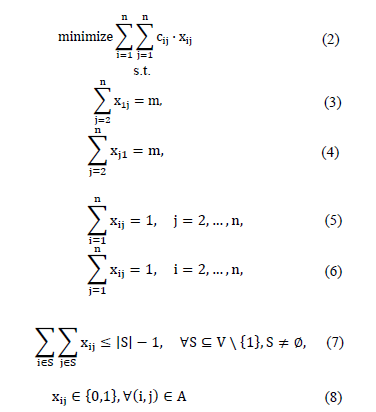
Several integer programming formulation have been proposed for the mTSP in literature, the most commonly used one is the assignment-based integer programming formulation [11]. In this mathematical description, the mTSP is usually formulated using an assignment-based double-index integer linear programming formulation. The decision variable can be defined as follows:
The general formulation of assignment-based integer programming of the mTSP can be given as follows
The expression (2) describes the fact that the objective of the problem is the minimization of the sum of the associated costs (distance) for each arc . The constraints (3) and (4) ensure that exactly salesmen depart form and return back to node 1 (the dispatching center). Expressions (5) and (6) represent the classical assignment constraints. Finally, constraints (7) are used to prevent subtour-s (Subtour Elimination Constraints, SECs).
3. M-ACS for route planning
The M-ACS applied as a solution alternative for the case study is taken from the original pseudocode reported in [11]. According to [11], there exist , as a set of colonies, which represent different group of global solutions of the problem (repair tours). Each colony obtains a set of global solutions, where each ant of the colony obtain a repair tour, using an Ant Colony System (ACS) algorithm and during the route construction, the ants that belong to a same colony (type) cooperate, sharing experience through "frequent" pheromone exchange. However the different types of ants are also involved in a competition process, which is based on the fact that the ants are repulsed by the pheromone of ants that belong to other colony (other type of ants). Combining both mechanisms (collaboration as well as competition), a set of global solutions can be reached for all colonies (better exploration process as a main advantage), selecting the best solution after certain number of iterations.
3.1. The adapted algorithm ]]>
Concretely, each artificial ant makes the repair tour; thus, a breakdown is chosen until all of them are included in the tour. For the selection of a (not yet visited) breakdown three aspects are taken into account in the M-ACS: how good was the choice of the breakdown before (, pheromone trails), how promising is the choice of that breakdown (, measure of desirability) and how good were the choices of that city for the other colonies (, colony pheromone trail). For this reason, one interesting characteristic of the M-ACS is the creation of a pheromone matrix for each ant type. In our M-ACS the pseudo-random-proportional rule either considers the experience earned by each colony. The state transition rules (consider, from the basic formulation that and ) are given by:
where indicates the average value of pheromone in the edge taken from the other colonies, excluding the pheromone trail of colony (current colony), after some number of iteration (). Another parameter defined in the M-ACS is , which denotes the sensibility of each ant for using its own colony experience () or also the experience of the remaining colonies ().
The frequent pheromone exchange is performed after a number of iteration , where is a user-defined parameter and can be established dividing the total number of iteration in equal amount or as the user decides. Finally, the frequent pheromone exchange can be computed as follows:
where index indicates the current colony, which performs the pheromone update, taking the average pheromone values of the other colonies, excluding its own pheromone trail.
The repulsion mechanism, between ants of different types, can be inferred from the term in the expressions (10) and (11). An ant that belongs to colony , has less probability to choice the breakdown if other ant types chosen this breakdown in the previous route constructions (the average pheromone value of the other ant types is increased). For this reason, ants of the same type have much more opportunities to preserve the chosen breakdowns when these are incorporated in the earliest route constructions.
The initial pheromone is obtained from Nearest Neighbor Heuristic (NN). As in previous research developed by [10], the heuristic starts with random node and then the other "non-visited-node" are incorporated according to the minimum traveled distance criterion.
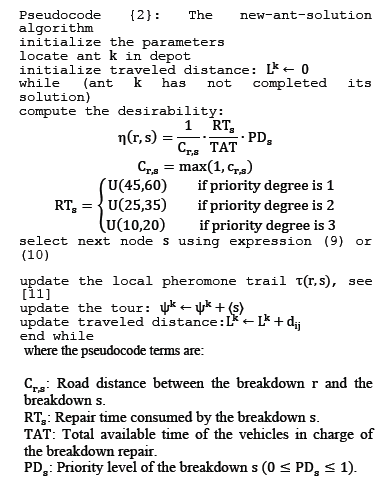
The M-ACS pseudocode adapted to the case study (Pseudocode 1) is detailed as:
]]>
Differing to [11], the subordinate pseudocodenew-ant-solution is adapted to the real-life case study. Particularly, the main difference resides on the measure of desirability (), which becomes better when the distance is minimum, the vehicle available time is efficiently spent (maximum ratio in ) and the breakdown priority is highest (the three priority level are established according to the voltage level, being the electrical breakdowns that occur in 220KV and 33KV lines of the first priority level, the second priority level for those which occur in 4KV lines, and the third in electrical lines with voltage level under 4KV (more frequent)). The values in the Pseudocode (2) follow a probabilistic distribution, uniform, with different parameters depending upon breakdown priority degree.
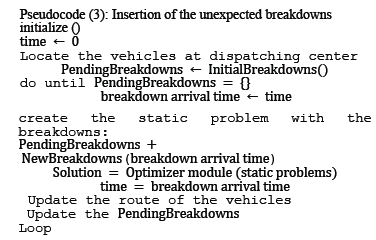
3.2. Treatment of the unexpected breakdowns The proposal consists of two integrated modules (dispatcher and optimizer module), in which a sequence of static mTSP problems is created. Dispatcher module initializes all the data structures, controls the time, handle the occurrence of all breakdowns (pending breakdowns of unexpected breakdowns), provide to the Optimizer module the input data and update the routes according to the results of the Optimizer module. On the other hand, the Optimizer module is responsible for solving the static problems generated by the other module. The static problem solutions are given by M-ACS.
In the Pseudocode (3) the main actions suggested by the proposed framework are explained in details. The pseudocode show the steps that should be followed when some unexpected breakdowns occurs.
3.3. Complexity analysis of M-ACS The time complexity of ACO algorithms is mainly based on its search strategies, where a set of ants develop a tour construction with complexity until a number of iterations is reached. The pheromone trails are stored in a matrix with entries (one for each edge) as in all ACO strategies [12]. In M-ACS a set of colonies is defined, each colony represents a subgroup of the total number of ants . In the computational analysis this total number of ants is the important parameter and not the number of colonies. This is because the pheromone exchange between the colonies, which only is performed every 10% of the iterations, takes as well and therefore does not increase the complexity of the standard pheromone updates within each colony. Yielding an overall time complexity of , equal to the other ACO strategies.
]]>
4. Computational results
In this section the M-ACS algorithm is tested on a real-life case study, set up in the city of Santa Clara, Cuba. This city, with a 300 000 population, has been one the most affected by the hurricanes over the last twenty years [13]. Therefore, the decision making related with route planning after natural disasters has received great deal of attention for the local authorities. The company involved in the decision making process presents serious financial difficulties, in particular with the computational resources. Hence, the approximate algorithm proposed in the paper is aimed to facilitate such computational resource lacks.
This case study consists on route planning for repairing the electrical breakdowns after the hurricanes crossing the mentioned city. The Fig. 2 shows the road network of Santa Clara, where the traveled distance of each arc in the network is calculated using the professional software MapInfo 6.0.
The dispatching center (the star in Fig. 2) and some electrical breakdowns after a devastating hurricane (e.g. hurricane IKE) are depicted as well. As we mention before, this case study can be modeled using the assignment-based formulation of the m-TSP, where each salesman represents a vehicle equipped with all resources for repair of the electrical breakdown.
The algorithm proposed in this paper was coded in JAVA and all experiments were executed on a microcomputer Intel Dual Core with 2.4 GHz, 4 GB RAM.
After a significant amount of executions, the parameters' values were tuned for the M-ACS applied to the case study. The aforementioned parameter setting has been supported by the ANOVA statistical technique, resulting significantly better (minimum criterion) the objective function value with the following parameters:
The value is defined as 0.75;
Parameters were setting as 1;
The evaporation coefficient performs better as 0.1;
]]>
Ten ants were assigned to each colony in the construction of solutions and;
Every 10 iterations, 10% of the total number of iteration (100), occurs the pheromone exchange.
The temporal scope of the M-ACS application was shift of 8 hours. In this case is considered that the first moment in the route planning process (after the hurricane) starts at the beginning of the shift and every 30 minutes after the first moment is check for new unexpected breakdowns. If certain breakdown(s) occur(s), the proposed algorithm develops an insertion process to the previous route based on the strategy described in Pseudocode (3).
In this computational experiment the algorithm performance is compared with other classical ACO variant, the Ant Colony System (ACS). Due to its similarities (excepting the competition and cooperation process of colonies) with the proposed algorithm was not explained in Section 3. However, the typical parameters of this algorithm (and number of iteration) are tuned using the same values defined in M-ACS.
The computational experimentation is based on the application of the ACO variants (M-ACS and ACS) for 20 shifts, in which a high diversity (related with different priority degree and unexpected) of breakdowns are under consideration. In the Table 1 are showed the main characteristics of every shift, including the fleet size, total number of breakdown during 8 hours, quantity of breakdown according to the priority degree and the amount of unexpected breakdown that occurred after the first route planning.
Table 2 presents the objective function value (total traveled distance, in Km.) applying the solution approaches based on ACO, the M-ACS and ACS. The values in boldface represent the objective function value for each shift. First three columns indicate the shift code and the solution quality of both algorithmic approaches. The last column illustrates a descriptive analysis (D) which is developed according to the follow expression:
where and are the objective function values after applying the M-ACS and ACS respectively. A positive value of D indicates in what percentage the proposed algorithm (M-ACS) overcomes the other ACO strategy (ACS); otherwise, the M-ACS performs worse than the ACS.The descriptive results depicted in Table 2 proof the efficacy of the proposed ACO solution approach (M-ACS). In only one shift, number 10, the classical ACS performs better regarding solution quality. It is quite interesting that only in minimum scale instance the ACS overcomes the M-ACS.
]]>
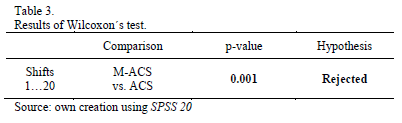
In addition to the descriptive analysis, a nonparametric test is applied aimed to know whether the average improvement (D) results significant. The objective function values have been introduced on the IBM SPSS 21, comparing both performance values (see in Table 3) using Wilcoxon Signed Rank Test. A -value is computed for this test, depending of it, is determined whether the hypothesis is rejected (when -value is lower than the significance value) or not.
Having closer look to the -value figure can be decided that the M-ACS performs significantly better than the classical ACS, which means that the competition and cooperation process between colonies of ants is much more suitable in the route planning process to repair breakdowns which occur in power network distribution, the real-life case study examined in the present paper.
5. Conclusions
In this paper, we have adapted and then applied a previous introduced ACO algorithm, called Multi-type Ant Colony System (M-ACS) (see in [11]), which significantly improves the performance of other efficient ACO strategy, the Ant Colony System (ACS). Comparison of our algorithm to classical ACO algorithm have shown that, the M-ACS is currently one the best performing variant for the Multiple Traveling Salesman Problem (mTSP), which have identified as the basic formulation in a realist route planning process to repair electrical breakdowns.
A case study, set up in the city of Santa Clara, confirms that our solution approach can be applied to real world instances. Thus, the proposed algorithm supports the decision making process related with the route planning to repair the electrical breakdown after natural disasters.
]]>
References
[1] Asgary, A. and Levy, J., A review of the implications of prospect theory for natural hazards and disaster planning. International Journal of Environmental Research, 3 (3), pp. 379-394, 2009. [ Links ]
[2] Tajnsek, V., Pihler, J. and Roser, M., Advanced logistical systems for the maintenance of overhead distribution lines through DCC with the use of laser monitoring. IEEE Transactions on Power Delivery, 26 (3), pp. 1337-1343, 2011. [ Links ]
[3] Wang, C. and Cheng, H.-Z., Optimization of network configuration in large distribution systems using plant growth simulation algorithm, IEEE Transactions on Power System, 23 (1), pp. 119-126, 2008. [ Links ]
[4] Borges, C.L.T. and Falcão, D.M., Optimal distributed generation allocation for reliability, losses, and voltage improvement, International Journal of Electrical Power & Energy Systems, 28 (6), pp. 413-420, 2006. [ Links ]
[5] Falaghi, H., Haghifam, M.-R. and Singh, C., Ant colony optimization-based method for placement of sectionalizing switches in distribution networks using a fuzzy multiobjective approach, IEEE Transactions on Power Delivery, 24 (1), pp. 268-276, 2009. [ Links ]
[6] Kivelevitch, E., Cohen K. and Kumar, M., A market-based solution to the multiple traveling salesmen problem, Journal of Intelligent & Robotic Systems, 72 (1), pp. 21-40, 2013. [ Links ]
[7] Frederickson, G. and Wittman, B., Approximation algorithms for the traveling repairman and speeding deliveryman problems, Algorithmica, 62 (3-4), pp. 1198-1221, 2012. [ Links ]
[8] Azi, N., Gendreau, M. and Potvin, J.-Y., A dynamic vehicle routing problem with multiple delivery routes, Annals of Operations Research, 199 (1), pp. 103-112, 2012. [ Links ]
[9] Pillac, V., Gendreau, M., Guéret, C. and Medaglia A.-L., A review of dynamic vehicle routing problems, European Journal of Operational Research, 225 (1), pp. 1-11, 2013. [ Links ]
[10] Costa-Salas, Y. J., Abreu-Ledón R., Coello-Machado N. I. and Nowé, A. Multi-type ant colony system for solving the multiple traveling salesman problem, Revista Técnica de la Facultad de Ingeniería Universidad del Zulia, 35 (3), pp. 311-320, 2012. [ Links ]
[11] Bektas, T., The multiple traveling salesman problem: An overview of formulations and solution procedures, Omega, 34 (3), pp. 209 219, 2006. [ Links ]
[12] Dorigo, M. and Stützle, T., ACO Algorithms for the traveling salesman problem, Evolutionary algorithms in engineering and computer science: Recent advances in genetic algorithms, Evolution strategies, volutionary programming, Genetic programming and industrial applications, New York, John Wiley & Sons, 1999. [ Links ]
[13] Costa-Salas, Y.J., Algorithmic assistance to the optimization process in Vehicle routing problems, Doctoral Thesis, Department of Logistics System and Material Handling, Otto-von-Guericke University, Magdeburg, Germany, 2013. [ Links ]
Y.J. Costa-Salas, is an Industrial Engineer from the Universidad Central "Marta Abreu" de Las Villas, Cuba. He received the Doctor-Ingenieur degree in the prestigious German institution Otto-von-Guericke University. His research interests cover several topics of Applied Mathematics in decision making: mathematical programming and approximate algorithms for hard combinatorial problems, bio-inspired algorithms, and supply chain optimization, among others. Prof. Costa belongs to the referee staff of many well-known international journals such as European Journal of Operational Research, Expert System with Application and Decision Science. He works as Associate Professor in the Faculty of Economics at Universidad de Manizales, Colombia.
W.A. Sarache-Castro, obtained his Industrial Engineer degree from the Universidad de Ibagué. He received the PhD in the Universidad Central "Marta Abreu" de Las Villas, Cuba. His has many contributions in the research field of Logistics and Operation Management. His is Associate Professor of the Industrial Engineering Department at Universidad Nacional de Colombia, Sede Manizales, Colombia.

 salesmen. Same type ants cooperate among them, sharing experiences through "frequent" pheromone exchange. Moreover, a competition between ant types (i.e. ants of different colonies) is also introduced in order to create certain diversity in the search process.
 , where
  is the set of
  nodes (vertices) and
  is the set of arcs (edges). Let
  be a cost (typically distance) matrix associated with
  is said to be symmetric when
  ,
,  and asymmetric otherwise. The aim of this discrete combinatorial problem is to find
 . The constraints (3) and (4) ensure that exactly
  , as a set of colonies, which represent different group of global solutions of the problem (repair tours). Each colony obtains a set of global solutions, where each ant of the colony obtain a repair tour, using an Ant Colony System (ACS) algorithm and during the route construction, the ants that belong to a same colony (type) cooperate, sharing experience through "frequent" pheromone exchange. However the different types of ants are also involved in a competition process, which is based on the fact that the ants are repulsed by the pheromone of ants that belong to other colony (other type of ants). Combining both mechanisms (collaboration as well as competition), a set of global solutions can be reached for all colonies (better exploration process as a main advantage), selecting the best solution after certain number of iterations.
 , pheromone trails), how promising is the choice of that breakdown (
 , measure of desirability) and how good were the choices of that city for the other colonies (
 , colony pheromone trail). For this reason, one interesting characteristic of the M-ACS is the creation of a pheromone matrix for each ant type. In our M-ACS the pseudo-random-proportional rule either considers the experience earned by each colony. The state transition rules (consider, from the basic formulation that
  and
and  ) are given by: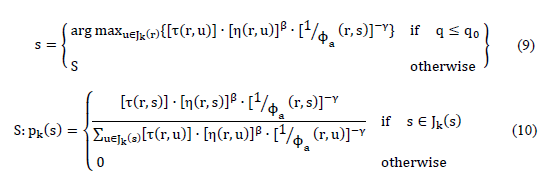
 taken from the other colonies, excluding the pheromone trail of colony
  (current colony), after some number of iteration (
 ). Another parameter defined in the M-ACS is
  , which denotes the sensibility of each ant for using its own colony experience (
 ) or also the experience of the remaining colonies (
 ).
). in equal amount or as the user decides. Finally, the frequent pheromone exchange can be computed as follows:
 in the expressions (10) and (11). An ant that belongs to colony
  if other ant types chosen this breakdown in the previous route constructions (the average pheromone value of the other ant types is increased). For this reason, ants of the same type have much more opportunities to preserve the chosen breakdowns when these are incorporated in the earliest route constructions.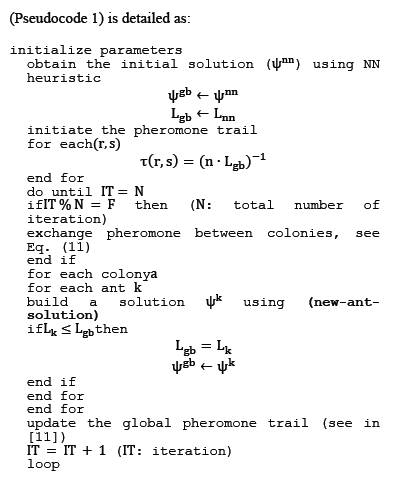
 ) and the breakdown priority is highest (the three priority level are established according to the voltage level, being the electrical breakdowns that occur in 220KV and 33KV lines of the first priority level, the second priority level for those which occur in 4KV lines, and the third in electrical lines with voltage level under 4KV (more frequent)). The
  values in the Pseudocode (2) follow a probabilistic distribution, uniform, with different parameters depending upon breakdown priority degree.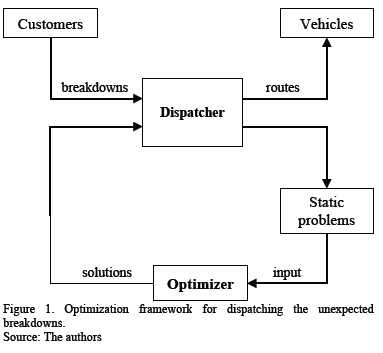
 until a number of iterations is reached. The pheromone trails are stored in a matrix with
  in the network is calculated using the professional software MapInfo 6.0.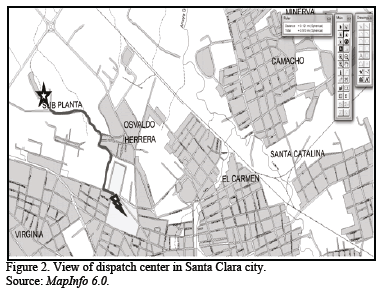
 value is defined as 0.75;
 were setting as 1;
 performs better as 0.1;
 and number of iteration) are tuned using the same values defined in M-ACS.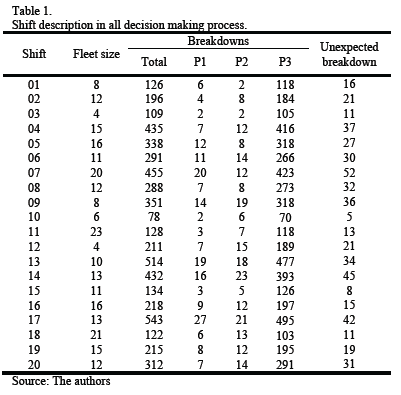

 and
and  are the objective function values after applying the M-ACS and ACS respectively. A positive value of D indicates in what percentage the proposed algorithm (M-ACS) overcomes the other ACO strategy (ACS); otherwise, the M-ACS performs worse than the ACS.The descriptive results depicted in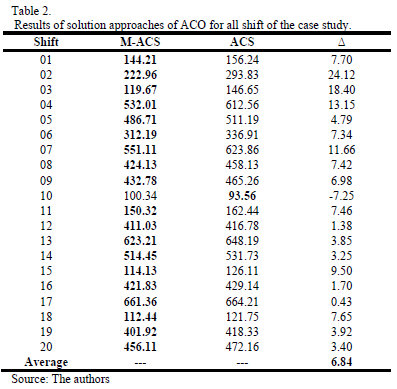
 -value is computed for this test, depending of it, is determined whether the hypothesis is rejected (when