<?xml version="1.0" encoding="ISO-8859-1"?><article xmlns:mml="http://www.w3.org/1998/Math/MathML" xmlns:xlink="http://www.w3.org/1999/xlink" xmlns:xsi="http://www.w3.org/2001/XMLSchema-instance">
<front>
<journal-meta>
<journal-id>0012-7353</journal-id>
<journal-title><![CDATA[DYNA]]></journal-title>
<abbrev-journal-title><![CDATA[Dyna rev.fac.nac.minas]]></abbrev-journal-title>
<issn>0012-7353</issn>
<publisher>
<publisher-name><![CDATA[Universidad Nacional de Colombia]]></publisher-name>
</publisher>
</journal-meta>
<article-meta>
<article-id>S0012-73532015000200024</article-id>
<article-id pub-id-type="doi">10.15446/dyna.v82n190.43792</article-id>
<title-group>
<article-title xml:lang="en"><![CDATA[Structural analysis of a friction stir-welded small trailer]]></article-title>
<article-title xml:lang="es"><![CDATA[Análisis estructural de un pequeño remolque unido con soldadura por fricción agitación]]></article-title>
</title-group>
<contrib-group>
<contrib contrib-type="author">
<name>
<surname><![CDATA[Bermúdez-Parra]]></surname>
<given-names><![CDATA[Fabio]]></given-names>
</name>
<xref ref-type="aff" rid="A01"/>
</contrib>
<contrib contrib-type="author">
<name>
<surname><![CDATA[Franco-Arenas]]></surname>
<given-names><![CDATA[Fernando]]></given-names>
</name>
<xref ref-type="aff" rid="A02"/>
</contrib>
<contrib contrib-type="author">
<name>
<surname><![CDATA[Casanova-García]]></surname>
<given-names><![CDATA[Fernando]]></given-names>
</name>
<xref ref-type="aff" rid="A03"/>
</contrib>
</contrib-group>
<aff id="A01">
<institution><![CDATA[,Universidad del Valle  ]]></institution>
<addr-line><![CDATA[Cali ]]></addr-line>
<country>Colombia</country>
</aff>
<aff id="A02">
<institution><![CDATA[,Universidad del Valle Escuela de Ingeniería de Materiales ]]></institution>
<addr-line><![CDATA[Cali ]]></addr-line>
<country>Colombia</country>
</aff>
<aff id="A03">
<institution><![CDATA[,Universidad del Valle Escuela de Ingeniería Mecánica ]]></institution>
<addr-line><![CDATA[Cali ]]></addr-line>
<country>Colombia</country>
</aff>
<pub-date pub-type="pub">
<day>00</day>
<month>04</month>
<year>2015</year>
</pub-date>
<pub-date pub-type="epub">
<day>00</day>
<month>04</month>
<year>2015</year>
</pub-date>
<volume>82</volume>
<numero>190</numero>
<fpage>192</fpage>
<lpage>197</lpage>
<copyright-statement/>
<copyright-year/>
<self-uri xlink:href="http://www.scielo.org.co/scielo.php?script=sci_arttext&amp;pid=S0012-73532015000200024&amp;lng=en&amp;nrm=iso"></self-uri><self-uri xlink:href="http://www.scielo.org.co/scielo.php?script=sci_abstract&amp;pid=S0012-73532015000200024&amp;lng=en&amp;nrm=iso"></self-uri><self-uri xlink:href="http://www.scielo.org.co/scielo.php?script=sci_pdf&amp;pid=S0012-73532015000200024&amp;lng=en&amp;nrm=iso"></self-uri><abstract abstract-type="short" xml:lang="en"><p><![CDATA[This paper introduces the analysis of a trailer structure made of 6063-T5 aluminum alloy using the Friction Stir-Welding process. The base material and the welded joint were characterized by tension tests. The loads for the structural analysis were obtained from field tests where stresses were measured on critical points at a 2.73 m long 0.95 m width trailer while it was driven on an unpaved road. The stresses on the whole trailer were found by using a finite element model, where the joint with the maximum stresses was identified. This joint was constructed with a tubular structural element using Friction Stir Welding and was evaluated by bending tests. Using the impact factor obtained from the field test, fatigue analysis was performed on the welded joint. It was found that the strength of the joint was sufficient to carry the loads on the trailer.]]></p></abstract>
<abstract abstract-type="short" xml:lang="es"><p><![CDATA[En este artículo se analiza una estructura de remolque construida utilizando aleación de aluminio 6063-T5 y soldadura por fricción-agitación. El material base y la junta soldada fueron caracterizados mediante pruebas de tracción. Las cargas para el análisis estructural fueron obtenidas con pruebas de campo donde se midieron esfuerzos en puntos considerados críticos, en un remolque de 2.73 m de largo por 0.95 m de ancho mientras era conducido sobre una carretera irregular. Los esfuerzos en el remolque completo se obtuvieron utilizando un modelo de elementos finitos donde la junta con máximos esfuerzos fue identificada. Esta junta fue construida con un elemento tubular utilizando soldadura por fricción - agitación y posteriormente fue evaluada con pruebas de flexión. Utilizando el factor de impacto obtenido de las pruebas de campo, se realizó un análisis a fatiga de la junta. Se encontró que la resistencia de la junta es suficiente para soportar las cargas de operación del remolque.]]></p></abstract>
<kwd-group>
<kwd lng="en"><![CDATA[trailer]]></kwd>
<kwd lng="en"><![CDATA[friction stir welding]]></kwd>
<kwd lng="en"><![CDATA[impact factor]]></kwd>
<kwd lng="en"><![CDATA[6063-T5 aluminum alloy]]></kwd>
<kwd lng="es"><![CDATA[remolque]]></kwd>
<kwd lng="es"><![CDATA[soldadura por fricción agitación]]></kwd>
<kwd lng="es"><![CDATA[factor de impacto]]></kwd>
<kwd lng="es"><![CDATA[aleación de aluminio 6063-T5]]></kwd>
</kwd-group>
</article-meta>
</front><body><![CDATA[ <p><font size="1" face="Verdana, Arial, Helvetica, sans-serif"><b>DOI:</b> <a href="http://dx.doi.org/10.15446/dyna.v82n190.43792" target="_blank">http://dx.doi.org/10.15446/dyna.v82n190.43792</a></font></p>     <p align="center"><font size="4" face="Verdana, Arial, Helvetica, sans-serif"><b>Structural analysis of a friction stir-welded  small trailer </b></font></p>     <p align="center"><i><font size="3"><b><font face="Verdana, Arial, Helvetica, sans-serif">An&aacute;lisis   estructural de un peque&ntilde;o remolque unido con soldadura por fricci&oacute;n agitaci&oacute;n</font></b></font></i></p>     <p align="center">&nbsp;</p>     <p align="center"><b><font size="2" face="Verdana, Arial, Helvetica, sans-serif">Fabio Berm&uacute;dez-Parra <i><sup>a</sup></i>,   Fernando Franco-Arenas <i><sup>b</sup></i> &amp; Fernando Casanova-García <i><sup>c</sup></i></font></b><font size="2" face="Verdana, Arial, Helvetica, sans-serif"></font></p>     <p align="center">&nbsp;</p>     <p align="center"><font size="2" face="Verdana, Arial, Helvetica, sans-serif"><sup><i>a</i></sup><i> Universidad del Valle, Cali, Colombia. <a href="mailto:fabio.bermudez.parra@gmail.com">fabio.bermudez.parra@gmail.com</a>    <br> </i></font><i><font size="2" face="Verdana, Arial, Helvetica, sans-serif"><sup>b </sup>Escuela de Ingeniería de Materiales, Universidad del Valle, Cali, Colombia. <a href="mailto:fernando.franco@correounivalle.edu.co">fernando.franco@correounivalle.edu.co</a>    <br> </font></i><i><font size="2" face="Verdana, Arial, Helvetica, sans-serif"><sup>c</sup> Escuela de Ingeniería Mec&aacute;nica, Universidad del Valle, Cali, Colombia. <a href="mailto:gonzalo.casanova@correounivalle.edu.co">gonzalo.casanova@correounivalle.edu.co</a></font></i></p>     <p align="center">&nbsp;</p>     ]]></body>
<body><![CDATA[<p align="center"><font size="2" face="Verdana, Arial, Helvetica, sans-serif"><b>Received: May 30<sup>th</sup>,   de 2014. Received in revised form: January 27<sup>th</sup>, 2015. Accepted:   February 16<sup>th</sup>, 2015</b></font></p>     <p align="center">&nbsp;</p>     <p align="center"><font size="1" face="Verdana, Arial, Helvetica, sans-seriff"><b>This work is licensed under a</b> <a rel="license" href="http://creativecommons.org/licenses/by-nc-nd/4.0/">Creative Commons Attribution-NonCommercial-NoDerivatives 4.0 International License</a>.</font><br /><a rel="license" href="http://creativecommons.org/licenses/by-nc-nd/4.0/"><img style="border-width:0" src="https://i.creativecommons.org/l/by-nc-nd/4.0/88x31.png" /></a></p> <hr>     <p><font size="2" face="Verdana, Arial, Helvetica, sans-serif"><b>Abstract    <br>   </b></font><font size="2" face="Verdana, Arial, Helvetica, sans-serif">This paper introduces the analysis of a trailer structure     made of 6063-T5 aluminum alloy using the Friction Stir-Welding process. The base material and the welded joint were     characterized by tension tests. The loads     for the structural analysis were obtained from field tests where stresses were     measured on critical points at a 2.73 m long 0.95 m width trailer while it was     driven on an unpaved road. The stresses     on the whole trailer were found by using a finite element model, where the     joint with the maximum stresses was identified. This joint was constructed with a tubular structural element using     Friction Stir Welding and was evaluated by bending tests. Using the impact factor obtained from the     field test, fatigue analysis was performed on the welded joint. It was found that the strength of the joint     was sufficient to carry the loads on the trailer.</font></p>     <p><font size="2" face="Verdana, Arial, Helvetica, sans-serif"><i>Keywords</i>:  trailer, friction stir welding, impact factor, 6063-T5 aluminum alloy.</font></p>     <p><font size="2" face="Verdana, Arial, Helvetica, sans-serif"><b>Resumen    <br> </b></font><font size="2" face="Verdana, Arial, Helvetica, sans-serif">En este  artículo se analiza una estructura de  remolque construida utilizando aleaci&oacute;n de aluminio 6063-T5 y soldadura por  fricci&oacute;n-agitaci&oacute;n. El material base y la junta soldada fueron caracterizados  mediante pruebas de tracci&oacute;n. Las cargas para el an&aacute;lisis estructural fueron  obtenidas con pruebas de campo donde se midieron esfuerzos en puntos  considerados críticos, en un remolque de 2.73 m de largo por 0.95 m de ancho  mientras era conducido sobre una carretera irregular. Los esfuerzos en el  remolque completo se obtuvieron utilizando un modelo de elementos finitos donde  la junta con m&aacute;ximos esfuerzos fue identificada. Esta junta fue construida con  un elemento tubular utilizando soldadura por fricci&oacute;n - agitaci&oacute;n y  posteriormente fue evaluada con pruebas de flexi&oacute;n. Utilizando el factor de  impacto obtenido de las pruebas de campo, se realiz&oacute; un an&aacute;lisis a fatiga de la  junta. Se encontr&oacute; que la resistencia de la junta es suficiente para soportar las cargas de operaci&oacute;n del remolque.</font></p>     <p><font size="2" face="Verdana, Arial, Helvetica, sans-serif"><i>Palabras clave</i>: remolque, soldadura por fricci&oacute;n agitaci&oacute;n,  factor de impacto, aleaci&oacute;n de aluminio 6063-T5.</font></p> <hr>     <p>&nbsp;</p>     ]]></body>
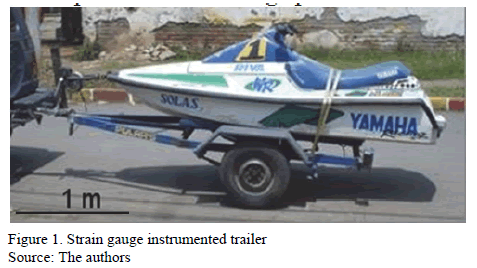
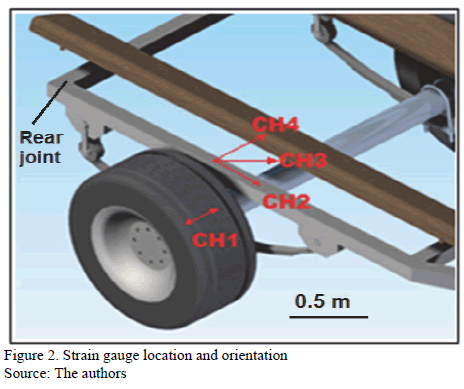
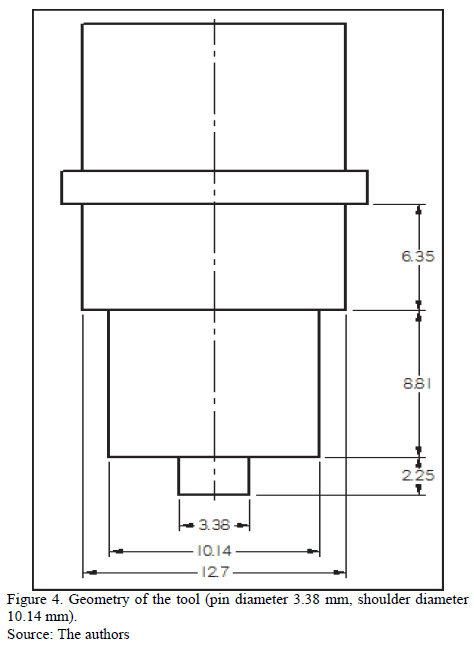
<body><![CDATA[<p><font size="3" face="Verdana, Arial, Helvetica, sans-serif"><b>1. Introduction</b></font></p>     <p><font size="2" face="Verdana, Arial, Helvetica, sans-serif">Modern industry faces  the important challenge of reducing its contaminating emissions to decrease  global warming. The transport industry  is one of the most fossil fuel consuming entities and the trend is clearly toward  higher traffic volumes around the world. Vehicular fuel consumption can be  decreased by reducing the weight of the vehicle by using materials like  aluminum and magnesium alloys which have a specific stiffness and strength &#91;1&#93;,  high enough to make them suitable for structural vehicle applications &#91;2&#93;.  However, some disadvantages such as poor weldability with conventional  techniques hinder their use in structural applications; fortunately, Friction  Stir Welding (FSW) emerged as an adequate joining technique to be used in  high-strength alloys &#91;3&#93;.</font></p>     <p><font size="2" face="Verdana, Arial, Helvetica, sans-serif">An adjusted design is another important factor in  decreasing structural weight and fuel consumption. Load uncertainty is frequently the reason why  designers select too-high safety factors resulting in non-optimal heavy  structures. Dynamic loads produced during accelerations, curve taking, or when  the vehicle moves over rough surfaces, are important parameters for the design  of vehicles because of the fluctuating stresses and the fatigue failures they  may produce. These dynamic loads are  strongly dependent on vehicle type, speed and road roughness &#91;4&#93;.</font></p>     <p><font size="2" face="Verdana, Arial, Helvetica, sans-serif">Dynamic loads due to the road-tire interaction have been  extensively studied as a tool for the design of bridges &#91;4-6&#93;. The impact factor (I), has frequently been  used to evaluate the increase of load due to the roughness of the road. The impact factor is defined as &#91;4&#93;:</font></p>     <p><img src="/img/revistas/dyna/v82n190/v82n190a24eq01.gif"></p>     <p><font size="2" face="Verdana, Arial, Helvetica, sans-serif">where <img src="/img/revistas/dyna/v82n190/v82n190a24eq004.gif"> and <img src="/img/revistas/dyna/v82n190/v82n190a24eq006.gif"> are the dynamic and static responses,  respectively. Liu et al. &#91;5&#93; reported  maximum impact factors of 34%; however, the roughness amplitude they considered  (~2 cm) is not as severe as a road in bad-condition on which many vehicles  frequently travel. Impact factors in the  same order were calculated from the results reported by Kim et al. &#91;4&#93;, but the  roughness studied is still low. A higher  impact factor (80%) was reported by Kwasniewski et al. &#91;6&#93;. Using field tests, Moreno et al. &#91;7&#93; found  that the impact factor depends on road roughness. They found impact factors of 28.5, 50.4 and  80.5% for smooth, average, and highly rough roads, respectively. </font></p>     <p><font size="2" face="Verdana, Arial, Helvetica, sans-serif">This paper shows the design and analysis of a trailer  structure used to transport a watercraft. This structure was chosen because it  is small enough to make its construction affordable in a later stage of the  study affordable. Also, these kinds of structures are relevant for some local  manufactures. The material selected is a 6063-T5 aluminum alloy in rectangular  tubular sections. The joints were  designed to be welded by using FSW. To  perform an adjusted design reducing the uncertainty of the actual loads, field  tests were conducted on an existing trailer made of steel. The field tests  revealed the impact factor, which was then used for undertaking a fatigue  analysis. Bending tests were carried out  on sections joined with the selected profiles to determine the strength of the  FSW. The main contribution of this work was to show that FSW can be used to  develop structures with practical applications and with advantages with respect  to the traditional steel structures.</font></p>     <p>&nbsp;</p>     <p><font size="3" face="Verdana, Arial, Helvetica, sans-serif"><b>2. Methodology</b></font></p>     <p><font size="2" face="Verdana, Arial, Helvetica, sans-serif">For an efficient design, actual loads were measured by  using strain gages on an existing trailer (<a href="#fig01">Fig. 1</a>) made of low-carbon steel,  which is used to transport a 350 kg watercraft. The shaft and the lateral beam of the trailer were instrumented. A strain gage (FLA-3-11 TML strain gage) was  installed on the top of the shaft using quarter Wheatstone bridge  configuration. With this configuration,  the total stresses were detected, but these stresses are mainly due to bending  caused by the vertical load on the tire. On the beam, a three-strain gage rosette (FRA-3-11 TML) was bound; each  strain gage was installed in quarter bridge configuration. With these three strain gages, the normal  stresses in longitudinal direction, the normal stresses in transversal  direction and the shear stresses can be determined. The four signals (<a href="#fig02">Fig. 2</a>) were collected by  using a DC-104R TML dynamic strain recorder with a sampling rate of 100 data  per second. The data acquisition system  was set at zero while the vehicle was unloaded. </font></p>     ]]></body>
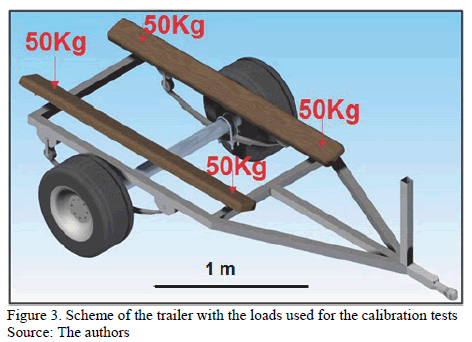
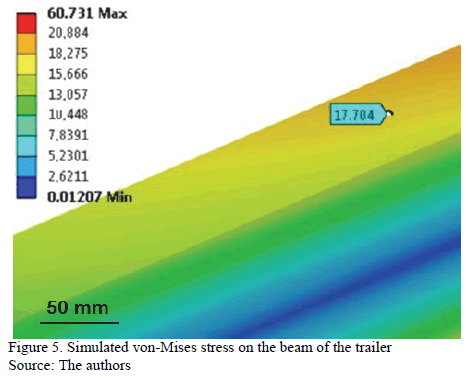
<body><![CDATA[<p align="center"><font size="2" face="Verdana, Arial, Helvetica, sans-serif"><a name="fig01"></a></font><img src="/img/revistas/dyna/v82n190/v82n190a24fig01.gif"></p>     <p align="center"><font size="2" face="Verdana, Arial, Helvetica, sans-serif"><a name="fig02"></a></font><img src="/img/revistas/dyna/v82n190/v82n190a24fig02.gif"></p>     <p><font size="2" face="Verdana, Arial, Helvetica, sans-serif">A finite element model  (FEM) was made to calculate stresses at every point of the real trailer. The FEM was calibrated by comparing the  results of the model with the measured stress obtained with a known load. Once instrumented, the vehicle was loaded  with a 50-kg weight on each point where the watercraft is supported. <a href="#fig03">Fig. 3</a> shows a scheme of the trailer with the  known load. With strain, stresses were  calculated using the plane stress equations. </font></p>     <p align="center"><font size="2" face="Verdana, Arial, Helvetica, sans-serif"><a name="fig03"></a></font><img src="/img/revistas/dyna/v82n190/v82n190a24fig03.gif"></p>     <p><font size="2" face="Verdana, Arial, Helvetica, sans-serif">After the calibration, the trailer was loaded with the  watercraft and driven over an unpaved road where these vehicles usually have to  travel. The impact factor was calculated  using the measured stresses. </font></p>     <p><font size="2" face="Verdana, Arial, Helvetica, sans-serif">The new trailer was designed using 6063-T5 aluminum  alloy. A finite element model using  Ansys software with solid 187 tetrahedral structural elements was run to find  the critical joints. The loads on the model were applied as shown in <a href="#fig03">Fig. 3</a>.  Restrictions on vertical direction were applied on the joints of the trailer  with the suspension. The maximum stresses on those joints calculated from the  model and the impact factor obtained from the field tests were used to check  their fatigue life. The joints on the  trailer were designed to be made using FSW. Tension tests according the  ASTM-E8-00b standard were conducted on a plate of 6063-T5 alloy with and  without FSW to find the efficiency of the welding. The critical joints found with the finite  elements model were assembled using FSW and bending tests were performed on  them to determine the failure stress. The FSW process was performed on a conventional milling machine using a  3.35 mm diameter cylindrical tool (<a href="#fig04">Fig. 4</a>) made of H13 quenched and tempered  steel with a hardness of 55 HRC. The tool rotational speed was 1800 rpm and the  welding speed was 252 mm/min. </font></p>     <p align="center"><font size="2" face="Verdana, Arial, Helvetica, sans-serif"><a name="fig04"></a></font><img src="/img/revistas/dyna/v82n190/v82n190a24fig04.gif"></p>     <p>&nbsp;</p>     <p><font size="3" face="Verdana, Arial, Helvetica, sans-serif"><b>3. Results and  discussion</b></font></p>     <p><font size="2" face="Verdana, Arial, Helvetica, sans-serif">When the trailer was loaded with 200 kg, the measured  strains on the beam were: <img src="/img/revistas/dyna/v82n190/v82n190a24eq016.gif"> (0º), <img src="/img/revistas/dyna/v82n190/v82n190a24eq018.gif"> (45º), and <img src="/img/revistas/dyna/v82n190/v82n190a24eq020.gif">(90º). With these values, stresses were calculated  using the plain stress equations; then, the von-Mises stress value obtained was  16.8 MPa. </font></p>     ]]></body>
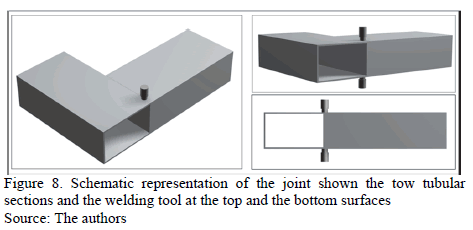
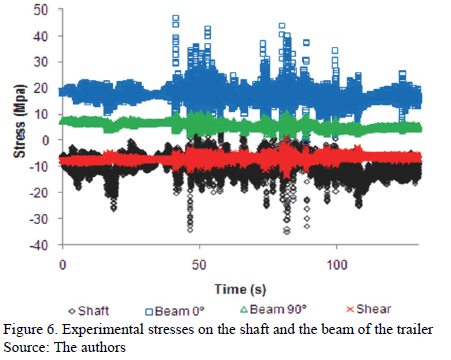
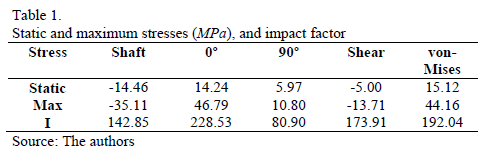
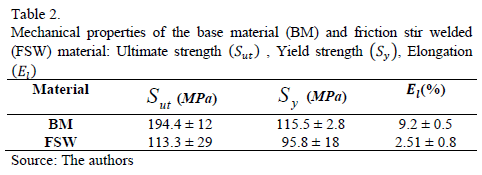
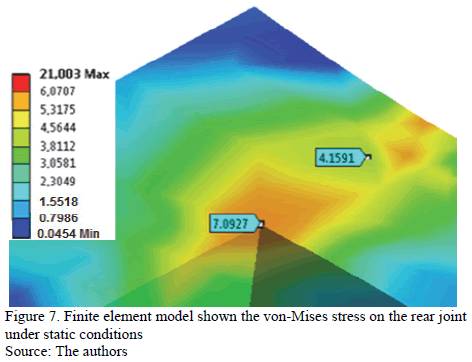
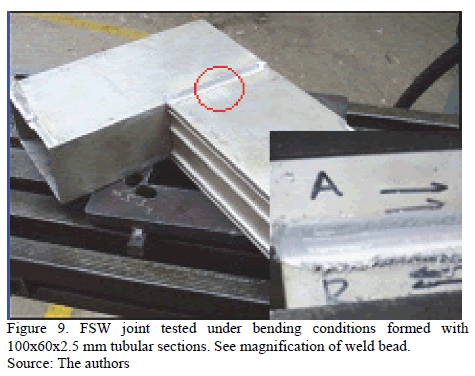
<body><![CDATA[<p><font size="2" face="Verdana, Arial, Helvetica, sans-serif">The von-Mises stress obtained with FEM on the zone  where the stress was experimentally measured was 17.7 MPa (<a href="#fig05">Fig. 5</a>); therefore,  the error obtained on the model was 5.35%. </font></p>     <p align="center"><font size="2" face="Verdana, Arial, Helvetica, sans-serif"><a name="fig05"></a></font><img src="/img/revistas/dyna/v82n190/v82n190a24fig05.gif"></p>     <p><font size="2" face="Verdana, Arial, Helvetica, sans-serif">The impact factor was  calculated using the stresses measured with the watercraft on the trailer under  static and dynamic conditions. The  dynamic stresses where obtained with the road test, whose results are shown in     <a href="#fig06">Fig. 6</a>. As expected, longitudinal stress  (0º stress) on the beam was higher than shear and 90º stress. High variation on the stress on the shaft and  the 0º stress on the beam were observed; less important variations were  obtained in the shear and 90º stresses on the beam. <a href="#tab01">Table 1</a> shows the static stresses, the  maximum stresses obtained during the dynamic test, and the calculated impact  factor. On the beam, the impact factor  was maximum for the axial stress (0°) and lower impact factors were detected on  the 90º and the shear stresses. To counter  this impact factor variability on the beam, the impact factor calculated with  the von-Mises stress was used for the fatigue analysis. The impact factor on the shaft is higher than  that reported in the literature &#91;4-7&#93;, which is due to the high roughness of  the road where the trailer had to travel. Surprisingly, the impact factor on the beam was higher than that on the  shaft; this is probably due to the lack of a damping system on the trailer. </font></p>     <p align="center"><font size="2" face="Verdana, Arial, Helvetica, sans-serif"><a name="fig06"></a></font><img src="/img/revistas/dyna/v82n190/v82n190a24fig06.gif"></p>     <p align="center"><font size="2" face="Verdana, Arial, Helvetica, sans-serif"><a name="tab01"></a></font><img src="/img/revistas/dyna/v82n190/v82n190a24tab01.gif"></p>     <p><font size="2" face="Verdana, Arial, Helvetica, sans-serif">The results of the tension tests on the base material (BM)  and the friction stir-welded material are shown in <a href="#tab02">Table 2</a>. Friction stir-welded specimens presented  lower yield and ultimate tensile strength than those of base material. The ductility for the FSW was also lower than  that of the base material. These results  agree with the results of Sato &amp; Kokawa &#91;8&#93; who reported lower properties  for the material in the as-weld condition. Rodriguez et al. &#91;9&#93; also reported decreased ductility for the welded  material of a 6016 Aluminum alloy. With  respect to the yield strength, the average efficiency of the FSW joint  calculated as the ratio between the yield strength of the FSW and the base  material was 82.9 %. </font></p>     <p align=center><font size="2" face="Verdana, Arial, Helvetica, sans-serif"><a name="tab02"></a></font><img src="/img/revistas/dyna/v82n190/v82n190a24tab02.gif"></p>     <p><font size="2" face="Verdana, Arial, Helvetica, sans-serif">The aluminum trailer has the same general shape as the  existing trailer, but it was designed with a 100x60x2.5 mm tubular  section. It was simulated with the load  of the watercraft under static conditions. The critical stress was found on the rear joint and the von-Mises stress  is shown in <a href="#fig07">Figure 7</a>. Approximately, the  nominal stress can be taken as the stress at the center of the section (4.16 <i>MPa</i>) and the stress at the corner (7.09 <i>MPa</i>) are due to the stress  concentration. Therefore, a stress  concentration factor of 1.7 exists at the corner. </font></p>     <p align="center"><font size="2" face="Verdana, Arial, Helvetica, sans-serif"><a name="fig07"></a></font><img src="/img/revistas/dyna/v82n190/v82n190a24fig07.gif"></p>     <p><font size="2" face="Verdana, Arial, Helvetica, sans-serif">The joint was designed to be welded at the top and the  bottom surface. Bending tests were  conducted on six specimens to check whether these two beads were sufficient to  carry out the working stress. <a href="#fig08">Fig. 8</a> schematically shows the beads that form the joint and <a href="#fig09">Fig. 9</a> shows an actual  joint. The bending tests were performed  by applying a load on the extreme of the welded segment using a hydraulic  machine. The resulting average rupture stress on the bending test was 97.95 <i>MPa</i> with a standard deviation of 8.22.</font></p>     ]]></body>
<body><![CDATA[<p align="center"><font size="2" face="Verdana, Arial, Helvetica, sans-serif"><a name="fig08"></a></font><img src="/img/revistas/dyna/v82n190/v82n190a24fig08.gif"></p>     <p align="center"><font size="2" face="Verdana, Arial, Helvetica, sans-serif"><a name="fig09"></a></font><img src="/img/revistas/dyna/v82n190/v82n190a24fig09.gif"></p>     <p><font size="2" face="Verdana, Arial, Helvetica, sans-serif">The rupture strength obtained from the bending test is  high enough to withstand the stress due to the watercraft weight under static  conditions; however, a fatigue analysis should be performed because of the  fluctuating stresses introduced on the trailer due to road roughness (<a href="#fig06">Fig. 6</a>). The von-Mises stress was used to perform the  fatigue analysis. The stress under  static conditions obtained from the FEM model (<a href="#fig07">Fig. 7</a>) was used as the mean  stress <img src="/img/revistas/dyna/v82n190/v82n190a24eq044.gif">,  and the impact factor, found on the beam during the dynamic test, was used to  calculate the maximum stresses <img src="/img/revistas/dyna/v82n190/v82n190a24eq046.gif">. Then the maximum stress is:</font></p>     <p><img src="/img/revistas/dyna/v82n190/v82n190a24eq02.gif"></p>     <p><font size="2" face="Verdana, Arial, Helvetica, sans-serif">Replacing, the value obtained was <img src="/img/revistas/dyna/v82n190/v82n190a24eq050.gif"></font></p>     <p><font size="2" face="Verdana, Arial, Helvetica, sans-serif">The alternating equivalent stress <img src="/img/revistas/dyna/v82n190/v82n190a24eq052.gif"> is:</font></p>     <p><img src="/img/revistas/dyna/v82n190/v82n190a24eq03.gif"></p>     <p><font size="2" face="Verdana, Arial, Helvetica, sans-serif">Therefore, the alternating stress was: 7.98 <i>MPa</i>.</font></p>     <p><font size="2" face="Verdana, Arial, Helvetica, sans-serif">The fatigue strength of the material was obtained with the  approximated equation:</font></p>     <p><img src="/img/revistas/dyna/v82n190/v82n190a24eq04.gif"></p>     ]]></body>
<body><![CDATA[<p><font size="2" face="Verdana, Arial, Helvetica, sans-serif">where <img src="/img/revistas/dyna/v82n190/v82n190a24eq058.gif"> is the ultimate tensile strength, which, in  this case, was taken from the bending tests (97.95 <i>MPa</i>). Factors due to surface  roughness, size, and stress concentration were taken into account to calculate  the fatigue strength of the joint. </font></p>     <p><font size="2" face="Verdana, Arial, Helvetica, sans-serif">The roughness of the as-weld surface was considered  similar to that of a forged surface. Thus, the surface factor is: <img src="/img/revistas/dyna/v82n190/v82n190a24eq060.gif"> .</font></p>     <p><font size="2" face="Verdana, Arial, Helvetica, sans-serif">With the profile equivalent diameter (85.2 mm), the size  factor is: <img src="/img/revistas/dyna/v82n190/v82n190a24eq062.gif"> .</font></p>     <p><font size="2" face="Verdana, Arial, Helvetica, sans-serif">The stress concentration factor <img src="/img/revistas/dyna/v82n190/v82n190a24eq064.gif"> was determined by using a FEM of the specimen  under bending conditions (<a href="#fig07">Fig. 7</a>). The obtained value was 1.7. </font></p>     <p><font size="2" face="Verdana, Arial, Helvetica, sans-serif">The fatigue strength of the piece was:</font></p>     <p><img src="/img/revistas/dyna/v82n190/v82n190a24eq05.gif"></p>     <p><font size="2" face="Verdana, Arial, Helvetica, sans-serif">The value obtained was <img src="/img/revistas/dyna/v82n190/v82n190a24eq068.gif">.</font></p>     <p><font size="2" face="Verdana, Arial, Helvetica, sans-serif">The safety factor <img src="/img/revistas/dyna/v82n190/v82n190a24eq070.gif">,  using the Goodman approach, is given by:</font></p>     <p><img src="/img/revistas/dyna/v82n190/v82n190a24eq06.gif"></p>     <p><font size="2" face="Verdana, Arial, Helvetica, sans-serif">The calculated safety factor was <img src="/img/revistas/dyna/v82n190/v82n190a24eq074.gif"> = 2.31. This means that the joint will have a secure life until <img src="/img/revistas/dyna/v82n190/v82n190a24eq076.gif"> cycles. Regardless of the high safety factor, the aluminum trailer is 20%  lighter than the steel trailer used for the tests.</font></p>     ]]></body>
<body><![CDATA[<p><font size="2" face="Verdana, Arial, Helvetica, sans-serif">The latter was a simplified method for the design and  analysis of the structure that showed that it is possible to get improved design  by using stress measurements, a light material and a modern joining  technique. An improved analysis can be  made by using Miner's rule to calculate an equivalent stress from the measured  stress and obtaining a more efficient structure designed for a determined period  of time. More advanced methodologies  than that used herein can be found in the literature &#91;10-12&#93; and can be used to  achieve a more adjusted and efficient design. </font></p>     <p><font size="2" face="Verdana, Arial, Helvetica, sans-serif">A limitation of this work is the use of a steel structure  to evaluate the aluminum structure. We have assumed that the behavior of both  structures is similar considering the similarity in loads and road roughness,  and considering that both materials are working in the linear elastic range.  However for an actual validation of the structure, tests have to be performed  on the aluminum structure, which is part of future work. Another important  factor needing improvement to arrive at a better design is the knowledge of the  fatigue properties of the friction stir-welded aluminum alloys. S-N curves of the welded joints (with the  actual geometry) are needed to make more accurate fatigue life calculations  &#91;13,14&#93;. Finally, improvement of the strength of the joints could be achieved  by using a specialized FSW machine rather than the tool machine used in the  present study as shown by Zapata et al. &#91;15&#93;. </font></p>     <p>&nbsp;</p>     <p><font size="3" face="Verdana, Arial, Helvetica, sans-serif"><b>4. Conclusions</b></font></p>     <p><font size="2" face="Verdana, Arial, Helvetica, sans-serif">The impact factor found on the shaft of the trailer  running on an unpaved road was greater than those reported in the  literature. The impact factor on the  beam calculated with the static and maximum von-Mises stress was higher than  that on the shaft.</font></p>     <p><font size="2" face="Verdana, Arial, Helvetica, sans-serif">An efficiency of 82.9% with respect to the yield strength  was obtained on the welded material by using tension tests. </font></p>     <p><font size="2" face="Verdana, Arial, Helvetica, sans-serif">The designed joint assembled with FSW has fatigue strength  to support the dynamic stress and to be secure from fatigue failure. Therefore,  it is reliable to use FSW in these kinds of structures. With this joint, a 20%  lighter prototype with respect to the steel trailer can be produced.</font></p>     <p>&nbsp;</p>     <p><font size="3" face="Verdana, Arial, Helvetica, sans-serif"><b>References</b></font></p>     <!-- ref --><p><font size="2" face="Verdana, Arial, Helvetica, sans-serif"><b>&#91;1&#93;</b>    Edwards, K.L., Strategic substitution of new materials  for old: Applications in automotive product development. Materials and Design,  25, pp. 529-533, 2004. DOI: 10.1016/j.matdes.2003.12.008</font>&nbsp;&nbsp;&nbsp;&nbsp;&nbsp;&nbsp;&nbsp;&nbsp;[&#160;<a href="javascript:void(0);" onclick="javascript: window.open('/scielo.php?script=sci_nlinks&ref=000082&pid=S0012-7353201500020002400001&lng=','','width=640,height=500,resizable=yes,scrollbars=1,menubar=yes,');">Links</a>&#160;]<!-- end-ref --><!-- ref --><p><font size="2" face="Verdana, Arial, Helvetica, sans-serif"><b>&#91;2&#93;</b>    Carle, D. and Blount, G., The suitability of aluminum  as an alternative material for car bodies. Mater and Design, 20, pp. 267-272,  1999. DOI: 10.1016/S0261-3069(99)00003-5</font>&nbsp;&nbsp;&nbsp;&nbsp;&nbsp;&nbsp;&nbsp;&nbsp;[&#160;<a href="javascript:void(0);" onclick="javascript: window.open('/scielo.php?script=sci_nlinks&ref=000083&pid=S0012-7353201500020002400002&lng=','','width=640,height=500,resizable=yes,scrollbars=1,menubar=yes,');">Links</a>&#160;]<!-- end-ref --><!-- ref --><p><font size="2" face="Verdana, Arial, Helvetica, sans-serif"><b>&#91;3&#93;</b>    Moreira, P.M.G.P., Santos, T., Tavares, S.M.O., Richter-Trummer,  V., Vilaca, P. and De Castro, P.M.S.T. Mechanical and metallurgical  characterization of friction stir welding joints of AA6061-T6 with AA6082-T6.  Materials and Design, 30, pp. 2726-2731, 2009. DOI: 10.1016/j.matdes.2008.04.042</font>&nbsp;&nbsp;&nbsp;&nbsp;&nbsp;&nbsp;&nbsp;&nbsp;[&#160;<a href="javascript:void(0);" onclick="javascript: window.open('/scielo.php?script=sci_nlinks&ref=000084&pid=S0012-7353201500020002400003&lng=','','width=640,height=500,resizable=yes,scrollbars=1,menubar=yes,');">Links</a>&#160;]<!-- end-ref --><!-- ref --><p><font size="2" face="Verdana, Arial, Helvetica, sans-serif"><b>&#91;4&#93;</b>    Kim, C.W., Kawatani, M. and Kim, K.B.,  Three-dimensional dynamic analysis for bridge-vehicle interaction with roadway  roughness. Computers and Structures, 83, pp. 1627-1645, 2006. DOI:  10.1016/j.compstruc.2004.12.004</font>&nbsp;&nbsp;&nbsp;&nbsp;&nbsp;&nbsp;&nbsp;&nbsp;[&#160;<a href="javascript:void(0);" onclick="javascript: window.open('/scielo.php?script=sci_nlinks&ref=000085&pid=S0012-7353201500020002400004&lng=','','width=640,height=500,resizable=yes,scrollbars=1,menubar=yes,');">Links</a>&#160;]<!-- end-ref --><!-- ref --><p><font size="2" face="Verdana, Arial, Helvetica, sans-serif"><b>&#91;5&#93;</b>    Liu, C., Huang, D. and Wang, T., Analytical dynamic  impact study based on correlated road roughness. Computers and Structures, 80,  pp. 1639-1650, 2002. DOI: 10.1016/S0045-7949(02)00113-X</font>&nbsp;&nbsp;&nbsp;&nbsp;&nbsp;&nbsp;&nbsp;&nbsp;[&#160;<a href="javascript:void(0);" onclick="javascript: window.open('/scielo.php?script=sci_nlinks&ref=000086&pid=S0012-7353201500020002400005&lng=','','width=640,height=500,resizable=yes,scrollbars=1,menubar=yes,');">Links</a>&#160;]<!-- end-ref --><!-- ref --><p><font size="2" face="Verdana, Arial, Helvetica, sans-serif"><b>&#91;6&#93;</b>    Kwasniewski, L., Li, H., Wekezer, J. and Malachowski,  J., Finite element analysis of vehicle-bridge interaction. Finite Elements in  Analysis and Design, 42, pp. 950-959, 2006. DOI: 10.1016/j.finel.2006.01.014</font>&nbsp;&nbsp;&nbsp;&nbsp;&nbsp;&nbsp;&nbsp;&nbsp;[&#160;<a href="javascript:void(0);" onclick="javascript: window.open('/scielo.php?script=sci_nlinks&ref=000087&pid=S0012-7353201500020002400006&lng=','','width=640,height=500,resizable=yes,scrollbars=1,menubar=yes,');">Links</a>&#160;]<!-- end-ref --><!-- ref --><p><font size="2" face="Verdana, Arial, Helvetica, sans-serif"><b>&#91;7&#93;</b> Moreno, A.,  Teran, J. y Carrion, F.J., Efecto de la rugosidad de carreteras en el da&ntilde;o a  vehículos. Sanfandila Qro Publicaci&oacute;n t&eacute;cnica, No. 139, pp. 5-10, 2003.    &nbsp;&nbsp;&nbsp;&nbsp;&nbsp;&nbsp;&nbsp;&nbsp;[&#160;<a href="javascript:void(0);" onclick="javascript: window.open('/scielo.php?script=sci_nlinks&ref=000088&pid=S0012-7353201500020002400007&lng=','','width=640,height=500,resizable=yes,scrollbars=1,menubar=yes,');">Links</a>&#160;]<!-- end-ref --></font></p>     <!-- ref --><p><font size="2" face="Verdana, Arial, Helvetica, sans-serif"><b>&#91;8&#93;</b>    Sato, Y.S. and Kokawa, H., Distribution of tensile  property and microstructure in friction stir weld of 6063 aluminum. Metallurgical and Materials Transactions A,  32A, pp. 3023-3031, 2001. DOI: 10.1007/s11661-001-0177-8</font>&nbsp;&nbsp;&nbsp;&nbsp;&nbsp;&nbsp;&nbsp;&nbsp;[&#160;<a href="javascript:void(0);" onclick="javascript: window.open('/scielo.php?script=sci_nlinks&ref=000090&pid=S0012-7353201500020002400008&lng=','','width=640,height=500,resizable=yes,scrollbars=1,menubar=yes,');">Links</a>&#160;]<!-- end-ref --><!-- ref --><p><font size="2" face="Verdana, Arial, Helvetica, sans-serif"><b>&#91;9&#93;</b>    Rodriguez, D.M., Loureiro, A., Leitao, C., Leal, R.M.,  Chaparro, B.M. and Vilaca, P., Influence of friction stir welding parameters on  the microstructural and mechanical properties of AA 6016-T4 thin welds.  Materials and Design, 30, pp. 1913-1921, 2003. DOI: 10.1016/j.matdes.2008.09.016</font>&nbsp;&nbsp;&nbsp;&nbsp;&nbsp;&nbsp;&nbsp;&nbsp;[&#160;<a href="javascript:void(0);" onclick="javascript: window.open('/scielo.php?script=sci_nlinks&ref=000091&pid=S0012-7353201500020002400009&lng=','','width=640,height=500,resizable=yes,scrollbars=1,menubar=yes,');">Links</a>&#160;]<!-- end-ref --><!-- ref --><p><font size="2" face="Verdana, Arial, Helvetica, sans-serif"><b>&#91;10&#93;</b>   Wannengurg, J., Heyns, P.S. and Raath, A.D.,  Application of a fatigue equivalent static load methodology for the numerical  durability assessment of heavy vehicle structures. International Journal of  Fatigue, 31, pp. 1541-1549, 2009. DOI: 10.1016/j.ijfatigue.2009.04.020</font>&nbsp;&nbsp;&nbsp;&nbsp;&nbsp;&nbsp;&nbsp;&nbsp;[&#160;<a href="javascript:void(0);" onclick="javascript: window.open('/scielo.php?script=sci_nlinks&ref=000092&pid=S0012-7353201500020002400010&lng=','','width=640,height=500,resizable=yes,scrollbars=1,menubar=yes,');">Links</a>&#160;]<!-- end-ref --><!-- ref --><p><font size="2" face="Verdana, Arial, Helvetica, sans-serif"><b>&#91;11&#93;</b>   Boessio, M.L., Morsch, I.B. and Awruch, A.M., Fatigue  life estimation of commercial vehicles. Journal of Sound and Vibration, 291,  pp. 169-191, 2006. DOI: 10.1016/j.jsv.2005.06.002</font>&nbsp;&nbsp;&nbsp;&nbsp;&nbsp;&nbsp;&nbsp;&nbsp;[&#160;<a href="javascript:void(0);" onclick="javascript: window.open('/scielo.php?script=sci_nlinks&ref=000093&pid=S0012-7353201500020002400011&lng=','','width=640,height=500,resizable=yes,scrollbars=1,menubar=yes,');">Links</a>&#160;]<!-- end-ref --><!-- ref --><p><font size="2" face="Verdana, Arial, Helvetica, sans-serif"><b>&#91;12&#93;</b>   Haiba, M., Barton, D.C., Brooks, P.C. and Levesley,  M.C., Review of life assessment techniques applied to dynamically loaded  automotive components. Computers and Structures, 80, pp. 481-494, 2002. DOI: 10.1016/S0045-7949(02)00022-6</font>&nbsp;&nbsp;&nbsp;&nbsp;&nbsp;&nbsp;&nbsp;&nbsp;[&#160;<a href="javascript:void(0);" onclick="javascript: window.open('/scielo.php?script=sci_nlinks&ref=000094&pid=S0012-7353201500020002400012&lng=','','width=640,height=500,resizable=yes,scrollbars=1,menubar=yes,');">Links</a>&#160;]<!-- end-ref --><!-- ref --><p><font size="2" face="Verdana, Arial, Helvetica, sans-serif"><b>&#91;13&#93;</b>   Macdonald, K.A. and Haagensen, P.J., Fatigue design of  welded aluminum rectangular hollow section joints. Engineering Failure Analysis, 6, pp. 113-130, 1999. DOI: 10.1016/S1350-6307(98)00025-9</font>&nbsp;&nbsp;&nbsp;&nbsp;&nbsp;&nbsp;&nbsp;&nbsp;[&#160;<a href="javascript:void(0);" onclick="javascript: window.open('/scielo.php?script=sci_nlinks&ref=000095&pid=S0012-7353201500020002400013&lng=','','width=640,height=500,resizable=yes,scrollbars=1,menubar=yes,');">Links</a>&#160;]<!-- end-ref --><!-- ref --><p><font size="2" face="Verdana, Arial, Helvetica, sans-serif"><b>&#91;14&#93;</b>   Maddox, S.J., Review of fatigue assessment procedures  for welded aluminum structures. International Journal of Fatigue, 25, pp.  1359-1378, 2003. DOI: 10.1016/S0142-1123(03)00063-X</font>&nbsp;&nbsp;&nbsp;&nbsp;&nbsp;&nbsp;&nbsp;&nbsp;[&#160;<a href="javascript:void(0);" onclick="javascript: window.open('/scielo.php?script=sci_nlinks&ref=000096&pid=S0012-7353201500020002400014&lng=','','width=640,height=500,resizable=yes,scrollbars=1,menubar=yes,');">Links</a>&#160;]<!-- end-ref --><!-- ref --><p><font size="2" face="Verdana, Arial, Helvetica, sans-serif"><b>&#91;15&#93;</b> Zapata, J., Valderrama, J., Hoyos, E. and L&oacute;pez, D.,  Mechanical properties comparison of friction stir welding butt joints of AA1100  made in a conventional milling machine and a FWS machine. DYNA, 80 (182), pp.  115-123, 2013.    &nbsp;&nbsp;&nbsp;&nbsp;&nbsp;&nbsp;&nbsp;&nbsp;[&#160;<a href="javascript:void(0);" onclick="javascript: window.open('/scielo.php?script=sci_nlinks&ref=000097&pid=S0012-7353201500020002400015&lng=','','width=640,height=500,resizable=yes,scrollbars=1,menubar=yes,');">Links</a>&#160;]<!-- end-ref --> </font></p>     <p>&nbsp;</p>     <p><font size="2" face="Verdana, Arial, Helvetica, sans-serif"><b>F.  Bermudez-Parra,</b> received the Bs. Eng in Mechanical Engineering in 2009 from  the Universidad del Valle, Colombia. Currently he is working as Innovation and  Development Engineer at Fanalca SA, Cali, Colombia.</font></p>     <p><font size="2" face="Verdana, Arial, Helvetica, sans-serif"><b>F.  Franco-Arenas, </b>completed his Bs.  Eng in Mechanical Engineering in 1984 and PhD in Materials Engineering in 2012 all  of them from Universidad del Valle. Currently, he is working as a full time  professor at the Materials Engineering School at Universidad del Valle,  Colombia.</font></p>     <p><font size="2" face="Verdana, Arial, Helvetica, sans-serif"><b>F. Casanova,</b> completed his Bs. Eng in Mechanical Engineering in 2001 and his MSc degree in  Mechanical Engineering in 2006 all of them from Universidad del Valle, Colombia.  In 2013, he completed his PhD. in Mechanical Engineering from the University of  Florida, USA. Since 2007 he has been working as a professor at the Mechanical  Engineering School at Universidad del Valle.</font></p>     ]]></body>
<body><![CDATA[ ]]></body><back>
<ref-list>
<ref id="B1">
<label>1</label><nlm-citation citation-type="journal">
<person-group person-group-type="author">
<name>
<surname><![CDATA[Edwards]]></surname>
<given-names><![CDATA[K.L.]]></given-names>
</name>
</person-group>
<article-title xml:lang="en"><![CDATA[Strategic substitution of new materials for old: Applications in automotive product development.]]></article-title>
<source><![CDATA[Materials and Design]]></source>
<year>2004</year>
<numero>25</numero>
<issue>25</issue>
<page-range>529-533</page-range></nlm-citation>
</ref>
<ref id="B2">
<label>2</label><nlm-citation citation-type="journal">
<person-group person-group-type="author">
<name>
<surname><![CDATA[Carle]]></surname>
<given-names><![CDATA[D.]]></given-names>
</name>
<name>
<surname><![CDATA[Blount]]></surname>
<given-names><![CDATA[G.]]></given-names>
</name>
</person-group>
<article-title xml:lang="en"><![CDATA[The suitability of aluminum as an alternative material for car bodies]]></article-title>
<source><![CDATA[Mater and Design]]></source>
<year>1999</year>
<numero>20</numero>
<issue>20</issue>
<page-range>267-272</page-range></nlm-citation>
</ref>
<ref id="B3">
<label>3</label><nlm-citation citation-type="journal">
<person-group person-group-type="author">
<name>
<surname><![CDATA[Moreira]]></surname>
<given-names><![CDATA[P.M.G.P.]]></given-names>
</name>
<name>
<surname><![CDATA[Santos]]></surname>
<given-names><![CDATA[T.]]></given-names>
</name>
<name>
<surname><![CDATA[Tavares]]></surname>
<given-names><![CDATA[S.M.O.]]></given-names>
</name>
<name>
<surname><![CDATA[Richter-Trummer]]></surname>
<given-names><![CDATA[V.]]></given-names>
</name>
<name>
<surname><![CDATA[Vilaca]]></surname>
<given-names><![CDATA[P.]]></given-names>
</name>
<name>
<surname><![CDATA[De Castro]]></surname>
<given-names><![CDATA[P.M.S.T.]]></given-names>
</name>
</person-group>
<article-title xml:lang="en"><![CDATA[Mechanical and metallurgical characterization of friction stir welding joints of AA6061-T6 with AA6082-T6.]]></article-title>
<source><![CDATA[Materials and Design]]></source>
<year>2009</year>
<numero>30</numero>
<issue>30</issue>
<page-range>2726-2731</page-range></nlm-citation>
</ref>
<ref id="B4">
<label>4</label><nlm-citation citation-type="journal">
<person-group person-group-type="author">
<name>
<surname><![CDATA[Kim]]></surname>
<given-names><![CDATA[C.W.]]></given-names>
</name>
<name>
<surname><![CDATA[Kawatani]]></surname>
<given-names><![CDATA[M.]]></given-names>
</name>
<name>
<surname><![CDATA[Kim]]></surname>
<given-names><![CDATA[K.B.]]></given-names>
</name>
</person-group>
<article-title xml:lang="en"><![CDATA[Three-dimensional dynamic analysis for bridge-vehicle interaction with roadway roughness]]></article-title>
<source><![CDATA[Computers and Structures]]></source>
<year>2006</year>
<numero>83</numero>
<issue>83</issue>
<page-range>1627-1645</page-range></nlm-citation>
</ref>
<ref id="B5">
<label>5</label><nlm-citation citation-type="journal">
<person-group person-group-type="author">
<name>
<surname><![CDATA[Liu]]></surname>
<given-names><![CDATA[C.]]></given-names>
</name>
<name>
<surname><![CDATA[Huang]]></surname>
<given-names><![CDATA[D.]]></given-names>
</name>
<name>
<surname><![CDATA[Wang]]></surname>
<given-names><![CDATA[T.]]></given-names>
</name>
</person-group>
<article-title xml:lang="en"><![CDATA[Analytical dynamic impact study based on correlated road roughness.]]></article-title>
<source><![CDATA[Computers and Structures]]></source>
<year>2002</year>
<numero>80</numero>
<issue>80</issue>
<page-range>1639-1650</page-range></nlm-citation>
</ref>
<ref id="B6">
<label>6</label><nlm-citation citation-type="journal">
<person-group person-group-type="author">
<name>
<surname><![CDATA[Kwasniewski]]></surname>
<given-names><![CDATA[L.]]></given-names>
</name>
<name>
<surname><![CDATA[Li]]></surname>
<given-names><![CDATA[H.]]></given-names>
</name>
<name>
<surname><![CDATA[Wekezer]]></surname>
<given-names><![CDATA[J.]]></given-names>
</name>
<name>
<surname><![CDATA[Malachowski]]></surname>
<given-names><![CDATA[J.]]></given-names>
</name>
</person-group>
<article-title xml:lang="en"><![CDATA[Finite element analysis of vehicle-bridge interaction]]></article-title>
<source><![CDATA[Finite Elements in Analysis and Design]]></source>
<year>2006</year>
<numero>42</numero>
<issue>42</issue>
<page-range>950-959</page-range></nlm-citation>
</ref>
<ref id="B7">
<label>7</label><nlm-citation citation-type="journal">
<person-group person-group-type="author">
<name>
<surname><![CDATA[Moreno]]></surname>
<given-names><![CDATA[A.]]></given-names>
</name>
<name>
<surname><![CDATA[Teran]]></surname>
<given-names><![CDATA[J.]]></given-names>
</name>
<name>
<surname><![CDATA[Carrion]]></surname>
<given-names><![CDATA[F.J.]]></given-names>
</name>
</person-group>
<article-title xml:lang="es"><![CDATA[Efecto de la rugosidad de carreteras en el daño a vehículos]]></article-title>
<source><![CDATA[Sanfandila Qro]]></source>
<year>2003</year>
<numero>139</numero>
<issue>139</issue>
<page-range>5-10</page-range></nlm-citation>
</ref>
<ref id="B8">
<label>8</label><nlm-citation citation-type="journal">
<person-group person-group-type="author">
<name>
<surname><![CDATA[Sato]]></surname>
<given-names><![CDATA[Y.S.]]></given-names>
</name>
<name>
<surname><![CDATA[Kokawa]]></surname>
<given-names><![CDATA[H.]]></given-names>
</name>
</person-group>
<article-title xml:lang="en"><![CDATA[Distribution of tensile property and microstructure in friction stir weld of 6063 aluminum]]></article-title>
<source><![CDATA[Metallurgical and Materials Transactions A]]></source>
<year>2001</year>
<numero>32A</numero>
<issue>32A</issue>
<page-range>3023-3031</page-range></nlm-citation>
</ref>
<ref id="B9">
<label>9</label><nlm-citation citation-type="journal">
<person-group person-group-type="author">
<name>
<surname><![CDATA[Rodriguez]]></surname>
<given-names><![CDATA[D.M.]]></given-names>
</name>
<name>
<surname><![CDATA[Loureiro]]></surname>
<given-names><![CDATA[A.]]></given-names>
</name>
<name>
<surname><![CDATA[Leitao]]></surname>
<given-names><![CDATA[C.]]></given-names>
</name>
<name>
<surname><![CDATA[Leal]]></surname>
<given-names><![CDATA[R.M.]]></given-names>
</name>
<name>
<surname><![CDATA[Chaparro]]></surname>
<given-names><![CDATA[B.M.]]></given-names>
</name>
<name>
<surname><![CDATA[Vilaca]]></surname>
<given-names><![CDATA[P.]]></given-names>
</name>
</person-group>
<article-title xml:lang="en"><![CDATA[Influence of friction stir welding parameters on the microstructural and mechanical properties of AA 6016-T4 thin welds.]]></article-title>
<source><![CDATA[Materials and Design]]></source>
<year>2003</year>
<numero>30</numero>
<issue>30</issue>
<page-range>1913-1921</page-range></nlm-citation>
</ref>
<ref id="B10">
<label>10</label><nlm-citation citation-type="journal">
<person-group person-group-type="author">
<name>
<surname><![CDATA[Wannengurg]]></surname>
<given-names><![CDATA[J.]]></given-names>
</name>
<name>
<surname><![CDATA[Heyns]]></surname>
<given-names><![CDATA[P.S.]]></given-names>
</name>
<name>
<surname><![CDATA[Raath]]></surname>
<given-names><![CDATA[A.D.]]></given-names>
</name>
</person-group>
<article-title xml:lang="en"><![CDATA[Application of a fatigue equivalent static load methodology for the numerical durability assessment of heavy vehicle structures]]></article-title>
<source><![CDATA[International Journal of Fatigue]]></source>
<year>2009</year>
<numero>31</numero>
<issue>31</issue>
<page-range>1541-1549</page-range></nlm-citation>
</ref>
<ref id="B11">
<label>11</label><nlm-citation citation-type="journal">
<person-group person-group-type="author">
<name>
<surname><![CDATA[Boessio]]></surname>
<given-names><![CDATA[M.L.]]></given-names>
</name>
<name>
<surname><![CDATA[Morsch]]></surname>
<given-names><![CDATA[I.B.]]></given-names>
</name>
<name>
<surname><![CDATA[Awruch]]></surname>
<given-names><![CDATA[A.M.]]></given-names>
</name>
</person-group>
<article-title xml:lang="en"><![CDATA[Fatigue life estimation of commercial vehicles.]]></article-title>
<source><![CDATA[Journal of Sound and Vibration]]></source>
<year>2006</year>
<numero>291</numero>
<issue>291</issue>
<page-range>169-191</page-range></nlm-citation>
</ref>
<ref id="B12">
<label>12</label><nlm-citation citation-type="journal">
<person-group person-group-type="author">
<name>
<surname><![CDATA[Haiba]]></surname>
<given-names><![CDATA[M.]]></given-names>
</name>
<name>
<surname><![CDATA[Barton]]></surname>
<given-names><![CDATA[D.C.]]></given-names>
</name>
<name>
<surname><![CDATA[Brooks]]></surname>
<given-names><![CDATA[P.C.]]></given-names>
</name>
<name>
<surname><![CDATA[Levesley]]></surname>
<given-names><![CDATA[M.C.]]></given-names>
</name>
</person-group>
<article-title xml:lang="en"><![CDATA[Review of life assessment techniques applied to dynamically loaded automotive components]]></article-title>
<source><![CDATA[Computers and Structures]]></source>
<year>2002</year>
<numero>80</numero>
<issue>80</issue>
<page-range>481-494</page-range></nlm-citation>
</ref>
<ref id="B13">
<label>13</label><nlm-citation citation-type="journal">
<person-group person-group-type="author">
<name>
<surname><![CDATA[Macdonald]]></surname>
<given-names><![CDATA[K.A.]]></given-names>
</name>
<name>
<surname><![CDATA[Haagensen]]></surname>
<given-names><![CDATA[P.J.]]></given-names>
</name>
</person-group>
<article-title xml:lang="en"><![CDATA[Fatigue design of welded aluminum rectangular hollow section joints]]></article-title>
<source><![CDATA[Engineering Failure Analysis]]></source>
<year>1999</year>
<numero>6</numero>
<issue>6</issue>
<page-range>113-130</page-range></nlm-citation>
</ref>
<ref id="B14">
<label>14</label><nlm-citation citation-type="journal">
<person-group person-group-type="author">
<name>
<surname><![CDATA[Maddox]]></surname>
<given-names><![CDATA[S.J.]]></given-names>
</name>
</person-group>
<article-title xml:lang="en"><![CDATA[Review of fatigue assessment procedures for welded aluminum structures]]></article-title>
<source><![CDATA[International Journal of Fatigue]]></source>
<year>2003</year>
<numero>25</numero>
<issue>25</issue>
<page-range>1359-1378</page-range></nlm-citation>
</ref>
<ref id="B15">
<label>15</label><nlm-citation citation-type="journal">
<person-group person-group-type="author">
<name>
<surname><![CDATA[Zapata]]></surname>
<given-names><![CDATA[J.]]></given-names>
</name>
<name>
<surname><![CDATA[Valderrama]]></surname>
<given-names><![CDATA[J.]]></given-names>
</name>
<name>
<surname><![CDATA[Hoyos]]></surname>
<given-names><![CDATA[E.]]></given-names>
</name>
<name>
<surname><![CDATA[López]]></surname>
<given-names><![CDATA[D.]]></given-names>
</name>
</person-group>
<article-title xml:lang="en"><![CDATA[Mechanical properties comparison of friction stir welding butt joints of AA1100 made in a conventional milling machine and a FWS machine]]></article-title>
<source><![CDATA[DYNA]]></source>
<year>2013</year>
<volume>80</volume>
<numero>182</numero>
<issue>182</issue>
<page-range>115-123</page-range></nlm-citation>
</ref>
</ref-list>
</back>
</article>