<?xml version="1.0" encoding="ISO-8859-1"?><article xmlns:mml="http://www.w3.org/1998/Math/MathML" xmlns:xlink="http://www.w3.org/1999/xlink" xmlns:xsi="http://www.w3.org/2001/XMLSchema-instance">
<front>
<journal-meta>
<journal-id>0012-7353</journal-id>
<journal-title><![CDATA[DYNA]]></journal-title>
<abbrev-journal-title><![CDATA[Dyna rev.fac.nac.minas]]></abbrev-journal-title>
<issn>0012-7353</issn>
<publisher>
<publisher-name><![CDATA[Universidad Nacional de Colombia]]></publisher-name>
</publisher>
</journal-meta>
<article-meta>
<article-id>S0012-73532016000500009</article-id>
<article-id pub-id-type="doi">10.15446/dyna.v83n199.51831</article-id>
<title-group>
<article-title xml:lang="en"><![CDATA[An adaptive controller applied to an anti-lock braking system laboratory]]></article-title>
<article-title xml:lang="es"><![CDATA[Control adaptivo aplicado a un laboratorio de un sistema de frenos antibloqueo]]></article-title>
</title-group>
<contrib-group>
<contrib contrib-type="author">
<name>
<surname><![CDATA[Acosta-Lú]]></surname>
<given-names><![CDATA[Cuauhtémoc]]></given-names>
</name>
<xref ref-type="aff" rid="A01"/>
</contrib>
<contrib contrib-type="author">
<name>
<surname><![CDATA[Gennaro]]></surname>
<given-names><![CDATA[Stefano Di]]></given-names>
</name>
<xref ref-type="aff" rid="A02"/>
</contrib>
<contrib contrib-type="author">
<name>
<surname><![CDATA[Sánchez-Morales]]></surname>
<given-names><![CDATA[María Eugenia]]></given-names>
</name>
<xref ref-type="aff" rid="A01"/>
</contrib>
</contrib-group>
<aff id="A01">
<institution><![CDATA[,Universidad de Guadalajara Centro Universitario de la Ciénega ]]></institution>
<addr-line><![CDATA[Ocotlán Jalisco]]></addr-line>
<country>México</country>
</aff>
<aff id="A">
<institution><![CDATA[,eugenia.sanchez@cuci.udg.mx  ]]></institution>
<addr-line><![CDATA[ ]]></addr-line>
</aff>
<aff id="A02">
<institution><![CDATA[,DEWS University of L'Aquila Department of Information Engineering ]]></institution>
<addr-line><![CDATA[Coppito L'Aquila]]></addr-line>
<country>Italy</country>
</aff>
<pub-date pub-type="pub">
<day>00</day>
<month>12</month>
<year>2016</year>
</pub-date>
<pub-date pub-type="epub">
<day>00</day>
<month>12</month>
<year>2016</year>
</pub-date>
<volume>83</volume>
<numero>199</numero>
<fpage>69</fpage>
<lpage>77</lpage>
<copyright-statement/>
<copyright-year/>
<self-uri xlink:href="http://www.scielo.org.co/scielo.php?script=sci_arttext&amp;pid=S0012-73532016000500009&amp;lng=en&amp;nrm=iso"></self-uri><self-uri xlink:href="http://www.scielo.org.co/scielo.php?script=sci_abstract&amp;pid=S0012-73532016000500009&amp;lng=en&amp;nrm=iso"></self-uri><self-uri xlink:href="http://www.scielo.org.co/scielo.php?script=sci_pdf&amp;pid=S0012-73532016000500009&amp;lng=en&amp;nrm=iso"></self-uri><abstract abstract-type="short" xml:lang="en"><p><![CDATA[Controlling an antilock braking system is difficult due to the existence of nonlinear dynamics and the uncertainty of its characteristics and parameters. To overcome these issues, we propose two controllers. The first controller is designed under the complete knowledge of the parameters hypothesis. Then, an adaptive nonlinear controller is designed using an estimate of the tire-road friction coefficient. This second controller is implemented in an ABS laboratory setup in order to test its performance, and the results show that the adaptive controller ensures the tracking of the desired reference and identifies the unknown parameter.]]></p></abstract>
<abstract abstract-type="short" xml:lang="es"><p><![CDATA[El control para un sistema de frenos antibloqueo (ABS) es un problema complejo debido a la existencia de dinámicas no lineales y perturbaciones en algunos parámetros. Para hacer frente a estos problemas, se proponen dos controladores. El primer controlador es diseñado bajo la hipótesis de que se conocen todos los parámetros. Enseguida, se diseña un controlador adaptivo usando una estimación del coeficiente de fricción neumático-carretera. Este segundo controlador es implementado en un laboratorio de ABS para probar la eficacia del mismo, y los resultados muestran que el controlador adaptivo asegura el seguimiento de la referencia deseada e identifica el parámetro desconocido.]]></p></abstract>
<kwd-group>
<kwd lng="en"><![CDATA[Adaptive Control]]></kwd>
<kwd lng="en"><![CDATA[Anti-lock braking system]]></kwd>
<kwd lng="en"><![CDATA[Real-Time Systems]]></kwd>
<kwd lng="en"><![CDATA[Wheel Slip Control]]></kwd>
<kwd lng="es"><![CDATA[Control Adaptivo]]></kwd>
<kwd lng="es"><![CDATA[Sistema de Frenos Antibloqueo]]></kwd>
<kwd lng="es"><![CDATA[Sistemas en Tiempo real]]></kwd>
<kwd lng="es"><![CDATA[Control de Deslizamiento en las ruedas]]></kwd>
</kwd-group>
</article-meta>
</front><body><![CDATA[ <p><font size="1" face="Verdana, Arial, Helvetica, sans-serif"><b>DOI:</b> <a href="http://dx.doi.org/10.15446/dyna.v83n199.51831" target="_blank">http://dx.doi.org/10.15446/dyna.v83n199.51831</a></font></p>    <p align="center"><font size="4" face="Verdana, Arial, Helvetica, sans-serif"><b>An adaptive  controller applied to an anti-lock braking system laboratory</b></font></p>     <p align="center"><i><font size="3"><b><font face="Verdana, Arial, Helvetica, sans-serif">Control adaptivo aplicado a un laboratorio de un sistema de frenos antibloqueo</font></b></font></i></p>     <p align="center">&nbsp;</p>     <p align="center"><b><font size="2" face="Verdana, Arial, Helvetica, sans-serif">Cuauht&eacute;moc Acosta-L&uacute;a <i><sup>a</sup></i>,   Stefano Di Gennaro <i><sup>b </sup></i>&amp;   Mar&iacute;a Eugenia S&aacute;nchez-Morales <i><sup>a</sup></i></font></b></p>     <p align="center">&nbsp;</p>     <p align="center"><font size="2" face="Verdana, Arial, Helvetica, sans-serif"><sup><i>a</i></sup><i> Centro Universitario de la Ci&eacute;nega - Universidad de Guadalajara,   Ocotl&aacute;n, Jalisco, M&eacute;xico. <a href="mailto: cuauhtemoc.acosta@cuci.udg.mx">cuauhtemoc.acosta@cuci.udg.mx</a>, <a href="mailto:eugenia.sanchez@cuci.udg.mx">eugenia.sanchez@cuci.udg.mx</a>    <br>   <sup>b</sup> Department of Information     Engineering, Computer Science and Mathematics; also: Center of Excellence DEWS University     of L'Aquila, Coppito, L'Aquila, Italy. <a href="mailto:stefano.digennaro@univaq.it">stefano.digennaro@univaq.it</a></i></font></p>     <p align="center">&nbsp;</p>     <p align="center"><font size="2" face="Verdana, Arial, Helvetica, sans-serif"><b>Recibido: July 13<sup>th</sup>,   2015. Recibido en versi&oacute;n revisada: April 11<sup>th</sup>, 2016. Aceptado: June 13<sup>th</sup>, 2016.</b></font></p>     ]]></body>
<body><![CDATA[<p align="center">&nbsp;</p>     <p align="center"><font size="1" face="Verdana, Arial, Helvetica, sans-seriff"><b>This work is licensed under a</b> <a rel="license" href="http://creativecommons.org/licenses/by-nc-nd/4.0/">Creative Commons Attribution-NonCommercial-NoDerivatives 4.0 International License</a>.</font><br /><a rel="license" href="http://creativecommons.org/licenses/by-nc-nd/4.0/"><img style="border-width:0" src="https://i.creativecommons.org/l/by-nc-nd/4.0/88x31.png" /></a></p><hr>     <p><font size="2" face="Verdana, Arial, Helvetica, sans-serif"><b>Abstract    <br> </b></font><font size="2" face="Verdana, Arial, Helvetica, sans-serif">Controlling an  antilock braking system is difficult due to the existence of nonlinear dynamics  and the uncertainty of its characteristics and parameters. To overcome these  issues, we propose two controllers. The first controller is designed under the complete  knowledge of the parameters hypothesis. Then, an adaptive nonlinear controller  is designed using an estimate of the tire-road friction coefficient.  This second controller is implemented in an ABS laboratory setup in order to  test its performance, and the results show that the adaptive controller ensures the tracking of the desired reference and identifies the unknown parameter.</font></p>     <p><font size="2" face="Verdana, Arial, Helvetica, sans-serif"><i>Keywords</i>: Adaptive  Control, Anti-lock braking system, Real-Time Systems, Wheel Slip Control.</font></p>     <p><font size="2" face="Verdana, Arial, Helvetica, sans-serif"><b>Resumen    <br> </b></font><font size="2" face="Verdana, Arial, Helvetica, sans-serif">El control para un  sistema de frenos antibloqueo (ABS) es un problema complejo debido a la  existencia de din&aacute;micas no lineales y perturbaciones en algunos  par&aacute;metros. Para hacer frente a estos  problemas, se proponen dos controladores. El primer controlador es dise&ntilde;ado  bajo la hip&oacute;tesis de que se conocen todos los par&aacute;metros. Enseguida, se dise&ntilde;a  un controlador adaptivo usando una estimaci&oacute;n del coeficiente de fricci&oacute;n  neum&aacute;tico-carretera. Este segundo  controlador es implementado en un laboratorio de ABS para probar la eficacia  del mismo, y los resultados muestran que el controlador adaptivo asegura el seguimiento de la referencia deseada e identifica el par&aacute;metro desconocido. </font></p>     <p><font size="2" face="Verdana, Arial, Helvetica, sans-serif"><i>Palabras clave</i>: Control Adaptivo; Sistema de Frenos Antibloqueo,  Sistemas en Tiempo real, Control de Deslizamiento en las ruedas.</font></p> <hr>     <p>&nbsp;</p>     <p><font size="3" face="Verdana, Arial, Helvetica, sans-serif"><b>1. Introduction</b></font></p>     ]]></body>
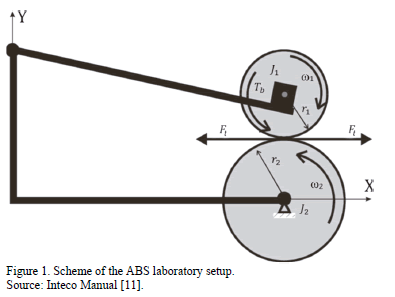
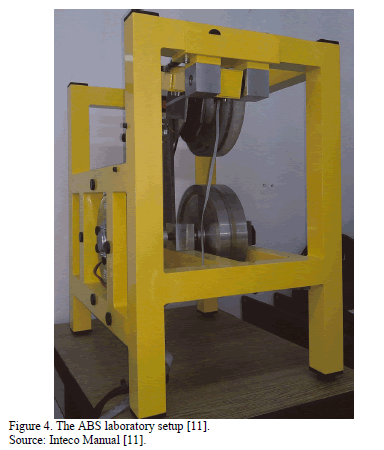
<body><![CDATA[<p><font size="2" face="Verdana, Arial, Helvetica, sans-serif">The Antilock Braking System (ABS) is an  electronically controlled system that helps the driver to maintain the control  of the vehicle during emergency braking. It achieved this by preventing the  wheels from locking-up. This prevents the slippage  of the wheels on the surface, adjusting the brake fluid pressure level of each  wheel, and helps the driver to keep the control of the vehicle &#91;1&#93;. Increasing  the braking efficiency and maintaining the vehicle's maneuverability, the ABS  reduces driving instability and decreases the braking distance by adjusting the  maximum braking power applied to the brake pad. Modern ABS systems aim to  obtain maximum wheel grip on the surface while the vehicle is braking &#91;2&#93; as  well as preventing the wheels from locking-up.</font></p>     <p><font size="2" face="Verdana, Arial, Helvetica, sans-serif">Several algorithms have been designed to  control ABS systems. These control algorithms can be grouped in two main  categories: wheel acceleration and tire slip control. The first category  approaches slip control indirectly by controlling the deceleration/acceleration  of the wheel through the brake pressure from the actuator. The second control  is a direct wheel slip control. This kind of controller is not easy to design  because of the highly nonlinear and uncertain structure of the ABS system.</font></p>     <p><font size="2" face="Verdana, Arial, Helvetica, sans-serif">One of the main issues is that the  controller has to operate at an unstable equilibrium point in order to achieve  optimal behavior. Small perturbations of the controller input may induce drastic  changes in the output. The performance of the ABS system is not always  satisfactory due to the high dependency of the system parameters on the road  conditions, which may vary over a wide range and in an unexpected manner. All  these factors complicate the development of an accurate mathematical model for  the ABS system. Therefore, advanced control design techniques are required so  that the wheel slip control can cope with uncertainties in the dynamic models. </font></p>     <p><font size="2" face="Verdana, Arial, Helvetica, sans-serif">Different (linear and nonlinear)  techniques have been developed to control ABS systems. The design of braking  control systems faces important challenges, generally associated with velocity  and vehicle parameters estimation. In &#91;3&#93; an extended Kalman filter is used to  estimate the friction coefficient with the corresponding simulations in CarSim.  Using intelligent control, in &#91;4&#93;, a self-learning  fuzzy sliding-mode control (SLFSMC) design method was proposed. In &#91;5&#93;, a fuzzy  model reference learning controller, a genetic model reference adaptive  controller, and a general genetic adaptive controller were designed. Another  ABS control technique is the hybrid control that was introduced by &#91;6,7&#93;.  Moreover, &#91;8&#93; describes the analysis, modeling and simulation of an electric  vehicle (EV) focused on developing a test bench to reproduce EV dynamics using  de ABS system. In &#91;9&#93;, an ABS for an electric vehicle was designed, whereas  &#91;10&#93; introduces an electrical ABS actuating in wheel motors. </font></p>     <p><font size="2" face="Verdana, Arial, Helvetica, sans-serif">In this article a mechatronic system, the  ABS laboratory setup manufactured by Inteco Ltd, was used to test a proposed  nonlinear adaptive controller. This experimental setup represents a quarter car  model and consists of two rolling wheels. The lower wheel, made of aluminum, emulates  the relative road motion of the car, whereas the upper wheel, made of rigid  plastic, is mounted on the balance lever and simulates the wheel of a vehicle.  In order to accelerate the lower wheel, a large DC motor is coupled on it. The  upper wheel is equipped with a disk-brake system that is driven by a small DC  motor where the control input is applied &#91;11&#93;. Encoders on the wheels allow their  positions and velocities to be determined. The proposed control ensures that  the desired references are tracked, using information available from the ABS sensors,  i.e. the angular velocity of the upper and lower wheels. The main achievement  of this article is regarding the parameter adaptation of the friction  coefficient between the two wheels; this represents the tire-road friction  coefficient in a real automobile. This is one of the most important parameters,  the estimation of which can be difficult, for example in the case of sudden  variations due to changes in road conditions. The adaptation in the controller  guarantees the exponential convergence of the estimation to the real parameter  value, as well as the exponential tracking of the reference. Finally, the  nonlinear adaptive controller has been implemented and validated through real-time  simulations on the ABS laboratory setup.</font></p>     <p><font size="2" face="Verdana, Arial, Helvetica, sans-serif">Earlier works focused on ABS laboratory  setups are mainly based on the assumption that all sensors' information is  available for measurement. Some works present linear and nonlinear controllers  &#91;12,13&#93;, whereas &#91;14&#93; proposes a fuzzy control. In &#91;15&#93; a control strategy  based on sliding mode is proposed. Finally, some articles use intelligent  control techniques &#91;16,17&#93;. </font></p>     <p><font size="2" face="Verdana, Arial, Helvetica, sans-serif">The article is organized as follows:  section 2 briefly presents the mathematical model of the experimental setup. In  Section 3, the control problem is solved to track a constant reference when the  state variables are considered measurable. First, all the parameters are  considered known. Then, the friction coefficient between the wheels is  considered unknown, and an estimation is proposed. Section 4 shows some real-time  results obtained using the ABS laboratory setup. The paper ends with some  concluding remarks. </font></p>     <p>&nbsp;</p>     <p><font size="3" face="Verdana, Arial, Helvetica, sans-serif"><b>2. Mathematical model of the experimental ABS laboratory setup</b></font></p>     <p><font size="2" face="Verdana, Arial, Helvetica, sans-serif">In this paper, an ABS laboratory setup  manufactured by Inteco Ltd. was considered (see <a href="#fig01">Fig. 1</a>). Although simple, this  setup preserves the fundamental characteristics of an actual ABS system in the  range of 0-70 km/h &#91;11&#93;.</font></p>     ]]></body>
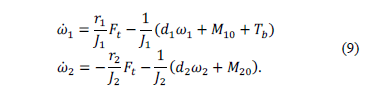
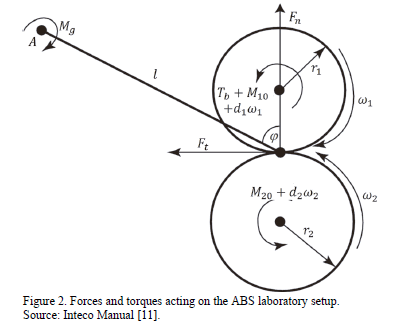
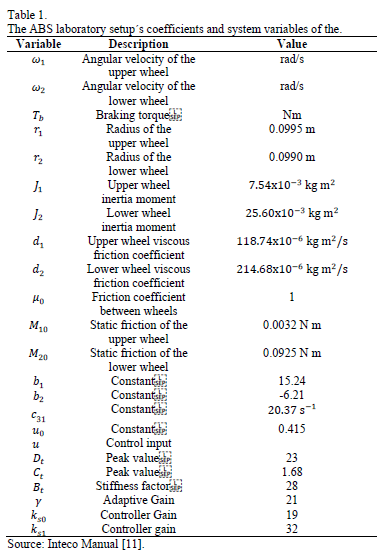
<body><![CDATA[<p align="center"><font size="2" face="Verdana, Arial, Helvetica, sans-serif"><a name="fig01"></a></font><img src="/img/revistas/dyna/v83n199/v83n199a09fig01.gif"></p>     <p><font size="2" face="Verdana, Arial, Helvetica, sans-serif"><i><b>2.1.  Mathematical model of the ABS laboratory  setup</b></i></font></p>     <p><font size="2" face="Verdana, Arial, Helvetica, sans-serif">The mathematical model of the ABS laboratory  setup is derived under the assumptions of negligible lateral and vertical motions,  and a rolling resistance force negligible with respect to braking (see <a href="#fig02">Fig.2</a>).  The braking torque <img src="/img/revistas/dyna/v83n199/v83n199a09eq004.gif"> and the bearing friction  torque <img src="/img/revistas/dyna/v83n199/v83n199a09eq006.gif"> act on the upper wheel. The  bearing friction torque <img src="/img/revistas/dyna/v83n199/v83n199a09eq008.gif"> acts on the lower wheel. The  tractive force <img src="/img/revistas/dyna/v83n199/v83n199a09eq010.gif"> acts on both wheels. </font></p>     <p align="center"><font size="2" face="Verdana, Arial, Helvetica, sans-serif"><a name="fig02"></a></font><img src="/img/revistas/dyna/v83n199/v83n199a09fig02.gif"></p>     <p><font size="2" face="Verdana, Arial, Helvetica, sans-serif">The dynamic equations of the ABS laboratory  setup are </font></p>     <p><img src="/img/revistas/dyna/v83n199/v83n199a09eq01.gif"></p>     <p><font size="2" face="Verdana, Arial, Helvetica, sans-serif">where <img src="/img/revistas/dyna/v83n199/v83n199a09eq016.gif">, <img src="/img/revistas/dyna/v83n199/v83n199a09eq018.gif"> are the angular velocities of  the upper and lower wheels respectively, the inertia moments of which are <img src="/img/revistas/dyna/v83n199/v83n199a09eq020.gif">, <img src="/img/revistas/dyna/v83n199/v83n199a09eq022.gif"> and the radii of which are <img src="/img/revistas/dyna/v83n199/v83n199a09eq024.gif">, <img src="/img/revistas/dyna/v83n199/v83n199a09eq026.gif">. Furthermore, <img src="/img/revistas/dyna/v83n199/v83n199a09eq028.gif">, <img src="/img/revistas/dyna/v83n199/v83n199a09eq030.gif"> are the viscous friction  coefficients of the upper and lower wheel, <img src="/img/revistas/dyna/v83n199/v83n199a09eq006.gif">, <img src="/img/revistas/dyna/v83n199/v83n199a09eq008.gif"> are the static frictions of  the upper and lower wheel, respectively, <img src="/img/revistas/dyna/v83n199/v83n199a09eq004.gif"> is the braking torque, and <img src="/img/revistas/dyna/v83n199/v83n199a09eq010.gif"> is the traction force between  the wheels. The nominal parameters are given in <a href="#tab01">Table 1</a>. Finally, <img src="/img/revistas/dyna/v83n199/v83n199a09eq032.gif">, <img src="/img/revistas/dyna/v83n199/v83n199a09eq034.gif"> and <img src="/img/revistas/dyna/v83n199/v83n199a09eq036.gif"> are auxiliary variables used  to determinate if the vehicle is in traction mode or in braking mode</font></p>     <p><img src="/img/revistas/dyna/v83n199/v83n199a09eq02" /></p>     <p><font size="2" face="Verdana, Arial, Helvetica, sans-serif">with</font></p>     <p><img src="/img/revistas/dyna/v83n199/v83n199a09eq03.gif"></p>     ]]></body>
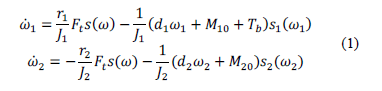
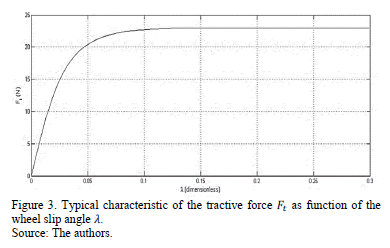
<body><![CDATA[<p><font size="2" face="Verdana, Arial, Helvetica, sans-serif">Here <img src="/img/revistas/dyna/v83n199/v83n199a09eq046.gif"> represents the vehicle wheel  velocity, whereas <img src="/img/revistas/dyna/v83n199/v83n199a09eq048.gif"> represents the vehicle  velocity. The tractive force <img src="/img/revistas/dyna/v83n199/v83n199a09eq050.gif"> is generated on contact  between the upper and the lower wheel. Various models are available in the  literature to model the tire behavior &#91;18&#93;.  Without loss of generality, since the same approach can be used with different  tire models, in this work the simplified Pacejka's &quot;magic formula&quot; &#91;16&#93;</font></p>     <p><img src="/img/revistas/dyna/v83n199/v83n199a09eq04.gif"></p>     <p><font size="2" face="Verdana, Arial, Helvetica, sans-serif">has been used to describe the tractive  force, where</font></p>     <p><img src="/img/revistas/dyna/v83n199/v83n199a09eq05.gif"></p>     <p><font size="2" face="Verdana, Arial, Helvetica, sans-serif">is the wheel slip, i.e. the relative difference of the wheel  velocities. This formula approximates the response curve of the braking process  based on experimental data. It is widely used, and makes it possible to work  with a wider range of</font> <font size="2" face="Verdana, Arial, Helvetica, sans-serif">values, both in  the linear and in the nonlinear region of the tire characteristic.</font></p>     <p align="center"><font size="2" face="Verdana, Arial, Helvetica, sans-serif"><a name="tab01"></a></font><img src="/img/revistas/dyna/v83n199/v83n199a09tab01.gif"></p>     <p><font size="2" face="Verdana, Arial, Helvetica, sans-serif">The expression (4) of the tractive force <img src="/img/revistas/dyna/v83n199/v83n199a09eq050.gif"> depends on positive  experimental coefficients given by the stiffness factor <img src="/img/revistas/dyna/v83n199/v83n199a09eq064.gif">; the shape factor <img src="/img/revistas/dyna/v83n199/v83n199a09eq066.gif">; and the peak value <img src="/img/revistas/dyna/v83n199/v83n199a09eq068.gif">, which are determined to match the experimental data. Moreover, <img src="/img/revistas/dyna/v83n199/v83n199a09eq070.gif"> is the friction coefficient  between the upper and lower wheel. <a href="#fig03">Fig. 3</a> shows the characteristic of the  tractive force calculated with (4), as a function of the wheel slip (5). </font></p>     <p align="center"><font size="2" face="Verdana, Arial, Helvetica, sans-serif"><a name="fig03"></a></font><img src="/img/revistas/dyna/v83n199/v83n199a09fig03.gif"></p>     <p><font size="2" face="Verdana, Arial, Helvetica, sans-serif">The braking torque, <img src="/img/revistas/dyna/v83n199/v83n199a09eq072.gif">, is modeled with a first-order equation &#91;11&#93;, given by</font></p>     <p><img src="/img/revistas/dyna/v83n199/v83n199a09eq06.gif"></p>     ]]></body>
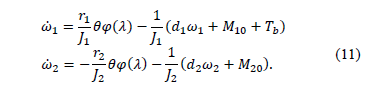
<body><![CDATA[<p><font size="2" face="Verdana, Arial, Helvetica, sans-serif">where <img src="/img/revistas/dyna/v83n199/v83n199a09eq076.gif"> is a positive constant, and <img src="/img/revistas/dyna/v83n199/v83n199a09eq078.gif"> describes the relation  between the control input applied to the DC motor, which drives the action of  brake pads, and the control input <img src="/img/revistas/dyna/v83n199/v83n199a09eq070.gif">, which generates the braking torque <img src="/img/revistas/dyna/v83n199/v83n199a09eq072.gif">. This relation can be approximated by</font></p>     <p><img src="/img/revistas/dyna/v83n199/v83n199a09eq07.gif"></p>     <p><font size="2" face="Verdana, Arial, Helvetica, sans-serif">where <img src="/img/revistas/dyna/v83n199/v83n199a09eq082.gif"> is the operating threshold of  the brake driving system. According to the mathematical model, equation (6) is  similar to the brake pedal in an automobile &#91;17,20-21&#93;. </font></p>     <p><font size="2" face="Verdana, Arial, Helvetica, sans-serif">Under normal operational conditions, the  wheel velocity <img src="/img/revistas/dyna/v83n199/v83n199a09eq046.gif"> matches the forward velocity <img src="/img/revistas/dyna/v83n199/v83n199a09eq048.gif">. When the brake is applied, braking forces are generated at the  wheel interface and <img src="/img/revistas/dyna/v83n199/v83n199a09eq084.gif"> tends to be lower than <img src="/img/revistas/dyna/v83n199/v83n199a09eq086.gif"> (but always positive), this a  slippage occurs. During the braking process, the wheel slip <img src="/img/revistas/dyna/v83n199/v83n199a09eq088.gif"> is positive, as well as <img src="/img/revistas/dyna/v83n199/v83n199a09eq090.gif">,<img src="/img/revistas/dyna/v83n199/v83n199a09eq092.gif">. Hence,</font></p>     <p><img src="/img/revistas/dyna/v83n199/v83n199a09eq08.gif"></p>     <p><font size="2" face="Verdana, Arial, Helvetica, sans-serif">and equations (1) become</font></p>     <p><img src="/img/revistas/dyna/v83n199/v83n199a09eq09.gif"></p>     <p><font size="2" face="Verdana, Arial, Helvetica, sans-serif"><b><i>2.2. Longitudinal vehicle force</i></b></font></p>     <p><font size="2" face="Verdana, Arial, Helvetica, sans-serif">The tractive force <img src="/img/revistas/dyna/v83n199/v83n199a09eq050.gif"> given in (4) can be rewritten  as </font></p>     <p><img src="/img/revistas/dyna/v83n199/v83n199a09eq10.gif"></p>     ]]></body>
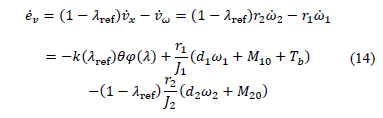
<body><![CDATA[<p><font size="2" face="Verdana, Arial, Helvetica, sans-serif">where <img src="/img/revistas/dyna/v83n199/v83n199a09eq106.gif"> is the product of the road-tire  friction coefficient with the tire stiffness coefficient <img src="/img/revistas/dyna/v83n199/v83n199a09eq068.gif">, and where <img src="/img/revistas/dyna/v83n199/v83n199a09eq108.gif"> is the normalized tire  characteristics. This latter usually increases linearly with the wheel slip <img src="/img/revistas/dyna/v83n199/v83n199a09eq088.gif"> up to a maximum value and  then decreases, reaching an asymptotic value for high wheel slip angles, as  shown in <a href="#fig03">Fig. 3</a>. The function <img src="/img/revistas/dyna/v83n199/v83n199a09eq108.gif"> is symmetric with respect to  the origin. Hence, <img src="/img/revistas/dyna/v83n199/v83n199a09eq108.gif"> reaches a minimum for  negative values of <img src="/img/revistas/dyna/v83n199/v83n199a09eq088.gif"> and then increases to an  asymptotic value for high negative wheel slip angles. </font></p>     <p><font size="2" face="Verdana, Arial, Helvetica, sans-serif">In real automobiles the friction  coefficient is a parameter that may vary considerably according to the road and  tire conditions. Also, the parameter <img src="/img/revistas/dyna/v83n199/v83n199a09eq068.gif"> depends on the tire conditions.  Considering (10), equations (1) can be rewritten in the following form:</font></p>     <p><img src="/img/revistas/dyna/v83n199/v83n199a09eq11.gif"></p>     <p><font size="2" face="Verdana, Arial, Helvetica, sans-serif">In the  following section it is assumed, that <img src="/img/revistas/dyna/v83n199/v83n199a09eq114.gif">. The output to be controlled is the wheel slip <img src="/img/revistas/dyna/v83n199/v83n199a09eq088.gif"> and the control aim is to  design a controller such that <img src="/img/revistas/dyna/v83n199/v83n199a09eq088.gif"> globally tracks a constant  reference <img src="/img/revistas/dyna/v83n199/v83n199a09eq116.gif"> in the presence of parameter  uncertainties. The primary function of the controller is to prevent the lock-up  of the wheel during an emergency brake. Ideally, it is desired that the ABS  maintains the wheel slip at the peak of the maximum longitudinal (tractive)  force <img src="/img/revistas/dyna/v83n199/v83n199a09eq118.gif">. Hence, it is considered to be a constant reference <img src="/img/revistas/dyna/v83n199/v83n199a09eq116.gif"> &#91;19&#93;.</font></p>     <p>&nbsp;</p>     <p><font size="3" face="Verdana, Arial, Helvetica, sans-serif"><b>3. Design of an Adaptive Nonlinear Controller</b></font></p>     <p><font size="2" face="Verdana, Arial, Helvetica, sans-serif">In the  following section it is assumed that only the parameter nominal values <img src="/img/revistas/dyna/v83n199/v83n199a09eq120.gif">, <img src="/img/revistas/dyna/v83n199/v83n199a09eq122.gif"> are known. Therefore, <img src="/img/revistas/dyna/v83n199/v83n199a09eq124.gif"> is unknown, with a nominal  value <img src="/img/revistas/dyna/v83n199/v83n199a09eq126.gif">. In this section a nonlinear dynamic controller is designed to  force the error</font></p>     <p><img src="/img/revistas/dyna/v83n199/v83n199a09eq12.gif"></p>     <p><font size="2" face="Verdana, Arial, Helvetica, sans-serif">to zero in the  presence of variations of <img src="/img/revistas/dyna/v83n199/v83n199a09eq124.gif">. The control law needs to generate a control reference. Hence,  instead of considering the wheel slip as the controlled variable, the auxiliary  slip velocity <img src="/img/revistas/dyna/v83n199/v83n199a09eq130.gif"> will be used. The slip  velocity reference is given by <img src="/img/revistas/dyna/v83n199/v83n199a09eq132.gif">. Hence, the slip velocity error is defined as</font></p>     <p><img src="/img/revistas/dyna/v83n199/v83n199a09eq13.gif"></p>     ]]></body>

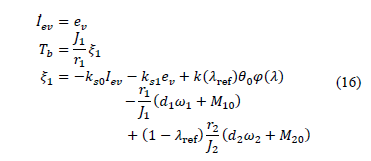
<body><![CDATA[<p><font size="2" face="Verdana, Arial, Helvetica, sans-serif">Since <img src="/img/revistas/dyna/v83n199/v83n199a09eq136.gif">, the control problem is equivalent to force <img src="/img/revistas/dyna/v83n199/v83n199a09eq138.gif"> to zero asymptotically. The dynamics  of the slip velocity error are</font></p>     <p><img src="/img/revistas/dyna/v83n199/v83n199a09eq14.gif"></p>     <p><font size="2" face="Verdana, Arial, Helvetica, sans-serif">where </font></p>     <p><img src="/img/revistas/dyna/v83n199/v83n199a09eq15.gif"></p>     <p><font size="2" face="Verdana, Arial, Helvetica, sans-serif">Considering a  constant slip reference <img src="/img/revistas/dyna/v83n199/v83n199a09eq116.gif">, if the parameter <img src="/img/revistas/dyna/v83n199/v83n199a09eq148.gif"> is known and <img src="/img/revistas/dyna/v83n199/v83n199a09eq150.gif"> are measurable, the  controller </font></p>     <p><img src="/img/revistas/dyna/v83n199/v83n199a09eq16.gif"></p>     <p><font size="2" face="Verdana, Arial, Helvetica, sans-serif">with <img src="/img/revistas/dyna/v83n199/v83n199a09eq160.gif">, <img src="/img/revistas/dyna/v83n199/v83n199a09eq162.gif">, ensures that the tracking error (13) and its derivative globally  and exponentially converge to zero. </font></p>     <p><font size="2" face="Verdana, Arial, Helvetica, sans-serif">In fact, <img src="/img/revistas/dyna/v83n199/v83n199a09eq164.gif"> is easily reached and, <img src="/img/revistas/dyna/v83n199/v83n199a09eq166.gif"> is easily derived. Hence, <img src="/img/revistas/dyna/v83n199/v83n199a09eq168.gif">tend globally exponentially to zero, as well as the error <img src="/img/revistas/dyna/v83n199/v83n199a09eq170.gif"> in (12). Hence <img src="/img/revistas/dyna/v83n199/v83n199a09eq088.gif"> tends to <img src="/img/revistas/dyna/v83n199/v83n199a09eq116.gif"> globally and exponentially.</font></p>     <p><font size="2" face="Verdana, Arial, Helvetica, sans-serif">Let us now  consider the case in which the friction coefficient <img src="/img/revistas/dyna/v83n199/v83n199a09eq124.gif"> between the two wheels is unknown. </font></p>     <p><font size="2" face="Verdana, Arial, Helvetica, sans-serif"><b>Theorem  3.1</b> Consider a constant slip reference <img src="/img/revistas/dyna/v83n199/v83n199a09eq116.gif">. If the disturbances <img src="/img/revistas/dyna/v83n199/v83n199a09eq172.gif"> are known and constant, <img src="/img/revistas/dyna/v83n199/v83n199a09eq090.gif">, <img src="/img/revistas/dyna/v83n199/v83n199a09eq174.gif"> are measurable, and the  parameter <img src="/img/revistas/dyna/v83n199/v83n199a09eq124.gif"> is unknown, the dynamic  controller </font></p>     ]]></body>
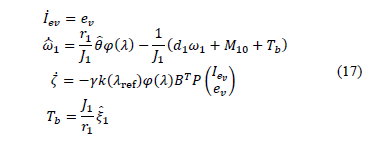
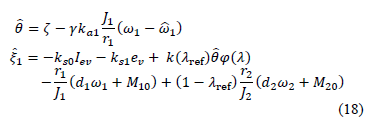
<body><![CDATA[<p><img src="/img/revistas/dyna/v83n199/v83n199a09eq17.gif"></p>     <p><font size="2" face="Verdana, Arial, Helvetica, sans-serif">with</font></p>     <p><img src="/img/revistas/dyna/v83n199/v83n199a09eq18.gif"></p>     <p><font size="2" face="Verdana, Arial, Helvetica, sans-serif">and with<i> k</i><img src="/img/revistas/dyna/v83n199/v83n199a09eq190.gif"> as (15) and <img src="/img/revistas/dyna/v83n199/v83n199a09eq192.gif">ensures that the  tracking error (13) and the estimation error <img src="/img/revistas/dyna/v83n199/v83n199a09eq194.gif"> globally exponentially  tend to zero along their derivatives<i>.</i></font></p>     <p><font size="2" face="Verdana, Arial, Helvetica, sans-serif"><b>Proof  1.</b> The dynamics of the error (14) rewrite</font></p>     <p><img src="/img/revistas/dyna/v83n199/v83n199a09eq181.gif"></p>     <p><font size="2" face="Verdana, Arial, Helvetica, sans-serif">Hence, using (17), (18), the error dynamics are </font></p>     <p><img src="/img/revistas/dyna/v83n199/v83n199a09eq182.gif"></p>     <p><font size="2" face="Verdana, Arial, Helvetica, sans-serif">with the matrices</font></p>     <p><img src="/img/revistas/dyna/v83n199/v83n199a09eq183.gif"></p>     ]]></body>

<body><![CDATA[<p><font size="2" face="Verdana, Arial, Helvetica, sans-serif">Let us consider the following Lyapunov  candidate</font></p>     <p><img src="/img/revistas/dyna/v83n199/v83n199a09eq184.gif"></p>     <p><font size="2" face="Verdana, Arial, Helvetica, sans-serif">with</font></p> <img src="/img/revistas/dyna/v83n199/v83n199a09eq185.gif">     <p><font size="2" face="Verdana, Arial, Helvetica, sans-serif">and where <img src="/img/revistas/dyna/v83n199/v83n199a09eq212.gif">. Deriving along the trajectories of the system</font></p>     <p><img src="/img/revistas/dyna/v83n199/v83n199a09eq186.gif"></p>     <p><font size="2" face="Verdana, Arial, Helvetica, sans-serif">And</font></p>     <p><img src="/img/revistas/dyna/v83n199/v83n199a09eq187.gif"></p>     <p><font size="2" face="Verdana, Arial, Helvetica, sans-serif">so that one obtains</font></p>     <p><img src="/img/revistas/dyna/v83n199/v83n199a09eq188.gif"></p>     <p><font size="2" face="Verdana, Arial, Helvetica, sans-serif">with <img src="/img/revistas/dyna/v83n199/v83n199a09eq220.gif"> fixed, and <img src="/img/revistas/dyna/v83n199/v83n199a09eq222.gif"> solution of the Lyapunov equation <img src="/img/revistas/dyna/v83n199/v83n199a09eq224.gif">. Since <img src="/img/revistas/dyna/v83n199/v83n199a09eq226.gif">, and considering the dynamics of <img src="/img/revistas/dyna/v83n199/v83n199a09eq228.gif"> one obtains</font></p>     ]]></body>
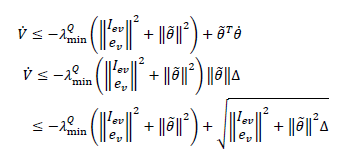
<body><![CDATA[<p><img src="/img/revistas/dyna/v83n199/v83n199a09eq189.gif"></p>     <p><font size="2" face="Verdana, Arial, Helvetica, sans-serif">Therefore, one obtains</font></p>     <p><img src="/img/revistas/dyna/v83n199/v83n199a09eq1810.gif"></p>     <p><font size="2" face="Verdana, Arial, Helvetica, sans-serif">since <img src="/img/revistas/dyna/v83n199/v83n199a09eq234.gif">, and where <img src="/img/revistas/dyna/v83n199/v83n199a09eq236.gif"> is the minimum eigenvalue of <i>Q</i>. Therefore, <img src="/img/revistas/dyna/v83n199/v83n199a09eq238.gif">, <img src="/img/revistas/dyna/v83n199/v83n199a09eq138.gif">, and <img src="/img/revistas/dyna/v83n199/v83n199a09eq240.gif"> tend to zero globally and  exponentially. Hence, <img src="/img/revistas/dyna/v83n199/v83n199a09eq242.gif"> tends to <img src="/img/revistas/dyna/v83n199/v83n199a09eq244.gif"> globally and exponentially.  Since the adaptive controller (17) ensures that <img src="/img/revistas/dyna/v83n199/v83n199a09eq246.gif"> globally an exponentially,  one concludes that also <img src="/img/revistas/dyna/v83n199/v83n199a09eq088.gif"> tends to <img src="/img/revistas/dyna/v83n199/v83n199a09eq116.gif"> globally and exponentially.</font></p>     <p><font size="2" face="Verdana, Arial, Helvetica, sans-serif"><b>Theorem 3.2</b> Assume that<i> the parameter </i><img src="/img/revistas/dyna/v83n199/v83n199a09eq124.gif"><i> remains bounded, varying with bounded  derivative </i><img src="/img/revistas/dyna/v83n199/v83n199a09eq248.gif"><i>, for a certain </i><img src="/img/revistas/dyna/v83n199/v83n199a09eq250.gif"><i>. Hence, the controller of  Theorem 3.2 ensures global practical exponential stability of the tracking  error (13) and of the estimation error dynamic </i><img src="/img/revistas/dyna/v83n199/v83n199a09eq194.gif"><i> to a ball of the origin of arbitrary radius </i><img src="/img/revistas/dyna/v83n199/v83n199a09eq252.gif"><i>.</i></font></p>     <p><font size="2" face="Verdana, Arial, Helvetica, sans-serif"><b>Proof  2.</b> Following the proof of Theorem 1, one obtains</font></p>     <p><img src="/img/revistas/dyna/v83n199/v83n199a09eq1811.gif"></p>     <p><font size="2" face="Verdana, Arial, Helvetica, sans-serif">for <img src="/img/revistas/dyna/v83n199/v83n199a09eq248.gif">. Since</font></p>     <p><img src="/img/revistas/dyna/v83n199/v83n199a09eq1812.gif"></p>     <p><font size="2" face="Verdana, Arial, Helvetica, sans-serif">with <img src="/img/revistas/dyna/v83n199/v83n199a09eq262.gif"><i>, </i><img src="/img/revistas/dyna/v83n199/v83n199a09eq264.gif"><i>, </i>then</font></p>     ]]></body>
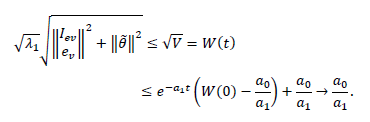
<body><![CDATA[<p><img src="/img/revistas/dyna/v83n199/v83n199a09eq1813.gif"></p>     <p><font size="2" face="Verdana, Arial, Helvetica, sans-serif">or, setting <img src="/img/revistas/dyna/v83n199/v83n199a09eq268.gif"></font></p>     <p><img src="/img/revistas/dyna/v83n199/v83n199a09eq1814.gif"></p>     <p><font size="2" face="Verdana, Arial, Helvetica, sans-serif">so that</font></p>     <p><img src="/img/revistas/dyna/v83n199/v83n199a09eq1815.gif"></p>     <p><font size="2" face="Verdana, Arial, Helvetica, sans-serif">Setting <img src="/img/revistas/dyna/v83n199/v83n199a09eq276.gif">, i.e.</font></p>     <p><img src="/img/revistas/dyna/v83n199/v83n199a09eq1816.gif"></p>     <p><font size="2" face="Verdana, Arial, Helvetica, sans-serif">one ensures that</font></p>     <p><img src="/img/revistas/dyna/v83n199/v83n199a09eq1817.gif"></p>     <p><font size="2" face="Verdana, Arial, Helvetica, sans-serif">i.e. global practical exponential  stability to an arbitrary ball of the origin.</font></p>     ]]></body>
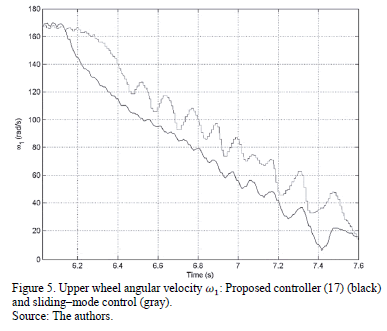
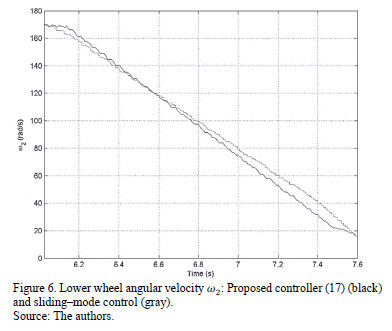
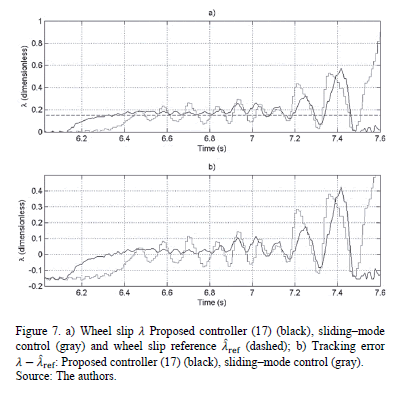
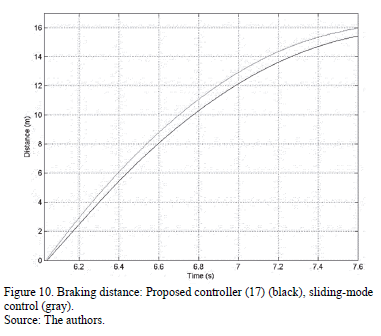
<body><![CDATA[<p>&nbsp;</p>     <p><b><font size="3" face="Verdana, Arial, Helvetica, sans-serif">4. Experimental Results</font></b></p>     <p><font size="2" face="Verdana, Arial, Helvetica, sans-serif">In order to  compare the performance of the proposed controller with another that is available  in literature, we present a comparison with a sliding-mode controller that was proposed  in &#91;16&#93;, which uses an estimation <img src="/img/revistas/dyna/v83n199/v83n199a09eq282.gif"> of <img src="/img/revistas/dyna/v83n199/v83n199a09eq124.gif">. The sliding-mode  technique is a very efficient control technique because of its properties  concerning order reduction and low sensibility to disturbances and parameter  variation &#91;22&#93;. This is important in the control of nonlinear systems such as  the ABS. The high-frequency nature of the SMC signal is its main drawback  because the control can excite non-modeled system dynamics and wear out  mechanical parts. </font></p>     <p><font size="2" face="Verdana, Arial, Helvetica, sans-serif">Experimental  tests on the ABS laboratory setup (see <a href="#fig04">Fig. 4</a>) have been conducted to evaluate  the braking performance of the proposed controller (17) using the data in <a href="#tab01">Table  1</a>. These tests represent maneuvers in a straight line. The initial conditions  were <img src="/img/revistas/dyna/v83n199/v83n199a09eq284.gif">1625 RPM (170 rad/s) and <img src="/img/revistas/dyna/v83n199/v83n199a09eq286.gif">.</font></p>     <p align="center"><font size="2" face="Verdana, Arial, Helvetica, sans-serif"><a name="fig04"></a></font><img src="/img/revistas/dyna/v83n199/v83n199a09fig04.gif"></p>     <p><font size="2" face="Verdana, Arial, Helvetica, sans-serif">When the  maximal velocity of the upper wheel is detected, the system disables the DC  motor coupled to the lower wheel, and the braking process begins. It is worthwhile  noting that this work considers <img src="/img/revistas/dyna/v83n199/v83n199a09eq288.gif">, but in terms of the real system its variability can be taken into  account, varying <img src="/img/revistas/dyna/v83n199/v83n199a09eq120.gif"> in the interval of interest.</font></p>     <p><font size="2" face="Verdana, Arial, Helvetica, sans-serif">The results are summarized in <a href="#fig05">Figs. 5</a>-<a href="#fig10">10</a>, in which  it can be seen that the proposed controller (17) ensures better performances  with respect to the sliding-mode controller &#91;15&#93;.  It is important to emphasize that after the braking phase, between 6.2 and 7.4  s, which correspond to the maximum braking efficiency, the performance is no  longer relevant since the longitudinal velocity is low, and the setup is no  longer working in the appropriate range of velocities. In fact, <img src="/img/revistas/dyna/v83n199/v83n199a09eq088.gif"> will grow when the longitudinal velocity tends  to zero. <a href="#fig05">Figs. 5</a> and <a href="#fig06">6</a> show that both controllers maintain deceleration in both  velocities. The difference can be found in the time the controllers require to  complete the braking process. The proposed controller (17) manages to stop a  few tenths of a second before the sliding-mode controller. Furthermore, as shown in <a href="#fig07">Fig. 7</a>, the proposed  controller (17) reaches faster the reference <img src="/img/revistas/dyna/v83n199/v83n199a09eq348.gif">, and keeps the estimated slip closer  to the reference. </font></p>     <p align="center"><font size="2" face="Verdana, Arial, Helvetica, sans-serif"><a name="fig05"></a></font><img src="/img/revistas/dyna/v83n199/v83n199a09fig05.gif"></p>     <p align="center"><font size="2" face="Verdana, Arial, Helvetica, sans-serif"><a name="fig06"></a></font><img src="/img/revistas/dyna/v83n199/v83n199a09fig06.gif"></p>     <p align="center"><font size="2" face="Verdana, Arial, Helvetica, sans-serif"><a name="fig07"></a></font><img src="/img/revistas/dyna/v83n199/v83n199a09fig07.gif"></p>     ]]></body>

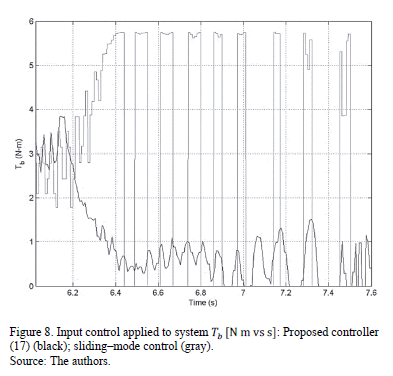
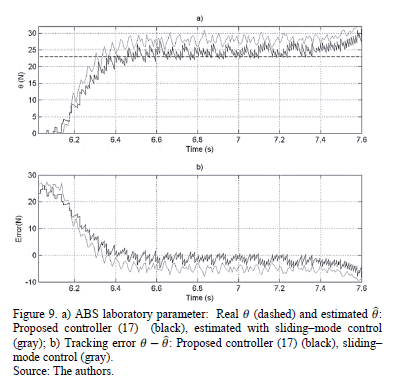
<body><![CDATA[<p><font size="2" face="Verdana, Arial, Helvetica, sans-serif">Another  positive effect of the proposed controller is shown in <a href="#fig08">Fig. 8</a>, in which the  absence of chattering, typical of the sliding-mode control can be seen. This  ensures better wear resistance, less noise, and an increased passenger comfort  with lower jerk effects. <a href="#fig09">Fig. 9</a> shows, for both controllers, the  estimate <img src="/img/revistas/dyna/v83n199/v83n199a09eq282.gif"> of the real parameter. At the end of the braking process,  the estimate is not reliable since <img src="/img/revistas/dyna/v83n199/v83n199a09eq282.gif"> depends on the slip velocity <img src="/img/revistas/dyna/v83n199/v83n199a09eq088.gif">, which is not properly  controlled at the end of the  braking process. This has already been commented upon.</font></p>     <p align="center"><font size="2" face="Verdana, Arial, Helvetica, sans-serif"><a name="fig08"></a></font><img src="/img/revistas/dyna/v83n199/v83n199a09fig08.gif"></p>     <p align="center"><font size="2" face="Verdana, Arial, Helvetica, sans-serif"><a name="fig09"></a></font><img src="/img/revistas/dyna/v83n199/v83n199a09fig09.gif"></p>     <p><font size="2" face="Verdana, Arial, Helvetica, sans-serif">As a final indication of the better  performance of the proposed controller, <a href="#fig10">Fig. 10</a> shows that the proposed  controller (17) accomplishes the braking process in approximately 6.7% less  time and distance in comparison with the sliding-mode controller.</font></p>     <p align="center"><font size="2" face="Verdana, Arial, Helvetica, sans-serif"><a name="fig10"></a></font><img src="/img/revistas/dyna/v83n199/v83n199a09fig10.gif"></p>     <p>&nbsp;</p>     <p><font size="3" face="Verdana, Arial, Helvetica, sans-serif"><b>4. Conclusions</b></font></p>     <p><font size="2" face="Verdana, Arial, Helvetica, sans-serif">This article presents an adaptive  controller for an ABS laboratory setup. The proposed controller allows the  friction coefficient between the two wheels to be identified. It is assumed  that the bearing friction torques are known. The adaptive controller is  designed to ensure the exponential stability of the system. In addition, the  dynamic controller ensures the desired tracking of the wheel slip, and is implemented  in real-time.</font></p>     <p><font size="2" face="Verdana, Arial, Helvetica, sans-serif">A  series of experiments have been performed on the ABS Laboratory setup to show  the performance of the proposed </font><font size="2" face="Verdana, Arial, Helvetica, sans-serif">adaptive controller. The experimental results also show the performance  of this dynamic controller in comparison with a sliding-mode control that was proposed in  the literature.</font></p>     <p><font size="2" face="Verdana, Arial, Helvetica, sans-serif">The sliding-mode controller suffers from  chattering, which is absent in the proposed controller and thus shows better  behavior. Moreover, the proposed controller achieves shorter braking distances  in shorter times, hence increasing safety. Finally, thanks to a smoother signal  to the actuator with respect to the sliding-mode control, the proposed  controller ensures longer durability of the pads, less noise, and an increased  passenger comfort with lower jerk effects.</font></p>     ]]></body>
<body><![CDATA[<p>&nbsp;</p>     <p><font size="3" face="Verdana, Arial, Helvetica, sans-serif"><b>References</b></font></p>     <!-- ref --><p><font size="2" face="Verdana, Arial, Helvetica, sans-serif"><b>&#91;1&#93;</b> Emig, R., Goebels, H. and  Schramm, J., Antilock braking systems (ABS) for commercial vehicles-status 1990  and future prospects, Proceeding International Transportation Electronics  Congress Vehicle Electronics, 1990. pp. 515-523. DOI: 10.1109/ICTE.1990.713050</font>&nbsp;&nbsp;&nbsp;&nbsp;&nbsp;&nbsp;&nbsp;&nbsp;[&#160;<a href="javascript:void(0);" onclick="javascript: window.open('/scielo.php?script=sci_nlinks&ref=1151914&pid=S0012-7353201600050000900001&lng=','','width=640,height=500,resizable=yes,scrollbars=1,menubar=yes,');">Links</a>&#160;]<!-- end-ref --><!-- ref --><p><font size="2" face="Verdana, Arial, Helvetica, sans-serif"><b>&#91;2&#93;</b> Kiencke, U. and Nielsen, L.,  Automotive control systems: For engine, driveline and vehicle, Springer. 2nd  Ed, 2010.    &nbsp;&nbsp;&nbsp;&nbsp;&nbsp;&nbsp;&nbsp;&nbsp;[&#160;<a href="javascript:void(0);" onclick="javascript: window.open('/scielo.php?script=sci_nlinks&ref=1151915&pid=S0012-7353201600050000900002&lng=','','width=640,height=500,resizable=yes,scrollbars=1,menubar=yes,');">Links</a>&#160;]<!-- end-ref --></font></p>     <!-- ref --><p><font size="2" face="Verdana, Arial, Helvetica, sans-serif"><b>&#91;3&#93;</b> Zhen-Jun, S., Tian-Jun, Z. and  Hong-Yan, Z., Research on road friction coefficient estimation algorithm based  on extended Kalman filter, Proceeding of International Intelligent Computation  Technology and Automation, 2008, pp. 418-422. Doi: 10.1109/ICICTA.2008.38</font>&nbsp;&nbsp;&nbsp;&nbsp;&nbsp;&nbsp;&nbsp;&nbsp;[&#160;<a href="javascript:void(0);" onclick="javascript: window.open('/scielo.php?script=sci_nlinks&ref=1151917&pid=S0012-7353201600050000900003&lng=','','width=640,height=500,resizable=yes,scrollbars=1,menubar=yes,');">Links</a>&#160;]<!-- end-ref --><!-- ref --><p><font size="2" face="Verdana, Arial, Helvetica, sans-serif"><b>&#91;4&#93;</b> Lin, C-H. and Chun, H.,  Self-learning fuzzy sliding mode control for antilock braking systems, IEEE  Transaction on Control System Technology, 11(2), pp. 273-278, 2003. DOI:  10.1109/TCST.2003.809246</font>&nbsp;&nbsp;&nbsp;&nbsp;&nbsp;&nbsp;&nbsp;&nbsp;[&#160;<a href="javascript:void(0);" onclick="javascript: window.open('/scielo.php?script=sci_nlinks&ref=1151918&pid=S0012-7353201600050000900004&lng=','','width=640,height=500,resizable=yes,scrollbars=1,menubar=yes,');">Links</a>&#160;]<!-- end-ref --><!-- ref --><p><font size="2" face="Verdana, Arial, Helvetica, sans-serif"><b>&#91;5&#93;</b> Lennon, W.K. and Passino, K.M.,  Intelligent control for brake system, IEEE Transaction on Control System  Technology, 7(2), pp. 188-202, 1999. DOI: 10.1109/87.748145.    &nbsp;&nbsp;&nbsp;&nbsp;&nbsp;&nbsp;&nbsp;&nbsp;[&#160;<a href="javascript:void(0);" onclick="javascript: window.open('/scielo.php?script=sci_nlinks&ref=1151919&pid=S0012-7353201600050000900005&lng=','','width=640,height=500,resizable=yes,scrollbars=1,menubar=yes,');">Links</a>&#160;]<!-- end-ref --></font></p>     <!-- ref --><p><font size="2" face="Verdana, Arial, Helvetica, sans-serif"><b>&#91;6&#93;</b> Wei, Z. and Xuenxun, G., An ABS  control strategy for commercial vehicle, IEEE/ASME Transaction on, 20(1), pp.  384-391, 2015. DOI: 10.1109/TMECH.2014.2322629</font>&nbsp;&nbsp;&nbsp;&nbsp;&nbsp;&nbsp;&nbsp;&nbsp;[&#160;<a href="javascript:void(0);" onclick="javascript: window.open('/scielo.php?script=sci_nlinks&ref=1151921&pid=S0012-7353201600050000900006&lng=','','width=640,height=500,resizable=yes,scrollbars=1,menubar=yes,');">Links</a>&#160;]<!-- end-ref --><!-- ref --><p><font size="2" face="Verdana, Arial, Helvetica, sans-serif"><b>&#91;7&#93;</b> Yazdanpanah, R.M., Design of  robust speed and slip controllers for a hybrid electromagnetic brake system,  Electric Power Applications IET, 9(4), pp. 307-318, 2015. DOI: 10.1049/iet-epa.2014.0256.    &nbsp;&nbsp;&nbsp;&nbsp;&nbsp;&nbsp;&nbsp;&nbsp;[&#160;<a href="javascript:void(0);" onclick="javascript: window.open('/scielo.php?script=sci_nlinks&ref=1151922&pid=S0012-7353201600050000900007&lng=','','width=640,height=500,resizable=yes,scrollbars=1,menubar=yes,');">Links</a>&#160;]<!-- end-ref --></font></p>     <!-- ref --><p><font size="2" face="Verdana, Arial, Helvetica, sans-serif"><b>&#91;8&#93;</b> Alacal&aacute;, I., Claudio, A.,  Guerrero, G, Aguayo-Alquicira, J and Olivares, V.H., Electric vehicle emulation  based on inertial flywheel and DC machine, DYNA 81(18), pp.86-96, 2014.    &nbsp;&nbsp;&nbsp;&nbsp;&nbsp;&nbsp;&nbsp;&nbsp;[&#160;<a href="javascript:void(0);" onclick="javascript: window.open('/scielo.php?script=sci_nlinks&ref=1151924&pid=S0012-7353201600050000900008&lng=','','width=640,height=500,resizable=yes,scrollbars=1,menubar=yes,');">Links</a>&#160;]<!-- end-ref --></font></p>     <!-- ref --><p><font size="2" face="Verdana, Arial, Helvetica, sans-serif"><b>&#91;9&#93;</b> Lin, W.C., Lin, C.L., Hsu, P.M.  and Wu, M.T., Realization of antilock braking strategy for electric scooter,  Industrial Electronics, IEEE Transaction, 61(6), pp. 2862-2833, 2014. DOI: 10.1109/TIE.2013.2276775</font>&nbsp;&nbsp;&nbsp;&nbsp;&nbsp;&nbsp;&nbsp;&nbsp;[&#160;<a href="javascript:void(0);" onclick="javascript: window.open('/scielo.php?script=sci_nlinks&ref=1151926&pid=S0012-7353201600050000900009&lng=','','width=640,height=500,resizable=yes,scrollbars=1,menubar=yes,');">Links</a>&#160;]<!-- end-ref --><!-- ref --><p><font size="2" face="Verdana, Arial, Helvetica, sans-serif"><b>&#91;10&#93;</b> Ivanov, V.S. and Shyrokau, B.,  A survey of traction control and antilock braking systems of full electric  vehicle with individually controlled electric motors, Vehicular Technology,  IEEE Transaction on, 64(9), pp, 3878-3898, 2015. DOI: 10.1109/TVT.2014.2361860.    &nbsp;&nbsp;&nbsp;&nbsp;&nbsp;&nbsp;&nbsp;&nbsp;[&#160;<a href="javascript:void(0);" onclick="javascript: window.open('/scielo.php?script=sci_nlinks&ref=1151927&pid=S0012-7353201600050000900010&lng=','','width=640,height=500,resizable=yes,scrollbars=1,menubar=yes,');">Links</a>&#160;]<!-- end-ref --></font></p>     <!-- ref --><p><font size="2" face="Verdana, Arial, Helvetica, sans-serif"><b>&#91;11&#93;</b> Inteco, User's manual, The  Laboratory Antilock Braking System Controlled from PC, Inteco Ltd.Crakow,  Poland, 2006.    &nbsp;&nbsp;&nbsp;&nbsp;&nbsp;&nbsp;&nbsp;&nbsp;[&#160;<a href="javascript:void(0);" onclick="javascript: window.open('/scielo.php?script=sci_nlinks&ref=1151929&pid=S0012-7353201600050000900011&lng=','','width=640,height=500,resizable=yes,scrollbars=1,menubar=yes,');">Links</a>&#160;]<!-- end-ref --></font></p>     <!-- ref --><p><font size="2" face="Verdana, Arial, Helvetica, sans-serif"><b>&#91;12&#93;</b> Al-Mola, M-H., Mailah, M.,  Samin, P.M., Muhaimin, A-H. and Abdullah, M-Y., Performance comparison between  sliding mode control and active force control for a nonlinear anti-lock brake  system, WSEAS Transactions on System and Control, &#91;Online&#93;. 9, pp. 101-107,  2014. Available at: <a href="http://www.wseas.org/multimedia/journals/control/2014/ a225703-219.pdf" target="_blank">http://www.wseas.org/multimedia/journals/control/2014/  a225703-219.pdf</a></font>&nbsp;&nbsp;&nbsp;&nbsp;&nbsp;&nbsp;&nbsp;&nbsp;[&#160;<a href="javascript:void(0);" onclick="javascript: window.open('/scielo.php?script=sci_nlinks&ref=1151931&pid=S0012-7353201600050000900012&lng=','','width=640,height=500,resizable=yes,scrollbars=1,menubar=yes,');">Links</a>&#160;]<!-- end-ref --><!-- ref --><p><font size="2" face="Verdana, Arial, Helvetica, sans-serif"><b>&#91;13&#93;</b> Martinez-Gardea, M.  Mares-Guzman I.J., Di Gennaro, S. and Acosta-Lua, C., Experimental comparison  of linear and non linear controllers applied to an antilock braking system,  IEEE Iternational Conference on Control Applications, 2014, pp.71-76. DOI: 10.1109/CCA.2014.6981331.    &nbsp;&nbsp;&nbsp;&nbsp;&nbsp;&nbsp;&nbsp;&nbsp;[&#160;<a href="javascript:void(0);" onclick="javascript: window.open('/scielo.php?script=sci_nlinks&ref=1151932&pid=S0012-7353201600050000900013&lng=','','width=640,height=500,resizable=yes,scrollbars=1,menubar=yes,');">Links</a>&#160;]<!-- end-ref --></font></p>     <!-- ref --><p><font size="2" face="Verdana, Arial, Helvetica, sans-serif"><b>&#91;14&#93;</b> Precup, R.-E., Spataru, S.-V.,  Radac, M.-B., Petriu, E-M, Preitl, S. and David, R.-C., Experimental results of  model-based fuzzy control solutions for a laboratory antilock braking system,  Human Computer Systems Interaction: Backgrounds and Applications, Springer,  2012.    &nbsp;&nbsp;&nbsp;&nbsp;&nbsp;&nbsp;&nbsp;&nbsp;[&#160;<a href="javascript:void(0);" onclick="javascript: window.open('/scielo.php?script=sci_nlinks&ref=1151934&pid=S0012-7353201600050000900014&lng=','','width=640,height=500,resizable=yes,scrollbars=1,menubar=yes,');">Links</a>&#160;]<!-- end-ref --> </font></p>     <!-- ref --><p><font size="2" face="Verdana, Arial, Helvetica, sans-serif"><b>&#91;15&#93;</b> Oniz, Y., Kayacan, E. and  Kaynak, O., A Dynamic method to forecast the wheel slip for antilock braking  system and its experimental evaluation, IEEE Transactions on System, Man and  Cybernetics-Part B: Cybernetics, 39(2), 2009. DOI: 10.1109/TSMCB.2008.2007966.    &nbsp;&nbsp;&nbsp;&nbsp;&nbsp;&nbsp;&nbsp;&nbsp;[&#160;<a href="javascript:void(0);" onclick="javascript: window.open('/scielo.php?script=sci_nlinks&ref=1151936&pid=S0012-7353201600050000900015&lng=','','width=640,height=500,resizable=yes,scrollbars=1,menubar=yes,');">Links</a>&#160;]<!-- end-ref --></font></p>     <!-- ref --><p><font size="2" face="Verdana, Arial, Helvetica, sans-serif"><b>&#91;16&#93;</b> Dadashnialehi, A.,  Bab-Hadiashar, A., Cao, Z. and Kapoor, A., Accurate wheel speed measurement for  sensorless ABS in electric vehicle, IEEE International Conference on Vehicular  Electronics and Safety, 2012. pp.37-42. DOI: 10.1109/ICVES.2012.6294313.    &nbsp;&nbsp;&nbsp;&nbsp;&nbsp;&nbsp;&nbsp;&nbsp;[&#160;<a href="javascript:void(0);" onclick="javascript: window.open('/scielo.php?script=sci_nlinks&ref=1151938&pid=S0012-7353201600050000900016&lng=','','width=640,height=500,resizable=yes,scrollbars=1,menubar=yes,');">Links</a>&#160;]<!-- end-ref --></font></p>     <!-- ref --><p><font size="2" face="Verdana, Arial, Helvetica, sans-serif"><b>&#91;17&#93;</b> Topalov, A-V., Kayacan, E.,  Oniz, Y. and Kaynak, O., Neuro-fuzzy control of antilock braking system using  variable structure-systems based learning algorithm, International Conference  on Adaptive and Intelligent Systems, September, &#91;Online&#93;. 2009. pp. 166-171,  Available at: <a href="http://doi.ieeecomputersociety.org/10.1109/ICAIS.2009.35" target="_blank">http://doi.ieeecomputersociety.org/10.1109/ICAIS.2009.35</a></font>&nbsp;&nbsp;&nbsp;&nbsp;&nbsp;&nbsp;&nbsp;&nbsp;[&#160;<a href="javascript:void(0);" onclick="javascript: window.open('/scielo.php?script=sci_nlinks&ref=1151940&pid=S0012-7353201600050000900017&lng=','','width=640,height=500,resizable=yes,scrollbars=1,menubar=yes,');">Links</a>&#160;]<!-- end-ref --><!-- ref --><p><font size="2" face="Verdana, Arial, Helvetica, sans-serif"><b>&#91;18&#93;</b> Pacejka, H-B., Tyre and vehicle  dynamics. Elsevier Butterworth-Hein, 2006.    &nbsp;&nbsp;&nbsp;&nbsp;&nbsp;&nbsp;&nbsp;&nbsp;[&#160;<a href="javascript:void(0);" onclick="javascript: window.open('/scielo.php?script=sci_nlinks&ref=1151941&pid=S0012-7353201600050000900018&lng=','','width=640,height=500,resizable=yes,scrollbars=1,menubar=yes,');">Links</a>&#160;]<!-- end-ref --></font></p>     <!-- ref --><p><font size="2" face="Verdana, Arial, Helvetica, sans-serif"><b>&#91;19&#93;</b> Kenneth, R-B., Reference input  wheel slip tracking using sliding mode control, SAE Technical Paper Series,  2002-01-0301, 2002.    &nbsp;&nbsp;&nbsp;&nbsp;&nbsp;&nbsp;&nbsp;&nbsp;[&#160;<a href="javascript:void(0);" onclick="javascript: window.open('/scielo.php?script=sci_nlinks&ref=1151943&pid=S0012-7353201600050000900019&lng=','','width=640,height=500,resizable=yes,scrollbars=1,menubar=yes,');">Links</a>&#160;]<!-- end-ref --></font></p>     <!-- ref --><p><font size="2" face="Verdana, Arial, Helvetica, sans-serif"><b>&#91;20&#93;</b> Acosta-Lua.  C., Castillo-Toledo. B., Di Gennaro. S. and  Martinez-Gardea. M., Dynamic control applied to a laboratory antilock braking  system, Mathematical Problems in Engineering, 2015. DOI: 10.1155/2015/896859.    &nbsp;&nbsp;&nbsp;&nbsp;&nbsp;&nbsp;&nbsp;&nbsp;[&#160;<a href="javascript:void(0);" onclick="javascript: window.open('/scielo.php?script=sci_nlinks&ref=1151945&pid=S0012-7353201600050000900020&lng=','','width=640,height=500,resizable=yes,scrollbars=1,menubar=yes,');">Links</a>&#160;]<!-- end-ref --></font></p>     <!-- ref --><p><font size="2" face="Verdana, Arial, Helvetica, sans-serif"><b>&#91;21&#93;</b> Utkin, V., Guldner, J. and Shi,  J., Sliding mode control in  electromechanical systems, The Taylor &amp; Francis systems and control  book series. Taylor &amp; Francis, Philadelphia, PA, 1999.    &nbsp;&nbsp;&nbsp;&nbsp;&nbsp;&nbsp;&nbsp;&nbsp;[&#160;<a href="javascript:void(0);" onclick="javascript: window.open('/scielo.php?script=sci_nlinks&ref=1151947&pid=S0012-7353201600050000900021&lng=','','width=640,height=500,resizable=yes,scrollbars=1,menubar=yes,');">Links</a>&#160;]<!-- end-ref --> </font></p>     <p>&nbsp;</p>     <p><font size="2" face="Verdana, Arial, Helvetica, sans-serif"><b>C. Acosta-Lua,</b> obtained his BSc. in Electronic Engineering from  the Technological Institute of Morelia (2001), Mexico. He obtained his MSc.  (2003) and PhD. (2007) in Electrical Engineering Science from CINVESTAV,  Guadalajara, Mexico. He has participated in academic visits to INSA Lyon,  France and DEWS Research Center in L'Aquila Italy. He undertook his  Postdoctoral studies at DEWS Research Center in L' Aquila, Italy and the Ford  Motor Company Centre for Research and Implementation. Since 2009 he has been an  Associate Professor of Automatic Control at the University of Guadalajara. Currently  he is engaged in the development of nonlinear techniques for vehicle control  and observer nonlinear subsystems. ORCID: 0000-0002-7398-2629.</font></p>     <p><font size="2" face="Verdana, Arial, Helvetica, sans-serif"><b>S. Di Gennaro,</b> obtained his BSc. in Nuclear Engineering in 1987  (summa cum laude), and his PhD. in Systems Engineering in 1992, both from the  University of Rome &quot;La Sapienza&quot;, Rome, Italy. In October 1990 he joined  the Department of Electrical Engineering, University of L'Aquila, as assistant  professor of Automatic Control. Since 2001 he has been associate professor of  Automatic Control at the University of L'Aquila. In 2012 he joined the  Department of Information Engineering Computer Science and Mathematics and he  is also a member of the Center of Excellence DEWS. He teaches courses in  Automatic Control and Nonlinear Control. He has visited various Research  Centers including the Department of Electrical Engineering of Princeton  University, the Department of Electrical Engineering and Computer Science at Berkeley,  and the Centro de Investigaci&oacute;n y Estudios Avanzados del IPN in Guadalajara,  Mexico. He works in the area of hybrid systems, regulation theory, and  applications of nonlinear control. ORCID: 0000-0002-2014-623X</font></p>     ]]></body>
<body><![CDATA[<p><font size="2" face="Verdana, Arial, Helvetica, sans-serif"><b>M.E.  Sanchez-Morales,</b> obtained her BSc. in Physics in the Autonomous University of Puebla  (2001), Mexico. She obtained her MSc. (2003) and PhD. (2007) in Science of Optics  from CIO. She has made academic visits to CICESE Ensenada, M&eacute;xico; UNAM M&eacute;xico,  DF; UAM Madrid, Spain and Laboratory of Physical Chemistry of Luminescent  Materials in University Lyon II, Lyon France. Currently she works at the  University of Guadalajara on the dynamics of movements applied to industry and  optical phenomena in waveguides. ORCID: 0000-0003-4018-672X</font></p>      ]]></body><back>
<ref-list>
<ref id="B1">
<label>1</label><nlm-citation citation-type="confpro">
<person-group person-group-type="author">
<name>
<surname><![CDATA[Emig]]></surname>
<given-names><![CDATA[R.]]></given-names>
</name>
<name>
<surname><![CDATA[Goebels]]></surname>
<given-names><![CDATA[H.]]></given-names>
</name>
<name>
<surname><![CDATA[Schramm]]></surname>
<given-names><![CDATA[J.]]></given-names>
</name>
</person-group>
<article-title xml:lang="es"><![CDATA[Antilock braking systems (ABS) for commercial vehicles-status 1990 and future prospects]]></article-title>
<source><![CDATA[]]></source>
<year></year>
<conf-name><![CDATA[ Proceeding International Transportation Electronics Congress Vehicle Electronics]]></conf-name>
<conf-date>1990</conf-date>
<conf-loc> </conf-loc>
<page-range>515-523</page-range></nlm-citation>
</ref>
<ref id="B2">
<label>2</label><nlm-citation citation-type="book">
<person-group person-group-type="author">
<name>
<surname><![CDATA[Kiencke]]></surname>
<given-names><![CDATA[U.]]></given-names>
</name>
<name>
<surname><![CDATA[Nielsen]]></surname>
<given-names><![CDATA[L.]]></given-names>
</name>
</person-group>
<source><![CDATA[Automotive control systems: For engine, driveline and vehicle]]></source>
<year>2010</year>
<edition>2nd</edition>
<publisher-name><![CDATA[Springer]]></publisher-name>
</nlm-citation>
</ref>
<ref id="B3">
<label>3</label><nlm-citation citation-type="confpro">
<person-group person-group-type="author">
<name>
<surname><![CDATA[Zhen-Jun]]></surname>
<given-names><![CDATA[S.]]></given-names>
</name>
<name>
<surname><![CDATA[Tian-Jun]]></surname>
<given-names><![CDATA[Z.]]></given-names>
</name>
<name>
<surname><![CDATA[Hong-Yan]]></surname>
<given-names><![CDATA[Z.]]></given-names>
</name>
</person-group>
<article-title xml:lang="en"><![CDATA[Research on road friction coefficient estimation algorithm based on extended Kalman filter]]></article-title>
<source><![CDATA[]]></source>
<year></year>
<conf-name><![CDATA[ Proceeding of International Intelligent Computation Technology and Automation]]></conf-name>
<conf-date>2008</conf-date>
<conf-loc> </conf-loc>
<page-range>418-422</page-range></nlm-citation>
</ref>
<ref id="B4">
<label>4</label><nlm-citation citation-type="journal">
<person-group person-group-type="author">
<name>
<surname><![CDATA[Lin]]></surname>
<given-names><![CDATA[C-H.]]></given-names>
</name>
<name>
<surname><![CDATA[Chun]]></surname>
<given-names><![CDATA[H.]]></given-names>
</name>
</person-group>
<article-title xml:lang="en"><![CDATA[Self-learning fuzzy sliding mode control for antilock braking systems]]></article-title>
<source><![CDATA[IEEE Transaction on Control System Technology]]></source>
<year>2003</year>
<volume>11</volume>
<numero>2</numero>
<issue>2</issue>
<page-range>273-278</page-range></nlm-citation>
</ref>
<ref id="B5">
<label>5</label><nlm-citation citation-type="journal">
<person-group person-group-type="author">
<name>
<surname><![CDATA[Lennon]]></surname>
<given-names><![CDATA[W.K.]]></given-names>
</name>
<name>
<surname><![CDATA[Passino]]></surname>
<given-names><![CDATA[K.M.]]></given-names>
</name>
</person-group>
<article-title xml:lang="en"><![CDATA[Intelligent control for brake system]]></article-title>
<source><![CDATA[IEEE Transaction on Control System Technology]]></source>
<year>1999</year>
<volume>7</volume>
<numero>2</numero>
<issue>2</issue>
<page-range>188-202</page-range></nlm-citation>
</ref>
<ref id="B6">
<label>6</label><nlm-citation citation-type="journal">
<person-group person-group-type="author">
<name>
<surname><![CDATA[Wei]]></surname>
<given-names><![CDATA[Z.]]></given-names>
</name>
<name>
<surname><![CDATA[Xuenxun]]></surname>
<given-names><![CDATA[G.]]></given-names>
</name>
</person-group>
<article-title xml:lang="en"><![CDATA[An ABS control strategy for commercial vehicle]]></article-title>
<source><![CDATA[IEEE/ASME Transaction on]]></source>
<year>2015</year>
<volume>20</volume>
<numero>1</numero>
<issue>1</issue>
<page-range>384-391</page-range></nlm-citation>
</ref>
<ref id="B7">
<label>7</label><nlm-citation citation-type="journal">
<person-group person-group-type="author">
<name>
<surname><![CDATA[Yazdanpanah]]></surname>
<given-names><![CDATA[R.M.]]></given-names>
</name>
</person-group>
<article-title xml:lang="en"><![CDATA[Design of robust speed and slip controllers for a hybrid electromagnetic brake system]]></article-title>
<source><![CDATA[Electric Power Applications IET]]></source>
<year>2015</year>
<volume>9</volume>
<numero>4</numero>
<issue>4</issue>
<page-range>307-318</page-range></nlm-citation>
</ref>
<ref id="B8">
<label>8</label><nlm-citation citation-type="journal">
<person-group person-group-type="author">
<name>
<surname><![CDATA[Alacalá]]></surname>
<given-names><![CDATA[I.]]></given-names>
</name>
<name>
<surname><![CDATA[Claudio]]></surname>
<given-names><![CDATA[A.]]></given-names>
</name>
<name>
<surname><![CDATA[Guerrero]]></surname>
<given-names><![CDATA[G]]></given-names>
</name>
<name>
<surname><![CDATA[Aguayo-Alquicira]]></surname>
<given-names><![CDATA[J]]></given-names>
</name>
<name>
<surname><![CDATA[Olivares]]></surname>
<given-names><![CDATA[V.H.]]></given-names>
</name>
</person-group>
<article-title xml:lang="en"><![CDATA[Electric vehicle emulation based on inertial flywheel and DC machine]]></article-title>
<source><![CDATA[DYNA]]></source>
<year>2014</year>
<volume>81</volume>
<numero>18</numero>
<issue>18</issue>
<page-range>86-96</page-range></nlm-citation>
</ref>
<ref id="B9">
<label>9</label><nlm-citation citation-type="journal">
<person-group person-group-type="author">
<name>
<surname><![CDATA[Lin]]></surname>
<given-names><![CDATA[W.C.]]></given-names>
</name>
<name>
<surname><![CDATA[Lin]]></surname>
<given-names><![CDATA[C.L.]]></given-names>
</name>
<name>
<surname><![CDATA[Hsu]]></surname>
<given-names><![CDATA[P.M.]]></given-names>
</name>
<name>
<surname><![CDATA[Wu]]></surname>
<given-names><![CDATA[M.T.]]></given-names>
</name>
</person-group>
<article-title xml:lang="en"><![CDATA[Realization of antilock braking strategy for electric scooter]]></article-title>
<source><![CDATA[Industrial Electronics, IEEE Transaction]]></source>
<year>2014</year>
<volume>61</volume>
<numero>6</numero>
<issue>6</issue>
<page-range>2862-2833</page-range></nlm-citation>
</ref>
<ref id="B10">
<label>10</label><nlm-citation citation-type="journal">
<person-group person-group-type="author">
<name>
<surname><![CDATA[Ivanov]]></surname>
<given-names><![CDATA[V.S.]]></given-names>
</name>
<name>
<surname><![CDATA[Shyrokau]]></surname>
<given-names><![CDATA[B.]]></given-names>
</name>
</person-group>
<article-title xml:lang="en"><![CDATA[A survey of traction control and antilock braking systems of full electric vehicle with individually controlled electric motors]]></article-title>
<source><![CDATA[Vehicular Technology, IEEE Transaction on]]></source>
<year>2015</year>
<volume>64</volume>
<numero>9</numero>
<issue>9</issue>
<page-range>3878-3898</page-range></nlm-citation>
</ref>
<ref id="B11">
<label>11</label><nlm-citation citation-type="book">
<collab>Inteco</collab>
<source><![CDATA[User's manual: The Laboratory Antilock Braking System Controlled from PC]]></source>
<year>2006</year>
<publisher-name><![CDATA[Inteco Ltd.Crakow]]></publisher-name>
</nlm-citation>
</ref>
<ref id="B12">
<label>12</label><nlm-citation citation-type="journal">
<person-group person-group-type="author">
<name>
<surname><![CDATA[Al-Mola]]></surname>
<given-names><![CDATA[M-H.]]></given-names>
</name>
<name>
<surname><![CDATA[Mailah]]></surname>
<given-names><![CDATA[M.]]></given-names>
</name>
<name>
<surname><![CDATA[Samin]]></surname>
<given-names><![CDATA[P.M.]]></given-names>
</name>
<name>
<surname><![CDATA[Muhaimin]]></surname>
<given-names><![CDATA[A-H.]]></given-names>
</name>
<name>
<surname><![CDATA[Abdullah]]></surname>
<given-names><![CDATA[M-Y.]]></given-names>
</name>
</person-group>
<article-title xml:lang="en"><![CDATA[Performance comparison between sliding mode control and active force control for a nonlinear anti-lock brake system]]></article-title>
<source><![CDATA[WSEAS Transactions on System and Control]]></source>
<year>2014</year>
<numero>9</numero>
<issue>9</issue>
<page-range>101-107</page-range></nlm-citation>
</ref>
<ref id="B13">
<label>13</label><nlm-citation citation-type="journal">
<person-group person-group-type="author">
<name>
<surname><![CDATA[Martinez-Gardea]]></surname>
<given-names><![CDATA[M.]]></given-names>
</name>
<name>
<surname><![CDATA[Mares-Guzman]]></surname>
<given-names><![CDATA[I.J.]]></given-names>
</name>
<name>
<surname><![CDATA[Di Gennaro]]></surname>
<given-names><![CDATA[S.]]></given-names>
</name>
<name>
<surname><![CDATA[Acosta-Lua]]></surname>
<given-names><![CDATA[C.]]></given-names>
</name>
</person-group>
<article-title xml:lang="en"><![CDATA[Experimental comparison of linear and non linear controllers applied to an antilock braking system]]></article-title>
<source><![CDATA[IEEE Iternational Conference on Control Applications]]></source>
<year>2014</year>
<page-range>71-76</page-range></nlm-citation>
</ref>
<ref id="B14">
<label>14</label><nlm-citation citation-type="book">
<person-group person-group-type="author">
<name>
<surname><![CDATA[Precup]]></surname>
<given-names><![CDATA[R.-E.]]></given-names>
</name>
<name>
<surname><![CDATA[Spataru]]></surname>
<given-names><![CDATA[S.-V.]]></given-names>
</name>
<name>
<surname><![CDATA[Radac]]></surname>
<given-names><![CDATA[M.-B.]]></given-names>
</name>
<name>
<surname><![CDATA[Petriu]]></surname>
<given-names><![CDATA[E-M]]></given-names>
</name>
<name>
<surname><![CDATA[Preitl]]></surname>
<given-names><![CDATA[S.]]></given-names>
</name>
<name>
<surname><![CDATA[David]]></surname>
<given-names><![CDATA[R.-C.]]></given-names>
</name>
</person-group>
<article-title xml:lang="en"><![CDATA[Experimental results of model-based fuzzy control solutions for a laboratory antilock braking system]]></article-title>
<source><![CDATA[Human Computer Systems Interaction: Backgrounds and Applications]]></source>
<year>2012</year>
<publisher-name><![CDATA[Springer]]></publisher-name>
</nlm-citation>
</ref>
<ref id="B15">
<label>15</label><nlm-citation citation-type="journal">
<person-group person-group-type="author">
<name>
<surname><![CDATA[Oniz]]></surname>
<given-names><![CDATA[Y.]]></given-names>
</name>
<name>
<surname><![CDATA[Kayacan]]></surname>
<given-names><![CDATA[E.]]></given-names>
</name>
<name>
<surname><![CDATA[Kaynak]]></surname>
<given-names><![CDATA[O.]]></given-names>
</name>
</person-group>
<article-title xml:lang="en"><![CDATA[A Dynamic method to forecast the wheel slip for antilock braking system and its experimental evaluation]]></article-title>
<source><![CDATA[IEEE Transactions on System, Man and Cybernetics-Part B: Cybernetics]]></source>
<year>2009</year>
<volume>39</volume>
<numero>2</numero>
<issue>2</issue>
</nlm-citation>
</ref>
<ref id="B16">
<label>16</label><nlm-citation citation-type="journal">
<person-group person-group-type="author">
<name>
<surname><![CDATA[Dadashnialehi]]></surname>
<given-names><![CDATA[A.]]></given-names>
</name>
<name>
<surname><![CDATA[Bab-Hadiashar]]></surname>
<given-names><![CDATA[A.]]></given-names>
</name>
<name>
<surname><![CDATA[Cao]]></surname>
<given-names><![CDATA[Z.]]></given-names>
</name>
<name>
<surname><![CDATA[Kapoor]]></surname>
<given-names><![CDATA[A.]]></given-names>
</name>
</person-group>
<article-title xml:lang="en"><![CDATA[Accurate wheel speed measurement for sensorless ABS in electric vehicle]]></article-title>
<source><![CDATA[IEEE International Conference on Vehicular Electronics and Safety]]></source>
<year></year>
<numero>2012</numero>
<issue>2012</issue>
<page-range>37-42</page-range></nlm-citation>
</ref>
<ref id="B17">
<label>17</label><nlm-citation citation-type="journal">
<person-group person-group-type="author">
<name>
<surname><![CDATA[Topalov]]></surname>
<given-names><![CDATA[A-V.]]></given-names>
</name>
<name>
<surname><![CDATA[Kayacan]]></surname>
<given-names><![CDATA[E.]]></given-names>
</name>
<name>
<surname><![CDATA[Oniz]]></surname>
<given-names><![CDATA[Y.]]></given-names>
</name>
<name>
<surname><![CDATA[Kaynak]]></surname>
<given-names><![CDATA[O.]]></given-names>
</name>
</person-group>
<article-title xml:lang="en"><![CDATA[Neuro-fuzzy control of antilock braking system using variable structure-systems based learning algorithm]]></article-title>
<source><![CDATA[International Conference on Adaptive and Intelligent Systems]]></source>
<year>2009</year>
<page-range>166-171</page-range></nlm-citation>
</ref>
<ref id="B18">
<label>18</label><nlm-citation citation-type="book">
<person-group person-group-type="author">
<name>
<surname><![CDATA[Pacejka]]></surname>
<given-names><![CDATA[H-B.]]></given-names>
</name>
</person-group>
<source><![CDATA[Tyre and vehicle dynamics.]]></source>
<year>2006</year>
<publisher-name><![CDATA[Elsevier Butterworth-Hein]]></publisher-name>
</nlm-citation>
</ref>
<ref id="B19">
<label>19</label><nlm-citation citation-type="book">
<person-group person-group-type="author">
<name>
<surname><![CDATA[Kenneth]]></surname>
<given-names><![CDATA[R-B.]]></given-names>
</name>
</person-group>
<source><![CDATA[Reference input wheel slip tracking using sliding mode control]]></source>
<year>2002</year>
<publisher-name><![CDATA[SAE Technical Paper Series]]></publisher-name>
</nlm-citation>
</ref>
<ref id="B20">
<label>20</label><nlm-citation citation-type="journal">
<person-group person-group-type="author">
<name>
<surname><![CDATA[Acosta-Lua.]]></surname>
<given-names><![CDATA[C.]]></given-names>
</name>
<name>
<surname><![CDATA[Castillo-Toledo.]]></surname>
<given-names><![CDATA[B.]]></given-names>
</name>
<name>
<surname><![CDATA[Di Gennaro.]]></surname>
<given-names><![CDATA[S.]]></given-names>
</name>
<name>
<surname><![CDATA[Martinez-Gardea.]]></surname>
<given-names><![CDATA[M.]]></given-names>
</name>
</person-group>
<article-title xml:lang="en"><![CDATA[Dynamic control applied to a laboratory antilock braking system]]></article-title>
<source><![CDATA[Mathematical Problems in Engineering]]></source>
<year>2015</year>
</nlm-citation>
</ref>
<ref id="B21">
<label>21</label><nlm-citation citation-type="book">
<person-group person-group-type="author">
<name>
<surname><![CDATA[Utkin]]></surname>
<given-names><![CDATA[V.]]></given-names>
</name>
<name>
<surname><![CDATA[Guldner]]></surname>
<given-names><![CDATA[J.]]></given-names>
</name>
<name>
<surname><![CDATA[Shi]]></surname>
<given-names><![CDATA[J.]]></given-names>
</name>
</person-group>
<source><![CDATA[Sliding mode control in electromechanical systems]]></source>
<year>1999</year>
<publisher-loc><![CDATA[Philadelphia^ePA PA]]></publisher-loc>
<publisher-name><![CDATA[Taylor & Francis]]></publisher-name>
</nlm-citation>
</ref>
</ref-list>
</back>
</article>