<?xml version="1.0" encoding="ISO-8859-1"?><article xmlns:mml="http://www.w3.org/1998/Math/MathML" xmlns:xlink="http://www.w3.org/1999/xlink" xmlns:xsi="http://www.w3.org/2001/XMLSchema-instance">
<front>
<journal-meta>
<journal-id>0012-7353</journal-id>
<journal-title><![CDATA[DYNA]]></journal-title>
<abbrev-journal-title><![CDATA[Dyna rev.fac.nac.minas]]></abbrev-journal-title>
<issn>0012-7353</issn>
<publisher>
<publisher-name><![CDATA[Universidad Nacional de Colombia]]></publisher-name>
</publisher>
</journal-meta>
<article-meta>
<article-id>S0012-73532016000500010</article-id>
<article-id pub-id-type="doi">10.15446/dyna.v83n199.56238</article-id>
<title-group>
<article-title xml:lang="en"><![CDATA[Modeling attenuation and dispersion of acoustic waves in porous media containing immiscible non viscous fluids]]></article-title>
<article-title xml:lang="es"><![CDATA[Modelado de atenuación y dispersión de ondas acústicas en medios porosos que contienen fluidos inmiscibles no viscosos]]></article-title>
</title-group>
<contrib-group>
<contrib contrib-type="author">
<name>
<surname><![CDATA[Duitama-Leal]]></surname>
<given-names><![CDATA[Alejandro]]></given-names>
</name>
<xref ref-type="aff" rid="A01"/>
</contrib>
<contrib contrib-type="author">
<name>
<surname><![CDATA[Almanza]]></surname>
<given-names><![CDATA[Ovidio]]></given-names>
</name>
<xref ref-type="aff" rid="A02"/>
</contrib>
<contrib contrib-type="author">
<name>
<surname><![CDATA[Montes-Vides]]></surname>
<given-names><![CDATA[Luis]]></given-names>
</name>
<xref ref-type="aff" rid="A03"/>
</contrib>
</contrib-group>
<aff id="A01">
<institution><![CDATA[,Universidad de Cundinamarca Departamento de Matemáticas ]]></institution>
<addr-line><![CDATA[Bogotá ]]></addr-line>
<country>Colombia</country>
</aff>
<aff id="A02">
<institution><![CDATA[,Universidad Nacional de Colombia Departamento de Física ]]></institution>
<addr-line><![CDATA[Bogotá ]]></addr-line>
<country>Colombia</country>
</aff>
<aff id="A03">
<institution><![CDATA[,Universidad Nacional de Colombia Departmento de Geociencias ]]></institution>
<addr-line><![CDATA[Bogotá ]]></addr-line>
<country>Colombia</country>
</aff>
<pub-date pub-type="pub">
<day>00</day>
<month>12</month>
<year>2016</year>
</pub-date>
<pub-date pub-type="epub">
<day>00</day>
<month>12</month>
<year>2016</year>
</pub-date>
<volume>83</volume>
<numero>199</numero>
<fpage>78</fpage>
<lpage>85</lpage>
<copyright-statement/>
<copyright-year/>
<self-uri xlink:href="http://www.scielo.org.co/scielo.php?script=sci_arttext&amp;pid=S0012-73532016000500010&amp;lng=en&amp;nrm=iso"></self-uri><self-uri xlink:href="http://www.scielo.org.co/scielo.php?script=sci_abstract&amp;pid=S0012-73532016000500010&amp;lng=en&amp;nrm=iso"></self-uri><self-uri xlink:href="http://www.scielo.org.co/scielo.php?script=sci_pdf&amp;pid=S0012-73532016000500010&amp;lng=en&amp;nrm=iso"></self-uri><abstract abstract-type="short" xml:lang="en"><p><![CDATA[This paper reports the results of the propagation of P-waves in porous media, simulated by solving the generalized Biot's equations in finite differences. In saturated models, it was observed that when a wave advances, the maximum amplitude of the spectrum is shifted to lower frequencies, and that this maximum amplitude and its frequency are directly related. Besides this, the quality factor decreases with porosity and saturation. Hence, attenuation becomes higher when porosity, saturation, and frequency increase but tends asymptotically towards a constant value. Although phase analysis is generally discarded, it does provide interesting results. It was noted that the wave phase changes linearly with frequency at a rate of change that increases linearly with travel time. This rate increases with saturation but decreases slightly with porosity. This work ignores spherical divergence or scattering and concentrates on intrinsic attenuation caused by friction, particularly between fluids and solid particles.]]></p></abstract>
<abstract abstract-type="short" xml:lang="es"><p><![CDATA[Este artículo reporta resultados de la propagación de ondas P en medios porosos, simulada solucionando en diferencias finitas las ecuaciones generalizadas de Biot. En modelos saturados se observó que cuando avanza la onda, la amplitud máxima del espectro se desplaza hacia frecuencias menores, y que esta amplitud máxima y su frecuencia están directamente relacionadas. Además, que el factor de calidad disminuye con la porosidad y la saturación. Por ende, la atenuación aumenta con la porosidad, la saturación y la frecuencia pero tiende asintóticamente a un valor constante. Se observó que la fase de la onda cambia linealmente con la frecuencia a una rata de cambio que aumenta linealmente con el tiempo de viaje. Esta rata aumenta con la saturación pero disminuye ligeramente con la porosidad. Este trabajo ignora la divergencia esférica y la retro dispersión, concentrándose en la atenuación intrínseca causada por la fricción, en particular entre líquido y partículas sólidas.]]></p></abstract>
<kwd-group>
<kwd lng="en"><![CDATA[Biot theory]]></kwd>
<kwd lng="en"><![CDATA[attenuation]]></kwd>
<kwd lng="en"><![CDATA[viscosity]]></kwd>
<kwd lng="en"><![CDATA[saturation]]></kwd>
<kwd lng="en"><![CDATA[porosity]]></kwd>
<kwd lng="es"><![CDATA[Teoría de Biot]]></kwd>
<kwd lng="es"><![CDATA[atenuación]]></kwd>
<kwd lng="es"><![CDATA[viscosidad]]></kwd>
<kwd lng="es"><![CDATA[saturación]]></kwd>
<kwd lng="es"><![CDATA[porosidad]]></kwd>
</kwd-group>
</article-meta>
</front><body><![CDATA[ <p><font size="1" face="Verdana, Arial, Helvetica, sans-serif"><b>DOI:</b> <a href="http://dx.doi.org/10.15446/dyna.v83n199.56238" target="_blank">http://dx.doi.org/10.15446/dyna.v83n199.56238</a></font></p>    <p align="center"><font size="4" face="Verdana, Arial, Helvetica, sans-serif"><b>Modeling  attenuation and dispersion of acoustic waves in porous media containing  immiscible non viscous fluids</b></font></p>     <p align="center"><i><b><font size="3" face="Verdana, Arial, Helvetica, sans-serif">Modelado de atenuaci&oacute;n y dispersi&oacute;n de ondas ac&uacute;sticas en medios porosos que contienen fluidos inmiscibles no viscosos </font></b></i></p>     <p align="center">&nbsp;</p>     <p align="center"><b><font size="2" face="Verdana, Arial, Helvetica, sans-serif">Alejandro Duitama-Leal <i><sup>a</sup></i>,   Ovidio Almanza <i><sup>b</sup></i> &amp;   Luis Montes-Vides <i><sup>c</sup></i></font></b></p>     <p align="center">&nbsp;</p>     <p align="center"><font size="2" face="Verdana, Arial, Helvetica, sans-serif"><sup><i>a </i></sup><i>Departamento de Matem&aacute;ticas, Universidad de Cundinamarca, Bogot&aacute;,   Colombia, <a href="mailto:adulfisica@gmail.com">adulfisica@gmail.com</a>    <br>   <sup>b </sup>Departamento de F&iacute;sica, Universidad Nacional de Colombia, Bogot&aacute;, Colombia.   <a href="mailto:oaalmanzam@unal.edu.co">oaalmanzam@unal.edu.co</a>    <br>  <sup>c </sup>Departmento de Geociencias, Universidad Nacional de Colombia, Bogot&aacute;,  Colombia. <a href="mailto:lamontesv@unal.edu.co">lamontesv@unal.edu.co</a></i></font></p>     <p align="center">&nbsp;</p>     ]]></body>
<body><![CDATA[<p align="center"><font size="2" face="Verdana, Arial, Helvetica, sans-serif"><b>Received. March 16<sup>th</sup>, 2016.   Received in revised form. August 12<sup>th</sup>, 2016. Accepted. September 2<sup>nd</sup>,   2016.</b></font></p>     <p align="center">&nbsp;</p>     <p align="center"><font size="1" face="Verdana, Arial, Helvetica, sans-seriff"><b>This work is licensed under a</b> <a rel="license" href="http://creativecommons.org/licenses/by-nc-nd/4.0/">Creative Commons Attribution-NonCommercial-NoDerivatives 4.0 International License</a>.</font><br /><a rel="license" href="http://creativecommons.org/licenses/by-nc-nd/4.0/"><img style="border-width:0" src="https://i.creativecommons.org/l/by-nc-nd/4.0/88x31.png" /></a></p><hr>     <p><font size="2" face="Verdana, Arial, Helvetica, sans-serif"><b>Abstract    <br> </b></font><font size="2" face="Verdana, Arial, Helvetica, sans-serif">This paper  reports the results of the propagation of P-waves in porous media, simulated by  solving the generalized Biot's equations in finite differences. In saturated  models, it was observed that when a wave advances, the maximum amplitude of the  spectrum is shifted to lower frequencies, and that this maximum amplitude and  its frequency are directly related. Besides this, the quality factor decreases  with porosity and saturation. Hence, attenuation becomes higher when porosity,  saturation, and frequency increase but tends asymptotically towards a constant  value. Although phase analysis is generally discarded, it does provide  interesting results. It was noted that the wave phase changes linearly with  frequency at a rate of change that increases linearly with travel time. This  rate increases with saturation but decreases slightly with porosity. This work  ignores spherical divergence or scattering and concentrates on intrinsic  attenuation caused by friction, particularly between fluids and solid particles.</font></p>     <p><font size="2" face="Verdana, Arial, Helvetica, sans-serif"><i>Keywords</i>. Biot theory,  attenuation, viscosity, saturation, porosity.</font></p>     <p><font size="2" face="Verdana, Arial, Helvetica, sans-serif"><b>Resumen    <br> </b></font><font size="2" face="Verdana, Arial, Helvetica, sans-serif">Este art&iacute;culo reporta resultados de la  propagaci&oacute;n de ondas P en medios porosos, simulada solucionando en diferencias  finitas las ecuaciones generalizadas de Biot. En modelos saturados se observ&oacute;  que cuando avanza la onda, la amplitud m&aacute;xima del espectro se desplaza hacia  frecuencias menores, y que esta amplitud m&aacute;xima y su frecuencia est&aacute;n  directamente relacionadas. Adem&aacute;s, que el factor de calidad disminuye con la  porosidad y la saturaci&oacute;n. Por ende, la atenuaci&oacute;n aumenta con la porosidad, la  saturaci&oacute;n y la frecuencia pero tiende asint&oacute;ticamente a un valor constante. Se  observ&oacute; que la fase de la onda cambia linealmente con la frecuencia a una rata  de cambio que aumenta linealmente con el tiempo de viaje. Esta rata aumenta con  la saturaci&oacute;n pero disminuye ligeramente con la porosidad. Este trabajo ignora la  divergencia esf&eacute;rica y la retro dispersi&oacute;n, concentr&aacute;ndose en la atenuaci&oacute;n  intr&iacute;nseca causada por la fricci&oacute;n, en particular entre l&iacute;quido y part&iacute;culas s&oacute;lidas.</font></p>     <p><font size="2" face="Verdana, Arial, Helvetica, sans-serif"><i>Palabras clave</i>. Teor&iacute;a de Biot; atenuaci&oacute;n;  viscosidad; saturaci&oacute;n; porosidad.</font></p> <hr>     <p>&nbsp;</p>     ]]></body>
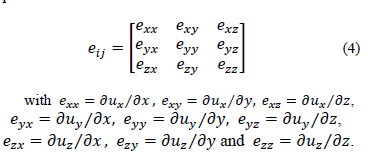
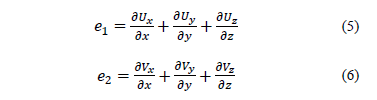
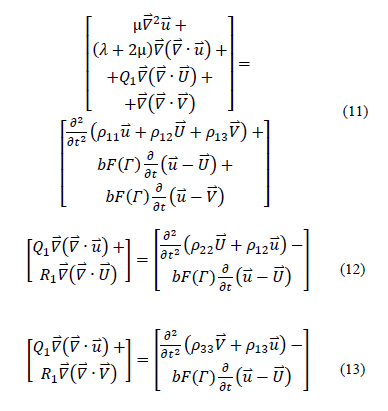
<body><![CDATA[<p><font size="3" face="Verdana, Arial, Helvetica, sans-serif"><b>1. Introduction</b></font></p>     <p><font size="2" face="Verdana, Arial, Helvetica, sans-serif">Attenuation is the exponential decay of  traveling wave amplitude and dispersion is the change of velocity with  frequency. These can be used to enhance seismic resolution and as direct  hydrocarbon indicators. The intrinsic attenuation is quantified by the inverse  of the quality factor Q<sup>-1</sup> as the fraction of wave energy transformed  to heat in each period, whereas the attenuation scattering Q<sub>scat</sub><sup>-1</sup> is due to energy scattered in all directions. The sum of both is known as total  attenuation. In mild stratified sediments, the scattering losses are considered  negligible depending on frequency range, varying the relation Q<sup>-1</sup>/Q<sub>scat</sub><sup>-1</sup> from 19 in sonic logs to 4 in VSP (Vertical Seismic Profile) &#91;1&#93;. In  sedimentary environments, Q<sup>-1</sup> values ranging from 10<sup>-2</sup> to  10<sup>-1</sup> across the seismic band (1-150 Hz) have been reported &#91;1&#93;. </font></p>     <p><font size="2" face="Verdana, Arial, Helvetica, sans-serif">Despite  scientific improvements, the physical phenomena related to the intrinsic and scattering  attenuations in sedimentary rocks are not completely understood.  Notwithstanding different flow regimes and frequency bands, it is possible to  explain some aspects of wave attenuation with a single mechanism. wave induced  fluid flow - WIFF. When a wave stresses an average element, pore fluids respond  with different changes in their fluid pressures. As a consequence, fluids  within the porous element start flowing, significantly attenuating the wave  energy. It has been demonstrated that these fluid-flow waves are responsible  for dispersion and attenuation at low frequencies (31-123 Hz) &#91;2&#93;.  Additionally, the relative motion between the rock matrix and the fluids is  intensified by the presence of fluid-fluid interfaces and their pressure  gradients &#91;3&#93;. It has been demonstrated that WIFF causes significant  attenuation in partially saturated Berea sandstone at low and high pressure &#91;4&#93;. The  induced flows take place at distinct scales, the macroscopic scale phenomenon  at low or high frequencies is known as &quot;Biot loss&quot; &#91;5,6&#93;. Microscopic  mechanisms caused by micro-cracks or broken grain contact under stress and  known as squirt flow have been proposed to explain measured attenuation at  ultrasonic frequencies &#91;7-9&#93;. Also, mesoscopic mechanisms have been reported  &#91;10&#93; to treat wave induced flow due to patchy saturation. Pride and Berryman  &#91;11,12&#93; published research on mesoscopic losses occurring in the  double-porosity model. At low rates of varying strain and at a larger length  scale compared to typical pore size, the fluid pressure has enough time to  equilibrate between the porous phases and consequently, the double porosity  model is reduced to the Biot one porosity mechanism &#91;13&#93;. It is even believed  that at seismic frequencies the main cause is the WIF; in homogeneous media,  WIF becomes weaker and Biot loss could be sizeable. On the other hand,  understanding the effects of saturation and viscosity on seismic response  requires numerical simulations given that laboratory tests must be carried out  with strains and frequencies set in the seismic domain. Hence, the propagation  of acoustic waves in wet porous media was numerically simulated. Biot's  equations were extended to porous media saturated with two immiscible fluids  &#91;14&#93;, solved in finite differences and coded in a C++ program. These equations  include a complex quantity that represents the deviation from Poiseuille  friction as the frequency increases, transforming the static viscosity  coefficient into a dynamic complex term. Models with variable porosity and saturation  were used to discriminate their separated effects of porosity and saturation.  Spectral analysis using Fourier transform provided information about the  behavior of amplitude and phase spectra of wavelets (although phase analysis is  mostly disregarded) that characterize seismic response within these two  parameters.</font></p>     <p>&nbsp;</p>     <p><font size="3" face="Verdana, Arial, Helvetica, sans-serif"><b>2. Theory </b></font></p>     <p><font size="2" face="Verdana, Arial, Helvetica, sans-serif"><b><i>2.1. Wave propagation in porous media </i></b></font></p>     <p><font size="2" face="Verdana, Arial, Helvetica, sans-serif">The stresses and strains of the material inside a continuous elastic volume are connected by the Hooke's law,  which only holds for some materials under certain loading conditions. Under  these circumstances, the second-order tensors that represent stress and strain  are related through a fourth-rank stiffness tensor. </font></p>     <p><font size="2" face="Verdana, Arial, Helvetica, sans-serif">Now, consider  a homogeneous and isotropic volume of rock <img src="/img/revistas/dyna/v83n199/v83n199a10eq002.gif"> with porosity <img src="/img/revistas/dyna/v83n199/v83n199a10eq004.gif"> and density <img src="/img/revistas/dyna/v83n199/v83n199a10eq006.gif">,  which contains two immiscible fluids with saturation <i>S</i> and (<i>S-1)</i> and  respective densities <img src="/img/revistas/dyna/v83n199/v83n199a10eq008.gif"> and <img src="/img/revistas/dyna/v83n199/v83n199a10eq010.gif">.  The displacements of the solid, and fluids 1 and 2 are designated by the  independent vectors <img src="/img/revistas/dyna/v83n199/v83n199a10eq012.gif">and <img src="/img/revistas/dyna/v83n199/v83n199a10eq014.gif">.</font></p>     <p><font size="2" face="Verdana, Arial, Helvetica, sans-serif">When a wave propagates across a  media, the faces of the solid volume are under the stress tensor</font></p>     <p><img src="/img/revistas/dyna/v83n199/v83n199a10eq01.gif"></p>     ]]></body>

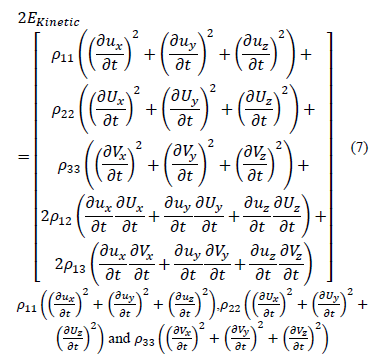
<body><![CDATA[<p><font size="2" face="Verdana, Arial, Helvetica, sans-serif">and  the surfaces of fluids 1 and 2 are under  forces which are proportional to the fluids pressure <img src="/img/revistas/dyna/v83n199/v83n199a10eq018.gif"> according to.</font></p>     <p><img src="/img/revistas/dyna/v83n199/v83n199a10eq0203.gif"></p>     <p><font size="2" face="Verdana, Arial, Helvetica, sans-serif">The  minus sign indicates that the force is exerted in the opposite direction to the pressure.</font></p>     <p><font size="2" face="Verdana, Arial, Helvetica, sans-serif">The following strain tensor represents  the deformed porous solid</font></p>     <p><img src="/img/revistas/dyna/v83n199/v83n199a10eq04.gif"></p>     <p><font size="2" face="Verdana, Arial, Helvetica, sans-serif">The changes of volume in fluids 1 and 2  are</font></p>     <p><img src="/img/revistas/dyna/v83n199/v83n199a10eq0506.gif"></p>     <p><font size="2" face="Verdana, Arial, Helvetica, sans-serif">The kinetic energy of the system <img src="/img/revistas/dyna/v83n199/v83n199a10eq040.gif"> per unit of volume is estimated by.</font></p>     <p><img src="/img/revistas/dyna/v83n199/v83n199a10eq07.gif"></p>     <p>&nbsp;</p>     ]]></body>
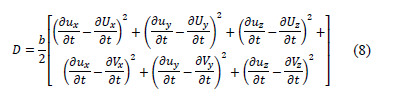
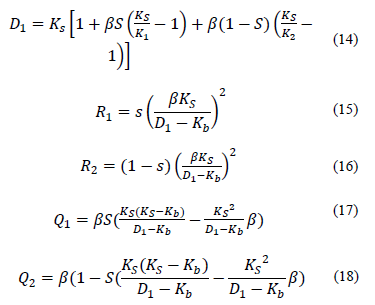
<body><![CDATA[<p><font size="2" face="Verdana, Arial, Helvetica, sans-serif">corresponds  to the kinetic energy of the matrix, and the kinetic energy of fluids 1 and 2, respectively. The mass coefficients <img src="/img/revistas/dyna/v83n199/v83n199a10eq050.gif"> and <img src="/img/revistas/dyna/v83n199/v83n199a10eq052.gif">are apparent  densities which represent coupling parameters between the fluids and the solid,  so the last two terms correspond to their coupling energies. The weak  gas-liquid interaction was not taken into account. As a result, the friction is  only due to the relative motion between the solid and every fluid, and the  dissipation function <img src="/img/revistas/dyna/v83n199/v83n199a10eq054.gif"> becomes.</font></p>     <p><img src="/img/revistas/dyna/v83n199/v83n199a10eq08.gif"></p>     <p><font size="2" face="Verdana, Arial, Helvetica, sans-serif">where <img src="/img/revistas/dyna/v83n199/v83n199a10eq058.gif"> is the Darcy's coefficient of the fluid  component that relates the total friction force on the fluid with the average  fluid velocity and depends on the fluid's dynamic viscosity<img src="/img/revistas/dyna/v83n199/v83n199a10eq060.gif">, the  permeability <img src="/img/revistas/dyna/v83n199/v83n199a10eq062.gif"> and the porosity <img src="/img/revistas/dyna/v83n199/v83n199a10eq004.gif"> of the matrix, according to.</font></p>     <p><img src="/img/revistas/dyna/v83n199/v83n199a10eq09.gif"></p>     <p><font size="2" face="Verdana, Arial, Helvetica, sans-serif"><img src="/img/revistas/dyna/v83n199/v83n199a10eq058.gif"> depends on the fluids  hence<img src="/img/revistas/dyna/v83n199/v83n199a10eq066.gif">, where <img src="/img/revistas/dyna/v83n199/v83n199a10eq068.gif"> and <img src="/img/revistas/dyna/v83n199/v83n199a10eq070.gif"> are the individual Darcy coefficients of each  fluid. After a certain frequency<img src="/img/revistas/dyna/v83n199/v83n199a10eq072.gif"> given later by equation (19), fluids behave as  a non-laminar or Poiseuille flow, hence D in equation (8) must be multiplied by  the factor</font></p>     <p><img src="/img/revistas/dyna/v83n199/v83n199a10eq10.gif"></p>     <p> <font size="2" face="Verdana, Arial, Helvetica, sans-serif"><img src="/img/revistas/dyna/v83n199/v83n199a10eq076.gif"> represents the ratio  between angular frequency and critical frequency <img src="/img/revistas/dyna/v83n199/v83n199a10eq078.gif">, <img src="/img/revistas/dyna/v83n199/v83n199a10eq080.gif"> is a structure factor which depends on pore  geometry, and <img src="/img/revistas/dyna/v83n199/v83n199a10eq050.gif">,<img src="/img/revistas/dyna/v83n199/v83n199a10eq082.gif">, <img src="/img/revistas/dyna/v83n199/v83n199a10eq084.gif"> and <img src="/img/revistas/dyna/v83n199/v83n199a10eq086.gif">are defined by.</font></p>     <p><img src="/img/revistas/dyna/v83n199/v83n199a10eq101.gif"></p>     <p><font size="2" face="Verdana, Arial, Helvetica, sans-serif">The propagation of waves across the porous  matrix saturated by the immiscible fluids is governed by the system of coupled  equations.</font></p>     <p><img src="/img/revistas/dyna/v83n199/v83n199a10eq1113.gif"></p>     ]]></body>
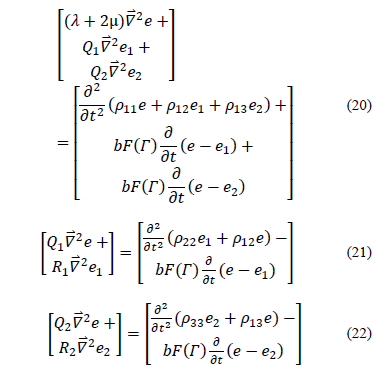
<body><![CDATA[<p><font size="2" face="Verdana, Arial, Helvetica, sans-serif">The displacements vectors <img src="/img/revistas/dyna/v83n199/v83n199a10eq012.gif">and <img src="/img/revistas/dyna/v83n199/v83n199a10eq014.gif"> are completely described by the nine  independent equations 11, 12 and 13. In isotropic material, the transverse and  longitudinal waves are uncoupled and they obey independent equations of  propagation. The terms <img src="/img/revistas/dyna/v83n199/v83n199a10eq096.gif">, <img src="/img/revistas/dyna/v83n199/v83n199a10eq098.gif">, <img src="/img/revistas/dyna/v83n199/v83n199a10eq100.gif">and <img src="/img/revistas/dyna/v83n199/v83n199a10eq102.gif"> in equations 11, 12 and 13 are defined below.</font></p>     <p><img src="/img/revistas/dyna/v83n199/v83n199a10eq1418.gif"></p>     <p><font size="2" face="Verdana, Arial, Helvetica, sans-serif"><img src="/img/revistas/dyna/v83n199/v83n199a10eq114.gif"> is the shear modulus, <img src="/img/revistas/dyna/v83n199/v83n199a10eq116.gif"> is the Bulk Modulus of the Structure and <img src="/img/revistas/dyna/v83n199/v83n199a10eq118.gif"> is the second Lame's parameter, <img src="/img/revistas/dyna/v83n199/v83n199a10eq120.gif"> and <img src="/img/revistas/dyna/v83n199/v83n199a10eq122.gif"> represent the pressure on fluids 1 or 2 required to displace the fluids into the  porous, and <img src="/img/revistas/dyna/v83n199/v83n199a10eq100.gif"> and <img src="/img/revistas/dyna/v83n199/v83n199a10eq102.gif"> are physical constants that provide  information about the solid-fluids couplings. <img src="/img/revistas/dyna/v83n199/v83n199a10eq124.gif"> and <img src="/img/revistas/dyna/v83n199/v83n199a10eq126.gif"> are the bulk modulus of the fluid 1 and 2, and <img src="/img/revistas/dyna/v83n199/v83n199a10eq128.gif"> is the bulk modulus of the sand (grains).</font></p>     <p><font size="2" face="Verdana, Arial, Helvetica, sans-serif">In a porous material with an  average pore diameter of d, the Poiseuille flow occurs below a certain  frequency <img src="/img/revistas/dyna/v83n199/v83n199a10eq078.gif"> that defines the low frequency bandwidth &#91;5&#93;. Such  a frequency is given by.</font></p>     <p><img src="/img/revistas/dyna/v83n199/v83n199a10eq19.gif"></p>     <p><font size="2" face="Verdana, Arial, Helvetica, sans-serif">The  longitudinal waves are decoupled from transverse waves, by applying the divergence operator on both sides of equations (11),  (12) and (13) to finally obtain.</font></p>     <p><img src="/img/revistas/dyna/v83n199/v83n199a10eq2022.gif"></p>     <p><font size="2" face="Verdana, Arial, Helvetica, sans-serif">The  set of equations 20, 21 and 22 rule the propagation of longitudinal waves in  porous media containing fluids. The extension of this theory to the  high-frequency range was developed by Biot &#91;6&#93;, and since then  it has been widely used in petroleum engineering.</font></p>     <p><font size="2" face="Verdana, Arial, Helvetica, sans-serif">A  more detailed explanation of Biot's theory  can be found in reference &#91;14,15&#93;.</font></p>     <p><font size="2" face="Verdana, Arial, Helvetica, sans-serif"><b><i>2.2. Attenuation and Dispersion</i></b></font></p>     ]]></body>
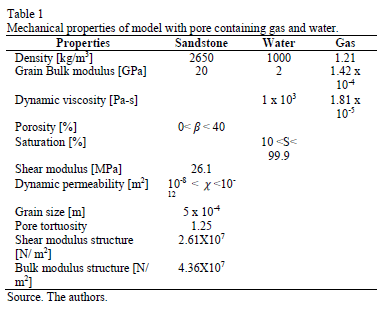
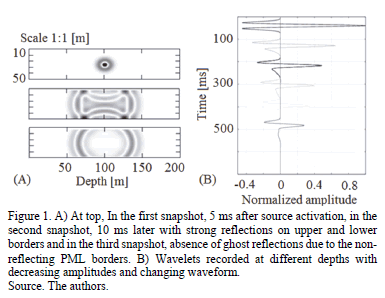
<body><![CDATA[<p><font size="2" face="Verdana, Arial, Helvetica, sans-serif">Intrinsic  seismic attenuation is characterized by the quality factor Q, defined in terms  of the mean stored energy <img src="/img/revistas/dyna/v83n199/v83n199a10eq138.gif"> divided by  the energy lost <img src="/img/revistas/dyna/v83n199/v83n199a10eq140.gif"> during a  cycle of sinusoidal deformation. The lost energy is absorbed by the medium as  heat energy. Q quantifies  the attenuation caused by fluid  movement and friction in pores, and is related to the phase angle <img src="/img/revistas/dyna/v83n199/v83n199a10eq142.gif"> between stress  and strain, according to</font></p>     <p><img src="/img/revistas/dyna/v83n199/v83n199a10eq23.gif"></p>     <p><font size="2" face="Verdana, Arial, Helvetica, sans-serif">As  is known, the Earth's  crust preferentially attenuates higher frequencies, diminishing the seismic resolution.</font></p>     <p><font size="2" face="Verdana, Arial, Helvetica, sans-serif">Wavelets are formed by superposing monochromatic  waves called frequency  components of the wave, where each component travels with a velocity called  phase velocity that depends on its frequency. Dispersion is the phenomenon by which each component has a different  phase velocity that distorts the shape of the wave. When this occurs,  the medium is referred to as dispersive.</font></p>     <p>&nbsp;</p>     <p><font size="3" face="Verdana, Arial, Helvetica, sans-serif"><b>3. Methodology </b></font></p>     <p><font size="2" face="Verdana, Arial, Helvetica, sans-serif">The system of simultaneous differential  equations (20), (21) and (22), solved in the second order central finite  difference scheme, was implemented in a C++ code. Porous sandstones were modeled as homogeneous  isotropic porous media containing non-viscous fluids (gas and water). Each  model with a different porosity and a distinct saturation according to its  mechanical properties is listed in <a href="#tab01">Table 1</a>. To eliminate ghost reflections in the  lateral and inferior regions bordering the model, non-reflecting borders were  included by implementing Perfectly Matched Layers (PML) &#91;16&#93;. The efficiency of  PML borders surrounding the model is observed in <a href="#fig01">Fig. 1A</a> containing three  snapshots. the first at t=5 ms, the second at t=15 ms with spurious reflections  on the borders, and the third at t=15 ms without reflections on PML borders. In  order to circumvent geometric dispersion, the source generates a plane wave on  the model simulating a 60Hz Ricker wavelet. In each simulation, the wave propagated in a 2D model with a depth of  2km and a width of 0.05 km formed grids that were 0.5 m high and 0.5 m thick.  The downward wave was recorded at 20 points with a separation of 100 meters  between one recording position and the next. The simulation time was 350  milliseconds and the sampling rate, 50 microseconds. According to equation (14), and taking into  account the values listed in <a href="#tab01">Table 1</a>, the estimated critical frequency values  are in kHz, hence the bandwidth of simulations is located in the seismic  frequency range. To observe the isolated effect of porosity on attenuation and  dispersion, some numerical simulations ran in fully saturated models each one  with a different porosity. With that intention, homogeneous models saturated  with water at 99.9% were created, with porosities varying of between 2.5% and  22.5% and with increases of 2.5%. Similarly, to observe the isolated effect of  saturation on attenuation, other numerical simulations were run in constant porosity  models with different saturations, ranging from 10% to 99.9%, with increases of  10%. For each simulation, the wavelets recorded in depth in each model, were  spectrally decomposed by Fourier transform providing their respective amplitude  and phase spectra. Besides the above, arrival times were estimated to find out  the combined effect of porosity and saturation in P-wave velocity.</font></p>     <p align="center"><font size="2" face="Verdana, Arial, Helvetica, sans-serif"><a name="tab01"></a></font><img src="/img/revistas/dyna/v83n199/v83n199a10tab01.gif"></p>     <p align="center"><font size="2" face="Verdana, Arial, Helvetica, sans-serif"><a name="fig01"></a></font><img src="/img/revistas/dyna/v83n199/v83n199a10fig01.gif"></p>     <p><font size="2" face="Verdana, Arial, Helvetica, sans-serif"><b><i>3.1. Analysis of results</i></b></font></p>     ]]></body>
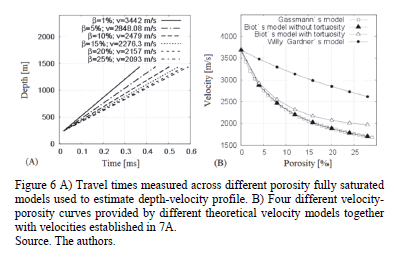
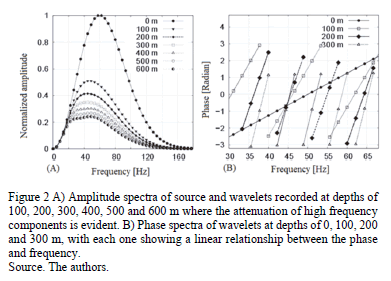
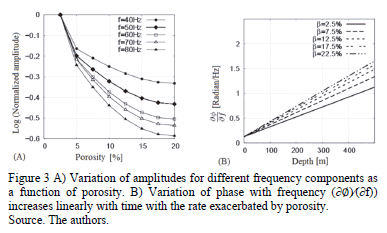
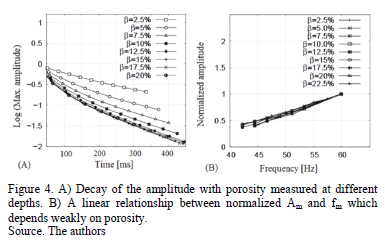
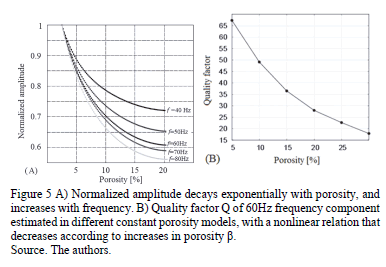
<body><![CDATA[<p><font size="2" face="Verdana, Arial, Helvetica, sans-serif"><a href="#fig01">Fig. 1B</a> depicts a synthetic seismogram  formed by six superimposing wavelets recorded in depth in a 15% porosity  model of a porous sandstone which is  saturated with water at 99.9%, where the attenuation is manifested by a  reduction of the amplitudes, while the dispersion is manifested by changing the  waveforms. In a perfectly elastic homogeneous-isotropic medium, all frequency  components travel with the same phase velocity without energy loss and, as a  result, the wavelet holds its form while moving. The six wavelets of <a href="#fig01">Fig. 1A</a> were Fourier transformed and their amplitude spectra plotted in <a href="#fig01">Fig. 2A</a>,  indicating the depth at which each wavelet was recorded. The image shows the  amplitude spectrum diminishing in depth whereas the higher amplitude <i>A<sub>m</sub></i> of each spectrum is  shifted toward low frequencies; from now on, the frequency of the maximum  component energy of each spectrum will be referred to as <i>f<sub>m</sub></i>.  On the surface, <i>f<sub>m</sub></i> is 60  Hz but at 100 m depth, it is 47 Hz. It reaches 45 Hz at 200 m; simultaneously the shape of the spectrum is  continuously modified until it becomes bi-modal at 600m. Given that the plane  wave does not suffer geometric dispersion, the above observed behavior is associated  entirely to the friction by the relative motion between the fluids and the pore  wall. <a href="#fig02">Fig. 2B</a> contains the phase spectra of wavelets recorded at depths of 100,  200 and 400 m. The phase spectra indicate that phase and frequency are related  by the expression<img src="/img/revistas/dyna/v83n199/v83n199a10eq150.gif">, where the ratio of change of  phase with frequency <img src="/img/revistas/dyna/v83n199/v83n199a10eq152.gif"> increases in depth z. The above procedure,  including wave propagation, wavelet recording in depth, and spectral analysis,  was repeated for all numerical simulations.</font></p>     <p align="center"><font size="2" face="Verdana, Arial, Helvetica, sans-serif"><a name="fig02"></a></font><img src="/img/revistas/dyna/v83n199/v83n199a10fig02.gif"></p>     <p><font size="2" face="Verdana, Arial, Helvetica, sans-serif">Now, to quantify the impact of porosity on  attenuation and dispersion, the wavelets recorded in depth and supplied by the  simulation in each model were spectrally decomposed using the Fourier  transform. As stated, each saturated model has a different porosity. From now on, the spectra of wavelets recorded  in depth will be referred to as spectra in depth. Accordingly, the spectra in depth of each model were  overlapped as shown in <a href="#fig02">Fig. 2</a>. Next, the logarithms of measured amplitudes at  40, 50, 60, 70, and 80 Hz were normalized by dividing each value by the maximum  value, as shown in <a href="#fig03">Fig. 3A</a>. Each curve indicates that attenuation becomes  stronger with porosity, which is explained by the fact that the pore surface,  where friction occurs, is extended when porosity increases. Also, by comparing  the curves according to frequency, it can be deduced that attenuation caused by  porosity is strengthened when frequency increases.</font></p>     <p align="center"><font size="2" face="Verdana, Arial, Helvetica, sans-serif"><a name="fig03"></a></font><img src="/img/revistas/dyna/v83n199/v83n199a10fig03.gif"></p>     <p><font size="2" face="Verdana, Arial, Helvetica, sans-serif">This can be explained by the following  fact. At low frequencies, there is a  partial coupling between fluids and the solid but at higher frequencies, the  coupling breaks and friction increases together with the energy transfer rate.  In order to find the effects of porosity on dispersion, <img src="/img/revistas/dyna/v83n199/v83n199a10eq160.gif"> were measured in phase  spectra in depth of each model with a different porosity. The summarized  results are shown in <a href="#fig03">Fig. 3B</a>. <a href="#fig02">Fig. 2B</a> shows that in a homogeneous-isotropic  saturated media, <img src="/img/revistas/dyna/v83n199/v83n199a10eq162.gif"> increases with depth, whereas  <a href="#fig03">Fig. 3B</a> shows that <img src="/img/revistas/dyna/v83n199/v83n199a10eq162.gif"> becomes higher when porosity  increases, exacerbating the dispersion phenomena. The term <img src="/img/revistas/dyna/v83n199/v83n199a10eq160.gif"> might be considered a seismic  attribute and therefore a porosity indicator inside a fully saturated lithic  unit, relating their values directly with their porosities. </font></p>     <p><font size="2" face="Verdana, Arial, Helvetica, sans-serif">On the other hand, the highest amplitudes  of all spectra in depth were estimated. <a href="#fig04">Fig. 4A</a> shows curves relating the  logarithm of the highest amplitudes <img src="/img/revistas/dyna/v83n199/v83n199a10eq164.gif"> versus travel time and  porosity. Each curve shows an exponential decay of amplitude with the travel  time and a decay factor which increases with porosity. Although attenuation  increases with porosity, the lines tend asymptotically to a  limiting line established in this modeling by a porosity of about 22.5%. This  means that above this value, attenuation will remain constant no matter what  the value of porosity is. </font></p>     <p align="center"><font size="2" face="Verdana, Arial, Helvetica, sans-serif"><a name="fig04"></a></font><img src="/img/revistas/dyna/v83n199/v83n199a10fig04.gif"></p>     <p><font size="2" face="Verdana, Arial, Helvetica, sans-serif"><a href="#fig01">Fig. 1B</a> illustrates that the maximum  amplitude <img src="/img/revistas/dyna/v83n199/v83n199a10eq164.gif"> shifts to lower frequencies  when the depth increases. Therefore, the highest amplitudes (<img src="/img/revistas/dyna/v83n199/v83n199a10eq164.gif">) of all spectra in depth and their frequencies (<img src="/img/revistas/dyna/v83n199/v83n199a10eq166.gif">) were estimated and plotted in <a href="#fig04">Fig. 4B</a>. A numerical  regression indicates a linear relation between <img src="/img/revistas/dyna/v83n199/v83n199a10eq164.gif"> and <img src="/img/revistas/dyna/v83n199/v83n199a10eq166.gif"> which is almost insensitive  to porosity. In a real case, the dispersion around the relationship would be  below estimation errors. The next step was to consider the quality factor Q, so  the amplitudes at 40, 50, 60, 70 and 80 Hz of all spectra in depth versus  porosity were plotted. <a href="#fig05">Fig. 5A</a> shows how amplitude decreases exponentially with  porosity and increases with frequency. It means that the higher frequency  components of waves are rapidly attenuated while the low frequency components remain. The  amplitudes of the 60Hz component were plotted in <a href="#fig05">Fig. 5B</a>, which shows the  decreasing effect of porosity on quality factor. Q tends asymptotically to a  constant value, as porosity increases. Values from <a href="#fig05">Fig. 5A</a> were used to build  the curves associated to components of 40, 50, 70 and 80 Hz. These curves  showed similar behavior  to the observed in <a href="#fig05">Fig. 5B</a>. The range of Q (from 35 to 80) observed in <a href="#fig05">Fig. 5B</a> points out that there is a sizeable attenuation in the seismic bandwidth. </font></p>     <p align="center"><font size="2" face="Verdana, Arial, Helvetica, sans-serif"><a name="fig05"></a></font><img src="/img/revistas/dyna/v83n199/v83n199a10fig05.gif"></p>     <p><font size="2" face="Verdana, Arial, Helvetica, sans-serif">To establish the effect of porosity on P wave  velocity, new simulations were run in saturated models with different porosity  ranging from 2.5% up to 22.5% with a 2.5% variation each. The travel times  estimated in depth displayed in <a href="#fig06">Fig. 6A</a> indicate that velocity decreases with  porosity (from 3442 m/s in the 1% porosity model to 2093 m/s in the 25% porosity model). The observed variation in  velocity coincides with reported velocity-porosity relationships obtained by  numerical simulations to derive the elastic properties of model monomineralic  consolidated sandstone &#91;17&#93; and empirical dataset of sandstone samples of  varying porosity and clay content (from clean to 51% clay) whose velocities  were measured at different pressures &#91;18&#93;. </font></p>     ]]></body>


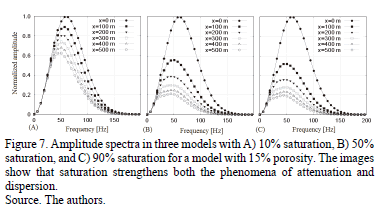
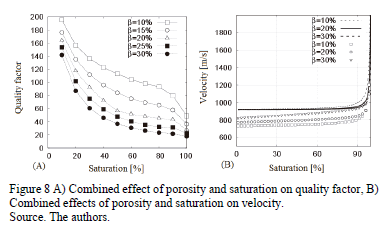
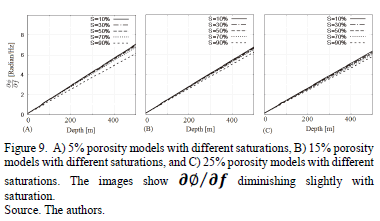
<body><![CDATA[<p align="center"><font size="2" face="Verdana, Arial, Helvetica, sans-serif"><a name="fig06"></a></font><img src="/img/revistas/dyna/v83n199/v83n199a10fig06.gif"></p>     <p><font size="2" face="Verdana, Arial, Helvetica, sans-serif">The observed velocity-porosity  behavior in <a href="#fig06">Fig. 6A</a> was compared to the theoretical velocity models proposed by  Wyllie &amp; Gardner &#91;19&#93;, Gassmann (1951) &#91;20&#93; and Biot &#91;6&#93;, with all their  curves plotted in <a href="#fig06">Fig. 6B</a>. The resulting curve shows a linear  diminishing trend observed in laboratory research &#91;2&#93;. On one hand, the Wyllie  &amp; Gardner curve, which represents a time average equation and not a  rigorous theoretical model, defines the upper limit of velocity-porosity  relationship. On the other hand, Gassmann's velocity establishes the lower  limit of velocity and coincides with Biot's velocity in case of a model without  tortuosity, that is, entirely connected pores. In the presence of tortuosity,  the velocity curve deviates from Gassmann's curve when porosity increases due  to the fact that tortuosity affects solid-fluid coupling. The velocity of the  rock matrix corresponds to the value where porosity becomes zero, settling  around 3700 m/s. This result indicates that when the wave passes through a  fully saturated medium, there is a delay in the journey that depends on  porosity. Such behavior has also been observed in experimental data and field  data &#91;21&#93;.</font></p>     <p><font size="2" face="Verdana, Arial, Helvetica, sans-serif">Finally, the isolated effect of saturation in  the spectra of amplitude and phase was studied. <a href="#fig07">Fig. 7A</a> shows the amplitude  spectra of wavelets recorded in a 10% saturated model with a porosity of 10%.  On the surface <img src="/img/revistas/dyna/v83n199/v83n199a10eq164.gif"> occurs when <img src="/img/revistas/dyna/v83n199/v83n199a10eq166.gif"> is 60 Hz, but as the wave propagates, <img src="/img/revistas/dyna/v83n199/v83n199a10eq164.gif"> diminishes while its <img src="/img/revistas/dyna/v83n199/v83n199a10eq170.gif">moves towards lower frequencies. This  behavior is accentuated</font> <font size="2" face="Verdana, Arial, Helvetica, sans-serif">when saturation  reaches 50% in same model seen in <a href="#fig07">Fig. 7B</a>, where a bi-modal shape appears in a  more attenuated spectrum. <a href="#fig07">Fig. 7C</a> shows a stronger effect due to a higher saturation. It can  thus be concluded that saturation strengthens both the phenomena of attenuation  and dispersion.</font></p>     <p align="center"><font size="2" face="Verdana, Arial, Helvetica, sans-serif"><a name="fig07"></a></font><img src="/img/revistas/dyna/v83n199/v83n199a10fig07.gif"></p>     <p><font size="2" face="Verdana, Arial, Helvetica, sans-serif">Simulations were run on models with porosities of 10%, 15%, 20%, 25% and  30%, with saturations of 10%, 20%, 30% and so on until reaching 99.9%. In each  spectra in depth, the quality factors at 60 Hz were estimated and the results,  summarized in <a href="#fig08">Fig. 8A</a>, show that the quality factor decreases with saturation  and porosity. However, it can be noted  that the saturation effect on the quality factor is more intense for  saturations below 40%. Above this  value, a trend is depicted that is less steep. Furthermore, <a href="#fig08">Fig. 8A</a> shows that  the effect of porosity on the quality factor is steeper for lower values with a limiting Q curve of around 22%. In  <a href="#fig08">Fig. 8B</a>, the combined effect of porosity and saturation on velocity is  observed. When saturation is less than 90%, the propagation velocity remains  almost insensitive to saturation, but exceeding that value, velocity increases  rapidly until reaching full saturation. A similar behaviour of velocity with  water saturation in experimental tests has been reported &#91;22&#93; (Winkler and  Murphy, 1995). The extremely low bulk modulus of gas makes it feasible to  compress the rock-fluid aggregate, keeping an almost constant velocity. Thus,  velocity is mainly affected by porosity and to a lesser extent by saturation  except when saturation is almost full. Finally, the influence of saturation on <img src="/img/revistas/dyna/v83n199/v83n199a10eq176.gif"> was studied by </font></p>     <p align="center"><font size="2" face="Verdana, Arial, Helvetica, sans-serif"><a name="fig08"></a></font><img src="/img/revistas/dyna/v83n199/v83n199a10fig08.gif"></p>     <p><font size="2" face="Verdana, Arial, Helvetica, sans-serif">analyzing the phases observed in the previous simulations. The results  are shown in <a href="#fig09">Figs. 9A</a>, <a href="#fig09">9B</a> and <a href="#fig09">9C</a> and outline a linear relationship between  the increase of <img src="/img/revistas/dyna/v83n199/v83n199a10eq184.gif"> and travel time. Slopes in the set of <a href="#fig09">Figs.  9A</a>, <a href="#fig09">9B</a> and <a href="#fig09">9C</a> show that <img src="/img/revistas/dyna/v83n199/v83n199a10eq184.gif"> decreases slightly with saturation.  Conversely, <a href="#fig03">Fig. 3B</a> shows that <img src="/img/revistas/dyna/v83n199/v83n199a10eq184.gif"> increases with porosity. Porosity increases  the change of phase with frequency and simultaneously saturation slows this  effect down but only </font></p>     <p align="center"><font size="2" face="Verdana, Arial, Helvetica, sans-serif"><a name="fig09"></a></font><img src="/img/revistas/dyna/v83n199/v83n199a10fig09.gif"></p>     <p>&nbsp;</p>     <p><font size="3" face="Verdana, Arial, Helvetica, sans-serif"><b>4. Conclusions</b></font></p>     ]]></body>

<body><![CDATA[<p><font size="2" face="Verdana, Arial, Helvetica, sans-serif">The propagation of P-wave in porous media  that model porous sandstone containing gas and water was numerically simulated  allowing for the characterization of the effects of porosity and saturation on  velocity, attenuation, and dispersion. When a wave propagates in saturated  media, the maximum amplitude of the spectrum shifts to lower frequencies. As a  result, sizeable Biot's losses in seismic bandwidth were observed  with low Q values that contradict the belief regarding its absence. Attenuation  increases as porosity, saturation and frequency increase but it tends  asymptotically towards a limit value. Moreover, when porosity and saturation  increase, Q diminishes. Although usually discarded, the phase analysis did  provide interesting results. On one hand, the phase varies with frequency with  a rate that increases when wavelets propagate. On the other hand, this rate is  almost insensitive to saturation but increases with porosity. This term <img src="/img/revistas/dyna/v83n199/v83n199a10eq186.gif"> might be considered a seismic  attribute and therefore a porosity indicator. </font></p>     <p><font size="2" face="Verdana, Arial, Helvetica, sans-serif">Finally, a relationship between acoustic  wave velocity and fully saturated porosity was established. When saturation is  less than 90%, the propagation velocity remains almost constant, but when that  value is exceeded, velocity increases rapidly until reaching full saturation.</font></p>     <p>&nbsp;</p>     <p><font size="3" face="Verdana, Arial, Helvetica, sans-serif"><b>Acknowledgements</b></font></p>     <p><font size="2" face="Verdana, Arial, Helvetica, sans-serif">The authors would like to thank  Universidad Nacional de Colombia for the support given to this research,  especially to the Graduate Program in Geophysics. This paper is a partial  result obtained by the physicist Alejandro Duitama, while preparing his  Master's thesis in Geophysics. </font></p>     <p>&nbsp;</p>     <p><font size="3" face="Verdana, Arial, Helvetica, sans-serif"><b>Bibliography</b></font></p>     <!-- ref --><p><font size="2" face="Verdana, Arial, Helvetica, sans-serif"><b>&#91;1&#93;</b> Sams, M., Neep, J., Worthington, M. and King, M., The measurements  of velocity dispersion and frequency-dependent intrinsic attenuation in  sedimentary rocks. Geophysics, 62, pp. 1456-1464, 1997. DOI: 10.1190/1.1444249.    &nbsp;&nbsp;&nbsp;&nbsp;&nbsp;&nbsp;&nbsp;&nbsp;[&#160;<a href="javascript:void(0);" onclick="javascript: window.open('/scielo.php?script=sci_nlinks&ref=1149961&pid=S0012-7353201600050001000001&lng=','','width=640,height=500,resizable=yes,scrollbars=1,menubar=yes,');">Links</a>&#160;]<!-- end-ref --></font></p>     <!-- ref --><p><font size="2" face="Verdana, Arial, Helvetica, sans-serif"><b>&#91;2&#93;</b> White, J., Computed seismic speeds and attenuation in rocks with  partial gas saturation. Geophysics, 40, pp. 224-232, 1975. DOI: 10.1190/1.1440520.    &nbsp;&nbsp;&nbsp;&nbsp;&nbsp;&nbsp;&nbsp;&nbsp;[&#160;<a href="javascript:void(0);" onclick="javascript: window.open('/scielo.php?script=sci_nlinks&ref=1149963&pid=S0012-7353201600050001000002&lng=','','width=640,height=500,resizable=yes,scrollbars=1,menubar=yes,');">Links</a>&#160;]<!-- end-ref --></font></p>     <!-- ref --><p><font size="2" face="Verdana, Arial, Helvetica, sans-serif"><b>&#91;3&#93;</b> Carcione, J., Helle, H. and Pham, N., White's model for wave  propagation in partially saturated rocks: Comparison with poroelastic numerical  experiments. Geophysics, 68, 1389-1398., 2003. DOI: 10.1190/1.1598132.    &nbsp;&nbsp;&nbsp;&nbsp;&nbsp;&nbsp;&nbsp;&nbsp;[&#160;<a href="javascript:void(0);" onclick="javascript: window.open('/scielo.php?script=sci_nlinks&ref=1149965&pid=S0012-7353201600050001000003&lng=','','width=640,height=500,resizable=yes,scrollbars=1,menubar=yes,');">Links</a>&#160;]<!-- end-ref --></font></p>     <!-- ref --><p><font size="2" face="Verdana, Arial, Helvetica, sans-serif"><b>&#91;4&#93;</b> Tisato, N., Quintal, B., Chapman, S., Madonna, C., Subramaniyan, S.,  Frehner, M., Saenger, E. and Grasselli, G., Seismic attenuation in partially  saturated rocks. Recent advances and future directions. The Leading Edge, 33(6),  pp. 648-655, 2014.    &nbsp;&nbsp;&nbsp;&nbsp;&nbsp;&nbsp;&nbsp;&nbsp;[&#160;<a href="javascript:void(0);" onclick="javascript: window.open('/scielo.php?script=sci_nlinks&ref=1149967&pid=S0012-7353201600050001000004&lng=','','width=640,height=500,resizable=yes,scrollbars=1,menubar=yes,');">Links</a>&#160;]<!-- end-ref --></font></p>     <!-- ref --><p><font size="2" face="Verdana, Arial, Helvetica, sans-serif"><b>&#91;5&#93;</b> Biot, M., Theory of propagation of elastic waves in a  fluid-saturated porous solid, I. Low frecuency range. J. Acous. Soc. Am., 28,  pp. 168-178, 1956. DOI: 10.1121/1.1908239.    &nbsp;&nbsp;&nbsp;&nbsp;&nbsp;&nbsp;&nbsp;&nbsp;[&#160;<a href="javascript:void(0);" onclick="javascript: window.open('/scielo.php?script=sci_nlinks&ref=1149969&pid=S0012-7353201600050001000005&lng=','','width=640,height=500,resizable=yes,scrollbars=1,menubar=yes,');">Links</a>&#160;]<!-- end-ref --></font></p>     <!-- ref --><p><font size="2" face="Verdana, Arial, Helvetica, sans-serif"><b>&#91;6&#93;</b> Biot, M., Theory of propagation of elastic waves in a  fluid-saturated porous solid. II. Higher-frecuency range. J. Acous. Soc. Am.,  28, pp. 179-191, 1956. DOI: 10.1121/1.1908239</font>&nbsp;&nbsp;&nbsp;&nbsp;&nbsp;&nbsp;&nbsp;&nbsp;[&#160;<a href="javascript:void(0);" onclick="javascript: window.open('/scielo.php?script=sci_nlinks&ref=1149971&pid=S0012-7353201600050001000006&lng=','','width=640,height=500,resizable=yes,scrollbars=1,menubar=yes,');">Links</a>&#160;]<!-- end-ref --><!-- ref --><p><font size="2" face="Verdana, Arial, Helvetica, sans-serif"><b>&#91;7&#93;</b> Dvorkin, J., Mavko, G. and Nur, A., Squirt flow in fully saturated  rocks. Geophysics, 60, pp. 97-107, 1995. DOI: 10.1190/1.1443767.    &nbsp;&nbsp;&nbsp;&nbsp;&nbsp;&nbsp;&nbsp;&nbsp;[&#160;<a href="javascript:void(0);" onclick="javascript: window.open('/scielo.php?script=sci_nlinks&ref=1149972&pid=S0012-7353201600050001000007&lng=','','width=640,height=500,resizable=yes,scrollbars=1,menubar=yes,');">Links</a>&#160;]<!-- end-ref --></font></p>     ]]></body>
<body><![CDATA[<!-- ref --><p><font size="2" face="Verdana, Arial, Helvetica, sans-serif"><b>&#91;8&#93;</b> Mavko, G. and Nur, A., Wave attenuation in partially saturated rocks.  Geophysics, 44, pp. 161-178, 1979. DOI: 10.1190/1.1440958.    &nbsp;&nbsp;&nbsp;&nbsp;&nbsp;&nbsp;&nbsp;&nbsp;[&#160;<a href="javascript:void(0);" onclick="javascript: window.open('/scielo.php?script=sci_nlinks&ref=1149974&pid=S0012-7353201600050001000008&lng=','','width=640,height=500,resizable=yes,scrollbars=1,menubar=yes,');">Links</a>&#160;]<!-- end-ref --></font></p>     <!-- ref --><p><font size="2" face="Verdana, Arial, Helvetica, sans-serif"><b>&#91;9&#93;</b> Williams, K., Jackson, D., Thorsos, E., Tang, D. and Shock, S.,  Comparison of sound speed and attenuation measured in sandy sediments to  predictions based on the Biot theory of porous media. IEEE, J. Ocean. Eng., 27,  pp. 413-428, 2002.    &nbsp;&nbsp;&nbsp;&nbsp;&nbsp;&nbsp;&nbsp;&nbsp;[&#160;<a href="javascript:void(0);" onclick="javascript: window.open('/scielo.php?script=sci_nlinks&ref=1149976&pid=S0012-7353201600050001000009&lng=','','width=640,height=500,resizable=yes,scrollbars=1,menubar=yes,');">Links</a>&#160;]<!-- end-ref --></font></p>     <!-- ref --><p><font size="2" face="Verdana, Arial, Helvetica, sans-serif"><b>&#91;10&#93;</b> Johnson, D., Theory of frequency dependent acoustics in  patchy-saturated porous media. J. Acous, Soc. Am., 110, pp. 682-694, 2001. DOI:  10.1121/1.1381021.    &nbsp;&nbsp;&nbsp;&nbsp;&nbsp;&nbsp;&nbsp;&nbsp;[&#160;<a href="javascript:void(0);" onclick="javascript: window.open('/scielo.php?script=sci_nlinks&ref=1149978&pid=S0012-7353201600050001000010&lng=','','width=640,height=500,resizable=yes,scrollbars=1,menubar=yes,');">Links</a>&#160;]<!-- end-ref --></font></p>     <!-- ref --><p><font size="2" face="Verdana, Arial, Helvetica, sans-serif"><b>&#91;11&#93;</b> Pride, S. and Berryman, J., Linear dynamics of double porosity and  dual-permeability materials. I. Governing equations and acoustic attenuation.  Phys. Rev. E., 68, pp. 036603, 2003. DOI: 10.1103/PhysRevE.68.036603.    &nbsp;&nbsp;&nbsp;&nbsp;&nbsp;&nbsp;&nbsp;&nbsp;[&#160;<a href="javascript:void(0);" onclick="javascript: window.open('/scielo.php?script=sci_nlinks&ref=1149980&pid=S0012-7353201600050001000011&lng=','','width=640,height=500,resizable=yes,scrollbars=1,menubar=yes,');">Links</a>&#160;]<!-- end-ref --> </font></p>     <!-- ref --><p><font size="2" face="Verdana, Arial, Helvetica, sans-serif"><b>&#91;12&#93;</b> Pride, S. and Berryman, J., Linear dynamics of double porosity and  dual-permeability materials. II. Fluid transport equations. Phys. Rev. E., 60,  pp. 4285-4299, 2003.    &nbsp;&nbsp;&nbsp;&nbsp;&nbsp;&nbsp;&nbsp;&nbsp;[&#160;<a href="javascript:void(0);" onclick="javascript: window.open('/scielo.php?script=sci_nlinks&ref=1149982&pid=S0012-7353201600050001000012&lng=','','width=640,height=500,resizable=yes,scrollbars=1,menubar=yes,');">Links</a>&#160;]<!-- end-ref --> </font></p>     ]]></body>
<body><![CDATA[<!-- ref --><p><font size="2" face="Verdana, Arial, Helvetica, sans-serif"><b>&#91;13&#93;</b> Caspari, E., Qi, Q., Lopes, S., Gurevich, B., Rubino, J., Velis, D.,  Clenell, M. and Muller, T., Wave attenuation in partially saturated porous  rocks - New observations and interpretation across scales. The Leading Edge,  33(6) pp. 606-614, 2014.    &nbsp;&nbsp;&nbsp;&nbsp;&nbsp;&nbsp;&nbsp;&nbsp;[&#160;<a href="javascript:void(0);" onclick="javascript: window.open('/scielo.php?script=sci_nlinks&ref=1149984&pid=S0012-7353201600050001000013&lng=','','width=640,height=500,resizable=yes,scrollbars=1,menubar=yes,');">Links</a>&#160;]<!-- end-ref --> </font></p>     <!-- ref --><p><font size="2" face="Verdana, Arial, Helvetica, sans-serif"><b>&#91;14&#93;</b> Camarasa, M., Contribuci&oacute;n a la teor&iacute;a de Biot  sobre propagaci&oacute;n de ondas ac&uacute;sticas en sedimentos saturados en una mezcla de  fluidos. Tesis Doctoral, Universidad  Complutense de Madrid, Madrid, Espa&ntilde;a,1992.    &nbsp;&nbsp;&nbsp;&nbsp;&nbsp;&nbsp;&nbsp;&nbsp;[&#160;<a href="javascript:void(0);" onclick="javascript: window.open('/scielo.php?script=sci_nlinks&ref=1149986&pid=S0012-7353201600050001000014&lng=','','width=640,height=500,resizable=yes,scrollbars=1,menubar=yes,');">Links</a>&#160;]<!-- end-ref --></font></p>     <!-- ref --><p><font size="2" face="Verdana, Arial, Helvetica, sans-serif"><b>&#91;15&#93;</b> Duitama, A., Simulaci&oacute;n de la atenuaci&oacute;n de  frecuencias en ondas s&iacute;smicas primarias, MSc. Tesis, Departmento de  Geociencias, Universidad Nacional de Colombia, Bogot&aacute;, Colombia, 2013.    &nbsp;&nbsp;&nbsp;&nbsp;&nbsp;&nbsp;&nbsp;&nbsp;[&#160;<a href="javascript:void(0);" onclick="javascript: window.open('/scielo.php?script=sci_nlinks&ref=1149988&pid=S0012-7353201600050001000015&lng=','','width=640,height=500,resizable=yes,scrollbars=1,menubar=yes,');">Links</a>&#160;]<!-- end-ref --></font></p>     <!-- ref --><p><font size="2" face="Verdana, Arial, Helvetica, sans-serif"><b>&#91;16&#93;</b> Zeng, Y., He, J. and Liu, W., The application of the perfectly  matched layer in numerical modeling of wave propagation in poroelastic media.  Geophysics, 6(4), pp. 1258-1266, 2001. Doi: 10.1190/1.1487073.    &nbsp;&nbsp;&nbsp;&nbsp;&nbsp;&nbsp;&nbsp;&nbsp;[&#160;<a href="javascript:void(0);" onclick="javascript: window.open('/scielo.php?script=sci_nlinks&ref=1149990&pid=S0012-7353201600050001000016&lng=','','width=640,height=500,resizable=yes,scrollbars=1,menubar=yes,');">Links</a>&#160;]<!-- end-ref --></font></p>     <!-- ref --><p><font size="2" face="Verdana, Arial, Helvetica, sans-serif"><b>&#91;17&#93;</b> Knackstedt, M., Arns, C. and Pinczewskiz, W., Velocity-porosity  relationships, 1. Accurate velocity model for clean consolidated sandstones.  Geophysics, 68, pp. 1822-1834, 2003.    &nbsp;&nbsp;&nbsp;&nbsp;&nbsp;&nbsp;&nbsp;&nbsp;[&#160;<a href="javascript:void(0);" onclick="javascript: window.open('/scielo.php?script=sci_nlinks&ref=1149992&pid=S0012-7353201600050001000017&lng=','','width=640,height=500,resizable=yes,scrollbars=1,menubar=yes,');">Links</a>&#160;]<!-- end-ref --> </font></p>     ]]></body>
<body><![CDATA[<!-- ref --><p><font size="2" face="Verdana, Arial, Helvetica, sans-serif"><b>&#91;18&#93;</b> Han, D., Nur, A. and Morgan, D., Effects of porosity and clay  content on wave velocities in sandstones. Geophysics, 51, pp. 2093-2107, 1986. DOI:  10.1190/1.1442062.    &nbsp;&nbsp;&nbsp;&nbsp;&nbsp;&nbsp;&nbsp;&nbsp;[&#160;<a href="javascript:void(0);" onclick="javascript: window.open('/scielo.php?script=sci_nlinks&ref=1149994&pid=S0012-7353201600050001000018&lng=','','width=640,height=500,resizable=yes,scrollbars=1,menubar=yes,');">Links</a>&#160;]<!-- end-ref --></font></p>     <!-- ref --><p><font size="2" face="Verdana, Arial, Helvetica, sans-serif"><b>&#91;19&#93;</b> Wyllie, M. and Gardner, L.W., Elastic wave  velocities in heterogeneous and porous media, Geophysics, 21, pp 41-70, 1956. DOI: 10.1190/1.1438217.    &nbsp;&nbsp;&nbsp;&nbsp;&nbsp;&nbsp;&nbsp;&nbsp;[&#160;<a href="javascript:void(0);" onclick="javascript: window.open('/scielo.php?script=sci_nlinks&ref=1149996&pid=S0012-7353201600050001000019&lng=','','width=640,height=500,resizable=yes,scrollbars=1,menubar=yes,');">Links</a>&#160;]<!-- end-ref --></font></p>     <!-- ref --><p><font size="2" face="Verdana, Arial, Helvetica, sans-serif"><b>&#91;20&#93;</b> Gassmann, F., Uber die  elastiziat poroser medien, Vier. der Natur. Gesellschaft, 96, pp 1-26, 1951.    &nbsp;&nbsp;&nbsp;&nbsp;&nbsp;&nbsp;&nbsp;&nbsp;[&#160;<a href="javascript:void(0);" onclick="javascript: window.open('/scielo.php?script=sci_nlinks&ref=1149998&pid=S0012-7353201600050001000020&lng=','','width=640,height=500,resizable=yes,scrollbars=1,menubar=yes,');">Links</a>&#160;]<!-- end-ref --></font></p>     <!-- ref --><p><font size="2" face="Verdana, Arial, Helvetica, sans-serif"><b>&#91;21&#93;</b> Korneev, V., Goloshubin, M., Daley, T. and Silin, G., Seismic  low-frequency effects in monitoring fluid-saturated reservoirs. Geophysics, 69,  pp. 522-532, 2004. DOI: 10.1190/1.1707072.    &nbsp;&nbsp;&nbsp;&nbsp;&nbsp;&nbsp;&nbsp;&nbsp;[&#160;<a href="javascript:void(0);" onclick="javascript: window.open('/scielo.php?script=sci_nlinks&ref=1150000&pid=S0012-7353201600050001000021&lng=','','width=640,height=500,resizable=yes,scrollbars=1,menubar=yes,');">Links</a>&#160;]<!-- end-ref --></font></p>     <!-- ref --><p><font size="2" face="Verdana, Arial, Helvetica, sans-serif"><b>&#91;22&#93;</b> Winkler, K. and Murphy, W., Acoustic velocity and  attenuation in porous rocks, in T. Ahrens, ed. Rock physics and phase  relations, Reference Shelf 3, AGU, pp 20-34,1955.    &nbsp;&nbsp;&nbsp;&nbsp;&nbsp;&nbsp;&nbsp;&nbsp;[&#160;<a href="javascript:void(0);" onclick="javascript: window.open('/scielo.php?script=sci_nlinks&ref=1150002&pid=S0012-7353201600050001000022&lng=','','width=640,height=500,resizable=yes,scrollbars=1,menubar=yes,');">Links</a>&#160;]<!-- end-ref --></font></p>     ]]></body>
<body><![CDATA[<p>&nbsp;</p>     <p><font size="2" face="Verdana, Arial, Helvetica, sans-serif"><b>A. Duitama-Leal,</b> is Physicist, and MSc.  of Geophysics from Universidad Nacional de Colombia. Experience like instructor  of physics and mathematics. Knowledge in geophysics and interest in research,  particularly in numeric methods and simulation of physics and geophysics  systems using the C++ language and parallel programming. In Geophysics, the  topics are modeling of wave field, fluids mechanic and seismic theory  inversion. ORCID. 0000-0002-5477-2191</font></p>     <p><font size="2" face="Verdana, Arial, Helvetica, sans-serif"><b>O. Almanza-Montero</b>, received the Dr, in Physic  in the Universidad de Valladolid (Spain - 2000), his MSc. In Physic in the  Universidad Nacional de Colombia. Currently he is professor in this University,  from 1996. His works are focused in materials science such as semiconductor and  antioxidant activity of some Colombian fruits as well. He is author of more  than 50 paper published in different journals. Characterization techniques  (XRD, EPR, IR, UV-vis) are methods he usually use. ORCID. 0000-0002-5141-6079</font></p>     <p><font size="2" face="Verdana, Arial, Helvetica, sans-serif"><b>L. Montes-Vides,</b> is Physicist from the  Universidad Nacional de Colombia, MSc. in Engineering from the Universidad  Nacional de Colombia in 1987 and Dr. in Science - Geophysics from the  Universidade Federal do Par&aacute; (Brazil - 1998). At the Universidad Nacional de  Colombia - sede Bogot&aacute; since 1990 as a lecturer in the following programs.  undergratuate program in Geology, graduate programs in Master Science in  Geophysics and Doctorate in Geosciences, all of them at the Faculty of  Sciences. Research areas focused in Seismic prospecting, seismic inversion,  seismic modeling and applied computing mathematics. Reviewer of following  scientific journals. ESRJ, Revista da SBGf, J.Appl. Geophysics and  CT&amp;F. ORCID. 0000-0002-7470-9202</font></p>      ]]></body><back>
<ref-list>
<ref id="B1">
<label>1</label><nlm-citation citation-type="journal">
<person-group person-group-type="author">
<name>
<surname><![CDATA[Sams]]></surname>
<given-names><![CDATA[M.]]></given-names>
</name>
<name>
<surname><![CDATA[Neep]]></surname>
<given-names><![CDATA[J.]]></given-names>
</name>
<name>
<surname><![CDATA[Worthington]]></surname>
<given-names><![CDATA[M.]]></given-names>
</name>
<name>
<surname><![CDATA[King]]></surname>
<given-names><![CDATA[M.]]></given-names>
</name>
</person-group>
<article-title xml:lang="en"><![CDATA[The measurements of velocity dispersion and frequency-dependent intrinsic attenuation in sedimentary rocks]]></article-title>
<source><![CDATA[Geophysics]]></source>
<year>1997</year>
<numero>62</numero>
<issue>62</issue>
<page-range>1456-1464</page-range></nlm-citation>
</ref>
<ref id="B2">
<label>2</label><nlm-citation citation-type="journal">
<person-group person-group-type="author">
<name>
<surname><![CDATA[White]]></surname>
<given-names><![CDATA[J.]]></given-names>
</name>
</person-group>
<article-title xml:lang="en"><![CDATA[Computed seismic speeds and attenuation in rocks with partial gas saturation]]></article-title>
<source><![CDATA[Geophysics]]></source>
<year>1975</year>
<numero>40</numero>
<issue>40</issue>
<page-range>224-232</page-range></nlm-citation>
</ref>
<ref id="B3">
<label>3</label><nlm-citation citation-type="journal">
<person-group person-group-type="author">
<name>
<surname><![CDATA[Carcione]]></surname>
<given-names><![CDATA[J.]]></given-names>
</name>
<name>
<surname><![CDATA[Helle]]></surname>
<given-names><![CDATA[H.]]></given-names>
</name>
<name>
<surname><![CDATA[Pham]]></surname>
<given-names><![CDATA[N.]]></given-names>
</name>
</person-group>
<article-title xml:lang="en"><![CDATA[White's model for wave propagation in partially saturated rocks: Comparison with poroelastic numerical experiments]]></article-title>
<source><![CDATA[Geophysics]]></source>
<year>2003</year>
<numero>68</numero>
<issue>68</issue>
<page-range>1389-1398</page-range></nlm-citation>
</ref>
<ref id="B4">
<label>4</label><nlm-citation citation-type="journal">
<person-group person-group-type="author">
<name>
<surname><![CDATA[Tisato]]></surname>
<given-names><![CDATA[N.]]></given-names>
</name>
<name>
<surname><![CDATA[Quintal]]></surname>
<given-names><![CDATA[B.]]></given-names>
</name>
<name>
<surname><![CDATA[Chapman]]></surname>
<given-names><![CDATA[S.]]></given-names>
</name>
<name>
<surname><![CDATA[Madonna]]></surname>
<given-names><![CDATA[C.]]></given-names>
</name>
<name>
<surname><![CDATA[Subramaniyan]]></surname>
<given-names><![CDATA[S.]]></given-names>
</name>
<name>
<surname><![CDATA[Frehner]]></surname>
<given-names><![CDATA[M.]]></given-names>
</name>
<name>
<surname><![CDATA[Saenger]]></surname>
<given-names><![CDATA[E.]]></given-names>
</name>
<name>
<surname><![CDATA[Grasselli]]></surname>
<given-names><![CDATA[G.]]></given-names>
</name>
</person-group>
<article-title xml:lang="en"><![CDATA[Seismic attenuation in partially saturated rocks: Recent advances and future directions]]></article-title>
<source><![CDATA[The Leading Edge]]></source>
<year>2014</year>
<volume>33</volume>
<numero>^s6</numero>
<issue>^s6</issue>
<supplement>6</supplement>
<page-range>648-655</page-range></nlm-citation>
</ref>
<ref id="B5">
<label>5</label><nlm-citation citation-type="journal">
<person-group person-group-type="author">
<name>
<surname><![CDATA[Biot]]></surname>
<given-names><![CDATA[M.]]></given-names>
</name>
</person-group>
<article-title xml:lang="en"><![CDATA[Theory of propagation of elastic waves in a fluid-saturated porous solid: I. Low frecuency range]]></article-title>
<source><![CDATA[J. Acous. Soc. Am.]]></source>
<year>1956</year>
<numero>28</numero>
<issue>28</issue>
<page-range>168-178</page-range></nlm-citation>
</ref>
<ref id="B6">
<label>6</label><nlm-citation citation-type="journal">
<person-group person-group-type="author">
<name>
<surname><![CDATA[Biot]]></surname>
<given-names><![CDATA[M.]]></given-names>
</name>
</person-group>
<article-title xml:lang="en"><![CDATA[Theory of propagation of elastic waves in a fluid-saturated porous solid: II. Higher-frecuency range]]></article-title>
<source><![CDATA[J. Acous. Soc. Am.]]></source>
<year>1956</year>
<numero>28</numero>
<issue>28</issue>
<page-range>179-191</page-range></nlm-citation>
</ref>
<ref id="B7">
<label>7</label><nlm-citation citation-type="journal">
<person-group person-group-type="author">
<name>
<surname><![CDATA[Dvorkin]]></surname>
<given-names><![CDATA[J.]]></given-names>
</name>
<name>
<surname><![CDATA[Mavko]]></surname>
<given-names><![CDATA[G.]]></given-names>
</name>
<name>
<surname><![CDATA[Nur]]></surname>
<given-names><![CDATA[A.]]></given-names>
</name>
</person-group>
<article-title xml:lang="en"><![CDATA[Squirt flow in fully saturated rocks.]]></article-title>
<source><![CDATA[Geophysics]]></source>
<year>1995</year>
<numero>60</numero>
<issue>60</issue>
<page-range>97-107</page-range></nlm-citation>
</ref>
<ref id="B8">
<label>8</label><nlm-citation citation-type="journal">
<person-group person-group-type="author">
<name>
<surname><![CDATA[Mavko]]></surname>
<given-names><![CDATA[G.]]></given-names>
</name>
<name>
<surname><![CDATA[Nur]]></surname>
<given-names><![CDATA[A.]]></given-names>
</name>
</person-group>
<article-title xml:lang="en"><![CDATA[Wave attenuation in partially saturated rocks]]></article-title>
<source><![CDATA[Geophysics]]></source>
<year>1979</year>
<numero>44</numero>
<issue>44</issue>
<page-range>161-178</page-range></nlm-citation>
</ref>
<ref id="B9">
<label>9</label><nlm-citation citation-type="journal">
<person-group person-group-type="author">
<name>
<surname><![CDATA[Williams]]></surname>
<given-names><![CDATA[K.]]></given-names>
</name>
<name>
<surname><![CDATA[Jackson]]></surname>
<given-names><![CDATA[D.]]></given-names>
</name>
<name>
<surname><![CDATA[Thorsos]]></surname>
<given-names><![CDATA[E.]]></given-names>
</name>
<name>
<surname><![CDATA[Tang]]></surname>
<given-names><![CDATA[D.]]></given-names>
</name>
<name>
<surname><![CDATA[Shock]]></surname>
<given-names><![CDATA[S.]]></given-names>
</name>
</person-group>
<article-title xml:lang="en"><![CDATA[Comparison of sound speed and attenuation measured in sandy sediments to predictions based on the Biot theory of porous media.]]></article-title>
<source><![CDATA[IEEE, J. Ocean. Eng.]]></source>
<year>2002</year>
<numero>27</numero>
<issue>27</issue>
<page-range>413-428</page-range></nlm-citation>
</ref>
<ref id="B10">
<label>10</label><nlm-citation citation-type="journal">
<person-group person-group-type="author">
<name>
<surname><![CDATA[Johnson]]></surname>
<given-names><![CDATA[D.]]></given-names>
</name>
</person-group>
<article-title xml:lang="en"><![CDATA[Theory of frequency dependent acoustics in patchy-saturated porous media.]]></article-title>
<source><![CDATA[J. Acous, Soc. Am.]]></source>
<year>2001</year>
<numero>110</numero>
<issue>110</issue>
<page-range>682-694</page-range></nlm-citation>
</ref>
<ref id="B11">
<label>11</label><nlm-citation citation-type="journal">
<person-group person-group-type="author">
<name>
<surname><![CDATA[Pride]]></surname>
<given-names><![CDATA[S.]]></given-names>
</name>
<name>
<surname><![CDATA[Berryman]]></surname>
<given-names><![CDATA[J.]]></given-names>
</name>
</person-group>
<article-title xml:lang="en"><![CDATA[Linear dynamics of double porosity and dual-permeability materials.: I. Governing equations and acoustic attenuation]]></article-title>
<source><![CDATA[Phys. Rev. E.]]></source>
<year>2003</year>
<numero>68</numero>
<issue>68</issue>
<page-range>036603</page-range></nlm-citation>
</ref>
<ref id="B12">
<label>12</label><nlm-citation citation-type="journal">
<person-group person-group-type="author">
<name>
<surname><![CDATA[Pride]]></surname>
<given-names><![CDATA[S.]]></given-names>
</name>
<name>
<surname><![CDATA[Berryman]]></surname>
<given-names><![CDATA[J.]]></given-names>
</name>
</person-group>
<article-title xml:lang="en"><![CDATA[Linear dynamics of double porosity and dual-permeability materials.: II. Fluid transport equations]]></article-title>
<source><![CDATA[Phys. Rev. E.]]></source>
<year>2003</year>
<numero>60</numero>
<issue>60</issue>
<page-range>4285-4299</page-range></nlm-citation>
</ref>
<ref id="B13">
<label>13</label><nlm-citation citation-type="journal">
<person-group person-group-type="author">
<name>
<surname><![CDATA[Caspari]]></surname>
<given-names><![CDATA[E.]]></given-names>
</name>
<name>
<surname><![CDATA[Qi]]></surname>
<given-names><![CDATA[Q.]]></given-names>
</name>
<name>
<surname><![CDATA[Lopes]]></surname>
<given-names><![CDATA[S.]]></given-names>
</name>
<name>
<surname><![CDATA[Gurevich]]></surname>
<given-names><![CDATA[B.]]></given-names>
</name>
<name>
<surname><![CDATA[Rubino]]></surname>
<given-names><![CDATA[J.]]></given-names>
</name>
<name>
<surname><![CDATA[Velis]]></surname>
<given-names><![CDATA[D.]]></given-names>
</name>
<name>
<surname><![CDATA[Clenell]]></surname>
<given-names><![CDATA[M.]]></given-names>
</name>
<name>
<surname><![CDATA[Muller]]></surname>
<given-names><![CDATA[T.]]></given-names>
</name>
</person-group>
<article-title xml:lang="en"><![CDATA[Wave attenuation in partially saturated porous rocks: New observations and interpretation across scales]]></article-title>
<source><![CDATA[The Leading Edge]]></source>
<year>2014</year>
<volume>33</volume>
<numero>6</numero>
<issue>6</issue>
<page-range>606-614</page-range></nlm-citation>
</ref>
<ref id="B14">
<label>14</label><nlm-citation citation-type="">
<person-group person-group-type="author">
<name>
<surname><![CDATA[Camarasa]]></surname>
<given-names><![CDATA[M.]]></given-names>
</name>
</person-group>
<source><![CDATA[Contribución a la teoría de Biot sobre propagación de ondas acústicas en sedimentos saturados en una mezcla de fluidos.]]></source>
<year></year>
</nlm-citation>
</ref>
<ref id="B15">
<label>15</label><nlm-citation citation-type="">
<person-group person-group-type="author">
<name>
<surname><![CDATA[Duitama]]></surname>
<given-names><![CDATA[A.]]></given-names>
</name>
</person-group>
<source><![CDATA[Simulación de la atenuación de frecuencias en ondas sísmicas primarias]]></source>
<year></year>
</nlm-citation>
</ref>
<ref id="B16">
<label>16</label><nlm-citation citation-type="journal">
<person-group person-group-type="author">
<name>
<surname><![CDATA[Zeng]]></surname>
<given-names><![CDATA[Y.]]></given-names>
</name>
<name>
<surname><![CDATA[He]]></surname>
<given-names><![CDATA[J.]]></given-names>
</name>
<name>
<surname><![CDATA[Liu]]></surname>
<given-names><![CDATA[W.]]></given-names>
</name>
</person-group>
<article-title xml:lang="en"><![CDATA[The application of the perfectly matched layer in numerical modeling of wave propagation in poroelastic media]]></article-title>
<source><![CDATA[Geophysics]]></source>
<year>2001</year>
<volume>6</volume>
<numero>4</numero>
<issue>4</issue>
<page-range>1258-1266</page-range></nlm-citation>
</ref>
<ref id="B17">
<label>17</label><nlm-citation citation-type="journal">
<person-group person-group-type="author">
<name>
<surname><![CDATA[Knackstedt]]></surname>
<given-names><![CDATA[M.]]></given-names>
</name>
<name>
<surname><![CDATA[Arns]]></surname>
<given-names><![CDATA[C.]]></given-names>
</name>
<name>
<surname><![CDATA[Pinczewskiz]]></surname>
<given-names><![CDATA[W.]]></given-names>
</name>
</person-group>
<article-title xml:lang="en"><![CDATA[Velocity-porosity relationships: 1. Accurate velocity model for clean consolidated sandstones]]></article-title>
<source><![CDATA[Geophysics]]></source>
<year>2003</year>
<numero>68</numero>
<issue>68</issue>
<page-range>1822-1834</page-range></nlm-citation>
</ref>
<ref id="B18">
<label>18</label><nlm-citation citation-type="journal">
<person-group person-group-type="author">
<name>
<surname><![CDATA[Han]]></surname>
<given-names><![CDATA[D.]]></given-names>
</name>
<name>
<surname><![CDATA[Nur]]></surname>
<given-names><![CDATA[A.]]></given-names>
</name>
<name>
<surname><![CDATA[Morgan]]></surname>
<given-names><![CDATA[D.]]></given-names>
</name>
</person-group>
<article-title xml:lang="en"><![CDATA[Effects of porosity and clay content on wave velocities in sandstones]]></article-title>
<source><![CDATA[Geophysics]]></source>
<year>1986</year>
<numero>51</numero>
<issue>51</issue>
<page-range>2093-2107</page-range></nlm-citation>
</ref>
<ref id="B19">
<label>19</label><nlm-citation citation-type="journal">
<person-group person-group-type="author">
<name>
<surname><![CDATA[Wyllie]]></surname>
<given-names><![CDATA[M.]]></given-names>
</name>
<name>
<surname><![CDATA[Gardner]]></surname>
<given-names><![CDATA[L.W.]]></given-names>
</name>
</person-group>
<article-title xml:lang="en"><![CDATA[Elastic wave velocities in heterogeneous and porous media]]></article-title>
<source><![CDATA[Geophysics]]></source>
<year>1956</year>
<numero>21</numero>
<issue>21</issue>
<page-range>41-70</page-range></nlm-citation>
</ref>
<ref id="B20">
<label>20</label><nlm-citation citation-type="journal">
<person-group person-group-type="author">
<name>
<surname><![CDATA[Gassmann]]></surname>
<given-names><![CDATA[F.]]></given-names>
</name>
</person-group>
<article-title xml:lang="de"><![CDATA[Uber die elastiziat poroser medien]]></article-title>
<source><![CDATA[Vier. der Natur. Gesellschaft]]></source>
<year>1951</year>
<numero>96</numero>
<issue>96</issue>
<page-range>1-26</page-range></nlm-citation>
</ref>
<ref id="B21">
<label>21</label><nlm-citation citation-type="journal">
<person-group person-group-type="author">
<name>
<surname><![CDATA[Korneev]]></surname>
<given-names><![CDATA[V.]]></given-names>
</name>
<name>
<surname><![CDATA[Goloshubin]]></surname>
<given-names><![CDATA[M.]]></given-names>
</name>
<name>
<surname><![CDATA[Daley]]></surname>
<given-names><![CDATA[T.]]></given-names>
</name>
<name>
<surname><![CDATA[Silin]]></surname>
<given-names><![CDATA[G.]]></given-names>
</name>
</person-group>
<article-title xml:lang="en"><![CDATA[Seismic low-frequency effects in monitoring fluid-saturated reservoirs]]></article-title>
<source><![CDATA[Geophysics]]></source>
<year>2004</year>
<numero>69</numero>
<issue>69</issue>
<page-range>522-532</page-range></nlm-citation>
</ref>
<ref id="B22">
<label>22</label><nlm-citation citation-type="">
<person-group person-group-type="author">
<name>
<surname><![CDATA[Winkler]]></surname>
<given-names><![CDATA[K.]]></given-names>
</name>
<name>
<surname><![CDATA[Murphy]]></surname>
<given-names><![CDATA[W.]]></given-names>
</name>
</person-group>
<article-title xml:lang="en"><![CDATA[Acoustic velocity and attenuation in porous rocks]]></article-title>
<person-group person-group-type="editor">
<name>
<surname><![CDATA[Ahrens]]></surname>
<given-names><![CDATA[T.]]></given-names>
</name>
</person-group>
<source><![CDATA[Rock physics and phase relations]]></source>
<year>1955</year>
<page-range>20-34</page-range></nlm-citation>
</ref>
</ref-list>
</back>
</article>