<?xml version="1.0" encoding="ISO-8859-1"?><article xmlns:mml="http://www.w3.org/1998/Math/MathML" xmlns:xlink="http://www.w3.org/1999/xlink" xmlns:xsi="http://www.w3.org/2001/XMLSchema-instance">
<front>
<journal-meta>
<journal-id>0012-7353</journal-id>
<journal-title><![CDATA[DYNA]]></journal-title>
<abbrev-journal-title><![CDATA[Dyna rev.fac.nac.minas]]></abbrev-journal-title>
<issn>0012-7353</issn>
<publisher>
<publisher-name><![CDATA[Universidad Nacional de Colombia]]></publisher-name>
</publisher>
</journal-meta>
<article-meta>
<article-id>S0012-73532016000500012</article-id>
<article-id pub-id-type="doi">10.15446/dyna.v83n199.56394</article-id>
<title-group>
<article-title xml:lang="en"><![CDATA[Characterization of construction and demolition waste in order to obtain Ca and Si using a citric acid treatment]]></article-title>
<article-title xml:lang="es"><![CDATA[Caracterización de un residuo de construcción y demolición para la obtención de Ca y Si mediante tratamiento con ácido cítrico]]></article-title>
</title-group>
<contrib-group>
<contrib contrib-type="author">
<name>
<surname><![CDATA[Mejía]]></surname>
<given-names><![CDATA[Erica]]></given-names>
</name>
<xref ref-type="aff" rid="A02"/>
</contrib>
<contrib contrib-type="author">
<name>
<surname><![CDATA[Navarro]]></surname>
<given-names><![CDATA[Patricio]]></given-names>
</name>
<xref ref-type="aff" rid="A03"/>
</contrib>
<contrib contrib-type="author">
<name>
<surname><![CDATA[Vargas]]></surname>
<given-names><![CDATA[Cristian]]></given-names>
</name>
<xref ref-type="aff" rid="A03"/>
</contrib>
<contrib contrib-type="author">
<name>
<surname><![CDATA[Tobón]]></surname>
<given-names><![CDATA[Jorge I.]]></given-names>
</name>
<xref ref-type="aff" rid="A04"/>
</contrib>
<contrib contrib-type="author">
<name>
<surname><![CDATA[Osorio]]></surname>
<given-names><![CDATA[Walter]]></given-names>
</name>
<xref ref-type="aff" rid="A01"/>
</contrib>
</contrib-group>
<aff id="A01">
<institution><![CDATA[,Instituto de Biotecnología Escuela de Ciencias Soil Microbiology Group]]></institution>
<addr-line><![CDATA[Medellín ]]></addr-line>
<country>Colombia</country>
</aff>
<aff id="A02">
<institution><![CDATA[,Universidad de San Buenaventura Industrial Design Department ]]></institution>
<addr-line><![CDATA[Medellín ]]></addr-line>
<country>Colombia</country>
</aff>
<aff id="A03">
<institution><![CDATA[,Universidad de Santiago de Chile Facultad de Ingeniería Departamento de Ingeniería Metalúrgica]]></institution>
<addr-line><![CDATA[Santiago ]]></addr-line>
<country>Chile</country>
</aff>
<aff id="A04">
<institution><![CDATA[,Universidad Nacional de Colombia Facultad de Minas Departamento de Materiales y Minerales]]></institution>
<addr-line><![CDATA[Medellín ]]></addr-line>
<country>Colombia</country>
</aff>
<pub-date pub-type="pub">
<day>00</day>
<month>12</month>
<year>2016</year>
</pub-date>
<pub-date pub-type="epub">
<day>00</day>
<month>12</month>
<year>2016</year>
</pub-date>
<volume>83</volume>
<numero>199</numero>
<fpage>94</fpage>
<lpage>101</lpage>
<copyright-statement/>
<copyright-year/>
<self-uri xlink:href="http://www.scielo.org.co/scielo.php?script=sci_arttext&amp;pid=S0012-73532016000500012&amp;lng=en&amp;nrm=iso"></self-uri><self-uri xlink:href="http://www.scielo.org.co/scielo.php?script=sci_abstract&amp;pid=S0012-73532016000500012&amp;lng=en&amp;nrm=iso"></self-uri><self-uri xlink:href="http://www.scielo.org.co/scielo.php?script=sci_pdf&amp;pid=S0012-73532016000500012&amp;lng=en&amp;nrm=iso"></self-uri><abstract abstract-type="short" xml:lang="en"><p><![CDATA[The paper analyses residual concrete (CW) degradation by organic acids and their potential use as nutrient source for degraded soils. The aims of the research were to carry out a chemical and mineralogical characterization of CW and to evaluate the dissolution of calcium and silicon from CW using citric acid in order to determine its potential use as a source of these elements for degraded soils. The chemical and mineralogical characterization made it possible to identify calcium and silicon as major elements associated with the concrete phases in the form of calcite, portlandite, hydrated calcium silicate, and hydrated calcium aluminosilicates. Calcium and silicon extraction was studied through a chemical and mineralogical analysis of CW (smaller than 4 mm), which was submerged in a citric acid solution for two days at 28 °C and 110 rpm under controlled and uncontrolled pH conditions. Based on the concentration of calcium and silicon in solution, it was possible to conclude that after acidulation, this waste can be used as a source of nutrients for soils degraded by human use.]]></p></abstract>
<abstract abstract-type="short" xml:lang="es"><p><![CDATA[Los ácidos orgánicos y principalmente el ácido cítrico generan daños en estructuras de concreto, comprometiendo su correcto desempeño. Por otra parte, el concreto residual (CR) es un problema ambiental debido a los grandes volúmenes generados requiriendo para su correcta disposición amplias extensiones de terrenos. El objetivo de este estudio fue caracterizar química y mineralógicamente el CR y evaluar la disolución de calcio y silicio con ácido cítrico, con el fin de determinar su uso potencial como fuente de estos elementos para suelos degradados. La caracterización permitió identificar como elementos mayoritarios el calcio y el silicio asociados a las fases del concreto como la calcita, portlandita y alumino-silicatos de calcio hidratados. La extracción de calcio y silicio fue investigada mediante análisis químico y mineralógico sobre concreto residual sumergido en solución de ácido cítrico por dos días a 28 °C y 110 rpm controlando y no controlando el pH. Debido a la concentración de calcio y silicio en solución se pudo verificar que estos residuos luego de la acidulación podrían ser empleados como fuente de nutrientes para suelos degradados antrópicamente.]]></p></abstract>
<kwd-group>
<kwd lng="en"><![CDATA[construction and demolition waste]]></kwd>
<kwd lng="en"><![CDATA[dissolution and organic acid]]></kwd>
<kwd lng="es"><![CDATA[residuos urbanos]]></kwd>
<kwd lng="es"><![CDATA[disolución]]></kwd>
<kwd lng="es"><![CDATA[ácidos orgánicos]]></kwd>
</kwd-group>
</article-meta>
</front><body><![CDATA[ <p><font size="1" face="Verdana, Arial, Helvetica, sans-serif"><b>DOI:</b> <a href="http://dx.doi.org/10.15446/dyna.v83n199.56394" target="_blank">http://dx.doi.org/10.15446/dyna.v83n199.56394</a></font></p>    <p align="center"><font size="4" face="Verdana, Arial, Helvetica, sans-serif"><b>Characterization  of construction and demolition waste in order to obtain Ca and Si using a citric acid treatment</b></font></p>     <p align="center"><i><b><font size="3" face="Verdana, Arial, Helvetica, sans-serif">Caracterizaci&oacute;n de un residuo de construcci&oacute;n y demolici&oacute;n para la obtenci&oacute;n de Ca y Si mediante tratamiento con &aacute;cido c&iacute;trico</font></b></i></p>     <p align="center">&nbsp;</p>     <p align="center"><b><font size="2" face="Verdana, Arial, Helvetica, sans-serif">Erica Mej&iacute;a <i><sup>a,b,d</sup>, </i> Patricio Navarro <i><sup>c</sup>,</i> Cristian Vargas <i><sup>c</sup>,</i> Jorge I. Tob&oacute;n <i><sup>d </sup></i>&amp; Walter   Osorio <i><sup>a</sup></i></font></b></p>     <p align="center">&nbsp;</p>     <p align="center"><font size="2" face="Verdana, Arial, Helvetica, sans-serif"><sup><i>a </i></sup><i>Soil Microbiology   Group, Escuela de Ciencias, Instituto de Biotecnolog&iacute;a, Universidad Nacional de   Colombia, Medell&iacute;n, Colombia, <a href="mailto:nwosorio@unal.edu.co">nwosorio@unal.edu.co</a>    <br>   <sup>b </sup>Industrial Design     Department, Universidad de San Buenaventura, Medell&iacute;n, Colombia.     <a href="mailto:erika.mejia@usbmed.edu.co">erika.mejia@usbmed.edu.co</a>    <br>     <sup>c </sup>Departamento de       Ingenier&iacute;a Metal&uacute;rgica, Facultad de Ingenier&iacute;a, Universidad de Santiago de       Chile (USACH), Santiago, Chile. <a href="mailto:patricio.navarro@usach.cl">patricio.navarro@usach.cl</a>    <br>       <sup>d </sup>Cement and Building Materials Group,         Departamento de Materiales y Minerales, Facultad de Minas, Universidad Nacional         de Colombia, Medell&iacute;n, Colombia. <a href="mailto:jitobon@unal.edu.co">jitobon@unal.edu.co</a></i></font></p>     ]]></body>
<body><![CDATA[<p align="center">&nbsp;</p>     <p align="center"><font size="2" face="Verdana, Arial, Helvetica, sans-serif"><b>Received: March 22<sup>th</sup>, 2016. Received   in revised form: August 22<sup>th</sup>, 2016. Accepted: September 12<sup>th</sup>,   2016.</b></font></p>     <p align="center">&nbsp;</p>     <p align="center"><font size="1" face="Verdana, Arial, Helvetica, sans-seriff"><b>This work is licensed under a</b> <a rel="license" href="http://creativecommons.org/licenses/by-nc-nd/4.0/">Creative Commons Attribution-NonCommercial-NoDerivatives 4.0 International License</a>.</font><br /><a rel="license" href="http://creativecommons.org/licenses/by-nc-nd/4.0/"><img style="border-width:0" src="https://i.creativecommons.org/l/by-nc-nd/4.0/88x31.png" /></a></p><hr>     <p><font size="2" face="Verdana, Arial, Helvetica, sans-serif"><b>Abstract    <br> </b></font><font size="2" face="Verdana, Arial, Helvetica, sans-serif">The paper analyses residual concrete (CW)  degradation by organic acids and their potential use as nutrient source for  degraded soils. The aims of the research were to carry out a chemical and  mineralogical characterization of CW and to evaluate the dissolution of calcium  and silicon from CW using citric acid in order to determine its potential use  as a source of these elements for degraded soils. The chemical and  mineralogical characterization made it possible to identify calcium and silicon  as major elements associated with the concrete phases in the form of calcite,  portlandite, hydrated calcium silicate, and hydrated calcium aluminosilicates.  Calcium and silicon extraction was studied through a chemical and mineralogical  analysis of CW (smaller than 4 mm), which was submerged in a citric acid  solution for two days at 28 °C and 110 rpm under controlled and uncontrolled pH  conditions. Based on the concentration of calcium and silicon in solution, it  was possible to conclude that after acidulation, this waste can be used as a source of nutrients for soils degraded by human use.</font></p>     <p><font size="2" face="Verdana, Arial, Helvetica, sans-serif"><i>Keywords</i>: construction and  demolition waste (CDW), dissolution and organic acid<i>.</i></font></p>     <p><font size="2" face="Verdana, Arial, Helvetica, sans-serif"><b>Resumen    <br> </b></font><font size="2" face="Verdana, Arial, Helvetica, sans-serif">Los &aacute;cidos org&aacute;nicos y  principalmente el &aacute;cido c&iacute;trico generan da&ntilde;os en estructuras de concreto,  comprometiendo su correcto desempe&ntilde;o. Por otra parte, el concreto residual (CR)  es un problema ambiental debido a los grandes vol&uacute;menes generados requiriendo  para su correcta disposici&oacute;n amplias extensiones de terrenos. El objetivo de  este estudio fue caracterizar qu&iacute;mica y mineral&oacute;gicamente el CR y evaluar la  disoluci&oacute;n de calcio y silicio con &aacute;cido c&iacute;trico, con el fin de determinar su  uso potencial como fuente de estos elementos para suelos degradados. La  caracterizaci&oacute;n permiti&oacute; identificar como elementos mayoritarios el calcio y el  silicio asociados a las fases del concreto como la calcita, portlandita y  alumino-silicatos de calcio hidratados. La extracci&oacute;n de calcio y silicio fue  investigada mediante an&aacute;lisis qu&iacute;mico y mineral&oacute;gico sobre concreto residual  sumergido en soluci&oacute;n de &aacute;cido c&iacute;trico por dos d&iacute;as a 28 °C y 110 rpm  controlando y no controlando el pH. Debido a la concentraci&oacute;n de calcio y  silicio en soluci&oacute;n se pudo verificar que estos residuos luego de la  acidulaci&oacute;n podr&iacute;an ser empleados como fuente de nutrientes para suelos degradados antr&oacute;picamente. </font></p>     <p><font size="2" face="Verdana, Arial, Helvetica, sans-serif"><i>Palabras  clave</i>:  residuos urbanos, disoluci&oacute;n, &aacute;cidos org&aacute;nicos.</font></p> <hr>     ]]></body>
<body><![CDATA[<p>&nbsp;</p>     <p><font size="3" face="Verdana, Arial, Helvetica, sans-serif"><b>1. Introduction </b></font></p>     <p><font size="2" face="Verdana, Arial, Helvetica, sans-serif">The acceleration of urban growth and  satisfying the demand that has resulted from the population explosion has led  to the demolition of one-story buildings to make way for vertical buildings, in  order to optimize land use. This has generated greater demand for the primary  materials used to manufacture concrete, particularly for aggregates, which are  its primary component in terms of volume. The mining of these stony aggregates  has environmental impacts and causes changes in ecosystems that can alter biological  equilibrium &#91;1&#93;.  Meanwhile, the solid waste generated in construction and demolition processes  represents approximately 50% of the total waste produced in urban areas &#91;1,2&#93;. It  is, thus, necessary to search for new ways to obtain aggregates, such as using  construction and demolition waste (CDW). This could be one way to address the  problem of mineral deposit depletion while also decreasing the space used for  the final deposition of CDW &#91;3-5&#93;.</font></p>     <p><font size="2" face="Verdana, Arial, Helvetica, sans-serif">Concretes  manufactured with aggregates recycled from CDW have similar mechanical and  durability properties to non-structural concretes manufactured with natural  aggregate&#91;3,6,7&#93;.However, the use of fine aggregates  (particles smaller than 4mm), which represent approximately 40% of the waste  produced &#91;4,8&#93;, has not shown good results &#91;1,9&#93;. Thus, it is necessary to establish a recycling process  that produces value for CDW, which represents 16% of the total solid waste  produced worldwide &#91;1,10-12&#93;. Proper management and recycling of  this waste could prevent it from being deposited in uncontrolled landfills,  parks, median strips, private lots, legal and illegal dumps, and other places &#91;13&#93;. </font></p>     <p><font size="2" face="Verdana, Arial, Helvetica, sans-serif">Meanwhile,  global research has been undertaken on the deterioration of buildings,  structures, and monuments, since this affects their aesthetics and proper  functioning &#91;14-19&#93;. When the materials used in these  structures are exposed to substances like water, atmospheric gases, and  microorganisms, they become unstable and undergo changes in their physical,  chemical and mineralogical properties &#91;14,19-21&#93;. The main groups of microorganisms  responsible for this deterioration are bacteria, fungi, and lichen &#91;15,17,22-24&#93;. These microorganisms exude organic  acids that are capable of eroding rocks, leading to the eventual deterioration  of buildings &#91;25-27&#93;. Additionally, during this  biodeterioration process, the action of the organic acids produced by these  microorganisms allows different types of plants to take route in urban  structures in the absence of soil &#91;19&#93;. </font></p>     <p><font size="2" face="Verdana, Arial, Helvetica, sans-serif">One organic acid that is commonly found in  soils and deteriorated structures is citric acid. This acid plays an important  role in the weathering and dissolution processes of primary and secondary  minerals such as aluminosilicates in both soil and urban structures &#91;17&#93;. This  increases the possibility that destabilized concrete waste could leave behind  elements such as calcium and silicon. These elements are commonly found in  soils and, thus, could be used as sources of nutrients in soils degraded by  human use. </font></p>     <p><font size="2" face="Verdana, Arial, Helvetica, sans-serif">The objective of this study was to evaluate  the dissolution of Ca and Si contained in concrete waste by attacking it with  citric acid at different concentrations and pH levels. In doing so, the ideas was to establish the  dissolution process of these elements and determine their potential to be used  as nutrient sources for degraded soils. </font></p>     <p>&nbsp;</p>     <p><font size="3" face="Verdana, Arial, Helvetica, sans-serif"><b>2. Experimental work </b></font></p>     <p><font size="2" face="Verdana, Arial, Helvetica, sans-serif"><b><i>2.1. Waste samples</i></b></font></p>     ]]></body>
<body><![CDATA[<p><font size="2" face="Verdana, Arial, Helvetica, sans-serif">The samples used for this study were CW  provided by the Cement Chemistry Laboratory at the Universidad Nacional de  Colombia in Medell&iacute;n. The samples were air-dried for one week and then a size  reduction process was performed in order to guarantee a fine particle size  distribution between 0.038 and 0.30 mm and a coarse particle size between 0.3  and 2.36 mm. These sizes cannot be used as recycled aggregates. </font></p>     <p><font size="2" face="Verdana, Arial, Helvetica, sans-serif"><b><i>2.2. Waste characterization</i></b></font></p>     <p><font size="2" face="Verdana, Arial, Helvetica, sans-serif">The waste used in the study was  characterized by Scanning Electron Microscopy (SEM), X-ray Diffraction (XRD),  and X-ray Fluorescence (XRF).</font></p>     <p><font size="2" face="Verdana, Arial, Helvetica, sans-serif">The SEM  images and microchemical analysis were obtained with a JEOL JSM 5910 LV  microscope equipped with an EDS OXFORD solid-state detector. The work was  performed in back-scattered electron (BSE) observation mode, with a 20 kV  acceleration voltage , and a 210 second data collection time. The samples were  previously metallized with gold. </font></p>     <p><font size="2" face="Verdana, Arial, Helvetica, sans-serif">In order to determine the element content  in the waste, the energy-dispersive XRF technique was used with 2D direct  excitation. The spectrometer used was a PANalytical MiniPal 2, 9 w (30 KW, 1  mA) chrome irradiation tube, Si-PIN detector, 12-position sample changer,  100-240 V, 45-65 HZ. </font></p>     <p><font size="2" face="Verdana, Arial, Helvetica, sans-serif">The mineralogical composition of the  waste was determined by XRD using a Panalytical Reference X'Pert PRO MPD with  Cu radiation of wavelength K<font face="Symbol">a</font>1 = 1.5406 A. Power: 45 kV and 40 mA.  Scanning: a step-size of 0.013° at a speed of 59 s per step with continuous  scanning. </font></p>     <p><font size="2" face="Verdana, Arial, Helvetica, sans-serif"><b><i>2.3. Experimental methods</i></b></font></p>     <p><font size="2" face="Verdana, Arial, Helvetica, sans-serif">In order to evaluate the dissolution of  the Ca and Si contained in the concrete waste, exploratory tests were performed  at three different pH levels to determine the best pH. Subsequently, tests were  performed at a constant pH, with and without regulating this parameter, in  order to identify its effects. All of the experiments were performed using the  same procedure. </font></p>     <p><font size="2" face="Verdana, Arial, Helvetica, sans-serif">The elements of interest were obtained by  treating the waste with an aqueous solution containing citric acid. The  following concentrations of citric acid were used: 8.5 gL<sup>-1</sup> (0.04 M), 9.5 gL<sup>-1</sup> (0.05 M), and 10.5 gL<sup>-1</sup> (0.055 M). A constant pH of 2.2 was maintained; this was previously determined  by exploratory testing. The elements were sterilized in an autoclave at 120 ºC  and 0.1 MPa for 20 minutes before use. </font></p>     <p><font size="2" face="Verdana, Arial, Helvetica, sans-serif">The working  system was prepared by putting 5 g of waste into contact with each liter of  solution until a 300 mL working volume was obtained. This was poured into a 500  mL reactor. The mixture was placed in an orbital agitation system, where it was  agitated for 48 hours at 110 rpm with an average working temperature of 28 °C.  Samples of 10 mL were taken at certain time intervals. These were sent for  chemical analysis to determine their Ca and Si content. During these intervals,  the pH was also regulated for the tests in which it was necessary to do so. The  recovery of these last elements was obtained by creating a balance in the  aqueous solutions. </font></p>     ]]></body>
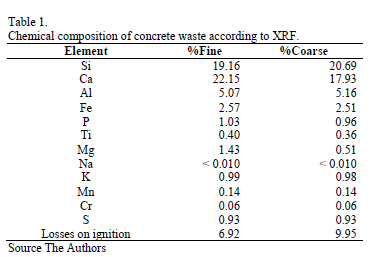
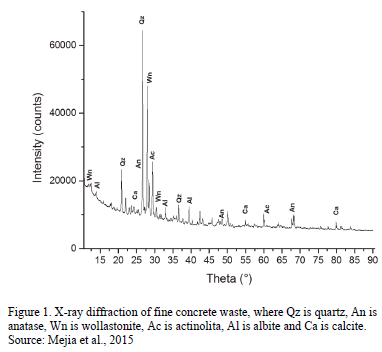
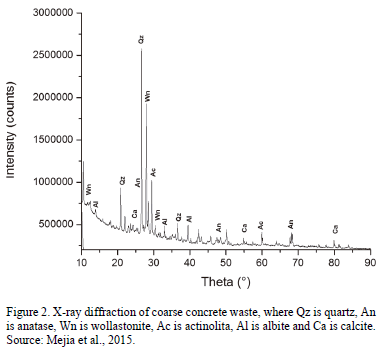
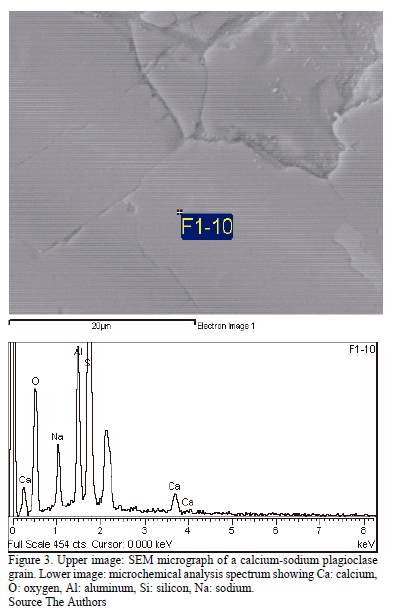
<body><![CDATA[<p>&nbsp;</p>     <p><font size="3" face="Verdana, Arial, Helvetica, sans-serif"><b>3. Results and discussion </b></font></p>     <p><font size="2" face="Verdana, Arial, Helvetica, sans-serif"><i>3.1.1 Initial chemical and  mineralogical characterization</i></font></p>     <p><font size="2" face="Verdana, Arial, Helvetica, sans-serif">XRF analysis  was performed to identify the elements present in the waste. The primary  elements found were silicon and calcium, with   aluminum and iron present to a lesser extent (<a href="#tab01">Table 1</a>). Additionally, traces of   the following elements were found: titanium, magnesium, sodium, potassium,  manganese, chromium, phosphorous, and sulfur.</font></p>     <p align="center"><font size="2" face="Verdana, Arial, Helvetica, sans-serif"><a name="tab01"></a></font><img src="/img/revistas/dyna/v83n199/v83n199a12tab01.gif"></p>     <p align="center"><font size="2" face="Verdana, Arial, Helvetica, sans-serif"><a name="fig01"></a></font><img src="/img/revistas/dyna/v83n199/v83n199a12fig01.gif"></p>     <p><font size="2" face="Verdana, Arial, Helvetica, sans-serif">XRD was used to confirm the mineral   phases associated with the waste of both particle sizes. The mineral phases   detected for the fine material were: quartz (SiO<sub>2</sub>), calcite (CaCO<sub>3</sub>),   albite and actinolite (Ca<sub>2</sub>(Mg,Fe<sup>2+</sup>)5Si<sub>8</sub>O<sub>22</sub>(OH)<sub>2</sub>)   (<a href="#fig02">Fig. 2</a>). The phases for the coarse material were: quartz, actinolite, albite,   and calcite (<a href="#fig02">Fig. 2</a>). It is important to note that the mineralogical phases   present in cement paste can be masked by the minerals previously mentioned,  which may be the components of concrete aggregates. </font></p>     <p align="center"><font size="2" face="Verdana, Arial, Helvetica, sans-serif"><a name="fig02" id="fig02"></a></font><img src="/img/revistas/dyna/v83n199/v83n199a12fig02.gif"></p>     <p><font size="2" face="Verdana, Arial, Helvetica, sans-serif">SEM   analysis and microchemical analysis confirmed the presence of minerals   including feldspars and silicates. <a href="#fig03">Fig. 3</a> shows sub-euhedral, rounded, and   elongated particles. The percentage in weight of the elements measured by EDS  was very similar to that of albite, calcite, quartz, and aluminosilicates. </font></p>     <p align="center"><font size="2" face="Verdana, Arial, Helvetica, sans-serif"><a name="fig03"></a></font><img src="/img/revistas/dyna/v83n199/v83n199a12fig03.gif"></p>     ]]></body>
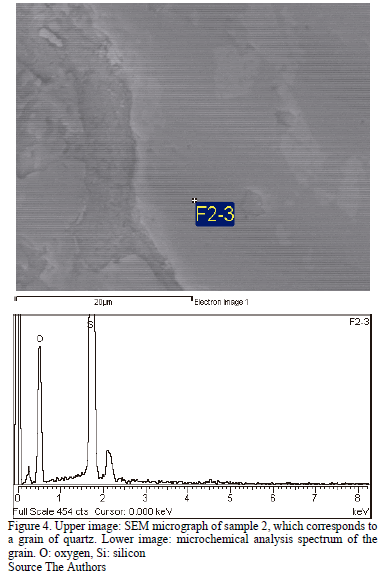
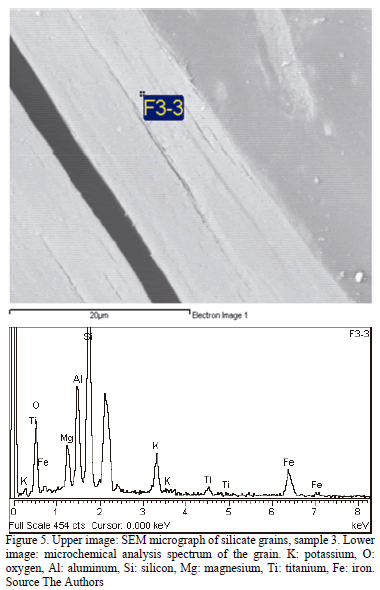
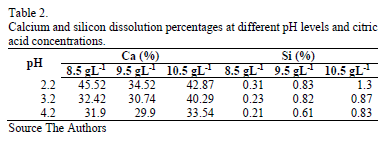
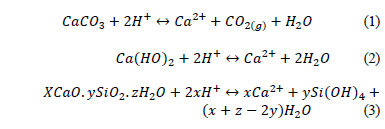
<body><![CDATA[<p><font size="2" face="Verdana, Arial, Helvetica, sans-serif">The quartz that was present was interspersed   with different minerals including calcium, sodium and magnesium  aluminosilicates (<a href="#fig04">Fig. 4</a>). </font></p>     <p align="center"><font size="2" face="Verdana, Arial, Helvetica, sans-serif"><a name="fig04"></a></font><img src="/img/revistas/dyna/v83n199/v83n199a12fig04.gif"></p>     <p><font size="2" face="Verdana, Arial, Helvetica, sans-serif"><a href="#fig05">Fig. 5</a> shows a grain of magnesium,   potassium, and iron silicate, which presents a fibrous tabular structure   typical of this type of mineral. The grains are intergrown with aluminosilicate  grains. </font></p>     <p align="center"><font size="2" face="Verdana, Arial, Helvetica, sans-serif"><a name="fig05"></a></font><img src="/img/revistas/dyna/v83n199/v83n199a12fig05.gif"></p>     <p><font size="2" face="Verdana, Arial, Helvetica, sans-serif">Through   chemical and mineralogical characterization of the waste, we were able to   determine the presence of elements that could potentially be used as nutrients   in degraded soils after being subjected to a structural destabilization   process. This is because they are found in minerals that have a very low or no   solubility in water. Reusing these elements would generate a recycling of   nutrients such as silicon and calcium, and, thus, they would contribute to   plant growth &#91;11,28&#93;. According to XRD, XRF and SEM   results, the CW samples presented a large percentage of quartz, which is a   chemically inert mineral that is useful for improving the physical properties   of soil, including texture, aeration, infiltration, and drainage &#91;11&#93;. Additionally, the presence of   calcite, wollastonite, and anatase was also observed. These minerals can   improve the chemical properties of soils such as their pH regulation. In this  case, the finest material presented the highest calcium content &#91;12&#93;.</font></p>     <p><font size="2" face="Verdana, Arial, Helvetica, sans-serif"><b><i>3.2. Effect of pH on dissolution with citric acid</i></b></font></p>     <p><font size="2" face="Verdana, Arial, Helvetica, sans-serif"><i>3.2.1. Exploratory tests</i></font></p>     <p><font size="2" face="Verdana, Arial, Helvetica, sans-serif">In order to evaluate the effect of   acidity on Ca and Si dissolution at different citric acid concentrations, the   dissolution of these elements was evaluated after 48 hours of processing. We   found that the greatest Ca and Si dissolution occurred with 10.5 gL<sup>-1</sup> of citric acid and a pH of 2.2 (<a href="#tab02">Table 2</a>). This coincides with other authors'   findings &#91;24&#93;, who discovered   that citric acid hydrolysis permits the dissociation and complexation of Ca<sup>2+</sup>.   The dissolved Ca<sup>2+ </sup>probably came from carbonates and portlandite,   which are the most soluble minerals. From a lesser extent it also came from   hydrated calcium silicates, which are low solubility minerals. Ca<sup>2+</sup> dissolution produces concrete decalcification and the formation of calcium salt   (Equations 1 and 2) &#91;18,24,29&#93;.   Meanwhile, &#91;30-34&#93; found   that when concrete was subjected to attacks by different organic acids, the   effect was accelerated at a lower pH. Moreover, the release of silicon   indicated that calcium silicate dissolution took place in addition to   portlandite and calcite dissolution; this occurred as shown in Equation 1-3 &#91;29&#93;.   However, some authors have found that after a partial dissolution process, a   silica gel forms, which limits the release of silicon and calcium &#91;29,32,33&#93;.   Using this test, we were able to determine that the working pH to improve Ca  and Si release was 2.2; this condition was used thereafter. </font></p>     <p><img src="/img/revistas/dyna/v83n199/v83n199a12eq0103.gif"></p>     <p align="center"><font size="2" face="Verdana, Arial, Helvetica, sans-serif"><a name="tab02"></a></font><img src="/img/revistas/dyna/v83n199/v83n199a12tab02.gif"></p>     ]]></body>
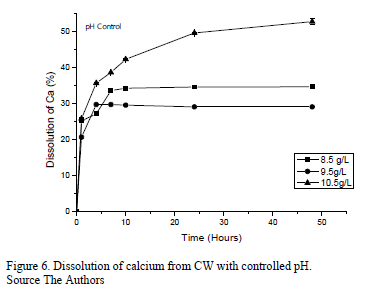
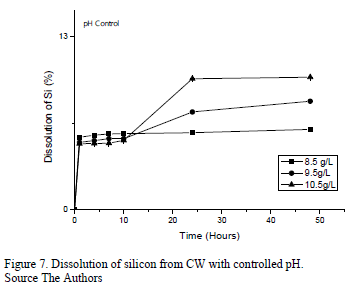
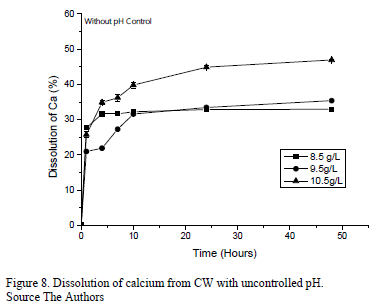
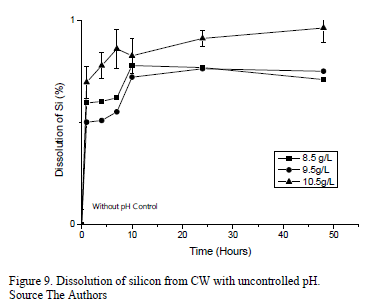
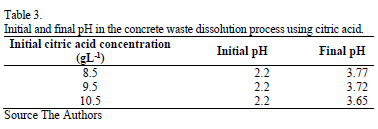
<body><![CDATA[<p><font size="2" face="Verdana, Arial, Helvetica, sans-serif"><i>3.2.2. With pH regulation</i></font></p>     <p><font size="2" face="Verdana, Arial, Helvetica, sans-serif">In order to evaluate the effect of the   citric acid concentration, an experiment was conducted in which the acidity of   the solution was regulated. The dissolution kinetic of Ca over time at   different citric acid concentrations was similar for a short period of time   (seven hours), during which the dissolution velocity was high. After 10 hours,   the velocity tended towards zero; this effect was more marked for the lowest   citric acid concentrations (<a href="#fig07">Fig. 7</a>). Additionally, the curve forms were typical   of passivation processes. This could indicate the formation of a precipitate on   the waste particles, thus generating a barrier between the citric acid and the waste   particles. Ca<sup>2+</sup> dissolution was greater at a higher acid   concentration (10.5 gL<sup>-1</sup>) (<a href="#fig06">Fig. 6</a>). In the case of silicon,   dissolution was lower than 10% and release occurred rapidly during the initial   hours of the process (Fig. 7). Calcium release could have been inhibited by the   formation of calcium citrate (Ca<sub>3</sub>(C<sub>6</sub>H<sub>5</sub>O<sub>7</sub>)<sub>2</sub>·4H<sub>2</sub>O);   however, this compound is moderately soluble in water (0.096 g for each 100 mL   at 23 °C), and the concentration of Ca<sub>3</sub>(C<sub>6</sub>H<sub>5</sub>O<sub>7</sub>)<sub>2</sub>·4H<sub>2</sub>O   that formed was lower than 0.05 g per 100 mL. Thus, it appears that the process   was not inhibited by the formation of calcium citrate. Meanwhile, as previously   noted, some authors have found that the formation of a silica gel can limit   concrete dissolution, impeding calcium and silicon release. The formation of  this gel is, thus, thought to have limited the process &#91;30&#93;.</font></p>     <p align="center"><font size="2" face="Verdana, Arial, Helvetica, sans-serif"><a name="fig06"></a></font><img src="/img/revistas/dyna/v83n199/v83n199a12fig06.gif"></p>     <p align="center"><font size="2" face="Verdana, Arial, Helvetica, sans-serif"><a name="fig07"></a></font><img src="/img/revistas/dyna/v83n199/v83n199a12fig07.gif"></p>     <p><font size="2" face="Verdana, Arial, Helvetica, sans-serif"><i>3.2.2. Without pH regulation</i></font></p>     <p><font size="2" face="Verdana, Arial, Helvetica, sans-serif">In order to determine the effect of pH on   calcium and silicon dissolution at different citric acid concentrations, this   parameter was left to evolve over the course of the process. The dissolution   behavior of calcium and silicon was very similar to that generated when pH was   controlled, except that the dissolution percentages were lower (<a href="#fig08">Figs. 8</a> and <a href="#fig09">9</a>).   Meanwhile, proton consumption was observed that was caused by the increase in   pH during the process, which rose from 2.2 to 3.7 in all cases (<a href="#tab03">Table 3</a>). This   could be due to the dissolution reactions of the calcium carbonate and the  calcium aluminosilicates. </font></p>     <p align="center"><font size="2" face="Verdana, Arial, Helvetica, sans-serif"><a name="fig08"></a></font><img src="/img/revistas/dyna/v83n199/v83n199a12fig08.gif"></p>     <p align="center"><font size="2" face="Verdana, Arial, Helvetica, sans-serif"><a name="fig09"></a></font><img src="/img/revistas/dyna/v83n199/v83n199a12fig09.gif"></p>     <p align="center"><font size="2" face="Verdana, Arial, Helvetica, sans-serif"><a name="tab03"></a></font><img src="/img/revistas/dyna/v83n199/v83n199a12tab03.gif"></p>     <p><font size="2" face="Verdana, Arial, Helvetica, sans-serif"><b><i>3.3. Final chemical and mineralogical characterization</i></b></font></p>     ]]></body>
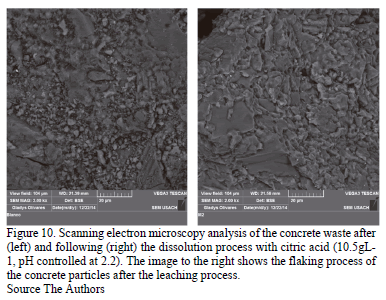
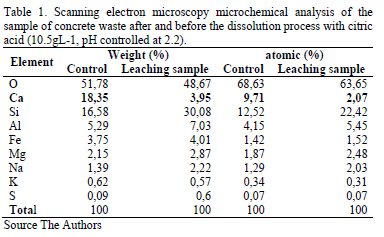
<body><![CDATA[<p><font size="2" face="Verdana, Arial, Helvetica, sans-serif">By   conducting SEM analysis and microchemical analysis after completing the process   with citric acid, we were able to identify alterations in the concrete waste   particles (<a href="#fig10">Fig. 10</a>). We observed calcium silicate hydrate grains with evidence   of flaking caused by dissolution. Moreover, microchemical analysis of the   sample of concrete waste with citric acid (10.5gL-1, pH controlled at 2.2)   showed that the calcium concentration was lower after dissolution process   (<a href="#tab011">Table 1</a>). This indicates the decalcification of calcium silicate hydrate.   These results coincide with other authors findings who have explained the   calcium silicate hydrate leaching was a result of the decalcification process,  and silica gel precipitates over the grain &#91;17, 19, 24, 29, 32&#93;</font></p>     <p align="center"><font size="2" face="Verdana, Arial, Helvetica, sans-serif"><a name="fig10"></a></font><img src="/img/revistas/dyna/v83n199/v83n199a12fig10.gif"></p>     <p align="center"><font size="2" face="Verdana, Arial, Helvetica, sans-serif"><a name="tab011" id="tab011"></a></font><img src="/img/revistas/dyna/v83n199/v83n199a12tab011.gif"></p>     <p>&nbsp;</p>     <p><font size="3" face="Verdana, Arial, Helvetica, sans-serif"><b>4. Conclusions</b></font></p>     <p><font size="2" face="Verdana, Arial, Helvetica, sans-serif">CW has the potential to be used as a  source of Ca and Si, after undergoing an acidulation process with citric acid.  It could be used to provide nutrients for plants in nutrient-deficient  soils since; in addition to containing  minerals such as calcite, portlandite, and CSH, it can also release Ca and Si  in solution after undergoing a dissolution process with citric acid.</font></p>     <p><font size="2" face="Verdana, Arial, Helvetica, sans-serif">The minerals identified are present as   primary or secondary minerals in the clayey fraction of the soil; therefore,  they would not drastically affect the chemical composition of the soil. </font></p>     <p><font size="2" face="Verdana, Arial, Helvetica, sans-serif">By performing dissolution tests with   citric acid, we were able to observe calcium silicate hydrate dissolution; this  was evidenced by the concentration of silicon in solution. </font></p>     <p><font size="2" face="Verdana, Arial, Helvetica, sans-serif">The best dissolution conditions for   calcium and silicon occurred at 10.5 gL-1 of citric acid and had a pH of 2.2,  with a controlled pH. </font></p>     <p><font size="2" face="Verdana, Arial, Helvetica, sans-serif">The SEM characterization allowed us to  find an agglomeration of grains and corrosion evidence on the CSH grains.</font></p>     ]]></body>
<body><![CDATA[<p>&nbsp;</p>     <p><font size="3" face="Verdana, Arial, Helvetica, sans-serif"><b>Acknowledgments</b></font></p>     <p><font size="2" face="Verdana, Arial, Helvetica, sans-serif">The authors are grateful for the   financial support provided by the Universidad de San Buenaventura, the   Universidad de Santiago de Chile, and the Universidad Nacional de Colombia in   Medell&iacute;n, and also for the technical support that was essential to complete   this study. Finally, the authors would like to thank the Colciencias National  Doctorate Program, project 567.</font></p>     <p>&nbsp;</p>     <p><font size="3" face="Verdana, Arial, Helvetica, sans-serif"><b>References</b></font></p>     <!-- ref --><p><font size="2" face="Verdana, Arial, Helvetica, sans-serif"><b>&#91;1&#93;</b> F. Rodrigues, M. T. Carvalho, L. Evangelista, and J. De Brito, &quot;Physical-chemical   and mineralogical characterization of fine aggregates from construction and   demolition waste recycling plants,&quot; J.   Clean. Prod., vol. 52, pp. 438-445, 2013. DOI:  10.1016/j.jclepro.2013.02.023</font>&nbsp;&nbsp;&nbsp;&nbsp;&nbsp;&nbsp;&nbsp;&nbsp;[&#160;<a href="javascript:void(0);" onclick="javascript: window.open('/scielo.php?script=sci_nlinks&ref=1150341&pid=S0012-7353201600050001200001&lng=','','width=640,height=500,resizable=yes,scrollbars=1,menubar=yes,');">Links</a>&#160;]<!-- end-ref --><!-- ref --><p><font size="2" face="Verdana, Arial, Helvetica, sans-serif"><b>&#91;2&#93;</b> M. V. Madurwar, R. V. Ralegaonkar, and S. a. Mandavgane,   &quot;Application of agro-waste for sustainable construction materials: A review,&quot; Constr. Build. Mater., vol. 38, pp.  872-878, 2013. DOI: 10.1016/j.conbuildmat.2012.09.011</font>&nbsp;&nbsp;&nbsp;&nbsp;&nbsp;&nbsp;&nbsp;&nbsp;[&#160;<a href="javascript:void(0);" onclick="javascript: window.open('/scielo.php?script=sci_nlinks&ref=1150342&pid=S0012-7353201600050001200002&lng=','','width=640,height=500,resizable=yes,scrollbars=1,menubar=yes,');">Links</a>&#160;]<!-- end-ref --><!-- ref --><p><font size="2" face="Verdana, Arial, Helvetica, sans-serif"><b>&#91;3&#93;</b> K. Rahal, &quot;Mechanical properties of concrete with recycled coarse   aggregate,&quot; Build. Environ.,  vol. 42, no. 1, pp. 407-415, 2007. DOI: 10.1016/j.buildenv.2005.07.033</font>&nbsp;&nbsp;&nbsp;&nbsp;&nbsp;&nbsp;&nbsp;&nbsp;[&#160;<a href="javascript:void(0);" onclick="javascript: window.open('/scielo.php?script=sci_nlinks&ref=1150343&pid=S0012-7353201600050001200003&lng=','','width=640,height=500,resizable=yes,scrollbars=1,menubar=yes,');">Links</a>&#160;]<!-- end-ref --><!-- ref --><p><font size="2" face="Verdana, Arial, Helvetica, sans-serif"><b>&#91;4&#93;</b> S. C. Angulo, C. Ulsen, V. M. John, H. Kahn, and M. a. Cincotto,   &quot;Chemical-mineralogical characterization of C&amp;D waste recycled aggregates   from Sao Paulo, Brazil,&quot; Waste Manag.,  vol. 29, no. 2, pp. 721-730, 2009. Doi: 10.1016/j.cemconcomp.2007.02.002.    &nbsp;&nbsp;&nbsp;&nbsp;&nbsp;&nbsp;&nbsp;&nbsp;[&#160;<a href="javascript:void(0);" onclick="javascript: window.open('/scielo.php?script=sci_nlinks&ref=1150344&pid=S0012-7353201600050001200004&lng=','','width=640,height=500,resizable=yes,scrollbars=1,menubar=yes,');">Links</a>&#160;]<!-- end-ref --></font></p>     ]]></body>
<body><![CDATA[<!-- ref --><p><font size="2" face="Verdana, Arial, Helvetica, sans-serif"><b>&#91;5&#93;</b> M. C. Limbachiya, E. Marrocchino, and a. Koulouris, &quot;Chemical-mineralogical   characterisation of coarse recycled concrete aggregate,&quot; Waste Manag., vol. 27, no. 2, pp.  201-208, 2007. Doi: doi.org/10.1016/j.wasman.2006.01.005.    &nbsp;&nbsp;&nbsp;&nbsp;&nbsp;&nbsp;&nbsp;&nbsp;[&#160;<a href="javascript:void(0);" onclick="javascript: window.open('/scielo.php?script=sci_nlinks&ref=1150346&pid=S0012-7353201600050001200005&lng=','','width=640,height=500,resizable=yes,scrollbars=1,menubar=yes,');">Links</a>&#160;]<!-- end-ref --></font></p>     <!-- ref --><p><font size="2" face="Verdana, Arial, Helvetica, sans-serif"><b>&#91;6&#93;</b> C. Ulsen, H. Kahn, S. C. Angulo, and V. M. John, &quot;Applied Mineralogy   Characterization of Construction and Demolition Waste from Brazilian Recycling  Plants,&quot; Chem. Anal., 2003.    &nbsp;&nbsp;&nbsp;&nbsp;&nbsp;&nbsp;&nbsp;&nbsp;[&#160;<a href="javascript:void(0);" onclick="javascript: window.open('/scielo.php?script=sci_nlinks&ref=1150348&pid=S0012-7353201600050001200006&lng=','','width=640,height=500,resizable=yes,scrollbars=1,menubar=yes,');">Links</a>&#160;]<!-- end-ref --> </font></p>     <!-- ref --><p><font size="2" face="Verdana, Arial, Helvetica, sans-serif"><b>&#91;7&#93;</b> K. McNeil and T. H.-K. Kang, &quot;Recycled Concrete Aggregates: A   Review,&quot; Int. J. Concr. Struct. Mater.,  vol. 7, no. 1, pp. 61-69, 2013. DOI: 10.1007/s40069-013-0032-5</font>&nbsp;&nbsp;&nbsp;&nbsp;&nbsp;&nbsp;&nbsp;&nbsp;[&#160;<a href="javascript:void(0);" onclick="javascript: window.open('/scielo.php?script=sci_nlinks&ref=1150350&pid=S0012-7353201600050001200007&lng=','','width=640,height=500,resizable=yes,scrollbars=1,menubar=yes,');">Links</a>&#160;]<!-- end-ref --><!-- ref --><p><font size="2" face="Verdana, Arial, Helvetica, sans-serif"><b>&#91;8&#93;</b> C. Ulsen, H. Kahn, G. Hawlitschek, E. a. Masini, S. C. Angulo, and   V. M. John, &quot;Production of recycled sand from construction and demolition   waste,&quot; Constr. Build. Mater.,  vol. 40, pp. 1168-1173, 2012. DOI: dx.doi.org/10.1016/j.conbuildmat.2012.02.004</font>&nbsp;&nbsp;&nbsp;&nbsp;&nbsp;&nbsp;&nbsp;&nbsp;[&#160;<a href="javascript:void(0);" onclick="javascript: window.open('/scielo.php?script=sci_nlinks&ref=1150351&pid=S0012-7353201600050001200008&lng=','','width=640,height=500,resizable=yes,scrollbars=1,menubar=yes,');">Links</a>&#160;]<!-- end-ref --><!-- ref --><p><font size="2" face="Verdana, Arial, Helvetica, sans-serif"><b>&#91;9&#93;</b> M. Wahlström, J. Laine-Ylijoki, a. Määttänen, T. Luotojärvi, and L. Kivekäs, &quot;Environmental quality   assurance system for use of crushed mineral demolition wastes in earth   constructions,&quot; Stud. Environ. Sci.,  vol. 71, no. C, pp. 725-734, 1997. DOI: doi.org/10.1016/S0956-053X(99)00319-0</font>&nbsp;&nbsp;&nbsp;&nbsp;&nbsp;&nbsp;&nbsp;&nbsp;[&#160;<a href="javascript:void(0);" onclick="javascript: window.open('/scielo.php?script=sci_nlinks&ref=1150352&pid=S0012-7353201600050001200009&lng=','','width=640,height=500,resizable=yes,scrollbars=1,menubar=yes,');">Links</a>&#160;]<!-- end-ref --><!-- ref --><p><font size="2" face="Verdana, Arial, Helvetica, sans-serif"><b>&#91;10&#93;</b> M. Weil, U. Jeske, and L. Schebek, &quot;Closed-loop recycling of   construction and demolition waste in Germany in view of stricter environmental   threshold values.,&quot; Waste Manag. Res., vol. 24, no. 3, pp. 197-206, 2006. DOI:  10.1177/0734242X06063686</font>&nbsp;&nbsp;&nbsp;&nbsp;&nbsp;&nbsp;&nbsp;&nbsp;[&#160;<a href="javascript:void(0);" onclick="javascript: window.open('/scielo.php?script=sci_nlinks&ref=1150353&pid=S0012-7353201600050001200010&lng=','','width=640,height=500,resizable=yes,scrollbars=1,menubar=yes,');">Links</a>&#160;]<!-- end-ref --><!-- ref --><p><font size="2" face="Verdana, Arial, Helvetica, sans-serif"><b>&#91;11&#93;</b> E. C. G. Dos Santos, &quot;Aplicação de res&iacute;duos de   construção e demolição reciclados (RCD-R) em estruturas de solo reforçado.   Dissertação,&quot; Dissertação,  2007. DOI: 10.11606/D.18.2007.tde-10042007-110106</font>&nbsp;&nbsp;&nbsp;&nbsp;&nbsp;&nbsp;&nbsp;&nbsp;[&#160;<a href="javascript:void(0);" onclick="javascript: window.open('/scielo.php?script=sci_nlinks&ref=1150354&pid=S0012-7353201600050001200011&lng=','','width=640,height=500,resizable=yes,scrollbars=1,menubar=yes,');">Links</a>&#160;]<!-- end-ref --><!-- ref --><p><font size="2" face="Verdana, Arial, Helvetica, sans-serif"><b>&#91;12&#93;</b> P. Renato, O. Lasso, C. Manoel, P. Vaz, A.   Carlos, and D. C. Bernardi, &quot;CARACTERIZAÇÃO DE RES&Iacute;DUOS DE CONSTRUÇÃO E   DEMOLIÇÃO RECICLADOS ( RCD-R ) PARA UTILIZAÇÃO COMO CORRETIVO DA ACIDEZ   CHARACTERIZATION OF RECYCLED CONSTRUCTION AND DEMOLITION RESIDUES ( RCD-R ) FOR  USE AS SOIL ACIDITY CORRECTIVE,&quot; 2013.    &nbsp;&nbsp;&nbsp;&nbsp;&nbsp;&nbsp;&nbsp;&nbsp;[&#160;<a href="javascript:void(0);" onclick="javascript: window.open('/scielo.php?script=sci_nlinks&ref=1150355&pid=S0012-7353201600050001200012&lng=','','width=640,height=500,resizable=yes,scrollbars=1,menubar=yes,');">Links</a>&#160;]<!-- end-ref --></font></p>     <!-- ref --><p><font size="2" face="Verdana, Arial, Helvetica, sans-serif"><b>&#91;13&#93;</b> F. Pacheco-Torgal and J. a. Labrincha, &quot;The future of construction   materials research and the seventh un Millennium Development Goal: A few   insights,&quot; Constr. Build. Mater.,  vol. 40, pp. 729-737, 2013. DOI: dx.doi.org/10.1016/j.conbuildmat.2012.11.007</font>&nbsp;&nbsp;&nbsp;&nbsp;&nbsp;&nbsp;&nbsp;&nbsp;[&#160;<a href="javascript:void(0);" onclick="javascript: window.open('/scielo.php?script=sci_nlinks&ref=1150357&pid=S0012-7353201600050001200013&lng=','','width=640,height=500,resizable=yes,scrollbars=1,menubar=yes,');">Links</a>&#160;]<!-- end-ref --><!-- ref --><p><font size="2" face="Verdana, Arial, Helvetica, sans-serif"><b>&#91;14&#93;</b> D. Mottershead, A. Gorbushina, G. Lucas, and J. Wright, &quot;The   influence of marine salts, aspect and microbes in the weathering of sandstone   in two historic structures,&quot; Build.   Environ., vol. 38, no. 9-10, pp. 1193-1204, 2003. DOI:  dx.doi.org/10.1016/S0360-1323(03)00071-4</font>&nbsp;&nbsp;&nbsp;&nbsp;&nbsp;&nbsp;&nbsp;&nbsp;[&#160;<a href="javascript:void(0);" onclick="javascript: window.open('/scielo.php?script=sci_nlinks&ref=1150358&pid=S0012-7353201600050001200014&lng=','','width=640,height=500,resizable=yes,scrollbars=1,menubar=yes,');">Links</a>&#160;]<!-- end-ref --><!-- ref --><p><font size="2" face="Verdana, Arial, Helvetica, sans-serif"><b>&#91;15&#93;</b> S. a Shinkafi, I. Haruna, S.A.Shinkafi, and I.Haruna,   &quot;Microorganisms associated with deteriorated desurface painted concrete   buildings within Sokoto, Nigeria,&quot; Int.  J. Curr. Microbiol. Appl. Sci., vol. 2, no. 10, pp. 314-324, 2013.    &nbsp;&nbsp;&nbsp;&nbsp;&nbsp;&nbsp;&nbsp;&nbsp;[&#160;<a href="javascript:void(0);" onclick="javascript: window.open('/scielo.php?script=sci_nlinks&ref=1150359&pid=S0012-7353201600050001200015&lng=','','width=640,height=500,resizable=yes,scrollbars=1,menubar=yes,');">Links</a>&#160;]<!-- end-ref --></font></p>     <!-- ref --><p><font size="2" face="Verdana, Arial, Helvetica, sans-serif"><b>&#91;16&#93;</b> J. D. Gu, T. E. Ford, N. S. Berke, and R. Mitchell,   &quot;Biodeterioration of concrete by the fungus Fusarium,&quot; Int. Biodeterior. Biodegrad., vol. 41, no. 2, pp. 101-109, 1998.     doi: 10.1016/S0964-8305(98)00034-1</font>&nbsp;&nbsp;&nbsp;&nbsp;&nbsp;&nbsp;&nbsp;&nbsp;[&#160;<a href="javascript:void(0);" onclick="javascript: window.open('/scielo.php?script=sci_nlinks&ref=1150361&pid=S0012-7353201600050001200016&lng=','','width=640,height=500,resizable=yes,scrollbars=1,menubar=yes,');">Links</a>&#160;]<!-- end-ref --><!-- ref --><p><font size="2" face="Verdana, Arial, Helvetica, sans-serif"><b>&#91;17&#93;</b> T. Verdier, M. Coutand, A. Bertron, and C. Roques, &quot;A review of   indoor microbial growth across building materials and sampling and analysis  methods,&quot; <i>Build. Environ.</i>, vol. 80, pp. 136-149, 2014. DOI: dx.doi.org/10.1016/j.buildenv.2014.05.030</font>&nbsp;&nbsp;&nbsp;&nbsp;&nbsp;&nbsp;&nbsp;&nbsp;[&#160;<a href="javascript:void(0);" onclick="javascript: window.open('/scielo.php?script=sci_nlinks&ref=1150362&pid=S0012-7353201600050001200017&lng=','','width=640,height=500,resizable=yes,scrollbars=1,menubar=yes,');">Links</a>&#160;]<!-- end-ref --><!-- ref --><p><font size="2" face="Verdana, Arial, Helvetica, sans-serif"><b>&#91;18&#93;</b> L. G. Sequeda-Casta&ntilde;eda, A. E. Ortiz-Ardila, J. P. Correa-Cuadros,   and C. L&oacute;pez-P&eacute;rez, &quot;Chemical and microbiological comparison of  biodeterioration in colombian heritage constructions,&quot; Univ. Sci., vol. 18, no. 1, pp. 51-63, 2013. DOI: <a href="http://dx.doi.org/10.1016/j.jclepro.2013.02.023" target="_blank">http://dx.doi.org/10.1016/j.jclepro.2013.02.023</a></font>&nbsp;&nbsp;&nbsp;&nbsp;&nbsp;&nbsp;&nbsp;&nbsp;[&#160;<a href="javascript:void(0);" onclick="javascript: window.open('/scielo.php?script=sci_nlinks&ref=1150363&pid=S0012-7353201600050001200018&lng=','','width=640,height=500,resizable=yes,scrollbars=1,menubar=yes,');">Links</a>&#160;]<!-- end-ref --><!-- ref --><p><font size="2" face="Verdana, Arial, Helvetica, sans-serif"><b>&#91;19&#93;</b> B. Cwalina, &quot;Biodeterioration of Concrete,&quot; J. Archit. Civ. Eng. Environ., no. 4, pp. 133-140, 2008.    &nbsp;&nbsp;&nbsp;&nbsp;&nbsp;&nbsp;&nbsp;&nbsp;[&#160;<a href="javascript:void(0);" onclick="javascript: window.open('/scielo.php?script=sci_nlinks&ref=1150364&pid=S0012-7353201600050001200019&lng=','','width=640,height=500,resizable=yes,scrollbars=1,menubar=yes,');">Links</a>&#160;]<!-- end-ref --></font></p>     ]]></body>
<body><![CDATA[<!-- ref --><p><font size="2" face="Verdana, Arial, Helvetica, sans-serif"><b>&#91;20&#93;</b> M. L. Coutinho, A. Z. Miller, and M. F. Macedo, &quot;Biological   colonization and biodeterioration of architectural ceramic materials: An   overview,&quot; J. Cult. Herit.,  2015. DOI: <a href="http://dx.doi.org/10.1016/j.culher.2015.01.006" target="_blank">http://dx.doi.org/10.1016/j.culher.2015.01.006</a></font>&nbsp;&nbsp;&nbsp;&nbsp;&nbsp;&nbsp;&nbsp;&nbsp;[&#160;<a href="javascript:void(0);" onclick="javascript: window.open('/scielo.php?script=sci_nlinks&ref=1150366&pid=S0012-7353201600050001200020&lng=','','width=640,height=500,resizable=yes,scrollbars=1,menubar=yes,');">Links</a>&#160;]<!-- end-ref --><!-- ref --><p><font size="2" face="Verdana, Arial, Helvetica, sans-serif"><b>&#91;21&#93;</b> A. Bertron, &quot;Understanding interactions between cementitious   materials and microorganisms: a key to sustainable and safe concrete structures   in various contexts,&quot; Mater. Struct.,  pp. 1787-1806, 2014. DOI: 10.1617/s11527-014-0433-1</font>&nbsp;&nbsp;&nbsp;&nbsp;&nbsp;&nbsp;&nbsp;&nbsp;[&#160;<a href="javascript:void(0);" onclick="javascript: window.open('/scielo.php?script=sci_nlinks&ref=1150367&pid=S0012-7353201600050001200021&lng=','','width=640,height=500,resizable=yes,scrollbars=1,menubar=yes,');">Links</a>&#160;]<!-- end-ref --><!-- ref --><p><font size="2" face="Verdana, Arial, Helvetica, sans-serif"><b>&#91;22&#93;</b> Wei, S., M. Sanchez, D. Trejo, and C. Gillis, &quot;Microbial mediated   deterioration of reinforced concrete structures,&quot; Int. Biodeterior. Biodegrad., vol. 64, no. 8, pp. 748-754, 2010.  DOI: dx.doi.org/10.1016/j.ibiod.2010.09.001</font>&nbsp;&nbsp;&nbsp;&nbsp;&nbsp;&nbsp;&nbsp;&nbsp;[&#160;<a href="javascript:void(0);" onclick="javascript: window.open('/scielo.php?script=sci_nlinks&ref=1150368&pid=S0012-7353201600050001200022&lng=','','width=640,height=500,resizable=yes,scrollbars=1,menubar=yes,');">Links</a>&#160;]<!-- end-ref --><!-- ref --><p><font size="2" face="Verdana, Arial, Helvetica, sans-serif"><b>&#91;23&#93;</b> D. Nica, J. L. Davis, L. Kirby, G. Zuo, and D. J. Roberts,   &quot;Isolation and characterization of microorganisms involved in the   biodeterioration of concrete in sewers,&quot; Int.   Biodeterior. Biodegrad., vol. 46, no. 1, pp. 61-68, 2000. DOI:  dx.doi.org/10.1016/S0964-8305(00)00064-0</font>&nbsp;&nbsp;&nbsp;&nbsp;&nbsp;&nbsp;&nbsp;&nbsp;[&#160;<a href="javascript:void(0);" onclick="javascript: window.open('/scielo.php?script=sci_nlinks&ref=1150369&pid=S0012-7353201600050001200023&lng=','','width=640,height=500,resizable=yes,scrollbars=1,menubar=yes,');">Links</a>&#160;]<!-- end-ref --><!-- ref --><p><font size="2" face="Verdana, Arial, Helvetica, sans-serif"><b>&#91;24&#93;</b> S. Larreur-Cayol, a. Bertron,   and G. Escadeillas, &quot;Degradation of cement-based materials by various organic   acids in agro-industrial waste-waters,&quot; Cem.   Concr. Res., vol. 41, no. 8, pp. 882-892, 2011. DOI:  dx.doi.org/10.1016/j.cemconres.2011.04.007</font>&nbsp;&nbsp;&nbsp;&nbsp;&nbsp;&nbsp;&nbsp;&nbsp;[&#160;<a href="javascript:void(0);" onclick="javascript: window.open('/scielo.php?script=sci_nlinks&ref=1150370&pid=S0012-7353201600050001200024&lng=','','width=640,height=500,resizable=yes,scrollbars=1,menubar=yes,');">Links</a>&#160;]<!-- end-ref --><!-- ref --><p><font size="2" face="Verdana, Arial, Helvetica, sans-serif"><b>&#91;25&#93;</b> E. Hoffland, T. W. Kuyper, H. Wallander, C. Plassard, A. a.   Gorbushina, K. Haselwandter, S. Holmström, R. Landeweert, U. S. Lundström, A.   Rosling, R. Sen, M. M. Smits, P. A. van Hees, and N. van Breemen, &quot;The role of   fungi in weathering,&quot; Front. Ecol.   Environ., vol. 2, no. 5, pp. 258-264, 2004. DOI:  10.1890/1540-9295(2004)002&#91;0258:TROFIW&#93;2.0.CO;2</font>&nbsp;&nbsp;&nbsp;&nbsp;&nbsp;&nbsp;&nbsp;&nbsp;[&#160;<a href="javascript:void(0);" onclick="javascript: window.open('/scielo.php?script=sci_nlinks&ref=1150371&pid=S0012-7353201600050001200025&lng=','','width=640,height=500,resizable=yes,scrollbars=1,menubar=yes,');">Links</a>&#160;]<!-- end-ref --><!-- ref --><p><font size="2" face="Verdana, Arial, Helvetica, sans-serif"><b>&#91;26&#93;</b> A. Rosling, T. Roose, A. M. Herrmann, F. a. Davidson, R. D. Finlay,   and G. M. Gadd, &quot;Approaches to modelling mineral weathering by fungi,&quot; Fungal Biol. Rev., vol. 23, no. 4,  pp. 138-144, 2009. DOI: dx.doi.org/10.1016/j.fbr.2009.09.003</font>&nbsp;&nbsp;&nbsp;&nbsp;&nbsp;&nbsp;&nbsp;&nbsp;[&#160;<a href="javascript:void(0);" onclick="javascript: window.open('/scielo.php?script=sci_nlinks&ref=1150372&pid=S0012-7353201600050001200026&lng=','','width=640,height=500,resizable=yes,scrollbars=1,menubar=yes,');">Links</a>&#160;]<!-- end-ref --><!-- ref --><p><font size="2" face="Verdana, Arial, Helvetica, sans-serif"><b>&#91;27&#93;</b> S. Wei, Z. Jiang, H. Liu, D. Zhou, and M. Sanchez-Silva,   &quot;Microbiologically induced deterioration of concrete - A review,&quot; Brazilian J. Microbiol., vol. 44, no.   4, pp. 1001-1007, 2013. DOI:  10.1590/S1517-83822014005000006</font>&nbsp;&nbsp;&nbsp;&nbsp;&nbsp;&nbsp;&nbsp;&nbsp;[&#160;<a href="javascript:void(0);" onclick="javascript: window.open('/scielo.php?script=sci_nlinks&ref=1150373&pid=S0012-7353201600050001200027&lng=','','width=640,height=500,resizable=yes,scrollbars=1,menubar=yes,');">Links</a>&#160;]<!-- end-ref --><!-- ref --><p><font size="2" face="Verdana, Arial, Helvetica, sans-serif"><b>&#91;28&#93;</b> D. de Santos Mari&aacute;n, B. Monercillo Delgado, A.   Garc&iacute;a Mart&iacute;nez, and F. L. D. La Construcci&oacute;n, &quot;Gesti&oacute;n de residuos en las  obras de construcci&oacute;n y demolici&oacute;n,&quot; vol. 2<sup>a</sup>, p. 193, 2011. DOI: dx.doi.org/10.1016/j.jclepro.2013.02.023</font>&nbsp;&nbsp;&nbsp;&nbsp;&nbsp;&nbsp;&nbsp;&nbsp;[&#160;<a href="javascript:void(0);" onclick="javascript: window.open('/scielo.php?script=sci_nlinks&ref=1150374&pid=S0012-7353201600050001200028&lng=','','width=640,height=500,resizable=yes,scrollbars=1,menubar=yes,');">Links</a>&#160;]<!-- end-ref --><!-- ref --><p><font size="2" face="Verdana, Arial, Helvetica, sans-serif"><b>&#91;29&#93;</b> M. P. Lavigne, A. Bertron, C. Botanch, L. Auer, G. Hernandez-Raquet,   A. Cockx, J. N. Foussard, G. Escadeillas, and E. Paul, &quot;Innovative approach to   simulating the biodeterioration of industrial cementitious products in sewer   environment. Part II: Validation on CAC and BFSC linings,&quot; Cem. Concr. Res., vol. 79, no. March,  pp. 409-418, 2016. DOI: dx.doi.org/10.1016/j.cemconres.2015.10.002</font>&nbsp;&nbsp;&nbsp;&nbsp;&nbsp;&nbsp;&nbsp;&nbsp;[&#160;<a href="javascript:void(0);" onclick="javascript: window.open('/scielo.php?script=sci_nlinks&ref=1150375&pid=S0012-7353201600050001200029&lng=','','width=640,height=500,resizable=yes,scrollbars=1,menubar=yes,');">Links</a>&#160;]<!-- end-ref --><!-- ref --><p><font size="2" face="Verdana, Arial, Helvetica, sans-serif"><b>&#91;30&#93;</b> A. Bertron, G. Escadeillas,   and J. Duchesne, &quot;Cement pastes alteration by liquid manure organic acids:   Chemical and mineralogical characterization,&quot; Cem. Concr. Res., vol. 34, no. 10, pp. 1823-1835, 2004. DOI:  dx.doi.org/10.1016/j.cemconres.2004.01.002</font>&nbsp;&nbsp;&nbsp;&nbsp;&nbsp;&nbsp;&nbsp;&nbsp;[&#160;<a href="javascript:void(0);" onclick="javascript: window.open('/scielo.php?script=sci_nlinks&ref=1150376&pid=S0012-7353201600050001200030&lng=','','width=640,height=500,resizable=yes,scrollbars=1,menubar=yes,');">Links</a>&#160;]<!-- end-ref --><!-- ref --><p><font size="2" face="Verdana, Arial, Helvetica, sans-serif"><b>&#91;31&#93;</b> a. Bertron, J. Duchesne, and G. Escadeillas, &quot;Degradation of cement   pastes by organic acids,&quot; Mater.   Struct., vol. 40, no. 3, pp. 341-354, 2007. DOI:  10.1617/s11527-006-9110-3</font>&nbsp;&nbsp;&nbsp;&nbsp;&nbsp;&nbsp;&nbsp;&nbsp;[&#160;<a href="javascript:void(0);" onclick="javascript: window.open('/scielo.php?script=sci_nlinks&ref=1150377&pid=S0012-7353201600050001200031&lng=','','width=640,height=500,resizable=yes,scrollbars=1,menubar=yes,');">Links</a>&#160;]<!-- end-ref --><!-- ref --><p><font size="2" face="Verdana, Arial, Helvetica, sans-serif"><b>&#91;32&#93;</b> a. Bertron, J. Duchesne, and G. Escadeillas, &quot;Attack of cement   pastes exposed to organic acids in manure,&quot; Cem. Concr. Compos., vol. 27,  no. 9-10, pp. 898-909, 2005. DOI: dx.doi.org/10.1016/j.cemconcomp.2005.06.003</font>&nbsp;&nbsp;&nbsp;&nbsp;&nbsp;&nbsp;&nbsp;&nbsp;[&#160;<a href="javascript:void(0);" onclick="javascript: window.open('/scielo.php?script=sci_nlinks&ref=1150378&pid=S0012-7353201600050001200032&lng=','','width=640,height=500,resizable=yes,scrollbars=1,menubar=yes,');">Links</a>&#160;]<!-- end-ref --><!-- ref --><p><font size="2" face="Verdana, Arial, Helvetica, sans-serif"><b>&#91;33&#93;</b> L. De Windt and P. Devillers, &quot;Modeling the degradation of Portland   cement pastes by biogenic organic acids,&quot; Cem. Concr. Res., vol. 40, no. 8, pp. 1165-1174, 2010. DOI:  dx.doi.org/10.1016/j.cemconres.2010.03.005</font>&nbsp;&nbsp;&nbsp;&nbsp;&nbsp;&nbsp;&nbsp;&nbsp;[&#160;<a href="javascript:void(0);" onclick="javascript: window.open('/scielo.php?script=sci_nlinks&ref=1150379&pid=S0012-7353201600050001200033&lng=','','width=640,height=500,resizable=yes,scrollbars=1,menubar=yes,');">Links</a>&#160;]<!-- end-ref --><!-- ref --><p><font size="2" face="Verdana, Arial, Helvetica, sans-serif"><b>&#91;34&#93;</b> De Windt, L., &amp; Devillers, P. (2010). Modeling the degradation   of Portland cement pastes by biogenic organic acids. Cement and Concrete  Research, 40(8), 1165-1174. DOI: dx.doi.org/10.1016/j.cemconres.2010.03.005</font>&nbsp;&nbsp;&nbsp;&nbsp;&nbsp;&nbsp;&nbsp;&nbsp;[&#160;<a href="javascript:void(0);" onclick="javascript: window.open('/scielo.php?script=sci_nlinks&ref=1150380&pid=S0012-7353201600050001200034&lng=','','width=640,height=500,resizable=yes,scrollbars=1,menubar=yes,');">Links</a>&#160;]<!-- end-ref --><!-- ref --><p><font size="2" face="Verdana, Arial, Helvetica, sans-serif"><b>&#91;35&#93;</b> Mej&iacute;a, E., Tob&oacute;n, J. I., Osorno, L., &amp;   Osorio, W. (2015). Mineralogical characterization of   urban construction and demolition waste: potential use as a nutrient source for  degraded soils. WIT Transactions on Ecology and the Environment, 194, 399-413.    &nbsp;&nbsp;&nbsp;&nbsp;&nbsp;&nbsp;&nbsp;&nbsp;[&#160;<a href="javascript:void(0);" onclick="javascript: window.open('/scielo.php?script=sci_nlinks&ref=1150381&pid=S0012-7353201600050001200035&lng=','','width=640,height=500,resizable=yes,scrollbars=1,menubar=yes,');">Links</a>&#160;]<!-- end-ref --></font></p>     <p>&nbsp;</p>     <p><font size="2" face="Verdana, Arial, Helvetica, sans-serif"><b>E. Mej&iacute;a, </b>is a BSc. in Materials  Engineer from the Universidad de Antioquia, Colombia, (2007), with a MSc. in  Materials and Processes from the Universidad Nacional de Colombia, Medell&iacute;n,  Colombia (2010). She is Biotechnology PhD student at the Universidad Nacional  de Colombia, Medell&iacute;n as well as a teacher on the architecture program and  research coordinator in the faculty of integrated arts at the Universidad de  San Buenaventura, Medell&iacute;n, Colombia. Her research interests include:  biomining, waste assessment, closed-cycle processes and processes that help  mitigate environmental impacts. ORCID: 0000-0002-2913-1181</font></p>     <p><font size="2" face="Verdana, Arial, Helvetica, sans-serif"><b>P. Navarro,</b> is a BSc. in Civil and  Metallurgist Engineer from the Universidad de Santiago de Chile, Chile, and has  a PhD in Engineering Sciences, with an honorary mention in Metallurgy at the  Universidad de Concepcion, Chile. His research interests include:  Hydrometallurgy, leaching, solvent extraction, Effluent Treatment. ORCID: 0000-0003-2127-0029</font></p>     ]]></body>
<body><![CDATA[<p><font size="2" face="Verdana, Arial, Helvetica, sans-serif"><b>C. Vargas, </b>is a BSc. in Civil Engineer  in Metallurgy, a MSc. and Dr. of Engineering Sciences with an honorary mention  in Metallurgical Engineering from the Universidad de Santiago de Chile, Chile.  His areas of research are electrometallurgy, corrosion, and treatment of  metallurgical effluents. He is an academic and researcher in the Department of  Metallurgical Engineering where he teaches undergraduate and graduate courses,  and has been the adviser of more than forty Engineering, Master's and PhD  theses. He has participated as lead researcher and co-researcher in various  FONDEF, FONDECYT, CYTED and DICYT projects. He has published in ISI, SCIELO,  and in records of international and national conferences. He is the co-inventor  of two patents in Chile and the USA. He is co-author of the book &quot;Fundamentos  de Corrosi&oacute;n y Protecci&oacute;n de Materiales,&quot; published by USACH. He is currently  the Vice Dean of Research and Development. ORCID: 0000-0002-7360-6201</font></p>     <p><font size="2" face="Verdana, Arial, Helvetica, sans-serif"><b>J.I. Tob&oacute;n, </b>received a BSc.  in Geological Engineering in 1992, an MSc. in Engineering in 2003, and a PhD in  Materials Science and Technology in 2011, all from the Universidad Nacional de  Colombia, Medellin, Colombia. From 1992 to 1995 he worked for different  companies in the mining and oil sectors; from 1995 to 1999 he worked for  Cementos Argos S.A. while at the same time working at the Universidad Nacional  de Colombia as a part-time professor. Since 1999, he has worked full time for  the Universidad Nacional de Colombia. Currently, he is a Full Professor in the  Materials and Minerals Department, Facultad de Minas, Universidad Nacional de  Colombia. His research interests include: the industrial application of  minerals and rocks, chemistry and mineralogy of cements, nanotechnology in  construction materials, alternative cementitious materials, and high  performance cements and concretes. ORCID: 0000-0002-1451-1309</font></p>     <p><font size="2" face="Verdana, Arial, Helvetica, sans-serif"><b>W. Osorio, </b>has the following academic  degrees: BSc. in Agronomy (1990), Universidad Nacional de Colombia, MSc. in  Soil Science (2000), Hawaii University, USA and PhD. in Soil Science (2008),  Hawaii University, USA. Since 1993 he has worked as a teacher  and researcher at the Universidad Nacional de Colombia were he leads the soil  microbiology research group. He is a member of the Soil Sci. Soc. America, the  American Society of Agronomy, and the Soil Sci. Soci. of Colombia. He teaches soil sciences courses, plant-soil  nutrient management (undergraduate), Environmental Soil Biotechnology  (Graduate). ORCID: 0000-0002-0654-1399</font></p>      ]]></body><back>
<ref-list>
<ref id="B1">
<label>1</label><nlm-citation citation-type="journal">
<person-group person-group-type="author">
<name>
<surname><![CDATA[Rodrigues]]></surname>
<given-names><![CDATA[F.]]></given-names>
</name>
<name>
<surname><![CDATA[Carvalho]]></surname>
<given-names><![CDATA[M. T.]]></given-names>
</name>
<name>
<surname><![CDATA[Evangelista]]></surname>
<given-names><![CDATA[L.]]></given-names>
</name>
<name>
<surname><![CDATA[Brito]]></surname>
<given-names><![CDATA[J. De]]></given-names>
</name>
</person-group>
<article-title xml:lang="en"><![CDATA[Physical-chemical and mineralogical characterization of fine aggregates from construction and demolition waste recycling plants]]></article-title>
<source><![CDATA[J. Clean. Prod.]]></source>
<year>2013</year>
<volume>52</volume>
<page-range>438-445</page-range></nlm-citation>
</ref>
<ref id="B2">
<label>2</label><nlm-citation citation-type="journal">
<person-group person-group-type="author">
<name>
<surname><![CDATA[Madurwar]]></surname>
<given-names><![CDATA[M. V.]]></given-names>
</name>
<name>
<surname><![CDATA[Ralegaonkar]]></surname>
<given-names><![CDATA[R. V.]]></given-names>
</name>
<name>
<surname><![CDATA[Mandavgane]]></surname>
<given-names><![CDATA[S. a.]]></given-names>
</name>
</person-group>
<article-title xml:lang="en"><![CDATA[Application of agro-waste for sustainable construction materials: A review]]></article-title>
<source><![CDATA[Constr. Build. Mater.]]></source>
<year>2013</year>
<volume>38</volume>
<page-range>872-878</page-range></nlm-citation>
</ref>
<ref id="B3">
<label>3</label><nlm-citation citation-type="journal">
<person-group person-group-type="author">
<name>
<surname><![CDATA[Rahal]]></surname>
<given-names><![CDATA[K.]]></given-names>
</name>
</person-group>
<article-title xml:lang="en"><![CDATA[Mechanical properties of concrete with recycled coarse aggregate]]></article-title>
<source><![CDATA[Build. Environ.]]></source>
<year>2007</year>
<volume>42</volume>
<numero>1</numero>
<issue>1</issue>
<page-range>407-415</page-range></nlm-citation>
</ref>
<ref id="B4">
<label>4</label><nlm-citation citation-type="journal">
<person-group person-group-type="author">
<name>
<surname><![CDATA[Angulo]]></surname>
<given-names><![CDATA[S. C.]]></given-names>
</name>
<name>
<surname><![CDATA[Ulsen]]></surname>
<given-names><![CDATA[C.]]></given-names>
</name>
<name>
<surname><![CDATA[John]]></surname>
<given-names><![CDATA[V. M.]]></given-names>
</name>
<name>
<surname><![CDATA[Kahn]]></surname>
<given-names><![CDATA[H.]]></given-names>
</name>
<name>
<surname><![CDATA[Cincotto]]></surname>
<given-names><![CDATA[M. a.]]></given-names>
</name>
</person-group>
<article-title xml:lang="en"><![CDATA[Chemical-mineralogical characterization of C&D waste recycled aggregates from Sao Paulo, Brazil]]></article-title>
<source><![CDATA[Waste Manag.]]></source>
<year>2009</year>
<volume>29</volume>
<numero>2</numero>
<issue>2</issue>
<page-range>721-730</page-range></nlm-citation>
</ref>
<ref id="B5">
<label>5</label><nlm-citation citation-type="journal">
<person-group person-group-type="author">
<name>
<surname><![CDATA[Limbachiya]]></surname>
<given-names><![CDATA[M. C.]]></given-names>
</name>
<name>
<surname><![CDATA[Marrocchino]]></surname>
<given-names><![CDATA[E.]]></given-names>
</name>
<name>
<surname><![CDATA[Koulouris]]></surname>
<given-names><![CDATA[a.]]></given-names>
</name>
</person-group>
<article-title xml:lang="en"><![CDATA[Chemical-mineralogical characterisation of coarse recycled concrete aggregate]]></article-title>
<source><![CDATA[Waste Manag.]]></source>
<year>2007</year>
<volume>27</volume>
<numero>2</numero>
<issue>2</issue>
<page-range>201-208</page-range></nlm-citation>
</ref>
<ref id="B6">
<label>6</label><nlm-citation citation-type="journal">
<person-group person-group-type="author">
<name>
<surname><![CDATA[Ulsen]]></surname>
<given-names><![CDATA[C.]]></given-names>
</name>
<name>
<surname><![CDATA[Kahn]]></surname>
<given-names><![CDATA[H.]]></given-names>
</name>
<name>
<surname><![CDATA[Angulo]]></surname>
<given-names><![CDATA[S. C.]]></given-names>
</name>
<name>
<surname><![CDATA[John]]></surname>
<given-names><![CDATA[V. M.]]></given-names>
</name>
</person-group>
<article-title xml:lang="en"><![CDATA[Applied Mineralogy Characterization of Construction and Demolition Waste from Brazilian Recycling Plants]]></article-title>
<source><![CDATA[Chem. Anal.]]></source>
<year>2003</year>
</nlm-citation>
</ref>
<ref id="B7">
<label>7</label><nlm-citation citation-type="journal">
<person-group person-group-type="author">
<name>
<surname><![CDATA[McNeil]]></surname>
<given-names><![CDATA[K.]]></given-names>
</name>
<name>
<surname><![CDATA[Kang]]></surname>
<given-names><![CDATA[T. H.-K.]]></given-names>
</name>
</person-group>
<article-title xml:lang="en"><![CDATA[Recycled Concrete Aggregates: A Review]]></article-title>
<source><![CDATA[Int. J. Concr. Struct. Mater.]]></source>
<year>2013</year>
<volume>7</volume>
<numero>1</numero>
<issue>1</issue>
<page-range>61-69</page-range></nlm-citation>
</ref>
<ref id="B8">
<label>8</label><nlm-citation citation-type="journal">
<person-group person-group-type="author">
<name>
<surname><![CDATA[Ulsen]]></surname>
<given-names><![CDATA[C.]]></given-names>
</name>
<name>
<surname><![CDATA[Kahn]]></surname>
<given-names><![CDATA[H.]]></given-names>
</name>
<name>
<surname><![CDATA[Hawlitschek]]></surname>
<given-names><![CDATA[G.]]></given-names>
</name>
<name>
<surname><![CDATA[Masini]]></surname>
<given-names><![CDATA[E. a.]]></given-names>
</name>
<name>
<surname><![CDATA[Angulo]]></surname>
<given-names><![CDATA[S. C.]]></given-names>
</name>
<name>
<surname><![CDATA[John]]></surname>
<given-names><![CDATA[V. M.]]></given-names>
</name>
</person-group>
<article-title xml:lang="en"><![CDATA[Production of recycled sand from construction and demolition waste]]></article-title>
<source><![CDATA[Constr. Build. Mater.]]></source>
<year>2012</year>
<volume>40</volume>
<page-range>1168-1173</page-range></nlm-citation>
</ref>
<ref id="B9">
<label>9</label><nlm-citation citation-type="journal">
<person-group person-group-type="author">
<name>
<surname><![CDATA[Wahlström]]></surname>
<given-names><![CDATA[M.]]></given-names>
</name>
<name>
<surname><![CDATA[Laine-Ylijoki]]></surname>
<given-names><![CDATA[J.]]></given-names>
</name>
<name>
<surname><![CDATA[Määttänen]]></surname>
<given-names><![CDATA[a.]]></given-names>
</name>
<name>
<surname><![CDATA[Luotojärvi]]></surname>
<given-names><![CDATA[T.]]></given-names>
</name>
<name>
<surname><![CDATA[Kivekäs]]></surname>
<given-names><![CDATA[L.]]></given-names>
</name>
</person-group>
<article-title xml:lang="en"><![CDATA[Environmental quality assurance system for use of crushed mineral demolition wastes in earth constructions]]></article-title>
<source><![CDATA[Stud. Environ. Sci.]]></source>
<year>1997</year>
<volume>71</volume>
<numero>C</numero>
<issue>C</issue>
<page-range>725-734</page-range></nlm-citation>
</ref>
<ref id="B10">
<label>10</label><nlm-citation citation-type="journal">
<person-group person-group-type="author">
<name>
<surname><![CDATA[Weil]]></surname>
<given-names><![CDATA[M.]]></given-names>
</name>
<name>
<surname><![CDATA[Jeske]]></surname>
<given-names><![CDATA[U.]]></given-names>
</name>
<name>
<surname><![CDATA[Schebek]]></surname>
<given-names><![CDATA[L.]]></given-names>
</name>
</person-group>
<article-title xml:lang="en"><![CDATA[Closed-loop recycling of construction and demolition waste in Germany in view of stricter environmental threshold values.]]></article-title>
<source><![CDATA[Waste Manag. Res.]]></source>
<year>2006</year>
<volume>24</volume>
<numero>3</numero>
<issue>3</issue>
<page-range>197-206</page-range></nlm-citation>
</ref>
<ref id="B11">
<label>11</label><nlm-citation citation-type="">
<person-group person-group-type="author">
<name>
<surname><![CDATA[Santos]]></surname>
<given-names><![CDATA[E. C. G. Dos]]></given-names>
</name>
</person-group>
<source><![CDATA[Aplicação de resíduos de construção e demolição reciclados (RCD-R) em estruturas de solo reforçado. Dissertação]]></source>
<year>2007</year>
</nlm-citation>
</ref>
<ref id="B12">
<label>12</label><nlm-citation citation-type="">
<person-group person-group-type="author">
<name>
<surname><![CDATA[Renato]]></surname>
<given-names><![CDATA[P.]]></given-names>
</name>
<name>
<surname><![CDATA[Lasso]]></surname>
<given-names><![CDATA[O.]]></given-names>
</name>
<name>
<surname><![CDATA[Manoel]]></surname>
<given-names><![CDATA[C.]]></given-names>
</name>
<name>
<surname><![CDATA[Vaz]]></surname>
<given-names><![CDATA[P.]]></given-names>
</name>
<name>
<surname><![CDATA[Carlos]]></surname>
<given-names><![CDATA[A.]]></given-names>
</name>
<name>
<surname><![CDATA[Bernardi]]></surname>
<given-names><![CDATA[D. C.]]></given-names>
</name>
</person-group>
<article-title xml:lang="pt"><![CDATA[CARACTERIZAÇÃO DE RESÍDUOS DE CONSTRUÇÃO E DEMOLIÇÃO RECICLADOS ( RCD-R ) PARA UTILIZAÇÃO COMO CORRETIVO DA ACIDEZ CHARACTERIZATION OF RECYCLED CONSTRUCTION AND DEMOLITION RESIDUES ( RCD-R ) FOR USE AS SOIL ACIDITY CORRECTIVE]]></article-title>
<source><![CDATA[]]></source>
<year>2013</year>
</nlm-citation>
</ref>
<ref id="B13">
<label>13</label><nlm-citation citation-type="journal">
<person-group person-group-type="author">
<name>
<surname><![CDATA[Pacheco-Torgal]]></surname>
<given-names><![CDATA[F.]]></given-names>
</name>
<name>
<surname><![CDATA[Labrincha]]></surname>
<given-names><![CDATA[J. a.]]></given-names>
</name>
</person-group>
<article-title xml:lang="pt"><![CDATA[The future of construction materials research and the seventh un Millennium Development Goal: A few insights]]></article-title>
<source><![CDATA[Constr. Build. Mater.]]></source>
<year>2013</year>
<volume>40</volume>
<page-range>729-737</page-range></nlm-citation>
</ref>
<ref id="B14">
<label>14</label><nlm-citation citation-type="journal">
<person-group person-group-type="author">
<name>
<surname><![CDATA[Mottershead]]></surname>
<given-names><![CDATA[D.]]></given-names>
</name>
<name>
<surname><![CDATA[Gorbushina]]></surname>
<given-names><![CDATA[A.]]></given-names>
</name>
<name>
<surname><![CDATA[Lucas]]></surname>
<given-names><![CDATA[G.]]></given-names>
</name>
<name>
<surname><![CDATA[Wright]]></surname>
<given-names><![CDATA[J.]]></given-names>
</name>
</person-group>
<article-title xml:lang="en"><![CDATA[The influence of marine salts, aspect and microbes in the weathering of sandstone in two historic structures]]></article-title>
<source><![CDATA[Build. Environ.]]></source>
<year>2003</year>
<volume>38</volume>
<numero>9-10</numero>
<issue>9-10</issue>
<page-range>1193-1204</page-range></nlm-citation>
</ref>
<ref id="B15">
<label>15</label><nlm-citation citation-type="journal">
<person-group person-group-type="author">
<name>
<surname><![CDATA[Shinkafi]]></surname>
<given-names><![CDATA[S. a]]></given-names>
</name>
<name>
<surname><![CDATA[Haruna]]></surname>
<given-names><![CDATA[I.]]></given-names>
</name>
<name>
<surname><![CDATA[Shinkafi]]></surname>
<given-names><![CDATA[S.A.]]></given-names>
</name>
<name>
<surname><![CDATA[Haruna]]></surname>
<given-names><![CDATA[I.]]></given-names>
</name>
</person-group>
<article-title xml:lang="en"><![CDATA[Microorganisms associated with deteriorated desurface painted concrete buildings within Sokoto, Nigeria]]></article-title>
<source><![CDATA[Int. J. Curr. Microbiol. Appl. Sci.]]></source>
<year>2013</year>
<volume>2</volume>
<numero>10</numero>
<issue>10</issue>
<page-range>314-324</page-range></nlm-citation>
</ref>
<ref id="B16">
<label>16</label><nlm-citation citation-type="journal">
<person-group person-group-type="author">
<name>
<surname><![CDATA[Gu]]></surname>
<given-names><![CDATA[J. D.]]></given-names>
</name>
<name>
<surname><![CDATA[Ford]]></surname>
<given-names><![CDATA[T. E.]]></given-names>
</name>
<name>
<surname><![CDATA[Berke]]></surname>
<given-names><![CDATA[N. S.]]></given-names>
</name>
<name>
<surname><![CDATA[Mitchell]]></surname>
<given-names><![CDATA[R.]]></given-names>
</name>
</person-group>
<article-title xml:lang="en"><![CDATA[Biodeterioration of concrete by the fungus Fusarium]]></article-title>
<source><![CDATA[Int. Biodeterior. Biodegrad.]]></source>
<year>1998</year>
<volume>41</volume>
<numero>2</numero>
<issue>2</issue>
<page-range>101-109</page-range></nlm-citation>
</ref>
<ref id="B17">
<label>17</label><nlm-citation citation-type="journal">
<person-group person-group-type="author">
<name>
<surname><![CDATA[Verdier]]></surname>
<given-names><![CDATA[T.]]></given-names>
</name>
<name>
<surname><![CDATA[Coutand]]></surname>
<given-names><![CDATA[M.]]></given-names>
</name>
<name>
<surname><![CDATA[Bertron]]></surname>
<given-names><![CDATA[A.]]></given-names>
</name>
<name>
<surname><![CDATA[Roques]]></surname>
<given-names><![CDATA[C.]]></given-names>
</name>
</person-group>
<article-title xml:lang="en"><![CDATA[A review of indoor microbial growth across building materials and sampling and analysis methods]]></article-title>
<source><![CDATA[Build. Environ.]]></source>
<year>2014</year>
<volume>80</volume>
<page-range>136-149</page-range></nlm-citation>
</ref>
<ref id="B18">
<label>18</label><nlm-citation citation-type="journal">
<person-group person-group-type="author">
<name>
<surname><![CDATA[Sequeda-Castañeda]]></surname>
<given-names><![CDATA[L. G.]]></given-names>
</name>
<name>
<surname><![CDATA[Ortiz-Ardila]]></surname>
<given-names><![CDATA[A. E.]]></given-names>
</name>
<name>
<surname><![CDATA[Correa-Cuadros]]></surname>
<given-names><![CDATA[J. P.]]></given-names>
</name>
<name>
<surname><![CDATA[López-Pérez]]></surname>
<given-names><![CDATA[C.]]></given-names>
</name>
</person-group>
<article-title xml:lang="en"><![CDATA[Chemical and microbiological comparison of biodeterioration in colombian heritage constructions]]></article-title>
<source><![CDATA[Univ. Sci.]]></source>
<year>2013</year>
<volume>18</volume>
<numero>1</numero>
<issue>1</issue>
<page-range>51-63</page-range></nlm-citation>
</ref>
<ref id="B19">
<label>19</label><nlm-citation citation-type="journal">
<person-group person-group-type="author">
<name>
<surname><![CDATA[Cwalina]]></surname>
<given-names><![CDATA[B.]]></given-names>
</name>
</person-group>
<article-title xml:lang="en"><![CDATA[Biodeterioration of Concrete]]></article-title>
<source><![CDATA[J. Archit. Civ. Eng. Environ.]]></source>
<year>2008</year>
<numero>4</numero>
<issue>4</issue>
<page-range>133-140</page-range></nlm-citation>
</ref>
<ref id="B20">
<label>20</label><nlm-citation citation-type="journal">
<person-group person-group-type="author">
<name>
<surname><![CDATA[Coutinho]]></surname>
<given-names><![CDATA[M. L.]]></given-names>
</name>
<name>
<surname><![CDATA[Miller]]></surname>
<given-names><![CDATA[A. Z.]]></given-names>
</name>
<name>
<surname><![CDATA[Macedo]]></surname>
<given-names><![CDATA[M. F.]]></given-names>
</name>
</person-group>
<article-title xml:lang="en"><![CDATA[Biological colonization and biodeterioration of architectural ceramic materials: An overview]]></article-title>
<source><![CDATA[J. Cult. Herit.]]></source>
<year>2015</year>
</nlm-citation>
</ref>
<ref id="B21">
<label>21</label><nlm-citation citation-type="journal">
<person-group person-group-type="author">
<name>
<surname><![CDATA[Bertron]]></surname>
<given-names><![CDATA[A.]]></given-names>
</name>
</person-group>
<article-title xml:lang="en"><![CDATA[Understanding interactions between cementitious materials and microorganisms: a key to sustainable and safe concrete structures in various contexts]]></article-title>
<source><![CDATA[Mater. Struct.]]></source>
<year>2014</year>
<page-range>1787-1806</page-range></nlm-citation>
</ref>
<ref id="B22">
<label>22</label><nlm-citation citation-type="journal">
<person-group person-group-type="author">
<name>
<surname><![CDATA[Wei]]></surname>
<given-names><![CDATA[S.]]></given-names>
</name>
<name>
<surname><![CDATA[Sanchez]]></surname>
<given-names><![CDATA[M.]]></given-names>
</name>
<name>
<surname><![CDATA[Trejo]]></surname>
<given-names><![CDATA[D.]]></given-names>
</name>
<name>
<surname><![CDATA[Gillis]]></surname>
<given-names><![CDATA[C.]]></given-names>
</name>
</person-group>
<article-title xml:lang="en"><![CDATA[Microbial mediated deterioration of reinforced concrete structures]]></article-title>
<source><![CDATA[Int. Biodeterior. Biodegrad.]]></source>
<year>2010</year>
<volume>64</volume>
<numero>8</numero>
<issue>8</issue>
<page-range>748-754</page-range></nlm-citation>
</ref>
<ref id="B23">
<label>23</label><nlm-citation citation-type="journal">
<person-group person-group-type="author">
<name>
<surname><![CDATA[Nica]]></surname>
<given-names><![CDATA[D.]]></given-names>
</name>
<name>
<surname><![CDATA[Davis]]></surname>
<given-names><![CDATA[J. L.]]></given-names>
</name>
<name>
<surname><![CDATA[Kirby]]></surname>
<given-names><![CDATA[L.]]></given-names>
</name>
<name>
<surname><![CDATA[Zuo]]></surname>
<given-names><![CDATA[G.]]></given-names>
</name>
<name>
<surname><![CDATA[Roberts]]></surname>
<given-names><![CDATA[D. J.]]></given-names>
</name>
</person-group>
<article-title xml:lang="en"><![CDATA[Isolation and characterization of microorganisms involved in the biodeterioration of concrete in sewers]]></article-title>
<source><![CDATA[Int. Biodeterior. Biodegrad.]]></source>
<year>2000</year>
<volume>46</volume>
<numero>1</numero>
<issue>1</issue>
<page-range>61-68</page-range></nlm-citation>
</ref>
<ref id="B24">
<label>24</label><nlm-citation citation-type="journal">
<person-group person-group-type="author">
<name>
<surname><![CDATA[Larreur-Cayol]]></surname>
<given-names><![CDATA[S.]]></given-names>
</name>
<name>
<surname><![CDATA[Bertron]]></surname>
<given-names><![CDATA[a.]]></given-names>
</name>
<name>
<surname><![CDATA[Escadeillas]]></surname>
<given-names><![CDATA[G.]]></given-names>
</name>
</person-group>
<article-title xml:lang="en"><![CDATA[Degradation of cement-based materials by various organic acids in agro-industrial waste-waters]]></article-title>
<source><![CDATA[Cem. Concr. Res.]]></source>
<year>2011</year>
<volume>41</volume>
<numero>8</numero>
<issue>8</issue>
<page-range>882-892</page-range></nlm-citation>
</ref>
<ref id="B25">
<label>25</label><nlm-citation citation-type="journal">
<person-group person-group-type="author">
<name>
<surname><![CDATA[Hoffland]]></surname>
<given-names><![CDATA[E.]]></given-names>
</name>
<name>
<surname><![CDATA[Kuyper]]></surname>
<given-names><![CDATA[T. W.]]></given-names>
</name>
<name>
<surname><![CDATA[Wallander]]></surname>
<given-names><![CDATA[H.]]></given-names>
</name>
<name>
<surname><![CDATA[Plassard]]></surname>
<given-names><![CDATA[C.]]></given-names>
</name>
<name>
<surname><![CDATA[Gorbushina]]></surname>
<given-names><![CDATA[A. a.]]></given-names>
</name>
<name>
<surname><![CDATA[Haselwandter]]></surname>
<given-names><![CDATA[K.]]></given-names>
</name>
<name>
<surname><![CDATA[Holmström]]></surname>
<given-names><![CDATA[S.]]></given-names>
</name>
<name>
<surname><![CDATA[Landeweert]]></surname>
<given-names><![CDATA[R.]]></given-names>
</name>
<name>
<surname><![CDATA[Lundström]]></surname>
<given-names><![CDATA[U. S.]]></given-names>
</name>
<name>
<surname><![CDATA[Rosling]]></surname>
<given-names><![CDATA[A.]]></given-names>
</name>
<name>
<surname><![CDATA[Sen]]></surname>
<given-names><![CDATA[R.]]></given-names>
</name>
<name>
<surname><![CDATA[Smits]]></surname>
<given-names><![CDATA[M. M.]]></given-names>
</name>
<name>
<surname><![CDATA[Hees]]></surname>
<given-names><![CDATA[P. A. van]]></given-names>
</name>
<name>
<surname><![CDATA[Breemen]]></surname>
<given-names><![CDATA[N. van]]></given-names>
</name>
</person-group>
<article-title xml:lang="en"><![CDATA[The role of fungi in weathering]]></article-title>
<source><![CDATA[Front. Ecol. Environ.]]></source>
<year>2004</year>
<volume>2</volume>
<numero>5</numero>
<issue>5</issue>
<page-range>258-264</page-range></nlm-citation>
</ref>
<ref id="B26">
<label>26</label><nlm-citation citation-type="journal">
<person-group person-group-type="author">
<name>
<surname><![CDATA[Rosling]]></surname>
<given-names><![CDATA[A.]]></given-names>
</name>
<name>
<surname><![CDATA[Roose]]></surname>
<given-names><![CDATA[T.]]></given-names>
</name>
<name>
<surname><![CDATA[Herrmann]]></surname>
<given-names><![CDATA[A. M.]]></given-names>
</name>
<name>
<surname><![CDATA[Davidson]]></surname>
<given-names><![CDATA[F. a.]]></given-names>
</name>
<name>
<surname><![CDATA[Finlay]]></surname>
<given-names><![CDATA[R. D.]]></given-names>
</name>
<name>
<surname><![CDATA[Gadd]]></surname>
<given-names><![CDATA[G. M.]]></given-names>
</name>
</person-group>
<article-title xml:lang="en"><![CDATA[Approaches to modelling mineral weathering by fungi]]></article-title>
<source><![CDATA[Fungal Biol. Rev.]]></source>
<year>2009</year>
<volume>23</volume>
<numero>4</numero>
<issue>4</issue>
<page-range>138-144</page-range></nlm-citation>
</ref>
<ref id="B27">
<label>27</label><nlm-citation citation-type="journal">
<person-group person-group-type="author">
<name>
<surname><![CDATA[Wei]]></surname>
<given-names><![CDATA[S.]]></given-names>
</name>
<name>
<surname><![CDATA[Jiang]]></surname>
<given-names><![CDATA[Z.]]></given-names>
</name>
<name>
<surname><![CDATA[Liu]]></surname>
<given-names><![CDATA[H.]]></given-names>
</name>
<name>
<surname><![CDATA[Zhou]]></surname>
<given-names><![CDATA[D.]]></given-names>
</name>
<name>
<surname><![CDATA[Sanchez-Silva]]></surname>
<given-names><![CDATA[M.]]></given-names>
</name>
</person-group>
<article-title xml:lang="en"><![CDATA[Microbiologically induced deterioration of concrete: A review]]></article-title>
<source><![CDATA[Brazilian J. Microbiol.]]></source>
<year>2013</year>
<volume>44</volume>
<numero>4</numero>
<issue>4</issue>
<page-range>1001-1007</page-range></nlm-citation>
</ref>
<ref id="B28">
<label>28</label><nlm-citation citation-type="">
<person-group person-group-type="author">
<name>
<surname><![CDATA[Marián]]></surname>
<given-names><![CDATA[D. de Santos]]></given-names>
</name>
<name>
<surname><![CDATA[Monercillo Delgado]]></surname>
<given-names><![CDATA[B.]]></given-names>
</name>
<name>
<surname><![CDATA[García Martínez]]></surname>
<given-names><![CDATA[A.]]></given-names>
</name>
<name>
<surname><![CDATA[Construcción]]></surname>
<given-names><![CDATA[F. L. D. La]]></given-names>
</name>
</person-group>
<source><![CDATA[Gestión de residuos en las obras de construcción y demolición]]></source>
<year>2011</year>
<volume>2ª</volume>
</nlm-citation>
</ref>
<ref id="B29">
<label>29</label><nlm-citation citation-type="journal">
<person-group person-group-type="author">
<name>
<surname><![CDATA[Lavigne]]></surname>
<given-names><![CDATA[M. P.]]></given-names>
</name>
<name>
<surname><![CDATA[Bertron]]></surname>
<given-names><![CDATA[A.]]></given-names>
</name>
<name>
<surname><![CDATA[Botanch]]></surname>
<given-names><![CDATA[C.]]></given-names>
</name>
<name>
<surname><![CDATA[Auer]]></surname>
<given-names><![CDATA[L.]]></given-names>
</name>
<name>
<surname><![CDATA[Hernandez-Raquet]]></surname>
<given-names><![CDATA[G.]]></given-names>
</name>
<name>
<surname><![CDATA[Cockx]]></surname>
<given-names><![CDATA[A.]]></given-names>
</name>
<name>
<surname><![CDATA[Foussard]]></surname>
<given-names><![CDATA[J. N.]]></given-names>
</name>
<name>
<surname><![CDATA[Escadeillas]]></surname>
<given-names><![CDATA[G.]]></given-names>
</name>
<name>
<surname><![CDATA[Paul]]></surname>
<given-names><![CDATA[E.]]></given-names>
</name>
</person-group>
<article-title xml:lang="en"><![CDATA[Innovative approach to simulating the biodeterioration of industrial cementitious products in sewer environment: Part II: Validation on CAC and BFSC linings]]></article-title>
<source><![CDATA[Cem. Concr. Res.]]></source>
<year>2016</year>
<volume>79</volume>
<page-range>409-418</page-range></nlm-citation>
</ref>
<ref id="B30">
<label>30</label><nlm-citation citation-type="journal">
<person-group person-group-type="author">
<name>
<surname><![CDATA[Bertron]]></surname>
<given-names><![CDATA[A.]]></given-names>
</name>
<name>
<surname><![CDATA[Escadeillas]]></surname>
<given-names><![CDATA[G.]]></given-names>
</name>
<name>
<surname><![CDATA[Duchesne]]></surname>
<given-names><![CDATA[J.]]></given-names>
</name>
</person-group>
<article-title xml:lang="en"><![CDATA[Cement pastes alteration by liquid manure organic acids: Chemical and mineralogical characterization]]></article-title>
<source><![CDATA[Cem. Concr. Res.]]></source>
<year>2004</year>
<volume>34</volume>
<numero>10</numero>
<issue>10</issue>
<page-range>1823-1835</page-range></nlm-citation>
</ref>
<ref id="B31">
<label>31</label><nlm-citation citation-type="journal">
<person-group person-group-type="author">
<name>
<surname><![CDATA[Bertron]]></surname>
<given-names><![CDATA[a.]]></given-names>
</name>
<name>
<surname><![CDATA[Duchesne]]></surname>
<given-names><![CDATA[J.]]></given-names>
</name>
<name>
<surname><![CDATA[Escadeillas]]></surname>
<given-names><![CDATA[G.]]></given-names>
</name>
</person-group>
<article-title xml:lang="en"><![CDATA[Degradation of cement pastes by organic acids]]></article-title>
<source><![CDATA[Mater. Struct.]]></source>
<year>2007</year>
<volume>40</volume>
<numero>3</numero>
<issue>3</issue>
<page-range>341-354</page-range></nlm-citation>
</ref>
<ref id="B32">
<label>32</label><nlm-citation citation-type="journal">
<person-group person-group-type="author">
<name>
<surname><![CDATA[Bertron]]></surname>
<given-names><![CDATA[a.]]></given-names>
</name>
<name>
<surname><![CDATA[Duchesne]]></surname>
<given-names><![CDATA[J.]]></given-names>
</name>
<name>
<surname><![CDATA[Escadeillas]]></surname>
<given-names><![CDATA[G.]]></given-names>
</name>
</person-group>
<article-title xml:lang="en"><![CDATA[Attack of cement pastes exposed to organic acids in manure]]></article-title>
<source><![CDATA[Cem. Concr. Compos.]]></source>
<year>2005</year>
<volume>27</volume>
<numero>9-10</numero>
<issue>9-10</issue>
<page-range>898-909</page-range></nlm-citation>
</ref>
<ref id="B33">
<label>33</label><nlm-citation citation-type="journal">
<person-group person-group-type="author">
<name>
<surname><![CDATA[Windt]]></surname>
<given-names><![CDATA[L. De]]></given-names>
</name>
<name>
<surname><![CDATA[Devillers]]></surname>
<given-names><![CDATA[P.]]></given-names>
</name>
</person-group>
<article-title xml:lang="en"><![CDATA[Modeling the degradation of Portland cement pastes by biogenic organic acids]]></article-title>
<source><![CDATA[Cem. Concr. Res.]]></source>
<year>2010</year>
<volume>40</volume>
<numero>8</numero>
<issue>8</issue>
<page-range>1165-1174</page-range></nlm-citation>
</ref>
<ref id="B34">
<label>34</label><nlm-citation citation-type="journal">
<person-group person-group-type="author">
<name>
<surname><![CDATA[De Windt]]></surname>
<given-names><![CDATA[L.]]></given-names>
</name>
<name>
<surname><![CDATA[Devillers]]></surname>
<given-names><![CDATA[P.]]></given-names>
</name>
</person-group>
<article-title xml:lang="en"><![CDATA[Modeling the degradation of Portland cement pastes by biogenic organic acids]]></article-title>
<source><![CDATA[Cement and Concrete Research]]></source>
<year>2010</year>
<volume>40</volume>
<numero>8</numero>
<issue>8</issue>
<page-range>1165-1174</page-range></nlm-citation>
</ref>
<ref id="B35">
<label>35</label><nlm-citation citation-type="journal">
<person-group person-group-type="author">
<name>
<surname><![CDATA[Mejía]]></surname>
<given-names><![CDATA[E.]]></given-names>
</name>
<name>
<surname><![CDATA[Tobón]]></surname>
<given-names><![CDATA[J. I.]]></given-names>
</name>
<name>
<surname><![CDATA[Osorno]]></surname>
<given-names><![CDATA[L.]]></given-names>
</name>
<name>
<surname><![CDATA[Osorio]]></surname>
<given-names><![CDATA[W.]]></given-names>
</name>
</person-group>
<article-title xml:lang="en"><![CDATA[Mineralogical characterization of urban construction and demolition waste: potential use as a nutrient source for degraded soils]]></article-title>
<source><![CDATA[WIT Transactions on Ecology and the Environment]]></source>
<year>2015</year>
<numero>194</numero>
<issue>194</issue>
<page-range>399-413</page-range></nlm-citation>
</ref>
</ref-list>
</back>
</article>