<?xml version="1.0" encoding="ISO-8859-1"?><article xmlns:mml="http://www.w3.org/1998/Math/MathML" xmlns:xlink="http://www.w3.org/1999/xlink" xmlns:xsi="http://www.w3.org/2001/XMLSchema-instance">
<front>
<journal-meta>
<journal-id>0012-7353</journal-id>
<journal-title><![CDATA[DYNA]]></journal-title>
<abbrev-journal-title><![CDATA[Dyna rev.fac.nac.minas]]></abbrev-journal-title>
<issn>0012-7353</issn>
<publisher>
<publisher-name><![CDATA[Universidad Nacional de Colombia]]></publisher-name>
</publisher>
</journal-meta>
<article-meta>
<article-id>S0012-73532016000500017</article-id>
<article-id pub-id-type="doi">10.15446/dyna.v83n199.52252</article-id>
<title-group>
<article-title xml:lang="en"><![CDATA[Uplift force and momenta on a slab subjected to hydraulic jump]]></article-title>
<article-title xml:lang="es"><![CDATA[Fuerza de levantamiento y momentos en una losa sometida a salto hidráulico]]></article-title>
</title-group>
<contrib-group>
<contrib contrib-type="author">
<name>
<surname><![CDATA[González-Betancourt]]></surname>
<given-names><![CDATA[Mauricio]]></given-names>
</name>
<xref ref-type="aff" rid="A01"/>
</contrib>
</contrib-group>
<aff id="A01">
<institution><![CDATA[,Universidad Nacional de Colombia  ]]></institution>
<addr-line><![CDATA[ ]]></addr-line>
<country>Colombia</country>
</aff>
<aff id="A">
<institution><![CDATA[,mao275@yahoo.com  ]]></institution>
<addr-line><![CDATA[ ]]></addr-line>
</aff>
<pub-date pub-type="pub">
<day>00</day>
<month>12</month>
<year>2016</year>
</pub-date>
<pub-date pub-type="epub">
<day>00</day>
<month>12</month>
<year>2016</year>
</pub-date>
<volume>83</volume>
<numero>199</numero>
<fpage>124</fpage>
<lpage>133</lpage>
<copyright-statement/>
<copyright-year/>
<self-uri xlink:href="http://www.scielo.org.co/scielo.php?script=sci_arttext&amp;pid=S0012-73532016000500017&amp;lng=en&amp;nrm=iso"></self-uri><self-uri xlink:href="http://www.scielo.org.co/scielo.php?script=sci_abstract&amp;pid=S0012-73532016000500017&amp;lng=en&amp;nrm=iso"></self-uri><self-uri xlink:href="http://www.scielo.org.co/scielo.php?script=sci_pdf&amp;pid=S0012-73532016000500017&amp;lng=en&amp;nrm=iso"></self-uri><abstract abstract-type="short" xml:lang="en"><p><![CDATA[As part of the search for safe and economic design criterion to line slabs of stilling basins, the present study is one of the first to calculate the center of pressure, uplift forces, and momenta from a spatiotemporal analysis of the pressures measured above and below instrumented slabs in a physical model. Controlled release of the waterstops, and variation in the dimensions of expansion joints and in the gap between foundation and the lining slab were carried out in order to consider their effects on the magnitudes of uplift forces and momenta. An offset of the center of pressure from the slab's center of gravity was identified. The objective of this work was to consider the failure mechanism induced by momentum in the slab's design. Design criterion to make the lining slab's thickness to length between 6 and 12 times the incident flow depth, is proposed, and this is compared to other design criteria.]]></p></abstract>
<abstract abstract-type="short" xml:lang="es"><p><![CDATA[Buscando un criterio de diseño seguro y económico para las losas de los tanques de amortiguación, se calcularon fuerzas de levantamiento, centros de presión y momentos a partir de un análisis espacio-temporal de las presiones medidas encima y debajo de losas instrumentadas en un modelo físico. La liberación controlada de los sellos y la variación en las dimensiones de las juntas y de la separación entre la cimentación y la losa, fueron realizadas para considerar sus efectos sobre la fuerza de levantamiento y los momentos. Se identificó desplazamiento del centro de presión respecto al centro de gravedad de la losa. Para considerar el mecanismo de falla inducido por el momento en el diseño de losas, objetivo del trabajo, se propone un criterio de diseño para el espesor equivalente de las losas con longitudes entre 6 y 12 veces la profundidad del flujo incidente y se compara con otros criterios.]]></p></abstract>
<kwd-group>
<kwd lng="en"><![CDATA[Uplift pressure]]></kwd>
<kwd lng="en"><![CDATA[hydrodynamics uplift]]></kwd>
<kwd lng="en"><![CDATA[slabs]]></kwd>
<kwd lng="en"><![CDATA[physical model]]></kwd>
<kwd lng="en"><![CDATA[stilling basins]]></kwd>
<kwd lng="en"><![CDATA[hydraulic jump]]></kwd>
<kwd lng="es"><![CDATA[Presiones de levantamiento]]></kwd>
<kwd lng="es"><![CDATA[levantamiento hidrodinámico]]></kwd>
<kwd lng="es"><![CDATA[losas]]></kwd>
<kwd lng="es"><![CDATA[modelo físico]]></kwd>
<kwd lng="es"><![CDATA[tanques de amortiguación]]></kwd>
<kwd lng="es"><![CDATA[salto hidráulico]]></kwd>
</kwd-group>
</article-meta>
</front><body><![CDATA[ <p><font size="1" face="Verdana, Arial, Helvetica, sans-serif"><b>DOI:</b> <a href="http://dx.doi.org/10.15446/dyna.v83n199.52252" target="_blank">http://dx.doi.org/10.15446/dyna.v83n199.52252</a></font></p>    <p align="center"><font size="4" face="Verdana, Arial, Helvetica, sans-serif"><b>Uplift  force and momenta on a slab subjected to hydraulic jump</b></font></p>     <p align="center"><i><b><font size="3" face="Verdana, Arial, Helvetica, sans-serif">Fuerza de levantamiento y momentos en una losa sometida a salto hidr&aacute;ulico </font></b></i></p>     <p align="center">&nbsp;</p>     <p align="center"><b><font size="2" face="Verdana, Arial, Helvetica, sans-serif">Mauricio Gonz&aacute;lez-Betancourt </font></b></p>     <p align="center">&nbsp;</p>     <p align="center"><font size="2" face="Verdana, Arial, Helvetica, sans-serif"><i>Investigador del convenio   COLCIENCIAS- Servicio Nacional de Aprendizaje SENA y miembro del Grupo de   investigaci&oacute;n del Posgrado en Aprovechamiento de Recursos Hidr&aacute;ulicos,   Universidad Nacional de Colombia, Colombia. <a href="mailto:magonzalezb@sena.edu.co">magonzalezb@sena.edu.co</a>;   <a href="mailto:mao275@yahoo.com">mao275@yahoo.com</a></i></font></p>     <p align="center">&nbsp;</p>     <p align="center"><font size="2" face="Verdana, Arial, Helvetica, sans-serif"><b>Received: August 03<sup>th</sup>, 2015.   Received in revised form: February 14<sup>th</sup>, 2016. Accepted: July 18<sup>th</sup>,   2016.</b></font></p>     <p align="center">&nbsp;</p>     ]]></body>
<body><![CDATA[<p align="center"><font size="1" face="Verdana, Arial, Helvetica, sans-seriff"><b>This work is licensed under a</b> <a rel="license" href="http://creativecommons.org/licenses/by-nc-nd/4.0/">Creative Commons Attribution-NonCommercial-NoDerivatives 4.0 International License</a>.</font><br /><a rel="license" href="http://creativecommons.org/licenses/by-nc-nd/4.0/"><img style="border-width:0" src="https://i.creativecommons.org/l/by-nc-nd/4.0/88x31.png" /></a></p><hr>     <p><font size="2" face="Verdana, Arial, Helvetica, sans-serif"><b>Abstract</b>    <br> </font><font size="2" face="Verdana, Arial, Helvetica, sans-serif">As part of the search for safe and  economic design criterion to line slabs of stilling basins, the present study  is one of the first to calculate the center of pressure, uplift forces, and  momenta from a spatiotemporal analysis of the pressures measured above and  below instrumented slabs in a physical model. Controlled release of the  waterstops, and variation in the dimensions of expansion joints and in the gap  between foundation and the lining slab were carried out in order to consider  their effects on the magnitudes of uplift forces and momenta. An offset of the  center of pressure from the slab's center of gravity was identified. The objective  of this work was to consider the failure mechanism induced by momentum in the  slab's design. Design criterion to make the lining slab's thickness to length  between 6 and 12 times the incident flow depth, is proposed, and this is compared to other design criteria.</font></p>     <p><font size="2" face="Verdana, Arial, Helvetica, sans-serif"><i>Keywords</i>: Uplift pressure; hydrodynamics uplift; slabs, physical model;  stilling basins; hydraulic jump. </font></p>     <p><font size="2" face="Verdana, Arial, Helvetica, sans-serif"><b>Resumen    <br> </b></font><font size="2" face="Verdana, Arial, Helvetica, sans-serif">Buscando un  criterio de dise&ntilde;o seguro y econ&oacute;mico para las losas de los tanques de  amortiguaci&oacute;n, se calcularon fuerzas de levantamiento, centros de presi&oacute;n y  momentos a partir de un an&aacute;lisis espacio-temporal de las presiones medidas  encima y debajo de losas instrumentadas en un modelo f&iacute;sico. La liberaci&oacute;n  controlada de los sellos y la variaci&oacute;n en las dimensiones de las juntas y de  la separaci&oacute;n entre la cimentaci&oacute;n y la losa, fueron realizadas para considerar  sus efectos sobre la fuerza de levantamiento y los momentos. Se identific&oacute;  desplazamiento del centro de presi&oacute;n respecto al centro de gravedad de la losa.  Para considerar el mecanismo de falla inducido por el momento en el dise&ntilde;o de  losas, objetivo del trabajo, se propone un criterio de dise&ntilde;o para el espesor  equivalente de las losas con longitudes entre 6 y 12 veces la profundidad del flujo incidente y se compara con otros criterios. </font></p>     <p><font size="2" face="Verdana, Arial, Helvetica, sans-serif"><i>Palabras clave</i>: Presiones de levantamiento; levantamiento  hidrodin&aacute;mico; losas; modelo f&iacute;sico; tanques de amortiguaci&oacute;n; salto  hidr&aacute;ulico.</font></p> <hr>     <p>&nbsp;</p>     <p><font size="3" face="Verdana, Arial, Helvetica, sans-serif"><b>1. Introduction</b></font></p>     <p><font size="2" face="Verdana, Arial, Helvetica, sans-serif">Outlet works conduit typically requires  dissipation of excess kinetic energy to prevent downstream channel erosion as  this flow often discharges at a high velocity. An energy dissipator, such as a  stilling basin, is used to retard the fast moving water by creating a hydraulic  jump &#91;1&#93;. The design of an energy dissipating structure need criteria to avoid  cavitation, abrasion, internal erosion, hydrodynamic uplift, etc.</font></p>     ]]></body>
<body><![CDATA[<p><font size="2" face="Verdana, Arial, Helvetica, sans-serif">Historical reporting of the failure of  slabs in flumes and stilling basins, with an equivalent thickness ranging from  0.3 m to 4 m, has show the hydrodynamic uplift to be a structural design  problem &#91;2-5&#93;. Equivalent thickness is the real slab thickness, and anchors are  defense against uplift. </font></p>     <p><font size="2" face="Verdana, Arial, Helvetica, sans-serif">Since the early 60s, design criteria for  lining slabs to calculate the uplift force and equivalent thickness have been  proposed. The most recognized design criteria were based on stochastic analysis  of the pressure and force fluctuations at the floor of the hydraulic jump in a  physical model &#91;6-10&#93;. A summary of the criteria can be found in references  &#91;11-12&#93;. They determine the uplift force taking into account the length (L) and  width (W) of the slab. Researchers agree with the criteria that the length of  the slab in direction of flow has an inverse relation to the uplift force  &#91;6,7,9,10,12&#93;. However, there is no complete agreement as to the slab's width  influence on the uplift force. Bellin and Fiorotto &#91;10&#93; suggest building the  slab with the minimum width technically possible, and other criteria indicate  otherwise &#91;8,9,12&#93;. </font></p>     <p><font size="2" face="Verdana, Arial, Helvetica, sans-serif">There are differences between design  criteria due to simplifications in the physical and conceptual models that were  supported. For the same condition, the slab's equivalent thickness that was  calculated using existing criteria shows large differences. Thus, it is  difficult to choose criteria that guarantee the stability of the slab with the  lowest cost and, generally, the designer chooses the more conservative  criteria. According to Khatsuria &#91;11&#93;, the vast variation between criteria  points to the fact that this science is still in an evolutionary stage. While Bollaert  &#91;13&#93; expressed that &quot;<i>despite major advances in measurement  technology and data acquisition, a safe and  economic design method for any kind of concrete lined stilling basin is still  missing today. Especially the dynamic or even transient character of pressure  pulsations as a function of their two-dimensional spatial distribution above  and underneath the lining is not fully assessed and implemented in existing  design methods. </i>&#91;13&#93;&quot;.</font></p>     <p><font size="2" face="Verdana, Arial, Helvetica, sans-serif">In addition, the physical models that  supported the design criteria were not simulated in their true scale joints,  waterstops, slab thickness (s), and gap between soil foundation and the  concrete slab (<font face="Symbol">d</font>) since the pressure drop through the joints to the  foundation was depreciated. In the prototype, gap <font face="Symbol">d</font> and width joint  (<font face="Symbol">e</font>) can change by sources of natural movement, internal erosion, etc.  Furthermore, the position and number of sensors reported by the references  &#91;6-10&#93; were not sufficient to be able to accurately estimate both the uplift  force and its center of pressure.</font></p>     <p><font size="2" face="Verdana, Arial, Helvetica, sans-serif">To date, the evidence suggests that  hydrodynamic uplift is also influenced by the interaction of fluid with joint  and detachment of the waterstops &#91;13-19&#93;. However, these factors have not been  considered in the design criteria of the slab subjected to a hydraulic jump  with horizontal aprons. </font></p>     <p><font size="2" face="Verdana, Arial, Helvetica, sans-serif">Previous work was observed in which  joints and waterstops act as pressure filter fluctuations generated in the  flume &#91;18&#93;. Also, the joints generate a time delay between the entry of the  pressure wave at the joint and its arrival below the slab. It leads to the  pressure differential between top and bottom of the slab and, therefore, the  uplift force emerges. The interactions between the joints and the main stream alter  the amplitude of pressure wave below the slab. Joints and waterstops promote  generating pressure gradients below the slab and some instants, the pressure  gradients will have positive or negative linear correlation. With only one open  transversal joint, the pressure below the slab was uniform. With two or more  open joints, pressure gradients below the slab were generated.</font></p>     <p><font size="2" face="Verdana, Arial, Helvetica, sans-serif">No uniformity in pressure over a slab  leads to the consideration of the failure mechanism induced by momentum of  force. If a slab turns a little due to momentum, offset between slabs occurs  and the stagnation point increases the uplift pressure and drag force. Failure  or loss of intimate </font><font size="2" face="Verdana, Arial, Helvetica, sans-serif">contact with the  soil is typically the result of a slab overturning its downstream contact point  &#91;1&#93;. The forces of interest in a momentum balance are slab weight (F<sub>weight</sub>),  strength of the anchors, the resultant forces F<sup>-</sup> and F<sup>+</sup> of field pressure acting on the surface above and below the slab, and drag  force (F<sub>R</sub>). The net uplift force (F<sub>net</sub>) is a vector sum  of the forces F<sup>+</sup> and F<sup>-</sup>, which could have a center of  pressure in a different coordinate to the center of gravity of the slab that  changes over time (<a href="#fig01">Fig. 1</a>). </font></p>     <p align="center"><font size="2" face="Verdana, Arial, Helvetica, sans-serif"><a name="fig01"></a></font><img src="/img/revistas/dyna/v83n199/v83n199a17fig01.gif"></p>     <p><font size="2" face="Verdana, Arial, Helvetica, sans-serif">Therefore, in this study the author determined  the forces F<sup>+</sup>, F<sup>-</sup> and F<sub>net</sub> from a spatial  integration of pressure fields and balance forces. The author established the  pressure fields from measured pressures with multiple sensors above and below a  slab that was subject to hydraulic jump. The center of pressure to be able to  calculate the momenta of force F<sup>+</sup> and F<sup>-</sup> was also  identified, and the momentum Ma in terms of the downstream contact point of the  slab, and the momentum Mc, in terms of the upstream contact point of the slab (<a href="#fig01">Fig.  1</a>) was calculated. The author also contemplated the variation of magnitude of  the force F<sup>+</sup> and its center of pressure by the joints, the damage of  the waterstops, and the variation of gap <font face="Symbol">d</font> and <font face="Symbol">e</font>. </font></p>     <p><font size="2" face="Verdana, Arial, Helvetica, sans-serif">Multiple tests including physical and  hydrodynamic variations were evaluated. They were analyzed and helped improve  the understanding of the uplift hydrodynamic of the lining slabs. The author  present the design criterion that has an equivalent thickness of the slabs with  lengths between 6 and 12 times the depth of the incident flow. This paper is  based on the author's PhD thesis &#91;18&#93;.</font></p>     ]]></body>
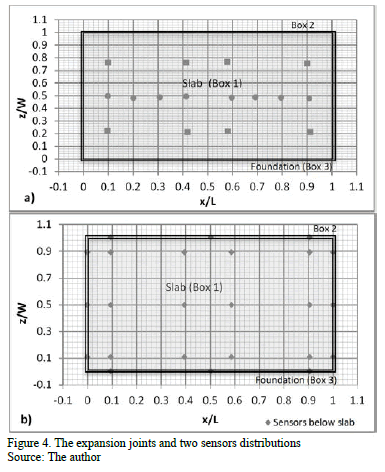
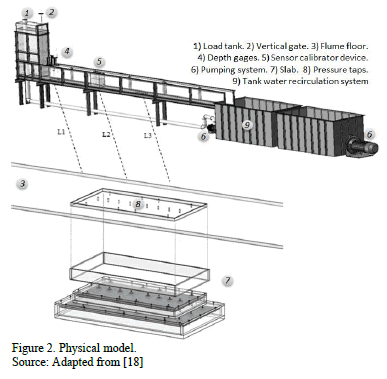
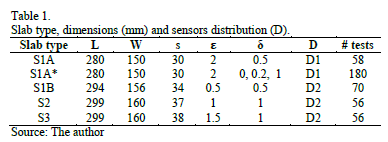
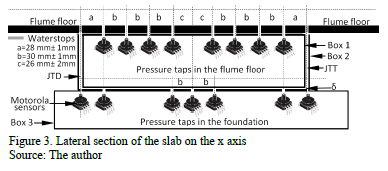
<body><![CDATA[<p>&nbsp;</p>     <p><font size="3" face="Verdana, Arial, Helvetica, sans-serif"><b>2. Materials and methods </b></font></p>     <p><font size="2" face="Verdana, Arial, Helvetica, sans-serif">Pressures were measured above and below  slabs in a physical model that was made in the Hydraulic Laboratory at the  &quot;University of Valle&quot; in Cali, Colombia (<a href="#fig02">Fig. 2</a>). The physical model contains  slabs fixed under the horizontal flume floor at different distances from the  load tank. The flume was 0.5 m high, 8m long, and 0.35 m wide. The slab and its  details such as expansion joints, slab thickness, gaps <font face="Symbol">d</font>, and <font face="Symbol">e</font>, were  simulated with several acrylic boxes with dimensions from largest ((L+<img src="/img/revistas/dyna/v83n199/v83n199a17eq004.gif">)*(W+<img src="/img/revistas/dyna/v83n199/v83n199a17eq006.gif">)*(s+<font face="Symbol">d</font>), internal dimensions) to smallest (L*W*s, external dimensions;  <a href="#tab01">Table 1</a>; <a href="#fig01">Figs. 1</a>, <a href="#fig02">2</a>). </font></p>     <p align="center"><font size="2" face="Verdana, Arial, Helvetica, sans-serif"><a name="fig02"></a></font><img src="/img/revistas/dyna/v83n199/v83n199a17fig02.gif"></p>     <p align="center"><font size="2" face="Verdana, Arial, Helvetica, sans-serif"><a name="tab01"></a></font><img src="/img/revistas/dyna/v83n199/v83n199a17tab01.gif"></p>     <p><font size="2" face="Verdana, Arial, Helvetica, sans-serif">The length (L) of   individual slabs ranged from 6 to 12 times the incident flow depth (y<sub>1</sub>),   and the slab's width was approximately half its length. The gap <font face="Symbol">d</font> was   possible by interposing aluminum sheet rings 1 mm in diameter and thickness  that were required to achieve the desired separation.</font></p>     <p><font size="2" face="Verdana, Arial, Helvetica, sans-serif">The flume floor was   drilled and slotted to provide continuity to pressure taps and joints (<a href="#fig03">Fig. 3</a>).   The model slabs were fixed to the basin to prevent motion. The coupling between   elements in the system was monitored to avoid stagnation points by the offset   between edges, as was recommended and studied in references &#91;19-20&#93;. The offset   was estimated to be 10<sup>-5</sup>m. This could be the case for the prototype   due to imperfections in the finishing of the slabs and their rearrangement by natural movement.</font></p>     <p align="center"><font size="2" face="Verdana, Arial, Helvetica, sans-serif"><a name="fig03"></a></font><img src="/img/revistas/dyna/v83n199/v83n199a17fig03.gif"></p>     <p><font size="2" face="Verdana, Arial, Helvetica, sans-serif">The   flow entering the hydraulic jump was full and partially developed with a   Reynolds number in the boundary layer (Re<sub>x</sub>) between 300,000 and   17,380,000. The first slab (S1) was located at a distance at which the Re<sub>x</sub> was between 300,000 and 660,000 (transition), the second slab 2 (S2) was in the   area of Re<sub>x</sub> between 4,150,000 and 9,130,000, and the third slab (S3)   was the farthest from the load tank with Re<sub>x</sub> between 7,900,000 and   17,380,000. The experimental design varied the state of development of the   boundary layer since the magnitude of pressure fluctuation depended on whether   the flow is fully developed or undeveloped &#91;11&#93;. However, the flow regime was   always turbulent with Reynolds numbers between 90,000 and 200,000. Incident flow velocities (V<sub>1</sub>) ranged from 1.65 and 5.76 m/s. </font></p>     <p><font size="2" face="Verdana, Arial, Helvetica, sans-serif">The   pressure was measured with 32 Motorola sensors (MPXV 4006GC7U, range 0-6 kpa   and accuracy ±5 %) and with circular pressure taps of 2 mm in diameter above   and below the slab with two distributions (<a href="#fig04">Fig. 4</a>). The first sensors   distribution (D1) selected 16 pressure taps above and below the slab that had   an equal distribution (<a href="#fig04">Fig. 4a</a>, sensor symbol &quot;&bull;&quot; and &quot;&#9632;&quot;). The second sensors distribution (D2) selected 8 pressure taps that were   located above the slab in the central line (<a href="#fig04">Fig. 4a</a>; sensor symbol &quot;&bull;&quot;). When these sensors failed, the pressure taps next to the   longitudinal joint were used (<a href="#fig04">Fig. 4a</a>; sensor symbol &quot;&#9632;&quot;). Furthermore,   24 pressure taps below the slab and the bottom of the joints were implemented to achieve a higher resolution of the pressure field (<a href="#fig04">Fig. 4b</a>; sensor symbol &quot;&#9830;&quot;). </font></p>     ]]></body>
<body><![CDATA[<p align="center"><font size="2" face="Verdana, Arial, Helvetica, sans-serif"><a name="fig04"></a></font><img src="/img/revistas/dyna/v83n199/v83n199a17fig04.gif"></p>     <p><font size="2" face="Verdana, Arial, Helvetica, sans-serif">Every   five working hours, in accordance with the methodology proposed in the   reference &#91;21&#93;, the pressure measurement system was dynamically calibrated, and dynamic uncertainty was, on average, 8.82%. The signs that</font> <font size="2" face="Verdana, Arial, Helvetica, sans-serif">were acquired   with a data acquisition system (DAQ National Instruments, NI SCXI: 1000, 1102B,   1600, 1300) were sent to a laptop. The sampling frequency (fs) was 200 Hz and   was limited by the data acquisition system available. In addition, it held the   sampling theorem (avoiding aliasing) and improved the resolution in the time of   the digitized signal (5 ms). In signal processing, a median digital filter was   used to remove frequency components that were not part of the phenomenon since   it closely recovers the original signal while removing noise &#91;22&#93;. According to   the analysis of the frequency signal and the dynamic characteristics of the   pressure measurement system, the cutoff frequency of the digital filter was   10.5 Hz (window median filter equal to nineteen). Thus, the typical overshoot   of the pressure measurement system in response to a sudden change of pressure   (pressure fluctuation) was minimized. &quot;Overshoot is the amount of output   measured beyond the final steady output value in response to a step change in the measurand&quot; &#91;23&#93;. </font></p>     <p><font size="2" face="Verdana, Arial, Helvetica, sans-serif">In each test, the slab type (S1A, S1A*,   S1B, S2, and S3: <a href="#tab01">Table 1</a>), the open   joint(s), and the Fr<sub>1</sub>, were selected. Hydrodynamic variations   included a minimum seven different Fr<sub>1</sub> between 2.3 and 10 for each physical variation. </font></p>     <p><font size="2" face="Verdana, Arial, Helvetica, sans-serif">Physical   variations include the controlled release of the waterstop(s) in: a) one of the   four joints, front transverse joint (FTJ), rear transverse joint (RTJ), or   longitudinal joint (LJ); b) two joints simultaneously, longitudinal joints (LJ), or transverse joints (TJ); c) all joints (AJ). </font></p>     <p><font size="2" face="Verdana, Arial, Helvetica, sans-serif">The flow depth was measured on a) FTJ, b)   LJ in the middle of the slab, c) RTJ. At each point, the minimum and maximum   depth detected in 30 seconds were measured with depth gages that had a 300 mm   range and an accuracy of ± 0.2 mm. The discharge was regulated between 8.15 and   14.1 Gallon/min, as was the vertical gate of the load tank (1.8m high, 1m long   and 0.35 m wide) between 2.5 and 5.5 cm. The discharge was measured from an   Omega flow meter (FMG-901). The flow rate was measured with a Prandtl tube at a   point located 0.05 m upstream of the front transverse joint, and the measurement error was 4%. </font></p>     <p><font size="2" face="Verdana, Arial, Helvetica, sans-serif">The   test was run over 15 minutes and the data acquisition was performed during in   the last five minutes. Data acquisition time was mainly associated with   extensive data and the number of tests explored (420). One test had 60,000 discrete samples in which the pressure fields were analyzed. </font></p>     <p><font size="2" face="Verdana, Arial, Helvetica, sans-serif">The hydraulic jump with rectangular weirs   of heights ranging from 5 to 20 cm at the end of the flume was induced.   Because, in general, the highest pressure fluctuations are reported in the   first third of the length of the free hydraulic jump &#91;8,24-30&#93;, the slabs were   located under 30% of its length. Some tests in the slab &quot;S1&quot; had a submerged hydraulic jump.</font></p>     <p>&nbsp;</p>     <p><font size="3" face="Verdana, Arial, Helvetica, sans-serif"><b>3. Data processing and results</b></font></p>     <p><font size="2" face="Verdana, Arial, Helvetica, sans-serif">This researcher evaluated each sampling   instant from the 58 test samples that had an S1A configuration, the forces F<sup>+</sup>,   F<sup>-</sup>, F<sub>net</sub>, their center of pressure over the slab   surfaces, and the momenta Ma and Mc. Using data processing, the pressure fields   from the pressure measured above and below the slab in each sampling instant   were adjusted. According to the theory of Riemann integration, to obtain the   total force vectors F<sup>+</sup> and F<sup>- </sup>(eq. 1 and eq. 2), the area of slab was discretized and the sum of the partial pressures was computed. </font></p>     ]]></body>
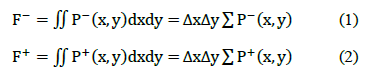
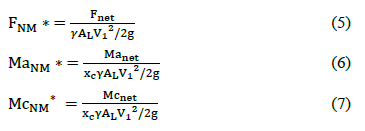
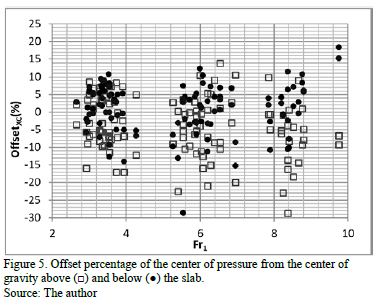
<body><![CDATA[<p><img src="/img/revistas/dyna/v83n199/v83n199a17eq0102.gif"></p>     <p><font size="2" face="Verdana, Arial, Helvetica, sans-serif">Where, P<sup>-</sup> and P<sup>+</sup> are the pressures above and below the slab's surfaces. <img src="/img/revistas/dyna/v83n199/v83n199a17eq020.gif"> (L/186 x B/115) are area   elements in which the slab area (A<sub>L</sub>) was  discretized. </font></p>     <p><font size="2" face="Verdana, Arial, Helvetica, sans-serif">The x-coordinate of center of pressure (intersection of the resultant force  and the surface's line of action) was obtained with eq. 3. </font></p>     <p><img src="/img/revistas/dyna/v83n199/v83n199a17eq03.gif"></p>     <p><font size="2" face="Verdana, Arial, Helvetica, sans-serif">Where x<sub>i</sub> is x coordinate of  the center of the differential element of area.</font></p>     <p><font size="2" face="Verdana, Arial, Helvetica, sans-serif">The forces F<sup>+ </sup>and F<sup>-</sup>'s   centers of pressure were different to their centers of gravity, which affect   momenta that induce rotation of the slab. The offset percentage of the center   of pressure from the center of gravity in x-coordinate was calculated using eq.  4 (<a href="#fig05">Fig. 5</a>). </font></p>     <p><img src="/img/revistas/dyna/v83n199/v83n199a17eq04.gif"></p>     <p><font size="2" face="Verdana, Arial, Helvetica, sans-serif">Where x<sub>c</sub> is x-coordinate of  the slab's center of gravity (or centroid).</font></p>     <p align="center"><font size="2" face="Verdana, Arial, Helvetica, sans-serif"><a name="fig05"></a></font><img src="/img/revistas/dyna/v83n199/v83n199a17fig05.gif"></p>     <p><font size="2" face="Verdana, Arial, Helvetica, sans-serif">The author calculated the momenta   balances with respect to the slab's extreme contact points. The clockwise   momentum was positive. The F<sub>net</sub> and net momenta (Ma<sub>net </sub>and   Mc<sub>net</sub>) determine the possibility of the slab's uplift or rotation   (<a href="#fig01">Fig. 1</a>). Then, the maximum value of F<sub>net</sub>, Ma<sub>net, </sub>Mc<sub>net</sub> in each test was selected and expressed in   terms of net instability dimensionless   coefficients (F<sub>NM</sub>*, Ma<sub>NM</sub>*, |Mc<sub>NM</sub>*|;  eq. 5 -7). </font></p>     ]]></body>

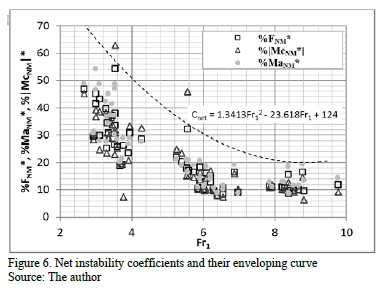
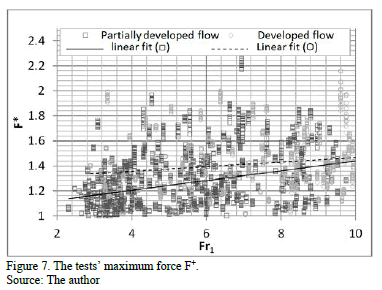
<body><![CDATA[<p><img src="/img/revistas/dyna/v83n199/v83n199a17eq0507.gif"></p>     <p><font size="2" face="Verdana, Arial, Helvetica, sans-serif">Where <font face="Symbol">g</font> is the  specific weight of water and g is the gravity.</font></p>     <p><font size="2" face="Verdana, Arial, Helvetica, sans-serif">The coefficients F<sub>NM</sub>*   were lower than the coefficient Ma<sub>NM</sub>* and |Mc<sub>NM</sub>*| (<a href="#fig06">Fig.   6</a>), which show that the mechanism of initial failure is the slab's rotation.   The dotted boundary was called the enveloping curve of instability net coefficients (C<sub>net</sub>) and   it will be used to predict the uplift hydrodynamic in the next subsection. Two   values of |Mc<sub>NM</sub>*| that fall outside the area   of the curve (<a href="#fig06">Fig. 6</a>). These values manifest the   combination of a great uplift force with a great center of pressure offset from  the center of gravity below the slab (<a href="#fig06">Fig. 6</a>).</font></p>     <p align="center"><font size="2" face="Verdana, Arial, Helvetica, sans-serif"><a name="fig06"></a></font><img src="/img/revistas/dyna/v83n199/v83n199a17fig06.gif"></p>     <p><font size="2" face="Verdana, Arial, Helvetica, sans-serif">To expand upon the above,   the author analyzed the impact on uplift force of the variations of Re<sub>x</sub>,   the gap <font face="Symbol">d</font>, the gap <font face="Symbol">e</font>, and the controlled release of the waterstops. It was considered that these physical variables only affect pressure fields below the slab, i.e. the force F<sup>+</sup>. Thus, in each sampling instant from the 420 tests we   calculated the force F<sup>+</sup> (eq. 2) and then expressed it in the  form of a dimensionless coefficient, according to eq. 8. </font></p>     <p><img src="/img/revistas/dyna/v83n199/v83n199a17eq08.gif"></p>     <p><font size="2" face="Verdana, Arial, Helvetica, sans-serif">Where <img src="/img/revistas/dyna/v83n199/v83n199a17eq036.gif"> was   calculated as the average of three minimum depths measured on FTJ, LJ, RTJ with  a baseline below the slab. </font></p>     <p><font size="2" face="Verdana, Arial, Helvetica, sans-serif">To avoid the mistake of   basing the analyses on a spurious value, ten maximum values identified in each   test were plotted (<a href="#fig07">Figs. 7</a>-<a href="#fig10">10</a>). For same Froude number, coefficient F<sup>*</sup> varied as a result of pressure fluctuations of the hydraulic jump and the  geometric variations made in each test. </font></p>     <p align="center"><font size="2" face="Verdana, Arial, Helvetica, sans-serif"><a name="fig07"></a></font><img src="/img/revistas/dyna/v83n199/v83n199a17fig07.gif"></p>     <p><font size="2" face="Verdana, Arial, Helvetica, sans-serif">The incidence of the   state of development of flow over force F<sup>+</sup> was not clear. The force F<sup>+</sup> is proportional to the Froude   number and, generally, it was lower than twice the average hydrostatic force  below the slab (<img src="/img/revistas/dyna/v83n199/v83n199a17eq038.gif">; <a href="#fig07">Fig. 7</a>). </font></p>     ]]></body>

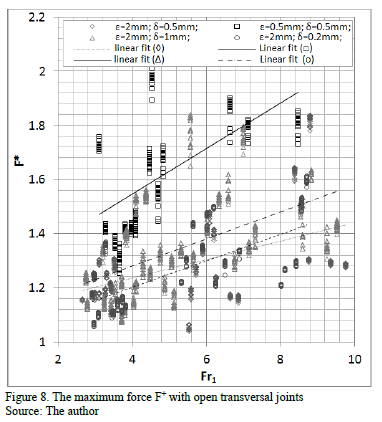
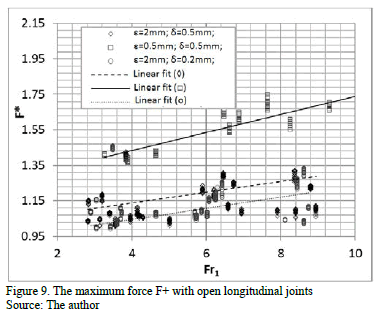
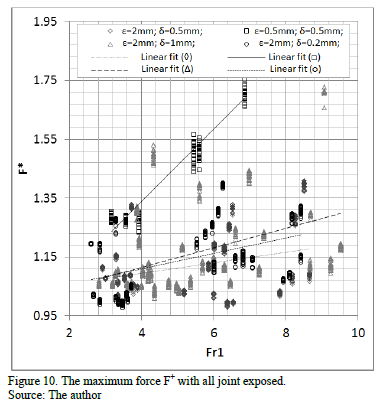
<body><![CDATA[<p><font size="2" face="Verdana, Arial, Helvetica, sans-serif">The effect on the force F<sup>+</sup> by detachment of the waterstops, the change of the gaps <font face="Symbol">e</font>, and <font face="Symbol">d</font> can   be deduced from <a href="#fig08">Figs. 8</a>-<a href="#fig10">10</a>. These showed the maximum F<sup>+</sup> found in the   different tests with S1 configuration and open transversal joints (<a href="#fig08">Fig. 8</a>),   open longitudinal joints (<a href="#fig09">Fig. 9</a>), and all open joints (<a href="#fig10">Fig. 10</a>). Furthermore,   a slab configuration with gap <font face="Symbol">e</font> of 0.5 mm and 2 mm; and gap <font face="Symbol">d</font> of 0.2  mm, 0.5 mm, and 1 mm was also considered</font></p>     <p align="center"><font size="2" face="Verdana, Arial, Helvetica, sans-serif"><a name="fig08"></a></font><img src="/img/revistas/dyna/v83n199/v83n199a17fig08.gif"></p>     <p align="center"><font size="2" face="Verdana, Arial, Helvetica, sans-serif"><a name="fig09"></a></font><img src="/img/revistas/dyna/v83n199/v83n199a17fig09.gif"></p>     <p align="center"><font size="2" face="Verdana, Arial, Helvetica, sans-serif"> <a name="fig10"></a></font><img src="/img/revistas/dyna/v83n199/v83n199a17fig10.gif"></p>     <p><font size="2" face="Verdana, Arial, Helvetica, sans-serif">As a   result of these tests, it is possible to say that the narrowest joint   (<font face="Symbol">e</font>=0.5 mm) induced a greater uplift force F<sup>+ </sup>(<a href="#fig08">Fig. 8</a>-<a href="#fig10">10</a>). Tests   with open traversal joints induced major uplift forces  under the slabs, and these were followed by tests with all open joints. </font></p>     <p><font size="2" face="Verdana, Arial, Helvetica, sans-serif">The incidence of gap <font face="Symbol">d</font> on uplift   force was not clear. For the condition of open transverse joints an inverse  relationship between the uplift force and the gap <font face="Symbol">d</font> was observed (<a href="#fig08">Fig. 8</a>).</font></p>     <p><font size="2" face="Verdana, Arial, Helvetica, sans-serif">However, occasionally the author   identified a proportional relationship between F+ and gap <font face="Symbol">d</font> in tests with   longitudinal joints or all open joints (<a href="#fig08">Figs. 8</a>, <a href="#fig09">9</a>). The greatest uplift forces   obtained from the combination of gap <font face="Symbol">e</font> of 0.5 mm and gap <font face="Symbol">d</font> of 0.5 mm,   and the results showed in references &#91;15,16&#93;, led to us leaving the hypothesis  open (narrower gap <font face="Symbol">d</font> leads to a hydraulic jack). </font></p>     <p><font size="2" face="Verdana, Arial, Helvetica, sans-serif">The study of net uplift force and its   point of application showed that it is necessary to consider the equivalent   thickness of lining slabs in design criteria as well as the failure mechanism   induced by momentum. Also, detachment of the waterstops, the   size and the orientation joints that have an effect on the uplift force,  and consequently influence its momentum should also be considered. </font></p>     <p>&nbsp;</p>     <p><font size="3" face="Verdana, Arial, Helvetica, sans-serif"><b>4. Estimation of hydrodynamic uplift</b></font></p>     ]]></body>
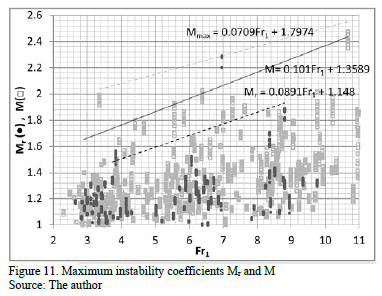
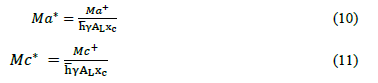
<body><![CDATA[<p><font size="2" face="Verdana, Arial, Helvetica, sans-serif">The author proposes experimental tests   and design criterion to estimate the equivalent thickness of a slab with   lengths between 6 and 12 times the incident flow depth. The design of concrete   slabs for hydrodynamic loading focuses on the determination of the maximum   possible destabilizing force and momentum. In this criterion, uplift force and momenta are considered by the dimensionless design coefficient <img src="/img/revistas/dyna/v83n199/v83n199a17eq050.gif">, calculated by eq. 9. </font></p>     <p><img src="/img/revistas/dyna/v83n199/v83n199a17eq09.gif"></p>     <p><font size="2" face="Verdana, Arial, Helvetica, sans-serif">Where, C<sub>net</sub> is the instability net coefficients, which can be obtained from <a href="#fig06">Fig. 6</a>'s   envelope curve. &quot;<img src="/img/revistas/dyna/v83n199/v83n199a17eq054.gif">&quot; is an dimensionless experimental coefficient that takes into account the increase of the force F<sup>+</sup> and its momentum from the detachment of the waterstops, and the size and the orientation joints. &quot;<img src="/img/revistas/dyna/v83n199/v83n199a17eq056.gif">&quot; is a dimensionless experimental coefficient that takes into account extreme instabilities.</font></p>     <p><font size="2" face="Verdana, Arial, Helvetica, sans-serif">To   obtain the coefficients <img src="/img/revistas/dyna/v83n199/v83n199a17eq058.gif"> and <img src="/img/revistas/dyna/v83n199/v83n199a17eq056.gif">, the force F<sup>+</sup> found in   each sampling instant from 420 tests was used to calculate the momenta Ma<sup>+</sup> and Mc<sup>+</sup>. The largest momenta Ma<sup>+</sup> and Mc<sup>+</sup> in each test were selected and expressed in form of dimensionless coefficients (eq. 10 and eq. 11). </font></p>     <p><img src="/img/revistas/dyna/v83n199/v83n199a17eq1011.gif"></p>     <p><font size="2" face="Verdana, Arial, Helvetica, sans-serif">The largest   absolute value of the coefficients Ma* and Mc* in each test were identified and called coefficient M (eq. 12). </font></p>     <p><font size="2" face="Verdana, Arial, Helvetica, sans-serif"><img src="/img/revistas/dyna/v83n199/v83n199a17eq12.gif"></font></p>     <p><font size="2" face="Verdana, Arial, Helvetica, sans-serif">M coefficients   from 58 tests with an S1A configuration were added to the subscript r (M<sub>r</sub>).   A curves adjustment over the maximum value of M<sub>r</sub> and M vs. Fr<sub>1</sub> was plotted (<a href="#fig11">Fig. 11</a>). The M curves that were proposed as lines ensured that the slope is always positive as the uplift force F<sup>+</sup> is proportional to Fr<sub>1</sub>. Furthermore, since the positive and negative maximum pressure</font> <font size="2" face="Verdana, Arial, Helvetica, sans-serif">coefficient increases over time &#91;8,27&#93;, the   line fits the data conservatively to compensate for the short-time data acquisition (5 min).</font></p>     <p align="center"><font size="2" face="Verdana, Arial, Helvetica, sans-serif"><a name="fig11"></a></font><img src="/img/revistas/dyna/v83n199/v83n199a17fig11.gif"></p> <font size="2">     <p><font face="Verdana, Arial, Helvetica, sans-serif">The   amplification factor <img src="/img/revistas/dyna/v83n199/v83n199a17eq054.gif"> that depends on Fr<sub>1</sub> is calculated according to equation 13 (<a href="#fig11">Fig. 11</a>). </font></p> </font>     ]]></body>

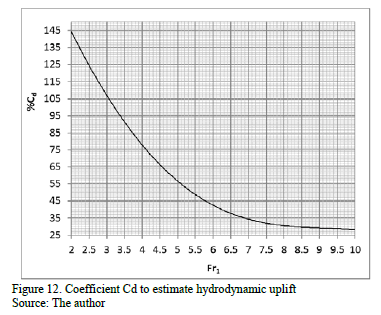
<body><![CDATA[<p><font size="2"></font><img src="/img/revistas/dyna/v83n199/v83n199a17eq13.gif"></p> <font size="2">    <p><font face="Verdana, Arial, Helvetica, sans-serif">M<sub>max </sub>were associated with the extreme   instabilities and the low probability of occurrence (<a href="#fig11">Fig. 11</a>). To determine the coefficient <img src="/img/revistas/dyna/v83n199/v83n199a17eq074.gif"> the same methodology used to determine<img src="/img/revistas/dyna/v83n199/v83n199a17eq076.gif"> was implemented, and the M curve was compared with a curve fit to M<sub>max </sub>(eq. 14, <a href="#fig11">Fig. 11</a>). </font></p>     <p><img src="/img/revistas/dyna/v83n199/v83n199a17eq14.gif"></p>     <p><font face="Verdana, Arial, Helvetica, sans-serif">The design coefficient in the Fr<sub>1</sub> function is presented in <a href="#fig12">Fig. 12</a>. The buoyancy is considered by the design   coefficient if the real thickness used in the prototype is less than the   calculated thickness scaling model to prototype (<a href="#tab01">Table 1</a>). If the above are fulfilled, the thickness of the slab can be calculated with equation 15. </font></p>     <p><img src="/img/revistas/dyna/v83n199/v83n199a17eq15.gif"></p>     <p><font face="Verdana, Arial, Helvetica, sans-serif">Where <img src="/img/revistas/dyna/v83n199/v83n199a17eq082.gif"> is the specific weight of   concrete. In a scenario in which the slab could be immersed in a water-sediment   mixture (for example, during the flushing of sediments from reservoirs), it is   necessary to replace the specific weight of water by mixture (<img src="/img/revistas/dyna/v83n199/v83n199a17eq084.gif">). The above equation intends to compensate for the increase in the buoyancy force on the slab by the increased density of the mixture.</font></p> </font>     <p align="center"><font size="2"><font face="Verdana, Arial, Helvetica, sans-serif"><a name="fig12"></a></font></font><img src="/img/revistas/dyna/v83n199/v83n199a17fig12.gif"></p> <font size="2">     <p><font face="Verdana, Arial, Helvetica, sans-serif">The slab thickness is most often selected   empirically as achieving stability to resist uplift force alone with this   parameter requires a heavy slab, and this is not always possible. In these   cases, the methodology of equivalent thickness through the anchor should be used &#91;31&#93;. Slab thickness and the anchor could be calculated with eq. 16</font></p>     <p><img src="/img/revistas/dyna/v83n199/v83n199a17eq16.gif"></p> </font>     <p><font size="2" face="Verdana, Arial, Helvetica, sans-serif">The left side of eq. 16 is considered the    hydrodynamic uplift. &quot;<img src="/img/revistas/dyna/v83n199/v83n199a17eq090.gif">&quot; is the drainage coefficient, and it can be used as a    means to theoretically reduce up to 50% of the pressure uplift (<img src="/img/revistas/dyna/v83n199/v83n199a17eq090.gif">= 0.5; &#91;32-33&#93;). The right side of eq. 16 represents the forces that    counteract the uplift force, including the weight of the concrete slab and the    force that provides the anchor. Where, &quot;<img src="/img/revistas/dyna/v83n199/v83n199a17eq092.gif">&quot; is the tensile stress between steel-slab, <img src="/img/revistas/dyna/v83n199/v83n199a17eq094.gif"> is the number of steel bars,    and <img src="/img/revistas/dyna/v83n199/v83n199a17eq096.gif">is the area of the steel bar. For safety purposes, double the area    of the anchor steel is assumed to design slabs in stilling basins &#91;31&#93;.   </font></p>        ]]></body>

<body><![CDATA[<p><font size="2" face="Verdana, Arial, Helvetica, sans-serif">Underdrains, anchors, cutoffs, and slab    thickness are all provided to stabilize the slabs &#91;32&#93;. A slab that is about    600 mm thick is the minimum recommended &#91;33&#93;, and this shall be determined by    analyzing hydrostatic uplift and an elastic foundation analysis &#91;32&#93;. Uplift    momenta and misalignment between slabs can be prevented by adding steel in the    partial contraction deboned joint located the transversal joint (the joint with    slip dowels). Thus, the deboned joint allows the expansion or contraction of    the slab while the steel counteracts the shear loads void misalignment between    slabs &#91;32,34-35&#93;. Also, safety reinforcement counteracts the momentum of force F<sub>R</sub>.</font></p>     <p>&nbsp;</p>     <p><font size="3" face="Verdana, Arial, Helvetica, sans-serif"><b>5. Analysis</b></font></p>     <p><font size="2" face="Verdana, Arial, Helvetica, sans-serif">To ensure that the physical model    represents the prototype, there must be geometrical, kinematic, and dynamic    similarity &#91;36-38&#93;. Therefore, it is necessary to consider the effects of scale before using any lining slabs design criteria. </font></p>     <p><font size="2" face="Verdana, Arial, Helvetica, sans-serif">In hydraulic    jump, when the large eddies are well reproduced in a model, the representation    of turbulence is nearly achieved since the eddies are the energy carriers &#91;11&#93;.    The large eddies in the turbulent flow are proportional to the principal    dimension of the flow field, and they ensure correct simulation using a    geometrically similar model &#91;11&#93;. The author recommends using a geometric scale more generous than 1:50 &#91;36&#93;. </font></p>     <p><font size="2" face="Verdana, Arial, Helvetica, sans-serif">Viscous effects can lead to scale    effects, especially in models based on Froude, for which the Reynolds number is    always less than the prototype &#91;11&#93;. In tests with an Fr<sub>1</sub> between    2.3 and 7.15, viscous effects and scale effects in terms of void fraction,    bubble count rate, and bubble chord time distributions were overcome. Their    influence was at least minimized since in the model the flow depth was greater    than 30 mm, and there was a turbulent flow with Reynolds numbers greater than    100,000 &#91;39,36-41&#93;. When the physical model does not take into account the    concentration of air in the evaluation of the pressures, it may require an    additional safety factor. Pinheiro &#91;25&#93; found that increased air concentration decreases the mean pressure value and the standard deviation of force. </font></p>     <p><font size="2" face="Verdana, Arial, Helvetica, sans-serif">According to Lopardo <i>et al.</i> &#91;29&#93;, the pressure data collected in a physical model with a    free vertical gate system and horizontal flume can be extrapolated to sloping    channels in hydraulic jump stilling basins. That is as long as the error is on    the side of safety. Similarity law of fluctuating pressure spectrum in the    strongly rolling area agrees with gravity law &#91;41&#93;. Thus, data from basic    research provides pressure values that are useful for stilling basin predesign, despite the limits in scale similarity.</font></p>     <p><font size="2" face="Verdana, Arial, Helvetica, sans-serif">Viscous    and inertial forces dominate physical processes involving flow through small    cracks or joints along a channel boundary &#91;19&#93;. The dimensions used to simulate    the expansion joints (0.5 mm - 2 mm) lead us to suggest the use of a geometric    scale more generous than 1:30. To establish similarity between the roughness    implemented in the general contour of the model (coated in acrylic: n<sub>Manning</sub> = 0.009) and prototype (coated concrete: n<sub>Manning</sub> = 0.014), the    geometric scale should be 1:14. Thus, the Manning roughness scale factor limits    the geometric scale &#91;36&#93;. When this parameter has no similarity, the model is rougher than its prototype, and scale effects are generated.</font></p>     <p><font size="2" face="Verdana, Arial, Helvetica, sans-serif">Inside the joints and the <font face="Symbol">d</font> gap, as    with the cavities, constrictions, and junctions, the propagation speed of    pressure wave (c) becomes a function of the variation of fluid density    (compressibility), and area (distensibility) increases in pressure &#91;42&#93;. For a    given Fr<sub>1</sub>, the effects of the Reynolds number on the two-phase flow    properties are particularly notable in the developed shear layer &#91;38&#93;. Thus,    aeration in a prototype will be higher than in the model, and a similar or    smaller &quot;c&quot; can be expected in the prototype. Pressure waves experience    diffraction, interference, reflection, and refraction that depend of solid material in the boundary. These    can alter the propagation speed, amplitude and the transmitted energy &#91;14,18&#93;.    In the prototype, the boundary may be concrete and soil. The boundary was    acrylic in the model, in which &quot;c&quot; may decrease and energy losses in the    reflection of the pressure wave increase. Nevertheless, in a prototype designed    with the criterion and a scale more generous than 1:14, the impact of the last    variables are less in the resonance phenomena and persistence time of the net    uplift pressure due to the length of the slabs &#91;27&#93;, the hydraulic jump's low    frequency &#91;27,31,37&#93;, and the role of the joints as frequency filters &#91;17,18&#93;.    The pressure amplification under the slab for the effects of fluid, joints    interaction, and pressure waves at frequencies below 10.5 Hz were considered as part of this criterion.</font></p>     <p><font size="2" face="Verdana, Arial, Helvetica, sans-serif">In    these cases that Fr<sub>1</sub> is greater than 7.16, and/or the stilling basin    demands a greater geometric scale than 1:15 to be able to establish similarity.    The criterion proposed can be used for the predesign of lining slabs. &quot;For a joint length of 18 m and <i>c</i> of 100 m/s, one obtains a resonance frequency &lt; 3 Hz &#91;13&#93;&quot;. If the resonance    is demonstrated, the transient approach needs a quantification of pressure    amplification inside the joints, which can be the use of an appropriate    pressure amplification coefficient &#91;13&#93;. To verify resonance inside the joints    and the gap <font face="Symbol">d</font>, a model scale 1:1, pressure sensors with high natural    frequency and with a damping close to 0.6 to prevent overshoot error are    required. To check    the stability of the slabs in the physical model of the prototype, a scale more    generous than 1:14 is recommended. Given the opportunity to try alternatives,    analyze different solutions, view operating    conditions in extreme situations, and eventually, reduce the risk &#91;43&#93;, physical modeling allows details to be refined so to as find a safer and more economical project.</font></p>     ]]></body>
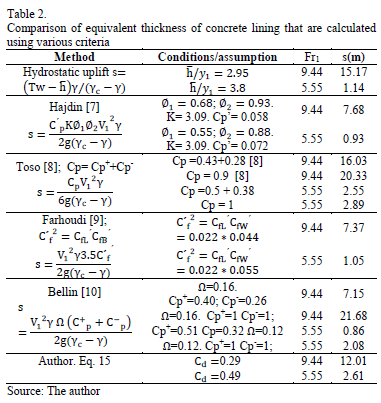
<body><![CDATA[<p><font size="2" face="Verdana, Arial, Helvetica, sans-serif">To compare the developed criterion with    other traditional criteria to estimate the slab equivalent thickness, some    scale effects are ignored and two illustrative examples are shown. The author    consider the hydraulic jump stilling basin with the following details. The    first example: y<sub>1</sub>=2.43m, y<sub>2</sub>=31.45m (major conjugate of    the hydraulic jump). Size of panel monolith: W=11.5 m (W=4.4y<sub>1</sub>) and    L= 25 m (L= 9.76y<sub>1</sub>). V<sub>1</sub> = 46.1 m/s and Fr<sub>1</sub> =    9.44. Second illustrative example: y<sub>1</sub>=0.45m, y<sub>2</sub>=3.54 m,    W= 4.5 m (W=4.4y<sub>1</sub>), L=2 m (L=10y1), V<sub>1</sub> = 16.5 m/s and Fr<sub>1</sub> = 5.5. In the computation, the submerged specific weight is 1.6 ton/m<sup>3</sup>, and a safety factor and an operating drainage system are not considered. </font></p>     <p><font size="2" face="Verdana, Arial, Helvetica, sans-serif">Hydrostatic uplift is evaluated using    three conditions: spillway design flood,    stilling basin empty, and sudden drawdown following design flood &#91;11,33&#93;.    Usually, the first condition gives the maximum uplift force in the slab close    to the hydraulic jump &#91;11&#93;. The latter is due to the pressure of tail water    level (Tw), which is transmitted by a saturated foundation that has greater    fluid pressure on the slab. The criteria belonging to Hajdin &#91;7&#93; and Toso <i>et al.</i> &#91;8&#93; was used, which are based on    the measurement of fluctuating pressures, and the criteria of Farhoudi <i>et al.</i> &#91;9&#93; and Bellin <i>et al.</i> &#91;10&#93;, which are based on direct    measurement of fluctuating force. In all these studies, except Bellin <i>et al.</i> &#91;10&#93;, propagation of fluctuating    pressures below the apron was not considered. For the criteria to be applied,    the influence of the length and width of the slab are taken into account by    using the coefficient of spatial correlation (<img src="/img/revistas/dyna/v83n199/v83n199a17eq098.gif">, the force coefficient (<img src="/img/revistas/dyna/v83n199/v83n199a17eq100.gif">), or the uplift coefficient (<img src="/img/revistas/dyna/v83n199/v83n199a17eq102.gif">. This paper also considers the dimensionless pressure coefficient    (Cp), which is based on the maximum positive (Cp<sup>+</sup>) and negative    pressure (Cp<sup>-</sup>) deviation from the mean pressure, and the coefficient    based on root-mean-square pressure fluctuations (Cp') that is reported in the references &#91;7-10, 27, 30&#93;. </font></p>     <p><font size="2" face="Verdana, Arial, Helvetica, sans-serif">In each example, two computations to    evaluate Bellin <i>et al.</i> &#91;10&#93; and    Toso's &#91;8&#93; criteria with two Cp were used as it is important acknowledge the    importance of a correct selection pressure coefficient when estimating the equivalent thickness. The slab equivalent thickness computation using various relationships is presented in <a href="#tab02">Table 2</a>.</font></p>     <p align="center"><font size="2" face="Verdana, Arial, Helvetica, sans-serif"><a name="tab02"></a></font><img src="/img/revistas/dyna/v83n199/v83n199a17tab02.gif"></p>     <p><font size="2" face="Verdana, Arial, Helvetica, sans-serif">The first    computation of the two illustrative Cp examples was based on Cp<sup>+</sup> and    Cp<sup>- </sup>experimental data. In this case, the equivalent thickness estimated by criteria from Bellin <i>et al.</i> &#91;10&#93;, Hajdin &#91;7&#93;, and Farhoudi <i>et al.</i> &#91;9&#93; were similar. The equivalent thickness that was estimated by the    criterion proposed in this paper (last row, <a href="#tab02">table 2</a>) is greater than those    mentioned above while Toso <i>et al.</i>'s criterion &#91;8&#93; was most conservative. </font></p>     <p><font size="2" face="Verdana, Arial, Helvetica, sans-serif">In the second computation in the two    illustrative examples, Cp was based on the suggestions from each group of    researchers. Bellin <i>et al.</i> &#91;10&#93;    suggest assuming the pressure coefficients Cp+, Cp- =1 in case of a lack of    experimental data while Toso <i>et al.</i> &#91;10&#93; suggest Cp 0.9 for the incident Froude number between 7.7 and 10. In this case, the criteria were very conservative. </font></p>     <p><font size="2" face="Verdana, Arial, Helvetica, sans-serif">The    Toso &#91;8&#93; criteria may be safely assumed, but it is conservative for a large slab    that presents the compensation of the pressure pulses on its upper face. In the hydraulic jump, the pressure pulses on big slabs are    uncorrelated since the slab length is larger than the integral scale of the    pressure fluctuations. The integral scale is thereby defined as the distance on    which, on average, two pressure pulses become fully uncorrelated. In other words, it defines the maximum possible area in which a pulse may reasonably act &#91;13,17&#93;.</font></p>     <p><font size="2" face="Verdana, Arial, Helvetica, sans-serif">Thus, extreme pulses recorded by a single   sensor in the large slab are not a representative sample of the pressure fields   above and below the slab to accurately calculate the uplift force &#91;13,18&#93;. Above the large slab, a  positive or negative pulse is a local effect.</font></p>     <p><font size="2" face="Verdana, Arial, Helvetica, sans-serif">In the first illustrative example, for   the first computation and the discarded Toso criterion, hydrostatic uplift was   the most critical condition for the slab's stability. This clearly shows that   the release of waterstops at two different points in the floor stilling basin   leads to critical situations that deserve to be paid more attention from  engineers.</font></p>     <p><font size="2" face="Verdana, Arial, Helvetica, sans-serif">In this study, a slab was located in the highest pressure fluctuations zone of the hydraulic jump as the   study of Farhoudi <i>et al.</i> &#91;9&#93;   and Bellin <i>et al.</i> &#91;10&#93; indicated. Differential   heads resulting from the sloping water surface of the jump can cause a   circulating flow under the slab if leakage is allowed to enter the joint at the   downstream end of the basin and to flow out of the joint at the upstream end   &#91;32&#93;. Therefore, it is necessary in future research to   mount several slabs along the hydraulic jump and to vary the number of waterstops detached   on two different slabs: one at the area of maximum pressure  fluctuation in the toe jump and the other at the area of maximum depth. </font></p>     ]]></body>
<body><![CDATA[<p><font size="2" face="Verdana, Arial, Helvetica, sans-serif">The criterion proposed contributed to the   search for a safe and economic design method for a concrete lined stilling   basin because it considers uplift force and momenta. It was computed from a   spatiotemporal analysis of the pressure fields that was measured above and   below the instrumented slabs in a physical model. Furthermore, the criterion   was supported by a large amount of experimental information, for which details   that had previously been poorly studied such as joints, waterstops, and gaps   between foundations and the concrete slab were considered. The design   coefficient that is supplied by a curve in an Fr<sub>1</sub>function  facilitates the designer's application of the criterion. </font></p>     <p>&nbsp;</p>     <p><font size="3" face="Verdana, Arial, Helvetica, sans-serif"><b>6. Conclusions </b></font></p>     <p><font size="2" face="Verdana, Arial, Helvetica, sans-serif">The waterstops, the size, and the   orientation joints have an effect on the uplift pressures, and consequently,   influence the magnitude of uplift forces and momenta. The narrower joints and   open traversal joints generated major uplift forces below the slabs. An offset   of the center of pressure from the center of gravity in the flow direction   increased the momenta Ma and Mc by up to 30%. Thus, it was necessary to  consider the failure mechanism induced by momentum in the design criteria. </font></p>     <p><font size="2" face="Verdana, Arial, Helvetica, sans-serif">Considering the maximum force and momenta   in each test, a design coefficient was found that defines the equivalent   thickness depending on the incident Froude number between 3 and 10. It   considers the effects of the offset on the center of pressure from the slab's   center of gravity. This is generated by the influence of waterstops, joints,   and hydraulic jump macroturbulence with full and partially developed inflow.   According to changes in the hydrodynamic conditions and the physical model's   characteristics, the study involves slabs with lengths between 6 and 12 times  the incident flow depth.</font></p>     <p><font size="2" face="Verdana, Arial, Helvetica, sans-serif">The   author discuss the scale effect that is inherent to the physical model and   conclude that the experimental results are useful for: a) Designing the lining   slabs in hydraulics structures that are similar to the model using scale more   generous than 1:14, and an Fr<sub>1</sub> between 2.3 and 7.15; b) Predesigning   the lining slabs in stilling basins that require a geometric scale greater than   1:15 in order to establish similarity and/or an Fr<sub>1</sub> between 7.16 and  10. </font></p>     <p>&nbsp;</p>     <p><font size="3" face="Verdana, Arial, Helvetica, sans-serif"><b>Acknowledgments</b></font></p>     <p><font size="2" face="Verdana, Arial, Helvetica, sans-serif">This research project was partially funded by COLCIENCIAS. The author   would like to give a special thanks to Efra&iacute;n del Risco and Lilian Posada for   their valuable suggestions and insights in this field. The experiments   necessary for the development of this research were undertaken in the Hydraulic   Laboratory at the University of Valle in Cali, Colombia. The author sincerely  appreciate the support.</font></p>     <p>&nbsp;</p>     ]]></body>
<body><![CDATA[<p><font size="3" face="Verdana, Arial, Helvetica, sans-serif"><b>References</b></font></p>     <!-- ref --><p><font size="2" face="Verdana, Arial, Helvetica, sans-serif"><b>&#91;1&#93;</b> Federal Emergency Management   Agency., Outlet works energy dissipators best practices for design, construction,   problem identification and evaluation, inspection, maintenance, renovation, and  repair. Technical manual, USA, FEMA P-679, pp. 1-66, 2010.    &nbsp;&nbsp;&nbsp;&nbsp;&nbsp;&nbsp;&nbsp;&nbsp;[&#160;<a href="javascript:void(0);" onclick="javascript: window.open('/scielo.php?script=sci_nlinks&ref=1150705&pid=S0012-7353201600050001700001&lng=','','width=640,height=500,resizable=yes,scrollbars=1,menubar=yes,');">Links</a>&#160;]<!-- end-ref --> </font></p>     <!-- ref --><p><font size="2" face="Verdana, Arial, Helvetica, sans-serif"><b>&#91;2&#93;</b> Hepler, T.E. and Johnson, P.L.,   Analysis of spillway failure by uplift pressure. ASCE National Conference,  Colorado Springs, Colorado, august 8-12, pp 857-862, 1988.    &nbsp;&nbsp;&nbsp;&nbsp;&nbsp;&nbsp;&nbsp;&nbsp;[&#160;<a href="javascript:void(0);" onclick="javascript: window.open('/scielo.php?script=sci_nlinks&ref=1150707&pid=S0012-7353201600050001700002&lng=','','width=640,height=500,resizable=yes,scrollbars=1,menubar=yes,');">Links</a>&#160;]<!-- end-ref --></font></p>     <!-- ref --><p><font size="2" face="Verdana, Arial, Helvetica, sans-serif"><b>&#91;3&#93;</b> VSL International. Soil and   rock anchors, Examples from practice. Berne, Switzerland. &#91;Online&#93;. pp 19-20,   1992 &#91;Consulted: 15th of august of 2009&#93;. Available at:  <a href="http://www.vsl.net/Portals/0/vsl_techreports/PT_Ground_Anchors.pdf" target="_blank">www.vsl.net/Portals/0/vsl_techreports/PT_Ground_Anchors.pdf</a> </font>&nbsp;&nbsp;&nbsp;&nbsp;&nbsp;&nbsp;&nbsp;&nbsp;[&#160;<a href="javascript:void(0);" onclick="javascript: window.open('/scielo.php?script=sci_nlinks&ref=1150709&pid=S0012-7353201600050001700003&lng=','','width=640,height=500,resizable=yes,scrollbars=1,menubar=yes,');">Links</a>&#160;]<!-- end-ref --><!-- ref --><p><font size="2" face="Verdana, Arial, Helvetica, sans-serif"><b>&#91;4&#93;</b> Bowers, C.E. and Tsai, F.Y.,   Fluctuating pressures in spillway stilling basins. J. Hydraulic Division, ASCE,  95(6), pp. 2071-2079, 1969.    &nbsp;&nbsp;&nbsp;&nbsp;&nbsp;&nbsp;&nbsp;&nbsp;[&#160;<a href="javascript:void(0);" onclick="javascript: window.open('/scielo.php?script=sci_nlinks&ref=1150710&pid=S0012-7353201600050001700004&lng=','','width=640,height=500,resizable=yes,scrollbars=1,menubar=yes,');">Links</a>&#160;]<!-- end-ref --></font></p>     <!-- ref --><p><font size="2" face="Verdana, Arial, Helvetica, sans-serif"><b>&#91;5&#93;</b> Bribiescas, S. and Capella, V.,   Turbulence effects on the linning of stilling basins. Proceedings ICOLD.  Congr&eacute;s des Grands Barrages. Madrid. Q.41. R.83. pp. 1575-1592, 1973.    &nbsp;&nbsp;&nbsp;&nbsp;&nbsp;&nbsp;&nbsp;&nbsp;[&#160;<a href="javascript:void(0);" onclick="javascript: window.open('/scielo.php?script=sci_nlinks&ref=1150712&pid=S0012-7353201600050001700005&lng=','','width=640,height=500,resizable=yes,scrollbars=1,menubar=yes,');">Links</a>&#160;]<!-- end-ref --></font></p>     ]]></body>
<body><![CDATA[<!-- ref --><p><font size="2" face="Verdana, Arial, Helvetica, sans-serif"><b>&#91;6&#93;</b> Bribiescas,   S. and Fuentes, O., Tanques amortiguadores. Technical  Report, Project 7045. UNAM, M&eacute;xico D. F. pp. 1-50, 1978.    &nbsp;&nbsp;&nbsp;&nbsp;&nbsp;&nbsp;&nbsp;&nbsp;[&#160;<a href="javascript:void(0);" onclick="javascript: window.open('/scielo.php?script=sci_nlinks&ref=1150714&pid=S0012-7353201600050001700006&lng=','','width=640,height=500,resizable=yes,scrollbars=1,menubar=yes,');">Links</a>&#160;]<!-- end-ref --></font></p>     <!-- ref --><p><font size="2" face="Verdana, Arial, Helvetica, sans-serif"><b>&#91;7&#93;</b> Hajdin, G., Contribution to the   evaluation of fluctuation pressure on fluid currents limit areas- based on the   pressures recorded at several points of the area. VIII Conference of Yugoslav  Hydraulics Association, Portoroz. 1982.    &nbsp;&nbsp;&nbsp;&nbsp;&nbsp;&nbsp;&nbsp;&nbsp;[&#160;<a href="javascript:void(0);" onclick="javascript: window.open('/scielo.php?script=sci_nlinks&ref=1150716&pid=S0012-7353201600050001700007&lng=','','width=640,height=500,resizable=yes,scrollbars=1,menubar=yes,');">Links</a>&#160;]<!-- end-ref --></font></p>     <!-- ref --><p><font size="2" face="Verdana, Arial, Helvetica, sans-serif"><b>&#91;8&#93;</b> Toso, J. and Bowers, C.,   Extreme pressures in hydraulic-jump stilling basins, J. of Hydraulic  Engineering, 114(8), pp. 829-843, 1988. DOI: 10.1061/(ASCE)0733-9429(1988)114:8(829)</font>&nbsp;&nbsp;&nbsp;&nbsp;&nbsp;&nbsp;&nbsp;&nbsp;[&#160;<a href="javascript:void(0);" onclick="javascript: window.open('/scielo.php?script=sci_nlinks&ref=1150718&pid=S0012-7353201600050001700008&lng=','','width=640,height=500,resizable=yes,scrollbars=1,menubar=yes,');">Links</a>&#160;]<!-- end-ref --><!-- ref --><p><font size="2" face="Verdana, Arial, Helvetica, sans-serif"><b>&#91;9&#93;</b> Farhoudi, J. and Narayanan, R.,   Force on slab beneath hydraulic jump. J. of Hydraulic Engineering, 117(1), pp.  64-82, 1991. DOI: 10.1061/(ASCE)0733-9429(1991)117:1(64)</font>&nbsp;&nbsp;&nbsp;&nbsp;&nbsp;&nbsp;&nbsp;&nbsp;[&#160;<a href="javascript:void(0);" onclick="javascript: window.open('/scielo.php?script=sci_nlinks&ref=1150719&pid=S0012-7353201600050001700009&lng=','','width=640,height=500,resizable=yes,scrollbars=1,menubar=yes,');">Links</a>&#160;]<!-- end-ref --><!-- ref --><p><font size="2" face="Verdana, Arial, Helvetica, sans-serif"><b>&#91;10&#93;</b> Bellin, A. and Fiorotto, V.,   Direct dynamic force measurements on slab in spillway stilling basin. J. of  Hydraulic Engineering. 121(10), pp. 686-693, 1995. DOI: 10.1061/(ASCE)0733-9429(1995)121:10(686)</font>&nbsp;&nbsp;&nbsp;&nbsp;&nbsp;&nbsp;&nbsp;&nbsp;[&#160;<a href="javascript:void(0);" onclick="javascript: window.open('/scielo.php?script=sci_nlinks&ref=1150720&pid=S0012-7353201600050001700010&lng=','','width=640,height=500,resizable=yes,scrollbars=1,menubar=yes,');">Links</a>&#160;]<!-- end-ref --><!-- ref --><p><font size="2" face="Verdana, Arial, Helvetica, sans-serif"><b>&#91;11&#93;</b> Khatsuria R.M., Hydraulics of  spillways and energy dissipators. New York: Marcel Dekker, 2005. pp 411-424.    &nbsp;&nbsp;&nbsp;&nbsp;&nbsp;&nbsp;&nbsp;&nbsp;[&#160;<a href="javascript:void(0);" onclick="javascript: window.open('/scielo.php?script=sci_nlinks&ref=1150721&pid=S0012-7353201600050001700011&lng=','','width=640,height=500,resizable=yes,scrollbars=1,menubar=yes,');">Links</a>&#160;]<!-- end-ref --></font></p>     <!-- ref --><p><font size="2" face="Verdana, Arial, Helvetica, sans-serif"><b>&#91;12&#93;</b> Pinheiro, A., Quintela, A. and   Ramos, C., Hydrodynamic forces in hydraulic jump stilling Basins. Proceedings   of the symposium on fundamentals and advancements in hydraulic measurements and  experimentation. ASCE. New York. USA. pp. 321-330, 1994.    &nbsp;&nbsp;&nbsp;&nbsp;&nbsp;&nbsp;&nbsp;&nbsp;[&#160;<a href="javascript:void(0);" onclick="javascript: window.open('/scielo.php?script=sci_nlinks&ref=1150723&pid=S0012-7353201600050001700012&lng=','','width=640,height=500,resizable=yes,scrollbars=1,menubar=yes,');">Links</a>&#160;]<!-- end-ref --></font></p>     <!-- ref --><p><font size="2" face="Verdana, Arial, Helvetica, sans-serif"><b>&#91;13&#93;</b> Bollaert, E.F.R., Dynamic   uplift of concrete linings: Theory and case studies, USSD Annual Meeting, April  24-26 2009, Nashville, United States. pp. 1-16, 2009.    &nbsp;&nbsp;&nbsp;&nbsp;&nbsp;&nbsp;&nbsp;&nbsp;[&#160;<a href="javascript:void(0);" onclick="javascript: window.open('/scielo.php?script=sci_nlinks&ref=1150725&pid=S0012-7353201600050001700013&lng=','','width=640,height=500,resizable=yes,scrollbars=1,menubar=yes,');">Links</a>&#160;]<!-- end-ref --> </font></p>     <!-- ref --><p><font size="2" face="Verdana, Arial, Helvetica, sans-serif"><b>&#91;14&#93;</b> Bollaert, E.F.R. and Schleiss,   A.J., Transient water pressures in joints and formation of rock scour due to   high-velocity jet impact. Communication 13, Laboratoire de Constructions  Hydrauliques, Ecole Polytechnique F&eacute;d&eacute;rale de Lausanne. 2002.    &nbsp;&nbsp;&nbsp;&nbsp;&nbsp;&nbsp;&nbsp;&nbsp;[&#160;<a href="javascript:void(0);" onclick="javascript: window.open('/scielo.php?script=sci_nlinks&ref=1150727&pid=S0012-7353201600050001700014&lng=','','width=640,height=500,resizable=yes,scrollbars=1,menubar=yes,');">Links</a>&#160;]<!-- end-ref --></font></p>     <!-- ref --><p><font size="2" face="Verdana, Arial, Helvetica, sans-serif"><b>&#91;15&#93;</b> del Risco,   E., Hurtado, E. y Gonz&aacute;lez, M., Estudio experimental de las presiones de   levantamiento bajo una losa con juntas transversales al flujo. Tecnolog&iacute;a y  Ciencias del Agua. I(1), pp. 31-42, 2010.    &nbsp;&nbsp;&nbsp;&nbsp;&nbsp;&nbsp;&nbsp;&nbsp;[&#160;<a href="javascript:void(0);" onclick="javascript: window.open('/scielo.php?script=sci_nlinks&ref=1150729&pid=S0012-7353201600050001700015&lng=','','width=640,height=500,resizable=yes,scrollbars=1,menubar=yes,');">Links</a>&#160;]<!-- end-ref --></font></p>     <!-- ref --><p><font size="2" face="Verdana, Arial, Helvetica, sans-serif"><b>&#91;16&#93;</b> Hurtado,   E., del Risco, E. y Gonz&aacute;lez, M., Presiones medidas en la base de una losa de   fondo con juntas paralelas al flujo en un canal. Revista de la Facultad de  Ingenier&iacute;a de la Universidad de Antioquia, 47, pp. 39-52, 2009.    &nbsp;&nbsp;&nbsp;&nbsp;&nbsp;&nbsp;&nbsp;&nbsp;[&#160;<a href="javascript:void(0);" onclick="javascript: window.open('/scielo.php?script=sci_nlinks&ref=1150731&pid=S0012-7353201600050001700016&lng=','','width=640,height=500,resizable=yes,scrollbars=1,menubar=yes,');">Links</a>&#160;]<!-- end-ref --></font></p>     <!-- ref --><p><font size="2" face="Verdana, Arial, Helvetica, sans-serif"><b>&#91;17&#93;</b> Melo, J., Pinheiro, A. y Ramos,   C., Forces on plunge pool slabs: Influence of joints location and width. J. of  Hydraulic Engineering, 132(1), pp. 49-60. 2006. DOI: 10.1061/(ASCE)0733-9429(2006)132:1(49)</font>&nbsp;&nbsp;&nbsp;&nbsp;&nbsp;&nbsp;&nbsp;&nbsp;[&#160;<a href="javascript:void(0);" onclick="javascript: window.open('/scielo.php?script=sci_nlinks&ref=1150733&pid=S0012-7353201600050001700017&lng=','','width=640,height=500,resizable=yes,scrollbars=1,menubar=yes,');">Links</a>&#160;]<!-- end-ref --><!-- ref --><p><font size="2" face="Verdana, Arial, Helvetica, sans-serif"><b>&#91;18&#93;</b> Gonz&aacute;lez,   M., Levantamiento de una losa de piso sometida a un flujo turbulento. PhD Tesis,  Facultad de Minas, Universidad Nacional de Colombia, Medell&iacute;n, Colombia. 2013.    &nbsp;&nbsp;&nbsp;&nbsp;&nbsp;&nbsp;&nbsp;&nbsp;[&#160;<a href="javascript:void(0);" onclick="javascript: window.open('/scielo.php?script=sci_nlinks&ref=1150734&pid=S0012-7353201600050001700018&lng=','','width=640,height=500,resizable=yes,scrollbars=1,menubar=yes,');">Links</a>&#160;]<!-- end-ref --></font></p>     <!-- ref --><p><font size="2" face="Verdana, Arial, Helvetica, sans-serif"><b>&#91;19&#93;</b> Frizell, W.K., Uplift and crack   flow resulting from high velocity discharges over. Report DSO-07-07 U.S.  Department of the interior, Bureau of Reclamation. Denver, Colorado, 2007, pp. 2-5.    &nbsp;&nbsp;&nbsp;&nbsp;&nbsp;&nbsp;&nbsp;&nbsp;[&#160;<a href="javascript:void(0);" onclick="javascript: window.open('/scielo.php?script=sci_nlinks&ref=1150736&pid=S0012-7353201600050001700019&lng=','','width=640,height=500,resizable=yes,scrollbars=1,menubar=yes,');">Links</a>&#160;]<!-- end-ref --></font></p>     <!-- ref --><p><font size="2" face="Verdana, Arial, Helvetica, sans-serif"><b>&#91;20&#93;</b> del Risco,   E., Investigaci&oacute;n experimental de la falla de losas de revestimiento de tanques  amortiguadores. MSc. Tesis, Facultad de Ingenier&iacute;a. UNAM, M&eacute;xico, 1983.    &nbsp;&nbsp;&nbsp;&nbsp;&nbsp;&nbsp;&nbsp;&nbsp;[&#160;<a href="javascript:void(0);" onclick="javascript: window.open('/scielo.php?script=sci_nlinks&ref=1150738&pid=S0012-7353201600050001700020&lng=','','width=640,height=500,resizable=yes,scrollbars=1,menubar=yes,');">Links</a>&#160;]<!-- end-ref --></font></p>     <!-- ref --><p><font size="2" face="Verdana, Arial, Helvetica, sans-serif"><b>&#91;21&#93;</b> Gonz&aacute;lez,   M. y Giraldo, S., Caracterizaci&oacute;n din&aacute;mica de sensores de presi&oacute;n utilizando el   principio de la botella de mariotte. Rev. Fac. Ing.  Univ. Antioquia, 71, pp. 146-156, 2014.    &nbsp;&nbsp;&nbsp;&nbsp;&nbsp;&nbsp;&nbsp;&nbsp;[&#160;<a href="javascript:void(0);" onclick="javascript: window.open('/scielo.php?script=sci_nlinks&ref=1150740&pid=S0012-7353201600050001700021&lng=','','width=640,height=500,resizable=yes,scrollbars=1,menubar=yes,');">Links</a>&#160;]<!-- end-ref --></font></p>     <!-- ref --><p><font size="2" face="Verdana, Arial, Helvetica, sans-serif"><b>&#91;22&#93;</b> Proakis,   J.G. and Manolakis D.G., Tratamiento Digital de Se&ntilde;ales. Prentice Hall. Espa&ntilde;a,  2000.    &nbsp;&nbsp;&nbsp;&nbsp;&nbsp;&nbsp;&nbsp;&nbsp;[&#160;<a href="javascript:void(0);" onclick="javascript: window.open('/scielo.php?script=sci_nlinks&ref=1150742&pid=S0012-7353201600050001700022&lng=','','width=640,height=500,resizable=yes,scrollbars=1,menubar=yes,');">Links</a>&#160;]<!-- end-ref --> </font></p>     ]]></body>
<body><![CDATA[<!-- ref --><p><font size="2" face="Verdana, Arial, Helvetica, sans-serif"><b>&#91;23&#93;</b> The International Society of   Automation (ISA 37.16.01). A guide for the dynamic calibration of pressure  transducers. pp. 13-38, 2002.    &nbsp;&nbsp;&nbsp;&nbsp;&nbsp;&nbsp;&nbsp;&nbsp;[&#160;<a href="javascript:void(0);" onclick="javascript: window.open('/scielo.php?script=sci_nlinks&ref=1150744&pid=S0012-7353201600050001700023&lng=','','width=640,height=500,resizable=yes,scrollbars=1,menubar=yes,');">Links</a>&#160;]<!-- end-ref --></font></p>     <!-- ref --><p><font size="2" face="Verdana, Arial, Helvetica, sans-serif"><b>&#91;24&#93;</b> Vasiliev, O.F. and Bukreyev, V.I.,   Statistical characteristics of pressure fluctuations in the region of hydraulic  jump. Proceedings 12th IAHR Congress, Fort Collins, USA, pp. 1-8, 1967.    &nbsp;&nbsp;&nbsp;&nbsp;&nbsp;&nbsp;&nbsp;&nbsp;[&#160;<a href="javascript:void(0);" onclick="javascript: window.open('/scielo.php?script=sci_nlinks&ref=1150746&pid=S0012-7353201600050001700024&lng=','','width=640,height=500,resizable=yes,scrollbars=1,menubar=yes,');">Links</a>&#160;]<!-- end-ref --> </font></p>     <!-- ref --><p><font size="2" face="Verdana, Arial, Helvetica, sans-serif"><b>&#91;25&#93;</b> Pinheiro,   A., Accoes hidrodin&aacute;micas em bacias de dissipacao de energia por ressalto. PhD.  dissertation, Universidad T&eacute;cnica de Lisboa, Lisboa, Portugal, 353 P., 1995.    &nbsp;&nbsp;&nbsp;&nbsp;&nbsp;&nbsp;&nbsp;&nbsp;[&#160;<a href="javascript:void(0);" onclick="javascript: window.open('/scielo.php?script=sci_nlinks&ref=1150748&pid=S0012-7353201600050001700025&lng=','','width=640,height=500,resizable=yes,scrollbars=1,menubar=yes,');">Links</a>&#160;]<!-- end-ref --> </font></p>     <!-- ref --><p><font size="2" face="Verdana, Arial, Helvetica, sans-serif"><b>&#91;26&#93;</b> Khader, M. and Elango, K.,   Turbulent pressure field beneath a hydraulic jump. J. of Hydraulic Research,  12(4), pp. 469-489, 1974. DOI: 10.1080/00221687409499725</font>&nbsp;&nbsp;&nbsp;&nbsp;&nbsp;&nbsp;&nbsp;&nbsp;[&#160;<a href="javascript:void(0);" onclick="javascript: window.open('/scielo.php?script=sci_nlinks&ref=1150750&pid=S0012-7353201600050001700026&lng=','','width=640,height=500,resizable=yes,scrollbars=1,menubar=yes,');">Links</a>&#160;]<!-- end-ref --><!-- ref --><p><font size="2" face="Verdana, Arial, Helvetica, sans-serif"><b>&#91;27&#93;</b> Fiorotto, V. and Rinaldo, A.,   Fluctuating uplift and linnings design in spillway stilling basins. J.  Hydraulic Enginnering ASCE. 118(4), pp. 578-596. 1992a. DOI: 10.1061/(ASCE)0733-9429(1992)118:4(578)</font>&nbsp;&nbsp;&nbsp;&nbsp;&nbsp;&nbsp;&nbsp;&nbsp;[&#160;<a href="javascript:void(0);" onclick="javascript: window.open('/scielo.php?script=sci_nlinks&ref=1150751&pid=S0012-7353201600050001700027&lng=','','width=640,height=500,resizable=yes,scrollbars=1,menubar=yes,');">Links</a>&#160;]<!-- end-ref --><!-- ref --><p><font size="2" face="Verdana, Arial, Helvetica, sans-serif"><b>&#91;28&#93;</b> Fiorotto, V. and Rinaldo, A.,   Turbulent pressure fluctuations under hydraulic jumps. J. of Hydraulic  Research, 130, pp. 499-520, 1992b. DOI: 10.1080/00221689209498897</font>&nbsp;&nbsp;&nbsp;&nbsp;&nbsp;&nbsp;&nbsp;&nbsp;[&#160;<a href="javascript:void(0);" onclick="javascript: window.open('/scielo.php?script=sci_nlinks&ref=1150752&pid=S0012-7353201600050001700028&lng=','','width=640,height=500,resizable=yes,scrollbars=1,menubar=yes,');">Links</a>&#160;]<!-- end-ref --><!-- ref --><p><font size="2" face="Verdana, Arial, Helvetica, sans-serif"><b>&#91;29&#93;</b> Lopardo, R., de Lio, J. and   Lopardo, M., Physical modelling and design estimation of instantaneous   pressures in stilling basins. Proceedings of the XXVIII IAHR Congress. Graz.  132 P., 1999.    &nbsp;&nbsp;&nbsp;&nbsp;&nbsp;&nbsp;&nbsp;&nbsp;[&#160;<a href="javascript:void(0);" onclick="javascript: window.open('/scielo.php?script=sci_nlinks&ref=1150753&pid=S0012-7353201600050001700029&lng=','','width=640,height=500,resizable=yes,scrollbars=1,menubar=yes,');">Links</a>&#160;]<!-- end-ref --></font></p>     <!-- ref --><p><font size="2" face="Verdana, Arial, Helvetica, sans-serif"><b>&#91;30&#93;</b> Mees, A.,   Estudo dos esforços hidrodinâmicos em bacias de dissipação por ressalto   hidr&aacute;ulico com baixo n&uacute;mero de Froude. MSc. Thesis. Universidade Federal do Rio  Grande do Sul, Porto Alegre, Brasil. 2008.    &nbsp;&nbsp;&nbsp;&nbsp;&nbsp;&nbsp;&nbsp;&nbsp;[&#160;<a href="javascript:void(0);" onclick="javascript: window.open('/scielo.php?script=sci_nlinks&ref=1150755&pid=S0012-7353201600050001700030&lng=','','width=640,height=500,resizable=yes,scrollbars=1,menubar=yes,');">Links</a>&#160;]<!-- end-ref --> </font></p>     <!-- ref --><p><font size="2" face="Verdana, Arial, Helvetica, sans-serif"><b>&#91;31&#93;</b> Fiorotto, V. and Salandin, P.,   Design of anchored slabs in spillway stilling basins. ASCE. J. of Hydraulic  Engineering. 126(7), pp. 502-512. 2000. DOI: 10.1061/(ASCE)0733-9429(2000)126:7(502)</font>&nbsp;&nbsp;&nbsp;&nbsp;&nbsp;&nbsp;&nbsp;&nbsp;[&#160;<a href="javascript:void(0);" onclick="javascript: window.open('/scielo.php?script=sci_nlinks&ref=1150757&pid=S0012-7353201600050001700031&lng=','','width=640,height=500,resizable=yes,scrollbars=1,menubar=yes,');">Links</a>&#160;]<!-- end-ref --><!-- ref --><p><font size="2" face="Verdana, Arial, Helvetica, sans-serif"><b>&#91;32&#93;</b> Blair, H.K. and Rhone, T.J.,   Design of small dams. Bureau of Reclamation, 3a ed., Washington, DC, cap. 9,  Spillways structural design details. 1987, pp. 429-434.    &nbsp;&nbsp;&nbsp;&nbsp;&nbsp;&nbsp;&nbsp;&nbsp;[&#160;<a href="javascript:void(0);" onclick="javascript: window.open('/scielo.php?script=sci_nlinks&ref=1150758&pid=S0012-7353201600050001700032&lng=','','width=640,height=500,resizable=yes,scrollbars=1,menubar=yes,');">Links</a>&#160;]<!-- end-ref --></font></p>     <!-- ref --><p><font size="2" face="Verdana, Arial, Helvetica, sans-serif"><b>&#91;33&#93;</b> Bureau of Indian Standards.,   Structural design of energy dissipators for spillways criteria. Doc. WRD  09(489). Preliminary Indian Standard. July 2007. Available at: <a href="http://www.bis.org.in/sf/wrd/WRD09(489).pdf" target="_blank">www.bis.org.in/sf/wrd/WRD09(489).pdf</a></font>&nbsp;&nbsp;&nbsp;&nbsp;&nbsp;&nbsp;&nbsp;&nbsp;[&#160;<a href="javascript:void(0);" onclick="javascript: window.open('/scielo.php?script=sci_nlinks&ref=1150760&pid=S0012-7353201600050001700033&lng=','','width=640,height=500,resizable=yes,scrollbars=1,menubar=yes,');">Links</a>&#160;]<!-- end-ref --><!-- ref --><p><font size="2" face="Verdana, Arial, Helvetica, sans-serif"><b>&#91;34&#93;</b> Bussell, M. and Cather, R.,   Design and construction of joints in concrete structures, report 146.   Construction industry research and information association. London, UK,  pp.12-64, 1995.    &nbsp;&nbsp;&nbsp;&nbsp;&nbsp;&nbsp;&nbsp;&nbsp;[&#160;<a href="javascript:void(0);" onclick="javascript: window.open('/scielo.php?script=sci_nlinks&ref=1150761&pid=S0012-7353201600050001700034&lng=','','width=640,height=500,resizable=yes,scrollbars=1,menubar=yes,');">Links</a>&#160;]<!-- end-ref --></font></p>     <!-- ref --><p><font size="2" face="Verdana, Arial, Helvetica, sans-serif"><b>&#91;35&#93;</b> British Standard 8007., Code of   practice for design of concrete structures for retaining aqueous liquids. UDC  624.953, pp. 11-19. 1987.    &nbsp;&nbsp;&nbsp;&nbsp;&nbsp;&nbsp;&nbsp;&nbsp;[&#160;<a href="javascript:void(0);" onclick="javascript: window.open('/scielo.php?script=sci_nlinks&ref=1150763&pid=S0012-7353201600050001700035&lng=','','width=640,height=500,resizable=yes,scrollbars=1,menubar=yes,');">Links</a>&#160;]<!-- end-ref --></font></p>     <!-- ref --><p><font size="2" face="Verdana, Arial, Helvetica, sans-serif"><b>&#91;36&#93;</b> Chanson, H., The hydraulics of  open channel flow. Edward Arnold, London, UK. 1999.    &nbsp;&nbsp;&nbsp;&nbsp;&nbsp;&nbsp;&nbsp;&nbsp;[&#160;<a href="javascript:void(0);" onclick="javascript: window.open('/scielo.php?script=sci_nlinks&ref=1150765&pid=S0012-7353201600050001700036&lng=','','width=640,height=500,resizable=yes,scrollbars=1,menubar=yes,');">Links</a>&#160;]<!-- end-ref --> </font></p>     <!-- ref --><p><font size="2" face="Verdana, Arial, Helvetica, sans-serif"><b>&#91;37&#93;</b> Murzyn, F., and Chanson, H.,   Free surface, bubbly flow and turbulence measurements in hydraulic jumps.   Report CH63/07, Div. of Civil Engineering, University of Queensland, Brisbane,  Australia, August, July. 2007. 116 P.    &nbsp;&nbsp;&nbsp;&nbsp;&nbsp;&nbsp;&nbsp;&nbsp;[&#160;<a href="javascript:void(0);" onclick="javascript: window.open('/scielo.php?script=sci_nlinks&ref=1150767&pid=S0012-7353201600050001700037&lng=','','width=640,height=500,resizable=yes,scrollbars=1,menubar=yes,');">Links</a>&#160;]<!-- end-ref --></font></p>     <!-- ref --><p><font size="2" face="Verdana, Arial, Helvetica, sans-serif"><b>&#91;38&#93;</b> Chanson, H., Turbulent   air-water flows in hydraulic structures: dynamic similarity and scale effects. Environ.  Fluid. Mechanics 9(2), pp. 125-142, 2009. DOI: 10.1007/s10652-008-9078-3 </font>&nbsp;&nbsp;&nbsp;&nbsp;&nbsp;&nbsp;&nbsp;&nbsp;[&#160;<a href="javascript:void(0);" onclick="javascript: window.open('/scielo.php?script=sci_nlinks&ref=1150769&pid=S0012-7353201600050001700038&lng=','','width=640,height=500,resizable=yes,scrollbars=1,menubar=yes,');">Links</a>&#160;]<!-- end-ref --><!-- ref --><p><font size="2" face="Verdana, Arial, Helvetica, sans-serif"><b>&#91;39&#93;</b> Lopardo, R., Discussion:   Prototype measurements of pressure fluctuations in The Dalles Dam stilling  basin. Journal of Hydraulic Research, 48(6), pp. 822-823. 2010. DOI: 10.1080/00221686.2010.536432 </font>&nbsp;&nbsp;&nbsp;&nbsp;&nbsp;&nbsp;&nbsp;&nbsp;[&#160;<a href="javascript:void(0);" onclick="javascript: window.open('/scielo.php?script=sci_nlinks&ref=1150770&pid=S0012-7353201600050001700039&lng=','','width=640,height=500,resizable=yes,scrollbars=1,menubar=yes,');">Links</a>&#160;]<!-- end-ref --><!-- ref --><p><font size="2" face="Verdana, Arial, Helvetica, sans-serif"><b>&#91;40&#93;</b> Novak P., Nalluri C. and   Narayanan R., Hydraulic Structures. Fourth Edition Taylor &amp; Francis. New  York pp: 246-265. 2007</font>&nbsp;&nbsp;&nbsp;&nbsp;&nbsp;&nbsp;&nbsp;&nbsp;[&#160;<a href="javascript:void(0);" onclick="javascript: window.open('/scielo.php?script=sci_nlinks&ref=1150771&pid=S0012-7353201600050001700040&lng=','','width=640,height=500,resizable=yes,scrollbars=1,menubar=yes,');">Links</a>&#160;]<!-- end-ref --><!-- ref --><p><font size="2" face="Verdana, Arial, Helvetica, sans-serif"><b>&#91;41&#93;</b> JiJian, L. JiMin, W. and JinDe,   G., Similarity law of fluctuating pressure spectrum beneath hydraulic jump.   Chinese Science Bulletin. 53(14). pp. 2230-2238, 2008. DOI:  10.1007/s11434-008-0300-y</font>&nbsp;&nbsp;&nbsp;&nbsp;&nbsp;&nbsp;&nbsp;&nbsp;[&#160;<a href="javascript:void(0);" onclick="javascript: window.open('/scielo.php?script=sci_nlinks&ref=1150772&pid=S0012-7353201600050001700041&lng=','','width=640,height=500,resizable=yes,scrollbars=1,menubar=yes,');">Links</a>&#160;]<!-- end-ref --><!-- ref --><p><font size="2" face="Verdana, Arial, Helvetica, sans-serif"><b>&#91;42&#93;</b> Lightthill, J., Waves in  fluids. Cambridge University Press. pp. 89-202, 1979.    &nbsp;&nbsp;&nbsp;&nbsp;&nbsp;&nbsp;&nbsp;&nbsp;[&#160;<a href="javascript:void(0);" onclick="javascript: window.open('/scielo.php?script=sci_nlinks&ref=1150773&pid=S0012-7353201600050001700042&lng=','','width=640,height=500,resizable=yes,scrollbars=1,menubar=yes,');">Links</a>&#160;]<!-- end-ref --></font></p>     <!-- ref --><p><font size="2" face="Verdana, Arial, Helvetica, sans-serif"><b>&#91;43&#93;</b> Lopardo,   R., Algunos aportes de los modelos f&iacute;sicos en la optimizaci&oacute;n hidr&aacute;ulica de   grandes presas Argentinas. V Congreso argentino de presas y aprovechamientos  hidroel&eacute;ctricos. San Miguel de Tucum&aacute;n (Tucum&aacute;n). pp. 1 -19, 2008.    &nbsp;&nbsp;&nbsp;&nbsp;&nbsp;&nbsp;&nbsp;&nbsp;[&#160;<a href="javascript:void(0);" onclick="javascript: window.open('/scielo.php?script=sci_nlinks&ref=1150775&pid=S0012-7353201600050001700043&lng=','','width=640,height=500,resizable=yes,scrollbars=1,menubar=yes,');">Links</a>&#160;]<!-- end-ref --></font></p>     <p>&nbsp;</p>     <p><font size="2" face="Verdana, Arial, Helvetica, sans-serif"><b>M. Gonzalez-Betancourt, </b>is BSc. in Agricultural Engineering jointly from  the Universidad Nacional de Colombia (Palmira campus), and Universidad del  Valle, Cali, Colombia, in 2008. He received his PhD in  Engineering with an emphasis on Hydraulic Resources in 2014 from the Universidad  Nacional de Colombia, Medellin, Colombia. Between 2008 and 2010, he worked at  the Hydraulic Laboratory at the Universidad del Valle. Since 2009 he has been  associated with the Posgrado en Aprovechamiento de Recursos Hidr&aacute;ulicos  research group &#91;Postgraduate program on the use of Hydraulic Resources&#93; at the  Universidad Nacional de Colombia. From 2014 to date, he has been a researcher  in Colombia subject to the terms of the joint agreement between the Organizaci&oacute;n  de Estados Iberoamericanos &#91;Organization of Iberoamerican States&#93;, the Servicio  Nacional de Aprendizaje &#91;National Apprenticeship Service&#93; and COLCIENCIAS  &#91;Administrative Department of Science, Technology and Innovation&#93;. ORCID: 0000-0001-5485-8043</font></p>      ]]></body><back>
<ref-list>
<ref id="B1">
<label>1</label><nlm-citation citation-type="">
<collab>Federal Emergency Management Agency</collab>
<source><![CDATA[Outlet works energy dissipators best practices for design, construction, problem identification and evaluation, inspection, maintenance, renovation, and repair: Technical manual]]></source>
<year>2010</year>
<page-range>1-66</page-range></nlm-citation>
</ref>
<ref id="B2">
<label>2</label><nlm-citation citation-type="confpro">
<person-group person-group-type="author">
<name>
<surname><![CDATA[Hepler]]></surname>
<given-names><![CDATA[T.E.]]></given-names>
</name>
<name>
<surname><![CDATA[Johnson]]></surname>
<given-names><![CDATA[P.L.]]></given-names>
</name>
</person-group>
<article-title xml:lang="en"><![CDATA[Analysis of spillway failure by uplift pressure.]]></article-title>
<source><![CDATA[]]></source>
<year></year>
<conf-name><![CDATA[ ASCE National Conference]]></conf-name>
<conf-date>1988</conf-date>
<conf-loc>Colorado Springs Colorado</conf-loc>
</nlm-citation>
</ref>
<ref id="B3">
<label>3</label><nlm-citation citation-type="">
<collab>VSL International</collab>
<source><![CDATA[Soil and rock anchors, Examples from practice]]></source>
<year>1992</year>
<page-range>19-20</page-range><publisher-loc><![CDATA[Berne ]]></publisher-loc>
</nlm-citation>
</ref>
<ref id="B4">
<label>4</label><nlm-citation citation-type="journal">
<person-group person-group-type="author">
<name>
<surname><![CDATA[Bowers]]></surname>
<given-names><![CDATA[C.E.]]></given-names>
</name>
<name>
<surname><![CDATA[Tsai]]></surname>
<given-names><![CDATA[F.Y.]]></given-names>
</name>
</person-group>
<article-title xml:lang="en"><![CDATA[Fluctuating pressures in spillway stilling basins.]]></article-title>
<source><![CDATA[J. Hydraulic Division]]></source>
<year>1969</year>
<volume>95</volume>
<numero>6</numero>
<issue>6</issue>
<page-range>2071-2079</page-range><publisher-name><![CDATA[ASCE]]></publisher-name>
</nlm-citation>
</ref>
<ref id="B5">
<label>5</label><nlm-citation citation-type="confpro">
<person-group person-group-type="author">
<name>
<surname><![CDATA[Bribiescas]]></surname>
<given-names><![CDATA[S.]]></given-names>
</name>
<name>
<surname><![CDATA[Capella]]></surname>
<given-names><![CDATA[V.]]></given-names>
</name>
</person-group>
<article-title xml:lang="en"><![CDATA[Turbulence effects on the linning of stilling basins]]></article-title>
<source><![CDATA[]]></source>
<year></year>
<conf-name><![CDATA[ ICOLD. Congrés des Grands Barrages]]></conf-name>
<conf-date>1973</conf-date>
<conf-loc>Madrid </conf-loc>
</nlm-citation>
</ref>
<ref id="B6">
<label>6</label><nlm-citation citation-type="book">
<person-group person-group-type="author">
<name>
<surname><![CDATA[Bribiescas]]></surname>
<given-names><![CDATA[S.]]></given-names>
</name>
<name>
<surname><![CDATA[Fuentes]]></surname>
<given-names><![CDATA[O.]]></given-names>
</name>
</person-group>
<source><![CDATA[Tanques amortiguadores.: Technical Report, Project 7045]]></source>
<year>1978</year>
<page-range>1-50</page-range><publisher-loc><![CDATA[México D. F. ]]></publisher-loc>
<publisher-name><![CDATA[UNAM]]></publisher-name>
</nlm-citation>
</ref>
<ref id="B7">
<label>7</label><nlm-citation citation-type="confpro">
<person-group person-group-type="author">
<name>
<surname><![CDATA[Hajdin]]></surname>
<given-names><![CDATA[G.]]></given-names>
</name>
</person-group>
<article-title xml:lang="en"><![CDATA[Contribution to the evaluation of fluctuation pressure on fluid currents limit areas- based on the pressures recorded at several points of the area]]></article-title>
<source><![CDATA[]]></source>
<year></year>
<conf-name><![CDATA[VIII Conference of Yugoslav Hydraulics Association]]></conf-name>
<conf-date>1982</conf-date>
<conf-loc>Portoroz </conf-loc>
</nlm-citation>
</ref>
<ref id="B8">
<label>8</label><nlm-citation citation-type="journal">
<person-group person-group-type="author">
<name>
<surname><![CDATA[Toso]]></surname>
<given-names><![CDATA[J.]]></given-names>
</name>
<name>
<surname><![CDATA[Bowers]]></surname>
<given-names><![CDATA[C.]]></given-names>
</name>
</person-group>
<article-title xml:lang="en"><![CDATA[Extreme pressures in hydraulic-jump stilling basins]]></article-title>
<source><![CDATA[J. of Hydraulic Engineering]]></source>
<year>1988</year>
<volume>114</volume>
<numero>8</numero>
<issue>8</issue>
<page-range>829-843</page-range></nlm-citation>
</ref>
<ref id="B9">
<label>9</label><nlm-citation citation-type="journal">
<person-group person-group-type="author">
<name>
<surname><![CDATA[Farhoudi]]></surname>
<given-names><![CDATA[J.]]></given-names>
</name>
<name>
<surname><![CDATA[Narayanan]]></surname>
<given-names><![CDATA[R.]]></given-names>
</name>
</person-group>
<article-title xml:lang="en"><![CDATA[Force on slab beneath hydraulic jump]]></article-title>
<source><![CDATA[J. of Hydraulic Engineering]]></source>
<year>1991</year>
<volume>117</volume>
<numero>1</numero>
<issue>1</issue>
<page-range>64-82</page-range></nlm-citation>
</ref>
<ref id="B10">
<label>10</label><nlm-citation citation-type="journal">
<person-group person-group-type="author">
<name>
<surname><![CDATA[Bellin]]></surname>
<given-names><![CDATA[A.]]></given-names>
</name>
<name>
<surname><![CDATA[Fiorotto]]></surname>
<given-names><![CDATA[V.]]></given-names>
</name>
</person-group>
<article-title xml:lang="en"><![CDATA[Direct dynamic force measurements on slab in spillway stilling basin]]></article-title>
<source><![CDATA[J. of Hydraulic Engineering]]></source>
<year>1995</year>
<volume>121</volume>
<numero>10</numero>
<issue>10</issue>
<page-range>686-693</page-range></nlm-citation>
</ref>
<ref id="B11">
<label>11</label><nlm-citation citation-type="book">
<person-group person-group-type="author">
<name>
<surname><![CDATA[Khatsuria]]></surname>
<given-names><![CDATA[R.M.]]></given-names>
</name>
</person-group>
<source><![CDATA[Hydraulics of spillways and energy dissipators.]]></source>
<year>2005</year>
<page-range>411-424</page-range><publisher-loc><![CDATA[New York ]]></publisher-loc>
<publisher-name><![CDATA[Marcel Dekker]]></publisher-name>
</nlm-citation>
</ref>
<ref id="B12">
<label>12</label><nlm-citation citation-type="confpro">
<person-group person-group-type="author">
<name>
<surname><![CDATA[Pinheiro]]></surname>
<given-names><![CDATA[A.]]></given-names>
</name>
<name>
<surname><![CDATA[Quintela]]></surname>
<given-names><![CDATA[A.]]></given-names>
</name>
<name>
<surname><![CDATA[Ramos]]></surname>
<given-names><![CDATA[C.]]></given-names>
</name>
</person-group>
<article-title xml:lang="en"><![CDATA[Hydrodynamic forces in hydraulic jump stilling Basins]]></article-title>
<source><![CDATA[]]></source>
<year></year>
<conf-name><![CDATA[ symposium on fundamentals and advancements in hydraulic measurements and experimentation]]></conf-name>
<conf-date>1994</conf-date>
<conf-loc>New York New York</conf-loc>
</nlm-citation>
</ref>
<ref id="B13">
<label>13</label><nlm-citation citation-type="confpro">
<person-group person-group-type="author">
<name>
<surname><![CDATA[Bollaert]]></surname>
<given-names><![CDATA[E.F.R.]]></given-names>
</name>
</person-group>
<article-title xml:lang="en"><![CDATA[Dynamic uplift of concrete linings: Theory and case studies]]></article-title>
<source><![CDATA[]]></source>
<year></year>
<conf-name><![CDATA[ USSD Annual Meeting]]></conf-name>
<conf-date>2009</conf-date>
<conf-loc>Nashville </conf-loc>
</nlm-citation>
</ref>
<ref id="B14">
<label>14</label><nlm-citation citation-type="book">
<person-group person-group-type="author">
<name>
<surname><![CDATA[Bollaert]]></surname>
<given-names><![CDATA[E.F.R.]]></given-names>
</name>
<name>
<surname><![CDATA[Schleiss]]></surname>
<given-names><![CDATA[A.J.]]></given-names>
</name>
</person-group>
<source><![CDATA[Transient water pressures in joints and formation of rock scour due to high-velocity jet impact.]]></source>
<year>2002</year>
<publisher-name><![CDATA[Laboratoire de Constructions Hydrauliques, Ecole Polytechnique Fédérale de Lausanne]]></publisher-name>
</nlm-citation>
</ref>
<ref id="B15">
<label>15</label><nlm-citation citation-type="journal">
<person-group person-group-type="author">
<name>
<surname><![CDATA[del Risco]]></surname>
<given-names><![CDATA[E.]]></given-names>
</name>
<name>
<surname><![CDATA[Hurtado]]></surname>
<given-names><![CDATA[E.]]></given-names>
</name>
<name>
<surname><![CDATA[González]]></surname>
<given-names><![CDATA[M.]]></given-names>
</name>
</person-group>
<article-title xml:lang="es"><![CDATA[Estudio experimental de las presiones de levantamiento bajo una losa con juntas transversales al flujo]]></article-title>
<source><![CDATA[Tecnología y Ciencias del Agua]]></source>
<year>2010</year>
<volume>I</volume>
<numero>1</numero>
<issue>1</issue>
<page-range>31-42</page-range></nlm-citation>
</ref>
<ref id="B16">
<label>16</label><nlm-citation citation-type="journal">
<person-group person-group-type="author">
<name>
<surname><![CDATA[Hurtado]]></surname>
<given-names><![CDATA[E.]]></given-names>
</name>
<name>
<surname><![CDATA[del Risco]]></surname>
<given-names><![CDATA[E.]]></given-names>
</name>
<name>
<surname><![CDATA[González]]></surname>
<given-names><![CDATA[M.]]></given-names>
</name>
</person-group>
<article-title xml:lang="es"><![CDATA[Presiones medidas en la base de una losa de fondo con juntas paralelas al flujo en un canal]]></article-title>
<source><![CDATA[Revista de la Facultad de Ingeniería de la Universidad de Antioquia]]></source>
<year>2009</year>
<numero>47</numero>
<issue>47</issue>
<page-range>39-52</page-range></nlm-citation>
</ref>
<ref id="B17">
<label>17</label><nlm-citation citation-type="journal">
<person-group person-group-type="author">
<name>
<surname><![CDATA[Melo]]></surname>
<given-names><![CDATA[J.]]></given-names>
</name>
<name>
<surname><![CDATA[Pinheiro]]></surname>
<given-names><![CDATA[A.]]></given-names>
</name>
<name>
<surname><![CDATA[Ramos]]></surname>
<given-names><![CDATA[C.]]></given-names>
</name>
</person-group>
<article-title xml:lang="en"><![CDATA[Forces on plunge pool slabs: Influence of joints location and width]]></article-title>
<source><![CDATA[J. of Hydraulic Engineering]]></source>
<year>2006</year>
<volume>132</volume>
<numero>1</numero>
<issue>1</issue>
<page-range>49-60</page-range></nlm-citation>
</ref>
<ref id="B18">
<label>18</label><nlm-citation citation-type="">
<person-group person-group-type="author">
<name>
<surname><![CDATA[González]]></surname>
<given-names><![CDATA[M.]]></given-names>
</name>
</person-group>
<source><![CDATA[Levantamiento de una losa de piso sometida a un flujo turbulento.]]></source>
<year></year>
</nlm-citation>
</ref>
<ref id="B19">
<label>19</label><nlm-citation citation-type="">
<person-group person-group-type="author">
<name>
<surname><![CDATA[Frizell]]></surname>
<given-names><![CDATA[W.K.]]></given-names>
</name>
</person-group>
<source><![CDATA[Uplift and crack flow resulting from high velocity discharges over.: Report DSO-07-07 U.S. Department of the interior]]></source>
<year>2007</year>
<page-range>2-5</page-range><publisher-loc><![CDATA[Denver ]]></publisher-loc>
</nlm-citation>
</ref>
<ref id="B20">
<label>20</label><nlm-citation citation-type="">
<person-group person-group-type="author">
<name>
<surname><![CDATA[del Risco]]></surname>
<given-names><![CDATA[E.]]></given-names>
</name>
</person-group>
<source><![CDATA[Investigación experimental de la falla de losas de revestimiento de tanques amortiguadores]]></source>
<year></year>
</nlm-citation>
</ref>
<ref id="B21">
<label>21</label><nlm-citation citation-type="journal">
<person-group person-group-type="author">
<name>
<surname><![CDATA[González]]></surname>
<given-names><![CDATA[M.]]></given-names>
</name>
<name>
<surname><![CDATA[Giraldo]]></surname>
<given-names><![CDATA[S.]]></given-names>
</name>
</person-group>
<article-title xml:lang="es"><![CDATA[Caracterización dinámica de sensores de presión utilizando el principio de la botella de mariotte]]></article-title>
<source><![CDATA[Rev. Fac. Ing. Univ. Antioquia]]></source>
<year>2014</year>
<numero>71</numero>
<issue>71</issue>
<page-range>146-156</page-range></nlm-citation>
</ref>
<ref id="B22">
<label>22</label><nlm-citation citation-type="book">
<person-group person-group-type="author">
<name>
<surname><![CDATA[Proakis]]></surname>
<given-names><![CDATA[J.G.]]></given-names>
</name>
<name>
<surname><![CDATA[Manolakis]]></surname>
<given-names><![CDATA[D.G.]]></given-names>
</name>
</person-group>
<source><![CDATA[Tratamiento Digital de Señales]]></source>
<year>2000</year>
<publisher-name><![CDATA[Prentice Hall]]></publisher-name>
</nlm-citation>
</ref>
<ref id="B23">
<label>23</label><nlm-citation citation-type="">
<collab>The International Society of Automation</collab>
<source><![CDATA[A guide for the dynamic calibration of pressure transducers]]></source>
<year>2002</year>
<page-range>13-38</page-range></nlm-citation>
</ref>
<ref id="B24">
<label>24</label><nlm-citation citation-type="confpro">
<person-group person-group-type="author">
<name>
<surname><![CDATA[Vasiliev]]></surname>
<given-names><![CDATA[O.F.]]></given-names>
</name>
<name>
<surname><![CDATA[Bukreyev]]></surname>
<given-names><![CDATA[V.I.]]></given-names>
</name>
</person-group>
<article-title xml:lang="en"><![CDATA[Statistical characteristics of pressure fluctuations in the region of hydraulic jump]]></article-title>
<source><![CDATA[]]></source>
<year></year>
<conf-name><![CDATA[12th IAHR Congress]]></conf-name>
<conf-date>1967</conf-date>
<conf-loc>Fort Collins </conf-loc>
</nlm-citation>
</ref>
<ref id="B25">
<label>25</label><nlm-citation citation-type="">
<person-group person-group-type="author">
<name>
<surname><![CDATA[Pinheiro]]></surname>
<given-names><![CDATA[A.]]></given-names>
</name>
</person-group>
<source><![CDATA[Accoes hidrodinámicas em bacias de dissipacao de energia por ressalto]]></source>
<year>1995</year>
</nlm-citation>
</ref>
<ref id="B26">
<label>26</label><nlm-citation citation-type="journal">
<person-group person-group-type="author">
<name>
<surname><![CDATA[Khader]]></surname>
<given-names><![CDATA[M.]]></given-names>
</name>
<name>
<surname><![CDATA[Elango]]></surname>
<given-names><![CDATA[K.]]></given-names>
</name>
</person-group>
<article-title xml:lang="en"><![CDATA[Turbulent pressure field beneath a hydraulic jump]]></article-title>
<source><![CDATA[J. of Hydraulic Research]]></source>
<year>1974</year>
<volume>12</volume>
<numero>4</numero>
<issue>4</issue>
<page-range>469-489</page-range></nlm-citation>
</ref>
<ref id="B27">
<label>27</label><nlm-citation citation-type="journal">
<person-group person-group-type="author">
<name>
<surname><![CDATA[Fiorotto]]></surname>
<given-names><![CDATA[V.]]></given-names>
</name>
<name>
<surname><![CDATA[Rinaldo]]></surname>
<given-names><![CDATA[A.]]></given-names>
</name>
</person-group>
<article-title xml:lang="en"><![CDATA[Fluctuating uplift and linnings design in spillway stilling basins]]></article-title>
<source><![CDATA[J. Hydraulic Enginnering ASCE.]]></source>
<year>1992</year>
<month>a</month>
<volume>118</volume>
<numero>4</numero>
<issue>4</issue>
<page-range>578-596</page-range></nlm-citation>
</ref>
<ref id="B28">
<label>28</label><nlm-citation citation-type="journal">
<person-group person-group-type="author">
<name>
<surname><![CDATA[Fiorotto]]></surname>
<given-names><![CDATA[V.]]></given-names>
</name>
<name>
<surname><![CDATA[Rinaldo]]></surname>
<given-names><![CDATA[A.]]></given-names>
</name>
</person-group>
<article-title xml:lang="en"><![CDATA[Turbulent pressure fluctuations under hydraulic jumps]]></article-title>
<source><![CDATA[J. of Hydraulic Research]]></source>
<year>1992</year>
<month>b</month>
<numero>130</numero>
<issue>130</issue>
<page-range>499-520</page-range></nlm-citation>
</ref>
<ref id="B29">
<label>29</label><nlm-citation citation-type="confpro">
<person-group person-group-type="author">
<name>
<surname><![CDATA[Lopardo]]></surname>
<given-names><![CDATA[R.]]></given-names>
</name>
<name>
<surname><![CDATA[de Lio]]></surname>
<given-names><![CDATA[J.]]></given-names>
</name>
<name>
<surname><![CDATA[Lopardo]]></surname>
<given-names><![CDATA[M.]]></given-names>
</name>
</person-group>
<article-title xml:lang="en"><![CDATA[Physical modelling and design estimation of instantaneous pressures in stilling basins]]></article-title>
<source><![CDATA[]]></source>
<year></year>
<conf-name><![CDATA[XXVIII IAHR Congress]]></conf-name>
<conf-date>1999</conf-date>
<conf-loc>Graz </conf-loc>
</nlm-citation>
</ref>
<ref id="B30">
<label>30</label><nlm-citation citation-type="">
<person-group person-group-type="author">
<name>
<surname><![CDATA[Mees]]></surname>
<given-names><![CDATA[A.]]></given-names>
</name>
</person-group>
<source><![CDATA[Estudo dos esforços hidrodinâmicos em bacias de dissipação por ressalto hidráulico com baixo número de Froude.]]></source>
<year></year>
</nlm-citation>
</ref>
<ref id="B31">
<label>31</label><nlm-citation citation-type="journal">
<person-group person-group-type="author">
<name>
<surname><![CDATA[Fiorotto]]></surname>
<given-names><![CDATA[V.]]></given-names>
</name>
<name>
<surname><![CDATA[Salandin]]></surname>
<given-names><![CDATA[P.]]></given-names>
</name>
</person-group>
<article-title xml:lang="en"><![CDATA[Design of anchored slabs in spillway stilling basins.]]></article-title>
<source><![CDATA[ASCE.. J. of Hydraulic Engineering]]></source>
<year>2000</year>
<volume>126</volume>
<numero>7</numero>
<issue>7</issue>
<page-range>502-512</page-range></nlm-citation>
</ref>
<ref id="B32">
<label>32</label><nlm-citation citation-type="">
<person-group person-group-type="author">
<name>
<surname><![CDATA[Blair]]></surname>
<given-names><![CDATA[H.K.]]></given-names>
</name>
<name>
<surname><![CDATA[Rhone]]></surname>
<given-names><![CDATA[T.J.]]></given-names>
</name>
</person-group>
<source><![CDATA[Design of small dams.: Bureau of Reclamation]]></source>
<year>1987</year>
<edition>3a</edition>
<page-range>429-434</page-range><publisher-loc><![CDATA[Washington, DC ]]></publisher-loc>
</nlm-citation>
</ref>
<ref id="B33">
<label>33</label><nlm-citation citation-type="">
<collab>Bureau of Indian Standards</collab>
<source><![CDATA[Structural design of energy dissipators for spillways criteria: Doc. WRD 09(489). Preliminary Indian Standard]]></source>
<year>July</year>
<month> 2</month>
<day>00</day>
</nlm-citation>
</ref>
<ref id="B34">
<label>34</label><nlm-citation citation-type="book">
<person-group person-group-type="author">
<name>
<surname><![CDATA[Bussell]]></surname>
<given-names><![CDATA[M.]]></given-names>
</name>
<name>
<surname><![CDATA[Cather]]></surname>
<given-names><![CDATA[R.]]></given-names>
</name>
</person-group>
<source><![CDATA[Design and construction of joints in concrete structures: report 146]]></source>
<year>1995</year>
<page-range>12-64</page-range><publisher-loc><![CDATA[London ]]></publisher-loc>
<publisher-name><![CDATA[Construction industry research and information association]]></publisher-name>
</nlm-citation>
</ref>
<ref id="B35">
<label>35</label><nlm-citation citation-type="">
<source><![CDATA[British Standard 8007: Code of practice for design of concrete structures for retaining aqueous liquids]]></source>
<year>1987</year>
<page-range>11-19</page-range></nlm-citation>
</ref>
<ref id="B36">
<label>36</label><nlm-citation citation-type="book">
<person-group person-group-type="author">
<name>
<surname><![CDATA[Chanson]]></surname>
<given-names><![CDATA[H.]]></given-names>
</name>
</person-group>
<source><![CDATA[The hydraulics of open channel flow.]]></source>
<year>1999</year>
<publisher-loc><![CDATA[London ]]></publisher-loc>
<publisher-name><![CDATA[Edward Arnold,]]></publisher-name>
</nlm-citation>
</ref>
<ref id="B37">
<label>37</label><nlm-citation citation-type="">
<person-group person-group-type="author">
<name>
<surname><![CDATA[Murzyn]]></surname>
<given-names><![CDATA[F.]]></given-names>
</name>
<name>
<surname><![CDATA[Chanson]]></surname>
<given-names><![CDATA[H.]]></given-names>
</name>
</person-group>
<collab>University of Queensland^dDiv. of Civil Engineering</collab>
<source><![CDATA[Free surface, bubbly flow and turbulence measurements in hydraulic jumps.]]></source>
<year></year>
<publisher-loc><![CDATA[Brisbane ]]></publisher-loc>
</nlm-citation>
</ref>
<ref id="B38">
<label>38</label><nlm-citation citation-type="journal">
<person-group person-group-type="author">
<name>
<surname><![CDATA[Chanson]]></surname>
<given-names><![CDATA[H.]]></given-names>
</name>
</person-group>
<article-title xml:lang="en"><![CDATA[Turbulent air-water flows in hydraulic structures: dynamic similarity and scale effects]]></article-title>
<source><![CDATA[Environ. Fluid. Mechanics]]></source>
<year>2009</year>
<volume>9</volume>
<numero>2</numero>
<issue>2</issue>
<page-range>125-142</page-range></nlm-citation>
</ref>
<ref id="B39">
<label>39</label><nlm-citation citation-type="journal">
<person-group person-group-type="author">
<name>
<surname><![CDATA[Lopardo]]></surname>
<given-names><![CDATA[R.]]></given-names>
</name>
</person-group>
<article-title xml:lang="en"><![CDATA[Discussion: Prototype measurements of pressure fluctuations in The Dalles Dam stilling basin]]></article-title>
<source><![CDATA[Journal of Hydraulic Research]]></source>
<year>2010</year>
<volume>48</volume>
<numero>6</numero>
<issue>6</issue>
<page-range>822-823</page-range></nlm-citation>
</ref>
<ref id="B40">
<label>40</label><nlm-citation citation-type="book">
<person-group person-group-type="author">
<name>
<surname><![CDATA[Novak]]></surname>
<given-names><![CDATA[P.]]></given-names>
</name>
<name>
<surname><![CDATA[Nalluri]]></surname>
<given-names><![CDATA[C.]]></given-names>
</name>
<name>
<surname><![CDATA[Narayanan]]></surname>
<given-names><![CDATA[R.]]></given-names>
</name>
</person-group>
<source><![CDATA[Hydraulic Structures]]></source>
<year>2007</year>
<edition>Fourth</edition>
<page-range>246-265</page-range><publisher-loc><![CDATA[New York ]]></publisher-loc>
<publisher-name><![CDATA[Taylor & Francis]]></publisher-name>
</nlm-citation>
</ref>
<ref id="B41">
<label>41</label><nlm-citation citation-type="journal">
<person-group person-group-type="author">
<name>
<surname><![CDATA[JiJian]]></surname>
<given-names><![CDATA[L.]]></given-names>
</name>
<name>
<surname><![CDATA[JiMin]]></surname>
<given-names><![CDATA[W.]]></given-names>
</name>
<name>
<surname><![CDATA[JinDe]]></surname>
<given-names><![CDATA[G.]]></given-names>
</name>
</person-group>
<article-title xml:lang="en"><![CDATA[Similarity law of fluctuating pressure spectrum beneath hydraulic jump.]]></article-title>
<source><![CDATA[Chinese Science Bulletin.]]></source>
<year>2008</year>
<volume>53</volume>
<numero>14</numero>
<issue>14</issue>
<page-range>2230-2238</page-range></nlm-citation>
</ref>
<ref id="B42">
<label>42</label><nlm-citation citation-type="book">
<person-group person-group-type="author">
<name>
<surname><![CDATA[Lightthill]]></surname>
<given-names><![CDATA[J.]]></given-names>
</name>
</person-group>
<source><![CDATA[Waves in fluids]]></source>
<year>1979</year>
<page-range>89-202</page-range><publisher-name><![CDATA[Cambridge University Press]]></publisher-name>
</nlm-citation>
</ref>
<ref id="B43">
<label>43</label><nlm-citation citation-type="confpro">
<person-group person-group-type="author">
<name>
<surname><![CDATA[Lopardo]]></surname>
<given-names><![CDATA[R.]]></given-names>
</name>
</person-group>
<article-title xml:lang="es"><![CDATA[Algunos aportes de los modelos físicos en la optimización hidráulica de grandes presas Argentinas]]></article-title>
<source><![CDATA[]]></source>
<year></year>
<conf-name><![CDATA[V Congreso argentino de presas y aprovechamientos hidroeléctricos]]></conf-name>
<conf-date>2008</conf-date>
<conf-loc>San Miguel de Tucumán </conf-loc>
</nlm-citation>
</ref>
</ref-list>
</back>
</article>