<?xml version="1.0" encoding="ISO-8859-1"?><article xmlns:mml="http://www.w3.org/1998/Math/MathML" xmlns:xlink="http://www.w3.org/1999/xlink" xmlns:xsi="http://www.w3.org/2001/XMLSchema-instance">
<front>
<journal-meta>
<journal-id>0120-0690</journal-id>
<journal-title><![CDATA[Revista Colombiana de Ciencias Pecuarias]]></journal-title>
<abbrev-journal-title><![CDATA[Rev Colom Cienc Pecua]]></abbrev-journal-title>
<issn>0120-0690</issn>
<publisher>
<publisher-name><![CDATA[Facultad de Ciencias Agrarias, Universidad de Antioquia]]></publisher-name>
</publisher>
</journal-meta>
<article-meta>
<article-id>S0120-06902010000200003</article-id>
<title-group>
<article-title xml:lang="en"><![CDATA[Genotype-environment interaction in multibreed bovine populations in the Colombian low tropic]]></article-title>
<article-title xml:lang="es"><![CDATA[Interacción genotipo-ambiente en una población bovina multirracial en el trópico bajo colombiano]]></article-title>
<article-title xml:lang="pt"><![CDATA[Interação genótipo ambiente em populações bovinas multiraciais no trópico baixo colombiano]]></article-title>
</title-group>
<contrib-group>
<contrib contrib-type="author">
<name>
<surname><![CDATA[Arboleda Zapata]]></surname>
<given-names><![CDATA[Elkin M]]></given-names>
</name>
<xref ref-type="aff" rid="A01"/>
</contrib>
<contrib contrib-type="author">
<name>
<surname><![CDATA[Cerón Muñoz]]></surname>
<given-names><![CDATA[Mario F]]></given-names>
</name>
<xref ref-type="aff" rid="A01"/>
</contrib>
<contrib contrib-type="author">
<name>
<surname><![CDATA[Cotes Torres]]></surname>
<given-names><![CDATA[José M]]></given-names>
</name>
<xref ref-type="aff" rid="A02"/>
</contrib>
<contrib contrib-type="author">
<name>
<surname><![CDATA[Vergara Garay]]></surname>
<given-names><![CDATA[Oscar D]]></given-names>
</name>
<xref ref-type="aff" rid="A01"/>
</contrib>
</contrib-group>
<aff id="A01">
<institution><![CDATA[,Universidad de Antioquia Facultad de Ciencias Agrarias Grupo de Genética, Mejoramiento y Modelación Animal (GaMMA)]]></institution>
<addr-line><![CDATA[Medellín ]]></addr-line>
<country>Colombia</country>
</aff>
<aff id="A02">
<institution><![CDATA[,Universidad Nacional de Colombia, Sede Medellín Facultad de Ciencias Agropecuarias ]]></institution>
<addr-line><![CDATA[Medellín ]]></addr-line>
<country>Colombia</country>
</aff>
<pub-date pub-type="pub">
<day>00</day>
<month>07</month>
<year>2010</year>
</pub-date>
<pub-date pub-type="epub">
<day>00</day>
<month>07</month>
<year>2010</year>
</pub-date>
<volume>23</volume>
<numero>2</numero>
<fpage>145</fpage>
<lpage>157</lpage>
<copyright-statement/>
<copyright-year/>
<self-uri xlink:href="http://www.scielo.org.co/scielo.php?script=sci_arttext&amp;pid=S0120-06902010000200003&amp;lng=en&amp;nrm=iso"></self-uri><self-uri xlink:href="http://www.scielo.org.co/scielo.php?script=sci_abstract&amp;pid=S0120-06902010000200003&amp;lng=en&amp;nrm=iso"></self-uri><self-uri xlink:href="http://www.scielo.org.co/scielo.php?script=sci_pdf&amp;pid=S0120-06902010000200003&amp;lng=en&amp;nrm=iso"></self-uri><abstract abstract-type="short" xml:lang="en"><p><![CDATA[With the aim of quantifying the genotype-environment interaction (GEI) and the phenotypic stability in multibreed bovine population of the Colombian Northwest, registries from 16 herds located in three agroecological regions (E1, E2, E3) from low tropic systems (humid subtropic forest, humid tropic forest and dry tropic forest, were collected from 1995 to 2007. Weight at 12-mo (W12), weight at 18-mo (W18), and weight at 24-mo (W24), were evaluated with 1806, 1455, and 1197 data, 14, 11, and 10 genetic groups respectively; animals of the breeds and crossbred between Angus (A), Blanco Orejinegro (B), Zebu (Z), Holstein (H), Romosinuano (R), and Senepoll (S) were used. In a mixed model, the fixed effects of contemporary group (year-season-sex) and the age covariate were used, which showed a significant effect (p<0.001) on the three traits. Random effects were region, genetic group (breed or crosses), and GEI, but the last one (GEI) showed significant effect (p<0.05) for this last one. The Shukla's variance in Bayesian methodology was used for the phenotypic stability analysis. The results indicated that the groups with high proportion of Zebu were associated with E2 and groups with greater levels of Romosinuano were associated with E3. Holstein and Blanco Orejinegro tended to give greater phenotypic stability than the groups that used these breeds.]]></p></abstract>
<abstract abstract-type="short" xml:lang="es"><p><![CDATA[Con el objetivo de cuantificar la interacción genotipo-ambiente (IGA) y la estabilidad fenotípica en una población bovina multirracial del noreste colombiano, se usaron registros de 16 rebaños localizados en tres regiones agroecológicas del trópico bajo: bosque húmedo subtropical (R1), bosque húmedo tropical (R2) y bosque seco tropical (R3), entre los años 1995 y 2007. Los pesos fueron evaluados a los 12 (P12), 18 (P18) y 24 meses (P24), con 1806, 1455 y 1197 datos, y 14, 11 y 10 grupos genéticos, respectivamente. Fueron usados animales puros y cruzados entre las razas Angus (A), Blanco Orejinegro (B), Cebú (C), Holstein (H), Romosinuano (R) y Senepol (S). Se utilizó un modelo mixto, en el que los efectos fijos de grupo contemporáneo y la edad presentaron efecto significativo (p<0.001) sobre las tres características. Los efectos aleatorios fueron región, grupo genético (raza o cruce) e IGA, la que presentó efecto significativo (p<0.05). Para el análisis de estabilidad fenotípica se utilizó la varianza de Shukla mediante metodología bayesiana. Los resultados indican que los grupos genéticos con altas proporciones de Cebú fueron asociados con R2 y los grupos genéticos con altos niveles de Romosinuano fueron asociados con R3. Las razas Holstein y Blanco Orejinegro tendieron a dar mayor estabilidad fenotípica a los grupos donde estas razas fueron usadas.]]></p></abstract>
<abstract abstract-type="short" xml:lang="pt"><p><![CDATA[Com o propósito de quantificar a interação genótipo ambiente (IGA) e estabilidade fenotípica em populações bovinas multiraciais no trópico baixo colombiano foram utilizados registros desde 1995 até 2007 de 16 fazendas localizadas em três regiões agroecológicas: bosque subtropical úmido (E1) bosque tropical úmido (E2) e bosque tropical seco (E3). Foram avaliadas o peso aos 12, 18 e 24 meses, com 1806, 1455 e 1197 registros, respectivamente de 10 grupos genéticos das raças Angus, Blanco Orejinegro, Zebu, Holandês, Romosinuano e Senepol. O Modelo mixto utilizado incluiu os efeitos fixos de grupo contemporâneo (ano, época e sexo) e a idade como covariavel, os quais foram significativos (p<0.001) nas três características. Foram considerados os efeitos aleatórios de regiao, grupo genético e a interação (GEI), onde este último foi significativo. A analise de estabilidade fenotípica foi realizada utilizando a variância de Shukla por metodologia Bayesiana. Os resultados indicaram que os grupos com maior proporção de Zebu foram associados com E2 e os grupos com maior proporção de Romosinuano foram associados com E3. Os animais que tinham composição racial de Holandês e Blanco Orejinegro tiveram maior estabilidade fenotípica que os outros grupos raciais.]]></p></abstract>
<kwd-group>
<kwd lng="en"><![CDATA[bayesian methodology]]></kwd>
<kwd lng="en"><![CDATA[beef cattle]]></kwd>
<kwd lng="en"><![CDATA[phenotypic stability]]></kwd>
<kwd lng="en"><![CDATA[variance components]]></kwd>
<kwd lng="es"><![CDATA[componentes de varianza]]></kwd>
<kwd lng="es"><![CDATA[estabilidad fenotípica]]></kwd>
<kwd lng="es"><![CDATA[ganado de carne]]></kwd>
<kwd lng="es"><![CDATA[metodologías bayesianas]]></kwd>
<kwd lng="pt"><![CDATA[metodologia bayesiana]]></kwd>
<kwd lng="pt"><![CDATA[gado de corte]]></kwd>
<kwd lng="pt"><![CDATA[estabilidade fenotípica]]></kwd>
<kwd lng="pt"><![CDATA[componentes de variância]]></kwd>
</kwd-group>
</article-meta>
</front><body><![CDATA[ <p><font face="Verdana, Arial, Helvetica, sans-serif" size="4"> <b>Genotype-environment interaction in multibreed bovine populations in the Colombian low tropic<Sup>&curren; </Sup></b></font></p>         <p><font face="Verdana, Arial, Helvetica, sans-serif" size="3"><b><i>Interacci&oacute;n genotipo-ambiente en una poblaci&oacute;n bovina multirracial en el tr&oacute;pico bajo colombiano </i></b></font></p>         <p><font face="Verdana, Arial, Helvetica, sans-serif" size="3"><i><b>       Intera&ccedil;&atilde;o gen&oacute;tipo ambiente em popula&ccedil;&otilde;es bovinas multiraciais no tr&oacute;pico baixo colombiano </b></i></font></p>     <p>&nbsp;</p>     <p><font face="Verdana, Arial, Helvetica, sans-serif" size="2">Elkin M Arboleda Zapata<Sup>1</Sup>, Zoot, MSc; Mario F Cer&oacute;n Mu&ntilde;oz<Sup>1*</Sup>, Zoot, PhD; Jos&eacute; M Cotes Torres<Sup>2</Sup>, I Agr, PhD; Oscar D Vergara Garay<Sup><Sup>1,3</Sup><Sup>, </Sup></Sup>Zoot, PhD. </font></p>     <p><font face="Verdana, Arial, Helvetica, sans-serif" size="2"><Sup><i>1 </i></Sup><i>Grupo de Gen&eacute;tica, Mejoramiento y Modelaci&oacute;n Animal (GaMMA), Facultad de Ciencias Agrarias, Universidad de          Antioquia, Medell&iacute;n, Colombia. <Sup>2 </Sup>Facultad de Ciencias Agropecuarias, Universidad Nacional de Colombia, Sede Medell&iacute;n, Medell&iacute;n, Colombia. <Sup>3 </Sup>Facultad de Medicina Veterinaria y Zootecnia, Universidad de C&oacute;rdoba, Monter&iacute;a, Colombia. </i></font></p>     <p><i><font face="Verdana, Arial, Helvetica, sans-serif" size="2">(Recibido: 26 octubre, 2009 ; aceptado: 13 abril, 2010 ) </font></i><font face="Verdana, Arial, Helvetica, sans-serif" size="2"></font></p>     <p><font face="Verdana, Arial, Helvetica, sans-serif" size="2">&nbsp;</font></p> <hr size="1">                     <p><font face="Verdana, Arial, Helvetica, sans-serif" size="2"><b><i>Summary</i></b></font></p>              <p><i><font face="Verdana, Arial, Helvetica, sans-serif" size="2">With the aim of quantifying the genotype-environment interaction (GEI) and the phenotypic stability in multibreed bovine population of the Colombian Northwest, registries from 16 herds located in three agroecological regions (E1, E2, E3) from low tropic systems (humid subtropic forest, humid tropic forest and dry tropic forest, were collected from 1995 to 2007. Weight at 12-mo (W12), weight at 18-mo (W18), and weight at 24-mo (W24), were evaluated with 1806, 1455, and 1197 data, 14, 11, and 10 genetic groups respectively; animals of the breeds and crossbred between Angus (A), Blanco Orejinegro (B), Zebu (Z), Holstein (H), Romosinuano (R), and Senepoll (S) were used. In a mixed model, the fixed effects of contemporary group (year-season-sex) and the age covariate were used, which showed a significant effect (p&lt;0.001) on the three traits. Random effects were region, genetic group (breed or crosses), and GEI, but the last one (GEI) showed significant effect (p&lt;0.05) for this last one. The Shukla's variance in Bayesian methodology was used for the phenotypic stability analysis. The results indicated that the groups with high proportion of Zebu were associated with E2 and groups with greater levels of Romosinuano were associated with E3. Holstein and Blanco Orejinegro tended to give greater phenotypic stability than the groups that used these breeds. </font></i><font face="Verdana, Arial, Helvetica, sans-serif" size="2"></font></p>     ]]></body>
<body><![CDATA[<p><font face="Verdana, Arial, Helvetica, sans-serif" size="2"><b>Key words: </b>b<i>ayesian methodology, beef cattle, phenotypic stability, variance components. </i></font></p>     <p><font face="Verdana, Arial, Helvetica, sans-serif" size="2">&nbsp;</font></p> <hr size="1">     <p><font face="Verdana, Arial, Helvetica, sans-serif" size="2"><b><i>Resumen </i></b></font></p>              <p><i><font face="Verdana, Arial, Helvetica, sans-serif" size="2">Con el objetivo de cuantificar la interacci&oacute;n genotipo-ambiente (IGA) y la estabilidad fenot&iacute;pica en una poblaci&oacute;n bovina multirracial del noreste colombiano, se usaron registros de 16 reba&ntilde;os localizados en tres regiones agroecol&oacute;gicas del tr&oacute;pico bajo: bosque h&uacute;medo subtropical (R1), bosque h&uacute;medo tropical (R2) y bosque seco tropical (R3), entre los a&ntilde;os 1995 y 2007. Los pesos fueron evaluados a los 12 (P12), 18 (P18) y 24 meses (P24), con 1806, 1455 y 1197 datos, y 14, 11 y 10 grupos gen&eacute;ticos, respectivamente. Fueron usados animales puros y cruzados entre las razas Angus (A), Blanco Orejinegro (B), Ceb&uacute; (C), Holstein (H), Romosinuano (R) y Senepol (S). Se utiliz&oacute; un modelo mixto, en el que los efectos fijos de grupo contempor&aacute;neo y la edad presentaron efecto significativo (p&lt;0.001) sobre las tres caracter&iacute;sticas. Los efectos aleatorios fueron regi&oacute;n, grupo gen&eacute;tico (raza o cruce) e IGA, la que present&oacute; efecto significativo (p&lt;0.05). Para el an&aacute;lisis de estabilidad fenot&iacute;pica se utiliz&oacute; la varianza de Shukla mediante metodolog&iacute;a bayesiana. Los resultados indican que los grupos gen&eacute;ticos con altas proporciones de Ceb&uacute; fueron asociados con R2 y los grupos gen&eacute;ticos con altos niveles de Romosinuano fueron asociados con R3. Las razas Holstein y Blanco Orejinegro tendieron a dar mayor estabilidad fenot&iacute;pica a los grupos donde estas razas fueron usadas. </font></i><font face="Verdana, Arial, Helvetica, sans-serif" size="2"></font></p>     <p><font face="Verdana, Arial, Helvetica, sans-serif" size="2"><b>Palabras clave:</b> <i>componentes de varianza, estabilidad fenot&iacute;pica, ganado de carne, metodolog&iacute;as bayesianas. </i></font></p>     <p><font face="Verdana, Arial, Helvetica, sans-serif" size="2">&nbsp;</font></p>              <hr size="1">              <p><font face="Verdana, Arial, Helvetica, sans-serif" size="2"><b><i>Resumo</i></b></font></p>              <p><i><font face="Verdana, Arial, Helvetica, sans-serif" size="2">Com o prop&oacute;sito de quantificar a intera&ccedil;&atilde;o gen&oacute;tipo ambiente (IGA) e estabilidade fenot&iacute;pica em popula&ccedil;&otilde;es bovinas multiraciais no tr&oacute;pico baixo colombiano foram utilizados registros desde 1995 at&eacute; 2007 de 16 fazendas localizadas em tr&ecirc;s regi&otilde;es agroecol&oacute;gicas: bosque subtropical &uacute;mido (E1) bosque tropical &uacute;mido (E2) e bosque tropical seco (E3). Foram avaliadas o peso aos 12, 18 e 24 meses, com 1806, 1455 e 1197 registros, respectivamente de 10 grupos gen&eacute;ticos das ra&ccedil;as Angus, Blanco Orejinegro, Zebu, Holand&ecirc;s, Romosinuano e Senepol. O Modelo mixto utilizado incluiu os efeitos fixos de grupo contempor&acirc;neo (ano, &eacute;poca e sexo) e a idade como covariavel, os quais foram significativos (p&lt;0.001) nas tr&ecirc;s caracter&iacute;sticas. Foram considerados os efeitos aleat&oacute;rios de regiao, grupo gen&eacute;tico e a intera&ccedil;&atilde;o (GEI), onde este &uacute;ltimo foi significativo. A analise de estabilidade fenot&iacute;pica foi realizada utilizando a vari&acirc;ncia de Shukla por metodologia Bayesiana. Os resultados indicaram que os grupos com maior propor&ccedil;&atilde;o de Zebu foram associados com E2 e os grupos com maior propor&ccedil;&atilde;o de Romosinuano foram associados com E3. Os animais que tinham composi&ccedil;&atilde;o racial de Holand&ecirc;s e Blanco Orejinegro tiveram maior estabilidade fenot&iacute;pica que os outros grupos raciais. </font></i><font face="Verdana, Arial, Helvetica, sans-serif" size="2"></font></p>     <p><font face="Verdana, Arial, Helvetica, sans-serif" size="2"><b>Palavras chave:</b><i> metodologia bayesiana, gado de corte, estabilidade fenot&iacute;pica, componentes de vari&acirc;ncia.</i></font></p>                   <p><font face="Verdana, Arial, Helvetica, sans-serif" size="2">&curren; 	Para citar este art&iacute;culo: Arboleda Elkin, Cer&oacute;n-Mu&ntilde;oz Mario, Cotes Jos&eacute;, Vergara Oscar. Genotype-environment interaction in multibreed bovine populations in the Colombian low tropic. Rev Colomb Cienc Pecu 2010; 145-157. </font></p>     ]]></body>
<body><![CDATA[<p><font face="Verdana, Arial, Helvetica, sans-serif" size="2">* 	Corresponding Author. Mario F Cer&oacute;n-Mu&ntilde;oz. Universidad de Antioquia. Facultad de Ciencias Agrarias. Carrera 75 No. 65-87- Ciudadela de Robledo. Medell&iacute;n, Colombia. Tel: (4) 2199140.  E-mail address: <a href="mailto:mceronm@hotmail.com">mceronm@hotmail.com</a>. </font></p>     <p><font face="Verdana, Arial, Helvetica, sans-serif" size="2">&nbsp;</font></p> <hr size="1">     <p><font face="Verdana, Arial, Helvetica, sans-serif" size="3"><b>Introduction </b></font></p>     <p><font face="Verdana, Arial, Helvetica, sans-serif" size="2">The genetic evaluation of animals according to the performance of their pure and crossbred progeny is becoming a priority for Colombian producers. To make these evaluations, several models have been proposed. These models allow comparisons among animals with different breed composition (Elzo and Famula, 1985; Arnold et al., 1992). However, it is important to consider the possible genotypeenvironment interactions when these evaluations are conducted under different environmental conditions (Falconer and Mckay, 1996). </font></p>     <p><font face="Verdana, Arial, Helvetica, sans-serif" size="2">The genotype-environment interaction (GEI) has been defined as the variation in the relative performance of a trait, expressed by two or more genotypes, when it is measured under two or more environments. These interactions can represent either changes in the genotype classification order and/or changes in the absolute and relative variances (genetic, environmental and phenotypic) for diverse environments (Falconer, 1952; Falconer and Mckay, 1996; Hunh, 1996; Kang and Magari, 1996). </font></p>     <p><font face="Verdana, Arial, Helvetica, sans-serif" size="2">In order to estimate the presence of GEI for economically important traits in bovines, the following methodologies have been used: a) To consider the GEI as a random effect in the model (Shukla, 1972; Meyer, 1987; Magari and Kang, 1997; Piepho, 1999). b) To use multi-trait analysis, which considers animal performance in each environment as different traits, and estimating the genetic correlation among them (Dickerson, 1962; Schaeffer, 2001). c) To model the variation in phenotypic performance under the different environments, this is named reaction norm (Lynch and Walsh, 1998). </font></p>     <p><font face="Verdana, Arial, Helvetica, sans-serif" size="2">The Shukla's variance allows to assess the study of GEI, and to use the Bayesian Methodology for estimating the model with the Shukla's variance to improve the selection of genotypes by high yield and phenotypic stability and it is more appropriate when the prior information is available (Cotes et al., 2006). </font></p>     <p><font face="Verdana, Arial, Helvetica, sans-serif" size="2">On the other hand, Su et al. (2006) proposed the use of reaction norms under Bayesian analysis in order to achieve better parameters for interpreting GEI. This research was carried out to estimate GEI and the phenotypic stability in multibreed beef cattle production, located in different agroecological regions of the Colombian Northwest. </font></p>     <p><font face="Verdana, Arial, Helvetica, sans-serif" size="2">&nbsp;</font></p>                   <p><font face="Verdana, Arial, Helvetica, sans-serif" size="3"><b>Materials and methods </b></font></p>     ]]></body>
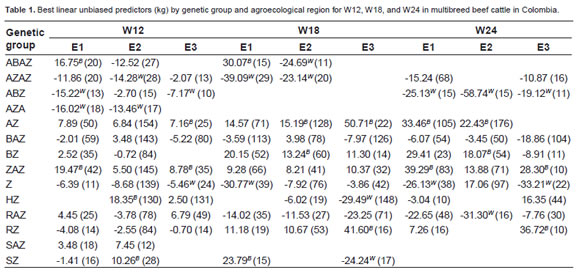
<body><![CDATA[<p><font face="Verdana, Arial, Helvetica, sans-serif" size="2">The Animal Care and Use Committ ee approval was not obtained for this study, because the data were obtained from an existing database in La Leyenda farm. </font></p>     <p><font face="Verdana, Arial, Helvetica, sans-serif" size="2">Three agroecological regions (environments) were considered: The first one (E1) was located in the Southwest region of Antioquia department (altitude: between 500 and 800 m above sea level; yearly average temperature: 27 &ordm;C; precipitation around 2050 mm/yr). The zone was classified as sub-tropical humid forest (bh-ST; Holdridge, 1996). Soils were very fertile and 60% of the lands were undulated. The second region (E2) was located in the border between Antioquia and C&oacute;rdoba departments (altitude: between 60 and 150 m above sea level; yearly temperatures ranged from 28 &ordm;C to 30 &ordm;C; precipitation: from 2000 to 2200 mm/yr). The zone was classified as tropical humid forest (bh-T; Holdridge, 1996). Soil fertility ranged from low to very low, and the land was mostly flat. The last region (E3) was located in C&oacute;rdoba and Sucre departments (altitude: between 0 and 150 m above sea level; yearly temperature ranged from 27 to 32 &deg;C; precipitation ranged from 1000 to 1400 mm/yr). This zone was classified as tropical dry forest (bs-T; Holdridge, 1996), and its soils were fairly fertile and the land is mostly flat. </font></p>     <p><font face="Verdana, Arial, Helvetica, sans-serif" size="2">Data from 16 herds managed by the company Custodiar S. A. were used. Four of them were raised in E1, six in E2 and six in E3. All animals were born one herd located in E2, after weaning, most of the female calves stayed in this farm while all males were distributed in the other farm and environments (<a href="#t1">Table 1</a>). </font></p>     <p><font face="Verdana, Arial, Helvetica, sans-serif" size="2">Records used corresponded to animals born between years 1995 and 2006, with weight at weaning 12, 18, and 24, months of age. Animals used included several crossbreeds of Angus (A), Blanco Orejinegro (B), Zebu (Z), Romosinuano (R), Senepoll (S), and Holstein (H) (<a href="#t1">Table 1</a>). Zebu included commercial crossbred Bos indicus cattle of Brahman, Guzerat, and Nellore origins, and Brahman sires imported from the USA. For all evaluated traits, each genetic group had at least 10 animals in two of the agroecological regions (<a href="#t1">Table 1</a>). </font></p>     <p><font face="Verdana, Arial, Helvetica, sans-serif" size="2">After filtering the original data base, 14 groups were analyzed for weight at 12 months of age (W12), with 1806 records and ages between 315 and 415 days; 11 groups were analyzed for weight at 18 months of age (W18) including 1455 records and ages between 500 and 600 days; finally 10 groups were analyzed for weight at 24 months of age (W24) with 1197 records and ages between 680 and 780 days. </font></p>     <p align="center"><font face="Verdana, Arial, Helvetica, sans-serif" size="2"><img src="/img/revistas/rccp/v23n2/v23n2a03t01.jpg"></font><a name="t1"></a></p>     <p><font face="Verdana, Arial, Helvetica, sans-serif" size="2">&nbsp;</font></p>     <p><font face="Verdana, Arial, Helvetica, sans-serif" size="2">Remark in parenthesis is the number of animal for genetic group. Superscript in the same column indicates better (B) and worst (W) genetic groups for each agroecological region. </font></p>               <p><font face="Verdana, Arial, Helvetica, sans-serif" size="2">Contemporary groups were formed by sex (male or female), season (dry, from December to March; wet, from April to November) and year of weighting (from 1995 to 2007). </font></p>               <p><font face="Verdana, Arial, Helvetica, sans-serif" size="2">The following mixed model was used to analyze W12, W18 and W24: </font></p>               ]]></body>
<body><![CDATA[<p><font face="Verdana, Arial, Helvetica, sans-serif" size="2">y = X<sub>1</sub>&egrave; + X<sub>2</sub>&beta; + Z<sub>1</sub>&atilde; + Z<sub>2</sub>&otilde;+  Z<sub>3</sub>&auml; + &aring; [1];          </font></p>     <p><font face="Verdana, Arial, Helvetica, sans-serif" size="2">Where: </font></p>     <p><font face="Verdana, Arial, Helvetica, sans-serif" size="2">y = vector of records of weights;    <br>   X<sub>1</sub> = design matrix related with the effect of   contemporary group &egrave;;    <br>   X<sub>2</sub> and &beta; = design matrix and regression   coeffi cient of animal age (covariate), respectively;    <br>   Z<sub>1</sub> and &atilde; = incidence matrix and vector of   genetic group effects, respectively;    <br>   Z<sub>2</sub> and &otilde; = incidence matrix and vector of   environment effects, respectively;    <br>   Z<sub>3</sub> and &auml; = incidence matrix and vector of   genetic group by environment interaction effects,   respectively;    <br> &aring; = vector of residuals.</font></p>     <p><font face="Verdana, Arial, Helvetica, sans-serif" size="2">Effects of genetic group, environment, genetic group by environment interaction, and the residual were considered random effects and were considered to be normally distributed with mean zero and variances: I&sigma;<sub>&gamma;</sub><Sup>2</Sup>, I&sigma;<sub>&upsilon;</sub><Sup>2</Sup>, I&sigma;<sub>&delta;</sub><Sup>2 </Sup>and I&sigma;<sub>&epsilon;</sub><Sup>2</Sup>, respectively. For estimating all parameters in model [1] the MIXED procedure of SAS (2006) program was used. </font></p>     ]]></body>
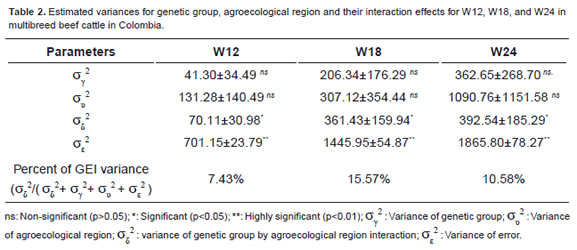
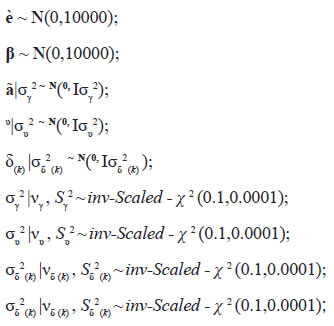
<body><![CDATA[<p><font face="Verdana, Arial, Helvetica, sans-serif" size="2">The Shukla's variance (Shukla, 1972) and Bayesian method proposed by Cotes et al. (2006) was used. Thus, model [1] was modified as follows: </font></p>     <p><font face="Verdana, Arial, Helvetica, sans-serif" size="2"><img src="/img/revistas/rccp/v23n2/v23n2a03f03.jpg"></font></p>     <p><font face="Verdana, Arial, Helvetica, sans-serif" size="2">Where: </font></p>     <p><font face="Verdana, Arial, Helvetica, sans-serif" size="2">Z<sub>3(k)</sub> and &auml;<sub>k</sub>  = incidence matrix and vector of genetic group by environment interaction effects k<sup>th</sup> for the group (k=1,2,&hellip;,g). This model [2] assumes heterogeneity variance for k<sup>th</sup> genetic group among environments. Thus, the effects &auml;<Sub>k </Sub>were considered to be normally distribution with mean zero and variances I&sigma;<sub>&delta;</sub><sup>2</sup><sub>(k)</sub> (Kang and Magari, 1996; Magari and Kang, 1997; Piepho, 1999; Cotes et al., 2006). </font></p>     <p><font face="Verdana, Arial, Helvetica, sans-serif" size="2">The Bayesian estimation included a noninformative prior distribution for all the parameters, as follows: </font></p>     <p><font face="Verdana, Arial, Helvetica, sans-serif" size="2"><img src="/img/revistas/rccp/v23n2/v23n2a03f04.jpg"></font></p>     <p><font face="Verdana, Arial, Helvetica, sans-serif" size="2">Where Inv-Scaled-&chi;<Sup>2 </Sup>indicates a scaled inversechi-square. Samples of joint posterior distribution were obtained using GIBBS sampler, which was programmed in SAS/IML (2006). </font></p>     <p><font face="Verdana, Arial, Helvetica, sans-serif" size="2">&nbsp;</font></p>                                     <p><font face="Verdana, Arial, Helvetica, sans-serif" size="3"><b>Results</b></font></p>              <p><font face="Verdana, Arial, Helvetica, sans-serif" size="2">Both, age covariate and c ontemporary group effect were highly significant (p&lt;0.001) for W12, W18, and W24 (<a href="#t2">Table 2</a>). GEI was observed between genetic group and agroecological region (p&lt;0.05) for the three evaluated traits. Main effects of genetic groups and agroecological region were non-significant (<a href="#t2">Table 2</a>). </font></p>     ]]></body>

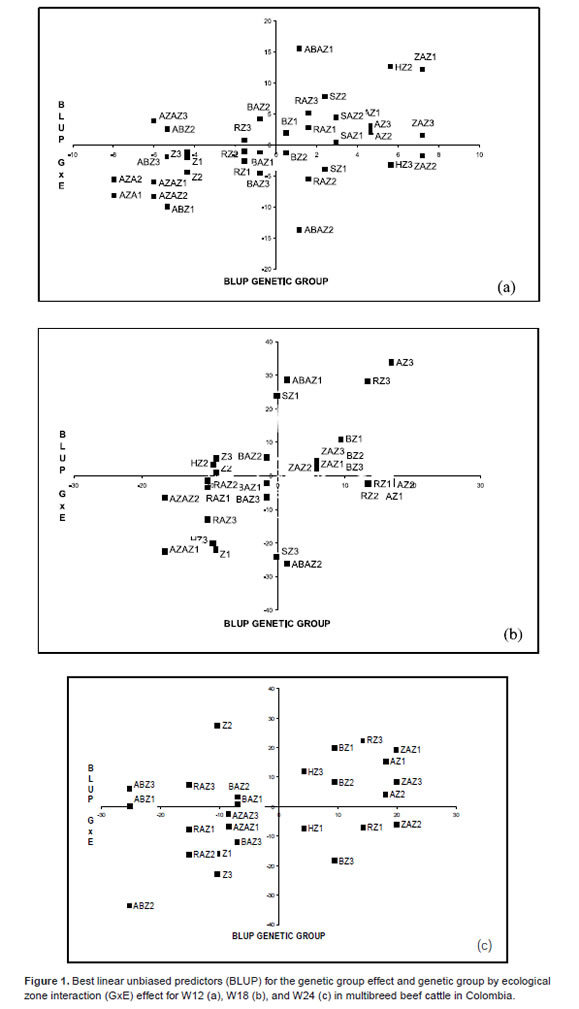
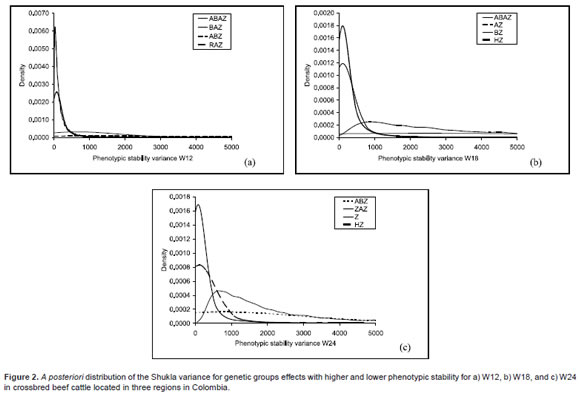
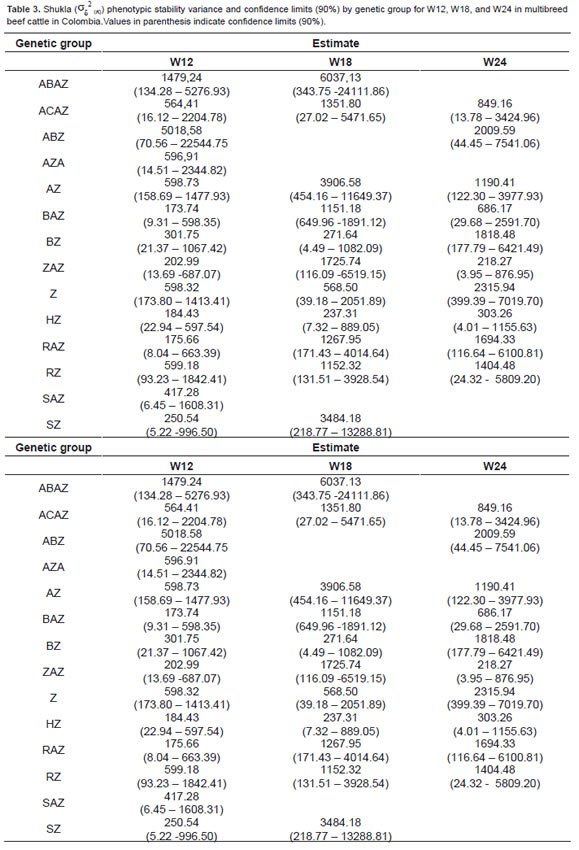
<body><![CDATA[<p align="center"><font face="Verdana, Arial, Helvetica, sans-serif" size="2"><img src="/img/revistas/rccp/v23n2/v23n2a03t02.jpg"></font><a name="t2"></a></p>     <p><font face="Verdana, Arial, Helvetica, sans-serif" size="2">&nbsp;</font></p>     <p><font face="Verdana, Arial, Helvetica, sans-serif" size="2"><i>Genetic group by agroecological region interaction </i></font></p>     <p><font face="Verdana, Arial, Helvetica, sans-serif" size="2"><i>Weight at 12 months of age </i></font></p>     <p><font face="Verdana, Arial, Helvetica, sans-serif" size="2"><i>Agroecological region 1 (E1).</i> Genetic groups of highest performance for W12 were ZAZ and ABAZ (Fig. 1). These groups did not show significant differences (p&gt;0.05) among themselves, but both of them had significant differences (p&lt;0.05) with the rest of genetic group. AZA, ABZ, and AZAZ groups showed the lowest performance, and had not significant differences (p&gt;0.05) among themselves (<a href="#f1">Figure 1</a>). </font></p>     <p><font face="Verdana, Arial, Helvetica, sans-serif" size="2"><i>Agroecological region 2 (E2).</i> HZ, SZ, SAZ, AZ, and ZAZ groups had a highest performance (although a non-significant difference was observed among themselves; p&gt;0.05). The HZ group showed significant differences from groups whit the lowest performance (AZAZ, AZA, ABAZ, Z, RAZ, and RZ; <a href="#f1">Figure 1a</a>). </font></p>     <p><font face="Verdana, Arial, Helvetica, sans-serif" size="2"><i>Agroecological region 3 (E3).</i> A non-significant difference was observed among genetic groups (p&gt;0.05). </font></p>     <p><font face="Verdana, Arial, Helvetica, sans-serif" size="2"><i>Phenotypic stability analysis.</i> The genetic group BAZ, RAZ, HZ, and ZAZ showed a high stability, with low variances (<a href="#t3">Table 3</a>). Groups with high variances and low stability were ABZ and ABAZ (<a href="#f2">Figure 2</a>). </font></p>     <p><font face="Verdana, Arial, Helvetica, sans-serif" size="2"><i>Performance and stability analysis.</i> Summarizing the results for W12, group ABAZ has high performance in E1, but also a low performance in E2, underlying the importance of GEI analysis. ZAZ group performed well in E1 and E2, while ABZ (the least stable group) performed poorly. </font></p>     <p align="center"><font face="Verdana, Arial, Helvetica, sans-serif" size="2"><img src="/img/revistas/rccp/v23n2/v23n2a03f01.jpg"></font><a name="f1"></a></p>     ]]></body>
<body><![CDATA[<p><font face="Verdana, Arial, Helvetica, sans-serif" size="2">&nbsp;</font></p>     <p><font face="Verdana, Arial, Helvetica, sans-serif" size="2">Genetic groups with crosses between Angus   (A), Blanco Orejinegro (B), Zebu (Z), Holstein   (H), Romosinuano (R) and Senepoll (S); 1   (Agroecological region 1); 2 (Agroecological   region 2); 3 (Agroecological regi&oacute;n 3); (Genetic   group of the sire)x(Genetic group of the dam):   ABAZ (25%Ax25%B)x(25%Ax25%Z);   AZAZ (37,5%Ax12,5%Z)x(25%Ax25%Z);   ABZ (50%A)x(25%Bx25%Z); AZA (50%A)   x(37,5%Zx12,5%A); AZ (50%A)x(50%Z);   BAZ (50%B)x(25%Ax25%Z); BZ (50%B)   x(50%Z); ZAZ (50%Z)x(25%Ax25%Z); Z   (50%Z)x(50%Z); HZ (50%H)x(50%Z); RAZ   (50%R)x(25%Ax25%Z); RZ (50%R)x(50%Z);   SAZ (50%S)x(25%Ax25%Z); SZ (50%S) x(50%Z).</font></p>     <p><font face="Verdana, Arial, Helvetica, sans-serif" size="2">When BLUP of genetic group and GEI effects are graphically confronted for W12 (<a href="#f1">Figure 1a</a>), it was found that ABAZ group in E1 (on the rightupper quadrant) had the highest BLUP. However, it was the lowest performance and had the lowest stability (<a href="#f2">Figure 2</a>). Although had a positive BLUP, ABAZ group was located near the mean, and was exceeded by ZAZ, HZ, and AZ groups. These groups did not show important performance differences between zones and showed high stability. Regarding the low performance groups (left-lower quadrant), AZA had the lowest BLUP value and intermediate stability where it was evaluated. Groups such as AZAZ and Z showed intermediate stability and had low performance in most zones. The group ABZ (the least stable) showed only one positive BLUP, although it was close to the mean in E2. </font></p>     <p align="center"><font face="Verdana, Arial, Helvetica, sans-serif" size="2"><img src="/img/revistas/rccp/v23n2/v23n2a03f02.jpg"></font><a name="f2"></a></p>     <p align="center"><font face="Verdana, Arial, Helvetica, sans-serif" size="2"><img src="/img/revistas/rccp/v23n2/v23n2a03t03.jpg"></font><a name="t3"></a></p>     <p><font face="Verdana, Arial, Helvetica, sans-serif" size="2"><i>Weight at 18 months of age </i></font></p>     <p><font face="Verdana, Arial, Helvetica, sans-serif" size="2"><i>Agroecological region 1 (E1)</i>. ABAZ, SZ, and BZ genetic groups had the best performance for W18. AZAZ and Z genetic groups were the worst performers for W18 (<a href="#f1">Figure 1b</a>), and a non-significant difference was found between themselves (p&gt;0.05), but showed significant differences from the others groups (p&lt;0.05). </font></p>     <p><font face="Verdana, Arial, Helvetica, sans-serif" size="2"><i>Agroecological region 2 (E2):</i> the AZ group had the best performance (<a href="#f1">Figure 1b</a>). Groups ABAZ and AZAZ were the worst performance, and nonsignificant difference was found between them (p&gt;0.05). </font></p>     <p><font face="Verdana, Arial, Helvetica, sans-serif" size="2"><i>Agroecological region 3 (E3)</i>. AZ and RZ groups showed the best BLUP values and were significantly different (p&lt;0.05) from the rest of genetic groups (<a href="#f1">Figure 1b</a>). HZ, SZ and RAZ groups were the worst performance. The RZ group had a good BLUP in this zone, while RAZ had a negative BLUP. F1 groups, such as HZ and SZ, performed poorly. </font></p>     <p><font face="Verdana, Arial, Helvetica, sans-serif" size="2"><i>Phenotypic stability analysis</i>. HZ and BZ groups were the most stable for W18 (<a href="#t3">Table 3</a>), with relatively lower variances. On the other hand, ABAZ, AZ, and SZ groups were the least stable, with higher variances (<a href="#f2">Figure 2</a>). Some F1 were the most stable groups (HZ and BZ), although some other F1 groups showed lower stability (AZ and SZ). </font></p>     ]]></body>
<body><![CDATA[<p><font face="Verdana, Arial, Helvetica, sans-serif" size="2">Performance and stability analysis. ABAZ group had high performance in E1 but showed the lowest performance in E2. In the same way, SZ group had good performance in E1, but showed bad performance in E3. </font></p>     <p><font face="Verdana, Arial, Helvetica, sans-serif" size="2">AZ group had a good performance in E2 and E3, while BZ group had a poor performance in E1 and E2. However, AZAZ had a low performance in both environments. </font></p>     <p><font face="Verdana, Arial, Helvetica, sans-serif" size="2">When BLUP of main effect of the genetic group was confronted with BLUP for GEI effect (<a href="#f1">Figure 1b</a>), AZ and RZ groups in E3 (located in the rightupper quadrant) had the highest BLUP, although both of them showed negative BLUP in E1 and E2. Group AZ was one of the least stable (<a href="#f2">Figure 2</a>), while RZ had medium stability, which made BZ and ZAZ the best alternatives. These last two groups had positive BLUP values, but close to zero. Stability was high and medium for BZ and ZAZ groups, respectively (<a href="#t3">Table 3</a>). As observed for W12, ABAZ had a good performance in E1, but had the worst performance in E2. </font></p>     <p><font face="Verdana, Arial, Helvetica, sans-serif" size="2">Regarding the groups with low performance (<a href="#f1">Figure 1b</a>, left-lower quadrant), AZAZ had the lowest BLUP values and presented medium stability. Medium stability groups, such as RAZ and Z, had lower BLUP in most environments. HZ group, the most stable (<a href="#f2">Figure 2</a>), had only one positive BLUP, although it was close to the average in E2, but it had the worst performance in E3. </font></p>                  <p><font face="Verdana, Arial, Helvetica, sans-serif" size="2"><i>Weight at 24 months of age </i></font></p>                  <p><font face="Verdana, Arial, Helvetica, sans-serif" size="2"><i>Agroecological region 1 (E1).</i> ZAZ, AZ, and BZ genetic groups were the best groups for W24 (Fig. 1c). These groups did not show significant difference from the groups of worst performance (p&gt;0.05; Z, ABZ, and RAZ). In the groups of worst performance a non-significant difference was found among themselves (p&gt;0.05). </font></p>     <p><font face="Verdana, Arial, Helvetica, sans-serif" size="2">Zebu and BZ, AZ, and ZAZ groups had good performance in this environment. On the other hand, Z, ABZ, and AZAZ groups had negative values of BLUP. </font></p>     <p><font face="Verdana, Arial, Helvetica, sans-serif" size="2"><i>Agroecological region 2 (E2).</i> Genetic groups with high performance were AZ, BZ, Z and ZAZ (p&gt;0.05). Genetic groups with low performance were ABZ and RAZ (p&gt;0.05). There was significant difference between these groups (p&lt;0.05) (<a href="#f1">Figure 1c</a>). Similar to W12 and W18, F1 groups with dam Z had a high performance mating with Bos taurus and ZAZ. Contrary to W12 and W18 result, Zebu demonstrated to be a good option here. The ABZ group showed low BLUP, as for W12, in this agroecological region. </font></p>     <p><font face="Verdana, Arial, Helvetica, sans-serif" size="2">Agroecological region 3 (E3. The RZ and ZAZ groups were the best performance groups (<a href="#f1">Figure 1c</a>), but a non-significant difference between themselves (p&gt;0.05) was found, but the RZ group differed from another genetic group (p&lt;0.05). On the other hand, groups of poorest performance were Z, ABZ, and BAZ, and a non-significant difference was found between themselves (p&gt;0.05). Similar to W18, RZ group had good performance in this agroecological region, as well as in E1 and E2. </font></p>     <p><font face="Verdana, Arial, Helvetica, sans-serif" size="2">Phenotypic stability analysis. The most stable groups for W24 were ZAZ and HZ (<a href="#t3">Table 3</a>), which had relatively lower variances. On the other hand, the least stable groups were Z and ABZ (<a href="#f2">Figure 2</a>). </font></p>     ]]></body>
<body><![CDATA[<p><font face="Verdana, Arial, Helvetica, sans-serif" size="2">Performance and stability analysis: Groups performed in different ways in each agroecological region. It Z group was the best performance in E2 but it was the worst in E1 and E3. </font></p>     <p><font face="Verdana, Arial, Helvetica, sans-serif" size="2">When the BLUP's of the main effect of genetic group were confronted with the BLUP's of the GEI effect for W24 (<a href="#f1">Figure 1c</a>), ZAZ in E1 and E3 (right-upper quadrant) had good BLUP values. This group showed negative BLUP in E2, although close to the average, and it was the most stable group (<a href="#f2">Figure 2</a>). Group AZ had medium stability with good BLUP values where it was evaluated (E1 and E2). Groups HZ and RZ, which performed well in E3 had negative BLUP's in E1. The contrary happened with BZ, which performed well in E1 and E2, but had negative BLUP's in E3. </font></p>     <p><font face="Verdana, Arial, Helvetica, sans-serif" size="2">On the other hand, the lowest performance groups (<a href="#f1">Figure 1c</a>, left-lower quadrant), ABZ, RAZ, and Z had the lowest BLUP's values and stability (<a href="#f2">Figure 2</a>). Several BLUP values were also calculated for those groups in the zones where they were tested. Thus, ABZ had the lowest values in E1 (ABZ1), while RAZ had the lowest in E1 and E2 (RAZ1 and RAZ2), and Z had the lowest in E1 and E3. </font></p>     <p><font face="Verdana, Arial, Helvetica, sans-serif" size="2"><i>Comparative analysis </i></font></p>     <p><font face="Verdana, Arial, Helvetica, sans-serif" size="2"><a href="#t1">Table 1</a> summarizes the best and worst genetic groups in each agroecological region for each trait, according to performance and stability. </font></p>                                       <p><font face="Verdana, Arial, Helvetica, sans-serif" size="2">&nbsp;</font></p>     <p><font face="Verdana, Arial, Helvetica, sans-serif" size="3"><b>Discussion </b></font></p>     <p><font face="Verdana, Arial, Helvetica, sans-serif" size="2">Although in the GEI was non-significant in this study the GEI has been reported to be significant in several research studies, for example Dom&iacute;nguez et al. (2003) analyzed weights and gains of weight from different ages in M&eacute;xico (including W12 and W18), and reported significant differences for GEI. They concluded that productive performance for each genetic group differs according to specific herd management. In Argentina, Molinuevo (1998) conducted a lineal regression analysis of gains of weight for genetic group and season combinations to determine GEI and compare high versus low growth potential steers fed on different pasture. The high potential groups were superior when the conditions improved. Carvalheiro et al. (2006) compared several Nellore x Hereford crossbred in different environments in Brazil. They reported significant differences for GEI on pre-weaning weight. </font></p>     <p><font face="Verdana, Arial, Helvetica, sans-serif" size="2"><i>Genetic group by agroecological region interaction </i></font></p>     <p><font face="Verdana, Arial, Helvetica, sans-serif" size="2"><i>Weight at 12 months of age </i></font></p>     ]]></body>
<body><![CDATA[<p><font face="Verdana, Arial, Helvetica, sans-serif" size="2"><i>Agroecological region 1 (E1).</i> in this region, genetic groups with AZ dams had the best performance. An exception occurred when the sire was 75% A x 25% Z (group AZAZ), for the high percent of Angus which revealed signs of lack of adaptation to this region. Similarly, groups with Angus sires (AZA and ABZ groups) showed low performance. Schatz et al. (2005), reported that under tropical conditions, increasing Bos taurus proportions decrease post weaning growth. </font></p>     <p><font face="Verdana, Arial, Helvetica, sans-serif" size="2"><i>Agroecological region 2 (E2).</i> When groups combined Z dams with Bos taurus sires breeds (no including Creole breeds), the performance of W12 was increased in this region. The AZAZ group, which had a high performance in E1, but had a poor performance in E2, showed a very strong GEI. </font></p>     <p><font face="Verdana, Arial, Helvetica, sans-serif" size="2"><i>Agroecological region 3 (E3).</i> The nonsignificant difference found may be because the agroecological region has the best environmental conditions for development of all the genetic groups. </font></p>     <p><font face="Verdana, Arial, Helvetica, sans-serif" size="2"><i>Phenotypic stability analysis</i>. Groups with AZ dams were the most stable when combined with Zebu or Creole breeds as the paternal group (BAZ, RAZ and ZAZ); but when the sire was AB, animals showed lower stability (ABAZ). In conclusion, when three breeds are crossed, AZ dams transmit higher stability, so they should be considered for genetic improvement programs. </font></p>     <p><font face="Verdana, Arial, Helvetica, sans-serif" size="2">Performance and stability analysis: Difference in the performance of the group ABAZ in E1 and E2, underlies the importance of GEI analysis. However, this group showed a low stability, which means that it requires specific agroecological conditions to improve its performance. </font></p>     <p><font face="Verdana, Arial, Helvetica, sans-serif" size="2">The ZAZ group performed well in E1 and E2, while ABZ (the least stable group) performed poorly here. This could be explained by postweaning adaptation factors of ABZ or by the lack of precocity of ABZ provided by Blanco Orejinegro (which is not present in the ZAZ group). This could also be explained by the low Bos indicus proportions in the ABZ group. And also it may explain the fact that the AZA group (composed by the same breeds as ZAZ, but in inverse proportions) performed poorly and had lower stability. </font></p>     <p><font face="Verdana, Arial, Helvetica, sans-serif" size="2"><i>Weig ht at 18 months of age </i></font></p>     <p><font face="Verdana, Arial, Helvetica, sans-serif" size="2"><i>Agroecological region 1 (E1). </i>ABAZ, SZ, and BZ genetic groups had best performance for W18. AZAZ and Z genetic groups were the worst performers for W18 (Fig. 1b), with a non-significant difference between themselves (p&gt;0.05), but they showed significant differences from the others groups (p&lt;0.05). According to Molinuevo (1998) similar results were obtained in Angus crossbreds for different feeding systems. Frisch and Vercoe (1984), Brown et al. (2001), and L&oacute;pez and Vacaro (2002) also reported opposite results for several European crossbreds compared to Brahman under tropical conditions. This was explained by the high productive potential of Bos taurus and the high adaptive potential of Zebu, which can or cannot be expressed according to the prevalent environmental and management conditions. </font></p>     <p><font face="Verdana, Arial, Helvetica, sans-serif" size="2"><i>Agroecological region 2 (E2). </i>The differences found between groups at 12 months of age were lost 6 months after. This may be because the environments have an important effect in early stages of animal development (Meyer et al., 1993; Elzo et al., 1998). </font></p>     <p><font face="Verdana, Arial, Helvetica, sans-serif" size="2"><i>Agroecological region 3 (E3). </i>In this region, crossbreds with AZ dams continue to be productive at 18 months, but when the Romosinuano was included in crossbreds of three breeds it showed a disadvantage in this period, underlying the importance of the specific adaptations of crossbreds. </font></p>     ]]></body>
<body><![CDATA[<p><font face="Verdana, Arial, Helvetica, sans-serif" size="2">High heterosis levels and the balance between productive and adaptive potential of Bos taurus and Zebu explain the high performance of F1 crossbreds (Madalena, 2001; L&oacute;pez and Vacaro, 2002; Plasse, 2003; Carvalheiro et al., 2006). This may be one of the advantages of Colombian Creole cattle which is Bos taurus mainly. </font></p>     <p><font face="Verdana, Arial, Helvetica, sans-serif" size="2"><i>Phenotypic stability analysis.</i> As for W12, the group ABAZ was the least stable, and the HZ group had the lowest variance. This suggested the need of making specific recommendations to each agroecological region, with the objective of increasing the stability of the production of beef cattle. </font></p>     <p><font face="Verdana, Arial, Helvetica, sans-serif" size="2">Performance and stability analysis. Differences in the performance of some groups in the different regions indicate the importance of the GEI analysis, in order to improve the meat production in each environment. </font></p>     <p><font face="Verdana, Arial, Helvetica, sans-serif" size="2">The AZ group had a good performance in E2 and E3, while BZ group had a poor performance in E1 and E2. However, the AZAZ had a low performance in both environments. It should be noticed that groups with good performance were F1, while the AZAZ group (which performed also poorly for W12 in those zones) had a different genetic composition (5/8 Angus x 3/8 Zebu). </font></p>     <p><font face="Verdana, Arial, Helvetica, sans-serif" size="2">The differences in stability of different genetic groups are in agreement with Frisch and Vercoe (1984) and Hartman (1990), who recommended specific genetic groups for specific environments. </font></p>              <p><font face="Verdana, Arial, Helvetica, sans-serif" size="2"><i>Weight at 24 months of age </i></font></p>                      <p><font face="Verdana, Arial, Helvetica, sans-serif" size="2"><i>Agroecological region 1 (E1).</i> The performance of Z, ABZ, and AZAZ groups coincides with their lower performance for W12 and W18 in this environment. Madalena (2001) and L&oacute;pez and Vacaro (2002), reported a tendency to favor F1 crossbreds. Molinuevo (1998) in Argentina, Frisch and Vercoe (1984), and Brown et al. (1997) in tropical conditions, highlighted heterosis between Bos taurus and Zebu, which would express depending on the management and conditions supplied. </font></p>             <p><font face="Verdana, Arial, Helvetica, sans-serif" size="2"><i>Agroecological region 2 (E2).</i> The results in this region support the idea of the farmers that having animals with a Zebu genetic composition in this environment (with poorest soils), is the best option. For another type of environment the use of Zebu animals are not necessary. Reports by Frisch and Vercoe (1984), Brown et al. (1997), Brown et al. (2001), and Beffa (2005), do not show clear conclusions when comparing several crossbreds of Zebu with Bos taurus under tropical conditions. The common conclusion is conducting additional research in order to establish specific environments for specific lines or crossbreds. Other researchers, such as Madalena (2001), L&oacute;pez and Vacaro (2002), Plasse (2003) and Carvalheiro et al. (2006), have reported a slight tendency to use F1 crossbreds in beef cattle. </font></p>             <p><font face="Verdana, Arial, Helvetica, sans-serif" size="2"><i>Agroecological region 3 (E3).</i> This result in this region shows that the RZ genetic group did not show differences between ages, and it is a good option for beef cattle production in Colombia (Mart&iacute;nez, 1998; Torregrosa et al., 2006). </font></p>             <p><font face="Verdana, Arial, Helvetica, sans-serif" size="2">Phenotypic stability analysis. Results of phenotypic stability analysis suggest that in ages, with no maternal influence, the ability of animal growth is strongly influenced by their genetic composition and environmental conditions in which animals grow. </font></p>             ]]></body>
<body><![CDATA[<p><font face="Verdana, Arial, Helvetica, sans-serif" size="2"><i>Performance and stability analysis. </i>The difference in the performance of genetic groups may be because Zebu has a good adaptation in fertile and poor soils, but when conditions improve, other groups have higher performace (e.i, the ZAZ group). </font></p>                   <p><font face="Verdana, Arial, Helvetica, sans-serif" size="2"><i>Comparative analysis </i></font></p>     <p><font face="Verdana, Arial, Helvetica, sans-serif" size="2">Although the GEI was observed for the three traits, it was also observed that several groups had a high performance in most of the environments for several traits. Groups AZ, ZAZ, and BZ had high performance in E1 and E2. Groups ABZ, RAZ, and AZAZ showed low performance for all three traits in several environments. Thus, when breeds such as Angus is introduced, the results will depend on different factors, including breed complementarity, breed proportion, and selection of sires and dams. This is in agreement with those results reported by Hartman (1990), Molinuevo (1998), and Madalena (2001). </font></p>     <p><font face="Verdana, Arial, Helvetica, sans-serif" size="2">GEI were significant for W12, W18 and W24. Some genetic groups showed high performance in specific agroecological regions. Groups that had high performance for a particular trait, did not necessarily perform well for the other traits evaluated. This could be due to factors such as adaptability, precocity, heterozygosis, breed proportion, weather and soil conditions, or other conditions and management present in each farm. However, some groups excelled in most zones for most of the traits, such as AZ, ZAZ, and BZ. On the other hand, groups such as ABZ, RAZ, and AZAZ performed poorly for the three traits in almost all of the regions. The ideal Bos taurus proportions for W12, W18, and W24 is close to 50%, when this proportion increases, the response for the evaluated traits decreases. </font></p>     <p><font face="Verdana, Arial, Helvetica, sans-serif" size="2">&nbsp;</font></p>     <p><font face="Verdana, Arial, Helvetica, sans-serif" size="3"><b>Acknowledgments </b></font></p>     <p><font face="Verdana, Arial, Helvetica, sans-serif" size="2">Authors thank Custodiar S.A. company for facilitating the data sets to conduct this research. Authors also appreciate the financial support of CODI of the University of Antioquia. </font></p>     <p><font face="Verdana, Arial, Helvetica, sans-serif" size="2">&nbsp;</font></p>     <p><font face="Verdana, Arial, Helvetica, sans-serif" size="3"><b>References </b></font></p>     <!-- ref --><p><font face="Verdana, Arial, Helvetica, sans-serif" size="2">1. Arnold J, Bertrand J, and Benyshek L. Animal model for genetic evaluation of multibreed data. J Anim Sci 1992; 70:3322-3332. </font>&nbsp;&nbsp;&nbsp;&nbsp;&nbsp;&nbsp;&nbsp;&nbsp;[&#160;<a href="javascript:void(0);" onclick="javascript: window.open('/scielo.php?script=sci_nlinks&ref=000132&pid=S0120-0690201000020000300001&lng=','','width=640,height=500,resizable=yes,scrollbars=1,menubar=yes,');">Links</a>&#160;]<!-- end-ref --><!-- ref --><p><font face="Verdana, Arial, Helvetica, sans-serif" size="2">2. Beffa L. Genotype x environment interaction in Africander cattle. Thesis PhD. Faculty of Natural and Agricultural Sciences. University of the Free State. 2005.</font>&nbsp;&nbsp;&nbsp;&nbsp;&nbsp;&nbsp;&nbsp;&nbsp;[&#160;<a href="javascript:void(0);" onclick="javascript: window.open('/scielo.php?script=sci_nlinks&ref=000133&pid=S0120-0690201000020000300002&lng=','','width=640,height=500,resizable=yes,scrollbars=1,menubar=yes,');">Links</a>&#160;]<!-- end-ref --><!-- ref --><p><font face="Verdana, Arial, Helvetica, sans-serif" size="2">3. Brown M, Brown A, Jackson W, and Miesner J. Genotype x environment interactions in Angus, Brahman, and reciprocal cross cows and their calves grazing common Bermudagrass and endophyte-infected tall fescue pastures. J Anim Sci 1997; 75:920-925. </font>&nbsp;&nbsp;&nbsp;&nbsp;&nbsp;&nbsp;&nbsp;&nbsp;[&#160;<a href="javascript:void(0);" onclick="javascript: window.open('/scielo.php?script=sci_nlinks&ref=000134&pid=S0120-0690201000020000300003&lng=','','width=640,height=500,resizable=yes,scrollbars=1,menubar=yes,');">Links</a>&#160;]<!-- end-ref --><!-- ref --><p><font face="Verdana, Arial, Helvetica, sans-serif" size="2">4. Brown M, Brown A, Jackson W, and Miesner J. Genotype x environment interactions in milk yield and quality in Angus, Brahman, and reciprocal-cross cows on different forage systems. J Anim Sci 2001; 79:1643-1649. </font>&nbsp;&nbsp;&nbsp;&nbsp;&nbsp;&nbsp;&nbsp;&nbsp;[&#160;<a href="javascript:void(0);" onclick="javascript: window.open('/scielo.php?script=sci_nlinks&ref=000135&pid=S0120-0690201000020000300004&lng=','','width=640,height=500,resizable=yes,scrollbars=1,menubar=yes,');">Links</a>&#160;]<!-- end-ref --><!-- ref --><p><font face="Verdana, Arial, Helvetica, sans-serif" size="2">5. Carvalheiro R, Pimentel E, Cardoso V, Queiroz A, and Fries L. Genetic effects on preweaning weight gain of Nellore-Hereford calves according to different models and estimation methods. J Anim Sci 2006; 84:2925-2934. </font>&nbsp;&nbsp;&nbsp;&nbsp;&nbsp;&nbsp;&nbsp;&nbsp;[&#160;<a href="javascript:void(0);" onclick="javascript: window.open('/scielo.php?script=sci_nlinks&ref=000136&pid=S0120-0690201000020000300005&lng=','','width=640,height=500,resizable=yes,scrollbars=1,menubar=yes,');">Links</a>&#160;]<!-- end-ref --><!-- ref --><p><font face="Verdana, Arial, Helvetica, sans-serif" size="2">6. Cotes J, Crossa J, Sanches A, and Cornelius P. A Bayesian Approach for Assessing the Stability of Genotypes. Crop Sci Soc of Amer 2006; 46:2654-2665. </font>&nbsp;&nbsp;&nbsp;&nbsp;&nbsp;&nbsp;&nbsp;&nbsp;[&#160;<a href="javascript:void(0);" onclick="javascript: window.open('/scielo.php?script=sci_nlinks&ref=000137&pid=S0120-0690201000020000300006&lng=','','width=640,height=500,resizable=yes,scrollbars=1,menubar=yes,');">Links</a>&#160;]<!-- end-ref --><!-- ref --><p><font face="Verdana, Arial, Helvetica, sans-serif" size="2">7. Dickerson G. Implications of genetic-environmental interactions in animal breeding. Anim Prod 1962; 4:47-63. </font>&nbsp;&nbsp;&nbsp;&nbsp;&nbsp;&nbsp;&nbsp;&nbsp;[&#160;<a href="javascript:void(0);" onclick="javascript: window.open('/scielo.php?script=sci_nlinks&ref=000138&pid=S0120-0690201000020000300007&lng=','','width=640,height=500,resizable=yes,scrollbars=1,menubar=yes,');">Links</a>&#160;]<!-- end-ref --><!-- ref --><p><font face="Verdana, Arial, Helvetica, sans-serif" size="2">8. Dominguez J, N&uacute;&ntilde;ez R, Ram&iacute;rez R, and Ru&iacute;z A. Environmental effects and repeatability for growth traits in Tropicarne cattle. Tec Pecu Mex 2003; 41:1-18. </font>&nbsp;&nbsp;&nbsp;&nbsp;&nbsp;&nbsp;&nbsp;&nbsp;[&#160;<a href="javascript:void(0);" onclick="javascript: window.open('/scielo.php?script=sci_nlinks&ref=000139&pid=S0120-0690201000020000300008&lng=','','width=640,height=500,resizable=yes,scrollbars=1,menubar=yes,');">Links</a>&#160;]<!-- end-ref --><!-- ref --><p><font face="Verdana, Arial, Helvetica, sans-serif" size="2">9. Elzo MA and Famula T. Multibreed sire evaluation procedure within a country. J Anim Sci 1985; 60:942-952. </font>&nbsp;&nbsp;&nbsp;&nbsp;&nbsp;&nbsp;&nbsp;&nbsp;[&#160;<a href="javascript:void(0);" onclick="javascript: window.open('/scielo.php?script=sci_nlinks&ref=000140&pid=S0120-0690201000020000300009&lng=','','width=640,height=500,resizable=yes,scrollbars=1,menubar=yes,');">Links</a>&#160;]<!-- end-ref --><!-- ref --><p><font face="Verdana, Arial, Helvetica, sans-serif" size="2">10. Elzo MA, Manrique C, Ossa G, and Acosta O. Additive and nonadditive genetic variability for growth traits in the Turipana Romosinuano-Zebu multibreed herd. J Anim Sci 1998; 76:1539-1549. </font>&nbsp;&nbsp;&nbsp;&nbsp;&nbsp;&nbsp;&nbsp;&nbsp;[&#160;<a href="javascript:void(0);" onclick="javascript: window.open('/scielo.php?script=sci_nlinks&ref=000141&pid=S0120-0690201000020000300010&lng=','','width=640,height=500,resizable=yes,scrollbars=1,menubar=yes,');">Links</a>&#160;]<!-- end-ref --><!-- ref --><p><font face="Verdana, Arial, Helvetica, sans-serif" size="2">11. Falconer D and Mckay J. Introduction to quantitative genetics. 4th ed. England: Longman Group Ltd; 1996. </font>&nbsp;&nbsp;&nbsp;&nbsp;&nbsp;&nbsp;&nbsp;&nbsp;[&#160;<a href="javascript:void(0);" onclick="javascript: window.open('/scielo.php?script=sci_nlinks&ref=000142&pid=S0120-0690201000020000300011&lng=','','width=640,height=500,resizable=yes,scrollbars=1,menubar=yes,');">Links</a>&#160;]<!-- end-ref --><!-- ref --><p><font face="Verdana, Arial, Helvetica, sans-serif" size="2">12. Falconer D. The problem of environment and selection. Amer Nat 1952; 86:293-299. </font>&nbsp;&nbsp;&nbsp;&nbsp;&nbsp;&nbsp;&nbsp;&nbsp;[&#160;<a href="javascript:void(0);" onclick="javascript: window.open('/scielo.php?script=sci_nlinks&ref=000143&pid=S0120-0690201000020000300012&lng=','','width=640,height=500,resizable=yes,scrollbars=1,menubar=yes,');">Links</a>&#160;]<!-- end-ref --><!-- ref --><p><font face="Verdana, Arial, Helvetica, sans-serif" size="2">13. Frisch J and Vercoe J. An analysis of growth of different cattle genotypes reared in different environments. J of Agr Sci 1984; 103:137-153. </font>&nbsp;&nbsp;&nbsp;&nbsp;&nbsp;&nbsp;&nbsp;&nbsp;[&#160;<a href="javascript:void(0);" onclick="javascript: window.open('/scielo.php?script=sci_nlinks&ref=000144&pid=S0120-0690201000020000300013&lng=','','width=640,height=500,resizable=yes,scrollbars=1,menubar=yes,');">Links</a>&#160;]<!-- end-ref --><!-- ref --><p><font face="Verdana, Arial, Helvetica, sans-serif" size="2">14. Hartman W. Implications of genotype-environment interactions in animal breeding: Genotype-location interactions in poultry. World's Poultry Sci J 1990; 46:197-210. </font>&nbsp;&nbsp;&nbsp;&nbsp;&nbsp;&nbsp;&nbsp;&nbsp;[&#160;<a href="javascript:void(0);" onclick="javascript: window.open('/scielo.php?script=sci_nlinks&ref=000145&pid=S0120-0690201000020000300014&lng=','','width=640,height=500,resizable=yes,scrollbars=1,menubar=yes,');">Links</a>&#160;]<!-- end-ref --><!-- ref --><p><font face="Verdana, Arial, Helvetica, sans-serif" size="2">15. Huhn M. Nonparametric analysis of genotype x environment interactions by ranks. In: Kang MS and Gauch HG. Genotype by environment interaction. New York: CRC Press; 1996. p. 235-271. </font>&nbsp;&nbsp;&nbsp;&nbsp;&nbsp;&nbsp;&nbsp;&nbsp;[&#160;<a href="javascript:void(0);" onclick="javascript: window.open('/scielo.php?script=sci_nlinks&ref=000146&pid=S0120-0690201000020000300015&lng=','','width=640,height=500,resizable=yes,scrollbars=1,menubar=yes,');">Links</a>&#160;]<!-- end-ref --><!-- ref --><p><font face="Verdana, Arial, Helvetica, sans-serif" size="2">16. Holdridge L. Ecolog&iacute;a basada en zonas de vida. San Jos&eacute; de Costa Rica: Instituto interamericano de cooperaci&oacute;n para la agricultura; 1996. </font>&nbsp;&nbsp;&nbsp;&nbsp;&nbsp;&nbsp;&nbsp;&nbsp;[&#160;<a href="javascript:void(0);" onclick="javascript: window.open('/scielo.php?script=sci_nlinks&ref=000147&pid=S0120-0690201000020000300016&lng=','','width=640,height=500,resizable=yes,scrollbars=1,menubar=yes,');">Links</a>&#160;]<!-- end-ref --><!-- ref --><p><font face="Verdana, Arial, Helvetica, sans-serif" size="2">17. Kang M and Magari R. New development in selecting for phenotypic stability in crop breeding. Genotype-byenvironment interaction. New York: CRC Press; 1996. p.1-14. </font>&nbsp;&nbsp;&nbsp;&nbsp;&nbsp;&nbsp;&nbsp;&nbsp;[&#160;<a href="javascript:void(0);" onclick="javascript: window.open('/scielo.php?script=sci_nlinks&ref=000148&pid=S0120-0690201000020000300017&lng=','','width=640,height=500,resizable=yes,scrollbars=1,menubar=yes,');">Links</a>&#160;]<!-- end-ref --><!-- ref --><p><font face="Verdana, Arial, Helvetica, sans-serif" size="2">18. Lynch M, and Walsh B. Genetics and analysis of quantitative traits. Massachusetts: Sinauer Associates; 1998. </font>&nbsp;&nbsp;&nbsp;&nbsp;&nbsp;&nbsp;&nbsp;&nbsp;[&#160;<a href="javascript:void(0);" onclick="javascript: window.open('/scielo.php?script=sci_nlinks&ref=000149&pid=S0120-0690201000020000300018&lng=','','width=640,height=500,resizable=yes,scrollbars=1,menubar=yes,');">Links</a>&#160;]<!-- end-ref --><!-- ref --><p><font face="Verdana, Arial, Helvetica, sans-serif" size="2">19. L&oacute;pez J and Vacaro L. Comparative performance of Holstein Friesian and Brown Swiss crosses with zebus in dual purpose production systems in three regions of Venezuela. Zootec Trop 2002; 20:397-414. </font>&nbsp;&nbsp;&nbsp;&nbsp;&nbsp;&nbsp;&nbsp;&nbsp;[&#160;<a href="javascript:void(0);" onclick="javascript: window.open('/scielo.php?script=sci_nlinks&ref=000150&pid=S0120-0690201000020000300019&lng=','','width=640,height=500,resizable=yes,scrollbars=1,menubar=yes,');">Links</a>&#160;]<!-- end-ref --><!-- ref --><p><font face="Verdana, Arial, Helvetica, sans-serif" size="2">20. Madalena F. Consideration on models to predict crossbred performance in cattle. Arch Latinoam Prod Anim 2001; 9:108-117. </font>&nbsp;&nbsp;&nbsp;&nbsp;&nbsp;&nbsp;&nbsp;&nbsp;[&#160;<a href="javascript:void(0);" onclick="javascript: window.open('/scielo.php?script=sci_nlinks&ref=000151&pid=S0120-0690201000020000300020&lng=','','width=640,height=500,resizable=yes,scrollbars=1,menubar=yes,');">Links</a>&#160;]<!-- end-ref --><!-- ref --><p><font face="Verdana, Arial, Helvetica, sans-serif" size="2">21. Magari R and Kang MS. SAS-STABLE: Stability analysis of balanced and unbalanced data. Agrono J 1997; 89:929-932. </font>&nbsp;&nbsp;&nbsp;&nbsp;&nbsp;&nbsp;&nbsp;&nbsp;[&#160;<a href="javascript:void(0);" onclick="javascript: window.open('/scielo.php?script=sci_nlinks&ref=000152&pid=S0120-0690201000020000300021&lng=','','width=640,height=500,resizable=yes,scrollbars=1,menubar=yes,');">Links</a>&#160;]<!-- end-ref --><!-- ref --><p><font face="Verdana, Arial, Helvetica, sans-serif" size="2">22. Mart&iacute;nez G. El ganado criollo Romosinuano (Romo). Agri 1998; 24: 1-11; [Fecha de acceso: Dic. 17-2008] URL: <a href="http://www.cattlenetwork.net/docs/agri/agri24_1.pdf" target="_blank">http://www.cattlenetwork.net/docs/agri/agri24_1.pdf</a>. </font>&nbsp;&nbsp;&nbsp;&nbsp;&nbsp;&nbsp;&nbsp;&nbsp;[&#160;<a href="javascript:void(0);" onclick="javascript: window.open('/scielo.php?script=sci_nlinks&ref=000153&pid=S0120-0690201000020000300022&lng=','','width=640,height=500,resizable=yes,scrollbars=1,menubar=yes,');">Links</a>&#160;]<!-- end-ref --><!-- ref --><p><font face="Verdana, Arial, Helvetica, sans-serif" size="2">23. Meyer K. Estimates of variances due to sire x herd interactions and environmental covariances between paternal half-sibs for first lactation dairy production. Livest Prod Sci 1987; 17:95-115. </font>&nbsp;&nbsp;&nbsp;&nbsp;&nbsp;&nbsp;&nbsp;&nbsp;[&#160;<a href="javascript:void(0);" onclick="javascript: window.open('/scielo.php?script=sci_nlinks&ref=000154&pid=S0120-0690201000020000300023&lng=','','width=640,height=500,resizable=yes,scrollbars=1,menubar=yes,');">Links</a>&#160;]<!-- end-ref --><!-- ref --><p><font face="Verdana, Arial, Helvetica, sans-serif" size="2">24. Meyer K, Carrick J, and Donnelly B. Genetic parameters for growth traits of Australian beef cattle from a multibreed selection experiment. J Anim Sci 1993; 71:2614-2622. </font>&nbsp;&nbsp;&nbsp;&nbsp;&nbsp;&nbsp;&nbsp;&nbsp;[&#160;<a href="javascript:void(0);" onclick="javascript: window.open('/scielo.php?script=sci_nlinks&ref=000155&pid=S0120-0690201000020000300024&lng=','','width=640,height=500,resizable=yes,scrollbars=1,menubar=yes,');">Links</a>&#160;]<!-- end-ref --><!-- ref --><p><font face="Verdana, Arial, Helvetica, sans-serif" size="2">25. Molinuevo H. Selecci&oacute;n de bovinos para sistemas de producci&oacute;n en pastoreo. Rev. Arg Prod Anim 1998; 18:227-245. </font>&nbsp;&nbsp;&nbsp;&nbsp;&nbsp;&nbsp;&nbsp;&nbsp;[&#160;<a href="javascript:void(0);" onclick="javascript: window.open('/scielo.php?script=sci_nlinks&ref=000156&pid=S0120-0690201000020000300025&lng=','','width=640,height=500,resizable=yes,scrollbars=1,menubar=yes,');">Links</a>&#160;]<!-- end-ref --><!-- ref --><p><font face="Verdana, Arial, Helvetica, sans-serif" size="2">26. Plasse D. El uso del ganado criollo en pro gramas de cruzamiento para la producci&oacute;n de carne en Am&eacute;rica Latina. Documentos FAO; 2003; [Fecha de acceso: Jan. 23-2009] URL: <a href="http://www.fao.org/docrep/009/ah223s/AH223S08.htm#ch4.7" target="_blank">http://www.fao.org/docrep/009/ah223s/AH223S08.htm#ch4.7</a></font>&nbsp;&nbsp;&nbsp;&nbsp;&nbsp;&nbsp;&nbsp;&nbsp;[&#160;<a href="javascript:void(0);" onclick="javascript: window.open('/scielo.php?script=sci_nlinks&ref=000157&pid=S0120-0690201000020000300026&lng=','','width=640,height=500,resizable=yes,scrollbars=1,menubar=yes,');">Links</a>&#160;]<!-- end-ref --><!-- ref --><p><font face="Verdana, Arial, Helvetica, sans-serif" size="2">27. Piepho H. Stability analysis using the SAS system. Agron J 1999; 91: 154-160. </font>&nbsp;&nbsp;&nbsp;&nbsp;&nbsp;&nbsp;&nbsp;&nbsp;[&#160;<a href="javascript:void(0);" onclick="javascript: window.open('/scielo.php?script=sci_nlinks&ref=000158&pid=S0120-0690201000020000300027&lng=','','width=640,height=500,resizable=yes,scrollbars=1,menubar=yes,');">Links</a>&#160;]<!-- end-ref --><!-- ref --><p><font face="Verdana, Arial, Helvetica, sans-serif" size="2">28. SAS. SAS OnlineDoc 9.1. SAS Institute Inc., Cary, NC, USA. 2006 </font>&nbsp;&nbsp;&nbsp;&nbsp;&nbsp;&nbsp;&nbsp;&nbsp;[&#160;<a href="javascript:void(0);" onclick="javascript: window.open('/scielo.php?script=sci_nlinks&ref=000159&pid=S0120-0690201000020000300028&lng=','','width=640,height=500,resizable=yes,scrollbars=1,menubar=yes,');">Links</a>&#160;]<!-- end-ref --><!-- ref --><p><font face="Verdana, Arial, Helvetica, sans-serif" size="2">29. Schaeffer L. Multiple trait international bull comparisons. Livest Prod Sci 2001; 69:145-153. </font>&nbsp;&nbsp;&nbsp;&nbsp;&nbsp;&nbsp;&nbsp;&nbsp;[&#160;<a href="javascript:void(0);" onclick="javascript: window.open('/scielo.php?script=sci_nlinks&ref=000160&pid=S0120-0690201000020000300029&lng=','','width=640,height=500,resizable=yes,scrollbars=1,menubar=yes,');">Links</a>&#160;]<!-- end-ref --><!-- ref --><p><font face="Verdana, Arial, Helvetica, sans-serif" size="2">30. Schatz TJ, Ridley PER, and O`brien PJ. Effect of Charolais content on post weaning growth of brahman cross steers in the douglas daly region of the northern territory. Ani Prod Aust 2005; 25: 309; [Fecha de acceso: Jan. 23-2009] URL: <a href="http://www.publish.csiro.au/?act=view_file&file_id=SA0401154.pdf" target="_blank">http://www.publish.csiro.au/?act=view_file&amp;file_id=SA0401154.pdf</a>. </font>&nbsp;&nbsp;&nbsp;&nbsp;&nbsp;&nbsp;&nbsp;&nbsp;[&#160;<a href="javascript:void(0);" onclick="javascript: window.open('/scielo.php?script=sci_nlinks&ref=000161&pid=S0120-0690201000020000300030&lng=','','width=640,height=500,resizable=yes,scrollbars=1,menubar=yes,');">Links</a>&#160;]<!-- end-ref --><!-- ref --><p><font face="Verdana, Arial, Helvetica, sans-serif" size="2">31. Shukla G. Some statistical aspects of partitioning genotype -environment components of variability. Heredity 1972; 29:237-245. </font>&nbsp;&nbsp;&nbsp;&nbsp;&nbsp;&nbsp;&nbsp;&nbsp;[&#160;<a href="javascript:void(0);" onclick="javascript: window.open('/scielo.php?script=sci_nlinks&ref=000162&pid=S0120-0690201000020000300031&lng=','','width=640,height=500,resizable=yes,scrollbars=1,menubar=yes,');">Links</a>&#160;]<!-- end-ref --><!-- ref --><p><font face="Verdana, Arial, Helvetica, sans-serif" size="2">32. Su G, Madsen P, Lund M, Sorensen D, Korsgaard I, and Jensen J. Bayesian analysis of the linear reaction norm model with unknown covariates. J Anim Sci 2006; 84:16 </font>&nbsp;&nbsp;&nbsp;&nbsp;&nbsp;&nbsp;&nbsp;&nbsp;[&#160;<a href="javascript:void(0);" onclick="javascript: window.open('/scielo.php?script=sci_nlinks&ref=000163&pid=S0120-0690201000020000300032&lng=','','width=640,height=500,resizable=yes,scrollbars=1,menubar=yes,');">Links</a>&#160;]<!-- end-ref --><!-- ref --><p><font face="Verdana, Arial, Helvetica, sans-serif" size="2">33. Torregroza L, Cuadrado H, and P&eacute;rez J. Beef producction in steers F1 Romo-Zebu with grass Angleton (Dichantium aristatum) ensitlages and supplements in Sinu Valley. Rev MVZ C&oacute;rdoba 2006; 11: 825-829. [Fecha de acceso: Feb. 16-2009] URL: <a href="http://redalyc.uaemex.mx/redalyc/pdf/693/69311207.pdf" target="_blank">http://redalyc.uaemex.mx/redalyc/pdf/693/69311207.pdf. 51-1658</a>. </font>&nbsp;&nbsp;&nbsp;&nbsp;&nbsp;&nbsp;&nbsp;&nbsp;[&#160;<a href="javascript:void(0);" onclick="javascript: window.open('/scielo.php?script=sci_nlinks&ref=000164&pid=S0120-0690201000020000300033&lng=','','width=640,height=500,resizable=yes,scrollbars=1,menubar=yes,');">Links</a>&#160;]<!-- end-ref --> ]]></body><back>
<ref-list>
<ref id="B1">
<label>1</label><nlm-citation citation-type="journal">
<person-group person-group-type="author">
<name>
<surname><![CDATA[Arnold]]></surname>
<given-names><![CDATA[J]]></given-names>
</name>
<name>
<surname><![CDATA[Bertrand]]></surname>
<given-names><![CDATA[J]]></given-names>
</name>
<name>
<surname><![CDATA[Benyshek]]></surname>
<given-names><![CDATA[L]]></given-names>
</name>
</person-group>
<article-title xml:lang="en"><![CDATA[Animal model for genetic evaluation of multibreed data]]></article-title>
<source><![CDATA[J Anim Sci]]></source>
<year>1992</year>
<volume>70</volume>
<page-range>3322-3332</page-range></nlm-citation>
</ref>
<ref id="B2">
<label>2</label><nlm-citation citation-type="">
<person-group person-group-type="author">
<name>
<surname><![CDATA[Beffa]]></surname>
<given-names><![CDATA[L]]></given-names>
</name>
</person-group>
<source><![CDATA[Genotype x environment interaction in Africander cattle]]></source>
<year></year>
</nlm-citation>
</ref>
<ref id="B3">
<label>3</label><nlm-citation citation-type="journal">
<person-group person-group-type="author">
<name>
<surname><![CDATA[Brown]]></surname>
<given-names><![CDATA[M]]></given-names>
</name>
<name>
<surname><![CDATA[Brown]]></surname>
<given-names><![CDATA[A]]></given-names>
</name>
<name>
<surname><![CDATA[Jackson]]></surname>
<given-names><![CDATA[W]]></given-names>
</name>
<name>
<surname><![CDATA[Miesner]]></surname>
<given-names><![CDATA[J]]></given-names>
</name>
</person-group>
<article-title xml:lang="en"><![CDATA[Genotype x environment interactions in Angus, Brahman, and reciprocal cross cows and their calves grazing common Bermudagrass and endophyte-infected tall fescue pastures]]></article-title>
<source><![CDATA[J Anim Sci]]></source>
<year>1997</year>
<volume>75</volume>
<page-range>920-925</page-range></nlm-citation>
</ref>
<ref id="B4">
<label>4</label><nlm-citation citation-type="journal">
<person-group person-group-type="author">
<name>
<surname><![CDATA[Brown]]></surname>
<given-names><![CDATA[M]]></given-names>
</name>
<name>
<surname><![CDATA[Brown]]></surname>
<given-names><![CDATA[A]]></given-names>
</name>
<name>
<surname><![CDATA[Jackson]]></surname>
<given-names><![CDATA[W]]></given-names>
</name>
<name>
<surname><![CDATA[Miesner]]></surname>
<given-names><![CDATA[J]]></given-names>
</name>
</person-group>
<article-title xml:lang="en"><![CDATA[Genotype x environment interactions in milk yield and quality in Angus, Brahman, and reciprocal-cross cows on different forage systems]]></article-title>
<source><![CDATA[J Anim Sci]]></source>
<year>2001</year>
<volume>79</volume>
<page-range>1643-1649</page-range></nlm-citation>
</ref>
<ref id="B5">
<label>5</label><nlm-citation citation-type="journal">
<person-group person-group-type="author">
<name>
<surname><![CDATA[Carvalheiro]]></surname>
<given-names><![CDATA[R]]></given-names>
</name>
<name>
<surname><![CDATA[Pimentel]]></surname>
<given-names><![CDATA[E]]></given-names>
</name>
<name>
<surname><![CDATA[Cardoso]]></surname>
<given-names><![CDATA[V]]></given-names>
</name>
<name>
<surname><![CDATA[Queiroz]]></surname>
<given-names><![CDATA[A]]></given-names>
</name>
<name>
<surname><![CDATA[Fries]]></surname>
<given-names><![CDATA[L]]></given-names>
</name>
</person-group>
<article-title xml:lang="en"><![CDATA[Genetic effects on preweaning weight gain of Nellore-Hereford calves according to different models and estimation methods]]></article-title>
<source><![CDATA[J Anim Sci]]></source>
<year>2006</year>
<volume>84</volume>
<page-range>2925-2934</page-range></nlm-citation>
</ref>
<ref id="B6">
<label>6</label><nlm-citation citation-type="journal">
<person-group person-group-type="author">
<name>
<surname><![CDATA[Cotes]]></surname>
<given-names><![CDATA[J]]></given-names>
</name>
<name>
<surname><![CDATA[Crossa]]></surname>
<given-names><![CDATA[J]]></given-names>
</name>
<name>
<surname><![CDATA[Sanches]]></surname>
<given-names><![CDATA[A]]></given-names>
</name>
<name>
<surname><![CDATA[Cornelius]]></surname>
<given-names><![CDATA[P]]></given-names>
</name>
</person-group>
<article-title xml:lang="en"><![CDATA[A Bayesian Approach for Assessing the Stability of Genotypes]]></article-title>
<source><![CDATA[Crop Sci Soc of Amer]]></source>
<year>2006</year>
<volume>46</volume>
<page-range>2654-2665</page-range></nlm-citation>
</ref>
<ref id="B7">
<label>7</label><nlm-citation citation-type="journal">
<person-group person-group-type="author">
<name>
<surname><![CDATA[Dickerson]]></surname>
<given-names><![CDATA[G]]></given-names>
</name>
</person-group>
<article-title xml:lang="en"><![CDATA[Implications of genetic-environmental interactions in animal breeding]]></article-title>
<source><![CDATA[Anim Prod]]></source>
<year>1962</year>
<volume>4</volume>
<page-range>47-63</page-range></nlm-citation>
</ref>
<ref id="B8">
<label>8</label><nlm-citation citation-type="journal">
<person-group person-group-type="author">
<name>
<surname><![CDATA[Dominguez]]></surname>
<given-names><![CDATA[J]]></given-names>
</name>
<name>
<surname><![CDATA[Núñez]]></surname>
<given-names><![CDATA[R]]></given-names>
</name>
<name>
<surname><![CDATA[Ramírez]]></surname>
<given-names><![CDATA[R]]></given-names>
</name>
<name>
<surname><![CDATA[Ruíz]]></surname>
<given-names><![CDATA[A]]></given-names>
</name>
</person-group>
<article-title xml:lang="en"><![CDATA[Environmental effects and repeatability for growth traits in Tropicarne cattle]]></article-title>
<source><![CDATA[Tec Pecu Mex]]></source>
<year>2003</year>
<volume>41</volume>
<page-range>1-18</page-range></nlm-citation>
</ref>
<ref id="B9">
<label>9</label><nlm-citation citation-type="journal">
<person-group person-group-type="author">
<name>
<surname><![CDATA[Elzo]]></surname>
<given-names><![CDATA[MA]]></given-names>
</name>
<name>
<surname><![CDATA[Famula]]></surname>
<given-names><![CDATA[T]]></given-names>
</name>
</person-group>
<article-title xml:lang="en"><![CDATA[Multibreed sire evaluation procedure within a country]]></article-title>
<source><![CDATA[J Anim Sci]]></source>
<year>1985</year>
<volume>60</volume>
<page-range>942-952</page-range></nlm-citation>
</ref>
<ref id="B10">
<label>10</label><nlm-citation citation-type="journal">
<person-group person-group-type="author">
<name>
<surname><![CDATA[Elzo]]></surname>
<given-names><![CDATA[MA]]></given-names>
</name>
<name>
<surname><![CDATA[Manrique]]></surname>
<given-names><![CDATA[C]]></given-names>
</name>
<name>
<surname><![CDATA[Ossa]]></surname>
<given-names><![CDATA[G]]></given-names>
</name>
<name>
<surname><![CDATA[Acosta]]></surname>
<given-names><![CDATA[O]]></given-names>
</name>
</person-group>
<article-title xml:lang="en"><![CDATA[Additive and nonadditive genetic variability for growth traits in the Turipana Romosinuano-Zebu multibreed herd]]></article-title>
<source><![CDATA[J Anim Sci]]></source>
<year>1998</year>
<volume>76</volume>
<page-range>1539-1549</page-range></nlm-citation>
</ref>
<ref id="B11">
<label>11</label><nlm-citation citation-type="book">
<person-group person-group-type="author">
<name>
<surname><![CDATA[Falconer]]></surname>
<given-names><![CDATA[D]]></given-names>
</name>
<name>
<surname><![CDATA[Mckay]]></surname>
<given-names><![CDATA[J]]></given-names>
</name>
</person-group>
<source><![CDATA[Introduction to quantitative genetics]]></source>
<year>1996</year>
<edition>4</edition>
<publisher-name><![CDATA[Longman Group Ltd]]></publisher-name>
</nlm-citation>
</ref>
<ref id="B12">
<label>12</label><nlm-citation citation-type="journal">
<person-group person-group-type="author">
<name>
<surname><![CDATA[Falconer]]></surname>
<given-names><![CDATA[D]]></given-names>
</name>
</person-group>
<article-title xml:lang="en"><![CDATA[The problem of environment and selection]]></article-title>
<source><![CDATA[Amer Nat]]></source>
<year>1952</year>
<volume>86</volume>
<page-range>293-299</page-range></nlm-citation>
</ref>
<ref id="B13">
<label>13</label><nlm-citation citation-type="journal">
<person-group person-group-type="author">
<name>
<surname><![CDATA[Frisch]]></surname>
<given-names><![CDATA[J]]></given-names>
</name>
<name>
<surname><![CDATA[Vercoe]]></surname>
<given-names><![CDATA[J]]></given-names>
</name>
</person-group>
<article-title xml:lang="en"><![CDATA[An analysis of growth of different cattle genotypes reared in different environments]]></article-title>
<source><![CDATA[J of Agr Sci]]></source>
<year>1984</year>
<volume>103</volume>
<page-range>137-153</page-range></nlm-citation>
</ref>
<ref id="B14">
<label>14</label><nlm-citation citation-type="journal">
<person-group person-group-type="author">
<name>
<surname><![CDATA[Hartman]]></surname>
<given-names><![CDATA[W]]></given-names>
</name>
</person-group>
<article-title xml:lang="en"><![CDATA[Implications of genotype-environment interactions in animal breeding: Genotype-location interactions in poultry]]></article-title>
<source><![CDATA[World's Poultry Sci J]]></source>
<year>1990</year>
<volume>46</volume>
<page-range>197-210</page-range></nlm-citation>
</ref>
<ref id="B15">
<label>15</label><nlm-citation citation-type="book">
<person-group person-group-type="author">
<name>
<surname><![CDATA[Huhn]]></surname>
<given-names><![CDATA[M]]></given-names>
</name>
</person-group>
<article-title xml:lang="en"><![CDATA[Nonparametric analysis of genotype x environment interactions by ranks]]></article-title>
<person-group person-group-type="editor">
<name>
<surname><![CDATA[Kang]]></surname>
<given-names><![CDATA[MS]]></given-names>
</name>
<name>
<surname><![CDATA[Gauch]]></surname>
<given-names><![CDATA[HG]]></given-names>
</name>
</person-group>
<source><![CDATA[Genotype by environment interaction]]></source>
<year>1996</year>
<page-range>235-271</page-range><publisher-loc><![CDATA[New York ]]></publisher-loc>
<publisher-name><![CDATA[CRC Press]]></publisher-name>
</nlm-citation>
</ref>
<ref id="B16">
<label>16</label><nlm-citation citation-type="book">
<person-group person-group-type="author">
<name>
<surname><![CDATA[Holdridge]]></surname>
<given-names><![CDATA[L]]></given-names>
</name>
</person-group>
<source><![CDATA[Ecología basada en zonas de vida]]></source>
<year>1996</year>
<publisher-loc><![CDATA[San José de Costa Rica ]]></publisher-loc>
<publisher-name><![CDATA[Instituto interamericano de cooperación para la agricultura]]></publisher-name>
</nlm-citation>
</ref>
<ref id="B17">
<label>17</label><nlm-citation citation-type="book">
<person-group person-group-type="author">
<name>
<surname><![CDATA[Kang]]></surname>
<given-names><![CDATA[M]]></given-names>
</name>
<name>
<surname><![CDATA[Magari]]></surname>
<given-names><![CDATA[R]]></given-names>
</name>
</person-group>
<source><![CDATA[New development in selecting for phenotypic stability in crop breeding: Genotype-byenvironment interaction]]></source>
<year>1996</year>
<page-range>1-14</page-range><publisher-loc><![CDATA[New York ]]></publisher-loc>
<publisher-name><![CDATA[CRC Press]]></publisher-name>
</nlm-citation>
</ref>
<ref id="B18">
<label>18</label><nlm-citation citation-type="book">
<person-group person-group-type="author">
<name>
<surname><![CDATA[Lynch]]></surname>
<given-names><![CDATA[M]]></given-names>
</name>
<name>
<surname><![CDATA[Walsh]]></surname>
<given-names><![CDATA[B]]></given-names>
</name>
</person-group>
<source><![CDATA[Genetics and analysis of quantitative traits]]></source>
<year>1998</year>
<publisher-loc><![CDATA[Massachusetts ]]></publisher-loc>
<publisher-name><![CDATA[Sinauer Associates]]></publisher-name>
</nlm-citation>
</ref>
<ref id="B19">
<label>19</label><nlm-citation citation-type="journal">
<person-group person-group-type="author">
<name>
<surname><![CDATA[López]]></surname>
<given-names><![CDATA[J]]></given-names>
</name>
<name>
<surname><![CDATA[Vacaro]]></surname>
<given-names><![CDATA[L]]></given-names>
</name>
</person-group>
<article-title xml:lang="en"><![CDATA[Comparative performance of Holstein Friesian and Brown Swiss crosses with zebus in dual purpose production systems in three regions of Venezuela]]></article-title>
<source><![CDATA[Zootec Trop]]></source>
<year>2002</year>
<volume>20</volume>
<page-range>397-414</page-range></nlm-citation>
</ref>
<ref id="B20">
<label>20</label><nlm-citation citation-type="journal">
<person-group person-group-type="author">
<name>
<surname><![CDATA[Madalena]]></surname>
<given-names><![CDATA[F]]></given-names>
</name>
</person-group>
<article-title xml:lang="en"><![CDATA[Consideration on models to predict crossbred performance in cattle]]></article-title>
<source><![CDATA[Arch Latinoam Prod Anim]]></source>
<year>2001</year>
<volume>9</volume>
<page-range>108-117</page-range></nlm-citation>
</ref>
<ref id="B21">
<label>21</label><nlm-citation citation-type="journal">
<person-group person-group-type="author">
<name>
<surname><![CDATA[Magari]]></surname>
<given-names><![CDATA[R]]></given-names>
</name>
<name>
<surname><![CDATA[Kang]]></surname>
<given-names><![CDATA[MS]]></given-names>
</name>
</person-group>
<article-title xml:lang="en"><![CDATA[SAS-STABLE: Stability analysis of balanced and unbalanced data]]></article-title>
<source><![CDATA[Agrono J]]></source>
<year>1997</year>
<volume>89</volume>
<page-range>929-932</page-range></nlm-citation>
</ref>
<ref id="B22">
<label>22</label><nlm-citation citation-type="journal">
<person-group person-group-type="author">
<name>
<surname><![CDATA[Martínez]]></surname>
<given-names><![CDATA[G]]></given-names>
</name>
</person-group>
<article-title xml:lang="es"><![CDATA[El ganado criollo Romosinuano (Romo)]]></article-title>
<source><![CDATA[Agri]]></source>
<year>1998</year>
<volume>24</volume>
<page-range>1-11</page-range></nlm-citation>
</ref>
<ref id="B23">
<label>23</label><nlm-citation citation-type="journal">
<person-group person-group-type="author">
<name>
<surname><![CDATA[Meyer]]></surname>
<given-names><![CDATA[K]]></given-names>
</name>
</person-group>
<article-title xml:lang="en"><![CDATA[Estimates of variances due to sire x herd interactions and environmental covariances between paternal half-sibs for first lactation dairy production]]></article-title>
<source><![CDATA[Livest Prod Sci]]></source>
<year>1987</year>
<numero>17</numero>
<issue>17</issue>
<page-range>95-115</page-range></nlm-citation>
</ref>
<ref id="B24">
<label>24</label><nlm-citation citation-type="journal">
<person-group person-group-type="author">
<name>
<surname><![CDATA[Meyer]]></surname>
<given-names><![CDATA[K]]></given-names>
</name>
<name>
<surname><![CDATA[Carrick]]></surname>
<given-names><![CDATA[J]]></given-names>
</name>
<name>
<surname><![CDATA[Donnelly]]></surname>
<given-names><![CDATA[B]]></given-names>
</name>
</person-group>
<article-title xml:lang="en"><![CDATA[Genetic parameters for growth traits of Australian beef cattle from a multibreed selection experiment]]></article-title>
<source><![CDATA[J Anim Sci]]></source>
<year>1993</year>
<volume>71</volume>
<page-range>2614-2622</page-range></nlm-citation>
</ref>
<ref id="B25">
<label>25</label><nlm-citation citation-type="journal">
<person-group person-group-type="author">
<name>
<surname><![CDATA[Molinuevo]]></surname>
<given-names><![CDATA[H]]></given-names>
</name>
</person-group>
<article-title xml:lang="es"><![CDATA[Selección de bovinos para sistemas de producción en pastoreo]]></article-title>
<source><![CDATA[Rev. Arg Prod Anim]]></source>
<year>1998</year>
<volume>18</volume>
<page-range>227-245</page-range></nlm-citation>
</ref>
<ref id="B26">
<label>26</label><nlm-citation citation-type="">
<person-group person-group-type="author">
<name>
<surname><![CDATA[Plasse]]></surname>
<given-names><![CDATA[D]]></given-names>
</name>
</person-group>
<source><![CDATA[El uso del ganado criollo en pro gramas de cruzamiento para la producción de carne en América Latina: Documentos FAO]]></source>
<year>2003</year>
</nlm-citation>
</ref>
<ref id="B27">
<label>27</label><nlm-citation citation-type="journal">
<person-group person-group-type="author">
<name>
<surname><![CDATA[Piepho]]></surname>
<given-names><![CDATA[H]]></given-names>
</name>
</person-group>
<article-title xml:lang="en"><![CDATA[Stability analysis using the SAS system]]></article-title>
<source><![CDATA[Agron J]]></source>
<year>1999</year>
<volume>91</volume>
<page-range>154-160</page-range></nlm-citation>
</ref>
<ref id="B28">
<label>28</label><nlm-citation citation-type="book">
<collab>SAS</collab>
<source><![CDATA[SAS OnlineDoc 9.1]]></source>
<year>2006</year>
<publisher-loc><![CDATA[Cary ]]></publisher-loc>
<publisher-name><![CDATA[SAS Institute Inc]]></publisher-name>
</nlm-citation>
</ref>
<ref id="B29">
<label>29</label><nlm-citation citation-type="journal">
<person-group person-group-type="author">
<name>
<surname><![CDATA[Schaeffer]]></surname>
<given-names><![CDATA[L]]></given-names>
</name>
</person-group>
<article-title xml:lang="en"><![CDATA[Multiple trait international bull comparisons]]></article-title>
<source><![CDATA[Livest Prod Sci]]></source>
<year>2001</year>
<volume>69</volume>
<page-range>145-153</page-range></nlm-citation>
</ref>
<ref id="B30">
<label>30</label><nlm-citation citation-type="journal">
<person-group person-group-type="author">
<name>
<surname><![CDATA[Schatz]]></surname>
<given-names><![CDATA[TJ]]></given-names>
</name>
<name>
<surname><![CDATA[Ridley]]></surname>
<given-names><![CDATA[PER]]></given-names>
</name>
<name>
<surname><![CDATA[O`brien]]></surname>
<given-names><![CDATA[PJ]]></given-names>
</name>
</person-group>
<article-title xml:lang="en"><![CDATA[Effect of Charolais content on post weaning growth of brahman cross steers in the douglas daly region of the northern territory]]></article-title>
<source><![CDATA[Ani Prod Aust]]></source>
<year>2005</year>
<volume>25</volume>
<page-range>309</page-range><page-range>http://www.publish.csiro.au/?act=view_file&file_id=SA0401154.pdf</page-range></nlm-citation>
</ref>
<ref id="B31">
<label>31</label><nlm-citation citation-type="journal">
<person-group person-group-type="author">
<name>
<surname><![CDATA[Shukla]]></surname>
<given-names><![CDATA[G]]></given-names>
</name>
</person-group>
<article-title xml:lang="en"><![CDATA[Some statistical aspects of partitioning genotype -environment components of variability]]></article-title>
<source><![CDATA[Heredity]]></source>
<year>1972</year>
<volume>29</volume>
<page-range>237-245</page-range></nlm-citation>
</ref>
<ref id="B32">
<label>32</label><nlm-citation citation-type="journal">
<person-group person-group-type="author">
<name>
<surname><![CDATA[Su]]></surname>
<given-names><![CDATA[G]]></given-names>
</name>
<name>
<surname><![CDATA[Madsen]]></surname>
<given-names><![CDATA[P]]></given-names>
</name>
<name>
<surname><![CDATA[Lund]]></surname>
<given-names><![CDATA[M]]></given-names>
</name>
<name>
<surname><![CDATA[Sorensen]]></surname>
<given-names><![CDATA[D]]></given-names>
</name>
<name>
<surname><![CDATA[Korsgaard]]></surname>
<given-names><![CDATA[I]]></given-names>
</name>
<name>
<surname><![CDATA[Jensen]]></surname>
<given-names><![CDATA[J]]></given-names>
</name>
</person-group>
<article-title xml:lang="en"><![CDATA[Bayesian analysis of the linear reaction norm model with unknown covariates]]></article-title>
<source><![CDATA[J Anim Sci]]></source>
<year>2006</year>
<volume>84</volume>
<page-range>16</page-range></nlm-citation>
</ref>
<ref id="B33">
<label>33</label><nlm-citation citation-type="journal">
<person-group person-group-type="author">
<name>
<surname><![CDATA[Torregroza]]></surname>
<given-names><![CDATA[L]]></given-names>
</name>
<name>
<surname><![CDATA[Cuadrado]]></surname>
<given-names><![CDATA[H]]></given-names>
</name>
<name>
<surname><![CDATA[Pérez]]></surname>
<given-names><![CDATA[J]]></given-names>
</name>
</person-group>
<article-title xml:lang="en"><![CDATA[Beef producction in steers F1 Romo-Zebu with grass Angleton (Dichantium aristatum) ensitlages and supplements in Sinu Valley]]></article-title>
<source><![CDATA[Rev MVZ Córdoba]]></source>
<year>2006</year>
<volume>11</volume>
<page-range>825-829</page-range></nlm-citation>
</ref>
</ref-list>
</back>
</article>