<?xml version="1.0" encoding="ISO-8859-1"?><article xmlns:mml="http://www.w3.org/1998/Math/MathML" xmlns:xlink="http://www.w3.org/1999/xlink" xmlns:xsi="http://www.w3.org/2001/XMLSchema-instance">
<front>
<journal-meta>
<journal-id>0120-0690</journal-id>
<journal-title><![CDATA[Revista Colombiana de Ciencias Pecuarias]]></journal-title>
<abbrev-journal-title><![CDATA[Rev Colom Cienc Pecua]]></abbrev-journal-title>
<issn>0120-0690</issn>
<publisher>
<publisher-name><![CDATA[Facultad de Ciencias Agrarias, Universidad de Antioquia]]></publisher-name>
</publisher>
</journal-meta>
<article-meta>
<article-id>S0120-06902010000400003</article-id>
<title-group>
<article-title xml:lang="en"><![CDATA[Kappa casein genotypes and curd yield in Holstein cows]]></article-title>
<article-title xml:lang="es"><![CDATA[Relación entre los genotipos de la kappa caseína de vacas holstein y el rendimiento en cuajada]]></article-title>
<article-title xml:lang="pt"><![CDATA[Relações entre os genótipos da kappa caseína em vacas holstein a rendimento de requeijão]]></article-title>
</title-group>
<contrib-group>
<contrib contrib-type="author">
<name>
<surname><![CDATA[Zambrano Burbano]]></surname>
<given-names><![CDATA[Gema L]]></given-names>
</name>
<xref ref-type="aff" rid="A01"/>
</contrib>
<contrib contrib-type="author">
<name>
<surname><![CDATA[Eraso Cabrera]]></surname>
<given-names><![CDATA[Yohana M]]></given-names>
</name>
<xref ref-type="aff" rid="A01"/>
</contrib>
<contrib contrib-type="author">
<name>
<surname><![CDATA[Solarte Portilla]]></surname>
<given-names><![CDATA[Carlos E]]></given-names>
</name>
<xref ref-type="aff" rid="A01"/>
</contrib>
<contrib contrib-type="author">
<name>
<surname><![CDATA[Rosero Galindo]]></surname>
<given-names><![CDATA[Carol Y]]></given-names>
</name>
<xref ref-type="aff" rid="A01"/>
</contrib>
</contrib-group>
<aff id="A01">
<institution><![CDATA[,School of Animal Sciences Research Group on Animal Production and Health ]]></institution>
<addr-line><![CDATA[ ]]></addr-line>
</aff>
<pub-date pub-type="pub">
<day>00</day>
<month>12</month>
<year>2010</year>
</pub-date>
<pub-date pub-type="epub">
<day>00</day>
<month>12</month>
<year>2010</year>
</pub-date>
<volume>23</volume>
<numero>4</numero>
<fpage>422</fpage>
<lpage>428</lpage>
<copyright-statement/>
<copyright-year/>
<self-uri xlink:href="http://www.scielo.org.co/scielo.php?script=sci_arttext&amp;pid=S0120-06902010000400003&amp;lng=en&amp;nrm=iso"></self-uri><self-uri xlink:href="http://www.scielo.org.co/scielo.php?script=sci_abstract&amp;pid=S0120-06902010000400003&amp;lng=en&amp;nrm=iso"></self-uri><self-uri xlink:href="http://www.scielo.org.co/scielo.php?script=sci_pdf&amp;pid=S0120-06902010000400003&amp;lng=en&amp;nrm=iso"></self-uri><abstract abstract-type="short" xml:lang="en"><p><![CDATA[The objective of this study was to relate kappa casein (CSN3) genotypes with curd yield (RC) and total milk protein (PTP) in Holstein cows located in the high tropics in Narino, Colombia. Twenty seven animals were used to establish the mentioned relationships. The genotype of each animal was determined by PCR - SSCP. Variables were analyzed using a linear model which included the fix effects of genotype, lactation stage, and their interaction. Age of the cow and fat percentage in milk were used as covariates. The results for RC indicate no interaction between genotype and lactation stage. Age was not statistically significant (p>0.05), while fat percent and genotype were significant (p<0.05). The Tukey - Kramer test indicated differences between the BB genotype, compared to homozygous AA and heterozygous AB. The BB genotype resulted in the best performance, requiring the least amount of milk to produce one kg of curd. As for protein content, differences were significant (p<0.05) for the effect of genotype and lactation stage: the homozygous BB had the highest percentage of milk protein during the final (third) stage of lactation.]]></p></abstract>
<abstract abstract-type="short" xml:lang="es"><p><![CDATA[El presente estudio tuvo como objetivo determinar las relaciones entre los genotipos para Kappa Caseína (CSN3), el rendimiento industrial en cuajada (RC) y el porcentaje total de proteína (PTP) en vacas Holstein del Trópico Alto de Nariño-Colombia. El genotipo de cada animal fue determinado molecularmente con la técnica PCR - SSCP. Para establecer las relaciones antes indicadas se utilizaron 27 unidades experimentales. Las variables fueron analizadas mediante un modelo lineal en el que se incluyeron los efectos fijos del genotipo, el tercio de lactancia, la interacción entre estos dos factores y como covariables, la edad del animal y el porcentaje de grasa en la leche. Los resultados para RC indicaron que no existe interacción entre los genotipos y el tercio de lactancia. La edad del animal no fue estadísticamente significativa (p>0.05), mientras que la covariable porcentaje de grasa y el genotipo resultaron significativos (p<0.05). La prueba estadística de Tukey - Kramer indicó diferencias entre el genotipo BB, respecto al homocigoto AA y al heterocigoto AB, siendo el primero el de mejor rendimiento, al requerir la menor cantidad de leche para producir un kilogramo de cuajada. En cuanto al porcentaje de proteína, se encontraron diferencias estadísticamente significativas (p<0.05) únicamente por efecto del genotipo y del tercio de lactancia, siendo el homocigoto BB el que presentó mayor porcentaje de proteína en el tercer tercio de lactancia.]]></p></abstract>
<abstract abstract-type="short" xml:lang="pt"><p><![CDATA[Este estudo teve como objetivo determinar as relações entre os genótipos para Kappa Caseína (CSN3), a rendimento industrial em requeijão (RC) e a percentagem de proteína total (PTP) em vacas Holstein do trópico alto do Nariño Colômbia. O genótipo de cada animal foi determinado molecularmente mediante a técnica PCR-SSCP. Para estabelecer as relações descritas acima, foram utilizadas 27 unidades experimentais e um modelo linear que incluiu os efeitos fixos do genótipo, o terço da lactação, a interação entre estes dois fatores, a idade do animal e o percentual de gordura no leite como covariáveis. Os resultados para (RC) indicaram ñao existe interação entre os genótipos e o terço da lactação, a idade do animal não foi estatisticamente significativa (p>0.05), mas a covariável percentagem de gordura, e o genótipo foram estatisticamente significativos (p<0.05). O teste estatístico de Tukey - Kramer indicou as diferenças entre o genótipo BB em relação a o homozigoto AA, heterozigoto AB, apresentando o primeiro o melhor desempenho porque precisou a menor quantidade de leite para produzir um quilo de requeijão. Em relação ã percentagens de proteína foram encontradas diferenças estatisticamente significativas (p<0.05) pelo efeito do genótipo e do terço de lactação, sendo o homozigoto BB o que a presenteou maior percentagem de proteína, no terceiro terço da lactação.]]></p></abstract>
<kwd-group>
<kwd lng="en"><![CDATA[lactation stage]]></kwd>
<kwd lng="en"><![CDATA[milk fat]]></kwd>
<kwd lng="en"><![CDATA[milk processing]]></kwd>
<kwd lng="en"><![CDATA[PCR-SSC]]></kwd>
<kwd lng="es"><![CDATA[industrialización láctea]]></kwd>
<kwd lng="es"><![CDATA[PCR-SSCP]]></kwd>
<kwd lng="es"><![CDATA[porcentaje de grasa]]></kwd>
<kwd lng="es"><![CDATA[tercio de lactancia]]></kwd>
<kwd lng="pt"><![CDATA[industrialização do leite]]></kwd>
<kwd lng="pt"><![CDATA[PCR-SSCP]]></kwd>
<kwd lng="pt"><![CDATA[porcentagem de gordura]]></kwd>
<kwd lng="pt"><![CDATA[terço da lactação]]></kwd>
</kwd-group>
</article-meta>
</front><body><![CDATA[ <p align="center"><font face="Verdana, Arial, Helvetica, sans-serif" size="4"><b>Kappa casein genotypes and curd yield in Holstein cows<Sup><Sup>&curren; </Sup></Sup></b></font></p>     <p align="center"><b><font face="Verdana, Arial, Helvetica, sans-serif" size="3"><I>Relaci&oacute;n entre los genotipos de la kappa case&iacute;na de vacas holstein y el rendimiento en cuajada</I></font></b></p>     <p align="center"><b><font face="Verdana, Arial, Helvetica, sans-serif" size="3"><I>Rela&ccedil;&otilde;es entre os gen&oacute;tipos da kappa case&iacute;na em vacas holstein a rendimento de requeij&atilde;o  </I></font></b><font face="Verdana, Arial, Helvetica, sans-serif" size="2"><I></I></font></p>     <p>&nbsp;</p>     <p><font face="Verdana, Arial, Helvetica, sans-serif" size="2">Gema L Zambrano Burbano<Sup><I>1*</I></Sup>, Zoot; Yohana M Eraso Cabrera<Sup><I>1</I></Sup>, Zoot; Carlos E Solarte Portilla<Sup><I>1</I></Sup>, M.Sc, Dr.Sc;    Carol Y Rosero Galindo<Sup><I>1</I></Sup>, Biol, M.Sc, (c). Dr.Sc.  </font></p>    <p><font face="Verdana, Arial, Helvetica, sans-serif" size="2"><Sup><I>1</I></Sup><I>Breeding Program, University of Nari&ntilde;o. Research Grou</I><I>p  </I><I>on Animal Production and Health. School of Animal Sciences. University of Nari&ntilde;o</I><I>.  </I></font></p>    <p><font face="Verdana, Arial, Helvetica, sans-serif" size="2"><I>(Received: 18 january, 2010; accepted: 21 september, 2010) </I></font></p>     <p>&nbsp;</p> <hr size="1">     <p><font face="Verdana, Arial, Helvetica, sans-serif" size="2"><I><b>Summary </b></I></font></p>    <p><font face="Verdana, Arial, Helvetica, sans-serif" size="2"><I>The objective of this study was to relate kappa casein (CSN3) genotypes with curd yield (RC) and total milk protein (PTP) in Holstein cows located in the high tropics in Narino, Colombia. Twenty seven animals were used to establish the mentioned relationships. The genotype of each animal was determined by PCR - SSCP. Variables were analyzed using a linear model which included the fix effects of genotype, lactation stage, and their interaction. Age of the cow and fat percentage in milk were used as covariates. The results for RC indicate no interaction between genotype and lactation stage. Age was not statistically significant (p&gt;0.05), while fat percent and genotype were significant (p&lt;0.05). The Tukey - Kramer test indicated differences between the BB genotype, compared to homozygous AA and heterozygous AB. The BB genotype resulted in the best performance, requiring the least amount of milk to produce one kg of curd. As for protein content, differences were significant (p&lt;0.05) for the effect of genotype and lactation stage: the homozygous BB had the highest percentage of milk protein during the final (third) stage of lactation. </I></font></p>    ]]></body>
<body><![CDATA[<p><font face="Verdana, Arial, Helvetica, sans-serif" size="2"><b>Key words:</b> <I>lactation stage, milk fat, milk processing, PCR-SSC. </I></font></p>     <p>&nbsp;</p> <hr size="1">     <p><font face="Verdana, Arial, Helvetica, sans-serif" size="2"><I><b>Resumen </b></I></font></p>    <p><font face="Verdana, Arial, Helvetica, sans-serif" size="2"><I>El presente estudio tuvo como objetivo determinar las relaciones entre los genotipos para Kappa Case&iacute;na (CSN3), el rendimiento industrial en cuajada (RC) y el porcentaje total de prote&iacute;na (PTP) en vacas Holstein del Tr&oacute;pico Alto de Nari&ntilde;o-Colombia. El genotipo de cada animal fue determinado molecularmente con la t&eacute;cnica PCR - SSCP. Para establecer las relaciones antes indicadas se utilizaron 27 unidades experimentales. Las variables fueron analizadas mediante un modelo lineal en el que se incluyeron los efectos fijos del genotipo, el tercio de lactancia, la interacci&oacute;n entre estos dos factores y como covariables, la edad del animal y el porcentaje de grasa en la leche. Los resultados para RC </I><I>indicaron que no existe interacci&oacute;n entre los genotipos y el tercio de lactancia. La edad del animal no fue estad&iacute;sticamente significativa (p&gt;0.05), mientras que la covariable porcentaje de grasa y el genotipo resultaron significativos (p&lt;0.05). La prueba estad&iacute;stica de Tukey - Kramer indic&oacute; diferencias entre el genotipo BB, respecto al homocigoto AA y al heterocigoto AB, siendo el primero el de mejor rendimiento, al requerir la menor cantidad de leche para producir un kilogramo de cuajada. En cuanto al porcentaje de prote&iacute;na, se encontraron diferencias estad&iacute;sticamente significativas (p&lt;0.05) &uacute;nicamente por efecto del genotipo y del tercio de lactancia, siendo el homocigoto BB el que present&oacute; mayor porcentaje de prote&iacute;na en el tercer tercio de lactancia. </I></font></p>     <p><font face="Verdana, Arial, Helvetica, sans-serif" size="2"><b>Palabras clave:</b> <I>industrializaci&oacute;n l&aacute;ctea, PCR-SSCP, porcentaje de grasa, tercio de lactancia. </I></font></p>     <p>&nbsp;</p><hr size="1">     <p><font face="Verdana, Arial, Helvetica, sans-serif" size="2"><I><b>Resumo</b></I></font></p>    <p><font face="Verdana, Arial, Helvetica, sans-serif" size="2"><I>Este estudo teve como objetivo determinar as rela&ccedil;&otilde;es entre os gen&oacute;tipos para Kappa Case&iacute;na (</I>CSN3<I>), a rendimento industrial em requeij&atilde;o (RC) e a percentagem de prote&iacute;na total (PTP) em vacas Holstein do tr&oacute;pico alto do Nari&ntilde;o Col&ocirc;mbia. O gen&oacute;tipo de cada animal foi determinado molecularmente mediante a t&eacute;cnica PCR-SSCP. Para estabelecer as rela&ccedil;&otilde;es descritas acima, foram utilizadas 27 unidades experimentais e um modelo linear que incluiu os efeitos fixos do gen&oacute;tipo, o ter&ccedil;o da lacta&ccedil;&atilde;o, a intera&ccedil;&atilde;o entre estes dois fatores, a idade do animal e o percentual de gordura no leite como covari&aacute;veis. Os resultados para (RC) indicaram &ntilde;ao existe intera&ccedil;&atilde;o entre os gen&oacute;tipos e o ter&ccedil;o da lacta&ccedil;&atilde;o, a idade do animal n&atilde;o foi estatisticamente significativa (p&gt;0.05), mas a covari&aacute;vel percentagem de gordura, e o gen&oacute;tipo foram estatisticamente significativos (p&lt;0.05). O teste estat&iacute;stico de Tukey - Kramer indicou as diferen&ccedil;as entre o gen&oacute;tipo BB em rela&ccedil;&atilde;o a o homozigoto AA, heterozigoto AB, apresentando o primeiro o melhor desempenho porque precisou a menor quantidade de leite para produzir um quilo de requeij&atilde;o. Em rela&ccedil;&atilde;o &atilde; percentagens de prote&iacute;na foram encontradas diferen&ccedil;as estatisticamente significativas (p&lt;0.05) pelo efeito do gen&oacute;tipo e do ter&ccedil;o de lacta&ccedil;&atilde;o, sendo o homozigoto BB o que a presenteou maior percentagem de prote&iacute;na, no terceiro ter&ccedil;o da lacta&ccedil;&atilde;o. </I></font></p>    <p><font face="Verdana, Arial, Helvetica, sans-serif" size="2"><b>Palavras chave: </b><I>industrializa&ccedil;&atilde;o do leite, PCR-SSCP, porcentagem de gordura, ter&ccedil;o da lacta&ccedil;&atilde;o. </I></font></p>     <p><font face="Verdana, Arial, Helvetica, sans-serif" size="2">&curren; To cite this paper: Zambrano B GL <I>et. al.</I> Kappa casein genotypes and curd yield in Holstein cows. Rev Colomb Cienc Pecu 2010; 23:422-428 </font></p>     ]]></body>
<body><![CDATA[<p><font face="Verdana, Arial, Helvetica, sans-serif" size="2">* Corresponding author: E-mail: <a href="mailto:mitugema@hotmail.com">mitugema@hotmail.com</a></font></p>     <p><font face="Verdana, Arial, Helvetica, sans-serif" size="2">&nbsp;</font></p> <hr size="1">     <p><font face="Verdana, Arial, Helvetica, sans-serif" size="3"><b>Introduction</b></font></p>     <p><font face="Verdana, Arial, Helvetica, sans-serif" size="2">Most dairy farms in Colombia are grouped in four geographical areas termed competitive regions, according to Resolution number 000012 from 2007, issued by the Ministry of Agriculture and Rural Development of this country. The majority of the high-tropics herds, which are mostly specialized dairy farms, are located in Antioquia, Cundinamarca and Nari&ntilde;o provinces, while dual-purpose dairy farms are more abundant in the basins of lowtropics (Agrocadenas, 2006). </font></p>    <p><font face="Verdana, Arial, Helvetica, sans-serif" size="2">One of the most limiting factors affecting competitiveness of specialized dairy farms in Narino is the low quality of the product, in terms of milk composition. According to Gonz&aacute;lez <I>et al. </I>(2004), the low protein content in milk negatively affects the efficiency of industrial processes to produce curd and cheese. Therefore, improvement of milk composition in this area is an important matter to take into account when planning nutrition and genetic variables for optimal animal production (Solarte <I>et al.,</I> 2009). </font></p>    <p><font face="Verdana, Arial, Helvetica, sans-serif" size="2">The compositional quality of milk depends not only on environmental factors, but also on genetic traits such as the Kappa Casein gene (CSN3), which has been widely studied in order to establish relationships between its polymorphisms with the percent of total milk protein and industrial yield (Naranjo <I>et al., </I>2007). Research conducted in various regions have reported mixed results regarding the associations between AA, AB and BB genotypes of CSN3 and milk yield (Ng-Kwai-Hang <I>et al., </I>1984; Mclean <I>et al., </I>1982; Requena <I>et al., </I>2007). However, given the complexity of gene expression, it is necessary to compare these results with those obtained under environmental conditions typical of this area in Colombia. </font></p>    <p><font face="Verdana, Arial, Helvetica, sans-serif" size="2">Therefore in this study we established the relationships between CSN3 genotypes and curd yield and percentage of milk protein in Holstein cows that are the predominant breed in the Andean region of Nari&ntilde;o. </font></p>     <p><font face="Verdana, Arial, Helvetica, sans-serif" size="2">&nbsp;</font></p>     <p><font face="Verdana, Arial, Helvetica, sans-serif" size="3"><b>Materials and methods </b></font></p>    <p><font face="Verdana, Arial, Helvetica, sans-serif" size="2"><I>Type of study </I></font></p>    ]]></body>
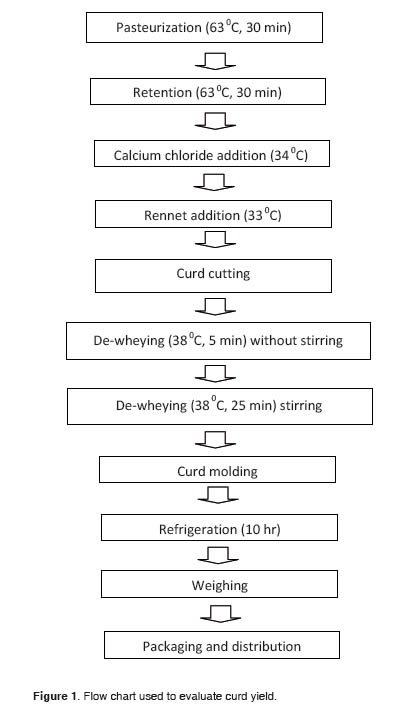
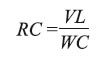
<body><![CDATA[<p><font face="Verdana, Arial, Helvetica, sans-serif" size="2">The present study was conducted in the municipality of Pasto, in southwestern Colombia, located in north latitude 1&deg;13'22'', west longitude 77&deg;16'22'', at a height of 2690 m, and an average temperature of 12 &deg;C and a relative humidity of 82% (IGAC, 2006). </font></p>    <p><font face="Verdana, Arial, Helvetica, sans-serif" size="2">A total of 348 cows were sampled to determine their CSN3 genotype using PCR-SSCP. Once identified by this criterion, lactating cows were selected and classified according to their lactation stage, i.e., initial (first), mid (second), and final (third). </font></p>    <p><font face="Verdana, Arial, Helvetica, sans-serif" size="2"><I>Methods </I></font></p>    <p><font face="Verdana, Arial, Helvetica, sans-serif" size="2"><I>Identification of genotypes. </I>Molecular identification of AA and BB homozygous and AB heterozygous genotypes for the CSN3 gene was conducted at the Animal Breeding laboratory of the University of Nari&ntilde;o, following the methodology described by Barroso <I>et al. </I>(1998), and modified by Solarte <I>et al.</I> (2009). </font></p>    <p><font face="Verdana, Arial, Helvetica, sans-serif" size="2"><I>Collection of milk samples. </I>Milk samples were obtained from animals whose output was adjusted to 305 days and adult equivalent (PL) using the factors indicated by Cer&oacute;n <I>et al. </I>(2003) for Colombian Holstein cattle. The experimental unit was each animal in its corresponding lactating stage. Four liters of milk were obtained from each cow in the morning milking and immediately transported under refrigeration (4 &deg;C) to the processing plant. Upon receipt of the sample, three litters of milk were used for the assessment of curd yield, and one litter for physicochemical, microbiological and compositional analysis. </font></p>    <p><font face="Verdana, Arial, Helvetica, sans-serif" size="2">An EKOMILK (KAM Milkama 98-2A) industrial milk analyzer was used to assess milk composition. Values obtained for acidity and fat using the analyzer were confirmed by manual testing. Acidity was determined by a qualitative change in color after mixing one volume of milk with an alkaline solution of sodium hydroxide, adding phenolphthalein as indicator (0.1 N). Fat content was determined using Gerber's method (1955). The number of colony-forming units (CFU) and degree of environmental contamination of milk were included in the microbiological analysis. </font></p>    <p><font face="Verdana, Arial, Helvetica, sans-serif" size="2"><I>Curd. </I>A protocol was established at the processing plant for the evaluation of curd yield (<a href="#f1">Figure 1</a>). The equipment and implements used to obtain the curd were a centrifuge (Funke Gerber, Berlin Germany), autoclave (All American, Wisconsin, USA), stainless steel containers, electric stoves, burettes (Schott, Mainz, Germany), pipettes (Schott , Mainz, Germany), thermo-hydrometer (Funke Gerber, Berlin Germany), analytical balance (Mettler Toledo, Mexico DC), thermometers (B &amp; S, Germany), curd knives to cut 1 x 1 cm, industrial molds (500 g), and bags for packaging. </font></p>    <p><font face="Verdana, Arial, Helvetica, sans-serif" size="2">The curd obtained was classified as "peasant type", according to the processing plant. This product is characterized by 60% moisture content. Fat and protein contents were not standardized prior to milk processing. </font></p>    <p><font face="Verdana, Arial, Helvetica, sans-serif" size="2"><I>Evaluation of curd yield. </I>After 10 hours of cooling, the curd yield was calculated taking into account the volume of processed milk and the final weight of the curd, and calculations were based on the following formula: </font></p>     <p><font face="Verdana, Arial, Helvetica, sans-serif" size="2"><img src="/img/revistas/rccp/v23n4/v23n04a03f04.jpg"></font></p>     ]]></body>
<body><![CDATA[<p><font face="Verdana, Arial, Helvetica, sans-serif" size="2">where RC = curd yield, expressed in liters of milk required to produce one kg of curd; VL = volume of milk; and WC = final weight of curd. </font></p>    <p align="center"><font face="Verdana, Arial, Helvetica, sans-serif" size="2"><img src="/img/revistas/rccp/v23n4/v23n04a03f01.jpg"></font><a name="f1"></a></p>     <p><font face="Verdana, Arial, Helvetica, sans-serif" size="2">&nbsp;</font></p>     <p><font face="Verdana, Arial, Helvetica, sans-serif" size="2"><I>Statistical analysis. </I>Analyses were performed using a linear model which included fixed effects of lactation stage (lactation was divided into thirds), genotype, and the interaction effect of lactation stage by genotype. Percentage of fat in milk was included as a covariate. The statistical model is expressed as: </font></p>     <p><font face="Verdana, Arial, Helvetica, sans-serif" size="2"><img src="/img/revistas/rccp/v23n4/v23n04a03f05.jpg"></font></p>    <p><font face="Verdana, Arial, Helvetica, sans-serif" size="2">where Y<Sub>ijk </Sub>= curd yield, associated with the j<Sup>th </Sup>genotype, the k<Sup>th </Sup>lactation stage, and the interaction of the j<Sup>th </Sup>genotype with the k<Sup>th </Sup>lactation stage, and taking into account the percentage of fat in milk. <I>&mu; </I>= Media common to all observations. </font></p>    <p><font face="Verdana, Arial, Helvetica, sans-serif" size="2"><I>&tau;</I><Sub><I>j</I></Sub><I> = </I>Effect of the j<Sup>th</Sup> genotype. J= 1, 2, 3.        <br>   <I>&alpha;k </I>= Effect of the k<Sup>th</Sup> lactation stage.     <br>   <i>k</i> = 1, 2, 3. <I>    <br>   &tau;&alpha; = </I>Interaction effect of the j<Sup>th </Sup>genotype with the k<Sup>t<Sup>h    </Sup></Sup>lactation stage.     ]]></body>

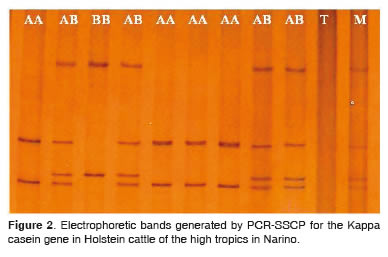
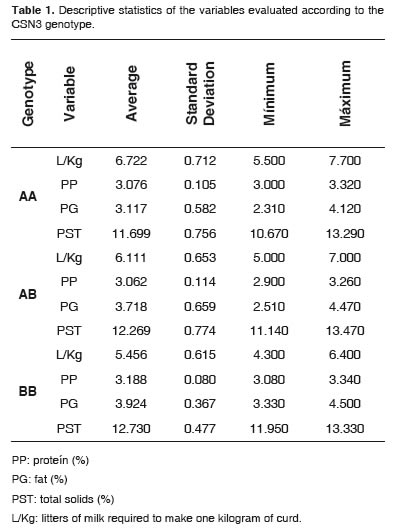
<body><![CDATA[<br>   <i>&#946;</i> <i>(x<sub>1i</sub> &#8211; </i> <i>x<sub>1</sub></i>) = Lineal effect of the covariate "percent of fat in milk".     <br>   <i>&#949;<sub>ijk</sub></i> = Experimental error associated with the j<Sup>th </Sup>genotype in the k<Sup>th </Sup>lactation stage and the interaction between the j<Sup>th </Sup>genotype with the k<Sup>th </Sup>lactation stage. </font></p>     <p><font face="Verdana, Arial, Helvetica, sans-serif" size="2">Each genotype in each lactation stage was regarded as a treatment. Each treatment had three replicates and thus in total 27 experimental units were evaluated. Age was not included in the model as a covariate because it was not statistically significant. The analysis was performed with the GLM procedure of SAS statistical software version 9.20 and Enterprise SAS Guide version 4.2. (2009). </font></p>     <p><font face="Verdana, Arial, Helvetica, sans-serif" size="2">&nbsp;</font></p>     <p><font face="Verdana, Arial, Helvetica, sans-serif" size="3"><b>Results</b></font></p>     <p><font face="Verdana, Arial, Helvetica, sans-serif" size="2"><I>Kappa - Casein (CSN3) genotypes </I>According to Barroso <I>et al. </I>(1998), the PCR SSCP molecular technique identifies more than four allelic variants for the CSN3 gene. In our studied population only two allelic variants were found (A and B), identifying homozygous genotypes AA, BB and heterozygous AB, in accordance with the electrophoretic pattern described by Barroso <I>et al. </I>(1998) (<a href="#f2">Figure 2</a>). These results are consistent with those reported by other researchers, in which A and B alleles have the highest frequency for the CSN3 gene in dairy breeds (Requena <I>et al., </I>2007; Chessa <I>et al.,</I> 2007; Soria <I>et al.,</I> 2003; Eigel <I>et al.,</I> 1984). </font></p>     <p align="center"><font face="Verdana, Arial, Helvetica, sans-serif" size="2"><img src="/img/revistas/rccp/v23n4/v23n04a03f02.jpg"></font><a name="f2"></a></p>     <p><font face="Verdana, Arial, Helvetica, sans-serif" size="2"><I>Descriptive statistics </I></font></p>    <p><font face="Verdana, Arial, Helvetica, sans-serif" size="2"><a href="#t1">Table 1</a> presents the percentages of protein (PP), body fat (BF), total solids (PST), and liters required to produce one kg of curd (L / Kg), separated for each genotype. </font></p>     <p align="center"><font face="Verdana, Arial, Helvetica, sans-serif" size="2"><img src="/img/revistas/rccp/v23n4/v23n04a03t01.jpg"></font><a name="t1"></a></p>     ]]></body>
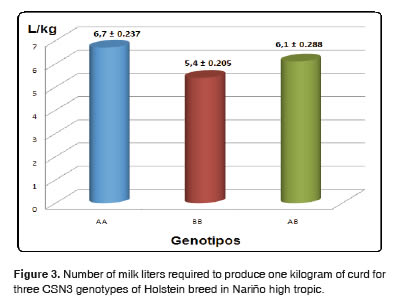
<body><![CDATA[<p><font face="Verdana, Arial, Helvetica, sans-serif" size="2"><I>Analysis of variance for curd yield. </I></font></p>    <p><font face="Verdana, Arial, Helvetica, sans-serif" size="2">Genotype, lactation stage, and the linear effect of fat percent in milk (included as a covariate) were statistically significant (p &lt;0.05) in the ANOVA. The coefficient of determination was 0.624, indicating that the effects included in the model explain curd yield by 62, 4%. </font></p>    <p><font face="Verdana, Arial, Helvetica, sans-serif" size="2">The least square means for curd yield were compared using the Tukey - Kramer test, concluding that the BB genotype had the highest yield compared to genotypes AA and AB, and no significant differences were found between AA and BB, as shown in <a href="#f3">Figure 3</a>. </font></p>    <p align="center"><font face="Verdana, Arial, Helvetica, sans-serif" size="2"><img src="/img/revistas/rccp/v23n4/v23n04a03f03.jpg"></font><a name="f3"></a></p>     <p><font face="Verdana, Arial, Helvetica, sans-serif" size="2">Finally, according to the Tukey -Kramer multiple comparison test, the only differences found for protein percentage were between the first and the second third of lactation. This is in agreement with reports by Comeron <I>et al. </I>(2003). However, no differences were observed among the different genotypes. </font></p>     <p><font face="Verdana, Arial, Helvetica, sans-serif" size="2">&nbsp;</font></p>     <p><font face="Verdana, Arial, Helvetica, sans-serif" size="3"><b>Discussion</b></font></p>    <p><font face="Verdana, Arial, Helvetica, sans-serif" size="2">The results of this study are consistent with those reported by Ng-Kwai-Hang <I>et al. </I>(1984) and McLean <I>et al. </I>(1982), who concluded that the BB genotype for CSN3 determines the best milk properties for cheese production, because of the greater firmness in the curd and less time required for the formation of small micelles. In regard to the homozygous AA genotype, these animals had lower casein contents and, as a consequence, a higher proportion of large micelles, which reduces curd yield efficiency. </font></p>    <p><font face="Verdana, Arial, Helvetica, sans-serif" size="2">Furthermore, according to Barroso <I>et al. </I>(1998), there is a positive relation between the CSN3 genotype and the milk protein content, and this protein content influences the clotting time required by rennet, and also the firmness and the cheese yield, showing higher values in milk from cows with genotype BB with respect to the homozygous AA (Schlieben <I>et al., </I>1991; Van Eenennaam and Medrano, 1991), reaching differences that in some cases amount up to 3% (Aleandri <I>et al.,</I> 1990). </font></p>    <p><font face="Verdana, Arial, Helvetica, sans-serif" size="2">The study by Rojas <I>et al. </I>(2009) using Limonero cattle indicated that variant B of the CSN3 could be used to improve the efficiency to transform milk into cheese. To a similar conclusion arrived Naranjo <I>et al. </I>(2007) for the same variant of the gene in Harton del Valle cattle breed. In summary, as stated by Solarte <I>et al. </I>(2009), these studies found that bovine milk from cows with the BB genotype for CSN3 has greater stability to heat and freezing, requires less clotting time, produces a more consistent curd, and increases cheese yield. Those results are in agreement with the present study. </font></p>    ]]></body>
<body><![CDATA[<p><font face="Verdana, Arial, Helvetica, sans-serif" size="2">These results confirm the need to reorient the selection process in Nari&ntilde;o high tropics, where CSN3 genotype should be considered as an important criterion to define selection objectives. </font></p>     <p><font face="Verdana, Arial, Helvetica, sans-serif" size="2">This trait should be included along with other factors that are relevant to the region, such as the functional type, longevity and somatic cell count, consistent with current selection trends for the Holstein breed in many countries (Heins <i>et al</i>., 2006). </font></p>     <p><font face="Verdana, Arial, Helvetica, sans-serif" size="2">&nbsp;</font></p>     <p><font face="Verdana, Arial, Helvetica, sans-serif" size="3"><b>Acknowledgements </b></font></p>     <p><font face="Verdana, Arial, Helvetica, sans-serif" size="2">We would like to acknowledge the Colombian Ministry of Agriculture and Rural Development, the Breeding Program at the University of Nari&ntilde;o, and Narino Dairy Cooperative Dairy -Col&aacute;cteos, for providing the resources necessary for the completion of this study. </font></p>     <p><font face="Verdana, Arial, Helvetica, sans-serif" size="2">&nbsp;</font></p>     <p><font face="Verdana, Arial, Helvetica, sans-serif" size="3"><b>References </b></font></p>     <!-- ref --><p><font face="Verdana, Arial, Helvetica, sans-serif" size="2">1. Aleandri RLG, Buttazzoni JC, Schneider A and Davoli R. B. the effects of milk protein polymorphisms on milk components and cheese-production ability. J Dairy Sci 1990; 73:241-255. </font>&nbsp;&nbsp;&nbsp;&nbsp;&nbsp;&nbsp;&nbsp;&nbsp;[&#160;<a href="javascript:void(0);" onclick="javascript: window.open('/scielo.php?script=sci_nlinks&ref=000080&pid=S0120-0690201000040000300001&lng=','','width=640,height=500,resizable=yes,scrollbars=1,menubar=yes,');">Links</a>&#160;]<!-- end-ref --><!-- ref --><p><font face="Verdana, Arial, Helvetica, sans-serif" size="2">2. Barroso A, Dunner S, Ca&ntilde;on J. Detection of Bovine Kappacasein Variants A, B, C y E by Means of Polymerase Chain Reaction-single strand conformation polymorphism (PCRSSCP). Technical note. J Anim Sci 1998; 76: 1535-1538. </font>&nbsp;&nbsp;&nbsp;&nbsp;&nbsp;&nbsp;&nbsp;&nbsp;[&#160;<a href="javascript:void(0);" onclick="javascript: window.open('/scielo.php?script=sci_nlinks&ref=000081&pid=S0120-0690201000040000300002&lng=','','width=640,height=500,resizable=yes,scrollbars=1,menubar=yes,');">Links</a>&#160;]<!-- end-ref --><!-- ref --><p><font face="Verdana, Arial, Helvetica, sans-serif" size="2">3. B.S.I BRITISH STANDARDS INSTITUTTION. Method for determination of fat in milk and milk products. Gerber. 1955. </font>&nbsp;&nbsp;&nbsp;&nbsp;&nbsp;&nbsp;&nbsp;&nbsp;[&#160;<a href="javascript:void(0);" onclick="javascript: window.open('/scielo.php?script=sci_nlinks&ref=000082&pid=S0120-0690201000040000300003&lng=','','width=640,height=500,resizable=yes,scrollbars=1,menubar=yes,');">Links</a>&#160;]<!-- end-ref --><!-- ref --><p><font face="Verdana, Arial, Helvetica, sans-serif" size="2">4. Cer&oacute;n M, Tonhati H, Costa C, Solarte C, Benavides C. Factores de ajuste para producci&oacute;n de leche en bovinos Holstein colombiano. Colombia Rev Colomb Cienc Pecu 2003; 16: 26-32. </font>&nbsp;&nbsp;&nbsp;&nbsp;&nbsp;&nbsp;&nbsp;&nbsp;[&#160;<a href="javascript:void(0);" onclick="javascript: window.open('/scielo.php?script=sci_nlinks&ref=000083&pid=S0120-0690201000040000300004&lng=','','width=640,height=500,resizable=yes,scrollbars=1,menubar=yes,');">Links</a>&#160;]<!-- end-ref --><!-- ref --><p><font face="Verdana, Arial, Helvetica, sans-serif" size="2">5. Chessa S, Chiatti F, Ceriotti G, Caroli A, Consolandi C, Pagnacco G, Castiglioni B. Development of a Single Nucleotide Polymorphism Genotyping Microarray Platform for the Identification of Bovine Milk Protein Genetic Polymorphisms. J Dairy Sci 2007; 90:451-464. </font>&nbsp;&nbsp;&nbsp;&nbsp;&nbsp;&nbsp;&nbsp;&nbsp;[&#160;<a href="javascript:void(0);" onclick="javascript: window.open('/scielo.php?script=sci_nlinks&ref=000084&pid=S0120-0690201000040000300005&lng=','','width=640,height=500,resizable=yes,scrollbars=1,menubar=yes,');">Links</a>&#160;]<!-- end-ref --><!-- ref --><p><font face="Verdana, Arial, Helvetica, sans-serif" size="2">6. Comer&oacute;n EA, Aronna MS, Roggero M, Brizi N, Romero LA, Cuatr&iacute;n A. Sistema de pastoreo l&iacute;deres-seguidores con vacas lecheras a dos niveles de suplementaci&oacute;n. Rev Arg d Prd Anm 2003; 23 Suppl 1:103-104. </font>&nbsp;&nbsp;&nbsp;&nbsp;&nbsp;&nbsp;&nbsp;&nbsp;[&#160;<a href="javascript:void(0);" onclick="javascript: window.open('/scielo.php?script=sci_nlinks&ref=000085&pid=S0120-0690201000040000300006&lng=','','width=640,height=500,resizable=yes,scrollbars=1,menubar=yes,');">Links</a>&#160;]<!-- end-ref --><p><font face="Verdana, Arial, Helvetica, sans-serif" size="2">7. Eigel WN, Butler JE, Ernstrom CA, Farrell HM, Harwalkar VR, Jenness R, McL Whitney R. Nomenclature of Proteins of Cow&rsaquo;s Milk: Fifth Revision. J Dairy Sci 1984; 67:1599-1631. </font></p>     <!-- ref --><p><font face="Verdana, Arial, Helvetica, sans-serif" size="2">8. Gonz&aacute;lez MF, Barrales V y Valenzuela AS. Desarrollo de un modelo para evaluar la factibilidad productiva y econ&oacute;mica de la progenie resultante del cruzamiento de vacas holstein friesian con toros de las vacas francesa montbeliarde y normando. [Fecha de acceso a la web 2005] URL: <a href="http://www.uc.cl/agronomia/e_publicaciones/Documentosderabajo/doc" target="_blank">http://www.uc.cl/agronomia/e_publicaciones/Documentosderabajo/doc</a></font>&nbsp;&nbsp;&nbsp;&nbsp;&nbsp;&nbsp;&nbsp;&nbsp;[&#160;<a href="javascript:void(0);" onclick="javascript: window.open('/scielo.php?script=sci_nlinks&ref=000087&pid=S0120-0690201000040000300008&lng=','','width=640,height=500,resizable=yes,scrollbars=1,menubar=yes,');">Links</a>&#160;]<!-- end-ref --><!-- ref --><p><font face="Verdana, Arial, Helvetica, sans-serif" size="2">9. Heins BJ, Hansen LB, Seykora AJ. Production of Pure Holsteins versus crossbreds of Holstein with Normande, Montbeliarde, and Scandinavian Red. J Dairy Sci 2006; 89:2799-2804. </font>&nbsp;&nbsp;&nbsp;&nbsp;&nbsp;&nbsp;&nbsp;&nbsp;[&#160;<a href="javascript:void(0);" onclick="javascript: window.open('/scielo.php?script=sci_nlinks&ref=000088&pid=S0120-0690201000040000300009&lng=','','width=640,height=500,resizable=yes,scrollbars=1,menubar=yes,');">Links</a>&#160;]<!-- end-ref --><!-- ref --><p><font face="Verdana, Arial, Helvetica, sans-serif" size="2">10. IGAC. Instituto Geogr&aacute;fico Agust&iacute;n Codazzi. Colombia. 2006. URL: <a href="http://www.igac.gov.co/" target="_blank">www.igac.gov.co/</a></font>&nbsp;&nbsp;&nbsp;&nbsp;&nbsp;&nbsp;&nbsp;&nbsp;[&#160;<a href="javascript:void(0);" onclick="javascript: window.open('/scielo.php?script=sci_nlinks&ref=000089&pid=S0120-0690201000040000300010&lng=','','width=640,height=500,resizable=yes,scrollbars=1,menubar=yes,');">Links</a>&#160;]<!-- end-ref --><!-- ref --><p><font face="Verdana, Arial, Helvetica, sans-serif" size="2">11. Mclean DM, Graham ERB and Mckenzie HA. Estimation of casein composition by gel electrophoresis. Int Dairy Congr Moscow 1982; 1:221. </font>&nbsp;&nbsp;&nbsp;&nbsp;&nbsp;&nbsp;&nbsp;&nbsp;[&#160;<a href="javascript:void(0);" onclick="javascript: window.open('/scielo.php?script=sci_nlinks&ref=000090&pid=S0120-0690201000040000300011&lng=','','width=640,height=500,resizable=yes,scrollbars=1,menubar=yes,');">Links</a>&#160;]<!-- end-ref --><!-- ref --><p><font face="Verdana, Arial, Helvetica, sans-serif" size="2">12. Ministerio de Agricultura y Desarrollo Rural Colombia, resoluci&oacute;n n&uacute;mero 000012 del 2007 "por la cual se establece el sistema de pago de la leche cruda al productor". 12 de enero 2007. </font>&nbsp;&nbsp;&nbsp;&nbsp;&nbsp;&nbsp;&nbsp;&nbsp;[&#160;<a href="javascript:void(0);" onclick="javascript: window.open('/scielo.php?script=sci_nlinks&ref=000091&pid=S0120-0690201000040000300012&lng=','','width=640,height=500,resizable=yes,scrollbars=1,menubar=yes,');">Links</a>&#160;]<!-- end-ref --><!-- ref --><p><font face="Verdana, Arial, Helvetica, sans-serif" size="2">13. Naranjo J, Posso A, C&aacute;rdenas H, Mu&ntilde;oz JE. Detecci&oacute;n de la variantes al&eacute;licas de la kappa case&iacute;na en bovinos hart&oacute;n del valle. Rev Acta Agron&oacute;m 2007; 56 :43-47. URL <a href="http://www.revistas.unal.edu.co" target="_blank">www.revistas.unal.edu.co </a></font>&nbsp;&nbsp;&nbsp;&nbsp;&nbsp;&nbsp;&nbsp;&nbsp;[&#160;<a href="javascript:void(0);" onclick="javascript: window.open('/scielo.php?script=sci_nlinks&ref=000092&pid=S0120-0690201000040000300013&lng=','','width=640,height=500,resizable=yes,scrollbars=1,menubar=yes,');">Links</a>&#160;]<!-- end-ref --><!-- ref --><p><font face="Verdana, Arial, Helvetica, sans-serif" size="2">14. Ng-Kwai-Hang KF, Hayes JF, Moxley JE, Monardes HG. Association of genetic variants of casein and milk serum proteins in milk fat and protein production by dairy cattle. J Dairy Sci 1984; 67:835-840. </font>&nbsp;&nbsp;&nbsp;&nbsp;&nbsp;&nbsp;&nbsp;&nbsp;[&#160;<a href="javascript:void(0);" onclick="javascript: window.open('/scielo.php?script=sci_nlinks&ref=000093&pid=S0120-0690201000040000300014&lng=','','width=640,height=500,resizable=yes,scrollbars=1,menubar=yes,');">Links</a>&#160;]<!-- end-ref --><!-- ref --><p><font face="Verdana, Arial, Helvetica, sans-serif" size="2">15. Observatorio Agrocadenas. Segundo informe de coyunturas de leche. 2006. Disponible en internet <a href="http://www.agrocadenas.gov.co" target="_blank">www.agrocadenas.gov.co</a></font>&nbsp;&nbsp;&nbsp;&nbsp;&nbsp;&nbsp;&nbsp;&nbsp;[&#160;<a href="javascript:void(0);" onclick="javascript: window.open('/scielo.php?script=sci_nlinks&ref=000094&pid=S0120-0690201000040000300015&lng=','','width=640,height=500,resizable=yes,scrollbars=1,menubar=yes,');">Links</a>&#160;]<!-- end-ref --><!-- ref --><p><font face="Verdana, Arial, Helvetica, sans-serif" size="2">16. Requena FD, Ag&uuml;era EI, Requena F. Gen&eacute;tica de la case&iacute;na de la leche en el bovino Fris&oacute;n. Redvet Rev electr Vet 2007; Vol VIII: 1. URL <a href="http://www.veterinaria.org/revistas/redvet/ n010107.html" target="_blank">http://www.veterinaria.org/revistas/redvet/ n010107.html</a>. </font>&nbsp;&nbsp;&nbsp;&nbsp;&nbsp;&nbsp;&nbsp;&nbsp;[&#160;<a href="javascript:void(0);" onclick="javascript: window.open('/scielo.php?script=sci_nlinks&ref=000095&pid=S0120-0690201000040000300016&lng=','','width=640,height=500,resizable=yes,scrollbars=1,menubar=yes,');">Links</a>&#160;]<!-- end-ref --><!-- ref --><p><font face="Verdana, Arial, Helvetica, sans-serif" size="2">17. Rojas I, Aranguren MJ, Portillo M, Villasmil OY, Valbuena E, Rinc&oacute;n X, Contreras G, Ya&ntilde;ez L. Polimorfismo gen&eacute;tico de la kappa-case&iacute;na en ganado criollo limonero. Revista cient&iacute;fica 2009; 19:645-649. </font>&nbsp;&nbsp;&nbsp;&nbsp;&nbsp;&nbsp;&nbsp;&nbsp;[&#160;<a href="javascript:void(0);" onclick="javascript: window.open('/scielo.php?script=sci_nlinks&ref=000096&pid=S0120-0690201000040000300017&lng=','','width=640,height=500,resizable=yes,scrollbars=1,menubar=yes,');">Links</a>&#160;]<!-- end-ref --><!-- ref --><p><font face="Verdana, Arial, Helvetica, sans-serif" size="2">18. SAS. Institute INC versi&oacute;n 9.20 y Enterprise SAS Guide versi&oacute;n 4.2. 2009. </font>&nbsp;&nbsp;&nbsp;&nbsp;&nbsp;&nbsp;&nbsp;&nbsp;[&#160;<a href="javascript:void(0);" onclick="javascript: window.open('/scielo.php?script=sci_nlinks&ref=000097&pid=S0120-0690201000040000300018&lng=','','width=640,height=500,resizable=yes,scrollbars=1,menubar=yes,');">Links</a>&#160;]<!-- end-ref --><!-- ref --><p><font face="Verdana, Arial, Helvetica, sans-serif" size="2">19. Schlieben S, Erhardt G, Senft B. Genotyping of bovine kappacaseine following DNA sequence amplification and direct sequencing of kappacaseine-E PCR. Anim Genetics 1991; 22:333-342. </font>&nbsp;&nbsp;&nbsp;&nbsp;&nbsp;&nbsp;&nbsp;&nbsp;[&#160;<a href="javascript:void(0);" onclick="javascript: window.open('/scielo.php?script=sci_nlinks&ref=000098&pid=S0120-0690201000040000300019&lng=','','width=640,height=500,resizable=yes,scrollbars=1,menubar=yes,');">Links</a>&#160;]<!-- end-ref --><!-- ref --><p><font face="Verdana, Arial, Helvetica, sans-serif" size="2">20. Solarte C, Rosero C, Eraso Y, Zambrano G, C&aacute;rdenas H, Burgos W. Frecuencias al&eacute;licas del gen Kappa case&iacute;na en la raza Holstein del tr&oacute;pico alto de Nari&ntilde;o-Colombia. Livestock Research for Rural Development 2009; 21(1). URL <a href="http://www. lrrd.org/lrrd21/1/sola21003.htm" target="_blank">http://www. lrrd.org/lrrd21/1/sola21003.htm </a></font>&nbsp;&nbsp;&nbsp;&nbsp;&nbsp;&nbsp;&nbsp;&nbsp;[&#160;<a href="javascript:void(0);" onclick="javascript: window.open('/scielo.php?script=sci_nlinks&ref=000099&pid=S0120-0690201000040000300020&lng=','','width=640,height=500,resizable=yes,scrollbars=1,menubar=yes,');">Links</a>&#160;]<!-- end-ref --><!-- ref --><p><font face="Verdana, Arial, Helvetica, sans-serif" size="2">21. Soria LA, Iglesias GM, Huguet MJ, Mirande SL. A PCR-RFLP Test to detect allelic variants of the bovine kappa-casein gene. Anim Biotechnol 2003; 14:1-5. </font>&nbsp;&nbsp;&nbsp;&nbsp;&nbsp;&nbsp;&nbsp;&nbsp;[&#160;<a href="javascript:void(0);" onclick="javascript: window.open('/scielo.php?script=sci_nlinks&ref=000100&pid=S0120-0690201000040000300021&lng=','','width=640,height=500,resizable=yes,scrollbars=1,menubar=yes,');">Links</a>&#160;]<!-- end-ref --><!-- ref --><p><font face="Verdana, Arial, Helvetica, sans-serif" size="2">22. Van Eenennaan A, Medrano J. Genetic polymorphism in milk protein loci: Milk protein polymorphisms in California dairy cattle. J Dairy Sci 1991; 4:1730-1742. </font>&nbsp;&nbsp;&nbsp;&nbsp;&nbsp;&nbsp;&nbsp;&nbsp;[&#160;<a href="javascript:void(0);" onclick="javascript: window.open('/scielo.php?script=sci_nlinks&ref=000101&pid=S0120-0690201000040000300022&lng=','','width=640,height=500,resizable=yes,scrollbars=1,menubar=yes,');">Links</a>&#160;]<!-- end-ref --> ]]></body><back>
<ref-list>
<ref id="B1">
<label>1</label><nlm-citation citation-type="journal">
<person-group person-group-type="author">
<name>
<surname><![CDATA[Aleandri]]></surname>
<given-names><![CDATA[RLG]]></given-names>
</name>
<name>
<surname><![CDATA[Buttazzoni]]></surname>
<given-names><![CDATA[JC]]></given-names>
</name>
<name>
<surname><![CDATA[Schneider]]></surname>
<given-names><![CDATA[A]]></given-names>
</name>
<name>
<surname><![CDATA[Davoli]]></surname>
<given-names><![CDATA[R]]></given-names>
</name>
</person-group>
<article-title xml:lang="en"><![CDATA[B the effects of milk protein polymorphisms on milk components and cheese-production ability]]></article-title>
<source><![CDATA[J Dairy Sci]]></source>
<year>1990</year>
<volume>73</volume>
<page-range>241-255</page-range></nlm-citation>
</ref>
<ref id="B2">
<label>2</label><nlm-citation citation-type="journal">
<person-group person-group-type="author">
<name>
<surname><![CDATA[Barroso]]></surname>
<given-names><![CDATA[A]]></given-names>
</name>
<name>
<surname><![CDATA[Dunner]]></surname>
<given-names><![CDATA[S]]></given-names>
</name>
<name>
<surname><![CDATA[Cañon]]></surname>
<given-names><![CDATA[J]]></given-names>
</name>
</person-group>
<article-title xml:lang="en"><![CDATA[Detection of Bovine Kappacasein Variants A, B, C y E by Means of Polymerase Chain Reaction-single strand conformation polymorphism (PCRSSCP)]]></article-title>
<source><![CDATA[J Anim Sci]]></source>
<year>1998</year>
<volume>76</volume>
<page-range>1535-1538</page-range></nlm-citation>
</ref>
<ref id="B3">
<label>3</label><nlm-citation citation-type="book">
<collab>B.S.I BRITISH STANDARDS INSTITUTTION</collab>
<source><![CDATA[Method for determination of fat in milk and milk products]]></source>
<year>1955</year>
<publisher-name><![CDATA[Gerber]]></publisher-name>
</nlm-citation>
</ref>
<ref id="B4">
<label>4</label><nlm-citation citation-type="journal">
<person-group person-group-type="author">
<name>
<surname><![CDATA[Cerón]]></surname>
<given-names><![CDATA[M]]></given-names>
</name>
<name>
<surname><![CDATA[Tonhati]]></surname>
<given-names><![CDATA[H]]></given-names>
</name>
<name>
<surname><![CDATA[Costa]]></surname>
<given-names><![CDATA[C]]></given-names>
</name>
<name>
<surname><![CDATA[Solarte]]></surname>
<given-names><![CDATA[C]]></given-names>
</name>
<name>
<surname><![CDATA[Benavides]]></surname>
<given-names><![CDATA[C]]></given-names>
</name>
</person-group>
<article-title xml:lang="en"><![CDATA[Factores de ajuste para producción de leche en bovinos Holstein colombiano]]></article-title>
<source><![CDATA[Colombia Rev Colomb Cienc Pecu]]></source>
<year>2003</year>
<volume>16</volume>
<page-range>26-32</page-range></nlm-citation>
</ref>
<ref id="B5">
<label>5</label><nlm-citation citation-type="journal">
<person-group person-group-type="author">
<name>
<surname><![CDATA[Chessa]]></surname>
<given-names><![CDATA[S]]></given-names>
</name>
<name>
<surname><![CDATA[Chiatti]]></surname>
<given-names><![CDATA[F]]></given-names>
</name>
<name>
<surname><![CDATA[Ceriotti]]></surname>
<given-names><![CDATA[G]]></given-names>
</name>
<name>
<surname><![CDATA[Caroli]]></surname>
<given-names><![CDATA[A]]></given-names>
</name>
<name>
<surname><![CDATA[Consolandi]]></surname>
<given-names><![CDATA[C]]></given-names>
</name>
<name>
<surname><![CDATA[Pagnacco]]></surname>
<given-names><![CDATA[G]]></given-names>
</name>
<name>
<surname><![CDATA[Castiglioni]]></surname>
<given-names><![CDATA[B]]></given-names>
</name>
</person-group>
<article-title xml:lang="en"><![CDATA[Development of a Single Nucleotide Polymorphism Genotyping Microarray Platform for the Identification of Bovine Milk Protein Genetic Polymorphisms]]></article-title>
<source><![CDATA[J Dairy Sci]]></source>
<year>2007</year>
<volume>90</volume>
<page-range>451-464</page-range></nlm-citation>
</ref>
<ref id="B6">
<label>6</label><nlm-citation citation-type="journal">
<person-group person-group-type="author">
<name>
<surname><![CDATA[Comerón]]></surname>
<given-names><![CDATA[EA]]></given-names>
</name>
<name>
<surname><![CDATA[Aronna]]></surname>
<given-names><![CDATA[MS]]></given-names>
</name>
<name>
<surname><![CDATA[Roggero]]></surname>
<given-names><![CDATA[M]]></given-names>
</name>
<name>
<surname><![CDATA[Brizi]]></surname>
<given-names><![CDATA[N]]></given-names>
</name>
<name>
<surname><![CDATA[Romero]]></surname>
<given-names><![CDATA[LA]]></given-names>
</name>
<name>
<surname><![CDATA[Cuatrín]]></surname>
<given-names><![CDATA[A]]></given-names>
</name>
</person-group>
<article-title xml:lang="es"><![CDATA[Sistema de pastoreo líderes-seguidores con vacas lecheras a dos niveles de suplementación]]></article-title>
<source><![CDATA[Rev Arg d Prd Anm]]></source>
<year>2003</year>
<volume>23</volume>
<numero>^s1</numero>
<issue>^s1</issue>
<supplement>1</supplement>
<page-range>103-104</page-range></nlm-citation>
</ref>
<ref id="B7">
<label>7</label><nlm-citation citation-type="journal">
<person-group person-group-type="author">
<name>
<surname><![CDATA[Eigel]]></surname>
<given-names><![CDATA[WN]]></given-names>
</name>
<name>
<surname><![CDATA[Butler]]></surname>
<given-names><![CDATA[JE]]></given-names>
</name>
<name>
<surname><![CDATA[Ernstrom]]></surname>
<given-names><![CDATA[CA]]></given-names>
</name>
<name>
<surname><![CDATA[Farrell]]></surname>
<given-names><![CDATA[HM]]></given-names>
</name>
<name>
<surname><![CDATA[Harwalkar]]></surname>
<given-names><![CDATA[VR]]></given-names>
</name>
<name>
<surname><![CDATA[Jenness]]></surname>
<given-names><![CDATA[R]]></given-names>
</name>
<name>
<surname><![CDATA[McL Whitney]]></surname>
<given-names><![CDATA[R]]></given-names>
</name>
</person-group>
<article-title xml:lang="es"><![CDATA[Nomenclature of Proteins of Cows Milk: Fifth Revision]]></article-title>
<source><![CDATA[J Dairy Sci]]></source>
<year>1984</year>
<volume>67</volume>
<page-range>1599-1631</page-range></nlm-citation>
</ref>
<ref id="B8">
<label>8</label><nlm-citation citation-type="">
<person-group person-group-type="author">
<name>
<surname><![CDATA[González]]></surname>
<given-names><![CDATA[MF]]></given-names>
</name>
<name>
<surname><![CDATA[Barrales]]></surname>
<given-names><![CDATA[V]]></given-names>
</name>
<name>
<surname><![CDATA[Valenzuela]]></surname>
<given-names><![CDATA[AS]]></given-names>
</name>
</person-group>
<source><![CDATA[Desarrollo de un modelo para evaluar la factibilidad productiva y económica de la progenie resultante del cruzamiento de vacas holstein friesian con toros de las vacas francesa montbeliarde y normando]]></source>
<year></year>
</nlm-citation>
</ref>
<ref id="B9">
<label>9</label><nlm-citation citation-type="journal">
<person-group person-group-type="author">
<name>
<surname><![CDATA[Heins]]></surname>
<given-names><![CDATA[BJ]]></given-names>
</name>
<name>
<surname><![CDATA[Hansen]]></surname>
<given-names><![CDATA[LB]]></given-names>
</name>
<name>
<surname><![CDATA[Seykora]]></surname>
<given-names><![CDATA[AJ]]></given-names>
</name>
</person-group>
<article-title xml:lang="en"><![CDATA[Production of Pure Holsteins versus crossbreds of Holstein with Normande, Montbeliarde, and Scandinavian Red]]></article-title>
<source><![CDATA[J Dairy Sci]]></source>
<year>2006</year>
<volume>89</volume>
<page-range>2799-2804</page-range></nlm-citation>
</ref>
<ref id="B10">
<label>10</label><nlm-citation citation-type="">
<collab>IGAC</collab>
<source><![CDATA[Instituto Geográfico Agustín Codazzi]]></source>
<year>2006</year>
</nlm-citation>
</ref>
<ref id="B11">
<label>11</label><nlm-citation citation-type="journal">
<person-group person-group-type="author">
<name>
<surname><![CDATA[Mclean]]></surname>
<given-names><![CDATA[DM]]></given-names>
</name>
<name>
<surname><![CDATA[Graham]]></surname>
<given-names><![CDATA[ERB]]></given-names>
</name>
<name>
<surname><![CDATA[Mckenzie]]></surname>
<given-names><![CDATA[HA]]></given-names>
</name>
</person-group>
<article-title xml:lang="en"><![CDATA[Estimation of casein composition by gel electrophoresis]]></article-title>
<source><![CDATA[Int Dairy Congr Moscow]]></source>
<year>1982</year>
<volume>1</volume>
<page-range>221</page-range></nlm-citation>
</ref>
<ref id="B12">
<label>12</label><nlm-citation citation-type="">
<collab>Ministerio de Agricultura y Desarrollo Rural Colombia</collab>
<source><![CDATA[resolución número 000012 del 2007 "por la cual se establece el sistema de pago de la leche cruda al productor"]]></source>
<year>2007</year>
</nlm-citation>
</ref>
<ref id="B13">
<label>13</label><nlm-citation citation-type="journal">
<person-group person-group-type="author">
<name>
<surname><![CDATA[Naranjo]]></surname>
<given-names><![CDATA[J]]></given-names>
</name>
<name>
<surname><![CDATA[Posso]]></surname>
<given-names><![CDATA[A]]></given-names>
</name>
<name>
<surname><![CDATA[Cárdenas]]></surname>
<given-names><![CDATA[H]]></given-names>
</name>
<name>
<surname><![CDATA[Muñoz]]></surname>
<given-names><![CDATA[JE]]></given-names>
</name>
</person-group>
<article-title xml:lang="es"><![CDATA[Detección de la variantes alélicas de la kappa caseína en bovinos hartón del valle]]></article-title>
<source><![CDATA[Rev Acta Agronóm]]></source>
<year>2007</year>
<volume>56</volume>
<page-range>43-47</page-range></nlm-citation>
</ref>
<ref id="B14">
<label>14</label><nlm-citation citation-type="journal">
<person-group person-group-type="author">
<name>
<surname><![CDATA[Ng-Kwai-Hang]]></surname>
<given-names><![CDATA[KF]]></given-names>
</name>
<name>
<surname><![CDATA[Hayes]]></surname>
<given-names><![CDATA[JF]]></given-names>
</name>
<name>
<surname><![CDATA[Moxley]]></surname>
<given-names><![CDATA[JE]]></given-names>
</name>
<name>
<surname><![CDATA[Monardes]]></surname>
<given-names><![CDATA[HG]]></given-names>
</name>
</person-group>
<article-title xml:lang="en"><![CDATA[Association of genetic variants of casein and milk serum proteins in milk fat and protein production by dairy cattle]]></article-title>
<source><![CDATA[J Dairy Sci]]></source>
<year>1984</year>
<volume>67</volume>
<page-range>835-840</page-range></nlm-citation>
</ref>
<ref id="B15">
<label>15</label><nlm-citation citation-type="">
<collab>Observatorio Agrocadenas</collab>
<source><![CDATA[Segundo informe de coyunturas de leche]]></source>
<year>2006</year>
</nlm-citation>
</ref>
<ref id="B16">
<label>16</label><nlm-citation citation-type="journal">
<person-group person-group-type="author">
<name>
<surname><![CDATA[Requena]]></surname>
<given-names><![CDATA[FD]]></given-names>
</name>
<name>
<surname><![CDATA[Agüera]]></surname>
<given-names><![CDATA[EI]]></given-names>
</name>
<name>
<surname><![CDATA[Requena]]></surname>
<given-names><![CDATA[F]]></given-names>
</name>
</person-group>
<article-title xml:lang="es"><![CDATA[Genética de la caseína de la leche en el bovino Frisón]]></article-title>
<source><![CDATA[Redvet Rev electr Vet]]></source>
<year>2007</year>
<volume>VIII</volume>
<page-range>1</page-range></nlm-citation>
</ref>
<ref id="B17">
<label>17</label><nlm-citation citation-type="journal">
<person-group person-group-type="author">
<name>
<surname><![CDATA[Rojas]]></surname>
<given-names><![CDATA[I]]></given-names>
</name>
<name>
<surname><![CDATA[Aranguren]]></surname>
<given-names><![CDATA[MJ]]></given-names>
</name>
<name>
<surname><![CDATA[Portillo]]></surname>
<given-names><![CDATA[M]]></given-names>
</name>
<name>
<surname><![CDATA[Villasmil]]></surname>
<given-names><![CDATA[OY]]></given-names>
</name>
<name>
<surname><![CDATA[Valbuena]]></surname>
<given-names><![CDATA[E]]></given-names>
</name>
<name>
<surname><![CDATA[Rincón]]></surname>
<given-names><![CDATA[X]]></given-names>
</name>
<name>
<surname><![CDATA[Contreras]]></surname>
<given-names><![CDATA[G]]></given-names>
</name>
<name>
<surname><![CDATA[Yañez]]></surname>
<given-names><![CDATA[L]]></given-names>
</name>
</person-group>
<article-title xml:lang="es"><![CDATA[Polimorfismo genético de la kappa-caseína en ganado criollo limonero]]></article-title>
<source><![CDATA[Revista científica]]></source>
<year>2009</year>
<volume>19</volume>
<page-range>645-649</page-range></nlm-citation>
</ref>
<ref id="B18">
<label>18</label><nlm-citation citation-type="">
<collab>SAS</collab>
<source><![CDATA[Institute INC versión 9.20 y Enterprise SAS Guide versión 4.2]]></source>
<year>2009</year>
</nlm-citation>
</ref>
<ref id="B19">
<label>19</label><nlm-citation citation-type="journal">
<person-group person-group-type="author">
<name>
<surname><![CDATA[Schlieben]]></surname>
<given-names><![CDATA[S]]></given-names>
</name>
<name>
<surname><![CDATA[Erhardt]]></surname>
<given-names><![CDATA[G]]></given-names>
</name>
<name>
<surname><![CDATA[Senft]]></surname>
<given-names><![CDATA[B]]></given-names>
</name>
</person-group>
<article-title xml:lang="en"><![CDATA[Genotyping of bovine kappacaseine following DNA sequence amplification and direct sequencing of kappacaseine-E PCR]]></article-title>
<source><![CDATA[Anim Genetics]]></source>
<year>1991</year>
<volume>22</volume>
<page-range>333-342</page-range></nlm-citation>
</ref>
<ref id="B20">
<label>20</label><nlm-citation citation-type="journal">
<person-group person-group-type="author">
<name>
<surname><![CDATA[Solarte]]></surname>
<given-names><![CDATA[C]]></given-names>
</name>
<name>
<surname><![CDATA[Rosero]]></surname>
<given-names><![CDATA[C]]></given-names>
</name>
<name>
<surname><![CDATA[Eraso]]></surname>
<given-names><![CDATA[Y]]></given-names>
</name>
<name>
<surname><![CDATA[Zambrano]]></surname>
<given-names><![CDATA[G]]></given-names>
</name>
<name>
<surname><![CDATA[Cárdenas]]></surname>
<given-names><![CDATA[H]]></given-names>
</name>
<name>
<surname><![CDATA[Burgos]]></surname>
<given-names><![CDATA[W]]></given-names>
</name>
</person-group>
<article-title xml:lang="es"><![CDATA[Frecuencias alélicas del gen Kappa caseína en la raza Holstein del trópico alto de Nariño-Colombia]]></article-title>
<source><![CDATA[Livestock Research for Rural Development]]></source>
<year>2009</year>
<volume>21</volume>
<numero>1</numero>
<issue>1</issue>
</nlm-citation>
</ref>
<ref id="B21">
<label>21</label><nlm-citation citation-type="journal">
<person-group person-group-type="author">
<name>
<surname><![CDATA[Soria]]></surname>
<given-names><![CDATA[LA]]></given-names>
</name>
<name>
<surname><![CDATA[Iglesias]]></surname>
<given-names><![CDATA[GM]]></given-names>
</name>
<name>
<surname><![CDATA[Huguet]]></surname>
<given-names><![CDATA[MJ]]></given-names>
</name>
<name>
<surname><![CDATA[Mirande]]></surname>
<given-names><![CDATA[SL]]></given-names>
</name>
</person-group>
<article-title xml:lang="en"><![CDATA[A PCR-RFLP Test to detect allelic variants of the bovine kappa-casein gene]]></article-title>
<source><![CDATA[Anim Biotechnol]]></source>
<year>2003</year>
<volume>14</volume>
<page-range>1-5</page-range></nlm-citation>
</ref>
<ref id="B22">
<label>22</label><nlm-citation citation-type="journal">
<person-group person-group-type="author">
<name>
<surname><![CDATA[Van]]></surname>
<given-names><![CDATA[Eenennaan A]]></given-names>
</name>
<name>
<surname><![CDATA[Medrano]]></surname>
<given-names><![CDATA[J]]></given-names>
</name>
</person-group>
<article-title xml:lang="en"><![CDATA[Genetic polymorphism in milk protein loci: Milk protein polymorphisms in California dairy cattle]]></article-title>
<source><![CDATA[J Dairy Sci]]></source>
<year>1991</year>
<volume>4</volume>
<page-range>1730-1742</page-range></nlm-citation>
</ref>
</ref-list>
</back>
</article>