<?xml version="1.0" encoding="ISO-8859-1"?><article xmlns:mml="http://www.w3.org/1998/Math/MathML" xmlns:xlink="http://www.w3.org/1999/xlink" xmlns:xsi="http://www.w3.org/2001/XMLSchema-instance">
<front>
<journal-meta>
<journal-id>0120-0690</journal-id>
<journal-title><![CDATA[Revista Colombiana de Ciencias Pecuarias]]></journal-title>
<abbrev-journal-title><![CDATA[Rev Colom Cienc Pecua]]></abbrev-journal-title>
<issn>0120-0690</issn>
<publisher>
<publisher-name><![CDATA[Facultad de Ciencias Agrarias, Universidad de Antioquia]]></publisher-name>
</publisher>
</journal-meta>
<article-meta>
<article-id>S0120-06902010000400011</article-id>
<title-group>
<article-title xml:lang="en"><![CDATA[Equine Viral Arteritis: epidemiological and intervention perspectives]]></article-title>
<article-title xml:lang="es"><![CDATA[Arteritis Viral Equina: perspectivas epidemiológicas y de intervención]]></article-title>
<article-title xml:lang="pt"><![CDATA[Arterite Viral Eqüina: Perspectivas Epidemiológicas e de Intervenção]]></article-title>
</title-group>
<contrib-group>
<contrib contrib-type="author">
<name>
<surname><![CDATA[Ruiz-Sáenz]]></surname>
<given-names><![CDATA[Julián]]></given-names>
</name>
<xref ref-type="aff" rid="A01"/>
</contrib>
</contrib-group>
<aff id="A01">
<institution><![CDATA[,Universidad de Antioquia Facultad de Ciencias Agrarias Grupo de Investigación CENTAURO]]></institution>
<addr-line><![CDATA[Medellín ]]></addr-line>
<country>Colombia</country>
</aff>
<pub-date pub-type="pub">
<day>00</day>
<month>12</month>
<year>2010</year>
</pub-date>
<pub-date pub-type="epub">
<day>00</day>
<month>12</month>
<year>2010</year>
</pub-date>
<volume>23</volume>
<numero>4</numero>
<fpage>501</fpage>
<lpage>512</lpage>
<copyright-statement/>
<copyright-year/>
<self-uri xlink:href="http://www.scielo.org.co/scielo.php?script=sci_arttext&amp;pid=S0120-06902010000400011&amp;lng=en&amp;nrm=iso"></self-uri><self-uri xlink:href="http://www.scielo.org.co/scielo.php?script=sci_abstract&amp;pid=S0120-06902010000400011&amp;lng=en&amp;nrm=iso"></self-uri><self-uri xlink:href="http://www.scielo.org.co/scielo.php?script=sci_pdf&amp;pid=S0120-06902010000400011&amp;lng=en&amp;nrm=iso"></self-uri><abstract abstract-type="short" xml:lang="en"><p><![CDATA[Equine viral arteritis is an infectious viral disease of horses that causes serious economic losses due to the presentation of abortions, respiratory disease and loss of performance. After the initial infection males can become persistently infected carriers scattering infection through semen, a situation that brings indirect economic losses by restrictions on international trade of horses and semen from breeding and from countries at risk of infection with the virus. Outbreaks of infection have been reported in several American countries with which Colombia has active links of import and export of horses and semen. This article focuses on creating awareness of the key points of infection and on examples of how infection has been distributed in countries that have developed horse breeding, such as Argentina, a country aware of the origin and distribution of the infection. This study will help us understand how to assess, prevent and/ or control the entry of such a devastating infection for the equine industry.]]></p></abstract>
<abstract abstract-type="short" xml:lang="es"><p><![CDATA[La arteritis viral equina es una enfermedad viral infectocontagiosa de los equinos que puede llegar a causar graves pérdidas económicas debidas a la presentación de abortos, enfermedad respiratoria y pérdida del desempeño; luego de la primoinfección los machos pueden resultar infectados persistentemente convirtiéndose en portadores los cuales diseminan la infección a través del semen; hecho que acarrea pérdidas económicas indirectas por las restricciones en el comercio internacional tanto de ejemplares como de semen procedente de criaderos y países con riesgo de infección con el virus. Se han reportado brotes de infección en diversos países de América con los cuales Colombia tiene activos vínculos de importación y exportación de equinos y semen. El presente artículo trata de dar a conocer los puntos clave de la infección y ejemplos de cómo se ha distribuido la infección en países con sistemas de explotación de equinos tales como Argentina, en el cual se conoce el origen de la infección y su distribución; cuyo estudio, nos ayudará a entender cómo debemos evaluar, prevenir y/o controlar la entrada de una infección devastadora para la industria equina nacional.]]></p></abstract>
<abstract abstract-type="short" xml:lang="pt"><p><![CDATA[A arterites viral eqüina é uma doença infecto-contagiosa dos eqüinos que pode chegar a causar graves perdas económicas devidas à apresentação de abortos, enfermidade respiratória e perda do desempenho; logo da primoinfecção, os machos podem resultar infectados persistentemente, convertendo-se em portadores e disseminam a infecção a través do sémen; fato que acarreia perdas económicas indirectas pelas restrições no comercio internacional de reprodutores e sémen procedente de criatórios e países com risco de infecção com o vírus. Tem-se reportado surtos de infecção em diversos países da América, com os quais Colômbia tem activos vínculos de importação e exportação de equinos e sémen. O presente artigo trata de dar a conhecer os pontos chave da infecção e exemplos de como tem-se distribuído a infecção em países com sistemas de exploração de eqüinos como Argentina, na qual se conhece a origem da infecção e sua distribuição; para o qual o estudo, nos ajudará a entender como devemos avaliar, prevenir e/ou controlar a entrada da infecção devastadora para a industria eqüina nacional.]]></p></abstract>
<kwd-group>
<kwd lng="en"><![CDATA[equine arteritis virus]]></kwd>
<kwd lng="en"><![CDATA[prevention and control]]></kwd>
<kwd lng="en"><![CDATA[viral infection]]></kwd>
<kwd lng="es"><![CDATA[infección viral]]></kwd>
<kwd lng="es"><![CDATA[prevención y mitigación]]></kwd>
<kwd lng="es"><![CDATA[virus de la arteritis equina]]></kwd>
<kwd lng="pt"><![CDATA[vírus]]></kwd>
<kwd lng="pt"><![CDATA[infecção viral]]></kwd>
<kwd lng="pt"><![CDATA[prevenção e mitigação]]></kwd>
</kwd-group>
</article-meta>
</front><body><![CDATA[ <p align="center"><font face="Verdana, Arial, Helvetica, sans-serif" size="4"><b>Equine Viral Arteritis: epidemiological and intervention perspectives<Sup>&curren; </Sup></b></font></p>     <p align="center"><b><font face="Verdana, Arial, Helvetica, sans-serif" size="3"><I>Arteritis Viral Equina: perspectivas epidemiol&oacute;gicas y de intervenci&oacute;n  </I></font></b></p>     <p align="center"><b><font face="Verdana, Arial, Helvetica, sans-serif" size="3"><I>Arterite Viral Eq&uuml;ina: Perspectivas Epidemiol&oacute;gicas e de Interven&ccedil;&atilde;o  </I></font></b><font face="Verdana, Arial, Helvetica, sans-serif" size="2"></font></p>     <p>&nbsp;</p>     <p><font face="Verdana, Arial, Helvetica, sans-serif" size="2">Juli&aacute;n Ruiz-S&aacute;enz<Sup><I>1</I></Sup><Sup>*</Sup>, MV, MSc </font></p>     <p><font face="Verdana, Arial, Helvetica, sans-serif" size="2"><Sup><I>1</I></Sup><I>Grupo de Investigaci&oacute;n CENTAURO, Facultad de Ciencias Agrarias, Universidad de Antioquia, A.A. 1226, Medell&iacute;n, Colombia. </I></font></p>    <p><font face="Verdana, Arial, Helvetica, sans-serif" size="2"><I>(Received: 10 march, 2009; accepted: 14 september, 2010) </I></font></p>     <p>&nbsp;</p><hr size="1">     <p><font face="Verdana, Arial, Helvetica, sans-serif" size="2"><I><b>Summary </b></I></font></p>    <p><font face="Verdana, Arial, Helvetica, sans-serif" size="2"><I>Equine viral arteritis is an infectious viral disease of horses that causes serious economic losses due to the presentation of abortions, respiratory disease and loss of performance. After the initial infection males can become persistently infected carriers scattering infection through semen, a situation that brings indirect economic losses by restrictions on international trade of horses and semen from breeding and from countries at risk of infection with the virus. Outbreaks of infection have been reported in several American countries with which Colombia has active links of import and export of horses and semen. This article focuses on creating awareness of the key points of infection and on examples of how infection has been distributed in countries that have developed horse breeding, such as Argentina, a country aware of the origin and distribution of the infection. This study will help us understand how to assess, prevent and/ or control the entry of such a devastating infection for the equine industry. </I></font></p>    ]]></body>
<body><![CDATA[<p><font face="Verdana, Arial, Helvetica, sans-serif" size="2"><b>Key words:</b> <I>equine arteritis virus, prevention and control, viral infection. </I></font></p>     <p>&nbsp;</p><hr size="1">     <p><font face="Verdana, Arial, Helvetica, sans-serif" size="2"><I><b>Resumen </b></I></font></p>    <p><font face="Verdana, Arial, Helvetica, sans-serif" size="2"><I>La arteritis viral equina es una enfermedad viral infectocontagiosa de los equinos que puede llegar a causar graves p&eacute;rdidas econ&oacute;micas debidas a la presentaci&oacute;n de abortos, enfermedad respiratoria y p&eacute;rdida del desempe&ntilde;o; luego de la primoinfecci&oacute;n los machos pueden resultar infectados persistentemente convirti&eacute;ndose en portadores los cuales diseminan la infecci&oacute;n a trav&eacute;s del semen; hecho que acarrea p&eacute;rdidas econ&oacute;micas indirectas por las restricciones en el comercio internacional tanto de ejemplares como de semen procedente de criaderos y pa&iacute;ses con riesgo de infecci&oacute;n con el virus. Se han reportado brotes de </I><I>infecci&oacute;n en diversos pa&iacute;ses de Am&eacute;rica con los cuales Colombia tiene activos v&iacute;nculos de importaci&oacute;n y exportaci&oacute;n de equinos y semen. El presente art&iacute;culo trata de dar a conocer los puntos clave de la infecci&oacute;n y ejemplos de c&oacute;mo se ha distribuido la infecci&oacute;n en pa&iacute;ses con sistemas de explotaci&oacute;n de equinos tales como Argentina, en el cual se conoce el origen de la infecci&oacute;n y su distribuci&oacute;n; cuyo estudio, nos ayudar&aacute; a entender c&oacute;mo debemos evaluar, prevenir y/o controlar la entrada de una infecci&oacute;n devastadora para la industria equina nacional. </I></font></p>     <p><font face="Verdana, Arial, Helvetica, sans-serif" size="2"><b>Palabras clave:</b> <I>infecci&oacute;n viral, prevenci&oacute;n y mitigaci&oacute;n, virus de la arteritis equina. </I></font></p>     <p>&nbsp;</p><hr size="1">     <p><font face="Verdana, Arial, Helvetica, sans-serif" size="2"><I><b>Resumo </b></I></font></p>    <p><font face="Verdana, Arial, Helvetica, sans-serif" size="2"><I>A arterites viral eq&uuml;ina &eacute; uma doen&ccedil;a infecto-contagiosa dos eq&uuml;inos que pode chegar a causar graves perdas econ&oacute;micas devidas &agrave; apresenta&ccedil;&atilde;o de abortos, enfermidade respirat&oacute;ria e perda do desempenho; logo da primoinfec&ccedil;&atilde;o, os machos podem resultar infectados persistentemente, convertendo-se em portadores e disseminam a infec&ccedil;&atilde;o a trav&eacute;s do s&eacute;men; fato que acarreia perdas econ&oacute;micas indirectas pelas restri&ccedil;&otilde;es no comercio internacional de reprodutores e s&eacute;men procedente de criat&oacute;rios e pa&iacute;ses com risco de infec&ccedil;&atilde;o com o v&iacute;rus. Tem-se reportado surtos de infec&ccedil;&atilde;o em diversos pa&iacute;ses da Am&eacute;rica, com os quais Col&ocirc;mbia tem activos v&iacute;nculos de importa&ccedil;&atilde;o e exporta&ccedil;&atilde;o de equinos e s&eacute;men. O presente artigo trata de dar a conhecer os pontos chave da infec&ccedil;&atilde;o e exemplos de como tem-se distribu&iacute;do a infec&ccedil;&atilde;o em pa&iacute;ses com sistemas de explora&ccedil;&atilde;o de eq&uuml;inos como Argentina, na qual se conhece a origem da infec&ccedil;&atilde;o e sua distribui&ccedil;&atilde;o; para o qual o estudo, nos ajudar&aacute; a entender como devemos avaliar, prevenir e/ou controlar a entrada da infec&ccedil;&atilde;o devastadora para a industria eq&uuml;ina nacional. </I></font></p>    <p><font face="Verdana, Arial, Helvetica, sans-serif" size="2"><b>Palavras chave:</b> <I>v&iacute;rus, infec&ccedil;&atilde;o viral, preven&ccedil;&atilde;o e mitiga&ccedil;&atilde;o. </I></font></p>    <p><font face="Verdana, Arial, Helvetica, sans-serif" size="2">&curren;	 To cite this paper: Ruiz S&aacute;enz J. Equine Viral Arteritis: epidemiological and intervention perspectives. Rev Colomb Cienc Pecu 2010;23:501-512. </font></p>     ]]></body>
<body><![CDATA[<p><font face="Verdana, Arial, Helvetica, sans-serif" size="2">*	 Correspondence author: Juli&aacute;n Ru&iacute;z S&aacute;enz. Unidad de Diagn&oacute;stico, Facultad de Ciencias Agrarias. Universidad de Antioquia. Carrera 75 No.65-87.Ciudadela de Robledo. Medell&iacute;n, Colombia.Tel:(574)219 91 60.E-mail: <a href="mailto:julianruizsaenz@gmail.com">julianruizsaenz@gmail.com</a>. </font></p>     <p><font face="Verdana, Arial, Helvetica, sans-serif" size="2">&nbsp;</font></p><hr size="1">     <p><font face="Verdana, Arial, Helvetica, sans-serif" size="3"><b>Introduction</b></font></p>     <p><font face="Verdana, Arial, Helvetica, sans-serif" size="2">Equine viral arteritis (EVA) is a contagious disease of horses caused by an enveloped RNA virus, known as Equine arteritis virus (EAV). EAV is the prototype virus of the genus Arterivirus, family <I>Arteriviridae, </I>order Nidovirales (Cavanagh, 1997; ICTVdB, 2006). Based on their genetic structure and replication strategy, three additional viruses have been classified in the same genus and family. They are of great importance, one of them causing Porcine Reproductive and Respiratory Syndrome (Plagemannand Moennig, 1992). </font></p>    <p><font face="Verdana, Arial, Helvetica, sans-serif" size="2">Based on extensive comparative studies at the genomic and antigenic level of EAV, only one serotype has been detected, usually called the Bucyrus strain (McCollum, 1969). However, temporal and geographic diversity among EAV isolates has been demonstrated (Murphy et al., 1992). There also exists some variability between the strains based on their pathogenicity, some strains being capable of causing a wide range of clinical symptoms, collectively referred to as EVA in susceptible horses, whereas others produce only a slight fever (Balasuriya <I>et al.</I>,1995) </font></p>    <p><font face="Verdana, Arial, Helvetica, sans-serif" size="2">Although through the years it has been recognized that EAV causes contagious abortion in pregnant mares (Doll <I>et al.</I>, 1957), and that the virus causes abortion outbreaks (Balasuriya <I>et al.</I>, 1998), some evidence suggests that not all strains of the virus have abortigenic properties, some strains causing only clinically mild or asymptomatic diseases such that they are considered strong candidates to be used as vaccine strains (Moore <I>et al., </I>2002, Moore <I>et al.</I>, 2003). However, from a practical standpoint, it is difficult to distinguish between EAV strains that can cause abortion and those which do not; additionally, there are no standard techniques to classify the strains based on their abortive properties. Therefore, from a clinical point of view, all strains of the virus should be considered potentially abortigenic unless proved otherwise (Timoney,2003). </font></p>    <p><font face="Verdana, Arial, Helvetica, sans-serif" size="2">EAV is not particularly resistant to exposure to the environment and is rapidly inactivated by a wide range of physico-chemical conditions, mainly temperature, surviving only 20-30 minutes at 56 &ordm;C and 2-3 days at 37 &deg;C. Additionally, it can survive up to 75 days at 4 &ordm;C, and even years in fluids and tissues preserved at -70 &ordm;C. However, the virus can rapidly be inactivated by low humidity, sunlight, and the use of lipid solvents, or by using common inactivating detergents (Burky, 1966, Shirai et al., 2000). Yet, since virus viability upon refrigeration or freezing is high, EAV can remain infective in frozen semen for long periods of time, even years (Timoney, 2000). </font></p>     <p><font face="Verdana, Arial, Helvetica, sans-serif" size="2">&nbsp;</font></p>     <p><font face="Verdana, Arial, Helvetica, sans-serif" size="3"><b>Background</b></font></p>    <p><font face="Verdana, Arial, Helvetica, sans-serif" size="2">More than a century ago, reports were published in the European veterinary literature concerning a horse disease whose clinical features were consistent with those described for EVA. However, the virus was not isolated until 1953, during an outbreak of abortions and respiratory illness in a "Standardbred" horse breeding ranch near Bucyrus, Ohio (Doll,1957) </font></p>    ]]></body>
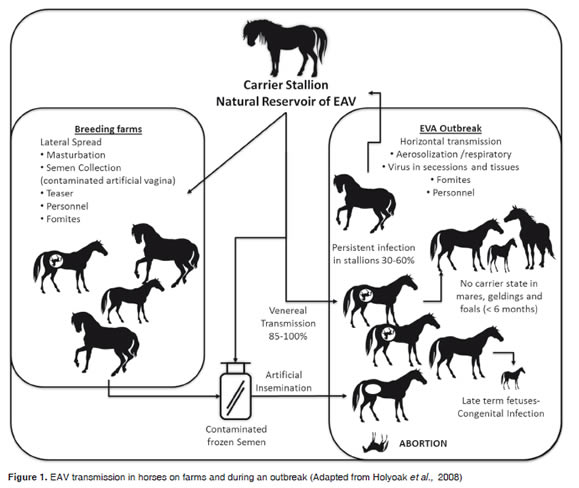
<body><![CDATA[<p><font face="Verdana, Arial, Helvetica, sans-serif" size="2">The most important outbreak of EVA in America occurred in 1984, when the disease struck many racing thoroughbred farms in Kentucky. This outbreak led to two very important findings regarding the EVA: the efficiency of venereal transmission of the virus by an infected stallion, and the high tendency of transmission as a carrier that a stallion has after a natural infection (Timoney, 1984). The fear that a highly pathogenic strain had emerged, joined with the belief that most horse populations are susceptible to the virus, led to an increased evaluation of the importance of the disease worldwide, imposing severe restrictions on the movement of horses with positive titers of antibodies against the virus (Timoney and McCollum, 1993a). These measures were subsequently gradually decreased, with today a greater emphasis on controlling the international trade of carrier stallions and infected semen, which have frequently been implicated in the spread of the virus within and between countries (Timoney, 2000b) </font></p>    <p><font face="Verdana, Arial, Helvetica, sans-serif" size="2">According to the World Animal Health Organization-OIE, a carrier stallion has serological positive for antibodies to the virus using the virus neutralisation test or an appropriately validated enzyme-linked immunosorbent assay (ELISA) and also positive virus isolation from the semen (Timoney, 2004).</font></p>     <p><font face="Verdana, Arial, Helvetica, sans-serif" size="2">&nbsp; </font></p>     <p><font face="Verdana, Arial, Helvetica, sans-serif" size="3"><b>Transmission</b></font></p>    <p><font face="Verdana, Arial, Helvetica, sans-serif" size="2">EVA is primarily a respiratory disease, transmitted through inhalation of viral particles between horses during the acute stage of infection mainly during transport of the animals for trade, exhibition or racing. The virus can be excreted by nasal secretions until 16 days post-infection, and this is a source of infection for horses that are in closecontact(McCollum, 1971). </font></p>    <p><font face="Verdana, Arial, Helvetica, sans-serif" size="2">However, unlike other respiratory diseases, EAV can also be transmitted as a venereal disease during insemination, either by natural mating or artificial insemination, because the virus may be excreted in the semen, which is a major source of infection (<a href="#f1">Figure 1</a>). When a mare, a gelding or a sexually immature colt catches the disease, the animal excretes the virus through respiratory airways and develops a strong immunity to re-infection (Fukunaga <I>et al., </I>1981). In contrast, adult males are very likely to become carriers of the virus for long periods of time and can transmit the virus to mares during mating (Neu <I>et al., </I>1988).Although the mare easily eliminates the virus, a pregnant EAV-infected mare cantransmit the virus tothe fetus. </font></p>    <p><font face="Verdana, Arial, Helvetica, sans-serif" size="2">Vertical transmission can occur by the congenital route, and depending on how advanced the pregnancy is, the fetus can become infected, die and be aborted between 9 and 30 days after infection. At times a live but congenitally infected and sick foal is born (Vaala <I>et al., </I>1992); in such cases, the placenta, the placental fluids and the fetus are important sources of infectious virus (<a href="#f1">Figure 1</a>). Additionally, indirect transmission can occur in an iatrogenic manner by using utensils contaminated with nasal secretions/excretions or abortion tissues orsecretions(Timoney and McCollum, 1993b) </font></p>     <p align="center"><font face="Verdana, Arial, Helvetica, sans-serif" size="2"><img src="/img/revistas/rccp/v23n4/v23n04a11f01.jpg"></font><a name="f1"></a></p>     <p><font face="Verdana, Arial, Helvetica, sans-serif" size="2">&nbsp;</font></p>     <p><font face="Verdana, Arial, Helvetica, sans-serif" size="3"><b>Clinical findings </b></font></p>    ]]></body>
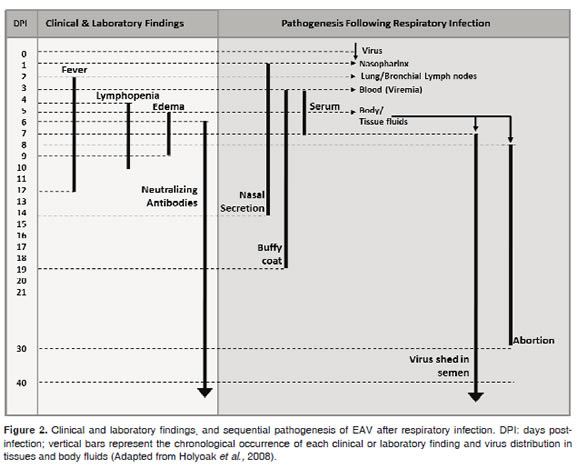
<body><![CDATA[<p><font face="Verdana, Arial, Helvetica, sans-serif" size="2">There are considerable variations in the clinical symptoms and in severity of infection, and although many horses infected with EAV do not show symptoms, it has been demonstrated that experimental infection can be fatal (Glaser <I>et al., </I>1996, MacLachlan <I>et al., </I>1996). As in most infectious diseases, certain host factors determine the severity of the disease, such as age, immune status, sex which determines the possibility of being a potential carrier, etc. Other factors depend on the agent such as the route of exposure, viral strain and infective dose. </font></p>    <p><font face="Verdana, Arial, Helvetica, sans-serif" size="2">After an incubation period varying from 2-14 days (6-8 days after venereal exposure) the most prominent symptom is fever of about 41 &deg;C that may last between 2 and 12 days, usually concomitant with depression and anorexia, conjunctivitis and rhinitis with nasal and ocular discharge, leucopenia, peripheral or supraorbital edema, and inflammation and edema of the scrotum, prepuce, mammary glands and limbs (<a href="#f2">Figure 2</a>). Urticaria that may be localized in the face and neck or generalized in most of the body is also common (Timoney andMcCollum, 1993b) </font></p>    <p><font face="Verdana, Arial, Helvetica, sans-serif" size="2">Another symptom of infection in pregnant mares is abortion, that is not preceded by any characteristic or premonitory sign and may occur either at the end of the acute phase of illness or when the recovery phase begins (Coignoul and Cheville, 1984; Vaala <I>et al., </I>1992). Abortions have been observed between 3 and 10 months of gestation in both natural and experimental infections and abortion rates in the different outbreaks reported have varied from low levels of 10% or up to dramatic levels of 50-60% (Timoney and McCollum, 1993b). </font></p>    <p align="center"><font face="Verdana, Arial, Helvetica, sans-serif" size="2"><img src="/img/revistas/rccp/v23n4/v23n04a11f02.jpg"></font><a name="f2"></a></p>     <p><font face="Verdana, Arial, Helvetica, sans-serif" size="2">During acute infection, stallions may show temporal subfertility/infertility, associated with decreased libido, low sperm motility/concentration and low percentage of morphologically normal sperm; these changes are mainly due to the high scrotal temperature and not to a pathological effect induced by the virus. These changes persist for about 16 weeks, at which time the horse returns to its normal seminal parameters (Neu <I>et al., </I>1992). Additionally, carrier stallions can excrete virus in the semen and exhibit a normal semen quality (Timoney <I>et al., </I>1987, Timoney and McCollum, 1993b). As for other members of the <I>Equidae </I>family, outbreaks have not been reported among donkeys or mules, and although antibodies have been identified, there is little information on the clinical signs observed in these species (Timoney and McCollum, 1993b). </font></p>     <p><font face="Verdana, Arial, Helvetica, sans-serif" size="2">&nbsp;</font></p>     <p><font face="Verdana, Arial, Helvetica, sans-serif" size="3"><b>Pathogenesis</b></font></p>    <p><font face="Verdana, Arial, Helvetica, sans-serif" size="2">Two days after aerosol infection, EAV spreads rapidly to the bronchial and pulmonary lymph nodes, reaching the bloodstream and spreading throughout the body. It is therefore possible to isolate the virus in a wide variety of tissues and body fluids, making isolation of the virus possible 2 days post-infection in nasopharyngeal swab samples, 19 days in white cells, and up to 9 days in serum or plasma (<a href="#f2">Figure 2</a>). Virus clearance coincides with the development of specific neutralizing antibodies against EAV (Timoney and McCollum, 1993b). </font></p>    <p><font face="Verdana, Arial, Helvetica, sans-serif" size="2">During primary viremia, EAV infects and replicates in endothelial cells causing strong multi-vessel damage to the endothelium, the subsequent internal elastic lamina and affecting the middle muscular layer of the vessels. Vasculitis is characterized by fibrinoid necrosis of small arteries with extravasation of red blood cells and proteinaceous material. Additionally, the virus infects macrophages, which in conjunction with endothelial cell damage leads to increased release of proinflammatory cytokines that are heavily involved in the pathogenesis of "arteritis" (Moore <I>et al., </I>2003). </font></p>    <p><font face="Verdana, Arial, Helvetica, sans-serif" size="2">Experimentally, it has become clear that abortion is primarily the result of fetal infection, other than myometritis or damage to the placenta, leading to expulsion of the fetus; in addition, there is evidence that the tissues of the aborted fetus tissues have higher viral titers compared to the mother, stressing the high level of virus replication in the fetus (MacLachlan <I>et al., </I>1996). </font></p>     ]]></body>
<body><![CDATA[<p><font face="Verdana, Arial, Helvetica, sans-serif" size="2">&nbsp;</font></p>     <p><font face="Verdana, Arial, Helvetica, sans-serif" size="3"><b>Virus reservoir </b></font></p>    <p><font face="Verdana, Arial, Helvetica, sans-serif" size="2">The natural reservoir of EAV infection is the carrier stallion, which ensures the permanence of the infection in equine populations. The carrier state has been identified only in the stallion, not in mares, geldings or sexually immature foals (Timoney <I>et al., </I>1987). Virus can persist in the stallion for weeks, months or years, even for life in some individuals. About 60% of the stallions that acquire the virus by the respiratory route may become persistently infected; that is why the frequency of carriers in any stallion population can vary from less than 10% to over 70% (Timoney and McCollum, 1993b). In the persistently infected stallion, EAV is located in the accessory sexual glands and establishment and persistence of the carrier state is testosteronedependent (Little <I>et al., </I>1992). Carrier stallions constantly eliminate the virus in the semen and consequently the risk of transmission of infection is limited to the time of mating. Transmission rates range from 85 to 100%,whether mating is naturalor artificial insemination isperformed (<a href="#f1">Figure 1</a>). </font></p>    <p><font face="Verdana, Arial, Helvetica, sans-serif" size="2">A lesser percentage of long-term carrier stallions can clear the virus spontaneously from the reproductive tracts and do not show risk for transmission of infection (Timoney and McCollum, 2000). However it has been shown that carrier stallions are the natural source of genetic and phenotypic diversity of the virus, creating new risks of emergence of viral variants with new pathogenic potential (Balasuriya <I>et al.,</I>1999, Hedges et al., 1999, Balasuriya <I>et al., </I>2004). </font></p>     <p><font face="Verdana, Arial, Helvetica, sans-serif" size="2">&nbsp;</font></p>     <p><font face="Verdana, Arial, Helvetica, sans-serif" size="3"><b>Diagnosis </b></font></p>    <p><font face="Verdana, Arial, Helvetica, sans-serif" size="2">Given the clinical similarity of EVA with other equine infectious and non-infectious diseases, any presumptive diagnosis should always be confirmed by laboratory tests (Holyoak <I>et al., </I>2008). The presence of EVA must be suspected if respiratory symptoms are accompanied by abortions. Virus isolates can be obtained from nasopharyngeal swabs or washes, conjunctival swabs, samples of ejaculates, essentially the sperm-rich fraction, placentas, fetal fluids and tissues of aborted fetuses, such as lung, spleen and lymph nodes, and through blood samples with EDTAas anticoagulant. </font></p>    <p><font face="Verdana, Arial, Helvetica, sans-serif" size="2">The most widely used method for diagnosis is the evaluation of neutralizing antibodies, although the presence of such antibodies does not indicate active infection, but rather that the animal has been exposed to EAV. An active infection is diagnosed when high levels of antibodies in a single sample are found or when an increase in antibody titers occurs in two paired blood samples, obtained 1428 days apart (Holyoak <I>et al., </I>2008). Although several types of immunoassays (ELISAs) have been developed, given the high specificity of the virus neutralization test to detect individuals with low serum antibody titers, this test has been established by the World Animal Health Organization-OIE as the gold standard for international transport of horses (Timoney, 2004) </font></p>     <p><font face="Verdana, Arial, Helvetica, sans-serif" size="2">&nbsp;</font></p>     <p><font face="Verdana, Arial, Helvetica, sans-serif" size="3"><b>Treatment </b></font></p>    ]]></body>
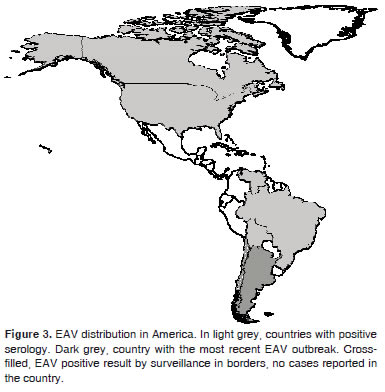
<body><![CDATA[<p><font face="Verdana, Arial, Helvetica, sans-serif" size="2">Since there is no specific treatment for EVA, once the infection is confirmed clinical management should include rest, fluids and in some cases, broadspectrum antibiotics to reduce the risk of secondary bacterial infections. Adult horses fully recover from the disease, leaving only the recovered stallions as carriers and sources ofinfection. </font></p>     <p><font face="Verdana, Arial, Helvetica, sans-serif" size="2">&nbsp;</font></p>     <p><font face="Verdana, Arial, Helvetica, sans-serif" size="3"><b>Prevention and control </b></font></p>    <p><font face="Verdana, Arial, Helvetica, sans-serif" size="2">Although in Colombia, EVA is an exotic disease, some prevention and control measures have been widely reported, that can make infection a manageable disease, and most importantly, can reduce the direct economic losses produced by disease outbreaks. There is currently an avirulent live vaccine (Arvac<Sup>&reg;</Sup>, Fort Dodge Animal Health Laboratories, Iowa, USA) that is safe, effective and	 economical,	 and	 has	 been	 used	 in	 other	 Latin-American	 countries.	 The	 combination	 of	 vaccination	with	the	use	of	isolation	measures	of	 unvaccinated	animals	can	prevent	the	transmission	 of	 EAV.	 Since	 EAV-negative	 and	 properly	 immunized	 stallions	 cannot	 be	 carriers,	 every	 negative	 foal	 under	 9	 months	 of	 age	 should	 be	 vaccinated.	 It	 is	 worth	 mentioning	 that	 the	 use	 of	 this	 vaccine	 in	 pregnant	 mares	 has	 not	 been	 approved	due	to	the	possibility	of	causing	abortion	 (USDA-APHIS,	 2004).	 In	 addition,	 vaccination	 has	 been	 successfully	 used	 as	 a	 tool	 to	 control	 the	 spread	 of	 the	 disease	 during	 an	 outbreak,	 controlling	the	spread	of	infection	and	the	severity	 of	the	symptoms	(Timoney,	1988).	It	is	necessary	 to	mention	that	due	to	EVA	is	an	exotic	disease,	 vaccinations	are	not	recommended	in	our	country	 yet. </font></p>    <p><font face="Verdana, Arial, Helvetica, sans-serif" size="2">In	breeders	and	sites	dedicated	to	reproduction,	 it	is	necessary	to	perform	bleeding	and	serological	 assays	of	all	horses	prior	to	mating;	viral	isolation	 should	also	be	attempted	on	imported	semen	before	 use.	It	is	very	important	to	maintain	strict	hygiene	 and	 disinfection	 of	 instruments	 and	 equipment	 to	 minimize	the	risk	of	transmission	of	the	virus.	EAVnegative	mares	should	mate	only	with	semen	from	 EAV-seronegative	 stallions,	 but	 not	 with	 semen	 from	carriers	that	could	be	infected. </font></p>    <p><font face="Verdana, Arial, Helvetica, sans-serif" size="2">If	 the	 results	 of	 blood	 tests	 are	 positive	 for	 a	 stallion,	but	there	is	 no	 official	documentation	of	 a	 negative	 state	 prior	 to	 vaccination,	 the	 stallion	 should	be	analyzed	to	determine	its	possible	carrier	 state.	 Virus	 isolation	 should	 be	 attempted	 using	 semen	 of	 two	 separate	 ejaculations,	 or	 mating	 two	 EAV-negative	 mares	 with	 the	 same	 stallion.	 Twenty-eight	days	after	mating,	serological	surveys	 should	be	performed	on	the	mares	to	determine	if	 neutralizing	antibodies	against	EAV	have	developed	 (Holyoak	<I>et al.,</I>	2008). </font></p>    <p><font face="Verdana, Arial, Helvetica, sans-serif" size="2">Carrier	 stallions	 should	 mate	 only	 with	 EAVpositive	 or	 properly	 vaccinated	 mares.	 When	 a	 carrier	stallion	is	paired	with	a	positive	mare	or	with	 a	vaccinated	mare,	both	mares	should	be	isolated	 for	 24	 hours	 after	 mating	 to	 prevent	 mechanical	 transmission	of	the	virus	through	traces	of	semen.	 If	it	is	the	first	time	that	the	mare	has	been	paired	 with	a	carrier	stallion,	the	mare	should	be	isolated	 from	other	horses	for	21	days	due	to	the	possibility	 of	 virus	 dispersion	 trough	 traces	 of	 semen.	 All	 vaccinated	 horses	 should	 receive	 yearly	 boosters	 to	protect	them	against	infection	and	in	the	case	of	 stallions,	to	prevent	the	development	of	the	carrier	 state.	In	a	generation	or	two,	these	practices	could	 eliminate	the	population	of	carrier	stallions	(USDAAPHIS,	2004). </font></p>     <p><font face="Verdana, Arial, Helvetica, sans-serif" size="2">&nbsp;</font></p>     <p><font face="Verdana, Arial, Helvetica, sans-serif" size="3"><b>Epidemiological status in America </b></font></p>    <p><font face="Verdana, Arial, Helvetica, sans-serif" size="2">In	 America,	 the	 presence	 of	 EAV	 has	 been	 reported	in	different	countries	of	South,	Central	and	 North	 America,	 mainly	 in	 Argentina,	 the	 United	 States	 and	 Canada	 where	 the	 virus	 has	 caused	 substantial	economic	losses	and	is	today	one	of	the	 main	pathogens	of	veterinary	importance	(<a href="#f3">Figure	3</a>). </font></p>     ]]></body>
<body><![CDATA[<p align="center"><font face="Verdana, Arial, Helvetica, sans-serif" size="2"><img src="/img/revistas/rccp/v23n4/v23n04a11f03.jpg"></font><a name="f3"></a></p>     <p><font face="Verdana, Arial, Helvetica, sans-serif" size="2"><a href="#f3">Figure 3</a>. EAV distribution in America. In light grey, countries with positive serology. Dark grey, country with the most recent EAV outbreak. Crossfilled, EAV positive result by surveillance in borders, no cases reported in the country. </font></p>    <p><font face="Verdana, Arial, Helvetica, sans-serif" size="2">The	prevalence	of	EAV	varies	significantly	among	 horse	breeds.	In	the	U.S.,	this	infection	is	particularly	 common	among	Standardbreds.	In	a	survey	done	in	 1998,	 24%	 of	 unvaccinated	 Standardbreds,	 4.5%	 of	 Thoroughbreds,	 0.6%	 of	 Quarter	 horses,	 and	 3.6%	 of	 Warmblood	 horses	 had	 antibodies	 to	 this	 virus.	 Breed-related	 differences	 in	 seroprevalence	 might	 be	 due	 to	 genetic	 differences,	 but	 they	 are	 more	likely	to	be	caused	by	different	management	 practices	 (USDA-APHIS,	 2004).	 In	 experimentally	 infected	 horses,	 the	 breed	 has	 no	 apparent	 effect	 on susceptibility to infection or the establishment of carriers (Neu <I>et al., </I>1992). For Latin American countries there arenotanofficialreportofprevalence due to there is only few studies and EAV serologic surveyofhorse'spopulationsdoesnotexist. </font></p>    <p><font face="Verdana, Arial, Helvetica, sans-serif" size="2">In Brazil, infection was first reported in 1993 in Ibi&uacute;na, state of S&atilde;o Paulo (Fernandes <I>et al., </I>1997), and now prevalence rates have been reported, ranging from 0.85% in the state of Minas Gerais (Bello <I>et al., </I>2007), to 18.2% in S&atilde;o Paulo (Lara <I>et al., </I>2002) and to 23% in horses in the state of Rio Grande do Sul (Diel <I>et al., </I>2006 ), indicating that the level of infection can be high if no adequate control measures areadopted. </font></p>    <p><font face="Verdana, Arial, Helvetica, sans-serif" size="2">However, studies conducted in the province of Urara in Brazil and in serum samples of horses belonging to different breeds and uses in Peru did not reveal seropositive animals (Rodr&iacute;guez and Rivera, 1998, Heinemann <I>et al., </I>2002). On the other hand, the virus was never isolated in Chile, but the border surveillance program detected the presence of two positive animals (<a href="#f3">Figure 3</a>), one of which was killed and the other returned to its country of origin (Berrios, 2005). </font></p>    <p><font face="Verdana, Arial, Helvetica, sans-serif" size="2">In 2005, using neutralization assays, out of 1,008 equine serum samples taken from 5 different states of Venezuela, 2.48% seropositivity was reported, with a significantly greater proportion in imported horses compared with horses born in the country; this was the first laboratory evidence for the presence of EVA in the northern region of South America (Perozo, 2005), and highlights the importance of horse exchange on the border betweenVenezuelaand Colombia. </font></p>    <p><font face="Verdana, Arial, Helvetica, sans-serif" size="2">The case of Argentine has been largely discussed and documented in the scientific and technical literature, as it is the South American country with the largest number of reported cases. Until 1998, there were no reported cases of the disease in Argentina and the virus had never been isolated in samples from nasal swabs or abortions in horses suffering from respiratory or reproductive disorders. In parallel with the approval of the import of horses from EVA-infected countries, Argentina initiated serological monitoring of imported horses and semen as part of the EVA Epidemiological Surveillance Program; this revealed one positive sample of semen imported in April 1998, and led to the destruction of the entire lot of semen, and to official intervention of the two farms involved in the import and use of the semen. In paired samples carried out in all of the horses existing in the two farms, no infection was found,andthisdeterminedtheriseofhealthactivities and restrictive measures in the movement of horses (movementrestriction)(DelaSota <I>et al., </I>2008). </font></p>    <p><font face="Verdana, Arial, Helvetica, sans-serif" size="2">In October 1998, of three stallions imported to Argentina, one was seropositive, so that the farm was restricted and required sanitation. In this site and during the implementation of these health activities a high serological prevalence was detected and the two other stallions were confirmed by biological assays as virus reservoirs and were consequently castrated to prevent the spread of the infection (Dela Sota <I>et al., </I>2008). </font></p>    <p><font face="Verdana, Arial, Helvetica, sans-serif" size="2">There have been different serological tests, to try to assess the presence of infection in different areas and horse populations fromArgentina, most of them yielding negative results, such as in breeders that had imported horses to Argentina since 1995, and also in horses present in farms adjacent (in a radius of 10 km) to the first farm in which the infection was first detected (De la Sota <I>et al., </I>2008). </font></p>    <p><font face="Verdana, Arial, Helvetica, sans-serif" size="2">Three year later, in October 2001, the requirement to diagnose EVA in native, imported horses or seminal material was established. Out of the 1774 samples included in this study, 99.83% were free of infection; 14 stallions were positive for EVA. Of these, 10 were thoroughbreds imported from the U.S. and one was a Welsh Pony imported from France; all of them had been vaccinated, the three remaining stallions were Show Jumping and Dressage horses, and were removed from the reproductive activity and castrated to prevent the reproductive spread of the infection(Gonz&aacute;lez <I>et al., </I>2003). </font></p>    ]]></body>
<body><![CDATA[<p><font face="Verdana, Arial, Helvetica, sans-serif" size="2">InJune 2002, two farms epidemiologically related with the initial outbreak of EVA were evaluated by virus neutralization. Bleeding was performed on all the horses in order to detect possible cases of seroconversion. Eight of the 439 horses evaluated tested positive, corresponding to eight mares that came from the farm in which the initial outbreak had occurred(Gonz&aacute;lez <I>et al., </I>2003). </font></p>    <p><font face="Verdana, Arial, Helvetica, sans-serif" size="2">As a result of positive serological diagnoses, interventions were conducted in six establishments. Serological surveys were conducted in all the horses, two serial diagnostic tests with an interval of 14 days, to verify the absence of viral activity. Of a total of 1080 equines sampled in nine farms, 306 (30.6%) were positive, indicating that once the infection enters a herd it can easily be distributed within it. However, none of the symptoms reported the presence of reproductive or respiratory clinical signs consistent with those caused by EAV infection. A consolidated analysis of the results obtained between 1998 and 2002 showed that of 7722 samples tested, 319 were positive (4.13%). In addition, when the origin of the horses was exanimated, the presence of infection was restricted to three of 23 tested provinces, Buenos Aires, Cordoba and Entre Rios(Dela Sota <I>et al., </I>2008). </font></p>    <p><font face="Verdana, Arial, Helvetica, sans-serif" size="2">From the epidemiological investigations carried out, it was concluded that the possible entry of the virus that occurred through a stallion imported in 1996, could have spread the infection to other susceptible horses on the farm. Additionally it was concluded that EAV has a restricted geographic distribution inArgentina, being present in just a few provinces, equine categoriesand production systems due mainly to high risk factors such as horse importations (De laSota <I>et al., </I>2008). </font></p>    <p><font face="Verdana, Arial, Helvetica, sans-serif" size="2">Phylogenetic analyses of strains isolated in 2002 from semen samples of animals belonging to herds with a history of import of animals from Europe and from a testicle stored at -20 &ordm;C since 2000, showed that the Argentinian strains of EAV have strong phylogenetic relationships with European strains and that there are at least two different virus "populations" circulating in Argentina (Echeverria <I>et al., </I>2007, Metz <I>et al., </I>2008b). Other recent and larger studies identified two major groups of sequences confirming that South American strains have multiple origins, one of them being European strains (Metz <I>et al., </I>2008a, Metz <I>et al., </I>2010). </font></p>    <p><font face="Verdana, Arial, Helvetica, sans-serif" size="2">Additionally, studies of viral neutralization <I>in vitro </I>have shown that the strains isolated in Argentina have different neutralization patterns compared with a reference strain, and that the reference strain used in diagnostic tests and vaccines, is neutralized to a lower lever by heterologous antisera (Echeverr&iacute;a <I>et al., </I>2010). This result is very important if one considers that American commercial vaccines use strains which may not generate adequate immunity in our countries. </font></p>     <p><font face="Verdana, Arial, Helvetica, sans-serif" size="2">&nbsp;</font></p>     <p><font face="Verdana, Arial, Helvetica, sans-serif" size="3"><b>EVA multi-state outbreak in U.S. </b></font></p>    <p><font face="Verdana, Arial, Helvetica, sans-serif" size="2">As in Latin America, in U.S. EVA has cause significant economic loses; in the last years a strong multi-state outbreak reaches 18 states. This outbreak, began with an outbreak of abortions in early June 2006 in a Quarter Horse ranch in the state of New Mexico where one of four stallions developed fever, depression, preputial and forehead limb edemas, with subsequent loss of fertility and virus isolation from semen. Subsequently, a second stallion developed pyrexia, but maintained adequate fertility. Prior to the diagnosis of EAV, semen had been sent to different states in the US, that all reported positive for EAVafter shipment and use. In the same breeder farm, the two remaining stallions were confirmed as positive, but only one showed light pyrexia and both excreted virus in the semen. In total and associated with the first case, there were 30 reported abortions, representing about half the population of pregnant mares exposed to the first infected stallion(Timoney <I>et al., </I>2006). </font></p>    <p><font face="Verdana, Arial, Helvetica, sans-serif" size="2">Additionally, due to shipping of semen or movement of mares, the outbreak spread to 18 states: 69.5% corresponded to those infected through direct exposure to insemination with infected semen, 29% corresponded to mares and foals that were exposed indirectly by visiting infected herds during the outbreak and 1.5% in both insemination and indirect exposure. Moreover, in some states such as Utah, the outbreak resulted in respiratory illness, abortions, neonatal pneumonia and death of several animals. It should be noted that initial studies of the outbreak concluded that the infection reached approximately 90% seroprevalence in the infected farms, indicating the efficiency of spread of infection in a susceptible population (Timoney <I>et al., </I>2006). </font></p>    <p><font face="Verdana, Arial, Helvetica, sans-serif" size="2">Recent phylogenetic analyses performed on samples of the same outbreak, confirmed that the national circulation of the virus originated from the dispersion of the original strain from New M&eacute;xico and later that the virus mutated and changed its neutralizing phenotype, demonstrating the strong capacity of the virus to evolve and adapt through the persistence of the virus in carrier horses and through the passage from one animal to another during the outbreak (Zhang <I>et al., </I>2010) </font></p>     ]]></body>
<body><![CDATA[<p><font face="Verdana, Arial, Helvetica, sans-serif" size="2">&nbsp;</font></p>     <p><font face="Verdana, Arial, Helvetica, sans-serif" size="3"><b>Is Colombia at risk? </b></font></p>    <p><font face="Verdana, Arial, Helvetica, sans-serif" size="2">Nowadays, Colombia has active import links of horses with countries in which EAV is present or has been reported, and has imported many horses from those countries. Examples of this are the massive import from Argentina of more than 700 Creole Argentine horses undertaken by the National Police in 1997, or the Paso Fino World Cups that have taken place in Medell&iacute;n in 2003 and Pereira in 2009, using the figure of "temporary import" of animalsfor the international competitors. </font></p>    <p><font face="Verdana, Arial, Helvetica, sans-serif" size="2">The import of horses is a very important element of Colombia's livestock trade. Only during 2005 and 2006, 1079 horses were imported from Mexico, Panama,Per&uacute;,Portugal, Puerto Rico, the Dominican Republic, Guatemala, Honduras, Venezuela, Argentina, Aruba, Bolivia, Chile, Costa Rica, Ecuador, USA, France, Italy and the Netherlands with a value of USD 1.200.000. This is not to mention the importance of exports which during the same period was over USD 22.000.000 (Source: ColombianAgriculturalInstitute, ICA). </font></p>    <p><font face="Verdana, Arial, Helvetica, sans-serif" size="2">According to a 2008 equine census, published by ICA, Colombia currently has a population of 1.882.730 horses settled mainly in the departments of Cordoba, Antioquia, Casanare, Tolima and Cundinamarca, where it concentrates 42% of the national equine census. Given these figures, an infection could clearly be devastating to our susceptible populations and the risk is too high to be ignored. </font></p>    <p><font face="Verdana, Arial, Helvetica, sans-serif" size="2">Among the animal health requirements for permanent entrance of horses into Colombia, ICA requires that stallions be negative after two viral neutralization tests carried out during the 28 days prior to shipment and a 14 day interval between them; for seropositive stallions, the requirement is that they have mated two seronegative mares which remained negative after two neutralization tests, carried out first, the day of mating and second 28 days later. For females a negative result or stability of neutralizing titers in two serological, evaluated 28 days prior to shipment is required. Additionally, import is also allowed of geldings that were negative between the ages of 6 and 12 months and werethenvaccinated. </font></p>    <p><font face="Verdana, Arial, Helvetica, sans-serif" size="2">However "illegal" entry of equines across borders such as the Venezuelan border, for events that group populations such as fairs or for use as transport, can representa strong riskofdiseaseintroductioninto the country. This means that infection can be acquired via European strains imported to the Americas from South America, or via strains causing strong outbreaksinthenorthernhemisphere. </font></p>    <p><font face="Verdana, Arial, Helvetica, sans-serif" size="2">The background in the Latin American countries presented above highlights the importance of serological surveillance, which informs us that a new agent has come in contact with the susceptible population of horses, and allows us to establish preventivemeasures toavoid spread of the virus. </font></p>    <p><font face="Verdana, Arial, Helvetica, sans-serif" size="2">It is noteworthy that the ICA has recently temporarily suspended the entry into Colombia from horses from Argentina as a result of the national health warning issued by the National Health Service and Food Quality-SENASA following a positive diagnosis of EVAin the province of Buenos Aires (ICA, 2010). </font></p>     <p><font face="Verdana, Arial, Helvetica, sans-serif" size="2">Therefore we propose to strengthen technical scientific investigations and mainly diagnostic capacities to be prepared for early diagnosis and control, and avoid an infection that can be devastating for such a large and important industry as zootechnical exploitation of equines in our country. </font></p>     ]]></body>
<body><![CDATA[<p><font face="Verdana, Arial, Helvetica, sans-serif" size="2">&nbsp;</font></p>     <p><font face="Verdana, Arial, Helvetica, sans-serif" size="3"><b>Acknowledgment </b></font></p>    <p><font face="Verdana, Arial, Helvetica, sans-serif" size="2">The author thanks Dr. Anne-Lise Haenni for revision of English and critical reading of the manuscript. </font></p>     <p><font face="Verdana, Arial, Helvetica, sans-serif" size="2">&nbsp;</font></p>     <p><font face="Verdana, Arial, Helvetica, sans-serif" size="3"><b>References </b></font></p>     <!-- ref --><p><font face="Verdana, Arial, Helvetica, sans-serif" size="2">1. Balasuriya UB, Evermann JF, Hedges JF, McKeirnan AJ, Mitten JQ, Beyer JC, McCollum WH, Timoney PJ, MacLachlan NJ. Serologic and molecular characterization of an abortigenic strain of equine arteritis virus isolated from infective frozen semen and an aborted equine fetus. J Am Vet MedAssoc 1998; 213:1586-1589. </font>&nbsp;&nbsp;&nbsp;&nbsp;&nbsp;&nbsp;&nbsp;&nbsp;[&#160;<a href="javascript:void(0);" onclick="javascript: window.open('/scielo.php?script=sci_nlinks&ref=000108&pid=S0120-0690201000040001100001&lng=','','width=640,height=500,resizable=yes,scrollbars=1,menubar=yes,');">Links</a>&#160;]<!-- end-ref --><!-- ref --><p><font face="Verdana, Arial, Helvetica, sans-serif" size="2">2. Balasuriya UB, Hedges JF, Nadler SA, McCollum WH, Timoney PJ, MacLachlan NJ. Genetic stability of equine arteritis virus during horizontal and vertical transmission in an outbreak of equine viral arteritis. J Gen Virol 1999; 80:19491958. </font>&nbsp;&nbsp;&nbsp;&nbsp;&nbsp;&nbsp;&nbsp;&nbsp;[&#160;<a href="javascript:void(0);" onclick="javascript: window.open('/scielo.php?script=sci_nlinks&ref=000109&pid=S0120-0690201000040001100002&lng=','','width=640,height=500,resizable=yes,scrollbars=1,menubar=yes,');">Links</a>&#160;]<!-- end-ref --><!-- ref --><p><font face="Verdana, Arial, Helvetica, sans-serif" size="2">3. Balasuriya UB, Hedges JF, Smalley VL, Navarrette A, McCollum WH, Timoney PJ, Snijder EJ, MacLachlan NJ. Genetic characterization of equine arteritis virus during persistent infectionof stallions.J Gen Virol 2004;85:379-390. </font>&nbsp;&nbsp;&nbsp;&nbsp;&nbsp;&nbsp;&nbsp;&nbsp;[&#160;<a href="javascript:void(0);" onclick="javascript: window.open('/scielo.php?script=sci_nlinks&ref=000110&pid=S0120-0690201000040001100003&lng=','','width=640,height=500,resizable=yes,scrollbars=1,menubar=yes,');">Links</a>&#160;]<!-- end-ref --><!-- ref --><p><font face="Verdana, Arial, Helvetica, sans-serif" size="2">4. Balasuriya UB, Timoney PJ, McCollum WH, MacLachlan NJ. Phylogenetic analysis of open reading frame 5 of field isolates of equine arteritis virus and identification of conserved and nonconserved regions in the GL envelope glycoprotein. Virology 1995; 214:690-697. </font>&nbsp;&nbsp;&nbsp;&nbsp;&nbsp;&nbsp;&nbsp;&nbsp;[&#160;<a href="javascript:void(0);" onclick="javascript: window.open('/scielo.php?script=sci_nlinks&ref=000111&pid=S0120-0690201000040001100004&lng=','','width=640,height=500,resizable=yes,scrollbars=1,menubar=yes,');">Links</a>&#160;]<!-- end-ref --><!-- ref --><p><font face="Verdana, Arial, Helvetica, sans-serif" size="2">5. Bello ACPP, Cunha AP, Braz GF, Lara MCSH, Reis JKP, Haddad JPH, Rocha MA, Leite RC. Frequency of equine viral arteritis in Minas Gerais State, Brazil. Arq Bras Med Vet Zootec 2007; 59: 1077-1079. </font>&nbsp;&nbsp;&nbsp;&nbsp;&nbsp;&nbsp;&nbsp;&nbsp;[&#160;<a href="javascript:void(0);" onclick="javascript: window.open('/scielo.php?script=sci_nlinks&ref=000112&pid=S0120-0690201000040001100005&lng=','','width=640,height=500,resizable=yes,scrollbars=1,menubar=yes,');">Links</a>&#160;]<!-- end-ref --><!-- ref --><p><font face="Verdana, Arial, Helvetica, sans-serif" size="2">6. Berrios, P. Actualizaci&oacute;n sobre enfermedades virales de los equinos. MonElectr PatolVet 2005;2:34-59. </font>&nbsp;&nbsp;&nbsp;&nbsp;&nbsp;&nbsp;&nbsp;&nbsp;[&#160;<a href="javascript:void(0);" onclick="javascript: window.open('/scielo.php?script=sci_nlinks&ref=000113&pid=S0120-0690201000040001100006&lng=','','width=640,height=500,resizable=yes,scrollbars=1,menubar=yes,');">Links</a>&#160;]<!-- end-ref --><!-- ref --><p><font face="Verdana, Arial, Helvetica, sans-serif" size="2">7. Burky F. Further properties of Equine Arteritis Virus. Arch Virol; 1966;19:123-129 </font>&nbsp;&nbsp;&nbsp;&nbsp;&nbsp;&nbsp;&nbsp;&nbsp;[&#160;<a href="javascript:void(0);" onclick="javascript: window.open('/scielo.php?script=sci_nlinks&ref=000114&pid=S0120-0690201000040001100007&lng=','','width=640,height=500,resizable=yes,scrollbars=1,menubar=yes,');">Links</a>&#160;]<!-- end-ref --><!-- ref --><p><font face="Verdana, Arial, Helvetica, sans-serif" size="2">8. Cavanagh D. Nidovirales: a new order comprising Coronaviridae and Arteriviridae. Arch Virol 1997; 142: 629-633. </font>&nbsp;&nbsp;&nbsp;&nbsp;&nbsp;&nbsp;&nbsp;&nbsp;[&#160;<a href="javascript:void(0);" onclick="javascript: window.open('/scielo.php?script=sci_nlinks&ref=000115&pid=S0120-0690201000040001100008&lng=','','width=640,height=500,resizable=yes,scrollbars=1,menubar=yes,');">Links</a>&#160;]<!-- end-ref --><!-- ref --><p><font face="Verdana, Arial, Helvetica, sans-serif" size="2">9. Coignoul FL, Cheville NF. Pathology of maternal genital tract, placenta, and fetus in equine viral arteritis. Vet Pathol 1984; 21:333-40. </font>&nbsp;&nbsp;&nbsp;&nbsp;&nbsp;&nbsp;&nbsp;&nbsp;[&#160;<a href="javascript:void(0);" onclick="javascript: window.open('/scielo.php?script=sci_nlinks&ref=000116&pid=S0120-0690201000040001100009&lng=','','width=640,height=500,resizable=yes,scrollbars=1,menubar=yes,');">Links</a>&#160;]<!-- end-ref --><!-- ref --><p><font face="Verdana, Arial, Helvetica, sans-serif" size="2">10. De la Sota MD, Gonz&aacute;lez R, Chiricosta A. Situaci&oacute;n de la arteritis viral equina en la Argentina. In: Curso Producci&oacute;n Equina I, Facultad de Agronom&iacute;a y Veterinaria de la Universidad Nacional de R&iacute;o Cuarto -Sitio Argentino de Producci&oacute;n Animal, 2008. Disponible en: <a href="http://www.produccionbovina.com" target="_blank">http://www.produccionbovina.com</a> Revisado en noviembre de 2008. </font>&nbsp;&nbsp;&nbsp;&nbsp;&nbsp;&nbsp;&nbsp;&nbsp;[&#160;<a href="javascript:void(0);" onclick="javascript: window.open('/scielo.php?script=sci_nlinks&ref=000117&pid=S0120-0690201000040001100010&lng=','','width=640,height=500,resizable=yes,scrollbars=1,menubar=yes,');">Links</a>&#160;]<!-- end-ref --><!-- ref --><p><font face="Verdana, Arial, Helvetica, sans-serif" size="2">11. Diel DG, Almeida SR, Weiblen R, Frandoloso R, Anziliero D, Kreutz LC, Sauter Groff FH, Flores EF. Prevalence of antibodies to influenza virus, viral arteritis and herpesvirus in horses of the Rio Grande do Sul state, Brazil. Cienc. Rural, 2006;36:1467-1473. </font>&nbsp;&nbsp;&nbsp;&nbsp;&nbsp;&nbsp;&nbsp;&nbsp;[&#160;<a href="javascript:void(0);" onclick="javascript: window.open('/scielo.php?script=sci_nlinks&ref=000118&pid=S0120-0690201000040001100011&lng=','','width=640,height=500,resizable=yes,scrollbars=1,menubar=yes,');">Links</a>&#160;]<!-- end-ref --><!-- ref --><p><font face="Verdana, Arial, Helvetica, sans-serif" size="2">12. Doll ER, Knappenberger RE, and Bryans JT. An outbreak of abortion caused by the equine arteritis virus. Cornell Vet 1957; 47:69-75. </font>&nbsp;&nbsp;&nbsp;&nbsp;&nbsp;&nbsp;&nbsp;&nbsp;[&#160;<a href="javascript:void(0);" onclick="javascript: window.open('/scielo.php?script=sci_nlinks&ref=000119&pid=S0120-0690201000040001100012&lng=','','width=640,height=500,resizable=yes,scrollbars=1,menubar=yes,');">Links</a>&#160;]<!-- end-ref --><!-- ref --><p><font face="Verdana, Arial, Helvetica, sans-serif" size="2">13. Echeverr&iacute;a MG, D&iacute;az S, Metz GE, Serena MS, Panei CJ, Nosetto E. Genetic typing of equine arteritis virus isolates from Argentina.Virus Genes 2007; 35:313-20. </font>&nbsp;&nbsp;&nbsp;&nbsp;&nbsp;&nbsp;&nbsp;&nbsp;[&#160;<a href="javascript:void(0);" onclick="javascript: window.open('/scielo.php?script=sci_nlinks&ref=000120&pid=S0120-0690201000040001100013&lng=','','width=640,height=500,resizable=yes,scrollbars=1,menubar=yes,');">Links</a>&#160;]<!-- end-ref --><!-- ref --><p><font face="Verdana, Arial, Helvetica, sans-serif" size="2">14. Echeverr&iacute;a MG, D&iacute;az S, Metz GE, Serena MS, Panei CJ, Nosetto E. Evaluation of neutralization patterns of the five unique Argentine equine arteritis virus field strains reported. Rev Argent Microbiol. 2010; 42:11-7. </font>&nbsp;&nbsp;&nbsp;&nbsp;&nbsp;&nbsp;&nbsp;&nbsp;[&#160;<a href="javascript:void(0);" onclick="javascript: window.open('/scielo.php?script=sci_nlinks&ref=000121&pid=S0120-0690201000040001100014&lng=','','width=640,height=500,resizable=yes,scrollbars=1,menubar=yes,');">Links</a>&#160;]<!-- end-ref --><!-- ref --><p><font face="Verdana, Arial, Helvetica, sans-serif" size="2">15. Fernandes WR, Souza MCC, Timoney PJ. Ocorr&ecirc;ncia de surto de arterite viral dos eq&uuml;inos no Brasil. In: 52th Confer&ecirc;ncia Anual Da Sociedade Paulista De Medicina Veterin&aacute;ria, 1997, S&atilde;o Paulo. <I>Anais</I>..., S&atilde;o Paulo: Sociedade Paulista de Medicina Veterin&aacute;ria, 1997. p. 14. </font>&nbsp;&nbsp;&nbsp;&nbsp;&nbsp;&nbsp;&nbsp;&nbsp;[&#160;<a href="javascript:void(0);" onclick="javascript: window.open('/scielo.php?script=sci_nlinks&ref=000122&pid=S0120-0690201000040001100015&lng=','','width=640,height=500,resizable=yes,scrollbars=1,menubar=yes,');">Links</a>&#160;]<!-- end-ref --><!-- ref --><p><font face="Verdana, Arial, Helvetica, sans-serif" size="2">16. Fukunaga Y, Imagawa H, Tabuchi E, Akiyama Y. Clinical and virological findings on experimental equine viral arteritis in horses. Bull Equine Res Instit 1981; 18: 110-118. </font>&nbsp;&nbsp;&nbsp;&nbsp;&nbsp;&nbsp;&nbsp;&nbsp;[&#160;<a href="javascript:void(0);" onclick="javascript: window.open('/scielo.php?script=sci_nlinks&ref=000123&pid=S0120-0690201000040001100016&lng=','','width=640,height=500,resizable=yes,scrollbars=1,menubar=yes,');">Links</a>&#160;]<!-- end-ref --><!-- ref --><p><font face="Verdana, Arial, Helvetica, sans-serif" size="2">17. Glaser AL, de Vries AA, Rottier PJ, Horzinek MC, Colenbrander B. Equine arteritis virus: a review of clinical featuresand management aspects.Vet Q 1996;18:95-99. </font>&nbsp;&nbsp;&nbsp;&nbsp;&nbsp;&nbsp;&nbsp;&nbsp;[&#160;<a href="javascript:void(0);" onclick="javascript: window.open('/scielo.php?script=sci_nlinks&ref=000124&pid=S0120-0690201000040001100017&lng=','','width=640,height=500,resizable=yes,scrollbars=1,menubar=yes,');">Links</a>&#160;]<!-- end-ref --><!-- ref --><p><font face="Verdana, Arial, Helvetica, sans-serif" size="2">18. Gonzalez LJ, De la sota M, Barrandeguy M, Trono K, Ayerbe M, Tarantelli M. Relevamiento serol&oacute;gico de arteritis viral equina en padrillos registrados en argentina. In Proceedings of the VIII Congreso of the World Equine Vet. Assoc., 2003, p. 194-195. </font>&nbsp;&nbsp;&nbsp;&nbsp;&nbsp;&nbsp;&nbsp;&nbsp;[&#160;<a href="javascript:void(0);" onclick="javascript: window.open('/scielo.php?script=sci_nlinks&ref=000125&pid=S0120-0690201000040001100018&lng=','','width=640,height=500,resizable=yes,scrollbars=1,menubar=yes,');">Links</a>&#160;]<!-- end-ref --><!-- ref --><p><font face="Verdana, Arial, Helvetica, sans-serif" size="2">19. Hedges JF, Balasuriya UB, Timoney PJ, McCollum WH, Mac Lachlan NJ. Genetic divergence with emergence of novel phenotypic variants of equine arteritis virus during persistent infectionof stallions. JVirol 1999;73:3672-3681. </font>&nbsp;&nbsp;&nbsp;&nbsp;&nbsp;&nbsp;&nbsp;&nbsp;[&#160;<a href="javascript:void(0);" onclick="javascript: window.open('/scielo.php?script=sci_nlinks&ref=000126&pid=S0120-0690201000040001100019&lng=','','width=640,height=500,resizable=yes,scrollbars=1,menubar=yes,');">Links</a>&#160;]<!-- end-ref --><!-- ref --><p><font face="Verdana, Arial, Helvetica, sans-serif" size="2">20. Heinemann MB, Cortez A, Souza MCC, Gotti T, Ferreira F, Homem VSF, Ferreira JS, Soares RM, Sakamoto SM, Cunha EMS, Richtzenhain LJ. Seroprevalence of equine infection anemia, equine viral arteritis and equine viralabortionin Uruar&aacute; municipality, Par&aacute; State, Brazil. Braz J Vet ResAnim Sci 2002; 39:50-53. </font>&nbsp;&nbsp;&nbsp;&nbsp;&nbsp;&nbsp;&nbsp;&nbsp;[&#160;<a href="javascript:void(0);" onclick="javascript: window.open('/scielo.php?script=sci_nlinks&ref=000127&pid=S0120-0690201000040001100020&lng=','','width=640,height=500,resizable=yes,scrollbars=1,menubar=yes,');">Links</a>&#160;]<!-- end-ref --><!-- ref --><p><font face="Verdana, Arial, Helvetica, sans-serif" size="2">21. Holyoak GR, Balasuriya UB, Broaddus CC, Timoney PJ. Equine viral arteritis: current status and prevention. Theriogenology 2008;70:403-14. </font>&nbsp;&nbsp;&nbsp;&nbsp;&nbsp;&nbsp;&nbsp;&nbsp;[&#160;<a href="javascript:void(0);" onclick="javascript: window.open('/scielo.php?script=sci_nlinks&ref=000128&pid=S0120-0690201000040001100021&lng=','','width=640,height=500,resizable=yes,scrollbars=1,menubar=yes,');">Links</a>&#160;]<!-- end-ref --><!-- ref --><p><font face="Verdana, Arial, Helvetica, sans-serif" size="2">22. ICA-Instituto Colombiano Agropecuario. Resoluci&oacute;n 001595, 11de Mayodel 2010. Bogot&aacute;.2010. </font>&nbsp;&nbsp;&nbsp;&nbsp;&nbsp;&nbsp;&nbsp;&nbsp;[&#160;<a href="javascript:void(0);" onclick="javascript: window.open('/scielo.php?script=sci_nlinks&ref=000129&pid=S0120-0690201000040001100022&lng=','','width=640,height=500,resizable=yes,scrollbars=1,menubar=yes,');">Links</a>&#160;]<!-- end-ref --><!-- ref --><p><font face="Verdana, Arial, Helvetica, sans-serif" size="2">23. ICTVdB -03.004.0.01.002. Equine arteritis virus. In: <I>ICTVdB - The Universal Virus Database</I>, version 4. B&uuml;chen-Osmond, C. (Ed),Columbia University, NewYork, USA.2006. </font>&nbsp;&nbsp;&nbsp;&nbsp;&nbsp;&nbsp;&nbsp;&nbsp;[&#160;<a href="javascript:void(0);" onclick="javascript: window.open('/scielo.php?script=sci_nlinks&ref=000130&pid=S0120-0690201000040001100023&lng=','','width=640,height=500,resizable=yes,scrollbars=1,menubar=yes,');">Links</a>&#160;]<!-- end-ref --><!-- ref --><p><font face="Verdana, Arial, Helvetica, sans-serif" size="2">24. Lara MCCSH, Fernandes WR, Timoney PJ, Birgel EH. Prevalence of equine arteritis virus specific antibodies in horses of S&atilde;o Paulo State, Brazil. Arq Bras Med Vet Zootec 2002; 54:223-227. </font>&nbsp;&nbsp;&nbsp;&nbsp;&nbsp;&nbsp;&nbsp;&nbsp;[&#160;<a href="javascript:void(0);" onclick="javascript: window.open('/scielo.php?script=sci_nlinks&ref=000131&pid=S0120-0690201000040001100024&lng=','','width=640,height=500,resizable=yes,scrollbars=1,menubar=yes,');">Links</a>&#160;]<!-- end-ref --><!-- ref --><p><font face="Verdana, Arial, Helvetica, sans-serif" size="2">25. Little TV, Holyoak GR, McCollum WH, Timoney PJ. Output of equine arteritis virus from persistently infected stallions is testosterone dependent, p. 225-229. In: Plowright W, Rossdale PD, Wade JF. (ed.), Proceedings of the 6th International Conference on Equine Infectious Diseases, Cambridge, 1991. R &amp;W Publications, Newmarket, England. 1992. </font>&nbsp;&nbsp;&nbsp;&nbsp;&nbsp;&nbsp;&nbsp;&nbsp;[&#160;<a href="javascript:void(0);" onclick="javascript: window.open('/scielo.php?script=sci_nlinks&ref=000132&pid=S0120-0690201000040001100025&lng=','','width=640,height=500,resizable=yes,scrollbars=1,menubar=yes,');">Links</a>&#160;]<!-- end-ref --><!-- ref --><p><font face="Verdana, Arial, Helvetica, sans-serif" size="2">26. MacLachlan NJ, Balasuriya UB, Rossitto PV, Hullinger PA, Patton JF, Wilson WD. Fatal experimental equine arteritis virus infection of a pregnant mare: immunohistochemical staining of viral antigens.J Vet Diagn Invest 1996; 8:367-374. </font>&nbsp;&nbsp;&nbsp;&nbsp;&nbsp;&nbsp;&nbsp;&nbsp;[&#160;<a href="javascript:void(0);" onclick="javascript: window.open('/scielo.php?script=sci_nlinks&ref=000133&pid=S0120-0690201000040001100026&lng=','','width=640,height=500,resizable=yes,scrollbars=1,menubar=yes,');">Links</a>&#160;]<!-- end-ref --><!-- ref --><p><font face="Verdana, Arial, Helvetica, sans-serif" size="2">27. McCollum WH. Development of a modified virus strain and vaccine for equine viral arteritis. JAVMA1969;155:318-322. </font>&nbsp;&nbsp;&nbsp;&nbsp;&nbsp;&nbsp;&nbsp;&nbsp;[&#160;<a href="javascript:void(0);" onclick="javascript: window.open('/scielo.php?script=sci_nlinks&ref=000134&pid=S0120-0690201000040001100027&lng=','','width=640,height=500,resizable=yes,scrollbars=1,menubar=yes,');">Links</a>&#160;]<!-- end-ref --><!-- ref --><p><font face="Verdana, Arial, Helvetica, sans-serif" size="2">28. McCollum WH, Prickett ME, Bryans JT. Temporal distribution of equine arteritis virus in respiratory mucosa, tissues and body fluids of horses infected by inhalation. Res Vet Sci 1971; 12:459-464. </font>&nbsp;&nbsp;&nbsp;&nbsp;&nbsp;&nbsp;&nbsp;&nbsp;[&#160;<a href="javascript:void(0);" onclick="javascript: window.open('/scielo.php?script=sci_nlinks&ref=000135&pid=S0120-0690201000040001100028&lng=','','width=640,height=500,resizable=yes,scrollbars=1,menubar=yes,');">Links</a>&#160;]<!-- end-ref --><!-- ref --><p><font face="Verdana, Arial, Helvetica, sans-serif" size="2">29. Metz GE, Serena MS, D&iacute;az S, Echeverr&iacute;a MG. Caracterizaci&oacute;n de secuencias del virus de la arteritis equina obtenidas directamente de muestras de semen de equinos seropositivos. AnalectaVeterinaria 2008;28:21-26. </font>&nbsp;&nbsp;&nbsp;&nbsp;&nbsp;&nbsp;&nbsp;&nbsp;[&#160;<a href="javascript:void(0);" onclick="javascript: window.open('/scielo.php?script=sci_nlinks&ref=000136&pid=S0120-0690201000040001100029&lng=','','width=640,height=500,resizable=yes,scrollbars=1,menubar=yes,');">Links</a>&#160;]<!-- end-ref --><!-- ref --><p><font face="Verdana, Arial, Helvetica, sans-serif" size="2">30. Metz GE, Serena MS, Ocampos GM, Panei CJ, Fernandez VL, Echeverr&iacute;a MG. Equine arteritis virus: a new isolate from the presumable first carrier stallion in Argentina and its genetic relationships among the four reported unique Argentinean strains.Arch Virol 2008b;153:2111-2115. </font>&nbsp;&nbsp;&nbsp;&nbsp;&nbsp;&nbsp;&nbsp;&nbsp;[&#160;<a href="javascript:void(0);" onclick="javascript: window.open('/scielo.php?script=sci_nlinks&ref=000137&pid=S0120-0690201000040001100030&lng=','','width=640,height=500,resizable=yes,scrollbars=1,menubar=yes,');">Links</a>&#160;]<!-- end-ref --><!-- ref --><p><font face="Verdana, Arial, Helvetica, sans-serif" size="2">31. Metz GE, Ocampos GP, Serena MS, Gambaro SE, Nosetto E, Echeverr&iacute;a MG. Extended Phylogeny of the Equine Arteritis Virus Sequences Including South American Sequences. Intervirology 2010 6; 54:29-36. </font>&nbsp;&nbsp;&nbsp;&nbsp;&nbsp;&nbsp;&nbsp;&nbsp;[&#160;<a href="javascript:void(0);" onclick="javascript: window.open('/scielo.php?script=sci_nlinks&ref=000138&pid=S0120-0690201000040001100031&lng=','','width=640,height=500,resizable=yes,scrollbars=1,menubar=yes,');">Links</a>&#160;]<!-- end-ref --><!-- ref --><p><font face="Verdana, Arial, Helvetica, sans-serif" size="2">32. Moore BD, Balasuriya UB, Hedges JF, MacLachlanNJ. Growth characteristics of a highly virulent, a moderately virulent, and an avirulent strain of equine arteritis virus in primary equine endothelial cells are predictive of their virulence to horses. Virology. 2002; 298:39-44. </font>&nbsp;&nbsp;&nbsp;&nbsp;&nbsp;&nbsp;&nbsp;&nbsp;[&#160;<a href="javascript:void(0);" onclick="javascript: window.open('/scielo.php?script=sci_nlinks&ref=000139&pid=S0120-0690201000040001100032&lng=','','width=640,height=500,resizable=yes,scrollbars=1,menubar=yes,');">Links</a>&#160;]<!-- end-ref --><!-- ref --><p><font face="Verdana, Arial, Helvetica, sans-serif" size="2">33. Moore BD, Balasuriya UB, Watson JL, Bosio CM, MacKay RJ, MacLachlan NJ. Virulent and avirulent strains of equine arteritis virus induce different quantities ofTNF-alpha and other proinflammatory cytokines in alveolarand blood-derived equine macrophages.Virology 2003;314:662-70. </font>&nbsp;&nbsp;&nbsp;&nbsp;&nbsp;&nbsp;&nbsp;&nbsp;[&#160;<a href="javascript:void(0);" onclick="javascript: window.open('/scielo.php?script=sci_nlinks&ref=000140&pid=S0120-0690201000040001100033&lng=','','width=640,height=500,resizable=yes,scrollbars=1,menubar=yes,');">Links</a>&#160;]<!-- end-ref --><!-- ref --><p><font face="Verdana, Arial, Helvetica, sans-serif" size="2">34. Murphy TW, McCollum WH, Timoney PJ, Klingeborn BW, Hyllseth B, Golnik W, Erasmus B. Genomic variability among globally distributed isolates of equine arteritis virus. Vet Microbiol 1992;32:101-115. </font>&nbsp;&nbsp;&nbsp;&nbsp;&nbsp;&nbsp;&nbsp;&nbsp;[&#160;<a href="javascript:void(0);" onclick="javascript: window.open('/scielo.php?script=sci_nlinks&ref=000141&pid=S0120-0690201000040001100034&lng=','','width=640,height=500,resizable=yes,scrollbars=1,menubar=yes,');">Links</a>&#160;]<!-- end-ref --><!-- ref --><p><font face="Verdana, Arial, Helvetica, sans-serif" size="2">35. Neu SM, Timoney PJ, Lowry SR. Changes in semen quality following experimental equine arteritis virus infection in the stallion.Theriogenology 1992; 37: 407-31. </font>&nbsp;&nbsp;&nbsp;&nbsp;&nbsp;&nbsp;&nbsp;&nbsp;[&#160;<a href="javascript:void(0);" onclick="javascript: window.open('/scielo.php?script=sci_nlinks&ref=000142&pid=S0120-0690201000040001100035&lng=','','width=640,height=500,resizable=yes,scrollbars=1,menubar=yes,');">Links</a>&#160;]<!-- end-ref --><!-- ref --><p><font face="Verdana, Arial, Helvetica, sans-serif" size="2">36. Neu SM, Timoney PJ, McCollum WH. Persistent infection of the reproductive tract in stallions experimentally infected with equine arteritis virus. In: Proceedings of the 5th Conf Equine Infec Dis1988; 149-154. </font>&nbsp;&nbsp;&nbsp;&nbsp;&nbsp;&nbsp;&nbsp;&nbsp;[&#160;<a href="javascript:void(0);" onclick="javascript: window.open('/scielo.php?script=sci_nlinks&ref=000143&pid=S0120-0690201000040001100036&lng=','','width=640,height=500,resizable=yes,scrollbars=1,menubar=yes,');">Links</a>&#160;]<!-- end-ref --><!-- ref --><p><font face="Verdana, Arial, Helvetica, sans-serif" size="2">37. Perozo EA. Prevalencia de la arteritis viral equina en Venezuela a trav&eacute;s de la prueba de seroneutralizaci&oacute;n en placa. Tesis de Maestr&iacute;a, Facultad de Ciencias Veterinarias, Postgrado de Reproducci&oacute;n Animal y Tecnolog&iacute;a de la Inseminaci&oacute;n Artificial. Universidad Central de Venezuela, Caracas, Venezuela 2005. </font>&nbsp;&nbsp;&nbsp;&nbsp;&nbsp;&nbsp;&nbsp;&nbsp;[&#160;<a href="javascript:void(0);" onclick="javascript: window.open('/scielo.php?script=sci_nlinks&ref=000144&pid=S0120-0690201000040001100037&lng=','','width=640,height=500,resizable=yes,scrollbars=1,menubar=yes,');">Links</a>&#160;]<!-- end-ref --><!-- ref --><p><font face="Verdana, Arial, Helvetica, sans-serif" size="2">38. Plagemann PGW, Moennig V. Lactate dehydrogenase-elevating virus, equine arteritis virus, and simian hemorrhagic fever virus: A new group of positive-strand RNA viruses. Adv Virus Res 1992;41:99-192. </font>&nbsp;&nbsp;&nbsp;&nbsp;&nbsp;&nbsp;&nbsp;&nbsp;[&#160;<a href="javascript:void(0);" onclick="javascript: window.open('/scielo.php?script=sci_nlinks&ref=000145&pid=S0120-0690201000040001100038&lng=','','width=640,height=500,resizable=yes,scrollbars=1,menubar=yes,');">Links</a>&#160;]<!-- end-ref --><!-- ref --><p><font face="Verdana, Arial, Helvetica, sans-serif" size="2">39. Rodr&iacute;guez T, Rivera H. Seroprevalencia del virus arteritis equina en poblaci&oacute;n de equinos en riesgo del peru. Rev Inv Pec IVITA(Peru) 1998;9:78-80. </font>&nbsp;&nbsp;&nbsp;&nbsp;&nbsp;&nbsp;&nbsp;&nbsp;[&#160;<a href="javascript:void(0);" onclick="javascript: window.open('/scielo.php?script=sci_nlinks&ref=000146&pid=S0120-0690201000040001100039&lng=','','width=640,height=500,resizable=yes,scrollbars=1,menubar=yes,');">Links</a>&#160;]<!-- end-ref --><!-- ref --><p><font face="Verdana, Arial, Helvetica, sans-serif" size="2">40. Shirai J, Kanno T, Tsuchiya Y, Mitsubayashi S, Seki R. Effects of chlorine, iodine, and quaternary ammonium compound disinfectants on several exotic disease viruses. J Vet Med Sci 2000;62:85-92. </font>&nbsp;&nbsp;&nbsp;&nbsp;&nbsp;&nbsp;&nbsp;&nbsp;[&#160;<a href="javascript:void(0);" onclick="javascript: window.open('/scielo.php?script=sci_nlinks&ref=000147&pid=S0120-0690201000040001100040&lng=','','width=640,height=500,resizable=yes,scrollbars=1,menubar=yes,');">Links</a>&#160;]<!-- end-ref --><!-- ref --><p><font face="Verdana, Arial, Helvetica, sans-serif" size="2">41. Timoney PJ, Creekmore L, Meade B, Fly D, Rogers E, King B. Multi-state occurrence of EVA. Report of the Committee on Infectious Diseases of Horses: Addressing equine viral arteritis in the United States. In: Proceedings of the one-hundred tenth annual meeting of the United States animal health association. Minneapolis, Minnesota: Pat Campbell & Associates and Spectrum Press; 2006. p.354-362. </font>&nbsp;&nbsp;&nbsp;&nbsp;&nbsp;&nbsp;&nbsp;&nbsp;[&#160;<a href="javascript:void(0);" onclick="javascript: window.open('/scielo.php?script=sci_nlinks&ref=000148&pid=S0120-0690201000040001100041&lng=','','width=640,height=500,resizable=yes,scrollbars=1,menubar=yes,');">Links</a>&#160;]<!-- end-ref --><!-- ref --><p><font face="Verdana, Arial, Helvetica, sans-serif" size="2">42. Timoney PJ, McCollum WH, MurphyTW, Roberts AW, Willard JG, Carswell GD. The carrier state in equine arteritis virus infection in the stallion with specific emphasis on the venereal mode of virus transmission. J Reprod Fertility 1987;35:95-102. </font>&nbsp;&nbsp;&nbsp;&nbsp;&nbsp;&nbsp;&nbsp;&nbsp;[&#160;<a href="javascript:void(0);" onclick="javascript: window.open('/scielo.php?script=sci_nlinks&ref=000149&pid=S0120-0690201000040001100042&lng=','','width=640,height=500,resizable=yes,scrollbars=1,menubar=yes,');">Links</a>&#160;]<!-- end-ref --><!-- ref --><p><font face="Verdana, Arial, Helvetica, sans-serif" size="2">43. Timoney PJ, McCollum WH. Equine Viral Arteritis - epidemiology and control. J Eq Vet Sci 1988; 8:54-9. </font>&nbsp;&nbsp;&nbsp;&nbsp;&nbsp;&nbsp;&nbsp;&nbsp;[&#160;<a href="javascript:void(0);" onclick="javascript: window.open('/scielo.php?script=sci_nlinks&ref=000150&pid=S0120-0690201000040001100043&lng=','','width=640,height=500,resizable=yes,scrollbars=1,menubar=yes,');">Links</a>&#160;]<!-- end-ref --><!-- ref --><p><font face="Verdana, Arial, Helvetica, sans-serif" size="2">44. Timoney PJ, McCollum WH. Equine viral arteritis in perspective in relation to Int trade. J Equine Vet Sci 1993a;13:50-52. </font>&nbsp;&nbsp;&nbsp;&nbsp;&nbsp;&nbsp;&nbsp;&nbsp;[&#160;<a href="javascript:void(0);" onclick="javascript: window.open('/scielo.php?script=sci_nlinks&ref=000151&pid=S0120-0690201000040001100044&lng=','','width=640,height=500,resizable=yes,scrollbars=1,menubar=yes,');">Links</a>&#160;]<!-- end-ref --><!-- ref --><p><font face="Verdana, Arial, Helvetica, sans-serif" size="2">45. Timoney PJ, McCollum WH. Equine viral arteritis. Vet Clin North Am Equine Pract 1993b; 9:295-309. </font>&nbsp;&nbsp;&nbsp;&nbsp;&nbsp;&nbsp;&nbsp;&nbsp;[&#160;<a href="javascript:void(0);" onclick="javascript: window.open('/scielo.php?script=sci_nlinks&ref=000152&pid=S0120-0690201000040001100045&lng=','','width=640,height=500,resizable=yes,scrollbars=1,menubar=yes,');">Links</a>&#160;]<!-- end-ref --><!-- ref --><p><font face="Verdana, Arial, Helvetica, sans-serif" size="2">46. Timoney PJ, McCollum WH. Equine viral arteritis: Further characterization of the carrier state in stallions. J Reprod Fertility Suppl 2000; 56:3-11. </font>&nbsp;&nbsp;&nbsp;&nbsp;&nbsp;&nbsp;&nbsp;&nbsp;[&#160;<a href="javascript:void(0);" onclick="javascript: window.open('/scielo.php?script=sci_nlinks&ref=000153&pid=S0120-0690201000040001100046&lng=','','width=640,height=500,resizable=yes,scrollbars=1,menubar=yes,');">Links</a>&#160;]<!-- end-ref --><!-- ref --><p><font face="Verdana, Arial, Helvetica, sans-serif" size="2">47. Timoney PJ. Clinical, virological and epidemiological features of the 1984 out break of equine viral arteritis in the Thorough bred population in Kentucky, USA. In: Proceedings of the Grayson Found Int Conf Thorough bred Breeders Org on EquineViral Arteritis1984; 24-33. </font>&nbsp;&nbsp;&nbsp;&nbsp;&nbsp;&nbsp;&nbsp;&nbsp;[&#160;<a href="javascript:void(0);" onclick="javascript: window.open('/scielo.php?script=sci_nlinks&ref=000154&pid=S0120-0690201000040001100047&lng=','','width=640,height=500,resizable=yes,scrollbars=1,menubar=yes,');">Links</a>&#160;]<!-- end-ref --><!-- ref --><p><font face="Verdana, Arial, Helvetica, sans-serif" size="2">48. Timoney PJ. Equine viral arteritis. Am Assoc Equine Pract Report 2000a;7. </font>&nbsp;&nbsp;&nbsp;&nbsp;&nbsp;&nbsp;&nbsp;&nbsp;[&#160;<a href="javascript:void(0);" onclick="javascript: window.open('/scielo.php?script=sci_nlinks&ref=000155&pid=S0120-0690201000040001100048&lng=','','width=640,height=500,resizable=yes,scrollbars=1,menubar=yes,');">Links</a>&#160;]<!-- end-ref --><!-- ref --><p><font face="Verdana, Arial, Helvetica, sans-serif" size="2">49. Timoney PJ. The increasing significance of international trade in equids and its influence on the spread of infectious diseases. Ann NYA cad Sci 2000b; 916: 55-60. </font>&nbsp;&nbsp;&nbsp;&nbsp;&nbsp;&nbsp;&nbsp;&nbsp;[&#160;<a href="javascript:void(0);" onclick="javascript: window.open('/scielo.php?script=sci_nlinks&ref=000156&pid=S0120-0690201000040001100049&lng=','','width=640,height=500,resizable=yes,scrollbars=1,menubar=yes,');">Links</a>&#160;]<!-- end-ref --><!-- ref --><p><font face="Verdana, Arial, Helvetica, sans-serif" size="2">50. Timoney PJ. Equine viral arteritis Chapter 2.5.10. In OIE Manual of Diagnostic Tests and Vaccines for Terrestrial Animals. 5th Edn. Paris,World Organization forAnimal Health, OIE. 2004,1178pp. </font>&nbsp;&nbsp;&nbsp;&nbsp;&nbsp;&nbsp;&nbsp;&nbsp;[&#160;<a href="javascript:void(0);" onclick="javascript: window.open('/scielo.php?script=sci_nlinks&ref=000157&pid=S0120-0690201000040001100050&lng=','','width=640,height=500,resizable=yes,scrollbars=1,menubar=yes,');">Links</a>&#160;]<!-- end-ref --><!-- ref --><p><font face="Verdana, Arial, Helvetica, sans-serif" size="2">51. Timoney PJ. Equine viral Arteritis. In: Equine Respiratory Diseases, P. Lekeux (Ed.) Publisher: International Veterinary Information Service (<a href="http://www.ivis.org" target="_blank">www.ivis.org</a>), Ithaca, NewYork, USA. 2003. </font>&nbsp;&nbsp;&nbsp;&nbsp;&nbsp;&nbsp;&nbsp;&nbsp;[&#160;<a href="javascript:void(0);" onclick="javascript: window.open('/scielo.php?script=sci_nlinks&ref=000158&pid=S0120-0690201000040001100051&lng=','','width=640,height=500,resizable=yes,scrollbars=1,menubar=yes,');">Links</a>&#160;]<!-- end-ref --><!-- ref --><p><font face="Verdana, Arial, Helvetica, sans-serif" size="2">52. USDA-APHIS. Equine viral arteritis uniform methods and rules effective April 19,2004. USDA-APHIS, 2004:1-19. </font>&nbsp;&nbsp;&nbsp;&nbsp;&nbsp;&nbsp;&nbsp;&nbsp;[&#160;<a href="javascript:void(0);" onclick="javascript: window.open('/scielo.php?script=sci_nlinks&ref=000159&pid=S0120-0690201000040001100052&lng=','','width=640,height=500,resizable=yes,scrollbars=1,menubar=yes,');">Links</a>&#160;]<!-- end-ref --><!-- ref --><p><font face="Verdana, Arial, Helvetica, sans-serif" size="2">53. Vaala WE, Hamir AN, Dubovi EJ, Timoney PJ, Ruiz B. Fatal, congenitally acquired infection with equine arteritis virus in a neonatal Thorough bred.Equine Vet J 1992; 24:155-158. </font>&nbsp;&nbsp;&nbsp;&nbsp;&nbsp;&nbsp;&nbsp;&nbsp;[&#160;<a href="javascript:void(0);" onclick="javascript: window.open('/scielo.php?script=sci_nlinks&ref=000160&pid=S0120-0690201000040001100053&lng=','','width=640,height=500,resizable=yes,scrollbars=1,menubar=yes,');">Links</a>&#160;]<!-- end-ref --><!-- ref --><p><font face="Verdana, Arial, Helvetica, sans-serif" size="2">54. Zhang J, Timoney PJ, Shuck KM, Seoul G, Go YY, Lu Z, Powell DG, Meade BJ, Balasuriya UB. Molecular epidemiology and genetic characterization of equine arteritis virus isolates associated with the 2006-2007 multi-state disease occurrence in the USA. J GenVirol 2010;91: 2286-2301. </font>&nbsp;&nbsp;&nbsp;&nbsp;&nbsp;&nbsp;&nbsp;&nbsp;[&#160;<a href="javascript:void(0);" onclick="javascript: window.open('/scielo.php?script=sci_nlinks&ref=000161&pid=S0120-0690201000040001100054&lng=','','width=640,height=500,resizable=yes,scrollbars=1,menubar=yes,');">Links</a>&#160;]<!-- end-ref --> ]]></body><back>
<ref-list>
<ref id="B1">
<label>1</label><nlm-citation citation-type="journal">
<person-group person-group-type="author">
<name>
<surname><![CDATA[Balasuriya]]></surname>
<given-names><![CDATA[UB]]></given-names>
</name>
<name>
<surname><![CDATA[Evermann]]></surname>
<given-names><![CDATA[JF]]></given-names>
</name>
<name>
<surname><![CDATA[Hedges]]></surname>
<given-names><![CDATA[JF]]></given-names>
</name>
<name>
<surname><![CDATA[McKeirnan]]></surname>
<given-names><![CDATA[AJ]]></given-names>
</name>
<name>
<surname><![CDATA[Mitten]]></surname>
<given-names><![CDATA[JQ]]></given-names>
</name>
<name>
<surname><![CDATA[Beyer]]></surname>
<given-names><![CDATA[JC]]></given-names>
</name>
<name>
<surname><![CDATA[McCollum]]></surname>
<given-names><![CDATA[WH]]></given-names>
</name>
<name>
<surname><![CDATA[Timoney]]></surname>
<given-names><![CDATA[PJ]]></given-names>
</name>
<name>
<surname><![CDATA[MacLachlan]]></surname>
<given-names><![CDATA[NJ]]></given-names>
</name>
</person-group>
<article-title xml:lang="en"><![CDATA[Serologic and molecular characterization of an abortigenic strain of equine arteritis virus isolated from infective frozen semen and an aborted equine fetus]]></article-title>
<source><![CDATA[J Am Vet MedAssoc]]></source>
<year>1998</year>
<volume>213</volume>
<page-range>1586-1589</page-range></nlm-citation>
</ref>
<ref id="B2">
<label>2</label><nlm-citation citation-type="journal">
<person-group person-group-type="author">
<name>
<surname><![CDATA[Balasuriya]]></surname>
<given-names><![CDATA[UB]]></given-names>
</name>
<name>
<surname><![CDATA[Hedges]]></surname>
<given-names><![CDATA[JF]]></given-names>
</name>
<name>
<surname><![CDATA[Nadler]]></surname>
<given-names><![CDATA[SA]]></given-names>
</name>
<name>
<surname><![CDATA[McCollum]]></surname>
<given-names><![CDATA[WH]]></given-names>
</name>
<name>
<surname><![CDATA[Timoney]]></surname>
<given-names><![CDATA[PJ]]></given-names>
</name>
<name>
<surname><![CDATA[MacLachlan]]></surname>
<given-names><![CDATA[NJ]]></given-names>
</name>
</person-group>
<article-title xml:lang="en"><![CDATA[Genetic stability of equine arteritis virus during horizontal and vertical transmission in an outbreak of equine viral arteritis]]></article-title>
<source><![CDATA[J Gen Virol]]></source>
<year>1999</year>
<volume>80</volume>
<page-range>19491958</page-range></nlm-citation>
</ref>
<ref id="B3">
<label>3</label><nlm-citation citation-type="journal">
<person-group person-group-type="author">
<name>
<surname><![CDATA[Balasuriya]]></surname>
<given-names><![CDATA[UB]]></given-names>
</name>
<name>
<surname><![CDATA[Hedges]]></surname>
<given-names><![CDATA[JF]]></given-names>
</name>
<name>
<surname><![CDATA[Smalley]]></surname>
<given-names><![CDATA[VL]]></given-names>
</name>
<name>
<surname><![CDATA[Navarrette]]></surname>
<given-names><![CDATA[A]]></given-names>
</name>
<name>
<surname><![CDATA[McCollum]]></surname>
<given-names><![CDATA[WH]]></given-names>
</name>
<name>
<surname><![CDATA[Timoney]]></surname>
<given-names><![CDATA[PJ]]></given-names>
</name>
<name>
<surname><![CDATA[Snijder]]></surname>
<given-names><![CDATA[EJ]]></given-names>
</name>
<name>
<surname><![CDATA[MacLachlan]]></surname>
<given-names><![CDATA[NJ]]></given-names>
</name>
</person-group>
<article-title xml:lang="en"><![CDATA[Genetic characterization of equine arteritis virus during persistent infectionof stallions]]></article-title>
<source><![CDATA[J Gen Virol]]></source>
<year>2004</year>
<volume>85</volume>
<page-range>379-390</page-range></nlm-citation>
</ref>
<ref id="B4">
<label>4</label><nlm-citation citation-type="journal">
<person-group person-group-type="author">
<name>
<surname><![CDATA[Balasuriya]]></surname>
<given-names><![CDATA[UB]]></given-names>
</name>
<name>
<surname><![CDATA[Timoney]]></surname>
<given-names><![CDATA[PJ]]></given-names>
</name>
<name>
<surname><![CDATA[McCollum]]></surname>
<given-names><![CDATA[WH]]></given-names>
</name>
<name>
<surname><![CDATA[MacLachlan]]></surname>
<given-names><![CDATA[NJ]]></given-names>
</name>
</person-group>
<article-title xml:lang="en"><![CDATA[Phylogenetic analysis of open reading frame 5 of field isolates of equine arteritis virus and identification of conserved and nonconserved regions in the GL envelope glycoprotein]]></article-title>
<source><![CDATA[Virology]]></source>
<year>1995</year>
<volume>214</volume>
<page-range>690-697</page-range></nlm-citation>
</ref>
<ref id="B5">
<label>5</label><nlm-citation citation-type="journal">
<person-group person-group-type="author">
<name>
<surname><![CDATA[Bello]]></surname>
<given-names><![CDATA[ACPP]]></given-names>
</name>
<name>
<surname><![CDATA[Cunha]]></surname>
<given-names><![CDATA[AP]]></given-names>
</name>
<name>
<surname><![CDATA[Braz]]></surname>
<given-names><![CDATA[GF]]></given-names>
</name>
<name>
<surname><![CDATA[Lara]]></surname>
<given-names><![CDATA[MCSH]]></given-names>
</name>
<name>
<surname><![CDATA[Reis]]></surname>
<given-names><![CDATA[JKP]]></given-names>
</name>
<name>
<surname><![CDATA[Haddad]]></surname>
<given-names><![CDATA[JPH]]></given-names>
</name>
<name>
<surname><![CDATA[Rocha]]></surname>
<given-names><![CDATA[MA]]></given-names>
</name>
<name>
<surname><![CDATA[Leite]]></surname>
<given-names><![CDATA[RC]]></given-names>
</name>
</person-group>
<article-title xml:lang="en"><![CDATA[Frequency of equine viral arteritis in Minas Gerais State, Brazil]]></article-title>
<source><![CDATA[Arq Bras Med Vet Zootec]]></source>
<year>2007</year>
<volume>59</volume>
<page-range>1077-1079</page-range></nlm-citation>
</ref>
<ref id="B6">
<label>6</label><nlm-citation citation-type="journal">
<person-group person-group-type="author">
<name>
<surname><![CDATA[Berrios,]]></surname>
<given-names><![CDATA[P]]></given-names>
</name>
</person-group>
<article-title xml:lang="en"><![CDATA[Actualización sobre enfermedades virales de los equinos]]></article-title>
<source><![CDATA[MonElectr PatolVet]]></source>
<year>2005</year>
<volume>2</volume>
<page-range>34-59</page-range></nlm-citation>
</ref>
<ref id="B7">
<label>7</label><nlm-citation citation-type="journal">
<person-group person-group-type="author">
<name>
<surname><![CDATA[Burky]]></surname>
<given-names><![CDATA[F]]></given-names>
</name>
</person-group>
<article-title xml:lang="en"><![CDATA[Further properties of Equine Arteritis Virus]]></article-title>
<source><![CDATA[Arch Virol]]></source>
<year>1966</year>
<volume>19</volume>
<page-range>123-129</page-range></nlm-citation>
</ref>
<ref id="B8">
<label>8</label><nlm-citation citation-type="journal">
<person-group person-group-type="author">
<name>
<surname><![CDATA[Cavanagh]]></surname>
<given-names><![CDATA[D]]></given-names>
</name>
</person-group>
<article-title xml:lang="en"><![CDATA[Nidovirales: a new order comprising Coronaviridae and Arteriviridae]]></article-title>
<source><![CDATA[Arch Virol]]></source>
<year>1997</year>
<volume>142</volume>
<page-range>629-633</page-range></nlm-citation>
</ref>
<ref id="B9">
<label>9</label><nlm-citation citation-type="journal">
<person-group person-group-type="author">
<name>
<surname><![CDATA[Coignoul]]></surname>
<given-names><![CDATA[FL]]></given-names>
</name>
<name>
<surname><![CDATA[Cheville]]></surname>
<given-names><![CDATA[NF]]></given-names>
</name>
</person-group>
<article-title xml:lang="en"><![CDATA[Pathology of maternal genital tract, placenta, and fetus in equine viral arteritis]]></article-title>
<source><![CDATA[Vet Pathol]]></source>
<year>1984</year>
<volume>21</volume>
<page-range>333-40</page-range></nlm-citation>
</ref>
<ref id="B10">
<label>10</label><nlm-citation citation-type="">
<person-group person-group-type="author">
<name>
<surname><![CDATA[De la Sota]]></surname>
<given-names><![CDATA[MD]]></given-names>
</name>
<name>
<surname><![CDATA[González]]></surname>
<given-names><![CDATA[R]]></given-names>
</name>
<name>
<surname><![CDATA[Chiricosta]]></surname>
<given-names><![CDATA[A]]></given-names>
</name>
</person-group>
<article-title xml:lang="es"><![CDATA[Situación de la arteritis viral equina en la Argentina]]></article-title>
<source><![CDATA[Curso Producción Equina I, Facultad de Agronomía y Veterinaria de la Universidad Nacional de Río Cuarto -Sitio Argentino de Producción Animal]]></source>
<year>2008</year>
</nlm-citation>
</ref>
<ref id="B11">
<label>11</label><nlm-citation citation-type="journal">
<person-group person-group-type="author">
<name>
<surname><![CDATA[Diel]]></surname>
<given-names><![CDATA[DG]]></given-names>
</name>
<name>
<surname><![CDATA[Almeida]]></surname>
<given-names><![CDATA[SR]]></given-names>
</name>
<name>
<surname><![CDATA[Weiblen]]></surname>
<given-names><![CDATA[R]]></given-names>
</name>
<name>
<surname><![CDATA[Frandoloso]]></surname>
<given-names><![CDATA[R]]></given-names>
</name>
<name>
<surname><![CDATA[Anziliero]]></surname>
<given-names><![CDATA[D]]></given-names>
</name>
<name>
<surname><![CDATA[Kreutz]]></surname>
<given-names><![CDATA[LC]]></given-names>
</name>
<name>
<surname><![CDATA[Sauter]]></surname>
<given-names><![CDATA[Groff FH]]></given-names>
</name>
<name>
<surname><![CDATA[Flores]]></surname>
<given-names><![CDATA[EF]]></given-names>
</name>
</person-group>
<article-title xml:lang="en"><![CDATA[Prevalence of antibodies to influenza virus, viral arteritis and herpesvirus in horses of the Rio Grande do Sul state, Brazil]]></article-title>
<source><![CDATA[Cienc Rural]]></source>
<year>2006</year>
<volume>36</volume>
<page-range>1467-1473</page-range></nlm-citation>
</ref>
<ref id="B12">
<label>12</label><nlm-citation citation-type="journal">
<person-group person-group-type="author">
<name>
<surname><![CDATA[Doll]]></surname>
<given-names><![CDATA[ER]]></given-names>
</name>
<name>
<surname><![CDATA[Knappenberger]]></surname>
<given-names><![CDATA[RE]]></given-names>
</name>
<name>
<surname><![CDATA[and]]></surname>
<given-names><![CDATA[Bryans JT]]></given-names>
</name>
</person-group>
<article-title xml:lang="en"><![CDATA[An outbreak of abortion caused by the equine arteritis virus]]></article-title>
<source><![CDATA[Cornell Vet]]></source>
<year>1957</year>
<volume>47</volume>
<page-range>69-75</page-range></nlm-citation>
</ref>
<ref id="B13">
<label>13</label><nlm-citation citation-type="journal">
<person-group person-group-type="author">
<name>
<surname><![CDATA[Echeverría]]></surname>
<given-names><![CDATA[MG]]></given-names>
</name>
<name>
<surname><![CDATA[Díaz]]></surname>
<given-names><![CDATA[S]]></given-names>
</name>
<name>
<surname><![CDATA[Metz]]></surname>
<given-names><![CDATA[GE]]></given-names>
</name>
<name>
<surname><![CDATA[Serena]]></surname>
<given-names><![CDATA[MS]]></given-names>
</name>
<name>
<surname><![CDATA[Panei]]></surname>
<given-names><![CDATA[CJ]]></given-names>
</name>
<name>
<surname><![CDATA[Nosetto]]></surname>
<given-names><![CDATA[E]]></given-names>
</name>
</person-group>
<article-title xml:lang="en"><![CDATA[Genetic typing of equine arteritis virus isolates from Argentina]]></article-title>
<source><![CDATA[Virus Genes]]></source>
<year>2007</year>
<volume>35</volume>
<page-range>313-20</page-range></nlm-citation>
</ref>
<ref id="B14">
<label>14</label><nlm-citation citation-type="journal">
<person-group person-group-type="author">
<name>
<surname><![CDATA[Echeverría]]></surname>
<given-names><![CDATA[MG]]></given-names>
</name>
<name>
<surname><![CDATA[Díaz]]></surname>
<given-names><![CDATA[S]]></given-names>
</name>
<name>
<surname><![CDATA[Metz]]></surname>
<given-names><![CDATA[GE]]></given-names>
</name>
<name>
<surname><![CDATA[Serena]]></surname>
<given-names><![CDATA[MS]]></given-names>
</name>
<name>
<surname><![CDATA[Panei]]></surname>
<given-names><![CDATA[CJ]]></given-names>
</name>
<name>
<surname><![CDATA[Nosetto]]></surname>
<given-names><![CDATA[E]]></given-names>
</name>
</person-group>
<article-title xml:lang="en"><![CDATA[Evaluation of neutralization patterns of the five unique Argentine equine arteritis virus field strains reported]]></article-title>
<source><![CDATA[Rev Argent Microbiol]]></source>
<year>2010</year>
<volume>42</volume>
<page-range>11-7</page-range></nlm-citation>
</ref>
<ref id="B15">
<label>15</label><nlm-citation citation-type="confpro">
<person-group person-group-type="author">
<name>
<surname><![CDATA[Fernandes]]></surname>
<given-names><![CDATA[WR]]></given-names>
</name>
<name>
<surname><![CDATA[Souza]]></surname>
<given-names><![CDATA[MCC]]></given-names>
</name>
<name>
<surname><![CDATA[Timoney]]></surname>
<given-names><![CDATA[PJ]]></given-names>
</name>
</person-group>
<source><![CDATA[Ocorrência de surto de arterite viral dos eqüinos no Brasil]]></source>
<year></year>
<conf-name><![CDATA[52 Conferência Anual Da Sociedade Paulista De Medicina Veterinária]]></conf-name>
<conf-date>1997</conf-date><conf-date>1997</conf-date>
<conf-loc>São Paulo </conf-loc>
<page-range>14</page-range></nlm-citation>
</ref>
<ref id="B16">
<label>16</label><nlm-citation citation-type="journal">
<person-group person-group-type="author">
<name>
<surname><![CDATA[Fukunaga]]></surname>
<given-names><![CDATA[Y]]></given-names>
</name>
<name>
<surname><![CDATA[Imagawa]]></surname>
<given-names><![CDATA[H]]></given-names>
</name>
<name>
<surname><![CDATA[Tabuchi]]></surname>
<given-names><![CDATA[E]]></given-names>
</name>
<name>
<surname><![CDATA[Akiyama]]></surname>
<given-names><![CDATA[Y]]></given-names>
</name>
</person-group>
<article-title xml:lang="en"><![CDATA[Clinical and virological findings on experimental equine viral arteritis in horses]]></article-title>
<source><![CDATA[Bull Equine Res Instit]]></source>
<year>1981</year>
<volume>18</volume>
<page-range>110-118</page-range></nlm-citation>
</ref>
<ref id="B17">
<label>17</label><nlm-citation citation-type="journal">
<person-group person-group-type="author">
<name>
<surname><![CDATA[Glaser]]></surname>
<given-names><![CDATA[AL]]></given-names>
</name>
<name>
<surname><![CDATA[de]]></surname>
<given-names><![CDATA[Vries AA]]></given-names>
</name>
<name>
<surname><![CDATA[Rottier]]></surname>
<given-names><![CDATA[PJ]]></given-names>
</name>
<name>
<surname><![CDATA[Horzinek]]></surname>
<given-names><![CDATA[MC]]></given-names>
</name>
<name>
<surname><![CDATA[Colenbrander]]></surname>
<given-names><![CDATA[B]]></given-names>
</name>
</person-group>
<article-title xml:lang="en"><![CDATA[Equine arteritis virus: a review of clinical featuresand management aspects]]></article-title>
<source><![CDATA[Vet Q]]></source>
<year>1996</year>
<volume>18</volume>
<page-range>95-99</page-range></nlm-citation>
</ref>
<ref id="B18">
<label>18</label><nlm-citation citation-type="confpro">
<person-group person-group-type="author">
<name>
<surname><![CDATA[Gonzalez]]></surname>
<given-names><![CDATA[LJ]]></given-names>
</name>
<name>
<surname><![CDATA[De la sota]]></surname>
<given-names><![CDATA[M]]></given-names>
</name>
<name>
<surname><![CDATA[Barrandeguy]]></surname>
<given-names><![CDATA[M]]></given-names>
</name>
<name>
<surname><![CDATA[Trono]]></surname>
<given-names><![CDATA[K]]></given-names>
</name>
<name>
<surname><![CDATA[Ayerbe]]></surname>
<given-names><![CDATA[M]]></given-names>
</name>
<name>
<surname><![CDATA[Tarantelli]]></surname>
<given-names><![CDATA[M]]></given-names>
</name>
</person-group>
<source><![CDATA[Relevamiento serológico de arteritis viral equina en padrillos registrados en argentina]]></source>
<year></year>
<conf-name><![CDATA[VIII Congreso of the World Equine Vet. Assoc]]></conf-name>
<conf-date>2003</conf-date>
<conf-loc> </conf-loc>
<page-range>194-195</page-range></nlm-citation>
</ref>
<ref id="B19">
<label>19</label><nlm-citation citation-type="journal">
<person-group person-group-type="author">
<name>
<surname><![CDATA[Hedges]]></surname>
<given-names><![CDATA[JF]]></given-names>
</name>
<name>
<surname><![CDATA[Balasuriya]]></surname>
<given-names><![CDATA[UB]]></given-names>
</name>
<name>
<surname><![CDATA[Timoney]]></surname>
<given-names><![CDATA[PJ]]></given-names>
</name>
<name>
<surname><![CDATA[McCollum]]></surname>
<given-names><![CDATA[WH]]></given-names>
</name>
<name>
<surname><![CDATA[Mac]]></surname>
<given-names><![CDATA[Lachlan NJ]]></given-names>
</name>
</person-group>
<article-title xml:lang="en"><![CDATA[Genetic divergence with emergence of novel phenotypic variants of equine arteritis virus during persistent infectionof stallions]]></article-title>
<source><![CDATA[Jvirol]]></source>
<year>1999</year>
<volume>73</volume>
<page-range>3672-3681</page-range></nlm-citation>
</ref>
<ref id="B20">
<label>20</label><nlm-citation citation-type="journal">
<person-group person-group-type="author">
<name>
<surname><![CDATA[Heinemann]]></surname>
<given-names><![CDATA[MB]]></given-names>
</name>
<name>
<surname><![CDATA[Cortez]]></surname>
<given-names><![CDATA[A]]></given-names>
</name>
<name>
<surname><![CDATA[Souza]]></surname>
<given-names><![CDATA[MCC]]></given-names>
</name>
<name>
<surname><![CDATA[Gotti]]></surname>
<given-names><![CDATA[T]]></given-names>
</name>
<name>
<surname><![CDATA[Ferreira]]></surname>
<given-names><![CDATA[F]]></given-names>
</name>
<name>
<surname><![CDATA[Homem]]></surname>
<given-names><![CDATA[VSF]]></given-names>
</name>
<name>
<surname><![CDATA[Ferreira]]></surname>
<given-names><![CDATA[JS]]></given-names>
</name>
<name>
<surname><![CDATA[Soares]]></surname>
<given-names><![CDATA[RM]]></given-names>
</name>
<name>
<surname><![CDATA[Sakamoto]]></surname>
<given-names><![CDATA[SM]]></given-names>
</name>
<name>
<surname><![CDATA[Cunha]]></surname>
<given-names><![CDATA[EMS]]></given-names>
</name>
<name>
<surname><![CDATA[Richtzenhain]]></surname>
<given-names><![CDATA[LJ]]></given-names>
</name>
</person-group>
<article-title xml:lang="en"><![CDATA[Seroprevalence of equine infection anemia, equine viral arteritis and equine viralabortionin Uruará municipality, Pará State, Brazil]]></article-title>
<source><![CDATA[Braz J Vet ResAnim Sci]]></source>
<year>2002</year>
<volume>39</volume>
<page-range>50-53</page-range></nlm-citation>
</ref>
<ref id="B21">
<label>21</label><nlm-citation citation-type="journal">
<person-group person-group-type="author">
<name>
<surname><![CDATA[Holyoak]]></surname>
<given-names><![CDATA[GR]]></given-names>
</name>
<name>
<surname><![CDATA[Balasuriya]]></surname>
<given-names><![CDATA[UB]]></given-names>
</name>
<name>
<surname><![CDATA[Broaddus]]></surname>
<given-names><![CDATA[CC]]></given-names>
</name>
<name>
<surname><![CDATA[Timoney]]></surname>
<given-names><![CDATA[PJ]]></given-names>
</name>
</person-group>
<article-title xml:lang="en"><![CDATA[Equine viral arteritis: current status and prevention]]></article-title>
<source><![CDATA[Theriogenology]]></source>
<year>2008</year>
<volume>70</volume>
<page-range>403-14</page-range></nlm-citation>
</ref>
<ref id="B22">
<label>22</label><nlm-citation citation-type="">
<source><![CDATA[]]></source>
<year></year>
</nlm-citation>
</ref>
<ref id="B23">
<label>23</label><nlm-citation citation-type="">
<source><![CDATA[]]></source>
<year></year>
</nlm-citation>
</ref>
<ref id="B24">
<label>24</label><nlm-citation citation-type="journal">
<person-group person-group-type="author">
<name>
<surname><![CDATA[Lara]]></surname>
<given-names><![CDATA[MCCSH]]></given-names>
</name>
<name>
<surname><![CDATA[Fernandes]]></surname>
<given-names><![CDATA[WR]]></given-names>
</name>
<name>
<surname><![CDATA[Timoney]]></surname>
<given-names><![CDATA[PJ]]></given-names>
</name>
<name>
<surname><![CDATA[Birgel]]></surname>
<given-names><![CDATA[EH]]></given-names>
</name>
</person-group>
<article-title xml:lang="en"><![CDATA[Prevalence of equine arteritis virus specific antibodies in horses of São Paulo State, Brazil]]></article-title>
<source><![CDATA[Arq Bras Med Vet Zootec]]></source>
<year>2002</year>
<volume>54</volume>
<page-range>223-227</page-range></nlm-citation>
</ref>
<ref id="B25">
<label>25</label><nlm-citation citation-type="confpro">
<person-group person-group-type="author">
<name>
<surname><![CDATA[Plowright]]></surname>
<given-names><![CDATA[W]]></given-names>
</name>
<name>
<surname><![CDATA[Rossdale]]></surname>
<given-names><![CDATA[PD]]></given-names>
</name>
<name>
<surname><![CDATA[Wade]]></surname>
<given-names><![CDATA[JF]]></given-names>
</name>
</person-group>
<source><![CDATA[]]></source>
<year>1992</year>
<conf-name><![CDATA[6 International Conference on Equine Infectious Diseases]]></conf-name>
<conf-date>1991</conf-date>
<conf-loc>Cambridge </conf-loc>
<publisher-name><![CDATA[R &W Publications]]></publisher-name>
</nlm-citation>
</ref>
<ref id="B26">
<label>26</label><nlm-citation citation-type="journal">
<person-group person-group-type="author">
<name>
<surname><![CDATA[MacLachlan]]></surname>
<given-names><![CDATA[NJ]]></given-names>
</name>
<name>
<surname><![CDATA[Balasuriya]]></surname>
<given-names><![CDATA[UB]]></given-names>
</name>
<name>
<surname><![CDATA[Rossitto]]></surname>
<given-names><![CDATA[PV]]></given-names>
</name>
<name>
<surname><![CDATA[Hullinger]]></surname>
<given-names><![CDATA[PA]]></given-names>
</name>
<name>
<surname><![CDATA[Patton]]></surname>
<given-names><![CDATA[JF]]></given-names>
</name>
<name>
<surname><![CDATA[Wilson]]></surname>
<given-names><![CDATA[WD]]></given-names>
</name>
</person-group>
<article-title xml:lang="en"><![CDATA[Fatal experimental equine arteritis virus infection of a pregnant mare: immunohistochemical staining of viral antigens]]></article-title>
<source><![CDATA[J Vet Diagn Invest]]></source>
<year>1996</year>
<volume>8</volume>
<page-range>367-374</page-range></nlm-citation>
</ref>
<ref id="B27">
<label>27</label><nlm-citation citation-type="journal">
<person-group person-group-type="author">
<name>
<surname><![CDATA[McCollum]]></surname>
<given-names><![CDATA[WH]]></given-names>
</name>
</person-group>
<article-title xml:lang="en"><![CDATA[Development of a modified virus strain and vaccine for equine viral arteritis]]></article-title>
<source><![CDATA[JAVMA]]></source>
<year>1969</year>
<volume>155</volume>
<page-range>318-322</page-range></nlm-citation>
</ref>
<ref id="B28">
<label>28</label><nlm-citation citation-type="journal">
<person-group person-group-type="author">
<name>
<surname><![CDATA[McCollum]]></surname>
<given-names><![CDATA[WH]]></given-names>
</name>
<name>
<surname><![CDATA[Prickett]]></surname>
<given-names><![CDATA[ME]]></given-names>
</name>
<name>
<surname><![CDATA[Bryans]]></surname>
<given-names><![CDATA[JT]]></given-names>
</name>
</person-group>
<article-title xml:lang="en"><![CDATA[Temporal distribution of equine arteritis virus in respiratory mucosa, tissues and body fluids of horses infected by inhalation]]></article-title>
<source><![CDATA[Res Vet Sci]]></source>
<year>1971</year>
<volume>12</volume>
<page-range>459-464</page-range></nlm-citation>
</ref>
<ref id="B29">
<label>29</label><nlm-citation citation-type="journal">
<person-group person-group-type="author">
<name>
<surname><![CDATA[Metz]]></surname>
<given-names><![CDATA[GE]]></given-names>
</name>
<name>
<surname><![CDATA[Serena]]></surname>
<given-names><![CDATA[MS]]></given-names>
</name>
<name>
<surname><![CDATA[Díaz]]></surname>
<given-names><![CDATA[S]]></given-names>
</name>
<name>
<surname><![CDATA[Echeverría]]></surname>
<given-names><![CDATA[MG]]></given-names>
</name>
</person-group>
<article-title xml:lang="es"><![CDATA[Caracterización de secuencias del virus de la arteritis equina obtenidas directamente de muestras de semen de equinos seropositivos]]></article-title>
<source><![CDATA[AnalectaVeterinaria]]></source>
<year>2008</year>
<volume>28</volume>
<page-range>21-26</page-range></nlm-citation>
</ref>
<ref id="B30">
<label>30</label><nlm-citation citation-type="journal">
<person-group person-group-type="author">
<name>
<surname><![CDATA[Metz]]></surname>
<given-names><![CDATA[GE]]></given-names>
</name>
<name>
<surname><![CDATA[Serena]]></surname>
<given-names><![CDATA[MS]]></given-names>
</name>
<name>
<surname><![CDATA[Ocampos]]></surname>
<given-names><![CDATA[GM]]></given-names>
</name>
<name>
<surname><![CDATA[Panei]]></surname>
<given-names><![CDATA[CJ]]></given-names>
</name>
<name>
<surname><![CDATA[Fernandez]]></surname>
<given-names><![CDATA[VL]]></given-names>
</name>
<name>
<surname><![CDATA[Echeverría]]></surname>
<given-names><![CDATA[MG]]></given-names>
</name>
</person-group>
<article-title xml:lang="en"><![CDATA[Equine arteritis virus: a new isolate from the presumable first carrier stallion in Argentina and its genetic relationships among the four reported unique Argentinean strains]]></article-title>
<source><![CDATA[Arch Virol]]></source>
<year>2008</year>
<month>b</month>
<volume>153</volume>
<page-range>2111-2115</page-range></nlm-citation>
</ref>
<ref id="B31">
<label>31</label><nlm-citation citation-type="journal">
<person-group person-group-type="author">
<name>
<surname><![CDATA[Metz]]></surname>
<given-names><![CDATA[GE]]></given-names>
</name>
<name>
<surname><![CDATA[Ocampos]]></surname>
<given-names><![CDATA[GP]]></given-names>
</name>
<name>
<surname><![CDATA[Serena]]></surname>
<given-names><![CDATA[MS]]></given-names>
</name>
<name>
<surname><![CDATA[Gambaro]]></surname>
<given-names><![CDATA[SE]]></given-names>
</name>
<name>
<surname><![CDATA[Nosetto]]></surname>
<given-names><![CDATA[E]]></given-names>
</name>
<name>
<surname><![CDATA[Echeverría]]></surname>
<given-names><![CDATA[MG]]></given-names>
</name>
</person-group>
<article-title xml:lang="en"><![CDATA[Extended Phylogeny of the Equine Arteritis Virus Sequences Including South American Sequences]]></article-title>
<source><![CDATA[Intervirology]]></source>
<year>2010</year>
<volume>54</volume>
<page-range>29-36</page-range></nlm-citation>
</ref>
<ref id="B32">
<label>32</label><nlm-citation citation-type="journal">
<person-group person-group-type="author">
<name>
<surname><![CDATA[Moore]]></surname>
<given-names><![CDATA[BD]]></given-names>
</name>
<name>
<surname><![CDATA[Balasuriya]]></surname>
<given-names><![CDATA[UB]]></given-names>
</name>
<name>
<surname><![CDATA[Hedges]]></surname>
<given-names><![CDATA[JF, MacLachlanNJ]]></given-names>
</name>
</person-group>
<article-title xml:lang="en"><![CDATA[Growth characteristics of a highly virulent, a moderately virulent, and an avirulent strain of equine arteritis virus in primary equine endothelial cells are predictive of their virulence to horses]]></article-title>
<source><![CDATA[Virology]]></source>
<year>2002</year>
<volume>298</volume>
<page-range>39-44</page-range></nlm-citation>
</ref>
<ref id="B33">
<label>33</label><nlm-citation citation-type="journal">
<person-group person-group-type="author">
<name>
<surname><![CDATA[Moore]]></surname>
<given-names><![CDATA[BD]]></given-names>
</name>
<name>
<surname><![CDATA[Balasuriya]]></surname>
<given-names><![CDATA[UB]]></given-names>
</name>
<name>
<surname><![CDATA[Watson]]></surname>
<given-names><![CDATA[JL]]></given-names>
</name>
<name>
<surname><![CDATA[Bosio]]></surname>
<given-names><![CDATA[CM]]></given-names>
</name>
<name>
<surname><![CDATA[MacKay]]></surname>
<given-names><![CDATA[RJ]]></given-names>
</name>
<name>
<surname><![CDATA[MacLachlan]]></surname>
<given-names><![CDATA[NJ]]></given-names>
</name>
</person-group>
<article-title xml:lang="en"><![CDATA[Virulent and avirulent strains of equine arteritis virus induce different quantities ofTNF-alpha and other proinflammatory cytokines in alveolarand blood-derived equine macrophages]]></article-title>
<source><![CDATA[Virology]]></source>
<year>2003</year>
<volume>314</volume>
<page-range>662-70</page-range></nlm-citation>
</ref>
<ref id="B34">
<label>34</label><nlm-citation citation-type="journal">
<person-group person-group-type="author">
<name>
<surname><![CDATA[Murphy]]></surname>
<given-names><![CDATA[TW]]></given-names>
</name>
<name>
<surname><![CDATA[McCollum]]></surname>
<given-names><![CDATA[WH]]></given-names>
</name>
<name>
<surname><![CDATA[Timoney]]></surname>
<given-names><![CDATA[PJ]]></given-names>
</name>
<name>
<surname><![CDATA[Klingeborn]]></surname>
<given-names><![CDATA[BW]]></given-names>
</name>
<name>
<surname><![CDATA[Hyllseth]]></surname>
<given-names><![CDATA[B]]></given-names>
</name>
<name>
<surname><![CDATA[Golnik]]></surname>
<given-names><![CDATA[W]]></given-names>
</name>
<name>
<surname><![CDATA[Erasmus]]></surname>
<given-names><![CDATA[B]]></given-names>
</name>
</person-group>
<article-title xml:lang="en"><![CDATA[Genomic variability among globally distributed isolates of equine arteritis virus]]></article-title>
<source><![CDATA[Vet Microbiol]]></source>
<year>1992</year>
<volume>32</volume>
<page-range>101-115</page-range></nlm-citation>
</ref>
<ref id="B35">
<label>35</label><nlm-citation citation-type="journal">
<person-group person-group-type="author">
<name>
<surname><![CDATA[Neu]]></surname>
<given-names><![CDATA[SM]]></given-names>
</name>
<name>
<surname><![CDATA[Timoney]]></surname>
<given-names><![CDATA[PJ]]></given-names>
</name>
<name>
<surname><![CDATA[Lowry]]></surname>
<given-names><![CDATA[SR]]></given-names>
</name>
</person-group>
<article-title xml:lang="en"><![CDATA[Changes in semen quality following experimental equine arteritis virus infection in the stallion]]></article-title>
<source><![CDATA[Theriogenology]]></source>
<year>1992</year>
<volume>37</volume>
<page-range>407-31</page-range></nlm-citation>
</ref>
<ref id="B36">
<label>36</label><nlm-citation citation-type="confpro">
<person-group person-group-type="author">
<name>
<surname><![CDATA[Neu]]></surname>
<given-names><![CDATA[SM]]></given-names>
</name>
<name>
<surname><![CDATA[Timoney]]></surname>
<given-names><![CDATA[PJ]]></given-names>
</name>
<name>
<surname><![CDATA[McCollum]]></surname>
<given-names><![CDATA[WH]]></given-names>
</name>
</person-group>
<source><![CDATA[Persistent infection of the reproductive tract in stallions experimentally infected with equine arteritis virus]]></source>
<year></year>
<conf-name><![CDATA[5 Conf Equine Infec Dis]]></conf-name>
<conf-date>1988</conf-date>
<conf-loc> </conf-loc>
<page-range>149-154</page-range></nlm-citation>
</ref>
<ref id="B37">
<label>37</label><nlm-citation citation-type="">
<person-group person-group-type="author">
<name>
<surname><![CDATA[Perozo]]></surname>
<given-names><![CDATA[EA]]></given-names>
</name>
</person-group>
<source><![CDATA[Prevalencia de la arteritis viral equina en Venezuela a través de la prueba de seroneutralización en placa]]></source>
<year></year>
</nlm-citation>
</ref>
<ref id="B38">
<label>38</label><nlm-citation citation-type="journal">
<person-group person-group-type="author">
<name>
<surname><![CDATA[Plagemann]]></surname>
<given-names><![CDATA[PGW]]></given-names>
</name>
<name>
<surname><![CDATA[Moennig]]></surname>
<given-names><![CDATA[V]]></given-names>
</name>
</person-group>
<article-title xml:lang="en"><![CDATA[Lactate dehydrogenase-elevating virus, equine arteritis virus, and simian hemorrhagic fever virus: A new group of positive-strand RNA viruses]]></article-title>
<source><![CDATA[Adv Virus Res]]></source>
<year>1992</year>
<volume>41</volume>
<page-range>99-192</page-range></nlm-citation>
</ref>
<ref id="B39">
<label>39</label><nlm-citation citation-type="journal">
<person-group person-group-type="author">
<name>
<surname><![CDATA[Rodríguez]]></surname>
<given-names><![CDATA[T]]></given-names>
</name>
<name>
<surname><![CDATA[Rivera]]></surname>
<given-names><![CDATA[H]]></given-names>
</name>
</person-group>
<article-title xml:lang="es"><![CDATA[Seroprevalencia del virus arteritis equina en población de equinos en riesgo del peru]]></article-title>
<source><![CDATA[Rev Inv Pec IVITA(Peru)]]></source>
<year>1998</year>
<volume>9</volume>
<page-range>78-80</page-range></nlm-citation>
</ref>
<ref id="B40">
<label>40</label><nlm-citation citation-type="journal">
<person-group person-group-type="author">
<name>
<surname><![CDATA[Shirai]]></surname>
<given-names><![CDATA[J]]></given-names>
</name>
<name>
<surname><![CDATA[Kanno]]></surname>
<given-names><![CDATA[T]]></given-names>
</name>
<name>
<surname><![CDATA[Tsuchiya]]></surname>
<given-names><![CDATA[Y]]></given-names>
</name>
<name>
<surname><![CDATA[Mitsubayashi]]></surname>
<given-names><![CDATA[S]]></given-names>
</name>
<name>
<surname><![CDATA[Seki]]></surname>
<given-names><![CDATA[R]]></given-names>
</name>
</person-group>
<article-title xml:lang="en"><![CDATA[Effects of chlorine, iodine, and quaternary ammonium compound disinfectants on several exotic disease viruses]]></article-title>
<source><![CDATA[J Vet Med Sci]]></source>
<year>2000</year>
<volume>62</volume>
<page-range>85-92</page-range></nlm-citation>
</ref>
<ref id="B41">
<label>41</label><nlm-citation citation-type="confpro">
<person-group person-group-type="author">
<name>
<surname><![CDATA[Timoney]]></surname>
<given-names><![CDATA[PJ]]></given-names>
</name>
<name>
<surname><![CDATA[Creekmore]]></surname>
<given-names><![CDATA[L]]></given-names>
</name>
<name>
<surname><![CDATA[Meade]]></surname>
<given-names><![CDATA[B]]></given-names>
</name>
<name>
<surname><![CDATA[Fly]]></surname>
<given-names><![CDATA[D]]></given-names>
</name>
<name>
<surname><![CDATA[Rogers]]></surname>
<given-names><![CDATA[E]]></given-names>
</name>
<name>
<surname><![CDATA[King]]></surname>
<given-names><![CDATA[B]]></given-names>
</name>
</person-group>
<source><![CDATA[Multi-state occurrence of EVA: Report of the Committee on Infectious Diseases of Horses: Addressing equine viral arteritis in the United States]]></source>
<year></year>
<conf-name><![CDATA[ one-hundred tenth annual meeting of the United States animal health association]]></conf-name>
<conf-date>2006</conf-date>
<conf-loc>Minneapolis Minnesota</conf-loc>
<page-range>354-362</page-range></nlm-citation>
</ref>
<ref id="B42">
<label>42</label><nlm-citation citation-type="journal">
<person-group person-group-type="author">
<name>
<surname><![CDATA[Timoney]]></surname>
<given-names><![CDATA[PJ]]></given-names>
</name>
<name>
<surname><![CDATA[McCollum]]></surname>
<given-names><![CDATA[WH]]></given-names>
</name>
<name>
<surname><![CDATA[MurphyTW,]]></surname>
<given-names><![CDATA[Roberts AW]]></given-names>
</name>
<name>
<surname><![CDATA[Willard]]></surname>
<given-names><![CDATA[JG]]></given-names>
</name>
<name>
<surname><![CDATA[Carswell]]></surname>
<given-names><![CDATA[GD]]></given-names>
</name>
</person-group>
<article-title xml:lang="en"><![CDATA[The carrier state in equine arteritis virus infection in the stallion with specific emphasis on the venereal mode of virus transmission]]></article-title>
<source><![CDATA[J Reprod Fertility]]></source>
<year>1987</year>
<volume>35</volume>
<page-range>95-102</page-range></nlm-citation>
</ref>
<ref id="B43">
<label>43</label><nlm-citation citation-type="journal">
<person-group person-group-type="author">
<name>
<surname><![CDATA[Timoney]]></surname>
<given-names><![CDATA[PJ]]></given-names>
</name>
<name>
<surname><![CDATA[McCollum]]></surname>
<given-names><![CDATA[WH]]></given-names>
</name>
</person-group>
<article-title xml:lang="en"><![CDATA[Equine Viral Arteritis - epidemiology and control]]></article-title>
<source><![CDATA[J Eq Vet Sci]]></source>
<year>1988</year>
<volume>8</volume>
<page-range>54-9</page-range></nlm-citation>
</ref>
<ref id="B44">
<label>44</label><nlm-citation citation-type="journal">
<person-group person-group-type="author">
<name>
<surname><![CDATA[Timoney]]></surname>
<given-names><![CDATA[PJ]]></given-names>
</name>
<name>
<surname><![CDATA[McCollum]]></surname>
<given-names><![CDATA[WH]]></given-names>
</name>
</person-group>
<article-title xml:lang="en"><![CDATA[Equine viral arteritis in perspective in relation to Int trade]]></article-title>
<source><![CDATA[J Equine Vet Sci]]></source>
<year>1993</year>
<month>a</month>
<volume>13</volume>
<page-range>50-52</page-range></nlm-citation>
</ref>
<ref id="B45">
<label>45</label><nlm-citation citation-type="journal">
<person-group person-group-type="author">
<name>
<surname><![CDATA[Timoney]]></surname>
<given-names><![CDATA[PJ]]></given-names>
</name>
<name>
<surname><![CDATA[McCollum]]></surname>
<given-names><![CDATA[WH]]></given-names>
</name>
</person-group>
<article-title xml:lang="en"><![CDATA[Equine viral arteritis]]></article-title>
<source><![CDATA[Vet Clin North Am Equine Pract]]></source>
<year>1993</year>
<month>b</month>
<volume>9</volume>
<page-range>295-309</page-range></nlm-citation>
</ref>
<ref id="B46">
<label>46</label><nlm-citation citation-type="journal">
<person-group person-group-type="author">
<name>
<surname><![CDATA[Timoney]]></surname>
<given-names><![CDATA[PJ]]></given-names>
</name>
<name>
<surname><![CDATA[McCollum]]></surname>
<given-names><![CDATA[WH]]></given-names>
</name>
</person-group>
<article-title xml:lang="en"><![CDATA[Equine viral arteritis: Further characterization of the carrier state in stallions]]></article-title>
<source><![CDATA[J Reprod Fertility Suppl]]></source>
<year>2000</year>
<volume>56</volume>
<page-range>3-11</page-range></nlm-citation>
</ref>
<ref id="B47">
<label>47</label><nlm-citation citation-type="confpro">
<person-group person-group-type="author">
<name>
<surname><![CDATA[Timoney]]></surname>
<given-names><![CDATA[PJ]]></given-names>
</name>
</person-group>
<source><![CDATA[Clinical, virological and epidemiological features of the 1984 out break of equine viral arteritis in the Thorough bred population in Kentucky, USA]]></source>
<year></year>
<conf-name><![CDATA[ Grayson Found Int Conf Thorough bred Breeders Org on EquineViral Arteritis]]></conf-name>
<conf-date>1984</conf-date>
<conf-loc> </conf-loc>
<page-range>24-33</page-range></nlm-citation>
</ref>
<ref id="B48">
<label>48</label><nlm-citation citation-type="journal">
<person-group person-group-type="author">
<name>
<surname><![CDATA[Timoney]]></surname>
<given-names><![CDATA[PJ]]></given-names>
</name>
</person-group>
<article-title xml:lang="en"><![CDATA[Equine viral arteritis]]></article-title>
<source><![CDATA[Am Assoc Equine Pract Report]]></source>
<year>2000</year>
<month>a</month>
<volume>7</volume>
</nlm-citation>
</ref>
<ref id="B49">
<label>49</label><nlm-citation citation-type="journal">
<person-group person-group-type="author">
<name>
<surname><![CDATA[Timoney]]></surname>
<given-names><![CDATA[PJ]]></given-names>
</name>
</person-group>
<article-title xml:lang="en"><![CDATA[The increasing significance of international trade in equids and its influence on the spread of infectious diseases]]></article-title>
<source><![CDATA[Ann NYA cad Sci]]></source>
<year>2000</year>
<month>b</month>
<volume>916</volume>
<page-range>55-60</page-range></nlm-citation>
</ref>
<ref id="B50">
<label>50</label><nlm-citation citation-type="book">
<person-group person-group-type="author">
<name>
<surname><![CDATA[Timoney]]></surname>
<given-names><![CDATA[PJ]]></given-names>
</name>
</person-group>
<source><![CDATA[Equine viral arteritis]]></source>
<year>2004</year>
<edition>5</edition>
<page-range>1178</page-range><publisher-loc><![CDATA[Paris ]]></publisher-loc>
<publisher-name><![CDATA[World Organization forAnimal Health, OIE]]></publisher-name>
</nlm-citation>
</ref>
<ref id="B51">
<label>51</label><nlm-citation citation-type="book">
<person-group person-group-type="author">
<name>
<surname><![CDATA[Timoney]]></surname>
<given-names><![CDATA[PJ]]></given-names>
</name>
</person-group>
<article-title xml:lang="en"><![CDATA[Equine viral Arteritis]]></article-title>
<source><![CDATA[Equine Respiratory Diseases]]></source>
<year>2003</year>
<publisher-loc><![CDATA[Ithaca ]]></publisher-loc>
<publisher-name><![CDATA[International Veterinary Information Service]]></publisher-name>
</nlm-citation>
</ref>
<ref id="B52">
<label>52</label><nlm-citation citation-type="book">
<collab>USDA-APHIS</collab>
<source><![CDATA[Equine viral arteritis uniform methods and rules effective]]></source>
<year>2004</year>
<page-range>1-19</page-range><publisher-name><![CDATA[USDA-APHIS]]></publisher-name>
</nlm-citation>
</ref>
<ref id="B53">
<label>53</label><nlm-citation citation-type="journal">
<person-group person-group-type="author">
<name>
<surname><![CDATA[Vaala]]></surname>
<given-names><![CDATA[WE]]></given-names>
</name>
<name>
<surname><![CDATA[Hamir]]></surname>
<given-names><![CDATA[AN]]></given-names>
</name>
<name>
<surname><![CDATA[Dubovi]]></surname>
<given-names><![CDATA[EJ]]></given-names>
</name>
<name>
<surname><![CDATA[Timoney]]></surname>
<given-names><![CDATA[PJ]]></given-names>
</name>
<name>
<surname><![CDATA[Ruiz]]></surname>
<given-names><![CDATA[B]]></given-names>
</name>
</person-group>
<article-title xml:lang="en"><![CDATA[Fatal, congenitally acquired infection with equine arteritis virus in a neonatal Thorough bred]]></article-title>
<source><![CDATA[Equine Vet J]]></source>
<year>1992</year>
<volume>24</volume>
<page-range>155-158</page-range></nlm-citation>
</ref>
<ref id="B54">
<label>54</label><nlm-citation citation-type="journal">
<person-group person-group-type="author">
<name>
<surname><![CDATA[Zhang]]></surname>
<given-names><![CDATA[J]]></given-names>
</name>
<name>
<surname><![CDATA[Timoney]]></surname>
<given-names><![CDATA[PJ]]></given-names>
</name>
<name>
<surname><![CDATA[Shuck]]></surname>
<given-names><![CDATA[KM]]></given-names>
</name>
<name>
<surname><![CDATA[Seoul]]></surname>
<given-names><![CDATA[G]]></given-names>
</name>
<name>
<surname><![CDATA[Go]]></surname>
<given-names><![CDATA[YY]]></given-names>
</name>
<name>
<surname><![CDATA[Lu]]></surname>
<given-names><![CDATA[Z]]></given-names>
</name>
<name>
<surname><![CDATA[Powell]]></surname>
<given-names><![CDATA[DG]]></given-names>
</name>
<name>
<surname><![CDATA[Meade]]></surname>
<given-names><![CDATA[BJ]]></given-names>
</name>
<name>
<surname><![CDATA[Balasuriya]]></surname>
<given-names><![CDATA[UB]]></given-names>
</name>
</person-group>
<article-title xml:lang="en"><![CDATA[Molecular epidemiology and genetic characterization of equine arteritis virus isolates associated with the 2006-2007 multi-state disease occurrence in the USA]]></article-title>
<source><![CDATA[J GenVirol]]></source>
<year>2010</year>
<volume>91</volume>
<page-range>2286-2301</page-range></nlm-citation>
</ref>
</ref-list>
</back>
</article>