<?xml version="1.0" encoding="ISO-8859-1"?><article xmlns:mml="http://www.w3.org/1998/Math/MathML" xmlns:xlink="http://www.w3.org/1999/xlink" xmlns:xsi="http://www.w3.org/2001/XMLSchema-instance">
<front>
<journal-meta>
<journal-id>0120-0690</journal-id>
<journal-title><![CDATA[Revista Colombiana de Ciencias Pecuarias]]></journal-title>
<abbrev-journal-title><![CDATA[Rev Colom Cienc Pecua]]></abbrev-journal-title>
<issn>0120-0690</issn>
<publisher>
<publisher-name><![CDATA[Facultad de Ciencias Agrarias, Universidad de Antioquia]]></publisher-name>
</publisher>
</journal-meta>
<article-meta>
<article-id>S0120-06902011000300002</article-id>
<title-group>
<article-title xml:lang="en"><![CDATA[Dietary acidifiers in weanling pig diets: a review]]></article-title>
<article-title xml:lang="es"><![CDATA[Acidificantes dietarios para cerdos recién destetados: revisión]]></article-title>
<article-title xml:lang="pt"><![CDATA[Dietas acidificadas em suínos desmamados: uma revisão]]></article-title>
</title-group>
<contrib-group>
<contrib contrib-type="author">
<name>
<surname><![CDATA[Kil]]></surname>
<given-names><![CDATA[Dong Yong]]></given-names>
</name>
<xref ref-type="aff" rid="A01"/>
</contrib>
<contrib contrib-type="author">
<name>
<surname><![CDATA[Kwon]]></surname>
<given-names><![CDATA[Woong Bi]]></given-names>
</name>
<xref ref-type="aff" rid="A02"/>
</contrib>
<contrib contrib-type="author">
<name>
<surname><![CDATA[Kim]]></surname>
<given-names><![CDATA[Beob Gyun]]></given-names>
</name>
<xref ref-type="aff" rid="A02"/>
</contrib>
</contrib-group>
<aff id="A01">
<institution><![CDATA[,University Anseong  ]]></institution>
<addr-line><![CDATA[GyeonGi-Do ]]></addr-line>
<country>Republic of Korea</country>
</aff>
<aff id="A02">
<institution><![CDATA[,Konkuk University  ]]></institution>
<addr-line><![CDATA[Seoul ]]></addr-line>
<country>Republic of Korea</country>
</aff>
<pub-date pub-type="pub">
<day>00</day>
<month>09</month>
<year>2011</year>
</pub-date>
<pub-date pub-type="epub">
<day>00</day>
<month>09</month>
<year>2011</year>
</pub-date>
<volume>24</volume>
<numero>3</numero>
<fpage>231</fpage>
<lpage>247</lpage>
<copyright-statement/>
<copyright-year/>
<self-uri xlink:href="http://www.scielo.org.co/scielo.php?script=sci_arttext&amp;pid=S0120-06902011000300002&amp;lng=en&amp;nrm=iso"></self-uri><self-uri xlink:href="http://www.scielo.org.co/scielo.php?script=sci_abstract&amp;pid=S0120-06902011000300002&amp;lng=en&amp;nrm=iso"></self-uri><self-uri xlink:href="http://www.scielo.org.co/scielo.php?script=sci_pdf&amp;pid=S0120-06902011000300002&amp;lng=en&amp;nrm=iso"></self-uri><abstract abstract-type="short" xml:lang="en"><p><![CDATA[The objective of the present review is to provide an overview on the effects of the addition of acidifiers to nursery pig diets. Researchers have proposed that dietary acidifiers decrease pH in the stomach and the lower gastrointestinal tract (GIT) of weanling pigs, and thus, protect the host from pathogenic invasion and proliferation and improve nutrient digestion. These benefits may subsequently result in improved growth performance of weanling pigs. In experiments on nursery pigs, dietary acidifiers decreased stomach pH at least to a small extent, but had little influence on the pH of the lower GIT. Studies found no observable changes in microbial populations upon providing weanling pigs with dietary acidifiers, but they found a slight reduction in lactobacilli or lactic acid-producing bacteria throughout the GIT. Dietary acidifiers improved protein digestion in many cases despite variable results regarding the digestibility of amino acids and improved growth performance. Such positive responses were more apparent during the first or second week of experiments than the later stages. However, growth responses were inconsistent among different sources and varying inclusion rates of acidifiers. Information on the dietary acidifiers&rsquo; mode of action is quite limited, and large variations exist in results regarding the effects of dietary acidifiers. Based on the present review, the benefit of dietary acidifiers for nursery pigs is not entirely convincing. Further research is required to clarify the acidifiers&rsquo; mode of action and its association with subsequent growth performance in weanling pigs.]]></p></abstract>
<abstract abstract-type="short" xml:lang="es"><p><![CDATA[El objetivo de esta revisión es ofrecer una visión general sobre los efectos de la adición de acidificantes orgánicos en la dieta de cerdos destetos. Se ha propuesto que los acidificantes dietarios reducen el pH en el estómago y tracto gastrointestinal (TGI) de los cerdos recién destetados, y por lo tanto protegen al huésped de la invasión y proliferación de patógenos, al tiempo que mejoran la digestión de nutrientes. Estos beneficios podrían resultar en una mejora del crecimiento de dichos animales. En experimentos con cerdos destetados, los acidificantes dietarios han mostrado que pueden disminuir el pH del estómago, al menos en pequeña medida, pero han tenido poca influencia en el pH del tracto gastrointestinal posterior. Algunos estudios no encontraron cambios observables en las poblaciones microbianas al ofrecer acidificantes en la dieta a estos animales, pero se reporta una ligera reducción de los lactobacilos o bacterias lácticas productoras de ácido en todo el tracto gastrointestinal. En muchos casos, los acidificantes parecen mejorar la digestión proteica, a pesar de ofrecer resultados variables con respecto a la digestibilidad de los aminoácidos y mejora del crecimiento. Tales respuestas positivas parecen ser más evidentes durante la primera o segunda semana de los experimentos que en etapas posteriores. Sin embargo, la respuesta en crecimiento ha sido inconsistente respecto a diferentes fuentes y niveles de inclusión de acidificantes. La información sobre el modo de acción de los acidificantes dietarios es bastante limitada y existen grandes variaciones en los resultados respecto a sus efectos. De acuerdo con esta revisión, el beneficio potencial de los acidificantes dietarios en cerdos destetados no está del todo justificado. Se requiere investigación adicional para aclarar su modo de acción y su relación con el crecimiento de los cerdos recién destetados.]]></p></abstract>
<abstract abstract-type="short" xml:lang="pt"><p><![CDATA[O objetivo desta revisão é fornecer uma visão geral dos efeitos da adição de acidificantes orgânicos na dieta de leitões desmamados. Tem sido proposto que a dieta acidificante reduz o pH do estômago e do trato gastrointestinal (TGI) de leitões desmamados, e assim proteger o hospedeiro da invasão e proliferação de patogênicos, melhorando a digestão dos nutrientes. Estes podem resultar em um maior crescimento destes animais. Em experimentos com suínos desmamados, a acidificação da dieta têm sido mostrados para diminuir o pH do estômago, pelo menos em pequena medida, mas tiveram pouca influência sobre o pH do trato gastrointestinal posterior. Alguns estudos não encontraram alterações observáveis em populações microbianas ao oferecer acidificantes na dieta, mas tem-se reportado uma ligeira redução de lactobacilos ou bactérias lácticas produtoras de ácido em tudo o trato gastrointestinal. Em muitos casos, os acidificantes parecem melhorar a digestão de proteínas, apesar de oferecer resultados variáveis com respeito à digestibilidade dos aminoácidos e melhora o crescimento. ais respostas positivas parecem ser mais evidentes durante a primeira ou segunda. No entanto, a resposta de crescimento tem sido inconsistente com relação a diferentes fontes e níveis de inclusão de acidificantes. A Informação sobre o modo de ação dos acidificantes na dieta é bastante limitado e existem grandes variações nos resultados sobre seus efeitos. De acordo com essa análise, o benefício potencial de alimentar leitões desmamados com acidificantes não é inteiramente justificado. Mais pesquisas são necessárias para esclarecer seu modo de ação e sua relação com o crescimento de leitões desmamados.]]></p></abstract>
<kwd-group>
<kwd lng="en"><![CDATA[acidifiers]]></kwd>
<kwd lng="en"><![CDATA[gastrointestinal pH]]></kwd>
<kwd lng="en"><![CDATA[growth performance]]></kwd>
<kwd lng="en"><![CDATA[microbial population]]></kwd>
<kwd lng="en"><![CDATA[nutrient digestion]]></kwd>
<kwd lng="en"><![CDATA[weanling pigs]]></kwd>
<kwd lng="es"><![CDATA[acidificantes]]></kwd>
<kwd lng="es"><![CDATA[cerdos recién destetados]]></kwd>
<kwd lng="es"><![CDATA[digestión de nutrientes]]></kwd>
<kwd lng="es"><![CDATA[pH gastrointestinal]]></kwd>
<kwd lng="es"><![CDATA[población microbiana]]></kwd>
<kwd lng="es"><![CDATA[rendimiento productivo]]></kwd>
<kwd lng="pt"><![CDATA[acidificantes]]></kwd>
<kwd lng="pt"><![CDATA[desempenho produtivo]]></kwd>
<kwd lng="pt"><![CDATA[pH gastrointestinal]]></kwd>
<kwd lng="pt"><![CDATA[digestão de nutrientes]]></kwd>
<kwd lng="pt"><![CDATA[leitões]]></kwd>
<kwd lng="pt"><![CDATA[desmamados populção microbiana]]></kwd>
</kwd-group>
</article-meta>
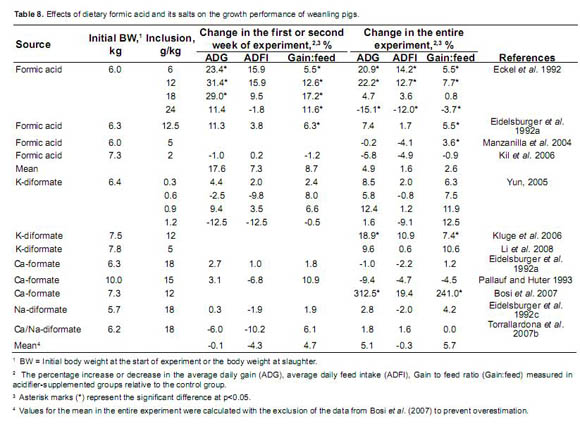
</front><body><![CDATA[ <p align="right"><font face="Verdana, Arial, Helvetica, sans-serif" size="2"><b>Art&iacute;culos originales</b> </font></p>     <p align="center"><font face="Verdana, Arial, Helvetica, sans-serif" size="4"><b>Dietary acidifiers in weanling pig diets: a review</b><Sup>&curren;</Sup></font></p>     <p align="center"><font face="Verdana, Arial, Helvetica, sans-serif" size="3"><b>   Acidificantes dietarios para cerdos reci&eacute;n destetados: revisi&oacute;n </b></font></p>     <p align="center"><font face="Verdana, Arial, Helvetica, sans-serif" size="3"><b>Dietas acidificadas em su&iacute;nos desmamados: uma revis&atilde;o </b> </font></p>     <p><font face="Verdana, Arial, Helvetica, sans-serif" size="2">Dong Yong Kil   <sup>1</sup>   , Animal Science, PhD; Woong Bi Kwon<sup>2</sup>, Animal Science, BS; Beob Gyun Kim <sup>2*</sup>, Animal Science, PhD.</font></p>     <p><font face="Verdana, Arial, Helvetica, sans-serif" size="2"><i><sup>1</sup>Departament of animal Science and Technology, Chung - Ang University Anseong, GyeonGi-Do 456-756, Republic of Korea.    </i></font></p>     <p><font face="Verdana, Arial, Helvetica, sans-serif" size="2"><i><sup>2</sup>   Department of Animal Science and Environment, Konkuk University, Seoul 143-701, Republic of Korea. </i></font></p>     <p><font face="Verdana, Arial, Helvetica, sans-serif" size="2">(Recibido: 8 abril, 2011; aceptado: 8 mayo, 2011)</font></p>     <p><font face="Verdana, Arial, Helvetica, sans-serif" size="2">&nbsp;</font></p><hr size="1">     <p><font face="Verdana, Arial, Helvetica, sans-serif" size="2"><i><b>Summary</b></i></font></p>     ]]></body>
<body><![CDATA[<p><font face="Verdana, Arial, Helvetica, sans-serif" size="2">The objective of the present review is to provide an overview on the effects of the addition of acidifiers to nursery pig diets. Researchers have proposed that dietary acidifiers decrease pH in the stomach and the lower gastrointestinal tract (GIT) of weanling pigs, and thus, protect the host from pathogenic invasion and proliferation and improve nutrient digestion. These benefits may subsequently result in improved growth    performance of weanling pigs. In experiments on nursery pigs, dietary acidifiers decreased stomach pH at least to a small extent, but had little influence on the pH of the lower GIT. Studies found no observable changes in microbial populations upon providing weanling pigs with dietary acidifiers, but they found a slight reduction in lactobacilli or lactic acid-producing bacteria throughout the GIT. Dietary acidifiers improved protein digestion in many cases despite variable results regarding the digestibility of amino acids and improved growth performance. Such positive responses were more apparent during the first or second    week of experiments than the later stages. However, growth responses were inconsistent among different sources and varying inclusion rates of acidifiers. Information on the dietary acidifiers&rsquo; mode of action is quite limited, and large variations exist in results regarding the effects of dietary acidifiers. Based on the present review, the benefit of dietary acidifiers for nursery pigs is not entirely convincing. Further research is required to clarify the acidifiers&rsquo; mode of action and its association with subsequent growth performance in weanling pigs.</font></p>     <p><font face="Verdana, Arial, Helvetica, sans-serif" size="2"><b>Key words:</b> acidifiers, gastrointestinal pH, growth performance, microbial population, nutrient digestion, weanling pigs.</font></p>     <p><font face="Verdana, Arial, Helvetica, sans-serif" size="2">&nbsp;</font></p><hr size="1">     <p><font face="Verdana, Arial, Helvetica, sans-serif" size="2"><b>Resumen</b></font></p>     <p><font face="Verdana, Arial, Helvetica, sans-serif" size="2">El objetivo de esta revisi&oacute;n es ofrecer una visi&oacute;n general sobre los efectos de la adici&oacute;n de acidificantes org&aacute;nicos en la dieta de cerdos destetos. Se ha propuesto que los acidificantes dietarios reducen el pH en el est&oacute;mago y tracto gastrointestinal (TGI) de los cerdos reci&eacute;n destetados, y por lo tanto protegen al hu&eacute;sped de la invasi&oacute;n y proliferaci&oacute;n de pat&oacute;genos, al tiempo que mejoran la digesti&oacute;n de nutrientes. Estos beneficios podr&iacute;an resultar en una mejora del crecimiento de dichos animales. En experimentos con cerdos    destetados, los acidificantes dietarios han mostrado que pueden disminuir el pH del est&oacute;mago, al menos en peque&ntilde;a medida, pero han tenido poca influencia en el pH del tracto gastrointestinal posterior. Algunos estudios no encontraron cambios observables en las poblaciones microbianas al ofrecer acidificantes en la dieta a estos animales, pero se reporta una ligera reducci&oacute;n de los lactobacilos o bacterias l&aacute;cticas productoras de &aacute;cido en todo el tracto gastrointestinal. En muchos casos, los acidificantes parecen mejorar la digesti&oacute;n proteica, a pesar de ofrecer resultados variables con respecto a la digestibilidad de    los amino&aacute;cidos y mejora del crecimiento. Tales respuestas positivas parecen ser m&aacute;s evidentes durante la primera o segunda semana de los experimentos que en etapas posteriores. Sin embargo, la respuesta en crecimiento ha sido inconsistente respecto a diferentes fuentes y niveles de inclusi&oacute;n de acidificantes. La informaci&oacute;n sobre el modo de acci&oacute;n de los acidificantes dietarios es bastante limitada y existen grandes variaciones en los resultados respecto a sus efectos. De acuerdo con esta revisi&oacute;n, el beneficio potencial de los acidificantes dietarios en cerdos destetados no est&aacute; del todo justificado. Se requiere investigaci&oacute;n  adicional para aclarar su modo de acci&oacute;n y su relaci&oacute;n con el crecimiento de los cerdos reci&eacute;n destetados. </font></p>     <p><font face="Verdana, Arial, Helvetica, sans-serif" size="2"><b>Palabras clave:</b> acidificantes, cerdos reci&eacute;n destetados, digesti&oacute;n de nutrientes, pH gastrointestinal, poblaci&oacute;n microbiana, rendimiento productivo.</font></p> <hr size="1">     <p><font face="Verdana, Arial, Helvetica, sans-serif" size="2"><b>Resumo</b></font></p>     <p><font face="Verdana, Arial, Helvetica, sans-serif" size="2"> O objetivo desta revis&atilde;o &eacute; fornecer uma vis&atilde;o geral dos efeitos da adi&ccedil;&atilde;o de acidificantes org&acirc;nicos na dieta de leit&otilde;es desmamados. Tem sido proposto que a dieta acidificante reduz o pH do est&ocirc;mago e do trato gastrointestinal (TGI) de leit&otilde;es desmamados, e assim proteger o hospedeiro da invas&atilde;o e prolifera&ccedil;&atilde;o    de patog&ecirc;nicos, melhorando a digest&atilde;o dos nutrientes. Estes podem resultar em um maior crescimento destes animais. Em experimentos com su&iacute;nos desmamados, a acidifica&ccedil;&atilde;o da dieta t&ecirc;m sido mostrados para diminuir o pH do est&ocirc;mago, pelo menos em pequena medida, mas tiveram pouca influ&ecirc;ncia sobre o pH do trato gastrointestinal posterior. Alguns estudos n&atilde;o encontraram altera&ccedil;&otilde;es observ&aacute;veis em popula&ccedil;&otilde;es microbianas ao oferecer acidificantes na dieta, mas tem-se reportado uma ligeira redu&ccedil;&atilde;o de lactobacilos ou bact&eacute;rias l&aacute;cticas produtoras de &aacute;cido em tudo o trato gastrointestinal. Em muitos casos,    os acidificantes parecem melhorar a digest&atilde;o de prote&iacute;nas, apesar de oferecer resultados vari&aacute;veis com respeito &agrave; digestibilidade dos amino&aacute;cidos e melhora o crescimento. ais respostas positivas parecem ser mais evidentes durante a primeira ou segunda. No entanto, a resposta de crescimento tem sido inconsistente com rela&ccedil;&atilde;o a diferentes fontes e n&iacute;veis de inclus&atilde;o de acidificantes. A Informa&ccedil;&atilde;o sobre o modo de a&ccedil;&atilde;o dos acidificantes na dieta &eacute; bastante limitado e existem grandes varia&ccedil;&otilde;es nos resultados sobre seus efeitos. De acordo com essa an&aacute;lise, o benef&iacute;cio potencial de alimentar leit&otilde;es desmamados com acidificantes n&atilde;o  &eacute; inteiramente justificado. Mais pesquisas s&atilde;o necess&aacute;rias para esclarecer seu modo de a&ccedil;&atilde;o e sua rela&ccedil;&atilde;o com o crescimento de leit&otilde;es desmamados. </font></p>     <p><font face="Verdana, Arial, Helvetica, sans-serif" size="2"><b>Palavras chave:</b>acidificantes, desempenho produtivo, pH gastrointestinal, digest&atilde;o de nutrientes, leit&otilde;es, desmamados popul&ccedil;&atilde;o microbiana.</font></p>     <p><font face="Verdana, Arial, Helvetica, sans-serif" size="2"><Sup>&curren;</Sup>To cite this article: Kil DY, Kwon WB, Kim BG. Dietary acidifiers in weanling pig diets: a review. Rev Colomb Cienc Pecu 2011; 24:231-247 </font></p>     ]]></body>
<body><![CDATA[<p><font face="Verdana, Arial, Helvetica, sans-serif" size="2"><sup>*</sup> Corresponding author: Beob Gyun Kim. Department of Animal Science and Environment, Konkuk University, Seoul 143-701, Republic of Korea. Tel +82-2-2049-6255. E-mail:<a href="mailto:bgkim@konkuk.ac.kr">bgkim@konkuk.ac.kr</a></font></p>     <p><font face="Verdana, Arial, Helvetica, sans-serif" size="2">&nbsp;</font></p> <hr size="1">     <p>&nbsp;</p>     <p><font face="Verdana, Arial, Helvetica, sans-serif" size="3"><b>Introduction</b> </font></p>     <p><font face="Verdana, Arial, Helvetica, sans-serif" size="2">In the modern swine industry, shortening the sucking period for piglets, to increase the number of  sow's reproductive cycles, is a widespread practice due to the belief that a reduced lactation period increases swine production profitability. As a side effect, however, piglets weaned at an early age (2 to 4 weeks) suffer from environmental, physiological, and social stresses. The sudden change in dietary regimens, from sow`s milk to solid feed, places a particularly heavy burden on the immature digestive system of weanling pigs. Researchers have considered this nutritional challenge as one primary reason why weanling pigs frequently experience growth retardation, high rates of intestinal disease incidence, and high mortality rates (Ravindran and Kornegay, 1993). </font></p>     <p><font face="Verdana, Arial, Helvetica, sans-serif" size="2">To solve these postweaning problems, the swine industry has made wide use of antibiotic growth promoters (AGP) in postweaning diets, and AGP have shown promising benefits in weanling pigs (Cromwell, 2001). However, public concerns regarding occurrence of antibiotic-resistant pathogens and antibiotic residues in animal products have caused a partial or total discontinuation of AGP use in animal feeds in many countries. As a consequence, many swine nutritionists are currently investigating alternative feed additives and feeding strategies to alleviate the postweaning complications without using AGP. </font></p>     <p><font face="Verdana, Arial, Helvetica, sans-serif" size="2">Researchers have suggested probiotics, prebiotics, enzymes, minerals, and acidifiers as alternatives for improving weanling pigs` health and growth performance (Pettigrew, 2006; Stein and Kil, 2006). Among these feed additives, dietary acidifiers (organic and inorganic acids) have gained great interest in the industry, because of their potential to reduce the pH of the gastrointestinal tract (GIT), which improves nutrient digestion in weanling pigs and protects the GIT from pathogenic invasion and proliferation. Several reviews pertaining to dietary acidifiers used in weanling pig diets have been published previously (Ravindran and Kornegay, 1993; Partanen and Mroz, 1999; Kim  et al., 2005). However, the previous reviews did not discuss the literature published in the past decade, which caused swine nutritionists to doubt the efficacy of dietary acidifiers in currently weanling pig diets. The present review, therefore, aimed to summarize the current data regarding the effects of dietary acidifiers on weanling pigs and to provide an overview of the application of dietary acidifiers in weanling pig diets.</font></p>     <p>&nbsp;</p>     <p><font face="Verdana, Arial, Helvetica, sans-serif" size="3"><b>Justification for adding acidifiers to nursery diets</b></font></p>     <p><font face="Verdana, Arial, Helvetica, sans-serif" size="2">Efficient protein digestion requires the maintenance of a low gastric pH, because a low stomach pH activates proteolytic enzymes, such as pepsin (Kidder and Manners, 1978). Moreover, the acidic conditions play an important role in preventing harmful bacteria from passing into the lower GIT (Maxwell and Stewart, 1995). Hydrochloric acid (HCl) production is a major determinant of stomach pH, and greater HCl production leads to a lower stomach pH. However, weanling pigs have an unfavorably high pH in the stomach, due to their limited capacity for secreting an adequate HCl quantity (Kidder and Manners, 1978), which leads to reduced protein digestion of solid diets. Moreover, the increased amounts of undigested protein entering the duodenum may accelerate pathogenic bacterial growth in the lower GIT (Smith and Jones, 1963; Partanen and Mroz, 1999). Ravindran and Kornegay (1993) have observed that both poor growth performance and a high diarrhea incidence in weanling pigs involve a reduction in protein digestion and an outgrowth of pathogenic bacteria. To overcome the stomach pH issues in weanling pigs, nutritionists advocate diet acidification through adding acids (i.e., acidifiers) to weanling pig diets. </font></p>     ]]></body>
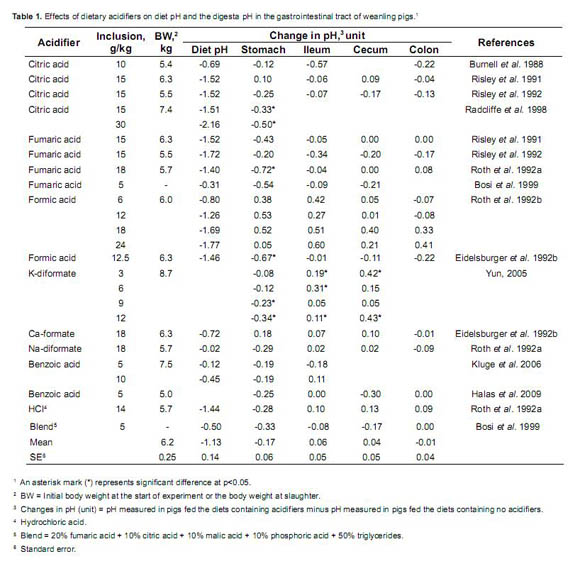
<body><![CDATA[<p>&nbsp;</p>     <p><font face="Verdana, Arial, Helvetica, sans-serif" size="3"><b>Potential mode of action of acidifiers</b></font></p>     <p><font face="Verdana, Arial, Helvetica, sans-serif" size="2">The addition of acidifiers to weanling pig diets requires a clear understanding of the acidifiers` mode of action. Certain researchers have proposed that adding dietary acidifiers to swine diets correlates primarily with (1) decreased pH in the stomach and lower GIT, (2) modulation of microbial populations, and (3) improvement in nutrient digestion, although other researchers have speculated upon other possible mechanisms (Ravindran and Kornegay, 1993; Partanen and Mroz, 1999). </font></p>     <p><font face="Verdana, Arial, Helvetica, sans-serif" size="2"><i>Effects on pH in the GIT</i></font></p>     <p><font face="Verdana, Arial, Helvetica, sans-serif" size="2">The addition of dietary acidifiers clearly decreases diet pH in a dose-dependent manner <a name="t1" id="t1"></a><a href="#t1">(Table 1)</a>. It appears that the pK<sub>a</sub> value of acidifiers and the quantity of other dietary components (such as milk products and mineral supplements that are high in acid-binding capacity) affect the degree of pH reduction (Kim <i>et al.</i>, 2005). In general, the addition of dietary acidifiers decreases the stomach pH in weanling pigs. In 17 experiments, 19 out of 25 acidifier-supplemented groups had decreased  a stomach pH as compared to the control group, and the mean change was -0.17 (SE = 0.06) (<a name="t1" id="t1"></a><a href="#t1">Table 1</a>). </font></p>     <p><font face="Verdana, Arial, Helvetica, sans-serif" size="2">Four experiments reported a significant reduction in stomach pH, while others failed to detect significance. There was no clear difference among the dietary acidifiers in the extent of their pH-lowering effects. In addition, the reduction in stomach pH due to feeding acidifiers was likely independent of the diet`s acidifier amounts although 2 experiments reported dose-dependent reductions in stomach pH. For the lower part of the GIT, the dietary acidifier effects on the digesta pH were more inconsistent than the stomach pH. Yun (2005) observed a significant pH increase in the ileum and the cecum by feeding increasing concentrations of K-diformate to the weanling pigs, whereas others reported no difference. Thus, the effects of acidifiers on pH of the GIT appear to be limited only to the stomach, and further studies are needed to clarify the effects of acidifiers on pH of the lower GIT.</font></p>     <p align="center"><a name="t1"><img src="/img/revistas/rccp/v24n3/a02t1.JPG"/></a></font></p>     <p><font face="Verdana, Arial, Helvetica, sans-serif" size="2">&nbsp;</font></p>     <p><font face="Verdana, Arial, Helvetica, sans-serif" size="2"><i>Effects on microbial population</i></font></p>     <p><font face="Verdana, Arial, Helvetica, sans-serif" size="2">Low pH in the stomach plays an important role in preventing undesirable bacteria from invading and proliferating along the GIT (Maxwell and Stewart, 1995) and creates preferential conditions for the growth of beneficial bacteria such as    <i>lactobacilli</i> (Fuller, 1977). However, weanling pigs often have an overgrowth of pathogenic bacteria (e.g., coliforms) and a reduced population of favorable bacteria (e.g., <i>lactobacilli</i> and  <i>bifidobacteria</i>; Barrow <i>et al.</i>, 1977). The high stomach pH and increased quantity of undigested feed entering the lower GIT may cause this microbial imbalance in weanling pigs (Smith and Jones, 1963; Partanen and Mroz, 1999). </font></p>     ]]></body>
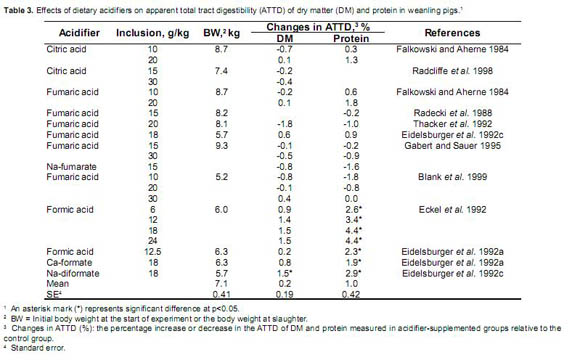
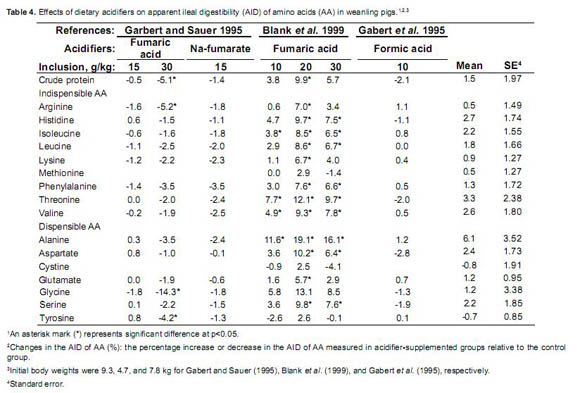
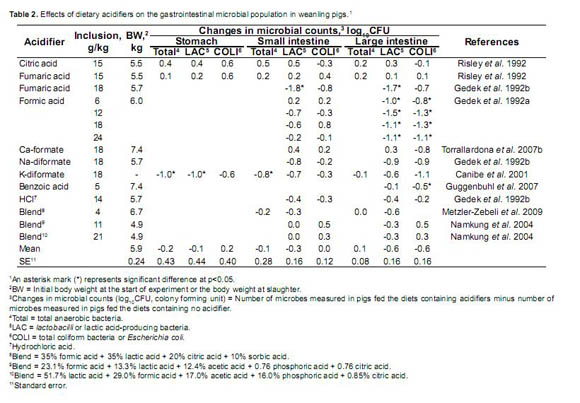
<body><![CDATA[<p><font face="Verdana, Arial, Helvetica, sans-serif" size="2">Researchers have hypothesized that adding acidifiers to nursery diets favors the growth of beneficial bacteria, with an accompanying reduction in harmful bacteria, by reducing stomach pH (Partanen and Mroz, 1999). Moreover, the previous <i>in vitro </i>experiments suggested that organic acidifiers may have direct antimicrobial effects, specifically on the pH-sensitive harmful bacteria such as coliforms and<i> Clostridia</i>, without influencing the growth of pH-insensitive beneficial bacteria such as <i>lactobacilli </i>(Gauthier, 2002). However, most of the previous experiments, in which researchers fed dietary acidifiers to weanling pigs, reported few significant benefits for microbial populations in the GIT (<a href="#t2">Table 2</a>). Instead, the addition of dietary acidifiers resulted, on average, in a slight depression of <i>lactobacilli</i> or lactic acid- producing bacteria counts in the small intestine (-0.3 log<sub>10</sub>   CFU &#177; 0.16 SE) and the large intestine (-0.6 log<sub>10</sub>   CFU &#177; 0.16 SE) and variable results for coliforms or <i>Escherichia coli</i>. The limited data make it difficult to explain these contrasting results. Further research is required to verify the effects of dietary acidifiers on microbial populations. For future studies, molecular techniques for quantifying microbial counts may produce greater accuracy and precision compared to conventional culture methods (Kil and Swanson, 2010).  10</font></p>     <p align="center"><a name="t2"><img src="/img/revistas/rccp/v24n3/a02t2.JPG" /></a></font></p>     <p><font face="Verdana, Arial, Helvetica, sans-serif" size="3"><b>Improvement in nutrient digestion</b></font></p>     <p><font face="Verdana, Arial, Helvetica, sans-serif" size="2">Many researchers have tested the hypothesis that adding dietary acidifiers improves the digestibility of protein and amino acids (AA) in the diets fed to weanling pigs because dietary acidifiers decrease the stomach pH and, therefore, increase pepsin activation in the stomach. In addition, researchers have suggested that dietary acidifiers may delay the passage rate of gastric digesta into the duodenum and stimulate pancreatic enzyme secretion by acidifying the stomach contents, allowing further digestion of protein and other nutrients (Ravindran and Kornegay, 1993; Partanen and Mroz, 1999). Our review assessed the 11 experiments measuring apparent total tract digestibility (ATTD) of protein (<a href="#t3">Table 3</a>). Compared with the control group, feeding dietary acidifiers improved the ATTD of protein, on average, by 1% (SE = 0.42). Among the 20 acidifier-supplemented groups, 12 groups showed a numerical increase in the ATTD of protein, ranging from 0.3 to 4.4%, with 7 groups showing statistical significance. Among the dietary acidifiers, formic acid and its salts appeared most effective in improving the ATTD of protein. Eckel <i>et al.</i> (1992) observed a significant dose-dependent improvement in the ATTD of protein upon feeding weanling pigs with increasing concentrations of formic acid, ranging from 6 to 24 g/kg. Falkowski and Aherne (1984) also observed similar dose-dependent responses for citric acid and fumaric acid, but without statistical significance. These experiments showed large variations in their results on the ATTD of protein.</font></p>     <p><font face="Verdana, Arial, Helvetica, sans-serif" size="2">On the other hand, data on the apparent ileal digestibility (AID) of protein and AA for weanling pigs are limited (<a href="#t4">Table 4</a>). Blank <i>et al.</i> (1999) reported that feeding fumaric acid to weanling pigs, in concentrations ranging from 10 to 30 g/ kg, significantly improved the AID of protein and of several indispensable and dispensable AA, with 20 g/kg being the most effective dosage. In contrast, Gabert and Sauer (1995) found that dietary fumaric acid or Na-fumarate had a negative impact on the AID of protein and most AA. Gabert <i>et al.</i> (1995) found no significant effects of dietary formic acid on the AID of AA. The reason for these conflicting results is unclear; however, it may be related to the differences in dietary levels, sources of protein, and other dietary components among the experiments (Blank <i>et al.</i>, 1999). </font></p>     <p align="center"><a name="t3"><img src="/img/revistas/rccp/v24n3/a02t3.JPG" /></a> </font></p>     <p align="center"><a name="t4"><img src="/img/revistas/rccp/v24n3/a02t4.JPG" /></a></font></p>     <p><font face="Verdana, Arial, Helvetica, sans-serif" size="2">In addition to protein and AA digestibility, researchers have also suggested that dietary acidifiers, due to their property of chelating minerals, may improve the digestibility of minerals such as Ca and P (Ravindran and Kornegay, 1993). Others note dietary acidifiers` role in promoting the efficacy of intrinsic phytase in feed ingredients or of exogenous microbial phytase (Partanen and Mroz, 1999). Studies have frequently documented improvements in the ATTD of Ca and P in growing pigs fed diets containing fumaric acid (Mroz et al., 2000), formic acid (Jongbloed <i>et al.</i>, 2000; Mroz    <i>et al.</i>, 2000), lactic acid (Kemme <i>et al.</i>, 1999; Jongbloed <i>et al.</i>, 2000), or benzoic acid (Sauer  <i>et al.,</i> 2009; B&ucirc;hler <i>et al.</i>, 2010). However, very limited data exist for weanling pigs. Radcliffe <i>et al.</i> (1998) reported that the ATTD of Ca and P increased by 8% and 10%, respectively, with the addition of 15 or 30 g/kg of citric acid to the diets fed to weanling pigs. </font></p>     <p>&nbsp;</p>     <p><font face="Verdana, Arial, Helvetica, sans-serif" size="3"><b>Other possible mechanisms</b></font></p>     ]]></body>
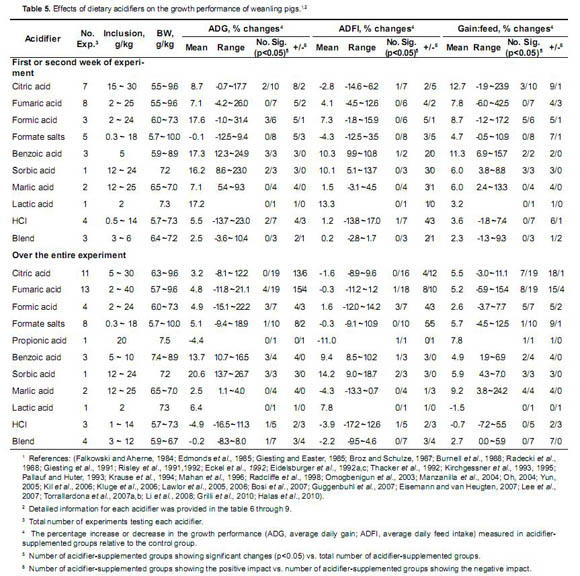
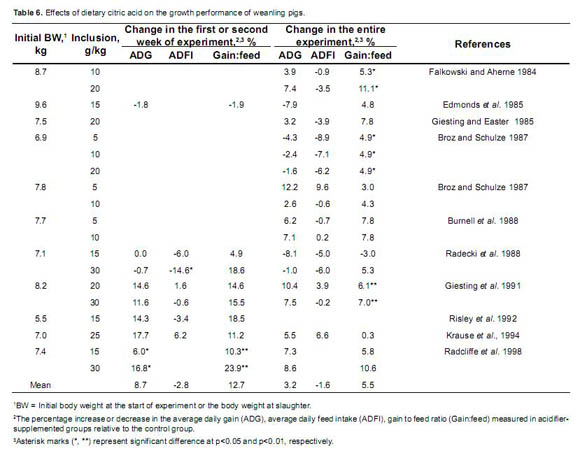
<body><![CDATA[<p><font face="Verdana, Arial, Helvetica, sans-serif" size="2">Previous reviews have proposed that organic acidifiers may stimulate the intermediary metabolism of nutrients in animals, leading to improved energy and nutrient utilization, and organic acidifiers such as fumaric acid may serve as immediate energy sources, particularly for intestinal epithelial cells (Ravindran and Kornegay, 1993; Partanen and Mroz, 1999). In theory, these regulatory roles of dietary acidifiers appear to be acceptable, at least to some extent. However, little experimental evidence supports these mechanisms in pigs.</font></p>     <p>&nbsp;</p>     <p><font face="Verdana, Arial, Helvetica, sans-serif" size="3"><b>Acidifiers and growth performance in weanling pigs</b></font></p>     <p><font face="Verdana, Arial, Helvetica, sans-serif" size="2">Improved nutrient digestibility and a balanced microbial population, due to dietary acidifiers, should improve growth performance in weanling pigs. In a meta-analysis of growth responses to dietary acidifiers, Partanen and Mroz (1999) indicated that average daily gain (ADG) and feed efficiency (gain:feed ratio) in weanling pigs improved significantly with dietary citric acid, fumaric acid, or formic acid or its salts. In the current review, we examined 36 previous experiments, some of which Partanen and Mroz (1999) had not included in their meta-analysis. In addition, our review investigated how dietary acidifiers affected the growth performance of weanling pigs during the two separate experimental periods (the first or second week) and the entire experiment, because studies have noted that the most pronounced positive response usually occurred in the immediate postweaning period and then decreased as the pigs matured (Ravindran and Kornegay, 1993). To our knowledge, this separate analysis has not been previously performed. <a href="#t5">Table 5</a> presents the overall data. <a href="#t6">Table 6</a> through 9 shows the information for each acidifier in detail.</font></p>     <p align="center"><a name="t5"><img src="/img/revistas/rccp/v24n3/a02t5.JPG" /></a></p>     <p align="center"><a name="t6"><img src="/img/revistas/rccp/v24n3/a02t6.JPG" /></a></p>     <p><font face="Verdana, Arial, Helvetica, sans-serif" size="2"><i>Citric acid</i></font></p>     <p><font face="Verdana, Arial, Helvetica, sans-serif" size="2">Citric acid is a weak crystalline organic acid with no odor and a sour taste. Citric acid was widely used in the earlier experiments conducted between 1980 and 2000. Thereafter, citric acid drew little attention with regard to weanling pigs. Published data we obtained from the 12 previous experiments indicated that, despite high variation, dietary citric acid generally increased ADG and feed efficiency but decreased average daily feed intake (ADFI) when we considered the ratio of number of positive responses to number of negative responses (<a href="#t6">Table 6</a>). The average improvements in ADG and feed efficiency were 8.7% and 12.7%, respectively, in the first or second week of the experiment, whereas the corresponding figures were 3.2% and 5.5%, respectively, over the entire experimental period. </font></p>     <p><font face="Verdana, Arial, Helvetica, sans-serif" size="2">This result agrees with the previous observation that dietary acidifiers` positive effects decreased with age (Ravindran and Kornegay, 1993). </font></p>     <p><font face="Verdana, Arial, Helvetica, sans-serif" size="2">Regardless of the experimental period, however, only a few experiments reported significant improvement in ADG (Radcliffe <i>et al.</i>, 1998) or feed efficiency (Falkowski and Aherne, 1984; Broz and Schulze, 1987; Giesting et al., 1991; Risley <i>et al.</i>, 1991; Radcliffe <i>et al.</i>, 1998).</font></p>     ]]></body>
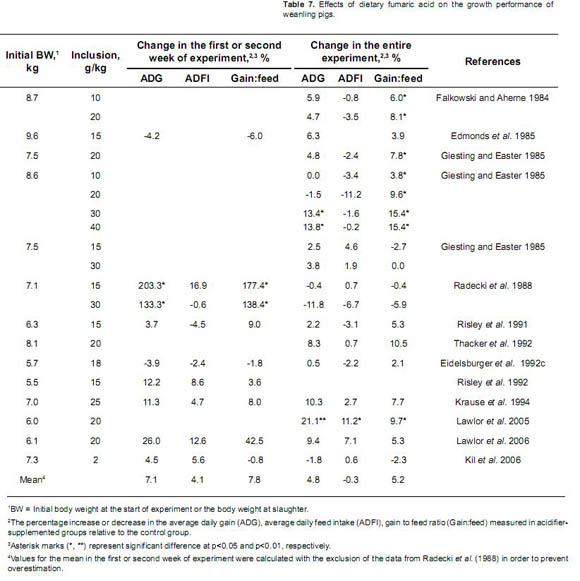
<body><![CDATA[<p><font face="Verdana, Arial, Helvetica, sans-serif" size="2"><i>Fumaric acid</i></font></p>     <p><font face="Verdana, Arial, Helvetica, sans-serif" size="2">Fumaric acid is a weak crystalline organic acid with no odor and a tart flavor. In swine nutrition, researchers in the late twentieth century intensively studied fumaric acid with regard to weanling pigs. In the past decade, however, information pertaining to the effects of fumaric acid on the growth performance of weanling pigs has been lacking. </font></p>     <p><font face="Verdana, Arial, Helvetica, sans-serif" size="2">We investigated 14 such experiments (<a href="#t7">Table 7</a>). With the exception of three experiments (Edmonds <i>et al.</i>, 1985; Eidelsburger et al., 1992c; Kil et al., 2006), feeding fumaric acid to weanling pigs had a positive effect on ADG and feed efficiency by an average of 7.1% and 7.8%, respectively, during the first or second week of the experiments. Radecki <i>et al.</i> (1988) reported that, when pigs` diets contained 15 to 30 g/kg of fumaric acid, ADG increased 133.3% to 203.3% and feed efficiency increased 138.4% to 177.4%, as compared to the control group. However, we excluded the data from Radecki et al. (1988) from our calculations of the average improvements in the ADG and feed efficiency due to feeding fumaric acid because the inordinately low ADG and feed efficiency in the control group caused the large percent increment, which would likely inflate the average values had we included these data. </font></p>     <p align="center"><a name="t7"><img src="/img/revistas/rccp/v24n3/a02t7.JPG" /></a></p>     <p><font face="Verdana, Arial, Helvetica, sans-serif" size="2">Weanling pigs fed diets containing fumaric acid showed increased ADFI by an average of 4.1%, as compared with the control group. Over the entire experimental periods, the ADG and feed efficiency also improved by 4.8% and 5.2%, respectively. Giesting and Easter (1985) reported significant improvements in ADG upon adding 30 or 40 g/kg of fumaric acid and in feed efficiency with 10, 20, 30 or 40 g/kg of fumaric acid addition. Likewise, other studies that fed 10 or 20 g/kg of fumaric acid to weanling pigs observed a 21.1% improvement in ADG (Lawlor <i>et al.</i>, 2005) and a 6.0 to 9.7% improvement in feed efficiency (Falkowski and Aherne, 1984; Lawlor <i>et al.</i>, 2005). Although Lawlor <i>et al.</i>, (2005) reported significant ADFI improvements upon 20 g/kg of fumaric acid addition, these results varied greatly, ranging from -11.2 to 11.2% of change relative to the control group`s ADFI. We found no consistent tendency for fumaric acid to have a dose-dependent positive effect on the growth performance of weanling pigs. </font></p>     <p><font face="Verdana, Arial, Helvetica, sans-serif" size="2"><i>Formic acid and its salts</i></font></p>     <p><font face="Verdana, Arial, Helvetica, sans-serif" size="2">Formic acid is a highly volatile, liquid organic acid with a pungent odor. Early studies directly applied the free form of formic acid to swine diets. In recent years, however, researchers have generally used its salts combined with Ca, Na, or K because these are easier to handle and less volatile. Unlike citric acid and fumaric acid, formic acid and its salts were tested in relatively recent experiments. We included the 12 experiments using formic acid or formic salts in this review <a name="t8" id="t8"></a><a href="#t8">(Table 8)</a>. When researchers added free formic acid to the nursery diets, growth performance improved in the first or second week of the experiment. Average improvements were 17.6%, 7.3%, and 8.7% for the ADG, ADFI, and feed efficiency, respectively. Over the entire experimental periods, growth performance showed slight improvements (i.e., 4.9%, 1.6%, and 2.6% improvements in ADG, ADFI, and feed efficiency, respectively). </font></p>     <p align="center"><a name="t8"><img src="/img/revistas/rccp/v24n3/a02t8.JPG" /></a></p>     <p><font face="Verdana, Arial, Helvetica, sans-serif" size="2">However, Eckel et al. (1992) reported that pigs fed diets containing 24 g/kg of formic acid showed significant reductions in ADG, ADFI, and feed efficiency by 15.1%, 12.0%, and 3.7%, respectively. Manzanilla<i> et al.</i>, (2004) and Kil<i> et al.</i> (2006) observed non-significant reductions in ADG and ADFI. When included in weanling pig diets, formic salts had zero or negative impacts on ADG (-0.1%) and ADFI (-4.3%) based on the average change relative to the control group. However, feed efficiency improved (4.7%) during the first or second week of the experiments. Among the eight formic salts-supplemented groups, three groups showed great reductions in ADG, while five groups showed reductions in the ADFI. In contrast, most formic salts-supplemented groups had a positive change in ADG and feed efficiency over the entire experimental period. Adding formic salts improved the ADG and feed efficiency by 5.1% and 5.7%, respectively, across the entire experimental period. </font></p>     <p><font face="Verdana, Arial, Helvetica, sans-serif" size="2">Moreover, Bosi<i> et al. </i>(2007) fed weanling pigs diets containing 12 g/kg Ca-formate and found ADG increased 312.5% and feed efficiency increased 241.0% relative to the control group. However, we removed the data from Bosi et al. (2007) from our calculation of the average improvements to avoid overestimating values. Interestingly, formic acid induced average improvements in ADG and feed efficiency that were greater over the entire experimental period than in the first or second week of the experiments, which contrasts with the cases of citric acid, fumaric acid, and formic acid. It appears that considerable variations among the experiments may contribute to this contrasting observation. It is also difficult to conclude which formic acid sources had the greatest benefit on weanling pigs` performance, although Eidelsburger <i>et al.</i> (1992a) observed that pure formic acid improved pig performance with greater efficiency than Ca-formate did. No clear dose- dependent responses were observed in pigs fed diets containing either formic acid or formic salts.</font></p>     ]]></body>
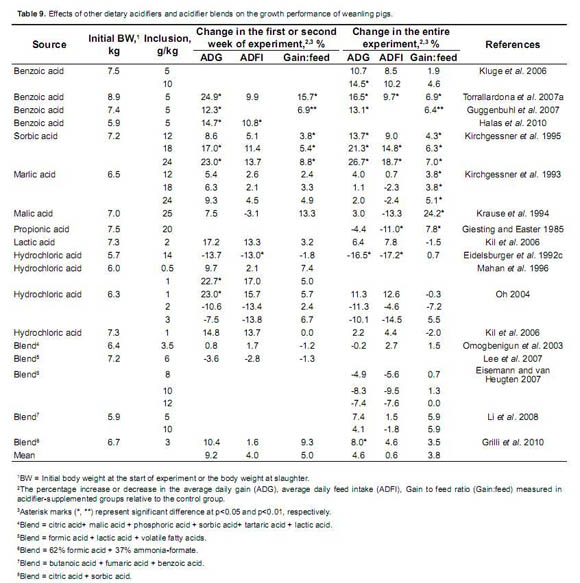
<body><![CDATA[<p><font face="Verdana, Arial, Helvetica, sans-serif" size="2"><i>Other acidifiers</i></font></p>     <p><font face="Verdana, Arial, Helvetica, sans-serif" size="2">Previous experiments also examined a variety of other organic acidifiers, inorganic acidifiers, and blends of organic and/or inorganic acidifiers (<a href="#t9">Table 9</a>). </font></p>     <p><font face="Verdana, Arial, Helvetica, sans-serif" size="2">Feeding weanling pigs diets with 5 g/kg of benzoic acid significantly improved ADG (14.7%) and ADFI (10.8%) in the first or second week of the experiment (Halas <i>et al.</i>, 2010). Likewise, Torrallardona <i>et al. </i>(2007a) and Guggenbuhl <i>et al.</i> (2007) reported significant improvements in ADG and feed efficiency upon adding 5 g/kg of benzoic acid to the feed during both the first and second weeks of the experiment and over the entire experimental period. Kluge <i>et al.</i> (2006) also observed similar improvements upon the addition of benzoic acid with a tendency toward positive dose- dependent responses. </font></p>     <p><font face="Verdana, Arial, Helvetica, sans-serif" size="2">Kirchgessner <i>et al.</i> (1995) determined the effects of adding sorbic acid. Increasing the inclusion of sorbic acid from 12 to 24 g/kg of the diet induced linear increases in ADG, ADFI, and feed efficiency, regardless of the experimental period. Two experiments tested the effects of including 12 to 25 g/kg of malic acid in the diets (Kirchgessner  <i>et al.</i>, 1993; Krause <i>et al.</i>, 1994). These found non- significant improvements, on average, in ADG (7.1%), ADFI (1.5%), and feed efficiency (6.0%) in the first or second week of the experiments. Both experiments reported significantly improved feed efficiency across entire experimental periods, but the decreased ADFI likely caused this result. </font></p>     <p><font face="Verdana, Arial, Helvetica, sans-serif" size="2">Giesting and Easter (1985) fed weanling pigs diets containing propionic acid and reported significant improvements in feed efficiency (7.8%) but decreased ADG (-4.4%) and ADFI (-11.0%). Although an early study reported that supplying water containing lactic acid had a positive impact on the growth performance of weanling pigs (Cole et al., 1968), data pertaining to how dietary lactic acid affects weanling pig performance are currently limited. Kil <i>et al.</i> (2006) reported that feeding 2 g/kg of lactic acid improved growth performance in weanling pigs, and its positive impacts exceeded those of other acidifiers (i.e., fumaric acid and formic acid) although the study failed to find significant differences among the acidifiers` effects.</font></p>     <p><font face="Verdana, Arial, Helvetica, sans-serif" size="2">Studies have also evaluated inorganic acidifiers, such as HCl, phosphoric acids, and sulfuric acids, as alternatives to organic acidifiers because they are cheaper than organic acidifiers. However, the results of these previous experiments have been controversial. Some researchers reported improvements in the growth performance of weanling pigs (Mahan et al., 1996; Kil <i>et al.</i>, 2006), whereas others found great reductions in growth performance (Giesting, 1986; Eidelsburger et al., 1992c). The inclusion rate of inorganic acidifiers in the diets may affect the results because a high inclusion rate of inorganic acidifiers such as HCl may disturb the electrolyte balance (Giesting, 1986). Eidelsburger <i>et a</i>l. (1992c) reported a great reduction in the growth performance of weanling pigs fed diets containing 14 g/kg of HCl; however, other researchers observed improved growth performance upon feeding pigs diets containing less than 1 g/kg of HCl (Mahan <i>et al.</i>, 1996; Oh, 2004; Kil <i>et al.</i>, 2006). Further research is required to determine the optimal inclusion rate of inorganic acidifiers in the diets of weanling pigs.</font></p>     <p align="center"><a name="t9"><img src="/img/revistas/rccp/v24n3/a02t9.JPG" /></a></p>     <p><font face="Verdana, Arial, Helvetica, sans-serif" size="2">The blending of various organic and inorganic acidifiers has gained increasing attention because mixed acidifiers may work synergistically to improve health and performance of weanling pigs. In the current review, we included five previous experiments testing the blending of acidifiers for weanling pigs. On average, however, such studies observed no improvements in the growth performance of weanling pigs in either the first or second week of the experiments and across entire experiments. Grilli et al. (2010) reported that feeding weanling pigs 3 g/kg of a citric acid and sorbic acid blend improved growth performance, but only the improvement in overall ADG was significant. Li et al. (2008) also observed the numerically improved ADG and feed efficiency across the entire experiment upon feeding weanling pigs 5 to 10 g/kg of a butanoic acid, fumaric acid, and benzoic acid blend. However, other experiments reported such blends negatively impacted growth performance in some cases, regardless of the experimental period (Omogbenigun et al., 2003; Lee et al., 2007; Eisemann and van Heugten, 2007). Therefore, the effectiveness and synergism of acidifier blends for weanling pigs remains questionable.</font></p>     <p><font face="Verdana, Arial, Helvetica, sans-serif" size="2">  The results of weanling pigs` responses to dietary acidifiers show considerable variations. Some experiments reported that weanling pigs showed improvements in growth performance, while others found no effect or depressed growth performance. Responses were also inconsistent among sources and inclusion rates of the acidifiers. As the previous reviews suggested (Ravindran and Kornegay, 1993; Partanen and Mroz, 1999; Kim  <i>et al.</i>, 2005), these inconsistent results among the experiments are mainly consequences of large variations in experimental methodologies, such as pigs` ages and dietary ingredients. </font></p>     <p><font face="Verdana, Arial, Helvetica, sans-serif" size="2">Researchers and the swine industry have expected younger pigs to show greater improvements than older pigs as a result of acidifiers in their feed because these animals` digestive systems mature with age (Ravindran and Kornegay, 1993). The current review generally supports this notion, although formic salts showed the opposite results. This review also suggests that simple diets containing mainly cereals and vegetable meal may benefit weanling pigs to a greater degree than the complex diets containing milk products do because milk products may mask the acidifiers` positive effects on weanling pigs (Ravindran and Kornegay, 1993). In addition, complex diets generally have high buffering capacities, which may decrease the pH-lowering effects of acidifiers (Ravindran and Kornegay, 1993; Kim <i>et al.</i>, 2005), and complex diets contain ingredients that are more digestible than simple diets, which also may decrease the positive impacts of acidifiers (Partanen and Mroz, 1999). In the present review, we observed the earlier experiments` tendency to use simple diets containing cereal and vegetable meal and to report acidifiers having more pronounced effects than the recent experiments show. These recent experiments used more complex diets containing milk products or other animal protein sources. Moreover, some previous experiments used other growth promoting agents such as AGP and copper sulfate in the diets, which therefore complicated our understanding of the effects of acidifiers alone.</font> </p>     ]]></body>
<body><![CDATA[<p>&nbsp;</p>     <p><font face="Verdana, Arial, Helvetica, sans-serif" size="3"><b>Conclusions</b></font></p>     <p><font face="Verdana, Arial, Helvetica, sans-serif" size="2">The concept that dietary acidifiers improve health and growth performance in weanling pigs seems theoretically reasonable because lowering stomach pH through diet acidification can increase nutrient digestion, especially for protein and prevent pathogenic bacterial proliferation in the GIT. Although the stomach pH of weanling pigs tends to decrease when their diets contain various acidifiers, the extent of the pH reduction in the stomach is likely too small to beneficially affect nutrient digestion and prevent pathogenic invasion. This insufficient reduction in stomach pH may explain why previous experiments reported large variations in protein digestion, microbial populations, and growth performance with the addition of acidifiers to nursery diets. To discern acidifiers` effects on growth performance, the current review examined greater amounts of recently published data than previous reviews did. As previous reviews observed, we found most dietary acidifiers had positive impacts on growth performance with more pronounced effects at earlier ages than in later ages of weanling pigs. However, we observed no clear effects of the sources or inclusion rates of acidifiers. Significant variations in responses to dietary acidifiers still existed as previous reviews observed. These variations likely result from differences in experimental methodologies such as pigs` age and dietary ingredients. Therefore, this variation makes it difficult for us to conclude whether dietary acidifiers have promising effects on the health and performance of weanling pigs. Further research is needed to verify the clear mode(s) of action of acidifiers and its relationship with subsequent growth performance in weanling pigs.</font></p>     <p>&nbsp;</p>     <p><font face="Verdana, Arial, Helvetica, sans-serif" size="3"><b>Acknowledgements</b></font></p>     <p><font face="Verdana, Arial, Helvetica, sans-serif" size="2">Easy Bio System Inc. (Seoul, Republic of Korea) financially supported the present work. </font></p>     <p>&nbsp;</p>     <p><font face="Verdana, Arial, Helvetica, sans-serif" size="2"><b>References</b></font></p>     <!-- ref --><p><font face="Verdana, Arial, Helvetica, sans-serif" size="2"> 1. Barrow PA, Fuller R, Newport MJ. Changes in the microflora and physiology of the anteriorintestinal tract of pigs weaned at    2 days with special reference to the pathogenesis of diarrhea. Infect Immunol 1977; 18:586-595. </font>&nbsp;&nbsp;&nbsp;&nbsp;&nbsp;&nbsp;&nbsp;&nbsp;[&#160;<a href="javascript:void(0);" onclick="javascript: window.open('/scielo.php?script=sci_nlinks&ref=000091&pid=S0120-0690201100030000200001&lng=','','width=640,height=500,resizable=yes,scrollbars=1,menubar=yes,');">Links</a>&#160;]<!-- end-ref --><!-- ref --><p><font face="Verdana, Arial, Helvetica, sans-serif" size="2">2. Blank R, Mosenthin R, Sauer WC, Huang S. Effect of fumaric acid and dietary buffering capacity on ileal and fecal amino acid    digestibilities in early-weaned pigs. J Anim Sci 1999; 77:2974- 2984. </font>&nbsp;&nbsp;&nbsp;&nbsp;&nbsp;&nbsp;&nbsp;&nbsp;[&#160;<a href="javascript:void(0);" onclick="javascript: window.open('/scielo.php?script=sci_nlinks&ref=000092&pid=S0120-0690201100030000200002&lng=','','width=640,height=500,resizable=yes,scrollbars=1,menubar=yes,');">Links</a>&#160;]<!-- end-ref --><!-- ref --><p><font face="Verdana, Arial, Helvetica, sans-serif" size="2">3. Bosi P, Jung HJ, Han IK, Perini S, Cacciavillani JA, Casini L, Creston D, Gremokolini C, Mattuzzi S. Effects of dietary    buffering characteristics and protected or unprotected acids on piglet growth, digestibility and characteristics of gut content.  Asian-Aust J Anim Sci 1999; 12:1104-1110.</font>&nbsp;&nbsp;&nbsp;&nbsp;&nbsp;&nbsp;&nbsp;&nbsp;[&#160;<a href="javascript:void(0);" onclick="javascript: window.open('/scielo.php?script=sci_nlinks&ref=000093&pid=S0120-0690201100030000200003&lng=','','width=640,height=500,resizable=yes,scrollbars=1,menubar=yes,');">Links</a>&#160;]<!-- end-ref --><!-- ref --><p><font face="Verdana, Arial, Helvetica, sans-serif" size="2"> 4. Bosi P, Sarli G, Casini L, De Filippi S, Trevisi P, Mazzoni    M, Merialdi G. The influence of fat protection of calcium formate on growth and intestinal defence in Escherichia coli   k88-challenged weanling pigs. Anim Feed Sci Technol 2007; 139:170-185. </font>&nbsp;&nbsp;&nbsp;&nbsp;&nbsp;&nbsp;&nbsp;&nbsp;[&#160;<a href="javascript:void(0);" onclick="javascript: window.open('/scielo.php?script=sci_nlinks&ref=000094&pid=S0120-0690201100030000200004&lng=','','width=640,height=500,resizable=yes,scrollbars=1,menubar=yes,');">Links</a>&#160;]<!-- end-ref --><!-- ref --><p><font face="Verdana, Arial, Helvetica, sans-serif" size="2">5. Broz J, Schulze J. Efficacy of citric acid as a feed additive in early weaned piglets. J Anim Physiol Anim Nutr 1987; 58:215- 223. </font>&nbsp;&nbsp;&nbsp;&nbsp;&nbsp;&nbsp;&nbsp;&nbsp;[&#160;<a href="javascript:void(0);" onclick="javascript: window.open('/scielo.php?script=sci_nlinks&ref=000095&pid=S0120-0690201100030000200005&lng=','','width=640,height=500,resizable=yes,scrollbars=1,menubar=yes,');">Links</a>&#160;]<!-- end-ref --><!-- ref --><p><font face="Verdana, Arial, Helvetica, sans-serif" size="2">6. B&ucirc;hler K, Bucher B, Wenk C. Apparent nutrient and mineral    digestibility in growing&shy;finishing pigs fed phosphorus reduced diets supplemented with benzoic acid and phytase. Livest Sci    2010; 134:103-105.</font>&nbsp;&nbsp;&nbsp;&nbsp;&nbsp;&nbsp;&nbsp;&nbsp;[&#160;<a href="javascript:void(0);" onclick="javascript: window.open('/scielo.php?script=sci_nlinks&ref=000096&pid=S0120-0690201100030000200006&lng=','','width=640,height=500,resizable=yes,scrollbars=1,menubar=yes,');">Links</a>&#160;]<!-- end-ref --><!-- ref --><p><font face="Verdana, Arial, Helvetica, sans-serif" size="2"> 7. Burnell TW, Cromwell GL, Stahly TS. Effects of dried whey    and copper sulfate on the growth responses to organic acid in diets for weanling pigs. J Anim Sci 1988; 66:1100-1108. </font>&nbsp;&nbsp;&nbsp;&nbsp;&nbsp;&nbsp;&nbsp;&nbsp;[&#160;<a href="javascript:void(0);" onclick="javascript: window.open('/scielo.php?script=sci_nlinks&ref=000097&pid=S0120-0690201100030000200007&lng=','','width=640,height=500,resizable=yes,scrollbars=1,menubar=yes,');">Links</a>&#160;]<!-- end-ref --><!-- ref --><p><font face="Verdana, Arial, Helvetica, sans-serif" size="2">8. Canibe N, Steien SH, &Oslash;verland M, Jensen BB. Effect of K-diformate in starter diets on acidity, microbiota, and the    amount of organic acids in the digestive tract of piglets, and on gastric alterations. J Anim Sci 2001; 79:2123-2133. </font>&nbsp;&nbsp;&nbsp;&nbsp;&nbsp;&nbsp;&nbsp;&nbsp;[&#160;<a href="javascript:void(0);" onclick="javascript: window.open('/scielo.php?script=sci_nlinks&ref=000098&pid=S0120-0690201100030000200008&lng=','','width=640,height=500,resizable=yes,scrollbars=1,menubar=yes,');">Links</a>&#160;]<!-- end-ref --><!-- ref --><p><font face="Verdana, Arial, Helvetica, sans-serif" size="2">9. Cole DJA, Beal RM, Luscombe JR. The effect on performance and bacterial flora of lactic acid, propionic acid, calcium    propionate and calcium acrylate in the drinking water of weaned pigs. Vet Rec 1968; 83:459-464.</font>&nbsp;&nbsp;&nbsp;&nbsp;&nbsp;&nbsp;&nbsp;&nbsp;[&#160;<a href="javascript:void(0);" onclick="javascript: window.open('/scielo.php?script=sci_nlinks&ref=000099&pid=S0120-0690201100030000200009&lng=','','width=640,height=500,resizable=yes,scrollbars=1,menubar=yes,');">Links</a>&#160;]<!-- end-ref --><!-- ref --><p><font face="Verdana, Arial, Helvetica, sans-serif" size="2">10. Cromwell GL. Animicrobial and promicrobial agents. In: Swine Nutrition. Lewis AJ, Southern LL, editors. Washington D.C.:  CRC Press; 2001. p.401-426.</font>&nbsp;&nbsp;&nbsp;&nbsp;&nbsp;&nbsp;&nbsp;&nbsp;[&#160;<a href="javascript:void(0);" onclick="javascript: window.open('/scielo.php?script=sci_nlinks&ref=000100&pid=S0120-0690201100030000200010&lng=','','width=640,height=500,resizable=yes,scrollbars=1,menubar=yes,');">Links</a>&#160;]<!-- end-ref --><!-- ref --><p><font face="Verdana, Arial, Helvetica, sans-serif" size="2"> 11. Eckel B, Kirchgessner M, Roth FX. Influence of formic acid    on daily weight gain, feed intake, feed conversion rate and digestibility. 1. The nutritive value of organic acids in the    rearing of piglets. J Anim Physiol Anim Nutr 1992; 62:93-100. </font>&nbsp;&nbsp;&nbsp;&nbsp;&nbsp;&nbsp;&nbsp;&nbsp;[&#160;<a href="javascript:void(0);" onclick="javascript: window.open('/scielo.php?script=sci_nlinks&ref=000101&pid=S0120-0690201100030000200011&lng=','','width=640,height=500,resizable=yes,scrollbars=1,menubar=yes,');">Links</a>&#160;]<!-- end-ref --><!-- ref --><p><font face="Verdana, Arial, Helvetica, sans-serif" size="2">12. Edmonds MS, Izquierdo OA, Baker DH. Feed additive studies with newly weaned pigs: efficacy of supplemental copper, antibiotics and organic acids. J Anim Sci 1985; 60:462-469. </font>&nbsp;&nbsp;&nbsp;&nbsp;&nbsp;&nbsp;&nbsp;&nbsp;[&#160;<a href="javascript:void(0);" onclick="javascript: window.open('/scielo.php?script=sci_nlinks&ref=000102&pid=S0120-0690201100030000200012&lng=','','width=640,height=500,resizable=yes,scrollbars=1,menubar=yes,');">Links</a>&#160;]<!-- end-ref --><!-- ref --><p><font face="Verdana, Arial, Helvetica, sans-serif" size="2">13. Eidelsburger U, Roth FX, Kirchgessner M. Influence of formic acid, calcium formate and sodium bicarbonate on daily weight    gain, feed intake, feed conversion rate and digestibility. 7. Nutritive value of organic acids in piglet rearing. J Anim    Physiol Anim Nutr 1992a; 67:258-267. </font>&nbsp;&nbsp;&nbsp;&nbsp;&nbsp;&nbsp;&nbsp;&nbsp;[&#160;<a href="javascript:void(0);" onclick="javascript: window.open('/scielo.php?script=sci_nlinks&ref=000103&pid=S0120-0690201100030000200013&lng=','','width=640,height=500,resizable=yes,scrollbars=1,menubar=yes,');">Links</a>&#160;]<!-- end-ref --><!-- ref --><p><font face="Verdana, Arial, Helvetica, sans-serif" size="2">14. Eidelsburger U, Kirchgessner M, Roth FX. Influence of    formic acid, calcium formate and sodium bicarbonate on pH, concentration of carbonic acids and ammonia in different    segments of the gastrointestinal tract. 8. Nutritive value of organic acids in piglet rearing. J Anim Physiol  Anim Nutr    1992b; 68:20-32. </font>&nbsp;&nbsp;&nbsp;&nbsp;&nbsp;&nbsp;&nbsp;&nbsp;[&#160;<a href="javascript:void(0);" onclick="javascript: window.open('/scielo.php?script=sci_nlinks&ref=000104&pid=S0120-0690201100030000200014&lng=','','width=640,height=500,resizable=yes,scrollbars=1,menubar=yes,');">Links</a>&#160;]<!-- end-ref --><!-- ref --><p><font face="Verdana, Arial, Helvetica, sans-serif" size="2">15. Eidelsburger U, Kirchgessner M, Roth FX. Influence of fumaric    acid, hydrochloric acid, sodium formate, tylosin and toyocerin on daily weight gain, feed conversion rate and digestibility.    11. Nutritive value of organic acids in piglet rearing. J Anim Physiol Anim Nutr 1992c; 68:82-92. </font>&nbsp;&nbsp;&nbsp;&nbsp;&nbsp;&nbsp;&nbsp;&nbsp;[&#160;<a href="javascript:void(0);" onclick="javascript: window.open('/scielo.php?script=sci_nlinks&ref=000105&pid=S0120-0690201100030000200015&lng=','','width=640,height=500,resizable=yes,scrollbars=1,menubar=yes,');">Links</a>&#160;]<!-- end-ref --><!-- ref --><p><font face="Verdana, Arial, Helvetica, sans-serif" size="2">16. Eisemann JH, van Heugten E. Response of pigs to dietary inclusion of formic acid and ammonium formate. J Anim Sci    2007; 85:1530-1539. </font>&nbsp;&nbsp;&nbsp;&nbsp;&nbsp;&nbsp;&nbsp;&nbsp;[&#160;<a href="javascript:void(0);" onclick="javascript: window.open('/scielo.php?script=sci_nlinks&ref=000106&pid=S0120-0690201100030000200016&lng=','','width=640,height=500,resizable=yes,scrollbars=1,menubar=yes,');">Links</a>&#160;]<!-- end-ref --><!-- ref --><p><font face="Verdana, Arial, Helvetica, sans-serif" size="2">17. Falkowski JF, Aherne FX. Fumaric and citric acid as feed    additives in starter pig nutrition. J Anim Sci 1984; 58:935-938. Fuller R. The importance of lactobacilli in maintain normal    microbial balance in the crop. Br Pout Sci 1977; 18:89-94. </font>&nbsp;&nbsp;&nbsp;&nbsp;&nbsp;&nbsp;&nbsp;&nbsp;[&#160;<a href="javascript:void(0);" onclick="javascript: window.open('/scielo.php?script=sci_nlinks&ref=000107&pid=S0120-0690201100030000200017&lng=','','width=640,height=500,resizable=yes,scrollbars=1,menubar=yes,');">Links</a>&#160;]<!-- end-ref --><!-- ref --><p><font face="Verdana, Arial, Helvetica, sans-serif" size="2">18. Gabert VM, Sauer WC. The effect of fumaric acid and sodium    fumarate supplementation to diets for weanling pigs on amino acid digestibility and volatile fatty acid concentrations in ileal    digesta. Anim Feed Sci Techol 1995; 53:243-254.</font>&nbsp;&nbsp;&nbsp;&nbsp;&nbsp;&nbsp;&nbsp;&nbsp;[&#160;<a href="javascript:void(0);" onclick="javascript: window.open('/scielo.php?script=sci_nlinks&ref=000108&pid=S0120-0690201100030000200018&lng=','','width=640,height=500,resizable=yes,scrollbars=1,menubar=yes,');">Links</a>&#160;]<!-- end-ref --><!-- ref --><p><font face="Verdana, Arial, Helvetica, sans-serif" size="2">19. Gabert VM, Sauer WC, Schmilz M, Ahrens F, Mosenthin R. The effect of formic acid and buffering capacity on the    ileal digestibilities of amino acids and bacterial populations and metabolites in the small intestine of weanling pigs fed  semipurified fish meal diets. Can J Anim Sci 1995; 75:615-623. </font>&nbsp;&nbsp;&nbsp;&nbsp;&nbsp;&nbsp;&nbsp;&nbsp;[&#160;<a href="javascript:void(0);" onclick="javascript: window.open('/scielo.php?script=sci_nlinks&ref=000109&pid=S0120-0690201100030000200019&lng=','','width=640,height=500,resizable=yes,scrollbars=1,menubar=yes,');">Links</a>&#160;]<!-- end-ref --><!-- ref --><p><font face="Verdana, Arial, Helvetica, sans-serif" size="2">20. Gauthier R. Intestinal health, the key to productivity  - the case    of organic acids. Precongreso Cientifico Avicola IASA XXVII convencion ANECA-WPDC. Puerto Vallarta, Jal. Mexico. April    30, 2002. </font>&nbsp;&nbsp;&nbsp;&nbsp;&nbsp;&nbsp;&nbsp;&nbsp;[&#160;<a href="javascript:void(0);" onclick="javascript: window.open('/scielo.php?script=sci_nlinks&ref=000110&pid=S0120-0690201100030000200020&lng=','','width=640,height=500,resizable=yes,scrollbars=1,menubar=yes,');">Links</a>&#160;]<!-- end-ref --><!-- ref --><p><font face="Verdana, Arial, Helvetica, sans-serif" size="2">21. Gedek B, Kirchgessner M, Eidelsburger U, Wiehler S, Bott A,    Roth FX. Influence of formic acid on the microflora in different segments of the gastrointestinal tract. 5. Nutritive value of    organic acids in piglet rearing. J Anim Physiol Anim Nutr 1992a; 67:206-214. </font>&nbsp;&nbsp;&nbsp;&nbsp;&nbsp;&nbsp;&nbsp;&nbsp;[&#160;<a href="javascript:void(0);" onclick="javascript: window.open('/scielo.php?script=sci_nlinks&ref=000111&pid=S0120-0690201100030000200021&lng=','','width=640,height=500,resizable=yes,scrollbars=1,menubar=yes,');">Links</a>&#160;]<!-- end-ref --><!-- ref --><p><font face="Verdana, Arial, Helvetica, sans-serif" size="2">22. Gedek B, Roth FX, Kirchgessner M, Wiehler S, Bott A, Eidelsburger U. Influence of fumaric acid, hydrochloric acid,    sodium formate, tylosin, and toyocerin on the microflora in different segments of the gastrointestinal tract. 14. Nutritive    value of organic acids in piglet rearing. J Anim Physiol Anim Nutr 1992b; 68:209-217. </font>&nbsp;&nbsp;&nbsp;&nbsp;&nbsp;&nbsp;&nbsp;&nbsp;[&#160;<a href="javascript:void(0);" onclick="javascript: window.open('/scielo.php?script=sci_nlinks&ref=000112&pid=S0120-0690201100030000200022&lng=','','width=640,height=500,resizable=yes,scrollbars=1,menubar=yes,');">Links</a>&#160;]<!-- end-ref --><!-- ref --><p><font face="Verdana, Arial, Helvetica, sans-serif" size="2">23. Giesting DW, Easter RA. Response of starter pigs to supplementation of corn-soybean meal diets with organic acids.  J Anim Sci 1985; 60:1288-1294. </font>&nbsp;&nbsp;&nbsp;&nbsp;&nbsp;&nbsp;&nbsp;&nbsp;[&#160;<a href="javascript:void(0);" onclick="javascript: window.open('/scielo.php?script=sci_nlinks&ref=000113&pid=S0120-0690201100030000200023&lng=','','width=640,height=500,resizable=yes,scrollbars=1,menubar=yes,');">Links</a>&#160;]<!-- end-ref --><!-- ref --><p><font face="Verdana, Arial, Helvetica, sans-serif" size="2">24. Giesting DW, Roos MA, Easter RA. Evaluation of the effect of    fumaric acid and sodium bicarbonate addition on performance of starter pigs fed diets of different types. J Anim Sci 1991;    69:2489-2496. </font>&nbsp;&nbsp;&nbsp;&nbsp;&nbsp;&nbsp;&nbsp;&nbsp;[&#160;<a href="javascript:void(0);" onclick="javascript: window.open('/scielo.php?script=sci_nlinks&ref=000114&pid=S0120-0690201100030000200024&lng=','','width=640,height=500,resizable=yes,scrollbars=1,menubar=yes,');">Links</a>&#160;]<!-- end-ref --><!-- ref --><p><font face="Verdana, Arial, Helvetica, sans-serif" size="2">25. Giesting DW. Utilization of soy protein by the young pig. PhD    Thesis. Univ. Illinois, Urbana, Champaign. 1986. </font>&nbsp;&nbsp;&nbsp;&nbsp;&nbsp;&nbsp;&nbsp;&nbsp;[&#160;<a href="javascript:void(0);" onclick="javascript: window.open('/scielo.php?script=sci_nlinks&ref=000115&pid=S0120-0690201100030000200025&lng=','','width=640,height=500,resizable=yes,scrollbars=1,menubar=yes,');">Links</a>&#160;]<!-- end-ref --><!-- ref --><p><font face="Verdana, Arial, Helvetica, sans-serif" size="2">26. Grilli E, Messina MR, Tedeschi M, Piva A. Feeding a    microencapsulated blend of organic acids and nature identical compounds to weaning pigs improved growth performance and    intestinal metabolism. Livest Sci 2010; 133:173-175. </font>&nbsp;&nbsp;&nbsp;&nbsp;&nbsp;&nbsp;&nbsp;&nbsp;[&#160;<a href="javascript:void(0);" onclick="javascript: window.open('/scielo.php?script=sci_nlinks&ref=000116&pid=S0120-0690201100030000200026&lng=','','width=640,height=500,resizable=yes,scrollbars=1,menubar=yes,');">Links</a>&#160;]<!-- end-ref --><!-- ref --><p><font face="Verdana, Arial, Helvetica, sans-serif" size="2">27. Guggenbuhl P, S&Oslash;on A, Quintana AP, Nunes CS. Effects of    dietary supplementation with benzoic acid (vevovitall&#174;) on the zootechnical performance, the gastrointestinal microflora    and the ileal digestibility of the young pig. Livest Sci 2007; 108:218-221. </font>&nbsp;&nbsp;&nbsp;&nbsp;&nbsp;&nbsp;&nbsp;&nbsp;[&#160;<a href="javascript:void(0);" onclick="javascript: window.open('/scielo.php?script=sci_nlinks&ref=000117&pid=S0120-0690201100030000200027&lng=','','width=640,height=500,resizable=yes,scrollbars=1,menubar=yes,');">Links</a>&#160;]<!-- end-ref --><!-- ref --><p><font face="Verdana, Arial, Helvetica, sans-serif" size="2">28. Halas D, Hansen CF, Hampson DJ, Mullan BP, Kim JC, Wilson RH, Pluske JR. Dietary supplementation with benzoic    acid improves apparent ileal digestibility of total nitrogen and increases villous height and caecal microbial diversity in  weaner pigs. Anim Feed Sci Technol 2010; 160:137-147. </font>&nbsp;&nbsp;&nbsp;&nbsp;&nbsp;&nbsp;&nbsp;&nbsp;[&#160;<a href="javascript:void(0);" onclick="javascript: window.open('/scielo.php?script=sci_nlinks&ref=000118&pid=S0120-0690201100030000200028&lng=','','width=640,height=500,resizable=yes,scrollbars=1,menubar=yes,');">Links</a>&#160;]<!-- end-ref --><!-- ref --><p><font face="Verdana, Arial, Helvetica, sans-serif" size="2">29. Halas D, Hansen CF, Hampson DJ, Mullan BP, Wilson RH,    Pluske JR. Effect of dietary supplementation with inulin and/ or benzoic acid on the incidence and severity of post-weaning    diarrhoea in weaner pigs after experimental challenge with enterotoxigenic Escherichia coli.  Arch Anim Nutr 2009;    63:267-280. </font>&nbsp;&nbsp;&nbsp;&nbsp;&nbsp;&nbsp;&nbsp;&nbsp;[&#160;<a href="javascript:void(0);" onclick="javascript: window.open('/scielo.php?script=sci_nlinks&ref=000119&pid=S0120-0690201100030000200029&lng=','','width=640,height=500,resizable=yes,scrollbars=1,menubar=yes,');">Links</a>&#160;]<!-- end-ref --><!-- ref --><p><font face="Verdana, Arial, Helvetica, sans-serif" size="2">30. Jongbloed AW, Mroz Z, van der Weij-Jongbloed R, Kemme    PA. The effects of microbial phytase, organic acids and their interaction in diets for growing pigs. Livest Prod Sci 2000;    67:113-122.</font>&nbsp;&nbsp;&nbsp;&nbsp;&nbsp;&nbsp;&nbsp;&nbsp;[&#160;<a href="javascript:void(0);" onclick="javascript: window.open('/scielo.php?script=sci_nlinks&ref=000120&pid=S0120-0690201100030000200030&lng=','','width=640,height=500,resizable=yes,scrollbars=1,menubar=yes,');">Links</a>&#160;]<!-- end-ref --><!-- ref --><p><font face="Verdana, Arial, Helvetica, sans-serif" size="2">31. Kemme PA, Jongbloed AW, Mroz Z, Kogut J, Beynen AC. Digestibility of nutrients in growing-finishing pigs is affected    by Aspergillus niger phytase, phytate and lactic acid levels 2. apparent total tract digestibility of phosphorus, calcium and    magnesium and ileal degradation of phytic acid. Livest Prod Sci 1999; 58:119-127. </font>&nbsp;&nbsp;&nbsp;&nbsp;&nbsp;&nbsp;&nbsp;&nbsp;[&#160;<a href="javascript:void(0);" onclick="javascript: window.open('/scielo.php?script=sci_nlinks&ref=000121&pid=S0120-0690201100030000200031&lng=','','width=640,height=500,resizable=yes,scrollbars=1,menubar=yes,');">Links</a>&#160;]<!-- end-ref --><!-- ref --><p><font face="Verdana, Arial, Helvetica, sans-serif" size="2">32. Kidder DE and Manners MJ. Digestibility. In digestion in the pig. Bath UK: Kingeton Press; 1978. p.190.  </font>&nbsp;&nbsp;&nbsp;&nbsp;&nbsp;&nbsp;&nbsp;&nbsp;[&#160;<a href="javascript:void(0);" onclick="javascript: window.open('/scielo.php?script=sci_nlinks&ref=000122&pid=S0120-0690201100030000200032&lng=','','width=640,height=500,resizable=yes,scrollbars=1,menubar=yes,');">Links</a>&#160;]<!-- end-ref --><!-- ref --><p><font face="Verdana, Arial, Helvetica, sans-serif" size="2">33. Kil DY, Piao LG, Long HF, Lim JS, Yun MS, Kong CS, Ju WS, Lee HB, Kim YY. Effects of organic or inorganic acid    supplementation on growth performance, nutrient digestibility and white blood cell counts in weanling pigs. Asian-Aust J  Anim Sci 2006; 19:252-261. </font>&nbsp;&nbsp;&nbsp;&nbsp;&nbsp;&nbsp;&nbsp;&nbsp;[&#160;<a href="javascript:void(0);" onclick="javascript: window.open('/scielo.php?script=sci_nlinks&ref=000123&pid=S0120-0690201100030000200033&lng=','','width=640,height=500,resizable=yes,scrollbars=1,menubar=yes,');">Links</a>&#160;]<!-- end-ref --><!-- ref --><p><font face="Verdana, Arial, Helvetica, sans-serif" size="2">34. Kil DY, Swanson KS. Role of microbes in canine and feline  health. J Anim Sci 2010:2010-3498. </font>&nbsp;&nbsp;&nbsp;&nbsp;&nbsp;&nbsp;&nbsp;&nbsp;[&#160;<a href="javascript:void(0);" onclick="javascript: window.open('/scielo.php?script=sci_nlinks&ref=000124&pid=S0120-0690201100030000200034&lng=','','width=640,height=500,resizable=yes,scrollbars=1,menubar=yes,');">Links</a>&#160;]<!-- end-ref --><!-- ref --><p><font face="Verdana, Arial, Helvetica, sans-serif" size="2">35. Kim YY, Kil DY, Oh HK, Han IK. Acidifier as an alternative    material to antibiotics in animal feed. Asian-Aust J Anim Sci 2005; 18:1048-1060. </font>&nbsp;&nbsp;&nbsp;&nbsp;&nbsp;&nbsp;&nbsp;&nbsp;[&#160;<a href="javascript:void(0);" onclick="javascript: window.open('/scielo.php?script=sci_nlinks&ref=000125&pid=S0120-0690201100030000200035&lng=','','width=640,height=500,resizable=yes,scrollbars=1,menubar=yes,');">Links</a>&#160;]<!-- end-ref --><!-- ref --><p><font face="Verdana, Arial, Helvetica, sans-serif" size="2">36. Kirchgessner M, Roth FX, Eidelsburger U. Nutritive value of tartaric and malic acids in piglet rearing. J Anim Physiol Anim  Nutr 1993; 70:216-224. </font>&nbsp;&nbsp;&nbsp;&nbsp;&nbsp;&nbsp;&nbsp;&nbsp;[&#160;<a href="javascript:void(0);" onclick="javascript: window.open('/scielo.php?script=sci_nlinks&ref=000126&pid=S0120-0690201100030000200036&lng=','','width=640,height=500,resizable=yes,scrollbars=1,menubar=yes,');">Links</a>&#160;]<!-- end-ref --><!-- ref --><p><font face="Verdana, Arial, Helvetica, sans-serif" size="2">37. Kirchgessner M, Roth FX, Paulicks BR. Nutritive value of    sorbic acid in piglet rearing. J Anim Physiol Anim Nutr 1995; 74:235-242. </font>&nbsp;&nbsp;&nbsp;&nbsp;&nbsp;&nbsp;&nbsp;&nbsp;[&#160;<a href="javascript:void(0);" onclick="javascript: window.open('/scielo.php?script=sci_nlinks&ref=000127&pid=S0120-0690201100030000200037&lng=','','width=640,height=500,resizable=yes,scrollbars=1,menubar=yes,');">Links</a>&#160;]<!-- end-ref --><!-- ref --><p><font face="Verdana, Arial, Helvetica, sans-serif" size="2">38. Kluge H, Broz J, Eder K. Effect of benzoic acid on growth performance, nutrient digestibility, nitrogen balance,    gastrointestinal microflora and parameters of microbial metabolism in piglets. J Anim Physiol Anim Nutr 2006; 90:316- 324.</font>&nbsp;&nbsp;&nbsp;&nbsp;&nbsp;&nbsp;&nbsp;&nbsp;[&#160;<a href="javascript:void(0);" onclick="javascript: window.open('/scielo.php?script=sci_nlinks&ref=000128&pid=S0120-0690201100030000200038&lng=','','width=640,height=500,resizable=yes,scrollbars=1,menubar=yes,');">Links</a>&#160;]<!-- end-ref --><!-- ref --><p><font face="Verdana, Arial, Helvetica, sans-serif" size="2"> 39. Krause DO, Harrison PC, Easter RA. Characterization of the    nutritional interactions between organic acids and inorganic bases in the pig and chick. J Anim Sci 1994; 72:1257-1262. </font>&nbsp;&nbsp;&nbsp;&nbsp;&nbsp;&nbsp;&nbsp;&nbsp;[&#160;<a href="javascript:void(0);" onclick="javascript: window.open('/scielo.php?script=sci_nlinks&ref=000129&pid=S0120-0690201100030000200039&lng=','','width=640,height=500,resizable=yes,scrollbars=1,menubar=yes,');">Links</a>&#160;]<!-- end-ref --><!-- ref --><p><font face="Verdana, Arial, Helvetica, sans-serif" size="2">40. Lawlor PG, Lynch PB, Caffrey PJ. Effect of creep feeding, dietary fumaric acid and level of dairy product in the diet on    post-weaning pig performance. Irish J Agric Food Res 2005; 44:45-55. </font>&nbsp;&nbsp;&nbsp;&nbsp;&nbsp;&nbsp;&nbsp;&nbsp;[&#160;<a href="javascript:void(0);" onclick="javascript: window.open('/scielo.php?script=sci_nlinks&ref=000130&pid=S0120-0690201100030000200040&lng=','','width=640,height=500,resizable=yes,scrollbars=1,menubar=yes,');">Links</a>&#160;]<!-- end-ref --><!-- ref --><p><font face="Verdana, Arial, Helvetica, sans-serif" size="2">41. Lawlor PG, Lynch PB, Caffrey PJ. Effect of fumaric acid, calcium formate and mineral levels in diets on the intake and    growth performance of newly weaned pigs. Irish J Agric Food Res 2006; 45:61-71. </font>&nbsp;&nbsp;&nbsp;&nbsp;&nbsp;&nbsp;&nbsp;&nbsp;[&#160;<a href="javascript:void(0);" onclick="javascript: window.open('/scielo.php?script=sci_nlinks&ref=000131&pid=S0120-0690201100030000200041&lng=','','width=640,height=500,resizable=yes,scrollbars=1,menubar=yes,');">Links</a>&#160;]<!-- end-ref --><!-- ref --><p><font face="Verdana, Arial, Helvetica, sans-serif" size="2">42. Lee DN, Liu SR, Chen YT, Wang RC, Lin YS, Weng CF. Effects of diets supplemented with organic acids and    nucleotides on growth, immune responses and digestive tract development in weaned pigs. J Anim Physiol Anim Nutr 2007;  91:508-518. </font>&nbsp;&nbsp;&nbsp;&nbsp;&nbsp;&nbsp;&nbsp;&nbsp;[&#160;<a href="javascript:void(0);" onclick="javascript: window.open('/scielo.php?script=sci_nlinks&ref=000132&pid=S0120-0690201100030000200042&lng=','','width=640,height=500,resizable=yes,scrollbars=1,menubar=yes,');">Links</a>&#160;]<!-- end-ref --><!-- ref --><p><font face="Verdana, Arial, Helvetica, sans-serif" size="2">43. Li Z, Yi G, Yin J, Sun P, Li D, Knight C. Effect of organic acids    on growth performance, gastrointestinal pH, intestinal microbial populations and immune responses of weaned pigs. Asian-Aust    J Anim Sci 2008; 21:252-261. </font>&nbsp;&nbsp;&nbsp;&nbsp;&nbsp;&nbsp;&nbsp;&nbsp;[&#160;<a href="javascript:void(0);" onclick="javascript: window.open('/scielo.php?script=sci_nlinks&ref=000133&pid=S0120-0690201100030000200043&lng=','','width=640,height=500,resizable=yes,scrollbars=1,menubar=yes,');">Links</a>&#160;]<!-- end-ref --><!-- ref --><p><font face="Verdana, Arial, Helvetica, sans-serif" size="2">44 Mahan DC, Newton EA, Cera KR. Effect of supplemental    sodium chloride, sodium phosphate, or hydrochloric acid in starter pig diets containing dried whey. J Anim Sci 1996;    74:1217-1222.</font>&nbsp;&nbsp;&nbsp;&nbsp;&nbsp;&nbsp;&nbsp;&nbsp;[&#160;<a href="javascript:void(0);" onclick="javascript: window.open('/scielo.php?script=sci_nlinks&ref=000134&pid=S0120-0690201100030000200044&lng=','','width=640,height=500,resizable=yes,scrollbars=1,menubar=yes,');">Links</a>&#160;]<!-- end-ref --><!-- ref --><p><font face="Verdana, Arial, Helvetica, sans-serif" size="2">45. Manzanilla EG, Perez JF, Martin M, Kamel C, Baucells F, Gasa J. Effect of plant extracts and formic acid on the intestinal    equilibrium of early-weaned pigs. J Anim Sci 2004; 82:3210- 3218. </font>&nbsp;&nbsp;&nbsp;&nbsp;&nbsp;&nbsp;&nbsp;&nbsp;[&#160;<a href="javascript:void(0);" onclick="javascript: window.open('/scielo.php?script=sci_nlinks&ref=000135&pid=S0120-0690201100030000200045&lng=','','width=640,height=500,resizable=yes,scrollbars=1,menubar=yes,');">Links</a>&#160;]<!-- end-ref --><!-- ref --><p><font face="Verdana, Arial, Helvetica, sans-serif" size="2">46. Maxwell FJ and Stewart CS. The microbiology of the gut and the role of probiotics. In the Neonatal Pig: Development and    Survival. Wallingford Oxon: CAB International; 1995. p.155- 186.  </font>&nbsp;&nbsp;&nbsp;&nbsp;&nbsp;&nbsp;&nbsp;&nbsp;[&#160;<a href="javascript:void(0);" onclick="javascript: window.open('/scielo.php?script=sci_nlinks&ref=000136&pid=S0120-0690201100030000200046&lng=','','width=640,height=500,resizable=yes,scrollbars=1,menubar=yes,');">Links</a>&#160;]<!-- end-ref --><!-- ref --><p><font face="Verdana, Arial, Helvetica, sans-serif" size="2">47. Metzler-Zebeli BU, Ratriyanto A, Jezierny D, Sauer N, Eklund M, Mosenthin R. Effects of betaine, organic acids and inulin as    single feed additives or in combination on bacterial populations in the gastrointestinal tract of weaned pigs. Arch Anim Nutr  2009; 63:427-441. </font>&nbsp;&nbsp;&nbsp;&nbsp;&nbsp;&nbsp;&nbsp;&nbsp;[&#160;<a href="javascript:void(0);" onclick="javascript: window.open('/scielo.php?script=sci_nlinks&ref=000137&pid=S0120-0690201100030000200047&lng=','','width=640,height=500,resizable=yes,scrollbars=1,menubar=yes,');">Links</a>&#160;]<!-- end-ref --><!-- ref --><p><font face="Verdana, Arial, Helvetica, sans-serif" size="2">48. Mroz Z, Jongbloed AW, Partanen KH, Vreman K, Kemme    PA, Kogut J. The effects of calcium benzoate in diets with or without organic acids on dietary buffering capacity, apparent    digestibility, retention of nutrients, and manure characteristics in swine. J Anim Sci 2000; 78:2622-2632. </font>&nbsp;&nbsp;&nbsp;&nbsp;&nbsp;&nbsp;&nbsp;&nbsp;[&#160;<a href="javascript:void(0);" onclick="javascript: window.open('/scielo.php?script=sci_nlinks&ref=000138&pid=S0120-0690201100030000200048&lng=','','width=640,height=500,resizable=yes,scrollbars=1,menubar=yes,');">Links</a>&#160;]<!-- end-ref --><!-- ref --><p><font face="Verdana, Arial, Helvetica, sans-serif" size="2">49. Namkung H, Li M, Gong J, Yu H, Cottrill M, de Lange CFM. Impact of feeding blends of organic acids and herbal extracts on    growth performance, gut microbiota and digestive function in newly weaned pigs. Can J Anim Sci 2004; 84:697-704. </font>&nbsp;&nbsp;&nbsp;&nbsp;&nbsp;&nbsp;&nbsp;&nbsp;[&#160;<a href="javascript:void(0);" onclick="javascript: window.open('/scielo.php?script=sci_nlinks&ref=000139&pid=S0120-0690201100030000200049&lng=','','width=640,height=500,resizable=yes,scrollbars=1,menubar=yes,');">Links</a>&#160;]<!-- end-ref --><!-- ref --><p><font face="Verdana, Arial, Helvetica, sans-serif" size="2">50. Oh HK. Effects of dietary supplements on growth, nutrient digestion, and intestinal morphology in monogastric animals.    PhD thesis, Seoul National Univ., Seoul. 2004.</font>&nbsp;&nbsp;&nbsp;&nbsp;&nbsp;&nbsp;&nbsp;&nbsp;[&#160;<a href="javascript:void(0);" onclick="javascript: window.open('/scielo.php?script=sci_nlinks&ref=000140&pid=S0120-0690201100030000200050&lng=','','width=640,height=500,resizable=yes,scrollbars=1,menubar=yes,');">Links</a>&#160;]<!-- end-ref --><!-- ref --><p><font face="Verdana, Arial, Helvetica, sans-serif" size="2"> 51. Omogbenigun FO, Nyachoti CM, Slominski BA. The effect of    supplementing microbial phytase and organic acids to a corn- soybean based diet fed to early-weaned pigs. J Anim Sci 2003;    81:1806-1813. </font>&nbsp;&nbsp;&nbsp;&nbsp;&nbsp;&nbsp;&nbsp;&nbsp;[&#160;<a href="javascript:void(0);" onclick="javascript: window.open('/scielo.php?script=sci_nlinks&ref=000141&pid=S0120-0690201100030000200051&lng=','','width=640,height=500,resizable=yes,scrollbars=1,menubar=yes,');">Links</a>&#160;]<!-- end-ref --><!-- ref --><p><font face="Verdana, Arial, Helvetica, sans-serif" size="2">52. Pallauf J, Huter J. Studies on the influence of calcium formate    on growth, digestibility of crude nutrients, nitrogen balance and calcium retention in weaned piglets. Anim Feed Sci Technol    1993; 43:65-76. </font>&nbsp;&nbsp;&nbsp;&nbsp;&nbsp;&nbsp;&nbsp;&nbsp;[&#160;<a href="javascript:void(0);" onclick="javascript: window.open('/scielo.php?script=sci_nlinks&ref=000142&pid=S0120-0690201100030000200052&lng=','','width=640,height=500,resizable=yes,scrollbars=1,menubar=yes,');">Links</a>&#160;]<!-- end-ref --><!-- ref --><p><font face="Verdana, Arial, Helvetica, sans-serif" size="2">53 Partanen KH, Mroz Z. Organic acids for performance    enhancement in pig diets. Nutr Res Rev 1999; 12:117-145. </font>&nbsp;&nbsp;&nbsp;&nbsp;&nbsp;&nbsp;&nbsp;&nbsp;[&#160;<a href="javascript:void(0);" onclick="javascript: window.open('/scielo.php?script=sci_nlinks&ref=000143&pid=S0120-0690201100030000200053&lng=','','width=640,height=500,resizable=yes,scrollbars=1,menubar=yes,');">Links</a>&#160;]<!-- end-ref --><!-- ref --><p><font face="Verdana, Arial, Helvetica, sans-serif" size="2">54. Pettigrew JE. Reduced use of antibiotic growth promoters    in diets fed to weanling pigs: Dietary tools, Part 1. Anim Biotechnol 2006; 17: 207-215. </font>&nbsp;&nbsp;&nbsp;&nbsp;&nbsp;&nbsp;&nbsp;&nbsp;[&#160;<a href="javascript:void(0);" onclick="javascript: window.open('/scielo.php?script=sci_nlinks&ref=000144&pid=S0120-0690201100030000200054&lng=','','width=640,height=500,resizable=yes,scrollbars=1,menubar=yes,');">Links</a>&#160;]<!-- end-ref --><!-- ref --><p><font face="Verdana, Arial, Helvetica, sans-serif" size="2">55. Radcliffe JS, Zhang Z, Kornegay ET. The effects of microbial phytase, citric acid, and their interaction in a corn-soybean    meal-based diet for weanling pigs. J Anim Sci 1998; 76:1880- 1886.   .</font>&nbsp;&nbsp;&nbsp;&nbsp;&nbsp;&nbsp;&nbsp;&nbsp;[&#160;<a href="javascript:void(0);" onclick="javascript: window.open('/scielo.php?script=sci_nlinks&ref=000145&pid=S0120-0690201100030000200055&lng=','','width=640,height=500,resizable=yes,scrollbars=1,menubar=yes,');">Links</a>&#160;]<!-- end-ref --><!-- ref --><p><font face="Verdana, Arial, Helvetica, sans-serif" size="2">56. Radecki SV, Juhl MR, Miller ER. Fumaric and citric acids as feed additives in starter pig diets: effect on performance and    nutrient balance. J Anim Sci 1988; 66:2598-2605.</font>&nbsp;&nbsp;&nbsp;&nbsp;&nbsp;&nbsp;&nbsp;&nbsp;[&#160;<a href="javascript:void(0);" onclick="javascript: window.open('/scielo.php?script=sci_nlinks&ref=000146&pid=S0120-0690201100030000200056&lng=','','width=640,height=500,resizable=yes,scrollbars=1,menubar=yes,');">Links</a>&#160;]<!-- end-ref --><!-- ref --><p><font face="Verdana, Arial, Helvetica, sans-serif" size="2">57. Ravindran V, Kornegay ET. Acidification of weaner pig diets: A review. J Sci Food Agric 1993; 62:313-322.  </font>&nbsp;&nbsp;&nbsp;&nbsp;&nbsp;&nbsp;&nbsp;&nbsp;[&#160;<a href="javascript:void(0);" onclick="javascript: window.open('/scielo.php?script=sci_nlinks&ref=000147&pid=S0120-0690201100030000200057&lng=','','width=640,height=500,resizable=yes,scrollbars=1,menubar=yes,');">Links</a>&#160;]<!-- end-ref --><!-- ref --><p><font face="Verdana, Arial, Helvetica, sans-serif" size="2">58. Risley CR, Kornegay ET, Lindemann MD, Weakland SM. Effects of organic acids with and without a microbial culture    on performance and gastrointestinal tract measurements of weanling pigs. Anim Feed Sci Technol 1991; 35:259-270. </font>&nbsp;&nbsp;&nbsp;&nbsp;&nbsp;&nbsp;&nbsp;&nbsp;[&#160;<a href="javascript:void(0);" onclick="javascript: window.open('/scielo.php?script=sci_nlinks&ref=000148&pid=S0120-0690201100030000200058&lng=','','width=640,height=500,resizable=yes,scrollbars=1,menubar=yes,');">Links</a>&#160;]<!-- end-ref --><!-- ref --><p><font face="Verdana, Arial, Helvetica, sans-serif" size="2">59. Risley CR, Kornegay ET, Lindemann MD, Wood CM, Eigel WN. Effect of feeding organic acids on selected intestinal    content measurements at varying times postweaning in pigs. J Anim Sci 1992; 70:196-206. </font>&nbsp;&nbsp;&nbsp;&nbsp;&nbsp;&nbsp;&nbsp;&nbsp;[&#160;<a href="javascript:void(0);" onclick="javascript: window.open('/scielo.php?script=sci_nlinks&ref=000149&pid=S0120-0690201100030000200059&lng=','','width=640,height=500,resizable=yes,scrollbars=1,menubar=yes,');">Links</a>&#160;]<!-- end-ref --><!-- ref --><p><font face="Verdana, Arial, Helvetica, sans-serif" size="2">60. Roth FX, Eidelsburger U, Kirchgessner M. Influence of fumaric acid, hydrochloric acid, sodium formate, tylosin and toyocerin    on pH, dry matter content, concentration of carbonic acids and ammonia in different segments of the gastrointestinal tract.  12. Nutritive value of organic acids in piglet rearing. J Anim Physiol Anim Nutr 1992a; 68:93-103.</font>&nbsp;&nbsp;&nbsp;&nbsp;&nbsp;&nbsp;&nbsp;&nbsp;[&#160;<a href="javascript:void(0);" onclick="javascript: window.open('/scielo.php?script=sci_nlinks&ref=000150&pid=S0120-0690201100030000200060&lng=','','width=640,height=500,resizable=yes,scrollbars=1,menubar=yes,');">Links</a>&#160;]<!-- end-ref --><!-- ref --><p><font face="Verdana, Arial, Helvetica, sans-serif" size="2"> 61. Roth FX, Eckel B, Kirchgessner M, Eidelsburger U. Influence of formic acid on pH, dry matter content, and concentrations of    volatile fatty acids and lactic acid in the gastrointestinal tract. 3. Nutritive value of organic acids in piglet rearing. J Anim  Physiol Anim Nutr 1992b; 67:148-156. </font>&nbsp;&nbsp;&nbsp;&nbsp;&nbsp;&nbsp;&nbsp;&nbsp;[&#160;<a href="javascript:void(0);" onclick="javascript: window.open('/scielo.php?script=sci_nlinks&ref=000151&pid=S0120-0690201100030000200061&lng=','','width=640,height=500,resizable=yes,scrollbars=1,menubar=yes,');">Links</a>&#160;]<!-- end-ref --><!-- ref --><p><font face="Verdana, Arial, Helvetica, sans-serif" size="2">62. Sauer W, Cervantes M, Yanez J, Araiza B, Murdoch G, Morales    A, Zijlstra RT. Effect of dietary inclusion of benzoic acid on mineral balance in growing pigs. Livest Sci 2009; 122:162-168.</font>&nbsp;&nbsp;&nbsp;&nbsp;&nbsp;&nbsp;&nbsp;&nbsp;[&#160;<a href="javascript:void(0);" onclick="javascript: window.open('/scielo.php?script=sci_nlinks&ref=000152&pid=S0120-0690201100030000200062&lng=','','width=640,height=500,resizable=yes,scrollbars=1,menubar=yes,');">Links</a>&#160;]<!-- end-ref --><!-- ref --><p><font face="Verdana, Arial, Helvetica, sans-serif" size="2">   63. Smith HW and Jones JET. Observations on the alimentary tract and its bacterial flora in healthy and diseased pigs. J Pathol  Bacteriol 1963; 86:387-412. </font>&nbsp;&nbsp;&nbsp;&nbsp;&nbsp;&nbsp;&nbsp;&nbsp;[&#160;<a href="javascript:void(0);" onclick="javascript: window.open('/scielo.php?script=sci_nlinks&ref=000153&pid=S0120-0690201100030000200063&lng=','','width=640,height=500,resizable=yes,scrollbars=1,menubar=yes,');">Links</a>&#160;]<!-- end-ref --><!-- ref --><p><font face="Verdana, Arial, Helvetica, sans-serif" size="2">64. Stein HH and Kil DY. Reduced use of antibiotic growth    promoters in diets fed to weanling pigs: Dietary tools, Part 2. Anim Biotechnol 2006; 17:217-231.</font>&nbsp;&nbsp;&nbsp;&nbsp;&nbsp;&nbsp;&nbsp;&nbsp;[&#160;<a href="javascript:void(0);" onclick="javascript: window.open('/scielo.php?script=sci_nlinks&ref=000154&pid=S0120-0690201100030000200064&lng=','','width=640,height=500,resizable=yes,scrollbars=1,menubar=yes,');">Links</a>&#160;]<!-- end-ref --><!-- ref --><p><font face="Verdana, Arial, Helvetica, sans-serif" size="2">   65. Thacker PA, Campbell GL, Groot-Wassink J. The effect of organic acids and enzyme supplementation on the performance    of pigs fed barley-based diets. Can J Anim Sci 1992; 72:395- 402.</font>&nbsp;&nbsp;&nbsp;&nbsp;&nbsp;&nbsp;&nbsp;&nbsp;[&#160;<a href="javascript:void(0);" onclick="javascript: window.open('/scielo.php?script=sci_nlinks&ref=000155&pid=S0120-0690201100030000200065&lng=','','width=640,height=500,resizable=yes,scrollbars=1,menubar=yes,');">Links</a>&#160;]<!-- end-ref --><!-- ref --><p><font face="Verdana, Arial, Helvetica, sans-serif" size="2">   66. Torrallardona D, Badiola I, Broz J. Effects of benzoic acid on performance and ecology of gastrointestinal microbiota in    weanling piglets. Livest Sci 2007a; 108:210-213. </font>&nbsp;&nbsp;&nbsp;&nbsp;&nbsp;&nbsp;&nbsp;&nbsp;[&#160;<a href="javascript:void(0);" onclick="javascript: window.open('/scielo.php?script=sci_nlinks&ref=000156&pid=S0120-0690201100030000200066&lng=','','width=640,height=500,resizable=yes,scrollbars=1,menubar=yes,');">Links</a>&#160;]<!-- end-ref --><!-- ref --><p><font face="Verdana, Arial, Helvetica, sans-serif" size="2">67. Torrallardona D, Conde R, Badiola I, Polo J. Evaluation of    spray dried animal plasma and calcium formate as alternatives to colistin in piglets experimentally infected with Escherichia    coli k99. Livest Sci 2007b; 108:303-306. </font>&nbsp;&nbsp;&nbsp;&nbsp;&nbsp;&nbsp;&nbsp;&nbsp;[&#160;<a href="javascript:void(0);" onclick="javascript: window.open('/scielo.php?script=sci_nlinks&ref=000157&pid=S0120-0690201100030000200067&lng=','','width=640,height=500,resizable=yes,scrollbars=1,menubar=yes,');">Links</a>&#160;]<!-- end-ref --><!-- ref --><p><font face="Verdana, Arial, Helvetica, sans-serif" size="2">68. Yun MS. Supplementation of potassium-diformate (formi   ), as an alternative of antibiotics, on growth performance,    &nbsp;   morphological changes of small intestine and immune responses in weanling pig. MS thesis. Seoul National Univ., Seoul, 2005. </font>&nbsp;&nbsp;&nbsp;&nbsp;&nbsp;&nbsp;&nbsp;&nbsp;[&#160;<a href="javascript:void(0);" onclick="javascript: window.open('/scielo.php?script=sci_nlinks&ref=000158&pid=S0120-0690201100030000200068&lng=','','width=640,height=500,resizable=yes,scrollbars=1,menubar=yes,');">Links</a>&#160;]<!-- end-ref --> ]]></body><back>
<ref-list>
<ref id="B1">
<label>1</label><nlm-citation citation-type="journal">
<person-group person-group-type="author">
<name>
<surname><![CDATA[Barrow]]></surname>
<given-names><![CDATA[PA]]></given-names>
</name>
<name>
<surname><![CDATA[Fuller]]></surname>
<given-names><![CDATA[R]]></given-names>
</name>
<name>
<surname><![CDATA[Newport]]></surname>
<given-names><![CDATA[MJ]]></given-names>
</name>
</person-group>
<article-title xml:lang="en"><![CDATA[Changes in the microflora and physiology of the anteriorintestinal tract of pigs weaned at 2 days with special reference to the pathogenesis of diarrhea]]></article-title>
<source><![CDATA[Infect Immunol]]></source>
<year>1977</year>
<volume>18</volume>
<page-range>586-595</page-range></nlm-citation>
</ref>
<ref id="B2">
<label>2</label><nlm-citation citation-type="journal">
<person-group person-group-type="author">
<name>
<surname><![CDATA[Blank]]></surname>
<given-names><![CDATA[R]]></given-names>
</name>
<name>
<surname><![CDATA[Mosenthin]]></surname>
<given-names><![CDATA[R]]></given-names>
</name>
<name>
<surname><![CDATA[Sauer]]></surname>
<given-names><![CDATA[WC]]></given-names>
</name>
<name>
<surname><![CDATA[Huang]]></surname>
<given-names><![CDATA[S]]></given-names>
</name>
</person-group>
<article-title xml:lang="en"><![CDATA[Effect of fumaric acid and dietary buffering capacity on ileal and fecal amino acid digestibilities in early-weaned pigs]]></article-title>
<source><![CDATA[J Anim Sci]]></source>
<year>1999</year>
<volume>77</volume>
<page-range>2974- 2984</page-range></nlm-citation>
</ref>
<ref id="B3">
<label>3</label><nlm-citation citation-type="journal">
<person-group person-group-type="author">
<name>
<surname><![CDATA[Bosi]]></surname>
<given-names><![CDATA[P]]></given-names>
</name>
<name>
<surname><![CDATA[Jung]]></surname>
<given-names><![CDATA[HJ]]></given-names>
</name>
<name>
<surname><![CDATA[Han]]></surname>
<given-names><![CDATA[IK]]></given-names>
</name>
<name>
<surname><![CDATA[Perini]]></surname>
<given-names><![CDATA[S]]></given-names>
</name>
<name>
<surname><![CDATA[Cacciavillani]]></surname>
<given-names><![CDATA[JA]]></given-names>
</name>
<name>
<surname><![CDATA[Casini]]></surname>
<given-names><![CDATA[L]]></given-names>
</name>
<name>
<surname><![CDATA[Creston]]></surname>
<given-names><![CDATA[D]]></given-names>
</name>
<name>
<surname><![CDATA[Gremokolini]]></surname>
<given-names><![CDATA[C]]></given-names>
</name>
<name>
<surname><![CDATA[Mattuzzi]]></surname>
<given-names><![CDATA[S]]></given-names>
</name>
</person-group>
<article-title xml:lang="en"><![CDATA[Effects of dietary buffering characteristics and protected or unprotected acids on piglet growth, digestibility and characteristics of gut content]]></article-title>
<source><![CDATA[Asian-Aust J Anim Sci]]></source>
<year>1999</year>
<volume>12</volume>
<page-range>1104-1110</page-range></nlm-citation>
</ref>
<ref id="B4">
<label>4</label><nlm-citation citation-type="journal">
<person-group person-group-type="author">
<name>
<surname><![CDATA[Bosi]]></surname>
<given-names><![CDATA[P]]></given-names>
</name>
<name>
<surname><![CDATA[Sarli]]></surname>
<given-names><![CDATA[G]]></given-names>
</name>
<name>
<surname><![CDATA[Casini]]></surname>
<given-names><![CDATA[L]]></given-names>
</name>
<name>
<surname><![CDATA[De]]></surname>
<given-names><![CDATA[Filippi S]]></given-names>
</name>
<name>
<surname><![CDATA[Trevisi]]></surname>
<given-names><![CDATA[P]]></given-names>
</name>
<name>
<surname><![CDATA[Mazzoni]]></surname>
<given-names><![CDATA[M]]></given-names>
</name>
<name>
<surname><![CDATA[Merialdi]]></surname>
<given-names><![CDATA[G]]></given-names>
</name>
</person-group>
<article-title xml:lang="en"><![CDATA[The influence of fat protection of calcium formate on growth and intestinal defence in Escherichia coli k88-challenged weanling pigs]]></article-title>
<source><![CDATA[Anim Feed Sci Technol]]></source>
<year>2007</year>
<volume>139</volume>
<page-range>170-185</page-range></nlm-citation>
</ref>
<ref id="B5">
<label>5</label><nlm-citation citation-type="journal">
<person-group person-group-type="author">
<name>
<surname><![CDATA[Broz]]></surname>
<given-names><![CDATA[J]]></given-names>
</name>
<name>
<surname><![CDATA[Schulze]]></surname>
<given-names><![CDATA[J]]></given-names>
</name>
</person-group>
<article-title xml:lang="en"><![CDATA[Efficacy of citric acid as a feed additive in early weaned piglets]]></article-title>
<source><![CDATA[J Anim Physiol Anim Nutr]]></source>
<year>1987</year>
<volume>58</volume>
<page-range>215- 223</page-range></nlm-citation>
</ref>
<ref id="B6">
<label>6</label><nlm-citation citation-type="journal">
<person-group person-group-type="author">
<name>
<surname><![CDATA[Bûhler]]></surname>
<given-names><![CDATA[K]]></given-names>
</name>
<name>
<surname><![CDATA[Bucher]]></surname>
<given-names><![CDATA[B]]></given-names>
</name>
<name>
<surname><![CDATA[Wenk]]></surname>
<given-names><![CDATA[C]]></given-names>
</name>
</person-group>
<article-title xml:lang="en"><![CDATA[Apparent nutrient and mineral digestibility in growing&shy;finishing pigs fed phosphorus reduced diets supplemented with benzoic acid and phytase]]></article-title>
<source><![CDATA[Livest Sci]]></source>
<year>2010</year>
<volume>134</volume>
<page-range>103-105</page-range></nlm-citation>
</ref>
<ref id="B7">
<label>7</label><nlm-citation citation-type="journal">
<person-group person-group-type="author">
<name>
<surname><![CDATA[Burnell]]></surname>
<given-names><![CDATA[TW]]></given-names>
</name>
<name>
<surname><![CDATA[Cromwell]]></surname>
<given-names><![CDATA[GL]]></given-names>
</name>
<name>
<surname><![CDATA[Stahly]]></surname>
<given-names><![CDATA[TS]]></given-names>
</name>
</person-group>
<article-title xml:lang="en"><![CDATA[Effects of dried whey and copper sulfate on the growth responses to organic acid in diets for weanling pigs]]></article-title>
<source><![CDATA[J Anim Sci]]></source>
<year>1988</year>
<volume>66</volume>
<page-range>1100-1108</page-range></nlm-citation>
</ref>
<ref id="B8">
<label>8</label><nlm-citation citation-type="journal">
<person-group person-group-type="author">
<name>
<surname><![CDATA[Canibe]]></surname>
<given-names><![CDATA[N]]></given-names>
</name>
<name>
<surname><![CDATA[Steien]]></surname>
<given-names><![CDATA[SH]]></given-names>
</name>
<name>
<surname><![CDATA[Øverland]]></surname>
<given-names><![CDATA[M]]></given-names>
</name>
<name>
<surname><![CDATA[Jensen]]></surname>
<given-names><![CDATA[BB]]></given-names>
</name>
</person-group>
<article-title xml:lang="en"><![CDATA[Effect of K-diformate in starter diets on acidity, microbiota, and the amount of organic acids in the digestive tract of piglets, and on gastric alterations]]></article-title>
<source><![CDATA[J Anim Sci]]></source>
<year>2001</year>
<volume>79</volume>
<page-range>2123-2133</page-range></nlm-citation>
</ref>
<ref id="B9">
<label>9</label><nlm-citation citation-type="journal">
<person-group person-group-type="author">
<name>
<surname><![CDATA[Cole]]></surname>
<given-names><![CDATA[DJA]]></given-names>
</name>
<name>
<surname><![CDATA[Beal]]></surname>
<given-names><![CDATA[RM]]></given-names>
</name>
<name>
<surname><![CDATA[Luscombe]]></surname>
<given-names><![CDATA[JR]]></given-names>
</name>
</person-group>
<article-title xml:lang="en"><![CDATA[The effect on performance and bacterial flora of lactic acid, propionic acid, calcium propionate and calcium acrylate in the drinking water of weaned pigs]]></article-title>
<source><![CDATA[Vet Rec]]></source>
<year>1968</year>
<volume>83</volume>
<page-range>459-464</page-range></nlm-citation>
</ref>
<ref id="B10">
<label>10</label><nlm-citation citation-type="">
<person-group person-group-type="author">
<name>
<surname><![CDATA[Cromwell]]></surname>
<given-names><![CDATA[GL]]></given-names>
</name>
</person-group>
<article-title xml:lang="en"><![CDATA[Animicrobial and promicrobial agents]]></article-title>
<person-group person-group-type="editor">
<name>
<surname><![CDATA[Lewis]]></surname>
<given-names><![CDATA[AJ]]></given-names>
</name>
<name>
<surname><![CDATA[Southern]]></surname>
<given-names><![CDATA[LL]]></given-names>
</name>
</person-group>
<source><![CDATA[Swine Nutrition]]></source>
<year>2001</year>
<page-range>401-426</page-range><publisher-loc><![CDATA[Washington D.C ]]></publisher-loc>
</nlm-citation>
</ref>
<ref id="B11">
<label>11</label><nlm-citation citation-type="journal">
<person-group person-group-type="author">
<name>
<surname><![CDATA[Eckel]]></surname>
<given-names><![CDATA[B]]></given-names>
</name>
<name>
<surname><![CDATA[Kirchgessner]]></surname>
<given-names><![CDATA[M]]></given-names>
</name>
<name>
<surname><![CDATA[Roth]]></surname>
<given-names><![CDATA[FX]]></given-names>
</name>
</person-group>
<article-title xml:lang="en"><![CDATA[Influence of formic acid on daily weight gain, feed intake, feed conversion rate and digestibility 1 The nutritive value of organic acids in the rearing of piglets]]></article-title>
<source><![CDATA[J Anim Physiol Anim Nutr]]></source>
<year>1992</year>
<volume>62</volume>
<page-range>93-100</page-range></nlm-citation>
</ref>
<ref id="B12">
<label>12</label><nlm-citation citation-type="journal">
<person-group person-group-type="author">
<name>
<surname><![CDATA[Edmonds]]></surname>
<given-names><![CDATA[MS]]></given-names>
</name>
<name>
<surname><![CDATA[Izquierdo]]></surname>
<given-names><![CDATA[OA]]></given-names>
</name>
<name>
<surname><![CDATA[Baker]]></surname>
<given-names><![CDATA[DH]]></given-names>
</name>
</person-group>
<article-title xml:lang="en"><![CDATA[Feed additive studies with newly weaned pigs: efficacy of supplemental copper, antibiotics and organic acids]]></article-title>
<source><![CDATA[J Anim Sci]]></source>
<year>1985</year>
<volume>60</volume>
<page-range>462-469</page-range></nlm-citation>
</ref>
<ref id="B13">
<label>13</label><nlm-citation citation-type="journal">
<person-group person-group-type="author">
<name>
<surname><![CDATA[Eidelsburger]]></surname>
<given-names><![CDATA[U]]></given-names>
</name>
<name>
<surname><![CDATA[Roth]]></surname>
<given-names><![CDATA[FX]]></given-names>
</name>
<name>
<surname><![CDATA[Kirchgessner]]></surname>
<given-names><![CDATA[M]]></given-names>
</name>
</person-group>
<article-title xml:lang="en"><![CDATA[Influence of formic acid, calcium formate and sodium bicarbonate on daily weight gain, feed intake, feed conversion rate and digestibility 7 Nutritive value of organic acids in piglet rearing]]></article-title>
<source><![CDATA[J Anim Physiol Anim Nutr]]></source>
<year>1992</year>
<month>a</month>
<volume>67</volume>
<page-range>258-267</page-range></nlm-citation>
</ref>
<ref id="B14">
<label>14</label><nlm-citation citation-type="journal">
<person-group person-group-type="author">
<name>
<surname><![CDATA[Eidelsburger]]></surname>
<given-names><![CDATA[U]]></given-names>
</name>
<name>
<surname><![CDATA[Kirchgessner]]></surname>
<given-names><![CDATA[M]]></given-names>
</name>
<name>
<surname><![CDATA[Roth]]></surname>
<given-names><![CDATA[FX]]></given-names>
</name>
</person-group>
<article-title xml:lang="en"><![CDATA[Influence of formic acid, calcium formate and sodium bicarbonate on pH, concentration of carbonic acids and ammonia in different segments of the gastrointestinal tract 8 Nutritive value of organic acids in piglet rearing]]></article-title>
<source><![CDATA[J Anim Physiol Anim Nutr]]></source>
<year>1992</year>
<month>b</month>
<volume>68</volume>
<page-range>20-32</page-range></nlm-citation>
</ref>
<ref id="B15">
<label>15</label><nlm-citation citation-type="journal">
<person-group person-group-type="author">
<name>
<surname><![CDATA[Eidelsburger]]></surname>
<given-names><![CDATA[U]]></given-names>
</name>
<name>
<surname><![CDATA[Kirchgessner]]></surname>
<given-names><![CDATA[M]]></given-names>
</name>
<name>
<surname><![CDATA[Roth]]></surname>
<given-names><![CDATA[FX]]></given-names>
</name>
</person-group>
<article-title xml:lang="en"><![CDATA[Influence of fumaric acid, hydrochloric acid, sodium formate, tylosin and toyocerin on daily weight gain, feed conversion rate and digestibility 11 Nutritive value of organic acids in piglet rearing]]></article-title>
<source><![CDATA[J Anim Physiol Anim Nutr]]></source>
<year>1992</year>
<month>c</month>
<volume>68</volume>
<page-range>82-92</page-range></nlm-citation>
</ref>
<ref id="B16">
<label>16</label><nlm-citation citation-type="journal">
<person-group person-group-type="author">
<name>
<surname><![CDATA[Eisemann]]></surname>
<given-names><![CDATA[JH]]></given-names>
</name>
<name>
<surname><![CDATA[van]]></surname>
<given-names><![CDATA[Heugten E]]></given-names>
</name>
</person-group>
<article-title xml:lang="en"><![CDATA[Response of pigs to dietary inclusion of formic acid and ammonium formate]]></article-title>
<source><![CDATA[J Anim Sci]]></source>
<year>2007</year>
<volume>85</volume>
<page-range>1530-1539</page-range></nlm-citation>
</ref>
<ref id="B17">
<label>17</label><nlm-citation citation-type="journal">
<person-group person-group-type="author">
<name>
<surname><![CDATA[Falkowski]]></surname>
<given-names><![CDATA[JF]]></given-names>
</name>
<name>
<surname><![CDATA[Aherne]]></surname>
<given-names><![CDATA[FX]]></given-names>
</name>
</person-group>
<article-title xml:lang="en"><![CDATA[Fumaric and citric acid as feed additives in starter pig nutrition]]></article-title>
<source><![CDATA[J Anim Sci]]></source>
<year>1984</year>
<volume>58</volume>
<page-range>935-938</page-range></nlm-citation>
</ref>
<ref id="B18">
<label>18</label><nlm-citation citation-type="journal">
<person-group person-group-type="author">
<name>
<surname><![CDATA[Gabert]]></surname>
<given-names><![CDATA[VM]]></given-names>
</name>
<name>
<surname><![CDATA[Sauer]]></surname>
<given-names><![CDATA[WC]]></given-names>
</name>
</person-group>
<article-title xml:lang="en"><![CDATA[The effect of fumaric acid and sodium fumarate supplementation to diets for weanling pigs on amino acid digestibility and volatile fatty acid concentrations in ileal digesta]]></article-title>
<source><![CDATA[Anim Feed Sci Techol]]></source>
<year>1995</year>
<volume>53</volume>
<page-range>243-254</page-range></nlm-citation>
</ref>
<ref id="B19">
<label>19</label><nlm-citation citation-type="journal">
<person-group person-group-type="author">
<name>
<surname><![CDATA[Gabert]]></surname>
<given-names><![CDATA[VM]]></given-names>
</name>
<name>
<surname><![CDATA[Sauer]]></surname>
<given-names><![CDATA[WC]]></given-names>
</name>
<name>
<surname><![CDATA[Schmilz]]></surname>
<given-names><![CDATA[M]]></given-names>
</name>
<name>
<surname><![CDATA[Ahrens]]></surname>
<given-names><![CDATA[F]]></given-names>
</name>
<name>
<surname><![CDATA[Mosenthin]]></surname>
<given-names><![CDATA[R]]></given-names>
</name>
</person-group>
<article-title xml:lang="en"><![CDATA[The effect of formic acid and buffering capacity on the ileal digestibilities of amino acids and bacterial populations and metabolites in the small intestine of weanling pigs fed semipurified fish meal diets]]></article-title>
<source><![CDATA[Can J Anim Sci]]></source>
<year>1995</year>
<volume>75</volume>
<page-range>615-623</page-range></nlm-citation>
</ref>
<ref id="B20">
<label>20</label><nlm-citation citation-type="confpro">
<person-group person-group-type="author">
<name>
<surname><![CDATA[Gauthier]]></surname>
<given-names><![CDATA[R]]></given-names>
</name>
</person-group>
<source><![CDATA[Intestinal health, the key to productivity - the case of organic acids]]></source>
<year>2002</year>
<conf-name><![CDATA[XXVII convencion ANECA-WPDC]]></conf-name>
<conf-loc>Puerto Vallarta </conf-loc>
</nlm-citation>
</ref>
<ref id="B21">
<label>21</label><nlm-citation citation-type="journal">
<person-group person-group-type="author">
<name>
<surname><![CDATA[Gedek]]></surname>
<given-names><![CDATA[B]]></given-names>
</name>
<name>
<surname><![CDATA[Kirchgessner]]></surname>
<given-names><![CDATA[M]]></given-names>
</name>
<name>
<surname><![CDATA[Eidelsburger]]></surname>
<given-names><![CDATA[U]]></given-names>
</name>
<name>
<surname><![CDATA[Wiehler]]></surname>
<given-names><![CDATA[S]]></given-names>
</name>
<name>
<surname><![CDATA[Bott]]></surname>
<given-names><![CDATA[A]]></given-names>
</name>
<name>
<surname><![CDATA[Roth]]></surname>
<given-names><![CDATA[FX]]></given-names>
</name>
</person-group>
<article-title xml:lang="en"><![CDATA[Influence of formic acid on the microflora in different segments of the gastrointestinal tract 5 Nutritive value of organic acids in piglet rearing]]></article-title>
<source><![CDATA[J Anim Physiol Anim Nutr]]></source>
<year>1992</year>
<month>a</month>
<volume>67</volume>
<page-range>206-214</page-range></nlm-citation>
</ref>
<ref id="B22">
<label>22</label><nlm-citation citation-type="journal">
<person-group person-group-type="author">
<name>
<surname><![CDATA[Gedek]]></surname>
<given-names><![CDATA[B]]></given-names>
</name>
<name>
<surname><![CDATA[Roth]]></surname>
<given-names><![CDATA[FX]]></given-names>
</name>
<name>
<surname><![CDATA[Kirchgessner]]></surname>
<given-names><![CDATA[M]]></given-names>
</name>
<name>
<surname><![CDATA[Wiehler]]></surname>
<given-names><![CDATA[S]]></given-names>
</name>
<name>
<surname><![CDATA[Bott]]></surname>
<given-names><![CDATA[A]]></given-names>
</name>
<name>
<surname><![CDATA[Eidelsburger]]></surname>
<given-names><![CDATA[U]]></given-names>
</name>
</person-group>
<article-title xml:lang="en"><![CDATA[Influence of fumaric acid, hydrochloric acid, sodium formate, tylosin, and toyocerin on the microflora in different segments of the gastrointestinal tract 14 Nutritive value of organic acids in piglet rearing]]></article-title>
<source><![CDATA[J Anim Physiol Anim Nutr]]></source>
<year>1992</year>
<month>b</month>
<volume>68</volume>
<page-range>209-217</page-range></nlm-citation>
</ref>
<ref id="B23">
<label>23</label><nlm-citation citation-type="journal">
<person-group person-group-type="author">
<name>
<surname><![CDATA[Giesting]]></surname>
<given-names><![CDATA[DW]]></given-names>
</name>
<name>
<surname><![CDATA[Easter]]></surname>
<given-names><![CDATA[RA]]></given-names>
</name>
</person-group>
<article-title xml:lang="en"><![CDATA[Response of starter pigs to supplementation of corn-soybean meal diets with organic acids]]></article-title>
<source><![CDATA[J Anim Sci]]></source>
<year>1985</year>
<volume>60</volume>
<page-range>1288-1294</page-range></nlm-citation>
</ref>
<ref id="B24">
<label>24</label><nlm-citation citation-type="journal">
<person-group person-group-type="author">
<name>
<surname><![CDATA[Giesting]]></surname>
<given-names><![CDATA[DW]]></given-names>
</name>
<name>
<surname><![CDATA[Roos]]></surname>
<given-names><![CDATA[MA]]></given-names>
</name>
<name>
<surname><![CDATA[Easter]]></surname>
<given-names><![CDATA[RA]]></given-names>
</name>
</person-group>
<article-title xml:lang="en"><![CDATA[Evaluation of the effect of fumaric acid and sodium bicarbonate addition on performance of starter pigs fed diets of different types]]></article-title>
<source><![CDATA[J Anim Sci]]></source>
<year>1991</year>
<volume>69</volume>
<page-range>2489-2496</page-range></nlm-citation>
</ref>
<ref id="B25">
<label>25</label><nlm-citation citation-type="">
<person-group person-group-type="author">
<name>
<surname><![CDATA[Giesting]]></surname>
<given-names><![CDATA[DW]]></given-names>
</name>
</person-group>
<source><![CDATA[Utilization of soy protein by the young pig]]></source>
<year>1986</year>
<publisher-loc><![CDATA[Champaign ]]></publisher-loc>
</nlm-citation>
</ref>
<ref id="B26">
<label>26</label><nlm-citation citation-type="journal">
<person-group person-group-type="author">
<name>
<surname><![CDATA[Grilli]]></surname>
<given-names><![CDATA[E]]></given-names>
</name>
<name>
<surname><![CDATA[Messina]]></surname>
<given-names><![CDATA[MR]]></given-names>
</name>
<name>
<surname><![CDATA[Tedeschi]]></surname>
<given-names><![CDATA[M]]></given-names>
</name>
<name>
<surname><![CDATA[Piva]]></surname>
<given-names><![CDATA[A]]></given-names>
</name>
</person-group>
<article-title xml:lang="en"><![CDATA[Feeding a microencapsulated blend of organic acids and nature identical compounds to weaning pigs improved growth performance and intestinal metabolism]]></article-title>
<source><![CDATA[Livest Sci]]></source>
<year>2010</year>
<volume>133</volume>
<page-range>173-175</page-range></nlm-citation>
</ref>
<ref id="B27">
<label>27</label><nlm-citation citation-type="journal">
<person-group person-group-type="author">
<name>
<surname><![CDATA[Guggenbuhl]]></surname>
<given-names><![CDATA[P]]></given-names>
</name>
<name>
<surname><![CDATA[SØon]]></surname>
<given-names><![CDATA[A]]></given-names>
</name>
<name>
<surname><![CDATA[Quintana]]></surname>
<given-names><![CDATA[AP]]></given-names>
</name>
<name>
<surname><![CDATA[Nunes]]></surname>
<given-names><![CDATA[CS]]></given-names>
</name>
</person-group>
<article-title xml:lang="en"><![CDATA[Effects of dietary supplementation with benzoic acid (vevovitall®) on the zootechnical performance, the gastrointestinal microflora and the ileal digestibility of the young pig]]></article-title>
<source><![CDATA[Livest Sci]]></source>
<year>2007</year>
<volume>108</volume>
<page-range>218-221</page-range></nlm-citation>
</ref>
<ref id="B28">
<label>28</label><nlm-citation citation-type="journal">
<person-group person-group-type="author">
<name>
<surname><![CDATA[Halas]]></surname>
<given-names><![CDATA[D]]></given-names>
</name>
<name>
<surname><![CDATA[Hansen]]></surname>
<given-names><![CDATA[CF]]></given-names>
</name>
<name>
<surname><![CDATA[Hampson]]></surname>
<given-names><![CDATA[DJ]]></given-names>
</name>
<name>
<surname><![CDATA[Mullan]]></surname>
<given-names><![CDATA[BP]]></given-names>
</name>
<name>
<surname><![CDATA[Kim]]></surname>
<given-names><![CDATA[JC]]></given-names>
</name>
<name>
<surname><![CDATA[Wilson]]></surname>
<given-names><![CDATA[RH]]></given-names>
</name>
<name>
<surname><![CDATA[Pluske]]></surname>
<given-names><![CDATA[JR]]></given-names>
</name>
</person-group>
<article-title xml:lang="en"><![CDATA[Dietary supplementation with benzoic acid improves apparent ileal digestibility of total nitrogen and increases villous height and caecal microbial diversity in weaner pigs]]></article-title>
<source><![CDATA[Anim Feed Sci Technol]]></source>
<year>2010</year>
<volume>160</volume>
<page-range>137-147</page-range></nlm-citation>
</ref>
<ref id="B29">
<label>29</label><nlm-citation citation-type="journal">
<person-group person-group-type="author">
<name>
<surname><![CDATA[Halas]]></surname>
<given-names><![CDATA[D]]></given-names>
</name>
<name>
<surname><![CDATA[Hansen]]></surname>
<given-names><![CDATA[CF]]></given-names>
</name>
<name>
<surname><![CDATA[Hampson]]></surname>
<given-names><![CDATA[DJ]]></given-names>
</name>
<name>
<surname><![CDATA[Mullan]]></surname>
<given-names><![CDATA[BP]]></given-names>
</name>
<name>
<surname><![CDATA[Wilson]]></surname>
<given-names><![CDATA[RH]]></given-names>
</name>
<name>
<surname><![CDATA[Pluske]]></surname>
<given-names><![CDATA[JR]]></given-names>
</name>
</person-group>
<article-title xml:lang="en"><![CDATA[Effect of dietary supplementation with inulin and/ or benzoic acid on the incidence and severity of post-weaning diarrhoea in weaner pigs after experimental challenge with enterotoxigenic Escherichia coli]]></article-title>
<source><![CDATA[Arch Anim Nutr]]></source>
<year>2009</year>
<volume>63</volume>
<page-range>267-280</page-range></nlm-citation>
</ref>
<ref id="B30">
<label>30</label><nlm-citation citation-type="journal">
<person-group person-group-type="author">
<name>
<surname><![CDATA[Jongbloed]]></surname>
<given-names><![CDATA[AW]]></given-names>
</name>
<name>
<surname><![CDATA[Mroz]]></surname>
<given-names><![CDATA[Z]]></given-names>
</name>
<name>
<surname><![CDATA[van]]></surname>
<given-names><![CDATA[der Weij-Jongbloed R]]></given-names>
</name>
<name>
<surname><![CDATA[Kemme]]></surname>
<given-names><![CDATA[PA]]></given-names>
</name>
</person-group>
<article-title xml:lang="en"><![CDATA[The effects of microbial phytase, organic acids and their interaction in diets for growing pigs]]></article-title>
<source><![CDATA[Livest Prod Sci]]></source>
<year>2000</year>
<volume>67</volume>
<page-range>113-122</page-range></nlm-citation>
</ref>
<ref id="B31">
<label>31</label><nlm-citation citation-type="journal">
<person-group person-group-type="author">
<name>
<surname><![CDATA[Kemme]]></surname>
<given-names><![CDATA[PA]]></given-names>
</name>
<name>
<surname><![CDATA[Jongbloed]]></surname>
<given-names><![CDATA[AW]]></given-names>
</name>
<name>
<surname><![CDATA[Mroz]]></surname>
<given-names><![CDATA[Z]]></given-names>
</name>
<name>
<surname><![CDATA[Kogut]]></surname>
<given-names><![CDATA[J]]></given-names>
</name>
<name>
<surname><![CDATA[Beynen]]></surname>
<given-names><![CDATA[AC]]></given-names>
</name>
</person-group>
<article-title xml:lang="en"><![CDATA[Digestibility of nutrients in growing-finishing pigs is affected by Aspergillus niger phytase, phytate and lactic acid levels 2 apparent total tract digestibility of phosphorus, calcium and magnesium and ileal degradation of phytic acid]]></article-title>
<source><![CDATA[Livest Prod Sci]]></source>
<year>1999</year>
<volume>58</volume>
<page-range>119-127</page-range></nlm-citation>
</ref>
<ref id="B32">
<label>32</label><nlm-citation citation-type="book">
<person-group person-group-type="author">
<name>
<surname><![CDATA[Kidder]]></surname>
<given-names><![CDATA[DE]]></given-names>
</name>
<name>
<surname><![CDATA[Manners]]></surname>
<given-names><![CDATA[MJ]]></given-names>
</name>
</person-group>
<article-title xml:lang="en"><![CDATA[Digestibility]]></article-title>
<source><![CDATA[digestion in the pig]]></source>
<year>1978</year>
<page-range>190</page-range><publisher-name><![CDATA[Kingeton Press]]></publisher-name>
</nlm-citation>
</ref>
<ref id="B33">
<label>33</label><nlm-citation citation-type="journal">
<person-group person-group-type="author">
<name>
<surname><![CDATA[Kil]]></surname>
<given-names><![CDATA[DY]]></given-names>
</name>
<name>
<surname><![CDATA[Piao]]></surname>
<given-names><![CDATA[LG]]></given-names>
</name>
<name>
<surname><![CDATA[Long]]></surname>
<given-names><![CDATA[HF]]></given-names>
</name>
<name>
<surname><![CDATA[Lim]]></surname>
<given-names><![CDATA[JS]]></given-names>
</name>
<name>
<surname><![CDATA[Yun]]></surname>
<given-names><![CDATA[MS]]></given-names>
</name>
<name>
<surname><![CDATA[Kong]]></surname>
<given-names><![CDATA[CS]]></given-names>
</name>
<name>
<surname><![CDATA[Ju]]></surname>
<given-names><![CDATA[WS]]></given-names>
</name>
<name>
<surname><![CDATA[Lee]]></surname>
<given-names><![CDATA[HB]]></given-names>
</name>
<name>
<surname><![CDATA[Kim]]></surname>
<given-names><![CDATA[YY]]></given-names>
</name>
</person-group>
<article-title xml:lang="en"><![CDATA[Effects of organic or inorganic acid supplementation on growth performance, nutrient digestibility and white blood cell counts in weanling pigs]]></article-title>
<source><![CDATA[Asian-Aust J Anim Sci]]></source>
<year>2006</year>
<volume>19</volume>
<page-range>252-261</page-range></nlm-citation>
</ref>
<ref id="B34">
<label>34</label><nlm-citation citation-type="journal">
<person-group person-group-type="author">
<name>
<surname><![CDATA[Kil]]></surname>
<given-names><![CDATA[DY]]></given-names>
</name>
<name>
<surname><![CDATA[Swanson]]></surname>
<given-names><![CDATA[KS]]></given-names>
</name>
</person-group>
<article-title xml:lang="en"><![CDATA[Role of microbes in canine and feline health]]></article-title>
<source><![CDATA[J Anim Sci]]></source>
<year>2010</year>
<page-range>2010-3498</page-range></nlm-citation>
</ref>
<ref id="B35">
<label>35</label><nlm-citation citation-type="journal">
<person-group person-group-type="author">
<name>
<surname><![CDATA[Kim]]></surname>
<given-names><![CDATA[YY]]></given-names>
</name>
<name>
<surname><![CDATA[Kil]]></surname>
<given-names><![CDATA[DY]]></given-names>
</name>
<name>
<surname><![CDATA[Oh]]></surname>
<given-names><![CDATA[HK]]></given-names>
</name>
<name>
<surname><![CDATA[Han]]></surname>
<given-names><![CDATA[IK]]></given-names>
</name>
</person-group>
<article-title xml:lang="en"><![CDATA[Acidifier as an alternative material to antibiotics in animal feed]]></article-title>
<source><![CDATA[Asian-Aust J Anim Sci]]></source>
<year>2005</year>
<volume>18</volume>
<page-range>1048-1060</page-range></nlm-citation>
</ref>
<ref id="B36">
<label>36</label><nlm-citation citation-type="journal">
<person-group person-group-type="author">
<name>
<surname><![CDATA[Kirchgessner]]></surname>
<given-names><![CDATA[M]]></given-names>
</name>
<name>
<surname><![CDATA[Roth]]></surname>
<given-names><![CDATA[FX]]></given-names>
</name>
<name>
<surname><![CDATA[Eidelsburger]]></surname>
<given-names><![CDATA[U]]></given-names>
</name>
</person-group>
<article-title xml:lang="en"><![CDATA[Nutritive value of tartaric and malic acids in piglet rearing]]></article-title>
<source><![CDATA[J Anim Physiol Anim Nutr]]></source>
<year>1993</year>
<volume>70</volume>
<page-range>216-224</page-range></nlm-citation>
</ref>
<ref id="B37">
<label>37</label><nlm-citation citation-type="journal">
<person-group person-group-type="author">
<name>
<surname><![CDATA[Kirchgessner]]></surname>
<given-names><![CDATA[M]]></given-names>
</name>
<name>
<surname><![CDATA[Roth]]></surname>
<given-names><![CDATA[FX]]></given-names>
</name>
<name>
<surname><![CDATA[Paulicks]]></surname>
<given-names><![CDATA[BR]]></given-names>
</name>
</person-group>
<article-title xml:lang="en"><![CDATA[Nutritive value of sorbic acid in piglet rearing]]></article-title>
<source><![CDATA[J Anim Physiol Anim Nutr]]></source>
<year>1995</year>
<volume>74</volume>
<page-range>235-242</page-range></nlm-citation>
</ref>
<ref id="B38">
<label>38</label><nlm-citation citation-type="journal">
<person-group person-group-type="author">
<name>
<surname><![CDATA[Kluge]]></surname>
<given-names><![CDATA[H]]></given-names>
</name>
<name>
<surname><![CDATA[Broz]]></surname>
<given-names><![CDATA[J]]></given-names>
</name>
<name>
<surname><![CDATA[Eder]]></surname>
<given-names><![CDATA[K]]></given-names>
</name>
</person-group>
<article-title xml:lang="en"><![CDATA[Effect of benzoic acid on growth performance, nutrient digestibility, nitrogen balance, gastrointestinal microflora and parameters of microbial metabolism in piglets]]></article-title>
<source><![CDATA[J Anim Physiol Anim Nutr]]></source>
<year>2006</year>
<volume>90</volume>
<page-range>316- 324</page-range></nlm-citation>
</ref>
<ref id="B39">
<label>39</label><nlm-citation citation-type="journal">
<person-group person-group-type="author">
<name>
<surname><![CDATA[Krause]]></surname>
<given-names><![CDATA[DO]]></given-names>
</name>
<name>
<surname><![CDATA[Harrison]]></surname>
<given-names><![CDATA[PC]]></given-names>
</name>
<name>
<surname><![CDATA[Easter]]></surname>
<given-names><![CDATA[RA]]></given-names>
</name>
</person-group>
<article-title xml:lang="en"><![CDATA[Characterization of the nutritional interactions between organic acids and inorganic bases in the pig and chick]]></article-title>
<source><![CDATA[J Anim Sci]]></source>
<year>1994</year>
<volume>72</volume>
<page-range>1257-1262</page-range></nlm-citation>
</ref>
<ref id="B40">
<label>40</label><nlm-citation citation-type="journal">
<person-group person-group-type="author">
<name>
<surname><![CDATA[Lawlor]]></surname>
<given-names><![CDATA[PG]]></given-names>
</name>
<name>
<surname><![CDATA[Lynch]]></surname>
<given-names><![CDATA[PB]]></given-names>
</name>
<name>
<surname><![CDATA[Caffrey]]></surname>
<given-names><![CDATA[PJ]]></given-names>
</name>
</person-group>
<article-title xml:lang="en"><![CDATA[Effect of creep feeding, dietary fumaric acid and level of dairy product in the diet on post-weaning pig performance]]></article-title>
<source><![CDATA[Irish J Agric Food Res]]></source>
<year>2005</year>
<volume>44</volume>
<page-range>45-55</page-range></nlm-citation>
</ref>
<ref id="B41">
<label>41</label><nlm-citation citation-type="journal">
<person-group person-group-type="author">
<name>
<surname><![CDATA[Lawlor]]></surname>
<given-names><![CDATA[PG]]></given-names>
</name>
<name>
<surname><![CDATA[Lynch]]></surname>
<given-names><![CDATA[PB]]></given-names>
</name>
<name>
<surname><![CDATA[Caffrey]]></surname>
<given-names><![CDATA[PJ]]></given-names>
</name>
</person-group>
<article-title xml:lang="en"><![CDATA[Effect of fumaric acid, calcium formate and mineral levels in diets on the intake and growth performance of newly weaned pigs]]></article-title>
<source><![CDATA[Irish J Agric Food Res]]></source>
<year>2006</year>
<volume>45</volume>
<page-range>61-71</page-range></nlm-citation>
</ref>
<ref id="B42">
<label>42</label><nlm-citation citation-type="journal">
<person-group person-group-type="author">
<name>
<surname><![CDATA[Lee]]></surname>
<given-names><![CDATA[DN]]></given-names>
</name>
<name>
<surname><![CDATA[Liu]]></surname>
<given-names><![CDATA[SR]]></given-names>
</name>
<name>
<surname><![CDATA[Chen]]></surname>
<given-names><![CDATA[YT]]></given-names>
</name>
<name>
<surname><![CDATA[Wang]]></surname>
<given-names><![CDATA[RC]]></given-names>
</name>
<name>
<surname><![CDATA[Lin]]></surname>
<given-names><![CDATA[YS]]></given-names>
</name>
<name>
<surname><![CDATA[Weng]]></surname>
<given-names><![CDATA[CF]]></given-names>
</name>
</person-group>
<article-title xml:lang="en"><![CDATA[Effects of diets supplemented with organic acids and nucleotides on growth, immune responses and digestive tract development in weaned pigs]]></article-title>
<source><![CDATA[J Anim Physiol Anim Nutr]]></source>
<year>2007</year>
<volume>91</volume>
<page-range>508-518</page-range></nlm-citation>
</ref>
<ref id="B43">
<label>43</label><nlm-citation citation-type="journal">
<person-group person-group-type="author">
<name>
<surname><![CDATA[Li]]></surname>
<given-names><![CDATA[Z]]></given-names>
</name>
<name>
<surname><![CDATA[Yi]]></surname>
<given-names><![CDATA[G]]></given-names>
</name>
<name>
<surname><![CDATA[Yin]]></surname>
<given-names><![CDATA[J]]></given-names>
</name>
<name>
<surname><![CDATA[Sun]]></surname>
<given-names><![CDATA[P]]></given-names>
</name>
<name>
<surname><![CDATA[Li]]></surname>
<given-names><![CDATA[D]]></given-names>
</name>
<name>
<surname><![CDATA[Knight]]></surname>
<given-names><![CDATA[C]]></given-names>
</name>
</person-group>
<article-title xml:lang="en"><![CDATA[Effect of organic acids on growth performance, gastrointestinal pH, intestinal microbial populations and immune responses of weaned pigs]]></article-title>
<source><![CDATA[Asian-Aust J Anim Sci]]></source>
<year>2008</year>
<volume>21</volume>
<page-range>252-261</page-range></nlm-citation>
</ref>
<ref id="B44">
<label>44</label><nlm-citation citation-type="journal">
<person-group person-group-type="author">
<name>
<surname><![CDATA[Mahan]]></surname>
<given-names><![CDATA[DC]]></given-names>
</name>
<name>
<surname><![CDATA[Newton]]></surname>
<given-names><![CDATA[EA]]></given-names>
</name>
<name>
<surname><![CDATA[Cera]]></surname>
<given-names><![CDATA[KR]]></given-names>
</name>
</person-group>
<article-title xml:lang="en"><![CDATA[Effect of supplemental sodium chloride, sodium phosphate, or hydrochloric acid in starter pig diets containing dried whey]]></article-title>
<source><![CDATA[J Anim Sci]]></source>
<year>1996</year>
<volume>74</volume>
<page-range>1217-1222</page-range></nlm-citation>
</ref>
<ref id="B45">
<label>45</label><nlm-citation citation-type="journal">
<person-group person-group-type="author">
<name>
<surname><![CDATA[Manzanilla]]></surname>
<given-names><![CDATA[EG]]></given-names>
</name>
<name>
<surname><![CDATA[Perez]]></surname>
<given-names><![CDATA[JF]]></given-names>
</name>
<name>
<surname><![CDATA[Martin]]></surname>
<given-names><![CDATA[M]]></given-names>
</name>
<name>
<surname><![CDATA[Kamel]]></surname>
<given-names><![CDATA[C]]></given-names>
</name>
<name>
<surname><![CDATA[Baucells]]></surname>
<given-names><![CDATA[F]]></given-names>
</name>
<name>
<surname><![CDATA[Gasa]]></surname>
<given-names><![CDATA[J]]></given-names>
</name>
</person-group>
<article-title xml:lang="en"><![CDATA[Effect of plant extracts and formic acid on the intestinal equilibrium of early-weaned pigs]]></article-title>
<source><![CDATA[J Anim Sci]]></source>
<year>2004</year>
<volume>82</volume>
<page-range>3210- 3218</page-range></nlm-citation>
</ref>
<ref id="B46">
<label>46</label><nlm-citation citation-type="book">
<person-group person-group-type="author">
<name>
<surname><![CDATA[Maxwell]]></surname>
<given-names><![CDATA[FJ]]></given-names>
</name>
<name>
<surname><![CDATA[Stewart]]></surname>
<given-names><![CDATA[CS]]></given-names>
</name>
</person-group>
<article-title xml:lang="en"><![CDATA[The microbiology of the gut and the role of probiotics]]></article-title>
<source><![CDATA[the Neonatal Pig: Development and Survival]]></source>
<year>1995</year>
<page-range>155- 186</page-range><publisher-name><![CDATA[CAB International]]></publisher-name>
</nlm-citation>
</ref>
<ref id="B47">
<label>47</label><nlm-citation citation-type="journal">
<person-group person-group-type="author">
<name>
<surname><![CDATA[Metzler-Zebeli]]></surname>
<given-names><![CDATA[BU]]></given-names>
</name>
<name>
<surname><![CDATA[Ratriyanto]]></surname>
<given-names><![CDATA[A]]></given-names>
</name>
<name>
<surname><![CDATA[Jezierny]]></surname>
<given-names><![CDATA[D]]></given-names>
</name>
<name>
<surname><![CDATA[Sauer]]></surname>
<given-names><![CDATA[N]]></given-names>
</name>
<name>
<surname><![CDATA[Eklund]]></surname>
<given-names><![CDATA[M]]></given-names>
</name>
<name>
<surname><![CDATA[Mosenthin]]></surname>
<given-names><![CDATA[R]]></given-names>
</name>
</person-group>
<article-title xml:lang="en"><![CDATA[Effects of betaine, organic acids and inulin as single feed additives or in combination on bacterial populations in the gastrointestinal tract of weaned pigs]]></article-title>
<source><![CDATA[Arch Anim Nutr]]></source>
<year>2009</year>
<volume>63</volume>
<page-range>427-441</page-range></nlm-citation>
</ref>
<ref id="B48">
<label>48</label><nlm-citation citation-type="journal">
<person-group person-group-type="author">
<name>
<surname><![CDATA[Mroz]]></surname>
<given-names><![CDATA[Z]]></given-names>
</name>
<name>
<surname><![CDATA[Jongbloed]]></surname>
<given-names><![CDATA[AW]]></given-names>
</name>
<name>
<surname><![CDATA[Partanen]]></surname>
<given-names><![CDATA[KH]]></given-names>
</name>
<name>
<surname><![CDATA[Vreman]]></surname>
<given-names><![CDATA[K]]></given-names>
</name>
<name>
<surname><![CDATA[Kemme]]></surname>
<given-names><![CDATA[PA]]></given-names>
</name>
<name>
<surname><![CDATA[Kogut]]></surname>
<given-names><![CDATA[J]]></given-names>
</name>
</person-group>
<article-title xml:lang="en"><![CDATA[The effects of calcium benzoate in diets with or without organic acids on dietary buffering capacity, apparent digestibility, retention of nutrients, and manure characteristics in swine]]></article-title>
<source><![CDATA[J Anim Sci]]></source>
<year>2000</year>
<volume>78</volume>
<page-range>2622-2632</page-range></nlm-citation>
</ref>
<ref id="B49">
<label>49</label><nlm-citation citation-type="journal">
<person-group person-group-type="author">
<name>
<surname><![CDATA[Namkung]]></surname>
<given-names><![CDATA[H]]></given-names>
</name>
<name>
<surname><![CDATA[Li]]></surname>
<given-names><![CDATA[M]]></given-names>
</name>
<name>
<surname><![CDATA[Gong]]></surname>
<given-names><![CDATA[J]]></given-names>
</name>
<name>
<surname><![CDATA[Yu]]></surname>
<given-names><![CDATA[H]]></given-names>
</name>
<name>
<surname><![CDATA[Cottrill]]></surname>
<given-names><![CDATA[M]]></given-names>
</name>
<name>
<surname><![CDATA[de]]></surname>
<given-names><![CDATA[Lange CFM]]></given-names>
</name>
</person-group>
<article-title xml:lang="en"><![CDATA[Impact of feeding blends of organic acids and herbal extracts on growth performance, gut microbiota and digestive function in newly weaned pigs]]></article-title>
<source><![CDATA[Can J Anim Sci]]></source>
<year>2004</year>
<volume>84</volume>
<page-range>697-704</page-range></nlm-citation>
</ref>
<ref id="B50">
<label>50</label><nlm-citation citation-type="">
<person-group person-group-type="author">
<name>
<surname><![CDATA[Oh]]></surname>
<given-names><![CDATA[HK]]></given-names>
</name>
</person-group>
<source><![CDATA[Effects of dietary supplements on growth, nutrient digestion, and intestinal morphology in monogastric animals]]></source>
<year></year>
</nlm-citation>
</ref>
<ref id="B51">
<label>51</label><nlm-citation citation-type="journal">
<person-group person-group-type="author">
<name>
<surname><![CDATA[Omogbenigun]]></surname>
<given-names><![CDATA[FO]]></given-names>
</name>
<name>
<surname><![CDATA[Nyachoti]]></surname>
<given-names><![CDATA[CM]]></given-names>
</name>
<name>
<surname><![CDATA[Slominski]]></surname>
<given-names><![CDATA[BA]]></given-names>
</name>
</person-group>
<article-title xml:lang="en"><![CDATA[The effect of supplementing microbial phytase and organic acids to a corn- soybean based diet fed to early-weaned pigs]]></article-title>
<source><![CDATA[J Anim Sci]]></source>
<year>2003</year>
<volume>81</volume>
<page-range>1806-1813</page-range></nlm-citation>
</ref>
<ref id="B52">
<label>52</label><nlm-citation citation-type="journal">
<person-group person-group-type="author">
<name>
<surname><![CDATA[Pallauf]]></surname>
<given-names><![CDATA[J]]></given-names>
</name>
<name>
<surname><![CDATA[Huter]]></surname>
<given-names><![CDATA[J]]></given-names>
</name>
</person-group>
<article-title xml:lang="en"><![CDATA[Studies on the influence of calcium formate on growth, digestibility of crude nutrients, nitrogen balance and calcium retention in weaned piglets]]></article-title>
<source><![CDATA[Anim Feed Sci Technol]]></source>
<year>1993</year>
<volume>43</volume>
<page-range>65-76</page-range></nlm-citation>
</ref>
<ref id="B53">
<label>53</label><nlm-citation citation-type="journal">
<person-group person-group-type="author">
<name>
<surname><![CDATA[Partanen]]></surname>
<given-names><![CDATA[KH]]></given-names>
</name>
<name>
<surname><![CDATA[Mroz]]></surname>
<given-names><![CDATA[Z]]></given-names>
</name>
</person-group>
<article-title xml:lang="en"><![CDATA[Organic acids for performance enhancement in pig diets]]></article-title>
<source><![CDATA[Nutr Res Rev]]></source>
<year>1999</year>
<volume>12</volume>
<page-range>117-145</page-range></nlm-citation>
</ref>
<ref id="B54">
<label>54</label><nlm-citation citation-type="journal">
<person-group person-group-type="author">
<name>
<surname><![CDATA[Pettigrew]]></surname>
<given-names><![CDATA[JE]]></given-names>
</name>
</person-group>
<article-title xml:lang="en"><![CDATA[Reduced use of antibiotic growth promoters in diets fed to weanling pigs: Dietary tools, Part 1]]></article-title>
<source><![CDATA[Anim Biotechnol]]></source>
<year>2006</year>
<volume>17</volume>
<page-range>207-215</page-range></nlm-citation>
</ref>
<ref id="B55">
<label>55</label><nlm-citation citation-type="journal">
<person-group person-group-type="author">
<name>
<surname><![CDATA[Radcliffe]]></surname>
<given-names><![CDATA[JS]]></given-names>
</name>
<name>
<surname><![CDATA[Zhang]]></surname>
<given-names><![CDATA[Z]]></given-names>
</name>
<name>
<surname><![CDATA[Kornegay]]></surname>
<given-names><![CDATA[ET]]></given-names>
</name>
</person-group>
<article-title xml:lang="en"><![CDATA[The effects of microbial phytase, citric acid, and their interaction in a corn-soybean meal-based diet for weanling pigs]]></article-title>
<source><![CDATA[J Anim Sci]]></source>
<year>1998</year>
<volume>76</volume>
<page-range>1880- 1886</page-range></nlm-citation>
</ref>
<ref id="B56">
<label>56</label><nlm-citation citation-type="journal">
<person-group person-group-type="author">
<name>
<surname><![CDATA[Radecki]]></surname>
<given-names><![CDATA[SV]]></given-names>
</name>
<name>
<surname><![CDATA[Juhl]]></surname>
<given-names><![CDATA[MR]]></given-names>
</name>
<name>
<surname><![CDATA[Miller]]></surname>
<given-names><![CDATA[ER]]></given-names>
</name>
</person-group>
<article-title xml:lang="en"><![CDATA[Fumaric and citric acids as feed additives in starter pig diets: effect on performance and nutrient balance]]></article-title>
<source><![CDATA[J Anim Sci]]></source>
<year>1988</year>
<volume>66</volume>
<page-range>2598-2605</page-range></nlm-citation>
</ref>
<ref id="B57">
<label>57</label><nlm-citation citation-type="journal">
<person-group person-group-type="author">
<name>
<surname><![CDATA[Ravindran]]></surname>
<given-names><![CDATA[V]]></given-names>
</name>
<name>
<surname><![CDATA[Kornegay]]></surname>
<given-names><![CDATA[ET]]></given-names>
</name>
</person-group>
<article-title xml:lang="en"><![CDATA[Acidification of weaner pig diets: A review]]></article-title>
<source><![CDATA[J Sci Food Agric]]></source>
<year>1993</year>
<volume>62</volume>
<page-range>313-322</page-range></nlm-citation>
</ref>
<ref id="B58">
<label>58</label><nlm-citation citation-type="journal">
<person-group person-group-type="author">
<name>
<surname><![CDATA[Risley]]></surname>
<given-names><![CDATA[CR]]></given-names>
</name>
<name>
<surname><![CDATA[Kornegay]]></surname>
<given-names><![CDATA[ET]]></given-names>
</name>
<name>
<surname><![CDATA[Lindemann]]></surname>
<given-names><![CDATA[MD]]></given-names>
</name>
<name>
<surname><![CDATA[Weakland]]></surname>
<given-names><![CDATA[SM]]></given-names>
</name>
</person-group>
<article-title xml:lang="en"><![CDATA[Effects of organic acids with and without a microbial culture on performance and gastrointestinal tract measurements of weanling pigs]]></article-title>
<source><![CDATA[Anim Feed Sci Technol]]></source>
<year>1991</year>
<volume>35</volume>
<page-range>259-270</page-range></nlm-citation>
</ref>
<ref id="B59">
<label>59</label><nlm-citation citation-type="journal">
<person-group person-group-type="author">
<name>
<surname><![CDATA[Risley]]></surname>
<given-names><![CDATA[CR]]></given-names>
</name>
<name>
<surname><![CDATA[Kornegay]]></surname>
<given-names><![CDATA[ET]]></given-names>
</name>
<name>
<surname><![CDATA[Lindemann]]></surname>
<given-names><![CDATA[MD]]></given-names>
</name>
<name>
<surname><![CDATA[Wood]]></surname>
<given-names><![CDATA[CM]]></given-names>
</name>
<name>
<surname><![CDATA[Eigel]]></surname>
<given-names><![CDATA[WN]]></given-names>
</name>
</person-group>
<article-title xml:lang="en"><![CDATA[Effect of feeding organic acids on selected intestinal content measurements at varying times postweaning in pigs]]></article-title>
<source><![CDATA[J Anim Sci]]></source>
<year>1992</year>
<volume>70</volume>
<page-range>196-206</page-range></nlm-citation>
</ref>
<ref id="B60">
<label>60</label><nlm-citation citation-type="journal">
<person-group person-group-type="author">
<name>
<surname><![CDATA[Roth]]></surname>
<given-names><![CDATA[FX]]></given-names>
</name>
<name>
<surname><![CDATA[Eidelsburger]]></surname>
<given-names><![CDATA[U]]></given-names>
</name>
<name>
<surname><![CDATA[Kirchgessner]]></surname>
<given-names><![CDATA[M]]></given-names>
</name>
</person-group>
<article-title xml:lang="en"><![CDATA[Influence of fumaric acid, hydrochloric acid, sodium formate, tylosin and toyocerin on pH, dry matter content, concentration of carbonic acids and ammonia in different segments of the gastrointestinal tract 12 Nutritive value of organic acids in piglet rearing]]></article-title>
<source><![CDATA[J Anim Physiol Anim Nutr]]></source>
<year>1992</year>
<month>a</month>
<volume>68</volume>
<page-range>93-103</page-range></nlm-citation>
</ref>
<ref id="B61">
<label>61</label><nlm-citation citation-type="journal">
<person-group person-group-type="author">
<name>
<surname><![CDATA[Roth]]></surname>
<given-names><![CDATA[FX]]></given-names>
</name>
<name>
<surname><![CDATA[Eckel]]></surname>
<given-names><![CDATA[B]]></given-names>
</name>
<name>
<surname><![CDATA[Kirchgessner]]></surname>
<given-names><![CDATA[M]]></given-names>
</name>
<name>
<surname><![CDATA[Eidelsburger]]></surname>
<given-names><![CDATA[U]]></given-names>
</name>
</person-group>
<article-title xml:lang="en"><![CDATA[Influence of formic acid on pH, dry matter content, and concentrations of volatile fatty acids and lactic acid in the gastrointestinal tract 3 Nutritive value of organic acids in piglet rearing]]></article-title>
<source><![CDATA[J Anim Physiol Anim Nutr]]></source>
<year>1992</year>
<month>b</month>
<volume>67</volume>
<page-range>148-156</page-range></nlm-citation>
</ref>
<ref id="B62">
<label>62</label><nlm-citation citation-type="journal">
<person-group person-group-type="author">
<name>
<surname><![CDATA[Sauer]]></surname>
<given-names><![CDATA[W]]></given-names>
</name>
<name>
<surname><![CDATA[Cervantes]]></surname>
<given-names><![CDATA[M]]></given-names>
</name>
<name>
<surname><![CDATA[Yanez]]></surname>
<given-names><![CDATA[J]]></given-names>
</name>
<name>
<surname><![CDATA[Araiza]]></surname>
<given-names><![CDATA[B]]></given-names>
</name>
<name>
<surname><![CDATA[Murdoch]]></surname>
<given-names><![CDATA[G]]></given-names>
</name>
<name>
<surname><![CDATA[Morales]]></surname>
<given-names><![CDATA[A]]></given-names>
</name>
<name>
<surname><![CDATA[Zijlstra]]></surname>
<given-names><![CDATA[RT]]></given-names>
</name>
</person-group>
<article-title xml:lang="en"><![CDATA[Effect of dietary inclusion of benzoic acid on mineral balance in growing pigs]]></article-title>
<source><![CDATA[Livest Sci]]></source>
<year>2009</year>
<volume>122</volume>
<page-range>162-168</page-range></nlm-citation>
</ref>
<ref id="B63">
<label>63</label><nlm-citation citation-type="journal">
<person-group person-group-type="author">
<name>
<surname><![CDATA[Smith]]></surname>
<given-names><![CDATA[HW and Jones JET]]></given-names>
</name>
</person-group>
<article-title xml:lang="en"><![CDATA[Observations on the alimentary tract and its bacterial flora in healthy and diseased pigs]]></article-title>
<source><![CDATA[J Pathol Bacteriol]]></source>
<year>1963</year>
<volume>86</volume>
<page-range>387-412</page-range></nlm-citation>
</ref>
<ref id="B64">
<label>64</label><nlm-citation citation-type="journal">
<person-group person-group-type="author">
<name>
<surname><![CDATA[Stein]]></surname>
<given-names><![CDATA[HH and Kil DY]]></given-names>
</name>
</person-group>
<article-title xml:lang="en"><![CDATA[Reduced use of antibiotic growth promoters in diets fed to weanling pigs: Dietary tools, Part 2]]></article-title>
<source><![CDATA[Anim Biotechnol]]></source>
<year>2006</year>
<volume>17</volume>
<page-range>217-231</page-range></nlm-citation>
</ref>
<ref id="B65">
<label>65</label><nlm-citation citation-type="journal">
<person-group person-group-type="author">
<name>
<surname><![CDATA[Thacker]]></surname>
<given-names><![CDATA[PA]]></given-names>
</name>
<name>
<surname><![CDATA[Campbell]]></surname>
<given-names><![CDATA[GL]]></given-names>
</name>
<name>
<surname><![CDATA[Groot-Wassink]]></surname>
<given-names><![CDATA[J]]></given-names>
</name>
</person-group>
<article-title xml:lang="en"><![CDATA[The effect of organic acids and enzyme supplementation on the performance of pigs fed barley-based diets]]></article-title>
<source><![CDATA[Can J Anim Sci]]></source>
<year>1992</year>
<volume>72</volume>
<page-range>395- 402</page-range></nlm-citation>
</ref>
<ref id="B66">
<label>66</label><nlm-citation citation-type="journal">
<person-group person-group-type="author">
<name>
<surname><![CDATA[Torrallardona]]></surname>
<given-names><![CDATA[D]]></given-names>
</name>
<name>
<surname><![CDATA[Badiola]]></surname>
<given-names><![CDATA[I]]></given-names>
</name>
<name>
<surname><![CDATA[Broz]]></surname>
<given-names><![CDATA[J]]></given-names>
</name>
</person-group>
<article-title xml:lang="en"><![CDATA[Effects of benzoic acid on performance and ecology of gastrointestinal microbiota in weanling piglets]]></article-title>
<source><![CDATA[Livest Sci]]></source>
<year>2007</year>
<month>a</month>
<volume>108</volume>
<page-range>210-213</page-range></nlm-citation>
</ref>
<ref id="B67">
<label>67</label><nlm-citation citation-type="journal">
<person-group person-group-type="author">
<name>
<surname><![CDATA[Torrallardona]]></surname>
<given-names><![CDATA[D]]></given-names>
</name>
<name>
<surname><![CDATA[Conde]]></surname>
<given-names><![CDATA[R]]></given-names>
</name>
<name>
<surname><![CDATA[Badiola]]></surname>
<given-names><![CDATA[I]]></given-names>
</name>
<name>
<surname><![CDATA[Polo]]></surname>
<given-names><![CDATA[J]]></given-names>
</name>
</person-group>
<article-title xml:lang="en"><![CDATA[Evaluation of spray dried animal plasma and calcium formate as alternatives to colistin in piglets experimentally infected with Escherichia coli k99]]></article-title>
<source><![CDATA[Livest Sci]]></source>
<year>2007</year>
<month>b</month>
<volume>108</volume>
<page-range>303-306</page-range></nlm-citation>
</ref>
<ref id="B68">
<label>68</label><nlm-citation citation-type="">
<person-group person-group-type="author">
<name>
<surname><![CDATA[Yun]]></surname>
<given-names><![CDATA[MS]]></given-names>
</name>
</person-group>
<source><![CDATA[Supplementation of potassium-diformate (formi ), as an alternative of antibiotics, on growth performance, morphological changes of small intestine and immune responses in weanling pig]]></source>
<year></year>
</nlm-citation>
</ref>
</ref-list>
</back>
</article>