<?xml version="1.0" encoding="ISO-8859-1"?><article xmlns:mml="http://www.w3.org/1998/Math/MathML" xmlns:xlink="http://www.w3.org/1999/xlink" xmlns:xsi="http://www.w3.org/2001/XMLSchema-instance">
<front>
<journal-meta>
<journal-id>0120-0690</journal-id>
<journal-title><![CDATA[Revista Colombiana de Ciencias Pecuarias]]></journal-title>
<abbrev-journal-title><![CDATA[Rev Colom Cienc Pecua]]></abbrev-journal-title>
<issn>0120-0690</issn>
<publisher>
<publisher-name><![CDATA[Facultad de Ciencias Agrarias, Universidad de Antioquia]]></publisher-name>
</publisher>
</journal-meta>
<article-meta>
<article-id>S0120-06902011000400005</article-id>
<title-group>
<article-title xml:lang="en"><![CDATA[Effect of feeding hens trout by-product meal or tuna fish oil on production parameters and yolk fatty acid profile]]></article-title>
<article-title xml:lang="es"><![CDATA[Efecto de la alimentación de gallinas con ensilaje de vísceras de trucha o aceite de atún en parámetros productivos y perfil de ácidos grasos en yema de huevo]]></article-title>
<article-title xml:lang="pt"><![CDATA[Efeito da alimentação de galinhas com silagem de vísceras de truta ou óleo de atum nos parâmetros produtivos e o perfil de ácidos graxos na gema de ovo]]></article-title>
</title-group>
<contrib-group>
<contrib contrib-type="author">
<name>
<surname><![CDATA[Díaz]]></surname>
<given-names><![CDATA[Gonzalo J]]></given-names>
</name>
<xref ref-type="aff" rid="A01"/>
</contrib>
<contrib contrib-type="author">
<name>
<surname><![CDATA[Cortés]]></surname>
<given-names><![CDATA[Amparo]]></given-names>
</name>
<xref ref-type="aff" rid="A01"/>
</contrib>
<contrib contrib-type="author">
<name>
<surname><![CDATA[Cepeda]]></surname>
<given-names><![CDATA[Sandra M]]></given-names>
</name>
<xref ref-type="aff" rid="A01"/>
</contrib>
</contrib-group>
<aff id="A01">
<institution><![CDATA[,Universidad Nacional de Colombia Facultad de Medicina Veterinaria y de Zootecnia Laboratorio de Toxicología y Nutrición Aviar]]></institution>
<addr-line><![CDATA[Bogotá ]]></addr-line>
<country>Colombia</country>
</aff>
<pub-date pub-type="pub">
<day>00</day>
<month>12</month>
<year>2011</year>
</pub-date>
<pub-date pub-type="epub">
<day>00</day>
<month>12</month>
<year>2011</year>
</pub-date>
<volume>24</volume>
<numero>4</numero>
<fpage>598</fpage>
<lpage>608</lpage>
<copyright-statement/>
<copyright-year/>
<self-uri xlink:href="http://www.scielo.org.co/scielo.php?script=sci_arttext&amp;pid=S0120-06902011000400005&amp;lng=en&amp;nrm=iso"></self-uri><self-uri xlink:href="http://www.scielo.org.co/scielo.php?script=sci_abstract&amp;pid=S0120-06902011000400005&amp;lng=en&amp;nrm=iso"></self-uri><self-uri xlink:href="http://www.scielo.org.co/scielo.php?script=sci_pdf&amp;pid=S0120-06902011000400005&amp;lng=en&amp;nrm=iso"></self-uri><abstract abstract-type="short" xml:lang="en"><p><![CDATA[Objective: a study was conducted to evaluate two sources of omega-3 (n-3) fatty acid enrichment, namely a trout by-product meal (TBPM) and tuna fish oil (TFO), as potential sources for egg yolk n-3 enrichment. Methods: Seventy-27 week old commercial layers were assigned to each of seven dietary treatments, as follows. Group 1: control; group 2: 5% TBPM; group 3: 10% TBPM; group 4: 15% TBPM; group 5: 20% TBPM; group 6: 2% TFO; and group 7: 3% TFO. The experimental diets were fed for 28 days. Results: no effect on production parameters was caused by the experimental diets. All diets containing TBPM or TFO significantly (p<0.05) increased n-3 egg yolk fatty acid content. Dietary levels of 5-20% TBPM increased egg yolk n-3 content between 1.97 and 3.54 times compared with control eggs. TFO levels of 2% and 3% increased the n-3 egg yolk content 3.37 and 4.13 times, respectively, compared with control eggs. The n-6/n-3 ratio in egg yolk lipids was significantly (p<0.05) decreased by the experimental diets. The n-6/n-3 ratio in control eggs was 16.79 compared with ratios ranging from 4.34 to 8.11 in enriched eggs. Conclusions: the results showed that both TBPM and TFO are good sources of n-3 fatty acid enrichment in eggs. Further studies are required in order to determine the effects of TBPM and TFO inclusion on the organoleptic quality of eggs.]]></p></abstract>
<abstract abstract-type="short" xml:lang="es"><p><![CDATA[Objetivo: se realizó un estudio para evaluar dos potenciales fuentes de enriquecimiento de ácidos grasos omega-3 (n-3) en yema de huevo: ensilaje de vísceras de trucha (TBPM) y aceite de atún (TFO). Métodos: un total de 70 gallinas de postura de 27 semanas se asignaron a siete tratamientos dietarios, así: grupo 1: control; grupo 2: 5% TBPM; grupo 3: 10% TBPM; grupo 4: 15% TBPM; grupo 5: 20% TBPM; grupo 6: 2% TFO y grupo 7: 3% TFO. Las dietas experimentales se suministraron durante 28 días. Resultados: no se encontraron efectos sobre los parámetros productivos a causa de las dietas experimentales, pero todas las dietas suplementadas con TBPM o TFO causaron un aumento significativo (p<0.05) en el contenido de n-3 de la yema. La suplementación de 5-20% de TBPM causó un incremento de n-3 de 1.97 a 3.54 veces, comparado con el contenido de n-3 de los huevos control. La suplementación de 2% y 3% de TFO incrementó en contenido de n-3 en 3.37 y 4.13 veces, respectivamente. La relación n-6/n-3 en los lípidos de la yema aumentó significativamente en las dietas experimentales siendo esta relación de 16.79 en los huevos control y de 4.34-8.11 en los huevos de gallinas suplementadas con las fuentes de n-3. Conclusiones: los resultados del presente estudio demuestran que tanto el TBPM como el TFO constituyen fuentes apropiadas de enriquecimiento de huevos con ácidos grasos n-3. Se requieren más estudios para determinar los efectos de estas materias primas en la calidad organoléptica del huevo.]]></p></abstract>
<abstract abstract-type="short" xml:lang="pt"><p><![CDATA[Objetivo: Foi realizado um estudo para avaliar duas fontes potenciais de enriquecimento de ômega-3 (n-3) na gema de ovo: silagem de vísceras de truta (TBPM) e óleo de atum (TFO). Métodos: Um total de 70 galinhas poedeiras de 27 semanas, foram atribuídas a sete tratamentos dietéticos: grupo 1: controle, grupo 2: 5%TBPM, grupo 3: 10% TBPM, grupo 4: 15% TBPM, grupo 5: 20% TBPM, grupo 6: 2% TFO e grupo 7: TFO 3%. As dietas experimentais foram subministradas durante 28 dias. Resultados: Não foram encontradas diferencias nos parâmetros de produção por causa das dietas experimentais, mas todas as dietas suplementadas com TFO ou TBPM causaram um aumento significativo (p<0.05) no conteúdo de n-3 da gema. A suplementação de 5-20% de TBPM causou um aumento de n-3 de 1.97 a 3.54 vezes, em comparação com o conteúdo de n-3 do controle. A suplementação de 2% e 3% de TFO aumentou o conteúdo de n-3 em 3.37 e 4.13 vezes, respectivamente. A relação n-6/n-3 nos lipídios da gema aumentou significativamente nas dietas experimentais, sendo esta relação de 16.79 nos ovos do controle e de 4.43 a 8.11 em ovos de galinha suplementados com fontes de n-3. Conclusões: Os resultados deste estudo demonstram que o TFO e o TBPM são fontes apropriadas de enriquecimento de ovos com n-3 ácidos graxos. Mais estudos são necessários para determinar os efeitos dessas matérias primas na qualidade organoléptica do ovo.]]></p></abstract>
<kwd-group>
<kwd lng="en"><![CDATA[hens]]></kwd>
<kwd lng="en"><![CDATA[n-3 fatty acids]]></kwd>
<kwd lng="en"><![CDATA[omega-3 eggs]]></kwd>
<kwd lng="en"><![CDATA[trout by-product meal]]></kwd>
<kwd lng="en"><![CDATA[tuna fish oil]]></kwd>
<kwd lng="es"><![CDATA[aceite de atún]]></kwd>
<kwd lng="es"><![CDATA[ácidos grasos n-3]]></kwd>
<kwd lng="es"><![CDATA[ensilaje de vísceras de trucha]]></kwd>
<kwd lng="es"><![CDATA[gallinas de postura]]></kwd>
<kwd lng="pt"><![CDATA[ácidos graxos]]></kwd>
<kwd lng="pt"><![CDATA[avicultura]]></kwd>
<kwd lng="pt"><![CDATA[óleo de atum]]></kwd>
</kwd-group>
</article-meta>
</front><body><![CDATA[ <p align="center"><font face="Verdana, Arial, Helvetica, sans-serif" size="4"><b>Effect  of feeding hens trout by-product meal or tuna fish oil on </b>      <b>production  parameters and yolk fatty acid profile</b><b>&curren;</b> </font></p>     <p align="center"><font face="Verdana, Arial, Helvetica, sans-serif" size="3"><b>Efecto de la  alimentaci&oacute;n de gallinas con ensilaje de v&iacute;sceras de trucha o aceite de at&uacute;n en      par&aacute;metros productivos  y perfil de &aacute;cidos grasos en yema de huevo</b> </font></p>     <p align="center"><font face="Verdana, Arial, Helvetica, sans-serif" size="3"><b>Efeito da alimenta&ccedil;&atilde;o  de galinhas com silagem de v&iacute;sceras de truta ou &oacute;leo de atum nos</b>      <b>par&acirc;metros produtivos  e o perfil de &aacute;cidos graxos na gema de ovo</b> </font></p>     <p align="center"></p>     <p><font face="Verdana, Arial, Helvetica, sans-serif" size="2">Gonzalo  J D&iacute;az<sup>1*</sup>, MV, PhD; Amparo Cort&eacute;s<sup>1</sup></i>, MV;  Sandra M Cepeda<sup>1</sup></i> </font></p>     <p><font face="Verdana, Arial, Helvetica, sans-serif" size="2"><sup>1</sup>Laboratorio  de Toxicolog&iacute;a y Nutrici&oacute;n Aviar, Facultad de Medicina Veterinaria y de  Zootecnia, Universidad Nacional de      Colombia,  Bogot&aacute;, D.C., Colombia. </font></p>     <p><font face="Verdana, Arial, Helvetica, sans-serif" size="2">(Recibido:  18 noviembre, 2010; aceptado: 23 agosto, 2011) </font></p>     <p></p> <hr size="1" />     <p><font face="Verdana, Arial, Helvetica, sans-serif" size="2"><b><u>Objective:</u></b>  a study was conducted to evaluate two sources of omega-3 (n-3) fatty acid  enrichment, namely </i></b>  a  trout by-product meal (TBPM) and tuna fish oil (TFO), as potential sources for  egg yolk n-3 enrichment. </i></b>  <b><u>Methods:</u></b>  Seventy-27 week old commercial layers were assigned to each of seven dietary  treatments, as </i></b>  follows.  Group 1: control; group 2: 5% TBPM; group 3: 10% TBPM; group 4: 15% TBPM; group  5: 20% </i></b>  TBPM;  group 6: 2% TFO; and group 7: 3% TFO. The experimental diets were fed for 28  days. <b><u>Results:</u></b></i></b>  no effect on production parameters was caused  by the experimental  diets. All diets containing  TBPM </i></b>  or  TFO significantly (p&lt;0.05) increased n-3 egg yolk fatty acid content.  Dietary levels of 5-20% TBPM </i></b>  increased  egg yolk n-3 content between 1.97 and 3.54 times compared with control eggs.  TFO levels of 2% </i></b>  and  3% increased the n-3 egg yolk content 3.37 and 4.13 times, respectively,  compared with control eggs. </i></b>  The  n-6/n-3 ratio in egg yolk lipids was significantly (p&lt;0.05) decreased by the  experimental diets. The</i></b>  n-6/n-3  ratio in control eggs was 16.79 compared with ratios ranging from 4.34 to 8.11  in enriched eggs. </i></b>  <b><u>Conclusions:</u></b>  the results showed that both TBPM and TFO are good sources of n-3 fatty acid  enrichment</i></b>  in  eggs. Further studies are required in order to determine the effects of TBPM  and TFO inclusion on the</i></b>  organoleptic  quality of eggs.</i></b> </font></p>     <p><font face="Verdana, Arial, Helvetica, sans-serif" size="2"><b>Key  words<i>:</i></b> hens, n-3 fatty acids, omega-3 eggs, trout by-product meal ,  tuna fish oil<b>.</b></i></font></p>     ]]></body>
<body><![CDATA[<p></p> <hr size="1" />     <p><font face="Verdana, Arial, Helvetica, sans-serif" size="2"><b>Resumen</i></b></font></p>     <p><font face="Verdana, Arial, Helvetica, sans-serif" size="2"><b><u>Objetivo:</u></b>  se realiz&oacute; un estudio para evaluar dos potenciales fuentes de enriquecimiento  de &aacute;cidos grasos</i></b> omega-3  (n-3) en yema de huevo: ensilaje de v&iacute;sceras de trucha (TBPM) y aceite de at&uacute;n  (TFO). <b><u>M&eacute;todos:</u></b></i></b> un  total de 70 gallinas de postura de 27 semanas se asignaron a siete tratamientos  dietarios, as&iacute;: grupo 1:</i></b> control;  grupo 2: 5% TBPM; grupo 3: 10% TBPM; grupo 4: 15% TBPM; grupo 5: 20% TBPM; grupo </i></b> 6: 2%  TFO y grupo 7: 3% TFO. Las dietas experimentales se suministraron durante 28  d&iacute;as. <b><u>Resultados:</u></b> </i></b> no se encontraron efectos sobre los par&aacute;metros  productivos a causa de las dietas  experimentales, pero </i></b> todas  las dietas suplementadas con TBPM  o TFO causaron un aumento significativo  (p&lt;0.05) en el</i></b> contenido  de n-3 de la yema. La suplementaci&oacute;n de 5-20% de TBPM caus&oacute; un incremento de  n-3 de 1.97 </i></b> a  3.54 veces, comparado con el contenido de n-3 de los huevos control. La  suplementaci&oacute;n de 2% y 3% </i></b> de  TFO increment&oacute; en contenido de n-3 en 3.37 y 4.13 veces, respectivamente. La  relaci&oacute;n n-6/n-3 en</i></b> los  l&iacute;pidos de la yema aument&oacute;  significativamente en las dietas experimentales siendo esta relaci&oacute;n de </i></b> 16.79  en los huevos control y de 4.34-8.11 en los huevos de gallinas suplementadas  con las fuentes de n-3. </i></b> <b><u>Conclusiones:</u></b>  los resultados del presente estudio demuestran que tanto el TBPM como el TFO  constituyen</i></b> fuentes  apropiadas de enriquecimiento de huevos con &aacute;cidos grasos n-3. Se requieren m&aacute;s  estudios para </i></b> determinar  los efectos de estas materias primas en la calidad organol&eacute;ptica del huevo.</i></b> </font></p>     <p><font face="Verdana, Arial, Helvetica, sans-serif" size="2"><b>Palabras  clave<i>:</i></b> aceite de at&uacute;n, &aacute;cidos grasos n-3, ensilaje de v&iacute;sceras de  trucha, gallinas de postura.</font></p>     <p></p> <hr size="1" />     <p><font face="Verdana, Arial, Helvetica, sans-serif" size="2"><b>Resumo</b> </font></p>     <p><font face="Verdana, Arial, Helvetica, sans-serif" size="2"><b><u>Objetivo:</u></b>  Foi realizado um estudo para avaliar  duas fontes potenciais de enriquecimento de &ocirc;mega-3 </i></b> (n-3)  na gema de ovo: silagem de v&iacute;sceras de truta (TBPM) e &oacute;leo de atum (TFO).  <b><u>M&eacute;todos:</u></b> Um total de </i></b> 70  galinhas poedeiras de 27 semanas, foram atribu&iacute;das a sete tratamentos  diet&eacute;ticos: grupo 1: controle,</i></b> grupo  2: 5%TBPM, grupo 3: 10% TBPM, grupo 4: 15% TBPM, grupo 5: 20% TBPM, grupo 6: 2%  TFO</i></b> e  grupo 7: TFO 3%. As dietas experimentais  foram subministradas durante 28  dias. <b><u>Resultados:</u></b> N&atilde;o </i></b> foram  encontradas diferencias nos par&acirc;metros de produ&ccedil;&atilde;o por causa das dietas  experimentais, mas todas</i></b> as  dietas suplementadas com TFO ou TBPM causaram um aumento significativo  (p&lt;0.05) no conte&uacute;do </i></b> de  n-3 da gema. A suplementa&ccedil;&atilde;o de 5-20% de TBPM causou um aumento de n-3 de 1.97  a 3.54 vezes,</i></b> em  compara&ccedil;&atilde;o com o conte&uacute;do de n-3 do controle. A suplementa&ccedil;&atilde;o de 2% e 3% de TFO  aumentou o </i></b> conte&uacute;do  de n-3 em 3.37 e 4.13 vezes, respectivamente. A rela&ccedil;&atilde;o n-6/n-3 nos lip&iacute;dios da  gema aumentou</i></b> significativamente  nas dietas experimentais, sendo esta rela&ccedil;&atilde;o de 16.79 nos ovos do controle e de  4.43 </i></b> a 8.11  em ovos de  galinha suplementados com  fontes de n-3. <b><u>Conclus&otilde;es:</u></b>  Os resultados deste estudo </i></b> demonstram que o  TFO e o TBPM s&atilde;o fontes apropriadas de enriquecimento de ovos com n-3  &aacute;cidos</i></b> graxos. Mais estudos  s&atilde;o necess&aacute;rios para  determinar os efeitos dessas mat&eacute;rias  primas na qualidade </i></b> organol&eacute;ptica  do ovo.</i></b> </font></p>     <p><font face="Verdana, Arial, Helvetica, sans-serif" size="2"><b>Palavras  chave:</b> &aacute;cidos graxos, avicultura, &oacute;leo de atum.</i></font></p>     <p><font face="Verdana, Arial, Helvetica, sans-serif" size="2">&curren; To cite this article: D&iacute;az GJ, Cort&eacute;s A,  Cepeda SM. Effect of feeding hens trout by-product meal or tuna fish oil on  production parameters and yolk fatty acid  profile. Rev Colomb Cienc Pecu 2011; 24:609-616</font> </p>     <p><font face="Verdana, Arial, Helvetica, sans-serif" size="2">* Corresponding  author: Gonzalo J D&iacute;az. Laboratorio de Toxicolog&iacute;a, Facultad de Medicina  Veterinaria y de Zootecnia, Universidad Nacional de Colombia.   E-mail:  <a href="mailto:gjdiazg@unal.edu.co">gjdiazg@unal.edu.co</a></font></p>     ]]></body>
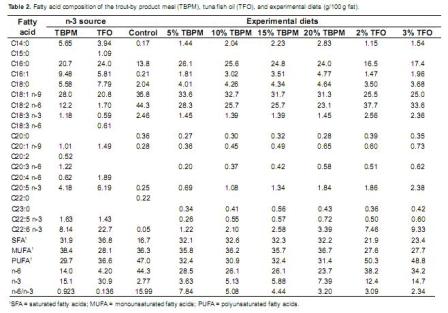
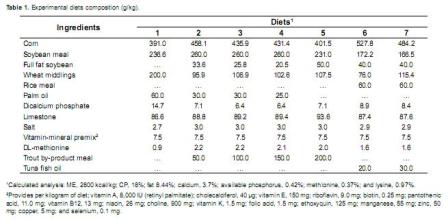
<body><![CDATA[<p></p> <hr size="1" />     <p><font face="Verdana, Arial, Helvetica, sans-serif" size="3"><b>Introduction</b></font></p>     <p><font face="Verdana, Arial, Helvetica, sans-serif" size="2">The omega-3  (n-3) are a group of  fatty acids    with important  implications for human  health.    Recommendations about  the intake of dietary  fat    point out the  importance of consuming higher levels    of n-3  fatty acids (Leskanich  and Noble, 1997;    Kris-Etherton <i>et al.</i>, 2003). Current Western  diets    are  not only  deficient in n-3  fatty acids, but  also    have  excessive amounts of omega-6  (n-6) fatty    acids compared  with the diet  on which the  human    race evolved  (Simopoulus, 2002).   The large amounts of  dietary n-6 fatty acids and    the  high n-6/n-3 ratio  commonly found in Western    diets (10:1  to 25:1) promote the pathogenesis  of</font><font face="Verdana, Arial, Helvetica, sans-serif" size="2">cardiovascular, inflammatory and autoimmune    diseases, while increased  levels of n-3 fatty  acids    (and a lower n-6/n-3 ratio) has  protective effects    (Simopoulus, 2002).  One way  of increasing the    intake of n-3 fatty  acids is through  the intake of natural sources rich in these fatty acids such as oily  fish, and flax  seed. Another possibility is  through  the consumption of  functional foods enriched  in  n-3 fatty acids such as enriched eggs (Lewis <i>et al.</i>,  2000). </font></p>     <p><font face="Verdana, Arial, Helvetica, sans-serif" size="2">Several  studies have shown that it is possible to  increase the amount of n-3 fatty acids (and decrease the n-6/n-3 ratio)  in the egg  yolk by feeding  hens    diets enriched  with sources of n-3  fatty acids such    as menhaden  oil, tuna fishmeal,  linseed oil, and    others (Leskanich and  Noble, 1997; Baucells <i>et al.</i>,    2000; Gonzalez-Esquerra and Leeson,  2000; Lewis    <i>et al.</i>, 2000;  Howe <i>et al.</i>, 2002).  These sources of   n-3 fatty  acids, however, are not readily  available   in such countries as  Colombia. The aim the present    study  was to evaluate two sources of n-3 fatty acids    available in  the Colombian market, namely trout    by-product meal  (TBPM) and tuna fish oil  (TFO),    as potential sources  for the enrichment of eggs with    n-3 fatty acids.</font></p>     <p></p>     <p><font face="Verdana, Arial, Helvetica, sans-serif" size="3"><b>Materials and methods</b> </font></p>     <p><font face="Verdana, Arial, Helvetica, sans-serif" size="2">27-week old commercial  layers of the   Hy-Line Brown  strain were assigned  to each of   seven dietary  treatments that consisted  of diets    containing increasing  levels of a source of n-3 fatty    acids, as  follows. Group 1: control;  group 2: 5%    TBPM; group 3: 10%  TBPM; group 4: 15% TBPM;    group 5: 20% TBPM;  group 6: 2% TFO; and group    7: 3% TFO. Since  there are several studies reporting    the use of  FO as a  source of enrichment with  n-3  fatty acids (Baucells <i>et al</i>.,  2000) it was decided to use this ingredient  in only two  groups and to  test    four levels of  TBPM, a novel  source of n-3 fatty    acids. </font></p>     <p><font face="Verdana, Arial, Helvetica, sans-serif" size="2">For the preparation  of the TBPM a total of    200 kg of  trout inner guts was  mixed with 15%    molasses, 0.2% <i>Lactobacillus bulgaricus</i>, 0.1%    potassium sorbate (as antifungal  agent) and    50 ml/kg of crushed  onion as antioxidant,  as    described before (Betancourt <i>et al</i>., 2005). The  mix    was kept in  tightly closed 50  kg plastic drums  and    mixed three times daily  in order to homogenize the    fermentation process. The fermentation lasted for 30    days until a complete liquefaction of the product was    obtained. The  experimental diets were formulated    to contain or exceed  the concentrations of  required    nutrients for laying hens  and were isocaloric  and    isoproteic (Leeson and Summers,  2001). The   ingredient composition and  calculated analysis of   the experimental diets is  summarized in table  1.    Fatty acid compositions  of TBPM, TFO, and each    experimental diet are presented in <a href="#t2">table 2</a>. Proximate   analysis of the  TBPM revealed the following    composition (g/kg): Dry matter, 384.0; ether extract,    353.0; crude protein, 204.0; ash,  66.0; crude fiber,    10.0; non-nitrogen extract (calculated), 186.0.</font></p>    <p align="center"><a name="t1"> <img src="/img/revistas/rccp/v24n4/a05t1.JPG" /></a>    <p align="center"><a name="t2"> <img src="/img/revistas/rccp/v24n4/a05t2.JPG" /></a>     ]]></body>
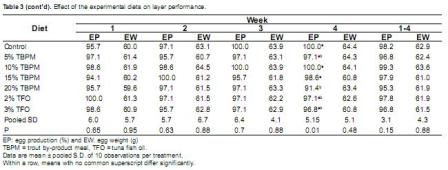
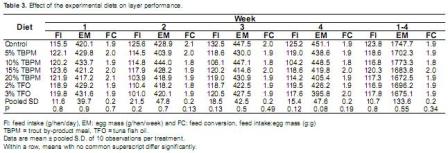
<body><![CDATA[<p><font face="Verdana, Arial, Helvetica, sans-serif" size="2">The birds were  allocated at random to one of the  seven dietary  treatments, with 10 individual birds per treatment. Hens  were kept in  individual wire cages  with artificial  light provided 14 h per day. Feed and  water were provided <i>ad  libitum</i> during 28 days. </font></p>     <p><font face="Verdana, Arial, Helvetica, sans-serif" size="2">Body weight  was recorded at the beginning    (27 weeks  of age) and at weekly  intervals until    the end of the  experiment (31 weeks  of age). Egg    production and  egg weight was  recorded daily and    individually.  Individual feed intake  was measured    at  weekly intervals. At days 7, 14, 21 and 28 of the    experiment, eight  yolks from each dietary treatment    were pooled into two  4-yolk replicates and analyzed    to determine the  fatty acid composition.</font></p>     <p><font face="Verdana, Arial, Helvetica, sans-serif" size="2">The samples  were processed according  to    the methods described by  Folch  <i>et al.</i> (1957)    for extraction  of lipids and by  Betancourt <i>et al</i>.    (2005) for the determination of the fatty acid    profile. In  summary, to one  gram of yolk 40 ml    of chloroform:methanol 2:1  were added, and the </font><font face="Verdana, Arial, Helvetica, sans-serif" size="2">mix was homogenized  and filtered to  obtain 20 ml  of extract to which 5 ml of water were added. The  mix was homogenized  again and centrifuged  at  3.000 rpm for 10  minutes. The supernatant  was  removed and eliminated and 1 ml of the lower layer  was transferred to a  previously weighed test  tube.  The solvent was  then evaporated under  a gently  stream of nitrogen and the dry  film remaining was  redissolved with methyl chloride to a concentration  of 25 mg/ml.  From this solution  20 &micro;l were taken  and added with 160 &micro;l methylene chloride and 20 &micro;l  of Meth-Prep II transesterification reagent  (Alltech  Associates, Inc., Deefield,  IL, USA). The mix  was  left at ambient  temperature for 30 minutes  and  then 1 &micro;l  of the solution  was injected into  the gas  chromatograph for the determination  of the fatty  acid methyl esthers (FAMEs). </font></p>     <p><font face="Verdana, Arial, Helvetica, sans-serif" size="2">The FAMEs  were separated using  a 30 m x    0.32 mm inside diameter  x 0.25  &micro;m film thickness    Omegawax<sup>TM</sup> 320 fused silica capillary GC column    (Supelco, Inc.,  Bellefonte, PA, USA) and  analyzed with a Shimadzu  GC-14A Gas Chromatograph  (Shimadzu Scientific  Instruments, Columbia, MD,  USA)  equipped with a flame ionization detector.  The separation  was obtained with a  temperature  ramp (initial  temperature 80&deg;C, 10  &deg;C/min to  190  &deg;C, 20 min at 190 &deg;C, 2 &deg;C/min to 220 &deg;C and  10  min at 220 &deg;C) using helium as carrier gas. The  injection was  made in split  mode with a  split ratio  of  1:50. Retention times were compared with known  standards (Supelco,  Inc., Bellefonte, PA, USA).</font></p>     <p><font face="Verdana, Arial, Helvetica, sans-serif" size="2"><i>Statistical Analysis</i> </font></p>     <p><font face="Verdana, Arial, Helvetica, sans-serif" size="2">   Data (treatment means)  were subjected to one-   way ANOVA  by using the  General Linear Model    procedure of SAS   (SAS<sup>&reg;</sup> Institute, 2008).  When    the  F-test for treatments  was significant at  p&lt;0.05    in the ANOVA  analysis, means were compared  for   significant differences  using Duncan's multiple   range test.  Regression analysis was  also conducted    to determine  the relationship between  dietary and egg yolk n-3, n-6 and n-6/n-3 fatty acids in order to    obtain both the correlation coefficient and P value of the regression model.</font></p>     <p><font face="Verdana, Arial, Helvetica, sans-serif" size="2"></font></p>     <p><font face="Verdana, Arial, Helvetica, sans-serif" size="3"><b>Results</b> </font></p>     <p><font face="Verdana, Arial, Helvetica, sans-serif" size="2"><a href="#t3">Table 3</a> summarizes  the effect of the    experimental diets on layer performance. In general,    no effects on  layer performance were  caused by    the experimental diets,  although layers fed  20%    TBPM had a  significantly lower (p&lt;0.05)  percent    production during week  4 of the experiment    compared with controls.  However, the overall    28-day percent production  of the hens fed  20%    TBPM was not  significantly different from  that of   the control group. No other significant differences    in layer performance were  observed during the   experiment. No significant  differences in body    weight were recorded at  any of the scheduled    sampling times (data not shown). </font></p>     <p align="center"><a name="t3"><img src="/img/revistas/rccp/v24n4/a05t3.JPG" /></a></p>    ]]></body>
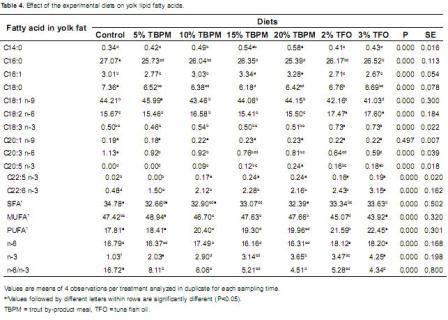
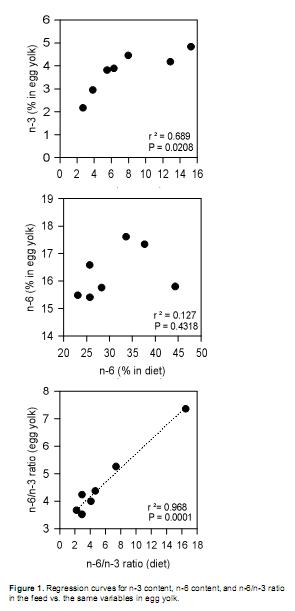
<body><![CDATA[<p align="center"><a name="t"> <img src="/img/revistas/rccp/v24n4/a05t.JPG" /></a></p>     <p><font face="Verdana, Arial, Helvetica, sans-serif" size="2">No significant  differences in the  fatty acid    profile were observed  at days 7, 14,  21 or 28  of    the  experiment (data not shown),  and therefore it    was decided  to pool the  data corresponding to the    four sampling  times (Table 4). All  diets containing    TBPM or TFO caused a  significant increase in n-3    egg  yolk fatty acid content. Levels of n-3 fatty acids    were  especially high in the groups fed 20% TBPM    and 3% TFO  (3.65%, and 4.25%, respectively)    which corresponded to 3.5 and 4.1 times the levels    of the control  group (1.03%). The  n-6/n-3 ratio    was significantly lower in  all egg yolks  from hens    receiving the dietary  sources of n-3  fatty acids.    The reduction in  the n-6/n-3 ratio  was significant    (p&lt;0.05) in all dietary treatments and corresponded    to a n-6/n-3  ratio close to  17 in control  eggs,    compared with ratios  ranging from 4.34 to  8.11 in    n-3 enriched eggs.</font></p>    <p align="center"> <a name="t4"><img src="/img/revistas/rccp/v24n4/a05t4.JPG" /></a></p>     <p><font face="Verdana, Arial, Helvetica, sans-serif" size="2"><a href="#f1">Figure 1</a>  shows the regression  analysis of the    n-3, and n-6 fatty  acid content, and the n-6/n-3 ratio    in the  diet vs. their corresponding values  in egg  yolk. A linear  relationship was observed for the n-3 content (r2 = 0.689, P = 0.0208), and for the n-6/n-3  ratio (r<sup>2</sup> = 0.968,  P = 0.0001). However, the  n-6  dietary content was  not linearly related  to the n-6  egg yolk content (r<sup>2</sup> = 0.127, P = 0.4318).</font></p>    <p align="center"><a name="f1"> <img src="/img/revistas/rccp/v24n4/a05f1.JPG" /></a></p>     <p><font face="Verdana, Arial, Helvetica, sans-serif" size="3"><b>Discussion</b> </font></p>     <p><font face="Verdana, Arial, Helvetica, sans-serif" size="2">The effect of FO  supplementation on performance    parameters is  in agreement with  that observed in    previous  studies in which similar levels of fish oil (up    to  4%) were included in the diet of layers (Hargis <i>et </i>   <i>al.</i>, 1991;  Van Elswyk <i>et  al.</i>, 1992; Baucells <i>et al</i>.,   2000; Gonzalez-Esquerra and Leeson,  2000). Our    results corroborate  previous observations in  which no effect on  layer performance are  observed when  diets enriched with  n-3 fatty acids  are given to the birds. Unfortunately,  no previous reports  on the use of TBPM as an ingredient for laying hen diets or as a source of n-3 fatty acids were found in the literature and therefore it is not possible to contrast our results  with previous ones.</font></p>     <p><font face="Verdana, Arial, Helvetica, sans-serif" size="2">The levels  of n-3 enrichment  observed with    the dietary supplementation of FO  (and TBPM)    are similar to those  reported in previous  studies.    For example, layers  fed 4% deodorized  menhaden    oil had omega-3  fatty acid content  in egg yolk    of 4.13% compared with  1.04% in the control    group (Gonzalez-Ezquerra  and Leeson, 2000).  In    another study  (Baucells <i>et al</i>., 2000)  layers fed a   diet containing 4%  FO laid eggs  containing 5.06%    omega-3 fatty acids  compared with an  omega-3    fatty acid content of 0.87%  found in the eggs of    hens fed a diet containing tallow instead of FO.</font></p>     <p><font face="Verdana, Arial, Helvetica, sans-serif" size="2">The decrease in the  n-6/n-3 ratio observed in the    present study in the eggs of birds supplemented with    n-3 sources is consistent with the decrease reported    in previous studies.  For instance, Simopoulus    (2000) reported an n-6/n-3  ratio of 19.9  in    supermarket eggs versus a ratio of 6.6 in "fishmeal    eggs". Similarly,  Baucells <i>et al</i>. (2000)  reported    that the n-6/n-3 ratio  in egg yolk decreased  from    15.58 in hens  fed a diet containing  tallow to 2.42    in hens fed a diet containing 4% FO.  Interestingly,    significantly higher levels  of n-6 fatty acids  were    obtained in eggs  from hens receiving 10%  TBPM    and 2% and  3% TFO; however,  these levels were    only between 6.2  and 8.4% greater  than those of   the control group, and therefore  did not affect  the   n-6/n-3 ratio significantly. </font></p>     <p><font face="Verdana, Arial, Helvetica, sans-serif" size="2">In general, it is  accepted that the amount of long    chain polyunsaturates within the yolk is a reflection    of the amount within the diet (Leskanich and Noble,    1997). In the present study, this fact was true for n-3    fatty acids, but not for n-6 fatty acids (<a href="#f1">Figure 1</a>). We   cannot provide an explanation  for this observation    but it might  be possible that the reason  lies on the   essentiality of linoleic  acid (18:2<i>n</i>6), the  main n-6    fatty acid. The only essential fatty acid for chickens    is linoleic acid (Watkins,  1995) and it  is possible   that this acid  is being used  as a precursor of other compounds (for instance prostaglandins 1  and 2) instead of  being transported entirely  into the egg  yolk.  This fact would explain why the n-6 fatty acid  content  in the diet is not linearly related to the n-3  fatty acid content in  egg yolk.</font></p>     ]]></body>
<body><![CDATA[<p><font face="Verdana, Arial, Helvetica, sans-serif" size="2">The fact  that a linear relationship exist  for the    n-6/n-3 ratio  in feed and  yolk indicates that  the    n-6/n-3 ratio  of the diet  could be used  as a good    predictor of the  n-6/n-3 ratio in  yolk. However,    dietary n-3 content  is not as accurate as a predictor   of the n-3 yolk  content, and the dietary n-6 content    is  not linearly related to the egg yolk n-6 content as    it was previously  discussed.</font></p>     <p><font face="Verdana, Arial, Helvetica, sans-serif" size="2">The results  of the present  study indicate that    TBPM, a  product potentially available  in the   Colombian market,  with an n-3  fatty acid content    of 15.13%  and an n-6/n-3  ratio of 0.923, is an    adequate source for  the enrichment of  eggs with    n-3 fatty  acids. Supplementing diets  with levels of   5-20% TBPM, results  in the production of egg yolks    containing between  1.97 and 3.54  times more n-3    fatty acids than  those from non-supplemented diets. </font></p>     <p><font face="Verdana, Arial, Helvetica, sans-serif" size="2">The level of  n-3 enrichment was  also high with  TFO, resulting in  eggs containing between  3.37 to  4.13 times higher levels of n-3 fatty acids than those of control eggs. TFO contains more n-3 fatty acids  (30.86%) and has a  lower n-6/n-3 ratio (0.136) compared with TBPM. Further studies are required,  however, in order to determine  the effects of these ingredients on the organoleptic quality of the eggs. </font></p>     <p><font face="Verdana, Arial, Helvetica, sans-serif" size="2">It  has been recommended to increase the dietary    intake of n-3 fatty  acids in humans  (Simopoulus,    2002; Kris-Etherton <i>et al.</i>, 2003)  and both sources    of n-3 fatty  acids tested in  the present trial  can be used to produce eggs  containing a higher content    of n-3 fatty  acids. Although supplements  are a    suitable alternative for  n-3 fatty acid  intake it has    been recommended that  a food-based approach  is    preferable (Kris-Etherton <i>et al.</i>, 2003). An increased    intake of n-3 fatty  acids, along with  a decreased    intake of oils rich  in n-6 fatty  acids (e.g. corn,    soybean, and sunflower oil) will  help consumers    obtain a dietary n-6/n-3  ratio which approaches    the 1:1 to 4:1 ratio recommended for a human diet    (Simopoulus, 2000).</font></p>     <p><font face="Verdana, Arial, Helvetica, sans-serif" size="2"></font></p>     <p><font face="Verdana, Arial, Helvetica, sans-serif" size="3"><b>References</b> </font></p>     <!-- ref --><p><font face="Verdana, Arial, Helvetica, sans-serif" size="2">1. Baucells MD, Crespo  N, Barroeta AC, Lopez-Ferrer S,    Grashorn MA. Incorporation of  different polyunsaturated fatty    acids  into eggs. Poult Sci 2000; 79:51-59.</font>&nbsp;&nbsp;&nbsp;&nbsp;&nbsp;&nbsp;&nbsp;&nbsp;[&#160;<a href="javascript:void(0);" onclick="javascript: window.open('/scielo.php?script=sci_nlinks&ref=000059&pid=S0120-0690201100040000500001&lng=','','width=640,height=500,resizable=yes,scrollbars=1,menubar=yes,');">Links</a>&#160;]<!-- end-ref --><!-- ref --><p><font face="Verdana, Arial, Helvetica, sans-serif" size="2">   2. Betancourt L, Diaz GJ, Aguilar X, R&iacute;os  J. Efecto del  ensilaje    de  v&iacute;sceras de trucha  (Oncorhynchus mykiss) sobre el    comportamiento productive y  el contenido de  &aacute;cidos omega-3    en  h&iacute;gado, muslos y pechuga, de pollos de engorde. Livest Res    Rural Develop  2005; &#091;17: Article #106, fecha de  acceso: Abril    26 de  2011&#093; URL: <a href="http://www.lrrd.org/lrrd17/9/beta17106.htm" target="_blank">http://www.lrrd.org/lrrd17/9/beta17106.htm</a>   </font>&nbsp;&nbsp;&nbsp;&nbsp;&nbsp;&nbsp;&nbsp;&nbsp;[&#160;<a href="javascript:void(0);" onclick="javascript: window.open('/scielo.php?script=sci_nlinks&ref=000060&pid=S0120-0690201100040000500002&lng=','','width=640,height=500,resizable=yes,scrollbars=1,menubar=yes,');">Links</a>&#160;]<!-- end-ref --><!-- ref --><p><font face="Verdana, Arial, Helvetica, sans-serif" size="2">3. Folch J,  Lees M, Stanley  GSH. A simple  method for the    isolation  and purification of total lipides from animal tissues. J    Biol  Chem 1957; 226:497-509.   </font>&nbsp;&nbsp;&nbsp;&nbsp;&nbsp;&nbsp;&nbsp;&nbsp;[&#160;<a href="javascript:void(0);" onclick="javascript: window.open('/scielo.php?script=sci_nlinks&ref=000061&pid=S0120-0690201100040000500003&lng=','','width=640,height=500,resizable=yes,scrollbars=1,menubar=yes,');">Links</a>&#160;]<!-- end-ref --><!-- ref --><p><font face="Verdana, Arial, Helvetica, sans-serif" size="2">4. Gonzalez-Esquerra  R, Leeson S. Effect of feeding hens regular    and deodorized  Menhaden oil on  production parameters, yolk    fatty  acid profile, and sensory quality of eggs. Poult Sci 2000;    79:1597-1602.   </font>&nbsp;&nbsp;&nbsp;&nbsp;&nbsp;&nbsp;&nbsp;&nbsp;[&#160;<a href="javascript:void(0);" onclick="javascript: window.open('/scielo.php?script=sci_nlinks&ref=000062&pid=S0120-0690201100040000500004&lng=','','width=640,height=500,resizable=yes,scrollbars=1,menubar=yes,');">Links</a>&#160;]<!-- end-ref --><!-- ref --><p><font face="Verdana, Arial, Helvetica, sans-serif" size="2">5. Hargis PS, Van  Elswyk ME, Hargis BM.  Dietary modification    of  yolk lipids with menhaden oil. Poult Sci 1991; 70:874-883.   </font>&nbsp;&nbsp;&nbsp;&nbsp;&nbsp;&nbsp;&nbsp;&nbsp;[&#160;<a href="javascript:void(0);" onclick="javascript: window.open('/scielo.php?script=sci_nlinks&ref=000063&pid=S0120-0690201100040000500005&lng=','','width=640,height=500,resizable=yes,scrollbars=1,menubar=yes,');">Links</a>&#160;]<!-- end-ref --><!-- ref --><p><font face="Verdana, Arial, Helvetica, sans-serif" size="2">6. Howe  PR, Downing JA, Grenyer BF, Grigonis-Deane EM, Bryden    WL.  Tuna fishmeal as a source of DHA for n-3 PUFA enrichment    of  pork, chicken, and eggs. Lipids 2002; 37:1067-1076.   </font>&nbsp;&nbsp;&nbsp;&nbsp;&nbsp;&nbsp;&nbsp;&nbsp;[&#160;<a href="javascript:void(0);" onclick="javascript: window.open('/scielo.php?script=sci_nlinks&ref=000064&pid=S0120-0690201100040000500006&lng=','','width=640,height=500,resizable=yes,scrollbars=1,menubar=yes,');">Links</a>&#160;]<!-- end-ref --><!-- ref --><p><font face="Verdana, Arial, Helvetica, sans-serif" size="2">7. Kris-Etherton PM,  Harris S, Appel  LJ. Omega-3 fatty  acids    and cardiovascular disease: New  recommendations from the </font><font face="Verdana, Arial, Helvetica, sans-serif" size="2">American Heart Association. Arterioscler Thromb Vasc Biol    2003; 23:151-152.   </font>&nbsp;&nbsp;&nbsp;&nbsp;&nbsp;&nbsp;&nbsp;&nbsp;[&#160;<a href="javascript:void(0);" onclick="javascript: window.open('/scielo.php?script=sci_nlinks&ref=000065&pid=S0120-0690201100040000500007&lng=','','width=640,height=500,resizable=yes,scrollbars=1,menubar=yes,');">Links</a>&#160;]<!-- end-ref --><!-- ref --><p><font face="Verdana, Arial, Helvetica, sans-serif" size="2">8. Leskanich CO, Noble  RC. Manipulation of  the n-3    polyunsaturated fatty acid composition of avian eggs and meat.    Worlds Poult Sci J 1997; 53:155-183.   </font>&nbsp;&nbsp;&nbsp;&nbsp;&nbsp;&nbsp;&nbsp;&nbsp;[&#160;<a href="javascript:void(0);" onclick="javascript: window.open('/scielo.php?script=sci_nlinks&ref=000066&pid=S0120-0690201100040000500008&lng=','','width=640,height=500,resizable=yes,scrollbars=1,menubar=yes,');">Links</a>&#160;]<!-- end-ref --><!-- ref --><p><font face="Verdana, Arial, Helvetica, sans-serif" size="2">9. Leeson S, Summers JD. Scott's Nutrition of the Chicken. 4th ed.    Guelph (ON): University Books; 2001. </font>&nbsp;&nbsp;&nbsp;&nbsp;&nbsp;&nbsp;&nbsp;&nbsp;[&#160;<a href="javascript:void(0);" onclick="javascript: window.open('/scielo.php?script=sci_nlinks&ref=000067&pid=S0120-0690201100040000500009&lng=','','width=640,height=500,resizable=yes,scrollbars=1,menubar=yes,');">Links</a>&#160;]<!-- end-ref --><!-- ref --><p><font face="Verdana, Arial, Helvetica, sans-serif" size="2">10. Lewis NM, Seburg S, Flanagan NL. Enriched eggs as a source    of n-3 polyunsaturated fatty acids  for humans. Poult Sci 2000;    79:971-974.   </font>&nbsp;&nbsp;&nbsp;&nbsp;&nbsp;&nbsp;&nbsp;&nbsp;[&#160;<a href="javascript:void(0);" onclick="javascript: window.open('/scielo.php?script=sci_nlinks&ref=000068&pid=S0120-0690201100040000500010&lng=','','width=640,height=500,resizable=yes,scrollbars=1,menubar=yes,');">Links</a>&#160;]<!-- end-ref --><!-- ref --><p><font face="Verdana, Arial, Helvetica, sans-serif" size="2">11. SAS Institute Inc. SAS/STAT 9.2  User's Guide. Cary  (NC):    SAS Institute Inc.; 2008. </font>&nbsp;&nbsp;&nbsp;&nbsp;&nbsp;&nbsp;&nbsp;&nbsp;[&#160;<a href="javascript:void(0);" onclick="javascript: window.open('/scielo.php?script=sci_nlinks&ref=000069&pid=S0120-0690201100040000500011&lng=','','width=640,height=500,resizable=yes,scrollbars=1,menubar=yes,');">Links</a>&#160;]<!-- end-ref --><!-- ref --><p><font face="Verdana, Arial, Helvetica, sans-serif" size="2">12. Simopoulus AP. Human  requirement for n-3  polyunsaturated    fatty acids. Poult Sci 2000; 79:961-970. </font>&nbsp;&nbsp;&nbsp;&nbsp;&nbsp;&nbsp;&nbsp;&nbsp;[&#160;<a href="javascript:void(0);" onclick="javascript: window.open('/scielo.php?script=sci_nlinks&ref=000070&pid=S0120-0690201100040000500012&lng=','','width=640,height=500,resizable=yes,scrollbars=1,menubar=yes,');">Links</a>&#160;]<!-- end-ref --><!-- ref --><p><font face="Verdana, Arial, Helvetica, sans-serif" size="2">13. Simopoulus AP. The importance  of the ratio  of omega-6/   omega-3 essential fatty  acids. Biomed Pharmacother 2002;    56:365-379.</font>&nbsp;&nbsp;&nbsp;&nbsp;&nbsp;&nbsp;&nbsp;&nbsp;[&#160;<a href="javascript:void(0);" onclick="javascript: window.open('/scielo.php?script=sci_nlinks&ref=000071&pid=S0120-0690201100040000500013&lng=','','width=640,height=500,resizable=yes,scrollbars=1,menubar=yes,');">Links</a>&#160;]<!-- end-ref --><!-- ref --><p><font face="Verdana, Arial, Helvetica, sans-serif" size="2"> 14. Van Elswyk ME,  Sams AR, Hargis  PS. Composition,    Functionality, and sensory  evaluation of eggs from  hens fed    dietary menhaden oil. J Food Sci 1992; 57:342-344, 349.   </font>&nbsp;&nbsp;&nbsp;&nbsp;&nbsp;&nbsp;&nbsp;&nbsp;[&#160;<a href="javascript:void(0);" onclick="javascript: window.open('/scielo.php?script=sci_nlinks&ref=000072&pid=S0120-0690201100040000500014&lng=','','width=640,height=500,resizable=yes,scrollbars=1,menubar=yes,');">Links</a>&#160;]<!-- end-ref --><!-- ref --><p><font face="Verdana, Arial, Helvetica, sans-serif" size="2">15. Watkins BA. Biochemical  and physiological aspects  of    polyunsaturates. Poult Av Biol Rev 1995; 6:1-18.</font>&nbsp;&nbsp;&nbsp;&nbsp;&nbsp;&nbsp;&nbsp;&nbsp;[&#160;<a href="javascript:void(0);" onclick="javascript: window.open('/scielo.php?script=sci_nlinks&ref=000073&pid=S0120-0690201100040000500015&lng=','','width=640,height=500,resizable=yes,scrollbars=1,menubar=yes,');">Links</a>&#160;]<!-- end-ref --> ]]></body><back>
<ref-list>
<ref id="B1">
<label>1</label><nlm-citation citation-type="journal">
<person-group person-group-type="author">
<name>
<surname><![CDATA[Baucells]]></surname>
<given-names><![CDATA[MD]]></given-names>
</name>
<name>
<surname><![CDATA[Crespo]]></surname>
<given-names><![CDATA[N]]></given-names>
</name>
<name>
<surname><![CDATA[Barroeta]]></surname>
<given-names><![CDATA[AC]]></given-names>
</name>
<name>
<surname><![CDATA[Lopez-Ferrer]]></surname>
<given-names><![CDATA[S]]></given-names>
</name>
<name>
<surname><![CDATA[Grashorn]]></surname>
<given-names><![CDATA[MA]]></given-names>
</name>
</person-group>
<article-title xml:lang="en"><![CDATA[Incorporation of different polyunsaturated fatty acids into eggs]]></article-title>
<source><![CDATA[Poult Sci]]></source>
<year>2000</year>
<volume>79</volume>
<page-range>51-59</page-range></nlm-citation>
</ref>
<ref id="B2">
<label>2</label><nlm-citation citation-type="journal">
<person-group person-group-type="author">
<name>
<surname><![CDATA[Betancourt]]></surname>
<given-names><![CDATA[L]]></given-names>
</name>
<name>
<surname><![CDATA[Diaz]]></surname>
<given-names><![CDATA[GJ]]></given-names>
</name>
<name>
<surname><![CDATA[Aguilar]]></surname>
<given-names><![CDATA[X]]></given-names>
</name>
<name>
<surname><![CDATA[Ríos]]></surname>
<given-names><![CDATA[J]]></given-names>
</name>
</person-group>
<article-title xml:lang="en"><![CDATA[Efecto del ensilaje de vísceras de trucha (Oncorhynchus mykiss) sobre el comportamiento productive y el contenido de ácidos omega-3 en hígado, muslos y pechuga, de pollos de engorde]]></article-title>
<source><![CDATA[Livest Res Rural Develop]]></source>
<year>2005</year>
</nlm-citation>
</ref>
<ref id="B3">
<label>3</label><nlm-citation citation-type="journal">
<person-group person-group-type="author">
<name>
<surname><![CDATA[Folch]]></surname>
<given-names><![CDATA[J]]></given-names>
</name>
<name>
<surname><![CDATA[Lees]]></surname>
<given-names><![CDATA[M]]></given-names>
</name>
<name>
<surname><![CDATA[Stanley]]></surname>
<given-names><![CDATA[GSH]]></given-names>
</name>
</person-group>
<article-title xml:lang="en"><![CDATA[A simple method for the isolation and purification of total lipides from animal tissues]]></article-title>
<source><![CDATA[J Biol Chem]]></source>
<year>1957</year>
<volume>226</volume>
<page-range>497-509</page-range></nlm-citation>
</ref>
<ref id="B4">
<label>4</label><nlm-citation citation-type="journal">
<person-group person-group-type="author">
<name>
<surname><![CDATA[Gonzalez-Esquerra]]></surname>
<given-names><![CDATA[R]]></given-names>
</name>
<name>
<surname><![CDATA[Leeson]]></surname>
<given-names><![CDATA[S]]></given-names>
</name>
</person-group>
<article-title xml:lang="en"><![CDATA[Effect of feeding hens regular and deodorized Menhaden oil on production parameters, yolk fatty acid profile, and sensory quality of eggs]]></article-title>
<source><![CDATA[Poult Sci]]></source>
<year>2000</year>
<volume>79</volume>
<page-range>1597-1602</page-range></nlm-citation>
</ref>
<ref id="B5">
<label>5</label><nlm-citation citation-type="journal">
<person-group person-group-type="author">
<name>
<surname><![CDATA[Hargis]]></surname>
<given-names><![CDATA[PS]]></given-names>
</name>
<name>
<surname><![CDATA[Van]]></surname>
<given-names><![CDATA[Elswyk ME]]></given-names>
</name>
<name>
<surname><![CDATA[Hargis]]></surname>
<given-names><![CDATA[BM]]></given-names>
</name>
</person-group>
<article-title xml:lang="en"><![CDATA[Dietary modification of yolk lipids with menhaden oil]]></article-title>
<source><![CDATA[Poult Sci]]></source>
<year>1991</year>
<volume>70</volume>
<page-range>874-883</page-range></nlm-citation>
</ref>
<ref id="B6">
<label>6</label><nlm-citation citation-type="journal">
<person-group person-group-type="author">
<name>
<surname><![CDATA[Howe]]></surname>
<given-names><![CDATA[PR]]></given-names>
</name>
<name>
<surname><![CDATA[Downing]]></surname>
<given-names><![CDATA[JA]]></given-names>
</name>
<name>
<surname><![CDATA[Grenyer]]></surname>
<given-names><![CDATA[BF]]></given-names>
</name>
<name>
<surname><![CDATA[Grigonis-Deane]]></surname>
<given-names><![CDATA[EM]]></given-names>
</name>
<name>
<surname><![CDATA[Bryden]]></surname>
<given-names><![CDATA[WL]]></given-names>
</name>
</person-group>
<article-title xml:lang="en"><![CDATA[Tuna fishmeal as a source of DHA for n-3 PUFA enrichment of pork, chicken, and eggs]]></article-title>
<source><![CDATA[Lipids]]></source>
<year>2002</year>
<volume>37</volume>
<page-range>1067-1076</page-range></nlm-citation>
</ref>
<ref id="B7">
<label>7</label><nlm-citation citation-type="journal">
<person-group person-group-type="author">
<name>
<surname><![CDATA[Kris-Etherton]]></surname>
<given-names><![CDATA[PM]]></given-names>
</name>
<name>
<surname><![CDATA[Harris]]></surname>
<given-names><![CDATA[S]]></given-names>
</name>
<name>
<surname><![CDATA[Appel]]></surname>
<given-names><![CDATA[LJ]]></given-names>
</name>
</person-group>
<article-title xml:lang="en"><![CDATA[Omega-3 fatty acids and cardiovascular disease: New recommendations from the American Heart Association]]></article-title>
<source><![CDATA[Arterioscler Thromb Vasc Biol]]></source>
<year>2003</year>
<volume>23</volume>
<page-range>151-152</page-range></nlm-citation>
</ref>
<ref id="B8">
<label>8</label><nlm-citation citation-type="journal">
<person-group person-group-type="author">
<name>
<surname><![CDATA[Leskanich]]></surname>
<given-names><![CDATA[CO]]></given-names>
</name>
<name>
<surname><![CDATA[Noble]]></surname>
<given-names><![CDATA[RC]]></given-names>
</name>
</person-group>
<article-title xml:lang="en"><![CDATA[Manipulation of the n-3 polyunsaturated fatty acid composition of avian eggs and meat]]></article-title>
<source><![CDATA[Worlds Poult Sci J]]></source>
<year>1997</year>
<volume>53</volume>
<page-range>155-183</page-range></nlm-citation>
</ref>
<ref id="B9">
<label>9</label><nlm-citation citation-type="book">
<person-group person-group-type="author">
<name>
<surname><![CDATA[Leeson]]></surname>
<given-names><![CDATA[S]]></given-names>
</name>
<name>
<surname><![CDATA[Summers]]></surname>
<given-names><![CDATA[JD]]></given-names>
</name>
</person-group>
<source><![CDATA[Scott's Nutrition of the Chicken]]></source>
<year>2001</year>
<edition>4</edition>
<publisher-name><![CDATA[University Books]]></publisher-name>
</nlm-citation>
</ref>
<ref id="B10">
<label>10</label><nlm-citation citation-type="journal">
<person-group person-group-type="author">
<name>
<surname><![CDATA[Lewis]]></surname>
<given-names><![CDATA[NM]]></given-names>
</name>
<name>
<surname><![CDATA[Seburg]]></surname>
<given-names><![CDATA[S]]></given-names>
</name>
<name>
<surname><![CDATA[Flanagan]]></surname>
<given-names><![CDATA[NL]]></given-names>
</name>
</person-group>
<article-title xml:lang="en"><![CDATA[Enriched eggs as a source of n-3 polyunsaturated fatty acids for humans]]></article-title>
<source><![CDATA[Poult Sci]]></source>
<year>2000</year>
<volume>79</volume>
<page-range>971-974</page-range></nlm-citation>
</ref>
<ref id="B11">
<label>11</label><nlm-citation citation-type="book">
<collab>SAS Institute Inc</collab>
<source><![CDATA[SAS/STAT 9.2 User's Guide]]></source>
<year>2008</year>
<publisher-loc><![CDATA[Cary ]]></publisher-loc>
<publisher-name><![CDATA[SAS Institute Inc]]></publisher-name>
</nlm-citation>
</ref>
<ref id="B12">
<label>12</label><nlm-citation citation-type="journal">
<person-group person-group-type="author">
<name>
<surname><![CDATA[Simopoulus]]></surname>
<given-names><![CDATA[AP]]></given-names>
</name>
</person-group>
<article-title xml:lang="en"><![CDATA[Human requirement for n-3 polyunsaturated fatty acids]]></article-title>
<source><![CDATA[Poult Sci]]></source>
<year>2000</year>
<volume>79</volume>
<page-range>961-970</page-range></nlm-citation>
</ref>
<ref id="B13">
<label>13</label><nlm-citation citation-type="journal">
<person-group person-group-type="author">
<name>
<surname><![CDATA[Simopoulus]]></surname>
<given-names><![CDATA[AP]]></given-names>
</name>
</person-group>
<article-title xml:lang="en"><![CDATA[The importance of the ratio of omega-6/ omega-3 essential fatty acids]]></article-title>
<source><![CDATA[Biomed Pharmacother]]></source>
<year>2002</year>
<volume>56</volume>
<page-range>365-379</page-range></nlm-citation>
</ref>
<ref id="B14">
<label>14</label><nlm-citation citation-type="journal">
<person-group person-group-type="author">
<name>
<surname><![CDATA[Van]]></surname>
<given-names><![CDATA[Elswyk ME]]></given-names>
</name>
<name>
<surname><![CDATA[Sams]]></surname>
<given-names><![CDATA[AR]]></given-names>
</name>
<name>
<surname><![CDATA[Hargis]]></surname>
<given-names><![CDATA[PS]]></given-names>
</name>
</person-group>
<article-title xml:lang="en"><![CDATA[Composition, Functionality, and sensory evaluation of eggs from hens fed dietary menhaden oil]]></article-title>
<source><![CDATA[J Food Sci]]></source>
<year>1992</year>
<volume>57</volume>
<page-range>342-344, 349</page-range></nlm-citation>
</ref>
<ref id="B15">
<label>15</label><nlm-citation citation-type="journal">
<person-group person-group-type="author">
<name>
<surname><![CDATA[Watkins]]></surname>
<given-names><![CDATA[BA]]></given-names>
</name>
</person-group>
<article-title xml:lang="en"><![CDATA[Biochemical and physiological aspects of polyunsaturates]]></article-title>
<source><![CDATA[Poult Av Biol Rev]]></source>
<year>1995</year>
<volume>6</volume>
<page-range>1-18</page-range></nlm-citation>
</ref>
</ref-list>
</back>
</article>