<?xml version="1.0" encoding="ISO-8859-1"?><article xmlns:mml="http://www.w3.org/1998/Math/MathML" xmlns:xlink="http://www.w3.org/1999/xlink" xmlns:xsi="http://www.w3.org/2001/XMLSchema-instance">
<front>
<journal-meta>
<journal-id>0120-0690</journal-id>
<journal-title><![CDATA[Revista Colombiana de Ciencias Pecuarias]]></journal-title>
<abbrev-journal-title><![CDATA[Rev Colom Cienc Pecua]]></abbrev-journal-title>
<issn>0120-0690</issn>
<publisher>
<publisher-name><![CDATA[Facultad de Ciencias Agrarias, Universidad de Antioquia]]></publisher-name>
</publisher>
</journal-meta>
<article-meta>
<article-id>S0120-06902013000200004</article-id>
<title-group>
<article-title xml:lang="en"><![CDATA[Variance components and genetic parameters for milk production of Holstein cattle in Antioquia (Colombia) using random regression models]]></article-title>
<article-title xml:lang="es"><![CDATA[Componentes de varianza y parámetros genéticos para producción de leche en ganado Holstein de Antioquia (Colombia), utilizando modelos de regresión aleatoria]]></article-title>
<article-title xml:lang="pt"><![CDATA[Componentes de variância e parâmetros genéticos para produção de leite em gado Holandês da Antioquia, (Colombia) utilizando modelos de regressão aleatória]]></article-title>
</title-group>
<contrib-group>
<contrib contrib-type="author">
<name>
<surname><![CDATA[Herrera]]></surname>
<given-names><![CDATA[Ana C]]></given-names>
</name>
<xref ref-type="aff" rid="A01"/>
</contrib>
<contrib contrib-type="author">
<name>
<surname><![CDATA[Múnera]]></surname>
<given-names><![CDATA[Oscar D]]></given-names>
</name>
</contrib>
<contrib contrib-type="author">
<name>
<surname><![CDATA[Cerón-Muñoz]]></surname>
<given-names><![CDATA[Mario F]]></given-names>
</name>
</contrib>
</contrib-group>
<aff id="A01">
<institution><![CDATA[,Universidad de Antioquia Facultad de Ciencias Agrarias ]]></institution>
<addr-line><![CDATA[ ]]></addr-line>
</aff>
<pub-date pub-type="pub">
<day>00</day>
<month>06</month>
<year>2013</year>
</pub-date>
<pub-date pub-type="epub">
<day>00</day>
<month>06</month>
<year>2013</year>
</pub-date>
<volume>26</volume>
<numero>2</numero>
<fpage>90</fpage>
<lpage>97</lpage>
<copyright-statement/>
<copyright-year/>
<self-uri xlink:href="http://www.scielo.org.co/scielo.php?script=sci_arttext&amp;pid=S0120-06902013000200004&amp;lng=en&amp;nrm=iso"></self-uri><self-uri xlink:href="http://www.scielo.org.co/scielo.php?script=sci_abstract&amp;pid=S0120-06902013000200004&amp;lng=en&amp;nrm=iso"></self-uri><self-uri xlink:href="http://www.scielo.org.co/scielo.php?script=sci_pdf&amp;pid=S0120-06902013000200004&amp;lng=en&amp;nrm=iso"></self-uri><abstract abstract-type="short" xml:lang="en"><p><![CDATA[Background: genetic parameters of lactation curve in dairy cattle can be analyzed as longitudinal data using random regression models (RRM). Objective: the goal of the present study was to estimate variance components and genetic parameters for milk production in Holstein cattle located in Antioquia province using RRM. Methods: a total of 3,158 monthly controls corresponding to 741 first lactations of Holstein cows were evaluated. The RRM included several Legendre polynomials to estimate the population fixed-curve coefficients and to predict the direct additive genetic and the permanent environment effects. Additionally, heterogeneous residual variances were considered by grouping the days in milk into 5 and 10 classes. Eleven models with first to fourth order polynomials were used to describe the direct additive genetic and the permanent environment effects. The residue was modeled by considering five variance classes. Models were compared using Schwartz Bayesian and Akaike's information criteria. Results: the best model was obtained by fourth order Legendre polynomials to estimate the fixed curve of the population, genetic and permanent environment effects. In addition, 5 kinds of days were used to model the residual variances. The variance for the animal genetic, phenotypic, permanent environment, and residual effects decreased as days increased. Milk production heritability in early lactation was 0.36, increasing until 95 days (0.41), with subsequent decrease, reaching 0.10 at 245 days. The permanent environment variance values decreased to 125 days (0.13) and then increased to 215 days (0.21), to finish at the last stage of lactation with values of 0.05. The genetic and phenotypic correlations between milk yields at different days of lactation decreased as days intervals increased. Conclusion: the findings of this study suggest that in the first 150 days of lactation animals better express their genetic potential and that after 180 days there is greater environmental effect.]]></p></abstract>
<abstract abstract-type="short" xml:lang="es"><p><![CDATA[Antecedentes: los parámetros genéticos de la curva de lactancia en ganado de leche pueden ser analizados como datos longitudinales usando modelos de regresión aleatoria (RRM). Objetivo: el objetivo de este estudio fue estimar componentes de varianza y parámetros genéticos para la producción de leche en vacas Holstein en el departamento de Antioquia, utilizando RRM. Métodos: se utilizaron 3.158 controles mensuales de 741 primeras lactancias. Se usaron RRM con diferentes grados de polinomios de Legendre para estimar los coeficientes de la curva fija de la población y la predicción de los efectos genético aditivo directo y de ambiente permanente y se consideraron 5 y 10 clases de varianzas residuales heterogéneas. Se emplearon once modelos con polinomios de primer a cuarto orden, para describir los efectos genético aditivo directo y ambiente permanente. Los modelos fueron comparados mediante los criterios de información bayesiano de Schwartz y de Akaike. Resultados: el mejor modelo presentó polinomios de cuarto orden 4, 4 y 4 de la curva fija, del efecto genético aditivo y de ambiente permanente, respectivamente, y con 5 clases de varianzas heterogéneas (444.het5). La varianzas para los efectos genético animal, fenotípico, de ambiente permanente y residual disminuyeron con el aumento de los días. La heredabilidad de la producción de leche al inicio de la lactancia fue de 0,36 y fue aumentando hasta los 95 días (0,41), con posterior disminución, llegando a 0,10 a los 245 días. Para la trayectoria de la proporción de ambiente permanente los valores descendieron hasta los 125 días (con 0,13), luego aumentaron hasta los 215 días (con 0,21), para finalizar en la última etapa de la lactancia con valores de 0,05. Las correlaciones genéticas y fenotípicas entre producciones de leche en los diferentes días de lactancia disminuyeron con el aumento del intervalo de los días. Conclusión: los resultados encontrados en este estudio sugieren que en los primeros 150 días de lactancia los animales expresan mejor su potencial, y que despues de 180 días hay mayor impacto ambiental.]]></p></abstract>
<abstract abstract-type="short" xml:lang="pt"><p><![CDATA[Antecedentes: os parâmetros genéticos da curva de lactação em gado leiteiro podem ser analisados como dados longitudinais usando modelos de regressão aleatória (RRM). Objetivo: o objetivo deste estudo foi estimar os componentes de variância e os parâmetros genéticos para produção de leite de vacas holandesas em Antioquia, utilizando um modelo de regressão aleatória (RRM). Métodos: foram utilizados 3.158 controles mensais de 741 primeiras lactações. Usaram-se RRM com diferentes graus de polinômio ortogonal de Legendre para estimar os coeficientes da curva fixa da população e a predição dos efeitos genéticos aditivos diretos e de ambiente permanente. Consideraram-se 5 e 10 classes de variâncias residuais heterogêneas. Foram empregados 11 modelos com polinômios de primeira ate quarta ordem para descrever os efeitos genéticos aditivos diretos e de ambiente permanente. Os modelos foram comparados mediante os critérios de informação bayesiano de Schwartz e de Akaike. Resultados: o melhor modelo foi o de quarto ordem (4, 4 e 4) da curva fixa, do efeito genético aditivo e de ambiente permanente, respectivamente, e com cinco classes de variâncias heterogéneas (444.het5). A variância para os efeitos genético animal, fenotípico, de ambiente permanente e residual diminuiu com o aumento dos dias. A herdabilidade da produção de leite ao inicio da lactação foi de 0.36 e foi aumentando até os 95 dias (0.41), com posterior diminuição, chegando até 0.10 aos 245 dias. Para a trajetória da proporção de ambiente permanente os valores descenderam até os 125 dias (com 0.13), com posterior aumento até os 215 dias (com 0.21), para finalizar na última etapa da lactação com valores de 0.05. As correlaciones genéticas e fenotípicas entre produções de leite nos diferentes dias de lactação diminuíram com o aumento do intervalo dos dias. Conclusão: os resultados encontrados sugerem que nos primeiros 150 dias da lactação os animais expressaram melhor seu potencial genético.]]></p></abstract>
<kwd-group>
<kwd lng="en"><![CDATA[dairy cattle]]></kwd>
<kwd lng="en"><![CDATA[genetic evaluation]]></kwd>
<kwd lng="en"><![CDATA[heritability]]></kwd>
<kwd lng="es"><![CDATA[evaluaciones genéticas]]></kwd>
<kwd lng="es"><![CDATA[ganado de leche]]></kwd>
<kwd lng="es"><![CDATA[heredabilidad]]></kwd>
<kwd lng="pt"><![CDATA[avaliações genéticas]]></kwd>
<kwd lng="pt"><![CDATA[gado de leite]]></kwd>
<kwd lng="pt"><![CDATA[herdabilidade]]></kwd>
</kwd-group>
</article-meta>
</front><body><![CDATA[ <font face="Verdana, Arial, Helvetica, sans-serif" size="2">     <p align="right"><b>ORIGINAL ARTICLES</b></p>     <p>&nbsp;</p>     <p align="center"><b><font size="4">Variance components and genetic parameters for milk   production of Holstein cattle in Antioquia (Colombia) using   random regression models<sup><a href="#1">&curren;</a><a name="b1"></a></sup></font></b></p>     <p align="center">&nbsp;</p>     <p align="center"><b><font size="3">Componentes de varianza y par&aacute;metros gen&eacute;ticos para producci&oacute;n de leche en ganado Holstein de Antioquia (Colombia), utilizando modelos de regresi&oacute;n aleatoria</font></b></p>     <p align="center">&nbsp;</p>     <p align="center"><b><font size="3">Componentes de vari&acirc;ncia e par&acirc;metros gen&eacute;ticos para produ&ccedil;&atilde;o de leite em gado Holand&ecirc;s da Antioquia, (Colombia) utilizando modelos de regress&atilde;o aleat&oacute;ria</font></b></p>     <p>&nbsp;</p>     <p>&nbsp;</p>     ]]></body>
<body><![CDATA[<p><b>Ana C Herrera<sup>*</sup>, Zoot, MS; Oscar D M&uacute;nera, Zoot, MS student; Mario F Cer&oacute;n-Mu&ntilde;oz, Zoot, MS, Dr.</b></p>     <p>* Corresponding author: Ana Cristina Herrera Rios. Grupo de investigaci&oacute;n GaMMA, Facultad de Ciencias Agrarias, Universidad de Antioquia. Carrera 75 No. 65-87, Bloque 47-233. Ciudadela de Robledo. AA 1226, Medell&igrave;n, Colombia. Tel (574) 2199140. e-mail: <a href="mailto:anacristinah@gmail.com">anacristinah@gmail.com</a></p>     <p>&nbsp;</p>     <p>Grupo de Gen&eacute;tica, Mejoramiento y Modelaci&oacute;n Animal,(GaMMA),Facultad de Ciencias Agrarias e Instituto de Biolog&iacute;a,   Universidad de Antioquia, Medell&iacute;n Colombia. </p>     <p>&nbsp;</p>     <p>(Received: September 9, 2012; accepted: December 18, 2012)</p>     <p>&nbsp;</p> <hr size="1">     <p><b>Summary</b></p>     <p><b>Background:</b> genetic parameters of lactation curve in dairy cattle can be analyzed as longitudinal data   using random regression models (RRM). <b>Objective:</b> the goal of the present study was to estimate variance   components and genetic parameters for milk production in Holstein cattle located in Antioquia province using   RRM. <b>Methods:</b> a total of 3,158 monthly controls corresponding to 741 first lactations of Holstein cows   were evaluated. The RRM included several Legendre polynomials to estimate the population fixed-curve   coefficients and to predict the direct additive genetic and the permanent environment effects. Additionally,   heterogeneous residual variances were considered by grouping the days in milk into 5 and 10 classes. Eleven   models with first to fourth order polynomials were used to describe the direct additive genetic and the   permanent environment effects. The residue was modeled by considering five variance classes. Models were   compared using Schwartz Bayesian and Akaike's information criteria. <b>Results:</b> the best model was obtained   by fourth order Legendre polynomials to estimate the fixed curve of the population, genetic and permanent   environment effects. In addition, 5 kinds of days were used to model the residual variances. The variance for   the animal genetic, phenotypic, permanent environment, and residual effects decreased as days increased.   Milk production heritability in early lactation was 0.36, increasing until 95 days (0.41), with subsequent   decrease, reaching 0.10 at 245 days. The permanent environment variance values decreased to 125 days (0.13)   and then increased to 215 days (0.21), to finish at the last stage of lactation with values of 0.05. The genetic and phenotypic correlations between milk yields at different days of lactation decreased as days intervals increased. <b>Conclusion:</b> the findings of this study suggest that in the first 150 days of lactation animals better express their genetic potential and that after 180 days there is greater environmental effect.</p>     <p><b>Key words:</b> dairy cattle, genetic evaluation, heritability.</p> <hr size="1">     ]]></body>
<body><![CDATA[<p><b>Resumen</b></p>     <p><b>Antecedentes:</b> los par&aacute;metros gen&eacute;ticos de la curva de lactancia en ganado de leche pueden ser analizados   como datos longitudinales usando modelos de regresi&oacute;n aleatoria (RRM). <b>Objetivo:</b> el objetivo de este   estudio fue estimar componentes de varianza y par&aacute;metros gen&eacute;ticos para la producci&oacute;n de leche en vacas   Holstein en el departamento de Antioquia, utilizando RRM. <b>M&eacute;todos:</b> se utilizaron 3.158 controles mensuales   de 741 primeras lactancias. Se usaron RRM con diferentes grados de polinomios de Legendre para estimar   los coeficientes de la curva fija de la poblaci&oacute;n y la predicci&oacute;n de los efectos gen&eacute;tico aditivo directo y de   ambiente permanente y se consideraron 5 y 10 clases de varianzas residuales heterog&eacute;neas. Se emplearon   once modelos con polinomios de primer a cuarto orden, para describir los efectos gen&eacute;tico aditivo directo   y ambiente permanente. Los modelos fueron comparados mediante los criterios de informaci&oacute;n bayesiano   de Schwartz y de Akaike. <b>Resultados:</b> el mejor modelo present&oacute; polinomios de cuarto orden 4, 4 y 4 de la   curva fija, del efecto gen&eacute;tico aditivo y de ambiente permanente, respectivamente, y con 5 clases de varianzas   heterog&eacute;neas (444.het5). La varianzas para los efectos gen&eacute;tico animal, fenot&iacute;pico, de ambiente permanente   y residual disminuyeron con el aumento de los d&iacute;as. La heredabilidad de la producci&oacute;n de leche al inicio de   la lactancia fue de 0,36 y fue aumentando hasta los 95 d&iacute;as (0,41), con posterior disminuci&oacute;n, llegando a 0,10   a los 245 d&iacute;as. Para la trayectoria de la proporci&oacute;n de ambiente permanente los valores descendieron hasta   los 125 d&iacute;as (con 0,13), luego aumentaron hasta los 215 d&iacute;as (con 0,21), para finalizar en la &uacute;ltima etapa de   la lactancia con valores de 0,05. Las correlaciones gen&eacute;ticas y fenot&iacute;picas entre producciones de leche en los   diferentes d&iacute;as de lactancia disminuyeron con el aumento del intervalo de los d&iacute;as. <b>Conclusi&oacute;n:</b> los resultados   encontrados en este estudio sugieren que en los primeros 150 d&iacute;as de lactancia los animales expresan mejor   su potencial, y que despues de 180 d&iacute;as hay mayor impacto ambiental.</p>     <p><b>Palabras clave:</b> evaluaciones gen&eacute;ticas, ganado de leche, heredabilidad.</p> <hr size="1">     <p><b>Resumo</b></p>     <p><b>Antecedentes:</b> os par&acirc;metros gen&eacute;ticos da curva de lacta&ccedil;&atilde;o em gado leiteiro podem ser analisados   como dados longitudinais usando modelos de regress&atilde;o aleat&oacute;ria (RRM). <b>Objetivo:</b> o objetivo deste   estudo foi estimar os componentes de vari&acirc;ncia e os par&acirc;metros gen&eacute;ticos para produ&ccedil;&atilde;o de leite de vacas   holandesas em Antioquia, utilizando um modelo de regress&atilde;o aleat&oacute;ria (RRM). M&eacute;todos: foram utilizados   3.158 controles mensais de 741 primeiras lacta&ccedil;&otilde;es. Usaram-se RRM com diferentes graus de polin&ocirc;mio   ortogonal de Legendre para estimar os coeficientes da curva fixa da popula&ccedil;&atilde;o e a predi&ccedil;&atilde;o dos efeitos   gen&eacute;ticos aditivos diretos e de ambiente permanente. Consideraram-se 5 e 10 classes de vari&acirc;ncias residuais   heterog&ecirc;neas. Foram empregados 11 modelos com polin&ocirc;mios de primeira ate quarta ordem para descrever   os efeitos gen&eacute;ticos aditivos diretos e de ambiente permanente. Os modelos foram comparados mediante os   crit&eacute;rios de informa&ccedil;&atilde;o bayesiano de Schwartz e de Akaike. <b>Resultados:</b> o melhor modelo foi o de quarto   ordem (4, 4 e 4) da curva fixa, do efeito gen&eacute;tico aditivo e de ambiente permanente, respectivamente, e com   cinco classes de vari&acirc;ncias heterog&eacute;neas (444.het5). A vari&acirc;ncia para os efeitos gen&eacute;tico animal, fenot&iacute;pico,   de ambiente permanente e residual diminuiu com o aumento dos dias. A herdabilidade da produ&ccedil;&atilde;o de leite ao   inicio da lacta&ccedil;&atilde;o foi de 0.36 e foi aumentando at&eacute; os 95 dias (0.41), com posterior diminui&ccedil;&atilde;o, chegando at&eacute;   0.10 aos 245 dias. Para a trajet&oacute;ria da propor&ccedil;&atilde;o de ambiente permanente os valores descenderam at&eacute; os 125   dias (com 0.13), com posterior aumento at&eacute; os 215 dias (com 0.21), para finalizar na &uacute;ltima etapa da lacta&ccedil;&atilde;o   com valores de 0.05. As correlaciones gen&eacute;ticas e fenot&iacute;picas entre produ&ccedil;&otilde;es de leite nos diferentes dias de   lacta&ccedil;&atilde;o diminu&iacute;ram com o aumento do intervalo dos dias. <b>Conclus&atilde;o:</b> os resultados encontrados sugerem   que nos primeiros 150 dias da lacta&ccedil;&atilde;o os animais expressaram melhor seu potencial gen&eacute;tico.</p>     <p><b>Palavras chave:</b> avalia&ccedil;&otilde;es gen&eacute;ticas, gado de leite, herdabilidade.</p> <hr size="1">     <p>&nbsp;</p>     <p>&nbsp;</p>     <p><b><font size="3">Introduction </font></b></p>     <p>Genetic evaluations in dairy cattle require   estimating the variance components and genetic   parameters of populations. To accomplish this   objective, several methods taking total, partial,   and daily milk yield (DMY) records into account   have been used. The simplest model uses milk   production adjusted to 305 days. Some models   include a more sophisticated level of complexity   (Mark, 2004). Among these is the Test-Day model,   which uses measurements spanning a period of time   of complete lactation to describe milk production   and milk constituents at any given point on the   curve (Rodriguez-Zas <i>et al.</i>, 2000). The DMY can   be analyzed using repeated measures throughout the   lactation length using random regression models   (RRM), which describe the covariance structure   over time in a continuous manner to estimate the   genetic parameters on any lactation day for an   animal by using polynomials and other functions   of days in milk as a covariate (Henderson, 1982;   Schaeffer and Drekkers, 1994; Jamrozik <i>et al.</i>, 1997; Kistemaker <i>et al.</i>, 1997; Meyer, 2004).</p>     ]]></body>
<body><![CDATA[<p>The RRM also allow us to model deviations of   phenotypic trajectories, which may have different   shapes and can be more easily described by   Legendre polynomials (Kirkpatrick <i>et al.</i>, 1990)   facilitating the prediction of missing records and   improving convergence (Meyer, 2004). In addition,   it is necessary to consider heterogeneous residual   variances to improve the total variance partition,   despite the increase in the number of parameters   to be estimated for the maximization process of   the likelihood function (Meyer, 1999; Olori <i>et al.</i>, 1999a; Muir <i>et al.</i>, 2007).</p>     <p>According to some literature reports, researchers   have used RRM with differing degrees of Legendre   polynomials and several heterogeneous variance   classes with high heritability values throughout the   milk production curve (Van der Werf, 2001; Strabel   and Misztal, 1999; Veerkamp and Thompson, 1999,   Liu et al, 2000; Albuquerqe and Meyer, 2001).   In addition, such studies have proposed the use   of heterogeneous residual variances by grouping   classes with similar variations (Meyer, 1999; Olori   <i>et al.</i> 1999a). Consequently, the purpose of this   study was to estimate variance components and   genetic parameters for milk production of Holstein cows in Antioquia using a random regression model.</p>     <p>&nbsp;</p>     <p><b><font size="3">Materials and methods </font></b></p>     <p>A total of 3,158 monthly controls from 741   first lactation Holstein cows were used. Lactations   occurred between November 2007 and October   2011 in 32 dairy herds in northern and eastern   Antioquia. The herds are subscribed to the Milk   Control Program of Antioquia Holstein Corporation   and the University of Antioquia. The program   included individual milk measurements collected   using A4 methodology (ICAR, 2002) with monthly   visits and two milking controls (morning and   afternoon). Lactations with more than 4 monthly   records were considered in the analysis; the   pedigree file included 8,032 animals.</p>     <p>Controlled herds are located in a very humid   premontane forest (bmh-PM), with an average   temperature of 16 &deg;C, an altitude between 2,000   and 3,000 m above sea level, and annual rainfall   between 2,000 and 4,000 mm which falls onto a   flat and undulating topography. Animals grazed   mostly on kikuyu grass (<i>Pennisetum clandestinum</i>)   and some ryegrass associations. Animals were   supplemented with commercial concentrate feed   according to production stage and herd management criteria.</p>     <p>Varying degrees of the Legendre polynomial   were used in the RRM to estimate population fixed   curve coefficients and to predict direct genetic and   permanent environment effects, considering 5 and   10 classes of heterogeneous residual variances.   Days in milk intervals of 5-90, 91-120, 121-190,   191-250, 251-305 d were used for the 5 variance   classes, while 1-30, 31-64, 65-92, 93-121, 122-   155, 156-188, 189-211, 212-255, 256-290, 291-   323 d intervals were considered for the 10 variance   classes. The fixed effect of contemporary group   (farm, season and year of birth) was also included.   Calving seasons were defined as: 1 (December to   February), 2 (March to May), 3 (June to August), and 4 (September to November).</p>     <p>The random regression model used was as follows:</p>     <p align="center"><img src="/img/revistas/rccp/v26n2/v26n2a4g1.jpg"></p>     <p>Where:</p>     ]]></body>
<body><![CDATA[<p><i>y<sub>ij</sub></i> = Milk production at the j<i><sup>th</sup></i> control of the ith   animal;</p>     <p><i>F<sub>ij</sub></i> = Contemporary group fixed effect of the j<i><sup>th</sup></i>  control of the i<i><sup>th</sup></i> animal;</p>     <p><i>b<sub>m</sub></i> = m<i><sup>th</sup></i> fixed regression coefficient for kb   regressors;</p>     <p><i>&Phi;<sub>m</sub>t</i><sub>(<i>ij</i>)</sub> = m<i><sup>th</sup></i> Legendre polynomial evaluated at the j<i><sup>th</sup></i>  control day of the i<i><sup>th</sup></i> animal;</p>     <p>&alpha;<i><sub>im</sub></i> = m<i><sup>th</sup></i> random regression coefficients for the   additive genetic effect of the ith animal;</p>     <p>&gamma;<i><sub>im</sub></i> = m<i><sup>th</sup></i> random regression coefficients for the   permanent environment effect of the ith animal;</p>     <p><i>kb</i>-1, <i>ka</i>&#8211;1, and <i>kap</i>-1= Legendre polynomials   order to describe the mean curve and the additive   genetic and permanent environment effects,   respectively;</p>     <p>&epsilon;<i><sub>ij</sub></i> = Random error associated to the j<sup><i>th</i></sup> control the i<i><sup>th</sup></i>  animal.</p>     <p>The (co) variance components and genetic   parameters were obtained with the restricted   maximum likelihood method using the WOMBAT   statistical program (Meyer, 2007). The random   regression models were compared using Akaike   information criterion (AIC; Akaike, 1974) and   Bayesian information criterion (BIC; Schwarz,   1978), which allow comparing non-nested models   and penalize models having a high number of   parameters, BIC being the most rigorous (Nunez-   Anton and Zimmerman, 2000). Low AIC and BIC   values correspond to a better model fit. </p>     <p>&nbsp;</p>     ]]></body>
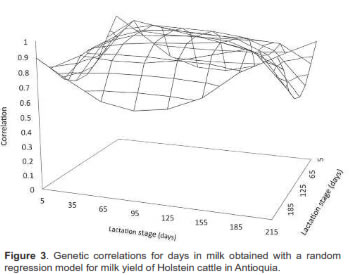
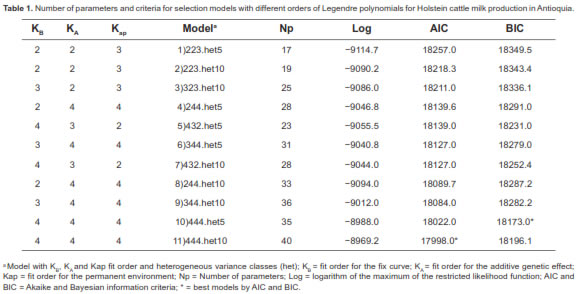
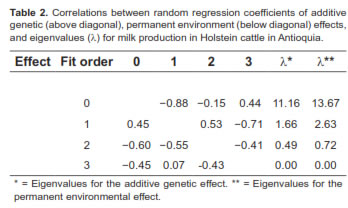
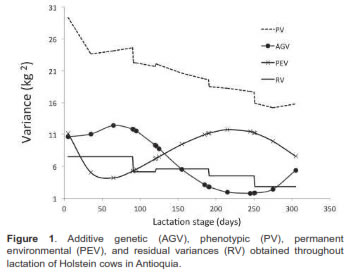
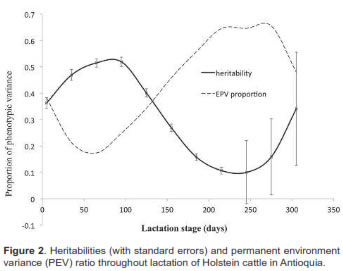
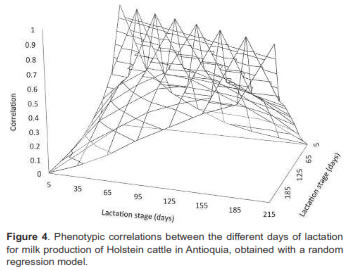
<body><![CDATA[<p><b><font size="3">Results </font></b></p>     <p>The AIC and BIC results for each model   tested are shown in <a href="#t1">table 1</a>. The lowest AIC value   corresponded to the polynomial-degree model 4,   4, and 4 of the fixed curve, additive genetic, and   permanent environment effect, respectively, and 10   heterogeneous variance classes (444.het10). The   lowest BIC value was for the model with the same   polynomial degree above, but with 5 heterogeneous   classes (444.het5). In this study, (co) variance   components and genetic parameters were estimated   using model 444.het5, since it showed the lowest BIC   value, was more parsimonious and displayed faster convergence.</p>     <p align="center"><a name="t1"></a><img src="/img/revistas/rccp/v26n2/v26n2a4t1.jpg"></p>     <p>The first eigenvalue (&lambda;) accounted for 83.89%   of the total additive genetic covariance matrix, and   the first three eigenvalues explained it by 99.99%.   For the permanent environmental effect, the first   eigenvalue accounted for 80.33% of the total   permanent environmental variance and the first three values explained it by 99.99% (<a href="#t2">Table 2</a>).</p>     <p align="center"><a name="t2"></a><img src="/img/revistas/rccp/v26n2/v26n2a4t2.jpg"></p>     <p>Variance trajectories are shown in <a href="#f3">figure 3</a>.   The direct genetic variance increased until d70   (12.44 kg<sup>2</sup>) with subsequent decrease until d239   (1.75 kg<sup>2</sup>). The permanent environment interaction   was higher at the beginning of lactation (12.67   kg<sup>2</sup>), with subsequent reduction to d59 (4.11 kg<sup>2</sup>),   followed by an increase to d224 (11.8 kg<sup>2</sup>). The   residual variance showed a downward trend from d5   (7.5 kg<sup>2</sup>) to d305 (2.8 kg<sup>2</sup>). The highest phenotypic   variance occurred at the beginning of lactation (29.3 kg<sup>2</sup>), decreasing to d305 (15.8 kg<sup>2</sup>).</p>     <p align="center"><a name="f1"></a><img src="/img/revistas/rccp/v26n2/v26n2a4f1.jpg"></p>     <p>Milk yield heritability in early lactation   was 0.36. It increased up to d95 (0.41), with a   subsequent decrease, reaching 0.10 at d245, with   low standard errors fluctuating between 0.013   and 0.021. Heritabilities increased during the last   lactation phase (up to 0.34), but had high standard   errors (0.14 to 0.21). The permanent environment   trajectory values decreased to d125 (0.13), then   increased to d215 (0.21), finishing at 0.05 during the final lactation stage (<a href="#f2">Figure 2</a>).</p>     <p align="center"><a name="f2"></a><img src="/img/revistas/rccp/v26n2/v26n2a4f2.jpg"></p>     <p>Genetic and phenotypic correlations between   milk yields at different lactation days are presented   in figures <a href="#f3">3</a> and <a href="#f4">4</a>, respectively. In general, genetic   correlations decreased as day intervals increased,   with positive values between 0.04 and 0.99.   These results were higher than those obtained for   phenotypic correlations, but followed the same path with values between 0.004 and 0.66.</p>     ]]></body>
<body><![CDATA[<p align="center"><a name="f3"></a><img src="/img/revistas/rccp/v26n2/v26n2a4f3.jpg"></p>     <p align="center"><a name="f4"></a><img src="/img/revistas/rccp/v26n2/v26n2a4f4.jpg"></p>     <p>&nbsp;</p>     <p><b><font size="3">Discussion</font></b></p>     <p>The AIC and BIC values decreased as the number   of parameters increased for each model evaluated.   The best models were 444.het10 (for AIC) and 444.   het5 (for BIC). Several researchers have tested   different orders of Legendre polynomials for milk   production. Assuming homogeneous residuals   variance, Cobuci <i>et al.</i> (2006) and Cobuci <i>et al.</i> (2011) reported that model 555 with homogeneous   residual variances was best (for both AIC and   BIC). Albuquerque <i>et al.</i> (2011) also found models   with polynomial orders 2 through 5 to be better for   the same effects using 5 heterogeneous residual   variances. Olori <i>et al.</i> (1999) tested RA models with   3 to 5 polynomial orders for different effects, using   10 classes of heterogeneous residual variances. The   best models found were those of higher order (i.e.,   the fourth order, having more number of classes of   heterogeneous residual variances).</p>     <p>It can be considered that higher adjustment   orders for Legendre polynomials increase the   flexibility of RA models. Furthermore, due to the   mathematical properties of orthogonal Legendre   polynomials, they are considered the most   appropriate for daily milk production analysis   (Schaeffer, 2004; Strabel and Jamrozik, 2006).   However, biological interpretation of these   coefficients is more difficult compared to other   parametric functions, such as the Wilmink function   and the Ali and Schaeffer polynomial functions.   Some researchers, such as Cobuci (2005) and   Bignardi (2011), tested these functions, obtaining   the best results with models that used Legendre polynomials with orders from 4 to 7.</p>     <p>The decline is very pronounced after 150 days   and up to 275 for the additive variance. Similarly,   Gonzalez-Pena <i>et al.</i> (2007), using heterogeneous   residual variances, reported the highest value for   the additive variance (&sigma;<sup>2</sup>a) on d5 and the lowest   on d302. A similar trend was estimated by Strabel   and Jamrozik (2006) using fourth order Legendre polynomials for the additive effect of the animal.</p>     <p>Different results were reported by Fujii   (2006), who found the lowest animal variance at   the beginning of lactation, and the highest at its   conclusion. This was similar to results for Holstein   cows in Brazil, where 3, 4 and 5 orders Legendre   polynomials were used for fixed effects, animal   genetic, and permanent environment, respectively   (Vieira, 2006). Similarly, permanent environment   variance was found to sharply decrease for the   first 30 days, remaining relatively constant for the   majority of lactation, and increasing at the end of   it (Fujii, 2006). Other studies have reported that   permanent environment variance decreased from   the start of lactation to 250 days, approximately,   and increased at the end of it above the initial values (Strabel and Jamrozik, 2006).</p>     <p>Heritabilities found at the beginning and up to   150 days were greater than 0.30, indicating that   considerable genetic variability exists in the studied   population. Similar values were reported by Strabel   and Jamrozik (2006) who found that the heritability   curve increases as lactation proceeds to 150 days or   so, decreasing slightly afterwards, and increasing at the   end of the curve. Herrera <i>et al.</i> (2011), using ordinary   test-day models for Holstein cows in Antioquia, found   milk production heritability values of 0.31 for the first months of lactation, declining thereafter.</p>     <p>According to the present study, in the first   five months of lactation animals express better   their genetic potential (higher genetic variances   and heritabilities), and after six months there   are environmental effects which have a greater   influence than the genetic factors. Although heritabilities were high during late lactation, standard errors were also high, mainly due to the reduction in the number of lactating animals and the exclusion of females reaching advanced pregnancy. The heritability curve for milk production in the evaluated population suggested that it is possible to achieve a greater efficiency in animal selection up to the first five months of lactation.</p>     ]]></body>
<body><![CDATA[<p>Gonzalez-Pena <i>et al.</i> (2007) and Olori <i>et al.</i> (1999)   reported heritabilities greater than 0.50 for some   stages of the lactation curve. These oscillations during   lactation have no clear biological explanation. It is   assumed that they can result from using higher-order   functions to explain the random effects in the model.   On the other hand, Albuquerque (2011), DeGroot   <i>et al.</i> (2007), and Muir <i>et al.</i> (2007) reported lower   heritabilities than those observed in this study, with values ranging between 0.10 and 0.16.</p>     <p>Genetic correlations for milk production between   lactation days prior to day 215 were greater than   0.60. Similar results were found by Takma <i>et al.</i>   (2007) and Olori <i>et al.</i> (1999) in Holstein cows at   first calving where genetic correlations were high   for consecutive days, decreasing as the interval between them increased.</p>     <p>Phenotypic correlations between start and end   days of lactation (e.g., day 35 with 305, and 65 with   305) were close to zero and negative. These results   are usually obtained with Legendre polynomials   (Brotherstone <i>et al.</i>, 2000; Cobuci, 2005; Gonzales-   Herrera <i>et al.</i>, 2008), because the parametric   functions do not model the association between   production at the beginning and at the end of the   lactation curve. Small numbers of observations for   the extreme ages, distance of the average and over   parameterized models are reported as possible causes of these problems (de Sousa, <i>et al.</i>, 2011).</p>     <p>It can be concluded that there is a high genetic   variability for milk production of first-calving Holstein cows in Antioquia.</p>     <p>&nbsp;</p> <hr size="1">    <p><b><font size="3">Notes</font></b></p>     <p><sup><a name="1"></a><a href="#b1">&curren;</a></sup> To cite this article: Herrera AC, M&uacute;nera OD, Cer&oacute;n- Mu&ntilde;oz MF. Variance components and genetic parameters for milk production of Holstein cattle in Antioquia (Colombia) using random regression models. Rev Colomb Cienc Pecu 2013; 26:90-97.</p> <hr size="1">     <p>&nbsp;</p>     <p><b><font size="3">Acknowledgements </font></b></p>     <p>Financial support to this study was provided   by Colciencias (Evaluaci&oacute;n gen&eacute;tico-econ&oacute;mica   de bovinos Holstein en sistemas de producci&oacute;n de leche en Antioquia).</p>     ]]></body>
<body><![CDATA[<p>&nbsp;</p>     <p><b><font size="3">References </font></b></p>     <!-- ref --><p>Akaike H. A new look at the statiscal model identification.   Trans Autom Control 1974; 19:716-723.    &nbsp;&nbsp;&nbsp;&nbsp;&nbsp;&nbsp;&nbsp;&nbsp;[&#160;<a href="javascript:void(0);" onclick="javascript: window.open('/scielo.php?script=sci_nlinks&ref=000085&pid=S0120-0690201300020000400001&lng=','','width=640,height=500,resizable=yes,scrollbars=1,menubar=yes,');">Links</a>&#160;]<!-- end-ref --> </p>     <!-- ref --><p>Albuquerque LG, Meyer K. Estimates of covariance functions   for growth from birth to 630 days of age in Nelore cattle. J   Anim Sci 2001; 79:2776-2789.    &nbsp;&nbsp;&nbsp;&nbsp;&nbsp;&nbsp;&nbsp;&nbsp;[&#160;<a href="javascript:void(0);" onclick="javascript: window.open('/scielo.php?script=sci_nlinks&ref=000087&pid=S0120-0690201300020000400002&lng=','','width=640,height=500,resizable=yes,scrollbars=1,menubar=yes,');">Links</a>&#160;]<!-- end-ref --> </p>     <!-- ref --><p>Bignardi AB, El Faro L, Cardoso VL, Machado PF,   Albuquerque LG. Random regression models using different   functions to model test-day milk yield of Brazilian Holstein   cows. Gen and Mol Res 2011; 92:4634-4640.    &nbsp;&nbsp;&nbsp;&nbsp;&nbsp;&nbsp;&nbsp;&nbsp;[&#160;<a href="javascript:void(0);" onclick="javascript: window.open('/scielo.php?script=sci_nlinks&ref=000089&pid=S0120-0690201300020000400003&lng=','','width=640,height=500,resizable=yes,scrollbars=1,menubar=yes,');">Links</a>&#160;]<!-- end-ref --> </p>     <!-- ref --><p>Brotherstone S, White IM, Meyer K. Genetic modeling of daily   yields using orthogonal polynomials and parametric curves.   Anim Sci 2000; 70:407-415.    &nbsp;&nbsp;&nbsp;&nbsp;&nbsp;&nbsp;&nbsp;&nbsp;[&#160;<a href="javascript:void(0);" onclick="javascript: window.open('/scielo.php?script=sci_nlinks&ref=000091&pid=S0120-0690201300020000400004&lng=','','width=640,height=500,resizable=yes,scrollbars=1,menubar=yes,');">Links</a>&#160;]<!-- end-ref --> </p>     ]]></body>
<body><![CDATA[<!-- ref --><p>Cobuci JA, Costa CN, Braccini JN, Freitas AF. Genetic   parameters for milk production by using random regression   models with different alternatives of fixed regression modeling.   Rev Bras Zootec 2011; 40:1397-1404.    &nbsp;&nbsp;&nbsp;&nbsp;&nbsp;&nbsp;&nbsp;&nbsp;[&#160;<a href="javascript:void(0);" onclick="javascript: window.open('/scielo.php?script=sci_nlinks&ref=000093&pid=S0120-0690201300020000400005&lng=','','width=640,height=500,resizable=yes,scrollbars=1,menubar=yes,');">Links</a>&#160;]<!-- end-ref --> </p>     <!-- ref --><p>Cobuci JA,Costa CN,Teixeira NM, Freitas AF. Utiliza&ccedil;&atilde;o dos   polin&ocirc;mios de Legendre e da fun&ccedil;&atilde;o de Wilmink em avalia&ccedil;&otilde;es   gen&eacute;ticas para persist&ecirc;ncia na lacta&ccedil;&atilde;o de animais da ra&ccedil;a   Holandesa. Arq Bras de Med Vet e Zoot 2006; 58:614-623.    &nbsp;&nbsp;&nbsp;&nbsp;&nbsp;&nbsp;&nbsp;&nbsp;[&#160;<a href="javascript:void(0);" onclick="javascript: window.open('/scielo.php?script=sci_nlinks&ref=000095&pid=S0120-0690201300020000400006&lng=','','width=640,height=500,resizable=yes,scrollbars=1,menubar=yes,');">Links</a>&#160;]<!-- end-ref --> </p>     <!-- ref --><p>Cobuci, JA, Euclydes RF, Lopes PS, Costa CN, Torres RA, y   Pereira CS. Estimation of genetic parameters for test-day milk   yield in Holstein cows using a random regression model. Genet   Mol Biol 2005; 28:75-83.    &nbsp;&nbsp;&nbsp;&nbsp;&nbsp;&nbsp;&nbsp;&nbsp;[&#160;<a href="javascript:void(0);" onclick="javascript: window.open('/scielo.php?script=sci_nlinks&ref=000097&pid=S0120-0690201300020000400007&lng=','','width=640,height=500,resizable=yes,scrollbars=1,menubar=yes,');">Links</a>&#160;]<!-- end-ref --> </p>     <!-- ref --><p>De Sousa JE, Almeida e Silva M, Sarmento JL, de Sousa WH,   de Souza MS, Ferreira IC. Estimates of covariance functions for   growth of Anglo-Nubian goats. Rev Bras Zootec 2011; 40:106-   114.    &nbsp;&nbsp;&nbsp;&nbsp;&nbsp;&nbsp;&nbsp;&nbsp;[&#160;<a href="javascript:void(0);" onclick="javascript: window.open('/scielo.php?script=sci_nlinks&ref=000099&pid=S0120-0690201300020000400008&lng=','','width=640,height=500,resizable=yes,scrollbars=1,menubar=yes,');">Links</a>&#160;]<!-- end-ref --> </p>     <!-- ref --><p>DeGroot BJ, Keown JF. Estimates of genetic parameters for   Holstein cows for test-day yield traits with a random regression   cubic spline model. Genet Mol Res 2007; 6:434-444.    &nbsp;&nbsp;&nbsp;&nbsp;&nbsp;&nbsp;&nbsp;&nbsp;[&#160;<a href="javascript:void(0);" onclick="javascript: window.open('/scielo.php?script=sci_nlinks&ref=000101&pid=S0120-0690201300020000400009&lng=','','width=640,height=500,resizable=yes,scrollbars=1,menubar=yes,');">Links</a>&#160;]<!-- end-ref --> </p>     ]]></body>
<body><![CDATA[<!-- ref --><p>Fujii SM. Comparison of homogeneity and heterogeneity of   residual variance using random regression test-day models for first lactation Japanese Holstein cows. J Anim Sci 2006; 77:28-   32.    &nbsp;&nbsp;&nbsp;&nbsp;&nbsp;&nbsp;&nbsp;&nbsp;[&#160;<a href="javascript:void(0);" onclick="javascript: window.open('/scielo.php?script=sci_nlinks&ref=000103&pid=S0120-0690201300020000400010&lng=','','width=640,height=500,resizable=yes,scrollbars=1,menubar=yes,');">Links</a>&#160;]<!-- end-ref --> </p>     <!-- ref --><p>Gonzalez-Herrera LG, El Faro L, Albuquerque LG, Tonhati   H, Cavallari C.H. Estimativas de par&acirc;metros gen&eacute;ticos para   produ&ccedil;&atilde;o de leite e persist&ecirc;ncia de lacta&ccedil;&otilde;es em vacas gir,   aplicando modelos de regress&atilde;o aleat&oacute;ria. Rev Bras Zootec   2008; 37:1584-1589.    &nbsp;&nbsp;&nbsp;&nbsp;&nbsp;&nbsp;&nbsp;&nbsp;[&#160;<a href="javascript:void(0);" onclick="javascript: window.open('/scielo.php?script=sci_nlinks&ref=000105&pid=S0120-0690201300020000400011&lng=','','width=640,height=500,resizable=yes,scrollbars=1,menubar=yes,');">Links</a>&#160;]<!-- end-ref --> </p>     <!-- ref --><p>Gonz&aacute;lez-Pe&ntilde;a D, Espinoza JL, Palacios A y Luna de la Pe&ntilde;a R.   Estimaci&oacute;n de componentes de (co)varianza para la producci&oacute;n   de leche del d&iacute;a del control en ganado siboney utilizando un   modelo de regresi&oacute;n aleatoria. INCI 2007; 32:702-706.    &nbsp;&nbsp;&nbsp;&nbsp;&nbsp;&nbsp;&nbsp;&nbsp;[&#160;<a href="javascript:void(0);" onclick="javascript: window.open('/scielo.php?script=sci_nlinks&ref=000107&pid=S0120-0690201300020000400012&lng=','','width=640,height=500,resizable=yes,scrollbars=1,menubar=yes,');">Links</a>&#160;]<!-- end-ref --> </p>     <!-- ref --><p>Henderson J. Analysis of covariance in the mixed model: higher   level, nonhomogeneous, and random regressions. Biometrics 1982; 38:623-640.    &nbsp;&nbsp;&nbsp;&nbsp;&nbsp;&nbsp;&nbsp;&nbsp;[&#160;<a href="javascript:void(0);" onclick="javascript: window.open('/scielo.php?script=sci_nlinks&ref=000109&pid=S0120-0690201300020000400013&lng=','','width=640,height=500,resizable=yes,scrollbars=1,menubar=yes,');">Links</a>&#160;]<!-- end-ref --></p>     <!-- ref --><p>Herrera AC, M&uacute;nera OD, Molina LM, Cer&oacute;n-Mu&ntilde;oz MF.   Componentes de varianza para producci&oacute;n de leche, grasa y   prote&iacute;na en el d&iacute;a de control en vacas Holstein del departamento   de Antioquia. Rev Nac de Agron Med 2011; 64: S1-89:26-30.    &nbsp;&nbsp;&nbsp;&nbsp;&nbsp;&nbsp;&nbsp;&nbsp;[&#160;<a href="javascript:void(0);" onclick="javascript: window.open('/scielo.php?script=sci_nlinks&ref=000111&pid=S0120-0690201300020000400014&lng=','','width=640,height=500,resizable=yes,scrollbars=1,menubar=yes,');">Links</a>&#160;]<!-- end-ref --> </p>     ]]></body>
<body><![CDATA[<!-- ref --><p>ICAR. Frequency of milk visits. In: International agreement   of recording practices. Section 2.3.15.2. 2002. &#91;Acess date: January 3, 2012&#93; URL: <a href="http://www.icar.org" target="_blank">http://www.icar.org</a>&nbsp;&nbsp;&nbsp;&nbsp;&nbsp;&nbsp;&nbsp;&nbsp;[&#160;<a href="javascript:void(0);" onclick="javascript: window.open('/scielo.php?script=sci_nlinks&ref=000113&pid=S0120-0690201300020000400015&lng=','','width=640,height=500,resizable=yes,scrollbars=1,menubar=yes,');">Links</a>&#160;]<!-- end-ref --><!-- ref --><p>Jamrozik JG, Kistemaker J. Comparison of possible covariates   for use in a random regression model for analyses of test day   yields. J Dairy Sci 1997; 80:2550-2556.    &nbsp;&nbsp;&nbsp;&nbsp;&nbsp;&nbsp;&nbsp;&nbsp;[&#160;<a href="javascript:void(0);" onclick="javascript: window.open('/scielo.php?script=sci_nlinks&ref=000114&pid=S0120-0690201300020000400016&lng=','','width=640,height=500,resizable=yes,scrollbars=1,menubar=yes,');">Links</a>&#160;]<!-- end-ref --> </p>     <!-- ref --><p>Kirkpatrick M, Lofsvold D, Bulmer M. Analysis of the   inheritance, selection and evolution of growth trajectories.   Genetics 1990; 124:979-993.    &nbsp;&nbsp;&nbsp;&nbsp;&nbsp;&nbsp;&nbsp;&nbsp;[&#160;<a href="javascript:void(0);" onclick="javascript: window.open('/scielo.php?script=sci_nlinks&ref=000116&pid=S0120-0690201300020000400017&lng=','','width=640,height=500,resizable=yes,scrollbars=1,menubar=yes,');">Links</a>&#160;]<!-- end-ref --> </p>     <!-- ref --><p>Kistemaker GJ . PhD Thesis. University of Guelph, 1997. pp26-   124.    &nbsp;&nbsp;&nbsp;&nbsp;&nbsp;&nbsp;&nbsp;&nbsp;[&#160;<a href="javascript:void(0);" onclick="javascript: window.open('/scielo.php?script=sci_nlinks&ref=000118&pid=S0120-0690201300020000400018&lng=','','width=640,height=500,resizable=yes,scrollbars=1,menubar=yes,');">Links</a>&#160;]<!-- end-ref --> </p>     <!-- ref --><p>Liu Z, Reinhardt F, Reents R. Estimating parameters of a   random regression test day model for first three lactation milk   production traits using the covariance function approach.   Interbull Bull 2000; 25:74-80.    &nbsp;&nbsp;&nbsp;&nbsp;&nbsp;&nbsp;&nbsp;&nbsp;[&#160;<a href="javascript:void(0);" onclick="javascript: window.open('/scielo.php?script=sci_nlinks&ref=000120&pid=S0120-0690201300020000400019&lng=','','width=640,height=500,resizable=yes,scrollbars=1,menubar=yes,');">Links</a>&#160;]<!-- end-ref --> </p>     <!-- ref --><p>Mark T. Applied genetic evaluations for production and   functional traits in dairy cattle. J Dairy Sci 2004; 87:2641-2652.    &nbsp;&nbsp;&nbsp;&nbsp;&nbsp;&nbsp;&nbsp;&nbsp;[&#160;<a href="javascript:void(0);" onclick="javascript: window.open('/scielo.php?script=sci_nlinks&ref=000122&pid=S0120-0690201300020000400020&lng=','','width=640,height=500,resizable=yes,scrollbars=1,menubar=yes,');">Links</a>&#160;]<!-- end-ref --> </p>     <!-- ref --><p>Meyer K. Estimates of genetic and phenotypic covariance   functions for post weaning growth and mature weight of beef   cows. J Anim Breed Genet 1999; 116:181-205.    &nbsp;&nbsp;&nbsp;&nbsp;&nbsp;&nbsp;&nbsp;&nbsp;[&#160;<a href="javascript:void(0);" onclick="javascript: window.open('/scielo.php?script=sci_nlinks&ref=000124&pid=S0120-0690201300020000400021&lng=','','width=640,height=500,resizable=yes,scrollbars=1,menubar=yes,');">Links</a>&#160;]<!-- end-ref --> </p>     <!-- ref --><p>Meyer K. Scope for a random regression model in genetic   evaluation of beef cattle for growth. Livest Prod Sci 2004;   86:69-83.    &nbsp;&nbsp;&nbsp;&nbsp;&nbsp;&nbsp;&nbsp;&nbsp;[&#160;<a href="javascript:void(0);" onclick="javascript: window.open('/scielo.php?script=sci_nlinks&ref=000126&pid=S0120-0690201300020000400022&lng=','','width=640,height=500,resizable=yes,scrollbars=1,menubar=yes,');">Links</a>&#160;]<!-- end-ref --> </p>     <!-- ref --><p>Meyer K. WOMBAT- A program for mixed models analyses in   quantitative genetics by REML. J Zhejiang Uni SCIENCE B.   2007; 8:815-821.    &nbsp;&nbsp;&nbsp;&nbsp;&nbsp;&nbsp;&nbsp;&nbsp;[&#160;<a href="javascript:void(0);" onclick="javascript: window.open('/scielo.php?script=sci_nlinks&ref=000128&pid=S0120-0690201300020000400023&lng=','','width=640,height=500,resizable=yes,scrollbars=1,menubar=yes,');">Links</a>&#160;]<!-- end-ref --> </p>     <!-- ref --><p>Muir BL, Kistemaker G. Genetic parameters for a multiple-trait   multiple-lactation random regression test-day model in Italian   Holsteins. J Dairy Sci 2007; 90:1564-1574.    &nbsp;&nbsp;&nbsp;&nbsp;&nbsp;&nbsp;&nbsp;&nbsp;[&#160;<a href="javascript:void(0);" onclick="javascript: window.open('/scielo.php?script=sci_nlinks&ref=000130&pid=S0120-0690201300020000400024&lng=','','width=640,height=500,resizable=yes,scrollbars=1,menubar=yes,');">Links</a>&#160;]<!-- end-ref --> </p>     <!-- ref --><p>Nunez-Anton V and Zimmerman DL. Modeling nonstationary   longitudinal data. Biometrics 2000; 56:699-705.    &nbsp;&nbsp;&nbsp;&nbsp;&nbsp;&nbsp;&nbsp;&nbsp;[&#160;<a href="javascript:void(0);" onclick="javascript: window.open('/scielo.php?script=sci_nlinks&ref=000132&pid=S0120-0690201300020000400025&lng=','','width=640,height=500,resizable=yes,scrollbars=1,menubar=yes,');">Links</a>&#160;]<!-- end-ref --> </p>     <!-- ref --><p>Olori VE, Hill WG. Estimating variance components for test   day milk records by restricted maximum likelihood with a   random regression animal model. Liv Prod Sci 1999; 61:53-63.    &nbsp;&nbsp;&nbsp;&nbsp;&nbsp;&nbsp;&nbsp;&nbsp;[&#160;<a href="javascript:void(0);" onclick="javascript: window.open('/scielo.php?script=sci_nlinks&ref=000134&pid=S0120-0690201300020000400026&lng=','','width=640,height=500,resizable=yes,scrollbars=1,menubar=yes,');">Links</a>&#160;]<!-- end-ref --> </p>     <!-- ref --><p>Olori VE, Hill WG. The structure of the residual error variance   of test day milk in random regression models. Interbull Bulletin;   1999a.p20:6-9.    &nbsp;&nbsp;&nbsp;&nbsp;&nbsp;&nbsp;&nbsp;&nbsp;[&#160;<a href="javascript:void(0);" onclick="javascript: window.open('/scielo.php?script=sci_nlinks&ref=000136&pid=S0120-0690201300020000400027&lng=','','width=640,height=500,resizable=yes,scrollbars=1,menubar=yes,');">Links</a>&#160;]<!-- end-ref --> </p>     <!-- ref --><p>Rodr&iacute;guez-Zas S, Gianola D, Shook G. Evaluation of models   for somatic cell score lactation patterns in Holsteins. Liv Prod   Sci 2000; 67:19-30.    &nbsp;&nbsp;&nbsp;&nbsp;&nbsp;&nbsp;&nbsp;&nbsp;[&#160;<a href="javascript:void(0);" onclick="javascript: window.open('/scielo.php?script=sci_nlinks&ref=000138&pid=S0120-0690201300020000400028&lng=','','width=640,height=500,resizable=yes,scrollbars=1,menubar=yes,');">Links</a>&#160;]<!-- end-ref --> </p>     <!-- ref --><p>Schaeffer LR, Jamrozik J, Kistemaker GJ, Van Doormaal BJ.   Experience with a test-day model. J Dairy Sci 2000; 83:1135-   1144.    &nbsp;&nbsp;&nbsp;&nbsp;&nbsp;&nbsp;&nbsp;&nbsp;[&#160;<a href="javascript:void(0);" onclick="javascript: window.open('/scielo.php?script=sci_nlinks&ref=000140&pid=S0120-0690201300020000400029&lng=','','width=640,height=500,resizable=yes,scrollbars=1,menubar=yes,');">Links</a>&#160;]<!-- end-ref --> </p>     <!-- ref --><p>Schaeffer LR, Dekkers JCM. Random regressions in animal   models for test-day production in dairy cattle. Proceedings of   the 5th World Congr Genet Appl Livest Prod, Guelph. 1994.   p433-446.    &nbsp;&nbsp;&nbsp;&nbsp;&nbsp;&nbsp;&nbsp;&nbsp;[&#160;<a href="javascript:void(0);" onclick="javascript: window.open('/scielo.php?script=sci_nlinks&ref=000142&pid=S0120-0690201300020000400030&lng=','','width=640,height=500,resizable=yes,scrollbars=1,menubar=yes,');">Links</a>&#160;]<!-- end-ref --> </p>     <!-- ref --><p>Schwarz G. Estimating the dimension of a model. Ann Stat   1978; 6:461-464.    &nbsp;&nbsp;&nbsp;&nbsp;&nbsp;&nbsp;&nbsp;&nbsp;[&#160;<a href="javascript:void(0);" onclick="javascript: window.open('/scielo.php?script=sci_nlinks&ref=000144&pid=S0120-0690201300020000400031&lng=','','width=640,height=500,resizable=yes,scrollbars=1,menubar=yes,');">Links</a>&#160;]<!-- end-ref --> </p>     <!-- ref --><p>Strabel T, Misztal I. Genetic parameters for first and second   lactation milk yields of Polish Black and White cattle with   random regression. J Dairy Sci 1999; 82:2805&#8211;2810.    &nbsp;&nbsp;&nbsp;&nbsp;&nbsp;&nbsp;&nbsp;&nbsp;[&#160;<a href="javascript:void(0);" onclick="javascript: window.open('/scielo.php?script=sci_nlinks&ref=000146&pid=S0120-0690201300020000400032&lng=','','width=640,height=500,resizable=yes,scrollbars=1,menubar=yes,');">Links</a>&#160;]<!-- end-ref --> </p>     <!-- ref --><p>Strabel T, Jamrozik J. Genetic analysis of milk production   traits of polish black and white cattle using large-scale random   regression test-day models. J Dairy Sci 2006; 89:3152-3163.    &nbsp;&nbsp;&nbsp;&nbsp;&nbsp;&nbsp;&nbsp;&nbsp;[&#160;<a href="javascript:void(0);" onclick="javascript: window.open('/scielo.php?script=sci_nlinks&ref=000148&pid=S0120-0690201300020000400033&lng=','','width=640,height=500,resizable=yes,scrollbars=1,menubar=yes,');">Links</a>&#160;]<!-- end-ref --> </p>     <!-- ref --><p>Takma C, Akbas Y. Estimates of genetic parameters for test day   milk yields of a Holstein Friesian herd in Turkey with random   regression models. Arch Tierz Dummerstorf 2007; 4:327-336.    &nbsp;&nbsp;&nbsp;&nbsp;&nbsp;&nbsp;&nbsp;&nbsp;[&#160;<a href="javascript:void(0);" onclick="javascript: window.open('/scielo.php?script=sci_nlinks&ref=000150&pid=S0120-0690201300020000400034&lng=','','width=640,height=500,resizable=yes,scrollbars=1,menubar=yes,');">Links</a>&#160;]<!-- end-ref --> </p>     <!-- ref --><p>Van der Werf J. Random regression in animal breeding. Course   notes. University of New England 2001; &#91;Access date: June   1, 2011&#93; URL: <a href="http://www-personal.une.edu.au/~jvanderw/CFcoursenotes.pdf" target="_blank">http://www-personal.une.edu.au/~jvanderw/CFcoursenotes.pdf</a> &nbsp;&nbsp;&nbsp;&nbsp;&nbsp;&nbsp;&nbsp;&nbsp;[&#160;<a href="javascript:void(0);" onclick="javascript: window.open('/scielo.php?script=sci_nlinks&ref=000152&pid=S0120-0690201300020000400035&lng=','','width=640,height=500,resizable=yes,scrollbars=1,menubar=yes,');">Links</a>&#160;]<!-- end-ref --><!-- ref --><p>Veerkamp RF, Thompson R. A Covariance function for feed   intake, live weight, and milk yield estimated using a random   regression model. J Dairy Sci 1999; 82:1565&#8211;1573.    &nbsp;&nbsp;&nbsp;&nbsp;&nbsp;&nbsp;&nbsp;&nbsp;[&#160;<a href="javascript:void(0);" onclick="javascript: window.open('/scielo.php?script=sci_nlinks&ref=000153&pid=S0120-0690201300020000400036&lng=','','width=640,height=500,resizable=yes,scrollbars=1,menubar=yes,');">Links</a>&#160;]<!-- end-ref --> </p>     <!-- ref --><p>Vieira CT, Costa CN, Torres RA, Ara&uacute;jo SI, Lopes PS, Reg&aacute;is   AJ, Silva C, Ara&uacute;jo J, Rocha JL. Uso de fun&ccedil;&otilde;es ortogonais   para descrever a produ&ccedil;&atilde;o de leite no dia de controle por meio   de modelos de regress&atilde;o aleat&oacute;ria. Rev Bras Zootec 2006; 35:967-974.    &nbsp;&nbsp;&nbsp;&nbsp;&nbsp;&nbsp;&nbsp;&nbsp;[&#160;<a href="javascript:void(0);" onclick="javascript: window.open('/scielo.php?script=sci_nlinks&ref=000155&pid=S0120-0690201300020000400037&lng=','','width=640,height=500,resizable=yes,scrollbars=1,menubar=yes,');">Links</a>&#160;]<!-- end-ref --></p> </font>     ]]></body><back>
<ref-list>
<ref id="B1">
<nlm-citation citation-type="journal">
<person-group person-group-type="author">
<name>
<surname><![CDATA[Akaike]]></surname>
<given-names><![CDATA[H.]]></given-names>
</name>
</person-group>
<article-title xml:lang="en"><![CDATA[A new look at the statiscal model identification]]></article-title>
<source><![CDATA[Trans Autom Control]]></source>
<year>1974</year>
<volume>19</volume>
<page-range>716-723</page-range></nlm-citation>
</ref>
<ref id="B2">
<nlm-citation citation-type="journal">
<person-group person-group-type="author">
<name>
<surname><![CDATA[Albuquerque]]></surname>
<given-names><![CDATA[LG]]></given-names>
</name>
<name>
<surname><![CDATA[Meyer]]></surname>
<given-names><![CDATA[K.]]></given-names>
</name>
</person-group>
<article-title xml:lang="en"><![CDATA[Estimates of covariance functions for growth from birth to 630 days of age in Nelore cattle]]></article-title>
<source><![CDATA[Anim Sci]]></source>
<year>2001</year>
<volume>79</volume>
<page-range>2776-2789</page-range></nlm-citation>
</ref>
<ref id="B3">
<nlm-citation citation-type="journal">
<person-group person-group-type="author">
<name>
<surname><![CDATA[Bignardi]]></surname>
<given-names><![CDATA[AB]]></given-names>
</name>
<name>
<surname><![CDATA[El Faro]]></surname>
<given-names><![CDATA[L]]></given-names>
</name>
<name>
<surname><![CDATA[Cardoso]]></surname>
<given-names><![CDATA[VL]]></given-names>
</name>
<name>
<surname><![CDATA[Machado]]></surname>
<given-names><![CDATA[PF]]></given-names>
</name>
<name>
<surname><![CDATA[Albuquerque]]></surname>
<given-names><![CDATA[LG.]]></given-names>
</name>
</person-group>
<article-title xml:lang="en"><![CDATA[Random regression models using different functions to model test-day milk yield of Brazilian Holstein cows]]></article-title>
<source><![CDATA[Gen and Mol Res]]></source>
<year>2011</year>
<volume>92</volume>
<page-range>4634-4640</page-range></nlm-citation>
</ref>
<ref id="B4">
<nlm-citation citation-type="journal">
<person-group person-group-type="author">
<name>
<surname><![CDATA[Brotherstone]]></surname>
<given-names><![CDATA[S]]></given-names>
</name>
<name>
<surname><![CDATA[White]]></surname>
<given-names><![CDATA[IM]]></given-names>
</name>
<name>
<surname><![CDATA[Meyer]]></surname>
<given-names><![CDATA[K.]]></given-names>
</name>
</person-group>
<article-title xml:lang="en"><![CDATA[Genetic modeling of daily yields using orthogonal polynomials and parametric curves]]></article-title>
<source><![CDATA[Anim Sci]]></source>
<year>2000</year>
<volume>70</volume>
<page-range>407-415</page-range></nlm-citation>
</ref>
<ref id="B5">
<nlm-citation citation-type="journal">
<person-group person-group-type="author">
<name>
<surname><![CDATA[Cobuci]]></surname>
<given-names><![CDATA[JA]]></given-names>
</name>
<name>
<surname><![CDATA[Costa]]></surname>
<given-names><![CDATA[CN]]></given-names>
</name>
<name>
<surname><![CDATA[Braccini]]></surname>
<given-names><![CDATA[JN]]></given-names>
</name>
<name>
<surname><![CDATA[Freitas]]></surname>
<given-names><![CDATA[AF.]]></given-names>
</name>
</person-group>
<article-title xml:lang="en"><![CDATA[Genetic parameters for milk production by using random regression models with different alternatives of fixed regression modeling]]></article-title>
<source><![CDATA[Rev Bras Zootec]]></source>
<year>2011</year>
<volume>40</volume>
<page-range>1397-1404</page-range></nlm-citation>
</ref>
<ref id="B6">
<nlm-citation citation-type="journal">
<person-group person-group-type="author">
<name>
<surname><![CDATA[Cobuci]]></surname>
<given-names><![CDATA[JA]]></given-names>
</name>
<name>
<surname><![CDATA[Costa]]></surname>
<given-names><![CDATA[CN]]></given-names>
</name>
<name>
<surname><![CDATA[Teixeira]]></surname>
<given-names><![CDATA[NM]]></given-names>
</name>
<name>
<surname><![CDATA[Freitas]]></surname>
<given-names><![CDATA[AF.]]></given-names>
</name>
</person-group>
<article-title xml:lang="pt"><![CDATA[Utilização dos polinômios de Legendre e da função de Wilmink em avaliações genéticas para persistência na lactação de animais da raça Holandesa]]></article-title>
<source><![CDATA[Arq Bras de Med Vet e Zoot]]></source>
<year>2006</year>
<volume>58</volume>
<page-range>614-623</page-range></nlm-citation>
</ref>
<ref id="B7">
<nlm-citation citation-type="journal">
<person-group person-group-type="author">
<name>
<surname><![CDATA[Cobuci]]></surname>
<given-names><![CDATA[JA]]></given-names>
</name>
<name>
<surname><![CDATA[Euclydes]]></surname>
<given-names><![CDATA[RF]]></given-names>
</name>
<name>
<surname><![CDATA[Lopes]]></surname>
<given-names><![CDATA[PS]]></given-names>
</name>
<name>
<surname><![CDATA[Costa]]></surname>
<given-names><![CDATA[CN]]></given-names>
</name>
<name>
<surname><![CDATA[Torres]]></surname>
<given-names><![CDATA[RA]]></given-names>
</name>
<name>
<surname><![CDATA[Pereira]]></surname>
<given-names><![CDATA[CS.]]></given-names>
</name>
</person-group>
<article-title xml:lang="en"><![CDATA[Estimation of genetic parameters for test-day milk yield in Holstein cows using a random regression model]]></article-title>
<source><![CDATA[Genet Mol Biol]]></source>
<year>2005</year>
<volume>28</volume>
<page-range>75-83</page-range></nlm-citation>
</ref>
<ref id="B8">
<nlm-citation citation-type="journal">
<person-group person-group-type="author">
<name>
<surname><![CDATA[De Sousa]]></surname>
<given-names><![CDATA[JE]]></given-names>
</name>
<name>
<surname><![CDATA[Almeida e Silva]]></surname>
<given-names><![CDATA[M]]></given-names>
</name>
<name>
<surname><![CDATA[Sarmento]]></surname>
<given-names><![CDATA[JL]]></given-names>
</name>
<name>
<surname><![CDATA[de Sousa]]></surname>
<given-names><![CDATA[WH]]></given-names>
</name>
<name>
<surname><![CDATA[de Souza]]></surname>
<given-names><![CDATA[MS]]></given-names>
</name>
<name>
<surname><![CDATA[Ferreira]]></surname>
<given-names><![CDATA[IC.]]></given-names>
</name>
</person-group>
<article-title xml:lang="en"><![CDATA[Estimates of covariance functions for growth of Anglo-Nubian goats]]></article-title>
<source><![CDATA[Rev Bras Zootec]]></source>
<year>2011</year>
<volume>40</volume>
<page-range>106- 114</page-range></nlm-citation>
</ref>
<ref id="B9">
<nlm-citation citation-type="journal">
<person-group person-group-type="author">
<name>
<surname><![CDATA[DeGroot]]></surname>
<given-names><![CDATA[BJ]]></given-names>
</name>
<name>
<surname><![CDATA[Keown]]></surname>
<given-names><![CDATA[JF.]]></given-names>
</name>
</person-group>
<article-title xml:lang="en"><![CDATA[Estimates of genetic parameters for Holstein cows for test-day yield traits with a random regression cubic spline model]]></article-title>
<source><![CDATA[Genet Mol Res]]></source>
<year>2007</year>
<volume>6</volume>
<page-range>434-444</page-range></nlm-citation>
</ref>
<ref id="B10">
<nlm-citation citation-type="journal">
<person-group person-group-type="author">
<name>
<surname><![CDATA[Fujii]]></surname>
<given-names><![CDATA[SM]]></given-names>
</name>
</person-group>
<article-title xml:lang="en"><![CDATA[Comparison of homogeneity and heterogeneity of residual variance using random regression test-day models for first lactation Japanese Holstein cows]]></article-title>
<source><![CDATA[J Anim Sci]]></source>
<year>2006</year>
<volume>77</volume>
<page-range>28- 32</page-range></nlm-citation>
</ref>
<ref id="B11">
<nlm-citation citation-type="journal">
<person-group person-group-type="author">
<name>
<surname><![CDATA[Gonzalez-Herrera]]></surname>
<given-names><![CDATA[LG]]></given-names>
</name>
<name>
<surname><![CDATA[El Faro]]></surname>
<given-names><![CDATA[L]]></given-names>
</name>
<name>
<surname><![CDATA[Albuquerque]]></surname>
<given-names><![CDATA[LG]]></given-names>
</name>
<name>
<surname><![CDATA[Tonhati]]></surname>
<given-names><![CDATA[H]]></given-names>
</name>
<name>
<surname><![CDATA[Cavallari]]></surname>
<given-names><![CDATA[C.H.]]></given-names>
</name>
</person-group>
<article-title xml:lang="pt"><![CDATA[Estimativas de parâmetros genéticos para produção de leite e persistência de lactações em vacas gir, aplicando modelos de regressão aleatória]]></article-title>
<source><![CDATA[Rev Bras Zootec]]></source>
<year>2008</year>
<volume>37</volume>
<page-range>1584-1589</page-range></nlm-citation>
</ref>
<ref id="B12">
<nlm-citation citation-type="journal">
<person-group person-group-type="author">
<name>
<surname><![CDATA[González-Peña]]></surname>
<given-names><![CDATA[D]]></given-names>
</name>
<name>
<surname><![CDATA[Espinoza]]></surname>
<given-names><![CDATA[JL]]></given-names>
</name>
<name>
<surname><![CDATA[Palacios]]></surname>
<given-names><![CDATA[A]]></given-names>
</name>
<name>
<surname><![CDATA[Luna de la Peña]]></surname>
<given-names><![CDATA[R.]]></given-names>
</name>
</person-group>
<article-title xml:lang="es"><![CDATA[Estimación de componentes de (co)varianza para la producción de leche del día del control en ganado siboney utilizando un modelo de regresión aleatoria]]></article-title>
<source><![CDATA[INCI]]></source>
<year>2007</year>
<volume>32</volume>
<page-range>702-706</page-range></nlm-citation>
</ref>
<ref id="B13">
<nlm-citation citation-type="journal">
<person-group person-group-type="author">
<name>
<surname><![CDATA[Henderson]]></surname>
<given-names><![CDATA[J.]]></given-names>
</name>
</person-group>
<article-title xml:lang="en"><![CDATA[Analysis of covariance in the mixed model: higher level, nonhomogeneous, and random regressions]]></article-title>
<source><![CDATA[Biometrics]]></source>
<year>1982</year>
<volume>38</volume>
<page-range>623-640</page-range></nlm-citation>
</ref>
<ref id="B14">
<nlm-citation citation-type="journal">
<person-group person-group-type="author">
<name>
<surname><![CDATA[Herrera]]></surname>
<given-names><![CDATA[AC]]></given-names>
</name>
<name>
<surname><![CDATA[Múnera]]></surname>
<given-names><![CDATA[OD]]></given-names>
</name>
<name>
<surname><![CDATA[Molina]]></surname>
<given-names><![CDATA[LM]]></given-names>
</name>
<name>
<surname><![CDATA[Cerón-Muñoz]]></surname>
<given-names><![CDATA[MF.]]></given-names>
</name>
</person-group>
<article-title xml:lang="es"><![CDATA[Componentes de varianza para producción de leche, grasa y proteína en el día de control en vacas Holstein del departamento de Antioquia]]></article-title>
<source><![CDATA[Rev Nac de Agron Med]]></source>
<year>2011</year>
<volume>64</volume>
<numero>89^s1</numero>
<issue>89^s1</issue>
<supplement>1</supplement>
<page-range>26-30</page-range></nlm-citation>
</ref>
<ref id="B15">
<nlm-citation citation-type="">
<collab>ICAR</collab>
<article-title xml:lang="en"><![CDATA[Frequency of milk visits]]></article-title>
<source><![CDATA[International agreement of recording practices]]></source>
<year>2002</year>
</nlm-citation>
</ref>
<ref id="B16">
<nlm-citation citation-type="journal">
<person-group person-group-type="author">
<name>
<surname><![CDATA[Jamrozik]]></surname>
<given-names><![CDATA[JG]]></given-names>
</name>
<name>
<surname><![CDATA[Kistemaker]]></surname>
<given-names><![CDATA[J.]]></given-names>
</name>
</person-group>
<article-title xml:lang="en"><![CDATA[Comparison of possible covariates for use in a random regression model for analyses of test day yields]]></article-title>
<source><![CDATA[J Dairy Sci]]></source>
<year>1997</year>
<volume>80</volume>
<page-range>2550-2556</page-range></nlm-citation>
</ref>
<ref id="B17">
<nlm-citation citation-type="journal">
<person-group person-group-type="author">
<name>
<surname><![CDATA[Kirkpatrick]]></surname>
<given-names><![CDATA[M]]></given-names>
</name>
<name>
<surname><![CDATA[Lofsvold]]></surname>
<given-names><![CDATA[D]]></given-names>
</name>
<name>
<surname><![CDATA[Bulmer]]></surname>
<given-names><![CDATA[M.]]></given-names>
</name>
</person-group>
<article-title xml:lang="en"><![CDATA[Analysis of the inheritance, selection and evolution of growth trajectories]]></article-title>
<source><![CDATA[Genetics]]></source>
<year>1990</year>
<volume>124</volume>
<page-range>979-993</page-range></nlm-citation>
</ref>
<ref id="B18">
<nlm-citation citation-type="">
<person-group person-group-type="author">
<name>
<surname><![CDATA[Kistemaker]]></surname>
<given-names><![CDATA[GJ]]></given-names>
</name>
</person-group>
<source><![CDATA[]]></source>
<year></year>
<page-range>26- 124</page-range></nlm-citation>
</ref>
<ref id="B19">
<nlm-citation citation-type="journal">
<person-group person-group-type="author">
<name>
<surname><![CDATA[Liu]]></surname>
<given-names><![CDATA[Z]]></given-names>
</name>
<name>
<surname><![CDATA[Reinhardt]]></surname>
<given-names><![CDATA[F]]></given-names>
</name>
<name>
<surname><![CDATA[Reents]]></surname>
<given-names><![CDATA[R.]]></given-names>
</name>
</person-group>
<article-title xml:lang="en"><![CDATA[Estimating parameters of a random regression test day model for first three lactation milk production traits using the covariance function approach]]></article-title>
<source><![CDATA[Interbull Bull]]></source>
<year>2000</year>
<volume>25</volume>
<page-range>74-80</page-range></nlm-citation>
</ref>
<ref id="B20">
<nlm-citation citation-type="journal">
<person-group person-group-type="author">
<name>
<surname><![CDATA[Mark]]></surname>
<given-names><![CDATA[T.]]></given-names>
</name>
</person-group>
<article-title xml:lang="en"><![CDATA[Applied genetic evaluations for production and functional traits in dairy cattle]]></article-title>
<source><![CDATA[J Dairy Sci]]></source>
<year>2004</year>
<volume>87</volume>
<page-range>2641-2652</page-range></nlm-citation>
</ref>
<ref id="B21">
<nlm-citation citation-type="journal">
<person-group person-group-type="author">
<name>
<surname><![CDATA[Meyer]]></surname>
<given-names><![CDATA[K.]]></given-names>
</name>
</person-group>
<article-title xml:lang="en"><![CDATA[Estimates of genetic and phenotypic covariance functions for post weaning growth and mature weight of beef cows]]></article-title>
<source><![CDATA[J Anim Breed Genet]]></source>
<year>1999</year>
<volume>116</volume>
<page-range>181-205</page-range></nlm-citation>
</ref>
<ref id="B22">
<nlm-citation citation-type="journal">
<person-group person-group-type="author">
<name>
<surname><![CDATA[Meyer]]></surname>
<given-names><![CDATA[K.]]></given-names>
</name>
</person-group>
<article-title xml:lang="en"><![CDATA[Scope for a random regression model in genetic evaluation of beef cattle for growth]]></article-title>
<source><![CDATA[Livest Prod Sci]]></source>
<year>2004</year>
<volume>86</volume>
<page-range>69-83</page-range></nlm-citation>
</ref>
<ref id="B23">
<nlm-citation citation-type="journal">
<person-group person-group-type="author">
<name>
<surname><![CDATA[Meyer]]></surname>
<given-names><![CDATA[K.]]></given-names>
</name>
</person-group>
<article-title xml:lang="en"><![CDATA[WOMBAT- A program for mixed models analyses in quantitative genetics by REML]]></article-title>
<source><![CDATA[J Zhejiang Uni SCIENCE B.]]></source>
<year>2007</year>
<volume>8</volume>
<page-range>815-821</page-range></nlm-citation>
</ref>
<ref id="B24">
<nlm-citation citation-type="journal">
<person-group person-group-type="author">
<name>
<surname><![CDATA[Muir]]></surname>
<given-names><![CDATA[BL]]></given-names>
</name>
<name>
<surname><![CDATA[Kistemaker]]></surname>
<given-names><![CDATA[G.]]></given-names>
</name>
</person-group>
<article-title xml:lang="en"><![CDATA[Genetic parameters for a multiple-trait multiple-lactation random regression test-day model in Italian Holsteins]]></article-title>
<source><![CDATA[J Dairy Sci]]></source>
<year>2007</year>
<volume>90</volume>
<page-range>1564-1574</page-range></nlm-citation>
</ref>
<ref id="B25">
<nlm-citation citation-type="journal">
<person-group person-group-type="author">
<name>
<surname><![CDATA[Nunez-Anton]]></surname>
<given-names><![CDATA[V]]></given-names>
</name>
<name>
<surname><![CDATA[Zimmerman]]></surname>
<given-names><![CDATA[DL.]]></given-names>
</name>
</person-group>
<article-title xml:lang="en"><![CDATA[Modeling nonstationary longitudinal data]]></article-title>
<source><![CDATA[Biometrics]]></source>
<year>2000</year>
<volume>56</volume>
<page-range>699-705</page-range></nlm-citation>
</ref>
<ref id="B26">
<nlm-citation citation-type="journal">
<person-group person-group-type="author">
<name>
<surname><![CDATA[Olori]]></surname>
<given-names><![CDATA[VE]]></given-names>
</name>
<name>
<surname><![CDATA[Hill]]></surname>
<given-names><![CDATA[WG.]]></given-names>
</name>
</person-group>
<article-title xml:lang="en"><![CDATA[Estimating variance components for test day milk records by restricted maximum likelihood with a random regression animal model]]></article-title>
<source><![CDATA[Liv Prod Sci]]></source>
<year>1999</year>
<volume>61</volume>
<page-range>53-63</page-range></nlm-citation>
</ref>
<ref id="B27">
<nlm-citation citation-type="journal">
<person-group person-group-type="author">
<name>
<surname><![CDATA[Olori]]></surname>
<given-names><![CDATA[VE]]></given-names>
</name>
<name>
<surname><![CDATA[Hill]]></surname>
<given-names><![CDATA[WG.]]></given-names>
</name>
</person-group>
<article-title xml:lang="en"><![CDATA[The structure of the residual error variance of test day milk in random regression models]]></article-title>
<source><![CDATA[Interbull Bulletin]]></source>
<year>1999</year>
<volume>20</volume>
<page-range>6-9</page-range></nlm-citation>
</ref>
<ref id="B28">
<nlm-citation citation-type="journal">
<person-group person-group-type="author">
<name>
<surname><![CDATA[Rodríguez-Zas]]></surname>
<given-names><![CDATA[S]]></given-names>
</name>
<name>
<surname><![CDATA[Gianola]]></surname>
<given-names><![CDATA[D]]></given-names>
</name>
<name>
<surname><![CDATA[Shook]]></surname>
<given-names><![CDATA[G.]]></given-names>
</name>
</person-group>
<article-title xml:lang="en"><![CDATA[Evaluation of models for somatic cell score lactation patterns in Holsteins]]></article-title>
<source><![CDATA[Liv Prod Sci]]></source>
<year>2000</year>
<volume>67</volume>
<page-range>19-30</page-range></nlm-citation>
</ref>
<ref id="B29">
<nlm-citation citation-type="journal">
<person-group person-group-type="author">
<name>
<surname><![CDATA[Schaeffer]]></surname>
<given-names><![CDATA[LR]]></given-names>
</name>
<name>
<surname><![CDATA[Jamrozik]]></surname>
<given-names><![CDATA[J]]></given-names>
</name>
<name>
<surname><![CDATA[Kistemaker]]></surname>
<given-names><![CDATA[GJ]]></given-names>
</name>
<name>
<surname><![CDATA[Van Doormaal]]></surname>
<given-names><![CDATA[BJ.]]></given-names>
</name>
</person-group>
<article-title xml:lang="en"><![CDATA[Experience with a test-day model]]></article-title>
<source><![CDATA[J Dairy Sci]]></source>
<year>2000</year>
<volume>83</volume>
<page-range>1135- 1144</page-range></nlm-citation>
</ref>
<ref id="B30">
<nlm-citation citation-type="journal">
<person-group person-group-type="author">
<name>
<surname><![CDATA[Schaeffer]]></surname>
<given-names><![CDATA[LR]]></given-names>
</name>
<name>
<surname><![CDATA[Dekkers]]></surname>
<given-names><![CDATA[JCM.]]></given-names>
</name>
</person-group>
<article-title xml:lang="en"><![CDATA[Random regressions in animal models for test-day production in dairy cattle. Proceedings of the 5th World Congr]]></article-title>
<source><![CDATA[Genet Appl Livest Prod, Guelph]]></source>
<year>1994</year>
<page-range>433-446</page-range></nlm-citation>
</ref>
<ref id="B31">
<nlm-citation citation-type="journal">
<person-group person-group-type="author">
<name>
<surname><![CDATA[Schwarz]]></surname>
<given-names><![CDATA[G]]></given-names>
</name>
</person-group>
<article-title xml:lang="en"><![CDATA[Estimating the dimension of a model]]></article-title>
<source><![CDATA[Ann Stat]]></source>
<year>1978</year>
<volume>6</volume>
<page-range>461-464</page-range></nlm-citation>
</ref>
<ref id="B32">
<nlm-citation citation-type="journal">
<person-group person-group-type="author">
<name>
<surname><![CDATA[Strabel]]></surname>
<given-names><![CDATA[T]]></given-names>
</name>
<name>
<surname><![CDATA[Misztal]]></surname>
<given-names><![CDATA[I.]]></given-names>
</name>
</person-group>
<article-title xml:lang="en"><![CDATA[Genetic parameters for first and second lactation milk yields of Polish Black and White cattle with random regression]]></article-title>
<source><![CDATA[J Dairy Sci]]></source>
<year>1999</year>
<volume>82</volume>
<page-range>2805-2810</page-range></nlm-citation>
</ref>
<ref id="B33">
<nlm-citation citation-type="journal">
<person-group person-group-type="author">
<name>
<surname><![CDATA[Strabel]]></surname>
<given-names><![CDATA[T]]></given-names>
</name>
<name>
<surname><![CDATA[Jamrozik]]></surname>
<given-names><![CDATA[J.]]></given-names>
</name>
</person-group>
<article-title xml:lang="en"><![CDATA[Genetic analysis of milk production traits of polish black and white cattle using large-scale random regression test-day models]]></article-title>
<source><![CDATA[J Dairy Sci]]></source>
<year>2006</year>
<volume>89</volume>
<page-range>3152-3163</page-range></nlm-citation>
</ref>
<ref id="B34">
<nlm-citation citation-type="journal">
<person-group person-group-type="author">
<name>
<surname><![CDATA[Takma]]></surname>
<given-names><![CDATA[C]]></given-names>
</name>
<name>
<surname><![CDATA[Akbas]]></surname>
<given-names><![CDATA[Y.]]></given-names>
</name>
</person-group>
<article-title xml:lang="en"><![CDATA[Estimates of genetic parameters for test day milk yields of a Holstein Friesian herd in Turkey with random regression models]]></article-title>
<source><![CDATA[Arch Tierz Dummerstorf]]></source>
<year>2007</year>
<volume>4</volume>
<page-range>327-336</page-range></nlm-citation>
</ref>
<ref id="B35">
<nlm-citation citation-type="book">
<person-group person-group-type="author">
<name>
<surname><![CDATA[Van der Werf]]></surname>
<given-names><![CDATA[J.]]></given-names>
</name>
</person-group>
<source><![CDATA[Random regression in animal breeding. Course notes]]></source>
<year>2001</year>
<publisher-name><![CDATA[University of New England]]></publisher-name>
</nlm-citation>
</ref>
<ref id="B36">
<nlm-citation citation-type="journal">
<person-group person-group-type="author">
<name>
<surname><![CDATA[Veerkamp]]></surname>
<given-names><![CDATA[RF]]></given-names>
</name>
<name>
<surname><![CDATA[Thompson]]></surname>
<given-names><![CDATA[R.]]></given-names>
</name>
</person-group>
<article-title xml:lang="en"><![CDATA[A Covariance function for feed intake, live weight, and milk yield estimated using a random regression model]]></article-title>
<source><![CDATA[J Dairy Sci]]></source>
<year>1999</year>
<volume>82</volume>
<page-range>1565-1573</page-range></nlm-citation>
</ref>
<ref id="B37">
<nlm-citation citation-type="journal">
<person-group person-group-type="author">
<name>
<surname><![CDATA[Vieira]]></surname>
<given-names><![CDATA[CT]]></given-names>
</name>
<name>
<surname><![CDATA[Costa]]></surname>
<given-names><![CDATA[CN]]></given-names>
</name>
<name>
<surname><![CDATA[Torres]]></surname>
<given-names><![CDATA[RA]]></given-names>
</name>
<name>
<surname><![CDATA[Araújo]]></surname>
<given-names><![CDATA[SI]]></given-names>
</name>
<name>
<surname><![CDATA[Lopes]]></surname>
<given-names><![CDATA[PS]]></given-names>
</name>
<name>
<surname><![CDATA[Regáis]]></surname>
<given-names><![CDATA[AJ]]></given-names>
</name>
<name>
<surname><![CDATA[Silva]]></surname>
<given-names><![CDATA[C]]></given-names>
</name>
<name>
<surname><![CDATA[Araújo]]></surname>
<given-names><![CDATA[J]]></given-names>
</name>
<name>
<surname><![CDATA[Rocha]]></surname>
<given-names><![CDATA[JL.]]></given-names>
</name>
</person-group>
<article-title xml:lang="pt"><![CDATA[Uso de funções ortogonais para descrever a produção de leite no dia de controle por meio de modelos de regressão aleatória]]></article-title>
<source><![CDATA[Rev Bras Zootec]]></source>
<year>2006</year>
<volume>35</volume>
<page-range>967-974</page-range></nlm-citation>
</ref>
</ref-list>
</back>
</article>