<?xml version="1.0" encoding="ISO-8859-1"?><article xmlns:mml="http://www.w3.org/1998/Math/MathML" xmlns:xlink="http://www.w3.org/1999/xlink" xmlns:xsi="http://www.w3.org/2001/XMLSchema-instance">
<front>
<journal-meta>
<journal-id>0120-0690</journal-id>
<journal-title><![CDATA[Revista Colombiana de Ciencias Pecuarias]]></journal-title>
<abbrev-journal-title><![CDATA[Rev Colom Cienc Pecua]]></abbrev-journal-title>
<issn>0120-0690</issn>
<publisher>
<publisher-name><![CDATA[Facultad de Ciencias Agrarias, Universidad de Antioquia]]></publisher-name>
</publisher>
</journal-meta>
<article-meta>
<article-id>S0120-06902014000200006</article-id>
<title-group>
<article-title xml:lang="en"><![CDATA[Reproductive evaluation of red deer (Cervus elaphus) stags under tropical conditions]]></article-title>
<article-title xml:lang="es"><![CDATA[Evaluación reproductiva del ciervo rojo (Cervus elaphus) macho bajo condiciones tropicales]]></article-title>
<article-title xml:lang="pt"><![CDATA[Avaliação reprodutiva do cervo rojo (Cervus elaphus) macho sob condições tropicais]]></article-title>
</title-group>
<contrib-group>
<contrib contrib-type="author">
<name>
<surname><![CDATA[Hernández-Souza]]></surname>
<given-names><![CDATA[Maritza E]]></given-names>
</name>
<xref ref-type="aff" rid="A01"/>
</contrib>
<contrib contrib-type="author">
<name>
<surname><![CDATA[Aké-López]]></surname>
<given-names><![CDATA[Jesús R]]></given-names>
</name>
<xref ref-type="aff" rid="A01"/>
<xref ref-type="aff" rid="A03"/>
</contrib>
<contrib contrib-type="author">
<name>
<surname><![CDATA[Segura Correa]]></surname>
<given-names><![CDATA[José C]]></given-names>
</name>
<xref ref-type="aff" rid="A01"/>
</contrib>
<contrib contrib-type="author">
<name>
<surname><![CDATA[Centurión-Castro]]></surname>
<given-names><![CDATA[Fernando]]></given-names>
</name>
<xref ref-type="aff" rid="A01"/>
</contrib>
<contrib contrib-type="author">
<name>
<surname><![CDATA[Aké-Villanueva]]></surname>
<given-names><![CDATA[Jesús R]]></given-names>
</name>
<xref ref-type="aff" rid="A01"/>
</contrib>
<contrib contrib-type="author">
<name>
<surname><![CDATA[Ticante Perez]]></surname>
<given-names><![CDATA[Víctor]]></given-names>
</name>
<xref ref-type="aff" rid="A02"/>
</contrib>
</contrib-group>
<aff id="A01">
<institution><![CDATA[,Universidad Autónoma de Yucatán Facultad de Medicina Veterinaria y Zootecnia ]]></institution>
<addr-line><![CDATA[ ]]></addr-line>
</aff>
<aff id="A02">
<institution><![CDATA[,Centro de Desarrollo Tecnológico ''Tantakin'' FIRA  ]]></institution>
<addr-line><![CDATA[ ]]></addr-line>
</aff>
<aff id="A03">
<institution><![CDATA[,Universidad Autónoma de Yucatán  ]]></institution>
<addr-line><![CDATA[Mérida Yucatán]]></addr-line>
<country>México</country>
</aff>
<pub-date pub-type="pub">
<day>00</day>
<month>06</month>
<year>2014</year>
</pub-date>
<pub-date pub-type="epub">
<day>00</day>
<month>06</month>
<year>2014</year>
</pub-date>
<volume>27</volume>
<numero>2</numero>
<fpage>114</fpage>
<lpage>120</lpage>
<copyright-statement/>
<copyright-year/>
<self-uri xlink:href="http://www.scielo.org.co/scielo.php?script=sci_arttext&amp;pid=S0120-06902014000200006&amp;lng=en&amp;nrm=iso"></self-uri><self-uri xlink:href="http://www.scielo.org.co/scielo.php?script=sci_abstract&amp;pid=S0120-06902014000200006&amp;lng=en&amp;nrm=iso"></self-uri><self-uri xlink:href="http://www.scielo.org.co/scielo.php?script=sci_pdf&amp;pid=S0120-06902014000200006&amp;lng=en&amp;nrm=iso"></self-uri><abstract abstract-type="short" xml:lang="en"><p><![CDATA[Background: evaluation of reproductive traits of red deer is important to understand its performance. Objective: to evaluate seminal traits of red deer (Cervus elaphus) at three different stages of the breeding season (beginning, middle, and end) and to relate semen quality traits with pregnancy rate of hinds. Methods: scrotal circumference, semen volume, mass motility, individual motility, sperm concentration, morphology, and intact acrosomes were evaluated in seven stags. After evaluation, each of five stags was bred to 23 to 30 hinds. Pregnancy diagnosis was carried out using ultrasonography 45 days after the breeding season. Data were analyzed using the Student's t and chi-square tests, and simple correlation procedures. Results: scrotal circumference was reduced 5.4 cm (p<0.05) from the beginning to the end of the reproductive season, although semen volume was similar at the three different stages of the season. Sperm concentration (194 vs. 622.7/10(6)), mass motility (1.6 vs. 2.8), individual motility (28.6 vs. 63.3%), and intact acrosome (52.7 vs. 75.5%) were greater (p<0.05) at the middle of the breeding season in comparison with values found at the beginning. Percentage of abnormal spermatozoa was similar at the beginning and middle of the breeding season (p&gt;0.05). No spermatozoa were found in stags at the end of the breeding season. Pregnancy rates were similar among bucks (p&gt;0.05), ranging from 80% to 91.3%, and there was no relationship between pregnancy rate and semen traits. Conclusions: there was a clear seasonality of semen traits of red deer and no relationship between semen traits and pregnancy rate.]]></p></abstract>
<abstract abstract-type="short" xml:lang="es"><p><![CDATA[Antecedentes: la evaluación reproductiva de los ciervos es de suma importancia para entender su comportamiento reproductivo bajo el sistema en el cual se producen. Objetivo: evaluar algunos rasgos seminales del venado rojo (Cervus elaphus) en diferentes momentos de la estación reproductiva (inicio, medio y final) y relacionar la calidad seminal con la tasa de preñez de las hembras. Métodos: se utilizaron siete machos para medir la circunferencia escrotal, volumen seminal, motilidad masal, motilidad individual, concentración de espermatozoides, morfología y acrosomas intactos. Después de la evaluación, cinco machos fueron apareados con 23 a 30 hembras cada uno. El diagnóstico de preñez se realizó por ultrasonografía, 45 días después de la estación de apareamiento. Los datos se analizaron mediante las pruebas de t de Student y chi cuadrado, y procedimientos de correlación simple. Resultados: la circunferencia escrotal se redujo 5,4 cm (p<0,05) del inicio al final de la estación reproductiva, aunque el volumen de semen fue similar en los tres momentos de la estación reproductiva. La concentración de espermatozoides (194 vs 622,7/106), motilidad masal (1,6 vs 2,8), motilidad individual (28,6 vs 63,3%) y acrosomas intactos (52,7 vs 75,5%) fueron mejores (p<0,05) en la mitad de la estación reproductiva que en comparación con los valores del inicio de la misma. El porcentaje de espermatozoides anormales fue similar al inicio y en la mitad de la estación reproductiva (p&gt;0,05). No se encontraron espermatozoides al final de la estación reproductiva. Las tasas de preñez fueron similares entre machos (p&gt;0,05) variando de 80 a 91,3%, y no se encontró relación entre la tasa de preñez y los rasgos seminales. Conclusiones: hubo una clara estacionalidad de los rasgos seminales del venado rojo bajo las condiciones tropicales y una falta de relación entre los rasgos seminales y la tasa de preñez.]]></p></abstract>
<abstract abstract-type="short" xml:lang="pt"><p><![CDATA[Antecedentes: a avaliação reprodutiva do cervo rojo é muito importante para entender seu comportamento reprodutivo no sistema em que eles são produzidos. Objetivo: avaliar algumas caraterísticas do sêmen do cervo rojo (Cervus elaphus) em diferentes momentos da estação reprodutiva (inicio, meio e final) e relacionar a qualidade seminal com a taxa de prenhez das fêmeas. Métodos: foram utilizados sete machos para medir a circunferência escrotal, volume seminal, motilidade masal, motilidade individual, concentração de espermatozóides, morfologia e acrossomas intactos. Depois da avaliação, cinco machos foram acasalados com 23-30 fêmeas cada um. El diagnóstico de gestação foi realizado por ultrassonografia, 45 dias depois da estação de acasalamento. Os dados foram analisados usando provas de t de Student e chi-quadrado, e procedimentos de correlação simples. Resultados: a circunferência escrotal se reduz 5,4 cm (p<0,05) do inicio ao final da estação reprodutiva, ainda o volume de sêmen foi similar nos três momentos da estação reprodutiva. A concentração de espermatozoides (194 vs 622,7/10(6)), motilidade masal (1,6 vs 2,8), motilidade individual (28,6 vs 63,3%) e acrossomas intactos (52,7 vs 75,5%) foram melhores (p<0,05) na parte meia em comparação com os valores do inicio da estação reprodutiva. A porcentagem de espermatozoides anormais foi similar ao inicio e em meio da estação reprodutiva (p&gt;0,05). No se encontraram espermatozoides ao final da estação reprodutiva. As taxas de prenhez foram similares entre machos (p&gt;0,05) variando de 80 a 91,3%, e não se encontrou relação entre a taxa de prenhez e os rasgos seminais. Conclusões: houve uma clara estacionalidade dos rasgos seminais do cervo rojo sob as condiciones tropicais e uma falta de relação entre os rasgos seminais e a taxa de prenhez.]]></p></abstract>
<kwd-group>
<kwd lng="en"><![CDATA[breeding season]]></kwd>
<kwd lng="en"><![CDATA[electro-ejaculation]]></kwd>
<kwd lng="en"><![CDATA[pregnancy rate]]></kwd>
<kwd lng="en"><![CDATA[semen traits]]></kwd>
<kwd lng="es"><![CDATA[electro-eyaculación]]></kwd>
<kwd lng="es"><![CDATA[estación reproductiva]]></kwd>
<kwd lng="es"><![CDATA[rasgos seminales]]></kwd>
<kwd lng="es"><![CDATA[tasa de preñez]]></kwd>
<kwd lng="pt"><![CDATA[electro-ejaculação]]></kwd>
<kwd lng="pt"><![CDATA[estação de acasalamento]]></kwd>
<kwd lng="pt"><![CDATA[rasgos seminais]]></kwd>
<kwd lng="pt"><![CDATA[taxa de prenhez]]></kwd>
</kwd-group>
</article-meta>
</front><body><![CDATA[  <font size="2" face="Verdana, Arial, Helvetica, sans-serif">     <p align="right"><b>ORIGINAL ARTICLES</b></p>     <p align="center">&nbsp;</p>     <p align="center"><font size="4"><b>Reproductive evaluation of red deer (<i>Cervus elaphus</i>)   stags under tropical conditions<sup><a name="b0"></a><a href="#0">&curren;</a></sup></b></font></p>     <p align="center">&nbsp;</p>     <p align="center"><font size="3"> <b>Evaluaci&oacute;n reproductiva del ciervo rojo (<i><u>Cervus elaphus</u></i>) macho bajo condiciones tropicales</b></font></p>     <p>&nbsp;  </p>     <p align="center"><b><font size="3">Avalia&ccedil;&atilde;o reprodutiva do cervo rojo (<i><u>Cervus elaphus</u></i>) macho sob condi&ccedil;&otilde;es tropicais </font></b></p>     <p>&nbsp;</p>     <p>&nbsp;</p>     ]]></body>
<body><![CDATA[<p><b>Maritza E Hern&aacute;ndez-Souza<sup>1</sup>, MVZ, MSc; Jes&uacute;s R Ak&eacute;-L&oacute;pez<sup>1*</sup>, MVZ, MSc, Dr; Jos&eacute; C Segura Correa<sup>1</sup>, IAZ, MSc, Dr;   Fernando Centuri&oacute;n-Castro1, MVZ, Dr; Jes&uacute;s R Ak&eacute;-Villanueva<sup>1</sup>, MVZ, MSc; V&iacute;ctor Ticante Perez<sup>2</sup>, IAZ.</b></p>     <p>1Departamento de Reproducci&oacute;n Animal, Facultad de Medicina Veterinaria y Zootecnia, Universidad Aut&oacute;noma de Yucat&aacute;n.</p>     <p>   2Centro de Desarrollo Tecnol&oacute;gico ''Tantakin'' FIRA.</p>     <p>* Corresponding author: Jes&uacute;s Ricardo Ak&eacute; L&oacute;pez. Departamento de Reproducci&oacute;n Animal, Facultad de Medicina Veterinaria y Zootecnia,Universidad Aut&oacute;noma de Yucat&aacute;n. Apartado postal 4-116 Itzimna, M&eacute;rida, Yucat&aacute;n, M&eacute;xico. E-mail: <a href="mailto:alopez@uady.mx">alopez@uady.mx</a></p>     <p>&nbsp;</p>     <p>   (Received: August 14, 2012; accepted: August 31, 2013)</p>     <p>&nbsp;</p> <hr size="1" />     <p><b>Summary</b></p>     <p>   <b>Background:</b> evaluation of reproductive traits of red deer is important to understand its performance.   <b>Objective:</b> to evaluate seminal traits of red deer (<i>Cervus elaphus</i>) at three different stages of the breeding   season (beginning, middle, and end) and to relate semen quality traits with pregnancy rate of hinds. <b>Methods:</b>  scrotal circumference, semen volume, mass motility, individual motility, sperm concentration, morphology,   and intact acrosomes were evaluated in seven stags. After evaluation, each of five stags was bred to 23 to   30 hinds. Pregnancy diagnosis was carried out using ultrasonography 45 days after the breeding season.   Data were analyzed using the Student's t and chi-square tests, and simple correlation procedures. <b>Results:</b>  scrotal circumference was reduced 5.4 cm (p&lt;0.05) from the beginning to the end of the reproductive season,   although semen volume was similar at the three different stages of the season. Sperm concentration (194 <i>vs</i>.   622.7/10<sup>6</sup>), mass motility (1.6 <i>vs</i>. 2.8), individual motility (28.6 vs. 63.3%), and intact acrosome (52.7 <i>vs</i>. 75.5%)   were greater (p&lt;0.05) at the middle of the breeding season in comparison with values found at the beginning.   Percentage of abnormal spermatozoa was similar at the beginning and middle of the breeding season (p&gt;0.05).   No spermatozoa were found in stags at the end of the breeding season. Pregnancy rates were similar among   bucks (p&gt;0.05), ranging from 80% to 91.3%, and there was no relationship between pregnancy rate and semen   traits. <b>Conclusions:</b> there was a clear seasonality of semen traits of red deer and no relationship between   semen traits and pregnancy rate.</p>     <p>   <b>Key words:</b> breeding season, electro-ejaculation, pregnancy rate, semen traits.</p> <hr size="1" />     ]]></body>
<body><![CDATA[<p><b>Resumen</b></p>     <p>   <b>Antecedentes:</b> la evaluaci&oacute;n reproductiva de los ciervos es de suma importancia para entender su   comportamiento reproductivo bajo el sistema en el cual se producen. <b>Objetivo:</b> evaluar algunos rasgos   seminales del venado rojo (<i>Cervus elaphus</i>) en diferentes momentos de la estaci&oacute;n reproductiva (inicio,   medio y final) y relacionar la calidad seminal con la tasa de pre&ntilde;ez de las hembras. <b>M&eacute;todos:</b> se utilizaron   siete machos para medir la circunferencia escrotal, volumen seminal, motilidad masal, motilidad individual,   concentraci&oacute;n de espermatozoides, morfolog&iacute;a y acrosomas intactos. Despu&eacute;s de la evaluaci&oacute;n, cinco machos   fueron apareados con 23 a 30 hembras cada uno. El diagn&oacute;stico de pre&ntilde;ez se realiz&oacute; por ultrasonograf&iacute;a, 45   d&iacute;as despu&eacute;s de la estaci&oacute;n de apareamiento. Los datos se analizaron mediante las pruebas de t de Student   y chi cuadrado, y procedimientos de correlaci&oacute;n simple. <b>Resultados:</b> la circunferencia escrotal se redujo 5,4 cm   (p&lt;0,05) del inicio al final de la estaci&oacute;n reproductiva, aunque el volumen de semen fue similar en los tres   momentos de la estaci&oacute;n reproductiva. La concentraci&oacute;n de espermatozoides (194 <i>vs</i> 622,7/106), motilidad   masal (1,6 <i>vs</i> 2,8), motilidad individual (28,6 <i>vs</i> 63,3%) y acrosomas intactos (52,7 <i>vs</i> 75,5%) fueron mejores   (p&lt;0,05) en la mitad de la estaci&oacute;n reproductiva que en comparaci&oacute;n con los valores del inicio de la misma.   El porcentaje de espermatozoides anormales fue similar al inicio y en la mitad de la estaci&oacute;n reproductiva   (p&gt;0,05). No se encontraron espermatozoides al final de la estaci&oacute;n reproductiva. Las tasas de pre&ntilde;ez fueron   similares entre machos (p&gt;0,05) variando de 80 a 91,3%, y no se encontr&oacute; relaci&oacute;n entre la tasa de pre&ntilde;ez y   los rasgos seminales. <b>Conclusiones:</b> hubo una clara estacionalidad de los rasgos seminales del venado rojo   bajo las condiciones tropicales y una falta de relaci&oacute;n entre los rasgos seminales y la tasa de pre&ntilde;ez.</p>     <p>   <b>Palabras clave:</b> electro-eyaculaci&oacute;n, estaci&oacute;n reproductiva, rasgos seminales, tasa de pre&ntilde;ez.</p> <hr size="1" />     <p><b>Resumo</b></p>     <p>   <b>Antecedentes:</b> a avalia&ccedil;&atilde;o reprodutiva do cervo rojo &eacute; muito importante para entender seu comportamento   reprodutivo no sistema em que eles s&atilde;o produzidos. <b>Objetivo:</b> avaliar algumas carater&iacute;sticas do s&ecirc;men do   cervo rojo (<i>Cervus elaphus</i>) em diferentes momentos da esta&ccedil;&atilde;o reprodutiva (inicio, meio e final) e relacionar   a qualidade seminal com a taxa de prenhez das f&ecirc;meas. <b>M&eacute;todos:</b> foram utilizados sete machos para   medir a circunfer&ecirc;ncia escrotal, volume seminal, motilidade masal, motilidade individual, concentra&ccedil;&atilde;o de   espermatoz&oacute;ides, morfologia e acrossomas intactos. Depois da avalia&ccedil;&atilde;o, cinco machos foram acasalados com   23-30 f&ecirc;meas cada um. El diagn&oacute;stico de gesta&ccedil;&atilde;o foi realizado por ultrassonografia, 45 dias depois da esta&ccedil;&atilde;o   de acasalamento. Os dados foram analisados usando provas de <i>t</i> de Student e chi-quadrado, e procedimentos de   correla&ccedil;&atilde;o simples. <b>Resultados:</b> a circunfer&ecirc;ncia escrotal se reduz 5,4 cm (p&lt;0,05) do inicio ao final da esta&ccedil;&atilde;o   reprodutiva, ainda o volume de s&ecirc;men foi similar nos tr&ecirc;s momentos da esta&ccedil;&atilde;o reprodutiva. A concentra&ccedil;&atilde;o   de espermatozoides (194 vs 622,7/10<sup>6</sup>), motilidade masal (1,6 vs 2,8), motilidade individual (28,6 vs 63,3%)   e acrossomas intactos (52,7 vs 75,5%) foram melhores (p&lt;0,05) na parte meia em compara&ccedil;&atilde;o com os valores   do inicio da esta&ccedil;&atilde;o reprodutiva. A porcentagem de espermatozoides anormais foi similar ao inicio e em meio da   esta&ccedil;&atilde;o reprodutiva (p&gt;0,05). No se encontraram espermatozoides ao final da esta&ccedil;&atilde;o reprodutiva. As taxas   de prenhez foram similares entre machos (p&gt;0,05) variando de 80 a 91,3%, e n&atilde;o se encontrou rela&ccedil;&atilde;o entre   a taxa de prenhez e os rasgos seminais. <b>Conclus&otilde;es:</b> houve uma clara estacionalidade dos rasgos seminais do   cervo rojo sob as condiciones tropicais e uma falta de rela&ccedil;&atilde;o entre os rasgos seminais e a taxa de prenhez.</p>     <p>   <b>Palavras chave:</b> electro-ejacula&ccedil;&atilde;o, esta&ccedil;&atilde;o de acasalamento, rasgos seminais, taxa de prenhez.</p> <hr size="1" />     <p>&nbsp;</p>     <p>&nbsp;</p>     <p><b><font size="3">Introduction</font></b></p>     <p>   Production of Red deer is a novel activity in Mexico.   Therefore, it would be of great interest to generate   information about productive and reproductive   performance of stags and hinds. Reproductive evaluation   of stags is important because an unfertile animal can   affect an entire group of hinds, reducing pregnancy   and lambing rates (Berger, 2000). Reproductive season   for Red deer (<i>Cervus elaphus</i>) begins at the end of the   summer or at the beginning of autumn in the northern   hemisphere, terminating at the end of winter, when day   length declines (Gonz&aacute;lez and Torres, 1998). Under   general commercial conditions, the breeding season   consists of the introduction of a stag (without any   physical or reproductive evaluation) to a group of hinds   for approximately 3 to 5 months (Pantoja-Lugo, 2008).   In spite of the importance of stags, their reproductive evaluation is not routinely performed due to their   aggressive and nervous behavior (Martinez <i>et al.</i>,   2008). However, it is possible to obtain stag semen   by electroejaculation, which is normally carried out   under sedation. Reproductive evaluation of stags   brings the opportunity to know the condition of their   semen, and allow for the establishing of strategies   and management practices for better reproductive use.   There are few reports on reproductive characteristics   of Red deer stags in the tropics, particularly in Mexico.</p>     ]]></body>
<body><![CDATA[<p>The objective of this study was to evaluate seminal   traits of Red deer stags at three different stages   (beginning, middle and end) of the breeding season and to relate semen quality with pregnancy rate of hinds.</p>     <p>&nbsp;</p>     <p><b><font size="3">Materials and methods</font></b></p>     <p>   <i>Location of the study</i></p>     <p>The study was conducted from July 2009 to   January 2010 at the Centro de Desarrollo Tecnol&oacute;gico   of Fideicomisos Instituidos con Relaci&oacute;n a la   Agricultura (FIRA), located in Yucatan, Mexico (20&ordm;   09' N y 89&ordm; 14' W) at 36 m above sea level. The   study complied with bioethics committee norms of   the Faculty of Veterinary and Animal Science of the   ''Universidad Aut&oacute;noma de Yucat&aacute;n''. The climate   of the region is hot sub-humid, with rain in summer   (Aw0), 25.8 &ordm;C average temperature, and an average   annual rainfall of 1,300 mm (Enciclopedia de los Municipios de M&eacute;xico, 2009).</p>     <p><i>Design of the study</i></p>     <p>Semen collection was carried out three times   (beginning, middle and end) during the Red deer's   breeding season. The first semen collection occurred   in July, when stags scrub antlers, indicating the   beginning of the Red deer's reproductive season in the   northern hemisphere (Soler and Cseh, 2009). At that   time, stags were dehorned and introduced to a group   of hinds (23 to 30). The second collection was carried   out 90 days later (October, considered the middle of   the breeding season). Collection was conducted when   stags were still with the females; it was impossible to   separate them due to management problems. The last   collection was conducted 90 days after the second one   (January, considered the end of the season). Semen   evaluation was conducted one week after stags were separated from the hinds.</p>     <p><i>Animals and management</i></p>     <p>Seven stags (average age: 8 &plusmn; 1.5 years) without   apparent physical testicle pathologies were evaluated   at the beginning of the study. As one stag died, only six stags were used in the second and third evaluations.</p>     <p>Body condition score of stags was evaluated at the   beginning, middle and end of the breeding season, but   body weight was taken only at the beginning and end   of the season. Body condition was evaluated using a 1   to 5 scale where 1 corresponds to animal emaciation   and 5 to animal obesity (Audig&eacute; <i>et al.</i>, 1998). Stags   were weighed in the morning (08:00 to 09:00 h) using   a SmartScale 300 electronic scale (Gallagher Group Ltd, Hamilton, Hamilton, New Zealand).</p>     ]]></body>
<body><![CDATA[<p>Stags were separated from hinds and placed in   individual pens on the day of semen collection.   Thereafter, they were conducted to a handling facility   (''shute'') for sedation and injected with 2 mg/kg   body weight 10% xylazine i.m. (Pisa Agropecuaria   SA de CV, Atitalaquia, Hidalgo, Mexico). Handling   of animals was careful during animal sedation,   evaluation, and recovery to avoid stress-related complications.</p>     <p><i>Testes evaluation</i></p>     <p>Once stags were sedated, the testes, epididymis   and spermatic cords were palpated to determine   consistency and/or abnormalities. The scrotal   circumference was measured using a metric tape   while holding the neck of the scrotum and gently   forcing the testes down into the scrotum, then   putting the measuring tape snugly around the largest   circumference. Prepuce and penis integrity was also   evaluated. Management was similar throughout the breeding season.</p>     <p><i>Semen collection and evaluation</i></p>     <p>Once anesthetized, stags were ejaculated using   an electroejaculator (Standard Precision Electronics; Ejaculator System, Inc. Denver, Colorado, USA) with an electrode for small ruminants (20 cm length and 1 cm diameter) with 3 longitudinal electrodes. The catheter was lubricated and carefully introduced into the rectum with the electrodes directed towards the pelvis. Once located in place, electric stimuli were delivered for 3 to 4 seconds with rest periods of 1 to 2 seconds until ejaculation occurred. Stimuli started at 25 minivolts and gradually increased to 250 minivolts. Ejaculates were collected in a scaled centrifuge tube with a conical end and maintained at 37 &ordm;C. Ejaculates were evaluated using standard semen evaluation procedures for cattle (Evans and Maxwell, 1990; Gisejewski, 2004). Semen volume (Vol) was measured in a scaled collector tube with a conical end. An aliquot was diluted (1:3) in a 1% formalinsaline solution to measure sperm concentration (Conc) at a 1:400 dilution using a haemocytometer (Neubauer chamber). Mass motility (MM; status: 0-5) and individual motility (IM; 0-100%) were assessed by microscope observation at 100X and 400X, respectively. Sperm morphology (Mor) was evaluated in eosin-negrosin smears counting 100 cells per sample. Intact acrosome (IAc) evaluation was performed after fixing an aliquot in a formalinsaline solution and examining 100 spermatozoa using a phase contrast microscope (1,000X). Normal spermatozoa had apical borders with sharp-dark welldefined semilunar shapes (Silva and Gadella, 2006).</p>     <p><i>Hind management</i></p>     <p>One hundred and thirty-six hinds without a calf   (aged 3 to 10 years) were randomly assigned to five   groups (G1, n=30; G2, n=28; G3, n=30; G4, n=23;   G5, n=25). One unrelated stag was penned with each   group of hinds at the beginning of September 2009   and separated at the beginning of January 2010.   Pregnancy diagnosis was conducted 45 days after the   breeding season when stags were removed from pens.   Diagnosis was conducted using a Pie Medical 100   Falco Vet ultrasound device (Pie Medical Equipment   BV, Mastricht, Netherlands) using a linear endorectal transducer (6/8 Mhz).</p>     <p><i>Statistical analysis</i></p>     <p>   Differences in semen traits (Vol, MM, IM,   Conc, Mor, IAc) among season stages (beginning,   middle and end) were tested using matched ''t'' tests. Differences among stags with respect to pregnancy   status of their mated hinds were analyzed with Chisquare   test. Relationship between semen traits of stags   penned with hinds and pregnancy rate was calculated   using Pearson simple correlations. All statistical   analyses were carried out using the SAS package   (SAS Institute, Cary, North Carolina, USA).</p>     <p>&nbsp;</p>     ]]></body>
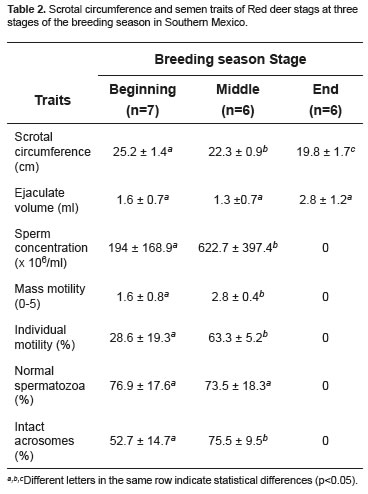
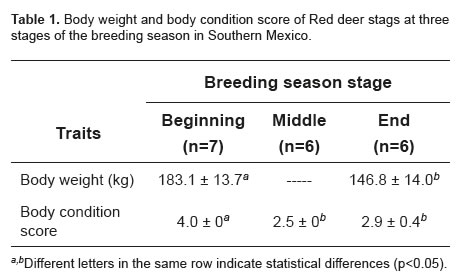
<body><![CDATA[<p><b><font size="3">Results</font></b></p>     <p>   Mean body weight and condition score of stags at   the three stages of the breeding season are shown in     <a href="#t1">table 1</a>. Stags lost 36.3 kg body weight and reduced   1.1 points in body condition score from the beginning   to the end of the breeding season.</p>     <p align="center"><a name="t1"></a><img src="/img/revistas/rccp/v27n2/v27n2a6t1.jpg"></p>     <p>Mean values of scrotal circumference and semen   traits of stags are shown in <a href="#t2">table 2</a>. Scrotal circumference   was reduced 5.4 cm from the beginning to the end of   the breeding season. Even though high semen volumes   were observed at the end of the breeding season,   differences with respect to the other two collection   stages were not significant (p&gt;0.05). Conc, MM, IM   and IAc mean values (collected at the middle of the   breeding season) were higher (p&lt;0.05) than those   obtained at the beginning of the season, but the values   for normal spermatozoa were similar (p&gt;0.05). No   spermatozoa were found at the end of the breeding   season; therefore, statistical comparisons of sperm traits were not made for this stage.</p>     <p align="center"><a name="t2"></a><img src="/img/revistas/rccp/v27n2/v27n2a6t2.jpg"></p>     <p>The overall average pregnancy rate for the five   groups of hinds (each group with a stag) was 86.7%.   Hind pregnancy rates were similar among stags   (p&gt;0.05). The lowest value was for stag number 5 (80%) and the highest for stag number 4 (91.3%). </p>     <p>No association was observed between semen traits and pregnancy rate.</p>     <p>&nbsp;</p>     <p><b><font size="3">Discussion</font></b></p>     <p>   Stags had lost 19% body weight by the conclusion   of the breeding season. This trend in body weight loss   is similar to that reported by Orr (2008), who found   a 30% body weight loss. This loss is related to the   reproductive activity of stags because they stop eating   due to constant activities of courting and breeding   hinds; and also because of constant fights to establish   hierarchy among stags. Orr (2008) mentioned that   weight loss is later recovered during spring and   summer. A decrease in body condition score was also   observed as body condition score depends on body   weight (Orr, 2008).</p>     ]]></body>
<body><![CDATA[<p>Scrotal circumference decreases from the beginning   to the end of the breeding season, a normal phenomenon   in stationary reproductive animals (L&oacute;pez <i>et al.</i>, 1999; Santiago-Moreno <i>et al.</i>, 2005a). Scrotal circumference is commonly increased at the beginning of the breeding season due to activation of the hypothalamichypophyseal gonadal axis which causes androgendependent changes such as increase in testicle size (Clarke <i>et al.</i>, 2001; Malo <i>et al.</i>, 2005; Cassiana <i>et al.</i>, 2009), and changes in seminiferous tubules and ejaculate quality (Hochereau-de-Reviers <i>et al.</i>, 1985; Langford <i>et al.</i>, 1987; Gastel <i>et al.</i>, 1995). However, this cannot be demonstrated in this study because scrotal circumference was not measured at the beginning of the study. The short scrotal circumferences at the end of the breeding season could be due to the stag's testicle regression due to a transition period lasting throughout the nonreproductive season, a normal phenomenon in stationary animals (L&oacute;pez <i>et al.</i>, 1999; Santiago- Moreno <i>et al.</i>, 2005a).</p>     <p>With respect to semen volume, there were no   differences among collection stages during the   breeding season. The mean ejaculate volume was   lower than that observed by Gizejewski (2004),   who reported a mean of 2.4 ml. The difference   could be partially explained because Gizejewski   (2004) collected the semen using an artificial vagina,   while an electroejaculator was used in the present   study. Furthermore, the first watery transparent   fraction was not collected in the present study, and   inadequate response of stags to electro-ejaculator   stimulus cannot be discarded -causing low volume of semen.</p>     <p>A noticeable increase in sperm concentration   was observed from the beginning to the middle   of the breeding season; however, no spermatozoa   were found in the final stage. Sperm concentration   increase was similar to that reported by Gisejewski   (2004), who found lower spermatozoa concentration   at the beginning of the reproductive season (0.2 to   0.45 x 10<sup>6</sup>/mm<sup>3</sup>) compared with the middle stage   (2.62 to 3.18 x 10<sup>6</sup>/mm<sup>3</sup>) for Red deer in the Northern   hemisphere. The explanation for the high concentration   observed at the middle of the season could be that   stags were at their peak reproductive levels at this   time, resulting from adequate functionality of the   hypothalamic-hypophyseal gonadal axis that causes   androgen-dependent structural and functional   changes and better ejaculate quality (Hochereau-de- Reviers <i>et al.</i>, 1985; Langford <i>et al.</i>, 1987; Gastel <i>et al.</i>, 1995). The lack of sperm cells at the end of the season is in accordance with reports by Haigh <i>et al.</i> (1984) and Gisejewski (2004). Some authors mention that the lack of sperm cell signals the end of the breeding season due to a decrease in LH and FSH concentration (Gastel <i>et al.</i>, 1995; Clarke <i>et al.</i>, 2001; Cassiana <i>et al.</i>, 2009).</p>     <p>The highest sperm motility (mass and individual)   was observed at the middle of the breeding season,   which agrees with the results by Gisejewski (2004)   who found 60 and 40% values at the middle and   beginning of the season, respectively. Malo <i>et al.</i>   (2005) reported 62% motility at the middle of the   breeding season. Greater sperm motility is associated   to a larger mitochondrial (Pizzari <i>et al.</i>, 2002) and   endocrine (Santiago-Moreno <i>et al.</i>, 2005b) activity,   with an increase of LH pulses, which favor normal   spermatogenesis and development of the accessory glands (Santiago-Moreno <i>et al.</i>, 2005b).</p>     <p>The lack of difference observed between abnormal   spermatozoa (%) at the beginning and middle of the   breeding season contrast with results by Gisejewski   (2004), who found less than 5% abnormal spermatozoa   at the middle and 10% at the beginning of the season.   Colas (1984) mentioned that periods of sexual   abstinence could decrease ejaculate quality. Abstinence   implies a long storage of spermatozoa, which negatively   affects the percentage of normal spermatozoa. Malo   <i>et al.</i> (2005) observed 77% normal spermatozoa   in Red deer at the middle of the breeding season, similar to the percentage found in this study.</p>     <p>The high percentage of damaged acrosomes   observed at the beginning of the season in comparison   with the middle of it could be explained by the   reestablishment of spermatogenesis as the breeding   season was underway (Colas, 1984; Villarreal, 1999),   which is a normal process observed in stationary   species, such as the Red deer. Intact acrosomes at the   middle of the season was lower than the 90% value   reported by Malo <i>et al.</i> (2005) and 97% reported by   Martinez <i>et al.</i> (2008) for the same period. However,   Malo <i>et al.</i> (2005) used semen obtained from the   epididymis. The decrease of intact acrosomes in   this study could be due to weather conditions; some   studies reported that high environmental temperatures   may increase the percentage of abnormal spermatozoa (Marai <i>et al.</i>, 2008).</p>     <p>It is worth mentioning that ejaculates without   sperm cells were obtained at the end of the season,   indicating that stags entered into a sexual activity   rest period, as reported by Haigh <i>et al.</i> (1984) and   Gizejewski (2004), who also observed ejaculates free   of sperm at the end of the period of sexual activity of Red deer stags.</p>     <p><i>Pregnancy rate</i></p>     <p>No differences between pregnancy rates of the   different groups were observed in the present study.   Correlation of pregnancy rate and semen traits was   not significant. Pregnancy rates (80% to 91%) were   higher than the values found by Gomendio <i>et al.</i>   (2007), who reported 24 to 70% fertility rates using   natural breeding. They were also higher than values   reported by Malo <i>et al.</i> (2005), who reported 20 to   75% pregnancy rates using artificial insemination.   The high pregnancy rate found here could be due to   the long breeding season (September to January),   which allowed more copulation opportunities. Several   researchers mentioned that individual differences   among Red deer stags could contribute to differences   in reproductive performance of hinds (Malo <i>et al.</i>,   2005; Santiago-Moreno <i>et al.</i>, 2006). Some authors   mention a relationship between pregnancy rate   and semen quality (Malo <i>et al.</i>, 2005; Gomendio   <i>et al.</i>, 2007). However, this study does not support   that claim; stags with low semen traits had better pregnancy rates in this study.</p>     <p>In conclusion, there was a clear effect of breeding   season stage on semen traits of Red deer under   tropical conditions, but a lack of relationship between   semen traits and pregnancy rate was also observed.   These results suggest that pregnancy in hinds is the   result of many factors, one of which is semen quality.   However, the ability of stags to seek the hinds with   greater receptivity and reproductive characteristics   was not taken into consideration in this study,   which is a very important aspect for obtaining high pregnancy rates.</p>     ]]></body>
<body><![CDATA[<p>&nbsp;</p> <hr size="1" />     <p><a name="0"></a><a href="#b0">&curren;</a> To cite this article: Hern&aacute;ndez-Souza ME, Ak&eacute;-L&oacute;pez JR, Segura JC, Centuri&oacute;n-Castro F, Ak&eacute;-Villanueva JR, Ticante V. Reproductive evaluation of red deer (<i>Cervus elaphus</i>) stags under tropical conditions. Rev Colomb Cienc Pecu 2014; 27:114-120.</p> <hr size="1" />     <p>&nbsp;</p>     <p>&nbsp;</p>     <p>&nbsp;</p>     <p><font size="3"><b>Acknowledgments</b></font></p>     <p>   The first author thanks to Consejo Nacional de   Ciencia y Tecnolog&iacute;a (CONACYT) for the scholarship   provided for her Master Science studies.</p>     <p>&nbsp;</p>     <p><b><font size="3">References</font></b></p>     <!-- ref --><p>   Audig&eacute; L, Wilson PR, Morris RS. A body condition score system   and its use for farmed red deer hinds. New Zeal J Agr Res 1998;   41:545-553.    &nbsp;&nbsp;&nbsp;&nbsp;&nbsp;&nbsp;&nbsp;&nbsp;[&#160;<a href="javascript:void(0);" onclick="javascript: window.open('/scielo.php?script=sci_nlinks&ref=000082&pid=S0120-0690201400020000600001&lng=','','width=640,height=500,resizable=yes,scrollbars=1,menubar=yes,');">Links</a>&#160;]<!-- end-ref --></p>     <!-- ref --><p>   Cassiana OA, Martinez AC, De-Moraes W, Juvenal JC,   Moreira N. Caracteristicas reprodutivas de veado-boror&oacute;-dosul   ou veado-m&atilde;o-curta (<i>Mazama nana</i>). Pesq Vet Bras 2009;   29:993-998.    &nbsp;&nbsp;&nbsp;&nbsp;&nbsp;&nbsp;&nbsp;&nbsp;[&#160;<a href="javascript:void(0);" onclick="javascript: window.open('/scielo.php?script=sci_nlinks&ref=000084&pid=S0120-0690201400020000600002&lng=','','width=640,height=500,resizable=yes,scrollbars=1,menubar=yes,');">Links</a>&#160;]<!-- end-ref --></p>     <!-- ref --><p>   Clarke FM, Miethe GH, Bennett NC. Reproductive suppression   in female Damaraland molerats <i>Cryptomys damarensis</i>: dominant   control or self-restrain? Proc Royal Soc London. Biological Sci   2001; 268:899-909.    &nbsp;&nbsp;&nbsp;&nbsp;&nbsp;&nbsp;&nbsp;&nbsp;[&#160;<a href="javascript:void(0);" onclick="javascript: window.open('/scielo.php?script=sci_nlinks&ref=000086&pid=S0120-0690201400020000600003&lng=','','width=640,height=500,resizable=yes,scrollbars=1,menubar=yes,');">Links</a>&#160;]<!-- end-ref --></p>     <!-- ref --><p>   Colas G. Semen technology in the ram. In: Courot M editor. The   Male in Farm Animal Reproduction. The Netherlands: Martinus   Nijhoff Press; 1984. p.219-236.    &nbsp;&nbsp;&nbsp;&nbsp;&nbsp;&nbsp;&nbsp;&nbsp;[&#160;<a href="javascript:void(0);" onclick="javascript: window.open('/scielo.php?script=sci_nlinks&ref=000088&pid=S0120-0690201400020000600004&lng=','','width=640,height=500,resizable=yes,scrollbars=1,menubar=yes,');">Links</a>&#160;]<!-- end-ref --></p>     <!-- ref --><p>   Enciclopedia de los Municipios de M&eacute;xico. Tzucacab [En l&iacute;nea].   Instituto Nacional para el Federalismo y Desarrollo Municipal,   Gobierno del Estado de Yucat&aacute;n. 2009. [access date: June 15,   2013]. URL: <a href="http://www.e-local.gob.mx/work/templates/enciclo/EMM31yucatan/index.html" target="_blank">http://www.e-local.gob.mx/work/templates/enciclo/yucatan/</a>&nbsp;&nbsp;&nbsp;&nbsp;&nbsp;&nbsp;&nbsp;&nbsp;[&#160;<a href="javascript:void(0);" onclick="javascript: window.open('/scielo.php?script=sci_nlinks&ref=000090&pid=S0120-0690201400020000600005&lng=','','width=640,height=500,resizable=yes,scrollbars=1,menubar=yes,');">Links</a>&#160;]<!-- end-ref --><!-- ref --><p>   Evans G, Maxwell C. Inseminaci&oacute;n artificial de ovejas y cabras.   Zaragoza: Acribia; 1990. p 95-107.    &nbsp;&nbsp;&nbsp;&nbsp;&nbsp;&nbsp;&nbsp;&nbsp;[&#160;<a href="javascript:void(0);" onclick="javascript: window.open('/scielo.php?script=sci_nlinks&ref=000091&pid=S0120-0690201400020000600006&lng=','','width=640,height=500,resizable=yes,scrollbars=1,menubar=yes,');">Links</a>&#160;]<!-- end-ref --></p>     ]]></body>
<body><![CDATA[<!-- ref --><p>   Gastel T, Bielli A, Perez R, Lopez A, Castrillejo A, Tagle R, Franco   J, Laborde D, Forsberg M, Rodriguez-Martinez H. Seasonal   variations in testicular morphology in Uruguayan Corriedale   rams. Anim Reprod Sci 1995; 40:59-75.    &nbsp;&nbsp;&nbsp;&nbsp;&nbsp;&nbsp;&nbsp;&nbsp;[&#160;<a href="javascript:void(0);" onclick="javascript: window.open('/scielo.php?script=sci_nlinks&ref=000093&pid=S0120-0690201400020000600007&lng=','','width=640,height=500,resizable=yes,scrollbars=1,menubar=yes,');">Links</a>&#160;]<!-- end-ref --></p>     <!-- ref --><p>   Gizejewski Z. Effect of season on characteristics of red deer   (<i>Cervus elaphus</i> L.): Semen collected using modified artificial   vagina. Reprod Biol 2004; 4:51-65.    &nbsp;&nbsp;&nbsp;&nbsp;&nbsp;&nbsp;&nbsp;&nbsp;[&#160;<a href="javascript:void(0);" onclick="javascript: window.open('/scielo.php?script=sci_nlinks&ref=000095&pid=S0120-0690201400020000600008&lng=','','width=640,height=500,resizable=yes,scrollbars=1,menubar=yes,');">Links</a>&#160;]<!-- end-ref --></p>     <!-- ref --><p>   Gomendio M, Malo AF, Garde JJ, Roldan ERS. Sperm traits   and male fertility in natural populations. Reproduction 2007;   134:19-29.    &nbsp;&nbsp;&nbsp;&nbsp;&nbsp;&nbsp;&nbsp;&nbsp;[&#160;<a href="javascript:void(0);" onclick="javascript: window.open('/scielo.php?script=sci_nlinks&ref=000097&pid=S0120-0690201400020000600009&lng=','','width=640,height=500,resizable=yes,scrollbars=1,menubar=yes,');">Links</a>&#160;]<!-- end-ref --></p>     <!-- ref --><p>   Gonz&aacute;lez AO, Torres ME. Ciervo Colorado [En l&iacute;nea]. Sitio   Argentino de Producci&oacute;n Animal: Producci&oacute;n de Ciervos. 1998.   [access date: June 1, 2009]. URL: <a href="http://www.produccion-animal.com.ar/" target="_blank">www.producci&oacute;n-animal.com.ar</a>&nbsp;&nbsp;&nbsp;&nbsp;&nbsp;&nbsp;&nbsp;&nbsp;[&#160;<a href="javascript:void(0);" onclick="javascript: window.open('/scielo.php?script=sci_nlinks&ref=000099&pid=S0120-0690201400020000600010&lng=','','width=640,height=500,resizable=yes,scrollbars=1,menubar=yes,');">Links</a>&#160;]<!-- end-ref --><!-- ref --><p>   Haigh JC, Cates WF, Glover GJ, Rawlings NC. Relationship   between seasonal changes in serum testosterone concentrations,   scrotal circumference and sperm morphology of male wapiti   (<i>Cervus elaphus</i>). J Reprod Fert 1984; 70:413-418.    &nbsp;&nbsp;&nbsp;&nbsp;&nbsp;&nbsp;&nbsp;&nbsp;[&#160;<a href="javascript:void(0);" onclick="javascript: window.open('/scielo.php?script=sci_nlinks&ref=000100&pid=S0120-0690201400020000600011&lng=','','width=640,height=500,resizable=yes,scrollbars=1,menubar=yes,');">Links</a>&#160;]<!-- end-ref --></p>     <!-- ref --><p>   Hochereau-de-Reviers MT, Perreau C, Lincoln GA. Photoperiodic   variations of somatic and germ cell populations in the Soay ram   testis. J Reprod Fert 1985; 74:329-334.    &nbsp;&nbsp;&nbsp;&nbsp;&nbsp;&nbsp;&nbsp;&nbsp;[&#160;<a href="javascript:void(0);" onclick="javascript: window.open('/scielo.php?script=sci_nlinks&ref=000102&pid=S0120-0690201400020000600012&lng=','','width=640,height=500,resizable=yes,scrollbars=1,menubar=yes,');">Links</a>&#160;]<!-- end-ref --></p>     <!-- ref --><p>   Langford GA, Ainsworth L, Marcos GJ, Shrestha JNB.   Photoperiod entrainment of testosterone, luteinizing hormone,   folliclestimulating hormone, and prolactin cycles in rams in   relation to testis size and semen quality. Biol Reprod 1987;   37:489-499.    &nbsp;&nbsp;&nbsp;&nbsp;&nbsp;&nbsp;&nbsp;&nbsp;[&#160;<a href="javascript:void(0);" onclick="javascript: window.open('/scielo.php?script=sci_nlinks&ref=000104&pid=S0120-0690201400020000600013&lng=','','width=640,height=500,resizable=yes,scrollbars=1,menubar=yes,');">Links</a>&#160;]<!-- end-ref --></p>     <!-- ref --><p>   L&oacute;pez SA, Soler AJ, Garc&iacute;a AJ, Gallego L, Garde JJ. Influencia   de los factores ambientales sobre el tama&ntilde;o testicular, l&iacute;bido y   caracter&iacute;sticas seminales del mufl&oacute;n (<i>Ovis gmelini musimon</i>) a lo   largo del a&ntilde;o. Producci&oacute;n Ovina y Caprina XXIV. Sociedad Espa&ntilde;ola   de Ovinotecnia y Caprinotecnia (SEOC); 1999. p. 181-185.    &nbsp;&nbsp;&nbsp;&nbsp;&nbsp;&nbsp;&nbsp;&nbsp;[&#160;<a href="javascript:void(0);" onclick="javascript: window.open('/scielo.php?script=sci_nlinks&ref=000106&pid=S0120-0690201400020000600014&lng=','','width=640,height=500,resizable=yes,scrollbars=1,menubar=yes,');">Links</a>&#160;]<!-- end-ref --></p>     <!-- ref --><p>   Malo AF, Garde J, Soler AJ, Garc&iacute;a AJ, Gomendio M, Roldan   ERS. Male fertility in natural populations of red deer is determined   by sperm velocity and the proportion of normal spermatozoa. Biol   Reprod 2005; 72:822-829.    &nbsp;&nbsp;&nbsp;&nbsp;&nbsp;&nbsp;&nbsp;&nbsp;[&#160;<a href="javascript:void(0);" onclick="javascript: window.open('/scielo.php?script=sci_nlinks&ref=000108&pid=S0120-0690201400020000600015&lng=','','width=640,height=500,resizable=yes,scrollbars=1,menubar=yes,');">Links</a>&#160;]<!-- end-ref --></p>     <!-- ref --><p>   Marai IFM, El-Darawany AA, Fadiel A, Abdel-Hafez MAM.   Reproductive performance traits as affected by heat stress and its   alleviation in sheep. Trop Subtrop Agroecosyst 2008; 8:209-234.    &nbsp;&nbsp;&nbsp;&nbsp;&nbsp;&nbsp;&nbsp;&nbsp;[&#160;<a href="javascript:void(0);" onclick="javascript: window.open('/scielo.php?script=sci_nlinks&ref=000110&pid=S0120-0690201400020000600016&lng=','','width=640,height=500,resizable=yes,scrollbars=1,menubar=yes,');">Links</a>&#160;]<!-- end-ref --></p>     <!-- ref --><p>   Orr M. Deer Farming on Small Farms - Part Two. 2008. [access date:   October 15, 2009]. URL: <a href="http://www.lifestyleblock.co.nz/lifestyle-file/livestock-a-pets/other-species/item/415-deer-farming-on-small-farms-part-two.html" target="_blank">http://www.lifestyleblock.co.nz/otherspecies/article/415-deer-farming-on-small-farms-part-two.html</a>  &nbsp;&nbsp;&nbsp;&nbsp;&nbsp;&nbsp;&nbsp;&nbsp;[&#160;<a href="javascript:void(0);" onclick="javascript: window.open('/scielo.php?script=sci_nlinks&ref=000112&pid=S0120-0690201400020000600017&lng=','','width=640,height=500,resizable=yes,scrollbars=1,menubar=yes,');">Links</a>&#160;]<!-- end-ref --><!-- ref --><p>Pizzari T, Froman DP, Birhead TR. Pre- and post-insemination   episodes of sexual selection in the fowl, Gallus g. domesticus.   Heredity 2003; 88:112-116.    &nbsp;&nbsp;&nbsp;&nbsp;&nbsp;&nbsp;&nbsp;&nbsp;[&#160;<a href="javascript:void(0);" onclick="javascript: window.open('/scielo.php?script=sci_nlinks&ref=000113&pid=S0120-0690201400020000600018&lng=','','width=640,height=500,resizable=yes,scrollbars=1,menubar=yes,');">Links</a>&#160;]<!-- end-ref --></p>     <!-- ref --><p>   Santiago-Moreno J, G&oacute;mez-Brunet A, Toledano-D&iacute;az A,   Gonz&aacute;lez-Bulnes A, L&oacute;pez-Sebasti&aacute;n A. Influence of age on   the relationship between annual changes in horn growth rate   and prolactin secretion in the European mouflon (<i>Ovis gmelini   musimon</i>). Anim Reprod Sci 2005a; 85:251-261.    &nbsp;&nbsp;&nbsp;&nbsp;&nbsp;&nbsp;&nbsp;&nbsp;[&#160;<a href="javascript:void(0);" onclick="javascript: window.open('/scielo.php?script=sci_nlinks&ref=000115&pid=S0120-0690201400020000600019&lng=','','width=640,height=500,resizable=yes,scrollbars=1,menubar=yes,');">Links</a>&#160;]<!-- end-ref --></p>     <!-- ref --><p>   Santiago-Moreno J, G&oacute;mez-Brunet A, Gonz&aacute;lez-Bulnes A, Toledano-   D&iacute;az A, Malpaux B, L&oacute;pez-Sebasti&aacute;n A. Differences in reproductive   pattern between wild and domestic rams are not associated with   inter-specific annual variations in plasma prolactin and melatonin   concentrations. Domest Anim Endocrinol 2005b; 28:416-429.    &nbsp;&nbsp;&nbsp;&nbsp;&nbsp;&nbsp;&nbsp;&nbsp;[&#160;<a href="javascript:void(0);" onclick="javascript: window.open('/scielo.php?script=sci_nlinks&ref=000117&pid=S0120-0690201400020000600020&lng=','','width=640,height=500,resizable=yes,scrollbars=1,menubar=yes,');">Links</a>&#160;]<!-- end-ref --></p>     <!-- ref --><p>   Santiago-Moreno J, G&oacute;mez-Brunet A, Toledano-D&iacute;az A, Picazo   R, Gonzalez-Bulnes A, L&oacute;pez-Sebasti&aacute;n A. Seasonal endocrine   changes and breeding activity in Mediterranean wild ruminants.   Reprod Domest Anim 2006; 41:72-81.    &nbsp;&nbsp;&nbsp;&nbsp;&nbsp;&nbsp;&nbsp;&nbsp;[&#160;<a href="javascript:void(0);" onclick="javascript: window.open('/scielo.php?script=sci_nlinks&ref=000119&pid=S0120-0690201400020000600021&lng=','','width=640,height=500,resizable=yes,scrollbars=1,menubar=yes,');">Links</a>&#160;]<!-- end-ref --></p>     <!-- ref --><p>   Silva PFN, Gadella BM. Detection of damage in mammalian   sperm cells. Theriogenology 2006; 65:958-978.    &nbsp;&nbsp;&nbsp;&nbsp;&nbsp;&nbsp;&nbsp;&nbsp;[&#160;<a href="javascript:void(0);" onclick="javascript: window.open('/scielo.php?script=sci_nlinks&ref=000121&pid=S0120-0690201400020000600022&lng=','','width=640,height=500,resizable=yes,scrollbars=1,menubar=yes,');">Links</a>&#160;]<!-- end-ref --></p>     ]]></body>
<body><![CDATA[<!-- ref --><p>   Soler JP, Cseh SB. Suplementaci&oacute;n estrat&eacute;gica en ciervos   colorados (<i>Cervus elaphus</i>) para mejorar la producci&oacute;n de asta   dura. Vet Arg 2009; 26:257.    &nbsp;&nbsp;&nbsp;&nbsp;&nbsp;&nbsp;&nbsp;&nbsp;[&#160;<a href="javascript:void(0);" onclick="javascript: window.open('/scielo.php?script=sci_nlinks&ref=000123&pid=S0120-0690201400020000600023&lng=','','width=640,height=500,resizable=yes,scrollbars=1,menubar=yes,');">Links</a>&#160;]<!-- end-ref --></p>     <!-- ref --><p>   Villarreal J. Venado Cola Blanca: Manejo y Aprovechamiento   Cineg&eacute;tico. Uni&oacute;n Ganadera de Nuevo Le&oacute;n. Monterrey, Nuevo   Le&oacute;n, M&eacute;xico; 1999. p. 401-405.    &nbsp;&nbsp;&nbsp;&nbsp;&nbsp;&nbsp;&nbsp;&nbsp;[&#160;<a href="javascript:void(0);" onclick="javascript: window.open('/scielo.php?script=sci_nlinks&ref=000125&pid=S0120-0690201400020000600024&lng=','','width=640,height=500,resizable=yes,scrollbars=1,menubar=yes,');">Links</a>&#160;]<!-- end-ref --></p>     <p>&nbsp;</p>     <p>&nbsp;</p> </font>      ]]></body><back>
<ref-list>
<ref id="B1">
<nlm-citation citation-type="journal">
<person-group person-group-type="author">
<name>
<surname><![CDATA[Audigé]]></surname>
<given-names><![CDATA[L]]></given-names>
</name>
<name>
<surname><![CDATA[Wilson]]></surname>
<given-names><![CDATA[PR]]></given-names>
</name>
<name>
<surname><![CDATA[Morris]]></surname>
<given-names><![CDATA[RS]]></given-names>
</name>
</person-group>
<article-title xml:lang="en"><![CDATA[A body condition score system and its use for farmed red deer hinds]]></article-title>
<source><![CDATA[New Zeal J Agr Res]]></source>
<year>1998</year>
<volume>41</volume>
<page-range>545-553</page-range></nlm-citation>
</ref>
<ref id="B2">
<nlm-citation citation-type="journal">
<person-group person-group-type="author">
<name>
<surname><![CDATA[Cassiana]]></surname>
<given-names><![CDATA[OA]]></given-names>
</name>
<name>
<surname><![CDATA[Martinez]]></surname>
<given-names><![CDATA[AC]]></given-names>
</name>
<name>
<surname><![CDATA[De-Moraes]]></surname>
<given-names><![CDATA[W]]></given-names>
</name>
<name>
<surname><![CDATA[Juvenal]]></surname>
<given-names><![CDATA[JC]]></given-names>
</name>
<name>
<surname><![CDATA[Moreira]]></surname>
<given-names><![CDATA[N]]></given-names>
</name>
</person-group>
<article-title xml:lang="pt"><![CDATA[Caracteristicas reprodutivas de veado-bororó-dosul ou veado-mão-curta (Mazama nana)]]></article-title>
<source><![CDATA[Pesq Vet Bras]]></source>
<year>2009</year>
<volume>29</volume>
<page-range>993-998</page-range></nlm-citation>
</ref>
<ref id="B3">
<nlm-citation citation-type="journal">
<person-group person-group-type="author">
<name>
<surname><![CDATA[Clarke]]></surname>
<given-names><![CDATA[FM]]></given-names>
</name>
<name>
<surname><![CDATA[Miethe]]></surname>
<given-names><![CDATA[GH]]></given-names>
</name>
<name>
<surname><![CDATA[Bennett]]></surname>
<given-names><![CDATA[NC]]></given-names>
</name>
</person-group>
<article-title xml:lang="en"><![CDATA[Reproductive suppression in female Damaraland molerats Cryptomys damarensis: dominant control or self-restrain?]]></article-title>
<source><![CDATA[Proc Royal Soc London]]></source>
<year>Biol</year>
<month>og</month>
<day>ic</day>
<volume>268</volume>
<page-range>899-909</page-range></nlm-citation>
</ref>
<ref id="B4">
<nlm-citation citation-type="book">
<person-group person-group-type="author">
<name>
<surname><![CDATA[Colas]]></surname>
<given-names><![CDATA[G]]></given-names>
</name>
</person-group>
<article-title xml:lang="en"><![CDATA[Semen technology in the ram]]></article-title>
<person-group person-group-type="editor">
<name>
<surname><![CDATA[Courot]]></surname>
<given-names><![CDATA[M]]></given-names>
</name>
</person-group>
<source><![CDATA[The Male in Farm Animal Reproduction]]></source>
<year>1984</year>
<page-range>219-236</page-range><publisher-loc><![CDATA[The Netherlands ]]></publisher-loc>
<publisher-name><![CDATA[Martinus Nijhoff Press]]></publisher-name>
</nlm-citation>
</ref>
<ref id="B5">
<nlm-citation citation-type="book">
<collab>Enciclopedia de los Municipios de México. Tzucacab</collab>
<source><![CDATA[]]></source>
<year>2009</year>
<publisher-name><![CDATA[Instituto Nacional para el Federalismo y Desarrollo Municipal, Gobierno del Estado de Yucatán]]></publisher-name>
</nlm-citation>
</ref>
<ref id="B6">
<nlm-citation citation-type="book">
<person-group person-group-type="author">
<name>
<surname><![CDATA[Evans]]></surname>
<given-names><![CDATA[G]]></given-names>
</name>
<name>
<surname><![CDATA[Maxwell]]></surname>
<given-names><![CDATA[C]]></given-names>
</name>
</person-group>
<source><![CDATA[Inseminación artificial de ovejas y cabras]]></source>
<year>1990</year>
<page-range>95-107</page-range><publisher-loc><![CDATA[Zaragoza ]]></publisher-loc>
<publisher-name><![CDATA[Acribia]]></publisher-name>
</nlm-citation>
</ref>
<ref id="B7">
<nlm-citation citation-type="journal">
<person-group person-group-type="author">
<name>
<surname><![CDATA[Gastel]]></surname>
<given-names><![CDATA[T]]></given-names>
</name>
<name>
<surname><![CDATA[Bielli]]></surname>
<given-names><![CDATA[A]]></given-names>
</name>
<name>
<surname><![CDATA[Perez]]></surname>
<given-names><![CDATA[R]]></given-names>
</name>
<name>
<surname><![CDATA[Lopez]]></surname>
<given-names><![CDATA[A]]></given-names>
</name>
<name>
<surname><![CDATA[Castrillejo]]></surname>
<given-names><![CDATA[A]]></given-names>
</name>
<name>
<surname><![CDATA[Tagle]]></surname>
<given-names><![CDATA[R]]></given-names>
</name>
<name>
<surname><![CDATA[Franco]]></surname>
<given-names><![CDATA[J]]></given-names>
</name>
<name>
<surname><![CDATA[Laborde]]></surname>
<given-names><![CDATA[D]]></given-names>
</name>
<name>
<surname><![CDATA[Forsberg]]></surname>
<given-names><![CDATA[M]]></given-names>
</name>
<name>
<surname><![CDATA[Rodriguez-Martinez]]></surname>
<given-names><![CDATA[H]]></given-names>
</name>
</person-group>
<article-title xml:lang="en"><![CDATA[Seasonal variations in testicular morphology in Uruguayan Corriedale rams]]></article-title>
<source><![CDATA[Anim Reprod Sci]]></source>
<year>1995</year>
<volume>40</volume>
<page-range>59-75</page-range></nlm-citation>
</ref>
<ref id="B8">
<nlm-citation citation-type="journal">
<person-group person-group-type="author">
<name>
<surname><![CDATA[Gizejewski]]></surname>
<given-names><![CDATA[Z]]></given-names>
</name>
</person-group>
<article-title xml:lang="en"><![CDATA[Effect of season on characteristics of red deer (Cervus elaphus L.): Semen collected using modified artificial vagina]]></article-title>
<source><![CDATA[Reprod Biol]]></source>
<year>2004</year>
<volume>4</volume>
<page-range>51-65</page-range></nlm-citation>
</ref>
<ref id="B9">
<nlm-citation citation-type="journal">
<person-group person-group-type="author">
<name>
<surname><![CDATA[Gomendio]]></surname>
<given-names><![CDATA[M]]></given-names>
</name>
<name>
<surname><![CDATA[Malo]]></surname>
<given-names><![CDATA[AF]]></given-names>
</name>
<name>
<surname><![CDATA[Garde]]></surname>
<given-names><![CDATA[JJ]]></given-names>
</name>
<name>
<surname><![CDATA[Roldan]]></surname>
<given-names><![CDATA[ERS]]></given-names>
</name>
</person-group>
<article-title xml:lang="en"><![CDATA[Sperm traits and male fertility in natural populations]]></article-title>
<source><![CDATA[Reproduction]]></source>
<year>2007</year>
<volume>134</volume>
<page-range>19-29</page-range></nlm-citation>
</ref>
<ref id="B10">
<nlm-citation citation-type="book">
<person-group person-group-type="author">
<name>
<surname><![CDATA[González]]></surname>
<given-names><![CDATA[AO]]></given-names>
</name>
<name>
<surname><![CDATA[Torres]]></surname>
<given-names><![CDATA[ME]]></given-names>
</name>
</person-group>
<source><![CDATA[Ciervo Colorado]]></source>
<year>1998</year>
<publisher-name><![CDATA[Sitio Argentino de Producción Animal: Producción de Ciervos]]></publisher-name>
</nlm-citation>
</ref>
<ref id="B11">
<nlm-citation citation-type="journal">
<person-group person-group-type="author">
<name>
<surname><![CDATA[Haigh]]></surname>
<given-names><![CDATA[JC]]></given-names>
</name>
<name>
<surname><![CDATA[Cates]]></surname>
<given-names><![CDATA[WF]]></given-names>
</name>
<name>
<surname><![CDATA[Glover]]></surname>
<given-names><![CDATA[GJ]]></given-names>
</name>
<name>
<surname><![CDATA[Rawlings]]></surname>
<given-names><![CDATA[NC]]></given-names>
</name>
</person-group>
<article-title xml:lang="en"><![CDATA[Relationship between seasonal changes in serum testosterone concentrations, scrotal circumference and sperm morphology of male wapiti (Cervus elaphus)]]></article-title>
<source><![CDATA[J Reprod Fert]]></source>
<year>1984</year>
<volume>70</volume>
<page-range>413-418</page-range></nlm-citation>
</ref>
<ref id="B12">
<nlm-citation citation-type="journal">
<person-group person-group-type="author">
<name>
<surname><![CDATA[Hochereau-de-Reviers]]></surname>
<given-names><![CDATA[MT]]></given-names>
</name>
<name>
<surname><![CDATA[Perreau]]></surname>
<given-names><![CDATA[C]]></given-names>
</name>
<name>
<surname><![CDATA[Lincoln]]></surname>
<given-names><![CDATA[GA]]></given-names>
</name>
</person-group>
<article-title xml:lang="en"><![CDATA[Photoperiodic variations of somatic and germ cell populations in the Soay ram testis]]></article-title>
<source><![CDATA[J Reprod Fert]]></source>
<year>1985</year>
<volume>74</volume>
<page-range>329-334</page-range></nlm-citation>
</ref>
<ref id="B13">
<nlm-citation citation-type="journal">
<person-group person-group-type="author">
<name>
<surname><![CDATA[Langford]]></surname>
<given-names><![CDATA[GA]]></given-names>
</name>
<name>
<surname><![CDATA[Ainsworth]]></surname>
<given-names><![CDATA[L]]></given-names>
</name>
<name>
<surname><![CDATA[Marcos]]></surname>
<given-names><![CDATA[GJ]]></given-names>
</name>
<name>
<surname><![CDATA[Shrestha]]></surname>
<given-names><![CDATA[JNB]]></given-names>
</name>
</person-group>
<article-title xml:lang="en"><![CDATA[Photoperiod entrainment of testosterone, luteinizing hormone, folliclestimulating hormone, and prolactin cycles in rams in relation to testis size and semen quality]]></article-title>
<source><![CDATA[Biol Reprod]]></source>
<year>1987</year>
<volume>37</volume>
<page-range>489-499</page-range></nlm-citation>
</ref>
<ref id="B14">
<nlm-citation citation-type="book">
<person-group person-group-type="author">
<name>
<surname><![CDATA[López]]></surname>
<given-names><![CDATA[SA]]></given-names>
</name>
<name>
<surname><![CDATA[Soler]]></surname>
<given-names><![CDATA[AJ]]></given-names>
</name>
<name>
<surname><![CDATA[García]]></surname>
<given-names><![CDATA[AJ]]></given-names>
</name>
<name>
<surname><![CDATA[Gallego]]></surname>
<given-names><![CDATA[L]]></given-names>
</name>
<name>
<surname><![CDATA[Garde]]></surname>
<given-names><![CDATA[JJ]]></given-names>
</name>
</person-group>
<source><![CDATA[Influencia de los factores ambientales sobre el tamaño testicular, líbido y características seminales del muflón (Ovis gmelini musimon) a lo largo del año]]></source>
<year>1999</year>
<page-range>181-185</page-range><publisher-name><![CDATA[Producción Ovina y Caprina XXIV. Sociedad Española de Ovinotecnia y Caprinotecnia (SEOC)]]></publisher-name>
</nlm-citation>
</ref>
<ref id="B15">
<nlm-citation citation-type="journal">
<person-group person-group-type="author">
<name>
<surname><![CDATA[Malo]]></surname>
<given-names><![CDATA[AF]]></given-names>
</name>
<name>
<surname><![CDATA[Garde]]></surname>
<given-names><![CDATA[J]]></given-names>
</name>
<name>
<surname><![CDATA[Soler]]></surname>
<given-names><![CDATA[AJ]]></given-names>
</name>
<name>
<surname><![CDATA[García]]></surname>
<given-names><![CDATA[AJ]]></given-names>
</name>
<name>
<surname><![CDATA[Gomendio]]></surname>
<given-names><![CDATA[M]]></given-names>
</name>
<name>
<surname><![CDATA[Roldan]]></surname>
<given-names><![CDATA[ERS]]></given-names>
</name>
</person-group>
<article-title xml:lang="en"><![CDATA[Male fertility in natural populations of red deer is determined by sperm velocity and the proportion of normal spermatozoa]]></article-title>
<source><![CDATA[Biol Reprod]]></source>
<year>2005</year>
<volume>72</volume>
<page-range>822-829</page-range></nlm-citation>
</ref>
<ref id="B16">
<nlm-citation citation-type="journal">
<person-group person-group-type="author">
<name>
<surname><![CDATA[Marai]]></surname>
<given-names><![CDATA[IFM]]></given-names>
</name>
<name>
<surname><![CDATA[El-Darawany]]></surname>
<given-names><![CDATA[AA]]></given-names>
</name>
<name>
<surname><![CDATA[Fadiel]]></surname>
<given-names><![CDATA[A]]></given-names>
</name>
<name>
<surname><![CDATA[Abdel-Hafez]]></surname>
<given-names><![CDATA[MAM]]></given-names>
</name>
</person-group>
<article-title xml:lang="en"><![CDATA[Reproductive performance traits as affected by heat stress and its alleviation in sheep]]></article-title>
<source><![CDATA[Trop Subtrop Agroecosyst]]></source>
<year>2008</year>
<volume>8</volume>
<page-range>209-234</page-range></nlm-citation>
</ref>
<ref id="B17">
<nlm-citation citation-type="">
<person-group person-group-type="author">
<name>
<surname><![CDATA[Orr]]></surname>
<given-names><![CDATA[M]]></given-names>
</name>
</person-group>
<source><![CDATA[Deer Farming on Small Farms - Part Two]]></source>
<year>2008</year>
</nlm-citation>
</ref>
<ref id="B18">
<nlm-citation citation-type="journal">
<person-group person-group-type="author">
<name>
<surname><![CDATA[Pizzari]]></surname>
<given-names><![CDATA[T]]></given-names>
</name>
<name>
<surname><![CDATA[Froman]]></surname>
<given-names><![CDATA[DP]]></given-names>
</name>
<name>
<surname><![CDATA[Birhead]]></surname>
<given-names><![CDATA[TR]]></given-names>
</name>
</person-group>
<article-title xml:lang="en"><![CDATA[Pre- and post-insemination episodes of sexual selection in the fowl, Gallus g. domesticus]]></article-title>
<source><![CDATA[Heredity]]></source>
<year>2003</year>
<volume>88</volume>
<page-range>112-116</page-range></nlm-citation>
</ref>
<ref id="B19">
<nlm-citation citation-type="journal">
<person-group person-group-type="author">
<name>
<surname><![CDATA[Santiago-Moreno]]></surname>
<given-names><![CDATA[J]]></given-names>
</name>
<name>
<surname><![CDATA[Gómez-Brunet]]></surname>
<given-names><![CDATA[A]]></given-names>
</name>
<name>
<surname><![CDATA[Toledano-Díaz]]></surname>
<given-names><![CDATA[A]]></given-names>
</name>
<name>
<surname><![CDATA[González-Bulnes]]></surname>
<given-names><![CDATA[A]]></given-names>
</name>
<name>
<surname><![CDATA[López-Sebastián]]></surname>
<given-names><![CDATA[A]]></given-names>
</name>
</person-group>
<article-title xml:lang="en"><![CDATA[Influence of age on the relationship between annual changes in horn growth rate and prolactin secretion in the European mouflon (Ovis gmelini musimon)]]></article-title>
<source><![CDATA[Anim Reprod Sci]]></source>
<year>2005</year>
<month>a</month>
<volume>85</volume>
<page-range>251-261</page-range></nlm-citation>
</ref>
<ref id="B20">
<nlm-citation citation-type="journal">
<person-group person-group-type="author">
<name>
<surname><![CDATA[Santiago-Moreno]]></surname>
<given-names><![CDATA[J]]></given-names>
</name>
<name>
<surname><![CDATA[Gómez-Brunet]]></surname>
<given-names><![CDATA[A]]></given-names>
</name>
<name>
<surname><![CDATA[González-Bulnes]]></surname>
<given-names><![CDATA[A]]></given-names>
</name>
<name>
<surname><![CDATA[Toledano-]]></surname>
<given-names><![CDATA[Díaz A]]></given-names>
</name>
<name>
<surname><![CDATA[Malpaux]]></surname>
<given-names><![CDATA[B]]></given-names>
</name>
<name>
<surname><![CDATA[López-Sebastián]]></surname>
<given-names><![CDATA[A]]></given-names>
</name>
</person-group>
<article-title xml:lang="en"><![CDATA[Differences in reproductive pattern between wild and domestic rams are not associated with inter-specific annual variations in plasma prolactin and melatonin concentrations]]></article-title>
<source><![CDATA[Domest Anim Endocrinol]]></source>
<year>2005</year>
<month>b</month>
<volume>28</volume>
<page-range>416-429</page-range></nlm-citation>
</ref>
<ref id="B21">
<nlm-citation citation-type="journal">
<person-group person-group-type="author">
<name>
<surname><![CDATA[Santiago-Moreno]]></surname>
<given-names><![CDATA[J]]></given-names>
</name>
<name>
<surname><![CDATA[Gómez-Brunet]]></surname>
<given-names><![CDATA[A]]></given-names>
</name>
<name>
<surname><![CDATA[Toledano-Díaz]]></surname>
<given-names><![CDATA[A]]></given-names>
</name>
<name>
<surname><![CDATA[Picazo]]></surname>
<given-names><![CDATA[R]]></given-names>
</name>
<name>
<surname><![CDATA[Gonzalez-Bulnes]]></surname>
<given-names><![CDATA[A]]></given-names>
</name>
<name>
<surname><![CDATA[López-Sebastián]]></surname>
<given-names><![CDATA[A]]></given-names>
</name>
</person-group>
<article-title xml:lang="en"><![CDATA[Seasonal endocrine changes and breeding activity in Mediterranean wild ruminants]]></article-title>
<source><![CDATA[Reprod Domest Anim]]></source>
<year>2006</year>
<volume>41</volume>
<page-range>72-81</page-range></nlm-citation>
</ref>
<ref id="B22">
<nlm-citation citation-type="journal">
<person-group person-group-type="author">
<name>
<surname><![CDATA[Silva]]></surname>
<given-names><![CDATA[PFN]]></given-names>
</name>
<name>
<surname><![CDATA[Gadella]]></surname>
<given-names><![CDATA[BM]]></given-names>
</name>
</person-group>
<article-title xml:lang="en"><![CDATA[Detection of damage in mammalian sperm cells]]></article-title>
<source><![CDATA[Theriogenology]]></source>
<year>2006</year>
<volume>65</volume>
<page-range>958-978</page-range></nlm-citation>
</ref>
<ref id="B23">
<nlm-citation citation-type="journal">
<person-group person-group-type="author">
<name>
<surname><![CDATA[Soler]]></surname>
<given-names><![CDATA[JP]]></given-names>
</name>
<name>
<surname><![CDATA[Cseh]]></surname>
<given-names><![CDATA[SB]]></given-names>
</name>
</person-group>
<article-title xml:lang="en"><![CDATA[Suplementación estratégica en ciervos colorados (Cervus elaphus) para mejorar la producción de asta dura]]></article-title>
<source><![CDATA[Vet Arg]]></source>
<year>2009</year>
<volume>26</volume>
<page-range>257</page-range></nlm-citation>
</ref>
<ref id="B24">
<nlm-citation citation-type="book">
<person-group person-group-type="author">
<name>
<surname><![CDATA[Villarreal]]></surname>
<given-names><![CDATA[J]]></given-names>
</name>
</person-group>
<source><![CDATA[Venado Cola Blanca: Manejo y Aprovechamiento Cinegético]]></source>
<year>1999</year>
<page-range>401-405</page-range><publisher-loc><![CDATA[Monterrey^eNuevo León Nuevo León]]></publisher-loc>
<publisher-name><![CDATA[Unión Ganadera de Nuevo León]]></publisher-name>
</nlm-citation>
</ref>
</ref-list>
</back>
</article>