<?xml version="1.0" encoding="ISO-8859-1"?><article xmlns:mml="http://www.w3.org/1998/Math/MathML" xmlns:xlink="http://www.w3.org/1999/xlink" xmlns:xsi="http://www.w3.org/2001/XMLSchema-instance">
<front>
<journal-meta>
<journal-id>0120-0690</journal-id>
<journal-title><![CDATA[Revista Colombiana de Ciencias Pecuarias]]></journal-title>
<abbrev-journal-title><![CDATA[Rev Colom Cienc Pecua]]></abbrev-journal-title>
<issn>0120-0690</issn>
<publisher>
<publisher-name><![CDATA[Facultad de Ciencias Agrarias, Universidad de Antioquia]]></publisher-name>
</publisher>
</journal-meta>
<article-meta>
<article-id>S0120-06902014000200008</article-id>
<title-group>
<article-title xml:lang="en"><![CDATA[Annual breeding soundness evaluation of rams]]></article-title>
<article-title xml:lang="es"><![CDATA[Evaluación anual de la salud reproductiva en carneros]]></article-title>
<article-title xml:lang="pt"><![CDATA[Avaliação anual da saúde reprodutiva nos carneiros]]></article-title>
</title-group>
<contrib-group>
<contrib contrib-type="author">
<name>
<surname><![CDATA[Oliveira Menegassi]]></surname>
<given-names><![CDATA[Silvio R]]></given-names>
</name>
<xref ref-type="aff" rid="A01"/>
<xref ref-type="aff" rid="A02"/>
<xref ref-type="aff" rid="A03"/>
</contrib>
<contrib contrib-type="author">
<name>
<surname><![CDATA[Jardim Barcellos]]></surname>
<given-names><![CDATA[Júlio O]]></given-names>
</name>
<xref ref-type="aff" rid="A01"/>
<xref ref-type="aff" rid="A03"/>
</contrib>
<contrib contrib-type="author">
<name>
<surname><![CDATA[Koetz Júnior]]></surname>
<given-names><![CDATA[Celso]]></given-names>
</name>
<xref ref-type="aff" rid="A04"/>
</contrib>
<contrib contrib-type="author">
<name>
<surname><![CDATA[Peripolli]]></surname>
<given-names><![CDATA[Vanessa]]></given-names>
</name>
<xref ref-type="aff" rid="A02"/>
<xref ref-type="aff" rid="A03"/>
</contrib>
<contrib contrib-type="author">
<name>
<surname><![CDATA[Andrighetto Canozzi]]></surname>
<given-names><![CDATA[Maria E]]></given-names>
</name>
<xref ref-type="aff" rid="A02"/>
<xref ref-type="aff" rid="A03"/>
</contrib>
<contrib contrib-type="author">
<name>
<surname><![CDATA[McManus]]></surname>
<given-names><![CDATA[Concepta]]></given-names>
</name>
<xref ref-type="aff" rid="A02"/>
<xref ref-type="aff" rid="A03"/>
</contrib>
<contrib contrib-type="author">
<name>
<surname><![CDATA[Guiselli Lopes]]></surname>
<given-names><![CDATA[Flávio]]></given-names>
</name>
<xref ref-type="aff" rid="A04"/>
</contrib>
</contrib-group>
<aff id="A01">
<institution><![CDATA[,Universidade Federal do Rio Grande do Sul (UFRGS) Departamento de Zootecnia ]]></institution>
<addr-line><![CDATA[Porto Alegre RS]]></addr-line>
<country>Brasil</country>
</aff>
<aff id="A02">
<institution><![CDATA[,Universidade Federal do Rio Grande do Sul (UFRGS) Departamento de Zootecnia ]]></institution>
<addr-line><![CDATA[Porto Alegre RS]]></addr-line>
<country>Brasil</country>
</aff>
<aff id="A03">
<institution><![CDATA[,Universidade Federal do Rio Grande do Sul (UFRGS) Departamento de Zootecnia ]]></institution>
<addr-line><![CDATA[Porto Alegre Rio Grande do Sul]]></addr-line>
<country>Brasil</country>
</aff>
<aff id="A04">
<institution><![CDATA[,Universidade Norte do Paraná (UNOPAR) Faculdade de Medicina Veterinária ]]></institution>
<addr-line><![CDATA[Arapongas Paraná]]></addr-line>
<country>Brasil</country>
</aff>
<pub-date pub-type="pub">
<day>00</day>
<month>06</month>
<year>2014</year>
</pub-date>
<pub-date pub-type="epub">
<day>00</day>
<month>06</month>
<year>2014</year>
</pub-date>
<volume>27</volume>
<numero>2</numero>
<fpage>133</fpage>
<lpage>137</lpage>
<copyright-statement/>
<copyright-year/>
<self-uri xlink:href="http://www.scielo.org.co/scielo.php?script=sci_arttext&amp;pid=S0120-06902014000200008&amp;lng=en&amp;nrm=iso"></self-uri><self-uri xlink:href="http://www.scielo.org.co/scielo.php?script=sci_abstract&amp;pid=S0120-06902014000200008&amp;lng=en&amp;nrm=iso"></self-uri><self-uri xlink:href="http://www.scielo.org.co/scielo.php?script=sci_pdf&amp;pid=S0120-06902014000200008&amp;lng=en&amp;nrm=iso"></self-uri><abstract abstract-type="short" xml:lang="en"><p><![CDATA[Background: breeding soundness evaluation (BSE) of males is crucial for reproductive success in sheep production systems. Objective: to determine the causes of failure when annual BSE was used to evaluate reproductive performance of rams. Methods: we analyzed 1,017 reproductive assessment records and assigned animals to young or mature groups. Animals were classified as approved or failed in the BSE. Statistical analyses were performed through Chi-square tests, correlation, and factor analyses. Results: our results clearly show the importance of regularly performing BSE to detect potential failures in rams that might reduce general fertility rates. Conclusions: consistent physical causes of failure were identified, and fertility rates varied according to age and year of examination.]]></p></abstract>
<abstract abstract-type="short" xml:lang="es"><p><![CDATA[Antecedentes: la evaluación de la aptitud reproductiva (AR) del macho es crucial para el éxito reproductivo en los sistemas de producción ovina. Objetivo: determinar las causas de rechazo de carneros en el examen de la aptitud reproductiva. Métodos: fueron analizados 1017 registros de evaluación reproductiva de carneros clasificados como jóvenes y maduros. Los animales fueron clasificados como aprobados o no en el AR. Los análisis estadísticos incluyeron prueba de chi-cuadrado, correlaciones y análisis de los factores. Resultados: nuestros resultados demuestran claramente la importancia de la realización periódica del AR, ya que hubo una reducción en las tasas generales de los rechazos después de haber sido implementado. Conclusiones: se identificaron consistentes causas físicas de rechazo y las tasas de la fertilidad variaron según la edad y el año del examen.]]></p></abstract>
<abstract abstract-type="short" xml:lang="pt"><p><![CDATA[Antecedentes: a avaliação da aptidão reprodutiva (AR) do macho é crucial para o sucesso dos sistemas de produção ovina. Objetivo: determinar as causas de reprovação de carneiros na AR. Métodos: 1.017 registros de AR de carneiros jovens a adultos foram avaliados. Os animais foram clasificados como aprovados ou reprobados no AR. Os dados foram analisados por qui-quadrado, correlação e análise de fatores. Resultados: ficou demontrado claramente a importância da realização periódica da AR uma vez que houve redução nos índices gerais de reprovação após a implementação da AR. Conclusões: consistentes causas físicas de reprovação foram identificadas e os índices de fertilidade variaram segundo a idade e o ano do exame.]]></p></abstract>
<kwd-group>
<kwd lng="en"><![CDATA[fertility]]></kwd>
<kwd lng="en"><![CDATA[ovine]]></kwd>
<kwd lng="en"><![CDATA[reproductive evaluation]]></kwd>
<kwd lng="es"><![CDATA[evaluación reproductiva]]></kwd>
<kwd lng="es"><![CDATA[fertilidad]]></kwd>
<kwd lng="es"><![CDATA[ovino]]></kwd>
<kwd lng="pt"><![CDATA[evaluación reproductiva]]></kwd>
<kwd lng="pt"><![CDATA[fertilidad]]></kwd>
<kwd lng="pt"><![CDATA[ovino]]></kwd>
</kwd-group>
</article-meta>
</front><body><![CDATA[  <font size="2" face="Verdana, Arial, Helvetica, sans-serif">     <p align="right"><b>SHORT COMMUNICATION</b></p>     <p align="right">&nbsp;</p>     <p align="center"><b><font size="4">Annual breeding soundness evaluation of rams <sup><a name="b0"></a><a href="#0">&curren;</a></sup></font></b></p>     <p align="center">&nbsp;</p>     <p align="center"><b><font size="3"> Evaluaci&oacute;n anual de la salud reproductiva en carneros</font></b></p>     <p align="center">&nbsp;  </p>     <p align="center"><b><font size="3">Avalia&ccedil;&atilde;o anual da sa&uacute;de reprodutiva nos carneiros</font></b></p>     <p align="center">&nbsp;</p>     <p align="center">&nbsp;</p>     ]]></body>
<body><![CDATA[<p><b>Silvio R Oliveira Menegassi<sup>1,2*</sup>, MV, MSc; J&uacute;lio O Jardim Barcellos<sup>1,2</sup>, MV, DSc; Celso Koetz J&uacute;nior<sup>3</sup>, MV, MSc; Vanessa   Peripolli<sup>1,2</sup>,Zoot, MSc; Maria E Andrighetto Canozzi<sup>1,2</sup>,MV, MSc; Concepta McManus<sup>1,2</sup>, Zoot, P&oacute;s-doc; Fl&aacute;vio Guiselli Lopes<sup>3</sup>, MV, DSc. </b></p>     <p>* Corresponding author: Silvio R Oliveira Menegassi. Departamento de Zootecnia, Universidade Federal do Rio Grande do Sul (UFRGS), Porto Alegre, RS, Brasil. Av. Bento Gon&ccedil;alves, 7.712 &#8211; 91540-000 &#8211; Porto Alegre, RS, Brasil. Email: <a href="mailto:programa.paat@gmail.com">programa.paat@gmail.com</a></p>     <p>1Departamento de Zootecnia, Universidade Federal do Rio Grande do Sul (UFRGS), Porto Alegre, RS, Brasil. </p>     <p>2N&uacute;cleo de Estudos em Sistemas de Produ&ccedil;&atilde;o de Bovinos de Corte e Cadeia Produtiva (NESPRO), Departamento de Zootecnia,   Universidade Federal do Rio Grande do Sul (UFRGS), Porto Alegre, Rio Grande do Sul, Brasil.</p>     <p>   3Faculdade de Medicina Veterin&aacute;ria, Universidade Norte do Paran&aacute; (UNOPAR), Arapongas, Paran&aacute;, Brasil.</p>     <p>&nbsp;</p>     <p>(Received: February 8, 2012; accepted: November 7, 2013)</p>     <p>&nbsp;</p> <hr size="1" />     <p><b>Summary</b></p>     <p>   <b>Background:</b> breeding soundness evaluation (BSE) of males is crucial for reproductive success in sheep   production systems. <b>Objective:</b> to determine the causes of failure when annual BSE was used to evaluate   reproductive performance of rams. <b>Methods:</b> we analyzed 1,017 reproductive assessment records and assigned   animals to young or mature groups. Animals were classified as approved or failed in the BSE. Statistical analyses   were performed through Chi-square tests, correlation, and factor analyses. <b>Results:</b> our results clearly show the   importance of regularly performing BSE to detect potential failures in rams that might reduce general fertility   rates. <b>Conclusions:</b> consistent physical causes of failure were identified, and fertility rates varied according   to age and year of examination.</p>     ]]></body>
<body><![CDATA[<p>   <b>Key words:</b> fertility, ovine, reproductive evaluation.</p> <hr size="1" />     <p><b>Resumen</b></p>     <p>   <b>Antecedentes:</b> la evaluaci&oacute;n de la aptitud reproductiva (AR) del macho es crucial para el &eacute;xito reproductivo   en los sistemas de producci&oacute;n ovina. <b>Objetivo:</b> determinar las causas de rechazo de carneros en el examen de   la aptitud reproductiva. <b>M&eacute;todos:</b> fueron analizados 1017 registros de evaluaci&oacute;n reproductiva de carneros   clasificados como j&oacute;venes y maduros. Los animales fueron clasificados como aprobados o no en el AR. Los   an&aacute;lisis estad&iacute;sticos incluyeron prueba de chi-cuadrado, correlaciones y an&aacute;lisis de los factores. <b>Resultados:</b>  nuestros resultados demuestran claramente la importancia de la realizaci&oacute;n peri&oacute;dica del AR, ya que hubo una reducci&oacute;n en las tasas generales de los rechazos despu&eacute;s de haber sido implementado. <b>Conclusiones:</b> se   identificaron consistentes causas f&iacute;sicas de rechazo y las tasas de la fertilidad variaron seg&uacute;n la edad y el a&ntilde;o   del examen.</p>     <p><b>Palabras clave:</b> evaluaci&oacute;n reproductiva, fertilidad, ovino.</p> <hr size="1" />     <p><b>Resumo</b></p>     <p><b>Antecedentes:</b> a avalia&ccedil;&atilde;o da aptid&atilde;o reprodutiva (AR) do macho &eacute; crucial para o sucesso dos sistemas de   produ&ccedil;&atilde;o ovina. <b>Objetivo:</b> determinar as causas de reprova&ccedil;&atilde;o de carneiros na AR. <b>M&eacute;todos:</b> 1.017 registros   de AR de carneiros jovens a adultos foram avaliados. Os animais foram clasificados como aprovados ou   reprobados no AR. Os dados foram analisados por qui-quadrado, correla&ccedil;&atilde;o e an&aacute;lise de fatores. <b>Resultados:</b>  ficou demontrado claramente a import&acirc;ncia da realiza&ccedil;&atilde;o peri&oacute;dica da AR uma vez que houve redu&ccedil;&atilde;o   nos &iacute;ndices gerais de reprova&ccedil;&atilde;o ap&oacute;s a implementa&ccedil;&atilde;o da AR. <b>Conclus&otilde;es:</b> consistentes causas f&iacute;sicas de   reprova&ccedil;&atilde;o foram identificadas e os &iacute;ndices de fertilidade variaram segundo a idade e o ano do exame.</p>     <p><b>Palabras clave:</b> evaluaci&oacute;n reproductiva, fertilidad, ovino.</p> <hr size="1" />     <p>&nbsp;</p>     <p>&nbsp;</p>     <p><b><font size="3">Introduction</font></b></p>     ]]></body>
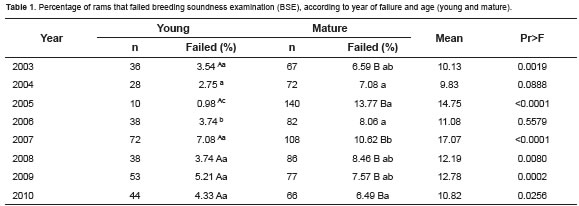
<body><![CDATA[<p>Natural mating is the main breeding method in   sheep production systems, and herd fertility efficiency   depends essentially on ram and ewe reproductive   performance. The Brazilian College of Animal   Breeding published guidelines for breeding soundness   examination (BSE), to be conducted before the   breeding season in order to minimize breeding losses   (CBRA, 1998). The reproductive success or failure of   males can be measured quantitatively on a population   basis or individually and should, where possible, be   replicated over time using different criteria to estimate fertility and reproductive efficiency (Foote, 2003).</p>     <p>Periodical BSE identifies the main causes of   ram failures, making it an important tool to increase   reproductive efficiency of the herd. Thus, the aims of   this work were to monitor rams for eight consecutive   years using BSE and to measure the main causes of reproductive failure before the breeding season.</p>     <p>&nbsp;</p>     <p><b><font size="3">Materials and methods</font></b></p>     <p>   <i>Evaluated animals</i></p>     <p>A database consisting of 1,017 reproductive   assessment records of Corriedale rams was evaluated.   Animals were classified as young when they had never   been used in mating systems (18 months) or mature   rams if they had previous sexual experience (more   than 18 months). Data were collected from 2003 to   2010 as shown in <a href="#t1">table 1</a>. BSE were performed every   year. Animals were maintained on adequate pastures with <i>ad libitum</i> access to water, and parasite control.</p>     <p align="center"><a name="t1"></a><img src="/img/revistas/rccp/v27n2/v27n2a8t1.jpg"></p>     <p><i>Breeding soundness evaluation</i></p>     <p>   The BSE was performed according to the   guidelines of CBRA (1998):</p>     <p>   1. General clinical examination: eyes, teeth, body   condition score, and leg conditions.</p>     ]]></body>
<body><![CDATA[<p>2. Clinical examination of the reproductive tract: prepuce, penis, scrotum, testicles.</p>     <p>   3. Semen examination: motility, vigor, mass   movement, sperm concentration and sperm morphology   were performed using a phase-contrast microscope.   Semen collection was performed using electroejaculation.</p>     <p><i>Statistical analyses</i></p>     <p>   The Chi-square test was used to investigate the   relationship of the binary variable (approval or   failure) among 2003 to 2010 and age classes (young   or mature).</p>     <p>Failure results were submitted to principal component   analysis. Pearson's correlation coefficient among the evaluated parameters was also calculated.</p>     <p>   All statistical analyses were conducted using the   Statistical Analysis System software package.</p>     <p>&nbsp;</p>     <p><b><font size="3">Results</font></b></p>     <p>   Interaction was found between age and year of   reproductive failure; mature rams failed the BSE exam   in 2003, 2005, 2007, 2008, 2009, and 2010; however,   no difference was observed between ages during years   2004 and 2006 (<a href="#t1">Table 1</a>).</p>     <p>Means followed by different small letters in the   same column and different capital letters in the same   row are statistically different by Tukey test (5% significance).</p>     ]]></body>
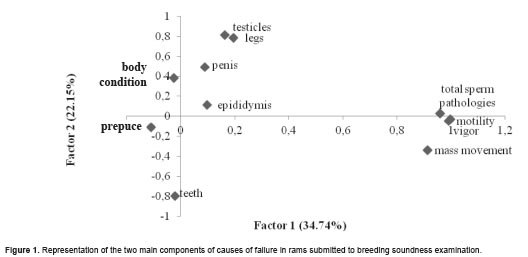
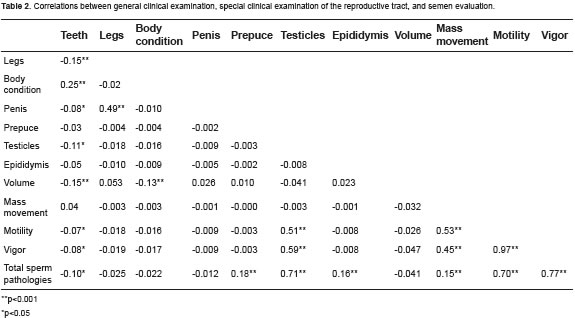
<body><![CDATA[<p>Failed = percent of excluded rams after annual BSE.</p>     <p>The main factors explain 34.74% of failures   causes. When total sperm pathology increased,   motility, vigor, and mass movement decreased along   with an increase of testis, penis, epididymis and leg   problems, and a decrease in body condition, along   with teeth and foreskin problems. Secondary causes   explained 22.15% of failures. When an increase was   observed for problems related to body condition,   testicles, penis, epididymis and sperm pathologies, a   decrease was also observed for problems related to   teeth, prepuce, motility, vigor, and mass movement (<a href="#f1">Figure 1</a>).</p>     <p align="center"><a name="f1"></a><img src="/img/revistas/rccp/v27n2/v27n2a8f1.jpg"></p>      <p>A positive correlation was observed between teeth   failure and body condition, and a negative correlation   between legs and seminal volumes (<a href="#t2">Table 2</a>). Physical   aspects of the prepuce were positively correlated   with sperm pathologies. We also found a positive   correlation between testicles and motility, vigor   and total sperm pathologies. However, epididymis   alterations showed a positive correlation with the total sperm pathologies (p&lt;0.001).</p>     <p align="center"><a name="t2"></a><img src="/img/revistas/rccp/v27n2/v27n2a8t2.jpg"></p>      <p>&nbsp;</p>     <p><b><font size="3">Discussion</font></b></p>     <p>   BSE is considered an important tool to evaluate   reproductive performance in different species,   including rams. In the present study, consistent causes   of failure were identified with rates varied according   to age and year.</p>     <p>Kimberling and Butter (1986) found higher   failure rates during BSE of mature rams than those   observed in the present study. This variability could   be explained by many factors, such as management   practices, season when BSE was performed, and even the statistical analysis method applied (Amann, 2005).</p>     <p>In this study, the main causes of failure were   physical&#8212;missing teeth, leg problems, poor body   condition score, testicle hypoplasia, and epididymitis&#8212;   and related with the ejaculate&#8212;motility, vigor, mass   movement, and total pathologies&#8212;which is in   agreement with findings by other researchers (Moraes   <i>et al.</i>, 1977; Ott and Memon, 1980). Maurya <i>et al.</i>   (2010) concluded that breeding efficiency of rams is   better when their body condition is adequate during the breeding season.</p>     ]]></body>
<body><![CDATA[<p>In the present study, the rates of failure at semen   examination were high, despite not considering   seasonal differences, as in the study of Karagiannidisa   <i>et al.</i> (2000). When studying seasonal variations in   semen production among rams within each breed,   those authors found significant differences in semen   quantity and quality. Moreover, Oberst <i>et al.</i> (2011),   in a similar study with Lacaune rams, observed   that, except for sperm concentration, all other   semen characteristics presented seasonal variations.   Consistent with the present study, Van Metre <i>et al.</i>   (2012) found that 29.0% of the evaluated rams failed   the BSE and the most common reason for failure was substandard semen parameters.</p>     <p>The importance of regular reproductive assessment   is evident considering the results of this study and   the cited literature. Breeding evaluation in rams was   shown to be consistent, independently of the age of the   animals. Physical and seminal problems were the main   causes of failure, and their incidence varied between   young and adult animals. A high number of rams failed   the BSE when it was used routinely, demonstrating   the importance of this annual exam to detect causes acquired during the mating season.</p>     <p>&nbsp;</p> <hr size="1" />     <p><a name="0"></a><a href="#b0">&curren;</a> To cite this article: Oliveira SR, Jardim JO, Koetz C, Peripolli V, Andrighetto ME, McManus C, Guiselli L. Annual breeding soundness evaluation of rams. Rev Colomb Cienc Pecu 2014; 27:133-137.</p> <hr size="1" />     <p>&nbsp;</p>     <p>&nbsp;</p>     <p>&nbsp;</p>     <p><b><font size="3">References</font></b></p>     <!-- ref --><p>   Amann RP. Weaknesses in report of fertility for horses and other   species. Theriogenology 2005; 63:698-715.    &nbsp;&nbsp;&nbsp;&nbsp;&nbsp;&nbsp;&nbsp;&nbsp;[&#160;<a href="javascript:void(0);" onclick="javascript: window.open('/scielo.php?script=sci_nlinks&ref=000071&pid=S0120-0690201400020000800001&lng=','','width=640,height=500,resizable=yes,scrollbars=1,menubar=yes,');">Links</a>&#160;]<!-- end-ref --></p>     ]]></body>
<body><![CDATA[<!-- ref --><p>   Colegio Brasileiro de Reprodu&ccedil;&atilde;o Animal (CBRA). Procedimentos   para exame androl&oacute;gico e avalia&ccedil;&atilde;o de s&ecirc;men animal. 2&ordf; ed. Belo   Horizonte: Col&eacute;gio Brasileiro de Reprodu&ccedil;&atilde;o Animal; 1998.    &nbsp;&nbsp;&nbsp;&nbsp;&nbsp;&nbsp;&nbsp;&nbsp;[&#160;<a href="javascript:void(0);" onclick="javascript: window.open('/scielo.php?script=sci_nlinks&ref=000073&pid=S0120-0690201400020000800002&lng=','','width=640,height=500,resizable=yes,scrollbars=1,menubar=yes,');">Links</a>&#160;]<!-- end-ref --></p>     <!-- ref --><p>   Foote RH. Fertility estimation: a review of past experience and   future prospects. Anim Reprod Sci 2003; 73:119-139.    &nbsp;&nbsp;&nbsp;&nbsp;&nbsp;&nbsp;&nbsp;&nbsp;[&#160;<a href="javascript:void(0);" onclick="javascript: window.open('/scielo.php?script=sci_nlinks&ref=000075&pid=S0120-0690201400020000800003&lng=','','width=640,height=500,resizable=yes,scrollbars=1,menubar=yes,');">Links</a>&#160;]<!-- end-ref --></p>     <!-- ref --><p>   Karagiannidisa A, Varsakeli S, Alexopoulosa C, Amarantidis I.   Seasonal variation in semen characteristics of Chios and Friesian   rams in Greece. Small Ruminant Res 2000; 37:125-130.    &nbsp;&nbsp;&nbsp;&nbsp;&nbsp;&nbsp;&nbsp;&nbsp;[&#160;<a href="javascript:void(0);" onclick="javascript: window.open('/scielo.php?script=sci_nlinks&ref=000077&pid=S0120-0690201400020000800004&lng=','','width=640,height=500,resizable=yes,scrollbars=1,menubar=yes,');">Links</a>&#160;]<!-- end-ref --></p>     <!-- ref --><p>   Kimberling C, Buttler J. Colorado's ram breeding soundness   program. In: Proceedings of the 5th Annual Meeting of   the WRCC-46 for Ram Epididymitis and Ovine Footrot   Conference; June 20-21; Albuquerque, USA. Albuquerque   (NM): Western Regional Coordinating Committee-46; 1986.   p.41-47.    &nbsp;&nbsp;&nbsp;&nbsp;&nbsp;&nbsp;&nbsp;&nbsp;[&#160;<a href="javascript:void(0);" onclick="javascript: window.open('/scielo.php?script=sci_nlinks&ref=000079&pid=S0120-0690201400020000800005&lng=','','width=640,height=500,resizable=yes,scrollbars=1,menubar=yes,');">Links</a>&#160;]<!-- end-ref --></p>     <!-- ref --><p>   Maurya VP, Sejian V, Kumar D, Naqvi SMK. Effect of induced   body condition score differences on sexual behavior, scrotal   measurements, semen attributes and endocrine responses in   Malpura rams under hot semi-arid environment. J Anim Physiol   2010; 94:308-317.    &nbsp;&nbsp;&nbsp;&nbsp;&nbsp;&nbsp;&nbsp;&nbsp;[&#160;<a href="javascript:void(0);" onclick="javascript: window.open('/scielo.php?script=sci_nlinks&ref=000081&pid=S0120-0690201400020000800006&lng=','','width=640,height=500,resizable=yes,scrollbars=1,menubar=yes,');">Links</a>&#160;]<!-- end-ref --></p>     ]]></body>
<body><![CDATA[<!-- ref --><p>   Van Metre DCV, Rao S, Kimberling CV, Morley PS. Factors   associated with failure in breeding soundness examination of   Western USA rams. Prev Vet Med 2012; 105:118- 126.    &nbsp;&nbsp;&nbsp;&nbsp;&nbsp;&nbsp;&nbsp;&nbsp;[&#160;<a href="javascript:void(0);" onclick="javascript: window.open('/scielo.php?script=sci_nlinks&ref=000083&pid=S0120-0690201400020000800007&lng=','','width=640,height=500,resizable=yes,scrollbars=1,menubar=yes,');">Links</a>&#160;]<!-- end-ref --></p>     <!-- ref --><p>   Moraes JCF, Silva JF, Schuch LH. Influ&ecirc;ncia do macho na   fertilidade do rebanho ovino inseminado artificialmente no Rio   Grande do Sul. Ver Bras Reprod Anim 1977; 1:31-38.    &nbsp;&nbsp;&nbsp;&nbsp;&nbsp;&nbsp;&nbsp;&nbsp;[&#160;<a href="javascript:void(0);" onclick="javascript: window.open('/scielo.php?script=sci_nlinks&ref=000085&pid=S0120-0690201400020000800008&lng=','','width=640,height=500,resizable=yes,scrollbars=1,menubar=yes,');">Links</a>&#160;]<!-- end-ref --></p>     <!-- ref --><p>   Oberst ER, Smirdele WA, Brito MA, Marschner TR, Ribeiro LA,   Mattos RC. Seasonal variation in semen quality of Lacaune rams   in Brazil. Braz J Vet Res Anim Sci 2011; 48:319-324.    &nbsp;&nbsp;&nbsp;&nbsp;&nbsp;&nbsp;&nbsp;&nbsp;[&#160;<a href="javascript:void(0);" onclick="javascript: window.open('/scielo.php?script=sci_nlinks&ref=000087&pid=S0120-0690201400020000800009&lng=','','width=640,height=500,resizable=yes,scrollbars=1,menubar=yes,');">Links</a>&#160;]<!-- end-ref --></p>     <!-- ref --><p>   Ott RS, Memon MA. Breeding soudness examination of rams and   bucks, a review. Theriogenology 1980; 13:155-164.    &nbsp;&nbsp;&nbsp;&nbsp;&nbsp;&nbsp;&nbsp;&nbsp;[&#160;<a href="javascript:void(0);" onclick="javascript: window.open('/scielo.php?script=sci_nlinks&ref=000089&pid=S0120-0690201400020000800010&lng=','','width=640,height=500,resizable=yes,scrollbars=1,menubar=yes,');">Links</a>&#160;]<!-- end-ref --></p>     <p>&nbsp;</p> </font>     ]]></body><back>
<ref-list>
<ref id="B1">
<nlm-citation citation-type="journal">
<person-group person-group-type="author">
<name>
<surname><![CDATA[Amann]]></surname>
<given-names><![CDATA[RP]]></given-names>
</name>
</person-group>
<article-title xml:lang="en"><![CDATA[Weaknesses in report of fertility for horses and other species]]></article-title>
<source><![CDATA[Theriogenology]]></source>
<year>2005</year>
<volume>63</volume>
<page-range>698-715</page-range></nlm-citation>
</ref>
<ref id="B2">
<nlm-citation citation-type="book">
<collab>Colegio Brasileiro de Reprodução Animal (CBRA)</collab>
<source><![CDATA[Procedimentos para exame andrológico e avaliação de sêmen animal]]></source>
<year>1998</year>
<edition>2</edition>
<publisher-loc><![CDATA[Belo Horizonte ]]></publisher-loc>
<publisher-name><![CDATA[Colégio Brasileiro de Reprodução Animal]]></publisher-name>
</nlm-citation>
</ref>
<ref id="B3">
<nlm-citation citation-type="journal">
<person-group person-group-type="author">
<name>
<surname><![CDATA[Foote]]></surname>
<given-names><![CDATA[RH]]></given-names>
</name>
</person-group>
<article-title xml:lang="en"><![CDATA[Fertility estimation: a review of past experience and future prospects]]></article-title>
<source><![CDATA[Anim Reprod Sci]]></source>
<year>2003</year>
<volume>73</volume>
<page-range>119-139</page-range></nlm-citation>
</ref>
<ref id="B4">
<nlm-citation citation-type="journal">
<person-group person-group-type="author">
<name>
<surname><![CDATA[Karagiannidisa]]></surname>
<given-names><![CDATA[A]]></given-names>
</name>
<name>
<surname><![CDATA[Varsakeli]]></surname>
<given-names><![CDATA[S]]></given-names>
</name>
<name>
<surname><![CDATA[Alexopoulosa]]></surname>
<given-names><![CDATA[C]]></given-names>
</name>
<name>
<surname><![CDATA[Amarantidis]]></surname>
<given-names><![CDATA[I]]></given-names>
</name>
</person-group>
<article-title xml:lang="en"><![CDATA[Seasonal variation in semen characteristics of Chios and Friesian rams in Greece]]></article-title>
<source><![CDATA[Small Ruminant Res]]></source>
<year>2000</year>
<volume>37</volume>
<page-range>125-130</page-range></nlm-citation>
</ref>
<ref id="B5">
<nlm-citation citation-type="confpro">
<person-group person-group-type="author">
<name>
<surname><![CDATA[Kimberling]]></surname>
<given-names><![CDATA[C]]></given-names>
</name>
<name>
<surname><![CDATA[Buttler]]></surname>
<given-names><![CDATA[J]]></given-names>
</name>
</person-group>
<article-title xml:lang="en"><![CDATA[Colorado's ram breeding soundness program]]></article-title>
<source><![CDATA[]]></source>
<year>1986</year>
<conf-name><![CDATA[5 Annual Meeting of the WRCC-46 for Ram Epididymitis and Ovine Footrot Conference]]></conf-name>
<conf-loc> </conf-loc>
<page-range>41-47</page-range><publisher-name><![CDATA[Western Regional Coordinating Committee-46]]></publisher-name>
</nlm-citation>
</ref>
<ref id="B6">
<nlm-citation citation-type="journal">
<person-group person-group-type="author">
<name>
<surname><![CDATA[Maurya]]></surname>
<given-names><![CDATA[VP]]></given-names>
</name>
<name>
<surname><![CDATA[Sejian]]></surname>
<given-names><![CDATA[V]]></given-names>
</name>
<name>
<surname><![CDATA[Kumar]]></surname>
<given-names><![CDATA[D]]></given-names>
</name>
<name>
<surname><![CDATA[Naqvi]]></surname>
<given-names><![CDATA[SMK]]></given-names>
</name>
</person-group>
<article-title xml:lang="en"><![CDATA[Effect of induced body condition score differences on sexual behavior, scrotal measurements, semen attributes and endocrine responses in Malpura rams under hot semi-arid environment]]></article-title>
<source><![CDATA[J Anim Physiol]]></source>
<year>2010</year>
<volume>94</volume>
<page-range>308-317</page-range></nlm-citation>
</ref>
<ref id="B7">
<nlm-citation citation-type="journal">
<person-group person-group-type="author">
<name>
<surname><![CDATA[Van]]></surname>
<given-names><![CDATA[Metre DCV]]></given-names>
</name>
<name>
<surname><![CDATA[Rao]]></surname>
<given-names><![CDATA[S]]></given-names>
</name>
<name>
<surname><![CDATA[Kimberling]]></surname>
<given-names><![CDATA[CV]]></given-names>
</name>
<name>
<surname><![CDATA[Morley]]></surname>
<given-names><![CDATA[PS]]></given-names>
</name>
</person-group>
<article-title xml:lang="en"><![CDATA[Factors associated with failure in breeding soundness examination of Western USA rams]]></article-title>
<source><![CDATA[Prev Vet Med]]></source>
<year>2012</year>
<volume>105</volume>
<page-range>118- 126</page-range></nlm-citation>
</ref>
<ref id="B8">
<nlm-citation citation-type="journal">
<person-group person-group-type="author">
<name>
<surname><![CDATA[Moraes]]></surname>
<given-names><![CDATA[JCF]]></given-names>
</name>
<name>
<surname><![CDATA[Silva]]></surname>
<given-names><![CDATA[JF]]></given-names>
</name>
<name>
<surname><![CDATA[Schuch]]></surname>
<given-names><![CDATA[LH]]></given-names>
</name>
</person-group>
<article-title xml:lang="pt"><![CDATA[Influência do macho na fertilidade do rebanho ovino inseminado artificialmente no Rio Grande do Sul]]></article-title>
<source><![CDATA[Ver Bras Reprod Anim]]></source>
<year>1977</year>
<volume>1</volume>
<page-range>31-38</page-range></nlm-citation>
</ref>
<ref id="B9">
<nlm-citation citation-type="journal">
<person-group person-group-type="author">
<name>
<surname><![CDATA[Oberst]]></surname>
<given-names><![CDATA[ER]]></given-names>
</name>
<name>
<surname><![CDATA[Smirdele]]></surname>
<given-names><![CDATA[WA]]></given-names>
</name>
<name>
<surname><![CDATA[Brito]]></surname>
<given-names><![CDATA[MA]]></given-names>
</name>
<name>
<surname><![CDATA[Marschner]]></surname>
<given-names><![CDATA[TR]]></given-names>
</name>
<name>
<surname><![CDATA[Ribeiro]]></surname>
<given-names><![CDATA[LA]]></given-names>
</name>
<name>
<surname><![CDATA[Mattos]]></surname>
<given-names><![CDATA[RC]]></given-names>
</name>
</person-group>
<article-title xml:lang="en"><![CDATA[Seasonal variation in semen quality of Lacaune rams in Brazil]]></article-title>
<source><![CDATA[Braz J Vet Res Anim Sci]]></source>
<year>2011</year>
<volume>48</volume>
<page-range>319-324</page-range></nlm-citation>
</ref>
<ref id="B10">
<nlm-citation citation-type="journal">
<person-group person-group-type="author">
<name>
<surname><![CDATA[Ott]]></surname>
<given-names><![CDATA[RS]]></given-names>
</name>
<name>
<surname><![CDATA[Memon]]></surname>
<given-names><![CDATA[MA]]></given-names>
</name>
</person-group>
<article-title xml:lang="en"><![CDATA[Breeding soudness examination of rams and bucks, a review]]></article-title>
<source><![CDATA[Theriogenology]]></source>
<year>1980</year>
<volume>13</volume>
<page-range>155-164</page-range></nlm-citation>
</ref>
</ref-list>
</back>
</article>