<?xml version="1.0" encoding="ISO-8859-1"?><article xmlns:mml="http://www.w3.org/1998/Math/MathML" xmlns:xlink="http://www.w3.org/1999/xlink" xmlns:xsi="http://www.w3.org/2001/XMLSchema-instance">
<front>
<journal-meta>
<journal-id>0120-4157</journal-id>
<journal-title><![CDATA[Biomédica]]></journal-title>
<abbrev-journal-title><![CDATA[Biomédica]]></abbrev-journal-title>
<issn>0120-4157</issn>
<publisher>
<publisher-name><![CDATA[Instituto Nacional de Salud]]></publisher-name>
</publisher>
</journal-meta>
<article-meta>
<article-id>S0120-41572004000500007</article-id>
<title-group>
<article-title xml:lang="es"><![CDATA[Polimorfismo del TNF- alfa en autoinmunidad y tuberculosis]]></article-title>
</title-group>
<contrib-group>
<contrib contrib-type="author">
<name>
<surname><![CDATA[Correa]]></surname>
<given-names><![CDATA[Paula A]]></given-names>
</name>
<xref ref-type="aff" rid="A01"/>
</contrib>
<contrib contrib-type="author">
<name>
<surname><![CDATA[Gómez]]></surname>
<given-names><![CDATA[Luis M]]></given-names>
</name>
<xref ref-type="aff" rid="A01"/>
</contrib>
<contrib contrib-type="author">
<name>
<surname><![CDATA[Anaya]]></surname>
<given-names><![CDATA[Juan Manuel]]></given-names>
</name>
<xref ref-type="aff" rid="A01"/>
</contrib>
</contrib-group>
<aff id="A01">
<institution><![CDATA[,Corporación para Investigaciones Biológicas Unidad de Biología Celular e Inmunogenética ]]></institution>
<addr-line><![CDATA[Medellín ]]></addr-line>
<country>Colombia</country>
</aff>
<pub-date pub-type="pub">
<day>00</day>
<month>06</month>
<year>2004</year>
</pub-date>
<pub-date pub-type="epub">
<day>00</day>
<month>06</month>
<year>2004</year>
</pub-date>
<volume>24</volume>
<fpage>43</fpage>
<lpage>51</lpage>
<copyright-statement/>
<copyright-year/>
<self-uri xlink:href="http://www.scielo.org.co/scielo.php?script=sci_arttext&amp;pid=S0120-41572004000500007&amp;lng=en&amp;nrm=iso"></self-uri><self-uri xlink:href="http://www.scielo.org.co/scielo.php?script=sci_abstract&amp;pid=S0120-41572004000500007&amp;lng=en&amp;nrm=iso"></self-uri><self-uri xlink:href="http://www.scielo.org.co/scielo.php?script=sci_pdf&amp;pid=S0120-41572004000500007&amp;lng=en&amp;nrm=iso"></self-uri><abstract abstract-type="short" xml:lang="es"><p><![CDATA[El factor de necrosis tumoral alfa (TNF-alfa ) está incriminado tanto en enfermedades autoinmunes como en infecciosas. En el presente estudio se examinó el polimorfismo de la región promotora -308 del gen del TNF-alfa en enfermedades autoinmunes; 091; lupus eritematoso sistémico (LES), artritis reumatoidea (AR), síndrome de Sjögren primario (SSp) 093; ; y en tuberculosis. La genotipificación del polimorfismo -308 del TNF-alfa se realizó en ADN de pacientes con AR (N=165), LES (N=118), SSp (N=67), tuberculosis (N=138) y controles sanos (N=419), mediante reacción en cadena de la polimerasa con polimorfismos en los tamańos de los fragmentos de restricción (PCR-RFLP). El alelo TNF2 se asoció con la AR (OR=1,6; IC95% 1,2-2,3, p=0,008), el LES (OR=2,3; IC95% 1,6-3,3, p<0,0001) y el SSp (OR=2,7; IC95% 1,7-4,1, p<0,0001). El alelo TNF1 se asoció con la tuberculosis (OR=1,9: IC95% 1,2-3,1, p=0,02). La heterocigosis TNF1/TNF2 fue factor de riesgo para AR (OR=1,7; IC95% 1,2-2,6, p=0,01), LES (OR=3; IC95% 2-4,7, p<0,0001) y SSp (OR=3,8; IC95% 2,2-6,5, p<0,0001), mientras que la homocigosis TNF1/TNF1 fue protectora para autoinmunidad (OR<0,6, p<0,01). Por el contrario, el genotipo TNF1/TNF2 fue protector para tuberculosis (OR=0,5; IC95% 0,3-0,9, p=0,02) y la homocigosis TNF1/TNF1 se asoció con susceptibilidad a la misma (OR=2; IC95% 1,2-3,4, p=0,02). Los resultados indican que el alelo TNF2 es un factor común de riesgo para enfermedades autoinmunes reumatológicas pero protector para tuberculosis. Esto sugiere una selección genética en nuestra población]]></p></abstract>
<abstract abstract-type="short" xml:lang="en"><p><![CDATA[Polymorphism of TNF - alpha in autoimmunity and tuberculosis Tumor necrosis factor alpha (TNF-alpha ) has been incriminated in several autoimmune and infectious diseases. The influence of TNF-a -308 polymorphism was examined in patients with systemic lupus erythematosus (SLE), rheumatoid arthritis (RA), primary Sjögren's syndrome (pSS) and tuberculosis. Genomic DNA from patients with RA (N=165), SLE (N=118), pSS (N=67), tuberculosis (N=138), as well as ethnic-matched controls (N=419) were characterized for the TNF-a -308 genetic polymorphism using the polymerase chain reaction-restriction fragment length polymorphism (PCR-RFLP) method. TNF2 allele was associated with RA (OR: 1.6, C.I.95% 1.2-2.3, p=0.008), SLE (OR: 2.3, 95%C.I. 1.6-3.3, p<0.0001), and pSS (OR: 2.7, 95%C.I. 1.7-4.1, p<0.0001). TNF1 was associated with tuberculosis (OR: 1.9, 95%C.I. 1.2-3.1, p=0.02). TNF1/TNF2 heterozygosity was associated with susceptibility for RA (OR: 1.7, 95%C.I. 1.2-2.6, p=0.01), SLE (OR: 3, 95%C.I. 2-4.7, p<0.0001), and pSS (OR: 3.8, 95%C.I. 2.2-6.5, p<0.0001). The homozygous state TNF1/TNF1 was protective for autoimmunity (OR<0.6, p<0.01). In contrast, the TNF1/TNF2 genotype was a protective factor for tuberculosis (OR 0.5, 95%C.I. 0.3-0.9, p= 0.02) whereas TNF1/TNF1 homozygosity was associated with susceptibility (OR: 2, 95%C.I. 1.2-3.4, p=0.02). These results indicate that TNF2 is a common susceptibility allele for autoimmune rheumatic diseases and a protective one for tuberculosis. In addition, the data point towards a genetic selection in our population that might be maintained through dominant selection (heterozygote advantage) to infection by M. tuberculosis but susceptible to autoimmunity.]]></p></abstract>
<kwd-group>
<kwd lng="es"><![CDATA[factor de necrosis tumoral]]></kwd>
<kwd lng="es"><![CDATA[polimorfismo]]></kwd>
<kwd lng="es"><![CDATA[artritis reumatoidea]]></kwd>
<kwd lng="es"><![CDATA[lupus eritematoso sistémico]]></kwd>
<kwd lng="es"><![CDATA[síndrome de Sjögren]]></kwd>
<kwd lng="es"><![CDATA[autoinmunidad]]></kwd>
<kwd lng="es"><![CDATA[tuberculosis]]></kwd>
<kwd lng="en"><![CDATA[tumor necrosis factor]]></kwd>
<kwd lng="en"><![CDATA[polymorphism]]></kwd>
<kwd lng="en"><![CDATA[rheumatoid arthritis]]></kwd>
<kwd lng="en"><![CDATA[systemic lupus erythematosus]]></kwd>
<kwd lng="en"><![CDATA[Sjögren´s syndrome]]></kwd>
<kwd lng="en"><![CDATA[autoimmunity]]></kwd>
<kwd lng="en"><![CDATA[tuberculosis]]></kwd>
</kwd-group>
</article-meta>
</front><body><![CDATA[ <P ALIGN="CENTER"><!DOCTYPE HTML PUBLIC "-//W3C//DTD HTML 3.2//EN"><!-- This HTML document was generated by PageMaker --><!-- On Tue Jul 27 12:54:01 2004 from "C:\Biomed\biom24S\polimorfismo de TNF a 10.p65" --><!-- Generation of PM publication page 43 --><B><FONT FACE="Arial" SIZE=4>Polimorfismo del TNF - </FONT><FONT FACE=Symbol SIZE=4>a</FONT><FONT FACE="Arial" SIZE=4> en autoinmunidad y tuberculosis</P> </B></FONT><FONT FACE="Arial">    <P ALIGN="CENTER">Paula A. Correa, Luis M. G&oacute;mez, Juan Manuel Anaya</P>     <P ALIGN="CENTER">Unidad de Biolog&iacute;a Celular e Inmunogen&eacute;tica, Corporaci&oacute;n para Investigaciones Biol&oacute;gicas,</P>     <P ALIGN="CENTER">Medell&iacute;n, Colombia</P> </FONT><FONT FACE="Arial">    <P>El factor de necrosis tumoral alfa (TNF-</FONT><FONT FACE=Symbol>a</FONT><FONT FACE="Arial"> ) est&aacute; incriminado tanto en enfermedades autoinmunes como en infecciosas. En el presente estudio se examin&oacute; el polimorfismo de la regi&oacute;n promotora -308 del gen del TNF-</FONT><FONT FACE=Symbol> a</FONT><FONT FACE="Arial"> en enfermedades autoinmunes; [ lupus eritematoso sist&eacute;mico (LES), artritis reumatoidea (AR), s&iacute;ndrome de Sj&ouml;gren primario (SSp)] ; y en tuberculosis. </P>     <P>La genotipificaci&oacute;n del polimorfismo -308 del TNF-</FONT><FONT FACE=Symbol>a</FONT><FONT FACE="Arial"> se realiz&oacute; en ADN de pacientes con AR (N=165), LES (N=118), SSp (N=67), tuberculosis (N=138) y controles sanos (N=419), mediante reacci&oacute;n en cadena de la polimerasa con polimorfismos en los tama&ntilde;os de los fragmentos de restricci&oacute;n (PCR-RFLP). </P>     <P>El alelo TNF2 se asoci&oacute; con la AR (OR=1,6; IC95% 1,2-2,3, <I>p</I>=0,008), el LES (OR=2,3; IC95% 1,6-3,3, <I>p</I>&lt;0,0001) y el SSp (OR=2,7; IC95% 1,7-4,1, <I>p</I>&lt;0,0001). El alelo TNF1 se asoci&oacute; con la tuberculosis (OR=1,9: IC95% 1,2-3,1, <I>p</I>=0,02). La heterocigosis TNF1/TNF2 fue factor de riesgo para AR (OR=1,7; IC95% 1,2-2,6, <I>p</I>=0,01), LES (OR=3; IC95% 2-4,7, <I>p</I>&lt;0,0001) y SSp (OR=3,8; IC95% 2,2-6,5, <I>p</I>&lt;0,0001), mientras que la homocigosis TNF1/TNF1 fue protectora para autoinmunidad (OR&lt;0,6, <I>p</I>&lt;0,01). Por el contrario, el genotipo TNF1/TNF2 fue protector para tuberculosis (OR=0,5; IC95% 0,3-0,9, <I>p</I>=0,02) y la homocigosis TNF1/TNF1 se asoci&oacute; con susceptibilidad a la misma (OR=2; IC95% 1,2-3,4, <I>p</I>=0,02). </P>     <P>Los resultados indican que el alelo TNF2 es un factor com&uacute;n de riesgo para enfermedades autoinmunes reumatol&oacute;gicas pero protector para tuberculosis. Esto sugiere una selecci&oacute;n gen&eacute;tica en nuestra poblaci&oacute;n. </P> <B>    <P>Palabras clave:</B> factor de necrosis tumoral, polimorfismo, artritis reumatoidea, lupus eritematoso sist&eacute;mico, s&iacute;ndrome de Sj&ouml;gren, autoinmunidad, tuberculosis. </P> <B>    <P>Polymorphism of TNF - </FONT><FONT FACE=Symbol>a</B></FONT><FONT FACE="Arial"> <B>in autoimmunity and tuberculosis</B> </P>     ]]></body>
<body><![CDATA[<P>Tumor necrosis factor alpha (TNF-</FONT><FONT FACE=Symbol>a</FONT><FONT FACE="Arial"> ) has been incriminated in several autoimmune and infectious diseases. The influence of TNF-</FONT><FONT FACE=Symbol>a</FONT><FONT FACE="Arial"> -308 polymorphism was examined in patients with systemic lupus erythematosus (SLE), rheumatoid arthritis (RA), primary Sj&ouml;gren's syndrome (pSS) and tuberculosis. Genomic DNA from patients with RA (N=165), SLE (N=118), pSS (N=67), tuberculosis (N=138), as well as ethnic-matched controls (N=419) were characterized for the TNF-</FONT><FONT FACE=Symbol>a</FONT><FONT FACE="Arial"> -308 genetic polymorphism using the polymerase chain reaction-restriction fragment length polymorphism (PCR-RFLP) method. TNF2 allele was associated with RA (OR: 1.6, C.I.95% 1.2-2.3, <I>p</I>=0.008), SLE (OR: 2.3, 95%C.I. 1.6-3.3, <I>p</I>&lt;0.0001), and pSS (OR: 2.7, 95%C.I. 1.7-4.1, <I>p</I>&lt;0.0001). TNF1 was associated with tuberculosis (OR: 1.9, 95%C.I. 1.2-3.1, <I>p</I>=0.02). TNF1/TNF2 heterozygosity was associated with susceptibility for RA (OR: 1.7, 95%C.I. 1.2-2.6, <I>p</I>=0.01), SLE (OR: 3, 95%C.I. 2-4.7, <I>p</I>&lt;0.0001), and pSS (OR: 3.8, 95%C.I. 2.2-6.5, <I>p</I>&lt;0.0001). The homozygous state TNF1/TNF1 was protective for autoimmunity (OR&lt;0.6, <I>p</I>&lt;0.01). In contrast, the TNF1/TNF2 genotype was a protective factor for tuberculosis (OR 0.5, 95%C.I. 0.3-0.9, <I>p</I>= 0.02) whereas TNF1/TNF1 homozygosity was associated with susceptibility (OR: 2, 95%C.I. 1.2-3.4, <I>p</I>=0.02). These results indicate that TNF2 is a common susceptibility allele for autoimmune rheumatic diseases and a protective one for tuberculosis. In addition, the data point towards a genetic selection in our population that might be maintained through dominant selection (heterozygote advantage) to infection by <I>M. tuberculosis</I> but susceptible to autoimmunity. </P> <B>    <P>Key words: </B>tumor necrosis factor, polymorphism, rheumatoid arthritis, systemic lupus erythematosus, Sj&ouml;gren's syndrome, autoimmunity, tuberculosis.</P>     <P><!-- Generation of PM publication page 44 -->La artritis reumatoidea (AR), el lupus eritematoso sist&eacute;mico (LES) y el s&iacute;ndrome de Sj&ouml;gren (SS), son enfermedades autoinmunes, inflamatorias y sist&eacute;micas de etiolog&iacute;a desconocida y cuya fisiopatolog&iacute;a es compleja. En ellas participan muchas prote&iacute;nas de importancia inmunol&oacute;gica que incluyen las citocinas que son sintetizadas y reguladas a partir de genes individuales. El polimorfismo de estos &uacute;ltimos contribuye al car&aacute;cter polig&eacute;nico de estas enfermedades (1,2). Entre las citocinas incriminadas en la fisio-patolog&iacute;a de estas enfermedades autoinmunes sobresalen aqu&eacute;llas con propiedades pro-inflamatorias, una de las cuales es el factor de necrosis tumoral alfa (TNF-a ), prote&iacute;na de 17 kd y una longitud de 157 amino&aacute;cidos (3). Es secretada por macr&oacute;fagos, monocitos, neutr&oacute;filos, linfocitos T, principalmente CD4+, y tambi&eacute;n por c&eacute;lulas asesinas naturales (4). Su secreci&oacute;n es inhibida por la interleucina 6, el factor de crecimiento y transformaci&oacute;n beta, la vitamina D3, la prostaglandina E<SUB>2</SUB> y la dexametasona, entre otros. Act&uacute;a reclutando neutr&oacute;filos y monocitos en sitios de inflamaci&oacute;n, a los que activa para que eliminen agentes microbianos. El TNF-a tambi&eacute;n estimula las c&eacute;lulas endoteliales para que expresen mol&eacute;culas de adhesi&oacute;n que facilitan el tr&aacute;fico leucocitario y, a su vez, estimula la secreci&oacute;n de quimiocinas e induce apoptosis en la c&eacute;lula blanco (5). Cuando esta citocina es sintetizada en grandes cantidades produce efectos sist&eacute;micos nocivos que incluyen inducci&oacute;n de fiebre, caquexia y s&iacute;ntesis de prote&iacute;nas de fase aguda; tambi&eacute;n, puede causar trombosis intravascular y choque (3,4). En los modelos animales de algunas patolog&iacute;as, como la AR, se ha podido observar que la expresi&oacute;n aumentada o persistente del TNF-a puede, por s&iacute; sola, inducir artritis (6). </P>     <P>El gen que codifica para el TNF-</FONT><FONT FACE=Symbol>a</FONT><FONT FACE="Arial"> est&aacute; ubicado en el brazo corto del cromososma 6 (6p21.31), inmerso en el complejo mayor de histocompatibilidad (CMH). Este gen es regulado a nivel transcripcional y postranscripcional. Ciertas variaciones puntuales en la regi&oacute;n promotora de este gen pueden favorecer un cambio en la s&iacute;ntesis de prote&iacute;na, fen&oacute;meno que se ha asociado con patolog&iacute;a autoinmune y enfermedades infecciosas (7-14). </P>     <P>El polimorfismo en un solo nucle&oacute;tido (<I>single nucleotide polymorphism</I>, SNP), en el que se sustituye una guanina por una adenina (G&reg;A) en la posici&oacute;n _308, genera los alelos conocidos como TNF1 (G) y TNF2 (A). La s&iacute;ntesis del TNF-</FONT><FONT FACE=Symbol> a</FONT><FONT FACE="Arial"> puede variar en funci&oacute;n de este polimorfismo. El TNF2 se ha asociado con una transcripci&oacute;n significativamente aumentada de la citocina (13). Se ha encontrado, en diferentes estudios, que el alelo TNF2 puede estar asociado con varias patolog&iacute;as autoinmunes, incluso la AR y el LES (9,13). </P>     <P>Las caracter&iacute;sticas moleculares y propiedades patog&eacute;nicas del TNF-</FONT><FONT FACE=Symbol> a</FONT><FONT FACE="Arial"> en enfermedades cr&oacute;nicas e inflamatorias como la AR promovieron el desarrollo de terapias biol&oacute;gicas anti- TNF-</FONT><FONT FACE=Symbol> a</FONT><FONT FACE="Arial"> que resultaron eficaces (15). No obstante, se ha observado que tienen tambi&eacute;n efectos adversos como son el riesgo de reactivaci&oacute;n o el desarrollo de tuberculosis (16). </P>     <P>La tuberculosis es una enfermedad granulomatosa cr&oacute;nica, causada por <I>Mycobacterium tuberculosis</I>. En su patog&eacute;nesis intervienen factores tanto del medio ambiente, como sociales y gen&eacute;ticos. Aproximadamente, la tercera parte de la poblaci&oacute;n mundial inmunocompetente est&aacute; infectada con <I>M. tuberculosis</I>; se estima que el 10% de esta poblaci&oacute;n desarrollar&aacute; la enfermedad (17). La infecci&oacute;n por <I>M. tuberculosis </I>ocurre por v&iacute;a a&eacute;rea y el primer contacto con el hospedero se lleva a cabo en el macr&oacute;fago alveolar que, luego de fagocitar la micobacteria, sintetiza citocinas proinflamatorias como el TNF-</FONT><FONT FACE=Symbol>a</FONT><FONT FACE="Arial"> (18), el cual juega un papel clave no s&oacute;lo en la respuesta del hospedero contra <I>M. tuberculosis </I>sino tambi&eacute;n en las manifestaciones cl&iacute;nicas de la enfermedad. Esta citocina interviene en la formaci&oacute;n, la organizaci&oacute;n y el control del granuloma y, en sinergismo con el interfer&oacute;n gamma, induce la expresi&oacute;n de la &oacute;xido n&iacute;trico sintasa inducible, lo <!-- Generation of PM publication page 45 -->cual genera la producci&oacute;n de &oacute;xido n&iacute;trico, uno de los principales agentes microbicidas para micobacterias (18,19). Adem&aacute;s, el TNF-</FONT><FONT FACE=Symbol> a</FONT><FONT FACE="Arial"> puede afectar la migraci&oacute;n celular, la localizaci&oacute;n tisular de la micobacteria y la expresi&oacute;n de mol&eacute;culas de adhesi&oacute;n, de quimiocinas y sus respectivos receptores (19). La expresi&oacute;n del TNF-</FONT><FONT FACE=Symbol> a</FONT><FONT FACE="Arial"> en la tuberculosis, as&iacute; como en otras patolog&iacute;as de origen infeccioso, puede variar de un individuo a otro y tambi&eacute;n entre poblaciones. Estas variaciones pueden ser explicadas, en parte, por polimorfismos en la regi&oacute;n promotora del gen (13). La influencia de factores gen&eacute;ticos en el desarrollo de la tuberculosis es sustentada por el alto grado de concordancia de la enfermedad en gemelos univitelinos (20). </P>     <P>Dado que la producci&oacute;n del TNF-</FONT><FONT FACE=Symbol> a</FONT><FONT FACE="Arial"> es variable entre individuos y que esta variaci&oacute;n puede ser explicada por factores gen&eacute;ticos encargados de regular su s&iacute;ntesis y que, adem&aacute;s, el polimorfismo del gen correspondiente se puede asociar con algunas enfermedades autoinmunes e infecciosas, el presente trabajo evalu&oacute; simult&aacute;neamente la asociaci&oacute;n del SNP _308 del TNF-</FONT><FONT FACE=Symbol> a</FONT><FONT FACE="Arial"> en pacientes con enfermedades autoinmunes reumatol&oacute;gicas y tuberculosis. </P> <B>    <P>Materiales y m&eacute;todos </P> <I>    <P>Pacientes y controles</B></I> </P>     ]]></body>
<body><![CDATA[<P>Se realiz&oacute; la genotipificaci&oacute;n del SNP -308 del TNF-</FONT><FONT FACE=Symbol> a</FONT><FONT FACE="Arial"> en 350 individuos con enfermedades autoinmunes reumatol&oacute;gicas, todos los cuales hab&iacute;an cumplido con los criterios internacionales de clasificaci&oacute;n correspondientes a cada enfermedad y distribuidos as&iacute;: 165 pacientes con AR (21), 118 con LES (22) y 67 pacientes con SS primario (23). </P>     <P>Tambi&eacute;n se incluyeron 138 pacientes con tuberculosis pulmonar, negativos para infecci&oacute;n por el virus de inmunodeficiencia humano (VIH) y 419 individuos sanos (controles), pertenecientes al mismo grupo &eacute;tnico y geogr&aacute;fico de los pacientes pero sin relaci&oacute;n con ellos, exentos de enfermedad autoinmune o infecciosa. El diagn&oacute;stico de tuberculosis se confirm&oacute; por presencia de bacilos &aacute;cido alcohol resistentes en esputos o por aislamiento de <I>M. tuberculosis </I>en     <BR> cultivo. La serolog&iacute;a para el VIH fue negativa en todos los casos. </P>     <P>Los pacientes se atendieron en la Cl&iacute;nica Universitaria Bolivariana y en el Hospital La Mar&iacute;a de Medell&iacute;n. Esta investigaci&oacute;n se llev&oacute; a cabo de acuerdo con la Resoluci&oacute;n N<SUP>o</SUP> 008430 de 1993 del Ministerio de Salud de la Rep&uacute;blica de Colombia y se consider&oacute; como de riesgo m&iacute;nimo. El estudio cont&oacute; con la aprobaci&oacute;n del comit&eacute; de &eacute;tica de la Corporaci&oacute;n para Investigaciones Biol&oacute;gicas. </P> <B><I>    <P>Extracci&oacute;n de ADN</B></I> </P>     <P>Se extrajo de cada uno de los individuos, pacientes y controles, el ADN gen&oacute;mico de c&eacute;lulas mononucleares de sangre perif&eacute;rica obtenida por punci&oacute;n venosa, seg&uacute;n el m&eacute;todo de precipitaci&oacute;n con sales (<I>salting out</I>), previamente descrito (24). </P> <B><I>    <P>Polimorfismo del TNF-</B></I></FONT><FONT FACE=Symbol> <B>a</FONT><I><FONT FACE="Arial"> </P> </B></I>    <P>Se realiz&oacute; la genotipificaci&oacute;n del SNP _308 por el m&eacute;todo de reacci&oacute;n en cadena de la polimerasa (PCR). La reacci&oacute;n se llev&oacute; a cabo en un volumen final de 50 ul, los cuales conten&iacute;an 100 ng de ADN gen&oacute;mico, 10 pmol de cada uno de los iniciadores espec&iacute;ficos para la posici&oacute;n _308, tanto sentido (5'AGGCAATAGGTTTTGAGGGCC AT3') como antisentido (5'TCCTCCCTGCTCCGATTCCG 3' ) (25), 1,5 mM de Mg<SUB>2</SUB>Cl y 200 uM de dNTPs (Promega, Madison, WI, EU); se utiliz&oacute; 1 unidad de Taq ADN polimerasa (Promega, Madison, WI, EU) con amplificaci&oacute;n de anidaje a 60°C, durante 35 ciclos, en un termociclador MJ PTC 200 (Promega, Madison, WI, EU). El producto esperado de la PCR correspond&iacute;a a 107 pb y se analiz&oacute; en un gel de agarosa al 2% (SeaKem LE, BMA, Rockland, ME, EU), te&ntilde;ido con bromuro de etidio (Sigma, St. Louis, MI, EU). </P>     <P>El an&aacute;lisis final del SNP _308 se evalu&oacute; por la t&eacute;cnica de polimorfismo en el tama&ntilde;o de fragmentos de restricci&oacute;n (RFLP). Para este an&aacute;lisis se utiliz&oacute; la endonucleasa <I>NcoI </I>(Promega, Madison, WI, EU), la cual genera cortes espec&iacute;ficos en el producto de la amplificaci&oacute;n de la PCR, los que, luego de la restricci&oacute;n, permiten discriminar los alelos seg&uacute;n el patr&oacute;n de bandas que fuera originado: 87 pb y 20 pb para el TNF1 (alelo nativo o TNFG) y 107 pb para el alelo TNF2 <!-- Generation of PM publication page 46 -->(alelo mutado o TNFA) (25), el cual no presenta la secuencia espec&iacute;fica para que la endonucleasa pueda fragmentar el ADN. </P> <B><I>    <P>An&aacute;lisis estad&iacute;stico</B></I> </P>     ]]></body>
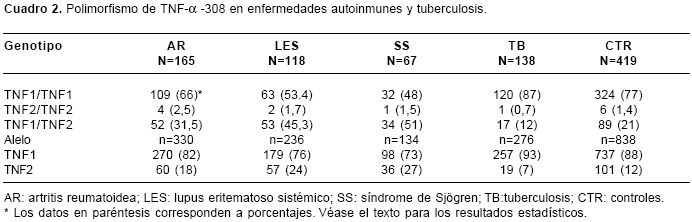
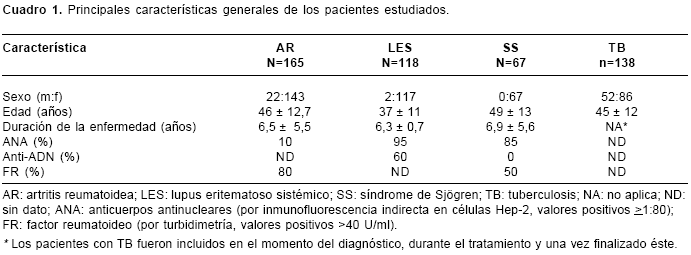
<body><![CDATA[<P>El dise&ntilde;o del presente estudio asumi&oacute; la presencia de una probabilidad de error del 0,05, con un poder de detecci&oacute;n del 90%. Se asumi&oacute;, igualmente, una correlaci&oacute;n del 10% o menos entre el caso y su control. La relaci&oacute;n caso:control fue superior a 1:2,5, y el m&iacute;nimo riesgo relativo indirecto previsto para marcadores gen&eacute;ticos en los pacientes fue de 3. Por lo tanto, el tama&ntilde;o de la muestra fue suficiente para observar diferencias significativas. El presente trabajo cumpli&oacute; con las gu&iacute;as para el desarrollo de estudios de asociaci&oacute;n gen&eacute;tica (26,27). </P>     <P>Tanto en pacientes como en controles se determinaron las frecuencias al&eacute;licas y g&eacute;nicas. Las comparaciones entre frecuencias fueron realizadas utilizando la prueba de </FONT><FONT FACE=Symbol>c</FONT><SUP><FONT FACE="Arial">2</SUP>. Se calcularon la raz&oacute;n de disparidad (OR) y los intervalos de confianza (IC) de 95% (28). En todos los casos, el grado de significaci&oacute;n fue inferior al 5%. Dado que no se hicieron comparaciones m&uacute;ltiples, no fue necesario corregir el valor de la significancia. </P> <B>    <P>Resultados</B> </P>     <P>Las caracter&iacute;sticas generales de los pacientes se resumen en el </FONT><A HREF="#cuadro1"><FONT FACE="Arial">cuadro 1</FONT></A><FONT FACE="Arial">. </P>     <P><A NAME="cuadro1"></A></P> </FONT>    <P ALIGN="CENTER"><IMG SRC="/img/revistas/bio/v24s1/1s07t1.gif"></P> <FONT FACE="Arial">    <P>En el </FONT><A HREF="#cuadro2"><FONT FACE="Arial">cuadro 2</FONT></A><FONT FACE="Arial"> se muestran los resultados de las frecuencias al&eacute;licas y genot&iacute;picas. El alelo TNF2 se asoci&oacute; con la AR (OR=1,6; IC95% 1,2-2,3, <I>p</I>=0,008), el LES (OR=2,3; IC95% 1,6-3,3, <I>p</I>&lt;0,0001) y el SS (OR=2,7, IC95% 1,7-4,1, <I>p</I>&lt;0,0001). El alelo TNF1 se asoci&oacute; con la tuberculosis (OR=1,9; IC95% 1,2-3,1, <I>p</I>=0,02). La heterocigosis TNF1/TNF2 (GA) fue factor de riesgo para AR (OR=1,7; IC95% 1,2-2,6, <I>p</I>=0,01), para LES (OR=3; IC95% 2-4,7, <I>p</I>&lt;0,0001) y para el SS (OR=3,8; IC95% 2,2-6,5, <I>p</I>&lt;0,0001), mientras que la homocigosis TNF1/TNF1 (GG) fue protectora para AR (OR=0,6; IC95% 0,4-0,8, <I>p</I>=0,007), LES (OR=0,33; IC95% 0,2-0,5, <I>p</I>&lt;0,0001) y SS (OR=0,3; IC95% 0,2-0,4, <I>p</I>&lt;0,0001). Por el contrario, el genotipo TNF1/TNF2 (GA) fue protector para tuberculosis (OR=0,5; IC95% 0,3-0,9, <I>p</I>=0,02), mientras que la homocigosis TNF1/TNF1 (GG) se asoci&oacute; con susceptibilidad a la misma enfermedad (OR=2; IC95% 1,2-3,4, <I>p</I>=0,02).</P>     <P><A NAME="cuadro2"></A></P> </FONT>    <P ALIGN="CENTER"><IMG SRC="/img/revistas/bio/v24s1/1s07t2.gif"></P> <FONT FACE="Arial">    <P>La comparaci&oacute;n entre el grupo de enfermedades autoinmunes y la tuberculosis puso en evidencia que la asociaci&oacute;n entre TNF2 u autoinmunidad era m&aacute;s fuerte que cuando se comparaban los grupos de autoinmunidadcon el grupo control (OR&gt;0,3, p&lt;0,0001). As&iacute; mismo, el papel protector de TNF1 para autoinmunidad fue m&aacute;s fuerte cuando se compar&oacute; con el grupo de tuberculosis (OR&lt;0,3, <I>p</I>&lt;0,0001). </P>     ]]></body>
<body><![CDATA[<P>En el grupo control se observ&oacute; una heterocigosis del 21% (</FONT><A HREF="#cuadro2"><FONT FACE="Arial">cuadro 2</FONT></A><FONT FACE="Arial">), muy similar a aquella observada en poblaci&oacute;n cauc&aacute;sica (29), sin que se detectaran, en funci&oacute;n del sexo, diferencias significativas en alelos y genotipos (<I>p</I>=0,7). </P> <B>    <P>Discusi&oacute;n</B> </P>     <P>En el presente estudio se examin&oacute; simult&aacute;nea-mente el polimorfismo _308 del TNF-</FONT><FONT FACE=Symbol> a</FONT><FONT FACE="Arial"> en un n&uacute;mero importante de pacientes con enfermedades autoinmunes, tuberculosis e individuos cl&iacute;nicamente sanos, provenientes de un mismo grupo de poblaci&oacute;n. Tres aspectos importantes pueden ser discutidos a la luz de estos resultados. En primer lugar, muestran una asociaci&oacute;n opuesta del polimorfismo _308 del TNF-</FONT><FONT FACE=Symbol> a</FONT><FONT FACE="Arial"> con autoinmunidad y tuberculosis, pues mientras el TNF2 result&oacute; ser un alelo com&uacute;n de susceptibilidad para autoinmunidad, y protector para tuberculosis, el alelo TNF1 mostr&oacute; ser un factor de riesgo para tuberculosis. De la misma manera, la heterocigosis TNF1/TNF2 (GA) fue factor de riesgo para autoinmunidad pero protector para tuberculosis. En segundo lugar, los datos sugieren la presentaci&oacute;n de una selecci&oacute;n gen&eacute;tica en nuestra poblaci&oacute;n. Es posible que los altos niveles de polimorfismo se mantengan por selecci&oacute;n de equilibrio entre enfermedades, en la cual los alelos que predisponen a una enfermedad, resultan ser protectores para otra. Podr&iacute;a, tambi&eacute;n, suceder que tal selecci&oacute;n se mantenga por dominancia (ventaja de heterocigosis), en la cual los heterocigotos para un determinado alelo son resistentes a una enfermedad (tuberculosis) pero susceptibles a otras (autoinmunidad). En tercer lugar, este estudio, realizado sobre el particular en poblaci&oacute;n colombiana, servir&aacute; para futuras comparaciones de frecuencias al&eacute;licas y genot&iacute;picas, as&iacute; como para el estudio de la gen&eacute;tica de poblaciones (29). </P>     <P>La gran diversidad gen&eacute;tica, as&iacute; como la distribuci&oacute;n de frecuencias al&eacute;licas observadas en la mayor&iacute;a de los genes polim&oacute;rficos, est&aacute;n influenciadas y generadas por fuerzas selectivas propias del entorno en el que se desarrollan las especies, tales como agentes infecciosos, supervivencia y dominancia gen&eacute;tica, entre otros. Basados en esta &uacute;ltima, se ha postulado la teor&iacute;a de la 'ventaja de heterocigosis', en humanos o el 'vigor h&iacute;brido' en plantas y algunas especies animales (30). Esta teor&iacute;a propone que los individuos heterocigotos son capaces de responder de manera m&aacute;s eficiente a las exigencias del medio, ya que poseen una mayor variedad gen&eacute;tica que les permite adaptarse a las condiciones adversas, en particular, al ataque de diversos microorganismos (20,31). Esta teor&iacute;a parece estar sustentada por la coevoluci&oacute;n entre pat&oacute;genos y hospederos, en la cual existe selecci&oacute;n positiva para aquellos genes involucrados en la interacci&oacute;n hospedero-par&aacute;sito (30,32). </P>     <P>El gen del TNF-a es altamente polim&oacute;rfico (33). Se han identificado 5 micros&aacute;telites denominados TNF a, b, c, d, e, cada uno de los cuales presenta diferentes variables, as&iacute;: TNFa AC/GT, que origina 13 alelos diferentes; TNFb TC/GA con 7 alelos diferentes; TNFc TC/GA con 2 alelos diferentes; TNFd TC/GA con dos alelos diferentes, y TNFe TC/GA con 4 alelos. Igualmente, se han descrito varias mutaciones puntuales dentro del gen, ubicadas tanto en regiones promotoras como en sitios de transcripci&oacute;n y en regiones no transcritas. De las mutaciones en la regi&oacute;n reguladora, el <!-- Generation of PM publication page 48 -->cambio de G&reg;A en el sitio _308 del promotor es considerado uno de los m&aacute;s importantes, dado su efecto en la s&iacute;ntesis de la citocina (13,25). </P>     <P>Un an&aacute;lisis del TNF-</FONT><FONT FACE=Symbol> a</FONT><FONT FACE="Arial"> y las enfermedades autoinmunes reumatol&oacute;gicas revela que existe suficiente evidencia para sustentar que esta citocina es un elemento clave en la patog&eacute;nesis de la AR (35). La membrana sinovial normal no expresa TNF-</FONT><FONT FACE=Symbol> a</FONT><FONT FACE="Arial"> , pero s&iacute; la de pacientes con AR. Se ha encontrado expresado en los macr&oacute;fagos, las c&eacute;lulas endoteliales y en la interfase pannus-cart&iacute;lago. Es el principal factor de crecimiento de los fibroblastos, liberado espont&aacute;neamente por las c&eacute;lulas mononucleares sinoviales encontradas en la sinovial reumatoidea. En las articulaciones inflamadas, el TNF-a tiene una variedad de efectos que incluyen la activaci&oacute;n de los osteoclastos y la estimulaci&oacute;n de la adherencia de los neutr&oacute;filos a las c&eacute;lulas endoteliales (34). Los pacientes con AR que presentan destrucci&oacute;n &oacute;sea tienen niveles mayores de TNF-</FONT><FONT FACE=Symbol> a</FONT><FONT FACE="Arial"> en el l&iacute;quido sinovial que los pacientes sin destrucci&oacute;n &oacute;sea (35). </P>     <P>En nuestra poblaci&oacute;n, observamos que el alelo TNF2 es un factor de predisposici&oacute;n a la AR (OR=1,6). En otras poblaciones, este alelo se ha asociado con la AR tanto como factor de susceptibilidad como de gravedad (36-38). Para evitar asociaciones espurias y m&uacute;ltiples, y tal como ha sido sugerido para este tipo de estudios (26), no se analizaron en el presente estudio las relaciones entre los alelos del TNF-</FONT><FONT FACE=Symbol> a</FONT><FONT FACE="Arial"> y las caracter&iacute;sticas cl&iacute;nicas o de laboratorio de los pacientes. </P>     <P>En el LES, el papel del TNF-</FONT><FONT FACE=Symbol> a</FONT><FONT FACE="Arial"> es controvertido en la medida que hay discordancia entre los estudios en humanos y los modelos murinos (39,40). No obstante, en pacientes con LES esta citocina pudiera tener m&aacute;s un papel protector que delet&eacute;reo (41,42). Cerca de 20% de los pacientes con AR tratados con bloqueadores del TNF-</FONT><FONT FACE=Symbol> a</FONT><FONT FACE="Arial"> desarrollan anticuerpos anti-ADN espec&iacute;ficos de LES (39,43) y algunos presentan el cuadro cl&iacute;nico de LES (44). </P>     <P>El alelo TNF2 se ha asociado con susceptibilidad al LES en poblaciones cauc&aacute;sicas, tanto en desequilibrio de ligamiento con HLA-DR3 (45,46) como independientemente de este locus (47,48). Por el contrario, en poblaci&oacute;n mexicana con alto porcentaje amerindio (49) o en africanos (46) no se ha observado tal asociaci&oacute;n. Un estudio de ligamiento en familias de California (Estados Unidos) revel&oacute; que el TNF2 no confer&iacute;a susceptibilidad para el LES (50). Nuestros resultados, en pacientes con LES de Medell&iacute;n, corroboran la asociaci&oacute;n del TNF2 con esta enfermedad (OR=2,3). De otra parte, los hallazgos en el grupo control muestran resultados similares a los obtenidos en poblaci&oacute;n cauc&aacute;sica americana (29). </P>     <P>El SS es una exocrinopat&iacute;a autoinmune caracterizada por la resequedad de las mucosas, principalmente oral y lagrimal (51). El an&aacute;lisis de los infiltrados linfocitarios provenientes de las gl&aacute;ndulas salivares de pacientes con SS ha mostrado un predominio de linfocitos T CD4+, seguido de linfocitos T CD8+, linfocitos B y macr&oacute;fagos (52). El TNF-</FONT><FONT FACE=Symbol> a</FONT><FONT FACE="Arial"> , tanto su ARNm como la prote&iacute;na, son expresados en forma significativa en canal&iacute;culos y en c&eacute;lulas mononucleares del infiltrado glandular de pacientes con SS e induce prote&oacute;lisis de los acinos glandulares (53-57). Nuestros resultados muestran, por primera vez, que tal como sucede para la AR y el LES, el TNF2 es un alelo de susceptibilidad para el SS primario (OR=2,7). </P>     ]]></body>
<body><![CDATA[<P>Las enfermedades autoinmunes son entidades frecuentes que se desarrollan en individuos gen&eacute;ticamente susceptibles y cuya expresi&oacute;n cl&iacute;nica es modificada por ambientes permisivos y protectores. Desde el punto de vista gen&eacute;tico, estas enfermedades son complejas, es decir, su herencia no es mendeliana y son polig&eacute;nicas. Nuestros resultados indican que el TNF2 es un alelo com&uacute;n de susceptibilidad para enfermedades autoinmunes como la AR, el LES y el SS, y sustentan la hip&oacute;tesis de mecanismos inmuno-gen&eacute;ticos similares para estas enfermedades (51,58-60). La herencia de la patolog&iacute;a autoinmune, con fenotipos diferentes (enfermedades), puede tener un ancestro gen&eacute;tico com&uacute;n para varias de ellas. </P>     <P>En cuanto al TNF-</FONT><FONT FACE=Symbol> a</FONT><FONT FACE="Arial"> y la tuberculosis, se considera que esta citocina es necesaria para el control de la infecci&oacute;n aguda por <I>M. tuberculosis </I>(19). En particular, el TNF-a es de mucha importancia en la formaci&oacute;n del granuloma en &eacute;sta <!-- Generation of PM publication page 49 -->y en otras enfermedades por micobacterias (19). Esto explica, en parte, la reactivaci&oacute;n de la tuberculosis en pacientes con AR que han sido tratados con agentes biol&oacute;gicos inhibidores del TNF-</FONT><FONT FACE=Symbol> a</FONT><FONT FACE="Arial"> (15,16). Si bien el papel del TNF-</FONT><FONT FACE=Symbol> a</FONT><FONT FACE="Arial"> en la tuberculosis es considerado importante, no hay reportes sobre su polimorfismo en poblaciones cauc&aacute;sicas ni en mestizas. En un estudio previo, realizado en India, no se observ&oacute; asociaci&oacute;n entre el SNP -308 y tuberculosis pulmonar (61). En este sentido, nuestros resultados aportan un conocimiento nuevo en cuanto a la asociaci&oacute;n del alelo TNF1 y esta enfermedad en nuestra poblaci&oacute;n. </P>     <P>Los estudios en curso eval&uacute;an el polimorfismo de otros genes inmersos en la regi&oacute;n del CMH, con el fin de examinar si la asociaci&oacute;n diferencial del SNP _308 del TNF con autoinmunidad y tuberculosis es primaria o secundaria, es decir, si est&aacute; o no en desequilibrio de ligamiento con otros loci del CMH incriminados en la respuesta inmune. Es tambi&eacute;n importante considerar en estudios futuros, los niveles de expresi&oacute;n de la citocina con el fin de determinar la relaci&oacute;n funcional con su polimorfismo. </P> <B>    <P>Agradecimientos </P> </B>    <P>Los autores expresan su gratitud a Alexandra Fl&oacute;rez, Rosa Hinojosa, &Aacute;ngela M. Tob&oacute;n, Lizeth Paniagua, Jos&eacute; Cadena, Mauricio Luj&aacute;n y Jaime Robledo por sus aportes en el inicio del presente trabajo y por haber permitido estudiar algunos de sus pacientes, as&iacute; como a &Aacute;ngela Restrepo y William Rojas por sus pertinentes comentarios y correcci&oacute;n del manuscrito. Tambi&eacute;n agradecemos la colaboraci&oacute;n de los m&eacute;dicos del Hospital La Mar&iacute;a y la Cl&iacute;nica Universitaria Bolivariana, en donde fueron atendidos la mayor&iacute;a de los pacientes estudiados. Este trabajo fue financiado por Colciencias (22130412672), la Asociaci&oacute;n Colombiana de Reumatolog&iacute;a y la Corporaci&oacute;n para Investigaciones Biol&oacute;gicas. </P>     <P>Correspondencia: </P>     <P>Juan Manuel Anaya, Carrera 72-A N°78-B-141, Medell&iacute;n, Colombia. </P>     <P>Tel&eacute;fono: (4) 441 0855; fax: (4) 441 5514 </P>     <P><a href="mailto:janaya@cib.org.co">janaya@cib.org.co</a> </P>     <P>Recibido: 08/25/03; aceptado: 05/02/04&nbsp;</P> <B>    ]]></body>
<body><![CDATA[<P>Referencias</B> </P>     <!-- ref --><P>1. <B>Kuchroo VK, Sarvetnick N, Hafler DA, Nicholson LB.</B> Cytokines and autoimmune diseases. En: Kuchroo VK, Sarvetnick N, Hafler DA, Nicholson LB, editors. Cytokines and autoimmune diseases. New Jersey, NJ, Humana Press; 2001. p. 3-422. &nbsp;&nbsp;&nbsp;&nbsp;&nbsp;&nbsp;&nbsp;&nbsp;[&#160;<a href="javascript:void(0);" onclick="javascript: window.open('/scielo.php?script=sci_nlinks&ref=000064&pid=S0120-4157200400050000700001&lng=','','width=640,height=500,resizable=yes,scrollbars=1,menubar=yes,');">Links</a>&#160;]<!-- end-ref --><!-- ref --><P>2. <B>Jirholt J, Lindqvist AKB, Holmdahl R. </B>The genetics of rheumatoid arthritis and the need for animal models to find and understand the underlying genes. Arthritis Res 2001; 3: 87-97. &nbsp;&nbsp;&nbsp;&nbsp;&nbsp;&nbsp;&nbsp;&nbsp;[&#160;<a href="javascript:void(0);" onclick="javascript: window.open('/scielo.php?script=sci_nlinks&ref=000065&pid=S0120-4157200400050000700002&lng=','','width=640,height=500,resizable=yes,scrollbars=1,menubar=yes,');">Links</a>&#160;]<!-- end-ref --><!-- ref --><P>3. <B>Aggarwal BB, Kohr WJ, Hass PE, Moffat B, Spencer SA, Henzel WJ, <I>et al.</I> </B>Human tumor necrosis factor. Production, purification, and characterization. J Biol Chem 1985; 260: 2345-54. &nbsp;&nbsp;&nbsp;&nbsp;&nbsp;&nbsp;&nbsp;&nbsp;[&#160;<a href="javascript:void(0);" onclick="javascript: window.open('/scielo.php?script=sci_nlinks&ref=000066&pid=S0120-4157200400050000700003&lng=','','width=640,height=500,resizable=yes,scrollbars=1,menubar=yes,');">Links</a>&#160;]<!-- end-ref --><!-- ref --><P>4.<B> Oppenheim JJ, Francis W, Ruscetti, Faltynek C.</B> Cytokines. En: Stites DP, Terr AI, Parslow TG, editors. Immunology. Basic and clinical. 8<SUP>th</SUP> edition. Norwalk: Appleton &amp; Lance; 1994. p. 105-23. &nbsp;&nbsp;&nbsp;&nbsp;&nbsp;&nbsp;&nbsp;&nbsp;[&#160;<a href="javascript:void(0);" onclick="javascript: window.open('/scielo.php?script=sci_nlinks&ref=000067&pid=S0120-4157200400050000700004&lng=','','width=640,height=500,resizable=yes,scrollbars=1,menubar=yes,');">Links</a>&#160;]<!-- end-ref --><!-- ref --><P>5. <B>Gupta S. </B>A decision between life and death during TNF-alpha-induced signalling. J Clin Immunol 2002; 22: 185-94. &nbsp;&nbsp;&nbsp;&nbsp;&nbsp;&nbsp;&nbsp;&nbsp;[&#160;<a href="javascript:void(0);" onclick="javascript: window.open('/scielo.php?script=sci_nlinks&ref=000068&pid=S0120-4157200400050000700005&lng=','','width=640,height=500,resizable=yes,scrollbars=1,menubar=yes,');">Links</a>&#160;]<!-- end-ref --><!-- ref --><P>6. <B>Keffer J, Probert L, Cazlaris H, Georgopoulos S, Kaslaris E, Kioussis D, <I>et al.</I> </B>Transgenic mice expressing human tumor necrosis factor: a predictive genetic model of rheumatoid arthritis. EMBO J 1991; 10: 4025-31. &nbsp;&nbsp;&nbsp;&nbsp;&nbsp;&nbsp;&nbsp;&nbsp;[&#160;<a href="javascript:void(0);" onclick="javascript: window.open('/scielo.php?script=sci_nlinks&ref=000069&pid=S0120-4157200400050000700006&lng=','','width=640,height=500,resizable=yes,scrollbars=1,menubar=yes,');">Links</a>&#160;]<!-- end-ref --><!-- ref --><P>7. <B>Stuber F, Peterson M, Bokelmann, Schade U. </B>A genomic polymorphism within the TNF locus influences TNF-plasma levels and outcome of patients with severe sepsis. Crit Care Med 1996; 24: 381-4. &nbsp;&nbsp;&nbsp;&nbsp;&nbsp;&nbsp;&nbsp;&nbsp;[&#160;<a href="javascript:void(0);" onclick="javascript: window.open('/scielo.php?script=sci_nlinks&ref=000070&pid=S0120-4157200400050000700007&lng=','','width=640,height=500,resizable=yes,scrollbars=1,menubar=yes,');">Links</a>&#160;]<!-- end-ref --><!-- ref --><P>8. <B>Roy S, McGuire W, Mascie-Taylor CN, Saha B, Hazra SK, Hill AV, <I>et al.</I> </B>Tumor necrosis factor promoter polymorphism and susceptibility to lepromatous leprosy. J Infect Dis 1997; 17: 530-2. &nbsp;&nbsp;&nbsp;&nbsp;&nbsp;&nbsp;&nbsp;&nbsp;[&#160;<a href="javascript:void(0);" onclick="javascript: window.open('/scielo.php?script=sci_nlinks&ref=000071&pid=S0120-4157200400050000700008&lng=','','width=640,height=500,resizable=yes,scrollbars=1,menubar=yes,');">Links</a>&#160;]<!-- end-ref --><!-- ref --><P>9. <B>Cornelis LV. </B>Tumor necrosis factor gene polymorphisms as severity markers in rheumatoid arthritis. Ann Rheum Dis 1999; 58 (Suppl. I): 120-6. &nbsp;&nbsp;&nbsp;&nbsp;&nbsp;&nbsp;&nbsp;&nbsp;[&#160;<a href="javascript:void(0);" onclick="javascript: window.open('/scielo.php?script=sci_nlinks&ref=000072&pid=S0120-4157200400050000700009&lng=','','width=640,height=500,resizable=yes,scrollbars=1,menubar=yes,');">Links</a>&#160;]<!-- end-ref --><!-- ref --><P>10. <B>Kolliaas G, Douni E, Kassiootis G, Kontoyiannis D. </B>The function of tumor necrosis factor and receptors in models of multi-organs inflammation, rheumatoid arthritis, multiple sclerosis and immflamatory bowel disease. Ann Rheum Dis 1999; 58:(Suppl. 1): 132-9. &nbsp;&nbsp;&nbsp;&nbsp;&nbsp;&nbsp;&nbsp;&nbsp;[&#160;<a href="javascript:void(0);" onclick="javascript: window.open('/scielo.php?script=sci_nlinks&ref=000073&pid=S0120-4157200400050000700010&lng=','','width=640,height=500,resizable=yes,scrollbars=1,menubar=yes,');">Links</a>&#160;]<!-- end-ref --><!-- ref --><P>11. <B>Shapira L, Stabholz A, Rieckmann P, Kruse N. </B>Genetic polymorphism of the tumor necrosis factor (TNF)-alpha promoter region in families with localized early-onset periodontitis. J Periodontal Res 2001; 36: 183-6. &nbsp;&nbsp;&nbsp;&nbsp;&nbsp;&nbsp;&nbsp;&nbsp;[&#160;<a href="javascript:void(0);" onclick="javascript: window.open('/scielo.php?script=sci_nlinks&ref=000074&pid=S0120-4157200400050000700011&lng=','','width=640,height=500,resizable=yes,scrollbars=1,menubar=yes,');">Links</a>&#160;]<!-- end-ref --><!-- ref --><P>12. <B>Wilson AG, Symons JA, McDowell TL, Duff GW. </B>Effects of polymorphism in the human tumor necrosis alpha promoter with secretion of TNF-alpha and TNF-beta by human mononuclear cells: a possible link to insulin-dependent diabetes mellitus. Eur J Immunol 1993; 23: 224-31. &nbsp;&nbsp;&nbsp;&nbsp;&nbsp;&nbsp;&nbsp;&nbsp;[&#160;<a href="javascript:void(0);" onclick="javascript: window.open('/scielo.php?script=sci_nlinks&ref=000075&pid=S0120-4157200400050000700012&lng=','','width=640,height=500,resizable=yes,scrollbars=1,menubar=yes,');">Links</a>&#160;]<!-- end-ref --><!-- ref --><P>13. <B>Hajeer AH, Hutchinson IV. </B>Influence of TNFa gene polymorphisms on TNFa production and disease. Hum Immunol 2001; 62: 1191-9. &nbsp;&nbsp;&nbsp;&nbsp;&nbsp;&nbsp;&nbsp;&nbsp;[&#160;<a href="javascript:void(0);" onclick="javascript: window.open('/scielo.php?script=sci_nlinks&ref=000076&pid=S0120-4157200400050000700013&lng=','','width=640,height=500,resizable=yes,scrollbars=1,menubar=yes,');">Links</a>&#160;]<!-- end-ref --><!-- ref --><P>14. <B>McGuire W, Hill AV, Allospp CE, Greenwood BM, Kwiatkowski D.</B> Variation in the TNF-alpha promoter region associated with susceptibility to cerebral malaria. Nature 1994; 371: 508-11. &nbsp;&nbsp;&nbsp;&nbsp;&nbsp;&nbsp;&nbsp;&nbsp;[&#160;<a href="javascript:void(0);" onclick="javascript: window.open('/scielo.php?script=sci_nlinks&ref=000077&pid=S0120-4157200400050000700014&lng=','','width=640,height=500,resizable=yes,scrollbars=1,menubar=yes,');">Links</a>&#160;]<!-- end-ref --><!-- ref --><P><!-- Generation of PM publication page 50 -->15.<B> Criscione LG, St Clair EW. </B>Tumor necrosis factor-alpha antagonists for the treatment of rheumatic diseases. Curr Opin Rheumatol 2002; 14: 204-11. &nbsp;&nbsp;&nbsp;&nbsp;&nbsp;&nbsp;&nbsp;&nbsp;[&#160;<a href="javascript:void(0);" onclick="javascript: window.open('/scielo.php?script=sci_nlinks&ref=000078&pid=S0120-4157200400050000700015&lng=','','width=640,height=500,resizable=yes,scrollbars=1,menubar=yes,');">Links</a>&#160;]<!-- end-ref --><!-- ref --><P>16. <B>Keane J, Gershon S, Wise RP, Mirabile-Levens E, Kasznica J, Schwieterman WD, <I>et al.</I> </B>Tuberculosis associated with Infliximab, a tumor necrosis factor alpha-neutralizing agent. N Engl J Med 2001; 345: 1098-104. &nbsp;&nbsp;&nbsp;&nbsp;&nbsp;&nbsp;&nbsp;&nbsp;[&#160;<a href="javascript:void(0);" onclick="javascript: window.open('/scielo.php?script=sci_nlinks&ref=000079&pid=S0120-4157200400050000700016&lng=','','width=640,height=500,resizable=yes,scrollbars=1,menubar=yes,');">Links</a>&#160;]<!-- end-ref --><!-- ref --><P>17. <B>World Health Organization.</B> Global tuberculosis Control. WHO</FONT><FONT FACE="Arial" COLOR="#808080"> </FONT><FONT FACE="Arial">Report 2001, WHO/CDS/TB. Geneva, Switzerland; World Health Organization; 2001. &nbsp;&nbsp;&nbsp;&nbsp;&nbsp;&nbsp;&nbsp;&nbsp;[&#160;<a href="javascript:void(0);" onclick="javascript: window.open('/scielo.php?script=sci_nlinks&ref=000080&pid=S0120-4157200400050000700017&lng=','','width=640,height=500,resizable=yes,scrollbars=1,menubar=yes,');">Links</a>&#160;]<!-- end-ref --><!-- ref --><P>18. <B>van Crevel R, Ottenhoff T, van der Mer J. </B>Innate immunity to <I>Mycobacterium tuberculosis</I>. Clin Microbiol Rev 2002; 15: 294-309. &nbsp;&nbsp;&nbsp;&nbsp;&nbsp;&nbsp;&nbsp;&nbsp;[&#160;<a href="javascript:void(0);" onclick="javascript: window.open('/scielo.php?script=sci_nlinks&ref=000081&pid=S0120-4157200400050000700018&lng=','','width=640,height=500,resizable=yes,scrollbars=1,menubar=yes,');">Links</a>&#160;]<!-- end-ref --><!-- ref --><P>19. <B>Flynn JL, Chan J.</B> Immunology of tuberculosis. Annu Rev Immunol 2001; 19: 93-129. &nbsp;&nbsp;&nbsp;&nbsp;&nbsp;&nbsp;&nbsp;&nbsp;[&#160;<a href="javascript:void(0);" onclick="javascript: window.open('/scielo.php?script=sci_nlinks&ref=000082&pid=S0120-4157200400050000700019&lng=','','width=640,height=500,resizable=yes,scrollbars=1,menubar=yes,');">Links</a>&#160;]<!-- end-ref --><!-- ref --><P>20. <B>Cooke GS, Hill AV.</B> Genetics of susceptibility to human infectious disease. Nature Rev 2001; 2: 967-77. &nbsp;&nbsp;&nbsp;&nbsp;&nbsp;&nbsp;&nbsp;&nbsp;[&#160;<a href="javascript:void(0);" onclick="javascript: window.open('/scielo.php?script=sci_nlinks&ref=000083&pid=S0120-4157200400050000700020&lng=','','width=640,height=500,resizable=yes,scrollbars=1,menubar=yes,');">Links</a>&#160;]<!-- end-ref --><!-- ref --><P>21. <B>Arnett FC, Edworthy SM, Bloch DA, McShane DJ, Fries JF, Cooper NS, <I>et al.</I> </B>The American Rheumatism Association 1987 revised criteria for the classification of rheumatoid arthritis. Arthritis Rheum 1988; 31: 315-24. &nbsp;&nbsp;&nbsp;&nbsp;&nbsp;&nbsp;&nbsp;&nbsp;[&#160;<a href="javascript:void(0);" onclick="javascript: window.open('/scielo.php?script=sci_nlinks&ref=000084&pid=S0120-4157200400050000700021&lng=','','width=640,height=500,resizable=yes,scrollbars=1,menubar=yes,');">Links</a>&#160;]<!-- end-ref --><!-- ref --><P>22. <B>Tan EM, Cohen AS, Fries JF, Masi AT, McShane DJ, Rothfield NF,<I> et al. </B></I>The 1982 revised criteria for the classification of systemic lupus erythematosus. Arthritis Rheum 1982; 25: 1271-7. &nbsp;&nbsp;&nbsp;&nbsp;&nbsp;&nbsp;&nbsp;&nbsp;[&#160;<a href="javascript:void(0);" onclick="javascript: window.open('/scielo.php?script=sci_nlinks&ref=000085&pid=S0120-4157200400050000700022&lng=','','width=640,height=500,resizable=yes,scrollbars=1,menubar=yes,');">Links</a>&#160;]<!-- end-ref --><!-- ref --><P>23. <B>Vitali C, Moutsopoulos HM, Bombardieri S. </B>The European community study group on diagnostic criteria for Sj&ouml;gren's syndrome. Sensitivity and specificity of test for ocular and oral involvement in Sj&ouml;gren's syndrome. Ann Rheum Dis 1994; 53: 637-47. &nbsp;&nbsp;&nbsp;&nbsp;&nbsp;&nbsp;&nbsp;&nbsp;[&#160;<a href="javascript:void(0);" onclick="javascript: window.open('/scielo.php?script=sci_nlinks&ref=000086&pid=S0120-4157200400050000700023&lng=','','width=640,height=500,resizable=yes,scrollbars=1,menubar=yes,');">Links</a>&#160;]<!-- end-ref --><!-- ref --><P>24. <B>Miller SA, Dykes DD, Polesky HF. </B>A simple salting out procedure for extracting DNA from human nucleated cells. Nucleic Acids Res 1988; 16: 1215. &nbsp;&nbsp;&nbsp;&nbsp;&nbsp;&nbsp;&nbsp;&nbsp;[&#160;<a href="javascript:void(0);" onclick="javascript: window.open('/scielo.php?script=sci_nlinks&ref=000087&pid=S0120-4157200400050000700024&lng=','','width=640,height=500,resizable=yes,scrollbars=1,menubar=yes,');">Links</a>&#160;]<!-- end-ref --><!-- ref --><P>25. <B>Wilson AG, de Vries N, Pociot F, di Giovine FS, Van der Putte LB, Duff GW. </B>An allelic polymorphism within the human tumor necrosis factor alpha promoter region is strongly associated with HLA-A1, B8 and DR3 alleles. J Exp Med 1993; 177: 557-60. &nbsp;&nbsp;&nbsp;&nbsp;&nbsp;&nbsp;&nbsp;&nbsp;[&#160;<a href="javascript:void(0);" onclick="javascript: window.open('/scielo.php?script=sci_nlinks&ref=000088&pid=S0120-4157200400050000700025&lng=','','width=640,height=500,resizable=yes,scrollbars=1,menubar=yes,');">Links</a>&#160;]<!-- end-ref --><!-- ref --><P>26. <B>Cardon LR, Bell J. </B>Association study designs for complex diseases. Nature Rev 2001; 2: 91-9. &nbsp;&nbsp;&nbsp;&nbsp;&nbsp;&nbsp;&nbsp;&nbsp;[&#160;<a href="javascript:void(0);" onclick="javascript: window.open('/scielo.php?script=sci_nlinks&ref=000089&pid=S0120-4157200400050000700026&lng=','','width=640,height=500,resizable=yes,scrollbars=1,menubar=yes,');">Links</a>&#160;]<!-- end-ref --><!-- ref --><P>27. <B>Cooper DN, Nussbaum RL, Krawezak M.</B> Proposed guidelines for papers describing DNA polymorphism-disease associations. Hum Genet 2002; 110: 207-8. &nbsp;&nbsp;&nbsp;&nbsp;&nbsp;&nbsp;&nbsp;&nbsp;[&#160;<a href="javascript:void(0);" onclick="javascript: window.open('/scielo.php?script=sci_nlinks&ref=000090&pid=S0120-4157200400050000700027&lng=','','width=640,height=500,resizable=yes,scrollbars=1,menubar=yes,');">Links</a>&#160;]<!-- end-ref --><!-- ref --><P>28. <B>SPSS, Inc.</B> SPSS 9.05 for Windows Reference Guide. Chicago, IL: SPSS Inc.; 1999. &nbsp;&nbsp;&nbsp;&nbsp;&nbsp;&nbsp;&nbsp;&nbsp;[&#160;<a href="javascript:void(0);" onclick="javascript: window.open('/scielo.php?script=sci_nlinks&ref=000091&pid=S0120-4157200400050000700028&lng=','','width=640,height=500,resizable=yes,scrollbars=1,menubar=yes,');">Links</a>&#160;]<!-- end-ref --><!-- ref --><P>29. <B>Baena A, Leung JY, Sullivan AD, Landires I, Vasquez-Luna N, Quinones-Berrocal J, <I>et al.</I> </B>TNF-alpha promoter single nucleotide polymorphisms are markers of human ancestry. Genes Immun 2002; 3: 482-7. &nbsp;&nbsp;&nbsp;&nbsp;&nbsp;&nbsp;&nbsp;&nbsp;[&#160;<a href="javascript:void(0);" onclick="javascript: window.open('/scielo.php?script=sci_nlinks&ref=000092&pid=S0120-4157200400050000700029&lng=','','width=640,height=500,resizable=yes,scrollbars=1,menubar=yes,');">Links</a>&#160;]<!-- end-ref --><!-- ref --><P>30. <B>Hedrick PW. </B>Evolution at HLA: possible explanations for the deficiency of homozygotes in two populations. Hum Hered 1990; 40: 213-30. &nbsp;&nbsp;&nbsp;&nbsp;&nbsp;&nbsp;&nbsp;&nbsp;[&#160;<a href="javascript:void(0);" onclick="javascript: window.open('/scielo.php?script=sci_nlinks&ref=000093&pid=S0120-4157200400050000700030&lng=','','width=640,height=500,resizable=yes,scrollbars=1,menubar=yes,');">Links</a>&#160;]<!-- end-ref --><!-- ref --><P>31. <B>Carrington M, Nelson GW, Mart&iacute;n MP,</B> <B>Kissner T, Vlahov D, Goedert JJ, <I>et al. </B></I>HLA and HIV-1: heterozygote advantage and B*35-Cw*04 disadvantage. Science 1999; 283: 1748-52. &nbsp;&nbsp;&nbsp;&nbsp;&nbsp;&nbsp;&nbsp;&nbsp;[&#160;<a href="javascript:void(0);" onclick="javascript: window.open('/scielo.php?script=sci_nlinks&ref=000094&pid=S0120-4157200400050000700031&lng=','','width=640,height=500,resizable=yes,scrollbars=1,menubar=yes,');">Links</a>&#160;]<!-- end-ref --><!-- ref --><P>32. <B>Schliekelman P, Garner C, Slatkin M.</B> Natural selection and resistance to HIV. Nature 2001; 411: 545-6. &nbsp;&nbsp;&nbsp;&nbsp;&nbsp;&nbsp;&nbsp;&nbsp;[&#160;<a href="javascript:void(0);" onclick="javascript: window.open('/scielo.php?script=sci_nlinks&ref=000095&pid=S0120-4157200400050000700032&lng=','','width=640,height=500,resizable=yes,scrollbars=1,menubar=yes,');">Links</a>&#160;]<!-- end-ref --><!-- ref --><P>33. <B>Correa P, Anaya JM. </B>Bases moleculares para el estudio del TNFa en la artritis reumatoidea. Rev Colomb Reumatol 2001; 8: 236-50. &nbsp;&nbsp;&nbsp;&nbsp;&nbsp;&nbsp;&nbsp;&nbsp;[&#160;<a href="javascript:void(0);" onclick="javascript: window.open('/scielo.php?script=sci_nlinks&ref=000096&pid=S0120-4157200400050000700033&lng=','','width=640,height=500,resizable=yes,scrollbars=1,menubar=yes,');">Links</a>&#160;]<!-- end-ref --><!-- ref --><P>34. <B>Choy EHS, Panayi GS.</B> Cytokine pathways and joint inflammation in rheumatoid arthritis. N Engl J Med 2001; 344: 907-16. &nbsp;&nbsp;&nbsp;&nbsp;&nbsp;&nbsp;&nbsp;&nbsp;[&#160;<a href="javascript:void(0);" onclick="javascript: window.open('/scielo.php?script=sci_nlinks&ref=000097&pid=S0120-4157200400050000700034&lng=','','width=640,height=500,resizable=yes,scrollbars=1,menubar=yes,');">Links</a>&#160;]<!-- end-ref --><!-- ref --><P>35. <B>Neidel J, Schulze M, Lindschau J. </B>Association between degree of bone-erosion and synovial fluid-levels of tumor necrosis factor a in the knee-joints of patients with rheumatoid arthritis. Inflamm Res 1995; 44: 217-21. &nbsp;&nbsp;&nbsp;&nbsp;&nbsp;&nbsp;&nbsp;&nbsp;[&#160;<a href="javascript:void(0);" onclick="javascript: window.open('/scielo.php?script=sci_nlinks&ref=000098&pid=S0120-4157200400050000700035&lng=','','width=640,height=500,resizable=yes,scrollbars=1,menubar=yes,');">Links</a>&#160;]<!-- end-ref --><!-- ref --><P>36. <B>Brikman BM, Huizinga TW, Kurban SS, van der Velde EA, Schreuder GM, Hazes JM, <I>et al.</I> </B>Tumor necrosis factor a gene polymorphisms in rheumatoid arthritis: association with susceptibility to, or severity of, disease? Br J Rheumatol 1997; 36: 516-21. &nbsp;&nbsp;&nbsp;&nbsp;&nbsp;&nbsp;&nbsp;&nbsp;[&#160;<a href="javascript:void(0);" onclick="javascript: window.open('/scielo.php?script=sci_nlinks&ref=000099&pid=S0120-4157200400050000700036&lng=','','width=640,height=500,resizable=yes,scrollbars=1,menubar=yes,');">Links</a>&#160;]<!-- end-ref --><!-- ref --><P>37. <B>Cvetkovic JT, Wallberg-Jonsson S, Stegmayr B, Rantapaa-Dahlqvist S, Lefvert AK.</B> Susceptibility for and clinical manifestations of rheumatoid arthritis are associated with polymorphisms of the TNF-alpha, IL-1 beta, and IL-1Ra genes. J Rheumatol 2002; 29: 212-9. &nbsp;&nbsp;&nbsp;&nbsp;&nbsp;&nbsp;&nbsp;&nbsp;[&#160;<a href="javascript:void(0);" onclick="javascript: window.open('/scielo.php?script=sci_nlinks&ref=000100&pid=S0120-4157200400050000700037&lng=','','width=640,height=500,resizable=yes,scrollbars=1,menubar=yes,');">Links</a>&#160;]<!-- end-ref --><!-- ref --><P>38. <B>Waldron-Lynch F, Adams C, Amos C, Zhu DK, McDermott MF, Shanahan F, <I>et al.</I> </B>Tumor necrosis factor 5' promoter single nucleotide polymorphisms influence susceptibility to rheumatoid arthritis (RA) in immunogenetically defined multiplex RA families. Genes Immun 2001; 2: 82-7. &nbsp;&nbsp;&nbsp;&nbsp;&nbsp;&nbsp;&nbsp;&nbsp;[&#160;<a href="javascript:void(0);" onclick="javascript: window.open('/scielo.php?script=sci_nlinks&ref=000101&pid=S0120-4157200400050000700038&lng=','','width=640,height=500,resizable=yes,scrollbars=1,menubar=yes,');">Links</a>&#160;]<!-- end-ref --><!-- ref --><P>39. <B>Mageed RA, Isenberg DA.</B> Tumour necrosis factor alpha in systemic lupus erythematosus and anti-DNA autoantibody production. Lupus 2002; 11: 850-5. &nbsp;&nbsp;&nbsp;&nbsp;&nbsp;&nbsp;&nbsp;&nbsp;[&#160;<a href="javascript:void(0);" onclick="javascript: window.open('/scielo.php?script=sci_nlinks&ref=000102&pid=S0120-4157200400050000700039&lng=','','width=640,height=500,resizable=yes,scrollbars=1,menubar=yes,');">Links</a>&#160;]<!-- end-ref --><!-- ref --><P>40. <B>Aringer M, Smolen JS.</B> Complex cytokine effects in a complex autoimmune disease: tumor necrosis factor in systemic lupus erythematosus. Arthritis Res Ther 2003; 5: 172-7. &nbsp;&nbsp;&nbsp;&nbsp;&nbsp;&nbsp;&nbsp;&nbsp;[&#160;<a href="javascript:void(0);" onclick="javascript: window.open('/scielo.php?script=sci_nlinks&ref=000103&pid=S0120-4157200400050000700040&lng=','','width=640,height=500,resizable=yes,scrollbars=1,menubar=yes,');">Links</a>&#160;]<!-- end-ref --><!-- ref --><P>41. <B>Jones BM, Liu T, Wong RW.</B> Reduced in vitro production of interferon-gamma, interleukin-4 and interleukin-12 and increased production of interleukin-6, interleukin- 10 and tumour necrosis factor-alpha in systemic lupus erythematosus. Weak correlations of cytokine production with disease activity. Autoimmunity 1999; 31: 117-24. &nbsp;&nbsp;&nbsp;&nbsp;&nbsp;&nbsp;&nbsp;&nbsp;[&#160;<a href="javascript:void(0);" onclick="javascript: window.open('/scielo.php?script=sci_nlinks&ref=000104&pid=S0120-4157200400050000700041&lng=','','width=640,height=500,resizable=yes,scrollbars=1,menubar=yes,');">Links</a>&#160;]<!-- end-ref --><!-- ref --><P>42. <B>G&oacute;mez D, Correa PA, Cadena J, G&oacute;mez LM, Molina JF, Anaya JM.</B> Th1/Th2 cytokines in systemic lupus erythematosus. Protecting role of tumor necrosis factor alfa. Semin Arthritis Rheum 2004; 33: 404-13. &nbsp;&nbsp;&nbsp;&nbsp;&nbsp;&nbsp;&nbsp;&nbsp;[&#160;<a href="javascript:void(0);" onclick="javascript: window.open('/scielo.php?script=sci_nlinks&ref=000105&pid=S0120-4157200400050000700042&lng=','','width=640,height=500,resizable=yes,scrollbars=1,menubar=yes,');">Links</a>&#160;]<!-- end-ref --><!-- ref --><P>43. <B>Charles PJ, Smeenk RJ, De Jong J, Feldmann M, Maini RN.</B> Assessment of antibodies to double-stranded DNA induced in rheumatoid arthritis patients following treatment with Infliximab, a monoclonal antibody to tumor necrosis factor alpha: findings in open-label and randomized placebo-controlled trials. Arthritis Rheum 2000; 43: 2383-90. &nbsp;&nbsp;&nbsp;&nbsp;&nbsp;&nbsp;&nbsp;&nbsp;[&#160;<a href="javascript:void(0);" onclick="javascript: window.open('/scielo.php?script=sci_nlinks&ref=000106&pid=S0120-4157200400050000700043&lng=','','width=640,height=500,resizable=yes,scrollbars=1,menubar=yes,');">Links</a>&#160;]<!-- end-ref --><!-- ref --><P>44. <B>Debant M, Vittecoq O, Descamps V, Le Loet X, Meyer O.</B> Anti-TNF-a-induced systemic lupus syndrome. Clin Rheumatol 2003; 22: 56-61. &nbsp;&nbsp;&nbsp;&nbsp;&nbsp;&nbsp;&nbsp;&nbsp;[&#160;<a href="javascript:void(0);" onclick="javascript: window.open('/scielo.php?script=sci_nlinks&ref=000107&pid=S0120-4157200400050000700044&lng=','','width=640,height=500,resizable=yes,scrollbars=1,menubar=yes,');">Links</a>&#160;]<!-- end-ref --><!-- ref --><P>45. <B>Wilson AG, Gordon C, di Giovine FS, de Vries N, van de Putte LB, Emery P</B>,<B> <I>et al.</I> </B>A genetic association between systemic lupus erythematosus and tumor necrosis factor alpha. Eur J Immunol 1994; 24: 191-5. &nbsp;&nbsp;&nbsp;&nbsp;&nbsp;&nbsp;&nbsp;&nbsp;[&#160;<a href="javascript:void(0);" onclick="javascript: window.open('/scielo.php?script=sci_nlinks&ref=000108&pid=S0120-4157200400050000700045&lng=','','width=640,height=500,resizable=yes,scrollbars=1,menubar=yes,');">Links</a>&#160;]<!-- end-ref --><!-- ref --><P>46. <B>Rudwaleit M, Tikly M, Khamashta M, Gibson K, Klinke J, Hughes G, <I>et al.</B></I> Interethnic differences in the association of tumor necrosis factor promoter polymorphisms with systemic lupus erythematosus. J Rheumatol 1996; 23: 1725-8. &nbsp;&nbsp;&nbsp;&nbsp;&nbsp;&nbsp;&nbsp;&nbsp;[&#160;<a href="javascript:void(0);" onclick="javascript: window.open('/scielo.php?script=sci_nlinks&ref=000109&pid=S0120-4157200400050000700046&lng=','','width=640,height=500,resizable=yes,scrollbars=1,menubar=yes,');">Links</a>&#160;]<!-- end-ref --><!-- ref --><P>47. <B>Rood MJ, van Krugten MV, Zanelli E, van der Linden MW, Keijsers V, Schreuder GM, <I>et al.</B></I> TNF-308A and HLA-DR3 alleles contribute independently to susceptibility to systemic lupus erythematosus. Arthritis Rheum 2000; 43: 129-34. &nbsp;&nbsp;&nbsp;&nbsp;&nbsp;&nbsp;&nbsp;&nbsp;[&#160;<a href="javascript:void(0);" onclick="javascript: window.open('/scielo.php?script=sci_nlinks&ref=000110&pid=S0120-4157200400050000700047&lng=','','width=640,height=500,resizable=yes,scrollbars=1,menubar=yes,');">Links</a>&#160;]<!-- end-ref --><!-- ref --><P>48. <B>van der Linden MW, van der Slik AR, Zanelli E, Giphart MJ, Pieterman E, Schreuder GM, <I>et al.</B></I> Six microsatellite markers on the short arm of chromosome 6 in relation to HLA-DR3 and TNF-308A in systemic lupus erythematosus. Genes Immun 2001; 2: 373-80. &nbsp;&nbsp;&nbsp;&nbsp;&nbsp;&nbsp;&nbsp;&nbsp;[&#160;<a href="javascript:void(0);" onclick="javascript: window.open('/scielo.php?script=sci_nlinks&ref=000111&pid=S0120-4157200400050000700048&lng=','','width=640,height=500,resizable=yes,scrollbars=1,menubar=yes,');">Links</a>&#160;]<!-- end-ref --><!-- ref --><P>49. <B>Zuniga J, Vargas-Alarc&oacute;n G, Hernandez-Pacheco G, Portal-Celhay C, Yamamoto-Furusho JK, Granados J.</B> Tumor necrosis factor-alpha promoter polymorphisms in Mexican patients with systemic lupus erythematosus. Genes Immun 2001; 2: 363-6. &nbsp;&nbsp;&nbsp;&nbsp;&nbsp;&nbsp;&nbsp;&nbsp;[&#160;<a href="javascript:void(0);" onclick="javascript: window.open('/scielo.php?script=sci_nlinks&ref=000112&pid=S0120-4157200400050000700049&lng=','','width=640,height=500,resizable=yes,scrollbars=1,menubar=yes,');">Links</a>&#160;]<!-- end-ref --><!-- ref --><P>50. <B>Tsuchiya N, Kawasaki A, Tsao BP, Komata T, Grossman JM, Tokunaga K. </B>Analysis of the association of HLA-DRB1, TNF alpha promoter and TNFR2 (TNFRSF1B) polymorphisms with SLE using transmission disequilibrium test. Genes Immun 2001; 2: 317-22. &nbsp;&nbsp;&nbsp;&nbsp;&nbsp;&nbsp;&nbsp;&nbsp;[&#160;<a href="javascript:void(0);" onclick="javascript: window.open('/scielo.php?script=sci_nlinks&ref=000113&pid=S0120-4157200400050000700050&lng=','','width=640,height=500,resizable=yes,scrollbars=1,menubar=yes,');">Links</a>&#160;]<!-- end-ref --><!-- ref --><P>51. <B>Anaya<I> </I>JM, Talal N.</B> Sj&ouml;gren's syndrome comes of age. Semin Arthritis Rheum 1999; 28: 355-9. &nbsp;&nbsp;&nbsp;&nbsp;&nbsp;&nbsp;&nbsp;&nbsp;[&#160;<a href="javascript:void(0);" onclick="javascript: window.open('/scielo.php?script=sci_nlinks&ref=000114&pid=S0120-4157200400050000700051&lng=','','width=640,height=500,resizable=yes,scrollbars=1,menubar=yes,');">Links</a>&#160;]<!-- end-ref --><!-- ref --><P>52. <B>Skopouli FN, Fox PC, Galanopoulou V, Atkinson JC, Jaffe ES, Moutsopoulos HM.</B> T cell subpopulations in the labial minor salivary gland histopathologic lesion of Sj&ouml;gren's syndrome. J Rheumatol 1991; 18: 210-4. &nbsp;&nbsp;&nbsp;&nbsp;&nbsp;&nbsp;&nbsp;&nbsp;[&#160;<a href="javascript:void(0);" onclick="javascript: window.open('/scielo.php?script=sci_nlinks&ref=000115&pid=S0120-4157200400050000700052&lng=','','width=640,height=500,resizable=yes,scrollbars=1,menubar=yes,');">Links</a>&#160;]<!-- end-ref --><!-- ref --><P>53. <B>Boumba D, Skopouli FN, Moutsopoulos HM.</B> Cytokine mRNA expression in the labial salivary gland tissues from patients with primary Sj&ouml;gren's syndrome. Br J Rheumatol 1995; 34: 326-33. &nbsp;&nbsp;&nbsp;&nbsp;&nbsp;&nbsp;&nbsp;&nbsp;[&#160;<a href="javascript:void(0);" onclick="javascript: window.open('/scielo.php?script=sci_nlinks&ref=000116&pid=S0120-4157200400050000700053&lng=','','width=640,height=500,resizable=yes,scrollbars=1,menubar=yes,');">Links</a>&#160;]<!-- end-ref --><!-- ref --><P>54. <B>Fox RI, Kang HI, Ando D, Abrams J, Pisa E.</B> Cytokine mRNA expression in salivary gland biopsies of Sjogren's syndrome. J Immunol 1994; 152: 5532-9. &nbsp;&nbsp;&nbsp;&nbsp;&nbsp;&nbsp;&nbsp;&nbsp;[&#160;<a href="javascript:void(0);" onclick="javascript: window.open('/scielo.php?script=sci_nlinks&ref=000117&pid=S0120-4157200400050000700054&lng=','','width=640,height=500,resizable=yes,scrollbars=1,menubar=yes,');">Links</a>&#160;]<!-- end-ref --><!-- ref --><P>55. <B>Oxholm P, Daniels TE, Bendtzen K.</B> Cytokine expression in labial salivary glands from patients with primary Sjogren's syndrome. Autoimmunity 1992; 12: 185-91. &nbsp;&nbsp;&nbsp;&nbsp;&nbsp;&nbsp;&nbsp;&nbsp;[&#160;<a href="javascript:void(0);" onclick="javascript: window.open('/scielo.php?script=sci_nlinks&ref=000118&pid=S0120-4157200400050000700055&lng=','','width=640,height=500,resizable=yes,scrollbars=1,menubar=yes,');">Links</a>&#160;]<!-- end-ref --><!-- ref --><P>56. <B>Sun D, Emmert-Buck MR, Fox PC. </B>Differential cytokine mRNA expression in human labial minor salivary glands in primary Sj&ouml;gren's syndrome. Autoimmunity 1998; 28: 125-37. &nbsp;&nbsp;&nbsp;&nbsp;&nbsp;&nbsp;&nbsp;&nbsp;[&#160;<a href="javascript:void(0);" onclick="javascript: window.open('/scielo.php?script=sci_nlinks&ref=000119&pid=S0120-4157200400050000700056&lng=','','width=640,height=500,resizable=yes,scrollbars=1,menubar=yes,');">Links</a>&#160;]<!-- end-ref --><!-- ref --><P>57. <B>Azuma M, Motegi K, Aota K, Hayashi Y, Sato M. </B>Role of cytokines in the destruction of acinar structure in Sj&ouml;gren's syndrome salivary glands. Lab Invest 1997; 77: 269-80. &nbsp;&nbsp;&nbsp;&nbsp;&nbsp;&nbsp;&nbsp;&nbsp;[&#160;<a href="javascript:void(0);" onclick="javascript: window.open('/scielo.php?script=sci_nlinks&ref=000120&pid=S0120-4157200400050000700057&lng=','','width=640,height=500,resizable=yes,scrollbars=1,menubar=yes,');">Links</a>&#160;]<!-- end-ref --><!-- ref --><P>58. <B>Heward J, Gough SCL.</B> Genetic susceptibility to the development of autoimmune disease. Clin Science 1997; 93: 479-9 1. &nbsp;&nbsp;&nbsp;&nbsp;&nbsp;&nbsp;&nbsp;&nbsp;[&#160;<a href="javascript:void(0);" onclick="javascript: window.open('/scielo.php?script=sci_nlinks&ref=000121&pid=S0120-4157200400050000700058&lng=','','width=640,height=500,resizable=yes,scrollbars=1,menubar=yes,');">Links</a>&#160;]<!-- end-ref --><!-- ref --><P>59. <B>Becker KG, Simon RM, Bailey-Wilson JE, Freidlin B, Biddison WE, McFarland HF</B>,<B> <I>et al</I>. </B>Clustering of non-major histocompatibility complex susceptibility candidate loci in human autoimmune diseases. Proc Natl Acad Sci USA 1998; 95: 9979-84. &nbsp;&nbsp;&nbsp;&nbsp;&nbsp;&nbsp;&nbsp;&nbsp;[&#160;<a href="javascript:void(0);" onclick="javascript: window.open('/scielo.php?script=sci_nlinks&ref=000122&pid=S0120-4157200400050000700059&lng=','','width=640,height=500,resizable=yes,scrollbars=1,menubar=yes,');">Links</a>&#160;]<!-- end-ref --><!-- ref --><P>60. <B>Myerscough A, John S, Barrett JH, Ollier WER, Worthington J.</B> Linkage of rheumatoid arthritis to insulin-dependent diabetes mellitus loci. Arthritis Rheum 2000; 43: 2771-5. &nbsp;&nbsp;&nbsp;&nbsp;&nbsp;&nbsp;&nbsp;&nbsp;[&#160;<a href="javascript:void(0);" onclick="javascript: window.open('/scielo.php?script=sci_nlinks&ref=000123&pid=S0120-4157200400050000700060&lng=','','width=640,height=500,resizable=yes,scrollbars=1,menubar=yes,');">Links</a>&#160;]<!-- end-ref --><!-- ref --><P>61. <B>Selvaraj P, Sriram U, Mathan Kurian S, Reetha AM, Narayanan PR. </B>Tumor necrosis factor alpha (-238 and -308) and beta gene polymorphisms in pulmonary tuberculosis: haplotype analysis with HLA-A, B and DR genes. Tuberculosis 2001; 81: 335-41</FONT>.&nbsp;&nbsp;&nbsp;&nbsp;&nbsp;&nbsp;&nbsp;&nbsp;[&#160;<a href="javascript:void(0);" onclick="javascript: window.open('/scielo.php?script=sci_nlinks&ref=000124&pid=S0120-4157200400050000700061&lng=','','width=640,height=500,resizable=yes,scrollbars=1,menubar=yes,');">Links</a>&#160;]<!-- end-ref --> ]]></body><back>
<ref-list>
<ref id="B1">
<label>1</label><nlm-citation citation-type="book">
<person-group person-group-type="author">
<name>
<surname><![CDATA[Kuchroo]]></surname>
<given-names><![CDATA[VK]]></given-names>
</name>
<name>
<surname><![CDATA[Sarvetnick]]></surname>
<given-names><![CDATA[N]]></given-names>
</name>
<name>
<surname><![CDATA[Hafler]]></surname>
<given-names><![CDATA[DA]]></given-names>
</name>
<name>
<surname><![CDATA[Nicholson]]></surname>
<given-names><![CDATA[LB]]></given-names>
</name>
</person-group>
<article-title xml:lang="en"><![CDATA[Cytokines and autoimmune diseases]]></article-title>
<person-group person-group-type="editor">
<name>
<surname><![CDATA[Kuchroo]]></surname>
<given-names><![CDATA[VK]]></given-names>
</name>
<name>
<surname><![CDATA[Sarvetnick]]></surname>
<given-names><![CDATA[N]]></given-names>
</name>
<name>
<surname><![CDATA[Hafler]]></surname>
<given-names><![CDATA[DA]]></given-names>
</name>
<name>
<surname><![CDATA[Nicholson]]></surname>
<given-names><![CDATA[LB]]></given-names>
</name>
</person-group>
<source><![CDATA[Cytokines and autoimmune diseases]]></source>
<year>2001</year>
<page-range>3-422</page-range><publisher-loc><![CDATA[New Jersey, NJ ]]></publisher-loc>
<publisher-name><![CDATA[Humana Press]]></publisher-name>
</nlm-citation>
</ref>
<ref id="B2">
<label>2</label><nlm-citation citation-type="journal">
<person-group person-group-type="author">
<name>
<surname><![CDATA[Jirholt]]></surname>
<given-names><![CDATA[J]]></given-names>
</name>
<name>
<surname><![CDATA[Lindqvist]]></surname>
<given-names><![CDATA[AKB]]></given-names>
</name>
<name>
<surname><![CDATA[Holmdahl]]></surname>
<given-names><![CDATA[R]]></given-names>
</name>
</person-group>
<article-title xml:lang="en"><![CDATA[The genetics of rheumatoid arthritis and the need for animal models to find and understand the underlying genes]]></article-title>
<source><![CDATA[Arthritis Res]]></source>
<year>2001</year>
<volume>3</volume>
<page-range>87-97</page-range></nlm-citation>
</ref>
<ref id="B3">
<label>3</label><nlm-citation citation-type="journal">
<person-group person-group-type="author">
<name>
<surname><![CDATA[Aggarwal]]></surname>
<given-names><![CDATA[BB]]></given-names>
</name>
<name>
<surname><![CDATA[Kohr]]></surname>
<given-names><![CDATA[WJ]]></given-names>
</name>
<name>
<surname><![CDATA[Hass]]></surname>
<given-names><![CDATA[PE]]></given-names>
</name>
<name>
<surname><![CDATA[Moffat]]></surname>
<given-names><![CDATA[B]]></given-names>
</name>
<name>
<surname><![CDATA[Spencer]]></surname>
<given-names><![CDATA[SA]]></given-names>
</name>
<name>
<surname><![CDATA[Henzel]]></surname>
<given-names><![CDATA[WJ]]></given-names>
</name>
</person-group>
<article-title xml:lang="en"><![CDATA[Human tumor necrosis factor: Production, purification, and characterization]]></article-title>
<source><![CDATA[J Biol Chem]]></source>
<year>1985</year>
<volume>260</volume>
<page-range>2345-54</page-range></nlm-citation>
</ref>
<ref id="B4">
<label>4</label><nlm-citation citation-type="book">
<person-group person-group-type="author">
<name>
<surname><![CDATA[Oppenheim]]></surname>
<given-names><![CDATA[JJ]]></given-names>
</name>
<name>
<surname><![CDATA[Francis]]></surname>
<given-names><![CDATA[W]]></given-names>
</name>
<name>
<surname><![CDATA[Faltynek]]></surname>
<given-names><![CDATA[C]]></given-names>
</name>
</person-group>
<article-title xml:lang="en"><![CDATA[Cytokines]]></article-title>
<person-group person-group-type="editor">
<name>
<surname><![CDATA[Stites]]></surname>
<given-names><![CDATA[DP]]></given-names>
</name>
<name>
<surname><![CDATA[Terr]]></surname>
<given-names><![CDATA[AI]]></given-names>
</name>
<name>
<surname><![CDATA[Parslow]]></surname>
<given-names><![CDATA[TG]]></given-names>
</name>
</person-group>
<source><![CDATA[Immunology: Basic and clinical]]></source>
<year>1994</year>
<edition>8th</edition>
<page-range>105-23</page-range><publisher-loc><![CDATA[Norwalk ]]></publisher-loc>
<publisher-name><![CDATA[Appleton & Lance]]></publisher-name>
</nlm-citation>
</ref>
<ref id="B5">
<label>5</label><nlm-citation citation-type="journal">
<person-group person-group-type="author">
<name>
<surname><![CDATA[Gupta]]></surname>
<given-names><![CDATA[S]]></given-names>
</name>
</person-group>
<article-title xml:lang="en"><![CDATA[A decision between life and death during TNF-alpha-induced signalling]]></article-title>
<source><![CDATA[J Clin Immunol]]></source>
<year>2002</year>
<volume>22</volume>
<page-range>185-94</page-range></nlm-citation>
</ref>
<ref id="B6">
<label>6</label><nlm-citation citation-type="journal">
<person-group person-group-type="author">
<name>
<surname><![CDATA[Keffer]]></surname>
<given-names><![CDATA[J]]></given-names>
</name>
<name>
<surname><![CDATA[Probert]]></surname>
<given-names><![CDATA[L]]></given-names>
</name>
<name>
<surname><![CDATA[Cazlaris]]></surname>
<given-names><![CDATA[H]]></given-names>
</name>
<name>
<surname><![CDATA[Georgopoulos]]></surname>
<given-names><![CDATA[S]]></given-names>
</name>
<name>
<surname><![CDATA[Kaslaris]]></surname>
<given-names><![CDATA[E]]></given-names>
</name>
<name>
<surname><![CDATA[Kioussis]]></surname>
<given-names><![CDATA[D]]></given-names>
</name>
</person-group>
<article-title xml:lang="en"><![CDATA[Transgenic mice expressing human tumor necrosis factor: a predictive genetic model of rheumatoid arthritis]]></article-title>
<source><![CDATA[EMBO J]]></source>
<year>1991</year>
<volume>10</volume>
<page-range>4025-31</page-range></nlm-citation>
</ref>
<ref id="B7">
<label>7</label><nlm-citation citation-type="journal">
<person-group person-group-type="author">
<name>
<surname><![CDATA[Stuber]]></surname>
<given-names><![CDATA[F]]></given-names>
</name>
<name>
<surname><![CDATA[Peterson]]></surname>
<given-names><![CDATA[M]]></given-names>
</name>
<name>
<surname><![CDATA[Schade]]></surname>
<given-names><![CDATA[U]]></given-names>
</name>
</person-group>
<article-title xml:lang="en"><![CDATA[A genomic polymorphism within the TNF locus influences TNF-plasma levels and outcome of patients with severe sepsis]]></article-title>
<source><![CDATA[Crit Care Med]]></source>
<year>1996</year>
<volume>24</volume><volume>381-4</volume>
</nlm-citation>
</ref>
<ref id="B8">
<label>8</label><nlm-citation citation-type="journal">
<person-group person-group-type="author">
<name>
<surname><![CDATA[Roy]]></surname>
<given-names><![CDATA[S]]></given-names>
</name>
<name>
<surname><![CDATA[McGuire]]></surname>
<given-names><![CDATA[W]]></given-names>
</name>
<name>
<surname><![CDATA[Mascie-Taylor]]></surname>
<given-names><![CDATA[CN]]></given-names>
</name>
<name>
<surname><![CDATA[Saha]]></surname>
<given-names><![CDATA[B]]></given-names>
</name>
<name>
<surname><![CDATA[Hazra]]></surname>
<given-names><![CDATA[SK]]></given-names>
</name>
<name>
<surname><![CDATA[Hill]]></surname>
<given-names><![CDATA[AV]]></given-names>
</name>
</person-group>
<article-title xml:lang="en"><![CDATA[Tumor necrosis factor promoter polymorphism and susceptibility to lepromatous leprosy]]></article-title>
<source><![CDATA[J Infect Dis]]></source>
<year>1997</year>
<volume>17</volume>
<page-range>530-2</page-range></nlm-citation>
</ref>
<ref id="B9">
<label>9</label><nlm-citation citation-type="journal">
<person-group person-group-type="author">
<name>
<surname><![CDATA[Cornelis]]></surname>
<given-names><![CDATA[LV]]></given-names>
</name>
</person-group>
<article-title xml:lang="en"><![CDATA[Tumor necrosis factor gene polymorphisms as severity markers in rheumatoid arthritis]]></article-title>
<source><![CDATA[Ann Rheum Dis]]></source>
<year>1999</year>
<volume>58</volume>
<numero>^sI</numero>
<issue>^sI</issue>
<supplement>I</supplement>
<page-range>120-6</page-range></nlm-citation>
</ref>
<ref id="B10">
<label>10</label><nlm-citation citation-type="journal">
<person-group person-group-type="author">
<name>
<surname><![CDATA[Kolliaas]]></surname>
<given-names><![CDATA[G]]></given-names>
</name>
<name>
<surname><![CDATA[Douni]]></surname>
<given-names><![CDATA[E]]></given-names>
</name>
<name>
<surname><![CDATA[Kassiootis]]></surname>
<given-names><![CDATA[G]]></given-names>
</name>
<name>
<surname><![CDATA[Kontoyiannis]]></surname>
<given-names><![CDATA[D]]></given-names>
</name>
</person-group>
<article-title xml:lang="en"><![CDATA[The function of tumor necrosis factor and receptors in models of multi-organs inflammation, rheumatoid arthritis, multiple sclerosis and immflamatory bowel disease]]></article-title>
<source><![CDATA[Ann Rheum Dis]]></source>
<year>1999</year>
<volume>58</volume>
<numero>^s1</numero>
<issue>^s1</issue>
<supplement>1</supplement>
<page-range>132-9</page-range></nlm-citation>
</ref>
<ref id="B11">
<label>11</label><nlm-citation citation-type="journal">
<person-group person-group-type="author">
<name>
<surname><![CDATA[Shapira]]></surname>
<given-names><![CDATA[L]]></given-names>
</name>
<name>
<surname><![CDATA[Stabholz]]></surname>
<given-names><![CDATA[A]]></given-names>
</name>
<name>
<surname><![CDATA[Rieckmann]]></surname>
<given-names><![CDATA[P]]></given-names>
</name>
<name>
<surname><![CDATA[Kruse]]></surname>
<given-names><![CDATA[N]]></given-names>
</name>
</person-group>
<article-title xml:lang="en"><![CDATA[Genetic polymorphism of the tumor necrosis factor (TNF)-alpha promoter region in families with localized early-onset periodontitis]]></article-title>
<source><![CDATA[J Periodontal Res]]></source>
<year>2001</year>
<volume>36</volume>
<page-range>183-6</page-range></nlm-citation>
</ref>
<ref id="B12">
<label>12</label><nlm-citation citation-type="journal">
<person-group person-group-type="author">
<name>
<surname><![CDATA[Wilson]]></surname>
<given-names><![CDATA[AG]]></given-names>
</name>
<name>
<surname><![CDATA[Symons]]></surname>
<given-names><![CDATA[JA]]></given-names>
</name>
<name>
<surname><![CDATA[McDowell]]></surname>
<given-names><![CDATA[TL]]></given-names>
</name>
<name>
<surname><![CDATA[Duff]]></surname>
<given-names><![CDATA[GW]]></given-names>
</name>
</person-group>
<article-title xml:lang="en"><![CDATA[Effects of polymorphism in the human tumor necrosis alpha promoter with secretion of TNF-alpha and TNF-beta by human mononuclear cells: a possible link to insulin-dependent diabetes mellitus]]></article-title>
<source><![CDATA[Eur J Immunol]]></source>
<year>1993</year>
<volume>23</volume>
<page-range>224-31</page-range></nlm-citation>
</ref>
<ref id="B13">
<label>13</label><nlm-citation citation-type="journal">
<person-group person-group-type="author">
<name>
<surname><![CDATA[Hajeer]]></surname>
<given-names><![CDATA[AH]]></given-names>
</name>
<name>
<surname><![CDATA[Hutchinson]]></surname>
<given-names><![CDATA[IV]]></given-names>
</name>
</person-group>
<article-title xml:lang="en"><![CDATA[Influence of TNFa gene polymorphisms on TNFa production and disease]]></article-title>
<source><![CDATA[Hum Immunol]]></source>
<year>2001</year>
<volume>62</volume>
<page-range>1191-9</page-range></nlm-citation>
</ref>
<ref id="B14">
<label>14</label><nlm-citation citation-type="journal">
<person-group person-group-type="author">
<name>
<surname><![CDATA[McGuire]]></surname>
<given-names><![CDATA[W]]></given-names>
</name>
<name>
<surname><![CDATA[Hill]]></surname>
<given-names><![CDATA[AV]]></given-names>
</name>
<name>
<surname><![CDATA[Allospp]]></surname>
<given-names><![CDATA[CE]]></given-names>
</name>
<name>
<surname><![CDATA[Greenwood]]></surname>
<given-names><![CDATA[BM]]></given-names>
</name>
<name>
<surname><![CDATA[Kwiatkowski]]></surname>
<given-names><![CDATA[D]]></given-names>
</name>
</person-group>
<article-title xml:lang="en"><![CDATA[Variation in the TNF-alpha promoter region associated with susceptibility to cerebral malaria]]></article-title>
<source><![CDATA[Nature]]></source>
<year>1994</year>
<volume>371</volume>
<page-range>508-11</page-range></nlm-citation>
</ref>
<ref id="B15">
<label>15</label><nlm-citation citation-type="journal">
<person-group person-group-type="author">
<name>
<surname><![CDATA[Criscione]]></surname>
<given-names><![CDATA[LG]]></given-names>
</name>
<name>
<surname><![CDATA[St Clair]]></surname>
<given-names><![CDATA[EW]]></given-names>
</name>
</person-group>
<article-title xml:lang="en"><![CDATA[Tumor necrosis factor-alpha antagonists for the treatment of rheumatic diseases]]></article-title>
<source><![CDATA[Curr Opin Rheumatol]]></source>
<year>2002</year>
<volume>14</volume>
<page-range>204-11</page-range></nlm-citation>
</ref>
<ref id="B16">
<label>16</label><nlm-citation citation-type="journal">
<person-group person-group-type="author">
<name>
<surname><![CDATA[Keane]]></surname>
<given-names><![CDATA[J]]></given-names>
</name>
<name>
<surname><![CDATA[Gershon]]></surname>
<given-names><![CDATA[S]]></given-names>
</name>
<name>
<surname><![CDATA[Wise]]></surname>
<given-names><![CDATA[RP]]></given-names>
</name>
<name>
<surname><![CDATA[Mirabile-Levens]]></surname>
<given-names><![CDATA[E]]></given-names>
</name>
<name>
<surname><![CDATA[Kasznica]]></surname>
<given-names><![CDATA[J]]></given-names>
</name>
<name>
<surname><![CDATA[Schwieterman]]></surname>
<given-names><![CDATA[WD]]></given-names>
</name>
</person-group>
<article-title xml:lang="en"><![CDATA[Tuberculosis associated with Infliximab, a tumor necrosis factor alpha-neutralizing agent]]></article-title>
<source><![CDATA[N Engl J Med]]></source>
<year>2001</year>
<volume>345</volume>
<page-range>1098-104</page-range></nlm-citation>
</ref>
<ref id="B17">
<label>17</label><nlm-citation citation-type="book">
<collab>World Health Organization</collab>
<source><![CDATA[Global tuberculosis Control]]></source>
<year>2001</year>
<publisher-loc><![CDATA[Geneva^eSwitzerland Switzerland]]></publisher-loc>
<publisher-name><![CDATA[World Health Organization]]></publisher-name>
</nlm-citation>
</ref>
<ref id="B18">
<label>18</label><nlm-citation citation-type="journal">
<person-group person-group-type="author">
<name>
<surname><![CDATA[van Crevel]]></surname>
<given-names><![CDATA[R]]></given-names>
</name>
<name>
<surname><![CDATA[Ottenhoff]]></surname>
<given-names><![CDATA[T]]></given-names>
</name>
<name>
<surname><![CDATA[van der Mer]]></surname>
<given-names><![CDATA[J]]></given-names>
</name>
</person-group>
<article-title xml:lang="en"><![CDATA[Innate immunity to Mycobacterium tuberculosis]]></article-title>
<source><![CDATA[Clin Microbiol Rev]]></source>
<year>2002</year>
<volume>15</volume>
<page-range>294-309</page-range></nlm-citation>
</ref>
<ref id="B19">
<label>19</label><nlm-citation citation-type="journal">
<person-group person-group-type="author">
<name>
<surname><![CDATA[Flynn]]></surname>
<given-names><![CDATA[JL]]></given-names>
</name>
<name>
<surname><![CDATA[Chan]]></surname>
<given-names><![CDATA[J]]></given-names>
</name>
</person-group>
<article-title xml:lang="en"><![CDATA[Immunology of tuberculosis]]></article-title>
<source><![CDATA[Annu Rev Immunol]]></source>
<year>2001</year>
<volume>19</volume>
<page-range>93-129</page-range></nlm-citation>
</ref>
<ref id="B20">
<label>20</label><nlm-citation citation-type="journal">
<person-group person-group-type="author">
<name>
<surname><![CDATA[Cooke]]></surname>
<given-names><![CDATA[GS]]></given-names>
</name>
<name>
<surname><![CDATA[Hill]]></surname>
<given-names><![CDATA[AV]]></given-names>
</name>
</person-group>
<article-title xml:lang="en"><![CDATA[Genetics of susceptibility to human infectious disease]]></article-title>
<source><![CDATA[Nature Rev]]></source>
<year>2001</year>
<volume>2</volume>
<page-range>967-77</page-range></nlm-citation>
</ref>
<ref id="B21">
<label>21</label><nlm-citation citation-type="journal">
<person-group person-group-type="author">
<name>
<surname><![CDATA[Arnett]]></surname>
<given-names><![CDATA[FC]]></given-names>
</name>
<name>
<surname><![CDATA[Edworthy]]></surname>
<given-names><![CDATA[SM]]></given-names>
</name>
<name>
<surname><![CDATA[Bloch]]></surname>
<given-names><![CDATA[DA]]></given-names>
</name>
<name>
<surname><![CDATA[McShane]]></surname>
<given-names><![CDATA[DJ]]></given-names>
</name>
<name>
<surname><![CDATA[Fries]]></surname>
<given-names><![CDATA[JF]]></given-names>
</name>
<name>
<surname><![CDATA[Cooper]]></surname>
<given-names><![CDATA[NS]]></given-names>
</name>
</person-group>
<article-title xml:lang="en"><![CDATA[The American Rheumatism Association 1987 revised criteria for the classification of rheumatoid arthritis]]></article-title>
<source><![CDATA[Arthritis Rheum]]></source>
<year>1988</year>
<volume>31</volume>
<page-range>315-24</page-range></nlm-citation>
</ref>
<ref id="B22">
<label>22</label><nlm-citation citation-type="journal">
<person-group person-group-type="author">
<name>
<surname><![CDATA[Tan]]></surname>
<given-names><![CDATA[EM]]></given-names>
</name>
<name>
<surname><![CDATA[Cohen]]></surname>
<given-names><![CDATA[AS]]></given-names>
</name>
<name>
<surname><![CDATA[Fries]]></surname>
<given-names><![CDATA[JF]]></given-names>
</name>
<name>
<surname><![CDATA[Masi]]></surname>
<given-names><![CDATA[AT]]></given-names>
</name>
<name>
<surname><![CDATA[McShane]]></surname>
<given-names><![CDATA[DJ]]></given-names>
</name>
<name>
<surname><![CDATA[Rothfield]]></surname>
<given-names><![CDATA[NF]]></given-names>
</name>
</person-group>
<article-title xml:lang="en"><![CDATA[The 1982 revised criteria for the classification of systemic lupus erythematosus]]></article-title>
<source><![CDATA[Arthritis Rheum]]></source>
<year>1982</year>
<volume>25</volume>
<page-range>1271-7</page-range></nlm-citation>
</ref>
<ref id="B23">
<label>23</label><nlm-citation citation-type="journal">
<person-group person-group-type="author">
<name>
<surname><![CDATA[Vitali]]></surname>
<given-names><![CDATA[C]]></given-names>
</name>
<name>
<surname><![CDATA[Moutsopoulos]]></surname>
<given-names><![CDATA[HM]]></given-names>
</name>
<name>
<surname><![CDATA[Bombardieri]]></surname>
<given-names><![CDATA[S]]></given-names>
</name>
</person-group>
<article-title xml:lang="en"><![CDATA[The European community study group on diagnostic criteria for Sjögren's syndrome: Sensitivity and specificity of test for ocular and oral involvement in Sjögren's syndrome]]></article-title>
<source><![CDATA[Ann Rheum Dis]]></source>
<year>1994</year>
<volume>53</volume>
<page-range>637-47</page-range></nlm-citation>
</ref>
<ref id="B24">
<label>24</label><nlm-citation citation-type="journal">
<person-group person-group-type="author">
<name>
<surname><![CDATA[Miller]]></surname>
<given-names><![CDATA[SA]]></given-names>
</name>
<name>
<surname><![CDATA[Dykes]]></surname>
<given-names><![CDATA[DD]]></given-names>
</name>
<name>
<surname><![CDATA[Polesky]]></surname>
<given-names><![CDATA[HF]]></given-names>
</name>
</person-group>
<article-title xml:lang="en"><![CDATA[A simple salting out procedure for extracting DNA from human nucleated cells]]></article-title>
<source><![CDATA[Nucleic Acids Res]]></source>
<year>1988</year>
<volume>16</volume>
<page-range>1215</page-range></nlm-citation>
</ref>
<ref id="B25">
<label>25</label><nlm-citation citation-type="journal">
<person-group person-group-type="author">
<name>
<surname><![CDATA[Wilson]]></surname>
<given-names><![CDATA[AG]]></given-names>
</name>
<name>
<surname><![CDATA[de Vries]]></surname>
<given-names><![CDATA[N]]></given-names>
</name>
<name>
<surname><![CDATA[Pociot]]></surname>
<given-names><![CDATA[F]]></given-names>
</name>
<name>
<surname><![CDATA[di Giovine]]></surname>
<given-names><![CDATA[FS]]></given-names>
</name>
<name>
<surname><![CDATA[Van der Putte]]></surname>
<given-names><![CDATA[LB]]></given-names>
</name>
<name>
<surname><![CDATA[Duff]]></surname>
<given-names><![CDATA[GW]]></given-names>
</name>
</person-group>
<article-title xml:lang="en"><![CDATA[An allelic polymorphism within the human tumor necrosis factor alpha promoter region is strongly associated with HLA-A1, B8 and DR3 alleles]]></article-title>
<source><![CDATA[J Exp Med]]></source>
<year>1993</year>
<volume>177</volume>
<page-range>557-60</page-range></nlm-citation>
</ref>
<ref id="B26">
<label>26</label><nlm-citation citation-type="journal">
<person-group person-group-type="author">
<name>
<surname><![CDATA[Cardon]]></surname>
<given-names><![CDATA[LR]]></given-names>
</name>
<name>
<surname><![CDATA[Bell]]></surname>
<given-names><![CDATA[J]]></given-names>
</name>
</person-group>
<article-title xml:lang="en"><![CDATA[Association study designs for complex diseases]]></article-title>
<source><![CDATA[Nature Rev]]></source>
<year>2001</year>
<volume>2</volume>
<page-range>91-9</page-range></nlm-citation>
</ref>
<ref id="B27">
<label>27</label><nlm-citation citation-type="journal">
<person-group person-group-type="author">
<name>
<surname><![CDATA[Cooper]]></surname>
<given-names><![CDATA[DN]]></given-names>
</name>
<name>
<surname><![CDATA[Nussbaum]]></surname>
<given-names><![CDATA[RL]]></given-names>
</name>
<name>
<surname><![CDATA[Krawezak]]></surname>
<given-names><![CDATA[M]]></given-names>
</name>
</person-group>
<article-title xml:lang="en"><![CDATA[Proposed guidelines for papers describing DNA polymorphism-disease associations]]></article-title>
<source><![CDATA[Hum Genet]]></source>
<year>2002</year>
<volume>110</volume>
<page-range>207-8</page-range></nlm-citation>
</ref>
<ref id="B28">
<label>28</label><nlm-citation citation-type="book">
<collab>SPSS, Inc</collab>
<source><![CDATA[SPSS 9.05 for Windows Reference Guide]]></source>
<year>1999</year>
<publisher-loc><![CDATA[Chicago, IL ]]></publisher-loc>
<publisher-name><![CDATA[SPSS Inc]]></publisher-name>
</nlm-citation>
</ref>
<ref id="B29">
<label>29</label><nlm-citation citation-type="journal">
<person-group person-group-type="author">
<name>
<surname><![CDATA[Baena]]></surname>
<given-names><![CDATA[A]]></given-names>
</name>
<name>
<surname><![CDATA[Leung]]></surname>
<given-names><![CDATA[JY]]></given-names>
</name>
<name>
<surname><![CDATA[Sullivan]]></surname>
<given-names><![CDATA[AD]]></given-names>
</name>
<name>
<surname><![CDATA[Landires]]></surname>
<given-names><![CDATA[I]]></given-names>
</name>
<name>
<surname><![CDATA[Vasquez-Luna]]></surname>
<given-names><![CDATA[N]]></given-names>
</name>
<name>
<surname><![CDATA[Quinones-Berrocal]]></surname>
<given-names><![CDATA[J]]></given-names>
</name>
</person-group>
<article-title xml:lang="en"><![CDATA[TNF-alpha promoter single nucleotide polymorphisms are markers of human ancestr]]></article-title>
<source><![CDATA[Genes Immun]]></source>
<year>2002</year>
<volume>3</volume>
<page-range>482-7</page-range></nlm-citation>
</ref>
<ref id="B30">
<label>30</label><nlm-citation citation-type="journal">
<person-group person-group-type="author">
<name>
<surname><![CDATA[Hedrick]]></surname>
<given-names><![CDATA[PW]]></given-names>
</name>
</person-group>
<article-title xml:lang="en"><![CDATA[Evolution at HLA: possible explanations for the deficiency of homozygotes in two populations]]></article-title>
<source><![CDATA[Hum Hered]]></source>
<year>1990</year>
<volume>40</volume>
<page-range>213-30</page-range></nlm-citation>
</ref>
<ref id="B31">
<label>31</label><nlm-citation citation-type="journal">
<person-group person-group-type="author">
<name>
<surname><![CDATA[Carrington]]></surname>
<given-names><![CDATA[M]]></given-names>
</name>
<name>
<surname><![CDATA[Nelson]]></surname>
<given-names><![CDATA[GW]]></given-names>
</name>
<name>
<surname><![CDATA[Martín]]></surname>
<given-names><![CDATA[MP]]></given-names>
</name>
<name>
<surname><![CDATA[Kissner]]></surname>
<given-names><![CDATA[T]]></given-names>
</name>
<name>
<surname><![CDATA[Vlahov]]></surname>
<given-names><![CDATA[D]]></given-names>
</name>
<name>
<surname><![CDATA[Goedert]]></surname>
<given-names><![CDATA[JJ]]></given-names>
</name>
</person-group>
<article-title xml:lang="en"><![CDATA[HLA and HIV-1: heterozygote advantage and B*35-Cw*04 disadvantage]]></article-title>
<source><![CDATA[Science]]></source>
<year>1999</year>
<volume>283</volume>
<page-range>1748-52</page-range></nlm-citation>
</ref>
<ref id="B32">
<label>32</label><nlm-citation citation-type="journal">
<person-group person-group-type="author">
<name>
<surname><![CDATA[Schliekelman]]></surname>
<given-names><![CDATA[P]]></given-names>
</name>
<name>
<surname><![CDATA[Garner]]></surname>
<given-names><![CDATA[C]]></given-names>
</name>
<name>
<surname><![CDATA[Slatkin]]></surname>
<given-names><![CDATA[M]]></given-names>
</name>
</person-group>
<article-title xml:lang="en"><![CDATA[Natural selection and resistance to HIV]]></article-title>
<source><![CDATA[Nature]]></source>
<year>2001</year>
<volume>411</volume>
<page-range>545-6</page-range></nlm-citation>
</ref>
<ref id="B33">
<label>33</label><nlm-citation citation-type="journal">
<person-group person-group-type="author">
<name>
<surname><![CDATA[Correa]]></surname>
<given-names><![CDATA[P]]></given-names>
</name>
<name>
<surname><![CDATA[Anaya]]></surname>
<given-names><![CDATA[JM]]></given-names>
</name>
</person-group>
<article-title xml:lang="es"><![CDATA[Bases moleculares para el estudio del TNFa en la artritis reumatoidea]]></article-title>
<source><![CDATA[Rev Colomb Reumatol]]></source>
<year>2001</year>
<volume>8</volume>
<page-range>236-50</page-range></nlm-citation>
</ref>
<ref id="B34">
<label>34</label><nlm-citation citation-type="journal">
<person-group person-group-type="author">
<name>
<surname><![CDATA[Choy]]></surname>
<given-names><![CDATA[EHS]]></given-names>
</name>
<name>
<surname><![CDATA[Panayi]]></surname>
<given-names><![CDATA[GS]]></given-names>
</name>
</person-group>
<article-title xml:lang="en"><![CDATA[Cytokine pathways and joint inflammation in rheumatoid arthritis]]></article-title>
<source><![CDATA[N Engl J Med]]></source>
<year>2001</year>
<volume>344</volume>
<page-range>907-16</page-range></nlm-citation>
</ref>
<ref id="B35">
<label>35</label><nlm-citation citation-type="journal">
<person-group person-group-type="author">
<name>
<surname><![CDATA[Neidel]]></surname>
<given-names><![CDATA[J]]></given-names>
</name>
<name>
<surname><![CDATA[Schulze]]></surname>
<given-names><![CDATA[M]]></given-names>
</name>
<name>
<surname><![CDATA[Lindschau]]></surname>
<given-names><![CDATA[J]]></given-names>
</name>
</person-group>
<article-title xml:lang="en"><![CDATA[Association between degree of bone-erosion and synovial fluid-levels of tumor necrosis factor a in the knee-joints of patients with rheumatoid arthritis]]></article-title>
<source><![CDATA[Inflamm Res]]></source>
<year>1995</year>
<volume>44</volume>
<page-range>217-21</page-range></nlm-citation>
</ref>
<ref id="B36">
<label>36</label><nlm-citation citation-type="journal">
<person-group person-group-type="author">
<name>
<surname><![CDATA[Brikman]]></surname>
<given-names><![CDATA[BM]]></given-names>
</name>
<name>
<surname><![CDATA[Huizinga]]></surname>
<given-names><![CDATA[TW]]></given-names>
</name>
<name>
<surname><![CDATA[Kurban]]></surname>
<given-names><![CDATA[SS]]></given-names>
</name>
<name>
<surname><![CDATA[van der Velde]]></surname>
<given-names><![CDATA[EA]]></given-names>
</name>
<name>
<surname><![CDATA[Schreuder]]></surname>
<given-names><![CDATA[GM]]></given-names>
</name>
<name>
<surname><![CDATA[Hazes]]></surname>
<given-names><![CDATA[JM]]></given-names>
</name>
</person-group>
<article-title xml:lang="en"><![CDATA[Tumor necrosis factor a gene polymorphisms in rheumatoid arthritis: association with susceptibility to, or severity of, disease?]]></article-title>
<source><![CDATA[Br J Rheumatol]]></source>
<year>1997</year>
<volume>36</volume>
<page-range>516-21</page-range></nlm-citation>
</ref>
<ref id="B37">
<label>37</label><nlm-citation citation-type="journal">
<person-group person-group-type="author">
<name>
<surname><![CDATA[Cvetkovic]]></surname>
<given-names><![CDATA[JT]]></given-names>
</name>
<name>
<surname><![CDATA[Wallberg-Jonsson]]></surname>
<given-names><![CDATA[S]]></given-names>
</name>
<name>
<surname><![CDATA[Stegmayr]]></surname>
<given-names><![CDATA[B]]></given-names>
</name>
<name>
<surname><![CDATA[Rantapaa-Dahlqvist]]></surname>
<given-names><![CDATA[S]]></given-names>
</name>
<name>
<surname><![CDATA[Lefvert]]></surname>
<given-names><![CDATA[AK]]></given-names>
</name>
</person-group>
<article-title xml:lang="en"><![CDATA[Susceptibility for and clinical manifestations of rheumatoid arthritis are associated with polymorphisms of the TNF-alpha, IL-1 beta, and IL-1Ra genes]]></article-title>
<source><![CDATA[J Rheumatol]]></source>
<year>2002</year>
<volume>29</volume>
<page-range>212-9</page-range></nlm-citation>
</ref>
<ref id="B38">
<label>38</label><nlm-citation citation-type="journal">
<person-group person-group-type="author">
<name>
<surname><![CDATA[Waldron-Lynch]]></surname>
<given-names><![CDATA[F]]></given-names>
</name>
<name>
<surname><![CDATA[Adams]]></surname>
<given-names><![CDATA[C]]></given-names>
</name>
<name>
<surname><![CDATA[Amos]]></surname>
<given-names><![CDATA[C]]></given-names>
</name>
<name>
<surname><![CDATA[Zhu]]></surname>
<given-names><![CDATA[DK]]></given-names>
</name>
<name>
<surname><![CDATA[McDermott]]></surname>
<given-names><![CDATA[MF]]></given-names>
</name>
<name>
<surname><![CDATA[Shanahan]]></surname>
<given-names><![CDATA[F]]></given-names>
</name>
</person-group>
<article-title xml:lang="en"><![CDATA[Tumor necrosis factor 5' promoter single nucleotide polymorphisms influence susceptibility to rheumatoid arthritis (RA) in immunogenetically defined multiplex RA families]]></article-title>
<source><![CDATA[Genes Immun]]></source>
<year>2001</year>
<volume>2</volume>
<page-range>82-7</page-range></nlm-citation>
</ref>
<ref id="B39">
<label>39</label><nlm-citation citation-type="journal">
<person-group person-group-type="author">
<name>
<surname><![CDATA[Mageed]]></surname>
<given-names><![CDATA[RA]]></given-names>
</name>
<name>
<surname><![CDATA[Isenberg]]></surname>
<given-names><![CDATA[DA]]></given-names>
</name>
</person-group>
<article-title xml:lang="en"><![CDATA[Tumour necrosis factor alpha in systemic lupus erythematosus and anti-DNA autoantibody production]]></article-title>
<source><![CDATA[Lupus]]></source>
<year>2002</year>
<volume>11</volume>
<page-range>850-5</page-range></nlm-citation>
</ref>
<ref id="B40">
<label>40</label><nlm-citation citation-type="journal">
<person-group person-group-type="author">
<name>
<surname><![CDATA[Aringer]]></surname>
<given-names><![CDATA[M]]></given-names>
</name>
<name>
<surname><![CDATA[Smolen]]></surname>
<given-names><![CDATA[JS]]></given-names>
</name>
</person-group>
<article-title xml:lang="en"><![CDATA[Complex cytokine effects in a complex autoimmune disease:: tumor necrosis factor in systemic lupus erythematosus]]></article-title>
<source><![CDATA[Arthritis Res Ther]]></source>
<year>2003</year>
<volume>5</volume>
<page-range>172-7</page-range></nlm-citation>
</ref>
<ref id="B41">
<label>41</label><nlm-citation citation-type="journal">
<person-group person-group-type="author">
<name>
<surname><![CDATA[Jones]]></surname>
<given-names><![CDATA[BM]]></given-names>
</name>
<name>
<surname><![CDATA[Liu]]></surname>
<given-names><![CDATA[T]]></given-names>
</name>
<name>
<surname><![CDATA[Wong]]></surname>
<given-names><![CDATA[RW]]></given-names>
</name>
</person-group>
<article-title xml:lang="en"><![CDATA[Reduced in vitro production of interferon-gamma, interleukin-4 and interleukin-12 and increased production of interleukin-6, interleukin- 10 and tumour necrosis factor-alpha in systemic lupus erythematosus: Weak correlations of cytokine production with disease activity]]></article-title>
<source><![CDATA[Autoimmunity]]></source>
<year>1999</year>
<volume>31</volume>
<page-range>117-24</page-range></nlm-citation>
</ref>
<ref id="B42">
<label>42</label><nlm-citation citation-type="journal">
<person-group person-group-type="author">
<name>
<surname><![CDATA[Gómez]]></surname>
<given-names><![CDATA[D]]></given-names>
</name>
<name>
<surname><![CDATA[Correa]]></surname>
<given-names><![CDATA[PA]]></given-names>
</name>
<name>
<surname><![CDATA[Cadena]]></surname>
<given-names><![CDATA[J]]></given-names>
</name>
<name>
<surname><![CDATA[Gómez]]></surname>
<given-names><![CDATA[LM]]></given-names>
</name>
<name>
<surname><![CDATA[Molina]]></surname>
<given-names><![CDATA[JF]]></given-names>
</name>
<name>
<surname><![CDATA[Anaya]]></surname>
<given-names><![CDATA[JM]]></given-names>
</name>
</person-group>
<article-title xml:lang="en"><![CDATA[Th1/Th2 cytokines in systemic lupus erythematosus: Protecting role of tumor necrosis factor alfa]]></article-title>
<source><![CDATA[Semin Arthritis Rheum]]></source>
<year>2004</year>
<volume>33</volume>
<page-range>404-13</page-range></nlm-citation>
</ref>
<ref id="B43">
<label>43</label><nlm-citation citation-type="journal">
<person-group person-group-type="author">
<name>
<surname><![CDATA[Charles]]></surname>
<given-names><![CDATA[PJ]]></given-names>
</name>
<name>
<surname><![CDATA[Smeenk]]></surname>
<given-names><![CDATA[RJ]]></given-names>
</name>
<name>
<surname><![CDATA[De Jong]]></surname>
<given-names><![CDATA[J]]></given-names>
</name>
<name>
<surname><![CDATA[Feldmann]]></surname>
<given-names><![CDATA[M]]></given-names>
</name>
<name>
<surname><![CDATA[Maini]]></surname>
<given-names><![CDATA[RN]]></given-names>
</name>
</person-group>
<article-title xml:lang="en"><![CDATA[Assessment of antibodies to double-stranded DNA induced in rheumatoid arthritis patients following treatment with Infliximab, a monoclonal antibody to tumor necrosis factor alpha: findings in open-label and randomized placebo-controlled trials]]></article-title>
<source><![CDATA[Arthritis Rheum]]></source>
<year>2000</year>
<volume>43</volume>
<page-range>2383-90</page-range></nlm-citation>
</ref>
<ref id="B44">
<label>44</label><nlm-citation citation-type="journal">
<person-group person-group-type="author">
<name>
<surname><![CDATA[Debant]]></surname>
<given-names><![CDATA[M]]></given-names>
</name>
<name>
<surname><![CDATA[Vittecoq]]></surname>
<given-names><![CDATA[O]]></given-names>
</name>
<name>
<surname><![CDATA[Descamps]]></surname>
<given-names><![CDATA[V]]></given-names>
</name>
<name>
<surname><![CDATA[Le Loet]]></surname>
<given-names><![CDATA[X]]></given-names>
</name>
<name>
<surname><![CDATA[Meyer]]></surname>
<given-names><![CDATA[O]]></given-names>
</name>
</person-group>
<article-title xml:lang="en"><![CDATA[Anti-TNF-a-induced systemic lupus syndrome]]></article-title>
<source><![CDATA[Clin Rheumatol]]></source>
<year>2003</year>
<volume>22</volume>
<page-range>56-61</page-range></nlm-citation>
</ref>
<ref id="B45">
<label>45</label><nlm-citation citation-type="journal">
<person-group person-group-type="author">
<name>
<surname><![CDATA[Wilson]]></surname>
<given-names><![CDATA[AG]]></given-names>
</name>
<name>
<surname><![CDATA[Gordon]]></surname>
<given-names><![CDATA[C]]></given-names>
</name>
<name>
<surname><![CDATA[di Giovine]]></surname>
<given-names><![CDATA[FS]]></given-names>
</name>
<name>
<surname><![CDATA[de Vries]]></surname>
<given-names><![CDATA[N]]></given-names>
</name>
<name>
<surname><![CDATA[van de Putte]]></surname>
<given-names><![CDATA[LB]]></given-names>
</name>
<name>
<surname><![CDATA[Emery]]></surname>
<given-names><![CDATA[P]]></given-names>
</name>
</person-group>
<article-title xml:lang="en"><![CDATA[A genetic association between systemic lupus erythematosus and tumor necrosis factor alpha]]></article-title>
<source><![CDATA[Eur J Immunol]]></source>
<year>1994</year>
<volume>24</volume>
<page-range>191-5</page-range></nlm-citation>
</ref>
<ref id="B46">
<label>46</label><nlm-citation citation-type="journal">
<person-group person-group-type="author">
<name>
<surname><![CDATA[Rudwaleit]]></surname>
<given-names><![CDATA[M]]></given-names>
</name>
<name>
<surname><![CDATA[Tikly]]></surname>
<given-names><![CDATA[M]]></given-names>
</name>
<name>
<surname><![CDATA[Khamashta]]></surname>
<given-names><![CDATA[M]]></given-names>
</name>
<name>
<surname><![CDATA[Gibson]]></surname>
<given-names><![CDATA[K]]></given-names>
</name>
<name>
<surname><![CDATA[Klinke]]></surname>
<given-names><![CDATA[J]]></given-names>
</name>
<name>
<surname><![CDATA[Hughes]]></surname>
<given-names><![CDATA[G]]></given-names>
</name>
</person-group>
<article-title xml:lang="en"><![CDATA[Interethnic differences in the association of tumor necrosis factor promoter polymorphisms with systemic lupus erythematosus]]></article-title>
<source><![CDATA[J Rheumatol]]></source>
<year>1996</year>
<volume>23</volume>
<page-range>1725-8</page-range></nlm-citation>
</ref>
<ref id="B47">
<label>47</label><nlm-citation citation-type="journal">
<person-group person-group-type="author">
<name>
<surname><![CDATA[Rood]]></surname>
<given-names><![CDATA[MJ]]></given-names>
</name>
<name>
<surname><![CDATA[van Krugten]]></surname>
<given-names><![CDATA[MV]]></given-names>
</name>
<name>
<surname><![CDATA[Zanelli]]></surname>
<given-names><![CDATA[E]]></given-names>
</name>
<name>
<surname><![CDATA[van der Linden]]></surname>
<given-names><![CDATA[MW]]></given-names>
</name>
<name>
<surname><![CDATA[Keijsers]]></surname>
<given-names><![CDATA[V]]></given-names>
</name>
<name>
<surname><![CDATA[Schreuder]]></surname>
<given-names><![CDATA[GM]]></given-names>
</name>
</person-group>
<article-title xml:lang="en"><![CDATA[TNF-308A and HLA-DR3 alleles contribute independently to susceptibility to systemic lupus erythematosus]]></article-title>
<source><![CDATA[Arthritis Rheum]]></source>
<year>2000</year>
<volume>43</volume>
<page-range>129-34</page-range></nlm-citation>
</ref>
<ref id="B48">
<label>48</label><nlm-citation citation-type="journal">
<person-group person-group-type="author">
<name>
<surname><![CDATA[van der Linden]]></surname>
<given-names><![CDATA[MW]]></given-names>
</name>
<name>
<surname><![CDATA[van der Slik]]></surname>
<given-names><![CDATA[AR]]></given-names>
</name>
<name>
<surname><![CDATA[Zanelli]]></surname>
<given-names><![CDATA[E]]></given-names>
</name>
<name>
<surname><![CDATA[Giphart]]></surname>
<given-names><![CDATA[MJ]]></given-names>
</name>
<name>
<surname><![CDATA[Pieterman]]></surname>
<given-names><![CDATA[E]]></given-names>
</name>
<name>
<surname><![CDATA[Schreuder]]></surname>
<given-names><![CDATA[GM]]></given-names>
</name>
</person-group>
<article-title xml:lang="en"><![CDATA[Six microsatellite markers on the short arm of chromosome 6 in relation to HLA-DR3 and TNF-308A in systemic lupus erythematosus]]></article-title>
<source><![CDATA[Genes Immun]]></source>
<year>2001</year>
<volume>2</volume>
<page-range>373-80</page-range></nlm-citation>
</ref>
<ref id="B49">
<label>49</label><nlm-citation citation-type="journal">
<person-group person-group-type="author">
<name>
<surname><![CDATA[Zuniga]]></surname>
<given-names><![CDATA[J]]></given-names>
</name>
<name>
<surname><![CDATA[Vargas-Alarcón]]></surname>
<given-names><![CDATA[G]]></given-names>
</name>
<name>
<surname><![CDATA[Hernandez-Pacheco]]></surname>
<given-names><![CDATA[G]]></given-names>
</name>
<name>
<surname><![CDATA[Portal-Celhay]]></surname>
<given-names><![CDATA[C]]></given-names>
</name>
<name>
<surname><![CDATA[Yamamoto-Furusho]]></surname>
<given-names><![CDATA[JK]]></given-names>
</name>
<name>
<surname><![CDATA[Granados]]></surname>
<given-names><![CDATA[J]]></given-names>
</name>
</person-group>
<article-title xml:lang="en"><![CDATA[Tumor necrosis factor-alpha promoter polymorphisms in Mexican patients with systemic lupus erythematosus]]></article-title>
<source><![CDATA[Genes Immun]]></source>
<year>2001</year>
<volume>2</volume>
<page-range>363-6</page-range></nlm-citation>
</ref>
<ref id="B50">
<label>50</label><nlm-citation citation-type="journal">
<person-group person-group-type="author">
<name>
<surname><![CDATA[Tsuchiya]]></surname>
<given-names><![CDATA[N]]></given-names>
</name>
<name>
<surname><![CDATA[Kawasaki]]></surname>
<given-names><![CDATA[A]]></given-names>
</name>
<name>
<surname><![CDATA[Tsao]]></surname>
<given-names><![CDATA[BP]]></given-names>
</name>
<name>
<surname><![CDATA[Komata]]></surname>
<given-names><![CDATA[T]]></given-names>
</name>
<name>
<surname><![CDATA[Grossman]]></surname>
<given-names><![CDATA[JM]]></given-names>
</name>
<name>
<surname><![CDATA[Tokunaga]]></surname>
<given-names><![CDATA[K]]></given-names>
</name>
</person-group>
<article-title xml:lang="en"><![CDATA[Analysis of the association of HLA-DRB1, TNF alpha promoter and TNFR2 (TNFRSF1B) polymorphisms with SLE using transmission disequilibrium test]]></article-title>
<source><![CDATA[Genes Immun]]></source>
<year>2001</year>
<volume>2</volume>
<page-range>317-22</page-range></nlm-citation>
</ref>
<ref id="B51">
<label>51</label><nlm-citation citation-type="journal">
<person-group person-group-type="author">
<name>
<surname><![CDATA[Anaya]]></surname>
<given-names><![CDATA[JM]]></given-names>
</name>
<name>
<surname><![CDATA[Talal]]></surname>
<given-names><![CDATA[N]]></given-names>
</name>
</person-group>
<article-title xml:lang="en"><![CDATA[Sjögren's syndrome comes of age]]></article-title>
<source><![CDATA[Semin Arthritis Rheum]]></source>
<year>1999</year>
<volume>28</volume>
<page-range>355-9</page-range></nlm-citation>
</ref>
<ref id="B52">
<label>52</label><nlm-citation citation-type="journal">
<person-group person-group-type="author">
<name>
<surname><![CDATA[Skopouli]]></surname>
<given-names><![CDATA[FN]]></given-names>
</name>
<name>
<surname><![CDATA[Fox]]></surname>
<given-names><![CDATA[PC]]></given-names>
</name>
<name>
<surname><![CDATA[Galanopoulou]]></surname>
<given-names><![CDATA[V]]></given-names>
</name>
<name>
<surname><![CDATA[Atkinson]]></surname>
<given-names><![CDATA[JC]]></given-names>
</name>
<name>
<surname><![CDATA[Jaffe]]></surname>
<given-names><![CDATA[ES]]></given-names>
</name>
<name>
<surname><![CDATA[Moutsopoulos]]></surname>
<given-names><![CDATA[HM]]></given-names>
</name>
</person-group>
<article-title xml:lang="en"><![CDATA[T cell subpopula tions in the labial minor salivary gland histopathologic lesion of Sjögren's syndrome]]></article-title>
<source><![CDATA[J Rheumatol]]></source>
<year>1991</year>
<volume>18</volume>
<page-range>210-4</page-range></nlm-citation>
</ref>
<ref id="B53">
<label>53</label><nlm-citation citation-type="journal">
<person-group person-group-type="author">
<name>
<surname><![CDATA[Boumba]]></surname>
<given-names><![CDATA[D]]></given-names>
</name>
<name>
<surname><![CDATA[Skopouli]]></surname>
<given-names><![CDATA[FN]]></given-names>
</name>
<name>
<surname><![CDATA[Moutsopoulos]]></surname>
<given-names><![CDATA[HM]]></given-names>
</name>
</person-group>
<article-title xml:lang="en"><![CDATA[Cytokine mRNA expression in the labial salivary gland tissues from patients with primary Sjögren's syndrome]]></article-title>
<source><![CDATA[Br J Rheumatol]]></source>
<year>1995</year>
<volume>34</volume>
<page-range>326-33</page-range></nlm-citation>
</ref>
<ref id="B54">
<label>54</label><nlm-citation citation-type="journal">
<person-group person-group-type="author">
<name>
<surname><![CDATA[Fox]]></surname>
<given-names><![CDATA[RI]]></given-names>
</name>
<name>
<surname><![CDATA[Kang]]></surname>
<given-names><![CDATA[HI]]></given-names>
</name>
<name>
<surname><![CDATA[Ando]]></surname>
<given-names><![CDATA[D]]></given-names>
</name>
<name>
<surname><![CDATA[Abrams]]></surname>
<given-names><![CDATA[J]]></given-names>
</name>
<name>
<surname><![CDATA[Pisa]]></surname>
<given-names><![CDATA[E]]></given-names>
</name>
</person-group>
<article-title xml:lang="en"><![CDATA[Cytokine mRNA expression in salivary gland biopsies of Sjogren's syndrome]]></article-title>
<source><![CDATA[J Immunol]]></source>
<year>1994</year>
<volume>152</volume>
<page-range>5532-9</page-range></nlm-citation>
</ref>
<ref id="B55">
<label>55</label><nlm-citation citation-type="journal">
<person-group person-group-type="author">
<name>
<surname><![CDATA[Oxholm]]></surname>
<given-names><![CDATA[P]]></given-names>
</name>
<name>
<surname><![CDATA[Daniels]]></surname>
<given-names><![CDATA[TE]]></given-names>
</name>
<name>
<surname><![CDATA[Bendtzen]]></surname>
<given-names><![CDATA[K]]></given-names>
</name>
</person-group>
<article-title xml:lang="en"><![CDATA[Cytokine expression in labial salivary glands from patients with primary Sjogren's syndrome]]></article-title>
<source><![CDATA[Autoimmunity]]></source>
<year>1992</year>
<volume>12</volume>
<page-range>185-91</page-range></nlm-citation>
</ref>
<ref id="B56">
<label>56</label><nlm-citation citation-type="journal">
<person-group person-group-type="author">
<name>
<surname><![CDATA[Sun]]></surname>
<given-names><![CDATA[D]]></given-names>
</name>
<name>
<surname><![CDATA[Emmert-Buck]]></surname>
<given-names><![CDATA[MR]]></given-names>
</name>
<name>
<surname><![CDATA[Fox]]></surname>
<given-names><![CDATA[PC]]></given-names>
</name>
</person-group>
<article-title xml:lang="en"><![CDATA[Differential cytokine mRNA expression in human labial minor salivary glands in primary Sjögren's syndrome]]></article-title>
<source><![CDATA[Autoimmunity]]></source>
<year>1998</year>
<volume>28</volume>
<page-range>125-37</page-range></nlm-citation>
</ref>
<ref id="B57">
<label>57</label><nlm-citation citation-type="journal">
<person-group person-group-type="author">
<name>
<surname><![CDATA[Azuma]]></surname>
<given-names><![CDATA[M]]></given-names>
</name>
<name>
<surname><![CDATA[Motegi]]></surname>
<given-names><![CDATA[K]]></given-names>
</name>
<name>
<surname><![CDATA[Aota]]></surname>
<given-names><![CDATA[K]]></given-names>
</name>
<name>
<surname><![CDATA[Hayashi]]></surname>
<given-names><![CDATA[Y]]></given-names>
</name>
<name>
<surname><![CDATA[Sato]]></surname>
<given-names><![CDATA[M]]></given-names>
</name>
</person-group>
<article-title xml:lang="en"><![CDATA[Role of cytokines in the destruction of acinar structure in Sjögren's syndrome salivary glands]]></article-title>
<source><![CDATA[Lab Invest]]></source>
<year>1997</year>
<volume>77</volume>
<page-range>269-80</page-range></nlm-citation>
</ref>
<ref id="B58">
<label>58</label><nlm-citation citation-type="journal">
<person-group person-group-type="author">
<name>
<surname><![CDATA[Heward]]></surname>
<given-names><![CDATA[J]]></given-names>
</name>
<name>
<surname><![CDATA[Gough]]></surname>
<given-names><![CDATA[SCL]]></given-names>
</name>
</person-group>
<article-title xml:lang="en"><![CDATA[Genetic susceptibility to the development of autoimmune disease]]></article-title>
<source><![CDATA[Clin Science]]></source>
<year>1997</year>
<volume>93</volume>
<page-range>479-9</page-range></nlm-citation>
</ref>
<ref id="B59">
<label>59</label><nlm-citation citation-type="journal">
<person-group person-group-type="author">
<name>
<surname><![CDATA[Becker]]></surname>
<given-names><![CDATA[KG]]></given-names>
</name>
<name>
<surname><![CDATA[Simon]]></surname>
<given-names><![CDATA[RM]]></given-names>
</name>
<name>
<surname><![CDATA[Bailey-Wilson]]></surname>
<given-names><![CDATA[JE]]></given-names>
</name>
<name>
<surname><![CDATA[Freidlin]]></surname>
<given-names><![CDATA[B]]></given-names>
</name>
<name>
<surname><![CDATA[Biddison]]></surname>
<given-names><![CDATA[WE]]></given-names>
</name>
<name>
<surname><![CDATA[McFarland]]></surname>
<given-names><![CDATA[HF]]></given-names>
</name>
</person-group>
<article-title xml:lang="en"><![CDATA[Clustering of non-major histocompatibility complex susceptibility candidate loci in human autoimmune diseases]]></article-title>
<source><![CDATA[Proc Natl Acad Sci USA]]></source>
<year>1998</year>
<volume>95</volume>
<page-range>9979-84</page-range></nlm-citation>
</ref>
<ref id="B60">
<label>60</label><nlm-citation citation-type="journal">
<person-group person-group-type="author">
<name>
<surname><![CDATA[Myerscough]]></surname>
<given-names><![CDATA[A]]></given-names>
</name>
<name>
<surname><![CDATA[John]]></surname>
<given-names><![CDATA[S]]></given-names>
</name>
<name>
<surname><![CDATA[Barrett]]></surname>
<given-names><![CDATA[JH]]></given-names>
</name>
<name>
<surname><![CDATA[Ollier]]></surname>
<given-names><![CDATA[WER]]></given-names>
</name>
<name>
<surname><![CDATA[Worthington]]></surname>
<given-names><![CDATA[J]]></given-names>
</name>
</person-group>
<article-title xml:lang="en"><![CDATA[Linkage of rheumatoid arthritis to insulin-dependent diabetes mellitus loci]]></article-title>
<source><![CDATA[Arthritis Rheum]]></source>
<year>2000</year>
<volume>43</volume>
<page-range>2771-5</page-range></nlm-citation>
</ref>
<ref id="B61">
<label>61</label><nlm-citation citation-type="journal">
<person-group person-group-type="author">
<name>
<surname><![CDATA[Selvaraj]]></surname>
<given-names><![CDATA[P]]></given-names>
</name>
<name>
<surname><![CDATA[Sriram]]></surname>
<given-names><![CDATA[U]]></given-names>
</name>
<name>
<surname><![CDATA[Mathan Kurian]]></surname>
<given-names><![CDATA[S]]></given-names>
</name>
<name>
<surname><![CDATA[Reetha]]></surname>
<given-names><![CDATA[AM]]></given-names>
</name>
<name>
<surname><![CDATA[Narayanan]]></surname>
<given-names><![CDATA[PR]]></given-names>
</name>
</person-group>
<article-title xml:lang="en"><![CDATA[Tumor necrosis factor alpha (-238 and -308) and beta gene polymorphisms in pulmonary tuberculosis: haplotype analysis with HLA-A, B and DR genes]]></article-title>
<source><![CDATA[Tuberculosis]]></source>
<year>2001</year>
<volume>81</volume>
<page-range>335-41</page-range></nlm-citation>
</ref>
</ref-list>
</back>
</article>