<?xml version="1.0" encoding="ISO-8859-1"?><article xmlns:mml="http://www.w3.org/1998/Math/MathML" xmlns:xlink="http://www.w3.org/1999/xlink" xmlns:xsi="http://www.w3.org/2001/XMLSchema-instance">
<front>
<journal-meta>
<journal-id>0120-4157</journal-id>
<journal-title><![CDATA[Biomédica]]></journal-title>
<abbrev-journal-title><![CDATA[Biomédica]]></abbrev-journal-title>
<issn>0120-4157</issn>
<publisher>
<publisher-name><![CDATA[Instituto Nacional de Salud]]></publisher-name>
</publisher>
</journal-meta>
<article-meta>
<article-id>S0120-41572006000200003</article-id>
<title-group>
<article-title xml:lang="es"><![CDATA[Presentación diferencial de ARN mensajeros e identificación del gen selenocisteína liasa en células de carcinoma hepatocelular con expresión transitoria de la proteína core del virus de la hepatitis C]]></article-title>
<article-title xml:lang="en"><![CDATA[Differential display of messenger RNA and identification of selenocysteine lyase gene in hepatocellular carcinoma cells transiently expressing hepatitis C virus Core protein]]></article-title>
</title-group>
<contrib-group>
<contrib contrib-type="author">
<name>
<surname><![CDATA[Yepes]]></surname>
<given-names><![CDATA[Jesús Orlando]]></given-names>
</name>
<xref ref-type="aff" rid="A01"/>
</contrib>
<contrib contrib-type="author">
<name>
<surname><![CDATA[Gunturíz]]></surname>
<given-names><![CDATA[María Luz]]></given-names>
</name>
<xref ref-type="aff" rid="A02"/>
</contrib>
<contrib contrib-type="author">
<name>
<surname><![CDATA[Henao]]></surname>
<given-names><![CDATA[Luis Felipe]]></given-names>
</name>
<xref ref-type="aff" rid="A01"/>
</contrib>
<contrib contrib-type="author">
<name>
<surname><![CDATA[Navas]]></surname>
<given-names><![CDATA[María Cristina]]></given-names>
</name>
<xref ref-type="aff" rid="A01"/>
</contrib>
<contrib contrib-type="author">
<name>
<surname><![CDATA[Balcázar]]></surname>
<given-names><![CDATA[Norman]]></given-names>
</name>
<xref ref-type="aff" rid="A03"/>
</contrib>
<contrib contrib-type="author">
<name>
<surname><![CDATA[Gómez]]></surname>
<given-names><![CDATA[Luis Alberto]]></given-names>
</name>
<xref ref-type="aff" rid="A03"/>
</contrib>
</contrib-group>
<aff id="A01">
<institution><![CDATA[,Universidad de Antioquia Facultad de Medicina Grupo de Gastrohepatología]]></institution>
<addr-line><![CDATA[Medellín ]]></addr-line>
<country>Colombia</country>
</aff>
<aff id="A02">
<institution><![CDATA[,Instituto Nacional de Salud Grupo de Fisiología Molecular ]]></institution>
<addr-line><![CDATA[Bogotá, D.C ]]></addr-line>
<country>Colombia</country>
</aff>
<aff id="A03">
<institution><![CDATA[,Instituto Nacional de Salud Grupo de Fisiología Molecular ]]></institution>
<addr-line><![CDATA[Medellín ]]></addr-line>
<country>Colombia</country>
</aff>
<pub-date pub-type="pub">
<day>00</day>
<month>06</month>
<year>2006</year>
</pub-date>
<pub-date pub-type="epub">
<day>00</day>
<month>06</month>
<year>2006</year>
</pub-date>
<volume>26</volume>
<numero>2</numero>
<fpage>194</fpage>
<lpage>205</lpage>
<copyright-statement/>
<copyright-year/>
<self-uri xlink:href="http://www.scielo.org.co/scielo.php?script=sci_arttext&amp;pid=S0120-41572006000200003&amp;lng=en&amp;nrm=iso"></self-uri><self-uri xlink:href="http://www.scielo.org.co/scielo.php?script=sci_abstract&amp;pid=S0120-41572006000200003&amp;lng=en&amp;nrm=iso"></self-uri><self-uri xlink:href="http://www.scielo.org.co/scielo.php?script=sci_pdf&amp;pid=S0120-41572006000200003&amp;lng=en&amp;nrm=iso"></self-uri><abstract abstract-type="short" xml:lang="es"><p><![CDATA[Introducción. El virus de la hepatitis C se asocia a diversas hepatopatías como hepatitis aguda, hepatitis crónica, esteatosis, cirrosis y carcinoma hepatocelular. Numerosos estudios han explorado mecanismos virales implicados en el establecimiento de la infección persistente y en las propiedades oncogénicas e inmunomoduladoras de la proteína core del virus de la hepatitis C. Las investigaciones orientadas a evaluar los cambios en la expresión de genes celulares endógenos inducidos por la proteína core son importantes para identificar genes candidatos responsables de los mecanismos de patogenicidad del virus de la hepatitis C. Objetivos. Comparar perfiles de expresión e identificar genes celulares endógenos en la línea celular derivada de carcinoma hepatocelular humano, HepG2, con expresión transitoria de la proteína core del virus de la hepatitis C. Materiales y métodos. Se utilizó la técnica de presentación diferencial de ARN mensajero por RT-PCR en células HepG2 con y sin expresión transitoria de la proteína core del virus de la hepatitis C o de la proteína verde fluorescente, obtenidas previamente con el sistema de expresión del Semliki Forest Virus, mediante transducción de partículas recombinantes rSFVCore o rSFV-GFP. Resultados. Se observaron diferencias en las intensidades de las bandas de ARNm expresadas en células HepG2 transducidas con rSFV-Core comparadas con células sin transducir y trasducidas con rSFV-GFP. Un ARNm de 258 pb expresado diferencialmente en células HepG2 transducidas con rSFV-Core fue clonado e identificado como selenocisteína liasa. Conclusión. Los resultados confirman que la expresión de la proteína core del virus de la hepatitis C se asocia con cambios en la expresión de ARN mensajeros específicos, incluido al gen selenocisteina liasa, el cual puede estar involucrado en la fisiopatología del carcinoma hepatocelular.]]></p></abstract>
<abstract abstract-type="short" xml:lang="en"><p><![CDATA[Introduction. Hepatitis C virus is associated with diverse liver diseases including acute and chronic hepatitis, steatosis, cirrhosis and hepatocellular carcinoma. Several studies have explored viral mechanisms involved in the establishment of persistent infection and oncogenic Hepatitis C virus. Expression assays of Hepatitis C virus core protein suggest that this protein has transforming and carcinogenic properties with multifunctional activities in host cells. Characterization of expressed genes in cells expressing Core protein is important in order to identify candidate genes responsible for these pathogenic alterations. Objective. To compare and identify gene expression profiles in the human hepatocarcinoma derived cell line, HepG2, with transient expression of Hepatitis C virus Core protein. Materials and methods. We have used comparative PCR-mediated differential display of mRNA from HepG2 hepatocarcinoma with and without transient expression of HCV Core protein or green fluorescent protein, previously obtained using the Semliki Forest Virus-based expression, through transduction of recombinant particles, rSFV-Core and rSFV-GFP,respectively. Results. We observed differences in band intensities of mRNA in HepG2 cells transduced with rSFV-Core compared with those detected in cells without transduction, and transduced with rSFV-GFP. Cloning and sequencing of a gene fragment (258 bp) that was expressed differentially in HepG2 cells transduced with rSFV-Core, was identified as selenocystein lyase. Conclusion. The results confirm that HCV Core protein expressed in HepG2 is associated with specific changes in mRNA expression, including the gene for selenocystein lyase. This gene may be involved in the pathophysiology of hepatocellular carcinoma.]]></p></abstract>
<kwd-group>
<kwd lng="es"><![CDATA[hepatitis C]]></kwd>
<kwd lng="es"><![CDATA[expresión génica]]></kwd>
<kwd lng="es"><![CDATA[carcinoma hepatocelular]]></kwd>
<kwd lng="es"><![CDATA[ARN mensajero]]></kwd>
<kwd lng="es"><![CDATA[virus ARN]]></kwd>
<kwd lng="es"><![CDATA[selenocisteína]]></kwd>
<kwd lng="en"><![CDATA[hepatitis C]]></kwd>
<kwd lng="en"><![CDATA[gene expression]]></kwd>
<kwd lng="en"><![CDATA[carcinoma]]></kwd>
<kwd lng="en"><![CDATA[hepatocellular]]></kwd>
<kwd lng="en"><![CDATA[RNA]]></kwd>
<kwd lng="en"><![CDATA[messenger]]></kwd>
<kwd lng="en"><![CDATA[RNA viruses]]></kwd>
<kwd lng="en"><![CDATA[selenocisteine]]></kwd>
</kwd-group>
</article-meta>
</front><body><![CDATA[   <B><FONT FACE="Arial" SIZE=4>    <P ALIGN="CENTER">Presentaci&oacute;n diferencial de ARN mensajeros e identificaci&oacute;n del gen selenociste&iacute;na liasa en c&eacute;lulas de carcinoma hepatocelular con expresi&oacute;n transitoria de la prote&iacute;na <I>core</I> del virus de la hepatitis C</P> </B></FONT><FONT FACE="Arial">    <P ALIGN="CENTER">Jes&uacute;s Orlando Yepes <SUP>1</SUP>, Mar&iacute;a Luz Guntur&iacute;z <SUP>2</SUP>, Luis Felipe Henao <SUP>1</SUP>, Mar&iacute;a Cristina Navas <SUP>1</SUP>, Norman Balc&aacute;zar <SUP>3</SUP>, Luis Alberto G&oacute;mez <SUP>2</SUP>,<SUP> 4</P>     <P>1</SUP> Grupo de Gastrohepatolog&iacute;a, Facultad de Medicina, Universidad de Antioquia, Medell&iacute;n, Colombia.</P> <SUP>    <P>2</SUP> Grupo de Fisiolog&iacute;a Molecular, Instituto Nacional de Salud, Bogot&aacute;, D.C. Colombia.</P> <SUP>    <P>3</SUP> Grupo de Inmunovirolog&iacute;a, Universidad de Antioquia, Medell&iacute;n, Colombia.</P> <B>    <P>Introducci&oacute;n. </B>El virus de la hepatitis C se asocia a diversas hepatopat&iacute;as como hepatitis aguda, hepatitis cr&oacute;nica, esteatosis, cirrosis y carcinoma hepatocelular. Numerosos estudios han explorado mecanismos virales implicados en el establecimiento de la infecci&oacute;n persistente y en las propiedades oncog&eacute;nicas e inmunomoduladoras de la prote&iacute;na core del virus de la hepatitis C. Las investigaciones orientadas a evaluar los cambios en la expresi&oacute;n de genes celulares end&oacute;genos inducidos por la prote&iacute;na <I>core</I> son importantes para identificar genes candidatos responsables de los mecanismos de patogenicidad del virus de la hepatitis C.</P> <B>    <P>Objetivos. </B>Comparar perfiles de expresi&oacute;n e identificar genes celulares end&oacute;genos en la l&iacute;nea celular derivada de carcinoma hepatocelular humano, HepG2, con expresi&oacute;n transitoria de la prote&iacute;na core del virus de la hepatitis C.</P> <B>    <P>Materiales y m&eacute;todos. </B>Se utiliz&oacute; la t&eacute;cnica de presentaci&oacute;n diferencial de ARN mensajero por RT-PCR en c&eacute;lulas HepG2 con y sin expresi&oacute;n transitoria de la prote&iacute;na <I>core</I> del virus de la hepatitis C o de la prote&iacute;na verde fluorescente, obtenidas previamente con el sistema de expresi&oacute;n del <I>Semliki Forest Virus</I>, mediante transducci&oacute;n de part&iacute;culas recombinantes rSFVCore o rSFV-GFP.</P> <B>    <P>Resultados. </B>Se observaron diferencias en las intensidades de las bandas de ARNm expresadas en c&eacute;lulas HepG2 transducidas con rSFV-Core comparadas con c&eacute;lulas sin transducir y trasducidas con rSFV-GFP. Un ARNm de 258 pb expresado diferencialmente en c&eacute;lulas HepG2 transducidas con rSFV-Core fue clonado e identificado como selenociste&iacute;na liasa. </P> <B>    ]]></body>
<body><![CDATA[<P>Conclusi&oacute;n. </B>Los resultados confirman que la expresi&oacute;n de la prote&iacute;na <I>core</I> del virus de la hepatitis C se asocia con cambios en la expresi&oacute;n de ARN mensajeros espec&iacute;ficos, incluido al gen selenocisteina liasa, el cual puede estar involucrado en la fisiopatolog&iacute;a del carcinoma hepatocelular.</P> <B>    <P>Palabras clave: </B>hepatitis C, expresi&oacute;n g&eacute;nica, carcinoma hepatocelular, ARN mensajero, virus ARN, selenociste&iacute;na.</P> <B>    <P>Differential display of messenger RNA and identification of selenocysteine lyase gene in</P>     <P>hepatocellular carcinoma cells transiently expressing hepatitis C virus <I>Core</I> protein</P>     <P>Introduction. </B>Hepatitis C virus is associated with diverse liver diseases including acute and chronic hepatitis, steatosis, cirrhosis and hepatocellular carcinoma. Several studies have explored viral mechanisms involved in the establishment of persistent infection and oncogenic Hepatitis C virus. Expression assays of Hepatitis C virus <I>core</I> protein suggest that this protein has transforming and carcinogenic properties with multifunctional activities in host cells. Characterization of expressed genes in cells expressing <I>Core</I> protein is important in order to identify candidate genes responsible for these pathogenic alterations.</P> <B>    <P>Objective. </B>To compare and identify gene expression profiles in the human hepatocarcinoma derived cell line, HepG2, with transient expression of Hepatitis C virus <I>Core</I> protein.</P> <B>    <P>Materials and methods. </B>We have used comparative PCR-mediated differential display of mRNA from HepG2 hepatocarcinoma with and without transient expression of HCV Core protein or green fluorescent protein, previously obtained using the Semliki Forest Virus-based expression, through transduction of recombinant particles, rSFV-Core and rSFV-GFP,respectively.</P> <B>    <P>Results. </B>We observed differences in band intensities of mRNA in HepG2 cells transduced with rSFV-Core compared with those detected in cells without transduction, and transduced with rSFV-GFP. Cloning and sequencing of a gene fragment (258 bp) that was expressed differentially in HepG2 cells transduced with rSFV-Core, was identified as selenocystein lyase.</P> <B>    <P>Conclusion. </B>The results confirm that HCV <I>Core</I> protein expressed in HepG2 is associated with specific changes in mRNA expression, including the gene for selenocystein lyase. This gene may be involved in the pathophysiology of hepatocellular carcinoma.</P> <B>    <P>Keywords: </B>hepatitis C; gene expression; carcinoma, hepatocellular; RNA, messenger; RNA viruses, selenocisteine.</P>     ]]></body>
<body><![CDATA[<P>La infecci&oacute;n por el virus de la hepatitis C (VHC), es la causa mas com&uacute;n de hepatitis no A no B, postransfusional, y es el principal agente causante de hepatitis cr&oacute;nica, cirrosis y carcinoma hepatocelular (HCC) en el hemisferio occidental (1,2). La Organizaci&oacute;n Mundial de la Salud estima aproximadamente 170 millones de personas con infecci&oacute;n por el VHC a nivel mundial (3). De 50 a 80% de todas las personas infectadas evoluciona a infecci&oacute;n persistente cr&oacute;nica, y de ese porcentaje, 20% desarrolla cirrosis, condici&oacute;n que predispone al desarrollo de HCC en 1 a 4% de los casos por a&ntilde;o (2).</P>     <P>El VHC est&aacute; clasificado en la familia <I>Flaviviridae</I>, g&eacute;nero <I>Hepacivirus</I>. El genoma viral corresponde a un ARN de cadena sencilla, de sentido positivo, que codifica una poliprote&iacute;na procesada por proteasas virales y celulares para dar origen a cuatro prote&iacute;nas estructurales ( <I>core</I>, E1, E2, p7) y seis prote&iacute;nas no estructurales (NS2, NS3, NS4A, NS4B, NS5A, NS5B) (4-7).</P>     <P>Diversos estudios sugieren que la prote&iacute;na core, adem&aacute;s de ser la unidad estructural de la c&aacute;pside viral, estar&iacute;a implicada en las estrategias virales de persistencia y oncogenicidad. <I>Core</I> es una prote&iacute;na multifuncional de 23 kDa que es hidrolizada por una proteasa celular para generar la isoforma p21 (173-179 aa), considerada como la prote&iacute;na core madura.</P>     <P>El estudio de la secuencia core, que se caracteriza por ser altamente conservada entre los diferentes genotipos, ha permitido identificar dominios implicados en su localizaci&oacute;n nuclear, en su capacidad de interacci&oacute;n con prote&iacute;nas involucradas en la regulaci&oacute;n transcripcional (8-10) y la apoptosis (11-13), en su potencial oncog&eacute;nico (14-16), su capacidad para modificar el metabolismo de l&iacute;pidos (17,18) y sus propiedades inmunomoduladoras (19-21). Aunque los mecanismos moleculares por lo cuales la prote&iacute;na core contribuye a la carcinog&eacute;nesis en hepatocitos no se conoce, se ha sugerido que en esta acci&oacute;n est&aacute;n involucradas alteraciones como la insensibilidad a la inhibici&oacute;n del crecimiento, la evasi&oacute;n de la apoptosis, la inmortalizaci&oacute;n, la angiog&eacute;nesis y la met&aacute;stasis (11-16).</P>     <P>Las evidencias de la capacidad de la prote&iacute;na <I>core</I> del VHC de modificar procesos celulares se han obtenido a partir de diversas aproximaciones, como la expresi&oacute;n transitoria o estable de la core en l&iacute;neas celulares y el desarrollo de animales transg&eacute;nicos para la prote&iacute;na core. Las evidencias de la modulaci&oacute;n de la expresi&oacute;n de genes como c-myc, c-fos, p53, p73 y p21<SUP>waf</SUP> (8,9,22) por acci&oacute;n de la prote&iacute;na viral <I>core</I> se han obtenido mediante transfecci&oacute;n transitoria de construcciones con genes reporteros que contienen las regiones reguladoras de dichos genes; sin embargo, los estudios que buscan evaluar directamente los cambios en la expresi&oacute;n de genes celulares end&oacute;genos asociados con la expresi&oacute;n de la prote&iacute;na core del VHC han sido relativamente escasos (23-25).</P>     <P>Una de las razones del poco conocimiento de la expresi&oacute;n g&eacute;nica de c&eacute;lulas hep&aacute;ticas infectadas se debe en parte a las dificultades para obtener un modelo eficiente de replicaci&oacute;n del VHC <I>in vitro </I>(26,27); para resolver esta dificultad se han utilizado vectores virales, como el sistema de expresi&oacute;n basado en el replic&oacute;n de <I>Semliki Forest Virus</I> (SFV), el cual es uno de los m&aacute;s vers&aacute;tiles y eficientes para la expresi&oacute;n de prote&iacute;nas heter&oacute;logas en diversas l&iacute;neas celulares (28). La eficiencia de este vector en la l&iacute;nea celular HepG2 se ha evaluado para la prote&iacute;na de c&aacute;pside del virus de la hepatitis E (29), la prote&iacute;na core del VHC y la prote&iacute;na reportera GFP (del ingl&eacute;s <I>green fluorescent protein</I>) (30). Teniendo en cuenta que el VHC es esencialmente hepatotr&oacute;pico, el sistema de expresi&oacute;n de la prote&iacute;na core del VHC en c&eacute;lulas hep&aacute;ticas se ha propuesto como un modelo apropiado para el estudio de las propiedades de esta prote&iacute;na viral (25,30).</P>     <P>En este estudio se plante&oacute; la hip&oacute;tesis de que la expresi&oacute;n heter&oacute;loga de la prote&iacute;na <I>core</I> del VHC en c&eacute;lulas HepG2 se asocia con cambios en la expresi&oacute;n del ARN; por lo tanto, el objetivo fue obtener y comparar de manera simult&aacute;nea los perfiles del ARNm en c&eacute;lulas HepG2 transducidas con part&iacute;culas recombinantes (rSFV) para la prote&iacute;na <I>core</I> del VHC, para la prote&iacute;na verde fluorescente (rSFV-GFP) y en c&eacute;lulas sin transducir. En este trabajo se muestran diferencias en los perfiles de expresi&oacute;n del ARNm en c&eacute;lulas HepG2 con expresi&oacute;n transitoria de las prote&iacute;nas heter&oacute;logas y se identifica uno de los genes end&oacute;genos expresados en la c&eacute;lulas hep&aacute;ticas trasducidas con rSFV-Core.</P> <B>    <P>Materiales y m&eacute;todos</P>     <P>C&eacute;lulas</P> </B>    <P>Se cultivaron c&eacute;lulas HepG2, gentilmente proporcionadas por S&oacute;crates Herrera (Universidad del Valle, Colombia), en RPMI-1640 (Gibco Life Technologies, Estados Unidos), con suplemento de 1% de penicilina/estreptomicina, 25 mM de Hepes, 1% de L-glutamina y 10% de suero fetal bovino, SFB, (Gibco Life Technologies, Estados Unidos), a 37°C en una atm&oacute;sfera al 5% de CO<SUB>2</SUB> (30).</P> <B>    ]]></body>
<body><![CDATA[<P>Part&iacute;culas virales recombinantes y transducci&oacute;n de c&eacute;lulas HepG2</P> </B>    <P>Se utilizaron part&iacute;culas virales recombinantes obtenidas previamente por Henao y col (30) mediante cotransfecci&oacute;n de los ARN mensajeros transcritos <I>in vitro</I> de pSFV1-Core o pSFV-GFP y pSFV-helper en c&eacute;lulas BHK21 (30). Para la transducci&oacute;n de c&eacute;lulas HepG2 (1,5 x 10<SUP>7</SUP>) se utilizaron las part&iacute;culas rSFV-Core o rSFV-GFP a una multiplicidad de infecci&oacute;n (MOI) de 0,5 y se incubaron a 37 oC en una atm&oacute;sfera al 5% de CO<SUB>2</SUB>, en medio RPMI con 10% de SBF durante 24 horas (30). Como control se utilizaron c&eacute;lulas tratadas en id&eacute;nticas condiciones, pero en ausencia de part&iacute;culas recombinantes. La confirmaci&oacute;n de la expresi&oacute;n de la prote&iacute;na verde fluorescente, GFP, y de la prote&iacute;na core en c&eacute;lulas HepG2 se realiz&oacute; por Western blot, inmunofluorescencia indirecta y an&aacute;lisis de citometr&iacute;a de flujo, respectivamente, como se describi&oacute; previamente (30).</P> <B>    <P>Presentaci&oacute;n diferencial de ARNm</P> </B>    <P>Despu&eacute;s de demostrar la expresi&oacute;n de las prote&iacute;nas en las c&eacute;lulas hep&aacute;ticas se realiz&oacute; la extracci&oacute;n de ARN total (31) a partir de 1,5 x 10<SUP>7</SUP> c&eacute;lulas transducidas con rSFV-Core o con rSFVGFP y de c&eacute;lulas control no transducidas; se utiliz&oacute; el reactivo TRIZOL (Gibco Life Technologies, Estados Unidos) de acuerdo con las instrucciones del fabricante. Para eliminar el ADN gen&oacute;mico contaminante, el ARN total (50 </FONT><FONT FACE=Symbol>m</FONT><FONT FACE="Arial">g) fue tratado con la enzima ADNasa l (Fermentas, Estados Unidos) a una concentraci&oacute;n final de 10 unidades/ mg de ARN e incubado por una hora a 37°C. El ARN total libre de ADN se recuper&oacute; mediante extracci&oacute;n con fenol:cloroformo 3:1, pH 4,8 (Sigma, Estados Unidos). La fase acuosa se precipit&oacute; con acetato de sodio (0,1 vol, 3 M) y etanol absoluto (2,2 vol), el ARN se lav&oacute; con etanol al 75% y se resuspendi&oacute; en agua libre de ARNasa (32).</P>     <P>La cantidad del ARN total se estim&oacute; por medio de espectrofotometr&iacute;a a 260 nm y la calidad por la relaci&oacute;n 260/280 (1,8 a 2,0) y por la integridad del ARN, evaluada por electroforesis en gel de agarosa (1,2%) en buffer Tris acetato EDTA (TAE), 1X.</P>     <P>La presentaci&oacute;n diferencial de ARNm se realiz&oacute; seg&uacute;n el protocolo descrito previamente por G&oacute;mez y col (33). En forma resumida, el ARN total (5 ug) obtenido de c&eacute;lulas HepG2 sin transducir y transducidas con rSFV-Core o rSFVGFP se transcribi&oacute; con la transcriptasa reversa <I>Super Script II</I> (Invitrogen, Estados Unidos) con el iniciador T12MG descrito por Liang y Pardee (34). Los ADNc correspondientes fueron amplificados por PCR utilizando el mismo iniciador T12MG (TTTTTTTTTTTMG) y otro iniciador arbitrario, AP-3 (AGGCGAACA) (Gene Hunter, Estados Unidos) en presencia de a32P-dCTP (ICN, Estados Unidos). Despu&eacute;s de la PCR, los productos de amplificaci&oacute;n fueron separados en un gel de poliacrilamida (6%) en condiciones no denaturantes y a partir del gel seco; la autoradiograf&iacute;a se obtuvo por calor y vac&iacute;o (Hyperfilm, Amersham, Inglaterra).</P>     <P>Las autorradiograf&iacute;as se analizaron por comparaci&oacute;n de la localizaci&oacute;n y de las intensidades de las bandas como se explica en la secci&oacute;n de an&aacute;lisis de datos. Las bandas que presentaron diferencias en su intensidad se seleccionaron y se recuperaron del gel de poliacrilamida por eluci&oacute;n en agua . Dos microlitros del producto elu&iacute;do se reamplificaron, utilizando el mismo par de iniciadores descritos arriba. Los productos amplificados se separaron en un gel de agarosa (1,8%) fueron purificados con el sistema de purificaci&oacute;n de productos de PCR (GFX, Amersham, Estados Unidos) y clonados en el vector pGEM-T-Easy (Promega, Estados Unidos) como se describi&oacute; previamente (33).</P>     <P>A partir de 500 ng de ADN plasm&iacute;dico recombinante, extra&iacute;do por el m&eacute;todo de lisis alcalina (35), se realiz&oacute; la secuenciaci&oacute;n utilizando el m&eacute;todo de Sanger (36) con el sistema de secuenciaci&oacute;n Big Dye Terminador (Perkin Elmer, Estados Unidos) y el secuenciador autom&aacute;tico Gene Analyzer (ABI Prism 310, Applied Biosystem, Estados Unidos). Las secuencias obtenidas se analizaron con el Software Vector NTI Suite (Informax) y se compararon con las secuencias disponibles en las bases de datos de dominio p&uacute;blico (GenBank, EMBL) v&iacute;a BLAST (37).</P> <B>    <P>An&aacute;lisis de datos</P> </B>    <P>La expresi&oacute;n de los genes de los tres grupos experimentales se analiz&oacute; comparando los niveles de expresi&oacute;n relativos, en los que cada banda representa los genes diferencialmente expresados producto del <I>differential display</I>. Las autorradiograf&iacute;as fueron digitalizadas y mediante procesamiento y an&aacute;lisis de las im&aacute;genes digitales se cuantificaron las intensidades relativas de cada una de las bandas por medio del sistema de an&aacute;lisis y documentaci&oacute;n de electroforesis EDAS 290 (Eastman, Kodak, Inglaterra) y el <I>software</I> de an&aacute;lisis de im&aacute;genes Kodak 1D 3.5. Cada banda se cuantific&oacute; en una escala de niveles de grises en la que el nivel 0 representaba la banda m&aacute;s intensa u oscura y el nivel de 256 representaba la banda menos intensa o clara. </P>     ]]></body>
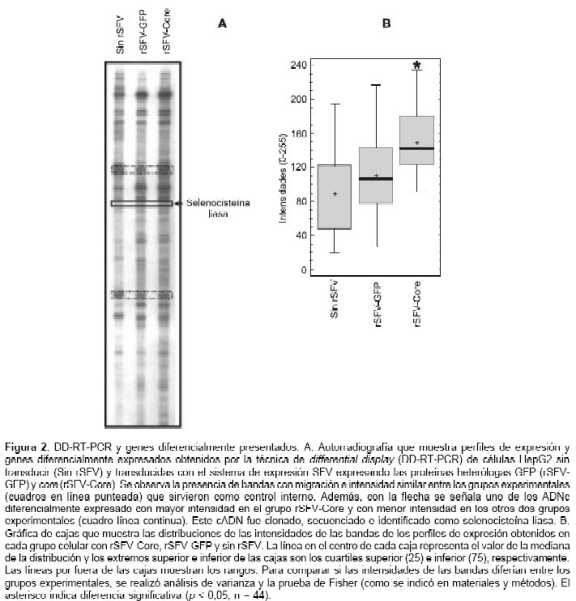
<body><![CDATA[<P>Con el fin de eliminar los factores experimentales que pudieran influir en los niveles relativos de las intensidades de los genes expresados (por ejemplo posibles diferencias en la marcaci&oacute;n en la reacci&oacute;n de PCR y en las eficiencias de detecci&oacute;n por diferencias en la cantidad de ARN inicial y <I>background</I>) los valores de intensidad de cada banda fueron normalizados rest&aacute;ndoles el valor del <I>background</I> y debido a que la masa total de productos de ADNc sembrado en el gel de poliacrilamida fue igual (2 </FONT><FONT FACE=Symbol>m</FONT><FONT FACE="Arial">l del producto de la reacci&oacute;n con la misma actividad espec&iacute;fica a-<SUP>32</SUP>PdCTP 3000 Ci/mmol) en los diferentes grupos experimentales, los niveles relativos de intensidad se compararon usando la expresi&oacute;n log<SUB>2</SUB> (T/NT) en donde T es el promedio ± desviaci&oacute;n est&aacute;ndar de las intensidades de las bandas detectadas en la autorradiograf&iacute;a del grupo transducido (rSFV-GFP o rSFV-Core) y NT es el promedio ± desviaci&oacute;n est&aacute;ndar de las intensidades de las bandas detectadas en la autorradiograf&iacute;a del grupo de c&eacute;lulas no transducidas (34).</P>     <P>Para identificar genes diferencialmente expresados se establecieron como punto de comparaci&oacute;n las bandas obtenidas de las c&eacute;lulas no transducidas, y para saber si el promedio de las intensidades de las bandas difer&iacute;an entre los grupos, se realiz&oacute; an&aacute;lisis de varianza y la prueba de Fisher (38). El valor de p &lt; 0,05 se consider&oacute; estad&iacute;sticamente significativo.</P> <B>    <P>Resultados</P> </B>    <P>A las 24 horas de la transducci&oacute;n con las part&iacute;culas recombinantes se observ&oacute; que las c&eacute;lulas HepG2 no transducidas (Sin rSRV, </FONT><A HREF="#figura1">figura 1A</A><FONT FACE="Arial">) ten&iacute;an una morfolog&iacute;a fibroblastoide y se adher&iacute;an a la matriz extracelular; en contraste, las c&eacute;lulas HepG2 transducidas con rSFV-GFP y rSVF-Core presentaron una morfolog&iacute;a redondeada y se desprend&iacute;an de la matriz extracelular (</FONT><A HREF="#figura1">figura 1B</A><FONT FACE="Arial"> y C). Este efecto citop&aacute;tico fue m&aacute;s evidente en las c&eacute;lulas transducidas con rSFV-Core (</FONT><A HREF="#figura1">figura 1C</A><FONT FACE="Arial">) que en las c&eacute;lulas transducidas con rSFV-GFP (</FONT><A HREF="#figura1">figura 1B</A><FONT FACE="Arial">), lo cual sugiri&oacute; que, adem&aacute;s del efecto citop&aacute;tico inducido por el vector viral, la prote&iacute;na <I>core</I> del VHC podr&iacute;a tener un efecto t&oacute;xico.</P>     <P><A NAME="figura1"></A></P> </FONT>    <P ALIGN="CENTER"><IMG SRC="/img/revistas/bio/v26n2/2a03i1.jpg"></P> <FONT FACE="Arial">    <P>Mediante el an&aacute;lisis de <I>Western blot</I> se observ&oacute; la presencia de una banda de 21 kDa correspondiente a la prote&iacute;na core en c&eacute;lulas transducidas con rSFV-Core y su ausencia en las no transducidas (</FONT><A HREF="#figura1">figura 1D</A><FONT FACE="Arial">); por an&aacute;lisis de citometr&iacute;a de flujo se detect&oacute; la presencia de GFP en c&eacute;lulas transducidas con rSFV-GFP (dato no mostrado), como fue reportado por Henao y col (30).</P>     <P>Luego de varios ensayos con diferentes tiempos de transducci&oacute;n (24, 48 y 72 h, datos no mostrados), el ARN de las c&eacute;lulas HepG2 se extrajo a las 24 horas de la transducci&oacute;n, tiempo que garantiz&oacute; la expresi&oacute;n de la prote&iacute;na heter&oacute;loga core, con el menor efecto del vector SFV sobre la viabilidad de las c&eacute;lulas (</FONT><A HREF="#figura1">figura 1</A><FONT FACE="Arial">).</P>     <P>Despu&eacute;s de usar dos iniciadores arbitrarios en los ensayos de presentaci&oacute;n diferencial de ARNm observamos que su perfil de expresi&oacute;n entre c&eacute;lulas HepG2 transducidas con rSFV-Core (</FONT><A HREF="#figura2">figura 2</A><FONT FACE="Arial">A, carril 3) no present&oacute; mucha diferencia comparado con el perfil de expresi&oacute;n obtenido de las c&eacute;lulas transducidas con rSFV-GFP (</FONT><A HREF="#figura2">figura 2A</A><FONT FACE="Arial"> carril 2) y no transducidas (</FONT><A HREF="#figura2">figura 2A</A><FONT FACE="Arial">, carril 1). En los tres grupos experimentales (c&eacute;lulas HepG2 no transducidas, transducidas con rSFV-GFP y rSFV-Core) se detectaron 42, 43 y 44 bandas, respectivamente.</P>     <P><A NAME="figura2"></A></P> </FONT>    ]]></body>
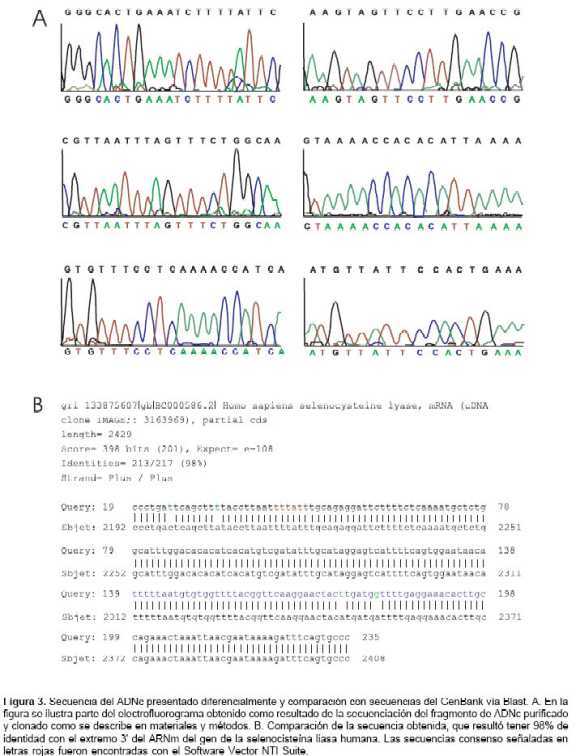
<body><![CDATA[<P ALIGN="CENTER"><IMG SRC="/img/revistas/bio/v26n2/2a03i2.jpg"></P> <FONT FACE="Arial">    <P>Dentro de cada uno de los grupos de genes expresados se observaron distribuciones de intensidades de bandas individuales que variaron entre 85 (bandas m&aacute;s oscuras) y 228 (bandas m&aacute;s claras) niveles de grises en el grupo transducido con rSFV-Core, entre 11 y 190 niveles de grises en el grupo no transducido y entre 17 y 206 niveles de grises en el grupo transducido con rSFV-GFP. Las bandas se distribuyeron homog&eacute;neamente en cada uno de los carriles y la mayor&iacute;a de estos ADNc, que representan los diferentes genes expresados, presentaron migraciones relativamente semejantes (</FONT><A HREF="#figura2">figura 2A</A><FONT FACE="Arial">).</P>     <P>Sin embargo, la diferencia se detect&oacute; por la intensidad de algunas bandas como se muestra en la </FONT><A HREF="#figura2">figura 2</A><FONT FACE="Arial">. Las bandas cuya intensidad era mayor o menor que la del grupo no transducido se consideraron como aumentadas o disminuidas en su expresi&oacute;n, respectivamente. Este resultado fue reproducible en tres ensayos diferentes de trascripci&oacute;n reversa con el primer T12MG, seguida de PCR con el mismo iniciador T12MG y el iniciador arbitrario (AP-3).</P>     <P>Despu&eacute;s de normalizar las intensidades relativas de cada banda, el an&aacute;lisis comparativo de los niveles de intensidad y la distribuci&oacute;n de las bandas de cada carril revelaron que las c&eacute;lulas transducidas con rSFV-Core mostraron niveles de expresi&oacute;n relativos diferentes comparados con los niveles de expresi&oacute;n de c&eacute;lulas sin transducir y transducidas con rSFV-GFP (</FONT><A HREF="#figura2">figura 2</A><FONT FACE="Arial">B). Por ejemplo, se observaron diferencias significativas y reproducibles en los niveles de expresi&oacute;n relativos de ARNm en las c&eacute;lulas HepG2 transducidas con rSFV-Core (promedio 143±37, n = 44, p &lt; 0,05) con respecto a los promedios del grupo no transducido (83±51, n = 42) y del grupo transducido con rSFV-GFP (102±45, n = 42).</P>     <P>Sin embargo, la comparaci&oacute;n de los promedios entre estos dos grupos no mostr&oacute; diferencias estad&iacute;sticamente significativas (n = 42, p &gt; 0,05).</P>     <P>Estos hallazgos indican que los perfiles de expresi&oacute;n pueden identificarse con base en la comparaci&oacute;n de la migraci&oacute;n de las bandas y en el promedio de intensidades relativas de los genes expresados.</P>     <P>El an&aacute;lisis de la presencia o ausencia de bandas y de las intensidades relativas en las autorradiograf&iacute;as (recuadros de la </FONT><A HREF="#figura2">figura 2A</A><FONT FACE="Arial">) permiti&oacute; la detecci&oacute;n de un fragmento ADNc de 258 pares de bases (</FONT><A HREF="#figura2">figura 2</A><FONT FACE="Arial">A, se&ntilde;alado con la flecha) expresado diferencialmente en el grupo rSFV-Core y que no se observ&oacute; en las c&eacute;lulas no transducidas ni en las transducidas con rSFV-GFP (recuadro l&iacute;nea punteada, </FONT><A HREF="#figura2">figura 2</A><FONT FACE="Arial">A). Este ADNc se purific&oacute; y se clon&oacute; como se describe en materiales y m&eacute;todos (datos no mostrados), y la caracterizaci&oacute;n de este fragmento se realiz&oacute; por medio del an&aacute;lisis de su secuencia en las dos direcciones 5‘-3‘y 3‘-5‘ (</FONT><A HREF="#figura3">figura 3</A><FONT FACE="Arial">). La b&uacute;squeda de homolog&iacute;a con otras secuencias reportadas en las bases de datos disponibles (GenBank, EMBL) v&iacute;a BLAST revel&oacute; una identidad del 98% con secuencias de ADNc reportadas, las cuales codifican para la enzima selenociste&iacute;na liasa humana (n&uacute;mero de acceso al GenBank BC000586.2), sugiriendo que las c&eacute;lulas HepG2 transducidas con rSFV-Core expresan este gen (37). El an&aacute;lisis de la secuencia que encontramos (n&uacute;mero de acceso al GenBank AK002119.1) mostr&oacute; un enriquecimiento en A (27%) y T (29%) y la presencia de las secuencias consensos UUUTUU (39), consideradas como se&ntilde;al de poliadenilaci&oacute;n, y de la secuencia UAAAU, propia de elementos ricos en AU (</FONT><A HREF="#figura3">figura 3</A><FONT FACE="Arial">B, se&ntilde;aladas en color rojo). Adem&aacute;s, observamos diferencias en 4 de los 217 nucle&oacute;tidos en el alineamiento realizado con la secuencia de ADNc humano (</FONT><A HREF="#figura3">figura 3</A><FONT FACE="Arial">B, letras verdes). Estas caracter&iacute;sticas de secuencia son comunes en los extremos 3’ de los ARNm que codifican prote&iacute;nas y regulan su estabilidad (39).</P>     <P><A NAME="figura3"></A></P> </FONT>    <P ALIGN="CENTER"><IMG SRC="/img/revistas/bio/v26n2/2a03i3.jpg"></P> <B><FONT FACE="Arial">    <P>Discusi&oacute;n</P> </B>    ]]></body>
<body><![CDATA[<P>Los resultados presentados en este trabajo ilustran el potencial del sistema de expresi&oacute;n heter&oacute;loga basado en el replic&oacute;n del SFV y de la presentaci&oacute;n diferencial de mARN en el estudio de la prote&iacute;na core del VHC expresado en c&eacute;lulas HepG2, as&iacute; como en el an&aacute;lisis de la expresi&oacute;n diferencial de genes en presencia o ausencia de la prote&iacute;na viral.</P>     <P>Esta aproximaci&oacute;n experimental permiti&oacute; la detecci&oacute;n y la clonaci&oacute;n molecular de un fragmento del ADNc que codifica para la selenociste&iacute;na liasa, uno de los ADNc expresados diferencialmente en c&eacute;lulas HepG2 transducidas con rSFV-Core, con respecto a las c&eacute;lulas sin transducir y a las transducidas con rSFV-GFP.</P>     <P>Este es el primer reporte de la asociaci&oacute;n entre la expresi&oacute;n de este gen en c&eacute;lulas HepG2 y la prote&iacute;na core del virus de la hepatitis C. Las caracter&iacute;sticas y actividades conocidas de la selenociste&iacute;na liasa (40-42) y el an&aacute;lisis de factores promotores que intervienen en la hepatocarcinog&eacute;nesis (40-45) nos permiten proponer una posible participaci&oacute;n de esta prote&iacute;na en el carcinoma hepatocelular. </P>     <P>La diferencia observada en el efecto citop&aacute;tico de los cultivos celulares transducidos con rSFVCore comparado con el observado en el caso de rSFV-GFP podr&iacute;a deberse a un efecto de la prote&iacute;na core en la regulaci&oacute;n de la apoptosis o, alternativamente, a efectos citop&aacute;ticos y tumoricidas del vector de expresi&oacute;n SFV (28,46-48). La interacci&oacute;n de <I>core</I> con el dominio citoplasm&aacute;tico de dos miembros de la familia de receptores del factor de necrosis tumoral (TNF), TNFR-1 y CD95, se ha demostrado <I>in vitro</I> (49- 54). Esta interacci&oacute;n parece estar implicada en la apoptosis observada en las l&iacute;neas de c&eacute;lulas hep&aacute;ticas como HepG2 y Hut78 con expresi&oacute;n transitoria de la prote&iacute;na <I>core</I> (55-57). Por lo tanto, se requieren estudios adicionales, incluidos estudios de expresi&oacute;n de la prote&iacute;na core utilizando otro sistema de expresi&oacute;n distinto al SFV, y ensayos que eval&uacute;en directamente las propiedades proapopt&oacute;ticas de la prote&iacute;na core, algunos de los cuales est&aacute;n en curso.</P>     <P>Una aproximaci&oacute;n para empezar a entender los efectos de la expresi&oacute;n de prote&iacute;nas del virus de la hepatitis C en c&eacute;lulas hep&aacute;ticas es identificar cambios en la expresi&oacute;n de genes en la presencia o ausencia de la prote&iacute;na de inter&eacute;s (24,58,59). En este trabajo observamos perfiles de expresi&oacute;n de ARNm semejantes en c&eacute;lulas HepG2 sin transducir y expresando la prote&iacute;na GFP. Sin embargo, en c&eacute;lulas que expresan la prote&iacute;na core, el perfil de expresi&oacute;n de los ARNm cambia y uno de los genes expresados diferencialmente en estas c&eacute;lulas es el gen que codifica para la selenociste&iacute;na liasa, <I>SLC</I>. Para demostrar la relaci&oacute;n causal entre la expresi&oacute;n diferencial de este gen y la prote&iacute;na core del VHC es necesario realizar estudios de expresi&oacute;n de este gen por Northern blot o RT-PCR cuantitativa en el sistema descrito en este estudio y compararlos con las condiciones durante la infecci&oacute;n natural, lo cual podr&iacute;a realizarse con el reciente establecimiento de dos promisorios modelos de replicaci&oacute;n <I>in vitro</I> del VHC (48, 51,52, 58,60).</P>     <P>La detecci&oacute;n e identificaci&oacute;n de la expresi&oacute;n del gen <I>SCL</I> en el hepatocarcinoma humano HepG2 permite sugerir un papel de este gen en la promoci&oacute;n del carcinoma hepatocelular que no se ha propuesto previamente (45). El gen <I>SLC</I> se expresa normalmente en varios tejidos, preferencialmente en h&iacute;gado, ri&ntilde;&oacute;n y test&iacute;culos (40,41), y codifica para la enzima que cataliza la formaci&oacute;n de L-alanina y selenio elemental a partir de la L-selenociste&iacute;na, una mol&eacute;cula que cuando se encuentra libre es t&oacute;xica y al acumularse puede llegar a ser letal (40,41). La enzima, en conjunto con la selenofosfato sintetasa, tambi&eacute;n participa en la bios&iacute;ntesis de selenoprote&iacute;nas y de metil selenociste&iacute;na, mol&eacute;culas importantes en la homeostasis del estado de &oacute;xido-reducci&oacute;n celular y en la s&iacute;ntesis de derivados de ciste&iacute;na, mol&eacute;culas que tienen la propiedad de tener acciones de quimioprevenci&oacute;n contra el c&aacute;ncer (44,61). Estos efectos y actividades, as&iacute; como la relaci&oacute;n entre carcinoma hepatocelular, incremento en la producci&oacute;n de ROS y estr&eacute;s oxidativo (45), y el resultado de nuestro trabajo, permiten plantear por primera vez una posible asociaci&oacute;n entre la expresi&oacute;n de la selenociste&iacute;na liasa y el carcinoma hep&aacute;tico. Proponemos que la expresi&oacute;n de la selenociste&iacute;na liasa est&aacute; finamente regulada, y que su alteraci&oacute;n puede estar involucrada en el c&aacute;ncer de dos maneras; cuando aumenta su expresi&oacute;n o actividad, la acci&oacute;n detoxificadora y de defensa antioxidante incrementar&iacute;a la viabilidad y longevidad celular, facilitando o promoviendo la acci&oacute;n de agentes tumorales (44,45).</P>     <P>Alternativamente, cuando su expresi&oacute;n o actividad est&aacute; disminuida, conducir&iacute;a a una menor producci&oacute;n de selenoprote&iacute;nas y derivados, conduciendo a una menor protecci&oacute;n contra especies reactivas de ox&iacute;geno, ROS, que pueden da&ntilde;ar constituyentes celulares, oxidar el ADN y modificar prote&iacute;nas que en conjunto promueven la carcinog&eacute;nesis (44,45,61,62). No obstante, estas hip&oacute;tesis requieren ser investigadas espec&iacute;ficamente en el c&aacute;ncer hep&aacute;tico.</P>     <P>En conclusi&oacute;n, los resultados de este trabajo confirman que la expresi&oacute;n de la prote&iacute;na core del virus de la hepatitis C se asocia con cambios en la expresi&oacute;n de ARN mensajeros espec&iacute;ficos, incluyendo al gen SLC que puede estar involucrado en la fisiopatolog&iacute;a del carcinoma hepatocelular.</P> <B>    <P>Agradecimientos</P> </B>    <P>Los pl&aacute;smidos pSFV-Core y pSFV-GFP fueron construidos durante los estudios doctorales de Mar&iacute;a Cristina Navas bajo la asesor&iacute;a de Fran&ccedil;oise Stoll-Keller del Institut de Virologie, Universit&eacute; Louis Pasteur en Estrasburgo, Francia, y de Jovan Pavlovic del Institute of Virology, University of Zurich, Zurich, Suiza. Los autores agradecen al Instituto Colombiano para el Desarrollo de la Ciencia y la Tecnolog&iacute;a "Francisco Jos&eacute; de Caldas", COLCIENCIAS, al Comit&eacute; para el Desarrollo de la Investigaci&oacute;n de la Universidad de Antioquia (CODI) y al Instituto Nacional de Salud.</P> <B>    ]]></body>
<body><![CDATA[<P>Conflicto de intereses</P> </B>    <P>Los autores declaran no tener vinculaci&oacute;n laboral con ning&uacute;n laboratorio farmac&eacute;utico o empresa interesada en obtener resultados positivos o egativos de la investigaci&oacute;n.</P> <B>    <P>Financiaci&oacute;n</P> </B>    <P>Este trabajo se realiz&oacute; con el apoyo financiero del Instituto Colombiano para el Desarrollo de la Ciencia y la Tecnolog&iacute;a "Francisco Jos&eacute; de Caldas", COLCIENCIAS (Proyectos 1115-04- 10228 y 2104-12-11563), el Comit&eacute; para el Desarrollo de la Investigaci&oacute;n de la Universidad de Antioquia (CODI) y el Instituto Nacional de Salud.</P>     <P>Correspondencia:</P>     <P>Luis Alberto G&oacute;mez, Grupo de Fisiolog&iacute;a Molecular, Instituto Nacional de Salud, Bogot&aacute;, D.C. Colombia. Apartado a&eacute;reo</P>     <P>80080. Av Calle 26 No. 51-60. Tel. 57-1- 2207700 ext. 414,</P>     <P>fax. 571-2200901.</P> </FONT>    <P><A HREF="mailto:lgomez@ins.gov.co">lgomez@ins.gov.co</A></P> <FONT FACE="Arial">    <P>Recibido: 27/09/05; aceptado:14/03/06</P> <B>     ]]></body>
<body><![CDATA[<P>Referencias</P> </B>    <!-- ref --><P>1.<B> Choo QL, Kuo G, Weiner AJ, Overby LR, Bradley DW, Houghton M. </B>Isolation of a cDNA clone derived from a blood-borne non-A, non-B viral hepatitis genome. Science 1989;244:359-62.&nbsp;&nbsp;&nbsp;&nbsp;&nbsp;&nbsp;&nbsp;&nbsp;[&#160;<a href="javascript:void(0);" onclick="javascript: window.open('/scielo.php?script=sci_nlinks&ref=000084&pid=S0120-4157200600020000300001&lng=','','width=640,height=500,resizable=yes,scrollbars=1,menubar=yes,');">Links</a>&#160;]<!-- end-ref --><!-- ref --><P>2.<B> Alberti A, Benvegnu ML. </B>Management of hepatitis C. J Hepatol 2003;38(Suppl. 1):S104-18.&nbsp;&nbsp;&nbsp;&nbsp;&nbsp;&nbsp;&nbsp;&nbsp;[&#160;<a href="javascript:void(0);" onclick="javascript: window.open('/scielo.php?script=sci_nlinks&ref=000085&pid=S0120-4157200600020000300002&lng=','','width=640,height=500,resizable=yes,scrollbars=1,menubar=yes,');">Links</a>&#160;]<!-- end-ref --><!-- ref --><P>3.<B> World Health Organization. </B>Hepatitis C Global prevalence (update). Wkly Epidemiol Rec 2000;75:18-9.&nbsp;&nbsp;&nbsp;&nbsp;&nbsp;&nbsp;&nbsp;&nbsp;[&#160;<a href="javascript:void(0);" onclick="javascript: window.open('/scielo.php?script=sci_nlinks&ref=000086&pid=S0120-4157200600020000300003&lng=','','width=640,height=500,resizable=yes,scrollbars=1,menubar=yes,');">Links</a>&#160;]<!-- end-ref --><!-- ref --><P>4.<B> Penin F, Dubuisson J, Rey FA, Moradpour D, Pawlotsky JM. </B>Structural biology of hepatitis C virus. Hepatology 2004;39:5-19.&nbsp;&nbsp;&nbsp;&nbsp;&nbsp;&nbsp;&nbsp;&nbsp;[&#160;<a href="javascript:void(0);" onclick="javascript: window.open('/scielo.php?script=sci_nlinks&ref=000087&pid=S0120-4157200600020000300004&lng=','','width=640,height=500,resizable=yes,scrollbars=1,menubar=yes,');">Links</a>&#160;]<!-- end-ref --><!-- ref --><P>5.<B> Santolini E, Migliaccio G, La Monica N. </B>Biosynthesis and biochemical properties of the hepatitis C virus core protein. J Virol 1994;68:3631-41.&nbsp;&nbsp;&nbsp;&nbsp;&nbsp;&nbsp;&nbsp;&nbsp;[&#160;<a href="javascript:void(0);" onclick="javascript: window.open('/scielo.php?script=sci_nlinks&ref=000088&pid=S0120-4157200600020000300005&lng=','','width=640,height=500,resizable=yes,scrollbars=1,menubar=yes,');">Links</a>&#160;]<!-- end-ref --><!-- ref --><P>6.<B> Matsumoto M, Hwang SB, Jeng KS, Zhu N, Lai MM. </B>Homotypic interaction and multimerization of hepatitis C virus core protein. Virology 1996;218:43-51.&nbsp;&nbsp;&nbsp;&nbsp;&nbsp;&nbsp;&nbsp;&nbsp;[&#160;<a href="javascript:void(0);" onclick="javascript: window.open('/scielo.php?script=sci_nlinks&ref=000089&pid=S0120-4157200600020000300006&lng=','','width=640,height=500,resizable=yes,scrollbars=1,menubar=yes,');">Links</a>&#160;]<!-- end-ref --><!-- ref --><P>7.<B> McLauchlan J. </B>Properties of the hepatitis C virus core protein: a structural protein that modulates cellular processes. J Viral Hepat 2000;7:2-14.&nbsp;&nbsp;&nbsp;&nbsp;&nbsp;&nbsp;&nbsp;&nbsp;[&#160;<a href="javascript:void(0);" onclick="javascript: window.open('/scielo.php?script=sci_nlinks&ref=000090&pid=S0120-4157200600020000300007&lng=','','width=640,height=500,resizable=yes,scrollbars=1,menubar=yes,');">Links</a>&#160;]<!-- end-ref --><!-- ref --><P>8.<B> Ray RB, Lagging LM, Meyer K, Steele R, Ray R. </B>Transcriptional regulation of cellular and viral promoters by the hepatitis C virus core protein. Virus Res 1995; 37:209-20.&nbsp;&nbsp;&nbsp;&nbsp;&nbsp;&nbsp;&nbsp;&nbsp;[&#160;<a href="javascript:void(0);" onclick="javascript: window.open('/scielo.php?script=sci_nlinks&ref=000091&pid=S0120-4157200600020000300008&lng=','','width=640,height=500,resizable=yes,scrollbars=1,menubar=yes,');">Links</a>&#160;]<!-- end-ref --><!-- ref --><P>9.<B> Lu W, Lo SY, Chen M, Wu K, Fung YK, Ou JH. </B>Activation of p53 tumor suppressor by hepatitis C virus core protein. Virology 1999; 264:134-41.&nbsp;&nbsp;&nbsp;&nbsp;&nbsp;&nbsp;&nbsp;&nbsp;[&#160;<a href="javascript:void(0);" onclick="javascript: window.open('/scielo.php?script=sci_nlinks&ref=000092&pid=S0120-4157200600020000300009&lng=','','width=640,height=500,resizable=yes,scrollbars=1,menubar=yes,');">Links</a>&#160;]<!-- end-ref --><!-- ref --><P>10.<B> Ray RB, Steele R, Meyer K, Ray R. </B>Hepatitis C virus core protein represses p21WAF1/Cip1/Sid1 promoter activity. Gene1998;208:331-6.&nbsp;&nbsp;&nbsp;&nbsp;&nbsp;&nbsp;&nbsp;&nbsp;[&#160;<a href="javascript:void(0);" onclick="javascript: window.open('/scielo.php?script=sci_nlinks&ref=000093&pid=S0120-4157200600020000300010&lng=','','width=640,height=500,resizable=yes,scrollbars=1,menubar=yes,');">Links</a>&#160;]<!-- end-ref --><!-- ref --><P>11.<B> Ruggieri A, Harada T, Matsuura Y, Miyamura T. </B>Sensitization to Fas-mediated apoptosis by hepatitis C virus core protein. Virology 1997;229:68-76.&nbsp;&nbsp;&nbsp;&nbsp;&nbsp;&nbsp;&nbsp;&nbsp;[&#160;<a href="javascript:void(0);" onclick="javascript: window.open('/scielo.php?script=sci_nlinks&ref=000094&pid=S0120-4157200600020000300011&lng=','','width=640,height=500,resizable=yes,scrollbars=1,menubar=yes,');">Links</a>&#160;]<!-- end-ref --><!-- ref --><P>12. <B>Marusawa</B></FONT><FONT FACE="Arial" COLOR="#0000ff"> </FONT><B><FONT FACE="Arial">H, Hijikata M, Chiba</B></FONT><FONT FACE="Arial" COLOR="#0000ff"> </FONT><B><FONT FACE="Arial">T, Shimotohno K. </B>Hepatitis C virus core protein inhibits Fas and tumor necrosis factor alpha-mediated apoptosis via NfkappaB activation. J Virol 1999;73:4713-20&nbsp;&nbsp;&nbsp;&nbsp;&nbsp;&nbsp;&nbsp;&nbsp;[&#160;<a href="javascript:void(0);" onclick="javascript: window.open('/scielo.php?script=sci_nlinks&ref=000095&pid=S0120-4157200600020000300012&lng=','','width=640,height=500,resizable=yes,scrollbars=1,menubar=yes,');">Links</a>&#160;]<!-- end-ref --><!-- ref --><P>13.<B> Hahn CS, Cho YG, Kang BS, Lester IM, Hahn YS. </B>The HCV core protein acts as a positive regulator of fas-mediated apoptosis in a human lymphoblastoid T cell line. Virology 2000;276:127-37.&nbsp;&nbsp;&nbsp;&nbsp;&nbsp;&nbsp;&nbsp;&nbsp;[&#160;<a href="javascript:void(0);" onclick="javascript: window.open('/scielo.php?script=sci_nlinks&ref=000096&pid=S0120-4157200600020000300013&lng=','','width=640,height=500,resizable=yes,scrollbars=1,menubar=yes,');">Links</a>&#160;]<!-- end-ref --><!-- ref --><P>14.<B> Ray RB, Laggin LM, Meyer K, Ray R. </B>Hepatitis C Virus core protein cooperates with ras and transforms primary rat embryo fibroblasts to tumorigenic phenotype. J Virol 1996;70:4438-43.&nbsp;&nbsp;&nbsp;&nbsp;&nbsp;&nbsp;&nbsp;&nbsp;[&#160;<a href="javascript:void(0);" onclick="javascript: window.open('/scielo.php?script=sci_nlinks&ref=000097&pid=S0120-4157200600020000300014&lng=','','width=640,height=500,resizable=yes,scrollbars=1,menubar=yes,');">Links</a>&#160;]<!-- end-ref --><!-- ref --><P>15.<B> Moriya K, Fujie H, Shintani Y, Yotsuyanagi H, Tsutsumi T, Ishibashi K, et al. </B>The core protein of hepatitis C virus induces hepatocellular carcinoma in transgenic mice. Nat Med 1998;4:1065-7.&nbsp;&nbsp;&nbsp;&nbsp;&nbsp;&nbsp;&nbsp;&nbsp;[&#160;<a href="javascript:void(0);" onclick="javascript: window.open('/scielo.php?script=sci_nlinks&ref=000098&pid=S0120-4157200600020000300015&lng=','','width=640,height=500,resizable=yes,scrollbars=1,menubar=yes,');">Links</a>&#160;]<!-- end-ref --><!-- ref --><P>16.<B> Yoshida T, Hanada T, Tokuhisa T, Kosai K, Sata M, Kohara M, et al. </B>Activation of STAT3 by the hepatitis C virus core protein leads to cellular transformation. J Exp Med 2002 ;196:641-53.&nbsp;&nbsp;&nbsp;&nbsp;&nbsp;&nbsp;&nbsp;&nbsp;[&#160;<a href="javascript:void(0);" onclick="javascript: window.open('/scielo.php?script=sci_nlinks&ref=000099&pid=S0120-4157200600020000300016&lng=','','width=640,height=500,resizable=yes,scrollbars=1,menubar=yes,');">Links</a>&#160;]<!-- end-ref --><!-- ref --><P>17.<B> Moriya K, Yotsuyanagi H, Shintani Y, Fujie H, Ishibashi K, Matsuura Y, et al. </B>Hepatitis C virus core protein induces hepatic steatosis in transgenic mice. J Gen Virol 1997;78:1527-31.&nbsp;&nbsp;&nbsp;&nbsp;&nbsp;&nbsp;&nbsp;&nbsp;[&#160;<a href="javascript:void(0);" onclick="javascript: window.open('/scielo.php?script=sci_nlinks&ref=000100&pid=S0120-4157200600020000300017&lng=','','width=640,height=500,resizable=yes,scrollbars=1,menubar=yes,');">Links</a>&#160;]<!-- end-ref --><!-- ref --><P>18.<B> Barba G, Harper F, Harada T, Kohara M, Goulinet S, Matsuura Y, et al. </B>Hepatitis C virus core protein shows a cytoplasmic localization and associates to cellular lipid storage droplets. Proc Natl Acad Sci U S A 1997;94:1200-5.&nbsp;&nbsp;&nbsp;&nbsp;&nbsp;&nbsp;&nbsp;&nbsp;[&#160;<a href="javascript:void(0);" onclick="javascript: window.open('/scielo.php?script=sci_nlinks&ref=000101&pid=S0120-4157200600020000300018&lng=','','width=640,height=500,resizable=yes,scrollbars=1,menubar=yes,');">Links</a>&#160;]<!-- end-ref --><!-- ref --><P>19.<B> Large MK, Kittlesen DJ, Hahn YS. </B>Suppression of host immune response by the core protein of hepatitis C virus: possible implications for hepatitis C virus persistence. J Immunol 1999;162:931-8.&nbsp;&nbsp;&nbsp;&nbsp;&nbsp;&nbsp;&nbsp;&nbsp;[&#160;<a href="javascript:void(0);" onclick="javascript: window.open('/scielo.php?script=sci_nlinks&ref=000102&pid=S0120-4157200600020000300019&lng=','','width=640,height=500,resizable=yes,scrollbars=1,menubar=yes,');">Links</a>&#160;]<!-- end-ref --><!-- ref --><P>20.<B> Soguero C, Joo M, Chianese-Bullock KA, Nguyen DT, Tung K, Hahn YS. </B>Hepatitis C virus core protein leads to immune suppression and liver damage in a transgenic murine model. J Virol 2002;76:9345-54.&nbsp;&nbsp;&nbsp;&nbsp;&nbsp;&nbsp;&nbsp;&nbsp;[&#160;<a href="javascript:void(0);" onclick="javascript: window.open('/scielo.php?script=sci_nlinks&ref=000103&pid=S0120-4157200600020000300020&lng=','','width=640,height=500,resizable=yes,scrollbars=1,menubar=yes,');">Links</a>&#160;]<!-- end-ref --><!-- ref --><P>21.<B> Dolganiuc A, Kodys K, Kopasz A, Marshall C, Do T, Romics L Jr, et al. </B>Hepatitis C virus core and nonstructural protein 3 proteins induce pro- and antiinflammatory cytokines and inhibit dendritic cell differentiation. J Immunol 2003 1;170:5615-24.&nbsp;&nbsp;&nbsp;&nbsp;&nbsp;&nbsp;&nbsp;&nbsp;[&#160;<a href="javascript:void(0);" onclick="javascript: window.open('/scielo.php?script=sci_nlinks&ref=000104&pid=S0120-4157200600020000300021&lng=','','width=640,height=500,resizable=yes,scrollbars=1,menubar=yes,');">Links</a>&#160;]<!-- end-ref --><!-- ref --><P>22.<B> Alisi A, Giambartolomei S, Cupelli F, Merlo P, Fontemaggi G, Spaziani A, et al. </B>Physical and functional interaction between HCV core protein and the different p73 isoforms. Oncogene 2003;22:2573-80.&nbsp;&nbsp;&nbsp;&nbsp;&nbsp;&nbsp;&nbsp;&nbsp;[&#160;<a href="javascript:void(0);" onclick="javascript: window.open('/scielo.php?script=sci_nlinks&ref=000105&pid=S0120-4157200600020000300022&lng=','','width=640,height=500,resizable=yes,scrollbars=1,menubar=yes,');">Links</a>&#160;]<!-- end-ref --><!-- ref --><P>23.<B> Su AI, Pezacki JP, Wodicka L, Brideau AD, Supekova L, Thimme R, et al</B>. Genomic analysis of the host response to hepatitis C virus infection. Proc Natl Acad Sci USA 2002;99:15669-74.&nbsp;&nbsp;&nbsp;&nbsp;&nbsp;&nbsp;&nbsp;&nbsp;[&#160;<a href="javascript:void(0);" onclick="javascript: window.open('/scielo.php?script=sci_nlinks&ref=000106&pid=S0120-4157200600020000300023&lng=','','width=640,height=500,resizable=yes,scrollbars=1,menubar=yes,');">Links</a>&#160;]<!-- end-ref --><!-- ref --><P>24.<B> Ohkawa K, Ishida H, Nakanishi F, Hosui A, Sato A, Ueda K, et al. </B>Changes in gene expression profile by HCV core protein in cultured liver cells: analysis by DNA array assay. Hepatol Res 2003;25:396-408.&nbsp;&nbsp;&nbsp;&nbsp;&nbsp;&nbsp;&nbsp;&nbsp;[&#160;<a href="javascript:void(0);" onclick="javascript: window.open('/scielo.php?script=sci_nlinks&ref=000107&pid=S0120-4157200600020000300024&lng=','','width=640,height=500,resizable=yes,scrollbars=1,menubar=yes,');">Links</a>&#160;]<!-- end-ref --><!-- ref --><P>25.<B> Liu M, Zhang SL, Cheng J, Liu Y, Wang L, Shao Q, et al. </B>Genes transactivated by hepatitis C virus core protein, a microarray assay. World J Gastroenterol 2005 14;11:3351-6.&nbsp;&nbsp;&nbsp;&nbsp;&nbsp;&nbsp;&nbsp;&nbsp;[&#160;<a href="javascript:void(0);" onclick="javascript: window.open('/scielo.php?script=sci_nlinks&ref=000108&pid=S0120-4157200600020000300025&lng=','','width=640,height=500,resizable=yes,scrollbars=1,menubar=yes,');">Links</a>&#160;]<!-- end-ref --><!-- ref --><P>26.<B> Schinazi RF, Ilan E, Black PL, Yao X, Dagan S. </B>Cellbased and animal models for hepatitis B and C viruses. Antivir Chem Chemother 1999;10:99-114.&nbsp;&nbsp;&nbsp;&nbsp;&nbsp;&nbsp;&nbsp;&nbsp;[&#160;<a href="javascript:void(0);" onclick="javascript: window.open('/scielo.php?script=sci_nlinks&ref=000109&pid=S0120-4157200600020000300026&lng=','','width=640,height=500,resizable=yes,scrollbars=1,menubar=yes,');">Links</a>&#160;]<!-- end-ref --><!-- ref --><P>27.<B> Sun BS, Pan J, Clayton MM, Liu J, Yan X, Matskevich AA, et al. </B>Hepatitis C virus replication in stably transfected HepG2 cells promotes hepatocellular growth and tumorigenesis. J Cell Physiol 2004;201:447-58.&nbsp;&nbsp;&nbsp;&nbsp;&nbsp;&nbsp;&nbsp;&nbsp;[&#160;<a href="javascript:void(0);" onclick="javascript: window.open('/scielo.php?script=sci_nlinks&ref=000110&pid=S0120-4157200600020000300027&lng=','','width=640,height=500,resizable=yes,scrollbars=1,menubar=yes,');">Links</a>&#160;]<!-- end-ref --><!-- ref --><P>28.<B> Lundstrom K, Schweitzer C, Richards JG, Ehrengruber M, Jenck F, Muhlhardt C. </B>Semliki forest virus vectors for in vitro and in vivo applications. Gene Ther Mol Biol 1999;4:23-31.&nbsp;&nbsp;&nbsp;&nbsp;&nbsp;&nbsp;&nbsp;&nbsp;[&#160;<a href="javascript:void(0);" onclick="javascript: window.open('/scielo.php?script=sci_nlinks&ref=000111&pid=S0120-4157200600020000300028&lng=','','width=640,height=500,resizable=yes,scrollbars=1,menubar=yes,');">Links</a>&#160;]<!-- end-ref --><!-- ref --><P>29.<B> Torresi J, Meanger J, Lambert P, Li F, Locarnini SA, Anderson DA. </B>High level expression of the capsid protein of hepatitis E virus in diverse eukaryotic cells using the Semliki Forest virus replicon. J Virol Methods 1997;69:81-91.&nbsp;&nbsp;&nbsp;&nbsp;&nbsp;&nbsp;&nbsp;&nbsp;[&#160;<a href="javascript:void(0);" onclick="javascript: window.open('/scielo.php?script=sci_nlinks&ref=000112&pid=S0120-4157200600020000300029&lng=','','width=640,height=500,resizable=yes,scrollbars=1,menubar=yes,');">Links</a>&#160;]<!-- end-ref --><!-- ref --><P>30.<B> Henao LF, Yepes JO, Alvarez CM, Balcazar N, Navas MC. </B>Expresi&oacute;n de la prote&iacute;na verde fluorescente y prote&iacute;na Core del virus de la hepatitis C en la l&iacute;nea de hepatoma HepG2 mediante el sistema de expresi&oacute;n del Semliki Forest Virus. Act Biol 2004;26:23-9.&nbsp;&nbsp;&nbsp;&nbsp;&nbsp;&nbsp;&nbsp;&nbsp;[&#160;<a href="javascript:void(0);" onclick="javascript: window.open('/scielo.php?script=sci_nlinks&ref=000113&pid=S0120-4157200600020000300030&lng=','','width=640,height=500,resizable=yes,scrollbars=1,menubar=yes,');">Links</a>&#160;]<!-- end-ref --><!-- ref --><P>31.<B> Chomczynski P. </B>Solubilization in formamide protects RNA from degradation. Nucleic Acids Res 1992;20:3791-2.&nbsp;&nbsp;&nbsp;&nbsp;&nbsp;&nbsp;&nbsp;&nbsp;[&#160;<a href="javascript:void(0);" onclick="javascript: window.open('/scielo.php?script=sci_nlinks&ref=000114&pid=S0120-4157200600020000300031&lng=','','width=640,height=500,resizable=yes,scrollbars=1,menubar=yes,');">Links</a>&#160;]<!-- end-ref --><!-- ref --><P>32.<B> Sambrook J, Fritsch EF, Maniatis T. </B>Molecular Cloning. A Laboratory Manual. Second Edition. Cold Spring Harbor: Laboratory Press; 1989.&nbsp;&nbsp;&nbsp;&nbsp;&nbsp;&nbsp;&nbsp;&nbsp;[&#160;<a href="javascript:void(0);" onclick="javascript: window.open('/scielo.php?script=sci_nlinks&ref=000115&pid=S0120-4157200600020000300032&lng=','','width=640,height=500,resizable=yes,scrollbars=1,menubar=yes,');">Links</a>&#160;]<!-- end-ref --><!-- ref --><P>33.<B> Gomez LA, Strasberg Rieber M, Rieber M. </B>PCRmediated differential display and cloning of a melanocyte gene decreased in malignant melanoma and upregulated with sensitization to DNA damage. DNA Cell Biol 1996;15:423-7.&nbsp;&nbsp;&nbsp;&nbsp;&nbsp;&nbsp;&nbsp;&nbsp;[&#160;<a href="javascript:void(0);" onclick="javascript: window.open('/scielo.php?script=sci_nlinks&ref=000116&pid=S0120-4157200600020000300033&lng=','','width=640,height=500,resizable=yes,scrollbars=1,menubar=yes,');">Links</a>&#160;]<!-- end-ref --><!-- ref --><P>34.<B> Liang P, Averboukh L, Keyomarsi K, Sager R, Pardee AB. </B>Differential display of eukaryotic messenger RNA by means the polymerase chain reaction. Science 1992;257:967-71.&nbsp;&nbsp;&nbsp;&nbsp;&nbsp;&nbsp;&nbsp;&nbsp;[&#160;<a href="javascript:void(0);" onclick="javascript: window.open('/scielo.php?script=sci_nlinks&ref=000117&pid=S0120-4157200600020000300034&lng=','','width=640,height=500,resizable=yes,scrollbars=1,menubar=yes,');">Links</a>&#160;]<!-- end-ref --><!-- ref --><P>35.<B> Birnboim HC. </B>A rapid alkaline extraction method for the isolation of plasmid DNA. Methods Enzymol 1983;100:243-55&nbsp;&nbsp;&nbsp;&nbsp;&nbsp;&nbsp;&nbsp;&nbsp;[&#160;<a href="javascript:void(0);" onclick="javascript: window.open('/scielo.php?script=sci_nlinks&ref=000118&pid=S0120-4157200600020000300035&lng=','','width=640,height=500,resizable=yes,scrollbars=1,menubar=yes,');">Links</a>&#160;]<!-- end-ref --><!-- ref --><P>36.<B> Sanger F, Nicklen S, Coulson AR. </B>DNA sequencing with chain terminating inhibitors. Proc Natl Acad Sci USA 1977; 74: 5463-7.&nbsp;&nbsp;&nbsp;&nbsp;&nbsp;&nbsp;&nbsp;&nbsp;[&#160;<a href="javascript:void(0);" onclick="javascript: window.open('/scielo.php?script=sci_nlinks&ref=000119&pid=S0120-4157200600020000300036&lng=','','width=640,height=500,resizable=yes,scrollbars=1,menubar=yes,');">Links</a>&#160;]<!-- end-ref --><!-- ref --><P>37.<B> Altschul SF, Gish W. </B>Local alignment statistics. Methods Enzymol 1996;266:460-80.&nbsp;&nbsp;&nbsp;&nbsp;&nbsp;&nbsp;&nbsp;&nbsp;[&#160;<a href="javascript:void(0);" onclick="javascript: window.open('/scielo.php?script=sci_nlinks&ref=000120&pid=S0120-4157200600020000300037&lng=','','width=640,height=500,resizable=yes,scrollbars=1,menubar=yes,');">Links</a>&#160;]<!-- end-ref --><!-- ref --><P>38.<B> Cleveland WS. </B>Visualizing data. New Jersey: Hobart Press. Murray Hill; 1993.&nbsp;&nbsp;&nbsp;&nbsp;&nbsp;&nbsp;&nbsp;&nbsp;[&#160;<a href="javascript:void(0);" onclick="javascript: window.open('/scielo.php?script=sci_nlinks&ref=000121&pid=S0120-4157200600020000300038&lng=','','width=640,height=500,resizable=yes,scrollbars=1,menubar=yes,');">Links</a>&#160;]<!-- end-ref --><!-- ref --><P>39.<B> Bevilacqua A, Ceriani MC, Canti G, Asnaghi L, Gherzi R, Brewer G, et al. </B>Bcl-2 protein is required for the adenine/uridine-rich element (ARE)-dependent degradation of its own messenger. J Biol Chem 2003;278:23451-9.&nbsp;&nbsp;&nbsp;&nbsp;&nbsp;&nbsp;&nbsp;&nbsp;[&#160;<a href="javascript:void(0);" onclick="javascript: window.open('/scielo.php?script=sci_nlinks&ref=000122&pid=S0120-4157200600020000300039&lng=','','width=640,height=500,resizable=yes,scrollbars=1,menubar=yes,');">Links</a>&#160;]<!-- end-ref --><!-- ref --><P>40.<B> Esaki N, Nakamura T, Tanaka H, Sodag K. </B>Selenocysteine lyase, a novel enzyme that specifically acts on selenocysteine. Mammalian distribution and purification and properties of pig liver enzyme. J Biol Chem 1982;257:4386-91.&nbsp;&nbsp;&nbsp;&nbsp;&nbsp;&nbsp;&nbsp;&nbsp;[&#160;<a href="javascript:void(0);" onclick="javascript: window.open('/scielo.php?script=sci_nlinks&ref=000123&pid=S0120-4157200600020000300040&lng=','','width=640,height=500,resizable=yes,scrollbars=1,menubar=yes,');">Links</a>&#160;]<!-- end-ref --><!-- ref --><P>41.<B> Mihara H, Kurihara T, Watanabe T, Yoshimura T, Esaki N. </B>cDNA cloning, purification and characterization of mouse liver selenocysteine lyase. Candidate for selenium delivery protein in selenoprotein synthesis. J Biol Chem 2000;275: 6195-200.&nbsp;&nbsp;&nbsp;&nbsp;&nbsp;&nbsp;&nbsp;&nbsp;[&#160;<a href="javascript:void(0);" onclick="javascript: window.open('/scielo.php?script=sci_nlinks&ref=000124&pid=S0120-4157200600020000300041&lng=','','width=640,height=500,resizable=yes,scrollbars=1,menubar=yes,');">Links</a>&#160;]<!-- end-ref --><!-- ref --><P>42.<B> Ip C, Thompson HJ, Zhu Z, Ganther HE. </B>In vitro and in vivo studies of methylseleninic acid: evidence that a monomethylated selenium metabolite is critical for cancer chemoprevention. Cancer Res 2000;60: 2882-6.&nbsp;&nbsp;&nbsp;&nbsp;&nbsp;&nbsp;&nbsp;&nbsp;[&#160;<a href="javascript:void(0);" onclick="javascript: window.open('/scielo.php?script=sci_nlinks&ref=000125&pid=S0120-4157200600020000300042&lng=','','width=640,height=500,resizable=yes,scrollbars=1,menubar=yes,');">Links</a>&#160;]<!-- end-ref --><!-- ref --><P>43.<B> Kretz-Remy C, Arrigo AP. </B>Gene expression and thiol redox state. Methods Enzymol 2002;348:200-15.&nbsp;&nbsp;&nbsp;&nbsp;&nbsp;&nbsp;&nbsp;&nbsp;[&#160;<a href="javascript:void(0);" onclick="javascript: window.open('/scielo.php?script=sci_nlinks&ref=000126&pid=S0120-4157200600020000300043&lng=','','width=640,height=500,resizable=yes,scrollbars=1,menubar=yes,');">Links</a>&#160;]<!-- end-ref --><!-- ref --><P>44.<B> Mitsui A, Hamuro J, Nakamura H, Kondo N, Hirabayashi Y, Ishizaki-Koizumi S, et al. </B>Overexpression of human thioredoxin in transgenic mice controls oxidative stress and life span. Antioxid Redox Signal 2002;4:693-6.&nbsp;&nbsp;&nbsp;&nbsp;&nbsp;&nbsp;&nbsp;&nbsp;[&#160;<a href="javascript:void(0);" onclick="javascript: window.open('/scielo.php?script=sci_nlinks&ref=000127&pid=S0120-4157200600020000300044&lng=','','width=640,height=500,resizable=yes,scrollbars=1,menubar=yes,');">Links</a>&#160;]<!-- end-ref --><!-- ref --><P>45.<B> Maeda S, Kamata H, Luo JL, Leffert H, Karin M. </B>IKKB couples hepatocyte death to cytokine-driven compensatory proliferation that promotes chemical hepatocarcinogenesis. Cell 2005;121:977-90.&nbsp;&nbsp;&nbsp;&nbsp;&nbsp;&nbsp;&nbsp;&nbsp;[&#160;<a href="javascript:void(0);" onclick="javascript: window.open('/scielo.php?script=sci_nlinks&ref=000128&pid=S0120-4157200600020000300045&lng=','','width=640,height=500,resizable=yes,scrollbars=1,menubar=yes,');">Links</a>&#160;]<!-- end-ref --><!-- ref --><P>46.<B> Lingor P, Sch&ouml;ll U, B&auml;hr M, K&uuml;gler S. </B>Functional applications of novel Semliki Forest virus vectors are limited by vector toxicity in cultures of primary neurons in vitro and in the substantia nigra in vivo. Exp Brain Res 2005;161:335-42.&nbsp;&nbsp;&nbsp;&nbsp;&nbsp;&nbsp;&nbsp;&nbsp;[&#160;<a href="javascript:void(0);" onclick="javascript: window.open('/scielo.php?script=sci_nlinks&ref=000129&pid=S0120-4157200600020000300046&lng=','','width=640,height=500,resizable=yes,scrollbars=1,menubar=yes,');">Links</a>&#160;]<!-- end-ref --><!-- ref --><P>47.<B> Ehrengruber MU, Lundstrom K, Schweitzer C, Heuss C, Schlesinger S, Gahwiler BH. </B>Recombinant Semliki Forest virus and Sindbis virus efficiently infect neurons in hippocampal slice cultures. Proc Natl Acad Sci USA 1999;96:7041-6.&nbsp;&nbsp;&nbsp;&nbsp;&nbsp;&nbsp;&nbsp;&nbsp;[&#160;<a href="javascript:void(0);" onclick="javascript: window.open('/scielo.php?script=sci_nlinks&ref=000130&pid=S0120-4157200600020000300047&lng=','','width=640,height=500,resizable=yes,scrollbars=1,menubar=yes,');">Links</a>&#160;]<!-- end-ref --><!-- ref --><P>48.<B> Atkins GJ, Sheahan BJ, Liljestrom P. </B>The molecular pathogenesis of Semliki Forest virus: a model virus made useful? J Gen Virol 1999;80:2287-97.&nbsp;&nbsp;&nbsp;&nbsp;&nbsp;&nbsp;&nbsp;&nbsp;[&#160;<a href="javascript:void(0);" onclick="javascript: window.open('/scielo.php?script=sci_nlinks&ref=000131&pid=S0120-4157200600020000300048&lng=','','width=640,height=500,resizable=yes,scrollbars=1,menubar=yes,');">Links</a>&#160;]<!-- end-ref --><!-- ref --><P>49.<B> Glasgow GM, McGee MM, Tarbatt CJ, Mooney DA, Sheahan BJ, Atkins GJ. </B>The Semliki Forest virus vector induces p53-independent apoptosis. J Gen Virol 1998;79:2405-10.&nbsp;&nbsp;&nbsp;&nbsp;&nbsp;&nbsp;&nbsp;&nbsp;[&#160;<a href="javascript:void(0);" onclick="javascript: window.open('/scielo.php?script=sci_nlinks&ref=000132&pid=S0120-4157200600020000300049&lng=','','width=640,height=500,resizable=yes,scrollbars=1,menubar=yes,');">Links</a>&#160;]<!-- end-ref --><!-- ref --><P>50.<B> Fujita T, Ishido S, Muramatsu S, Itoh M, Hotta H. </B>Suppression of actinomycin D-induced apoptosis by the NS3 protein of hepatitis C virus. Biochem Biophys Res Commun 1996;229:825-31.&nbsp;&nbsp;&nbsp;&nbsp;&nbsp;&nbsp;&nbsp;&nbsp;[&#160;<a href="javascript:void(0);" onclick="javascript: window.open('/scielo.php?script=sci_nlinks&ref=000133&pid=S0120-4157200600020000300050&lng=','','width=640,height=500,resizable=yes,scrollbars=1,menubar=yes,');">Links</a>&#160;]<!-- end-ref --><!-- ref --><P>51.<B> Lan KH, Sheu ML, Hwang SJ, Yen SH, Chen SY, Wu JC, et al. </B>HCV NS5A interacts with p53 and inhibits p53-mediated apoptosis. Oncogene 2002;21:4801-11.&nbsp;&nbsp;&nbsp;&nbsp;&nbsp;&nbsp;&nbsp;&nbsp;[&#160;<a href="javascript:void(0);" onclick="javascript: window.open('/scielo.php?script=sci_nlinks&ref=000134&pid=S0120-4157200600020000300051&lng=','','width=640,height=500,resizable=yes,scrollbars=1,menubar=yes,');">Links</a>&#160;]<!-- end-ref --><!-- ref --><P>52.<B> Meyer K, Basu A, Saito K, Ray RB, Ray R. </B>Inhibition of hepatitis C virus core protein expression in immortalized human hepatocytes induces cytochrome c-independent increase in Apaf-1 and caspase-9 activation for cell death. Virology 2005;336:198-207.&nbsp;&nbsp;&nbsp;&nbsp;&nbsp;&nbsp;&nbsp;&nbsp;[&#160;<a href="javascript:void(0);" onclick="javascript: window.open('/scielo.php?script=sci_nlinks&ref=000135&pid=S0120-4157200600020000300052&lng=','','width=640,height=500,resizable=yes,scrollbars=1,menubar=yes,');">Links</a>&#160;]<!-- end-ref --><!-- ref --><P>53.<B> Liljestrom P, Garoff H. </B>A new generation of animal cell expression vectors based on the Semliki Forest virus replicon. Biotechnology 1991;9:1356-61.&nbsp;&nbsp;&nbsp;&nbsp;&nbsp;&nbsp;&nbsp;&nbsp;[&#160;<a href="javascript:void(0);" onclick="javascript: window.open('/scielo.php?script=sci_nlinks&ref=000136&pid=S0120-4157200600020000300053&lng=','','width=640,height=500,resizable=yes,scrollbars=1,menubar=yes,');">Links</a>&#160;]<!-- end-ref --><!-- ref --><P>54.<B> Langhans B, Lechmann M, Ihlenfeldt H, Jung G, Giers G, Schweitzer S, et al. </B>A hepatitis C virus (HCV) core protein derived peptide inhibits HCV specific lymphocyte proliferation. Eur J Med Res 2000;5:115-20.&nbsp;&nbsp;&nbsp;&nbsp;&nbsp;&nbsp;&nbsp;&nbsp;[&#160;<a href="javascript:void(0);" onclick="javascript: window.open('/scielo.php?script=sci_nlinks&ref=000137&pid=S0120-4157200600020000300054&lng=','','width=640,height=500,resizable=yes,scrollbars=1,menubar=yes,');">Links</a>&#160;]<!-- end-ref --><!-- ref --><P>55.<B> Basu A, Meyer K, Ray RB, Ray R. </B>Hepatitis C virus core protein is necessary for the maintenance of immortalized human hepatocytes. Virology 2002;298:53-62.&nbsp;&nbsp;&nbsp;&nbsp;&nbsp;&nbsp;&nbsp;&nbsp;[&#160;<a href="javascript:void(0);" onclick="javascript: window.open('/scielo.php?script=sci_nlinks&ref=000138&pid=S0120-4157200600020000300055&lng=','','width=640,height=500,resizable=yes,scrollbars=1,menubar=yes,');">Links</a>&#160;]<!-- end-ref --><!-- ref --><P>56.<B> Ray RB, Laggin LM, Meyer K, Ray R. </B>Hepatitis C Virus core protein cooperates with ras and transforms primary rat embryo fibroblasts to tumorigenic phenotype. J Virol 1996;70:4438-43</FONT><FONT SIZE=2>.&nbsp;&nbsp;&nbsp;&nbsp;&nbsp;&nbsp;&nbsp;&nbsp;[&#160;<a href="javascript:void(0);" onclick="javascript: window.open('/scielo.php?script=sci_nlinks&ref=000139&pid=S0120-4157200600020000300056&lng=','','width=640,height=500,resizable=yes,scrollbars=1,menubar=yes,');">Links</a>&#160;]<!-- end-ref --><!-- ref --><P>57.<B> Moriya K, Fujie H, Shintani Y, Yotsuyanagi H, Tsutsumi T, Ishibashi K, et al. </B>The core protein of hepatitis C virus induces hepatocellular carcinoma in transgenic mice. Nat Med 1998;4:1065-7.&nbsp;&nbsp;&nbsp;&nbsp;&nbsp;&nbsp;&nbsp;&nbsp;[&#160;<a href="javascript:void(0);" onclick="javascript: window.open('/scielo.php?script=sci_nlinks&ref=000140&pid=S0120-4157200600020000300057&lng=','','width=640,height=500,resizable=yes,scrollbars=1,menubar=yes,');">Links</a>&#160;]<!-- end-ref --><!-- ref --><P>58.<B> Rheme C, Ehrengruber MU, Grandgirard D. </B>Alphaviral cytotoxicity and its implication in vector development. Exp Physiol 2004;90:45-52.&nbsp;&nbsp;&nbsp;&nbsp;&nbsp;&nbsp;&nbsp;&nbsp;[&#160;<a href="javascript:void(0);" onclick="javascript: window.open('/scielo.php?script=sci_nlinks&ref=000141&pid=S0120-4157200600020000300058&lng=','','width=640,height=500,resizable=yes,scrollbars=1,menubar=yes,');">Links</a>&#160;]<!-- end-ref --><!-- ref --><P>59.<B> Tsuchihara K, Hijikata M, Fukuda K, Kuroki T, Yamamoto N, Shimotohno K. </B>Hepatitis C virus core protein regulates cell growth and signal transduction pathway transmitting growth stimuli. Virology 1999;258:100-7.&nbsp;&nbsp;&nbsp;&nbsp;&nbsp;&nbsp;&nbsp;&nbsp;[&#160;<a href="javascript:void(0);" onclick="javascript: window.open('/scielo.php?script=sci_nlinks&ref=000142&pid=S0120-4157200600020000300059&lng=','','width=640,height=500,resizable=yes,scrollbars=1,menubar=yes,');">Links</a>&#160;]<!-- end-ref --><!-- ref --><P>60.<B> Zhong J, Gastaminza P, Cheng G, Kapadia S, Kato T, Burton DR, et al. </B>Robust hepatitis C virus infection in vitro. Proc Nat Acad Sci USA 2005;102:9294-9.&nbsp;&nbsp;&nbsp;&nbsp;&nbsp;&nbsp;&nbsp;&nbsp;[&#160;<a href="javascript:void(0);" onclick="javascript: window.open('/scielo.php?script=sci_nlinks&ref=000143&pid=S0120-4157200600020000300060&lng=','','width=640,height=500,resizable=yes,scrollbars=1,menubar=yes,');">Links</a>&#160;]<!-- end-ref --><!-- ref --><P>61.<B> Unni E, Koul D, Yung WK, Sinha R. </B>Semethylselenocysteine inhibits phosphatidylinositol 3-kinase activity of mouse mammary epithelial tumor cells in vitro. Breast Cancer Res 2005;7:699-707.&nbsp;&nbsp;&nbsp;&nbsp;&nbsp;&nbsp;&nbsp;&nbsp;[&#160;<a href="javascript:void(0);" onclick="javascript: window.open('/scielo.php?script=sci_nlinks&ref=000144&pid=S0120-4157200600020000300061&lng=','','width=640,height=500,resizable=yes,scrollbars=1,menubar=yes,');">Links</a>&#160;]<!-- end-ref --><!-- ref --><P>62.<B> Chang J, Yang S, Cho Y, Hwang SB, Hahn YS, Sung YC. </B>Hepatitis C virus core from two different genotypes has an oncogenic potential but is not sufficient for transforming primary rat embryo fibroblast in cooperation with the H-ras oncogene. J Virol 1998;72:3060-5.&nbsp;&nbsp;&nbsp;&nbsp;&nbsp;&nbsp;&nbsp;&nbsp;[&#160;<a href="javascript:void(0);" onclick="javascript: window.open('/scielo.php?script=sci_nlinks&ref=000145&pid=S0120-4157200600020000300062&lng=','','width=640,height=500,resizable=yes,scrollbars=1,menubar=yes,');">Links</a>&#160;]<!-- end-ref --> ]]></body><back>
<ref-list>
<ref id="B1">
<label>1</label><nlm-citation citation-type="journal">
<person-group person-group-type="author">
<name>
<surname><![CDATA[Choo]]></surname>
<given-names><![CDATA[QL]]></given-names>
</name>
<name>
<surname><![CDATA[Kuo]]></surname>
<given-names><![CDATA[G]]></given-names>
</name>
<name>
<surname><![CDATA[Weiner]]></surname>
<given-names><![CDATA[AJ]]></given-names>
</name>
<name>
<surname><![CDATA[Overby]]></surname>
<given-names><![CDATA[LR]]></given-names>
</name>
<name>
<surname><![CDATA[Bradley]]></surname>
<given-names><![CDATA[DW]]></given-names>
</name>
<name>
<surname><![CDATA[Houghton]]></surname>
<given-names><![CDATA[M]]></given-names>
</name>
</person-group>
<article-title xml:lang="en"><![CDATA[Isolation of a cDNA clone derived from a blood-borne non-A, non-B viral hepatitis genome]]></article-title>
<source><![CDATA[Science]]></source>
<year>1989</year>
<volume>244</volume>
<page-range>359-62</page-range></nlm-citation>
</ref>
<ref id="B2">
<label>2</label><nlm-citation citation-type="journal">
<person-group person-group-type="author">
<name>
<surname><![CDATA[Alberti]]></surname>
<given-names><![CDATA[A]]></given-names>
</name>
<name>
<surname><![CDATA[Benvegnu]]></surname>
<given-names><![CDATA[ML]]></given-names>
</name>
</person-group>
<article-title xml:lang="en"><![CDATA[Management of hepatitis C]]></article-title>
<source><![CDATA[J Hepatol]]></source>
<year>2003</year>
<volume>38</volume>
<numero>^s1</numero>
<issue>^s1</issue>
<supplement>1</supplement>
<page-range>S104-18</page-range></nlm-citation>
</ref>
<ref id="B3">
<label>3</label><nlm-citation citation-type="journal">
<collab>World Health Organization</collab>
<article-title xml:lang="en"><![CDATA[Hepatitis C-Global prevalence (update)]]></article-title>
<source><![CDATA[Wkly Epidemiol Rec]]></source>
<year>2000</year>
<volume>75</volume>
<page-range>18-9</page-range></nlm-citation>
</ref>
<ref id="B4">
<label>4</label><nlm-citation citation-type="journal">
<person-group person-group-type="author">
<name>
<surname><![CDATA[Penin]]></surname>
<given-names><![CDATA[F]]></given-names>
</name>
<name>
<surname><![CDATA[Dubuisson]]></surname>
<given-names><![CDATA[J]]></given-names>
</name>
<name>
<surname><![CDATA[Rey]]></surname>
<given-names><![CDATA[FA]]></given-names>
</name>
<name>
<surname><![CDATA[Moradpour]]></surname>
<given-names><![CDATA[D]]></given-names>
</name>
<name>
<surname><![CDATA[Pawlotsky]]></surname>
<given-names><![CDATA[JM]]></given-names>
</name>
</person-group>
<article-title xml:lang="en"><![CDATA[Structural biology of hepatitis C virus]]></article-title>
<source><![CDATA[Hepatology]]></source>
<year>2004</year>
<volume>39</volume>
<page-range>5-19</page-range></nlm-citation>
</ref>
<ref id="B5">
<label>5</label><nlm-citation citation-type="journal">
<person-group person-group-type="author">
<name>
<surname><![CDATA[Santolini]]></surname>
<given-names><![CDATA[E]]></given-names>
</name>
<name>
<surname><![CDATA[Migliaccio]]></surname>
<given-names><![CDATA[G]]></given-names>
</name>
<name>
<surname><![CDATA[La Monica]]></surname>
<given-names><![CDATA[N]]></given-names>
</name>
</person-group>
<article-title xml:lang="en"><![CDATA[Biosynthesis and biochemical properties of the hepatitis C virus core protein]]></article-title>
<source><![CDATA[J Virol]]></source>
<year>1994</year>
<volume>68</volume><volume>3631-41</volume>
</nlm-citation>
</ref>
<ref id="B6">
<label>6</label><nlm-citation citation-type="journal">
<person-group person-group-type="author">
<name>
<surname><![CDATA[Matsumoto]]></surname>
<given-names><![CDATA[M]]></given-names>
</name>
<name>
<surname><![CDATA[Hwang]]></surname>
<given-names><![CDATA[SB]]></given-names>
</name>
<name>
<surname><![CDATA[Jeng]]></surname>
<given-names><![CDATA[KS]]></given-names>
</name>
<name>
<surname><![CDATA[Zhu]]></surname>
<given-names><![CDATA[N]]></given-names>
</name>
<name>
<surname><![CDATA[Lai]]></surname>
<given-names><![CDATA[MM]]></given-names>
</name>
</person-group>
<article-title xml:lang="en"><![CDATA[Homotypic interaction and multimerization of hepatitis C virus core protein]]></article-title>
<source><![CDATA[Virology]]></source>
<year>1996</year>
<volume>218</volume>
<page-range>43-51</page-range></nlm-citation>
</ref>
<ref id="B7">
<label>7</label><nlm-citation citation-type="journal">
<person-group person-group-type="author">
<name>
<surname><![CDATA[McLauchlan]]></surname>
<given-names><![CDATA[J]]></given-names>
</name>
</person-group>
<article-title xml:lang="en"><![CDATA[Properties of the hepatitis C virus core protein: a structural protein that modulates cellular processes]]></article-title>
<source><![CDATA[J Viral Hepat]]></source>
<year>2000</year>
<volume>7</volume>
<page-range>2-14</page-range></nlm-citation>
</ref>
<ref id="B8">
<label>8</label><nlm-citation citation-type="journal">
<person-group person-group-type="author">
<name>
<surname><![CDATA[Ray]]></surname>
<given-names><![CDATA[RB]]></given-names>
</name>
<name>
<surname><![CDATA[Lagging]]></surname>
<given-names><![CDATA[LM]]></given-names>
</name>
<name>
<surname><![CDATA[Meyer]]></surname>
<given-names><![CDATA[K]]></given-names>
</name>
<name>
<surname><![CDATA[Steele]]></surname>
<given-names><![CDATA[R]]></given-names>
</name>
<name>
<surname><![CDATA[Ray]]></surname>
<given-names><![CDATA[R]]></given-names>
</name>
</person-group>
<article-title xml:lang="en"><![CDATA[Transcriptional regulation of cellular and viral promoters by the hepatitis C virus core protein]]></article-title>
<source><![CDATA[Virus Res]]></source>
<year>1995</year>
<volume>37</volume>
<page-range>209-20</page-range></nlm-citation>
</ref>
<ref id="B9">
<label>9</label><nlm-citation citation-type="journal">
<person-group person-group-type="author">
<name>
<surname><![CDATA[Lu]]></surname>
<given-names><![CDATA[W]]></given-names>
</name>
<name>
<surname><![CDATA[Lo]]></surname>
<given-names><![CDATA[SY]]></given-names>
</name>
<name>
<surname><![CDATA[Chen]]></surname>
<given-names><![CDATA[M]]></given-names>
</name>
<name>
<surname><![CDATA[Wu]]></surname>
<given-names><![CDATA[K]]></given-names>
</name>
<name>
<surname><![CDATA[Fung]]></surname>
<given-names><![CDATA[YK]]></given-names>
</name>
<name>
<surname><![CDATA[Ou]]></surname>
<given-names><![CDATA[JH]]></given-names>
</name>
</person-group>
<article-title xml:lang="en"><![CDATA[Activation of p53 tumor suppressor by hepatitis C virus core protein]]></article-title>
<source><![CDATA[Virology]]></source>
<year>1999</year>
<volume>264</volume>
<page-range>134-41</page-range></nlm-citation>
</ref>
<ref id="B10">
<label>10</label><nlm-citation citation-type="journal">
<person-group person-group-type="author">
<name>
<surname><![CDATA[Ray]]></surname>
<given-names><![CDATA[RB]]></given-names>
</name>
<name>
<surname><![CDATA[Steele]]></surname>
<given-names><![CDATA[R]]></given-names>
</name>
<name>
<surname><![CDATA[Meyer]]></surname>
<given-names><![CDATA[K]]></given-names>
</name>
<name>
<surname><![CDATA[Ray]]></surname>
<given-names><![CDATA[R]]></given-names>
</name>
</person-group>
<article-title xml:lang="en"><![CDATA[Hepatitis C virus core protein represses p21WAF1/Cip1/Sid1 promoter activity]]></article-title>
<source><![CDATA[Gene]]></source>
<year>1998</year>
<volume>208</volume>
<page-range>331-6</page-range></nlm-citation>
</ref>
<ref id="B11">
<label>11</label><nlm-citation citation-type="journal">
<person-group person-group-type="author">
<name>
<surname><![CDATA[Ruggieri]]></surname>
<given-names><![CDATA[A]]></given-names>
</name>
<name>
<surname><![CDATA[Harada]]></surname>
<given-names><![CDATA[T]]></given-names>
</name>
<name>
<surname><![CDATA[Matsuura]]></surname>
<given-names><![CDATA[Y]]></given-names>
</name>
<name>
<surname><![CDATA[Miyamura]]></surname>
<given-names><![CDATA[T]]></given-names>
</name>
</person-group>
<article-title xml:lang="en"><![CDATA[Sensitization to Fas-mediated apoptosis by hepatitis C virus core protein]]></article-title>
<source><![CDATA[Virology]]></source>
<year>1997</year>
<volume>229</volume>
<page-range>68-76</page-range></nlm-citation>
</ref>
<ref id="B12">
<label>12</label><nlm-citation citation-type="journal">
<person-group person-group-type="author">
<name>
<surname><![CDATA[Marusawa]]></surname>
<given-names><![CDATA[H]]></given-names>
</name>
<name>
<surname><![CDATA[Hijikata]]></surname>
<given-names><![CDATA[M]]></given-names>
</name>
<name>
<surname><![CDATA[Chiba]]></surname>
<given-names><![CDATA[T]]></given-names>
</name>
<name>
<surname><![CDATA[Shimotohno]]></surname>
<given-names><![CDATA[K]]></given-names>
</name>
</person-group>
<article-title xml:lang="en"><![CDATA[Hepatitis C virus core protein inhibits Fas and tumor necrosis factor alpha-mediated apoptosis via NfkappaB activation]]></article-title>
<source><![CDATA[J Virol]]></source>
<year>1999</year>
<volume>73</volume>
<page-range>4713-20</page-range></nlm-citation>
</ref>
<ref id="B13">
<label>13</label><nlm-citation citation-type="journal">
<person-group person-group-type="author">
<name>
<surname><![CDATA[Hahn]]></surname>
<given-names><![CDATA[CS]]></given-names>
</name>
<name>
<surname><![CDATA[Cho]]></surname>
<given-names><![CDATA[YG]]></given-names>
</name>
<name>
<surname><![CDATA[Kang]]></surname>
<given-names><![CDATA[BS]]></given-names>
</name>
<name>
<surname><![CDATA[Lester]]></surname>
<given-names><![CDATA[IM]]></given-names>
</name>
<name>
<surname><![CDATA[Hahn]]></surname>
<given-names><![CDATA[YS]]></given-names>
</name>
</person-group>
<article-title xml:lang="en"><![CDATA[The HCV core protein acts as a positive regulator of fas-mediated apoptosis in a human lymphoblastoid T cell line]]></article-title>
<source><![CDATA[Virology]]></source>
<year>2000</year>
<volume>276</volume>
<page-range>127-37</page-range></nlm-citation>
</ref>
<ref id="B14">
<label>14</label><nlm-citation citation-type="journal">
<person-group person-group-type="author">
<name>
<surname><![CDATA[Ray]]></surname>
<given-names><![CDATA[RB]]></given-names>
</name>
<name>
<surname><![CDATA[Laggin]]></surname>
<given-names><![CDATA[LM]]></given-names>
</name>
<name>
<surname><![CDATA[Meyer]]></surname>
<given-names><![CDATA[K]]></given-names>
</name>
<name>
<surname><![CDATA[Ray]]></surname>
<given-names><![CDATA[R]]></given-names>
</name>
</person-group>
<article-title xml:lang="en"><![CDATA[Hepatitis C Virus core protein cooperates with ras and transforms primary rat embryo fibroblasts to tumorigenic phenotype]]></article-title>
<source><![CDATA[J Virol]]></source>
<year>1996</year>
<volume>70</volume>
<page-range>4438-43</page-range></nlm-citation>
</ref>
<ref id="B15">
<label>15</label><nlm-citation citation-type="journal">
<person-group person-group-type="author">
<name>
<surname><![CDATA[Moriya]]></surname>
<given-names><![CDATA[K]]></given-names>
</name>
<name>
<surname><![CDATA[Fujie]]></surname>
<given-names><![CDATA[H]]></given-names>
</name>
<name>
<surname><![CDATA[Shintani]]></surname>
<given-names><![CDATA[Y]]></given-names>
</name>
<name>
<surname><![CDATA[Yotsuyanagi]]></surname>
<given-names><![CDATA[H]]></given-names>
</name>
<name>
<surname><![CDATA[Tsutsumi]]></surname>
<given-names><![CDATA[T]]></given-names>
</name>
<name>
<surname><![CDATA[Ishibashi]]></surname>
<given-names><![CDATA[K]]></given-names>
</name>
</person-group>
<article-title xml:lang="en"><![CDATA[The core protein of hepatitis C virus induces hepatocellular carcinoma in transgenic mice]]></article-title>
<source><![CDATA[Nat Med]]></source>
<year>1998</year>
<volume>4</volume>
<page-range>1065-7</page-range></nlm-citation>
</ref>
<ref id="B16">
<label>16</label><nlm-citation citation-type="journal">
<person-group person-group-type="author">
<name>
<surname><![CDATA[Yoshida]]></surname>
<given-names><![CDATA[T]]></given-names>
</name>
<name>
<surname><![CDATA[Hanada]]></surname>
<given-names><![CDATA[T]]></given-names>
</name>
<name>
<surname><![CDATA[Tokuhisa]]></surname>
<given-names><![CDATA[T]]></given-names>
</name>
<name>
<surname><![CDATA[Kosai]]></surname>
<given-names><![CDATA[K]]></given-names>
</name>
<name>
<surname><![CDATA[Sata]]></surname>
<given-names><![CDATA[M]]></given-names>
</name>
<name>
<surname><![CDATA[Kohara]]></surname>
<given-names><![CDATA[M]]></given-names>
</name>
</person-group>
<article-title xml:lang="en"><![CDATA[Activation of STAT3 by the hepatitis C virus core protein leads to cellular transformation]]></article-title>
<source><![CDATA[J Exp Med]]></source>
<year>2002</year>
<volume>196</volume>
<page-range>641-53</page-range></nlm-citation>
</ref>
<ref id="B17">
<label>17</label><nlm-citation citation-type="journal">
<person-group person-group-type="author">
<name>
<surname><![CDATA[Moriya]]></surname>
<given-names><![CDATA[K]]></given-names>
</name>
<name>
<surname><![CDATA[Yotsuyanagi]]></surname>
<given-names><![CDATA[H]]></given-names>
</name>
<name>
<surname><![CDATA[Shintani]]></surname>
<given-names><![CDATA[Y]]></given-names>
</name>
<name>
<surname><![CDATA[Fujie]]></surname>
<given-names><![CDATA[H]]></given-names>
</name>
<name>
<surname><![CDATA[Ishibashi]]></surname>
<given-names><![CDATA[K]]></given-names>
</name>
<name>
<surname><![CDATA[Matsuura]]></surname>
<given-names><![CDATA[Y]]></given-names>
</name>
</person-group>
<article-title xml:lang="en"><![CDATA[Hepatitis C virus core protein induces hepatic steatosis in transgenic mice]]></article-title>
<source><![CDATA[J Gen Virol]]></source>
<year>1997</year>
<volume>78</volume>
<page-range>1527-31</page-range></nlm-citation>
</ref>
<ref id="B18">
<label>18</label><nlm-citation citation-type="journal">
<person-group person-group-type="author">
<name>
<surname><![CDATA[Barba]]></surname>
<given-names><![CDATA[G]]></given-names>
</name>
<name>
<surname><![CDATA[Harper]]></surname>
<given-names><![CDATA[F]]></given-names>
</name>
<name>
<surname><![CDATA[Harada]]></surname>
<given-names><![CDATA[T]]></given-names>
</name>
<name>
<surname><![CDATA[Kohara]]></surname>
<given-names><![CDATA[M]]></given-names>
</name>
<name>
<surname><![CDATA[Goulinet]]></surname>
<given-names><![CDATA[S]]></given-names>
</name>
<name>
<surname><![CDATA[Matsuura]]></surname>
<given-names><![CDATA[Y]]></given-names>
</name>
</person-group>
<article-title xml:lang="en"><![CDATA[Hepatitis C virus core protein shows a cytoplasmic localization and associates to cellular lipid storage droplets]]></article-title>
<source><![CDATA[Proc Natl Acad Sci U S A]]></source>
<year>1997</year>
<volume>94</volume>
<page-range>1200-5</page-range></nlm-citation>
</ref>
<ref id="B19">
<label>19</label><nlm-citation citation-type="journal">
<person-group person-group-type="author">
<name>
<surname><![CDATA[Large]]></surname>
<given-names><![CDATA[MK]]></given-names>
</name>
<name>
<surname><![CDATA[Kittlesen]]></surname>
<given-names><![CDATA[DJ]]></given-names>
</name>
<name>
<surname><![CDATA[Hahn]]></surname>
<given-names><![CDATA[YS]]></given-names>
</name>
</person-group>
<article-title xml:lang="en"><![CDATA[Suppression of host immune response by the core protein of hepatitis C virus: possible implications for hepatitis C virus persistence]]></article-title>
<source><![CDATA[J Immunol]]></source>
<year>1999</year>
<volume>162</volume>
<page-range>931-8</page-range></nlm-citation>
</ref>
<ref id="B20">
<label>20</label><nlm-citation citation-type="journal">
<person-group person-group-type="author">
<name>
<surname><![CDATA[Soguero]]></surname>
<given-names><![CDATA[C]]></given-names>
</name>
<name>
<surname><![CDATA[Joo]]></surname>
<given-names><![CDATA[M]]></given-names>
</name>
<name>
<surname><![CDATA[Chianese-Bullock]]></surname>
<given-names><![CDATA[KA]]></given-names>
</name>
<name>
<surname><![CDATA[Nguyen]]></surname>
<given-names><![CDATA[DT]]></given-names>
</name>
<name>
<surname><![CDATA[Tung]]></surname>
<given-names><![CDATA[K]]></given-names>
</name>
<name>
<surname><![CDATA[Hahn]]></surname>
<given-names><![CDATA[YS]]></given-names>
</name>
</person-group>
<article-title xml:lang="en"><![CDATA[Hepatitis C virus core protein leads to immune suppression and liver damage in a transgenic murine model]]></article-title>
<source><![CDATA[J Virol]]></source>
<year>2002</year>
<volume>76</volume>
<page-range>9345-54</page-range></nlm-citation>
</ref>
<ref id="B21">
<label>21</label><nlm-citation citation-type="journal">
<person-group person-group-type="author">
<name>
<surname><![CDATA[Dolganiuc]]></surname>
<given-names><![CDATA[A]]></given-names>
</name>
<name>
<surname><![CDATA[Kodys]]></surname>
<given-names><![CDATA[K]]></given-names>
</name>
<name>
<surname><![CDATA[Kopasz]]></surname>
<given-names><![CDATA[A]]></given-names>
</name>
<name>
<surname><![CDATA[Marshall]]></surname>
<given-names><![CDATA[C]]></given-names>
</name>
<name>
<surname><![CDATA[Do]]></surname>
<given-names><![CDATA[T]]></given-names>
</name>
<name>
<surname><![CDATA[Romics]]></surname>
<given-names><![CDATA[L Jr]]></given-names>
</name>
</person-group>
<article-title xml:lang="en"><![CDATA[Hepatitis C virus core and nonstructural protein 3 proteins induce pro- and antiinflammatory cytokines and inhibit dendritic cell differentiatio]]></article-title>
<source><![CDATA[J Immunol]]></source>
<year>2003</year>
<volume>1</volume><volume>170</volume>
<page-range>5615-24</page-range></nlm-citation>
</ref>
<ref id="B22">
<label>22</label><nlm-citation citation-type="journal">
<person-group person-group-type="author">
<name>
<surname><![CDATA[Alisi]]></surname>
<given-names><![CDATA[A]]></given-names>
</name>
<name>
<surname><![CDATA[Giambartolomei]]></surname>
<given-names><![CDATA[S]]></given-names>
</name>
<name>
<surname><![CDATA[Cupelli]]></surname>
<given-names><![CDATA[F]]></given-names>
</name>
<name>
<surname><![CDATA[Merlo]]></surname>
<given-names><![CDATA[P]]></given-names>
</name>
<name>
<surname><![CDATA[Fontemaggi]]></surname>
<given-names><![CDATA[G]]></given-names>
</name>
<name>
<surname><![CDATA[Spaziani]]></surname>
<given-names><![CDATA[A]]></given-names>
</name>
</person-group>
<article-title xml:lang="en"><![CDATA[Physical and functional interaction between HCV core protein and the different p73 isoforms]]></article-title>
<source><![CDATA[Oncogene]]></source>
<year>2003</year>
<volume>22</volume>
<page-range>2573-80</page-range></nlm-citation>
</ref>
<ref id="B23">
<label>23</label><nlm-citation citation-type="journal">
<person-group person-group-type="author">
<name>
<surname><![CDATA[Su]]></surname>
<given-names><![CDATA[AI]]></given-names>
</name>
<name>
<surname><![CDATA[Pezacki]]></surname>
<given-names><![CDATA[JP]]></given-names>
</name>
<name>
<surname><![CDATA[Wodicka]]></surname>
<given-names><![CDATA[L]]></given-names>
</name>
<name>
<surname><![CDATA[Brideau]]></surname>
<given-names><![CDATA[AD]]></given-names>
</name>
<name>
<surname><![CDATA[Supekova]]></surname>
<given-names><![CDATA[L]]></given-names>
</name>
<name>
<surname><![CDATA[Thimme]]></surname>
<given-names><![CDATA[R]]></given-names>
</name>
</person-group>
<article-title xml:lang="en"><![CDATA[Genomic analysis of the host response to hepatitis C virus infection]]></article-title>
<source><![CDATA[Proc Natl Acad Sci USA]]></source>
<year>2002</year>
<volume>99</volume>
<page-range>15669-74</page-range></nlm-citation>
</ref>
<ref id="B24">
<label>24</label><nlm-citation citation-type="journal">
<person-group person-group-type="author">
<name>
<surname><![CDATA[Ohkawa]]></surname>
<given-names><![CDATA[K]]></given-names>
</name>
<name>
<surname><![CDATA[Ishida]]></surname>
<given-names><![CDATA[H]]></given-names>
</name>
<name>
<surname><![CDATA[Nakanishi]]></surname>
<given-names><![CDATA[F]]></given-names>
</name>
<name>
<surname><![CDATA[Hosui]]></surname>
<given-names><![CDATA[A]]></given-names>
</name>
<name>
<surname><![CDATA[Sato]]></surname>
<given-names><![CDATA[A]]></given-names>
</name>
<name>
<surname><![CDATA[Ueda]]></surname>
<given-names><![CDATA[K]]></given-names>
</name>
</person-group>
<article-title xml:lang="en"><![CDATA[Changes in gene expression profile by HCV core protein in cultured liver cells: analysis by DNA array assay]]></article-title>
<source><![CDATA[Hepatol Res]]></source>
<year>2003</year>
<volume>25</volume>
<page-range>396-408</page-range></nlm-citation>
</ref>
<ref id="B25">
<label>25</label><nlm-citation citation-type="journal">
<person-group person-group-type="author">
<name>
<surname><![CDATA[Liu]]></surname>
<given-names><![CDATA[M]]></given-names>
</name>
<name>
<surname><![CDATA[Zhang]]></surname>
<given-names><![CDATA[SL]]></given-names>
</name>
<name>
<surname><![CDATA[Cheng]]></surname>
<given-names><![CDATA[J]]></given-names>
</name>
<name>
<surname><![CDATA[Liu]]></surname>
<given-names><![CDATA[Y]]></given-names>
</name>
<name>
<surname><![CDATA[Wang]]></surname>
<given-names><![CDATA[L]]></given-names>
</name>
<name>
<surname><![CDATA[Shao]]></surname>
<given-names><![CDATA[Q]]></given-names>
</name>
</person-group>
<article-title xml:lang="en"><![CDATA[Genes transactivated by hepatitis C virus core protein, a microarray assay]]></article-title>
<source><![CDATA[World J Gastroenterol]]></source>
<year>2005</year>
<volume>14;11</volume>
<page-range>3351-6</page-range></nlm-citation>
</ref>
<ref id="B26">
<label>26</label><nlm-citation citation-type="journal">
<person-group person-group-type="author">
<name>
<surname><![CDATA[Schinazi]]></surname>
<given-names><![CDATA[RF]]></given-names>
</name>
<name>
<surname><![CDATA[Ilan]]></surname>
<given-names><![CDATA[E]]></given-names>
</name>
<name>
<surname><![CDATA[Black]]></surname>
<given-names><![CDATA[PL]]></given-names>
</name>
<name>
<surname><![CDATA[Yao]]></surname>
<given-names><![CDATA[X]]></given-names>
</name>
<name>
<surname><![CDATA[Dagan]]></surname>
<given-names><![CDATA[S]]></given-names>
</name>
</person-group>
<article-title xml:lang="en"><![CDATA[Cellbased and animal models for hepatitis B and C viruses]]></article-title>
<source><![CDATA[Antivir Chem Chemother]]></source>
<year>1999</year>
<volume>10</volume>
<page-range>99-114</page-range></nlm-citation>
</ref>
<ref id="B27">
<label>27</label><nlm-citation citation-type="journal">
<person-group person-group-type="author">
<name>
<surname><![CDATA[Sun]]></surname>
<given-names><![CDATA[BS]]></given-names>
</name>
<name>
<surname><![CDATA[Pan]]></surname>
<given-names><![CDATA[J]]></given-names>
</name>
<name>
<surname><![CDATA[Clayton]]></surname>
<given-names><![CDATA[MM]]></given-names>
</name>
<name>
<surname><![CDATA[Liu]]></surname>
<given-names><![CDATA[J]]></given-names>
</name>
<name>
<surname><![CDATA[Yan]]></surname>
<given-names><![CDATA[X]]></given-names>
</name>
<name>
<surname><![CDATA[Matskevich]]></surname>
<given-names><![CDATA[AA]]></given-names>
</name>
</person-group>
<article-title xml:lang="en"><![CDATA[Hepatitis C virus replication in stably transfected HepG2 cells promotes hepatocellular growth and tumorigenesis]]></article-title>
<source><![CDATA[J Cell Physiol]]></source>
<year>2004</year>
<volume>201</volume>
<page-range>447-58</page-range></nlm-citation>
</ref>
<ref id="B28">
<label>28</label><nlm-citation citation-type="journal">
<person-group person-group-type="author">
<name>
<surname><![CDATA[Lundstrom]]></surname>
<given-names><![CDATA[K]]></given-names>
</name>
<name>
<surname><![CDATA[Schweitzer]]></surname>
<given-names><![CDATA[C]]></given-names>
</name>
<name>
<surname><![CDATA[Richards]]></surname>
<given-names><![CDATA[JG]]></given-names>
</name>
<name>
<surname><![CDATA[Ehrengruber]]></surname>
<given-names><![CDATA[M]]></given-names>
</name>
<name>
<surname><![CDATA[Jenck]]></surname>
<given-names><![CDATA[F]]></given-names>
</name>
<name>
<surname><![CDATA[Muhlhardt]]></surname>
<given-names><![CDATA[C]]></given-names>
</name>
</person-group>
<article-title xml:lang="en"><![CDATA[Semliki forest virus vectors for in vitro and in vivo applications]]></article-title>
<source><![CDATA[Gene Ther Mol Biol]]></source>
<year>1999</year>
<volume>4</volume>
<page-range>23-31</page-range></nlm-citation>
</ref>
<ref id="B29">
<label>29</label><nlm-citation citation-type="journal">
<person-group person-group-type="author">
<name>
<surname><![CDATA[Torresi]]></surname>
<given-names><![CDATA[J]]></given-names>
</name>
<name>
<surname><![CDATA[Meanger]]></surname>
<given-names><![CDATA[J]]></given-names>
</name>
<name>
<surname><![CDATA[Lambert]]></surname>
<given-names><![CDATA[P]]></given-names>
</name>
<name>
<surname><![CDATA[Li]]></surname>
<given-names><![CDATA[F]]></given-names>
</name>
<name>
<surname><![CDATA[Locarnini]]></surname>
<given-names><![CDATA[SA]]></given-names>
</name>
<name>
<surname><![CDATA[Anderson]]></surname>
<given-names><![CDATA[DA]]></given-names>
</name>
</person-group>
<article-title xml:lang="en"><![CDATA[High level expression of the capsid protein of hepatitis E virus in diverse eukaryotic cells using the Semliki Forest virus replicon]]></article-title>
<source><![CDATA[J Virol Methods]]></source>
<year>1997</year>
<volume>69</volume>
<page-range>81-91</page-range></nlm-citation>
</ref>
<ref id="B30">
<label>30</label><nlm-citation citation-type="journal">
<person-group person-group-type="author">
<name>
<surname><![CDATA[Henao]]></surname>
<given-names><![CDATA[LF]]></given-names>
</name>
<name>
<surname><![CDATA[Yepes]]></surname>
<given-names><![CDATA[JO]]></given-names>
</name>
<name>
<surname><![CDATA[Alvarez]]></surname>
<given-names><![CDATA[CM]]></given-names>
</name>
<name>
<surname><![CDATA[Balcazar]]></surname>
<given-names><![CDATA[N]]></given-names>
</name>
<name>
<surname><![CDATA[Navas]]></surname>
<given-names><![CDATA[MC]]></given-names>
</name>
</person-group>
<article-title xml:lang="en"><![CDATA[Expresión de la proteína verde fluorescente y proteína Core del virus de la hepatitis C en la línea de hepatoma HepG2 mediante el sistema de expresión del Semliki Forest Virus]]></article-title>
<source><![CDATA[Act Biol]]></source>
<year>2004</year>
<volume>26</volume>
<page-range>23-9</page-range></nlm-citation>
</ref>
<ref id="B31">
<label>31</label><nlm-citation citation-type="journal">
<person-group person-group-type="author">
<name>
<surname><![CDATA[Chomczynski]]></surname>
<given-names><![CDATA[P]]></given-names>
</name>
</person-group>
<article-title xml:lang="en"><![CDATA[Solubilization in formamide protects RNA from degradation]]></article-title>
<source><![CDATA[Nucleic Acids Res]]></source>
<year>1992</year>
<volume>20</volume>
<page-range>3791-2</page-range></nlm-citation>
</ref>
<ref id="B32">
<label>32</label><nlm-citation citation-type="book">
<person-group person-group-type="author">
<name>
<surname><![CDATA[Sambrook]]></surname>
<given-names><![CDATA[J]]></given-names>
</name>
<name>
<surname><![CDATA[Fritsch]]></surname>
<given-names><![CDATA[EF]]></given-names>
</name>
<name>
<surname><![CDATA[Maniatis]]></surname>
<given-names><![CDATA[T]]></given-names>
</name>
</person-group>
<source><![CDATA[Molecular Cloning. A Laboratory Manual]]></source>
<year>1989</year>
<edition>Second Edition</edition>
<publisher-loc><![CDATA[Cold Spring Harbor ]]></publisher-loc>
<publisher-name><![CDATA[Laboratory Press]]></publisher-name>
</nlm-citation>
</ref>
<ref id="B33">
<label>33</label><nlm-citation citation-type="journal">
<person-group person-group-type="author">
<name>
<surname><![CDATA[Gomez]]></surname>
<given-names><![CDATA[LA]]></given-names>
</name>
<name>
<surname><![CDATA[Strasberg Rieber]]></surname>
<given-names><![CDATA[M]]></given-names>
</name>
<name>
<surname><![CDATA[Rieber]]></surname>
<given-names><![CDATA[M]]></given-names>
</name>
</person-group>
<article-title xml:lang="en"><![CDATA[PCRmediated differential display and cloning of a melanocyte gene decreased in malignant melanoma and upregulated with sensitization to DNA damage]]></article-title>
<source><![CDATA[DNA Cell Biol]]></source>
<year>1996</year>
<volume>15</volume>
<page-range>423-7</page-range></nlm-citation>
</ref>
<ref id="B34">
<label>34</label><nlm-citation citation-type="journal">
<person-group person-group-type="author">
<name>
<surname><![CDATA[Liang]]></surname>
<given-names><![CDATA[P]]></given-names>
</name>
<name>
<surname><![CDATA[Averboukh]]></surname>
<given-names><![CDATA[L]]></given-names>
</name>
<name>
<surname><![CDATA[Keyomarsi]]></surname>
<given-names><![CDATA[K]]></given-names>
</name>
<name>
<surname><![CDATA[Sager]]></surname>
<given-names><![CDATA[R]]></given-names>
</name>
<name>
<surname><![CDATA[Pardee]]></surname>
<given-names><![CDATA[AB]]></given-names>
</name>
</person-group>
<article-title xml:lang="en"><![CDATA[Differential display of eukaryotic messenger RNA by means the polymerase chain reaction]]></article-title>
<source><![CDATA[Science]]></source>
<year>1992</year>
<volume>257</volume>
<page-range>967-71</page-range></nlm-citation>
</ref>
<ref id="B35">
<label>35</label><nlm-citation citation-type="journal">
<person-group person-group-type="author">
<name>
<surname><![CDATA[Birnboim]]></surname>
<given-names><![CDATA[HC]]></given-names>
</name>
</person-group>
<article-title xml:lang="en"><![CDATA[A rapid alkaline extraction method for the isolation of plasmid DNA]]></article-title>
<source><![CDATA[Methods Enzymol]]></source>
<year>1983</year>
<volume>100</volume>
<page-range>243-55</page-range></nlm-citation>
</ref>
<ref id="B36">
<label>36</label><nlm-citation citation-type="journal">
<person-group person-group-type="author">
<name>
<surname><![CDATA[Sanger]]></surname>
<given-names><![CDATA[F]]></given-names>
</name>
<name>
<surname><![CDATA[Nicklen]]></surname>
<given-names><![CDATA[S]]></given-names>
</name>
<name>
<surname><![CDATA[Coulson]]></surname>
<given-names><![CDATA[AR]]></given-names>
</name>
</person-group>
<article-title xml:lang="en"><![CDATA[DNA sequencing with chain terminating inhibitors]]></article-title>
<source><![CDATA[Proc Natl Acad Sci USA]]></source>
<year>1977</year>
<volume>74</volume>
<page-range>5463-7</page-range></nlm-citation>
</ref>
<ref id="B37">
<label>37</label><nlm-citation citation-type="journal">
<person-group person-group-type="author">
<name>
<surname><![CDATA[Altschul]]></surname>
<given-names><![CDATA[SF]]></given-names>
</name>
<name>
<surname><![CDATA[Gish]]></surname>
<given-names><![CDATA[W]]></given-names>
</name>
</person-group>
<article-title xml:lang="en"><![CDATA[Local alignment statistics]]></article-title>
<source><![CDATA[Methods Enzymol]]></source>
<year>1996</year>
<volume>266</volume>
<page-range>460-80</page-range></nlm-citation>
</ref>
<ref id="B38">
<label>38</label><nlm-citation citation-type="book">
<person-group person-group-type="author">
<name>
<surname><![CDATA[Cleveland]]></surname>
<given-names><![CDATA[WS]]></given-names>
</name>
</person-group>
<source><![CDATA[Visualizing data]]></source>
<year>1993</year>
<publisher-loc><![CDATA[New Jersey ]]></publisher-loc>
<publisher-name><![CDATA[Hobart Press. Murray Hill]]></publisher-name>
</nlm-citation>
</ref>
<ref id="B39">
<label>39</label><nlm-citation citation-type="journal">
<person-group person-group-type="author">
<name>
<surname><![CDATA[Bevilacqua]]></surname>
<given-names><![CDATA[A]]></given-names>
</name>
<name>
<surname><![CDATA[Ceriani]]></surname>
<given-names><![CDATA[MC]]></given-names>
</name>
<name>
<surname><![CDATA[Canti]]></surname>
<given-names><![CDATA[G]]></given-names>
</name>
<name>
<surname><![CDATA[Asnaghi]]></surname>
<given-names><![CDATA[L]]></given-names>
</name>
<name>
<surname><![CDATA[Gherzi]]></surname>
<given-names><![CDATA[R]]></given-names>
</name>
<name>
<surname><![CDATA[Brewer]]></surname>
<given-names><![CDATA[G]]></given-names>
</name>
</person-group>
<article-title xml:lang="en"><![CDATA[Bcl-2 protein is required for the adenine/uridine-rich element (ARE)-dependent degradation of its own messenger]]></article-title>
<source><![CDATA[J Biol Chem]]></source>
<year>2003</year>
<volume>278</volume>
<page-range>23451-9</page-range></nlm-citation>
</ref>
<ref id="B40">
<label>40</label><nlm-citation citation-type="journal">
<person-group person-group-type="author">
<name>
<surname><![CDATA[Esaki]]></surname>
<given-names><![CDATA[N]]></given-names>
</name>
<name>
<surname><![CDATA[Nakamura]]></surname>
<given-names><![CDATA[T]]></given-names>
</name>
<name>
<surname><![CDATA[Tanaka]]></surname>
<given-names><![CDATA[H]]></given-names>
</name>
<name>
<surname><![CDATA[Sodag]]></surname>
<given-names><![CDATA[K]]></given-names>
</name>
</person-group>
<article-title xml:lang="en"><![CDATA[Selenocysteine lyase, a novel enzyme that specifically acts on selenocysteine. Mammalian distribution and purification and properties of pig liver enzyme]]></article-title>
<source><![CDATA[J Biol Chem]]></source>
<year>1982</year>
<volume>257</volume>
<page-range>4386-91</page-range></nlm-citation>
</ref>
<ref id="B41">
<label>41</label><nlm-citation citation-type="journal">
<person-group person-group-type="author">
<name>
<surname><![CDATA[Mihara]]></surname>
<given-names><![CDATA[H]]></given-names>
</name>
<name>
<surname><![CDATA[Kurihara]]></surname>
<given-names><![CDATA[T]]></given-names>
</name>
<name>
<surname><![CDATA[Watanabe]]></surname>
<given-names><![CDATA[T]]></given-names>
</name>
<name>
<surname><![CDATA[Yoshimura]]></surname>
<given-names><![CDATA[T]]></given-names>
</name>
<name>
<surname><![CDATA[Esaki]]></surname>
<given-names><![CDATA[N]]></given-names>
</name>
</person-group>
<article-title xml:lang="en"><![CDATA[cDNA cloning, purification and characterization of mouse liver selenocysteine lyase. Candidate for selenium delivery protein in selenoprotein synthesis]]></article-title>
<source><![CDATA[J Biol Chem]]></source>
<year>2000</year>
<volume>275</volume>
<page-range>6195-200</page-range></nlm-citation>
</ref>
<ref id="B42">
<label>42</label><nlm-citation citation-type="journal">
<person-group person-group-type="author">
<name>
<surname><![CDATA[Ip]]></surname>
<given-names><![CDATA[C]]></given-names>
</name>
<name>
<surname><![CDATA[Thompson]]></surname>
<given-names><![CDATA[HJ]]></given-names>
</name>
<name>
<surname><![CDATA[Zhu]]></surname>
<given-names><![CDATA[Z]]></given-names>
</name>
<name>
<surname><![CDATA[Ganther]]></surname>
<given-names><![CDATA[HE]]></given-names>
</name>
</person-group>
<article-title xml:lang="en"><![CDATA[In vitro and in vivo studies of methylseleninic acid: evidence that a monomethylated selenium metabolite is critical for cancer chemoprevention]]></article-title>
<source><![CDATA[Cancer Res]]></source>
<year>2000</year>
<volume>60</volume>
<page-range>2882-6</page-range></nlm-citation>
</ref>
<ref id="B43">
<label>43</label><nlm-citation citation-type="journal">
<person-group person-group-type="author">
<name>
<surname><![CDATA[Kretz-Remy]]></surname>
<given-names><![CDATA[C]]></given-names>
</name>
<name>
<surname><![CDATA[Arrigo]]></surname>
<given-names><![CDATA[AP]]></given-names>
</name>
</person-group>
<article-title xml:lang="en"><![CDATA[Gene expression and thiol redox state]]></article-title>
<source><![CDATA[Methods Enzymol]]></source>
<year>2002</year>
<volume>348</volume>
<page-range>200-15</page-range></nlm-citation>
</ref>
<ref id="B44">
<label>44</label><nlm-citation citation-type="journal">
<person-group person-group-type="author">
<name>
<surname><![CDATA[Mitsui]]></surname>
<given-names><![CDATA[A]]></given-names>
</name>
<name>
<surname><![CDATA[Hamuro]]></surname>
<given-names><![CDATA[J]]></given-names>
</name>
<name>
<surname><![CDATA[Nakamura]]></surname>
<given-names><![CDATA[H]]></given-names>
</name>
<name>
<surname><![CDATA[Kondo]]></surname>
<given-names><![CDATA[N]]></given-names>
</name>
<name>
<surname><![CDATA[Hirabayashi]]></surname>
<given-names><![CDATA[Y]]></given-names>
</name>
<name>
<surname><![CDATA[Ishizaki-Koizumi]]></surname>
<given-names><![CDATA[S]]></given-names>
</name>
</person-group>
<article-title xml:lang="en"><![CDATA[Overexpression of human thioredoxin in transgenic mice controls oxidative stress and life span]]></article-title>
<source><![CDATA[Antioxid Redox Signal]]></source>
<year>2002</year>
<volume>4</volume>
<page-range>693-6</page-range></nlm-citation>
</ref>
<ref id="B45">
<label>45</label><nlm-citation citation-type="journal">
<person-group person-group-type="author">
<name>
<surname><![CDATA[Maeda]]></surname>
<given-names><![CDATA[S]]></given-names>
</name>
<name>
<surname><![CDATA[Kamata]]></surname>
<given-names><![CDATA[H]]></given-names>
</name>
<name>
<surname><![CDATA[Luo]]></surname>
<given-names><![CDATA[JL]]></given-names>
</name>
<name>
<surname><![CDATA[Leffert]]></surname>
<given-names><![CDATA[H]]></given-names>
</name>
<name>
<surname><![CDATA[Karin]]></surname>
<given-names><![CDATA[M]]></given-names>
</name>
</person-group>
<article-title xml:lang="en"><![CDATA[IKKB couples hepatocyte death to cytokine-driven compensatory proliferation that promotes chemical hepatocarcinogenesis]]></article-title>
<source><![CDATA[Cell]]></source>
<year>2005</year>
<volume>121</volume>
<page-range>977-90</page-range></nlm-citation>
</ref>
<ref id="B46">
<label>46</label><nlm-citation citation-type="journal">
<person-group person-group-type="author">
<name>
<surname><![CDATA[Lingor]]></surname>
<given-names><![CDATA[P]]></given-names>
</name>
<name>
<surname><![CDATA[Schöll]]></surname>
<given-names><![CDATA[U]]></given-names>
</name>
<name>
<surname><![CDATA[Bähr]]></surname>
<given-names><![CDATA[M]]></given-names>
</name>
<name>
<surname><![CDATA[Kügler]]></surname>
<given-names><![CDATA[S]]></given-names>
</name>
</person-group>
<article-title xml:lang="en"><![CDATA[Functional applications of novel Semliki Forest virus vectors are limited by vector toxicity in cultures of primary neurons in vitro and in the substantia nigra in vivo]]></article-title>
<source><![CDATA[Exp Brain Res]]></source>
<year>2005</year>
<volume>161</volume>
<page-range>335-42</page-range></nlm-citation>
</ref>
<ref id="B47">
<label>47</label><nlm-citation citation-type="journal">
<person-group person-group-type="author">
<name>
<surname><![CDATA[Ehrengruber]]></surname>
<given-names><![CDATA[MU]]></given-names>
</name>
<name>
<surname><![CDATA[Lundstrom]]></surname>
<given-names><![CDATA[K]]></given-names>
</name>
<name>
<surname><![CDATA[Schweitzer]]></surname>
<given-names><![CDATA[C]]></given-names>
</name>
<name>
<surname><![CDATA[Heuss]]></surname>
<given-names><![CDATA[C]]></given-names>
</name>
<name>
<surname><![CDATA[Schlesinger]]></surname>
<given-names><![CDATA[S]]></given-names>
</name>
<name>
<surname><![CDATA[Gahwiler]]></surname>
<given-names><![CDATA[BH]]></given-names>
</name>
</person-group>
<article-title xml:lang="en"><![CDATA[Recombinant Semliki Forest virus and Sindbis virus efficiently infect neurons in hippocampal slice cultures]]></article-title>
<source><![CDATA[Proc Natl Acad Sci USA]]></source>
<year>1999</year>
<volume>96</volume>
<page-range>7041-6</page-range></nlm-citation>
</ref>
<ref id="B48">
<label>48</label><nlm-citation citation-type="journal">
<person-group person-group-type="author">
<name>
<surname><![CDATA[Atkins]]></surname>
<given-names><![CDATA[GJ]]></given-names>
</name>
<name>
<surname><![CDATA[Sheahan]]></surname>
<given-names><![CDATA[BJ]]></given-names>
</name>
<name>
<surname><![CDATA[Liljestrom]]></surname>
<given-names><![CDATA[P]]></given-names>
</name>
</person-group>
<article-title xml:lang="en"><![CDATA[The molecular pathogenesis of Semliki Forest virus: a model virus made useful?]]></article-title>
<source><![CDATA[J Gen Virol]]></source>
<year>1999</year>
<volume>80</volume>
<page-range>2287-97</page-range></nlm-citation>
</ref>
<ref id="B49">
<label>49</label><nlm-citation citation-type="journal">
<person-group person-group-type="author">
<name>
<surname><![CDATA[Glasgow]]></surname>
<given-names><![CDATA[GM]]></given-names>
</name>
<name>
<surname><![CDATA[McGee]]></surname>
<given-names><![CDATA[MM]]></given-names>
</name>
<name>
<surname><![CDATA[Tarbatt]]></surname>
<given-names><![CDATA[CJ]]></given-names>
</name>
<name>
<surname><![CDATA[Mooney]]></surname>
<given-names><![CDATA[DA]]></given-names>
</name>
<name>
<surname><![CDATA[Sheahan]]></surname>
<given-names><![CDATA[BJ]]></given-names>
</name>
<name>
<surname><![CDATA[Atkins]]></surname>
<given-names><![CDATA[GJ]]></given-names>
</name>
</person-group>
<article-title xml:lang="en"><![CDATA[The Semliki Forest virus vector induces p53-independent apoptosis]]></article-title>
<source><![CDATA[J Gen Virol]]></source>
<year>1998</year>
<volume>79</volume>
<page-range>2405-10</page-range></nlm-citation>
</ref>
<ref id="B50">
<label>50</label><nlm-citation citation-type="journal">
<person-group person-group-type="author">
<name>
<surname><![CDATA[Fujita]]></surname>
<given-names><![CDATA[T]]></given-names>
</name>
<name>
<surname><![CDATA[Ishido]]></surname>
<given-names><![CDATA[S]]></given-names>
</name>
<name>
<surname><![CDATA[Muramatsu]]></surname>
<given-names><![CDATA[S]]></given-names>
</name>
<name>
<surname><![CDATA[Itoh]]></surname>
<given-names><![CDATA[M]]></given-names>
</name>
<name>
<surname><![CDATA[Hotta]]></surname>
<given-names><![CDATA[H]]></given-names>
</name>
</person-group>
<article-title xml:lang="en"><![CDATA[Suppression of actinomycin D-induced apoptosis by the NS3 protein of hepatitis C virus]]></article-title>
<source><![CDATA[Biochem Biophys Res Commun]]></source>
<year>1996</year>
<volume>229</volume>
<page-range>825-31</page-range></nlm-citation>
</ref>
<ref id="B51">
<label>51</label><nlm-citation citation-type="journal">
<person-group person-group-type="author">
<name>
<surname><![CDATA[Lan]]></surname>
<given-names><![CDATA[KH]]></given-names>
</name>
<name>
<surname><![CDATA[Sheu]]></surname>
<given-names><![CDATA[ML]]></given-names>
</name>
<name>
<surname><![CDATA[Hwang]]></surname>
<given-names><![CDATA[SJ]]></given-names>
</name>
<name>
<surname><![CDATA[Yen]]></surname>
<given-names><![CDATA[SH]]></given-names>
</name>
<name>
<surname><![CDATA[Chen]]></surname>
<given-names><![CDATA[SY]]></given-names>
</name>
<name>
<surname><![CDATA[Wu]]></surname>
<given-names><![CDATA[JC]]></given-names>
</name>
</person-group>
<article-title xml:lang="en"><![CDATA[HCV NS5A interacts with p53 and inhibits p53-mediated apoptosis]]></article-title>
<source><![CDATA[Oncogene]]></source>
<year>2002</year>
<volume>21</volume>
<page-range>4801-11</page-range></nlm-citation>
</ref>
<ref id="B52">
<label>52</label><nlm-citation citation-type="journal">
<person-group person-group-type="author">
<name>
<surname><![CDATA[Meyer]]></surname>
<given-names><![CDATA[K]]></given-names>
</name>
<name>
<surname><![CDATA[Basu]]></surname>
<given-names><![CDATA[A]]></given-names>
</name>
<name>
<surname><![CDATA[Saito]]></surname>
<given-names><![CDATA[K]]></given-names>
</name>
<name>
<surname><![CDATA[Ray]]></surname>
<given-names><![CDATA[RB]]></given-names>
</name>
<name>
<surname><![CDATA[Ray]]></surname>
<given-names><![CDATA[R]]></given-names>
</name>
</person-group>
<article-title xml:lang="en"><![CDATA[Inhibition of hepatitis C virus core protein expression in immortalized human hepatocytes induces cytochrome c-independent increase in Apaf-1 and caspase-9 activation for cell death]]></article-title>
<source><![CDATA[Virology]]></source>
<year>2005</year>
<volume>336</volume>
<page-range>198-207</page-range></nlm-citation>
</ref>
<ref id="B53">
<label>53</label><nlm-citation citation-type="journal">
<person-group person-group-type="author">
<name>
<surname><![CDATA[Liljestrom]]></surname>
<given-names><![CDATA[P]]></given-names>
</name>
<name>
<surname><![CDATA[Garoff]]></surname>
<given-names><![CDATA[H]]></given-names>
</name>
</person-group>
<article-title xml:lang="en"><![CDATA[A new generation of animal cell expression vectors based on the Semliki Forest virus replicon]]></article-title>
<source><![CDATA[Biotechnology]]></source>
<year>1991</year>
<volume>9</volume>
<page-range>1356-61</page-range></nlm-citation>
</ref>
<ref id="B54">
<label>54</label><nlm-citation citation-type="journal">
<person-group person-group-type="author">
<name>
<surname><![CDATA[Langhans]]></surname>
<given-names><![CDATA[B]]></given-names>
</name>
<name>
<surname><![CDATA[Lechmann]]></surname>
<given-names><![CDATA[M]]></given-names>
</name>
<name>
<surname><![CDATA[Ihlenfeldt]]></surname>
<given-names><![CDATA[H]]></given-names>
</name>
<name>
<surname><![CDATA[Jung]]></surname>
<given-names><![CDATA[G]]></given-names>
</name>
<name>
<surname><![CDATA[Giers]]></surname>
<given-names><![CDATA[G]]></given-names>
</name>
<name>
<surname><![CDATA[Schweitzer]]></surname>
<given-names><![CDATA[S]]></given-names>
</name>
</person-group>
<article-title xml:lang="en"><![CDATA[A hepatitis C virus (HCV) core protein derived peptide inhibits HCV specific lymphocyte proliferation]]></article-title>
<source><![CDATA[Eur J Med Res]]></source>
<year>2000</year>
<volume>5</volume>
<page-range>115-20</page-range></nlm-citation>
</ref>
<ref id="B55">
<label>55</label><nlm-citation citation-type="journal">
<person-group person-group-type="author">
<name>
<surname><![CDATA[Basu]]></surname>
<given-names><![CDATA[A]]></given-names>
</name>
<name>
<surname><![CDATA[Meyer]]></surname>
<given-names><![CDATA[K]]></given-names>
</name>
<name>
<surname><![CDATA[Ray]]></surname>
<given-names><![CDATA[RB]]></given-names>
</name>
<name>
<surname><![CDATA[Ray]]></surname>
<given-names><![CDATA[R]]></given-names>
</name>
</person-group>
<article-title xml:lang="en"><![CDATA[Hepatitis C virus core protein is necessary for the maintenance of immortalized human hepatocytes]]></article-title>
<source><![CDATA[Virology]]></source>
<year>2002</year>
<volume>298</volume>
<page-range>53-62</page-range></nlm-citation>
</ref>
<ref id="B56">
<label>56</label><nlm-citation citation-type="journal">
<person-group person-group-type="author">
<name>
<surname><![CDATA[Ray]]></surname>
<given-names><![CDATA[RB]]></given-names>
</name>
<name>
<surname><![CDATA[Laggin]]></surname>
<given-names><![CDATA[LM]]></given-names>
</name>
<name>
<surname><![CDATA[Meyer]]></surname>
<given-names><![CDATA[K]]></given-names>
</name>
<name>
<surname><![CDATA[Ray]]></surname>
<given-names><![CDATA[R]]></given-names>
</name>
</person-group>
<article-title xml:lang="en"><![CDATA[Hepatitis C Virus core protein cooperates with ras and transforms primary rat embryo fibroblasts to tumorigenic phenotype]]></article-title>
<source><![CDATA[J Virol]]></source>
<year>1996</year>
<volume>70</volume>
<page-range>4438-43</page-range></nlm-citation>
</ref>
<ref id="B57">
<label>57</label><nlm-citation citation-type="journal">
<person-group person-group-type="author">
<name>
<surname><![CDATA[Moriya]]></surname>
<given-names><![CDATA[K]]></given-names>
</name>
<name>
<surname><![CDATA[Fujie]]></surname>
<given-names><![CDATA[H]]></given-names>
</name>
<name>
<surname><![CDATA[Shintani]]></surname>
<given-names><![CDATA[Y]]></given-names>
</name>
<name>
<surname><![CDATA[Yotsuyanagi]]></surname>
<given-names><![CDATA[H]]></given-names>
</name>
<name>
<surname><![CDATA[Tsutsumi]]></surname>
<given-names><![CDATA[T]]></given-names>
</name>
<name>
<surname><![CDATA[Ishibashi]]></surname>
<given-names><![CDATA[K]]></given-names>
</name>
</person-group>
<article-title xml:lang="en"><![CDATA[The core protein of hepatitis C virus induces hepatocellular carcinoma in transgenic mice]]></article-title>
<source><![CDATA[Nat Med]]></source>
<year>1998</year>
<volume>4</volume>
<page-range>1065-7</page-range></nlm-citation>
</ref>
<ref id="B58">
<label>58</label><nlm-citation citation-type="journal">
<person-group person-group-type="author">
<name>
<surname><![CDATA[Rheme]]></surname>
<given-names><![CDATA[C]]></given-names>
</name>
<name>
<surname><![CDATA[Ehrengruber]]></surname>
<given-names><![CDATA[MU]]></given-names>
</name>
<name>
<surname><![CDATA[Grandgirard]]></surname>
<given-names><![CDATA[D]]></given-names>
</name>
</person-group>
<article-title xml:lang="en"><![CDATA[Alphaviral cytotoxicity and its implication in vector development]]></article-title>
<source><![CDATA[Exp Physiol]]></source>
<year>2004</year>
<volume>90</volume>
<page-range>45-52</page-range></nlm-citation>
</ref>
<ref id="B59">
<label>59</label><nlm-citation citation-type="journal">
<person-group person-group-type="author">
<name>
<surname><![CDATA[Tsuchihara]]></surname>
<given-names><![CDATA[K]]></given-names>
</name>
<name>
<surname><![CDATA[Hijikata]]></surname>
<given-names><![CDATA[M]]></given-names>
</name>
<name>
<surname><![CDATA[Fukuda]]></surname>
<given-names><![CDATA[K]]></given-names>
</name>
<name>
<surname><![CDATA[Kuroki]]></surname>
<given-names><![CDATA[T]]></given-names>
</name>
<name>
<surname><![CDATA[Yamamoto]]></surname>
<given-names><![CDATA[N]]></given-names>
</name>
<name>
<surname><![CDATA[Shimotohno]]></surname>
<given-names><![CDATA[K]]></given-names>
</name>
</person-group>
<article-title xml:lang="en"><![CDATA[Hepatitis C virus core protein regulates cell growth and signal transduction pathway transmitting growth stimuli]]></article-title>
<source><![CDATA[Virology]]></source>
<year>1999</year>
<volume>258</volume>
<page-range>100-7</page-range></nlm-citation>
</ref>
<ref id="B60">
<label>60</label><nlm-citation citation-type="journal">
<person-group person-group-type="author">
<name>
<surname><![CDATA[Zhong]]></surname>
<given-names><![CDATA[J]]></given-names>
</name>
<name>
<surname><![CDATA[Gastaminza]]></surname>
<given-names><![CDATA[P]]></given-names>
</name>
<name>
<surname><![CDATA[Cheng]]></surname>
<given-names><![CDATA[G]]></given-names>
</name>
<name>
<surname><![CDATA[Kapadia]]></surname>
<given-names><![CDATA[S]]></given-names>
</name>
<name>
<surname><![CDATA[Kato]]></surname>
<given-names><![CDATA[T]]></given-names>
</name>
<name>
<surname><![CDATA[Burton]]></surname>
<given-names><![CDATA[DR]]></given-names>
</name>
</person-group>
<article-title xml:lang="en"><![CDATA[Robust hepatitis C virus infection in vitro]]></article-title>
<source><![CDATA[Proc Nat Acad Sci USA]]></source>
<year>2005</year>
<volume>102</volume>
<page-range>9294-9</page-range></nlm-citation>
</ref>
<ref id="B61">
<label>61</label><nlm-citation citation-type="journal">
<person-group person-group-type="author">
<name>
<surname><![CDATA[Unni]]></surname>
<given-names><![CDATA[E]]></given-names>
</name>
<name>
<surname><![CDATA[Koul]]></surname>
<given-names><![CDATA[D]]></given-names>
</name>
<name>
<surname><![CDATA[Yung]]></surname>
<given-names><![CDATA[WK]]></given-names>
</name>
<name>
<surname><![CDATA[Sinha]]></surname>
<given-names><![CDATA[R]]></given-names>
</name>
</person-group>
<article-title xml:lang="en"><![CDATA[Semethylselenocysteine inhibits phosphatidylinositol 3-kinase activity of mouse mammary epithelial tumor cells in vitro]]></article-title>
<source><![CDATA[Breast Cancer Res]]></source>
<year>2005</year>
<volume>7</volume>
<page-range>699-707</page-range></nlm-citation>
</ref>
<ref id="B62">
<label>62</label><nlm-citation citation-type="journal">
<person-group person-group-type="author">
<name>
<surname><![CDATA[Chang]]></surname>
<given-names><![CDATA[J]]></given-names>
</name>
<name>
<surname><![CDATA[Yang]]></surname>
<given-names><![CDATA[S]]></given-names>
</name>
<name>
<surname><![CDATA[Cho]]></surname>
<given-names><![CDATA[Y]]></given-names>
</name>
<name>
<surname><![CDATA[Hwang]]></surname>
<given-names><![CDATA[SB]]></given-names>
</name>
<name>
<surname><![CDATA[Hahn]]></surname>
<given-names><![CDATA[YS]]></given-names>
</name>
<name>
<surname><![CDATA[Sung]]></surname>
<given-names><![CDATA[YC]]></given-names>
</name>
</person-group>
<article-title xml:lang="en"><![CDATA[Hepatitis C virus core from two different genotypes has an oncogenic potential but is not sufficient for transforming primary rat embryo fibroblast in cooperation with the H-ras oncogene]]></article-title>
<source><![CDATA[J Virol]]></source>
<year>1998</year>
<volume>72</volume>
<page-range>3060-5</page-range></nlm-citation>
</ref>
</ref-list>
</back>
</article>