<?xml version="1.0" encoding="ISO-8859-1"?><article xmlns:mml="http://www.w3.org/1998/Math/MathML" xmlns:xlink="http://www.w3.org/1999/xlink" xmlns:xsi="http://www.w3.org/2001/XMLSchema-instance">
<front>
<journal-meta>
<journal-id>0120-5307</journal-id>
<journal-title><![CDATA[Investigación y Educación en Enfermería]]></journal-title>
<abbrev-journal-title><![CDATA[Invest. educ. enferm]]></abbrev-journal-title>
<issn>0120-5307</issn>
<publisher>
<publisher-name><![CDATA[Imprenta Universidad de Antioquia]]></publisher-name>
</publisher>
</journal-meta>
<article-meta>
<article-id>S0120-53072011000200002</article-id>
<title-group>
<article-title xml:lang="en"><![CDATA[Contribution of intimate partner violence exposure, other traumatic events and posttraumatic stress disorder to chronic pain and depressive symptoms]]></article-title>
<article-title xml:lang="es"><![CDATA[Contribución de la exposición a violencia de pareja, otros eventos traumáticos en la vida y síndrome de estrés postraumático sobre el dolor crónico y los síntomas depresivos]]></article-title>
<article-title xml:lang="pt"><![CDATA[Contribuição da exposição à violência contra a mulher, outros eventos traumáticos na vida e síndrome de estresse pós-traumático sobre a dor crônica e os sintomas depressivos]]></article-title>
</title-group>
<contrib-group>
<contrib contrib-type="author">
<name>
<surname><![CDATA[Tobo Medina]]></surname>
<given-names><![CDATA[Natalia]]></given-names>
</name>
<xref ref-type="aff" rid="A01"/>
</contrib>
<contrib contrib-type="author">
<name>
<surname><![CDATA[Canaval Erazo]]></surname>
<given-names><![CDATA[Gladys Eugenia]]></given-names>
</name>
<xref ref-type="aff" rid="A02"/>
</contrib>
<contrib contrib-type="author">
<name>
<surname><![CDATA[Burgos Dávila]]></surname>
<given-names><![CDATA[Delia Concepción]]></given-names>
</name>
<xref ref-type="aff" rid="A03"/>
</contrib>
<contrib contrib-type="author">
<name>
<surname><![CDATA[Carrol Humphreys]]></surname>
<given-names><![CDATA[Janice]]></given-names>
</name>
<xref ref-type="aff" rid="A04"/>
</contrib>
</contrib-group>
<aff id="A01">
<institution><![CDATA[,Universidad del Valle  ]]></institution>
<addr-line><![CDATA[ ]]></addr-line>
<country>Colombia</country>
</aff>
<aff id="A02">
<institution><![CDATA[,Universidad del Valle  ]]></institution>
<addr-line><![CDATA[ ]]></addr-line>
<country>Colombia</country>
</aff>
<aff id="A03">
<institution><![CDATA[,Universidad del Valle  ]]></institution>
<addr-line><![CDATA[ ]]></addr-line>
<country>Colombia</country>
</aff>
<aff id="A04">
<institution><![CDATA[,University of California  ]]></institution>
<addr-line><![CDATA[ ]]></addr-line>
<country>Estados Unidos</country>
</aff>
<pub-date pub-type="pub">
<day>00</day>
<month>07</month>
<year>2011</year>
</pub-date>
<pub-date pub-type="epub">
<day>00</day>
<month>07</month>
<year>2011</year>
</pub-date>
<volume>29</volume>
<numero>2</numero>
<fpage>174</fpage>
<lpage>186</lpage>
<copyright-statement/>
<copyright-year/>
<self-uri xlink:href="http://www.scielo.org.co/scielo.php?script=sci_arttext&amp;pid=S0120-53072011000200002&amp;lng=en&amp;nrm=iso"></self-uri><self-uri xlink:href="http://www.scielo.org.co/scielo.php?script=sci_abstract&amp;pid=S0120-53072011000200002&amp;lng=en&amp;nrm=iso"></self-uri><self-uri xlink:href="http://www.scielo.org.co/scielo.php?script=sci_pdf&amp;pid=S0120-53072011000200002&amp;lng=en&amp;nrm=iso"></self-uri><abstract abstract-type="short" xml:lang="en"><p><![CDATA[Objective. To assess the contribution of intimate partner violence (IPV) exposure, other traumatic events and posttraumatic stress disorder to chronic pain and depressive symptoms. Methodology. Cross sectional descriptive study. 150 women with a past history of IPV who lived in the metropolitan area of the city of Cali (Colombia), and were over 18 years old participated in the study. Data were collected between June of 2009 and March of 2010. IPV, trauma exposure, posttraumatic stress, depressive symptoms and pain were measured with standard scales. Information was analyzed using regression and multiple-scale analysis. Results. More than 50% of the women from the sample were exposed to the typical types of violence: threatening, physical and sexual violence. Usually a type of violence coexists with the other types. Depressive symptoms and chronic pain were present in 72% and 74% of the patients respectively. Conclusion. Physical manifestations were not the ones that caused most of the effects over women’s health with IPV, but psychological manifestations as depressive symptoms and stress did. Women exposed to IPV health approach should be conducted from a multidimensional view.]]></p></abstract>
<abstract abstract-type="short" xml:lang="es"><p><![CDATA[Objetivo. Examinar la contribución de la exposición a Violencia de Pareja (VP), otros eventos traumáticos en la vida y síndrome de estrés postraumático sobre el dolor crónico y los síntomas depresivos. Metodología. Diseño descriptivo de corte transversal con la participación de 150 mujeres mayores de 18 años con historia de VP y residentes en el área metropolitana de la ciudad de Cali (Colombia). La recolección de la muestra se hizo de junio de 2009 a marzo de 2010. La VP, la exposición a trauma en la vida, el estrés postraumático, la sintomatología depresiva y el dolor, se midieron con escalas estandarizadas. Para el tratamiento de la información se hicieron análisis de regresión y de escalonamiento múltiple. Resultados. Más del 50% de la muestra sufrió los cuatro tipos de violencia: simbólica, amenaza, física y sexual; un tipo de violencia coexiste con la aplicación de los otros tipos de violencia. Los síntomas depresivos y el dolor crónico estuvieron presentes en el 74% y 42% de las participantes. Conclusión. Las manifestaciones físicas no fueron las que produjeron los mayores efectos sobre la salud de la mujer con VP, sino las manifestaciones psicológicas, como los síntomas depresivos y el estrés. El abordaje de la salud de la mujer expuesta a VP debe hacerse desde la mirada multidimensional.]]></p></abstract>
<abstract abstract-type="short" xml:lang="pt"><p><![CDATA[Objetivo. Examinar a contribuição da exposição à Violência Contra a Mulher (VCM), outros eventos traumáticos na vida e síndrome de estresse pós-traumático sobre a dor crônica e os sintomas depressivos. Metodologia. Desenho descritivo de corte transversal com a participação de 150 mulheres maiores de 18 anos com história de VCM e residentes na área metropolitana da cidade de Cali (Colômbia). O recolhimento da mostra se fez de junho de 2009 a março de 2010. A VCM, a exposição a trauma na vida, o estresse pós-traumático, a sintomatologia depressiva e a dor, mediram-se com escalas estandardizadas. Para o tratamento da informação se fizeram análise de regressão e de escalonamento múltipla. Resultados. Mais de 50% da mostra sofreu os quatro tipos de violência: simbólica, ameaça, física e sexual; um tipo de violência coexiste com a aplicação dos outros tipos de violência. Os sintomas depressivos e a dor crônica estiveram presentes em 74% e 42% das participantes. Conclusão. As manifestações físicas não foram as que produziram os maiores efeitos sobre a saúde da mulher com exposição à violência, senão as manifestações psicológicas, como os sintomas depressivos e o estresse. A abordagem da saúde da mulher exposta a violência, deve fazer-se desde uma olhada multidimensional.]]></p></abstract>
<kwd-group>
<kwd lng="en"><![CDATA[battered women]]></kwd>
<kwd lng="en"><![CDATA[domestic violence]]></kwd>
<kwd lng="en"><![CDATA[violence against women]]></kwd>
<kwd lng="en"><![CDATA[sexual violence]]></kwd>
<kwd lng="en"><![CDATA[stress disorders]]></kwd>
<kwd lng="en"><![CDATA[post-traumatic]]></kwd>
<kwd lng="en"><![CDATA[pain]]></kwd>
<kwd lng="en"><![CDATA[stress]]></kwd>
<kwd lng="en"><![CDATA[psychological]]></kwd>
<kwd lng="en"><![CDATA[life change events]]></kwd>
<kwd lng="en"><![CDATA[scales]]></kwd>
<kwd lng="es"><![CDATA[mujeres maltratadas]]></kwd>
<kwd lng="es"><![CDATA[violencia doméstica]]></kwd>
<kwd lng="es"><![CDATA[violencia contra la mujer]]></kwd>
<kwd lng="es"><![CDATA[violencia sexual]]></kwd>
<kwd lng="es"><![CDATA[trastornos por estrés postraumático]]></kwd>
<kwd lng="es"><![CDATA[dolor]]></kwd>
<kwd lng="es"><![CDATA[estrés psicológico]]></kwd>
<kwd lng="es"><![CDATA[acontecimientos que cambian la vida]]></kwd>
<kwd lng="pt"><![CDATA[mulheres maltratadas]]></kwd>
<kwd lng="pt"><![CDATA[violência doméstica]]></kwd>
<kwd lng="pt"><![CDATA[violência contra a mulher]]></kwd>
<kwd lng="pt"><![CDATA[violência sexual]]></kwd>
<kwd lng="pt"><![CDATA[transtornos de estresse pós-traumáticos]]></kwd>
<kwd lng="pt"><![CDATA[dor]]></kwd>
<kwd lng="pt"><![CDATA[estresse psicológico]]></kwd>
<kwd lng="pt"><![CDATA[acontecimentos que mudam a vida]]></kwd>
<kwd lng="pt"><![CDATA[escalas]]></kwd>
</kwd-group>
</article-meta>
</front><body><![CDATA[ <p align="right"><font size="2" face="Verdana"><b>ART&Iacute;CULO ORIGINAL / ORIGINAL       ARTICLE/ ARTIGO ORIGINAL</b></font></p>     <p>&nbsp;</p>     <p><font size="4" face="Verdana"><b>Contribution of intimate partner violence exposure, other traumatic events and posttraumatic stress disorder to chronic pain and depressive symptoms</b></font></p>     <p><font size="3" face="Verdana"><b>Contribuci&oacute;n de la exposici&oacute;n a violencia de pareja, otros eventos traum&aacute;ticos en la vida y s&iacute;ndrome de estr&eacute;s postraum&aacute;tico sobre el dolor cr&oacute;nico y los s&iacute;ntomas depresivos</b></font></p>      <p><font size="3" face="Verdana"><b>Contribui&ccedil;&atilde;o da exposi&ccedil;&atilde;o &agrave; viol&ecirc;ncia contra a mulher, outros eventos traum&aacute;ticos na vida e s&iacute;ndrome de estresse p&oacute;s-traum&aacute;tico sobre a dor cr&ocirc;nica e os sintomas depressivos</b></font></p>     <p>&nbsp;</p>     <p>&nbsp;</p>     <p><font size="2" face="Verdana">Natalia Tobo Medina<sup>1</sup>, Gladys Eugenia Canaval Erazo<sup>2</sup>, Delia Concepci&oacute;n Burgos D&aacute;vila<sup>3</sup>, Janice Carrol Humphreys<sup>4</sup></font></p>      <p>&nbsp;</p>     <p><font size="2" face="Verdana"><sup>1</sup> Enfermera, Especialista en Enfermer&iacute;a Cardiorrespiratoria, Mag&iacute;ster en Enfermer&iacute;a, Maestr&iacute;a en Psicolog&iacute;a Evolutiva y de la Educaci&oacute;n para la Atenci&oacute;n del Adulto y el Anciano y Doctora en Psicolog&iacute;a del Aprendizaje Humano y Psicolog&iacute;a de la Salud. Profesora Titular de la Universidad del Valle, Colombia. email: <a href="mailto:nataliatobo@yahoo.es">nataliatobo@yahoo.es</a>.</font></p>     ]]></body>
<body><![CDATA[<p><font size="2" face="Verdana"><sup>2</sup> Especialista en Salud de la Mujer, Mag&iacute;ster en Fisiolog&iacute;a y Doctora en Ciencias de la Enfermer&iacute;a. Profesora Titular de la Universidad del Valle, Colombia. email: <a href="mailto:gladys.canaval@correounivalle.edu.co">gladys.canaval@correounivalle.edu.co</a>.</font></p>     <p><font size="2" face="Verdana"><sup>3</sup> Especialista en Terapia de Pareja y Familia, Especialista en Educaci&oacute;n Sexual y Mag&iacute;ster en Psicoterapia Gestalt. Profesora Auxiliar de la Universidad del Valle, Colombia. email: <a href="mailto:delia.burgos@correounivalle.edu.co">delia.burgos@correounivalle.edu.co</a>.</font></p>     <p><font size="2" face="Verdana"><sup>4</sup> Enfermera, Mag&iacute;ster y Doctora en Enfermer&iacute;a. Profesora de University of California at San Francisco, Estados Unidos. email: <a href="mailto:janice.humphreys@nursing.ucsf.edu">janice.humphreys@nursing.ucsf.edu</a>.</font></p>     <p>&nbsp;</p>     <p><font size="2" face="Verdana"><b>Subvenciones y ayudas:</b> esta investigaci&oacute;n recibi&oacute; apoyo de la Vicerrector&iacute;a de Investigaciones de la Universidad del Valle.</font></p>     <p><font size="2" face="Verdana"><b>Conflicto de intereses:</b> ninguno a declarar.</font></p>     <p><font size="2" face="Verdana"><b>C&oacute;mo citar este art&iacute;culo:</b> Tobo N, Canaval GE, Burgos DC, Humphreys J. Contribution of intimate partner violence exposure, other traumatic events and posttraumatic stress disorder to chronic pain and depressive symptoms. Invest Educ Enferm. 2011;29(2): 174 — 186.</font></p>     <p>&nbsp;</p> <hr noshade>     <p>&nbsp;</p>     <p><font size="2" face="Verdana"><b>ABSTRACT</b></font></p>     ]]></body>
<body><![CDATA[<p><font size="2" face="Verdana"> <b>Objective.</b> To assess the contribution of intimate partner violence (IPV) exposure, other traumatic events and posttraumatic stress disorder to chronic pain and depressive symptoms. <b>Methodology.</b> Cross sectional descriptive study. 150 women with a past history of IPV who lived in the metropolitan area of the city of Cali (Colombia), and were over 18 years old participated in the study. Data were collected between June of 2009 and March of 2010. IPV, trauma exposure, posttraumatic stress, depressive symptoms and pain were measured with standard scales. Information was analyzed using regression and multiple-scale analysis. <b>Results.</b> More than 50% of the women from the sample were exposed to the typical types of violence: threatening, physical and sexual violence. Usually a type of violence coexists with the other types. Depressive symptoms and chronic pain were present in 72% and 74% of the patients respectively. <b>Conclusion.</b> Physical manifestations were not the ones that caused most of the effects over women’s health with IPV, but psychological manifestations as depressive symptoms and stress did. Women exposed to IPV health approach should be conducted from a multidimensional view.</font></p>      <p><font size="2" face="Verdana"><b>Key words: </b><i> battered women; domestic violence; violence against women; sexual violence; stress disorders, post-traumatic; pain; stress, psychological; life change events; scales.</i></font></p>      <p>&nbsp;</p> <hr noshade>     <p>&nbsp;</p>     <p><font size="2" face="Verdana"><b>RESUMEN</b></font></p>     <p><font size="2" face="Verdana"><b>Objetivo.</b> Examinar la contribuci&oacute;n de la exposici&oacute;n a Violencia de Pareja (VP), otros eventos traum&aacute;ticos en la vida y s&iacute;ndrome de estr&eacute;s postraum&aacute;tico sobre el dolor cr&oacute;nico y los s&iacute;ntomas depresivos. <b>Metodolog&iacute;a.</b> Diseño descriptivo de corte transversal con la participaci&oacute;n de 150 mujeres mayores de 18 años con historia de VP y residentes en el &aacute;rea metropolitana de la ciudad de Cali (Colombia). La recolecci&oacute;n de la muestra se hizo de junio de 2009 a marzo de 2010. La VP, la exposici&oacute;n a trauma en la vida, el estr&eacute;s postraum&aacute;tico, la sintomatolog&iacute;a depresiva y el dolor, se midieron con escalas estandarizadas. Para el tratamiento de la informaci&oacute;n se hicieron an&aacute;lisis de regresi&oacute;n y de escalonamiento m&uacute;ltiple. <b>Resultados.</b> M&aacute;s del 50% de la muestra sufri&oacute; los cuatro tipos de violencia: simb&oacute;lica, amenaza, f&iacute;sica y sexual; un tipo de violencia coexiste con la aplicaci&oacute;n de los otros tipos de violencia. Los s&iacute;ntomas depresivos y el dolor cr&oacute;nico estuvieron presentes en el 74% y 42% de las participantes. <b>Conclusi&oacute;n.</b> Las manifestaciones f&iacute;sicas no fueron las que produjeron los mayores efectos sobre la salud de la mujer con VP, sino las manifestaciones psicol&oacute;gicas, como los s&iacute;ntomas depresivos y el estr&eacute;s. El abordaje de la salud de la mujer expuesta a VP debe hacerse desde la mirada multidimensional.</font></p>     <p><font size="2" face="Verdana"><b>Palabras clave:</b> <i> mujeres maltratadas; violencia dom&eacute;stica; violencia contra la mujer; violencia sexual; trastornos por estr&eacute;s postraum&aacute;tico; dolor; estr&eacute;s psicol&oacute;gico; acontecimientos que cambian la vida; escalas.</i></font></p> 	      <p>&nbsp;</p> <hr noshade>     <p>&nbsp;</p>     <p><font size="2" face="Verdana"><b>RESUMO</b></font></p>     ]]></body>
<body><![CDATA[<p><font size="2" face="Verdana"><b>Objetivo.</b> Examinar a contribui&ccedil;&atilde;o da exposi&ccedil;&atilde;o &agrave; Viol&ecirc;ncia Contra a Mulher (VCM), outros eventos traum&aacute;ticos na vida e s&iacute;ndrome de estresse p&oacute;s-traum&aacute;tico sobre a dor cr&ocirc;nica e os sintomas depressivos. <b>Metodologia.</b> Desenho descritivo de corte transversal com a participa&ccedil;&atilde;o de 150 mulheres maiores de 18 anos com hist&oacute;ria de VCM e residentes na &aacute;rea metropolitana da cidade de Cali (Col&ocirc;mbia). O recolhimento da mostra se fez de junho de 2009 a mar&ccedil;o de 2010. A VCM, a exposi&ccedil;&atilde;o a trauma na vida, o estresse p&oacute;s-traum&aacute;tico, a sintomatologia depressiva e a dor, mediram-se com escalas estandardizadas. Para o tratamento da informa&ccedil;&atilde;o se fizeram an&aacute;lise de regress&atilde;o e de escalonamento m&uacute;ltipla. <b>Resultados.</b> Mais de 50% da mostra sofreu os quatro tipos de viol&ecirc;ncia: simb&oacute;lica, amea&ccedil;a, f&iacute;sica e sexual; um tipo de viol&ecirc;ncia coexiste com a aplica&ccedil;&atilde;o dos outros tipos de viol&ecirc;ncia. Os sintomas depressivos e a dor cr&ocirc;nica estiveram presentes em 74% e 42% das participantes. <b>Conclus&atilde;o.</b> As manifesta&ccedil;&otilde;es f&iacute;sicas n&atilde;o foram as que produziram os maiores efeitos sobre a sa&uacute;de da mulher com exposi&ccedil;&atilde;o &agrave; viol&ecirc;ncia, sen&atilde;o as manifesta&ccedil;&otilde;es psicol&oacute;gicas, como os sintomas depressivos e o estresse. A abordagem da sa&uacute;de da mulher exposta a viol&ecirc;ncia, deve fazer-se desde uma olhada multidimensional.</font></p>      <p><font size="2" face="Verdana"><b>Palavras chaves: </b><i>mulheres maltratadas; viol&ecirc;ncia dom&eacute;stica; viol&ecirc;ncia contra a mulher; viol&ecirc;ncia sexual; transtornos de estresse p&oacute;s-traum&aacute;ticos; dor; estresse psicol&oacute;gico; acontecimentos que mudam a vida; escalas.</i></font></p>     <p>&nbsp;</p> <hr noshade>     <p>&nbsp;</p>     <p><font size="3" face="Verdana"><b>INTRODUCCI&Oacute;N</b></font></p>     <p><font size="2" face="Verdana">Intimate partner violence is a traumatic experience that affects more than a third of Colombian women according to the last PROFAMILIA demographic and health study (ENDS 2005).<sup>1</sup> Women who experience IPV have more health problems and have more physical and psychological symptoms than women who have never experienced it. Between the most common symptoms that have been reported are chronic pain and depression.<sup>2-4</sup> To 2011 there are no studies about the relationship between IPV, trauma exposure and posttraumatic stress disorder (PTSD) with chronic pain and depression in samples of women from the community with a past history of IPV.</font></p>     <p><font size="2" face="Verdana">IPV refers to physical or sexual violence, or the threatening of such violence, or psychological or emotional abuse, and coercive tactics when there has been physical or sexual violence between people who are or were intimate partners.<sup>5</sup> It is a significant public health problem that affects mainly women.<sup>1,5-8</sup> Numerous studies have concluded that women who experience IPV have a worse general health status and are more symptomatic than women who have never experience partner violence.<sup>2,9,10</sup> Chronic pain and depression symptoms are among the most reported ones.<sup>11,12</sup> Some researchers have concluded that women who experience IPV are at high risk of suffering from PTDS.<sup>13</sup> Other authors suggest that PTSD alone doesn’t explain the high range of women’s answer to trauma exposure.<sup>14</sup> It has also been reported in other studies in veterans, crime victims and natural disaster survivors that exposure to other traumatic events is associated with a poorer health and more symptoms.<sup>15</sup></font></p>     <p><font size="2" face="Verdana">IPV refers to physical or sexual violence (Using Physical Violence), to symbolic acts, or the threatening of such violence, psychological or emotional abuse, or coercive tactics when there has been previous sexual or physical violence between people who are current sexual partners or have been before.<sup>5</sup> In Colombia a study based in a population survey refers that 39% of women who have been exposed to physical aggression by their intimate partner, husband or ex partner reported their cases in the last year.<sup>1</sup> Numbers in the United States of America show a percentage between 8% and 14%<sup>16,17</sup> IPV prevalence found in the studies in other latitudes show numbers between 25% and 30%.<sup>16</sup> IPV can happen in all kind of intimate relationships including marriage, free union, adult and teenager relationships, also between couples of the same or different gender, however IPV is more frequent from men against women.</font></p>     <p><font size="2" face="Verdana">A study carried out by the World Health Organization (WHO) about domestic sexual violence against women,<sup>18</sup> show evidences about the deep impact IPV has over women’s general health status. 20 to 25% of the participants reported that IPV was the direct cause of their physical injuries and that it had happened more than once.</font></p>     <p><font size="2" face="Verdana">Green and Kimberly<sup>19</sup> argue that samples taken from clinics and home shelters tend to affect the results to an extreme. They conclude that such samples are different from the general population, because it is composed by people who look for a treatment or diagnosis on their symptoms, or receive and act over the reference health system. As a result, samples taken from clinics have a higher probability of being composed by women with more symptoms, more unexplained, and more severe symptoms compared to the general population.</font></p>     ]]></body>
<body><![CDATA[<p><font size="2" face="Verdana">Trauma is defined as events that involve “death threatening or death, severe damages, or self or other’s physical integrity threatening”.<sup>20</sup> The event can be directly experienced or as witness of it. On a wide review of studies about the effects of trauma over health, including IPV, Green and Kimberly20 concluded that individuals exposed to trauma are at risk of pain, depression, infectious diseases,<sup>21</sup> higher use of prescribed medicines, fertility problems,<sup>22</sup> neurological problems, joint and back problems, and gastrointestinal disorders.<sup>23</sup> While here is strong evidence that trauma exposure, including IPV, is related with symptoms, the nature of the relationship is not clear. Critics to researches about IPV argue that studies focused on single forms of trauma exposure, can attribute negative effects over health mistakenly, without seeing the further impact contextual and multiple types of trauma have in people’s life.</font></p>     <p><font size="2" face="Verdana">Posttraumatic stress disorder (PSTD) is referred to a psychological reaction that some individuals present after exposure to trauma.<sup>24</sup> In abused women the PTSD reported incidence varies from 33% to 70%.<sup>25-27</sup> To date the relationship between IPV, trauma exposure, PTSD, chronic pain and depression symptoms has not been studied in a sample of abused women from the community.</font></p>     <p><font size="2" face="Verdana">According to Melzack<sup>28</sup> Chronic pain is the result of a destructive condition that happens when the physiological and homeostatic patterns of an individual genetically determined fail. It has been theorized that it happens when stressing factors, both physical and psychological, act adversely over the body regulation systems. Andrasik, Flor and Turk<sup>29</sup> point that physiological factors play an essential role in the genesis, exacerbation and maintenance of chronic pain. The explanation of such factors can help in chronic pain comprehension and treatment. Chronic pain reports are high between trauma survivors. For example, in a study carried out in a group of abused women, the most frequent symptoms reported were: headache (84%), muscle tension or muscle pain (81%) and backache (80%). Women who experienced IPV reported a higher frequency of abdominal pain, genitourinary tract pain, pelvic and genital pain, painful coitus, headache including migraine,<sup>12</sup> backache and neck pain<sup>30,31</sup> compared to women who had not been abused.</font></p>     <p><font size="2" face="Verdana">Depressive symptoms are the most prevalent consequence of IPV.<sup>32</sup> In a survey applied to 82 women who had experienced depressive symptoms, 61% reported a past history of IPV, including sexual harassment (29%).<sup>22</sup> IPV severity was correlated significantly and positively with the severity of symptoms. Sutherland, Bybee and Sullivan<sup>33</sup> noticed in their study that 63% of the women who had been abused, had at least moderate depression and the 30% of them had severe depression. Depressive symptoms are also present in women with PTSD.<sup>34</sup> Higher levels of depressive symptoms have also been associated to higher rates of physical disease, functional disability and higher use of health services. Schnurr and Green<sup>36</sup> have proposed an integrated model to relate trauma exposure and PTSD with physical health effects.</font></p>     <p><font size="2" face="Verdana">They suggest that “knowing which factors lead to health deficient results can facilitate the detection of vulnerable individuals and the implementation of preventive strategies to reduce risk”; they propose that trauma exposure produces a distress response that precipitates changes in the health status. Schnurr and Green<sup>36</sup> conceptualized trauma exposition as the variable that activates the distress response in people, however it seems like they treat all kinds of trauma as having the same effect and they don’t take into account cumulative trauma exposure consequences through life. Finally, the same authors only report the effects on general health, they don’t consider chronic pain or depressive symptoms specific results.</font></p>     <p><font size="2" face="Verdana">The objective of this study was to analyze the contribution of IPV exposure, other traumatic events in life and PTSD to chronic pain and depressive symptoms.</font></p>     <p>&nbsp;</p>     <p><font size="3" face="Verdana"><b>METODOLOG&iacute;A</b></font></p>     <p><font size="2" face="Verdana"><b>Type of study and sample size.</b> A cross sectional design was used to study the relationship between IPV, trauma exposure and PTSD with chronic pain and its depressive symptoms. The sample size was determined through power analysis, for a correlation study with a 0.80 power, two tails alpha error level of 0.05, a minimum sample of 104 people was needed to carry out the study.<sup>37</sup></font></p>     <p><font size="2" face="Verdana"><b>Inclusion criteria.</b> Women who live in the metropolitan area of the city of Cali (Colombia), older than 18 years old, who knew how to read, without cognitive impairment, with a past or current history of IPV (Experienced anytime from the age of 16) who accepted to participate in the study. Women were selected at the community level exclusively.</font></p>     ]]></body>
<body><![CDATA[<p><font size="2" face="Verdana"><b>Instruments used.</b> The following instruments were used in the research: a) IPV was measured using the Marshall’s Severity of Violence Against Women Scale –SVAWS-<sup>38</sup> of 46 items about severity and frequency of violent acts from the partner the SVAWS identifies the intensity according to the type of violence. Violence is subdivided in severity degrees determined by the severity of the possible damage to women’s integrity. The possible scoring rank to score the type of violence is: From 0 to 57 for threatening, from O to 63 for physical violence, and from 0 to 18 for sexual violence. This scale has a measured reliability with the Cronbach alpha of 0.89. b) Trauma exposure in life was evaluated using the Life Stress Check List- Revised (LSC-R). It has an index of 30 stressing events in daily life. It measures the age at the time of the first episode and affection, measured the year before the study.<sup>39</sup> It has been widely use in different populations of women.<sup>40-42</sup> The maximum score is 30 and the weight per impact of five for each factor for a maximum total of 150 points. C) PTSD was measured using the PTSD symptom scale (PSS-R), self report inventory of 17 headings,<sup>43</sup> each item corresponds to a PTSD diagnostic criteria, it is a Likert type scale with four points which has a maximum total score of 51. Foa<sup>44</sup> assessed the internal consistency in 44 raped women reporting a Cronbach alpha of 0.9. d) Chronic pain was assessed using the Brief Pain Inventory (BPI), it is a self report instrument widely used,<sup>45</sup> that values all the painful areas localization and pain intensity (0= No painful to 10= Very painful), evaluating the degree in which pain interferes in the general activities, mood, walking, daily work, relationship with others and life enjoyment (0= It doesn’t interfere to 10= It completely interferes). To establish the duration of chronic pain, the question of how many days in the last three months had she had the pain was used. e) for depressive symptoms the Center for Epidemiologic Studies Depression Scale (CES-D) was used,<sup>46</sup> in which if the total score is 16 or more it indicates depressive symptoms.</font></p>     <p><font size="2" face="Verdana"><b>Information collection procedures.</b> Places like health institutions, community groups, and participant’s residencies were used to take the samples. Women interested in participating who answered the three screening questions were included.<sup>47</sup> Total confidentiality and privacy were assured; Informed consent was read and signed. Each group of instruments completed by the participant was identified with a code. Women who participated were informed about the health institutions were they could go for help.</font></p>     <p><font size="2" face="Verdana"><b>Information analysis.</b> Descriptive statistics were used, mean, median, standard deviation to continuous variables and frequencies with percentages for categorical variables. Bivariate associations were used with each of the resulting variables (Intensity, pain interference and depressive symptoms). To analyze the predictive value of the severity and frequency of IPV was proposed. There wasn’t found any relationship and significant difference between IPV and the intensity or presence of chronic pain, reason why just the contribution of IPV to depressive symptoms was assessed.</font></p>     <p><font size="2" face="Verdana">Using a different hierarchical multiple regression analysis after registering the trauma total score in the patient’s life and the total of PTSD, the predictive power of the frequency and severity of IPV over depressive symptoms was assessed. For IPV measures that fill the significant correlation criteria according to the effect of the size from medium to small,<sup>48</sup> and according to what was reported in a meta analysis review,<sup>49</sup> multiple regression analysis were conducted for both of the IPV measures predicting depressive symptoms. Each IPV measure significant contribution was proved with a 0.05 two tail alpha.</font></p>     <p><font size="2" face="Verdana">Four regression models were conducted considering depressive symptoms as the independent variable. In the first model the independent variable was traumatic events exposure. In the second model the intimate partner violence was added. The third model adds posttraumatic stress. The fourth model discards the exposure to traumatic events variable which was the one that contributed the least in the third model. To answer to the question if chronic pain predictors and depressive symptoms using the trauma and IPV total scores could differ in function of PTSD, the possibility of interactive influence with hierarchical multiple regression was assessed. The sample was taken from June 2009 to March 2010.</font></p>     <p>&nbsp;</p>     <p><font size="3" face="Verdana"><b>RESULTADOS</b></font></p>     <p><font size="2" face="Verdana">150 women who met the inclusion criteria participated in the study. The main characteristics of the group were: Mean age 37±12 years (From 18 to 75 years, under 50 years: 88.0%), 90.0% belonged to the lower socioeconomic status (1 to 3), 74.0% were mixed race women, 62.1% had a job, 29.3% were housewives, and 6.6% didn’t have an occupation, the average education was 8.8±3.8 years, and 60% were married, or lived in free union.</font></p>     <p><font size="2" face="Verdana"><b>Severity, intensity and type of violence.</b> All the participants had experienced emotional or physical mistreatment by their partners. IPV duration found went from less than a month to three months. 31.3% of the women also experienced violence from people different to their partner; three of every five cases were from a relative. More than 50% of the women were exposed to all the types of violence studied. By type of violence, threatening violence was the most frequent one (96.3%), followed by physical violence (88.0%) and sexual violence (53.0%). Threatening violence got the higher score for violence intensity (24.2±16.3), followed by physical violence (17.2±15.0), and sexual violence (3.5±4.5).</font></p>     <p><font size="2" face="Verdana"><b>Posttraumatic stress.</b> 59.7% of the studied women had a possible PTSD due to IPV. PTSD symptoms score rank went from 0 to 47 with a mean of 18.5±12.4.</font></p>     ]]></body>
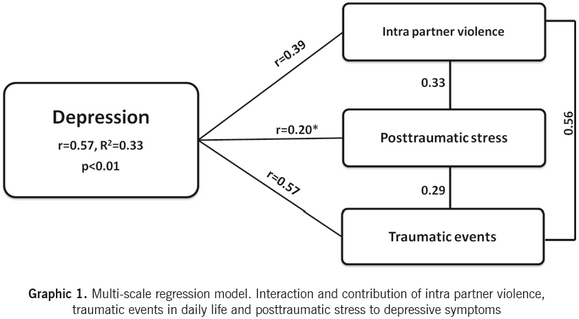
<body><![CDATA[<p><font size="2" face="Verdana"><b>Traumatic events in daily life.</b> The rank for the total score of the number of traumatic events in daily life of the group went from 0 to 7 with a mean of 7.01±3.81. The number of experienced events reported more frequently was of six events (13.0%). 4.8% of the women experienced between 15 and 19 events, 3.3% didn’t report any of those traumatic events. The maximum weight of the impact of the stressing events experienced by women the year before the study was of 66 points with a mean of 20.6±12.5.</font></p>     <p><font size="2" face="Verdana"><b>Depressive symptoms.</b> 74% of the women had depressive symptoms. The mean score for this scale was 23.8±11.6 with a higher score of 50 for the group.</font></p>     <p><font size="2" face="Verdana"><b>Chronic pain.</b> 42.3% of the women from the sample had chronic pain. Pain mean intensity was 3.7±2.3, 40% of the women’s pain was relieved with medicines, and 37.0% with rest. 74% reported some type of interference of pain in their daily activities.</font></p>     <p><font size="2" face="Verdana"><b>Variables relationship.</b> Variables were correlated directly and significantly (p< 0.001): a) IPV with depressive symptoms (r=0.36), with exposure to traumatic events (r=0.39) and with the total of PTSD symptoms (r=0.59). b) Chronic pain intensity with traumatic events (r=0.30) and the total of PTSD symptoms (r=0.29). Regarding chronic pain, 39.2% of the women with PTSD had it, versus a 46.6% who didn’t, not being a statistically significant difference between them (X2= 0.791, p=0.374).</font></p>     <p><font size="2" face="Verdana"><b>IPV contribution to depressive symptoms and chronic pain.</b> The contribution of IPV to chronic pain and depression was analyzed. No significant relationships were found with chronic pain, reason why just the contribution of IPV to depressive symptoms was analyzed. It was analyzed using a separated hierarchical multiple regression analysis after entering the total score of trauma in life and the total score of PTSD, the predictive power of the severity and frequency of IPV over depressive symptoms.</font></p>     <p><font size="2" face="Verdana">Four models were run: 1º) showed a significant relationship (p< 0.01) between depression and traumatic events, they explain 4.5% of the variance of the changes of depressive symptoms; 2º) IPV is added, finding a significant relationship between depressive symptoms and IPV intensity, IPV explained 13.6% of the variance; 3º) PTDS is added, explaining 20.0% of the symptoms variance; and 4º) the fourth model discards the traumatic events exposure. With the first three variables the r value is 0.45, explaining 20.9% of the depressive symptoms.</font></p>     <p><font size="2" face="Verdana"><b>Multiple-scale regression model.</b> The model with depressive symptoms as an independent variable and the model with IPV, traumatic events in daily life (TEDL) and posttraumatic stress, as independent variables explained 33.3% of the variance of depressive symptoms (p< 0.01). <a href="#g1">Graphic</a> 1 shows the results of the correlations between the different variables and the results of the regression.</font></p>     <p>&nbsp;</p>     <p><font size="3" face="Verdana"><b>DISCUSI&Oacute;N</b></font></p>     <p><font size="2" face="Verdana">This study evaluated the interaction between intimate partner violence, trauma exposure in life and PTSD, and the relative contribution to chronic pain and depression, two of the most common consequences over health experienced by abu- sed women. Additionally, it was looked to expand knowledge from an existing model<sup>45</sup> linking trauma exposure, including IPV and PTSD, with physical health outcomes.</font></p>     ]]></body>
<body><![CDATA[<p><font size="2" face="Verdana"><img src="/img/revistas/iee/v29n2/v29n2a02i01.png" height="22"><a name="g1"></a></font></p>     <p><font size="2" face="Verdana">The results showed that more than half of the wo- men from the group of participants were exposed to the three types of violence: threatening, physi- cal and sexual violence. 97% of the women were exposed to threats; one type of violence that is not easily identified, reason why they is not easily no- ticed because there is no direct physical damage. But as the current study suggests, they are corre- lated with psychological and physical disorders. Psychological and physical disorders expressed by depression, posttraumatic stress and pain, were present in an important percentage of the group of women from the community violence victims, in the 74%, 59.3% and 42% respectively. Additio- nally, IPV was significantly correlated with depres- sive symptoms and posttraumatic stress and the traumatic events with pain intensity. Traumatic and abuse experiences from childhood have also been found in women with high intensity chronic pain syndromes and poor answer to pharmacolo- gical therapies. Abuse was represented in lack of protection from their families, responsibilities and demands that don’t correspond to their age and job at young ages.<sup>50</sup></font></p>     <p><font size="2" face="Verdana">Regarding traumatic events, in the current study, eight of the ten daily life stressing events, with the greater impact in the women’s life, had to be with mistreating or violence experiences, 4 of them since childhood, with a negligent treatment, and abandonment in substitute homes or adoption, more abuse, sexual and physical attacks before the age of 16. After that age, abuse and sexual attacks by known people come back. The latter reveals that different types of violence in women from the community are experienced from young ages.</font></p>     <p><font size="2" face="Verdana">The correlation using the total number of events of IPV pointed a significant and positive relationship with the number of traumatic events, the number of depressive symptoms and the posttraumatic stress score reported. Meaning that with a higher exposure to IPV, greater the exposure to trauma in life, the number of depressive symptoms and posttraumatic stress. Not happening the same with chronic pain.</font></p>     <p><font size="2" face="Verdana">Studies about IPV consequences over health have shown that abused women have a poor health status, little quality of life, great use of healthcare services,<sup>51</sup> and those effects stay over time after IPV is over.<sup>52-54</sup> Even though abused women can be assessed frequently in health care services, including primary care services, literature reports that IPV is the main reason to consult just in 4% of the women.<sup>55</sup> It has been demonstrated that all types of IPV affect negatively women’s health. Physical abuse is known as one of the main causes of women’s harm.56 Some studies<sup>10,27,57</sup> have concluded that emotional or psychological violence is related with significant consequences for physical health.</font></p>     <p><font size="2" face="Verdana">Sexual abuse produces both physical and mental consequences, including pain and depressive symptoms,<sup>58</sup> in this study, sexual violence was present in half of the women who participated, it is similar to what was reported in the literature of 40% to 50% of the cases of IPV, although a correlation between sexual violence and emotional symptoms alone wasn’t done, it could be inferred, due to the high percentages of this kind of violence, that it contributes with the magnitude of the results of psychological disorders found, which lead to future researches to evaluate this relationship.</font></p>     <p><font size="2" face="Verdana">Frequency and severity of abuse has been consistently associated with women’s health care, number and intensity of symptoms.27 Usual and severe abuse, cause more severe symptoms. Symptoms can last for long periods of time after the abuse has ended.<sup>59</sup> These results have been recently reassured by the WHO report. However just two studies in the United States and two in Colombia have evaluated those symptoms in detail. Those studies have used samples from clinics, home shelters, and family commissioners which possibly imply a greater number of symptoms and worse health conditions than women who don’t go to those services. This study gives information about IPV consequences in women from the community, scores close to the maximum possible score of the CES-D scale were found and they were related significantly and positively with IPV intensity.</font></p>     <p><font size="2" face="Verdana">The absence of correlations found between traumatic events as: IPV, depressive symptoms and posttraumatic stress with chronic pain is rare. Several authors have explained the physiopathological relationship between persistent depressive or stressing status with a greater susceptibility to pain, as well as the existence of pain in those people without evident organic disorders. It is possible that the low percentage of women with chronic pain identified in the study and the results between their correlations, could have been determined by the lost of memories about the duration or persistence of pain over time in these women, because it was the only disorder which diagnosis depended completely from what the participant reported, the other disorders resulted from the analysis of the answers to several items of tests designed to the diagnosis of such disorders.</font></p>     <p><font size="2" face="Verdana">A few studies have evaluated both PTSD and chronic pain in samples taken from the community, so the answer to the question if PTSD or trauma exposure in life can predispose women to chronic pain, remains unknown.</font></p>     <p><font size="2" face="Verdana">Regarding the contribution of posttraumatic stress, the model with depressive symptoms as dependent variables showed three predictive variables: Intimate partner violence, traumatic events in daily life and posttraumatic stress. However its contribution to the explanation of IPV trauma variance was low. Adding posttraumatic stress conduced to a better explanation of the variance and because B value wasn’t significant for IPV neither for traumatic events, but significant for posttraumatic stress, it can be concluded that this is the main predictive variable of depressive symptoms.</font></p>     ]]></body>
<body><![CDATA[<p><font size="2" face="Verdana">The fact that depression correlated with traumatic events, and physical and chronic pain didn’t show any correlation between stressing events in life, IPV and posttraumatic stress, suggests a new discussion about the predominance of the relationship of psychological effects over physical effects in mistreated women, and recovers the importance of an integral view for their attention.</font></p>     <p><font size="2" face="Verdana">Population based studies have shown that individuals with PTSD report a poorer health and more chronic health problems than individuals without PTSD.<sup>64,65</sup> In a meta-analysis of researches about sexual trauma, Golding, Cooper and George<sup>66</sup> found that depression among women resulted from repeated exposure to trauma. Recent data suggest that PTSD can be the variable that mediates trauma effects over women health status,<sup>61</sup> the current study assures this concept in relation to depression,<sup>67</sup> the current results show that pain intensity positively and significantly correlates with PTSD, but not with IPV specifically.</font></p>     <p><font size="2" face="Verdana">PTSD, in this study, is the main way through which trauma exposure leads to health disorders. PTSD changes substantially psychological behavior of women in IPV situation, those changes also contribute to health disorders. Green and Kimberling,<sup>19</sup> concluded that PTSD works as mediator of health consequences.</font></p>     <p><font size="2" face="Verdana">The results of the hierarchical multiple regression and multiple-scale analysis suggest that the form and severity in which intimate partner violence is experienced, as well as the sources of coping that the exposed person has, can lead to the different psychological and physical disorders, not its presence itself. Additionally, they indicate that IPV cannot be isolated from the context of different life experiences and conditions of those women, who, as mentioned before are accompanied by other traumatic events that can lead to the development of depressive symptoms and other psychological, mental and physical disorders.</font></p>     <p><font size="2" face="Verdana">The Schnurr and Green model<sup>15</sup> provide a conceptual frame for the current study; however it requires more preparation for the future. While they suggest that PTSD is a key mechanism through which trauma leads to a poor health, they also notice that PTSD doesn’t mediate all the trauma exposure effects over health. These authors suggest that gender is an important factor that influences all the aspects of the model, most of the researches mentioned by Greend and Kimerling involve elder men. In the current study, just women were studied, and the results indicate that it would be valuable to study other variables, characteristic of the female gender which with their specificity influence the emotional, cognitive and physical reactions after traumatic events.</font></p>     <p><font size="2" face="Verdana">In the family environment, in which violence, disrespect, dignity and women rights violation is a daily situation, leads to think about the future of the children who live it ( the adults of the future, raised in violent environments), regarding couple relationships and their future contribution to the development of an equal, pacific and just society.</font></p>     <p><font size="2" face="Verdana">The results of the study contribute an essential base for the development of interventions directed to women at high risk and that promote the creation of intervention projects focused on the promotion of a healthy coexistence, changes in social interactions and to modify the differences in gender equity. It also suggests that legislators, people who make decisions, members of the healthcare system, judicial and other related fields, should take political, social and interventional measures to prevent, eradicate and mitigate the problem.</font></p>     <p><font size="2" face="Verdana">This study is considered innovative, it describes and evaluates the relationship between trauma exposure in life, PTSD, chronic pain and depressive symptoms in a sample of women taken from the community. Previous studies haven’t reported all those variables and have limited their studies to some of them, recruiting participants from specialized clinics or shelters. It is recommended to have health agents taking care of this topic, especially nurses, to evaluate and identify vulnerable women in IPV situation, plan care, taking into account the predictive factors of negative effects that emerged from the study, and prioritize in physical and psychological health interdependence, besides guiding about the ways of healthy coping.</font></p>     <p><font size="2" face="Verdana">This study concludes that physical manifestations which are traditionally important in valuing and recognizing the effects of intimate partner violence, even though they were present, they were not the most important manifestations of the effects over women’s health. Psychological manifestations as depressive symptoms and stress were the ones with the greater expression.</font></p>     <p><font size="2" face="Verdana">Results show the importance of approaching IPV exposed women from a multidimensional view. Evaluating posttraumatic stress in the attention of these women, on the other hand, is presented as an important early predictor of depression, situation that is really important because of the great impact mental health disorders have over the coping abilities.</font></p>     ]]></body>
<body><![CDATA[<p><font size="2" face="Verdana"><b>Study limitations:</b> The cross sectional design didn’t allow the determination of the temporal sequence of the variables and the nature of causality. It is needed a longitudinal research to answer those questions.</font></p>     <p>&nbsp;</p>     <p><font size="3" face="Verdana"><b>REFERENCIAS</b> </font>     <!-- ref --><p><font size="2" face="Verdana">1. Profamilia. Estudio Nacional de Demograf&iacute;a y Salud 2005-ENDS-2005. Bogot&aacute;: Colombia, Profamilia; 2005.</font>&nbsp;&nbsp;&nbsp;&nbsp;&nbsp;&nbsp;&nbsp;&nbsp;[&#160;<a href="javascript:void(0);" onclick="javascript: window.open('/scielo.php?script=sci_nlinks&ref=000096&pid=S0120-5307201100020000200001&lng=','','width=640,height=500,resizable=yes,scrollbars=1,menubar=yes,');">Links</a>&#160;]<!-- end-ref --><!-- ref --><p><font size="2" face="Verdana">2. Coker AL, Smith PH, Bethea L, King MR, McKeown RE. Physical health consequences of physical and psychological intimate partner violence. Arch Fam Med. 2000;9(5):451-57.</font>&nbsp;&nbsp;&nbsp;&nbsp;&nbsp;&nbsp;&nbsp;&nbsp;[&#160;<a href="javascript:void(0);" onclick="javascript: window.open('/scielo.php?script=sci_nlinks&ref=000097&pid=S0120-5307201100020000200002&lng=','','width=640,height=500,resizable=yes,scrollbars=1,menubar=yes,');">Links</a>&#160;]<!-- end-ref --><!-- ref --><p><font size="2" face="Verdana">3. Diaz-Olavarrieta C, Campbell J, Garcia de la Cadena C, Paz F, Villa AR. Domestic violence against patients with chronic neurologic disorders. Arch Neurol. 1995;56(6): 681-85.</font>&nbsp;&nbsp;&nbsp;&nbsp;&nbsp;&nbsp;&nbsp;&nbsp;[&#160;<a href="javascript:void(0);" onclick="javascript: window.open('/scielo.php?script=sci_nlinks&ref=000098&pid=S0120-5307201100020000200003&lng=','','width=640,height=500,resizable=yes,scrollbars=1,menubar=yes,');">Links</a>&#160;]<!-- end-ref --><!-- ref --><p><font size="2" face="Verdana">4. Labrador Encinas FJ, Fernandez–Velasco MR, Rincon P. Caracter&iacute;sticas psicopatol&oacute;gicas de mujeres v&iacute;ctimas de violencia de pareja. Psicothema. 2010;22(1):99-105.</font>&nbsp;&nbsp;&nbsp;&nbsp;&nbsp;&nbsp;&nbsp;&nbsp;[&#160;<a href="javascript:void(0);" onclick="javascript: window.open('/scielo.php?script=sci_nlinks&ref=000099&pid=S0120-5307201100020000200004&lng=','','width=640,height=500,resizable=yes,scrollbars=1,menubar=yes,');">Links</a>&#160;]<!-- end-ref --><!-- ref --><p><font size="2" face="Verdana">5. Saltzman LE, Fanslow JL, McMahon PM, Shelley GA. Intimate partner violence surveillance: uniform definitions and recommended data elements. Atlanta: Centers of Disease Control and Prevention; 1999.</font>&nbsp;&nbsp;&nbsp;&nbsp;&nbsp;&nbsp;&nbsp;&nbsp;[&#160;<a href="javascript:void(0);" onclick="javascript: window.open('/scielo.php?script=sci_nlinks&ref=000100&pid=S0120-5307201100020000200005&lng=','','width=640,height=500,resizable=yes,scrollbars=1,menubar=yes,');">Links</a>&#160;]<!-- end-ref --><!-- ref --><p><font size="2" face="Verdana">6. World Health Organization. Multy-country study on women´s health and domestic violence against women. Switzerland: WHO; 2005.</font>&nbsp;&nbsp;&nbsp;&nbsp;&nbsp;&nbsp;&nbsp;&nbsp;[&#160;<a href="javascript:void(0);" onclick="javascript: window.open('/scielo.php?script=sci_nlinks&ref=000101&pid=S0120-5307201100020000200006&lng=','','width=640,height=500,resizable=yes,scrollbars=1,menubar=yes,');">Links</a>&#160;]<!-- end-ref --><!-- ref --><p><font size="2" face="Verdana">7. Organizaci&oacute;n Mundial de la Salud/Organizaci&oacute;n Panamericana de la Salud. Violencia contra la mujer: Un tema de salud prioritario. Declaraci&oacute;n del Director General de la OMS. Junio 1998. [En l&iacute;nea] [Acceso 2006 Oct 18]. Disponible en: <a href="www.who.int/gender/violence/en/violencia_infopack1.pdf">www.who.int/gender/violence/en/violencia_infopack1.pdf</a></font>&nbsp;&nbsp;&nbsp;&nbsp;&nbsp;&nbsp;&nbsp;&nbsp;[&#160;<a href="javascript:void(0);" onclick="javascript: window.open('/scielo.php?script=sci_nlinks&ref=000102&pid=S0120-5307201100020000200007&lng=','','width=640,height=500,resizable=yes,scrollbars=1,menubar=yes,');">Links</a>&#160;]<!-- end-ref --><!-- ref --><p><font size="2" face="Verdana">8. Jones AS, Gielen AC, Campbell JC, Schollenberger J, Dienemann JA, Kub J et al. Annual and lifetime prevalence of partner abuse in a sample of female HMO enrollees. Women’s Health Issues. 1999;9(6):295-305.</font>&nbsp;&nbsp;&nbsp;&nbsp;&nbsp;&nbsp;&nbsp;&nbsp;[&#160;<a href="javascript:void(0);" onclick="javascript: window.open('/scielo.php?script=sci_nlinks&ref=000103&pid=S0120-5307201100020000200008&lng=','','width=640,height=500,resizable=yes,scrollbars=1,menubar=yes,');">Links</a>&#160;]<!-- end-ref --><!-- ref --><p><font size="2" face="Verdana">9. Dutton MA, Goodman LA, Bennett L. Court-involved battered women’s responses to violence: the role of psychological, physical, and sexual abuse. Violence Vict.1999;14(1):89-104.</font>&nbsp;&nbsp;&nbsp;&nbsp;&nbsp;&nbsp;&nbsp;&nbsp;[&#160;<a href="javascript:void(0);" onclick="javascript: window.open('/scielo.php?script=sci_nlinks&ref=000104&pid=S0120-5307201100020000200009&lng=','','width=640,height=500,resizable=yes,scrollbars=1,menubar=yes,');">Links</a>&#160;]<!-- end-ref --><!-- ref --><p><font size="2" face="Verdana">10. Arias I, Pape KT. Psychological abuse: implications for adjustment and commitment to leave violent partners. Violence Vict. 1999;14(1):55-67.</font>&nbsp;&nbsp;&nbsp;&nbsp;&nbsp;&nbsp;&nbsp;&nbsp;[&#160;<a href="javascript:void(0);" onclick="javascript: window.open('/scielo.php?script=sci_nlinks&ref=000105&pid=S0120-5307201100020000200010&lng=','','width=640,height=500,resizable=yes,scrollbars=1,menubar=yes,');">Links</a>&#160;]<!-- end-ref --><!-- ref --><p><font size="2" face="Verdana">11. Sutherland CA, Bybee DI, Sullivan CM. Beyond bruises and broken bones: the joint effects of stress and injuries on battered women’s health. Am J Community Psychol. 2002;30(5):609-36.</font>&nbsp;&nbsp;&nbsp;&nbsp;&nbsp;&nbsp;&nbsp;&nbsp;[&#160;<a href="javascript:void(0);" onclick="javascript: window.open('/scielo.php?script=sci_nlinks&ref=000106&pid=S0120-5307201100020000200011&lng=','','width=640,height=500,resizable=yes,scrollbars=1,menubar=yes,');">Links</a>&#160;]<!-- end-ref --><!-- ref --><p><font size="2" face="Verdana">12. Dienemann J, Boyle E, Baker D, Resnick W, Wiederhorn N, Campbell J. Intimate partner abuse among women diagnosed with depression. Issues Ment Health Nurs. 2000;21(5):499-513.</font>&nbsp;&nbsp;&nbsp;&nbsp;&nbsp;&nbsp;&nbsp;&nbsp;[&#160;<a href="javascript:void(0);" onclick="javascript: window.open('/scielo.php?script=sci_nlinks&ref=000107&pid=S0120-5307201100020000200012&lng=','','width=640,height=500,resizable=yes,scrollbars=1,menubar=yes,');">Links</a>&#160;]<!-- end-ref --><!-- ref --><p><font size="2" face="Verdana">13. Silva C, McFarlane J, Soeken K, Parker B, Reel S. Symptoms of post-traumatic stress disorder in abused women in a primary care setting. J Womens Health.1997;6(5): 543-52.</font>&nbsp;&nbsp;&nbsp;&nbsp;&nbsp;&nbsp;&nbsp;&nbsp;[&#160;<a href="javascript:void(0);" onclick="javascript: window.open('/scielo.php?script=sci_nlinks&ref=000108&pid=S0120-5307201100020000200013&lng=','','width=640,height=500,resizable=yes,scrollbars=1,menubar=yes,');">Links</a>&#160;]<!-- end-ref --><!-- ref --><p><font size="2" face="Verdana">14. Humphreys J, Lee K, Neylan T, Marmar C. Trauma history of sheltered battered women. Issues Ment Health Nurs. 1999; 20(4):319-32.</font>&nbsp;&nbsp;&nbsp;&nbsp;&nbsp;&nbsp;&nbsp;&nbsp;[&#160;<a href="javascript:void(0);" onclick="javascript: window.open('/scielo.php?script=sci_nlinks&ref=000109&pid=S0120-5307201100020000200014&lng=','','width=640,height=500,resizable=yes,scrollbars=1,menubar=yes,');">Links</a>&#160;]<!-- end-ref --><!-- ref --><p><font size="2" face="Verdana">15. Schnurr PP, Green BL, editors. Trauma and health: physical health consequences of exposure to extreme stress. Washington, DC: American Psychological Association;2004.</font>&nbsp;&nbsp;&nbsp;&nbsp;&nbsp;&nbsp;&nbsp;&nbsp;[&#160;<a href="javascript:void(0);" onclick="javascript: window.open('/scielo.php?script=sci_nlinks&ref=000110&pid=S0120-5307201100020000200015&lng=','','width=640,height=500,resizable=yes,scrollbars=1,menubar=yes,');">Links</a>&#160;]<!-- end-ref --><!-- ref --><p><font size="2" face="Verdana">16. Jones AS, Gielen AC, Campbell JC, Schollenberger J, Dienemann JA, Kub J et al. Annual and lifetime prevalence of partner abuse in a sample of female HMO enrollees. Women’s Health Issues. 1999; 9 (6): 295-305.</font>&nbsp;&nbsp;&nbsp;&nbsp;&nbsp;&nbsp;&nbsp;&nbsp;[&#160;<a href="javascript:void(0);" onclick="javascript: window.open('/scielo.php?script=sci_nlinks&ref=000111&pid=S0120-5307201100020000200016&lng=','','width=640,height=500,resizable=yes,scrollbars=1,menubar=yes,');">Links</a>&#160;]<!-- end-ref --><!-- ref --><p><font size="2" face="Verdana">17. Humphreys J, Campbell JC, editors. Family violence and nursing practice. Philadelphia: Lippincott Williams & Wilkins; 2004.</font>&nbsp;&nbsp;&nbsp;&nbsp;&nbsp;&nbsp;&nbsp;&nbsp;[&#160;<a href="javascript:void(0);" onclick="javascript: window.open('/scielo.php?script=sci_nlinks&ref=000112&pid=S0120-5307201100020000200017&lng=','','width=640,height=500,resizable=yes,scrollbars=1,menubar=yes,');">Links</a>&#160;]<!-- end-ref --><!-- ref --><p><font size="2" face="Verdana">18. Garcia-Moreno C, Heise L, Jansen HA, Ellsberg M, Watts C. Violence against women. Science. 2005;310(5752):1282-83.</font>&nbsp;&nbsp;&nbsp;&nbsp;&nbsp;&nbsp;&nbsp;&nbsp;[&#160;<a href="javascript:void(0);" onclick="javascript: window.open('/scielo.php?script=sci_nlinks&ref=000113&pid=S0120-5307201100020000200018&lng=','','width=640,height=500,resizable=yes,scrollbars=1,menubar=yes,');">Links</a>&#160;]<!-- end-ref --><!-- ref --><p><font size="2" face="Verdana">19. Green BL, Kimerling R. Physical health outcomes in traumatized populations. In: Schnurr PP, Green BL. Trauma and health: physical health consequences of exposure to extreme stress. Washington, DC: American Psychological Association; 2004. p.13-42.</font>&nbsp;&nbsp;&nbsp;&nbsp;&nbsp;&nbsp;&nbsp;&nbsp;[&#160;<a href="javascript:void(0);" onclick="javascript: window.open('/scielo.php?script=sci_nlinks&ref=000114&pid=S0120-5307201100020000200019&lng=','','width=640,height=500,resizable=yes,scrollbars=1,menubar=yes,');">Links</a>&#160;]<!-- end-ref --><!-- ref --><p><font size="2" face="Verdana">20. American Psychiatric Association - APA. Diagnostic and statistical manual of mental disorders. 4th Ed. Washington DC: APA; 1994. p. 424.</font>&nbsp;&nbsp;&nbsp;&nbsp;&nbsp;&nbsp;&nbsp;&nbsp;[&#160;<a href="javascript:void(0);" onclick="javascript: window.open('/scielo.php?script=sci_nlinks&ref=000115&pid=S0120-5307201100020000200020&lng=','','width=640,height=500,resizable=yes,scrollbars=1,menubar=yes,');">Links</a>&#160;]<!-- end-ref --><!-- ref --><p><font size="2" face="Verdana">21. Walker EA, Gelfand AN, Katon WJ, Koss MP, Von Korff M, Bernstein DE et al. Adult health status of women with histories of childhood abused and neglect. Am J Med. 1999;107(4):332-9.</font>&nbsp;&nbsp;&nbsp;&nbsp;&nbsp;&nbsp;&nbsp;&nbsp;[&#160;<a href="javascript:void(0);" onclick="javascript: window.open('/scielo.php?script=sci_nlinks&ref=000116&pid=S0120-5307201100020000200021&lng=','','width=640,height=500,resizable=yes,scrollbars=1,menubar=yes,');">Links</a>&#160;]<!-- end-ref --><!-- ref --><p><font size="2" face="Verdana">22. Centers for Disease Control Vietnam Experience Study. Health status of Vietnam veterans. II. Physical health. J Am Med Assoc. 1988; 259(18):2708-14.</font>&nbsp;&nbsp;&nbsp;&nbsp;&nbsp;&nbsp;&nbsp;&nbsp;[&#160;<a href="javascript:void(0);" onclick="javascript: window.open('/scielo.php?script=sci_nlinks&ref=000117&pid=S0120-5307201100020000200022&lng=','','width=640,height=500,resizable=yes,scrollbars=1,menubar=yes,');">Links</a>&#160;]<!-- end-ref --><!-- ref --><p><font size="2" face="Verdana">23. Drossman DA. Sexual and physical abuse and gastrointestinal illness. Scand J Gastroenterol Suppl. 1995;208:90-96.</font>&nbsp;&nbsp;&nbsp;&nbsp;&nbsp;&nbsp;&nbsp;&nbsp;[&#160;<a href="javascript:void(0);" onclick="javascript: window.open('/scielo.php?script=sci_nlinks&ref=000118&pid=S0120-5307201100020000200023&lng=','','width=640,height=500,resizable=yes,scrollbars=1,menubar=yes,');">Links</a>&#160;]<!-- end-ref --><!-- ref --><p><font size="2" face="Verdana">24. American Psychiatric Association. Diagnostic and statistical manual of mental disorders. 4th ed. Washington DC: American Psychiatric Association; 1994.</font>&nbsp;&nbsp;&nbsp;&nbsp;&nbsp;&nbsp;&nbsp;&nbsp;[&#160;<a href="javascript:void(0);" onclick="javascript: window.open('/scielo.php?script=sci_nlinks&ref=000119&pid=S0120-5307201100020000200024&lng=','','width=640,height=500,resizable=yes,scrollbars=1,menubar=yes,');">Links</a>&#160;]<!-- end-ref --><!-- ref --><p><font size="2" face="Verdana">25. Astin MC, Lawrence KJ, Foy DW. Posttraumatic stress disorder among battered women: risk and resiliency factors. Violence Vict. 1993;8(1):17-28.</font>&nbsp;&nbsp;&nbsp;&nbsp;&nbsp;&nbsp;&nbsp;&nbsp;[&#160;<a href="javascript:void(0);" onclick="javascript: window.open('/scielo.php?script=sci_nlinks&ref=000120&pid=S0120-5307201100020000200025&lng=','','width=640,height=500,resizable=yes,scrollbars=1,menubar=yes,');">Links</a>&#160;]<!-- end-ref --><!-- ref --><p><font size="2" face="Verdana">26. Silva C, McFarlane J, Soeken K, Parker B, Reel S. Symptoms of post-traumatic stress disorder in abused women in a primary care setting. J Womens Health. 1997;(5):543-52.</font>&nbsp;&nbsp;&nbsp;&nbsp;&nbsp;&nbsp;&nbsp;&nbsp;[&#160;<a href="javascript:void(0);" onclick="javascript: window.open('/scielo.php?script=sci_nlinks&ref=000121&pid=S0120-5307201100020000200026&lng=','','width=640,height=500,resizable=yes,scrollbars=1,menubar=yes,');">Links</a>&#160;]<!-- end-ref --><!-- ref --><p><font size="2" face="Verdana">27. Saunders DG. Posttraumatic stress symptom profiles of battered women: a comparison of survivors in two settings. Violence Vict. 1994;9(1):31-44.</font>&nbsp;&nbsp;&nbsp;&nbsp;&nbsp;&nbsp;&nbsp;&nbsp;[&#160;<a href="javascript:void(0);" onclick="javascript: window.open('/scielo.php?script=sci_nlinks&ref=000122&pid=S0120-5307201100020000200027&lng=','','width=640,height=500,resizable=yes,scrollbars=1,menubar=yes,');">Links</a>&#160;]<!-- end-ref --><!-- ref --><p><font size="2" face="Verdana">28. Melzack R. Pain and the neuromatrix in the brain. J Dent Educ. 2001;65(12):1378-82.</font>&nbsp;&nbsp;&nbsp;&nbsp;&nbsp;&nbsp;&nbsp;&nbsp;[&#160;<a href="javascript:void(0);" onclick="javascript: window.open('/scielo.php?script=sci_nlinks&ref=000123&pid=S0120-5307201100020000200028&lng=','','width=640,height=500,resizable=yes,scrollbars=1,menubar=yes,');">Links</a>&#160;]<!-- end-ref --><!-- ref --><p><font size="2" face="Verdana">29. Andrasik F, Flor H, Turk DC. An expanded view of psychological aspects in head pain: a biopsychosocial model. Neurol Sci. 2005;26:S87-S91.</font>&nbsp;&nbsp;&nbsp;&nbsp;&nbsp;&nbsp;&nbsp;&nbsp;[&#160;<a href="javascript:void(0);" onclick="javascript: window.open('/scielo.php?script=sci_nlinks&ref=000124&pid=S0120-5307201100020000200029&lng=','','width=640,height=500,resizable=yes,scrollbars=1,menubar=yes,');">Links</a>&#160;]<!-- end-ref --><!-- ref --><p><font size="2" face="Verdana">30. Hamber K, Johansson EE, Lindgren G. “I was always on guard”—an exploration of woman abuse in a group of women with musculoskeletal pain. Fam Pract. 1999;16(3):238-44.</font>&nbsp;&nbsp;&nbsp;&nbsp;&nbsp;&nbsp;&nbsp;&nbsp;[&#160;<a href="javascript:void(0);" onclick="javascript: window.open('/scielo.php?script=sci_nlinks&ref=000125&pid=S0120-5307201100020000200030&lng=','','width=640,height=500,resizable=yes,scrollbars=1,menubar=yes,');">Links</a>&#160;]<!-- end-ref --><!-- ref --><p><font size="2" face="Verdana">31. Bodden-Heidrich R, Kuppers V, Beckmann MW, Rechenberger I, Bender HG. Chronic pelvic pain syndrome (CPPS) and chronic vulvar pain syndrome (CVPS): evaluation of psychosomatic aspects. J Psychosom Obstet Gynaecol.1999;20(3):145-51.</font>&nbsp;&nbsp;&nbsp;&nbsp;&nbsp;&nbsp;&nbsp;&nbsp;[&#160;<a href="javascript:void(0);" onclick="javascript: window.open('/scielo.php?script=sci_nlinks&ref=000126&pid=S0120-5307201100020000200031&lng=','','width=640,height=500,resizable=yes,scrollbars=1,menubar=yes,');">Links</a>&#160;]<!-- end-ref --><!-- ref --><p><font size="2" face="Verdana">32. Coker AL, Smith PH, Bethea L, King MR, McKeown RE. Physical health consequences of physical and psychological intimate partner violence. Arch Fam Med. 2000;9(5):451-7.</font>&nbsp;&nbsp;&nbsp;&nbsp;&nbsp;&nbsp;&nbsp;&nbsp;[&#160;<a href="javascript:void(0);" onclick="javascript: window.open('/scielo.php?script=sci_nlinks&ref=000127&pid=S0120-5307201100020000200032&lng=','','width=640,height=500,resizable=yes,scrollbars=1,menubar=yes,');">Links</a>&#160;]<!-- end-ref --><!-- ref --><p><font size="2" face="Verdana">33. Sutherland CA, Bybee DI, Sullivan CM. Beyond bruises and broken bones: The joint effects of stress and injuries on battered women’s health. Am J Community Psychol 2002;30(5):609-36.</font>&nbsp;&nbsp;&nbsp;&nbsp;&nbsp;&nbsp;&nbsp;&nbsp;[&#160;<a href="javascript:void(0);" onclick="javascript: window.open('/scielo.php?script=sci_nlinks&ref=000128&pid=S0120-5307201100020000200033&lng=','','width=640,height=500,resizable=yes,scrollbars=1,menubar=yes,');">Links</a>&#160;]<!-- end-ref --><!-- ref --><p><font size="2" face="Verdana">34. Golding JM. Intimate partner violence as a risk factor for mental disorders: a meta-analysis. J Fam Violence. 1999;14(2):99-132.</font>&nbsp;&nbsp;&nbsp;&nbsp;&nbsp;&nbsp;&nbsp;&nbsp;[&#160;<a href="javascript:void(0);" onclick="javascript: window.open('/scielo.php?script=sci_nlinks&ref=000129&pid=S0120-5307201100020000200034&lng=','','width=640,height=500,resizable=yes,scrollbars=1,menubar=yes,');">Links</a>&#160;]<!-- end-ref --><!-- ref --><p><font size="2" face="Verdana">35. Kessler RC, Sonnega A, Bromet E, Hughes M, Nelson CB. Posttraumatic stress disorder in the National Comorbidity Survey. Arch Gen Psychiatry.1995;52(12):1048-60.</font>&nbsp;&nbsp;&nbsp;&nbsp;&nbsp;&nbsp;&nbsp;&nbsp;[&#160;<a href="javascript:void(0);" onclick="javascript: window.open('/scielo.php?script=sci_nlinks&ref=000130&pid=S0120-5307201100020000200035&lng=','','width=640,height=500,resizable=yes,scrollbars=1,menubar=yes,');">Links</a>&#160;]<!-- end-ref --><!-- ref --><p><font size="2" face="Verdana">36. Schnurr PP, Green BL. Understanding relationships among trauma, posttraumatic stress disorder, and health outcomes. In: Schnurr PP, Green BL. Trauma and health: physical health consequences of exposure to extreme stress. Washington DC: American Psychological Association; 2004. p.247-75.</font>&nbsp;&nbsp;&nbsp;&nbsp;&nbsp;&nbsp;&nbsp;&nbsp;[&#160;<a href="javascript:void(0);" onclick="javascript: window.open('/scielo.php?script=sci_nlinks&ref=000131&pid=S0120-5307201100020000200036&lng=','','width=640,height=500,resizable=yes,scrollbars=1,menubar=yes,');">Links</a>&#160;]<!-- end-ref --><!-- ref --><p><font size="2" face="Verdana">37. Kraemer HC, Thiemann S. How many subjects? Statistical power analysis in research. Thousand Oaks: Sage; 1987.</font>&nbsp;&nbsp;&nbsp;&nbsp;&nbsp;&nbsp;&nbsp;&nbsp;[&#160;<a href="javascript:void(0);" onclick="javascript: window.open('/scielo.php?script=sci_nlinks&ref=000132&pid=S0120-5307201100020000200037&lng=','','width=640,height=500,resizable=yes,scrollbars=1,menubar=yes,');">Links</a>&#160;]<!-- end-ref --><!-- ref --><p><font size="2" face="Verdana">38. Marshall L. Development of the Severity of Violence Against Women Scales. J Fami Violence, 1992;7(2):103-21.</font>&nbsp;&nbsp;&nbsp;&nbsp;&nbsp;&nbsp;&nbsp;&nbsp;[&#160;<a href="javascript:void(0);" onclick="javascript: window.open('/scielo.php?script=sci_nlinks&ref=000133&pid=S0120-5307201100020000200038&lng=','','width=640,height=500,resizable=yes,scrollbars=1,menubar=yes,');">Links</a>&#160;]<!-- end-ref --><!-- ref --><p><font size="2" face="Verdana">39. Wolfe J, Kimerling R. Gender issues in the assessment of posttraumatic stress disorder. In: Wilson JP, Keane TN, editors. Assessing psychological trauma and PTSD. New York: Guilford Press; 1997. p.192-238.</font>&nbsp;&nbsp;&nbsp;&nbsp;&nbsp;&nbsp;&nbsp;&nbsp;[&#160;<a href="javascript:void(0);" onclick="javascript: window.open('/scielo.php?script=sci_nlinks&ref=000134&pid=S0120-5307201100020000200039&lng=','','width=640,height=500,resizable=yes,scrollbars=1,menubar=yes,');">Links</a>&#160;]<!-- end-ref --><p><font size="2" face="Verdana">40. Wolfe J, Kimerling R. Gender issues in the assessment of posttraumatic stress disorder. In: Wilson J, Keane T. Assessing psychological trauma and PTSD. New York: Guilford Press; 1997. p. 192-219.</font></p>     <!-- ref --><p><font size="2" face="Verdana">41. Brown PJ, Stout RL, Mueller T. Substance use disorder and posttraumatic stress disorder comorbidity: Addiction and psychiatric treatment rates. Psychol Addict Behav. 1999;13(2):115-22.</font>&nbsp;&nbsp;&nbsp;&nbsp;&nbsp;&nbsp;&nbsp;&nbsp;[&#160;<a href="javascript:void(0);" onclick="javascript: window.open('/scielo.php?script=sci_nlinks&ref=000136&pid=S0120-5307201100020000200041&lng=','','width=640,height=500,resizable=yes,scrollbars=1,menubar=yes,');">Links</a>&#160;]<!-- end-ref --><!-- ref --><p><font size="2" face="Verdana">42. Schumacher AM, Jaramillo D, Uribe T, De Pheils P, Holzemer W, Taylor D et al.The relationship of two types of trauma exposure to current physical and psychological symptom distress in a community sample of colombian women: why interpersonal violence deserves more attention. Health Care Women Int. 2010;31(10):946-61.</font>&nbsp;&nbsp;&nbsp;&nbsp;&nbsp;&nbsp;&nbsp;&nbsp;[&#160;<a href="javascript:void(0);" onclick="javascript: window.open('/scielo.php?script=sci_nlinks&ref=000137&pid=S0120-5307201100020000200042&lng=','','width=640,height=500,resizable=yes,scrollbars=1,menubar=yes,');">Links</a>&#160;]<!-- end-ref --><!-- ref --><p><font size="2" face="Verdana">43. Brown PJ, Stout RL, Mueller T. Substance use disorder and posttraumatic stress disorder comorbidity: addiction and psychiatric treatment rates. Psychol Addict Behav. 1999;13(2):115-22.</font>&nbsp;&nbsp;&nbsp;&nbsp;&nbsp;&nbsp;&nbsp;&nbsp;[&#160;<a href="javascript:void(0);" onclick="javascript: window.open('/scielo.php?script=sci_nlinks&ref=000138&pid=S0120-5307201100020000200043&lng=','','width=640,height=500,resizable=yes,scrollbars=1,menubar=yes,');">Links</a>&#160;]<!-- end-ref --><!-- ref --><p><font size="2" face="Verdana">44. Foa EB, Riggs DS, Dancu CV, Rothbaum BO. Reliability and validity of a brief instrument for assessing post-traumatic stress disorder. J Trauma Stress. 1993;6(4):459-73.</font>&nbsp;&nbsp;&nbsp;&nbsp;&nbsp;&nbsp;&nbsp;&nbsp;[&#160;<a href="javascript:void(0);" onclick="javascript: window.open('/scielo.php?script=sci_nlinks&ref=000139&pid=S0120-5307201100020000200044&lng=','','width=640,height=500,resizable=yes,scrollbars=1,menubar=yes,');">Links</a>&#160;]<!-- end-ref --><!-- ref --><p><font size="2" face="Verdana">45. Daut RL, Cleeland, CS, Flanery RC. Development of the Wisconsin Brief Pain Questionnaire to assess pain in cancer and other diseases. Pain. 1983;17(2):197-210.</font>&nbsp;&nbsp;&nbsp;&nbsp;&nbsp;&nbsp;&nbsp;&nbsp;[&#160;<a href="javascript:void(0);" onclick="javascript: window.open('/scielo.php?script=sci_nlinks&ref=000140&pid=S0120-5307201100020000200045&lng=','','width=640,height=500,resizable=yes,scrollbars=1,menubar=yes,');">Links</a>&#160;]<!-- end-ref --><!-- ref --><p><font size="2" face="Verdana">46. Radloff LS. The CES-D scale: a self-report depression scale for research in the general population. Appl Psychol Meas. 1977;1(3):385-401.</font>&nbsp;&nbsp;&nbsp;&nbsp;&nbsp;&nbsp;&nbsp;&nbsp;[&#160;<a href="javascript:void(0);" onclick="javascript: window.open('/scielo.php?script=sci_nlinks&ref=000141&pid=S0120-5307201100020000200046&lng=','','width=640,height=500,resizable=yes,scrollbars=1,menubar=yes,');">Links</a>&#160;]<!-- end-ref --><!-- ref --><p><font size="2" face="Verdana">47. McFarlane J, Parker B, Soeken K, Bullock L. Assessing for abuse during pregnancy: Severity and frequency of injuries and associated entry into prenatal care. JAMA. 1992;267(23):3176-78.</font>&nbsp;&nbsp;&nbsp;&nbsp;&nbsp;&nbsp;&nbsp;&nbsp;[&#160;<a href="javascript:void(0);" onclick="javascript: window.open('/scielo.php?script=sci_nlinks&ref=000142&pid=S0120-5307201100020000200047&lng=','','width=640,height=500,resizable=yes,scrollbars=1,menubar=yes,');">Links</a>&#160;]<!-- end-ref --><!-- ref --><p><font size="2" face="Verdana">48. Cohen J. Statistical Power Analysis for the Behavioral Sciences. 2nd ed. Mahwah: Lawrence Erlbaum; 1988.</font>&nbsp;&nbsp;&nbsp;&nbsp;&nbsp;&nbsp;&nbsp;&nbsp;[&#160;<a href="javascript:void(0);" onclick="javascript: window.open('/scielo.php?script=sci_nlinks&ref=000143&pid=S0120-5307201100020000200048&lng=','','width=640,height=500,resizable=yes,scrollbars=1,menubar=yes,');">Links</a>&#160;]<!-- end-ref --><!-- ref --><p><font size="2" face="Verdana">49. Hemphill JF. Interpreting the magnitudes of correlation coefficients. Am Psychol. 2003;58(1):78-9.</font>&nbsp;&nbsp;&nbsp;&nbsp;&nbsp;&nbsp;&nbsp;&nbsp;[&#160;<a href="javascript:void(0);" onclick="javascript: window.open('/scielo.php?script=sci_nlinks&ref=000144&pid=S0120-5307201100020000200049&lng=','','width=640,height=500,resizable=yes,scrollbars=1,menubar=yes,');">Links</a>&#160;]<!-- end-ref --><!-- ref --><p><font size="2" face="Verdana">50. Tobo N. Factores emocionales, cognitivos y conductuales en la vivencia de la fibromialgia [tesis doctoral en internet]. Barcelona: Tesis doctoral en Xarxa, Universidad Aut&oacute;noma de Barcelona; 2007 [acceso 2010 sep 19]. Disponible en: <a href="http://www.tesisenred.net/TDX-1102107-093654">http://www.tesisenred.net/TDX-1102107-093654</a></font>&nbsp;&nbsp;&nbsp;&nbsp;&nbsp;&nbsp;&nbsp;&nbsp;[&#160;<a href="javascript:void(0);" onclick="javascript: window.open('/scielo.php?script=sci_nlinks&ref=000145&pid=S0120-5307201100020000200050&lng=','','width=640,height=500,resizable=yes,scrollbars=1,menubar=yes,');">Links</a>&#160;]<!-- end-ref --><!-- ref --><p><font size="2" face="Verdana">51. Campbell JC. Health consequences of intimate partner violence. Lancet. 2002; 359: 1331-36.</font>&nbsp;&nbsp;&nbsp;&nbsp;&nbsp;&nbsp;&nbsp;&nbsp;[&#160;<a href="javascript:void(0);" onclick="javascript: window.open('/scielo.php?script=sci_nlinks&ref=000146&pid=S0120-5307201100020000200051&lng=','','width=640,height=500,resizable=yes,scrollbars=1,menubar=yes,');">Links</a>&#160;]<!-- end-ref --><!-- ref --><p><font size="2" face="Verdana">52. Garcia-Moreno C, Heise L, Jansen H A, Ellsberg M, Watts C. Violence against women. Science. 2005; 310 (5752): 1282-1283.</font>&nbsp;&nbsp;&nbsp;&nbsp;&nbsp;&nbsp;&nbsp;&nbsp;[&#160;<a href="javascript:void(0);" onclick="javascript: window.open('/scielo.php?script=sci_nlinks&ref=000147&pid=S0120-5307201100020000200052&lng=','','width=640,height=500,resizable=yes,scrollbars=1,menubar=yes,');">Links</a>&#160;]<!-- end-ref --><!-- ref --><p><font size="2" face="Verdana">53. Campbell JC, Lewandowski L. Mental and physical health effects of intimate partner violence on women and children. Psychiatric Clinics of North Am. 1997;20(2):353-74.</font>&nbsp;&nbsp;&nbsp;&nbsp;&nbsp;&nbsp;&nbsp;&nbsp;[&#160;<a href="javascript:void(0);" onclick="javascript: window.open('/scielo.php?script=sci_nlinks&ref=000148&pid=S0120-5307201100020000200053&lng=','','width=640,height=500,resizable=yes,scrollbars=1,menubar=yes,');">Links</a>&#160;]<!-- end-ref --><!-- ref --><p><font size="2" face="Verdana">54. Koss MP, Koss PG, Woodruff WJ. Deleterious effects of criminal victimization on women’s health and medical utilization. Arch Intern Med. 1991;151(2):342-7.</font>&nbsp;&nbsp;&nbsp;&nbsp;&nbsp;&nbsp;&nbsp;&nbsp;[&#160;<a href="javascript:void(0);" onclick="javascript: window.open('/scielo.php?script=sci_nlinks&ref=000149&pid=S0120-5307201100020000200054&lng=','','width=640,height=500,resizable=yes,scrollbars=1,menubar=yes,');">Links</a>&#160;]<!-- end-ref --><!-- ref --><p><font size="2" face="Verdana">55. Hathaway JE, Mucci LA, Silverman JG, Brooks DR, Mathews R, Pavlos CA. Health status and health care use of Massachusetts women reporting partner abuse. Am J Prev Med. 2000;19(4):302-7.</font>&nbsp;&nbsp;&nbsp;&nbsp;&nbsp;&nbsp;&nbsp;&nbsp;[&#160;<a href="javascript:void(0);" onclick="javascript: window.open('/scielo.php?script=sci_nlinks&ref=000150&pid=S0120-5307201100020000200055&lng=','','width=640,height=500,resizable=yes,scrollbars=1,menubar=yes,');">Links</a>&#160;]<!-- end-ref --><!-- ref --><p><font size="2" face="Verdana">56. Rand MR. Violence-related injuries treated in hospital emergency department. Bureau of Justice Statistics special report. Washington, DC: US Department of Justice; 1997.</font>&nbsp;&nbsp;&nbsp;&nbsp;&nbsp;&nbsp;&nbsp;&nbsp;[&#160;<a href="javascript:void(0);" onclick="javascript: window.open('/scielo.php?script=sci_nlinks&ref=000151&pid=S0120-5307201100020000200056&lng=','','width=640,height=500,resizable=yes,scrollbars=1,menubar=yes,');">Links</a>&#160;]<!-- end-ref --><!-- ref --><p><font size="2" face="Verdana">57. Coker AL, Smith PH, Bethea L, King MR, McKeown RE. Physical health consequences of physical and psychological intimate partner violence. Arch Fam Med. 2000;9(5):451-7.</font>&nbsp;&nbsp;&nbsp;&nbsp;&nbsp;&nbsp;&nbsp;&nbsp;[&#160;<a href="javascript:void(0);" onclick="javascript: window.open('/scielo.php?script=sci_nlinks&ref=000152&pid=S0120-5307201100020000200057&lng=','','width=640,height=500,resizable=yes,scrollbars=1,menubar=yes,');">Links</a>&#160;]<!-- end-ref --><!-- ref --><p><font size="2" face="Verdana">58. Campbell JC, Soeken K. Forced sex and intimate partner violence: effects on women’s health. Violence Against Women. 1999;5(9):1017-35.</font>&nbsp;&nbsp;&nbsp;&nbsp;&nbsp;&nbsp;&nbsp;&nbsp;[&#160;<a href="javascript:void(0);" onclick="javascript: window.open('/scielo.php?script=sci_nlinks&ref=000153&pid=S0120-5307201100020000200058&lng=','','width=640,height=500,resizable=yes,scrollbars=1,menubar=yes,');">Links</a>&#160;]<!-- end-ref --><!-- ref --><p><font size="2" face="Verdana">59. Felitti VJ, Anda RF, Nordenberg D, Williamson DF, Spitz AM, Edwards V et al. Relationship of childhood abuse and household dysfunction to many of the leading causes of death in adults. Am J Prev Med. 1998;14(4):245-58.</font>&nbsp;&nbsp;&nbsp;&nbsp;&nbsp;&nbsp;&nbsp;&nbsp;[&#160;<a href="javascript:void(0);" onclick="javascript: window.open('/scielo.php?script=sci_nlinks&ref=000154&pid=S0120-5307201100020000200059&lng=','','width=640,height=500,resizable=yes,scrollbars=1,menubar=yes,');">Links</a>&#160;]<!-- end-ref --><!-- ref --><p><font size="2" face="Verdana">60. Diaz-Olavarrieta C, Campbell J, Garcia C, Paz F, Villa AR. Domestic violence against patients with chronic neurologic disorders. Arch Neurol. 1999;56(6):681-5.</font>&nbsp;&nbsp;&nbsp;&nbsp;&nbsp;&nbsp;&nbsp;&nbsp;[&#160;<a href="javascript:void(0);" onclick="javascript: window.open('/scielo.php?script=sci_nlinks&ref=000155&pid=S0120-5307201100020000200060&lng=','','width=640,height=500,resizable=yes,scrollbars=1,menubar=yes,');">Links</a>&#160;]<!-- end-ref --><!-- ref --><p><font size="2" face="Verdana">62. Jaramillo DE, Uribe TM. Medici&oacute;n de distr&eacute;s psicol&oacute;gico en mujeres maltratadas, Medell&iacute;n, 2003. Colomb Med [en l&iacute;nea] 2006;37. [Acceso 2009 May 13]; disponible en: <a href=http://colombiamedica.univalle.edu.co/Vol37No2/html/PDF/cm37n2a7.pdf"">http://colombiamedica.univalle.edu.co/Vol37No2/html/PDF/cm37n2a7.pdf.</a></font>&nbsp;&nbsp;&nbsp;&nbsp;&nbsp;&nbsp;&nbsp;&nbsp;[&#160;<a href="javascript:void(0);" onclick="javascript: window.open('/scielo.php?script=sci_nlinks&ref=000156&pid=S0120-5307201100020000200061&lng=','','width=640,height=500,resizable=yes,scrollbars=1,menubar=yes,');">Links</a>&#160;]<!-- end-ref --><!-- ref --><p><font size="2" face="Verdana">63. Canaval GE, Gonz&aacute;lez MC, Humphreys J, De Le&oacute;n N, Gonz&aacute;lez S. Violencia de pareja y salud de las mujeres que consultan a las Comisarias de Familia. Invest Educ Enferm. 2009;27(2): 209-17.</font>&nbsp;&nbsp;&nbsp;&nbsp;&nbsp;&nbsp;&nbsp;&nbsp;[&#160;<a href="javascript:void(0);" onclick="javascript: window.open('/scielo.php?script=sci_nlinks&ref=000157&pid=S0120-5307201100020000200062&lng=','','width=640,height=500,resizable=yes,scrollbars=1,menubar=yes,');">Links</a>&#160;]<!-- end-ref --><!-- ref --><p><font size="2" face="Verdana">64. Barrett DH, Doebbeling CC, Schwartz DA, Voelker MD, Falter KH, Woolson RF et al. Posttraumatic stress disorder and self-reported physical health status among U.S. Military personnel serving during the Gulf War period: a population-based study. Psychosomatics. 2002;43(3):195-205.</font>&nbsp;&nbsp;&nbsp;&nbsp;&nbsp;&nbsp;&nbsp;&nbsp;[&#160;<a href="javascript:void(0);" onclick="javascript: window.open('/scielo.php?script=sci_nlinks&ref=000158&pid=S0120-5307201100020000200063&lng=','','width=640,height=500,resizable=yes,scrollbars=1,menubar=yes,');">Links</a>&#160;]<!-- end-ref --><!-- ref --><p><font size="2" face="Verdana">65. Boscarino JA. Post-traumatic stress and associated disorders among Vietnam veterans: the significance of combat exposure and social support. J Trauma Stress.1995; 8(2):317-36.</font>&nbsp;&nbsp;&nbsp;&nbsp;&nbsp;&nbsp;&nbsp;&nbsp;[&#160;<a href="javascript:void(0);" onclick="javascript: window.open('/scielo.php?script=sci_nlinks&ref=000159&pid=S0120-5307201100020000200064&lng=','','width=640,height=500,resizable=yes,scrollbars=1,menubar=yes,');">Links</a>&#160;]<!-- end-ref --><!-- ref --><p><font size="2" face="Verdana">66. Golding JM, Cooper ML, George LK. Sexual assault history and health perceptions: seven general population studies. Health Psychol. 1997;16(5):417-25.</font>&nbsp;&nbsp;&nbsp;&nbsp;&nbsp;&nbsp;&nbsp;&nbsp;[&#160;<a href="javascript:void(0);" onclick="javascript: window.open('/scielo.php?script=sci_nlinks&ref=000160&pid=S0120-5307201100020000200065&lng=','','width=640,height=500,resizable=yes,scrollbars=1,menubar=yes,');">Links</a>&#160;]<!-- end-ref --><!-- ref --><p><font size="2" face="Verdana">67. Roy-Byrne P, Smith WR, Goldberg J, Afari N, Buchwald D. Post-traumatic stress disorder among patients with chronic pain and chronic fatigue. Psychol Med. 2004;34(2):363-8.</font>&nbsp;&nbsp;&nbsp;&nbsp;&nbsp;&nbsp;&nbsp;&nbsp;[&#160;<a href="javascript:void(0);" onclick="javascript: window.open('/scielo.php?script=sci_nlinks&ref=000161&pid=S0120-5307201100020000200066&lng=','','width=640,height=500,resizable=yes,scrollbars=1,menubar=yes,');">Links</a>&#160;]<!-- end-ref --><p>&nbsp;</p> <hr noshade>     ]]></body>
<body><![CDATA[<p><font size="2" face="Verdana"><b>Fecha de Recibido</b>: 17 de enero de 2011. <b>   Fecha       de Aprobado</b>:16 de mayo de 2011.</font></p>       ]]></body><back>
<ref-list>
<ref id="B1">
<label>1</label><nlm-citation citation-type="book">
<collab>Profamilia</collab>
<source><![CDATA[Estudio Nacional de Demografía y Salud 2005-ENDS-2005]]></source>
<year>2005</year>
<publisher-loc><![CDATA[Bogotá ]]></publisher-loc>
<publisher-name><![CDATA[Profamilia]]></publisher-name>
</nlm-citation>
</ref>
<ref id="B2">
<label>2</label><nlm-citation citation-type="journal">
<person-group person-group-type="author">
<name>
<surname><![CDATA[Coker]]></surname>
<given-names><![CDATA[AL]]></given-names>
</name>
<name>
<surname><![CDATA[Smith]]></surname>
<given-names><![CDATA[PH]]></given-names>
</name>
<name>
<surname><![CDATA[Bethea]]></surname>
<given-names><![CDATA[L]]></given-names>
</name>
<name>
<surname><![CDATA[King]]></surname>
<given-names><![CDATA[MR]]></given-names>
</name>
<name>
<surname><![CDATA[McKeown]]></surname>
<given-names><![CDATA[RE]]></given-names>
</name>
</person-group>
<article-title xml:lang="en"><![CDATA[Physical health consequences of physical and psychological intimate partner violence]]></article-title>
<source><![CDATA[Arch Fam Med]]></source>
<year>2000</year>
<volume>9</volume>
<numero>5</numero>
<issue>5</issue>
<page-range>451-57</page-range></nlm-citation>
</ref>
<ref id="B3">
<label>3</label><nlm-citation citation-type="journal">
<person-group person-group-type="author">
<name>
<surname><![CDATA[Diaz-Olavarrieta]]></surname>
<given-names><![CDATA[C]]></given-names>
</name>
<name>
<surname><![CDATA[Campbell]]></surname>
<given-names><![CDATA[J]]></given-names>
</name>
<name>
<surname><![CDATA[Garcia]]></surname>
<given-names><![CDATA[de la Cadena C]]></given-names>
</name>
<name>
<surname><![CDATA[Paz]]></surname>
<given-names><![CDATA[F]]></given-names>
</name>
<name>
<surname><![CDATA[Villa]]></surname>
<given-names><![CDATA[AR]]></given-names>
</name>
</person-group>
<article-title xml:lang="en"><![CDATA[Domestic violence against patients with chronic neurologic disorders]]></article-title>
<source><![CDATA[Arch Neurol]]></source>
<year>1995</year>
<volume>56</volume>
<numero>6</numero>
<issue>6</issue>
<page-range>681-85</page-range></nlm-citation>
</ref>
<ref id="B4">
<label>4</label><nlm-citation citation-type="journal">
<person-group person-group-type="author">
<name>
<surname><![CDATA[Labrador]]></surname>
<given-names><![CDATA[Encinas FJ]]></given-names>
</name>
<name>
<surname><![CDATA[Fernandez-Velasco]]></surname>
<given-names><![CDATA[MR]]></given-names>
</name>
<name>
<surname><![CDATA[Rincon]]></surname>
<given-names><![CDATA[P]]></given-names>
</name>
</person-group>
<article-title xml:lang="es"><![CDATA[Características psicopatológicas de mujeres víctimas de violencia de pareja]]></article-title>
<source><![CDATA[Psicothema]]></source>
<year>2010</year>
<volume>22</volume>
<numero>1</numero>
<issue>1</issue>
<page-range>99-105</page-range></nlm-citation>
</ref>
<ref id="B5">
<label>5</label><nlm-citation citation-type="book">
<person-group person-group-type="author">
<name>
<surname><![CDATA[Saltzman]]></surname>
<given-names><![CDATA[LE]]></given-names>
</name>
<name>
<surname><![CDATA[Fanslow]]></surname>
<given-names><![CDATA[JL]]></given-names>
</name>
<name>
<surname><![CDATA[McMahon]]></surname>
<given-names><![CDATA[PM]]></given-names>
</name>
<name>
<surname><![CDATA[Shelley]]></surname>
<given-names><![CDATA[GA]]></given-names>
</name>
</person-group>
<source><![CDATA[Intimate partner violence surveillance: uniform definitions and recommended data elements]]></source>
<year>1999</year>
<publisher-loc><![CDATA[^eAtlanta Atlanta]]></publisher-loc>
<publisher-name><![CDATA[Centers of Disease Control and Prevention]]></publisher-name>
</nlm-citation>
</ref>
<ref id="B6">
<label>6</label><nlm-citation citation-type="book">
<collab>World Health Organization</collab>
<source><![CDATA[Multy-country study on women´s health and domestic violence against women]]></source>
<year>2005</year>
<publisher-name><![CDATA[WHO]]></publisher-name>
</nlm-citation>
</ref>
<ref id="B7">
<label>7</label><nlm-citation citation-type="">
<collab>Organización Mundial de la Salud/Organización Panamericana de la Salud</collab>
<source><![CDATA[Violencia contra la mujer: Un tema de salud prioritario: Declaración del Director General de la OMS]]></source>
<year>1998</year>
</nlm-citation>
</ref>
<ref id="B8">
<label>8</label><nlm-citation citation-type="journal">
<person-group person-group-type="author">
<name>
<surname><![CDATA[Jones]]></surname>
<given-names><![CDATA[AS]]></given-names>
</name>
<name>
<surname><![CDATA[Gielen]]></surname>
<given-names><![CDATA[AC]]></given-names>
</name>
<name>
<surname><![CDATA[Campbell]]></surname>
<given-names><![CDATA[JC]]></given-names>
</name>
<name>
<surname><![CDATA[Schollenberger]]></surname>
<given-names><![CDATA[J]]></given-names>
</name>
<name>
<surname><![CDATA[Dienemann]]></surname>
<given-names><![CDATA[JA]]></given-names>
</name>
<name>
<surname><![CDATA[Kub]]></surname>
<given-names><![CDATA[J et al]]></given-names>
</name>
</person-group>
<article-title xml:lang="en"><![CDATA[Annual and lifetime prevalence of partner abuse in a sample of female HMO enrollees]]></article-title>
<source><![CDATA[Women’s Health Issues]]></source>
<year>1999</year>
<volume>9</volume>
<numero>6</numero>
<issue>6</issue>
<page-range>295-305</page-range></nlm-citation>
</ref>
<ref id="B9">
<label>9</label><nlm-citation citation-type="journal">
<person-group person-group-type="author">
<name>
<surname><![CDATA[Dutton]]></surname>
<given-names><![CDATA[MA]]></given-names>
</name>
<name>
<surname><![CDATA[Goodman]]></surname>
<given-names><![CDATA[LA]]></given-names>
</name>
<name>
<surname><![CDATA[Bennett]]></surname>
<given-names><![CDATA[L]]></given-names>
</name>
</person-group>
<article-title xml:lang="en"><![CDATA[Court-involved battered women’s responses to violence: the role of psychological, physical, and sexual abuse]]></article-title>
<source><![CDATA[Violence Vict]]></source>
<year>1999</year>
<volume>14</volume>
<numero>1</numero>
<issue>1</issue>
<page-range>89-104</page-range></nlm-citation>
</ref>
<ref id="B10">
<label>10</label><nlm-citation citation-type="journal">
<person-group person-group-type="author">
<name>
<surname><![CDATA[Arias]]></surname>
<given-names><![CDATA[I]]></given-names>
</name>
<name>
<surname><![CDATA[Pape]]></surname>
<given-names><![CDATA[KT]]></given-names>
</name>
</person-group>
<article-title xml:lang="en"><![CDATA[Psychological abuse: implications for adjustment and commitment to leave violent partners]]></article-title>
<source><![CDATA[Violence Vict]]></source>
<year>1999</year>
<volume>14</volume>
<numero>1</numero>
<issue>1</issue>
<page-range>55-67</page-range></nlm-citation>
</ref>
<ref id="B11">
<label>11</label><nlm-citation citation-type="journal">
<person-group person-group-type="author">
<name>
<surname><![CDATA[Sutherland]]></surname>
<given-names><![CDATA[CA]]></given-names>
</name>
<name>
<surname><![CDATA[Bybee]]></surname>
<given-names><![CDATA[DI]]></given-names>
</name>
<name>
<surname><![CDATA[Sullivan]]></surname>
<given-names><![CDATA[CM]]></given-names>
</name>
</person-group>
<article-title xml:lang="en"><![CDATA[Beyond bruises and broken bones: the joint effects of stress and injuries on battered women’s health]]></article-title>
<source><![CDATA[Am J Community Psychol]]></source>
<year>2002</year>
<volume>30</volume>
<numero>5</numero>
<issue>5</issue>
<page-range>609-36</page-range></nlm-citation>
</ref>
<ref id="B12">
<label>12</label><nlm-citation citation-type="journal">
<person-group person-group-type="author">
<name>
<surname><![CDATA[Dienemann]]></surname>
<given-names><![CDATA[J]]></given-names>
</name>
<name>
<surname><![CDATA[Boyle]]></surname>
<given-names><![CDATA[E]]></given-names>
</name>
<name>
<surname><![CDATA[Baker]]></surname>
<given-names><![CDATA[D]]></given-names>
</name>
<name>
<surname><![CDATA[Resnick]]></surname>
<given-names><![CDATA[W]]></given-names>
</name>
<name>
<surname><![CDATA[Wiederhorn]]></surname>
<given-names><![CDATA[N]]></given-names>
</name>
<name>
<surname><![CDATA[Campbell]]></surname>
<given-names><![CDATA[J]]></given-names>
</name>
</person-group>
<article-title xml:lang="en"><![CDATA[Intimate partner abuse among women diagnosed with depression]]></article-title>
<source><![CDATA[Issues Ment Health Nurs]]></source>
<year>2000</year>
<volume>21</volume>
<numero>5</numero>
<issue>5</issue>
<page-range>499-513</page-range></nlm-citation>
</ref>
<ref id="B13">
<label>13</label><nlm-citation citation-type="journal">
<person-group person-group-type="author">
<name>
<surname><![CDATA[Silva]]></surname>
<given-names><![CDATA[C]]></given-names>
</name>
<name>
<surname><![CDATA[McFarlane]]></surname>
<given-names><![CDATA[J]]></given-names>
</name>
<name>
<surname><![CDATA[Soeken]]></surname>
<given-names><![CDATA[K]]></given-names>
</name>
<name>
<surname><![CDATA[Parker]]></surname>
<given-names><![CDATA[B]]></given-names>
</name>
<name>
<surname><![CDATA[Reel]]></surname>
<given-names><![CDATA[S]]></given-names>
</name>
</person-group>
<article-title xml:lang="en"><![CDATA[Symptoms of post-traumatic stress disorder in abused women in a primary care setting]]></article-title>
<source><![CDATA[J Womens Health]]></source>
<year>1997</year>
<volume>6</volume>
<numero>5</numero>
<issue>5</issue>
<page-range>543-52</page-range></nlm-citation>
</ref>
<ref id="B14">
<label>14</label><nlm-citation citation-type="journal">
<person-group person-group-type="author">
<name>
<surname><![CDATA[Humphreys]]></surname>
<given-names><![CDATA[J]]></given-names>
</name>
<name>
<surname><![CDATA[Lee]]></surname>
<given-names><![CDATA[K]]></given-names>
</name>
<name>
<surname><![CDATA[Neylan]]></surname>
<given-names><![CDATA[T]]></given-names>
</name>
<name>
<surname><![CDATA[Marmar]]></surname>
<given-names><![CDATA[C]]></given-names>
</name>
</person-group>
<article-title xml:lang="en"><![CDATA[Trauma history of sheltered battered women]]></article-title>
<source><![CDATA[Issues Ment Health Nurs]]></source>
<year>1999</year>
<volume>20</volume>
<numero>4</numero>
<issue>4</issue>
<page-range>319-32</page-range></nlm-citation>
</ref>
<ref id="B15">
<label>15</label><nlm-citation citation-type="book">
<person-group person-group-type="author">
<name>
<surname><![CDATA[Schnurr]]></surname>
<given-names><![CDATA[PP]]></given-names>
</name>
<name>
<surname><![CDATA[Green]]></surname>
<given-names><![CDATA[BL]]></given-names>
</name>
</person-group>
<source><![CDATA[Trauma and health: physical health consequences of exposure to extreme stress]]></source>
<year>2004</year>
<publisher-loc><![CDATA[Washington ]]></publisher-loc>
<publisher-name><![CDATA[American Psychological Association]]></publisher-name>
</nlm-citation>
</ref>
<ref id="B16">
<label>16</label><nlm-citation citation-type="journal">
<person-group person-group-type="author">
<name>
<surname><![CDATA[Jones]]></surname>
<given-names><![CDATA[AS]]></given-names>
</name>
<name>
<surname><![CDATA[Gielen]]></surname>
<given-names><![CDATA[AC]]></given-names>
</name>
<name>
<surname><![CDATA[Campbell]]></surname>
<given-names><![CDATA[JC]]></given-names>
</name>
<name>
<surname><![CDATA[Schollenberger]]></surname>
<given-names><![CDATA[J]]></given-names>
</name>
<name>
<surname><![CDATA[Dienemann]]></surname>
<given-names><![CDATA[JA]]></given-names>
</name>
<name>
<surname><![CDATA[Kub]]></surname>
<given-names><![CDATA[J]]></given-names>
</name>
</person-group>
<article-title xml:lang="en"><![CDATA[Annual and lifetime prevalence of partner abuse in a sample of female HMO enrollees]]></article-title>
<source><![CDATA[Women’s Health Issues]]></source>
<year>1999</year>
<volume>9</volume>
<numero>6</numero>
<issue>6</issue>
<page-range>295-305</page-range></nlm-citation>
</ref>
<ref id="B17">
<label>17</label><nlm-citation citation-type="book">
<person-group person-group-type="author">
<name>
<surname><![CDATA[Humphreys]]></surname>
<given-names><![CDATA[J]]></given-names>
</name>
<name>
<surname><![CDATA[Campbell]]></surname>
<given-names><![CDATA[JC]]></given-names>
</name>
</person-group>
<source><![CDATA[Family violence and nursing practice]]></source>
<year>2004</year>
<publisher-loc><![CDATA[Philadelphia ]]></publisher-loc>
<publisher-name><![CDATA[Lippincott Williams & Wilkins]]></publisher-name>
</nlm-citation>
</ref>
<ref id="B18">
<label>18</label><nlm-citation citation-type="journal">
<person-group person-group-type="author">
<name>
<surname><![CDATA[Garcia-Moreno]]></surname>
<given-names><![CDATA[C]]></given-names>
</name>
<name>
<surname><![CDATA[Heise]]></surname>
<given-names><![CDATA[L]]></given-names>
</name>
<name>
<surname><![CDATA[Jansen]]></surname>
<given-names><![CDATA[HA]]></given-names>
</name>
<name>
<surname><![CDATA[Ellsberg]]></surname>
<given-names><![CDATA[M]]></given-names>
</name>
<name>
<surname><![CDATA[Watts]]></surname>
<given-names><![CDATA[C]]></given-names>
</name>
</person-group>
<article-title xml:lang="en"><![CDATA[Violence against women]]></article-title>
<source><![CDATA[Science]]></source>
<year>2005</year>
<volume>310</volume>
<numero>5752</numero>
<issue>5752</issue>
<page-range>1282-83</page-range></nlm-citation>
</ref>
<ref id="B19">
<label>19</label><nlm-citation citation-type="book">
<person-group person-group-type="author">
<name>
<surname><![CDATA[Green]]></surname>
<given-names><![CDATA[BL]]></given-names>
</name>
<name>
<surname><![CDATA[Kimerling]]></surname>
<given-names><![CDATA[R]]></given-names>
</name>
</person-group>
<article-title xml:lang="en"><![CDATA[Physical health outcomes in traumatized populations]]></article-title>
<person-group person-group-type="editor">
<name>
<surname><![CDATA[Schnurr]]></surname>
<given-names><![CDATA[PP]]></given-names>
</name>
<name>
<surname><![CDATA[Green]]></surname>
<given-names><![CDATA[BL]]></given-names>
</name>
</person-group>
<source><![CDATA[Trauma and health: physical health consequences of exposure to extreme stress]]></source>
<year>2004</year>
<page-range>13-42</page-range><publisher-loc><![CDATA[Washington ]]></publisher-loc>
<publisher-name><![CDATA[American Psychological Association]]></publisher-name>
</nlm-citation>
</ref>
<ref id="B20">
<label>20</label><nlm-citation citation-type="book">
<collab>American Psychiatric Association - APA</collab>
<source><![CDATA[Diagnostic and statistical manual of mental disorders]]></source>
<year>1994</year>
<edition>4</edition>
<page-range>424</page-range><publisher-loc><![CDATA[Washington ]]></publisher-loc>
<publisher-name><![CDATA[APA]]></publisher-name>
</nlm-citation>
</ref>
<ref id="B21">
<label>21</label><nlm-citation citation-type="journal">
<person-group person-group-type="author">
<name>
<surname><![CDATA[Walker]]></surname>
<given-names><![CDATA[EA]]></given-names>
</name>
<name>
<surname><![CDATA[Gelfand]]></surname>
<given-names><![CDATA[AN]]></given-names>
</name>
<name>
<surname><![CDATA[Katon]]></surname>
<given-names><![CDATA[WJ]]></given-names>
</name>
<name>
<surname><![CDATA[Koss]]></surname>
<given-names><![CDATA[MP]]></given-names>
</name>
<name>
<surname><![CDATA[Von]]></surname>
<given-names><![CDATA[Korff M]]></given-names>
</name>
<name>
<surname><![CDATA[Bernstein]]></surname>
<given-names><![CDATA[DE]]></given-names>
</name>
</person-group>
<article-title xml:lang="en"><![CDATA[Adult health status of women with histories of childhood abused and neglect]]></article-title>
<source><![CDATA[Am J Med]]></source>
<year>1999</year>
<volume>107</volume>
<numero>4</numero>
<issue>4</issue>
<page-range>332-9</page-range></nlm-citation>
</ref>
<ref id="B22">
<label>22</label><nlm-citation citation-type="journal">
<person-group person-group-type="author">
<name>
<surname><![CDATA[Centers]]></surname>
<given-names><![CDATA[for Disease Control Vietnam Experience Study]]></given-names>
</name>
</person-group>
<article-title xml:lang="en"><![CDATA[Health status of Vietnam veterans II Physical health]]></article-title>
<source><![CDATA[J Am Med Assoc]]></source>
<year>1988</year>
<volume>259</volume>
<numero>18</numero>
<issue>18</issue>
<page-range>2708-14</page-range></nlm-citation>
</ref>
<ref id="B23">
<label>23</label><nlm-citation citation-type="journal">
<person-group person-group-type="author">
<name>
<surname><![CDATA[Drossman]]></surname>
<given-names><![CDATA[DA]]></given-names>
</name>
</person-group>
<article-title xml:lang="en"><![CDATA[Sexual and physical abuse and gastrointestinal illness]]></article-title>
<source><![CDATA[Scand J Gastroenterol Suppl]]></source>
<year>1995</year>
<volume>208</volume>
<page-range>90-96</page-range></nlm-citation>
</ref>
<ref id="B24">
<label>24</label><nlm-citation citation-type="book">
<collab>American Psychiatric Association</collab>
<source><![CDATA[Diagnostic and statistical manual of mental disorders]]></source>
<year>1994</year>
<edition>4</edition>
<publisher-loc><![CDATA[Washington ]]></publisher-loc>
<publisher-name><![CDATA[American Psychiatric Association]]></publisher-name>
</nlm-citation>
</ref>
<ref id="B25">
<label>25</label><nlm-citation citation-type="journal">
<person-group person-group-type="author">
<name>
<surname><![CDATA[Astin]]></surname>
<given-names><![CDATA[MC]]></given-names>
</name>
<name>
<surname><![CDATA[Lawrence]]></surname>
<given-names><![CDATA[KJ]]></given-names>
</name>
<name>
<surname><![CDATA[Foy]]></surname>
<given-names><![CDATA[DW]]></given-names>
</name>
</person-group>
<article-title xml:lang="en"><![CDATA[Posttraumatic stress disorder among battered women: risk and resiliency factors]]></article-title>
<source><![CDATA[Violence Vict]]></source>
<year>1993</year>
<volume>8</volume>
<numero>1</numero>
<issue>1</issue>
<page-range>17-28</page-range></nlm-citation>
</ref>
<ref id="B26">
<label>26</label><nlm-citation citation-type="journal">
<person-group person-group-type="author">
<name>
<surname><![CDATA[Silva]]></surname>
<given-names><![CDATA[C]]></given-names>
</name>
<name>
<surname><![CDATA[McFarlane]]></surname>
<given-names><![CDATA[J]]></given-names>
</name>
<name>
<surname><![CDATA[Soeken]]></surname>
<given-names><![CDATA[K]]></given-names>
</name>
<name>
<surname><![CDATA[Parker]]></surname>
<given-names><![CDATA[B]]></given-names>
</name>
<name>
<surname><![CDATA[Reel]]></surname>
<given-names><![CDATA[S]]></given-names>
</name>
</person-group>
<article-title xml:lang="en"><![CDATA[Symptoms of post-traumatic stress disorder in abused women in a primary care setting]]></article-title>
<source><![CDATA[J Womens Health]]></source>
<year>1997</year>
<numero>5</numero>
<issue>5</issue>
<page-range>543-52</page-range></nlm-citation>
</ref>
<ref id="B27">
<label>27</label><nlm-citation citation-type="journal">
<person-group person-group-type="author">
<name>
<surname><![CDATA[Saunders]]></surname>
<given-names><![CDATA[DG]]></given-names>
</name>
</person-group>
<article-title xml:lang="en"><![CDATA[Posttraumatic stress symptom profiles of battered women: a comparison of survivors in two settings]]></article-title>
<source><![CDATA[Violence Vict]]></source>
<year>1994</year>
<volume>9</volume>
<numero>1</numero>
<issue>1</issue>
<page-range>31-44</page-range></nlm-citation>
</ref>
<ref id="B28">
<label>28</label><nlm-citation citation-type="journal">
<person-group person-group-type="author">
<name>
<surname><![CDATA[Melzack]]></surname>
<given-names><![CDATA[R]]></given-names>
</name>
</person-group>
<article-title xml:lang="en"><![CDATA[Pain and the neuromatrix in the brain]]></article-title>
<source><![CDATA[J Dent Educ]]></source>
<year>2001</year>
<volume>65</volume>
<numero>12</numero>
<issue>12</issue>
<page-range>1378-82</page-range></nlm-citation>
</ref>
<ref id="B29">
<label>29</label><nlm-citation citation-type="journal">
<person-group person-group-type="author">
<name>
<surname><![CDATA[Andrasik]]></surname>
<given-names><![CDATA[F]]></given-names>
</name>
<name>
<surname><![CDATA[Flor]]></surname>
<given-names><![CDATA[H]]></given-names>
</name>
<name>
<surname><![CDATA[Turk]]></surname>
<given-names><![CDATA[DC]]></given-names>
</name>
</person-group>
<article-title xml:lang="en"><![CDATA[An expanded view of psychological aspects in head pain: a biopsychosocial model]]></article-title>
<source><![CDATA[Neurol Sci]]></source>
<year>2005</year>
<volume>26</volume>
<page-range>S87-S91</page-range></nlm-citation>
</ref>
<ref id="B30">
<label>30</label><nlm-citation citation-type="journal">
<person-group person-group-type="author">
<name>
<surname><![CDATA[Hamber]]></surname>
<given-names><![CDATA[K]]></given-names>
</name>
<name>
<surname><![CDATA[Johansson]]></surname>
<given-names><![CDATA[EE]]></given-names>
</name>
<name>
<surname><![CDATA[Lindgren]]></surname>
<given-names><![CDATA[G]]></given-names>
</name>
</person-group>
<article-title xml:lang="en"><![CDATA["I was always on guard"-an exploration of woman abuse in a group of women with musculoskeletal pain]]></article-title>
<source><![CDATA[Fam Pract]]></source>
<year>1999</year>
<volume>16</volume>
<numero>3</numero>
<issue>3</issue>
<page-range>238-44</page-range></nlm-citation>
</ref>
<ref id="B31">
<label>31</label><nlm-citation citation-type="journal">
<person-group person-group-type="author">
<name>
<surname><![CDATA[Bodden-Heidrich]]></surname>
<given-names><![CDATA[R]]></given-names>
</name>
<name>
<surname><![CDATA[Kuppers]]></surname>
<given-names><![CDATA[V]]></given-names>
</name>
<name>
<surname><![CDATA[Beckmann]]></surname>
<given-names><![CDATA[MW]]></given-names>
</name>
<name>
<surname><![CDATA[Rechenberger]]></surname>
<given-names><![CDATA[I]]></given-names>
</name>
<name>
<surname><![CDATA[Bender]]></surname>
<given-names><![CDATA[HG]]></given-names>
</name>
</person-group>
<article-title xml:lang="en"><![CDATA[Chronic pelvic pain syndrome (CPPS) and chronic vulvar pain syndrome (CVPS): evaluation of psychosomatic aspects]]></article-title>
<source><![CDATA[J Psychosom Obstet Gynaecol]]></source>
<year>1999</year>
<volume>20</volume>
<numero>3</numero>
<issue>3</issue>
<page-range>145-51</page-range></nlm-citation>
</ref>
<ref id="B32">
<label>32</label><nlm-citation citation-type="journal">
<person-group person-group-type="author">
<name>
<surname><![CDATA[Coker]]></surname>
<given-names><![CDATA[AL]]></given-names>
</name>
<name>
<surname><![CDATA[Smith]]></surname>
<given-names><![CDATA[PH]]></given-names>
</name>
<name>
<surname><![CDATA[Bethea]]></surname>
<given-names><![CDATA[L]]></given-names>
</name>
<name>
<surname><![CDATA[King]]></surname>
<given-names><![CDATA[MR]]></given-names>
</name>
<name>
<surname><![CDATA[McKeown]]></surname>
<given-names><![CDATA[RE]]></given-names>
</name>
</person-group>
<article-title xml:lang="en"><![CDATA[Physical health consequences of physical and psychological intimate partner violence]]></article-title>
<source><![CDATA[Arch Fam Med]]></source>
<year>2000</year>
<volume>9</volume>
<numero>5</numero>
<issue>5</issue>
<page-range>451-7</page-range></nlm-citation>
</ref>
<ref id="B33">
<label>33</label><nlm-citation citation-type="journal">
<person-group person-group-type="author">
<name>
<surname><![CDATA[Sutherland]]></surname>
<given-names><![CDATA[CA]]></given-names>
</name>
<name>
<surname><![CDATA[Bybee]]></surname>
<given-names><![CDATA[DI]]></given-names>
</name>
<name>
<surname><![CDATA[Sullivan]]></surname>
<given-names><![CDATA[CM]]></given-names>
</name>
</person-group>
<article-title xml:lang="en"><![CDATA[Beyond bruises and broken bones: The joint effects of stress and injuries on battered women’s health]]></article-title>
<source><![CDATA[Am J Community Psychol]]></source>
<year>2002</year>
<volume>30</volume>
<numero>5</numero>
<issue>5</issue>
<page-range>609-36</page-range></nlm-citation>
</ref>
<ref id="B34">
<label>34</label><nlm-citation citation-type="journal">
<person-group person-group-type="author">
<name>
<surname><![CDATA[Golding]]></surname>
<given-names><![CDATA[JM]]></given-names>
</name>
</person-group>
<article-title xml:lang="en"><![CDATA[Intimate partner violence as a risk factor for mental disorders: a meta-analysis]]></article-title>
<source><![CDATA[J Fam Violence]]></source>
<year>1999</year>
<volume>14</volume>
<numero>2</numero>
<issue>2</issue>
<page-range>99-132</page-range></nlm-citation>
</ref>
<ref id="B35">
<label>35</label><nlm-citation citation-type="journal">
<person-group person-group-type="author">
<name>
<surname><![CDATA[Kessler]]></surname>
<given-names><![CDATA[RC]]></given-names>
</name>
<name>
<surname><![CDATA[Sonnega]]></surname>
<given-names><![CDATA[A]]></given-names>
</name>
<name>
<surname><![CDATA[Bromet]]></surname>
<given-names><![CDATA[E]]></given-names>
</name>
<name>
<surname><![CDATA[Hughes]]></surname>
<given-names><![CDATA[M]]></given-names>
</name>
<name>
<surname><![CDATA[Nelson]]></surname>
<given-names><![CDATA[CB]]></given-names>
</name>
</person-group>
<article-title xml:lang="en"><![CDATA[Posttraumatic stress disorder in the National Comorbidity Survey]]></article-title>
<source><![CDATA[Arch Gen Psychiatry]]></source>
<year>1995</year>
<volume>52</volume>
<numero>12</numero>
<issue>12</issue>
<page-range>1048-60</page-range></nlm-citation>
</ref>
<ref id="B36">
<label>36</label><nlm-citation citation-type="book">
<person-group person-group-type="author">
<name>
<surname><![CDATA[Schnurr]]></surname>
<given-names><![CDATA[PP]]></given-names>
</name>
<name>
<surname><![CDATA[Green]]></surname>
<given-names><![CDATA[BL]]></given-names>
</name>
</person-group>
<article-title xml:lang="en"><![CDATA[Understanding relationships among trauma, posttraumatic stress disorder, and health outcomes]]></article-title>
<person-group person-group-type="editor">
<name>
<surname><![CDATA[Schnurr]]></surname>
<given-names><![CDATA[PP]]></given-names>
</name>
<name>
<surname><![CDATA[Green]]></surname>
<given-names><![CDATA[BL]]></given-names>
</name>
</person-group>
<source><![CDATA[Trauma and health: physical health consequences of exposure to extreme stress]]></source>
<year>2004</year>
<page-range>247-75</page-range><publisher-loc><![CDATA[Washington ]]></publisher-loc>
<publisher-name><![CDATA[American Psychological Association]]></publisher-name>
</nlm-citation>
</ref>
<ref id="B37">
<label>37</label><nlm-citation citation-type="book">
<person-group person-group-type="author">
<name>
<surname><![CDATA[Kraemer]]></surname>
<given-names><![CDATA[HC]]></given-names>
</name>
<name>
<surname><![CDATA[Thiemann]]></surname>
<given-names><![CDATA[S]]></given-names>
</name>
</person-group>
<source><![CDATA[How many subjects? Statistical power analysis in research]]></source>
<year>1987</year>
<publisher-name><![CDATA[Thousand OaksSage]]></publisher-name>
</nlm-citation>
</ref>
<ref id="B38">
<label>38</label><nlm-citation citation-type="journal">
<person-group person-group-type="author">
<name>
<surname><![CDATA[Marshall]]></surname>
<given-names><![CDATA[L]]></given-names>
</name>
</person-group>
<article-title xml:lang="en"><![CDATA[Development of the Severity of Violence Against Women Scales]]></article-title>
<source><![CDATA[J Fami Violence]]></source>
<year>1992</year>
<volume>7</volume>
<numero>2</numero>
<issue>2</issue>
<page-range>103-21</page-range></nlm-citation>
</ref>
<ref id="B39">
<label>39</label><nlm-citation citation-type="book">
<person-group person-group-type="author">
<name>
<surname><![CDATA[Wolfe]]></surname>
<given-names><![CDATA[J]]></given-names>
</name>
<name>
<surname><![CDATA[Kimerling]]></surname>
<given-names><![CDATA[R]]></given-names>
</name>
</person-group>
<article-title xml:lang="en"><![CDATA[Gender issues in the assessment of posttraumatic stress disorder]]></article-title>
<person-group person-group-type="editor">
<name>
<surname><![CDATA[Wilson]]></surname>
<given-names><![CDATA[JP]]></given-names>
</name>
<name>
<surname><![CDATA[Keane]]></surname>
<given-names><![CDATA[TN]]></given-names>
</name>
</person-group>
<source><![CDATA[Assessing psychological trauma and PTSD]]></source>
<year>1997</year>
<page-range>192-238</page-range><publisher-loc><![CDATA[New York ]]></publisher-loc>
<publisher-name><![CDATA[Guilford Press]]></publisher-name>
</nlm-citation>
</ref>
<ref id="B40">
<label>40</label><nlm-citation citation-type="book">
<person-group person-group-type="author">
<name>
<surname><![CDATA[Wolfe]]></surname>
<given-names><![CDATA[J]]></given-names>
</name>
<name>
<surname><![CDATA[Kimerling]]></surname>
<given-names><![CDATA[R]]></given-names>
</name>
</person-group>
<article-title xml:lang="en"><![CDATA[Gender issues in the assessment of posttraumatic stress disorder]]></article-title>
<person-group person-group-type="editor">
<name>
<surname><![CDATA[Wilson]]></surname>
<given-names><![CDATA[JP]]></given-names>
</name>
<name>
<surname><![CDATA[Keane]]></surname>
<given-names><![CDATA[TN]]></given-names>
</name>
</person-group>
<source><![CDATA[Assessing psychological trauma and PTSD]]></source>
<year>1997</year>
<page-range>192-219</page-range><publisher-loc><![CDATA[New York ]]></publisher-loc>
<publisher-name><![CDATA[Guilford Press]]></publisher-name>
</nlm-citation>
</ref>
<ref id="B41">
<label>41</label><nlm-citation citation-type="journal">
<person-group person-group-type="author">
<name>
<surname><![CDATA[Brown]]></surname>
<given-names><![CDATA[PJ]]></given-names>
</name>
<name>
<surname><![CDATA[Stout]]></surname>
<given-names><![CDATA[RL]]></given-names>
</name>
<name>
<surname><![CDATA[Mueller]]></surname>
<given-names><![CDATA[T]]></given-names>
</name>
</person-group>
<article-title xml:lang="en"><![CDATA[Substance use disorder and posttraumatic stress disorder comorbidity: Addiction and psychiatric treatment rates]]></article-title>
<source><![CDATA[Psychol Addict Behav]]></source>
<year>1999</year>
<volume>13</volume>
<numero>2</numero>
<issue>2</issue>
<page-range>115-22</page-range></nlm-citation>
</ref>
<ref id="B42">
<label>42</label><nlm-citation citation-type="journal">
<person-group person-group-type="author">
<name>
<surname><![CDATA[Schumacher]]></surname>
<given-names><![CDATA[AM]]></given-names>
</name>
<name>
<surname><![CDATA[Jaramillo]]></surname>
<given-names><![CDATA[D]]></given-names>
</name>
<name>
<surname><![CDATA[Uribe]]></surname>
<given-names><![CDATA[T]]></given-names>
</name>
<name>
<surname><![CDATA[De]]></surname>
<given-names><![CDATA[Pheils P]]></given-names>
</name>
<name>
<surname><![CDATA[Holzemer]]></surname>
<given-names><![CDATA[W]]></given-names>
</name>
<name>
<surname><![CDATA[Taylor]]></surname>
<given-names><![CDATA[D et al]]></given-names>
</name>
</person-group>
<article-title xml:lang="en"><![CDATA[The relationship of two types of trauma exposure to current physical and psychological symptom distress in a community sample of colombian women: why interpersonal violence deserves more attention]]></article-title>
<source><![CDATA[Health Care Women Int]]></source>
<year>2010</year>
<volume>31</volume>
<numero>10</numero>
<issue>10</issue>
<page-range>946-61</page-range></nlm-citation>
</ref>
<ref id="B43">
<label>43</label><nlm-citation citation-type="journal">
<person-group person-group-type="author">
<name>
<surname><![CDATA[Brown]]></surname>
<given-names><![CDATA[PJ]]></given-names>
</name>
<name>
<surname><![CDATA[Stout]]></surname>
<given-names><![CDATA[RL]]></given-names>
</name>
<name>
<surname><![CDATA[Mueller]]></surname>
<given-names><![CDATA[T]]></given-names>
</name>
</person-group>
<article-title xml:lang="en"><![CDATA[Substance use disorder and posttraumatic stress disorder comorbidity: addiction and psychiatric treatment rates]]></article-title>
<source><![CDATA[Psychol Addict Behav]]></source>
<year>1999</year>
<volume>13</volume>
<numero>2</numero>
<issue>2</issue>
<page-range>115-22</page-range></nlm-citation>
</ref>
<ref id="B44">
<label>44</label><nlm-citation citation-type="journal">
<person-group person-group-type="author">
<name>
<surname><![CDATA[Foa]]></surname>
<given-names><![CDATA[EB]]></given-names>
</name>
<name>
<surname><![CDATA[Riggs]]></surname>
<given-names><![CDATA[DS]]></given-names>
</name>
<name>
<surname><![CDATA[Dancu]]></surname>
<given-names><![CDATA[CV]]></given-names>
</name>
<name>
<surname><![CDATA[Rothbaum]]></surname>
<given-names><![CDATA[BO]]></given-names>
</name>
</person-group>
<article-title xml:lang="en"><![CDATA[Reliability and validity of a brief instrument for assessing post-traumatic stress disorder]]></article-title>
<source><![CDATA[J Trauma Stress]]></source>
<year>1993</year>
<volume>6</volume>
<numero>4</numero>
<issue>4</issue>
<page-range>459-73</page-range></nlm-citation>
</ref>
<ref id="B45">
<label>45</label><nlm-citation citation-type="journal">
<person-group person-group-type="author">
<name>
<surname><![CDATA[Daut]]></surname>
<given-names><![CDATA[RL]]></given-names>
</name>
<name>
<surname><![CDATA[Cleeland,]]></surname>
<given-names><![CDATA[CS]]></given-names>
</name>
<name>
<surname><![CDATA[Flanery]]></surname>
<given-names><![CDATA[RC]]></given-names>
</name>
</person-group>
<article-title xml:lang="en"><![CDATA[Development of the Wisconsin Brief Pain Questionnaire to assess pain in cancer and other diseases]]></article-title>
<source><![CDATA[Pain]]></source>
<year>1983</year>
<volume>17</volume>
<numero>2</numero>
<issue>2</issue>
<page-range>197-210</page-range></nlm-citation>
</ref>
<ref id="B46">
<label>46</label><nlm-citation citation-type="journal">
<person-group person-group-type="author">
<name>
<surname><![CDATA[Radloff]]></surname>
<given-names><![CDATA[LS]]></given-names>
</name>
</person-group>
<article-title xml:lang="en"><![CDATA[The CES-D scale: a self-report depression scale for research in the general population]]></article-title>
<source><![CDATA[Appl Psychol Meas]]></source>
<year>1977</year>
<volume>1</volume>
<numero>3</numero>
<issue>3</issue>
<page-range>385-401</page-range></nlm-citation>
</ref>
<ref id="B47">
<label>47</label><nlm-citation citation-type="journal">
<person-group person-group-type="author">
<name>
<surname><![CDATA[McFarlane]]></surname>
<given-names><![CDATA[J]]></given-names>
</name>
<name>
<surname><![CDATA[Parker]]></surname>
<given-names><![CDATA[B]]></given-names>
</name>
<name>
<surname><![CDATA[Soeken]]></surname>
<given-names><![CDATA[K]]></given-names>
</name>
<name>
<surname><![CDATA[Bullock]]></surname>
<given-names><![CDATA[L]]></given-names>
</name>
</person-group>
<article-title xml:lang="en"><![CDATA[Assessing for abuse during pregnancy: Severity and frequency of injuries and associated entry into prenatal care]]></article-title>
<source><![CDATA[JAMA]]></source>
<year>1992</year>
<volume>267</volume>
<numero>23</numero>
<issue>23</issue>
<page-range>3176-78</page-range></nlm-citation>
</ref>
<ref id="B48">
<label>48</label><nlm-citation citation-type="book">
<person-group person-group-type="author">
<name>
<surname><![CDATA[Cohen]]></surname>
<given-names><![CDATA[J]]></given-names>
</name>
</person-group>
<source><![CDATA[Statistical Power Analysis for the Behavioral Sciences]]></source>
<year>1988</year>
<edition>2</edition>
<publisher-loc><![CDATA[Mahwah ]]></publisher-loc>
<publisher-name><![CDATA[Lawrence Erlbaum]]></publisher-name>
</nlm-citation>
</ref>
<ref id="B49">
<label>49</label><nlm-citation citation-type="journal">
<person-group person-group-type="author">
<name>
<surname><![CDATA[Hemphill]]></surname>
<given-names><![CDATA[JF]]></given-names>
</name>
</person-group>
<article-title xml:lang="en"><![CDATA[Interpreting the magnitudes of correlation coefficients]]></article-title>
<source><![CDATA[Am Psychol]]></source>
<year>2003</year>
<volume>58</volume>
<numero>1</numero>
<issue>1</issue>
<page-range>78-9</page-range></nlm-citation>
</ref>
<ref id="B50">
<label>50</label><nlm-citation citation-type="">
<person-group person-group-type="author">
<name>
<surname><![CDATA[Tobo]]></surname>
<given-names><![CDATA[N]]></given-names>
</name>
</person-group>
<source><![CDATA[Factores emocionales, cognitivos y conductuales en la vivencia de la fibromialgia]]></source>
<year></year>
</nlm-citation>
</ref>
<ref id="B51">
<label>51</label><nlm-citation citation-type="journal">
<person-group person-group-type="author">
<name>
<surname><![CDATA[Campbell]]></surname>
<given-names><![CDATA[JC]]></given-names>
</name>
</person-group>
<article-title xml:lang="en"><![CDATA[Health consequences of intimate partner violence]]></article-title>
<source><![CDATA[Lancet]]></source>
<year>2002</year>
<volume>359</volume>
<page-range>1331-36</page-range></nlm-citation>
</ref>
<ref id="B52">
<label>52</label><nlm-citation citation-type="journal">
<person-group person-group-type="author">
<name>
<surname><![CDATA[Garcia-Moreno]]></surname>
<given-names><![CDATA[C]]></given-names>
</name>
<name>
<surname><![CDATA[Heise]]></surname>
<given-names><![CDATA[L]]></given-names>
</name>
<name>
<surname><![CDATA[Jansen]]></surname>
<given-names><![CDATA[H A]]></given-names>
</name>
<name>
<surname><![CDATA[Ellsberg]]></surname>
<given-names><![CDATA[M]]></given-names>
</name>
<name>
<surname><![CDATA[Watts]]></surname>
<given-names><![CDATA[C]]></given-names>
</name>
</person-group>
<article-title xml:lang="en"><![CDATA[Violence against women]]></article-title>
<source><![CDATA[Science]]></source>
<year>2005</year>
<volume>310</volume>
<numero>5752</numero>
<issue>5752</issue>
<page-range>1282-1283</page-range></nlm-citation>
</ref>
<ref id="B53">
<label>53</label><nlm-citation citation-type="journal">
<person-group person-group-type="author">
<name>
<surname><![CDATA[Campbell]]></surname>
<given-names><![CDATA[JC]]></given-names>
</name>
<name>
<surname><![CDATA[Lewandowski]]></surname>
<given-names><![CDATA[L]]></given-names>
</name>
</person-group>
<article-title xml:lang="en"><![CDATA[Mental and physical health effects of intimate partner violence on women and children]]></article-title>
<source><![CDATA[Psychiatric Clinics of North Am]]></source>
<year>1997</year>
<volume>20</volume>
<numero>2</numero>
<issue>2</issue>
<page-range>353-74</page-range></nlm-citation>
</ref>
<ref id="B54">
<label>54</label><nlm-citation citation-type="journal">
<person-group person-group-type="author">
<name>
<surname><![CDATA[Koss]]></surname>
<given-names><![CDATA[MP]]></given-names>
</name>
<name>
<surname><![CDATA[Koss]]></surname>
<given-names><![CDATA[PG]]></given-names>
</name>
<name>
<surname><![CDATA[Woodruff]]></surname>
<given-names><![CDATA[WJ]]></given-names>
</name>
</person-group>
<article-title xml:lang="en"><![CDATA[Deleterious effects of criminal victimization on women’s health and medical utilization]]></article-title>
<source><![CDATA[Arch Intern Med]]></source>
<year>1991</year>
<volume>151</volume>
<numero>2</numero>
<issue>2</issue>
<page-range>342-7</page-range></nlm-citation>
</ref>
<ref id="B55">
<label>55</label><nlm-citation citation-type="journal">
<person-group person-group-type="author">
<name>
<surname><![CDATA[Hathaway]]></surname>
<given-names><![CDATA[JE]]></given-names>
</name>
<name>
<surname><![CDATA[Mucci]]></surname>
<given-names><![CDATA[LA]]></given-names>
</name>
<name>
<surname><![CDATA[Silverman]]></surname>
<given-names><![CDATA[JG]]></given-names>
</name>
<name>
<surname><![CDATA[Brooks]]></surname>
<given-names><![CDATA[DR]]></given-names>
</name>
<name>
<surname><![CDATA[Mathews]]></surname>
<given-names><![CDATA[R]]></given-names>
</name>
<name>
<surname><![CDATA[Pavlos]]></surname>
<given-names><![CDATA[CA]]></given-names>
</name>
</person-group>
<article-title xml:lang="en"><![CDATA[Health status and health care use of Massachusetts women reporting partner abuse]]></article-title>
<source><![CDATA[Am J Prev Med]]></source>
<year>2000</year>
<volume>19</volume>
<numero>4</numero>
<issue>4</issue>
<page-range>302-7</page-range></nlm-citation>
</ref>
<ref id="B56">
<label>56</label><nlm-citation citation-type="book">
<person-group person-group-type="author">
<name>
<surname><![CDATA[Rand]]></surname>
<given-names><![CDATA[MR]]></given-names>
</name>
</person-group>
<source><![CDATA[Violence-related injuries treated in hospital emergency department. Bureau of Justice Statistics special report]]></source>
<year>1997</year>
<publisher-loc><![CDATA[Washington ]]></publisher-loc>
<publisher-name><![CDATA[US Department of Justice]]></publisher-name>
</nlm-citation>
</ref>
<ref id="B57">
<label>57</label><nlm-citation citation-type="journal">
<person-group person-group-type="author">
<name>
<surname><![CDATA[Coker]]></surname>
<given-names><![CDATA[AL]]></given-names>
</name>
<name>
<surname><![CDATA[Smith]]></surname>
<given-names><![CDATA[PH]]></given-names>
</name>
<name>
<surname><![CDATA[Bethea]]></surname>
<given-names><![CDATA[L]]></given-names>
</name>
<name>
<surname><![CDATA[King]]></surname>
<given-names><![CDATA[MR]]></given-names>
</name>
<name>
<surname><![CDATA[McKeown]]></surname>
<given-names><![CDATA[RE]]></given-names>
</name>
</person-group>
<article-title xml:lang="en"><![CDATA[Physical health consequences of physical and psychological intimate partner violence]]></article-title>
<source><![CDATA[Arch Fam Med]]></source>
<year>2000</year>
<volume>9</volume>
<numero>5</numero>
<issue>5</issue>
<page-range>451-7</page-range></nlm-citation>
</ref>
<ref id="B58">
<label>58</label><nlm-citation citation-type="journal">
<person-group person-group-type="author">
<name>
<surname><![CDATA[Campbell]]></surname>
<given-names><![CDATA[JC]]></given-names>
</name>
<name>
<surname><![CDATA[Soeken]]></surname>
<given-names><![CDATA[K]]></given-names>
</name>
</person-group>
<article-title xml:lang="en"><![CDATA[Forced sex and intimate partner violence: effects on women’s health]]></article-title>
<source><![CDATA[Violence Against Women]]></source>
<year>1999</year>
<volume>5</volume>
<numero>9</numero>
<issue>9</issue>
<page-range>1017-35</page-range></nlm-citation>
</ref>
<ref id="B59">
<label>59</label><nlm-citation citation-type="journal">
<person-group person-group-type="author">
<name>
<surname><![CDATA[Felitti]]></surname>
<given-names><![CDATA[VJ]]></given-names>
</name>
<name>
<surname><![CDATA[Anda]]></surname>
<given-names><![CDATA[RF]]></given-names>
</name>
<name>
<surname><![CDATA[Nordenberg]]></surname>
<given-names><![CDATA[D]]></given-names>
</name>
<name>
<surname><![CDATA[Williamson]]></surname>
<given-names><![CDATA[DF]]></given-names>
</name>
<name>
<surname><![CDATA[Spitz]]></surname>
<given-names><![CDATA[AM]]></given-names>
</name>
<name>
<surname><![CDATA[Edwards]]></surname>
<given-names><![CDATA[V]]></given-names>
</name>
</person-group>
<article-title xml:lang="en"><![CDATA[Relationship of childhood abuse and household dysfunction to many of the leading causes of death in adults]]></article-title>
<source><![CDATA[Am J Prev Med]]></source>
<year>1998</year>
<volume>14</volume>
<numero>4</numero>
<issue>4</issue>
<page-range>245-58</page-range></nlm-citation>
</ref>
<ref id="B60">
<label>60</label><nlm-citation citation-type="journal">
<person-group person-group-type="author">
<name>
<surname><![CDATA[Diaz-Olavarrieta]]></surname>
<given-names><![CDATA[C]]></given-names>
</name>
<name>
<surname><![CDATA[Campbell]]></surname>
<given-names><![CDATA[J]]></given-names>
</name>
<name>
<surname><![CDATA[Garcia]]></surname>
<given-names><![CDATA[C]]></given-names>
</name>
<name>
<surname><![CDATA[Paz]]></surname>
<given-names><![CDATA[F]]></given-names>
</name>
<name>
<surname><![CDATA[Villa]]></surname>
<given-names><![CDATA[AR]]></given-names>
</name>
</person-group>
<article-title xml:lang="en"><![CDATA[Domestic violence against patients with chronic neurologic disorders]]></article-title>
<source><![CDATA[Arch Neurol]]></source>
<year>1999</year>
<volume>56</volume>
<numero>6</numero>
<issue>6</issue>
<page-range>681-5</page-range></nlm-citation>
</ref>
<ref id="B61">
<label>62</label><nlm-citation citation-type="">
<person-group person-group-type="author">
<name>
<surname><![CDATA[Jaramillo]]></surname>
<given-names><![CDATA[DE]]></given-names>
</name>
<name>
<surname><![CDATA[Uribe]]></surname>
<given-names><![CDATA[TM]]></given-names>
</name>
</person-group>
<source><![CDATA[Medición de distrés psicológico en mujeres maltratadas, Medellín, 2003]]></source>
<year>2006</year>
</nlm-citation>
</ref>
<ref id="B62">
<label>63</label><nlm-citation citation-type="journal">
<person-group person-group-type="author">
<name>
<surname><![CDATA[Canaval]]></surname>
<given-names><![CDATA[GE]]></given-names>
</name>
<name>
<surname><![CDATA[González]]></surname>
<given-names><![CDATA[MC]]></given-names>
</name>
<name>
<surname><![CDATA[Humphreys]]></surname>
<given-names><![CDATA[J]]></given-names>
</name>
<name>
<surname><![CDATA[De]]></surname>
<given-names><![CDATA[León N]]></given-names>
</name>
<name>
<surname><![CDATA[González]]></surname>
<given-names><![CDATA[S]]></given-names>
</name>
</person-group>
<article-title xml:lang="es"><![CDATA[Violencia de pareja y salud de las mujeres que consultan a las Comisarias de Familia]]></article-title>
<source><![CDATA[Invest Educ Enferm]]></source>
<year>2009</year>
<volume>27</volume>
<numero>2</numero>
<issue>2</issue>
<page-range>209-17</page-range></nlm-citation>
</ref>
<ref id="B63">
<label>64</label><nlm-citation citation-type="journal">
<person-group person-group-type="author">
<name>
<surname><![CDATA[Barrett]]></surname>
<given-names><![CDATA[DH]]></given-names>
</name>
<name>
<surname><![CDATA[Doebbeling]]></surname>
<given-names><![CDATA[CC]]></given-names>
</name>
<name>
<surname><![CDATA[Schwartz]]></surname>
<given-names><![CDATA[DA]]></given-names>
</name>
<name>
<surname><![CDATA[Voelker]]></surname>
<given-names><![CDATA[MD]]></given-names>
</name>
<name>
<surname><![CDATA[Falter]]></surname>
<given-names><![CDATA[KH]]></given-names>
</name>
<name>
<surname><![CDATA[Woolson]]></surname>
<given-names><![CDATA[RF]]></given-names>
</name>
</person-group>
<article-title xml:lang="en"><![CDATA[Posttraumatic stress disorder and self-reported physical health status among U S Military personnel serving during the Gulf War period: a population-based study]]></article-title>
<source><![CDATA[Psychosomatics]]></source>
<year>2002</year>
<volume>43</volume>
<numero>3</numero>
<issue>3</issue>
<page-range>195-205</page-range></nlm-citation>
</ref>
<ref id="B64">
<label>65</label><nlm-citation citation-type="journal">
<person-group person-group-type="author">
<name>
<surname><![CDATA[Boscarino]]></surname>
<given-names><![CDATA[JA]]></given-names>
</name>
</person-group>
<article-title xml:lang="en"><![CDATA[Post-traumatic stress and associated disorders among Vietnam veterans: the significance of combat exposure and social support]]></article-title>
<source><![CDATA[J Trauma Stress]]></source>
<year>1995</year>
<volume>8</volume>
<numero>2</numero>
<issue>2</issue>
<page-range>317-36</page-range></nlm-citation>
</ref>
<ref id="B65">
<label>66</label><nlm-citation citation-type="journal">
<person-group person-group-type="author">
<name>
<surname><![CDATA[Golding]]></surname>
<given-names><![CDATA[JM]]></given-names>
</name>
<name>
<surname><![CDATA[Cooper]]></surname>
<given-names><![CDATA[ML]]></given-names>
</name>
<name>
<surname><![CDATA[George]]></surname>
<given-names><![CDATA[LK]]></given-names>
</name>
</person-group>
<article-title xml:lang="en"><![CDATA[Sexual assault history and health perceptions: seven general population studies]]></article-title>
<source><![CDATA[Health Psychol]]></source>
<year>1997</year>
<volume>16</volume>
<numero>5</numero>
<issue>5</issue>
<page-range>417-25</page-range></nlm-citation>
</ref>
<ref id="B66">
<label>67</label><nlm-citation citation-type="journal">
<person-group person-group-type="author">
<name>
<surname><![CDATA[Roy-Byrne]]></surname>
<given-names><![CDATA[P]]></given-names>
</name>
<name>
<surname><![CDATA[Smith]]></surname>
<given-names><![CDATA[WR]]></given-names>
</name>
<name>
<surname><![CDATA[Goldberg]]></surname>
<given-names><![CDATA[J]]></given-names>
</name>
<name>
<surname><![CDATA[Afari]]></surname>
<given-names><![CDATA[N]]></given-names>
</name>
<name>
<surname><![CDATA[Buchwald]]></surname>
<given-names><![CDATA[D]]></given-names>
</name>
</person-group>
<article-title xml:lang="en"><![CDATA[Post-traumatic stress disorder among patients with chronic pain and chronic fatigue]]></article-title>
<source><![CDATA[Psychol Med]]></source>
<year>2004</year>
<volume>34</volume>
<numero>2</numero>
<issue>2</issue>
<page-range>363-8</page-range></nlm-citation>
</ref>
</ref-list>
</back>
</article>